INCLUSION OF IVERMECTIN IN THE FIRST THERAPEUTIC LINE OF ACTION
FOR COVID-19
A very significant decrease in the Mortality Rate is reported with its use Gustavo Aguirre Chang. Doctor
graduated from UNMSM, with Post Graduate Programs in Management and Occupational Health. Lima Peru. May
2, 2020.
SUMMARY
The existing evidence regarding the use of Ivermectin in COVID-19 is reviewed. A report is also made of the cases treated
at the local level.
A study recently published in the journal Antiviral Research obtained participants from 169 hospitals around the world,
this study includes a high number of patients treated with Ivermectin: 704 and their corresponding 704 controls. The
study results indicate that the case fatality rate in patients who used Ivermectin was 6.1 times lower compared to patients
who did not use Ivermectin (1.4 vs. 8.5%, p <0.0001).
For his part, in the Dominican Republic, the Pulmonologist J. Tavares reports that he is treating 247 patients with
Ivermectin with a favorable response in all cases and has not reported any fatal cases.
Similarly, at the local level, although to date there are not many documented cases, the case fatality rate has been 0% and
it is also observed that in 100% of the cases treated with Ivermectin there is an improvement in the illness and resolution
of fever within 48 hours of starting treatment.
A new therapeutic scheme is presented according to the degree of severity and response to treatment, prepared based on
the experience of patients treated locally.
In the final part, an evaluation of the Risk-Benefit of the use of Ivermectin is made, the conclusion is given that, since there is
practically no risk in its use, it is recommended to formalize its inclusion in the first line of therapeutic action for COVID-19.
Finally, Recommendations are given mainly related to the supply in Health Establishments throughout the country.
Faced with the current Pandemic of COVID-19, it is necessary to
disseminate the scientific evidence and clinical experiences that
occur every day, and based on these, our Therapeutic Plans and
Schemes must be updated.
THERAPEUTIC PLAN FOR COVID-19
Autopsy results in cases with COVID-
19 have shown that Diffuse Alveolar Damage (DAD) and hyaline
membranes occur in the alveoli, both characteristic findings of
Severe Acute Respiratory Syndrome (SARS), but also a higher
degree of micro and macrothrombosis has been evidenced,
including pulmonary thromboembolism, compared to what was
found in the Pathological Anatomy studies of cases with SARS
Cov-1. This has allowed us to have a better understanding of the
Pathophysiological Stages of SARS Cov-infection.
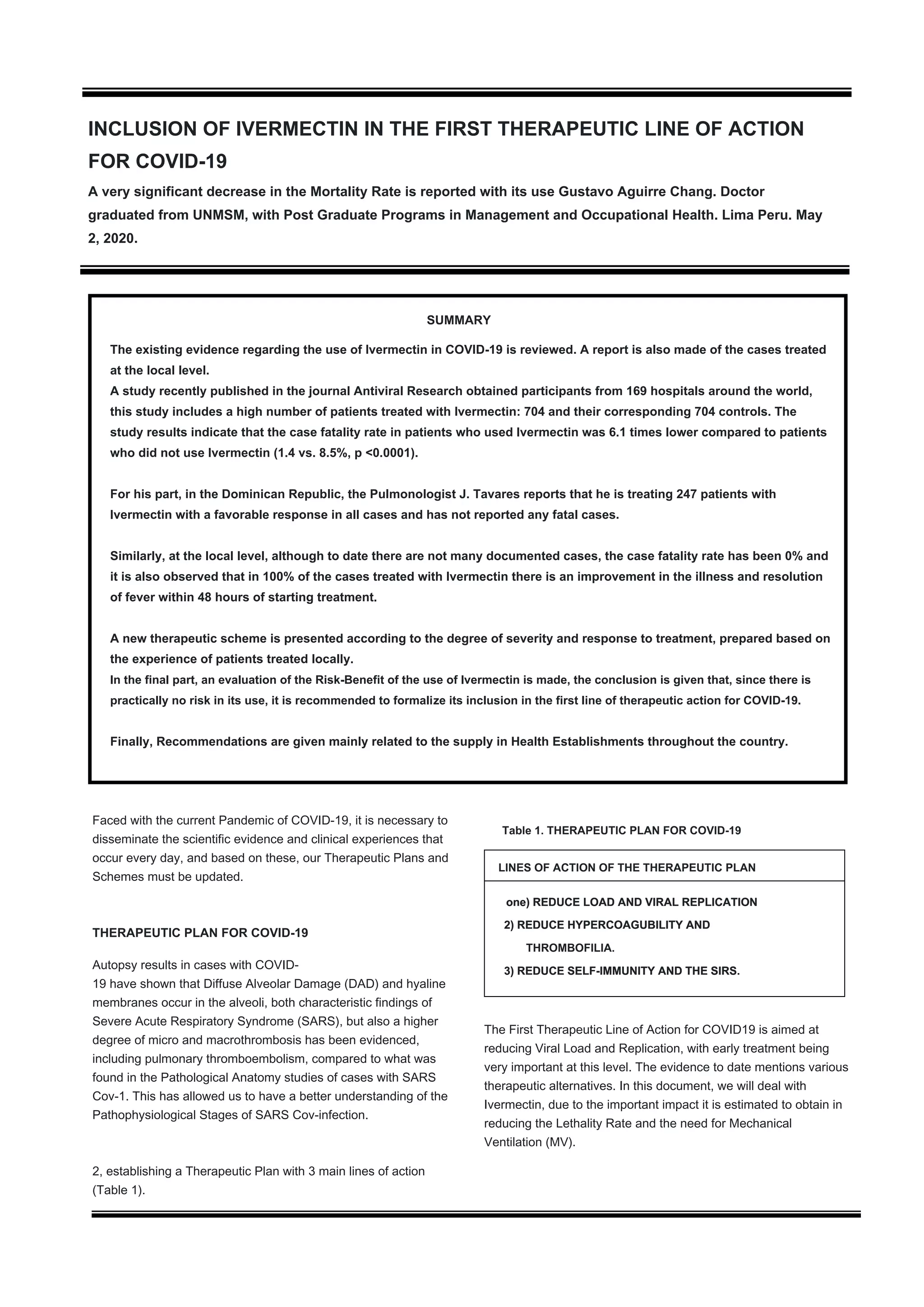
2, establishing a Therapeutic Plan with 3 main lines of action
(Table 1).
Table 1. THERAPEUTIC PLAN FOR COVID-19
LINES OF ACTION OF THE THERAPEUTIC PLAN
one) REDUCE LOAD AND VIRAL REPLICATIONone) REDUCE LOAD AND VIRAL REPLICATION
2) REDUCE HYPERCOAGUBILITY AND2) REDUCE HYPERCOAGUBILITY AND
THROMBOFILIA.
3) REDUCE SELF-IMMUNITY AND THE SIRS.3) REDUCE SELF-IMMUNITY AND THE SIRS.
The First Therapeutic Line of Action for COVID19 is aimed at
reducing Viral Load and Replication, with early treatment being
very important at this level. The evidence to date mentions various
therapeutic alternatives. In this document, we will deal with
Ivermectin, due to the important impact it is estimated to obtain in
reducing the Lethality Rate and the need for Mechanical
Ventilation (MV).
Dr. Gustavo Aguirre ChangDr. Gustavo Aguirre Chang Medical Graduated from UNMSM. Peru.
2
BACKGROUND AND SAFETY OF THE USE OF IVERMECTIN
Ivermectin is an antiparasitic considered by the WHO as an
essential drug, approved by the FDA from the USA, and widelyessential drug, approved by the FDA from the USA, and widely
used in humans worldwide for almost 40 years. Until 2008, close to
2,000 million tablets had been administered to more than 68
million people in Africa, Latin America and Yemen, with which
Onchocerciasis was eradicated and was considered by the WHO
in 2009 as a triumph of humanity. in the face of adversity. It is
therefore a medicine that is widely known for its use in humans, it
is not an experimental medicine, it is free of patents, it is easily
available, its safety is high, it is very well tolerated at the usual
dose of 200 mcg. per kilo of weight, and no relevant side effects
have been reported, even when given in doses that double the
usual ones (1,2,3). In short, we have that it is a f This drug isusual ones (1,2,3). In short, we have that it is a f This drug is
already highly experienced in its use, toxicity has not been
reported in the millions of treatments carried out, and it can be
given safely even at doses well above the regular ones (1-6).
ANTIVIRAL ACTIVITY OF IVERMECTIN
Several studies show that Ivermectin has a broad spectrum
antiviral activity, it has been found in vitro to have an effect against
Dengue (7,8) and HIV1 (8). According to published studies,
Ivermectin can dissociate the preformed IMPα / β1 heterodimer,
responsible for the nuclear transport of viral protein loads (8). The
nuclear transport of viral proteins is essential for the replication
cycle and the inhibition of the host's antiviral response, so acting
on the nuclear transport process may be a viable therapeutic
approach against RNA viruses (8,10,11 ).
REDUCTION OF VIRAL REPLICATION OF SARS COV-2 WITH
IVERMECTIN
The first study on the effect of Ivermectin on COVID-19 has been
led by Kylie Wagstaff of the Biomedicine Discovery Institute (BDI)
of the
Monash University in Melbourne, Australia (12). This study is
available from April 3, 2020 online in the journal Antiviral
Research. It has been carried out in vitro in cell cultures. Viral RNA
was found to be reduced by 93% after 24 hours and by 99.8%
after 48 hours with a single 5 mM dose of Ivermectin given 2 hours
after infection with SARS-CoV-2. This equates to approximately a
5,000-fold reduction in coronavirus RNA in 48 hours. At 72 hours
no further reductions were observed. The IC50 of the Ivermectin
treatment was determined to be ~ 2mM under these conditions
and the
Authors reported that no toxicity was observed at any of the
concentrations evaluated. The authors They state that it can beconcentrations evaluated. The authors They state that it can be
widely used to treat affected populations since Ivermectin is
already approved by the FDA for human use.
FIRST PUBLISHED STUDY OF THE USE OF IVERMECTIN IN
COVID-19 INCLUDES 704 CASES WORLDWIDE
The first published study of the use of Ivermectin in COVID-19
patients is titled: “Usefulness of Ivermectin in COVID-19 Illness”
(14,15), has been made available online since April 19, 2020 in the
website of the well-known international journal Antiviral Research.
This is an international, multicenter, observational study that uses
prospectively collected data on patients diagnosed with COVID-19
between January 1 and March 31,
2020.
We used an international, unidentified, multi-agency database of
healthcare outcomes that meets FDA requirements for the data it
collects. The patients correspond to hospitalized patients
diagnosed with COVID-19 confirmed by PCR laboratory test.
Obtaining participants from 169 hospitals around the world, the
study includes a high number of patients with COVID-19 treated
with Ivermectin: 704 and their corresponding 704 controls. Of the
704 treated with Ivermectin, 64.1% were from North American
Hospitals, 17.0% from Europe, 8.7% from Asia,
5.1% from Africa, 5.0% from South America and 0.1% from
Australia. To obtain the 704 controls, the
68,230 hospitalized patients who were not treated with Ivermectin.
Pairing was performed to match age, sex, race, or ethnicity
groups, comorbidities, and a disease severity score (SOFA). The
average age was
53.7 years (+/- 17 years).
The average Ivermectin patient received was 150 mcg / Kg in one
dose.
The results of the study indicate that, in those who required MV,
the case fatality rate was significantly lower in patients in the
Ivermectin group (7.3% vs. 21.3%) and the General case fatality
rate was lower in the group with Ivermectin (1.4 vs. 8.5%, prate was lower in the group with Ivermectin (1.4 vs. 8.5%, p
<0.0001).
The results of this first study are very significant in terms of
reducing the Case fatality rate, this was 6.1 times lower comparedreducing the Case fatality rate, this was 6.1 times lower compared
to patients who did not use Ivermectin (1.4 vs. 8.5%), this is in
terms of General Lethality. In the analysis of the case fatality rate
of only those who required MV, case fatality decreased 2.9 times
(7.3% vs. 21.3%), which is also significant, despite being
Dr. Gustavo Aguirre ChangDr. Gustavo Aguirre Chang Medical Graduated from UNMSM. Peru.
3
an advanced stage of the disease. It should also be borne in mind
that these results have been obtained with an average dose of 150
mcg / kg, which is below the usual dose of 200 mcg / kg.
REPORT OF 247 CASES WITH COVID-19 TREATED WITH
IVERMECTIN BY A PHYSICIAN PNEUMOLOGIST IN REP.
DOMINICAN
The Pneumologist of the Dominican Republic, Johnny Tavárez
Chaplain of the city of Puerto Plata, who has almost 30 years of
professional experience, since April 18, 2020, gave interviews to
the media stating that he was successfully using the Ivermectin to
treat patients with COVID-19 (15,16). He explained that the
treatment he performs consists of giving 2 6 mg tablets (12mg of
Ivermectin) a day for 2 days (this is equivalent to a dose per day of
between 150 to 200 mcg per kilo). And in those who have more
than 80 kilos, the dose it gives is 3 tablets of 6 mg (18mg) per day
for 2 days (this is equivalent to a dose per day of between 150 to
225 mcg per kilo) (16).
The Doctor points out that the Ivermectin given from the first
Phases of the disease is very effective and the results are very
good, in most cases before 24 hours they were without symptoms.
He also commented that even cases with more than 50% lung
involvement responded very well to treatment. None of the treated
patients has had complications. It has not manifested any fatal
case, so it would be obtaining a Mortality Rate of 0%. Side effects
have been minimal, the most frequent were nausea and gastric
discomfort, and one patient had hives.
The Doctor indicates that 247 patients are being treated with
Ivermectin as of April 28, 2020 (17), all with favorable results. Of
the 247 cases, more than 100 have received only Ivermectin, and
in the remaining cases they initially received Hydroxychloroquine,
which indicates that they discontinued since this drug was
depleted in the city and this was also one of the reasons for
starting with Ivermectin. They are currently conducting an
information survey for a retrospective study. In the follow-up of the
treated cases, none have returned complicated and they are
apparently healthy.
DEVELOPING STUDIES
The Clinicaltrials.gov website (18) is a database of clinical studies.
As of 04.30.20 there are 4 studies that include Ivermectin hoping
to recruit patients. The first is a double-blind trial that will combine
Hydroxychloroquine with Ivermectin, the second and third will
combine Nitazoxamide with Ivermectin, and the fourth is a real life
study36 testing various drugs against COVID-19.
At the local level, a Research Protocol has been drawn up to carry out a study to
evaluate the efficacy and safety of Ivermectin against Hydroxychloroquine as a first-line
treatment in patients with COVID-19 infection. It is mentioned that the study would be
carried out at the Edgardo Rebagliati Martins de EsSalud National Hospital (19).
Regarding the doses to be used in this study, for Mild cases they consider a single dose
of 300 mcg per Kg of weight on an empty stomach, and for Moderates 2 doses of 300
mcg per Kg of weight on an empty stomach every 24 hours. On the other hand, on the
website of a media outlet in Argentina, the news "Researchers promote certain drugs for
the treatment of COVID 19" is published (20), Its content shows the study to be carried
out in a Hospital in Argentina by a group of Doctors. In its scheme, for Moderate cases,
the established dose is 24 mg or 400 mcg per kilogram given orally, in 1 dose. For
severe cases the indication is to give 24 mg. via nasogastric tube. Remaining the dose of
200 mcg per kilo for mild cases. Finally, the biotech company MedinCell has been
working on a long-acting injectable version of Ivermectin for use against Malaria before.
They point out that it is a known medicine, used for a long time and with few undesirable
effects. It is now in the company's interest to investigate its potential efficacy against
SARS CoV-2 (21). the established dose is 24 mg or 400 mcg per kilogram given orally, in
1 dose. For severe cases the indication is to give 24 mg. via nasogastric tube. Remaining
the dose of 200 mcg per kilo for mild cases. Finally, the biotech company MedinCell has
been working on a long-acting injectable version of Ivermectin for use against Malaria
before. They point out that it is a known medicine, used for a long time and with few
undesirable effects. It is now in the company's interest to investigate its potential efficacy
against SARS CoV-2 (21). the established dose is 24 mg or 400 mcg per kilogram given
orally, in 1 dose. For severe cases the indication is to give 24 mg. via nasogastric tube.
Remaining the dose of 200 mcg per kilo for mild cases. Finally, the biotech company
MedinCell has been working on a long-acting injectable version of Ivermectin for use
against Malaria before. They point out that it is a known medicine, used for a long time
and with few undesirable effects. It is now in the company's interest to investigate its
potential efficacy against SARS CoV-2 (21). The biotech company MedinCell has been
working on a long-acting injectable version of Ivermectin for use against Malaria. They point out that it is a k
PREPARATION OF A FIRST SCHEME OF IVERMECTIN
TREATMENT
Locally, in the City of Lima, some Doctors individually started
giving Ivermectin treatment from mid-April 2020. Based on the
studies and experiences mentioned, a group of Doctors graduated
from Promotion 83 of the Faculty of Medicine of San Fernando of
the UNMSM, all with more than 27 years of professional
experience, we review the safety of the use of Ivermectin. It was
agreed that no major adverse effects have been reported and that
these are rare and mild. The presence of stomach upset or pain,
dizziness, nausea, blurred vision, diarrhea and decreased appetite
are reported more frequently. A First Ivermectin Treatment
Scheme for COVID-19 was then prepared (see Table 2).
This Scheme was included in a larger table describing the
THERAPEUTIC PLAN AND POTENTIAL THERAPIES FOR
COVID-19, which was disseminated both within the group of
Medical graduates of UNMSM, as well as outside the group.
Based on the experience with the cases that were being treated
and with greater safety in the use of Ivermectin, the Table of the
THERAPEUTIC PLAN was updated, which was shared in a disin-
Dr. Gustavo Aguirre ChangDr. Gustavo Aguirre Chang Medical Graduated from UNMSM. Peru.
4
Teresada with many more Doctors, here is included the Ivermectin
Treatment Scheme. To date, several MINSA, EsSalud and Private
Hospitals and Health Establishments in the country, as well as
Doctors in their individual practice, have started using Ivermectin in
the first line of Therapeutic Action against COVID-19.
Table 2. FIRST ELABORATED TREATMENT SCHEME OF
IVERMECTIN FOR COVID-19
(version on 04-22-20)
IVERMECTIN FOR COVID-19 Presentation:
6mg / ml bottle.
General dosage: 1 drop per Kilo weight.General dosage: 1 drop per Kilo weight.
1 time a day for 2 days.
Presentation: 6mg tablets.
Adult Dose: 2 tab. daily for 2 days.
If it weighs between 80 to 110 Kg: give 3 tab. daily x 2 days. If it
weighs more than 110 Kg: give 4 tab. daily x 2 days. Do not take it
together with Juices (it reduces its effect), better to take it alone and then
take a glass of water. Do not take it together with food, take it at least 2
hours away from food (before and after).
In case of a history of gastritis, gastric discomfort, nausea or any
other reason for greater oral intolerance, give the dose divided
into 2 parts with a difference of 3 hours, this to reduce the side
effects (more frequently gastrointestinal) that it may cause. In
Severe and Critical Cases, in which the viral load is higher and
persistent, in case there is almost no improvement after the 2nd
dose, it is recommended to give additional daily doses until there
are no symptoms and evident signs of lung disease , such as
dyspnea, radiography or pathological ultrasound.
In our country, the most available presentation is in 6mg / ml
bottles. In this presentation it is indicated that 30 drops are
equivalent to 1 milliliter, which is a difference with the equivalence
between 20 drops and 1 milliliter that is usually handled with other
drugs that are given in drops.
Each drop contains 200 mcg, and 30 drops equals 6 mg of
Ivermectin. These equivalences are important to have clear, so as
not to give lower or higher doses than what is indicated in the
Scheme.
Another situation to take into account is that, although according to
what is indicated on the bottle, it should yield 150 drops in total, in
practice the yield ranges from 130 to 150 drops.
By not yielding more than 150 drops, if the patient weighs more than
74 kg, with 1 bottle it will not be enough to complete the 2nd dose,
but if it is a Mild or Moderate case without Risk Factors and whose
evolution is not unfavorable, it is very likely that with the 1st dose the
improvement will be significant, so the 2nd dose may be less in
number of drops than the 1st dose (whatever is left of the bottle).
It is important to know that orange juice has been identified to
decrease the oral bioavailability of Ivermectin (22). Therefore, it
should not be given with orange juice or from other fruits since
these contain components that are inhibitors of certain transporters
of Ivermectin and reduce their effect. The patient and family should
be instructed not to take antipyretics or anti-inflammatories
(Paracetamol or NSAIDs), since these mask how the disease
evolves and does not allow a good assessment of the response to
treatment. Drug interactions with Barbiturates, benzodiazepines,
sodium valproate are mentioned in the medical literature, noting
that association with GABA activity enhancers is not
recommended. Alcohol increases the plasma concentration of
Ivermectin.
CLASSIFICATION OF CASES FOR IVERMECTIN TREATMENT
To indicate the doses for Ivermectin Treatment, the case must first
be classified according to its severity and the presence or not of
Risk Factors. With this information the
treatment.
Subsequently, according to the response to treatment, it is decided
how to continue with it. CLASSIFICATION ACCORDING TO
SEVERITY The first classification to be made is according to the
severity of the case, in a practical way we handle the following
types of cases, going from least to most severe:
to) Asymptomatic (or with very mild symptoms and notto) Asymptomatic (or with very mild symptoms and not
Respiratory).
b) Mild.
c) Moderate.
d) Severe.
e) Critical.
Asymptomatic cases or those with very mild and non-respiratory
symptoms do not warrant treatment with Ivermectin, nor do Mild
cases that do not present Risk Factors. To avoid the unavailability
of the drug, whenever possible, its use should be reserved for
Moderate, Severe and Critical cases. To determine that a case is
Mild, the important thing is to corroborate that it does not present
dyspnea or symptoms or signs of lung involvement.
Moderate cases that already have dyspnea or respiratory distress,
but with exertion (when climbing stairs, walking, bathing), and have
an increase in respiratory rate, which is usually greater than 22. In
Severe cases, the presence of acute respiratory infection with
bilateral pulmonary compromise, dyspnea is almost constant or
occurs when carrying out activities with little effort, when talking or
feeding. They may present clinical signs of muscle fatigue such as
nasal flutter, accessory muscle use (pulling), chest-abdominal
imbalance.
Dr. Gustavo Aguirre ChangDr. Gustavo Aguirre Chang Medical Graduated from UNMSM. Peru.
5
Critical cases are patients who qualify for ICU care with
Mechanical Ventilation (MV). Viral load in Severe cases has been
found to be 60 times higher than in Mild cases. Severe cases apart
from the higher viral load, have a longer period of virus elimination.
RISK FACTORS: two of the main risk factors are older age and
male sex. And the most frequent and important comorbidities are
Arterial Hypertension, Diabetes, Obesity, Coronary Diseases,
Cerebrovascular Diseases, Asthma, Chronic Lung Disease,
Thromboembolic Disease, Recent Major Surgery, Kidney Failure,
among others.
RESPONSE TO TREATMENT AND ESTIMATED VIRAL LOAD
LEVEL
The day after starting treatment, the response to treatment with
Ivermectin should be assessed, and according to this it is
established whether additional doses will be necessary or if the
dose of Corticosteroids, Low Molecular Weight Heparin is added or
increased (LMWH), Antibiotics or other medication. Based on
response to treatment, one can estimate Viral Load. If the response
is given within 12 hours and with resolution of all symptoms, it is
estimated that the Viral Load has been low.
REPORT OF CASES WITH COVID-19 TREATED WITH
IVERMECTIN IN PERU
As for the cases treated by our group of Doctors graduated from
the San Fernando Medical School of the UNMSM, to date there
are 36. Below, 7 of the treated cases are described:
Case 1 : Reported by Dr. Gustavo Aguirre Chang. 86-year-old man,Case 1 : Reported by Dr. Gustavo Aguirre Chang. 86-year-old man,
who lives very close to the Angamos Hospital in Miraflores, Lima,
with an 8-day fever of between 38 and 39 ° C, with controlled
diagnoses of Diabetes and Hypertension. he did not present
dyspnea on exertion. He stayed at home those days taking
Paracetamol for fever and gargling 2 to 3 times a day. It weighs 74
kg. It was indicated to suspend the Antipyretics so as not to mask
the response to the treatment.
On the 8th day of symptom onset he took a 1st dose of 70 drops at
4pm and Dexamethasone 1 tab. from 4mg to 6pm. At 7pm he
presented sweats. At 7.30pm he no longer had a fever, and did not
present it again later. At 11pm on the same day he presented
sweating again.
The next day he woke up without discomfort and without fever. At 9am
she took the 2nd dose, only 64 drops which is what was left of the
bottle. At 11:30 am, he called by phone, saying that he already felt
cured. In the control the next day, he did not report symptoms.
This patient is classified as: a) Mild Case with Risk Factors and b)
With Very Quick Response to Treatment (3.5 hours) / Low Viral
Load. Gargling
Carried out 3 times a day have helped to lower the Viral Load, and this
made a very quick response possible in reducing fever and general
discomfort.
Case 2 : Reported by Dr. George Bernui Velarde. 62-year-oldCase 2 : Reported by Dr. George Bernui Velarde. 62-year-old
woman, with HT and Ca in treatment, with 3 days with sore throat
and headache that becomes intense from the 2nd day. On the 3rd
day, symptoms increase and coughs, myalgias, and dyspnea on
exertion and when talking (the doctor listens with dyspnea when
communicating with her) are added. He has not reported a fever, it
is understood that it was because he was taking 1gr. Paracetamol
for intense headache. It weighs 65Kg. Start 1st dose of Ivermectin
that 3rd day at 4pm (60 drops). The next day, at 9am, take the 2nd
dose (55 drops) and add 4mg Dexamethasone. for 2 days.
Presents progressive clinical improvement. After 2 days of taking
the 2nd dose (6th day from the onset of symptoms), only mild
headache and myalgia are reported, there is no more dyspnea. On
the 7th day, he reports a sense of well-being of 8 on a scale of 1 to
10.
The case is evaluated with Dr. Gustavo Aguirre, the patient is
classified as: a) Moderate Case (due to dyspnea when talking)
with Risk Factors and b) With 70% Response in 2 days and Total
in 7 days / Medium Load Viral.
Case 3 : Reported by Dr. Ruth Araníbar Rivero and Dr. MartínCase 3 : Reported by Dr. Ruth Araníbar Rivero and Dr. Martín
Santos Reyes.
60-year-old man with controlled Diabetes. The disease began with
aphonia, a slight feeling of discomfort in the pharynx, discreet nasal
congestion. He gargled water with lemon and salt, went to a pharmacy
where he was prescribed an antibiotic with which he improved as he
no longer suffered from hoarseness. On the 6th day after the onset of
symptoms, he began to present back pain that progressively
intensified and presented general discomfort. From the 9th day after
the onset of symptoms, he presents sweating at night (unusual for
him), the temperature was not measured on those days. When he did
not improve, on the 13th day in the morning he went to the Clinic in
SJL, and stated that when he entered the Clinic he had a feeling of
intense shortness of breath, they gave him the Rapid Test for
COVID-19, which came out positive, they did a lung tomography on
which
report the
Diagnosis of Atypical Pneumonia COVID-19 vs Influenza, they
indicate Azithromycin of 500mgs for 5 days and Paracetamol, states
that they told him that oxygen saturation was fine. At home he felt
tired, the night of that 13th day he had a fever with 38.5 ° C axillary,
Glucose 130 (he had not taken his medicine in the morning because
of the rush). Dr. Araníbar presents the case to Dr. Martin Santos and
it is decided to start treatment with Ivermectin. She weighs 78Kg, on
the 14th day at 2pm she takes the 1st dose of 78 drops, without food
2 hours before or after, in addition she is indicated for 2 doses of
Dexamethasone of 4 mg. VO and continue with Azithromycin.
Dr. Gustavo Aguirre ChangDr. Gustavo Aguirre Chang Medical Graduated from UNMSM. Peru.
6
At 8pm on the same day, she no longer had a fever, and almost without
discomfort, in the telephone communication around 10pm she did not present
cough or dyspnea.
The next day (15th day), he stated that after several days he had
slept continuously from 12pm to 5am, he no longer had a fever or
cough, he got up to clean and tidy up his room a little, he did not
feel tired, he asked for permission for bathing, it feels good. At
11.00 am take the 2nd dose of Ivermectin to finish the treatment.
Reviewing, we have that this patient is classified as:
a) Moderate Case (for presenting Dyspnea) with Risk Factors and
b) With Rapid Response to Treatment (6 hours) / Mild to Moderateb) With Rapid Response to Treatment (6 hours) / Mild to Moderate
Viral Load. The gargling he performed has helped him lower his
Viral Load, which in turn made a quick response possible in
reducing fever and other symptoms.
Case 4 : Reported by Dr. Fernando Zarzosa Salcedo 70-year-oldCase 4 : Reported by Dr. Fernando Zarzosa Salcedo 70-year-old
woman, diagnosed with mild bronchiectasis, starts symptoms with
fever and general discomfort, after 6 days dyspnea, chest pain and
higher fever are added at night,
On the 8th day of the onset of symptoms take 1st Dose, 80 drops,
and the next day take 2nd Dose of 65 drops (which reached from the
bottle). After taking the 2nd Dose the fever decreased, dyspnea
persists, but has improved. He says he feels better.
On the 10th day, the temperature is 38 ° C and a little general
discomfort.
The case is evaluated with Dr. Gustavo Aguirre, it is classified as:
a) Moderate to Severe Case with Risk Factors and b) With 70%
Response in 2 days / High Viral Load and Persistence. 2 additional
doses of Ivermectin are indicated.
Case 5 : Reported by Dr. Miguel Zapata Rojas. 60-year-old man,Case 5 : Reported by Dr. Miguel Zapata Rojas. 60-year-old man,
with Obesity, Weight: 86 Kg., With 5 days of fever between 38 to
39 ° C, with cough, sore throat, begins to present dyspnea on the
5th day that increases progressively. Is
taken to the
Emergency of a National Hospital, where he is admitted with
COVID-19 Pneumonia and Acute Respiratory Failure Diagnostics,
he is given Oxygen. Upon admission, he takes the 1st dose of 80
drops of Ivermectin. At 7 hours, a tomography was performed,
showing bilateral pulmonary infiltrates. Positive PCR Test
confirmed. Has analysis from 04.24.20 = Dimer D 1.12, DHL: 521,
PCR: 362, HB: 11.8, PLAQ:
349, LEUC: 17,020 (EOS: 0%, LIF: 10%, ABAST. 0%).
And from 04.28.20 = D-dimer 0.62, DHL: 482, PCR:
186, HB: 11.8, PLAQ: 413, LEUC: 9,850 (ABAST. 0%). Ferritin;
1.650, FA: 114, GCTP: 373, CPK: 95 The day after his admission to
the Hospital (6th day from the onset of symptoms) he received the
2nd dose in the morning consisting of 70 drops (what was left of the
bottle). Presents progressive clinical improvement, significantly
reducing dyspnea and no longer requiring oxygen
after 2 days of starting. But on days 9 and 10 from the onset of
Symptoms, he presented episodes of Dyspnea with decreased
oxygen saturation to between 92 to 94%, and on one occasion
after effort reached 84%.
The case is evaluated with Dr. Gustavo Aguirre, it is classified as:
a) Severe Case with Risk Factors and b) With 70% Response in 2
days and 75% in 9 days / High Viral Load and Persistence, with
improvement in the first days after 2 doses of Ivermectin, but
without resolution of symptoms. 2 additional doses of Ivermectin
are indicated, to end the alleged Persistent Viral Load. 3rd and 4th
doses of 129 drops are indicated, this is 300 mcg / kg,
recommending take it in 2 parts. After the 4th dose, there is clinical
improvement, his O2 Saturation is between 92% and 94% and the
patient manifests feeling well.
Case 6 : Reported by Dr. Manuel Yui Cerna. 83-year-old male, with aCase 6 : Reported by Dr. Manuel Yui Cerna. 83-year-old male, with a
Diagnosis of Prostate Adenoma with surgical treatment postponed by
the State of Emergency. He refers to presenting fever, cough and
general malaise for 7 days. He went to a private doctor on the 3rd
day of symptom onset and was prescribed Penicillin x 3 days, it
worsens and dyspnea is added from the 6th day. On the 7th day he
goes to the VES Hospital (district where he lives), and they tell him
that due to his very poor condition, he must go to the National
Hospital, the family says that they choose not to take him to the
National Hospital. Family member communicates with Dr. Yui, who
indicates starting with Ivermectin. It weighs 70 kg, so all the doses
given to it have all been 70 drops. By decision of the patient and their
relatives they choose to try to carry out the treatment at home. Take
the 1st dose on the 7th day at 9pm. The 2nd dose is taken the next
day at 10am (8th day from the onset of symptoms), and in the
afternoon the fever stops and dyspnea is reduced.
The next day, 9th day, a chest X-ray was performed, showing a
bilateral pulmonary infiltrate with involvement of around 35% of the
lung fields.
The case is reviewed with Dr. Gustavo Aguirre, it is classified as:
a) Severe to Critical Case with Risk Factors and b) With 70%
Response in 2 days and 80% in 4 days / High Viral Load and
persistent, and who has responded to treatment with Ivermectin,
no longer has a fever, but dyspnea and lung involvement
evidenced by radiography are maintained. The Family asks to
continue with home management, but it is explained that it must be
under the modality of Home Hospitalization, that is, with oxygen
provision and with more frequent medical controls. It is concluded
that to reduce the pulmonary compromise and the Viral Load it will
require at least 2 more doses, it is also indicated Corticoids and
Azithromycin. On the 11th day, the day after the 4th dose, she still
had dyspnea and they reported a little diarrhea.
Dr. Gustavo Aguirre ChangDr. Gustavo Aguirre Chang Medical Graduated from UNMSM. Peru.
7
between 90 to 92% without Oxygen, and with medicinal Oxygen it
rises to 98%. 1st ampoule of Enoxaparin is applied, continuous
with 50mg dose of Prednisone PO and gargling. Take 5th dose of
Ivermectin, 100 drops are indicated instead of 70 (300 mcg / kg), it
is indicated to take it in two parts, for reporting that you had
diarrhea during the day and to reduce adverse effects. They report
that 8 people live in the home, they are instructed to ventilate and
disinfect the home environments. Control X-ray is awaited. After
5th dose improves Oxygen Saturation to 93 to 94%.
This case, to date is the only one in which it is required to give 5
doses, it is understood by the severity that the disease reached
when not receiving specific treatment and for which it was indicated
to go to a National Hospital to be admitted. After the 2nd dose,
fever ceased, but dyspnea remained. It is presumed that it is
requiring more days of Ivermectin to reduce the High Viral Load
and that we have observed persists several more days in Severe
and Critical cases.
Case 7 : Reported by Dr. Eduardo A. Castillo Saavedra.Case 7 : Reported by Dr. Eduardo A. Castillo Saavedra.
A 58-year-old male patient began illness on April 13 with general
discomfort, body pain predominantly of large joints.
Day 2: fever is added in peaks of 38.4 to 39.6 ° C, Day 3 Diarrhea
is added, isolation begins, treatment with Paracetamol 4 gr is
given. daily and hydration on demand. Day 4: Nausea is added.
Day 5: Diarrhea is associated with tenesmus, 2 vomiting, fever
becomes more frequent. Dry cough is added
Day 6: sudden chest pain at dawn. It dawns with FR: 30-32 rpm
and saturation of 92%, it is taken to HNERM where a Quick Test is
carried out, which comes out Non-reactive. Coverage is started
with Azithromycin 500mg / d and they send you home with
outpatient treatment.
Day 7: take Azithromycin 2nd dose, continued with paracetamol,
increases respiratory difficulty with small efforts (brushing teeth).
Crackles appear on left base.
Day 8: Azithromycin 3rd dose, dyspnea is greater until resting.
Runs are added, O2 Saturation (SatO2): 89%, crackles are added
on right base. The feverish spikes give way; diarrhea and vomiting
persists (2 opportunities). He is taken to the National Hospital, his
Molecular Test (PCR) result is Positive, he goes on to emergency
observation with Pneumonia Diagnosis. Low flow fiO2 oxygen
therapy is started: 40% by CBN.
Day 9: Family on their own initiative gives Ivermectin 90 drops (the
2nd bottle remains in the patient's pocket with the indication to take
it after 24 hours, but it is not followed). In emergency observation
they start Hydroxychloroquine,
Enoxaparin, keep going with
Azithromycin and passes Venturi to FiO2 100%
Day 10: AGA: Alveolar-arterial oxygen gradient: PaO2 / FiO2
(PaFiO2): 308, SatO2 95% with Venturi Mask at Fio 100%. Go to
Priority II at CELIM. Laboratory results are received: LDH: 680,
Ferritin in 1993, Lymphopenia 645. The CT showed a CORADS 6.
Day 13 (April 26): at night the Family gives you the 2nd Dose of
Ivermectin, they give you the entire content of 1 bottle that is
equivalent to 30mg (150 drops). Day 14: The PaFi falls to 211,
sedation with Haloperidol is decided, pronation begins. Day 15:
SatO2 is 100% with MV, it goes to CBN 5 liters, it begins to tolerate
taking food. AGA shows increased PaFiO2.
Day 16: Continue in pronation, with Sat02: 97%, go to CBN with 4
liters, start talking without dyspnea. Day 17: Low CBN to 1 liter: with
Sat02: 98% at rest, you can go to the bathroom without desaturating,
you eat normal, eat all your food.
Day 18: Very favorable laboratory controls. The Rapid Test for
COVID results in Positive IgM and IgG.
Day 19: he is discharged from the National Hospital, recovered.
Apart from the cases treated by our group of Medical graduates
from UNMSM, in a radio interview (23), Cardiologist Walter
Mogrovejo stated that he has treated 12 patients with Ivermectin,
with a favorable response in all and did not report any lethal cases
in which received treatment. He stated that "no patient has
reported that it has not been beneficial" and that the use of
Ivermectin is very safe. The Doctor reported that after receiving the
communication from 3 patients treated with Ivermectin by Dr. Gil
Malca, he began his own experience. He also stated that Doctors
Antonio Camargo and Oliva have also successfully treated
patients with Ivermectin. Adding those treated by the
aforementioned Doctors, they add 46 patients. Reviewing the
cases treated locally with Ivermectin, we have to date that,
The Percentage of patients requiring ICU and / or Mechanical
Ventilation was 0%. Statistically, the number of patients treated is
few, but it is evident that the use of Ivermectin results in a very
significant decrease in the Lethality Rate. We should also mention
that a progressive shortage of the drug was observed in
pharmacies, which is expected to continue to occur as the
favorable results of its use are disclosed.
Dr. Gustavo Aguirre ChangDr. Gustavo Aguirre Chang Medical Graduated from UNMSM. Peru.
8
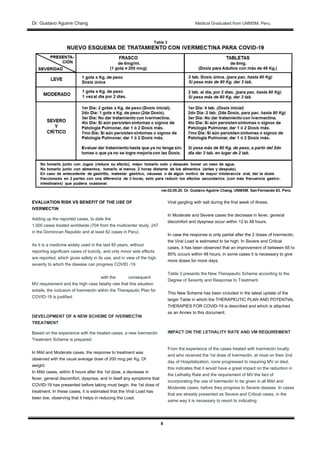
Table 3
EVALUATION RISK VS BENEFIT OF THE USE OF
IVERMECTIN
Adding up the reported cases, to date the
1,000 cases treated worldwide (704 from the multicenter study, 247
in the Dominican Republic and at least 82 cases in Peru).
As it is a medicine widely used in the last 40 years, without
reporting significant cases of toxicity, and only minor side effects
are reported, which gives safety in its use, and in view of the high
severity to which the disease can progress COVID -19,
with the consequent
MV requirement and the high case fatality rate that this situation
entails, the inclusion of Ivermectin within the Therapeutic Plan for
COVID-19 is justified.
DEVELOPMENT OF A NEW SCHEME OF IVERMECTIN
TREATMENT
Based on the experience with the treated cases, a new Ivermectin
Treatment Scheme is prepared.
In Mild and Moderate cases, the response to treatment was
observed with the usual average dose of 200 mcg per Kg. Of
weight.
In Mild cases, within 8 hours after the 1st dose, a decrease in
fever, general discomfort, dyspnea, and in itself any symptoms that
COVID-19 has presented before taking must begin. the 1st dose of
treatment. In these cases, it is estimated that the Viral Load has
been low, observing that it helps in reducing the Load.
Viral gargling with salt during the first week of illness.
In Moderate and Severe cases the decrease in fever, general
discomfort and dyspnea occur within 12 to 48 hours.
In case the response is only partial after the 2 doses of Ivermectin,
the Viral Load is estimated to be high. In Severe and Critical
cases, it has been observed that an improvement of between 65 to
85% occurs within 48 hours, in some cases it is necessary to give
more doses for more days.
Table 3 presents the New Therapeutic Scheme according to the
Degree of Severity and Response to Treatment.
This New Scheme has been included in the latest update of the
larger Table in which the THERAPEUTIC PLAN AND POTENTIAL
THERAPIES FOR COVID-19 is described and which is attached
as an Annex to this document.
IMPACT ON THE LETHALITY RATE AND VM REQUIREMENT
From the experience of the cases treated with Ivermectin locally,
and who received the 1st dose of Ivermectin, at most on their 2nd
day of Hospitalization, none progressed to requiring MV or died,
this indicates that it would have a great impact on the reduction in
the Lethality Rate and the requirement of MV the fact of
incorporating the use of Ivermectin to be given in all Mild and
Moderate cases, before they progress to Severe disease. In cases
that are already presented as Severe and Critical cases, in the
same way it is necessary to resort to indicating
Dr. Gustavo Aguirre ChangDr. Gustavo Aguirre Chang Medical Graduated from UNMSM. Peru.
9
Ivermectin, since it has been observed that there is a direct
relationship between Viral Load and the severity of the disease, so
it is highly probable that Ivermectin, in these advanced cases of
the disease, will have a significant impact on the Lethality Rate .
CONCLUSION
As there is practically no risk in the use of Ivermectin, it is
recommended to formalize its inclusion in the first therapeutic line
of action for COVID-19, to reduce viral load and replication.
RECOMMENDATIONS
• To direct the logistical processes to guarantee the supply of
Ivermectin in the Health Establishments of the country,
including those of the First Level of Care, with the aim of
facilitating the start of treatment in Mild cases with Risk
Factors, Moderate and those who are initiating severe
symptoms, and before they progress to Severe and Critical
cases that require referrals for Hospitalization.
• For a better supply and distribution of Ivermectin at a national
level, the purchases to be made should preferably include the
presentation in tablets, since these have a lower weight than
the bottles, are easier to transport and are not fragile material
such as that of the jars.
• It is recommended to coordinate with Pharmaceutical
Companies and Institutions to guarantee the continuity of
supply necessary to cover the country's demand for this
medicine.
REFERENCES
(one) M Navarro, et al. Safety of high-dose ivermectin: a systematic(one) M Navarro, et al. Safety of high-dose ivermectin: a systematic
review and meta-analysis, Journal of Antimicrobial
Chemotherapy, Volume 75, Issue 4, April 2020, Pages 827–Chemotherapy, Volume 75, Issue 4, April 2020, Pages 827–
834.
(2) Muñoz J, Ballester MR, Antonijoan RM, et al. Safety and(2) Muñoz J, Ballester MR, Antonijoan RM, et al. Safety and
pharmacokinetic profile of fixed-dose ivermectin with an innovative 18mg
tablet in healthy adult volunteers. Plos Neglected Tropical Diseases. 2018
Jan; 12 (1). (3) Moura EB, Maia Mde O, Ghazi M et al. . Salvage treatment ofJan; 12 (1). (3) Moura EB, Maia Mde O, Ghazi M et al. . Salvage treatment of
disseminated strongyloidiasis in an immunocompromised patient: therapy
success with subcutaneous ivermectin. Braz J Infect Dis 2012; 16: 479–81. (4) Zeitlersuccess with subcutaneous ivermectin. Braz J Infect Dis 2012; 16: 479–81. (4) Zeitler
K, Jariwala r, restrepo-Jaramillo r, et al. BMJ Case Rep
published. 2018. (5) Barrett J., et al. Subcutaneous ivermectin use in thepublished. 2018. (5) Barrett J., et al. Subcutaneous ivermectin use in the
treatment
of severe Strongyloides stercoralis infection: two case reports and a
discussion of the literature, Journal of Antimicrobial Chemotherapy, Volume
71, Issue 1, January 2016, Pages 220–
225.
(6) Smit MR, Ochomo EO, Waterhouse D,(6) Smit MR, Ochomo EO, Waterhouse D, et to the.
Pharmacokinetics-Pharmacodynamics of High-dose
Ivermectin with Dihydroartemisinin-Piperaquine on
Mosquitocidal Activity and QT-Prolongation (IVERMAL). Clinical
Pharmacology and Therapeutics. 2019
Feb; 105 (2): 388-401. DOI: 10.1002 / cpt.1219.
(7) Tay MY, Fraser JE, Chan WK, Moreland NJ, Rathore AP,(7) Tay MY, Fraser JE, Chan WK, Moreland NJ, Rathore AP,
Wang C, Vasudevan SG, Jans DA, 2013. Nuclear localization of dengue
virus (DENV) 1-4 non-structural protein 5; protection against all 4 DENV
serotypes by the inhibitor Ivermectin. Antiviral Res. 2013 Sep; 99 (3): 301-6. (8) Wagstaserotypes by the inhibitor Ivermectin. Antiviral Res. 2013 Sep; 99 (3): 301-6. (8) Wagsta
ff, KM; Sivakumaran, H .; Heaton, SM; Harrich, D .;
Jans, DA Ivermectin is a speci fi c inhibitor of importin alpha /
beta-mediated nuclear import able to inhibit replication of HIV-1 and dengue
virus. Biochem. J. 2012, 443, 851–856 (9) Tay MY, Fraser JE, Chan WK,virus. Biochem. J. 2012, 443, 851–856 (9) Tay MY, Fraser JE, Chan WK,
Moreland NJ, Rathore AP,
Wang C, Vasudevan SG, Jans DA, 2013. Nuclear localization of dengue virus
(DENV) 1-4 non-structural protein 5; protection against all 4 DENV serotypes
by the inhibitor Ivermectin. Antiviral Res. 2013 Sep; 99 (3): 301-6. (10) Yangby the inhibitor Ivermectin. Antiviral Res. 2013 Sep; 99 (3): 301-6. (10) Yang
SNY, Atkinson SC, Wang C, Lee A, Bogoyevitch MA,
Borg NA, Jans DA, 2020. The broad spectrum antiviral ivermectin targets
the host nuclear transport importin α / β1 heterodimer. Antiviral Res. Mar
2020. (11) Caly, L .; Wagsta ff, K .; Jans, DA Nuclear tra ffi cking of2020. (11) Caly, L .; Wagsta ff, K .; Jans, DA Nuclear tra ffi cking of
proteins from RNA viruses: Potential target for antivirals? Antivir. Res.
2012, 95, 202–206. (12) Caly, L .; Druce, JD; Catton, MG; Jans, DA; Wagsta ff,2012, 95, 202–206. (12) Caly, L .; Druce, JD; Catton, MG; Jans, DA; Wagsta ff,
KM The FDA-approved Drug Ivermectin inhibits the replication of
SARS-CoV-2 in vitro. Antivir. Res. 2020. (13) Bray, M., Rayner, C., Noël, F.,SARS-CoV-2 in vitro. Antivir. Res. 2020. (13) Bray, M., Rayner, C., Noël, F.,
Jans, D., Wagstaff, K.,
Ivermectin and COVID-19: a report in Antiviral Research, widespread
interest, an FDA warning, two letters to the editor and the authors' responses,
Antiviral Research. (14) Patel, Amit, Usefulness of Ivermectin in COVID-19Antiviral Research. (14) Patel, Amit, Usefulness of Ivermectin in COVID-19
Illness
(April 19, 2020). Available in SSRN:
https://ssrn.com/abstract=3580524 (15) Interview with Pulmonologist Johnnyhttps://ssrn.com/abstract=3580524 (15) Interview with Pulmonologist Johnny
Tavárez Capellán
(22 April 2020). Available in:
https://www.youtube.com/watch?v=tw1hDAiwZQQ (16) El Caribehttps://www.youtube.com/watch?v=tw1hDAiwZQQ (16) El Caribe
newspaper. Medication helps 150 with COVID-
19 in the center of Puerto Plata (April 20, 2020). Available at:
https://www.elcaribe.com.do/2020/04/20/medicamentoayuda-a-150-con-covid-19-en-centro-de-p
(17) Interview with Doctor Johnny Tavárez Capellán (April 28(17) Interview with Doctor Johnny Tavárez Capellán (April 28
2020). Available at: https://youtu.be/FtMZnp-3VsI
(18) Clinicaltrials.gov website. Your Consultation 01.05.20(18) Clinicaltrials.gov website. Your Consultation 01.05.20
on Ivermectin. Available in:
https://clinicaltrials.gov/ct2/results?cond=COVID&term=iver mectin & cntry
= & state = & city = & dist = (19) Research Protocol: Randomized, open study,= & state = & city = & dist = (19) Research Protocol: Randomized, open study,
phase II B controlled to evaluate the efficacy and safety of Ivermectin
versus standard hydroxychloroquine treatment as first-line treatment in
patients with mild and moderate COVID-19 infection at the Edgardo
Rebagliati Martins National Hospital. EsSalud. 2020. (20) Chain nine:Rebagliati Martins National Hospital. EsSalud. 2020. (20) Chain nine:
“Researchers drive certain
drugs for the treatment of COVID 19 ”. Available at:
https://www.cadenanueve.com/2020/04/25/investigadoresimpulsan-detertermina-farmacos-pa
(21) MedinCell Continues its Investigational Pursuit of Ivermectin
Targeting COVID-19 Patients, Available in:
https://www.trialsitenews.com/medincell-continues-itsinvestigational-pursuit-of-ivermectin-targ
(22) SR Vanapalli, Y. Chen, VL Ellingrod, et al. Orange juice
decreases the oral bioavailability of ivermectin in healthy volunteers. 2003
Annual Meeting of the American Society for Clinical Pharmacology and
Therapeutics. Washington (USA), 2–5 April, 2003. (23) Radio RPP: CoronavirusTherapeutics. Washington (USA), 2–5 April, 2003. (23) Radio RPP: Coronavirus
in Peru: Medical experience
it worked in Peruvian patients (April 30, 2020). Available in:
https://rpp.pe/peru/actualidad/coronavirus-en-perutratamiento-experimental-funcio

Ivermectin study on Covid 19 CoronaVirus

  • 1.
    INCLUSION OF IVERMECTININ THE FIRST THERAPEUTIC LINE OF ACTION FOR COVID-19 A very significant decrease in the Mortality Rate is reported with its use Gustavo Aguirre Chang. Doctor graduated from UNMSM, with Post Graduate Programs in Management and Occupational Health. Lima Peru. May 2, 2020. SUMMARY The existing evidence regarding the use of Ivermectin in COVID-19 is reviewed. A report is also made of the cases treated at the local level. A study recently published in the journal Antiviral Research obtained participants from 169 hospitals around the world, this study includes a high number of patients treated with Ivermectin: 704 and their corresponding 704 controls. The study results indicate that the case fatality rate in patients who used Ivermectin was 6.1 times lower compared to patients who did not use Ivermectin (1.4 vs. 8.5%, p <0.0001). For his part, in the Dominican Republic, the Pulmonologist J. Tavares reports that he is treating 247 patients with Ivermectin with a favorable response in all cases and has not reported any fatal cases. Similarly, at the local level, although to date there are not many documented cases, the case fatality rate has been 0% and it is also observed that in 100% of the cases treated with Ivermectin there is an improvement in the illness and resolution of fever within 48 hours of starting treatment. A new therapeutic scheme is presented according to the degree of severity and response to treatment, prepared based on the experience of patients treated locally. In the final part, an evaluation of the Risk-Benefit of the use of Ivermectin is made, the conclusion is given that, since there is practically no risk in its use, it is recommended to formalize its inclusion in the first line of therapeutic action for COVID-19. Finally, Recommendations are given mainly related to the supply in Health Establishments throughout the country. Faced with the current Pandemic of COVID-19, it is necessary to disseminate the scientific evidence and clinical experiences that occur every day, and based on these, our Therapeutic Plans and Schemes must be updated. THERAPEUTIC PLAN FOR COVID-19 Autopsy results in cases with COVID- 19 have shown that Diffuse Alveolar Damage (DAD) and hyaline membranes occur in the alveoli, both characteristic findings of Severe Acute Respiratory Syndrome (SARS), but also a higher degree of micro and macrothrombosis has been evidenced, including pulmonary thromboembolism, compared to what was found in the Pathological Anatomy studies of cases with SARS Cov-1. This has allowed us to have a better understanding of the Pathophysiological Stages of SARS Cov-infection. 2, establishing a Therapeutic Plan with 3 main lines of action (Table 1). Table 1. THERAPEUTIC PLAN FOR COVID-19 LINES OF ACTION OF THE THERAPEUTIC PLAN one) REDUCE LOAD AND VIRAL REPLICATIONone) REDUCE LOAD AND VIRAL REPLICATION 2) REDUCE HYPERCOAGUBILITY AND2) REDUCE HYPERCOAGUBILITY AND THROMBOFILIA. 3) REDUCE SELF-IMMUNITY AND THE SIRS.3) REDUCE SELF-IMMUNITY AND THE SIRS. The First Therapeutic Line of Action for COVID19 is aimed at reducing Viral Load and Replication, with early treatment being very important at this level. The evidence to date mentions various therapeutic alternatives. In this document, we will deal with Ivermectin, due to the important impact it is estimated to obtain in reducing the Lethality Rate and the need for Mechanical Ventilation (MV).
  • 2.
    Dr. Gustavo AguirreChangDr. Gustavo Aguirre Chang Medical Graduated from UNMSM. Peru. 2 BACKGROUND AND SAFETY OF THE USE OF IVERMECTIN Ivermectin is an antiparasitic considered by the WHO as an essential drug, approved by the FDA from the USA, and widelyessential drug, approved by the FDA from the USA, and widely used in humans worldwide for almost 40 years. Until 2008, close to 2,000 million tablets had been administered to more than 68 million people in Africa, Latin America and Yemen, with which Onchocerciasis was eradicated and was considered by the WHO in 2009 as a triumph of humanity. in the face of adversity. It is therefore a medicine that is widely known for its use in humans, it is not an experimental medicine, it is free of patents, it is easily available, its safety is high, it is very well tolerated at the usual dose of 200 mcg. per kilo of weight, and no relevant side effects have been reported, even when given in doses that double the usual ones (1,2,3). In short, we have that it is a f This drug isusual ones (1,2,3). In short, we have that it is a f This drug is already highly experienced in its use, toxicity has not been reported in the millions of treatments carried out, and it can be given safely even at doses well above the regular ones (1-6). ANTIVIRAL ACTIVITY OF IVERMECTIN Several studies show that Ivermectin has a broad spectrum antiviral activity, it has been found in vitro to have an effect against Dengue (7,8) and HIV1 (8). According to published studies, Ivermectin can dissociate the preformed IMPα / β1 heterodimer, responsible for the nuclear transport of viral protein loads (8). The nuclear transport of viral proteins is essential for the replication cycle and the inhibition of the host's antiviral response, so acting on the nuclear transport process may be a viable therapeutic approach against RNA viruses (8,10,11 ). REDUCTION OF VIRAL REPLICATION OF SARS COV-2 WITH IVERMECTIN The first study on the effect of Ivermectin on COVID-19 has been led by Kylie Wagstaff of the Biomedicine Discovery Institute (BDI) of the Monash University in Melbourne, Australia (12). This study is available from April 3, 2020 online in the journal Antiviral Research. It has been carried out in vitro in cell cultures. Viral RNA was found to be reduced by 93% after 24 hours and by 99.8% after 48 hours with a single 5 mM dose of Ivermectin given 2 hours after infection with SARS-CoV-2. This equates to approximately a 5,000-fold reduction in coronavirus RNA in 48 hours. At 72 hours no further reductions were observed. The IC50 of the Ivermectin treatment was determined to be ~ 2mM under these conditions and the Authors reported that no toxicity was observed at any of the concentrations evaluated. The authors They state that it can beconcentrations evaluated. The authors They state that it can be widely used to treat affected populations since Ivermectin is already approved by the FDA for human use. FIRST PUBLISHED STUDY OF THE USE OF IVERMECTIN IN COVID-19 INCLUDES 704 CASES WORLDWIDE The first published study of the use of Ivermectin in COVID-19 patients is titled: “Usefulness of Ivermectin in COVID-19 Illness” (14,15), has been made available online since April 19, 2020 in the website of the well-known international journal Antiviral Research. This is an international, multicenter, observational study that uses prospectively collected data on patients diagnosed with COVID-19 between January 1 and March 31, 2020. We used an international, unidentified, multi-agency database of healthcare outcomes that meets FDA requirements for the data it collects. The patients correspond to hospitalized patients diagnosed with COVID-19 confirmed by PCR laboratory test. Obtaining participants from 169 hospitals around the world, the study includes a high number of patients with COVID-19 treated with Ivermectin: 704 and their corresponding 704 controls. Of the 704 treated with Ivermectin, 64.1% were from North American Hospitals, 17.0% from Europe, 8.7% from Asia, 5.1% from Africa, 5.0% from South America and 0.1% from Australia. To obtain the 704 controls, the 68,230 hospitalized patients who were not treated with Ivermectin. Pairing was performed to match age, sex, race, or ethnicity groups, comorbidities, and a disease severity score (SOFA). The average age was 53.7 years (+/- 17 years). The average Ivermectin patient received was 150 mcg / Kg in one dose. The results of the study indicate that, in those who required MV, the case fatality rate was significantly lower in patients in the Ivermectin group (7.3% vs. 21.3%) and the General case fatality rate was lower in the group with Ivermectin (1.4 vs. 8.5%, prate was lower in the group with Ivermectin (1.4 vs. 8.5%, p <0.0001). The results of this first study are very significant in terms of reducing the Case fatality rate, this was 6.1 times lower comparedreducing the Case fatality rate, this was 6.1 times lower compared to patients who did not use Ivermectin (1.4 vs. 8.5%), this is in terms of General Lethality. In the analysis of the case fatality rate of only those who required MV, case fatality decreased 2.9 times (7.3% vs. 21.3%), which is also significant, despite being
  • 3.
    Dr. Gustavo AguirreChangDr. Gustavo Aguirre Chang Medical Graduated from UNMSM. Peru. 3 an advanced stage of the disease. It should also be borne in mind that these results have been obtained with an average dose of 150 mcg / kg, which is below the usual dose of 200 mcg / kg. REPORT OF 247 CASES WITH COVID-19 TREATED WITH IVERMECTIN BY A PHYSICIAN PNEUMOLOGIST IN REP. DOMINICAN The Pneumologist of the Dominican Republic, Johnny Tavárez Chaplain of the city of Puerto Plata, who has almost 30 years of professional experience, since April 18, 2020, gave interviews to the media stating that he was successfully using the Ivermectin to treat patients with COVID-19 (15,16). He explained that the treatment he performs consists of giving 2 6 mg tablets (12mg of Ivermectin) a day for 2 days (this is equivalent to a dose per day of between 150 to 200 mcg per kilo). And in those who have more than 80 kilos, the dose it gives is 3 tablets of 6 mg (18mg) per day for 2 days (this is equivalent to a dose per day of between 150 to 225 mcg per kilo) (16). The Doctor points out that the Ivermectin given from the first Phases of the disease is very effective and the results are very good, in most cases before 24 hours they were without symptoms. He also commented that even cases with more than 50% lung involvement responded very well to treatment. None of the treated patients has had complications. It has not manifested any fatal case, so it would be obtaining a Mortality Rate of 0%. Side effects have been minimal, the most frequent were nausea and gastric discomfort, and one patient had hives. The Doctor indicates that 247 patients are being treated with Ivermectin as of April 28, 2020 (17), all with favorable results. Of the 247 cases, more than 100 have received only Ivermectin, and in the remaining cases they initially received Hydroxychloroquine, which indicates that they discontinued since this drug was depleted in the city and this was also one of the reasons for starting with Ivermectin. They are currently conducting an information survey for a retrospective study. In the follow-up of the treated cases, none have returned complicated and they are apparently healthy. DEVELOPING STUDIES The Clinicaltrials.gov website (18) is a database of clinical studies. As of 04.30.20 there are 4 studies that include Ivermectin hoping to recruit patients. The first is a double-blind trial that will combine Hydroxychloroquine with Ivermectin, the second and third will combine Nitazoxamide with Ivermectin, and the fourth is a real life study36 testing various drugs against COVID-19. At the local level, a Research Protocol has been drawn up to carry out a study to evaluate the efficacy and safety of Ivermectin against Hydroxychloroquine as a first-line treatment in patients with COVID-19 infection. It is mentioned that the study would be carried out at the Edgardo Rebagliati Martins de EsSalud National Hospital (19). Regarding the doses to be used in this study, for Mild cases they consider a single dose of 300 mcg per Kg of weight on an empty stomach, and for Moderates 2 doses of 300 mcg per Kg of weight on an empty stomach every 24 hours. On the other hand, on the website of a media outlet in Argentina, the news "Researchers promote certain drugs for the treatment of COVID 19" is published (20), Its content shows the study to be carried out in a Hospital in Argentina by a group of Doctors. In its scheme, for Moderate cases, the established dose is 24 mg or 400 mcg per kilogram given orally, in 1 dose. For severe cases the indication is to give 24 mg. via nasogastric tube. Remaining the dose of 200 mcg per kilo for mild cases. Finally, the biotech company MedinCell has been working on a long-acting injectable version of Ivermectin for use against Malaria before. They point out that it is a known medicine, used for a long time and with few undesirable effects. It is now in the company's interest to investigate its potential efficacy against SARS CoV-2 (21). the established dose is 24 mg or 400 mcg per kilogram given orally, in 1 dose. For severe cases the indication is to give 24 mg. via nasogastric tube. Remaining the dose of 200 mcg per kilo for mild cases. Finally, the biotech company MedinCell has been working on a long-acting injectable version of Ivermectin for use against Malaria before. They point out that it is a known medicine, used for a long time and with few undesirable effects. It is now in the company's interest to investigate its potential efficacy against SARS CoV-2 (21). the established dose is 24 mg or 400 mcg per kilogram given orally, in 1 dose. For severe cases the indication is to give 24 mg. via nasogastric tube. Remaining the dose of 200 mcg per kilo for mild cases. Finally, the biotech company MedinCell has been working on a long-acting injectable version of Ivermectin for use against Malaria before. They point out that it is a known medicine, used for a long time and with few undesirable effects. It is now in the company's interest to investigate its potential efficacy against SARS CoV-2 (21). The biotech company MedinCell has been working on a long-acting injectable version of Ivermectin for use against Malaria. They point out that it is a k PREPARATION OF A FIRST SCHEME OF IVERMECTIN TREATMENT Locally, in the City of Lima, some Doctors individually started giving Ivermectin treatment from mid-April 2020. Based on the studies and experiences mentioned, a group of Doctors graduated from Promotion 83 of the Faculty of Medicine of San Fernando of the UNMSM, all with more than 27 years of professional experience, we review the safety of the use of Ivermectin. It was agreed that no major adverse effects have been reported and that these are rare and mild. The presence of stomach upset or pain, dizziness, nausea, blurred vision, diarrhea and decreased appetite are reported more frequently. A First Ivermectin Treatment Scheme for COVID-19 was then prepared (see Table 2). This Scheme was included in a larger table describing the THERAPEUTIC PLAN AND POTENTIAL THERAPIES FOR COVID-19, which was disseminated both within the group of Medical graduates of UNMSM, as well as outside the group. Based on the experience with the cases that were being treated and with greater safety in the use of Ivermectin, the Table of the THERAPEUTIC PLAN was updated, which was shared in a disin-
  • 4.
    Dr. Gustavo AguirreChangDr. Gustavo Aguirre Chang Medical Graduated from UNMSM. Peru. 4 Teresada with many more Doctors, here is included the Ivermectin Treatment Scheme. To date, several MINSA, EsSalud and Private Hospitals and Health Establishments in the country, as well as Doctors in their individual practice, have started using Ivermectin in the first line of Therapeutic Action against COVID-19. Table 2. FIRST ELABORATED TREATMENT SCHEME OF IVERMECTIN FOR COVID-19 (version on 04-22-20) IVERMECTIN FOR COVID-19 Presentation: 6mg / ml bottle. General dosage: 1 drop per Kilo weight.General dosage: 1 drop per Kilo weight. 1 time a day for 2 days. Presentation: 6mg tablets. Adult Dose: 2 tab. daily for 2 days. If it weighs between 80 to 110 Kg: give 3 tab. daily x 2 days. If it weighs more than 110 Kg: give 4 tab. daily x 2 days. Do not take it together with Juices (it reduces its effect), better to take it alone and then take a glass of water. Do not take it together with food, take it at least 2 hours away from food (before and after). In case of a history of gastritis, gastric discomfort, nausea or any other reason for greater oral intolerance, give the dose divided into 2 parts with a difference of 3 hours, this to reduce the side effects (more frequently gastrointestinal) that it may cause. In Severe and Critical Cases, in which the viral load is higher and persistent, in case there is almost no improvement after the 2nd dose, it is recommended to give additional daily doses until there are no symptoms and evident signs of lung disease , such as dyspnea, radiography or pathological ultrasound. In our country, the most available presentation is in 6mg / ml bottles. In this presentation it is indicated that 30 drops are equivalent to 1 milliliter, which is a difference with the equivalence between 20 drops and 1 milliliter that is usually handled with other drugs that are given in drops. Each drop contains 200 mcg, and 30 drops equals 6 mg of Ivermectin. These equivalences are important to have clear, so as not to give lower or higher doses than what is indicated in the Scheme. Another situation to take into account is that, although according to what is indicated on the bottle, it should yield 150 drops in total, in practice the yield ranges from 130 to 150 drops. By not yielding more than 150 drops, if the patient weighs more than 74 kg, with 1 bottle it will not be enough to complete the 2nd dose, but if it is a Mild or Moderate case without Risk Factors and whose evolution is not unfavorable, it is very likely that with the 1st dose the improvement will be significant, so the 2nd dose may be less in number of drops than the 1st dose (whatever is left of the bottle). It is important to know that orange juice has been identified to decrease the oral bioavailability of Ivermectin (22). Therefore, it should not be given with orange juice or from other fruits since these contain components that are inhibitors of certain transporters of Ivermectin and reduce their effect. The patient and family should be instructed not to take antipyretics or anti-inflammatories (Paracetamol or NSAIDs), since these mask how the disease evolves and does not allow a good assessment of the response to treatment. Drug interactions with Barbiturates, benzodiazepines, sodium valproate are mentioned in the medical literature, noting that association with GABA activity enhancers is not recommended. Alcohol increases the plasma concentration of Ivermectin. CLASSIFICATION OF CASES FOR IVERMECTIN TREATMENT To indicate the doses for Ivermectin Treatment, the case must first be classified according to its severity and the presence or not of Risk Factors. With this information the treatment. Subsequently, according to the response to treatment, it is decided how to continue with it. CLASSIFICATION ACCORDING TO SEVERITY The first classification to be made is according to the severity of the case, in a practical way we handle the following types of cases, going from least to most severe: to) Asymptomatic (or with very mild symptoms and notto) Asymptomatic (or with very mild symptoms and not Respiratory). b) Mild. c) Moderate. d) Severe. e) Critical. Asymptomatic cases or those with very mild and non-respiratory symptoms do not warrant treatment with Ivermectin, nor do Mild cases that do not present Risk Factors. To avoid the unavailability of the drug, whenever possible, its use should be reserved for Moderate, Severe and Critical cases. To determine that a case is Mild, the important thing is to corroborate that it does not present dyspnea or symptoms or signs of lung involvement. Moderate cases that already have dyspnea or respiratory distress, but with exertion (when climbing stairs, walking, bathing), and have an increase in respiratory rate, which is usually greater than 22. In Severe cases, the presence of acute respiratory infection with bilateral pulmonary compromise, dyspnea is almost constant or occurs when carrying out activities with little effort, when talking or feeding. They may present clinical signs of muscle fatigue such as nasal flutter, accessory muscle use (pulling), chest-abdominal imbalance.
  • 5.
    Dr. Gustavo AguirreChangDr. Gustavo Aguirre Chang Medical Graduated from UNMSM. Peru. 5 Critical cases are patients who qualify for ICU care with Mechanical Ventilation (MV). Viral load in Severe cases has been found to be 60 times higher than in Mild cases. Severe cases apart from the higher viral load, have a longer period of virus elimination. RISK FACTORS: two of the main risk factors are older age and male sex. And the most frequent and important comorbidities are Arterial Hypertension, Diabetes, Obesity, Coronary Diseases, Cerebrovascular Diseases, Asthma, Chronic Lung Disease, Thromboembolic Disease, Recent Major Surgery, Kidney Failure, among others. RESPONSE TO TREATMENT AND ESTIMATED VIRAL LOAD LEVEL The day after starting treatment, the response to treatment with Ivermectin should be assessed, and according to this it is established whether additional doses will be necessary or if the dose of Corticosteroids, Low Molecular Weight Heparin is added or increased (LMWH), Antibiotics or other medication. Based on response to treatment, one can estimate Viral Load. If the response is given within 12 hours and with resolution of all symptoms, it is estimated that the Viral Load has been low. REPORT OF CASES WITH COVID-19 TREATED WITH IVERMECTIN IN PERU As for the cases treated by our group of Doctors graduated from the San Fernando Medical School of the UNMSM, to date there are 36. Below, 7 of the treated cases are described: Case 1 : Reported by Dr. Gustavo Aguirre Chang. 86-year-old man,Case 1 : Reported by Dr. Gustavo Aguirre Chang. 86-year-old man, who lives very close to the Angamos Hospital in Miraflores, Lima, with an 8-day fever of between 38 and 39 ° C, with controlled diagnoses of Diabetes and Hypertension. he did not present dyspnea on exertion. He stayed at home those days taking Paracetamol for fever and gargling 2 to 3 times a day. It weighs 74 kg. It was indicated to suspend the Antipyretics so as not to mask the response to the treatment. On the 8th day of symptom onset he took a 1st dose of 70 drops at 4pm and Dexamethasone 1 tab. from 4mg to 6pm. At 7pm he presented sweats. At 7.30pm he no longer had a fever, and did not present it again later. At 11pm on the same day he presented sweating again. The next day he woke up without discomfort and without fever. At 9am she took the 2nd dose, only 64 drops which is what was left of the bottle. At 11:30 am, he called by phone, saying that he already felt cured. In the control the next day, he did not report symptoms. This patient is classified as: a) Mild Case with Risk Factors and b) With Very Quick Response to Treatment (3.5 hours) / Low Viral Load. Gargling Carried out 3 times a day have helped to lower the Viral Load, and this made a very quick response possible in reducing fever and general discomfort. Case 2 : Reported by Dr. George Bernui Velarde. 62-year-oldCase 2 : Reported by Dr. George Bernui Velarde. 62-year-old woman, with HT and Ca in treatment, with 3 days with sore throat and headache that becomes intense from the 2nd day. On the 3rd day, symptoms increase and coughs, myalgias, and dyspnea on exertion and when talking (the doctor listens with dyspnea when communicating with her) are added. He has not reported a fever, it is understood that it was because he was taking 1gr. Paracetamol for intense headache. It weighs 65Kg. Start 1st dose of Ivermectin that 3rd day at 4pm (60 drops). The next day, at 9am, take the 2nd dose (55 drops) and add 4mg Dexamethasone. for 2 days. Presents progressive clinical improvement. After 2 days of taking the 2nd dose (6th day from the onset of symptoms), only mild headache and myalgia are reported, there is no more dyspnea. On the 7th day, he reports a sense of well-being of 8 on a scale of 1 to 10. The case is evaluated with Dr. Gustavo Aguirre, the patient is classified as: a) Moderate Case (due to dyspnea when talking) with Risk Factors and b) With 70% Response in 2 days and Total in 7 days / Medium Load Viral. Case 3 : Reported by Dr. Ruth Araníbar Rivero and Dr. MartínCase 3 : Reported by Dr. Ruth Araníbar Rivero and Dr. Martín Santos Reyes. 60-year-old man with controlled Diabetes. The disease began with aphonia, a slight feeling of discomfort in the pharynx, discreet nasal congestion. He gargled water with lemon and salt, went to a pharmacy where he was prescribed an antibiotic with which he improved as he no longer suffered from hoarseness. On the 6th day after the onset of symptoms, he began to present back pain that progressively intensified and presented general discomfort. From the 9th day after the onset of symptoms, he presents sweating at night (unusual for him), the temperature was not measured on those days. When he did not improve, on the 13th day in the morning he went to the Clinic in SJL, and stated that when he entered the Clinic he had a feeling of intense shortness of breath, they gave him the Rapid Test for COVID-19, which came out positive, they did a lung tomography on which report the Diagnosis of Atypical Pneumonia COVID-19 vs Influenza, they indicate Azithromycin of 500mgs for 5 days and Paracetamol, states that they told him that oxygen saturation was fine. At home he felt tired, the night of that 13th day he had a fever with 38.5 ° C axillary, Glucose 130 (he had not taken his medicine in the morning because of the rush). Dr. Araníbar presents the case to Dr. Martin Santos and it is decided to start treatment with Ivermectin. She weighs 78Kg, on the 14th day at 2pm she takes the 1st dose of 78 drops, without food 2 hours before or after, in addition she is indicated for 2 doses of Dexamethasone of 4 mg. VO and continue with Azithromycin.
  • 6.
    Dr. Gustavo AguirreChangDr. Gustavo Aguirre Chang Medical Graduated from UNMSM. Peru. 6 At 8pm on the same day, she no longer had a fever, and almost without discomfort, in the telephone communication around 10pm she did not present cough or dyspnea. The next day (15th day), he stated that after several days he had slept continuously from 12pm to 5am, he no longer had a fever or cough, he got up to clean and tidy up his room a little, he did not feel tired, he asked for permission for bathing, it feels good. At 11.00 am take the 2nd dose of Ivermectin to finish the treatment. Reviewing, we have that this patient is classified as: a) Moderate Case (for presenting Dyspnea) with Risk Factors and b) With Rapid Response to Treatment (6 hours) / Mild to Moderateb) With Rapid Response to Treatment (6 hours) / Mild to Moderate Viral Load. The gargling he performed has helped him lower his Viral Load, which in turn made a quick response possible in reducing fever and other symptoms. Case 4 : Reported by Dr. Fernando Zarzosa Salcedo 70-year-oldCase 4 : Reported by Dr. Fernando Zarzosa Salcedo 70-year-old woman, diagnosed with mild bronchiectasis, starts symptoms with fever and general discomfort, after 6 days dyspnea, chest pain and higher fever are added at night, On the 8th day of the onset of symptoms take 1st Dose, 80 drops, and the next day take 2nd Dose of 65 drops (which reached from the bottle). After taking the 2nd Dose the fever decreased, dyspnea persists, but has improved. He says he feels better. On the 10th day, the temperature is 38 ° C and a little general discomfort. The case is evaluated with Dr. Gustavo Aguirre, it is classified as: a) Moderate to Severe Case with Risk Factors and b) With 70% Response in 2 days / High Viral Load and Persistence. 2 additional doses of Ivermectin are indicated. Case 5 : Reported by Dr. Miguel Zapata Rojas. 60-year-old man,Case 5 : Reported by Dr. Miguel Zapata Rojas. 60-year-old man, with Obesity, Weight: 86 Kg., With 5 days of fever between 38 to 39 ° C, with cough, sore throat, begins to present dyspnea on the 5th day that increases progressively. Is taken to the Emergency of a National Hospital, where he is admitted with COVID-19 Pneumonia and Acute Respiratory Failure Diagnostics, he is given Oxygen. Upon admission, he takes the 1st dose of 80 drops of Ivermectin. At 7 hours, a tomography was performed, showing bilateral pulmonary infiltrates. Positive PCR Test confirmed. Has analysis from 04.24.20 = Dimer D 1.12, DHL: 521, PCR: 362, HB: 11.8, PLAQ: 349, LEUC: 17,020 (EOS: 0%, LIF: 10%, ABAST. 0%). And from 04.28.20 = D-dimer 0.62, DHL: 482, PCR: 186, HB: 11.8, PLAQ: 413, LEUC: 9,850 (ABAST. 0%). Ferritin; 1.650, FA: 114, GCTP: 373, CPK: 95 The day after his admission to the Hospital (6th day from the onset of symptoms) he received the 2nd dose in the morning consisting of 70 drops (what was left of the bottle). Presents progressive clinical improvement, significantly reducing dyspnea and no longer requiring oxygen after 2 days of starting. But on days 9 and 10 from the onset of Symptoms, he presented episodes of Dyspnea with decreased oxygen saturation to between 92 to 94%, and on one occasion after effort reached 84%. The case is evaluated with Dr. Gustavo Aguirre, it is classified as: a) Severe Case with Risk Factors and b) With 70% Response in 2 days and 75% in 9 days / High Viral Load and Persistence, with improvement in the first days after 2 doses of Ivermectin, but without resolution of symptoms. 2 additional doses of Ivermectin are indicated, to end the alleged Persistent Viral Load. 3rd and 4th doses of 129 drops are indicated, this is 300 mcg / kg, recommending take it in 2 parts. After the 4th dose, there is clinical improvement, his O2 Saturation is between 92% and 94% and the patient manifests feeling well. Case 6 : Reported by Dr. Manuel Yui Cerna. 83-year-old male, with aCase 6 : Reported by Dr. Manuel Yui Cerna. 83-year-old male, with a Diagnosis of Prostate Adenoma with surgical treatment postponed by the State of Emergency. He refers to presenting fever, cough and general malaise for 7 days. He went to a private doctor on the 3rd day of symptom onset and was prescribed Penicillin x 3 days, it worsens and dyspnea is added from the 6th day. On the 7th day he goes to the VES Hospital (district where he lives), and they tell him that due to his very poor condition, he must go to the National Hospital, the family says that they choose not to take him to the National Hospital. Family member communicates with Dr. Yui, who indicates starting with Ivermectin. It weighs 70 kg, so all the doses given to it have all been 70 drops. By decision of the patient and their relatives they choose to try to carry out the treatment at home. Take the 1st dose on the 7th day at 9pm. The 2nd dose is taken the next day at 10am (8th day from the onset of symptoms), and in the afternoon the fever stops and dyspnea is reduced. The next day, 9th day, a chest X-ray was performed, showing a bilateral pulmonary infiltrate with involvement of around 35% of the lung fields. The case is reviewed with Dr. Gustavo Aguirre, it is classified as: a) Severe to Critical Case with Risk Factors and b) With 70% Response in 2 days and 80% in 4 days / High Viral Load and persistent, and who has responded to treatment with Ivermectin, no longer has a fever, but dyspnea and lung involvement evidenced by radiography are maintained. The Family asks to continue with home management, but it is explained that it must be under the modality of Home Hospitalization, that is, with oxygen provision and with more frequent medical controls. It is concluded that to reduce the pulmonary compromise and the Viral Load it will require at least 2 more doses, it is also indicated Corticoids and Azithromycin. On the 11th day, the day after the 4th dose, she still had dyspnea and they reported a little diarrhea.
  • 7.
    Dr. Gustavo AguirreChangDr. Gustavo Aguirre Chang Medical Graduated from UNMSM. Peru. 7 between 90 to 92% without Oxygen, and with medicinal Oxygen it rises to 98%. 1st ampoule of Enoxaparin is applied, continuous with 50mg dose of Prednisone PO and gargling. Take 5th dose of Ivermectin, 100 drops are indicated instead of 70 (300 mcg / kg), it is indicated to take it in two parts, for reporting that you had diarrhea during the day and to reduce adverse effects. They report that 8 people live in the home, they are instructed to ventilate and disinfect the home environments. Control X-ray is awaited. After 5th dose improves Oxygen Saturation to 93 to 94%. This case, to date is the only one in which it is required to give 5 doses, it is understood by the severity that the disease reached when not receiving specific treatment and for which it was indicated to go to a National Hospital to be admitted. After the 2nd dose, fever ceased, but dyspnea remained. It is presumed that it is requiring more days of Ivermectin to reduce the High Viral Load and that we have observed persists several more days in Severe and Critical cases. Case 7 : Reported by Dr. Eduardo A. Castillo Saavedra.Case 7 : Reported by Dr. Eduardo A. Castillo Saavedra. A 58-year-old male patient began illness on April 13 with general discomfort, body pain predominantly of large joints. Day 2: fever is added in peaks of 38.4 to 39.6 ° C, Day 3 Diarrhea is added, isolation begins, treatment with Paracetamol 4 gr is given. daily and hydration on demand. Day 4: Nausea is added. Day 5: Diarrhea is associated with tenesmus, 2 vomiting, fever becomes more frequent. Dry cough is added Day 6: sudden chest pain at dawn. It dawns with FR: 30-32 rpm and saturation of 92%, it is taken to HNERM where a Quick Test is carried out, which comes out Non-reactive. Coverage is started with Azithromycin 500mg / d and they send you home with outpatient treatment. Day 7: take Azithromycin 2nd dose, continued with paracetamol, increases respiratory difficulty with small efforts (brushing teeth). Crackles appear on left base. Day 8: Azithromycin 3rd dose, dyspnea is greater until resting. Runs are added, O2 Saturation (SatO2): 89%, crackles are added on right base. The feverish spikes give way; diarrhea and vomiting persists (2 opportunities). He is taken to the National Hospital, his Molecular Test (PCR) result is Positive, he goes on to emergency observation with Pneumonia Diagnosis. Low flow fiO2 oxygen therapy is started: 40% by CBN. Day 9: Family on their own initiative gives Ivermectin 90 drops (the 2nd bottle remains in the patient's pocket with the indication to take it after 24 hours, but it is not followed). In emergency observation they start Hydroxychloroquine, Enoxaparin, keep going with Azithromycin and passes Venturi to FiO2 100% Day 10: AGA: Alveolar-arterial oxygen gradient: PaO2 / FiO2 (PaFiO2): 308, SatO2 95% with Venturi Mask at Fio 100%. Go to Priority II at CELIM. Laboratory results are received: LDH: 680, Ferritin in 1993, Lymphopenia 645. The CT showed a CORADS 6. Day 13 (April 26): at night the Family gives you the 2nd Dose of Ivermectin, they give you the entire content of 1 bottle that is equivalent to 30mg (150 drops). Day 14: The PaFi falls to 211, sedation with Haloperidol is decided, pronation begins. Day 15: SatO2 is 100% with MV, it goes to CBN 5 liters, it begins to tolerate taking food. AGA shows increased PaFiO2. Day 16: Continue in pronation, with Sat02: 97%, go to CBN with 4 liters, start talking without dyspnea. Day 17: Low CBN to 1 liter: with Sat02: 98% at rest, you can go to the bathroom without desaturating, you eat normal, eat all your food. Day 18: Very favorable laboratory controls. The Rapid Test for COVID results in Positive IgM and IgG. Day 19: he is discharged from the National Hospital, recovered. Apart from the cases treated by our group of Medical graduates from UNMSM, in a radio interview (23), Cardiologist Walter Mogrovejo stated that he has treated 12 patients with Ivermectin, with a favorable response in all and did not report any lethal cases in which received treatment. He stated that "no patient has reported that it has not been beneficial" and that the use of Ivermectin is very safe. The Doctor reported that after receiving the communication from 3 patients treated with Ivermectin by Dr. Gil Malca, he began his own experience. He also stated that Doctors Antonio Camargo and Oliva have also successfully treated patients with Ivermectin. Adding those treated by the aforementioned Doctors, they add 46 patients. Reviewing the cases treated locally with Ivermectin, we have to date that, The Percentage of patients requiring ICU and / or Mechanical Ventilation was 0%. Statistically, the number of patients treated is few, but it is evident that the use of Ivermectin results in a very significant decrease in the Lethality Rate. We should also mention that a progressive shortage of the drug was observed in pharmacies, which is expected to continue to occur as the favorable results of its use are disclosed.
  • 8.
    Dr. Gustavo AguirreChangDr. Gustavo Aguirre Chang Medical Graduated from UNMSM. Peru. 8 Table 3 EVALUATION RISK VS BENEFIT OF THE USE OF IVERMECTIN Adding up the reported cases, to date the 1,000 cases treated worldwide (704 from the multicenter study, 247 in the Dominican Republic and at least 82 cases in Peru). As it is a medicine widely used in the last 40 years, without reporting significant cases of toxicity, and only minor side effects are reported, which gives safety in its use, and in view of the high severity to which the disease can progress COVID -19, with the consequent MV requirement and the high case fatality rate that this situation entails, the inclusion of Ivermectin within the Therapeutic Plan for COVID-19 is justified. DEVELOPMENT OF A NEW SCHEME OF IVERMECTIN TREATMENT Based on the experience with the treated cases, a new Ivermectin Treatment Scheme is prepared. In Mild and Moderate cases, the response to treatment was observed with the usual average dose of 200 mcg per Kg. Of weight. In Mild cases, within 8 hours after the 1st dose, a decrease in fever, general discomfort, dyspnea, and in itself any symptoms that COVID-19 has presented before taking must begin. the 1st dose of treatment. In these cases, it is estimated that the Viral Load has been low, observing that it helps in reducing the Load. Viral gargling with salt during the first week of illness. In Moderate and Severe cases the decrease in fever, general discomfort and dyspnea occur within 12 to 48 hours. In case the response is only partial after the 2 doses of Ivermectin, the Viral Load is estimated to be high. In Severe and Critical cases, it has been observed that an improvement of between 65 to 85% occurs within 48 hours, in some cases it is necessary to give more doses for more days. Table 3 presents the New Therapeutic Scheme according to the Degree of Severity and Response to Treatment. This New Scheme has been included in the latest update of the larger Table in which the THERAPEUTIC PLAN AND POTENTIAL THERAPIES FOR COVID-19 is described and which is attached as an Annex to this document. IMPACT ON THE LETHALITY RATE AND VM REQUIREMENT From the experience of the cases treated with Ivermectin locally, and who received the 1st dose of Ivermectin, at most on their 2nd day of Hospitalization, none progressed to requiring MV or died, this indicates that it would have a great impact on the reduction in the Lethality Rate and the requirement of MV the fact of incorporating the use of Ivermectin to be given in all Mild and Moderate cases, before they progress to Severe disease. In cases that are already presented as Severe and Critical cases, in the same way it is necessary to resort to indicating
  • 9.
    Dr. Gustavo AguirreChangDr. Gustavo Aguirre Chang Medical Graduated from UNMSM. Peru. 9 Ivermectin, since it has been observed that there is a direct relationship between Viral Load and the severity of the disease, so it is highly probable that Ivermectin, in these advanced cases of the disease, will have a significant impact on the Lethality Rate . CONCLUSION As there is practically no risk in the use of Ivermectin, it is recommended to formalize its inclusion in the first therapeutic line of action for COVID-19, to reduce viral load and replication. RECOMMENDATIONS • To direct the logistical processes to guarantee the supply of Ivermectin in the Health Establishments of the country, including those of the First Level of Care, with the aim of facilitating the start of treatment in Mild cases with Risk Factors, Moderate and those who are initiating severe symptoms, and before they progress to Severe and Critical cases that require referrals for Hospitalization. • For a better supply and distribution of Ivermectin at a national level, the purchases to be made should preferably include the presentation in tablets, since these have a lower weight than the bottles, are easier to transport and are not fragile material such as that of the jars. • It is recommended to coordinate with Pharmaceutical Companies and Institutions to guarantee the continuity of supply necessary to cover the country's demand for this medicine. REFERENCES (one) M Navarro, et al. Safety of high-dose ivermectin: a systematic(one) M Navarro, et al. Safety of high-dose ivermectin: a systematic review and meta-analysis, Journal of Antimicrobial Chemotherapy, Volume 75, Issue 4, April 2020, Pages 827–Chemotherapy, Volume 75, Issue 4, April 2020, Pages 827– 834. (2) Muñoz J, Ballester MR, Antonijoan RM, et al. Safety and(2) Muñoz J, Ballester MR, Antonijoan RM, et al. Safety and pharmacokinetic profile of fixed-dose ivermectin with an innovative 18mg tablet in healthy adult volunteers. Plos Neglected Tropical Diseases. 2018 Jan; 12 (1). (3) Moura EB, Maia Mde O, Ghazi M et al. . Salvage treatment ofJan; 12 (1). (3) Moura EB, Maia Mde O, Ghazi M et al. . Salvage treatment of disseminated strongyloidiasis in an immunocompromised patient: therapy success with subcutaneous ivermectin. Braz J Infect Dis 2012; 16: 479–81. (4) Zeitlersuccess with subcutaneous ivermectin. Braz J Infect Dis 2012; 16: 479–81. (4) Zeitler K, Jariwala r, restrepo-Jaramillo r, et al. BMJ Case Rep published. 2018. (5) Barrett J., et al. Subcutaneous ivermectin use in thepublished. 2018. (5) Barrett J., et al. Subcutaneous ivermectin use in the treatment of severe Strongyloides stercoralis infection: two case reports and a discussion of the literature, Journal of Antimicrobial Chemotherapy, Volume 71, Issue 1, January 2016, Pages 220– 225. (6) Smit MR, Ochomo EO, Waterhouse D,(6) Smit MR, Ochomo EO, Waterhouse D, et to the. Pharmacokinetics-Pharmacodynamics of High-dose Ivermectin with Dihydroartemisinin-Piperaquine on Mosquitocidal Activity and QT-Prolongation (IVERMAL). Clinical Pharmacology and Therapeutics. 2019 Feb; 105 (2): 388-401. DOI: 10.1002 / cpt.1219. (7) Tay MY, Fraser JE, Chan WK, Moreland NJ, Rathore AP,(7) Tay MY, Fraser JE, Chan WK, Moreland NJ, Rathore AP, Wang C, Vasudevan SG, Jans DA, 2013. Nuclear localization of dengue virus (DENV) 1-4 non-structural protein 5; protection against all 4 DENV serotypes by the inhibitor Ivermectin. Antiviral Res. 2013 Sep; 99 (3): 301-6. (8) Wagstaserotypes by the inhibitor Ivermectin. Antiviral Res. 2013 Sep; 99 (3): 301-6. (8) Wagsta ff, KM; Sivakumaran, H .; Heaton, SM; Harrich, D .; Jans, DA Ivermectin is a speci fi c inhibitor of importin alpha / beta-mediated nuclear import able to inhibit replication of HIV-1 and dengue virus. Biochem. J. 2012, 443, 851–856 (9) Tay MY, Fraser JE, Chan WK,virus. Biochem. J. 2012, 443, 851–856 (9) Tay MY, Fraser JE, Chan WK, Moreland NJ, Rathore AP, Wang C, Vasudevan SG, Jans DA, 2013. Nuclear localization of dengue virus (DENV) 1-4 non-structural protein 5; protection against all 4 DENV serotypes by the inhibitor Ivermectin. Antiviral Res. 2013 Sep; 99 (3): 301-6. (10) Yangby the inhibitor Ivermectin. Antiviral Res. 2013 Sep; 99 (3): 301-6. (10) Yang SNY, Atkinson SC, Wang C, Lee A, Bogoyevitch MA, Borg NA, Jans DA, 2020. The broad spectrum antiviral ivermectin targets the host nuclear transport importin α / β1 heterodimer. Antiviral Res. Mar 2020. (11) Caly, L .; Wagsta ff, K .; Jans, DA Nuclear tra ffi cking of2020. (11) Caly, L .; Wagsta ff, K .; Jans, DA Nuclear tra ffi cking of proteins from RNA viruses: Potential target for antivirals? Antivir. Res. 2012, 95, 202–206. (12) Caly, L .; Druce, JD; Catton, MG; Jans, DA; Wagsta ff,2012, 95, 202–206. (12) Caly, L .; Druce, JD; Catton, MG; Jans, DA; Wagsta ff, KM The FDA-approved Drug Ivermectin inhibits the replication of SARS-CoV-2 in vitro. Antivir. Res. 2020. (13) Bray, M., Rayner, C., Noël, F.,SARS-CoV-2 in vitro. Antivir. Res. 2020. (13) Bray, M., Rayner, C., Noël, F., Jans, D., Wagstaff, K., Ivermectin and COVID-19: a report in Antiviral Research, widespread interest, an FDA warning, two letters to the editor and the authors' responses, Antiviral Research. (14) Patel, Amit, Usefulness of Ivermectin in COVID-19Antiviral Research. (14) Patel, Amit, Usefulness of Ivermectin in COVID-19 Illness (April 19, 2020). Available in SSRN: https://ssrn.com/abstract=3580524 (15) Interview with Pulmonologist Johnnyhttps://ssrn.com/abstract=3580524 (15) Interview with Pulmonologist Johnny Tavárez Capellán (22 April 2020). Available in: https://www.youtube.com/watch?v=tw1hDAiwZQQ (16) El Caribehttps://www.youtube.com/watch?v=tw1hDAiwZQQ (16) El Caribe newspaper. Medication helps 150 with COVID- 19 in the center of Puerto Plata (April 20, 2020). Available at: https://www.elcaribe.com.do/2020/04/20/medicamentoayuda-a-150-con-covid-19-en-centro-de-p (17) Interview with Doctor Johnny Tavárez Capellán (April 28(17) Interview with Doctor Johnny Tavárez Capellán (April 28 2020). Available at: https://youtu.be/FtMZnp-3VsI (18) Clinicaltrials.gov website. Your Consultation 01.05.20(18) Clinicaltrials.gov website. Your Consultation 01.05.20 on Ivermectin. Available in: https://clinicaltrials.gov/ct2/results?cond=COVID&term=iver mectin & cntry = & state = & city = & dist = (19) Research Protocol: Randomized, open study,= & state = & city = & dist = (19) Research Protocol: Randomized, open study, phase II B controlled to evaluate the efficacy and safety of Ivermectin versus standard hydroxychloroquine treatment as first-line treatment in patients with mild and moderate COVID-19 infection at the Edgardo Rebagliati Martins National Hospital. EsSalud. 2020. (20) Chain nine:Rebagliati Martins National Hospital. EsSalud. 2020. (20) Chain nine: “Researchers drive certain drugs for the treatment of COVID 19 ”. Available at: https://www.cadenanueve.com/2020/04/25/investigadoresimpulsan-detertermina-farmacos-pa (21) MedinCell Continues its Investigational Pursuit of Ivermectin Targeting COVID-19 Patients, Available in: https://www.trialsitenews.com/medincell-continues-itsinvestigational-pursuit-of-ivermectin-targ (22) SR Vanapalli, Y. Chen, VL Ellingrod, et al. Orange juice decreases the oral bioavailability of ivermectin in healthy volunteers. 2003 Annual Meeting of the American Society for Clinical Pharmacology and Therapeutics. Washington (USA), 2–5 April, 2003. (23) Radio RPP: CoronavirusTherapeutics. Washington (USA), 2–5 April, 2003. (23) Radio RPP: Coronavirus in Peru: Medical experience it worked in Peruvian patients (April 30, 2020). Available in: https://rpp.pe/peru/actualidad/coronavirus-en-perutratamiento-experimental-funcio