IUV
3 Day experiential learning
Introduction
Current Scenario

  Applications: 8 Lakh applies

  Students Passing out : 7 Lakh

  Number of B-Schools
     India > 4800 (shiksha.com)
     Tamilnadu =144 (tnedu.net)

  Teaching standards – Conventional

  Difficulty in managing Best Placement avenues

  Industry skeptical of getting Right Skills,
Employability
“Only 23% of the management talent is employable.“ MeritTrac
  Services, an assessments player.

Only 10% of fresh graduates are actually employable, while a
  study of MBA and engineering graduates reveals only 25% of
  them to be employable. Tata Institute of Social Sciences

"It is not unemployment that is the major problem; it is the
    question of unemployability that is the major crisis in this
    competitive arena…” -APJ Abdul Kalam
Employability
In a global workforce study conducted by Towers
Perrin, a whopping 56% of Indian employees said
that they feel disengaged at work - the highest
percentage among all countries surveyed. These
disgruntled Indian employees feel a big disconnect
between their personal aspirations and their day-to-
day professional activities.
What is wrong with the System
       Too focused on Theoretical Study

      International B-School’s
           1/3 to ½ courses are people related courses

Human Capital Deficiencies
  We take a quantitative approach that merely aims to improve the
  supply-side of the Indian labour market
  the solution lies on the demand-side, and requires
  a qualitative solution as well.

International Accreditation Standards ensures students and parents
   top-quality education, ensures employers graduates are ready to
   perform on day one. (AACSB, ACBSP, CHEA, DETC )
( Association to Advanced Collegiate School of Business, Accreditation Council for Business School & Programs, Council for Higher Education
      Accreditation, Distance Education and Training Council )
21 Century Skills
                               st

-
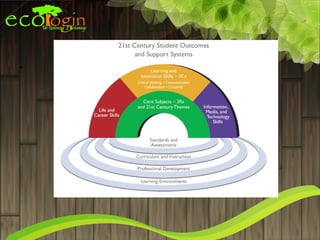
Learning and Innovation Skills
  focus on creativity, critical thinking, problem solving, communication
  and collaboration


Life and Career Skills -
   Flexibility & Adaptability; Initiative & Self-Direction; Social & Cross-
   Cultural Skills; Productivity & Accountability; Leadership &
   Responsibility.


Dheeraj Prasad, Director, Microsoft
-
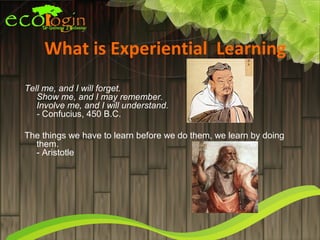
What is Experiential Learning
Tell me, and I will forget. 
   Show me, and I may remember. 
   Involve me, and I will understand.
   - Confucius, 450 B.C.

The things we have to learn before we do them, we learn by doing
  them.
  - Aristotle
What is Experiential Learning
Activity is the only road to
knowledge.
What is Experiential Learning
I never teach my pupils, I only
attempt to provide the conditions
in which they can learn.
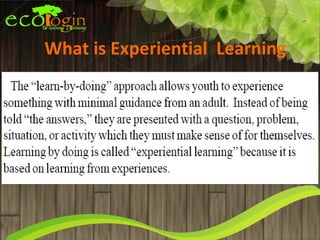
What is Experiential Learning
conventional prescribed teaching/training - the transfer of pre-
   determined knowledge / skills – “from the outside”.

experiential learning - development of people as individuals – “from the
   inside”.
Focus on the learning process for the individual .

Experiential Learning as
   understanding tool : Self / Others / Teams
  develop confidence / self esteem / personal strength
  imparts sense of purpose and fulfillment which improve Attitude, life
  balance and emotional well being

   Leadership roles
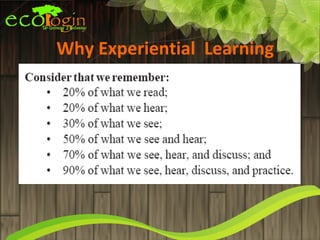
Why Experiential Learning
•
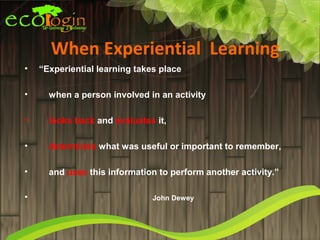
When Experiential Learning
•   “Experiential learning takes place

•     when a person involved in an activity

•     looks back and evaluates it,

•     determines what was useful or important to remember,

•     and uses this information to perform another activity.”

•                              John Dewey
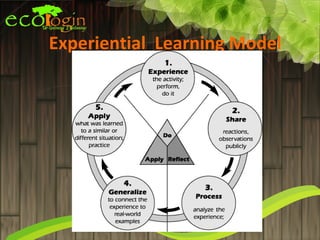
Experiential Learning Model
Why off site Experiential Learning
Creates Openness
Out of day 2 day activities
  assignments / books
  different set of teachers
Equality
Develops relationships quickly
Disequilibrium
Meta Learning
Kinaesthetic Imprint
Encourage Risk taking
Diversity of Strength
FUN
corporate psychologists Dr John Luckner and Reldan Nadler
Off site as Natural Outbound
“Nature has an inherently positive effect”.
Something people are not used to

Students are more open to the inspiration and challenge offered by
   natural world.

More chances of Integrating
Learning occurs naturally.

Creates managers who are
   eco Sensitive
   eco Maginative
   sought out by corporates
ecoLogin Approach
Program of International standard

Largely Interconnected to Nature
   more integrated
   more absorbed

Interdependence
   team members
   with nature / community / rural life / tribal life

Holistic

I related to Nature
The Capsule
Effective Team Building / Team work
Leadership Development
Change Management
Communication Skills
Conflict Resolution
Personal & Professional Effectiveness
Interpersonal Skills
Partnerships & Alliances (Second Stage)
Outcome - Students
Employable Students
 understanding of Self
 understanding of People
 better career choices
 initiative
 work better in Teams
 take more Initiative / Risk
 clarity of Life / Job
 interpersonal skills
 communicative skills
 not scared of Interviews
Outcome - Institution
Alumni

     will be in an organization for a long term
     will be better managers
     happy employers
     reputation goes up
     more recruitment
Who we are
• ecoLogin - an experience based alternate tourism service provider
  offering activity filled tourism experience in offbeat locations.

• We provide end to end, customized, completely guided tours with themes
  ranging from Adventure & Jungle tourism to Heritage & culture.

• The ecoLogin experience encompasses the involvement of local people
  and communities in service delivery which enriches the experience of the
  traveler and provides an alternate source of livelihood for the community.
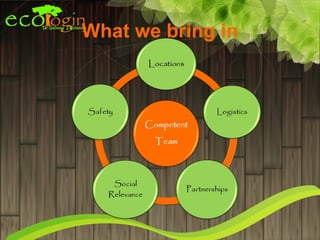
What we bring in
The Nuclei
• Sridhar Lakshmanan – sridhar@ecologin.org , Founder and CEO.
    –   A regular trekker, wild life enthusiast & photographer
    –   lives by the maxim - no fixed solutions to an ever changing world
    –   brings in about 8 years of experience in the Social Development sector & Corporate.
    –   an engineer from College of Engineering, Guindy and later passed out from IIM
        Ahmedabad in 2002.

• Arul Sekar – arul@ecologin.org , Founder and COO.
    – Extremely good at the art of charting a course in unknown territory with only a compass
      to rely on.
    – An outdoor enthusiast ; enjoys challenges & believes in encouraging others to 'Just give
      it a TRY’
    – a certified Mountaineer and Rock Climber for 8 years. Has 2 years of work ex.
    – Holds a Dual degree in Engineering from Anna University, Currently pursuing M.S.
      (Entrepreneurship) in Department of Management Studies, IIT-Madras.
• And a Team of 10 Passionate people.
Methodology
• Day I: Self Confidence: Discover the new 'U‘
 – Acclimatization
 – Socialize: Rural / tribal village visit
 – Goal setting
 – Mental block
 – Pushing your limits
 – Motivation
 – Self confidence
 – Discover the new You
Methodology
• Day II: Team Work: Discover the new 'US'

  -Setting a shared goal
  -Team work: knots, sequence climbing.
  -Managing Uncertainties
  -Risk Management
  -Survival Technique
  -Get lost & Find yourself : Map reading, facing uncertainties
  --as a team, maneuvering in forest.
  -Innovative Group games
  -Discover the new ‘US’
Methodology
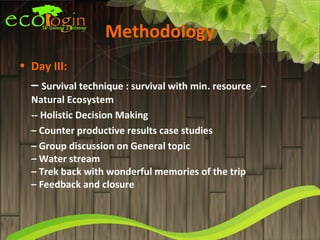
• Day III:
  – Survival technique : survival with min. resource   –
  Natural Ecosystem
  -- Holistic Decision Making
  – Counter productive results case studies
  – Group discussion on General topic
  – Water stream
  – Trek back with wonderful memories of the trip
  – Feedback and closure
Target Segments
MBA Students
Fresh Young Faculties
Student affair bodies / student council
Teaching faculty
Cross sectional across levels
Thank you

Iuv

  • 1.
  • 2.
    Introduction Current Scenario Applications: 8 Lakh applies Students Passing out : 7 Lakh Number of B-Schools India > 4800 (shiksha.com) Tamilnadu =144 (tnedu.net) Teaching standards – Conventional Difficulty in managing Best Placement avenues Industry skeptical of getting Right Skills,
  • 3.
    Employability “Only 23% ofthe management talent is employable.“ MeritTrac Services, an assessments player. Only 10% of fresh graduates are actually employable, while a study of MBA and engineering graduates reveals only 25% of them to be employable. Tata Institute of Social Sciences "It is not unemployment that is the major problem; it is the question of unemployability that is the major crisis in this competitive arena…” -APJ Abdul Kalam
  • 4.
    Employability In a globalworkforce study conducted by Towers Perrin, a whopping 56% of Indian employees said that they feel disengaged at work - the highest percentage among all countries surveyed. These disgruntled Indian employees feel a big disconnect between their personal aspirations and their day-to- day professional activities.
  • 5.
    What is wrongwith the System Too focused on Theoretical Study International B-School’s 1/3 to ½ courses are people related courses Human Capital Deficiencies We take a quantitative approach that merely aims to improve the supply-side of the Indian labour market the solution lies on the demand-side, and requires a qualitative solution as well. International Accreditation Standards ensures students and parents top-quality education, ensures employers graduates are ready to perform on day one. (AACSB, ACBSP, CHEA, DETC ) ( Association to Advanced Collegiate School of Business, Accreditation Council for Business School & Programs, Council for Higher Education Accreditation, Distance Education and Training Council )
  • 6.
    21 Century Skills st - Learning and Innovation Skills focus on creativity, critical thinking, problem solving, communication and collaboration Life and Career Skills - Flexibility & Adaptability; Initiative & Self-Direction; Social & Cross- Cultural Skills; Productivity & Accountability; Leadership & Responsibility. Dheeraj Prasad, Director, Microsoft
  • 7.
  • 8.
    What is ExperientialLearning Tell me, and I will forget.  Show me, and I may remember.  Involve me, and I will understand. - Confucius, 450 B.C. The things we have to learn before we do them, we learn by doing them. - Aristotle
  • 9.
    What is ExperientialLearning Activity is the only road to knowledge.
  • 10.
    What is ExperientialLearning I never teach my pupils, I only attempt to provide the conditions in which they can learn.
  • 11.
  • 12.
    What is ExperientialLearning conventional prescribed teaching/training - the transfer of pre- determined knowledge / skills – “from the outside”. experiential learning - development of people as individuals – “from the inside”. Focus on the learning process for the individual . Experiential Learning as understanding tool : Self / Others / Teams develop confidence / self esteem / personal strength imparts sense of purpose and fulfillment which improve Attitude, life balance and emotional well being Leadership roles
  • 13.
  • 14.
    When Experiential Learning • “Experiential learning takes place • when a person involved in an activity • looks back and evaluates it, • determines what was useful or important to remember, • and uses this information to perform another activity.” • John Dewey
  • 15.
  • 16.
    Why off siteExperiential Learning Creates Openness Out of day 2 day activities assignments / books different set of teachers Equality Develops relationships quickly Disequilibrium Meta Learning Kinaesthetic Imprint Encourage Risk taking Diversity of Strength FUN corporate psychologists Dr John Luckner and Reldan Nadler
  • 17.
    Off site asNatural Outbound “Nature has an inherently positive effect”. Something people are not used to Students are more open to the inspiration and challenge offered by natural world. More chances of Integrating Learning occurs naturally. Creates managers who are eco Sensitive eco Maginative sought out by corporates
  • 18.
    ecoLogin Approach Program ofInternational standard Largely Interconnected to Nature more integrated more absorbed Interdependence team members with nature / community / rural life / tribal life Holistic I related to Nature
  • 20.
    The Capsule Effective TeamBuilding / Team work Leadership Development Change Management Communication Skills Conflict Resolution Personal & Professional Effectiveness Interpersonal Skills Partnerships & Alliances (Second Stage)
  • 21.
    Outcome - Students EmployableStudents understanding of Self understanding of People better career choices initiative work better in Teams take more Initiative / Risk clarity of Life / Job interpersonal skills communicative skills not scared of Interviews
  • 22.
    Outcome - Institution Alumni will be in an organization for a long term will be better managers happy employers reputation goes up more recruitment
  • 23.
    Who we are •ecoLogin - an experience based alternate tourism service provider offering activity filled tourism experience in offbeat locations. • We provide end to end, customized, completely guided tours with themes ranging from Adventure & Jungle tourism to Heritage & culture. • The ecoLogin experience encompasses the involvement of local people and communities in service delivery which enriches the experience of the traveler and provides an alternate source of livelihood for the community.
  • 24.
  • 25.
    The Nuclei • SridharLakshmanan – sridhar@ecologin.org , Founder and CEO. – A regular trekker, wild life enthusiast & photographer – lives by the maxim - no fixed solutions to an ever changing world – brings in about 8 years of experience in the Social Development sector & Corporate. – an engineer from College of Engineering, Guindy and later passed out from IIM Ahmedabad in 2002. • Arul Sekar – arul@ecologin.org , Founder and COO. – Extremely good at the art of charting a course in unknown territory with only a compass to rely on. – An outdoor enthusiast ; enjoys challenges & believes in encouraging others to 'Just give it a TRY’ – a certified Mountaineer and Rock Climber for 8 years. Has 2 years of work ex. – Holds a Dual degree in Engineering from Anna University, Currently pursuing M.S. (Entrepreneurship) in Department of Management Studies, IIT-Madras. • And a Team of 10 Passionate people.
  • 26.
    Methodology • Day I:Self Confidence: Discover the new 'U‘ – Acclimatization – Socialize: Rural / tribal village visit – Goal setting – Mental block – Pushing your limits – Motivation – Self confidence – Discover the new You
  • 27.
    Methodology • Day II:Team Work: Discover the new 'US' -Setting a shared goal -Team work: knots, sequence climbing. -Managing Uncertainties -Risk Management -Survival Technique -Get lost & Find yourself : Map reading, facing uncertainties --as a team, maneuvering in forest. -Innovative Group games -Discover the new ‘US’
  • 28.
    Methodology • Day III: – Survival technique : survival with min. resource – Natural Ecosystem -- Holistic Decision Making – Counter productive results case studies – Group discussion on General topic – Water stream – Trek back with wonderful memories of the trip – Feedback and closure
  • 29.
    Target Segments MBA Students FreshYoung Faculties Student affair bodies / student council Teaching faculty Cross sectional across levels
  • 30.

Editor's Notes

  • #7 Creativity & Innovation Think Creatively Use a wide range of idea creation techniques (such as brainstorming) Create new and worthwhile ideas (both incremental and radical concepts) Elaborate, refine, analyze and evaluate their own ideas in order to improve and maximize creative efforts Work Creatively with Others Develop, implement and communicate new ideas to others effectivel Be open and responsive to new and diverse perspectives; incorporate group input and feedback into the work Demonstrate originality and inventiveness in work and understand the real world limits to adopting new ideas View failure as an opportunity to learn; understand that creativity and innovation is a long-term, cyclical process of small successes and frequent mistakes Implement Innovations Act on creative ideas to make a tangible and useful contribution to the field in which the innovation will occur Critical Thinking & Problem Solving Reason Effectively Use various types of reasoning (inductive, deductive, etc.) as appropriate to the situation Use Systems Thinking Analyze how parts of a whole interact with each other to produce overall outcomes in complex systems Make Judgments and Decisions Effectively analyze and evaluate evidence, arguments, claims and beliefs Analyze and evaluate major alternative points of view Synthesize and make connections between information and arguments Interpret information and draw conclusions based on the best analysis Reflect critically on learning experiences and processes Solve Problems Solve different kinds of non-familiar problems in both conventional and innovative ways Identify and ask significant questions that clarify various points of view and lead to better solutions Browse Critical Thinking & Problem Solving Resources Communication & Collaboration Communicate Clearly Articulate thoughts and ideas effectively using oral, written and nonverbal communication skills in a variety of forms and contexts Listen effectively to decipher meaning, including knowledge, values, attitudes and intentions Use communication for a range of purposes (e.g. to inform, instruct, motivate and persuade) Utilize multiple media and technologies, and know how to judge their effectiveness a priori as well as assess their impact Communicate effectively in diverse environments (including multi-lingual) Collaborate with Others Demonstrate ability to work effectively and respectfully with diverse teams Exercise flexibility and willingness to be helpful in making necessary compromises to accomplish a common goal Assume shared responsibility for collaborative work, and value the individual contributions made by each team member Flexibility & Adaptability Adapt to Change Adapt to varied roles, jobs responsibilities, schedules and contexts   Work effectively in a climate of ambiguity and changing priorities Be Flexible Incorporate feedback effectively Deal positively with praise, setbacks and criticism Understand, negotiate and balance diverse views and beliefs to reach workable solutions, particularly in multi-cultural environments Initiative & Self-Direction Manage Goals and Time Set goals with tangible and intangible success criteria Balance tactical (short-term) and strategic (long-term) goals Utilize time and manage workload efficiently Work Independently Monitor, define, prioritize and complete tasks without direct oversight Be Self-directed Learners Go beyond basic mastery of skills and/or curriculum to explore and expand one’s own learning and opportunities to gain expertise Demonstrate initiative to advance skill levels towards a professional level Demonstrate commitment to learning as a lifelong process Reflect critically on past experiences in order to inform future progress Social & Cross-Cultural Skills Interact Effectively with Others Know when it is appropriate to listen and when to speak Conduct themselves in a respectable, professional manner Work Effectively in Diverse Teams Respect cultural differences and work effectively with people from a range of social and cultural backgrounds Respond open-mindedly to different ideas and values Leverage social and cultural differences to create new ideas and increase both innovation and quality of work Productivity & Accountability Manage Projects Set and meet goals, even in the face of obstacles and competing pressure Prioritize, plan and manage work to achieve the intended result Produce Results Demonstrate additional attributes associated with producing high quality products including the abilities to: Work positively and ethically Manage time and projects effectively Multi-task Participate actively, as well as be reliable and punctual Present oneself professionally and with proper etiquette Collaborate and cooperate effectively with teams Respect and appreciate team diversity Be accountable for results eadership & Responsibility Guide and Lead Others Use interpersonal and problem-solving skills to influence and guide others toward a goal Leverage strengths of others to accomplish a common goal Inspire others to reach their very best via example and selflessness Demonstrate integrity and ethical behavior in using influence and power Be Responsible to Others Act responsibly with the interests of the larger community in mind
  • #8 3 rs – Reading, Riting, Rithimetic
  • #16 1 ) Involves doing even unfamiliar activities, pushes learner to a new level 2) We talk about the experience, share reactions & observations, freely discuss feelings generated by experience. Normally done by asking what did they do, feel, what part of the experience was easy, difficult. 3) How did you do it, how the themes, issues and problems where bought out. How specific problems where addressed. Why is the life skill they practiced important. 4) Generalise on what you learned, identify common truth, real life principals that surfaced, by asking them what did they learn from the experince, how is this learning related to other things they been learning, similar experience they had. 5) Discuss on how u will use what you ve learned, how learning can be applied to other situations, issues that can come in future. Ask how they can use what they have learned, how his can be relatedto other parts of life, how they can apply in future. Do – REFLECT & APPLY.