Presented by
Arpitha K R
6th sem, Civil
Introduction
Intelligent Transportation System
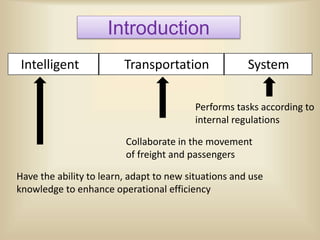
Performs tasks according to
internal regulations
Collaborate in the movement
of freight and passengers
Have the ability to learn, adapt to new situations and use
knowledge to enhance operational efficiency
Technique used
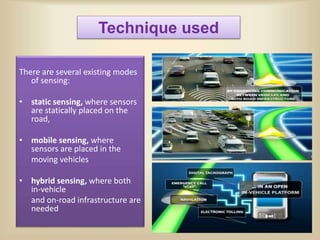
There are several existing modes
of sensing:
• static sensing, where sensors
are statically placed on the
road,
• mobile sensing, where
sensors are placed in the
moving vehicles
• hybrid sensing, where both
in-vehicle
and on-road infrastructure are
needed
Static sensing techniques
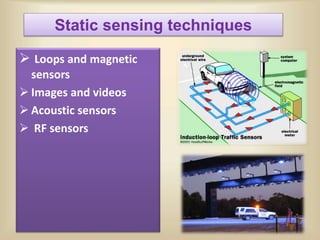
 Loops and magnetic
sensors
 Images and videos
 Acoustic sensors
 RF sensors
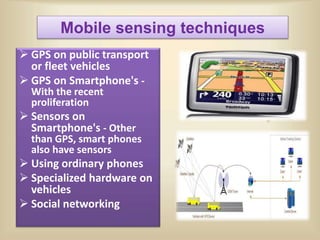
Mobile sensing techniques
 GPS on public transport
or fleet vehicles
 GPS on Smartphone's -
With the recent
proliferation
 Sensors on
Smartphone's - Other
than GPS, smart phones
also have sensors
 Using ordinary phones
 Specialized hardware on
vehicles
 Social networking
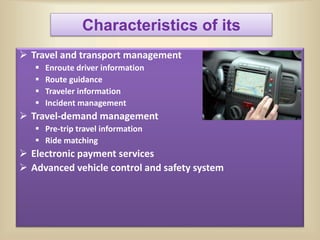
Characteristics of its
 Travel and transport management
 Enroute driver information
 Route guidance
 Traveler information
 Incident management
 Travel-demand management
 Pre-trip travel information
 Ride matching
 Electronic payment services
 Advanced vehicle control and safety system
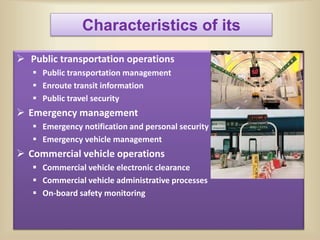
 Public transportation operations
 Public transportation management
 Enroute transit information
 Public travel security
 Emergency management
 Emergency notification and personal security
 Emergency vehicle management
 Commercial vehicle operations
 Commercial vehicle electronic clearance
 Commercial vehicle administrative processes
 On-board safety monitoring
Characteristics of its
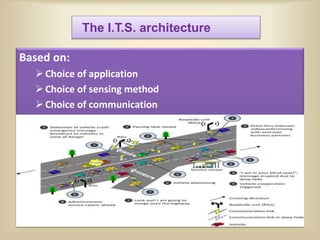
The I.T.S. architecture
Based on:
Choice of application
Choice of sensing method
Choice of communication
ITS applications
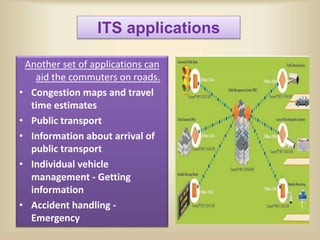
Another set of applications can
aid the commuters on roads.
• Congestion maps and travel
time estimates
• Public transport
• Information about arrival of
public transport
• Individual vehicle
management - Getting
information
• Accident handling -
Emergency
ITS applications
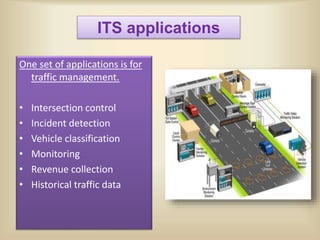
One set of applications is for
traffic management.
• Intersection control
• Incident detection
• Vehicle classification
• Monitoring
• Revenue collection
• Historical traffic data
Benefits of ITS
• Safety
Smooth traffic flows and reduce accidents, to direct traffic
away from accidents, alert emergency services
• Productivity
Congestion lowers productivity
• Environmental Performance
ITS that reduce congestion, stop-start driving, fuel
consumption, greenhouse gas emissions
Conclusion
Traffic congestion is an important problem in Indian
cities.
There is scope for evaluating existing ideas in different
and challenging traffic scenarios, innovate new solutions and
empirically evaluate ideas in collaboration with public and
private sectors.
.
ITS

ITS

  • 1.
    Presented by Arpitha KR 6th sem, Civil
  • 2.
    Introduction Intelligent Transportation System Performstasks according to internal regulations Collaborate in the movement of freight and passengers Have the ability to learn, adapt to new situations and use knowledge to enhance operational efficiency
  • 3.
    Technique used There areseveral existing modes of sensing: • static sensing, where sensors are statically placed on the road, • mobile sensing, where sensors are placed in the moving vehicles • hybrid sensing, where both in-vehicle and on-road infrastructure are needed
  • 4.
    Static sensing techniques Loops and magnetic sensors  Images and videos  Acoustic sensors  RF sensors
  • 5.
    Mobile sensing techniques GPS on public transport or fleet vehicles  GPS on Smartphone's - With the recent proliferation  Sensors on Smartphone's - Other than GPS, smart phones also have sensors  Using ordinary phones  Specialized hardware on vehicles  Social networking
  • 6.
    Characteristics of its Travel and transport management  Enroute driver information  Route guidance  Traveler information  Incident management  Travel-demand management  Pre-trip travel information  Ride matching  Electronic payment services  Advanced vehicle control and safety system
  • 7.
     Public transportationoperations  Public transportation management  Enroute transit information  Public travel security  Emergency management  Emergency notification and personal security  Emergency vehicle management  Commercial vehicle operations  Commercial vehicle electronic clearance  Commercial vehicle administrative processes  On-board safety monitoring Characteristics of its
  • 8.
    The I.T.S. architecture Basedon: Choice of application Choice of sensing method Choice of communication
  • 9.
    ITS applications Another setof applications can aid the commuters on roads. • Congestion maps and travel time estimates • Public transport • Information about arrival of public transport • Individual vehicle management - Getting information • Accident handling - Emergency
  • 10.
    ITS applications One setof applications is for traffic management. • Intersection control • Incident detection • Vehicle classification • Monitoring • Revenue collection • Historical traffic data
  • 11.
    Benefits of ITS •Safety Smooth traffic flows and reduce accidents, to direct traffic away from accidents, alert emergency services • Productivity Congestion lowers productivity • Environmental Performance ITS that reduce congestion, stop-start driving, fuel consumption, greenhouse gas emissions
  • 12.
    Conclusion Traffic congestion isan important problem in Indian cities. There is scope for evaluating existing ideas in different and challenging traffic scenarios, innovate new solutions and empirically evaluate ideas in collaboration with public and private sectors. .