© 2008 Cisco Systems, Inc. All rights reserved. Cisco Confidential
Presentation_ID 1
Chapter 2:
Configuring a Network
Operating System
Introduction to Networks
Presentation_ID 2
© 2008 Cisco Systems, Inc. All rights reserved. Cisco Confidential
Chapter 2 - Objectives
 Explain the purpose of Cisco IOS.
 Explain how to access and navigate Cisco IOS to configure network
devices.
 Describe the command structure of Cisco IOS software.
 Configure hostnames on a Cisco IOS device using the CLI.
 Use Cisco IOS commands to limit access to device configurations.
 Use Cisco IOS commands to save the running configuration.
 Explain how devices communicate across network media.
 Configure a host device with an IP address.
 Verify connectivity between two end devices.
Presentation_ID 3
© 2008 Cisco Systems, Inc. All rights reserved. Cisco Confidential
Chapter 2
2.1 IOS Bootcamp
2.2 Getting Basic
2.3 Address Schemes
2.4 Summary
Presentation_ID 4
© 2008 Cisco Systems, Inc. All rights reserved. Cisco Confidential
2.1 IOS Bootcamp
Presentation_ID 5
© 2008 Cisco Systems, Inc. All rights reserved. Cisco Confidential
Cisco IOS
Operating Systems
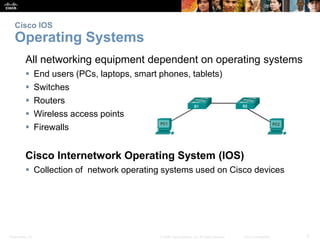
All networking equipment dependent on operating systems
 End users (PCs, laptops, smart phones, tablets)
 Switches
 Routers
 Wireless access points
 Firewalls
Cisco Internetwork Operating System (IOS)
 Collection of network operating systems used on Cisco devices
Presentation_ID 6
© 2008 Cisco Systems, Inc. All rights reserved. Cisco Confidential
Cisco IOS
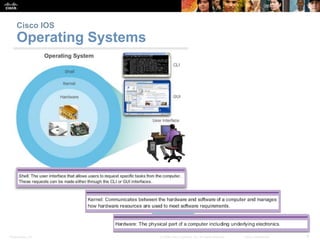
Operating Systems
Presentation_ID 7
© 2008 Cisco Systems, Inc. All rights reserved. Cisco Confidential
Cisco IOS
Purpose of OS
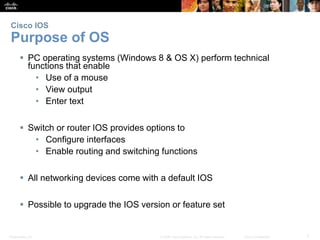
 PC operating systems (Windows 8 & OS X) perform technical
functions that enable
• Use of a mouse
• View output
• Enter text
 Switch or router IOS provides options to
• Configure interfaces
• Enable routing and switching functions
 All networking devices come with a default IOS
 Possible to upgrade the IOS version or feature set
Presentation_ID 8
© 2008 Cisco Systems, Inc. All rights reserved. Cisco Confidential
Cisco IOS
Location of the Cisco IOS
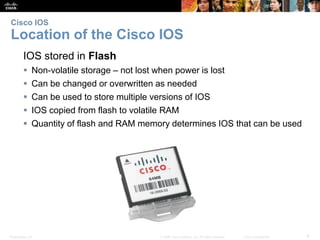
IOS stored in Flash
 Non-volatile storage – not lost when power is lost
 Can be changed or overwritten as needed
 Can be used to store multiple versions of IOS
 IOS copied from flash to volatile RAM
 Quantity of flash and RAM memory determines IOS that can be used
Presentation_ID 9
© 2008 Cisco Systems, Inc. All rights reserved. Cisco Confidential
Cisco IOS
IOS Functions
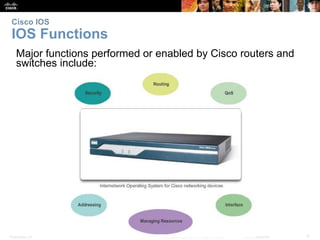
Major functions performed or enabled by Cisco routers and
switches include:
Presentation_ID 10
© 2008 Cisco Systems, Inc. All rights reserved. Cisco Confidential
Accessing a Cisco IOS Device
Console Access Method
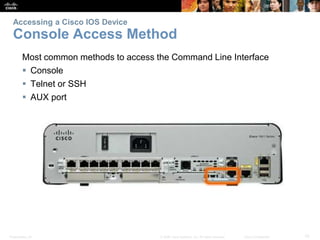
Most common methods to access the Command Line Interface
 Console
 Telnet or SSH
 AUX port
Presentation_ID 11
© 2008 Cisco Systems, Inc. All rights reserved. Cisco Confidential
Accessing a Cisco IOS Device
Console Access Method
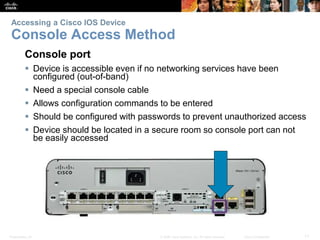
Console port
 Device is accessible even if no networking services have been
configured (out-of-band)
 Need a special console cable
 Allows configuration commands to be entered
 Should be configured with passwords to prevent unauthorized access
 Device should be located in a secure room so console port can not
be easily accessed
Presentation_ID 12
© 2008 Cisco Systems, Inc. All rights reserved. Cisco Confidential
Accessing a Cisco IOS Device
Telnet, SSH, and AUX Access Methods
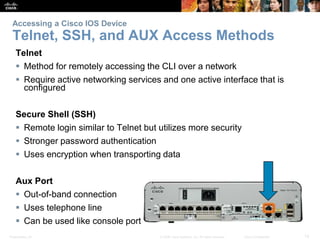
Telnet
 Method for remotely accessing the CLI over a network
 Require active networking services and one active interface that is
configured
Secure Shell (SSH)
 Remote login similar to Telnet but utilizes more security
 Stronger password authentication
 Uses encryption when transporting data
Aux Port
 Out-of-band connection
 Uses telephone line
 Can be used like console port
Presentation_ID 13
© 2008 Cisco Systems, Inc. All rights reserved. Cisco Confidential
Accessing a Cisco IOS Device
Terminal Emulation Programs
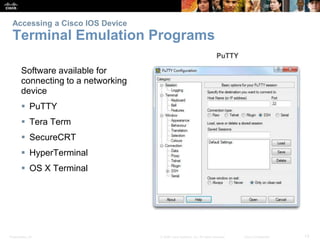
Software available for
connecting to a networking
device
 PuTTY
 Tera Term
 SecureCRT
 HyperTerminal
 OS X Terminal
Presentation_ID 14
© 2008 Cisco Systems, Inc. All rights reserved. Cisco Confidential
Navigating the IOS
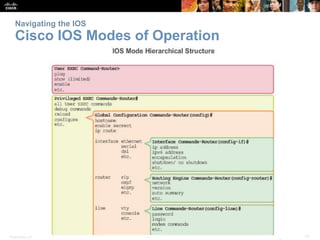
Cisco IOS Modes of Operation
Presentation_ID 15
© 2008 Cisco Systems, Inc. All rights reserved. Cisco Confidential
Navigating the IOS
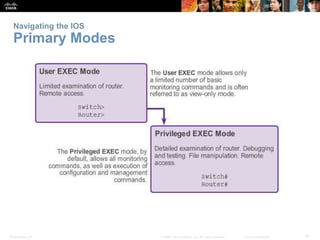
Primary Modes
Presentation_ID 16
© 2008 Cisco Systems, Inc. All rights reserved. Cisco Confidential
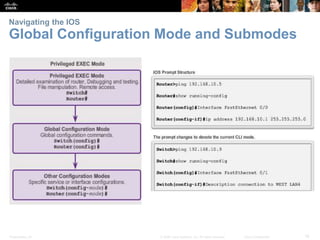
Navigating the IOS
Global Configuration Mode and Submodes
Presentation_ID 17
© 2008 Cisco Systems, Inc. All rights reserved. Cisco Confidential
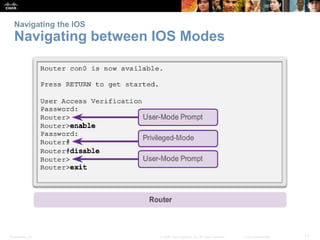
Navigating the IOS
Navigating between IOS Modes
Presentation_ID 18
© 2008 Cisco Systems, Inc. All rights reserved. Cisco Confidential
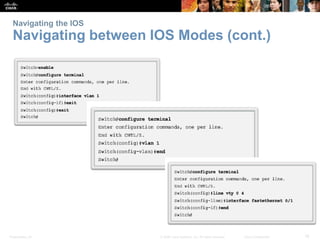
Navigating the IOS
Navigating between IOS Modes (cont.)
Presentation_ID 19
© 2008 Cisco Systems, Inc. All rights reserved. Cisco Confidential
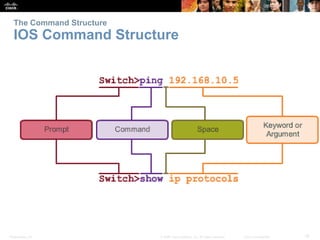
The Command Structure
IOS Command Structure
Presentation_ID 20
© 2008 Cisco Systems, Inc. All rights reserved. Cisco Confidential
The Command Structure
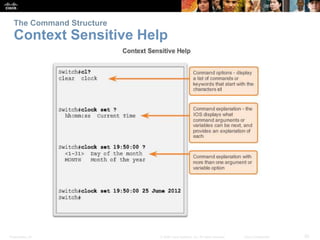
Context Sensitive Help
Presentation_ID 21
© 2008 Cisco Systems, Inc. All rights reserved. Cisco Confidential
The Command Structure
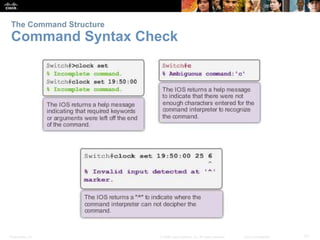
Command Syntax Check
Presentation_ID 22
© 2008 Cisco Systems, Inc. All rights reserved. Cisco Confidential
The Command Structure
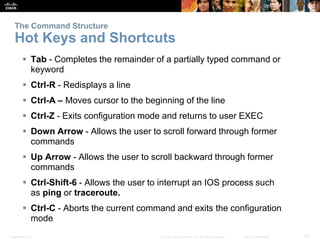
Hot Keys and Shortcuts
 Tab - Completes the remainder of a partially typed command or
keyword
 Ctrl-R - Redisplays a line
 Ctrl-A – Moves cursor to the beginning of the line
 Ctrl-Z - Exits configuration mode and returns to user EXEC
 Down Arrow - Allows the user to scroll forward through former
commands
 Up Arrow - Allows the user to scroll backward through former
commands
 Ctrl-Shift-6 - Allows the user to interrupt an IOS process such
as ping or traceroute.
 Ctrl-C - Aborts the current command and exits the configuration
mode
Presentation_ID 23
© 2008 Cisco Systems, Inc. All rights reserved. Cisco Confidential
The Command Structure
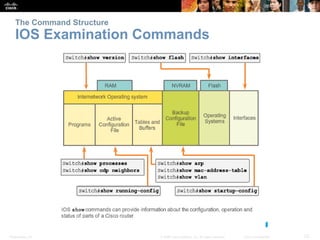
IOS Examination Commands
Presentation_ID 24
© 2008 Cisco Systems, Inc. All rights reserved. Cisco Confidential
The Command Structure
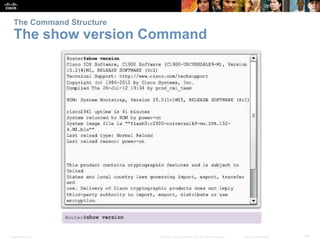
The show version Command
Presentation_ID 25
© 2008 Cisco Systems, Inc. All rights reserved. Cisco Confidential
2.2 Getting Basic
Presentation_ID 26
© 2008 Cisco Systems, Inc. All rights reserved. Cisco Confidential
Hostnames
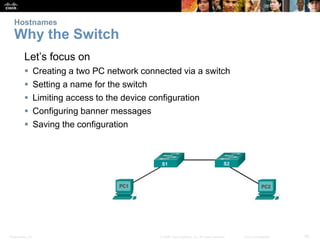
Why the Switch
Let’s focus on
 Creating a two PC network connected via a switch
 Setting a name for the switch
 Limiting access to the device configuration
 Configuring banner messages
 Saving the configuration
Presentation_ID 27
© 2008 Cisco Systems, Inc. All rights reserved. Cisco Confidential
Hostnames
Device Names
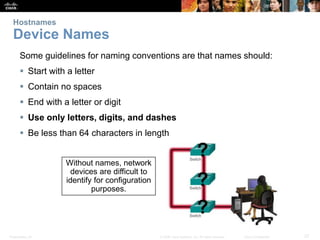
Some guidelines for naming conventions are that names should:
 Start with a letter
 Contain no spaces
 End with a letter or digit
 Use only letters, digits, and dashes
 Be less than 64 characters in length
Without names, network
devices are difficult to
identify for configuration
purposes.
Presentation_ID 28
© 2008 Cisco Systems, Inc. All rights reserved. Cisco Confidential
Hostnames
Hostnames
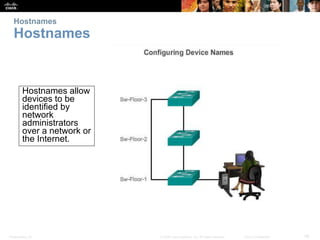
Hostnames allow
devices to be
identified by
network
administrators
over a network or
the Internet.
Presentation_ID 29
© 2008 Cisco Systems, Inc. All rights reserved. Cisco Confidential
Hostnames
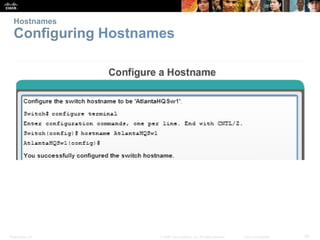
Configuring Hostnames
Presentation_ID 30
© 2008 Cisco Systems, Inc. All rights reserved. Cisco Confidential
Limiting Access to Device Configurations
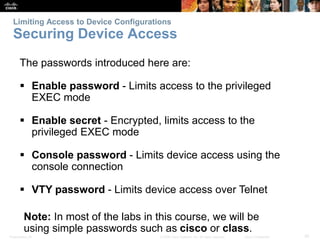
Securing Device Access
The passwords introduced here are:
 Enable password - Limits access to the privileged
EXEC mode
 Enable secret - Encrypted, limits access to the
privileged EXEC mode
 Console password - Limits device access using the
console connection
 VTY password - Limits device access over Telnet
Note: In most of the labs in this course, we will be
using simple passwords such as cisco or class.
Presentation_ID 31
© 2008 Cisco Systems, Inc. All rights reserved. Cisco Confidential
Limiting Access to Device Configurations
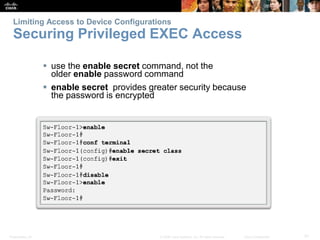
Securing Privileged EXEC Access
 use the enable secret command, not the
older enable password command
 enable secret provides greater security because
the password is encrypted
Presentation_ID 32
© 2008 Cisco Systems, Inc. All rights reserved. Cisco Confidential
Limiting Access to Device Configurations
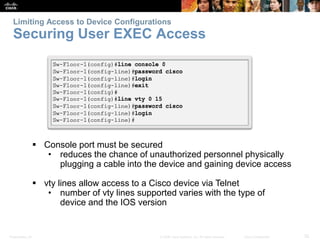
Securing User EXEC Access
 Console port must be secured
• reduces the chance of unauthorized personnel physically
plugging a cable into the device and gaining device access
 vty lines allow access to a Cisco device via Telnet
• number of vty lines supported varies with the type of
device and the IOS version
Presentation_ID 33
© 2008 Cisco Systems, Inc. All rights reserved. Cisco Confidential
Limiting Access to Device Configurations
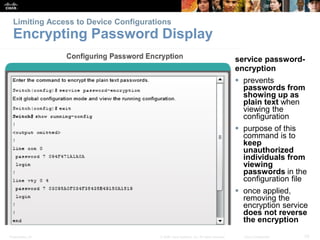
Encrypting Password Display
service password-
encryption
 prevents
passwords from
showing up as
plain text when
viewing the
configuration
 purpose of this
command is to
keep
unauthorized
individuals from
viewing
passwords in the
configuration file
 once applied,
removing the
encryption service
does not reverse
the encryption
Presentation_ID 34
© 2008 Cisco Systems, Inc. All rights reserved. Cisco Confidential
Limiting Access to Device Configurations
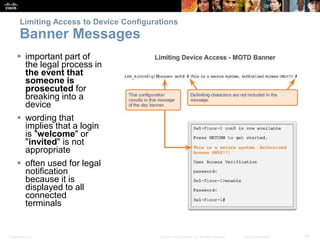
Banner Messages
 important part of
the legal process in
the event that
someone is
prosecuted for
breaking into a
device
 wording that
implies that a login
is "welcome" or
"invited" is not
appropriate
 often used for legal
notification
because it is
displayed to all
connected
terminals
Presentation_ID 35
© 2008 Cisco Systems, Inc. All rights reserved. Cisco Confidential
Saving Configurations
Configuration Files
 Switch# reload
System configuration has
been modified. Save?
[yes/no]: n
Proceed with reload?
[confirm]
 Startup configuration is
removed by using
the erase startup-config
Switch# erase startup-config
 On a switch you must
also issue the delete
vlan.dat
Switch# delete vlan.dat
Delete filename [vlan.dat]?
Delete flash:vlan.dat?
[confirm]
Presentation_ID 36
© 2008 Cisco Systems, Inc. All rights reserved. Cisco Confidential
2.3 Address Schemes
Presentation_ID 37
© 2008 Cisco Systems, Inc. All rights reserved. Cisco Confidential
Ports and Addresses
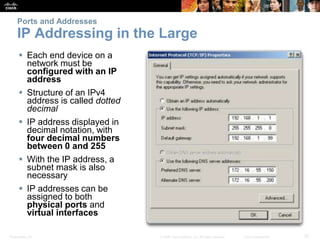
IP Addressing in the Large
 Each end device on a
network must be
configured with an IP
address
 Structure of an IPv4
address is called dotted
decimal
 IP address displayed in
decimal notation, with
four decimal numbers
between 0 and 255
 With the IP address, a
subnet mask is also
necessary
 IP addresses can be
assigned to both
physical ports and
virtual interfaces
Presentation_ID 38
© 2008 Cisco Systems, Inc. All rights reserved. Cisco Confidential
Addressing Devices
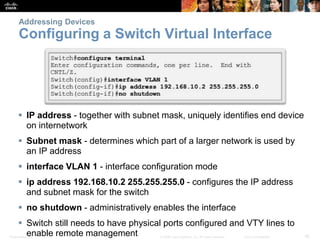
Configuring a Switch Virtual Interface
 IP address - together with subnet mask, uniquely identifies end device
on internetwork
 Subnet mask - determines which part of a larger network is used by
an IP address
 interface VLAN 1 - interface configuration mode
 ip address 192.168.10.2 255.255.255.0 - configures the IP address
and subnet mask for the switch
 no shutdown - administratively enables the interface
 Switch still needs to have physical ports configured and VTY lines to
enable remote management
Presentation_ID 39
© 2008 Cisco Systems, Inc. All rights reserved. Cisco Confidential
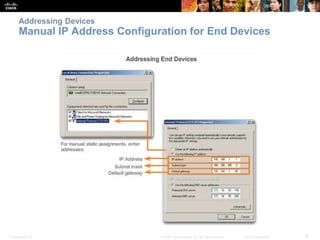
Addressing Devices
Manual IP Address Configuration for End Devices
Presentation_ID 40
© 2008 Cisco Systems, Inc. All rights reserved. Cisco Confidential
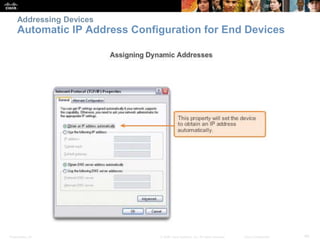
Addressing Devices
Automatic IP Address Configuration for End Devices
Presentation_ID 41
© 2008 Cisco Systems, Inc. All rights reserved. Cisco Confidential
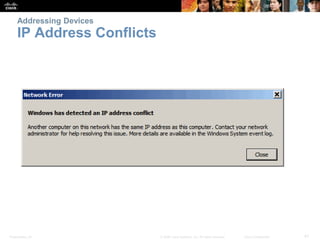
Addressing Devices
IP Address Conflicts
Presentation_ID 42
© 2008 Cisco Systems, Inc. All rights reserved. Cisco Confidential
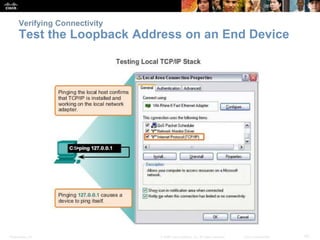
Verifying Connectivity
Test the Loopback Address on an End Device
Presentation_ID 43
© 2008 Cisco Systems, Inc. All rights reserved. Cisco Confidential
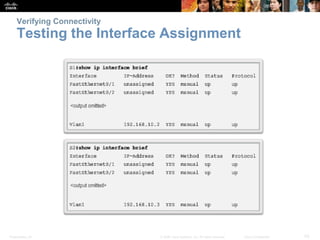
Verifying Connectivity
Testing the Interface Assignment
Presentation_ID 44
© 2008 Cisco Systems, Inc. All rights reserved. Cisco Confidential
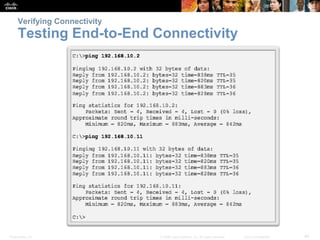
Verifying Connectivity
Testing End-to-End Connectivity
Presentation_ID 45
© 2008 Cisco Systems, Inc. All rights reserved. Cisco Confidential
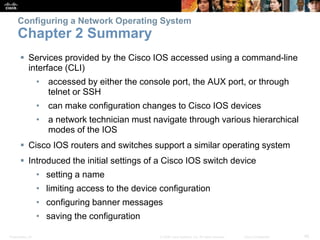
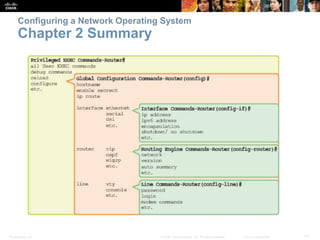
Configuring a Network Operating System
Chapter 2 Summary
 Services provided by the Cisco IOS accessed using a command-line
interface (CLI)
• accessed by either the console port, the AUX port, or through
telnet or SSH
• can make configuration changes to Cisco IOS devices
• a network technician must navigate through various hierarchical
modes of the IOS
 Cisco IOS routers and switches support a similar operating system
 Introduced the initial settings of a Cisco IOS switch device
• setting a name
• limiting access to the device configuration
• configuring banner messages
• saving the configuration
Presentation_ID 46
© 2008 Cisco Systems, Inc. All rights reserved. Cisco Confidential
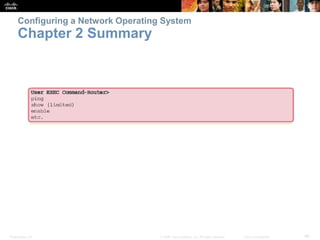
Configuring a Network Operating System
Chapter 2 Summary
Presentation_ID 47
© 2008 Cisco Systems, Inc. All rights reserved. Cisco Confidential
Configuring a Network Operating System
Chapter 2 Summary
Presentation_ID 48
© 2008 Cisco Systems, Inc. All rights reserved. Cisco Confidential

ITN_instructorPPT_Chapter2.pptx

  • 1.
    © 2008 CiscoSystems, Inc. All rights reserved. Cisco Confidential Presentation_ID 1 Chapter 2: Configuring a Network Operating System Introduction to Networks
  • 2.
    Presentation_ID 2 © 2008Cisco Systems, Inc. All rights reserved. Cisco Confidential Chapter 2 - Objectives  Explain the purpose of Cisco IOS.  Explain how to access and navigate Cisco IOS to configure network devices.  Describe the command structure of Cisco IOS software.  Configure hostnames on a Cisco IOS device using the CLI.  Use Cisco IOS commands to limit access to device configurations.  Use Cisco IOS commands to save the running configuration.  Explain how devices communicate across network media.  Configure a host device with an IP address.  Verify connectivity between two end devices.
  • 3.
    Presentation_ID 3 © 2008Cisco Systems, Inc. All rights reserved. Cisco Confidential Chapter 2 2.1 IOS Bootcamp 2.2 Getting Basic 2.3 Address Schemes 2.4 Summary
  • 4.
    Presentation_ID 4 © 2008Cisco Systems, Inc. All rights reserved. Cisco Confidential 2.1 IOS Bootcamp
  • 5.
    Presentation_ID 5 © 2008Cisco Systems, Inc. All rights reserved. Cisco Confidential Cisco IOS Operating Systems All networking equipment dependent on operating systems  End users (PCs, laptops, smart phones, tablets)  Switches  Routers  Wireless access points  Firewalls Cisco Internetwork Operating System (IOS)  Collection of network operating systems used on Cisco devices
  • 6.
    Presentation_ID 6 © 2008Cisco Systems, Inc. All rights reserved. Cisco Confidential Cisco IOS Operating Systems
  • 7.
    Presentation_ID 7 © 2008Cisco Systems, Inc. All rights reserved. Cisco Confidential Cisco IOS Purpose of OS  PC operating systems (Windows 8 & OS X) perform technical functions that enable • Use of a mouse • View output • Enter text  Switch or router IOS provides options to • Configure interfaces • Enable routing and switching functions  All networking devices come with a default IOS  Possible to upgrade the IOS version or feature set
  • 8.
    Presentation_ID 8 © 2008Cisco Systems, Inc. All rights reserved. Cisco Confidential Cisco IOS Location of the Cisco IOS IOS stored in Flash  Non-volatile storage – not lost when power is lost  Can be changed or overwritten as needed  Can be used to store multiple versions of IOS  IOS copied from flash to volatile RAM  Quantity of flash and RAM memory determines IOS that can be used
  • 9.
    Presentation_ID 9 © 2008Cisco Systems, Inc. All rights reserved. Cisco Confidential Cisco IOS IOS Functions Major functions performed or enabled by Cisco routers and switches include:
  • 10.
    Presentation_ID 10 © 2008Cisco Systems, Inc. All rights reserved. Cisco Confidential Accessing a Cisco IOS Device Console Access Method Most common methods to access the Command Line Interface  Console  Telnet or SSH  AUX port
  • 11.
    Presentation_ID 11 © 2008Cisco Systems, Inc. All rights reserved. Cisco Confidential Accessing a Cisco IOS Device Console Access Method Console port  Device is accessible even if no networking services have been configured (out-of-band)  Need a special console cable  Allows configuration commands to be entered  Should be configured with passwords to prevent unauthorized access  Device should be located in a secure room so console port can not be easily accessed
  • 12.
    Presentation_ID 12 © 2008Cisco Systems, Inc. All rights reserved. Cisco Confidential Accessing a Cisco IOS Device Telnet, SSH, and AUX Access Methods Telnet  Method for remotely accessing the CLI over a network  Require active networking services and one active interface that is configured Secure Shell (SSH)  Remote login similar to Telnet but utilizes more security  Stronger password authentication  Uses encryption when transporting data Aux Port  Out-of-band connection  Uses telephone line  Can be used like console port
  • 13.
    Presentation_ID 13 © 2008Cisco Systems, Inc. All rights reserved. Cisco Confidential Accessing a Cisco IOS Device Terminal Emulation Programs Software available for connecting to a networking device  PuTTY  Tera Term  SecureCRT  HyperTerminal  OS X Terminal
  • 14.
    Presentation_ID 14 © 2008Cisco Systems, Inc. All rights reserved. Cisco Confidential Navigating the IOS Cisco IOS Modes of Operation
  • 15.
    Presentation_ID 15 © 2008Cisco Systems, Inc. All rights reserved. Cisco Confidential Navigating the IOS Primary Modes
  • 16.
    Presentation_ID 16 © 2008Cisco Systems, Inc. All rights reserved. Cisco Confidential Navigating the IOS Global Configuration Mode and Submodes
  • 17.
    Presentation_ID 17 © 2008Cisco Systems, Inc. All rights reserved. Cisco Confidential Navigating the IOS Navigating between IOS Modes
  • 18.
    Presentation_ID 18 © 2008Cisco Systems, Inc. All rights reserved. Cisco Confidential Navigating the IOS Navigating between IOS Modes (cont.)
  • 19.
    Presentation_ID 19 © 2008Cisco Systems, Inc. All rights reserved. Cisco Confidential The Command Structure IOS Command Structure
  • 20.
    Presentation_ID 20 © 2008Cisco Systems, Inc. All rights reserved. Cisco Confidential The Command Structure Context Sensitive Help
  • 21.
    Presentation_ID 21 © 2008Cisco Systems, Inc. All rights reserved. Cisco Confidential The Command Structure Command Syntax Check
  • 22.
    Presentation_ID 22 © 2008Cisco Systems, Inc. All rights reserved. Cisco Confidential The Command Structure Hot Keys and Shortcuts  Tab - Completes the remainder of a partially typed command or keyword  Ctrl-R - Redisplays a line  Ctrl-A – Moves cursor to the beginning of the line  Ctrl-Z - Exits configuration mode and returns to user EXEC  Down Arrow - Allows the user to scroll forward through former commands  Up Arrow - Allows the user to scroll backward through former commands  Ctrl-Shift-6 - Allows the user to interrupt an IOS process such as ping or traceroute.  Ctrl-C - Aborts the current command and exits the configuration mode
  • 23.
    Presentation_ID 23 © 2008Cisco Systems, Inc. All rights reserved. Cisco Confidential The Command Structure IOS Examination Commands
  • 24.
    Presentation_ID 24 © 2008Cisco Systems, Inc. All rights reserved. Cisco Confidential The Command Structure The show version Command
  • 25.
    Presentation_ID 25 © 2008Cisco Systems, Inc. All rights reserved. Cisco Confidential 2.2 Getting Basic
  • 26.
    Presentation_ID 26 © 2008Cisco Systems, Inc. All rights reserved. Cisco Confidential Hostnames Why the Switch Let’s focus on  Creating a two PC network connected via a switch  Setting a name for the switch  Limiting access to the device configuration  Configuring banner messages  Saving the configuration
  • 27.
    Presentation_ID 27 © 2008Cisco Systems, Inc. All rights reserved. Cisco Confidential Hostnames Device Names Some guidelines for naming conventions are that names should:  Start with a letter  Contain no spaces  End with a letter or digit  Use only letters, digits, and dashes  Be less than 64 characters in length Without names, network devices are difficult to identify for configuration purposes.
  • 28.
    Presentation_ID 28 © 2008Cisco Systems, Inc. All rights reserved. Cisco Confidential Hostnames Hostnames Hostnames allow devices to be identified by network administrators over a network or the Internet.
  • 29.
    Presentation_ID 29 © 2008Cisco Systems, Inc. All rights reserved. Cisco Confidential Hostnames Configuring Hostnames
  • 30.
    Presentation_ID 30 © 2008Cisco Systems, Inc. All rights reserved. Cisco Confidential Limiting Access to Device Configurations Securing Device Access The passwords introduced here are:  Enable password - Limits access to the privileged EXEC mode  Enable secret - Encrypted, limits access to the privileged EXEC mode  Console password - Limits device access using the console connection  VTY password - Limits device access over Telnet Note: In most of the labs in this course, we will be using simple passwords such as cisco or class.
  • 31.
    Presentation_ID 31 © 2008Cisco Systems, Inc. All rights reserved. Cisco Confidential Limiting Access to Device Configurations Securing Privileged EXEC Access  use the enable secret command, not the older enable password command  enable secret provides greater security because the password is encrypted
  • 32.
    Presentation_ID 32 © 2008Cisco Systems, Inc. All rights reserved. Cisco Confidential Limiting Access to Device Configurations Securing User EXEC Access  Console port must be secured • reduces the chance of unauthorized personnel physically plugging a cable into the device and gaining device access  vty lines allow access to a Cisco device via Telnet • number of vty lines supported varies with the type of device and the IOS version
  • 33.
    Presentation_ID 33 © 2008Cisco Systems, Inc. All rights reserved. Cisco Confidential Limiting Access to Device Configurations Encrypting Password Display service password- encryption  prevents passwords from showing up as plain text when viewing the configuration  purpose of this command is to keep unauthorized individuals from viewing passwords in the configuration file  once applied, removing the encryption service does not reverse the encryption
  • 34.
    Presentation_ID 34 © 2008Cisco Systems, Inc. All rights reserved. Cisco Confidential Limiting Access to Device Configurations Banner Messages  important part of the legal process in the event that someone is prosecuted for breaking into a device  wording that implies that a login is "welcome" or "invited" is not appropriate  often used for legal notification because it is displayed to all connected terminals
  • 35.
    Presentation_ID 35 © 2008Cisco Systems, Inc. All rights reserved. Cisco Confidential Saving Configurations Configuration Files  Switch# reload System configuration has been modified. Save? [yes/no]: n Proceed with reload? [confirm]  Startup configuration is removed by using the erase startup-config Switch# erase startup-config  On a switch you must also issue the delete vlan.dat Switch# delete vlan.dat Delete filename [vlan.dat]? Delete flash:vlan.dat? [confirm]
  • 36.
    Presentation_ID 36 © 2008Cisco Systems, Inc. All rights reserved. Cisco Confidential 2.3 Address Schemes
  • 37.
    Presentation_ID 37 © 2008Cisco Systems, Inc. All rights reserved. Cisco Confidential Ports and Addresses IP Addressing in the Large  Each end device on a network must be configured with an IP address  Structure of an IPv4 address is called dotted decimal  IP address displayed in decimal notation, with four decimal numbers between 0 and 255  With the IP address, a subnet mask is also necessary  IP addresses can be assigned to both physical ports and virtual interfaces
  • 38.
    Presentation_ID 38 © 2008Cisco Systems, Inc. All rights reserved. Cisco Confidential Addressing Devices Configuring a Switch Virtual Interface  IP address - together with subnet mask, uniquely identifies end device on internetwork  Subnet mask - determines which part of a larger network is used by an IP address  interface VLAN 1 - interface configuration mode  ip address 192.168.10.2 255.255.255.0 - configures the IP address and subnet mask for the switch  no shutdown - administratively enables the interface  Switch still needs to have physical ports configured and VTY lines to enable remote management
  • 39.
    Presentation_ID 39 © 2008Cisco Systems, Inc. All rights reserved. Cisco Confidential Addressing Devices Manual IP Address Configuration for End Devices
  • 40.
    Presentation_ID 40 © 2008Cisco Systems, Inc. All rights reserved. Cisco Confidential Addressing Devices Automatic IP Address Configuration for End Devices
  • 41.
    Presentation_ID 41 © 2008Cisco Systems, Inc. All rights reserved. Cisco Confidential Addressing Devices IP Address Conflicts
  • 42.
    Presentation_ID 42 © 2008Cisco Systems, Inc. All rights reserved. Cisco Confidential Verifying Connectivity Test the Loopback Address on an End Device
  • 43.
    Presentation_ID 43 © 2008Cisco Systems, Inc. All rights reserved. Cisco Confidential Verifying Connectivity Testing the Interface Assignment
  • 44.
    Presentation_ID 44 © 2008Cisco Systems, Inc. All rights reserved. Cisco Confidential Verifying Connectivity Testing End-to-End Connectivity
  • 45.
    Presentation_ID 45 © 2008Cisco Systems, Inc. All rights reserved. Cisco Confidential Configuring a Network Operating System Chapter 2 Summary  Services provided by the Cisco IOS accessed using a command-line interface (CLI) • accessed by either the console port, the AUX port, or through telnet or SSH • can make configuration changes to Cisco IOS devices • a network technician must navigate through various hierarchical modes of the IOS  Cisco IOS routers and switches support a similar operating system  Introduced the initial settings of a Cisco IOS switch device • setting a name • limiting access to the device configuration • configuring banner messages • saving the configuration
  • 46.
    Presentation_ID 46 © 2008Cisco Systems, Inc. All rights reserved. Cisco Confidential Configuring a Network Operating System Chapter 2 Summary
  • 47.
    Presentation_ID 47 © 2008Cisco Systems, Inc. All rights reserved. Cisco Confidential Configuring a Network Operating System Chapter 2 Summary
  • 48.
    Presentation_ID 48 © 2008Cisco Systems, Inc. All rights reserved. Cisco Confidential