Evaluating Web Sites A Workshop for Educators Sheryl Eshbach
We’ve inherited this notion that if it pops up on a screen and looks good, we tend to think of it as fairly credible. - Paul Gilster, Digital Literacy (1997)
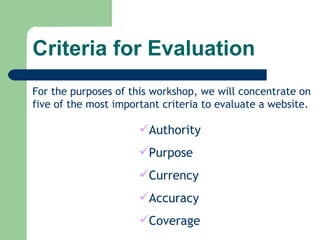
Criteria for Evaluation For the purposes of this workshop, we will concentrate on five of the most important criteria to evaluate a website. Authority Purpose Currency Accuracy Coverage
Authority As teachers, we should look for sites that are authored by people with the right experience, training or education on the topic we are researching.
Authority Checklist Is there an author named on the webpage? Is the author an expert on the chosen topic? Is there a link to further information about the author? Who sponsors the webpage, e.g. university, government, business? If there is no author or sponsor, is there another way to determine who wrote the webpage?
Additional information about Authority When authorship cannot be determined, keep in mind that ANYONE can publish ANYTHING on the internet.
Purpose Websites generally have one of three purposes: Provide useful information or services Promote and sell products or services Influence opinion
Purpose Checklist Does the site have the sponsor’s mission or goals stated? Is membership required to use the site, and is there a fee? Is a full range of information offered, or just one viewpoint? Is the author stating facts or offering an opinion?
Currency Students researching a topic are usually looking for the most up-to-date information.
Currency Checklist Is the date it was created stated somewhere on the website? When was it last updated? Are the links active and current? Is the information on the page outdated?
Additional information about Currency Some websites will contain timeless information, as it is with history books and classic novels. The dates on these types of websites will not be as important as one providing information about discoveries in science, for example.
Accuracy Unlike conventional print resources, websites rarely have editors to check the accuracy of the facts presented in them.
Accuracy Checklist Is the information reliable and error-free? Does the website have an editor to verify that the information is correct? Are citations included? Does the website have a preferred domain?
Additional information about Accuracy There are currently NO standards to ensure accuracy on a website!
Coverage Many websites offer information on the same topic. Some sites are comprehensive in scope and some are just an overview.
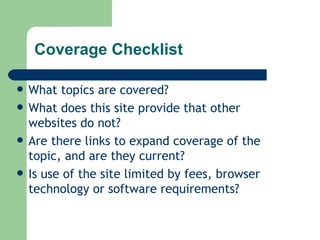
Coverage Checklist What topics are covered? What does this site provide that other websites do not? Are there links to expand coverage of the topic, and are they current? Is use of the site limited by fees, browser technology or software requirements?
And many more….. Other criteria are considered when evaluating a website. Often the appearance of a website is what makes it outstanding for some; others will give it a top rating if it is easily navigable. There are as many different website evaluation criteria as there are people evaluating them.
Bibliography Beck, Susan. “Evaluation Criteria.”  The Good, The Bad & The Ugly: or, Why It’s a Good Idea to Evaluate Web Sources.  1997.  http://lib.nmsu.edu/instruction/evalcrit.html Gilster, Paul.  Digital Literacy . New York: John Wiley & Sons, Inc., 1997. Schrock, Kathy. “Teaching Media Literacy in the Age of the Internet: The ABCs of Web Site Evaluation.”  Classroom Connect , December 1998.

Itc536 web evalpp

  • 1.
    Evaluating Web SitesA Workshop for Educators Sheryl Eshbach
  • 2.
    We’ve inherited thisnotion that if it pops up on a screen and looks good, we tend to think of it as fairly credible. - Paul Gilster, Digital Literacy (1997)
  • 3.
    Criteria for EvaluationFor the purposes of this workshop, we will concentrate on five of the most important criteria to evaluate a website. Authority Purpose Currency Accuracy Coverage
  • 4.
    Authority As teachers,we should look for sites that are authored by people with the right experience, training or education on the topic we are researching.
  • 5.
    Authority Checklist Isthere an author named on the webpage? Is the author an expert on the chosen topic? Is there a link to further information about the author? Who sponsors the webpage, e.g. university, government, business? If there is no author or sponsor, is there another way to determine who wrote the webpage?
  • 6.
    Additional information aboutAuthority When authorship cannot be determined, keep in mind that ANYONE can publish ANYTHING on the internet.
  • 7.
    Purpose Websites generallyhave one of three purposes: Provide useful information or services Promote and sell products or services Influence opinion
  • 8.
    Purpose Checklist Doesthe site have the sponsor’s mission or goals stated? Is membership required to use the site, and is there a fee? Is a full range of information offered, or just one viewpoint? Is the author stating facts or offering an opinion?
  • 9.
    Currency Students researchinga topic are usually looking for the most up-to-date information.
  • 10.
    Currency Checklist Isthe date it was created stated somewhere on the website? When was it last updated? Are the links active and current? Is the information on the page outdated?
  • 11.
    Additional information aboutCurrency Some websites will contain timeless information, as it is with history books and classic novels. The dates on these types of websites will not be as important as one providing information about discoveries in science, for example.
  • 12.
    Accuracy Unlike conventionalprint resources, websites rarely have editors to check the accuracy of the facts presented in them.
  • 13.
    Accuracy Checklist Isthe information reliable and error-free? Does the website have an editor to verify that the information is correct? Are citations included? Does the website have a preferred domain?
  • 14.
    Additional information aboutAccuracy There are currently NO standards to ensure accuracy on a website!
  • 15.
    Coverage Many websitesoffer information on the same topic. Some sites are comprehensive in scope and some are just an overview.
  • 16.
    Coverage Checklist Whattopics are covered? What does this site provide that other websites do not? Are there links to expand coverage of the topic, and are they current? Is use of the site limited by fees, browser technology or software requirements?
  • 17.
    And many more…..Other criteria are considered when evaluating a website. Often the appearance of a website is what makes it outstanding for some; others will give it a top rating if it is easily navigable. There are as many different website evaluation criteria as there are people evaluating them.
  • 18.
    Bibliography Beck, Susan.“Evaluation Criteria.” The Good, The Bad & The Ugly: or, Why It’s a Good Idea to Evaluate Web Sources. 1997. http://lib.nmsu.edu/instruction/evalcrit.html Gilster, Paul. Digital Literacy . New York: John Wiley & Sons, Inc., 1997. Schrock, Kathy. “Teaching Media Literacy in the Age of the Internet: The ABCs of Web Site Evaluation.” Classroom Connect , December 1998.