ITC Limited
Paperboards and Specialty Papers Division, Tribeni
Bratin Sengupta
Department of Chemical Engineering
National Institute of Technology, Durgapur.
EFFECT OF PCC SLURRY IN WET
END AND RUNNABILITY
Contents
 Wood and Pulp
 General Process of Paper Making
 Study
Wood and Pulp
“Paper is a thin material produced by pressing together
moist fibers, typically cellulose pulp derived
from wood, rags or grass, and drying them into flexible
sheets.”
The unit at Tribeni produces different types of paper which
are defined based on their functional properties such as
caliper, gsm , porosity, tensile strength etc.
It mainly produces cigarette paper.
Pulp from Wood ~
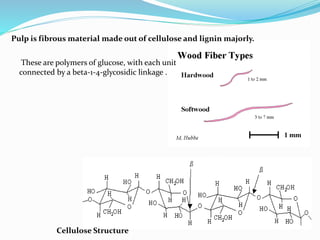
Hard Wood Soft Wood
• Deciduous forest
• Faster growth
• Difficult Conversion
• Fiber length 0.5-2mm
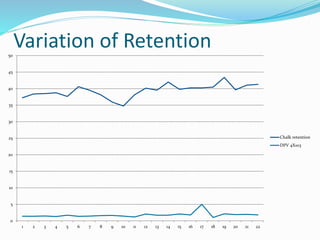
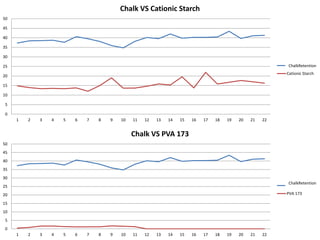
• Short fiber length and act as
filler material
• Improves formation,
smoothness and opacity
• Coniferous forest
• Slower growth
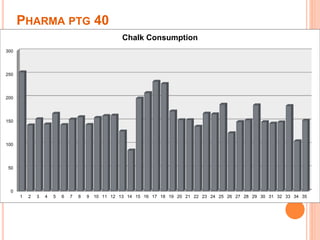
• Easy Conversion
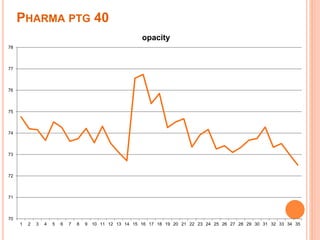
• Fiber length 2-5mm
• Improves strength, bonding
and tear strength
Pulp is fibrous material made out of cellulose and lignin majorly.
Cellulose Structure
These are polymers of glucose, with each unit
connected by a beta-1-4-glycosidic linkage .
Paper Making Process
Pulp
Sheets
Pulper
Refiner
Head
Box Press
Drier
Rewinder Reeling
Packing
Dispatch
Stock Preparation ~
Materials Required :
1. Pulp Stock
2. Chemicals
• Filler: Clay, Chalk, Talc, Titanium Dioxide
• Retention Aids
• Biocides: Oxiclean, Busan
• Acids and Bases
• Sizing Agents: Resin , Waxes
• Dry strength additives: starch
• Wet strength additives: cross-linking polymers
Refiners
The refining is an operation wherein the pulp slurry passes
between a pair of discs, one of which is stationary and the
other rotating at speeds of typically 1,000 or 1,200 RPM.
The discs have raised bars on their faces and pass each other
with narrow clearance.
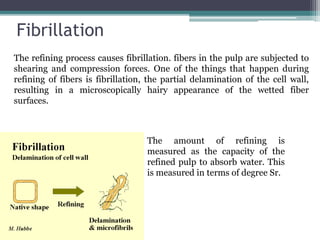
Fibrillation
The refining process causes fibrillation. fibers in the pulp are subjected to
shearing and compression forces. One of the things that happen during
refining of fibers is fibrillation, the partial delamination of the cell wall,
resulting in a microscopically hairy appearance of the wetted fiber
surfaces.
The amount of refining is
measured as the capacity of the
refined pulp to absorb water. This
is measured in terms of degree Sr.
Approach Flow
Centri-cleaner
• Equipments used to remove air,
dirt, shives and specks from the
pulp stock.
• Inlet consistency is around 1%.
• Generally consist of 3-4 stages
and reject of each stage flows
through the nozzle to a common
tank.
• Inlet and outlet valve of each
bottle is controlled to maintain a
required pressure drop.
Pressure Screen
• Cylindrical body with tangential
inlet and outlet along with a
reject outlet.
• Metallic screen drum having
required slots(0.15-0.8mm) is
fitted in drum co-centrally.
• Rotor placed at centre provides
centrifugal force .
• Stock which passes through
holes flows through outlet pipe
and reject goes for further
treatment.
Mainly composed of mechanical separation equipments to remove dirt and other
Impurity from the pulp before allowing it into the paper machine.
Paper Machine
•Stock enters from head box with 0.5% consistency
•Paper coming from wire part have 13-14% consistency.
•Paper exiting from press section have 30-40% consistency.
PAPER MACHINE-3
Installed in 1978 – Bertrams Sciences, UK
Deckle : 3.35 metres
Speed : 400 mpm
Grades :
Thin printing : 28 to 48 gsm
Wax match tissue : 44 gsm
Anti rust : 27 to 35 gsm
Insulating grades : 40 to 90 micron
Medical insert : 40 gsm
White tipping : 36 gsm
Daily capacity : 55 T
OBJECTIVE
 The objective of this project is to study the
effect on different paper quality due to
variation of different chemicals and
particularly the Chalk that is added to the
paper. The paper properties are being
studied under different conditions of chalk
and the variations in paper quality are
reported as the unit switched over from Bags
to PCC Slurry as their principal source of
Calcium Carbonate for the chalk
STUDY DETAILS
 Period: March ‘14 to
June ‘14.
 Paper Grades Selected
for study ~
 Opaque Tissue 28
 Pharma ptg 40
Data Collected
 Chemical Consumed
per ton paper produced
per day.
 Paper Quality for each
day – Opacity, Roughness,
Brightness, Ash content,
porosity.
 Runnability data – Chalk
Retention.
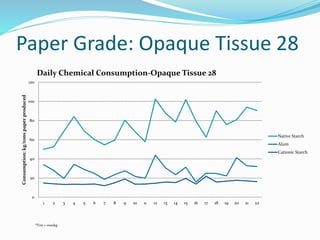
Paper Grade: Opaque Tissue 28
0
20
40
60
80
100
120
1 2 3 4 5 6 7 8 9 10 11 12 13 14 15 16 17 18 19 20 21 22
Consumption:kg/tonspaperproduced
Daily Chemical Consumption-Opaque Tissue 28
Native Starch
Alum
Cationic Starch
*Ton = 1000kg
Opaque Tissue 28
0
2
4
6
8
10
12
14
1 2 3 4 5 6 7 8 9 10 11 12 13 14 15 16 17 18 19 20 21 22
Consumption:kgpertonspaperproduced
Daily Chemical Consumption - Opaque Tissue 28
Salt
DVP 4X10²
Nalco 8699
Nalco 64059
Nalsize 105
Nalco 7670
Nalco 7530
Opaque Tissue 28
0
50
100
150
200
250
300
350
1 2 3 4 5 6 7 8 9 10 11 12 13 14 15 16 17 18 19 20 21 22
Chalk consumed per ton
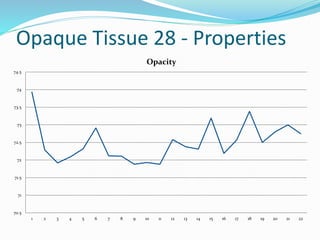
Opaque Tissue 28 - Properties
70.5
71
71.5
72
72.5
73
73.5
74
74.5
1 2 3 4 5 6 7 8 9 10 11 12 13 14 15 16 17 18 19 20 21 22
Opacity
Opaque Tissue 28 - Properties
0
10
20
30
40
50
60
70
80
1 2 3 4 5 6 7 8 9 10 11 12 13 14 15 16 17 18 19 20 21 22
Roughness
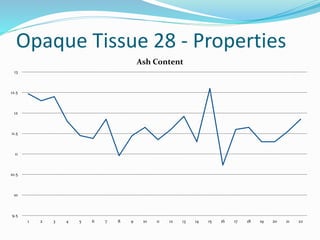
Opaque Tissue 28 - Properties
9.5
10
10.5
11
11.5
12
12.5
13
1 2 3 4 5 6 7 8 9 10 11 12 13 14 15 16 17 18 19 20 21 22
Ash Content
Opaque Tissue 28 - Properties
90
90.5
91
91.5
92
92.5
93
93.5
1 2 3 4 5 6 7 8 9 10 11 12 13 14 15 16 17 18 19 20 21 22
Brightness
Opaque Tissue 28 – Properties Vs
Chemicals
0
10
20
30
40
50
60
70
80
1 2 3 4 5 6 7 8 9 10 11 12 13 14 15 16 17 18 19 20 21 22
Roughness
PVA
Opaque Tissue 28 – Properties Vs
Chemicals
0
10
20
30
40
50
60
70
80
1 2 3 4 5 6 7 8 9 10 11 12 13 14 15 16 17 18 19 20 21 22
Opacity
Alum
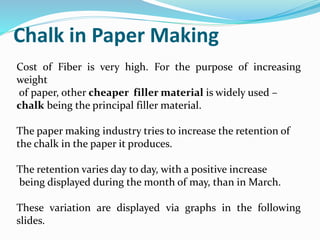
Chalk in Paper Making
Cost of Fiber is very high. For the purpose of increasing
weight
of paper, other cheaper filler material is widely used –
chalk being the principal filler material.
The paper making industry tries to increase the retention of
the chalk in the paper it produces.
The retention varies day to day, with a positive increase
being displayed during the month of may, than in March.
These variation are displayed via graphs in the following
slides.
Variation of Chalk Retention
0
5
10
15
20
25
30
35
40
45
50
1 2 3 4 5 6 7 8 9 10 11 12 13 14 15 16 17 18 19 20 21 22
Chalk retention
Variation of Retention
0
5
10
15
20
25
30
35
40
45
50
1 2 3 4 5 6 7 8 9 10 11 12 13 14 15 16 17 18 19 20 21 22
Chalk retention
DPV 4X10³
0
5
10
15
20
25
30
35
40
45
50
1 2 3 4 5 6 7 8 9 10 11 12 13 14 15 16 17 18 19 20 21 22
Chalk VS Cationic Starch
Chalk retaintion
Cationic Starch
0
5
10
15
20
25
30
35
40
45
50
1 2 3 4 5 6 7 8 9 10 11 12 13 14 15 16 17 18 19 20 21 22
Chalk VS PVA 173
Chalk retaintion
PVA 173
ChalkRetention
ChalkRetention
PAPER QUALITY : PHARMA PTG 40
0
20
40
60
80
100
120
140
1 2 3 4 5 6 7 8 9 10 11 12 13 14 15 16 17 18 19 20 21 22 23 24 25 26 27 28 29 30 31 32 33 34 35
Consumption:kg/tons
Chemical Consumption
Native Starch
Alum
Cationinc Starch
PHARMA PTG 40
0
1
2
3
4
5
6
7
8
1 2 3 4 5 6 7 8 9 10 11 12 13 14 15 16 17 18 19 20 21 22 23 24 25 26 27 28 29 30 31 32 33 34 35
Consumptiom:Kg/tons
Chemical Consumption
PVA 173
Salt
Nalco 7530
Nalco-7607
Nalsize 7543
Nalco 8699
DVP4X103
PHARMA PTG 40
0
50
100
150
200
250
300
1 2 3 4 5 6 7 8 9 10 11 12 13 14 15 16 17 18 19 20 21 22 23 24 25 26 27 28 29 30 31 32 33 34 35
Chalk Consumption
PHARMA PTG 40
70
71
72
73
74
75
76
77
78
1 2 3 4 5 6 7 8 9 10 11 12 13 14 15 16 17 18 19 20 21 22 23 24 25 26 27 28 29 30 31 32 33 34 35
opacity
PHARMA PTG 40
0
10
20
30
40
50
60
70
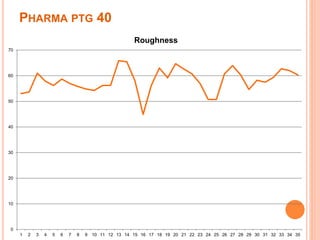
1 2 3 4 5 6 7 8 9 10 11 12 13 14 15 16 17 18 19 20 21 22 23 24 25 26 27 28 29 30 31 32 33 34 35
Roughness
PHARMA PTG 40
0
2
4
6
8
10
12
14
16
18
1 2 3 4 5 6 7 8 9 10 11 12 13 14 15 16 17 18 19 20 21 22 23 24 25 26 27 28 29 30 31 32 33 34 35
Ash
PHARMA PTG 40
82
84
86
88
90
92
94
96
98
100
1 2 3 4 5 6 7 8 9 10 11 12 13 14 15 16 17 18 19 20 21 22 23 24 25 26 27 28 29 30 31 32 33 34 35
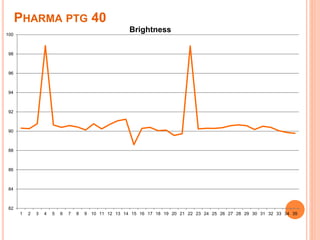
Brightness
PHARMA PTG 40
0
50
100
150
200
250
1 2 3 4 5 6 7 8 9 10 11 12 13 14 15 16 17 18 19 20 21 22 23 24 25 26 27 28 29 30 31 32 33 34 35
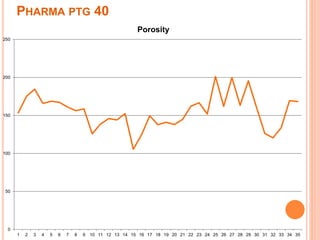
Porosity
PHARMA PTG 40
0
10
20
30
40
50
60
1 2 3 4 5 6 7 8 9 10 11 12 13 14 15 16 17 18 19 20 21 22 23 24 25 26 27 28 29 30 31 32 33 34 35
Chalk retention
ANALYSIS
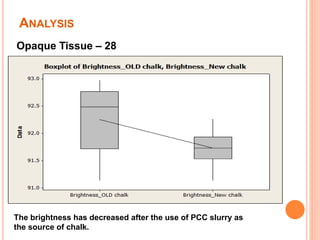
Opaque Tissue – 28
The brightness has decreased after the use of PCC slurry as
the source of chalk.
ANALYSIS
Opaque Tissue – 28
The opacity has decreased after the use of PCC slurry as the
source of chalk.
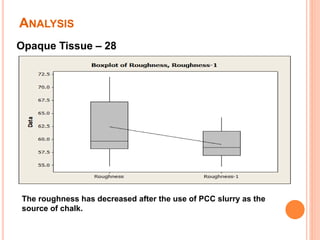
Opaque Tissue – 28
ANALYSIS
The roughness has decreased after the use of PCC slurry as the
source of chalk.
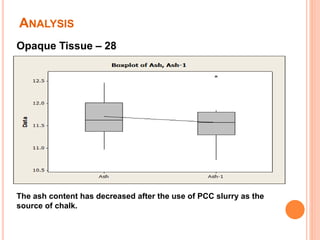
Opaque Tissue – 28
ANALYSIS
The ash content has decreased after the use of PCC slurry as the
source of chalk.
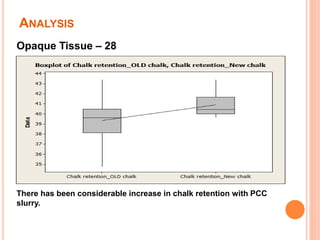
Opaque Tissue – 28
ANALYSIS
There has been considerable increase in chalk retention with PCC
slurry.
ANALYSIS
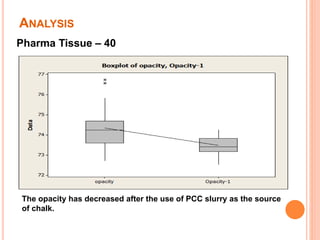
Pharma Tissue – 40
The opacity has decreased after the use of PCC slurry as the source
of chalk.
ANALYSIS
Pharma Tissue – 40
The roughness has increased after the use of PCC slurry as the
source of chalk.
ANALYSIS
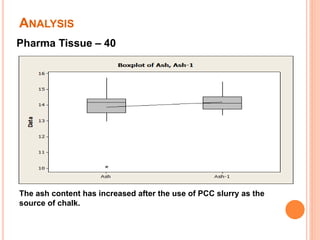
Pharma Tissue – 40
The ash content has increased after the use of PCC slurry as the
source of chalk.
ANALYSIS
Pharma Tissue – 40
The brightness has increased after the use of PCC slurry as the
source of chalk.
ANALYSIS
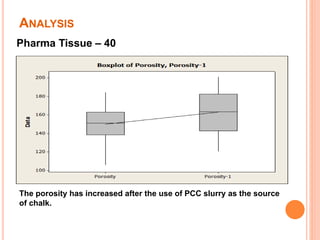
Pharma Tissue – 40
The porosity has increased after the use of PCC slurry as the source
of chalk.
ANALYSIS
Pharma Tissue – 40
There is considerable increase in retention.
SUMMERY
PROBLEMS IN PROJECT UNDERTAKING AND
IMPLEMENTATION OF R&D SUGGESTION
• Time lag between sample collection and result communiqué.
• All tests are not done at the same time instance.
• Time delay in communication of results to control unit.
SOLUTIONS
• Proper management of a online database for production
parameters which should be accessible at every operation
points.
• Online and real time Sampling of back water and finished
paper rolls.
• Automated control and metering of chemicals and fillers
added at the ‘chemical kitchen’ department of the plant.
THANK YOU

ITC Limited_Bratin_46

  • 1.
    ITC Limited Paperboards andSpecialty Papers Division, Tribeni
  • 2.
    Bratin Sengupta Department ofChemical Engineering National Institute of Technology, Durgapur. EFFECT OF PCC SLURRY IN WET END AND RUNNABILITY
  • 3.
    Contents  Wood andPulp  General Process of Paper Making  Study
  • 4.
    Wood and Pulp “Paperis a thin material produced by pressing together moist fibers, typically cellulose pulp derived from wood, rags or grass, and drying them into flexible sheets.” The unit at Tribeni produces different types of paper which are defined based on their functional properties such as caliper, gsm , porosity, tensile strength etc. It mainly produces cigarette paper.
  • 5.
    Pulp from Wood~ Hard Wood Soft Wood • Deciduous forest • Faster growth • Difficult Conversion • Fiber length 0.5-2mm • Short fiber length and act as filler material • Improves formation, smoothness and opacity • Coniferous forest • Slower growth • Easy Conversion • Fiber length 2-5mm • Improves strength, bonding and tear strength
  • 6.
    Pulp is fibrousmaterial made out of cellulose and lignin majorly. Cellulose Structure These are polymers of glucose, with each unit connected by a beta-1-4-glycosidic linkage .
  • 7.
    Paper Making Process Pulp Sheets Pulper Refiner Head BoxPress Drier Rewinder Reeling Packing Dispatch
  • 8.
    Stock Preparation ~ MaterialsRequired : 1. Pulp Stock 2. Chemicals • Filler: Clay, Chalk, Talc, Titanium Dioxide • Retention Aids • Biocides: Oxiclean, Busan • Acids and Bases • Sizing Agents: Resin , Waxes • Dry strength additives: starch • Wet strength additives: cross-linking polymers
  • 10.
    Refiners The refining isan operation wherein the pulp slurry passes between a pair of discs, one of which is stationary and the other rotating at speeds of typically 1,000 or 1,200 RPM. The discs have raised bars on their faces and pass each other with narrow clearance.
  • 11.
    Fibrillation The refining processcauses fibrillation. fibers in the pulp are subjected to shearing and compression forces. One of the things that happen during refining of fibers is fibrillation, the partial delamination of the cell wall, resulting in a microscopically hairy appearance of the wetted fiber surfaces. The amount of refining is measured as the capacity of the refined pulp to absorb water. This is measured in terms of degree Sr.
  • 12.
    Approach Flow Centri-cleaner • Equipmentsused to remove air, dirt, shives and specks from the pulp stock. • Inlet consistency is around 1%. • Generally consist of 3-4 stages and reject of each stage flows through the nozzle to a common tank. • Inlet and outlet valve of each bottle is controlled to maintain a required pressure drop. Pressure Screen • Cylindrical body with tangential inlet and outlet along with a reject outlet. • Metallic screen drum having required slots(0.15-0.8mm) is fitted in drum co-centrally. • Rotor placed at centre provides centrifugal force . • Stock which passes through holes flows through outlet pipe and reject goes for further treatment. Mainly composed of mechanical separation equipments to remove dirt and other Impurity from the pulp before allowing it into the paper machine.
  • 13.
    Paper Machine •Stock entersfrom head box with 0.5% consistency •Paper coming from wire part have 13-14% consistency. •Paper exiting from press section have 30-40% consistency.
  • 14.
    PAPER MACHINE-3 Installed in1978 – Bertrams Sciences, UK Deckle : 3.35 metres Speed : 400 mpm Grades : Thin printing : 28 to 48 gsm Wax match tissue : 44 gsm Anti rust : 27 to 35 gsm Insulating grades : 40 to 90 micron Medical insert : 40 gsm White tipping : 36 gsm Daily capacity : 55 T
  • 15.
    OBJECTIVE  The objectiveof this project is to study the effect on different paper quality due to variation of different chemicals and particularly the Chalk that is added to the paper. The paper properties are being studied under different conditions of chalk and the variations in paper quality are reported as the unit switched over from Bags to PCC Slurry as their principal source of Calcium Carbonate for the chalk
  • 16.
    STUDY DETAILS  Period:March ‘14 to June ‘14.  Paper Grades Selected for study ~  Opaque Tissue 28  Pharma ptg 40 Data Collected  Chemical Consumed per ton paper produced per day.  Paper Quality for each day – Opacity, Roughness, Brightness, Ash content, porosity.  Runnability data – Chalk Retention.
  • 17.
    Paper Grade: OpaqueTissue 28 0 20 40 60 80 100 120 1 2 3 4 5 6 7 8 9 10 11 12 13 14 15 16 17 18 19 20 21 22 Consumption:kg/tonspaperproduced Daily Chemical Consumption-Opaque Tissue 28 Native Starch Alum Cationic Starch *Ton = 1000kg
  • 18.
    Opaque Tissue 28 0 2 4 6 8 10 12 14 12 3 4 5 6 7 8 9 10 11 12 13 14 15 16 17 18 19 20 21 22 Consumption:kgpertonspaperproduced Daily Chemical Consumption - Opaque Tissue 28 Salt DVP 4X10² Nalco 8699 Nalco 64059 Nalsize 105 Nalco 7670 Nalco 7530
  • 19.
    Opaque Tissue 28 0 50 100 150 200 250 300 350 12 3 4 5 6 7 8 9 10 11 12 13 14 15 16 17 18 19 20 21 22 Chalk consumed per ton
  • 20.
    Opaque Tissue 28- Properties 70.5 71 71.5 72 72.5 73 73.5 74 74.5 1 2 3 4 5 6 7 8 9 10 11 12 13 14 15 16 17 18 19 20 21 22 Opacity
  • 21.
    Opaque Tissue 28- Properties 0 10 20 30 40 50 60 70 80 1 2 3 4 5 6 7 8 9 10 11 12 13 14 15 16 17 18 19 20 21 22 Roughness
  • 22.
    Opaque Tissue 28- Properties 9.5 10 10.5 11 11.5 12 12.5 13 1 2 3 4 5 6 7 8 9 10 11 12 13 14 15 16 17 18 19 20 21 22 Ash Content
  • 23.
    Opaque Tissue 28- Properties 90 90.5 91 91.5 92 92.5 93 93.5 1 2 3 4 5 6 7 8 9 10 11 12 13 14 15 16 17 18 19 20 21 22 Brightness
  • 24.
    Opaque Tissue 28– Properties Vs Chemicals 0 10 20 30 40 50 60 70 80 1 2 3 4 5 6 7 8 9 10 11 12 13 14 15 16 17 18 19 20 21 22 Roughness PVA
  • 25.
    Opaque Tissue 28– Properties Vs Chemicals 0 10 20 30 40 50 60 70 80 1 2 3 4 5 6 7 8 9 10 11 12 13 14 15 16 17 18 19 20 21 22 Opacity Alum
  • 26.
    Chalk in PaperMaking Cost of Fiber is very high. For the purpose of increasing weight of paper, other cheaper filler material is widely used – chalk being the principal filler material. The paper making industry tries to increase the retention of the chalk in the paper it produces. The retention varies day to day, with a positive increase being displayed during the month of may, than in March. These variation are displayed via graphs in the following slides.
  • 27.
    Variation of ChalkRetention 0 5 10 15 20 25 30 35 40 45 50 1 2 3 4 5 6 7 8 9 10 11 12 13 14 15 16 17 18 19 20 21 22 Chalk retention
  • 28.
    Variation of Retention 0 5 10 15 20 25 30 35 40 45 50 12 3 4 5 6 7 8 9 10 11 12 13 14 15 16 17 18 19 20 21 22 Chalk retention DPV 4X10³
  • 29.
    0 5 10 15 20 25 30 35 40 45 50 1 2 34 5 6 7 8 9 10 11 12 13 14 15 16 17 18 19 20 21 22 Chalk VS Cationic Starch Chalk retaintion Cationic Starch 0 5 10 15 20 25 30 35 40 45 50 1 2 3 4 5 6 7 8 9 10 11 12 13 14 15 16 17 18 19 20 21 22 Chalk VS PVA 173 Chalk retaintion PVA 173 ChalkRetention ChalkRetention
  • 30.
    PAPER QUALITY :PHARMA PTG 40 0 20 40 60 80 100 120 140 1 2 3 4 5 6 7 8 9 10 11 12 13 14 15 16 17 18 19 20 21 22 23 24 25 26 27 28 29 30 31 32 33 34 35 Consumption:kg/tons Chemical Consumption Native Starch Alum Cationinc Starch
  • 31.
    PHARMA PTG 40 0 1 2 3 4 5 6 7 8 12 3 4 5 6 7 8 9 10 11 12 13 14 15 16 17 18 19 20 21 22 23 24 25 26 27 28 29 30 31 32 33 34 35 Consumptiom:Kg/tons Chemical Consumption PVA 173 Salt Nalco 7530 Nalco-7607 Nalsize 7543 Nalco 8699 DVP4X103
  • 32.
    PHARMA PTG 40 0 50 100 150 200 250 300 12 3 4 5 6 7 8 9 10 11 12 13 14 15 16 17 18 19 20 21 22 23 24 25 26 27 28 29 30 31 32 33 34 35 Chalk Consumption
  • 33.
    PHARMA PTG 40 70 71 72 73 74 75 76 77 78 12 3 4 5 6 7 8 9 10 11 12 13 14 15 16 17 18 19 20 21 22 23 24 25 26 27 28 29 30 31 32 33 34 35 opacity
  • 34.
    PHARMA PTG 40 0 10 20 30 40 50 60 70 12 3 4 5 6 7 8 9 10 11 12 13 14 15 16 17 18 19 20 21 22 23 24 25 26 27 28 29 30 31 32 33 34 35 Roughness
  • 35.
    PHARMA PTG 40 0 2 4 6 8 10 12 14 16 18 12 3 4 5 6 7 8 9 10 11 12 13 14 15 16 17 18 19 20 21 22 23 24 25 26 27 28 29 30 31 32 33 34 35 Ash
  • 36.
    PHARMA PTG 40 82 84 86 88 90 92 94 96 98 100 12 3 4 5 6 7 8 9 10 11 12 13 14 15 16 17 18 19 20 21 22 23 24 25 26 27 28 29 30 31 32 33 34 35 Brightness
  • 37.
    PHARMA PTG 40 0 50 100 150 200 250 12 3 4 5 6 7 8 9 10 11 12 13 14 15 16 17 18 19 20 21 22 23 24 25 26 27 28 29 30 31 32 33 34 35 Porosity
  • 38.
    PHARMA PTG 40 0 10 20 30 40 50 60 12 3 4 5 6 7 8 9 10 11 12 13 14 15 16 17 18 19 20 21 22 23 24 25 26 27 28 29 30 31 32 33 34 35 Chalk retention
  • 39.
    ANALYSIS Opaque Tissue –28 The brightness has decreased after the use of PCC slurry as the source of chalk.
  • 40.
    ANALYSIS Opaque Tissue –28 The opacity has decreased after the use of PCC slurry as the source of chalk.
  • 41.
    Opaque Tissue –28 ANALYSIS The roughness has decreased after the use of PCC slurry as the source of chalk.
  • 42.
    Opaque Tissue –28 ANALYSIS The ash content has decreased after the use of PCC slurry as the source of chalk.
  • 43.
    Opaque Tissue –28 ANALYSIS There has been considerable increase in chalk retention with PCC slurry.
  • 44.
    ANALYSIS Pharma Tissue –40 The opacity has decreased after the use of PCC slurry as the source of chalk.
  • 45.
    ANALYSIS Pharma Tissue –40 The roughness has increased after the use of PCC slurry as the source of chalk.
  • 46.
    ANALYSIS Pharma Tissue –40 The ash content has increased after the use of PCC slurry as the source of chalk.
  • 47.
    ANALYSIS Pharma Tissue –40 The brightness has increased after the use of PCC slurry as the source of chalk.
  • 48.
    ANALYSIS Pharma Tissue –40 The porosity has increased after the use of PCC slurry as the source of chalk.
  • 49.
    ANALYSIS Pharma Tissue –40 There is considerable increase in retention.
  • 50.
  • 51.
    PROBLEMS IN PROJECTUNDERTAKING AND IMPLEMENTATION OF R&D SUGGESTION • Time lag between sample collection and result communiqué. • All tests are not done at the same time instance. • Time delay in communication of results to control unit. SOLUTIONS • Proper management of a online database for production parameters which should be accessible at every operation points. • Online and real time Sampling of back water and finished paper rolls. • Automated control and metering of chemicals and fillers added at the ‘chemical kitchen’ department of the plant.
  • 52.