Financing e-services in Europe:
        a regional perspective

                           Luigi Reggi
Department of Economics, Society and Politics, Urbino University and
  DG EU Regional Policy, Ministry of Economic Development, Italy


                      Sergio Scicchitano
Department of Economics and Law, Sapienza University of Rome and
  DG EU Regional Policy, Ministry of Economic Development, Italy


                         itAIS2011	
  Conference	
  
                               Rome,	
  Italy	
  
Agenda
•    Relevant literature and research objectives
•    EU Regional Policy and Information Society
•    Empirical method
•    Results
•    Discussion and conclusions
RELEVANT LITERATURE and RESEARCH OBJECTIVES

     Regional policies for innovation
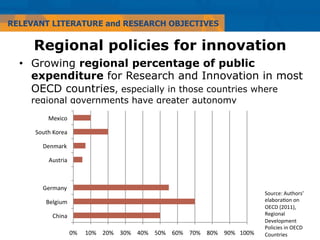
  •  Growing regional percentage of public
     expenditure for Research and Innovation in most
     OECD countries, especially in those countries where
    regional governments have greater autonomy
         C3D/EA#

     @A6=.#BA931#

       >30719?#

         ;6<=9/1#


       839710:#
                                                                             Source:	
  Authors’	
  
        2345/67#                                                             elabora=on	
  on	
  
                                                                             OECD	
  (2011),	
  
           -./01#                                                            Regional	
  
                                                                             Development	
  
                                                                             Policies	
  in	
  OECD	
  
                    !"# $!"# %!"# &!"# '!"# (!"# )!"# *!"# +!"# ,!"# $!!"#   Countries	
  
RELEVANT LITERATURE and RESEARCH OBJECTIVES


      Regional Innovation Systems
  •  The concept of RIS introduced since the early ’90s as
     an extension of the concept of National Innovation
     System (NIS)
    (Cooke, P. 1992, Cooke and Morgan 1998, Asheim and Isaksen,
    1997)

  •  Three different types of RISs have been identified
    (Asheim and Gertler 2004).
     –  The territorially embedded regional innovation
        systems (TERIS), where firms operate without any strong
        interaction with knowledge organizations.
     –  The regionally networked innovation system (RNeIS),
        where firms and organizations are still implanted in a
        specific region and characterized by localized, interactive
        learning.
     –  The regionalized national innovation system (RNaIS)
        where the innovation activity takes place mostly in
        cooperation with actors outside the region at a both
        national and international level.
RELEVANT LITERATURE and RESEARCH OBJECTIVES


               Research objective

  •  To explore the amount of public resources
     dedicated to ICT and e-services and the
     strategies that European public agencies are
     pursuing when allocating funding to local policy
     priorities
REGIONAL POLICY


            Why Regional Policy? (1/2)
•  Cohesion	
  policy:	
  aims	
  at	
  reducing	
  regional	
  dispari=es	
  
•  Second	
  item	
  of	
  EU	
  budget:	
  347	
  billion	
  Euros	
  for	
  
   2007-­‐13	
  period	
  
•  It	
  contributes	
  to	
  the	
  Digital	
  Agenda	
  of	
  EU2020	
  strategy	
  

•  Common EU policy                           •  Multilevel governance
    –  all EU 27 Countries are                     Regional and/or National
       involved                                    agencies are Managing
    –  full comparability: same rules              Authorities of Operational
       and regulations                             Programmes
REGIONAL POLICY


                 Why Regional Policy? (2/2)


  “In	
  the	
  2007-­‐2013	
  planning	
  period	
  the	
  share	
  of	
  Structural	
  Funds	
  of	
  the	
  
  European	
  Union	
  allocated	
  to	
  Research	
  and	
  Innova.on	
  (the	
  “Lisbon	
  
  Agenda”)	
  received	
  the	
  largest	
  increase,	
  in	
  absolute	
  and	
  relaFve	
  terms.	
  
  It	
  is	
  no	
  exaggeraFon	
  to	
  claim	
  that,	
  for	
  many	
  countries,	
  the	
  en.re	
  
  Lisbon	
  Agenda	
  rests	
  on	
  Structural	
  Funds.”	


  (Bonaccorsi	
  A.,	
  2010,	
  Towards	
  beMer	
  use	
  of	
  condi=onality	
  in	
  policies	
  for	
  research	
  and	
  innova=on	
  
  under	
  Structural	
  Funds:	
  The	
  intelligent	
  policy	
  challenge,	
  working	
  paper	
  underlying	
  Barca	
  Report	
  
  “An	
  agenda	
  for	
  the	
  reformed	
  Cohesion	
  Policy.)	
  	
  
EMPIRICAL METHOD


                   Data source

  •  Data source: official dataset on EU Structural
     Funds programmed resources for the period
     2007-13 provided by the European
     Commission – DG Regional Policy
  •  It includes data on the amount of financial
     resources programmed by 434 Operational
     Programmes (OP)
EMPIRICAL METHOD


  Programmed resources at NUTS2 level
  •  a matching with the Eurostat database of EU
     Regions (NUTS2 level) has been performed in
     order to estimate the programmed amount of
     resources at regional level.
  •  total amount of national and multiregional
     Programmes has been equally assigned to all
     regions directly involved in each Programme)

                Total regional resources
                           =
   resources allocated by the regional Programmes
                           +
   share of national or multiregional Programmes
      that have an impact on that specific region.
EMPIRICAL METHOD

  Identifying resources dedicated to
  e-services and information society
  •  How to calculate the contribution of
     structural Funds to each priority/sector?
  •  COUNCIL REGULATION (EC) No
     1083/2006 general:
     86 categories of expenditure
     –  6 are dedicated to the information Society and
        1 to the E-services
RESULTS

           Financial resources for Information Society
                   by category of expenditure


10	
              Telephone	
  infrastructures	
  (including	
  broadband	
  networks)	
                             2,257,722,464	
   15%	
  
11	
  +	
  12	
   Informa=on	
  and	
  communica=on	
  technologies	
  (including	
  TEN)	
                          4,121,115,554	
   27%	
  
13	
              Services	
  and	
  applica>ons	
  for	
  ci>zens	
  (e-­‐health,	
  e-­‐                           5,225,072,351	
   34%	
  
                  government,	
  e-­‐learning,	
  e-­‐inclusion,	
  etc.)	
  
14	
              Services	
  and	
  applica=ons	
  for	
  SMEs	
  (e-­‐commerce,	
  educa=on	
                      2,144,358,160	
   14%	
  
                  and	
  training,	
  networking,	
  etc.)	
  
15	
              Other	
  measures	
  for	
  improving	
  access	
  to	
  and	
  efficient	
  use	
  of	
             1,537,162,147	
   10%	
  
                  ICT	
  by	
  SMEs	


                                                                                            15,285,430,676	
   100%	
  
RESULTS

     Financial resources for Information Society
                  by Member State
                                                      Resources	
  allocated	
  by	
  Member	
  State	
  (in	
  %)	
  

10.00	
  %	
  

  8.00	
  %	
  

  6.00	
  %	
  

  4.00	
  %	
  

  2.00	
  %	
  

  0.00	
  %	
  
                               SK	
  
                              GR	
  

                                FI	
  
                               KR	
  

                               CK	
  
                               EE	
  
                            COOP	
  
                               LT	
  
                              PO	
  
                               FR	
  
                     EU	
  (Mean)	
  
                               SL	
  
                                IT	
  
                               PT	
  
                              HU	
  
                              RM	
  
                              ND	
  
                               SE	
  
                              UK	
  
                               DE	
  
                              BG	
  
                               LV	
  
                               BE	
  
                              DK	
  
                                IR	
  
                               LU	
  
                               AT	
  
                              MA	


                               ES	


                                                                                         %	
  cat	
  13	
  over	
  tot	
  SF	
     %	
  IS	
  over	
  tot.	
  SF	
  
   Note.	
  Authors’	
  calcula=ons	
  on	
  EC	
  –	
  DG	
  Regio	
  data	
  
RESULTS

  Financial resources for Information Society
               by Member State

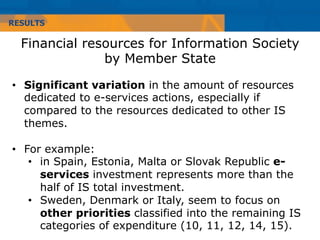
•  Significant variation in the amount of resources
   dedicated to e-services actions, especially if
   compared to the resources dedicated to other IS
   themes.

•  For example:
    •  in Spain, Estonia, Malta or Slovak Republic e-
       services investment represents more than the
       half of IS total investment.
    •  Sweden, Denmark or Italy, seem to focus on
       other priorities classified into the remaining IS
       categories of expenditure (10, 11, 12, 14, 15).
RESULTS

    Financial resources for public e-services
        at regional level: a cluster analysis
 Goodness	
  of	
  variance	
  fit	
  (GVF):	
  aims	
  at	
  minimizing	
  the	
  
 squared	
  devia=ons	
  of	
  the	
  class	
  means

                                                                       SSD	
  =sum	
  of	
  squared	
  difference	
  
Financial	
  resources	
  for	
  public	
  e-­‐services	
  	
  
  RESULTS

      Financial resources for Information Society
                    at regional level
RESULTS

      Financial resources for e-services at
                  regional level
•  In the 1st cluster:
    •  All the regions in Slovack Republic except
       Bratislavsky have planned high investments in e-
       services (more than 189 milion of euros)
    •  Campania (147,5 milion of euros), Andalucia (Spain)
       and Attiki (Greece)
•  In the 2nd cluster:
    •  Sardinia in Italy, 3 Spanish, 7 Greek and 10 Polack
       Regions, Pas-de-Calais (France), Észak-
       Magyarország (Hungary)

•  A number of COMP regions decided not to use
   structural funds to co-finance e-services development
RESULTS

  Financial resources for Information Society
     at regional level: a cluster analysis


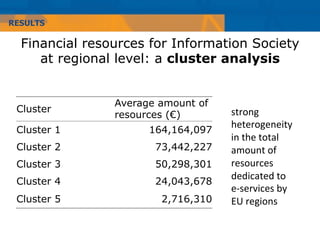
                Average amount of
 Cluster                            strong	
  
                resources (€)
                                    heterogeneity	
  
 Cluster 1            164,164,097
                                    in	
  the	
  total	
  
 Cluster 2             73,442,227   amount	
  of	
  
 Cluster 3             50,298,301   resources	
  
                                    dedicated	
  to	
  
 Cluster 4             24,043,678
                                    e-­‐services	
  by	
  
 Cluster 5              2,716,310   EU	
  regions	
  	
  
CONCLUSIONS


              Conclusions (1/2)
 •  Compared for the first time the financial
    resources dedicated to ICT and e-services at
    NUTS2 level
 •  Regional Policy funding represents a good proxy
    of the total amount of resources available to
    regional public policies, especially in the
    “convergence” objective
CONCLUSIONS


              Conclusions (2/2)
 •  Strong heterogeneity in the level of commitment
    towards e-services development both between
    and within countries
 •  This is due to:
     –  huge variation in total amount of resources
        available (e.g. CONV vs. CRO objectives),
        connected to the degree of development of the
        territories
     –  different regional strategies: focused on e-
        services vs. focus on other priority themes
DISCUSSION AND CONCLUSIONS


                 Open questions
  •  Which strategies are followed by which
     kind of agency, Programme, territory,
     objective?
  •  How will these strategies evolve over
     time?
  •  What are the determinants of the
     allocation of resources to ICT / e-services?
     –  Regional context (size, innovation, ICT
        diffusion, etc.)
     –  Other economic variables (amount of
        funding, FEIs vs. grants..)
Thank you!


                 Luigi Reggi
     luigi.reggi@gmail.com
          www.luigireggi.eu

Financing e-services in Europe: a regional perspective

  • 1.
    Financing e-services inEurope: a regional perspective Luigi Reggi Department of Economics, Society and Politics, Urbino University and DG EU Regional Policy, Ministry of Economic Development, Italy Sergio Scicchitano Department of Economics and Law, Sapienza University of Rome and DG EU Regional Policy, Ministry of Economic Development, Italy itAIS2011  Conference   Rome,  Italy  
  • 2.
    Agenda •  Relevant literature and research objectives •  EU Regional Policy and Information Society •  Empirical method •  Results •  Discussion and conclusions
  • 3.
    RELEVANT LITERATURE andRESEARCH OBJECTIVES Regional policies for innovation •  Growing regional percentage of public expenditure for Research and Innovation in most OECD countries, especially in those countries where regional governments have greater autonomy C3D/EA# @A6=.#BA931# >30719?# ;6<=9/1# 839710:# Source:  Authors’   2345/67# elabora=on  on   OECD  (2011),   -./01# Regional   Development   Policies  in  OECD   !"# $!"# %!"# &!"# '!"# (!"# )!"# *!"# +!"# ,!"# $!!"# Countries  
  • 4.
    RELEVANT LITERATURE andRESEARCH OBJECTIVES Regional Innovation Systems •  The concept of RIS introduced since the early ’90s as an extension of the concept of National Innovation System (NIS) (Cooke, P. 1992, Cooke and Morgan 1998, Asheim and Isaksen, 1997) •  Three different types of RISs have been identified (Asheim and Gertler 2004). –  The territorially embedded regional innovation systems (TERIS), where firms operate without any strong interaction with knowledge organizations. –  The regionally networked innovation system (RNeIS), where firms and organizations are still implanted in a specific region and characterized by localized, interactive learning. –  The regionalized national innovation system (RNaIS) where the innovation activity takes place mostly in cooperation with actors outside the region at a both national and international level.
  • 5.
    RELEVANT LITERATURE andRESEARCH OBJECTIVES Research objective •  To explore the amount of public resources dedicated to ICT and e-services and the strategies that European public agencies are pursuing when allocating funding to local policy priorities
  • 6.
    REGIONAL POLICY Why Regional Policy? (1/2) •  Cohesion  policy:  aims  at  reducing  regional  dispari=es   •  Second  item  of  EU  budget:  347  billion  Euros  for   2007-­‐13  period   •  It  contributes  to  the  Digital  Agenda  of  EU2020  strategy   •  Common EU policy •  Multilevel governance –  all EU 27 Countries are Regional and/or National involved agencies are Managing –  full comparability: same rules Authorities of Operational and regulations Programmes
  • 7.
    REGIONAL POLICY Why Regional Policy? (2/2) “In  the  2007-­‐2013  planning  period  the  share  of  Structural  Funds  of  the   European  Union  allocated  to  Research  and  Innova.on  (the  “Lisbon   Agenda”)  received  the  largest  increase,  in  absolute  and  relaFve  terms.   It  is  no  exaggeraFon  to  claim  that,  for  many  countries,  the  en.re   Lisbon  Agenda  rests  on  Structural  Funds.”     (Bonaccorsi  A.,  2010,  Towards  beMer  use  of  condi=onality  in  policies  for  research  and  innova=on   under  Structural  Funds:  The  intelligent  policy  challenge,  working  paper  underlying  Barca  Report   “An  agenda  for  the  reformed  Cohesion  Policy.)    
  • 8.
    EMPIRICAL METHOD Data source •  Data source: official dataset on EU Structural Funds programmed resources for the period 2007-13 provided by the European Commission – DG Regional Policy •  It includes data on the amount of financial resources programmed by 434 Operational Programmes (OP)
  • 9.
    EMPIRICAL METHOD Programmed resources at NUTS2 level •  a matching with the Eurostat database of EU Regions (NUTS2 level) has been performed in order to estimate the programmed amount of resources at regional level. •  total amount of national and multiregional Programmes has been equally assigned to all regions directly involved in each Programme) Total regional resources = resources allocated by the regional Programmes + share of national or multiregional Programmes that have an impact on that specific region.
  • 10.
    EMPIRICAL METHOD Identifying resources dedicated to e-services and information society •  How to calculate the contribution of structural Funds to each priority/sector? •  COUNCIL REGULATION (EC) No 1083/2006 general: 86 categories of expenditure –  6 are dedicated to the information Society and 1 to the E-services
  • 11.
    RESULTS Financial resources for Information Society by category of expenditure                 10   Telephone  infrastructures  (including  broadband  networks)   2,257,722,464   15%   11  +  12   Informa=on  and  communica=on  technologies  (including  TEN)   4,121,115,554   27%   13   Services  and  applica>ons  for  ci>zens  (e-­‐health,  e-­‐ 5,225,072,351   34%   government,  e-­‐learning,  e-­‐inclusion,  etc.)   14   Services  and  applica=ons  for  SMEs  (e-­‐commerce,  educa=on   2,144,358,160   14%   and  training,  networking,  etc.)   15   Other  measures  for  improving  access  to  and  efficient  use  of   1,537,162,147   10%   ICT  by  SMEs             15,285,430,676   100%  
  • 12.
    RESULTS Financial resources for Information Society by Member State Resources  allocated  by  Member  State  (in  %)   10.00  %   8.00  %   6.00  %   4.00  %   2.00  %   0.00  %   SK   GR   FI   KR   CK   EE   COOP   LT   PO   FR   EU  (Mean)   SL   IT   PT   HU   RM   ND   SE   UK   DE   BG   LV   BE   DK   IR   LU   AT   MA   ES   %  cat  13  over  tot  SF   %  IS  over  tot.  SF   Note.  Authors’  calcula=ons  on  EC  –  DG  Regio  data  
  • 13.
    RESULTS Financialresources for Information Society by Member State •  Significant variation in the amount of resources dedicated to e-services actions, especially if compared to the resources dedicated to other IS themes. •  For example: •  in Spain, Estonia, Malta or Slovak Republic e- services investment represents more than the half of IS total investment. •  Sweden, Denmark or Italy, seem to focus on other priorities classified into the remaining IS categories of expenditure (10, 11, 12, 14, 15).
  • 14.
    RESULTS Financial resources for public e-services at regional level: a cluster analysis Goodness  of  variance  fit  (GVF):  aims  at  minimizing  the   squared  devia=ons  of  the  class  means SSD  =sum  of  squared  difference  
  • 15.
    Financial  resources  for  public  e-­‐services     RESULTS Financial resources for Information Society at regional level
  • 16.
    RESULTS Financial resources for e-services at regional level •  In the 1st cluster: •  All the regions in Slovack Republic except Bratislavsky have planned high investments in e- services (more than 189 milion of euros) •  Campania (147,5 milion of euros), Andalucia (Spain) and Attiki (Greece) •  In the 2nd cluster: •  Sardinia in Italy, 3 Spanish, 7 Greek and 10 Polack Regions, Pas-de-Calais (France), Észak- Magyarország (Hungary) •  A number of COMP regions decided not to use structural funds to co-finance e-services development
  • 17.
    RESULTS Financialresources for Information Society at regional level: a cluster analysis Average amount of Cluster strong   resources (€) heterogeneity   Cluster 1 164,164,097 in  the  total   Cluster 2 73,442,227 amount  of   Cluster 3 50,298,301 resources   dedicated  to   Cluster 4 24,043,678 e-­‐services  by   Cluster 5 2,716,310 EU  regions    
  • 18.
    CONCLUSIONS Conclusions (1/2) •  Compared for the first time the financial resources dedicated to ICT and e-services at NUTS2 level •  Regional Policy funding represents a good proxy of the total amount of resources available to regional public policies, especially in the “convergence” objective
  • 19.
    CONCLUSIONS Conclusions (2/2) •  Strong heterogeneity in the level of commitment towards e-services development both between and within countries •  This is due to: –  huge variation in total amount of resources available (e.g. CONV vs. CRO objectives), connected to the degree of development of the territories –  different regional strategies: focused on e- services vs. focus on other priority themes
  • 20.
    DISCUSSION AND CONCLUSIONS Open questions •  Which strategies are followed by which kind of agency, Programme, territory, objective? •  How will these strategies evolve over time? •  What are the determinants of the allocation of resources to ICT / e-services? –  Regional context (size, innovation, ICT diffusion, etc.) –  Other economic variables (amount of funding, FEIs vs. grants..)
  • 21.
    Thank you! Luigi Reggi luigi.reggi@gmail.com www.luigireggi.eu

Editor's Notes

  • #2 My background in economics and management of innovation
  • #12 Robust and statistically significant
  • #13 Robust and statistically significant
  • #14 Robust and statistically significant
  • #15 Robust and statistically significant
  • #16 Robust and statistically significant
  • #17 Robust and statistically significant
  • #18 Robust and statistically significant
  • #19 Robust and statistically significant
  • #20 Robust and statistically significant