Issue certificates with
PyOpenSSL
And build a trust relationship.
Contents:
Who am I
PKI Reminder
PyOpenSSL
Issue certificates
Issue certificates (2)
Validation of certificates
Signature validation
·
·
·
·
·
·
·
Who am I
@pfreixes coding with python for the last 15 years
I come from the C world and fields such as Operating
System
life brought me to fields such as Nosql, Amqp, Twisted, etc
I work as a Lead Backend Engineer at M2M Cloud Factory
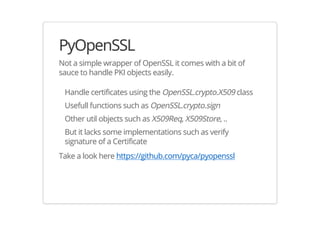
PyOpenSSL
Not a simple wrapper of OpenSSL it comes with a bit of
sauce to handle PKI objects easily.
Handle certificates using the OpenSSL.crypto.X509 class
Usefull functions such as OpenSSL.crypto.sign
Other util objects such as X509Req, X509Store, ..
But it lacks some implementations such as verify
signature of a Certificate
Take a look here https://github.com/pyca/pyopenssl
PKI Reminder
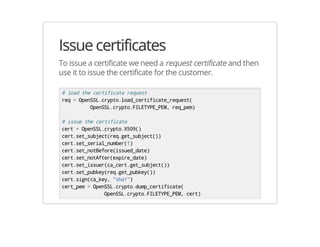
Issue certificates
To issue a certificate we need a request certificate and then
use it to issue the certificate for the customer.
# load the certificate request
req = OpenSSL.crypto.load_certificate_request(
OpenSSL.crypto.FILETYPE_PEM, req_pem)
# issue the certificate
cert = OpenSSL.crypto.X509()
cert.set_subject(req.get_subject())
cert.set_serial_number(1)
cert.set_notBefore(issued_date)
cert.set_notAfter(expire_date)
cert.set_issuer(ca_cert.get_subject())
cert.set_pubkey(req.get_pubkey())
cert.sign(ca_key, "sha1")
cert_pem = OpenSSL.crypto.dump_certificate(
OpenSSL.crypto.FILETYPE_PEM, cert)
Issue certificates (2)
To issue certifiates for subordinate authorities the
certificate has to be set with a few extensions.
ca_extension = 
OpenSSL.crypto.X509Extension("basicConstraints", True,
"CA:TRUE, pathlen:0")
key_usage = "keyCertSign, cRLSign, digitalSignature, nonRepudiation"
key_extension = 
OpenSSL.crypto.X509Extension("keyUsage", True, key_usage)
hash_extension = 
OpenSSL.crypto.X509Extension("subjectKeyIdentifier", False,
"hash", subject=cert)
cert.add_extensions([ca_extension, use_key_extension,
hash_extension])
Validation of certificates
To validate the certificates we use the method called
certification path validation. This is a well known method
with steps such as:
Each certificate in the chain is currently valid
The signature on each certificate is correct for the
certificate contents and public key.
Signature validation
It basically confirms that the signature of the certificate is
valid by using the public key of the CA.
To code that there is no magical function in python openssl.
A more complex code has to be used. Take look at
https://www.v13.gr/blog/?p=303.
More info with full method explained at http://tools.ietf.org
/html/rfc5280#section-6

Issue certificates with PyOpenSSL

  • 1.
    Issue certificates with PyOpenSSL Andbuild a trust relationship. Contents: Who am I PKI Reminder PyOpenSSL Issue certificates Issue certificates (2) Validation of certificates Signature validation · · · · · · ·
  • 2.
    Who am I @pfreixescoding with python for the last 15 years I come from the C world and fields such as Operating System life brought me to fields such as Nosql, Amqp, Twisted, etc I work as a Lead Backend Engineer at M2M Cloud Factory
  • 3.
    PyOpenSSL Not a simplewrapper of OpenSSL it comes with a bit of sauce to handle PKI objects easily. Handle certificates using the OpenSSL.crypto.X509 class Usefull functions such as OpenSSL.crypto.sign Other util objects such as X509Req, X509Store, .. But it lacks some implementations such as verify signature of a Certificate Take a look here https://github.com/pyca/pyopenssl
  • 4.
  • 5.
    Issue certificates To issuea certificate we need a request certificate and then use it to issue the certificate for the customer. # load the certificate request req = OpenSSL.crypto.load_certificate_request( OpenSSL.crypto.FILETYPE_PEM, req_pem) # issue the certificate cert = OpenSSL.crypto.X509() cert.set_subject(req.get_subject()) cert.set_serial_number(1) cert.set_notBefore(issued_date) cert.set_notAfter(expire_date) cert.set_issuer(ca_cert.get_subject()) cert.set_pubkey(req.get_pubkey()) cert.sign(ca_key, "sha1") cert_pem = OpenSSL.crypto.dump_certificate( OpenSSL.crypto.FILETYPE_PEM, cert)
  • 6.
    Issue certificates (2) Toissue certifiates for subordinate authorities the certificate has to be set with a few extensions. ca_extension = OpenSSL.crypto.X509Extension("basicConstraints", True, "CA:TRUE, pathlen:0") key_usage = "keyCertSign, cRLSign, digitalSignature, nonRepudiation" key_extension = OpenSSL.crypto.X509Extension("keyUsage", True, key_usage) hash_extension = OpenSSL.crypto.X509Extension("subjectKeyIdentifier", False, "hash", subject=cert) cert.add_extensions([ca_extension, use_key_extension, hash_extension])
  • 7.
    Validation of certificates Tovalidate the certificates we use the method called certification path validation. This is a well known method with steps such as: Each certificate in the chain is currently valid The signature on each certificate is correct for the certificate contents and public key.
  • 8.
    Signature validation It basicallyconfirms that the signature of the certificate is valid by using the public key of the CA. To code that there is no magical function in python openssl. A more complex code has to be used. Take look at https://www.v13.gr/blog/?p=303. More info with full method explained at http://tools.ietf.org /html/rfc5280#section-6