
Join us to keep the Internet open, thriving and
benefitting people around the globe.
The Internet is for Everyone
February 2018
Kathmandu, Nepal
Founded in 1992 by pioneers of the early Internet, the
Internet Society drives technologies that keep it open and
safe. We promote policies that empower people to
enable universal access for all.
We stand for a better Internet.
2
Global Presence
3
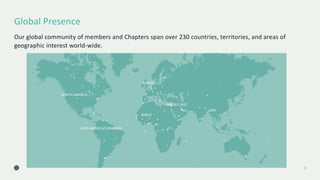
Our global community of members and Chapters span over 230 countries, territories, and areas of
geographic interest world-wide.
NORTH AMERICA
LATIN AMERICA/CARIBBEAN
EUROPE
AFRICA
MIDDLE EAST
ASIA
Internet Society in Asia-Pacific
4
The Numbers
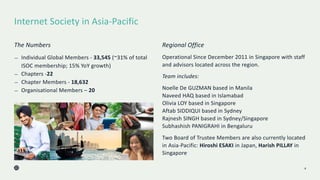
— Individual Global Members - 33,545 (~31% of total
ISOC membership; 15% YoY growth)
— Chapters -22
— Chapter Members - 18,632
— Organisational Members – 20
Regional Office
Operational Since December 2011 in Singapore with staff
and advisors located across the region.
Team includes:
Noelle De GUZMAN based in Manila
Naveed HAQ based in Islamabad
Olivia LOY based in Singapore
Aftab SIDDIQUI based in Sydney
Rajnesh SINGH based in Sydney/Singapore
Subhashish PANIGRAHI in Bengaluru
Two Board of Trustee Members are also currently located
in Asia-Pacific: Hiroshi ESAKI in Japan, Harish PILLAY in
Singapore
2017 Work Highlights
5
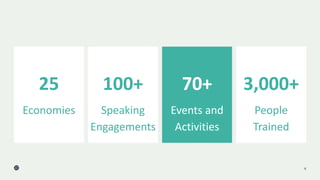
25
Economies
100+
Speaking
Engagements
70+
Events and
Activities
3,000+
People
Trained
6
Survey of Internet Policy Issues in Asia-Pacific
7
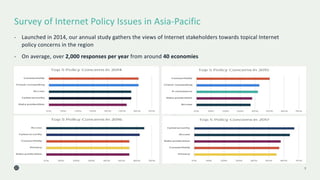
- Launched in 2014, our annual study gathers the views of Internet stakeholders towards topical Internet
policy concerns in the region
- On average, over 2,000 responses per year from around 40 economies
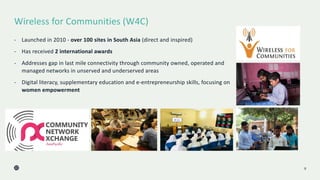
Wireless for Communities (W4C)
8
- Launched in 2010 - over 100 sites in South Asia (direct and inspired)
- Has received 2 international awards
- Addresses gap in last mile connectivity through community owned, operated and
managed networks in unserved and underserved areas
- Digital literacy, supplementary education and e-entrepreneurship skills, focusing on
women empowerment
IXP Mapping Project – APAC [www.ixpmap.org]
9
• Mapping all active IXPs in South
Asia, Southeast Asia, North/East
Asia, Pacific
• Identifies cities that would benefit
from an IXP based on population
• On-going project, initiated
specifically to support AP-IS*;
contributions welcome
• www.ixpmap.org
*Asia-Pacific Information Superhighway
http://www.unescap.org/our-work/ict-disaster-risk-reduction/asia-pacific-information-superhighway
10
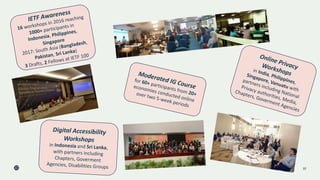
IETF Awareness
16 workshops in 2016 reaching
1000+ participants in
Indonesia, Philippines,
Singapore
2017: South Asia (Bangladesh,
Pakistan, Sri Lanka)
3 Drafts, 2 Fellows at IETF 100 Online PrivacyWorkshopsin India, Philippines,
Singapore, Vanuatu with
partners including National
Privacy authorities, Media,
Chapters, Goverment Agencies
Digital Accessibility
Workshops
in Indonesia and Sri Lanka,
with partners including
Chapters, Goverment
Agencies, Disabilities Groups
Moderated IG Course
for 60+ participants from 20+
economies conducted online
over two 5-week periods
Asia-Pacific Regional Issue Papers
11
• Series of issue papers to provide guidance to decision-makers and stakeholders
• Key findings, information on the state of play, opportunities as well as questions to think about
• Topics include (available at www.internetsociety.org/apac)
- Gender - Financial Inclusion
- Digital Access - Rural Connectivity
- Online Privacy - Frugal Innovation and Entrepreneurship
- Policies for the Digital Economy - Enabling E-services
- Local Content - Disaster Risk Reduction
- Internet of Things - Community Empowerment
- Social Media - Internet Safety
- Climate Change
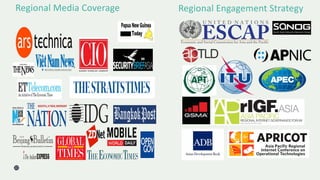
Regional Engagement StrategyRegional Media Coverage
2018 Work Campaigns – a new approach
13
IoT: Trust by Design
14
Problem:
The Internet and its users face an increasing risk of cyber threats because more insecure consumer IoT
devices join the Internet every day. The number of IoT devices and systems connected to the Internet
is expected to reach 20.4 billion by 2020 (Gartner), more than 2.5 times the global population. While
this is a well-known problem, not enough is being done to strengthen the security and privacy of
consumer IoT.
15
Goal:
We want suppliers of consumer grade IoT devices and services to adopt security and privacy in their
devices and services to protect the network, its users and critical information infrastructure from cyber
threats.
Objectives:
• Make the OTA IoT Trust Framework truly global
• Consumers drive demand for security and privacy in IoT
• Policy and regulations driving better security and privacy features in IOT
CN: Take Action for a Connected World
16
Problem:
Half of the world’s population is not yet connected to the Internet. After more than 25 years of Internet
development, traditional business models are slow to reach remote, rural, and underserved areas. It is
imperative that access is not seen as a one-way, monolithic approach and Community Networks provide
alternative forms of access.
17
Goal:
In connecting the next billions of users, new sustainable business models are required. By
demonstrating what can happen when we equip and empower people to connect themselves in the
hardest to reach parts of the world we will advocate for new policies, partnerships and ways of working
from influential policy and decision makers, and industry, around the world.
Objectives:
• An advocacy plan that demonstrates this model works
• Influence change and support in policy frameworks to incentivize the establishment of CNs
• Scale deployment and ensure continuity for the CN model worldwide
IG: Strengthening collaborative governance for a
sustainable Internet
Problem:
The multi-stakeholder model is once again threatened at its core. Rapidly changing global forces
Challenges of emerging issues (e.g. cyber threats). Supportive Governments are now wavering their
support. Those who never embraced it are stepping up their effort to impose their models. Unless
urgent action is taken, the multi-stakeholder model will be at risk of losing support around the world
and fading away
19
Goal:
Expand and enhance the adoption and use of the Internet MS model by critical governments and
intergovernmental organizations in all regions of the world.
Objectives:
• Get key governments, IGOs and other stakeholders to adopt the MS approach via domestic policy & regulatory
reforms
• Rebuild momentum for the MS approach in the face of mounting threats and opposition
MANRS: Mutually Agreed Norms for
Routing Security
20
Problem:
Internet routing is entirely based on trust. Currently, there are no built-in validation of the route, the
chain of trust spans continents, and, attacks on the Internet’s routing system represent a systemic
threat. Security in the Internet “public core” could only be achieved through cooperation and good
practices of the participants.
21
Goal:
Eliminate route hijacking and address spoofing.
Objectives:
• Convincing Network Operators to implement the MANRs recommendation
• Building and supporting the community of MANRS adopters to insure sustainability of MANRS
• Instating an audit and monitoring procedures in order to maintain high reputation of MANRS
Upcoming Activities
22
23
• ITU Plenipot Regional Preparations
• Regional Policy Survey 2018
• IoT Regional Workshop
• Online course on IG
• Engagements with APT, ITU and UNESCAP
• Deployment of new W4C site in Pakistan
• Internet Connectivity Workshop for Pacific
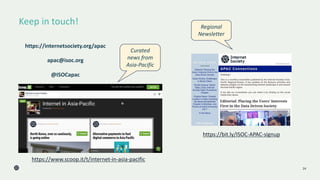
Keep in touch!
24
https://www.scoop.it/t/internet-in-asia-pacific
https://internetsociety.org/apac
apac@isoc.org
@ISOCapac
https://bit.ly/ISOC-APAC-signup
Curated
news from
Asia-Pacific
Regional
Newsletter
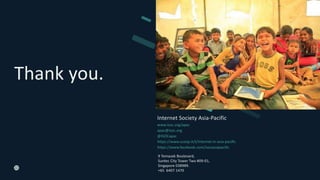
Thank you.
9 Temasek Boulevard,
Suntec City Tower Two #09-01,
Singapore 038989.
+65 6407 1470
Internet Society Asia-Pacific
www.isoc.org/apac
apac@isoc.org
@ISOCapac
https://www.scoop.it/t/internet-in-asia-pacific
https://www.facebook.com/isocasiapacific

ISOC Update

  • 1.
    Join us tokeep the Internet open, thriving and benefitting people around the globe. The Internet is for Everyone February 2018 Kathmandu, Nepal
  • 2.
    Founded in 1992by pioneers of the early Internet, the Internet Society drives technologies that keep it open and safe. We promote policies that empower people to enable universal access for all. We stand for a better Internet. 2
  • 3.
    Global Presence 3 Our globalcommunity of members and Chapters span over 230 countries, territories, and areas of geographic interest world-wide. NORTH AMERICA LATIN AMERICA/CARIBBEAN EUROPE AFRICA MIDDLE EAST ASIA
  • 4.
    Internet Society inAsia-Pacific 4 The Numbers — Individual Global Members - 33,545 (~31% of total ISOC membership; 15% YoY growth) — Chapters -22 — Chapter Members - 18,632 — Organisational Members – 20 Regional Office Operational Since December 2011 in Singapore with staff and advisors located across the region. Team includes: Noelle De GUZMAN based in Manila Naveed HAQ based in Islamabad Olivia LOY based in Singapore Aftab SIDDIQUI based in Sydney Rajnesh SINGH based in Sydney/Singapore Subhashish PANIGRAHI in Bengaluru Two Board of Trustee Members are also currently located in Asia-Pacific: Hiroshi ESAKI in Japan, Harish PILLAY in Singapore
  • 5.
  • 6.
  • 7.
    Survey of InternetPolicy Issues in Asia-Pacific 7 - Launched in 2014, our annual study gathers the views of Internet stakeholders towards topical Internet policy concerns in the region - On average, over 2,000 responses per year from around 40 economies
  • 8.
    Wireless for Communities(W4C) 8 - Launched in 2010 - over 100 sites in South Asia (direct and inspired) - Has received 2 international awards - Addresses gap in last mile connectivity through community owned, operated and managed networks in unserved and underserved areas - Digital literacy, supplementary education and e-entrepreneurship skills, focusing on women empowerment
  • 9.
    IXP Mapping Project– APAC [www.ixpmap.org] 9 • Mapping all active IXPs in South Asia, Southeast Asia, North/East Asia, Pacific • Identifies cities that would benefit from an IXP based on population • On-going project, initiated specifically to support AP-IS*; contributions welcome • www.ixpmap.org *Asia-Pacific Information Superhighway http://www.unescap.org/our-work/ict-disaster-risk-reduction/asia-pacific-information-superhighway
  • 10.
    10 IETF Awareness 16 workshopsin 2016 reaching 1000+ participants in Indonesia, Philippines, Singapore 2017: South Asia (Bangladesh, Pakistan, Sri Lanka) 3 Drafts, 2 Fellows at IETF 100 Online PrivacyWorkshopsin India, Philippines, Singapore, Vanuatu with partners including National Privacy authorities, Media, Chapters, Goverment Agencies Digital Accessibility Workshops in Indonesia and Sri Lanka, with partners including Chapters, Goverment Agencies, Disabilities Groups Moderated IG Course for 60+ participants from 20+ economies conducted online over two 5-week periods
  • 11.
    Asia-Pacific Regional IssuePapers 11 • Series of issue papers to provide guidance to decision-makers and stakeholders • Key findings, information on the state of play, opportunities as well as questions to think about • Topics include (available at www.internetsociety.org/apac) - Gender - Financial Inclusion - Digital Access - Rural Connectivity - Online Privacy - Frugal Innovation and Entrepreneurship - Policies for the Digital Economy - Enabling E-services - Local Content - Disaster Risk Reduction - Internet of Things - Community Empowerment - Social Media - Internet Safety - Climate Change
  • 12.
  • 13.
    2018 Work Campaigns– a new approach 13
  • 14.
    IoT: Trust byDesign 14
  • 15.
    Problem: The Internet andits users face an increasing risk of cyber threats because more insecure consumer IoT devices join the Internet every day. The number of IoT devices and systems connected to the Internet is expected to reach 20.4 billion by 2020 (Gartner), more than 2.5 times the global population. While this is a well-known problem, not enough is being done to strengthen the security and privacy of consumer IoT. 15 Goal: We want suppliers of consumer grade IoT devices and services to adopt security and privacy in their devices and services to protect the network, its users and critical information infrastructure from cyber threats. Objectives: • Make the OTA IoT Trust Framework truly global • Consumers drive demand for security and privacy in IoT • Policy and regulations driving better security and privacy features in IOT
  • 16.
    CN: Take Actionfor a Connected World 16
  • 17.
    Problem: Half of theworld’s population is not yet connected to the Internet. After more than 25 years of Internet development, traditional business models are slow to reach remote, rural, and underserved areas. It is imperative that access is not seen as a one-way, monolithic approach and Community Networks provide alternative forms of access. 17 Goal: In connecting the next billions of users, new sustainable business models are required. By demonstrating what can happen when we equip and empower people to connect themselves in the hardest to reach parts of the world we will advocate for new policies, partnerships and ways of working from influential policy and decision makers, and industry, around the world. Objectives: • An advocacy plan that demonstrates this model works • Influence change and support in policy frameworks to incentivize the establishment of CNs • Scale deployment and ensure continuity for the CN model worldwide
  • 18.
    IG: Strengthening collaborativegovernance for a sustainable Internet
  • 19.
    Problem: The multi-stakeholder modelis once again threatened at its core. Rapidly changing global forces Challenges of emerging issues (e.g. cyber threats). Supportive Governments are now wavering their support. Those who never embraced it are stepping up their effort to impose their models. Unless urgent action is taken, the multi-stakeholder model will be at risk of losing support around the world and fading away 19 Goal: Expand and enhance the adoption and use of the Internet MS model by critical governments and intergovernmental organizations in all regions of the world. Objectives: • Get key governments, IGOs and other stakeholders to adopt the MS approach via domestic policy & regulatory reforms • Rebuild momentum for the MS approach in the face of mounting threats and opposition
  • 20.
    MANRS: Mutually AgreedNorms for Routing Security 20
  • 21.
    Problem: Internet routing isentirely based on trust. Currently, there are no built-in validation of the route, the chain of trust spans continents, and, attacks on the Internet’s routing system represent a systemic threat. Security in the Internet “public core” could only be achieved through cooperation and good practices of the participants. 21 Goal: Eliminate route hijacking and address spoofing. Objectives: • Convincing Network Operators to implement the MANRs recommendation • Building and supporting the community of MANRS adopters to insure sustainability of MANRS • Instating an audit and monitoring procedures in order to maintain high reputation of MANRS
  • 22.
  • 23.
    23 • ITU PlenipotRegional Preparations • Regional Policy Survey 2018 • IoT Regional Workshop • Online course on IG • Engagements with APT, ITU and UNESCAP • Deployment of new W4C site in Pakistan • Internet Connectivity Workshop for Pacific
  • 24.
  • 25.
    Thank you. 9 TemasekBoulevard, Suntec City Tower Two #09-01, Singapore 038989. +65 6407 1470 Internet Society Asia-Pacific www.isoc.org/apac apac@isoc.org @ISOCapac https://www.scoop.it/t/internet-in-asia-pacific https://www.facebook.com/isocasiapacific