GHANA’S UNIVERSAL SERVICE FUND
 Overview of USF (GIFEC) in Ghana
 GIFEC Projects
 GIFEC achievements
 Challenges of Ownership and Sustainability
 Way Forward
OVERVIEW OF GIFEC
 The Fund was launched in November, 2004. However,
operations of the Fund started in January 2006.
 The Electronic Communications Act, 2008, Act 775
provides the legal framework (mandate) for the activities
of the Fund.
VISION, MISSION AND VALUES
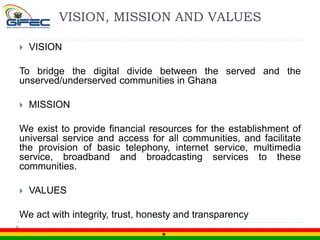
 VISION
To bridge the digital divide between the served and the
unserved/underserved communities in Ghana
 MISSION
We exist to provide financial resources for the establishment of
universal service and access for all communities, and facilitate
the provision of basic telephony, internet service, multimedia
service, broadband and broadcasting services to these
communities.
 VALUES
We act with integrity, trust, honesty and transparency
MANAGEMENT OF THE FUND
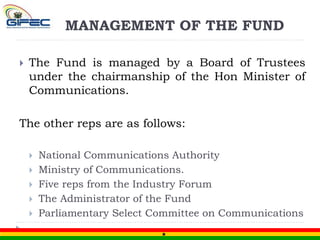
 The Fund is managed by a Board of Trustees
under the chairmanship of the Hon Minister of
Communications.
The other reps are as follows:
 National Communications Authority
 Ministry of Communications.
 Five reps from the Industry Forum
 The Administrator of the Fund
 Parliamentary Select Committee on Communications
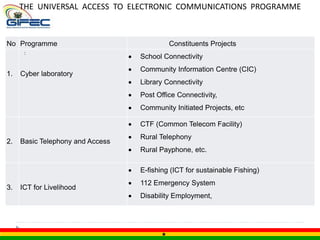
THE UNIVERSAL ACCESS TO ELECTRONIC COMMUNICATIONS PROGRAMME
No Programme Constituents Projects
1. Cyber laboratory
 School Connectivity
 Community Information Centre (CIC)
 Library Connectivity
 Post Office Connectivity,
 Community Initiated Projects, etc
2. Basic Telephony and Access
 CTF (Common Telecom Facility)
 Rural Telephony
 Rural Payphone, etc.
3. ICT for Livelihood
 E-fishing (ICT for sustainable Fishing)
 112 Emergency System
 Disability Employment,
:
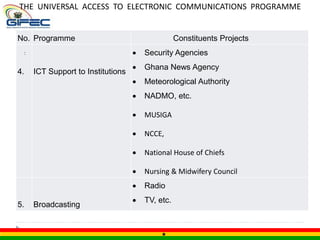
THE UNIVERSAL ACCESS TO ELECTRONIC COMMUNICATIONS PROGRAMME
No. Programme Constituents Projects
4. ICT Support to Institutions
 Security Agencies
 Ghana News Agency
 Meteorological Authority
 NADMO, etc.
 MUSIGA
 NCCE,
 National House of Chiefs
 Nursing & Midwifery Council
5. Broadcasting
 Radio
 TV, etc.
:
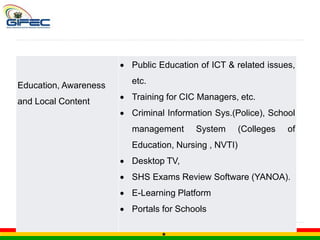
Education, Awareness
and Local Content
 Public Education of ICT & related issues,
etc.
 Training for CIC Managers, etc.
 Criminal Information Sys.(Police), School
management System (Colleges of
Education, Nursing , NVTI)
 Desktop TV,
 SHS Exams Review Software (YANOA).
 E-Learning Platform
 Portals for Schools
CYBER LAB PROGRAMS
 SCHOOL CONNECTIVITY
 COMMUNITY INFORMATION CENTERS
 SECURITY CONNECTIVITY
 LIBRARY CONNECTIVITY PROJECT
 INSTITUTIONAL SUPPORT(MMDA)
SCP
The following institutions have each been provided with a fully furnished and equipped ICT
laboratory with accessories, and Internet access:
 38 Colleges of Education
 37 NVTI
 26 Technical Institutes
 10 Youth Leadership Training Centres
 344 Senior Secondary Schools
 25 Basic Schools
 24 Community Dev’t Institutes
 3 OIC
 82 Nursing Training Schools
 9 Farm Institutes
 30 ICCES
 11 School for the deaf
 2000 Basic Schools
Total: 639
 27500 laptops have been provided to Basic Schools which do not have the infrastructure
for ICT laboratories. This is to support government policy of compulsory ICT education
at the basic level. About 2000 JHS have benefited from this initiative
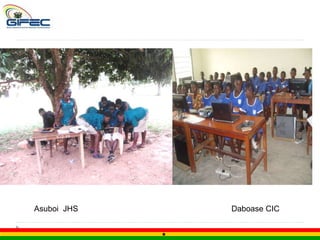
Asuboi JHS Daboase CIC
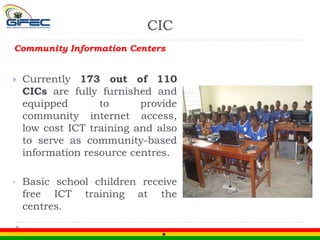
Community Information Centers
 Currently 173 out of 110
CICs are fully furnished and
equipped to provide
community internet access,
low cost ICT training and also
to serve as community-based
information resource centres.
• Basic school children receive
free ICT training at the
centres.
CIC
 31 Military units including all the training schools
 34 Police units including all the training schools
 100 Offices of the Bureau of National Investigations
 34 Prisons centres including all the training schools
 190 National Disaster Management Organisation centres
 6 Immigration units including all the training schools
 13 Fire service units including all the training schools
SECURITY CONNECTIVITY
 ICT – INSTITUTIONAL SUPPORT(MMDA)
 MUSIGA, NCCE,
 MMDA,
 Actors Guild,
 National House of Chiefs,
 Passport Office, etc
 LIBRARY CONNECTIVITY PROJECT
 10 Regional Libraries
 30 District Libraries
 10 Mobile Van
 CIP- Community Initiated Project—27
Universal Access To Basic Telephony
 Rural Telephony Project= 51 Sites
 Common Telecom Facility 38 Sites
 Rural Community Payphone= 2700 phones in
458 SHS
 Handsets for rural communities= 7000
handsets
ICT for Livelihood
E-Fishing Project:
18 Landing sites supported with 400 Fish Finders
ICTs for Persons with Disabilities
• 3 school for the blind,
• blind units in 8 SHS,
• 10 Disability empowerment
Emergency Call Centre 112
ICT Applications and Content
 School Management System – implemented for NVTI,
Colleges of Education
 Mobile phone programming application – 10 sch.
trained
 YANOA (Exams Revision)- 100 schools and 25 CIC’s
 Electronic Information Management System- 35
CIC’s
 CIS- Criminal Information System- Ghana police
 ICT Education and Awareness
 MMDA training – 2050 trained

Ongoing Projects
 Satellite Hub
 80 new RTPs
 School for Deaf and ICCES
 Support to Blind Union
 Support to Death and Birth Registry
 Continue with Cyber Lab programs
 Community Centralized Broadcasting System
 112 Emergency Call Centre (Ho, Tamale and
Takoradi)
 Support the digital immigration with setup boxes
 ICT Support for E-Fishing
 Continuation of all the above listed projects
CHALLENGES
 High Internet Bandwidth Cost
 High turnover trained CIC managers
 Ownership
THE WAY FORWARD
 Tax waiver for provision of internet services
for rural area
 Strategic partnership with the network
operators for subzidised bandwith for GIFEC
projects
 A lot more of public private partnerships for
the implementation of GIFEC projects.
Thank
You
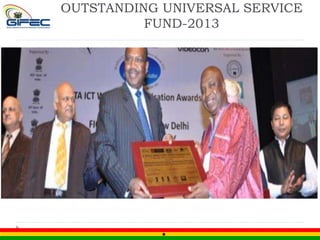
OUTSTANDING UNIVERSAL SERVICE
FUND-2013
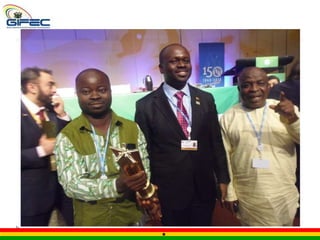
Best Universal Access in Infrastructure-
2014
Gifec
Gifec

Gifec

  • 1.
  • 2.
     Overview ofUSF (GIFEC) in Ghana  GIFEC Projects  GIFEC achievements  Challenges of Ownership and Sustainability  Way Forward
  • 3.
    OVERVIEW OF GIFEC The Fund was launched in November, 2004. However, operations of the Fund started in January 2006.  The Electronic Communications Act, 2008, Act 775 provides the legal framework (mandate) for the activities of the Fund.
  • 4.
    VISION, MISSION ANDVALUES  VISION To bridge the digital divide between the served and the unserved/underserved communities in Ghana  MISSION We exist to provide financial resources for the establishment of universal service and access for all communities, and facilitate the provision of basic telephony, internet service, multimedia service, broadband and broadcasting services to these communities.  VALUES We act with integrity, trust, honesty and transparency
  • 5.
    MANAGEMENT OF THEFUND  The Fund is managed by a Board of Trustees under the chairmanship of the Hon Minister of Communications. The other reps are as follows:  National Communications Authority  Ministry of Communications.  Five reps from the Industry Forum  The Administrator of the Fund  Parliamentary Select Committee on Communications
  • 6.
    THE UNIVERSAL ACCESSTO ELECTRONIC COMMUNICATIONS PROGRAMME No Programme Constituents Projects 1. Cyber laboratory  School Connectivity  Community Information Centre (CIC)  Library Connectivity  Post Office Connectivity,  Community Initiated Projects, etc 2. Basic Telephony and Access  CTF (Common Telecom Facility)  Rural Telephony  Rural Payphone, etc. 3. ICT for Livelihood  E-fishing (ICT for sustainable Fishing)  112 Emergency System  Disability Employment, :
  • 7.
    THE UNIVERSAL ACCESSTO ELECTRONIC COMMUNICATIONS PROGRAMME No. Programme Constituents Projects 4. ICT Support to Institutions  Security Agencies  Ghana News Agency  Meteorological Authority  NADMO, etc.  MUSIGA  NCCE,  National House of Chiefs  Nursing & Midwifery Council 5. Broadcasting  Radio  TV, etc. :
  • 8.
    Education, Awareness and LocalContent  Public Education of ICT & related issues, etc.  Training for CIC Managers, etc.  Criminal Information Sys.(Police), School management System (Colleges of Education, Nursing , NVTI)  Desktop TV,  SHS Exams Review Software (YANOA).  E-Learning Platform  Portals for Schools
  • 9.
    CYBER LAB PROGRAMS SCHOOL CONNECTIVITY  COMMUNITY INFORMATION CENTERS  SECURITY CONNECTIVITY  LIBRARY CONNECTIVITY PROJECT  INSTITUTIONAL SUPPORT(MMDA)
  • 10.
    SCP The following institutionshave each been provided with a fully furnished and equipped ICT laboratory with accessories, and Internet access:  38 Colleges of Education  37 NVTI  26 Technical Institutes  10 Youth Leadership Training Centres  344 Senior Secondary Schools  25 Basic Schools  24 Community Dev’t Institutes  3 OIC  82 Nursing Training Schools  9 Farm Institutes  30 ICCES  11 School for the deaf  2000 Basic Schools Total: 639  27500 laptops have been provided to Basic Schools which do not have the infrastructure for ICT laboratories. This is to support government policy of compulsory ICT education at the basic level. About 2000 JHS have benefited from this initiative
  • 11.
  • 12.
    Community Information Centers Currently 173 out of 110 CICs are fully furnished and equipped to provide community internet access, low cost ICT training and also to serve as community-based information resource centres. • Basic school children receive free ICT training at the centres. CIC
  • 13.
     31 Militaryunits including all the training schools  34 Police units including all the training schools  100 Offices of the Bureau of National Investigations  34 Prisons centres including all the training schools  190 National Disaster Management Organisation centres  6 Immigration units including all the training schools  13 Fire service units including all the training schools SECURITY CONNECTIVITY
  • 14.
     ICT –INSTITUTIONAL SUPPORT(MMDA)  MUSIGA, NCCE,  MMDA,  Actors Guild,  National House of Chiefs,  Passport Office, etc  LIBRARY CONNECTIVITY PROJECT  10 Regional Libraries  30 District Libraries  10 Mobile Van  CIP- Community Initiated Project—27
  • 15.
    Universal Access ToBasic Telephony  Rural Telephony Project= 51 Sites  Common Telecom Facility 38 Sites  Rural Community Payphone= 2700 phones in 458 SHS  Handsets for rural communities= 7000 handsets
  • 16.
    ICT for Livelihood E-FishingProject: 18 Landing sites supported with 400 Fish Finders ICTs for Persons with Disabilities • 3 school for the blind, • blind units in 8 SHS, • 10 Disability empowerment Emergency Call Centre 112
  • 17.
    ICT Applications andContent  School Management System – implemented for NVTI, Colleges of Education  Mobile phone programming application – 10 sch. trained  YANOA (Exams Revision)- 100 schools and 25 CIC’s  Electronic Information Management System- 35 CIC’s  CIS- Criminal Information System- Ghana police  ICT Education and Awareness  MMDA training – 2050 trained 
  • 18.
    Ongoing Projects  SatelliteHub  80 new RTPs  School for Deaf and ICCES  Support to Blind Union  Support to Death and Birth Registry  Continue with Cyber Lab programs  Community Centralized Broadcasting System  112 Emergency Call Centre (Ho, Tamale and Takoradi)  Support the digital immigration with setup boxes  ICT Support for E-Fishing  Continuation of all the above listed projects
  • 19.
    CHALLENGES  High InternetBandwidth Cost  High turnover trained CIC managers  Ownership
  • 20.
    THE WAY FORWARD Tax waiver for provision of internet services for rural area  Strategic partnership with the network operators for subzidised bandwith for GIFEC projects  A lot more of public private partnerships for the implementation of GIFEC projects.
  • 21.
  • 22.
  • 23.
    Best Universal Accessin Infrastructure- 2014