WELCOME
ISO 13485:2016 & MDR
ISO 13485:2016 Are you ready?
Susan Murphy
European Medical Device Operations Manager
So…Where Are We Now?
Definitions
Shall
 Used to express a command or exhortation you shall go
 Used in laws, regulations, or directives to express what is
mandatory <it shall be unlawful to carry firearms
 You shall do as I say
Definitions
Will
 Used to express
 desire
 choice
 willingness
 consent
 or in negative constructions refusal
Present
(*Most of the World)
ISO 13485:2003:
Medical Devices – Quality Management Systems,
Requirements For Regulatory Purposes
Present – Europe
(*Harmonized EU Version)
EN ISO 13485:2012: Medical Devices – Quality
Management Systems – Requirements For
Regulatory Purposes
Future
 Published as an ISO Standard on March 1st 2016
 Effective 1st March 2018 ISO 13485:2003 certificates will no
longer be issued, modified or revised by NSAI
 Effective 1st March 2019 all 13485:2003 certificates will
become invalid
 Effective until 1st March 2018 any new, modified or revised
ISO 13485:2003 certificates issued by NSAI will
have an expiry date not to exceed 1st March 2019
Harmonisation
 Once published, ISO 13485:2016 will still need to be reviewed,
accepted, and voted on for Harmonization in the EU.
 Only EU Harmonized Standards are recognized for “presumed
compliance” with EU Medical Directive requirements (e.g. EN
ISO 13485:2016 for CE Marking)
What’s New In 2016?
0.1 Introduction - General
• The standard “can be used by an organization involved in
one or more stages of the life-cycle of a medical device”
• And, by suppliers and other external parties providing
product to such organizations.
What’s New In 2016?
Section 1 – Scope
• 1.1 - This International Standard can also be used by
suppliers or external parties that provide product including
quality management system-related services to such
organizations.
• 1.2 - Any requirement of Clause 6, 7, or 8 can be deemed
“not applicable” to the organization (with documented
justification).
What’s New In 2016?
Section 1.2 – Scope
 “risk” = pertains to safety and performance requirements,
or meeting regulatory requirements
 “documented”= required to be established, implemented,
and maintained
 “Product” = now means product or service…
output that is intended for a customer, or…
an intended output of Product Realization
 “regulatory requirements” = is limited to the legal
requirements for the quality management system and legal
requirements for safety or performance of the device
What’s New In 2016?
Section 1.2 – Scope
 “The processes required by this International Standard that are
applicable to the organization, but are not performed by the
organization,
 are the responsibility of the organization and are
accounted for in the organization’s quality management
system by monitoring, maintaining, and controlling the
processes.”
What’s New In 2016?
Section 4: Quality Management System
 4.1 General
 4.1.1 document the role(s) of the organization.
 4.1.2 determine and apply the processes needed and apply a risk based
approach to the control of those processes
 4.1.4 Changes made to these processes must be:
 Evaluated for impact on the QMS
 Evaluated for impact on the medical device produced
 Controlled
What’s New In 2016?
Section 4: Quality Management System
 4.1 – General (software):
 4.1.6 – Requires documented procedures for the validation
of software used in the Quality Management System.
 4.1.6 – Such software shall be validated prior to initial use,
and as appropriate, after changes.
What’s New In 2016?
Section 4: Quality Management System
*4.2.3 - Medical Device File:
For each medical device type or medical device family,
the organization shall establish and maintain a file(s)
either containing or referencing documents generated to
demonstrate conformity with the requirement of this
International Standard and compliance with applicable
regulatory requirements. The content shall include, but
is not limited to….
(New sub-clause)
What’s New In 2016?
Section 4: Quality Management System
(4.2.3) Medical Device File Content:
 General description of the medical device, intended
use/purpose, and labelling, including any instructions for
use;
 Specifications for product,
 Specifications or procedures for manufacturing, packaging,
storage, handling and distribution;
 Procedures for measuring and monitoring;
 As appropriate, requirements for installation; and
 As appropriate, procedures for servicing.
(*New)
What’s New In 2016?
Section 5: Management Responsibility
 5.6 – Management Reviews
 The organization shall document procedures for
management review
 The organization shall carry out management review
at documented planned intervals
 New management review inputs
 Complaint handling
 Reporting to regulatory authorities
What’s New In 2016?
Section 5: Management Responsibility
 New management review inputs
 Complaint handling
 Reporting to regulatory authorities
What’s New In 2016?
Section 5: Management Responsibility
 New Management review outputs
 All outputs shall be recorded and include
the inputs reviewed and decisions in relation to
 Suitability, adequacy and effectiveness of the system
 Changes needed to respond to new and or revised regulatory
requirements
What’s New In 2016?
Section 6: Resource Management
 Demonstrating and maintaining competence
 Infrastructure prevent product mix-up and ensure
orderly handling of product.
What’s New In 2016?
Section 6: Resource Management
*6.4.2 – Contamination Control
 control of contaminated or potentially contaminated
product in order to prevent contamination of the work
environment, personnel, or product.
 For sterile medical devices, the organization shall
document requirements for control of contamination
with micro-organisms or particulate matter and maintain
the required cleanliness during assembly or packaging
processes.
(*New sub-clause)
What’s New In 2016?
Section 7: Product Realization
 7.1 – Product Planning
 (c) required verification, validation, monitoring, measurement, inspection
and test, handling, storage, distribution and traceability activities
specific to the product together with the criteria for product acceptance
What’s New In 2016?
Section 7: Product Realization
 7.2.1 – Determination of Product
Requirements
 d) any user training needed to ensure specified performance and safe
use of the medical device;
What’s New In 2016?
Section 7: Product Realization
 7.2.2 – Review of Requirements related
to the product:
 c) applicable regulatory requirements are met,
 d) any user training identified in accordance with 7.2.1 is
available or planned to be available,..
What’s New In 2016?
Section 7: Product Realization
 7.2.3 – Communication:
 The organization shall communicate with regulatory
authorities in accordance with applicable regulatory
requirements.
What’s New In 2016?
Section 7.3: Design and Development
 7.3.2 – Design and Development Planning
 design and development planning documents shall be
maintained and updated as the design and development
progresses
 the methods to ensure traceability of design and
development outputs to design and development inputs; and
 the resources needed including necessary competence of
personnel
 Inputs shall include usability and
 The requirements for the design and development of the
product and processes.
What’s New In 2016?
Section 7.3: Design and Development
 7.3.5 – Design and Development Review
 Shall include the identification of the design under review, the
participants involved and the date of the review
What’s New In 2016?
Section 7.3: Design and Development
 7.3.6 – Design and Development
Verification
 The organisation shall
 Document verification plans, including acceptance criteria, statistical
techniques and rational for sample size
 Where a device is connected to another device, verification shall include
confirmation that the design output meets the design input when connected
What’s New In 2016?
Section 7.3: Design and Development
 7.3.7 – Design and Development
Validation
 The organisation shall
 Document validation plans, including acceptance criteria, statistical
techniques and rational for sample size
 Validation shall be conducted on representative samples. The rational for
product choice shall be recorded
 Where a device is connected to another device, validation shall include
confirmation that the requirements for the specified application or intended
use have been met
 a medical device used for clinical evaluation or performance
evaluation is not considered to be released for use to the customer
 Validation shall be completed prior to release for use of the product to
the customer.
What’s New In 2016?
Section 7.3: Design and Development
 *7.3.8 – Design and Development Transfer
 The organization shall document procedures for transfer of design
and development outputs to manufacturing.
 Results and conclusions of the transfer shall be recorded (see 4.2.5).
(*New sub-clause)
What’s New In 2016?
Section 7.3: Design and Development
 7.3.9 – Control of Design and Development
Changes
 The organization shall determine the significance of
the change to function, performance, usability, safety
and applicable regulatory requirements for the
medical device and its intended use
 the changes shall be:
 reviewed;
 verified;
 validated, as appropriate; and
 approved.
What’s New In 2016?
Section 7.3: Design and Development
 7.3.9 – Control of Design and Development
Changes (cont’d)
 The review of design and development changes shall include
 evaluation of the effect of the changes on constituent parts
and product in process or already delivered,
 inputs or outputs of risk management and product
realization processes.
What’s New In 2016?
Section 7.3: Design and Development
 *7.3.10 – Design and Development Files
 The organization shall maintain a design and
development file for each medical device type or medical
device family.
 This file shall include or reference records generated to
demonstrate conformity to the requirements for design
and development
 and records for design and development changes.
(*New sub-clause)
What’s New In 2016?
Section 7.4: Purchasing
 7.4.1 – Purchasing Process
 The organization shall establish criteria for the evaluation and
selection of suppliers. The criteria shall be:
 based on the supplier’s ability to provide product that
meets the organizations’ requirements,
 based on the performance of the supplier,
 based on the effect of the purchased product on the
quality of the medical device, and
 proportionate to the risk associated with the medical
device.
What’s New In 2016?
Section 7.4: Purchasing
 7.4.1 – Purchasing Process (cont’d)
 The organization shall plan the monitoring and re-evaluation
of suppliers
 Nonfulfillment of purchasing requirements shall be
addressed with the supplier proportionate to the risk
associated with the purchased product and compliance with
applicable regulatory requirements.
What’s New In 2016?
Section 7.4: Purchasing
 7.4.3 – Verification of Purchased Product
 The extent of verification activities shall be based on the
supplier evaluation results and proportionate to the risks
associated with the purchased product.
 When the organization becomes aware of any changes to the
purchased product, the organization shall determine
whether these changes affect the product realization
process or the medical device.
What’s New In 2016?
Section 7.5: Production & Service Provision
 7.5.1.1 – Control of Production…
 As appropriate, production controls shall include but are not
limited to:
 b) qualification of infrastructure,
 c) implementation of monitoring and measurement of process
parameters and product characteristics
What’s New In 2016?
Section 7.5: Production & Service Provision
 7.5.2 – Cleanliness of Product
 The organization shall document requirements for cleanliness of
product or contamination control of product if:
 c) product cannot be cleaned prior to sterilization or its use,
and its cleanliness is of significance in use;
What’s New In 2016?
Section 7.5: Production & Service Provision
 7.5.4 – Servicing Activities
 The organization shall analyze records of servicing activities
carried out by the organization or its supplier:
 to determine if the information is to be handled as a
complaint and
 as appropriate, for input to the improvement process
What’s New In 2016?
Section 7.5: Production & Service Provision
 7.5.6 – Validation of Processes (cont’d)
 as appropriate, statistical techniques with rationale for
sample sizes
 requirements for records (see 4.2.5);
 revalidation, including criteria for revalidation; and
 approval of changes to the processes
What’s New In 2016?
Section 7.5: Production & Service Provision
 7.5.6 – Validation of Processes (cont’d)
 The specific approach and activities associated with software
validation and revalidation shall be proportionate to the risk
associated with the use of the software including the effect
on the ability of the product to conform to specifications.

Records of the results and conclusion of validation and necessary
actions from the validation shall be maintained (see 4.2.4 and
4.2.5).
What’s New In 2016?
Section 7.5: Production & Service Provision
7.5.7 Particular Requirements for the Validation of
Process of Sterilization and Sterile Barrier Systems
 The organization shall document procedures (see 4.2.4) for the
validation of processes for sterilization and sterile barrier systems.
 Processes for sterilization and sterile barrier systems shall be
validated prior to implementation and following product or process
changes, as appropriate.
 Records of the results and, conclusion of validation and necessary
actions from the validation shall be maintained
What’s New In 2016?
Section 7.5: Production & Service Provision
7.5.8 – Identification
 The organization shall identify product status with respect to
monitoring and measurement requirements throughout product
realization. Identification of product status shall be maintained
throughout production, storage, installation and servicing of
product to ensure that only product that has passed the
required inspections and tests or released under an authorized
concession is dispatched, used or installed. (*was previously sub-
clause 7.5.3.3)
 If required by applicable regulatory requirements, the
organization shall document a system to assign unique device
identification to the medical device.
What’s New In 2016?
Section 7.5: Production & Service Provision
 7.5.11 – Preservation of Product
 The organization shall protect product from alteration,
contamination or damage when exposed to expected conditions
and hazards during processing, storage, handling, and
distribution by:
 designing and constructing suitable packaging and shipping
containers, or
 documenting requirements for special conditions needed if
packaging alone cannot provide preservation
What’s New In 2016?
Section 8: Measurement, Analysis and Improvement
 8.2.1 – Feedback
 This feedback process shall include provisions to gather data
from production as well as post-production activities
What’s New In 2016?
Section 8: Measurement, Analysis and Improvement
*8.2.2 – Complaint Handling
 The organization shall document procedures for timely complaint
handling in accordance with applicable regulatory requirements.
 These procedures shall include at a minimum requirements and
responsibilities for:
a) receiving and recording information,
b) evaluating information to determine if the feedback constitutes a
complaint,
c) investigating complaints,
d) determining the need to report the information to the
appropriate regulatory authorities,
e) handling of complaint-related product, and
f) determining the need to initiate corrections or corrective actions.
What’s New In 2016?
Section 8: Measurement, Analysis and Improvement
*8.2.2 – Complaint Handling (cont’d)
 If any complaint is not investigated, justification shall be documented.
Any correction or corrective action resulting from the complaint handling
process shall be documented.
 If an investigation determines activities outside the organization
contributed to the complaint, relevant information shall be exchanged
between the organization and the external party involved.
 Complaint handling records shall be maintained (see 4.2.5).
(new sub clause)
What’s New In 2016?
Section 8: Measurement, Analysis and Improvement
*8.2.3 – Reporting to Regulatory Authorities
 If applicable regulatory requirements require notification of complaints
that meet specified reporting criteria of adverse events or issuance of
advisory notices, the organization shall document procedures for
providing notification to the appropriate regulatory authorities.
 Records of reporting to regulatory authorities shall be maintained (see
4.2.5).
(*NEW sub-clause)
What’s New In 2016?
Section 8: Measurement, Analysis and Improvement
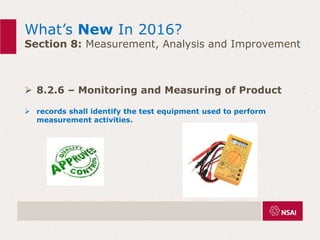
 8.2.6 – Monitoring and Measuring of Product
 records shall identify the test equipment used to perform
measurement activities.
What’s New In 2016?
Section 8: Measurement, Analysis and Improvement
 *8.3.1 – General
 The evaluation of nonconformity shall include a determination
of the need for an investigation and notification of any external
party responsible for the nonconformity.
 *8.3.2 –
 Actions in response to nonconforming product detected before
delivery
 Records of actions relating to the issuance of advisory notices
shall be maintained
(*New sub-clause)
What’s New In 2016?
Section 8: Measurement, Analysis and Improvement
If the analysis of data shows that the quality management
system is not suitable, adequate or effective, the
organization shall use this analysis as input for
improvement as required in 8.5
What’s New In 2016?
Section 8: Measurement, Analysis and Improvement
8.5.2 – Corrective Action
verifying that the corrective action does not adversely affect the
ability to meet applicable regulatory requirements or the safety and
performance of the medical device;
8.5.3 – Preventive Action
verifying that the action does not adversely affect the ability to
meet applicable regulatory requirements or the safety and
performance of the medical device;
What’s New In 2016?
GCL-25-01
NSAI Technical Questionnaire
MDR: Major Changes and
Impact on Industry
Colm O’Rourke
NSAI- Medical Devices
colm.orourke@nsai.ie
@NSAI_Medical
What we will cover
• Current status and NB designation plan
• Why we got to where we are
• Outcome of investigations
• What is a Notified Body and how do we work
• MDR content and changes
• Industry/Market impact
• Wrap up
Charles Darwin
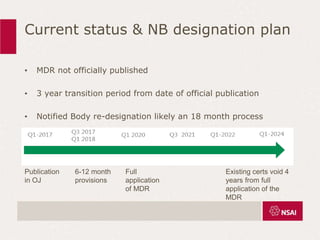
Current status & NB designation plan
• MDR not officially published
• 3 year transition period from date of official publication
• Notified Body re-designation likely an 18 month process
Publication
in OJ
6-12 month
provisions
Full
application
of MDR
Existing certs void 4
years from full
application of the
MDR
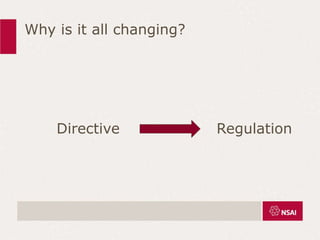
Why is it all changing?
Directive Regulation
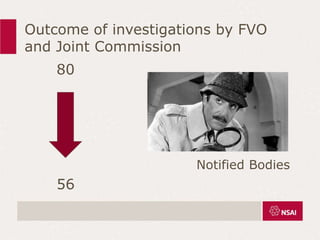
Outcome of investigations by FVO
and Joint Commission
80
Notified Bodies
56
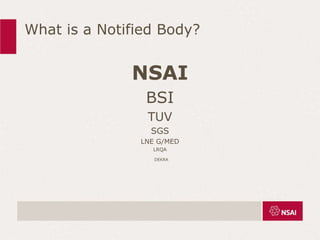
What is a Notified Body?
NSAI
BSI
TUV
SGS
LNE G/MED
LRQA
DEKRA
MDR (Medical Device Regulation) –
What is it?
• More detailed requirements on everything:
previous MD Directive 60+ pages vs. new
regulation of 566 pages
• It will greatly change how approval for products
is sought and maintained (CE–mark)
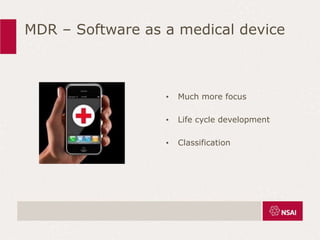
MDR – Software as a medical device
• Much more focus
• Life cycle development
• Classification
MDR – Grandfathering
• Established product must
comply
• What standards were used in
product development?
• Was a clinical trial carried
out?
• Will there be market supply
issues?
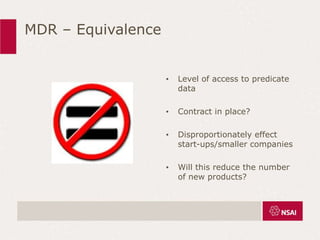
MDR – Equivalence
• Level of access to predicate
data
• Contract in place?
• Disproportionately effect
start-ups/smaller companies
• Will this reduce the number
of new products?
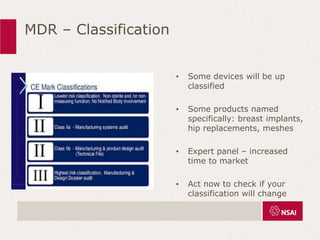
MDR – Classification
• Some devices will be up
classified
• Some products named
specifically: breast implants,
hip replacements, meshes
• Expert panel – increased
time to market
• Act now to check if your
classification will change
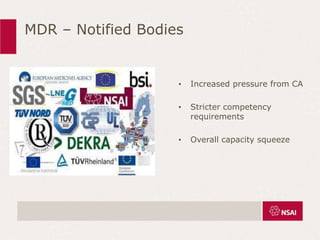
MDR – Notified Bodies
• Increased pressure from CA
• Stricter competency
requirements
• Overall capacity squeeze
MDR – Other areas of interest
• Clinical data requirements
• Common Specifications
• UDI
• Person Responsible
• Revised Economic Operator roles
• General safety and performance requirements
• Cosmetic devices/Devices without an indented medical purpose
• EUDAMED
• Additional reports required: PSUR/SSCP
• Unannounced audits: MDR states at least once every 5 years
Industry/Market impact
• New product development
• Increased risk management requirements
• Time to Market
• Clinical data
• Approval process
• Post market surveillance
• Overall resource drain
• Getting and maintaining compliance
• Remediation of existing products
• Removal of non-compliant products
Wrap up
NSAI is here to help
Colm O’Rourke
NSAI- Medical Devices
colm.orourke@nsai.ie
@NSAI_Medical
Questions?

ISO13485.ppt

  • 1.
  • 2.
    ISO 13485:2016 Areyou ready? Susan Murphy European Medical Device Operations Manager
  • 6.
  • 7.
    Definitions Shall  Used toexpress a command or exhortation you shall go  Used in laws, regulations, or directives to express what is mandatory <it shall be unlawful to carry firearms  You shall do as I say
  • 8.
    Definitions Will  Used toexpress  desire  choice  willingness  consent  or in negative constructions refusal
  • 9.
    Present (*Most of theWorld) ISO 13485:2003: Medical Devices – Quality Management Systems, Requirements For Regulatory Purposes
  • 10.
    Present – Europe (*HarmonizedEU Version) EN ISO 13485:2012: Medical Devices – Quality Management Systems – Requirements For Regulatory Purposes
  • 11.
    Future  Published asan ISO Standard on March 1st 2016  Effective 1st March 2018 ISO 13485:2003 certificates will no longer be issued, modified or revised by NSAI  Effective 1st March 2019 all 13485:2003 certificates will become invalid  Effective until 1st March 2018 any new, modified or revised ISO 13485:2003 certificates issued by NSAI will have an expiry date not to exceed 1st March 2019
  • 12.
    Harmonisation  Once published,ISO 13485:2016 will still need to be reviewed, accepted, and voted on for Harmonization in the EU.  Only EU Harmonized Standards are recognized for “presumed compliance” with EU Medical Directive requirements (e.g. EN ISO 13485:2016 for CE Marking)
  • 13.
    What’s New In2016? 0.1 Introduction - General • The standard “can be used by an organization involved in one or more stages of the life-cycle of a medical device” • And, by suppliers and other external parties providing product to such organizations.
  • 14.
    What’s New In2016? Section 1 – Scope • 1.1 - This International Standard can also be used by suppliers or external parties that provide product including quality management system-related services to such organizations. • 1.2 - Any requirement of Clause 6, 7, or 8 can be deemed “not applicable” to the organization (with documented justification).
  • 15.
    What’s New In2016? Section 1.2 – Scope  “risk” = pertains to safety and performance requirements, or meeting regulatory requirements  “documented”= required to be established, implemented, and maintained  “Product” = now means product or service… output that is intended for a customer, or… an intended output of Product Realization  “regulatory requirements” = is limited to the legal requirements for the quality management system and legal requirements for safety or performance of the device
  • 16.
    What’s New In2016? Section 1.2 – Scope  “The processes required by this International Standard that are applicable to the organization, but are not performed by the organization,  are the responsibility of the organization and are accounted for in the organization’s quality management system by monitoring, maintaining, and controlling the processes.”
  • 17.
    What’s New In2016? Section 4: Quality Management System  4.1 General  4.1.1 document the role(s) of the organization.  4.1.2 determine and apply the processes needed and apply a risk based approach to the control of those processes  4.1.4 Changes made to these processes must be:  Evaluated for impact on the QMS  Evaluated for impact on the medical device produced  Controlled
  • 18.
    What’s New In2016? Section 4: Quality Management System  4.1 – General (software):  4.1.6 – Requires documented procedures for the validation of software used in the Quality Management System.  4.1.6 – Such software shall be validated prior to initial use, and as appropriate, after changes.
  • 19.
    What’s New In2016? Section 4: Quality Management System *4.2.3 - Medical Device File: For each medical device type or medical device family, the organization shall establish and maintain a file(s) either containing or referencing documents generated to demonstrate conformity with the requirement of this International Standard and compliance with applicable regulatory requirements. The content shall include, but is not limited to…. (New sub-clause)
  • 20.
    What’s New In2016? Section 4: Quality Management System (4.2.3) Medical Device File Content:  General description of the medical device, intended use/purpose, and labelling, including any instructions for use;  Specifications for product,  Specifications or procedures for manufacturing, packaging, storage, handling and distribution;  Procedures for measuring and monitoring;  As appropriate, requirements for installation; and  As appropriate, procedures for servicing. (*New)
  • 21.
    What’s New In2016? Section 5: Management Responsibility  5.6 – Management Reviews  The organization shall document procedures for management review  The organization shall carry out management review at documented planned intervals  New management review inputs  Complaint handling  Reporting to regulatory authorities
  • 22.
    What’s New In2016? Section 5: Management Responsibility  New management review inputs  Complaint handling  Reporting to regulatory authorities
  • 23.
    What’s New In2016? Section 5: Management Responsibility  New Management review outputs  All outputs shall be recorded and include the inputs reviewed and decisions in relation to  Suitability, adequacy and effectiveness of the system  Changes needed to respond to new and or revised regulatory requirements
  • 24.
    What’s New In2016? Section 6: Resource Management  Demonstrating and maintaining competence  Infrastructure prevent product mix-up and ensure orderly handling of product.
  • 25.
    What’s New In2016? Section 6: Resource Management *6.4.2 – Contamination Control  control of contaminated or potentially contaminated product in order to prevent contamination of the work environment, personnel, or product.  For sterile medical devices, the organization shall document requirements for control of contamination with micro-organisms or particulate matter and maintain the required cleanliness during assembly or packaging processes. (*New sub-clause)
  • 26.
    What’s New In2016? Section 7: Product Realization  7.1 – Product Planning  (c) required verification, validation, monitoring, measurement, inspection and test, handling, storage, distribution and traceability activities specific to the product together with the criteria for product acceptance
  • 27.
    What’s New In2016? Section 7: Product Realization  7.2.1 – Determination of Product Requirements  d) any user training needed to ensure specified performance and safe use of the medical device;
  • 28.
    What’s New In2016? Section 7: Product Realization  7.2.2 – Review of Requirements related to the product:  c) applicable regulatory requirements are met,  d) any user training identified in accordance with 7.2.1 is available or planned to be available,..
  • 29.
    What’s New In2016? Section 7: Product Realization  7.2.3 – Communication:  The organization shall communicate with regulatory authorities in accordance with applicable regulatory requirements.
  • 30.
    What’s New In2016? Section 7.3: Design and Development  7.3.2 – Design and Development Planning  design and development planning documents shall be maintained and updated as the design and development progresses  the methods to ensure traceability of design and development outputs to design and development inputs; and  the resources needed including necessary competence of personnel  Inputs shall include usability and  The requirements for the design and development of the product and processes.
  • 31.
    What’s New In2016? Section 7.3: Design and Development  7.3.5 – Design and Development Review  Shall include the identification of the design under review, the participants involved and the date of the review
  • 32.
    What’s New In2016? Section 7.3: Design and Development  7.3.6 – Design and Development Verification  The organisation shall  Document verification plans, including acceptance criteria, statistical techniques and rational for sample size  Where a device is connected to another device, verification shall include confirmation that the design output meets the design input when connected
  • 33.
    What’s New In2016? Section 7.3: Design and Development  7.3.7 – Design and Development Validation  The organisation shall  Document validation plans, including acceptance criteria, statistical techniques and rational for sample size  Validation shall be conducted on representative samples. The rational for product choice shall be recorded  Where a device is connected to another device, validation shall include confirmation that the requirements for the specified application or intended use have been met  a medical device used for clinical evaluation or performance evaluation is not considered to be released for use to the customer  Validation shall be completed prior to release for use of the product to the customer.
  • 34.
    What’s New In2016? Section 7.3: Design and Development  *7.3.8 – Design and Development Transfer  The organization shall document procedures for transfer of design and development outputs to manufacturing.  Results and conclusions of the transfer shall be recorded (see 4.2.5). (*New sub-clause)
  • 35.
    What’s New In2016? Section 7.3: Design and Development  7.3.9 – Control of Design and Development Changes  The organization shall determine the significance of the change to function, performance, usability, safety and applicable regulatory requirements for the medical device and its intended use  the changes shall be:  reviewed;  verified;  validated, as appropriate; and  approved.
  • 36.
    What’s New In2016? Section 7.3: Design and Development  7.3.9 – Control of Design and Development Changes (cont’d)  The review of design and development changes shall include  evaluation of the effect of the changes on constituent parts and product in process or already delivered,  inputs or outputs of risk management and product realization processes.
  • 37.
    What’s New In2016? Section 7.3: Design and Development  *7.3.10 – Design and Development Files  The organization shall maintain a design and development file for each medical device type or medical device family.  This file shall include or reference records generated to demonstrate conformity to the requirements for design and development  and records for design and development changes. (*New sub-clause)
  • 38.
    What’s New In2016? Section 7.4: Purchasing  7.4.1 – Purchasing Process  The organization shall establish criteria for the evaluation and selection of suppliers. The criteria shall be:  based on the supplier’s ability to provide product that meets the organizations’ requirements,  based on the performance of the supplier,  based on the effect of the purchased product on the quality of the medical device, and  proportionate to the risk associated with the medical device.
  • 39.
    What’s New In2016? Section 7.4: Purchasing  7.4.1 – Purchasing Process (cont’d)  The organization shall plan the monitoring and re-evaluation of suppliers  Nonfulfillment of purchasing requirements shall be addressed with the supplier proportionate to the risk associated with the purchased product and compliance with applicable regulatory requirements.
  • 40.
    What’s New In2016? Section 7.4: Purchasing  7.4.3 – Verification of Purchased Product  The extent of verification activities shall be based on the supplier evaluation results and proportionate to the risks associated with the purchased product.  When the organization becomes aware of any changes to the purchased product, the organization shall determine whether these changes affect the product realization process or the medical device.
  • 41.
    What’s New In2016? Section 7.5: Production & Service Provision  7.5.1.1 – Control of Production…  As appropriate, production controls shall include but are not limited to:  b) qualification of infrastructure,  c) implementation of monitoring and measurement of process parameters and product characteristics
  • 42.
    What’s New In2016? Section 7.5: Production & Service Provision  7.5.2 – Cleanliness of Product  The organization shall document requirements for cleanliness of product or contamination control of product if:  c) product cannot be cleaned prior to sterilization or its use, and its cleanliness is of significance in use;
  • 43.
    What’s New In2016? Section 7.5: Production & Service Provision  7.5.4 – Servicing Activities  The organization shall analyze records of servicing activities carried out by the organization or its supplier:  to determine if the information is to be handled as a complaint and  as appropriate, for input to the improvement process
  • 44.
    What’s New In2016? Section 7.5: Production & Service Provision  7.5.6 – Validation of Processes (cont’d)  as appropriate, statistical techniques with rationale for sample sizes  requirements for records (see 4.2.5);  revalidation, including criteria for revalidation; and  approval of changes to the processes
  • 45.
    What’s New In2016? Section 7.5: Production & Service Provision  7.5.6 – Validation of Processes (cont’d)  The specific approach and activities associated with software validation and revalidation shall be proportionate to the risk associated with the use of the software including the effect on the ability of the product to conform to specifications.  Records of the results and conclusion of validation and necessary actions from the validation shall be maintained (see 4.2.4 and 4.2.5).
  • 46.
    What’s New In2016? Section 7.5: Production & Service Provision 7.5.7 Particular Requirements for the Validation of Process of Sterilization and Sterile Barrier Systems  The organization shall document procedures (see 4.2.4) for the validation of processes for sterilization and sterile barrier systems.  Processes for sterilization and sterile barrier systems shall be validated prior to implementation and following product or process changes, as appropriate.  Records of the results and, conclusion of validation and necessary actions from the validation shall be maintained
  • 47.
    What’s New In2016? Section 7.5: Production & Service Provision 7.5.8 – Identification  The organization shall identify product status with respect to monitoring and measurement requirements throughout product realization. Identification of product status shall be maintained throughout production, storage, installation and servicing of product to ensure that only product that has passed the required inspections and tests or released under an authorized concession is dispatched, used or installed. (*was previously sub- clause 7.5.3.3)  If required by applicable regulatory requirements, the organization shall document a system to assign unique device identification to the medical device.
  • 48.
    What’s New In2016? Section 7.5: Production & Service Provision  7.5.11 – Preservation of Product  The organization shall protect product from alteration, contamination or damage when exposed to expected conditions and hazards during processing, storage, handling, and distribution by:  designing and constructing suitable packaging and shipping containers, or  documenting requirements for special conditions needed if packaging alone cannot provide preservation
  • 49.
    What’s New In2016? Section 8: Measurement, Analysis and Improvement  8.2.1 – Feedback  This feedback process shall include provisions to gather data from production as well as post-production activities
  • 50.
    What’s New In2016? Section 8: Measurement, Analysis and Improvement *8.2.2 – Complaint Handling  The organization shall document procedures for timely complaint handling in accordance with applicable regulatory requirements.  These procedures shall include at a minimum requirements and responsibilities for: a) receiving and recording information, b) evaluating information to determine if the feedback constitutes a complaint, c) investigating complaints, d) determining the need to report the information to the appropriate regulatory authorities, e) handling of complaint-related product, and f) determining the need to initiate corrections or corrective actions.
  • 51.
    What’s New In2016? Section 8: Measurement, Analysis and Improvement *8.2.2 – Complaint Handling (cont’d)  If any complaint is not investigated, justification shall be documented. Any correction or corrective action resulting from the complaint handling process shall be documented.  If an investigation determines activities outside the organization contributed to the complaint, relevant information shall be exchanged between the organization and the external party involved.  Complaint handling records shall be maintained (see 4.2.5). (new sub clause)
  • 52.
    What’s New In2016? Section 8: Measurement, Analysis and Improvement *8.2.3 – Reporting to Regulatory Authorities  If applicable regulatory requirements require notification of complaints that meet specified reporting criteria of adverse events or issuance of advisory notices, the organization shall document procedures for providing notification to the appropriate regulatory authorities.  Records of reporting to regulatory authorities shall be maintained (see 4.2.5). (*NEW sub-clause)
  • 53.
    What’s New In2016? Section 8: Measurement, Analysis and Improvement  8.2.6 – Monitoring and Measuring of Product  records shall identify the test equipment used to perform measurement activities.
  • 54.
    What’s New In2016? Section 8: Measurement, Analysis and Improvement  *8.3.1 – General  The evaluation of nonconformity shall include a determination of the need for an investigation and notification of any external party responsible for the nonconformity.  *8.3.2 –  Actions in response to nonconforming product detected before delivery  Records of actions relating to the issuance of advisory notices shall be maintained (*New sub-clause)
  • 55.
    What’s New In2016? Section 8: Measurement, Analysis and Improvement If the analysis of data shows that the quality management system is not suitable, adequate or effective, the organization shall use this analysis as input for improvement as required in 8.5
  • 56.
    What’s New In2016? Section 8: Measurement, Analysis and Improvement 8.5.2 – Corrective Action verifying that the corrective action does not adversely affect the ability to meet applicable regulatory requirements or the safety and performance of the medical device; 8.5.3 – Preventive Action verifying that the action does not adversely affect the ability to meet applicable regulatory requirements or the safety and performance of the medical device;
  • 57.
    What’s New In2016? GCL-25-01 NSAI Technical Questionnaire
  • 58.
    MDR: Major Changesand Impact on Industry Colm O’Rourke NSAI- Medical Devices colm.orourke@nsai.ie @NSAI_Medical
  • 59.
    What we willcover • Current status and NB designation plan • Why we got to where we are • Outcome of investigations • What is a Notified Body and how do we work • MDR content and changes • Industry/Market impact • Wrap up
  • 60.
  • 61.
    Current status &NB designation plan • MDR not officially published • 3 year transition period from date of official publication • Notified Body re-designation likely an 18 month process Publication in OJ 6-12 month provisions Full application of MDR Existing certs void 4 years from full application of the MDR
  • 62.
    Why is itall changing? Directive Regulation
  • 63.
    Outcome of investigationsby FVO and Joint Commission 80 Notified Bodies 56
  • 64.
    What is aNotified Body? NSAI BSI TUV SGS LNE G/MED LRQA DEKRA
  • 65.
    MDR (Medical DeviceRegulation) – What is it? • More detailed requirements on everything: previous MD Directive 60+ pages vs. new regulation of 566 pages • It will greatly change how approval for products is sought and maintained (CE–mark)
  • 66.
    MDR – Softwareas a medical device • Much more focus • Life cycle development • Classification
  • 67.
    MDR – Grandfathering •Established product must comply • What standards were used in product development? • Was a clinical trial carried out? • Will there be market supply issues?
  • 68.
    MDR – Equivalence •Level of access to predicate data • Contract in place? • Disproportionately effect start-ups/smaller companies • Will this reduce the number of new products?
  • 69.
    MDR – Classification •Some devices will be up classified • Some products named specifically: breast implants, hip replacements, meshes • Expert panel – increased time to market • Act now to check if your classification will change
  • 70.
    MDR – NotifiedBodies • Increased pressure from CA • Stricter competency requirements • Overall capacity squeeze
  • 71.
    MDR – Otherareas of interest • Clinical data requirements • Common Specifications • UDI • Person Responsible • Revised Economic Operator roles • General safety and performance requirements • Cosmetic devices/Devices without an indented medical purpose • EUDAMED • Additional reports required: PSUR/SSCP • Unannounced audits: MDR states at least once every 5 years
  • 72.
    Industry/Market impact • Newproduct development • Increased risk management requirements • Time to Market • Clinical data • Approval process • Post market surveillance • Overall resource drain • Getting and maintaining compliance • Remediation of existing products • Removal of non-compliant products
  • 73.
    Wrap up NSAI ishere to help
  • 74.
    Colm O’Rourke NSAI- MedicalDevices colm.orourke@nsai.ie @NSAI_Medical
  • 75.