Title of TopicTopic 1 - 1.2
Scope and Coverage
This unit will cover:
• Use of information and interpretation
• Security of information
• Ethics in relation to IS
• Data security and legal issues
(privacy/confidentiality of data, data protection)
3.
Title of TopicTopic 1 - 1.3
Learning Objectives
By the end of this unit students will be able to:
• Appreciate how the use of IS relates to differing
interpretations of the meaning of information
• Be aware of typical ethical issues that arise with IS
• Critically analyse data security of IS in the context
of ethical and legal requirements
4.
Title of TopicTopic 1 - 1.4
Contents
• Interpretation, use and sharing of information
• Care and security of information
• Ethics and stakeholders in IS
• Data protection and legal principles
• Emphasis – People and Technology
5.
Title of TopicTopic 1 - 1.5
Interpretation
• We take a consciously contextualist approach in
this topic
• The processes of keeping information secure
reflects how people interpret its value and
relevance, as well as its use
• Politics and culture also come into play
• Structuration is a relevant theory when considering
interpretations and norms – and the means by
which information is kept secure
6.
Title of TopicTopic 1 - 1.6
Interpretation and Use
• People (both within and outside organisations) will
use IS in a way that is meaningful to them
• How much they trust the technology with their
information will have an effect on the way it is used
• Use may not always follow ‘obvious’ function
• A good example is ‘internet shopping’: some find it
useful, others mistrust the technology
7.
Title of TopicTopic 1 - 1.7
Internet shopping
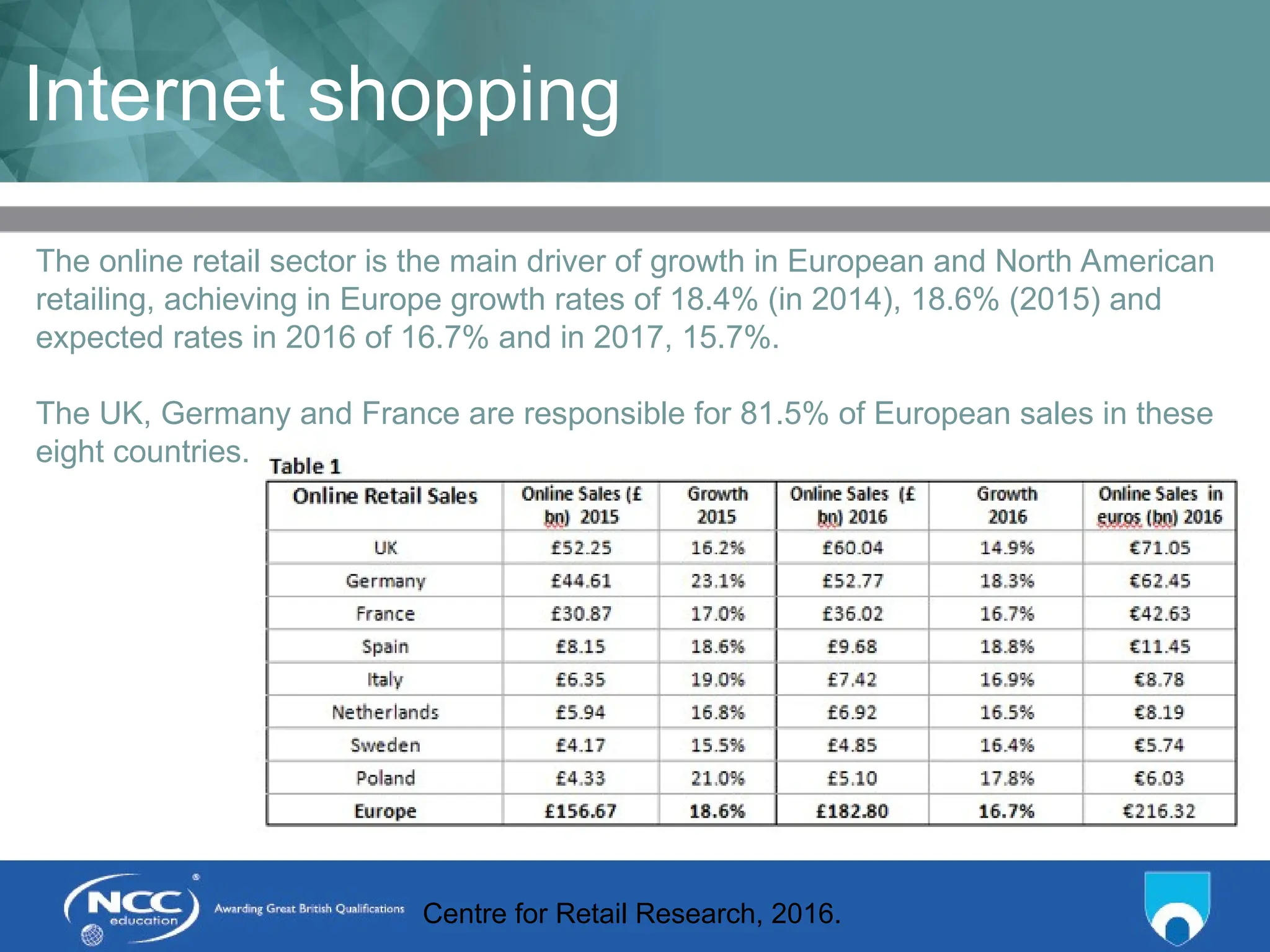
The online retail sector is the main driver of growth in European and North American
retailing, achieving in Europe growth rates of 18.4% (in 2014), 18.6% (2015) and
expected rates in 2016 of 16.7% and in 2017, 15.7%.
The UK, Germany and France are responsible for 81.5% of European sales in these
eight countries.
Centre for Retail Research, 2016.
8.
Title of TopicTopic 1 - 1.8
Internet Influence
• 73% of Internet users use it for research before
purchasing
• Used at every stage of the process including checking
details and price
• Consumers use the Internet to get informed about
sources of products - Online research and experience
translates to off-line purchases
• ....no simple relationship between Internet use and
purchasing habits (Chaffey 2007, p155) cited by
Boddy, Boonstra and Kennedy (2008)
9.
Title of TopicTopic 1 - 1.9
Sharing Information
• Attitudes, norms and rules about sharing
information also differ between people and
organisations
• Contrast people who are happy to use social
networking with those not too happy to use it or not
interested
• In business, attitudes to sharing information and
knowledge vary widely
10.
Title of TopicTopic 1 - 1.10
Information in Organisations
What information is
needed?
• What type of information
do we find most valuable?
• Who owns it?
• Where is it stored?
• How it is used?
Information Culture
• Information is power
• Should be available on a
‘need to know’ basis
• How is it shared?
• How is sharing
encouraged?
11.
Title of TopicTopic 1 - 1.11
Security/Privacy of Information
• It is important that information:
– Is securely stored
– Does not get into wrong hands
– Remains private and confidential
– Is used for the purpose originally intended
– Is removed when no longer required
• These are some of the legal requirements that
organisations must be aware of and can be found in
laws like the Data Protection Act 1998
12.
Title of TopicTopic 1 - 1.12
Ethical Issues
• Should a company monitor website use by staff? -
should staff use the Internet for personal reasons
whilst at work?
• Should a search engine provide information to a
government on websites visited and searches by
an individual?
• Should medical and care agencies share sensitive
information?
• Should companies have the right to ‘spam’ people?
13.
Title of TopicTopic 1 - 1.13
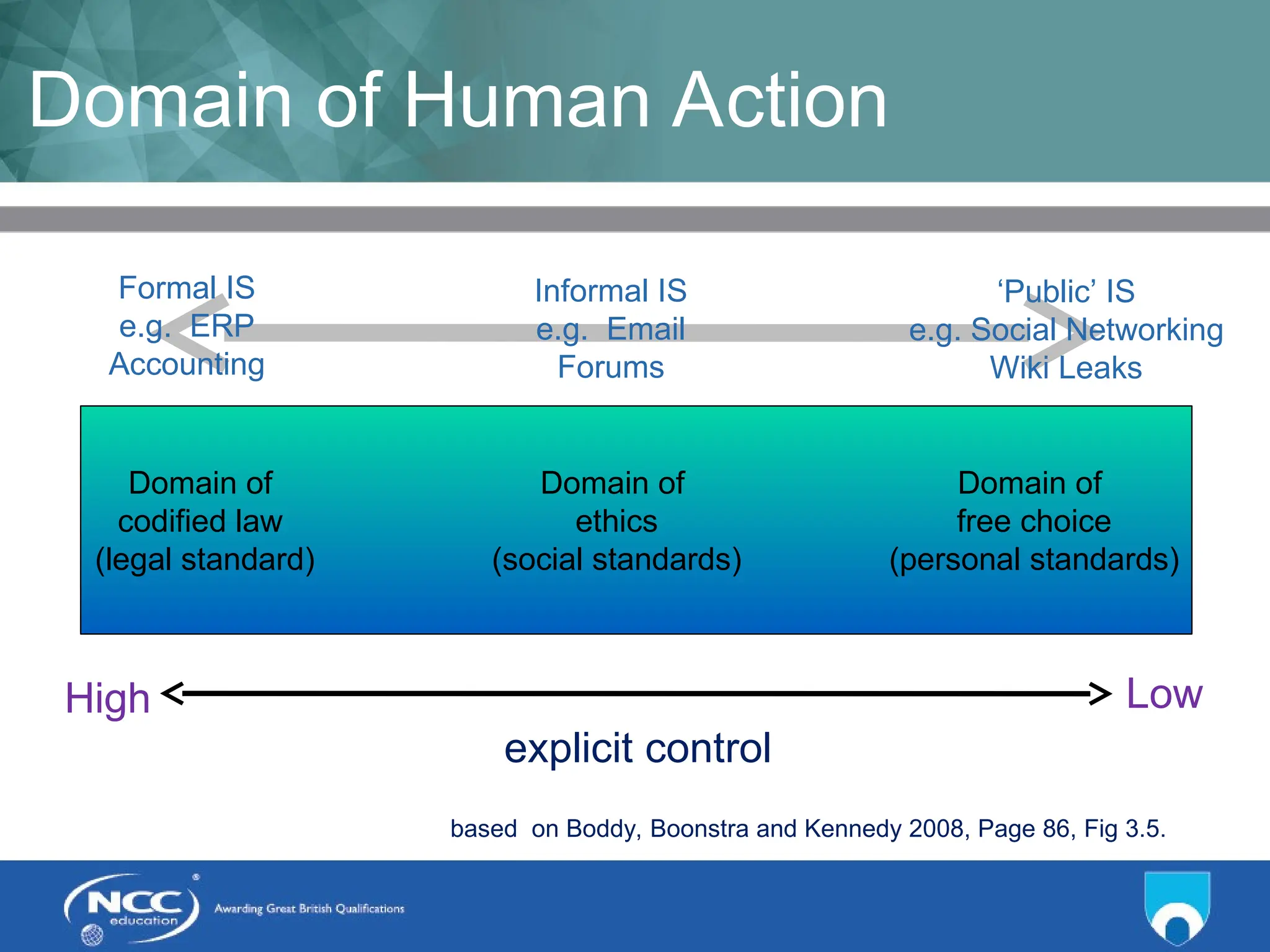
Domain of Human Action
Domain of
codified law
(legal standard)
Domain of
ethics
(social standards)
Domain of
free choice
(personal standards)
Low
High
explicit control
based on Boddy, Boonstra and Kennedy 2008, Page 86, Fig 3.5.
Formal IS
e.g. ERP
Accounting
Informal IS
e.g. Email
Forums
‘Public’ IS
e.g. Social Networking
Wiki Leaks
14.
Title of TopicTopic 1 - 1.14
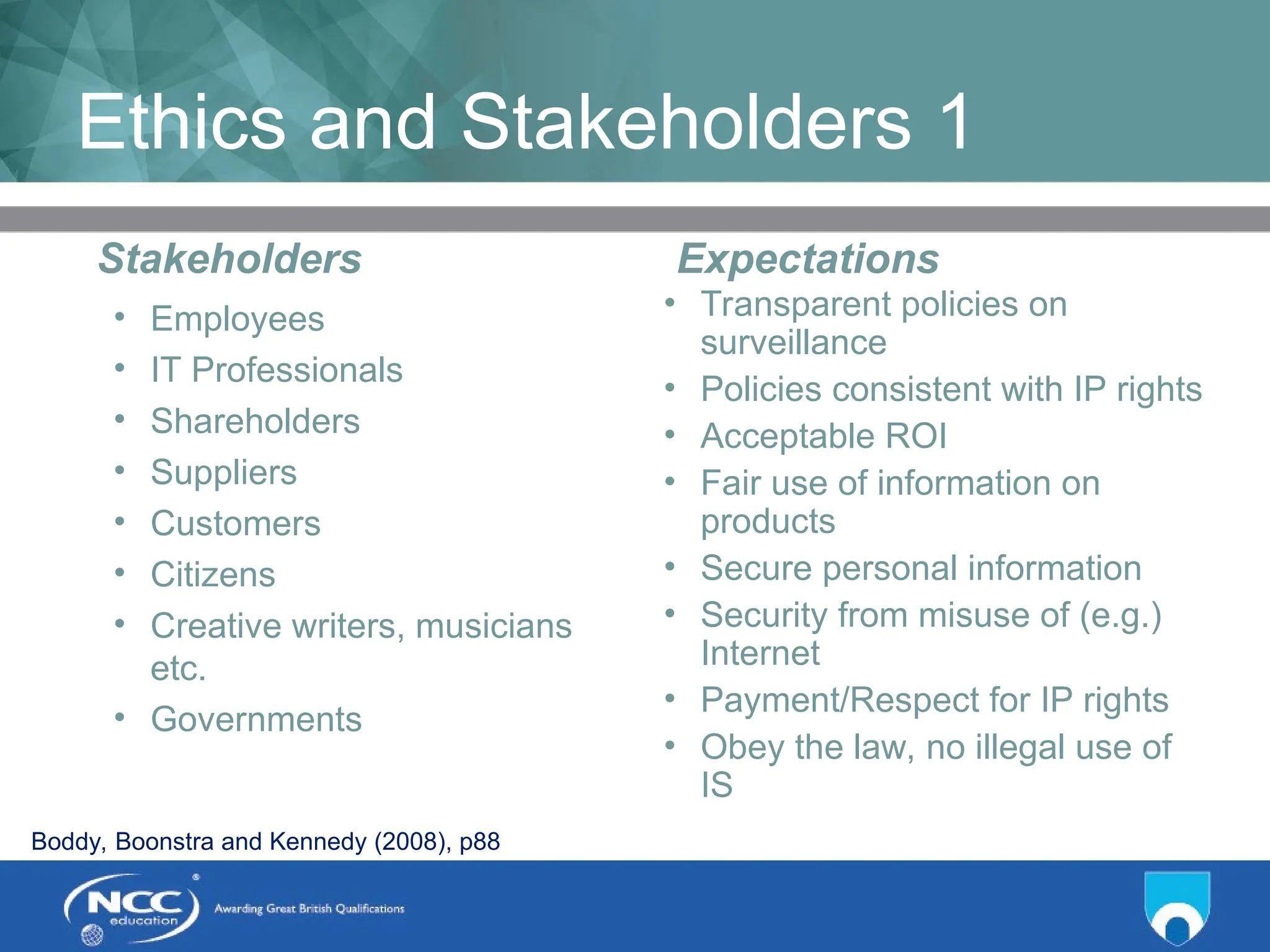
Ethics and Stakeholders 1
Stakeholders
• Employees
• IT Professionals
• Shareholders
• Suppliers
• Customers
• Citizens
• Creative writers, musicians
etc.
• Governments
Expectations
• Transparent policies on
surveillance
• Policies consistent with IP rights
• Acceptable ROI
• Fair use of information on
products
• Secure personal information
• Security from misuse of (e.g.)
Internet
• Payment/Respect for IP rights
• Obey the law, no illegal use of
IS
Boddy, Boonstra and Kennedy (2008), p88
15.
Title of TopicTopic 1 - 1.15
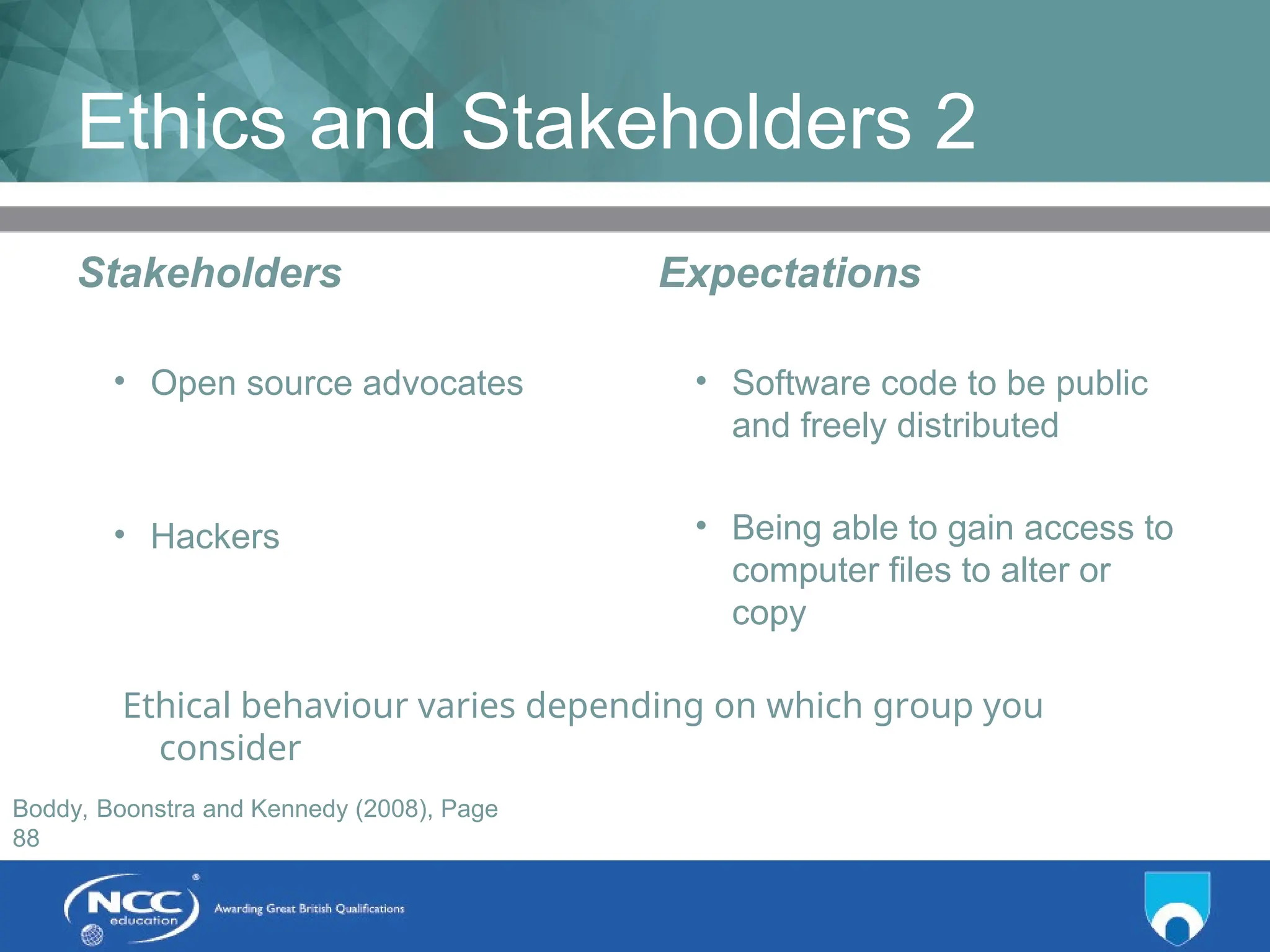
Ethics and Stakeholders 2
Stakeholders
• Open source advocates
• Hackers
Expectations
• Software code to be public
and freely distributed
• Being able to gain access to
computer files to alter or
copy
Boddy, Boonstra and Kennedy (2008), Page
88
Ethical behaviour varies depending on which group you
consider
16.
Title of TopicTopic 1 - 1.16
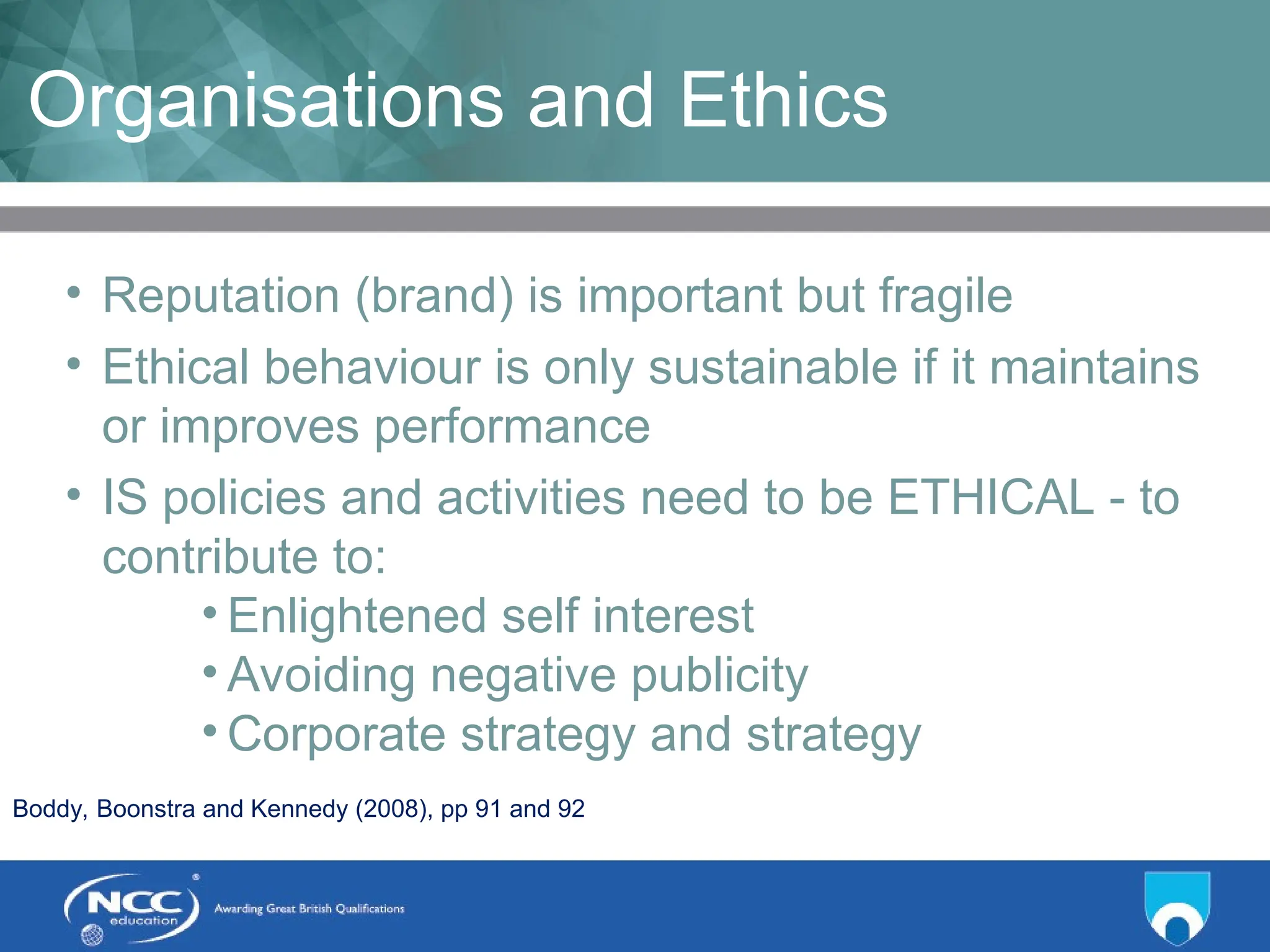
Organisations and Ethics
• Reputation (brand) is important but fragile
• Ethical behaviour is only sustainable if it maintains
or improves performance
• IS policies and activities need to be ETHICAL - to
contribute to:
• Enlightened self interest
• Avoiding negative publicity
• Corporate strategy and strategy
Boddy, Boonstra and Kennedy (2008), pp 91 and 92
17.
Title of TopicTopic 1 - 1.17
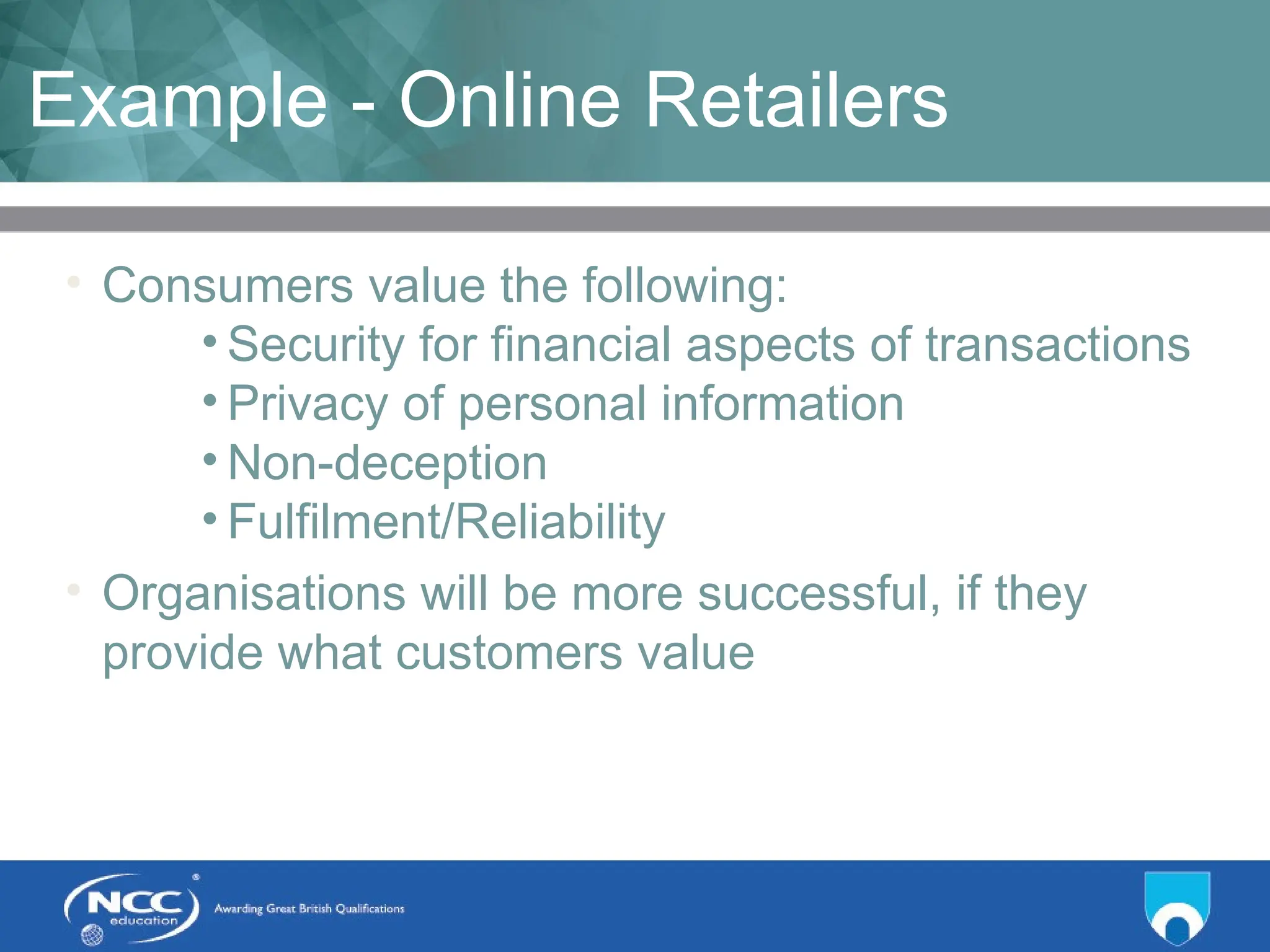
Example - Online Retailers
• Consumers value the following:
• Security for financial aspects of transactions
• Privacy of personal information
• Non-deception
• Fulfilment/Reliability
• Organisations will be more successful, if they
provide what customers value
18.
Title of TopicTopic 1 - 1.18
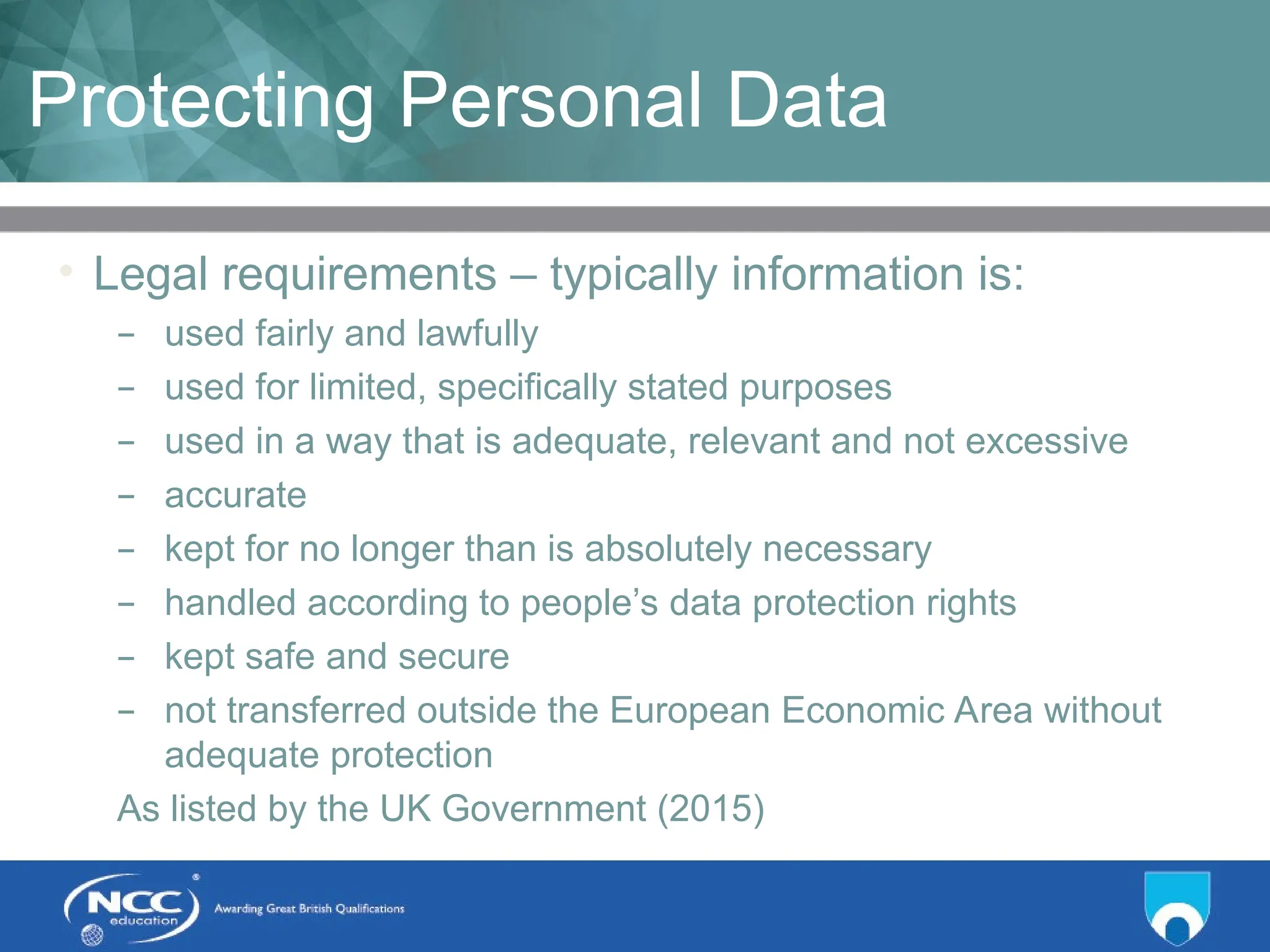
Protecting Personal Data
• Legal requirements – typically information is:
– used fairly and lawfully
– used for limited, specifically stated purposes
– used in a way that is adequate, relevant and not excessive
– accurate
– kept for no longer than is absolutely necessary
– handled according to people’s data protection rights
– kept safe and secure
– not transferred outside the European Economic Area without
adequate protection
As listed by the UK Government (2015)
19.
Title of TopicTopic 1 - 1.19
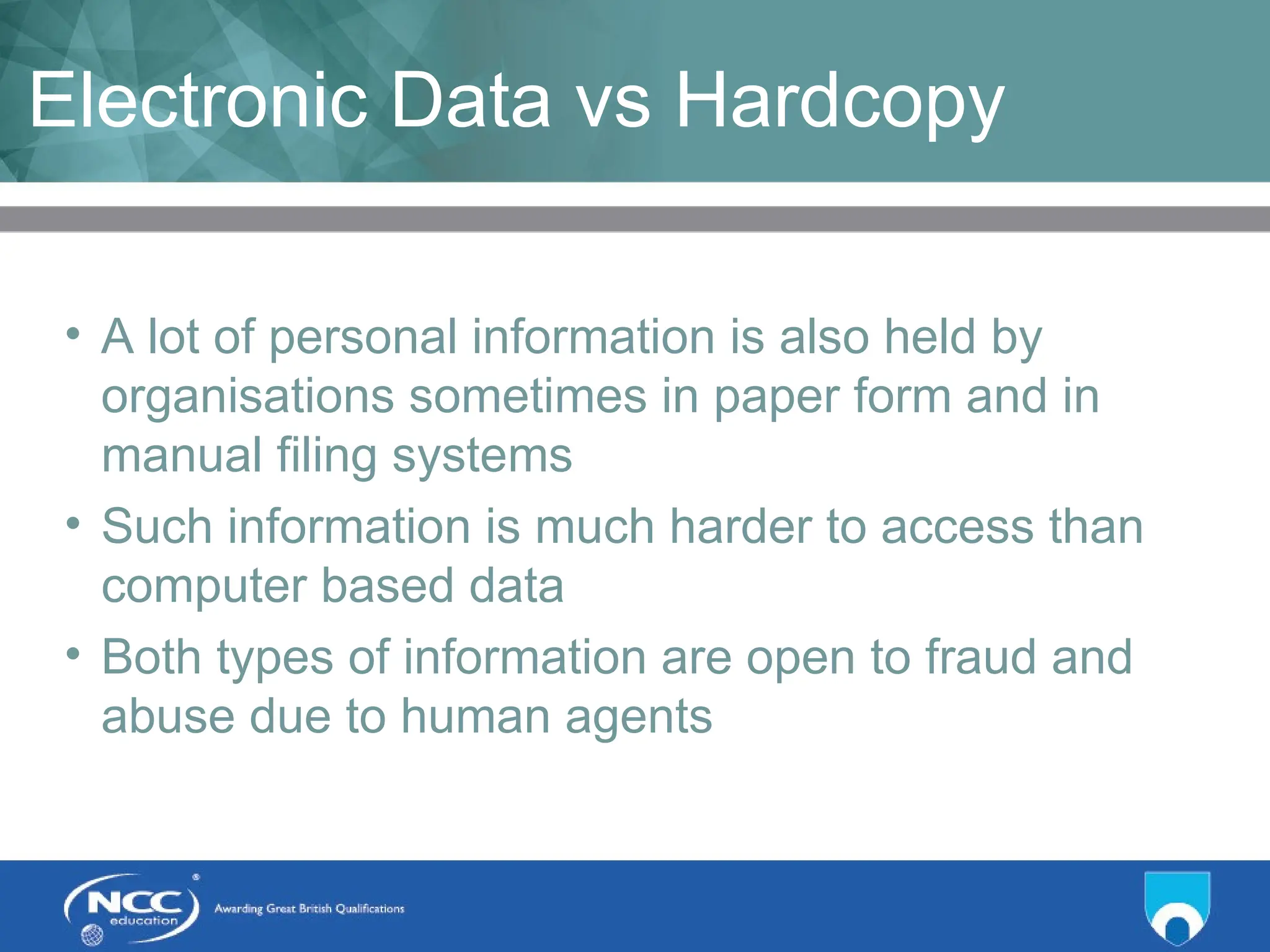
Electronic Data vs Hardcopy
• A lot of personal information is also held by
organisations sometimes in paper form and in
manual filing systems
• Such information is much harder to access than
computer based data
• Both types of information are open to fraud and
abuse due to human agents
20.
Title of TopicTopic 1 - 1.20
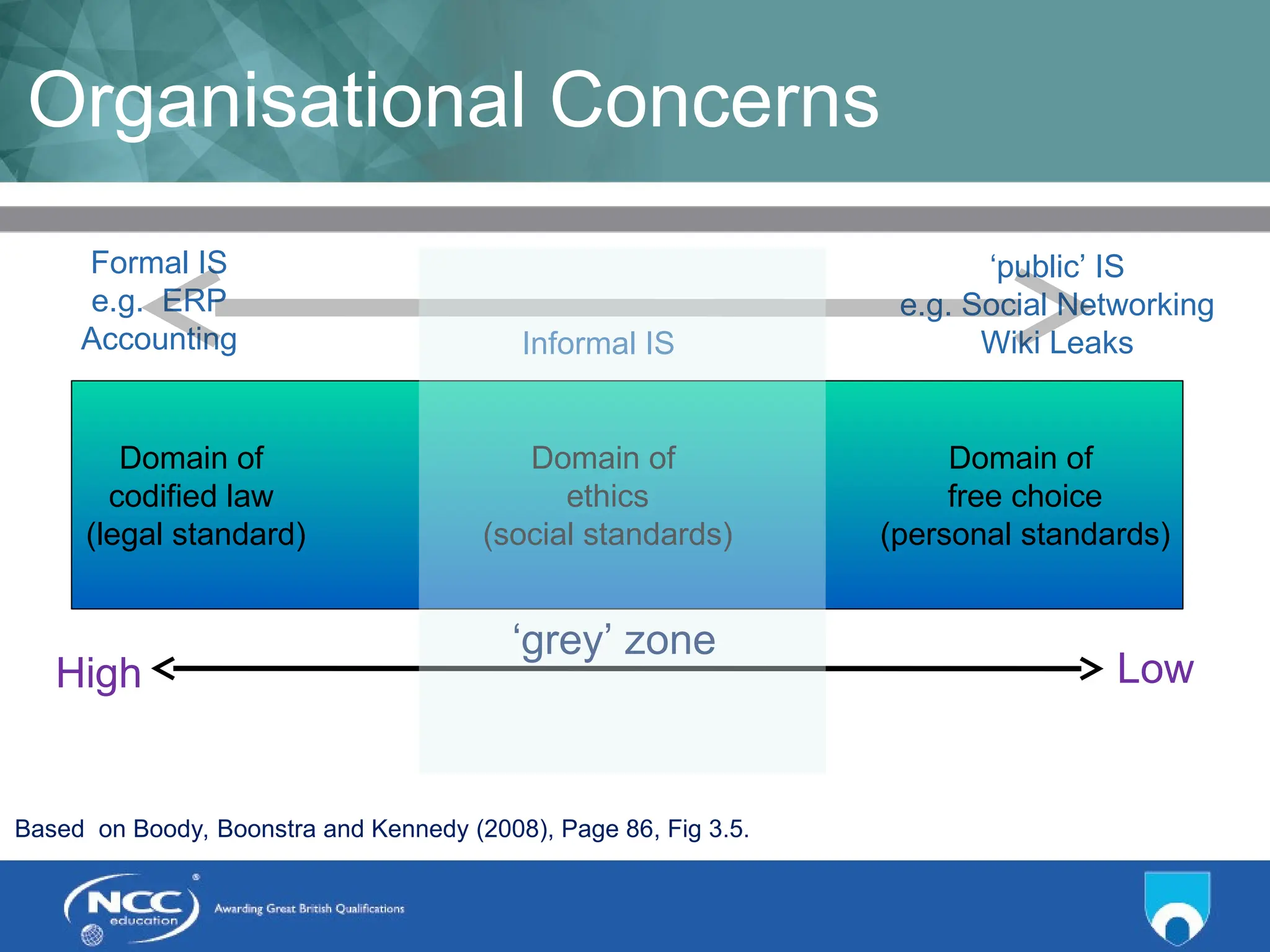
Organisational Concerns
Domain of
codified law
(legal standard)
Domain of
ethics
(social standards)
Domain of
free choice
(personal standards)
Low
High
‘grey’ zone
Based on Boody, Boonstra and Kennedy (2008), Page 86, Fig 3.5.
Formal IS
e.g. ERP
Accounting Informal IS
‘public’ IS
e.g. Social Networking
Wiki Leaks
21.
Title of TopicTopic 1 - 1.21
References
– Boddy, D., Boonstra ,A., Kennedy, G. (2008)
Managing Information Systems : Strategy and
Organisation 3rd
ed. FT Pearson. ISBN-10:
0273716816 or ISBN-13: 978-0273716815
– UK Government, (2015),
https://www.gov.uk/data-protection/the-data-prot
ection-act
– Centre for Retail Research, (2016),
http://www.retailresearch.org/onlineretailing.php
22.
Topic 7 –People and IS Interpretation
Any Questions?


![[MU630] 005. Ethics, Privacy and Security](https://cdn.slidesharecdn.com/ss_thumbnails/005-190422035900-thumbnail.jpg?width=640&height=640&fit=bounds)


![Coded Agents – with UiPath SDK + LangGraph [Virtual Hands-on Workshop]](https://cdn.slidesharecdn.com/ss_thumbnails/codedagentsdeck-251215155422-5497c599-thumbnail.jpg?width=640&height=640&fit=bounds)


