Title of TopicTopic 1 - 1.2
Scope and Coverage
This topic will cover:
• Factors in user acceptance of technology
• Human-computer interaction (HCI)
• Socio-technical approach to implementing
technology
3.
Title of TopicTopic 1 - 1.3
Learning Objectives
By the end of this topic students will be able to:
• Appreciate factors that influence user acceptance
of IS
• Understand the contribution of HCI principles to IS
• Plan IS introductions with attention to human needs
4.
Title of TopicTopic 1 - 1.4
Contents
• User acceptance and the Technology Adoption
Model
• HCI principles in the design of IS interactions
• Work design with socio-technical principles
• User experience and IS design
• Emphasis – People and Technology
5.
Title of TopicTopic 1 - 1.5
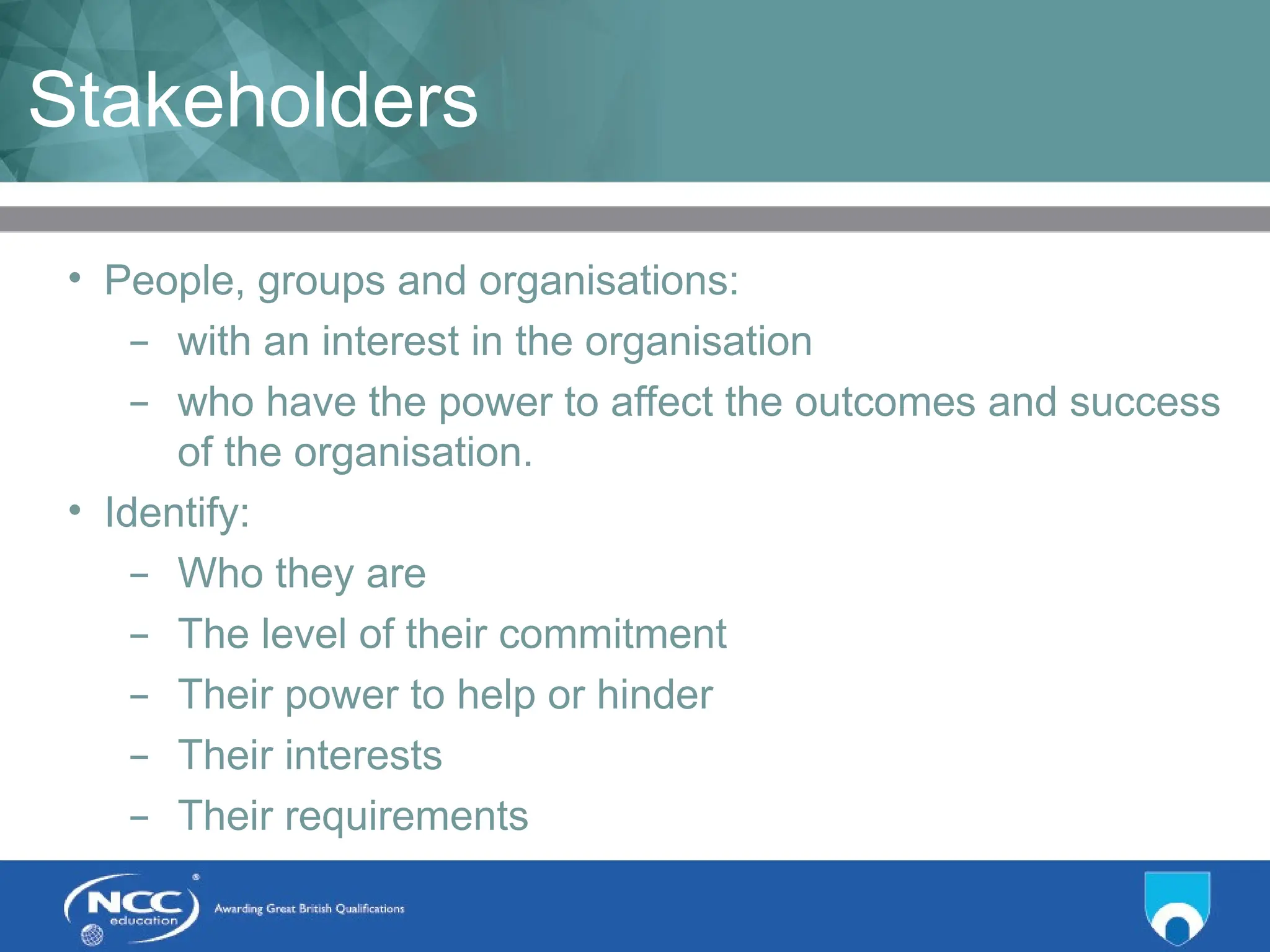
Stakeholders
• People, groups and organisations:
– with an interest in the organisation
– who have the power to affect the outcomes and success
of the organisation.
• Identify:
– Who they are
– The level of their commitment
– Their power to help or hinder
– Their interests
– Their requirements
6.
Title of TopicTopic 1 - 1.6
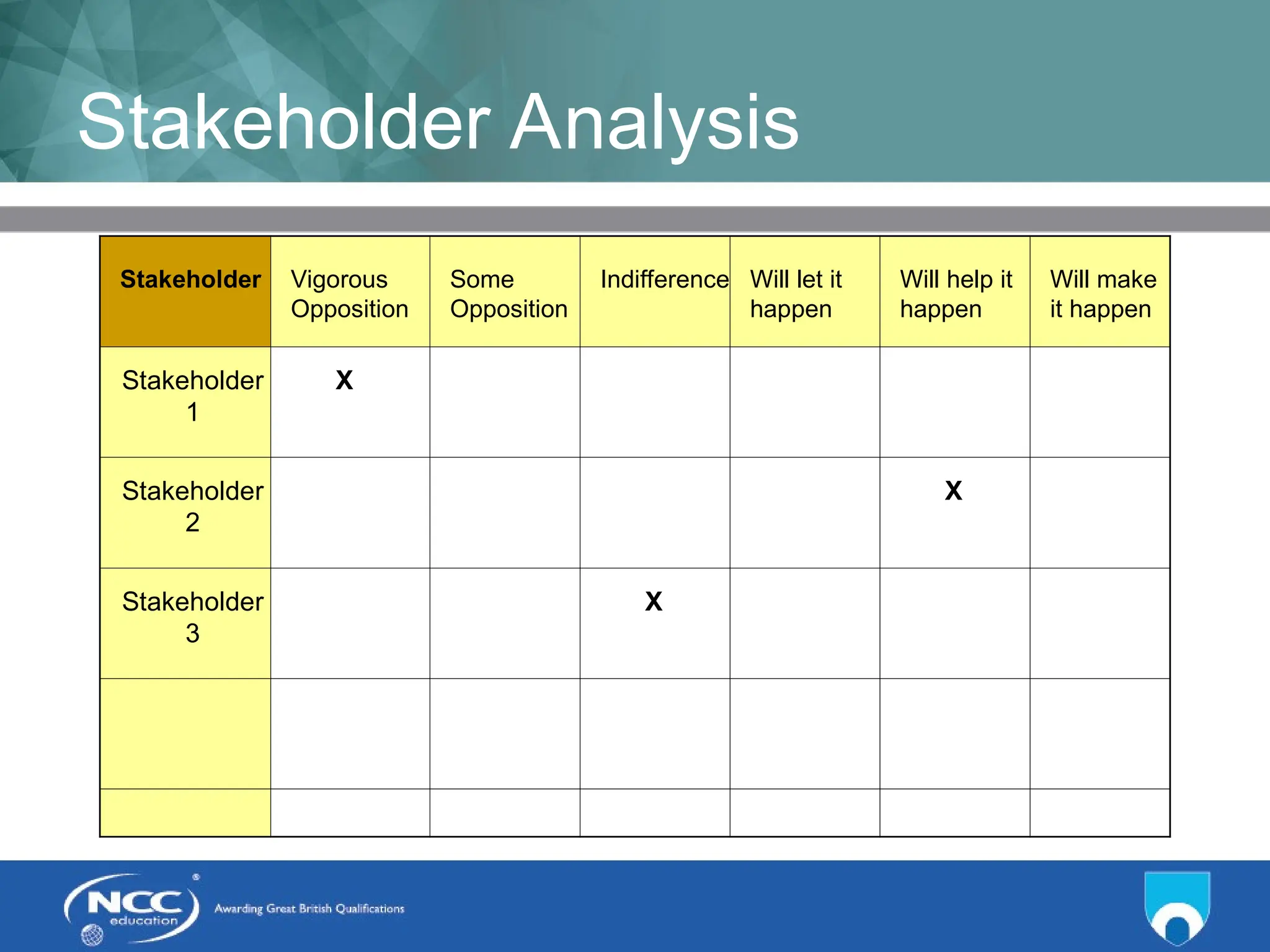
Stakeholder Analysis
Stakeholder Vigorous
Opposition
Some
Opposition
Indifference Will let it
happen
Will help it
happen
Will make
it happen
Stakeholder
1
X
Stakeholder
2
X
Stakeholder
3
X
7.
Title of TopicTopic 1 - 1.7
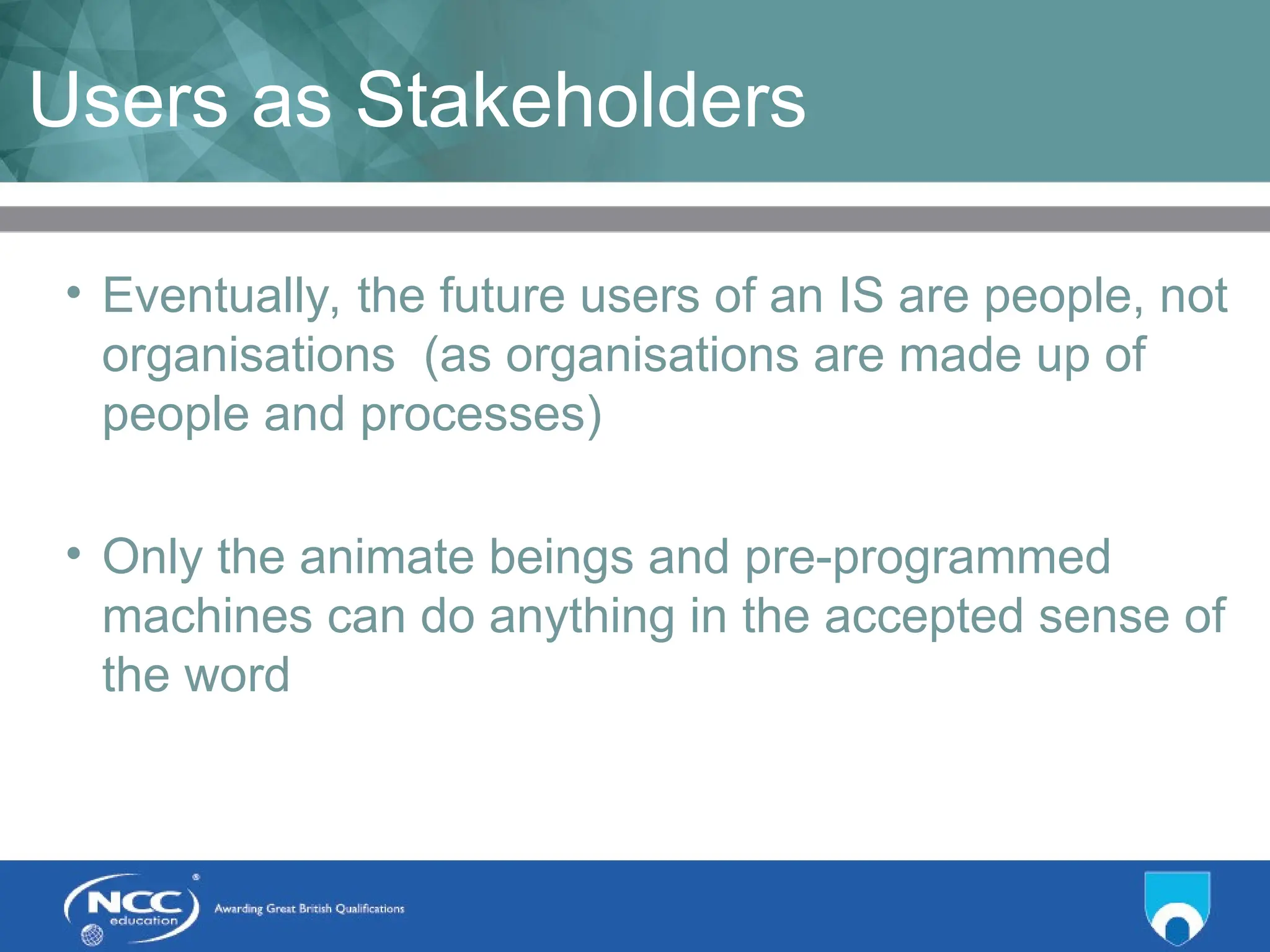
Users as Stakeholders
• Eventually, the future users of an IS are people, not
organisations (as organisations are made up of
people and processes)
• Only the animate beings and pre-programmed
machines can do anything in the accepted sense of
the word
8.
Title of TopicTopic 1 - 1.8
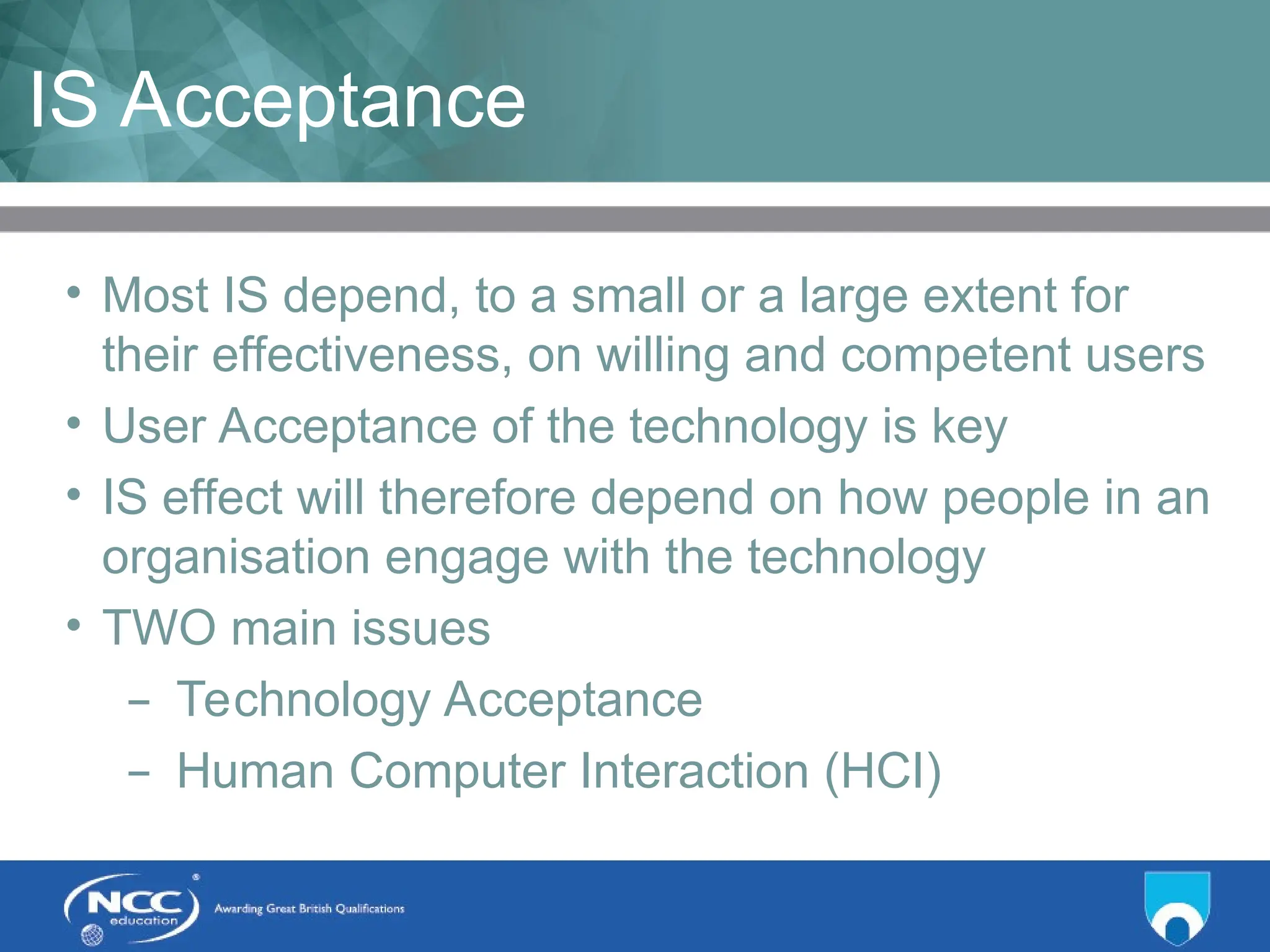
IS Acceptance
• Most IS depend, to a small or a large extent for
their effectiveness, on willing and competent users
• User Acceptance of the technology is key
• IS effect will therefore depend on how people in an
organisation engage with the technology
• TWO main issues
– Technology Acceptance
– Human Computer Interaction (HCI)
9.
Title of TopicTopic 1 - 1.9
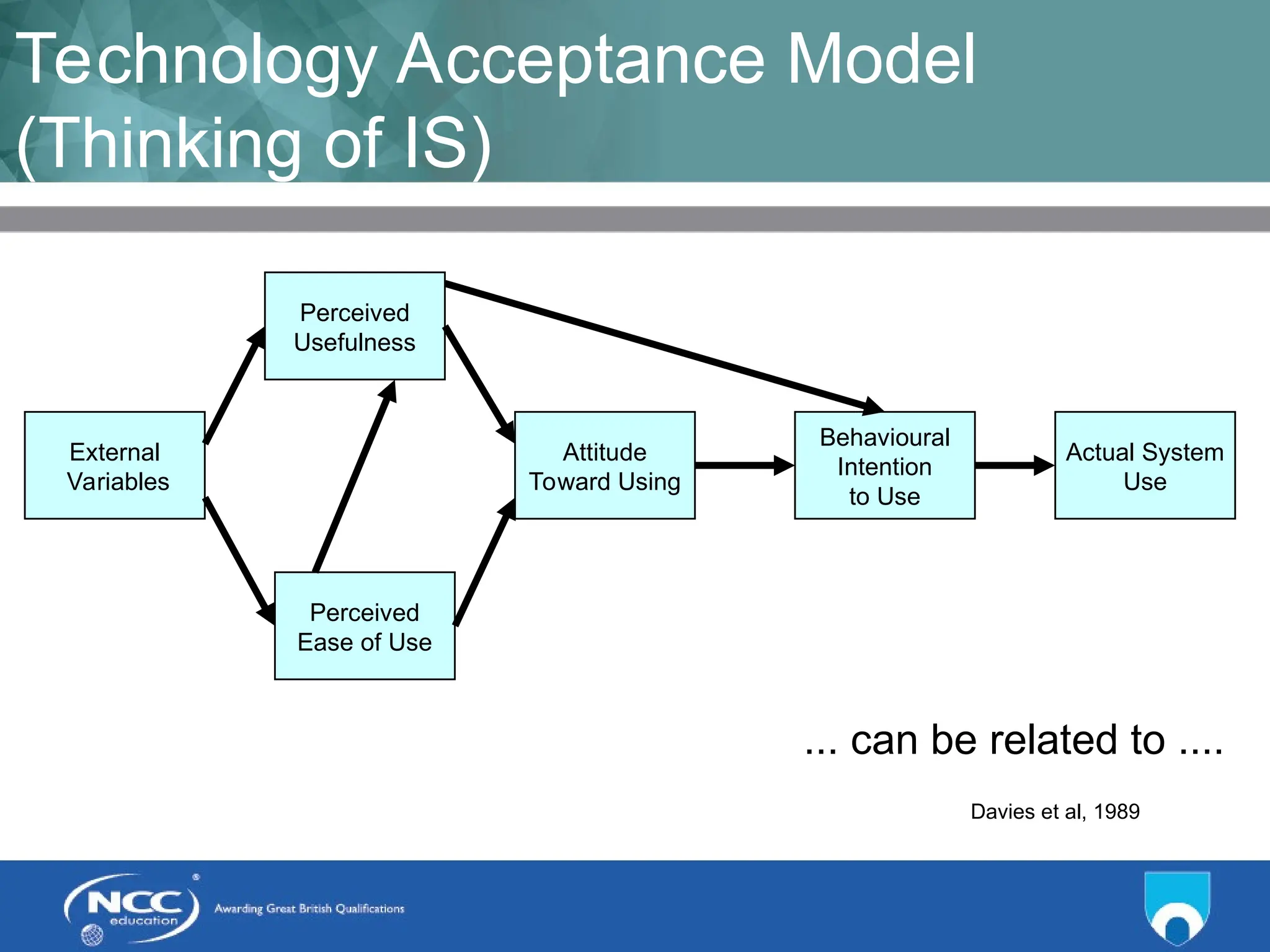
Technology Acceptance Model
(Thinking of IS)
External
Variables
Perceived
Ease of Use
Attitude
Toward Using
Perceived
Usefulness
Actual System
Use
Behavioural
Intention
to Use
Davies et al, 1989
... can be related to ....
10.
Title of TopicTopic 1 - 1.10
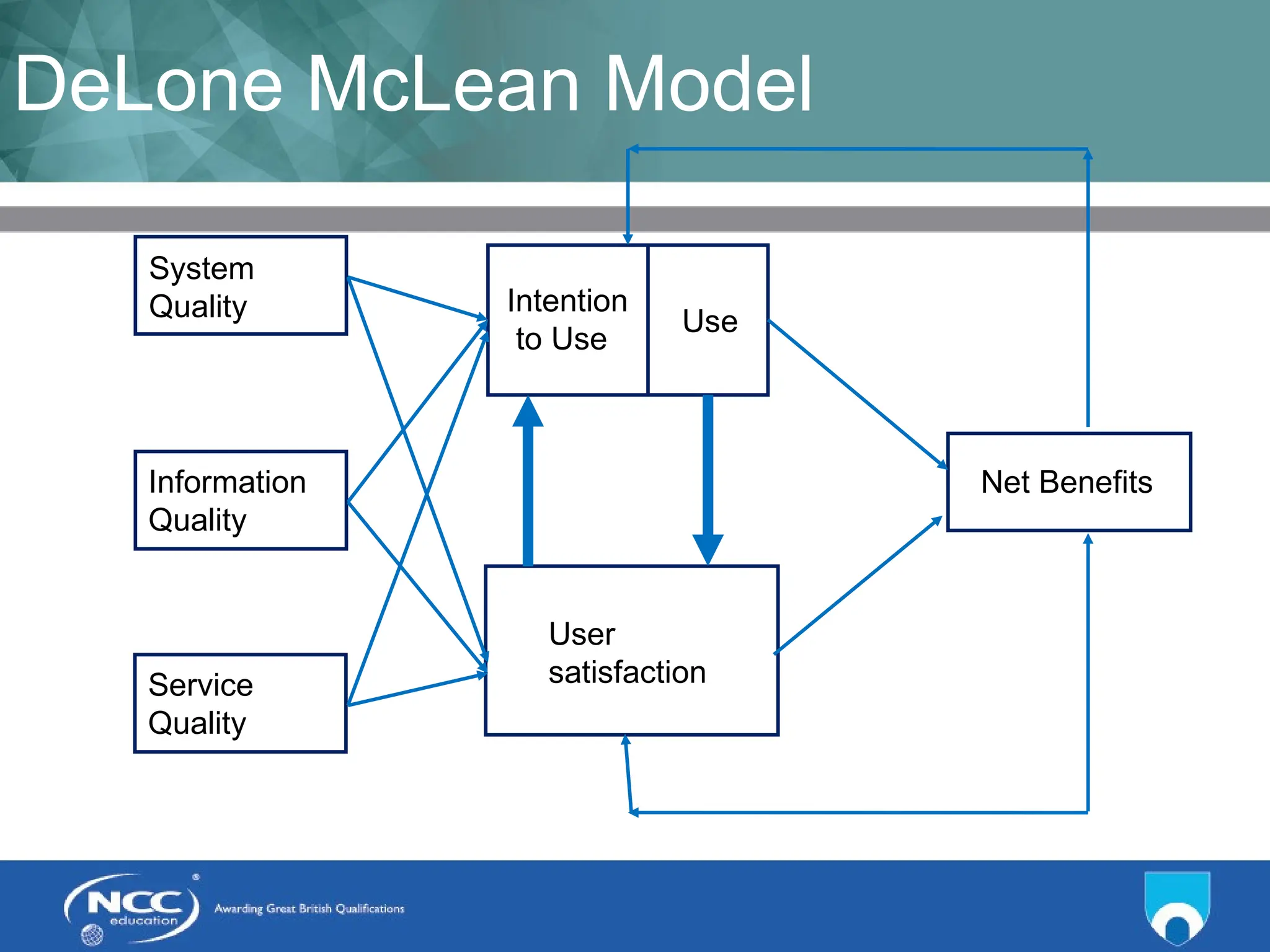
DeLone McLean Model
Net Benefits
System
Quality
Information
Quality
Intention
to Use
User
satisfaction
Service
Quality
Use
11.
Title of TopicTopic 1 - 1.11
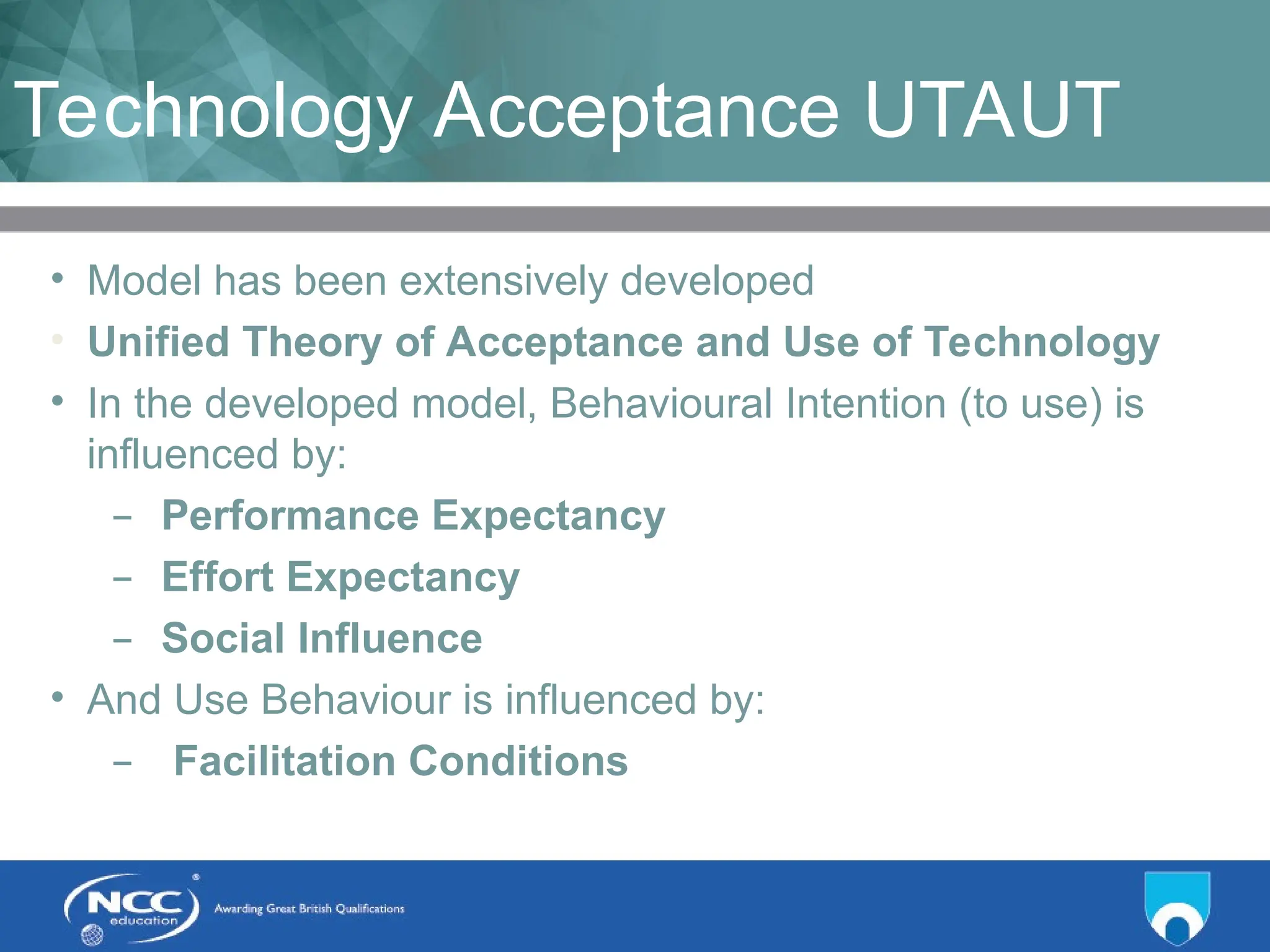
Technology Acceptance UTAUT
• Model has been extensively developed
• Unified Theory of Acceptance and Use of Technology
• In the developed model, Behavioural Intention (to use) is
influenced by:
– Performance Expectancy
– Effort Expectancy
– Social Influence
• And Use Behaviour is influenced by:
– Facilitation Conditions
12.
Title of TopicTopic 1 - 1.12
UTAUT
• Gender, age, experience and voluntariness of use
are other influencing factors
• Reference is:
– Venkatesh, V., Morris, M. G., Davis, G. B., and Davis, F. D. (2003)
User Acceptance of Information Technology: Toward a Unified
View
13.
Title of TopicTopic 1 - 1.13
Use and HCI principles
• When IS are designed, HCI principles can be
employed to ensure ease of use – thus influencing
one of the key aspects of user acceptance
• Most famously Nielsen developed a set of heuristic
principles to follow when designing an interface to a
computer system
• For more information, refer to ‘Topic 9 - Usability heuristic
principles’ (within the Supporting Documents pack for this
module)
14.
Title of TopicTopic 1 - 1.14
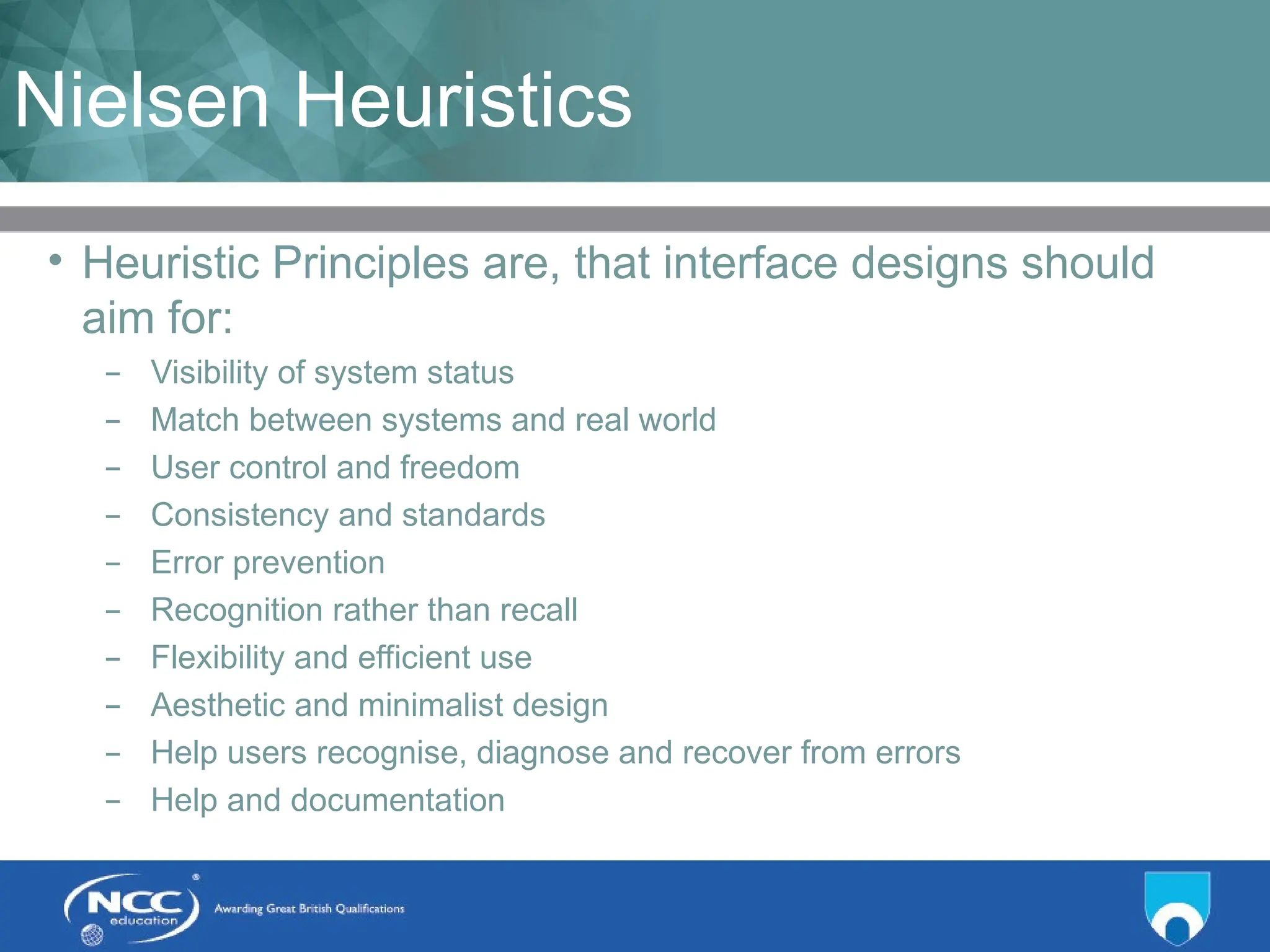
Nielsen Heuristics
• Heuristic Principles are, that interface designs should
aim for:
– Visibility of system status
– Match between systems and real world
– User control and freedom
– Consistency and standards
– Error prevention
– Recognition rather than recall
– Flexibility and efficient use
– Aesthetic and minimalist design
– Help users recognise, diagnose and recover from errors
– Help and documentation
15.
Title of TopicTopic 1 - 1.15
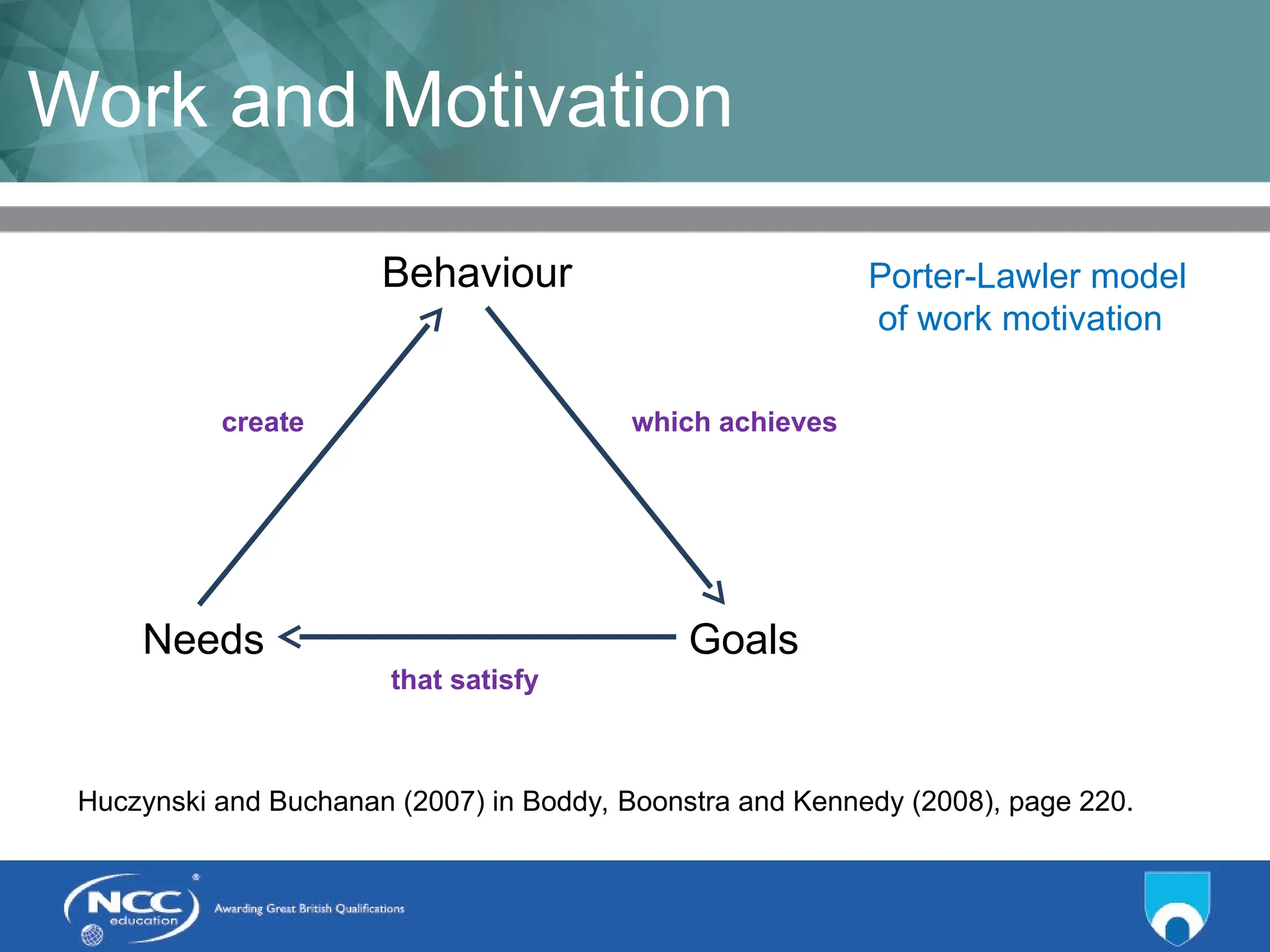
Work and Motivation
Needs Goals
Behaviour Porter-Lawler model
of work motivation
create which achieves
that satisfy
Huczynski and Buchanan (2007) in Boddy, Boonstra and Kennedy (2008), page 220.
16.
Title of TopicTopic 1 - 1.16
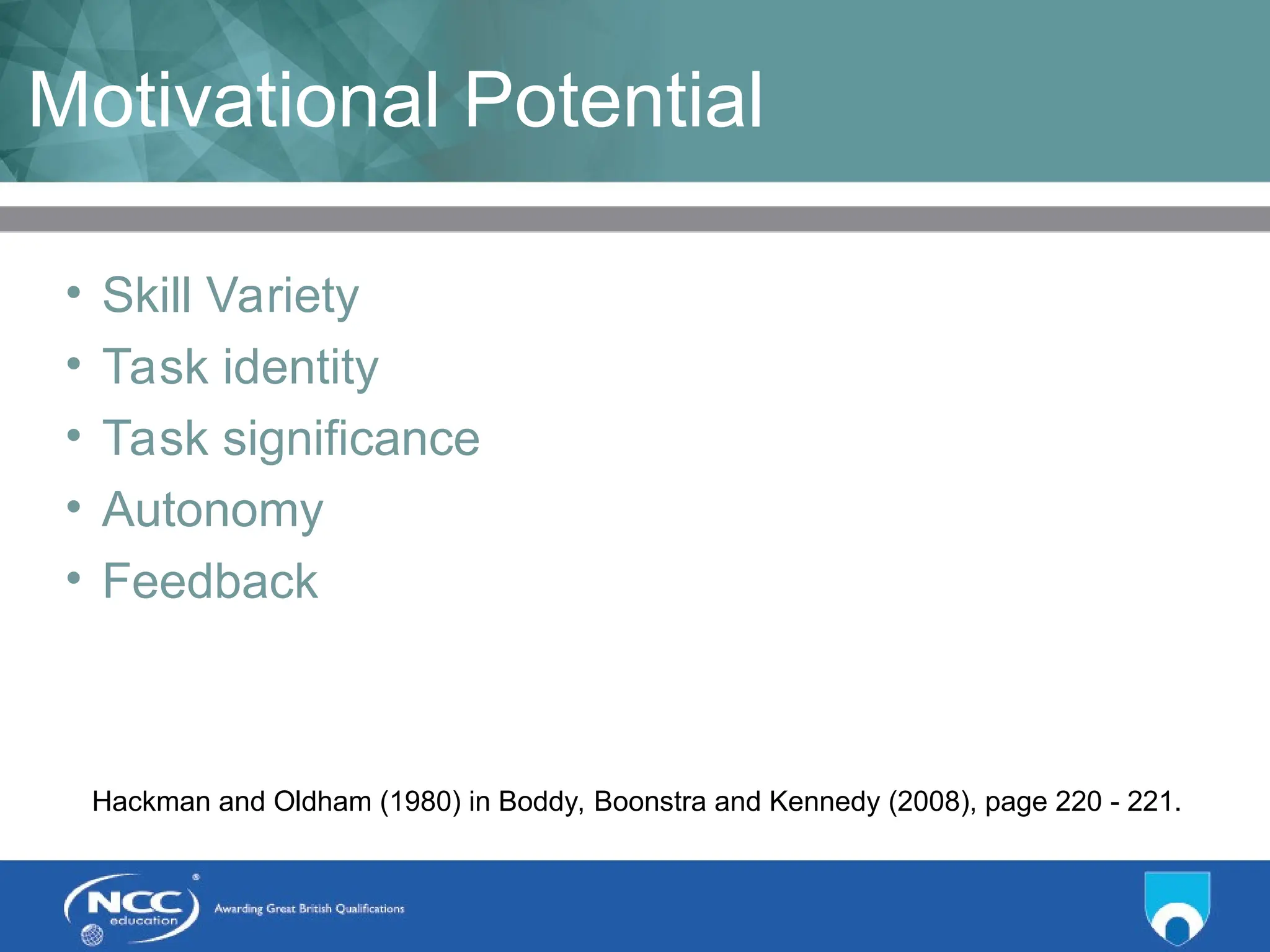
Motivational Potential
• Skill Variety
• Task identity
• Task significance
• Autonomy
• Feedback
Hackman and Oldham (1980) in Boddy, Boonstra and Kennedy (2008), page 220 - 221.
17.
Title of TopicTopic 1 - 1.17
Sociotechnical Design of IS
• The socio-technical design movement, started
many years ago, stresses the importance of
Human ‘systems’ working in collaboration with
Technological systems –both needing to be
‘designed’ to ensure success of the whole
• For IS, this translates most frequently in the
importance of actively involving human users in the
process of the design of systems
• Refer to ‘Topic 9 - Sociotechnical system’ (within the
Supporting Documents pack for this module)
18.
Title of TopicTopic 1 - 1.18
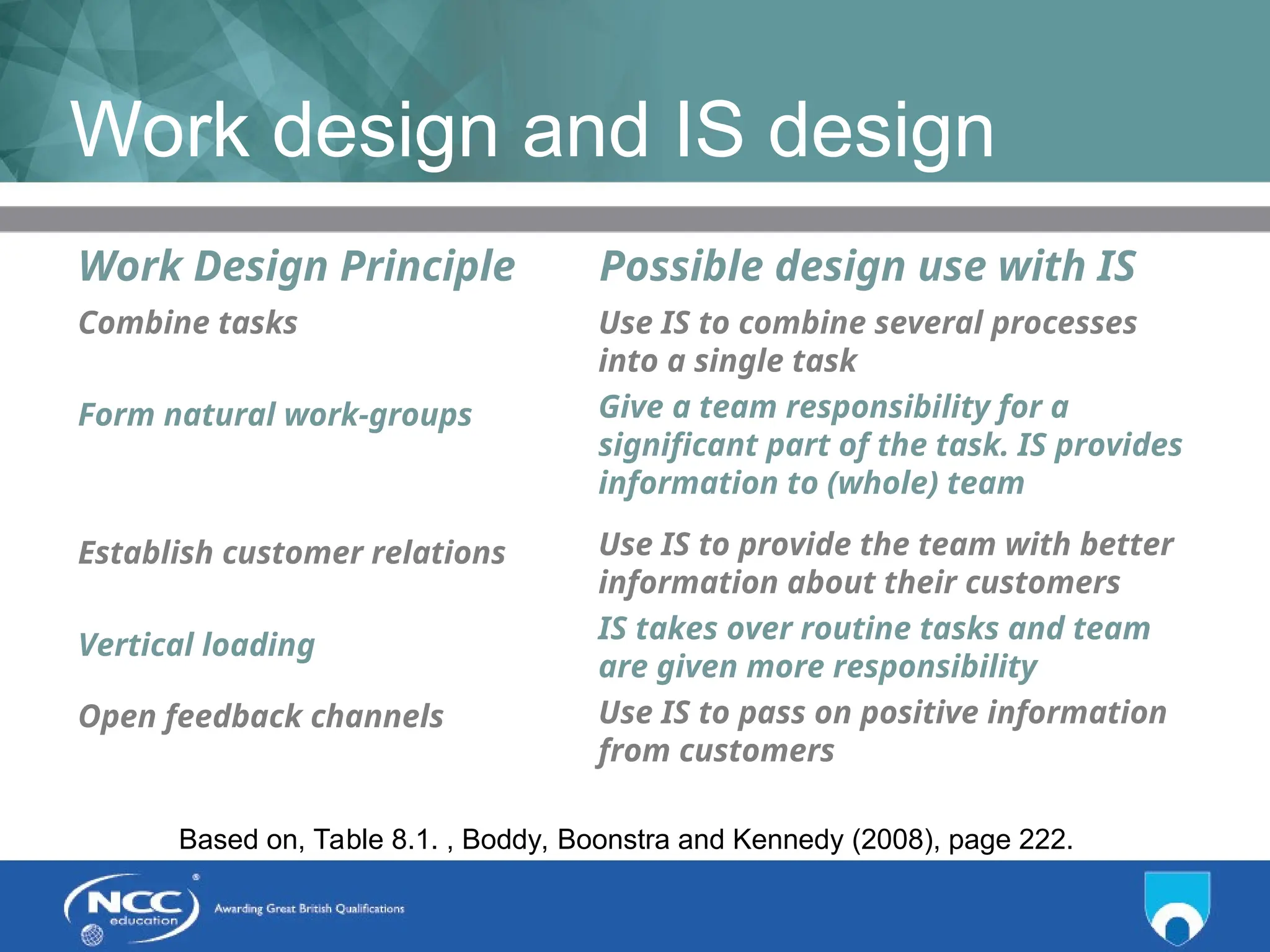
Work design and IS design
Work Design Principle
Combine tasks
Form natural work-groups
Establish customer relations
Vertical loading
Open feedback channels
Possible design use with IS
Use IS to combine several processes
into a single task
Give a team responsibility for a
significant part of the task. IS provides
information to (whole) team
Use IS to provide the team with better
information about their customers
IS takes over routine tasks and team
are given more responsibility
Use IS to pass on positive information
from customers
Based on, Table 8.1. , Boddy, Boonstra and Kennedy (2008), page 222.
19.
Title of TopicTopic 1 - 1.19
User Experience Design
• Situation and context of use
• Environmental factors (noise, light, dirty
environment)
• Time factors (how much time, time versus
accuracy)
• Can information be retrieved from somewhere else
(e.g. Address finders using post-code/zip code)
• Frequency of use (e.g. If infrequent, is it simple –
for example an automated ticketing machine?)
20.
Title of TopicTopic 1 - 1.20
User Experience Design -
Example
• Designing the User Experience is concerned with
the total context and use of an IS
• Refer to ‘Topic 9 - Example of User Experience
Design’ (within the Supporting Documents pack for
this module)
21.
Title of TopicTopic 1 - 1.21
References
• Boddy, D., Boonstra ,A., Kennedy, G. (2008) Managing
Information Systems : strategy and organisation 3rd
ed.
FT Pearson. ISBN-13: 978-0273 -71681-5XXX
• Venkatesh, V., Morris, M. G., Davis, G. B., and Davis, F. D.
(2003) User Acceptance of Information Technology:
Toward a Unified View
22.
Topic 9 -User Acceptance and the Socio-
technical Approach
Any Questions?



![Vibe Coding vs. Spec-Driven Development [Free Meetup]](https://cdn.slidesharecdn.com/ss_thumbnails/vibecodingvsspecdrivendevelopment-251209105622-43f455e7-thumbnail.jpg?width=640&height=640&fit=bounds)


