Islam and FairtradeCopyright © Islamic Relief 2010
International TradeCopyright © Islamic Relief 2010
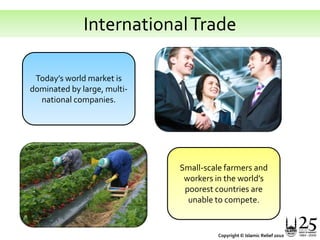
International TradeToday’s world market is dominated by large, multi-national companies.Small-scale farmers and workers in the world’s poorest countries are unable to compete.Copyright © Islamic Relief 2010
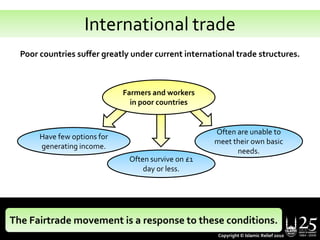
International tradePoor countries suffer greatly under current international trade structures. Farmers and workers in poor countriesOften are unable to meet their own basic needs.Have few options for generating income.Often survive on £1 day or less.The Fairtrade movement is a response to these conditions.Copyright © Islamic Relief 2010
What is Fairtrade?Copyright © Islamic Relief 2010
 Fair Trade or Fairtrade?The terms Fair Trade and fair tradedescribe the broad socio-economic movement which works to address inequalities in the conventional trade system. The word Fairtrade relates exclusively to the work of Fairtrade Labelling Organisations  International (FLO) and its national partners, such as The Fairtrade Foundation in the UK.Look for the FAIRTRADE Mark on Fairtrade productsOnly products which contain the official FAIRTRADE Mark  may be considered Fairtrade.Copyright © Islamic Relief 2010
What are the aims of Fairtrade?Greater equity in international trade.The fulfilment of workers’ rights in the developing world.The alleviation of world poverty.The promotion of environmental sustainability. Copyright © Islamic Relief 2010
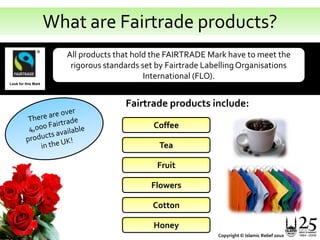
What are Fairtrade products?All products that hold the FAIRTRADE Mark have to meet the rigorous standards set by Fairtrade Labelling Organisations International (FLO).Look for this MarkFairtrade products include:There are over 4,000 Fairtrade products available in the UK!CoffeeTeaFruitFlowersCottonHoneyCopyright © Islamic Relief 2010
Fairtrade standardsCopyright © Islamic Relief 2010
Fairtrade standardsFairtrade standards ensure that production and trade leads to sustainable development in three areas:Economic development Social development  Environmental  developmentThe following slides explore the main Fairtrade standards.Copyright © Islamic Relief 2010
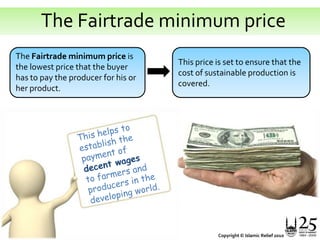
  The Fairtrade minimum priceThe Fairtrade minimum price is the lowest price that the buyer has to pay the producer for his or her product. This price is set to ensure that the cost of sustainable production is covered.This helps to establish the payment of decent wages to farmers and producers in the developing world. Copyright © Islamic Relief 2010
 The Fairtrade PremiumThis money is invested in social, environmental and economic developmental projects, such as education, healthcare and farming tools.The Fairtrade premium is money paid for a product, in addition to the Fairtrade minimum price. Local projects are decided upon democratically, by the Joint Body of hired labour workers.Copyright © Islamic Relief 2010
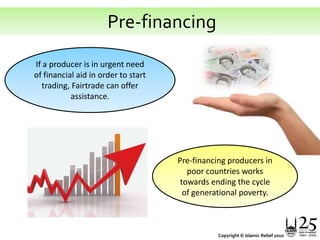
 Pre-financingIf a producer is in urgent need of financial aid in order to start trading, Fairtrade can offer assistance. Pre-financing producers in poor countries works towards ending the cycle of generational poverty. Copyright © Islamic Relief 2010
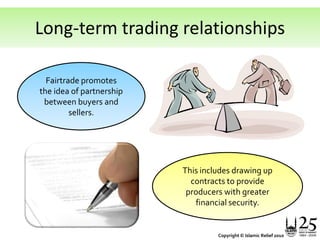
Long-term trading relationshipsFairtrade promotes the idea of partnership between buyers and sellers.This includes drawing up contracts to provide producers with greater financial security.Copyright © Islamic Relief 2010
Environmental sustainabilityFairtrade works to ensure that production is environmentally sustainable.Fairtrade premiums are sometimes invested in training producers in organic farming techniques. Fairtrade standards prohibit the use of Genetically Modified (GM) seeds.Copyright © Islamic Relief 2010
What is the Islamic Perspective on Fairtrade?Copyright © Islamic Relief 2010
What is the Islamic Perspective on Fairtrade?Essential to Islam are teachings related to::Equity and fairness..Respect  towards our natural environment.Workers’ rights.Islam shares Fairtrade’s vision of a trade system upheld by justice. Copyright © Islamic Relief 2010
What does the Qur’an teach us about fairness?’God loves those who are fair and just.’ (Qur’an 49:9)Copyright © Islamic Relief 2010
Social justice is a hallmark of IslamIslamic teachings advocateprotection of the weak from economic exploitation by the strong.Islamic teachings support Fairtrade practices such as the minimum price and premium. Copyright © Islamic Relief 2010
What does the Qur’an teach us about justice?‘Oh you who believe!  Be upright, for the sake of Allah, in testifying  for  fairness; and do not let the hatred of a people  urge you to be unjust, be just (since) that is closer to piety. Fear (from displeasing) Allah, verily Allah is Aware of what you do.’ (Qur’an 5:8)Copyright © Islamic Relief 2010
What did Prophet Muhammad (peace be upon him), teach us about the treatment of workers?‘Allah shows mercy to a man who is kind when he sells, when he buys, and when he makes a claim.’(Hadith related by Bukhari) Copyright © Islamic Relief 2010
Islam and contractual agreementsIslam teaches that contracts between employer and employee must be made. This is to protect the employee from exploitation.Copyright © Islamic Relief 2010
Islam and Workers’ WagesIslam urges believers to pay their employees fair wages, on time.Copyright © Islamic Relief 2010
What did Prophet Muhammad (peace be upon him), teach us about contractual agreements?‘Muslims must abide by their agreements, unless there is an agreement  that makes halal (permitted) what is haram (prohibited), or makes haram what is halal.’(Reported by Tirmidhi) This tells us that Islamic law strongly prohibits any unjust trade agreements, in line with Fairtrade thinking.Copyright © Islamic Relief 2010
What does the Qur’an teach us about the payment of employees?‘Give just measure and weight, nor withhold from the people the things that are their due.’ (Qur’an 7:85)Copyright © Islamic Relief 2010
Islam and Environmental SustainabilityIslam supports practices and policies that promote sustainable development. Muslims believe that God has given humans the role of stewardship (Khalifah) over all animal and plant life.This responsibility is a trust (Amanah) between God and humankind. For Muslims, it is a religious duty to protect the environment.Copyright © Islamic Relief 2010
What did Prophet Muhammad (peace be upon him), teach us about our responsibility over the earth?‘The world is beautiful and verdant, and verily God, be He exalted, has made you His stewards in it, and He sees how you acquit yourselves.’(Hadith related by Muslim from Abu Sa’id al-Khudri)Copyright © Islamic Relief 2010
What can we do to contribute to Fairtrade?Copyright © Islamic Relief 2010
What can we do to contribute to Fairtrade?Become ethically aware consumers; CAMPAIGN and TELL OTHERS to choose Fairtrade.The more we in the UK buy products with the FAIRTRADE Mark, the more farmers can sell their products on Fairtrade terms.Look for the FAIRTRADE Mark on Fairtrade productsCopyright © Islamic Relief 2010
Further informationFor further information about Fairtrade in the UK, visit the Fairtrade Foundation website:www.fairtrade.org.ukLook for the FAIRTRADE Mark on Fairtrade productsCopyright © Islamic Relief 2010
AcknowledgementsCopyright © Islamic Relief 2010
AcknowledgementsIslam and Fair Trade:A school resource for KS3 (11-14 yr olds) Written and produced by Sarah Kilou, Development Education, Islamic Relief Edited bySamia Ahmed, Senior Development Education Coordinator, Islamic ReliefHamayoon Sultan, Development Education Coordinator, Islamic ReliefResources consulted:The Qur’an (A new translation) by M.A.S Abdel Haleem, 2005
The Fairtrade Foundation website: www.fairtrade.org.uk

Islam And Fair Trade

  • 1.
    Islam and FairtradeCopyright© Islamic Relief 2010
  • 2.
  • 3.
    International TradeToday’s worldmarket is dominated by large, multi-national companies.Small-scale farmers and workers in the world’s poorest countries are unable to compete.Copyright © Islamic Relief 2010
  • 4.
    International tradePoor countriessuffer greatly under current international trade structures. Farmers and workers in poor countriesOften are unable to meet their own basic needs.Have few options for generating income.Often survive on £1 day or less.The Fairtrade movement is a response to these conditions.Copyright © Islamic Relief 2010
  • 5.
    What is Fairtrade?Copyright© Islamic Relief 2010
  • 6.
    Fair Tradeor Fairtrade?The terms Fair Trade and fair tradedescribe the broad socio-economic movement which works to address inequalities in the conventional trade system. The word Fairtrade relates exclusively to the work of Fairtrade Labelling Organisations International (FLO) and its national partners, such as The Fairtrade Foundation in the UK.Look for the FAIRTRADE Mark on Fairtrade productsOnly products which contain the official FAIRTRADE Mark may be considered Fairtrade.Copyright © Islamic Relief 2010
  • 7.
    What are theaims of Fairtrade?Greater equity in international trade.The fulfilment of workers’ rights in the developing world.The alleviation of world poverty.The promotion of environmental sustainability. Copyright © Islamic Relief 2010
  • 8.
    What are Fairtradeproducts?All products that hold the FAIRTRADE Mark have to meet the rigorous standards set by Fairtrade Labelling Organisations International (FLO).Look for this MarkFairtrade products include:There are over 4,000 Fairtrade products available in the UK!CoffeeTeaFruitFlowersCottonHoneyCopyright © Islamic Relief 2010
  • 9.
  • 10.
    Fairtrade standardsFairtrade standardsensure that production and trade leads to sustainable development in three areas:Economic development Social development Environmental developmentThe following slides explore the main Fairtrade standards.Copyright © Islamic Relief 2010
  • 11.
    TheFairtrade minimum priceThe Fairtrade minimum price is the lowest price that the buyer has to pay the producer for his or her product. This price is set to ensure that the cost of sustainable production is covered.This helps to establish the payment of decent wages to farmers and producers in the developing world. Copyright © Islamic Relief 2010
  • 12.
    The FairtradePremiumThis money is invested in social, environmental and economic developmental projects, such as education, healthcare and farming tools.The Fairtrade premium is money paid for a product, in addition to the Fairtrade minimum price. Local projects are decided upon democratically, by the Joint Body of hired labour workers.Copyright © Islamic Relief 2010
  • 13.
    Pre-financingIf aproducer is in urgent need of financial aid in order to start trading, Fairtrade can offer assistance. Pre-financing producers in poor countries works towards ending the cycle of generational poverty. Copyright © Islamic Relief 2010
  • 14.
    Long-term trading relationshipsFairtradepromotes the idea of partnership between buyers and sellers.This includes drawing up contracts to provide producers with greater financial security.Copyright © Islamic Relief 2010
  • 15.
    Environmental sustainabilityFairtrade worksto ensure that production is environmentally sustainable.Fairtrade premiums are sometimes invested in training producers in organic farming techniques. Fairtrade standards prohibit the use of Genetically Modified (GM) seeds.Copyright © Islamic Relief 2010
  • 16.
    What is theIslamic Perspective on Fairtrade?Copyright © Islamic Relief 2010
  • 17.
    What is theIslamic Perspective on Fairtrade?Essential to Islam are teachings related to::Equity and fairness..Respect towards our natural environment.Workers’ rights.Islam shares Fairtrade’s vision of a trade system upheld by justice. Copyright © Islamic Relief 2010
  • 18.
    What does theQur’an teach us about fairness?’God loves those who are fair and just.’ (Qur’an 49:9)Copyright © Islamic Relief 2010
  • 19.
    Social justice isa hallmark of IslamIslamic teachings advocateprotection of the weak from economic exploitation by the strong.Islamic teachings support Fairtrade practices such as the minimum price and premium. Copyright © Islamic Relief 2010
  • 20.
    What does theQur’an teach us about justice?‘Oh you who believe! Be upright, for the sake of Allah, in testifying for fairness; and do not let the hatred of a people urge you to be unjust, be just (since) that is closer to piety. Fear (from displeasing) Allah, verily Allah is Aware of what you do.’ (Qur’an 5:8)Copyright © Islamic Relief 2010
  • 21.
    What did ProphetMuhammad (peace be upon him), teach us about the treatment of workers?‘Allah shows mercy to a man who is kind when he sells, when he buys, and when he makes a claim.’(Hadith related by Bukhari) Copyright © Islamic Relief 2010
  • 22.
    Islam and contractualagreementsIslam teaches that contracts between employer and employee must be made. This is to protect the employee from exploitation.Copyright © Islamic Relief 2010
  • 23.
    Islam and Workers’WagesIslam urges believers to pay their employees fair wages, on time.Copyright © Islamic Relief 2010
  • 24.
    What did ProphetMuhammad (peace be upon him), teach us about contractual agreements?‘Muslims must abide by their agreements, unless there is an agreement that makes halal (permitted) what is haram (prohibited), or makes haram what is halal.’(Reported by Tirmidhi) This tells us that Islamic law strongly prohibits any unjust trade agreements, in line with Fairtrade thinking.Copyright © Islamic Relief 2010
  • 25.
    What does theQur’an teach us about the payment of employees?‘Give just measure and weight, nor withhold from the people the things that are their due.’ (Qur’an 7:85)Copyright © Islamic Relief 2010
  • 26.
    Islam and EnvironmentalSustainabilityIslam supports practices and policies that promote sustainable development. Muslims believe that God has given humans the role of stewardship (Khalifah) over all animal and plant life.This responsibility is a trust (Amanah) between God and humankind. For Muslims, it is a religious duty to protect the environment.Copyright © Islamic Relief 2010
  • 27.
    What did ProphetMuhammad (peace be upon him), teach us about our responsibility over the earth?‘The world is beautiful and verdant, and verily God, be He exalted, has made you His stewards in it, and He sees how you acquit yourselves.’(Hadith related by Muslim from Abu Sa’id al-Khudri)Copyright © Islamic Relief 2010
  • 28.
    What can wedo to contribute to Fairtrade?Copyright © Islamic Relief 2010
  • 29.
    What can wedo to contribute to Fairtrade?Become ethically aware consumers; CAMPAIGN and TELL OTHERS to choose Fairtrade.The more we in the UK buy products with the FAIRTRADE Mark, the more farmers can sell their products on Fairtrade terms.Look for the FAIRTRADE Mark on Fairtrade productsCopyright © Islamic Relief 2010
  • 30.
    Further informationFor furtherinformation about Fairtrade in the UK, visit the Fairtrade Foundation website:www.fairtrade.org.ukLook for the FAIRTRADE Mark on Fairtrade productsCopyright © Islamic Relief 2010
  • 31.
  • 32.
    AcknowledgementsIslam and FairTrade:A school resource for KS3 (11-14 yr olds) Written and produced by Sarah Kilou, Development Education, Islamic Relief Edited bySamia Ahmed, Senior Development Education Coordinator, Islamic ReliefHamayoon Sultan, Development Education Coordinator, Islamic ReliefResources consulted:The Qur’an (A new translation) by M.A.S Abdel Haleem, 2005
  • 33.
    The Fairtrade Foundationwebsite: www.fairtrade.org.uk