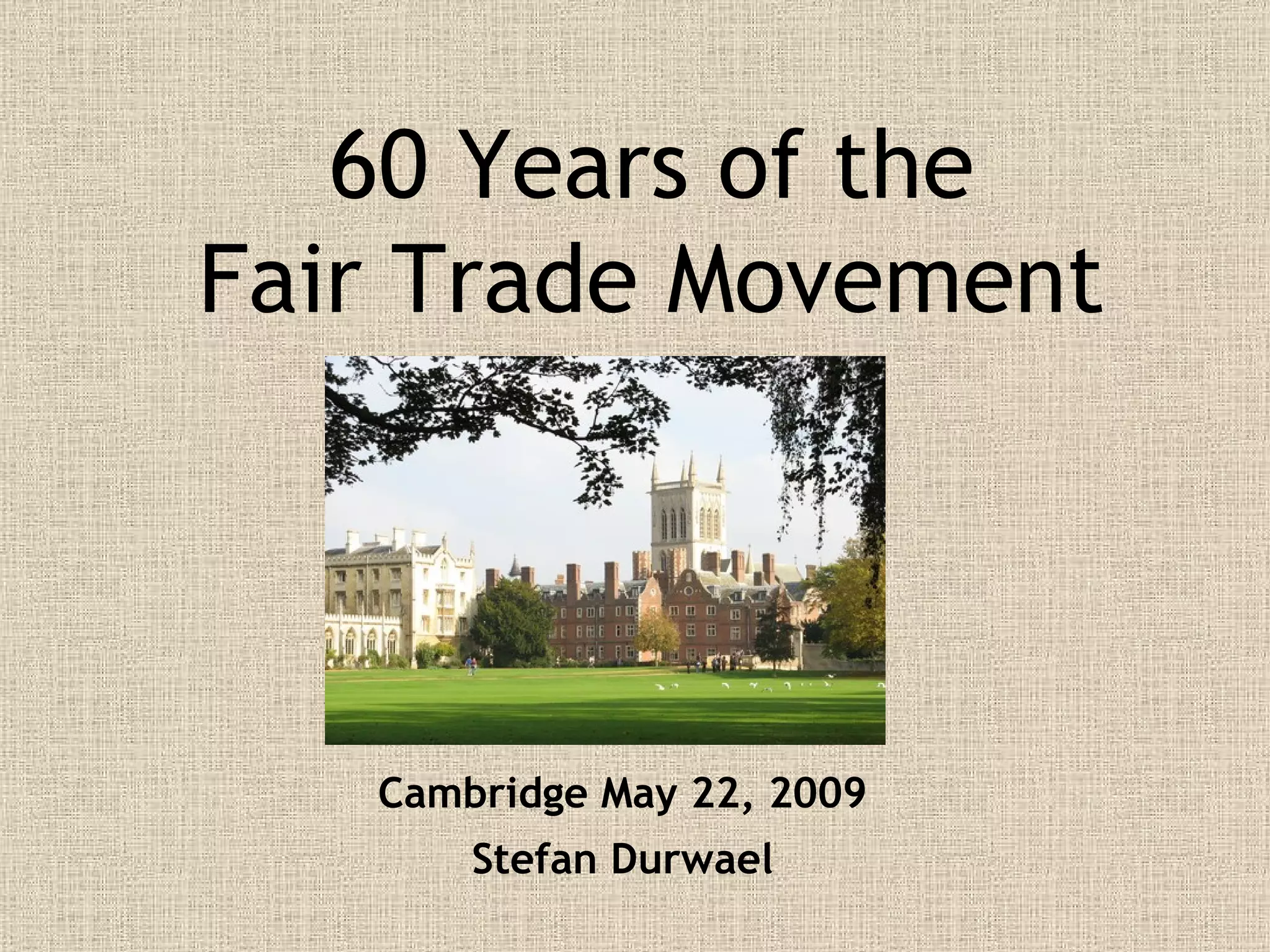
60 Years of the Fair Trade Movement Cambridge May 22, 2009 Stefan Durwael
Stefan Durwael History of 60 Year Fair Trade movement Fair Trade Anno 2009 Achievements Challenges Overview
Stefan Durwael [email_address] Skype: sdurwael Face Book LinkedIn
History of Fair Trade  1.   The roots: charity   (roughly 1946-1970) 2. Political period: ‘Believe in the revolution’    (roughly 1964-1985) 3. From niche to mainstream    (roughly 1986-2000) 4. Mainstreaming and profiling the USP  of Fair Trade (roughly 2000- …)
1. The roots: charity    (roughly 1946-1970) Edna Ruth Byler   1946  -  Puerto Rico   M.C.C.   Self Help Crafts   now Ten Thousand Villages SERVV, end 40ties Oxfam UK, Hong Kong,    end 50ties SOS NL, 1959
Based on (Christian) charity and solidarity No big words: helping through trade ‘ No aid but trade’ -  Unctad ’68 New Delhi
1966
2. Political period:    ‘Believe in the revolution’    (roughly 1964-1985) Cane sugar campaign (64) Boycot Outspan campaign (70)  Boycot Angola coffee (72)
May ‘68 demonstrations in Paris Solidarity with Martin Luther King,    Allende (Chili), Nyerere (Tanzania)  ‘ Centre - periphery model’   work of Dependencia School Lat.Am.   Paulo Freire ‘Pedagogy of the Oppressed’ (’68) Context
Breukelen (NL) 1969
Big discussions about how to change the world In order to allow the poorest groups in the 3 rd   World to determine their future, huge changes   in our own society and mentality are needed    Information and campaigning  for structural changes in society,    in the First World A product is a tool, a symbol  to tell the political message Trade as a way to support producers is less important
1973
Preference for working with  progressive countries  that want  to function independently from the Western capitalistic system coffee and tea from Tanzania wine and orange juice from Algeria cashew nuts from Mozambique rum from Cuba coffee from Nicaragua
Leuven (B) 1980
1985 FTO’s biennual meeting since Noordwijkerhout ’76 EFTA (Berlin Spandau, 1987) IFAT – WFTO (Noordwijk, 1989)  NEWS (1994) Fair Trade Labelling Organizations Intern. (1997) Regional and national networks in South and North Organizing Fair Trade Movement
F I N E 1998
3. From niche to mainstream    (roughly 1986-2000) The r evolution won’t come tomorrow    and the 3rd World can’t wait.. We have to use the opportunities in    the market  We should use commercial techniques  Critical consumption


1988
1860
 
4. Mainstreaming and profiling    the USP of Fair Trade    (roughly 2000 -…) Growth of CSR Political recognition of Fair Trade in Europe http://www.fairtrade-advocacy.org/images/communfairtrade.pdf     5 May ‘09 Fair Trade and ‘Fair Trade light’  Food increases, handicrafts tend to stagnate
FLO International  -  products
AUSTRALIA: Fairtrade Labelling Australia and New Zealand AUSTRIA: Fairtrade Austria  BELGIUM: Max Havelaar Belgium CANADA: TransFair Canada DENMARK: Max Havelaar Denmark  ESTONIA: Fairtrade Estonia (via Finland) FINLAND: Reilun kaupan edistämisyhdistys ry. FRANCE: Max Havelaar France GERMANY: TransFair Germany  IRELAND: Fairtrade Mark Ireland  ITALY: Fairtrade TransFair Italy  JAPAN: Fairtrade Label Japan  LATVIA: Fairtrade Latvia (via Finland) LITHUANIA: Fairtrade Lithuania  (via Finland) LUXEMBOURG: TransFair Minka Luxembourg THE NETHERLANDS: Stichting Max Havelaar Netherlands NEW ZEALAND: Fairtrade Labelling Australia and New Zealand NORWAY: Fairtrade Max Havelaar Norway SPAIN: Asociación del Sello de Comercio Justo SWEDEN: Rättvisemärkt SWITZERLAND: Max Havelaar Stiftung UK: The Fairtrade Foundation USA: TransFair USA 23 countries FLO International  -  members
Fairtrade Marketing Organisations SOUTH AFRICA: Fairtrade Label South Africa Producer Networks African Fairtrade Network (AFN) Coordinadora Latinoamericana y del Caribe de Comercio Justo (CLAC) Network of Asian Producers (NAP) FLO International  -  members (2)
350+ members in 70 countries 2/3 in the South 4 regional networks Many country networks
FAIR TRADE definition Fair Trade  is a trading partnership based on dialogue, transparency and respect, that seeks greater equity in international trade. It contributes to sustainable development by offering better trading conditions to, and securing the rights of, marginalized producers and workers - especially in countries of the South. Fair Trade Organizations  (backed by consumers) are engaged actively in supporting producers, awareness raising and in campaigning for changes in the rules and practice of conventional international trade.  FINE December 2001
CHARTER  of Fair Trade Principles www.  http://www.fairtrade-advocacy.org ) Two distinct but complementary channels: The integrated supply chain route products are imported and/or distributed by organisations who have Fair Trade at the core of their mission and activities, using it as a development tool to support disadvantaged producers and to reduce poverty, and combine their marketing with awareness-raising and campaigning.  The product certification route products complying with international standards are certified indicating that they have been produced, traded, processed and packaged in accordance with the specific requirements of the international standards . January 2009
http://www.fairtrade-advocacy.org/documents/ FairTrade2007_newfactsandfigures.pdf
Sales Fair Trade products ‘ North’ in 2007
Sales Fair Trade products Europe 2001 - 2007
Retail value Fair Trade certified products Europe 2007 (x 1.000 Euro)
Consumption Fair Trade certified products Europe 2007 in Euros per capita
Market share certified coffee and bananas Europe 2000-2007
Achievements Increased trade volume, work and income  Empowerment of producers (Indirect) Benefits to all producers in the area  Making the producer visible  Awareness, mainly in the North From niche to mainstream Growth of CSR (Fair Trade = CSR ‘avant la lettre’)  Political recognition (EP) Fair Trade Towns (+500 in 15 countries) World Fair Trade Day
CSR cooperation ∆ differentiation  Label ∆ brand Impact: Sales volume ∆ most disadvantaged Credible system ∆ expensive certification Political message ∆ marketing story Professionalism ∆ volunteers (campaigning) Challenges: the right balance…
The present economic model is not sustainable The ‘Culture of more, more, more’ and the    ‘Race to the bottom’ has to and will stop Not the market should be leading, but mankind,    our community, our planet, our future  Social and environmental costs will have to be    internalised in the market (in the cost price) Fair Trade and CSR are part of the solution    and will continue to grow To conclude…
Thank you Trade can be an efficient tool for sustainable development and poverty alleviation if carried out in a fair and responsible manner

60 Years Fair Trade Movement Cambridge 2009

  • 1.
    60 Years ofthe Fair Trade Movement Cambridge May 22, 2009 Stefan Durwael
  • 2.
    Stefan Durwael Historyof 60 Year Fair Trade movement Fair Trade Anno 2009 Achievements Challenges Overview
  • 3.
    Stefan Durwael [email_address]Skype: sdurwael Face Book LinkedIn
  • 4.
    History of FairTrade 1. The roots: charity (roughly 1946-1970) 2. Political period: ‘Believe in the revolution’ (roughly 1964-1985) 3. From niche to mainstream (roughly 1986-2000) 4. Mainstreaming and profiling the USP of Fair Trade (roughly 2000- …)
  • 5.
    1. The roots:charity (roughly 1946-1970) Edna Ruth Byler 1946 - Puerto Rico M.C.C. Self Help Crafts now Ten Thousand Villages SERVV, end 40ties Oxfam UK, Hong Kong, end 50ties SOS NL, 1959
  • 6.
    Based on (Christian)charity and solidarity No big words: helping through trade ‘ No aid but trade’ - Unctad ’68 New Delhi
  • 7.
  • 8.
    2. Political period: ‘Believe in the revolution’ (roughly 1964-1985) Cane sugar campaign (64) Boycot Outspan campaign (70) Boycot Angola coffee (72)
  • 9.
    May ‘68 demonstrationsin Paris Solidarity with Martin Luther King, Allende (Chili), Nyerere (Tanzania) ‘ Centre - periphery model’ work of Dependencia School Lat.Am. Paulo Freire ‘Pedagogy of the Oppressed’ (’68) Context
  • 10.
  • 11.
    Big discussions abouthow to change the world In order to allow the poorest groups in the 3 rd World to determine their future, huge changes in our own society and mentality are needed Information and campaigning for structural changes in society, in the First World A product is a tool, a symbol to tell the political message Trade as a way to support producers is less important
  • 12.
  • 13.
    Preference for workingwith progressive countries that want to function independently from the Western capitalistic system coffee and tea from Tanzania wine and orange juice from Algeria cashew nuts from Mozambique rum from Cuba coffee from Nicaragua
  • 14.
  • 15.
    1985 FTO’s biennualmeeting since Noordwijkerhout ’76 EFTA (Berlin Spandau, 1987) IFAT – WFTO (Noordwijk, 1989) NEWS (1994) Fair Trade Labelling Organizations Intern. (1997) Regional and national networks in South and North Organizing Fair Trade Movement
  • 16.
    F I NE 1998
  • 17.
    3. From nicheto mainstream (roughly 1986-2000) The r evolution won’t come tomorrow and the 3rd World can’t wait.. We have to use the opportunities in the market We should use commercial techniques Critical consumption
  • 18.
  • 19.
  • 20.
  • 21.
  • 22.
  • 23.
  • 24.
    4. Mainstreaming andprofiling the USP of Fair Trade (roughly 2000 -…) Growth of CSR Political recognition of Fair Trade in Europe http://www.fairtrade-advocacy.org/images/communfairtrade.pdf 5 May ‘09 Fair Trade and ‘Fair Trade light’ Food increases, handicrafts tend to stagnate
  • 25.
  • 26.
    AUSTRALIA: Fairtrade LabellingAustralia and New Zealand AUSTRIA: Fairtrade Austria BELGIUM: Max Havelaar Belgium CANADA: TransFair Canada DENMARK: Max Havelaar Denmark ESTONIA: Fairtrade Estonia (via Finland) FINLAND: Reilun kaupan edistämisyhdistys ry. FRANCE: Max Havelaar France GERMANY: TransFair Germany IRELAND: Fairtrade Mark Ireland ITALY: Fairtrade TransFair Italy JAPAN: Fairtrade Label Japan LATVIA: Fairtrade Latvia (via Finland) LITHUANIA: Fairtrade Lithuania (via Finland) LUXEMBOURG: TransFair Minka Luxembourg THE NETHERLANDS: Stichting Max Havelaar Netherlands NEW ZEALAND: Fairtrade Labelling Australia and New Zealand NORWAY: Fairtrade Max Havelaar Norway SPAIN: Asociación del Sello de Comercio Justo SWEDEN: Rättvisemärkt SWITZERLAND: Max Havelaar Stiftung UK: The Fairtrade Foundation USA: TransFair USA 23 countries FLO International - members
  • 27.
    Fairtrade Marketing OrganisationsSOUTH AFRICA: Fairtrade Label South Africa Producer Networks African Fairtrade Network (AFN) Coordinadora Latinoamericana y del Caribe de Comercio Justo (CLAC) Network of Asian Producers (NAP) FLO International - members (2)
  • 28.
    350+ members in70 countries 2/3 in the South 4 regional networks Many country networks
  • 29.
    FAIR TRADE definitionFair Trade is a trading partnership based on dialogue, transparency and respect, that seeks greater equity in international trade. It contributes to sustainable development by offering better trading conditions to, and securing the rights of, marginalized producers and workers - especially in countries of the South. Fair Trade Organizations (backed by consumers) are engaged actively in supporting producers, awareness raising and in campaigning for changes in the rules and practice of conventional international trade. FINE December 2001
  • 30.
    CHARTER ofFair Trade Principles www. http://www.fairtrade-advocacy.org ) Two distinct but complementary channels: The integrated supply chain route products are imported and/or distributed by organisations who have Fair Trade at the core of their mission and activities, using it as a development tool to support disadvantaged producers and to reduce poverty, and combine their marketing with awareness-raising and campaigning. The product certification route products complying with international standards are certified indicating that they have been produced, traded, processed and packaged in accordance with the specific requirements of the international standards . January 2009
  • 31.
  • 32.
    Sales Fair Tradeproducts ‘ North’ in 2007
  • 33.
    Sales Fair Tradeproducts Europe 2001 - 2007
  • 34.
    Retail value FairTrade certified products Europe 2007 (x 1.000 Euro)
  • 35.
    Consumption Fair Tradecertified products Europe 2007 in Euros per capita
  • 36.
    Market share certifiedcoffee and bananas Europe 2000-2007
  • 37.
    Achievements Increased tradevolume, work and income Empowerment of producers (Indirect) Benefits to all producers in the area Making the producer visible Awareness, mainly in the North From niche to mainstream Growth of CSR (Fair Trade = CSR ‘avant la lettre’) Political recognition (EP) Fair Trade Towns (+500 in 15 countries) World Fair Trade Day
  • 38.
    CSR cooperation ∆differentiation Label ∆ brand Impact: Sales volume ∆ most disadvantaged Credible system ∆ expensive certification Political message ∆ marketing story Professionalism ∆ volunteers (campaigning) Challenges: the right balance…
  • 39.
    The present economicmodel is not sustainable The ‘Culture of more, more, more’ and the ‘Race to the bottom’ has to and will stop Not the market should be leading, but mankind, our community, our planet, our future Social and environmental costs will have to be internalised in the market (in the cost price) Fair Trade and CSR are part of the solution and will continue to grow To conclude…
  • 40.
    Thank you Tradecan be an efficient tool for sustainable development and poverty alleviation if carried out in a fair and responsible manner

Editor's Notes

  • #3 History from a continental perspective
  • #4 FTO, IFAT, Max Havelaar, FLO
  • #5 Different phasesOverlapping. Some are still in phase 1Mainly from a continental and Dutch perspective
  • #6 Edna Ruth Byler: needle work or hand embroidered linen from Puerto RicoEnd of 50 ties: Oxfam UK started selling handicrafts from Chinese refugees
  • #8 EZA’s firrst warehouse in the monastery ‘Maria Sorg’ near Salzburg, with the warehouse in the cowshedSouthern FTO’s were established by NGO’s and socially motivated individualsSAFFY: In 1966, Sister Juliaan Mullie, a Belgian nun, founded SAFFY or Social Action for Filipino Youth, carried by its vocational thrust “Fight Hunger Through Work,” to create alternative sources of livelihood for the unemployed and out of school youth in the marginalized areas of Manila. The organization was legally incorporated in 1970 as Social Action Foundation For Rural and Urban Development, Inc. or SAFRUDI, retaining SAFFY as its trade name for its export items. Tara (Trade Alternative Reform Action) Projects made its humble beginning in early seventies
  • #9 Care sugar campaign: ‘By buying cane sugar you increase the pressure on governments in the rich countries to grant also the poor countries a place in the sun of prosperity…”
  • #10 Centre-Periphery model or core-periphery explains the structural relationship between the advanced centre and the less developed periphery.Both between capitalist and developing countries as well within a particular country.The developed countries exploit the poor countries with the help of the leading classes in the poor countries. It draws on the Marxist tradition of analysis. Underdevelopment or dependency are routed in the theory of imperialism.Underdevelopment is produced as part of the process necessary for the development of capitalism.The economic centers use political, military and trade/economical power to extract an economic surplus from the peripheral countries.Examples: trade relations and raw materials.(Today the world is changed. Two thirds of the world population is doing relative well. One third does not benefit from the economic growth. The Germans call this the ‘Zwei-Drittel Gemeinschaft’Paulo Freire (1921-1997) was a Brazilian educationalist. He traditionally worked with those who do not have a voice and who are oppressed. The emphasis was on informal and popular education.Martin Luther King: ‘I have a dream’ - 1963
  • #23 Eduard Douwes Dekker (1820 – 1887), better known under the name Multatuli, wrote the book Max Havelaar, 1860. Multatuli wrote about the abuses in the colony Dutch India, now called Indonesia. It has been published in 140 languages
  • #33 At the moment nearly 3 Billion EuroOver a million small-scale producers and workers are involved in the fair Trade movementThis means that 5 million people in Africa, Asia en Latin America benefit from Fair TradeAccording to WFTO it represents US $ 2 billion Fair Trade sales and 110 millions fair traders. Worldwide 2,7 billion people live on less the 2 $ a day
  • #38 EU Trade Commissioner Catherine Ashton European Commission communication 5 May 2009Contribution to the attainment of the Millennium Development Goals. Goal 1: Eradicate extreme poverty and hunger ******Goal 2: Achieve universal primary education Goal 3: Promote gender equality and empower women Goal 4: Reduce child mortality Goal 5: Improve maternal health Goal 6: Combat HIV/AIDS, malaria and other diseases *********Goal 7: Ensure environmental sustainability ********Goal 8: Develop a Global Partnership for Development ********The eight MDGs break down into 21 quantifiable targets that are measured by 60 indicators.
  • #40 The ‘Race to the bottom’ will stop. Millions of producers ar waiting to join the fair trade system