Starting (or retooling) Your
   Economic Development Program
            Staying competitive in community
         development while the world is changing
                       around us!


December 7, 2012       Presentation by Mark Barbash   1
Starting (or retooling) Your Economic
Development Program

    • Trends that are changing the way
      we do economic development
    • Economic Development Strategies to
      stay competitive
    • Where to start


December 7, 2012   Presentation by Mark Barbash   2
Let’s start Let’s a few economic realities
            with Start with a few
             economic realities:
that are impacting economic development

• We are going through a major economic
  transition.
• The nature of business is changing.
• The practice of Economic Development is
  changing as well.


December 7, 2012   Presentation by Mark Barbash   3
We are not replacing our retiring workers
with our new workers

             Over the next twenty years there will
             be 76 million Baby Boomers old
             enough to retire…

             ….but only 48 million new workers
             will be available in the talent pipeline
             to fill their positions.

December 7, 2012          Presentation by Mark Barbash   4
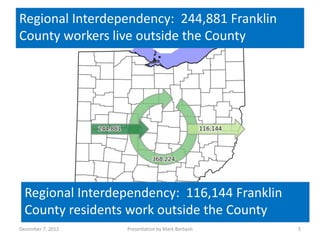
Regional Interdependency: 244,881 Franklin
  Regional Interdependency: Franklin County
County workers live outside the County


  Regional Interdependency: 116,144 Franklin
  County residents work outside the County
December 7, 2012   Presentation by Mark Barbash   5
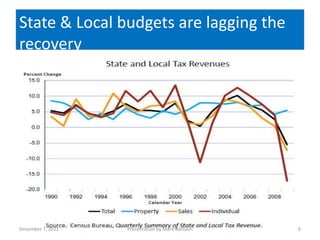
State & Local budgets are lagging the
recovery


December 7, 2012   Presentation by Mark Barbash   6
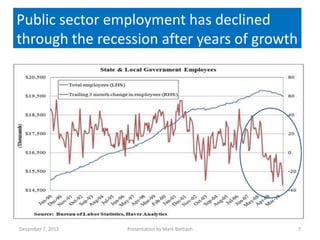
Public sector employment has declined
through the recession after years of growth


December 7, 2012   Presentation by Mark Barbash   7
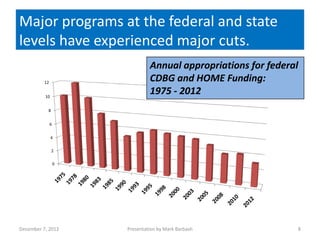
Major programs at the federal and state
levels have experienced major cuts.
                                Annual appropriations for federal
          12
                                CDBG and HOME Funding:
          10
                                1975 - 2012
           8


               6


               4

               2

                   0


December 7, 2012       Presentation by Mark Barbash             8
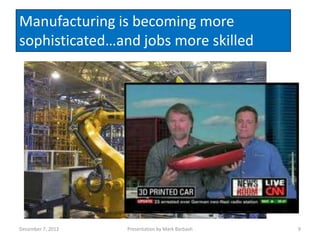
Manufacturing is becoming more
sophisticated…and jobs more skilled


December 7, 2012   Presentation by Mark Barbash   9
Entrepreneurship: More small
businesses…working for big business

In 2010, there were about 28 million small businesses in
this country, responsible for 49.2 percent of private
sector employment.

But there were also 18,500 firms with 500 employees or
more, defined as big business, and they employed the
other 50 percent or so.


December 7, 2012     Presentation by Mark Barbash      10
The 1099 Economy is becoming a more
important part of your community
   About half – 52 percent – of all small businesses are
home based and 78.5 percent are non-employers in the
sense that they employ only the sole proprietor.
   Of the remaining 21.5 percent that do employ
anyone, only 10.7 percent of that group will employ
more than 20 people.
   There are 331,000 self-employed workers in
Ohio, making up 6.00% of the total workforce, up by
5.00% from 2001. The Average Wage of a self-
employed worker in Ohio is $25,331.
December 7, 2012     Presentation by Mark Barbash      11
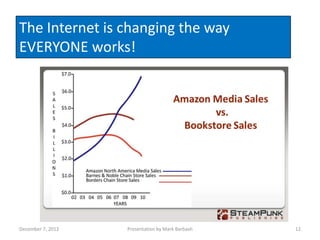
The Internet is changing the way
EVERYONE works!


December 7, 2012   Presentation by Mark Barbash   12
Ten Strategies for Communities
                   to Stay Competitive


December 7, 2012          Presentation by Mark Barbash   13
First, what’s NOT changing?

• The need to develop a plan is NOT changing
• The need to develop strong partnerships is
  NOT changing
• The need to provide quality services is NOT
  changing
• The need to tailor your ED tools to the needs
  of your community is NOT changing


December 7, 2012   Presentation by Mark Barbash   14
1. Think “Strategic Doing” vs. “Strategic
Planning”
•   Network of Networks
•   Plan; Then Do, Then Plan Again
•   Go from planning to implementation
•   Know your goals and focus your efforts
•   Engage the Community and the Networks
•   Ed Morrison, Purdue University
•   What’s happening at EDA with their CEDS

December 7, 2012   Presentation by Mark Barbash   15
2. Understand the ROI of your Economic
Development Program
• Cost / Benefit analysis for community
  investment of time and resources
• Economic Development E > P
• Fiscal Impact Analysis
• EDA Triple Bottom Line:
  Equity, Environment, Economy
• Political justification
• Understand…and take…informed risk
December 7, 2012   Presentation by Mark Barbash   16
3. Collaboration is the New Competition

• Companies are looking for your ability to bring
  a wide variety of resources to the table
• Regional collaboration: What is your
  community’s role in the region?
• Expand your partnership to include
  workforce, land
  use, transportation, philanthropic, hospitals, p
  ermitting
• Understand who does what best?
December 7, 2012   Presentation by Mark Barbash   17
4. Enhance what makes your community
livable and Know your product
•   Identify and leverage your strongest assets
•   What makes your community special?
•   Asset mapping on a local AND regional basis
•   Richard Florida: The Creative Class ?
•   Tactical urbanism
•   What is your available product? Large
    sites, smaller sites, redevelopment sites, Main
    Street

December 7, 2012     Presentation by Mark Barbash   18
5. Death of the Big Deal….

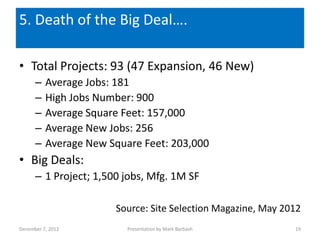
• Total Projects: 93 (47 Expansion, 46 New)
      –   Average Jobs: 181
      –   High Jobs Number: 900
      –   Average Square Feet: 157,000
      –   Average New Jobs: 256
      –   Average New Square Feet: 203,000
• Big Deals:
      – 1 Project; 1,500 jobs, Mfg. 1M SF

                       Source: Site Selection Magazine, May 2012
December 7, 2012          Presentation by Mark Barbash        19
6. Double Down on Retention and
Expansion
• Sometimes the best R & E does not involve
  incentives but simply helps solve problems
• Understand your business community and
  what helps it grow
• Cluster Strategy & Supply Chain
• Organized R & E program to track activity and
  performance
• Don’t promise what you can’t deliver

December 7, 2012   Presentation by Mark Barbash   20
7. Retention & Expansion is the Best
Attraction Strategy
• Companies locate where there are other like-
  minded businesses
• Few companies locate only because of
  incentives
• Follow the trail to customers, suppliers, key
  partners


December 7, 2012   Presentation by Mark Barbash   21
8. Emphasize the Entrepreneurial Strategy
that fits your community
•   Main Street revitalization
•   Small Business assistance
•   Economic Gardening
•   1099 Economy
•   Incubation vs. Acceleration


December 7, 2012    Presentation by Mark Barbash   22
9. Fine tune your financing and incentive
toolkit
• Use state incentives strategically
• Create local incentives that make sense for
  your community
• Provide for transparency and accountability
• The fewer the programs, the easier the deal
• Stronger reliance on local financing and
  federal programs

December 7, 2012   Presentation by Mark Barbash   23
10. Fine Tune your marketing, web
presence and social networking
• Have a user friendly website
• Link your site with your regional economic
  development partner
• Easily accessible public services
• 90% of the research by a site selection
  company is done BEFORE you are contacted
• Keep your inventory of sites up to date

December 7, 2012   Presentation by Mark Barbash   24
So, where do we
start?


December 7, 2012   Presentation by Mark Barbash   25
Key Next Steps:
                   Key Questions
• How well do you know your community ?
• Have you established
  priorities, goals, tasks, with assigned leads ?
      – Where are you, where do you want to be, how do
        you get there ?
• Do you have a toolbox that is appropriate to
  your community and priorities ?
• Do you have a way of measuring
  performance?
December 7, 2012      Presentation by Mark Barbash   26
Key Questions and Next Steps
                   Key Questions
   • How active and wide is your community’s
     regional network?
   • Network of Partners: Do you try to be a lone
     gun? Do you build partnerships?
   • Do you understand the daily needs of
     existing businesses, not just the needs for
     new investment?
   • Is your web site accurate, current and
     useful?
December 7, 2012     Presentation by Mark Barbash   27
December 7, 2012   Presentation by Mark Barbash   28

Is Your Community Prepared for Economic Development?

  • 1.
    Starting (or retooling)Your Economic Development Program Staying competitive in community development while the world is changing around us! December 7, 2012 Presentation by Mark Barbash 1
  • 2.
    Starting (or retooling)Your Economic Development Program • Trends that are changing the way we do economic development • Economic Development Strategies to stay competitive • Where to start December 7, 2012 Presentation by Mark Barbash 2
  • 3.
    Let’s start Let’sa few economic realities with Start with a few economic realities: that are impacting economic development • We are going through a major economic transition. • The nature of business is changing. • The practice of Economic Development is changing as well. December 7, 2012 Presentation by Mark Barbash 3
  • 4.
    We are notreplacing our retiring workers with our new workers Over the next twenty years there will be 76 million Baby Boomers old enough to retire… ….but only 48 million new workers will be available in the talent pipeline to fill their positions. December 7, 2012 Presentation by Mark Barbash 4
  • 5.
    Regional Interdependency: 244,881Franklin Regional Interdependency: Franklin County County workers live outside the County Regional Interdependency: 116,144 Franklin County residents work outside the County December 7, 2012 Presentation by Mark Barbash 5
  • 6.
    State & Localbudgets are lagging the recovery December 7, 2012 Presentation by Mark Barbash 6
  • 7.
    Public sector employmenthas declined through the recession after years of growth December 7, 2012 Presentation by Mark Barbash 7
  • 8.
    Major programs atthe federal and state levels have experienced major cuts. Annual appropriations for federal 12 CDBG and HOME Funding: 10 1975 - 2012 8 6 4 2 0 December 7, 2012 Presentation by Mark Barbash 8
  • 9.
    Manufacturing is becomingmore sophisticated…and jobs more skilled December 7, 2012 Presentation by Mark Barbash 9
  • 10.
    Entrepreneurship: More small businesses…workingfor big business In 2010, there were about 28 million small businesses in this country, responsible for 49.2 percent of private sector employment. But there were also 18,500 firms with 500 employees or more, defined as big business, and they employed the other 50 percent or so. December 7, 2012 Presentation by Mark Barbash 10
  • 11.
    The 1099 Economyis becoming a more important part of your community About half – 52 percent – of all small businesses are home based and 78.5 percent are non-employers in the sense that they employ only the sole proprietor. Of the remaining 21.5 percent that do employ anyone, only 10.7 percent of that group will employ more than 20 people. There are 331,000 self-employed workers in Ohio, making up 6.00% of the total workforce, up by 5.00% from 2001. The Average Wage of a self- employed worker in Ohio is $25,331. December 7, 2012 Presentation by Mark Barbash 11
  • 12.
    The Internet ischanging the way EVERYONE works! December 7, 2012 Presentation by Mark Barbash 12
  • 13.
    Ten Strategies forCommunities to Stay Competitive December 7, 2012 Presentation by Mark Barbash 13
  • 14.
    First, what’s NOTchanging? • The need to develop a plan is NOT changing • The need to develop strong partnerships is NOT changing • The need to provide quality services is NOT changing • The need to tailor your ED tools to the needs of your community is NOT changing December 7, 2012 Presentation by Mark Barbash 14
  • 15.
    1. Think “StrategicDoing” vs. “Strategic Planning” • Network of Networks • Plan; Then Do, Then Plan Again • Go from planning to implementation • Know your goals and focus your efforts • Engage the Community and the Networks • Ed Morrison, Purdue University • What’s happening at EDA with their CEDS December 7, 2012 Presentation by Mark Barbash 15
  • 16.
    2. Understand theROI of your Economic Development Program • Cost / Benefit analysis for community investment of time and resources • Economic Development E > P • Fiscal Impact Analysis • EDA Triple Bottom Line: Equity, Environment, Economy • Political justification • Understand…and take…informed risk December 7, 2012 Presentation by Mark Barbash 16
  • 17.
    3. Collaboration isthe New Competition • Companies are looking for your ability to bring a wide variety of resources to the table • Regional collaboration: What is your community’s role in the region? • Expand your partnership to include workforce, land use, transportation, philanthropic, hospitals, p ermitting • Understand who does what best? December 7, 2012 Presentation by Mark Barbash 17
  • 18.
    4. Enhance whatmakes your community livable and Know your product • Identify and leverage your strongest assets • What makes your community special? • Asset mapping on a local AND regional basis • Richard Florida: The Creative Class ? • Tactical urbanism • What is your available product? Large sites, smaller sites, redevelopment sites, Main Street December 7, 2012 Presentation by Mark Barbash 18
  • 19.
    5. Death ofthe Big Deal…. • Total Projects: 93 (47 Expansion, 46 New) – Average Jobs: 181 – High Jobs Number: 900 – Average Square Feet: 157,000 – Average New Jobs: 256 – Average New Square Feet: 203,000 • Big Deals: – 1 Project; 1,500 jobs, Mfg. 1M SF Source: Site Selection Magazine, May 2012 December 7, 2012 Presentation by Mark Barbash 19
  • 20.
    6. Double Downon Retention and Expansion • Sometimes the best R & E does not involve incentives but simply helps solve problems • Understand your business community and what helps it grow • Cluster Strategy & Supply Chain • Organized R & E program to track activity and performance • Don’t promise what you can’t deliver December 7, 2012 Presentation by Mark Barbash 20
  • 21.
    7. Retention &Expansion is the Best Attraction Strategy • Companies locate where there are other like- minded businesses • Few companies locate only because of incentives • Follow the trail to customers, suppliers, key partners December 7, 2012 Presentation by Mark Barbash 21
  • 22.
    8. Emphasize theEntrepreneurial Strategy that fits your community • Main Street revitalization • Small Business assistance • Economic Gardening • 1099 Economy • Incubation vs. Acceleration December 7, 2012 Presentation by Mark Barbash 22
  • 23.
    9. Fine tuneyour financing and incentive toolkit • Use state incentives strategically • Create local incentives that make sense for your community • Provide for transparency and accountability • The fewer the programs, the easier the deal • Stronger reliance on local financing and federal programs December 7, 2012 Presentation by Mark Barbash 23
  • 24.
    10. Fine Tuneyour marketing, web presence and social networking • Have a user friendly website • Link your site with your regional economic development partner • Easily accessible public services • 90% of the research by a site selection company is done BEFORE you are contacted • Keep your inventory of sites up to date December 7, 2012 Presentation by Mark Barbash 24
  • 25.
    So, where dowe start? December 7, 2012 Presentation by Mark Barbash 25
  • 26.
    Key Next Steps: Key Questions • How well do you know your community ? • Have you established priorities, goals, tasks, with assigned leads ? – Where are you, where do you want to be, how do you get there ? • Do you have a toolbox that is appropriate to your community and priorities ? • Do you have a way of measuring performance? December 7, 2012 Presentation by Mark Barbash 26
  • 27.
    Key Questions andNext Steps Key Questions • How active and wide is your community’s regional network? • Network of Partners: Do you try to be a lone gun? Do you build partnerships? • Do you understand the daily needs of existing businesses, not just the needs for new investment? • Is your web site accurate, current and useful? December 7, 2012 Presentation by Mark Barbash 27
  • 28.
    December 7, 2012 Presentation by Mark Barbash 28

Editor's Notes

  • #4 JimWe are going through a major economic transition in this country:Impact of technologyAging of the workforceGlobal competitivenessThe very nature of business is changing.We will still make things, but in very different ways.The service, retail and financial sectors are taking on greater importanceIncreasingly, workers are traveling further for jobs…so your residents will work elsewhere and your workers will live elsewhere
  • #6 Mark