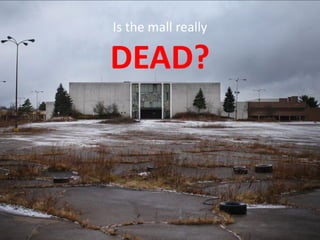
Is the mall really
DEAD?
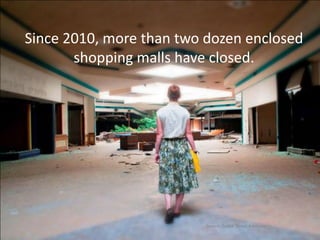
Since 2010, more than two dozen enclosed
shopping malls have closed.
Source: Green Street Advisors
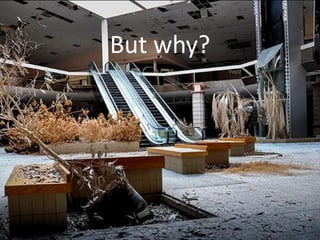
But why?
Some say demographics
and changing shopping
habits have led to the
mall’s demise
Some say ECOMMERCE is to blame
REALITYIS THAT LESS
THAN 10% OF GOODS ARE SOLD
VIA ONLINE RETAILERS
Source: New York Times Jan 3, 2015
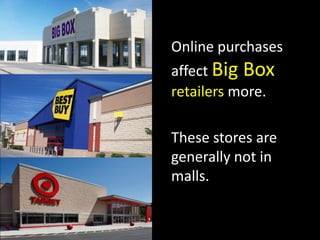
Online purchases
affect Big Box
retailers more.
These stores are
generally not in
malls.
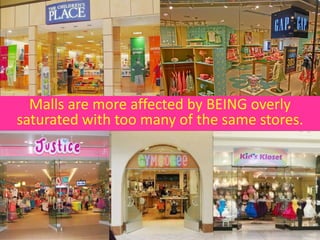
Malls are more affected by BEING overly
saturated with too many of the same stores.
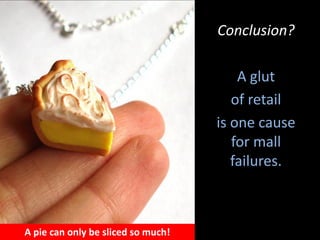
Conclusion?
A glut
of retail
is one cause
for mall
failures.
A pie can only be sliced so much!
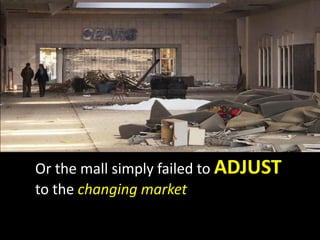
Or the mall simply failed to ADJUST
to the changing market
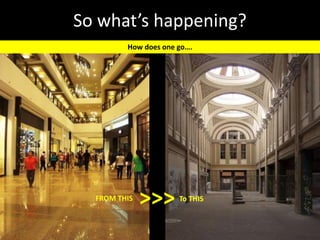
So what’s happening?
How does one go….
FROM THIS To THIS>>>
Some malls have declined due to the
consolidation of anchor tenants
IN 1990, ANCHORS LIKE RICH’S,
BLOOMINGDALES, MARSHALL FIELDS,
HUDSON'S, DAYTON'S AND MACY’S
WOULD FIGHT OVER SPACE IN MALLS.
Some malls have declined due to the
consolidation of anchor tenants
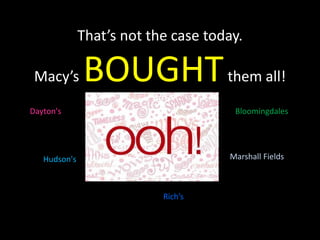
That’s not the case today.
Macy’s BOUGHTthem all!
Bloomingdales
Marshall FieldsHudson's
Dayton's
Rich’s
?So what’s the bottom line
Not all MALLS are dead
and NOT ALL malls are going away
Malls have never been
entirely about BUYING
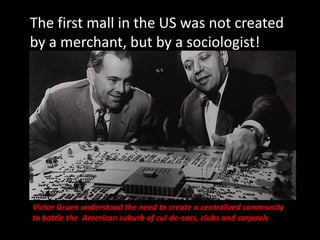
The first mall in the US was not created
by a merchant, but by a sociologist!
Victor Gruen understood the need to create a
centralized community to battle the American
suburb of cul-de-sacs, clubs and carpools.
Victor Gruen understood the need to create a centralized community
to battle the American suburb of cul-de-sacs, clubs and carpools
People want to be with other people….
Gruen understood this basic need
and he created a way for that to be
possible…..20th century-style
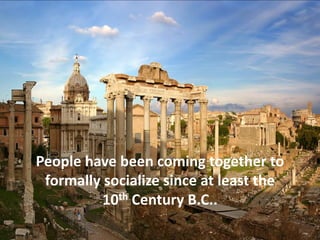
People have been coming together to
formally socialize since at least the
10th Century B.C..
The Census Bureau estimates there will
be more than 88 million people over 65
in America by 2050, more than twice
the current figure.
That alone gives modern malls a
core customer base.
another reason…
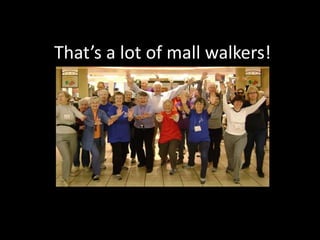
That’s a lot of mall walkers!
Just one more reason….
According to data released by the
International Council of Shopping Centers,
occupancy rates increased, the highest
since the throes of the recession,
in second-quarter 2008.
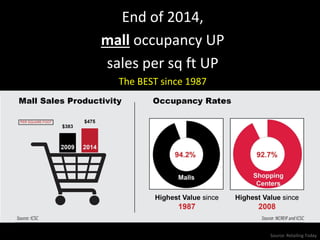
End of 2014,
mall occupancy UP
sales per sq ft UP
The BEST since 1987
Source: Retailing Today
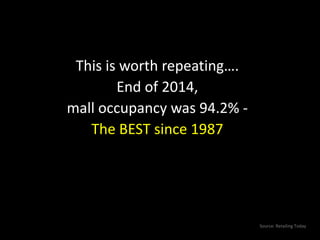
This is worth repeating….
End of 2014,
mall occupancy was 94.2% -
The BEST since 1987
Source: Retailing Today
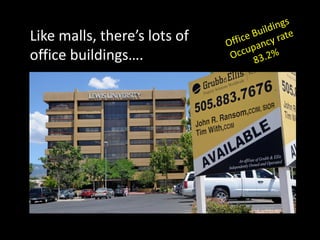
Like malls, there’s lots of
office buildings….
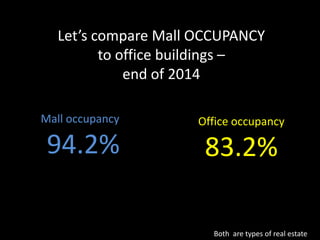
Let’s compare Mall OCCUPANCY
to office buildings –
end of 2014
Office occupancy
83.2%
Mall occupancy
94.2%
Both are types of real estate
WE DON’T HEAR PEOPLE
SHOUTINGTHAT OFFICE
BUILDINGS ARE DEAD!
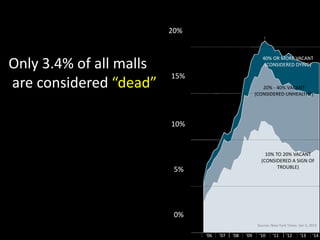
Only 3.4% of all malls
are considered “dead”
40% OR MORE VACANT
(CONSIDERED DYING)
20% - 40% VACANT
(CONSIDERED UNHEALTHY)
10% TO 20% VACANT
(CONSIDERED A SIGN OF
TROUBLE)
20%
15%
10%
5%
0%
‘06 ‘07 ‘08 ‘09 ‘10 ‘11 ‘12 ‘13 ‘14
Source: New York Times Jan 3, 2015
CONSIDER THIS….
If 3.4% of all malls are dead,
96.6% ARE
NOT!
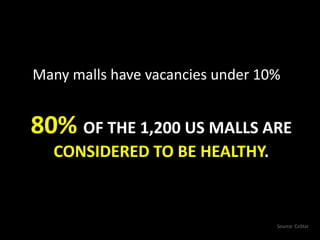
80% OF THE 1,200 US MALLS ARE
CONSIDERED TO BE HEALTHY.
Many malls have vacancies under 10%
Source: CoStar
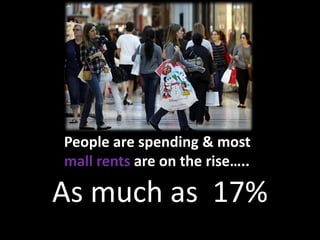
People are spending & most
mall rents are on the rise…..
As much as 17%
What about Net Operating Income?
2014 Mall NOI was the HIGHEST
year over year growth in 14 years!
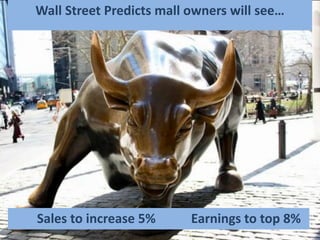
Sales to increase 5% Earnings to top 8%
Wall Street Predicts mall owners will see…
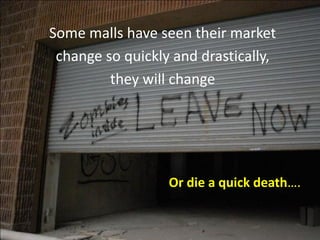
Some malls have seen their market
change so quickly and drastically,
they will change
Or die a quick death….
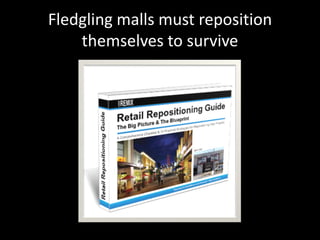
Fledgling malls must reposition
themselves to survive
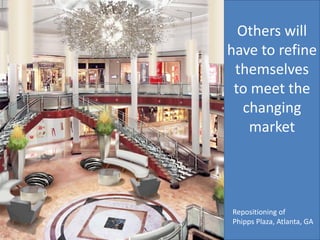
Repositioning of
Phipps Plaza, Atlanta, GA
Others will
have to refine
themselves
to meet the
changing
market
“All malls can die without
sensitivity to change “
-Gar Muse
Principal, Retail Design
COOPER CARRY
repositionverb re·po·si·tion ˌrē-pə-ˈzi-shən
> to change the position of
> to revise the marketing strategy for
(a product or a company) so as to
increase sales
RE
It seems like much of the mall
repositioning is taking place in dense
urban environments
Take Landmark Mall near Washington, DC
for example
It seems like much of the mall
repositioning is taking place in dense
urban environments
Take Landmark Mall near Washington, DC
for example
Landmark Mall is ADAPTING
It seems like much of the mall
repositioning is taking place in dense
urban environments
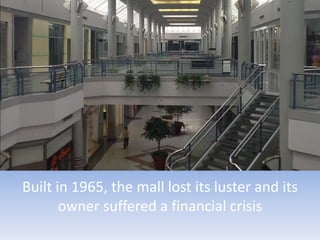
An empty food court CAN speak volumes
Built in 1965, the mall lost its luster and its
owner suffered a financial crisis
Landmark Mall is ADAPTING
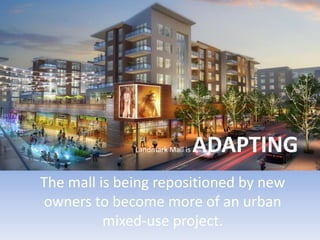
The mall is being repositioned by new
owners to become more of an urban
mixed-use project.
Landmark Mall is ADAPTING
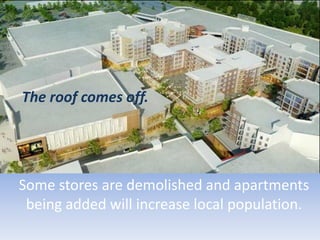
Some stores are demolished and apartments
being added will increase local population.
The roof comes off.
Landmark Mall is ADAPTING
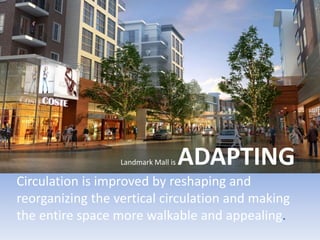
Circulation is improved by reshaping and
reorganizing the vertical circulation and making
the entire space more walkable and appealing.
Repositioning required cooperation
from many stakeholders
• Department stores
• Existing mall retail tenants
• Office tenants
• Government agencies
• Mall owners
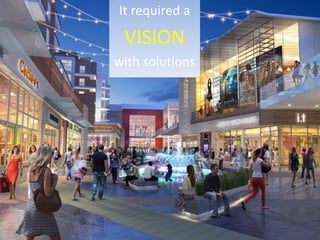
Landmark Mall is ADAPTING
It required a
VISION
with solutions
So far what have we learned?
Malls die when they don’t adapt
So far what have we learned?
Malls die when they don’t adapt
Too much of the “same” retail hurts malls
Malls die when they don’t adapt
Too much of the “same” retail hurts malls
Rents are on the increase
So far what have we learned?
Malls die when they don’t adapt
Too much of the “same” retail hurts malls
Rents are on the increase
Sales are on the increase
So far what have we learned?
Malls die when they don’t adapt
Too much of the “same” retail hurts malls
Rents are on the increase
Sales are on the increase
Mall NOI is on the increase
So far what have we learned?
There’s still one nagging question.
What about…
There, we’ve put it out there!
How do they shop?
Not in malls.
Right?
Wrong!
Source: OpinionLab
Wrong!In a 2014 OpinionLab survey:
• 85% of Millennials plan to head to the mall at least
once this summer
• 60% say they will go at least once a month
• Nearly half (48%) of Millennials rank browsing
different stores as their #1 reason to go to the mall
• Only 1 in 10 Millennials says nothing would
motivate them to spend more time in the mall
Source: OpinionLab
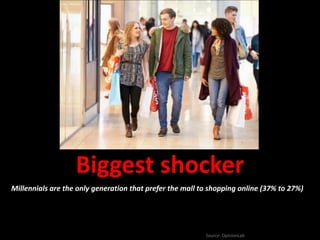
Biggest shocker
Millennials are the only generation that prefer the mall to shopping online (37% to 27%)
Source: OpinionLab
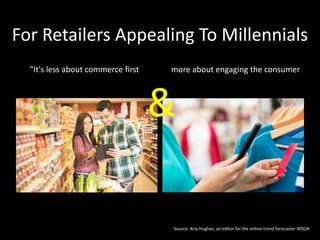
For Retailers Appealing To Millennials
"It's less about commerce first more about engaging the consumer
Source: Aria Hughes, an editor for the online trend forecaster WSGN
&
“The mall that’s dead
probably needed to be. “
-Angelo Carusi
Principal, Retail Design
COOPER CARRY
Why.
“Because it did not (or would not) change to meet the needs
of the consumer. For over 2,000 years people have sought
venues in which to socially interact with others. Malls have,
and always will, provide that forum and space. It’s innate in
us, as human beings, to want to be around others. We have
found in malls a way to socially interact while filling another
basic need which is tending to the desires of the head, heart
and stomach. What better way to do that than with a retail
store, coffee shop or soothing water feature close by.”
-Angelo Carusi
Principal, Retail Design
COOPER CARRY
To sum it up . . . . .
“Almost from their beginning, malls told stories. Shoppers,
municipalities, tenants and even developers contributed to
the fabric which when woven together resulted in dynamic
places and spaces that became places to not just shop, but to
gather. Not much has changed in the essence of the mall.
What has, and always will change, is the demographics,
shopping preferences and retail itself. This requires that malls
change as part of the evolutionary process. It doesn’t
necessarily mean that all malls are dead. It does, however,
mean that all malls can die. It’s the mall’s sensitivity to
change combined with the will to do so that will live on.”
-Gar Muse
Principal, Retail Design
COOPER CARRY
Let’s start a conversation…
COOPER CARRY, 191 Peachtree Street NE, Suite 2400, Atlanta, GA, 30303, 404-237-2000
Angelo Carusi, AIA, LEED AP,
CDP, CRX
Principal –
Retail Specialty Practice Group
angelocarrusi@coopercarry.com
404-358-4815 - cell
Gar Muse, AIA
Principal –
Retail Specialty Practice Group
garmuse@coopercarry.com
404-219-3895 - cell
Credit where credit is due:
• The Economics (and Nostalgia) of Dead Malls The New York Times, Jan. 3, 2015
• N. American REIT & Real Estate Research Reports, Green Street Advisors, 2015
• Victor Gruen and the Birth of the Shopping Mall, Labelscar, Aug. 22, 2012
•The De-Malling of America: What's Next for Hundreds of Outmoded Malls?,
CoStar, Oct. 3, 2012
•Opinion Lab: Fresh insight into millennials, malls & the future of the store,
March 30, 2014
•Retailing Today: Report: Malls not dead, far from it. March 30, 2015
Is the mall really dead?

Is the mall really dead?

  • 1.
    Is the mallreally DEAD?
  • 2.
    Since 2010, morethan two dozen enclosed shopping malls have closed. Source: Green Street Advisors
  • 3.
  • 4.
    Some say demographics andchanging shopping habits have led to the mall’s demise
  • 5.
    Some say ECOMMERCEis to blame
  • 6.
    REALITYIS THAT LESS THAN10% OF GOODS ARE SOLD VIA ONLINE RETAILERS Source: New York Times Jan 3, 2015
  • 7.
    Online purchases affect BigBox retailers more. These stores are generally not in malls.
  • 8.
    Malls are moreaffected by BEING overly saturated with too many of the same stores.
  • 9.
    Conclusion? A glut of retail isone cause for mall failures. A pie can only be sliced so much!
  • 10.
    Or the mallsimply failed to ADJUST to the changing market
  • 11.
    So what’s happening? Howdoes one go…. FROM THIS To THIS>>>
  • 12.
    Some malls havedeclined due to the consolidation of anchor tenants
  • 13.
    IN 1990, ANCHORSLIKE RICH’S, BLOOMINGDALES, MARSHALL FIELDS, HUDSON'S, DAYTON'S AND MACY’S WOULD FIGHT OVER SPACE IN MALLS. Some malls have declined due to the consolidation of anchor tenants
  • 14.
    That’s not thecase today. Macy’s BOUGHTthem all! Bloomingdales Marshall FieldsHudson's Dayton's Rich’s
  • 15.
    ?So what’s thebottom line
  • 16.
    Not all MALLSare dead and NOT ALL malls are going away
  • 17.
    Malls have neverbeen entirely about BUYING
  • 18.
    The first mallin the US was not created by a merchant, but by a sociologist! Victor Gruen understood the need to create a centralized community to battle the American suburb of cul-de-sacs, clubs and carpools. Victor Gruen understood the need to create a centralized community to battle the American suburb of cul-de-sacs, clubs and carpools
  • 19.
    People want tobe with other people…. Gruen understood this basic need and he created a way for that to be possible…..20th century-style
  • 20.
    People have beencoming together to formally socialize since at least the 10th Century B.C..
  • 21.
    The Census Bureauestimates there will be more than 88 million people over 65 in America by 2050, more than twice the current figure. That alone gives modern malls a core customer base. another reason…
  • 22.
    That’s a lotof mall walkers!
  • 23.
    Just one morereason…. According to data released by the International Council of Shopping Centers, occupancy rates increased, the highest since the throes of the recession, in second-quarter 2008.
  • 24.
    End of 2014, malloccupancy UP sales per sq ft UP The BEST since 1987 Source: Retailing Today
  • 25.
    This is worthrepeating…. End of 2014, mall occupancy was 94.2% - The BEST since 1987 Source: Retailing Today
  • 26.
    Like malls, there’slots of office buildings….
  • 27.
    Let’s compare MallOCCUPANCY to office buildings – end of 2014 Office occupancy 83.2% Mall occupancy 94.2% Both are types of real estate
  • 28.
    WE DON’T HEARPEOPLE SHOUTINGTHAT OFFICE BUILDINGS ARE DEAD!
  • 29.
    Only 3.4% ofall malls are considered “dead” 40% OR MORE VACANT (CONSIDERED DYING) 20% - 40% VACANT (CONSIDERED UNHEALTHY) 10% TO 20% VACANT (CONSIDERED A SIGN OF TROUBLE) 20% 15% 10% 5% 0% ‘06 ‘07 ‘08 ‘09 ‘10 ‘11 ‘12 ‘13 ‘14 Source: New York Times Jan 3, 2015
  • 30.
    CONSIDER THIS…. If 3.4%of all malls are dead, 96.6% ARE NOT!
  • 31.
    80% OF THE1,200 US MALLS ARE CONSIDERED TO BE HEALTHY. Many malls have vacancies under 10% Source: CoStar
  • 32.
    People are spending& most mall rents are on the rise….. As much as 17%
  • 33.
    What about NetOperating Income? 2014 Mall NOI was the HIGHEST year over year growth in 14 years!
  • 34.
    Sales to increase5% Earnings to top 8% Wall Street Predicts mall owners will see…
  • 35.
    Some malls haveseen their market change so quickly and drastically, they will change Or die a quick death….
  • 36.
    Fledgling malls mustreposition themselves to survive
  • 37.
    Repositioning of Phipps Plaza,Atlanta, GA Others will have to refine themselves to meet the changing market
  • 38.
    “All malls candie without sensitivity to change “ -Gar Muse Principal, Retail Design COOPER CARRY
  • 39.
    repositionverb re·po·si·tion ˌrē-pə-ˈzi-shən >to change the position of > to revise the marketing strategy for (a product or a company) so as to increase sales RE
  • 40.
    It seems likemuch of the mall repositioning is taking place in dense urban environments
  • 41.
    Take Landmark Mallnear Washington, DC for example It seems like much of the mall repositioning is taking place in dense urban environments
  • 42.
    Take Landmark Mallnear Washington, DC for example Landmark Mall is ADAPTING It seems like much of the mall repositioning is taking place in dense urban environments
  • 43.
    An empty foodcourt CAN speak volumes
  • 44.
    Built in 1965,the mall lost its luster and its owner suffered a financial crisis Landmark Mall is ADAPTING
  • 45.
    The mall isbeing repositioned by new owners to become more of an urban mixed-use project. Landmark Mall is ADAPTING
  • 46.
    Some stores aredemolished and apartments being added will increase local population. The roof comes off.
  • 47.
    Landmark Mall isADAPTING Circulation is improved by reshaping and reorganizing the vertical circulation and making the entire space more walkable and appealing.
  • 48.
    Repositioning required cooperation frommany stakeholders • Department stores • Existing mall retail tenants • Office tenants • Government agencies • Mall owners Landmark Mall is ADAPTING
  • 49.
  • 50.
    So far whathave we learned?
  • 51.
    So far whathave we learned? Malls die when they don’t adapt
  • 52.
    So far whathave we learned? Malls die when they don’t adapt Too much of the “same” retail hurts malls
  • 53.
    Malls die whenthey don’t adapt Too much of the “same” retail hurts malls Rents are on the increase So far what have we learned?
  • 54.
    Malls die whenthey don’t adapt Too much of the “same” retail hurts malls Rents are on the increase Sales are on the increase So far what have we learned?
  • 55.
    Malls die whenthey don’t adapt Too much of the “same” retail hurts malls Rents are on the increase Sales are on the increase Mall NOI is on the increase So far what have we learned?
  • 56.
    There’s still onenagging question. What about…
  • 58.
    There, we’ve putit out there!
  • 59.
    How do theyshop? Not in malls. Right?
  • 60.
  • 61.
    Wrong!In a 2014OpinionLab survey: • 85% of Millennials plan to head to the mall at least once this summer • 60% say they will go at least once a month • Nearly half (48%) of Millennials rank browsing different stores as their #1 reason to go to the mall • Only 1 in 10 Millennials says nothing would motivate them to spend more time in the mall Source: OpinionLab
  • 62.
    Biggest shocker Millennials arethe only generation that prefer the mall to shopping online (37% to 27%) Source: OpinionLab
  • 63.
    For Retailers AppealingTo Millennials "It's less about commerce first more about engaging the consumer Source: Aria Hughes, an editor for the online trend forecaster WSGN &
  • 64.
    “The mall that’sdead probably needed to be. “ -Angelo Carusi Principal, Retail Design COOPER CARRY
  • 65.
    Why. “Because it didnot (or would not) change to meet the needs of the consumer. For over 2,000 years people have sought venues in which to socially interact with others. Malls have, and always will, provide that forum and space. It’s innate in us, as human beings, to want to be around others. We have found in malls a way to socially interact while filling another basic need which is tending to the desires of the head, heart and stomach. What better way to do that than with a retail store, coffee shop or soothing water feature close by.” -Angelo Carusi Principal, Retail Design COOPER CARRY
  • 66.
    To sum itup . . . . . “Almost from their beginning, malls told stories. Shoppers, municipalities, tenants and even developers contributed to the fabric which when woven together resulted in dynamic places and spaces that became places to not just shop, but to gather. Not much has changed in the essence of the mall. What has, and always will change, is the demographics, shopping preferences and retail itself. This requires that malls change as part of the evolutionary process. It doesn’t necessarily mean that all malls are dead. It does, however, mean that all malls can die. It’s the mall’s sensitivity to change combined with the will to do so that will live on.” -Gar Muse Principal, Retail Design COOPER CARRY
  • 67.
    Let’s start aconversation… COOPER CARRY, 191 Peachtree Street NE, Suite 2400, Atlanta, GA, 30303, 404-237-2000 Angelo Carusi, AIA, LEED AP, CDP, CRX Principal – Retail Specialty Practice Group angelocarrusi@coopercarry.com 404-358-4815 - cell Gar Muse, AIA Principal – Retail Specialty Practice Group garmuse@coopercarry.com 404-219-3895 - cell
  • 69.
    Credit where creditis due: • The Economics (and Nostalgia) of Dead Malls The New York Times, Jan. 3, 2015 • N. American REIT & Real Estate Research Reports, Green Street Advisors, 2015 • Victor Gruen and the Birth of the Shopping Mall, Labelscar, Aug. 22, 2012 •The De-Malling of America: What's Next for Hundreds of Outmoded Malls?, CoStar, Oct. 3, 2012 •Opinion Lab: Fresh insight into millennials, malls & the future of the store, March 30, 2014 •Retailing Today: Report: Malls not dead, far from it. March 30, 2015