International Research Journal of Engineering and Technology (IRJET) e-ISSN: 2395-0056
www.irjet.net p-ISSN: 2395-0072Volume: 05 Issue: 06 | June-2018
© 2018, IRJET | Impact Factor value: 6.171 | ISO 9001:2008 Certified Journal | Page 1253
PV System Connected High Step-Up Boost DC-DC Converter Based
Voltage Compensator
K.Tamilselvan1, R.Anita2
1,2Department of Electrical and Electronics Engineering, Institute of Road and Transport Technology, Erode-
638316, Tamilnadu, India
----------------------------------------------------------------------***------------------------------------------------------------------
Abstract— In this paper, a Photovoltaic (PV) system
interfaced high step up DC-DC converter based voltage
compensator such as Dynamic Voltage Restorer (DVR) is
presented to alleviate the voltage sag and swell in low
voltage single-phase power distribution system. The PV
system supports the DC-link of the DVR. The PV array output
voltage stepped up with the use of high step up DC-DC boost
converter. The converter attains high step-up voltage gain by
means of low voltage stress on the power semiconductor
switch. Similarly, the stored energy in the coupled inductor
may be reprocessed to the load. The usage of high step up
DC-DC converter decreases the size and necessary power
rating of the series injection transformer. It as well increases
the stability and safety of the system. A feedback loop is
engaged to attain a faster response in sag/swell detection. A
single phase full bridge inverter is added to convert DC bus
voltage into a 230V, 50Hz single phase AC source by by
means of Sinusoidal Pulse Width Modulation (SPWM)
technique. Simulation results have ascertained the
proficiency of the presented PV supported DVR in alleviating
voltage sag and swell in low voltage single-phase power
distribution system.
Index Terms— Dynamic Voltage Restorer , DC-DC Boost
Converter, Photovoltaic System, Sag, Swell.
1. INTRODUCTION
DVR offers the most cost effective solution to alleviate
voltage sag and swell in the low and medium electric power
distribution system. The disturbances such as voltage sag,
swell and voltage distortion have become an accumulative
concern in both domestic and industrial customers. Voltage
sag is a sudden reduction of source voltage from 90% to
10% of its nominal value with duration from 0.5 cycles to 1
min [1].
Voltage swell is a sudden rise of supply voltage from
110% to 190% with duration from 0.5 cycles to 1 min [2,3].
This may occur in the distribution system where the grid
quality is unacceptable.
The above stated voltage variation measures happen
owing to single line to ground fault, phase to phase fault,
energization of large capacitor banks, switching of heavy
loads, starting of large motors and pressing process in steel
plants. The voltage variations events and its effects are
shown in Table 1.
Table 1
Voltage Variation Events and its Effects
Disturbances Effects
Unbalance voltage Produce excessive heat in
motor and control
equipment.
Interruption Complete shutdown.
Voltage sag Trip out the adjustable speed
drive & computer.
Voltage swell Overstress to insulation.
Fluctuations in
voltage
Light Flicker.
Harmonics Produce more noise and
overheating.
To alleviate the above stated power quality issues, the
DVR has been projected as effective sag/swell alleviation
equipment [4,5]. The injections of voltage from DVR
compensate the voltage sag/swell during sag and swell
events [6,7].
In this paper a simulation of high step up DC-DC
converter with the PV power generating system is
integrated to function as a high capacity DC voltage source.
It reduces the size and capacity of series injection
transformer. The converter practices the coupled inductor
and capacitors to attain high step up voltage gain. This
converter can offer higher voltage gain than the
conventional DC-DC boost converter [8,9].
2. PV SYSTEM INTERFACED HIGH STEP UP DC-DC
CONVERTER BASED DVR
The schematic diagram of the PV supported DVR is
shown in Figure 1. The projected system includes of a
battery, high step up DC-DC converter with coupled
inductor, Voltage Source Inverter (VSI), series injection
transformer (1:1) and semiconductor bypass switch S.
International Research Journal of Engineering and Technology (IRJET) e-ISSN: 2395-0056
www.irjet.net p-ISSN: 2395-0072Volume: 05 Issue: 06 | June-2018
© 2018, IRJET | Impact Factor value: 6.171 | ISO 9001:2008 Certified Journal | Page 1254
Figure 1 Block diagram of the PV-DVR
Table 2 displays the control signal of semiconductor
switch S, which is connected in parallel with the secondary
of series injection transformer. The power semiconductor
switch S is controlled by voltage sensor and the simple
logical circuits.
Table 2
Control Signal of Semiconductor Switch S
Supply voltage
in %
Control
signal
Mode of
Operation
100% 1 Ideal
<100% 0 DVR
>100% 0 DVR
A DVR is connected in series with the power distribution
system to inject a compensating voltage in series with the
AC source. The main components of a DVR are the high
capacity DC source, bridge inverter, injection transformer
and control system. A DVR can compensate the voltage
drop across a sensitive load by injecting a voltage through a
series injection transformer[10,11,12].
The inverter is a foremost component of DVR. Its control
will directly distress the transient and dynamic
performance of the DVR. The voltage injection of the DVR is
mainly being subject to on the capacity of DC source, which
is connected in the DC-link of the DVR. A high step up DC-
DC converter with coupled inductor offers a high power DC
source to voltage source inverter of the DVR.
3. HIGH STEP UP DC-DC CONVERTER
A high step up DC-DC converter can boost the voltage
from low level to high level. It decreases the number of
batteries, essential to attain the mandatory DC voltage level
in that way saving the cost and space as an alternative of
using numerous batteries. In general, the DC-DC boost
converter can offer high step up voltage gain with
exceedingly high duty cycle. The step-up voltage gain is
inadequate by the effect on power semiconductor switches,
inductors and capacitors. To develop the conversion
efficiency and to achieve high step up voltage gain the
coupled inductor with switched capacitor technique is
used[9]. This converter is connected in between the low
power DC source such as renewable energy power
generation system or conventional battery storage units
and voltage source inverter. The high step up DC-DC
converter with coupled inductor is shown in Figure 2.
Figure 2 Circuit configuration of high step up DC-DC
boost converter
The secondary side (Ns) of the coupled inductor is used
as a flyback converter. It can increase the voltage gain. The
energy stored in the leakage inductor (Lk) is recycled to the
load directly. The advantages of this DC-DC converters is as
follows
 It confines voltage spike on the main switch.
 Delivers high step up gain.
 High conversion efficiency.
 Low conduction loss.
 High step up ratio.
The secondary of the coupled inductor can charge
capacitors in parallel and discharge them in series with
the load. This converter combines the concept of coupled
inductor and switched capacitor techniques. The
secondary of the coupled inductor charge the capacitors
C2 and C3 when the switch is switched OFF and are
discharged in series by the secondary side of coupled
inductor when the switch is switched ON. It operates in
two mode of operation.
International Research Journal of Engineering and Technology (IRJET) e-ISSN: 2395-0056
www.irjet.net p-ISSN: 2395-0072Volume: 05 Issue: 06 | June-2018
© 2018, IRJET | Impact Factor value: 6.171 | ISO 9001:2008 Certified Journal | Page 1255
1) Mode 1: When te switch is switched ON, the
secondary of the coupled inductor induces voltage and
magnetizing inductance (Lm) is charged by Vin. The
induced voltage in the secondary of the coupled inductor
makes Vin, VC1, VC2 and VC3 released in series with the load.
V0 = Vin + VC1 + VC2 + VL2 + VC3 (1)
VL2 =kVin (2)
Where,
Np, Ns – Number of turns in primary and
secondary of the coupled inductor.
S – Main switch.
C1, D1 – Clamp capacitor and diode.
Lm – Magnetizing inductance.
Lk – Leakage inductor.
C1, C2 - Storage capacitors.
Vin – Input DC voltage.
VC1 -Voltage across the capacitor C1.
VC2 -Voltage across the capacitor C2.
VL2 – Voltage across the secondary of the
coupled inductor.
n – Turns ratio (Np : Ns)
2) Mode 2: When the switch is switched OFF, the
energy stored in the magnetic inductor (Lm) is released
through the secondary side of coupled inductor to
charge the capacitor C2 and C3 in parallel.
( ) ( )
(3)
(4)
where,
K - Coupling coefficient (k = ).
n - Coupled inductor turns ratio ( ).
D – Duty Cycle ( ).
The voltage gain is obtained by
( ) ( )
4. SIMULATION RESULTS OF PV-DVR
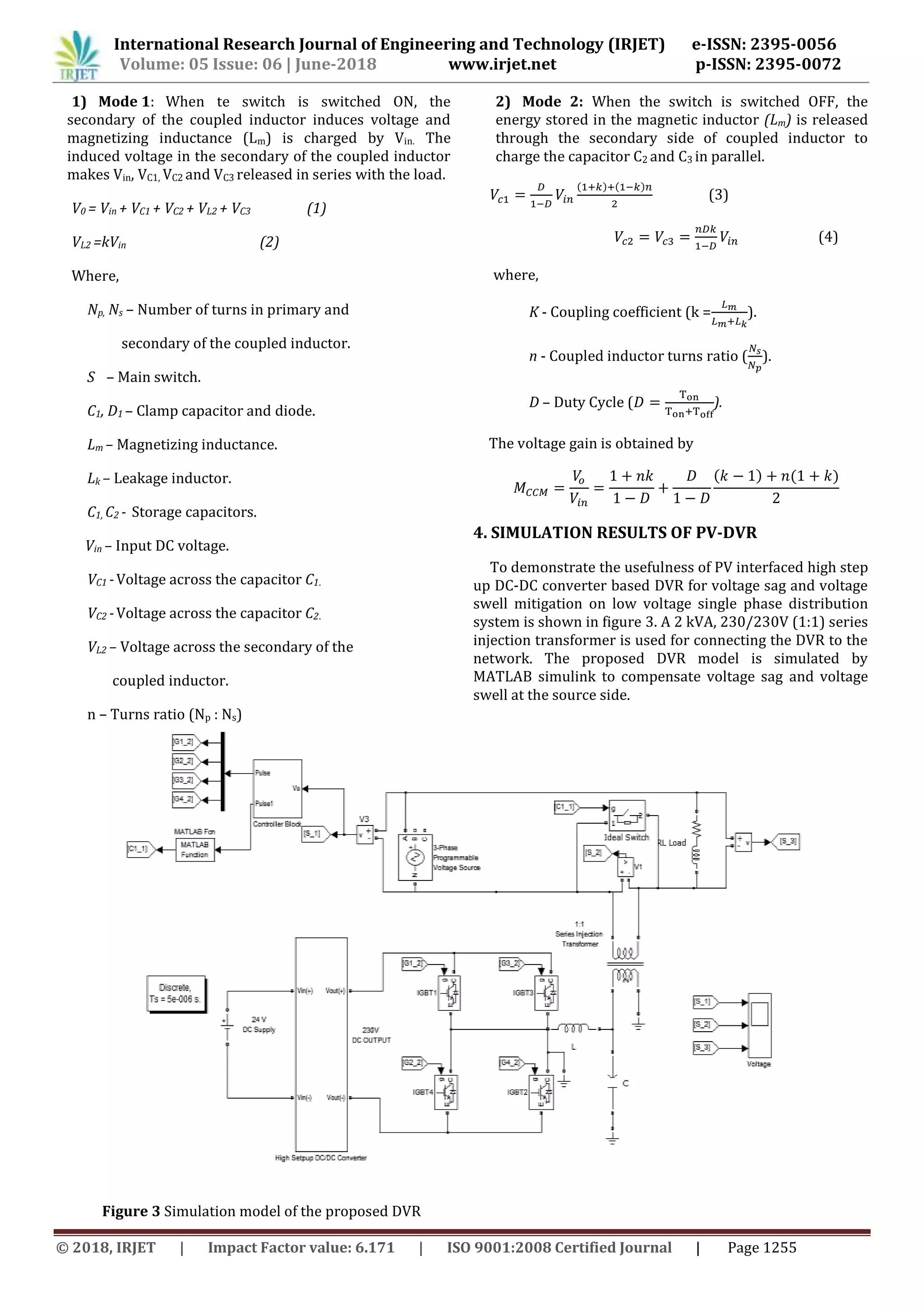
To demonstrate the usefulness of PV interfaced high step
up DC-DC converter based DVR for voltage sag and voltage
swell mitigation on low voltage single phase distribution
system is shown in figure 3. A 2 kVA, 230/230V (1:1) series
injection transformer is used for connecting the DVR to the
network. The proposed DVR model is simulated by
MATLAB simulink to compensate voltage sag and voltage
swell at the source side.
Figure 3 Simulation model of the proposed DVR
International Research Journal of Engineering and Technology (IRJET) e-ISSN: 2395-0056
www.irjet.net p-ISSN: 2395-0072Volume: 05 Issue: 06 | June-2018
© 2018, IRJET | Impact Factor value: 6.171 | ISO 9001:2008 Certified Journal | Page 1256
The simulation parameters of the DVR are shown in
Table 3.
Table 3
Simulation Parameters
Parameters Values
Load Resistance (RL) 43 Ω
Load Inductance 10 mH
Source Voltage 230 V
Load Voltage 230V
Rated Load Current 5 A
The total simulation period is 0.25 sec. In MATLAB the
DVR is simulated to be in operation only when the supply
voltage differs from its nominal value. Then, the DVR will
be in standby mode .
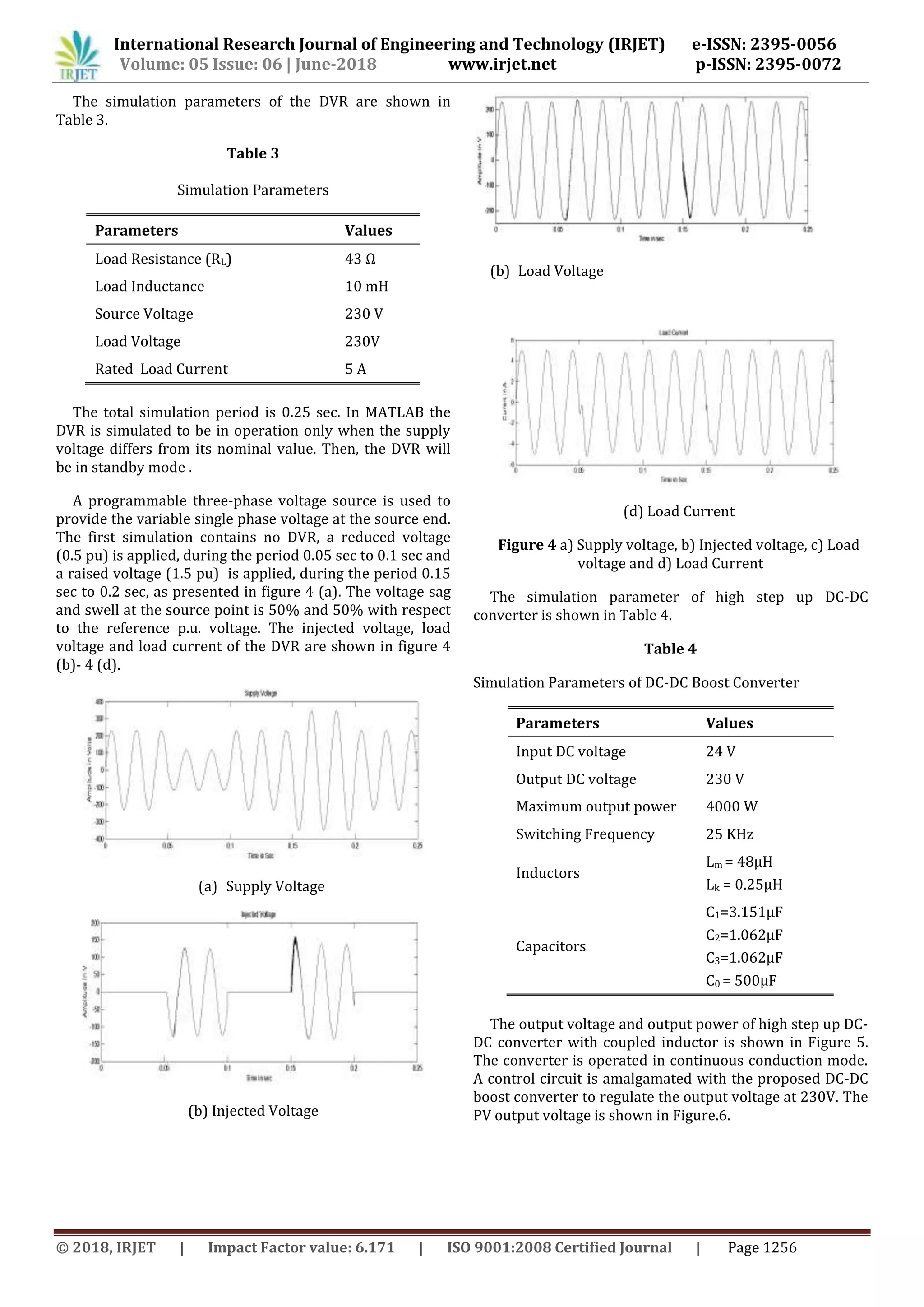
A programmable three-phase voltage source is used to
provide the variable single phase voltage at the source end.
The first simulation contains no DVR, a reduced voltage
(0.5 pu) is applied, during the period 0.05 sec to 0.1 sec and
a raised voltage (1.5 pu) is applied, during the period 0.15
sec to 0.2 sec, as presented in figure 4 (a). The voltage sag
and swell at the source point is 50% and 50% with respect
to the reference p.u. voltage. The injected voltage, load
voltage and load current of the DVR are shown in figure 4
(b)- 4 (d).
(a) Supply Voltage
(b) Injected Voltage
(b) Load Voltage
(d) Load Current
Figure 4 a) Supply voltage, b) Injected voltage, c) Load
voltage and d) Load Current
The simulation parameter of high step up DC-DC
converter is shown in Table 4.
Table 4
Simulation Parameters of DC-DC Boost Converter
Parameters Values
Input DC voltage 24 V
Output DC voltage 230 V
Maximum output power 4000 W
Switching Frequency 25 KHz
Inductors
Lm = 48µH
Lk = 0.25µH
Capacitors
C1=3.151µF
C2=1.062µF
C3=1.062µF
C0 = 500µF
The output voltage and output power of high step up DC-
DC converter with coupled inductor is shown in Figure 5.
The converter is operated in continuous conduction mode.
A control circuit is amalgamated with the proposed DC-DC
boost converter to regulate the output voltage at 230V. The
PV output voltage is shown in Figure.6.
International Research Journal of Engineering and Technology (IRJET) e-ISSN: 2395-0056
www.irjet.net p-ISSN: 2395-0072Volume: 05 Issue: 06 | June-2018
© 2018, IRJET | Impact Factor value: 6.171 | ISO 9001:2008 Certified Journal | Page 1257
(a)
Output voltage of high step up DC-DC converter
(b) Output power of high step up DC-DC converter
Figure 5 output of High step up DC-DC converter
Figure 6 PV array output voltage
5. CONCLUSION
The PV-DVR which integrates a PV interfaced high step
up DC-DC converter as a DC voltage source to alleviate the
voltage sag and swell in a single phase low voltage electric
power distribution system has been presented. The PV
system supports the DC link of the DVR to offer long lasting
compensation against voltage based disturbances in the
power distribution system. The simulation of the proposed
system has been presented. By using the capacitor charged
in parallel and discharged in series by coupled inductor,
high step up voltage gain and high efficiency are achieved.
Furthermore, the mandatory power rating of series
injection transformer is reduced to low rating by selecting
1:1 transformer for series injection.
6. REFERENCES
[1]Amrita Rai, A.K. Nadir, “Modeling and Simulation of
Dynamic Voltage Restorer (DVR) for Enhancing Voltage
Sag,” in sensor and transducer journals, Vol. 87, issue 1, pp:
85-93, Jan 2008.
[2]F.A.L.Jowder, “Modeling and simulation of different
system topologies for dynamic voltage restorer using
simulink,” in proc. EPECS ’09, p. 1-6, Nov 2009.
[3]H.Ezoji, A.Sheikholeslami, M.Tabasi, and M.M.Saeednia,
“Simulation of dynamic voltage restorer using hysteresis
voltage control,” European journal of scientific research,
vol. 27, pp. 152-166, Feb 2009.
[4]Hyun Lark Do, “Zero voltage switching boost converter
using a coupled inductor,” Vol. 11, No. 1, pp. 16-20, Jan
2011.
[5]P.Boonchiam, and N.Mithulananthan, “Understanding of
dynamic voltage restorers through MATLAB simulation,”
Thammasat Int. J. Sc. Tech., Vol. 11, No.3, pp. 1-6, Sep 2006.
[6]R.J.Wai and R.Y.Duan, “High-efficiency DC/DC converter
with high voltage gain,” IEE Proc. Electric Power
Applications, Vol.152, No.4, pp.793-802, Jul. 2005.
[7]R.Omar, and N. Abd Rahim, “Mitigation of voltage
sags/swells using Dynamic voltage restorer (DVR),” ARPN
Journal of Engineering and Applied Sciences, Vol. 4, No. 4,
June 2009.
[8]S.K.Changchien, T.J.Liang, J.F.Chen and L.S.Yang, “Novel
high step-up DC-DC converter for fuel cell energy
conversion system,” IEEE Trans. Ind. Electronics, Vol. 57,
No.6, pp.2007-2017, June 2010.
[9]Y.P.Hsieh, J.F.Chen, T.J.Liang and L.S.Yang, “Novel high
set-up DC-DC converter for distributed generation system,”
IEEE transaction on Industrial Electronics, pp. 1-7, Jan
2011.
[10]Meyer, C., De-Doncker, R.W., Li, Y.W. and Blaabjerg, F.
“Optimized control strategy for a medium-voltage DVR-
Theoretical Investigations and experimental results”, IEEE
Transactions on Power Electronics, Vol.23, No.6, pp.2746-
2754, 2008.
[11]Mahdianpoor, F.M., Hooshmand, R.A. and Mohammad,
A. “A new approach to multifunctional dynamic voltage
restorer implementation for emergency control in
distribution systems”, IEEE Transactions on Power
Delivery, Vol.26, No.2, pp.882-890, 2011.
[12]Mohan, N., Undeland, T.M. and Robbins, W.P. “Power
Electronics Converters: Applications and Design”, Third
Edition, Jhon Wiley & Sons Asia Pte. Ltd., Singapore,
pp.172-178, 2006.

IRJET- PV System Connected High Step-Up Boost DC-DC Converter based Voltage Compensator

  • 1.
    International Research Journalof Engineering and Technology (IRJET) e-ISSN: 2395-0056 www.irjet.net p-ISSN: 2395-0072Volume: 05 Issue: 06 | June-2018 © 2018, IRJET | Impact Factor value: 6.171 | ISO 9001:2008 Certified Journal | Page 1253 PV System Connected High Step-Up Boost DC-DC Converter Based Voltage Compensator K.Tamilselvan1, R.Anita2 1,2Department of Electrical and Electronics Engineering, Institute of Road and Transport Technology, Erode- 638316, Tamilnadu, India ----------------------------------------------------------------------***------------------------------------------------------------------ Abstract— In this paper, a Photovoltaic (PV) system interfaced high step up DC-DC converter based voltage compensator such as Dynamic Voltage Restorer (DVR) is presented to alleviate the voltage sag and swell in low voltage single-phase power distribution system. The PV system supports the DC-link of the DVR. The PV array output voltage stepped up with the use of high step up DC-DC boost converter. The converter attains high step-up voltage gain by means of low voltage stress on the power semiconductor switch. Similarly, the stored energy in the coupled inductor may be reprocessed to the load. The usage of high step up DC-DC converter decreases the size and necessary power rating of the series injection transformer. It as well increases the stability and safety of the system. A feedback loop is engaged to attain a faster response in sag/swell detection. A single phase full bridge inverter is added to convert DC bus voltage into a 230V, 50Hz single phase AC source by by means of Sinusoidal Pulse Width Modulation (SPWM) technique. Simulation results have ascertained the proficiency of the presented PV supported DVR in alleviating voltage sag and swell in low voltage single-phase power distribution system. Index Terms— Dynamic Voltage Restorer , DC-DC Boost Converter, Photovoltaic System, Sag, Swell. 1. INTRODUCTION DVR offers the most cost effective solution to alleviate voltage sag and swell in the low and medium electric power distribution system. The disturbances such as voltage sag, swell and voltage distortion have become an accumulative concern in both domestic and industrial customers. Voltage sag is a sudden reduction of source voltage from 90% to 10% of its nominal value with duration from 0.5 cycles to 1 min [1]. Voltage swell is a sudden rise of supply voltage from 110% to 190% with duration from 0.5 cycles to 1 min [2,3]. This may occur in the distribution system where the grid quality is unacceptable. The above stated voltage variation measures happen owing to single line to ground fault, phase to phase fault, energization of large capacitor banks, switching of heavy loads, starting of large motors and pressing process in steel plants. The voltage variations events and its effects are shown in Table 1. Table 1 Voltage Variation Events and its Effects Disturbances Effects Unbalance voltage Produce excessive heat in motor and control equipment. Interruption Complete shutdown. Voltage sag Trip out the adjustable speed drive & computer. Voltage swell Overstress to insulation. Fluctuations in voltage Light Flicker. Harmonics Produce more noise and overheating. To alleviate the above stated power quality issues, the DVR has been projected as effective sag/swell alleviation equipment [4,5]. The injections of voltage from DVR compensate the voltage sag/swell during sag and swell events [6,7]. In this paper a simulation of high step up DC-DC converter with the PV power generating system is integrated to function as a high capacity DC voltage source. It reduces the size and capacity of series injection transformer. The converter practices the coupled inductor and capacitors to attain high step up voltage gain. This converter can offer higher voltage gain than the conventional DC-DC boost converter [8,9]. 2. PV SYSTEM INTERFACED HIGH STEP UP DC-DC CONVERTER BASED DVR The schematic diagram of the PV supported DVR is shown in Figure 1. The projected system includes of a battery, high step up DC-DC converter with coupled inductor, Voltage Source Inverter (VSI), series injection transformer (1:1) and semiconductor bypass switch S.
  • 2.
    International Research Journalof Engineering and Technology (IRJET) e-ISSN: 2395-0056 www.irjet.net p-ISSN: 2395-0072Volume: 05 Issue: 06 | June-2018 © 2018, IRJET | Impact Factor value: 6.171 | ISO 9001:2008 Certified Journal | Page 1254 Figure 1 Block diagram of the PV-DVR Table 2 displays the control signal of semiconductor switch S, which is connected in parallel with the secondary of series injection transformer. The power semiconductor switch S is controlled by voltage sensor and the simple logical circuits. Table 2 Control Signal of Semiconductor Switch S Supply voltage in % Control signal Mode of Operation 100% 1 Ideal <100% 0 DVR >100% 0 DVR A DVR is connected in series with the power distribution system to inject a compensating voltage in series with the AC source. The main components of a DVR are the high capacity DC source, bridge inverter, injection transformer and control system. A DVR can compensate the voltage drop across a sensitive load by injecting a voltage through a series injection transformer[10,11,12]. The inverter is a foremost component of DVR. Its control will directly distress the transient and dynamic performance of the DVR. The voltage injection of the DVR is mainly being subject to on the capacity of DC source, which is connected in the DC-link of the DVR. A high step up DC- DC converter with coupled inductor offers a high power DC source to voltage source inverter of the DVR. 3. HIGH STEP UP DC-DC CONVERTER A high step up DC-DC converter can boost the voltage from low level to high level. It decreases the number of batteries, essential to attain the mandatory DC voltage level in that way saving the cost and space as an alternative of using numerous batteries. In general, the DC-DC boost converter can offer high step up voltage gain with exceedingly high duty cycle. The step-up voltage gain is inadequate by the effect on power semiconductor switches, inductors and capacitors. To develop the conversion efficiency and to achieve high step up voltage gain the coupled inductor with switched capacitor technique is used[9]. This converter is connected in between the low power DC source such as renewable energy power generation system or conventional battery storage units and voltage source inverter. The high step up DC-DC converter with coupled inductor is shown in Figure 2. Figure 2 Circuit configuration of high step up DC-DC boost converter The secondary side (Ns) of the coupled inductor is used as a flyback converter. It can increase the voltage gain. The energy stored in the leakage inductor (Lk) is recycled to the load directly. The advantages of this DC-DC converters is as follows  It confines voltage spike on the main switch.  Delivers high step up gain.  High conversion efficiency.  Low conduction loss.  High step up ratio. The secondary of the coupled inductor can charge capacitors in parallel and discharge them in series with the load. This converter combines the concept of coupled inductor and switched capacitor techniques. The secondary of the coupled inductor charge the capacitors C2 and C3 when the switch is switched OFF and are discharged in series by the secondary side of coupled inductor when the switch is switched ON. It operates in two mode of operation.
  • 3.
    International Research Journalof Engineering and Technology (IRJET) e-ISSN: 2395-0056 www.irjet.net p-ISSN: 2395-0072Volume: 05 Issue: 06 | June-2018 © 2018, IRJET | Impact Factor value: 6.171 | ISO 9001:2008 Certified Journal | Page 1255 1) Mode 1: When te switch is switched ON, the secondary of the coupled inductor induces voltage and magnetizing inductance (Lm) is charged by Vin. The induced voltage in the secondary of the coupled inductor makes Vin, VC1, VC2 and VC3 released in series with the load. V0 = Vin + VC1 + VC2 + VL2 + VC3 (1) VL2 =kVin (2) Where, Np, Ns – Number of turns in primary and secondary of the coupled inductor. S – Main switch. C1, D1 – Clamp capacitor and diode. Lm – Magnetizing inductance. Lk – Leakage inductor. C1, C2 - Storage capacitors. Vin – Input DC voltage. VC1 -Voltage across the capacitor C1. VC2 -Voltage across the capacitor C2. VL2 – Voltage across the secondary of the coupled inductor. n – Turns ratio (Np : Ns) 2) Mode 2: When the switch is switched OFF, the energy stored in the magnetic inductor (Lm) is released through the secondary side of coupled inductor to charge the capacitor C2 and C3 in parallel. ( ) ( ) (3) (4) where, K - Coupling coefficient (k = ). n - Coupled inductor turns ratio ( ). D – Duty Cycle ( ). The voltage gain is obtained by ( ) ( ) 4. SIMULATION RESULTS OF PV-DVR To demonstrate the usefulness of PV interfaced high step up DC-DC converter based DVR for voltage sag and voltage swell mitigation on low voltage single phase distribution system is shown in figure 3. A 2 kVA, 230/230V (1:1) series injection transformer is used for connecting the DVR to the network. The proposed DVR model is simulated by MATLAB simulink to compensate voltage sag and voltage swell at the source side. Figure 3 Simulation model of the proposed DVR
  • 4.
    International Research Journalof Engineering and Technology (IRJET) e-ISSN: 2395-0056 www.irjet.net p-ISSN: 2395-0072Volume: 05 Issue: 06 | June-2018 © 2018, IRJET | Impact Factor value: 6.171 | ISO 9001:2008 Certified Journal | Page 1256 The simulation parameters of the DVR are shown in Table 3. Table 3 Simulation Parameters Parameters Values Load Resistance (RL) 43 Ω Load Inductance 10 mH Source Voltage 230 V Load Voltage 230V Rated Load Current 5 A The total simulation period is 0.25 sec. In MATLAB the DVR is simulated to be in operation only when the supply voltage differs from its nominal value. Then, the DVR will be in standby mode . A programmable three-phase voltage source is used to provide the variable single phase voltage at the source end. The first simulation contains no DVR, a reduced voltage (0.5 pu) is applied, during the period 0.05 sec to 0.1 sec and a raised voltage (1.5 pu) is applied, during the period 0.15 sec to 0.2 sec, as presented in figure 4 (a). The voltage sag and swell at the source point is 50% and 50% with respect to the reference p.u. voltage. The injected voltage, load voltage and load current of the DVR are shown in figure 4 (b)- 4 (d). (a) Supply Voltage (b) Injected Voltage (b) Load Voltage (d) Load Current Figure 4 a) Supply voltage, b) Injected voltage, c) Load voltage and d) Load Current The simulation parameter of high step up DC-DC converter is shown in Table 4. Table 4 Simulation Parameters of DC-DC Boost Converter Parameters Values Input DC voltage 24 V Output DC voltage 230 V Maximum output power 4000 W Switching Frequency 25 KHz Inductors Lm = 48µH Lk = 0.25µH Capacitors C1=3.151µF C2=1.062µF C3=1.062µF C0 = 500µF The output voltage and output power of high step up DC- DC converter with coupled inductor is shown in Figure 5. The converter is operated in continuous conduction mode. A control circuit is amalgamated with the proposed DC-DC boost converter to regulate the output voltage at 230V. The PV output voltage is shown in Figure.6.
  • 5.
    International Research Journalof Engineering and Technology (IRJET) e-ISSN: 2395-0056 www.irjet.net p-ISSN: 2395-0072Volume: 05 Issue: 06 | June-2018 © 2018, IRJET | Impact Factor value: 6.171 | ISO 9001:2008 Certified Journal | Page 1257 (a) Output voltage of high step up DC-DC converter (b) Output power of high step up DC-DC converter Figure 5 output of High step up DC-DC converter Figure 6 PV array output voltage 5. CONCLUSION The PV-DVR which integrates a PV interfaced high step up DC-DC converter as a DC voltage source to alleviate the voltage sag and swell in a single phase low voltage electric power distribution system has been presented. The PV system supports the DC link of the DVR to offer long lasting compensation against voltage based disturbances in the power distribution system. The simulation of the proposed system has been presented. By using the capacitor charged in parallel and discharged in series by coupled inductor, high step up voltage gain and high efficiency are achieved. Furthermore, the mandatory power rating of series injection transformer is reduced to low rating by selecting 1:1 transformer for series injection. 6. REFERENCES [1]Amrita Rai, A.K. Nadir, “Modeling and Simulation of Dynamic Voltage Restorer (DVR) for Enhancing Voltage Sag,” in sensor and transducer journals, Vol. 87, issue 1, pp: 85-93, Jan 2008. [2]F.A.L.Jowder, “Modeling and simulation of different system topologies for dynamic voltage restorer using simulink,” in proc. EPECS ’09, p. 1-6, Nov 2009. [3]H.Ezoji, A.Sheikholeslami, M.Tabasi, and M.M.Saeednia, “Simulation of dynamic voltage restorer using hysteresis voltage control,” European journal of scientific research, vol. 27, pp. 152-166, Feb 2009. [4]Hyun Lark Do, “Zero voltage switching boost converter using a coupled inductor,” Vol. 11, No. 1, pp. 16-20, Jan 2011. [5]P.Boonchiam, and N.Mithulananthan, “Understanding of dynamic voltage restorers through MATLAB simulation,” Thammasat Int. J. Sc. Tech., Vol. 11, No.3, pp. 1-6, Sep 2006. [6]R.J.Wai and R.Y.Duan, “High-efficiency DC/DC converter with high voltage gain,” IEE Proc. Electric Power Applications, Vol.152, No.4, pp.793-802, Jul. 2005. [7]R.Omar, and N. Abd Rahim, “Mitigation of voltage sags/swells using Dynamic voltage restorer (DVR),” ARPN Journal of Engineering and Applied Sciences, Vol. 4, No. 4, June 2009. [8]S.K.Changchien, T.J.Liang, J.F.Chen and L.S.Yang, “Novel high step-up DC-DC converter for fuel cell energy conversion system,” IEEE Trans. Ind. Electronics, Vol. 57, No.6, pp.2007-2017, June 2010. [9]Y.P.Hsieh, J.F.Chen, T.J.Liang and L.S.Yang, “Novel high set-up DC-DC converter for distributed generation system,” IEEE transaction on Industrial Electronics, pp. 1-7, Jan 2011. [10]Meyer, C., De-Doncker, R.W., Li, Y.W. and Blaabjerg, F. “Optimized control strategy for a medium-voltage DVR- Theoretical Investigations and experimental results”, IEEE Transactions on Power Electronics, Vol.23, No.6, pp.2746- 2754, 2008. [11]Mahdianpoor, F.M., Hooshmand, R.A. and Mohammad, A. “A new approach to multifunctional dynamic voltage restorer implementation for emergency control in distribution systems”, IEEE Transactions on Power Delivery, Vol.26, No.2, pp.882-890, 2011. [12]Mohan, N., Undeland, T.M. and Robbins, W.P. “Power Electronics Converters: Applications and Design”, Third Edition, Jhon Wiley & Sons Asia Pte. Ltd., Singapore, pp.172-178, 2006.