International Research Journal of Engineering and Technology (IRJET) e-ISSN: 2395-0056
Volume: 06 Issue: 04 | Apr 2019 www.irjet.net p-ISSN: 2395-0072
© 2019, IRJET | Impact Factor value: 7.211 | ISO 9001:2008 Certified Journal | Page 4837
OBJECT SORTING MACHINE USING ARDUINO-UNO
Ameya Karode1, Pranav Mahajan2
1,2Student, Dept. of Mechanical Engineering, P.E.S’s Modern College of Engineering, Pune, Maharashtra, India
---------------------------------------------------------------------***----------------------------------------------------------------------
Abstract – This paper focuses on the concept of object sorting
machine using Arduino-Unoand itsworking. Thismachine can
mainly be used in warehouses and industries where certain
parts such as glass bottles have to be reused and are large in
quantity. Using this machine will save the time and cost to be
paid to a worker in case of sorting the objects manually. The
average sorting time for an object is 6 seconds.
This machine can be implemented in industries where
Mechatronics systems are used.
Key Words: OBJECT SORTING, ARDUINO UNO,
ULTRASONIC SENSOR, CONVEYOR, L293D MOTOR
DRIVER, 12V DC MOTOR.
1. INTRODUCTION
The object sorting machine can mainly be used in
warehouses and industriesandhelpinreducing errorswhile
sorting and reduce human effort. The main features of this
machine are high repeatability, robust in design, and
requires less maintenance.
2. LITERATURE REVIEW
1. Title: “Model design and simulation of automatic sorting
machine using proximity sensor” by I,A Daniyan, Esoso
Aghor.
This paper deals with separating species of non- ferrous
objects and at the same time movingobjectsautomaticallyto
the basket as defined by the regulation of the Programmable
Logic Controllers (PLC)with a capacitiveproximitysensor to
detect a value range of objects. Each object has been sorted
correctly into the designated compartment with an average
sorting time of 9.9, 14.1 and 18.5 seconds for plastic, wood
and steel objects respectively.TheauthorsconcludethatPLC
is the ‘brain’ of the sorting system to executes the
programmed functions.
2. Title: “PLC Based Object Sorting Automation” by Aditya
Deshpande, Rucha Kulkarni, Rucha Moghe.
This paper focuses on the need to develop Low Cost
Automation (LCA) for sorting products in an accurate
manner. The authors have developed a LCA system for
sorting the light weight objects on the basis of height
variation using DC geared motors which is controlled by
Programmable Logic Controller (PLC). Finally, the authors
conclude that the LCA system reduces cycle time, improves
3. PROBLEM STATEMENT
To build a prototype of an object sorting machine based
on height of object as a parameter which will sort 10
objects/minute.
4. COMPONENTS USED
S.NO NAME OF
COMPONENT
DESCRIPTION
1 Arduino Uno  Microcontroller:
ATmega328
 Operating Voltage: 5V
 Input Voltage
(recommended): 7-12V
 Input Voltage (limits):
6-20V
 Digital I/O Pins: 14(of
which 6 provide PWM
output)
 Analog Input Pins: 6
 DC Current per I/O
Pin: 40 mA
 DC Current for 3.3V
Pin: 50 mA
 Flash Memory: 32 KB
of which 0.5 KB used by
bootloader
 SRAM: 2 KB
(ATmega328)
 EEPROM: 1 KB
(ATmega328)
Clock Speed: 16 MHz
2 12 V DC
motor
30 rpm dc motor
International Research Journal of Engineering and Technology (IRJET) e-ISSN: 2395-0056
Volume: 06 Issue: 04 | Apr 2019 www.irjet.net p-ISSN: 2395-0072
© 2019, IRJET | Impact Factor value: 7.211 | ISO 9001:2008 Certified Journal | Page 4838
3 Ultrasonic
sensor
Pin
No.
Pin
Name
Description
1 Vcc Powers the
sensor,
+5V.
2 Trigger Input pin.
3 Echo Output
pin.
4 Gnd Connected
to the
Ground.
4 Conveyor Belt Rubber conveyor belt
5 Shaft Stainless Steel shaft
6 L293D  Supply Voltage
Range 4.5V to 36V.
 600-
mA Output current
capability per driver.
 Separate Input-logic
supply.
 It can drive small DC-
geared motors,
bipolar
stepper motor.
 Pulsed Current 1.2-A
Per Driver.
 Thermal Shutdown.
8 Pulley Plastic Pulley for conveyor
belt
9 12V battery 12 V, 2.5 A battery for power
supply
10 Frame Mild Steel Frame as a base
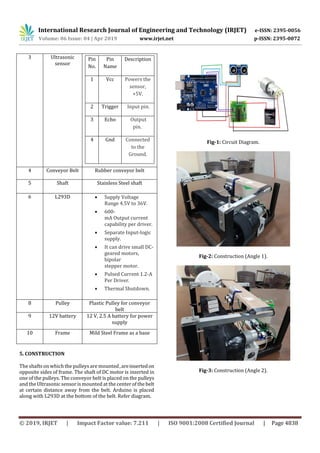
5. CONSTRUCTION
The shafts on which the pulleys are mounted,areinsertedon
opposite sides of frame. The shaft of DC motor is inserted in
one of the pulleys. The conveyor belt is placed on the pulleys
and the Ultrasonic sensor ismounted at the center of the belt
at certain distance away from the belt. Arduino is placed
along with L293D at the bottom of the belt. Refer diagram.
Fig-1: Circuit Diagram.
Fig-2: Construction (Angle 1).
Fig-3: Construction (Angle 2).
International Research Journal of Engineering and Technology (IRJET) e-ISSN: 2395-0056
Volume: 06 Issue: 04 | Apr 2019 www.irjet.net p-ISSN: 2395-0072
© 2019, IRJET | Impact Factor value: 7.211 | ISO 9001:2008 Certified Journal | Page 4839
6. WORKING
Fig-4: Block Diagram
The object is placed at the center of the conveyor intherange
of the Ultrasonic sensor. The sensor senses the object based
on its height which is inserted into the program of Arduino
and if the object has a height more than the decided height,
the conveyor belt moves towards one side and if the object
has a height less than the decided height, the conveyor belt
moves towards the other side. As the speed of the motor is
30rpm, we decide the delay in the program for the conveyor
belt to stop so that the next object can be placed and in this
way, 10 objects can be sorted in a minute. As the range of
Ultrasonic sensor is 2-25 centimeters, the object is placed on
the conveyor at a distance of more than 2 centimeters. Since
we have made a prototype, the object is placed manually, but
in industries the object can be placed using pick and place
robot or using any other means by which the object will
automatically get placed at a distance of more than 2
centimeters in case ultrasonic sensor is used.
7. CONCLUSION
In this paper concept of object sorting machine is explained
with the help of a prototype which sorts objectsaccordingto
their height. Although the prototype shown in this paperisa
smal scale model, it can be designed and manufactured for
large scale industrial applications. While testing the
prototype, we also observed that the machine has high
repeatability. Instead of Ultrasonic sensor, Capacitive type
proximity sensor can also be used which when mounted ata
certain height on the frame, can detectthepresenceofobject
and the conveyor will move towards one side and if the
object is below the decided height, it will not get detected
and thus the conveyor will move towards the other side. A
significant amount of cost can be reduced if this machine is
implemented in industries.
REFERENCES
[1] Y V Aruna, Beena S “Automatic convey or System with
In–Process Sorting Mechanism using PLC and HMI
System”, Int. Journal of Engineering Research and
Applications ISSN: 2248-9622, Vol. 5, Issue 11,(Part-3)
November 2015, pp.37-42
[2] Albert T. Jones , Charles R. McLean ,”A proposed
hierarchical control model forautomated manufacturing
systems”, National Bureau of Standards, Gaithersburg,
Maryland, USA
[3] D. A. Wahab, A. Hussain, E. Scavino, M.M. Mustafa and H.
Basri “Development of a Prototype Automated Sorting
System for Plastic Recycling” American Journal of
Applied Sciences 3 (7): 1924-1928, 2006 ISSN 1546-
9239 © 2006 Science Publications.
[4] Razieh Pourdarbani, Hamid
Reza Ghassemzadeh, Hadi Seyedarabi, Fariborz
Zaare Nahandi, Mohammad Moghaddam Vahed: Study
on an automatic sorting system for Date Fruits
J. Saudi Soc. Agric. Sci., 14 (2015), pp. 83-90
BIOGRAPHIES
AMEYA KARODE
Student at P.E.S’s Modern College
Of Engineering, Pune.
Branch: Mechanical Engineering
PRANAV MAHAJAN
Student at P.E.S’s Modern College
Of Engineering, Pune.
Branch: Mechanical Engineering

IRJET- Object Sorting Machine using Arduino-Uno

  • 1.
    International Research Journalof Engineering and Technology (IRJET) e-ISSN: 2395-0056 Volume: 06 Issue: 04 | Apr 2019 www.irjet.net p-ISSN: 2395-0072 © 2019, IRJET | Impact Factor value: 7.211 | ISO 9001:2008 Certified Journal | Page 4837 OBJECT SORTING MACHINE USING ARDUINO-UNO Ameya Karode1, Pranav Mahajan2 1,2Student, Dept. of Mechanical Engineering, P.E.S’s Modern College of Engineering, Pune, Maharashtra, India ---------------------------------------------------------------------***---------------------------------------------------------------------- Abstract – This paper focuses on the concept of object sorting machine using Arduino-Unoand itsworking. Thismachine can mainly be used in warehouses and industries where certain parts such as glass bottles have to be reused and are large in quantity. Using this machine will save the time and cost to be paid to a worker in case of sorting the objects manually. The average sorting time for an object is 6 seconds. This machine can be implemented in industries where Mechatronics systems are used. Key Words: OBJECT SORTING, ARDUINO UNO, ULTRASONIC SENSOR, CONVEYOR, L293D MOTOR DRIVER, 12V DC MOTOR. 1. INTRODUCTION The object sorting machine can mainly be used in warehouses and industriesandhelpinreducing errorswhile sorting and reduce human effort. The main features of this machine are high repeatability, robust in design, and requires less maintenance. 2. LITERATURE REVIEW 1. Title: “Model design and simulation of automatic sorting machine using proximity sensor” by I,A Daniyan, Esoso Aghor. This paper deals with separating species of non- ferrous objects and at the same time movingobjectsautomaticallyto the basket as defined by the regulation of the Programmable Logic Controllers (PLC)with a capacitiveproximitysensor to detect a value range of objects. Each object has been sorted correctly into the designated compartment with an average sorting time of 9.9, 14.1 and 18.5 seconds for plastic, wood and steel objects respectively.TheauthorsconcludethatPLC is the ‘brain’ of the sorting system to executes the programmed functions. 2. Title: “PLC Based Object Sorting Automation” by Aditya Deshpande, Rucha Kulkarni, Rucha Moghe. This paper focuses on the need to develop Low Cost Automation (LCA) for sorting products in an accurate manner. The authors have developed a LCA system for sorting the light weight objects on the basis of height variation using DC geared motors which is controlled by Programmable Logic Controller (PLC). Finally, the authors conclude that the LCA system reduces cycle time, improves 3. PROBLEM STATEMENT To build a prototype of an object sorting machine based on height of object as a parameter which will sort 10 objects/minute. 4. COMPONENTS USED S.NO NAME OF COMPONENT DESCRIPTION 1 Arduino Uno  Microcontroller: ATmega328  Operating Voltage: 5V  Input Voltage (recommended): 7-12V  Input Voltage (limits): 6-20V  Digital I/O Pins: 14(of which 6 provide PWM output)  Analog Input Pins: 6  DC Current per I/O Pin: 40 mA  DC Current for 3.3V Pin: 50 mA  Flash Memory: 32 KB of which 0.5 KB used by bootloader  SRAM: 2 KB (ATmega328)  EEPROM: 1 KB (ATmega328) Clock Speed: 16 MHz 2 12 V DC motor 30 rpm dc motor
  • 2.
    International Research Journalof Engineering and Technology (IRJET) e-ISSN: 2395-0056 Volume: 06 Issue: 04 | Apr 2019 www.irjet.net p-ISSN: 2395-0072 © 2019, IRJET | Impact Factor value: 7.211 | ISO 9001:2008 Certified Journal | Page 4838 3 Ultrasonic sensor Pin No. Pin Name Description 1 Vcc Powers the sensor, +5V. 2 Trigger Input pin. 3 Echo Output pin. 4 Gnd Connected to the Ground. 4 Conveyor Belt Rubber conveyor belt 5 Shaft Stainless Steel shaft 6 L293D  Supply Voltage Range 4.5V to 36V.  600- mA Output current capability per driver.  Separate Input-logic supply.  It can drive small DC- geared motors, bipolar stepper motor.  Pulsed Current 1.2-A Per Driver.  Thermal Shutdown. 8 Pulley Plastic Pulley for conveyor belt 9 12V battery 12 V, 2.5 A battery for power supply 10 Frame Mild Steel Frame as a base 5. CONSTRUCTION The shafts on which the pulleys are mounted,areinsertedon opposite sides of frame. The shaft of DC motor is inserted in one of the pulleys. The conveyor belt is placed on the pulleys and the Ultrasonic sensor ismounted at the center of the belt at certain distance away from the belt. Arduino is placed along with L293D at the bottom of the belt. Refer diagram. Fig-1: Circuit Diagram. Fig-2: Construction (Angle 1). Fig-3: Construction (Angle 2).
  • 3.
    International Research Journalof Engineering and Technology (IRJET) e-ISSN: 2395-0056 Volume: 06 Issue: 04 | Apr 2019 www.irjet.net p-ISSN: 2395-0072 © 2019, IRJET | Impact Factor value: 7.211 | ISO 9001:2008 Certified Journal | Page 4839 6. WORKING Fig-4: Block Diagram The object is placed at the center of the conveyor intherange of the Ultrasonic sensor. The sensor senses the object based on its height which is inserted into the program of Arduino and if the object has a height more than the decided height, the conveyor belt moves towards one side and if the object has a height less than the decided height, the conveyor belt moves towards the other side. As the speed of the motor is 30rpm, we decide the delay in the program for the conveyor belt to stop so that the next object can be placed and in this way, 10 objects can be sorted in a minute. As the range of Ultrasonic sensor is 2-25 centimeters, the object is placed on the conveyor at a distance of more than 2 centimeters. Since we have made a prototype, the object is placed manually, but in industries the object can be placed using pick and place robot or using any other means by which the object will automatically get placed at a distance of more than 2 centimeters in case ultrasonic sensor is used. 7. CONCLUSION In this paper concept of object sorting machine is explained with the help of a prototype which sorts objectsaccordingto their height. Although the prototype shown in this paperisa smal scale model, it can be designed and manufactured for large scale industrial applications. While testing the prototype, we also observed that the machine has high repeatability. Instead of Ultrasonic sensor, Capacitive type proximity sensor can also be used which when mounted ata certain height on the frame, can detectthepresenceofobject and the conveyor will move towards one side and if the object is below the decided height, it will not get detected and thus the conveyor will move towards the other side. A significant amount of cost can be reduced if this machine is implemented in industries. REFERENCES [1] Y V Aruna, Beena S “Automatic convey or System with In–Process Sorting Mechanism using PLC and HMI System”, Int. Journal of Engineering Research and Applications ISSN: 2248-9622, Vol. 5, Issue 11,(Part-3) November 2015, pp.37-42 [2] Albert T. Jones , Charles R. McLean ,”A proposed hierarchical control model forautomated manufacturing systems”, National Bureau of Standards, Gaithersburg, Maryland, USA [3] D. A. Wahab, A. Hussain, E. Scavino, M.M. Mustafa and H. Basri “Development of a Prototype Automated Sorting System for Plastic Recycling” American Journal of Applied Sciences 3 (7): 1924-1928, 2006 ISSN 1546- 9239 © 2006 Science Publications. [4] Razieh Pourdarbani, Hamid Reza Ghassemzadeh, Hadi Seyedarabi, Fariborz Zaare Nahandi, Mohammad Moghaddam Vahed: Study on an automatic sorting system for Date Fruits J. Saudi Soc. Agric. Sci., 14 (2015), pp. 83-90 BIOGRAPHIES AMEYA KARODE Student at P.E.S’s Modern College Of Engineering, Pune. Branch: Mechanical Engineering PRANAV MAHAJAN Student at P.E.S’s Modern College Of Engineering, Pune. Branch: Mechanical Engineering