International Research Journal of Engineering and Technology (IRJET) e-ISSN: 2395-0056
Volume: 07 Issue: 02 | Feb 2020 www.irjet.net p-ISSN: 2395-0072
© 2020, IRJET | Impact Factor value: 7.34 | ISO 9001:2008 Certified Journal | Page 2621
IoT based Portable Attendance System
Shubham Sonule1, Ashutosh Dongre2, Prof. Pankaj Taklikar3, Ameya Pannase4,
Grishma Akhand5, Aarzoo Kripal6, Akanksha Mamankar7
1,2,4,5,6,7B.E. Student, Department of ETC Engineering, SBJITMR, Nagpur, Maharashtra, India
3Assistant Professor, Department of ETC Engineering, SBJITMR, Nagpur, Maharashtra, India
---------------------------------------------------------------------***----------------------------------------------------------------------
Abstract - Conventional method of attendance marking is a
tedious task and requires some time investment also. In a
cumulative sense, the time invested in this activity is of
significant amount. Awireless biometricbasedsystemcanhelp
in alleviating this issue. This paper delves into the design and
implementation of a wireless fingerprint attendance
management system. This is a portable device that also helps
in maintaining the database for the registered candidates.
This system based on biometrics and wireless technique not
only save valuable time but also solves theproblemofspurious
attendance and the trouble of laying the corresponding
network. It can take the user’s attendances more easily and
also more effectively.
Key Words: Attendance, IOT, Biometric, Fingerprint,
Portable.
1. INTRODUCTION
Biometric such as fingerprints, voices and ECG signals are
unique human characters that cannot be tampered or
replicated. This facilitatesreal timesystemimplementations.
These biometric attendance systems are commonly used to
mark the presence in offices and schools. This project has a
wide application in school, colleges, offices, business
organization where marking of attendance is required
accurately with time. Conventional attendance system
followed in an educational system where the teacher’s call
out the name of each and every student and mark the
attendance causes time wastage during lecture time. This
becomes more severe especially in the current scenario
where number of students in class is very large. Managing
the attendance of such a large group is also very difficult.
Another disadvantage of presentsystemisthechancefor the
student to mark fake attendance. In here the devices are use
computer to store and verify fingerprints. Thus by using
Fingerprint sensor, the system will become more secure for
the users.
1.1 Literature Survey
According to the IOT based attendance system-IRJET-2017
there system requires a micro controller to function so they
have chosen the ESP826612e.To display the names of the
students whose fingerprint is scanned so they chose an
OLED display to display the student name. To scan and
recognize the fingerprints they chosen the fingerprint
module R305.providing the power to the system battery of
5v is connected. Other components required are switches,
wires, and PCB. Now the Attendance is also very important
factor for many educational institutions in South Africa
therefore They are carry off through the use of the new and
fast growing Radio Frequency Identification (RFID)
technology to develop a modulardevicefortheacquisitionof
attendees id. A IEEE 802.15.4 enabled radio interface is also
embedded to provide autonomous data acquisition into the
administrators database application. In addition, a database
Application ProgrammingInterface(API)isdeveloped based
on Microsoft® Excel using C# java high level programming.
The test outcomes of the design are presentedtovalidatethe
approach used in this work. now the different between the
Design and implementation of an RFID based smart
attendance register-IEEE-2017andtheIOTbasedAutomatic
Attendance Management System-ICCTCEEC-2017 is that
they using the Attendance Management System is the
implementation of InternetofThingsthroughRaspberry Pi3
and RFID Technology in order to reduce the time consumed
by the traditional system of recording daily attendance in
schools and institutions. So everything here in turn gets
automated. An attempt has also been made to develop an
Android application (app) and help the students’ to view
their attendance anywhere, anytime.
2. FUNCTIONS AND COMPOSING OF THE SYSTEM
2.1 Hardware Design
In here we are using the R307 is a fingerprintsensormodule
with TTLUART interface for direct connections to
microcontrollerUARTortoPCthroughMAX232/USB-Serial
adapter. The user which is going to register can store the
finger print data in the module and can configure it in 1:1 or
1: N mode for identifying the person. It has a baud rate of
9600 and is able to store 127 different finger prints.
NodeMCU ESP8266 is a programmable wi-fimoduleandcan
be configured to connect to the Internet for Internet of
Things (IOT) and similar technologies.
OLED Display is a 0.96 inch blue OLED display module. The
display module can be interfaced with any kind of
microcontroller using SPI / IIC protocols. It has a resolution
of 128x64. The package includes in it the display board,
display and a 4pin male header pre-soldered to board.
International Research Journal of Engineering and Technology (IRJET) e-ISSN: 2395-0056
Volume: 07 Issue: 02 | Feb 2020 www.irjet.net p-ISSN: 2395-0072
© 2020, IRJET | Impact Factor value: 7.34 | ISO 9001:2008 Certified Journal | Page 2622
2.2 Software Design
Arduino IDE is an open sourceplatformusedto build various
projects. Arduino is composed of two things. first the
physical programmable circuit board(often referred to as a
microcontroller) and the second is a section of software, or
IDE (Integrated Development Environment) that runs on
your computer, it used to write and upload the computer
code into the physical board.
Embedded C Sequential Programming Language.Clanguage
is software designed with different keywords, data types,
variables, constants, etc. Embedded C is a generic termgiven
to a programming language written in C, which is connected
with particular hardware architecture. Embedded C is an
extension to the C language with some additional header
files. These header files may change from controller to
controller.
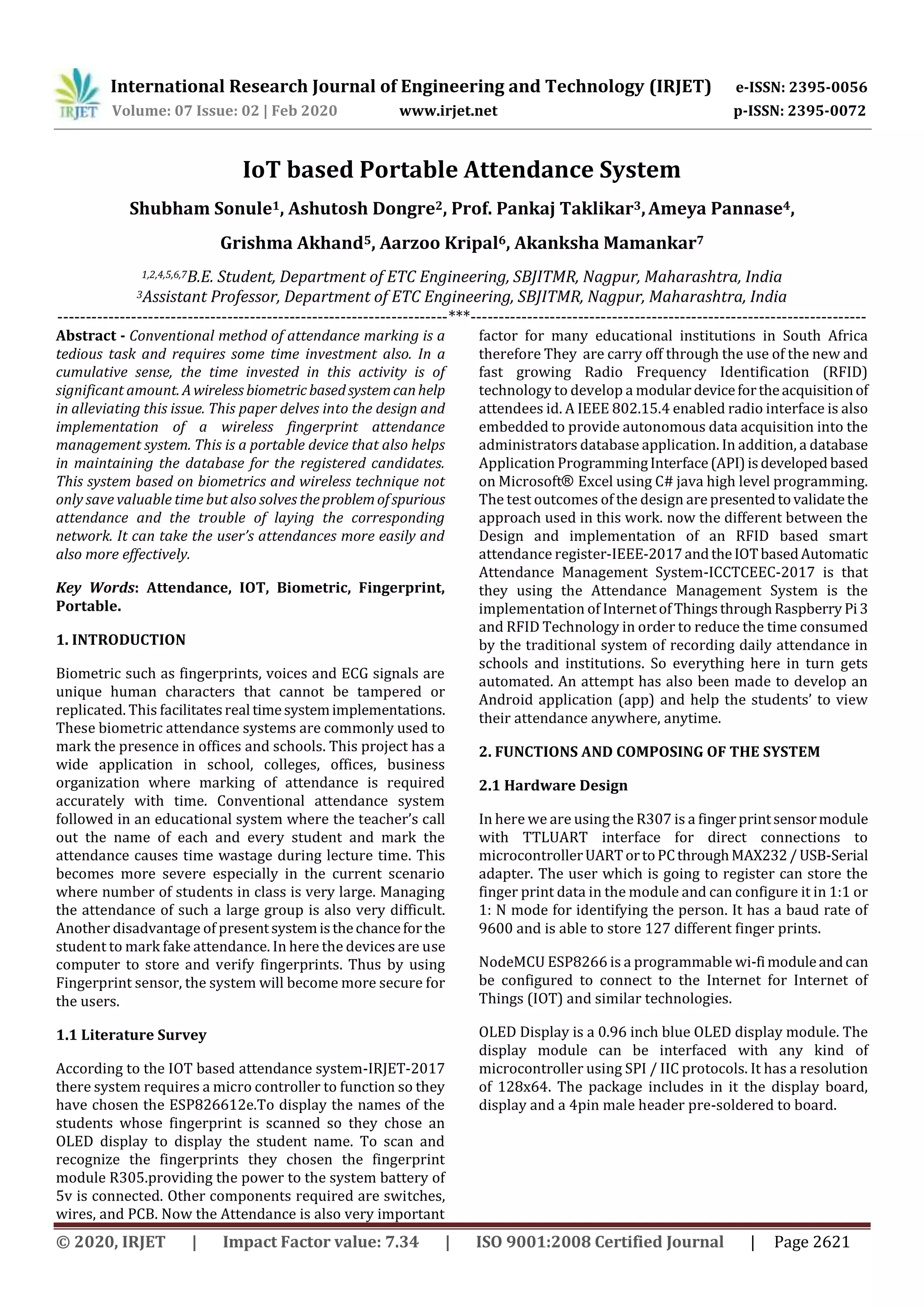
Firebase is a mobile and the firebase is also a web
application development platform whichisdevelopedby the
Firebase. Firebase provides the real time database and also
the backend as a service. The service provides the
application developers and the API that allows application
data to be synchronized across the clients and also the
stored on Firebase's cloud. Firebase Storage provides total
secure file uploads and also downloads for Firebase apps,
regardless of network quality. The developer can use it to
store images, to store audio, to store video, or other user-
generated content. Firebase Storage is backed by Google
Cloud storage.
Fig -1: Connectivity Concept
IRJET sample template format, Define abbreviations and
acronyms the first time they are used in the text, even after
they have been defined in the abstract. Abbreviationssuchas
IEEE, SI, MKS, CGS, sc, dc, and rms do not have to be defined.
Do not use abbreviations in the title or heads unless they are
unavoidable.
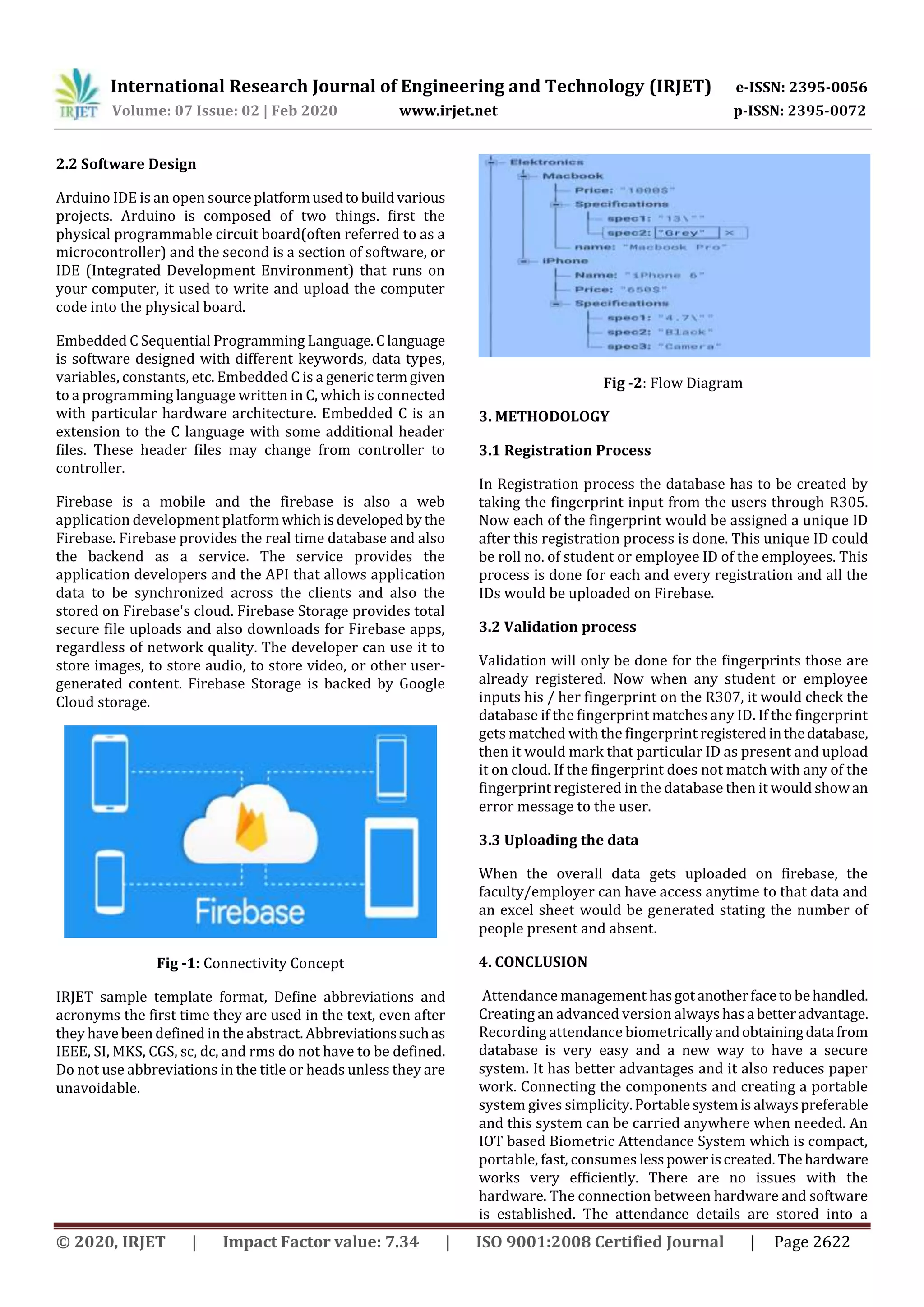
Fig -2: Flow Diagram
3. METHODOLOGY
3.1 Registration Process
In Registration process the database has to be created by
taking the fingerprint input from the users through R305.
Now each of the fingerprint would be assigned a unique ID
after this registration process is done. This unique ID could
be roll no. of student or employee ID of the employees. This
process is done for each and every registration and all the
IDs would be uploaded on Firebase.
3.2 Validation process
Validation will only be done for the fingerprints those are
already registered. Now when any student or employee
inputs his / her fingerprint on the R307, it would check the
database if the fingerprint matches any ID. If the fingerprint
gets matched with the fingerprint registeredinthedatabase,
then it would mark that particular ID as present and upload
it on cloud. If the fingerprint does not match with any of the
fingerprint registered in the database then it would showan
error message to the user.
3.3 Uploading the data
When the overall data gets uploaded on firebase, the
faculty/employer can have access anytime to that data and
an excel sheet would be generated stating the number of
people present and absent.
4. CONCLUSION
Attendance management hasgotanotherfacetobehandled.
Creating an advanced version alwayshasa betteradvantage.
Recording attendance biometricallyandobtainingdata from
database is very easy and a new way to have a secure
system. It has better advantages and it also reduces paper
work. Connecting the components and creating a portable
system gives simplicity.Portablesystemisalwayspreferable
and this system can be carried anywhere when needed. An
IOT based Biometric Attendance System which is compact,
portable, fast, consumes lesspoweriscreated. Thehardware
works very efficiently. There are no issues with the
hardware. The connection between hardware and software
is established. The attendance details are stored into a
International Research Journal of Engineering and Technology (IRJET) e-ISSN: 2395-0056
Volume: 07 Issue: 02 | Feb 2020 www.irjet.net p-ISSN: 2395-0072
© 2020, IRJET | Impact Factor value: 7.34 | ISO 9001:2008 Certified Journal | Page 2623
database. A website is created through which one can check
the details in the database. A user friendly,easytousedevice
which reduces the human effort and consumes less time for
the operations is developed.
REFERENCES
[1] Zhang Yongqiang, Liu Ji, ‘The Design of Wireless
Fingerprint Attendance System’, IEEE-2010.
[2] Sri Madhu B.M, KavyaKanagotagi, Devansh. ‘IOT
based Automatic Attendance Management System’,
ICCTCEEC-2017.
[3] Ignace. Toudjeu, Prosper Z. Sotenga. ‘Design and
implementation of an RFID based smart attendance
register’, IEEE-2017.
[4] Piyush Devikar, Ajit Krishnamoorthy,
AdityaBhanage, Mohit Singh Chauhan. ‘IOT based
Biometric Attendance System’, IJARCCE-2016.
[5] AnilkumarPatil,AkashMahla, Sonica Sonawane,‘IOT
based Attendance System’, IRJET-2017.
[6] Nadar Prince, Abhishek Sengupta, Ms Keerthi Unni,
‘Implementation of IOT based Attendance System
on a dedicated Web-Server’, IJSER-2016.

IRJET - IoT based Portable Attendance System

  • 1.
    International Research Journalof Engineering and Technology (IRJET) e-ISSN: 2395-0056 Volume: 07 Issue: 02 | Feb 2020 www.irjet.net p-ISSN: 2395-0072 © 2020, IRJET | Impact Factor value: 7.34 | ISO 9001:2008 Certified Journal | Page 2621 IoT based Portable Attendance System Shubham Sonule1, Ashutosh Dongre2, Prof. Pankaj Taklikar3, Ameya Pannase4, Grishma Akhand5, Aarzoo Kripal6, Akanksha Mamankar7 1,2,4,5,6,7B.E. Student, Department of ETC Engineering, SBJITMR, Nagpur, Maharashtra, India 3Assistant Professor, Department of ETC Engineering, SBJITMR, Nagpur, Maharashtra, India ---------------------------------------------------------------------***---------------------------------------------------------------------- Abstract - Conventional method of attendance marking is a tedious task and requires some time investment also. In a cumulative sense, the time invested in this activity is of significant amount. Awireless biometricbasedsystemcanhelp in alleviating this issue. This paper delves into the design and implementation of a wireless fingerprint attendance management system. This is a portable device that also helps in maintaining the database for the registered candidates. This system based on biometrics and wireless technique not only save valuable time but also solves theproblemofspurious attendance and the trouble of laying the corresponding network. It can take the user’s attendances more easily and also more effectively. Key Words: Attendance, IOT, Biometric, Fingerprint, Portable. 1. INTRODUCTION Biometric such as fingerprints, voices and ECG signals are unique human characters that cannot be tampered or replicated. This facilitatesreal timesystemimplementations. These biometric attendance systems are commonly used to mark the presence in offices and schools. This project has a wide application in school, colleges, offices, business organization where marking of attendance is required accurately with time. Conventional attendance system followed in an educational system where the teacher’s call out the name of each and every student and mark the attendance causes time wastage during lecture time. This becomes more severe especially in the current scenario where number of students in class is very large. Managing the attendance of such a large group is also very difficult. Another disadvantage of presentsystemisthechancefor the student to mark fake attendance. In here the devices are use computer to store and verify fingerprints. Thus by using Fingerprint sensor, the system will become more secure for the users. 1.1 Literature Survey According to the IOT based attendance system-IRJET-2017 there system requires a micro controller to function so they have chosen the ESP826612e.To display the names of the students whose fingerprint is scanned so they chose an OLED display to display the student name. To scan and recognize the fingerprints they chosen the fingerprint module R305.providing the power to the system battery of 5v is connected. Other components required are switches, wires, and PCB. Now the Attendance is also very important factor for many educational institutions in South Africa therefore They are carry off through the use of the new and fast growing Radio Frequency Identification (RFID) technology to develop a modulardevicefortheacquisitionof attendees id. A IEEE 802.15.4 enabled radio interface is also embedded to provide autonomous data acquisition into the administrators database application. In addition, a database Application ProgrammingInterface(API)isdeveloped based on Microsoft® Excel using C# java high level programming. The test outcomes of the design are presentedtovalidatethe approach used in this work. now the different between the Design and implementation of an RFID based smart attendance register-IEEE-2017andtheIOTbasedAutomatic Attendance Management System-ICCTCEEC-2017 is that they using the Attendance Management System is the implementation of InternetofThingsthroughRaspberry Pi3 and RFID Technology in order to reduce the time consumed by the traditional system of recording daily attendance in schools and institutions. So everything here in turn gets automated. An attempt has also been made to develop an Android application (app) and help the students’ to view their attendance anywhere, anytime. 2. FUNCTIONS AND COMPOSING OF THE SYSTEM 2.1 Hardware Design In here we are using the R307 is a fingerprintsensormodule with TTLUART interface for direct connections to microcontrollerUARTortoPCthroughMAX232/USB-Serial adapter. The user which is going to register can store the finger print data in the module and can configure it in 1:1 or 1: N mode for identifying the person. It has a baud rate of 9600 and is able to store 127 different finger prints. NodeMCU ESP8266 is a programmable wi-fimoduleandcan be configured to connect to the Internet for Internet of Things (IOT) and similar technologies. OLED Display is a 0.96 inch blue OLED display module. The display module can be interfaced with any kind of microcontroller using SPI / IIC protocols. It has a resolution of 128x64. The package includes in it the display board, display and a 4pin male header pre-soldered to board.
  • 2.
    International Research Journalof Engineering and Technology (IRJET) e-ISSN: 2395-0056 Volume: 07 Issue: 02 | Feb 2020 www.irjet.net p-ISSN: 2395-0072 © 2020, IRJET | Impact Factor value: 7.34 | ISO 9001:2008 Certified Journal | Page 2622 2.2 Software Design Arduino IDE is an open sourceplatformusedto build various projects. Arduino is composed of two things. first the physical programmable circuit board(often referred to as a microcontroller) and the second is a section of software, or IDE (Integrated Development Environment) that runs on your computer, it used to write and upload the computer code into the physical board. Embedded C Sequential Programming Language.Clanguage is software designed with different keywords, data types, variables, constants, etc. Embedded C is a generic termgiven to a programming language written in C, which is connected with particular hardware architecture. Embedded C is an extension to the C language with some additional header files. These header files may change from controller to controller. Firebase is a mobile and the firebase is also a web application development platform whichisdevelopedby the Firebase. Firebase provides the real time database and also the backend as a service. The service provides the application developers and the API that allows application data to be synchronized across the clients and also the stored on Firebase's cloud. Firebase Storage provides total secure file uploads and also downloads for Firebase apps, regardless of network quality. The developer can use it to store images, to store audio, to store video, or other user- generated content. Firebase Storage is backed by Google Cloud storage. Fig -1: Connectivity Concept IRJET sample template format, Define abbreviations and acronyms the first time they are used in the text, even after they have been defined in the abstract. Abbreviationssuchas IEEE, SI, MKS, CGS, sc, dc, and rms do not have to be defined. Do not use abbreviations in the title or heads unless they are unavoidable. Fig -2: Flow Diagram 3. METHODOLOGY 3.1 Registration Process In Registration process the database has to be created by taking the fingerprint input from the users through R305. Now each of the fingerprint would be assigned a unique ID after this registration process is done. This unique ID could be roll no. of student or employee ID of the employees. This process is done for each and every registration and all the IDs would be uploaded on Firebase. 3.2 Validation process Validation will only be done for the fingerprints those are already registered. Now when any student or employee inputs his / her fingerprint on the R307, it would check the database if the fingerprint matches any ID. If the fingerprint gets matched with the fingerprint registeredinthedatabase, then it would mark that particular ID as present and upload it on cloud. If the fingerprint does not match with any of the fingerprint registered in the database then it would showan error message to the user. 3.3 Uploading the data When the overall data gets uploaded on firebase, the faculty/employer can have access anytime to that data and an excel sheet would be generated stating the number of people present and absent. 4. CONCLUSION Attendance management hasgotanotherfacetobehandled. Creating an advanced version alwayshasa betteradvantage. Recording attendance biometricallyandobtainingdata from database is very easy and a new way to have a secure system. It has better advantages and it also reduces paper work. Connecting the components and creating a portable system gives simplicity.Portablesystemisalwayspreferable and this system can be carried anywhere when needed. An IOT based Biometric Attendance System which is compact, portable, fast, consumes lesspoweriscreated. Thehardware works very efficiently. There are no issues with the hardware. The connection between hardware and software is established. The attendance details are stored into a
  • 3.
    International Research Journalof Engineering and Technology (IRJET) e-ISSN: 2395-0056 Volume: 07 Issue: 02 | Feb 2020 www.irjet.net p-ISSN: 2395-0072 © 2020, IRJET | Impact Factor value: 7.34 | ISO 9001:2008 Certified Journal | Page 2623 database. A website is created through which one can check the details in the database. A user friendly,easytousedevice which reduces the human effort and consumes less time for the operations is developed. REFERENCES [1] Zhang Yongqiang, Liu Ji, ‘The Design of Wireless Fingerprint Attendance System’, IEEE-2010. [2] Sri Madhu B.M, KavyaKanagotagi, Devansh. ‘IOT based Automatic Attendance Management System’, ICCTCEEC-2017. [3] Ignace. Toudjeu, Prosper Z. Sotenga. ‘Design and implementation of an RFID based smart attendance register’, IEEE-2017. [4] Piyush Devikar, Ajit Krishnamoorthy, AdityaBhanage, Mohit Singh Chauhan. ‘IOT based Biometric Attendance System’, IJARCCE-2016. [5] AnilkumarPatil,AkashMahla, Sonica Sonawane,‘IOT based Attendance System’, IRJET-2017. [6] Nadar Prince, Abhishek Sengupta, Ms Keerthi Unni, ‘Implementation of IOT based Attendance System on a dedicated Web-Server’, IJSER-2016.