International Research Journal of Engineering and Technology (IRJET) e-ISSN: 2395-0056
Volume: 05 Issue: 06 | June 2018 www.irjet.net p-ISSN: 2395-0072
© 2018, IRJET | Impact Factor value: 6.171 | ISO 9001:2008 Certified Journal | Page 706
Automated Hydroponics System
Dhananjay S. Jagtap1, Jayesh M. Chaudhari2, Sangram S. Babar3, Ajinkya P. Dhumal4
1,2,3,4 U.G. Students, Sinhgad College of Engineering, Vadgaon Budruk, Pune, Maharashtra 411041
-----------------------------------------------------------------------------***----------------------------------------------------------------------------
Abstract - In some drought-prone areas like Marathwada,
Vidarbha in Maharashtra and other Indian states, one may be
concerned about the state’s precious water supply. However,
despite its reliance on H2O, hydroponics will not negatively
impact water availability. On the contrary, hydroponics can
actually help the environment. This project encompasses the
design, construction, and evaluation of a vertical hydroponic
tower. The tower is to be designed to cycle nutrient rich water
through hydroponic system; tray and water culture technique
then return the water back to the reservoir.
Key Words: soil-less farming, organic farming, water
culture, tray system, fodder production
1.INTRODUCTION
Hydroponic systems grow with the water culture. The only
requirements with the water culture system is a water
reservoir to supply nutrients to the plants, a platformforthe
plants on top of the nutrient solution. Water culturesystems
are the systems of leafy lettuce. These are very inexpensive
systems, which can be utilized in areas with little to no
electricity.
1.1 Resume
In present study, automated hydroponic system is
controlledandmonitoredbydifferentelectronicsensorssuch
as water levelindicator,humiditysensor,temperaturesensor
etc. Present work covers mechanical and electronics
knowledge for agricultural application. Proposed study will
advantageous forsoil-less cultivation process whereasinthe
project water culture is used. All the variables like
temperature, humidity and water flow can controlled and
supply precisely without manual interface by using
automated hydroponic system.
1.2 Motive
In India, the agricultural sector occupies a vital positionin
the overall economy of the country. Though the share of
agriculture in national income has come down, still it has a
substantial share in GrossDomestic Product(GDP).Hence, as
an engineer, it is our responsibility to contribute for society.
Contemporary Exercises – Hanging gardens of Babylon,
Aztec floating gardens.
1.3 Statement
Preparation of automated sustainable small-scale
hydroponic cropping of fodder for limited resource growers
in draught prone areas and minimization of diseases with
the help of suitable pastes and nutrients.
1.4 Working principle
Plants grow through a process called ‘photosynthesis’, in
which they use sunlight and a chemical inside their leaves
called chlorophyll to convert carbon dioxide(a gasintheair)
and water into glucose (a type of sugar) and oxygen. Write
that out chemically
6CO2 + 6H2O -- > C6H12O6 + 6CO2
1.5 Need
Green food is the natural diet of cattle. Green food is the
most viable method to notonlyenhancemilk production,but
to also bring about a qualitative change in themilk produced
by enhancing the content of unsaturated fat, Omega 3 fatty
acids, vitamins, minerals and carotenoids.
1. Land preservation
2. Water conservation
3. Faster growth and maturity
4. Contamination free
5. Minimal use of Fungicide and Pesticide
6. Less labour and maintenance costs
7. Control over growing environment
8. Time saving
9. Perennial production
10. Highly palatable and Nutritious food
2. EXPERIMENTATION
In natural conditions, soil acts as a mineral nutrient
reservoir but the soil itself is not essential to plant growth.
When the mineral nutrients in the soil are dissolved in
water, plant roots are able to absorb them. When the
required mineral nutrients are introduced into a plant's
water supply artificially, soil is no longer required for the
plant to thrive. Almost any terrestrial plant can grow like
this.
2.1 Contemporary Facilities
Now in the present system the structure of hydroponic
shade is Bamboo Apparatus, Plant material and Nutrient
solution.
We have conducted the experiment in a small room of
about 3m x 3m x 3m in dimension. Two sides of the room
International Research Journal of Engineering and Technology (IRJET) e-ISSN: 2395-0056
Volume: 05 Issue: 06 | June 2018 www.irjet.net p-ISSN: 2395-0072
© 2018, IRJET | Impact Factor value: 6.171 | ISO 9001:2008 Certified Journal | Page 707
have walls, while the other two sides (North-South) have
double glazed glass windows, permitting the sunlight, and
filtering out the heat. Theoptimumtemperature required for
hydroponic crops is around 220C and the maximum
temperature that the crop can tolerate is usually around 30-
320C. Since during winter season the temperature in
northern India is well within the acceptable limits, thus
facilitating successful hydroponics production.
2.2 Contemporary Operations
We used the seeds of barley and wheat, barley is
considered the seed of choice for production of hydroponic
fodder. Seeds of this crop are inexpensive and freely
available in the Indian market. We also used wheat seeds.
The seeds of these two crops (around 1 kgeach)wereplaced
in small plastic trays (approx. 100 grams mass each), which
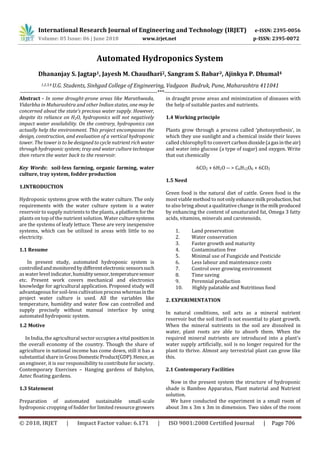
were arranged in a shelf system made of bamboos. The
choice of bamboo instead of aluminum or steel was to make
this economically viable and adaptable by any Indian
farmers.
Our goal was to make this fodder completely in an organic
manner, and to suit the local Indian conditions for
development of a cost-effective hydroponics Fodder device.
Hence, we decided to use fungicide and nutrient solution
commonly known as Beejamrit.
Fig -1: Bamboo Structure and Tray
In our system, we have used automatic water sprinkling
system. This constitutes temperature & humidity control,
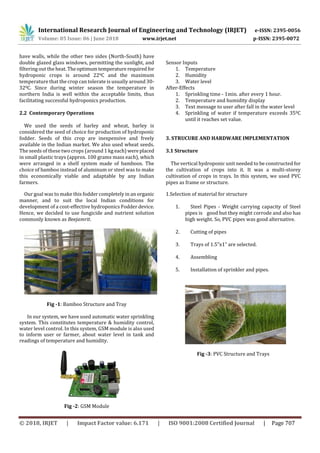
water level control. In this system, GSM module is also used
to inform user or farmer, about water level in tank and
readings of temperature and humidity.
Fig -2: GSM Module
Sensor Inputs
1. Temperature
2. Humidity
3. Water level
After-Effects
1. Sprinkling time - 1min. after every 1 hour.
2. Temperature and humidity display
3. Text message to user after fall in the water level
4. Sprinkling of water if temperature exceeds 350C
until it reaches set value.
3. STRUCURE AND HARDWARE IMPLEMENTATION
3.1 Structure
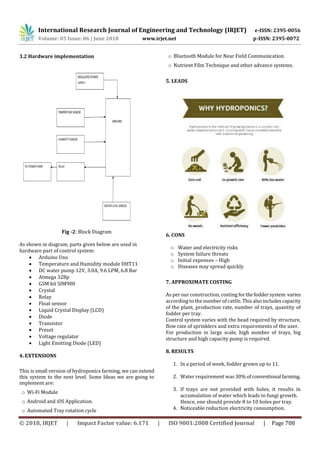
The vertical hydroponic unit needed to be constructed for
the cultivation of crops into it. It was a multi-storey
cultivation of crops in trays. In this system, we used PVC
pipes as frame or structure.
1.Selection of material for structure
1. Steel Pipes - Weight carrying capacity of Steel
pipes is good but they might corrode and also has
high weight. So, PVC pipes was good alternative.
2. Cutting of pipes
3. Trays of 1.5”x1” are selected.
4. Assembling
5. Installation of sprinkler and pipes.
Fig -3: PVC Structure and Trays
International Research Journal of Engineering and Technology (IRJET) e-ISSN: 2395-0056
Volume: 05 Issue: 06 | June 2018 www.irjet.net p-ISSN: 2395-0072
© 2018, IRJET | Impact Factor value: 6.171 | ISO 9001:2008 Certified Journal | Page 708
3.2 Hardware implementation
Fig -2: Block Diagram
As shown in diagram, parts given below are used in
hardware part of control system:
 Arduino Uno
 Temperature and Humidity module DHT11
 DC water pump 12V, 3.0A, 9.6 LPM, 6.8 Bar
 Atmega 328p
 GSM kit SIM900
 Crystal
 Relay
 Float sensor
 Liquid Crystal Display (LCD)
 Diode
 Transistor
 Preset
 Voltage regulator
 Light Emitting Diode (LED)
4. EXTENSIONS
This is small version of hydroponics farming, we can extend
this system to the next level. Some Ideas we are going to
implement are:
o Wi-Fi Module
o Android and iOS Application.
o Automated Tray rotation cycle
o Bluetooth Module for Near Field Communication
o Nutrient Film Technique and other advance systems.
5. LEADS
6. CONS
o Water and electricity risks
o System failure threats
o Initial expenses – High
o Diseases may spread quickly
7. APPROXIMATE COSTING
As per our construction, costing forthefoddersystem varies
according to the number of cattle. This alsoincludescapacity
of the plant, production rate, number of trays, quantity of
fodder per tray.
Control system varies with the head required by structure,
flow rate of sprinklers and extra requirements of the user.
For production in large scale, high number of trays, big
structure and high capacity pump is required.
8. RESULTS
1. In a period of week, fodder grown up to 11.
2. Water requirement was 30% ofconventional farming.
3. If trays are not provided with holes, it results in
accumulation of water which leads to fungi growth.
Hence, one should provide 8 to 10 holes per tray.
4. Noticeable reduction electricity consumption.
International Research Journal of Engineering and Technology (IRJET) e-ISSN: 2395-0056
Volume: 05 Issue: 06 | June 2018 www.irjet.net p-ISSN: 2395-0072
© 2018, IRJET | Impact Factor value: 6.171 | ISO 9001:2008 Certified Journal | Page 709
9. CONCLUSIONS
It has now been a little over 2 weeks since we've begun our
deep-water culture hydroponic system. The roots of plants
are visible. By using this system, farmers in draught prone
areas can grow fodder at affordable price.Priceofthefodder
per kg reduced up to ₹ 2 to ₹ 3.
Thus far we've tested and adjusted the water sprinkling
time, we think that this system is successfully conducted.
ACKNOWLEDGEMENT
We wish to express our sincere thanks with profound
gratitude to our guide Prof. P.S. Yadav for his valuable
guidance and constant encouragement. We extremely
grateful to Prof. S.A. Kulkarni, Prof. A.B. Korane andProf.S.R.
Bhave for their assistance and keep us going in hardesttime.
We truly thanks to our head of the department, Prof. V.N.
Kapatkar and Principal Dr. S.D. Lokhande.
Apologies to those whose help is not acknowledged.
REFERENCES
[1] Adrover. “Use of hydroponics culture to assess nutrient
supply. Technical report. Technical report, Department
of Biology”, University of Balearic Islands, 07122 Palma
de Mallorca, Spain, 2009.
[2] Ferentinos.”Neural network-based detection of
mechanical, sensor and biological faults in deep-trough
hydroponics. Technical report”, Department of Bio-
logical and Environmental Engineering, Cornell
University, Ithaca, NY 14853, USA, 2003.
[3] Giaglaras. “Dynamic Simulation of Nutrient Solution
Composition In A Closed HydroponicsSystem.Technical
report, University of Thessaly”, Department of
Agriculture, Animal and Crop Production Laboratory of
Agricultural Structures and Climate Regulation, Pedion
Areos38344, Volos, Greece, 2005.
[4] Hamed. “Cilioprotists as biological indicators for
estimating the efficiency of using Gravel Bed
Hydroponics System in domestic wastewatertreatment.
Technical report”, Department of Marine Science,
Faculty of Science, Port Said University,PortSaid,Egypt,
2013.
[5] Jayawardana. “The mechanisms underlying the
anthracnose disease reduction by rice hull as a silicon
source in capsicum (Capsicum annuum L.) grown in
simplied hydroponics”. Technical report,Departmentof
Botany, Faculty ofNatural Sciences,The OpenUniversity
of Sri Lanka, Nawala, 2015
[6] Nicholas. “Design, Construction and evaluation of
vertical hydroponic tower”. Technical report,
BioResource and Agricultural Engineering BioResource
and Agricultural Engineering Department California
Polytechnic State University San Luis Obispo, 2014.
[7] Thomsen. “Environmental Impacts of Urban
Hydroponics in Europe”:ACaseStudyinLyon. Technical
report, Department of Environmental Science, Aarhus
University, Frederiksborgvej 399, Postboks 358, DK-
4000 Roskilde, Denmark, 2018.
[8] Tiziano. “Quality assessment in organic vs.conventional
agricultural produce: Findings and issues”. Technical
report, Fellow Department of Environmental Studies,
Faculty of Social Studies, Masaryk University, Brno, 602
00, Czech Republic, 2017.
[9] Vaibhav. “Fully Automated Hydroponic System for
Indoor Plant Growth”. Technical report, College of
Engineering and Computer Science, California State
University, Fullerton 92831, United States, 2018.
[10] Wangwibulkit. “CEx-situ propagation of Pogostemon
helferi (Hook. f.) Press using tissue culture and a
hydroponics system”. Technical report, land Fisheries
Research and Development Bureau, Department of
Fisheries, Bangkok 10900, Thailand, 2017.

IRJET- Automated Hydroponics System

  • 1.
    International Research Journalof Engineering and Technology (IRJET) e-ISSN: 2395-0056 Volume: 05 Issue: 06 | June 2018 www.irjet.net p-ISSN: 2395-0072 © 2018, IRJET | Impact Factor value: 6.171 | ISO 9001:2008 Certified Journal | Page 706 Automated Hydroponics System Dhananjay S. Jagtap1, Jayesh M. Chaudhari2, Sangram S. Babar3, Ajinkya P. Dhumal4 1,2,3,4 U.G. Students, Sinhgad College of Engineering, Vadgaon Budruk, Pune, Maharashtra 411041 -----------------------------------------------------------------------------***---------------------------------------------------------------------------- Abstract - In some drought-prone areas like Marathwada, Vidarbha in Maharashtra and other Indian states, one may be concerned about the state’s precious water supply. However, despite its reliance on H2O, hydroponics will not negatively impact water availability. On the contrary, hydroponics can actually help the environment. This project encompasses the design, construction, and evaluation of a vertical hydroponic tower. The tower is to be designed to cycle nutrient rich water through hydroponic system; tray and water culture technique then return the water back to the reservoir. Key Words: soil-less farming, organic farming, water culture, tray system, fodder production 1.INTRODUCTION Hydroponic systems grow with the water culture. The only requirements with the water culture system is a water reservoir to supply nutrients to the plants, a platformforthe plants on top of the nutrient solution. Water culturesystems are the systems of leafy lettuce. These are very inexpensive systems, which can be utilized in areas with little to no electricity. 1.1 Resume In present study, automated hydroponic system is controlledandmonitoredbydifferentelectronicsensorssuch as water levelindicator,humiditysensor,temperaturesensor etc. Present work covers mechanical and electronics knowledge for agricultural application. Proposed study will advantageous forsoil-less cultivation process whereasinthe project water culture is used. All the variables like temperature, humidity and water flow can controlled and supply precisely without manual interface by using automated hydroponic system. 1.2 Motive In India, the agricultural sector occupies a vital positionin the overall economy of the country. Though the share of agriculture in national income has come down, still it has a substantial share in GrossDomestic Product(GDP).Hence, as an engineer, it is our responsibility to contribute for society. Contemporary Exercises – Hanging gardens of Babylon, Aztec floating gardens. 1.3 Statement Preparation of automated sustainable small-scale hydroponic cropping of fodder for limited resource growers in draught prone areas and minimization of diseases with the help of suitable pastes and nutrients. 1.4 Working principle Plants grow through a process called ‘photosynthesis’, in which they use sunlight and a chemical inside their leaves called chlorophyll to convert carbon dioxide(a gasintheair) and water into glucose (a type of sugar) and oxygen. Write that out chemically 6CO2 + 6H2O -- > C6H12O6 + 6CO2 1.5 Need Green food is the natural diet of cattle. Green food is the most viable method to notonlyenhancemilk production,but to also bring about a qualitative change in themilk produced by enhancing the content of unsaturated fat, Omega 3 fatty acids, vitamins, minerals and carotenoids. 1. Land preservation 2. Water conservation 3. Faster growth and maturity 4. Contamination free 5. Minimal use of Fungicide and Pesticide 6. Less labour and maintenance costs 7. Control over growing environment 8. Time saving 9. Perennial production 10. Highly palatable and Nutritious food 2. EXPERIMENTATION In natural conditions, soil acts as a mineral nutrient reservoir but the soil itself is not essential to plant growth. When the mineral nutrients in the soil are dissolved in water, plant roots are able to absorb them. When the required mineral nutrients are introduced into a plant's water supply artificially, soil is no longer required for the plant to thrive. Almost any terrestrial plant can grow like this. 2.1 Contemporary Facilities Now in the present system the structure of hydroponic shade is Bamboo Apparatus, Plant material and Nutrient solution. We have conducted the experiment in a small room of about 3m x 3m x 3m in dimension. Two sides of the room
  • 2.
    International Research Journalof Engineering and Technology (IRJET) e-ISSN: 2395-0056 Volume: 05 Issue: 06 | June 2018 www.irjet.net p-ISSN: 2395-0072 © 2018, IRJET | Impact Factor value: 6.171 | ISO 9001:2008 Certified Journal | Page 707 have walls, while the other two sides (North-South) have double glazed glass windows, permitting the sunlight, and filtering out the heat. Theoptimumtemperature required for hydroponic crops is around 220C and the maximum temperature that the crop can tolerate is usually around 30- 320C. Since during winter season the temperature in northern India is well within the acceptable limits, thus facilitating successful hydroponics production. 2.2 Contemporary Operations We used the seeds of barley and wheat, barley is considered the seed of choice for production of hydroponic fodder. Seeds of this crop are inexpensive and freely available in the Indian market. We also used wheat seeds. The seeds of these two crops (around 1 kgeach)wereplaced in small plastic trays (approx. 100 grams mass each), which were arranged in a shelf system made of bamboos. The choice of bamboo instead of aluminum or steel was to make this economically viable and adaptable by any Indian farmers. Our goal was to make this fodder completely in an organic manner, and to suit the local Indian conditions for development of a cost-effective hydroponics Fodder device. Hence, we decided to use fungicide and nutrient solution commonly known as Beejamrit. Fig -1: Bamboo Structure and Tray In our system, we have used automatic water sprinkling system. This constitutes temperature & humidity control, water level control. In this system, GSM module is also used to inform user or farmer, about water level in tank and readings of temperature and humidity. Fig -2: GSM Module Sensor Inputs 1. Temperature 2. Humidity 3. Water level After-Effects 1. Sprinkling time - 1min. after every 1 hour. 2. Temperature and humidity display 3. Text message to user after fall in the water level 4. Sprinkling of water if temperature exceeds 350C until it reaches set value. 3. STRUCURE AND HARDWARE IMPLEMENTATION 3.1 Structure The vertical hydroponic unit needed to be constructed for the cultivation of crops into it. It was a multi-storey cultivation of crops in trays. In this system, we used PVC pipes as frame or structure. 1.Selection of material for structure 1. Steel Pipes - Weight carrying capacity of Steel pipes is good but they might corrode and also has high weight. So, PVC pipes was good alternative. 2. Cutting of pipes 3. Trays of 1.5”x1” are selected. 4. Assembling 5. Installation of sprinkler and pipes. Fig -3: PVC Structure and Trays
  • 3.
    International Research Journalof Engineering and Technology (IRJET) e-ISSN: 2395-0056 Volume: 05 Issue: 06 | June 2018 www.irjet.net p-ISSN: 2395-0072 © 2018, IRJET | Impact Factor value: 6.171 | ISO 9001:2008 Certified Journal | Page 708 3.2 Hardware implementation Fig -2: Block Diagram As shown in diagram, parts given below are used in hardware part of control system:  Arduino Uno  Temperature and Humidity module DHT11  DC water pump 12V, 3.0A, 9.6 LPM, 6.8 Bar  Atmega 328p  GSM kit SIM900  Crystal  Relay  Float sensor  Liquid Crystal Display (LCD)  Diode  Transistor  Preset  Voltage regulator  Light Emitting Diode (LED) 4. EXTENSIONS This is small version of hydroponics farming, we can extend this system to the next level. Some Ideas we are going to implement are: o Wi-Fi Module o Android and iOS Application. o Automated Tray rotation cycle o Bluetooth Module for Near Field Communication o Nutrient Film Technique and other advance systems. 5. LEADS 6. CONS o Water and electricity risks o System failure threats o Initial expenses – High o Diseases may spread quickly 7. APPROXIMATE COSTING As per our construction, costing forthefoddersystem varies according to the number of cattle. This alsoincludescapacity of the plant, production rate, number of trays, quantity of fodder per tray. Control system varies with the head required by structure, flow rate of sprinklers and extra requirements of the user. For production in large scale, high number of trays, big structure and high capacity pump is required. 8. RESULTS 1. In a period of week, fodder grown up to 11. 2. Water requirement was 30% ofconventional farming. 3. If trays are not provided with holes, it results in accumulation of water which leads to fungi growth. Hence, one should provide 8 to 10 holes per tray. 4. Noticeable reduction electricity consumption.
  • 4.
    International Research Journalof Engineering and Technology (IRJET) e-ISSN: 2395-0056 Volume: 05 Issue: 06 | June 2018 www.irjet.net p-ISSN: 2395-0072 © 2018, IRJET | Impact Factor value: 6.171 | ISO 9001:2008 Certified Journal | Page 709 9. CONCLUSIONS It has now been a little over 2 weeks since we've begun our deep-water culture hydroponic system. The roots of plants are visible. By using this system, farmers in draught prone areas can grow fodder at affordable price.Priceofthefodder per kg reduced up to ₹ 2 to ₹ 3. Thus far we've tested and adjusted the water sprinkling time, we think that this system is successfully conducted. ACKNOWLEDGEMENT We wish to express our sincere thanks with profound gratitude to our guide Prof. P.S. Yadav for his valuable guidance and constant encouragement. We extremely grateful to Prof. S.A. Kulkarni, Prof. A.B. Korane andProf.S.R. Bhave for their assistance and keep us going in hardesttime. We truly thanks to our head of the department, Prof. V.N. Kapatkar and Principal Dr. S.D. Lokhande. Apologies to those whose help is not acknowledged. REFERENCES [1] Adrover. “Use of hydroponics culture to assess nutrient supply. Technical report. Technical report, Department of Biology”, University of Balearic Islands, 07122 Palma de Mallorca, Spain, 2009. [2] Ferentinos.”Neural network-based detection of mechanical, sensor and biological faults in deep-trough hydroponics. Technical report”, Department of Bio- logical and Environmental Engineering, Cornell University, Ithaca, NY 14853, USA, 2003. [3] Giaglaras. “Dynamic Simulation of Nutrient Solution Composition In A Closed HydroponicsSystem.Technical report, University of Thessaly”, Department of Agriculture, Animal and Crop Production Laboratory of Agricultural Structures and Climate Regulation, Pedion Areos38344, Volos, Greece, 2005. [4] Hamed. “Cilioprotists as biological indicators for estimating the efficiency of using Gravel Bed Hydroponics System in domestic wastewatertreatment. Technical report”, Department of Marine Science, Faculty of Science, Port Said University,PortSaid,Egypt, 2013. [5] Jayawardana. “The mechanisms underlying the anthracnose disease reduction by rice hull as a silicon source in capsicum (Capsicum annuum L.) grown in simplied hydroponics”. Technical report,Departmentof Botany, Faculty ofNatural Sciences,The OpenUniversity of Sri Lanka, Nawala, 2015 [6] Nicholas. “Design, Construction and evaluation of vertical hydroponic tower”. Technical report, BioResource and Agricultural Engineering BioResource and Agricultural Engineering Department California Polytechnic State University San Luis Obispo, 2014. [7] Thomsen. “Environmental Impacts of Urban Hydroponics in Europe”:ACaseStudyinLyon. Technical report, Department of Environmental Science, Aarhus University, Frederiksborgvej 399, Postboks 358, DK- 4000 Roskilde, Denmark, 2018. [8] Tiziano. “Quality assessment in organic vs.conventional agricultural produce: Findings and issues”. Technical report, Fellow Department of Environmental Studies, Faculty of Social Studies, Masaryk University, Brno, 602 00, Czech Republic, 2017. [9] Vaibhav. “Fully Automated Hydroponic System for Indoor Plant Growth”. Technical report, College of Engineering and Computer Science, California State University, Fullerton 92831, United States, 2018. [10] Wangwibulkit. “CEx-situ propagation of Pogostemon helferi (Hook. f.) Press using tissue culture and a hydroponics system”. Technical report, land Fisheries Research and Development Bureau, Department of Fisheries, Bangkok 10900, Thailand, 2017.