International Research Journal of Engineering and Technology (IRJET) e-ISSN: 2395-0056
Volume: 06 Issue: 07 | July 2019 www.irjet.net p-ISSN: 2395-0072
© 2019, IRJET | Impact Factor value: 7.211 | ISO 9001:2008 Certified Journal | Page 2241
Acute Ischemic Stroke Detection and Classification
S.R. Tongase1, S.S. Thorat2
1P.G. Scholar, Dept. of Electronics Engineering, GCOE, Amravati
2Assitant Professor, Dept. of Electronics Engineering, GCOE, Amravati
----------------------------------------------------------------------***---------------------------------------------------------------------
Abstract - Ischemic stroke is more common hence,
identification of ischemic stroke and detection of region of
brain affected is more important. CT (Computed
Tomography) scan images are widely use in rehabilitation
process. This paper presents the method to detect the stroke
region and classify normal and stroke patient.
Preprocessing operation perform on the input CT scan
image and skull part removed from the image. Stroke region
segmented from the image using morphological operation
and highlighted the region on original CT image or if CT
scan image is normal case then it shows that patient is
normal. Naive Bayes (NB) and k- Nearest Neighbor (k-NN)
classifiers are used for classification of stroke patient and
normal patient. Classification accuracy of NB and KNN is
92% for 25 image slices of different patient. Processing time
of K-NN classifier is 8.80s while for Naive Bayes 5.85 s.
Key Words: Computed Tomography, Ischemic Stroke,
Naive Bayes, k- Nearest Neighbor, GLCM
1. INTRODUCTION
Stroke is a Cerebro Vascular Accident (CVA) which is a
serious health issue and it is forward in reason of death
worldwide. Stroke is becoming main reason in cause of
disability, dementia and death in the developing countries.
Stroke affects the person who may be disabled and their
family also. Stroke is cause by interruption in supply of
blood to the brain, generally because of blood vessel burst
or blockage due to blood clot as shown in Fig. 1. This
interruption in supply of nutrients and oxygen to the
brain, results into the damage of brain tissue. Stroke is
divided into two types which are Ischemic and
Hemorrhagic. Abrupt occlusion of arteries supplying the
brain is the main cause of Ischemic Stroke [18].
Hemorrhagic stroke are cause by subarachnoid
hemorrhage- bleeding from one of the brain arteries into
the brain tissue or intra-cerebral hemorrhage - arterial
bleeding.
Almost 80 percent of strokes are ischemic stroke[18].
Hence it is required to detect the stroke in early stages.
Computed Tomography Scan images are widely for the
diagnosis of stroke. In CT scan dataset Ischemic stroke
appears as dark area with the contrast and hemorrhage as
bright region.
The proposed method used image processing
techniques such as median filtering, segmentation,
morphological operation. Naive Bayes and k- Nearest
Neighbor (k-NN) classifiers are used for the classification.
Fig -1: Supply of blood to the brain through vessel
Obstructed
2. LITERATURE SURVEY
Stroke can be diagnosed, if immediate treatment is
available. Damage to the brain depend on severity of the
stroke and amount time period for which the stroke occur.
CT(Computed Tomography) scan and MRI(Magnetic
Resonance Imaging) used in the rehabilitation process of
stroke, whereas CT scan is easily available, less costly and
widely used.
P. R. Mirajkar [4] proposed an algorithm to detect of
an acute ischemic stroke utilizing CT scan and MRI dataset.
CT scan images and Diffusion Weighted MRI are fused
which results in a composite image. This image provides
more information than single modality which is
accomplished using DWT. The algorithm is tested on 18
cases and for 16 cases stroke region is identified precisely.
A. F. Z. Yahiaoui [5] derived a method for the segmentation
of the Ischemic Stroke from CT scan images. FCM
clustering technique is used to segment the stroke region
of the brain. 10.46 s is average processing time achieved.
Dr. Menaka R [6] derived an algorithm for the detection of
an Ischemic Stroke from MRI dataset utilizing wavelet
transform. Classification of Normal and abnormal brain is
attain using watershed segmentation. Texture analysis is
performed using Grey Level Co-occurrence Matrix (GLCM)
and wavelet features extracted. Neural Network is applied
on FPGA by making Xillinx Simulink Blocks. Jeena R S [7]
International Research Journal of Engineering and Technology (IRJET) e-ISSN: 2395-0056
Volume: 06 Issue: 07 | July 2019 www.irjet.net p-ISSN: 2395-0072
© 2019, IRJET | Impact Factor value: 7.211 | ISO 9001:2008 Certified Journal | Page 2242
analyzed the MRI and CT images of brain for stroke
diagnosis. The computational of the algorithm time is very
less. Md Tabish raza [8] derived a comparison based
technique for detection of Ischemic tissue, by utilizing CBV
and MTT perfusion map. Status of tissue is classified. T. L.
Tan [9] derived a technique to enhance the contrast of CT
brain images for the detection of acute ischemic stroke.
Proposed method enhanced contrast of soft tissue and
achieved EMEE is 3.9409, PSNR is 32.7426. Kiran Parmar
[10] analyses the fusion of CT scan and MRI images using
wavelet transform. Maximum fusion rule achieved least
MSE and higher PSNR values. Mayank Chawla [11] derived
a technique to detect and classify the stroke using CT scan
images of the brain. Histogram plot is used to detect the
abnormal slices. Daubechies-4 is used for classification.
Ming sian, Lee [13] derived an algorithm which increases
the visual perception of stroke detection system.
Anisotropic filter removes noise. Brain images extracted
using Mathematical morphology. Region growing
technique is used to extract stroke region. 85% success
rate is achieved by the proposed system.
3. METHODOLOGY
Fig -2: Complete Block diagram of the System
Implemented
3.1 Pre-processing of CT scan Images
The purpose of the pre-processing step is to produce data
which are compatible with the ischemic stroke region
detection and classification system.
Input image is converted into grey image and resize
operation performed to get specific size image for further
operation. Histogram plot operation is perform to
calculate the number of pixel and grey level of image.
Image converted to black and white (binary) image to find
the region of interest with certain threshold value. Small
specks remove that have fewer pixel than specific value.
Small holes filled to get cleaned binary image.
1. Median Filtering
Image Enhancement involves filtering, resizing and
adjustment operation. Median filtering removes unwanted
noise from the image. Median filtering is one of the
popular image enhancement techniques.
2. Skull Stripping
Skull is unwanted part of the brain, to eliminate this
skull stripping is implemented. Skull part of the brain
image is unwanted which is removed using erosion
operation as shown in Fig 3.
(a) (b)
Fig -3: (a) Original Input Image of Normal Patient
(b) Preprocessed and Skull stripped of Original Image
(a) (b)
Fig -4: (a) Original Input Image of Stroke Patient
(b) Preprocessed and Skull stripped of Original Image
International Research Journal of Engineering and Technology (IRJET) e-ISSN: 2395-0056
Volume: 06 Issue: 07 | July 2019 www.irjet.net p-ISSN: 2395-0072
© 2019, IRJET | Impact Factor value: 7.211 | ISO 9001:2008 Certified Journal | Page 2243
3.2 Feature Extraction
Feature extraction can be explained in terms of features
database created after loading the training dataset and
feature evaluation and analysis performed after loading
testing dataset. Feature extraction consists of
Miscellaneous Feature such as Mean and Texture based
feature such as Entropy and Grey Level Co-occurrence
Matrix (GLCM).
Entropy: Entropy is the statistical measure of randomness
that can be used to calculate texture of the input grey scale
image.
E= -sum(p.*log2(p))
Mean: Mean calculates the mean intensity of the gray level
of an image. Mean can be calculated by summing up the
intensity values of all the pixels in the source image, then
dividing by the total number of pixels.
Grey Level Co-occurrence Matrix (GLCM): The GLCM used
to characterized the images on the basis of texture. GLCM
calculates how often a pixel with grey level value occur
either horizontally or vertically. The co-occurrence matrix
can be given as P(i,j|d,θ) where i and j are the grey level
values at a distance d with an angle θ.
µ= Mean value of P
& = Mean value of
& = Standard Deviation of
G = Size of co-occurrence matrix
Energy: Provides the sum of squared elements in the
GLCM. Also known as uniformity or the angular second
moment.
∑ ∑
Correlation: Measures the joint probability occurrence of
the specified pixel pairs.
∑ ∑
{ }
Contrast: Measures the local variations in the gray-level
co-occurrence matrix.
∑ {∑ ∑ } | |
Homogeneity: Measures the closeness of the distribution
of elements in the GLCM to the GLCM diagonal.
∑ ∑
| |
Feature Extraction is an important stage before any
classification. Features of the normal patient and stroke
patient CT scan image have been calculated as shown in
Table I. From the calculated feature values it is found that
there is a slight difference between the stroke and normal
patient feature values. Mean, Entropy and GLCM show a
significant difference in the features of both the images.
From these feature values, images of the stroke patient
and the normal patient can be classified.
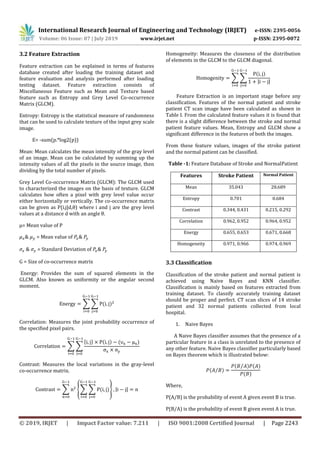
Table -1: Feature Database of Stroke and NormalPatient
Features Stroke Patient Normal Patient
Mean 35.043 28.689
Entropy 0.701 0.684
Contrast 0.344, 0.431 0.215, 0.292
Correlation 0.962, 0.952 0.964, 0.952
Energy 0.655, 0.653 0.671, 0.668
Homogeneity 0.971, 0.966 0.974, 0.969
3.3 Classification
Classification of the stroke patient and normal patient is
achieved using Naive Bayes and KNN classifier.
Classification is mainly based on features extracted from
training dataset. To classify accurately training dataset
should be proper and perfect. CT scan slices of 14 stroke
patient and 32 normal patients collected from local
hospital.
1. Naive Bayes
A Naive Bayes classifier assumes that the presence of a
particular feature in a class is unrelated to the presence of
any other feature. Naive Bayes classifier particularly based
on Bayes theorem which is illustrated below:
⁄
⁄
Where,
P(A/B) is the probability of event A given event B is true.
P(B/A) is the probability of event B given event A is true.
International Research Journal of Engineering and Technology (IRJET) e-ISSN: 2395-0056
Volume: 06 Issue: 07 | July 2019 www.irjet.net p-ISSN: 2395-0072
© 2019, IRJET | Impact Factor value: 7.211 | ISO 9001:2008 Certified Journal | Page 2244
P(A) is prior probability of event A.
P(B) is prior probability of event B
2. K Nearest Neighbor (KNN)
K nearest neighbors is a simple algorithm that stores
all available cases and classifies new cases based on a
similarity measure (e.g Distance function). It belongs to
the supervised learning domain and finds intense
application in pattern recognition, data mining and
intrusion detection.
Let m be the number of training data samples. Let p be an
unknown point.
KNN Algorithm
1. Store the training samples in an array of data
points array. This means each element of this
array represents a tuple (x, y).
2. Calculate Euclidean distance d.
√∑
3. Make set S of K smallest distances obtained. Each
of these distances corresponds to an already
classified data point.
4. Return the majority label among S.
Dataset of 21 patients i.e. 21 CT scan image slices is used
for training of both classifiers. Performance of both
classifiers tested on dataset of 25 patients image slices.
3.4 Segmentation of Stroke Region and Detection
Preprocessed image is then converted into binary
image by applying certain threshold. All the connected
components in the image are removed that having fewer
than certain pixel. Components in the image are
suppressed which are lighter than their surrounding and
connected to image border. Finally, stroke region
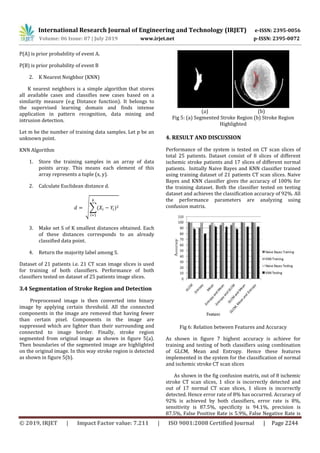
segmented from original image as shown in figure 5(a).
Then boundaries of the segmented image are highlighted
on the original image. In this way stroke region is detected
as shown in figure 5(b).
(a) (b)
Fig 5: (a) Segmented Stroke Region (b) Stroke Region
Highlighted
4. RESULT AND DISCUSSION
Performance of the system is tested on CT scan slices of
total 25 patients. Dataset consist of 8 slices of different
ischemic stroke patients and 17 slices of different normal
patients. Initially Naive Bayes and KNN classifier trained
using training dataset of 21 patients CT scan slices. Naive
Bayes and KNN classifier gives the accuracy of 100% for
the training dataset. Both the classifier tested on testing
dataset and achieves the classification accuracy of 92%. All
the performance parameters are analyzing using
confusion matrix.
Fig 6: Relation between Features and Accuracy
As shown in figure 7 highest accuracy is achieve for
training and testing of both classifiers using combination
of GLCM, Mean and Entropy. Hence these features
implemented in the system for the classification of normal
and ischemic stroke CT scan slices
As shown in the fig confusion matrix, out of 8 ischemic
stroke CT scan slices, 1 slice is incorrectly detected and
out of 17 normal CT scan slices, 1 slices is incorrectly
detected. Hence error rate of 8% has occurred. Accuracy of
92% is achieved by both classifiers, error rate is 8%,
sensitivity is 87.5%, specificity is 94.1%, precision is
87.5%, False Positive Rate is 5.9%, False Negative Rate is
International Research Journal of Engineering and Technology (IRJET) e-ISSN: 2395-0056
Volume: 06 Issue: 07 | July 2019 www.irjet.net p-ISSN: 2395-0072
© 2019, IRJET | Impact Factor value: 7.211 | ISO 9001:2008 Certified Journal | Page 2245
12.5%. Processing time of K-NN classifier for testing
Dataset is 8.80 second. Processing time of NB classifier for
testing dataset is 5.85 second.
Fig 7: Confusion Matrix of Naive Bayes and KNN
False Positive Rate is due to misclassification of slices.
False Negatives Rate is due arise due to a subtle difference
between normal and ischemic stroke. As the training
dataset is accurate hence all the parameters values
achieved are equal for both (Naive Bayes and KNN)
classifiers.
5. CONCLUSIONS
The present study demonstrates effectiveness of different
features and Naive Bayes and K Nearest Neighbor
Algorithm for the acute ischemic stroke detection and
classification. Stroke region is segmented on the basis of
gray level intensity of CT scan image. Naive Bayes and
KNN classifiers achieve the classification accuracy of 92%.
Both the classifiers are having equal accuracy according to
the features implemented. GLCM, Mean and Entropy are
the features used to analyze the texture of the image and
plays important role in the classification. Processing time
of Naive Bayes classifier is less as compare to KNN
classifier.
Finally, to achieve the higher accuracy training
dataset must be proper and suitable features are required
for the feature extraction. Hence accuracy can be
improved in future by implementing various features.
ACKNOWLEDGEMENT
I would like to express my deep gratitude to
Mrs. S. S. Thorat, Assistant Professor, Government College
of Engineering Amravati, my research supervisors, for
their patient guidance, enthusiastic encouragement and
useful critiques of this research work. I would also like to
thank Dr. P. R. Somwanshi, Dean of Dr. Panjabrao
Deshmukh Memorial Medical College (PDMMC), Amravati
for granting permission to take CT scan dataset. My
grateful thanks are also extended to Dr. S. P. Kothari, Head
of Radio-diagnosis Department, PDMMC, Amravati for her
help in allowing CT scan dataset. Also to I would also like
to extend my thanks to the Mr. K. V. Tayade CT scan
technicians of the Radio-diagnosis department, PDMMC,
Amravati for their help in offering me the resources in
running the program.
Finally, I wish to thank my parents for their support and
encouragement throughout my study
REFERENCES
[1] Ray BK, Hazra A, Ghosal M, Banerjee T, Chaudhuri A,
Singh V, et al. Early and delayed fatality of stroke in
Kolkata, India: Results from a 7-year longitudinal
population-based study. J Stroke Cerebrovasc
Dis. 2013; 22:281–9.
[2] The top 10 causes of death. World Health
Organization. http://www.who.
int/mediacentre/factsheets/fs310/en/. Accessed
March 24, 2015
[3] The internet stroke center.
http://www.strokecenter.org/patients/about-
stroke/ischemic-stroke/
[4] P. R. Mirajkar, K. A. Bhagwat, ArunVikas Singh,
Ashalatha M E.“Acute Ischemic Stroke Detection using
Wavelet Based Fusion of CT and MRI Images”
International Conference on Advances in Computing,
Communications and Informatics (ICACCI), 2015
[5] Amina Fatima Zahra Yahiaoui; Abdelhafid Bessaid.
“Segmentation of ischemic stroke area from CT brain
images” International Symposium on Signal, Image,
Video and Communications (ISIVC) , 2016
[6] Dr. Menaka R, Rohini. S,” Efficient Detection of
Ischemic Stroke from MRI Images Using Wavelet
Transform”, International Journal of Computer
Science and Information Technology Research Vol. 2,
Issue 3, pp: (446-454), Month: July - September 2014
[7] Jeena R.S., Kumar, S., "A comparative analysis of MRI
and CT brain images for stroke diagnosis", Emerging
Research Areas and 2013 International Conference on
Microelectronics, Communications and Renewable
Energy (AICERA/ICMiCR), 2013 Annual International
Conference on , vol., no., pp.1,5, 4-6 June 2013
[8] Md Tabish Raza, S. N. Merchant “A Comparison Based
Approach for Brain Tissue Detection under
Cerebrovascular Accident (Ischemic) Using CBV and
MTT Perfusion Map”. IEEE Conference on Information
& Communication Technologies, 2013.
[9] Tiong-Lang Tan; Kok-Swee Sim; Aun-Kee Chong,
"Contrast enhancement of CT brain images for
detection of ischemic stroke," Biomedical Engineering
International Research Journal of Engineering and Technology (IRJET) e-ISSN: 2395-0056
Volume: 06 Issue: 07 | July 2019 www.irjet.net p-ISSN: 2395-0072
© 2019, IRJET | Impact Factor value: 7.211 | ISO 9001:2008 Certified Journal | Page 2246
(ICoBE), 2012 International Conference on , vol., no.,
pp.385,388, 27-28 Feb. 2012
[10] K. Parmar, R. K. Kher, F. N. Thakkar “Analysis of CT
and MRI Image fusion using Wavelet Transform”
International Conference on Communication System
and Network Technologies,2012
[11] Chawla, M.; Sharma, S.; Sivaswamy, J.; Kishore, L.T., "A
method for automatic detection and classification of
stroke from brain CT images," Engineering in
Medicine and Biology Society, 2009. EMBC 2009.
Annual International Conference of the IEEE , vol., no.,
pp.3581,3584, 3-6 Sept. 2009
[12] Teena Thomas, Jobin Jose,” Computer Aided Detection
Of Ischemic Stroke Using Cellular Automata”,
International Conference On Innovations & Advances
In Science, Engineering And Technology [IC -IASET
2014],Volume 3, Special Issue 5, July 2014
[13] Ming Sian Lee; Chiun Li Chin; Ya Wen Lee; Chian Yun
Lee; Yan Ru Chen, "Increasing Visual Perception Brain
Stroke Detection System," Computing, Measurement,
Control and Sensor Network (CMCSN), 2012
International Conference on , vol., no., pp.429,432, 7-9
July 2012
[14] J. D. Lee, T. C. Chang, C. H. Huang, S. J. Wu, C. J. Chen
“Computer- aided Diagnosis system for acute stroke
using Diffusion Weighted images with Volume
Calculation”.26th Annual International Conference if
the IEEE EMBS,2004.
[15] https://www.analyticsvidhya.com/blog/2017/09/nai
ve-bayes-explained/
[16] http://www.saedsayad.com/k_nearest_neighbors.htm
l
[17] https://www.geeksforgeeks.org/k-nearest-
neighbours/
[18] http://www.strokecenter.org/patients/about-
stroke/stroke-statistics/

IRJET- Acute Ischemic Stroke Detection and Classification

  • 1.
    International Research Journalof Engineering and Technology (IRJET) e-ISSN: 2395-0056 Volume: 06 Issue: 07 | July 2019 www.irjet.net p-ISSN: 2395-0072 © 2019, IRJET | Impact Factor value: 7.211 | ISO 9001:2008 Certified Journal | Page 2241 Acute Ischemic Stroke Detection and Classification S.R. Tongase1, S.S. Thorat2 1P.G. Scholar, Dept. of Electronics Engineering, GCOE, Amravati 2Assitant Professor, Dept. of Electronics Engineering, GCOE, Amravati ----------------------------------------------------------------------***--------------------------------------------------------------------- Abstract - Ischemic stroke is more common hence, identification of ischemic stroke and detection of region of brain affected is more important. CT (Computed Tomography) scan images are widely use in rehabilitation process. This paper presents the method to detect the stroke region and classify normal and stroke patient. Preprocessing operation perform on the input CT scan image and skull part removed from the image. Stroke region segmented from the image using morphological operation and highlighted the region on original CT image or if CT scan image is normal case then it shows that patient is normal. Naive Bayes (NB) and k- Nearest Neighbor (k-NN) classifiers are used for classification of stroke patient and normal patient. Classification accuracy of NB and KNN is 92% for 25 image slices of different patient. Processing time of K-NN classifier is 8.80s while for Naive Bayes 5.85 s. Key Words: Computed Tomography, Ischemic Stroke, Naive Bayes, k- Nearest Neighbor, GLCM 1. INTRODUCTION Stroke is a Cerebro Vascular Accident (CVA) which is a serious health issue and it is forward in reason of death worldwide. Stroke is becoming main reason in cause of disability, dementia and death in the developing countries. Stroke affects the person who may be disabled and their family also. Stroke is cause by interruption in supply of blood to the brain, generally because of blood vessel burst or blockage due to blood clot as shown in Fig. 1. This interruption in supply of nutrients and oxygen to the brain, results into the damage of brain tissue. Stroke is divided into two types which are Ischemic and Hemorrhagic. Abrupt occlusion of arteries supplying the brain is the main cause of Ischemic Stroke [18]. Hemorrhagic stroke are cause by subarachnoid hemorrhage- bleeding from one of the brain arteries into the brain tissue or intra-cerebral hemorrhage - arterial bleeding. Almost 80 percent of strokes are ischemic stroke[18]. Hence it is required to detect the stroke in early stages. Computed Tomography Scan images are widely for the diagnosis of stroke. In CT scan dataset Ischemic stroke appears as dark area with the contrast and hemorrhage as bright region. The proposed method used image processing techniques such as median filtering, segmentation, morphological operation. Naive Bayes and k- Nearest Neighbor (k-NN) classifiers are used for the classification. Fig -1: Supply of blood to the brain through vessel Obstructed 2. LITERATURE SURVEY Stroke can be diagnosed, if immediate treatment is available. Damage to the brain depend on severity of the stroke and amount time period for which the stroke occur. CT(Computed Tomography) scan and MRI(Magnetic Resonance Imaging) used in the rehabilitation process of stroke, whereas CT scan is easily available, less costly and widely used. P. R. Mirajkar [4] proposed an algorithm to detect of an acute ischemic stroke utilizing CT scan and MRI dataset. CT scan images and Diffusion Weighted MRI are fused which results in a composite image. This image provides more information than single modality which is accomplished using DWT. The algorithm is tested on 18 cases and for 16 cases stroke region is identified precisely. A. F. Z. Yahiaoui [5] derived a method for the segmentation of the Ischemic Stroke from CT scan images. FCM clustering technique is used to segment the stroke region of the brain. 10.46 s is average processing time achieved. Dr. Menaka R [6] derived an algorithm for the detection of an Ischemic Stroke from MRI dataset utilizing wavelet transform. Classification of Normal and abnormal brain is attain using watershed segmentation. Texture analysis is performed using Grey Level Co-occurrence Matrix (GLCM) and wavelet features extracted. Neural Network is applied on FPGA by making Xillinx Simulink Blocks. Jeena R S [7]
  • 2.
    International Research Journalof Engineering and Technology (IRJET) e-ISSN: 2395-0056 Volume: 06 Issue: 07 | July 2019 www.irjet.net p-ISSN: 2395-0072 © 2019, IRJET | Impact Factor value: 7.211 | ISO 9001:2008 Certified Journal | Page 2242 analyzed the MRI and CT images of brain for stroke diagnosis. The computational of the algorithm time is very less. Md Tabish raza [8] derived a comparison based technique for detection of Ischemic tissue, by utilizing CBV and MTT perfusion map. Status of tissue is classified. T. L. Tan [9] derived a technique to enhance the contrast of CT brain images for the detection of acute ischemic stroke. Proposed method enhanced contrast of soft tissue and achieved EMEE is 3.9409, PSNR is 32.7426. Kiran Parmar [10] analyses the fusion of CT scan and MRI images using wavelet transform. Maximum fusion rule achieved least MSE and higher PSNR values. Mayank Chawla [11] derived a technique to detect and classify the stroke using CT scan images of the brain. Histogram plot is used to detect the abnormal slices. Daubechies-4 is used for classification. Ming sian, Lee [13] derived an algorithm which increases the visual perception of stroke detection system. Anisotropic filter removes noise. Brain images extracted using Mathematical morphology. Region growing technique is used to extract stroke region. 85% success rate is achieved by the proposed system. 3. METHODOLOGY Fig -2: Complete Block diagram of the System Implemented 3.1 Pre-processing of CT scan Images The purpose of the pre-processing step is to produce data which are compatible with the ischemic stroke region detection and classification system. Input image is converted into grey image and resize operation performed to get specific size image for further operation. Histogram plot operation is perform to calculate the number of pixel and grey level of image. Image converted to black and white (binary) image to find the region of interest with certain threshold value. Small specks remove that have fewer pixel than specific value. Small holes filled to get cleaned binary image. 1. Median Filtering Image Enhancement involves filtering, resizing and adjustment operation. Median filtering removes unwanted noise from the image. Median filtering is one of the popular image enhancement techniques. 2. Skull Stripping Skull is unwanted part of the brain, to eliminate this skull stripping is implemented. Skull part of the brain image is unwanted which is removed using erosion operation as shown in Fig 3. (a) (b) Fig -3: (a) Original Input Image of Normal Patient (b) Preprocessed and Skull stripped of Original Image (a) (b) Fig -4: (a) Original Input Image of Stroke Patient (b) Preprocessed and Skull stripped of Original Image
  • 3.
    International Research Journalof Engineering and Technology (IRJET) e-ISSN: 2395-0056 Volume: 06 Issue: 07 | July 2019 www.irjet.net p-ISSN: 2395-0072 © 2019, IRJET | Impact Factor value: 7.211 | ISO 9001:2008 Certified Journal | Page 2243 3.2 Feature Extraction Feature extraction can be explained in terms of features database created after loading the training dataset and feature evaluation and analysis performed after loading testing dataset. Feature extraction consists of Miscellaneous Feature such as Mean and Texture based feature such as Entropy and Grey Level Co-occurrence Matrix (GLCM). Entropy: Entropy is the statistical measure of randomness that can be used to calculate texture of the input grey scale image. E= -sum(p.*log2(p)) Mean: Mean calculates the mean intensity of the gray level of an image. Mean can be calculated by summing up the intensity values of all the pixels in the source image, then dividing by the total number of pixels. Grey Level Co-occurrence Matrix (GLCM): The GLCM used to characterized the images on the basis of texture. GLCM calculates how often a pixel with grey level value occur either horizontally or vertically. The co-occurrence matrix can be given as P(i,j|d,θ) where i and j are the grey level values at a distance d with an angle θ. µ= Mean value of P & = Mean value of & = Standard Deviation of G = Size of co-occurrence matrix Energy: Provides the sum of squared elements in the GLCM. Also known as uniformity or the angular second moment. ∑ ∑ Correlation: Measures the joint probability occurrence of the specified pixel pairs. ∑ ∑ { } Contrast: Measures the local variations in the gray-level co-occurrence matrix. ∑ {∑ ∑ } | | Homogeneity: Measures the closeness of the distribution of elements in the GLCM to the GLCM diagonal. ∑ ∑ | | Feature Extraction is an important stage before any classification. Features of the normal patient and stroke patient CT scan image have been calculated as shown in Table I. From the calculated feature values it is found that there is a slight difference between the stroke and normal patient feature values. Mean, Entropy and GLCM show a significant difference in the features of both the images. From these feature values, images of the stroke patient and the normal patient can be classified. Table -1: Feature Database of Stroke and NormalPatient Features Stroke Patient Normal Patient Mean 35.043 28.689 Entropy 0.701 0.684 Contrast 0.344, 0.431 0.215, 0.292 Correlation 0.962, 0.952 0.964, 0.952 Energy 0.655, 0.653 0.671, 0.668 Homogeneity 0.971, 0.966 0.974, 0.969 3.3 Classification Classification of the stroke patient and normal patient is achieved using Naive Bayes and KNN classifier. Classification is mainly based on features extracted from training dataset. To classify accurately training dataset should be proper and perfect. CT scan slices of 14 stroke patient and 32 normal patients collected from local hospital. 1. Naive Bayes A Naive Bayes classifier assumes that the presence of a particular feature in a class is unrelated to the presence of any other feature. Naive Bayes classifier particularly based on Bayes theorem which is illustrated below: ⁄ ⁄ Where, P(A/B) is the probability of event A given event B is true. P(B/A) is the probability of event B given event A is true.
  • 4.
    International Research Journalof Engineering and Technology (IRJET) e-ISSN: 2395-0056 Volume: 06 Issue: 07 | July 2019 www.irjet.net p-ISSN: 2395-0072 © 2019, IRJET | Impact Factor value: 7.211 | ISO 9001:2008 Certified Journal | Page 2244 P(A) is prior probability of event A. P(B) is prior probability of event B 2. K Nearest Neighbor (KNN) K nearest neighbors is a simple algorithm that stores all available cases and classifies new cases based on a similarity measure (e.g Distance function). It belongs to the supervised learning domain and finds intense application in pattern recognition, data mining and intrusion detection. Let m be the number of training data samples. Let p be an unknown point. KNN Algorithm 1. Store the training samples in an array of data points array. This means each element of this array represents a tuple (x, y). 2. Calculate Euclidean distance d. √∑ 3. Make set S of K smallest distances obtained. Each of these distances corresponds to an already classified data point. 4. Return the majority label among S. Dataset of 21 patients i.e. 21 CT scan image slices is used for training of both classifiers. Performance of both classifiers tested on dataset of 25 patients image slices. 3.4 Segmentation of Stroke Region and Detection Preprocessed image is then converted into binary image by applying certain threshold. All the connected components in the image are removed that having fewer than certain pixel. Components in the image are suppressed which are lighter than their surrounding and connected to image border. Finally, stroke region segmented from original image as shown in figure 5(a). Then boundaries of the segmented image are highlighted on the original image. In this way stroke region is detected as shown in figure 5(b). (a) (b) Fig 5: (a) Segmented Stroke Region (b) Stroke Region Highlighted 4. RESULT AND DISCUSSION Performance of the system is tested on CT scan slices of total 25 patients. Dataset consist of 8 slices of different ischemic stroke patients and 17 slices of different normal patients. Initially Naive Bayes and KNN classifier trained using training dataset of 21 patients CT scan slices. Naive Bayes and KNN classifier gives the accuracy of 100% for the training dataset. Both the classifier tested on testing dataset and achieves the classification accuracy of 92%. All the performance parameters are analyzing using confusion matrix. Fig 6: Relation between Features and Accuracy As shown in figure 7 highest accuracy is achieve for training and testing of both classifiers using combination of GLCM, Mean and Entropy. Hence these features implemented in the system for the classification of normal and ischemic stroke CT scan slices As shown in the fig confusion matrix, out of 8 ischemic stroke CT scan slices, 1 slice is incorrectly detected and out of 17 normal CT scan slices, 1 slices is incorrectly detected. Hence error rate of 8% has occurred. Accuracy of 92% is achieved by both classifiers, error rate is 8%, sensitivity is 87.5%, specificity is 94.1%, precision is 87.5%, False Positive Rate is 5.9%, False Negative Rate is
  • 5.
    International Research Journalof Engineering and Technology (IRJET) e-ISSN: 2395-0056 Volume: 06 Issue: 07 | July 2019 www.irjet.net p-ISSN: 2395-0072 © 2019, IRJET | Impact Factor value: 7.211 | ISO 9001:2008 Certified Journal | Page 2245 12.5%. Processing time of K-NN classifier for testing Dataset is 8.80 second. Processing time of NB classifier for testing dataset is 5.85 second. Fig 7: Confusion Matrix of Naive Bayes and KNN False Positive Rate is due to misclassification of slices. False Negatives Rate is due arise due to a subtle difference between normal and ischemic stroke. As the training dataset is accurate hence all the parameters values achieved are equal for both (Naive Bayes and KNN) classifiers. 5. CONCLUSIONS The present study demonstrates effectiveness of different features and Naive Bayes and K Nearest Neighbor Algorithm for the acute ischemic stroke detection and classification. Stroke region is segmented on the basis of gray level intensity of CT scan image. Naive Bayes and KNN classifiers achieve the classification accuracy of 92%. Both the classifiers are having equal accuracy according to the features implemented. GLCM, Mean and Entropy are the features used to analyze the texture of the image and plays important role in the classification. Processing time of Naive Bayes classifier is less as compare to KNN classifier. Finally, to achieve the higher accuracy training dataset must be proper and suitable features are required for the feature extraction. Hence accuracy can be improved in future by implementing various features. ACKNOWLEDGEMENT I would like to express my deep gratitude to Mrs. S. S. Thorat, Assistant Professor, Government College of Engineering Amravati, my research supervisors, for their patient guidance, enthusiastic encouragement and useful critiques of this research work. I would also like to thank Dr. P. R. Somwanshi, Dean of Dr. Panjabrao Deshmukh Memorial Medical College (PDMMC), Amravati for granting permission to take CT scan dataset. My grateful thanks are also extended to Dr. S. P. Kothari, Head of Radio-diagnosis Department, PDMMC, Amravati for her help in allowing CT scan dataset. Also to I would also like to extend my thanks to the Mr. K. V. Tayade CT scan technicians of the Radio-diagnosis department, PDMMC, Amravati for their help in offering me the resources in running the program. Finally, I wish to thank my parents for their support and encouragement throughout my study REFERENCES [1] Ray BK, Hazra A, Ghosal M, Banerjee T, Chaudhuri A, Singh V, et al. Early and delayed fatality of stroke in Kolkata, India: Results from a 7-year longitudinal population-based study. J Stroke Cerebrovasc Dis. 2013; 22:281–9. [2] The top 10 causes of death. World Health Organization. http://www.who. int/mediacentre/factsheets/fs310/en/. Accessed March 24, 2015 [3] The internet stroke center. http://www.strokecenter.org/patients/about- stroke/ischemic-stroke/ [4] P. R. Mirajkar, K. A. Bhagwat, ArunVikas Singh, Ashalatha M E.“Acute Ischemic Stroke Detection using Wavelet Based Fusion of CT and MRI Images” International Conference on Advances in Computing, Communications and Informatics (ICACCI), 2015 [5] Amina Fatima Zahra Yahiaoui; Abdelhafid Bessaid. “Segmentation of ischemic stroke area from CT brain images” International Symposium on Signal, Image, Video and Communications (ISIVC) , 2016 [6] Dr. Menaka R, Rohini. S,” Efficient Detection of Ischemic Stroke from MRI Images Using Wavelet Transform”, International Journal of Computer Science and Information Technology Research Vol. 2, Issue 3, pp: (446-454), Month: July - September 2014 [7] Jeena R.S., Kumar, S., "A comparative analysis of MRI and CT brain images for stroke diagnosis", Emerging Research Areas and 2013 International Conference on Microelectronics, Communications and Renewable Energy (AICERA/ICMiCR), 2013 Annual International Conference on , vol., no., pp.1,5, 4-6 June 2013 [8] Md Tabish Raza, S. N. Merchant “A Comparison Based Approach for Brain Tissue Detection under Cerebrovascular Accident (Ischemic) Using CBV and MTT Perfusion Map”. IEEE Conference on Information & Communication Technologies, 2013. [9] Tiong-Lang Tan; Kok-Swee Sim; Aun-Kee Chong, "Contrast enhancement of CT brain images for detection of ischemic stroke," Biomedical Engineering
  • 6.
    International Research Journalof Engineering and Technology (IRJET) e-ISSN: 2395-0056 Volume: 06 Issue: 07 | July 2019 www.irjet.net p-ISSN: 2395-0072 © 2019, IRJET | Impact Factor value: 7.211 | ISO 9001:2008 Certified Journal | Page 2246 (ICoBE), 2012 International Conference on , vol., no., pp.385,388, 27-28 Feb. 2012 [10] K. Parmar, R. K. Kher, F. N. Thakkar “Analysis of CT and MRI Image fusion using Wavelet Transform” International Conference on Communication System and Network Technologies,2012 [11] Chawla, M.; Sharma, S.; Sivaswamy, J.; Kishore, L.T., "A method for automatic detection and classification of stroke from brain CT images," Engineering in Medicine and Biology Society, 2009. EMBC 2009. Annual International Conference of the IEEE , vol., no., pp.3581,3584, 3-6 Sept. 2009 [12] Teena Thomas, Jobin Jose,” Computer Aided Detection Of Ischemic Stroke Using Cellular Automata”, International Conference On Innovations & Advances In Science, Engineering And Technology [IC -IASET 2014],Volume 3, Special Issue 5, July 2014 [13] Ming Sian Lee; Chiun Li Chin; Ya Wen Lee; Chian Yun Lee; Yan Ru Chen, "Increasing Visual Perception Brain Stroke Detection System," Computing, Measurement, Control and Sensor Network (CMCSN), 2012 International Conference on , vol., no., pp.429,432, 7-9 July 2012 [14] J. D. Lee, T. C. Chang, C. H. Huang, S. J. Wu, C. J. Chen “Computer- aided Diagnosis system for acute stroke using Diffusion Weighted images with Volume Calculation”.26th Annual International Conference if the IEEE EMBS,2004. [15] https://www.analyticsvidhya.com/blog/2017/09/nai ve-bayes-explained/ [16] http://www.saedsayad.com/k_nearest_neighbors.htm l [17] https://www.geeksforgeeks.org/k-nearest- neighbours/ [18] http://www.strokecenter.org/patients/about- stroke/stroke-statistics/