International Research Journal of Engineering and Technology (IRJET) e-ISSN: 2395-0056
Volume: 05 Issue: 08 | Aug 2018 www.irjet.net p-ISSN: 2395-0072
© 2018, IRJET | Impact Factor value: 7.211 | ISO 9001:2008 Certified Journal | Page 301
MULTI CORNERED THIN WALL SECTIONS FOR CRASHWORTHINESS AND
OCCUPANT PROTECTION
RONGALI NAIDU1, Dr. V. NAGA BHUSHANA RAO2
1M.tech Student, Department of Mechanical Engineering, Raghu Institute of Technology, Visakhapatnam
2Professor, Department of Mechanical Engineering, Raghu Institute of Technology, Visakhapatnam
-----------------------------------------------------------------------***------------------------------------------------------------------------
Abstract- The desire to improve crashworthiness of a
passenger vehicle for enhanced occupant safety has been a
major challenge for decades. When a crash is unavoidable,
it is the crash energy and the manner in which vehicle
occupants experience the associated forces that will
determine the Extent of injury to those occupants. The
major energy management comes from the upfront crash
energy absorption which can be designed to fit into the
available packaging space without affecting the cost-
weight effectiveness. Axial collapse of the thin walled
structures has been studied in detail over decades and the
understanding was limited primarily to circular tubes. It
was later refined and extended to square sections.
Plastic deformation of structures absorbs substantial
kinetic energy when impact occurs. Therefore, energy-
absorbing Components have been extensively used in
structural designs to intentionally absorb a large Portion
of crash energy.
Along with this analysis, the collapse behavior of square,
hexagonal, and octagonal cross-sections as the baseline for
designing a newly introduced 12-edge section for stable
collapse with high energy absorption capacity was
characterized. Inherent dissipation of the energy from
severe deformations at the corners of a section under axial
collapse formed the basis of this project, in which multi-
cornered thin-walled sections was focused on. With CAE
simulations was performed to evaluate the responses over
a range of steels grades starting from low end mild steels
to high end strength.
Keywords: Crashworthiness, aluminium column, damage
criteria, finite element.
1. Introduction
It subjects the vehicle structure to very high forces and
deformations depending upon the mode and velocity of the
collision. If these collision forces exceed the energy
absorbing capacity of vehicle structure in action the effect
is directly felt on the Occupants and might lead sever
injuries and fatalities Understanding the process of
collision and its effect of occupants of a vehicle is thus very
important and this underlying need has led to the birth of
the field of Crashworthiness and occupant safety. This
aspect of design has become the inherent requirement for
all the ground mobility vehicles. This requirement was
perceived very early by the manufacturers and realized the
need for incorporation of occupant protection even before
the general public could consider using their products for
their mobility needs. The most important step in vehicle
safety was initiated in the year 1966, when the National
Highway Traffic Safety Administration (NHTSA) was
formed and
Introduction of mandatory safety standards which are
popularly known as Federal Motor Vehicle
Safety Standards(FMVSS). These standards established a
precedence to regulate various aspects of vehicle design
and have become a foundational step for the safety of
ground transportation vehicles all around world. It has
become so mandatory that OEM (Original Equipment
Manufacturers) of the vehicle have integrated these FMVSS
standards into their design philosophies to develop safe
vehicle structures.
2. Literature review
ALEXANDER [1] Thin-walled structures are widely
applied as energy absorbers in automotive engineering,
military engineering and other industries. In order to
improve their energy absorption characteristics, extensive
studies including experiments, theoretical analysis and
numerical simulations, have been carried out. firstly
developed the collapse model of circular tube and derived
an approximate theoretical expression to predict the mean
crushing force. Both static and dynamic studies for the
circular and square tubes under axial load were done using
experimental and numerical methods.
Muhammad Kamran, Pu Xue, Naveed Ahmed, M S
Zahran , A A G Hani [2] The improvement of safety and
crashworthiness features of aero or automobile systems
are becoming more challenging with the advancements of
International Research Journal of Engineering and Technology (IRJET) e-ISSN: 2395-0056
Volume: 05 Issue: 08 | Aug 2018 www.irjet.net p-ISSN: 2395-0072
© 2018, IRJET | Impact Factor value: 7.211 | ISO 9001:2008 Certified Journal | Page 302
transportation and aerospace engineering to protect the
humans and vulnerable equipment. The metallic thin-
walled structures have proved to be a comparable choice
under dynamic crushing when these demands are to be
accomplished with optimal weight feature and low cost.
Impact energy is absorbed by such systems in multiple
mechanisms such as fracture, splitting, bending, tension,
shear and plastic deformation (Jones, 2012). Metallic tubes
are one such choice which show multiple deformation
modes under axial crushing with unique features such as
locally deformed axisymmetric or concertina mode,
diamond mode, mixed mode or globally deformed Euler
buckling mode depending on the geometry, material
parameters and boundary conditions.
Dadrasi Ali [3]: Various kinds of energy-absorbing
systems are being extensively used in many engineering
applications such as automobiles and other transport
vehicles. Indeed, during an impact event, the energy of the
crash and the manner in which the loads are transmitted
through the system, are very important points. As a
consequence, the axial crushing behavior of thin walled
structures, which are efficient energy absorbers, has been
a topic of great interest for many researchers. In designing
such structures, maximizing their energy-absorption
capability should always be a major objective. As
presented in previous researches, there are two
approaches to enhance the performance of the multi-cell
thin-walled columns: either using advanced materials with
high mechanical properties1,2 or designing optimized wall
thickness and cross-sectional dimensions for such columns
that can provide the best crash performances.
3. MODELLING AND ANALYSIS:
3.1 Automobile structure andCrashworthiness:
The structure of an automobile has evolved over last seven
decades meeting the needs of customers with complex
conflicting requirements such as cost and weight,
performance and materials, and energy management and
package, markets and safety regulations, economics and
competition, new technology and manufacturing
capabilities
Fig -Unit-body structure
3.2 Nonlinear Analysis and FEA codes:
Nonlinear analysis involves very complex issues that pose
series challenges for the analyst. The issues of
convergence, choice of nonlinear solution algorithm and
proper material modeling must be considered to get the
proper and meaningful results from the nonlinear analysis.
Unless the analyst is completely aware of these complex
issues it is very difficult to predict accurate and reliable
solution from the nonlinear simulations.
Different types of nonlinearities and the general approach
used for nonlinear analysis are explained in this paper.
This chapter also presents important features and
applications of three popular finite element codes
NASTRAN, ABAQUS and LS-DYNA3D.
Nonlinear analysis is used in many practical engineering
applications whenever the engineer wants to take full
advantage of material capacity. Often, designs based on
linear analysis are too conservative and cannot be
competitive in today’s international markets. An engineer
must take full advantage of material ductility and
toughness as many materials have significant capacity
beyond their initial yield strength.
3.3 Classification of nonlinear analysis:
In a finite element analysis if either the strain-
displacement matrix or the constitutive matrix is
nonlinear, the resulting stiffness matrix is nonlinear.
Changes in boundary condition during the course of
application of load also introduce nonlinear behavior in
structures. Based on the type of nonlinear effect, the
nonlinear analyses are classified into three categories as
below and discussed in next chapter in detail.
1. Geometric nonlinear analysis
2. Material nonlinear analysis
3. Boundary nonlinear (Contact) analysis
Cross-section of members: (a) square, (b) hexagonal,
(c) octagonal, and (d) 12-edge
International Research Journal of Engineering and Technology (IRJET) e-ISSN: 2395-0056
Volume: 05 Issue: 08 | Aug 2018 www.irjet.net p-ISSN: 2395-0072
© 2018, IRJET | Impact Factor value: 7.211 | ISO 9001:2008 Certified Journal | Page 303
3.4 Design objectives:
In the design for crashworthiness, specific energy
absorption (SEA) is considered to be the first measure of
energy-absorption capacity of a thin-walled section and is
therefore, the first objective of this optimum design was to
maximize SEA. SEA for these purposes can be defined as:
EA = E int
where Eint the internal energy and m is total mass of the
member. Typically, the collapse process involves forces
which are fluctuating around mean value before they
escalate to higher value when deformation is bottomed out
at the end of effective stroke length, which is considered to
be equal to 250 mm for all cases.
4.Finite Element model formulation and Simulations:
The characteristic understanding of the process, in which
thin-walled structures are compressed using state of art,
CAE methodologies can help to elucidate effectively their
responses under quasi-static and dynamic loadings. Non-
linear finite element code, ABAQUS was actively used in
this research to study the collapse patterns and analyze
the energy absorbing characteristics of thin-walled
sections with various sections subjected to axial impact
loading.
The specimens were modelled using the ABAQUS . To
accurately capture the folding pattern with characteristic
wavelength, the mesh size and density has to be chosen 2.5
mm.
The crush behaviour of thin-walled sections under quasi-
static loading enables to capture the fundamental
characteristics of collapse process with Mean crushing
force (Pm ) and Energy Absorption (Eabs) as dominant
parameters. However crush behavior is devoid of any
dynamics effect which is the main feature of dynamic
impact load cases. Most of the energy absorbing devices
are developed for structures that are designed to
withstand impact load conditions. The important feature
of dynamic impact is that the loading occurs within a short
duration of time. Its due to this transient nature of the
process, the deformations are predominantly dynamic in
nature.
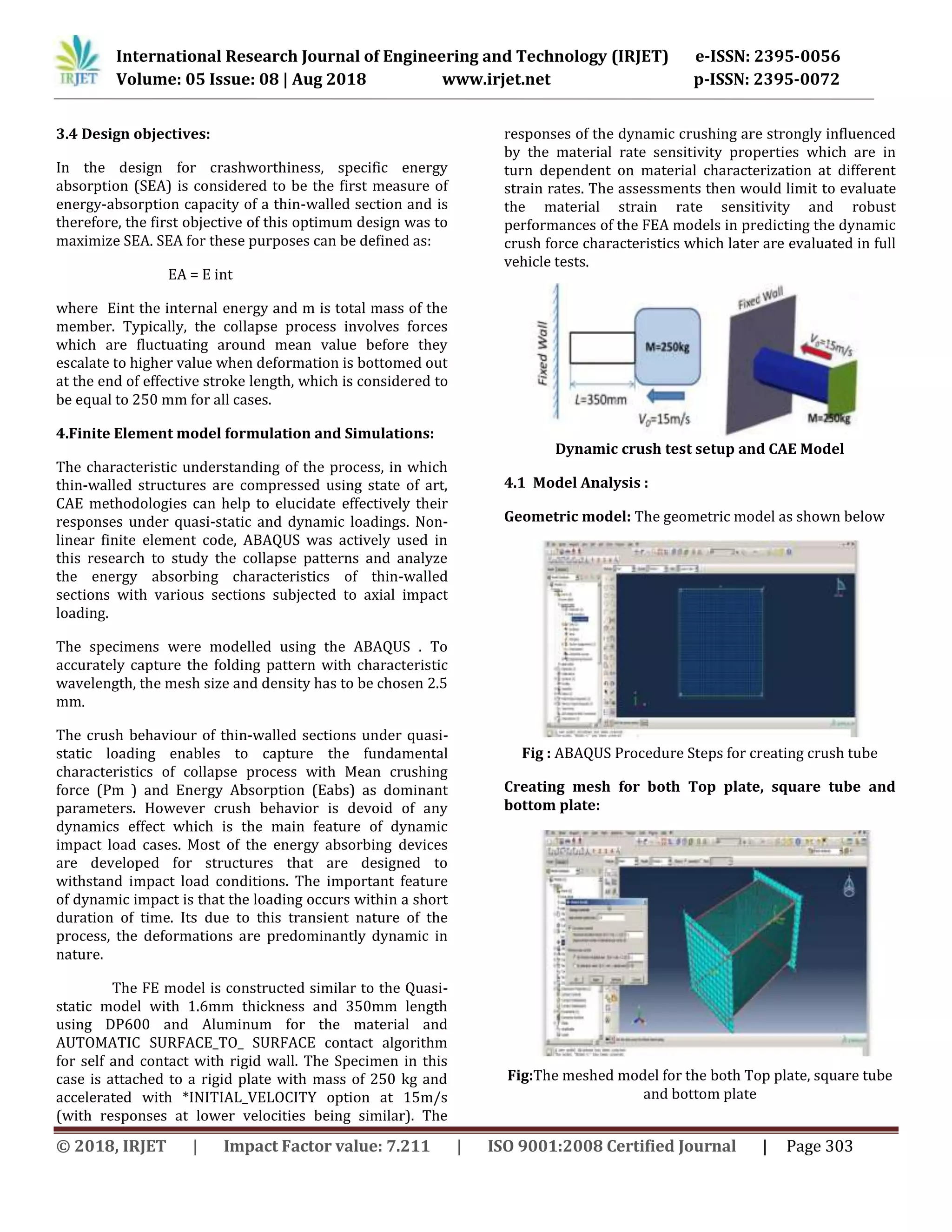
The FE model is constructed similar to the Quasi-
static model with 1.6mm thickness and 350mm length
using DP600 and Aluminum for the material and
AUTOMATIC SURFACE_TO_ SURFACE contact algorithm
for self and contact with rigid wall. The Specimen in this
case is attached to a rigid plate with mass of 250 kg and
accelerated with *INITIAL_VELOCITY option at 15m/s
(with responses at lower velocities being similar). The
responses of the dynamic crushing are strongly influenced
by the material rate sensitivity properties which are in
turn dependent on material characterization at different
strain rates. The assessments then would limit to evaluate
the material strain rate sensitivity and robust
performances of the FEA models in predicting the dynamic
crush force characteristics which later are evaluated in full
vehicle tests.
Dynamic crush test setup and CAE Model
4.1 Model Analysis :
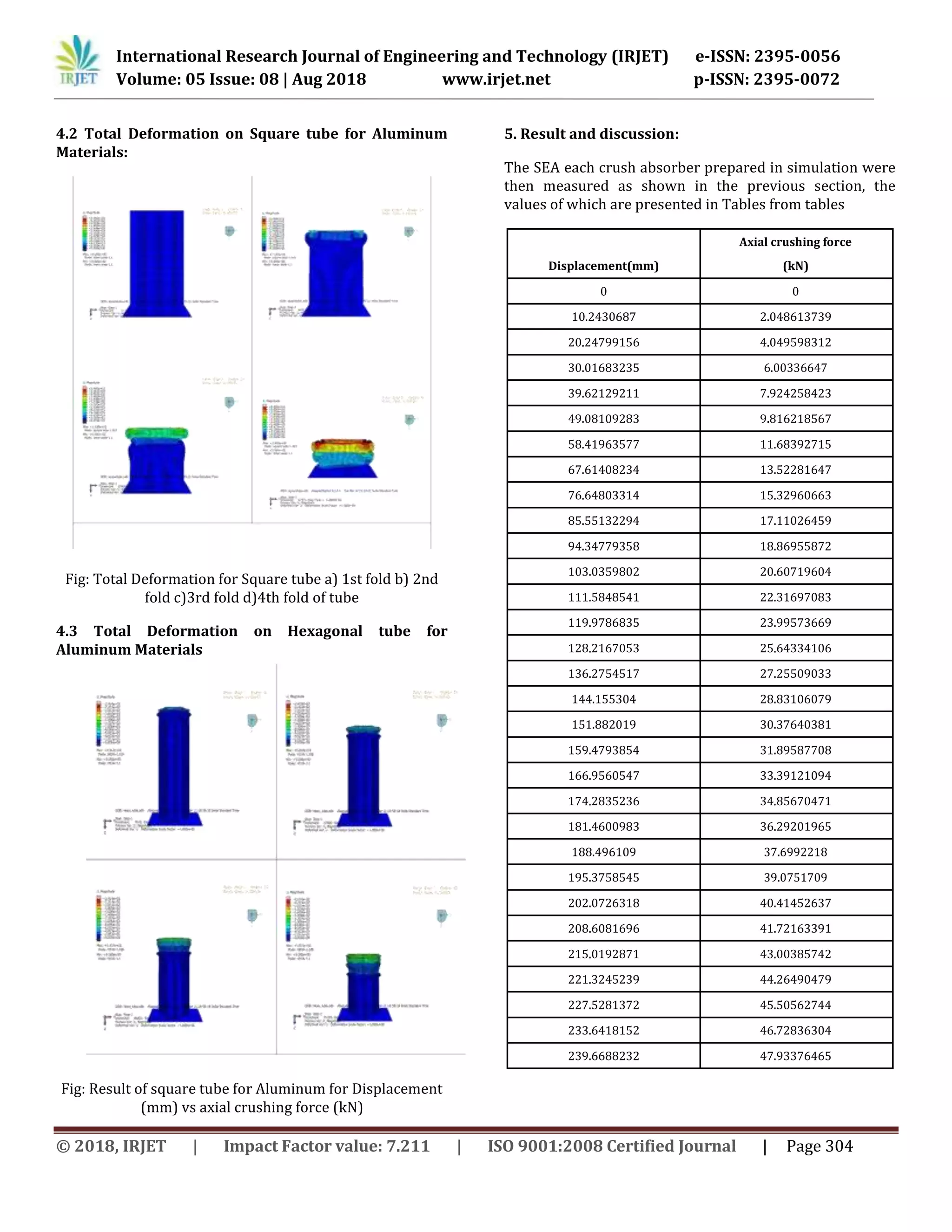
Geometric model: The geometric model as shown below
Fig : ABAQUS Procedure Steps for creating crush tube
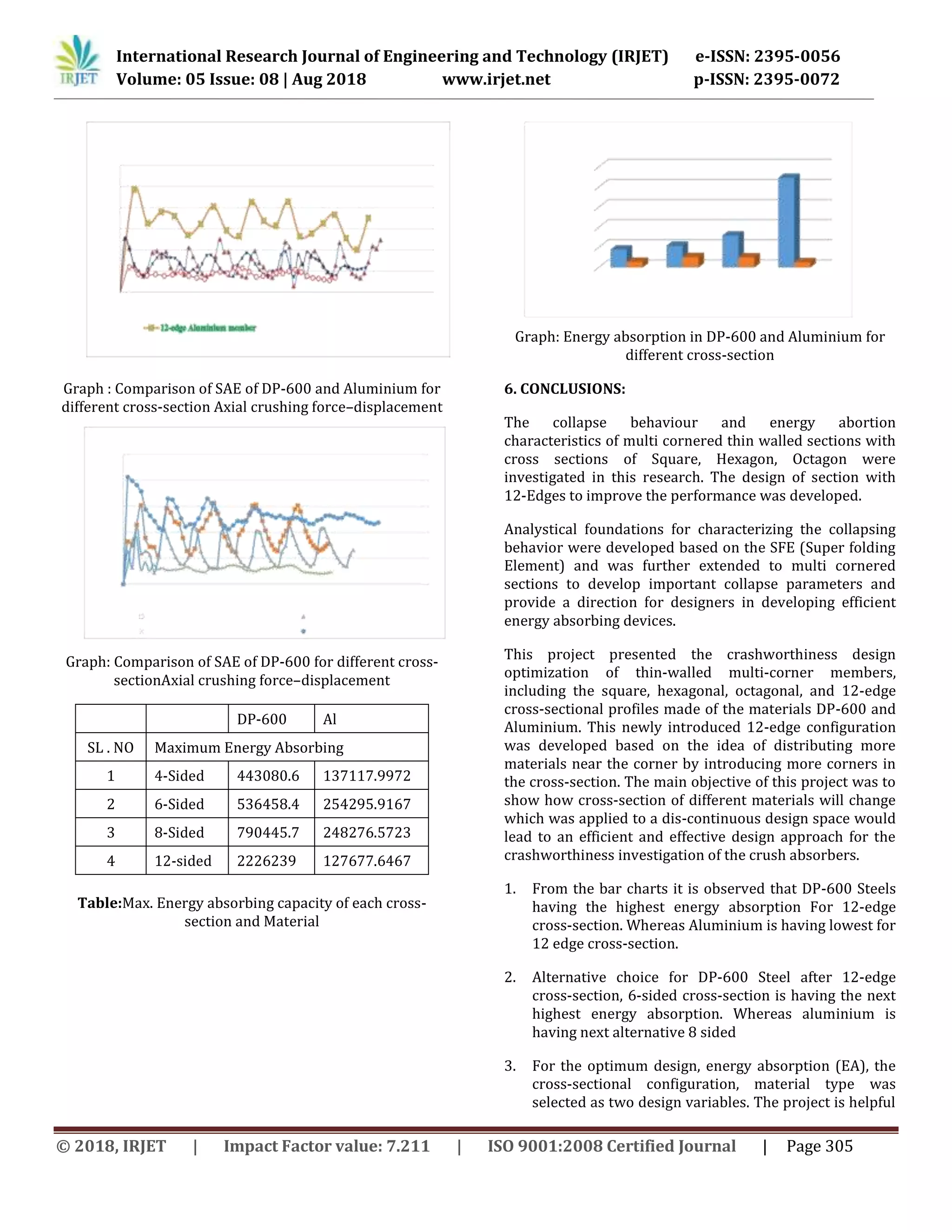
Creating mesh for both Top plate, square tube and
bottom plate:
Fig:The meshed model for the both Top plate, square tube
and bottom plate
International Research Journal of Engineering and Technology (IRJET) e-ISSN: 2395-0056
Volume: 05 Issue: 08 | Aug 2018 www.irjet.net p-ISSN: 2395-0072
© 2018, IRJET | Impact Factor value: 7.211 | ISO 9001:2008 Certified Journal | Page 304
4.2 Total Deformation on Square tube for Aluminum
Materials:
Fig: Total Deformation for Square tube a) 1st fold b) 2nd
fold c)3rd fold d)4th fold of tube
4.3 Total Deformation on Hexagonal tube for
Aluminum Materials
Fig: Result of square tube for Aluminum for Displacement
(mm) vs axial crushing force (kN)
5. Result and discussion:
The SEA each crush absorber prepared in simulation were
then measured as shown in the previous section, the
values of which are presented in Tables from tables
Axial crushing force
Displacement(mm) (kN)
0 0
10.2430687 2.048613739
20.24799156 4.049598312
30.01683235 6.00336647
39.62129211 7.924258423
49.08109283 9.816218567
58.41963577 11.68392715
67.61408234 13.52281647
76.64803314 15.32960663
85.55132294 17.11026459
94.34779358 18.86955872
103.0359802 20.60719604
111.5848541 22.31697083
119.9786835 23.99573669
128.2167053 25.64334106
136.2754517 27.25509033
144.155304 28.83106079
151.882019 30.37640381
159.4793854 31.89587708
166.9560547 33.39121094
174.2835236 34.85670471
181.4600983 36.29201965
188.496109 37.6992218
195.3758545 39.0751709
202.0726318 40.41452637
208.6081696 41.72163391
215.0192871 43.00385742
221.3245239 44.26490479
227.5281372 45.50562744
233.6418152 46.72836304
239.6688232 47.93376465
International Research Journal of Engineering and Technology (IRJET) e-ISSN: 2395-0056
Volume: 05 Issue: 08 | Aug 2018 www.irjet.net p-ISSN: 2395-0072
© 2018, IRJET | Impact Factor value: 7.211 | ISO 9001:2008 Certified Journal | Page 305
Graph : Comparison of SAE of DP-600 and Aluminium for
different cross-section Axial crushing force–displacement
Graph: Comparison of SAE of DP-600 for different cross-
sectionAxial crushing force–displacement
DP-600 Al
SL . NO Maximum Energy Absorbing
1 4-Sided 443080.6 137117.9972
2 6-Sided 536458.4 254295.9167
3 8-Sided 790445.7 248276.5723
4 12-sided 2226239 127677.6467
Table:Max. Energy absorbing capacity of each cross-
section and Material
Graph: Energy absorption in DP-600 and Aluminium for
different cross-section
6. CONCLUSIONS:
The collapse behaviour and energy abortion
characteristics of multi cornered thin walled sections with
cross sections of Square, Hexagon, Octagon were
investigated in this research. The design of section with
12-Edges to improve the performance was developed.
Analystical foundations for characterizing the collapsing
behavior were developed based on the SFE (Super folding
Element) and was further extended to multi cornered
sections to develop important collapse parameters and
provide a direction for designers in developing efficient
energy absorbing devices.
This project presented the crashworthiness design
optimization of thin-walled multi-corner members,
including the square, hexagonal, octagonal, and 12-edge
cross-sectional profiles made of the materials DP-600 and
Aluminium. This newly introduced 12-edge configuration
was developed based on the idea of distributing more
materials near the corner by introducing more corners in
the cross-section. The main objective of this project was to
show how cross-section of different materials will change
which was applied to a dis-continuous design space would
lead to an efficient and effective design approach for the
crashworthiness investigation of the crush absorbers.
1. From the bar charts it is observed that DP-600 Steels
having the highest energy absorption For 12-edge
cross-section. Whereas Aluminium is having lowest for
12 edge cross-section.
2. Alternative choice for DP-600 Steel after 12-edge
cross-section, 6-sided cross-section is having the next
highest energy absorption. Whereas aluminium is
having next alternative 8 sided
3. For the optimum design, energy absorption (EA), the
cross-sectional configuration, material type was
selected as two design variables. The project is helpful
International Research Journal of Engineering and Technology (IRJET) e-ISSN: 2395-0056
Volume: 05 Issue: 08 | Aug 2018 www.irjet.net p-ISSN: 2395-0072
© 2018, IRJET | Impact Factor value: 7.211 | ISO 9001:2008 Certified Journal | Page 306
to applied in industrial applications, such as crash-
worthiness design of automotive crumple zones. The
findings drawn from this project could be helpful in
crashworthiness improvement of automotive body
structure.
7. REFERENCES:
1. Modifications to Alexander’s theory with concertina
folding mechanism with moving hinge lines by Wierzbicki
and Bhat, Abramowicz and Jones -1986
2. First FE codes for crashworthiness applications such as
PAM-CRASH (Haug er al) and DYNA-3D (Hallquist and
Benson) reproducing the actual crushing process 1986
3. Extension of the approach to circular tubes to
rectangular tubes Abramowicz ,Wierzbicki and Jones 1989
4. Detailed Experimental studies of the Collapse modes -
Normal Jones -1989
5..Formulation of Super folding theory by combing theory
of plasticity with moving hinge lines - Wierzbicki and
Abramowicz and Jones 1989[31, 36]
6.Detailed experimental study on single and double hat in
both static and dynamic loading conditions- WhiteMD and
Jones N 1999
7.Collapse of thin-walled high-strength steel top hat
sections-Tarigopula 2006
8.Thin-walled section collapse as an efficient mechanism
for energy absorption – Alexander , 1960; Pugsley and
Macauly 1960
9.First theoretical analysis and analytical model with one
folding wave and stationary hinge line assumption to
characterise plastic collapse –Alexander 1960
10.Practical industrial research effort driven by Magee and
Thornton, at Ford Research labs 1978 on comparators for
designers

IRJET- A Study on the Behavior of Grid Slab Subjected to Seismic Loading

  • 1.
    International Research Journalof Engineering and Technology (IRJET) e-ISSN: 2395-0056 Volume: 05 Issue: 08 | Aug 2018 www.irjet.net p-ISSN: 2395-0072 © 2018, IRJET | Impact Factor value: 7.211 | ISO 9001:2008 Certified Journal | Page 301 MULTI CORNERED THIN WALL SECTIONS FOR CRASHWORTHINESS AND OCCUPANT PROTECTION RONGALI NAIDU1, Dr. V. NAGA BHUSHANA RAO2 1M.tech Student, Department of Mechanical Engineering, Raghu Institute of Technology, Visakhapatnam 2Professor, Department of Mechanical Engineering, Raghu Institute of Technology, Visakhapatnam -----------------------------------------------------------------------***------------------------------------------------------------------------ Abstract- The desire to improve crashworthiness of a passenger vehicle for enhanced occupant safety has been a major challenge for decades. When a crash is unavoidable, it is the crash energy and the manner in which vehicle occupants experience the associated forces that will determine the Extent of injury to those occupants. The major energy management comes from the upfront crash energy absorption which can be designed to fit into the available packaging space without affecting the cost- weight effectiveness. Axial collapse of the thin walled structures has been studied in detail over decades and the understanding was limited primarily to circular tubes. It was later refined and extended to square sections. Plastic deformation of structures absorbs substantial kinetic energy when impact occurs. Therefore, energy- absorbing Components have been extensively used in structural designs to intentionally absorb a large Portion of crash energy. Along with this analysis, the collapse behavior of square, hexagonal, and octagonal cross-sections as the baseline for designing a newly introduced 12-edge section for stable collapse with high energy absorption capacity was characterized. Inherent dissipation of the energy from severe deformations at the corners of a section under axial collapse formed the basis of this project, in which multi- cornered thin-walled sections was focused on. With CAE simulations was performed to evaluate the responses over a range of steels grades starting from low end mild steels to high end strength. Keywords: Crashworthiness, aluminium column, damage criteria, finite element. 1. Introduction It subjects the vehicle structure to very high forces and deformations depending upon the mode and velocity of the collision. If these collision forces exceed the energy absorbing capacity of vehicle structure in action the effect is directly felt on the Occupants and might lead sever injuries and fatalities Understanding the process of collision and its effect of occupants of a vehicle is thus very important and this underlying need has led to the birth of the field of Crashworthiness and occupant safety. This aspect of design has become the inherent requirement for all the ground mobility vehicles. This requirement was perceived very early by the manufacturers and realized the need for incorporation of occupant protection even before the general public could consider using their products for their mobility needs. The most important step in vehicle safety was initiated in the year 1966, when the National Highway Traffic Safety Administration (NHTSA) was formed and Introduction of mandatory safety standards which are popularly known as Federal Motor Vehicle Safety Standards(FMVSS). These standards established a precedence to regulate various aspects of vehicle design and have become a foundational step for the safety of ground transportation vehicles all around world. It has become so mandatory that OEM (Original Equipment Manufacturers) of the vehicle have integrated these FMVSS standards into their design philosophies to develop safe vehicle structures. 2. Literature review ALEXANDER [1] Thin-walled structures are widely applied as energy absorbers in automotive engineering, military engineering and other industries. In order to improve their energy absorption characteristics, extensive studies including experiments, theoretical analysis and numerical simulations, have been carried out. firstly developed the collapse model of circular tube and derived an approximate theoretical expression to predict the mean crushing force. Both static and dynamic studies for the circular and square tubes under axial load were done using experimental and numerical methods. Muhammad Kamran, Pu Xue, Naveed Ahmed, M S Zahran , A A G Hani [2] The improvement of safety and crashworthiness features of aero or automobile systems are becoming more challenging with the advancements of
  • 2.
    International Research Journalof Engineering and Technology (IRJET) e-ISSN: 2395-0056 Volume: 05 Issue: 08 | Aug 2018 www.irjet.net p-ISSN: 2395-0072 © 2018, IRJET | Impact Factor value: 7.211 | ISO 9001:2008 Certified Journal | Page 302 transportation and aerospace engineering to protect the humans and vulnerable equipment. The metallic thin- walled structures have proved to be a comparable choice under dynamic crushing when these demands are to be accomplished with optimal weight feature and low cost. Impact energy is absorbed by such systems in multiple mechanisms such as fracture, splitting, bending, tension, shear and plastic deformation (Jones, 2012). Metallic tubes are one such choice which show multiple deformation modes under axial crushing with unique features such as locally deformed axisymmetric or concertina mode, diamond mode, mixed mode or globally deformed Euler buckling mode depending on the geometry, material parameters and boundary conditions. Dadrasi Ali [3]: Various kinds of energy-absorbing systems are being extensively used in many engineering applications such as automobiles and other transport vehicles. Indeed, during an impact event, the energy of the crash and the manner in which the loads are transmitted through the system, are very important points. As a consequence, the axial crushing behavior of thin walled structures, which are efficient energy absorbers, has been a topic of great interest for many researchers. In designing such structures, maximizing their energy-absorption capability should always be a major objective. As presented in previous researches, there are two approaches to enhance the performance of the multi-cell thin-walled columns: either using advanced materials with high mechanical properties1,2 or designing optimized wall thickness and cross-sectional dimensions for such columns that can provide the best crash performances. 3. MODELLING AND ANALYSIS: 3.1 Automobile structure andCrashworthiness: The structure of an automobile has evolved over last seven decades meeting the needs of customers with complex conflicting requirements such as cost and weight, performance and materials, and energy management and package, markets and safety regulations, economics and competition, new technology and manufacturing capabilities Fig -Unit-body structure 3.2 Nonlinear Analysis and FEA codes: Nonlinear analysis involves very complex issues that pose series challenges for the analyst. The issues of convergence, choice of nonlinear solution algorithm and proper material modeling must be considered to get the proper and meaningful results from the nonlinear analysis. Unless the analyst is completely aware of these complex issues it is very difficult to predict accurate and reliable solution from the nonlinear simulations. Different types of nonlinearities and the general approach used for nonlinear analysis are explained in this paper. This chapter also presents important features and applications of three popular finite element codes NASTRAN, ABAQUS and LS-DYNA3D. Nonlinear analysis is used in many practical engineering applications whenever the engineer wants to take full advantage of material capacity. Often, designs based on linear analysis are too conservative and cannot be competitive in today’s international markets. An engineer must take full advantage of material ductility and toughness as many materials have significant capacity beyond their initial yield strength. 3.3 Classification of nonlinear analysis: In a finite element analysis if either the strain- displacement matrix or the constitutive matrix is nonlinear, the resulting stiffness matrix is nonlinear. Changes in boundary condition during the course of application of load also introduce nonlinear behavior in structures. Based on the type of nonlinear effect, the nonlinear analyses are classified into three categories as below and discussed in next chapter in detail. 1. Geometric nonlinear analysis 2. Material nonlinear analysis 3. Boundary nonlinear (Contact) analysis Cross-section of members: (a) square, (b) hexagonal, (c) octagonal, and (d) 12-edge
  • 3.
    International Research Journalof Engineering and Technology (IRJET) e-ISSN: 2395-0056 Volume: 05 Issue: 08 | Aug 2018 www.irjet.net p-ISSN: 2395-0072 © 2018, IRJET | Impact Factor value: 7.211 | ISO 9001:2008 Certified Journal | Page 303 3.4 Design objectives: In the design for crashworthiness, specific energy absorption (SEA) is considered to be the first measure of energy-absorption capacity of a thin-walled section and is therefore, the first objective of this optimum design was to maximize SEA. SEA for these purposes can be defined as: EA = E int where Eint the internal energy and m is total mass of the member. Typically, the collapse process involves forces which are fluctuating around mean value before they escalate to higher value when deformation is bottomed out at the end of effective stroke length, which is considered to be equal to 250 mm for all cases. 4.Finite Element model formulation and Simulations: The characteristic understanding of the process, in which thin-walled structures are compressed using state of art, CAE methodologies can help to elucidate effectively their responses under quasi-static and dynamic loadings. Non- linear finite element code, ABAQUS was actively used in this research to study the collapse patterns and analyze the energy absorbing characteristics of thin-walled sections with various sections subjected to axial impact loading. The specimens were modelled using the ABAQUS . To accurately capture the folding pattern with characteristic wavelength, the mesh size and density has to be chosen 2.5 mm. The crush behaviour of thin-walled sections under quasi- static loading enables to capture the fundamental characteristics of collapse process with Mean crushing force (Pm ) and Energy Absorption (Eabs) as dominant parameters. However crush behavior is devoid of any dynamics effect which is the main feature of dynamic impact load cases. Most of the energy absorbing devices are developed for structures that are designed to withstand impact load conditions. The important feature of dynamic impact is that the loading occurs within a short duration of time. Its due to this transient nature of the process, the deformations are predominantly dynamic in nature. The FE model is constructed similar to the Quasi- static model with 1.6mm thickness and 350mm length using DP600 and Aluminum for the material and AUTOMATIC SURFACE_TO_ SURFACE contact algorithm for self and contact with rigid wall. The Specimen in this case is attached to a rigid plate with mass of 250 kg and accelerated with *INITIAL_VELOCITY option at 15m/s (with responses at lower velocities being similar). The responses of the dynamic crushing are strongly influenced by the material rate sensitivity properties which are in turn dependent on material characterization at different strain rates. The assessments then would limit to evaluate the material strain rate sensitivity and robust performances of the FEA models in predicting the dynamic crush force characteristics which later are evaluated in full vehicle tests. Dynamic crush test setup and CAE Model 4.1 Model Analysis : Geometric model: The geometric model as shown below Fig : ABAQUS Procedure Steps for creating crush tube Creating mesh for both Top plate, square tube and bottom plate: Fig:The meshed model for the both Top plate, square tube and bottom plate
  • 4.
    International Research Journalof Engineering and Technology (IRJET) e-ISSN: 2395-0056 Volume: 05 Issue: 08 | Aug 2018 www.irjet.net p-ISSN: 2395-0072 © 2018, IRJET | Impact Factor value: 7.211 | ISO 9001:2008 Certified Journal | Page 304 4.2 Total Deformation on Square tube for Aluminum Materials: Fig: Total Deformation for Square tube a) 1st fold b) 2nd fold c)3rd fold d)4th fold of tube 4.3 Total Deformation on Hexagonal tube for Aluminum Materials Fig: Result of square tube for Aluminum for Displacement (mm) vs axial crushing force (kN) 5. Result and discussion: The SEA each crush absorber prepared in simulation were then measured as shown in the previous section, the values of which are presented in Tables from tables Axial crushing force Displacement(mm) (kN) 0 0 10.2430687 2.048613739 20.24799156 4.049598312 30.01683235 6.00336647 39.62129211 7.924258423 49.08109283 9.816218567 58.41963577 11.68392715 67.61408234 13.52281647 76.64803314 15.32960663 85.55132294 17.11026459 94.34779358 18.86955872 103.0359802 20.60719604 111.5848541 22.31697083 119.9786835 23.99573669 128.2167053 25.64334106 136.2754517 27.25509033 144.155304 28.83106079 151.882019 30.37640381 159.4793854 31.89587708 166.9560547 33.39121094 174.2835236 34.85670471 181.4600983 36.29201965 188.496109 37.6992218 195.3758545 39.0751709 202.0726318 40.41452637 208.6081696 41.72163391 215.0192871 43.00385742 221.3245239 44.26490479 227.5281372 45.50562744 233.6418152 46.72836304 239.6688232 47.93376465
  • 5.
    International Research Journalof Engineering and Technology (IRJET) e-ISSN: 2395-0056 Volume: 05 Issue: 08 | Aug 2018 www.irjet.net p-ISSN: 2395-0072 © 2018, IRJET | Impact Factor value: 7.211 | ISO 9001:2008 Certified Journal | Page 305 Graph : Comparison of SAE of DP-600 and Aluminium for different cross-section Axial crushing force–displacement Graph: Comparison of SAE of DP-600 for different cross- sectionAxial crushing force–displacement DP-600 Al SL . NO Maximum Energy Absorbing 1 4-Sided 443080.6 137117.9972 2 6-Sided 536458.4 254295.9167 3 8-Sided 790445.7 248276.5723 4 12-sided 2226239 127677.6467 Table:Max. Energy absorbing capacity of each cross- section and Material Graph: Energy absorption in DP-600 and Aluminium for different cross-section 6. CONCLUSIONS: The collapse behaviour and energy abortion characteristics of multi cornered thin walled sections with cross sections of Square, Hexagon, Octagon were investigated in this research. The design of section with 12-Edges to improve the performance was developed. Analystical foundations for characterizing the collapsing behavior were developed based on the SFE (Super folding Element) and was further extended to multi cornered sections to develop important collapse parameters and provide a direction for designers in developing efficient energy absorbing devices. This project presented the crashworthiness design optimization of thin-walled multi-corner members, including the square, hexagonal, octagonal, and 12-edge cross-sectional profiles made of the materials DP-600 and Aluminium. This newly introduced 12-edge configuration was developed based on the idea of distributing more materials near the corner by introducing more corners in the cross-section. The main objective of this project was to show how cross-section of different materials will change which was applied to a dis-continuous design space would lead to an efficient and effective design approach for the crashworthiness investigation of the crush absorbers. 1. From the bar charts it is observed that DP-600 Steels having the highest energy absorption For 12-edge cross-section. Whereas Aluminium is having lowest for 12 edge cross-section. 2. Alternative choice for DP-600 Steel after 12-edge cross-section, 6-sided cross-section is having the next highest energy absorption. Whereas aluminium is having next alternative 8 sided 3. For the optimum design, energy absorption (EA), the cross-sectional configuration, material type was selected as two design variables. The project is helpful
  • 6.
    International Research Journalof Engineering and Technology (IRJET) e-ISSN: 2395-0056 Volume: 05 Issue: 08 | Aug 2018 www.irjet.net p-ISSN: 2395-0072 © 2018, IRJET | Impact Factor value: 7.211 | ISO 9001:2008 Certified Journal | Page 306 to applied in industrial applications, such as crash- worthiness design of automotive crumple zones. The findings drawn from this project could be helpful in crashworthiness improvement of automotive body structure. 7. REFERENCES: 1. Modifications to Alexander’s theory with concertina folding mechanism with moving hinge lines by Wierzbicki and Bhat, Abramowicz and Jones -1986 2. First FE codes for crashworthiness applications such as PAM-CRASH (Haug er al) and DYNA-3D (Hallquist and Benson) reproducing the actual crushing process 1986 3. Extension of the approach to circular tubes to rectangular tubes Abramowicz ,Wierzbicki and Jones 1989 4. Detailed Experimental studies of the Collapse modes - Normal Jones -1989 5..Formulation of Super folding theory by combing theory of plasticity with moving hinge lines - Wierzbicki and Abramowicz and Jones 1989[31, 36] 6.Detailed experimental study on single and double hat in both static and dynamic loading conditions- WhiteMD and Jones N 1999 7.Collapse of thin-walled high-strength steel top hat sections-Tarigopula 2006 8.Thin-walled section collapse as an efficient mechanism for energy absorption – Alexander , 1960; Pugsley and Macauly 1960 9.First theoretical analysis and analytical model with one folding wave and stationary hinge line assumption to characterise plastic collapse –Alexander 1960 10.Practical industrial research effort driven by Magee and Thornton, at Ford Research labs 1978 on comparators for designers