International Research Journal of Engineering and Technology (IRJET) e-ISSN: 2395-0056
Volume: 04 Issue: 09 | Sep -2017 www.irjet.net p-ISSN: 2395-0072
© 2017, IRJET | Impact Factor value: 5.181 | ISO 9001:2008 Certified Journal | Page 110
Energy Absorption Characteristics of Thin Walled Metallic and Foam
Filled Tubular Structure with Different Cross-Sections
Chinmay Morajkar
Master of Technology, Machine Design
Student of Mechanical Engineering Department, UBDTCE Davangere, Karnataka, India
---------------------------------------------------------------------***---------------------------------------------------------------------
Abstract – The thin –walled structures are been used widely
as energy absorbers in industries such as aerospace, shipping
and automobile. The energy absorption behavior of tubular
structures depends on various factors in which one of them is
cross sectional geometry of tube structures .In this paper
Metallic tubular structures and foam filled metallic tubular
structures with different cross sections are studied. The
tubular structures with different sections such as circular,
hexagonal, triangular and square are studied based on the
energy absorption point of view. The tubes have the same
height, average section area, volume, thickness and material
which are subjected to quasi static loading. Theeffectof foam
has been studied during the crushing process since foam can
be used for different crash analysis problem. The numerical
model has been modeled and meshed using hyper mesh and
analyzed using commercial explicit finite element solver Ls-
Dyna. Finally the metallic and foam filled metallic tubes
analysis results are being compared based on the energy
absorption point of view.
Key Words: Specific Energy Absorption, Crushing Load,
Piecewise Linear Plastic, Crushable Foam, Quasi Static
Process.
1. INTRODUCTION
Safety of the passenger and driver has become an issue
almost from the beginning of mechanized road vehicle
development. Vehicle is used extensivelyanda largenumber
of safety accidents related to them occur widely. Using
energy absorbers is an appropriate option for this purpose.
As an energy absorber in crashworthiness applicationssuch
as cars, ships, trains, aero-planes and other high-volume
industrial products, the thin-walled structures have been
widely used to ensure crash safety due to their lightweight,
low cost and high energy absorption.
Tubular structures provide widest range of possible energy
absorbing system for any simplestructures.Apartfromtheir
use as energy absorbers, their common existence as
structural elements implies an in strict energy absorbing
capability in the largest part of the aerospace and
automobile structures.
Metallic foams is being used in aerospace industry in
different components to absorb the energyofanimpactorin
shielding devices to reduce the shock wave from a blast
which might also have complex shapes, Aluminum, nickel,
iron, copper, titanium and platinumaresomeofthecommon
metals which are used to prepare metallic foams.
In this paper, energy absorption capacity of thin walled
metallic and foam filled metallic tubes with various section
geometries are investigated and studied numerically.
1.1 LITERATURE SURVEY
In order to carry out the entitled work an extensive
literature survey was done by collecting and studying the
number of relevant journals, articles and technical papers
from the available resources.
Tubular structures are been used as energy absorbers in
various aerospace and automobile applications. Tubular
structures providehighspecificenergyabsorptioncapability
as well as light weight advantage. So it becomes an
important part to study the tubular structureswithdifferent
shapes. The effect of various cell configuration on energy
absorption behavior of tubular structures were carried out
by the different researchers,thenumerical andexperimental
correlation was given by Ali Alavi Nia et.al [1] andnumerical
examination was carried out by Younes et.al [2] for thin
walled tubes with various section shapes by maintaining
same mass for each case and found that the circular tubes
has the most energy absorption capacity [1] and the energy
absorption capability of tubular structure increases with
increase in number of sides [2]. The study is carried out by
using foam filled tubular structure which shows better
results compared to metallic structures as well asduringout
of planes impacting condition along with the cell geometry
the cell foil thickness, cell side size, cell expanding anglealso
affects the energy absorption capacitytubularstructures[3].
Alexander et.al [4] accomplished the first studies on the
collapse mode of cylindrical tubes under axial loads. The
theoretical model for collapse of steel conical tubes based on
experimental observation was done by Al-Hassani et.al [5]
and Mamalis et.al [6]. The average crushing load of square
tubes under axial static loads was studied experimentallyby
Abramowiz and Jones et.al [7]. They also carried out several
experiments on circular and square tubes under dynamic
loading conditions and presented a modification of
Alexander’s theoretical model.
International Research Journal of Engineering and Technology (IRJET) e-ISSN: 2395-0056
Volume: 04 Issue: 09 | Sep -2017 www.irjet.net p-ISSN: 2395-0072
© 2017, IRJET | Impact Factor value: 5.181 | ISO 9001:2008 Certified Journal | Page 111
In spite of the much research performed on circular thin-
walled tubes, the attempt to further improve the crushing
behavior of thin walled tubes by designing an efficient
energy absorbing material is highly desired. This numerical
study aims to improve the energy absorbing capacity of the
thin-walled tubes subjected to axial quasi static loading.
1.2 METHODOLOGY
In order to understand the crushing behavior of the tubular
structures based on energy absorbing characteristics during
impact event, the methodology is adopted. Based on the
study of available literaturetheprocessofenergyabsorption
behavior of thin walled structures is examined. In order to
correlate the numerical analysis the impact study has been
carried out on the thin walled structures of metallic as well
as foam filled structures by applyingtheloadonthedifferent
geometries cross section. For this case the modeling of the
tubular structure is done by using the available modeling
and meshing tool HYPERMESH V12.0. Then the analysis is
carried out by importing the model to available solver tool
LS DYNA 971 R 8.0 solver.
2. FINITE ELEMENT ANALYSIS
The Finite Element model consists of tubular structure and
two rigid blocks, the tube structures are made up of shell
elements and two rigid blocks are taken as solid elements.
Modelling is carried out in HYPERMESH and analysis is
carried out using LS DYNA.
The geometric model considered for theanalysisisasshown
in Fig-1 and it consists of Lower block and upper block
which are movable and fixed respectively, In between a
tubular structure is present which is of 100mm length. The
meshed model considered for the analysisisasshowninFig-
2.
Fig-1 Geometric model of tubular structure
All the tubular sections are having same length, average
section area and volume, the specifications of these are as
shown in Table-1.
Table -1: Specification of tubular structure
Fig-2 Meshed model of tubular structure
3. BOUNDRY AND LOADING CONDITIONS
The model geometry includes thin walled tubular structure
with metallic and foam filled tube between two rigidparts at
sits ends. The boundary conditions are the same as the
experimental test conducted by the reference [1] the upper
block is completely constrained in all directionswhereasthe
lower block can move with a velocity of 100mm/s in the
upward direction.
4. MATERIAL PROPERTIES
The material model for the tube, foam and blocks are
*MAT_PIECEWISE_LINEAR_PLASTICITY,
*MAT_CRUSHABLE_FOAM and *MAT_RIGID, respectively.
The material used for the metallic tube structure is Al3003
and foam is of carbon Nano. The material properties of
Al3003 tube are tabulated in Table-2.
Table-2 Properties of Al3003
International Research Journal of Engineering and Technology (IRJET) e-ISSN: 2395-0056
Volume: 04 Issue: 09 | Sep -2017 www.irjet.net p-ISSN: 2395-0072
© 2017, IRJET | Impact Factor value: 5.181 | ISO 9001:2008 Certified Journal | Page 112
The carbon Nano foam materials are crushable foam with
very less recovery, unlike foam material which is used in
most of the automotive and aerospace seating systems. As
carbon Nano foams are rigid foams and in this study the
strain hardening and strain rate effects of the material are
not considered. The material properties for carbon Nano
foam are tabulated in Table-3.
Table-3 Properties of Carbon Nano foam
In this material model, arbitrary yield stress versus
volumetric strain values are defined as shown in Fig-3.
Fig-3 Yield stress versus Volumetric strain
In order to supply appropriate conditions for deformations,
‘‘contact automatic surface to surface title’’ sand ‘‘contact
automatic single surface title’’ are usedfortube-foam,tubes-
rigid part elements and tube elements with each other
respectively.
5. FINITE ELEMENT ANALYSIS OF METALLIC AND FOAM
FILLED METALLIC TUBES
Specimen
Shape
Before loading After loading
Triangular
Squarer
Hexagonal
Circular
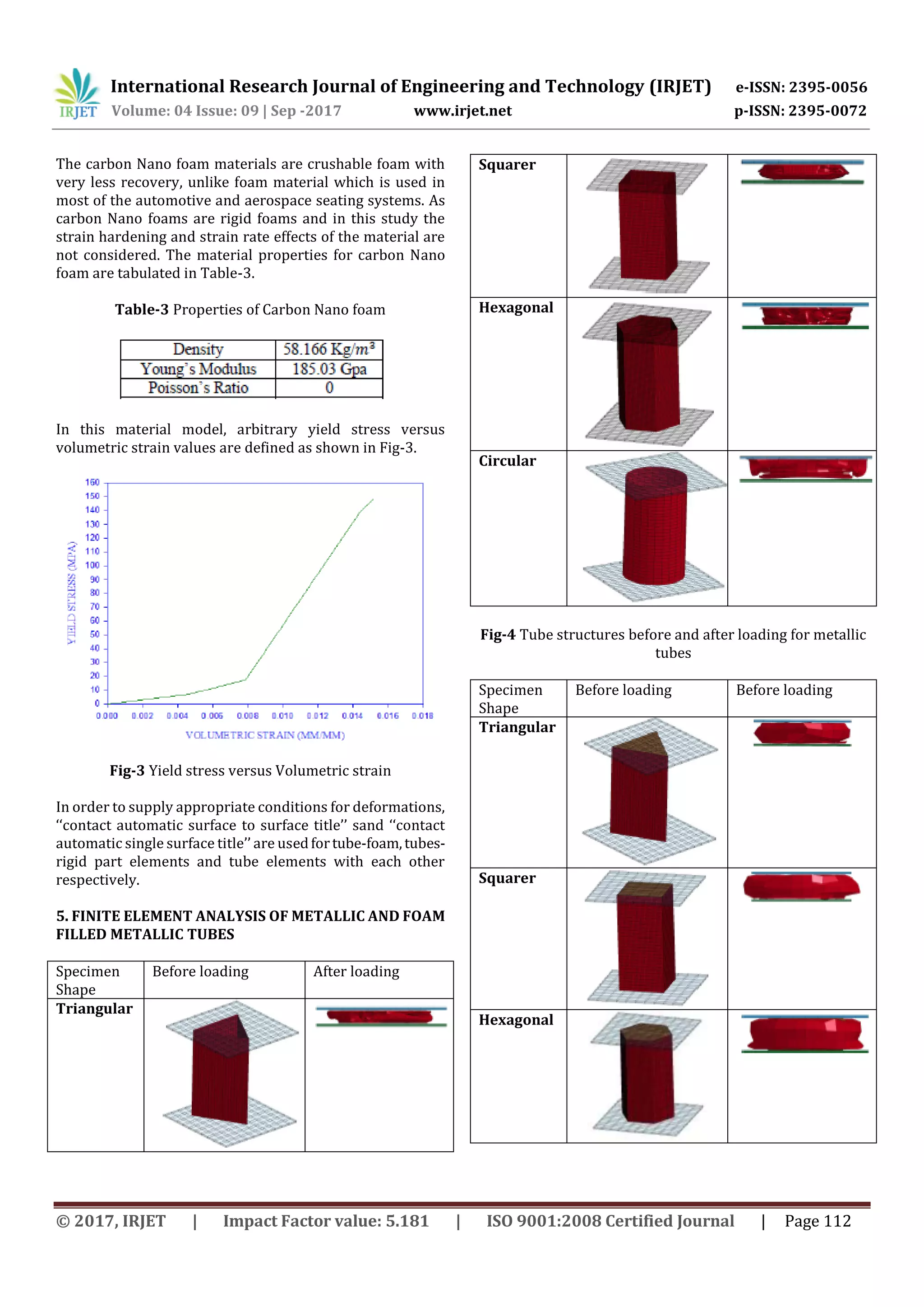
Fig-4 Tube structures before and after loading for metallic
tubes
Specimen
Shape
Before loading Before loading
Triangular
Squarer
Hexagonal
International Research Journal of Engineering and Technology (IRJET) e-ISSN: 2395-0056
Volume: 04 Issue: 09 | Sep -2017 www.irjet.net p-ISSN: 2395-0072
© 2017, IRJET | Impact Factor value: 5.181 | ISO 9001:2008 Certified Journal | Page 113
Circular
Fig-5 Tube structures before and after loading for metallic
tubes filled with foam
6. COMPARITIVE ANALYSIS OF METALLIC AND FOAM
FILLED METALLIC TUBES
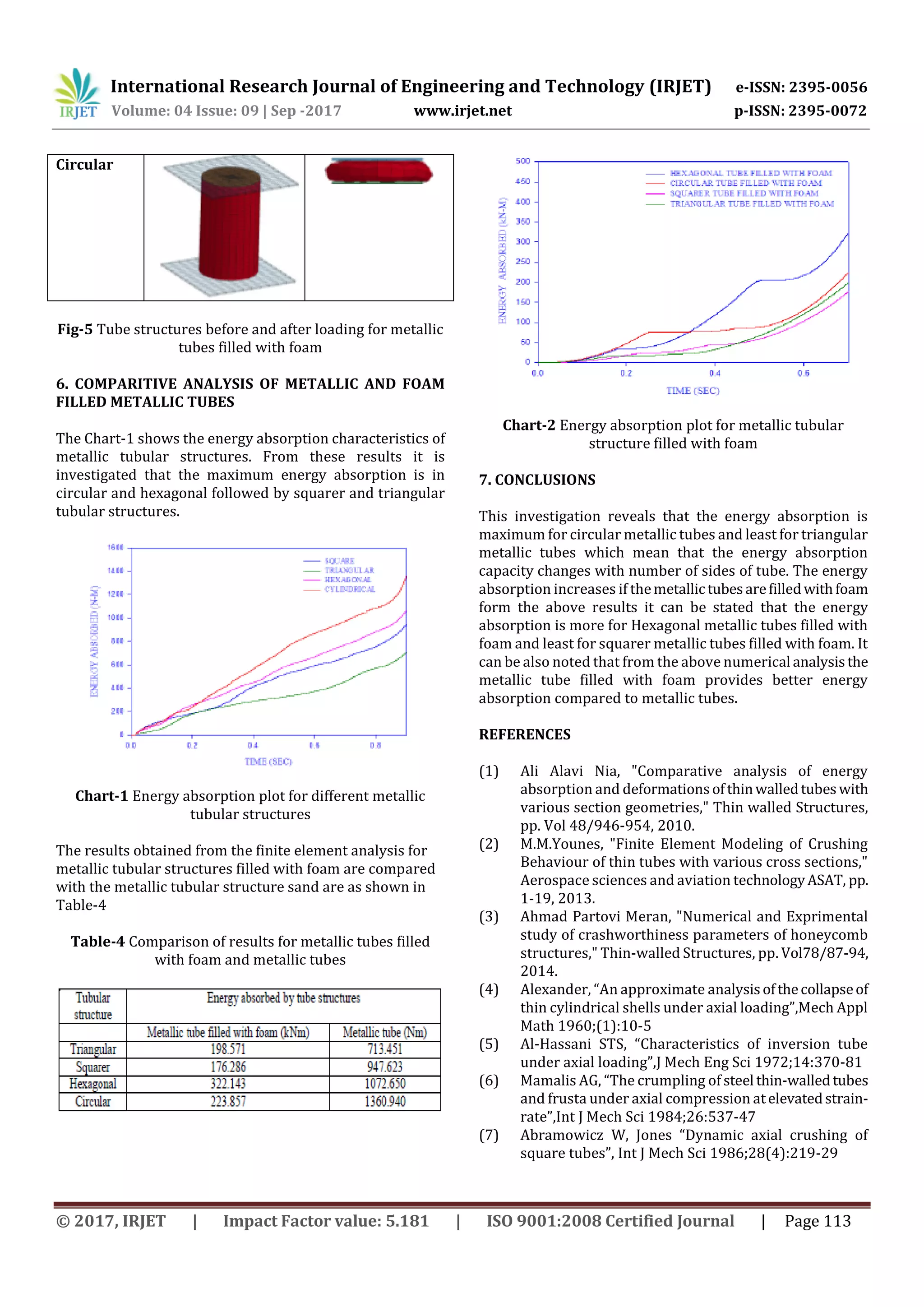
The Chart-1 shows the energy absorption characteristics of
metallic tubular structures. From these results it is
investigated that the maximum energy absorption is in
circular and hexagonal followed by squarer and triangular
tubular structures.
Chart-1 Energy absorption plot for different metallic
tubular structures
The results obtained from the finite element analysis for
metallic tubular structures filled with foam are compared
with the metallic tubular structure sand are as shown in
Table-4
Table-4 Comparison of results for metallic tubes filled
with foam and metallic tubes
Chart-2 Energy absorption plot for metallic tubular
structure filled with foam
7. CONCLUSIONS
This investigation reveals that the energy absorption is
maximum for circular metallic tubes and least for triangular
metallic tubes which mean that the energy absorption
capacity changes with number of sides of tube. The energy
absorption increases if themetallictubesarefilledwithfoam
form the above results it can be stated that the energy
absorption is more for Hexagonal metallic tubes filled with
foam and least for squarer metallic tubes filled with foam. It
can be also noted that from the above numerical analysisthe
metallic tube filled with foam provides better energy
absorption compared to metallic tubes.
REFERENCES
(1) Ali Alavi Nia, "Comparative analysis of energy
absorption and deformationsofthinwalledtubeswith
various section geometries," Thin walled Structures,
pp. Vol 48/946-954, 2010.
(2) M.M.Younes, "Finite Element Modeling of Crushing
Behaviour of thin tubes with various cross sections,"
Aerospace sciences and aviation technologyASAT, pp.
1-19, 2013.
(3) Ahmad Partovi Meran, "Numerical and Exprimental
study of crashworthiness parameters of honeycomb
structures," Thin-walled Structures, pp. Vol78/87-94,
2014.
(4) Alexander, “An approximate analysisofthecollapseof
thin cylindrical shells under axial loading”,Mech Appl
Math 1960;(1):10-5
(5) Al-Hassani STS, “Characteristics of inversion tube
under axial loading”,J Mech Eng Sci 1972;14:370-81
(6) Mamalis AG, “The crumpling of steel thin-walledtubes
and frusta under axial compression atelevatedstrain-
rate”,Int J Mech Sci 1984;26:537-47
(7) Abramowicz W, Jones “Dynamic axial crushing of
square tubes”, Int J Mech Sci 1986;28(4):219-29

Energy Absorption Characteristics of Thin Walled Metallic and Foam Filled Tubular Structure with Different Cross-Sections

  • 1.
    International Research Journalof Engineering and Technology (IRJET) e-ISSN: 2395-0056 Volume: 04 Issue: 09 | Sep -2017 www.irjet.net p-ISSN: 2395-0072 © 2017, IRJET | Impact Factor value: 5.181 | ISO 9001:2008 Certified Journal | Page 110 Energy Absorption Characteristics of Thin Walled Metallic and Foam Filled Tubular Structure with Different Cross-Sections Chinmay Morajkar Master of Technology, Machine Design Student of Mechanical Engineering Department, UBDTCE Davangere, Karnataka, India ---------------------------------------------------------------------***--------------------------------------------------------------------- Abstract – The thin –walled structures are been used widely as energy absorbers in industries such as aerospace, shipping and automobile. The energy absorption behavior of tubular structures depends on various factors in which one of them is cross sectional geometry of tube structures .In this paper Metallic tubular structures and foam filled metallic tubular structures with different cross sections are studied. The tubular structures with different sections such as circular, hexagonal, triangular and square are studied based on the energy absorption point of view. The tubes have the same height, average section area, volume, thickness and material which are subjected to quasi static loading. Theeffectof foam has been studied during the crushing process since foam can be used for different crash analysis problem. The numerical model has been modeled and meshed using hyper mesh and analyzed using commercial explicit finite element solver Ls- Dyna. Finally the metallic and foam filled metallic tubes analysis results are being compared based on the energy absorption point of view. Key Words: Specific Energy Absorption, Crushing Load, Piecewise Linear Plastic, Crushable Foam, Quasi Static Process. 1. INTRODUCTION Safety of the passenger and driver has become an issue almost from the beginning of mechanized road vehicle development. Vehicle is used extensivelyanda largenumber of safety accidents related to them occur widely. Using energy absorbers is an appropriate option for this purpose. As an energy absorber in crashworthiness applicationssuch as cars, ships, trains, aero-planes and other high-volume industrial products, the thin-walled structures have been widely used to ensure crash safety due to their lightweight, low cost and high energy absorption. Tubular structures provide widest range of possible energy absorbing system for any simplestructures.Apartfromtheir use as energy absorbers, their common existence as structural elements implies an in strict energy absorbing capability in the largest part of the aerospace and automobile structures. Metallic foams is being used in aerospace industry in different components to absorb the energyofanimpactorin shielding devices to reduce the shock wave from a blast which might also have complex shapes, Aluminum, nickel, iron, copper, titanium and platinumaresomeofthecommon metals which are used to prepare metallic foams. In this paper, energy absorption capacity of thin walled metallic and foam filled metallic tubes with various section geometries are investigated and studied numerically. 1.1 LITERATURE SURVEY In order to carry out the entitled work an extensive literature survey was done by collecting and studying the number of relevant journals, articles and technical papers from the available resources. Tubular structures are been used as energy absorbers in various aerospace and automobile applications. Tubular structures providehighspecificenergyabsorptioncapability as well as light weight advantage. So it becomes an important part to study the tubular structureswithdifferent shapes. The effect of various cell configuration on energy absorption behavior of tubular structures were carried out by the different researchers,thenumerical andexperimental correlation was given by Ali Alavi Nia et.al [1] andnumerical examination was carried out by Younes et.al [2] for thin walled tubes with various section shapes by maintaining same mass for each case and found that the circular tubes has the most energy absorption capacity [1] and the energy absorption capability of tubular structure increases with increase in number of sides [2]. The study is carried out by using foam filled tubular structure which shows better results compared to metallic structures as well asduringout of planes impacting condition along with the cell geometry the cell foil thickness, cell side size, cell expanding anglealso affects the energy absorption capacitytubularstructures[3]. Alexander et.al [4] accomplished the first studies on the collapse mode of cylindrical tubes under axial loads. The theoretical model for collapse of steel conical tubes based on experimental observation was done by Al-Hassani et.al [5] and Mamalis et.al [6]. The average crushing load of square tubes under axial static loads was studied experimentallyby Abramowiz and Jones et.al [7]. They also carried out several experiments on circular and square tubes under dynamic loading conditions and presented a modification of Alexander’s theoretical model.
  • 2.
    International Research Journalof Engineering and Technology (IRJET) e-ISSN: 2395-0056 Volume: 04 Issue: 09 | Sep -2017 www.irjet.net p-ISSN: 2395-0072 © 2017, IRJET | Impact Factor value: 5.181 | ISO 9001:2008 Certified Journal | Page 111 In spite of the much research performed on circular thin- walled tubes, the attempt to further improve the crushing behavior of thin walled tubes by designing an efficient energy absorbing material is highly desired. This numerical study aims to improve the energy absorbing capacity of the thin-walled tubes subjected to axial quasi static loading. 1.2 METHODOLOGY In order to understand the crushing behavior of the tubular structures based on energy absorbing characteristics during impact event, the methodology is adopted. Based on the study of available literaturetheprocessofenergyabsorption behavior of thin walled structures is examined. In order to correlate the numerical analysis the impact study has been carried out on the thin walled structures of metallic as well as foam filled structures by applyingtheloadonthedifferent geometries cross section. For this case the modeling of the tubular structure is done by using the available modeling and meshing tool HYPERMESH V12.0. Then the analysis is carried out by importing the model to available solver tool LS DYNA 971 R 8.0 solver. 2. FINITE ELEMENT ANALYSIS The Finite Element model consists of tubular structure and two rigid blocks, the tube structures are made up of shell elements and two rigid blocks are taken as solid elements. Modelling is carried out in HYPERMESH and analysis is carried out using LS DYNA. The geometric model considered for theanalysisisasshown in Fig-1 and it consists of Lower block and upper block which are movable and fixed respectively, In between a tubular structure is present which is of 100mm length. The meshed model considered for the analysisisasshowninFig- 2. Fig-1 Geometric model of tubular structure All the tubular sections are having same length, average section area and volume, the specifications of these are as shown in Table-1. Table -1: Specification of tubular structure Fig-2 Meshed model of tubular structure 3. BOUNDRY AND LOADING CONDITIONS The model geometry includes thin walled tubular structure with metallic and foam filled tube between two rigidparts at sits ends. The boundary conditions are the same as the experimental test conducted by the reference [1] the upper block is completely constrained in all directionswhereasthe lower block can move with a velocity of 100mm/s in the upward direction. 4. MATERIAL PROPERTIES The material model for the tube, foam and blocks are *MAT_PIECEWISE_LINEAR_PLASTICITY, *MAT_CRUSHABLE_FOAM and *MAT_RIGID, respectively. The material used for the metallic tube structure is Al3003 and foam is of carbon Nano. The material properties of Al3003 tube are tabulated in Table-2. Table-2 Properties of Al3003
  • 3.
    International Research Journalof Engineering and Technology (IRJET) e-ISSN: 2395-0056 Volume: 04 Issue: 09 | Sep -2017 www.irjet.net p-ISSN: 2395-0072 © 2017, IRJET | Impact Factor value: 5.181 | ISO 9001:2008 Certified Journal | Page 112 The carbon Nano foam materials are crushable foam with very less recovery, unlike foam material which is used in most of the automotive and aerospace seating systems. As carbon Nano foams are rigid foams and in this study the strain hardening and strain rate effects of the material are not considered. The material properties for carbon Nano foam are tabulated in Table-3. Table-3 Properties of Carbon Nano foam In this material model, arbitrary yield stress versus volumetric strain values are defined as shown in Fig-3. Fig-3 Yield stress versus Volumetric strain In order to supply appropriate conditions for deformations, ‘‘contact automatic surface to surface title’’ sand ‘‘contact automatic single surface title’’ are usedfortube-foam,tubes- rigid part elements and tube elements with each other respectively. 5. FINITE ELEMENT ANALYSIS OF METALLIC AND FOAM FILLED METALLIC TUBES Specimen Shape Before loading After loading Triangular Squarer Hexagonal Circular Fig-4 Tube structures before and after loading for metallic tubes Specimen Shape Before loading Before loading Triangular Squarer Hexagonal
  • 4.
    International Research Journalof Engineering and Technology (IRJET) e-ISSN: 2395-0056 Volume: 04 Issue: 09 | Sep -2017 www.irjet.net p-ISSN: 2395-0072 © 2017, IRJET | Impact Factor value: 5.181 | ISO 9001:2008 Certified Journal | Page 113 Circular Fig-5 Tube structures before and after loading for metallic tubes filled with foam 6. COMPARITIVE ANALYSIS OF METALLIC AND FOAM FILLED METALLIC TUBES The Chart-1 shows the energy absorption characteristics of metallic tubular structures. From these results it is investigated that the maximum energy absorption is in circular and hexagonal followed by squarer and triangular tubular structures. Chart-1 Energy absorption plot for different metallic tubular structures The results obtained from the finite element analysis for metallic tubular structures filled with foam are compared with the metallic tubular structure sand are as shown in Table-4 Table-4 Comparison of results for metallic tubes filled with foam and metallic tubes Chart-2 Energy absorption plot for metallic tubular structure filled with foam 7. CONCLUSIONS This investigation reveals that the energy absorption is maximum for circular metallic tubes and least for triangular metallic tubes which mean that the energy absorption capacity changes with number of sides of tube. The energy absorption increases if themetallictubesarefilledwithfoam form the above results it can be stated that the energy absorption is more for Hexagonal metallic tubes filled with foam and least for squarer metallic tubes filled with foam. It can be also noted that from the above numerical analysisthe metallic tube filled with foam provides better energy absorption compared to metallic tubes. REFERENCES (1) Ali Alavi Nia, "Comparative analysis of energy absorption and deformationsofthinwalledtubeswith various section geometries," Thin walled Structures, pp. Vol 48/946-954, 2010. (2) M.M.Younes, "Finite Element Modeling of Crushing Behaviour of thin tubes with various cross sections," Aerospace sciences and aviation technologyASAT, pp. 1-19, 2013. (3) Ahmad Partovi Meran, "Numerical and Exprimental study of crashworthiness parameters of honeycomb structures," Thin-walled Structures, pp. Vol78/87-94, 2014. (4) Alexander, “An approximate analysisofthecollapseof thin cylindrical shells under axial loading”,Mech Appl Math 1960;(1):10-5 (5) Al-Hassani STS, “Characteristics of inversion tube under axial loading”,J Mech Eng Sci 1972;14:370-81 (6) Mamalis AG, “The crumpling of steel thin-walledtubes and frusta under axial compression atelevatedstrain- rate”,Int J Mech Sci 1984;26:537-47 (7) Abramowicz W, Jones “Dynamic axial crushing of square tubes”, Int J Mech Sci 1986;28(4):219-29