Consistent (re)implementation of IRB & IFRS 9 credit risk
models
Date: 15 October 2020
By: Kristi Rohtsalu
By the time of preparing for the IFRS 9 adoption on 1 January 2018, the so-called IRB banks had already
in place IRB models for the calculation of regulatory capital requirements for credit risk (in accordance
with CRR). Many other banks aiming for the IRB had internal rating systems very similar to the IRB banks.
Hence, IFRS 9 parameters and expected credit loss estimates have been derived from the IRB parameters
by using various adjustments (e.g.: removal of margins of conservatism, transforming TTC and downturn
estimates to PIT estimates). This has caused unnecessary complexities in the IFRS 9 models as well as
inconsistencies between the IRB and IFRS 9 parameters. Taking a blank sheet of paper and imagining
developing models for both purposes – regulatory capital (IRB) and credit impairment losses (IFRS 9) –
from scratch enables a more holistic, more consistent and more efficient way of credit risk modelling.
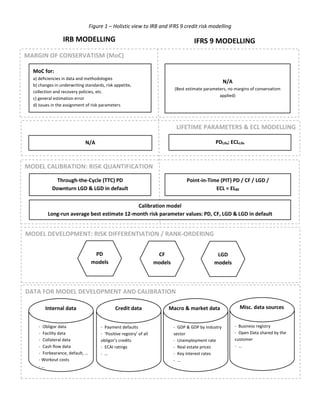
The figure below (refer to the next page) illustrates that both IRB and IFRS 9 models have the same
basement (data, rank-ordering models, calibration model and long-run average estimates). Only at the
very stage of risk quantification for the different types of risk estimates (PIT, TTC, downturn) there is a
branching into the calculation of the IRB parameters and the IFRS 9 parameters:
• Concerning IRB parameters, the RWA formula for the calculation of regulatory capital assumes 12-
month through-the-cycle (TTC) PD estimates, and downturn estimates for LGD and CF. Further, a
margin of conservatism is added to the best estimate risk parameter values for the possible estimation
errors.
• IFRS 9 parameters, on the other hand, are point-in-time (PIT) estimates, reflecting best estimate
predictions for the future (most often, weighted for the base, optimistic and pessimistic scenarios);
no margins of conservatism should be added. In addition to the 12-month estimates, there is the ECL
modelling part that involves transforming 12-month estimates into the lifetime estimates, given the
defined IFRS 9 scenarios.
Importantly, the calibration model or approach is ought to be such that it enables deriving all types of
risk estimates just by entering different inputs and/or assumptions to the algorithm: point-in-time
(weighted by the defined scenario projections as necessary), through-the-cycle and downturn.
As for the use of risk parameters in risk management, in capital allocation etc., rank-ordering models
should be preserved to meet the IRB requirements – and for the sake of model consistency as well. The
type of risk estimate (PIT, TTC, downturn) chosen for a given purpose depends on the specific use cases.
To summarise, my recommendation to the banks ‘sitting’ on the outdated credit risk models, built layer-
upon-layer, is to take that blank sheet of paper and reimagine the current implementations of the IRB and
IFRS 9 models for the sake of consistency and for efficiency gains in credit risk modelling area, going
forward. True, regulatory frameworks and the international financial reporting standard are still not fully
aligned, yet the discrepancies between the two could be viewed as non-essential.
Figure 1 – Holistic view to IRB and IFRS 9 credit risk modelling
DATA FOR MODEL DEVELOPMENT AND CALIBRATION
Internal data
- Obligor data
- Facility data
- Collateral data
- Cash flow data
- Forbearance, default, …
- Workout costs
- …
Credit data
- Payment defaults
- ‘Positive registry’ of all
obligor’s credits
- ECAI ratings
- …
Macro & market data
- GDP & GDP by industry
sector
- Unemployment rate
- Real estate prices
- Key interest rates
- …
Misc. data sources
- Business registry
- Open Data shared by the
customer
- …
MODEL DEVELOPMENT: RISK DIFFERENTIATION / RANK-ORDERING
PD
models
CF
models
LGD
models
IRB MODELLING IFRS 9 MODELLING
LIFETIME PARAMETERS & ECL MODELLING
MODEL CALIBRATION: RISK QUANTIFICATION
Through-the-Cycle (TTC) PD
Downturn LGD & LGD in default
Point-in-Time (PIT) PD / CF / LGD /
ECL = ELBE
Calibration model
Long-run average best estimate 12-month risk parameter values: PD, CF, LGD & LGD in default
MARGIN OF CONSERVATISM (MoC)
N/A
(Best estimate parameters, no margins of conservatism
applied)
MoC for:
a) deficiencies in data and methodologies
b) changes in underwriting standards, risk appetite,
collection and recovery policies, etc.
c) general estimation error
d) issues in the assignment of risk parameters
PDLife; ECLLifeN/A
Appendix. Abbreviations
CF – (Credit) Conversion Factor
CRR – Capital Requirements Regulation (in the European Union)
PD – (12 month) Probability of Default
PDLife – Lifetime Probability of Default (in the context of IFRS 9)
ECAI – External Credit Assessment Institutions
ECL – 12-month Expected Credit Loss (IFRS 9 term)
ECLLife – Lifetime Expected Credit Loss (in the context of IFRS 9)
EL – Expected Loss (CRR term)
ELBE – Expected Loss Best Estimate (CRR term, can be approximated to the ECL in IFRS 9 terms)
GDP – Gross Domestic Product
LGD – Loss Given Default
IFRS 9 – Internal Financial Reporting Standard #9
IRB – Internal Ratings-based approach (CRR term)
MoC – Margin of Conservatism
N/A – Not Applicable
PIT – Point-in-Time
RWA – Risk-Weighted Assets (for credit risk, in CRR terms)
TTC – Through-the-Cycle

IRB and IFRS 9 credit risk models - consistent (re)implementation

  • 1.
    Consistent (re)implementation ofIRB & IFRS 9 credit risk models Date: 15 October 2020 By: Kristi Rohtsalu By the time of preparing for the IFRS 9 adoption on 1 January 2018, the so-called IRB banks had already in place IRB models for the calculation of regulatory capital requirements for credit risk (in accordance with CRR). Many other banks aiming for the IRB had internal rating systems very similar to the IRB banks. Hence, IFRS 9 parameters and expected credit loss estimates have been derived from the IRB parameters by using various adjustments (e.g.: removal of margins of conservatism, transforming TTC and downturn estimates to PIT estimates). This has caused unnecessary complexities in the IFRS 9 models as well as inconsistencies between the IRB and IFRS 9 parameters. Taking a blank sheet of paper and imagining developing models for both purposes – regulatory capital (IRB) and credit impairment losses (IFRS 9) – from scratch enables a more holistic, more consistent and more efficient way of credit risk modelling. The figure below (refer to the next page) illustrates that both IRB and IFRS 9 models have the same basement (data, rank-ordering models, calibration model and long-run average estimates). Only at the very stage of risk quantification for the different types of risk estimates (PIT, TTC, downturn) there is a branching into the calculation of the IRB parameters and the IFRS 9 parameters: • Concerning IRB parameters, the RWA formula for the calculation of regulatory capital assumes 12- month through-the-cycle (TTC) PD estimates, and downturn estimates for LGD and CF. Further, a margin of conservatism is added to the best estimate risk parameter values for the possible estimation errors. • IFRS 9 parameters, on the other hand, are point-in-time (PIT) estimates, reflecting best estimate predictions for the future (most often, weighted for the base, optimistic and pessimistic scenarios); no margins of conservatism should be added. In addition to the 12-month estimates, there is the ECL modelling part that involves transforming 12-month estimates into the lifetime estimates, given the defined IFRS 9 scenarios. Importantly, the calibration model or approach is ought to be such that it enables deriving all types of risk estimates just by entering different inputs and/or assumptions to the algorithm: point-in-time (weighted by the defined scenario projections as necessary), through-the-cycle and downturn. As for the use of risk parameters in risk management, in capital allocation etc., rank-ordering models should be preserved to meet the IRB requirements – and for the sake of model consistency as well. The type of risk estimate (PIT, TTC, downturn) chosen for a given purpose depends on the specific use cases. To summarise, my recommendation to the banks ‘sitting’ on the outdated credit risk models, built layer- upon-layer, is to take that blank sheet of paper and reimagine the current implementations of the IRB and IFRS 9 models for the sake of consistency and for efficiency gains in credit risk modelling area, going forward. True, regulatory frameworks and the international financial reporting standard are still not fully aligned, yet the discrepancies between the two could be viewed as non-essential.
  • 2.
    Figure 1 –Holistic view to IRB and IFRS 9 credit risk modelling DATA FOR MODEL DEVELOPMENT AND CALIBRATION Internal data - Obligor data - Facility data - Collateral data - Cash flow data - Forbearance, default, … - Workout costs - … Credit data - Payment defaults - ‘Positive registry’ of all obligor’s credits - ECAI ratings - … Macro & market data - GDP & GDP by industry sector - Unemployment rate - Real estate prices - Key interest rates - … Misc. data sources - Business registry - Open Data shared by the customer - … MODEL DEVELOPMENT: RISK DIFFERENTIATION / RANK-ORDERING PD models CF models LGD models IRB MODELLING IFRS 9 MODELLING LIFETIME PARAMETERS & ECL MODELLING MODEL CALIBRATION: RISK QUANTIFICATION Through-the-Cycle (TTC) PD Downturn LGD & LGD in default Point-in-Time (PIT) PD / CF / LGD / ECL = ELBE Calibration model Long-run average best estimate 12-month risk parameter values: PD, CF, LGD & LGD in default MARGIN OF CONSERVATISM (MoC) N/A (Best estimate parameters, no margins of conservatism applied) MoC for: a) deficiencies in data and methodologies b) changes in underwriting standards, risk appetite, collection and recovery policies, etc. c) general estimation error d) issues in the assignment of risk parameters PDLife; ECLLifeN/A
  • 3.
    Appendix. Abbreviations CF –(Credit) Conversion Factor CRR – Capital Requirements Regulation (in the European Union) PD – (12 month) Probability of Default PDLife – Lifetime Probability of Default (in the context of IFRS 9) ECAI – External Credit Assessment Institutions ECL – 12-month Expected Credit Loss (IFRS 9 term) ECLLife – Lifetime Expected Credit Loss (in the context of IFRS 9) EL – Expected Loss (CRR term) ELBE – Expected Loss Best Estimate (CRR term, can be approximated to the ECL in IFRS 9 terms) GDP – Gross Domestic Product LGD – Loss Given Default IFRS 9 – Internal Financial Reporting Standard #9 IRB – Internal Ratings-based approach (CRR term) MoC – Margin of Conservatism N/A – Not Applicable PIT – Point-in-Time RWA – Risk-Weighted Assets (for credit risk, in CRR terms) TTC – Through-the-Cycle