Fernando Gont
IPv6 Security & Myth Busting
“Enterprise & IPv6” Workshop, UK IPv6 Council.
London, UK. April 24th
, 2023
“Enterprise & IPv6” Workshop
London, UK. April 24th
, 2023
About...
●
Security Researcher and Consultant
●
Published:
●
35+ IETF RFCs (15+ on IPv6)
●
Author of the SI6 Networks' IPv6 toolkit
●
https://www.si6networks.com/tools/ipv6toolkit
●
More at: https://www.gont.com.ar
3
“Enterprise & IPv6” Workshop
London, UK. April 24th
, 2023
Motivation for this presentation
“Enterprise & IPv6” Workshop
London, UK. April 24th
, 2023
Motivation for this presentation
●
Lots of myths around:
●
Security was considered during the design of the protocol
●
Network security paradigm will change from network-centric to host-centric
●
IPv6 will lead to increased IPsec usage
●
IPv6 will recover the “end-to-end” properties of the Internet
●
All them have a concrete negative effect:
●
They set incorrect expectations
●
They usually result in deployments that overlook security
5
“Enterprise & IPv6” Workshop
London, UK. April 24th
, 2023
General considerations about IPv6
security
“Enterprise & IPv6” Workshop
London, UK. April 24th
, 2023
Interesting aspects of IPv6 security
●
We have much less experience with IPv6 than with IPv4
●
IPv6 implementations are much less mature than their IPv4 counterparts
●
Security products (firewalls, NIDS, etc.) have less support for IPv6 than for IPv4
●
Increased complexity in the resulting Internet:
●
Two inter-networking protocols (IPv4 and IPv6)
●
Increased use of NATs
●
Increased use of tunnels
●
Lack of trained human resources
…but even then, IPv6 is the only option on the table to remain in this
business
8
“Enterprise & IPv6” Workshop
London, UK. April 24th
, 2023
IPv6 Extension Headers
“Enterprise & IPv6” Workshop
London, UK. April 24th
, 2023
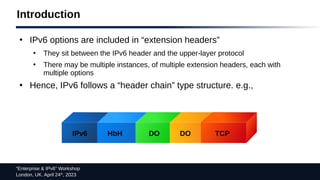
Introduction
●
IPv6 options are included in “extension headers”
●
They sit between the IPv6 header and the upper-layer protocol
●
There may be multiple instances, of multiple extension headers, each with
multiple options
●
Hence, IPv6 follows a “header chain” type structure. e.g.,
IPv6 HbH DO DO TCP
“Enterprise & IPv6” Workshop
London, UK. April 24th
, 2023
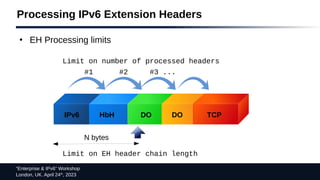
Processing IPv6 Extension Headers
●
EH Processing limits
IPv6 HbH DO DO TCP
Limit on number of processed headers
#1 #2 #3 ...
N bytes
Limit on EH header chain length
“Enterprise & IPv6” Workshop
London, UK. April 24th
, 2023
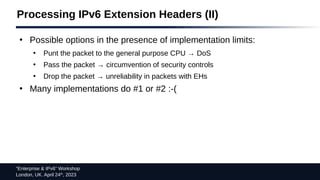
Processing IPv6 Extension Headers (II)
●
Possible options in the presence of implementation limits:
●
Punt the packet to the general purpose CPU → DoS
●
Pass the packet → circumvention of security controls
●
Drop the packet → unreliability in packets with EHs
●
Many implementations do #1 or #2 :-(
“Enterprise & IPv6” Workshop
London, UK. April 24th
, 2023
Security Implications of Extension Headers
●
Evasion of security controls
●
DoS due to processing requirements
●
DoS due to implementation errors
●
Extension Header-specific issues
“Enterprise & IPv6” Workshop
London, UK. April 24th
, 2023
Advice on Extension Headers
●
Analyze your EH requirements
●
Block IPv6 packets with unexpected EHs
“Enterprise & IPv6” Workshop
London, UK. April 24th
, 2023
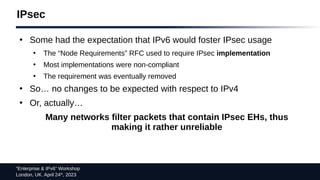
IPsec
●
Some had the expectation that IPv6 would foster IPsec usage
●
The “Node Requirements” RFC used to require IPsec implementation
●
Most implementations were non-compliant
●
The requirement was eventually removed
●
So… no changes to be expected with respect to IPv4
●
Or, actually…
Many networks filter packets that contain IPsec EHs, thus
making it rather unreliable
15
“Enterprise & IPv6” Workshop
London, UK. April 24th
, 2023
IPv6 Addressing
16
“Enterprise & IPv6” Workshop
London, UK. April 24th
, 2023
IPv6 Addressing
Introduction
“Enterprise & IPv6” Workshop
London, UK. April 24th
, 2023
Introduction
●
The main driver for IPv6 is its larger address space
●
IPv6 addresses are 128-bit long
●
IPv6 hosts simultaneously employ multiple addresses of:
●
Different scope (link-local, global, etc.)
●
Different type (unicast, multicast, etc.)
●
Different lifetime (stable, temporary)
●
IPv6 subnets are typically a /64
“Enterprise & IPv6” Workshop
London, UK. April 24th
, 2023
IPv6 Global Unicast Addresses
●
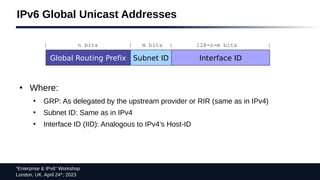
Where:
●
GRP: As delegated by the upstream provider or RIR (same as in IPv4)
●
Subnet ID: Same as in IPv4
●
Interface ID (IID): Analogous to IPv4’s Host-ID
Global Routing Prefix Subnet ID Interface ID
| n bits | m bits | 128-n-m bits |
“Enterprise & IPv6” Workshop
London, UK. April 24th
, 2023
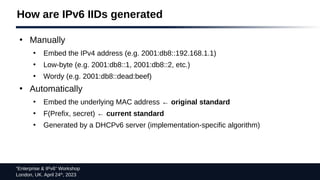
How are IPv6 IIDs generated
●
Manually
●
Embed the IPv4 address (e.g. 2001:db8::192.168.1.1)
●
Low-byte (e.g. 2001:db8::1, 2001:db8::2, etc.)
●
Wordy (e.g. 2001:db8::dead:beef)
●
Automatically
●
Embed the underlying MAC address ← original standard
●
F(Prefix, secret) ← current standard
●
Generated by a DHCPv6 server (implementation-specific algorithm)
21
“Enterprise & IPv6” Workshop
London, UK. April 24th
, 2023
IPv6 Addressing
Address Scanning
“Enterprise & IPv6” Workshop
London, UK. April 24th
, 2023
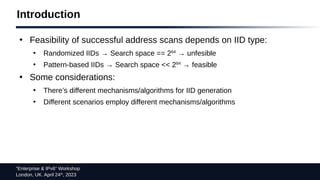
Introduction
●
Feasibility of successful address scans depends on IID type:
●
Randomized IIDs → Search space == 264
→ unfesible
●
Pattern-based IIDs → Search space << 264
→ feasible
●
Some considerations:
●
There’s different mechanisms/algorithms for IID generation
●
Different scenarios employ different mechanisms/algorithms
“Enterprise & IPv6” Workshop
London, UK. April 24th
, 2023
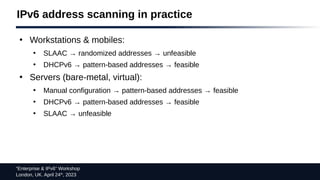
IPv6 address scanning in practice
●
Workstations & mobiles:
●
SLAAC → randomized addresses → unfeasible
●
DHCPv6 → pattern-based addresses → feasible
●
Servers (bare-metal, virtual):
●
Manual configuration → pattern-based addresses → feasible
●
DHCPv6 → pattern-based addresses → feasible
●
SLAAC → unfeasible
“Enterprise & IPv6” Workshop
London, UK. April 24th
, 2023
Advice on IPv6 address scanning
●
Network reconnaissance is a key phase of every attack
●
Making the attacker’s life more difficult is always useful
●
There may be limitations and/or trade-offs involved:
●
Enterprise may rely on a specific DHCPv6 vendor
●
Cloud provider may assign predictable addresses via DHCPv6
●
Organization may employ a specific pattern for server addresses
25
“Enterprise & IPv6” Workshop
London, UK. April 24th
, 2023
IPv6 Addressing
End-to-End Connectivity
“Enterprise & IPv6” Workshop
London, UK. April 24th
, 2023
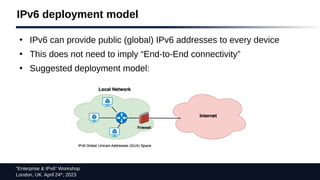
IPv6 deployment model
●
IPv6 can provide public (global) IPv6 addresses to every device
●
This does not need to imply “End-to-End connectivity”
●
Suggested deployment model:
“Enterprise & IPv6” Workshop
London, UK. April 24th
, 2023
Suggested enterprise security policy
●
Only allow outgoing communications (and return traffic)
●
Where necessary & possible:
●
Use temporary addresses along with stable addresses
●
Allow incoming connections only to specific sable addresses
28
“Enterprise & IPv6” Workshop
London, UK. April 24th
, 2023
IPv6 Addressing
Unique Local Addresses (ULAs)
“Enterprise & IPv6” Workshop
London, UK. April 24th
, 2023
Address Scope Security Properties
●
A non-global scope may provide “prophylactic” security
●
Address “filtering” as a result of limited address scope
●
Orthogonal to other filtering mechanisms
“Enterprise & IPv6” Workshop
London, UK. April 24th
, 2023
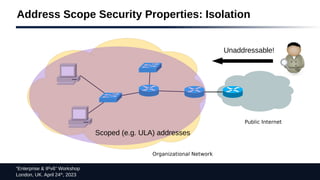
Public Internet
Organizational Network
Address Scope Security Properties: Isolation
Unaddressable!
Scoped (e.g. ULA) addresses
“Enterprise & IPv6” Workshop
London, UK. April 24th
, 2023
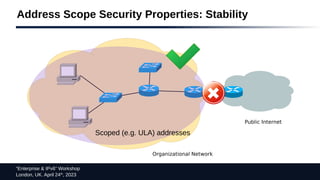
Public Internet
Organizational Network
Address Scope Security Properties: Stability
Scoped (e.g. ULA) addresses
“Enterprise & IPv6” Workshop
London, UK. April 24th
, 2023
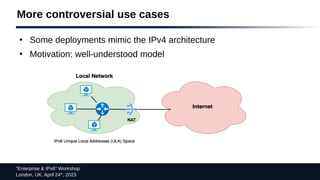
More controversial use cases
●
Some deployments mimic the IPv4 architecture
●
Motivation: well-understood model
34
“Enterprise & IPv6” Workshop
London, UK. April 24th
, 2023
IPv6 Addressing
Host-centric vs. Network-centric Security Paradigm
“Enterprise & IPv6” Workshop
London, UK. April 24th
, 2023
Changes in the security paradigm?
●
Some predict that IPv6 hosts will not rely on network-based controls
●
But IPv4 does not really rely on a network-centric paradigm!
●
IPv6 will implement both host-based and network-based controls:
●
They provide different layers of protection (defense in depth)
●
This is even more critical in the IoT-era
●
No changes with respect to the IPv4 world, actually!
36
“Enterprise & IPv6” Workshop
London, UK. April 24th
, 2023
IPv6 Addressing
Enforcing Access Control Lists (ACLs)
“Enterprise & IPv6” Workshop
London, UK. April 24th
, 2023
Introduction
●
Access Control Lists are a core component of security operations
●
Allow-lists:
– Meant to allow access to a resource from a prefix
●
Block-lists:
– Meant to block access to a resource
“Enterprise & IPv6” Workshop
London, UK. April 24th
, 2023
What is behind an IPv6 prefix?
●
Multiple addresses may map to a single host
●
Hosts typically configure multiple addresses
●
Addresses are typically selected from a /64
●
But a user might control a larger address block (e.g. a whole /48)
●
A single IPv6 address may map to multiple hosts
●
NAT-PT for IPv6 is not uncommon
●
Kubernetes typically do IPv6 ULAs + NAT
●
All these aspects are key when implementing IPv6 ACLs
“Enterprise & IPv6” Workshop
London, UK. April 24th
, 2023
IPv6 Allow-lists: Challenges
●
Use of temporary addresses (RFC8981) means:
●
Addresses change on a regular basis
●
Addresses from multiple hosts may be intermingled in the same /64
●
So...What should we “allow”?
●
If specifying /128s, the ACLs might fail
“Enterprise & IPv6” Workshop
London, UK. April 24th
, 2023
IPv6 Block-lists: Challenges
●
Quite often, these are dynamically introduced as /128s, via e.g.:
●
SIEM/IPS
●
fail2ban
●
IP reputation services (e.g., abuseipdb.com)
●
But...what should we “block”?
●
If blocking /128s, a skilled attacker might:
●
Intentionally exhaust the number of entries in your block-list
●
Circumvent the block-list (i.e., use throw-away IPv6 addresses)
“Enterprise & IPv6” Workshop
London, UK. April 24th
, 2023
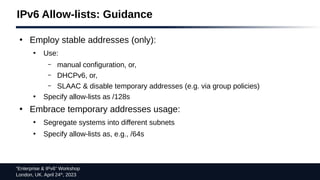
IPv6 Allow-lists: Guidance
●
Employ stable addresses (only):
●
Use:
– manual configuration, or,
– DHCPv6, or,
– SLAAC & disable temporary addresses (e.g. via group policies)
●
Specify allow-lists as /128s
●
Embrace temporary addresses usage:
●
Segregate systems into different subnets
●
Specify allow-lists as, e.g., /64s
“Enterprise & IPv6” Workshop
London, UK. April 24th
, 2023
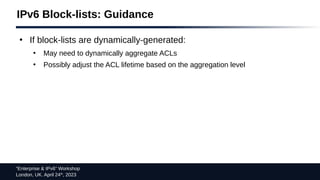
IPv6 Block-lists: Guidance
●
If block-lists are dynamically-generated:
●
May need to dynamically aggregate ACLs
●
Possibly adjust the ACL lifetime based on the aggregation level
“Enterprise & IPv6” Workshop
London, UK. April 24th
, 2023
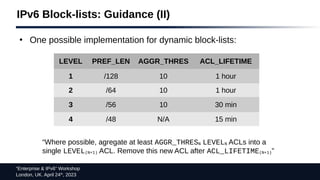
IPv6 Block-lists: Guidance (II)
LEVEL PREF_LEN AGGR_THRES ACL_LIFETIME
1 /128 10 1 hour
2 /64 10 1 hour
3 /56 10 30 min
4 /48 N/A 15 min
“Where possible, agregate at least AGGR_THRESN LEVELN ACLs into a
single LEVEL(N+1) ACL. Remove this new ACL after ACL_LIFETIME(N+1)”
●
One possible implementation for dynamic block-lists:
44
“Enterprise & IPv6” Workshop
London, UK. April 24th
, 2023
IPv6 Automatic Configuration
“Enterprise & IPv6” Workshop
London, UK. April 24th
, 2023
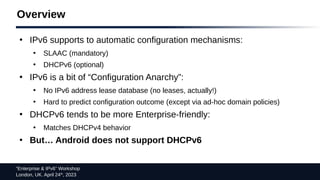
Overview
●
IPv6 supports to automatic configuration mechanisms:
●
SLAAC (mandatory)
●
DHCPv6 (optional)
●
IPv6 is a bit of “Configuration Anarchy”:
●
No IPv6 address lease database (no leases, actually!)
●
Hard to predict configuration outcome (except via ad-hoc domain policies)
●
DHCPv6 tends to be more Enterprise-friendly:
●
Matches DHCPv4 behavior
●
But… Android does not support DHCPv6
“Enterprise & IPv6” Workshop
London, UK. April 24th
, 2023
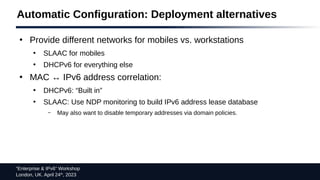
Automatic Configuration: Deployment alternatives
●
Provide different networks for mobiles vs. workstations
●
SLAAC for mobiles
●
DHCPv6 for everything else
●
MAC ↔ IPv6 address correlation:
●
DHCPv6: “Built in”
●
SLAAC: Use NDP monitoring to build IPv6 address lease database
– May also want to disable temporary addresses via domain policies.
“Enterprise & IPv6” Workshop
London, UK. April 24th
, 2023
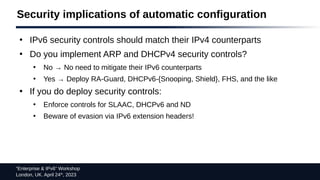
Security implications of automatic configuration
●
IPv6 security controls should match their IPv4 counterparts
●
Do you implement ARP and DHCPv4 security controls?
●
No → No need to mitigate their IPv6 counterparts
●
Yes → Deploy RA-Guard, DHCPv6-{Snooping, Shield}, FHS, and the like
●
If you do deploy security controls:
●
Enforce controls for SLAAC, DHCPv6 and ND
●
Beware of evasion via IPv6 extension headers!
49
“Enterprise & IPv6” Workshop
London, UK. April 24th
, 2023
Security implications of IPv6 on IPv4
Networks
“Enterprise & IPv6” Workshop
London, UK. April 24th
, 2023
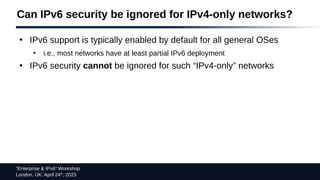
Can IPv6 security be ignored for IPv4-only networks?
●
IPv6 support is typically enabled by default for all general OSes
●
i.e., most networks have at least partial IPv6 deployment
●
IPv6 security cannot be ignored for such “IPv4-only” networks
“Enterprise & IPv6” Workshop
London, UK. April 24th
, 2023
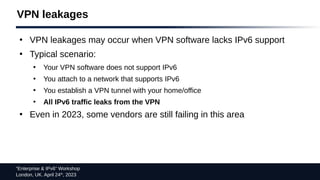
VPN leakages
●
VPN leakages may occur when VPN software lacks IPv6 support
●
Typical scenario:
●
Your VPN software does not support IPv6
●
You attach to a network that supports IPv6
●
You establish a VPN tunnel with your home/office
●
All IPv6 traffic leaks from the VPN
●
Even in 2023, some vendors are still failing in this area
52
“Enterprise & IPv6” Workshop
London, UK. April 24th
, 2023
Questions?
“Enterprise & IPv6” Workshop
London, UK. April 24th
, 2023
Thanks!
Fernando Gont
fgont@si6networks.com
IPv6 Hackers mailing-list
http://www.si6networks.com/community/
www.si6networks.com

IPv6 Security and Myth Busting

  • 1.
    Fernando Gont IPv6 Security& Myth Busting “Enterprise & IPv6” Workshop, UK IPv6 Council. London, UK. April 24th , 2023
  • 2.
    “Enterprise & IPv6”Workshop London, UK. April 24th , 2023 About... ● Security Researcher and Consultant ● Published: ● 35+ IETF RFCs (15+ on IPv6) ● Author of the SI6 Networks' IPv6 toolkit ● https://www.si6networks.com/tools/ipv6toolkit ● More at: https://www.gont.com.ar
  • 3.
    3 “Enterprise & IPv6”Workshop London, UK. April 24th , 2023 Motivation for this presentation
  • 4.
    “Enterprise & IPv6”Workshop London, UK. April 24th , 2023 Motivation for this presentation ● Lots of myths around: ● Security was considered during the design of the protocol ● Network security paradigm will change from network-centric to host-centric ● IPv6 will lead to increased IPsec usage ● IPv6 will recover the “end-to-end” properties of the Internet ● All them have a concrete negative effect: ● They set incorrect expectations ● They usually result in deployments that overlook security
  • 5.
    5 “Enterprise & IPv6”Workshop London, UK. April 24th , 2023 General considerations about IPv6 security
  • 6.
    “Enterprise & IPv6”Workshop London, UK. April 24th , 2023 Interesting aspects of IPv6 security ● We have much less experience with IPv6 than with IPv4 ● IPv6 implementations are much less mature than their IPv4 counterparts ● Security products (firewalls, NIDS, etc.) have less support for IPv6 than for IPv4 ● Increased complexity in the resulting Internet: ● Two inter-networking protocols (IPv4 and IPv6) ● Increased use of NATs ● Increased use of tunnels ● Lack of trained human resources …but even then, IPv6 is the only option on the table to remain in this business
  • 7.
    8 “Enterprise & IPv6”Workshop London, UK. April 24th , 2023 IPv6 Extension Headers
  • 8.
    “Enterprise & IPv6”Workshop London, UK. April 24th , 2023 Introduction ● IPv6 options are included in “extension headers” ● They sit between the IPv6 header and the upper-layer protocol ● There may be multiple instances, of multiple extension headers, each with multiple options ● Hence, IPv6 follows a “header chain” type structure. e.g., IPv6 HbH DO DO TCP
  • 9.
    “Enterprise & IPv6”Workshop London, UK. April 24th , 2023 Processing IPv6 Extension Headers ● EH Processing limits IPv6 HbH DO DO TCP Limit on number of processed headers #1 #2 #3 ... N bytes Limit on EH header chain length
  • 10.
    “Enterprise & IPv6”Workshop London, UK. April 24th , 2023 Processing IPv6 Extension Headers (II) ● Possible options in the presence of implementation limits: ● Punt the packet to the general purpose CPU → DoS ● Pass the packet → circumvention of security controls ● Drop the packet → unreliability in packets with EHs ● Many implementations do #1 or #2 :-(
  • 11.
    “Enterprise & IPv6”Workshop London, UK. April 24th , 2023 Security Implications of Extension Headers ● Evasion of security controls ● DoS due to processing requirements ● DoS due to implementation errors ● Extension Header-specific issues
  • 12.
    “Enterprise & IPv6”Workshop London, UK. April 24th , 2023 Advice on Extension Headers ● Analyze your EH requirements ● Block IPv6 packets with unexpected EHs
  • 13.
    “Enterprise & IPv6”Workshop London, UK. April 24th , 2023 IPsec ● Some had the expectation that IPv6 would foster IPsec usage ● The “Node Requirements” RFC used to require IPsec implementation ● Most implementations were non-compliant ● The requirement was eventually removed ● So… no changes to be expected with respect to IPv4 ● Or, actually… Many networks filter packets that contain IPsec EHs, thus making it rather unreliable
  • 14.
    15 “Enterprise & IPv6”Workshop London, UK. April 24th , 2023 IPv6 Addressing
  • 15.
    16 “Enterprise & IPv6”Workshop London, UK. April 24th , 2023 IPv6 Addressing Introduction
  • 16.
    “Enterprise & IPv6”Workshop London, UK. April 24th , 2023 Introduction ● The main driver for IPv6 is its larger address space ● IPv6 addresses are 128-bit long ● IPv6 hosts simultaneously employ multiple addresses of: ● Different scope (link-local, global, etc.) ● Different type (unicast, multicast, etc.) ● Different lifetime (stable, temporary) ● IPv6 subnets are typically a /64
  • 17.
    “Enterprise & IPv6”Workshop London, UK. April 24th , 2023 IPv6 Global Unicast Addresses ● Where: ● GRP: As delegated by the upstream provider or RIR (same as in IPv4) ● Subnet ID: Same as in IPv4 ● Interface ID (IID): Analogous to IPv4’s Host-ID Global Routing Prefix Subnet ID Interface ID | n bits | m bits | 128-n-m bits |
  • 18.
    “Enterprise & IPv6”Workshop London, UK. April 24th , 2023 How are IPv6 IIDs generated ● Manually ● Embed the IPv4 address (e.g. 2001:db8::192.168.1.1) ● Low-byte (e.g. 2001:db8::1, 2001:db8::2, etc.) ● Wordy (e.g. 2001:db8::dead:beef) ● Automatically ● Embed the underlying MAC address ← original standard ● F(Prefix, secret) ← current standard ● Generated by a DHCPv6 server (implementation-specific algorithm)
  • 19.
    21 “Enterprise & IPv6”Workshop London, UK. April 24th , 2023 IPv6 Addressing Address Scanning
  • 20.
    “Enterprise & IPv6”Workshop London, UK. April 24th , 2023 Introduction ● Feasibility of successful address scans depends on IID type: ● Randomized IIDs → Search space == 264 → unfesible ● Pattern-based IIDs → Search space << 264 → feasible ● Some considerations: ● There’s different mechanisms/algorithms for IID generation ● Different scenarios employ different mechanisms/algorithms
  • 21.
    “Enterprise & IPv6”Workshop London, UK. April 24th , 2023 IPv6 address scanning in practice ● Workstations & mobiles: ● SLAAC → randomized addresses → unfeasible ● DHCPv6 → pattern-based addresses → feasible ● Servers (bare-metal, virtual): ● Manual configuration → pattern-based addresses → feasible ● DHCPv6 → pattern-based addresses → feasible ● SLAAC → unfeasible
  • 22.
    “Enterprise & IPv6”Workshop London, UK. April 24th , 2023 Advice on IPv6 address scanning ● Network reconnaissance is a key phase of every attack ● Making the attacker’s life more difficult is always useful ● There may be limitations and/or trade-offs involved: ● Enterprise may rely on a specific DHCPv6 vendor ● Cloud provider may assign predictable addresses via DHCPv6 ● Organization may employ a specific pattern for server addresses
  • 23.
    25 “Enterprise & IPv6”Workshop London, UK. April 24th , 2023 IPv6 Addressing End-to-End Connectivity
  • 24.
    “Enterprise & IPv6”Workshop London, UK. April 24th , 2023 IPv6 deployment model ● IPv6 can provide public (global) IPv6 addresses to every device ● This does not need to imply “End-to-End connectivity” ● Suggested deployment model:
  • 25.
    “Enterprise & IPv6”Workshop London, UK. April 24th , 2023 Suggested enterprise security policy ● Only allow outgoing communications (and return traffic) ● Where necessary & possible: ● Use temporary addresses along with stable addresses ● Allow incoming connections only to specific sable addresses
  • 26.
    28 “Enterprise & IPv6”Workshop London, UK. April 24th , 2023 IPv6 Addressing Unique Local Addresses (ULAs)
  • 27.
    “Enterprise & IPv6”Workshop London, UK. April 24th , 2023 Address Scope Security Properties ● A non-global scope may provide “prophylactic” security ● Address “filtering” as a result of limited address scope ● Orthogonal to other filtering mechanisms
  • 28.
    “Enterprise & IPv6”Workshop London, UK. April 24th , 2023 Public Internet Organizational Network Address Scope Security Properties: Isolation Unaddressable! Scoped (e.g. ULA) addresses
  • 29.
    “Enterprise & IPv6”Workshop London, UK. April 24th , 2023 Public Internet Organizational Network Address Scope Security Properties: Stability Scoped (e.g. ULA) addresses
  • 30.
    “Enterprise & IPv6”Workshop London, UK. April 24th , 2023 More controversial use cases ● Some deployments mimic the IPv4 architecture ● Motivation: well-understood model
  • 31.
    34 “Enterprise & IPv6”Workshop London, UK. April 24th , 2023 IPv6 Addressing Host-centric vs. Network-centric Security Paradigm
  • 32.
    “Enterprise & IPv6”Workshop London, UK. April 24th , 2023 Changes in the security paradigm? ● Some predict that IPv6 hosts will not rely on network-based controls ● But IPv4 does not really rely on a network-centric paradigm! ● IPv6 will implement both host-based and network-based controls: ● They provide different layers of protection (defense in depth) ● This is even more critical in the IoT-era ● No changes with respect to the IPv4 world, actually!
  • 33.
    36 “Enterprise & IPv6”Workshop London, UK. April 24th , 2023 IPv6 Addressing Enforcing Access Control Lists (ACLs)
  • 34.
    “Enterprise & IPv6”Workshop London, UK. April 24th , 2023 Introduction ● Access Control Lists are a core component of security operations ● Allow-lists: – Meant to allow access to a resource from a prefix ● Block-lists: – Meant to block access to a resource
  • 35.
    “Enterprise & IPv6”Workshop London, UK. April 24th , 2023 What is behind an IPv6 prefix? ● Multiple addresses may map to a single host ● Hosts typically configure multiple addresses ● Addresses are typically selected from a /64 ● But a user might control a larger address block (e.g. a whole /48) ● A single IPv6 address may map to multiple hosts ● NAT-PT for IPv6 is not uncommon ● Kubernetes typically do IPv6 ULAs + NAT ● All these aspects are key when implementing IPv6 ACLs
  • 36.
    “Enterprise & IPv6”Workshop London, UK. April 24th , 2023 IPv6 Allow-lists: Challenges ● Use of temporary addresses (RFC8981) means: ● Addresses change on a regular basis ● Addresses from multiple hosts may be intermingled in the same /64 ● So...What should we “allow”? ● If specifying /128s, the ACLs might fail
  • 37.
    “Enterprise & IPv6”Workshop London, UK. April 24th , 2023 IPv6 Block-lists: Challenges ● Quite often, these are dynamically introduced as /128s, via e.g.: ● SIEM/IPS ● fail2ban ● IP reputation services (e.g., abuseipdb.com) ● But...what should we “block”? ● If blocking /128s, a skilled attacker might: ● Intentionally exhaust the number of entries in your block-list ● Circumvent the block-list (i.e., use throw-away IPv6 addresses)
  • 38.
    “Enterprise & IPv6”Workshop London, UK. April 24th , 2023 IPv6 Allow-lists: Guidance ● Employ stable addresses (only): ● Use: – manual configuration, or, – DHCPv6, or, – SLAAC & disable temporary addresses (e.g. via group policies) ● Specify allow-lists as /128s ● Embrace temporary addresses usage: ● Segregate systems into different subnets ● Specify allow-lists as, e.g., /64s
  • 39.
    “Enterprise & IPv6”Workshop London, UK. April 24th , 2023 IPv6 Block-lists: Guidance ● If block-lists are dynamically-generated: ● May need to dynamically aggregate ACLs ● Possibly adjust the ACL lifetime based on the aggregation level
  • 40.
    “Enterprise & IPv6”Workshop London, UK. April 24th , 2023 IPv6 Block-lists: Guidance (II) LEVEL PREF_LEN AGGR_THRES ACL_LIFETIME 1 /128 10 1 hour 2 /64 10 1 hour 3 /56 10 30 min 4 /48 N/A 15 min “Where possible, agregate at least AGGR_THRESN LEVELN ACLs into a single LEVEL(N+1) ACL. Remove this new ACL after ACL_LIFETIME(N+1)” ● One possible implementation for dynamic block-lists:
  • 41.
    44 “Enterprise & IPv6”Workshop London, UK. April 24th , 2023 IPv6 Automatic Configuration
  • 42.
    “Enterprise & IPv6”Workshop London, UK. April 24th , 2023 Overview ● IPv6 supports to automatic configuration mechanisms: ● SLAAC (mandatory) ● DHCPv6 (optional) ● IPv6 is a bit of “Configuration Anarchy”: ● No IPv6 address lease database (no leases, actually!) ● Hard to predict configuration outcome (except via ad-hoc domain policies) ● DHCPv6 tends to be more Enterprise-friendly: ● Matches DHCPv4 behavior ● But… Android does not support DHCPv6
  • 43.
    “Enterprise & IPv6”Workshop London, UK. April 24th , 2023 Automatic Configuration: Deployment alternatives ● Provide different networks for mobiles vs. workstations ● SLAAC for mobiles ● DHCPv6 for everything else ● MAC ↔ IPv6 address correlation: ● DHCPv6: “Built in” ● SLAAC: Use NDP monitoring to build IPv6 address lease database – May also want to disable temporary addresses via domain policies.
  • 44.
    “Enterprise & IPv6”Workshop London, UK. April 24th , 2023 Security implications of automatic configuration ● IPv6 security controls should match their IPv4 counterparts ● Do you implement ARP and DHCPv4 security controls? ● No → No need to mitigate their IPv6 counterparts ● Yes → Deploy RA-Guard, DHCPv6-{Snooping, Shield}, FHS, and the like ● If you do deploy security controls: ● Enforce controls for SLAAC, DHCPv6 and ND ● Beware of evasion via IPv6 extension headers!
  • 45.
    49 “Enterprise & IPv6”Workshop London, UK. April 24th , 2023 Security implications of IPv6 on IPv4 Networks
  • 46.
    “Enterprise & IPv6”Workshop London, UK. April 24th , 2023 Can IPv6 security be ignored for IPv4-only networks? ● IPv6 support is typically enabled by default for all general OSes ● i.e., most networks have at least partial IPv6 deployment ● IPv6 security cannot be ignored for such “IPv4-only” networks
  • 47.
    “Enterprise & IPv6”Workshop London, UK. April 24th , 2023 VPN leakages ● VPN leakages may occur when VPN software lacks IPv6 support ● Typical scenario: ● Your VPN software does not support IPv6 ● You attach to a network that supports IPv6 ● You establish a VPN tunnel with your home/office ● All IPv6 traffic leaks from the VPN ● Even in 2023, some vendors are still failing in this area
  • 48.
    52 “Enterprise & IPv6”Workshop London, UK. April 24th , 2023 Questions?
  • 49.
    “Enterprise & IPv6”Workshop London, UK. April 24th , 2023 Thanks! Fernando Gont fgont@si6networks.com IPv6 Hackers mailing-list http://www.si6networks.com/community/ www.si6networks.com