1
Internet Evolution and IPv6
Paul Wilson
APNIC
2
Overview
• Where is IPv6 today?
– Address space deployment
– Compared with IPv4
• Do we actually need IPv6?
– If so, why and when?
– Are there any alternatives?
• How will it happen?
– Evolution
– Revolution
• The opportunity of IPv6
3
Where is IPv6 today?
Address space deployment
4
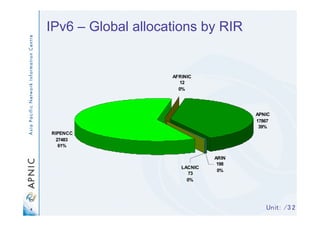
IPv6 – Global allocations by RIR
RIPENCC
27483
61%
AFRINIC
12
0%
APNIC
17867
39%
ARIN
198
0%
LACNIC
73
0%
5
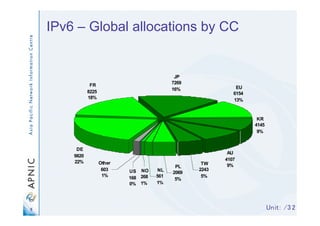
IPv6 – Global allocations by CC
Other
603
1%
NO
268
1%
PL
2069
5%
NL
561
1%
US
168
0%
EU
6154
13%
JP
7269
16%
FR
8225
18%
DE
9820
22%
KR
4145
9%
AU
4107
9%TW
2243
5%
6
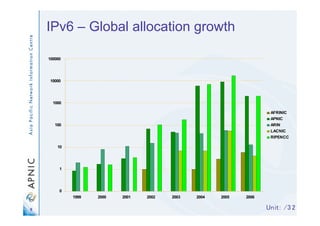
IPv6 – Global allocation growth
0
1
10
100
1000
10000
100000
1999 2000 2001 2002 2003 2004 2005 2006
AFRINIC
APNIC
ARIN
LACNIC
RIPENCC
7
Where is IPv6 today?
Comparison with IPv4
8
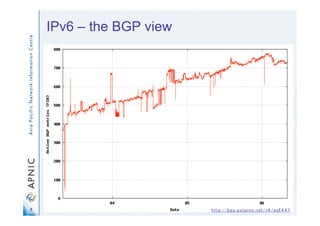
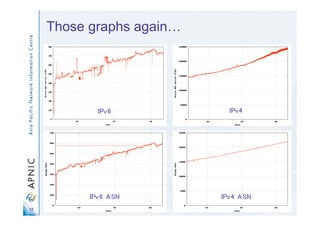
IPv6 – the BGP view
9
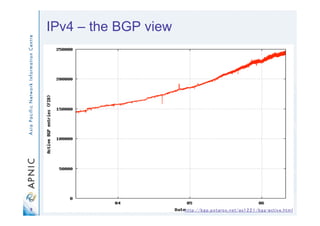
IPv4 – the BGP view
10
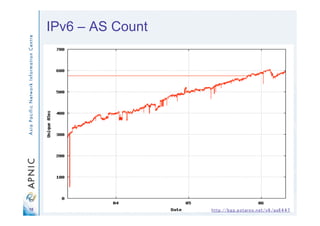
IPv6 – AS Count
11
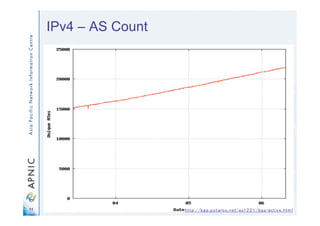
IPv4 – AS Count
12
Those graphs again…
13
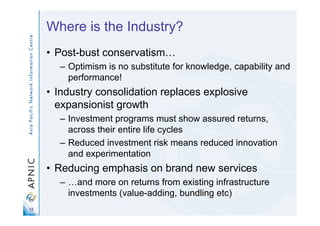
Where is the Industry?
• Post-bust conservatism…
– Optimism is no substitute for knowledge, capability and
performance!
• Industry consolidation replaces explosive
expansionist growth
– Investment programs must show assured returns,
across their entire life cycles
– Reduced investment risk means reduced innovation
and experimentation
• Reducing emphasis on brand new services
– …and more on returns from existing infrastructure
investments (value-adding, bundling etc)
14
Do we need IPv6?
15
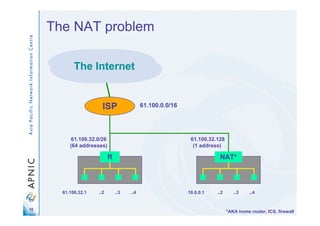
The (IPv4) Internet Today
• According to some: We “ran out” of IPv4
addresses a long time ago
– …when NAT deployment started in earnest.
– In today’s retail market one public IPv4 address can
cost as much as Mbit DSL
• Applications are now engineered for NAT
– Client-initiated transactions
– Application-layer identities
– Server agents for multi-party rendezvous
– Multi-party shared NAT state
• Ever increasing complexity, cost and performance
penalty
16
The NAT problem
10.0.0.1 ..2 ..3 ..4
R
61.100.32.0/26
(64 addresses)
61.100.32.1 ..2 ..3 ..4
ISP 61.100.0.0/16
The Internet
*AKA home router, ICS, firewall
NAT*
61.100.32.128
(1 address)
17
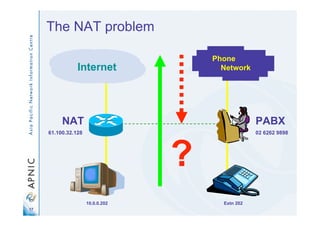
The NAT problem
Internet
10.0.0.202
61.100.32.128
NAT
?
Extn 202
Phone
Network
02 6262 9898
PABX
18
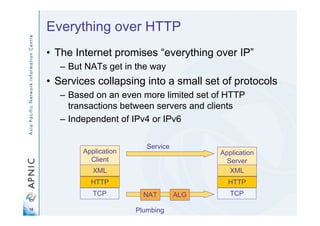
Everything over HTTP
• The Internet promises “everything over IP”
– But NATs get in the way
• Services collapsing into a small set of protocols
– Based on an even more limited set of HTTP
transactions between servers and clients
– Independent of IPv4 or IPv6
Plumbing
Application
Client
XML
HTTP
TCP
Application
Server
XML
HTTP
TCPNAT ALG
Service
19
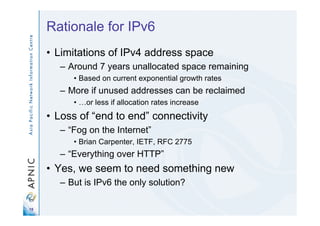
Rationale for IPv6
• Limitations of IPv4 address space
– Around 7 years unallocated space remaining
• Based on current exponential growth rates
– More if unused addresses can be reclaimed
• …or less if allocation rates increase
• Loss of “end to end” connectivity
– “Fog on the Internet”
• Brian Carpenter, IETF, RFC 2775
– “Everything over HTTP”
• Yes, we seem to need something new
– But is IPv6 the only solution?
20
Is IPv6 the only solution?
• Is there an alternative protocol?
– Basic problem is well understood: multiplex a common
communications bearer
– Not many different approaches are even possible.
• How long would a new design take?
– A decade or longer
– IPv6 has taken 12+ years so far
• Would a new design effort produce a new and
different architecture?
– Or would it produce the same response to the same
set of common constraints?
– …with possibly a slightly different set of trade-offs…
– Arguably not.
21
How can IPv6 happen?
22
What’s the motivation?
• Collectively, we all need IPv6
– But individually, it seems we are happy to wait
– We have different motivations, because the current costs are not
evenly shared
• Long term, we want…
– ISPs: Cheaper, simpler networks
– Developers: Cheaper, more capable applications
– Users: More applications, more value
• Short term, we can expect…
– ISPs: no user demand, more cost
– Developers: no market without users and ISPs
– Users: no difference at all
– No reward for early adopters
• … it’s the old “Chicken and Egg” syndrome…
23
How can it happen?
• From biology and politics, we have two
basic options
• Evolution …
– Gradual migration of existing IPv4 networks
and their associated service market to IPv6
– “IPv6 is the friend of IPv4”
• Revolution …
– Opening up new applications with IPv6 that
compete with IPv4 for industry resources, and
for overall market share
– “IPv4 is the enemy”
24
The problem is reality
• Technical
– IPv6 is stable and well tested
– But many technical issues are still being debated…
• “The perfect is the enemy of the good”
– Industry needs confidence and certainty
• Business
– NAT has worked too well
– Existing industry based on network complexity,
address scarcity, and insecurity
– Lack of investor interest in more infrastructure costs
• Short term interests vs long term imperatives
– IPv6 promotion - too much too early?
• IPv6 may be seen as “tired” and not “wired”
25
The result…
• Short term business pressures support the
case for further deferral of IPv6
infrastructure investment
• There is insufficient linkage between the
added cost, complexity and fragility of NAT-
based applications and the costs of
infrastructure deployment of IPv6
• An evolutionary adoption seems unlikely in
today’s environment
– …or in the foreseeable future
26
The IPv4 revolution
• The 1990’s – a new world of…
– Cheaper switching technologies
– Cheaper bandwidth
– Lower operational costs
– The PC revolution, funded by users
• The Internet boom
– The dumb (and cheap) network
– Technical and business innovation at the ends
– Many compelling business cases for new
services and innovation
27
An IPv6 revolution…
• The 2000’s – a new world of…
– Commodity Internet provision, lean and mean
– Massive reduction in cost of consumer electronics
– A network-ready society
• The IPv6 boom?
– “Internet for Everything”
– Serving the communications requirements of a device-
dense world
– Device population some 2–3 orders of magnitude
larger than today’s Internet
– Service costs must be cheaper by 2-3 orders of
magnitude – per packet
28
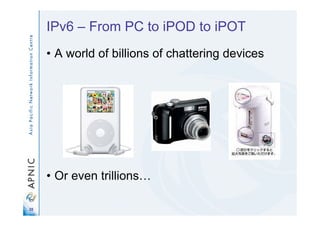
IPv6 – From PC to iPOD to iPOT
• A world of billions of chattering devices
• Or even trillions…
29
In conclusion…
30
The IPv6 Challenge
• There are too few compelling feature or revenue
levers in IPv6 to drive new investments in existing
service platforms
• But the silicon industry has made the shift from
value to volume years ago
• The Internet industry must follow
– From value to volume in IP(v6) packets
– Reducing packet transmission costs by orders of
magnitude
– To an IPv6 Internet embracing a world of trillions of
devices
– To a true utility model of service provision
31
The IPv6 Opportunity
• IPv6 as the catalyst for shifting the Internet
infrastructure industry a further giant leap
into a future of truly ubiquitous commodity
utility plumbing!
• Evolution takes millions of years
• The revolution could start any time
• Be prepared!
32
Thank you
pwilson@apnic.net

Ipv6 evolution

  • 1.
    1 Internet Evolution andIPv6 Paul Wilson APNIC
  • 2.
    2 Overview • Where isIPv6 today? – Address space deployment – Compared with IPv4 • Do we actually need IPv6? – If so, why and when? – Are there any alternatives? • How will it happen? – Evolution – Revolution • The opportunity of IPv6
  • 3.
    3 Where is IPv6today? Address space deployment
  • 4.
    4 IPv6 – Globalallocations by RIR RIPENCC 27483 61% AFRINIC 12 0% APNIC 17867 39% ARIN 198 0% LACNIC 73 0%
  • 5.
    5 IPv6 – Globalallocations by CC Other 603 1% NO 268 1% PL 2069 5% NL 561 1% US 168 0% EU 6154 13% JP 7269 16% FR 8225 18% DE 9820 22% KR 4145 9% AU 4107 9%TW 2243 5%
  • 6.
    6 IPv6 – Globalallocation growth 0 1 10 100 1000 10000 100000 1999 2000 2001 2002 2003 2004 2005 2006 AFRINIC APNIC ARIN LACNIC RIPENCC
  • 7.
    7 Where is IPv6today? Comparison with IPv4
  • 8.
  • 9.
  • 10.
  • 11.
  • 12.
  • 13.
    13 Where is theIndustry? • Post-bust conservatism… – Optimism is no substitute for knowledge, capability and performance! • Industry consolidation replaces explosive expansionist growth – Investment programs must show assured returns, across their entire life cycles – Reduced investment risk means reduced innovation and experimentation • Reducing emphasis on brand new services – …and more on returns from existing infrastructure investments (value-adding, bundling etc)
  • 14.
  • 15.
    15 The (IPv4) InternetToday • According to some: We “ran out” of IPv4 addresses a long time ago – …when NAT deployment started in earnest. – In today’s retail market one public IPv4 address can cost as much as Mbit DSL • Applications are now engineered for NAT – Client-initiated transactions – Application-layer identities – Server agents for multi-party rendezvous – Multi-party shared NAT state • Ever increasing complexity, cost and performance penalty
  • 16.
    16 The NAT problem 10.0.0.1..2 ..3 ..4 R 61.100.32.0/26 (64 addresses) 61.100.32.1 ..2 ..3 ..4 ISP 61.100.0.0/16 The Internet *AKA home router, ICS, firewall NAT* 61.100.32.128 (1 address)
  • 17.
  • 18.
    18 Everything over HTTP •The Internet promises “everything over IP” – But NATs get in the way • Services collapsing into a small set of protocols – Based on an even more limited set of HTTP transactions between servers and clients – Independent of IPv4 or IPv6 Plumbing Application Client XML HTTP TCP Application Server XML HTTP TCPNAT ALG Service
  • 19.
    19 Rationale for IPv6 •Limitations of IPv4 address space – Around 7 years unallocated space remaining • Based on current exponential growth rates – More if unused addresses can be reclaimed • …or less if allocation rates increase • Loss of “end to end” connectivity – “Fog on the Internet” • Brian Carpenter, IETF, RFC 2775 – “Everything over HTTP” • Yes, we seem to need something new – But is IPv6 the only solution?
  • 20.
    20 Is IPv6 theonly solution? • Is there an alternative protocol? – Basic problem is well understood: multiplex a common communications bearer – Not many different approaches are even possible. • How long would a new design take? – A decade or longer – IPv6 has taken 12+ years so far • Would a new design effort produce a new and different architecture? – Or would it produce the same response to the same set of common constraints? – …with possibly a slightly different set of trade-offs… – Arguably not.
  • 21.
  • 22.
    22 What’s the motivation? •Collectively, we all need IPv6 – But individually, it seems we are happy to wait – We have different motivations, because the current costs are not evenly shared • Long term, we want… – ISPs: Cheaper, simpler networks – Developers: Cheaper, more capable applications – Users: More applications, more value • Short term, we can expect… – ISPs: no user demand, more cost – Developers: no market without users and ISPs – Users: no difference at all – No reward for early adopters • … it’s the old “Chicken and Egg” syndrome…
  • 23.
    23 How can ithappen? • From biology and politics, we have two basic options • Evolution … – Gradual migration of existing IPv4 networks and their associated service market to IPv6 – “IPv6 is the friend of IPv4” • Revolution … – Opening up new applications with IPv6 that compete with IPv4 for industry resources, and for overall market share – “IPv4 is the enemy”
  • 24.
    24 The problem isreality • Technical – IPv6 is stable and well tested – But many technical issues are still being debated… • “The perfect is the enemy of the good” – Industry needs confidence and certainty • Business – NAT has worked too well – Existing industry based on network complexity, address scarcity, and insecurity – Lack of investor interest in more infrastructure costs • Short term interests vs long term imperatives – IPv6 promotion - too much too early? • IPv6 may be seen as “tired” and not “wired”
  • 25.
    25 The result… • Shortterm business pressures support the case for further deferral of IPv6 infrastructure investment • There is insufficient linkage between the added cost, complexity and fragility of NAT- based applications and the costs of infrastructure deployment of IPv6 • An evolutionary adoption seems unlikely in today’s environment – …or in the foreseeable future
  • 26.
    26 The IPv4 revolution •The 1990’s – a new world of… – Cheaper switching technologies – Cheaper bandwidth – Lower operational costs – The PC revolution, funded by users • The Internet boom – The dumb (and cheap) network – Technical and business innovation at the ends – Many compelling business cases for new services and innovation
  • 27.
    27 An IPv6 revolution… •The 2000’s – a new world of… – Commodity Internet provision, lean and mean – Massive reduction in cost of consumer electronics – A network-ready society • The IPv6 boom? – “Internet for Everything” – Serving the communications requirements of a device- dense world – Device population some 2–3 orders of magnitude larger than today’s Internet – Service costs must be cheaper by 2-3 orders of magnitude – per packet
  • 28.
    28 IPv6 – FromPC to iPOD to iPOT • A world of billions of chattering devices • Or even trillions…
  • 29.
  • 30.
    30 The IPv6 Challenge •There are too few compelling feature or revenue levers in IPv6 to drive new investments in existing service platforms • But the silicon industry has made the shift from value to volume years ago • The Internet industry must follow – From value to volume in IP(v6) packets – Reducing packet transmission costs by orders of magnitude – To an IPv6 Internet embracing a world of trillions of devices – To a true utility model of service provision
  • 31.
    31 The IPv6 Opportunity •IPv6 as the catalyst for shifting the Internet infrastructure industry a further giant leap into a future of truly ubiquitous commodity utility plumbing! • Evolution takes millions of years • The revolution could start any time • Be prepared!
  • 32.