Future Network Technologies Research and
         Innovation in HORIZON2020
           Consultation Workshop


       Smart networks & architectures Panel Session
                 Brussels (29/06/2012)
                  Olivier.Martin@ictconsulting.ch
       http://www.ictconsulting.ch/presentations/horizon2020.ppt


29/6/2012                        Olivier Martin                    1
Outline
   The “Invisible” or “infrastructural” Internet
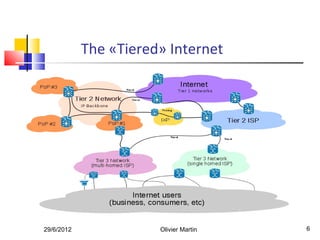
        The Tiered model
   The OTT, aka the “Services” Internet
        Facebook, Google, LinkedIn, Netflix, Skype, Twitter, YouTube, etc.
   IPV6 Deployment Status & Issues
   The proliferation of standards-making organisations
        The fading role of the IETF
   What can Horizon2020 do?
   Tentative Conclusions


29/6/2012                         Olivier Martin                          2
State of the Internet (1)
   What I used to write:
        There are two Internets that have very little in common, namely:
                 Academic & Research Internet (GEANT & National Research and

                   Education Networks (NRENs) in Europe, Internet2 & National Lambda
                   Rail (NLR) in the USA, etc.)
                 Commercial, also dubbed “Commodity”, Internet, itself divided between

                   the wired, wireless and cellular Internets.
        However, they clearly participate to the Global Internet despite major
         differences. Indeed, the A&R Internet has the following distinguishing
         characteristics:
                   Bandwidth rich unlike the bandwidth scarce Commercial Internet
                   Special emphasis on interconnection between Universities and Research
                    centers as well as provision of dedicated infrastructure for “mission-
                    oriented” communities (e.g. CERN/LHC)
                   Provision of advanced core Internet services (e.g. IPv6, native Multicast)
                   (too) Strong emphasis on bandwidth on demand. Was there a solid
                    business case analysis made?


29/6/2012                                Olivier Martin                                     3
State of the Internet (2)

Another formulation, probably closer to reality, is that there are indeed two
Internets “piled” on top of each other, the “infrastructural” one that is largely
“invisible” and is having troubles and the “services” one that is flourishing, more
specifically:
        The “Invisible” Internet (provided by Telco, specified by the IETF) plagued
         by:
               The lack of inter-domain services (QoS, Multicast)
               The endless transition to IPv6
               Near exponential growth, change of usage patterns (e.g. video), Falling
                revenues, Lack of spectrum.
               Hence the “legitimate” temptation to add more and more functionality (e.g.
                compute & storage)
        The Over The Top (OTT) Internet
               What uneducated users believe to be THE Internet
               Unconstrained by standards
               Driven by creativity and business opportunities

29/6/2012                                Olivier Martin                                      4
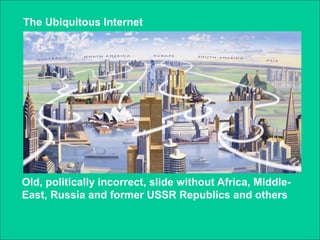
The Ubiquitous Internet


Old, politically incorrect, slide without Africa, Middle-
East, Russia and former USSR Republics and others
The «Tiered» Internet


29/6/2012              Olivier Martin   6
OTT Providers & Services
   Successfully provided what the Internet was unable to deliver, namely:
        Quality of Service by moving content closer to the user
        Inter-provider services because of its “inherent” Overlay nature
        Application-level/Emulated Multicast
        Sophisticated Peer-to-Peer technology (e.g. BitTorrent)
        Smart applications (e.g. Facebook, Google, LinkedIn, Netflix, Skype, Twitter,
         YouTube, etc.)
        Last but not least, Cloud services of various kinds (i.e. SaaS, PaaS, IaaS, etc.)
   So, do we need really need to change anything and move from a “relatively
    dumb” network to a “smarter” network, being well understood that end-user
    devices as well as services will become “smarter and smarter”?
        Given the outstanding success of OTT services the answer is a resounding NO, I
         think!


29/6/2012                                 Olivier Martin                                     7
The “ill-cooked” and outdated IPv6
                migration strategy (1)

   Started in the early 1990s, in the days of class-based addresses, i.e.
    before Classless Internet Domain Routing (CIDR) came about, in
    parallel with the development of IP next generation (IPng) proposals
    that finally led to the adoptionIPv6:
         Exhaustion of IPv4 addresses was seen as imminent
         The Internet was very small compared to today!
   Dual-stack was thought to be straightforward, which it actually was
    not as, around the same time, Digital Equipment Corporation (DEC)
    dropped DECNET Phase V, that was based on the same migration
    principles, on the grounds that it would never fly!
   Lack of variable length IPv6 addresses, i.e. lack of backward
    compatibility with IPv4, was probably the biggest mistake:
         However, back in the early 1990s, this was deemed impossible by the
          VLSI designers


29/6/2012                              Olivier Martin                           8
The “ill-cooked” and outdated IPv6
                migration strategy (2)
   Back in 1999 during the Internet Architecture Board (IAB) workshop in
    Utrecht, the idea of taking advantage of the “dreaded” Network Address
    Translators (NATs) to facilitate the transition to IPv6 was coined by Gabriel
    Montenegro (SUN) who was also working on an alternative to IPv6 dubbed
    ”Realm Specific IPs” (RSIP) that was not pursued.
         However, the IAB was violently against NATs because of the violation of the end-
          to-end paradigm. In other words, NATs were then “evils”!
         Indeed, the IETF only standardized NATs and associated Application Level
          gateways (ALGs) long after they had been widely deployed by commercial ISPs.
   So, nothing happened for 10 years, i.e. 2009 until it became obvious that, if
    only because of the upcoming lack of IPv4 addresses, the IPv4 and IPv6
    Internets would need to coexist for many years, if not decades!
   Having acknowledged the new reality, the new challenge, therefore, was to ensure
    “graceful” interconnection between these two Internets such that they would appear
    as a single, “Global” Internet

29/6/2012                              Olivier Martin                                   9
Various statements about NATs and IPv6-IPv4
                    coexistence


Russ Housley (IETF Chair): Are NATs for IPv6 a necessary evil?
         “They are necessary for a smooth migration from IPv4 to IPv6 so that the
          important properties of the Internet are preserved….We need to be pragmatic”
Xing Li (co-author of the IVI proposal (RFC6219) also known as
“stateless NAT64”)
      “The experience with IPv6 deployment in the past 10 years indicate that the ability

          to communicate between IPv4 and IPv6 address families would be beneficial.”
   Network World 20/3/09
         “Business incentives are completely lacking today for upgrading to IPv6, the next generation
          Internet protocol, according to a survey of network operators conducted by the Internet
          Society (ISOC).”
   Special Network World Issue 21/1/09 (sponsored by NTT)
         IPv6: Not If, When?
29/6/2012                                    Olivier Martin                                              10
IPv6 launch events: An amazing but
    genuine recurring series of “flops” (1)


   Started with the Global IPv6 launch event in Brussels in January 2004
        Most impressive event, all major actors present
        Many misleading, actually false, statements about the new capabilities
         inherent to IPv6 like built-in Quality of Service!
        Fully Internet-enabled car demonstrated with only one major feature
         missing (driverless)!
   Continued by the IETF in March 2008: “The night the IETF turned off
    IPv4”
        Discovered a few “residual” problems!
            “There's still a lot to do before the IPv4 addresses are used up within

             4 years or so!”
            We are now exactly there, and we are definitely much more


29/6/2012
             advanced, although actual deployment of IPv6 is despairingly slow! 11
                                        Olivier Martin
IPv6 launch events: An amazing but real
          recurring series of “flops” (2)

Pursued by ISOC in 2011 & 2012 “World IPv6 Day”
        Lot of “hype” before, essentially no or very little feedback afterwards!
Conclusions and Observations
        Relative fiasco in terms of wider and faster adoption of IPv6
        Intoxication does not work, the Internet is driven by economic
         considerations not by ideology and/or proselytism!
        Genuine advances have been made with the provision of new IPv6/IPv4
         transition tools
        An IPv4 trading market is developing which is not a very good sign
        However, IPv6 appears to be unavoidable


29/6/2012                            Olivier Martin                                 12
Will IPv6 be deployed soon?

We are now mid-2012 and although IP6/IPv4 transition technology has become
available, e.g. Stateful and Stateless NAT64, it is not widely deployed in
operational networks yet:
        Not clear how well NAT64 technology works and whether it will scale!
        Fortunately, most popular servers are already dual-stack or will soon be, however,
         many hyperlinks will probably appear as “broken” depending on the access
         network.
        Carrier-grade IPv4 NATs are being deployed which implies NATs over NATs (i.e.
         NAT444) which may, in turn, increase the number of “broken” applications and
         induce developers to layer new applications on top of the Web (i.e. HTTP)
 In any case, it is very comforting to observe that the IETF clearly learned the
lesson and that there is now an intensive activity on NATs of all kinds!
        NAT44, NAT64, NAT66, NAT444, … let us hope we will not see NAT4444 or even
         worse “tricks`!

29/6/2012                              Olivier Martin                                   13
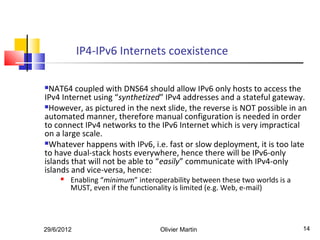
IP4-IPv6 Internets coexistence

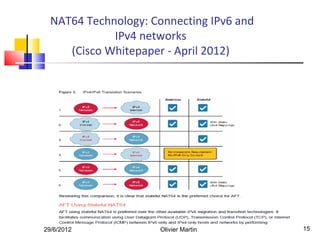
 NAT64 coupled with DNS64 should allow IPv6 only hosts to access the
IPv4 Internet using “synthetized” IPv4 addresses and a stateful gateway.
However, as pictured in the next slide, the reverse is NOT possible in an
automated manner, therefore manual configuration is needed in order
to connect IPv4 networks to the IPv6 Internet which is very impractical
on a large scale.
Whatever happens with IPv6, i.e. fast or slow deployment, it is too late
to have dual-stack hosts everywhere, hence there will be IPv6-only
islands that will not be able to “easily” communicate with IPv4-only
islands and vice-versa, hence:
        Enabling “minimum” interoperability between these two worlds is a
         MUST, even if the functionality is limited (e.g. Web, e-mail)


29/6/2012                          Olivier Martin                            14
NAT64 Technology: Connecting IPv6 and
             IPv4 networks
     (Cisco Whitepaper - April 2012)


29/6/2012            Olivier Martin       15
The ambiguities of the Standards making process

   Excerpts from Larry Roberts’ 1995 article “The ARPANET & Computer Networks” : “With
    five, independent, public packet networks under construction in the 1974-1975 period
    (USA, Canada , U.K. , France , Japan), there was strong incentive for the nations to agree
    on a standard user interface to the networks so that host computers would not have
    unique interfacing jobs in each country. Unlike most standards activities, where there is
    almost no incentive to compromise and agree, carriers in separate countries can only
    benefit from the adoption of a standard since it facilitates network interconnection and
    permits easier user attachment”.
   As pointed out by L. Roberts unless that there are compelling reasons to find a common
    solution diverging commercial interests often lead The new rule seems to be slow-
    down and complicate the standardization process rather than to accelerating it.
   Good Standards are the ones that are used and do not over or under specify.
   Most standards have a very limited lifetime, however, the IPv4 protocol suite and
    CCITT/ITU transmission standards are notable exceptions to this general rule.


29/6/2012                               Olivier Martin                                     16
Internet Engineering Task Force (IETF)

   IETF’s track record has been rather disappointing during the last 10
    years or so, however, it remains the undisputed guardian of Internet
    protocols:
        Failed to adapt in a timely manner to the rejection of its dual-stack IPv6
         migration strategy
        Failed to keep its ability to swiftly define suitable standards
        Defined MPLS, the last major architectural Internet change
               However, the Internet community is divided about the wisdom of this very
                significant, also very complex, change
                Interactions with ITU are less than satisfactory (MPLS-TP, NGN)
        Is the much heralded “rough consensus” model still working?
        The ongoing development of IP4-IPv6 transition/coexistence tools is, in
         my view, very encouraging
               However, Internet purists are probably in violent disagreement


29/6/2012                                Olivier Martin                                    17
Standards Developing Organisations (SDO)

A general observation is that there are far too many Internet related SDOs with
   the result that the Internet entropy is increasing slowly but surely.
  IETF is not the only culprit, the track record of the W3C (Web Consortium)
   and the Open Grid Forum (OGF) is also disappointing in terms of practical
   impact but not in terms of number of “standards” produced!
  The Open Networking Foundation (ONF) that is dealing with Software Defined
   Networking (SDN), aka OpenFlow, is anything but open, i.e. the entry price is
   high.
  The same can be said of MIT’s Communications Future Program (CFP)
  ITU rates well with respect to transmission technology and Optical Transport
   Network (OTN)
        However, where is ITU’s NGN and MPLS-TP leading to?
        Interactions with IETF leave much to be desired.
   IEEE, being more “industry-driven” has, by far, the best track record with
    Ethernet and WiMax
   But, ETSI also fares very well with GSM and LTE standards.
   3GPP is linked to ETSI and ITU with very focused goals
29/6/2012                                 Olivier Martin                         18
What the Internet may look like in the future

   A “Green”, i.e. energy aware, Internet will appear.
   Broadband access (i.e. Mb/sGb/s) will become nearly ubiquitous
        Wireless access will become prevalent (3G, 4G, LTE, WiMAX, 5G)
        But, fixed access will not disappear (ADSL, FTTH, GPON, Cable TV, leased
         lines, etc.)
   Paradigm changes are unavoidable, e.g.:
        Host based  Content based
        Information Centric Networks (ICN)
        Peer-2-Peer networks (P2P)
        Content Distribution Networks (CDN)
        Software Defined Networking (SDN, i.e. OpenFlow in practice)
     
         LISP "Locator/ID Separation Protocol (LISP)" (RFC6115)


29/6/2012                           Olivier Martin                              19
Challenges/Observations (1)
   Keep the “Global Internet” connected.
   The existing “dumb” network model that allowed the emergence of
    OTT services is probably better suited to innovation and fast creation
    of new services than a functionally richer network encompassing
    additional functionality such as compute & storage.
   The “fading” role of the IETF is preoccupying:
        the Internet belongs to everyone but who owns and controls it?
   The “multiplication” of new standards making organisations/forums is
    also worrying (e.g., W3C, OGF, ONF).
        Remember that Web 2.0 did not originate from W3C
        Likewise, the Cloud emerged because of the inability of the OGF to produce
         adequate standards in a timely manner.
        OpenFlow/SDN brings bright/promising ideas, however, it should not be used as a
         pretext to delay the introduction of IPv6
29/6/2012                              Olivier Martin                                 20
Challenges/Observations(2)

   Some new proposals, e.g. “bandwidth on demand” or “all-optical” networks
    look like “solutions looking for a problem” and lack a solid business case
    analysis.
   The Internet entropy is increasing, which body is really controlling its
    development:
        The past 10 years have been disappointing to say the least
        The last major architectural change was MPLS, however, the Internet community is
         still spit/divided about it
       The early Internet was extremely primitive in terms of services (i.e. ftp,
        telnet, email) before the advent of the Web (HTTP & HTML) that did not
        really originate from the IETF.
   The Internet can be visualized vertically as Telcos, ISPs, OTTs, Users on top of
    each others:
        Lack of concertation with users is flagrant
29/6/2012                                Olivier Martin                               21
Challenges/Observations(3)

The OTT allowed what the IETF completely failed to provide, namely:
Inter-provider/inter-domain services, QoS, Multicast
Although there is a clear trend towards multiple networks (e.g. IoT,

cars, smart electricity Grids) this should not dilute the effort to keep a
single Internet even though, it is already fragmented because of its
multilingual nature and the increasing number of paying services.
The top priority is to improve the connectivity between the IPv4-only

and IPv6-only worlds:
        NAT64/DNS64 is a right step in that direction but additional “middle-
         boxes”/network appliances are likely to be needed.
        In principle, a promising market, given the need to ensure minimum
         interoperability between these two worlds at the Web and email level, at the very
         least!
29/6/2012                              Olivier Martin                                   22
Additional comments (1)
   The trend is likely to be multiple, loosely coupled, networks rather than one
    single network (e.g. smartGrids, home networks, VANs,IoT, sensor nets), if
    only for cyber-security reasons.
   A well-organized transition to IPv6 should resemble more the ongoing
    transition from analog to digital TV than the complete “mess” surrounding
    the IPv4/IPv6 transition!
   In-network storage looks, a priori, like a good idea in terms of optimization,
    however, is it worth the additional complexity and related CAPEX/OPEX costs
    (e.g. router memory is likely to be an order of magnitude more expensive
    than regular RAMs).
   Many other parallel Internets will appear, e.g. the Internet of Things (IoT),
    Smart Grids, etc., that, if only for cyber-security reasons, will only be loosely
    connected to the “Global” Internet through highly-secured gateways.
        Will they be based on IPv4 or IPv6 or some other loosely related technology?


29/6/2012                                   Olivier Martin                              23
Additional comments (2)
   Related to the likely proliferation of Internets that will be dealing with objects
    of various kinds, one could say that there will be two categories of Internets:
        The “human” Internet, also known as the “Global” Internet, which human beings will use to
         connect smartphones, tablets, notebooks, ultrabooks, laptop PCs) in order to access and use
         social networks, Web services, more generally OTT services, including “cloud” services.
        The “non-human” Internet, e.g. the IoT, various sensor networks, that will be used to collect
         and aggregate control information to be fed ultimately into the “Global” Internet for actions
         by humans or into “specialized” Internets (i.e. control networks) for action by robots.


29/6/2012                                   Olivier Martin                                           24
What can/should Europe do in
Horizon2020 (1)
   Despite my rather negative comments about the IETF, this is the ONLY forum
    dealing with Internet architecture and lower layers protocols (i.e. up to layer
    4 (transport), therefore Europe:
        Must definitely strive to strengthen its presence and influence
        Try to establish strategic trans-continental alliances (e.g. EU-US, EU-JP or EU-KR) at the
         academic and research, project, and, most importantly, industrial levels.
        Must forget about European-only solutions in a more and more globalized world
        Must look at the wider worldwide market not only to the intra-European market which is huge
         but too fragmented.
        Standards making organizations must carefully avoid to over specify standards, in order to
         allow innovation while still allowing, either interworking or achieveng particular goals (e.g.
         CO2 emission levels, electricity consumption)


29/6/2012                                   Olivier Martin                                          25
What can/should Europe do in
Horizon2020 (2)

   Opportunities for the European ICT industry are definitely huge:
      irresistible trends towards a “Greener” ICT world
     almost borderless room for innovation in the OTT service space, e.g. e-Health, Smart-*

     Cloud computing

     Commodity routers, Large scale NATs , innovative network appliances facilitating

     interconnections with the emerging IPv6 world
     mobile Internet that is still in its infancy with immature protocols and products,

     innovation in efficient content distribution (Information-Centric Networking, improved peer-to-

     peer schemes).


29/6/2012                                   Olivier Martin                                          26
Tentative Conclusions
   The IPv4 Internet is growing fast but cannot continue “as is” beyond 2014 or
    so!
   IPv6 looks “almost” unavoidable but is by no means “guaranteed” to happen!
        IPv6 by itself only solves ONE problem, i.e. the lack of addresses BUT nothing else
   Last major, but still controversial, architecture change was the introduction of
    MPLS
   The “Global” Internet will encompass two Internets, IPv4 and IPv6 with some
    “glue” between them in the form of “dual-stack” hosts (mostly servers).
   Many other parallel Internets will appear, e.g. the Internet of Things (IoT),
    Smart Grids, etc., that, if only for cyber-security reasons, will only be loosely
    connected to the “Global” Internet through highly-secured gateways.
        Will they be based on IPv4 or IPv6 or some other loosely related technology?


29/6/2012                                   Olivier Martin                                 27
Additional Slides


29/6/2012            Olivier Martin   28
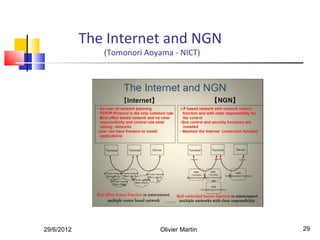
The Internet and NGN
               (Tomonori Aoyama - NICT)


29/6/2012                    Olivier Martin   29
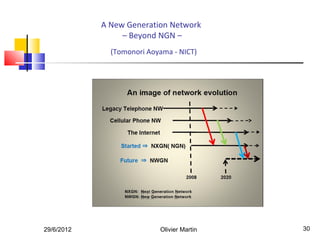
A New Generation Network
                 – Beyond NGN –
              (Tomonori Aoyama - NICT)


29/6/2012                  Olivier Martin   30

An independent view on the evolution of the Internet

  • 1.
    Future Network TechnologiesResearch and Innovation in HORIZON2020 Consultation Workshop Smart networks & architectures Panel Session Brussels (29/06/2012) Olivier.Martin@ictconsulting.ch http://www.ictconsulting.ch/presentations/horizon2020.ppt 29/6/2012 Olivier Martin 1
  • 2.
    Outline  The “Invisible” or “infrastructural” Internet  The Tiered model  The OTT, aka the “Services” Internet  Facebook, Google, LinkedIn, Netflix, Skype, Twitter, YouTube, etc.  IPV6 Deployment Status & Issues  The proliferation of standards-making organisations  The fading role of the IETF  What can Horizon2020 do?  Tentative Conclusions 29/6/2012 Olivier Martin 2
  • 3.
    State of theInternet (1)  What I used to write:  There are two Internets that have very little in common, namely:  Academic & Research Internet (GEANT & National Research and Education Networks (NRENs) in Europe, Internet2 & National Lambda Rail (NLR) in the USA, etc.)  Commercial, also dubbed “Commodity”, Internet, itself divided between the wired, wireless and cellular Internets.  However, they clearly participate to the Global Internet despite major differences. Indeed, the A&R Internet has the following distinguishing characteristics:  Bandwidth rich unlike the bandwidth scarce Commercial Internet  Special emphasis on interconnection between Universities and Research centers as well as provision of dedicated infrastructure for “mission- oriented” communities (e.g. CERN/LHC)  Provision of advanced core Internet services (e.g. IPv6, native Multicast)  (too) Strong emphasis on bandwidth on demand. Was there a solid business case analysis made? 29/6/2012 Olivier Martin 3
  • 4.
    State of theInternet (2) Another formulation, probably closer to reality, is that there are indeed two Internets “piled” on top of each other, the “infrastructural” one that is largely “invisible” and is having troubles and the “services” one that is flourishing, more specifically:  The “Invisible” Internet (provided by Telco, specified by the IETF) plagued by:  The lack of inter-domain services (QoS, Multicast)  The endless transition to IPv6  Near exponential growth, change of usage patterns (e.g. video), Falling revenues, Lack of spectrum.  Hence the “legitimate” temptation to add more and more functionality (e.g. compute & storage)  The Over The Top (OTT) Internet  What uneducated users believe to be THE Internet  Unconstrained by standards  Driven by creativity and business opportunities 29/6/2012 Olivier Martin 4
  • 5.
    The Ubiquitous Internet Old,politically incorrect, slide without Africa, Middle- East, Russia and former USSR Republics and others
  • 6.
  • 7.
    OTT Providers &Services  Successfully provided what the Internet was unable to deliver, namely:  Quality of Service by moving content closer to the user  Inter-provider services because of its “inherent” Overlay nature  Application-level/Emulated Multicast  Sophisticated Peer-to-Peer technology (e.g. BitTorrent)  Smart applications (e.g. Facebook, Google, LinkedIn, Netflix, Skype, Twitter, YouTube, etc.)  Last but not least, Cloud services of various kinds (i.e. SaaS, PaaS, IaaS, etc.)  So, do we need really need to change anything and move from a “relatively dumb” network to a “smarter” network, being well understood that end-user devices as well as services will become “smarter and smarter”?  Given the outstanding success of OTT services the answer is a resounding NO, I think! 29/6/2012 Olivier Martin 7
  • 8.
    The “ill-cooked” andoutdated IPv6 migration strategy (1)  Started in the early 1990s, in the days of class-based addresses, i.e. before Classless Internet Domain Routing (CIDR) came about, in parallel with the development of IP next generation (IPng) proposals that finally led to the adoptionIPv6:  Exhaustion of IPv4 addresses was seen as imminent  The Internet was very small compared to today!  Dual-stack was thought to be straightforward, which it actually was not as, around the same time, Digital Equipment Corporation (DEC) dropped DECNET Phase V, that was based on the same migration principles, on the grounds that it would never fly!  Lack of variable length IPv6 addresses, i.e. lack of backward compatibility with IPv4, was probably the biggest mistake:  However, back in the early 1990s, this was deemed impossible by the VLSI designers 29/6/2012 Olivier Martin 8
  • 9.
    The “ill-cooked” andoutdated IPv6 migration strategy (2)  Back in 1999 during the Internet Architecture Board (IAB) workshop in Utrecht, the idea of taking advantage of the “dreaded” Network Address Translators (NATs) to facilitate the transition to IPv6 was coined by Gabriel Montenegro (SUN) who was also working on an alternative to IPv6 dubbed ”Realm Specific IPs” (RSIP) that was not pursued.  However, the IAB was violently against NATs because of the violation of the end- to-end paradigm. In other words, NATs were then “evils”!  Indeed, the IETF only standardized NATs and associated Application Level gateways (ALGs) long after they had been widely deployed by commercial ISPs.  So, nothing happened for 10 years, i.e. 2009 until it became obvious that, if only because of the upcoming lack of IPv4 addresses, the IPv4 and IPv6 Internets would need to coexist for many years, if not decades!  Having acknowledged the new reality, the new challenge, therefore, was to ensure “graceful” interconnection between these two Internets such that they would appear as a single, “Global” Internet 29/6/2012 Olivier Martin 9
  • 10.
    Various statements aboutNATs and IPv6-IPv4 coexistence Russ Housley (IETF Chair): Are NATs for IPv6 a necessary evil?  “They are necessary for a smooth migration from IPv4 to IPv6 so that the important properties of the Internet are preserved….We need to be pragmatic” Xing Li (co-author of the IVI proposal (RFC6219) also known as “stateless NAT64”)  “The experience with IPv6 deployment in the past 10 years indicate that the ability to communicate between IPv4 and IPv6 address families would be beneficial.”  Network World 20/3/09  “Business incentives are completely lacking today for upgrading to IPv6, the next generation Internet protocol, according to a survey of network operators conducted by the Internet Society (ISOC).”  Special Network World Issue 21/1/09 (sponsored by NTT)  IPv6: Not If, When? 29/6/2012 Olivier Martin 10
  • 11.
    IPv6 launch events:An amazing but genuine recurring series of “flops” (1)  Started with the Global IPv6 launch event in Brussels in January 2004  Most impressive event, all major actors present  Many misleading, actually false, statements about the new capabilities inherent to IPv6 like built-in Quality of Service!  Fully Internet-enabled car demonstrated with only one major feature missing (driverless)!  Continued by the IETF in March 2008: “The night the IETF turned off IPv4”  Discovered a few “residual” problems!  “There's still a lot to do before the IPv4 addresses are used up within 4 years or so!”  We are now exactly there, and we are definitely much more 29/6/2012 advanced, although actual deployment of IPv6 is despairingly slow! 11 Olivier Martin
  • 12.
    IPv6 launch events:An amazing but real recurring series of “flops” (2) Pursued by ISOC in 2011 & 2012 “World IPv6 Day”  Lot of “hype” before, essentially no or very little feedback afterwards! Conclusions and Observations  Relative fiasco in terms of wider and faster adoption of IPv6  Intoxication does not work, the Internet is driven by economic considerations not by ideology and/or proselytism!  Genuine advances have been made with the provision of new IPv6/IPv4 transition tools  An IPv4 trading market is developing which is not a very good sign  However, IPv6 appears to be unavoidable 29/6/2012 Olivier Martin 12
  • 13.
    Will IPv6 bedeployed soon? We are now mid-2012 and although IP6/IPv4 transition technology has become available, e.g. Stateful and Stateless NAT64, it is not widely deployed in operational networks yet:  Not clear how well NAT64 technology works and whether it will scale!  Fortunately, most popular servers are already dual-stack or will soon be, however, many hyperlinks will probably appear as “broken” depending on the access network.  Carrier-grade IPv4 NATs are being deployed which implies NATs over NATs (i.e. NAT444) which may, in turn, increase the number of “broken” applications and induce developers to layer new applications on top of the Web (i.e. HTTP)  In any case, it is very comforting to observe that the IETF clearly learned the lesson and that there is now an intensive activity on NATs of all kinds!  NAT44, NAT64, NAT66, NAT444, … let us hope we will not see NAT4444 or even worse “tricks`! 29/6/2012 Olivier Martin 13
  • 14.
    IP4-IPv6 Internets coexistence NAT64 coupled with DNS64 should allow IPv6 only hosts to access the IPv4 Internet using “synthetized” IPv4 addresses and a stateful gateway. However, as pictured in the next slide, the reverse is NOT possible in an automated manner, therefore manual configuration is needed in order to connect IPv4 networks to the IPv6 Internet which is very impractical on a large scale. Whatever happens with IPv6, i.e. fast or slow deployment, it is too late to have dual-stack hosts everywhere, hence there will be IPv6-only islands that will not be able to “easily” communicate with IPv4-only islands and vice-versa, hence:  Enabling “minimum” interoperability between these two worlds is a MUST, even if the functionality is limited (e.g. Web, e-mail) 29/6/2012 Olivier Martin 14
  • 15.
    NAT64 Technology: ConnectingIPv6 and IPv4 networks (Cisco Whitepaper - April 2012) 29/6/2012 Olivier Martin 15
  • 16.
    The ambiguities ofthe Standards making process  Excerpts from Larry Roberts’ 1995 article “The ARPANET & Computer Networks” : “With five, independent, public packet networks under construction in the 1974-1975 period (USA, Canada , U.K. , France , Japan), there was strong incentive for the nations to agree on a standard user interface to the networks so that host computers would not have unique interfacing jobs in each country. Unlike most standards activities, where there is almost no incentive to compromise and agree, carriers in separate countries can only benefit from the adoption of a standard since it facilitates network interconnection and permits easier user attachment”.  As pointed out by L. Roberts unless that there are compelling reasons to find a common solution diverging commercial interests often lead The new rule seems to be slow- down and complicate the standardization process rather than to accelerating it.  Good Standards are the ones that are used and do not over or under specify.  Most standards have a very limited lifetime, however, the IPv4 protocol suite and CCITT/ITU transmission standards are notable exceptions to this general rule. 29/6/2012 Olivier Martin 16
  • 17.
    Internet Engineering TaskForce (IETF)  IETF’s track record has been rather disappointing during the last 10 years or so, however, it remains the undisputed guardian of Internet protocols:  Failed to adapt in a timely manner to the rejection of its dual-stack IPv6 migration strategy  Failed to keep its ability to swiftly define suitable standards  Defined MPLS, the last major architectural Internet change  However, the Internet community is divided about the wisdom of this very significant, also very complex, change  Interactions with ITU are less than satisfactory (MPLS-TP, NGN)  Is the much heralded “rough consensus” model still working?  The ongoing development of IP4-IPv6 transition/coexistence tools is, in my view, very encouraging  However, Internet purists are probably in violent disagreement 29/6/2012 Olivier Martin 17
  • 18.
    Standards Developing Organisations(SDO) A general observation is that there are far too many Internet related SDOs with the result that the Internet entropy is increasing slowly but surely.  IETF is not the only culprit, the track record of the W3C (Web Consortium) and the Open Grid Forum (OGF) is also disappointing in terms of practical impact but not in terms of number of “standards” produced!  The Open Networking Foundation (ONF) that is dealing with Software Defined Networking (SDN), aka OpenFlow, is anything but open, i.e. the entry price is high.  The same can be said of MIT’s Communications Future Program (CFP)  ITU rates well with respect to transmission technology and Optical Transport Network (OTN)  However, where is ITU’s NGN and MPLS-TP leading to?  Interactions with IETF leave much to be desired.  IEEE, being more “industry-driven” has, by far, the best track record with Ethernet and WiMax  But, ETSI also fares very well with GSM and LTE standards.  3GPP is linked to ETSI and ITU with very focused goals 29/6/2012 Olivier Martin 18
  • 19.
    What the Internetmay look like in the future  A “Green”, i.e. energy aware, Internet will appear.  Broadband access (i.e. Mb/sGb/s) will become nearly ubiquitous  Wireless access will become prevalent (3G, 4G, LTE, WiMAX, 5G)  But, fixed access will not disappear (ADSL, FTTH, GPON, Cable TV, leased lines, etc.)  Paradigm changes are unavoidable, e.g.:  Host based  Content based  Information Centric Networks (ICN)  Peer-2-Peer networks (P2P)  Content Distribution Networks (CDN)  Software Defined Networking (SDN, i.e. OpenFlow in practice)  LISP "Locator/ID Separation Protocol (LISP)" (RFC6115) 29/6/2012 Olivier Martin 19
  • 20.
    Challenges/Observations (1)  Keep the “Global Internet” connected.  The existing “dumb” network model that allowed the emergence of OTT services is probably better suited to innovation and fast creation of new services than a functionally richer network encompassing additional functionality such as compute & storage.  The “fading” role of the IETF is preoccupying:  the Internet belongs to everyone but who owns and controls it?  The “multiplication” of new standards making organisations/forums is also worrying (e.g., W3C, OGF, ONF).  Remember that Web 2.0 did not originate from W3C  Likewise, the Cloud emerged because of the inability of the OGF to produce adequate standards in a timely manner.  OpenFlow/SDN brings bright/promising ideas, however, it should not be used as a pretext to delay the introduction of IPv6 29/6/2012 Olivier Martin 20
  • 21.
    Challenges/Observations(2)  Some new proposals, e.g. “bandwidth on demand” or “all-optical” networks look like “solutions looking for a problem” and lack a solid business case analysis.  The Internet entropy is increasing, which body is really controlling its development:  The past 10 years have been disappointing to say the least  The last major architectural change was MPLS, however, the Internet community is still spit/divided about it  The early Internet was extremely primitive in terms of services (i.e. ftp, telnet, email) before the advent of the Web (HTTP & HTML) that did not really originate from the IETF.  The Internet can be visualized vertically as Telcos, ISPs, OTTs, Users on top of each others:  Lack of concertation with users is flagrant 29/6/2012 Olivier Martin 21
  • 22.
    Challenges/Observations(3) The OTT allowedwhat the IETF completely failed to provide, namely: Inter-provider/inter-domain services, QoS, Multicast Although there is a clear trend towards multiple networks (e.g. IoT, cars, smart electricity Grids) this should not dilute the effort to keep a single Internet even though, it is already fragmented because of its multilingual nature and the increasing number of paying services. The top priority is to improve the connectivity between the IPv4-only and IPv6-only worlds:  NAT64/DNS64 is a right step in that direction but additional “middle- boxes”/network appliances are likely to be needed.  In principle, a promising market, given the need to ensure minimum interoperability between these two worlds at the Web and email level, at the very least! 29/6/2012 Olivier Martin 22
  • 23.
    Additional comments (1)  The trend is likely to be multiple, loosely coupled, networks rather than one single network (e.g. smartGrids, home networks, VANs,IoT, sensor nets), if only for cyber-security reasons.  A well-organized transition to IPv6 should resemble more the ongoing transition from analog to digital TV than the complete “mess” surrounding the IPv4/IPv6 transition!  In-network storage looks, a priori, like a good idea in terms of optimization, however, is it worth the additional complexity and related CAPEX/OPEX costs (e.g. router memory is likely to be an order of magnitude more expensive than regular RAMs).  Many other parallel Internets will appear, e.g. the Internet of Things (IoT), Smart Grids, etc., that, if only for cyber-security reasons, will only be loosely connected to the “Global” Internet through highly-secured gateways.  Will they be based on IPv4 or IPv6 or some other loosely related technology? 29/6/2012 Olivier Martin 23
  • 24.
    Additional comments (2)  Related to the likely proliferation of Internets that will be dealing with objects of various kinds, one could say that there will be two categories of Internets:  The “human” Internet, also known as the “Global” Internet, which human beings will use to connect smartphones, tablets, notebooks, ultrabooks, laptop PCs) in order to access and use social networks, Web services, more generally OTT services, including “cloud” services.  The “non-human” Internet, e.g. the IoT, various sensor networks, that will be used to collect and aggregate control information to be fed ultimately into the “Global” Internet for actions by humans or into “specialized” Internets (i.e. control networks) for action by robots. 29/6/2012 Olivier Martin 24
  • 25.
    What can/should Europedo in Horizon2020 (1)  Despite my rather negative comments about the IETF, this is the ONLY forum dealing with Internet architecture and lower layers protocols (i.e. up to layer 4 (transport), therefore Europe:  Must definitely strive to strengthen its presence and influence  Try to establish strategic trans-continental alliances (e.g. EU-US, EU-JP or EU-KR) at the academic and research, project, and, most importantly, industrial levels.  Must forget about European-only solutions in a more and more globalized world  Must look at the wider worldwide market not only to the intra-European market which is huge but too fragmented.  Standards making organizations must carefully avoid to over specify standards, in order to allow innovation while still allowing, either interworking or achieveng particular goals (e.g. CO2 emission levels, electricity consumption) 29/6/2012 Olivier Martin 25
  • 26.
    What can/should Europedo in Horizon2020 (2)  Opportunities for the European ICT industry are definitely huge:  irresistible trends towards a “Greener” ICT world almost borderless room for innovation in the OTT service space, e.g. e-Health, Smart-* Cloud computing Commodity routers, Large scale NATs , innovative network appliances facilitating interconnections with the emerging IPv6 world mobile Internet that is still in its infancy with immature protocols and products, innovation in efficient content distribution (Information-Centric Networking, improved peer-to- peer schemes). 29/6/2012 Olivier Martin 26
  • 27.
    Tentative Conclusions  The IPv4 Internet is growing fast but cannot continue “as is” beyond 2014 or so!  IPv6 looks “almost” unavoidable but is by no means “guaranteed” to happen!  IPv6 by itself only solves ONE problem, i.e. the lack of addresses BUT nothing else  Last major, but still controversial, architecture change was the introduction of MPLS  The “Global” Internet will encompass two Internets, IPv4 and IPv6 with some “glue” between them in the form of “dual-stack” hosts (mostly servers).  Many other parallel Internets will appear, e.g. the Internet of Things (IoT), Smart Grids, etc., that, if only for cyber-security reasons, will only be loosely connected to the “Global” Internet through highly-secured gateways.  Will they be based on IPv4 or IPv6 or some other loosely related technology? 29/6/2012 Olivier Martin 27
  • 28.
  • 29.
    The Internet andNGN (Tomonori Aoyama - NICT) 29/6/2012 Olivier Martin 29
  • 30.
    A New GenerationNetwork – Beyond NGN – (Tomonori Aoyama - NICT) 29/6/2012 Olivier Martin 30