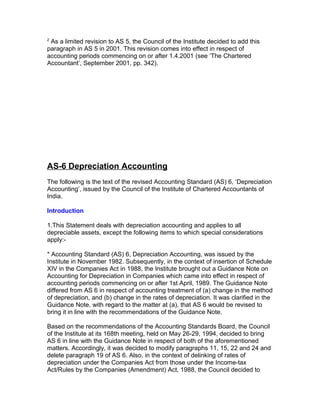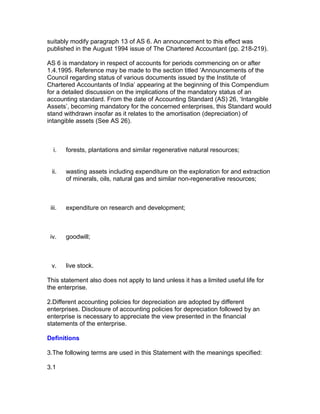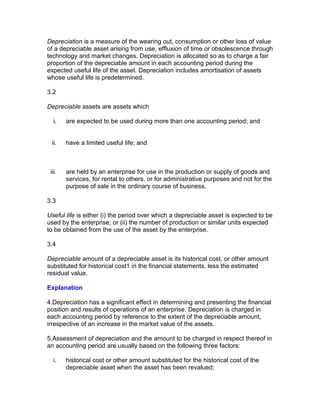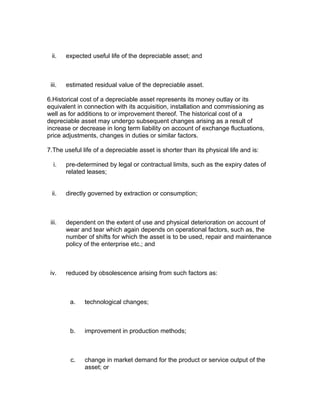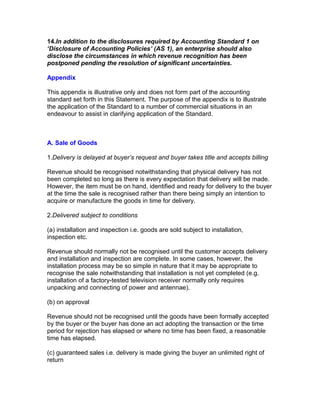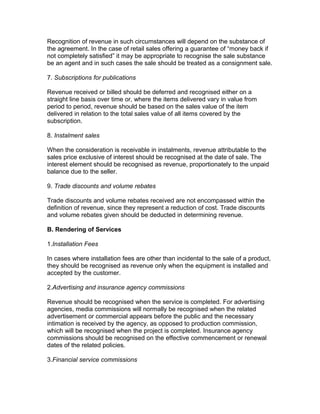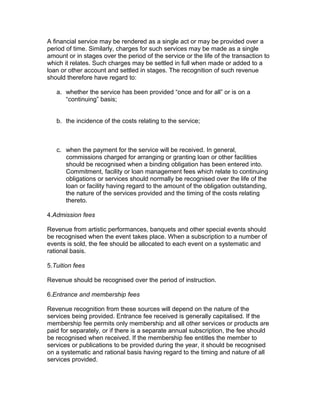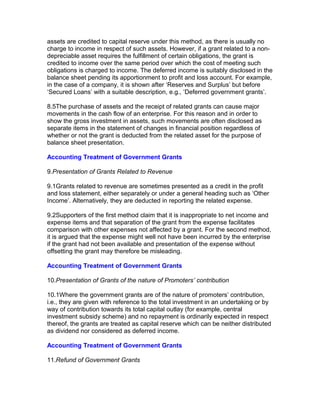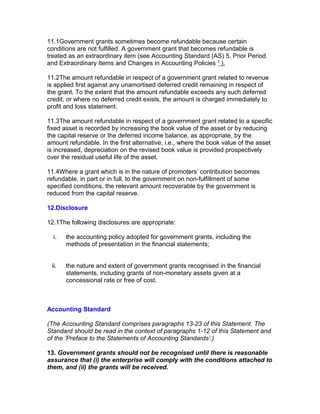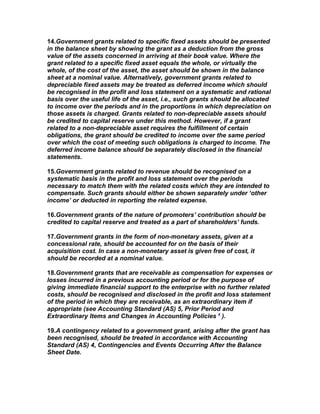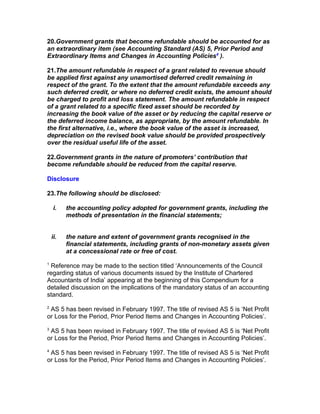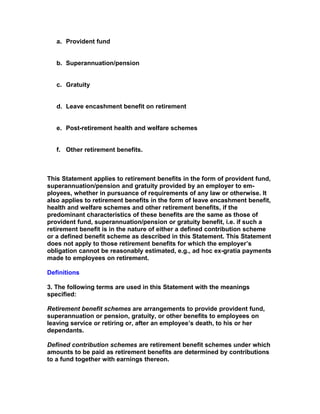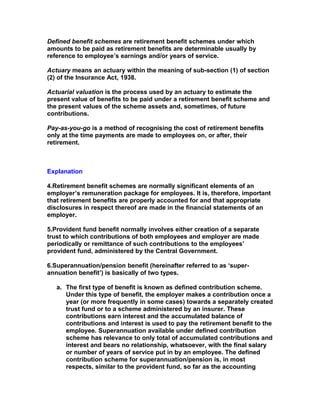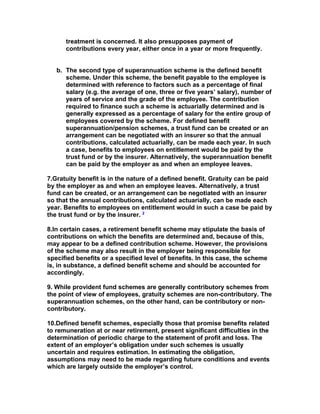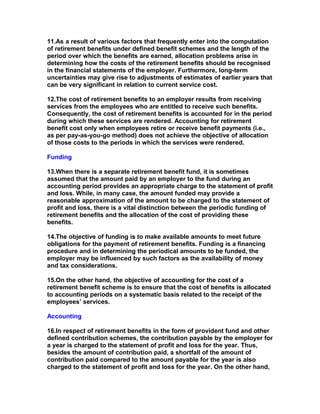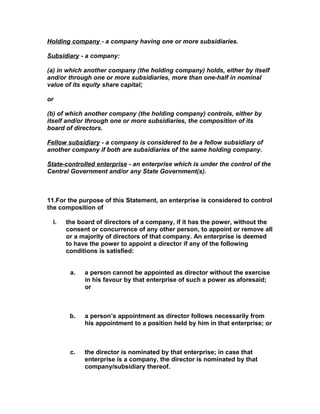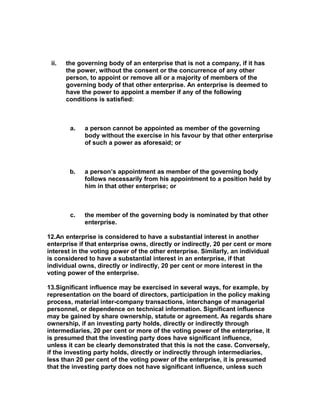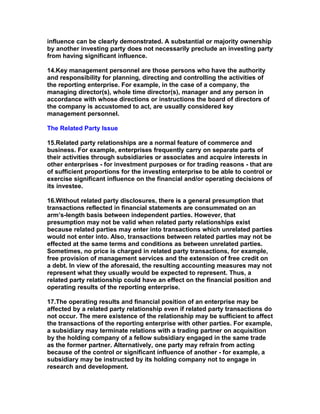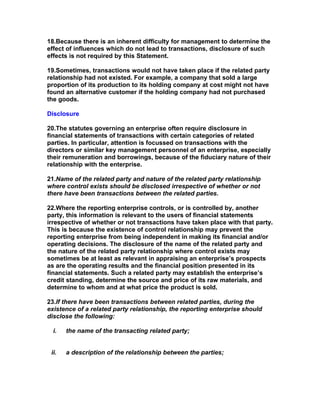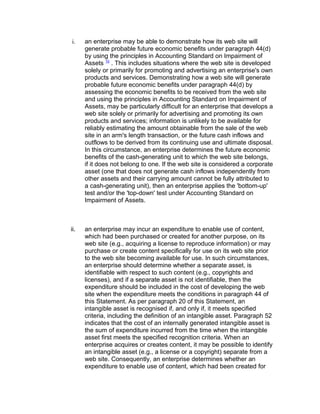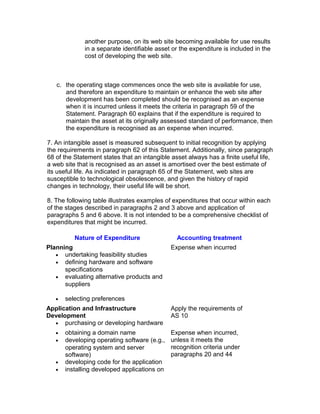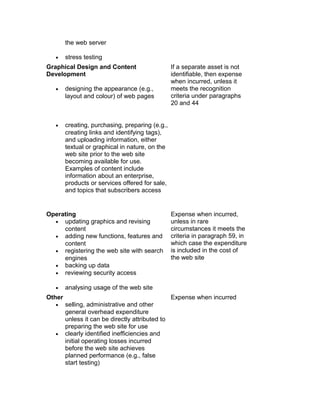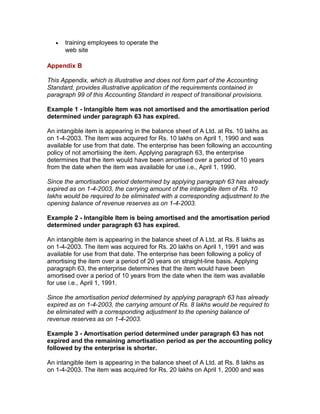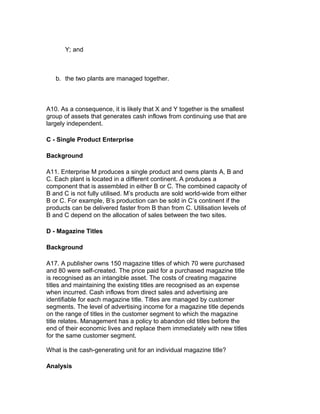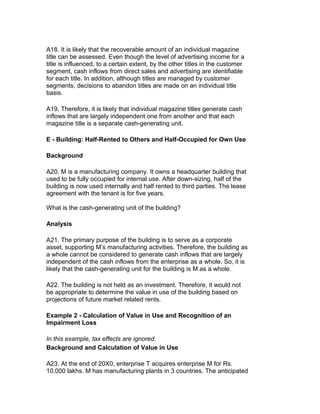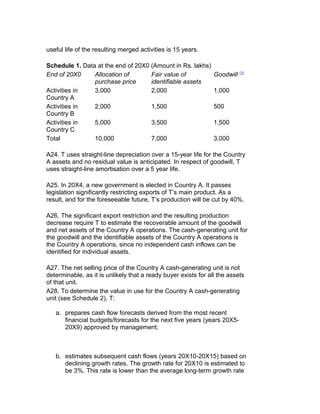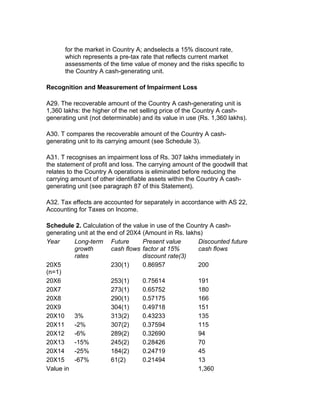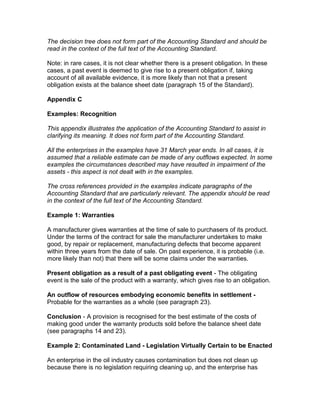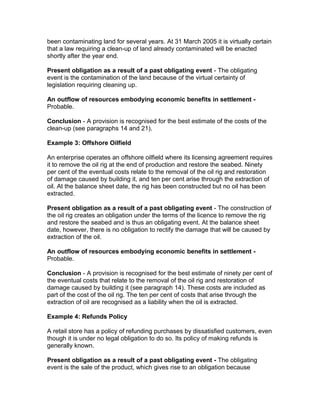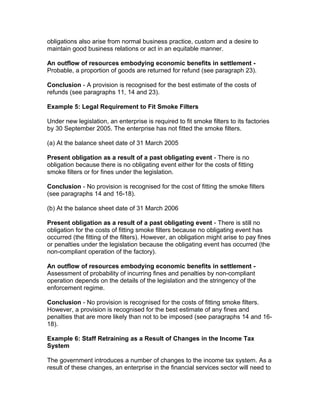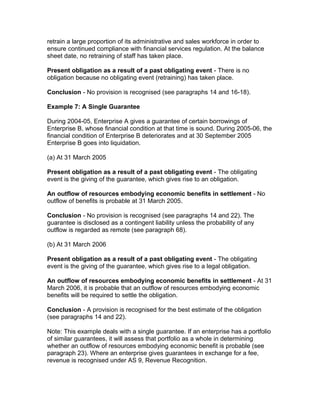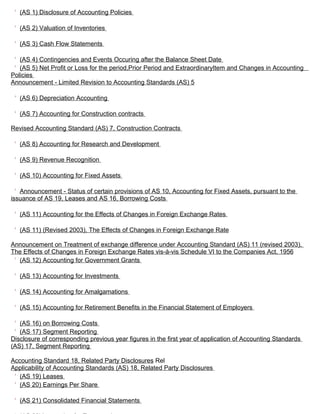
(AS 1) Disclosure of Accounting Policies

   (AS 2) Valuation of Inventories

   (AS 3) Cash Flow Statements

   (AS 4) Contingencies and Events Occuring after the Balance Sheet Date
   (AS 5) Net Profit or Loss for the period,Prior Period and ExtraordinaryItem and Changes in Accounting
Policies
Announcement - Limited Revision to Accounting Standards (AS) 5

   (AS 6) Depreciation Accounting

   (AS 7) Accounting for Construction contracts

Revised Accounting Standard (AS) 7, Construction Contracts

   (AS 8) Accounting for Research and Development

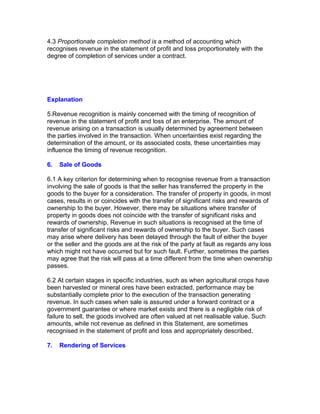
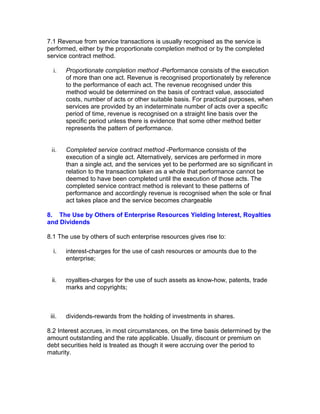
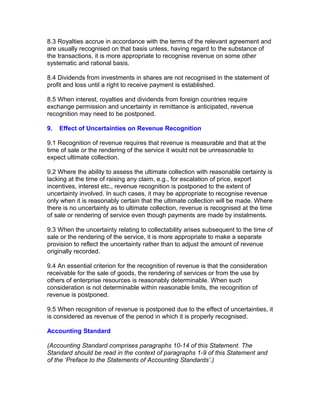
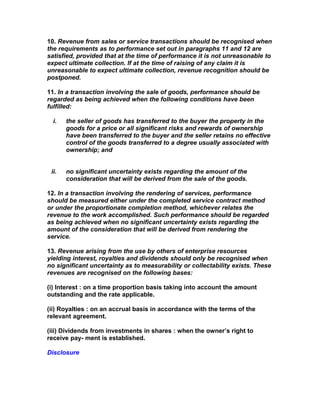
   (AS 9) Revenue Recognition

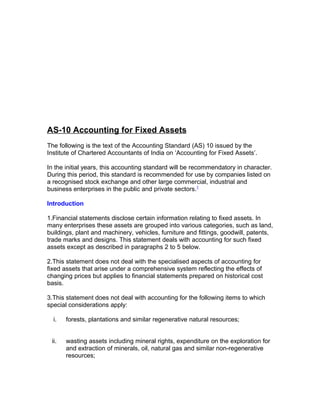
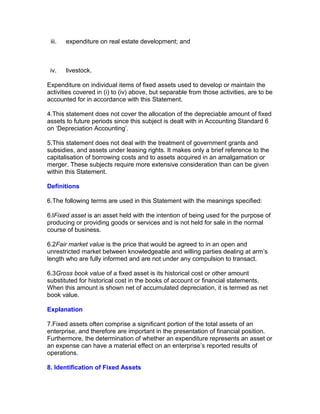
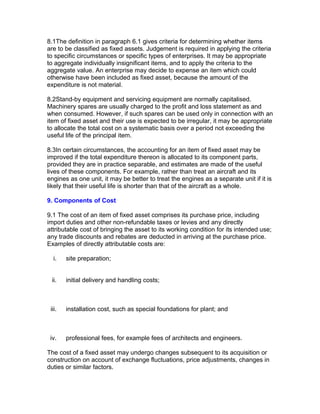
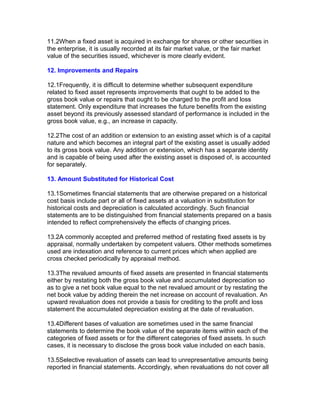
   (AS 10) Accounting for Fixed Assets

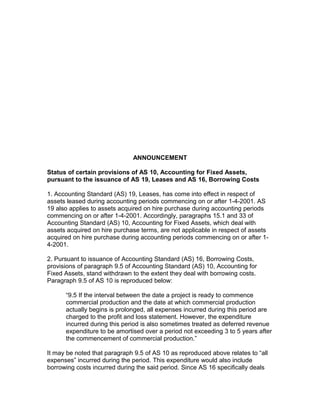
   Announcement - Status of certain provisions of AS 10, Accounting for Fixed Assets, pursuant to the
issuance of AS 19, Leases and AS 16, Borrowing Costs

   (AS 11) Accounting for the Effects of Changes in Foreign Exchange Rates

   (AS 11) (Revised 2003), The Effects of Changes in Foreign Exchange Rate

Announcement on Treatment of exchange difference under Accounting Standard (AS) 11 (revised 2003),
The Effects of Changes in Foreign Exchange Rates vis-à-vis Schedule VI to the Companies Act, 1956
  (AS 12) Accounting for Government Grants

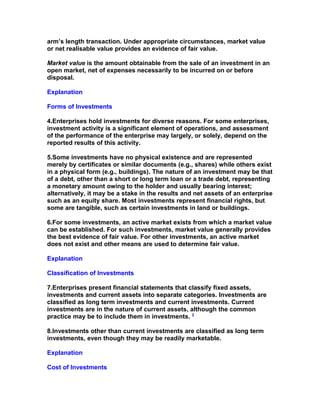
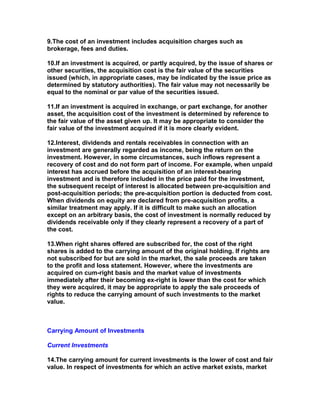
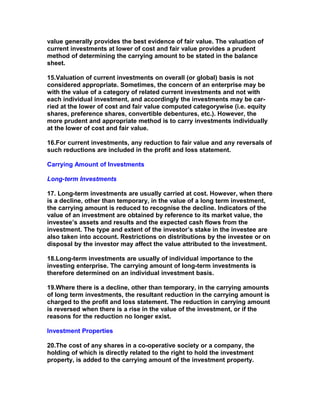
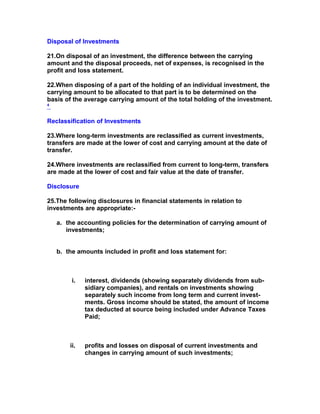
   (AS 13) Accounting for Investments

   (AS 14) Accounting for Amalgamations

   (AS 15) Accounting for Retirement Benefits in the Financial Statement of Employers

   (AS 16) on Borrowing Costs
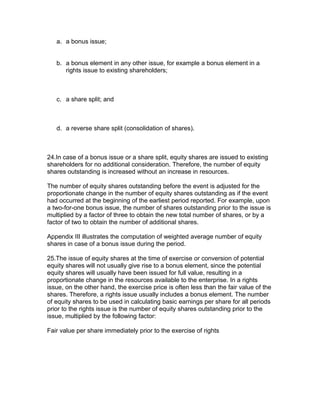
   (AS 17) Segment Reporting
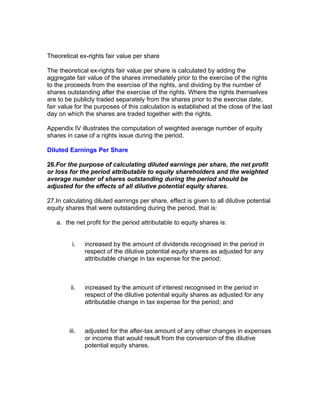
Disclosure of corresponding previous year figures in the first year of application of Accounting Standards
(AS) 17, Segment Reporting

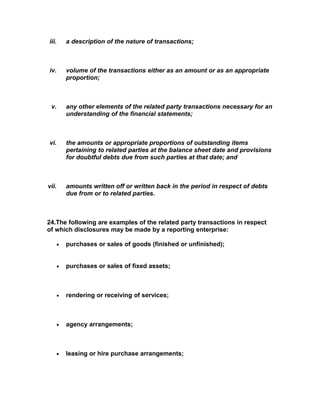
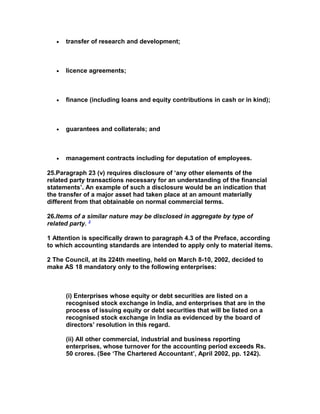
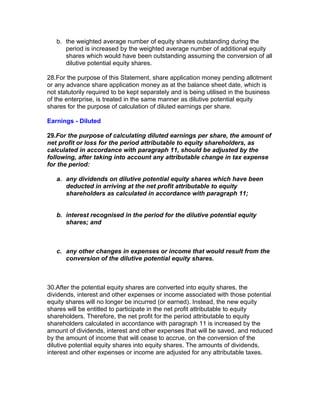
Accounting Standard 18, Related Party Disclosures Rel
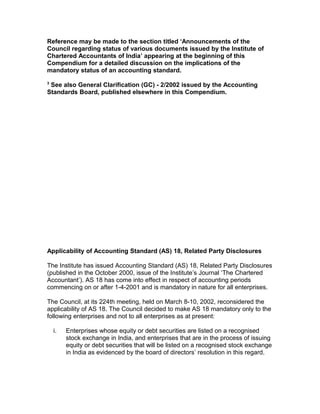
Applicability of Accounting Standards (AS) 18, Related Party Disclosures
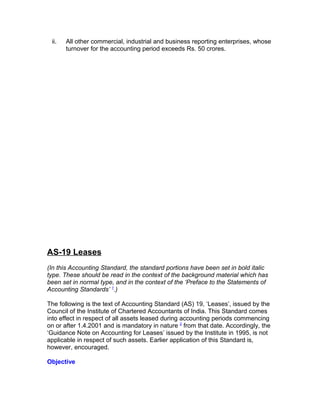
   (AS 19) Leases
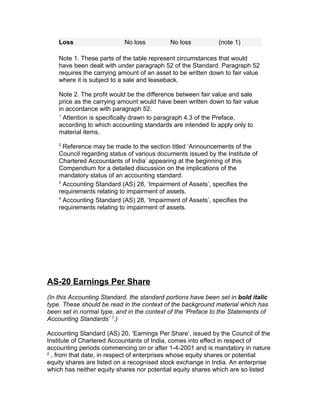
   (AS 20) Earnings Per Share

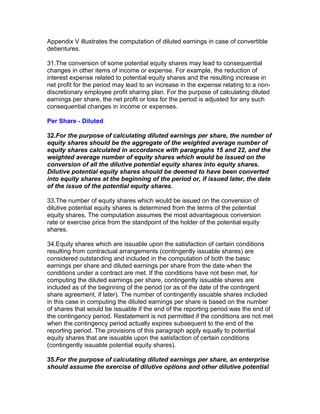
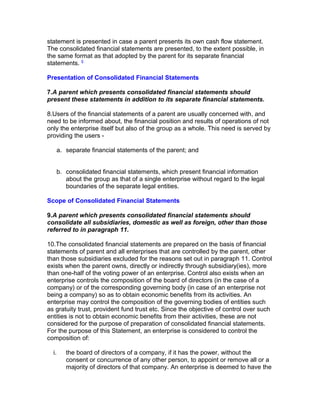
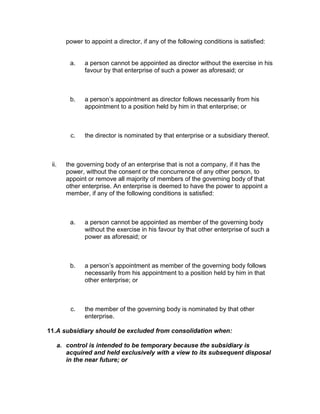
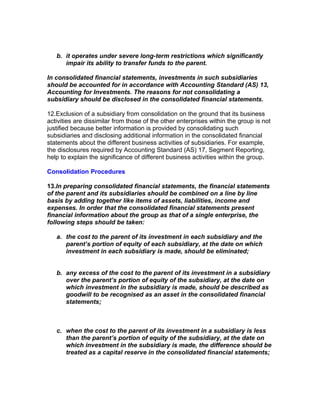
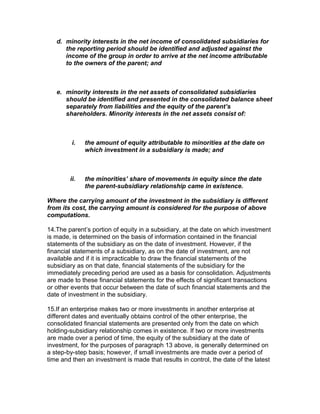
   (AS 21) Consolidated Financial Statements
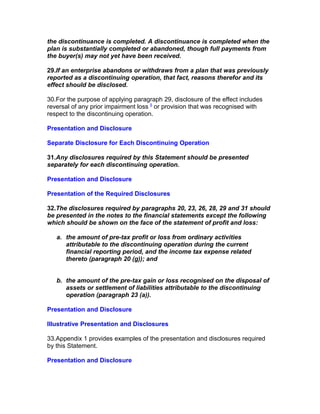
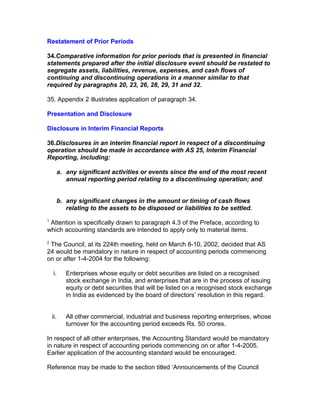
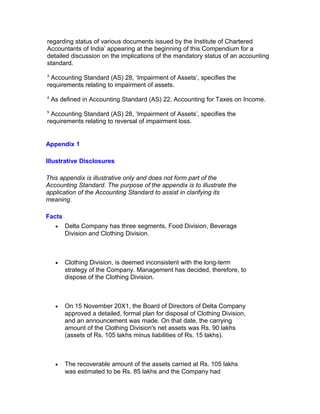
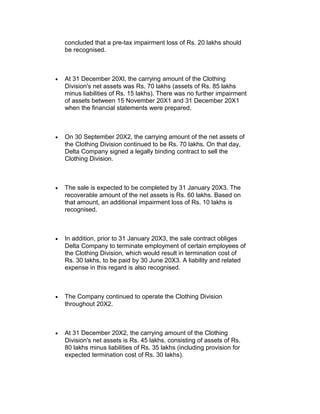
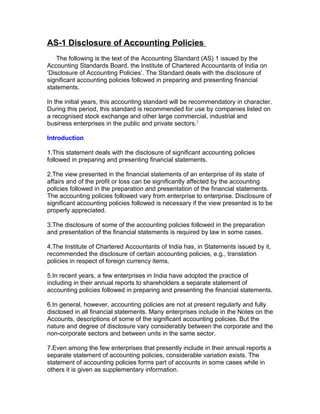
AS-1 Disclosure of Accounting Policies
ateThe following is the text of the Accounting Standard (AS) 1 issued by the
Accounting Standards Board, the Institute of Chartered Accountants of India on
‘Disclosure of Accounting Policies’. The Standard deals with the disclosure of
significant accounting policies followed in preparing and presenting financial
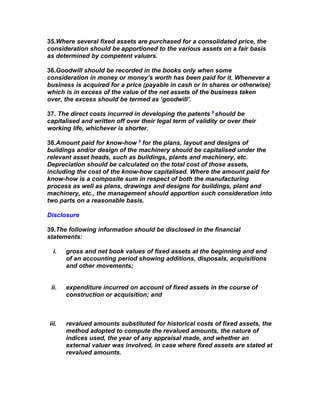
statements.

In the initial years, this accounting standard will be recommendatory in character.
During this period, this standard is recommended for use by companies listed on
a recognised stock exchange and other large commercial, industrial and
business enterprises in the public and private sectors.1

Introduction

1.This statement deals with the disclosure of significant accounting policies
followed in preparing and presenting financial statements.

2.The view presented in the financial statements of an enterprise of its state of
affairs and of the profit or loss can be significantly affected by the accounting
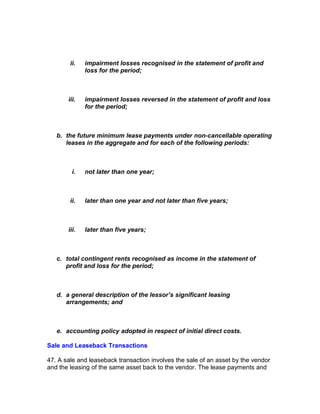
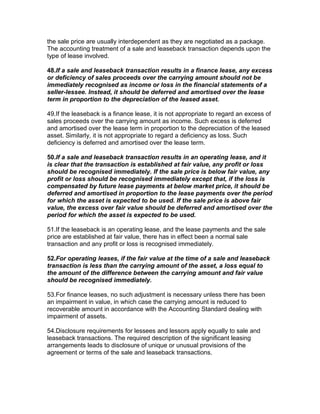
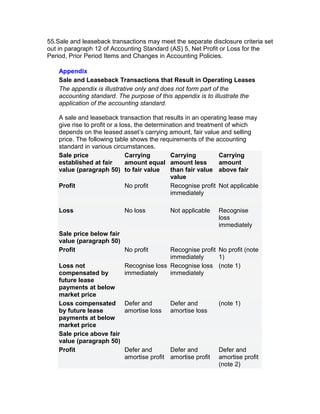
policies followed in the preparation and presentation of the financial statements.
The accounting policies followed vary from enterprise to enterprise. Disclosure of
significant accounting policies followed is necessary if the view presented is to be
properly appreciated.

3.The disclosure of some of the accounting policies followed in the preparation
and presentation of the financial statements is required by law in some cases.

4.The Institute of Chartered Accountants of India has, in Statements issued by it,
recommended the disclosure of certain accounting policies, e.g., translation
policies in respect of foreign currency items.

5.In recent years, a few enterprises in India have adopted the practice of
including in their annual reports to shareholders a separate statement of
accounting policies followed in preparing and presenting the financial statements.

6.In general, however, accounting policies are not at present regularly and fully
disclosed in all financial statements. Many enterprises include in the Notes on the
Accounts, descriptions of some of the significant accounting policies. But the
nature and degree of disclosure vary considerably between the corporate and the
non-corporate sectors and between units in the same sector.

7.Even among the few enterprises that presently include in their annual reports a
separate statement of accounting policies, considerable variation exists. The
statement of accounting policies forms part of accounts in some cases while in
others it is given as supplementary information.
8.The purpose of this Statement is to promote better understanding of financial
statements by establishing through an accounting standard the disclosure of
significant accounting policies and the manner in which accounting policies are
disclosed in the financial statements. Such disclosure would also facilitate a more
meaningful comparison between financial statements of different enterprises.

Explanation

Fundamental Accounting Assumptions

9.Certain fundamental accounting assumptions underlie the preparation and
presentation of financial statements. They are usually not specifically stated
because their acceptance and use are assumed. Disclosure is necessary if they
are not followed.

10The following have been generally accepted as fundamental accounting
assumptions:-

a. Going Concern

The enterprise is normally viewed as a going concern, that is, as continuing in
operation for the foreseeable future. It is assumed that the enterprise has neither
the intention nor the necessity of liquidation or of curtailing materially the scale of
the operations.

b. Consistency

It is assumed that accounting policies are consistent from one period to another.

c. Accrual

Revenues and costs are accrued, that is, recognised as they are earned or
incurred (and not as money is received or paid) and recorded in the financial
statements of the periods to which they relate. (The considerations affecting the
process of matching costs with revenues under the accrual assumption are not
dealt with in this Statement.)

Explanation

Nature of Accounting Policies

11 The accounting policies refer to the specific accounting principles and the
methods of applying those principles adopted by the enterprise in the preparation
and presentation of financial statements.
12.There is no single list of accounting policies which are applicable to all
circumstances. The differing circumstances in which enterprises operate in a
situation of diverse and complex economic activity make alternative accounting
principles and methods of applying those principles acceptable. The choice of the
appropriate accounting principles and the methods of applying those principles in
the specific circumstances of each enterprise calls for considerable judgement by
the management of the enterprise.

13.The various statements of the Institute of Chartered Accountants of India
combined with the efforts of government and other regulatory agencies and
progressive managements have reduced in recent years the number of
acceptable alternatives particularly in the case of corporate enterprises. While
continuing efforts in this regard in future are likely to reduce the number still
further, the availability of alternative accounting principles and methods of
applying those principles is not likely to be eliminated altogether in view of the
differing circumstances faced by the enterprises.

Explanation

Areas in Which Differing Accounting Policies are Encountered

14.The following are examples of the areas in which different accounting policies
may be adopted by different enterprises.

   •   Methods of depreciation, depletion and amortisation


   •   Treatment of expenditure during construction


   •   Conversion or translation of foreign currency items


   •   Valuation of inventories


   •   Treatment of goodwill


   •   Valuation of investments


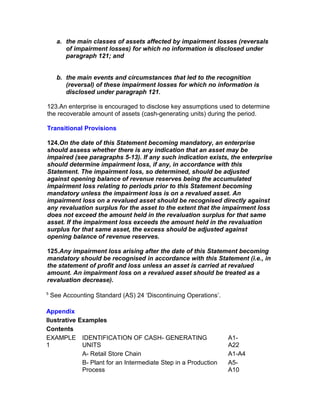
   •   Treatment of retirement benefits
•   Recognition of profit on long-term contracts


   •   Valuation of fixed assets


   •   Treatment of contingent liabilities.

15.The above list of examples is not intended to be exhaustive.

Explanation

Considerations in the Selection of Accounting Policies

16.The primary consideration in the selection of accounting policies by an
enterprise is that the financial statements prepared and presented on the basis of
such accounting policies should represent a true and fair view of the state of
affairs of the enterprise as at the balance sheet date and of the profit or loss for
the period ended on that date.

17.For this purpose, the major considerations governing the selection and
application of accounting policies are:-

a. Prudence

In view of the uncertainty attached to future events, profits are not anticipated but
recognised only when realised though not necessarily in cash. Provision is made
for all known liabilities and losses even though the amount cannot be determined
with certainty and represents only a best estimate in the light of available
information.

b. Substance over Form

The accounting treatment and presentation in financial statements of
transactions and events should be governed by their substance and not merely
by the legal form.

c. Materiality

Financial statements should disclose all “material” items, i.e. items the
knowledge of which might influence the decisions of the user of the financial
statements.

Explanation

Disclosure of Accounting Policies
18. To ensure proper understanding of financial statements, it is necessary that
all significant accounting policies adopted in the preparation and presentation of
financial statements should be disclosed.

19.Such disclosure should form part of the financial statements.

20 It would be helpful to the reader of financial statements if they are all
disclosed as such in one place instead of being scattered over several
statements, schedules and notes.

21.Examples of matters in respect of which disclosure of accounting policies
adopted will be required are contained in paragraph 14. This list of examples is
not, however, intended to be exhaustive.

22.Any change in an accounting policy which has a material effect should be
disclosed. The amount by which any item in the financial statements is affected
by such change should also be disclosed to the extent ascertainable. Where
such amount is not ascertainable, wholly or in part, the fact should be indicated.
If a change is made in the accounting policies which has no material effect on the
financial statements for the current period but which is reasonably expected to
have a material effect in later periods, the fact of such change should be
appropriately disclosed in the period in which the change is adopted.

23.Disclosure of accounting policies or of changes therein cannot remedy a
wrong or inappropriate treatment of the item in the accounts.

Explanation

Accounting Standard

(The Accounting Standard comprises paragraphs 24-27 of this Statement. The
Standard should be read in the context of paragraphs 1-23 of this Statement and
of the ‘Preface to the Statements of Accounting Standards’.)

24.All significant accounting policies adopted in the preparation and
presentation of financial statements should be disclosed.

25.The disclosure of the significant accounting policies as such should
form part of the financial statements and the significant accounting
policies should normally be disclosed in one place.

26.Any change in the accounting policies which has a material effect in the
current period or which is reasonably expected to have a material effect in
later periods should be disclosed. In the case of a change in accounting
policies which has a material effect in the current period, the amount by
which any item in the financial statements is affected by such change
should also be disclosed to the extent ascertainable. Where such amount
is not ascertainable, wholly or in part, the fact should be indicated.

27.If the fundamental accounting assumptions, viz. Going Concern,
Consistency and Accrual are followed in financial statements, specific
disclosure is not required. If a fundamental accounting assumption is not
followed, the fact should be disclosed.
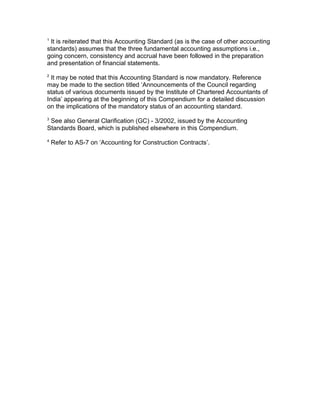
1
  It may be noted that this Accounting Standard is now mandatory. Reference
may be made to the section titled ‘Announcements of the Council regarding
status of various documents issued by the Institute of Chartered Accountants of
India’ appearing at the beginning of this Compendium for a detailed discussion
on the implications of the mandatory status of an accounting standard.

ments of Accounting Standards (AS 17)
AS-2 Valuation of Inventories
(In this Accounting Standard, the standard portions have been set in bold italic
type. These should be read in the context of the background material which has
been set in normal type, and in the context of the ‘Preface to the Statements of
Accounting Standards’.)

The following is the text of the revised Accounting Standard (AS) 2, ‘Valuation of
Inventories’, issued by the Council of the Institute of Chartered Accountants of
India. This revised Standard supersedes Accounting Standard (AS) 2, ‘Valuation
of Inventories’, issued in June, 1981.

The revised standard comes into effect in respect of accounting periods
commencing on or after 1.4.1999 and is mandatory in nature.1

Objective

A primary issue in accounting for inventories is the determination of the value at
which inventories are carried in the financial statements until the related
revenues are recognised. This Statement deals with the determination of such
value, including the ascertainment of cost of inventories and any write-down
thereof to net realisable value.

Scope

1.This Statement should be applied in accounting for inventories other
than:


   a. work in progress arising under construction contracts, including
      directly related service contracts (see Accounting Standard (AS) 7,
      Accounting for Construction Contracts);


        b .work in progress arising in the ordinary course of business of
        service providers;


        c. shares, debentures and other financial instruments held as stock-
        in-trade; and
d. producers’ inventories of livestock, agricultural and forest
      products, and mineral oils, ores and gases to the extent that they are
      measured at net realisable value in accordance with well established
      practices in those industries.

2. The inventories referred to in paragraph 1 (d) are measured at net realisable
value at certain stages of production. This occurs, for example, when agricultural
crops have been harvested or mineral oils, ores and gases have been extracted
and sale is assured under a forward contract or a government guarantee, or
when a homogenous market exists and there is a negligible risk of failure to sell.
These inventories are excluded from the scope of this Statement.

Definitions

3.The following terms are used in this Statement with the meanings
specified:

Inventories are assets:


   a. held for sale in the ordinary course of business;


   b. in the process of production for such sale; or


   c. in the form of materials or supplies to be consumed in the
      production process or in the rendering of services.

Net realisable value is the estimated selling price in the ordinary course of
business less the estimated costs of completion and the estimated costs
necessary to make the sale.

4.Inventories encompass goods purchased and held for resale, for example,
merchandise purchased by a retailer and held for resale, computer software held
for resale, or land and other property held for resale. Inventories also encompass
finished goods produced, or work in progress being produced, by the enterprise
and include materials, maintenance supplies, consumables and loose tools
awaiting use in the production process. Inventories do not include machinery
spares which can be used only in connection with an item of fixed asset and
whose use is expected to be irregular; such machinery spares are accounted for
in accordance with Accounting Standard (AS) 10, Accounting for Fixed Assets.
Measurement of Inventories

5.Inventories should be valued at the lower of cost and net realisable value.

Cost of Inventories

6.The cost of inventories should comprise all costs of purchase, costs of
conversion and other costs incurred in bringing the inventories to their
present location and condition.

Costs of Purchase

7.The costs of purchase consist of the purchase price including duties and taxes
(other than those subsequently recoverable by the enterprise from the taxing
authorities), freight inwards and other expenditure directly attributable to the
acquisition. Trade discounts, rebates, duty drawbacks and other similar items are
deducted in determining the costs of purchase.

Costs of Conversion

8.The costs of conversion of inventories include costs directly related to the units
of production, such as direct labour. They also include a systematic allocation of
fixed and variable production overheads that are incurred in converting materials
into finished goods. Fixed production overheads are those indirect costs of
production that remain relatively constant regardless of the volume of production,
such as depreciation and maintenance of factory buildings and the cost of factory
management and administration. Variable production overheads are those
indirect costs of production that vary directly, or nearly directly, with the volume of
production, such as indirect materials and indirect labour.

9.The allocation of fixed production overheads for the purpose of their inclusion
in the costs of conversion is based on the normal capacity of the production
facilities. Normal capacity is the production expected to be achieved on an
average over a number of periods or seasons under normal circumstances,
taking into account the loss of capacity resulting from planned maintenance. The
actual level of production may be used if it approximates normal capacity. The
amount of fixed production overheads allocated to each unit of production is not
increased as a consequence of low production or idle plant. Unallocated
overheads are recognised as an expense in the period in which they are
incurred. In periods of abnormally high production, the amount of fixed production
overheads allocated to each unit of production is decreased so that inventories
are not measured above cost. Variable production overheads are assigned to
each unit of production on the basis of the actual use of the production facilities.

10.A production process may result in more than one product being produced
simultaneously. This is the case, for example, when joint products are produced
or when there is a main product and a by-product. When the costs of conversion
of each product are not separately identifiable, they are allocated between the
products on a rational and consistent basis. The allocation may be based, for
example, on the relative sales value of each product either at the stage in the
production process when the products become separately identifiable, or at the
completion of production. Most by-products as well as scrap or waste materials,
by their nature, are immaterial. When this is the case, they are often measured at
net realisable value and this value is deducted from the cost of the main product.
As a result, the carrying amount of the main product is not materially different
from its cost.

Other Costs

11.Other costs are included in the cost of inventories only to the extent that they
are incurred in bringing the inventories to their present location and condition. For
example, it may be appropriate to include overheads other than production
overheads or the costs of designing products for specific customers in the cost of
inventories.

12.Interest and other borrowing costs are usually considered as not relating to
bringing the inventories to their present location and condition and are, therefore,
usually not included in the cost of inventories.

Exclusions from the Cost of Inventories

13.In determining the cost of inventories in accordance with paragraph 6, it is
appropriate to exclude certain costs and recognise them as expenses in the
period in which they are incurred. Examples of such costs are:

   a. abnormal amounts of wasted materials, labour, or other production costs;


   b. storage costs, unless those costs are necessary in the production process
      prior to a further production stage;


   c. administrative overheads that do not contribute to bringing the inventories
      to their present location and condition; and


   d. selling and distribution costs.

Cost Formulas
14.The cost of inventories of items that are not ordinarily interchangeable
and goods or services produced and segregated for specific projects
should be assigned by specific identification of their individual costs.

15.Specific identification of cost means that specific costs are attributed to
identified items of inventory. This is an appropriate treatment for items that are
segregated for a specific project, regardless of whether they have been
purchased or produced. However, when there are large numbers of items of
inventory which are ordinarily interchangeable, specific identification of costs is
inappropriate since, in such circumstances, an enterprise could obtain
predetermined effects on the net profit or loss for the period by selecting a
particular method of ascertaining the items that remain in inventories.

16.The cost of inventories, other than those dealt with in paragraph 14,
should be assigned by using the first-in, first-out (FIFO), or weighted
average cost formula. The formula used should reflect the fairest possible
approximation to the cost incurred in bringing the items of inventory to
their present location and condition.

17.A variety of cost formulas is used to determine the cost of inventories other
than those for which specific identification of individual costs is appropriate. The
formula used in determining the cost of an item of inventory needs to be selected
with a view to providing the fairest possible approximation to the cost incurred in
bringing the item to its present location and condition. The FIFO formula
assumes that the items of inventory which were purchased or produced first are
consumed or sold first, and consequently the items remaining in inventory at the
end of the period are those most recently purchased or produced. Under the
weighted average cost formula, the cost of each item is determined from the
weighted average of the cost of similar items at the beginning of a period and the
cost of similar items purchased or produced during the period. The average may
be calculated on a periodic basis, or as each additional shipment is received,
depending upon the circumstances of the enterprise.

Techniques for the Measurement of Cost

18.Techniques for the measurement of the cost of inventories, such as the
standard cost method or the retail method, may be used for convenience if the
results approximate the actual cost. Standard costs take into account normal
levels of consumption of materials and supplies, labour, efficiency and capacity
utilisation. They are regularly reviewed and, if necessary, revised in the light of
current conditions.

19.The retail method is often used in the retail trade for measuring inventories of
large numbers of rapidly changing items that have similar margins and for which
it is impracticable to use other costing methods. The cost of the inventory is
determined by reducing from the sales value of the inventory the appropriate
percentage gross margin. The percentage used takes into consideration
inventory which has been marked down to below its original selling price. An
average percentage for each retail department is often used.


Net Realisable Value

20.The cost of inventories may not be recoverable if those inventories are
damaged, if they have become wholly or partially obsolete, or if their selling
prices have declined. The cost of inventories may also not be recoverable if the
estimated costs of completion or the estimated costs necessary to make the sale
have increased. The practice of writing down inventories below cost to net
realisable value is consistent with the view that assets should not be carried in
excess of amounts expected to be realised from their sale or use.

21.Inventories are usually written down to net realisable value on an item-by-item
basis. In some circumstances, however, it may be appropriate to group similar or
related items. This may be the case with items of inventory relating to the same
product line that have similar purposes or end uses and are produced and
marketed in the same geographical area and cannot be practicably evaluated
separately from other items in that product line. It is not appropriate to write down
inventories based on a classification of inventory, for example, finished goods, or
all the inventories in a particular business segment.

22.Estimates of net realisable value are based on the most reliable evidence
available at the time the estimates are made as to the amount the inventories are
expected to realise. These estimates take into consideration fluctuations of price
or cost directly relating to events occurring after the balance sheet date to the
extent that such events confirm the conditions existing at the balance sheet date.

23.Estimates of net realisable value also take into consideration the purpose for
which the inventory is held. For example, the net realisable value of the quantity
of inventory held to satisfy firm sales or service contracts is based on the contract
price. If the sales contracts are for less than the inventory quantities held, the net
realisable value of the excess inventory is based on general selling prices.
Contingent losses on firm sales contracts in excess of inventory quantities held
and contingent losses on firm purchase contracts are dealt with in accordance
with the principles enunciated in Accounting Standard (AS) 4, Contingencies and
Events Occurring After the Balance Sheet Date.

24.Materials and other supplies held for use in the production of inventories are
not written down below cost if the finished products in which they will be
incorporated are expected to be sold at or above cost. However, when there has
been a decline in the price of materials and it is estimated that the cost of the
finished products will exceed net realisable value, the materials are written down
to net realisable value. In such circumstances, the replacement cost of the
materials may be the best available measure of their net realisable value.

25.An assessment is made of net realisable value as at each balance sheet date.


Disclosure

26.The financial statements should disclose:

    a. the accounting policies adopted in measuring inventories, including
       the cost formula used; and


    b. he total carrying amount of inventories and its classification
       appropriate to the enterprise.

27.Information about the carrying amounts held in different classifications of
inventories and the extent of the changes in these assets is useful to financial
statement users. Common classifications of inventories are raw materials and
components, work in progress, finished goods, stores and spares, and loose
tools.

* The Standard was originally issued in June 1981.
1
 Reference may be made to the section titled ‘Announcements of the Council
regarding status of various documents issued by the Institute of Chartered
Accountants of India’ appearing at the beginning of this Compendium for a
detailed discussion on the implications of the mandatory status of an accounting
standard.


Segment Re
AS-3 Cash Flow Statements
(In this Accounting Standard, the standard portions have been set in bold italic
type. These should be read in the context of the background material which has
been set in normal type, and in the context of the ‘Preface to the Statements of
Accounting Standards’.)

The following is the text of the revised Accounting Standard (AS) 3, ‘Cash Flow
Statements’, issued by the Council of the Institute of Chartered Accountants of
India. This Standard supersedes Accounting Standard (AS) 3, ‘Changes in
Financial Position’, issued in June, 1981.

In the initial years, this accounting standard will be recommendatory in character.
During this period, this standard is recommended for use by companies listed on
a recognised stock exchange and other commercial, industrial and business
enterprises in the public and private sectors.1

Objective

Information about the cash flows of an enterprise is useful in providing users of
financial statements with a basis to assess the ability of the enterprise to
generate cash and cash equivalents and the needs of the enterprise to utilise
those cash flows. The economic decisions that are taken by users require an
evaluation of the ability of an enterprise to generate cash and cash equivalents
and the timing and certainty of their generation.

The Statement deals with the provision of information about the historical
changes in cash and cash equivalents of an enterprise by means of a cash flow
statement which classifies cash flows during the period from operating, investing
and financing activities.

Scope

1.An enterprise should prepare a cash flow statement and should present it
for each period for which financial statements are presented.

2.Users of an enterprise’s financial statements are interested in how the
enterprise generates and uses cash and cash equivalents. This is the case
regardless of the nature of the enterprise’s activities and irrespective of whether
cash can be viewed as the product of the enterprise, as may be the case with a
financial enterprise. Enterprises need cash for essentially the same reasons,
however different their principal revenue-producing activities might be. They
need cash to conduct their operations, to pay their obligations, and to provide
returns to their investors.
Benefits of Cash Flow Information

3. A cash flow statement, when used in conjunction with the other financial
statements, provides information that enables users to evaluate the changes in
net assets of an enterprise, its financial structure (including its liquidity and
solvency) and its ability to affect the amounts and timing of cash flows in order to
adapt to changing circumstances and opportunities. Cash flow information is
useful in assessing the ability of the enterprise to generate cash and cash
equivalents and enables users to develop models to assess and compare the
present value of the future cash flows of different enterprises. It also enhances
the comparability of the reporting of operating performance by different
enterprises because it eliminates the effects of using different accounting
treatments for the same transactions and events.

4.Historical cash flow information is often used as an indicator of the amount,
timing and certainty of future cash flows. It is also useful in checking the accuracy
of past assessments of future cash flows and in examining the relationship
between profitability and net cash flow and the impact of changing prices.

Definitions

5.The following terms are used in this Statement with the meanings
specified:

Cash comprises cash on hand and demand deposits with banks.

Cash equivalents are short term, highly liquid investments that are readily
convertible into known amounts of cash and which are subject to an
insignificant risk of changes in value.

Cash flows are inflows and outflows of cash and cash equivalents.

Operating activities are the principal revenue-producing activities of the
enterprise and other activities that are not investing or financing activities.

Investing activities are the acquisition and disposal of long-term assets
and other investments not included in cash equivalents.

Financing activities are activities that result in changes in the size and
composition of the owners’ capital (including preference share capital in
the case of a company) and borrowings of the enterprise.

Cash and Cash Equivalents

6.Cash equivalents are held for the purpose of meeting short-term cash
commitments rather than for investment or other purposes. For an investment to
qualify as a cash equivalent, it must be readily convertible to a known amount of
cash and be subject to an insignificant risk of changes in value. Therefore, an
investment normally qualifies as a cash equivalent only when it has a short
maturity of, say, three months or less from the date of acquisition. Investments in
shares are excluded from cash equivalents unless they are, in substance, cash
equivalents; for example, preference shares of a company acquired shortly
before their specified redemption date (provided there is only an insignificant risk
of failure of the company to repay the amount at maturity).

7.Cash flows exclude movements between items that constitute cash or cash
equivalents because these components are part of the cash management of an
enterprise rather than part of its operating, investing and financing activities.
Cash management includes the investment of excess cash in cash equivalents.

Presentation of a Cash Flow Statement

8.The cash flow statement should report cash flows during the period
classified by operating, investing and financing activities.

9.An enterprise presents its cash flows from operating, investing and financing
activities in a manner which is most appropriate to its business. Classification by
activity provides information that allows users to assess the impact of those
activities on the financial position of the enterprise and the amount of its cash
and cash equivalents. This information may also be used to evaluate the
relationships among those activities.

10.A single transaction may include cash flows that are classified differently. For
example, when the instalment paid in respect of a fixed asset acquired on
deferred payment basis includes both interest and loan, the interest element is
classified under financing activities and the loan element is classified under
investing activities.

Operating Activities

11.The amount of cash flows arising from operating activities is a key indicator of
the extent to which the operations of the enterprise have generated sufficient
cash flows to maintain the operating capability of the enterprise, pay dividends,
repay loans and make new investments without recourse to external sources of
financing. Information about the specific components of historical operating cash
flows is useful, in conjunction with other information, in forecasting future
operating cash flows.

12.Cash flows from operating activities are primarily derived from the principal
revenue-producing activities of the enterprise. Therefore, they generally result
from the transactions and other events that enter into the determination of net
profit or loss. Examples of cash flows from operating activities are:
a. cash receipts from the sale of goods and the rendering of services;


   b. cash receipts from royalties, fees, commissions and other revenue;


   c. cash payments to suppliers for goods and services;


   d. cash payments to and on behalf of employees;


   e. cash receipts and cash payments of an insurance enterprise for premiums
      and claims, annuities and other policy benefits;


   f. cash payments or refunds of income taxes unless they can be specifically
      identified with financing and investing activities; and


   g. cash receipts and payments relating to futures contracts, forward
      contracts, option contracts and swap contracts when the contracts are
      held for dealing or trading purposes.

13.Some transactions, such as the sale of an item of plant, may give rise to a
gain or loss which is included in the determination of net profit or loss. However,
the cash flows relating to such transactions are cash flows from investing
activities.

14.An enterprise may hold securities and loans for dealing or trading purposes, in
which case they are similar to inventory acquired specifically for resale.
Therefore, cash flows arising from the purchase and sale of dealing or trading
securities are classified as operating activities. Similarly, cash advances and
loans made by financial enterprises are usually classified as operating activities
since they relate to the main revenue-producing activity of that enterprise.

Investing Activities

15.The separate disclosure of cash flows arising from investing activities is
important because the cash flows represent the extent to which expenditures
have been made for resources intended to generate future income and cash
flows. Examples of cash flows arising from investing activities are:
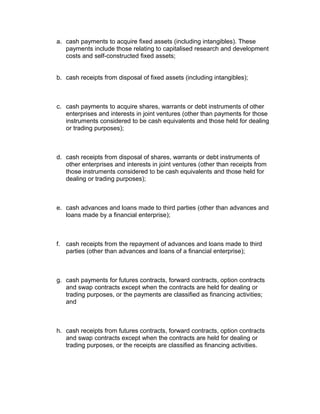
a. cash payments to acquire fixed assets (including intangibles). These
   payments include those relating to capitalised research and development
   costs and self-constructed fixed assets;


b. cash receipts from disposal of fixed assets (including intangibles);


c. cash payments to acquire shares, warrants or debt instruments of other
   enterprises and interests in joint ventures (other than payments for those
   instruments considered to be cash equivalents and those held for dealing
   or trading purposes);


d. cash receipts from disposal of shares, warrants or debt instruments of
   other enterprises and interests in joint ventures (other than receipts from
   those instruments considered to be cash equivalents and those held for
   dealing or trading purposes);


e. cash advances and loans made to third parties (other than advances and
   loans made by a financial enterprise);


f. cash receipts from the repayment of advances and loans made to third
   parties (other than advances and loans of a financial enterprise);


g. cash payments for futures contracts, forward contracts, option contracts
   and swap contracts except when the contracts are held for dealing or
   trading purposes, or the payments are classified as financing activities;
   and


h. cash receipts from futures contracts, forward contracts, option contracts
   and swap contracts except when the contracts are held for dealing or
   trading purposes, or the receipts are classified as financing activities.
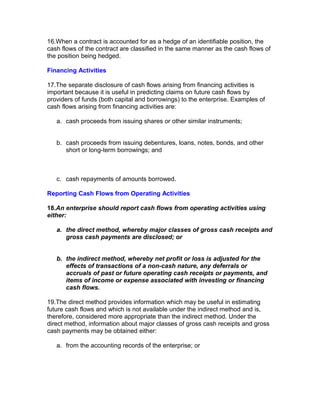
16.When a contract is accounted for as a hedge of an identifiable position, the
cash flows of the contract are classified in the same manner as the cash flows of
the position being hedged.

Financing Activities

17.The separate disclosure of cash flows arising from financing activities is
important because it is useful in predicting claims on future cash flows by
providers of funds (both capital and borrowings) to the enterprise. Examples of
cash flows arising from financing activities are:

   a. cash proceeds from issuing shares or other similar instruments;


   b. cash proceeds from issuing debentures, loans, notes, bonds, and other
      short or long-term borrowings; and


   c. cash repayments of amounts borrowed.

Reporting Cash Flows from Operating Activities

18.An enterprise should report cash flows from operating activities using
either:

   a. the direct method, whereby major classes of gross cash receipts and
      gross cash payments are disclosed; or


   b. the indirect method, whereby net profit or loss is adjusted for the
      effects of transactions of a non-cash nature, any deferrals or
      accruals of past or future operating cash receipts or payments, and
      items of income or expense associated with investing or financing
      cash flows.

19.The direct method provides information which may be useful in estimating
future cash flows and which is not available under the indirect method and is,
therefore, considered more appropriate than the indirect method. Under the
direct method, information about major classes of gross cash receipts and gross
cash payments may be obtained either:

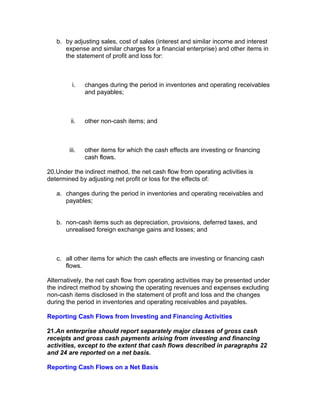
   a. from the accounting records of the enterprise; or
b. by adjusting sales, cost of sales (interest and similar income and interest
      expense and similar charges for a financial enterprise) and other items in
      the statement of profit and loss for:


         i.    changes during the period in inventories and operating receivables
               and payables;


        ii.    other non-cash items; and


        iii.   other items for which the cash effects are investing or financing
               cash flows.

20.Under the indirect method, the net cash flow from operating activities is
determined by adjusting net profit or loss for the effects of:

   a. changes during the period in inventories and operating receivables and
      payables;


   b. non-cash items such as depreciation, provisions, deferred taxes, and
      unrealised foreign exchange gains and losses; and


   c. all other items for which the cash effects are investing or financing cash
      flows.

Alternatively, the net cash flow from operating activities may be presented under
the indirect method by showing the operating revenues and expenses excluding
non-cash items disclosed in the statement of profit and loss and the changes
during the period in inventories and operating receivables and payables.

Reporting Cash Flows from Investing and Financing Activities

21.An enterprise should report separately major classes of gross cash
receipts and gross cash payments arising from investing and financing
activities, except to the extent that cash flows described in paragraphs 22
and 24 are reported on a net basis.

Reporting Cash Flows on a Net Basis
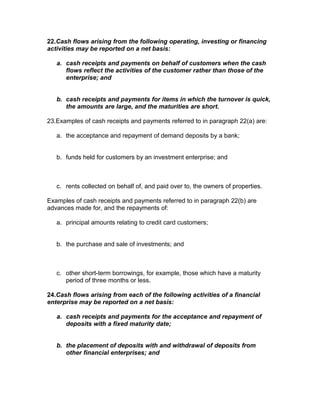
22.Cash flows arising from the following operating, investing or financing
activities may be reported on a net basis:

   a. cash receipts and payments on behalf of customers when the cash
      flows reflect the activities of the customer rather than those of the
      enterprise; and


   b. cash receipts and payments for items in which the turnover is quick,
      the amounts are large, and the maturities are short.

23.Examples of cash receipts and payments referred to in paragraph 22(a) are:

   a. the acceptance and repayment of demand deposits by a bank;


   b. funds held for customers by an investment enterprise; and


   c. rents collected on behalf of, and paid over to, the owners of properties.

Examples of cash receipts and payments referred to in paragraph 22(b) are
advances made for, and the repayments of:

   a. principal amounts relating to credit card customers;


   b. the purchase and sale of investments; and


   c. other short-term borrowings, for example, those which have a maturity
      period of three months or less.

24.Cash flows arising from each of the following activities of a financial
enterprise may be reported on a net basis:

   a. cash receipts and payments for the acceptance and repayment of
      deposits with a fixed maturity date;


   b. the placement of deposits with and withdrawal of deposits from
      other financial enterprises; and
c. cash advances and loans made to customers and the repayment of
      those advances and loans.

Foreign Currency Cash Flows

25.Cash flows arising from transactions in a foreign currency should be
recorded in an enterprise’s reporting currency by applying to the foreign
currency amount the exchange rate between the reporting currency and
the foreign currency at the date of the cash flow. A rate that approximates
the actual rate may be used if the result is substantially the same as would
arise if the rates at the dates of the cash flows were used. The effect of
changes in exchange rates on cash and cash equivalents held in a foreign
currency should be reported as a separate part of the reconciliation of the
changes in cash and cash equivalents during the period.

26.Cash flows denominated in foreign currency are reported in a manner
consistent with Accounting Standard (AS) 11, Accounting for the Effects of
Changes in Foreign Exchange Rates. This permits the use of an exchange rate
that approximates the actual rate. For example, a weighted average exchange
rate for a period may be used for recording foreign currency transactions.

27.Unrealised gains and losses arising from changes in foreign exchange rates
are not cash flows. However, the effect of exchange rate changes on cash and
cash equivalents held or due in a foreign currency is reported in the cash flow
statement in order to reconcile cash and cash equivalents at the beginning and
the end of the period. This amount is presented separately from cash flows from
operating, investing and financing activities and includes the differences, if any,
had those cash flows been reported at the end-of-period exchange rates.

Extraordinary Items

28.The cash flows associated with extraordinary items should be classified
as arising from operating, investing or financing activities as appropriate
and separately disclosed.

29.The cash flows associated with extraordinary items are disclosed separately
as arising from operating, investing or financing activities in the cash flow
statement, to enable users to understand their nature and effect on the present
and future cash flows of the enterprise. These disclosures are in addition to the
separate disclosures of the nature and amount of extraordinary items required by
Accounting Standard (AS) 5, Net Profit or Loss for the Period, Prior Period Items
and Changes in Accounting Policies.

Interest and Dividends
30. Cash flows from interest and dividends received and paid should each
be disclosed separately. Cash flows arising from interest paid and interest
and dividends received in the case of a financial enterprise should be
classified as cash flows arising from operating activities. In the case of
other enterprises, cash flows arising from interest paid should be
classified as cash flows from financing activities while interest and
dividends received should be classified as cash flows from investing
activities. Dividends paid should be classified as cash flows from financing
activities.

31.The total amount of interest paid during the period is disclosed in the cash
flow statement whether it has been recognised as an expense in the statement of
profit and loss or capitalised in accordance with Accounting Standard (AS) 10,
Accounting for Fixed Assets.

32.Interest paid and interest and dividends received are usually classified as
operating cash flows for a financial enterprise. However, there is no consensus
on the classification of these cash flows for other enterprises. Some argue that
interest paid and interest and dividends received may be classified as operating
cash flows because they enter into the determination of net profit or loss.
However, it is more appropriate that interest paid and interest and dividends
received are classified as financing cash flows and investing cash flows
respectively, because they are cost of obtaining financial resources or returns on
investments.

33. Some argue that dividends paid may be classified as a component of cash
flows from operating activities in order to assist users to determine the ability of
an enterprise to pay dividends out of operating cash flows. However, it is
considered more appropriate that dividends paid should be classified as cash
flows from financing activities because they are cost of obtaining financial
resources.

Taxes on Income

34.Cash flows arising from taxes on income should be separately
disclosed and should be classified as cash flows from operating activities
unless they can be specifically identified with financing and investing
activities.

35.Taxes on income arise on transactions that give rise to cash flows that are
classified as operating, investing or financing activities in a cash flow statement.
While tax expense may be readily identifiable with investing or financing
activities, the related tax cash flows are often impracticable to identify and may
arise in a different period from the cash flows of the underlying transactions.
Therefore, taxes paid are usually classified as cash flows from operating
activities. However, when it is practicable to identify the tax cash flow with an
individual transaction that gives rise to cash flows that are classified as investing
or financing activities, the tax cash flow is classified as an investing or financing
activity as appropriate. When tax cash flow are allocated over more than one
class of activity, the total amount of taxes paid is disclosed.

Investments in Subsidiaries, Associates and Joint Ventures

36.When accounting for an investment in an associate or a subsidiary or a
joint venture, an investor restricts its reporting in the cash flow statement
to the cash flows between itself and the investee/joint venture, for example,
cash flows relating to dividends and advances.

Acquisitions and Disposals of Subsidiaries and Other Business Units

37.The aggregate cash flows arising from acquisitions and from disposals
of subsidiaries or other business units should be presented separately and
classified as investing activities.

38.An enterprise should disclose, in aggregate, in respect of both
acquisition and disposal of subsidiaries or other business units during the
period each of the following:

   a. the total purchase or disposal consideration; and


   b. the portion of the purchase or disposal consideration discharged by
      means of cash and cash equivalents.

39. The separate presentation of the cash flow effects of acquisitions and
disposals of subsidiaries and other business units as single line items helps to
distinguish those cash flows from other cash flows. The cash flow effects of
disposals are not deducted from those of acquisitions.

Non-cash Transactions

40.Investing and financing transactions that do not require the use of cash
or cash equivalents should be excluded from a cash flow statement. Such
transactions should be disclosed elsewhere in the financial statements in a
way that provides all the relevant information about these investing and
financing activities.

41.Many investing and financing activities do not have a direct impact on current
cash flows although they do affect the capital and asset structure of an
enterprise. The exclusion of non-cash transactions from the cash flow statement
is consistent with the objective of a cash flow statement as these items do not
involve cash flows in the current period. Examples of non-cash transactions are:
a. the acquisition of assets by assuming directly related liabilities;


   b. the acquisition of an enterprise by means of issue of shares; and


   c. the conversion of debt to equity.

Components of Cash and Cash Equivalents

42.An enterprise should disclose the components of cash and cash
equivalents and should present a reconciliation of the amounts in its cash
flow statement with the equivalent items reported in the balance sheet.

43.In view of the variety of cash management practices, an enterprise discloses
the policy which it adopts in determining the composition of cash and cash
equivalents.

44.The effect of any change in the policy for determining components of cash
and cash equivalents is reported in accordance with Accounting Standard (AS) 5,
Net Profit or Loss for the Period, Prior Period Items and Changes in Accounting
Policies.

Other Disclosures

45.An enterprise should disclose, together with a commentary by
management, the amount of significant cash and cash equivalent balances
held by the enterprise that are not available for use by it.

46.There are various circumstances in which cash and cash equivalent balances
held by an enterprise are not available for use by it. Examples include cash and
cash equivalent balances held by a branch of the enterprise that operates in a
country where exchange controls or other legal restrictions apply as a result of
which the balances are not available for use by the enterprise.

47.Additional information may be relevant to users in understanding the financial
position and liquidity of an enterprise. Disclosure of this information, together with
a commentary by management, is encouraged and may include:

   a. the amount of undrawn borrowing facilities that may be available for future
      operating activities and to settle capital commitments, indicating any
      restrictions on the use of these facilities; and
b. the aggregate amount of cash flows that represent increases in operating
      capacity separately from those cash flows that are required to maintain
      operating capacity.

48.The separate disclosure of cash flows that represent increases in operating
capacity and cash flows that are required to maintain operating capacity is useful
in enabling the user to determine whether the enterprise is investing adequately
in the maintenance of its operating capacity. An enterprise that does not invest
adequately in the maintenance of its operating capacity may be prejudicing future
profitability for the sake of current liquidity and distributions to owners.

Appendix I

Cash Flow Statement for an Enterprise other than a Financial Enterprise

The appendix is illustrative only and does not form part of the accounting
standard. The purpose of this appendix is to illustrate the application of the
accounting standard.

1.The example shows only current period amounts.

2.Information from the statement of profit and loss and balance sheet is provided
to show how the statements of cash flows under the direct method and the
indirect method have been derived. Neither the statement of profit and loss nor
the balance sheet is presented in conformity with the disclosure and presentation
requirements of applicable laws and accounting standards. The working notes
given towards the end of this appendix are intended to assist in understanding
the manner in which the various figures appearing in the cash flow statement
have been derived. These working notes do not form part of the cash flow
statement and, accordingly, need not be published.

3.The following additional information is also relevant for the preparation of the
statement of cash flows (figures are in Rs.’000).

   a. An amount of 250 was raised from the issue of share capital and a further
      250 was raised from long term borrowings.


   b. Interest expense was 400 of which 170 was paid during the period. 100
      relating to interest expense of the prior period was also paid during the
      period.
c. Dividends paid were 1,200.


   d. Tax deducted at source on dividends received (included in the tax
      expense of 300 for the year) amounted to 40.


   e. During the period, the enterprise acquired fixed assets for 350. The
      payment was made in cash.


   f. Plant with original cost of 80 and accumulated depreciation of 60 was sold
      for 20.


   g. Foreign exchange loss of 40 represents the reduction in the carrying
      amount of a short-term investment in foreign-currency designated bonds
      arising out of a change in exchange rate between the date of acquisition of
      the investment and the balance sheet date.


   h. Sundry debtors and sundry creditors include amounts relating to credit
      sales and credit purchases only.

                   Balance Sheet as at 31.12.1996
                                                                 (Rs. ’000)
                                                     1996           1995
Assets
Cash on hand and balances with banks                 200               25
Short-term investments                               670               135
Sundry debtors                                       1,700             1,200
Interest receivable                                  100               -
Inventories                                          900               1,950
Long-term investments                                2,500             2,500
Fixed assets at cost                       2,180             1,910
Accumulated depreciation                   (1,450)           (1,060)
Fixed assets (net)                                   730               850
Total assets                                         6,800             6,660
Liabilities
Sundry creditors                                 150           1,890
Interest payable                                 230           100
Income taxes payable                             400           1,000
Long-term debt                                   1,110         1,040
Total liabilities                                1,890         4,030


Shareholders’ Funds
Share capital                                    1,500         1,250
Reserves                                         3,410         1,380
Total shareholders’ funds                        4,910         2,630
Total liabilities and shareholders’ funds        6,800         6,660


    Statement of Profit and Loss for the period ended 31.12.1996
                                                           (Rs. ’000)
Sales                                                     30,650
Cost of sales                                             (26,000)
Gross profit                                              4,650
Depreciation                                              (450)
Administrative and selling expenses                       (910)
Interest expense                                          (400)
Interest income                                           300
Dividend income                                           200
Foreign exchange loss                                     (40)
Net profit before taxation and extraordinary item         3,350
Extraordinary item - Insurance proceeds from              180
earthquake disaster settlement
Net profit after extraordinary item                       3,530
Income-tax                                                (300)
Net profit                                                3,230

       Direct Method Cash Flow Statement [Paragraph 18(a)]
                                                       (Rs. ’000)
                                                            1996
Cash flows from operating activities
Cash receipts from customers               30,150
Cash paid to suppliers and employees       (27,600)
Cash generated from operations             2,550
Income taxes paid                              (860)
Cash flow before extraordinary item            1,690
Proceeds from earthquake disaster settlement   180
Net cash from operating activities                       1,870
Cash flows from investing activities
Purchase of fixed assets                       (350)
Proceeds from sale of equipment                20
Interest received                              200
Dividends received                             160


Net cash from investing activities                       30
Cash flows from financing activities
Proceeds from issuance of share capital        250
Proceeds from long-term borrowings             250
Repayment of long-term borrowings              (180)
Interest paid                                  (270)
Dividends paid                                 (1,200)


Net cash used in financing activities                    (1,150)


Net increase in cash and cash equivalents                750
Cash and cash equivalents at beginning of                160
period
(see Note 1)
Cash and cash equivalents at end of period               910
(see Note 1)
      Indirect Method Cash Flow Statement [Paragraph 18(b)]
                                                         (Rs. ’000)
                                                              1996
Cash flows from operating activities
Net profit before taxation, and extraordinary item 3,350
Adjustments for:
                                                   450
      Depreciation
                                                   40
      Foreign exchange loss
                                                   (300)
      Interest income
(200)
       Dividend income
                                                  400
       Interest expense

Operating profit before working capital changes   3,740
Increase in sundry debtors                        (500)
Decrease in inventories                           1,050
Decrease in sundry creditors                      (1,740)


Cash generated from operations                    2,550
Income taxes paid                                 (860)


Cash flow before extraordinary item               1,690
Proceeds from earthquake disaster settlement      180


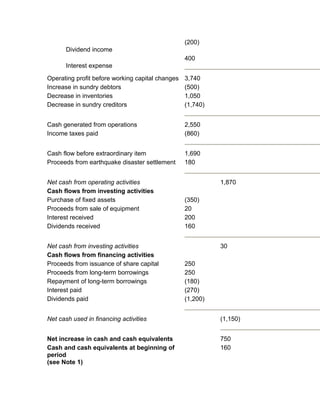
Net cash from operating activities                          1,870
Cash flows from investing activities
Purchase of fixed assets                          (350)
Proceeds from sale of equipment                   20
Interest received                                 200
Dividends received                                160


Net cash from investing activities                          30
Cash flows from financing activities
Proceeds from issuance of share capital           250
Proceeds from long-term borrowings                250
Repayment of long-term borrowings                 (180)
Interest paid                                     (270)
Dividends paid                                    (1,200)


Net cash used in financing activities                       (1,150)


Net increase in cash and cash equivalents                   750
Cash and cash equivalents at beginning of                   160
period
(see Note 1)
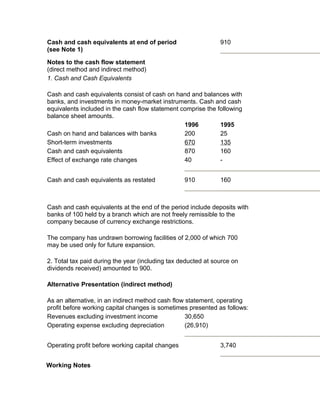
Cash and cash equivalents at end of period                     910
(see Note 1)

Notes to the cash flow statement
(direct method and indirect method)
1. Cash and Cash Equivalents

Cash and cash equivalents consist of cash on hand and balances with
banks, and investments in money-market instruments. Cash and cash
equivalents included in the cash flow statement comprise the following
balance sheet amounts.
                                                 1996         1995
Cash on hand and balances with banks             200          25
Short-term investments                           670          135
Cash and cash equivalents                        870          160
Effect of exchange rate changes                  40           -


Cash and cash equivalents as restated             910          160


Cash and cash equivalents at the end of the period include deposits with
banks of 100 held by a branch which are not freely remissible to the
company because of currency exchange restrictions.

The company has undrawn borrowing facilities of 2,000 of which 700
may be used only for future expansion.

2. Total tax paid during the year (including tax deducted at source on
dividends received) amounted to 900.

Alternative Presentation (indirect method)

As an alternative, in an indirect method cash flow statement, operating
profit before working capital changes is sometimes presented as follows:
Revenues excluding investment income               30,650
Operating expense excluding depreciation           (26,910)


Operating profit before working capital changes                3,740


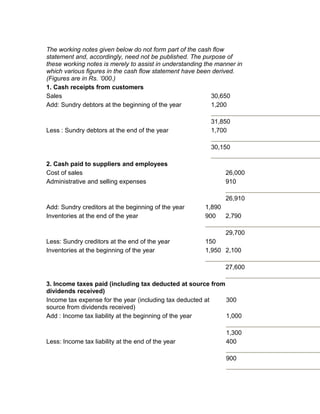
Working Notes
The working notes given below do not form part of the cash flow
statement and, accordingly, need not be published. The purpose of
these working notes is merely to assist in understanding the manner in
which various figures in the cash flow statement have been derived.
(Figures are in Rs. ’000.)
1. Cash receipts from customers
Sales                                                       30,650
Add: Sundry debtors at the beginning of the year            1,200

                                                          31,850
Less : Sundry debtors at the end of the year              1,700

                                                          30,150

2. Cash paid to suppliers and employees
Cost of sales                                                   26,000
Administrative and selling expenses                             910

                                                                26,910
Add: Sundry creditors at the beginning of the year      1,890
Inventories at the end of the year                      900   2,790

                                                                29,700
Less: Sundry creditors at the end of the year           150
Inventories at the beginning of the year                1,950 2,100

                                                                27,600

3. Income taxes paid (including tax deducted at source from
dividends received)
Income tax expense for the year (including tax deducted at  300
source from dividends received)
Add : Income tax liability at the beginning of the year     1,000

                                                                1,300
Less: Income tax liability at the end of the year               400

                                                                900
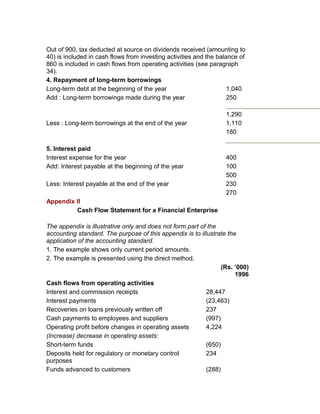
Out of 900, tax deducted at source on dividends received (amounting to
40) is included in cash flows from investing activities and the balance of
860 is included in cash flows from operating activities (see paragraph
34).
4. Repayment of long-term borrowings
Long-term debt at the beginning of the year                         1,040
Add : Long-term borrowings made during the year                     250

                                                                  1,290
Less : Long-term borrowings at the end of the year                1,110
                                                                  180

5. Interest paid
Interest expense for the year                                     400
Add: Interest payable at the beginning of the year                100
                                                                  500
Less: Interest payable at the end of the year                     230
                                                                  270
Appendix II
         Cash Flow Statement for a Financial Enterprise

The appendix is illustrative only and does not form part of the
accounting standard. The purpose of this appendix is to illustrate the
application of the accounting standard.
1. The example shows only current period amounts.
2. The example is presented using the direct method.
                                                                 (Rs. ’000)
                                                                      1996
Cash flows from operating activities
Interest and commission receipts                           28,447
Interest payments                                          (23,463)
Recoveries on loans previously written off                 237
Cash payments to employees and suppliers                   (997)
Operating profit before changes in operating assets        4,224
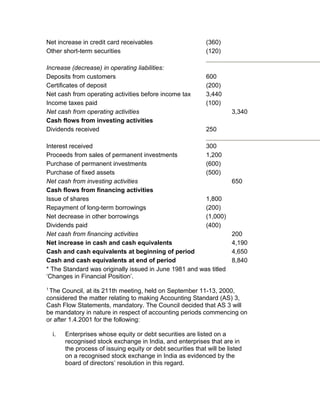
(Increase) decrease in operating assets:
Short-term funds                                           (650)
Deposits held for regulatory or monetary control           234
purposes
Funds advanced to customers                                (288)
Net increase in credit card receivables                        (360)
Other short-term securities                                    (120)

Increase (decrease) in operating liabilities:
Deposits from customers                                        600
Certificates of deposit                                        (200)
Net cash from operating activities before income tax           3,440
Income taxes paid                                              (100)
Net cash from operating activities                                       3,340
Cash flows from investing activities
Dividends received                                             250

Interest received                                       300
Proceeds from sales of permanent investments            1,200
Purchase of permanent investments                       (600)
Purchase of fixed assets                                (500)
Net cash from investing activities                                       650
Cash flows from financing activities
Issue of shares                                         1,800
Repayment of long-term borrowings                       (200)
Net decrease in other borrowings                        (1,000)
Dividends paid                                          (400)
Net cash from financing activities                                       200
Net increase in cash and cash equivalents                                4,190
Cash and cash equivalents at beginning of period                         4,650
Cash and cash equivalents at end of period                               8,840
* The Standard was originally issued in June 1981 and was titled
‘Changes in Financial Position’.
1
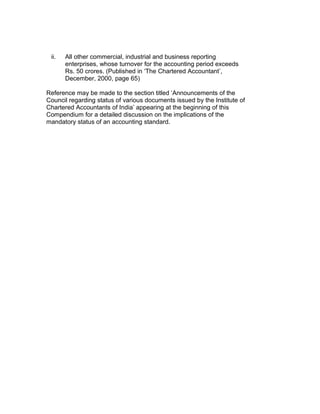
 The Council, at its 211th meeting, held on September 11-13, 2000,
considered the matter relating to making Accounting Standard (AS) 3,
Cash Flow Statements, mandatory. The Council decided that AS 3 will
be mandatory in nature in respect of accounting periods commencing on
or after 1.4.2001 for the following:

    i.   Enterprises whose equity or debt securities are listed on a
         recognised stock exchange in India, and enterprises that are in
         the process of issuing equity or debt securities that will be listed
         on a recognised stock exchange in India as evidenced by the
         board of directors’ resolution in this regard.
ii.   All other commercial, industrial and business reporting
       enterprises, whose turnover for the accounting period exceeds
       Rs. 50 crores. (Published in ‘The Chartered Accountant’,
       December, 2000, page 65)

Reference may be made to the section titled ‘Announcements of the
Council regarding status of various documents issued by the Institute of
Chartered Accountants of India’ appearing at the beginning of this
Compendium for a detailed discussion on the implications of the
mandatory status of an accounting standard.
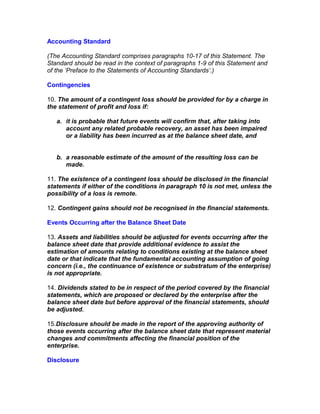
AS-4 Contingencies and Events Occurring After the
Balance Sheet Date
The following is the text of the revised Accounting Standard (AS) 4,
‘Contingencies and Events Occurring After the Balance Sheet Date’, issued by
the Council of the Institute of Chartered Accountants of India.

This revised standard comes into effect in respect of accounting periods
commencing on or after 1.4.1995 and is mandatory in nature.1 It is clarified that in
respect of accounting periods commencing on a date prior to 1.4.1995,
Accounting Standard 4 as originally issued in November 1982 (and subsequently
made mandatory) applies.

Introduction

1.This Statement deals with the treatment in financial statements of

   a. contingencies, and


   b. events occurring after the balance sheet date.

2.The following subjects, which may result in contingencies, are excluded from
the scope of this Statement in view of special considerations applicable to them:

       (a) liabilities of life assurance and general insurance enterprises arising
       from policies issued;


       (b) obligations under retirement benefit plans; and

       (c) commitments arising from long-term lease contracts.

Definitions

3.The following terms are used in this Statement with the meanings specified:

3.1A contingency is a condition or situation, the ultimate outcome of which, gain
or loss, will be known or determined only on the occurrence, or non-occurrence,
of one or more uncertain future events.
3.2Events occurring after the balance sheet date are those significant events,
both favourable and unfavourable, that occur between the balance sheet date
and the date on which the financial statements are approved by the Board of
Directors in the case of a company, and, by the corresponding approving
authority in the case of any other entity.

Two types of events can be identified:

   a. those which provide further evidence of conditions that existed at the
      balance sheet date; and


   b. those which are indicative of conditions that arose subsequent to the
      balance sheet date.

Explanation

4. Contingencies

4.1 The term “contingencies” used in this Statement is restricted to conditions or
situations at the balance sheet date, the financial effect of which is to be
determined by future events which may or may not occur.

4.2 Estimates are required for determining the amounts to be stated in the
financial statements for many on-going and recurring activities of an enterprise.
One must, however, distinguish between an event which is certain and one which
is uncertain. The fact that an estimate is involved does not, of itself, create the
type of uncertainty which characterises a contingency. For example, the fact that
estimates of useful life are used to determine depreciation, does not make
depreciation a contingency; the eventual expiry of the useful life of the asset is
not uncertain. Also, amounts owed for services received are not contingencies as
defined in paragraph 3.1, even though the amounts may have been estimated,
as there is nothing uncertain about the fact that these obligations have been
incurred.

4.3 The uncertainty relating to future events can be expressed by a range of
outcomes. This range may be presented as quantified probabilities, but in most
circumstances, this suggests a level of precision that is not supported by the
available information. The possible outcomes can, therefore, usually be generally
described except where reasonable quantification is practicable.

4.4 The estimates of the outcome and of the financial effect of contingencies are
determined by the judgement of the management of the enterprise. This
judgement is based on consideration of information available up to the date on
which the financial statements are approved and will include a review of events
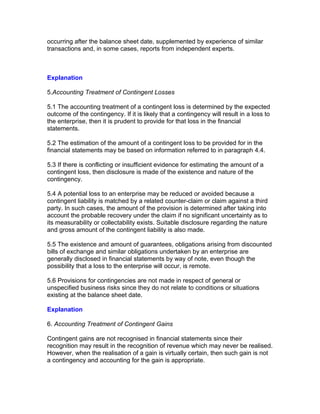
occurring after the balance sheet date, supplemented by experience of similar
transactions and, in some cases, reports from independent experts.


Explanation

5.Accounting Treatment of Contingent Losses

5.1 The accounting treatment of a contingent loss is determined by the expected
outcome of the contingency. If it is likely that a contingency will result in a loss to
the enterprise, then it is prudent to provide for that loss in the financial
statements.

5.2 The estimation of the amount of a contingent loss to be provided for in the
financial statements may be based on information referred to in paragraph 4.4.

5.3 If there is conflicting or insufficient evidence for estimating the amount of a
contingent loss, then disclosure is made of the existence and nature of the
contingency.

5.4 A potential loss to an enterprise may be reduced or avoided because a
contingent liability is matched by a related counter-claim or claim against a third
party. In such cases, the amount of the provision is determined after taking into
account the probable recovery under the claim if no significant uncertainty as to
its measurability or collectability exists. Suitable disclosure regarding the nature
and gross amount of the contingent liability is also made.

5.5 The existence and amount of guarantees, obligations arising from discounted
bills of exchange and similar obligations undertaken by an enterprise are
generally disclosed in financial statements by way of note, even though the
possibility that a loss to the enterprise will occur, is remote.

5.6 Provisions for contingencies are not made in respect of general or
unspecified business risks since they do not relate to conditions or situations
existing at the balance sheet date.

Explanation

6. Accounting Treatment of Contingent Gains

Contingent gains are not recognised in financial statements since their
recognition may result in the recognition of revenue which may never be realised.
However, when the realisation of a gain is virtually certain, then such gain is not
a contingency and accounting for the gain is appropriate.
Explanation

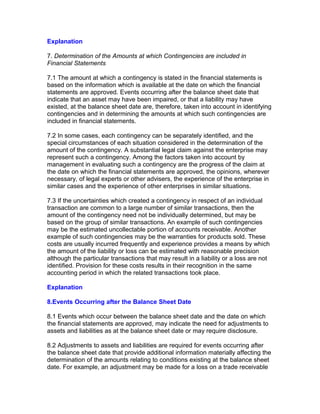
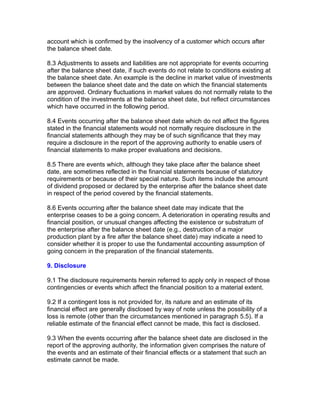
7. Determination of the Amounts at which Contingencies are included in
Financial Statements

7.1 The amount at which a contingency is stated in the financial statements is
based on the information which is available at the date on which the financial
statements are approved. Events occurring after the balance sheet date that
indicate that an asset may have been impaired, or that a liability may have
existed, at the balance sheet date are, therefore, taken into account in identifying
contingencies and in determining the amounts at which such contingencies are
included in financial statements.

7.2 In some cases, each contingency can be separately identified, and the
special circumstances of each situation considered in the determination of the
amount of the contingency. A substantial legal claim against the enterprise may
represent such a contingency. Among the factors taken into account by
management in evaluating such a contingency are the progress of the claim at
the date on which the financial statements are approved, the opinions, wherever
necessary, of legal experts or other advisers, the experience of the enterprise in
similar cases and the experience of other enterprises in similar situations.

7.3 If the uncertainties which created a contingency in respect of an individual
transaction are common to a large number of similar transactions, then the
amount of the contingency need not be individually determined, but may be
based on the group of similar transactions. An example of such contingencies
may be the estimated uncollectable portion of accounts receivable. Another
example of such contingencies may be the warranties for products sold. These
costs are usually incurred frequently and experience provides a means by which
the amount of the liability or loss can be estimated with reasonable precision
although the particular transactions that may result in a liability or a loss are not
identified. Provision for these costs results in their recognition in the same
accounting period in which the related transactions took place.

Explanation

8.Events Occurring after the Balance Sheet Date

8.1 Events which occur between the balance sheet date and the date on which
the financial statements are approved, may indicate the need for adjustments to
assets and liabilities as at the balance sheet date or may require disclosure.

8.2 Adjustments to assets and liabilities are required for events occurring after
the balance sheet date that provide additional information materially affecting the
determination of the amounts relating to conditions existing at the balance sheet
date. For example, an adjustment may be made for a loss on a trade receivable
account which is confirmed by the insolvency of a customer which occurs after
the balance sheet date.

8.3 Adjustments to assets and liabilities are not appropriate for events occurring
after the balance sheet date, if such events do not relate to conditions existing at
the balance sheet date. An example is the decline in market value of investments
between the balance sheet date and the date on which the financial statements
are approved. Ordinary fluctuations in market values do not normally relate to the
condition of the investments at the balance sheet date, but reflect circumstances
which have occurred in the following period.

8.4 Events occurring after the balance sheet date which do not affect the figures
stated in the financial statements would not normally require disclosure in the
financial statements although they may be of such significance that they may
require a disclosure in the report of the approving authority to enable users of
financial statements to make proper evaluations and decisions.

8.5 There are events which, although they take place after the balance sheet
date, are sometimes reflected in the financial statements because of statutory
requirements or because of their special nature. Such items include the amount
of dividend proposed or declared by the enterprise after the balance sheet date
in respect of the period covered by the financial statements.

8.6 Events occurring after the balance sheet date may indicate that the
enterprise ceases to be a going concern. A deterioration in operating results and
financial position, or unusual changes affecting the existence or substratum of
the enterprise after the balance sheet date (e.g., destruction of a major
production plant by a fire after the balance sheet date) may indicate a need to
consider whether it is proper to use the fundamental accounting assumption of
going concern in the preparation of the financial statements.

9. Disclosure

9.1 The disclosure requirements herein referred to apply only in respect of those
contingencies or events which affect the financial position to a material extent.

9.2 If a contingent loss is not provided for, its nature and an estimate of its
financial effect are generally disclosed by way of note unless the possibility of a
loss is remote (other than the circumstances mentioned in paragraph 5.5). If a
reliable estimate of the financial effect cannot be made, this fact is disclosed.

9.3 When the events occurring after the balance sheet date are disclosed in the
report of the approving authority, the information given comprises the nature of
the events and an estimate of their financial effects or a statement that such an
estimate cannot be made.
Accounting Standard

(The Accounting Standard comprises paragraphs 10-17 of this Statement. The
Standard should be read in the context of paragraphs 1-9 of this Statement and
of the ‘Preface to the Statements of Accounting Standards’.)

Contingencies

10. The amount of a contingent loss should be provided for by a charge in
the statement of profit and loss if:

   a. it is probable that future events will confirm that, after taking into
      account any related probable recovery, an asset has been impaired
      or a liability has been incurred as at the balance sheet date, and


   b. a reasonable estimate of the amount of the resulting loss can be
      made.

11. The existence of a contingent loss should be disclosed in the financial
statements if either of the conditions in paragraph 10 is not met, unless the
possibility of a loss is remote.

12. Contingent gains should not be recognised in the financial statements.

Events Occurring after the Balance Sheet Date

13. Assets and liabilities should be adjusted for events occurring after the
balance sheet date that provide additional evidence to assist the
estimation of amounts relating to conditions existing at the balance sheet
date or that indicate that the fundamental accounting assumption of going
concern (i.e., the continuance of existence or substratum of the enterprise)
is not appropriate.

14. Dividends stated to be in respect of the period covered by the financial
statements, which are proposed or declared by the enterprise after the
balance sheet date but before approval of the financial statements, should
be adjusted.

15.Disclosure should be made in the report of the approving authority of
those events occurring after the balance sheet date that represent material
changes and commitments affecting the financial position of the
enterprise.

Disclosure
16. If disclosure of contingencies is required by paragraph 11 of this
Statement, the following information should be provided:

    a. the nature of the contingency;


    b. the uncertainties which may affect the future outcome;


    c. an estimate of the financial effect, or a statement that such an
       estimate cannot be made.

17. If disclosure of events occurring after the balance sheet date in the
report of the approving authority is required by paragraph 15 of this
Statement, the following information should be provided:

    a. the nature of the event;


    b. an estimate of the financial effect, or a statement that such an
       estimate cannot be made.

*The Standard was originally issued in November 1982.
1
 Reference may be made to the section titled ‘Announcements of the Council
regarding status of various documents issued by the Institute of Chartered
Accountants of India’ appearing at the beginning of this Compendium for a
detailed discussion on the implications of the mandatory status of an accounting
standard.
AS-5 Net Profit or Loss for the Period, Prior Period Items
and Changes in Accounting Policies
 (In this Accounting Standard, the standard portions have been set in bold italic
type. These should be read in the context of the background material which has
been set in normal type, and in the context of the ‘Preface to the Statements of
Accounting Standards’.)

The following is the text of the revised Accounting Standard (AS) 5, ‘Net Profit or
Loss for the Period, Prior Period Items and Changes in Accounting Policies’,
issued by the Council of the Institute of Chartered Accountants of India.

This revised standard comes into effect in respect of accounting periods
commencing on or after 1.4.1996 and is mandatory in nature.1 It is clarified that in
respect of accounting periods commencing on a date prior to 1.4.1996,
Accounting Standard 5 as originally issued in November, 1982 (and
subsequently made mandatory) will apply.

Objective

The objective of this Statement is to prescribe the classification and disclosure of
certain items in the statement of profit and loss so that all enterprises prepare
and present such a statement on a uniform basis. This enhances the
comparability of the financial statements of an enterprise over time and with the
financial statements of other enterprises. Accordingly, this Statement requires the
classification and disclosure of extraordinary and prior period items, and the
disclosure of certain items within profit or loss from ordinary activities. It also
specifies the accounting treatment for changes in accounting estimates and the
disclosures to be made in the financial statements regarding changes in
accounting policies.

Scope

1.This Statement should be applied by an enterprise in presenting profit or
loss from ordinary activities, extraordinary items and prior period items in
the statement of profit and loss, in accounting for changes in accounting
estimates, and in disclosure of changes in accounting policies.
2.This Statement deals with, among other matters, the disclosure of certain items
of net profit or loss for the period. These disclosures are made in addition to any
other disclosures required by other Accounting Standards.

3.This Statement does not deal with the tax implications of extraordinary items,
prior period items, changes in accounting estimates, and changes in accounting
policies for which appropriate adjustments will have to be made depending on
the circumstances.

Definitions

4.The following terms are used in this Statement with the meanings
specified:

Ordinary activities are any activities which are undertaken by an enterprise
as part of its business and such related activities in which the enterprise
engages in furtherance of, incidental to, or arising from, these activities.

Extraordinary items are income or expenses that arise from events or
transactions that are clearly distinct from the ordinary activities of the
enterprise and, therefore, are not expected to recur frequently or regularly.

Prior period items are income or expenses which arise in the current
period as a result of errors or omissions in the preparation of the financial
statements of one or more prior periods.

Accounting policies are the specific accounting principles and the
methods of applying those principles adopted by an enterprise in the
preparation and presentation of financial statements.

Net Profit or Loss for the Period

5. All items of income and expense which are recognised in a period
should be included in the determination of net profit or loss for the period
unless an Accounting Standard requires or permits otherwise.

6.Normally, all items of income and expense which are recognised in a period
are included in the determination of the net profit or loss for the period. This
includes extraordinary items and the effects of changes in accounting estimates.

7.The net profit or loss for the period comprises the following components,
each of which should be disclosed on the face of the statement of profit
and loss:
a. profit or loss from ordinary activities; and


   b. extraordinary items.

Extraordinary Items

8.Extraordinary items should be disclosed in the statement of profit and
loss as a part of net profit or loss for the period. The nature and the
amount of each extraordinary item should be separately disclosed in the
statement of profit and loss in a manner that its impact on current profit or
loss can be perceived.

9.Virtually all items of income and expense included in the determination of net
profit or loss for the period arise in the course of the ordinary activities of the
enterprise. Therefore, only on rare occasions does an event or transaction give
rise to an extraordinary item.

10.Whether an event or transaction is clearly distinct from the ordinary activities
of the enterprise is determined by the nature of the event or transaction in
relation to the business ordinarily carried on by the enterprise rather than by the
frequency with which such events are expected to occur. Therefore, an event or
transaction may be extraordinary for one enterprise but not so for another
enterprise because of the differences between their respective ordinary activities.
For example, losses sustained as a result of an earthquake may qualify as an
extraordinary item for many enterprises. However, claims from policyholders
arising from an earthquake do not qualify as an extraordinary item for an
insurance enterprise that insures against such risks.

11.Examples of events or transactions that generally give rise to extraordinary
items for most enterprises are:

   •   attachment of property of the enterprise; or


   •   an earthquake.

Profit or Loss from Ordinary Activities

12.When items of income and expense within profit or loss from ordinary
activities are of such size, nature or incidence that their disclosure is
relevant to explain the performance of the enterprise for the period, the
nature and amount of such items should be disclosed separately.

13.Although the items of income and expense described in paragraph 12 are not
extraordinary items, the nature and amount of such items may be relevant to
users of financial statements in understanding the financial position and
performance of an enterprise and in making projections about financial position
and performance. Disclosure of such information is sometimes made in the notes
to the financial statements.

14.Circumstances which may give rise to the separate disclosure of items of
income and expense in accordance with paragraph 12 include:

   a. the write-down of inventories to net realisable value as well as the reversal
      of such write-downs;


   b. a restructuring of the activities of an enterprise and the reversal of any
      provisions for the costs of restructuring;


   c. disposals of items of fixed assets;


   d. disposals of long-term investments;


   e. legislative changes having retrospective application;


   f. litigation settlements; and


   g. other reversals of provisions.

Prior Period Items

15.The nature and amount of prior period items should be separately
disclosed in the statement of profit and loss in a manner that their impact
on the current profit or loss can be perceived.

16.The term ‘prior period items’, as defined in this Statement, refers only to
income or expenses which arise in the current period as a result of errors or
omissions in the preparation of the financial statements of one or more prior
periods. The term does not include other adjustments necessitated by
circumstances, which though related to prior periods, are determined in the
current period, e.g., arrears payable to workers as a result of revision of wages
with retrospective effect during the current period.

17.Errors in the preparation of the financial statements of one or more prior
periods may be discovered in the current period. Errors may occur as a result of
mathematical mistakes, mistakes in applying accounting policies,
misinterpretation of facts, or oversight.

18.Prior period items are generally infrequent in nature and can be distinguished
from changes in accounting estimates. Accounting estimates by their nature are
approximations that may need revision as additional information becomes
known. For example, income or expense recognised on the outcome of a
contingency which previously could not be estimated reliably does not constitute
a prior period item.

19.Prior period items are normally included in the determination of net profit or
loss for the current period. An alternative approach is to show such items in the
statement of profit and loss after determination of current net profit or loss. In
either case, the objective is to indicate the effect of such items on the current
profit or loss.

Changes in Accounting Estimates

20.As a result of the uncertainties inherent in business activities, many financial
statement items cannot be measured with precision but can only be estimated.
The estimation process involves judgments based on the latest information
available. Estimates may be required, for example, of bad debts, inventory
obsolescence or the useful lives of depreciable assets. The use of reasonable
estimates is an essential part of the preparation of financial statements and does
not undermine their reliability.

21.An estimate may have to be revised if changes occur regarding the
circumstances on which the estimate was based, or as a result of new
information, more experience or subsequent developments. The revision of the
estimate, by its nature, does not bring the adjustment within the definitions of an
extraordinary item or a prior period item.

22.Sometimes, it is difficult to distinguish between a change in an accounting
policy and a change in an accounting estimate. In such cases, the change is
treated as a change in an accounting estimate, with appropriate disclosure.

23.The effect of a change in an accounting estimate should be included in
the determination of net profit or loss in:
a. the period of the change, if the change affects the period only; or


   b. the period of the change and future periods, if the change affects
      both.

24.A change in an accounting estimate may affect the current period only or both
the current period and future periods. For example, a change in the estimate of
the amount of bad debts is recognised immediately and therefore affects only the
current period. However, a change in the estimated useful life of a depreciable
asset affects the depreciation in the current period and in each period during the
remaining useful life of the asset. In both cases, the effect of the change relating
to the current period is recognised as income or expense in the current period.
The effect, if any, on future periods, is recognised in future periods.

25.The effect of a change in an accounting estimate should be classified
using the same classification in the statement of profit and loss as was
used previously for the estimate.

26.To ensure the comparability of financial statements of different periods, the
effect of a change in an accounting estimate which was previously included in the
profit or loss from ordinary activities is included in that component of net profit or
loss. The effect of a change in an accounting estimate that was previously
included as an extraordinary item is reported as an extraordinary item.

27.The nature and amount of a change in an accounting estimate which
has a material effect in the current period, or which is expected to have a
material effect in subsequent periods, should be disclosed. If it is
impracticable to quantify the amount, this fact should be disclosed.

Changes in Accounting Policies

28. Users need to be able to compare the financial statements of an enterprise
over a period of time in order to identify trends in its financial position,
performance and cash flows. Therefore, the same accounting policies are
normally adopted for similar events or transactions in each period.

29.A change in an accounting policy should be made only if the adoption
of a different accounting policy is required by statute or for compliance
with an accounting standard or if it is considered that the change would
result in a more appropriate presentation of the financial statements of the
enterprise.

30.A more appropriate presentation of events or transactions in the financial
statements occurs when the new accounting policy results in more relevant or
reliable information about the financial position, performance or cash flows of the
enterprise.

31.The following are not changes in accounting policies :

   a. the adoption of an accounting policy for events or transactions that differ in
      substance from previously occurring events or transactions, e.g.,
      introduction of a formal retirement gratuity scheme by an employer in
      place of ad hoc ex-gratia payments to employees on retirement; and


   b. the adoption of a new accounting policy for events or transactions which
      did not occur previously or that were immaterial.


32.Any change in an accounting policy which has a material effect should
be disclosed. The impact of, and the adjustments resulting from, such
change, if material, should be shown in the financial statements of the
period in which such change is made, to reflect the effect of such change.
Where the effect of such change is not ascertainable, wholly or in part, the
fact should be indicated. If a change is made in the accounting policies
which has no material effect on the financial statements for the current
period but which is reasonably expected to have a material effect in later
periods, the fact of such change should be appropriately disclosed in the
period in which the change is adopted.

33.A change in accounting policy consequent upon the adoption of an
Accounting Standard should be accounted for in accordance with the
specific transitional provisions, if any, contained in that Accounting
Standard. However, disclosures required by paragraph 32 of this Statement
should be made unless the transitional provisions of any other Accounting
Standard require alternative disclosures in this regard.2

* A limited revision was made in 2001, pursuant to which paragraph 33 has been
added in this standard (see footnote 2). The Standard was originally issued in
November 1982 and was titled ‘Prior Period and Extraordinary Items and
Changes in Accounting Policies’.

1 Reference may be made to the section titled ‘Announcements of the Council
regarding status of various documents issued by the Institute of Chartered
Accountants of India’ appearing at the beginning of this Compendium for a
detailed discussion on the implications of the mandatory status of an accounting
standard.
2
 As a limited revision to AS 5, the Council of the Institute decided to add this
paragraph in AS 5 in 2001. This revision comes into effect in respect of
accounting periods commencing on or after 1.4.2001 (see ‘The Chartered
Accountant’, September 2001, pp. 342).


AS-6 Depreciation Accounting
The following is the text of the revised Accounting Standard (AS) 6, ‘Depreciation
Accounting’, issued by the Council of the Institute of Chartered Accountants of
India.

Introduction

1.This Statement deals with depreciation accounting and applies to all
depreciable assets, except the following items to which special considerations
apply:-

* Accounting Standard (AS) 6, Depreciation Accounting, was issued by the
Institute in November 1982. Subsequently, in the context of insertion of Schedule
XIV in the Companies Act in 1988, the Institute brought out a Guidance Note on
Accounting for Depreciation in Companies which came into effect in respect of
accounting periods commencing on or after 1st April, 1989. The Guidance Note
differed from AS 6 in respect of accounting treatment of (a) change in the method
of depreciation, and (b) change in the rates of depreciation. It was clarified in the
Guidance Note, with regard to the matter at (a), that AS 6 would be revised to
bring it in line with the recommendations of the Guidance Note.

Based on the recommendations of the Accounting Standards Board, the Council
of the Institute at its 168th meeting, held on May 26-29, 1994, decided to bring
AS 6 in line with the Guidance Note in respect of both of the aforementioned
matters. Accordingly, it was decided to modify paragraphs 11, 15, 22 and 24 and
delete paragraph 19 of AS 6. Also, in the context of delinking of rates of
depreciation under the Companies Act from those under the Income-tax
Act/Rules by the Companies (Amendment) Act, 1988, the Council decided to
suitably modify paragraph 13 of AS 6. An announcement to this effect was
published in the August 1994 issue of The Chartered Accountant (pp. 218-219).

AS 6 is mandatory in respect of accounts for periods commencing on or after
1.4.1995. Reference may be made to the section titled ‘Announcements of the
Council regarding status of various documents issued by the Institute of
Chartered Accountants of India’ appearing at the beginning of this Compendium
for a detailed discussion on the implications of the mandatory status of an
accounting standard. From the date of Accounting Standard (AS) 26, ‘Intangible
Assets’, becoming mandatory for the concerned enterprises, this Standard would
stand withdrawn insofar as it relates to the amortisation (depreciation) of
intangible assets (See AS 26).


  i.    forests, plantations and similar regenerative natural resources;


 ii.    wasting assets including expenditure on the exploration for and extraction
        of minerals, oils, natural gas and similar non-regenerative resources;


 iii.   expenditure on research and development;


 iv.    goodwill;


 v.     live stock.

This statement also does not apply to land unless it has a limited useful life for
the enterprise.

2.Different accounting policies for depreciation are adopted by different
enterprises. Disclosure of accounting policies for depreciation followed by an
enterprise is necessary to appreciate the view presented in the financial
statements of the enterprise.

Definitions

3.The following terms are used in this Statement with the meanings specified:

3.1
Depreciation is a measure of the wearing out, consumption or other loss of value
of a depreciable asset arising from use, effluxion of time or obsolescence through
technology and market changes. Depreciation is allocated so as to charge a fair
proportion of the depreciable amount in each accounting period during the
expected useful life of the asset. Depreciation includes amortisation of assets
whose useful life is predetermined.

3.2

Depreciable assets are assets which

  i.    are expected to be used during more than one accounting period; and


 ii.    have a limited useful life; and


 iii.   are held by an enterprise for use in the production or supply of goods and
        services, for rental to others, or for administrative purposes and not for the
        purpose of sale in the ordinary course of business.

3.3

Useful life is either (i) the period over which a depreciable asset is expected to be
used by the enterprise; or (ii) the number of production or similar units expected
to be obtained from the use of the asset by the enterprise.

3.4

Depreciable amount of a depreciable asset is its historical cost, or other amount
substituted for historical cost1 in the financial statements, less the estimated
residual value.

Explanation

4.Depreciation has a significant effect in determining and presenting the financial
position and results of operations of an enterprise. Depreciation is charged in
each accounting period by reference to the extent of the depreciable amount,
irrespective of an increase in the market value of the assets.

5.Assessment of depreciation and the amount to be charged in respect thereof in
an accounting period are usually based on the following three factors:

  i.    historical cost or other amount substituted for the historical cost of the
        depreciable asset when the asset has been revalued;
ii.    expected useful life of the depreciable asset; and


 iii.   estimated residual value of the depreciable asset.

6.Historical cost of a depreciable asset represents its money outlay or its
equivalent in connection with its acquisition, installation and commissioning as
well as for additions to or improvement thereof. The historical cost of a
depreciable asset may undergo subsequent changes arising as a result of
increase or decrease in long term liability on account of exchange fluctuations,
price adjustments, changes in duties or similar factors.

7.The useful life of a depreciable asset is shorter than its physical life and is:

  i.    pre-determined by legal or contractual limits, such as the expiry dates of
        related leases;


 ii.    directly governed by extraction or consumption;


 iii.   dependent on the extent of use and physical deterioration on account of
        wear and tear which again depends on operational factors, such as, the
        number of shifts for which the asset is to be used, repair and maintenance
        policy of the enterprise etc.; and


 iv.    reduced by obsolescence arising from such factors as:


         a.   technological changes;


         b.   improvement in production methods;


         c.   change in market demand for the product or service output of the
              asset; or
d.    legal or other restrictions.
1
 This statement does not deal with the treatment of the revaluation difference
which may arise when historical costs are substituted by revaluations.

8.Determination of the useful life of a depreciable asset is a matter of estimation
and is normally based on various factors including experience with similar types
of assets. Such estimation is more difficult for an asset using new technology or
used in the production of a new product or in the provision of a new service but is
nevertheless required on some reasonable basis.

9.Any addition or extension to an existing asset which is of a capital nature and
which becomes an integral part of the existing asset is depreciated over the
remaining useful life of that asset. As a practical measure, however, depreciation
is sometimes provided on such addition or extension at the rate which is applied
to an existing asset. Any addition or extension which retains a separate identity
and is capable of being used after the existing asset is disposed of, is
depreciated independently on the basis of an estimate of its own useful life.

10.Determination of residual value of an asset is normally a difficult matter. If
such value is considered as insignificant, it is normally regarded as nil. On the
contrary, if the residual value is likely to be significant, it is estimated at the time
of acquisition/installation, or at the time of subsequent revaluation of the asset.
One of the bases for determining the residual value would be the realisable value
of similar assets which have reached the end of their useful lives and have
operated under conditions similar to those in which the asset will be used.

11.The quantum of depreciation to be provided in an accounting period involves
the exercise of judgement by management in the light of technical, commercial,
accounting and legal requirements and accordingly may need periodical review.
If it is considered that the original estimate of useful life of an asset requires any
revision, the unamortised depreciable amount of the asset is charged to revenue
over the revised remaining useful life.

12.There are several methods of allocating depreciation over the useful life of the
assets. Those most commonly employed in industrial and commercial
enterprises are the straightline method and the reducing balance method. The
management of a business selects the most appropriate method(s) based on
various important factors e.g., (i) type of asset, (ii) the nature of the use of such
asset and (iii) circumstances prevailing in the business. A combination of more
than one method is sometimes used. In respect of depreciable assets which do
not have material value, depreciation is often allocated fully in the accounting
period in which they are acquired.
13.The statute governing an enterprise may provide the basis for computation of
the depreciation. For example, the Companies Act, 1956 lays down the rates of
depreciation in respect of various assets. Where the management’s estimate of
the useful life of an asset of the enterprise is shorter than that envisaged under
the provisions of the relevant statute, the depreciation provision is appropriately
computed by applying a higher rate. If the management’s estimate of the useful
life of the asset is longer than that envisaged under the statute, depreciation rate
lower than that envisaged by the statute can be applied only in accordance with
requirements of the statute.

14.Where depreciable assets are disposed of, discarded, demolished or
destroyed, the net surplus or deficiency, if material, is disclosed separately.

15.The method of depreciation is applied consistently to provide comparability of
the results of the operations of the enterprise from period to period. A change
from one method of providing depreciation to another is made only if the adoption
of the new method is required by statute or for compliance with an accounting
standard or if it is considered that the change would result in a more appropriate
preparation or presentation of the financial statements of the enterprise. When
such a change in the method of depreciation is made, depreciation is
recalculated in accordance with the new method from the date of the asset
coming into use. The deficiency or surplus arising from retrospective
recomputation of depreciation in accordance with the new method is adjusted in
the accounts in the year in which the method of depreciation is changed. In case
the change in the method results in deficiency in depreciation in respect of past
years, the deficiency is charged in the statement of profit and loss. In case the
change in the method results in surplus, the surplus is credited to the statement
of profit and loss. Such a change is treated as a change in accounting policy and
its effect is quantified and disclosed.

16.Where the historical cost of an asset has undergone a change due to
circumstances specified in para 6 above, the depreciation on the revised
unamortised depreciable amount is provided prospectively over the residual
useful life of the asset.

Disclosure

17.The depreciation methods used, the total depreciation for the period for each
class of assets, the gross amount of each class of depreciable assets and the
related accumulated depreciation are disclosed in the financial statements
alongwith the disclosure of other accounting policies. The depreciation rates or
the useful lives of the assets are disclosed only if they are different from the
principal rates specified in the statute governing the enterprise.

18.In case the depreciable assets are revalued, the provision for depreciation is
based on the revalued amount on the estimate of the remaining useful life of
such assets. In case the revaluation has a material effect on the amount of
depreciation, the same is disclosed separately in the year in which revaluation is
carried out.

19.A change in the method of depreciation is treated as a change in an
accounting policy and is disclosed accordingly.2

Accounting Standard

(The Accounting Standard comprises paragraphs 20-29 of this Statement. The
Standard should be read in the context of paragraphs 1-19 of this Statement and
of the ‘Preface to the Statements of Accounting Standards’.)

20.The depreciable amount of a depreciable asset should be allocated on a
systematic basis to each accounting period during the useful life of the
asset.

21.he depreciation method selected should be applied consistently from
period to period. A change from one method of providing depreciation to
another should be made only if the adoption of the new method is required
by statute or for compliance with an accounting standard or if it is
considered that the change would result in a more appropriate preparation
or presentation of the financial statements of the enterprise. When such a
change in the method of depreciation is made, depreciation should be
recalculated in accordance with the new method from the date of the asset
coming into use. The deficiency or surplus arising from retrospective
recomputation of depreciation in accordance with the new method should
be adjusted in the accounts in the year in which the method of depreciation
is changed. In case the change in the method results in deficiency in
depreciation in respect of past years, the deficiency should be charged in
the statement of profit and loss. In case the change in the method results
in surplus, the surplus should be credited to the statement of profit and
loss. Such a change should be treated as a change in accounting policy
and its effect should be quantified and disclosed.
2
    Refer to AS 5.

22.The useful life of a depreciable asset should be estimated after
considering the following factors:

     i.   expected physical wear and tear;


    ii.   obsolescence;
iii.   legal or other limits on the use of the asset.


23.The useful lives of major depreciable assets or classes of depreciable
assets may be reviewed periodically. Where there is a revision of the
estimated useful life of an asset, the unamortised depreciable amount
should be charged over the revised remaining useful life.

24.Any addition or extension which becomes an integral part of the
existing asset should be depreciated over the remaining useful life of that
asset. The depreciation on such addition or extension may also be
provided at the rate applied to the existing asset. Where an addition or
extension retains a separate identity and is capable of being used after the
existing asset is disposed of, depreciation should be provided
independently on the basis of an estimate of its own useful life.

25.Where the historical cost of a depreciable asset has undergone a
change due to increase or decrease in long term liability on account of
exchange fluctuations, price adjustments, changes in duties or similar
factors, the depreciation on the revised unamortised depreciable amount
should be provided prospectively over the residual useful life of the asset.

26.Where the depreciable assets are revalued, the provision for
depreciation should be based on the revalued amount and on the estimate
of the remaining useful lives of such assets. In case the revaluation has a
material effect on the amount of depreciation, the same should be
disclosed separately in the year in which revaluation is carried out.

27.If any depreciable asset is disposed of, discarded, demolished or
destroyed, the net surplus or deficiency, if material, should be disclosed
separately.

28.The following information should be disclosed in the financial
statements:

  i.   the historical cost or other amount substituted for historical cost of
       each class of depreciable assets;


 ii.   total depreciation for the period for each class of assets; and


iii.   the related accumulated depreciation.
29.The following information should also be disclosed in the financial
statements alongwith the disclosure of other accounting policies:

  i.   depreciation methods used; and


 ii.   depreciation rates or the useful lives of the assets, if they are
       different from the principal rates specified in the statute governing
       the enterprise.


AS-7 Accounting for Construction Contracts
(In this Accounting Standard, the standard portions have been set in bold italic
type. These should be read in the context of the background material which has
been set in normal type, and in the context of the ‘Preface to the Statements of
Accounting Standards’ 1 .)

Accounting Standard (AS) 7, Construction Contracts (revised), issued by the
Council of the Institute of Chartered Accountants of India, comes into effect in
respect of all contracts entered into during accounting periods commencing on or
after 1-4-2003 and is mandatory in nature 2 from that date. Accordingly,
Accounting Standard (AS) 7, ‘Accounting for Construction Contracts’, issued by
the Institute in December 1983, is not applicable in respect of such contracts.
Early application of this Standard is, however, encouraged.

The following is the text of the revised Accounting Standard.

Objective

The objective of this Statement is to prescribe the accounting treatment of
revenue and costs associated with construction contracts. Because of the nature
of the activity undertaken in construction contracts, the date at which the contract
activity is entered into and the date when the activity is completed usually fall into
different accounting periods. Therefore, the primary issue in accounting for
construction contracts is the allocation of contract revenue and contract costs to
the accounting periods in which construction work is performed. This Statement
uses the recognition criteria established in the Framework for the Preparation
and Presentation of Financial Statements to determine when contract revenue
and contract costs should be recognised as revenue and expenses in the
statement of profit and loss. It also provides practical guidance on the application
of these criteria.

1.This Statement should be applied in accounting for construction
contracts in the financial statements of contractors.

Definitions

2.The following terms are used in this Statement with the meanings
specified:

A construction contract is a contract specifically negotiated for the
construction of an asset or a combination of assets that are closely
interrelated or interdependent in terms of their design, technology and
function or their ultimate purpose or use.

A fixed price contract is a construction contract in which the contractor
agrees to a fixed contract price, or a fixed rate per unit of output, which in
some cases is subject to cost escalation clauses.

A cost plus contract is a construction contract in which the contractor is
reimbursed for allowable or otherwise defined costs, plus percentage of
these costs or a fixed fee.

3.A construction contract may be negotiated for the construction of a single asset
such as a bridge, building, dam, pipeline, road, ship or tunnel. A construction
contract may also deal with the construction of a number of assets which are
closely interrelated or interdependent in terms of their design, technology and
function or their ultimate purpose or use; examples of such contracts include
those for the construction of refineries and other complex pieces of plant or
equipment.

4.For the purposes of this Statement, construction contracts include:

   a. contracts for the rendering of services which are directly related to the
      construction of the asset, for example, those for the services of project
      managers and architects; and
b. contracts for destruction or restoration of assets, and the restoration of the
      environment following the demolition of assets.

5.Construction contracts are formulated in a number of ways which, for the
purposes of this Statement, are classified as fixed price contracts and cost plus
contracts. Some construction contracts may contain characteristics of both a
fixed price contract and a cost plus contract, for example, in the case of a cost
plus contract with an agreed maximum price. In such circumstances, a contractor
needs to consider all the conditions in paragraphs 22 and 23 in order to
determine when to recognise contract revenue and expenses.

Combining and Segmenting Construction Contracts

6.The requirements of this Statement are usually applied separately to each
construction contract. However, in certain circumstances, it is necessary to apply
the Statement to the separately identifiable components of a single contract or to
a group of contracts together in order to reflect the substance of a contract or a
group of contracts.

7.When a contract covers a number of assets, the construction of each
asset should be treated as a separate construction contract when:

   a. separate proposals have been submitted for each asset;


   b. each asset has been subject to separate negotiation and the
      contractor and customer have been able to accept or reject that part
      of the contract relating to each asset; and


   c. the costs and revenues of each asset can be identified.

8.A group of contracts, whether with a single customer or with several
customers, should be treated as a single construction contract when:

   a. the group of contracts is negotiated as a single package;


   b. the contracts are so closely interrelated that they are, in effect, part
      of a single project with an overall profit margin; and


   c. the contracts are performed concurrently or in a continuous
      sequence.
9.A contract may provide for the construction of an additional asset at the
option of the customer or may be amended to include the construction of
an additional asset. The construction of the additional asset should be
treated as a separate construction contract when:

   a. the asset differs significantly in design, technology or function from
      the asset or assets covered by the original contract; or


   b. the price of the asset is negotiated without regard to the original
      contract price.

Contract Revenue

10.Contract revenue should comprise:

   a. the initial amount of revenue agreed in the contract; and


   b. variations in contract work, claims and incentive payments:


         i.   to the extent that it is probable that they will result in revenue;
              and


        ii.   they are capable of being reliably measured.

11.Contract revenue is measured at the consideration received or receivable.
The measurement of contract revenue is affected by a variety of uncertainties
that depend on the outcome of future events. The estimates often need to be
revised as events occur and uncertainties are resolved. Therefore, the amount of
contract revenue may increase or decrease from one period to the next. For
example:

   a. a contractor and a customer may agree to variations or claims that
      increase or decrease contract revenue in a period subsequent to that in
      which the contract was initially agreed;


   b. the amount of revenue agreed in a fixed price contract may increase as a
      result of cost escalation clauses;
c. the amount of contract revenue may decrease as a result of penalties
      arising from delays caused by the contractor in the completion of the
      contract; or


   d. when a fixed price contract involves a fixed price per unit of output,
      contract revenue increases as the number of units is increased.

12.A variation is an instruction by the customer for a change in the scope of the
work to be performed under the contract. A variation may lead to an increase or a
decrease in contract revenue. Examples of variations are changes in the
specifications or design of the asset and changes in the duration of the contract.
A variation is included in contract revenue when:

   a. it is probable that the customer will approve the variation and the amount
      of revenue arising from the variation; and


   b. the amount of revenue can be reliably measured.

13.A claim is an amount that the contractor seeks to collect from the customer or
another party as reimbursement for costs not included in the contract price. A
claim may arise from, for example, customer caused delays, errors in
specifications or design, and disputed variations in contract work. The
measurement of the amounts of revenue arising from claims is subject to a high
level of uncertainty and often depends on the outcome of negotiations.
Therefore, claims are only included in contract revenue when:

   a. negotiations have reached an advanced stage such that it is probable that
      the customer will accept the claim; and


   b. the amount that it is probable will be accepted by the customer can be
      measured reliably.

14.Incentive payments are additional amounts payable to the contractor if
specified performance standards are met or exceeded. For example, a contract
may allow for an incentive payment to the contractor for early completion of the
contract. Incentive payments are included in contract revenue when:

   a. the contract is sufficiently advanced that it is probable that the specified
      performance standards will be met or exceeded; and


   b. the amount of the incentive payment can be measured reliably.
Contract Costs

15.Contract costs should comprise:

   a. costs that relate directly to the specific contract;


   b. costs that are attributable to contract activity in general and can be
      allocated to the contract; and


   c. such other costs as are specifically chargeable to the customer
      under the terms of the contract.

16.Costs that relate directly to a specific contract include:

   a. site labour costs, including site supervision;


   b. costs of materials used in construction;


   c. depreciation of plant and equipment used on the contract;


   d. costs of moving plant, equipment and materials to and from the contract
      site;


   e. costs of hiring plant and equipment;


   f. costs of design and technical assistance that is directly related to the
      contract;


   g. the estimated costs of rectification and guarantee work, including
      expected warranty costs; and
h. claims from third parties.

These costs may be reduced by any incidental income that is not included in
contract revenue, for example income from the sale of surplus materials and the
disposal of plant and equipment at the end of the contract.

17.Costs that may be attributable to contract activity in general and can be
allocated to specific contracts include:

   a. insurance;


   b. costs of design and technical assistance that is not directly related to a
      specific contract; and


   c. construction overheads.

Such costs are allocated using methods that are systematic and rational and are
applied consistently to all costs having similar characteristics. The allocation is
based on the normal level of construction activity. Construction overheads
include costs such as the preparation and processing of construction personnel
payroll. Costs that may be attributable to contract activity in general and can be
allocated to specific contracts also include borrowing costs as per Accounting
Standard (AS) 16, Borrowing Costs.

18.Costs that are specifically chargeable to the customer under the terms of the
contract may include some general administration costs and development costs
for which reimbursement is specified in the terms of the contract.

19.Costs that cannot be attributed to contract activity or cannot be allocated to a
contract are excluded from the costs of a construction contract. Such costs
include:

   a. general administration costs for which reimbursement is not specified in
      the contract;


   b. selling costs;


   c. research and development costs for which reimbursement is not specified
      in the contract; and
d. depreciation of idle plant and equipment that is not used on a particular
      contract.

20.Contract costs include the costs attributable to a contract for the period from
the date of securing the contract to the final completion of the contract. However,
costs that relate directly to a contract and which are incurred in securing the
contract are also included as part of the contract costs if they can be separately
identified and measured reliably and it is probable that the contract will be
obtained. When costs incurred in securing a contract are recognised as an
expense in the period in which they are incurred, they are not included in contract
costs when the contract is obtained in a subsequent period.

Recognition of Contract Revenue and Expenses

21.When the outcome of a construction contract can be estimated reliably,
contract revenue and contract costs associated with the construction
contract should be recognised as revenue and expenses respectively by
reference to the stage of completion of the contract activity at the reporting
date. An expected loss on the construction contract should be recognised
as an expense immediately in accordance with paragraph 35.

22.In the case of a fixed price contract, the outcome of a construction
contract can be estimated reliably when all the following conditions are
satisfied:

   a. total contract revenue can be measured reliably;


   b. it is probable that the economic benefits associated with the
      contract will flow to the enterprise;


   c. both the contract costs to complete the contract and the stage of
      contract completion at the reporting date can be measured reliably;
      and


   d. the contract costs attributable to the contract can be clearly
      identified and measured reliably so that actual contract costs
      incurred can be compared with prior estimates.
23. In the case of a cost plus contract, the outcome of a construction
contract can be estimated reliably when all the following conditions are
satisfied:

   a. it is probable that the economic benefits associated with the
      contract will flow to the enterprise; and


   b. the contract costs attributable to the contract, whether or not
      specifically reimbursable, can be clearly identified and measured
      reliably.

24.The recognition of revenue and expenses by reference to the stage of
completion of a contract is often referred to as the percentage of completion
method. Under this method, contract revenue is matched with the contract costs
incurred in reaching the stage of completion, resulting in the reporting of revenue,
expenses and profit which can be attributed to the proportion of work completed.
This method provides useful information on the extent of contract activity and
performance during a period.

25.Under the percentage of completion method, contract revenue is recognised
as revenue in the statement of profit and loss in the accounting periods in which
the work is performed. Contract costs are usually recognised as an expense in
the statement of profit and loss in the accounting periods in which the work to
which they relate is performed. However, any expected excess of total contract
costs over total contract revenue for the contract is recognised as an expense
immediately in accordance with paragraph 35.

26.A contractor may have incurred contract costs that relate to future activity on
the contract. Such contract costs are recognised as an asset provided it is
probable that they will be recovered. Such costs represent an amount due from
the customer and are often classified as contract work in progress.

27.When an uncertainty arises about the collectability of an amount already
included in contract revenue, and already recognised in the statement of profit
and loss, the uncollectable amount or the amount in respect of which recovery
has ceased to be probable is recognised as an expense rather than as an
adjustment of the amount of contract revenue.

28.An enterprise is generally able to make reliable estimates after it has agreed
to a contract which establishes:

   a. each party’s enforceable rights regarding the asset to be constructed;
b. the consideration to be exchanged; and


   c. the manner and terms of settlement.

It is also usually necessary for the enterprise to have an effective internal
financial budgeting and reporting system. The enterprise reviews and, when
necessary, revises the estimates of contract revenue and contract costs as the
contract progresses. The need for such revisions does not necessarily indicate
that the outcome of the contract cannot be estimated reliably.

29.The stage of completion of a contract may be determined in a variety of ways.
The enterprise uses the method that measures reliably the work performed.
Depending on the nature of the contract, the methods may include:

   a. the proportion that contract costs incurred for work performed upto the
      reporting date bear to the estimated total contract costs; or


   b. surveys of work performed; or


   c. completion of a physical proportion of the contract work.

Progress payments and advances received from customers may not necessarily
reflect the work performed.

30.When the stage of completion is determined by reference to the contract costs
incurred upto the reporting date, only those contract costs that reflect work
performed are included in costs incurred upto the reporting date. Examples of
contract costs which are excluded are:

   a. contract costs that relate to future activity on the contract, such as costs of
      materials that have been delivered to a contract site or set aside for use in
      a contract but not yet installed, used or applied during contract
      performance, unless the materials have been made specially for the
      contract; and


   b. payments made to subcontractors in advance of work performed under
      the subcontract.

31.When the outcome of a construction contract cannot be estimated
reliably:
a. revenue should be recognised only to the extent of contract costs
      incurred of which recovery is probable; and


   b. contract costs should be recognised as an expense in the period in
      which they are incurred.

An expected loss on the construction contract should be recognised as an
expense immediately in accordance with paragraph 35.

32.During the early stages of a contract it is often the case that the outcome of
the contract cannot be estimated reliably. Nevertheless, it may be probable that
the enterprise will recover the contract costs incurred. Therefore, contract
revenue is recognised only to the extent of costs incurred that are expected to be
recovered. As the outcome of the contract cannot be estimated reliably, no profit
is recognised. However, even though the outcome of the contract cannot be
estimated reliably, it may be probable that total contract costs will exceed total
contract revenue. In such cases, any expected excess of total contract costs over
total contract revenue for the contract is recognised as an expense immediately
in accordance with paragraph 35.

33.Contract costs recovery of which is not probable are recognised as an
expense immediately. Examples of circumstances in which the recoverability of
contract costs incurred may not be probable and in which contract costs may,
therefore, need to be recognised as an expense immediately include contracts:

   a. which are not fully enforceable, that is, their validity is seriously in
      question;


   b. the completion of which is subject to the outcome of pending litigation or
      legislation;


   c. relating to properties that are likely to be condemned or expropriated;


   d. where the customer is unable to meet its obligations; or


   e. where the contractor is unable to complete the contract or otherwise meet
      its obligations under the contract.
34.When the uncertainties that prevented the outcome of the contract
being estimated reliably no longer exist, revenue and expenses associated
with the construction contract should be recognised in accordance with
paragraph 21 rather than in accordance with paragraph 31.

Recognition of Expected Losses

35.When it is probable that total contract costs will exceed total contract
revenue, the expected loss should be recognised as an expense
immediately.

36.The amount of such a loss is determined irrespective of:

   a. whether or not work has commenced on the contract;


   b. the stage of completion of contract activity; or


   c. the amount of profits expected to arise on other contracts which are not
      treated as a single construction contract in accordance with paragraph 8.

Changes in Estimates

37.The percentage of completion method is applied on a cumulative basis in
each accounting period to the current estimates of contract revenue and contract
costs. Therefore, the effect of a change in the estimate of contract revenue or
contract costs, or the effect of a change in the estimate of the outcome of a
contract, is accounted for as a change in accounting estimate (see Accounting
Standard (AS) 5, Net Profit or Loss for the Period, Prior Period Items and
Changes in Accounting Policies). The changed estimates are used in
determination of the amount of revenue and expenses recognised in the
statement of profit and loss in the period in which the change is made and in
subsequent periods.

Disclosure

38.An enterprise should disclose:

   a. the amount of contract revenue recognised as revenue in the period;


   b. the methods used to determine the contract revenue recognised in
      the period; and
c. the methods used to determine the stage of completion of contracts
      in progress.

39. An enterprise should disclose the following for contracts in progress at
the reporting date:

   a. the aggregate amount of costs incurred and recognised profits (less
      recognised losses) upto the reporting date;


   b. the amount of advances received; and


   c. the amount of retentions.

40.Retentions are amounts of progress billings which are not paid until the
satisfaction of conditions specified in the contract for the payment of such
amounts or until defects have been rectified. Progress billings are amounts billed
for work performed on a contract whether or not they have been paid by the
customer. Advances are amounts received by the contractor before the related
work is performed.

41.An enterprise should present:

   a. the gross amount due from customers for contract work as an asset;
      and


   b. the gross amount due to customers for contract work as a liability.

42.The gross amount due from customers for contract work is the net amount of:

   a. costs incurred plus recognised profits; less


   b. the sum of recognised losses and progress billings

for all contracts in progress for which costs incurred plus recognised profits (less
recognised losses) exceeds progress billings.

43.The gross amount due to customers for contract work is the net amount of:
a. the sum of recognised losses and progress billings; less


   b. costs incurred plus recognised profits

for all contracts in progress for which progress billings exceed costs incurred plus
recognised profits (less recognised losses).

44.An enterprise discloses any contingencies in accordance with Accounting
Standard (AS) 4, Contingencies and Events Occurring After the Balance Sheet
Date. Contingencies may arise from such items as warranty costs, penalties or
possible losses.

Appendix

The appendix is illustrative only and does not form part of the Accounting
Standard. The purpose of the appendix is to illustrate the application of the
Accounting Standard to assist in clarifying its meaning.

Disclosure of Accounting Policies

The following are examples of accounting policy disclosures:

Revenue from fixed price construction contracts is recognised on the percentage
of completion method, measured by reference to the percentage of labour hours
incurred upto the reporting date to estimated total labour hours for each contract.

Revenue from cost plus contracts is recognised by reference to the recoverable
costs incurred during the period plus the fee earned, measured by the proportion
that costs incurred upto the reporting date bear to the estimated total costs of the
contract.

The Determination of Contract Revenue and Expenses

The following example illustrates one method of determining the stage of
completion of a contract and the timing of the recognition of contract revenue and
expenses (see paragraphs 21 to 34 of the Standard). (Amounts shown
hereinbelow are in Rs. lakhs)

A construction contractor has a fixed price contract for Rs. 9,000 to build a
bridge. The initial amount of revenue agreed in the contract is Rs. 9,000. The
contractor’s initial estimate of contract costs is Rs. 8,000. It will take 3 years to
build the bridge.

By the end of year 1, the contractor’s estimate of contract costs has increased to
Rs. 8,050.
In year 2, the customer approves a variation resulting in an increase in contract
revenue of Rs. 200 and estimated additional contract costs of Rs. 150. At the end
of year 2, costs incurred include Rs. 100 for standard materials stored at the site
to be used in year 3 to complete the project.


The contractor determines the stage of completion of the contract by
calculating the proportion that contract costs incurred for work
performed upto the reporting date bear to the latest estimated total
contract costs. A summary of the financial data during the construction
period is as follows:
                                                    (amount in Rs. lakhs)
                        Year 1             Year 2            Year 3
Initial amount of               9,000            9,000               9,000
revenue agreed in
contract
Variation                  --                       200               200
Total contract                  9,000            9,200               9,200
revenue
Contract costs                  2,093            6,168               8,200
incurred upto the
reporting date
Contract costs to               5,957            2,032         --
complete
Total estimated                 8,050            8,200               8,200
contract costs
Estimated Profit                 950             1,000               1,000
Stage of                        26%                 74%              100%
completion

The stage of completion for year 2 (74%) is determined by excluding
from contract costs incurred for work performed upto the reporting date,
Rs. 100 of standard materials stored at the site for use in year 3.

The amounts of revenue, expenses and profit recognised in the
statement of profit and loss in the three years are as follows:
                      Upto the          Recognised in     Recognised in
                      Reporting          Prior years       current year
                        Date
Year 1                     --                                   --
Revenue (9,000x .               2,340                                2,340
26)
Expenses (8,050x .             2,093                                   2,093
26)
Profit                           247                                      247
Year 2
Revenue (9,200x .              6,808              2,340                4,468
74)
Expenses (8,200x .             6,068              2,093                3,975
74)
Profit                           740                   247                493
Year 3
Revenue (9,200x                9,200              6,808                2,392
1.00)
Expenses                       8,200              6,068                2,132
Profit                         1,000                   740                260
Contract Disclosures

A contractor has reached the end of its first year of operations. All its
contract costs incurred have been paid for in cash and all its progress
billings and advances have been received in cash. Contract costs
incurred for contracts B, C and E include the cost of materials that have
been purchased for the contract but which have not been used in
contract performance upto the reporting date. For contracts B, C and E,
the customers have made advances to the contractor for work not yet
performed.
The status of its five contracts in progress at the end of year 1 is as
follows:
                                          Contract (amount in Rs. lakhs)
                                            A    B      C    D    E    Total
Contract Revenue recognised in             145 520 380 200        55 1,300
accordance with paragraph 21
Contract Expenses recognised in            110 450 350 250        55 1,215
accordance with paragraph 21
Expected Losses recognised in                                40   30       70
accordance with paragraph 35
Recognised profits less recognised          35    70    30 (90) (30)       15
losses
Contract Costs incurred in the period      110 510 450 250 100 1,420
Contract Costs incurred recognised as      110 450 350 250        55 1,215
contract expenses in the period in
accordance with paragraph 21
Contract Costs that relate to future                   60 100                45     205
activity recognised as an asset in            -                     -
accordance with paragraph 26
Contract Revenue (see above)                  145 520 380 200                55 1,300
Progress Billings (paragraph 40)              100 520 380 180                55 1,235
Unbilled Contract Revenue                     45       -     -      20       -        65
Advances (paragraph 40)                       -        80    20     -        25     125

The amounts to be disclosed in accordance with the Standard are as
follows:
Contract revenue recognised as revenue in the period                               1,300
(paragraph 38(a))
Contract costs incurred and recognised profits (less recognised                    1,435
losses) upto the reporting date (paragraph 39(a))
Advances received (paragraph 39(b))                                                 125
Gross amount due from customers for contract work- presented                        220
as an asset in accordance with paragraph 41(a)
Gross amount due to customers for contract work- presented as                       (20)
a liability in accordance with paragraph 41(b)

The amounts to be disclosed in accordance with paragraphs 39(a),
41(a) and 41(b) are calculated as follows:
                                                           (amount in Rs. lakhs)
                                   A      B        C         D          E         Total
Contract Costs incurred            110    510      450       250        100        1,420
Recognised profits less              35    70       30       (90) (30)                15
recognised losses
                                 145      580      480       160            70     1,435
Progress billings                  100    520      380       180            55     1,235
Due from customers                   45    60      100        -             15      220
Due to customers                   -      -        -         (20)       -           (20)

The amount disclosed in accordance with paragraph 39(a) is the same
as the amount for the current period because the disclosures relate to
the first year of operation.
* Originally issued in December 1983 and titled as ‘Accounting for
Construction Contracts’.
1
 Attention is specifically drawn to paragraph 4.3 of the Preface,
according to which accounting standards are intended to apply only to
material items.
2
 Reference may be made to the section titled ‘Announcements of the
Council regarding status of various documents issued by the Institute of
Chartered Accountants of India’ appearing at the beginning of this
compendium for a detailed discussion on the implications of the
mandatory status of an accounting standard.


AS-8 Accounting for Research and Development
The following is the text of the Accounting Standard (AS) 8 issued by the Council
of the Institute of Chartered Accountants of India on ‘Accounting for Research
and Development’. The Standard deals with the treatment of costs of research
and development in financial statements.

In the initial years, this accounting standard will be recommendatory in character.
During this period, this standard is recommended for use by companies listed on
a recognised stock exchange and other large commercial, industrial and
business enterprises in the public and private sectors.1
Introduction

1.This Statement deals with the treatment of costs of research and development
in financial statements.

2.The Statement does not deal with the accounting implications of the following
specialised activities:

  i.    research and development activities conducted for others under a
        contract;


 ii.    exploration for oil, gas and mineral deposits;


 iii.   research and development activities of enterprises at the construction
        stage.


Definitions

3.The following terms are used in this Statement with the meanings specified:

  i.    Research is original and planned investigation undertaken with the hope
        of gaining new scientific or technical knowledge and understanding;


 ii.    Development is the translation of research findings or other knowledge
        into a plan or design for the production of new or substantially improved
        materials, devices, products, processes, systems or services prior to the
        commencement of commercial production.

Explanation

4.Cost of Research and Development

4.1 There can be practical difficulties in deciding the amounts of the costs
specifically attributable to research and development. In order to achieve a
reasonable degree of comparability between enterprises and between
accounting periods of the same enterprise, it is necessary to identify the
elements comprising research and development costs.

4.2 Costs incurred for research and development include the following:
i.    salaries, wages and other related costs of personnel;


 ii.    costs of materials and services consumed;


 iii.   depreciation of building, equipment and facilities which have alternative
        economic use, to the extent that they are used for research and
        development;


 iv.    an appropriate amortisation of the cost of building, equipment and facilities
        which have no alternative economic use, to the extent that they are used
        for research and development;


 v.     a reasonable allocation of overhead costs;


 vi.    payment to outside bodies for research and development projects related
        to the enterprise; and


vii.    other costs, such as the amortisation of patents and licences.

4.3 Costs incurred to maintain production or to promote sales of existing products
are excluded from the costs of research and development. Thus, the costs of
routine or periodic minor modifications to existing products, production lines,
manufacturing processes and other ongoing operations as well as routine or
promotional costs of market research are excluded.

Explanation

5.Accounting Treatment of Research and Development Costs

5.1 The allocation of the costs of research and development activities to
accounting periods is determined by their relationship to the expected future
benefits to be derived from these activities. In most cases there is little, if any,
direct relationship between the amount of current research and development
costs and future benefits because the amount of such benefits, and the periods
over which they will be received, are usually too uncertain. Research and
development costs are therefore usually charged to expense in the period in
which they are incurred.

5.2 If it can be demonstrated, however, that the product or process is technically
and commercially feasible and that the enterprise has adequate resources to
enable the product or process to be marketed, it may be appropriate to defer the
costs of related research and development to future periods. Research and
development costs previously written off are not reinstated because they were
incurred at a time when the technical and commercial feasibility of the project
was too uncertain to establish a relationship with future benefits and they were
therefore proper charges to those past periods.

5.3 Deferred research and development costs are amortised on a systematic
basis, either by reference to the sale or use of the product or process or by
reference to a reasonable time period. However, technological and economic
obsolescence create uncertainties that restrict the number of units and time
period over which deferred costs are to be amortised.

5.4 Wherever research and development costs are to be deferred, the
appropriate legal requirements are also taken into account, for example, in the
case of companies the need to provide depreciation on fixed assets used for
purposes of research and development in accordance with the provisions of
Sections 205 and 350 of the Companies Act.

Explanation

6.Disclosure

6.1 The accounting policy adopted for the costs of research and development is
included in the statement of accounting policies (see AS 1 on ‘Disclosure of
Accounting Policies’). Information about amortisation practices is also disclosed
when research and development costs are deferred.

6.2 The disclosure of

  i.   research and development costs, including the amortisation of deferred
       costs, charged as an expense of each period, and


 ii.   the unamortised balance, if any, of deferred research and development
       costs,

enables the users of financial statements to consider the significance of such
activities in relation to those of other enterprises as well as to the other activities
of the enterprise itself.
Accounting Standard

(The Accounting Standard comprises paragraphs 7-16 of this Statement. The
Standard should be read in the context of paragraphs 1-6 of this Statement and
of the ‘Preface to the Statements of Accounting Standards’.)

7. Research and development costs should include:

  i.   salaries, wages and other related costs of personnel engaged in
       research and development;


 ii.   costs of materials and services consumed in research and
       development;


iii.   depreciation of building, equipment and facilities which have
       alternative economic use, to the extent that they are used for
       research and development;


iv.    an appropriate amortisation of the cost of building, equipment and
       facilities which have no alternative economic use, to the extent that
       they are used for research and development;


 v.    overhead costs related to research and development;


vi.    payment to outside bodies for research and development projects
       related to the enterprise; and


vii.   other costs related to research and development such as
       amortisation of patents and licences.

8. Amount of research and development cost described in paragraph 7
should be charged as an expense of the period in which they are incurred
except where such costs may be deferred in accordance with paragraph 9.
9. Research and development costs of a project may be deferred to future
periods, if the following criteria are satisfied:

  i.   the product or process is clearly defined and the costs attributable
       to the product or process can be separately identified;


 ii.   the technical feasibility of the product or process has been
       demonstrated;


iii.   the management of the enterprise has indicated its intention to
       produce and market, or use, the product or process;


iv.    there is a reasonable indication that current and future research and
       development costs to be incurred on the project together with
       expected production, selling and administration costs are likely to
       be more than covered by related future revenues/benefits; and


 v.    adequate resources exist, or are reasonably expected to be
       available, to complete the project and market the product or process.

10. Wherever research and development costs are deferred, the
appropriate legal requirements should also be taken into account.

11. If an accounting policy of deferral of research and development costs is
adopted, it should be applied to all such projects that meet the criteria in
paragraph 9.

12. If research and development costs of a project are deferred, they
should be allocated on a systematic basis to future accounting periods by
reference either to the sale or use of the product or process or to the time
period over which the product or process is expected to be sold or used.

13. The deferred research and development costs of a project should be
reviewed at the end of each accounting period. When the criteria of
paragraph 9, which previously justified the deferral of the costs, no longer
apply, the unamortised balance should be charged as an expense
immediately. When the criteria for deferral continue to be met but the
amount of unamortised balance of the deferred research and development
costs and other relevant costs exceed the expected future
revenues/benefits related thereto, such excess should be charged as an
expense immediately.

14. Research and development costs once written off should not be
reinstated even though the uncertainties which had led to their being
written off no longer exist.

Disclosure

I5. The total of research and development costs, including the amortised
portion of deferred costs, charged as expense should be disclosed in the
profit and loss account for the period.

16. Deferred research and development expenditure should be separately
disclosed in the balance sheet under the head ‘Miscellaneous
Expenditure’.
1
 It may be noted that this Accounting Standard is now mandatory. This standard
would stand withdrawn from the date of Accounting Standard (AS) 26, ‘Intangible
Assets’, becoming mandatory, for the concerned enterprises (see AS 26).
Reference may be made to the section titled ‘Announcements of the Council
regarding status of various documents issued by the Institute of Chartered
Accountants of India’ appearing at the beginning of this Compendium for a
detailed discussion on the implications of the mandatory status of an accounting
standard.
AS-9 Revenue Recognition’
The following is the text of the Accounting Standard (AS) 9 issued by the Institute
of Chartered Accountants of India on ‘Revenue Recognition’.1

In the initial years, this accounting standard will be recommendatory in character.
During this period, this standard is recommended for use by companies listed on
a recognised stock exchange and other large commercial, industrial and
business enterprises in the public and private sectors.2

Introduction

1.This Statement deals with the bases for recognition of revenue in the statement
of profit and loss of an enterprise. The Statement is concerned with the
recognition of revenue arising in the course of the ordinary activities of the
enterprise from

    •   the sale of goods, 3


    •   the rendering of services, and


    •   the use by others of enterprise resources yielding interest, royalties and
        dividends.


2.This Statement does not deal with the following aspects of revenue recognition
to which special considerations apply:

  i.    Revenue arising from construction contracts; 4


 ii.    Revenue arising from hire-purchase, lease agreements;


 iii.   Revenue arising from government grants and other similar subsidies;
iv.    Revenue of insurance companies arising from insurance contracts.

3.Examples of items not included within the definition of “revenue” for the
purpose of this Statement are:

  i.    Realised gains resulting from the disposal of, and unrealised gains
        resulting from the holding of, non-current assets e.g. appreciation in the
        value of fixed assets;


 ii.    Unrealised holding gains resulting from the change in value of current
        assets, and the natural increases in herds and agricultural and forest
        products;


 iii.   Realised or unrealised gains resulting from changes in foreign exchange
        rates and adjustments arising on the translation of foreign currency
        financial statements;


 iv.    Realised gains resulting from the discharge of an obligation at less than its
        carrying amount;


 v.     Unrealised gains resulting from the restatement of the carrying amount of
        an obligation.

Definitions

4.The following terms are used in this Statement with the meanings specified:

4.1 Revenue is the gross inflow of cash, receivables or other consideration
arising in the course of the ordinary activities of an enterprise from the sale of
goods, from the rendering of services, and from the use by others of enterprise
resources yielding interest, royalties and dividends. Revenue is measured by the
charges made to customers or clients for goods supplied and services rendered
to them and by the charges and rewards arising from the use of resources by
them. In an agency relationship, the revenue is the amount of commission and
not the gross inflow of cash, receivables or other consideration.

4.2 Completed service contract method is a method of accounting which
recognises revenue in the statement of profit and loss only when the rendering of
services under a contract is completed or substantially completed.
4.3 Proportionate completion method is a method of accounting which
recognises revenue in the statement of profit and loss proportionately with the
degree of completion of services under a contract.


Explanation

5.Revenue recognition is mainly concerned with the timing of recognition of
revenue in the statement of profit and loss of an enterprise. The amount of
revenue arising on a transaction is usually determined by agreement between
the parties involved in the transaction. When uncertainties exist regarding the
determination of the amount, or its associated costs, these uncertainties may
influence the timing of revenue recognition.

6.   Sale of Goods

6.1 A key criterion for determining when to recognise revenue from a transaction
involving the sale of goods is that the seller has transferred the property in the
goods to the buyer for a consideration. The transfer of property in goods, in most
cases, results in or coincides with the transfer of significant risks and rewards of
ownership to the buyer. However, there may be situations where transfer of
property in goods does not coincide with the transfer of significant risks and
rewards of ownership. Revenue in such situations is recognised at the time of
transfer of significant risks and rewards of ownership to the buyer. Such cases
may arise where delivery has been delayed through the fault of either the buyer
or the seller and the goods are at the risk of the party at fault as regards any loss
which might not have occurred but for such fault. Further, sometimes the parties
may agree that the risk will pass at a time different from the time when ownership
passes.

6.2 At certain stages in specific industries, such as when agricultural crops have
been harvested or mineral ores have been extracted, performance may be
substantially complete prior to the execution of the transaction generating
revenue. In such cases when sale is assured under a forward contract or a
government guarantee or where market exists and there is a negligible risk of
failure to sell, the goods involved are often valued at net realisable value. Such
amounts, while not revenue as defined in this Statement, are sometimes
recognised in the statement of profit and loss and appropriately described.

7.   Rendering of Services
7.1 Revenue from service transactions is usually recognised as the service is
performed, either by the proportionate completion method or by the completed
service contract method.

  i.    Proportionate completion method -Performance consists of the execution
        of more than one act. Revenue is recognised proportionately by reference
        to the performance of each act. The revenue recognised under this
        method would be determined on the basis of contract value, associated
        costs, number of acts or other suitable basis. For practical purposes, when
        services are provided by an indeterminate number of acts over a specific
        period of time, revenue is recognised on a straight line basis over the
        specific period unless there is evidence that some other method better
        represents the pattern of performance.


 ii.    Completed service contract method -Performance consists of the
        execution of a single act. Alternatively, services are performed in more
        than a single act, and the services yet to be performed are so significant in
        relation to the transaction taken as a whole that performance cannot be
        deemed to have been completed until the execution of those acts. The
        completed service contract method is relevant to these patterns of
        performance and accordingly revenue is recognised when the sole or final
        act takes place and the service becomes chargeable

8. The Use by Others of Enterprise Resources Yielding Interest, Royalties
and Dividends

8.1 The use by others of such enterprise resources gives rise to:

  i.    interest-charges for the use of cash resources or amounts due to the
        enterprise;


 ii.    royalties-charges for the use of such assets as know-how, patents, trade
        marks and copyrights;


 iii.   dividends-rewards from the holding of investments in shares.

8.2 Interest accrues, in most circumstances, on the time basis determined by the
amount outstanding and the rate applicable. Usually, discount or premium on
debt securities held is treated as though it were accruing over the period to
maturity.
8.3 Royalties accrue in accordance with the terms of the relevant agreement and
are usually recognised on that basis unless, having regard to the substance of
the transactions, it is more appropriate to recognise revenue on some other
systematic and rational basis.

8.4 Dividends from investments in shares are not recognised in the statement of
profit and loss until a right to receive payment is established.

8.5 When interest, royalties and dividends from foreign countries require
exchange permission and uncertainty in remittance is anticipated, revenue
recognition may need to be postponed.

9.   Effect of Uncertainties on Revenue Recognition

9.1 Recognition of revenue requires that revenue is measurable and that at the
time of sale or the rendering of the service it would not be unreasonable to
expect ultimate collection.

9.2 Where the ability to assess the ultimate collection with reasonable certainty is
lacking at the time of raising any claim, e.g., for escalation of price, export
incentives, interest etc., revenue recognition is postponed to the extent of
uncertainty involved. In such cases, it may be appropriate to recognise revenue
only when it is reasonably certain that the ultimate collection will be made. Where
there is no uncertainty as to ultimate collection, revenue is recognised at the time
of sale or rendering of service even though payments are made by instalments.

9.3 When the uncertainty relating to collectability arises subsequent to the time of
sale or the rendering of the service, it is more appropriate to make a separate
provision to reflect the uncertainty rather than to adjust the amount of revenue
originally recorded.

9.4 An essential criterion for the recognition of revenue is that the consideration
receivable for the sale of goods, the rendering of services or from the use by
others of enterprise resources is reasonably determinable. When such
consideration is not determinable within reasonable limits, the recognition of
revenue is postponed.

9.5 When recognition of revenue is postponed due to the effect of uncertainties, it
is considered as revenue of the period in which it is properly recognised.

Accounting Standard

(Accounting Standard comprises paragraphs 10-14 of this Statement. The
Standard should be read in the context of paragraphs 1-9 of this Statement and
of the ‘Preface to the Statements of Accounting Standards’.)
10. Revenue from sales or service transactions should be recognised when
the requirements as to performance set out in paragraphs 11 and 12 are
satisfied, provided that at the time of performance it is not unreasonable to
expect ultimate collection. If at the time of raising of any claim it is
unreasonable to expect ultimate collection, revenue recognition should be
postponed.

11. In a transaction involving the sale of goods, performance should be
regarded as being achieved when the following conditions have been
fulfilled:

  i.   the seller of goods has transferred to the buyer the property in the
       goods for a price or all significant risks and rewards of ownership
       have been transferred to the buyer and the seller retains no effective
       control of the goods transferred to a degree usually associated with
       ownership; and


 ii.   no significant uncertainty exists regarding the amount of the
       consideration that will be derived from the sale of the goods.

12. In a transaction involving the rendering of services, performance
should be measured either under the completed service contract method
or under the proportionate completion method, whichever relates the
revenue to the work accomplished. Such performance should be regarded
as being achieved when no significant uncertainty exists regarding the
amount of the consideration that will be derived from rendering the
service.

13. Revenue arising from the use by others of enterprise resources
yielding interest, royalties and dividends should only be recognised when
no significant uncertainty as to measurability or collectability exists. These
revenues are recognised on the following bases:

(i) Interest : on a time proportion basis taking into account the amount
outstanding and the rate applicable.

(ii) Royalties : on an accrual basis in accordance with the terms of the
relevant agreement.

(iii) Dividends from investments in shares : when the owner’s right to
receive pay- ment is established.

Disclosure
14.In addition to the disclosures required by Accounting Standard 1 on
‘Disclosure of Accounting Policies’ (AS 1), an enterprise should also
disclose the circumstances in which revenue recognition has been
postponed pending the resolution of significant uncertainties.

Appendix

This appendix is illustrative only and does not form part of the accounting
standard set forth in this Statement. The purpose of the appendix is to illustrate
the application of the Standard to a number of commercial situations in an
endeavour to assist in clarifying application of the Standard.


A. Sale of Goods

1.Delivery is delayed at buyer’s request and buyer takes title and accepts billing

Revenue should be recognised notwithstanding that physical delivery has not
been completed so long as there is every expectation that delivery will be made.
However, the item must be on hand, identified and ready for delivery to the buyer
at the time the sale is recognised rather than there being simply an intention to
acquire or manufacture the goods in time for delivery.

2.Delivered subject to conditions

(a) installation and inspection i.e. goods are sold subject to installation,
inspection etc.

Revenue should normally not be recognised until the customer accepts delivery
and installation and inspection are complete. In some cases, however, the
installation process may be so simple in nature that it may be appropriate to
recognise the sale notwithstanding that installation is not yet completed (e.g.
installation of a factory-tested television receiver normally only requires
unpacking and connecting of power and antennae).

(b) on approval

Revenue should not be recognised until the goods have been formally accepted
by the buyer or the buyer has done an act adopting the transaction or the time
period for rejection has elapsed or where no time has been fixed, a reasonable
time has elapsed.

(c) guaranteed sales i.e. delivery is made giving the buyer an unlimited right of
return
Recognition of revenue in such circumstances will depend on the substance of
the agreement. In the case of retail sales offering a guarantee of “money back if
not completely satisfied” it may be appropriate to recognise the sale substance
be an agent and in such cases the sale should be treated as a consignment sale.

7. Subscriptions for publications

Revenue received or billed should be deferred and recognised either on a
straight line basis over time or, where the items delivered vary in value from
period to period, revenue should be based on the sales value of the item
delivered in relation to the total sales value of all items covered by the
subscription.

8. Instalment sales

When the consideration is receivable in instalments, revenue attributable to the
sales price exclusive of interest should be recognised at the date of sale. The
interest element should be recognised as revenue, proportionately to the unpaid
balance due to the seller.

9. Trade discounts and volume rebates

Trade discounts and volume rebates received are not encompassed within the
definition of revenue, since they represent a reduction of cost. Trade discounts
and volume rebates given should be deducted in determining revenue.

B. Rendering of Services

1.Installation Fees

In cases where installation fees are other than incidental to the sale of a product,
they should be recognised as revenue only when the equipment is installed and
accepted by the customer.

2.Advertising and insurance agency commissions

Revenue should be recognised when the service is completed. For advertising
agencies, media commissions will normally be recognised when the related
advertisement or commercial appears before the public and the necessary
intimation is received by the agency, as opposed to production commission,
which will be recognised when the project is completed. Insurance agency
commissions should be recognised on the effective commencement or renewal
dates of the related policies.

3.Financial service commissions
A financial service may be rendered as a single act or may be provided over a
period of time. Similarly, charges for such services may be made as a single
amount or in stages over the period of the service or the life of the transaction to
which it relates. Such charges may be settled in full when made or added to a
loan or other account and settled in stages. The recognition of such revenue
should therefore have regard to:

   a. whether the service has been provided “once and for all” or is on a
      “continuing” basis;


   b. the incidence of the costs relating to the service;


   c. when the payment for the service will be received. In general,
      commissions charged for arranging or granting loan or other facilities
      should be recognised when a binding obligation has been entered into.
      Commitment, facility or loan management fees which relate to continuing
      obligations or services should normally be recognised over the life of the
      loan or facility having regard to the amount of the obligation outstanding,
      the nature of the services provided and the timing of the costs relating
      thereto.

4.Admission fees

Revenue from artistic performances, banquets and other special events should
be recognised when the event takes place. When a subscription to a number of
events is sold, the fee should be allocated to each event on a systematic and
rational basis.

5.Tuition fees

Revenue should be recognised over the period of instruction.

6.Entrance and membership fees

Revenue recognition from these sources will depend on the nature of the
services being provided. Entrance fee received is generally capitalised. If the
membership fee permits only membership and all other services or products are
paid for separately, or if there is a separate annual subscription, the fee should
be recognised when received. If the membership fee entitles the member to
services or publications to be provided during the year, it should be recognised
on a systematic and rational basis having regard to the timing and nature of all
services provided.
1
 It is reiterated that this Accounting Standard (as is the case of other accounting
standards) assumes that the three fundamental accounting assumptions i.e.,
going concern, consistency and accrual have been followed in the preparation
and presentation of financial statements.
2
  It may be noted that this Accounting Standard is now mandatory. Reference
may be made to the section titled ‘Announcements of the Council regarding
status of various documents issued by the Institute of Chartered Accountants of
India’ appearing at the beginning of this Compendium for a detailed discussion
on the implications of the mandatory status of an accounting standard.
3
 See also General Clarification (GC) - 3/2002, issued by the Accounting
Standards Board, which is published elsewhere in this Compendium.
4
    Refer to AS-7 on ‘Accounting for Construction Contracts’.
AS-10 Accounting for Fixed Assets
The following is the text of the Accounting Standard (AS) 10 issued by the
Institute of Chartered Accountants of India on ‘Accounting for Fixed Assets’.

In the initial years, this accounting standard will be recommendatory in character.
During this period, this standard is recommended for use by companies listed on
a recognised stock exchange and other large commercial, industrial and
business enterprises in the public and private sectors.1

Introduction

1.Financial statements disclose certain information relating to fixed assets. In
many enterprises these assets are grouped into various categories, such as land,
buildings, plant and machinery, vehicles, furniture and fittings, goodwill, patents,
trade marks and designs. This statement deals with accounting for such fixed
assets except as described in paragraphs 2 to 5 below.

2.This statement does not deal with the specialised aspects of accounting for
fixed assets that arise under a comprehensive system reflecting the effects of
changing prices but applies to financial statements prepared on historical cost
basis.

3.This statement does not deal with accounting for the following items to which
special considerations apply:

  i.   forests, plantations and similar regenerative natural resources;


 ii.   wasting assets including mineral rights, expenditure on the exploration for
       and extraction of minerals, oil, natural gas and similar non-regenerative
       resources;
iii.   expenditure on real estate development; and


 iv.    livestock.

Expenditure on individual items of fixed assets used to develop or maintain the
activities covered in (i) to (iv) above, but separable from those activities, are to be
accounted for in accordance with this Statement.

4.This statement does not cover the allocation of the depreciable amount of fixed
assets to future periods since this subject is dealt with in Accounting Standard 6
on ‘Depreciation Accounting’.

5.This statement does not deal with the treatment of government grants and
subsidies, and assets under leasing rights. It makes only a brief reference to the
capitalisation of borrowing costs and to assets acquired in an amalgamation or
merger. These subjects require more extensive consideration than can be given
within this Statement.

Definitions

6.The following terms are used in this Statement with the meanings specified:

6.lFixed asset is an asset held with the intention of being used for the purpose of
producing or providing goods or services and is not held for sale in the normal
course of business.

6.2Fair market value is the price that would be agreed to in an open and
unrestricted market between knowledgeable and willing parties dealing at arm’s
length who are fully informed and are not under any compulsion to transact.

6.3Gross book value of a fixed asset is its historical cost or other amount
substituted for historical cost in the books of account or financial statements.
When this amount is shown net of accumulated depreciation, it is termed as net
book value.

Explanation

7.Fixed assets often comprise a significant portion of the total assets of an
enterprise, and therefore are important in the presentation of financial position.
Furthermore, the determination of whether an expenditure represents an asset or
an expense can have a material effect on an enterprise’s reported results of
operations.

8. Identification of Fixed Assets
8.1The definition in paragraph 6.1 gives criteria for determining whether items
are to be classified as fixed assets. Judgement is required in applying the criteria
to specific circumstances or specific types of enterprises. It may be appropriate
to aggregate individually insignificant items, and to apply the criteria to the
aggregate value. An enterprise may decide to expense an item which could
otherwise have been included as fixed asset, because the amount of the
expenditure is not material.

8.2Stand-by equipment and servicing equipment are normally capitalised.
Machinery spares are usually charged to the profit and loss statement as and
when consumed. However, if such spares can be used only in connection with an
item of fixed asset and their use is expected to be irregular, it may be appropriate
to allocate the total cost on a systematic basis over a period not exceeding the
useful life of the principal item.

8.3In certain circumstances, the accounting for an item of fixed asset may be
improved if the total expenditure thereon is allocated to its component parts,
provided they are in practice separable, and estimates are made of the useful
lives of these components. For example, rather than treat an aircraft and its
engines as one unit, it may be better to treat the engines as a separate unit if it is
likely that their useful life is shorter than that of the aircraft as a whole.

9. Components of Cost

9.1 The cost of an item of fixed asset comprises its purchase price, including
import duties and other non-refundable taxes or levies and any directly
attributable cost of bringing the asset to its working condition for its intended use;
any trade discounts and rebates are deducted in arriving at the purchase price.
Examples of directly attributable costs are:

  i.    site preparation;


 ii.    initial delivery and handling costs;


 iii.   installation cost, such as special foundations for plant; and


 iv.    professional fees, for example fees of architects and engineers.

The cost of a fixed asset may undergo changes subsequent to its acquisition or
construction on account of exchange fluctuations, price adjustments, changes in
duties or similar factors.
9.22 [***]

9.3Administration and other general overhead expenses are usually excluded
from the cost of fixed assets because they do not relate to a specific fixed asset.
However, in some circumstances, such expenses as are specifically attributable
to construction of a project or to the acquisition of a fixed asset or bringing it to its
working condition, may be included as part of the cost of the construction project
or as a part of the cost of the fixed asset.

9.4The expenditure incurred on start-up and commissioning of the project,
including the expenditure incurred on test runs and experimental production, is
usually capitalised as an indirect element of the construction cost. However, the
expenditure incurred after the plant has begun commercial production, i.e.,
production intended for sale or captive consumption, is not capitalised and is
treated as revenue expenditure even though the contract may stipulate that the
plant will not be finally taken over until after the satisfactory completion of the
guarantee period.

9.5If the interval between the date a project is ready to commence commercial
production and the date at which commercial production actually begins is
prolonged, all expenses incurred during this period are charged to the profit and
loss statement. However, the expenditure incurred during this period is also
sometimes treated as deferred revenue expenditure to be amortised over a
period not exceeding 3 to 5 years after the commencement of commercial
production.3

10. Self-constructed Fixed Assets

10.1In arriving at the gross book value of self-constructed fixed assets, the same
principles apply as those described in paragraphs 9.1 to 9.5. Included in the
gross book value are costs of construction that relate directly to the specific asset
and costs that are attributable to the construction activity in general and can be
allocated to the specific asset. Any internal profits are eliminated in arriving at
such costs.

11. Non-monetary Consideration

11.1When a fixed asset is acquired in exchange for another asset, its cost is
usually determined by reference to the fair market value of the consideration
given. It may be appropriate to consider also the fair market value of the asset
acquired if this is more clearly evident. An alternative accounting treatment that is
sometimes used for an exchange of assets, particularly when the assets
exchanged are similar, is to record the asset acquired at the net book value of
the asset given up; in each case an adjustment is made for any balancing receipt
or payment of cash or other consideration.
11.2When a fixed asset is acquired in exchange for shares or other securities in
the enterprise, it is usually recorded at its fair market value, or the fair market
value of the securities issued, whichever is more clearly evident.

12. Improvements and Repairs

12.1Frequently, it is difficult to determine whether subsequent expenditure
related to fixed asset represents improvements that ought to be added to the
gross book value or repairs that ought to be charged to the profit and loss
statement. Only expenditure that increases the future benefits from the existing
asset beyond its previously assessed standard of performance is included in the
gross book value, e.g., an increase in capacity.

12.2The cost of an addition or extension to an existing asset which is of a capital
nature and which becomes an integral part of the existing asset is usually added
to its gross book value. Any addition or extension, which has a separate identity
and is capable of being used after the existing asset is disposed of, is accounted
for separately.

13. Amount Substituted for Historical Cost

13.1Sometimes financial statements that are otherwise prepared on a historical
cost basis include part or all of fixed assets at a valuation in substitution for
historical costs and depreciation is calculated accordingly. Such financial
statements are to be distinguished from financial statements prepared on a basis
intended to reflect comprehensively the effects of changing prices.

13.2A commonly accepted and preferred method of restating fixed assets is by
appraisal, normally undertaken by competent valuers. Other methods sometimes
used are indexation and reference to current prices which when applied are
cross checked periodically by appraisal method.

13.3The revalued amounts of fixed assets are presented in financial statements
either by restating both the gross book value and accumulated depreciation so
as to give a net book value equal to the net revalued amount or by restating the
net book value by adding therein the net increase on account of revaluation. An
upward revaluation does not provide a basis for crediting to the profit and loss
statement the accumulated depreciation existing at the date of revaluation.

13.4Different bases of valuation are sometimes used in the same financial
statements to determine the book value of the separate items within each of the
categories of fixed assets or for the different categories of fixed assets. In such
cases, it is necessary to disclose the gross book value included on each basis.

13.5Selective revaluation of assets can lead to unrepresentative amounts being
reported in financial statements. Accordingly, when revaluations do not cover all
the assets of a given class, it is appropriate that the selection of assets to be
revalued be made on a systematic basis. For example, an enterprise may
revalue a whole class of assets within a unit.

13.6It is not appropriate for the revaluation of a class of assets to result in the net
book value of that class being greater than the recoverable amount of the assets
of that class.

13.7An increase in net book value arising on revaluation of fixed assets is
normally credited directly to owner’s interests under the heading of revaluation
reserves and is regarded as not available for distribution. A decrease in net book
value arising on revaluation of fixed assets is charged to profit and loss
statement except that, to the extent that such a decrease is considered to be
related to a previous increase on revaluation that is included in revaluation
reserve, it is sometimes charged against that earlier increase. It sometimes
happens that an increase to be recorded is a reversal of a previous decrease
arising on revaluation which has been charged to profit and loss statement in
which case the increase is credited to profit and loss statement to the extent that
it offsets the previously recorded decrease.

14. Retirements and Disposals

14.1An item of fixed asset is eliminated from the financial statements on
disposal.

14.2Items of fixed assets that have been retired from active use and are held for
disposal are stated at the lower of their net book value and net realisable value
and are shown separately in the financial statements. Any expected loss is
recognised immediately in the profit and loss statement.

14.3In historical cost financial statements, gains or losses arising on disposal are
generally recognised in the profit and loss statement.

14.4On disposal of a previously revalued item of fixed asset, the difference
between net disposal proceeds and the net book value is normally charged or
credited to the profit and loss statement except that, to the extent such a loss is
related to an increase which was previously recorded as a credit to revaluation
reserve and which has not been subsequently reversed or utilised, it is charged
directly to that account. The amount standing in revaluation reserve following the
retirement or disposal of an asset which relates to that asset may be transferred
to general reserve.

15. Valuation of Fixed Assets in Special Cases

15.1In the case of fixed assets acquired on hire purchase terms, although legal
ownership does not vest in the enterprise, such assets are recorded at their cash
value, which, if not readily available, is calculated by assuming an appropriate
rate of interest. They are shown in the balance sheet with an appropriate
narration to indicate that the enterprise does not have full ownership thereof. 4

15.2Where an enterprise owns fixed assets jointly with others (otherwise than as
a partner in a firm), the extent of its share in such assets, and the proportion in
the original cost, accumulated depreciation and written down value are stated in
the balance sheet. Alternatively, the pro rata cost of such jointly owned assets is
grouped together with similar fully owned assets. Details of such jointly owned
assets are indicated separately in the fixed assets register.

15.3Where several assets are purchased for a consolidated price, the
consideration is apportioned to the various assets on a fair basis as determined
by competent valuers.

16. Fixed Assets of Special Types

16.1Goodwill, in general, is recorded in the books only when some consideration
in money or money’s worth has been paid for it. Whenever a business is
acquired for a price (payable either in cash or in shares or otherwise) which is in
excess of the value of the net assets of the business taken over, the excess is
termed as ‘goodwill’. Goodwill arises from business connections, trade name or
reputation of an enterprise or from other intangible benefits enjoyed by an
enterprise.

16.2As a matter of financial prudence, goodwill is written off over a period.
However, many enterprises do not write off goodwill and retain it as an asset.

16.3Patents 5 are normally acquired in two ways: (i) by purchase, in which case
patents are valued at the purchase cost including incidental expenses, stamp
duty, etc. and (ii) by development within the enterprise, in which case identifiable
costs incurred in developing the patents are capitalised. Patents are normally
written off over their legal term of validity or over their working life, whichever is
shorter.

16.4Know-how 6 in general is recorded in the books only when some
consideration in money or money’s worth has been paid for it. Know-how is
generally of two types:

  i.   relating to manufacturing processes; and


 ii.   relating to plans, designs and drawings of buildings or plant and
       machinery.
16.5Know-how related to plans, designs and drawings of buildings or plant and
machinery is capitalised under the relevant asset heads. In such cases
depreciation is calculated on the total cost of those assets, including the cost of
the know-how capitalised. Know-how related to manufacturing processes is
usually expensed in the year in which it is incurred.

16.6Where the amount paid for know-how is a composite sum in respect of both
the types mentioned in paragraph 16.4, such consideration is apportioned
amongst them on a reasonable basis.

16.7Where the consideration for the supply of know-how is a series of recurring
annual payments as royalties, technical assistance fees, contribution to research,
etc., such payments are charged to the profit and loss statement each year.

17. Disclosure

17.1Certain specific disclosures on accounting for fixed assets are already
required by Accounting Standard 1 on ‘Disclosure of Accounting Policies’ and
Accounting Standard 6 on ‘Depreciation Accounting’.

17.2Further disclosures that are sometimes made in financial statements include:

  i.    gross and net book values of fixed assets at the beginning and end of an
        accounting period showing additions, disposals, acquisitions and other
        movements;


 ii.    expenditure incurred on account of fixed assets in the course of
        construction or acquisition; and


 iii.   revalued amounts substituted for historical costs of fixed assets, the
        method adopted to compute the revalued amounts, the nature of any
        indices used, the year of any appraisal made, and whether an external
        valuer was involved, in case where fixed assets are stated at revalued
        amounts.

Accounting Standard

(The Accounting Standard comprises paragraphs 18-39 of this Statement. The
Standard should be read in the context of paragraphs 1-17 of this Statement and
of the ‘Preface to the Statements of Accounting Standards’.)
18.The items determined in accordance with the definition in paragraph 6.1
of this Statement should be included under fixed assets in financial
statements.

19.The gross book value of a fixed asset should be either historical cost or
a revaluation computed in accordance with this Standard. The method of
accounting for fixed assets included at historical cost is set out in
paragraphs 20 to 26; the method of accounting of revalued assets is set
out in paragraphs 27 to 32.

20.The cost of a fixed asset should comprise its purchase price and any
attributable cost of bringing the asset to its working condition for its
intended use. 7 [***]

21.The cost of a self-constructed fixed asset should comprise those costs
that relate directly to the specific asset and those that are attributable to
the construction activity in general and can be allocated to the specific
asset.

22.When a fixed asset is acquired in exchange or in part exchange for
another asset, the cost of the asset acquired should be recorded either at
fair market value or at the net book value of the asset given up, adjusted
for any balancing payment or receipt of cash or other consideration. For
these purposes fair market value may be determined by reference either to
the asset given up or to the asset acquired, whichever is more clearly
evident. Fixed asset acquired in exchange for shares or other securities in
the enterprise should be recorded at its fair market value, or the fair market
value of the securities issued, whichever is more clearly evident.

23.Subsequent expenditures related to an item of fixed asset should be
added to its book value only if they increase the future benefits from the
existing asset beyond its previously assessed standard of performance.

24.Material items retired from active use and held for disposal should be
stated at the lower of their net book value and net realisable value and
shown separately in the financial statements.

25.Fixed asset should be eliminated from the financial statements on
disposal or when no further benefit is expected from its use and disposal.

26.Losses arising from the retirement or gains or losses arising from
disposal of fixed asset which is carried at cost should be recognised in the
profit and loss statement.
27.When a fixed asset is revalued in financial statements, an entire class of
assets should be revalued, or the selection of assets for revaluation should
be made on a systematic basis. This basis should be disclosed.

28.The revaluation in financial statements of a class of assets should not
result in the net book value of that class being greater than the recoverable
amount of assets of that class.

29.When a fixed asset is revalued upwards, any accumulated depreciation
existing at the date of the revaluation should not be credited to the profit
and loss statement.

30.An increase in net book value arising on revaluation of fixed assets
should be credited directly to owners’ interests under the head of
revaluation reserve, except that, to the extent that such increase is related
to and not greater than a decrease arising on revaluation previously
recorded as a charge to the profit and loss statement, it may be credited to
the profit and loss statement. A decrease in net book value arising on
revaluation of fixed asset should be charged directly to the profit and loss
statement except that to the extent that such a decrease is related to an
increase which was previously recorded as a credit to revaluation reserve
and which has not been subsequently reversed or utilised, it may be
charged directly to that account.

31.The provisions of paragraphs 23, 24 and 25 are also applicable to fixed
assets included in financial statements at a revaluation.

32.On disposal of a previously revalued item of fixed asset, the difference
between net disposal proceeds and the net book value should be charged
or credited to the profit and loss statement except that to the extent that
such a loss is related to an increase which was previously recorded as a
credit to revaluation reserve and which has not been subsequently
reversed or utilised, it may be charged directly to that account.

33.Fixed assets acquired on hire purchase terms should be recorded at
their cash value, which, if not readily available, should be calculated by
assuming an appropriate rate of interest. They should be shown in the
balance sheet with an appropriate narration to indicate that the enterprise
does not have full ownership thereof. 8

34.In the case of fixed assets owned by the enterprise jointly with others,
the extent of the enterprise’s share in such assets, and the proportion of
the original cost, accumulated depreciation and written down value should
be stated in the balance sheet. Alternatively, the pro rata cost of such
jointly owned assets may be grouped together with similar fully owned
assets with an appropriate disclosure thereof.
35.Where several fixed assets are purchased for a consolidated price, the
consideration should be apportioned to the various assets on a fair basis
as determined by competent valuers.

36.Goodwill should be recorded in the books only when some
consideration in money or money’s worth has been paid for it. Whenever a
business is acquired for a price (payable in cash or in shares or otherwise)
which is in excess of the value of the net assets of the business taken
over, the excess should be termed as ‘goodwill’.

37. The direct costs incurred in developing the patents 9 should be
capitalised and written off over their legal term of validity or over their
working life, whichever is shorter.

38.Amount paid for know-how 9 for the plans, layout and designs of
buildings and/or design of the machinery should be capitalised under the
relevant asset heads, such as buildings, plants and machinery, etc.
Depreciation should be calculated on the total cost of those assets,
including the cost of the know-how capitalised. Where the amount paid for
know-how is a composite sum in respect of both the manufacturing
process as well as plans, drawings and designs for buildings, plant and
machinery, etc., the management should apportion such consideration into
two parts on a reasonable basis.

Disclosure

39.The following information should be disclosed in the financial
statements:

  i.   gross and net book values of fixed assets at the beginning and end
       of an accounting period showing additions, disposals, acquisitions
       and other movements;


 ii.   expenditure incurred on account of fixed assets in the course of
       construction or acquisition; and


iii.   revalued amounts substituted for historical costs of fixed assets, the
       method adopted to compute the revalued amounts, the nature of
       indices used, the year of any appraisal made, and whether an
       external valuer was involved, in case where fixed assets are stated at
       revalued amounts.
1
  It may be noted that this Accounting Standard is now mandatory. Reference
may be made to the section titled ‘Announcements of the Council regarding
status of various documents issued by the Institute of Chartered Accountants of
India’ appearing at the beginning of this Compendium for a detailed discussion
on the implications of the mandatory status of an accounting standard.
2
 Pursuant to the issuance of Accounting Standard (AS) 16, Borrowing Costs,
which came into effect in respect of accounting periods commencing on or after
1-4-2000, this paragraph stands withdrawn from the aforesaid date. The
erstwhile paragraph was as under:

“9.2 Financing costs relating to deferred credits or to borrowed funds attributable
to construction or acquisition of fixed assets for the period up to the completion of
construction or acquisition of fixed assets are also sometimes included in the
gross book value of the asset to which they relate. However, financing costs
(including interest) on fixed assets purchased on a deferred credit basis or on
monies borrowed for construction or acquisition of fixed assets are not
capitalised to the extent that such costs relate to periods after such assets are
ready to be put to use.”
3
  It may be noted that this paragraph relates to “all expenses” incurred during the
period. This expenditure would also include borrowing costs incurred during the
said period. Since Accounting Standard (AS) 16, Borrowing Costs, specifically
deals with the treatment of borrowing costs, the treatment provided by AS 16
would prevail over the provisions in this respect contained in this paragraph as
these provisions are general in nature and apply to “all expenses” (see ‘The
Chartered Accountant’, November 2001, page 699). Accordingly, this paragraph
stands withdrawn insofar as borrowing costs are concerned.
4
 Accounting Standard (AS) 19, Leases, has come into effect in respect of assets
leased during accounting periods commencing on or after 1-4-2001. AS 19 also
applies to assets acquired on hire purchase during accounting periods
commencing on or after 1-4-2001. Accordingly, this paragraph is not applicable in
respect of assets acquired on hire purchase during accounting periods
commencing on or after 1-4-2001 (see ‘The Chartered Accountant’, November
2001, page 699).
5
  From the date of Accounting Standard (AS) 26, Intangible Assets, becoming
mandatory for the concerned enterprises, this paragraph would stand withdrawn
(see AS 26).
6
 From the date of Accounting Standard (AS) 26, Intangible Assets, becoming
mandatory for the concerned enterprises, paragraphs 16.4 to 16.7 would stand
withdrawn (See AS 26).
7
 Pursuant to the issuance of Accounting Standard (AS) 16, Borrowing Costs,
which came into effect in respect of accounting periods commencing on or after
1-4-2000, a portion of this paragraph stands withdrawn from the aforesaid date.
The erstwhile paragraph was as under:

“20. The cost of a fixed asset should comprise its purchase price and any
attributable cost of bringing the asset to its working condition for its
intended use. Financing costs relating to deferred credits or to borrowed
funds attributable to construction or acquisition of fixed assets for the
period up to the completion of construction or acquisition of fixed assets
should also be included in the gross book value of the asset to which they
relate. However, the financing costs (including interest) on fixed assets
purchased on a deferred credit basis or on monies borrowed for
construction or acquisition of fixed assets should not be capitalised to the
extent that such costs relate to periods after such assets are ready to be
put to use.”
8
  Accounting Standard (AS) 19, Leases, has come into effect in respect of assets
leased during accounting periods commencing on or after 1-4-2001. AS 19 also
applies to assets acquired on hire purchase during accounting periods
commencing on or after 1-4-2001, Accordingly, this paragraph is not applicable in
respect of assets acquired on hire purchase during accounting periods
commencing on or after 1-4-2001 (see ‘The Chartered Accountant’, November
2001, page 699).
9
 From the date of Accounting Standard (AS) 26, Intangible Assets, becoming
mandatory for the concerned enterprises, this paragraph would stand withdrawn
(See AS 26)
ANNOUNCEMENT

Status of certain provisions of AS 10, Accounting for Fixed Assets,
pursuant to the issuance of AS 19, Leases and AS 16, Borrowing Costs

1. Accounting Standard (AS) 19, Leases, has come into effect in respect of
assets leased during accounting periods commencing on or after 1-4-2001. AS
19 also applies to assets acquired on hire purchase during accounting periods
commencing on or after 1-4-2001. Accordingly, paragraphs 15.1 and 33 of
Accounting Standard (AS) 10, Accounting for Fixed Assets, which deal with
assets acquired on hire purchase terms, are not applicable in respect of assets
acquired on hire purchase during accounting periods commencing on or after 1-
4-2001.

2. Pursuant to issuance of Accounting Standard (AS) 16, Borrowing Costs,
provisions of paragraph 9.5 of Accounting Standard (AS) 10, Accounting for
Fixed Assets, stand withdrawn to the extent they deal with borrowing costs.
Paragraph 9.5 of AS 10 is reproduced below:

      “9.5 If the interval between the date a project is ready to commence
      commercial production and the date at which commercial production
      actually begins is prolonged, all expenses incurred during this period are
      charged to the profit and loss statement. However, the expenditure
      incurred during this period is also sometimes treated as deferred revenue
      expenditure to be amortised over a period not exceeding 3 to 5 years after
      the commencement of commercial production.”

It may be noted that paragraph 9.5 of AS 10 as reproduced above relates to “all
expenses” incurred during the period. This expenditure would also include
borrowing costs incurred during the said period. Since AS 16 specifically deals
with the treatment of borrowing costs, the treatment provided by AS 16 would
prevail over the provisions in this respect contained in AS 10, as the provisions of
AS 10 are general in nature and apply to “all expenses”.

It may be noted that paragraphs 9.2 and 20 (except the first sentence) of AS 10,
Accounting for Fixed Assets, have already been withdrawn pursuant to issuance
of AS 16.


AS-11 Accounting for the Effects of Changes in Foreign
Exchange Rates
(In this Accounting Standard, the Standard portions have been set in bold italic
type. These should be read in the context of the background material which has
been set in normal type, and in the context of the ‘Preface to the Statements of
Accounting Standards’.)

The following is the text of Accounting Standard (AS) 11, ‘Accounting for the
Effects of Changes in Foreign Exchange Rates’, issued by the Council of the
Institute of Chartered Accountants of India.

This Standard will come into effect in respect of accounting periods commencing
on or after 1.4.1995 and will be mandatory in nature. 1

Objective

An enterprise may have transactions in foreign currencies or it may have foreign
branches. Foreign currency transactions should be expressed in the enterprise’s
reporting currency and the financial statements of foreign branches should be
translated into the enterprise’s reporting currency in order to include them in the
financial statements of the enterprise.

The principal issues in accounting for foreign currency transactions and foreign
branches are to decide which exchange rate to use and how to recognise in the
financial statements the financial effect of changes in exchange rates.

Scope

1.This Statement should be applied by an enterprise :
a. in accounting for transactions in foreign currencies; and


   b. in translating the financial statements of foreign branches for
      inclusion in the financial statements of the enterprise. 2


Definitions

2.The following terms are used in this Statement with the meanings
specified : Reporting currency is the currency used in presenting the
financial statements.

Foreign currency is a currency other than the reporting currency of an
enterprise.

Exchange rate is the ratio for exchange of two currencies as applicable to
the realisation of a specific asset or the payment of a specific liability or
the recording of a specific transaction or a group of inter-related
transactions.

Average rate is the mean of the exchange rates in force during a period.

Forward rate is the exchange rate established by the terms of an
agreement for exchange of two currencies at a specified future date.

Closing rate is the exchange rate at the balance sheet date.

Monetary items are money held and assets and liabilities to be received or
paid in fixed or determinable amounts of money, e.g., cash, receivables,
payables.

Non-monetary items are assets and liabilities other than monetary items
e.g. fixed assets, inventories, investments in equity shares.

Settlement date is the date at which a receivable is due to be collected or a
payable is due to be paid.

Recoverable amount is the amount which the enterprise expects to recover
from the future use of an asset, including its residual value on disposal.

Foreign Currency Transactions

Exchange Rate
3.A multiplicity of foreign exchange rates is possible in a given situation. In such
a case, the term ‘exchange rate’ refers to the rate which is applicable to the
particular transaction.

4.The term ‘exchange rate’ is defined in this Statement with reference to a
specific asset, liability or transaction or a group of inter-related transactions. For
the purpose of this Statement, two or more transactions are considered inter-
related if, by virtue of being set off against one another or otherwise, they affect
the net amount of reporting currency that will be available on, or required for, the
settlement of those transactions. Although the exchange rates applicable to
realisations and disbursements in a foreign currency may be different, an
enterprise may, where legally permissible, partly use the receivables to settle the
payables directly, in which case the payables and receivables are reported at the
exchange rate as applicable to the net amount of receivable or payable. Further,
where realisations are deposited into, and disbursements made out of, a foreign
currency bank account, all the transactions during a period (e.g. a month) are
reported at a rate that approximates the actual rate during that period. However,
where transactions cannot be considered inter-related as stated above, by set-off
or otherwise, the receivables and payables are reported at the rates applicable to
the respective amounts even where these are receivable from, or payable to, the
same foreign party.

Recording Transactions on Initial Recognition

5.A transaction in a foreign currency should be recorded in the reporting
currency by applying to the foreign currency amount the exchange rate
between the reporting currency and the foreign currency at the date of the
transaction, except as stated in para 4 above in respect of inter-related
transactions.

6.A transaction in a foreign currency is recorded in the financial records of an
enterprise as at the date on which the transaction occurs, normally using the
exchange rate at that date. This exchange rate is often referred to as the spot
rate. For practical reasons, a rate that approximates the actual rate is often used,
for example, an average rate for all transactions during the week or month in
which the transactions occur. However, if exchange rates fluctuate significantly,
the use of the average rate for a period is unreliable.

Reporting Effects of Changes in Exchange Rates Subsequent to Initial
Recognition

7.At each balance sheet date :

   a. monetary items denominated in a foreign currency (e.g. foreign
      currency notes, balances in bank accounts denominated in a foreign
      currency, and receivables, payables and loans denominated in a
foreign currency) should be reported using the closing rate.
      However, in certain circumstances, the closing rate may not reflect
      with reasonable accuracy the amount in reporting currency that is
      likely to be realised from, or required to disburse, a foreign currency
      monetary item at the balance sheet date, e.g., where there are
      restrictions on remittances or where the closing rate is unrealistic
      and it is not possible to effect an exchange of currencies at that rate
      at the balance sheet date. In such circumstances, the relevant
      monetary item should be reported in the reporting currency at the
      amount which is likely to be realised from, or required to disburse,
      such item at the balance sheet date;


   b. non-monetary items other than fixed assets, which are carried in
      terms of historical cost denominated in a foreign currency, should
      be reported using the exchange rate at the date of the transaction;


   c. non-monetary items other than fixed assets, which are carried in
      terms of fair value or other similar valuation, e.g. net realisable
      value, denominated in a foreign currency, should be reported using
      the exchange rates that existed when the values were determined
      (e.g. if the fair value is determined as on the balance sheet date, the
      exchange rate on the balance sheet date may be used); and


   d. he carrying amount of fixed assets should be adjusted as stated in
      paragraphs 10 and 11 below.


Recognition of Exchange Differences

8.Paragraphs 9 to 11 set out the accounting treatment required by this Statement
in respect of exchange differences on foreign currency transactions.

9.Exchange differences arising on foreign currency transactions should be
recognised as income or as expense in the period in which they arise,
except as stated in paragraphs 10 and 11 below.

10.Exchange differences arising on repayment of liabilities incurred for the
purpose of acquiring fixed assets, which are carried in terms of historical
cost, should be adjusted in the carrying amount of the respective fixed
assets. The carrying amount of such fixed assets should, to the extent not
already so adjusted or otherwise accounted for, also be adjusted to
account for any increase or decrease in the liability of the enterprise, as
expressed in the reporting currency by applying the closing rate, for
making payment towards the whole or a part of the cost of the assets or for
repayment of the whole or a part of the monies borrowed by the enterprise
from any person, directly or indirectly, in foreign currency specifically for
the purpose of acquiring those assets.

11.The carrying amount of fixed assets which are carried in terms of
revalued amounts should also be adjusted in the manner described in
paragraph 10 above. However, such adjustment should not result in the net
book value of a class of revalued fixed assets exceeding the recoverable
amount of assets of that class, the remaining amount of the increase in
liability, if any, being debited to the revaluation reserve, or to the profit and
loss statement in the event of inadequacy or absence of the revaluation
reserve.

12.An exchange difference results when there is a change in the exchange rate
between the transaction date and the date of settlement of any monetary items
arising from a foreign currency transaction. When the transaction is settled within
the same accounting period as that in which it occurred, the entire exchange
difference arises in that period. However, when the transaction is not settled in
the same accounting period as that in which it occurred, the exchange difference
arises over more than one accounting period.

Forward Exchange Contracts

13.An enterprise may enter into a forward exchange contract, or another
financial instrument that is in substance a forward exchange contract, to
establish the amount of the reporting currency required or available at the
settlement date of a transaction. The difference between the forward rate
and the exchange rate at date of the transaction should be recognised as
income or expense over the life of the contract, except in respect of
liabilities incurred for acquiring fixed assets, in which case, such
difference should be adjusted in the carrying amount of the respective
fixed assets.

14.The difference between the forward rate and the exchange rate at the
inception of a forward exchange contract is recognised as income or expense
over the life of the contract. The only exception is in respect of forward exchange
contracts related to liabilities in foreign currency incurred for acquisition of fixed
assets.

15.Any profit or loss arising on cancellation or renewal of a forward
exchange contract should be recognised as income or as expense for the
period, except in case of a forward exchange contract relating to liabilities
incurred for acquiring fixed assets, in which case, such profit or loss
should be adjusted in the carrying amount of the respective fixed assets.

Depreciation

16.Where the carrying amount of a depreciable asset has undergone a
change in accordance with paragraph 10 or paragraph 11 or paragraph 13
or paragraph 15 of this Statement, the depreciation on the revised
unamortised depreciable amount should be provided in accordance with
Accounting Standard (AS) 6, Depreciation Accounting.

Translation of the Financial Statements of Foreign Branches

17.The need for foreign currency translation arises in respect of the financial
statements of foreign branches of the parent enterprise.

18.The financial statements of a foreign branch should be translated using
the procedures in paragraphs 19 to 25 of this Statement.

19.Revenue items, except opening and closing inventories and
depreciation, should be translated into reporting currency of the reporting
enterprise at average rate. In appropriate circumstances, weighted average
rate may be applied, e.g., where the income or expenses are not earned or
incurred evenly during the accounting period (such as in the case of
seasonal businesses) or where there are exceptionally wide fluctuations in
exchange rates during the accounting period. Opening and closing
inventories should be translated at the rates prevalent at the
commencement and close respectively of the accounting period.
Depreciation should be translated at the rates used for the translation of
the values of the assets on which depreciation is calculated.

20.Monetary items should be translated using the closing rate. However, in
circumstances where the closing rate does not reflect with reasonable
accuracy the amount in reporting currency that is likely to be realised from,
or required to disburse, the foreign currency item at the balance sheet
date, a rate that reflects approximately the likely realisation or
disbursement as aforesaid should be used.

21.Non-monetary items other than inventories and fixed assets should be
translated using the exchange rate at the date of the transaction.

22.Fixed assets should be translated using the exchange rate at the date of
the transaction. Where there has been an increase or decrease in the
liability of the enterprise, as expressed in Indian rupees by applying the
closing rate, for making payment towards the whole or a part of the cost of
a fixed asset or for repayment of the whole or a part of monies borrowed
by the enterprise from any person, directly or indirectly, in foreign
currency specifically for the purpose of acquiring a fixed asset, the amount
by which the liability is so increased or reduced during the year, should be
added to, or reduced from, the historical cost of the fixed asset concerned.

23.Balance in ‘head office account’, whether debit or credit, should be
reported at the amount of the balance in the ‘branch account’ in the books
of the head office after adjusting for unresponded transactions.

24.The net exchange difference resulting from the translation of items in
the financial statements of a foreign branch should be recognised as
income or as expense for the period, except to the extent adjusted in the
carrying amount of the related fixed assets in accordance with paragraph
22 above.

25.Contingent liabilities should be translated into the reporting currency of
the enterprise at the closing rate. The translation of contingent liabilities
does not result in any exchange difference as defined in this Statement.

Disclosures

26.An enterprise should disclose -

      i.   the amount of exchange differences included in the net profit or loss
           for the period;


    ii.    the amount of exchange differences adjusted in the carrying amount
           of fixed assets during the accounting period; and


    iii.   the amount of exchange differences in respect of forward exchange
           contracts to be recognised in the profit or loss for one or more
           subsequent accounting periods, as required by paragraph 13.

27.Disclosure is also encouraged of an enterprise’s foreign currency risk
management policy.
1
 Reference may be made to the section titled ‘Announcements of the Council
regarding status of various documents issued by the Institute of Chartered
Accountants of India’ appearing at the beginning of this Compendium for a
detailed discussion on the implications of the mandatory status of an accounting
standard.
2
  The Council of the Institute of Chartered Accountants of India has clarified that
this Standard is not applicable to forward exchange transactions which are
entered into by authorised foreign exchange dealers, in view of the fact that the
nature of such transactions has certain special features which need to be
addressed specifically. The Standard shall, however, apply to translation of
financial statements of foreign branches of the foreign exchange dealers. (see
‘The Chartered Accountant’, April 1999, pp. 78-79.)


AS-11 (Revised 2003), The Effects of Changes in Foreign
Exchange Rate
(In this Accounting Standard, the standard portions have been set in bold italic
type. These should be read in the context of the background material which has
been set in normal type, and in the context of the ‘Preface to the Statements of
Accounting Standards. 1 )

Accounting Standard (AS) 11, The Effects of Changes in Foreign Exchange
Rates (revised 2003), issued by the Council of the Institute of Chartered
Accountants of India, comes into effect in respect of accounting periods
commencing on or after 1-4-2004 and is mandatory in nature 2 from that date.
The revised Standard supersedes Accounting Standard (AS) 11, Accounting for
the Effects of Changes in Foreign Exchange Rates (1994), except that in respect
of accounting for transactions in foreign currencies entered into by the reporting
enterprise itself or through its branches before the date this Standard comes into
effect, AS 11 (1994) will continue to be applicable.

The following is the text of the revised Accounting Standard.

Objective

An enterprise may carry on activities involving foreign exchange in two ways. It
may have transactions in foreign currencies or it may have foreign operations. In
order to include foreign currency transactions and foreign operations in the
financial statements of an enterprise, transactions must be expressed in the
enterprise's reporting currency and the financial statements of foreign operations
must be translated into the enterprise's reporting currency.

The principal issues in accounting for foreign currency transactions and foreign
operations are to decide which exchange rate to use and how to recognise in the
financial statements the financial effect of changes in exchange rates.

Scope

1.This Statement should be applied:

   a. in accounting for transactions in foreign currencies; and


   b. in translating the financial statements of foreign operations.

2. This Statement also deals with accounting for foreign currency transactions in
the nature of forward exchange contracts.

3.This Statement does not specify the currency in which an enterprise presents
its financial statements. However, an enterprise normally uses the currency of
the country in which it is domiciled. If it uses a different currency, this Statement
requires disclosure of the reason for using that currency. This Statement also
requires disclosure of the reason for any change in the reporting currency.

4. This Statement does not deal with the restatement of an enterprise's financial
statements from its reporting currency into another currency for the convenience
of users accustomed to that currency or for similar purposes.

5.This Statement does not deal with the presentation in a cash flow statement of
cash flows arising from transactions in a foreign currency and the translation of
cash flows of a foreign operation (see AS 3, Cash Flow Statements).

6.This Statement does not deal with exchange differences arising from foreign
currency borrowings to the extent that they are regarded as an adjustment to
interest costs (see paragraph 4(e) of AS 16, Borrowing Costs).

Definitions

7.The following terms are used in this Statement with the meanings
specified:

Average rate is the mean of the exchange rates in force during a period.
Closing rate is the exchange rate at the balance sheet date.

Exchange difference is the difference resulting from reporting the same
number of units of a foreign currency in the reporting currency at different
exchange rates.

Exchange rate is the ratio for exchange of two currencies.

Fair value is the amount for which an asset could be exchanged, or a
liability settled, between knowledgeable, willing parties in an arm's length
transaction.

Foreign currency is a currency other than the reporting currency of an
enterprise.

Foreign operation is a subsidiary 3, associate 4, joint venture 5 or branch of
the reporting enterprise, the activities of which are based or conducted in a
country other than the country of the reporting enterprise.

Forward exchange contract means an agreement to exchange different
currencies at a forward rate.

Forward rate is the specified exchange rate for exchange of two currencies
at a specified future date.

Integral foreign operation is a foreign operation, the activities of which are
an integral part of those of the reporting enterprise.

Monetary items are money held and assets and liabilities to be received or
paid in fixed or determinable amounts of money.

Net investment in a non-integral foreign operation is the reporting
enterprise’s share in the net assets of that operation.

Non-integral foreign operation is a foreign operation that is not an integral
foreign operation.

Non-monetary items are assets and liabilities other than monetary items.

Reporting currency is the currency used in presenting the financial
statements.

Foreign Currency Transactions

Initial Recognition
8.A foreign currency transaction is a transaction which is denominated in or
requires settlement in a foreign currency, including transactions arising when an
enterprise either:

   a. buys or sells goods or services whose price is denominated in a foreign
      currency;


   b. borrows or lends funds when the amounts payable or receivable are
      denominated in a foreign currency;


   c. becomes a party to an unperformed forward exchange contract; or


   d. otherwise acquires or disposes of assets, or incurs or settles liabilities,
      denominated in a foreign currency.

9.A foreign currency transaction should be recorded, on initial recognition
in the reporting currency, by applying to the foreign currency amount the
exchange rate between the reporting currency and the foreign currency at
the date of the transaction.

10.For practical reasons, a rate that approximates the actual rate at the date of
the transaction is often used, for example, an average rate for a week or a month
might be used for all transactions in each foreign currency occurring during that
period. However, if exchange rates fluctuate significantly, the use of the average
rate for a period is unreliable.

Reporting at Subsequent Balance Sheet Dates

11. At each balance sheet date:

   a. foreign currency monetary items should be reported using the
      closing rate. However, in certain circumstances, the closing rate may
      not reflect with reasonable accuracy the amount in reporting
      currency that is likely to be realised from, or required to disburse, a
      foreign currency monetary item at the balance sheet date, e.g.,
      where there are restrictions on remittances or where the closing rate
      is unrealistic and it is not possible to effect an exchange of
      currencies at that rate at the balance sheet date. In such
      circumstances, the relevant monetary item should be reported in the
      reporting currency at the amount which is likely to be realised from,
      or required to disburse, such item at the balance sheet date;
b. non-monetary items which are carried in terms of historical cost
      denominated in a foreign currency should be reported using the
      exchange rate at the date of the transaction; and


   c. non-monetary items which are carried at fair value or other similar
      valuation denominated in a foreign currency should be reported
      using the exchange rates that existed when the values were
      determined.

12.Cash, receivables, and payables are examples of monetary items. Fixed
assets, inventories, and investments in equity shares are examples of non-
monetary items. The carrying amount of an item is determined in accordance
with the relevant Accounting Standards. For example, certain assets may be
measured at fair value or other similar valuation (e.g., net realisable value) or at
historical cost. Whether the carrying amount is determined based on fair value or
other similar valuation or at historical cost, the amounts so determined for foreign
currency items are then reported in the reporting currency in accordance with this
Statement. The contingent liability denominated in foreign currency at the
balance sheet date is disclosed by using the closing rate.

Recognition of Exchange Differences

13. Exchange differences arising on the settlement of monetary items or on
reporting an enterprise's monetary items at rates different from those at
which they were initially recorded during the period, or reported in
previous financial statements, should be recognised as income or as
expenses in the period in which they arise, with the exception of exchange
differences dealt with in accordance with paragraph 15.

14. An exchange difference results when there is a change in the exchange rate
between the transaction date and the date of settlement of any monetary items
arising from a foreign currency transaction. When the transaction is settled within
the same accounting period as that in which it occurred, all the exchange
difference is recognised in that period. However, when the transaction is settled
in a subsequent accounting period, the exchange difference recognised in each
intervening period up to the period of settlement is determined by the change in
exchange rates during that period.

Net Investment in a Non-integral Foreign Operation

15. Exchange differences arising on a monetary item that, in substance,
forms part of an enterprise's net investment in a non-integral foreign
operation should be accumulated in a foreign currency translation reserve
in the enterprise's financial statements until the disposal of the net
investment, at which time they should be recognised as income or as
expenses in accordance with paragraph 31.

16. An enterprise may have a monetary item that is receivable from, or payable
to, a non-integral foreign operation. An item for which settlement is neither
planned nor likely to occur in the foreseeable future is, in substance, an
extension to, or deduction from, the enterprise's net investment in that non-
integral foreign operation. Such monetary items may include long-term
receivables or loans but do not include trade receivables or trade payables.

Financial Statements of Foreign Operations

Classification of Foreign Operations

17. The method used to translate the financial statements of a foreign operation
depends on the way in which it is financed and operates in relation to the
reporting enterprise. For this purpose, foreign operations are classified as either
“integral foreign operations” or “non-integral foreign operations”.

18. A foreign operation that is integral to the operations of the reporting
enterprise carries on its business as if it were an extension of the reporting
enterprise's operations. For example, such a foreign operation might only sell
goods imported from the reporting enterprise and remit the proceeds to the
reporting enterprise. In such cases, a change in the exchange rate between the
reporting currency and the currency in the country of foreign operation has an
almost immediate effect on the reporting enterprise's cash flow from operations.
Therefore, the change in the exchange rate affects the individual monetary items
held by the foreign operation rather than the reporting enterprise's net investment
in that operation.

19. In contrast, a non-integral foreign operation accumulates cash and other
monetary items, incurs expenses, generates income and perhaps arranges
borrowings, all substantially in its local currency. It may also enter into
transactions in foreign currencies, including transactions in the reporting
currency. When there is a change in the exchange rate between the reporting
currency and the local currency, there is little or no direct effect on the present
and future cash flows from operations of either the non-integral foreign operation
or the reporting enterprise. The change in the exchange rate affects the reporting
enterprise's net investment in the non-integral foreign operation rather than the
individual monetary and non-monetary items held by the non-integral foreign
operation.

20. The following are indications that a foreign operation is a non-integral foreign
operation rather than an integral foreign operation:
a. while the reporting enterprise may control the foreign operation, the
      activities of the foreign operation are carried out with a significant degree
      of autonomy from those of the reporting enterprise;


   b. transactions with the reporting enterprise are not a high proportion of the
      foreign operation's activities;


   c. the activities of the foreign operation are financed mainly from its own
      operations or local borrowings rather than from the reporting enterprise;


   d. costs of labour, material and other components of the foreign operation's
      products or services are primarily paid or settled in the local currency
      rather than in the reporting currency;


   e. the foreign operation's sales are mainly in currencies other than the
      reporting currency;


   f. cash flows of the reporting enterprise are insulated from the day-to-day
      activities of the foreign operation rather than being directly affected by the
      activities of the foreign operation;


   g. sales prices for the foreign operation’s products are not primarily
      responsive on a short-term basis to changes in exchange rates but are
      determined more by local competition or local government regulation; and


   h. there is an active local sales market for the foreign operation’s products,
      although there also might be significant amounts of exports.

The appropriate classification for each operation can, in principle, be established
from factual information related to the indicators listed above. In some cases, the
classification of a foreign operation as either a non-integral foreign operation or
an integral foreign operation of the reporting enterprise may not be clear, and
judgement is necessary to determine the appropriate classification.
Integral Foreign Operations

21. The financial statements of an integral foreign operation should be
translated using the principles and procedures in paragraphs 8 to 16 as if
the transactions of the foreign operation had been those of the reporting
enterprise itself.

22. The individual items in the financial statements of the foreign operation are
translated as if all its transactions had been entered into by the reporting
enterprise itself. The cost and depreciation of tangible fixed assets is translated
using the exchange rate at the date of purchase of the asset or, if the asset is
carried at fair value or other similar valuation, using the rate that existed on the
date of the valuation. The cost of inventories is translated at the exchange rates
that existed when those costs were incurred. The recoverable amount or
realisable value of an asset is translated using the exchange rate that existed
when the recoverable amount or net realisable value was determined. For
example, when the net realisable value of an item of inventory is determined in a
foreign currency, that value is translated using the exchange rate at the date as
at which the net realisable value is determined. The rate used is therefore usually
the closing rate. An adjustment may be required to reduce the carrying amount of
an asset in the financial statements of the reporting enterprise to its recoverable
amount or net realisable value even when no such adjustment is necessary in
the financial statements of the foreign operation. Alternatively, an adjustment in
the financial statements of the foreign operation may need to be reversed in the
financial statements of the reporting enterprise.

23. For practical reasons, a rate that approximates the actual rate at the date of
the transaction is often used, for example, an average rate for a week or a month
might be used for all transactions in each foreign currency occurring during that
period. However, if exchange rates fluctuate significantly, the use of the average
rate for a period is unreliable.

Non-integral Foreign Operations

24. In translating the financial statements of a non-integral foreign
operation for incorporation in its financial statements, the reporting
enterprise should use the following procedures:

   a. the assets and liabilities, both monetary and non-monetary, of the
      non-integral foreign operation should be translated at the closing
      rate;


   b. income and expense items of the non-integral foreign operation
      should be translated at exchange rates at the dates of the
      transactions; and
c. all resulting exchange differences should be accumulated in a
      foreign currency translation reserve until the disposal of the net
      investment.


25. For practical reasons, a rate that approximates the actual exchange rates, for
example an average rate for the period, is often used to translate income and
expense items of a foreign operation.

26. The translation of the financial statements of a non-integral foreign operation
results in the recognition of exchange differences arising from:

   a. translating income and expense items at the exchange rates at the dates
      of transactions and assets and liabilities at the closing rate;


   b. translating the opening net investment in the non-integral foreign operation
      at an exchange rate different from that at which it was previously reported;
      and


   c. other changes to equity in the non-integral foreign operation.

These exchange differences are not recognised as income or expenses for the
period because the changes in the exchange rates have little or no direct effect
on the present and future cash flows from operations of either the non-integral
foreign operation or the reporting enterprise. When a non-integral foreign
operation is consolidated but is not wholly owned, accumulated exchange
differences arising from translation and attributable to minority interests are
allocated to, and reported as part of, the minority interest in the consolidated
balance sheet.

27.Any goodwill or capital reserve arising on the acquisition of a non-integral
foreign operation is translated at the closing rate in accordance with paragraph
24.

28.A contingent liability disclosed in the financial statements of a non-integral
foreign operation is translated at the closing rate for its disclosure in the financial
statements of the reporting enterprise.
29. The incorporation of the financial statements of a non-integral foreign
operation in those of the reporting enterprise follows normal consolidation
procedures, such as the elimination of intra-group balances and intra-group
transactions of a subsidiary (see AS 21, Consolidated Financial Statements, and
AS 27, Financial Reporting of Interests in Joint Ventures). However, an exchange
difference arising on an intra-group monetary item, whether short-term or long-
term, cannot be eliminated against a corresponding amount arising on other
intra-group balances because the monetary item represents a commitment to
convert one currency into another and exposes the reporting enterprise to a gain
or loss through currency fluctuations. Accordingly, in the consolidated financial
statements of the reporting enterprise, such an exchange difference continues to
be recognised as income or an expense or, if it arises from the circumstances
described in paragraph 15, it is accumulated in a foreign currency translation
reserve until the disposal of the net investment.

30. When the financial statements of a non-integral foreign operation are drawn
up to a different reporting date from that of the reporting enterprise, the non-
integral foreign operation often prepares, for purposes of incorporation in the
financial statements of the reporting enterprise, statements as at the same date
as the reporting enterprise. When it is impracticable to do this, AS 21,
Consolidated Financial Statements, allows the use of financial statements drawn
up to a different reporting date provided that the difference is no greater than six
months and adjustments are made for the effects of any significant transactions
or other events that occur between the different reporting dates. In such a case,
the assets and liabilities of the non-integral foreign operation are translated at the
exchange rate at the balance sheet date of the non-integral foreign operation and
adjustments are made when appropriate for significant movements in exchange
rates up to the balance sheet date of the reporting enterprises in accordance with
AS 21. The same approach is used in applying the equity method to associates
and in applying proportionate consolidation to joint ventures in accordance with
AS 23, Accounting for Investments in Associates in Consolidated Financial
Statements and AS 27, Financial Reporting of Interests in Joint Ventures.

Disposal of a Non-integral Foreign Operation

31.On the disposal of a non-integral foreign operation, the cumulative
amount of the exchange differences which have been deferred and which
relate to that operation should be recognised as income or as expenses in
the same period in which the gain or loss on disposal is recognised.

32. An enterprise may dispose of its interest in a non-integral foreign operation
through sale, liquidation, repayment of share capital, or abandonment of all, or
part of, that operation. The payment of a dividend forms part of a disposal only
when it constitutes a return of the investment. In the case of a partial disposal,
only the proportionate share of the related accumulated exchange differences is
included in the gain or loss. A write-down of the carrying amount of a non-integral
foreign operation does not constitute a partial disposal. Accordingly, no part of
the deferred foreign exchange gain or loss is recognised at the time of a write-
down.

Change in the Classification of a Foreign Operation

33. When there is a change in the classification of a foreign operation, the
translation procedures applicable to the revised classification should be
applied from the date of the change in the classification.

34. The consistency principle requires that foreign operation once classified as
integral or non-integral is continued to be so classified. However, a change in the
way in which a foreign operation is financed and operates in relation to the
reporting enterprise may lead to a change in the classification of that foreign
operation. When a foreign operation that is integral to the operations of the
reporting enterprise is reclassified as a non-integral foreign operation, exchange
differences arising on the translation of non-monetary assets at the date of the
reclassification are accumulated in a foreign currency translation reserve. When
a non-integral foreign operation is reclassified as an integral foreign operation,
the translated amounts for non-monetary items at the date of the change are
treated as the historical cost for those items in the period of change and
subsequent periods. Exchange differences which have been deferred are not
recognised as income or expenses until the disposal of the operation.


All Changes in Foreign Exchange Rates

Tax Effects of Exchange Differences

35. Gains and losses on foreign currency transactions and exchange differences
arising on the translation of the financial statements of foreign operations may
have associated tax effects which are accounted for in accordance with AS 22,
Accounting for Taxes on Income.

Forward Exchange Contracts

36. An enterprise may enter into a forward exchange contract or another
financial instrument that is in substance a forward exchange contract,
which is not intended for trading or speculation purposes, to establish the
amount of the reporting currency required or available at the settlement
date of a transaction. The premium or discount arising at the inception of
such a forward exchange contract should be amortised as expense or
income over the life of the contract. Exchange differences on such a
contract should be recognised in the statement of profit and loss in the
reporting period in which the exchange rates change. Any profit or loss
arising on cancellation or renewal of such a forward exchange contract
should be recognised as income or as expense for the period.

37. The risks associated with changes in exchange rates may be mitigated by
entering into forward exchange contracts. Any premium or discount arising at the
inception of a forward exchange contract is accounted for separately from the
exchange differences on the forward exchange contract. The premium or
discount that arises on entering into the contract is measured by the difference
between the exchange rate at the date of the inception of the forward exchange
contract and the forward rate specified in the contract. Exchange difference on a
forward exchange contract is the difference between (a) the foreign currency
amount of the contract translated at the exchange rate at the reporting date, or
the settlement date where the transaction is settled during the reporting period,
and (b) the same foreign currency amount translated at the latter of the date of
inception of the forward exchange contract and the last reporting date.

38. A gain or loss on a forward exchange contract to which paragraph 36
does not apply should be computed by multiplying the foreign currency
amount of the forward exchange contract by the difference between the
forward rate available at the reporting date for the remaining maturity of
the contract and the contracted forward rate (or the forward rate last used
to measure a gain or loss on that contract for an earlier period). The gain or
loss so computed should be recognised in the statement of profit and loss
for the period. The premium or discount on the forward exchange contract
is not recognised separately.

39. In recording a forward exchange contract intended for trading or speculation
purposes, the premium or discount on the contract is ignored and at each
balance sheet date, the value of the contract is marked to its current market
value and the gain or loss on the contract is recognised.

Disclosure

40. An enterprise should disclose:

   a. the amount of exchange differences included in the net profit or loss
      for the period; and


   b. net exchange differences accumulated in foreign currency
      translation reserve as a separate component of shareholders’ funds,
and a reconciliation of the amount of such exchange differences at
      the beginning and end of the period.

41. When the reporting currency is different from the currency of the
country in which the enterprise is domiciled, the reason for using a
different currency should be disclosed. The reason for any change in the
reporting currency should also be disclosed.

42. When there is a change in the classification of a significant foreign
operation, an enterprise should disclose:

   a. the nature of the change in classification;


   b. the reason for the change;


   c. the impact of the change in classification on shareholders' funds;
      and


   d. the impact on net profit or loss for each prior period presented had
      the change in classification occurred at the beginning of the earliest
      period presented.

43.The effect on foreign currency monetary items or on the financial statements
of a foreign operation of a change in exchange rates occurring after the balance
sheet date is disclosed in accordance with AS 4, Contingencies and Events
Occurring After the Balance Sheet Date.

44. Disclosure is also encouraged of an enterprise's foreign currency risk
management policy.

Transitional Provisions

45.On the first time application of this Statement, if a foreign branch is
classified as a non-integral foreign operation in accordance with the
requirements of this Statement, the accounting treatment prescribed in
paragraphs 33 and 34 of the Statement in respect of change in the
classification of a foreign operation should be applied.

Appendix
Note: This Appendix is not a part of the Accounting Standard. The purpose of
this appendix is only to bring out the major differences between Accounting
Standard 11 (revised 2003) and corresponding International Accounting
Standard (IAS) 21 (revised 1993).

Comparison with IAS 21, The Effects of Changes in Foreign Exchange
Rates (revised 1993)

Revised AS 11 (2003) differs from International Accounting Standard (IAS) 21,
The Effects of Changes in Foreign Exchange Rates, in the following major
respects in terms of scope, accounting treatment, and terminology.

1. Scope

Inclusion of forward exchange contracts

Revised AS 11 (2003) deals with forward exchange contracts both intended for
hedging and for trading or speculation. IAS 21 does not deal with hedge
accounting for foreign currency items other than the classification of exchange
differences arising on a foreign currency liability accounted for as a hedge of a
net investment in a foreign entity. It also does not deal with forward exchange
contracts for trading or speculation. The aforesaid aspects are dealt with in IAS
39, Financial Instruments: Recognition and Measurement. Although, an Indian
accounting standard corresponding to IAS 39 is under preparation, it has been
decided to deal with accounting for forward exchange contracts in the revised AS
11 (2003), since the existing AS 11 deals with the same. Thus, accounting for
forward exchange contracts would not remain unaddressed untill the issuance of
the Indian accounting standard on financial instruments.


2. Accounting treatment

Recognition of exchange differences resulting from severe currency
devaluations

IAS 21, as a benchmark treatment, requires, in general, that exchange
differences on transactions be recognised as income or as expenses in the
period in which they arise. IAS 21, however, also permits as an allowed
alternative treatment, that exchange differences that arise from a severe
devaluation or depreciation of a currency be included in the carrying amount of
an asset, if certain conditions are satisfied. In line with the preference of the
Council of the Institute of Chartered Accountants of India, to eliminate
alternatives, where possible, revised AS 11 (2003) adopts the benchmark
treatment as the only acceptable treatment.

3. Terminology

Foreign operation

The revised AS 11 (2003) uses the terms, integral foreign operation and non-
integral foreign operation respectively for the expressions “foreign operations that
are integral to the operations of the reporting enterprise” and “foreign entity” used
in IAS 21. The intention is to communicate the meaning of these terms concisely.
This change has no effect on the requirements in revised AS 11 (2003). Revised
AS 11 (2003) provides additional implementation guidance by including two more
indicators for the classification of a foreign operation as a non-integral foreign
operation.
1
 Attention is specifically drawn to paragraph 4.3 of the Preface, according to
which accounting standards are intended to apply only to material items.
2.
  This implies that, while discharging their attest function, it will be the duty of the
members of the Institute to examine whether this Accounting Standard is
complied with in the presentation of financial statements covered by their audit.
In the event of any deviation from this Accounting Standard, it will be their duty to
make adequate disclosures in their audit reports so that the users of financial
statements may be aware of such deviations.
3
     As defined in AS 21, Consolidated Financial Statements.
4
 As defined in AS 23, Accounting for Investments in Associates in Consolidated
Financial Statements.
5
     As defined in AS 27, Financial Reporting of Interests in Joint Ventures.


1.The revised Accounting Standard (AS) 11, The Effects of Changes in Foreign
Exchange Rates, was published in the March 2003 issue of the Institute’s
Journal, ‘The Chartered Accountant’, (pp. 916 to 922). Revised AS 11 will come
into effect in respect of accounting periods commencing on or after 1-4-2004 and
is mandatory in nature from that date. The revised Standard will supersede
Accounting Standard (AS) 11, Accounting for the Effects of Changes in Foreign
Exchange Rates (1994), except that in respect of accounting for transactions in
foreign currencies entered into by the reporting enterprise itself or through its
branches before the date this Standard comes into effect, AS 11 (1994) will
continue to be applicable.
2.In this context, it may be noted that Schedule VI to the Companies Act, 1956,
provides, inter alia, that where the original cost and additions and deductions
thereto, relate to any fixed asset which has been acquired from a country outside
India, and in consequence of a change in the rate of exchange at any time after
the acquisition of such asset, there has been an increase or reduction in the
liability of the company, as expressed in Indian currency, for making payment
towards the whole or a part of the cost of the asset or for repayment of the whole
or a part of moneys borrowed by the company from any person, directly or
indirectly, in any foreign currency specifically for the purpose of acquiring the
assets (being in either case the liability existing immediately before the date on
which the change in the rate of exchange takes effect), the amount by which the
liability is so increased or reduced during the year, shall be added to, or, as the
case may be, deducted from the cost, and the amount arrived at after such
addition or deduction shall be taken to be the cost of the fixed asset.

3.The revised AS 11 (2003), however, does not require the adjustment of
exchange differences in the carrying amount of the fixed assets, in the situations
envisaged in Schedule VI to the Companies Act, 1956 (see para 13 of revised
AS 11). As per revised AS 11 (2003), such exchange differences are required to
be recongised in the statement of profit and loss since it is felt that this treatment
is conceptually preferable to that required in Schedule VI and is in consonance
with the international position in this regard.

4.It may be mentioned that the Institute has decided to take up this aspect with
the Government to consider the same in the revision of Schedule VI to the
Companies Act, 1956. It may be noted that where a requirement of an
accounting standard is different from the applicable law, the law prevails.
Accordingly, a requirement of an accounting standard is not applicable to the
extent it is in conflict with the requirement of the relevant law. Thus, pending the
amendment, if any, to Schedule VI to the Companies Act, 1956, in respect of the
matter, a company adopting the treatment described in paragraph 2 above will
still be considered to be complying with AS 11 for the purposes of section 211 of
the Act. Accordingly, the auditor of the company should not assert non-
compliance with AS 11 (2003) under section 227(3)(d) of the Act in such a case
and should not qualify his report in this regard on the true and fair view of the
state of the company’s affairs and profit or loss of the company under section
227(2) of the Act.
AS-12 Accounting for Government Grants
The following is the text of the Accounting Standard (AS) 12 issued by the
Council of the Institute of Chartered Accountants of India on ‘Accounting for
Government Grants’.

The Standard comes into effect in respect of accounting periods commencing on
or after 1.4.1992 and will be recommendatory in nature for an initial period of two
years. Accordingly, the Guidance Note on ‘Accounting for Capital Based Grants’
issued by the Institute in 1981 shall stand withdrawn from this date. This
Standard will become mandatory in respect of accounts for periods commencing
on or after 1.4.1994.1

Introduction

1.This Statement deals with accounting for government grants. Government
grants are sometimes called by other names such as subsidies, cash incentives,
duty drawbacks, etc.

2.This Statement does not deal with:

  i.    the special problems arising in accounting for government grants in
        financial statements reflecting the effects of changing prices or in
        supplementary information of a similar nature;


 ii.    government assistance other than in the form of government grants;


 iii.   government participation in the ownership of the enterprise.


Definitions

3.The following terms are used in this Statement with the meanings specified:

3.1Government refers to government, government agencies and similar bodies
whether local, national or international.

3.2Government grants are assistance by government in cash or kind to an
enterprise for past or future compliance with certain conditions. They exclude
those forms of government assistance which cannot reasonably have a value
placed upon them and transactions with government which cannot be
distinguished from the normal trading transactions of the enterprise.

Explanation

4.The receipt of government grants by an enterprise is significant for preparation
of the financial statements for two reasons. Firstly, if a government grant has
been received, an appropriate method of accounting therefor is necessary.
Secondly, it is desirable to give an indication of the extent to which the enterprise
has benefited from such grant during the reporting period. This facilitates
comparison of an enterprise’s financial statements with those of prior periods and
with those of other enterprises.
Accounting Treatment of Government Grants

5.Capital Approach versus Income Approach

5.1Two broad approaches may be followed for the accounting treatment of
government grants: the ‘capital approach’, under which a grant is treated as part
of shareholders’ funds, and the ‘income approach’, under which a grant is taken
to income over one or more periods.

5.2Those in support of the ‘capital approach’ argue as follows:

  i.    Many government grants are in the nature of promoters’ contribution, i.e.,
        they are given with reference to the total investment in an undertaking or
        by way of contribution towards its total capital outlay and no repayment is
        ordinarily expected in the case of such grants. These should, therefore, be
        credited directly to shareholders’ funds.


 ii.    It is inappropriate to recognise government grants in the profit and loss
        statement, since they are not earned but represent an incentive provided
        by government without related costs.

5.3Arguments in support of the ‘income approach’ are as follows:

  i.    Government grants are rarely gratuitous. The enterprise earns them
        through compliance with their conditions and meeting the envisaged
        obligations. They should therefore be taken to income and matched with
        the associated costs which the grant is intended to compensate.


 ii.    As income tax and other taxes are charges against income, it is logical to
        deal also with government grants, which are an extension of fiscal
        policies, in the profit and loss statement.


 iii.   In case grants are credited to shareholders’ funds, no correlation is done
        between the accounting treatment of the grant and the accounting
        treatment of the expenditure to which the grant relates.


5.4It is generally considered appropriate that accounting for government grant
should be based on the nature of the relevant grant. Grants which have the
characteristics similar to those of promoters’ contribution should be treated as
part of shareholders’ funds. Income approach may be more appropriate in the
case of other grants.

5.5 It is fundamental to the ‘income approach’ that government grants be
recognised in the profit and loss statement on a systematic and rational basis
over the periods necessary to match them with the related costs. Income
recognition of government grants on a receipts basis is not in accordance with
the accrual accounting assumption (see Accounting Standard (AS) 1, Disclosure
of Accounting Policies).

5.6 In most cases, the periods over which an enterprise recognises the costs or
expenses related to a government grant are readily ascertainable and thus
grants in recognition of specific expenses are taken to income in the same period
as the relevant expenses.

Accounting Treatment of Government Grants

6.Recognition of Government Grants

6.1Government grants available to the enterprise are considered for inclusion in
accounts:

  i.   where there is reasonable assurance that the enterprise will comply with
       the conditions attached to them; and


 ii.   where such benefits have been earned by the enterprise and it is
       reasonably certain that the ultimate collection will be made.

Mere receipt of a grant is not necessarily a conclusive evidence that conditions
attaching to the grant have been or will be fulfilled.

6.2An appropriate amount in respect of such earned benefits, estimated on a
prudent basis, is credited to income for the year even though the actual amount
of such benefits may be finally settled and received after the end of the relevant
accounting period.

6.3A contingency related to a government grant, arising after the grant has been
recognised, is treated in accordance with Accounting Standard (AS) 4,
Contingencies and Events Occurring After the Balance Sheet Date.

6.4In certain circumstances, a government grant is awarded for the purpose of
giving immediate financial support to an enterprise rather than as an incentive to
undertake specific expenditure. Such grants may be confined to an individual
enterprise and may not be available to a whole class of enterprises. These
circumstances may warrant taking the grant to income in the period in which the
enterprise qualifies to receive it, as an extraordinary item if appropriate (see
Accounting Standard (AS) 5, Prior Period and Extraordinary Items and Changes
in Accounting Policies 2 ).

6.5Government grants may become receivable by an enterprise as
compensation for expenses or losses incurred in a previous accounting period.
Such a grant is recognised in the income statement of the period in which it
becomes receivable, as an extraordinary item if appropriate (see Accounting
Standard (AS) 5, Prior Period and Extraordinary Items and Changes in
Accounting Policies 2).

Accounting Treatment of Government Grants

7.Non-monetary Government Grants

7.1Government grants may take the form of non-monetary assets, such as land
or other resources, given at concessional rates. In these circumstances, it is
usual to account for such assets at their acquisition cost. Non-monetary assets
given free of cost are recorded at a nominal value.

Accounting Treatment of Government Grants

8.Presentation of Grants Related to Specific Fixed Assets

8.1Grants related to specific fixed assets are government grants whose primary
condition is that an enterprise qualifying for them should purchase, construct or
otherwise acquire such assets. Other conditions may also be attached restricting
the type or location of the assets or the periods during which they are to be
acquired or held.

8.2Two methods of presentation in financial statements of grants (or the
appropriate portions of grants) related to specific fixed assets are regarded as
acceptable alternatives.

8.3Under one method, the grant is shown as a deduction from the gross value of
the asset concerned in arriving at its book value. The grant is thus recognised in
the profit and loss statement over the useful life of a depreciable asset by way of
a reduced depreciation charge. Where the grant equals the whole, or virtually the
whole, of the cost of the asset, the asset is shown in the balance sheet at a
nominal value.

8.4Under the other method, grants related to depreciable assets are treated as
deferred income which is recognised in the profit and loss statement on a
systematic and rational basis over the useful life of the asset. Such allocation to
income is usually made over the periods and in the proportions in which
depreciation on related assets is charged. Grants related to non-depreciable
assets are credited to capital reserve under this method, as there is usually no
charge to income in respect of such assets. However, if a grant related to a non-
depreciable asset requires the fulfillment of certain obligations, the grant is
credited to income over the same period over which the cost of meeting such
obligations is charged to income. The deferred income is suitably disclosed in the
balance sheet pending its apportionment to profit and loss account. For example,
in the case of a company, it is shown after ‘Reserves and Surplus’ but before
‘Secured Loans’ with a suitable description, e.g., ‘Deferred government grants’.

8.5The purchase of assets and the receipt of related grants can cause major
movements in the cash flow of an enterprise. For this reason and in order to
show the gross investment in assets, such movements are often disclosed as
separate items in the statement of changes in financial position regardless of
whether or not the grant is deducted from the related asset for the purpose of
balance sheet presentation.

Accounting Treatment of Government Grants

9.Presentation of Grants Related to Revenue

9.1Grants related to revenue are sometimes presented as a credit in the profit
and loss statement, either separately or under a general heading such as ‘Other
Income’. Alternatively, they are deducted in reporting the related expense.

9.2Supporters of the first method claim that it is inappropriate to net income and
expense items and that separation of the grant from the expense facilitates
comparison with other expenses not affected by a grant. For the second method,
it is argued that the expense might well not have been incurred by the enterprise
if the grant had not been available and presentation of the expense without
offsetting the grant may therefore be misleading.

Accounting Treatment of Government Grants

10.Presentation of Grants of the nature of Promoters’ contribution

10.1Where the government grants are of the nature of promoters’ contribution,
i.e., they are given with reference to the total investment in an undertaking or by
way of contribution towards its total capital outlay (for example, central
investment subsidy scheme) and no repayment is ordinarily expected in respect
thereof, the grants are treated as capital reserve which can be neither distributed
as dividend nor considered as deferred income.

Accounting Treatment of Government Grants

11.Refund of Government Grants
11.1Government grants sometimes become refundable because certain
conditions are not fulfilled. A government grant that becomes refundable is
treated as an extraordinary item (see Accounting Standard (AS) 5, Prior Period
and Extraordinary Items and Changes in Accounting Policies 3 ).

11.2The amount refundable in respect of a government grant related to revenue
is applied first against any unamortised deferred credit remaining in respect of
the grant. To the extent that the amount refundable exceeds any such deferred
credit, or where no deferred credit exists, the amount is charged immediately to
profit and loss statement.

11.3The amount refundable in respect of a government grant related to a specific
fixed asset is recorded by increasing the book value of the asset or by reducing
the capital reserve or the deferred income balance, as appropriate, by the
amount refundable. In the first alternative, i.e., where the book value of the asset
is increased, depreciation on the revised book value is provided prospectively
over the residual useful life of the asset.

11.4Where a grant which is in the nature of promoters’ contribution becomes
refundable, in part or in full, to the government on non-fulfillment of some
specified conditions, the relevant amount recoverable by the government is
reduced from the capital reserve.

12.Disclosure

12.1The following disclosures are appropriate:

  i.   the accounting policy adopted for government grants, including the
       methods of presentation in the financial statements;


 ii.   the nature and extent of government grants recognised in the financial
       statements, including grants of non-monetary assets given at a
       concessional rate or free of cost.


Accounting Standard

(The Accounting Standard comprises paragraphs 13-23 of this Statement. The
Standard should be read in the context of paragraphs 1-12 of this Statement and
of the ‘Preface to the Statements of Accounting Standards’.)

13. Government grants should not be recognised until there is reasonable
assurance that (i) the enterprise will comply with the conditions attached to
them, and (ii) the grants will be received.
14.Government grants related to specific fixed assets should be presented
in the balance sheet by showing the grant as a deduction from the gross
value of the assets concerned in arriving at their book value. Where the
grant related to a specific fixed asset equals the whole, or virtually the
whole, of the cost of the asset, the asset should be shown in the balance
sheet at a nominal value. Alternatively, government grants related to
depreciable fixed assets may be treated as deferred income which should
be recognised in the profit and loss statement on a systematic and rational
basis over the useful life of the asset, i.e., such grants should be allocated
to income over the periods and in the proportions in which depreciation on
those assets is charged. Grants related to non-depreciable assets should
be credited to capital reserve under this method. However, if a grant
related to a non-depreciable asset requires the fulfillment of certain
obligations, the grant should be credited to income over the same period
over which the cost of meeting such obligations is charged to income. The
deferred income balance should be separately disclosed in the financial
statements.

15.Government grants related to revenue should be recognised on a
systematic basis in the profit and loss statement over the periods
necessary to match them with the related costs which they are intended to
compensate. Such grants should either be shown separately under ‘other
income’ or deducted in reporting the related expense.

16.Government grants of the nature of promoters’ contribution should be
credited to capital reserve and treated as a part of shareholders’ funds.

17.Government grants in the form of non-monetary assets, given at a
concessional rate, should be accounted for on the basis of their
acquisition cost. In case a non-monetary asset is given free of cost, it
should be recorded at a nominal value.

18.Government grants that are receivable as compensation for expenses or
losses incurred in a previous accounting period or for the purpose of
giving immediate financial support to the enterprise with no further related
costs, should be recognised and disclosed in the profit and loss statement
of the period in which they are receivable, as an extraordinary item if
appropriate (see Accounting Standard (AS) 5, Prior Period and
Extraordinary Items and Changes in Accounting Policies 4 ).

19.A contingency related to a government grant, arising after the grant has
been recognised, should be treated in accordance with Accounting
Standard (AS) 4, Contingencies and Events Occurring After the Balance
Sheet Date.
20.Government grants that become refundable should be accounted for as
an extraordinary item (see Accounting Standard (AS) 5, Prior Period and
Extraordinary Items and Changes in Accounting Policies4 ).

21.The amount refundable in respect of a grant related to revenue should
be applied first against any unamortised deferred credit remaining in
respect of the grant. To the extent that the amount refundable exceeds any
such deferred credit, or where no deferred credit exists, the amount should
be charged to profit and loss statement. The amount refundable in respect
of a grant related to a specific fixed asset should be recorded by
increasing the book value of the asset or by reducing the capital reserve or
the deferred income balance, as appropriate, by the amount refundable. In
the first alternative, i.e., where the book value of the asset is increased,
depreciation on the revised book value should be provided prospectively
over the residual useful life of the asset.

22.Government grants in the nature of promoters’ contribution that
become refundable should be reduced from the capital reserve.

Disclosure

23.The following should be disclosed:

     i.   the accounting policy adopted for government grants, including the
          methods of presentation in the financial statements;


    ii.   the nature and extent of government grants recognised in the
          financial statements, including grants of non-monetary assets given
          at a concessional rate or free of cost.
1
 Reference may be made to the section titled ‘Announcements of the Council
regarding status of various documents issued by the Institute of Chartered
Accountants of India’ appearing at the beginning of this Compendium for a
detailed discussion on the implications of the mandatory status of an accounting
standard.
2
 AS 5 has been revised in February 1997. The title of revised AS 5 is ‘Net Profit
or Loss for the Period, Prior Period Items and Changes in Accounting Policies’.
3
 AS 5 has been revised in February 1997. The title of revised AS 5 is ‘Net Profit
or Loss for the Period, Prior Period Items and Changes in Accounting Policies’.
4
 AS 5 has been revised in February 1997. The title of revised AS 5 is ‘Net Profit
or Loss for the Period, Prior Period Items and Changes in Accounting Policies’.
AS-13 Accounting for Investments
The following is the text of Accounting Standard (AS) 13, ‘Accounting for
Investments’, issued by the Council of the Institute of Chartered
Accountants of India.1

Introduction
1.This Statement deals with accounting for investments in the financial
statements of enterprises and related disclosure requirements. 2

2.This Statement does not deal with:

   a. the bases for recognition of interest, dividends and rentals earned on
      investments which are covered by Accounting Standard 9 on
      Revenue Recognition;


   b. operating or finance leases;


   c. investments of retirement benefit plans and life insurance enter-
      prises; and


   d. mutual funds and/or the related asset management companies,
      banks and public financial institutions formed under a Central or
      State Government Act or so declared under the Companies Act,
      1956.

Definitions

3.The following terms are used in this Statement with the meanings
assigned:

Investments are assets held by an enterprise for earning income by way of
dividends, interest, and rentals, for capital appreciation, or for other bene-
fits to the investing enterprise. Assets held as stock-in-trade are not
‘investments’.

A current investment is an investment that is by its nature readily realisable
and is intended to be held for not more than one year from the date on
which such investment is made.

A long term investment is an investment other than a current investment.

An investment property is an investment in land or buildings that are not
intended to be occupied substantially for use by, or in the operations of,
the investing enterprise.

Fair value is the amount for which an asset could be exchanged between a
knowledgeable, willing buyer and a knowledgeable, willing seller in an
arm’s length transaction. Under appropriate circumstances, market value
or net realisable value provides an evidence of fair value.

Market value is the amount obtainable from the sale of an investment in an
open market, net of expenses necessarily to be incurred on or before
disposal.

Explanation

Forms of Investments

4.Enterprises hold investments for diverse reasons. For some enterprises,
investment activity is a significant element of operations, and assessment
of the performance of the enterprise may largely, or solely, depend on the
reported results of this activity.

5.Some investments have no physical existence and are represented
merely by certificates or similar documents (e.g., shares) while others exist
in a physical form (e.g., buildings). The nature of an investment may be that
of a debt, other than a short or long term loan or a trade debt, representing
a monetary amount owing to the holder and usually bearing interest;
alternatively, it may be a stake in the results and net assets of an enterprise
such as an equity share. Most investments represent financial rights, but
some are tangible, such as certain investments in land or buildings.

6.For some investments, an active market exists from which a market value
can be established. For such investments, market value generally provides
the best evidence of fair value. For other investments, an active market
does not exist and other means are used to determine fair value.

Explanation

Classification of Investments

7.Enterprises present financial statements that classify fixed assets,
investments and current assets into separate categories. Investments are
classified as long term investments and current investments. Current
investments are in the nature of current assets, although the common
practice may be to include them in investments. 3

8.Investments other than current investments are classified as long term
investments, even though they may be readily marketable.

Explanation

Cost of Investments
9.The cost of an investment includes acquisition charges such as
brokerage, fees and duties.

10.If an investment is acquired, or partly acquired, by the issue of shares or
other securities, the acquisition cost is the fair value of the securities
issued (which, in appropriate cases, may be indicated by the issue price as
determined by statutory authorities). The fair value may not necessarily be
equal to the nominal or par value of the securities issued.

11.If an investment is acquired in exchange, or part exchange, for another
asset, the acquisition cost of the investment is determined by reference to
the fair value of the asset given up. It may be appropriate to consider the
fair value of the investment acquired if it is more clearly evident.

12.Interest, dividends and rentals receivables in connection with an
investment are generally regarded as income, being the return on the
investment. However, in some circumstances, such inflows represent a
recovery of cost and do not form part of income. For example, when unpaid
interest has accrued before the acquisition of an interest-bearing
investment and is therefore included in the price paid for the investment,
the subsequent receipt of interest is allocated between pre-acquisition and
post-acquisition periods; the pre-acquisition portion is deducted from cost.
When dividends on equity are declared from pre-acquisition profits, a
similar treatment may apply. If it is difficult to make such an allocation
except on an arbitrary basis, the cost of investment is normally reduced by
dividends receivable only if they clearly represent a recovery of a part of
the cost.

13.When right shares offered are subscribed for, the cost of the right
shares is added to the carrying amount of the original holding. If rights are
not subscribed for but are sold in the market, the sale proceeds are taken
to the profit and loss statement. However, where the investments are
acquired on cum-right basis and the market value of investments
immediately after their becoming ex-right is lower than the cost for which
they were acquired, it may be appropriate to apply the sale proceeds of
rights to reduce the carrying amount of such investments to the market
value.


Carrying Amount of Investments

Current Investments

14.The carrying amount for current investments is the lower of cost and fair
value. In respect of investments for which an active market exists, market
value generally provides the best evidence of fair value. The valuation of
current investments at lower of cost and fair value provides a prudent
method of determining the carrying amount to be stated in the balance
sheet.

15.Valuation of current investments on overall (or global) basis is not
considered appropriate. Sometimes, the concern of an enterprise may be
with the value of a category of related current investments and not with
each individual investment, and accordingly the investments may be car-
ried at the lower of cost and fair value computed categorywise (i.e. equity
shares, preference shares, convertible debentures, etc.). However, the
more prudent and appropriate method is to carry investments individually
at the lower of cost and fair value.

16.For current investments, any reduction to fair value and any reversals of
such reductions are included in the profit and loss statement.

Carrying Amount of Investments

Long-term Investments

17. Long-term investments are usually carried at cost. However, when there
is a decline, other than temporary, in the value of a long term investment,
the carrying amount is reduced to recognise the decline. Indicators of the
value of an investment are obtained by reference to its market value, the
investee’s assets and results and the expected cash flows from the
investment. The type and extent of the investor’s stake in the investee are
also taken into account. Restrictions on distributions by the investee or on
disposal by the investor may affect the value attributed to the investment.

18.Long-term investments are usually of individual importance to the
investing enterprise. The carrying amount of long-term investments is
therefore determined on an individual investment basis.

19.Where there is a decline, other than temporary, in the carrying amounts
of long term investments, the resultant reduction in the carrying amount is
charged to the profit and loss statement. The reduction in carrying amount
is reversed when there is a rise in the value of the investment, or if the
reasons for the reduction no longer exist.

Investment Properties

20.The cost of any shares in a co-operative society or a company, the
holding of which is directly related to the right to hold the investment
property, is added to the carrying amount of the investment property.
Disposal of Investments

21.On disposal of an investment, the difference between the carrying
amount and the disposal proceeds, net of expenses, is recognised in the
profit and loss statement.

22.When disposing of a part of the holding of an individual investment, the
carrying amount to be allocated to that part is to be determined on the
basis of the average carrying amount of the total holding of the investment.
4


Reclassification of Investments

23.Where long-term investments are reclassified as current investments,
transfers are made at the lower of cost and carrying amount at the date of
transfer.

24.Where investments are reclassified from current to long-term, transfers
are made at the lower of cost and fair value at the date of transfer.

Disclosure

25.The following disclosures in financial statements in relation to
investments are appropriate:-

    a. the accounting policies for the determination of carrying amount of
       investments;


    b. the amounts included in profit and loss statement for:


         i.   interest, dividends (showing separately dividends from sub-
              sidiary companies), and rentals on investments showing
              separately such income from long term and current invest-
              ments. Gross income should be stated, the amount of income
              tax deducted at source being included under Advance Taxes
              Paid;


        ii.   profits and losses on disposal of current investments and
              changes in carrying amount of such investments;
iii.   profits and losses on disposal of long term investments and
               changes in the carrying amount of such investments;


   c. significant restrictions on the right of ownership, realisability of
      investments or the remittance of income and proceeds of disposal;


   d. the aggregate amount of quoted and unquoted investments, giving
      the aggregate market value of quoted investments;


   e. other disclosures as specifically required by the relevant statute
      governing the enterprise.

Accounting Standard

(The Accounting Standard comprises paragraphs 26-35 of this Statement.
The Standard should be read in the context of paragraphs 1-25 of this
Statement and of the ‘Preface to the Statements of Accounting Standards’.)

Classification of Investments

26.An enterprise should disclose current investments and long term
investments distinctly in its financial statements.

27.Further classification of current and long-term investments should be
as specified in the statute governing the enterprise. In the absence of a
statutory requirement, such further classification should disclose, where
applicable, investments in:

   a.   Government or Trust securities
   b.   Shares, debentures or bonds
   c.   Investment properties
   d.   Others-specifying nature.

Cost of Investments

28.The cost of an investment should include acquisition charges such as
brokerage, fees and duties.

29.If an investment is acquired, or partly acquired, by the issue of shares
or other securities, the acquisition cost should be the fair value of the
securities issued (which in appropriate cases may be indicated by the
issue price as determined by statutory authorities). The fair value may not
necessarily be equal to the nominal or par value of the securities issued. If
an investment is acquired in exchange for another asset, the acquisition
cost of the investment should be determined by reference to the fair value
of the asset given up. Alternatively, the acquisition cost of the investment
may be determined with reference to the fair value of the investment
acquired if it is more clearly evident.

Investment Properties

30.An enterprise holding investment properties should account for them as
long term investments.

Carrying Amount of Investments

31.Investments classified as current investments should be carried in the
financial statements at the lower of cost and fair value determined either
on an individual investment basis or by category of investment, but not on
an overall (or global) basis.

32.Investments classified as long term investments should be carried in
the financial statements at cost. However, provision for diminution shall be
made to recognise a decline, other than temporary, in the value of the
investments, such reduction being determined and made for each
investment individually.

Changes in Carrying Amounts of Investments

33.Any reduction in the carrying amount and any reversals of such
reductions should be charged or credited to the profit and loss statement.

Disposal of Investments

34.On disposal of an investment, the difference between the carrying
amount and net disposal proceeds should be charged or credited to the
profit and loss statement.

Disclosure

35.The following information should be disclosed in the financial
statements:

   a. the accounting policies for determination of carrying amount of
      investments;
b. classification of investments as specified in paragraphs 26 and 27
      above;


   c. the amounts included in profit and loss statement for:


         i.   interest, dividends (showing separately dividends from sub-
              sidiary companies), and rentals on investments showing
              separately such income from long term and current invest-
              ments. Gross income should be stated, the amount of income
              tax deducted at source being included under Advance Taxes
              Paid;


       ii.    profits and losses on disposal of current investments and
              changes in the carrying amount of such investments; and


       iii.   profits and losses on disposal of long term investments and
              changes in the carrying amount of such investments;


   d. significant restrictions on the right of ownership, realisability of
      investments or the remittance of income and proceeds of disposal;


   e. the aggregate amount of quoted and unquoted investments, giving
      the aggregate market value of quoted investments;


   f. other disclosures as specifically required by the relevant statute
      governing the enterprise.

Effective Date
36.This Accounting Standard comes into effect for financial statements
covering periods commencing on or after April 1, 1995.
1
 It may be noted that this Accounting Standard is now mandatory.
Reference may be made to the section titled ‘Announcements of the
Council regarding status of various documents issued by the Institute of
Chartered Accountants of India’ appearing at the beginning of this
Compendium for a detailed discussion on the implications of the
mandatory status of an accounting standard.
2
  Shares, debentures and other securities held as stock-in-trade (i.e., for
sale in the ordinary course of business) are not ‘investments’ as defined in
this Statement. However, the manner in which they are accounted for and
disclosed in the financial statements is quite similar to that applicable in
respect of current investments. Accordingly, the provisions of this
Statement, to the extent that they relate to current investments, are also
applicable to shares, debentures and other securities held as stock-in-
trade, with suitable modifications as specified in this Statement.
3
  Shares, debentures and other securities held for sale in the ordinary
course of business are disclosed as ‘stock-in-trade’ under the head
‘current assets’.
4
  In respect of shares, debentures and other securities held as stock-in-
trade, the cost of stocks disposed of is determined by applying an
appropriate cost formula (e.g. first-in, first-out, average cost, etc.). These
cost formulae are the same as those specified in Accounting Standard (AS)
2, in respect of Valuation of Inventories.
AS-14 Accounting for Amalgamations
The following is the text of Accounting Standard (AS) 14, ‘Accounting for
Amalgamations’, issued by the Council of the Institute of Chartered
Accountants of India.

This standard will come into effect in respect of accounting periods
commencing on or after 1.4.1995 and will be mandatory in nature.1 The
Guidance Note on Accounting Treatment of Reserves in Amalgamations
issued by the Institute in 1983 will stand withdrawn from the aforesaid date.

Introduction

1.This statement deals with accounting for amalgamations and the
treatment of any resultant goodwill or reserves. This statement is directed
principally to companies although some of its requirements also apply to
financial statements of other enterprises.

2.This statement does not deal with cases of acquisitions which arise when
there is a purchase by one company (referred to as the acquiring company)
of the whole or part of the shares, or the whole or part of the assets, of
another company (referred to as the acquired company) in consideration
for payment in cash or by issue of shares or other securities in the
acquiring company or partly in one form and partly in the other. The
distinguishing feature of an acquisition is that the acquired company is not
dissolved and its separate entity continues to exist.

Definitions

3.The following terms are used in this statement with the meanings
specified:

   a. Amalgamation means an amalgamation pursuant to the provisions of
      the Companies Act, 1956 or any other statute which may be
      applicable to companies.


   b. Transferor company means the company which is amalgamated into
      another company.
c. Transferee company means the company into which a transferor
   company is amalgamated.


d. Reserve means the portion of earnings, receipts or other surplus of
   an enterprise (whether capital or revenue) appropriated by the
   management for a general or a specific purpose other than a
   provision for depreciation or diminution in the value of assets or for
   a known liability.


e. Amalgamation in the nature of merger is an amalgamation which
   satisfies all the following conditions.


      i.   All the assets and liabilities of the transferor company
           become, after amalgamation, the assets and liabilities of the
           transferee company.


    ii.    Shareholders holding not less than 90% of the face value of
           the equity shares of the transferor company (other than the
           equity shares already held therein, immediately before the
           amalgamation, by the transferee company or its subsidiaries
           or their nominees) become equity shareholders of the
           transferee company by virtue of the amalgamation.


    iii.   The consideration for the amalgamation receivable by those
           equity shareholders of the transferor company who agree to
           become equity shareholders of the transferee company is
           discharged by the transferee company wholly by the issue of
           equity shares in the transferee company, except that cash may
           be paid in respect of any fractional shares.
iv.    The business of the transferor company is intended to be
              carried on, after the amalgamation, by the transferee company.


       v.     No adjustment is intended to be made to the book values of
              the assets and liabilities of the transferor company when they
              are incorporated in the financial statements of the transferee
              company except to ensure uniformity of accounting policies.


   f. Amalgamation in the nature of purchase is an amalgamation which
      does not satisfy any one or more of the conditions specified in sub-
      paragraph (e) above.


   g. Consideration for the amalgamation means the aggregate of the
      shares and other securities issued and the payment made in the
      form of cash or other assets by the transferee company to the
      shareholders of the transferor company.


   h. Fair value is the amount for which an asset could be exchanged
      between a knowledgeable, willing buyer and a knowledgeable, willing
      seller in an arm’s length transaction.


   i. Pooling of interests is a method of accounting for amalgamations the
      object of which is to account for the amalgamation as if the separate
      businesses of the amalgamating companies were intended to be
      continued by the transferee company. Accordingly, only minimal
      changes are made in aggregating the individual financial statements
      of the amalgamating companies.


Explanation

Types of Amalgamations

4. Generally speaking, amalgamations fall into two broad categories. In the
first category are those amalgamations where there is a genuine pooling
not merely of the assets and liabilities of the amalgamating companies but
also of the shareholders’ interests and of the businesses of these
companies. Such amalgamations are amalgamations which are in the
nature of ‘merger’ and the accounting treatment of such amalgamations
should ensure that the resultant figures of assets, liabilities, capital and
reserves more or less represent the sum of the relevant figures of the
amalgamating companies. In the second category are those amalgamations
which are in effect a mode by which one company acquires another
company and, as a consequence, the shareholders of the company which
is acquired normally do not continue to have a proportionate share in the
equity of the combined company, or the business of the company which is
acquired is not intended to be continued. Such amalgamations are
amalgamations in the nature of ‘purchase’.

5.An amalgamation is classified as an ‘amalgamation in the nature of
merger’ when all the conditions listed in paragraph 3(e) are satisfied. There
are, however, differing views regarding the nature of any further conditions
that may apply. Some believe that, in addition to an exchange of equity
shares, it is necessary that the shareholders of the transferor company
obtain a substantial share in the transferee company even to the extent that
it should not be possible to identify any one party as dominant therein.
This belief is based in part on the view that the exchange of control of one
company for an insignificant share in a larger company does not amount to
a mutual sharing of risks and benefits.

6.Others believe that the substance of an amalgamation in the nature of
merger is evidenced by meeting certain criteria regarding the relationship
of the parties, such as the former independence of the amalgamating
companies, the manner of their amalgamation, the absence of planned
transactions that would undermine the effect of the amalgamation, and the
continuing participation by the management of the transferor company in
the management of the transferee company after the amalgamation.

Methods of Accounting for Amalgamations

7.There are two main methods of accounting for amalgamations:

   a. the pooling of interests method; and


   b. the purchase method.

8.The use of the pooling of interests method is confined to circumstances
which meet the criteria referred to in paragraph 3(e) for an amalgamation in
the nature of merger.
9.The object of the purchase method is to account for the amalgamation by
applying the same principles as are applied in the normal purchase of
assets. This method is used in accounting for amalgamations in the nature
of purchase.

Methods of Accounting for Amalgamations

The Pooling of Interests Method

10.Under the pooling of interests method, the assets, liabilities and
reserves of the transferor company are recorded by the transferee
company at their existing carrying amounts (after making the adjustments
required in paragraph 11).

11.If, at the time of the amalgamation, the transferor and the transferee
companies have conflicting accounting policies, a uniform set of
accounting policies is adopted following the amalgamation. The effects on
the financial statements of any changes in accounting policies are reported
in accordance with Accounting Standard (AS) 5, ‘Prior Period and
Extraordinary Items and Changes in Accounting Policies’. 2

Methods of Accounting for Amalgamations

The Purchase Method

12.Under the purchase method, the transferee company accounts for the
amalgamation either by incorporating the assets and liabilities at their
existing carrying amounts or by allocating the consideration to individual
identifiable assets and liabilities of the transferor company on the basis of
their fair values at the date of amalgamation. The identifiable assets and
liabilities may include assets and liabilities not recorded in the financial
statements of the transferor company.

13.Where assets and liabilities are restated on the basis of their fair values,
the determination of fair values may be influenced by the intentions of the
transferee company. For example, the transferee company may have a
specialised use for an asset, which is not available to other potential
buyers. The transferee company may intend to effect changes in the
activities of the transferor company which necessitate the creation of
specific provisions for the expected costs, e.g. planned employee
termination and plant relocation costs.

Consideration

14.The consideration for the amalgamation may consist of securities, cash
or other assets. In determining the value of the consideration, an
assessment is made of the fair value of its elements. A variety of
techniques is applied in arriving at fair value. For example, when the
consideration includes securities, the value fixed by the statutory
authorities may be taken to be the fair value. In case of other assets, the
fair value may be determined by reference to the market value of the assets
given up. Where the market value of the assets given up cannot be reliably
assessed, such assets may be valued at their respective net book values.

15.Many amalgamations recognise that adjustments may have to be made
to the consideration in the light of one or more future events. When the
additional payment is probable and can reasonably be estimated at the
date of amalgamation, it is included in the calculation of the consideration.
In all other cases, the adjustment is recognised as soon as the amount is
determinable [see Accounting Standard (AS) 4, Contingencies and Events
Occurring After the Balance Sheet Date].


Treatment of Reserves on Amalgamation

16.If the amalgamation is an ‘amalgamation in the nature of merger’, the
identity of the reserves is preserved and they appear in the financial
statements of the transferee company in the same form in which they
appeared in the financial statements of the transferor company. Thus, for
example, the General Reserve of the transferor company becomes the
General Reserve of the transferee company, the Capital Reserve of the
transferor company becomes the Capital Reserve of the transferee
company and the Revaluation Reserve of the transferor company becomes
the Revaluation Reserve of the transferee company. As a result of
preserving the identity, reserves which are available for distribution as
dividend before the amalgamation would also be available for distribution
as dividend after the amalgamation. The difference between the amount
recorded as share capital issued (plus any additional consideration in the
form of cash or other assets) and the amount of share capital of the
transferor company is adjusted in reserves in the financial statements of
the transferee company.

17.If the amalgamation is an ‘amalgamation in the nature of purchase’, the
identity of the reserves, other than the statutory reserves dealt with in
paragraph 18, is not preserved. The amount of the consideration is
deducted from the value of the net assets of the transferor company
acquired by the transferee company. If the result of the computation is
negative, the difference is debited to goodwill arising on amalgamation and
dealt with in the manner stated in paragraphs 19-20. If the result of the
computation is positive, the difference is credited to Capital Reserve.
18.Certain reserves may have been created by the transferor company
pursuant to the requirements of, or to avail of the benefits under, the
Income-tax Act, 1961; for example, Development Allowance Reserve, or
Investment Allowance Reserve. The Act requires that the identity of the
reserves should be preserved for a specified period. Likewise, certain other
reserves may have been created in the financial statements of the
transferor company in terms of the requirements of other statutes. Though,
normally, in an amalgamation in the nature of purchase, the identity of
reserves is not preserved, an exception is made in respect of reserves of
the aforesaid nature (referred to hereinafter as ‘statutory reserves’) and
such reserves retain their identity in the financial statements of the
transferee company in the same form in which they appeared in the
financial statements of the transferor company, so long as their identity is
required to be maintained to comply with the relevant statute. This
exception is made only in those amalgamations where the requirements of
the relevant statute for recording the statutory reserves in the books of the
transferee company are complied with. In such cases the statutory
reserves are recorded in the financial statements of the transferee
company by a corresponding debit to a suitable account head (e.g.,
‘Amalgamation Adjustment Account’) which is disclosed as a part of
‘miscellaneous expenditure’ or other similar category in the balance sheet.
When the identity of the statutory reserves is no longer required to be
maintained, both the reserves and the aforesaid account are reversed

Treatment of Goodwill Arising on Amalgamation

19.Goodwill arising on amalgamation represents a payment made in
anticipation of future income and it is appropriate to treat it as an asset to
be amortised to income on a systematic basis over its useful life. Due to
the nature of goodwill, it is frequently difficult to estimate its useful life with
reasonable certainty. Such estimation is, therefore, made on a prudent
basis. Accordingly, it is considered appropriate to amortise goodwill over a
period not exceeding five years unless a somewhat longer period can be
justified.

20.Factors which may be considered in estimating the useful life of
goodwill arising on amalgamation include:

   •   the foreseeable life of the business or industry;


   •   the effects of product obsolescence, changes in demand and other
       economic factors;
•   the service life expectancies of key individuals or groups of
       employees;


   •   expected actions by competitors or potential competitors; and


   •   legal, regulatory or contractual provisions affecting the useful life.

Balance of Profit and Loss Account

21.In the case of an ‘amalgamation in the nature of merger’, the balance of
the Profit and Loss Account appearing in the financial statements of the
transferor company is aggregated with the corresponding balance
appearing in the financial statements of the transferee company.
Alternatively, it is transferred to the General Reserve, if any.

22.In the case of an ‘amalgamation in the nature of purchase’, the balance
of the Profit and Loss Account appearing in the financial statements of the
transferor company, whether debit or credit, loses its identity.

Treatment of Reserves Specified in A Scheme of Amalgamation

23.The scheme of amalgamation sanctioned under the provisions of the
Companies Act, 1956 or any other statute may prescribe the treatment to
be given to the reserves of the transferor company after its amalgamation.
Where the treatment is so prescribed, the same is followed. 3

Disclosure

24.For all amalgamations, the following disclosures are considered
appropriate in the first financial statements following the amalgamation:

   a. names and general nature of business of the amalgamating
      companies;


   b. effective date of amalgamation for accounting purposes;


   c. the method of accounting used to reflect the amalgamation; and
d. particulars of the scheme sanctioned under a statute.

25. For amalgamations accounted for under the pooling of interests
method, the following additional disclosures are considered appropriate in
the first financial statements following the amalgamation:

   a. description and number of shares issued, together with the
      percentage of each company’s equity shares exchanged to effect the
      amalgamation;


   b. the amount of any difference between the consideration and the
      value of net identifiable assets acquired, and the treatment thereof.

26.For amalgamations accounted for under the purchase method, the
following additional disclosures are considered appropriate in the first
financial statements following the amalgamation:

   a. consideration for the amalgamation and a description of the
      consideration paid or contingently payable; and


   b. the amount of any difference between the consideration and the
      value of net identifiable assets acquired, and the treatment thereof
      including the period of amortisation of any goodwill arising on
      amalgamation.

Amalgamation after the Balance Sheet Date

27.When an amalgamation is effected after the balance sheet date but
before the issuance of the financial statements of either party to the
amalgamation, disclosure is made in accordance with AS 4, ‘Contingencies
and Events Occurring After the Balance Sheet Date’, but the amalgamation
is not incorporated in the financial statements. In certain circumstances,
the amalgamation may also provide additional information affecting the
financial statements themselves, for instance, by allowing the going
concern assumption to be maintained.

Accounting Standard

(The Accounting Standard comprises paragraphs 28-46 of this Statement.
The Standard should be read in the context of paragraphs 1-27 of this
Statement and of the ‘Preface to the Statements of Accounting Standards’.)

28.An amalgamation may be either -
a. an amalgamation in the nature of merger, or


       b. an amalgamation in the nature of purchase.

29. An amalgamation should be considered to be an amalgamation in the
nature of merger when all the following conditions are satisfied:

  i.      All the assets and liabilities of the transferor company become, after
          amalgamation, the assets and liabilities of the transferee company.


 ii.      Shareholders holding not less than 90% of the face value of the
          equity shares of the transferor company (other than the equity
          shares already held therein, immediately before the amalgamation,
          by the transferee company or its subsidiaries or their nominees)
          become equity shareholders of the transferee company by virtue of
          the amalgamation.


iii.      The consideration for the amalgamation receivable by those equity
          shareholders of the transferor company who agree to become equity
          shareholders of the transferee company is discharged by the
          transferee company wholly by the issue of equity shares in the
          transferee company, except that cash may be paid in respect of any
          fractional shares.


iv.       The business of the transferor company is intended to be carried on,
          after the amalgamation, by the transferee company.


 v.       No adjustment is intended to be made to the book values of the
          assets and liabilities of the transferor company when they are
          incorporated in the financial statements of the transferee company
          except to ensure uniformity of accounting policies.

30.An amalgamation should be considered to be an amalgamation in the
nature of purchase, when any one or more of the conditions specified in
paragraph 29 is not satisfied.
31.When an amalgamation is considered to be an amalgamation in the
nature of merger, it should be accounted for under the pooling of interests
method described in paragraphs 33-35.

32.When an amalgamation is considered to be an amalgamation in the
nature of purchase, it should be accounted for under the purchase method
described in paragraphs 36-39.

The Pooling of Interests Method

33.In preparing the transferee company’s financial statements, the assets,
liabilities and reserves (whether capital or revenue or arising on
revaluation) of the transferor company should be recorded at their existing
carrying amounts and in the same form as at the date of the amalgamation.
The balance of the Profit and Loss Account of the transferor company
should be aggregated with the corresponding balance of the transferee
company or transferred to the General Reserve, if any.

34.If, at the time of the amalgamation, the transferor and the transferee
companies have conflicting accounting policies, a uniform set of
accounting policies should be adopted following the amalgamation. The
effects on the financial statements of any changes in accounting policies
should be reported in accordance with Accounting Standard (AS) 5 ‘Prior
Period and Extraordinary Items and Changes in Accounting Policies’. 4

35.The difference between the amount recorded as share capital issued
(plus any additional consideration in the form of cash or other assets) and
the amount of share capital of the transferor company should be adjusted
in reserves.

The Purchase Method

36.In preparing the transferee company’s financial statements, the assets
and liabilities of the transferor company should be incorporated at their
existing carrying amounts or, alternatively, the consideration should be
allocated to individual identifiable assets and liabilities on the basis of their
fair values at the date of amalgamation. The reserves (whether capital or
revenue or arising on revaluation) of the transferor company, other than
the statutory reserves, should not be included in the financial statements
of the transferee company except as stated in paragraph 39.

37.Any excess of the amount of the consideration over the value of the net
assets of the transferor company acquired by the transferee company
should be recognised in the transferee company’s financial statements as
goodwill arising on amalgamation. If the amount of the consideration is
lower than the value of the net assets acquired, the difference should be
treated as Capital Reserve.

38. The goodwill arising on amalgamation should be amortised to income
on a systematic basis over its useful life. The amortisation period should
not exceed five years unless a somewhat longer period can be justified.

39.Where the requirements of the relevant statute for recording the
statutory reserves in the books of the transferee company are complied
with, statutory reserves of the transferor company should be recorded in
the financial statements of the transferee company. The corresponding
debit should be given to a suitable account head (e.g., ‘Amalgamation
Adjustment Account’) which should be disclosed as a part of
‘miscellaneous expenditure’ or other similar category in the balance sheet.
When the identity of the statutory reserves is no longer required to be
maintained, both the reserves and the aforesaid account should be
reversed.

Common Procedures

40.The consideration for the amalgamation should include any non-cash
element at fair value. In case of issue of securities, the value fixed by the
statutory authorities may be taken to be the fair value. In case of other
assets, the fair value may be determined by reference to the market value
of the assets given up. Where the market value of the assets given up
cannot be reliably assessed, such assets may be valued at their respective
net book values.

41.Where the scheme of amalgamation provides for an adjustment to the
consideration contingent on one or more future events, the amount of the
additional payment should be included in the consideration if payment is
probable and a reasonable estimate of the amount can be made. In all other
cases, the adjustment should be recognised as soon as the amount is
determinable [see Accounting Standard (AS) 4, Contingencies and Events
Occurring After the Balance Sheet Date].

Treatment of Reserves Specified in A Scheme of Amalgamation

42.Where the scheme of amalgamation sanctioned under a statute
prescribes the treatment to be given to the reserves of the transferor
company after amalgamation, the same should be followed. 5

Disclosure

43.For all amalgamations, the following disclosures should be made in the
first financial statements following the amalgamation:
a. names and general nature of business of the amalgamating
      companies;


   b. effective date of amalgamation for accounting purposes;


   c. the method of accounting used to reflect the amalgamation; and


   d. particulars of the scheme sanctioned under a statute.

44.For amalgamations accounted for under the pooling of interests
method, the following additional disclosures should be made in the first
financial statements following the amalgamation:

   a. description and number of shares issued, together with the
      percentage of each company’s equity shares exchanged to effect the
      amalgamation;


   b. the amount of any difference between the consideration and the
      value of net identifiable assets acquired, and the treatment thereof.


45.For amalgamations accounted for under the purchase method, the
following additional disclosures should be made in the first financial
statements following the amalgamation:

   a. consideration for the amalgamation and a description of the
      consideration paid or contingently payable; and


   b. the amount of any difference between the consideration and the
      value of net identifiable assets acquired, and the treatment thereof
      including the period of amortisation of any goodwill arising on
      amalgamation.

Amalgamation after the Balance Sheet Date

46.When an amalgamation is effected after the balance sheet date but
before the issuance of the financial statements of either party to the
amalgamation, disclosure should be made in accordance with AS 4,
‘Contingencies and Events Occurring After the Balance Sheet Date’, but
the amalgamation should not be incorporated in the financial statements.
In certain circumstances, the amalgamation may also provide additional
information affecting the financial statements themselves, for instance, by
allowing the going concern assumption to be maintained.
1
Reference may be made to the section titled ‘Announcements of the
Council regarding status of various documents issued by the Institute of
Chartered Accountants of India’ appearing at the beginning of this
Compendium for a detailed discussion on the implications of the
mandatory status of an accounting standard.
2
 AS 5 has been revised in February 1997. The title of revised AS 5 is ‘Net
Profit or Loss for the Period, Prior Period Items and Changes in Accounting
Policies’.
3
    See also footnote to paragraph 42 of this Statement.
4
 AS 5 has been revised in February 1997. The title of revised AS 5 is ‘Net
Profit or Loss for the Period, Prior Period Items and Changes in Accounting
Policies’.
5
 See also General Clarification (GC) - 4/2002, issued by the Accounting
Standards Board, published elsewhere in this Compendium.

AS-15 Accounting for Retirement Benefits in the
Financial Statements of Employers
The following is the text of Accounting Standard (AS) 15, ‘Accounting for
Retirement Benefits in the Financial Statements of Employers’, issued by
the Council of the Institute of Chartered Accountants of India.

The Standard will come into effect in respect of accounting periods
commencing on or after 1.4.1995 and will be mandatory in nature.1 The
‘Statement on the Treatment of Retirement Gratuity in Accounts’ issued by
the Institute will stand withdrawn from the aforesaid date.

Introduction

1.This Statement deals with accounting for retirement benefits in the
financial statements of employers.

2.Retirement benefits usually consist of:
a. Provident fund


   b. Superannuation/pension


   c. Gratuity


   d. Leave encashment benefit on retirement


   e. Post-retirement health and welfare schemes


   f. Other retirement benefits.


This Statement applies to retirement benefits in the form of provident fund,
superannuation/pension and gratuity provided by an employer to em-
ployees, whether in pursuance of requirements of any law or otherwise. It
also applies to retirement benefits in the form of leave encashment benefit,
health and welfare schemes and other retirement benefits, if the
predominant characteristics of these benefits are the same as those of
provident fund, superannuation/pension or gratuity benefit, i.e. if such a
retirement benefit is in the nature of either a defined contribution scheme
or a defined benefit scheme as described in this Statement. This Statement
does not apply to those retirement benefits for which the employer’s
obligation cannot be reasonably estimated, e.g., ad hoc ex-gratia payments
made to employees on retirement.

Definitions

3. The following terms are used in this Statement with the meanings
specified:

Retirement benefit schemes are arrangements to provide provident fund,
superannuation or pension, gratuity, or other benefits to employees on
leaving service or retiring or, after an employee’s death, to his or her
dependants.

Defined contribution schemes are retirement benefit schemes under which
amounts to be paid as retirement benefits are determined by contributions
to a fund together with earnings thereon.
Defined benefit schemes are retirement benefit schemes under which
amounts to be paid as retirement benefits are determinable usually by
reference to employee’s earnings and/or years of service.

Actuary means an actuary within the meaning of sub-section (1) of section
(2) of the Insurance Act, 1938.

Actuarial valuation is the process used by an actuary to estimate the
present value of benefits to be paid under a retirement benefit scheme and
the present values of the scheme assets and, sometimes, of future
contributions.

Pay-as-you-go is a method of recognising the cost of retirement benefits
only at the time payments are made to employees on, or after, their
retirement.


Explanation

4.Retirement benefit schemes are normally significant elements of an
employer’s remuneration package for employees. It is, therefore, important
that retirement benefits are properly accounted for and that appropriate
disclosures in respect thereof are made in the financial statements of an
employer.

5.Provident fund benefit normally involves either creation of a separate
trust to which contributions of both employees and employer are made
periodically or remittance of such contributions to the employees’
provident fund, administered by the Central Government.

6.Superannuation/pension benefit (hereinafter referred to as ‘super-
annuation benefit’) is basically of two types.

   a. The first type of benefit is known as defined contribution scheme.
      Under this type of benefit, the employer makes a contribution once a
      year (or more frequently in some cases) towards a separately created
      trust fund or to a scheme administered by an insurer. These
      contributions earn interest and the accumulated balance of
      contributions and interest is used to pay the retirement benefit to the
      employee. Superannuation available under defined contribution
      scheme has relevance to only total of accumulated contributions and
      interest and bears no relationship, whatsoever, with the final salary
      or number of years of service put in by an employee. The defined
      contribution scheme for superannuation/pension is, in most
      respects, similar to the provident fund, so far as the accounting
treatment is concerned. It also presupposes payment of
      contributions every year, either once in a year or more frequently.


   b. The second type of superannuation scheme is the defined benefit
      scheme. Under this scheme, the benefit payable to the employee is
      determined with reference to factors such as a percentage of final
      salary (e.g. the average of one, three or five years’ salary), number of
      years of service and the grade of the employee. The contribution
      required to finance such a scheme is actuarially determined and is
      generally expressed as a percentage of salary for the entire group of
      employees covered by the scheme. For defined benefit
      superannuation/pension schemes, a trust fund can be created or an
      arrangement can be negotiated with an insurer so that the annual
      contributions, calculated actuarially, can be made each year. In such
      a case, benefits to employees on entitlement would be paid by the
      trust fund or by the insurer. Alternatively, the superannuation benefit
      can be paid by the employer as and when an employee leaves.

7.Gratuity benefit is in the nature of a defined benefit. Gratuity can be paid
by the employer as and when an employee leaves. Alternatively, a trust
fund can be created, or an arrangement can be negotiated with an insurer
so that the annual contributions, calculated actuarially, can be made each
year. Benefits to employees on entitlement would in such a case be paid by
the trust fund or by the insurer. 2

8.In certain cases, a retirement benefit scheme may stipulate the basis of
contributions on which the benefits are determined and, because of this,
may appear to be a defined contribution scheme. However, the provisions
of the scheme may also result in the employer being responsible for
specified benefits or a specified level of benefits. In this case, the scheme
is, in substance, a defined benefit scheme and should be accounted for
accordingly.

9. While provident fund schemes are generally contributory schemes from
the point of view of employees, gratuity schemes are non-contributory. The
superannuation schemes, on the other hand, can be contributory or non-
contributory.

10.Defined benefit schemes, especially those that promise benefits related
to remuneration at or near retirement, present significant difficulties in the
determination of periodic charge to the statement of profit and loss. The
extent of an employer’s obligation under such schemes is usually
uncertain and requires estimation. In estimating the obligation,
assumptions may need to be made regarding future conditions and events
which are largely outside the employer’s control.
11.As a result of various factors that frequently enter into the computation
of retirement benefits under defined benefit schemes and the length of the
period over which the benefits are earned, allocation problems arise in
determining how the costs of the retirement benefits should be recognised
in the financial statements of the employer. Furthermore, long-term
uncertainties may give rise to adjustments of estimates of earlier years that
can be very significant in relation to current service cost.

12.The cost of retirement benefits to an employer results from receiving
services from the employees who are entitled to receive such benefits.
Consequently, the cost of retirement benefits is accounted for in the period
during which these services are rendered. Accounting for retirement
benefit cost only when employees retire or receive benefit payments (i.e.,
as per pay-as-you-go method) does not achieve the objective of allocation
of those costs to the periods in which the services were rendered.

Funding

13.When there is a separate retirement benefit fund, it is sometimes
assumed that the amount paid by an employer to the fund during an
accounting period provides an appropriate charge to the statement of profit
and loss. While, in many case, the amount funded may provide a
reasonable approximation of the amount to be charged to the statement of
profit and loss, there is a vital distinction between the periodic funding of
retirement benefits and the allocation of the cost of providing these
benefits.

14.The objective of funding is to make available amounts to meet future
obligations for the payment of retirement benefits. Funding is a financing
procedure and in determining the periodical amounts to be funded, the
employer may be influenced by such factors as the availability of money
and tax considerations.

15.On the other hand, the objective of accounting for the cost of a
retirement benefit scheme is to ensure that the cost of benefits is allocated
to accounting periods on a systematic basis related to the receipt of the
employees’ services.

Accounting

16.In respect of retirement benefits in the form of provident fund and other
defined contribution schemes, the contribution payable by the employer for
a year is charged to the statement of profit and loss for the year. Thus,
besides the amount of contribution paid, a shortfall of the amount of
contribution paid compared to the amount payable for the year is also
charged to the statement of profit and loss for the year. On the other hand,
if contribution paid is in excess of the amount payable for the year, the
excess is treated as a pre-payment.

17.In respect of gratuity benefit and other defined benefit schemes, the
accounting treatment depends on the type of arrangement which the
employer has chosen to make.

  i.   If the employer has chosen to make payment for retirement benefits
       out of his own funds, an appropriate charge to the statement of profit
       and loss for the year is made through a provision for the accruing
       liability. The accruing liability is calculated according to actuarial
       valuation. However, many enterprises which employ only a few
       persons do not calculate the accrued liability by using actuarial
       methods. They calculate the accrued liability by reference to some
       other rational method e.g. a method based on the assumption that
       such benefits are payable to all employees at the end of the
       accounting year.


 ii.   In case the liability for retirement benefits is funded through creation
       of a trust, the cost incurred for the year is determined actuarially.
       Many employers undertake such valuations every year while others
       undertake them less frequently, usually once in every three years. If
       actuarial valuations are conducted every year, the annual accrual of
       retirement benefit cost can be easily determined. If, however, the
       actuarial valuations are not conducted annually, the actuary’s report
       specifies the contributions to be made by the employer on annual
       basis during the inter-valuation period. This annual contribution
       (which is in addition to the contribution that may be required to
       finance unfunded past service cost) reflects proper accrual of
       retirement benefit cost for each of the years during the inter-
       valuation period and is charged to the statement of profit and loss
       for each such year. Where the contribution paid during a year is
       lower than the amount required to be contributed during the year to
       meet the accrued liability as certified by the actuary, the shortfall is
       charged to the statement of profit and loss for the year. Where the
       contribution paid during a year is in excess of the amount required
       to be contributed during the year to meet the accrued liability as
       certified by the actuary, the excess is treated as a pre-payment.


iii.   In case the liability for retirement benefits is funded through a
       scheme administered by an insurer, it is usually considered
       necessary to obtain an actuarial certificate or a confirmation from the
       insurer that the contribution payable to the insurer is the appropriate
accrual of the liability for the year. Where the contribution paid
      during a year is lower than the amount required to be contributed
      during the year to meet the accrued liability as certified by the
      actuary or confirmed by the insurer, as the case may be, the shortfall
      is charged to the statement of profit and loss for the year. Where the
      contribution paid during a year is in excess of the amount required
      to be contributed during the year to meet the accrued liability as
      certified by the actuary or confirmed by the insurer, as the case may
      be, the excess is treated as a pre-payment.

Actuarial Principles

18.A number of actuarial valuation methods have been developed by the
actuarial profession to estimate employer’s obligations under defined
benefit schemes. While these methods are primarily designed to calculate
funding requirements, they are also frequently used to determine
retirement benefit costs for accounting purposes.

19.The actuarial method selected for determining accrual of liability and the
assumptions made can have a significant effect on the expense to be
recorded in each accounting period. Therefore, in carrying out a periodical
valuation, an actuary chooses a suitable valuation method and, in
consultation with the employer, makes appropriate assumptions about the
variable elements affecting the computations.

20.The assumptions relate to the expected inflow from future contributions
and from investments as well as to the expected outgo for benefits. The
uncertainty inherent in projecting future trends in rates of inflation, salary
levels and earnings on investments are taken into consideration by the
actuary in the actuarial valuations by using a set of compatible
assumptions. Usually, these projections are extended until the expected
date of death of the last pensioner in case of a superannuation scheme,
expected date of death etc. of the beneficiary in case of family pension, and
expected service in case of gratuity and are, accordingly, long-term.

Past Service Cost and Review of Actuarial Assumptions

21.An actuarially determined past service cost arises on the introduction of
a retirement benefit scheme for existing employees or on the making of
improvements to an existing scheme, etc. This cost gives employees credit
for benefits for services rendered before the occurrence of one or more of
these events.

22.Views differ as to how to account for this cost. One view is that this cost
should be recognised as soon as it has been determined. Others believe
that the entitlement giving rise to past service cost is in return for services
to be rendered by employees in future and therefore this cost ought to be
allocated over the periods during which the services are to be rendered.

23.In making an actuarial valuation, the actuary may sometimes effect a
change in the actuarial method used or in the assumptions adopted for
determining the retirement benefit costs. Any alterations in the retirement
benefit costs so arising are charged or credited to the statement of profit
and loss for the year or, alternatively, spread over a period not more than
the expected remaining working lives of the participating employees. A
change in the actuarial method used for determining the retirement benefit
costs constitutes a change in an accounting policy and is disclosed
accordingly.

Retired Employees

24.When a retirement benefit scheme for retired employees is amended,
due to inflation or for other reasons, to provide additional benefits to
retired employees, any additional costs are charged to the statement of
profit and loss of the year.

Disclosures

25.In view of the diversity of practices used for accounting of retirement
benefits costs, adequate disclosure of method followed in accounting for
them is essential for an understanding of the significance of such costs to
an employer.

26.Retirement benefit costs are sometimes disclosed separately for
statutory compliance. In other cases, they are considered to be an element
of employee remuneration and their separate disclosure is not usually
made.

Accounting Standard

(The Accounting Standard comprises paragraphs 27-31 of this Statement.
The Standard should be read in the context of paragraphs 1-26 of this
Statement and of the ‘Preface to the Statements of Accounting Standards’.)

27.In respect of retirement benefits in the form of provident fund and other
defined contribution schemes, the contribution payable by the employer
for a year should be charged to the statement of profit and loss for the
year. Thus, besides the amount of contribution paid, a shortfall of the
amount of contribution paid compared to the amount payable for the year
should also be charged to the statement of profit and loss for the year. On
the other hand, if contribution paid is in excess of the amount payable for
the year, the excess should be treated as a pre-payment.
28.In respect of gratuity benefit and other defined benefit schemes, the
accounting treatment will depend on the type of arrangement which the
employer has chosen to make.

  i.   If the employer has chosen to make payment for retirement benefits
       out of his own funds, an appropriate charge to the statement of
       profit and loss for the year should be made through a provision for
       the accruing liability. The accruing liability should be calculated
       according to actuarial valuation. However, those enterprises which
       employ only a few persons may calculate the accrued liability by
       reference to any other rational method e.g. a method based on the
       assumption that such benefits are payable to all employees at the
       end of the accounting year.


 ii.   In case the liability for retirement benefits is funded through creation
       of a trust, the cost incurred for the year should be determined
       actuarially. Such actuarial valuation should normally be conducted
       at least once in every three years. However, where the actuarial
       valuations are not conducted annually, the actuary’s report should
       specify the contributions to be made by the employer on annual
       basis during the inter-valuation period. This annual contribution
       (which is in addition to the contribution that may be required to
       finance unfunded past service cost) reflects proper accrual of
       retirement benefit cost for each of the years during the inter-
       valuation period and should be charged to the statement of profit
       and loss for each such year. Where the contribution paid during a
       year is lower than the amount required to be contributed during the
       year to meet the accrued liability as certified by the actuary, the
       shortfall should be charged to the statement of profit and loss for
       the year. Where the contribution paid during a year is in excess of
       the amount required to be contributed during the year to meet the
       accrued liability as certified by the actuary, the excess should be
       treated as a pre-payment.


iii.   In case the liability for retirement benefits is funded through a
       scheme administered by an insurer, an actuarial certificate or a
       confirmation from the insurer should be obtained that the
       contribution payable to the insurer is the appropriate accrual of the
       liability for the year. Where the contribution paid during a year is
       lower than amount required to be contributed during the year to
       meet the accrued liability as certified by the actuary or confirmed by
       the insurer, as the case may be, the shortfall should be charged to
       the statement of profit and loss for the year. Where the contribution
paid during a year is in excess of the amount required to be
       contributed during the year to meet the accrued liability as certified
       by the actuary or confirmed by the insurer, as the case may be, the
       excess should be treated as a pre-payment.

29.Any alterations in the retirement benefit costs arising from -

    a. introduction of a retirement benefit scheme for existing employees
       or making of improvements to an existing scheme, or


    b. changes in the actuarial method used or assumptions adopted,

should be charged or credited to the statement of profit and loss as they
arise in accordance with Accounting Standard (AS) 5, ‘Prior Period and
Extraordinary Items and Changes in Accounting Policies’. 3 Additionally, a
change in the actuarial method used should be treated as a change in an
accounting policy and disclosed in accordance with Accounting Standard
(AS) 5, ‘Prior Period and Extraordinary Items and Changes in Accounting
Policies.

30.When a retirement benefit scheme is amended with the result that
additional benefits are provided to retired employees, the cost of the
additional benefits should be accounted for in accordance with paragraph
29.

Disclosures

31.The financial statements should disclose the method by which
retirement benefit costs for the period have been determined. In case the
costs related to gratuity and other defined benefit schemes are based on
an actuarial valuation, the financial statements should also disclose
whether the actuarial valuation was made at the end of the period or at an
earlier date. In the latter case, the date of the actuarial valuation should be
specified and the method by which the accrual for the period has been
determined should also be briefly described, if the same is not based on
the report of the actuary.
1
 Reference may be made to the section titled ‘Announcements of the
Council regarding status of various documents issued by the Institute of
Chartered Accountants of India’ appearing at the beginning of this
Compendium for a detailed discussion on the implications of the
mandatory status of an accounting standard.
2
 A new section 4A has been inserted in the Payment of Gratuity Act by the
Payment of Gratuity (Amendment) Act, 1987. From the date of this section
coming into force, an employer (other than an employer or an
establishment belonging to, or under the control of, the Central or a State
Government) who is liable to pay gratuity under the above Act will have to
obtain an insurance in the prescribed manner to meet his liability for
payment of gratuity. Such insurance should be obtained from the Life
Insurance Corporation of India or any other prescribed insurer. However,
the Government may grant exemption to every employer who has already
established an approved gratuity fund in respect of his employees and who
desires to continue such fund, or to every employer who is employing 500
or more persons and who establishes an approved gratuity fund in the
prescribed manner.
3
 AS 5 has been revised in February 1997. The title of revised AS 5 is ‘Net
Profit or Loss for the Period, Prior Period Items and Changes in Accounting
Policies’.


AS-16 Borrowing Costs
(In this Accounting Standard, the standard portions have been set in bold
italic type. These should be read in the context of the background material
which has been set in normal type, and in the context of the ‘Preface to the
Statements of Accounting Standards’.)

The following is the text of Accounting Standard (AS) 16, ‘Borrowing
Costs’, issued by the Council of the Institute of Chartered Accountants of
India. This Standard comes into effect in respect of accounting periods
commencing on or after 1-4-2000 and is mandatory in nature. 1 Paragraph
9.2 and paragraph 20 (except the first sentence) of Accounting Standard
(AS) 10, ‘Accounting for Fixed Assets’, stand withdrawn from this date.

Objective

The objective of this Statement is to prescribe the accounting treatment for
borrowing costs.

Scope

1.This Statement should be applied in accounting for borrowing costs.
2.This Statement does not deal with the actual or imputed cost of owners’
equity, including preference share capital not classified as a liability.

Definitions

3.The following terms are used in this Statement with the meanings
specified:

Borrowing costs are interest and other costs incurred by an enterprise in
connection with the borrowing of funds.

A qualifying asset is an asset that necessarily takes a substantial period of
time 2 to get ready for its intended use or sale.

4.Borrowing costs may include:

   a. interest and commitment charges on bank borrowings and other
      short-term and long-term borrowings;


   b. amortisation of discounts or premiums relating to borrowings;


   c. amortisation of ancillary costs incurred in connection with the
      arrangement of borrowings;


   d. finance charges in respect of assets acquired under finance leases
      or under other similar arrangements; and


   e. exchange differences arising from foreign currency borrowings to
      the extent that they are regarded as an adjustment to interest costs.

5.Examples of qualifying assets are manufacturing plants, power
generation facilities, inventories that require a substantial period of time to
bring them to a saleable condition, and investment properties. Other
investments, and those inventories that are routinely manufactured or
otherwise produced in large quantities on a repetitive basis over a short
period of time, are not qualifying assets. Assets that are ready for their
intended use or sale when acquired also are not qualifying assets.

Recognition
6.Borrowing costs that are directly attributable to the acquisition,
construction or production of a qualifying asset should be capitalised as
part of the cost of that asset. The amount of borrowing costs eligible for
capitalisation should be determined in accordance with this Statement.
Other borrowing costs should be recognised as an expense in the period
in which they are incurred.

7.Borrowing costs are capitalised as part of the cost of a qualifying asset
when it is probable that they will result in future economic benefits to the
enterprise and the costs can be measured reliably. Other borrowing costs
are recognised as an expense in the period in which they are incurred.

Borrowing Costs Eligible for Capitalisation

8.The borrowing costs that are directly attributable to the acquisition,
construction or production of a qualifying asset are those borrowing costs
that would have been avoided if the expenditure on the qualifying asset
had not been made. When an enterprise borrows funds specifically for the
purpose of obtaining a particular qualifying asset, the borrowing costs that
directly relate to that qualifying asset can be readily identified.

9.It may be difficult to identify a direct relationship between particular
borrowings and a qualifying asset and to determine the borrowings that
could otherwise have been avoided. Such a difficulty occurs, for example,
when the financing activity of an enterprise is co-ordinated centrally or
when a range of debt instruments are used to borrow funds at varying rates
of interest and such borrowings are not readily identifiable with a specific
qualifying asset. As a result, the determination of the amount of borrowing
costs that are directly attributable to the acquisition, construction or
production of a qualifying asset is often difficult and the exercise of
judgement is required.

10.To the extent that funds are borrowed specifically for the purpose of
obtaining a qualifying asset, the amount of borrowing costs eligible for
capitalisation on that asset should be determined as the actual borrowing
costs incurred on that borrowing during the period less any income on the
temporary investment of those borrowings.

11.The financing arrangements for a qualifying asset may result in an
enterprise obtaining borrowed funds and incurring associated borrowing
costs before some or all of the funds are used for expenditure on the
qualifying asset. In such circumstances, the funds are often temporarily
invested pending their expenditure on the qualifying asset. In determining
the amount of borrowing costs eligible for capitalisation during a period,
any income earned on the temporary investment of those borrowings is
deducted from the borrowing costs incurred.
12.To the extent that funds are borrowed generally and used for the
purpose of obtaining a qualifying asset, the amount of borrowing costs
eligible for capitalisation should be determined by applying a capitalisation
rate to the expenditure on that asset. The capitalisation rate should be the
weighted average of the borrowing costs applicable to the borrowings of
the enterprise that are outstanding during the period, other than
borrowings made specifically for the purpose of obtaining a qualifying
asset. The amount of borrowing costs capitalised during a period should
not exceed the amount of borrowing costs incurred during that period.

Excess of the Carrying Amount of the Qualifying Asset over Recoverable
Amount

13.When the carrying amount or the expected ultimate cost of the
qualifying asset exceeds its recoverable amount or net realisable value, the
carrying amount is written down or written off in accordance with the
requirements of other Accounting Standards. In certain circumstances, the
amount of the write-down or write-off is written back in accordance with
those other Accounting Standards.

Commencement of Capitalisation

14.The capitalisation of borrowing costs as part of the cost of a qualifying
asset should commence when all the following conditions are satisfied:

   a. expenditure for the acquisition, construction or production of a
      qualifying asset is being incurred;


   b. borrowing costs are being incurred; and


   c. activities that are necessary to prepare the asset for its intended use
      or sale are in progress.

15.Expenditure on a qualifying asset includes only such expenditure that
has resulted in payments of cash, transfers of other assets or the
assumption of interest-bearing liabilities. Expenditure is reduced by any
progress payments received and grants received in connection with the
asset (see Accounting Standard 12, Accounting for Government Grants).
The average carrying amount of the asset during a period, including
borrowing costs previously capitalised, is normally a reasonable
approximation of the expenditure to which the capitalisation rate is applied
in that period.
16.The activities necessary to prepare the asset for its intended use or sale
encompass more than the physical construction of the asset. They include
technical and administrative work prior to the commencement of physical
construction, such as the activities associated with obtaining permits prior
to the commencement of the physical construction. However, such
activities exclude the holding of an asset when no production or
development that changes the asset’s condition is taking place. For
example, borrowing costs incurred while land is under development are
capitalised during the period in which activities related to the development
are being undertaken. However, borrowing costs incurred while land
acquired for building purposes is held without any associated development
activity do not qualify for capitalisation.

Suspension of Capitalisation

17.Capitalisation of borrowing costs should be suspended during extended
periods in which active development is interrupted.

18.Borrowing costs may be incurred during an extended period in which
the activities necessary to prepare an asset for its intended use or sale are
interrupted. Such costs are costs of holding partially completed assets and
do not qualify for capitalisation. However, capitalisation of borrowing costs
is not normally suspended during a period when substantial technical and
administrative work is being carried out. Capitalisation of borrowing costs
is also not suspended when a temporary delay is a necessary part of the
process of getting an asset ready for its intended use or sale. For example,
capitalisation continues during the extended period needed for inventories
to mature or the extended period during which high water levels delay
construction of a bridge, if such high water levels are common during the
construction period in the geographic region involved.

Cessation of Capitalisation

19.Capitalisation of borrowing costs should cease when substantially all
the activities necessary to prepare the qualifying asset for its intended use
or sale are complete.

20.An asset is normally ready for its intended use or sale when its physical
construction or production is complete even though routine administrative
work might still continue. If minor modifications, such as the decoration of
a property to the user’s specification, are all that are outstanding, this
indicates that substantially all the activities are complete.

21.When the construction of a qualifying asset is completed in parts and a
completed part is capable of being used while construction continues for
the other parts, capitalisation of borrowing costs in relation to a part
should cease when substantially all the activities necessary to prepare that
part for its intended use or sale are complete.

22.A business park comprising several buildings, each of which can be
used individually, is an example of a qualifying asset for which each part is
capable of being used while construction continues for the other parts. An
example of a qualifying asset that needs to be complete before any part
can be used is an industrial plant involving several processes which are
carried out in sequence at different parts of the plant within the same site,
such as a steel mill.

Disclosure

23.The financial statements should disclose:

    a. the accounting policy adopted for borrowing costs; and


    b. the amount of borrowing costs capitalised during the period.
1
 Reference may be made to the section titled ‘Announcements of the
Council regarding status of various documents issued by the Institute of
Chartered Accountants of India’ appearing at the beginning of this
Compendium for a detailed discussion on the implications of the
mandatory status of an accounting standard.
2
  See also Accounting Standards Interpretation (ASI) 1 published elsewhere
in this Compendium.
AS-17 Segment Reporting
(In this Accounting Standard, the standard portions have been set in bold
italic type. These should be read in the context of the background material
which has been set in normal type, and in the context of the ‘Preface to the
Statements of Accounting Standards’ 1 .)

The following is the text of Accounting Standard 17, ‘Segment Reporting’,
issued by the Council of the Institute of Chartered Accountants of India.
This Standard comes into effect in respect of accounting periods
commencing on or after 1.4.2001 and is mandatory in nature 2 , from that
date, in respect of the following:

  i.   Enterprises whose equity or debt securities are listed on a
       recognised stock exchange in India, and enterprises that are in the
       process of issuing equity or debt securities that will be listed on a
       recognised stock exchange in India as evidenced by the board of
       directors’ resolution in this regard.
ii.      All other commercial, industrial and business reporting enterprises,
          whose turnover for the accounting period exceeds Rs. 50 crores.

Objective

The objective of this Statement is to establish principles for reporting
financial information, about the different types of products and services an
enterprise produces and the different geographical areas in which it
operates. Such information helps users of financial statements:

       a. better understand the performance of the enterprise;


       b. better assess the risks and returns of the enterprise; and


       c. make more informed judgements about the enterprise as a whole.

Many enterprises provide groups of products and services or operate in
geographical areas that are subject to differing rates of profitability,
opportunities for growth, future prospects, and risks. Information about
different types of products and services of an enterprise and its operations
in different geographical areas - often called segment information - is
relevant to assessing the risks and returns of a diversified or multi-
locational enterprise but may not be determinable from the aggregated
data. Therefore, reporting of segment information is widely regarded as
necessary for meeting the needs of users of financial statements.

Scope

1.This Statement should be applied in presenting general purpose financial
statements.

2.The requirements of this Statement are also applicable in case of
consolidated financial statements.

3.An enterprise should comply with the requirements of this Statement
fully and not selectively.

4.If a single financial report contains both consolidated financial
statements and the separate financial statements of the parent, segment
information need be presented only on the basis of the consolidated
financial statements. In the context of reporting of segment information in
consolidated financial statements, the references in this Statement to any
financial statement items should construed to be the relevant item as
appearing in the consolidated financial statements.

Definitions

5.The following terms are used in this Statement with the meanings
specified:

A business segment is a distinguishable component of an enterprise that
is engaged in providing an individual product or service or a group of
related products or services and that is subject to risks and returns that
are different from those of other business segments. Factors that should
be considered in determining whether products or services are related
include:

   a. the nature of the products or services;


   b. the nature of the production processes;


   c. the type or class of customers for the products or services;


   d. the methods used to distribute the products or provide the services;
      and


   e. if applicable, the nature of the regulatory environment, for example,
      banking, insurance, or public utilities.


A geographical segment is a distinguishable component of an enterprise
that is engaged in providing products or services within a particular
economic environment and that is subject to risks and returns that are
different from those of components operating in other economic
environments. Factors that should be considered in identifying
geographical segments include:

   a. similarity of economic and political conditions;
b. relationships between operations in different geographical areas;


       c. proximity of operations;


       d. special risks associated with operations in a particular area;


       e. exchange control regulations; and


       f. the underlying currency risks.

A reportable segment is a business segment or a geographical segment
identified on the basis of foregoing definitions for which segment
information is required to be disclosed by this Statement.

Enterprise revenue is revenue from sales to external customers as
reported in the statement of profit and loss.

Segment revenue is the aggregate of

  i.      the portion of enterprise revenue that is directly attributable to a
          segment,


 ii.      the relevant portion of enterprise revenue that can be allocated on a
          reasonable basis to a segment, and


iii.      revenue from transactions with other segments of the enterprise.

Segment revenue does not include:

       a. extraordinary items as defined in AS 5, Net Profit or Loss for the
          Period, Prior Period Items and Changes in Accounting Policies;


       b. interest or dividend income, including interest earned on advances
          or loans to other segments unless the operations of the segment are
primarily of a financial nature; and


       c. gains on sales of investments or on extinguishment of debt unless
          the operations of the segment are primarily of a financial nature.

Segment expense is the aggregate of

  i.      the expense resulting from the operating activities of a segment that
          is directly attributable to the segment, and


 ii.      the relevant portion of enterprise expense that can be allocated on a
          reasonable basis to the segment,

          including expense relating to transactions with other segments of
          the enterprise.

Segment expense does not include:

       a. extraordinary items as defined in AS 5, Net Profit or Loss for the
          Period, Prior Period Items and Changes in Accounting Policies;


       b. interest expense, including interest incurred on advances or loans
          from other segments, unless the operations of the segment are
          primarily of a financial nature;


       c. losses on sales of investments or losses on extinguishment of debt
          unless the operations of the segment are primarily of a financial
          nature;


       d. income tax expense; and


       e. general administrative expenses, head-office expenses, and other
          expenses that arise at the enterprise level and relate to the
          enterprise as a whole. However, costs are sometimes incurred at the
          enterprise level on behalf of a segment. Such costs are part of
          segment expense if they relate to the operating activities of the
segment and if they can be directly attributed or allocated to the
      segment on a reasonable basis.


Segment result is segment revenue less segment expense.

Segment assets are those operating assets that are employed by a
segment in its operating activities and that either are directly attributable to
the segment or can be allocated to the segment on a reasonable basis.

If the segment result of a segment includes interest or dividend income, its
segment assets include the related receivables, loans, investments, or
other interest or dividend generating

assets. Segment assets do not include income tax assets.

Segment assets are determined after deducting related
allowances/provisions that are reported as direct offsets in the balance
sheet of the enterprise.

Segment liabilities are those operating liabilities that result from the
operating activities of a segment and that either are directly attributable to
the segment or can be allocated to the segment on a reasonable basis.

If the segment result of a segment includes interest expense, its segment
liabilities include the related interest-bearing liabilities.

Segment liabilities do not include income tax liabilities.

Segment accounting policies are the accounting policies adopted for
preparing and presenting the financial statements of the enterprise as well
as those accounting policies that relate specifically to segment reporting.

6.The factors in paragraph 5 for identifying business segments and
geographical segments are not listed in any particular order.

7.A single business segment does not include products and services with
significantly differing risks and returns. While there may be dissimilarities
with respect to one or several of the factors listed in the definition of
business segment, the products and services included in a single business
segment are expected to be similar with respect to a majority of the factors.

8.Similarly, a single geographical segment does not include operations in
economic environments with significantly differing risks and returns. A
geographical segment may be a single country, a group of two or more
countries, or a region within a country.

9.The risks and returns of an enterprise are influenced both by the
geographical location of its operations (where its products are produced or
where its service rendering activities are based) and also by the location of
its customers (where its products are sold or services are rendered). The
definition allows geographical segments to be based on either:

   a. the location of production or service facilities and other assets of an
      enterprise; or


   b. the location of its customers.

10.The organisational and internal reporting structure of an enterprise will
normally provide evidence of whether its dominant source of geographical
risks results from the location of its assets (the origin of its sales) or the
location of its customers (the destination of its sales). Accordingly, an
enterprise looks to this structure to determine whether its geographical
segments should be based on the location of its assets or on the location
of its customers.

11.Determining the composition of a business or geographical segment
involves a certain amount of judgement. In making that judgement,
enterprise management takes into account the objective of reporting
financial information by segment as set forth in this Statement and the
qualitative characteristics of financial statements as identified in the
Framework for the Preparation and Presentation of Financial Statements
issued by the Institute of Chartered Accountants of India. The qualitative
characteristics include the relevance, reliability, and comparability over
time of financial information that is reported about the different groups of
products and services of an enterprise and about its operations in
particular geographical areas, and the usefulness of that information for
assessing the risks and returns of the enterprise as a whole.

12.The predominant sources of risks affect how most enterprises are
organised and managed. Therefore, the organisational structure of an
enterprise and its internal financial reporting system are normally the basis
for identifying its segments.

13.The definitions of segment revenue, segment expense, segment assets
and segment liabilities include amounts of such items that are directly
attributable to a segment and amounts of such items that can be allocated
to a segment on a reasonable basis. An enterprise looks to its internal
financial reporting system as the starting point for identifying those items
that can be directly attributed, or reasonably allocated, to segments. There
is thus a presumption that amounts that have been identified with
segments for internal financial reporting purposes are directly attributable
or reasonably allocable to segments for the purpose of measuring the
segment revenue, segment expense, segment assets, and segment
liabilities of reportable segments.

14.In some cases, however, a revenue, expense, asset or liability may have
been allocated to segments for internal financial reporting purposes on a
basis that is understood by enterprise management but that could be
deemed arbitrary in the perception of external users of financial
statements. Such an allocation would not constitute a reasonable basis
under the definitions of segment revenue, segment expense, segment
assets, and segment liabilities in this Statement. Conversely, an enterprise
may choose not to allocate some item of revenue, expense, asset or
liability for internal financial reporting purposes, even though a reasonable
basis for doing so exists. Such an item is allocated pursuant to the
definitions of segment revenue, segment expense, segment assets, and
segment liabilities in this Statement.

15.Examples of segment assets include current assets that are used in the
operating activities of the segment and tangible and intangible fixed
assets. If a particular item of depreciation or amortisation is included in
segment expense, the related asset is also included in segment assets.
Segment assets do not include assets used for general enterprise or head-
office purposes. Segment assets include operating assets shared by two or
more segments if a reasonable basis for allocation exists. Segment assets
include goodwill that is directly attributable to a segment or that can be
allocated to a segment on a reasonable basis, and segment expense
includes related amortisation of goodwill. If segment assets have been
revalued subsequent to acquisition, then the measurement of segment
assets reflects those revaluations.

16.Examples of segment liabilities include trade and other payables,
accrued liabilities, customer advances, product warranty provisions, and
other claims relating to the provision of goods and services. Segment
liabilities do not include borrowings and other liabilities that are incurred
for financing rather than operating purposes. The liabilities of segments
whose operations are not primarily of a financial nature do not include
borrowings and similar liabilities because segment result represents an
operating, rather than a net-of-financing, profit or loss. Further, because
debt is often issued at the head-office level on an enterprise-wide basis, it
is often not possible to directly attribute, or reasonably allocate, the
interest-bearing liabilities to segments.
17.Segment revenue, segment expense, segment assets and segment
liabilities are determined before intra-enterprise balances and intra-
enterprise transactions are eliminated as part of the process of preparation
of enterprise financial statements, except to the extent that such intra-
enterprise balances and transactions are within a single segment.

18.While the accounting policies used in preparing and presenting the
financial statements of the enterprise as a whole are also the fundamental
segment accounting policies, segment accounting policies include, in
addition, policies that relate specifically to segment reporting, such as
identification of segments, method of pricing inter-segment transfers, and
basis for allocating revenues and expenses to segments.

Identifying Reportable Segments

Primary and Secondary Segment Reporting Formats

19.The dominant source and nature of risks and returns of an enterprise
should govern whether its primary segment reporting format will be
business segments or geographical segments. If the risks and returns of
an enterprise are affected predominantly by differences in the products
and services it produces, its primary format for reporting segment
information should be business segments, with secondary information
reported geographically. Similarly, if the risks and returns of the enterprise
are affected predominantly by the fact that it operates in different countries
or other geographical areas, its primary format for reporting segment
information should be geographical segments, with secondary information
reported for groups of related products and services.

20.Internal organisation and management structure of an enterprise and its
system of internal financial reporting to the board of directors and the chief
executive officer should normally be the basis for identifying the
predominant source and nature of risks and differing rates of return facing
the enterprise and, therefore, for determining which reporting format is
primary and which is secondary, except as provided in sub-paragraphs (a)
and (b) below:

   a. if risks and returns of an enterprise are strongly affected both by
      differences in the products and services it produces and by
      differences in the geographical areas in which it operates, as
      evidenced by a ‘matrix approach’ to managing the company and to
      reporting internally to the board of directors and the chief executive
      officer, then the enterprise should use business segments as its
      primary segment reporting format and geographical segments as its
      secondary reporting format; and
b. if internal organisational and management structure of an enterprise
      and its system of internal financial reporting to the board of
      directors and the chief executive officer are based neither on
      individual products or services or groups of related
      products/services nor on geographical areas, the directors and
      management of the enterprise should determine whether the risks
      and returns of the enterprise are related more to the products and
      services it produces or to the geographical areas in which it
      operates and should, accordingly, choose business segments or
      geographical segments as the primary segment reporting format of
      the enterprise, with the other as its secondary reporting format.

21.For most enterprises, the predominant source of risks and returns
determines how the enterprise is organised and managed. Organisational
and management structure of an enterprise and its internal financial
reporting system normally provide the best evidence of the predominant
source of risks and returns of the enterprise for the purpose of its segment
reporting. Therefore, except in rare circumstances, an enterprise will report
segment information in its financial statements on the same basis as it
reports internally to top management. Its predominant source of risks and
returns becomes its primary segment reporting format. Its secondary
source of risks and returns becomes its secondary segment reporting
format.

22.A ‘matrix presentation’ both business segments and geographical
segments as primary segment reporting formats with full segment
disclosures on each basis will often provide useful information if risks and
returns of an enterprise are strongly affected both by differences in the
products and services it produces and by differences in the geographical
areas in which it operates. This Statement does not require, but does not
prohibit, a ‘matrix presentation’.

23.In some cases, organisation and internal reporting of an enterprise may
have developed along lines unrelated to both the types of products and
services it produces, and the geographical areas in which it operates. In
such cases, the internally reported segment data will not meet the objective
of this Statement. Accordingly, paragraph 20(b) requires the directors and
management of the enterprise to determine whether the risks and returns
of the enterprise are more product/service driven or geographically driven
and to accordingly choose business segments or geographical segments
as the primary basis of segment reporting. The objective is to achieve a
reasonable degree of comparability with other enterprises, enhance
understandability of the resulting information, and meet the needs of
investors, creditors, and others for information about product/service-
related and geographically-related risks and returns.

Identifying Reportable Segments

Business and Geographical Segments

24.Business and geographical segments of an enterprise for external
reporting purposes should be those organisational units for which
information is reported to the board of directors and to the chief executive
officer for the purpose of evaluating the unit’s performance and for making
decisions about future allocations of resources, except as provided in
paragraph 25.

25.If internal organisational and management structure of an enterprise
and its system of internal financial reporting to the board of directors and
the chief executive officer are based neither on individual products or
services or groups of related products/services nor on geographical areas,
paragraph 20(b) requires that the directors and management of the
enterprise should choose either business segments or geographical
segments as the primary segment reporting format of the enterprise based
on their assessment of which reflects the primary source of the risks and
returns of the enterprise, with the other as its secondary reporting format.
In that case, the directors and management of the enterprise should
determine its business segments and geographical segments for external
reporting purposes based on the factors in the definitions in paragraph 5
of this Statement, rather than on the basis of its system of internal financial
reporting to the board of directors and chief executive officer, consistent
with the following:

   a. if one or more of the segments reported internally to the directors
      and management is a business segment or a geographical segment
      based on the factors in the definitions in paragraph 5 but others are
      not, sub-paragraph (b) below should be applied only to those
      internal segments that do not meet the definitions in paragraph 5
      (that is, an internally reported segment that meets the definition
      should not be further segmented);


   b. for those segments reported internally to the directors and
      management that do not satisfy the definitions in paragraph 5,
      management of the enterprise should look to the next lower level of
      internal segmentation that reports information along product and
      service lines or geographical lines, as appropriate under the
      definitions in paragraph 5; and
c. if such an internally reported lower-level segment meets the
      definition of business segment or geographical segment based on
      the factors in paragraph 5, the criteria in paragraph 27 for identifying
      reportable segments should be applied to that segment.


26.Under this Statement, most enterprises will identify their business and
geographical segments as the organisational units for which information is
reported to the board of the directors (particularly the non-executive
directors, if any) and to the chief executive officer (the senior operating
decision maker, which in some cases may be a group of several people) for
the purpose of evaluating each unit’s performance and for making
decisions about future allocations of resources. Even if an enterprise must
apply paragraph 25 because its internal segments are not along
product/service or geographical lines, it will consider the next lower level
of internal segmentation that reports information along product and service
lines or geographical lines rather than construct segments solely for
external reporting purposes. This approach of looking to organisational
and management structure of an enterprise and its internal financial
reporting system to identify the business and geographical segments of
the enterprise for external reporting purposes is sometimes called the
‘management approach’, and the organisational components for which
information is reported internally are sometimes called ‘operating
segments’.

Identifying Reportable Segments

Reportable Segments

27. A business segment or geographical segment should be identified as a
reportable segment if:

   a. its revenue from sales to external customers and from transactions
      with other segments is 10 per cent or more of the total revenue,
      external and internal, of all segments; or


   b. its segment result, whether profit or loss, is 10 per cent or more of -
i.   the combined result of all segments in profit, or


       ii.   the combined result of all segments in loss,

             whichever is greater in absolute amount; or


   c. its segment assets are 10 per cent or more of the total assets of all
      segments.

28.A business segment or a geographical segment which is not a
reportable segment as per paragraph 27, may be designated as a
reportable segment despite its size at the discretion of the management of
the enterprise. If that segment is not designated as a reportable segment, it
should be included as an unallocated reconciling item.

29.If total external revenue attributable to reportable segments constitutes
less than 75 per cent of the total enterprise revenue, additional segments
should be identified as reportable segments, even if they do not meet the
10 per cent thresholds in paragraph 27, until at least 75 per cent of total
enterprise revenue is included in reportable segments.

30.The 10 per cent thresholds in this Statement are not intended to be a
guide for determining materiality for any aspect of financial reporting other
than identifying reportable business and geographical segments.

Appendix II to this Statement presents an illustration of the determination
of reportable segments as per paragraphs 27-29.

31.A segment identified as a reportable segment in the immediately
preceding period because it satisfied the relevant 10 per cent thresholds
should continue to be a reportable segment for the current period
notwithstanding that its revenue, result, and assets all no longer meet the
10 per cent thresholds.

32.If a segment is identified as a reportable segment in the current period
because it satisfies the relevant 10 per cent thresholds, preceding-period
segment data that is presented for comparative purposes should, unless it
is impracticable to do so, be restated to reflect the newly reportable
segment as a separate segment, even if that segment did not satisfy the 10
per cent thresholds in the preceding period.

Identifying Reportable Segments
Segment Accounting Policies

33.Segment information should be prepared in conformity with the
accounting policies adopted for preparing and presenting the financial
statements of the enterprise as a whole.

34.There is a presumption that the accounting policies that the directors
and management of an enterprise have chosen to use in preparing the
financial statements of the enterprise as a whole are those that the
directors and management believe are the most appropriate for external
reporting purposes. Since the purpose of segment information is to help
users of financial statements better understand and make more informed
judgements about the enterprise as a whole, this Statement requires the
use, in preparing segment information, of the accounting policies adopted
for preparing and presenting the financial statements of the enterprise as a
whole. That does not mean, however, that the enterprise accounting
policies are to be applied to reportable segments as if the segments were
separate stand-alone reporting entities. A detailed calculation done in
applying a particular accounting policy at the enterprise-wide level may be
allocated to segments if there is a reasonable basis for doing so. Pension
calculations, for example, often are done for an enterprise as a whole, but
the enterprise-wide figures may be allocated to segments based on salary
and demographic data for the segments.

35.This Statement does not prohibit the disclosure of additional segment
information that is prepared on a basis other than the accounting policies
adopted for the enterprise financial statements provided that (a) the
information is reported internally to the board of directors and the chief
executive officer for purposes of making decisions about allocating
resources to the segment and assessing its performance and (b) the basis
of measurement for this additional information is clearly described.

36.Assets and liabilities that relate jointly to two or more segments should
be allocated to segments if, and only if, their related revenues and
expenses also are allocated to those segments.

37.The way in which asset, liability, revenue, and expense items are
allocated to segments depends on such factors as the nature of those
items, the activities conducted by the segment, and the relative autonomy
of that segment. It is not possible or appropriate to specify a single basis of
allocation that should be adopted by all enterprises; nor is it appropriate to
force allocation of enterprise asset, liability, revenue, and expense items
that relate jointly to two or more segments, if the only basis for making
those allocations is arbitrary. At the same time, the definitions of segment
revenue, segment expense, segment assets, and segment liabilities are
interrelated, and the resulting allocations should be consistent. Therefore,
jointly used assets and liabilities are allocated to segments if, and only if,
their related revenues and expenses also are allocated to those segments.
For example, an asset is included in segment assets if, and only if, the
related depreciation or amortisation is included in segment expense.

Disclosure 3

38.Paragraphs 39-46 specify the disclosures required for reportable
segments for primary segment reporting format of an enterprise.
Paragraphs 47-51 identify the disclosures required for secondary reporting
format of an enterprise. Enterprises are encouraged to make all of the
primary-segment disclosures identified in paragraphs 39-46 for each
reportable secondary segment although paragraphs 47-51 require
considerably less disclosure on the secondary basis. Paragraphs 53-59
address several other segment disclosure matters. Appendix III to this
Statement illustrates the application of these disclosure standards.

Primary Reporting Format

39.The disclosure requirements in paragraphs 40-46 should be applied to
each reportable segment based on primary reporting format of an
enterprise.

40.An enterprise should disclose the following for each reportable
segment:

   a. segment revenue, classified into segment revenue from sales to
      external customers and segment revenue from transactions with
      other segments;


   b. segment result;


   c. total carrying amount of segment assets;


   d. total amount of segment liabilities;


   e. total cost incurred during the period to acquire segment assets that
      are expected to be used during more than one period (tangible and
      intangible fixed assets);
f. total amount of expense included in the segment result for
      depreciation and amortisation in respect of segment assets for the
      period; and


   g. total amount of significant non-cash expenses, other than
      depreciation and amortisation in respect of segment assets, that
      were included in segment expense and, therefore, deducted in
      measuring segment result.

41.Paragraph 40 (b) requires an enterprise to report segment result. If an
enterprise can compute segment net profit or loss or some other measure
of segment profitability other than segment result, without arbitrary
allocations, reporting of such amount(s) in addition to segment result is
encouraged. If that measure is prepared on a basis other than the
accounting policies adopted for the financial statements of the enterprise,
the enterprise will include in its financial statements a clear description of
the basis of measurement.

42.An example of a measure of segment performance above segment result
in the statement of profit and loss is gross margin on sales. Examples of
measures of segment performance below segment result in the statement
of profit and loss are profit or loss from ordinary activities (either before or
after income taxes) and net profit or loss.

43.Accounting Standard 5, ‘Net Profit or Loss for the Period, Prior Period
Items and Changes in Accounting Policies’ requires that “when items of
income and expense within profit or loss from ordinary activities are of
such size, nature or incidence that their disclosure is relevant to explain
the performance of the enterprise for the period, the nature and amount of
such items should be disclosed separately”. Examples of such items
include write-downs of inventories, provisions for restructuring, disposals
of fixed assets and long-term investments, legislative changes having
retrospective application, litigation settlements, and reversal of provisions.
An enterprise is encouraged, but not required, to disclose the nature and
amount of any items of segment revenue and segment expense that are of
such size, nature, or incidence that their disclosure is relevant to explain
the performance of the segment for the period. Such disclosure is not
intended to change the classification of any such items of revenue or
expense from ordinary to extraordinary or to change the measurement of
such items. The disclosure, however, does change the level at which the
significance of such items is evaluated for disclosure purposes from the
enterprise level to the segment level.

44. An enterprise that reports the amount of cash flows arising from
operating, investing and financing activities of a segment need not
disclose depreciation and amortisation expense and non-cash expenses of
such segment pursuant to sub-paragraphs (f) and (g) of paragraph 40.
45.AS 3, Cash Flow Statements, recommends that an enterprise present a
cash flow statement that separately reports cash flows from operating,
investing and financing activities. Disclosure of information regarding
operating, investing and financing cash flows of each reportable segment
is relevant to understanding the enterprise’s overall financial position,
liquidity, and cash flows. Disclosure of segment cash flow is, therefore,
encouraged, though not required. An enterprise that provides segment
cash flow disclosures need not disclose depreciation and amortisation
expense and non-cash expenses pursuant to sub-paragraphs (f) and (g) of
paragraph 40.

46.An enterprise should present a reconciliation between the information
disclosed for reportable segments and the aggregated information in the
enterprise financial statements. In presenting the reconciliation, segment
revenue should be reconciled to enterprise revenue; segment result should
be reconciled to enterprise net profit or loss; segment assets should be
reconciled to enterprise assets; and segment liabilities should be
reconciled to enterprise liabilities.

Secondary Segment Information

47.Paragraphs 39-46 identify the disclosure requirements to be applied to
each reportable segment based on primary reporting format of an
enterprise. Paragraphs 48-51 identify the disclosure requirements to be
applied to each reportable segment based on secondary reporting format
of an enterprise, as follows:

   a. if primary format of an enterprise is business segments, the required
      secondary-format disclosures are identified in paragraph 48;


   b. if primary format of an enterprise is geographical segments based on
      location of assets (where the products of the enterprise are
      produced or where its service rendering operations are based), the
      required secondary-format disclosures are identified in paragraphs
      49 and 50;
c. if primary format of an enterprise is geographical segments based on
      the location of its customers (where its products are sold or services
      are rendered), the required secondary-format disclosures are
      identified in paragraphs 49 and 51.

48.If primary format of an enterprise for reporting segment information is
business segments, it should also report the following information:

   a. segment revenue from external customers by geographical area
      based on the geographical location of its customers, for each
      geographical segment whose revenue from sales to external
      customers is 10 per cent or more of enterprise revenue;


   b. the total carrying amount of segment assets by geographical
      location of assets, for each geographical segment whose segment
      assets are 10 per cent or more of the total assets of all geographical
      segments; and


   c. the total cost incurred during the period to acquire segment assets
      that are expected to be used during more than one period (tangible
      and intangible fixed assets) by geographical location of assets, for
      each geographical segment whose segment assets are 10 per cent
      or more of the total assets of all geographical segments.


49.If primary format of an enterprise for reporting segment information is
geographical segments (whether based on location of assets or location of
customers), it should also report the following segment information for
each business segment whose revenue from sales to external customers is
10 per cent or more of enterprise revenue or whose segment assets are 10
per cent or more of the total assets of all business segments:

   a. segment revenue from external customers;


   b. the total carrying amount of segment assets; and


   c. the total cost incurred during the period to acquire segment assets
      that are expected to be used during more than one period (tangible
      and intangible fixed assets).
50.If primary format of an enterprise for reporting segment information is
geographical segments that are based on location of assets, and if the
location of its customers is different from the location of its assets, then
the enterprise should also report revenue from sales to external customers
for each customer-based geographical segment whose revenue from sales
to external customers is 10 per cent or more of enterprise revenue.

51.If primary format of an enterprise for reporting segment information is
geographical segments that are based on location of customers, and if the
assets of the enterprise are located in different geographical areas from its
customers, then the enterprise should also report the following segment
information for each asset-based geographical segment whose revenue
from sales to external customers or segment assets are 10 per cent or
more of total enterprise amounts:

   a. the total carrying amount of segment assets by geographical
      location of the assets; and


   b. the total cost incurred during the period to acquire segment assets
      that are expected to be used during more than one period (tangible
      and intangible fixed assets) by location of the assets.


Illustrative Segment Disclosures

52.Appendix III to this Statement presents an illustration of the disclosures
for primary and secondary formats that are required by this Statement.

Other Disclosures

53.In measuring and reporting segment revenue from transactions with
other segments, inter-segment transfers should be measured on the basis
that the enterprise actually used to price those transfers. The basis of
pricing inter-segment transfers and any change therein should be
disclosed in the financial statements.

54.Changes in accounting policies adopted for segment reporting that
have a material effect on segment information should be disclosed. Such
disclosure should include a description of the nature of the change, and
the financial effect of the change if it is reasonably determinable.
55.AS 5 requires that changes in accounting policies adopted by the
enterprise should be made only if required by statute, or for compliance
with an accounting standard, or if it is considered that the change would
result in a more appropriate presentation of events or transactions in the
financial statements of the enterprise.

56.Changes in accounting policies adopted at the enterprise level that
affect segment information are dealt with in accordance with AS 5. AS 5
requires that any change in an accounting policy which has a material
effect should be disclosed. The impact of, and the adjustments resulting
from, such change, if material, should be shown in the financial statements
of the period in which such change is made, to reflect the effect of such
change. Where the effect of such change is not ascertainable, wholly or in
part, the fact should be indicated. If a change is made in the accounting
policies which has no material effect on the financial statements for the
current period but which is reasonably expected to have a material effect in
later periods, the fact of such change should be appropriately disclosed in
the period in which the change is adopted.

57.Some changes in accounting policies relate specifically to segment
reporting. Examples include changes in identification of segments and
changes in the basis for allocating revenues and expenses to segments.
Such changes can have a significant impact on the segment information
reported but will not change aggregate financial information reported for
the enterprise. To enable users to understand the impact of such changes,
this Statement requires the disclosure of the nature of the change and the
financial effect of the change, if reasonably determinable.

58.An enterprise should indicate the types of products and services
included in each reported business segment and indicate the composition
of each reported geographical segment, both primary and secondary, if not
otherwise disclosed in the financial statements.

59.To assess the impact of such matters as shifts in demand, changes in
the prices of inputs or other factors of production, and the development of
alternative products and processes on a business segment, it is necessary
to know the activities encompassed by that segment. Similarly, to assess
the impact of changes in the economic and political environment on the
risks and returns of a geographical segment, it is important to know the
composition of that geographical segment.

Appendix IV

Summary of Required Disclosure
The appendix is illustrative only and does not form part of the Accounting
Standard. Its purpose is to summarise the disclosures required by
paragraphs 38-59 for each of the three possible primary segment reporting
formats.

Figures in parentheses refer to paragraph numbers of the relevant
paragraphs in the text.

       PRIMARY          PRIMARY FORMAT IS PRIMARY FORMAT IS
      FORMAT IS           GEOGRAPHICAL                 GEOGRAPHICAL
      BUSINESS             SEGMENTS BY                  SEGMENTS BY
      SEGMENTS              LOCATION OF                  LOCATION OF
                                ASSETS                    CUSTOMERS
   Required Primary       Required Primary             Required Primary
       Disclosures            Disclosures                 Disclosures
   Revenue from        Revenue from external Revenue from external
   external customers customers by location of customers by location of
   by business         assets [40(a)]             customers [40(a)]
   segment [40(a)]
   Revenue from        Revenue from               Revenue from transactions
   transactions with transactions with other with other segments by
   other segments by segments by location of location of customers
   business segment assets [40(a)]                [40(a)]
   [40(a)]
   Segment result by Segment result by            Segment result by location
   business segment location of assets [40(b)] of customers [40(b)]
   [40(b)]
   Carrying amount of Carrying amount of          Carrying amount of
   segment assets by segment assets by            segment assets by location
   business segment location of assets [40(c)] of customers [40(c)]
   [40(c)]
   Segment liabilities Segment liabilities by     Segment liabilities by
   by business         location of assets [40(d)] location of customers
   segment [40(d)]                                [40(d)]
   Cost to acquire     Cost to acquire tangible Cost to acquire tangible
   tangible and        and intangible fixed       and intangible fixed assets
   intangible fixed    assets by location of      by location of customers
   assets by business assets [40(e)]              [40(e)]
   segment [40(e)]
        PRIMARY         PRIMARY FORMAT IS PRIMARY FORMAT IS
       FORMAT IS          GEOGRAPHICAL                 GEOGRAPHICAL
       BUSINESS            SEGMENTS BY                  SEGMENTS BY
       SEGMENTS             LOCATION OF                  LOCATION OF
                                ASSETS                    CUSTOMERS
Required        Required Secondary          Required Secondary
    Secondary           Disclosures                 Disclosures
    Disclosures
                                               Carrying amount of
                                               segment assets by location
                                               of assets if different from
                                               location of customers [51]
                                               Cost to acquire tangible
                                               and intangible fixed assets
                                               by location of assets if
                                               different from location of
                                               customers [51]
  Other Required           Other Required            Other Required
    Disclosures              Disclosures                Disclosures
Basis of pricing      Basis of pricing inter-  Basis of pricing inter-
inter- segment        segment transfers and segment transfers and any
transfers and any any change therein [53] change therein [53]
change therein
[53]
Changes in            Changes in segment       Changes in segment
segment               accounting policies [54] accounting policies [54]
accounting policies
[54]
Types of products Types of products and Types of products and
and services in       services in each         services in each business
each business         business segment [58] segment [58]
segment [58]
Composition of        Composition of each      Composition of each
each geographical geographical segment geographical segment [58]
segment [58]          [58]
1
  Attention is specifically drawn to paragraph 4.3 of the Preface,
according to which accounting standards are intended to apply only to
material items.
2
  Reference may be made to the section titled ‘Announcements of the
Council regarding status of various documents issued by the Institute of
Chartered Accountants of India’ appearing at the beginning of this
Compendium for a detailed discussion on the implications of the
mandatory status of an accounting standard.
3
  The Council, at its 224th meeting, held on March 8-10, 2002,
considered the matter relating to disclosure of corresponding previous
year figures in respect of segment reporting in the first year of
application of AS 17. The Council decided that in the first year of
application of AS 17, corresponding previous year figures in respect of
segment reporting need not be disclosed (See ‘The Chartered
       Accountant’, April 2002, pp. 1242).


Disclosure of corresponding previous year figures in the first year of
application of Accounting Standard (AS) 17, Segment Reporting

The Institute has issued Accounting Standard (AS) 17, Segment Reporting
(published in the October, 2000, issue of the Institute’s Journal ‘The Chartered
Accountant’). AS 17 has come into effect in respect of accounting periods
commencing on or after 1-4-2001 and is mandatory in nature, from that date, in
respect of the following:

  i.     Enterprises whose equity or debt securities are listed on a recognised
         stock exchange in India, and enterprises that are in the process of issuing
         equity or debt securities that will be listed on a recognised stock exchange
         in India as evidenced by the board of directors’ resolution in this regard.


 ii.     All other commercial, industrial and business reporting enterprises, whose
         turnover for the accounting period exceeds Rs. 50 crores.

The Council, at its 224th meeting, held on March 8-10, 2002, considered the
matter relating to disclosure of corresponding previous year figures in respect of
segment reporting in the first year of application of AS 17. The Council decided
that in the first year of application of AS 17, corresponding previous year figures
in respect of segment reporting need not be disclosed.
AS-18 Related Party Disclosures

(In this Accounting Standard, the standard portions have been set in bold
italic type. These should be read in the context of the background material
which has been set in normal type, and in the context of the ‘Preface to the
Statements of Accounting Standards’ 1.)

The following is the text of Accounting Standard (AS) 18, ‘Related Party
Disclosures’, issued by the Council of the Institute of Chartered
Accountants of India. This Standard comes into effect in respect of
accounting periods commencing on or after 1-4-2001 and is mandatory in
nature. 2

Objective

The objective of this Statement is to establish requirements for disclosure
of:

   a. related party relationships; and


   b. transactions between a reporting enterprise and its related parties.

Scope

1.This Statement should be applied in reporting related party relationships
and transactions between a reporting enterprise and its related parties. The
requirements of this Statement apply to the financial statements of each
reporting enterprise as also to consolidated financial statements presented
by a holding company.

2.This Statement applies only to related party relationships described in
paragraph 3.

3.This Statement deals only with related party relationships described in (a)
to (e) below:
a. enterprises that directly, or indirectly through one or more inter-
      mediaries, control, or are controlled by, or are under common
      control with, the reporting enterprise (this includes holding
      companies, subsidiaries and fellow subsidiaries);


   b. associates and joint ventures of the reporting enterprise and the
      investing party or venturer in respect of which the reporting
      enterprise is an associate or a joint venture;


   c. individuals owning, directly or indirectly, an interest in the voting
      power of the reporting enterprise that gives them control or
      significant influence over the enterprise, and relatives of any such
      individual;


   d. key management personnel and relatives of such personnel; and


   e. enterprises over which any person described in (c) or (d) is able to
      exercise significant influence. This includes enterprises owned by
      directors or major shareholders of the reporting enterprise and
      enterprises that have a member of key management in common with
      the reporting enterprise.

4.In the context of this Statement, the following are deemed not to be
related parties:

   a. two companies simply because they have a director in common,
      notwithstanding paragraph 3(d) or (e) above (unless the director is
      able to affect the policies of both companies in their mutual
      dealings);


   b. a single customer, supplier, franchiser, distributor, or general agent
      with whom an enterprise transacts a significant volume of business
      merely by virtue of the resulting economic dependence; and


   c. the parties listed below, in the course of their normal dealings with
      an enterprise by virtue only of those dealings (although they may
circumscribe the freedom of action of the enterprise or participate in
      its decision-making process):


         i.   providers of finance;


       ii.    trade unions;


       iii.   public utilities;


       iv.    government departments and government agencies including
              government sponsored bodies.

5. Related party disclosure requirements as laid down in this Statement do
not apply in circumstances where providing such disclosures would
conflict with the reporting enterprise’s duties of confidentiality as
specifically required in terms of a statute or by any regulator or similar
competent authority.

6.In case a statute or a regulator or a similar competent authority governing
an enterprise prohibit the enterprise to disclose certain information which
is required to be disclosed as per this Statement, disclosure of such
information is not warranted. For example, banks are obliged by law to
maintain confidentiality in respect of their customers’ transactions and this
Statement would not override the obligation to preserve the confidentiality
of customers’ dealings.

7.No disclosure is required in consolidated financial statements in respect
of intra-group transactions.

8.Disclosure of transactions between members of a group is unnecessary
in consolidated financial statements because consolidated financial
statements present information about the holding and its subsidiaries as a
single reporting enterprise.

9.No disclosure is required in the financial statements of state-controlled
enterprises as regards related party relationships with other state-
controlled enterprises and transactions with such enterprises.
Definitions

10.For the purpose of this Statement, the following terms are used with the
meanings specified:

Related party - parties are considered to be related if at any time during the
reporting period one party has the ability to control the other party or
exercise significant influence over the other party in making financial
and/or operating decisions.

Related party transaction - a transfer of resources or obligations between
related parties, regardless of whether or not a price is charged.

Control - (a) ownership, directly or indirectly, of more than one half of the
voting power of an enterprise, or

(b) control of the composition of the board of directors in the case of a
company or of the composition of the corresponding governing body in
case of any other enterprise, or

(c) a substantial interest in voting power and the power to direct, by statute
or agreement, the financial and/or operating policies of the enterprise.

Significant influence - participation in the financial and/or operating policy
decisions of an enterprise, but not control of those policies.

An Associate - an enterprise in which an investing reporting party has
significant influence and which is neither a subsidiary nor a joint venture
of that party.

A Joint venture - a contractual arrangement whereby two or more parties
undertake an economic activity which is subject to joint control.

Joint control - the contractually agreed sharing of power to govern the
financial and operating policies of an economic activity so as to obtain
benefits from it.

Key management personnel - those persons who have the authority and
responsibility for planning, directing and controlling the activities of the
reporting enterprise.

Relative - in relation to an individual, means the spouse, son, daughter,
brother, sister, father and mother who may be expected to influence, or be
influenced by, that individual in his/her dealings with the reporting
enterprise.
Holding company - a company having one or more subsidiaries.

Subsidiary - a company:

(a) in which another company (the holding company) holds, either by itself
and/or through one or more subsidiaries, more than one-half in nominal
value of its equity share capital;

or

(b) of which another company (the holding company) controls, either by
itself and/or through one or more subsidiaries, the composition of its
board of directors.

Fellow subsidiary - a company is considered to be a fellow subsidiary of
another company if both are subsidiaries of the same holding company.

State-controlled enterprise - an enterprise which is under the control of the
Central Government and/or any State Government(s).


11.For the purpose of this Statement, an enterprise is considered to control
the composition of

  i.   the board of directors of a company, if it has the power, without the
       consent or concurrence of any other person, to appoint or remove all
       or a majority of directors of that company. An enterprise is deemed
       to have the power to appoint a director if any of the following
       conditions is satisfied:


        a.   a person cannot be appointed as director without the exercise
             in his favour by that enterprise of such a power as aforesaid;
             or


        b.   a person’s appointment as director follows necessarily from
             his appointment to a position held by him in that enterprise; or


        c.   the director is nominated by that enterprise; in case that
             enterprise is a company, the director is nominated by that
             company/subsidiary thereof.
ii.   the governing body of an enterprise that is not a company, if it has
       the power, without the consent or the concurrence of any other
       person, to appoint or remove all or a majority of members of the
       governing body of that other enterprise. An enterprise is deemed to
       have the power to appoint a member if any of the following
       conditions is satisfied:


        a.   a person cannot be appointed as member of the governing
             body without the exercise in his favour by that other enterprise
             of such a power as aforesaid; or


        b.   a person’s appointment as member of the governing body
             follows necessarily from his appointment to a position held by
             him in that other enterprise; or


        c.   the member of the governing body is nominated by that other
             enterprise.

12.An enterprise is considered to have a substantial interest in another
enterprise if that enterprise owns, directly or indirectly, 20 per cent or more
interest in the voting power of the other enterprise. Similarly, an individual
is considered to have a substantial interest in an enterprise, if that
individual owns, directly or indirectly, 20 per cent or more interest in the
voting power of the enterprise.

13.Significant influence may be exercised in several ways, for example, by
representation on the board of directors, participation in the policy making
process, material inter-company transactions, interchange of managerial
personnel, or dependence on technical information. Significant influence
may be gained by share ownership, statute or agreement. As regards share
ownership, if an investing party holds, directly or indirectly through
intermediaries, 20 per cent or more of the voting power of the enterprise, it
is presumed that the investing party does have significant influence,
unless it can be clearly demonstrated that this is not the case. Conversely,
if the investing party holds, directly or indirectly through intermediaries,
less than 20 per cent of the voting power of the enterprise, it is presumed
that the investing party does not have significant influence, unless such
influence can be clearly demonstrated. A substantial or majority ownership
by another investing party does not necessarily preclude an investing party
from having significant influence.

14.Key management personnel are those persons who have the authority
and responsibility for planning, directing and controlling the activities of
the reporting enterprise. For example, in the case of a company, the
managing director(s), whole time director(s), manager and any person in
accordance with whose directions or instructions the board of directors of
the company is accustomed to act, are usually considered key
management personnel.

The Related Party Issue

15.Related party relationships are a normal feature of commerce and
business. For example, enterprises frequently carry on separate parts of
their activities through subsidiaries or associates and acquire interests in
other enterprises - for investment purposes or for trading reasons - that are
of sufficient proportions for the investing enterprise to be able to control or
exercise significant influence on the financial and/or operating decisions of
its investee.

16.Without related party disclosures, there is a general presumption that
transactions reflected in financial statements are consummated on an
arm’s-length basis between independent parties. However, that
presumption may not be valid when related party relationships exist
because related parties may enter into transactions which unrelated parties
would not enter into. Also, transactions between related parties may not be
effected at the same terms and conditions as between unrelated parties.
Sometimes, no price is charged in related party transactions, for example,
free provision of management services and the extension of free credit on
a debt. In view of the aforesaid, the resulting accounting measures may not
represent what they usually would be expected to represent. Thus, a
related party relationship could have an effect on the financial position and
operating results of the reporting enterprise.

17.The operating results and financial position of an enterprise may be
affected by a related party relationship even if related party transactions do
not occur. The mere existence of the relationship may be sufficient to affect
the transactions of the reporting enterprise with other parties. For example,
a subsidiary may terminate relations with a trading partner on acquisition
by the holding company of a fellow subsidiary engaged in the same trade
as the former partner. Alternatively, one party may refrain from acting
because of the control or significant influence of another - for example, a
subsidiary may be instructed by its holding company not to engage in
research and development.
18.Because there is an inherent difficulty for management to determine the
effect of influences which do not lead to transactions, disclosure of such
effects is not required by this Statement.

19.Sometimes, transactions would not have taken place if the related party
relationship had not existed. For example, a company that sold a large
proportion of its production to its holding company at cost might not have
found an alternative customer if the holding company had not purchased
the goods.

Disclosure

20.The statutes governing an enterprise often require disclosure in
financial statements of transactions with certain categories of related
parties. In particular, attention is focussed on transactions with the
directors or similar key management personnel of an enterprise, especially
their remuneration and borrowings, because of the fiduciary nature of their
relationship with the enterprise.

21.Name of the related party and nature of the related party relationship
where control exists should be disclosed irrespective of whether or not
there have been transactions between the related parties.

22.Where the reporting enterprise controls, or is controlled by, another
party, this information is relevant to the users of financial statements
irrespective of whether or not transactions have taken place with that party.
This is because the existence of control relationship may prevent the
reporting enterprise from being independent in making its financial and/or
operating decisions. The disclosure of the name of the related party and
the nature of the related party relationship where control exists may
sometimes be at least as relevant in appraising an enterprise’s prospects
as are the operating results and the financial position presented in its
financial statements. Such a related party may establish the enterprise’s
credit standing, determine the source and price of its raw materials, and
determine to whom and at what price the product is sold.

23.If there have been transactions between related parties, during the
existence of a related party relationship, the reporting enterprise should
disclose the following:

  i.   the name of the transacting related party;


 ii.   a description of the relationship between the parties;
iii.       a description of the nature of transactions;


iv.        volume of the transactions either as an amount or as an appropriate
           proportion;


 v.        any other elements of the related party transactions necessary for an
           understanding of the financial statements;


vi.        the amounts or appropriate proportions of outstanding items
           pertaining to related parties at the balance sheet date and provisions
           for doubtful debts due from such parties at that date; and


vii.       amounts written off or written back in the period in respect of debts
           due from or to related parties.


24.The following are examples of the related party transactions in respect
of which disclosures may be made by a reporting enterprise:

       •   purchases or sales of goods (finished or unfinished);


       •   purchases or sales of fixed assets;


       •   rendering or receiving of services;


       •   agency arrangements;


       •   leasing or hire purchase arrangements;
•   transfer of research and development;


   •   licence agreements;


   •   finance (including loans and equity contributions in cash or in kind);


   •   guarantees and collaterals; and


   •   management contracts including for deputation of employees.

25.Paragraph 23 (v) requires disclosure of ‘any other elements of the
related party transactions necessary for an understanding of the financial
statements’. An example of such a disclosure would be an indication that
the transfer of a major asset had taken place at an amount materially
different from that obtainable on normal commercial terms.

26.Items of a similar nature may be disclosed in aggregate by type of
related party. 3

1 Attention is specifically drawn to paragraph 4.3 of the Preface, according
to which accounting standards are intended to apply only to material items.

2 The Council, at its 224th meeting, held on March 8-10, 2002, decided to
make AS 18 mandatory only to the following enterprises:


       (i) Enterprises whose equity or debt securities are listed on a
       recognised stock exchange in India, and enterprises that are in the
       process of issuing equity or debt securities that will be listed on a
       recognised stock exchange in India as evidenced by the board of
       directors’ resolution in this regard.

       (ii) All other commercial, industrial and business reporting
       enterprises, whose turnover for the accounting period exceeds Rs.
       50 crores. (See ‘The Chartered Accountant’, April 2002, pp. 1242).
Reference may be made to the section titled ‘Announcements of the
Council regarding status of various documents issued by the Institute of
Chartered Accountants of India’ appearing at the beginning of this
Compendium for a detailed discussion on the implications of the
mandatory status of an accounting standard.
3
 See also General Clarification (GC) - 2/2002 issued by the Accounting
Standards Board, published elsewhere in this Compendium.


Applicability of Accounting Standard (AS) 18, Related Party Disclosures

The Institute has issued Accounting Standard (AS) 18, Related Party Disclosures
(published in the October 2000, issue of the Institute’s Journal ‘The Chartered
Accountant’). AS 18 has come into effect in respect of accounting periods
commencing on or after 1-4-2001 and is mandatory in nature for all enterprises.

The Council, at its 224th meeting, held on March 8-10, 2002, reconsidered the
applicability of AS 18. The Council decided to make AS 18 mandatory only to the
following enterprises and not to all enterprises as at present:

    i.   Enterprises whose equity or debt securities are listed on a recognised
         stock exchange in India, and enterprises that are in the process of issuing
         equity or debt securities that will be listed on a recognised stock exchange
         in India as evidenced by the board of directors’ resolution in this regard.
ii.   All other commercial, industrial and business reporting enterprises, whose
       turnover for the accounting period exceeds Rs. 50 crores.


AS-19 Leases
(In this Accounting Standard, the standard portions have been set in bold italic
type. These should be read in the context of the background material which has
been set in normal type, and in the context of the ‘Preface to the Statements of
Accounting Standards’ 1.)

The following is the text of Accounting Standard (AS) 19, ‘Leases’, issued by the
Council of the Institute of Chartered Accountants of India. This Standard comes
into effect in respect of all assets leased during accounting periods commencing
on or after 1.4.2001 and is mandatory in nature 2 from that date. Accordingly, the
‘Guidance Note on Accounting for Leases’ issued by the Institute in 1995, is not
applicable in respect of such assets. Earlier application of this Standard is,
however, encouraged.

Objective
The objective of this Statement is to prescribe, for lessees and lessors, the
appropriate accounting policies and disclosures in relation to finance leases and
operating leases.

Scope

1.This Statement should be applied in accounting for all leases other than:

   a. lease agreements to explore for or use natural resources, such as
      oil, gas, timber, metals and other mineral rights; and


   b. licensing agreements for items such as motion picture films, video
      recordings, plays, manuscripts, patents and copyrights; and


   c. lease agreements to use lands.

2.This Statement applies to agreements that transfer the right to use assets even
though substantial services by the lessor may be called for in connection with the
operation or maintenance of such assets. On the other hand, this Statement
does not apply to agreements that are contracts for services that do not transfer
the right to use assets from one contracting party to the other.

Definitions

3.The following terms are used in this Statement with the meanings
specified:

A lease is an agreement whereby the lessor conveys to the lessee in return
for a payment or series of payments the right to use an asset for an agreed
period of time.

A finance lease is a lease that transfers substantially all the risks and
rewards incident to ownership of an asset.

An operating lease is a lease other than a finance lease.

A non-cancellable lease is a lease that is cancellable only:

   a. upon the occurrence of some remote contingency; or
b. with the permission of the lessor; or


   c. if the lessee enters into a new lease for the same or an equivalent
      asset with the same lessor; or


   d. upon payment by the lessee of an additional amount such that, at
      inception, continuation of the lease is reasonably certain.

The inception of the lease is the earlier of the date of the lease agreement
and the date of a commitment by the parties to the principal provisions of
the lease.

The lease term is the non-cancellable period for which the lessee has
agreed to take on lease the asset together with any further periods for
which the lessee has the option to continue the lease of the asset, with or
without further payment, which option at the inception of the lease it is
reasonably certain that the lessee will exercise.

Minimum lease payments are the payments over the lease term that the
lessee is, or can be required, to make excluding contingent rent, costs for
services and taxes to be paid by and reimbursed to the lessor, together
with:

   a. in the case of the lessee, any residual value guaranteed by or on
      behalf of the lessee; or


   b. in the case of the lessor, any residual value guaranteed to the lessor:


         i.   by or on behalf of the lessee; or


        ii.   by an independent third party financially capable of meeting
              this guarantee.

However, if the lessee has an option to purchase the asset at a price which
is expected to be sufficiently lower than the fair value at the date the option
becomes exercisable that, at the inception of the lease, is reasonably
certain to be exercised, the minimum lease payments comprise minimum
payments payable over the lease term and the payment required to
exercise this purchase option.

Fair value is the amount for which an asset could be exchanged or a
liability settled between knowledgeable, willing parties in an arm’s length
transaction.

Economic life is either:

   a. the period over which an asset is expected to be economically
      usable by one or more users; or


   b. the number of production or similar units expected to be obtained
      from the asset by one or more users.

Useful life of a leased asset is either:

   a. the period over which the leased asset is expected to be used by the
      lessee; or


   b. the number of production or similar units expected to be obtained
      from the use of the asset by the lessee.


Residual value of a leased asset is the estimated fair value of the asset at
the end of the lease term.

Guaranteed residual value is:

   a. in the case of the lessee, that part of the residual value which is
      guaranteed by the lessee or by a party on behalf of the lessee (the
      amount of the guarantee being the maximum amount that could, in
      any event, become payable); and


   b. in the case of the lessor, that part of the residual value which is
      guaranteed by or on behalf of the lessee, or by an independent third
      party who is financially capable of discharging the obligations under
      the guarantee.

Unguaranteed residual value of a leased asset is the amount by which the
residual value of the asset exceeds its guaranteed residual value.
Gross investment in the lease is the aggregate of the minimum lease
payments under a finance lease from the standpoint of the lessor and any
unguaranteed residual value accruing to the lessor.

Unearned finance income is the difference between:

   a. the gross investment in the lease; and


   b. the present value of


         i.   the minimum lease payments under a finance lease from the
              standpoint of the lessor; and


        ii.   any unguaranteed residual value accruing to the lessor, at the
              interest rate implicit in the lease.

Net investment in the lease is the gross investment in the lease less
unearned finance income.

The interest rate implicit in the lease is the discount rate that, at the
inception of the lease, causes the aggregate present value of

   a. the minimum lease payments under a finance lease from the
      standpoint of the lessor; and


   b. any unguaranteed residual value accruing to the lessor, to be equal
      to the fair value of the leased asset.


The lessee’s incremental borrowing rate of interest is the rate of interest
the lessee would have to pay on a similar lease or, if that is not
determinable, the rate that, at the inception of the lease, the lessee would
incur to borrow over a similar term, and with a similar security, the funds
necessary to purchase the asset.

Contingent rent is that portion of the lease payments that is not fixed in
amount but is based on a factor other than just the passage of time (e.g.,
percentage of sales, amount of usage, price indices, market rates of
interest).
4.The definition of a lease includes agreements for the hire of an asset which
contain a provision giving the hirer an option to acquire title to the asset upon the
fulfillment of agreed conditions. These agreements are commonly known as hire
purchase agreements. Hire purchase agreements include agreements under
which the property in the asset is to pass to the hirer on the payment of the last
instalment and the hirer has a right to terminate the agreement at any time before
the property so passes.

Classification of Leases

5.The classification of leases adopted in this Statement is based on the extent to
which risks and rewards incident to ownership of a leased asset lie with the
lessor or the lessee. Risks include the possibilities of losses from idle capacity or
technological obsolescence and of variations in return due to changing economic
conditions. Rewards may be represented by the expectation of profitable
operation over the economic life of the asset and of gain from appreciation in
value or realisation of residual value.

6.A lease is classified as a finance lease if it transfers substantially all the risks
and rewards incident to ownership. Title may or may not eventually be
transferred. A lease is classified as an operating lease if it does not transfer
substantially all the risks and rewards incident to ownership.

7.Since the transaction between a lessor and a lessee is based on a lease
agreement common to both parties, it is appropriate to use consistent definitions.
The application of these definitions to the differing circumstances of the two
parties may sometimes result in the same lease being classified differently by the
lessor and the lessee.

8.Whether a lease is a finance lease or an operating lease depends on the
substance of the transaction rather than its form. Examples of situations which
would normally lead to a lease being classified as a finance lease are:

   a. the lease transfers ownership of the asset to the lessee by the end of the
      lease term;


   b. the lessee has the option to purchase the asset at a price which is
      expected to be sufficiently lower than the fair value at the date the option
      becomes exercisable such that, at the inception of the lease, it is
      reasonably certain that the option will be exercised;


   c. the lease term is for the major part of the economic life of the asset even if
      title is not transferred;
d. at the inception of the lease the present value of the minimum lease
      payments amounts to at least substantially all of the fair value of the
      leased asset; and


   e. the leased asset is of a specialised nature such that only the lessee can
      use it without major modifications being made.

9.Indicators of situations which individually or in combination could also lead to a
lease being classified as a finance lease are:

   a. if the lessee can cancel the lease, the lessor’s losses associated with the
      cancellation are borne by the lessee;


   b. gains or losses from the fluctuation in the fair value of the residual fall to
      the lessee (for example in the form of a rent rebate equalling most of the
      sales proceeds at the end of the lease); and


   c. the lessee can continue the lease for a secondary period at a rent which is
      substantially lower than market rent.

10.Lease classification is made at the inception of the lease. If at any time the
lessee and the lessor agree to change the provisions of the lease, other than by
renewing the lease, in a manner that would have resulted in a different
classification of the lease under the criteria in paragraphs 5 to 9 had the changed
terms been in effect at the inception of the lease, the revised agreement is
considered as a new agreement over its revised term. Changes in estimates (for
example, changes in estimates of the economic life or of the residual value of the
leased asset) or changes in circumstances (for example, default by the lessee),
however, do not give rise to a new classification of a lease for accounting
purposes.


Leases in the Financial Statements of Lessees

Finance Leases
11.At the inception of a finance lease, the lessee should recognise the
lease as an asset and a liability. Such recognition should be at an amount
equal to the fair value of the leased asset at the inception of the lease.
However, if the fair value of the leased asset exceeds the present value of
the minimum lease payments from the standpoint of the lessee, the
amount recorded as an asset and a liability should be the present value of
the minimum lease payments from the standpoint of the lessee. In
calculating the present value of the minimum lease payments the discount
rate is the interest rate implicit in the lease, if this is practicable to
determine; if not, the lessee’s incremental borrowing rate should be used.

Example

(a) An enterprise (the lessee) acquires a machinery on lease from a leasing
company (the lessor) on January 1, 20X0. The lease term covers the entire
economic life of the machinery, i.e., 3 years. The fair value of the machinery on
January 1, 20X0 is Rs.2,35,500. The lease agreement requires the lessee to pay
an amount of Rs.1,00,000 per year beginning December 31, 20X0. The lessee
has guaranteed a residual value of Rs.17,000 on December 31, 20X2 to the
lessor. The lessor, however, estimates that the machinery would have a salvage
value of only Rs.3,500 on December 31, 20X2.

The interest rate implicit in the lease is 16 per cent (approx.). This is calculated
using the following formula:

                      ALR            ALR               ALR            RV
  Fair value   =               +              + …               +
                    (1 + r)1       (1 + r)2          (1 + r)n       (1 + r)n

where

ALR is annual lease rental,
RV is residual value (both guaranteed and unguaranteed),
n is the lease term,
r is interest rate implicit in the lease.


The present value of minimum lease payments from the stand point of the lessee
is Rs.2,35,500.

The lessee would record the machinery as an asset at Rs.2,35,500 with a
corresponding liability representing the present value of lease payments over the
lease term (including the guaranteed residual value).

(b) In the above example, suppose the lessor estimates that the machinery would
have a salvage value of Rs.17,000 on December 31, 20X2. The lessee, however,
guarantees a residual value of Rs.5,000 only.

The interest rate implicit in the lease in this case would remain unchanged at
16% (approx.). The present value of the minimum lease payments from the
standpoint of the lessee, using this interest rate implicit in the lease, would be
Rs.2,27,805. As this amount is lower than the fair value of the leased asset (Rs.
2,35,500), the lessee would recognise the asset and the liability arising from the
lease at Rs.2,27,805.

In case the interest rate implicit in the lease is not known to the lessee, the
present value of the minimum lease payments from the standpoint of the lessee
would be computed using the lessee’s incremental borrowing rate.

12.Transactions and other events are accounted for and presented in
accordance with their substance and financial reality and not merely with their
legal form. While the legal form of a lease agreement is that the lessee may
acquire no legal title to the leased asset, in the case of finance leases the
substance and financial reality are that the lessee acquires the economic benefits
of the use of the leased asset for the major part of its economic life in return for
entering into an obligation to pay for that right an amount approximating to the
fair value of the asset and the related finance charge.

13.If such lease transactions are not reflected in the lessee’s balance sheet, the
economic resources and the level of obligations of an enterprise are understated
thereby distorting financial ratios. It is therefore appropriate that a finance lease
be recognised in the lessee’s balance sheet both as an asset and as an
obligation to pay future lease payments. At the inception of the lease, the asset
and the liability for the future lease payments are recognised in the balance sheet
at the same amounts.

14.It is not appropriate to present the liability for a leased asset as a deduction
from the leased asset in the financial statements. The liability for a leased asset
should be presented separately in the balance sheet as a current liability or a
long-term liability as the case may be.

15.Initial direct costs are often incurred in connection with specific leasing
activities, as in negotiating and securing leasing arrangements. The costs
identified as directly attributable to activities performed by the lessee for a
finance lease are included as part of the amount recognised as an asset under
the lease.

16.Lease payments should be apportioned between the finance charge and
the reduction of the outstanding liability. The finance charge should be
allocated to periods during the lease term so as to produce a constant
periodic rate of interest on the remaining balance of the liability for each
period.
Example

In the example (a) illustrating paragraph 11, the lease payments would
be apportioned by the lessee between the finance charge and the
reduction of the outstanding liability as follows:
       Year         Finance Payment Reduction in              Outstand-ing
                    charge       (Rs.)        outstanding     liability (Rs.)
                    (Rs.)                     liability (Rs.)
Year (January 1)                                              2,35,500
1
       (December 37,680          1,00,000 62,320              1,73,180
       31)
Year (December 27,709            1,00,000 72,291              1,00,889
2      31)
Year (December 16,142            1,00,000 83,858              17,031*
3      31)

* The difference between this figure and guaranteed residual value
(Rs.17,000) is due to approximation in computing the interest rate
implicit in the lease.

17.In practice, in allocating the finance charge to periods during the lease term,
some form of approximation may be used to simplify the calculation.

18.A finance lease gives rise to a depreciation expense for the asset as
well as a finance expense for each accounting period. The depreciation
policy for a leased asset should be consistent with that for depreciable
assets which are owned, and the depreciation recognised should be
calculated on the basis set out in Accounting Standard (AS) 6,
Depreciation Accounting. If there is no reasonable certainty that the lessee
will obtain ownership by the end of the lease term, the asset should be
fully depreciated over the lease term or its useful life, whichever is shorter.

19.The depreciable amount of a leased asset is allocated to each accounting
period during the period of expected use on a systematic basis consistent with
the depreciation policy the lessee adopts for depreciable assets that are owned.
If there is reasonable certainty that the lessee will obtain ownership by the end of
the lease term, the period of expected use is the useful life of the asset;
otherwise the asset is depreciated over the lease term or its useful life, whichever
is shorter.

20.The sum of the depreciation expense for the asset and the finance expense
for the period is rarely the same as the lease payments payable for the period,
and it is, therefore, inappropriate simply to recognise the lease payments payable
as an expense in the statement of profit and loss. Accordingly, the asset and the
related liability are unlikely to be equal in amount after the inception of the lease.

21.To determine whether a leased asset has become impaired, an enterprise
applies the Accounting Standard dealing with impairment of assets 3 , that sets
out the requirements as to how an enterprise should perform the review of the
carrying amount of an asset, how it should determine the recoverable amount of
an asset and when it should recognise, or reverse, an impairment loss.

22.The lessee should, in addition to the requirements of AS 10, Accounting
for Fixed Assets, AS 6, Depreciation Accounting, and the governing
statute, make the following disclosures for finance leases:

   a. assets acquired under finance lease as segregated from the assets
      owned;


   b. for each class of assets, the net carrying amount at the balance
      sheet date;


   c. a reconciliation between the total of minimum lease payments at the
      balance sheet date and their present value. In addition, an enterprise
      should disclose the total of minimum lease payments at the balance
      sheet date, and their present value, for each of the following periods:


          i.   not later than one year;


        ii.    later than one year and not later than five years;


        iii.   later than five years;


   d. contingent rents recognised as expense in the statement of profit
      and loss for the period;
e. the total of future minimum sublease payments expected to be
      received under non-cancellable subleases at the balance sheet date;
      and


   f. a general description of the lessee’s significant leasing
      arrangements including, but not limited to, the following:


         i.   the basis on which contingent rent payments are determined;


        ii.   the existence and terms of renewal or purchase options and
              escalation clauses; and


       iii.   restrictions imposed by lease arrangements, such as those
              concerning dividends, additional debt, and further leasing.

Leases in the Financial Statements of Lessees

Operating Leases

23.Lease payments under an operating lease should be recognised as an
expense in the statement of profit and loss on a straight line basis over the
lease term unless another systematic basis is more representative of the
time pattern of the user’s benefit.

24.For operating leases, lease payments (excluding costs for services such as
insurance and maintenance) are recognised as an expense in the statement of
profit and loss on a straight line basis unless another systematic basis is more
representative of the time pattern of the user’s benefit, even if the payments are
not on that basis.

25.The lessee should make the following disclosures for operating leases:

   a. the total of future minimum lease payments under non-cancellable
      operating leases for each of the following periods:
i.   not later than one year;


       ii.    later than one year and not later than five years;


       iii.   later than five years;


   b. the total of future minimum sublease payments expected to be
      received under non-cancellable subleases at the balance sheet date;


   c. lease payments recognised in the statement of profit and loss for the
      period, with separate amounts for minimum lease payments and
      contingent rents;


   d. sub-lease payments received (or receivable) recognised in the
      statement of profit and loss for the period;


   e. a general description of the lessee’s significant leasing
      arrangements including, but not limited to, the following:


         i.   the basis on which contingent rent payments are determined;


       ii.    the existence and terms of renewal or purchase options and
              escalation clauses; and


       iii.   restrictions imposed by lease arrangements, such as those
              concerning dividends, additional debt, and further leasing.

Leases in the Financial Statements of Lessors
Finance Leases

26.The lessor should recognise assets given under a finance lease in its
balance sheet as a receivable at an amount equal to the net investment in
the lease.

27.Under a finance lease substantially all the risks and rewards incident to legal
ownership are transferred by the lessor, and thus the lease payment receivable
is treated by the lessor as repayment of principal, i.e., net investment in the
lease, and finance income to reimburse and reward the lessor for its investment
and services.

28.The recognition of finance income should be based on a pattern
reflecting a constant periodic rate of return on the net investment of the
lessor outstanding in respect of the finance lease.

29.A lessor aims to allocate finance income over the lease term on a systematic
and rational basis. This income allocation is based on a pattern reflecting a
constant periodic return on the net investment of the lessor outstanding in
respect of the finance lease. Lease payments relating to the accounting period,
excluding costs for services, are reduced from both the principal and the
unearned finance income.

30.Estimated unguaranteed residual values used in computing the lessor’s gross
investment in a lease are reviewed regularly. If there has been a reduction in the
estimated unguaranteed residual value, the income allocation over the remaining
lease term is revised and any reduction in respect of amounts already accrued is
recognised immediately. An upward adjustment of the estimated residual value is
not made.

31.Initial direct costs, such as commissions and legal fees, are often incurred by
lessors in negotiating and arranging a lease. For finance leases, these initial
direct costs are incurred to produce finance income and are either recognised
immediately in the statement of profit and loss or allocated against the finance
income over the lease term.

32.The manufacturer or dealer lessor should recognise the transaction of
sale in the statement of profit and loss for the period, in accordance with
the policy followed by the enterprise for outright sales. If artificially low
rates of interest are quoted, profit on sale should be restricted to that
which would apply if a commercial rate of interest were charged. Initial
direct costs should be recognised as an expense in the statement of profit
and loss at the inception of the lease.
33.Manufacturers or dealers may offer to customers the choice of either buying
or leasing an asset. A finance lease of an asset by a manufacturer or dealer
lessor gives rise to two types of income:

   a. the profit or loss equivalent to the profit or loss resulting from an outright
      sale of the asset being leased, at normal selling prices, reflecting any
      applicable volume or trade discounts; and


   b. the finance income over the lease term.


34.The sales revenue recorded at the commencement of a finance lease term by
a manufacturer or dealer lessor is the fair value of the asset. However, if the
present value of the minimum lease payments accruing to the lessor computed at
a commercial rate of interest is lower than the fair value, the amount recorded as
sales revenue is the present value so computed. The cost of sale recognised at
the commencement of the lease term is the cost, or carrying amount if different,
of the leased asset less the present value of the unguaranteed residual value.
The difference between the sales revenue and the cost of sale is the selling
profit, which is recognised in accordance with the policy followed by the
enterprise for sales.

35.Manufacturer or dealer lessors sometimes quote artificially low rates of
interest in order to attract customers. The use of such a rate would result in an
excessive portion of the total income from the transaction being recognised at the
time of sale. If artificially low rates of interest are quoted, selling profit would be
restricted to that which would apply if a commercial rate of interest were charged.

36.Initial direct costs are recognised as an expense at the commencement of the
lease term because they are mainly related to earning the manufacturer’s or
dealer’s selling profit.

37.The lessor should make the following disclosures for finance leases:

   a. a reconciliation between the total gross investment in the lease at
      the balance sheet date, and the present value of minimum lease
      payments receivable at the balance sheet date. In addition, an
      enterprise should disclose the total gross investment in the lease
      and the present value of minimum lease payments receivable at the
      balance sheet date, for each of the following periods:
i.   not later than one year;


       ii.    later than one year and not later than five years;


       iii.   later than five years;


   b. unearned finance income;


   c. the unguaranteed residual values accruing to the benefit of the
      lessor;


   d. the accumulated provision for uncollectible minimum lease
      payments receivable;


   e. contingent rents recognised in the statement of profit and loss for
      the period;


   f. a general description of the significant leasing arrangements of the
      lessor; and


   g. accounting policy adopted in respect of initial direct costs.

38.As an indicator of growth it is often useful to also disclose the gross
investment less unearned income in new business added during the accounting
period, after deducting the relevant amounts for cancelled leases.

Leases in the Financial Statements of Lessors

Operating Leases
39.The lessor should present an asset given under operating lease in its
balance sheet under fixed assets.

40.Lease income from operating leases should be recognised in the
statement of profit and loss on a straight line basis over the lease term,
unless another systematic basis is more representative of the time pattern
in which benefit derived from the use of the leased asset is diminished.

41.Costs, including depreciation, incurred in earning the lease income are
recognised as an expense. Lease income (excluding receipts for services
provided such as insurance and maintenance) is recognised in the statement of
profit and loss on a straight line basis over the lease term even if the receipts are
not on such a basis, unless another systematic basis is more representative of
the time pattern in which benefit derived from the use of the leased asset is
diminished.

42.Initial direct costs incurred specifically to earn revenues from an operating
lease are either deferred and allocated to income over the lease term in
proportion to the recognition of rent income, or are recognised as an expense in
the statement of profit and loss in the period in which they are incurred.

43.The depreciation of leased assets should be on a basis consistent with
the normal depreciation policy of the lessor for similar assets, and the
depreciation charge should be calculated on the basis set out in AS 6,
Depreciation Accounting.

44. To determine whether a leased asset has become impaired, an enterprise
applies the Accounting Standard dealing with impairment of assets 4 that sets out
the requirements for how an enterprise should perform the review of the carrying
amount of an asset, how it should determine the recoverable amount of an asset
and when it should recognise, or reverse, an impairment loss.

45.A manufacturer or dealer lessor does not recognise any selling profit on
entering into an operating lease because it is not the equivalent of a sale.

46.The lessor should, in addition to the requirements of AS 6, Depreciation
Accounting and AS 10, Accounting for Fixed Assets, and the governing
statute, make the following disclosures for operating leases:

   a. for each class of assets, the gross carrying amount, the
      accumulated depreciation and accumulated impairment losses at the
      balance sheet date; and


         i.   the depreciation recognised in the statement of profit and loss
              for the period;
ii.   impairment losses recognised in the statement of profit and
              loss for the period;


       iii.   impairment losses reversed in the statement of profit and loss
              for the period;


   b. the future minimum lease payments under non-cancellable operating
      leases in the aggregate and for each of the following periods:


         i.   not later than one year;


        ii.   later than one year and not later than five years;


       iii.   later than five years;


   c. total contingent rents recognised as income in the statement of
      profit and loss for the period;


   d. a general description of the lessor’s significant leasing
      arrangements; and


   e. accounting policy adopted in respect of initial direct costs.

Sale and Leaseback Transactions

47. A sale and leaseback transaction involves the sale of an asset by the vendor
and the leasing of the same asset back to the vendor. The lease payments and
the sale price are usually interdependent as they are negotiated as a package.
The accounting treatment of a sale and leaseback transaction depends upon the
type of lease involved.

48.If a sale and leaseback transaction results in a finance lease, any excess
or deficiency of sales proceeds over the carrying amount should not be
immediately recognised as income or loss in the financial statements of a
seller-lessee. Instead, it should be deferred and amortised over the lease
term in proportion to the depreciation of the leased asset.

49.If the leaseback is a finance lease, it is not appropriate to regard an excess of
sales proceeds over the carrying amount as income. Such excess is deferred
and amortised over the lease term in proportion to the depreciation of the leased
asset. Similarly, it is not appropriate to regard a deficiency as loss. Such
deficiency is deferred and amortised over the lease term.

50.If a sale and leaseback transaction results in an operating lease, and it
is clear that the transaction is established at fair value, any profit or loss
should be recognised immediately. If the sale price is below fair value, any
profit or loss should be recognised immediately except that, if the loss is
compensated by future lease payments at below market price, it should be
deferred and amortised in proportion to the lease payments over the period
for which the asset is expected to be used. If the sale price is above fair
value, the excess over fair value should be deferred and amortised over the
period for which the asset is expected to be used.

51.If the leaseback is an operating lease, and the lease payments and the sale
price are established at fair value, there has in effect been a normal sale
transaction and any profit or loss is recognised immediately.

52.For operating leases, if the fair value at the time of a sale and leaseback
transaction is less than the carrying amount of the asset, a loss equal to
the amount of the difference between the carrying amount and fair value
should be recognised immediately.

53.For finance leases, no such adjustment is necessary unless there has been
an impairment in value, in which case the carrying amount is reduced to
recoverable amount in accordance with the Accounting Standard dealing with
impairment of assets.

54.Disclosure requirements for lessees and lessors apply equally to sale and
leaseback transactions. The required description of the significant leasing
arrangements leads to disclosure of unique or unusual provisions of the
agreement or terms of the sale and leaseback transactions.
55.Sale and leaseback transactions may meet the separate disclosure criteria set
out in paragraph 12 of Accounting Standard (AS) 5, Net Profit or Loss for the
Period, Prior Period Items and Changes in Accounting Policies.

    Appendix
    Sale and Leaseback Transactions that Result in Operating Leases
    The appendix is illustrative only and does not form part of the
    accounting standard. The purpose of this appendix is to illustrate the
    application of the accounting standard.

    A sale and leaseback transaction that results in an operating lease may
    give rise to profit or a loss, the determination and treatment of which
    depends on the leased asset’s carrying amount, fair value and selling
    price. The following table shows the requirements of the accounting
    standard in various circumstances.
    Sale price                 Carrying        Carrying         Carrying
    established at fair        amount equal amount less         amount
    value (paragraph 50) to fair value         than fair value above fair
                                               value
    Profit                     No profit       Recognise profit Not applicable
                                               immediately

    Loss                    No loss          Not applicable    Recognise
                                                               loss
                                                               immediately
    Sale price below fair
    value (paragraph 50)
    Profit                No profit        Recognise profit No profit (note
                                           immediately      1)
    Loss not                Recognise loss Recognise loss (note 1)
    compensated by          immediately    immediately
    future lease
    payments at below
    market price
    Loss compensated Defer and               Defer and         (note 1)
    by future lease       amortise loss      amortise loss
    payments at below
    market price
    Sale price above fair
    value (paragraph 50)
    Profit                Defer and          Defer and         Defer and
                          amortise profit    amortise profit   amortise profit
                                                               (note 2)
Loss                    No loss         No loss           (note 1)

    Note 1. These parts of the table represent circumstances that would
    have been dealt with under paragraph 52 of the Standard. Paragraph 52
    requires the carrying amount of an asset to be written down to fair value
    where it is subject to a sale and leaseback.

    Note 2. The profit would be the difference between fair value and sale
    price as the carrying amount would have been written down to fair value
    in accordance with paragraph 52.
    1
      Attention is specifically drawn to paragraph 4.3 of the Preface,
    according to which accounting standards are intended to apply only to
    material items.
    2
      Reference may be made to the section titled ‘Announcements of the
    Council regarding status of various documents issued by the Institute of
    Chartered Accountants of India’ appearing at the beginning of this
    Compendium for a detailed discussion on the implications of the
    mandatory status of an accounting standard.
    3
      Accounting Standard (AS) 28, ‘Impairment of Assets’, specifies the
    requirements relating to impairment of assets.
    4
      Accounting Standard (AS) 28, ‘Impairment of Assets’, specifies the
    requirements relating to impairment of assets.


AS-20 Earnings Per Share
(In this Accounting Standard, the standard portions have been set in bold italic
type. These should be read in the context of the background material which has
been set in normal type, and in the context of the ‘Preface to the Statements of
Accounting Standards’ 1.)

Accounting Standard (AS) 20, ‘Earnings Per Share’, issued by the Council of the
Institute of Chartered Accountants of India, comes into effect in respect of
accounting periods commencing on or after 1-4-2001 and is mandatory in nature
2
  , from that date, in respect of enterprises whose equity shares or potential
equity shares are listed on a recognised stock exchange in India. An enterprise
which has neither equity shares nor potential equity shares which are so listed
but which discloses earnings per share, should calculate and disclose earnings
per share in accordance with this Standard from the aforesaid date.3 The
following is the text of the Accounting Standard.

Objective

The objective of this Statement is to prescribe principles for the determination
and presentation of earnings per share which will improve comparison of
performance among different enterprises for the same period and among
different accounting periods for the same enterprise. The focus of this Statement
is on the denominator of the earnings per share calculation. Even though
earnings per share data has limitations because of different accounting policies
used for determining ‘earnings’, a consistently determined denominator
enhances the quality of financial reporting.

Scope

1.This Statement should be applied by enterprises whose equity shares or
potential equity shares are listed on a recognised stock exchange in India.
An enterprise which has neither equity shares nor potential equity shares
which are so listed but which discloses earnings per share should
calculate and disclose earnings per share in accordance with this
Statement. 4

2.In consolidated financial statements, the information required by this
Statement should be presented on the basis of consolidated information. 5

3.This Statement applies to enterprises whose equity or potential equity shares
are listed on a recognised stock exchange in India. An enterprise which has
neither equity shares nor potential equity shares which are so listed is not
required to disclose earnings per share. However, comparability in financial
reporting among enterprises is enhanced if such an enterprise that is required to
disclose by any statute or chooses to disclose earnings per share calculates
earnings per share in accordance with the principles laid down in this Statement.
In the case of a parent (holding enterprise), users of financial statements are
usually concerned with, and need to be informed about, the results of operations
of both the enterprise itself as well as of the group as a whole. Accordingly, in the
case of such enterprises, this Statement requires the presentation of earnings
per share information on the basis of consolidated financial statements as well as
individual financial statements of the parent. In consolidated financial statements,
such information is presented on the basis of consolidated information.

Definitions

4.For the purpose of this Statement, the following terms are used with the
meanings specified:
An equity share is a share other than a preference share.

A preference share is a share carrying preferential rights to dividends and
repayment of capital.

A financial instrument is any contract that gives rise to both a financial
asset of one enterprise and a financial liability or equity shares of another
enterprise.

A potential equity share is a financial instrument or other contract that
entitles, or may entitle, its holder to equity shares.

Share warrants or options are financial instruments that give the holder the
right to acquire equity shares.

Fair value is the amount for which an asset could be exchanged, or a
liability settled, between knowledgeable, willing parties in an arm’s length
transaction.

5.Equity shares participate in the net profit for the period only after preference
shares. An enterprise may have more than one class of equity shares. Equity
shares of the same class have the same rights to receive dividends.

6.A financial instrument is any contract that gives rise to both a financial asset of
one enterprise and a financial liability or equity shares of another enterprise. For
this purpose, a financial asset is any asset that is

   a. cash;


   b. a contractual right to receive cash or another financial asset from another
      enterprise;


   c. a contractual right to exchange financial instruments with another
      enterprise under conditions that are potentially favourable; or


   d. an equity share of another enterprise.
A financial liability is any liability that is a contractual obligation to deliver cash or
another financial asset to another enterprise or to exchange financial instruments
with another enterprise under conditions that are potentially unfavourable.

7.Examples of potential equity shares are:

   a. debt instruments or preference shares, that are convertible into equity
      shares;


   b. share warrants;


   c. options including employee stock option plans under which employees of
      an enterprise are entitled to receive equity shares as part of their
      remuneration and other similar plans; and


   d. shares which would be issued upon the satisfaction of certain conditions
      resulting from contractual arrangements (contingently issuable shares),
      such as the acquisition of a business or other assets, or shares issuable
      under a loan contract upon default of payment of principal or interest, if the
      contract so provides.

Presentation

8. An enterprise should present basic and diluted earnings per share on
the face of the statement of profit and loss for each class of equity shares
that has a different right to share in the net profit for the period. An
enterprise should present basic and diluted earnings per share with equal
prominence for all periods presented.

9.This Statement requires an enterprise to present basic and diluted
earnings per share, even if the amounts disclosed are negative (a loss per
share).

Measurement

Basic Earnings Per Share

10.Basic earnings per share should be calculated by dividing the net profit
or loss for the period attributable to equity shareholders by the weighted
average number of equity shares outstanding during the period.
Measurement

Earnings - Basic

11. For the purpose of calculating basic earnings per share, the net profit
or loss for the period attributable to equity shareholders should be the net
profit or loss for the period after deducting preference dividends and any
attributable tax thereto for the period.

12.All items of income and expense which are recognised in a period, including
tax expense and extraordinary items, are included in the determination of the net
profit or loss for the period unless an Accounting Standard requires or permits
otherwise (see Accounting Standard (AS) 5, Net Profit or Loss for the Period,
Prior Period Items and Changes in Accounting Policies). The amount of
preference dividends and any attributable tax thereto for the period is deducted
from the net profit for the period (or added to the net loss for the period) in order
to calculate the net profit or loss for the period attributable to equity shareholders.

13.The amount of preference dividends for the period that is deducted from the
net profit for the period is:

   a. the amount of any preference dividends on non-cumulative preference
      shares provided for in respect of the period; and


   b. the full amount of the required preference dividends for cumulative
      preference shares for the period, whether or not the dividends have been
      provided for. The amount of preference dividends for the period does not
      include the amount of any preference dividends for cumulative preference
      shares paid or declared during the current period in respect of previous
      periods.


14.If an enterprise has more than one class of equity shares, net profit or loss for
the period is apportioned over the different classes of shares in accordance with
their dividend rights.

Measurement

Per Share - Basic

15.For the purpose of calculating basic earnings per share, the number of
equity shares should be the weighted average number of equity shares
outstanding during the period.
16.The weighted average number of equity shares outstanding during the period
reflects the fact that the amount of shareholders’ capital may have varied during
the period as a result of a larger or lesser number of shares outstanding at any
time. It is the number of equity shares outstanding at the beginning of the period,
adjusted by the number of equity shares bought back or issued during the period
multiplied by the time-weighting factor. The time-weighting factor is the number of
days for which the specific shares are outstanding as a proportion of the total
number of days in the period; a reasonable approximation of the weighted
average is adequate in many circumstances.

Appendix I illustrates the computation of weighted average number of shares.

17.In most cases, shares are included in the weighted average number of shares
from the date the consideration is receivable, for example:

   a. equity shares issued in exchange for cash are included when cash is
      receivable;


   b. equity shares issued as a result of the conversion of a debt instrument to
      equity shares are included as of the date of conversion;


   c. equity shares issued in lieu of interest or principal on other financial
      instruments are included as of the date interest ceases to accrue;


   d. equity shares issued in exchange for the settlement of a liability of the
      enterprise are included as of the date the settlement becomes effective;


   e. equity shares issued as consideration for the acquisition of an asset other
      than cash are included as of the date on which the acquisition is
      recognised; and


   f. equity shares issued for the rendering of services to the enterprise are
      included as the services are rendered.

In these and other cases, the timing of the inclusion of equity shares is
determined by the specific terms and conditions attaching to their issue. Due
consideration should be given to the substance of any contract associated with
the issue.

18.Equity shares issued as part of the consideration in an amalgamation in the
nature of purchase are included in the weighted average number of shares as of
the date of the acquisition because the transferee incorporates the results of the
operations of the transferor into its statement of profit and loss as from the date
of acquisition. Equity shares issued during the reporting period as part of the
consideration in an amalgamation in the nature of merger are included in the
calculation of the weighted average number of shares from the beginning of the
reporting period because the financial statements of the combined enterprise for
the reporting period are prepared as if the combined entity had existed from the
beginning of the reporting period.

Therefore, the number of equity shares used for the calculation of basic earnings
per share in an amalgamation in the nature of merger is the aggregate of the
weighted average number of shares of the combined enterprises, adjusted to
equivalent shares of the enterprise whose shares are outstanding after the
amalgamation.

19.Partly paid equity shares are treated as a fraction of an equity share to the
extent that they were entitled to participate in dividends relative to a fully paid
equity share during the reporting period.

Appendix II illustrates the computations in respect of partly paid equity shares.

20.Where an enterprise has equity shares of different nominal values but with the
same dividend rights, the number of equity shares is calculated by converting all
such equity shares into equivalent number of shares of the same nominal value.

21.Equity shares which are issuable upon the satisfaction of certain conditions
resulting from contractual arrangements (contingently issuable shares) are
considered outstanding, and included in the computation of basic earnings per
share from the date when all necessary conditions under the contract have been
satisfied.

22.The weighted average number of equity shares outstanding during the
period and for all periods presented should be adjusted for events, other
than the conversion of potential equity shares, that have changed the
number of equity shares outstanding, without a corresponding change in
resources.

23.Equity shares may be issued, or the number of shares outstanding may be
reduced, without a corresponding change in resources. Examples include:
a. a bonus issue;


   b. a bonus element in any other issue, for example a bonus element in a
      rights issue to existing shareholders;


   c. a share split; and


   d. a reverse share split (consolidation of shares).


24.In case of a bonus issue or a share split, equity shares are issued to existing
shareholders for no additional consideration. Therefore, the number of equity
shares outstanding is increased without an increase in resources.

The number of equity shares outstanding before the event is adjusted for the
proportionate change in the number of equity shares outstanding as if the event
had occurred at the beginning of the earliest period reported. For example, upon
a two-for-one bonus issue, the number of shares outstanding prior to the issue is
multiplied by a factor of three to obtain the new total number of shares, or by a
factor of two to obtain the number of additional shares.

Appendix III illustrates the computation of weighted average number of equity
shares in case of a bonus issue during the period.

25.The issue of equity shares at the time of exercise or conversion of potential
equity shares will not usually give rise to a bonus element, since the potential
equity shares will usually have been issued for full value, resulting in a
proportionate change in the resources available to the enterprise. In a rights
issue, on the other hand, the exercise price is often less than the fair value of the
shares. Therefore, a rights issue usually includes a bonus element. The number
of equity shares to be used in calculating basic earnings per share for all periods
prior to the rights issue is the number of equity shares outstanding prior to the
issue, multiplied by the following factor:

Fair value per share immediately prior to the exercise of rights
Theoretical ex-rights fair value per share

The theoretical ex-rights fair value per share is calculated by adding the
aggregate fair value of the shares immediately prior to the exercise of the rights
to the proceeds from the exercise of the rights, and dividing by the number of
shares outstanding after the exercise of the rights. Where the rights themselves
are to be publicly traded separately from the shares prior to the exercise date,
fair value for the purposes of this calculation is established at the close of the last
day on which the shares are traded together with the rights.

Appendix IV illustrates the computation of weighted average number of equity
shares in case of a rights issue during the period.

Diluted Earnings Per Share

26.For the purpose of calculating diluted earnings per share, the net profit
or loss for the period attributable to equity shareholders and the weighted
average number of shares outstanding during the period should be
adjusted for the effects of all dilutive potential equity shares.

27.In calculating diluted earnings per share, effect is given to all dilutive potential
equity shares that were outstanding during the period, that is:

   a. the net profit for the period attributable to equity shares is:


         i.    increased by the amount of dividends recognised in the period in
               respect of the dilutive potential equity shares as adjusted for any
               attributable change in tax expense for the period;


         ii.   increased by the amount of interest recognised in the period in
               respect of the dilutive potential equity shares as adjusted for any
               attributable change in tax expense for the period; and


        iii.   adjusted for the after-tax amount of any other changes in expenses
               or income that would result from the conversion of the dilutive
               potential equity shares.
b. the weighted average number of equity shares outstanding during the
      period is increased by the weighted average number of additional equity
      shares which would have been outstanding assuming the conversion of all
      dilutive potential equity shares.

28.For the purpose of this Statement, share application money pending allotment
or any advance share application money as at the balance sheet date, which is
not statutorily required to be kept separately and is being utilised in the business
of the enterprise, is treated in the same manner as dilutive potential equity
shares for the purpose of calculation of diluted earnings per share.

Earnings - Diluted

29.For the purpose of calculating diluted earnings per share, the amount of
net profit or loss for the period attributable to equity shareholders, as
calculated in accordance with paragraph 11, should be adjusted by the
following, after taking into account any attributable change in tax expense
for the period:

   a. any dividends on dilutive potential equity shares which have been
      deducted in arriving at the net profit attributable to equity
      shareholders as calculated in accordance with paragraph 11;


   b. interest recognised in the period for the dilutive potential equity
      shares; and


   c. any other changes in expenses or income that would result from the
      conversion of the dilutive potential equity shares.


30.After the potential equity shares are converted into equity shares, the
dividends, interest and other expenses or income associated with those potential
equity shares will no longer be incurred (or earned). Instead, the new equity
shares will be entitled to participate in the net profit attributable to equity
shareholders. Therefore, the net profit for the period attributable to equity
shareholders calculated in accordance with paragraph 11 is increased by the
amount of dividends, interest and other expenses that will be saved, and reduced
by the amount of income that will cease to accrue, on the conversion of the
dilutive potential equity shares into equity shares. The amounts of dividends,
interest and other expenses or income are adjusted for any attributable taxes.
Appendix V illustrates the computation of diluted earnings in case of convertible
debentures.

31.The conversion of some potential equity shares may lead to consequential
changes in other items of income or expense. For example, the reduction of
interest expense related to potential equity shares and the resulting increase in
net profit for the period may lead to an increase in the expense relating to a non-
discretionary employee profit sharing plan. For the purpose of calculating diluted
earnings per share, the net profit or loss for the period is adjusted for any such
consequential changes in income or expenses.

Per Share - Diluted

32.For the purpose of calculating diluted earnings per share, the number of
equity shares should be the aggregate of the weighted average number of
equity shares calculated in accordance with paragraphs 15 and 22, and the
weighted average number of equity shares which would be issued on the
conversion of all the dilutive potential equity shares into equity shares.
Dilutive potential equity shares should be deemed to have been converted
into equity shares at the beginning of the period or, if issued later, the date
of the issue of the potential equity shares.

33.The number of equity shares which would be issued on the conversion of
dilutive potential equity shares is determined from the terms of the potential
equity shares. The computation assumes the most advantageous conversion
rate or exercise price from the standpoint of the holder of the potential equity
shares.

34.Equity shares which are issuable upon the satisfaction of certain conditions
resulting from contractual arrangements (contingently issuable shares) are
considered outstanding and included in the computation of both the basic
earnings per share and diluted earnings per share from the date when the
conditions under a contract are met. If the conditions have not been met, for
computing the diluted earnings per share, contingently issuable shares are
included as of the beginning of the period (or as of the date of the contingent
share agreement, if later). The number of contingently issuable shares included
in this case in computing the diluted earnings per share is based on the number
of shares that would be issuable if the end of the reporting period was the end of
the contingency period. Restatement is not permitted if the conditions are not met
when the contingency period actually expires subsequent to the end of the
reporting period. The provisions of this paragraph apply equally to potential
equity shares that are issuable upon the satisfaction of certain conditions
(contingently issuable potential equity shares).

35.For the purpose of calculating diluted earnings per share, an enterprise
should assume the exercise of dilutive options and other dilutive potential
equity shares of the enterprise. The assumed proceeds from these issues
should be considered to have been received from the issue of shares at
fair value. The difference between the number of shares issuable and the
number of shares that would have been issued at fair value should be
treated as an issue of equity shares for no consideration.

36.Fair value for this purpose is the average price of the equity shares during the
period. Theoretically, every market transaction for an enterprise’s equity shares
could be included in determining the average price. As a practical matter,
however, a simple average of last six months weekly closing prices are usually
adequate for use in computing the average price.

37.Options and other share purchase arrangements are dilutive when they would
result in the issue of equity shares for less than fair value. The amount of the
dilution is fair value less the issue price. Therefore, in order to calculate diluted
earnings per share, each such arrangement is treated as consisting of:

   a. a contract to issue a certain number of equity shares at their average fair
      value during the period. The shares to be so issued are fairly priced and
      are assumed to be neither dilutive nor anti-dilutive. They are ignored in the
      computation of diluted earnings per share; and


   b. a contract to issue the remaining equity shares for no consideration. Such
      equity shares generate no proceeds and have no effect on the net profit
      attributable to equity shares outstanding. Therefore, such shares are
      dilutive and are added to the number of equity shares outstanding in the
      computation of diluted earnings per share.


Appendix VI illustrates the effects of share options on diluted earnings per share.

38.To the extent that partly paid shares are not entitled to participate in dividends
during the reporting period they are considered the equivalent of warrants or
options.

Dilutive Potential Equity Shares

39.Potential equity shares should be treated as dilutive when, and only
when, their conversion to equity shares would decrease net profit per
share from continuing ordinary operations.

40.An enterprise uses net profit from continuing ordinary activities as “the control
figure” that is used to establish whether potential equity shares are dilutive or
anti-dilutive. The net profit from continuing ordinary activities is the net profit from
ordinary activities (as defined in AS 5) after deducting preference dividends and
any attributable tax thereto and after excluding items relating to discontinued
operations 6.

41.Potential equity shares are anti-dilutive when their conversion to equity shares
would increase earnings per share from continuing ordinary activities or decrease
loss per share from continuing ordinary activities. The effects of anti-dilutive
potential equity shares are ignored in calculating diluted earnings per share.

42.In considering whether potential equity shares are dilutive or anti-dilutive,
each issue or series of potential equity shares is considered separately rather
than in aggregate. The sequence in which potential equity shares are considered
may affect whether or not they are dilutive. Therefore, in order to maximise the
dilution of basic earnings per share, each issue or series of potential equity
shares is considered in sequence from the most dilutive to the least dilutive. For
the purpose of determining the sequence from most dilutive to least dilutive
potential equity shares, the earnings per incremental potential equity share is
calculated. Where the earnings per incremental share is the least, the potential
equity share is considered most dilutive and vice-versa.

Appendix VII illustrates the manner of determining the order in which dilutive
securities should be included in the computation of weighted average number of
shares.

43. Potential equity shares are weighted for the period they were outstanding.
Potential equity shares that were cancelled or allowed to lapse during the
reporting period are included in the computation of diluted earnings per share
only for the portion of the period during which they were outstanding. Potential
equity shares that have been converted into equity shares during the reporting
period are included in the calculation of diluted earnings per share from the
beginning of the period to the date of conversion; from the date of conversion,
the resulting equity shares are included in computing both basic and diluted
earnings per share.

Restatement

44.If the number of equity or potential equity shares outstanding increases
as a result of a bonus issue or share split or decreases as a result of a
reverse share split (consolidation of shares), the calculation of basic and
diluted earnings per share should be adjusted for all the periods
presented. If these changes occur after the balance sheet date but before
the date on which the financial statements are approved by the board of
directors, the per share calculations for those financial statements and any
prior period financial statements presented should be based on the new
number of shares. When per share calculations reflect such changes in the
number of shares, that fact should be disclosed.
45.An enterprise does not restate diluted earnings per share of any prior period
presented for changes in the assumptions used or for the conversion of potential
equity shares into equity shares outstanding.

46.An enterprise is encouraged to provide a description of equity share
transactions or potential equity share transactions, other than bonus issues,
share splits and reverse share splits (consolidation of shares) which occur after
the balance sheet date when they are of such importance that non-disclosure
would affect the ability of the users of the financial statements to make proper
evaluations and decisions. Examples of such transactions include:

   a. the issue of shares for cash;


   b. the issue of shares when the proceeds are used to repay debt or
      preference shares outstanding at the balance sheet date;


   c. the cancellation of equity shares outstanding at the balance sheet date;


   d. the conversion or exercise of potential equity shares, outstanding at the
      balance sheet date, into equity shares;


   e. the issue of warrants, options or convertible securities; and


   f. the satisfaction of conditions that would result in the issue of contingently
      issuable shares.

47.Earnings per share amounts are not adjusted for such transactions occurring
after the balance sheet date because such transactions do not affect the amount
of capital used to produce the net profit or loss for the period.

Disclosure

48.In addition to disclosures as required by paragraphs 8, 9 and 44 of this
Statement, an enterprise should disclose the following:

   a. the amounts used as the numerators in calculating basic and diluted
      earnings per share, and a reconciliation of those amounts to the net
profit or loss for the period;


   b. the weighted average number of equity shares used as the
      denominator in calculating basic and diluted earnings per share, and
      a reconciliation of these denominators to each other; and


   c. the nominal value of shares along with the earnings per share
      figures.

49.Contracts generating potential equity shares may incorporate terms and
conditions which affect the measurement of basic and diluted earnings per share.
These terms and conditions may determine whether or not any potential equity
shares are dilutive and, if so, the effect on the weighted average number of
shares outstanding and any consequent adjustments to the net profit attributable
to equity shareholders. Disclosure of the terms and conditions of such contracts
is encouraged by this Statement.

50.If an enterprise discloses, in addition to basic and diluted earnings per
share, per share amounts using a reported component of net profit other
than net profit or loss for the period attributable to equity shareholders,
such amounts should be calculated using the weighted average number of
equity shares determined in accordance with this Statement. If a
component of net profit is used which is not reported as a line item in the
statement of profit and loss, a reconciliation should be provided between
the component used and a line item which is reported in the statement of
profit and loss. Basic and diluted per share amounts should be disclosed
with equal prominence.

51.An enterprise may wish to disclose more information than this Statement
requires. Such information may help the users to evaluate the performance of the
enterprise and may take the form of per share amounts for various components
of net profit, e.g., profit from ordinary activities. Such disclosures are encouraged.
However, when such amounts are disclosed, the denominators need to be
calculated in accordance with this Statement in order to ensure the comparability
of the per share amounts disclosed.


APPENDICES

Note: These appendices are illustrative only and do not form part of the
Accounting Standard. The purpose of the appendices is to illustrate the
application of the Accounting Standard.
                               Appendix I
Example - Weighted Average Number of Shares
            (Accounting year 01-01-20X1 to 31-12-20X1)
                             No. of     No. of     No. of Shares
                            Shares     Shares       Outstanding
                            Issued     Bought
                                         Back
1st January, Balance at   1,800      -            1,800
20X1         beginning of
             year
31st May,    Issue of     600        -            2,400
20X1         shares for
             cash
1st Nov.,    Buy Back of -           300          2,100
20X1         shares
31st         Balance at   2,400      300          2,100
Dec.,20X1    end of year

Computation of Weighted Average:

(1,800 x 5/12) + (2,400 x 5/12) + (2,100 x 2/12) = 2,100 shares.

The weighted average number of shares can alternatively be computed
as follows:

(1,800 x12/12) + (600 x 7/12) - (300 x 2/12) = 2,100 shares
                               Appendix II
                    Example - Partly paid shares
            (Accounting year 01-01-20X1 to 31-12-20X1)
                                 No. of     Nominal      Amount paid
                                shares      value of
                                issued       shares
1st January, Balance at      1,800        Rs. 10        Rs. 10
20X1         beginning of
             year
31st         Issue of        600          Rs. 10        Rs. 5
October,     Shares
20X1

Assuming that partly paid shares are entitled to participate in the
dividend to the extent of amount paid, number of partly paid equity
shares would be taken as 300 for the purpose of calculation of earnings
per share.

Computation of weighted average would be as follows:
(1,800x12/12) + (300x2/12) = 1,850 shares.
                              Appendix III
                          Example - Bonus Issue
               (Accounting year 01-01-20XX to 31-12-20XX)
Net profit for the year 20X0                  Rs. 18,00,000
Net profit for the year 20X1                  Rs. 60,00,000
No. of equity shares outstanding until 30th   20,00,000
September 20X1
Bonus issue 1st October 20X1                  2 equity shares for each
                                              equity share
                                              outstanding at 30th
                                              September, 20X1
                                              20,00,000 x 2 =
                                              40,00,000
Earnings per share for the year 20X1          Rs. 60,00,000


                                              ( 20,00,000 + 40,00,000
                                              ) =Re. 1.00
Adjusted earnings per share for the year 20X0 Rs. 18,00,000


                                                 (20,00,000 + 40,00,000)
                                                 = Re. 0.30

Since the bonus issue is an issue without consideration, the issue is
treated as if it had occurred prior to the beginning of the year 20X0, the
earliest period reported.

                            Appendix IV
                       Example - Rights Issue
             (Accounting year 01-01-20XX to 31-12-20XX)
Net profit                                  Year 20X0 : Rs.
                                            11,00,000

                                                Year 20X1 : Rs.
                                                15,00,000
No. of shares outstanding prior to rights issue 5,00,000 shares
Rights issue                                    One new share for each
                                                five
                                                outstanding (i.e.
1,00,000 new shares)
                                                 Rights issue price : Rs.
                                                 15.00
                                                 Last date to exercise
                                                 rights:
                                                 1st March 20X1
Fair value of one equity share immediately       Rs. 21.00
prior to exercise of rights on 1st March 20X1
Computation of theoretical ex-rights fair value per share
Fair value of all outstanding shares immediately prior to exercise of
rights+total amount received from exercise
Number of shares outstanding prior to exercise + number of shares
issued in the exercise
      (Rs. 21.00 x 5,00,000 shares) + (Rs. 15.00 x 1,00,000 shares)

                   5,00,000 shares + 1,00,000 shares
Theoretical ex-rights fair value per share = Rs. 20.00
Computation of adjustment factor
Fair value per share prior to exercise of rights Rs. (21.00) = 1.05
Theoretical ex-rights value per share Rs. (20.00)
Computation of earnings per share
                                                          Year      Year
                                                          20X0      20X1
EPS for the year 20X0 as originally reported:             Rs.
Rs.11,00,000/5,00,000 shares                              2.20
EPS for the year 20X0 restated for rights issue:          Rs.
Rs.11,00,000/ (5,00,000 shares x 1.05)                    2.10
EPS for the year 20X1 including effects of rights issue             Rs.
                                                                    2.55
                     Rs. 15,00,000

     (5,00,000 x 1.05 x 2/12)+ (6,00,000 x 10/12)
                                Appendix V
                    Example - Convertible Debentures
               (Accounting year 01-01-20XX to 31-12-20XX)
Net profit for the current year     Rs. 1,00,00,000
No. of equity shares outstanding 50,00,000
Basic earnings per share            Rs. 2.00
No. of 12% convertible debentures 1,00,000
of Rs. 100 each

Each debenture is convertible into
10 equity shares
Interest expense for the current     Rs. 12,00,000
year
Tax relating to interest expense     Rs. 3,60,000
(30%)
Adjusted net profit for the current Rs. (1,00,00,000 + 12,00,000 -
year                                 3,60,000) = Rs. 1,08,40,000
No. of equity shares resulting       10,00,000
fromconversion of debentures
No. of equity shares used to         50,00,000 + 10,00,000 = 60,00,000
compute diluted earnings per
share
Diluted earnings per share           1,08,40,000/60,00,000 = Re. 1.81
                                Appendix VI
  Example - Effects of Share Options on Diluted Earnings Per Share
               (Accounting year 01-01-20XX to 31-12-20XX)
Net profit for the year 20X1                               Rs. 12,00,000
Weighted average number of equity shares outstanding 5,00,000
during the year 20X1                                       shares
Average fair value of one equity share during the year     Rs. 20.00
20X1
Weighted average number of shares under option during 1,00,000
the year 20X1                                              shares
Exercise price for shares under option during the year     Rs. 15.00
20X1
                    Computation of earnings per share
                                    Earnings     Shares Earnings per
                                                            share
Net profit for the year 20X1        Rs.
                                    12,00,000
Weighted average number of                       5,00,000
shares outstanding during year
20X1
Basic earnings per share                                    Rs. 2.40
Number of shares under option                    1,00,000
Number of shares that would         *            (75,000)
have been issued at fair value:
(100,000 x 15.00)/20.00
Diluted earnings per share          Rs.          5,25,000 Rs. 2.29
                                    12,00,000
*The earnings have not been increased as the total number of shares
has been increased only by the number of shares (25,000) deemed for
the purpose of the computation to have been issued for no consideration
{see para 37(b)}
                               Appendix VII
     Example - Determining the Order in Which to Include Dilutive
                                 Securities
      in the Computation of Weighted Average Number of Shares
              (Accounting year 01-01-20XX to 31-12-20XX)
Earnings, i.e., Net profit Rs. 1,00,00,000
attributable to equity
shareholders
No. of equity shares        20,00,000
outstanding
Average fair value of one Rs. 75.00
equity share during the
year
Potential Equity Shares
Options                     1,00,000 with exercise price of Rs. 60
Convertible Preference      8,00,000 shares entitled to a cumulative
Shares                      dividend of Rs. 8 per share. Each preference
                            share is convertible into 2 equity shares.
Attributable tax, e.g.,     10%
corporate dividend tax
12% Convertible             Nominal amount Rs. 10,00,00,000. Each
Debentures of Rs. 100       debenture is convertible into 4 equity shares.
each
Tax rate                    30%
     Increase in Earnings Attributable to Equity Shareholders on
                 Conversion of Potential Equity Shares
                                Increase in Increase in Earnings per
                                Earnings     no. of Equity Incremental
                                             Shares         Share
Options
Increase in earnings            Nil
No. of incremental shares                    20,000         Nil
issued for no consideration
{1,00,000 x (75 - 60) / 75}
Convertible Preference Shares
Increase in net profit          Rs.
attributable to equity          70,40,000
shareholders as adjusted by
attributable tax [(Rs.8 x
8,00,000)+ 10%(8 x
8,00,000)]
No. of incremental shares {2                16,00,000      Rs. 4.40
x 8,00,000}
12% Convertible Debentures
Increase in net profit {Rs.  Rs.
10,00,00,000 x 0.12 x ( 1 -  84,00,000
0.30)}
No. of incremental shares                   40,00,000      Rs. 2.10
{10,00,000 x 4}

It may be noted from the above that options are most dilutive as their
earnings per incremental share is nil. Hence, for the purpose of
computation of diluted earnings per share, options will be considered
first. 12% convertible debentures being second most dilutive will be
considered next and thereafter convertible preference shares will be
considered (see para 42).
              Computation of Diluted Earnings Per Share
                 Net Profit      No. of        Net profit
                 Attributable    Equity        attributable Per
                 (Rs.)           Shares        Share (Rs.)
As reported      1,00,00,000     20,00,000     5.00
Options                          20,000
                 1,00,00,000     20,20,000     4.95              Dilutive
12%              84,00,000       40,00,000
Convertible
Debentures
                 1,84,00,000     60,20,000     3.06              Dilutive
Convertible      70,40,000       16,00,000
Preference
Shares
                 2,54,40,000     76,20,000     3.34              Anti-
                                                                 Dilutive

Since diluted earnings per share is increased when taking the
convertible preference shares into account (from Rs. 3.06 to Rs 3.34),
the convertible preference shares are anti-dilutive and are ignored in the
calculation of diluted earnings per share. Therefore, diluted earnings per
share is Rs. 3.06.
1
  Attention is specifically drawn to paragraph 4.3 of the Preface,
according to which accounting standards are intended to apply only to
material items.
2
 Reference may be made to the section titled ‘Announcements of the
Council regarding status of various documents issued by the Institute of
Chartered Accountants of India’ appearing at the beginning of this
Compendium for a detailed discussion on the implications of the
mandatory status of an accounting standard.
3
  See also General Clarification (GC) - 1/2002 issued by the Accounting
Standards Board, published elsewhere in this Compendium.
4
  Ibid.
5
  Accounting Standard (AS) 21, 'Consolidated Financial Statements',
specifies the requirements relating to consolidated financial statements.
6
  Accounting Standard (AS) 24, ‘Discontinuing Operations’, specifies the
requirements in respect of discontinued operations.
AS-21 Consolidated Financial Statements
(In this Accounting Standard, the standard portions have been set in bold italic
type. These should be read in the context of the background material which has
been set in normal type, and in the context of the ‘Preface to the Statements of
Accounting Standards’. 1 )

Accounting Standard (AS) 21, ‘Consolidated Financial Statements’, issued by the
Council of the Institute of Chartered Accountants of India, comes into effect in
respect of accounting periods commencing on or after 1-4-2001. An enterprise
that presents consolidated financial statements should prepare and present
these statements in accordance with this Standard.2 The following is the text of
the Accounting Standard.

Objective

The objective of this Statement is to lay down principles and procedures for
preparation and presentation of consolidated financial statements. Consolidated
financial statements are presented by a parent (also known as holding
enterprise) to provide financial information about the economic activities of its
group. These statements are intended to present financial information about a
parent and its subsidiary(ies) as a single economic entity to show the economic
resources controlled by the group, the obligations of the group and results the
group achieves with its resources.

Scope

1.This Statement should be applied in the preparation and presentation of
consolidated financial statements for a group of enterprises under the
control of a parent.

2.This Statement should also be applied in accounting for investments in
subsidiaries in the separate financial statements of a parent.

3.In the preparation of consolidated financial statements, other Accounting
Standards also apply in the same manner as they apply to the separate financial
statements.

4.This Statement does not deal with:

   a. methods of accounting for amalgamations and their effects on
      consolidation, including goodwill arising on amalgamation (see AS 14,
      Accounting for Amalgamations);
b. accounting for investments in associates (at present governed by AS 13,
      Accounting for Investments 3 ); and


   c. accounting for investments in joint ventures (at present governed by AS
      13, Accounting for Investments 4 ).


Definitions

5.For the purpose of this Statement, the following terms are used with the
meanings specified:

Control:

   a. the ownership, directly or indirectly through subsidiary(ies), of more
      than one-half of the voting power of an enterprise; or


   b. control of the composition of the board of directors in the case of a
      company or of the composition of the corresponding governing
      body in case of any other enterprise so as to obtain economic
      benefits from its activities.

A subsidiary is an enterprise that is controlled by another enterprise
(known as the parent).

A parent is an enterprise that has one or more subsidiaries.

A group is a parent and all its subsidiaries.

Consolidated financial statements are the financial statements of a group
presented as those of a single enterprise.

Equity is the residual interest in the assets of an enterprise after deducting
all its liabilities.

Minority interest is that part of the net results of operations and of the net
assets of a subsidiary attributable to interests which are not owned,
directly or indirectly through subsidiary(ies), by the parent.

6. Consolidated financial statements normally include consolidated balance
sheet, consolidated statement of profit and loss, and notes, other statements and
explanatory material that form an integral part thereof. Consolidated cash flow
statement is presented in case a parent presents its own cash flow statement.
The consolidated financial statements are presented, to the extent possible, in
the same format as that adopted by the parent for its separate financial
statements. 5

Presentation of Consolidated Financial Statements

7.A parent which presents consolidated financial statements should
present these statements in addition to its separate financial statements.

8.Users of the financial statements of a parent are usually concerned with, and
need to be informed about, the financial position and results of operations of not
only the enterprise itself but also of the group as a whole. This need is served by
providing the users -

   a. separate financial statements of the parent; and


   b. consolidated financial statements, which present financial information
      about the group as that of a single enterprise without regard to the legal
      boundaries of the separate legal entities.

Scope of Consolidated Financial Statements

9.A parent which presents consolidated financial statements should
consolidate all subsidiaries, domestic as well as foreign, other than those
referred to in paragraph 11.

10.The consolidated financial statements are prepared on the basis of financial
statements of parent and all enterprises that are controlled by the parent, other
than those subsidiaries excluded for the reasons set out in paragraph 11. Control
exists when the parent owns, directly or indirectly through subsidiary(ies), more
than one-half of the voting power of an enterprise. Control also exists when an
enterprise controls the composition of the board of directors (in the case of a
company) or of the corresponding governing body (in case of an enterprise not
being a company) so as to obtain economic benefits from its activities. An
enterprise may control the composition of the governing bodies of entities such
as gratuity trust, provident fund trust etc. Since the objective of control over such
entities is not to obtain economic benefits from their activities, these are not
considered for the purpose of preparation of consolidated financial statements.
For the purpose of this Statement, an enterprise is considered to control the
composition of:

  i.   the board of directors of a company, if it has the power, without the
       consent or concurrence of any other person, to appoint or remove all or a
       majority of directors of that company. An enterprise is deemed to have the
power to appoint a director, if any of the following conditions is satisfied:


        a.    a person cannot be appointed as director without the exercise in his
              favour by that enterprise of such a power as aforesaid; or


        b.    a person’s appointment as director follows necessarily from his
              appointment to a position held by him in that enterprise; or


        c.    the director is nominated by that enterprise or a subsidiary thereof.


 ii.   the governing body of an enterprise that is not a company, if it has the
       power, without the consent or the concurrence of any other person, to
       appoint or remove all majority of members of the governing body of that
       other enterprise. An enterprise is deemed to have the power to appoint a
       member, if any of the following conditions is satisfied:


        a.    a person cannot be appointed as member of the governing body
              without the exercise in his favour by that other enterprise of such a
              power as aforesaid; or


        b.    a person’s appointment as member of the governing body follows
              necessarily from his appointment to a position held by him in that
              other enterprise; or


        c.    the member of the governing body is nominated by that other
              enterprise.

11.A subsidiary should be excluded from consolidation when:

   a. control is intended to be temporary because the subsidiary is
      acquired and held exclusively with a view to its subsequent disposal
      in the near future; or
b. it operates under severe long-term restrictions which significantly
      impair its ability to transfer funds to the parent.

In consolidated financial statements, investments in such subsidiaries
should be accounted for in accordance with Accounting Standard (AS) 13,
Accounting for Investments. The reasons for not consolidating a
subsidiary should be disclosed in the consolidated financial statements.

12.Exclusion of a subsidiary from consolidation on the ground that its business
activities are dissimilar from those of the other enterprises within the group is not
justified because better information is provided by consolidating such
subsidiaries and disclosing additional information in the consolidated financial
statements about the different business activities of subsidiaries. For example,
the disclosures required by Accounting Standard (AS) 17, Segment Reporting,
help to explain the significance of different business activities within the group.

Consolidation Procedures

13.In preparing consolidated financial statements, the financial statements
of the parent and its subsidiaries should be combined on a line by line
basis by adding together like items of assets, liabilities, income and
expenses. In order that the consolidated financial statements present
financial information about the group as that of a single enterprise, the
following steps should be taken:

   a. the cost to the parent of its investment in each subsidiary and the
      parent’s portion of equity of each subsidiary, at the date on which
      investment in each subsidiary is made, should be eliminated;


   b. any excess of the cost to the parent of its investment in a subsidiary
      over the parent’s portion of equity of the subsidiary, at the date on
      which investment in the subsidiary is made, should be described as
      goodwill to be recognised as an asset in the consolidated financial
      statements;


   c. when the cost to the parent of its investment in a subsidiary is less
      than the parent’s portion of equity of the subsidiary, at the date on
      which investment in the subsidiary is made, the difference should be
      treated as a capital reserve in the consolidated financial statements;
d. minority interests in the net income of consolidated subsidiaries for
      the reporting period should be identified and adjusted against the
      income of the group in order to arrive at the net income attributable
      to the owners of the parent; and


   e. minority interests in the net assets of consolidated subsidiaries
      should be identified and presented in the consolidated balance sheet
      separately from liabilities and the equity of the parent’s
      shareholders. Minority interests in the net assets consist of:


         i.   the amount of equity attributable to minorities at the date on
              which investment in a subsidiary is made; and


        ii.   the minorities’ share of movements in equity since the date
              the parent-subsidiary relationship came in existence.

Where the carrying amount of the investment in the subsidiary is different
from its cost, the carrying amount is considered for the purpose of above
computations.

14.The parent’s portion of equity in a subsidiary, at the date on which investment
is made, is determined on the basis of information contained in the financial
statements of the subsidiary as on the date of investment. However, if the
financial statements of a subsidiary, as on the date of investment, are not
available and if it is impracticable to draw the financial statements of the
subsidiary as on that date, financial statements of the subsidiary for the
immediately preceding period are used as a basis for consolidation. Adjustments
are made to these financial statements for the effects of significant transactions
or other events that occur between the date of such financial statements and the
date of investment in the subsidiary.

15.If an enterprise makes two or more investments in another enterprise at
different dates and eventually obtains control of the other enterprise, the
consolidated financial statements are presented only from the date on which
holding-subsidiary relationship comes in existence. If two or more investments
are made over a period of time, the equity of the subsidiary at the date of
investment, for the purposes of paragraph 13 above, is generally determined on
a step-by-step basis; however, if small investments are made over a period of
time and then an investment is made that results in control, the date of the latest
investment, as a practicable measure, may be considered as the date of
investment.

16.Intragroup balances and intragroup transactions and resulting
unrealised profits should be eliminated in full. Unrealised losses resulting
from intragroup transactions should also be eliminated unless cost cannot
be recovered.

17.Intragroup balances and intragroup transactions, including sales, expenses
and dividends, are eliminated in full. Unrealised profits resulting from intragroup
transactions that are included in the carrying amount of assets, such as inventory
and fixed assets, are eliminated in full. Unrealised losses resulting from
intragroup transactions that are deducted in arriving at the carrying amount of
assets are also eliminated unless cost cannot be recovered.

18. The financial statements used in the consolidation should be drawn up
to the same reporting date. If it is not practicable to draw up the financial
statements of one or more subsidiaries to such date and, accordingly,
those financial statements are drawn up to different reporting dates,
adjustments should be made for the effects of significant transactions or
other events that occur between those dates and the date of the parent’s
financial statements. In any case, the difference between reporting dates
should not be more than six months.

19.The financial statements of the parent and its subsidiaries used in the
preparation of the consolidated financial statements are usually drawn up to the
same date. When the reporting dates are different, the subsidiary often prepares,
for consolidation purposes, statements as at the same date as that of the parent.
When it is impracticable to do this, financial statements drawn up to different
reporting dates may be used provided the difference in reporting dates is not
more than six months. The consistency principle requires that the length of the
reporting periods and any difference in the reporting dates should be the same
from period to period.

20.Consolidated financial statements should be prepared using uniform
accounting policies for like transactions and other events in similar
circumstances. If it is not practicable to use uniform accounting policies in
preparing the consolidated financial statements, that fact should be
disclosed together with the proportions of the items in the consolidated
financial statements to which the different accounting policies have been
applied.

21.If a member of the group uses accounting policies other than those adopted in
the consolidated financial statements for like transactions and events in similar
circumstances, appropriate adjustments are made to its financial statements
when they are used in preparing the consolidated financial statements.
22.The results of operations of a subsidiary are included in the consolidated
financial statements as from the date on which parent-subsidiary relationship
came in existence. The results of operations of a subsidiary with which parent-
subsidiary relationship ceases to exist are included in the consolidated statement
of profit and loss until the date of cessation of the relationship. The difference
between the proceeds from the disposal of investment in a subsidiary and the
carrying amount of its assets less liabilities as of the date of disposal is
recognised in the consolidated statement of profit and loss as the profit or loss on
the disposal of the investment in the subsidiary. In order to ensure the
comparability of the financial statements from one accounting period to the next,
supplementary information is often provided about the effect of the acquisition
and disposal of subsidiaries on the financial position at the reporting date and the
results for the reporting period and on the corresponding amounts for the
preceding period.

23.An investment in an enterprise should be accounted for in accordance
with Accounting Standard (AS) 13, Accounting for Investments, from the
date that the enterprise ceases to be a subsidiary and does not become an
associate 6 .

24.The carrying amount of the investment at the date that it ceases to be a
subsidiary is regarded as cost thereafter.

25.Minority interests should be presented in the consolidated balance
sheet separately from liabilities and the equity of the parent’s
shareholders. Minority interests in the income of the group should also be
separately presented.

26.The losses applicable to the minority in a consolidated subsidiary may exceed
the minority interest in the equity of the subsidiary. The excess, and any further
losses applicable to the minority, are adjusted against the majority interest except
to the extent that the minority has a binding obligation to, and is able to, make
good the losses. If the subsidiary subsequently reports profits, all such profits are
allocated to the majority interest until the minority’s share of losses previously
absorbed by the majority has been recovered.

27.If a subsidiary has outstanding cumulative preference shares which are held
outside the group, the parent computes its share of profits or losses after
adjusting for the subsidiary’s preference dividends, whether or not dividends
have been declared.

Accounting for Investments in Subsidiaries in a Parent’s Separate Financial
Statements
28.In a parent’s separate financial statements, investments in subsidiaries
should be accounted for in accordance with Accounting Standard (AS) 13,
Accounting for Investments.

Disclosure

29. In addition to disclosures required by paragraph 11 and 20, following
disclosures should be made:

    a. in consolidated financial statements a list of all subsidiaries
       including the name, country of incorporation or residence,
       proportion of ownership interest and, if different, proportion of
       voting power held;


    b. in consolidated financial statements, where applicable:


          i.   the nature of the relationship between the parent and a
               subsidiary, if the parent does not own, directly or indirectly
               through subsidiaries, more than one-half of the voting power
               of the subsidiary;


        ii.    the effect of the acquisition and disposal of subsidiaries on
               the financial position at the reporting date, the results for the
               reporting period and on the corresponding amounts for the
               preceding period; and


        iii.   the names of the subsidiary(ies) of which reporting date(s)
               is/are different from that of the parent and the difference in
               reporting dates.

Transitional Provisions

30.On the first occasion that consolidated financial statements are
presented, comparative figures for the previous period need not be
presented. In all subsequent years full comparative figures for the previous
period should be presented in the consolidated financial statements.
1
 Attention is specifically drawn to paragraph 4.3 of the Preface, according to
which accounting standards are intended to apply only to material items.
2
  It is clarified that AS 21 is mandatory if an enterprise presents consolidated
financial statements. In other words, the accounting standard does not mandate
an enterprise to present consolidated financial statements but, if the enterprise
presents consolidated financial statements for complying with the requirements
of any statute or otherwise, it should prepare and present consolidated financial
statements in accordance with AS 21 (see ‘The Chartered Accountant’, July
2001, page 95).

Reference may be made to the section titled ‘Announcements of the Council
regarding status of various documents issued by the Institute of Chartered
Accountants of India’ appearing at the beginning of this Compendium for a
detailed discussion on the implications of the mandatory status of an accounting
standard.
3
 Accounting Standard (AS) 23, ‘Accounting for Investments in Associates in
Consolidated Financial Statements’, which came into effect in respect of
accounting periods commencing on or after 1-4-2002, specifies the requirements
relating to accounting for investments in associates in Consolidated Financial
Statements.
4
  Accounting Standard (AS) 27, ‘Financial Reporting of Interests in Joint
Ventures’, which came into effect in respect of accounting periods commencing
on or after 1-4-2002, specifies the requirements relating to accounting for
investments in joint ventures.
5
 See also General Clarification (GC) - 5/2002, issued by the Accounting
Standards Board, published elsewhere in this Compendium.
6
 Accounting Standard (AS) 23, 'Accounting for Investments in Associates in
Consolidated Financial Statements', which came into effect in respect of
accounting periods commencing on or after 1.4.2002, defines the term
‘associate’ and specifies the requirements relating to accounting for investments
in associates in Consolidated Financial Statements.
AS-22 Accounting for Taxes on Income
(In this Accounting Standard, the standard portions have been set in bold italic
type. These should be read in the context of the background material which has
been set in normal type, and in the context of the ‘Preface to the Statements of
Accounting Standards’ 1.)

Accounting Standard (AS) 22, ‘Accounting for Taxes on Income’, issued by the
Council of the Institute of Chartered Accountants of India, comes into effect in
respect of accounting periods commencing on or after 1-4-2001. It is mandatory
in nature 2 for:

   a. All the accounting periods commencing on or after 01.04.2001, in respect
      of the following:


         i.   Enterprises whose equity or debt securities are listed on a
              recognised stock exchange in India and enterprises that are in the
              process of issuing equity or debt securities that will be listed on a
              recognised stock exchange in India as evidenced by the board of
              directors’ resolution in this regard.


        ii.   All the enterprises of a group, if the parent presents consolidated
              financial statements and the Accounting Standard is mandatory in
              nature in respect of any of the enterprises of that group in terms of
              (i) above.
b. All the accounting periods commencing on or after 01.04.2002, in respect
      of companies not covered by (a) above.


   c. All the accounting periods commencing on or after 01.04.2003, in respect
      of all other enterprises.

The Guidance Note on Accounting for Taxes on Income, issued by the Institute
of Chartered Accountants of India in 1991, stands withdrawn from 1.4.2001. The
following is the text of the Accounting Standard.

Objective

The objective of this Statement is to prescribe accounting treatment for taxes on
income. Taxes on income is one of the significant items in the statement of profit
and loss of an enterprise. In accordance with the matching concept, taxes on
income are accrued in the same period as the revenue and expenses to which
they relate. Matching of such taxes against revenue for a period poses special
problems arising from the fact that in a number of cases, taxable income may be
significantly different from the accounting income. This divergence between
taxable income and accounting income arises due to two main reasons. Firstly,
there are differences between items of revenue and expenses as appearing in
the statement of profit and loss and the items which are considered as revenue,
expenses or deductions for tax purposes. Secondly, there are differences
between the amount in respect of a particular item of revenue or expense as
recognised in the statement of profit and loss and the corresponding amount
which is recognised for the computation of taxable income.

Scope

1.This Statement should be applied in accounting for taxes on income.
This includes the determination of the amount of the expense or saving
related to taxes on income in respect of an accounting period and the
disclosure of such an amount in the financial statements.

2.For the purposes of this Statement, taxes on income include all domestic and
foreign taxes which are based on taxable income.

3. This Statement does not specify when, or how, an enterprise should account
for taxes that are payable on distribution of dividends and other distributions
made by the enterprise.

Definitions
4.For the purpose of this Statement, the following terms are used with the
meanings specified:

Accounting income (loss) is the net profit or loss for a period, as reported
in the statement of profit and loss, before deducting income tax expense or
adding income tax saving.

Taxable income (tax loss) is the amount of the income (loss) for a period,
determined in accordance with the tax laws, based upon which income tax
payable (recoverable) is determined.

Tax expense (tax saving) is the aggregate of current tax and deferred tax
charged or credited to the statement of profit and loss for the period.

Current tax is the amount of income tax determined to be payable
(recoverable) in respect of the taxable income (tax loss) for a period.
Deferred tax is the tax effect of timing differences.

Timing differences are the differences between taxable income and
accounting income for a period that originate in one period and are
capable of reversal in one or more subsequent periods.

Permanent differences are the differences between taxable income and
accounting income for a period that originate in one period and do not
reverse subsequently.

5.Taxable income is calculated in accordance with tax laws. In some
circumstances, the requirements of these laws to compute taxable income differ
from the accounting policies applied to determine accounting income. The effect
of this difference is that the taxable income and accounting income may not be
the same.

6.The differences between taxable income and accounting income can be
classified into permanent differences and timing differences. Permanent
differences are those differences between taxable income and accounting
income which originate in one period and do not reverse subsequently. For
instance, if for the purpose of computing taxable income, the tax laws allow only
a part of an item of expenditure, the disallowed amount would result in a
permanent difference.

7.Timing differences are those differences between taxable income and
accounting income for a period that originate in one period and are capable of
reversal in one or more subsequent periods. Timing differences arise because
the period in which some items of revenue and expenses are included in taxable
income do not coincide with the period in which such items of revenue and
expenses are included or considered in arriving at accounting income. For
example, machinery purchased for scientific research related to business is fully
allowed as deduction in the first year for tax purposes whereas the same would
be charged to the statement of profit and loss as depreciation over its useful life.
The total depreciation charged on the machinery for accounting purposes and
the amount allowed as deduction for tax purposes will ultimately be the same, but
periods over which the depreciation is charged and the deduction is allowed will
differ. Another example of timing difference is a situation where, for the purpose
of computing taxable income, tax laws allow depreciation on the basis of the
written down value method, whereas for accounting purposes, straight line
method is used. Some other examples of timing differences arising under the
Indian tax laws are given in Appendix 1.

8.Unabsorbed depreciation and carry forward of losses which can be set-off
against future taxable income are also considered as timing differences and
result in deferred tax assets, subject to consideration of prudence (see
paragraphs 15-18).


Recognition

9.Tax expense for the period, comprising current tax and deferred tax,
should be included in the determination of the net profit or loss for the
period.

10.Taxes on income are considered to be an expense incurred by the enterprise
in earning income and are accrued in the same period as the revenue and
expenses to which they relate. Such matching may result into timing differences.
The tax effects of timing differences are included in the tax expense in the
statement of profit and loss and as deferred tax assets (subject to the
consideration of prudence as set out in paragraphs 15-18) or as deferred tax
liabilities, in the balance sheet.

11.An example of tax effect of a timing difference that results in a deferred tax
asset is an expense provided in the statement of profit and loss but not allowed
as a deduction under Section 43B of the Income-tax Act, 1961. This timing
difference will reverse when the deduction of that expense is allowed under
Section 43B in subsequent year(s). An example of tax effect of a timing
difference resulting in a deferred tax liability is the higher charge of depreciation
allowable under the Income-tax Act, 1961, compared to the depreciation
provided in the statement of profit and loss. In subsequent years, the differential
will reverse when comparatively lower depreciation will be allowed for tax
purposes.
12.Permanent differences do not result in deferred tax assets or deferred tax
liabilities.

13.Deferred tax should be recognised for all the timing differences, subject
to the consideration of prudence in respect of deferred tax assets as set
out in paragraphs 15-18.

14.This Statement requires recognition of deferred tax for all the timing
differences. This is based on the principle that the financial statements for a
period should recognise the tax effect, whether current or deferred, of all the
transactions occurring in that period.

15.Except in the situations stated in paragraph 17, deferred tax assets
should be recognised and carried forward only to the extent that there is a
reasonable certainty that sufficient future taxable income will be available
against which such deferred tax assets can be realised.

16.While recognising the tax effect of timing differences, consideration of
prudence cannot be ignored. Therefore, deferred tax assets are recognised and
carried forward only to the extent that there is a reasonable certainty of their
realisation. This reasonable level of certainty would normally be achieved by
examining the past record of the enterprise and by making realistic estimates of
profits for the future.

17.Where an enterprise has unabsorbed depreciation or carry forward of
losses under tax laws, deferred tax assets should be recognised only to
the extent that there is virtual certainty supported by convincing evidence
that sufficient future taxable income will be available against which such
deferred tax assets can be realised.

18.The existence of unabsorbed depreciation or carry forward of losses under tax
laws is strong evidence that future taxable income may not be available.
Therefore, when an enterprise has a history of recent losses, the enterprise
recognises deferred tax assets only to the extent that it has timing differences the
reversal of which will result in sufficient income or there is other convincing
evidence that sufficient taxable income will be available against which such
deferred tax assets can be realised. In such circumstances, the nature of the
evidence supporting its recognition is disclosed.

Re-assessment of Unrecognised Deferred Tax Assets

19.At each balance sheet date, an enterprise re-assesses unrecognised deferred
tax assets. The enterprise recognises previously unrecognised deferred tax
assets to the extent that it has become reasonably certain or virtually certain, as
the case may be (see paragraphs 15 to 18), that sufficient future taxable income
will be available against which such deferred tax assets can be realised. For
example, an improvement in trading conditions may make it reasonably certain
that the enterprise will be able to generate sufficient taxable income in the future.

Measurement

20.Current tax should be measured at the amount expected to be paid to
(recovered from) the taxation authorities, using the applicable tax rates and
tax laws.

21.Deferred tax assets and liabilities should be measured using the tax
rates and tax laws that have been enacted or substantively enacted by the
balance sheet date.

22.Deferred tax assets and liabilities are usually measured using the tax rates
and tax laws that have been enacted. However, certain announcements of tax
rates and tax laws by the government may have the substantive effect of actual
enactment. In these circumstances, deferred tax assets and liabilities are
measured using such announced tax rate and tax laws.

23.When different tax rates apply to different levels of taxable income, deferred
tax assets and liabilities are measured using average rates.

24.Deferred tax assets and liabilities should not be discounted to their
present value.

25.The reliable determination of deferred tax assets and liabilities on a
discounted basis requires detailed scheduling of the timing of the reversal of
each timing difference. In a number of cases such scheduling is impracticable or
highly complex. Therefore, it is inappropriate to require discounting of deferred
tax assets and liabilities. To permit, but not to require, discounting would result in
deferred tax assets and liabilities which would not be comparable between
enterprises. Therefore, this Statement does not require or permit the discounting
of deferred tax assets and liabilities.

Review of Deferred Tax Assets

26.The carrying amount of deferred tax assets should be reviewed at each
balance sheet date. An enterprise should write-down the carrying amount
of a deferred tax asset to the extent that it is no longer reasonably certain
or virtually certain, as the case may be (see paragraphs 15 to 18), that
sufficient future taxable income will be available against which deferred tax
asset can be realised. Any such write-down may be reversed to the extent
that it becomes reasonably certain or virtually certain, as the case may be
(see paragraphs 15 to 18), that sufficient future taxable income will be
available.
Presentation and Disclosure

27.An enterprise should offset assets and liabilities representing current
tax if the enterprise:

   a. has a legally enforceable right to set off the recognised amounts;
      and


   b. intends to settle the asset and the liability on a net basis.

28.An enterprise will normally have a legally enforceable right to set off an asset
and liability representing current tax when they relate to income taxes levied
under the same governing taxation laws and the taxation laws permit the
enterprise to make or receive a single net payment.

29.An enterprise should offset deferred tax assets and deferred tax
liabilities if:

   a. the enterprise has a legally enforceable right to set off assets
      against liabilities representing current tax; and


   b. the deferred tax assets and the deferred tax liabilities relate to taxes
      on income levied by the same governing taxation laws.

30.Deferred tax assets and liabilities should be distinguished from assets
and liabilities representing current tax for the period. Deferred tax assets
and liabilities should be disclosed under a separate heading in the balance
sheet of the enterprise, separately from current assets and current
liabilities.

31.The break-up of deferred tax assets and deferred tax liabilities into
major components of the respective balances should be disclosed in the
notes to accounts.

32.The nature of the evidence supporting the recognition of deferred tax
assets should be disclosed, if an enterprise has unabsorbed depreciation
or carry forward of losses under tax laws.

Transitional Provision

33.On the first occasion that the taxes on income are accounted for in
accordance with this Statement, the enterprise should recognise, in the
financial statements, the deferred tax balance that has accumulated prior
to the adoption of this Statement as deferred tax asset/liability with a
corresponding credit/charge to the revenue reserves, subject to the
consideration of prudence in case of deferred tax assets (see paragraphs
15-18). The amount so credited/charged to the revenue reserves should be
the same as that which would have resulted if this Statement had been in
effect from the beginning.3

34.For the purpose of determining accumulated deferred tax in the period in
which this Statement is applied for the first time, the opening balances of assets
and liabilities for accounting purposes and for tax purposes are compared and
the differences, if any, are determined. The tax effects of these differences, if
any, should be recognised as deferred tax assets or liabilities, if these differences
are timing differences. For example, in the year in which an enterprise adopts
this Statement, the opening balance of a fixed asset is Rs. 100 for accounting
purposes and Rs. 60 for tax purposes. The difference is because the enterprise
applies written down value method of depreciation for calculating taxable income
whereas for accounting purposes straight line method is used. This difference will
reverse in future when depreciation for tax purposes will be lower as compared to
the depreciation for accounting purposes. In the above case, assuming that
enacted tax rate for the year is 40% and that there are no other timing
differences, deferred tax liability of Rs. 16 [(Rs. 100 - Rs. 60) x 40%] would be
recognised. Another example is an expenditure that has already been written off
for accounting purposes in the year of its incurrance but is allowable for tax
purposes over a period of time. In this case, the asset representing that
expenditure would have a balance only for tax purposes but not for accounting
purposes. The difference between balance of the asset for tax purposes and the
balance (which is nil) for accounting purposes would be a timing difference which
will reverse in future when this expenditure would be allowed for tax purposes.
Therefore, a deferred tax asset would be recognised in respect of this difference
subject to the consideration of prudence (see paragraphs 15 - 18).

Appendix 1

Examples of Timing Differences

Note: This appendix is illustrative only and does not form part of the Accounting
Standard. The purpose of this appendix is to assist in clarifying the meaning of
the Accounting Standard. The sections mentioned hereunder are references to
sections in the Income-tax Act, 1961, as amended by the Finance Act, 2001.

1.Expenses debited in the statement of profit and loss for accounting purposes
but allowed for tax purposes in subsequent years, e.g.

   a. Expenditure of the nature mentioned in section 43B (e.g. taxes, duty,
      cess, fees, etc.) accrued in the statement of profit and loss on mercantile
      basis but allowed for tax purposes in subsequent years on payment basis.
b. Payments to non-residents accrued in the statement of profit and loss on
      mercantile basis, but disallowed for tax purposes under section 40(a)(i)
      and allowed for tax purposes in subsequent years when relevant tax is
      deducted or paid.


   c. Provisions made in the statement of profit and loss in anticipation of
      liabilities where the relevant liabilities are allowed in subsequent years
      when they crystallize.

2.Expenses amortized in the books over a period of years but are allowed for tax
purposes wholly in the first year (e.g. substantial advertisement expenses to
introduce a product, etc. treated as deferred revenue expenditure in the books)
or if amortization for tax purposes is over a longer or shorter period (e.g.
preliminary expenses under section 35D, expenses incurred for amalgamation
under section 35DD, prospecting expenses under section 35E).

3.Where book and tax depreciation differ. This could arise due to:

   a. Differences in depreciation rates.


   b. Differences in method of depreciation e.g. SLM or WDV.


   c. Differences in method of calculation e.g. calculation of depreciation with
      reference to individual assets in the books but on block basis for tax
      purposes and calculation with reference to time in the books but on the
      basis of full or half depreciation under the block basis for tax purposes.


   d. Differences in composition of actual cost of assets.

4.Where a deduction is allowed in one year for tax purposes on the basis of a
deposit made under a permitted deposit scheme (e.g. tea development account
scheme under section 33AB or site restoration fund scheme under section
33ABA) and expenditure out of withdrawal from such deposit is debited in the
statement of profit and loss in subsequent years.

5.Income credited to the statement of profit and loss but taxed only in
subsequent years e.g. conversion of capital assets into stock in trade.
6.If for any reason the recognition of income is spread over a number of years in
the accounts but the income is fully taxed in the year of receipt.

Appendix 2

Note: This appendix is illustrative only and does not form part of the Accounting
Standard. The purpose of this appendix is to illustrate the application of the
Accounting Standard. Extracts from statement of profit and loss are provided to
show the effects of the transactions described below.

Illstration 1

A company, ABC Ltd., prepares its accounts annually on 31st March. On 1st
April, 20x1, it purchases a machine at a cost of Rs. 1,50,000. The machine has a
useful life of three years and an expected scrap value of zero. Although it is
eligible for a 100% first year depreciation allowance for tax purposes, the
straight-line method is considered appropriate for accounting purposes. ABC Ltd.
has profits before depreciation and taxes of Rs. 2,00,000 each year and the
corporate tax rate is 40 per cent each year.

The purchase of machine at a cost of Rs. 1,50,000 in 20x1 gives rise to a tax
saving of Rs. 60,000. If the cost of the machine is spread over three years of its
life for accounting purposes, the amount of the tax saving should also be spread
over the same period as shown below:

                          Statement of Profit and Loss
           (for the three years ending 31st March, 20x1, 20x2, 20x3)
                                                     (Rupees in thousands)
                                                 20x1       20x2     20x3
    Profit before depreciation and taxes         200        200      200
    Less: Depreciation for accounting            50         50       50
    purposes
    Profit before taxes                          150        150      150
    Less: Tax expense
    Current tax
    0.40 (200 - 150)                             20
    0.40 (200)                                              80       80
    Deferred tax
    Tax effect of timing differences originating during the year
    0.40 (150 - 50)                              40
    Tax effect of timing differences reversing during the year
    0.40 (0 - 50)                                -          (20)     (20)
    Tax expense                                  60         60       60
Profit after tax                               90        90        90
Net timing differences                         40        20        0
Deferred tax liability                         40        20        0

In 20x1, the amount of depreciation allowed for tax purposes exceeds
the amount of depreciation charged for accounting purposes by Rs.
1,00,000 and, therefore, taxable income is lower than the accounting
income. This gives rise to a deferred tax liability of Rs. 40,000. In 20x2
and 20x3, accounting income is lower than taxable income because the
amount of depreciation charged for accounting purposes exceeds the
amount of depreciation allowed for tax purposes by Rs. 50,000 each
year. Accordingly, deferred tax liability is reduced by Rs. 20,000 each in
both the years. As may be seen, tax expense is based on the accounting
income of each period.

In 20x1, the profit and loss account is debited and deferred tax liability
account is credited with the amount of tax on the originating timing
difference of Rs. 1,00,000 while in each of the following two years,
deferred tax liability account is debited and profit and loss account is
credited with the amount of tax on the reversing timing difference of Rs.
50,000.
The following Journal entries will be passed:
Year 20x1
Profit and Loss A/c                                 Dr. 20,000
                          To Current tax A/c                     20,000
(Being the amount of taxes payable for the year 20x1 provided for)
Profit and Loss A/c                                 Dr. 40,000
                          To Deferred tax A/c                    40,000
(Being the deferred tax liability created for originating timing difference
of Rs. 1,00,000)
Year 20x2
Profit and Loss A/c Dr.                             80,000
                          To Current tax A/c                     80,000
(Being the amount of taxes payable for the year 20x2 provided for)
Deferred tax A/c Dr.                                20,000
                          To Profit and Loss A/c                 20,000
(Being the deferred tax liability adjusted for reversing timing difference of
Rs. 50,000)
Year 20x3
Profit and Loss A/c                                 Dr. 80,000
To Current tax A/c                      80,000
(Being the amount of taxes payable for the year 20x3 provided for)
Deferred tax A/c                                  Dr. 20,000
                         To Profit and Loss A/c                  20,000
(Being the deferred tax liability adjusted for reversing timing difference of
Rs. 50,000)

In year 20x1, the balance of deferred tax account i.e., Rs. 40,000 would
be shown separately from the current tax payable for the year in terms
of paragraph 30 of the Statement. In Year 20x2, the balance of deferred
tax account would be Rs. 20,000 and be shown separately from the
current tax payable for the year as in year 20x1. In Year 20x3, the
balance of deferred tax liability account would be nil.

Illustration 2

In the above illustration, the corporate tax rate has been assumed to be
same in each of the three years. If the rate of tax changes, it would be
necessary for the enterprise to adjust the amount of deferred tax liability
carried forward by applying the tax rate that has been enacted or
substantively enacted by the balance sheet date on accumulated timing
differences at the end of the accounting year (see paragraphs 21 and
22). For example, if in Illustration 1, the substantively enacted tax rates
for 20x1, 20x2 and 20x3 are 40%, 35% and 38% respectively, the
amount of deferred tax liability would be computed as follows:

The deferred tax liability carried forward each year would appear in the
balance sheet as under:
31st March, 20x1 =            0.40 (1,00,000) =         Rs. 40,000
31st March, 20x2 =            0.35 (50,000) =           Rs. 17,500
31st March, 20x3 =            0.38 (Zero) =             Rs. Zero

Accordingly, the amount debited/(credited) to the profit and loss account
(with corresponding credit or debit to deferred tax liability) for each year
would be as under:
31st March, 20x1 Debit                        = Rs. 40,000
31st March, 20x2 (Credit)                     = Rs. (22,500)
31st March, 20x3 (Credit)                     = Rs. (17,500)
Illustration 3

A company, ABC Ltd., prepares its accounts annually on 31st March.
The company has incurred a loss of Rs. 1,00,000 in the year 20x1 and
made profits of Rs. 50,000 and 60,000 in year 20x2 and year 20x3
respectively. It is assumed that under the tax laws, loss can be carried
forward for 8 years and tax rate is 40% and at the end of year 20x1, it
was virtually certain, supported by convincing evidence, that the
company would have sufficient taxable income in the future years
against which unabsorbed depreciation and carry forward of losses can
be set-off. It is also assumed that there is no difference between taxable
income and accounting income except that set-off of loss is allowed in
years 20x2 and 20x3 for tax purposes.
                         Statement of Profit and Loss
         (for the three years ending 31st March, 20x1, 20x2, 20x3)
                                                    (Rupees in thousands)
                                                  20x1      20x2       20x3
Profit (loss)                                     (100)     50         60
Less: Current tax                                 -         -          (4)
Deferred tax:
Tax effect of timing differences originating 40
during the year
Tax effect of timing differences reversing        -         (20)       (20)
during the year
Profit (loss) after tax effect                    (60)      30         36
1
  Attention is specifically drawn to paragraph 4.3 of the Preface,
according to which accounting standards are intended to apply only to
material items.
2
  Reference may be made to the section titled ‘Announcements of the
Council regarding status of various documents issued by the Institute of
Chartered Accountants of India’ appearing at the beginning of this
Compendium for a detailed discussion on the implications of the
mandatory status of an accounting standard.
3
  It is clarified that an enterprise, which applies AS 22 for the first time in
respect of accounting period commencing on 1st April, 2001, should
determine the amount of the opening balance of the accumulated
deferred tax by using the rate of income tax applicable as on 1st April,
2001. (See ‘The Chartered Accountant’, October 2001, pp.471-472).
Statements of Accounting Standards (AS 23)


AS-23 Accounting for Investments in Associates in
Consolidated Financial Statements
(In this Accounting Standard, the standard portions have been set in bold italic
type. These should be read in the context of the background material which has
been set in normal type, and in the context of the ‘Preface to the Statements of
Accounting Standards’.1 )

Accounting Standard (AS) 23, ‘Accounting for Investments in Associates in
Consolidated Financial Statements’, issued by the Council of the Institute of
Chartered Accountants of India, comes into effect in respect of accounting
periods commencing on or after 1-4-2002. An enterprise that presents
consolidated financial statements should account for investments in associates in
the consolidated financial statements in accordance with this Standard. 2 The
following is the text of the Accounting Standard.

Objective

The objective of this Statement is to set out principles and procedures for
recognising, in the consolidated financial statements, the effects of the
investments in associates on the financial position and operating results of a
group.

Scope

1.This Statement should be applied in accounting for investments in
associates in the preparation and presentation of consolidated financial
statements by an investor.

2.This Statement does not deal with accounting for investments in associates in
the preparation and presentation of separate financial statements by an investor.
3


Definitions

3.For the purpose of this Statement, the following terms are used with the
meanings specified:

An associate is an enterprise in which the investor has significant
influence and which is neither a subsidiary nor a joint venture 4 of the
investor.

Significant influence is the power to participate in the financial and/or
operating policy decisions of the investee but not control over those
policies.

Control:

    a. The ownership, directly or indirectly through subsidiary(ies), of more
       than one-half of the voting power of an enterprise; or


    b. control of the composition of the board of directors in the case of a
       company or of the composition of the corresponding governing
       body in case of any other enterprise so as to obtain economic
       benefits from its activities.
A subsidiary is an enterprise that is controlled by another enterprise
(known as the parent).

A parent is an enterprise that has one or more subsidiaries.

A group is a parent and all its subsidiaries.

Consolidated financial statements are the financial statements of a group
presented as those of a single enterprise.

The equity method is a method of accounting whereby the investment is
initially recorded at cost, identifying any goodwill/capital reserve arising at
the time of acquisition. The carrying amount of the investment is adjusted
thereafter for the post acquisition change in the investor’s share of net
assets of the investee. The consolidated statement of profit and loss
reflects the investor’s share of the results of operations of the investee. 5

Equity is the residual interest in the assets of an enterprise after deducting
all its liabilities.

4.For the purpose of this Statement, significant influence does not extend to
power to govern the financial and/or operating policies of an enterprise.
Significant influence may be gained by share ownership, statute or agreement.
As regards share ownership, if an investor holds, directly or indirectly through
subsidiary(ies), 20% or more of the voting power of the investee, it is presumed
that the investor has significant influence, unless it can be clearly demonstrated
that this is not the case. Conversely, if the investor holds, directly or indirectly
through subsidiary(ies), less than 20% of the voting power of the investee, it is
presumed that the investor does not have significant influence, unless such
influence can be clearly demonstrated.6 A substantial or majority ownership by
another investor does not necessarily preclude an investor from having
significant influence.

5.The existence of significant influence by an investor is usually evidenced in one
or more of the following ways:

   a. Representation on the board of directors or corresponding governing body
      of the investee;


   b. participation in policy making processes;
c. material transactions between the investor and the investee;


   d. interchange of managerial personnel; or


   e. provision of essential technical information.

6.Under the equity method, the investment is initially recorded at cost, identifying
any goodwill/capital reserve arising at the time of acquisition and the carrying
amount is increased or decreased to recognise the investor’s share of the profits
or losses of the investee after the date of acquisition. Distributions received from
an investee reduce the carrying amount of the investment. Adjustments to the
carrying amount may also be necessary for alterations in the investor’s
proportionate interest in the investee arising from changes in the investee’s
equity that have not been included in the statement of profit and loss. Such
changes include those arising from the revaluation of fixed assets and
investments, from foreign exchange translation differences and from the
adjustment of differences arising on amalgamations.7

Accounting for Investments - Equity Method

7.An investment in an associate should be accounted for in consolidated
financial statements under the equity method except when:

   a. the investment is acquired and held exclusively with a view to its
      subsequent disposal in the near future; or


   b. the associate operates under severe long-term restrictions that
      significantly impair its ability to transfer funds to the investor.

Investments in such associates should be accounted for in accordance
with Accounting Standard (AS) 13, Accounting for Investments. The
reasons for not applying the equity method in accounting for investments
in an associate should be disclosed in the consolidated financial
statements.

8.Recognition of income on the basis of distributions received may not be an
adequate measure of the income earned by an investor on an investment in an
associate because the distributions received may bear little relationship to the
performance of the associate. As the investor has significant influence over the
associate, the investor has a measure of responsibility for the associate’s
performance and, as a result, the return on its investment. The investor accounts
for this stewardship by extending the scope of its consolidated financial
statements to include its share of results of such an associate and so provides an
analysis of earnings and investment from which more useful ratios can be
calculated. As a result, application of the equity method in consolidated financial
statements provides more informative reporting of the net assets and net income
of the investor.

9.An investor should discontinue the use of the equity method from the
date that:

   a. it ceases to have significant influence in an associate but retains,
      either in whole or in part, its investment; or


   b. the use of the equity method is no longer appropriate because the
      associate operates under severe long-term restrictions that
      significantly impair its ability to transfer funds to the investor.

From the date of discontinuing the use of the equity method, investments
in such associates should be accounted for in accordance with Accounting
Standard (AS) 13, Accounting for Investments. For this purpose, the
carrying amount of the investment at that date should be regarded as cost
thereafter.

Application of the Equity Method

10.Many of the procedures appropriate for the application of the equity method
are similar to the consolidation procedures set out in Accounting Standard (AS)
21, Consolidated Financial Statements. Furthermore, the broad concepts
underlying the consolidation procedures used in the acquisition of a subsidiary
are adopted on the acquisition of an investment in an associate.

11.An investment in an associate is accounted for under the equity method from
the date on which it falls within the definition of an associate. On acquisition of
the investment any difference between the cost of acquisition and the investor’s
share of the equity of the associate is described as goodwill or capital reserve, as
the case may be.

12.Goodwill/capital reserve arising on the acquisition of an associate by an
investor should be included in the carrying amount of investment in the
associate but should be disclosed separately.

13.In using equity method for accounting for investment in an associate,
unrealised profits and losses resulting from transactions between the
investor (or its consolidated subsidiaries) and the associate should be
eliminated to the extent of the investor’s interest in the associate.
Unrealised losses should not be eliminated if and to the extent the cost of
the transferred asset cannot be recovered.

14.The most recent available financial statements of the associate are used by
the investor in applying the equity method; they are usually drawn up to the same
date as the financial statements of the investor. When the reporting dates of the
investor and the associate are different, the associate often prepares, for the use
of the investor, statements as at the same date as the financial statements of the
investor. When it is impracticable to do this, financial statements drawn up to a
different reporting date may be used. The consistency principle requires that the
length of the reporting periods, and any difference in the reporting dates, are
consistent from period to period.

15.When financial statements with a different reporting date are used,
adjustments are made for the effects of any significant events or transactions
between the investor (or its consolidated subsidiaries) and the associate that
occur between the date of the associate’s financial statements and the date of
the investor’s consolidated financial statements.

16.The investor usually prepares consolidated financial statements using uniform
accounting policies for the like transactions and events in similar circumstances.
In case an associate uses accounting policies other than those adopted for the
consolidated financial statements for like transactions and events in similar
circumstances, appropriate adjustments are made to the associate’s financial
statements when they are used by the investor in applying the equity method. If it
is not practicable to do so, that fact is disclosed along with a brief description of
the differences between the accounting policies.

17.If an associate has outstanding cumulative preference shares held outside the
group, the investor computes its share of profits or losses after adjusting for the
preference dividends whether or not the dividends have been declared.

18.If, under the equity method, an investor’s share of losses of an associate
equals or exceeds the carrying amount of the investment, the investor ordinarily
discontinues recognising its share of further losses and the investment is
reported at nil value. Additional losses are provided for to the extent that the
investor has incurred obligations or made payments on behalf of the associate to
satisfy obligations of the associate that the investor has guaranteed or to which
the investor is otherwise committed. If the associate subsequently reports profits,
the investor resumes including its share of those profits only after its share of the
profits equals the share of net losses that have not been recognised.

19.Where an associate presents consolidated financial statements, the results
and net assets to be taken into account are those reported in that associate’s
consolidated financial statements.
20.The carrying amount of investment in an associate should be reduced
to recognise a decline, other than temporary, in the value of the
investment, such reduction being determined and made for each
investment individually.

Contingencies

21.In accordance with Accounting Standard (AS) 4, Contingencies and Events
Occurring After the Balance Sheet Date, the investor discloses in the
consolidated financial statements:

   a. its share of the contingencies and capital commitments of an associate for
      which it is also contingently liable; and


   b. those contingencies that arise because the investor is severally liable for
      the liabilities of the associate.

Disclosure

22.In addition to the disclosures required by paragraph 7 and 12, an
appropriate listing and description of associates including the proportion
of ownership interest and, if different, the proportion of voting power held
should be disclosed in the consolidated financial statements.

23.Investments in associates accounted for using the equity method
should be classified as long-term investments and disclosed separately in
the consolidated balance sheet. The investor’s share of the profits or
losses of such investments should be disclosed separately in the
consolidated statement of profit and loss. The investor’s share of any
extraordinary or prior period items should also be separately disclosed.

24.The name(s) of the associate(s) of which reporting date(s) is/are
different from that of the financial statements of an investor and the
differences in reporting dates should be disclosed in the consolidated
financial statements.

25.In case an associate uses accounting policies other than those adopted
for the consolidated financial statements for like transactions and events
in similar circumstances and it is not practicable to make appropriate
adjustments to the associate’s financial statements, the fact should be
disclosed along with a brief description of the differences in the
accounting policies.

Transitional Provisions
26.On the first occasion when investment in an associate is accounted for
in consolidated financial statements in accordance with this Statement, the
carrying amount of investment in the associate should be brought to the
amount that would have resulted had the equity method of accounting
been followed as per this Statement since the acquisition of the associate.
The corresponding adjustment in this regard should be made in the
retained earnings in the consolidated financial statements.
1
 Attention is specifically drawn to paragraph 4.3 of the Preface, according to
which accounting standards are intended to apply only to material items.
2
  It is clarified that AS 23 is mandatory if an enterprise presents consolidated
financial statements. In other words, if an enterprise presents consolidated
financial statements, it should account for investments in associates in the
consolidated financial statements in accordance with AS 23 from the date of its
coming into effect, i.e., 1-4-2002 (see ‘The Chartered Accountant’, July 2001,
page 95).

Reference may be made to the section titled ‘Announcements of the Council
regarding status of various documents issued by the Institute of Chartered
Accountants of India’ appearing at the beginning of this Compendium for a
detailed discussion on the implications of the mandatory status of an accounting
standard.
3
 Accounting Standard (AS) 13, ‘Accounting for Investments’, is applicable for
accounting for investments in associates in the separate financial statements of
an investor.
4
  Accounting Standard (AS), 27, ‘Financial Reporting of Interests in Joint
Ventures’, defines the term ‘joint venture’ and specifies the requirements relating
to accounting for investments in joint ventures.
5
 See also General Clarification (GC) - 6/2002, issued by the Accounting
Standards Board, published elsewhere in this Compendium.
6
 See also General Clarification (GC) - 8/2002, issued by the Accounting
Standards Board, published elsewhere in this Compendium.
7
 See also General Clarification (GC) - 7/2002, issued by the Accounting
Standards Board, published elsewhere in this Compendiu
AS-24 Discontinuing Operations
(In this Accounting Standard, the standard portions have been set in bold italic
type. These should be read in the context of the background material which has
been set in normal type, and in the context of the 'Preface to the Statements of
Accounting Standards' 1.)

Accounting Standard (AS) 24, 'Discontinuing Operations', issued by the Council
of the Institute of Chartered Accountants of India, is recommendatory in nature 2
at present. The following is the text of the Accounting Standard.
Objective

The objective of this Statement is to establish principles for reporting information
about discontinuing operations, thereby enhancing the ability of users of financial
statements to make projections of an enterprise's cash flows, earnings-
generating capacity, and financial position by segregating information about
discontinuing operations from information about continuing operations.

Scope

1.This Statement applies to all discontinuing operations of an enterprise.

2.The requirements related to cash flow statement contained in this Statement
are applicable where an enterprise prepares and presents a cash flow statement.

Definitions

Discontinuing Operation

3.A discontinuing operation is a component of an enterprise:

   a. that the enterprise, pursuant to a single plan, is:


          i.   disposing of substantially in its entirety, such as by selling the
               component in a single transaction or by demerger or spin-off
               of ownership of the component to the enterprise's
               shareholders; or


        ii.    disposing of piecemeal, such as by selling off the
               component's assets and settling its liabilities individually; or


        iii.   terminating through abandonment; and


   b. that represents a separate major line of business or geographical
      area of operations; and
c. that can be distinguished operationally and for financial reporting
      purposes.

4.Under criterion (a) of the definition (paragraph 3 (a)), a discontinuing operation
may be disposed of in its entirety or piecemeal, but always pursuant to an overall
plan to discontinue the entire component.

5.If an enterprise sells a component substantially in its entirety, the result can be
a net gain or net loss. For such a discontinuance, a binding sale agreement is
entered into on a specific date, although the actual transfer of possession and
control of the discontinuing operation may occur at a later date. Also, payments
to the seller may occur at the time of the agreement, at the time of the transfer,
or over an extended future period.

6.Instead of disposing of a component substantially in its entirety, an enterprise
may discontinue and dispose of the component by selling its assets and settling
its liabilities piecemeal (individually or in small groups). For piecemeal disposals,
while the overall result may be a net gain or a net loss, the sale of an individual
asset or settlement of an individual liability may have the opposite effect.
Moreover, there is no specific date at which an overall binding sale agreement is
entered into. Rather, the sales of assets and settlements of liabilities may occur
over a period of months or perhaps even longer. Thus, disposal of a component
may be in progress at the end of a financial reporting period. To qualify as a
discontinuing operation, the disposal must be pursuant to a single co-ordinated
plan.

7.An enterprise may terminate an operation by abandonment without substantial
sales of assets. An abandoned operation would be a discontinuing operation if it
satisfies the criteria in the definition. However, changing the scope of an
operation or the manner in which it is conducted is not an abandonment because
that operation, although changed, is continuing.

8.Business enterprises frequently close facilities, abandon products or even
product lines, and change the size of their work force in response to market
forces. While those kinds of terminations generally are not, in themselves,
discontinuing operations as that term is defined in paragraph 3 of this Statement,
they can occur in connection with a discontinuing operation.

9.Examples of activities that do not necessarily satisfy criterion (a) of paragraph
3, but that might do so in combination with other circumstances, include:

   a. gradual or evolutionary phasing out of a product line or class of service;


   b. discontinuing, even if relatively abruptly, several products within an
      ongoing line of business;
c. shifting of some production or marketing activities for a particular line of
      business from one location to another; and


   d. closing of a facility to achieve productivity improvements or other cost
      savings.

An example in relation to consolidated financial statements is selling a subsidiary
whose activities are similar to those of the parent or other subsidiaries.

10.A reportable business segment or geographical segment as defined in
Accounting Standard (AS) 17, Segment Reporting, would normally satisfy
criterion (b) of the definition of a discontinuing operation (paragraph 3), that is, it
would represent a separate major line of business or geographical area of
operations. A part of such a segment may also satisfy criterion (b) of the
definition. For an enterprise that operates in a single business or geographical
segment and therefore does not report segment information, a major product or
service line may also satisfy the criteria of the definition.

11.A component can be distinguished operationally and for financial reporting
purposes - criterion (c) of the definition of a discontinuing operation (paragraph 3)
- if all the following conditions are met:

   a. the operating assets and liabilities of the component can be directly
      attributed to it;


   b. its revenue can be directly attributed to it;


   c. at least a majority of its operating expenses can be directly attributed to it.

12.Assets, liabilities, revenue, and expenses are directly attributable to a
component if they would be eliminated when the component is sold, abandoned
or otherwise disposed of. If debt is attributable to a component, the related
interest and other financing costs are similarly attributed to it.

13.Discontinuing operations, as defined in this Statement, are expected to occur
relatively infrequently. All infrequently occurring events do not necessarily qualify
as discontinuing operations. Infrequently occurring events that do not qualify as
discontinuing operations may result in items of income or expense that require
separate disclosure pursuant to Accounting Standard (AS) 5, Net Profit or Loss
for the Period, Prior Period Items and Changes in Accounting Policies, because
their size, nature, or incidence make them relevant to explain the performance of
the enterprise for the period.

14.The fact that a disposal of a component of an enterprise is classified as a
discontinuing operation under this Statement does not, in itself, bring into
question the enterprise's ability to continue as a going concern.

Definitions

Initial Disclosure Event

15.With respect to a discontinuing operation, the initial disclosure event is
the occurrence of one of the following, whichever occurs earlier:

   a. the enterprise has entered into a binding sale agreement for
      substantially all of the assets attributable to the discontinuing
      operation; or


   b. the enterprise's board of directors or similar governing body has
      both (i) approved a detailed, formal plan for the discontinuance and
      (ii) made an announcement of the plan.

16.A detailed, formal plan for the discontinuance normally includes:

   a. identification of the major assets to be disposed of;


   b. the expected method of disposal;


   c. the period expected to be required for completion of the disposal;


   d. the principal locations affected;


   e. the location, function, and approximate number of employees who will be
      compensated for terminating their services; and
f. the estimated proceeds or salvage to be realised by disposal.

17.An enterprise's board of directors or similar governing body is considered to
have made the announcement of a detailed, formal plan for discontinuance, if it
has announced the main features of the plan to those affected by it, such as,
lenders, stock exchanges, creditors, trade unions, etc., in a sufficiently specific
manner so as to make the enterprise demonstrably committed to the
discontinuance.

Recognition and Measurement

18. An enterprise should apply the principles of recognition and
measurement that are set out in other Accounting Standards for the
purpose of deciding as to when and how to recognise and measure the
changes in assets and liabilities and the revenue, expenses, gains, losses
and cash flows relating to a discontinuing operation.

19.This Statement does not establish any recognition and measurement
principles. Rather, it requires that an enterprise follow recognition and
measurement principles established in other Accounting Standards, e.g.,
Accounting Standard (AS) 4, Contingencies and Events Occurring After the
Balance Sheet Date and Accounting Standard on Impairment of Assets 3.

Presentation and Disclosure

Initial Disclosure

20.An enterprise should include the following information relating to a
discontinuing operation in its financial statements beginning with the
financial statements for the period in which the initial disclosure event (as
defined in paragraph 15) occurs:

   a. a description of the discontinuing operation(s);


   b. the business or geographical segment(s) in which it is reported as
      per AS 17, Segment Reporting;


   c. the date and nature of the initial disclosure event;


   d. the date or period in which the discontinuance is expected to be
      completed if known or determinable;
e. the carrying amounts, as of the balance sheet date, of the total
      assets to be disposed of and the total liabilities to be settled;


   f. the amounts of revenue and expenses in respect of the ordinary
      activities attributable to the discontinuing operation during the
      current financial reporting period;


   g. the amount of pre-tax profit or loss from ordinary activities
      attributable to the discontinuing operation during the current
      financial reporting period, and the income tax expense 4 related
      thereto; and


   h. the amounts of net cash flows attributable to the operating,
      investing, and financing activities of the discontinuing operation
      during the current financial reporting period.

21. For the purpose of presentation and disclosures required by this Statement,
the items of assets, liabilities, revenues, expenses, gains, losses, and cash flows
can be attributed to a discontinuing operation only if they will be disposed of,
settled, reduced, or eliminated when the discontinuance is completed. To the
extent that such items continue after completion of the discontinuance, they are
not allocated to the discontinuing operation. For example, salary of the continuing
staff of a discontinuing operation.

22. If an initial disclosure event occurs between the balance sheet date and the
date on which the financial statements for that period are approved by the board
of directors in the case of a company or by the corresponding approving authority
in the case of any other enterprise, disclosures as required by Accounting
Standard (AS) 4, Contingencies and Events Occurring After the Balance Sheet
Date, are made.

Presentation and Disclosure

Other Disclosures

23.When an enterprise disposes of assets or settles liabilities attributable
to a discontinuing operation or enters into binding agreements for the sale
of such assets or the settlement of such liabilities, it should include, in its
financial statements, the following information when the events occur:

   a. for any gain or loss that is recognised on the disposal of assets or
      settlement of liabilities attributable to the discontinuing operation, (i)
      the amount of the pre-tax gain or loss and (ii) income tax expense
      relating to the gain or loss; and


   b. the net selling price or range of prices (which is after deducting
      expected disposal costs) of those net assets for which the enterprise
      has entered into one or more binding sale agreements, the expected
      timing of receipt of those cash flows and the carrying amount of
      those net assets on the balance sheet date.

24.The asset disposals, liability settlements, and binding sale agreements
referred to in the preceding paragraph may occur concurrently with the initial
disclosure event, or in the period in which the initial disclosure event occurs, or in
a later period.

25.If some of the assets attributable to a discontinuing operation have actually
been sold or are the subject of one or more binding sale agreements entered into
between the balance sheet date and the date on which the financial statements
are approved by the board of directors in case of a company or by the
corresponding approving authority in the case of any other enterprise, the
disclosures required by Accounting Standard (AS) 4, Contingencies and Events
Occurring After the Balance Sheet Date, are made.

Presentation and Disclosure

Updating the Disclosures

26.In addition to the disclosures in paragraphs 20 and 23, an enterprise
should include, in its financial statements, for periods subsequent to the
one in which the initial disclosure event occurs, a description of any
significant changes in the amount or timing of cash flows relating to the
assets to be disposed or liabilities to be settled and the events causing
those changes.

27.Examples of events and activities that would be disclosed include the nature
and terms of binding sale agreements for the assets, a demerger or spin-off by
issuing equity shares of the new company to the enterprise's shareholders, and
legal or regulatory approvals.

28.The disclosures required by paragraphs 20, 23 and 26 should continue
in financial statements for periods up to and including the period in which
the discontinuance is completed. A discontinuance is completed when the
plan is substantially completed or abandoned, though full payments from
the buyer(s) may not yet have been received.

29.If an enterprise abandons or withdraws from a plan that was previously
reported as a discontinuing operation, that fact, reasons therefor and its
effect should be disclosed.

30.For the purpose of applying paragraph 29, disclosure of the effect includes
reversal of any prior impairment loss 5 or provision that was recognised with
respect to the discontinuing operation.

Presentation and Disclosure

Separate Disclosure for Each Discontinuing Operation

31.Any disclosures required by this Statement should be presented
separately for each discontinuing operation.

Presentation and Disclosure

Presentation of the Required Disclosures

32.The disclosures required by paragraphs 20, 23, 26, 28, 29 and 31 should
be presented in the notes to the financial statements except the following
which should be shown on the face of the statement of profit and loss:

   a. the amount of pre-tax profit or loss from ordinary activities
      attributable to the discontinuing operation during the current
      financial reporting period, and the income tax expense related
      thereto (paragraph 20 (g)); and


   b. the amount of the pre-tax gain or loss recognised on the disposal of
      assets or settlement of liabilities attributable to the discontinuing
      operation (paragraph 23 (a)).

Presentation and Disclosure

Illustrative Presentation and Disclosures

33.Appendix 1 provides examples of the presentation and disclosures required
by this Statement.

Presentation and Disclosure
Restatement of Prior Periods

34.Comparative information for prior periods that is presented in financial
statements prepared after the initial disclosure event should be restated to
segregate assets, liabilities, revenue, expenses, and cash flows of
continuing and discontinuing operations in a manner similar to that
required by paragraphs 20, 23, 26, 28, 29, 31 and 32.

35. Appendix 2 illustrates application of paragraph 34.

Presentation and Disclosure

Disclosure in Interim Financial Reports

36.Disclosures in an interim financial report in respect of a discontinuing
operation should be made in accordance with AS 25, Interim Financial
Reporting, including:

      a. any significant activities or events since the end of the most recent
         annual reporting period relating to a discontinuing operation; and


      b. any significant changes in the amount or timing of cash flows
         relating to the assets to be disposed or liabilities to be settled.
1
 Attention is specifically drawn to paragraph 4.3 of the Preface, according to
which accounting standards are intended to apply only to material items.
2
 The Council, at its 224th meeting, held on March 8-10, 2002, decided that AS
24 would be mandatory in nature in respect of accounting periods commencing
on or after 1-4-2004 for the following:

    i.    Enterprises whose equity or debt securities are listed on a recognised
          stock exchange in India, and enterprises that are in the process of issuing
          equity or debt securities that will be listed on a recognised stock exchange
          in India as evidenced by the board of directors’ resolution in this regard.


    ii.   All other commercial, industrial and business reporting enterprises, whose
          turnover for the accounting period exceeds Rs. 50 crores.

In respect of all other enterprises, the Accounting Standard would be mandatory
in nature in respect of accounting periods commencing on or after 1-4-2005.
Earlier application of the accounting standard would be encouraged.

Reference may be made to the section titled ‘Announcements of the Council
regarding status of various documents issued by the Institute of Chartered
Accountants of India’ appearing at the beginning of this Compendium for a
detailed discussion on the implications of the mandatory status of an accounting
standard.
3
 Accounting Standard (AS) 28, ‘Impairment of Assets’, specifies the
requirements relating to impairment of assets.
4
    As defined in Accounting Standard (AS) 22, Accounting for Taxes on Income.
5
 Accounting Standard (AS) 28, ‘Impairment of Assets’, specifies the
requirements relating to reversal of impairment loss.


Appendix 1

Illustrative Disclosures

This appendix is illustrative only and does not form part of the
Accounting Standard. The purpose of the appendix is to illustrate the
application of the Accounting Standard to assist in clarifying its
meaning.

Facts
     •   Delta Company has three segments, Food Division, Beverage
         Division and Clothing Division.


     •   Clothing Division, is deemed inconsistent with the long-term
         strategy of the Company. Management has decided, therefore, to
         dispose of the Clothing Division.


     •   On 15 November 20X1, the Board of Directors of Delta Company
         approved a detailed, formal plan for disposal of Clothing Division,
         and an announcement was made. On that date, the carrying
         amount of the Clothing Division's net assets was Rs. 90 lakhs
         (assets of Rs. 105 lakhs minus liabilities of Rs. 15 lakhs).


     •   The recoverable amount of the assets carried at Rs. 105 lakhs
         was estimated to be Rs. 85 lakhs and the Company had
concluded that a pre-tax impairment loss of Rs. 20 lakhs should
    be recognised.


•   At 31 December 20Xl, the carrying amount of the Clothing
    Division's net assets was Rs. 70 lakhs (assets of Rs. 85 lakhs
    minus liabilities of Rs. 15 lakhs). There was no further impairment
    of assets between 15 November 20X1 and 31 December 20X1
    when the financial statements were prepared.


•   On 30 September 20X2, the carrying amount of the net assets of
    the Clothing Division continued to be Rs. 70 lakhs. On that day,
    Delta Company signed a legally binding contract to sell the
    Clothing Division.


•   The sale is expected to be completed by 31 January 20X3. The
    recoverable amount of the net assets is Rs. 60 lakhs. Based on
    that amount, an additional impairment loss of Rs. 10 lakhs is
    recognised.


•   In addition, prior to 31 January 20X3, the sale contract obliges
    Delta Company to terminate employment of certain employees of
    the Clothing Division, which would result in termination cost of
    Rs. 30 lakhs, to be paid by 30 June 20X3. A liability and related
    expense in this regard is also recognised.


•   The Company continued to operate the Clothing Division
    throughout 20X2.


•   At 31 December 20X2, the carrying amount of the Clothing
    Division's net assets is Rs. 45 lakhs, consisting of assets of Rs.
    80 lakhs minus liabilities of Rs. 35 lakhs (including provision for
    expected termination cost of Rs. 30 lakhs).
•   Delta Company prepares its financial statements annually as of
       31 December. It does not prepare a cash flow statement.


   •   Other figures in the following financial statements are assumed to
       illustrate the presentation and disclosures required by the
       Statement.
I. Financial Statements for 20X1
1.1 Statement of Profit and Loss for 20X1
The Statement of Profit and Loss of Delta Company for the year 20X1
can be presented as follows:
                                                    (Amount in Rs. lakhs)
                                                          20X1         20X0
Turnover                                                  140          150
Operating expenses                                        (92)         (105)
Impairment loss                                           (20)         (---)
Pre-tax profit from operating activities                  28           45
Interest expense                                          (15)         (20)
Profit before tax                                         13           25
Profit from continuing operations before tax (see 15             12
Note 5)
Income tax expense                                  (7)          (6)
Profit from continuing operations after tax               8            6
Profit (loss) from discontinuing operations before (2)           13
tax (see Note 5)
Income tax expense                                  1            (7)
Profit (loss) from discontinuing operations after         (1)          6
tax
Profit from operating activities after tax          7                  12
1.2 Note to Financial Statements for 20X1

The following is Note 5 to Delta Company's financial statements:

On 15 November 20Xl, the Board of Directors announced a plan to
dispose of Company's Clothing Division, which is also a separate
segment as per AS 17, Segment Reporting. The disposal is consistent
with the Company's long-term strategy to focus its activities in the areas
of food and beverage manufacture and distribution, and to divest
unrelated activities. The Company is actively seeking a buyer for the
Clothing Division and hopes to complete the sale by the end of 20X2. At
31 December 20Xl, the carrying amount of the assets of the Clothing
Division was Rs. 85 lakhs (previous year Rs. 120 lakhs) and its liabilities
were Rs. 15 lakhs (previous year Rs. 20 lakhs). The following statement
shows the revenue and expenses of continuing and discontinuing
operations:
                                                    (Amount in Rs. lakhs)
                            Continuing       Discontinuing                Total
                            Operations         Operation
                            (Food and          (Clothing
                             Beverage          Division)
                            Divisions)
                         20X1     20X0       20X1       20X0       20X1         20X0
Turnover                90       80      50         70             140         150
Operating Expenses      (65)     (60)    (27)       (45)           (92)        (105)
Impairment Loss         ----     ----    (20)       (---)          (20)        (---)
Pre-tax profit from     25       20      3          25             28          45
operating activities
Interest expense        (10)     (8)     (5)        (12)           (15)        (20)
Profit (loss) before tax 15      12      (2)        13             13          25
Income tax expense      (7)      (6)     1          (7)            (6)         (13)
Profit (loss) from      8        6       (1)        6              7           12
operating activities
after tax
II. Financial Statements for 20X2
2.1 Statement of Profit and Loss for 20X2

The Statement of Profit and Loss of Delta Company for the year 20X2
can be presented as follows:
                                                    (Amount in Rs. lakhs)
                                                            20X2          20X1
Turnover                                                    140           140
Operating expenses                                          (90)          (92)
Impairment loss                                             (10)          (20)
Provision for employee termination benefits                 (30)          --
Pre-tax profit from operating activities               10        28
Interest expense                                       (25)      (15)
Profit (loss) before tax                               (15)      13
Profit from continuing operations before tax (see      20        15
Note 5)
Income tax expense                                     (6)       (7)
Profit from continuing operations after tax            14        8
Loss from discontinuing operations before tax (see     (35)      (2)
Note 5)
Income tax expense                                     10        1
Loss from discontinuing operations after tax           (25)      (1)
Profit (loss) from operating activities after tax      (11)      7

2.2 Note to Financial Statements for 20X2

The following is Note 5 to Delta Company's financial statements:

On 15 November 20Xl, the Board of Directors had announced a plan to
dispose of Company's Clothing Division, which is also a separate
segment as per AS 17, Segment Reporting. The disposal is consistent
with the Company's long-term strategy to focus its activities in the areas
of food and beverage manufacture and distribution, and to divest
unrelated activities. On 30 September 20X2, the Company signed a
contract to sell the Clothing Division to Z Corporation for Rs. 60 lakhs.

Clothing Division's assets are written down by Rs. 10 lakhs (previous
year Rs. 20 lakhs) before income tax saving of Rs. 3 lakhs (previous
year Rs. 6 lakhs) to their recoverable amount.

The Company has recognised provision for termination benefits of Rs.
30 lakhs (previous year Rs. nil) before income tax saving of Rs. 9 lakhs
(previous year Rs. nil) to be paid by 30 June 20X3 to certain employees
of the Clothing Division whose jobs will be terminated as a result of the
sale.

At 31 December 20X2, the carrying amount of assets of the Clothing
Division was Rs. 80 lakhs (previous year Rs. 85 lakhs) and its liabilities
were Rs. 35 lakhs (previous year Rs. 15 lakhs), including the provision
for expected termination cost of Rs. 30 lakhs (previous year Rs. nil). The
process of selling the Clothing Division is likely to be completed by 31
January 20X3.
The following statement shows the revenue and expenses of continuing
and discontinuing operations:
                                                 (Amount in Rs. lakhs)
                     Continuing           Discontinuing          Total
                   Operations (Food         Operation
                    and Beverage            (Clothing
                      Divisions)            Division)
                     20X2        20X1     20X2       20X1   20X2 20X1
Turnover           100       90         40       50         140    140
Operating          (60)      (65)       (30)     (27)       (90)   (92)
Expenses
Impairment Loss    ----      ----       (10)     (20)       (10)   (20)
Provision for      ----      ----       (30)     ----       (30)   ---
employee
termination
Pre-tax profit     40        25         (30)     3          10     28
(loss) from
operating
activities
Interest expense   (20)      (10)       (5)      (5)        (25)   (15)
Profit (loss)      20        15         (35)     (2)        (15)   13
before tax
Income tax         (6)       (7)        10       1          4      (6)
expense
Profit (loss) from 14        8          (25)     (1)        (11)   7
operating
activities after tax
III. Financial Statements for 20X3

The financial statements for 20X3, would disclose information related to
discontinued operations in a manner similar to that for 20X2 including
the fact of completion of discontinuance.
Appendix 2
Classification of Prior Period Operations

This appendix is illustrative only and does not form part of the
Accounting Standard. The purpose of the appendix is to illustrate the
application of the Accounting Standard to assist in clarifying its
meaning.
Facts
l.
      Paragraph 34 requires that comparative information for prior periods
      that is presented in financial statements prepared after the initial dis-
      closure event be restated to segregate assets, liabilities, revenue,
      expenses, and cash flows of continuing and discontinuing operations
      in a manner similar to that required by paragraphs 20, 23, 26, 28, 29,
      31 and 32.
2. Consider following facts:

         a. Operations A, B, C, and D were all continuing in years 1 and
            2;


         b. Operation D is approved and announced for disposal in year 3
            but actually disposed of in year 4;


         c. Operation B is discontinued in year 4 (approved and
            announced for disposal and actually disposed of) and
            operation E is acquired; and


         d. Operation F is acquired in year 5.
3.
      The following table illustrates the classification of continuing and
      discontinuing operations in years 3 to 5:
                   FINANCIAL STATEMENTS FOR YEAR 3
                  (Approved and Published early in Year 4)
         Year 2 Comparatives                            Year 3
     Continuing       Discontinuing        Continuing        Discontinuing
         A                                       A
         B                                       B
         C                                       C
                             D                                      D


                   FINANCIAL STATEMENTS FOR YEAR 4
                  (Approved and Published early in Year 5)
         Year 3 Comparatives                            Year 4
     Continuing       Discontinuing        Continuing        Discontinuing
A                                    A
                            B                                      B
        C                                    C
                            D                                      D
                                             E


                  FINANCIAL STATEMENTS FOR YEAR 5
                 (Approved and Published early in Year 6)
        Year 4 Comparatives                           Year 5
 Continuing          Discontinuing       Continuing       Discontinuing
        A                                    A
                            B
        C                                    C
                            D
        E                                    E
                                             F

4. If, for whatever reason, five-year comparative financial statements were
prepared in year 5, the classification of continuing and discontinuing
operations would be as follows:
                    FINANCIAL STATEMENTS FOR YEAR 5
   Year 1       Year 2       Year 3       Year 4                       Year 5
Comparatives Comparatives Comparatives Comparatives
Cont.       Disc.   Cont.   Disc.   Cont.   Disc.   Cont.   Disc. Cont. Disc.
   A                 A               A                A                A
             B                  B            B                 B
   C                 C               C                C                C
             D                  D            D                 D
                                                      E                E
                                                                       F

Accounting Standard (AS) 24, Discontinuing Operations, was issued in February
2002 as a recommendatory Accounting Standard. The Council, at its 224th
meeting, held on March 8-10, 2002, decided that AS 24 would be mandatory in
nature in respect of accounting periods commencing on or after 1-4-2004 for the
following:
i.    Enterprises whose equity or debt securities are listed on a recognised
        stock exchange in India, and enterprises that are in the process of issuing
        equity or debt securities that will be listed on a recognised stock exchange
        in India as evidenced by the board of directors’ resolution in this regard.


 ii.    All other commercial, industrial and business reporting enterprises, whose
        turnover for the accounting period exceeds Rs. 50 crores.

In respect of all other enterprises, the Accounting Standard would be mandatory
in nature in respect of accounting periods commencing on or after 1-4-2005.
Earlier application of the accounting standard would be encouraged.


AS-25 Interim Financial Reporting
(In this Accounting Standard, the standard portions have been set in bold italic
type. These should be read in the context of the background material which has
been set in normal type, and in the context of the 'Preface to the Statements of
Accounting Standards' 1.)

Accounting Standard (AS) 25, 'Interim Financial Reporting', issued by the Council
of the Institute of Chartered Accountants of India, comes into effect in respect of
accounting periods commencing on or after 1-4-2002. If an enterprise is required
or elects to prepare and present an interim financial report, it should comply with
this Standard. 2 The following is the text of the Accounting Standard.

Objective

The objective of this Statement is to prescribe the minimum content of an interim
financial report and to prescribe the principles for recognition and measurement
in a complete or condensed financial statements for an interim period. Timely
and reliable interim financial reporting improves the ability of investors, creditors,
and others to understand an enterprise's capacity to generate earnings and cash
flows, its financial condition and liquidity.

Scope

1.This Statement does not mandate which enterprises should be required
to present interim financial reports, how frequently, or how soon after the
end of an interim period. If an enterprise is required or elects to prepare
and present an interim financial report, it should comply with this
Statement.

2.A statute governing an enterprise or a regulator may require an enterprise to
prepare and present certain information at an interim date which may be different
in form and/or content as required by this Statement. In such a case, the
recognition and measurement principles as laid down in this Statement are
applied in respect of such information, unless otherwise specified in the statute or
by the regulator.

3.The requirements related to cash flow statement, complete or condensed,
contained in this Statement are applicable where an enterprise prepares and
presents a cash flow statement for the purpose of its annual financial report.

Definitions

4.The following terms are used in this Statement with the meanings
specified:

Interim period is a financial reporting period shorter than a full financial
year.

Interim financial report means a financial report containing either a
complete set of financial statements or a set of condensed financial
statements (as described in this Statement) for an interim period.

5.During the first year of operations of an enterprise, its annual financial reporting
period may be shorter than a financial year. In such a case, that shorter period is
not considered as an interim period.

Content of an Interim Financial Report

6.A complete set of financial statements normally includes:

   a. balance sheet;


   b. statement of profit and loss;


   c. cash flow statement; and


   d. notes including those relating to accounting policies and other statements
      and explanatory material that are an integral part of the financial
      statements.

7.In the interest of timeliness and cost considerations and to avoid repetition of
information previously reported, an enterprise may be required to or may elect to
present less information at interim dates as compared with its annual financial
statements. The benefit of timeliness of presentation may be partially offset by a
reduction in detail in the information provided. Therefore, this Statement requires
preparation and presentation of an interim financial report containing, as a
minimum, a set of condensed financial statements. The interim financial report
containing condensed financial statements is intended to provide an update on
the latest annual financial statements. Accordingly, it focuses on new activities,
events, and circumstances and does not duplicate information previously
reported.

8.This Statement does not prohibit or discourage an enterprise from presenting a
complete set of financial statements in its interim financial report, rather than a
set of condensed financial statements. This Statement also does not prohibit or
discourage an enterprise from including, in condensed interim financial
statements, more than the minimum line items or selected explanatory notes as
set out in this Statement. The recognition and measurement principles set out in
this Statement apply also to complete financial statements for an interim period,
and such statements would include all disclosures required by this Statement
(particularly the selected disclosures in paragraph 16) as well as those required
by other Accounting Standards.

Minimum Components of an Interim Financial Report

9. An interim financial report should include, at a minimum, the following
components:

   a. condensed balance sheet;


   b. condensed statement of profit and loss;


   c. condensed cash flow statement; and


   d. selected explanatory notes.

Form and Content of Interim Financial Statements

10.If an enterprise prepares and presents a complete set of financial
statements in its interim financial report, the form and content of those
statements should conform to the requirements as applicable to annual
complete set of financial statements.
11.If an enterprise prepares and presents a set of condensed financial
statements in its interim financial report, those condensed statements
should include, at a minimum, each of the headings and sub-headings that
were included in its most recent annual financial statements and the
selected explanatory notes as required by this Statement. Additional line
items or notes should be included if their omission would make the
condensed interim financial statements misleading.

12.If an enterprise presents basic and diluted earnings per share in its
annual financial statements in accordance with Accounting Standard (AS)
20, Earnings Per Share, basic and diluted earnings per share should be
presented in accordance with AS 20 on the face of the statement of profit
and loss, complete or condensed, for an interim period.

13.If an enterprise's annual financial report included the consolidated financial
statements in addition to the parent's separate financial statements, the interim
financial report includes both the consolidated financial statements and separate
financial statements, complete or condensed.

14.Appendix 1 provides illustrative formats of condensed financial statements.

Selected Explanatory Notes

15.A user of an enterprise's interim financial report will ordinarily have access to
the most recent annual financial report of that enterprise. It is, therefore, not
necessary for the notes to an interim financial report to provide relatively
insignificant updates to the information that was already reported in the notes in
the most recent annual financial report. At an interim date, an explanation of
events and transactions that are significant to an understanding of the changes in
financial position and performance of the enterprise since the last annual
reporting date is more useful.

16.An enterprise should include the following information, as a minimum,
in the notes to its interim financial statements, if material and if not
disclosed elsewhere in the interim financial report:

   a. a statement that the same accounting policies are followed in the
      interim financial statements as those followed in the most recent
      annual financial statements or, if those policies have been changed,
      a description of the nature and effect of the change;


   b. explanatory comments about the seasonality of interim operations;
c. the nature and amount of items affecting assets, liabilities, equity,
   net income, or cash flows that are unusual because of their nature,
   size, or incidence (see paragraphs 12 to 14 of Accounting Standard
   (AS) 5, Net Profit or Loss for the Period, Prior Period Items and
   Changes in Accounting Policies);


d. the nature and amount of changes in estimates of amounts reported
   in prior interim periods of the current financial year or changes in
   estimates of amounts reported in prior financial years, if those
   changes have a material effect in the current interim period;


e. issuances, buy-backs, repayments and restructuring of debt, equity
   and potential equity shares;


f. dividends, aggregate or per share (in absolute or percentage terms),
   separately for equity shares and other shares;


g. segment revenue, segment capital employed (segment assets minus
   segment liabilities) and segment result for business segments or
   geographical segments, whichever is the enterprise's primary basis
   of segment reporting (disclosure of segment information is required
   in an enterprise's interim financial report only if the enterprise is
   required, in terms of AS 17, Segment Reporting, to disclose segment
   information in its annual financial statements);


h. the effect of changes in the composition of the enterprise during the
   interim period, such as amalgamations, acquisition or disposal of
   subsidiaries and long-term investments, restructurings, and
   discontinuing operations; and


i. material changes in contingent liabilities since the last annual
   balance sheet date.
The above information should normally be reported on a financial year-to-
date basis. However, the enterprise should also disclose any events or
transactions that are material to an understanding of the current interim
period.

17.Other Accounting Standards specify disclosures that should be made in
financial statements. In that context, financial statements mean complete set of
financial statements normally included in an annual financial report and
sometimes included in other reports. The disclosures required by those other
Accounting Standards are not required if an enterprise's interim financial report
includes only condensed financial statements and selected explanatory notes
rather than a complete set of financial statements.

Periods for which Interim Financial Statements are required to be
presented

18.Interim reports should include interim financial statements (condensed
or complete) for periods as follows:

   a. balance sheet as of the end of the current interim period and a
      comparative balance sheet as of the end of the immediately
      preceding financial year;


   b. statements of profit and loss for the current interim period and
      cumulatively for the current financial year to date, with comparative
      statements of profit and loss for the comparable interim periods
      (current and year-to-date) of the immediately preceding financial
      year;


   c. cash flow statement cumulatively for the current financial year to
      date, with a comparative statement for the comparable year-to-date
      period of the immediately preceding financial year.


19.For an enterprise whose business is highly seasonal, financial information for
the twelve months ending on the interim reporting date and comparative
information for the prior twelve-month period may be useful. Accordingly,
enterprises whose business is highly seasonal are encouraged to consider
reporting such information in addition to the information called for in the
preceding paragraph.
20.Appendix 2 illustrates the periods required to be presented by an enterprise
that reports half-yearly and an enterprise that reports quarterly.

Materiality

21.In deciding how to recognise, measure, classify, or disclose an item for
interim financial reporting purposes, materiality should be assessed in
relation to the interim period financial data. In making assessments of
materiality, it should be recognised that interim measurements may rely on
estimates to a greater extent than measurements of annual financial data.

22. The Preface to the Statements of Accounting Standards states that "The
Accounting Standards are intended to apply only to items which are material".
The Framework for the Preparation and Presentation of Financial Statements,
issued by the Institute of Chartered Accountants of India, states that "information
is material if its misstatement (i.e., omission or erroneous statement) could
influence the economic decisions of users taken on the basis of the financial
information".

23.Judgement is always required in assessing materiality for financial reporting
purposes. For reasons of understandability of the interim figures, materiality for
making recognition and disclosure decision is assessed in relation to the interim
period financial data. Thus, for example, unusual or extraordinary items, changes
in accounting policies or estimates, and prior period items are recognised and
disclosed based on materiality in relation to interim period data. The overriding
objective is to ensure that an interim financial report includes all information that
is relevant to understanding an enterprise's financial position and performance
during the interim period.

Disclosure in Annual Financial Statements

24.An enterprise may not prepare and present a separate financial report for the
final interim period because the annual financial statements are presented. In
such a case, paragraph 25 requires certain disclosures to be made in the annual
financial statements for that financial year.

25.If an estimate of an amount reported in an interim period is changed
significantly during the final interim period of the financial year but a
separate financial report is not prepared and presented for that final
interim period, the nature and amount of that change in estimate should be
disclosed in a note to the annual financial statements for that financial
year.

26.Accounting Standard (AS) 5, Net Profit or Loss for the Period, Prior Period
Items and Changes in Accounting Policies, requires disclosure, in financial
statements, of the nature and (if practicable) the amount of a change in an
accounting estimate which has a material effect in the current period, or which is
expected to have a material effect in subsequent periods. Paragraph 16(d) of this
Statement requires similar disclosure in an interim financial report. Examples
include changes in estimate in the final interim period relating to inventory write-
downs, restructurings, or impairment losses that were reported in an earlier
interim period of the financial year. The disclosure required by the preceding
paragraph is consistent with AS 5 requirements and is intended to be restricted in
scope so as to relate only to the change in estimates. An enterprise is not
required to include additional interim period financial information in its annual
financial statements.

Recognition and Measurement

Same Accounting Policies as Annual

27.An enterprise should apply the same accounting policies in its interim
financial statements as are applied in its annual financial statements,
except for accounting policy changes made after the date of the most
recent annual financial statements that are to be reflected in the next
annual financial statements. However, the frequency of an enterprise's
reporting (annual, half-yearly, or quarterly) should not affect the
measurement of its annual results. To achieve that objective,
measurements for interim reporting purposes should be made on a year-
to-date basis.

28.Requiring that an enterprise apply the same accounting policies in its interim
financial statements as in its annual financial statements may seem to suggest
that interim period measurements are made as if each interim period stands
alone as an independent reporting period. However, by providing that the
frequency of an enterprise's reporting should not affect the measurement of its
annual results, paragraph 27 acknowledges that an interim period is a part of a
financial year. Year-to-date measurements may involve changes in estimates of
amounts reported in prior interim periods of the current financial year. But the
principles for recognising assets, liabilities, income, and expenses for interim
periods are the same as in annual financial statements.

29. To illustrate:

   a. the principles for recognising and measuring losses from inventory write-
      downs, restructurings, or impairments in an interim period are the same as
      those that an enterprise would follow if it prepared only annual financial
      statements. However, if such items are recognised and measured in one
      interim period and the estimate changes in a subsequent interim period of
      that financial year, the original estimate is changed in the subsequent
      interim period either by accrual of an additional amount of loss or by
      reversal of the previously recognised amount;
b. a cost that does not meet the definition of an asset at the end of an interim
      period is not deferred on the balance sheet date either to await future
      information as to whether it has met the definition of an asset or to smooth
      earnings over interim periods within a financial year; and


   c. income tax expense is recognised in each interim period based on the
      best estimate of the weighted average annual effective income tax rate
      expected for the full financial year. Amounts accrued for income tax
      expense in one interim period may have to be adjusted in a subsequent
      interim period of that financial year if the estimate of the annual effective
      income tax rate changes.

30.Under the Framework for the Preparation and Presentation of Financial
Statements, recognition is the "process of incorporating in the balance sheet or
statement of profit and loss an item that meets the definition of an element and
satisfies the criteria for recognition". The definitions of assets, liabilities, income,
and expenses are fundamental to recognition, both at annual and interim
financial reporting dates.

31.For assets, the same tests of future economic benefits apply at interim dates
as they apply at the end of an enterprise's financial year. Costs that, by their
nature, would not qualify as assets at financial year end would not qualify at
interim dates as well. Similarly, a liability at an interim reporting date must
represent an existing obligation at that date, just as it must at an annual reporting
date.

32.Income is recognised in the statement of profit and loss when an increase in
future economic benefits related to an increase in an asset or a decrease of a
liability has arisen that can be measured reliably. Expenses are recognised in the
statement of profit and loss when a decrease in future economic benefits related
to a decrease in an asset or an increase of a liability has arisen that can be
measured reliably. The recognition of items in the balance sheet which do not
meet the definition of assets or liabilities is not allowed.

33.In measuring assets, liabilities, income, expenses, and cash flows reported in
its financial statements, an enterprise that reports only annually is able to take
into account information that becomes available throughout the financial year. Its
measurements are, in effect, on a year-to-date basis.

34.An enterprise that reports half-yearly, uses information available by mid-year
or shortly thereafter in making the measurements in its financial statements for
the first six-month period and information available by year-end or shortly
thereafter for the twelve-month period. The twelve-month measurements will
reflect any changes in estimates of amounts reported for the first six-month
period. The amounts reported in the interim financial report for the first six-month
period are not retrospectively adjusted. Paragraphs 16(d) and 25 require,
however, that the nature and amount of any significant changes in estimates be
disclosed.

35. An enterprise that reports more frequently than half-yearly, measures income
and expenses on a year-to-date basis for each interim period using information
available when each set of financial statements is being prepared. Amounts of
income and expenses reported in the current interim period will reflect any
changes in estimates of amounts reported in prior interim periods of the financial
year. The amounts reported in prior interim periods are not retrospectively
adjusted. Paragraphs 16(d) and 25 require, however, that the nature and amount
of any significant changes in estimates be disclosed.

Recognition and Measurement

Revenues Received Seasonally or Occasionally

36.Revenues that are received seasonally or occasionally within a financial
year should not be anticipated or deferred as of an interim date if
anticipation or deferral would not be appropriate at the end of the
enterprise's financial year.

37.Examples include dividend revenue, royalties, and government grants.
Additionally, some enterprises consistently earn more revenues in certain interim
periods of a financial year than in other interim periods, for example, seasonal
revenues of retailers. Such revenues are recognised when they occur.

Recognition and Measurement

Costs Incurred Unevenly During the Financial Year

38.Costs that are incurred unevenly during an enterprise's financial year
should be anticipated or deferred for interim reporting purposes if, and
only if, it is also appropriate to anticipate or defer that type of cost at the
end of the financial year.

Recognition and Measurement

Applying the Recognition and Measurement principles

39.Appendix 3 provides examples of applying the general recognition and
measurement principles set out in paragraphs 27 to 38.
Recognition and Measurement

Use of Estimates

40.The measurement procedures to be followed in an interim financial
report should be designed to ensure that the resulting information is
reliable and that all material financial information that is relevant to an
understanding of the financial position or performance of the enterprise is
appropriately disclosed. While measurements in both annual and interim
financial reports are often based on reasonable estimates, the preparation
of interim financial reports generally will require a greater use of estimation
methods than annual financial reports.

41.Appendix 4 provides examples of the use of estimates in interim periods.

Restatement of Previously Reported Interim Periods

42.A change in accounting policy, other than one for which the transition is
specified by an Accounting Standard, should be reflected by restating the
financial statements of prior interim periods of the current financial year.

43.One objective of the preceding principle is to ensure that a single accounting
policy is applied to a particular class of transactions throughout an entire financial
year. The effect of the principle in paragraph 42 is to require that within the
current financial year any change in accounting policy be applied retrospectively
to the beginning of the financial year.


Transitional Provision

44.On the first occasion that an interim financial report is presented in
accordance with this Statement, the following need not be presented in respect
of all the interim periods of the current financial year:

   a. comparative statements of profit and loss for the comparable interim
      periods (current and year-to-date) of the immediately preceding financial
      year; and


   b. comparative cash flow statement for the comparable year-to-date period
      of the immediately preceding financial year.
1
 Attention is specifically drawn to paragraph 4.3 of the Preface, according to
which accounting standards are intended to apply only to material items.
2
 Reference may be made to the section titled ‘Announcements of the Council
regarding status of various documents issued by the Institute of Chartered
Accountants of India’ appearing at the beginning of this Compendium for a
detailed discussion on the implications of the mandatory status of an accounting
standard.

Appendix 1
Illustrative Format of Condensed Financial Statements

This Appendix, which is illustrative and does not form part of the
Accounting Standard, provides illustrative format of condensed financial
statements. The purpose of the appendix is to illustrate the application
of the Accounting Standard to assist in clarifying its meaning.

Paragraph 11 of the Accounting Standard provides that if an enterprise
prepares and presents a set of condensed financial statements in its
interim financial report, those condensed statements should include, at a
minimum, each of the headings and sub-headings that were included in
its most recent annual financial statements and the selected explanatory
notes as required by the Standard. Additional line items or notes should
be included if their omission would make the condensed interim financial
statements misleading.

The purpose of the following illustrative format is primarily to illustrate
the requirements of paragraph 11 of the Standard. It may be noted that
these illustrative formats are subject to the requirements laid down in the
Standard including those of paragraph 11.

             (B) Condensed Statement of Profit and Loss
                    Three    Corresponding Year-to- Year-to-
                    months three months of        date     date
                    ended     the previous      figures figures for
                            accounting year        for      the
                                                current previous
                                                period     year
1. Turnover
2. Other Income
             Total
3. Changes in
inventories of
finished goods
and work in
progress
4. Cost of raw
materials and
consumables
used
5. Salaries,
wages and other
staff costs
6. Other
expenses
7. Interest
8. Depreciation
and
amortisations
               Total
9. Profit or loss
from ordinary
activities before
tax
10. Extraordinary
items
11. Profit or loss
before tax
12. Tax expense
13. Profit or loss
after tax
14. Minority
Interests (in case
of consolidated
financial
statements)
15. Net profit or
loss for the
period
Earnings Per
Share

1. Basic Earnings
Per Share

2. Diluted
Earnings Per
Share
                (C) Condensed Cash Flow Statement
                                Year-to-date     Year-to-date
                                figures for the  figures for the
                                current period   previous year
1. Cash flows from operating
activities
2. Cash flows from investing
activities
3. Cash flows from financing
activities
4. Net increase/(decrease) in
cash and cash equivalents
5. Cash and cash equivalents
at beginning of period
6. Cash and cash equivalents
at end of period
                   (D) Selected Explanatory Notes

This part should contain selected explanatory notes as required by para-
graph 16 of this Statement.
Illustrative Format of Condensed Financial Statements for a Bank
                      (A) Condensed Balance Sheet
                                 Figures at the Figures at the end of
                                   end of the          the previous
                                 current interim     accounting year
                                     period
I. Capital and Liabilities
1. Capital
2. Reserve and surplus
3. Minority interests (in case
of consolidated financial
statements)
4. Deposits
5. Borrowings
6. Other liabilities and
provisions
                           Total
II. Assets
1. Cash and balances with
Reserve Bank of India
2. Balances with banks and
money at call and short
notice
3. Investments
4. Advances
5. Fixed assets
    a. Tangible fixed assets

   b. Intangible fixed
      assets
6. Other Assets
                         Total
             (B) Condensed Statement of Profit and Loss
                           Three Corresponding Year- Year-to-
                          months three months to-date       date
                           ended of the previous figures figures
                                   accounting       for    for the
                                      year        current previous
                                                  period    year
1. Interest earned
    a. Interest/discount
       on advances/bills
    b. Interest on
       Investments
    c. Interest on
       balances with
       Reserve Bank of
       India and other
       inter banks funds

    d. Others
2. Other Income
            Total Income
1. Interest expended
2. Operating expenses
    a. Payments to and
       provisions for
       employees

    b. Other operating
       expenses
3. Total expenses
(excluding provisions
and contingencies)
4. Operating profit
(profit before provisions
and contingencies)
5. Provisions and
contingencies
6. Profit or loss from
ordinary activities
before tax
7. Extraordinary items
8. Profit or loss before
tax
9. Tax expense
10. Profit or loss after
tax
11. Minority Interests (in
case of consolidated
financial statements)
12. Net profit or loss for
the period
Earnings Per Share
    1. Basic Earnings
       Per Share

    2. Diluted Earnings
       Per Share
                (C) Condensed Cash Flow Statement
                                Year-to-date      Year-to-date
                               figures for the  figures for the
                               current period   previous year
1. Cash flows from operating
activities
2. Cash flows from investing
activities
3. Cash flows from financing
activities
4. Net increase/(decrease) in
cash and cash equivalents
5. Cash and cash equivalents
at beginning of period
6. Cash and cash equivalents
at end of period
(D) Selected Explanatory Notes

This part should contain selected explanatory notes as required by
paragraph 16 of this Statement.

Appendix 2

Illustration of Periods Required to Be Presented

This Appendix, which is illustrative and does not form part of the
Accounting Standard, provides examples to illustrate application of the
principles in paragraphs 18 and 19. The purpose of the appendix is to
illustrate the application of the Accounting Standard to assist in clarifying
its meaning.

Enterprise Preparing and Presenting Interim Financial Reports Half-
Yearly

1. An enterprise whose financial year ends on 31 March, presents
financial statements (condensed or complete) for following periods in its
half-yearly interim financial report as of 30 September 2001:
Balance Sheet:
As at                   30 September 2001         31 March 2001
Statement of Profit and Loss:
6 months ending         30 September 2001         30 September 2000
                          3
Cash Flow Statement :

3
 It is assumed that the enterprise prepares a cash flow statement for the
purpose of its Annual Report.
6 months ending       30 September 2001         30 September 2000

Enterprise Preparing and Presenting Interim Financial Reports
Quarterly

2. An enterprise whose financial year ends on 31 March, presents
financial statements (condensed or complete) for following periods in its
interim financial report for the second quarter ending 30 September
2001:
Balance Sheet:
As at                  30 September 2001         31 March 2001
Statement of Profit and Loss:
6 months ending        30 September 2001         30 September 2000
3 months ending   30 September 2001               30 September 2000
Cash Flow Statement:
6 months ending   30 September 2001               30 September 2000

Enterprise whose business is highly seasonal Preparing and
Presenting Interim Financial Reports Quarterly

3. An enterprise whose financial year ends on 31 March, may present
financial statements (condensed or complete) for the following periods in
its interim financial report for the second quarter ending 30 September
2001:
Balance Sheet:
As at                    30 September 2001          31 March 2001
                                                    30 September 2000
Statement of Profit and Loss:
6 months ending          30 September 2001          30 September 2000
3 months ending          30 September 2001          30 September 2000
12 months ending         30 September 2001          30 September 2000
Cash Flow Statement:
6 months ending          30 September 2001          30 September 2000
12 months ending         30 September 2001          30 September 2000
Appendix 3
Examples of Applying the Recognition and Measurement Principles
This Appendix, which is illustrative and does not form part of the
Accounting Standard, provides examples of applying the general
recognition and measurement principles set out in paragraphs 27-38 of
this Standard. The purpose of the appendix is to illustrate the application
of the Accounting Standard to assist in clarifying its meaning.
Gratuity and Other Defined Benefit Schemes
1.
      Provisions in respect of gratuity and other defined benefit schemes
      for an interim period are calculated on a year-to-date basis by using
      the actuarially determined rates at the end of the prior financial year,
      adjusted for significant market fluctuations since that time and for
      significant curtailments, settlements, or other significant one-time
      events.
Major Planned Periodic Maintenance or Overhaul
2.
      The cost of a major planned periodic maintenance or overhaul or
      other seasonal expenditure that is expected to occur late in the year
      is not anticipated for interim reporting purposes unless an event has
      caused the enterprise to have a present obligation. The mere
intention or necessity to incur expenditure related to the future is not
    sufficient to give rise to an obligation.
Provisions
3.
    This Statement requires that an enterprise apply the same criteria
    for recognising and measuring a provision at an interim date as it
    would at the end of its financial year. The existence or non-existence
    of an obligation to transfer economic benefits is not a function of the
    length of the reporting period. It is a question of fact subsisting on
    the reporting date.
Year-End Bonuses
4.
    The nature of year-end bonuses varies widely. Some are earned
    simply by continued employment during a time period. Some
    bonuses are earned based on monthly, quarterly, or annual
    measure of operating result. They may be purely discretionary,
    contractual, or based on years of historical precedent.
5.
    A bonus is anticipated for interim reporting purposes if, and only if,
    (a) the bonus is a legal obligation or an obligation arising from past
    practice for which the enterprise has no realistic alternative but to
    make the payments, and (b) a reliable estimate of the obligation can
    be made.
Intangible Assets
6.
    An enterprise will apply the definition and recognition criteria for an
    intangible asset in the same way in an interim period as in an annual
    period. Costs incurred before the recognition criteria for an
    intangible asset are met are recognised as an expense. Costs
    incurred after the specific point in time at which the criteria are met
    are recognised as part of the cost of an intangible asset. "Deferring"
    costs as assets in an interim balance sheet in the hope that the
    recognition criteria will be met later in the financial year is not
    justified.
Other Planned but Irregularly Occurring Costs
7.
    An enterprise's budget may include certain costs expected to be
    incurred irregularly during the financial year, such as employee
    training costs. These costs generally are discretionary even though
    they are planned and tend to recur from year to year. Recognising
    an obligation at an interim financial reporting date for such costs that
    have not yet been incurred generally is not consistent with the
    definition of a liability.
Measuring Income Tax Expense for Interim Period
8.
    Interim period income tax expense is accrued using the tax rate that
    would be applicable to expected total annual earnings, that is, the
    estimated average annual effective income tax rate applied to the
    pre-tax income of the interim period.
9.
    This is consistent with the basic concept set out in paragraph 27 that
    the same accounting recognition and measurement principles
    should be applied in an interim financial report as are applied in
    annual financial statements. Income taxes are assessed on an
    annual basis. Therefore, interim period income tax expense is
    calculated by applying, to an interim period's pre-tax income, the tax
    rate that would be applicable to expected total annual earnings, that
    is, the estimated average annual effective income tax rate. That
    estimated average annual effective income tax rate would reflect the
    tax rate structure expected to be applicable to the full year's
    earnings including enacted or substantively enacted changes in the
    income tax rates scheduled to take effect later in the financial year.
    The estimated average annual effective income tax rate would be
    re-estimated on a year-to-date basis, consistent with paragraph 27
    of this Statement. Paragraph 16(d) requires disclosure of a
    significant change in estimate.
10.
    To the extent practicable, a separate estimated average annual
    effective income tax rate is determined for each governing taxation
    law and applied individually to the interim period pre-tax income
    under such laws. Similarly, if different income tax rates apply to
    different categories of income (such as capital gains or income
    earned in particular industries), to the extent practicable a separate
    rate is applied to each individual category of interim period pre-tax
    income. While that degree of precision is desirable, it may not be
    achievable in all cases, and a weighted average of rates across
    such governing taxation laws or across categories of income is used
    if it is a reasonable approximation of the effect of using more specific
    rates.
11.
    As illustration, an enterprise reports quarterly, earns Rs. 150 lakhs
    pre-tax profit in the first quarter but expects to incur losses of Rs 50
    lakhs in each of the three remaining quarters (thus having zero
    income for the year), and is governed by taxation laws according to
    which its estimated average annual effective income tax rate is
    expected to be 35 per cent. The following table shows the amount of
    income tax expense that is reported in each quarter:
                                                        (Amount in Rs. lakhs)
1st        2nd         3rd         4th        Annual
                    Quarter     Quarter     Quarter     Quarter
Tax Expense         52.5        (17.5)       (17.5)      (17.5)     0
Difference in Financial Reporting Year and Tax Year
12.
    If the financial reporting year and the income tax year differ, income
    tax expense for the interim periods of that financial reporting year is
    measured using separate weighted average estimated effective tax
    rates for each of the income tax years applied to the portion of pre-
    tax income earned in each of those income tax years.
13.
    To illustrate, an enterprise's financial reporting year ends 30
    September and it reports quarterly. Its year as per taxation laws
    ends 31 March. For the financial year that begins 1 October, Year 1
    ends 30 September of Year 2, the enterprise earns Rs 100 lakhs
    pre-tax each quarter. The estimated weighted average annual
    effective income tax rate is 30 per cent in Year 1 and 40 per cent in
    Year 2.
                                                         (Amount in Rs. lakhs)
                      Quarter Quarter Quarter Quarter                  Year
                      Ending      Ending       Ending      Ending Ending
                      31 Dec. 31 Mar. 30 June 30 Sep. 30 Sep.
                      Year 1      Year 1       Year 2       Year 2    Year 2
Tax Expense         30          30           40          40         140
Tax Deductions/Exemptions
14.
    Tax statutes may provide deductions/exemptions in computation of
    income for determining tax payable. Anticipated tax benefits of this
    type for the full year are generally reflected in computing the
    estimated annual effective income tax rate, because these
    deductions/exemptions are calculated on an annual basis under the
    usual provisions of tax statutes. On the other hand, tax benefits that
    relate to a one-time event are recognised in computing income tax
    expense in that interim period, in the same way that special tax rates
    applicable to particular categories of income are not blended into a
    single effective annual tax rate.
Tax Loss Carryforwards
15.
    A deferred tax asset should be recognised in respect of carryforward
    tax losses to the extent that it is virtually certain, supported by
    convincing evidence, that future taxable income will be available
    against which the deferred tax assets can be realised. The criteria
    are to be applied at the end of each interim period and, if they are
    met, the effect of the tax loss carryforward is reflected in the
computation of the estimated average annual effective income tax
      rate.
16.
      To illustrate, an enterprise that reports quarterly has an operating
      loss carryforward of Rs 100 lakhs for income tax purposes at the
      start of the current financial year for which a deferred tax asset has
      not been recognised. The enterprise earns Rs 100 lakhs in the first
      quarter of the current year and expects to earn Rs 100 lakhs in each
      of the three remaining quarters. Excluding the loss carryforward, the
      estimated average annual effective income tax rate is expected to
      be 40 per cent. The estimated payment of the annual tax on Rs. 400
      lakhs of earnings for the current year would be Rs. 120 lakhs {(Rs.
      400 lakhs - Rs. 100 lakhs) x 40%}. Considering the loss carry-
      forward, the estimated average annual effective income tax rate
      would be 30% {(Rs. 120 lakhs/Rs. 400 lakhs) x 100}. This average
      annual effective income tax rate would be applied to earnings of
      each quarter. Accordingly, tax expense would be as follows:
                                                        (Amount in Rs. lakhs)
                       1st        2nd        3rd         4th       Annual
                     Quarter     Quarter    Quarter     Quarter
Tax Expense        30.00       30.00       30.00         30.00      120.00
Contractual or Anticipated Purchase Price Changes
17.
    Volume rebates or discounts and other contractual changes in the
    prices of goods and services are anticipated in interim periods, if it is
    probable that they will take effect. Thus, contractual rebates and
    discounts are anticipated but discretionary rebates and discounts
    are not anticipated because the resulting liability would not satisfy
    the conditions of recognition, viz., that a liability must be a present
    obligation whose settlement is expected to result in an outflow of
    resources.
Depreciation and Amortisation
18.
    Depreciation and amortisation for an interim period is based only on
    assets owned during that interim period. It does not take into
    account asset acquisitions or disposals planned for later in the
    financial year.
Inventories
19.
    Inventories are measured for interim financial reporting by the same
    principles as at financial year end. AS 2 on Valuation of Inventories,
    establishes standards for recognising and measuring
    inventories.Inventories pose particular problems at any financial
reporting date because of the need to determine inventory
    quantities, costs, and net realisable values. Nonetheless, the same
    measurement principles are applied for interim inventories. To save
    cost and time, enterprises often use estimates to measure
    inventories at interim dates to a greater extent than at annual
    reporting dates. Paragraph 20 below provides an example of how to
    apply the net realisable value test at an interim date.
Net Realisable Value of Inventories
20.
    The net realisable value of inventories is determined by reference to
    selling prices and related costs to complete and sell the inventories.
    An enterprise will reverse a write-down to net realisable value in a
    subsequent interim period as it would at the end of its financial year.
Foreign Currency Translation Gains and Losses
21.
    Foreign currency translation gains and losses are measured for
    interim financial reporting by the same principles as at financial year
    end in accordance with the principles as stipulated in AS 11 on
    Accounting for the Effects of Changes in Foreign Exchange Rates.
Impairment of Assets
22.
    Accounting Standard on Impairment of Assets 4 requires that an
    impairment loss be recognised if the recoverable amount has
    declined below carrying amount.
23.
    An enterprise applies the same impairment tests, recognition, and
    reversal criteria at an interim date as it would at the end of its
    financial year. That does not mean, however, that an enterprise
    must necessarily make a detailed impairment calculation at the end
    of each interim period. Rather, an enterprise will assess the
    indications of significant impairment since the end of the most recent
    financial year to determine whether such a calculation is needed.

4
 Accounting Standard (AS) 28, ‘Impairment of Assets’, specifies the
requirements relating to impairment of assets.

Appendix 4

Examples of the Use of Estimates

This Appendix, which is illustrative and does not form part of the
Accounting Standard, provides examples to illustrate application of the
principles in this Standard. The purpose of the appendix is to illustrate
the application of the Accounting Standard to assist in clarifying its
meaning.
1.
    Provisions: Determination of the appropriate amount of a provision
    (such as a provision for warranties, restructuring costs, gratuity, etc.)
    may be complex and often costly and time-consuming. Enterprises
    sometimes engage outside experts to assist in annual calculations.
    Making similar estimates at interim dates often involves updating the
    provision made in the preceding annual financial statements rather
    than engaging outside experts to do a new calculation.
2.
    Contingencies: Measurement of contingencies may involve
    obtaining opinions of legal experts or other advisers. Formal reports
    from independent experts are sometimes obtained with respect to
    contingencies. Such opinions about litigation, claims, assessments,
    and other contingencies and uncertainties may or may not be
    needed at interim dates.
3.
    Specialised industries: Because of complexity, costliness, and
    time involvement, interim period measurements in specialised
    industries might be less precise than at financial year end. An
    example is calculation of insurance reserves by insurance
    companies.
AS-26 Intangible Assets
(In this Accounting Standard, the standard portions have been set in bold italic
type. These should be read in the context of the background material which has
been set in normal type, and in the context of the 'Preface to the Statements of
Accounting Standards' 1 .)

Accounting Standard (AS) 26, 'Intangible Assets', issued by the Council of the
Institute of Chartered Accountants of India, comes into effect in respect of
expenditure incurred on intangible items during accounting periods commencing
on or after 1-4-2003 and is mandatory in nature 2 from that date for the following:

  i.    Enterprises whose equity or debt securities are listed on a recognised
        stock exchange in India, and enterprises that are in the process of issuing
        equity or debt securities that will be listed on a recognised stock exchange
        in India as evidenced by the board of directors' resolution in this regard.


 ii.    All other commercial, industrial and business reporting enterprises, whose
        turnover for the accounting period exceeds Rs. 50 crores.

In respect of all other enterprises, the Accounting Standard comes into effect in
respect of expenditure incurred on intangible items during accounting periods
commencing on or after 1-4-2004 and is mandatory in nature from that date.

Earlier application of the Accounting Standard is encouraged.

In respect of intangible items appearing in the balance sheet as on the aforesaid
date, i.e., 1-4-2003 or 1-4-2004, as the case may be, the Standard has limited
application as stated in paragraph 99. From the date of this Standard becoming
mandatory for the concerned enterprises, the following stand withdrawn:

  i.    Accounting Standard (AS) 8, Accounting for Research and Development;


 ii.    Accounting Standard (AS) 6, Depreciation Accounting, with respect to the
        amortisation (depreciation) of intangible assets; and


 iii.   Accounting Standard (AS) 10, Accounting for Fixed Assets - paragraphs
        16.3 to 16.7, 37 and 38.

The following is the text of the Accounting Standard.
Objective

The objective of this Statement is to prescribe the accounting treatment for
intangible assets that are not dealt with specifically in another Accounting
Standard. This Statement requires an enterprise to recognise an intangible asset
if, and only if, certain criteria are met. The Statement also specifies how to
measure the carrying amount of intangible assets and requires certain
disclosures about intangible assets.

Scope

1.This Statement should be applied by all enterprises in accounting for
intangible assets, except:

   a. intangible assets that are covered by another Accounting Standard;


   b. financial assets 3 ;


   c. mineral rights and expenditure on the exploration for, or
      development and extraction of, minerals, oil, natural gas and similar
      non-regenerative resources; and


   d. intangible assets arising in insurance enterprises from contracts
      with policyholders.

2.If another Accounting Standard deals with a specific type of intangible asset, an
enterprise applies that Accounting Standard instead of this Statement. For
example, this Statement does not apply to:

   a. intangible assets held by an enterprise for sale in the ordinary course of
      business (see AS 2, Valuation of Inventories, and AS 7, Accounting for
      Construction Contracts);


   b. deferred tax assets (see AS 22, Accounting for Taxes on Income);


   c. leases that fall within the scope of AS 19, Leases; and
d. goodwill arising on an amalgamation (see AS 14, Accounting for
      Amalgamations) and goodwill arising on consolidation (see AS 21,
      Consolidated Financial Statements).

3.This Statement applies to, among other things, expenditure on advertising,
training, start-up, research and development activities. Research and
development activities are directed to the development of knowledge. Therefore,
although these activities may result in an asset with physical substance (for
example, a prototype), the physical element of the asset is secondary to its
intangible component, that is the knowledge embodied in it. This Statement also
applies to rights under licensing agreements for items such as motion picture
films, video recordings, plays, manuscripts, patents and copyrights. These items
are excluded from the scope of AS 19.

4.In the case of a finance lease, the underlying asset may be either tangible or
intangible. After initial recognition, a lessee deals with an intangible asset held
under a finance lease under this Statement.

5.Exclusions from the scope of an Accounting Standard may occur if certain
activities or transactions are so specialised that they give rise to accounting
issues that may need to be dealt with in a different way. Such issues arise in the
expenditure on the exploration for, or development and extraction of, oil, gas and
mineral deposits in extractive industries and in the case of contracts between
insurance enterprises and their policyholders. Therefore, this Statement does not
apply to expenditure on such activities. However, this Statement applies to other
intangible assets used (such as computer software), and other expenditure (such
as start-up costs), in extractive industries or by insurance enterprises. Accounting
issues of specialised nature also arise in respect of accounting for discount or
premium relating to borrowings and ancillary costs incurred in connection with
the arrangement of borrowings, share issue expenses and discount allowed on
the issue of shares. Accordingly, this Statement does not apply to such items
also.

Definitions

6.The following terms are used in this Statement with the meanings
specified:

An intangible asset is an identifiable non-monetary asset, without physical
substance, held for use in the production or supply of goods or services,
for rental to others, or for administrative purposes.

An asset is a resource:
a. controlled by an enterprise as a result of past events; and


   b. from which future economic benefits are expected to flow to the
      enterprise.

Monetary assets are money held and assets to be received in fixed or
determinable amounts of money.

Non-monetary assets are assets other than monetary assets.

Research is original and planned investigation undertaken with the
prospect of gaining new scientific or technical knowledge and
understanding.

Development is the application of research findings or other knowledge to
a plan or design for the production of new or substantially improved
materials, devices, products, processes, systems or services prior to the
commencement of commercial production or use.

Amortisation is the systematic allocation of the depreciable amount of an
intangible asset over its useful life.

Depreciable amount is the cost of an asset less its residual value.

Useful life is either:

   a. the period of time over which an asset is expected to be used by the
      enterprise; or


   b. the number of production or similar units expected to be obtained
      from the asset by the enterprise.


Residual value is the amount which an enterprise expects to obtain for an
asset at the end of its useful life after deducting the expected costs of
disposal.

Fair value of an asset is the amount for which that asset could be
exchanged between knowledgeable, willing parties in an arm's length
transaction.

An active market is a market where all the following conditions exist:
a. the items traded within the market are homogeneous;


   b. willing buyers and sellers can normally be found at any time; and


   c. prices are available to the public.

An impairment loss is the amount by which the carrying amount of an
asset exceeds its recoverable amount. 4

Carrying amount is the amount at which an asset is recognised in the
balance sheet, net of any accumulated amortisation and accumulated
impairment losses thereon.

Intangible Assets

7.Enterprises frequently expend resources, or incur liabilities, on the acquisition,
development, maintenance or enhancement of intangible resources such as
scientific or technical knowledge, design and implementation of new processes
or systems, licences, intellectual property, market knowledge and trademarks
(including brand names and publishing titles). Common examples of items
encompassed by these broad headings are computer software, patents,
copyrights, motion picture films, customer lists, mortgage servicing rights, fishing
licences, import quotas, franchises, customer or supplier relationships, customer
loyalty, market share and marketing rights. Goodwill is another example of an
item of intangible nature which either arises on acquisition or is internally
generated.

8.Not all the items described in paragraph 7 will meet the definition of an
intangible asset, that is, identifiability, control over a resource and expectation of
future economic benefits flowing to the enterprise. If an item covered by this
Statement does not meet the definition of an intangible asset, expenditure to
acquire it or generate it internally is recognised as an expense when it is
incurred. However, if the item is acquired in an amalgamation in the nature of
purchase, it forms part of the goodwill recognised at the date of the
amalgamation (see paragraph 55).

9.Some intangible assets may be contained in or on a physical substance such
as a compact disk (in the case of computer software), legal documentation (in the
case of a licence or patent) or film (in the case of motion pictures). The cost of
the physical substance containing the intangible assets is usually not significant.
Accordingly, the physical substance containing an intangible asset, though
tangible in nature, is commonly treated as a part of the intangible asset contained
in or on it.
10.In some cases, an asset may incorporate both intangible and tangible
elements that are, in practice, inseparable. In determining whether such an asset
should be treated under AS 10, Accounting for Fixed Assets, or as an intangible
asset under this Statement, judgement is required to assess as to which element
is predominant. For example, computer software for a computer controlled
machine tool that cannot operate without that specific software is an integral part
of the related hardware and it is treated as a fixed asset. The same applies to the
operating system of a computer. Where the software is not an integral part of the
related hardware, computer software is treated as an intangible asset.

Identifiability

11.The definition of an intangible asset requires that an intangible asset be
identifiable. To be identifiable, it is necessary that the intangible asset is clearly
distinguished from goodwill. Goodwill arising on an amalgamation in the nature of
purchase represents a payment made by the acquirer in anticipation of future
economic benefits. The future economic benefits may result from synergy
between the identifiable assets acquired or from assets which, individually, do
not qualify for recognition in the financial statements but for which the acquirer is
prepared to make a payment in the amalgamation.

12.An intangible asset can be clearly distinguished from goodwill if the asset is
separable. An asset is separable if the enterprise could rent, sell, exchange or
distribute the specific future economic benefits attributable to the asset without
also disposing of future economic benefits that flow from other assets used in the
same revenue earning activity.

13.Separability is not a necessary condition for identifiability since an enterprise
may be able to identify an asset in some other way. For example, if an intangible
asset is acquired with a group of assets, the transaction may involve the transfer
of legal rights that enable an enterprise to identify the intangible asset. Similarly,
if an internal project aims to create legal rights for the enterprise, the nature of
these rights may assist the enterprise in identifying an underlying internally
generated intangible asset. Also, even if an asset generates future economic
benefits only in combination with other assets, the asset is identifiable if the
enterprise can identify the future economic benefits that will flow from the asset.

Control

14.An enterprise controls an asset if the enterprise has the power to obtain the
future economic benefits flowing from the underlying resource and also can
restrict the access of others to those benefits. The capacity of an enterprise to
control the future economic benefits from an intangible asset would normally
stem from legal rights that are enforceable in a court of law. In the absence of
legal rights, it is more difficult to demonstrate control. However, legal
enforceability of a right is not a necessary condition for control since an
enterprise may be able to control the future economic benefits in some other
way.

15.Market and technical knowledge may give rise to future economic benefits. An
enterprise controls those benefits if, for example, the knowledge is protected by
legal rights such as copyrights, a restraint of trade agreement (where permitted)
or by a legal duty on employees to maintain confidentiality.

16.An enterprise may have a team of skilled staff and may be able to identify
incremental staff skills leading to future economic benefits from training. The
enterprise may also expect that the staff will continue to make their skills
available to the enterprise. However, usually an enterprise has insufficient control
over the expected future economic benefits arising from a team of skilled staff
and from training to consider that these items meet the definition of an intangible
asset. For a similar reason, specific management or technical talent is unlikely to
meet the definition of an intangible asset, unless it is protected by legal rights to
use it and to obtain the future economic benefits expected from it, and it also
meets the other parts of the definition.

17.An enterprise may have a portfolio of customers or a market share and expect
that, due to its efforts in building customer relationships and loyalty, the
customers will continue to trade with the enterprise. However, in the absence of
legal rights to protect, or other ways to control, the relationships with customers
or the loyalty of the customers to the enterprise, the enterprise usually has
insufficient control over the economic benefits from customer relationships and
loyalty to consider that such items (portfolio of customers, market shares,
customer relationships, customer loyalty) meet the definition of intangible assets.

Future Economic Benefits

18.The future economic benefits flowing from an intangible asset may include
revenue from the sale of products or services, cost savings, or other benefits
resulting from the use of the asset by the enterprise. For example, the use of
intellectual property in a production process may reduce future production costs
rather than increase future revenues.

Recognition and Initial Measurement of an Intangible Asset

19.The recognition of an item as an intangible asset requires an enterprise to
demonstrate that the item meets the:

   a. definition of an intangible asset (see paragraphs 6-18); and


   b. recognition criteria set out in this Statement (see paragraphs 20-54).
20.An intangible asset should be recognised if, and only if:

   a. it is probable that the future economic benefits that are attributable
      to the asset will flow to the enterprise; and


   b. the cost of the asset can be measured reliably.

21.An enterprise should assess the probability of future economic benefits
using reasonable and supportable assumptions that represent best
estimate of the set of economic conditions that will exist over the useful
life of the asset.

22.An enterprise uses judgement to assess the degree of certainty attached to
the flow of future economic benefits that are attributable to the use of the asset
on the basis of the evidence available at the time of initial recognition, giving
greater weight to external evidence.

23.An intangible asset should be measured initially at cost.

Separate Acquisition

24.If an intangible asset is acquired separately, the cost of the intangible asset
can usually be measured reliably. This is particularly so when the purchase
consideration is in the form of cash or other monetary assets.

25.The cost of an intangible asset comprises its purchase price, including any
import duties and other taxes (other than those subsequently recoverable by the
enterprise from the taxing authorities), and any directly attributable expenditure
on making the asset ready for its intended use. Directly attributable expenditure
includes, for example, professional fees for legal services. Any trade discounts
and rebates are deducted in arriving at the cost.

26.If an intangible asset is acquired in exchange for shares or other securities of
the reporting enterprise, the asset is recorded at its fair value, or the fair value of
the securities issued, whichever is more clearly evident.

Acquisition as Part of an Amalgamation

27.An intangible asset acquired in an amalgamation in the nature of purchase is
accounted for in accordance with Accounting Standard (AS) 14, Accounting for
Amalgamations. Where in preparing the financial statements of the transferee
company, the consideration is allocated to individual identifiable assets and
liabilities on the basis of their fair values at the date of amalgamation, paragraphs
28 to 32 of this Statement need to be considered.
28. Judgement is required to determine whether the cost (i.e. fair value) of an
intangible asset acquired in an amalgamation can be measured with sufficient
reliability for the purpose of separate recognition. Quoted market prices in an
active market provide the most reliable measurement of fair value. The
appropriate market price is usually the current bid price. If current bid prices are
unavailable, the price of the most recent similar transaction may provide a basis
from which to estimate fair value, provided that there has not been a significant
change in economic circumstances between the transaction date and the date at
which the asset's fair value is estimated.

29.If no active market exists for an asset, its cost reflects the amount that the
enterprise would have paid, at the date of the acquisition, for the asset in an
arm's length transaction between knowledgeable and willing parties, based on
the best information available. In determining this amount, an enterprise
considers the outcome of recent transactions for similar assets.

30.Certain enterprises that are regularly involved in the purchase and sale of
unique intangible assets have developed techniques for estimating their fair
values indirectly. These techniques may be used for initial measurement of an
intangible asset acquired in an amalgamation in the nature of purchase if their
objective is to estimate fair value as defined in this Statement and if they reflect
current transactions and practices in the industry to which the asset belongs.
These techniques include, where appropriate, applying multiples reflecting
current market transactions to certain indicators driving the profitability of the
asset (such as revenue, market shares, operating profit, etc.) or discounting
estimated future net cash flows from the asset.

31.In accordance with this Statement:

    a. a transferee recognises an intangible asset that meets the recognition
       criteria in paragraphs 20 and 21, even if that intangible asset had not been
       recognised in the financial statements of the transferor; and


    b. if the cost (i.e. fair value) of an intangible asset acquired as part of an
       amalgamation in the nature of purchase cannot be measured reliably, that
       asset is not recognised as a separate intangible asset but is included in
       goodwill (see paragraph 55).

32.Unless there is an active market for an intangible asset acquired in an
amalgamation in the nature of purchase, the cost initially recognised for the
intangible asset is restricted to an amount that does not create or increase any
capital reserve arising at the date of the amalgamation.
1
 Attention is specifically drawn to paragraph 4.3 of the Preface, according to
which accounting standards are intended to apply only to material items.
2
 Reference may be made to the section titled ‘Announcements of the Council
regarding status of various documents issued by the Institute of Chartered
Accountants of India’ appearing at the beginning of this Compendium for a
detailed discussion on the implications of the mandatory status of an accounting
standard.
3
    A financial asset is any asset that is:

      a. cash;


      b. a contractual right to receive cash or another financial asset from another
         enterprise;


      c. a contractual right to exchange financial instruments with another
         enterprise under conditions that are potentially favourable; or


      d. an ownership interest in another enterprise.
4
 Accounting Standard (AS) 28, ‘Impairment of Assets’, specifies the
requirements relating to impairment of assets

Acquisition by way of a Government Grant

33.In some cases, an intangible asset may be acquired free of charge, or for
nominal consideration, by way of a government grant. This may occur when a
government transfers or allocates to an enterprise intangible assets such as
airport landing rights, licences to operate radio or television stations, import
licences or quotas or rights to access other restricted resources. AS 12,
Accounting for Government Grants, requires that government grants in the form
of non-monetary assets, given at a concessional rate should be accounted for on
the basis of their acquisition cost. AS 12 also requires that in case a non-
monetary asset is given free of cost, it should be recorded at a nominal value.
Accordingly, intangible asset acquired free of charge, or for nominal
consideration, by way of government grant is recognised at a nominal value or at
the acquisition cost, as appropriate; any expenditure that is directly attributable to
making the asset ready for its intended use is also included in the cost of the
asset.

Exchanges of Assets
34.An intangible asset may be acquired in exchange or part exchange for
another asset. In such a case, the cost of the asset acquired is determined in
accordance with the principles laid down in this regard in AS 10, Accounting for
Fixed Assets.


Internally Generated Goodwill

35.Internally generated goodwill should not be recognised as an asset.

36.In same cases, expenditure is incurred to generate future economic benefits,
but it does not result in the creation of an intangible asset that meets the
recognition criteria in this Statement. Such expenditure is often described as
contributing to internally generated goodwill. Internally generated goodwill is not
recognised as an asset because it is not an identifiable resource controlled by
the enterprise that can be measured reliably at cost.

37.Differences between the market value of an enterprise and the carrying
amount of its identifiable net assets at any point in time may be due to a range of
factors that affect the value of the enterprise. However, such differences cannot
be considered to represent the cost of intangible assets controlled by the
enterprise.

Internally Generated Intangible Assets

38.It is sometimes difficult to assess whether an internally generated intangible
asset qualifies for recognition. It is often difficult to:

   a. identify whether, and the point of time when, there is an identifiable asset
      that will generate probable future economic benefits; and


   b. determine the cost of the asset reliably. In some cases, the cost of
      generating an intangible asset internally cannot be distinguished from the
      cost of maintaining or enhancing the enterprise's internally generated
      goodwill or of running day-to-day operations.

Therefore, in addition to complying with the general requirements for the
recognition and initial measurement of an intangible asset, an enterprise applies
the requirements and guidance in paragraphs 39-54 below to all internally
generated intangible assets.

39.To assess whether an internally generated intangible asset meets the criteria
for recognition, an enterprise classifies the generation of the asset into:
a. a research phase; and


   b. a development phase.


Although the terms 'research' and 'development' are defined, the terms 'research
phase' and 'development phase' have a broader meaning for the purpose of this
Statement.

40.If an enterprise cannot distinguish the research phase from the development
phase of an internal project to create an intangible asset, the enterprise treats the
expenditure on that project as if it were incurred in the research phase only.

Research Phase

41.No intangible asset arising from research (or from the research phase of
an internal project) should be recognised. Expenditure on research (or on
the research phase of an internal project) should be recognised as an
expense when it is incurred.

42. This Statement takes the view that, in the research phase of a project, an
enterprise cannot demonstrate that an intangible asset exists from which future
economic benefits are probable. Therefore, this expenditure is recognised as an
expense when it is incurred.

43.Examples of research activities are:

   a. activities aimed at obtaining new knowledge;


   b. the search for, evaluation and final selection of, applications of research
      findings or other knowledge;


   c. the search for alternatives for materials, devices, products, processes,
      systems or services; and


   d. the formulation, design, evaluation and final selection of possible
      alternatives for new or improved materials, devices, products, processes,
      systems or services.
Development Phase

44.An intangible asset arising from development (or from the development
phase of an internal project) should be recognised if, and only if, an
enterprise can demonstrate all of the following:

   a. the technical feasibility of completing the intangible asset so that it
      will be available for use or sale;


   b. its intention to complete the intangible asset and use or sell it;


   c. its ability to use or sell the intangible asset;


   d. how the intangible asset will generate probable future economic
      benefits. Among other things, the enterprise should demonstrate the
      existence of a market for the output of the intangible asset or the
      intangible asset itself or, if it is to be used internally, the usefulness
      of the intangible asset;


   e. the availability of adequate technical, financial and other resources
      to complete the development and to use or sell the intangible asset;
      and


   f. its ability to measure the expenditure attributable to the intangible
      asset during its development reliably.

45.In the development phase of a project, an enterprise can, in some instances,
identify an intangible asset and demonstrate that future economic benefits from
the asset are probable. This is because the development phase of a project is
further advanced than the research phase.

46.Examples of development activities are:

   a. the design, construction and testing of pre-production or pre-use
      prototypes and models;
b. the design of tools, jigs, moulds and dies involving new technology;


   c. the design, construction and operation of a pilot plant that is not of a scale
      economically feasible for commercial production; and


   d. the design, construction and testing of a chosen alternative for new or
      improved materials, devices, products, processes, systems or services.

47.To demonstrate how an intangible asset will generate probable future
economic benefits, an enterprise assesses the future economic benefits to be
received from the asset using the principles in Accounting Standard on
Impairment of Assets 5 . If the asset will generate economic benefits only in
combination with other assets, the enterprise applies the concept of cash-
generating units as set out in Accounting Standard on Impairment of Assets.

48.Availability of resources to complete, use and obtain the benefits from an
intangible asset can be demonstrated by, for example, a business plan showing
the technical, financial and other resources needed and the enterprise's ability to
secure those resources. In certain cases, an enterprise demonstrates the
availability of external finance by obtaining a lender's indication of its willingness
to fund the plan.

49.An enterprise's costing systems can often measure reliably the cost of
generating an intangible asset internally, such as salary and other expenditure
incurred in securing copyrights or licences or developing computer software.

50.Internally generated brands, mastheads, publishing titles, customer lists
and items similar in substance should not be recognised as intangible
assets.

51.This Statement takes the view that expenditure on internally generated
brands, mastheads, publishing titles, customer lists and items similar in
substance cannot be distinguished from the cost of developing the business as a
whole. Therefore, such items are not recognised as intangible assets.

Cost of an Internally Generated Intangible Asset

52.The cost of an internally generated intangible asset for the purpose of
paragraph 23 is the sum of expenditure incurred from the time when the
intangible asset first meets the recognition criteria in paragraphs 20-21 and 44.
Paragraph 58 prohibits reinstatement of expenditure recognised as an expense
in previous annual financial statements or interim financial reports.
53. The cost of an internally generated intangible asset comprises all expenditure
that can be directly attributed, or allocated on a reasonable and consistent basis,
to creating, producing and making the asset ready for its intended use. The cost
includes, if applicable:

   a. expenditure on materials and services used or consumed in generating
      the intangible asset;


   b. the salaries, wages and other employment related costs of personnel
      directly engaged in generating the asset;


   c. any expenditure that is directly attributable to generating the asset, such
      as fees to register a legal right and the amortisation of patents and
      licences that are used to generate the asset; and


   d. overheads that are necessary to generate the asset and that can be
      allocated on a reasonable and consistent basis to the asset (for example,
      an allocation of the depreciation of fixed assets, insurance premium and
      rent). Allocations of overheads are made on bases similar to those used in
      allocating overheads to inventories (see AS 2, Valuation of Inventories).
      AS 16, Borrowing Costs, establishes criteria for the recognition of interest
      as a component of the cost of a qualifying asset. These criteria are also
      applied for the recognition of interest as a component of the cost of an
      internally generated intangible asset.

54.The following are not components of the cost of an internally generated
intangible asset:

   a. selling, administrative and other general overhead expenditure unless this
      expenditure can be directly attributed to making the asset ready for use;


   b. clearly identified inefficiencies and initial operating losses incurred before
      an asset achieves planned performance; and


   c. expenditure on training the staff to operate the asset.

Example Illustrating Paragraph 52
An enterprise is developing a new production process. During the year 20X1,
expenditure incurred was Rs. 10 lakhs, of which Rs. 9 lakhs was incurred before
1 December 20X1 and 1 lakh was incurred between 1 December 20X1 and 31
December 20X1. The enterprise is able to demonstrate that, at 1 December
20X1, the production process met the criteria for recognition as an intangible
asset. The recoverable amount of the know-how embodied in the process
(including future cash outflows to complete the process before it is available for
use) is estimated to be Rs. 5 lakhs.

At the end of 20X1, the production process is recognised as an intangible asset
at a cost of Rs. 1 lakh (expenditure incurred since the date when the recognition
criteria were met, that is, 1 December 20X1). The Rs. 9 lakhs expenditure
incurred before 1 December 20X1 is recognised as an expense because the
recognition criteria were not met until 1 December 20X1. This expenditure will
never form part of the cost of the production process recognised in the balance
sheet.

During the year 20X2, expenditure incurred is Rs. 20 lakhs. At the end of 20X2,
the recoverable amount of the know-how embodied in the process (including
future cash outflows to complete the process before it is available for use) is
estimated to be Rs. 19 lakhs.

At the end of the year 20X2, the cost of the production process is Rs. 21 lakhs
(Rs. 1 lakh expenditure recognised at the end of 20X1 plus Rs. 20 lakhs
expenditure recognised in 20X2). The enterprise recognises an impairment loss
of Rs. 2 lakhs to adjust the carrying amount of the process before impairment
loss (Rs. 21 lakhs) to its recoverable amount (Rs. 19 lakhs). This impairment
loss will be reversed in a subsequent period if the requirements for the reversal
of an impairment loss in Accounting Standard on Impairment of Assets 6 , are
met.

Recognition of an Expense

55.Expenditure on an intangible item should be recognised as an expense
when it is incurred unless:

   a. it forms part of the cost of an intangible asset that meets the
      recognition criteria (see paragraphs 19-54); or


   b. the item is acquired in an amalgamation in the nature of purchase
      and cannot be recognised as an intangible asset. If this is the case,
      this expenditure (included in the cost of acquisition) should form
      part of the amount attributed to goodwill (capital reserve) at the date
      of acquisition (see AS 14, Accounting for Amalgamations).
56.In some cases, expenditure is incurred to provide future economic benefits to
an enterprise, but no intangible asset or other asset is acquired or created that
can be recognised. In these cases, the expenditure is recognised as an expense
when it is incurred. For example, expenditure on research is always recognised
as an expense when it is incurred (see paragraph 41). Examples of other
expenditure that is recognised as an expense when it is incurred include:

   a. expenditure on start-up activities (start-up costs), unless this expenditure
      is included in the cost of an item of fixed asset under AS 10. Start-up costs
      may consist of preliminary expenses incurred in establishing a legal entity
      such as legal and secretarial costs, expenditure to open a new facility or
      business (pre-opening costs) or expenditures for commencing new
      operations or launching new products or processes (pre-operating costs);


   b. expenditure on training activities;


   c. expenditure on advertising and promotional activities; and


   d. expenditure on relocating or re-organising part or all of an enterprise.

57.Paragraph 55 does not apply to payments for the delivery of goods or
services made in advance of the delivery of goods or the rendering of services.
Such prepayments are recognised as assets.

Past Expenses not to be Recognised as an Asset

58.Expenditure on an intangible item that was initially recognised as an
expense by a reporting enterprise in previous annual financial statements
or interim financial reports should not be recognised as part of the cost of
an intangible asset at a later date.

Subsequent Expenditure

59.Subsequent expenditure on an intangible asset after its purchase or its
completion should be recognised as an expense when it is incurred
unless:

   a. it is probable that the expenditure will enable the asset to generate
      future economic benefits in excess of its originally assessed
      standard of performance; and
b. the expenditure can be measured and attributed to the asset reliably.

If these conditions are met, the subsequent expenditure should be added
to the cost of the intangible asset.

60.Subsequent expenditure on a recognised intangible asset is recognised as an
expense if this expenditure is required to maintain the asset at its originally
assessed standard of performance. The nature of intangible assets is such that,
in many cases, it is not possible to determine whether subsequent expenditure is
likely to enhance or maintain the economic benefits that will flow to the enterprise
from those assets. In addition, it is often difficult to attribute such expenditure
directly to a particular intangible asset rather than the business as a whole.
Therefore, only rarely will expenditure incurred after the initial recognition of a
purchased intangible asset or after completion of an internally generated
intangible asset result in additions to the cost of the intangible asset.

61.Consistent with paragraph 50, subsequent expenditure on brands,
mastheads, publishing titles, customer lists and items similar in substance
(whether externally purchased or internally generated) is always recognised as
an expense to avoid the recognition of internally generated goodwill.

Measurement Subsequent to Initial Recognition

62.After initial recognition, an intangible asset should be carried at its cost
less any accumulated amortisation and any accumulated impairment
losses.
5
 Accounting Standard (AS) 28, ‘Impairment of Assets’, specifies the
requirements relating to impairment of assets.
6
 Accounting Standard (AS) 28, ‘Impairment of Assets’, specifies the
requirements relating to impairment of assets.

Amortisation

Amortisation Period

63.The depreciable amount of an intangible asset should be allocated on a
systematic basis over the best estimate of its useful life. There is a
rebuttable presumption that the useful life of an intangible asset will not
exceed ten years from the date when the asset is available for use.
Amortisation should commence when the asset is available for use.
64.As the future economic benefits embodied in an intangible asset are
consumed over time, the carrying amount of the asset is reduced to reflect that
consumption. This is achieved by systematic allocation of the cost of the asset,
less any residual value, as an expense over the asset's useful life. Amortisation
is recognised whether or not there has been an increase in, for example, the
asset's fair value or recoverable amount. Many factors need to be considered in
determining the useful life of an intangible asset including:

   a. the expected usage of the asset by the enterprise and whether the asset
      could be efficiently managed by another management team;


   b. typical product life cycles for the asset and public information on estimates
      of useful lives of similar types of assets that are used in a similar way;


   c. technical, technological or other types of obsolescence;


   d. the stability of the industry in which the asset operates and changes in the
      market demand for the products or services output from the asset;


   e. expected actions by competitors or potential competitors;


   f. the level of maintenance expenditure required to obtain the expected
      future economic benefits from the asset and the company's ability and
      intent to reach such a level;


   g. the period of control over the asset and legal or similar limits on the use of
      the asset, such as the expiry dates of related leases; and


   h. whether the useful life of the asset is dependent on the useful life of other
      assets of the enterprise.
65.Given the history of rapid changes in technology, computer software and
many other intangible assets are susceptible to technological obsolescence.
Therefore, it is likely that their useful life will be short.

66.Estimates of the useful life of an intangible asset generally become less
reliable as the length of the useful life increases. This Statement adopts a
presumption that the useful life of intangible assets is unlikely to exceed ten
years.

67.In some cases, there may be persuasive evidence that the useful life of an
intangible asset will be a specific period longer than ten years. In these cases,
the presumption that the useful life generally does not exceed ten years is
rebutted and the enterprise:

   a. amortises the intangible asset over the best estimate of its useful life;


   b. estimates the recoverable amount of the intangible asset at least annually
      in order to identify any impairment loss (see paragraph 83); and


   c. discloses the reasons why the presumption is rebutted and the factor(s)
      that played a significant role in determining the useful life of the asset (see
      paragraph 94(a)).

Examples

A. An enterprise has purchased an exclusive right to generate hydro-electric
power for sixty years. The costs of generating hydro-electric power are much
lower than the costs of obtaining power from alternative sources. It is expected
that the geographical area surrounding the power station will demand a
significant amount of power from the power station for at least sixty years.

The enterprise amortises the right to generate power over sixty years, unless
there is evidence that its useful life is shorter.

B. An enterprise has purchased an exclusive right to operate a toll motorway for
thirty years. There is no plan to construct alternative routes in the area served by
the motorway. It is expected that this motorway will be in use for at least thirty
years.

The enterprise amortises the right to operate the motorway over thirty years,
unless there is evidence that its useful life is shorter.
68.The useful life of an intangible asset may be very long but it is always finite.
Uncertainty justifies estimating the useful life of an intangible asset on a prudent
basis, but it does not justify choosing a life that is unrealistically short.

69.If control over the future economic benefits from an intangible asset is
achieved through legal rights that have been granted for a finite period, the
useful life of the intangible asset should not exceed the period of the legal
rights unless:

   a. the legal rights are renewable; and


   b. renewal is virtually certain.

70.There may be both economic and legal factors influencing the useful life of an
intangible asset: economic factors determine the period over which future
economic benefits will be generated; legal factors may restrict the period over
which the enterprise controls access to these benefits. The useful life is the
shorter of the periods determined by these factors.

71.The following factors, among others, indicate that renewal of a legal right is
virtually certain:

   a. the fair value of the intangible asset is not expected to reduce as the initial
      expiry date approaches, or is not expected to reduce by more than the
      cost of renewing the underlying right;


   b. there is evidence (possibly based on past experience) that the legal rights
      will be renewed; and


   c. there is evidence that the conditions necessary to obtain the renewal of
      the legal right (if any) will be satisfied.

Amortisation

Amortisation Method

72.The amortisation method used should reflect the pattern in which the
asset's economic benefits are consumed by the enterprise. If that pattern
cannot be determined reliably, the straight-line method should be used.
The amortisation charge for each period should be recognised as an
expense unless another Accounting Standard permits or requires it to be
included in the carrying amount of another asset.
73.A variety of amortisation methods can be used to allocate the depreciable
amount of an asset on a systematic basis over its useful life. These methods
include the straight-line method, the diminishing balance method and the unit of
production method. The method used for an asset is selected based on the
expected pattern of consumption of economic benefits and is consistently applied
from period to period, unless there is a change in the expected pattern of
consumption of economic benefits to be derived from that asset. There will rarely,
if ever, be persuasive evidence to support an amortisation method for intangible
assets that results in a lower amount of accumulated amortisation than under the
straight-line method.

74.Amortisation is usually recognised as an expense. However, sometimes, the
economic benefits embodied in an asset are absorbed by the enterprise in
producing other assets rather than giving rise to an expense. In these cases, the
amortisation charge forms part of the cost of the other asset and is included in its
carrying amount. For example, the amortisation of intangible assets used in a
production process is included in the carrying amount of inventories (see AS 2,
Valuation of Inventories).

Amortisation

Residual Value

75.The residual value of an intangible asset should be assumed to be zero
unless:

   a. there is a commitment by a third party to purchase the asset at the
      end of its useful life; or


   b. there is an active market for the asset and:


         i.   residual value can be determined by reference to that market;
              and


        ii.   it is probable that such a market will exist at the end of the
              asset's useful life.

76.A residual value other than zero implies that an enterprise expects to dispose
of the intangible asset before the end of its economic life.
77.The residual value is estimated using prices prevailing at the date of
acquisition of the asset, for the sale of a similar asset that has reached the end of
its estimated useful life and that has operated under conditions similar to those in
which the asset will be used. The residual value is not subsequently increased
for changes in prices or value.

Amortisation

Review of Amortisation Period and Amortisation Method

78.The amortisation period and the amortisation method should be
reviewed at least at each financial year end. If the expected useful life of
the asset is significantly different from previous estimates, the
amortisation period should be changed accordingly. If there has been a
significant change in the expected pattern of economic benefits from the
asset, the amortisation method should be changed to reflect the changed
pattern. Such changes should be accounted for in accordance with AS 5,
Net Profit or Loss for the Period, Prior Period Items and Changes in
Accounting Policies.

79.During the life of an intangible asset, it may become apparent that the
estimate of its useful life is inappropriate. For example, the useful life may be
extended by subsequent expenditure that improves the condition of the asset
beyond its originally assessed standard of performance. Also, the recognition of
an impairment loss may indicate that the amortisation period needs to be
changed.

80.Over time, the pattern of future economic benefits expected to flow to an
enterprise from an intangible asset may change. For example, it may become
apparent that a diminishing balance method of amortisation is appropriate rather
than a straight-line method. Another example is if use of the rights represented
by a licence is deferred pending action on other components of the business
plan. In this case, economic benefits that flow from the asset may not be
received until later periods.

Recoverability of the Carrying Amount-Impairment Losses

81.To determine whether an intangible asset is impaired, an enterprise applies
Accounting Standard on Impairment of Assets 7. That Standard explains how an
enterprise reviews the carrying amount of its assets, how it determines the
recoverable amount of an asset and when it recognises or reverses an
impairment loss.

82.If an impairment loss occurs before the end of the first annual accounting
period commencing after acquisition for an intangible asset acquired in an
amalgamation in the nature of purchase, the impairment loss is recognised as an
adjustment to both the amount assigned to the intangible asset and the goodwill
(capital reserve) recognised at the date of the amalgamation. However, if the
impairment loss relates to specific events or changes in circumstances occurring
after the date of acquisition, the impairment loss is recognised under Accounting
Standard on Impairment of Assets and not as an adjustment to the amount
assigned to the goodwill (capital reserve) recognised at the date of acquisition.

83.In addition to the requirements of Accounting Standard on Impairment
of Assets, an enterprise should estimate the recoverable amount of the
following intangible assets at least at each financial year end even if there
is no indication that the asset is impaired:

   a. an intangible asset that is not yet available for use; and


   b. an intangible asset that is amortised over a period exceeding ten
      years from the date when the asset is available for use.

The recoverable amount should be determined under Accounting Standard
on Impairment of Assets and impairment losses recognised accordingly.

84.The ability of an intangible asset to generate sufficient future economic
benefits to recover its cost is usually subject to great uncertainty until the asset is
available for use. Therefore, this Statement requires an enterprise to test for
impairment, at least annually, the carrying amount of an intangible asset that is
not yet available for use.

85.It is sometimes difficult to identify whether an intangible asset may be
impaired because, among other things, there is not necessarily any obvious
evidence of obsolescence. This difficulty arises particularly if the asset has a long
useful life. As a consequence, this Statement requires, as a minimum, an annual
calculation of the recoverable amount of an intangible asset if its useful life
exceeds ten years from the date when it becomes available for use.

86.The requirement for an annual impairment test of an intangible asset applies
whenever the current total estimated useful life of the asset exceeds ten years
from when it became available for use. Therefore, if the useful life of an
intangible asset was estimated to be less than ten years at initial recognition, but
the useful life is extended by subsequent expenditure to exceed ten years from
when the asset became available for use, an enterprise performs the impairment
test required under paragraph 83(b) and also makes the disclosure required
under paragraph 94(a).

Retirements and Disposals
87.An intangible asset should be derecognised (eliminated from the
balance sheet) on disposal or when no future economic benefits are
expected from its use and subsequent disposal.

88.Gains or losses arising from the retirement or disposal of an intangible
asset should be determined as the difference between the net disposal
proceeds and the carrying amount of the asset and should be recognised
as income or expense in the statement of profit and loss.

89.An intangible asset that is retired from active use and held for disposal is
carried at its carrying amount at the date when the asset is retired from active
use. At least at each financial year end, an enterprise tests the asset for
impairment under Accounting Standard on Impairment of Assets 8, and
recognises any impairment loss accordingly.

Disclosure

General

90.The financial statements should disclose the following for each class of
intangible assets, distinguishing between internally generated intangible
assets and other intangible assets:

   a. the useful lives or the amortisation rates used;


   b. the amortisation methods used;


   c. the gross carrying amount and the accumulated amortisation
      (aggregated with accumulated impairment losses) at the beginning
      and end of the period;


   d. a reconciliation of the carrying amount at the beginning and end of
      the period showing:


          i.   additions, indicating separately those from internal
               development and through amalgamation;
ii.   retirements and disposals;


       iii.   impairment losses recognised in the statement of profit and
              loss during the period (if any);


       iv.    impairment losses reversed in the statement of profit and loss
              during the period (if any);


        v.    amortisation recognised during the period; and


       vi.    other changes in the carrying amount during the period.

91.A class of intangible assets is a grouping of assets of a similar nature and use
in an enterprise's operations. Examples of separate classes may include:

   a. brand names;


   b. mastheads and publishing titles;


   c. computer software;


   d. licences and franchises;


   e. copyrights, and patents and other industrial property rights, service and
      operating rights;


   f. recipes, formulae, models, designs and prototypes; and
g. intangible assets under development.

The classes mentioned above are disaggregated (aggregated) into smaller
(larger) classes if this results in more relevant information for the users of the
financial statements.

92.An enterprise discloses information on impaired intangible assets under
Accounting Standard on Impairment of Assets 9 in addition to the information
required by paragraph 90(d)(iii) and (iv).

93.An enterprise discloses the change in an accounting estimate or accounting
policy such as that arising from changes in the amortisation method, the
amortisation period or estimated residual values, in accordance with AS 5, Net
Profit or Loss for the Period, Prior Period Items and Changes in Accounting
Policies.

94.The financial statements should also disclose:

   a. if an intangible asset is amortised over more than ten years, the
      reasons why it is presumed that the useful life of an intangible asset
      will exceed ten years from the date when the asset is available for
      use. In giving these reasons, the enterprise should describe the
      factor(s) that played a significant role in determining the useful life
      of the asset;


   b. a description, the carrying amount and remaining amortisation
      period of any individual intangible asset that is material to the
      financial statements of the enterprise as a whole;


   c. the existence and carrying amounts of intangible assets whose title
      is restricted and the carrying amounts of intangible assets pledged
      as security for liabilities; and


   d. the amount of commitments for the acquisition of intangible assets.

95.When an enterprise describes the factor(s) that played a significant role in
determining the useful life of an intangible asset that is amortised over more than
ten years, the enterprise considers the list of factors in paragraph 64.
Disclosure

Research and Development Expenditure

96.The financial statements should disclose the aggregate amount of
research and development expenditure recognised as an expense during
the period.

97.Research and development expenditure comprises all expenditure that is
directly attributable to research or development activities or that can be allocated
on a reasonable and consistent basis to such activities (see paragraphs 53-54 for
guidance on the type of expenditure to be included for the purpose of the
disclosure requirement in paragraph 96).

Disclosure

Other Information

98.An enterprise is encouraged, but not required, to give a description of any fully
amortised intangible asset that is still in use.

Transitional Provisions

99.Where, on the date of this Statement coming into effect, an enterprise is
following an accounting policy of not amortising an intangible item or
amortising an intangible item over a period longer than the period
determined under paragraph 63 of this Statement and the period
determined under paragraph 63 has expired on the date of this Statement
coming into effect, the carrying amount appearing in the balance sheet in
respect of that item should be eliminated with a corresponding adjustment
to the opening balance of revenue reserves.

In the event the period determined under paragraph 63 has not expired on
the date of this Statement coming into effect and:

   a. if the enterprise is following an accounting policy of not amortising
      an intangible item, the carrying amount of the intangible item should
      be restated, as if the accumulated amortisation had always been
      determined under this Statement, with the corresponding adjustment
      to the opening balance of revenue reserves. The restated carrying
      amount should be amortised over the balance of the period as
      determined in paragraph 63.


   b. if the remaining period as per the accounting policy followed by the
      enterprise:
i.   is shorter as compared to the balance of the period
              determined under paragraph 63, the carrying amount of the
              intangible item should be amortised over the remaining period
              as per the accounting policy followed by the enterprise,


        ii.   is longer as compared to the balance of the period determined
              under paragraph 63, the carrying amount of the intangible item
              should be restated, as if the accumulated amortisation had
              always been determined under this Statement, with the
              corresponding adjustment to the opening balance of revenue
              reserves. The restated carrying amount should be amortised
              over the balance of the period as determined in paragraph 63.

100.Appendix B illustrates the application of paragraph 99.
7
 Accounting Standard (AS) 28, ‘Impairment of Assets’, specifies the
requirements relating to impairment of assets.
8
 Accounting Standard (AS) 28, ‘Impairment of Assets’, specifies the
requirements relating to impairment of assets.
9
 Accounting Standard (AS) 28, ‘Impairment of Assets’, specifies the
requirements relating to impairment of assets.

Appendix A

This Appendix, which is illustrative and does not form part of the Accounting
Standard, provides illustrative application of the principles laid down in the
Standard to internal use software and web-site costs. The purpose of the
appendix is to illustrate the application of the Accounting Standard to assist in
clarifying its meaning.

I. Illustrative Application of the Accounting Standard to Internal Use
Computer Software

Computer software for internal use can be internally generated or acquired

Internally Generated Computer Software
1. Internally generated computer software for internal use is developed or
modified internally by the enterprise solely to meet the needs of the enterprise
and at no stage it is planned to sell it.

2. The stages of development of internally generated software may be
categorised into the following two phases:

   •   Preliminary project stage, i.e., the research phase


   •   Development stag

Preliminary project stage

3. At the preliminary project stage the internally generated software should not be
recognised as an asset. Expenditure incurred in the preliminary project stage
should be recognised as an expense when it is incurred. The reason for such a
treatment is that at this stage of the software project an enterprise can not
demonstrate that an asset exists from which future economic benefits are
probable.

4. When a computer software project is in the preliminary project stage,
enterprises are likely to:

   a. Make strategic decisions to allocate resources between alternative
      projects at a given point in time. For example, should programmers
      develop a new payroll system or direct their efforts toward correcting
      existing problems in an operating payroll system.


   b. Determine the performance requirements (that is, what it is that they need
      the software to do) and systems requirements for the computer software
      project it has proposed to undertake.


   c. Explore alternative means of achieving specified performance
      requirements. For example, should an entity make or buy the software.
      Should the software run on a mainframe or a client server system.


   d. Determine that the technology needed to achieve performance
      requirements exists.
e. Select a consultant to assist in the development and/or installation of the
      software.


Development Stage

5. An internally generated software arising at the development stage should be
recognised as an asset if, and only if, an enterprise can demonstrate all of the
following:

   a. the technical feasibility of completing the internally generated software so
      that it will be available for internal use;


   b. the intention of the enterprise to complete the internally generated
      software and use it to perform the functions intended. For example, the
      intention to complete the internally generated software can be
      demonstrated if the enterprise commits to the funding of the software
      project;


   c. the ability of the enterprise to use the software;


   d. how the software will generate probable future economic benefits. Among
      other things, the enterprise should demonstrate the usefulness of the
      software;


   e. the availability of adequate technical, financial and other resources to
      complete the development and to use the software; and


   f. the ability of the enterprise to measure the expenditure attributable to the
      software during its development reliably.

6. Examples of development activities in respect of internally generated software
include:
a. Design including detailed program design - which is the process of detail
      design of computer software that takes product function, feature, and
      technical requirements to their most detailed, logical form and is ready for
      coding.


   b. Coding which includes generating detailed instructions in a computer
      language to carry out the requirements described in the detail program
      design. The coding of computer software may begin prior to, concurrent
      with, or subsequent to the completion of the detail program design.

      At the end of these stages of the development activity, the enterprise has
      a working model, which is an operative version of the computer software
      capable of performing all the major planned functions, and is ready for
      initial testing ("beta" versions).


   c. Testing which is the process of performing the steps necessary to
      determine whether the coded computer software product meets function,
      feature, and technical performance requirements set forth in the product
      design.

At the end of the testing process, the enterprise has a master version of the
internal use software, which is a completed version together with the related user
documentation and the training materials.

Cost of internally generated software

7. The cost of an internally generated software is the sum of the expenditure
incurred from the time when the software first met the recognition criteria for an
intangible asset as stated in paragraphs 20 and 21 of this Statement and
paragraph 5 above. An expenditure which did not meet the recognition criteria as
aforesaid and expensed in an earlier financial statements should not be
reinstated if the recognition criteria are met later.

8. The cost of an internally generated software comprises all expenditure that
can be directly attributed or allocated on a reasonable and consistent basis to
create the software for its intended use. The cost include:

   a. expenditure on materials and services used or consumed in developing
      the software;


   b. the salaries, wages and other employment related costs of personnel
      directly engaged in developing the software;
c. any expenditure that is directly attributable to generating software; and


   d. overheads that are necessary to generate the software and that can be
      allocated on a reasonable and consistent basis to the software (For
      example, an allocation of the depreciation of fixed assets, insurance
      premium and rent). Allocation of overheads are made on basis similar to
      those used in allocating the overhead to inventories.

9. The following are not components of the cost of an internally generated
software:

   a. selling, administration and other general overhead expenditure unless this
      expenditure can be directly attributable to the development of the
      software;


   b. clearly identified inefficiencies and initial operating losses incurred before
      software achieves the planned performance; and


   c. expenditure on training the staff to use the internally generated software.

Software Acquired for Internal Use

10. The cost of a software acquired for internal use should be recongised as an
asset if it meets the recognition criteria prescribed in paragraphs 20 and 21 of
this Statement.

11. The cost of a software purchased for internal use comprises its purchase
price, including any import duties and other taxes (other than those subsequently
recoverable by the enterprise from the taxing authorities) and any directly
attributable expenditure on making the software ready for its use.

Any trade discounts and rebates are deducted in arriving at the cost. In the
determination of cost, matters stated in paragraphs 24 to 34 of the Statement
need to be considered, as appropriate.

Subsequent expenditure
12. Enterprises may incur considerable cost in modifying existing software
systems. Subsequent expenditure on software after its purchase or its
completion should be recognised as an expense when it is incurred unless:

   a. it is probable that the expenditure will enable the software to generate
      future economic benefits in excess of its originally assessed standards of
      performance; and


   b. the expenditure can be measured and attributed to the software reliably.

If these conditions are met, the subsequent expenditure should be added to the
carrying amount of the software. Costs incurred in order to restore or maintain
the future economic benefits that an enterprise can expect from the originally
assessed standard of performance of existing software systems is recognised as
an expense when, and only when, the restoration or maintenance work is carried
out.

Amortisation period

13. The depreciable amount of a software should be allocated on a systematic
basis over the best estimate of its useful life. The amortisation should commence
when the software is available for use.

14. As per this Statement, there is a rebuttable presumption that the useful life of
an intangible asset will not exceed ten years from the date when the asset is
available for use. However, given the history of rapid changes in technology,
computer software is susceptible to technological obsolescence. Therefore, it is
likely that useful life of the software will be much shorter, say 3 to 5 years.

Amortisation method

15. The amortisation method used should reflect the pattern in which the
software's economic benefits are consumed by the enterprise. If that pattern can
not be determined reliably, the straight-line method should be used.

The amortisation charge for each period should be recognised as an expenditure
unless another Accounting Standard permits or requires it to be included in the
carrying amount of another asset. For example, the amortisation of a software
used in a production process is included in the carrying amount of inventories.

II. Illustrative Application of the Accounting Standard to Web-Site Costs

1. An enterprise may incur internal expenditures when developing, enhancing
and maintaining its own web site. The web site may be used for various purposes
such as promoting and advertising products and services, providing electronic
services, and selling products and services.

2. The stages of a web site's development can be described as follows:

   a. Planning - includes undertaking feasibility studies, defining objectives and
      specifications, evaluating alternatives and selecting preferences;


   b. Application and Infrastructure Development - includes obtaining a domain
      name, purchasing and developing hardware and operating software,
      installing developed applications and stress testing; and


   c. Graphical Design and Content Development - includes designing the
      appearance of web pages and creating, purchasing, preparing and
      uploading information, either textual or graphical in nature, on the web site
      prior to the web site becoming available for use. This information may
      either be stored in separate databases that are integrated into (or
      accessed from) the web site or coded directly into the web pages.

3. Once development of a web site has been completed and the web site is
available for use, the web site commences an operating stage. During this stage,
an enterprise maintains and enhances the applications, infrastructure, graphical
design and content of the web site.

4. The expenditures for purchasing, developing, maintaining and enhancing
hardware (e.g., web servers, staging servers, production servers and Internet
connections) related to a web site are not accounted for under this Statement but
are accounted for under AS 10, Accounting for Fixed Assets. Additionally, when
an enterprise incurs an expenditure for having an Internet service provider host
the enterprise's web site on it's own servers connected to the Internet, the
expenditure is recognised as an expense.

5. An intangible asset is defined in paragraph 6 of this Statement as an
identifiable non-monetary asset, without physical substance, held for use in the
production or supply of goods or services, for rental to others, or for
administrative purposes. Paragraph 7 of this Statement provides computer
software as a common example of an intangible asset. By analogy, a web site is
another example of an intangible asset. Accordingly, a web site developed by an
enterprise for its own use is an internally generated intangible asset that is
subject to the requirements of this Statement.

6. An enterprise should apply the requirements of this Statement to an internal
expenditure for developing, enhancing and maintaining its own web site.
Paragraph 55 of this Statement provides expenditure on an intangible item to be
recognised as an expense when incurred unless it forms part of the cost of an
intangible asset that meets the recognition criteria in paragraphs 19-54 of the
Statement. Paragraph 56 of the Statement requires expenditure on start-up
activities to be recognised as an expense when incurred. Developing a web site
by an enterprise for its own use is not a start-up activity to the extent that an
internally generated intangible asset is created. An enterprise applies the
requirements and guidance in paragraphs 39-54 of this Statement to an
expenditure incurred for developing its own web site in addition to the general
requirements for recognition and initial measurement of an intangible asset. The
cost of a web site, as described in paragraphs 52-54 of this Statement,
comprises all expenditure that can be directly attributed, or allocated on a
reasonable and consistent basis, to creating, producing and preparing the asset
for its intended use.


The enterprise should evaluate the nature of each activity for which an
expenditure is incurred (e.g., training employees and maintaining the web site)
and the web site's stage of development or post-development:

   a. Paragraph 41 of this Statement requires an expenditure on research (or
      on the research phase of an internal project) to be recognised as an
      expense when incurred. The examples provided in paragraph 43 of this
      Statement are similar to the activities undertaken in the Planning stage of
      a web site's development. Consequently, expenditures incurred in the
      Planning stage of a web site's development are recognised as an expense
      when incurred.


   b. Paragraph 44 of this Statement requires an intangible asset arising from
      the development phase of an internal project to be recognised if an
      enterprise can demonstrate fulfillment of the six criteria specified.
      Application and Infrastructure Development and Graphical Design and
      Content Development stages are similar in nature to the development
      phase. Therefore, expenditures incurred in these stages should be
      recognised as an intangible asset if, and only if, in addition to complying
      with the general requirements for recognition and initial measurement of
      an intangible asset, an enterprise can demonstrate those items described
      in paragraph 44 of this Statement. In addition,
i.    an enterprise may be able to demonstrate how its web site will
      generate probable future economic benefits under paragraph 44(d)
      by using the principles in Accounting Standard on Impairment of
      Assets 10 . This includes situations where the web site is developed
      solely or primarily for promoting and advertising an enterprise's own
      products and services. Demonstrating how a web site will generate
      probable future economic benefits under paragraph 44(d) by
      assessing the economic benefits to be received from the web site
      and using the principles in Accounting Standard on Impairment of
      Assets, may be particularly difficult for an enterprise that develops a
      web site solely or primarily for advertising and promoting its own
      products and services; information is unlikely to be available for
      reliably estimating the amount obtainable from the sale of the web
      site in an arm's length transaction, or the future cash inflows and
      outflows to be derived from its continuing use and ultimate disposal.
      In this circumstance, an enterprise determines the future economic
      benefits of the cash-generating unit to which the web site belongs,
      if it does not belong to one. If the web site is considered a corporate
      asset (one that does not generate cash inflows independently from
      other assets and their carrying amount cannot be fully attributed to
      a cash-generating unit), then an enterprise applies the 'bottom-up'
      test and/or the 'top-down' test under Accounting Standard on
      Impairment of Assets.


ii.   an enterprise may incur an expenditure to enable use of content,
      which had been purchased or created for another purpose, on its
      web site (e.g., acquiring a license to reproduce information) or may
      purchase or create content specifically for use on its web site prior
      to the web site becoming available for use. In such circumstances,
      an enterprise should determine whether a separate asset, is
      identifiable with respect to such content (e.g., copyrights and
      licenses), and if a separate asset is not identifiable, then the
      expenditure should be included in the cost of developing the web
      site when the expenditure meets the conditions in paragraph 44 of
      this Statement. As per paragraph 20 of this Statement, an
      intangible asset is recognised if, and only if, it meets specified
      criteria, including the definition of an intangible asset. Paragraph 52
      indicates that the cost of an internally generated intangible asset is
      the sum of expenditure incurred from the time when the intangible
      asset first meets the specified recognition criteria. When an
      enterprise acquires or creates content, it may be possible to identify
      an intangible asset (e.g., a license or a copyright) separate from a
      web site. Consequently, an enterprise determines whether an
      expenditure to enable use of content, which had been created for
another purpose, on its web site becoming available for use results
              in a separate identifiable asset or the expenditure is included in the
              cost of developing the web site.


   c. the operating stage commences once the web site is available for use,
      and therefore an expenditure to maintain or enhance the web site after
      development has been completed should be recognised as an expense
      when it is incurred unless it meets the criteria in paragraph 59 of the
      Statement. Paragraph 60 explains that if the expenditure is required to
      maintain the asset at its originally assessed standard of performance, then
      the expenditure is recognised as an expense when incurred.

7. An intangible asset is measured subsequent to initial recognition by applying
the requirements in paragraph 62 of this Statement. Additionally, since paragraph
68 of the Statement states that an intangible asset always has a finite useful life,
a web site that is recognised as an asset is amortised over the best estimate of
its useful life. As indicated in paragraph 65 of the Statement, web sites are
susceptible to technological obsolescence, and given the history of rapid
changes in technology, their useful life will be short.

8. The following table illustrates examples of expenditures that occur within each
of the stages described in paragraphs 2 and 3 above and application of
paragraphs 5 and 6 above. It is not intended to be a comprehensive checklist of
expenditures that might be incurred.

          Nature of Expenditure                 Accounting treatment
Planning                                      Expense when incurred
   • undertaking feasibility studies
   • defining hardware and software
      specifications
   • evaluating alternative products and
      suppliers

   •   selecting preferences
Application and Infrastructure                Apply the requirements of
Development                                   AS 10
  • purchasing or developing hardware
   •   obtaining a domain name                Expense when incurred,
   •   developing operating software (e.g.,   unless it meets the
       operating system and server            recognition criteria under
       software)                              paragraphs 20 and 44
   •   developing code for the application
   •   installing developed applications on
the web server

   •    stress testing
Graphical Design and Content                      If a separate asset is not
Development                                       identifiable, then expense
                                                  when incurred, unless it
   •    designing the appearance (e.g.,           meets the recognition
        layout and colour) of web pages           criteria under paragraphs
                                                  20 and 44


   •    creating, purchasing, preparing (e.g.,
        creating links and identifying tags),
        and uploading information, either
        textual or graphical in nature, on the
        web site prior to the web site
        becoming available for use.
        Examples of content include
        information about an enterprise,
        products or services offered for sale,
        and topics that subscribers access


Operating                                         Expense when incurred,
  • updating graphics and revising                unless in rare
     content                                      circumstances it meets the
  • adding new functions, features and            criteria in paragraph 59, in
     content                                      which case the expenditure
  • registering the web site with search          is included in the cost of
     engines                                      the web site
  • backing up data
  • reviewing security access

   •    analysing usage of the web site
Other                                             Expense when incurred
   •    selling, administrative and other
        general overhead expenditure
        unless it can be directly attributed to
        preparing the web site for use
   •    clearly identified inefficiencies and
        initial operating losses incurred
        before the web site achieves
        planned performance (e.g., false
        start testing)
•   training employees to operate the
       web site

Appendix B

This Appendix, which is illustrative and does not form part of the Accounting
Standard, provides illustrative application of the requirements contained in
paragraph 99 of this Accounting Standard in respect of transitional provisions.

Example 1 - Intangible Item was not amortised and the amortisation period
determined under paragraph 63 has expired.

An intangible item is appearing in the balance sheet of A Ltd. at Rs. 10 lakhs as
on 1-4-2003. The item was acquired for Rs. 10 lakhs on April 1, 1990 and was
available for use from that date. The enterprise has been following an accounting
policy of not amortising the item. Applying paragraph 63, the enterprise
determines that the item would have been amortised over a period of 10 years
from the date when the item was available for use i.e., April 1, 1990.

Since the amortisation period determined by applying paragraph 63 has already
expired as on 1-4-2003, the carrying amount of the intangible item of Rs. 10
lakhs would be required to be eliminated with a corresponding adjustment to the
opening balance of revenue reserves as on 1-4-2003.

Example 2 - Intangible Item is being amortised and the amortisation period
determined under paragraph 63 has expired.

An intangible item is appearing in the balance sheet of A Ltd. at Rs. 8 lakhs as
on 1-4-2003. The item was acquired for Rs. 20 lakhs on April 1, 1991 and was
available for use from that date. The enterprise has been following a policy of
amortising the item over a period of 20 years on straight-line basis. Applying
paragraph 63, the enterprise determines that the item would have been
amortised over a period of 10 years from the date when the item was available
for use i.e., April 1, 1991.

Since the amortisation period determined by applying paragraph 63 has already
expired as on 1-4-2003, the carrying amount of Rs. 8 lakhs would be required to
be eliminated with a corresponding adjustment to the opening balance of
revenue reserves as on 1-4-2003.

Example 3 - Amortisation period determined under paragraph 63 has not
expired and the remaining amortisation period as per the accounting policy
followed by the enterprise is shorter.

An intangible item is appearing in the balance sheet of A Ltd. at Rs. 8 lakhs as
on 1-4-2003. The item was acquired for Rs. 20 lakhs on April 1, 2000 and was
available for use from that date. The enterprise has been following a policy of
amortising the intangible item over a period of 5 years on straight line basis.
Applying paragraph 63, the enterprise determines the amortisation period to be 8
years, being the best estimate of its useful life, from the date when the item was
available for use i.e., April 1, 2000.

On 1-4-2003, the remaining period of amortisation is 2 years as per the
accounting policy followed by the enterprise which is shorter as compared to the
balance of amortisation period determined by applying paragraph 63, i.e., 5
years. Accordingly, the enterprise would be required to amortise the intangible
item over the remaining 2 years as per the accounting policy followed by the
enterprise.

Example 4 - Amortisation period determined under paragraph 63 has not
expired and the remaining amortisation period as per the accounting policy
followed by the enterprise is longer.

An intangible item is appearing in the balance sheet of A Ltd. at Rs. 18 lakhs as
on 1-4-2003. The item was acquired for Rs. 24 lakhs on April 1, 2000 and was
available for use from that date. The enterprise has been following a policy of
amortising the intangible item over a period of 12 years on straight-line basis.
Applying paragraph 63, the enterprise determines that the item would have been
amortised over a period of 10 years on straight line basis from the date when the
item was available for use i.e., April 1, 2000.

On 1-4-2003, the remaining period of amortisation is 9 years as per the
accounting policy followed by the enterprise which is longer as compared to the
balance of period stipulated in paragraph 63, i.e., 7 years. Accordingly, the
enterprise would be required to restate the carrying amount of intangible item on
1-4-2003 at Rs. 16.8 lakhs (Rs. 24 lakhs - 3xRs. 2.4 lakhs, i.e., amortisation that
would have been charged as per the Standard) and the difference of Rs. 1.2
lakhs (Rs. 18 lakhs-Rs. 16.8 lakhs) would be required to be adjusted against the
opening balance of the revenue reserves. The carrying amount of Rs. 16.8 lakhs
would be amortised over 7 years which is the balance of the amortisation period
as per paragraph 63.

Example 5 - Intangible Item is not amortised and amortisation period
determined under paragraph 63 has not expired.

An intangible item is appearing in the balance sheet of A Ltd. at Rs. 20 lakhs as
on 1-4-2003. The item was acquired for Rs. 20 lakhs on April 1, 2000 and was
available for use from that date. The enterprise has been following an accounting
policy of not amortising the item. Applying paragraph 63, the enterprise
determines that the item would have been amortised over a period of 10 years on
straight line basis from the date when the item was available for use i.e., April 1,
2000.
On 1-4-2003, the enterprise would be required to restate the carrying amount of
intangible item at Rs. 14 lakhs (Rs. 20 lakhs - 3xRs. 2 lakhs, i.e., amortisation
that would have been charged as per the Standard) and the difference of Rs. 6
lakhs (Rs. 20 lakhs-Rs. 14 lakhs) would be required to be adjusted against the
opening balance of the revenue reserves. The carrying amount of Rs. 14 lakhs
would be amortised over 7 years which is the balance of the amortisation period
as per paragraph 63.
10
  Accounting Standard (AS) 28, ‘Impairment of Assets’, specifies the
requirements relating to impairment of assets.


1.Accounting Standard (AS) 26, 'Intangible Assets', came into effect in respect of
expenditure incurred on intangible items during accounting periods commencing
on or after 1-4-2003 and is mandatory in nature from that date for the following:

     i.   Enterprises whose equity or debt securities are listed on a recognised
          stock exchange in India, and enterprises that are in the process of issuing
          equity or debt securities that will be listed on a recognised stock exchange
          in India as evidenced by the board of directors' resolution in this regard.

          All other commercial, industrial and business reporting enterprises, whose
          turnover for the accounting period exceeds Rs. 50 crores.

          In respect of all other enterprises, the Accounting Standard will come into
          effect in respect of expenditure incurred on intangible items during
          accounting periods commencing on or after 1-4-2004 and will be
          mandatory in nature from that date.

2.An issue has been raised as to what should be the treatment of the expenditure
incurred on intangible items, which were treated as deferred revenue expenditure
and ordinarily spread over a period of 3 to 5 years before AS 26 became
mandatory and which do not meet the definition of an 'asset' as per AS 26. The
examples of such items are expenditure incurred in respect of lump sum
payment towards a Voluntary Retirement Scheme (VRS), preliminary expenses
etc. In this context, it is clarified as below:

     i.   The expenditure incurred on intangible items (referred to in paragraph 2
          above) after the date AS 26 became/becomes mandatory (1-4-2003 or 1-
          4-2004, as the case may be) would have to be expensed when incurred
          since these do not meet the definition of an 'asset' as per AS 26.
ii.    In respect of the balances of the expenditure incurred on intangible items
       (referred to in paragraph 2 above) before the date AS 26
       became/becomes mandatory, appearing in the balance sheet as on 1-4-
       2003 or 1-4-2004, as the case may be, paragraphs 99 and 100 of AS 26
       are applicable.

       In view of the above, it would not be proper to adjust the balances of such
       items against the revenue reserves as on 1-4-2003 or 1-4-2004, as the
       case may be, and such items should continue to be expensed over a
       number of years as originally contemplated, since as per the accounting
       principles relevant for deferred revenue expenditure in India, such
       expenditure is spread over a period which is normally less than the period
       contemplated in paragraph 63 of AS 26.


iii.   In case an enterprise has already adjusted the above referred balances of
       the intangible items appearing in the balance sheet as on 1-4-2003
       against the opening balance of revenue reserves as on 1-4-2003, it should
       rectify the same on the basis of the above requirements.
AS-27 'Financial Reporting of Interests in Joint Ventures

(In this Accounting Standard, the standard portions have been set in bold italic
type. These should be read in the context of the background material which has
been set in normal type, and in the context of the 'Preface to the Statements of
Accounting Standards' 1 .)

Accounting Standard (AS) 27, 'Financial Reporting of Interests in Joint Ventures',
issued by the Council of the Institute of Chartered Accountants of India, comes
into effect in respect of accounting periods commencing on or after 01.04.2002.
In respect of separate financial statements of an enterprise, this Standard is
mandatory in nature 2 from that date. In respect of consolidated financial
statements of an enterprise, this Standard is mandatory in nature 2 where the
enterprise prepares and presents the consolidated financial statements in
respect of accounting periods commencing on or after 01.04.2002. Earlier
application of the Accounting Standard is encouraged. The following is the text of
the Accounting Standard.

Objective

The objective of this Statement is to set out principles and procedures for
accounting for interests in joint ventures and reporting of joint venture assets,
liabilities, income and expenses in the financial statements of venturers and
investors.

Scope
1.This Statement should be applied in accounting for interests in joint
ventures and the reporting of joint venture assets, liabilities, income and
expenses in the financial statements of venturers and investors, regardless
of the structures or forms under which the joint venture activities take
place.

2.The requirements relating to accounting for joint ventures in consolidated
financial statements, contained in this Statement, are applicable only where
consolidated financial statements are prepared and presented by the venturer.

Definitions

3.For the purpose of this Statement, the following terms are used with the
meanings specified:

A joint venture is a contractual arrangement whereby two or more parties
undertake an economic activity, which is subject to joint control.

Joint control is the contractually agreed sharing of control over an
economic activity.

Control is the power to govern the financial and operating policies of an
economic activity so as to obtain benefits from it.

A venturer is a party to a joint venture and has joint control over that joint
venture.

An investor in a joint venture is a party to a joint venture and does not have
joint control over that joint venture.

Proportionate consolidation is a method of accounting and reporting
whereby a venturer's share of each of the assets, liabilities, income and
expenses of a jointly controlled entity is reported as separate line items in
the venturer's financial statements.

Forms of Joint Venture

4.Joint ventures take many different forms and structures. This Statement
identifies three broad types - jointly controlled operations, jointly controlled assets
and jointly controlled entities - which are commonly described as, and meet the
definition of, joint ventures. The following characteristics are common to all joint
ventures:

   a. two or more venturers are bound by a contractual arrangement; and
b. the contractual arrangement establishes joint control.

Contractual Arrangement

5.The existence of a contractual arrangement distinguishes interests which
involve joint control from investments in associates in which the investor has
significant influence (see Accounting Standard (AS) 23, Accounting for
Investments in Associates in Consolidated Financial Statements). Activities
which have no contractual arrangement to establish joint control are not joint
ventures for the purposes of this Statement.

6.In some exceptional cases, an enterprise by a contractual arrangement
establishes joint control over an entity which is a subsidiary of that enterprise
within the meaning of Accounting Standard (AS) 21, Consolidated Financial
Statements. In such cases, the entity is not consolidated under AS 21, but is
treated as a joint venture as per this Statement.

7.The contractual arrangement may be evidenced in a number of ways, for
example by a contract between the venturers or minutes of discussions between
the venturers. In some cases, the arrangement is incorporated in the articles or
other by-laws of the joint venture. Whatever its form, the contractual arrangement
is normally in writing and deals with such matters as:

   a. the activity, duration and reporting obligations of the joint venture;


   b. the appointment of the board of directors or equivalent governing body of
      the joint venture and the voting rights of the venturers;


   c. capital contributions by the venturers; and


   d. the sharing by the venturers of the output, income, expenses or results of
      the joint venture.


8.The contractual arrangement establishes joint control over the joint venture.
Such an arrangement ensures that no single venturer is in a position to
unilaterally control the activity. The arrangement identifies those decisions in
areas essential to the goals of the joint venture which require the consent of all
the venturers and those decisions which may require the consent of a specified
majority of the venturers.
9.The contractual arrangement will indicate whether or not an enterprise has joint
control over the venture, along with the other venturers. In evaluating whether an
enterprise has joint control over a venture, it would need to be considered
whether the contractual arrangement provides protective rights or participating
rights to the enterprise. Protective rights merely allow an enterprise to protect its
interests in the venture in situations where its interests are likely to be adversely
affected. The participating rights enable the enterprise to jointly control the
financial and operating policies related to the venture's ordinary course of
business. The existence of participating rights would evidence joint control.

10.The contractual arrangement may identify one venturer as the operator or
manager of the joint venture. The operator does not control the joint venture but
acts within the financial and operating policies which have been agreed to by the
venturers in accordance with the contractual arrangement and delegated to the
operator.


Jointly Controlled Operations

11. The operation of some joint ventures involves the use of the assets and other
resources of the venturers rather than the establishment of a corporation,
partnership or other entity, or a financial structure that is separate from the
venturers themselves. Each venturer uses its own fixed assets and carries its
own inventories. It also incurs its own expenses and liabilities and raises its own
finance, which represent its own obligations. The joint venture's activities may be
carried out by the venturer's employees alongside the venturer's similar activities.
The joint venture agreement usually provides means by which the revenue from
the jointly controlled operations and any expenses incurred in common are
shared among the venturers.

12. An example of a jointly controlled operation is when two or more venturers
combine their operations, resources and expertise in order to manufacture,
market and distribute, jointly, a particular product, such as an aircraft. Different
parts of the manufacturing process are carried out by each of the venturers. Each
venturer bears its own costs and takes a share of the revenue from the sale of
the aircraft, such share being determined in accordance with the contractual
arrangement.

13.In respect of its interests in jointly controlled operations, a venturer
should recognise in its separate financial statements and consequently in
its consolidated financial statements:
a. the assets that it controls and the liabilities that it incurs; and


   b. the expenses that it incurs and its share of the income that it earns
      from the joint venture.

14.Because the assets, liabilities, income and expenses are already recognised
in the separate financial statements of the venturer, and consequently in its
consolidated financial statements, no adjustments or other consolidation
procedures are required in respect of these items when the venturer presents
consolidated financial statements.

15.Separate accounting records may not be required for the joint venture itself
and financial statements may not be prepared for the joint venture. However, the
venturers may prepare accounts for internal management reporting purposes so
that they may assess the performance of the joint venture.

Jointly Controlled Assets

16.Some joint ventures involve the joint control, and often the joint ownership, by
the venturers of one or more assets contributed to, or acquired for the purpose
of, the joint venture and dedicated to the purposes of the joint venture. The
assets are used to obtain economic benefits for the venturers. Each venturer
may take a share of the output from the assets and each bears an agreed share
of the expenses incurred.

17.These joint ventures do not involve the establishment of a corporation,
partnership or other entity, or a financial structure that is separate from the
venturers themselves. Each venturer has control over its share of future
economic benefits through its share in the jointly controlled asset.

18.An example of a jointly controlled asset is an oil pipeline jointly controlled and
operated by a number of oil production companies. Each venturer uses the
pipeline to transport its own product in return for which it bears an agreed
proportion of the expenses of operating the pipeline. Another example of a jointly
controlled asset is when two enterprises jointly control a property, each taking a
share of the rents received and bearing a share of the expenses.

19.In respect of its interest in jointly controlled assets, a venturer should
recognise, in its separate financial statements, and consequently in its
consolidated financial statements:

   a. its share of the jointly controlled assets, classified according to the
      nature of the assets;
b. any liabilities which it has incurred;


   c. its share of any liabilities incurred jointly with the other venturers in
      relation to the joint venture;


   d. any income from the sale or use of its share of the output of the joint
      venture, together with its share of any expenses incurred by the joint
      venture; and


   e. any expenses which it has incurred in respect of its interest in the
      joint venture.

20.In respect of its interest in jointly controlled assets, each venturer includes in
its accounting records and recognises in its separate financial statements and
consequently in its consolidated financial statements:

   a. its share of the jointly controlled assets, classified according to the nature
      of the assets rather than as an investment, for example, a share of a
      jointly controlled oil pipeline is classified as a fixed asset;


   b. any liabilities which it has incurred, for example, those incurred in
      financing its share of the assets;


   c. its share of any liabilities incurred jointly with other venturers in relation to
      the joint venture;


   d. any income from the sale or use of its share of the output of the joint
      venture, together with its share of any expenses incurred by the joint
      venture; and


   e. any expenses which it has incurred in respect of its interest in the joint
      venture, for example, those related to financing the venturer's interest in
      the assets and selling its share of the output.
Because the assets, liabilities, income and expenses are already recognised in
the separate financial statements of the venturer, and consequently in its
consolidated financial statements, no adjustments or other consolidation
procedures are required in respect of these items when the venturer presents
consolidated financial statements.

21.The treatment of jointly controlled assets reflects the substance and economic
reality and, usually, the legal form of the joint venture. Separate accounting
records for the joint venture itself may be limited to those expenses incurred in
common by the venturers and ultimately borne by the venturers according to
their agreed shares. Financial statements may not be prepared for the joint
venture, although the venturers may prepare accounts for internal management
reporting purposes so that they may assess the performance of the joint venture.

Jointly Controlled Entities

22.A jointly controlled entity is a joint venture which involves the establishment of
a corporation, partnership or other entity in which each venturer has an interest.
The entity operates in the same way as other enterprises, except that a
contractual arrangement between the venturers establishes joint control over the
economic activity of the entity.

23.A jointly controlled entity controls the assets of the joint venture, incurs
liabilities and expenses and earns income. It may enter into contracts in its own
name and raise finance for the purposes of the joint venture activity. Each
venturer is entitled to a share of the results of the jointly controlled entity,
although some jointly controlled entities also involve a sharing of the output of the
joint venture.

24.An example of a jointly controlled entity is when two enterprises combine their
activities in a particular line of business by transferring the relevant assets and
liabilities into a jointly controlled entity. Another example is when an enterprise
commences a business in a foreign country in conjunction with the government
or other agency in that country, by establishing a separate entity which is jointly
controlled by the enterprise and the government or agency.

25.Many jointly controlled entities are similar to those joint ventures referred to as
jointly controlled operations or jointly controlled assets. For example, the
venturers may transfer a jointly controlled asset, such as an oil pipeline, into a
jointly controlled entity. Similarly, the venturers may contribute, into a jointly
controlled entity, assets which will be operated jointly. Some jointly controlled
operations also involve the establishment of a jointly controlled entity to deal with
particular aspects of the activity, for example, the design, marketing, distribution
or after-sales service of the product.
26.A jointly controlled entity maintains its own accounting records and prepares
and presents financial statements in the same way as other enterprises in
conformity with the requirements applicable to that jointly controlled entity.

Separate Financial Statements of a Venturer

27.In a venturer's separate financial statements, interest in a jointly
controlled entity should be accounted for as an investment in accordance
with Accounting Standard (AS) 13, Accounting for Investments.

28.Each venturer usually contributes cash or other resources to the jointly
controlled entity. These contributions are included in the accounting records of
the venturer and are recognised in its separate financial statements as an
investment in the jointly controlled entity.

Consolidated Financial Statements of a Venturer

29.In its consolidated financial statements, a venturer should report its
interest in a jointly controlled entity using proportionate consolidation
except

   a. an interest in a jointly controlled entity which is acquired and held
      exclusively with a view to its subsequent disposal in the near future;
      and


   b. an interest in a jointly controlled entity which operates under severe
      long-term restrictions that significantly impair its ability to transfer
      funds to the venturer.

Interest in such a jointly controlled entity should be accounted for as an
investment in accordance with Accounting Standard (AS) 13, Accounting
for Investments.

30.When reporting an interest in a jointly controlled entity in consolidated
financial statements, it is essential that a venturer reflects the substance and
economic reality of the arrangement, rather than the joint venture's particular
structure or form. In a jointly controlled entity, a venturer has control over its
share of future economic benefits through its share of the assets and liabilities of
the venture. This substance and economic reality is reflected in the consolidated
financial statements of the venturer when the venturer reports its interests in the
assets, liabilities, income and expenses of the jointly controlled entity by using
proportionate consolidation.

31.The application of proportionate consolidation means that the consolidated
balance sheet of the venturer includes its share of the assets that it controls
jointly and its share of the liabilities for which it is jointly responsible. The
consolidated statement of profit and loss of the venturer includes its share of the
income and expenses of the jointly controlled entity. Many of the procedures
appropriate for the application of proportionate consolidation are similar to the
procedures for the consolidation of investments in subsidiaries, which are set out
in Accounting Standard (AS) 21, Consolidated Financial Statements.

32.For the purpose of applying proportionate consolidation, the venturer uses the
consolidated financial statements of the jointly controlled entity.

33.Under proportionate consolidation, the venturer includes separate line items
for its share of the assets, liabilities, income and expenses of the jointly
controlled entity in its consolidated financial statements. For example, it shows its
share of the inventory of the jointly controlled entity separately as part of the
inventory of the consolidated group; it shows its share of the fixed assets of the
jointly controlled entity separately as part of the same items of the consolidated
group.

34.The financial statements of the jointly controlled entity used in applying
proportionate consolidation are usually drawn up to the same date as the
financial statements of the venturer. When the reporting dates are different, the
jointly controlled entity often prepares, for applying proportionate consolidation,
statements as at the same date as that of the venturer. When it is impracticable
to do this, financial statements drawn up to different reporting dates may be used
provided the difference in reporting dates is not more than six months. In such a
case, adjustments are made for the effects of significant transactions or other
events that occur between the date of financial statements of the jointly
controlled entity and the date of the venturer's financial statements. The
consistency principle requires that the length of the reporting periods, and any
difference in the reporting dates, are consistent from period to period.

35.The venturer usually prepares consolidated financial statements using uniform
accounting policies for the like transactions and events in similar circumstances.
In case a jointly controlled entity uses accounting policies other than those
adopted for the consolidated financial statements for like transactions and events
in similar circumstances, appropriate adjustments are made to the financial
statements of the jointly controlled entity when they are used by the venturer in
applying proportionate consolidation. If it is not practicable to do so, that fact is
disclosed together with the proportions of the items in the consolidated financial
statements to which the different accounting policies have been applied.

36.While giving effect to proportionate consolidation, it is inappropriate to offset
any assets or liabilities by the deduction of other liabilities or assets or any
income or expenses by the deduction of other expenses or income, unless a
legal right of set-off exists and the offsetting represents the expectation as to the
realisation of the asset or the settlement of the liability.
37.Any excess of the cost to the venturer of its interest in a jointly controlled
entity over its share of net assets of the jointly controlled entity, at the date on
which interest in the jointly controlled entity is acquired, is recognised as
goodwill, and separately disclosed in the consolidated financial statements.
When the cost to the venturer of its interest in a jointly controlled entity is less
than its share of the net assets of the jointly controlled entity, at the date on
which interest in the jointly controlled entity is acquired, the difference is treated
as a capital reserve in the consolidated financial statements. Where the carrying
amount of the venturer's interest in a jointly controlled entity is different from its
cost, the carrying amount is considered for the purpose of above computations.

38.The losses pertaining to one or more investors in a jointly controlled entity
may exceed their interests in the equity 3 of the jointly controlled entity. Such
excess, and any further losses applicable to such investors, are recognised by
the venturers in the proportion of their shares in the venture, except to the extent
that the investors have a binding obligation to, and are able to, make good the
losses. If the jointly controlled entity subsequently reports profits, all such profits
are allocated to venturers until the investors' share of losses previously absorbed
by the venturers has been recovered.

39.A venturer should discontinue the use of proportionate consolidation
from the date that:

   a. it ceases to have joint control over a jointly controlled entity but
      retains, either in whole or in part, its interest in the entity; or


   b. the use of the proportionate consolidation is no longer appropriate
      because the jointly controlled entity operates under severe long-
      term restrictions that significantly impair its ability to transfer funds
      to the venturer.

40.From the date of discontinuing the use of the proportionate
consolidation, interest in a jointly controlled entity should be accounted
for:

   a. in accordance with Accounting Standard (AS) 21, Consolidated
      Financial Statements, if the venturer acquires unilateral control over
      the entity and becomes parent within the meaning of that Standard;
      and


   b. in all other cases, as an investment in accordance with Accounting
      Standard (AS) 13, Accounting for Investments, or in accordance with
      Accounting Standard (AS) 23, Accounting for Investments in
      Associates in Consolidated Financial Statements, as appropriate.
For this purpose, cost of the investment should be determined as
      under:


         i.   the venturer's share in the net assets of the jointly controlled
              entity as at the date of discontinuance of proportionate
              consolidation should be ascertained, and


        ii.   the amount of net assets so ascertained should be adjusted
              with the carrying amount of the relevant goodwill/capital
              reserve (see paragraph 37) as at the date of discontinuance of
              proportionate consolidation.

Transactions between a Venturer and Joint Venture

41. When a venturer contributes or sells assets to a joint venture,
recognition of any portion of a gain or loss from the transaction should
reflect the substance of the transaction. While the assets are retained by
the joint venture, and provided the venturer has transferred the significant
risks and rewards of ownership, the venturer should recognise only that
portion of the gain or loss which is attributable to the interests of the other
venturers. The venturer should recognise the full amount of any loss when
the contribution or sale provides evidence of a reduction in the net
realisable value of current assets or an impairment loss.

42.When a venturer purchases assets from a joint venture, the venturer
should not recognise its share of the profits of the joint venture from the
transaction until it resells the assets to an independent party. A venturer
should recognise its share of the losses resulting from these transactions
in the same way as profits except that losses should be recognised
immediately when they represent a reduction in the net realisable value of
current assets or an impairment loss.

43. To assess whether a transaction between a venturer and a joint venture
provides evidence of impairment of an asset, the venturer determines the
recoverable amount of the asset as per Accounting Standard on Impairment of
Assets 4. In determining value in use, future cash flows from the asset are
estimated based on continuing use of the asset and its ultimate disposal by the
joint venture.

44.In case of transactions between a venturer and a joint venture in the
form of a jointly controlled entity, the requirements of paragraphs 41 and
42 should be applied only in the preparation and presentation of
consolidated financial statements and not in the preparation and
presentation of separate financial statements of the venturer.

45.In the separate financial statements of the venturer, the full amount of gain or
loss on the transactions taking place between the venturer and the jointly
controlled entity is recognised. However, while preparing the consolidated
financial statements, the venturer's share of the unrealised gain or loss is
eliminated. Unrealised losses are not eliminated, if and to the extent they
represent a reduction in the net realisable value of current assets or an
impairment loss. The venturer, in effect, recognises, in consolidated financial
statements, only that portion of gain or loss which is attributable to the interests
of other venturers.

Reporting Interests in Joint Ventures in the Financial Statements of an
Investor

46.An investor in a joint venture, which does not have joint control, should
report its interest in a joint venture in its consolidated financial statements
in accordance with Accounting Standard (AS) 13, Accounting for
Investments, Accounting Standard (AS) 21, Consolidated Financial
Statements or Accounting Standard (AS) 23, Accounting for Investments in
Associates in Consolidated Financial Statements, as appropriate.

47.In the separate financial statements of an investor, the interests in joint
ventures should be accounted for in accordance with Accounting Standard
(AS) 13, Accounting for Investments.


Operators of Joint Ventures

48. Operators or managers of a joint venture should account for any fees in
accordance with Accounting Standard (AS) 9, Revenue Recognition.

49.One or more venturers may act as the operator or manager of a joint venture.
Operators are usually paid a management fee for such duties. The fees are
accounted for by the joint venture as an expense.

Disclosure

50.A venturer should disclose the information required by paragraphs 51,
52 and 53 in its separate financial statements as well as in consolidated
financial statements.
51.A venturer should disclose the aggregate amount of the following
contingent liabilities, unless the probability of loss is remote, separately
from the amount of other contingent liabilities:

    a. any contingent liabilities that the venturer has incurred in relation to
       its interests in joint ventures and its share in each of the contingent
       liabilities which have been incurred jointly with other venturers;


    b. its share of the contingent liabilities of the joint ventures themselves
       for which it is contingently liable; and


    c. those contingent liabilities that arise because the venturer is
       contingently liable for the liabilities of the other venturers of a joint
       venture.

52.A venturer should disclose the aggregate amount of the following
commitments in respect of its interests in joint ventures separately from
other commitments:

    a. any capital commitments of the venturer in relation to its interests in
       joint ventures and its share in the capital commitments that have
       been incurred jointly with other venturers; and


    b. its share of the capital commitments of the joint ventures
       themselves.

53.A venturer should disclose a list of all joint ventures and description of
interests in significant joint ventures. In respect of jointly controlled
entities, the venturer should also disclose the proportion of ownership
interest, name and country of incorporation or residence.

54.A venturer should disclose, in its separate financial statements, the
aggregate amounts of each of the assets, liabilities, income and expenses
related to its interests in the jointly controlled entities.
1
 Attention is specifically drawn to paragraph 4.3 of the Preface, according to
which accounting standards are intended to apply only to material items.
2
 Reference may be made to the section titled ‘Announcements of the Council
regarding status of various documents issued by the Institute of Chartered
Accountants of India’ appearing at the beginning of this Compendium for a
detailed discussion on the implications of the mandatory status of an accounting
standard.
3
  Equity is the residual interest in the assets of an enterprise after deducting all its
liabilities.
4
 Accounting Standard (AS) 28, ‘Impairment of Assets’, specifies the requirements
relating to impairment of assets.


AS-28 Impairment of Assets
(In this Accounting Standard, the standard portions have been set in bold italic
type. These should be read in the context of the background material, which has
been set in normal type and in the context of the ‘Preface to the Statements of
Accounting Standards’ 1.)

Accounting Standard (AS) 28, ‘Impairment of Assets’, issued by the Council of
the Institute of Chartered Accountants of India, comes into effect in respect of
accounting periods commencing on or after 1-4-2004 and is mandatory in nature
2
  from that date for the following:
i.    Enterprises whose equity or debt securities are listed on a recognised
        stock exchange in India, and enterprises that are in the process of issuing
        equity or debt securities that will be listed on a recognised stock exchange
        in India as evidenced by the board of directors’ resolution in this regard.


 ii.    All other commercial, industrial and business reporting enterprises, whose
        turnover for the accounting period exceeds Rs. 50 crores.


In respect of all other enterprises, the Accounting Standard comes into effect in
respect of accounting periods commencing on or after 1-4-2005 and is
mandatory in nature from that date.

Earlier application of the Accounting Standard is encouraged.

The following is the text of the Accounting Standard.

Objective

The objective of this Statement is to prescribe the procedures that an enterprise
applies to ensure that its assets are carried at no more than their recoverable
amount. An asset is carried at more than its recoverable amount if its carrying
amount exceeds the amount to be recovered through use or sale of the asset. If
this is the case, the asset is described as impaired and this Statement requires
the enterprise to recognise an impairment loss. This Statement also specifies
when an enterprise should reverse an impairment loss and it prescribes certain
disclosures for impaired assets.

Scope

1.This Statement should be applied in accounting for the impairment of all
assets, other than:

   a. inventories (see AS 2, Valuation of Inventories);


   b. assets arising from construction contracts (see AS 7, Accounting for
      Construction Contracts);


   c. financial assets 3 , including investments that are included in the
      scope of AS 13, Accounting for Investments; and
d. deferred tax assets (see AS 22, Accounting for Taxes on Income).

2.This Statement does not apply to inventories, assets arising from construction
contracts, deferred tax assets or investments because existing Accounting
Standards applicable to these assets already contain specific requirements for
recognising and measuring the impairment related to these assets.

3. This Statement applies to assets that are carried at cost. It also applies to
assets that are carried at revalued amounts in accordance with other applicable
Accounting Standards. However, identifying whether a revalued asset may be
impaired depends on the basis used to determine the fair value of the asset:

   a. if the fair value of the asset is its market value, the only difference
      between the fair value of the asset and its net selling price is the direct
      incremental costs to dispose of the asset:


         i.   if the disposal costs are negligible, the recoverable amount of the
              revalued asset is necessarily close to, or greater than, its revalued
              amount (fair value). In this case, after the revaluation requirements
              have been applied, it is unlikely that the revalued asset is impaired
              and recoverable amount need not be estimated; and


        ii.   if the disposal costs are not negligible, net selling price of the
              revalued asset is necessarily less than its fair value. Therefore, the
              revalued asset will be impaired if its value in use is less than its
              revalued amount (fair value). In this case, after the revaluation
              requirements have been applied, an enterprise applies this
              Statement to determine whether the asset may be impaired; and


   b. if the asset’s fair value is determined on a basis other than its market
      value, its revalued amount (fair value) may be greater or lower than its
      recoverable amount. Hence, after the revaluation requirements have been
      applied, an enterprise applies this Statement to determine whether the
      asset may be impaired.

Definitions
4.The following terms are used in this Statement with the meanings
specified:

Recoverable amount is the higher of an asset’s net selling price and its
value in use.

Value in use is the present value of estimated future cash flows expected
to arise from the continuing use of an asset and from its disposal at the
end of its useful life.

Net selling price is the amount obtainable from the sale of an asset in an
arm’s length transaction between knowledgeable, willing parties, less the
costs of disposal.

Costs of disposal are incremental costs directly attributable to the disposal
of an asset, excluding finance costs and income tax expense.

An impairment loss is the amount by which the carrying amount of an
asset exceeds its recoverable amount.

Carrying amount is the amount at which an asset is recognised in the
balance sheet after deducting any accumulated depreciation (amortisation)
and accumulated impairment losses thereon.

Depreciation (Amortisation) is a systematic allocation of the depreciable
amount of an asset over its useful life. 4

Depreciable amount is the cost of an asset, or other amount substituted for
cost in the financial statements, less its residual value.

Useful life is either:

   a. the period of time over which an asset is expected to be used by the
      enterprise; or


   b. the number of production or similar units expected to be obtained
      from the asset by the enterprise.

A cash generating unit is the smallest identifiable group of assets that
generates cash inflows from continuing use that are largely independent of
the cash inflows from other assets or groups of assets.

Corporate assets are assets other than goodwill that contribute to the
future cash flows of both the cash generating unit under review and other
cash generating units.
An active market is a market where all the following conditions exist :

   a. the items traded within the market are homogeneous;


   b. willing buyers and sellers can normally be found at any time; and


   c. prices are available to the public.


Identifying an Asset that may be Impaired

5.An asset is impaired when the carrying amount of the asset exceeds its
recoverable amount. Paragraphs 6 to 13 specify when recoverable amount
should be determined. These requirements use the term ‘an asset’ but apply
equally to an individual asset or a cash-generating unit.

6.An enterprise should assess at each balance sheet date whether there is
any indication that an asset may be impaired. If any such indication exists,
the enterprise should estimate the recoverable amount of the asset.

7.Paragraphs 8 to 10 describe some indications that an impairment loss may
have occurred: if any of those indications is present, an enterprise is required to
make a formal estimate of recoverable amount. If no indication of a potential
impairment loss is present, this Statement does not require an enterprise to
make a formal estimate of recoverable amount.

8.In assessing whether there is any indication that an asset may be
impaired, an enterprise should consider, as a minimum, the following
indications:

External sources of information

   a. during the period, an asset’s market value has declined significantly
      more than would be expected as a result of the passage of time or
      normal use;


   b. significant changes with an adverse effect on the enterprise have
      taken place during the period, or will take place in the near future, in
      the technological, market, economic or legal environment in which
      the enterprise operates or in the market to which an asset is
dedicated;


   c. market interest rates or other market rates of return on investments
      have increased during the period, and those increases are likely to
      affect the discount rate used in calculating an asset’s value in use
      and decrease the asset’s recoverable amount materially;


   d. the carrying amount of the net assets of the reporting enterprise is
      more than its market capitalisation;

      Internal sources of information


   e. evidence is available of obsolescence or physical damage of an
      asset;


   f. significant changes with an adverse effect on the enterprise have
      taken place during the period, or are expected to take place in the
      near future, in the extent to which, or manner in which, an asset is
      used or is expected to be used. These changes include plans to
      discontinue or restructure the operation to which an asset belongs
      or to dispose of an asset before the previously expected date; and


   g. evidence is available from internal reporting that indicates that the
      economic performance of an asset is, or will be, worse than
      expected.

9.The list of paragraph 8 is not exhaustive. An enterprise may identify other
indications that an asset may be impaired and these would also require the
enterprise to determine the asset’s recoverable amount.

10.Evidence from internal reporting that indicates that an asset may be impaired
includes the existence of:

   a. cash flows for acquiring the asset, or subsequent cash needs for operating
      or maintaining it, that are significantly higher than those originally
      budgeted;
b. actual net cash flows or operating profit or loss flowing from the asset that
      are significantly worse than those budgeted;


   c. a significant decline in budgeted net cash flows or operating profit, or a
      significant increase in budgeted loss, flowing from the asset; or


   d. operating losses or net cash outflows for the asset, when current period
      figures are aggregated with budgeted figures for the future.

11.The concept of materiality applies in identifying whether the recoverable
amount of an asset needs to be estimated. For example, if previous calculations
show that an asset’s recoverable amount is significantly greater than its carrying
amount, the enterprise need not re-estimate the asset’s recoverable amount if no
events have occurred that would eliminate that difference. Similarly, previous
analysis may show that an asset’s recoverable amount is not sensitive to one (or
more) of the indications listed in paragraph 8.

12.As an illustration of paragraph 11, if market interest rates or other market
rates of return on investments have increased during the period, an enterprise is
not required to make a formal estimate of an asset’s recoverable amount in the
following cases:

   a. if the discount rate used in calculating the asset’s value in use is unlikely
      to be affected by the increase in these market rates. For example,
      increases in short-term interest rates may not have a material effect on the
      discount rate used for an asset that has a long remaining useful life; or


   b. if the discount rate used in calculating the asset’s value in use is likely to
      be affected by the increase in these market rates but previous sensitivity
      analysis of recoverable amount shows that:


         i.   it is unlikely that there will be a material decrease in recoverable
              amount because future cash flows are also likely to increase. For
              example, in some cases, an enterprise may be able to demonstrate
              that it adjusts its revenues to compensate for any increase in
              market rates; or
ii.   the decrease in recoverable amount is unlikely to result in a
                 material impairment loss.

13.If there is an indication that an asset may be impaired, this may indicate that
the remaining useful life, the depreciation (amortisation) method or the residual
value for the asset need to be reviewed and adjusted under the Accounting
Standard applicable to the asset, such as Accounting Standard (AS) 6,
Depreciation Accounting, even if no impairment loss is recognised for the asset.
1
Attention is specifically drawn to paragraph 4.3 of the Preface, according to
which accounting standards are intended to apply only to material items.
2
 Reference may be made to the section titled ‘Announcements of the council
regarding status of various documents issued by the Institute of Chartered
Accountants of India’ appearing at the beginning of this compendium for a
defeiled discussion on the implications of the mandatory status of an accounting
standard.
3
    A financial asset is any asset that is:

      a. cash;
      b. a contractual right to receive cash or another financial asset from another
         enterprise;
      c. a contractual right to exchange financial instruments with another
         enterprise under conditions that are potentially favourable; or
      d. an ownership interest in another enterprise.
4
 In the case of an intangible asset or goodwill, the term ‘amortisation’ is
generally used instead of ‘depreciation’. Both terms have the same meaning.

Measurement of Recoverable Amount

14.This Statement defines recoverable amount as the higher of an asset’s net
selling price and value in use. Paragraphs 15 to 55 set out the requirements for
measuring recoverable amount. These requirements use the term ‘an asset’ but
apply equally to an individual asset or a cash-generating unit.

15.It is not always necessary to determine both an asset’s net selling price and
its value in use. For example, if either of these amounts exceeds the asset’s
carrying amount, the asset is not impaired and it is not necessary to estimate the
other amount.
16.It may be possible to determine net selling price, even if an asset is not traded
in an active market. However, sometimes it will not be possible to determine net
selling price because there is no basis for making a reliable estimate of the
amount obtainable from the sale of the asset in an arm’s length transaction
between knowledgeable and willing parties. In this case, the recoverable amount
of the asset may be taken to be its value in use.

17.If there is no reason to believe that an asset’s value in use materially exceeds
its net selling price, the asset’s recoverable amount may be taken to be its net
selling price. This will often be the case for an asset that is held for disposal. This
is because the value in use of an asset held for disposal will consist mainly of the
net disposal proceeds, since the future cash flows from continuing use of the
asset until its disposal are likely to be negligible.

18.Recoverable amount is determined for an individual asset, unless the asset
does not generate cash inflows from continuing use that are largely independent
of those from other assets or groups of assets. If this is the case, recoverable
amount is determined for the cash-generating unit to which the asset belongs
(see paragraphs 63 to 86), unless either:

   a. the asset’s net selling price is higher than its carrying amount; or


   b. the asset’s value in use can be estimated to be close to its net selling
      price and net selling price can be determined.


19.In some cases, estimates, averages and simplified computations may provide
a reasonable approximation of the detailed computations illustrated in this
Statement for determining net selling price or value in use.

Net Selling Price

20.The best evidence of an asset’s net selling price is a price in a binding sale
agreement in an arm’s length transaction, adjusted for incremental costs that
would be directly attributable to the disposal of the asset.

21. If there is no binding sale agreement but an asset is traded in an active
market, net selling price is the asset’s market price less the costs of disposal.

The appropriate market price is usually the current bid price. When current bid
prices are unavailable, the price of the most recent transaction may provide a
basis from which to estimate net selling price, provided that there has not been a
significant change in economic circumstances between the transaction date and
the date at which the estimate is made.
22.If there is no binding sale agreement or active market for an asset, net selling
price is based on the best information available to reflect the amount that an
enterprise could obtain, at the balance sheet date, for the disposal of the asset in
an arm’s length transaction between knowledgeable, willing parties, after
deducting the costs of disposal. In determining this amount, an enterprise
considers the outcome of recent transactions for similar assets within the same
industry. Net selling price does not reflect a forced sale, unless management is
compelled to sell immediately.

23.Costs of disposal, other than those that have already been recognised as
liabilities, are deducted in determining net selling price. Examples of such costs
are legal costs, costs of removing the asset, and direct incremental costs to bring
an asset into condition for its sale. However, termination benefits and costs
associated with reducing or reorganising a business following the disposal of an
asset are not direct incremental costs to dispose of the asset.

24.Sometimes, the disposal of an asset would require the buyer to take over a
liability and only a single net selling price is available for both the asset and the
liability. Paragraph 76 explains how to deal with such cases.

Value in Use

25.Estimating the value in use of an asset involves the following steps:

   a. estimating the future cash inflows and outflows arising from continuing use
      of the asset and from its ultimate disposal; and


   b. applying the appropriate discount rate to these future cash flows.


Basis for Estimates of Future Cash Flows

26.In measuring value in use:

   a. cash flow projections should be based on reasonable and
      supportable assumptions that represent management’s best
      estimate of the set of economic conditions that will exist over the
      remaining useful life of the asset. Greater weight should be given to
      external evidence;


   b. cash flow projections should be based on the most recent financial
      budgets/forecasts that have been approved by management.
      Projections based on these budgets/forecasts should cover a
maximum period of five years, unless a longer period can be
       justified; and


   c. cash flow projections beyond the period covered by the most recent
      budgets/forecasts should be estimated by extrapolating the
      projections based on the budgets/forecasts using a steady or
      declining growth rate for subsequent years, unless an increasing
      rate can be justified. This growth rate should not exceed the long-
      term average growth rate for the products, industries, or country or
      countries in which the enterprise operates, or for the market in
      which the asset is used, unless a higher rate can be justified.

27.Detailed, explicit and reliable financial budgets/forecasts of future cash flows
for periods longer than five years are generally not available. For this reason,
management’s estimates of future cash flows are based on the most recent
budgets/forecasts for a maximum of five years. Management may use cash flow
projections based on financial budgets/forecasts over a period longer than five
years if management is confident that these projections are reliable and it can
demonstrate its ability, based on past experience, to forecast cash flows
accurately over that longer period.

28.Cash flow projections until the end of an asset’s useful life are estimated by
extrapolating the cash flow projections based on the financial budgets/forecasts
using a growth rate for subsequent years. This rate is steady or declining, unless
an increase in the rate matches objective information about patterns over a
product or industry lifecycle. If appropriate, the growth rate is zero or negative.

29.Where conditions are very favourable, competitors are likely to enter the
market and restrict growth. Therefore, enterprises will have difficulty in exceeding
the average historical growth rate over the long term (say, twenty years) for the
products, industries, or country or countries in which the enterprise operates, or
for the market in which the asset is used.

30.In using information from financial budgets/forecasts, an enterprise considers
whether the information reflects reasonable and supportable assumptions and
represents management’s best estimate of the set of economic conditions that
will exist over the remaining useful life of the asset.

Composition of Estimates of Future Cash Flows

31.Estimates of future cash flows should include:
a. projections of cash inflows from the continuing use of the asset;


   b. projections of cash outflows that are necessarily incurred to
      generate the cash inflows from continuing use of the asset
      (including cash outflows to prepare the asset for use) and that can
      be directly attributed, or allocated on a reasonable and consistent
      basis, to the asset; and


   c. net cash flows, if any, to be received (or paid) for the disposal of the
      asset at the end of its useful life.


32.Estimates of future cash flows and the discount rate reflect consistent
assumptions about price increases due to general inflation. Therefore, if the
discount rate includes the effect of price increases due to general inflation, future
cash flows are estimated in nominal terms. If the discount rate excludes the
effect of price increases due to general inflation, future cash flows are estimated
in real terms but include future specific price increases or decreases.

33.Projections of cash outflows include future overheads that can be attributed
directly, or allocated on a reasonable and consistent basis, to the use of the
asset.

34.When the carrying amount of an asset does not yet include all the cash
outflows to be incurred before it is ready for use or sale, the estimate of future
cash outflows includes an estimate of any further cash outflow that is expected to
be incurred before the asset is ready for use or sale. For example, this is the
case for a building under construction or for a development project that is not yet
completed.

35.To avoid double counting, estimates of future cash flows do not include:

   a. cash inflows from assets that generate cash inflows from continuing use
      that are largely independent of the cash inflows from the asset under
      review (for example, financial assets such as receivables); and


   b. cash outflows that relate to obligations that have already been recognised
      as liabilities (for example, payables, pensions or provisions).
36.Future cash flows should be estimated for the asset in its current
condition. Estimates of future cash flows should not include estimated
future cash inflows or outflows that are expected to arise from:

   a. a future restructuring to which an enterprise is not yet committed; or


   b. future capital expenditure that will improve or enhance the asset in
      excess of its originally assessed standard of performance.

37.Because future cash flows are estimated for the asset in its current condition,
value in use does not reflect:

   a. future cash outflows or related cost savings (for example, reductions in
      staff costs) or benefits that are expected to arise from a future
      restructuring to which an enterprise is not yet committed; or


   b. future capital expenditure that will improve or enhance the asset in excess
      of its originally assessed standard of performance or the related future
      benefits from this future expenditure.


38.A restructuring is a programme that is planned and controlled by management
and that materially changes either the scope of the business undertaken by an
enterprise or the manner in which the business is conducted.

39.When an enterprise becomes committed to a restructuring, some assets are
likely to be affected by this restructuring. Once the enterprise is committed to the
restructuring, in determining value in use, estimates of future cash inflows and
cash outflows reflect the cost savings and other benefits from the restructuring
(based on the most recent financial budgets/forecasts that have been approved
by management).

Example 5 given in the Appendix illustrates the effect of a future restructuring on
a value in use calculation.

40. Until an enterprise incurs capital expenditure that improves or enhances an
asset in excess of its originally assessed standard of performance, estimates of
future cash flows do not include the estimated future cash inflows that are
expected to arise from this expenditure (see Example 6 given in the Appendix).

41.Estimates of future cash flows include future capital expenditure necessary to
maintain or sustain an asset at its originally assessed standard of performance.
42.Estimates of future cash flows should not include:

   a. cash inflows or outflows from financing activities; or


   b. income tax receipts or payments.


43.Estimated future cash flows reflect assumptions that are consistent with the
way the discount rate is determined. Otherwise, the effect of some assumptions
will be counted twice or ignored. Because the time value of money is considered
by discounting the estimated future cash flows, these cash flows exclude cash
inflows or outflows from financing activities. Similarly, since the discount rate is
determined on a pre-tax basis, future cash flows are also estimated on a pre-tax
basis.

44.The estimate of net cash flows to be received (or paid) for the disposal
of an asset at the end of its useful life should be the amount that an
enterprise expects to obtain from the disposal of the asset in an arm’s
length transaction between knowledgeable, willing parties, after deducting
the estimated costs of disposal.

45.The estimate of net cash flows to be received (or paid) for the disposal of an
asset at the end of its useful life is determined in a similar way to an asset’s net
selling price, except that, in estimating those net cash flows:

   a. an enterprise uses prices prevailing at the date of the estimate for similar
      assets that have reached the end of their useful life and that have
      operated under conditions similar to those in which the asset will be used;
      and


   b. those prices are adjusted for the effect of both future price increases due
      to general inflation and specific future price increases (decreases).
      However, if estimates of future cash flows from the asset’s continuing use
      and the discount rate exclude the effect of general inflation, this effect is
      also excluded from the estimate of net cash flows on disposal.

Foreign Currency Future Cash Flows

46.Future cash flows are estimated in the currency in which they will be
generated and then discounted using a discount rate appropriate for that
currency. An enterprise translates the present value obtained using the exchange
rate at the balance sheet date (described in Accounting Standard (AS) 11,
Accounting for the Effects of Changes in Foreign Exchange Rates, as the closing
rate).

Discount Rate

47.The discount rate(s) should be a pre tax rate(s) that reflect(s) current
market assessments of the time value of money and the risks specific to
the asset. The discount rate(s) should not reflect risks for which future
cash flow estimates have been adjusted.

48.A rate that reflects current market assessments of the time value of money
and the risks specific to the asset is the return that investors would require if they
were to choose an investment that would generate cash flows of amounts, timing
and risk profile equivalent to those that the enterprise expects to derive from the
asset. This rate is estimated from the rate implicit in current market transactions
for similar assets or from the weighted average cost of capital of a listed
enterprise that has a single asset (or a portfolio of assets) similar in terms of
service potential and risks to the asset under review.

49.When an asset-specific rate is not directly available from the market, an
enterprise uses other bases to estimate the discount rate. The purpose is to
estimate, as far as possible, a market assessment of:

   a. the time value of money for the periods until the end of the asset’s useful
      life; and


   b. the risks that the future cash flows will differ in amount or timing from
      estimates.


50.As a starting point, the enterprise may take into account the following rates:

   a. the enterprise’s weighted average cost of capital determined using
      techniques such as the Capital Asset Pricing Model;


   b. the enterprise’s incremental borrowing rate; and


   c. other market borrowing rates.

51.These rates are adjusted:
a. to reflect the way that the market would assess the specific risks
      associated with the projected cash flows; and


   b. to exclude risks that are not relevant to the projected cash flows.


Consideration is given to risks such as country risk, currency risk, price risk and
cash flow risk.

52.To avoid double counting, the discount rate does not reflect risks for which
future cash flow estimates have been adjusted.

53.The discount rate is independent of the enterprise’s capital structure and the
way the enterprise financed the purchase of the asset because the future cash
flows expected to arise from an asset do not depend on the way in which the
enterprise financed the purchase of the asset.

54.When the basis for the rate is post-tax, that basis is adjusted to reflect a pre-
tax rate.

55.An enterprise normally uses a single discount rate for the estimate of an
asset’s value in use. However, an enterprise uses separate discount rates for
different future periods where value in use is sensitive to a difference in risks for
different periods or to the term structure of interest rates.

Recognition and Measurement of an Impairment Loss

56.Paragraphs 57 to 62 set out the requirements for recognising and measuring
impairment losses for an individual asset. Recognition and measurement of
impairment losses for a cash-generating unit are dealt with in paragraphs 87 to
92.

57.If the recoverable amount of an asset is less than its carrying amount,
the carrying amount of the asset should be reduced to its recoverable
amount. That reduction is an impairment loss.

58.An impairment loss should be recognised as an expense in the
statement of profit and loss immediately, unless the asset is carried at
revalued amount in accordance with another Accounting Standard (see
Accounting Standard (AS) 10, Accounting for Fixed Assets), in which case
any impairment loss of a revalued asset should be treated as a revaluation
decrease under that Accounting Standard.
59.An impairment loss on a revalued asset is recognised as an expense in the
statement of profit and loss. However, an impairment loss on a revalued asset is
recognised directly against any revaluation surplus for the asset to the extent that
the impairment loss does not exceed the amount held in the revaluation surplus
for that same asset.

60.When the amount estimated for an impairment loss is greater than the
carrying amount of the asset to which it relates, an enterprise should
recognise a liability if, and only if, that is required by another Accounting
Standard.

61.After the recognition of an impairment loss, the depreciation
(amortisation) charge for the asset should be adjusted in future periods to
allocate the asset’s revised carrying amount, less its residual value (if any),
on a systematic basis over its remaining useful life.

62. If an impairment loss is recognised, any related deferred tax assets or
liabilities are determined under Accounting Standard (AS) 22, Accounting for
Taxes on Income (see Example 3 given in the Appendix).

Cash-Generating Units

63.Paragraphs 64 to 92 set out the requirements for identifying the cash-
generating unit to which an asset belongs and determining the carrying amount
of, and recognising impairment losses for, cash-generating units.

Identification of the Cash-Generating Unit to Which an Asset Belongs

64.If there is any indication that an asset may be impaired, the recoverable
amount should be estimated for the individual asset. If it is not possible to
estimate the recoverable amount of the individual asset, an enterprise
should determine the recoverable amount of the cash-generating unit to
which the asset belongs (the asset’s cash-generating unit).

65.The recoverable amount of an individual asset cannot be determined if:

   a. the asset’s value in use cannot be estimated to be close to its net selling
      price (for example, when the future cash flows from continuing use of the
      asset cannot be estimated to be negligible); and


   b. the asset does not generate cash inflows from continuing use that are
      largely independent of those from other assets. In such cases, value in
      use and, therefore, recoverable amount, can be determined only for the
      asset’s cash-generating unit.
Example

A mining enterprise owns a private railway to support its mining activities. The
private railway could be sold only for scrap value and the private railway does not
generate cash inflows from continuing use that are largely independent of the
cash inflows from the other assets of the mine.

It is not possible to estimate the recoverable amount of the private railway
because the value in use of the private railway cannot be determined and it is
probably different from scrap value. Therefore, the enterprise estimates the
recoverable amount of the cash-generating unit to which the private railway
belongs, that is, the mine as a whole.

66.As defined in paragraph 4, an asset’s cash-generating unit is the smallest
group of assets that includes the asset and that generates cash inflows from
continuing use that are largely independent of the cash inflows from other assets
or groups of assets. Identification of an asset’s cash-generating unit involves
judgement. If recoverable amount cannot be determined for an individual asset,
an enterprise identifies the lowest aggregation of assets that generate largely
independent cash inflows from continuing use.

Example

A bus company provides services under contract with a municipality that requires
minimum service on each of five separate routes. Assets devoted to each route
and the cash flows from each route can be identified separately. One of the
routes operates at a significant loss.

Because the enterprise does not have the option to curtail any one bus route, the
lowest level of identifiable cash inflows from continuing use that are largely
independent of the cash inflows from other assets or groups of assets is the cash
inflows generated by the five routes together. The cash-generating unit for each
route is the bus company as a whole.

67.Cash inflows from continuing use are inflows of cash and cash equivalents
received from parties outside the reporting enterprise. In identifying whether cash
inflows from an asset (or group of assets) are largely independent of the cash
inflows from other assets (or groups of assets), an enterprise considers various
factors including how management monitors the enterprise’s operations (such as
by product lines, businesses, individual locations, districts or regional areas or in
some other way) or how management makes decisions about continuing or
disposing of the enterprise’s assets and operations. Example 1 in the Appendix
gives examples of identification of a cash-generating unit.
68.If an active market exists for the output produced by an asset or a group
of assets, this asset or group of assets should be identified as a separate
cash-generating unit, even if some or all of the output is used internally. If
this is the case, management’s best estimate of future market prices for
the output should be used:

   a. in determining the value in use of this cash-generating unit, when
      estimating the future cash inflows that relate to the internal use of
      the output; and


   b. in determining the value in use of other cash-generating units of the
      reporting enterprise, when estimating the future cash outflows that
      relate to the internal use of the output.

69.Even if part or all of the output produced by an asset or a group of assets is
used by other units of the reporting enterprise (for example, products at an
intermediate stage of a production process), this asset or group of assets forms a
separate cash-generating unit if the enterprise could sell this output in an active
market. This is because this asset or group of assets could generate cash inflows
from continuing use that would be largely independent of the cash inflows from
other assets or groups of assets. In using information based on financial
budgets/forecasts that relates to such a cash-generating unit, an enterprise
adjusts this information if internal transfer prices do not reflect management’s
best estimate of future market prices for the cash-generating unit’s output.

70.Cash-generating units should be identified consistently from period to
period for the same asset or types of assets, unless a change is justified.

71.If an enterprise determines that an asset belongs to a different cash-
generating unit than in previous periods, or that the types of assets aggregated
for the asset’s cash-generating unit have changed, paragraph 121 requires
certain disclosures about the cash-generating unit, if an impairment loss is
recognised or reversed for the cash-generating unit and is material to the
financial statements of the reporting enterprise as a whole.

Recoverable Amount and Carrying Amount of a Cash-Generating Unit

72.The recoverable amount of a cash-generating unit is the higher of the cash-
generating unit’s net selling price and value in use. For the purpose of
determining the recoverable amount of a cash-generating unit, any reference in
paragraphs 15 to 55 to ‘an asset’ is read as a reference to ‘a cash-generating
unit’.
73.The carrying amount of a cash-generating unit should be determined
consistently with the way the recoverable amount of the cash-generating
unit is determined.

74.The carrying amount of a cash-generating unit:

   a. includes the carrying amount of only those assets that can be attributed
      directly, or allocated on a reasonable and consistent basis, to the cash-
      generating unit and that will generate the future cash inflows estimated in
      determining the cash-generating unit’s value in use; and


   b. does not include the carrying amount of any recognised liability, unless the
      recoverable amount of the cash-generating unit cannot be determined
      without consideration of this liability.


This is because net selling price and value in use of a cash-generating unit are
determined excluding cash flows that relate to assets that are not part of the
cash-generating unit and liabilities that have already been recognised in the
financial statements, as set out in paragraphs 23 and 35.

75.Where assets are grouped for recoverability assessments, it is important to
include in the cash-generating unit all assets that generate the relevant stream of
cash inflows from continuing use. Otherwise, the cash-generating unit may
appear to be fully recoverable when in fact an impairment loss has occurred. In
some cases, although certain assets contribute to the estimated future cash
flows of a cash-generating unit, they cannot be allocated to the cash-generating
unit on a reasonable and consistent basis. This might be the case for goodwill or
corporate assets such as head office assets. Paragraphs 78 to 86 explain how to
deal with these assets in testing a cash-generating unit for impairment.

76.It may be necessary to consider certain recognised liabilities in order to
determine the recoverable amount of a cash-generating unit. This may occur if
the disposal of a cash-generating unit would require the buyer to take over a
liability. In this case, the net selling price (or the estimated cash flow from
ultimate disposal) of the cash-generating unit is the estimated selling price for the
assets of the cash-generating unit and the liability together, less the costs of
disposal. In order to perform a meaningful comparison between the carrying
amount of the cash-generating unit and its recoverable amount, the carrying
amount of the liability is deducted in determining both the cash-generating unit’s
value in use and its carrying amount.

Example
A company operates a mine in a country where legislation requires that the
owner must restore the site on completion of its mining operations. The cost of
restoration includes the replacement of the overburden, which must be removed
before mining operations commence. A provision for the costs to replace the
overburden was recognised as soon as the overburden was removed. The
amount provided was recognised as part of the cost of the mine and is being
depreciated over the mine’s useful life. The carrying amount of the provision for
restoration costs is Rs. 50,00,000, which is equal to the present value of the
restoration costs.

The enterprise is testing the mine for impairment. The cash-generating unit for
the mine is the mine as a whole. The enterprise has received various offers to
buy the mine at a price of around Rs. 80,00,000; this price encompasses the fact
that the buyer will take over the obligation to restore the overburden. Disposal
costs for the mine are negligible. The value in use of the mine is approximately
Rs. 1,20,00,000 excluding restoration costs. The carrying amount of the mine is
Rs. 1,00,00,000.

The net selling price for the cash-generating unit is Rs. 80,00,000. This amount
considers restoration costs that have already been provided for. As a
consequence, the value in use for the cash-generating unit is determined after
consideration of the restoration costs and is estimated to be Rs. 70,00,000 (Rs.
1,20,00,000 less Rs. 50,00,000). The carrying amount of the cash-generating
unit is Rs. 50,00,000, which is the carrying amount of the mine (Rs. 1,00,00,000)
less the carrying amount of the provision for restoration costs (Rs. 50,00,000).

77.For practical reasons, the recoverable amount of a cash-generating unit is
sometimes determined after consideration of assets that are not part of the cash-
generating unit (for example, receivables or other financial assets) or liabilities
that have already been recognised in the financial statements (for example,
payables, pensions and other provisions). In such cases, the carrying amount of
the cash-generating unit is increased by the carrying amount of those assets and
decreased by the carrying amount of those liabilities.

Goodwill

78.In testing a cash-generating unit for impairment, an enterprise should
identify whether goodwill that relates to this cash-generating unit is
recognised in the financial statements. If this is the case, an enterprise
should:

   a. perform a ‘bottom-up’ test, that is, the enterprise should:


         i.   identify whether the carrying amount of goodwill can be
              allocated on a reasonable and consistent basis to the cash-
generating unit under review; and


        ii.   then, compare the recoverable amount of the cash-generating
              unit under review to its carrying amount (including the
              carrying amount of allocated goodwill, if any) and recognise
              any impairment loss in accordance with paragraph 87.

              The enterprise should perform the step at (ii) above even if
              none of the carrying amount of goodwill can be allocated on a
              reasonable and consistent basis to the cash-generating unit
              under review; and


   b. if, in performing the ‘bottom-up’ test, the enterprise could not
      allocate the carrying amount of goodwill on a reasonable and
      consistent basis to the cash-generating unit under review, the
      enterprise should also perform a ‘top-down’ test, that is, the
      enterprise should:


         i.   identify the smallest cash-generating unit that includes the
              cash-generating unit under review and to which the carrying
              amount of goodwill can be allocated on a reasonable and
              consistent basis (the ‘larger’ cash-generating unit); and


        ii.   then, compare the recoverable amount of the larger cash-
              generating unit to its carrying amount (including the carrying
              amount of allocated goodwill) and recognise any impairment
              loss in accordance with paragraph 87.

79.Goodwill arising on acquisition represents a payment made by an acquirer in
anticipation of future economic benefits. The future economic benefits may result
from synergy between the identifiable assets acquired or from assets that
individually do not qualify for recognition in the financial statements. Goodwill
does not generate cash flows independently from other assets or groups of
assets and, therefore, the recoverable amount of goodwill as an individual asset
cannot be determined. As a consequence, if there is an indication that goodwill
may be impaired, recoverable amount is determined for the cash-generating unit
to which goodwill belongs. This amount is then compared to the carrying amount
of this cash-generating unit and any impairment loss is recognised in accordance
with paragraph 87.

80.Whenever a cash-generating unit is tested for impairment, an enterprise
considers any goodwill that is associated with the future cash flows to be
generated by the cash-generating unit. If goodwill can be allocated on a
reasonable and consistent basis, an enterprise applies the ‘bottom-up’ test only.
If it is not possible to allocate goodwill on a reasonable and consistent basis, an
enterprise applies both the ‘bottom-up’ test and ‘top-down’ test (see Example 7
given in the Appendix).

81.The ‘bottom-up’ test ensures that an enterprise recognises any impairment
loss that exists for a cash-generating unit, including for goodwill that can be
allocated on a reasonable and consistent basis. Whenever it is impracticable to
allocate goodwill on a reasonable and consistent basis in the ‘bottom-up’ test, the
combination of the ‘bottom-up’ and the ‘top-down’ test ensures that an enterprise
recognises:

   a. first, any impairment loss that exists for the cash-generating unit excluding
      any consideration of goodwill; and


   b. then, any impairment loss that exists for goodwill. Because an enterprise
      applies the ‘bottom-up’ test first to all assets that may be impaired, any
      impairment loss identified for the larger cash-generating unit in the ‘top-
      down’ test relates only to goodwill allocated to the larger unit.

82.If the ‘top-down’ test is applied, an enterprise formally determines the
recoverable amount of the larger cash-generating unit, unless there is persuasive
evidence that there is no risk that the larger cash-generating unit is impaired.

Corporate Assets

83.Corporate assets include group or divisional assets such as the building of a
headquarters or a division of the enterprise, EDP equipment or a research
centre. The structure of an enterprise determines whether an asset meets the
definition of corporate assets (see paragraph 4) for a particular cash-generating
unit. Key characteristics of corporate assets are that they do not generate cash
inflows independently from other assets or groups of assets and their carrying
amount cannot be fully attributed to the cash-generating unit under review.

84.Because corporate assets do not generate separate cash inflows, the
recoverable amount of an individual corporate asset cannot be determined
unless management has decided to dispose of the asset. As a consequence, if
there is an indication that a corporate asset may be impaired, recoverable
amount is determined for the cash-generating unit to which the corporate asset
belongs, compared to the carrying amount of this cash-generating unit and any
impairment loss is recognised in accordance with paragraph 87.

85.In testing a cash-generating unit for impairment, an enterprise should
identify all the corporate assets that relate to the cash-generating unit
under review. For each identified corporate asset, an enterprise should
then apply paragraph 78, that is:

   a. if the carrying amount of the corporate asset can be allocated on a
      reasonable and consistent basis to the cash-generating unit under
      review, an enterprise should apply the ‘bottom-up’ test only; and


   b. if the carrying amount of the corporate asset cannot be allocated on
      a reasonable and consistent basis to the cash-generating unit under
      review, an enterprise should apply both the ‘bottom-up’ and ‘top-
      down’ tests.


86.An example of how to deal with corporate assets is given as Example 8 in the
Appendix.

Impairment Loss for a Cash-Generating Unit

87.An impairment loss should be recognised for a cash-generating unit if,
and only if, its recoverable amount is less than its carrying amount. The
impairment loss should be allocated to reduce the carrying amount of the
assets of the unit in the following order:

   a. first, to goodwill allocated to the cash-generating unit (if any); and


   b. then, to the other assets of the unit on a pro-rata basis based on the
      carrying amount of each asset in the unit.


These reductions in carrying amounts should be treated as impairment
losses on individual assets and recognised in accordance with paragraph
58.

88.In allocating an impairment loss under paragraph 87, the carrying
amount of an asset should not be reduced below the highest of:
a. its net selling price (if determinable);


   b. its value in use (if determinable); and


   c. zero.


The amount of the impairment loss that would otherwise have been
allocated to the asset should be allocated to the other assets of the unit on
a pro-rata basis.

89.The goodwill allocated to a cash-generating unit is reduced before reducing
the carrying amount of the other assets of the unit because of its nature.

90.If there is no practical way to estimate the recoverable amount of each
individual asset of a cash-generating unit, this Statement requires the allocation
of the impairment loss between the assets of that unit other than goodwill on a
pro-rata basis, because all assets of a cash-generating unit work together.

91.If the recoverable amount of an individual asset cannot be determined (see
paragraph 65):

   a. an impairment loss is recognised for the asset if its carrying amount is
      greater than the higher of its net selling price and the results of the
      allocation procedures described in paragraphs 87 and 88; and


   b. no impairment loss is recognised for the asset if the related cash-
      generating unit is not impaired. This applies even if the asset’s net selling
      price is less than its carrying amount.

Example

A machine has suffered physical damage but is still working, although not as well
as it used to. The net selling price of the machine is less than its carrying
amount. The machine does not generate independent cash inflows from
continuing use. The smallest identifiable group of assets that includes the
machine and generates cash inflows from continuing use that are largely
independent of the cash inflows from other assets is the production line to which
the machine belongs. The recoverable amount of the production line shows that
the production line taken as a whole is not impaired.
Assumption 1: Budgets/forecasts approved by management reflect no
commitment of management to replace the machine.

The recoverable amount of the machine alone cannot be estimated since the
machine’s value in use:

   a. may differ from its net selling price; and


   b. can be determined only for the cash-generating unit to which the machine
      belongs (the production line).

The production line is not impaired, therefore, no impairment loss is recognised
for the machine. Nevertheless, the enterprise may need to reassess the
depreciation period or the depreciation method for the machine. Perhaps, a
shorter depreciation period or a faster depreciation method is required to reflect
the expected remaining useful life of the machine or the pattern in which
economic benefits are consumed by the enterprise.

Assumption 2: Budgets/forecasts approved by management reflect a
commitment of management to replace the machine and sell it in the near future.
Cash flows from continuing use of the machine until its disposal are estimated to
be negligible.

The machine’s value in use can be estimated to be close to its net selling price.
Therefore, the recoverable amount of the machine can be determined and no
consideration is given to the cash-generating unit to which the machine belongs
(the production line). Since the machine’s net selling price is less than its
carrying amount, an impairment loss is recognised for the machine.

92.After the requirements in paragraphs 87 and 88 have been applied, a
liability should be recognised for any remaining amount of an impairment
loss for a cash-generating unit if that is required by another Accounting
Standard.

Reversal of an Impairment Loss

93.Paragraphs 94 to 100 set out the requirements for reversing an impairment
loss recognised for an asset or a cash-generating unit in prior accounting
periods. These requirements use the term ‘an asset’ but apply equally to an
individual asset or a cash-generating unit. Additional requirements are set out for
an individual asset in paragraphs 101 to 105, for a cash-generating unit in
paragraphs 106 to 107 and for goodwill in paragraphs 108 to 111.

94.An enterprise should assess at each balance sheet date whether there
is any indication that an impairment loss recognised for an asset in prior
accounting periods may no longer exist or may have decreased. If any
such indication exists, the enterprise should estimate the recoverable
amount of that asset.

95.In assessing whether there is any indication that an impairment loss
recognised for an asset in prior accounting periods may no longer exist or
may have decreased, an enterprise should consider, as a minimum, the
following indications:

External sources of information

   a. the asset’s market value has increased significantly during the
      period;


   b. significant changes with a favourable effect on the enterprise have
      taken place during the period, or will take place in the near future, in
      the technological, market, economic or legal environment in which
      the enterprise operates or in the market to which the asset is
      dedicated;


   c. market interest rates or other market rates of return on investments
      have decreased during the period, and those decreases are likely to
      affect the discount rate used in calculating the asset’s value in use
      and increase the asset’s recoverable amount materially;

      Internal sources of information


   d. significant changes with a favourable effect on the enterprise have
      taken place during the period, or are expected to take place in the
      near future, in the extent to which, or manner in which, the asset is
      used or is expected to be used. These changes include capital
      expenditure that has been incurred during the period to improve or
      enhance an asset in excess of its originally assessed standard of
      performance or a commitment to discontinue or restructure the
      operation to which the asset belongs; and


   e. evidence is available from internal reporting that indicates that the
      economic performance of the asset is, or will be, better than
      expected.
96.Indications of a potential decrease in an impairment loss in paragraph 95
mainly mirror the indications of a potential impairment loss in paragraph 8. The
concept of materiality applies in identifying whether an impairment loss
recognised for an asset in prior accounting periods may need to be reversed and
the recoverable amount of the asset determined.

97.If there is an indication that an impairment loss recognised for an asset may
no longer exist or may have decreased, this may indicate that the remaining
useful life, the depreciation (amortisation) method or the residual value may need
to be reviewed and adjusted in accordance with the Accounting Standard
applicable to the asset, even if no impairment loss is reversed for the asset.

98.An impairment loss recognised for an asset in prior accounting periods
should be reversed if there has been a change in the estimates of cash
inflows, cash outflows or discount rates used to determine the asset’s
recoverable amount since the last impairment loss was recognised. If this
is the case, the carrying amount of the asset should be increased to its
recoverable amount. That increase is a reversal of an impairment loss.

99.A reversal of an impairment loss reflects an increase in the estimated service
potential of an asset, either from use or sale, since the date when an enterprise
last recognised an impairment loss for that asset. An enterprise is required to
identify the change in estimates that causes the increase in estimated service
potential. Examples of changes in estimates include:

   a. a change in the basis for recoverable amount (i.e., whether recoverable
      amount is based on net selling price or value in use);


   b. if recoverable amount was based on value in use: a change in the amount
      or timing of estimated future cash flows or in the discount rate; or


   c. if recoverable amount was based on net selling price: a change in
      estimate of the components of net selling price.


100.An asset’s value in use may become greater than the asset’s carrying
amount simply because the present value of future cash inflows increases as
they become closer. However, the service potential of the asset has not
increased. Therefore, an impairment loss is not reversed just because of the
passage of time (sometimes called the ‘unwinding’ of the discount), even if the
recoverable amount of the asset becomes higher than its carrying amount.

Reversal of an Impairment Loss for an Individual Asset

101.The increased carrying amount of an asset due to a reversal of an
impairment loss should not exceed the carrying amount that would have
been determined (net of amortisation or depreciation) had no impairment
loss been recognised for the asset in prior accounting periods.

102.Any increase in the carrying amount of an asset above the carrying amount
that would have been determined (net of amortisation or depreciation) had no
impairment loss been recognised for the asset in prior accounting periods is a
revaluation. In accounting for such a revaluation, an enterprise applies the
Accounting Standard applicable to the asset.

103.A reversal of an impairment loss for an asset should be recognised as
income immediately in the statement of profit and loss, unless the asset is
carried at revalued amount in accordance with another Accounting
Standard (see Accounting Standard (AS) 10, Accounting for Fixed Assets)
in which case any reversal of an impairment loss on a revalued asset
should be treated as a revaluation increase under that Accounting
Standard.

104.A reversal of an impairment loss on a revalued asset is credited directly to
equity under the heading revaluation surplus. However, to the extent that an
impairment loss on the same revalued asset was previously recognised as an
expense in the statement of profit and loss, a reversal of that impairment loss is
recognised as income in the statement of profit and loss.

105.After a reversal of an impairment loss is recognised, the depreciation
(amortisation) charge for the asset should be adjusted in future periods to
allocate the asset’s revised carrying amount, less its residual value (if any),
on a systematic basis over its remaining useful life.

Reversal of an Impairment Loss for a Cash-Generating Unit

106.A reversal of an impairment loss for a cash-generating unit should be
allocated to increase the carrying amount of the assets of the unit in the
following order:

   a. first, assets other than goodwill on a pro-rata basis based on the
      carrying amount of each asset in the unit; and
b. then, to goodwill allocated to the cash-generating unit (if any), if the
      requirements in paragraph 108 are met.


These increases in carrying amounts should be treated as reversals of
impairment losses for individual assets and recognised in accordance with
paragraph 103.

107.In allocating a reversal of an impairment loss for a cash-generating
unit under paragraph 106, the carrying amount of an asset should not be
increased above the lower of:

   a. its recoverable amount (if determinable); and


   b. the carrying amount that would have been determined (net of
      amortisation or depreciation) had no impairment loss been
      recognised for the asset in prior accounting periods.


The amount of the reversal of the impairment loss that would otherwise
have been allocated to the asset should be allocated to the other assets of
the unit on a pro-rata basis.

Reversal of an Impairment Loss for Goodwill

108.As an exception to the requirement in paragraph 98, an impairment
loss recognised for goodwill should not be reversed in a subsequent
period unless:

   a. the impairment loss was caused by a specific external event of an
      exceptional nature that is not expected to recur; and


   b. subsequent external events have occurred that reverse the effect of
      that event.


109.Accounting Standard (AS) 26, Intangible Assets, prohibits the recognition of
internally generated goodwill. Any subsequent increase in the recoverable
amount of goodwill is likely to be an increase in internally generated goodwill,
unless the increase relates clearly to the reversal of the effect of a specific
external event of an exceptional nature.
110.This Statement does not permit an impairment loss to be reversed for
goodwill because of a change in estimates (for example, a change in the
discount rate or in the amount and timing of future cash flows of the cash-
generating unit to which goodwill relates).

111.A specific external event is an event that is outside of the control of the
enterprise. Examples of external events of an exceptional nature include new
regulations that significantly curtail the operating activities, or decrease the
profitability, of the business to which the goodwill relates.

Impairment in case of Discontinuing Operations

112.The approval and announcement of a plan for discontinuance 5 is an
indication that the assets attributable to the discontinuing operation may be
impaired or that an impairment loss previously recognised for those assets
should be increased or reversed. Therefore, in accordance with this Statement,
an enterprise estimates the recoverable amount of each asset of the
discontinuing operation and recognises an impairment loss or reversal of a prior
impairment loss, if any.

113.In applying this Statement to a discontinuing operation, an enterprise
determines whether the recoverable amount of an asset of a discontinuing
operation is assessed for the individual asset or for the asset’s cash-generating
unit. For example:

   a. if the enterprise sells the discontinuing operation substantially in its
      entirety, none of the assets of the discontinuing operation generate cash
      inflows independently from other assets within the discontinuing operation.
      Therefore, recoverable amount is determined for the discontinuing
      operation as a whole and an impairment loss, if any, is allocated among
      the assets of the discontinuing operation in accordance with this
      Statement;


   b. if the enterprise disposes of the discontinuing operation in other ways
      such as piecemeal sales, the recoverable amount is determined for
      individual assets, unless the assets are sold in groups; and


   c. if the enterprise abandons the discontinuing operation, the recoverable
      amount is determined for individual assets as set out in this Statement.
114.After announcement of a plan, negotiations with potential purchasers of the
discontinuing operation or actual binding sale agreements may indicate that the
assets of the discontinuing operation may be further impaired or that impairment
losses recognised for these assets in prior periods may have decreased. As a
consequence, when such events occur, an enterprise re-estimates the
recoverable amount of the assets of the discontinuing operation and recognises
resulting impairment losses or reversals of impairment losses in accordance with
this Statement.

115.A price in a binding sale agreement is the best evidence of an asset’s (cash-
generating unit’s) net selling price or of the estimated cash inflow from ultimate
disposal in determining the asset’s (cash-generating unit’s) value in use.

116.The carrying amount (recoverable amount) of a discontinuing operation
includes the carrying amount (recoverable amount) of any goodwill that can be
allocated on a reasonable and consistent basis to that discontinuing operation.

Disclosure

117. For each class of assets, the financial statements should disclose:

   a. the amount of impairment losses recognised in the statement of
      profit and loss during the period and the line item(s) of the statement
      of profit and loss in which those impairment losses are included;


   b. the amount of reversals of impairment losses recognised in the
      statement of profit and loss during the period and the line item(s) of
      the statement of profit and loss in which those impairment losses
      are reversed;


   c. the amount of impairment losses recognised directly against
      revaluation surplus during the period; and


   d. the amount of reversals of impairment losses recognised directly in
      revaluation surplus during the period.

118.A class of assets is a grouping of assets of similar nature and use in an
enterprise’s operations.

119.The information required in paragraph 117 may be presented with other
information disclosed for the class of assets. For example, this information may
be included in a reconciliation of the carrying amount of fixed assets, at the
beginning and end of the period, as required under AS 10, Accounting for Fixed
Assets.

120.An enterprise that applies AS 17, Segment Reporting, should disclose
the following for each reportable segment based on an enterprise’s
primary format (as defined in AS 17):

   a. the amount of impairment losses recognised in the statement of
      profit and loss and directly against revaluation surplus during the
      period; and


   b. the amount of reversals of impairment losses recognised in the
      statement of profit and loss and directly in revaluation surplus
      during the period.


121.If an impairment loss for an individual asset or a cash-generating unit
is recognised or reversed during the period and is material to the financial
statements of the reporting enterprise as a whole, an enterprise should
disclose:

   a. the events and circumstances that led to the recognition or reversal
      of the impairment loss;


   b. the amount of the impairment loss recognised or reversed;


   c. for an individual asset:


         i.   the nature of the asset; and


        ii.   the reportable segment to which the asset belongs, based on
              the enterprise’s primary format (as defined in AS 17, Segment
              Reporting);
d. for a cash-generating unit:


         i.   a description of the cash-generating unit (such as whether it is
              a product line, a plant, a business operation, a geographical
              area, a reportable segment as defined in AS 17 or other);


       ii.    the amount of the impairment loss recognised or reversed by
              class of assets and by reportable segment based on the
              enterprise’s primary format (as defined in AS 17); and


       iii.   if the aggregation of assets for identifying the cash-generating
              unit has changed since the previous estimate of the cash-
              generating unit’s recoverable amount (if any), the enterprise
              should describe the current and former way of aggregating
              assets and the reasons for changing the way the cash-
              generating unit is identified;


   e. whether the recoverable amount of the asset (cash-generating unit)
      is its net selling price or its value in use;


   f. if recoverable amount is net selling price, the basis used to
      determine net selling price (such as whether selling price was
      determined by reference to an active market or in some other way);
      and


   g. if recoverable amount is value in use, the discount rate(s) used in
      the current estimate and previous estimate (if any) of value in use.

122.If impairment losses recognised (reversed) during the period are
material in aggregate to the financial statements of the reporting enterprise
as a whole, an enterprise should disclose a brief description of the
following:
a. the main classes of assets affected by impairment losses (reversals
         of impairment losses) for which no information is disclosed under
         paragraph 121; and


      b. the main events and circumstances that led to the recognition
         (reversal) of these impairment losses for which no information is
         disclosed under paragraph 121.

123.An enterprise is encouraged to disclose key assumptions used to determine
the recoverable amount of assets (cash-generating units) during the period.

Transitional Provisions

124.On the date of this Statement becoming mandatory, an enterprise
should assess whether there is any indication that an asset may be
impaired (see paragraphs 5-13). If any such indication exists, the enterprise
should determine impairment loss, if any, in accordance with this
Statement. The impairment loss, so determined, should be adjusted
against opening balance of revenue reserves being the accumulated
impairment loss relating to periods prior to this Statement becoming
mandatory unless the impairment loss is on a revalued asset. An
impairment loss on a revalued asset should be recognised directly against
any revaluation surplus for the asset to the extent that the impairment loss
does not exceed the amount held in the revaluation surplus for that same
asset. If the impairment loss exceeds the amount held in the revaluation
surplus for that same asset, the excess should be adjusted against
opening balance of revenue reserves.

125.Any impairment loss arising after the date of this Statement becoming
mandatory should be recognised in accordance with this Statement (i.e., in
the statement of profit and loss unless an asset is carried at revalued
amount. An impairment loss on a revalued asset should be treated as a
revaluation decrease).

5
    See Accounting Standard (AS) 24 ‘Discontinuing Operations’.

Appendix
llustrative Examples
Contents
EXAMPLE IDENTIFICATION OF CASH- GENERATING                        A1-
1            UNITS                                                A22
             A- Retail Store Chain                                A1-A4
             B- Plant for an Intermediate Step in a Production    A5-
             Process                                              A10
C- Single Product Enterprise                        A11-
                                                                   A16
               D- Magazine Titles                                  A17-
                                                                   A19
               E- Building: Half Rented to Others and Half         A20-
               Occupied for Own Use                                A22
EXAMPLE        CALCULATION OF VALUE IN USE AND                     A23-
2-             RECOGNITION OF AN IMPAIRMENT LOSS                   A32
EXAMPLE        DEFERRED TAX EFFECTS                                A33-
3-                                                                 A34
EXAMPLE        REVERSAL OF AN IMPAIRMENT LOSS                      A35-
4-                                                                 A39
EXAMPLE        TREATMENT OF A FUTURE RESTRUCTURING                 A40-
5-                                                                 A49
EXAMPLE        TREATMENT OF FUTURE CAPITAL                         A50-
6-             EXPENDITURE                                         A57
Appendix
Illustrative   Examples

The appendix is illustrative only and does not form part of the
Accounting Standard. The purpose of the appendix is to illustrate the
application of the Accounting Standard to assist in clarifying its meaning.

All the examples in this appendix assume the enterprises concerned
have no transactions other than those described.

Example 1 - Identification of Cash-Generating Units
The purpose of this example is:

   a. to give an indication of how cash-generating units are identified in
      various situations; and


   b. to highlight certain factors that an enterprise may consider in
      identifying the cash-generating unit to which an asset belongs.


A - Retail Store Chain

Background
Al. Store X belongs to a retail store chain M. X makes all its retail
purchases through M’s purchasing centre. Pricing, marketing,
advertising and human resources policies (except for hiring X’s cashiers
and salesmen) are decided by M. M also owns 5 other stores in the
same city as X (although in different neighbourhoods) and 20 other
stores in other cities. All stores are managed in the same way as X. X
and 4 other stores were purchased 4 years ago and goodwill was
recognised.

What is the cash-generating unit for X (X’s cash-generating unit)?

Analysis
A2. In identifying X’s cash-generating unit, an enterprise considers
whether, for example:

   a. internal management reporting is organised to measure
      performance on a store-by-store basis; and


   b. the business is run on a store-by-store profit basis or on
      region/city basis.


A3. All M’s stores are in different neighbourhoods and probably have
different customer bases. So, although X is managed at a corporate
level, X generates cash inflows that are largely independent from those
of M’s other stores. Therefore, it is likely that X is a cash-generating unit.

A4. If the carrying amount of the goodwill can be allocated on a
reasonable and consistent basis to X’s cash-generating unit, M applies
the ‘bottom-up’ test described in paragraph 78 of this Statement. If the
carrying amount of the goodwill cannot be allocated on a reasonable and
consistent basis to X’s cash-generating unit, M applies the ‘bottom-up’
and ‘top-down’ tests.

B - Plant for an Intermediate Step in a Production Process

Background

A5. A significant raw material used for plant Y’s final production is an
intermediate product bought from plant X of the same enterprise. X’s
products are sold to Y at a transfer price that passes all margins to X.
80% of Y’s final production is sold to customers outside of the reporting
enterprise. 60% of X’s final production is sold to Y and the remaining
40% is sold to customers outside of the reporting enterprise.

For each of the following cases, what are the cash-generating units for X
and Y?

Case 1: X could sell the products it sells to Y in an active market.
Internal transfer prices are higher than market prices.

Case 2: There is no active market for the products X sells to Y.


Analysis

Case 1

A6. X could sell its products on an active market and, so, generate cash
inflows from continuing use that would be largely independent of the
cash inflows from Y. Therefore, it is likely that X is a separate cash-
generating unit, although part of its production is used by Y (see
paragraph 68 of this Statement).

A7. It is likely that Y is also a separate cash-generating unit. Y sells 80%
of its products to customers outside of the reporting enterprise.
Therefore, its cash inflows from continuing use can be considered to be
largely independent.

A8. Internal transfer prices do not reflect market prices for X’s output.
Therefore, in determining value in use of both X and Y, the enterprise
adjusts financial budgets/forecasts to reflect management’s best
estimate of future market prices for those of X’s products that are used
internally (see paragraph 68 of this Statement).

Case 2
A9. It is likely that the recoverable amount of each plant cannot be
assessed independently from the recoverable amount of the other plant
because:

   a. the majority of X’s production is used internally and could not be
      sold in an active market. So, cash inflows of X depend on
      demand for Y’s products. Therefore, X cannot be considered to
      generate cash inflows that are largely independent from those of
Y; and


   b. the two plants are managed together.


A10. As a consequence, it is likely that X and Y together is the smallest
group of assets that generates cash inflows from continuing use that are
largely independent.

C - Single Product Enterprise

Background

A11. Enterprise M produces a single product and owns plants A, B and
C. Each plant is located in a different continent. A produces a
component that is assembled in either B or C. The combined capacity of
B and C is not fully utilised. M’s products are sold world-wide from either
B or C. For example, B’s production can be sold in C’s continent if the
products can be delivered faster from B than from C. Utilisation levels of
B and C depend on the allocation of sales between the two sites.

D - Magazine Titles

Background

A17. A publisher owns 150 magazine titles of which 70 were purchased
and 80 were self-created. The price paid for a purchased magazine title
is recognised as an intangible asset. The costs of creating magazine
titles and maintaining the existing titles are recognised as an expense
when incurred. Cash inflows from direct sales and advertising are
identifiable for each magazine title. Titles are managed by customer
segments. The level of advertising income for a magazine title depends
on the range of titles in the customer segment to which the magazine
title relates. Management has a policy to abandon old titles before the
end of their economic lives and replace them immediately with new titles
for the same customer segment.

What is the cash-generating unit for an individual magazine title?

Analysis
A18. It is likely that the recoverable amount of an individual magazine
title can be assessed. Even though the level of advertising income for a
title is influenced, to a certain extent, by the other titles in the customer
segment, cash inflows from direct sales and advertising are identifiable
for each title. In addition, although titles are managed by customer
segments, decisions to abandon titles are made on an individual title
basis.

A19. Therefore, it is likely that individual magazine titles generate cash
inflows that are largely independent one from another and that each
magazine title is a separate cash-generating unit.

E - Building: Half-Rented to Others and Half-Occupied for Own Use

Background

A20. M is a manufacturing company. It owns a headquarter building that
used to be fully occupied for internal use. After down-sizing, half of the
building is now used internally and half rented to third parties. The lease
agreement with the tenant is for five years.

What is the cash-generating unit of the building?

Analysis

A21. The primary purpose of the building is to serve as a corporate
asset, supporting M’s manufacturing activities. Therefore, the building as
a whole cannot be considered to generate cash inflows that are largely
independent of the cash inflows from the enterprise as a whole. So, it is
likely that the cash-generating unit for the building is M as a whole.

A22. The building is not held as an investment. Therefore, it would not
be appropriate to determine the value in use of the building based on
projections of future market related rents.

Example 2 - Calculation of Value in Use and Recognition of an
Impairment Loss

In this example, tax effects are ignored.
Background and Calculation of Value in Use

A23. At the end of 20X0, enterprise T acquires enterprise M for Rs.
10,000 lakhs. M has manufacturing plants in 3 countries. The anticipated
useful life of the resulting merged activities is 15 years.

Schedule 1. Data at the end of 20X0 (Amount in Rs. lakhs)
End of 20X0     Allocation of       Fair value of               Goodwill (1)
                purchase price      identifiable assets
Activities in   3,000               2,000                       1,000
Country A
Activities in   2,000               1,500                       500
Country B
Activities in   5,000               3,500                       1,500
Country C
Total           10,000              7,000                       3,000

A24. T uses straight-line depreciation over a 15-year life for the Country
A assets and no residual value is anticipated. In respect of goodwill, T
uses straight-line amortisation over a 5 year life.

A25. In 20X4, a new government is elected in Country A. It passes
legislation significantly restricting exports of T’s main product. As a
result, and for the foreseeable future, T’s production will be cut by 40%.

A26. The significant export restriction and the resulting production
decrease require T to estimate the recoverable amount of the goodwill
and net assets of the Country A operations. The cash-generating unit for
the goodwill and the identifiable assets of the Country A operations is
the Country A operations, since no independent cash inflows can be
identified for individual assets.

A27. The net selling price of the Country A cash-generating unit is not
determinable, as it is unlikely that a ready buyer exists for all the assets
of that unit.
A28. To determine the value in use for the Country A cash-generating
unit (see Schedule 2), T:

   a. prepares cash flow forecasts derived from the most recent
      financial budgets/forecasts for the next five years (years 20X5-
      20X9) approved by management;


   b. estimates subsequent cash flows (years 20X10-20X15) based on
      declining growth rates. The growth rate for 20X10 is estimated to
      be 3%. This rate is lower than the average long-term growth rate
for the market in Country A; andselects a 15% discount rate,
      which represents a pre-tax rate that reflects current market
      assessments of the time value of money and the risks specific to
      the Country A cash-generating unit.

Recognition and Measurement of Impairment Loss

A29. The recoverable amount of the Country A cash-generating unit is
1,360 lakhs: the higher of the net selling price of the Country A cash-
generating unit (not determinable) and its value in use (Rs. 1,360 lakhs).

A30. T compares the recoverable amount of the Country A cash-
generating unit to its carrying amount (see Schedule 3).

A31. T recognises an impairment loss of Rs. 307 lakhs immediately in
the statement of profit and loss. The carrying amount of the goodwill that
relates to the Country A operations is eliminated before reducing the
carrying amount of other identifiable assets within the Country A cash-
generating unit (see paragraph 87 of this Statement).

A32. Tax effects are accounted for separately in accordance with AS 22,
Accounting for Taxes on Income.

Schedule 2. Calculation of the value in use of the Country A cash-
generating unit at the end of 20X4 (Amount in Rs. lakhs)
Year      Long-term Future         Present value      Discounted future
          growth        cash flows factor at 15%      cash flows
          rates                    discount rate(3)
20X5                    230(1)     0.86957            200
(n=1)
20X6                    253(1)     0.75614            191
20X7                    273(1)     0.65752            180
20X8                    290(1)     0.57175            166
20X9                    304(1)     0.49718            151
20X10     3%            313(2)     0.43233            135
20X11     -2%           307(2)     0.37594            115
20X12     -6%           289(2)     0.32690            94
20X13     -15%          245(2)     0.28426            70
20X14     -25%          184(2)     0.24719            45
20X15     -67%          61(2)      0.21494            13
Value in                                              1,360
use

(1) Based on management’s best estimate of net cash flow projections
(after the 40% cut).

(2) Based on an extrapolation from preceding year cash flow using
declining growth rates.

(3) The present value factor is calculated as k = 1/(1+a)n, where a =
discount rate and n = period of discount.

Schedule 3. Calculation and allocation of the impairment loss for the
Country A cash-generating unit at the end of 20X4 (Amount in Rs. lakhs)
End of 20X4                        Goodwill Identifiable        Total
                                               assets
Historical cost                    1,000       2,000            3,000
Accumulated depreciation/          (800)       (533)            (1,333)
amortisation (20X1-20X4)
Carrying amount                    200         1,467            1,667
Impairment Loss                    (200)       (107)            (307)
Carrying amount after impairment 0             1,360            1,360
loss
Example 3 - Deferred Tax Effects

A33. An enterprise has an asset with a carrying amount of Rs. 1,000
lakhs. Its recoverable amount is Rs. 650 lakhs. The tax rate is 30% and
the carrying amount of the asset for tax purposes is Rs. 800 lakhs.
Impairment losses are not allowable as deduction for tax purposes. The
effect of the impairment loss is as follows:
                                                            Amount in Rs.
                                                                    lakhs
Impairment Loss recognised in the statement of profit and 350
loss
Impairment Loss allowed for tax purposes                   -
Timing Difference                                          350
Tax Effect of the above timing difference at 30%           105
(deferred tax asset)
Less: Deferred tax liability due to difference in          60
depreciation for accounting purposes and tax purposes
[(1,000 - 800) x 30%]
Deferred tax asset                                         45
A34. In accordance with AS 22, Accounting for Taxes on Income, the
enterprise recognises the deferred tax asset subject to the consideration
of prudence as set out in AS 22.

Example 4 - Reversal of an Impairment Loss

Use the data for enterprise T as presented in Example 2, with
supplementary information as provided in this example. In this example,
tax effects are ignored.

Background

A35. In 20X6, the government is still in office in Country A, but the
business situation is improving. The effects of the export laws on T’s
production are proving to be less drastic than initially expected by
management. As a result, management estimates that production will
increase by 30%. This favourable change requires T to re-estimate the
recoverable amount of the net assets of the Country A operations (see
paragraphs 94-95 of this Statement). The cash-generating unit for the
net assets of the Country A operations is still the Country A operations.

A36. Calculations similar to those in Example 2 show that the
recoverable amount of the Country A cash-generating unit is now Rs.
1,710 lakhs.

Reversal of Impairment Loss

A37. T compares the recoverable amount and the net carrying amount
of the Country A cash-generating unit.

Schedule 1. Calculation of the carrying amount of the Country A cash-
generating unit at the end of 20X6 (Amount in Rs. lakhs)
                                 Goodwill    Identifiable     Total
                                             assets
End of 20X4 (Example 2)
Historical cost                  1,000       2,000            3,000
Accumulated depreciation/        (800)       (533)            (1,333)
amortisation (4 years)
Impairment loss                  (200)       (107)            (307)
Carrying amount after            0           1,360            1,360
impairment loss
End of 20X6
Additional depreciation
(2 years)(1)                      -            (247)              (247)
Carrying amount                   0            1,113              1,113
Recoverable amount                                                1,710
Excess of recoverable amount                                      597
over carrying amount

(1)After recognition of the impairment loss at the end of 20X4, T revised
the depreciation charge for the Country A identifiable assets (from Rs.
133.3 lakhs per year to Rs. 123.7 lakhs per year), based on the revised
carrying amount and remaining useful life (11 years).

A38. There has been a favourable change in the estimates used to
determine the recoverable amount of the Country A net assets since the
last impairment loss was recognised. Therefore, in accordance with
paragraph 98 of this Statement, T recognises a reversal of the
impairment loss recognised in 20X4.

A39. In accordance with paragraphs 106 and 107 of this Statement, T
increases the carrying amount of the Country A identifiable assets by
Rs. 87 lakhs (see Schedule 3), i.e., up to the lower of recoverable
amount (Rs. 1,710 lakhs) and the identifiable assets’ depreciated
historical cost (Rs. 1,200 lakhs) (see Schedule 2). This increase is
recognised in the statement of profit and loss immediately.

Schedule 2. Determination of the depreciated historical cost of the
Country A identifiable assets at the end of 20X6 (Amount in Rs. lakhs)
End of 20X6                                           Identifiable assets
Historical cost                                       2,000
Accumulated depreciation (133.3 * 6 years)            (800)
Depreciated historical cost                           1,200
Carrying amount (Schedule 1)                          1,113
Difference                                            87
Schedule 3. Carrying amount of the Country A assets at the end of
20X6 (Amount in Rs. lakhs)
End of 20X6                       Goodwill    Identifiable         Total
                                              assets
Gross carrying amount             1,000       2,000                3,000
Accumulated depreciation/         (800)       (780)                (1,580)
amortisation
Accumulated impairment loss (200)             (107)                (307)
Carrying amount                    0            1,113             1,113
Reversal of impairment loss        0            87                87
Carrying amount after reversal 0                1,200             1,200
of impairment loss
Example 5 - Treatment of a Future Restructuring
In this example, tax effects are ignored.
Background
A40. At the end of 20X0, enterprise K tests a plant for impairment. The
plant is a cash-generating unit. The plant’s assets are carried at
depreciated historical cost. The plant has a carrying amount of Rs. 3,000
lakhs and a remaining useful life of 10 years.
A41. The plant is so specialised that it is not possible to determine its net
selling price. Therefore, the plant’s recoverable amount is its value in
use. Value in use is calculated using a pre-tax discount rate of 14%.
A42. Management approved budgets reflect that:

   a. at the end of 20X3, the plant will be restructured at an estimated
      cost of Rs. 100 lakhs. Since K is not yet committed to the
      restructuring, a provision has not been recognised for the future
      restructuring costs; and


   b. there will be future benefits from this restructuring in the form of
      reduced future cash outflows.


A43. At the end of 20X2, K becomes committed to the restructuring. The
costs are still estimated to be Rs. 100 lakhs and a provision is
recognised accordingly. The plant’s estimated future cash flows reflected
in the most recent management approved budgets are given in
paragraph A47 and a current discount rate is the same as at the end of
20X0.
A44. At the end of 20X3, restructuring costs of Rs. 100 lakhs are paid.
Again, the plant’s estimated future cash flows reflected in the most
recent management approved budgets and a current discount rate are
the same as those estimated at the end of 20X2.
At the End of 20X0
Schedule 1. Calculation of the plant’s value in use at the end of 20X0
(Amount in Rs. lakhs)
Year                 Future cash flows        Discounted at 14%
20X1                 300                      263
20X2                 280                      215
20X3              420(1)                    283
20X4              520(2)                    308
20X5              350(2)                    182
20X6              420(2)                    191
20X7              480(2)                    192
20X8              480(2)                    168
20X9              460(2)                    141
20X10             400(2)                    108
Value in use                                2,051
(1) Excludes estimated restructuring costs reflected in management
budgets.

(2) Excludes estimated benefits expected from the restructuring reflected
in management budgets.
A45. The plant’s recoverable amount (value in use) is less than its
carrying amount. Therefore, K recognises an impairment loss for the
plant.
Schedule 2. Calculation of the impairment loss at the end of 20X0
(Amount in Rs. lakhs)
                                                              Plant
Carrying amount before impairment loss                        3,000
Recoverable amount (Schedule 1)                               2,051
Impairment loss                                               (949)
Carrying amount after impairment loss                         2,051
At the End of 20X1
A46. No event occurs that requires the plant’s recoverable amount to be
re-estimated. Therefore, no calculation of the recoverable amount is
required to be performed.
At the End of 20X2
A47. The enterprise is now committed to the restructuring. Therefore, in
determining the plant’s value in use, the benefits expected from the
restructuring are considered in forecasting cash flows. This results in an
increase in the estimated future cash flows used to determine value in
use at the end of 20X0. In accordance with paragraphs 94-95 of this
Statement, the recoverable amount of the plant is re-determined at the
end of 20X2.
Schedule 3. Calculation of the plant’s value in use at the end of 20X2
(Amount in Rs. lakhs)
Year                Future cash flows        Discounted at 14%
20X3                420(1)                   368
20X4                570(2)                   439
20X5               380(2)                   256
20X6               450(2)                   266
20X7               510(2)                   265
20X8               510(2)                   232
20X9               480(2)                   192
20X10              410(2)                   144
Value in use                                2,162
(1) Excludes estimated restructuring costs because a liability has
already been recognised.

(2) Includes estimated benefits expected from the restructuring reflected
in management budgets.
A48. The plant’s recoverable amount (value in use) is higher than its
carrying amount (see Schedule 4). Therefore, K reverses the impairment
loss recognised for the plant at the end of 20X0.
Schedule 4. Calculation of the reversal of the impairment loss at the end
of 20X2 (Amount in Rs. lakhs)
                                                              Plant
Carrying amount at the end of 20X0 (Schedule 2)               2,051
End of 20X2
Depreciation charge (for 20X1 and 20X2 Schedule 5)            (410)
Carrying amount before reversal                               1,641
Recoverable amount (Schedule 3)                               2,162
Reversal of the impairment loss                               521
Carrying amount after reversal                                2,162
Carrying amount: depreciated historical cost (Schedule 5) 2,400(1)
(1) The reversal does not result in the carrying amount of the plant
exceeding what its carrying amount would have been at depreciated
historical cost. Therefore, the full reversal of the impairment loss is
recognised.
At the End of 20X3
A49. There is a cash outflow of Rs. 100 lakhs when the restructuring
costs are paid. Even though a cash outflow has taken place, there is no
change in the estimated future cash flows used to determine value in
use at the end of 20X2. Therefore, the plant’s recoverable amount is not
calculated at the end of 20X3
End Depreciated Recoverable Adjusted                 Impairment Carrying
of     historical    amount           depreciation loss         amount
year cost                             charge                    after
                                                                impairment
20X0 3,000           2,051            0              (949)      2,051
20X1 2,700           n.c.           (205)          0           1,846
20X2 2,400           2,162          (205)          521         2,162
20X3 2,100           n.c.           (270)          0           1,892
n.c. = not calculated as there is no indication that the impairment loss
may have increased/decreased.

Example 6 - Treatment of Future Capital Expenditure

In this example, tax effects are ignored.

Background

A50. At the end of 20X0, enterprise F tests a plane for impairment. The
plane is a cash-generating unit. It is carried at depreciated historical cost
and its carrying amount is Rs. 1,500 lakhs. It has an estimated
remaining useful life of 10 years.

A51. For the purpose of this example, it is assumed that the plane’s net
selling price is not determinable. Therefore, the plane’s recoverable
amount is its value in use. Value in use is calculated using a pre-tax
discount rate of 14%.
A52. Management approved budgets reflect that:

   a. in 20X4, capital expenditure of Rs. 250 lakhs will be incurred to
      renew the engine of the plane; and


   b. this capital expenditure will improve the performance of the plane
      by decreasing fuel consumption.


A53. At the end of 20X4, renewal costs are incurred. The plane’s
estimated future cash flows reflected in the most recent management
approved budgets are given in paragraph A56 and a current discount
rate is the same as at the end of 20X0.

At the End of 20X0

Schedule 1. Calculation of the plane’s value in use at the end of 20X0
(Amount in Rs. lakhs)
Year              Future cash flows           Discounted at 14%
20X1               221.65                    194.43
20X2               214.50                    165.05
20X3               205.50                    138.71
20X4               247.25(1)                 146.39
20X5               253.25(2)                 131.53
20X6               248.25(2)                 113.10
20X7               241.23(2)                 96.40
20X8               255.33(2)                 89.51
20X9               242.34(2)                 74.52
20X10              228.50(2)                 61.64
Value in use                                 1,211.28

(1) Excludes estimated renewal costs reflected in management budgets.

(2) Excludes estimated benefits expected from the renewal of the engine
reflected in management budgets.

A54. The plane’s carrying amount is less than its recoverable amount
(value in use). Therefore, F recognises an impairment loss for the plane.
Schedule 2. Calculation of the impairment loss at the end of 20X0
(Amount in Rs. lakhs)
                                                           Plane
Carrying amount before impairment loss                     1,500.00
Recoverable amount (Schedule 1)                            1,211.28
Impairment loss                                            (288.72)
Carrying amount after impairment loss                      1,211.28
Years 20X1-20X3
A55. No event occurs that requires the plane’s recoverable amount to be
re-estimated. Therefore, no calculation of recoverable amount is
required to be performed.
At the End of 20X4
A56. The capital expenditure is incurred. Therefore, in determining the
plane’s value in use, the future benefits expected from the renewal of the
engine are considered in forecasting cash flows. This results in an
increase in the estimated future cash flows used to determine value in
use at the end of 20X0. As a consequence, in accordance with
paragraphs 94-95 of this Statement, the recoverable amount of the
plane is recalculated at the end of 20X4.
Schedule 3. Calculation of the plane’s value in use at the end of 20X4
(Amount in Rs. lakhs)
Year               Future cash flows(1)       Discounted at 14%
20X5                 303.21                    265.97
20X6                 327.50                    252.00
20X7                 317.21                    214.11
20X8                 319.50                    189.17
20X9                 331.00                    171.91
20X10                279.99                    127.56
Value in use                                   1,220.72
(1) Includes estimated benefits expected from the renewal of the engine
reflected in management budgets.
A57. The plane’s recoverable amount (value in use) is higher than the
plane’s carrying amount and depreciated historical cost (see Schedule
4). Therefore, K reverses the impairment loss recognised for the plane at
the end of 20X0 so that the plane is carried at depreciated historical
cost.
Schedule 4. Calculation of the reversal of the impairment loss at the end
of 20X4 (Amount in Rs. lakhs)
                                                        Plane
Carrying amount at the end of 20X0 (Schedule 2)         1,211.28
End of 20X4
Depreciation charge (20X1 to 20X4-Schedule 5)           (484.52)
Renewal expenditure                                     250.00
Carrying amount before reversal                         976.76
Recoverable amount (Schedule 3)                         1,220.72
Reversal of the impairment loss                         173.24
Carrying amount after reversal                          1,150.00
Carrying amount: depreciated historical cost            1,150.00(1)
(Schedule 5)
(1) The value in use of the plane exceeds what its carrying amount
would have been at depreciated historical cost. Therefore, the reversal is
limited to an amount that does not result in the carrying amount of the
plane exceeding depreciated historical cost.
Schedule 5. Summary of the carrying amount of the plane (Amount in
Rs. lakhs)
Year      Depreciated Recoverable Adjusted         Impairment Carrying
          historical    amount      depreciation loss          amount
          cost                      charge                     after
                                                               impairment
20X0      1,500.00      1,211.28    0              (288.72)    1,211.28
20X1      1,350.00      n.c.        (121.13)       0           1,090.15
20X2      1,200.00      n.c.        (121.13)       0           969.02
20X3      1,050.00      n.c.        (121.13)       0           847.89
20X4      900.00                      (121.13)
renewal 250.00                        -__
 >        1,150.00       1,220.72     (121.13)       173.24      1,150.00
20X5      958.33         n.c.         (191.67)       0           958.33
n.c. = not calculated as there is no indication that the impairment loss
may have increased/decreased.
Example 7 - Application of the ‘Bottom-Up’ and ‘Top-Down’ Tests to
Goodwill
In this example, tax effects are ignored.
A58. At the end of 20X0, enterprise M acquired 100% of enterprise Z for
Rs. 3,000 lakhs. Z has 3 cash-generating units A, B and C with net fair
values of Rs. 1,200 lakhs, Rs. 800 lakhs and Rs. 400 lakhs respectively.
M recognises goodwill of Rs. 600 lakhs (Rs. 3,000 lakhs less Rs. 2,400
lakhs) that relates to Z.
A59. At the end of 20X4, A makes significant losses. Its recoverable
amount is estimated to be Rs. 1,350 lakhs. Carrying amounts are
detailed below.
Schedule 1. Carrying amounts at the end of 20X4 (Amount in Rs. lakhs)
End of 20X4              A         B         C      Goodwill        Total
Net carrying amount 1,300          1,200     800 120                3,420
A - Goodwill Can be Allocated on a Reasonable and Consistent
Basis
A60. At the date of acquisition of Z, the net fair values of A, B and C are
considered a reasonable basis for a pro-rata allocation of the goodwill to
A, B and C.
Schedule 2. Allocation of goodwill at the end of 20X4
                                          A         B        C       Total
End of 20X0
Net fair values                           1,200 800          400 2,400
Pro-rata                                  50%       33%      17% 100%
End of 20X4
Net carrying amount                       1,300 1,200 800 3,300
Allocation of goodwill (using the pro-    60        40       20      120
rata above)
Net carrying amount (after allocation of 1,360 1,240 820 3,420
goodwill)
A61. In accordance with the ‘bottom-up’ test in paragraph 78(a) of this
Statement, M compares A’s recoverable amount to its carrying amount
after the allocation of the carrying amount of goodwill.
End of 20X4                                                        A
Carrying amount after allocation of goodwill (Schedule 2)          1,360
Recoverable amount                                               1,350
Impairment loss                                                  10
B - Goodwill Cannot Be Allocated on a Reasonable and Consistent
Basis
A63. There is no reasonable way to allocate the goodwill that arose on
the acquisition of Z to A, B and C. At the end of 20X4, Z’s recoverable
amount is estimated to be Rs. 3,400 lakhs.
A64. At the end of 20X4, M first applies the ‘bottom-up’ test in
accordance with paragraph 78(a) of this Statement. It compares A’s
recoverable amount to its carrying amount excluding the goodwill.
Schedule 4. Application of ‘bottom-up’ test (Amount in Rs. lakhs)
End of 20X4                                                      A
Carrying amount                                                  1,300
Recoverable amount                                               1,350
Impairment loss                                                  0
A65. Therefore, no impairment loss is recognised for A as a result of the
‘bottom-up’ test.
A66. Since the goodwill could not be allocated on a reasonable and
consistent basis to A, M also performs a ‘top-down’ test in accordance
with paragraph 78(b) of this Statement. It compares the carrying amount
of Z as a whole to its recoverable amount (Z as a whole is the smallest
cash-generating unit that includes A and to which goodwill can be
allocated on a reasonable and consistent basis).
Schedule 5. Application of the ‘top-down’ test (Amount in Rs. lakhs)
End of 20X4                      A       B       C    Goodwill      Z
Carrying amount                  1,300 1,200 800 120                3,420
Impairment loss arising from 0           -       -    -             0
the ‘bottom-up’ test
Carrying amount after the        1,300 1,200 800 120                3,420
‘bottom-up’ test
Recoverable amount                                                  3,400
Impairment loss arising from                                        20
‘top-down’ test
A67. Therefore, M recognises an impairment loss of Rs. 20 lakhs that it
allocates fully to goodwill in accordance with paragraph 87 of this
Statement.

Example 8 - Allocation of Corporate Assets
In this example, tax effects are ignored.
Background
A68. Enterprise M has three cash-generating units: A, B and C. There
are adverse changes in the technological environment in which M
operates. Therefore, M conducts impairment tests of each of its cash-
generating units. At the end of 20X0, the carrying amounts of A, B and C
are Rs. 100 lakhs, Rs. 150 lakhs and Rs. 200 lakhs respectively.
A69. The operations are conducted from a headquarter. The carrying
amount of the headquarter assets is Rs. 200 lakhs: a headquarter
building of Rs. 150 lakhs and a research centre of Rs. 50 lakhs. The
relative carrying amounts of the cash-generating units are a reasonable
indication of the proportion of the head-quarter building devoted to each
cash-generating unit. The carrying amount of the research centre cannot
be allocated on a reasonable basis to the individual cash-generating
units.
A70. The remaining estimated useful life of cash-generating unit A is 10
years. The remaining useful lives of B, C and the headquarter assets are
20 years. The headquarter assets are depreciated on a straight-line
basis.
A71. There is no basis on which to calculate a net selling price for each
cash-generating unit. Therefore, the recoverable amount of each cash-
generating unit is based on its value in use. Value in use is calculated
using a pre-tax discount rate of 15%.
Identification of Corporate Assets
A72. In accordance with paragraph 85 of this Statement, M first identifies
all the corporate assets that relate to the individual cash-generating units
under review. The corporate assets are the headquarter building and the
research centre.
A73. M then decides how to deal with each of the corporate assets:

   a. the carrying amount of the headquarter building can be allocated
      on a reasonable and consistent basis to the cash-generating units
      under review. Therefore, only a ‘bottom-up’ test is necessary; and


   b. the carrying amount of the research centre cannot be allocated on
      a reasonable and consistent basis to the individual cash-
      generating units under review. Therefore, a ‘top-down’ test will be
      applied in addition to the ‘bottom-up’ test.


Allocation of Corporate Assets
A74. The carrying amount of the headquarter building is allocated to the
carrying amount of each individual cash-generating unit. A weighted
allocation basis is used because the estimated remaining useful life of
A’s cash-generating unit is 10 years, whereas the estimated remaining
useful lives of B and C’s cash-generating units are 20 years.
Schedule 1. Calculation of a weighted allocation of the carrying amount
of the headquarter building (Amount in Rs. lakhs)
End of 20X0                   A           B            C           Total
Carrying amount               100         150          200         450
Useful life                   10 years    20 years     20 years
Weighting based on useful 1               2            2
life
Carrying amount after         100         300          400         800
weighting
Pro-rata allocation of the    12.5%       37.5%        50%         100%
building                      (100/800) (300/800) (400/800)
Allocation of the carrying    19          56           75          150
amount of the building
(based on pro-rata above)
Carrying amount (after        119         206          275         600
allocation of the building)
Determination of Recoverable Amount
A75. The ‘bottom-up’ test requires calculation of the recoverable amount
of each individual cash-generating unit. The ‘top-down’ test requires
calculation of the recoverable amount of M as a whole (the smallest
cash-generating unit that includes the research centre).

Schedule 2. Calculation of A, B, C and M’s value in use at the end of
20X0 (Amount in Rs. lakhs)
Year Future Discount Future Discount Future Discount Future Discount
      cash at 15% cash at 15% cash at 15% cash at 15%
      flows            flows            flows            flows
1     18     16        9       8        10     9         39      34
2     31     23        16      12       20     15        72      54
3     37     24        24      16       34     22        105     69
4     42     24        29      17       44     25        128     73
5     47     24        32      16       51     25        143     71
6     52     22        33      14       56     24        155     67
7     55     21        34      13       60     22        162     61
8     55     18        35      11       63     21        166     54
9     53     15        35      10       65     18        167     48
10    48     12        35      9        66     16        169     42
11                     36      8        66     14        132     28
12                     35      7        66     12        131     25
13                       35      6         66     11        131     21
14                       33      5         65     9         128     18
15                       30      4         62     8         122     15
16                       26      3         60     6         115     12
17                       22      2         57     5         108     10
18                       18      1         51     4         97      8
19                       14      1         43     3         85      6
20                       10      1         35     2         71      4
Value          199               164              271               720(1)
in use
(1) It is assumed that the research centre generates additional future cash
flows for the enterprise as a whole. Therefore, the sum of the value in use
of each individual cash-generating unit is less than the value in use of the
business as a whole. The additional cash flows are not attributable to the
headquarter building.
Calculation of Impairment Losses
A76. In accordance with the ‘bottom-up’ test, M compares the carrying
amount of each cash-generating unit (after allocation of the carrying
amount of the building) to its recoverable amount.
Schedule 3. Application of ‘bottom-up’ test (Amount in Rs. lakhs)
End of 20X0                                            A       B      C
Carrying amount (after allocation of the building)     119 206 275
(Schedule 1)
Recoverable amount (Schedule 2)                        199 164 271
Impairment loss                                        0       (42) (4)
A77. The next step is to allocate the impairment losses between the
assets of the cash-generating units and the headquarter building.
Schedule 4. Allocation of the impairment losses for cash-generating
units B and C (Amount in Rs. lakhs)
Cash-generating unit             B                     C
To headquarter building          (12) (42*56/206)      (1) (4*75/275)
To assets in cash-generating (30) (42*150/206)         (3) (4*200/275)
unit
                                 (42)                  (4)
A78. In accordance with the ‘top-down’ test, since the research centre
could not be allocated on a reasonable and consistent basis to A, B and
C’s cash-generating units, M compares the carrying amount of the
smallest cash-generating unit to which the carrying amount of the
research centre can be allocated (i.e., M as a whole) to its recoverable
amount.
Schedule 5. Application of the ‘top-down’ test (Amount in Rs. lakhs)
End of 20X0                 A     B    C     Building   Research       M
                                                        centre
Carrying amount               100 150 200 150           50              650
Impairment loss arising       -     (30) (3) (13)       -               (46)
from the ‘bottom-up’ test
Carrying amount after the 100 120 197 137               50              604
‘bottom-up’ test
Recoverable amount                                                      720
(Schedule 2)
Impairment loss arising                                                 0
from ‘top-down’ test
A79. Therefore, no additional impairment loss results from the
application of the ‘top-down’ test. Only an impairment loss of Rs. 46
lakhs is recognised as a result of the application of the ‘bottom-up’ test
(1)
    Activities in each country are the smallest cash-generating units to
which goodwill can be allocated on a reasonable and consistent basis
(allocation based on the purchase price of the activities in each country,
as specified in the purchase agreement).
AS-29 Provisions, Contingent Liabilities and Contingent
Assets

(In this Accounting Standard, the standard portions have been set in bold italic
type. These should be read in the context of the background material, which has
been set in normal type, and in the context of the ‘Preface to the Statements of
Accounting Standards 1 .)
1
 Attention is specifically drawn to paragraph 4.3 of the Preface, according to
which accounting standards are intended to apply only to material items.

Accounting Standard (AS) 29, ‘Provisions, Contingent Liabilities and Contingent
Assets’, issued by the Council of the Institute of Chartered Accountants of India,
comes into effect in respect of accounting periods commencing on or after 1-4-
2004. This Standard is mandatory in nature from that date:


    a. in its entirety, for the enterprises which fall in any one or more of the
       following categories, at any time during the accounting period:


          i.   Enterprises whose equity or debt securities are listed whether in
               India or outside India.


         ii.   Enterprises which are in the process of listing their equity or debt
               securities as evidenced by the board of directors’ resolution in this
               regard.
iii.   Banks including co-operative banks.


    iv.    Financial institutions.


     v.    Enterprises carrying on insurance business.


    vi.    All commercial, industrial and business reporting enterprises,
           whose turnover for the immediately preceding accounting period on
           the basis of audited financial statements exceeds Rs. 50 crore.
           Turnover does not include ‘other income’.


    vii.   All commercial, industrial and business reporting enterprises having
           borrowings, including public deposits, in excess of Rs. 10 crore at
           any time during the accounting period.


   viii.   Holding and subsidiary enterprises of any one of the above at any
           time during the accounting period.


b. in its entirety, except paragraph 67, for the enterprises which do not fall in
   any of the categories in (a) above but fall in any one or more of the
   following categories:


      i.   All commercial, industrial and business reporting enterprises,
           whose turnover for the immediately preceding accounting period on
           the basis of audited financial statements exceeds Rs. 40 lakhs but
           does not exceed Rs. 50 crore. Turnover does not include ‘other
           income’.


     ii.   All commercial, industrial and business reporting enterprises having
           borrowings, including public deposits, in excess of Rs. 1 crore but
not in excess of Rs. 10 crore at any time during the accounting
           period.


    iii.   Holding and subsidiary enterprises of any one of the above at any
           time during the accounting period.


c. in its entirety, except paragraphs 66 and 67, for the enterprises, which do
   not fall in any of the categories in (a) and (b) above.

   Where an enterprise has been covered in any one or more of the
   categories in (a) above and subsequently, ceases to be so covered, the
   enterprise will not qualify for exemption from paragraph 67 of this
   Standard, until the enterprise ceases to be covered in any of the
   categories in (a) above for two consecutive years.

   Where an enterprise has been covered in any one or more of the
   categories in (a) or (b) above and subsequently, ceases to be covered in
   any of the categories in (a) and (b) above, the enterprise will not qualify for
   exemption from paragraphs 66 and 67 of this Standard, until the
   enterprise ceases to be covered in any of the categories in (a) and (b)
   above for two consecutive years.

   Where an enterprise has previously qualified for exemption from
   paragraph 67 or paragraphs 66 and 67, as the case may be, but no longer
   qualifies for exemption from paragraph 67 or paragraphs 66 and 67, as
   the case may be, in the current accounting period, this Standard becomes
   applicable, in its entirety or, in its entirety except paragraph 67, as the
   case may be, from the current period. However, the relevant
   corresponding previous period figures need not be disclosed.

   An enterprise, which, pursuant to the above provisions, does not disclose
   the information required by paragraph 67 or paragraphs 66 and 67, as the
   case may be, should disclose the fact.

   From the date of this Accounting Standard becoming mandatory (in its
   entirety or with the exception of paragraph 67 or paragraphs 66 and 67, as
   the case may be), all paragraphs of Accounting Standard (AS) 4,
   Contingencies and Events Occurring After the Balance Sheet Date, that
   deal with contingencies (viz., paragraphs 1 (a), 2, 3.1, 4 (4.1 to 4.4), 5 (5.1
   to 5.6), 6, 7 (7.1 to 7.3), 9.1 (relevant portion), 9.2, 10, 11, 12 and 16),
   stand withdrawn.
The following is the text of the Accounting Standard.

Objective

The objective of this Statement is to ensure that appropriate recognition criteria
and measurement bases are applied to provisions and contingent liabilities and
that sufficient information is disclosed in the notes to the financial statements to
enable users to understand their nature, timing and amount. The objective of this
Statement is also to lay down appropriate accounting for contingent assets.

Scope

1.This Statement should be applied in accounting for provisions and
contingent liabilities and in dealing with contingent assets, except:

   a. those resulting from financial instruments that are carried at fair
      value;


   b. those resulting from executory contracts;


   c. those arising in insurance enterprises from contracts with policy-
      holders; and


   d. those covered by another Accounting Standard.

2.This Statement applies to financial instruments (including guarantees) that are
not carried at fair value.

3. Executory contracts are contracts under which neither party has performed
any of its obligations or both parties have partially performed their obligations to
an equal extent.

4.This Statement applies to provisions, contingent liabilities and contingent
assets of insurance enterprises other than those arising from contracts with
policy-holders.

5.Where another Accounting Standard deals with a specific type of provision,
contingent liability or contingent asset, an enterprise applies that Statement
instead of this Statement. For example, certain types of provisions are also
addressed in Accounting Standards on:
a. construction contracts (see AS 7, Construction Contracts);


   b. taxes on income (see AS 22, Accounting for Taxes on Income);


   c. leases (see AS 19, Leases); and


   d. retirement benefits (see AS 15, Accounting for Retirement Benefits in the
      Financial Statements of Employers).

6.Some amounts treated as provisions may relate to the recognition of revenue,
for example where an enterprise gives guarantees in exchange for a fee. This
Statement does not address the recognition of revenue. AS 9, Revenue
Recognition, identifies the circumstances in which revenue is recognised and
provides practical guidance on the application of the recognition criteria. This
Statement does not change the requirements of AS 9.

7.This Statement defines provisions as liabilities which can be measured only by
using a substantial degree of estimation. The term 'provision' is also used in the
context of items such as depreciation, impairment of assets and doubtful debts:
these are adjustments to the carrying amounts of assets and are not addressed
in this Statement.

8.Other Accounting Standards specify whether expenditures are treated as
assets or as expenses. These issues are not addressed in this Statement.
Accordingly, this Statement neither prohibits nor requires capitalisation of the
costs recognised when a provision is made.

9.This Statement applies to provisions for restructuring (including discontinuing
operations). Where a restructuring meets the definition of a discontinuing
operation, additional disclosures are required by AS 24, Discontinuing
Operations.

Definitions

10.The following terms are used in this Statement with the meanings
specified:

A provision is a liability which can be measured only by using a substantial
degree of estimation.

A liability is a present obligation of the enterprise arising from past events,
the settlement of which is expected to result in an outflow from the
enterprise of resources embodying economic benefits.

An obligating event is an event that creates an obligation that results in an
enterprise having no realistic alternative to settling that obligation.

A contingent liability is:

   a. a possible obligation that arises from past events and the existence
      of which will be confirmed only by the occurrence or non-occurrence
      of one or more uncertain future events not wholly within the control
      of the enterprise; or


   b. a present obligation that arises from past events but is not
      recognised because:


         i.   it is not probable that an outflow of resources embodying
              economic benefits will be required to settle the obligation; or


        ii.   a reliable estimate of the amount of the obligation cannot be
              made.

A contingent asset is a possible asset that arises from past events the
existence of which will be confirmed only by the occurrence or non-
occurrence of one or more uncertain future events not wholly within the
control of the enterprise.

Present obligation - an obligation is a present obligation if, based on the
evidence available, its existence at the balance sheet date is considered
probable, i.e., more likely than not.

Possible obligation - an obligation is a possible obligation if, based on the
evidence available, its existence at the balance sheet date is considered
not probable.

A restructuring is a programme that is planned and controlled by
management, and materially changes either:

   a. the scope of a business undertaken by an enterprise; or
b. the manner in which that business is conducted.

11.An obligation is a duty or responsibility to act or perform in a certain way.
Obligations may be legally enforceable as a consequence of a binding contract
or statutory requirement. Obligations also arise from normal business practice,
custom and a desire to maintain good business relations or act in an equitable
manner.

12.Provisions can be distinguished from other liabilities such as trade payables
and accruals because in the measurement of provisions substantial degree of
estimation is involved with regard to the future expenditure required in
settlement. By contrast:

   a. trade payables are liabilities to pay for goods or services that have been
      received or supplied and have been invoiced or formally agreed with the
      supplier; and


   b. accruals are liabilities to pay for goods or services that have been
      received or supplied but have not been paid, invoiced or formally agreed
      with the supplier, including amounts due to employees. Although it is
      sometimes necessary to estimate the amount of accruals, the degree of
      estimation is generally much less than that for provisions.

13.In this Statement, the term 'contingent' is used for liabilities and assets that
are not recognised because their existence will be confirmed only by the
occurrence or non-occurrence of one or more uncertain future events not wholly
within the control of the enterprise. In addition, the term 'contingent liability' is
used for liabilities that do not meet the recognition criteria.

Recognition

Provisions

14.A provision should be recognised when:

   a. an enterprise has a present obligation as a result of a past event;


   b. it is probable that an outflow of resources embodying economic
      benefits will be required to settle the obligation; and


   c. a reliable estimate can be made of the amount of the obligation.
If these conditions are not met, no provision should be recognised.

Present Obligation

15.In almost all cases it will be clear whether a past event has given rise to a
present obligation. In rare cases, for example in a lawsuit, it may be disputed
either whether certain events have occurred or whether those events result in a
present obligation. In such a case, an enterprise determines whether a present
obligation exists at the balance sheet date by taking account of all available
evidence, including, for example, the opinion of experts. The evidence
considered includes any additional evidence provided by events after the balance
sheet date. On the basis of such evidence:

   a. where it is more likely than not that a present obligation exists at the
      balance sheet date, the enterprise recognises a provision (if the
      recognition criteria are met); and


   b. where it is more likely that no present obligation exists at the balance
      sheet date, the enterprise discloses a contingent liability, unless the
      possibility of an outflow of resources embodying economic benefits is
      remote (see paragraph 68).

Past Event

16.A past event that leads to a present obligation is called an obligating event.
For an event to be an obligating event, it is necessary that the enterprise has no
realistic alternative to settling the obligation created by the event.

17.Financial statements deal with the financial position of an enterprise at the
end of its reporting period and not its possible position in the future. Therefore,
no provision is recognised for costs that need to be incurred to operate in the
future. The only liabilities recognised in an enterprise's balance sheet are those
that exist at the balance sheet date.

18.It is only those obligations arising from past events existing independently of
an enterprise's future actions (i.e. the future conduct of its business) that are
recognised as provisions. Examples of such obligations are penalties or clean-up
costs for unlawful environmental damage, both of which would lead to an outflow
of resources embodying economic benefits in settlement regardless of the future
actions of the enterprise. Similarly, an enterprise recognises a provision for the
decommissioning costs of an oil installation to the extent that the enterprise is
obliged to rectify damage already caused. In contrast, because of commercial
pressures or legal requirements, an enterprise may intend or need to carry out
expenditure to operate in a particular way in the future (for example, by fitting
smoke filters in a certain type of factory). Because the enterprise can avoid the
future expenditure by its future actions, for example by changing its method of
operation, it has no present obligation for that future expenditure and no
provision is recognised.

19.An obligation always involves another party to whom the obligation is owed. It
is not necessary, however, to know the identity of the party to whom the
obligation is owed -- indeed the obligation may be to the public at large.

20.An event that does not give rise to an obligation immediately may do so at a
later date, because of changes in the law. For example, when environmental
damage is caused there may be no obligation to remedy the consequences.
However, the causing of the damage will become an obligating event when a
new law requires the existing damage to be rectified.

21.Where details of a proposed new law have yet to be finalised, an obligation
arises only when the legislation is virtually certain to be enacted. Differences in
circumstances surrounding enactment usually make it impossible to specify a
single event that would make the enactment of a law virtually certain. In many
cases it will be impossible to be virtually certain of the enactment of a law until it
is enacted.

Probable Outflow of Resources Embodying Economic Benefits

22.For a liability to qualify for recognition there must be not only a present
obligation but also the probability of an outflow of resources embodying
economic benefits to settle that obligation. For the purpose of this Statement, an
outflow of resources or other event is regarded as probable if the event is more
likely than not to occur, i.e., the probability that the event will occur is greater
than the probability that it will not. Where it is not probable that a present
obligation exists, an enterprise discloses a contingent liability, unless the
possibility of an outflow of resources embodying economic benefits is remote
(see paragraph 68).

23.Where there are a number of similar obligations (e.g. product warranties or
similar contracts) the probability that an outflow will be required in settlement is
determined by considering the class of obligations as a whole. Although the
likelihood of outflow for any one item may be small, it may well be probable that
some outflow of resources will be needed to settle the class of obligations as a
whole. If that is the case, a provision is recognised (if the other recognition
criteria are met).

Reliable Estimate of the Obligation

24.The use of estimates is an essential part of the preparation of financial
statements and does not undermine their reliability. This is especially true in the
case of provisions, which by their nature involve a greater degree of estimation
than most other items. Except in extremely rare cases, an enterprise will be able
to determine a range of possible outcomes and can therefore make an estimate
of the obligation that is reliable to use in recognising a provision.

25.In the extremely rare case where no reliable estimate can be made, a liability
exists that cannot be recognised. That liability is disclosed as a contingent liability
(see paragraph 68).

Contingent Liabilities

26.An enterprise should not recognise a contingent liability.

27.A contingent liability is disclosed, as required by paragraph 68, unless the
possibility of an outflow of resources embodying economic benefits is remote.

28.Where an enterprise is jointly and severally liable for an obligation, the part of
the obligation that is expected to be met by other parties is treated as a
contingent liability. The enterprise recognises a provision for the part of the
obligation for which an outflow of resources embodying economic benefits is
probable, except in the extremely rare circumstances where no reliable estimate
can be made (see paragraph 14).

29.Contingent liabilities may develop in a way not initially expected. Therefore,
they are assessed continually to determine whether an outflow of resources
embodying economic benefits has become probable. If it becomes probable that
an outflow of future economic benefits will be required for an item previously
dealt with as a contingent liability, a provision is recognised in accordance with
paragraph 14 in the financial statements of the period in which the change in
probability occurs (except in the extremely rare circumstances where no reliable
estimate can be made).

Contingent Assets

30.An enterprise should not recognise a contingent asset.

31.Contingent assets usually arise from unplanned or other unexpected events
that give rise to the possibility of an inflow of economic benefits to the enterprise.
An example is a claim that an enterprise is pursuing through legal processes,
where the outcome is uncertain.

32.Contingent assets are not recognised in financial statements since this may
result in the recognition of income that may never be realised. However, when
the realisation of income is virtually certain, then the related asset is not a
contingent asset and its recognition is appropriate.
33.A contingent asset is not disclosed in the financial statements. It is usually
disclosed in the report of the approving authority (Board of Directors in the case
of a company, and, the corresponding approving authority in the case of any
other enterprise), where an inflow of economic benefits is probable.

34.Contingent assets are assessed continually and if it has become virtually
certain that an inflow of economic benefits will arise, the asset and the related
income are recognised in the financial statements of the period in which the
change occurs.

Measurement

Best Estimate

35.The amount recognised as a provision should be the best estimate of
the expenditure required to settle the present obligation at the balance
sheet date. The amount of a provision should not be discounted to its
present value.

36.The estimates of outcome and financial effect are determined by the judgment
of the management of the enterprise, supplemented by experience of similar
transactions and, in some cases, reports from independent experts. The
evidence considered includes any additional evidence provided by events after
the balance sheet date.

37.The provision is measured before tax; the tax consequences of the provision,
and changes in it, are dealt with under AS 22, Accounting for Taxes on Income.


Risks and Uncertainties

38.The risks and uncertainties that inevitably surround many events and
circumstances should be taken into account in reaching the best estimate
of a provision.

39.Risk describes variability of outcome. A risk adjustment may increase the
amount at which a liability is measured. Caution is needed in making judgments
under conditions of uncertainty, so that income or assets are not overstated and
expenses or liabilities are not understated. However, uncertainty does not justify
the creation of excessive provisions or a deliberate overstatement of liabilities.
For example, if the projected costs of a particularly adverse outcome are
estimated on a prudent basis, that outcome is not then deliberately treated as
more probable than is realistically the case. Care is needed to avoid duplicating
adjustments for risk and uncertainty with consequent overstatement of a
provision.

40.Disclosure of the uncertainties surrounding the amount of the expenditure is
made under paragraph 67(b).

Future Events

41.Future events that may affect the amount required to settle an obligation
should be reflected in the amount of a provision where there is sufficient
objective evidence that they will occur.

42.Expected future events may be particularly important in measuring provisions.
For example, an enterprise may believe that the cost of cleaning up a site at the
end of its life will be reduced by future changes in technology. The amount
recognised reflects a reasonable expectation of technically qualified, objective
observers, taking account of all available evidence as to the technology that will
be available at the time of the clean-up. Thus, it is appropriate to include, for
example, expected cost reductions associated with increased experience in
applying existing technology or the expected cost of applying existing technology
to a larger or more complex clean-up operation than has previously been carried
out. However, an enterprise does not anticipate the development of a completely
new technology for cleaning up unless it is supported by sufficient objective
evidence.

43.The effect of possible new legislation is taken into consideration in measuring
an existing obligation when sufficient objective evidence exists that the legislation
is virtually certain to be enacted. The variety of circumstances that arise in
practice usually makes it impossible to specify a single event that will provide
sufficient, objective evidence in every case. Evidence is required both of what
legislation will demand and of whether it is virtually certain to be enacted and
implemented in due course. In many cases sufficient objective evidence will not
exist until the new legislation is enacted.

Expected Disposal of Assets

44.Gains from the expected disposal of assets should not be taken into
account in measuring a provision.

45.Gains on the expected disposal of assets are not taken into account in
measuring a provision, even if the expected disposal is closely linked to the event
giving rise to the provision. Instead, an enterprise recognises gains on expected
disposals of assets at the time specified by the Accounting Standard dealing with
the assets concerned.

Reimbursements
46.Where some or all of the expenditure required to settle a provision is
expected to be reimbursed by another party, the reimbursement should be
recognised when, and only when, it is virtually certain that reimbursement
will be received if the enterprise settles the obligation. The reimbursement
should be treated as a separate asset. The amount recognised for the
reimbursement should not exceed the amount of the provision.

47.In the statement of profit and loss, the expense relating to a provision
may be presented net of the amount recognised for a reimbursement.

48. Sometimes, an enterprise is able to look to another party to pay part or all of
the expenditure required to settle a provision (for example, through insurance
contracts, indemnity clauses or suppliers' warranties). The other party may either
reimburse amounts paid by the enterprise or pay the amounts directly.

49.In most cases, the enterprise will remain liable for the whole of the amount in
question so that the enterprise would have to settle the full amount if the third
party failed to pay for any reason. In this situation, a provision is recognised for
the full amount of the liability, and a separate asset for the expected
reimbursement is recognised when it is virtually certain that reimbursement will
be received if the enterprise settles the liability.

50.In some cases, the enterprise will not be liable for the costs in question if the
third party fails to pay. In such a case, the enterprise has no liability for those
costs and they are not included in the provision.

51.As noted in paragraph 28, an obligation for which an enterprise is jointly and
severally liable is a contingent liability to the extent that it is expected that the
obligation will be settled by the other parties.

Changes in Provisions

52.Provisions should be reviewed at each balance sheet date and adjusted
to reflect the current best estimate. If it is no longer probable that an
outflow of resources embodying economic benefits will be required to
settle the obligation, the provision should be reversed.

Use of Provisions

53.A provision should be used only for expenditures for which the
provision was originally recognised.

54.Only expenditures that relate to the original provision are adjusted against it.
Adjusting expenditures against a provision that was originally recognised for
another purpose would conceal the impact of two different events.
Application of the Recognition and Measurement Rules

Future Operating Losses

55.Provisions should not be recognised for future operating losses.

56.Future operating losses do not meet the definition of a liability in paragraph 10
and the general recognition criteria set out for provisions in paragraph 14.

57.An expectation of future operating losses is an indication that certain assets of
the operation may be impaired. An enterprise tests these assets for impairment
under Accounting Standard (AS) 28, Impairment of Assets.

Restructuring

58.The following are examples of events that may fall under the definition of
restructuring:

   a. sale or termination of a line of business


   b. the closure of business locations in a country or region or the relocation of
      business activities from one country or region to another;


   c. changes in management structure, for example, eliminating a layer of
      management; and


   d. fundamental re-organisations that have a material effect on the nature and
      focus of the enterprise's operations.

59.A provision for restructuring costs is recognised only when the recognition
criteria for provisions set out in paragraph 14 are met.

60.No obligation arises for the sale of an operation until the enterprise is
committed to the sale, i.e., there is a binding sale agreement.

61.An enterprise cannot be committed to the sale until a purchaser has been
identified and there is a binding sale agreement. Until there is a binding sale
agreement, the enterprise will be able to change its mind and indeed will have to
take another course of action if a purchaser cannot be found on acceptable
terms. When the sale of an operation is envisaged as part of a restructuring, the
assets of the operation are reviewed for impairment under Accounting Standard
(AS) 28, Impairment of Assets.

62.A restructuring provision should include only the direct expenditures
arising from the restructuring, which are those that are both:

   a. necessarily entailed by the restructuring; and


   b. not associated with the ongoing activities of the enterprise.

63.A restructuring provision does not include such costs as:

   a. retraining or relocating continuing staff;


   b. marketing; or


   c. investment in new systems and distribution networks.

These expenditures relate to the future conduct of the business and are not
liabilities for restructuring at the balance sheet date. Such expenditures are
recognised on the same basis as if they arose independently of a restructuring.

64.Identifiable future operating losses up to the date of a restructuring are not
included in a provision.

65.As required by paragraph 44, gains on the expected disposal of assets are
not taken into account in measuring a restructuring provision, even if the sale of
assets is envisaged as part of the restructuring.

Disclosure

66.For each class of provision, an enterprise should disclose:

   a. the carrying amount at the beginning and end of the period;


   b. additional provisions made in the period, including increases to
      existing provisions;
c. amounts used (i.e. incurred and charged against the provision)
      during the period; and


   d. unused amounts reversed during the period.

67.An enterprise should disclose the following for each class of provision:

   a. a brief description of the nature of the obligation and the expected
      timing of any resulting outflows of economic benefits;


   b. an indication of the uncertainties about those outflows. Where
      necessary to provide adequate information, an enterprise should
      disclose the major assumptions made concerning future events, as
      addressed in paragraph 41; and


   c. the amount of any expected reimbursement, stating the amount of
      any asset that has been recognised for that expected
      reimbursement.

68.Unless the possibility of any outflow in settlement is remote, an
enterprise should disclose for each class of contingent liability at the
balance sheet date a brief description of the nature of the contingent
liability and, where practicable:

   a. an estimate of its financial effect, measured under paragraphs 35-45;


   b. an indication of the uncertainties relating to any outflow; and


   c. the possibility of any reimbursement.

69.In determining which provisions or contingent liabilities may be aggregated to
form a class, it is necessary to consider whether the nature of the items is
sufficiently similar for a single statement about them to fulfill the requirements of
paragraphs 67 (a) and (b) and 68 (a) and (b). Thus, it may be appropriate to treat
as a single class of provision amounts relating to warranties of different products,
but it would not be appropriate to treat as a single class amounts relating to
normal warranties and amounts that are subject to legal proceedings.
70.Where a provision and a contingent liability arise from the same set of
circumstances, an enterprise makes the disclosures required by paragraphs 66-
68 in a way that shows the link between the provision and the contingent liability.

71.Where any of the information required by paragraph 68 is not disclosed
because it is not practicable to do so, that fact should be stated.

72.In extremely rare cases, disclosure of some or all of the information
required by paragraphs 66-70 can be expected to prejudice seriously the
position of the enterprise in a dispute with other parties on the subject
matter of the provision or contingent liability. In such cases, an enterprise
need not disclose the information, but should disclose the general nature
of the dispute, together with the fact that, and reason why, the information
has not been disclosed.

Appendix A

Tables - Provisions, Contingent Liabilities and Reimbursements

The purpose of this appendix is to summarise the main requirements of the
Accounting Standard. It does not form part of the Accounting Standard and
should be read in the context of the full text of the Accounting Standard.

Provisions and Contingent Liabilities

Where, as a result of past events, there may be an outflow of resources
embodying future economic benefits in settlement of: (a) a present
obligation the one whose existence at the balance sheet date is considered
probable; or (b) a possible obligation the existence of which at the balance
sheet date is considered not probable.

There is a present obligation that probably requires an outflow of
resources and a reliable estimate can be made of the amount of obligation.

There is a possible obligation or a present obligation that may, but
probably will not, require an outflow of resources.

There is a possible obligation or a present obligation where the likelihood
of an outflow of resources is remote.

A provision is recognised (paragraph 14).

Disclosures are required for the provision (paragraphs 66 and 67)
No provision is recognised (paragraph 26).

Disclosures are required for the contingent liability (paragraph 68).

No provision is recognised (paragraph 26).

No disclosure is required (paragraph 68).

Reimbursements

Some or all of the expenditure required to settle a provision is expected to
be reimbursed by another party.

The enterprise has no obligation for the part of the expenditure to be
reimbursed by the other party.

The obligation for the amount expected to be reimbursed remains with the
enterprise and it is virtually certain that reimbursement will be received if
the enterprise settles the provision.

The obligation for the amount expected to be reimbursed remains with the
enterprise and the reimbursement is not virtually certain if the enterprise
settles the provision.

The enterprise has no liability for the amount to be reimbursed (paragraph 50).

No disclosure is required.

The reimbursement is recognised as a separate asset in the balance sheet and
may be offset against the expense in the statement of profit and loss. The
amount recognised for the expected reimbursement does not exceed the liability
(paragraphs 46 and 47).

The reimbursement is disclosed together with the amount recognised for the
reimbursement (paragraph 67(c)).

The expected reimbursement is not recognised as an asset (paragraph 46).

The expected reimbursement is disclosed (paragraph 67(c)).

Appendix B

Decision Tree

The purpose of the decision tree is to summarise the main recognition
requirements of the Accounting Standard for provisions and contingent liabilities.
The decision tree does not form part of the Accounting Standard and should be
read in the context of the full text of the Accounting Standard.

Note: in rare cases, it is not clear whether there is a present obligation. In these
cases, a past event is deemed to give rise to a present obligation if, taking
account of all available evidence, it is more likely than not that a present
obligation exists at the balance sheet date (paragraph 15 of the Standard).

Appendix C

Examples: Recognition

This appendix illustrates the application of the Accounting Standard to assist in
clarifying its meaning. It does not form part of the Accounting Standard.

All the enterprises in the examples have 31 March year ends. In all cases, it is
assumed that a reliable estimate can be made of any outflows expected. In some
examples the circumstances described may have resulted in impairment of the
assets - this aspect is not dealt with in the examples.

The cross references provided in the examples indicate paragraphs of the
Accounting Standard that are particularly relevant. The appendix should be read
in the context of the full text of the Accounting Standard.

Example 1: Warranties

A manufacturer gives warranties at the time of sale to purchasers of its product.
Under the terms of the contract for sale the manufacturer undertakes to make
good, by repair or replacement, manufacturing defects that become apparent
within three years from the date of sale. On past experience, it is probable (i.e.
more likely than not) that there will be some claims under the warranties.

Present obligation as a result of a past obligating event - The obligating
event is the sale of the product with a warranty, which gives rise to an obligation.

An outflow of resources embodying economic benefits in settlement -
Probable for the warranties as a whole (see paragraph 23).

Conclusion - A provision is recognised for the best estimate of the costs of
making good under the warranty products sold before the balance sheet date
(see paragraphs 14 and 23).

Example 2: Contaminated Land - Legislation Virtually Certain to be Enacted

An enterprise in the oil industry causes contamination but does not clean up
because there is no legislation requiring cleaning up, and the enterprise has
been contaminating land for several years. At 31 March 2005 it is virtually certain
that a law requiring a clean-up of land already contaminated will be enacted
shortly after the year end.

Present obligation as a result of a past obligating event - The obligating
event is the contamination of the land because of the virtual certainty of
legislation requiring cleaning up.

An outflow of resources embodying economic benefits in settlement -
Probable.

Conclusion - A provision is recognised for the best estimate of the costs of the
clean-up (see paragraphs 14 and 21).

Example 3: Offshore Oilfield

An enterprise operates an offshore oilfield where its licensing agreement requires
it to remove the oil rig at the end of production and restore the seabed. Ninety
per cent of the eventual costs relate to the removal of the oil rig and restoration
of damage caused by building it, and ten per cent arise through the extraction of
oil. At the balance sheet date, the rig has been constructed but no oil has been
extracted.

Present obligation as a result of a past obligating event - The construction of
the oil rig creates an obligation under the terms of the licence to remove the rig
and restore the seabed and is thus an obligating event. At the balance sheet
date, however, there is no obligation to rectify the damage that will be caused by
extraction of the oil.

An outflow of resources embodying economic benefits in settlement -
Probable.

Conclusion - A provision is recognised for the best estimate of ninety per cent of
the eventual costs that relate to the removal of the oil rig and restoration of
damage caused by building it (see paragraph 14). These costs are included as
part of the cost of the oil rig. The ten per cent of costs that arise through the
extraction of oil are recognised as a liability when the oil is extracted.

Example 4: Refunds Policy

A retail store has a policy of refunding purchases by dissatisfied customers, even
though it is under no legal obligation to do so. Its policy of making refunds is
generally known.

Present obligation as a result of a past obligating event - The obligating
event is the sale of the product, which gives rise to an obligation because
obligations also arise from normal business practice, custom and a desire to
maintain good business relations or act in an equitable manner.

An outflow of resources embodying economic benefits in settlement -
Probable, a proportion of goods are returned for refund (see paragraph 23).

Conclusion - A provision is recognised for the best estimate of the costs of
refunds (see paragraphs 11, 14 and 23).

Example 5: Legal Requirement to Fit Smoke Filters

Under new legislation, an enterprise is required to fit smoke filters to its factories
by 30 September 2005. The enterprise has not fitted the smoke filters.

(a) At the balance sheet date of 31 March 2005

Present obligation as a result of a past obligating event - There is no
obligation because there is no obligating event either for the costs of fitting
smoke filters or for fines under the legislation.

Conclusion - No provision is recognised for the cost of fitting the smoke filters
(see paragraphs 14 and 16-18).

(b) At the balance sheet date of 31 March 2006

Present obligation as a result of a past obligating event - There is still no
obligation for the costs of fitting smoke filters because no obligating event has
occurred (the fitting of the filters). However, an obligation might arise to pay fines
or penalties under the legislation because the obligating event has occurred (the
non-compliant operation of the factory).

An outflow of resources embodying economic benefits in settlement -
Assessment of probability of incurring fines and penalties by non-compliant
operation depends on the details of the legislation and the stringency of the
enforcement regime.

Conclusion - No provision is recognised for the costs of fitting smoke filters.
However, a provision is recognised for the best estimate of any fines and
penalties that are more likely than not to be imposed (see paragraphs 14 and 16-
18).

Example 6: Staff Retraining as a Result of Changes in the Income Tax
System

The government introduces a number of changes to the income tax system. As a
result of these changes, an enterprise in the financial services sector will need to
retrain a large proportion of its administrative and sales workforce in order to
ensure continued compliance with financial services regulation. At the balance
sheet date, no retraining of staff has taken place.

Present obligation as a result of a past obligating event - There is no
obligation because no obligating event (retraining) has taken place.

Conclusion - No provision is recognised (see paragraphs 14 and 16-18).

Example 7: A Single Guarantee

During 2004-05, Enterprise A gives a guarantee of certain borrowings of
Enterprise B, whose financial condition at that time is sound. During 2005-06, the
financial condition of Enterprise B deteriorates and at 30 September 2005
Enterprise B goes into liquidation.

(a) At 31 March 2005

Present obligation as a result of a past obligating event - The obligating
event is the giving of the guarantee, which gives rise to an obligation.

An outflow of resources embodying economic benefits in settlement - No
outflow of benefits is probable at 31 March 2005.

Conclusion - No provision is recognised (see paragraphs 14 and 22). The
guarantee is disclosed as a contingent liability unless the probability of any
outflow is regarded as remote (see paragraph 68).

(b) At 31 March 2006

Present obligation as a result of a past obligating event - The obligating
event is the giving of the guarantee, which gives rise to a legal obligation.

An outflow of resources embodying economic benefits in settlement - At 31
March 2006, it is probable that an outflow of resources embodying economic
benefits will be required to settle the obligation.

Conclusion - A provision is recognised for the best estimate of the obligation
(see paragraphs 14 and 22).

Note: This example deals with a single guarantee. If an enterprise has a portfolio
of similar guarantees, it will assess that portfolio as a whole in determining
whether an outflow of resources embodying economic benefit is probable (see
paragraph 23). Where an enterprise gives guarantees in exchange for a fee,
revenue is recognised under AS 9, Revenue Recognition.
Example 8: A Court Case

After a wedding in 2004-05, ten people died, possibly as a result of food
poisoning from products sold by the enterprise. Legal proceedings are started
seeking damages from the enterprise but it disputes liability. Up to the date of
approval of the financial statements for the year 31 March 2005, the enterprise's
lawyers advise that it is probable that the enterprise will not be found liable.
However, when the enterprise prepares the financial statements for the year 31
March 2006, its lawyers advise that, owing to developments in the case, it is
probable that the enterprise will be found liable.

(a) At 31 March 2005

Present obligation as a result of a past obligating event - On the basis of the
evidence available when the financial statements were approved, there is no
present obligation as a result of past events.

Conclusion - No provision is recognised (see definition of ‘present obligation’
and paragraph 15). The matter is disclosed as a contingent liability unless the
probability of any outflow is regarded as remote (paragraph 68).

(b) At 31 March 2006

Present obligation as a result of a past obligating event - On the basis of the
evidence available, there is a present obligation.

An outflow of resources embodying economic benefits in settlement -
Probable.

Conclusion - A provision is recognised for the best estimate of the amount to
settle the obligation (paragraphs 14-15).

Example 9A: Refurbishment Costs - No Legislative Requirement

A furnace has a lining that needs to be replaced every five years for technical
reasons. At the balance sheet date, the lining has been in use for three years.

Present obligation as a result of a past obligating event - There is no present
obligation.

Conclusion - No provision is recognised (see paragraphs 14 and 16-18).

The cost of replacing the lining is not recognised because, at the balance sheet
date, no obligation to replace the lining exists independently of the company's
future actions - even the intention to incur the expenditure depends on the
company deciding to continue operating the furnace or to replace the lining.
Example 9B: Refurbishment Costs - Legislative Requirement

An airline is required by law to overhaul its aircraft once every three years.

Present obligation as a result of a past obligating event - There is no present
obligation.

Conclusion - No provision is recognised (see paragraphs 14 and 16-18).

The costs of overhauling aircraft are not recognised as a provision for the same
reasons as the cost of replacing the lining is not recognised as a provision in
example 9A. Even a legal requirement to overhaul does not make the costs of
overhaul a liability, because no obligation exists to overhaul the aircraft
independently of the enterprise's future actions - the enterprise could avoid the
future expenditure by its future actions, for example by selling the aircraft.

Appendix D

Example: Disclosures

The appendix is illustrative only and does not form part of the Accounting
Standard. The purpose of the appendix is to illustrate the application of the
Accounting Standard to assist in clarifying its meaning.

An example of the disclosures required by paragraph 67 is provided below.

Example 1 Warranties

A manufacturer gives warranties at the time of sale to purchasers of its three
product lines. Under the terms of the warranty, the manufacturer undertakes to
repair or replace items that fail to perform satisfactorily for two years from the
date of sale. At the balance sheet date, a provision of Rs. 60,000 has been
recognised. The following information is disclosed:

A provision of Rs. 60,000 has been recognised for expected warranty claims on
products sold during the last three financial years. It is expected that the majority
of this expenditure will be incurred in the next financial year, and all will be
incurred within two years of the balance sheet date.

An example is given below of the disclosures required by paragraph 72 where
some of the information required is not given because it can be expected to
prejudice seriously the position of the enterprise.

Example 2 Disclosure Exemption

An enterprise is involved in a dispute with a competitor, who is alleging that the
enterprise has infringed patents and is seeking damages of Rs. 1000 lakhs. The
enterprise recognises a provision for its best estimate of the obligation, but
discloses none of the information required by paragraphs 66 and 67 of the
Statement. The following information is disclosed:

Litigation is in process against the company relating to a dispute with a
competitor who alleges that the company has infringed patents and is seeking
damages of Rs. 1000 lakhs. The information usually required by AS 29,
Provisions, Contingent Liabilities and Contingent Assets is not disclosed on the
grounds that it can be expected to prejudice the interests of the company. The
directors are of the opinion that the claim can be successfully resisted by the
company.

Appendix E

Note: This Appendix is not a part of the Accounting Standard. The purpose of
this appendix is only to bring out the major differences between Accounting
Standard 29 and corresponding International Accounting Standard (IAS) 37.

Comparison with IAS 37, Provisions, Contingent Liabilities and Contingent
Assets (1998)

The Accounting Standard differs from International Accounting Standard (IAS)
37, Provisions, Contingent Liabilities and Contingent Assets, in the following
major respects:

1. Discounting of Provisions

IAS 37 requires that where the effect of the time value of money is material, the
amount of a provision should be the present value of the expenditures expected
to be required to settle the obligation. On the other hand, the Accounting
Standard requires that the amount of a provision should not be discounted to its
present value. The reason for not requiring discounting is that, at present, in
India, financial statements are prepared generally on historical cost basis and not
on present value basis.

2. Onerous Contracts

IAS 37 requires that if an enterprise has a contract that is onerous, the present
obligation under the contract should be recognised and measured as a provision.
For this purpose, IAS 37 defines an onerous contract as a contract in which the
unavoidable costs of meeting the obligations under the contract exceed the
economic benefits expected to be received under it.

It is decided that in respect of onerous contracts, on which IAS 37 is applicable,
present obligation should not be required to be recognised. This is because
recognition of estimated loss in case of an onerous contract amounts to
recognition of loss of future periods in the current year’s profit and loss account
thereby distorting the operating results of the current year. Further, it may not be
feasible to determine, in all cases, whether a particular contract is onerous or not
because which costs are unavoidable may be a matter of subjective judgement.
Accordingly, the provisions of IAS 37 relating to onerous contracts including the
definition of ‘onerous contract’ have been omitted from the Accounting Standard.

3. Constructive obligation and Restructurings

IAS 37 deals with ‘constructive obligation’ in the context of creation of a
provision. The effect of recognising provision on the basis of constructive
obligation is that, in some cases, provision will be required to be recognised at an
early stage. For example, in case of a restructuring, a constructive obligation
arises when an enterprise has a detailed formal plan for the restructuring and the
enterprise has raised a valid expectation in those affected that it will carry out the
restructuring by starting to implement that plan or announcing its main features to
those affected by it. It is felt that merely on the basis of a detailed formal plan and
announcement thereof, it would not be appropriate to recognise a provision since
a liability can not be considered to be crystalised at this stage. Further, the
judgment whether the management has raised valid expectations in those
affected may be a matter of considerable argument.

In view of the above, the Accounting Standard does not deal with ‘constructive
obligation’. Thus, in situations such as restructuring, general recognition criteria
are required to be applied.

4. Contingent Assets

Both the Accounting Standard and IAS 37 require that an enterprise should not
recognise a contingent asset. However, IAS 37 requires certain disclosures in
respect of contingent assets in the financial statements where an inflow of
economic benefits is probable. In contrast to this, as a measure of prudence, the
Accounting Standard does not even require contingent assets to be disclosed in
the financial statements. The Standard recognises that contingent asset is
usually disclosed in the report of the approving authority where an inflow of
economic benefits is probable.

5. Definitions

The definitions of the terms ‘legal obligation’, ‘constructive obligation’ and
‘onerous contract’ contained in IAS 37 have been omitted from the Accounting
Standard, as a consequence to above departures from IAS 37. Further, the
definitions of the terms ‘provision’ and ‘obligating event’ contained in IAS 37 have
been modified as a consequence to above departures from IAS 37. In the
Accounting Standard, the definitions of the terms ‘present obligation’ and
‘possible obligation’ have been added as compared to IAS 37 with a view to bring
more clarity.

Accounting standards

  • 1.
    (AS 1) Disclosureof Accounting Policies (AS 2) Valuation of Inventories (AS 3) Cash Flow Statements (AS 4) Contingencies and Events Occuring after the Balance Sheet Date (AS 5) Net Profit or Loss for the period,Prior Period and ExtraordinaryItem and Changes in Accounting Policies Announcement - Limited Revision to Accounting Standards (AS) 5 (AS 6) Depreciation Accounting (AS 7) Accounting for Construction contracts Revised Accounting Standard (AS) 7, Construction Contracts (AS 8) Accounting for Research and Development (AS 9) Revenue Recognition (AS 10) Accounting for Fixed Assets Announcement - Status of certain provisions of AS 10, Accounting for Fixed Assets, pursuant to the issuance of AS 19, Leases and AS 16, Borrowing Costs (AS 11) Accounting for the Effects of Changes in Foreign Exchange Rates (AS 11) (Revised 2003), The Effects of Changes in Foreign Exchange Rate Announcement on Treatment of exchange difference under Accounting Standard (AS) 11 (revised 2003), The Effects of Changes in Foreign Exchange Rates vis-à-vis Schedule VI to the Companies Act, 1956 (AS 12) Accounting for Government Grants (AS 13) Accounting for Investments (AS 14) Accounting for Amalgamations (AS 15) Accounting for Retirement Benefits in the Financial Statement of Employers (AS 16) on Borrowing Costs (AS 17) Segment Reporting Disclosure of corresponding previous year figures in the first year of application of Accounting Standards (AS) 17, Segment Reporting Accounting Standard 18, Related Party Disclosures Rel Applicability of Accounting Standards (AS) 18, Related Party Disclosures (AS 19) Leases (AS 20) Earnings Per Share (AS 21) Consolidated Financial Statements
  • 2.
    AS-1 Disclosure ofAccounting Policies ateThe following is the text of the Accounting Standard (AS) 1 issued by the Accounting Standards Board, the Institute of Chartered Accountants of India on ‘Disclosure of Accounting Policies’. The Standard deals with the disclosure of significant accounting policies followed in preparing and presenting financial statements. In the initial years, this accounting standard will be recommendatory in character. During this period, this standard is recommended for use by companies listed on a recognised stock exchange and other large commercial, industrial and business enterprises in the public and private sectors.1 Introduction 1.This statement deals with the disclosure of significant accounting policies followed in preparing and presenting financial statements. 2.The view presented in the financial statements of an enterprise of its state of affairs and of the profit or loss can be significantly affected by the accounting policies followed in the preparation and presentation of the financial statements. The accounting policies followed vary from enterprise to enterprise. Disclosure of significant accounting policies followed is necessary if the view presented is to be properly appreciated. 3.The disclosure of some of the accounting policies followed in the preparation and presentation of the financial statements is required by law in some cases. 4.The Institute of Chartered Accountants of India has, in Statements issued by it, recommended the disclosure of certain accounting policies, e.g., translation policies in respect of foreign currency items. 5.In recent years, a few enterprises in India have adopted the practice of including in their annual reports to shareholders a separate statement of accounting policies followed in preparing and presenting the financial statements. 6.In general, however, accounting policies are not at present regularly and fully disclosed in all financial statements. Many enterprises include in the Notes on the Accounts, descriptions of some of the significant accounting policies. But the nature and degree of disclosure vary considerably between the corporate and the non-corporate sectors and between units in the same sector. 7.Even among the few enterprises that presently include in their annual reports a separate statement of accounting policies, considerable variation exists. The statement of accounting policies forms part of accounts in some cases while in others it is given as supplementary information.
  • 3.
    8.The purpose ofthis Statement is to promote better understanding of financial statements by establishing through an accounting standard the disclosure of significant accounting policies and the manner in which accounting policies are disclosed in the financial statements. Such disclosure would also facilitate a more meaningful comparison between financial statements of different enterprises. Explanation Fundamental Accounting Assumptions 9.Certain fundamental accounting assumptions underlie the preparation and presentation of financial statements. They are usually not specifically stated because their acceptance and use are assumed. Disclosure is necessary if they are not followed. 10The following have been generally accepted as fundamental accounting assumptions:- a. Going Concern The enterprise is normally viewed as a going concern, that is, as continuing in operation for the foreseeable future. It is assumed that the enterprise has neither the intention nor the necessity of liquidation or of curtailing materially the scale of the operations. b. Consistency It is assumed that accounting policies are consistent from one period to another. c. Accrual Revenues and costs are accrued, that is, recognised as they are earned or incurred (and not as money is received or paid) and recorded in the financial statements of the periods to which they relate. (The considerations affecting the process of matching costs with revenues under the accrual assumption are not dealt with in this Statement.) Explanation Nature of Accounting Policies 11 The accounting policies refer to the specific accounting principles and the methods of applying those principles adopted by the enterprise in the preparation and presentation of financial statements.
  • 4.
    12.There is nosingle list of accounting policies which are applicable to all circumstances. The differing circumstances in which enterprises operate in a situation of diverse and complex economic activity make alternative accounting principles and methods of applying those principles acceptable. The choice of the appropriate accounting principles and the methods of applying those principles in the specific circumstances of each enterprise calls for considerable judgement by the management of the enterprise. 13.The various statements of the Institute of Chartered Accountants of India combined with the efforts of government and other regulatory agencies and progressive managements have reduced in recent years the number of acceptable alternatives particularly in the case of corporate enterprises. While continuing efforts in this regard in future are likely to reduce the number still further, the availability of alternative accounting principles and methods of applying those principles is not likely to be eliminated altogether in view of the differing circumstances faced by the enterprises. Explanation Areas in Which Differing Accounting Policies are Encountered 14.The following are examples of the areas in which different accounting policies may be adopted by different enterprises. • Methods of depreciation, depletion and amortisation • Treatment of expenditure during construction • Conversion or translation of foreign currency items • Valuation of inventories • Treatment of goodwill • Valuation of investments • Treatment of retirement benefits
  • 5.
    Recognition of profit on long-term contracts • Valuation of fixed assets • Treatment of contingent liabilities. 15.The above list of examples is not intended to be exhaustive. Explanation Considerations in the Selection of Accounting Policies 16.The primary consideration in the selection of accounting policies by an enterprise is that the financial statements prepared and presented on the basis of such accounting policies should represent a true and fair view of the state of affairs of the enterprise as at the balance sheet date and of the profit or loss for the period ended on that date. 17.For this purpose, the major considerations governing the selection and application of accounting policies are:- a. Prudence In view of the uncertainty attached to future events, profits are not anticipated but recognised only when realised though not necessarily in cash. Provision is made for all known liabilities and losses even though the amount cannot be determined with certainty and represents only a best estimate in the light of available information. b. Substance over Form The accounting treatment and presentation in financial statements of transactions and events should be governed by their substance and not merely by the legal form. c. Materiality Financial statements should disclose all “material” items, i.e. items the knowledge of which might influence the decisions of the user of the financial statements. Explanation Disclosure of Accounting Policies
  • 6.
    18. To ensureproper understanding of financial statements, it is necessary that all significant accounting policies adopted in the preparation and presentation of financial statements should be disclosed. 19.Such disclosure should form part of the financial statements. 20 It would be helpful to the reader of financial statements if they are all disclosed as such in one place instead of being scattered over several statements, schedules and notes. 21.Examples of matters in respect of which disclosure of accounting policies adopted will be required are contained in paragraph 14. This list of examples is not, however, intended to be exhaustive. 22.Any change in an accounting policy which has a material effect should be disclosed. The amount by which any item in the financial statements is affected by such change should also be disclosed to the extent ascertainable. Where such amount is not ascertainable, wholly or in part, the fact should be indicated. If a change is made in the accounting policies which has no material effect on the financial statements for the current period but which is reasonably expected to have a material effect in later periods, the fact of such change should be appropriately disclosed in the period in which the change is adopted. 23.Disclosure of accounting policies or of changes therein cannot remedy a wrong or inappropriate treatment of the item in the accounts. Explanation Accounting Standard (The Accounting Standard comprises paragraphs 24-27 of this Statement. The Standard should be read in the context of paragraphs 1-23 of this Statement and of the ‘Preface to the Statements of Accounting Standards’.) 24.All significant accounting policies adopted in the preparation and presentation of financial statements should be disclosed. 25.The disclosure of the significant accounting policies as such should form part of the financial statements and the significant accounting policies should normally be disclosed in one place. 26.Any change in the accounting policies which has a material effect in the current period or which is reasonably expected to have a material effect in later periods should be disclosed. In the case of a change in accounting policies which has a material effect in the current period, the amount by which any item in the financial statements is affected by such change
  • 7.
    should also bedisclosed to the extent ascertainable. Where such amount is not ascertainable, wholly or in part, the fact should be indicated. 27.If the fundamental accounting assumptions, viz. Going Concern, Consistency and Accrual are followed in financial statements, specific disclosure is not required. If a fundamental accounting assumption is not followed, the fact should be disclosed. 1 It may be noted that this Accounting Standard is now mandatory. Reference may be made to the section titled ‘Announcements of the Council regarding status of various documents issued by the Institute of Chartered Accountants of India’ appearing at the beginning of this Compendium for a detailed discussion on the implications of the mandatory status of an accounting standard. ments of Accounting Standards (AS 17)
  • 8.
    AS-2 Valuation ofInventories (In this Accounting Standard, the standard portions have been set in bold italic type. These should be read in the context of the background material which has been set in normal type, and in the context of the ‘Preface to the Statements of Accounting Standards’.) The following is the text of the revised Accounting Standard (AS) 2, ‘Valuation of Inventories’, issued by the Council of the Institute of Chartered Accountants of India. This revised Standard supersedes Accounting Standard (AS) 2, ‘Valuation of Inventories’, issued in June, 1981. The revised standard comes into effect in respect of accounting periods commencing on or after 1.4.1999 and is mandatory in nature.1 Objective A primary issue in accounting for inventories is the determination of the value at which inventories are carried in the financial statements until the related revenues are recognised. This Statement deals with the determination of such value, including the ascertainment of cost of inventories and any write-down thereof to net realisable value. Scope 1.This Statement should be applied in accounting for inventories other than: a. work in progress arising under construction contracts, including directly related service contracts (see Accounting Standard (AS) 7, Accounting for Construction Contracts); b .work in progress arising in the ordinary course of business of service providers; c. shares, debentures and other financial instruments held as stock- in-trade; and
  • 9.
    d. producers’ inventoriesof livestock, agricultural and forest products, and mineral oils, ores and gases to the extent that they are measured at net realisable value in accordance with well established practices in those industries. 2. The inventories referred to in paragraph 1 (d) are measured at net realisable value at certain stages of production. This occurs, for example, when agricultural crops have been harvested or mineral oils, ores and gases have been extracted and sale is assured under a forward contract or a government guarantee, or when a homogenous market exists and there is a negligible risk of failure to sell. These inventories are excluded from the scope of this Statement. Definitions 3.The following terms are used in this Statement with the meanings specified: Inventories are assets: a. held for sale in the ordinary course of business; b. in the process of production for such sale; or c. in the form of materials or supplies to be consumed in the production process or in the rendering of services. Net realisable value is the estimated selling price in the ordinary course of business less the estimated costs of completion and the estimated costs necessary to make the sale. 4.Inventories encompass goods purchased and held for resale, for example, merchandise purchased by a retailer and held for resale, computer software held for resale, or land and other property held for resale. Inventories also encompass finished goods produced, or work in progress being produced, by the enterprise and include materials, maintenance supplies, consumables and loose tools awaiting use in the production process. Inventories do not include machinery spares which can be used only in connection with an item of fixed asset and whose use is expected to be irregular; such machinery spares are accounted for in accordance with Accounting Standard (AS) 10, Accounting for Fixed Assets.
  • 10.
    Measurement of Inventories 5.Inventoriesshould be valued at the lower of cost and net realisable value. Cost of Inventories 6.The cost of inventories should comprise all costs of purchase, costs of conversion and other costs incurred in bringing the inventories to their present location and condition. Costs of Purchase 7.The costs of purchase consist of the purchase price including duties and taxes (other than those subsequently recoverable by the enterprise from the taxing authorities), freight inwards and other expenditure directly attributable to the acquisition. Trade discounts, rebates, duty drawbacks and other similar items are deducted in determining the costs of purchase. Costs of Conversion 8.The costs of conversion of inventories include costs directly related to the units of production, such as direct labour. They also include a systematic allocation of fixed and variable production overheads that are incurred in converting materials into finished goods. Fixed production overheads are those indirect costs of production that remain relatively constant regardless of the volume of production, such as depreciation and maintenance of factory buildings and the cost of factory management and administration. Variable production overheads are those indirect costs of production that vary directly, or nearly directly, with the volume of production, such as indirect materials and indirect labour. 9.The allocation of fixed production overheads for the purpose of their inclusion in the costs of conversion is based on the normal capacity of the production facilities. Normal capacity is the production expected to be achieved on an average over a number of periods or seasons under normal circumstances, taking into account the loss of capacity resulting from planned maintenance. The actual level of production may be used if it approximates normal capacity. The amount of fixed production overheads allocated to each unit of production is not increased as a consequence of low production or idle plant. Unallocated overheads are recognised as an expense in the period in which they are incurred. In periods of abnormally high production, the amount of fixed production overheads allocated to each unit of production is decreased so that inventories are not measured above cost. Variable production overheads are assigned to each unit of production on the basis of the actual use of the production facilities. 10.A production process may result in more than one product being produced simultaneously. This is the case, for example, when joint products are produced
  • 11.
    or when thereis a main product and a by-product. When the costs of conversion of each product are not separately identifiable, they are allocated between the products on a rational and consistent basis. The allocation may be based, for example, on the relative sales value of each product either at the stage in the production process when the products become separately identifiable, or at the completion of production. Most by-products as well as scrap or waste materials, by their nature, are immaterial. When this is the case, they are often measured at net realisable value and this value is deducted from the cost of the main product. As a result, the carrying amount of the main product is not materially different from its cost. Other Costs 11.Other costs are included in the cost of inventories only to the extent that they are incurred in bringing the inventories to their present location and condition. For example, it may be appropriate to include overheads other than production overheads or the costs of designing products for specific customers in the cost of inventories. 12.Interest and other borrowing costs are usually considered as not relating to bringing the inventories to their present location and condition and are, therefore, usually not included in the cost of inventories. Exclusions from the Cost of Inventories 13.In determining the cost of inventories in accordance with paragraph 6, it is appropriate to exclude certain costs and recognise them as expenses in the period in which they are incurred. Examples of such costs are: a. abnormal amounts of wasted materials, labour, or other production costs; b. storage costs, unless those costs are necessary in the production process prior to a further production stage; c. administrative overheads that do not contribute to bringing the inventories to their present location and condition; and d. selling and distribution costs. Cost Formulas
  • 12.
    14.The cost ofinventories of items that are not ordinarily interchangeable and goods or services produced and segregated for specific projects should be assigned by specific identification of their individual costs. 15.Specific identification of cost means that specific costs are attributed to identified items of inventory. This is an appropriate treatment for items that are segregated for a specific project, regardless of whether they have been purchased or produced. However, when there are large numbers of items of inventory which are ordinarily interchangeable, specific identification of costs is inappropriate since, in such circumstances, an enterprise could obtain predetermined effects on the net profit or loss for the period by selecting a particular method of ascertaining the items that remain in inventories. 16.The cost of inventories, other than those dealt with in paragraph 14, should be assigned by using the first-in, first-out (FIFO), or weighted average cost formula. The formula used should reflect the fairest possible approximation to the cost incurred in bringing the items of inventory to their present location and condition. 17.A variety of cost formulas is used to determine the cost of inventories other than those for which specific identification of individual costs is appropriate. The formula used in determining the cost of an item of inventory needs to be selected with a view to providing the fairest possible approximation to the cost incurred in bringing the item to its present location and condition. The FIFO formula assumes that the items of inventory which were purchased or produced first are consumed or sold first, and consequently the items remaining in inventory at the end of the period are those most recently purchased or produced. Under the weighted average cost formula, the cost of each item is determined from the weighted average of the cost of similar items at the beginning of a period and the cost of similar items purchased or produced during the period. The average may be calculated on a periodic basis, or as each additional shipment is received, depending upon the circumstances of the enterprise. Techniques for the Measurement of Cost 18.Techniques for the measurement of the cost of inventories, such as the standard cost method or the retail method, may be used for convenience if the results approximate the actual cost. Standard costs take into account normal levels of consumption of materials and supplies, labour, efficiency and capacity utilisation. They are regularly reviewed and, if necessary, revised in the light of current conditions. 19.The retail method is often used in the retail trade for measuring inventories of large numbers of rapidly changing items that have similar margins and for which it is impracticable to use other costing methods. The cost of the inventory is determined by reducing from the sales value of the inventory the appropriate
  • 13.
    percentage gross margin.The percentage used takes into consideration inventory which has been marked down to below its original selling price. An average percentage for each retail department is often used. Net Realisable Value 20.The cost of inventories may not be recoverable if those inventories are damaged, if they have become wholly or partially obsolete, or if their selling prices have declined. The cost of inventories may also not be recoverable if the estimated costs of completion or the estimated costs necessary to make the sale have increased. The practice of writing down inventories below cost to net realisable value is consistent with the view that assets should not be carried in excess of amounts expected to be realised from their sale or use. 21.Inventories are usually written down to net realisable value on an item-by-item basis. In some circumstances, however, it may be appropriate to group similar or related items. This may be the case with items of inventory relating to the same product line that have similar purposes or end uses and are produced and marketed in the same geographical area and cannot be practicably evaluated separately from other items in that product line. It is not appropriate to write down inventories based on a classification of inventory, for example, finished goods, or all the inventories in a particular business segment. 22.Estimates of net realisable value are based on the most reliable evidence available at the time the estimates are made as to the amount the inventories are expected to realise. These estimates take into consideration fluctuations of price or cost directly relating to events occurring after the balance sheet date to the extent that such events confirm the conditions existing at the balance sheet date. 23.Estimates of net realisable value also take into consideration the purpose for which the inventory is held. For example, the net realisable value of the quantity of inventory held to satisfy firm sales or service contracts is based on the contract price. If the sales contracts are for less than the inventory quantities held, the net realisable value of the excess inventory is based on general selling prices. Contingent losses on firm sales contracts in excess of inventory quantities held and contingent losses on firm purchase contracts are dealt with in accordance with the principles enunciated in Accounting Standard (AS) 4, Contingencies and Events Occurring After the Balance Sheet Date. 24.Materials and other supplies held for use in the production of inventories are not written down below cost if the finished products in which they will be incorporated are expected to be sold at or above cost. However, when there has been a decline in the price of materials and it is estimated that the cost of the finished products will exceed net realisable value, the materials are written down
  • 14.
    to net realisablevalue. In such circumstances, the replacement cost of the materials may be the best available measure of their net realisable value. 25.An assessment is made of net realisable value as at each balance sheet date. Disclosure 26.The financial statements should disclose: a. the accounting policies adopted in measuring inventories, including the cost formula used; and b. he total carrying amount of inventories and its classification appropriate to the enterprise. 27.Information about the carrying amounts held in different classifications of inventories and the extent of the changes in these assets is useful to financial statement users. Common classifications of inventories are raw materials and components, work in progress, finished goods, stores and spares, and loose tools. * The Standard was originally issued in June 1981. 1 Reference may be made to the section titled ‘Announcements of the Council regarding status of various documents issued by the Institute of Chartered Accountants of India’ appearing at the beginning of this Compendium for a detailed discussion on the implications of the mandatory status of an accounting standard. Segment Re
  • 15.
    AS-3 Cash FlowStatements (In this Accounting Standard, the standard portions have been set in bold italic type. These should be read in the context of the background material which has been set in normal type, and in the context of the ‘Preface to the Statements of Accounting Standards’.) The following is the text of the revised Accounting Standard (AS) 3, ‘Cash Flow Statements’, issued by the Council of the Institute of Chartered Accountants of India. This Standard supersedes Accounting Standard (AS) 3, ‘Changes in Financial Position’, issued in June, 1981. In the initial years, this accounting standard will be recommendatory in character. During this period, this standard is recommended for use by companies listed on a recognised stock exchange and other commercial, industrial and business enterprises in the public and private sectors.1 Objective Information about the cash flows of an enterprise is useful in providing users of financial statements with a basis to assess the ability of the enterprise to generate cash and cash equivalents and the needs of the enterprise to utilise those cash flows. The economic decisions that are taken by users require an evaluation of the ability of an enterprise to generate cash and cash equivalents and the timing and certainty of their generation. The Statement deals with the provision of information about the historical changes in cash and cash equivalents of an enterprise by means of a cash flow statement which classifies cash flows during the period from operating, investing and financing activities. Scope 1.An enterprise should prepare a cash flow statement and should present it for each period for which financial statements are presented. 2.Users of an enterprise’s financial statements are interested in how the enterprise generates and uses cash and cash equivalents. This is the case regardless of the nature of the enterprise’s activities and irrespective of whether cash can be viewed as the product of the enterprise, as may be the case with a financial enterprise. Enterprises need cash for essentially the same reasons, however different their principal revenue-producing activities might be. They need cash to conduct their operations, to pay their obligations, and to provide returns to their investors.
  • 16.
    Benefits of CashFlow Information 3. A cash flow statement, when used in conjunction with the other financial statements, provides information that enables users to evaluate the changes in net assets of an enterprise, its financial structure (including its liquidity and solvency) and its ability to affect the amounts and timing of cash flows in order to adapt to changing circumstances and opportunities. Cash flow information is useful in assessing the ability of the enterprise to generate cash and cash equivalents and enables users to develop models to assess and compare the present value of the future cash flows of different enterprises. It also enhances the comparability of the reporting of operating performance by different enterprises because it eliminates the effects of using different accounting treatments for the same transactions and events. 4.Historical cash flow information is often used as an indicator of the amount, timing and certainty of future cash flows. It is also useful in checking the accuracy of past assessments of future cash flows and in examining the relationship between profitability and net cash flow and the impact of changing prices. Definitions 5.The following terms are used in this Statement with the meanings specified: Cash comprises cash on hand and demand deposits with banks. Cash equivalents are short term, highly liquid investments that are readily convertible into known amounts of cash and which are subject to an insignificant risk of changes in value. Cash flows are inflows and outflows of cash and cash equivalents. Operating activities are the principal revenue-producing activities of the enterprise and other activities that are not investing or financing activities. Investing activities are the acquisition and disposal of long-term assets and other investments not included in cash equivalents. Financing activities are activities that result in changes in the size and composition of the owners’ capital (including preference share capital in the case of a company) and borrowings of the enterprise. Cash and Cash Equivalents 6.Cash equivalents are held for the purpose of meeting short-term cash commitments rather than for investment or other purposes. For an investment to
  • 17.
    qualify as acash equivalent, it must be readily convertible to a known amount of cash and be subject to an insignificant risk of changes in value. Therefore, an investment normally qualifies as a cash equivalent only when it has a short maturity of, say, three months or less from the date of acquisition. Investments in shares are excluded from cash equivalents unless they are, in substance, cash equivalents; for example, preference shares of a company acquired shortly before their specified redemption date (provided there is only an insignificant risk of failure of the company to repay the amount at maturity). 7.Cash flows exclude movements between items that constitute cash or cash equivalents because these components are part of the cash management of an enterprise rather than part of its operating, investing and financing activities. Cash management includes the investment of excess cash in cash equivalents. Presentation of a Cash Flow Statement 8.The cash flow statement should report cash flows during the period classified by operating, investing and financing activities. 9.An enterprise presents its cash flows from operating, investing and financing activities in a manner which is most appropriate to its business. Classification by activity provides information that allows users to assess the impact of those activities on the financial position of the enterprise and the amount of its cash and cash equivalents. This information may also be used to evaluate the relationships among those activities. 10.A single transaction may include cash flows that are classified differently. For example, when the instalment paid in respect of a fixed asset acquired on deferred payment basis includes both interest and loan, the interest element is classified under financing activities and the loan element is classified under investing activities. Operating Activities 11.The amount of cash flows arising from operating activities is a key indicator of the extent to which the operations of the enterprise have generated sufficient cash flows to maintain the operating capability of the enterprise, pay dividends, repay loans and make new investments without recourse to external sources of financing. Information about the specific components of historical operating cash flows is useful, in conjunction with other information, in forecasting future operating cash flows. 12.Cash flows from operating activities are primarily derived from the principal revenue-producing activities of the enterprise. Therefore, they generally result from the transactions and other events that enter into the determination of net profit or loss. Examples of cash flows from operating activities are:
  • 18.
    a. cash receiptsfrom the sale of goods and the rendering of services; b. cash receipts from royalties, fees, commissions and other revenue; c. cash payments to suppliers for goods and services; d. cash payments to and on behalf of employees; e. cash receipts and cash payments of an insurance enterprise for premiums and claims, annuities and other policy benefits; f. cash payments or refunds of income taxes unless they can be specifically identified with financing and investing activities; and g. cash receipts and payments relating to futures contracts, forward contracts, option contracts and swap contracts when the contracts are held for dealing or trading purposes. 13.Some transactions, such as the sale of an item of plant, may give rise to a gain or loss which is included in the determination of net profit or loss. However, the cash flows relating to such transactions are cash flows from investing activities. 14.An enterprise may hold securities and loans for dealing or trading purposes, in which case they are similar to inventory acquired specifically for resale. Therefore, cash flows arising from the purchase and sale of dealing or trading securities are classified as operating activities. Similarly, cash advances and loans made by financial enterprises are usually classified as operating activities since they relate to the main revenue-producing activity of that enterprise. Investing Activities 15.The separate disclosure of cash flows arising from investing activities is important because the cash flows represent the extent to which expenditures have been made for resources intended to generate future income and cash flows. Examples of cash flows arising from investing activities are:
  • 19.
    a. cash paymentsto acquire fixed assets (including intangibles). These payments include those relating to capitalised research and development costs and self-constructed fixed assets; b. cash receipts from disposal of fixed assets (including intangibles); c. cash payments to acquire shares, warrants or debt instruments of other enterprises and interests in joint ventures (other than payments for those instruments considered to be cash equivalents and those held for dealing or trading purposes); d. cash receipts from disposal of shares, warrants or debt instruments of other enterprises and interests in joint ventures (other than receipts from those instruments considered to be cash equivalents and those held for dealing or trading purposes); e. cash advances and loans made to third parties (other than advances and loans made by a financial enterprise); f. cash receipts from the repayment of advances and loans made to third parties (other than advances and loans of a financial enterprise); g. cash payments for futures contracts, forward contracts, option contracts and swap contracts except when the contracts are held for dealing or trading purposes, or the payments are classified as financing activities; and h. cash receipts from futures contracts, forward contracts, option contracts and swap contracts except when the contracts are held for dealing or trading purposes, or the receipts are classified as financing activities.
  • 20.
    16.When a contractis accounted for as a hedge of an identifiable position, the cash flows of the contract are classified in the same manner as the cash flows of the position being hedged. Financing Activities 17.The separate disclosure of cash flows arising from financing activities is important because it is useful in predicting claims on future cash flows by providers of funds (both capital and borrowings) to the enterprise. Examples of cash flows arising from financing activities are: a. cash proceeds from issuing shares or other similar instruments; b. cash proceeds from issuing debentures, loans, notes, bonds, and other short or long-term borrowings; and c. cash repayments of amounts borrowed. Reporting Cash Flows from Operating Activities 18.An enterprise should report cash flows from operating activities using either: a. the direct method, whereby major classes of gross cash receipts and gross cash payments are disclosed; or b. the indirect method, whereby net profit or loss is adjusted for the effects of transactions of a non-cash nature, any deferrals or accruals of past or future operating cash receipts or payments, and items of income or expense associated with investing or financing cash flows. 19.The direct method provides information which may be useful in estimating future cash flows and which is not available under the indirect method and is, therefore, considered more appropriate than the indirect method. Under the direct method, information about major classes of gross cash receipts and gross cash payments may be obtained either: a. from the accounting records of the enterprise; or
  • 21.
    b. by adjustingsales, cost of sales (interest and similar income and interest expense and similar charges for a financial enterprise) and other items in the statement of profit and loss for: i. changes during the period in inventories and operating receivables and payables; ii. other non-cash items; and iii. other items for which the cash effects are investing or financing cash flows. 20.Under the indirect method, the net cash flow from operating activities is determined by adjusting net profit or loss for the effects of: a. changes during the period in inventories and operating receivables and payables; b. non-cash items such as depreciation, provisions, deferred taxes, and unrealised foreign exchange gains and losses; and c. all other items for which the cash effects are investing or financing cash flows. Alternatively, the net cash flow from operating activities may be presented under the indirect method by showing the operating revenues and expenses excluding non-cash items disclosed in the statement of profit and loss and the changes during the period in inventories and operating receivables and payables. Reporting Cash Flows from Investing and Financing Activities 21.An enterprise should report separately major classes of gross cash receipts and gross cash payments arising from investing and financing activities, except to the extent that cash flows described in paragraphs 22 and 24 are reported on a net basis. Reporting Cash Flows on a Net Basis
  • 22.
    22.Cash flows arisingfrom the following operating, investing or financing activities may be reported on a net basis: a. cash receipts and payments on behalf of customers when the cash flows reflect the activities of the customer rather than those of the enterprise; and b. cash receipts and payments for items in which the turnover is quick, the amounts are large, and the maturities are short. 23.Examples of cash receipts and payments referred to in paragraph 22(a) are: a. the acceptance and repayment of demand deposits by a bank; b. funds held for customers by an investment enterprise; and c. rents collected on behalf of, and paid over to, the owners of properties. Examples of cash receipts and payments referred to in paragraph 22(b) are advances made for, and the repayments of: a. principal amounts relating to credit card customers; b. the purchase and sale of investments; and c. other short-term borrowings, for example, those which have a maturity period of three months or less. 24.Cash flows arising from each of the following activities of a financial enterprise may be reported on a net basis: a. cash receipts and payments for the acceptance and repayment of deposits with a fixed maturity date; b. the placement of deposits with and withdrawal of deposits from other financial enterprises; and
  • 23.
    c. cash advancesand loans made to customers and the repayment of those advances and loans. Foreign Currency Cash Flows 25.Cash flows arising from transactions in a foreign currency should be recorded in an enterprise’s reporting currency by applying to the foreign currency amount the exchange rate between the reporting currency and the foreign currency at the date of the cash flow. A rate that approximates the actual rate may be used if the result is substantially the same as would arise if the rates at the dates of the cash flows were used. The effect of changes in exchange rates on cash and cash equivalents held in a foreign currency should be reported as a separate part of the reconciliation of the changes in cash and cash equivalents during the period. 26.Cash flows denominated in foreign currency are reported in a manner consistent with Accounting Standard (AS) 11, Accounting for the Effects of Changes in Foreign Exchange Rates. This permits the use of an exchange rate that approximates the actual rate. For example, a weighted average exchange rate for a period may be used for recording foreign currency transactions. 27.Unrealised gains and losses arising from changes in foreign exchange rates are not cash flows. However, the effect of exchange rate changes on cash and cash equivalents held or due in a foreign currency is reported in the cash flow statement in order to reconcile cash and cash equivalents at the beginning and the end of the period. This amount is presented separately from cash flows from operating, investing and financing activities and includes the differences, if any, had those cash flows been reported at the end-of-period exchange rates. Extraordinary Items 28.The cash flows associated with extraordinary items should be classified as arising from operating, investing or financing activities as appropriate and separately disclosed. 29.The cash flows associated with extraordinary items are disclosed separately as arising from operating, investing or financing activities in the cash flow statement, to enable users to understand their nature and effect on the present and future cash flows of the enterprise. These disclosures are in addition to the separate disclosures of the nature and amount of extraordinary items required by Accounting Standard (AS) 5, Net Profit or Loss for the Period, Prior Period Items and Changes in Accounting Policies. Interest and Dividends
  • 24.
    30. Cash flowsfrom interest and dividends received and paid should each be disclosed separately. Cash flows arising from interest paid and interest and dividends received in the case of a financial enterprise should be classified as cash flows arising from operating activities. In the case of other enterprises, cash flows arising from interest paid should be classified as cash flows from financing activities while interest and dividends received should be classified as cash flows from investing activities. Dividends paid should be classified as cash flows from financing activities. 31.The total amount of interest paid during the period is disclosed in the cash flow statement whether it has been recognised as an expense in the statement of profit and loss or capitalised in accordance with Accounting Standard (AS) 10, Accounting for Fixed Assets. 32.Interest paid and interest and dividends received are usually classified as operating cash flows for a financial enterprise. However, there is no consensus on the classification of these cash flows for other enterprises. Some argue that interest paid and interest and dividends received may be classified as operating cash flows because they enter into the determination of net profit or loss. However, it is more appropriate that interest paid and interest and dividends received are classified as financing cash flows and investing cash flows respectively, because they are cost of obtaining financial resources or returns on investments. 33. Some argue that dividends paid may be classified as a component of cash flows from operating activities in order to assist users to determine the ability of an enterprise to pay dividends out of operating cash flows. However, it is considered more appropriate that dividends paid should be classified as cash flows from financing activities because they are cost of obtaining financial resources. Taxes on Income 34.Cash flows arising from taxes on income should be separately disclosed and should be classified as cash flows from operating activities unless they can be specifically identified with financing and investing activities. 35.Taxes on income arise on transactions that give rise to cash flows that are classified as operating, investing or financing activities in a cash flow statement. While tax expense may be readily identifiable with investing or financing activities, the related tax cash flows are often impracticable to identify and may arise in a different period from the cash flows of the underlying transactions. Therefore, taxes paid are usually classified as cash flows from operating activities. However, when it is practicable to identify the tax cash flow with an
  • 25.
    individual transaction thatgives rise to cash flows that are classified as investing or financing activities, the tax cash flow is classified as an investing or financing activity as appropriate. When tax cash flow are allocated over more than one class of activity, the total amount of taxes paid is disclosed. Investments in Subsidiaries, Associates and Joint Ventures 36.When accounting for an investment in an associate or a subsidiary or a joint venture, an investor restricts its reporting in the cash flow statement to the cash flows between itself and the investee/joint venture, for example, cash flows relating to dividends and advances. Acquisitions and Disposals of Subsidiaries and Other Business Units 37.The aggregate cash flows arising from acquisitions and from disposals of subsidiaries or other business units should be presented separately and classified as investing activities. 38.An enterprise should disclose, in aggregate, in respect of both acquisition and disposal of subsidiaries or other business units during the period each of the following: a. the total purchase or disposal consideration; and b. the portion of the purchase or disposal consideration discharged by means of cash and cash equivalents. 39. The separate presentation of the cash flow effects of acquisitions and disposals of subsidiaries and other business units as single line items helps to distinguish those cash flows from other cash flows. The cash flow effects of disposals are not deducted from those of acquisitions. Non-cash Transactions 40.Investing and financing transactions that do not require the use of cash or cash equivalents should be excluded from a cash flow statement. Such transactions should be disclosed elsewhere in the financial statements in a way that provides all the relevant information about these investing and financing activities. 41.Many investing and financing activities do not have a direct impact on current cash flows although they do affect the capital and asset structure of an enterprise. The exclusion of non-cash transactions from the cash flow statement is consistent with the objective of a cash flow statement as these items do not involve cash flows in the current period. Examples of non-cash transactions are:
  • 26.
    a. the acquisitionof assets by assuming directly related liabilities; b. the acquisition of an enterprise by means of issue of shares; and c. the conversion of debt to equity. Components of Cash and Cash Equivalents 42.An enterprise should disclose the components of cash and cash equivalents and should present a reconciliation of the amounts in its cash flow statement with the equivalent items reported in the balance sheet. 43.In view of the variety of cash management practices, an enterprise discloses the policy which it adopts in determining the composition of cash and cash equivalents. 44.The effect of any change in the policy for determining components of cash and cash equivalents is reported in accordance with Accounting Standard (AS) 5, Net Profit or Loss for the Period, Prior Period Items and Changes in Accounting Policies. Other Disclosures 45.An enterprise should disclose, together with a commentary by management, the amount of significant cash and cash equivalent balances held by the enterprise that are not available for use by it. 46.There are various circumstances in which cash and cash equivalent balances held by an enterprise are not available for use by it. Examples include cash and cash equivalent balances held by a branch of the enterprise that operates in a country where exchange controls or other legal restrictions apply as a result of which the balances are not available for use by the enterprise. 47.Additional information may be relevant to users in understanding the financial position and liquidity of an enterprise. Disclosure of this information, together with a commentary by management, is encouraged and may include: a. the amount of undrawn borrowing facilities that may be available for future operating activities and to settle capital commitments, indicating any restrictions on the use of these facilities; and
  • 27.
    b. the aggregateamount of cash flows that represent increases in operating capacity separately from those cash flows that are required to maintain operating capacity. 48.The separate disclosure of cash flows that represent increases in operating capacity and cash flows that are required to maintain operating capacity is useful in enabling the user to determine whether the enterprise is investing adequately in the maintenance of its operating capacity. An enterprise that does not invest adequately in the maintenance of its operating capacity may be prejudicing future profitability for the sake of current liquidity and distributions to owners. Appendix I Cash Flow Statement for an Enterprise other than a Financial Enterprise The appendix is illustrative only and does not form part of the accounting standard. The purpose of this appendix is to illustrate the application of the accounting standard. 1.The example shows only current period amounts. 2.Information from the statement of profit and loss and balance sheet is provided to show how the statements of cash flows under the direct method and the indirect method have been derived. Neither the statement of profit and loss nor the balance sheet is presented in conformity with the disclosure and presentation requirements of applicable laws and accounting standards. The working notes given towards the end of this appendix are intended to assist in understanding the manner in which the various figures appearing in the cash flow statement have been derived. These working notes do not form part of the cash flow statement and, accordingly, need not be published. 3.The following additional information is also relevant for the preparation of the statement of cash flows (figures are in Rs.’000). a. An amount of 250 was raised from the issue of share capital and a further 250 was raised from long term borrowings. b. Interest expense was 400 of which 170 was paid during the period. 100 relating to interest expense of the prior period was also paid during the period.
  • 28.
    c. Dividends paidwere 1,200. d. Tax deducted at source on dividends received (included in the tax expense of 300 for the year) amounted to 40. e. During the period, the enterprise acquired fixed assets for 350. The payment was made in cash. f. Plant with original cost of 80 and accumulated depreciation of 60 was sold for 20. g. Foreign exchange loss of 40 represents the reduction in the carrying amount of a short-term investment in foreign-currency designated bonds arising out of a change in exchange rate between the date of acquisition of the investment and the balance sheet date. h. Sundry debtors and sundry creditors include amounts relating to credit sales and credit purchases only. Balance Sheet as at 31.12.1996 (Rs. ’000) 1996 1995 Assets Cash on hand and balances with banks 200 25 Short-term investments 670 135 Sundry debtors 1,700 1,200 Interest receivable 100 - Inventories 900 1,950 Long-term investments 2,500 2,500 Fixed assets at cost 2,180 1,910 Accumulated depreciation (1,450) (1,060) Fixed assets (net) 730 850 Total assets 6,800 6,660
  • 29.
    Liabilities Sundry creditors 150 1,890 Interest payable 230 100 Income taxes payable 400 1,000 Long-term debt 1,110 1,040 Total liabilities 1,890 4,030 Shareholders’ Funds Share capital 1,500 1,250 Reserves 3,410 1,380 Total shareholders’ funds 4,910 2,630 Total liabilities and shareholders’ funds 6,800 6,660 Statement of Profit and Loss for the period ended 31.12.1996 (Rs. ’000) Sales 30,650 Cost of sales (26,000) Gross profit 4,650 Depreciation (450) Administrative and selling expenses (910) Interest expense (400) Interest income 300 Dividend income 200 Foreign exchange loss (40) Net profit before taxation and extraordinary item 3,350 Extraordinary item - Insurance proceeds from 180 earthquake disaster settlement Net profit after extraordinary item 3,530 Income-tax (300) Net profit 3,230 Direct Method Cash Flow Statement [Paragraph 18(a)] (Rs. ’000) 1996 Cash flows from operating activities Cash receipts from customers 30,150 Cash paid to suppliers and employees (27,600) Cash generated from operations 2,550
  • 30.
    Income taxes paid (860) Cash flow before extraordinary item 1,690 Proceeds from earthquake disaster settlement 180 Net cash from operating activities 1,870 Cash flows from investing activities Purchase of fixed assets (350) Proceeds from sale of equipment 20 Interest received 200 Dividends received 160 Net cash from investing activities 30 Cash flows from financing activities Proceeds from issuance of share capital 250 Proceeds from long-term borrowings 250 Repayment of long-term borrowings (180) Interest paid (270) Dividends paid (1,200) Net cash used in financing activities (1,150) Net increase in cash and cash equivalents 750 Cash and cash equivalents at beginning of 160 period (see Note 1) Cash and cash equivalents at end of period 910 (see Note 1) Indirect Method Cash Flow Statement [Paragraph 18(b)] (Rs. ’000) 1996 Cash flows from operating activities Net profit before taxation, and extraordinary item 3,350 Adjustments for: 450 Depreciation 40 Foreign exchange loss (300) Interest income
  • 31.
    (200) Dividend income 400 Interest expense Operating profit before working capital changes 3,740 Increase in sundry debtors (500) Decrease in inventories 1,050 Decrease in sundry creditors (1,740) Cash generated from operations 2,550 Income taxes paid (860) Cash flow before extraordinary item 1,690 Proceeds from earthquake disaster settlement 180 Net cash from operating activities 1,870 Cash flows from investing activities Purchase of fixed assets (350) Proceeds from sale of equipment 20 Interest received 200 Dividends received 160 Net cash from investing activities 30 Cash flows from financing activities Proceeds from issuance of share capital 250 Proceeds from long-term borrowings 250 Repayment of long-term borrowings (180) Interest paid (270) Dividends paid (1,200) Net cash used in financing activities (1,150) Net increase in cash and cash equivalents 750 Cash and cash equivalents at beginning of 160 period (see Note 1)
  • 32.
    Cash and cashequivalents at end of period 910 (see Note 1) Notes to the cash flow statement (direct method and indirect method) 1. Cash and Cash Equivalents Cash and cash equivalents consist of cash on hand and balances with banks, and investments in money-market instruments. Cash and cash equivalents included in the cash flow statement comprise the following balance sheet amounts. 1996 1995 Cash on hand and balances with banks 200 25 Short-term investments 670 135 Cash and cash equivalents 870 160 Effect of exchange rate changes 40 - Cash and cash equivalents as restated 910 160 Cash and cash equivalents at the end of the period include deposits with banks of 100 held by a branch which are not freely remissible to the company because of currency exchange restrictions. The company has undrawn borrowing facilities of 2,000 of which 700 may be used only for future expansion. 2. Total tax paid during the year (including tax deducted at source on dividends received) amounted to 900. Alternative Presentation (indirect method) As an alternative, in an indirect method cash flow statement, operating profit before working capital changes is sometimes presented as follows: Revenues excluding investment income 30,650 Operating expense excluding depreciation (26,910) Operating profit before working capital changes 3,740 Working Notes
  • 33.
    The working notesgiven below do not form part of the cash flow statement and, accordingly, need not be published. The purpose of these working notes is merely to assist in understanding the manner in which various figures in the cash flow statement have been derived. (Figures are in Rs. ’000.) 1. Cash receipts from customers Sales 30,650 Add: Sundry debtors at the beginning of the year 1,200 31,850 Less : Sundry debtors at the end of the year 1,700 30,150 2. Cash paid to suppliers and employees Cost of sales 26,000 Administrative and selling expenses 910 26,910 Add: Sundry creditors at the beginning of the year 1,890 Inventories at the end of the year 900 2,790 29,700 Less: Sundry creditors at the end of the year 150 Inventories at the beginning of the year 1,950 2,100 27,600 3. Income taxes paid (including tax deducted at source from dividends received) Income tax expense for the year (including tax deducted at 300 source from dividends received) Add : Income tax liability at the beginning of the year 1,000 1,300 Less: Income tax liability at the end of the year 400 900
  • 34.
    Out of 900,tax deducted at source on dividends received (amounting to 40) is included in cash flows from investing activities and the balance of 860 is included in cash flows from operating activities (see paragraph 34). 4. Repayment of long-term borrowings Long-term debt at the beginning of the year 1,040 Add : Long-term borrowings made during the year 250 1,290 Less : Long-term borrowings at the end of the year 1,110 180 5. Interest paid Interest expense for the year 400 Add: Interest payable at the beginning of the year 100 500 Less: Interest payable at the end of the year 230 270 Appendix II Cash Flow Statement for a Financial Enterprise The appendix is illustrative only and does not form part of the accounting standard. The purpose of this appendix is to illustrate the application of the accounting standard. 1. The example shows only current period amounts. 2. The example is presented using the direct method. (Rs. ’000) 1996 Cash flows from operating activities Interest and commission receipts 28,447 Interest payments (23,463) Recoveries on loans previously written off 237 Cash payments to employees and suppliers (997) Operating profit before changes in operating assets 4,224 (Increase) decrease in operating assets: Short-term funds (650) Deposits held for regulatory or monetary control 234 purposes Funds advanced to customers (288)
  • 35.
    Net increase incredit card receivables (360) Other short-term securities (120) Increase (decrease) in operating liabilities: Deposits from customers 600 Certificates of deposit (200) Net cash from operating activities before income tax 3,440 Income taxes paid (100) Net cash from operating activities 3,340 Cash flows from investing activities Dividends received 250 Interest received 300 Proceeds from sales of permanent investments 1,200 Purchase of permanent investments (600) Purchase of fixed assets (500) Net cash from investing activities 650 Cash flows from financing activities Issue of shares 1,800 Repayment of long-term borrowings (200) Net decrease in other borrowings (1,000) Dividends paid (400) Net cash from financing activities 200 Net increase in cash and cash equivalents 4,190 Cash and cash equivalents at beginning of period 4,650 Cash and cash equivalents at end of period 8,840 * The Standard was originally issued in June 1981 and was titled ‘Changes in Financial Position’. 1 The Council, at its 211th meeting, held on September 11-13, 2000, considered the matter relating to making Accounting Standard (AS) 3, Cash Flow Statements, mandatory. The Council decided that AS 3 will be mandatory in nature in respect of accounting periods commencing on or after 1.4.2001 for the following: i. Enterprises whose equity or debt securities are listed on a recognised stock exchange in India, and enterprises that are in the process of issuing equity or debt securities that will be listed on a recognised stock exchange in India as evidenced by the board of directors’ resolution in this regard.
  • 36.
    ii. All other commercial, industrial and business reporting enterprises, whose turnover for the accounting period exceeds Rs. 50 crores. (Published in ‘The Chartered Accountant’, December, 2000, page 65) Reference may be made to the section titled ‘Announcements of the Council regarding status of various documents issued by the Institute of Chartered Accountants of India’ appearing at the beginning of this Compendium for a detailed discussion on the implications of the mandatory status of an accounting standard.
  • 37.
    AS-4 Contingencies andEvents Occurring After the Balance Sheet Date The following is the text of the revised Accounting Standard (AS) 4, ‘Contingencies and Events Occurring After the Balance Sheet Date’, issued by the Council of the Institute of Chartered Accountants of India. This revised standard comes into effect in respect of accounting periods commencing on or after 1.4.1995 and is mandatory in nature.1 It is clarified that in respect of accounting periods commencing on a date prior to 1.4.1995, Accounting Standard 4 as originally issued in November 1982 (and subsequently made mandatory) applies. Introduction 1.This Statement deals with the treatment in financial statements of a. contingencies, and b. events occurring after the balance sheet date. 2.The following subjects, which may result in contingencies, are excluded from the scope of this Statement in view of special considerations applicable to them: (a) liabilities of life assurance and general insurance enterprises arising from policies issued; (b) obligations under retirement benefit plans; and (c) commitments arising from long-term lease contracts. Definitions 3.The following terms are used in this Statement with the meanings specified: 3.1A contingency is a condition or situation, the ultimate outcome of which, gain or loss, will be known or determined only on the occurrence, or non-occurrence, of one or more uncertain future events.
  • 38.
    3.2Events occurring afterthe balance sheet date are those significant events, both favourable and unfavourable, that occur between the balance sheet date and the date on which the financial statements are approved by the Board of Directors in the case of a company, and, by the corresponding approving authority in the case of any other entity. Two types of events can be identified: a. those which provide further evidence of conditions that existed at the balance sheet date; and b. those which are indicative of conditions that arose subsequent to the balance sheet date. Explanation 4. Contingencies 4.1 The term “contingencies” used in this Statement is restricted to conditions or situations at the balance sheet date, the financial effect of which is to be determined by future events which may or may not occur. 4.2 Estimates are required for determining the amounts to be stated in the financial statements for many on-going and recurring activities of an enterprise. One must, however, distinguish between an event which is certain and one which is uncertain. The fact that an estimate is involved does not, of itself, create the type of uncertainty which characterises a contingency. For example, the fact that estimates of useful life are used to determine depreciation, does not make depreciation a contingency; the eventual expiry of the useful life of the asset is not uncertain. Also, amounts owed for services received are not contingencies as defined in paragraph 3.1, even though the amounts may have been estimated, as there is nothing uncertain about the fact that these obligations have been incurred. 4.3 The uncertainty relating to future events can be expressed by a range of outcomes. This range may be presented as quantified probabilities, but in most circumstances, this suggests a level of precision that is not supported by the available information. The possible outcomes can, therefore, usually be generally described except where reasonable quantification is practicable. 4.4 The estimates of the outcome and of the financial effect of contingencies are determined by the judgement of the management of the enterprise. This judgement is based on consideration of information available up to the date on which the financial statements are approved and will include a review of events
  • 39.
    occurring after thebalance sheet date, supplemented by experience of similar transactions and, in some cases, reports from independent experts. Explanation 5.Accounting Treatment of Contingent Losses 5.1 The accounting treatment of a contingent loss is determined by the expected outcome of the contingency. If it is likely that a contingency will result in a loss to the enterprise, then it is prudent to provide for that loss in the financial statements. 5.2 The estimation of the amount of a contingent loss to be provided for in the financial statements may be based on information referred to in paragraph 4.4. 5.3 If there is conflicting or insufficient evidence for estimating the amount of a contingent loss, then disclosure is made of the existence and nature of the contingency. 5.4 A potential loss to an enterprise may be reduced or avoided because a contingent liability is matched by a related counter-claim or claim against a third party. In such cases, the amount of the provision is determined after taking into account the probable recovery under the claim if no significant uncertainty as to its measurability or collectability exists. Suitable disclosure regarding the nature and gross amount of the contingent liability is also made. 5.5 The existence and amount of guarantees, obligations arising from discounted bills of exchange and similar obligations undertaken by an enterprise are generally disclosed in financial statements by way of note, even though the possibility that a loss to the enterprise will occur, is remote. 5.6 Provisions for contingencies are not made in respect of general or unspecified business risks since they do not relate to conditions or situations existing at the balance sheet date. Explanation 6. Accounting Treatment of Contingent Gains Contingent gains are not recognised in financial statements since their recognition may result in the recognition of revenue which may never be realised. However, when the realisation of a gain is virtually certain, then such gain is not a contingency and accounting for the gain is appropriate.
  • 40.
    Explanation 7. Determination ofthe Amounts at which Contingencies are included in Financial Statements 7.1 The amount at which a contingency is stated in the financial statements is based on the information which is available at the date on which the financial statements are approved. Events occurring after the balance sheet date that indicate that an asset may have been impaired, or that a liability may have existed, at the balance sheet date are, therefore, taken into account in identifying contingencies and in determining the amounts at which such contingencies are included in financial statements. 7.2 In some cases, each contingency can be separately identified, and the special circumstances of each situation considered in the determination of the amount of the contingency. A substantial legal claim against the enterprise may represent such a contingency. Among the factors taken into account by management in evaluating such a contingency are the progress of the claim at the date on which the financial statements are approved, the opinions, wherever necessary, of legal experts or other advisers, the experience of the enterprise in similar cases and the experience of other enterprises in similar situations. 7.3 If the uncertainties which created a contingency in respect of an individual transaction are common to a large number of similar transactions, then the amount of the contingency need not be individually determined, but may be based on the group of similar transactions. An example of such contingencies may be the estimated uncollectable portion of accounts receivable. Another example of such contingencies may be the warranties for products sold. These costs are usually incurred frequently and experience provides a means by which the amount of the liability or loss can be estimated with reasonable precision although the particular transactions that may result in a liability or a loss are not identified. Provision for these costs results in their recognition in the same accounting period in which the related transactions took place. Explanation 8.Events Occurring after the Balance Sheet Date 8.1 Events which occur between the balance sheet date and the date on which the financial statements are approved, may indicate the need for adjustments to assets and liabilities as at the balance sheet date or may require disclosure. 8.2 Adjustments to assets and liabilities are required for events occurring after the balance sheet date that provide additional information materially affecting the determination of the amounts relating to conditions existing at the balance sheet date. For example, an adjustment may be made for a loss on a trade receivable
  • 41.
    account which isconfirmed by the insolvency of a customer which occurs after the balance sheet date. 8.3 Adjustments to assets and liabilities are not appropriate for events occurring after the balance sheet date, if such events do not relate to conditions existing at the balance sheet date. An example is the decline in market value of investments between the balance sheet date and the date on which the financial statements are approved. Ordinary fluctuations in market values do not normally relate to the condition of the investments at the balance sheet date, but reflect circumstances which have occurred in the following period. 8.4 Events occurring after the balance sheet date which do not affect the figures stated in the financial statements would not normally require disclosure in the financial statements although they may be of such significance that they may require a disclosure in the report of the approving authority to enable users of financial statements to make proper evaluations and decisions. 8.5 There are events which, although they take place after the balance sheet date, are sometimes reflected in the financial statements because of statutory requirements or because of their special nature. Such items include the amount of dividend proposed or declared by the enterprise after the balance sheet date in respect of the period covered by the financial statements. 8.6 Events occurring after the balance sheet date may indicate that the enterprise ceases to be a going concern. A deterioration in operating results and financial position, or unusual changes affecting the existence or substratum of the enterprise after the balance sheet date (e.g., destruction of a major production plant by a fire after the balance sheet date) may indicate a need to consider whether it is proper to use the fundamental accounting assumption of going concern in the preparation of the financial statements. 9. Disclosure 9.1 The disclosure requirements herein referred to apply only in respect of those contingencies or events which affect the financial position to a material extent. 9.2 If a contingent loss is not provided for, its nature and an estimate of its financial effect are generally disclosed by way of note unless the possibility of a loss is remote (other than the circumstances mentioned in paragraph 5.5). If a reliable estimate of the financial effect cannot be made, this fact is disclosed. 9.3 When the events occurring after the balance sheet date are disclosed in the report of the approving authority, the information given comprises the nature of the events and an estimate of their financial effects or a statement that such an estimate cannot be made.
  • 42.
    Accounting Standard (The AccountingStandard comprises paragraphs 10-17 of this Statement. The Standard should be read in the context of paragraphs 1-9 of this Statement and of the ‘Preface to the Statements of Accounting Standards’.) Contingencies 10. The amount of a contingent loss should be provided for by a charge in the statement of profit and loss if: a. it is probable that future events will confirm that, after taking into account any related probable recovery, an asset has been impaired or a liability has been incurred as at the balance sheet date, and b. a reasonable estimate of the amount of the resulting loss can be made. 11. The existence of a contingent loss should be disclosed in the financial statements if either of the conditions in paragraph 10 is not met, unless the possibility of a loss is remote. 12. Contingent gains should not be recognised in the financial statements. Events Occurring after the Balance Sheet Date 13. Assets and liabilities should be adjusted for events occurring after the balance sheet date that provide additional evidence to assist the estimation of amounts relating to conditions existing at the balance sheet date or that indicate that the fundamental accounting assumption of going concern (i.e., the continuance of existence or substratum of the enterprise) is not appropriate. 14. Dividends stated to be in respect of the period covered by the financial statements, which are proposed or declared by the enterprise after the balance sheet date but before approval of the financial statements, should be adjusted. 15.Disclosure should be made in the report of the approving authority of those events occurring after the balance sheet date that represent material changes and commitments affecting the financial position of the enterprise. Disclosure
  • 43.
    16. If disclosureof contingencies is required by paragraph 11 of this Statement, the following information should be provided: a. the nature of the contingency; b. the uncertainties which may affect the future outcome; c. an estimate of the financial effect, or a statement that such an estimate cannot be made. 17. If disclosure of events occurring after the balance sheet date in the report of the approving authority is required by paragraph 15 of this Statement, the following information should be provided: a. the nature of the event; b. an estimate of the financial effect, or a statement that such an estimate cannot be made. *The Standard was originally issued in November 1982. 1 Reference may be made to the section titled ‘Announcements of the Council regarding status of various documents issued by the Institute of Chartered Accountants of India’ appearing at the beginning of this Compendium for a detailed discussion on the implications of the mandatory status of an accounting standard.
  • 44.
    AS-5 Net Profitor Loss for the Period, Prior Period Items and Changes in Accounting Policies (In this Accounting Standard, the standard portions have been set in bold italic type. These should be read in the context of the background material which has been set in normal type, and in the context of the ‘Preface to the Statements of Accounting Standards’.) The following is the text of the revised Accounting Standard (AS) 5, ‘Net Profit or Loss for the Period, Prior Period Items and Changes in Accounting Policies’, issued by the Council of the Institute of Chartered Accountants of India. This revised standard comes into effect in respect of accounting periods commencing on or after 1.4.1996 and is mandatory in nature.1 It is clarified that in respect of accounting periods commencing on a date prior to 1.4.1996, Accounting Standard 5 as originally issued in November, 1982 (and subsequently made mandatory) will apply. Objective The objective of this Statement is to prescribe the classification and disclosure of certain items in the statement of profit and loss so that all enterprises prepare and present such a statement on a uniform basis. This enhances the comparability of the financial statements of an enterprise over time and with the financial statements of other enterprises. Accordingly, this Statement requires the classification and disclosure of extraordinary and prior period items, and the disclosure of certain items within profit or loss from ordinary activities. It also specifies the accounting treatment for changes in accounting estimates and the disclosures to be made in the financial statements regarding changes in accounting policies. Scope 1.This Statement should be applied by an enterprise in presenting profit or loss from ordinary activities, extraordinary items and prior period items in the statement of profit and loss, in accounting for changes in accounting estimates, and in disclosure of changes in accounting policies.
  • 45.
    2.This Statement dealswith, among other matters, the disclosure of certain items of net profit or loss for the period. These disclosures are made in addition to any other disclosures required by other Accounting Standards. 3.This Statement does not deal with the tax implications of extraordinary items, prior period items, changes in accounting estimates, and changes in accounting policies for which appropriate adjustments will have to be made depending on the circumstances. Definitions 4.The following terms are used in this Statement with the meanings specified: Ordinary activities are any activities which are undertaken by an enterprise as part of its business and such related activities in which the enterprise engages in furtherance of, incidental to, or arising from, these activities. Extraordinary items are income or expenses that arise from events or transactions that are clearly distinct from the ordinary activities of the enterprise and, therefore, are not expected to recur frequently or regularly. Prior period items are income or expenses which arise in the current period as a result of errors or omissions in the preparation of the financial statements of one or more prior periods. Accounting policies are the specific accounting principles and the methods of applying those principles adopted by an enterprise in the preparation and presentation of financial statements. Net Profit or Loss for the Period 5. All items of income and expense which are recognised in a period should be included in the determination of net profit or loss for the period unless an Accounting Standard requires or permits otherwise. 6.Normally, all items of income and expense which are recognised in a period are included in the determination of the net profit or loss for the period. This includes extraordinary items and the effects of changes in accounting estimates. 7.The net profit or loss for the period comprises the following components, each of which should be disclosed on the face of the statement of profit and loss:
  • 46.
    a. profit orloss from ordinary activities; and b. extraordinary items. Extraordinary Items 8.Extraordinary items should be disclosed in the statement of profit and loss as a part of net profit or loss for the period. The nature and the amount of each extraordinary item should be separately disclosed in the statement of profit and loss in a manner that its impact on current profit or loss can be perceived. 9.Virtually all items of income and expense included in the determination of net profit or loss for the period arise in the course of the ordinary activities of the enterprise. Therefore, only on rare occasions does an event or transaction give rise to an extraordinary item. 10.Whether an event or transaction is clearly distinct from the ordinary activities of the enterprise is determined by the nature of the event or transaction in relation to the business ordinarily carried on by the enterprise rather than by the frequency with which such events are expected to occur. Therefore, an event or transaction may be extraordinary for one enterprise but not so for another enterprise because of the differences between their respective ordinary activities. For example, losses sustained as a result of an earthquake may qualify as an extraordinary item for many enterprises. However, claims from policyholders arising from an earthquake do not qualify as an extraordinary item for an insurance enterprise that insures against such risks. 11.Examples of events or transactions that generally give rise to extraordinary items for most enterprises are: • attachment of property of the enterprise; or • an earthquake. Profit or Loss from Ordinary Activities 12.When items of income and expense within profit or loss from ordinary activities are of such size, nature or incidence that their disclosure is relevant to explain the performance of the enterprise for the period, the nature and amount of such items should be disclosed separately. 13.Although the items of income and expense described in paragraph 12 are not extraordinary items, the nature and amount of such items may be relevant to
  • 47.
    users of financialstatements in understanding the financial position and performance of an enterprise and in making projections about financial position and performance. Disclosure of such information is sometimes made in the notes to the financial statements. 14.Circumstances which may give rise to the separate disclosure of items of income and expense in accordance with paragraph 12 include: a. the write-down of inventories to net realisable value as well as the reversal of such write-downs; b. a restructuring of the activities of an enterprise and the reversal of any provisions for the costs of restructuring; c. disposals of items of fixed assets; d. disposals of long-term investments; e. legislative changes having retrospective application; f. litigation settlements; and g. other reversals of provisions. Prior Period Items 15.The nature and amount of prior period items should be separately disclosed in the statement of profit and loss in a manner that their impact on the current profit or loss can be perceived. 16.The term ‘prior period items’, as defined in this Statement, refers only to income or expenses which arise in the current period as a result of errors or omissions in the preparation of the financial statements of one or more prior periods. The term does not include other adjustments necessitated by circumstances, which though related to prior periods, are determined in the
  • 48.
    current period, e.g.,arrears payable to workers as a result of revision of wages with retrospective effect during the current period. 17.Errors in the preparation of the financial statements of one or more prior periods may be discovered in the current period. Errors may occur as a result of mathematical mistakes, mistakes in applying accounting policies, misinterpretation of facts, or oversight. 18.Prior period items are generally infrequent in nature and can be distinguished from changes in accounting estimates. Accounting estimates by their nature are approximations that may need revision as additional information becomes known. For example, income or expense recognised on the outcome of a contingency which previously could not be estimated reliably does not constitute a prior period item. 19.Prior period items are normally included in the determination of net profit or loss for the current period. An alternative approach is to show such items in the statement of profit and loss after determination of current net profit or loss. In either case, the objective is to indicate the effect of such items on the current profit or loss. Changes in Accounting Estimates 20.As a result of the uncertainties inherent in business activities, many financial statement items cannot be measured with precision but can only be estimated. The estimation process involves judgments based on the latest information available. Estimates may be required, for example, of bad debts, inventory obsolescence or the useful lives of depreciable assets. The use of reasonable estimates is an essential part of the preparation of financial statements and does not undermine their reliability. 21.An estimate may have to be revised if changes occur regarding the circumstances on which the estimate was based, or as a result of new information, more experience or subsequent developments. The revision of the estimate, by its nature, does not bring the adjustment within the definitions of an extraordinary item or a prior period item. 22.Sometimes, it is difficult to distinguish between a change in an accounting policy and a change in an accounting estimate. In such cases, the change is treated as a change in an accounting estimate, with appropriate disclosure. 23.The effect of a change in an accounting estimate should be included in the determination of net profit or loss in:
  • 49.
    a. the periodof the change, if the change affects the period only; or b. the period of the change and future periods, if the change affects both. 24.A change in an accounting estimate may affect the current period only or both the current period and future periods. For example, a change in the estimate of the amount of bad debts is recognised immediately and therefore affects only the current period. However, a change in the estimated useful life of a depreciable asset affects the depreciation in the current period and in each period during the remaining useful life of the asset. In both cases, the effect of the change relating to the current period is recognised as income or expense in the current period. The effect, if any, on future periods, is recognised in future periods. 25.The effect of a change in an accounting estimate should be classified using the same classification in the statement of profit and loss as was used previously for the estimate. 26.To ensure the comparability of financial statements of different periods, the effect of a change in an accounting estimate which was previously included in the profit or loss from ordinary activities is included in that component of net profit or loss. The effect of a change in an accounting estimate that was previously included as an extraordinary item is reported as an extraordinary item. 27.The nature and amount of a change in an accounting estimate which has a material effect in the current period, or which is expected to have a material effect in subsequent periods, should be disclosed. If it is impracticable to quantify the amount, this fact should be disclosed. Changes in Accounting Policies 28. Users need to be able to compare the financial statements of an enterprise over a period of time in order to identify trends in its financial position, performance and cash flows. Therefore, the same accounting policies are normally adopted for similar events or transactions in each period. 29.A change in an accounting policy should be made only if the adoption of a different accounting policy is required by statute or for compliance with an accounting standard or if it is considered that the change would result in a more appropriate presentation of the financial statements of the enterprise. 30.A more appropriate presentation of events or transactions in the financial statements occurs when the new accounting policy results in more relevant or
  • 50.
    reliable information aboutthe financial position, performance or cash flows of the enterprise. 31.The following are not changes in accounting policies : a. the adoption of an accounting policy for events or transactions that differ in substance from previously occurring events or transactions, e.g., introduction of a formal retirement gratuity scheme by an employer in place of ad hoc ex-gratia payments to employees on retirement; and b. the adoption of a new accounting policy for events or transactions which did not occur previously or that were immaterial. 32.Any change in an accounting policy which has a material effect should be disclosed. The impact of, and the adjustments resulting from, such change, if material, should be shown in the financial statements of the period in which such change is made, to reflect the effect of such change. Where the effect of such change is not ascertainable, wholly or in part, the fact should be indicated. If a change is made in the accounting policies which has no material effect on the financial statements for the current period but which is reasonably expected to have a material effect in later periods, the fact of such change should be appropriately disclosed in the period in which the change is adopted. 33.A change in accounting policy consequent upon the adoption of an Accounting Standard should be accounted for in accordance with the specific transitional provisions, if any, contained in that Accounting Standard. However, disclosures required by paragraph 32 of this Statement should be made unless the transitional provisions of any other Accounting Standard require alternative disclosures in this regard.2 * A limited revision was made in 2001, pursuant to which paragraph 33 has been added in this standard (see footnote 2). The Standard was originally issued in November 1982 and was titled ‘Prior Period and Extraordinary Items and Changes in Accounting Policies’. 1 Reference may be made to the section titled ‘Announcements of the Council regarding status of various documents issued by the Institute of Chartered Accountants of India’ appearing at the beginning of this Compendium for a detailed discussion on the implications of the mandatory status of an accounting standard.
  • 51.
    2 As alimited revision to AS 5, the Council of the Institute decided to add this paragraph in AS 5 in 2001. This revision comes into effect in respect of accounting periods commencing on or after 1.4.2001 (see ‘The Chartered Accountant’, September 2001, pp. 342). AS-6 Depreciation Accounting The following is the text of the revised Accounting Standard (AS) 6, ‘Depreciation Accounting’, issued by the Council of the Institute of Chartered Accountants of India. Introduction 1.This Statement deals with depreciation accounting and applies to all depreciable assets, except the following items to which special considerations apply:- * Accounting Standard (AS) 6, Depreciation Accounting, was issued by the Institute in November 1982. Subsequently, in the context of insertion of Schedule XIV in the Companies Act in 1988, the Institute brought out a Guidance Note on Accounting for Depreciation in Companies which came into effect in respect of accounting periods commencing on or after 1st April, 1989. The Guidance Note differed from AS 6 in respect of accounting treatment of (a) change in the method of depreciation, and (b) change in the rates of depreciation. It was clarified in the Guidance Note, with regard to the matter at (a), that AS 6 would be revised to bring it in line with the recommendations of the Guidance Note. Based on the recommendations of the Accounting Standards Board, the Council of the Institute at its 168th meeting, held on May 26-29, 1994, decided to bring AS 6 in line with the Guidance Note in respect of both of the aforementioned matters. Accordingly, it was decided to modify paragraphs 11, 15, 22 and 24 and delete paragraph 19 of AS 6. Also, in the context of delinking of rates of depreciation under the Companies Act from those under the Income-tax Act/Rules by the Companies (Amendment) Act, 1988, the Council decided to
  • 52.
    suitably modify paragraph13 of AS 6. An announcement to this effect was published in the August 1994 issue of The Chartered Accountant (pp. 218-219). AS 6 is mandatory in respect of accounts for periods commencing on or after 1.4.1995. Reference may be made to the section titled ‘Announcements of the Council regarding status of various documents issued by the Institute of Chartered Accountants of India’ appearing at the beginning of this Compendium for a detailed discussion on the implications of the mandatory status of an accounting standard. From the date of Accounting Standard (AS) 26, ‘Intangible Assets’, becoming mandatory for the concerned enterprises, this Standard would stand withdrawn insofar as it relates to the amortisation (depreciation) of intangible assets (See AS 26). i. forests, plantations and similar regenerative natural resources; ii. wasting assets including expenditure on the exploration for and extraction of minerals, oils, natural gas and similar non-regenerative resources; iii. expenditure on research and development; iv. goodwill; v. live stock. This statement also does not apply to land unless it has a limited useful life for the enterprise. 2.Different accounting policies for depreciation are adopted by different enterprises. Disclosure of accounting policies for depreciation followed by an enterprise is necessary to appreciate the view presented in the financial statements of the enterprise. Definitions 3.The following terms are used in this Statement with the meanings specified: 3.1
  • 53.
    Depreciation is ameasure of the wearing out, consumption or other loss of value of a depreciable asset arising from use, effluxion of time or obsolescence through technology and market changes. Depreciation is allocated so as to charge a fair proportion of the depreciable amount in each accounting period during the expected useful life of the asset. Depreciation includes amortisation of assets whose useful life is predetermined. 3.2 Depreciable assets are assets which i. are expected to be used during more than one accounting period; and ii. have a limited useful life; and iii. are held by an enterprise for use in the production or supply of goods and services, for rental to others, or for administrative purposes and not for the purpose of sale in the ordinary course of business. 3.3 Useful life is either (i) the period over which a depreciable asset is expected to be used by the enterprise; or (ii) the number of production or similar units expected to be obtained from the use of the asset by the enterprise. 3.4 Depreciable amount of a depreciable asset is its historical cost, or other amount substituted for historical cost1 in the financial statements, less the estimated residual value. Explanation 4.Depreciation has a significant effect in determining and presenting the financial position and results of operations of an enterprise. Depreciation is charged in each accounting period by reference to the extent of the depreciable amount, irrespective of an increase in the market value of the assets. 5.Assessment of depreciation and the amount to be charged in respect thereof in an accounting period are usually based on the following three factors: i. historical cost or other amount substituted for the historical cost of the depreciable asset when the asset has been revalued;
  • 54.
    ii. expected useful life of the depreciable asset; and iii. estimated residual value of the depreciable asset. 6.Historical cost of a depreciable asset represents its money outlay or its equivalent in connection with its acquisition, installation and commissioning as well as for additions to or improvement thereof. The historical cost of a depreciable asset may undergo subsequent changes arising as a result of increase or decrease in long term liability on account of exchange fluctuations, price adjustments, changes in duties or similar factors. 7.The useful life of a depreciable asset is shorter than its physical life and is: i. pre-determined by legal or contractual limits, such as the expiry dates of related leases; ii. directly governed by extraction or consumption; iii. dependent on the extent of use and physical deterioration on account of wear and tear which again depends on operational factors, such as, the number of shifts for which the asset is to be used, repair and maintenance policy of the enterprise etc.; and iv. reduced by obsolescence arising from such factors as: a. technological changes; b. improvement in production methods; c. change in market demand for the product or service output of the asset; or
  • 55.
    d. legal or other restrictions. 1 This statement does not deal with the treatment of the revaluation difference which may arise when historical costs are substituted by revaluations. 8.Determination of the useful life of a depreciable asset is a matter of estimation and is normally based on various factors including experience with similar types of assets. Such estimation is more difficult for an asset using new technology or used in the production of a new product or in the provision of a new service but is nevertheless required on some reasonable basis. 9.Any addition or extension to an existing asset which is of a capital nature and which becomes an integral part of the existing asset is depreciated over the remaining useful life of that asset. As a practical measure, however, depreciation is sometimes provided on such addition or extension at the rate which is applied to an existing asset. Any addition or extension which retains a separate identity and is capable of being used after the existing asset is disposed of, is depreciated independently on the basis of an estimate of its own useful life. 10.Determination of residual value of an asset is normally a difficult matter. If such value is considered as insignificant, it is normally regarded as nil. On the contrary, if the residual value is likely to be significant, it is estimated at the time of acquisition/installation, or at the time of subsequent revaluation of the asset. One of the bases for determining the residual value would be the realisable value of similar assets which have reached the end of their useful lives and have operated under conditions similar to those in which the asset will be used. 11.The quantum of depreciation to be provided in an accounting period involves the exercise of judgement by management in the light of technical, commercial, accounting and legal requirements and accordingly may need periodical review. If it is considered that the original estimate of useful life of an asset requires any revision, the unamortised depreciable amount of the asset is charged to revenue over the revised remaining useful life. 12.There are several methods of allocating depreciation over the useful life of the assets. Those most commonly employed in industrial and commercial enterprises are the straightline method and the reducing balance method. The management of a business selects the most appropriate method(s) based on various important factors e.g., (i) type of asset, (ii) the nature of the use of such asset and (iii) circumstances prevailing in the business. A combination of more than one method is sometimes used. In respect of depreciable assets which do not have material value, depreciation is often allocated fully in the accounting period in which they are acquired.
  • 56.
    13.The statute governingan enterprise may provide the basis for computation of the depreciation. For example, the Companies Act, 1956 lays down the rates of depreciation in respect of various assets. Where the management’s estimate of the useful life of an asset of the enterprise is shorter than that envisaged under the provisions of the relevant statute, the depreciation provision is appropriately computed by applying a higher rate. If the management’s estimate of the useful life of the asset is longer than that envisaged under the statute, depreciation rate lower than that envisaged by the statute can be applied only in accordance with requirements of the statute. 14.Where depreciable assets are disposed of, discarded, demolished or destroyed, the net surplus or deficiency, if material, is disclosed separately. 15.The method of depreciation is applied consistently to provide comparability of the results of the operations of the enterprise from period to period. A change from one method of providing depreciation to another is made only if the adoption of the new method is required by statute or for compliance with an accounting standard or if it is considered that the change would result in a more appropriate preparation or presentation of the financial statements of the enterprise. When such a change in the method of depreciation is made, depreciation is recalculated in accordance with the new method from the date of the asset coming into use. The deficiency or surplus arising from retrospective recomputation of depreciation in accordance with the new method is adjusted in the accounts in the year in which the method of depreciation is changed. In case the change in the method results in deficiency in depreciation in respect of past years, the deficiency is charged in the statement of profit and loss. In case the change in the method results in surplus, the surplus is credited to the statement of profit and loss. Such a change is treated as a change in accounting policy and its effect is quantified and disclosed. 16.Where the historical cost of an asset has undergone a change due to circumstances specified in para 6 above, the depreciation on the revised unamortised depreciable amount is provided prospectively over the residual useful life of the asset. Disclosure 17.The depreciation methods used, the total depreciation for the period for each class of assets, the gross amount of each class of depreciable assets and the related accumulated depreciation are disclosed in the financial statements alongwith the disclosure of other accounting policies. The depreciation rates or the useful lives of the assets are disclosed only if they are different from the principal rates specified in the statute governing the enterprise. 18.In case the depreciable assets are revalued, the provision for depreciation is based on the revalued amount on the estimate of the remaining useful life of
  • 57.
    such assets. Incase the revaluation has a material effect on the amount of depreciation, the same is disclosed separately in the year in which revaluation is carried out. 19.A change in the method of depreciation is treated as a change in an accounting policy and is disclosed accordingly.2 Accounting Standard (The Accounting Standard comprises paragraphs 20-29 of this Statement. The Standard should be read in the context of paragraphs 1-19 of this Statement and of the ‘Preface to the Statements of Accounting Standards’.) 20.The depreciable amount of a depreciable asset should be allocated on a systematic basis to each accounting period during the useful life of the asset. 21.he depreciation method selected should be applied consistently from period to period. A change from one method of providing depreciation to another should be made only if the adoption of the new method is required by statute or for compliance with an accounting standard or if it is considered that the change would result in a more appropriate preparation or presentation of the financial statements of the enterprise. When such a change in the method of depreciation is made, depreciation should be recalculated in accordance with the new method from the date of the asset coming into use. The deficiency or surplus arising from retrospective recomputation of depreciation in accordance with the new method should be adjusted in the accounts in the year in which the method of depreciation is changed. In case the change in the method results in deficiency in depreciation in respect of past years, the deficiency should be charged in the statement of profit and loss. In case the change in the method results in surplus, the surplus should be credited to the statement of profit and loss. Such a change should be treated as a change in accounting policy and its effect should be quantified and disclosed. 2 Refer to AS 5. 22.The useful life of a depreciable asset should be estimated after considering the following factors: i. expected physical wear and tear; ii. obsolescence;
  • 58.
    iii. legal or other limits on the use of the asset. 23.The useful lives of major depreciable assets or classes of depreciable assets may be reviewed periodically. Where there is a revision of the estimated useful life of an asset, the unamortised depreciable amount should be charged over the revised remaining useful life. 24.Any addition or extension which becomes an integral part of the existing asset should be depreciated over the remaining useful life of that asset. The depreciation on such addition or extension may also be provided at the rate applied to the existing asset. Where an addition or extension retains a separate identity and is capable of being used after the existing asset is disposed of, depreciation should be provided independently on the basis of an estimate of its own useful life. 25.Where the historical cost of a depreciable asset has undergone a change due to increase or decrease in long term liability on account of exchange fluctuations, price adjustments, changes in duties or similar factors, the depreciation on the revised unamortised depreciable amount should be provided prospectively over the residual useful life of the asset. 26.Where the depreciable assets are revalued, the provision for depreciation should be based on the revalued amount and on the estimate of the remaining useful lives of such assets. In case the revaluation has a material effect on the amount of depreciation, the same should be disclosed separately in the year in which revaluation is carried out. 27.If any depreciable asset is disposed of, discarded, demolished or destroyed, the net surplus or deficiency, if material, should be disclosed separately. 28.The following information should be disclosed in the financial statements: i. the historical cost or other amount substituted for historical cost of each class of depreciable assets; ii. total depreciation for the period for each class of assets; and iii. the related accumulated depreciation.
  • 59.
    29.The following informationshould also be disclosed in the financial statements alongwith the disclosure of other accounting policies: i. depreciation methods used; and ii. depreciation rates or the useful lives of the assets, if they are different from the principal rates specified in the statute governing the enterprise. AS-7 Accounting for Construction Contracts (In this Accounting Standard, the standard portions have been set in bold italic type. These should be read in the context of the background material which has been set in normal type, and in the context of the ‘Preface to the Statements of Accounting Standards’ 1 .) Accounting Standard (AS) 7, Construction Contracts (revised), issued by the Council of the Institute of Chartered Accountants of India, comes into effect in respect of all contracts entered into during accounting periods commencing on or after 1-4-2003 and is mandatory in nature 2 from that date. Accordingly, Accounting Standard (AS) 7, ‘Accounting for Construction Contracts’, issued by the Institute in December 1983, is not applicable in respect of such contracts. Early application of this Standard is, however, encouraged. The following is the text of the revised Accounting Standard. Objective The objective of this Statement is to prescribe the accounting treatment of revenue and costs associated with construction contracts. Because of the nature of the activity undertaken in construction contracts, the date at which the contract
  • 60.
    activity is enteredinto and the date when the activity is completed usually fall into different accounting periods. Therefore, the primary issue in accounting for construction contracts is the allocation of contract revenue and contract costs to the accounting periods in which construction work is performed. This Statement uses the recognition criteria established in the Framework for the Preparation and Presentation of Financial Statements to determine when contract revenue and contract costs should be recognised as revenue and expenses in the statement of profit and loss. It also provides practical guidance on the application of these criteria. 1.This Statement should be applied in accounting for construction contracts in the financial statements of contractors. Definitions 2.The following terms are used in this Statement with the meanings specified: A construction contract is a contract specifically negotiated for the construction of an asset or a combination of assets that are closely interrelated or interdependent in terms of their design, technology and function or their ultimate purpose or use. A fixed price contract is a construction contract in which the contractor agrees to a fixed contract price, or a fixed rate per unit of output, which in some cases is subject to cost escalation clauses. A cost plus contract is a construction contract in which the contractor is reimbursed for allowable or otherwise defined costs, plus percentage of these costs or a fixed fee. 3.A construction contract may be negotiated for the construction of a single asset such as a bridge, building, dam, pipeline, road, ship or tunnel. A construction contract may also deal with the construction of a number of assets which are closely interrelated or interdependent in terms of their design, technology and function or their ultimate purpose or use; examples of such contracts include those for the construction of refineries and other complex pieces of plant or equipment. 4.For the purposes of this Statement, construction contracts include: a. contracts for the rendering of services which are directly related to the construction of the asset, for example, those for the services of project managers and architects; and
  • 61.
    b. contracts fordestruction or restoration of assets, and the restoration of the environment following the demolition of assets. 5.Construction contracts are formulated in a number of ways which, for the purposes of this Statement, are classified as fixed price contracts and cost plus contracts. Some construction contracts may contain characteristics of both a fixed price contract and a cost plus contract, for example, in the case of a cost plus contract with an agreed maximum price. In such circumstances, a contractor needs to consider all the conditions in paragraphs 22 and 23 in order to determine when to recognise contract revenue and expenses. Combining and Segmenting Construction Contracts 6.The requirements of this Statement are usually applied separately to each construction contract. However, in certain circumstances, it is necessary to apply the Statement to the separately identifiable components of a single contract or to a group of contracts together in order to reflect the substance of a contract or a group of contracts. 7.When a contract covers a number of assets, the construction of each asset should be treated as a separate construction contract when: a. separate proposals have been submitted for each asset; b. each asset has been subject to separate negotiation and the contractor and customer have been able to accept or reject that part of the contract relating to each asset; and c. the costs and revenues of each asset can be identified. 8.A group of contracts, whether with a single customer or with several customers, should be treated as a single construction contract when: a. the group of contracts is negotiated as a single package; b. the contracts are so closely interrelated that they are, in effect, part of a single project with an overall profit margin; and c. the contracts are performed concurrently or in a continuous sequence.
  • 62.
    9.A contract mayprovide for the construction of an additional asset at the option of the customer or may be amended to include the construction of an additional asset. The construction of the additional asset should be treated as a separate construction contract when: a. the asset differs significantly in design, technology or function from the asset or assets covered by the original contract; or b. the price of the asset is negotiated without regard to the original contract price. Contract Revenue 10.Contract revenue should comprise: a. the initial amount of revenue agreed in the contract; and b. variations in contract work, claims and incentive payments: i. to the extent that it is probable that they will result in revenue; and ii. they are capable of being reliably measured. 11.Contract revenue is measured at the consideration received or receivable. The measurement of contract revenue is affected by a variety of uncertainties that depend on the outcome of future events. The estimates often need to be revised as events occur and uncertainties are resolved. Therefore, the amount of contract revenue may increase or decrease from one period to the next. For example: a. a contractor and a customer may agree to variations or claims that increase or decrease contract revenue in a period subsequent to that in which the contract was initially agreed; b. the amount of revenue agreed in a fixed price contract may increase as a result of cost escalation clauses;
  • 63.
    c. the amountof contract revenue may decrease as a result of penalties arising from delays caused by the contractor in the completion of the contract; or d. when a fixed price contract involves a fixed price per unit of output, contract revenue increases as the number of units is increased. 12.A variation is an instruction by the customer for a change in the scope of the work to be performed under the contract. A variation may lead to an increase or a decrease in contract revenue. Examples of variations are changes in the specifications or design of the asset and changes in the duration of the contract. A variation is included in contract revenue when: a. it is probable that the customer will approve the variation and the amount of revenue arising from the variation; and b. the amount of revenue can be reliably measured. 13.A claim is an amount that the contractor seeks to collect from the customer or another party as reimbursement for costs not included in the contract price. A claim may arise from, for example, customer caused delays, errors in specifications or design, and disputed variations in contract work. The measurement of the amounts of revenue arising from claims is subject to a high level of uncertainty and often depends on the outcome of negotiations. Therefore, claims are only included in contract revenue when: a. negotiations have reached an advanced stage such that it is probable that the customer will accept the claim; and b. the amount that it is probable will be accepted by the customer can be measured reliably. 14.Incentive payments are additional amounts payable to the contractor if specified performance standards are met or exceeded. For example, a contract may allow for an incentive payment to the contractor for early completion of the contract. Incentive payments are included in contract revenue when: a. the contract is sufficiently advanced that it is probable that the specified performance standards will be met or exceeded; and b. the amount of the incentive payment can be measured reliably.
  • 64.
    Contract Costs 15.Contract costsshould comprise: a. costs that relate directly to the specific contract; b. costs that are attributable to contract activity in general and can be allocated to the contract; and c. such other costs as are specifically chargeable to the customer under the terms of the contract. 16.Costs that relate directly to a specific contract include: a. site labour costs, including site supervision; b. costs of materials used in construction; c. depreciation of plant and equipment used on the contract; d. costs of moving plant, equipment and materials to and from the contract site; e. costs of hiring plant and equipment; f. costs of design and technical assistance that is directly related to the contract; g. the estimated costs of rectification and guarantee work, including expected warranty costs; and
  • 65.
    h. claims fromthird parties. These costs may be reduced by any incidental income that is not included in contract revenue, for example income from the sale of surplus materials and the disposal of plant and equipment at the end of the contract. 17.Costs that may be attributable to contract activity in general and can be allocated to specific contracts include: a. insurance; b. costs of design and technical assistance that is not directly related to a specific contract; and c. construction overheads. Such costs are allocated using methods that are systematic and rational and are applied consistently to all costs having similar characteristics. The allocation is based on the normal level of construction activity. Construction overheads include costs such as the preparation and processing of construction personnel payroll. Costs that may be attributable to contract activity in general and can be allocated to specific contracts also include borrowing costs as per Accounting Standard (AS) 16, Borrowing Costs. 18.Costs that are specifically chargeable to the customer under the terms of the contract may include some general administration costs and development costs for which reimbursement is specified in the terms of the contract. 19.Costs that cannot be attributed to contract activity or cannot be allocated to a contract are excluded from the costs of a construction contract. Such costs include: a. general administration costs for which reimbursement is not specified in the contract; b. selling costs; c. research and development costs for which reimbursement is not specified in the contract; and
  • 66.
    d. depreciation ofidle plant and equipment that is not used on a particular contract. 20.Contract costs include the costs attributable to a contract for the period from the date of securing the contract to the final completion of the contract. However, costs that relate directly to a contract and which are incurred in securing the contract are also included as part of the contract costs if they can be separately identified and measured reliably and it is probable that the contract will be obtained. When costs incurred in securing a contract are recognised as an expense in the period in which they are incurred, they are not included in contract costs when the contract is obtained in a subsequent period. Recognition of Contract Revenue and Expenses 21.When the outcome of a construction contract can be estimated reliably, contract revenue and contract costs associated with the construction contract should be recognised as revenue and expenses respectively by reference to the stage of completion of the contract activity at the reporting date. An expected loss on the construction contract should be recognised as an expense immediately in accordance with paragraph 35. 22.In the case of a fixed price contract, the outcome of a construction contract can be estimated reliably when all the following conditions are satisfied: a. total contract revenue can be measured reliably; b. it is probable that the economic benefits associated with the contract will flow to the enterprise; c. both the contract costs to complete the contract and the stage of contract completion at the reporting date can be measured reliably; and d. the contract costs attributable to the contract can be clearly identified and measured reliably so that actual contract costs incurred can be compared with prior estimates.
  • 67.
    23. In thecase of a cost plus contract, the outcome of a construction contract can be estimated reliably when all the following conditions are satisfied: a. it is probable that the economic benefits associated with the contract will flow to the enterprise; and b. the contract costs attributable to the contract, whether or not specifically reimbursable, can be clearly identified and measured reliably. 24.The recognition of revenue and expenses by reference to the stage of completion of a contract is often referred to as the percentage of completion method. Under this method, contract revenue is matched with the contract costs incurred in reaching the stage of completion, resulting in the reporting of revenue, expenses and profit which can be attributed to the proportion of work completed. This method provides useful information on the extent of contract activity and performance during a period. 25.Under the percentage of completion method, contract revenue is recognised as revenue in the statement of profit and loss in the accounting periods in which the work is performed. Contract costs are usually recognised as an expense in the statement of profit and loss in the accounting periods in which the work to which they relate is performed. However, any expected excess of total contract costs over total contract revenue for the contract is recognised as an expense immediately in accordance with paragraph 35. 26.A contractor may have incurred contract costs that relate to future activity on the contract. Such contract costs are recognised as an asset provided it is probable that they will be recovered. Such costs represent an amount due from the customer and are often classified as contract work in progress. 27.When an uncertainty arises about the collectability of an amount already included in contract revenue, and already recognised in the statement of profit and loss, the uncollectable amount or the amount in respect of which recovery has ceased to be probable is recognised as an expense rather than as an adjustment of the amount of contract revenue. 28.An enterprise is generally able to make reliable estimates after it has agreed to a contract which establishes: a. each party’s enforceable rights regarding the asset to be constructed;
  • 68.
    b. the considerationto be exchanged; and c. the manner and terms of settlement. It is also usually necessary for the enterprise to have an effective internal financial budgeting and reporting system. The enterprise reviews and, when necessary, revises the estimates of contract revenue and contract costs as the contract progresses. The need for such revisions does not necessarily indicate that the outcome of the contract cannot be estimated reliably. 29.The stage of completion of a contract may be determined in a variety of ways. The enterprise uses the method that measures reliably the work performed. Depending on the nature of the contract, the methods may include: a. the proportion that contract costs incurred for work performed upto the reporting date bear to the estimated total contract costs; or b. surveys of work performed; or c. completion of a physical proportion of the contract work. Progress payments and advances received from customers may not necessarily reflect the work performed. 30.When the stage of completion is determined by reference to the contract costs incurred upto the reporting date, only those contract costs that reflect work performed are included in costs incurred upto the reporting date. Examples of contract costs which are excluded are: a. contract costs that relate to future activity on the contract, such as costs of materials that have been delivered to a contract site or set aside for use in a contract but not yet installed, used or applied during contract performance, unless the materials have been made specially for the contract; and b. payments made to subcontractors in advance of work performed under the subcontract. 31.When the outcome of a construction contract cannot be estimated reliably:
  • 69.
    a. revenue shouldbe recognised only to the extent of contract costs incurred of which recovery is probable; and b. contract costs should be recognised as an expense in the period in which they are incurred. An expected loss on the construction contract should be recognised as an expense immediately in accordance with paragraph 35. 32.During the early stages of a contract it is often the case that the outcome of the contract cannot be estimated reliably. Nevertheless, it may be probable that the enterprise will recover the contract costs incurred. Therefore, contract revenue is recognised only to the extent of costs incurred that are expected to be recovered. As the outcome of the contract cannot be estimated reliably, no profit is recognised. However, even though the outcome of the contract cannot be estimated reliably, it may be probable that total contract costs will exceed total contract revenue. In such cases, any expected excess of total contract costs over total contract revenue for the contract is recognised as an expense immediately in accordance with paragraph 35. 33.Contract costs recovery of which is not probable are recognised as an expense immediately. Examples of circumstances in which the recoverability of contract costs incurred may not be probable and in which contract costs may, therefore, need to be recognised as an expense immediately include contracts: a. which are not fully enforceable, that is, their validity is seriously in question; b. the completion of which is subject to the outcome of pending litigation or legislation; c. relating to properties that are likely to be condemned or expropriated; d. where the customer is unable to meet its obligations; or e. where the contractor is unable to complete the contract or otherwise meet its obligations under the contract.
  • 70.
    34.When the uncertaintiesthat prevented the outcome of the contract being estimated reliably no longer exist, revenue and expenses associated with the construction contract should be recognised in accordance with paragraph 21 rather than in accordance with paragraph 31. Recognition of Expected Losses 35.When it is probable that total contract costs will exceed total contract revenue, the expected loss should be recognised as an expense immediately. 36.The amount of such a loss is determined irrespective of: a. whether or not work has commenced on the contract; b. the stage of completion of contract activity; or c. the amount of profits expected to arise on other contracts which are not treated as a single construction contract in accordance with paragraph 8. Changes in Estimates 37.The percentage of completion method is applied on a cumulative basis in each accounting period to the current estimates of contract revenue and contract costs. Therefore, the effect of a change in the estimate of contract revenue or contract costs, or the effect of a change in the estimate of the outcome of a contract, is accounted for as a change in accounting estimate (see Accounting Standard (AS) 5, Net Profit or Loss for the Period, Prior Period Items and Changes in Accounting Policies). The changed estimates are used in determination of the amount of revenue and expenses recognised in the statement of profit and loss in the period in which the change is made and in subsequent periods. Disclosure 38.An enterprise should disclose: a. the amount of contract revenue recognised as revenue in the period; b. the methods used to determine the contract revenue recognised in the period; and
  • 71.
    c. the methodsused to determine the stage of completion of contracts in progress. 39. An enterprise should disclose the following for contracts in progress at the reporting date: a. the aggregate amount of costs incurred and recognised profits (less recognised losses) upto the reporting date; b. the amount of advances received; and c. the amount of retentions. 40.Retentions are amounts of progress billings which are not paid until the satisfaction of conditions specified in the contract for the payment of such amounts or until defects have been rectified. Progress billings are amounts billed for work performed on a contract whether or not they have been paid by the customer. Advances are amounts received by the contractor before the related work is performed. 41.An enterprise should present: a. the gross amount due from customers for contract work as an asset; and b. the gross amount due to customers for contract work as a liability. 42.The gross amount due from customers for contract work is the net amount of: a. costs incurred plus recognised profits; less b. the sum of recognised losses and progress billings for all contracts in progress for which costs incurred plus recognised profits (less recognised losses) exceeds progress billings. 43.The gross amount due to customers for contract work is the net amount of:
  • 72.
    a. the sumof recognised losses and progress billings; less b. costs incurred plus recognised profits for all contracts in progress for which progress billings exceed costs incurred plus recognised profits (less recognised losses). 44.An enterprise discloses any contingencies in accordance with Accounting Standard (AS) 4, Contingencies and Events Occurring After the Balance Sheet Date. Contingencies may arise from such items as warranty costs, penalties or possible losses. Appendix The appendix is illustrative only and does not form part of the Accounting Standard. The purpose of the appendix is to illustrate the application of the Accounting Standard to assist in clarifying its meaning. Disclosure of Accounting Policies The following are examples of accounting policy disclosures: Revenue from fixed price construction contracts is recognised on the percentage of completion method, measured by reference to the percentage of labour hours incurred upto the reporting date to estimated total labour hours for each contract. Revenue from cost plus contracts is recognised by reference to the recoverable costs incurred during the period plus the fee earned, measured by the proportion that costs incurred upto the reporting date bear to the estimated total costs of the contract. The Determination of Contract Revenue and Expenses The following example illustrates one method of determining the stage of completion of a contract and the timing of the recognition of contract revenue and expenses (see paragraphs 21 to 34 of the Standard). (Amounts shown hereinbelow are in Rs. lakhs) A construction contractor has a fixed price contract for Rs. 9,000 to build a bridge. The initial amount of revenue agreed in the contract is Rs. 9,000. The contractor’s initial estimate of contract costs is Rs. 8,000. It will take 3 years to build the bridge. By the end of year 1, the contractor’s estimate of contract costs has increased to Rs. 8,050.
  • 73.
    In year 2,the customer approves a variation resulting in an increase in contract revenue of Rs. 200 and estimated additional contract costs of Rs. 150. At the end of year 2, costs incurred include Rs. 100 for standard materials stored at the site to be used in year 3 to complete the project. The contractor determines the stage of completion of the contract by calculating the proportion that contract costs incurred for work performed upto the reporting date bear to the latest estimated total contract costs. A summary of the financial data during the construction period is as follows: (amount in Rs. lakhs) Year 1 Year 2 Year 3 Initial amount of 9,000 9,000 9,000 revenue agreed in contract Variation -- 200 200 Total contract 9,000 9,200 9,200 revenue Contract costs 2,093 6,168 8,200 incurred upto the reporting date Contract costs to 5,957 2,032 -- complete Total estimated 8,050 8,200 8,200 contract costs Estimated Profit 950 1,000 1,000 Stage of 26% 74% 100% completion The stage of completion for year 2 (74%) is determined by excluding from contract costs incurred for work performed upto the reporting date, Rs. 100 of standard materials stored at the site for use in year 3. The amounts of revenue, expenses and profit recognised in the statement of profit and loss in the three years are as follows: Upto the Recognised in Recognised in Reporting Prior years current year Date Year 1 -- -- Revenue (9,000x . 2,340 2,340
  • 74.
    26) Expenses (8,050x . 2,093 2,093 26) Profit 247 247 Year 2 Revenue (9,200x . 6,808 2,340 4,468 74) Expenses (8,200x . 6,068 2,093 3,975 74) Profit 740 247 493 Year 3 Revenue (9,200x 9,200 6,808 2,392 1.00) Expenses 8,200 6,068 2,132 Profit 1,000 740 260 Contract Disclosures A contractor has reached the end of its first year of operations. All its contract costs incurred have been paid for in cash and all its progress billings and advances have been received in cash. Contract costs incurred for contracts B, C and E include the cost of materials that have been purchased for the contract but which have not been used in contract performance upto the reporting date. For contracts B, C and E, the customers have made advances to the contractor for work not yet performed. The status of its five contracts in progress at the end of year 1 is as follows: Contract (amount in Rs. lakhs) A B C D E Total Contract Revenue recognised in 145 520 380 200 55 1,300 accordance with paragraph 21 Contract Expenses recognised in 110 450 350 250 55 1,215 accordance with paragraph 21 Expected Losses recognised in 40 30 70 accordance with paragraph 35 Recognised profits less recognised 35 70 30 (90) (30) 15 losses Contract Costs incurred in the period 110 510 450 250 100 1,420 Contract Costs incurred recognised as 110 450 350 250 55 1,215
  • 75.
    contract expenses inthe period in accordance with paragraph 21 Contract Costs that relate to future 60 100 45 205 activity recognised as an asset in - - accordance with paragraph 26 Contract Revenue (see above) 145 520 380 200 55 1,300 Progress Billings (paragraph 40) 100 520 380 180 55 1,235 Unbilled Contract Revenue 45 - - 20 - 65 Advances (paragraph 40) - 80 20 - 25 125 The amounts to be disclosed in accordance with the Standard are as follows: Contract revenue recognised as revenue in the period 1,300 (paragraph 38(a)) Contract costs incurred and recognised profits (less recognised 1,435 losses) upto the reporting date (paragraph 39(a)) Advances received (paragraph 39(b)) 125 Gross amount due from customers for contract work- presented 220 as an asset in accordance with paragraph 41(a) Gross amount due to customers for contract work- presented as (20) a liability in accordance with paragraph 41(b) The amounts to be disclosed in accordance with paragraphs 39(a), 41(a) and 41(b) are calculated as follows: (amount in Rs. lakhs) A B C D E Total Contract Costs incurred 110 510 450 250 100 1,420 Recognised profits less 35 70 30 (90) (30) 15 recognised losses 145 580 480 160 70 1,435 Progress billings 100 520 380 180 55 1,235 Due from customers 45 60 100 - 15 220 Due to customers - - - (20) - (20) The amount disclosed in accordance with paragraph 39(a) is the same as the amount for the current period because the disclosures relate to the first year of operation. * Originally issued in December 1983 and titled as ‘Accounting for Construction Contracts’.
  • 76.
    1 Attention isspecifically drawn to paragraph 4.3 of the Preface, according to which accounting standards are intended to apply only to material items. 2 Reference may be made to the section titled ‘Announcements of the Council regarding status of various documents issued by the Institute of Chartered Accountants of India’ appearing at the beginning of this compendium for a detailed discussion on the implications of the mandatory status of an accounting standard. AS-8 Accounting for Research and Development The following is the text of the Accounting Standard (AS) 8 issued by the Council of the Institute of Chartered Accountants of India on ‘Accounting for Research and Development’. The Standard deals with the treatment of costs of research and development in financial statements. In the initial years, this accounting standard will be recommendatory in character. During this period, this standard is recommended for use by companies listed on a recognised stock exchange and other large commercial, industrial and business enterprises in the public and private sectors.1
  • 77.
    Introduction 1.This Statement dealswith the treatment of costs of research and development in financial statements. 2.The Statement does not deal with the accounting implications of the following specialised activities: i. research and development activities conducted for others under a contract; ii. exploration for oil, gas and mineral deposits; iii. research and development activities of enterprises at the construction stage. Definitions 3.The following terms are used in this Statement with the meanings specified: i. Research is original and planned investigation undertaken with the hope of gaining new scientific or technical knowledge and understanding; ii. Development is the translation of research findings or other knowledge into a plan or design for the production of new or substantially improved materials, devices, products, processes, systems or services prior to the commencement of commercial production. Explanation 4.Cost of Research and Development 4.1 There can be practical difficulties in deciding the amounts of the costs specifically attributable to research and development. In order to achieve a reasonable degree of comparability between enterprises and between accounting periods of the same enterprise, it is necessary to identify the elements comprising research and development costs. 4.2 Costs incurred for research and development include the following:
  • 78.
    i. salaries, wages and other related costs of personnel; ii. costs of materials and services consumed; iii. depreciation of building, equipment and facilities which have alternative economic use, to the extent that they are used for research and development; iv. an appropriate amortisation of the cost of building, equipment and facilities which have no alternative economic use, to the extent that they are used for research and development; v. a reasonable allocation of overhead costs; vi. payment to outside bodies for research and development projects related to the enterprise; and vii. other costs, such as the amortisation of patents and licences. 4.3 Costs incurred to maintain production or to promote sales of existing products are excluded from the costs of research and development. Thus, the costs of routine or periodic minor modifications to existing products, production lines, manufacturing processes and other ongoing operations as well as routine or promotional costs of market research are excluded. Explanation 5.Accounting Treatment of Research and Development Costs 5.1 The allocation of the costs of research and development activities to accounting periods is determined by their relationship to the expected future benefits to be derived from these activities. In most cases there is little, if any, direct relationship between the amount of current research and development costs and future benefits because the amount of such benefits, and the periods over which they will be received, are usually too uncertain. Research and
  • 79.
    development costs aretherefore usually charged to expense in the period in which they are incurred. 5.2 If it can be demonstrated, however, that the product or process is technically and commercially feasible and that the enterprise has adequate resources to enable the product or process to be marketed, it may be appropriate to defer the costs of related research and development to future periods. Research and development costs previously written off are not reinstated because they were incurred at a time when the technical and commercial feasibility of the project was too uncertain to establish a relationship with future benefits and they were therefore proper charges to those past periods. 5.3 Deferred research and development costs are amortised on a systematic basis, either by reference to the sale or use of the product or process or by reference to a reasonable time period. However, technological and economic obsolescence create uncertainties that restrict the number of units and time period over which deferred costs are to be amortised. 5.4 Wherever research and development costs are to be deferred, the appropriate legal requirements are also taken into account, for example, in the case of companies the need to provide depreciation on fixed assets used for purposes of research and development in accordance with the provisions of Sections 205 and 350 of the Companies Act. Explanation 6.Disclosure 6.1 The accounting policy adopted for the costs of research and development is included in the statement of accounting policies (see AS 1 on ‘Disclosure of Accounting Policies’). Information about amortisation practices is also disclosed when research and development costs are deferred. 6.2 The disclosure of i. research and development costs, including the amortisation of deferred costs, charged as an expense of each period, and ii. the unamortised balance, if any, of deferred research and development costs, enables the users of financial statements to consider the significance of such activities in relation to those of other enterprises as well as to the other activities of the enterprise itself.
  • 80.
    Accounting Standard (The AccountingStandard comprises paragraphs 7-16 of this Statement. The Standard should be read in the context of paragraphs 1-6 of this Statement and of the ‘Preface to the Statements of Accounting Standards’.) 7. Research and development costs should include: i. salaries, wages and other related costs of personnel engaged in research and development; ii. costs of materials and services consumed in research and development; iii. depreciation of building, equipment and facilities which have alternative economic use, to the extent that they are used for research and development; iv. an appropriate amortisation of the cost of building, equipment and facilities which have no alternative economic use, to the extent that they are used for research and development; v. overhead costs related to research and development; vi. payment to outside bodies for research and development projects related to the enterprise; and vii. other costs related to research and development such as amortisation of patents and licences. 8. Amount of research and development cost described in paragraph 7 should be charged as an expense of the period in which they are incurred except where such costs may be deferred in accordance with paragraph 9.
  • 81.
    9. Research anddevelopment costs of a project may be deferred to future periods, if the following criteria are satisfied: i. the product or process is clearly defined and the costs attributable to the product or process can be separately identified; ii. the technical feasibility of the product or process has been demonstrated; iii. the management of the enterprise has indicated its intention to produce and market, or use, the product or process; iv. there is a reasonable indication that current and future research and development costs to be incurred on the project together with expected production, selling and administration costs are likely to be more than covered by related future revenues/benefits; and v. adequate resources exist, or are reasonably expected to be available, to complete the project and market the product or process. 10. Wherever research and development costs are deferred, the appropriate legal requirements should also be taken into account. 11. If an accounting policy of deferral of research and development costs is adopted, it should be applied to all such projects that meet the criteria in paragraph 9. 12. If research and development costs of a project are deferred, they should be allocated on a systematic basis to future accounting periods by reference either to the sale or use of the product or process or to the time period over which the product or process is expected to be sold or used. 13. The deferred research and development costs of a project should be reviewed at the end of each accounting period. When the criteria of paragraph 9, which previously justified the deferral of the costs, no longer apply, the unamortised balance should be charged as an expense immediately. When the criteria for deferral continue to be met but the amount of unamortised balance of the deferred research and development costs and other relevant costs exceed the expected future
  • 82.
    revenues/benefits related thereto,such excess should be charged as an expense immediately. 14. Research and development costs once written off should not be reinstated even though the uncertainties which had led to their being written off no longer exist. Disclosure I5. The total of research and development costs, including the amortised portion of deferred costs, charged as expense should be disclosed in the profit and loss account for the period. 16. Deferred research and development expenditure should be separately disclosed in the balance sheet under the head ‘Miscellaneous Expenditure’. 1 It may be noted that this Accounting Standard is now mandatory. This standard would stand withdrawn from the date of Accounting Standard (AS) 26, ‘Intangible Assets’, becoming mandatory, for the concerned enterprises (see AS 26). Reference may be made to the section titled ‘Announcements of the Council regarding status of various documents issued by the Institute of Chartered Accountants of India’ appearing at the beginning of this Compendium for a detailed discussion on the implications of the mandatory status of an accounting standard.
  • 83.
    AS-9 Revenue Recognition’ Thefollowing is the text of the Accounting Standard (AS) 9 issued by the Institute of Chartered Accountants of India on ‘Revenue Recognition’.1 In the initial years, this accounting standard will be recommendatory in character. During this period, this standard is recommended for use by companies listed on a recognised stock exchange and other large commercial, industrial and business enterprises in the public and private sectors.2 Introduction 1.This Statement deals with the bases for recognition of revenue in the statement of profit and loss of an enterprise. The Statement is concerned with the recognition of revenue arising in the course of the ordinary activities of the enterprise from • the sale of goods, 3 • the rendering of services, and • the use by others of enterprise resources yielding interest, royalties and dividends. 2.This Statement does not deal with the following aspects of revenue recognition to which special considerations apply: i. Revenue arising from construction contracts; 4 ii. Revenue arising from hire-purchase, lease agreements; iii. Revenue arising from government grants and other similar subsidies;
  • 84.
    iv. Revenue of insurance companies arising from insurance contracts. 3.Examples of items not included within the definition of “revenue” for the purpose of this Statement are: i. Realised gains resulting from the disposal of, and unrealised gains resulting from the holding of, non-current assets e.g. appreciation in the value of fixed assets; ii. Unrealised holding gains resulting from the change in value of current assets, and the natural increases in herds and agricultural and forest products; iii. Realised or unrealised gains resulting from changes in foreign exchange rates and adjustments arising on the translation of foreign currency financial statements; iv. Realised gains resulting from the discharge of an obligation at less than its carrying amount; v. Unrealised gains resulting from the restatement of the carrying amount of an obligation. Definitions 4.The following terms are used in this Statement with the meanings specified: 4.1 Revenue is the gross inflow of cash, receivables or other consideration arising in the course of the ordinary activities of an enterprise from the sale of goods, from the rendering of services, and from the use by others of enterprise resources yielding interest, royalties and dividends. Revenue is measured by the charges made to customers or clients for goods supplied and services rendered to them and by the charges and rewards arising from the use of resources by them. In an agency relationship, the revenue is the amount of commission and not the gross inflow of cash, receivables or other consideration. 4.2 Completed service contract method is a method of accounting which recognises revenue in the statement of profit and loss only when the rendering of services under a contract is completed or substantially completed.
  • 85.
    4.3 Proportionate completionmethod is a method of accounting which recognises revenue in the statement of profit and loss proportionately with the degree of completion of services under a contract. Explanation 5.Revenue recognition is mainly concerned with the timing of recognition of revenue in the statement of profit and loss of an enterprise. The amount of revenue arising on a transaction is usually determined by agreement between the parties involved in the transaction. When uncertainties exist regarding the determination of the amount, or its associated costs, these uncertainties may influence the timing of revenue recognition. 6. Sale of Goods 6.1 A key criterion for determining when to recognise revenue from a transaction involving the sale of goods is that the seller has transferred the property in the goods to the buyer for a consideration. The transfer of property in goods, in most cases, results in or coincides with the transfer of significant risks and rewards of ownership to the buyer. However, there may be situations where transfer of property in goods does not coincide with the transfer of significant risks and rewards of ownership. Revenue in such situations is recognised at the time of transfer of significant risks and rewards of ownership to the buyer. Such cases may arise where delivery has been delayed through the fault of either the buyer or the seller and the goods are at the risk of the party at fault as regards any loss which might not have occurred but for such fault. Further, sometimes the parties may agree that the risk will pass at a time different from the time when ownership passes. 6.2 At certain stages in specific industries, such as when agricultural crops have been harvested or mineral ores have been extracted, performance may be substantially complete prior to the execution of the transaction generating revenue. In such cases when sale is assured under a forward contract or a government guarantee or where market exists and there is a negligible risk of failure to sell, the goods involved are often valued at net realisable value. Such amounts, while not revenue as defined in this Statement, are sometimes recognised in the statement of profit and loss and appropriately described. 7. Rendering of Services
  • 86.
    7.1 Revenue fromservice transactions is usually recognised as the service is performed, either by the proportionate completion method or by the completed service contract method. i. Proportionate completion method -Performance consists of the execution of more than one act. Revenue is recognised proportionately by reference to the performance of each act. The revenue recognised under this method would be determined on the basis of contract value, associated costs, number of acts or other suitable basis. For practical purposes, when services are provided by an indeterminate number of acts over a specific period of time, revenue is recognised on a straight line basis over the specific period unless there is evidence that some other method better represents the pattern of performance. ii. Completed service contract method -Performance consists of the execution of a single act. Alternatively, services are performed in more than a single act, and the services yet to be performed are so significant in relation to the transaction taken as a whole that performance cannot be deemed to have been completed until the execution of those acts. The completed service contract method is relevant to these patterns of performance and accordingly revenue is recognised when the sole or final act takes place and the service becomes chargeable 8. The Use by Others of Enterprise Resources Yielding Interest, Royalties and Dividends 8.1 The use by others of such enterprise resources gives rise to: i. interest-charges for the use of cash resources or amounts due to the enterprise; ii. royalties-charges for the use of such assets as know-how, patents, trade marks and copyrights; iii. dividends-rewards from the holding of investments in shares. 8.2 Interest accrues, in most circumstances, on the time basis determined by the amount outstanding and the rate applicable. Usually, discount or premium on debt securities held is treated as though it were accruing over the period to maturity.
  • 87.
    8.3 Royalties accruein accordance with the terms of the relevant agreement and are usually recognised on that basis unless, having regard to the substance of the transactions, it is more appropriate to recognise revenue on some other systematic and rational basis. 8.4 Dividends from investments in shares are not recognised in the statement of profit and loss until a right to receive payment is established. 8.5 When interest, royalties and dividends from foreign countries require exchange permission and uncertainty in remittance is anticipated, revenue recognition may need to be postponed. 9. Effect of Uncertainties on Revenue Recognition 9.1 Recognition of revenue requires that revenue is measurable and that at the time of sale or the rendering of the service it would not be unreasonable to expect ultimate collection. 9.2 Where the ability to assess the ultimate collection with reasonable certainty is lacking at the time of raising any claim, e.g., for escalation of price, export incentives, interest etc., revenue recognition is postponed to the extent of uncertainty involved. In such cases, it may be appropriate to recognise revenue only when it is reasonably certain that the ultimate collection will be made. Where there is no uncertainty as to ultimate collection, revenue is recognised at the time of sale or rendering of service even though payments are made by instalments. 9.3 When the uncertainty relating to collectability arises subsequent to the time of sale or the rendering of the service, it is more appropriate to make a separate provision to reflect the uncertainty rather than to adjust the amount of revenue originally recorded. 9.4 An essential criterion for the recognition of revenue is that the consideration receivable for the sale of goods, the rendering of services or from the use by others of enterprise resources is reasonably determinable. When such consideration is not determinable within reasonable limits, the recognition of revenue is postponed. 9.5 When recognition of revenue is postponed due to the effect of uncertainties, it is considered as revenue of the period in which it is properly recognised. Accounting Standard (Accounting Standard comprises paragraphs 10-14 of this Statement. The Standard should be read in the context of paragraphs 1-9 of this Statement and of the ‘Preface to the Statements of Accounting Standards’.)
  • 88.
    10. Revenue fromsales or service transactions should be recognised when the requirements as to performance set out in paragraphs 11 and 12 are satisfied, provided that at the time of performance it is not unreasonable to expect ultimate collection. If at the time of raising of any claim it is unreasonable to expect ultimate collection, revenue recognition should be postponed. 11. In a transaction involving the sale of goods, performance should be regarded as being achieved when the following conditions have been fulfilled: i. the seller of goods has transferred to the buyer the property in the goods for a price or all significant risks and rewards of ownership have been transferred to the buyer and the seller retains no effective control of the goods transferred to a degree usually associated with ownership; and ii. no significant uncertainty exists regarding the amount of the consideration that will be derived from the sale of the goods. 12. In a transaction involving the rendering of services, performance should be measured either under the completed service contract method or under the proportionate completion method, whichever relates the revenue to the work accomplished. Such performance should be regarded as being achieved when no significant uncertainty exists regarding the amount of the consideration that will be derived from rendering the service. 13. Revenue arising from the use by others of enterprise resources yielding interest, royalties and dividends should only be recognised when no significant uncertainty as to measurability or collectability exists. These revenues are recognised on the following bases: (i) Interest : on a time proportion basis taking into account the amount outstanding and the rate applicable. (ii) Royalties : on an accrual basis in accordance with the terms of the relevant agreement. (iii) Dividends from investments in shares : when the owner’s right to receive pay- ment is established. Disclosure
  • 89.
    14.In addition tothe disclosures required by Accounting Standard 1 on ‘Disclosure of Accounting Policies’ (AS 1), an enterprise should also disclose the circumstances in which revenue recognition has been postponed pending the resolution of significant uncertainties. Appendix This appendix is illustrative only and does not form part of the accounting standard set forth in this Statement. The purpose of the appendix is to illustrate the application of the Standard to a number of commercial situations in an endeavour to assist in clarifying application of the Standard. A. Sale of Goods 1.Delivery is delayed at buyer’s request and buyer takes title and accepts billing Revenue should be recognised notwithstanding that physical delivery has not been completed so long as there is every expectation that delivery will be made. However, the item must be on hand, identified and ready for delivery to the buyer at the time the sale is recognised rather than there being simply an intention to acquire or manufacture the goods in time for delivery. 2.Delivered subject to conditions (a) installation and inspection i.e. goods are sold subject to installation, inspection etc. Revenue should normally not be recognised until the customer accepts delivery and installation and inspection are complete. In some cases, however, the installation process may be so simple in nature that it may be appropriate to recognise the sale notwithstanding that installation is not yet completed (e.g. installation of a factory-tested television receiver normally only requires unpacking and connecting of power and antennae). (b) on approval Revenue should not be recognised until the goods have been formally accepted by the buyer or the buyer has done an act adopting the transaction or the time period for rejection has elapsed or where no time has been fixed, a reasonable time has elapsed. (c) guaranteed sales i.e. delivery is made giving the buyer an unlimited right of return
  • 90.
    Recognition of revenuein such circumstances will depend on the substance of the agreement. In the case of retail sales offering a guarantee of “money back if not completely satisfied” it may be appropriate to recognise the sale substance be an agent and in such cases the sale should be treated as a consignment sale. 7. Subscriptions for publications Revenue received or billed should be deferred and recognised either on a straight line basis over time or, where the items delivered vary in value from period to period, revenue should be based on the sales value of the item delivered in relation to the total sales value of all items covered by the subscription. 8. Instalment sales When the consideration is receivable in instalments, revenue attributable to the sales price exclusive of interest should be recognised at the date of sale. The interest element should be recognised as revenue, proportionately to the unpaid balance due to the seller. 9. Trade discounts and volume rebates Trade discounts and volume rebates received are not encompassed within the definition of revenue, since they represent a reduction of cost. Trade discounts and volume rebates given should be deducted in determining revenue. B. Rendering of Services 1.Installation Fees In cases where installation fees are other than incidental to the sale of a product, they should be recognised as revenue only when the equipment is installed and accepted by the customer. 2.Advertising and insurance agency commissions Revenue should be recognised when the service is completed. For advertising agencies, media commissions will normally be recognised when the related advertisement or commercial appears before the public and the necessary intimation is received by the agency, as opposed to production commission, which will be recognised when the project is completed. Insurance agency commissions should be recognised on the effective commencement or renewal dates of the related policies. 3.Financial service commissions
  • 91.
    A financial servicemay be rendered as a single act or may be provided over a period of time. Similarly, charges for such services may be made as a single amount or in stages over the period of the service or the life of the transaction to which it relates. Such charges may be settled in full when made or added to a loan or other account and settled in stages. The recognition of such revenue should therefore have regard to: a. whether the service has been provided “once and for all” or is on a “continuing” basis; b. the incidence of the costs relating to the service; c. when the payment for the service will be received. In general, commissions charged for arranging or granting loan or other facilities should be recognised when a binding obligation has been entered into. Commitment, facility or loan management fees which relate to continuing obligations or services should normally be recognised over the life of the loan or facility having regard to the amount of the obligation outstanding, the nature of the services provided and the timing of the costs relating thereto. 4.Admission fees Revenue from artistic performances, banquets and other special events should be recognised when the event takes place. When a subscription to a number of events is sold, the fee should be allocated to each event on a systematic and rational basis. 5.Tuition fees Revenue should be recognised over the period of instruction. 6.Entrance and membership fees Revenue recognition from these sources will depend on the nature of the services being provided. Entrance fee received is generally capitalised. If the membership fee permits only membership and all other services or products are paid for separately, or if there is a separate annual subscription, the fee should be recognised when received. If the membership fee entitles the member to services or publications to be provided during the year, it should be recognised on a systematic and rational basis having regard to the timing and nature of all services provided.
  • 92.
    1 It isreiterated that this Accounting Standard (as is the case of other accounting standards) assumes that the three fundamental accounting assumptions i.e., going concern, consistency and accrual have been followed in the preparation and presentation of financial statements. 2 It may be noted that this Accounting Standard is now mandatory. Reference may be made to the section titled ‘Announcements of the Council regarding status of various documents issued by the Institute of Chartered Accountants of India’ appearing at the beginning of this Compendium for a detailed discussion on the implications of the mandatory status of an accounting standard. 3 See also General Clarification (GC) - 3/2002, issued by the Accounting Standards Board, which is published elsewhere in this Compendium. 4 Refer to AS-7 on ‘Accounting for Construction Contracts’.
  • 93.
    AS-10 Accounting forFixed Assets The following is the text of the Accounting Standard (AS) 10 issued by the Institute of Chartered Accountants of India on ‘Accounting for Fixed Assets’. In the initial years, this accounting standard will be recommendatory in character. During this period, this standard is recommended for use by companies listed on a recognised stock exchange and other large commercial, industrial and business enterprises in the public and private sectors.1 Introduction 1.Financial statements disclose certain information relating to fixed assets. In many enterprises these assets are grouped into various categories, such as land, buildings, plant and machinery, vehicles, furniture and fittings, goodwill, patents, trade marks and designs. This statement deals with accounting for such fixed assets except as described in paragraphs 2 to 5 below. 2.This statement does not deal with the specialised aspects of accounting for fixed assets that arise under a comprehensive system reflecting the effects of changing prices but applies to financial statements prepared on historical cost basis. 3.This statement does not deal with accounting for the following items to which special considerations apply: i. forests, plantations and similar regenerative natural resources; ii. wasting assets including mineral rights, expenditure on the exploration for and extraction of minerals, oil, natural gas and similar non-regenerative resources;
  • 94.
    iii. expenditure on real estate development; and iv. livestock. Expenditure on individual items of fixed assets used to develop or maintain the activities covered in (i) to (iv) above, but separable from those activities, are to be accounted for in accordance with this Statement. 4.This statement does not cover the allocation of the depreciable amount of fixed assets to future periods since this subject is dealt with in Accounting Standard 6 on ‘Depreciation Accounting’. 5.This statement does not deal with the treatment of government grants and subsidies, and assets under leasing rights. It makes only a brief reference to the capitalisation of borrowing costs and to assets acquired in an amalgamation or merger. These subjects require more extensive consideration than can be given within this Statement. Definitions 6.The following terms are used in this Statement with the meanings specified: 6.lFixed asset is an asset held with the intention of being used for the purpose of producing or providing goods or services and is not held for sale in the normal course of business. 6.2Fair market value is the price that would be agreed to in an open and unrestricted market between knowledgeable and willing parties dealing at arm’s length who are fully informed and are not under any compulsion to transact. 6.3Gross book value of a fixed asset is its historical cost or other amount substituted for historical cost in the books of account or financial statements. When this amount is shown net of accumulated depreciation, it is termed as net book value. Explanation 7.Fixed assets often comprise a significant portion of the total assets of an enterprise, and therefore are important in the presentation of financial position. Furthermore, the determination of whether an expenditure represents an asset or an expense can have a material effect on an enterprise’s reported results of operations. 8. Identification of Fixed Assets
  • 95.
    8.1The definition inparagraph 6.1 gives criteria for determining whether items are to be classified as fixed assets. Judgement is required in applying the criteria to specific circumstances or specific types of enterprises. It may be appropriate to aggregate individually insignificant items, and to apply the criteria to the aggregate value. An enterprise may decide to expense an item which could otherwise have been included as fixed asset, because the amount of the expenditure is not material. 8.2Stand-by equipment and servicing equipment are normally capitalised. Machinery spares are usually charged to the profit and loss statement as and when consumed. However, if such spares can be used only in connection with an item of fixed asset and their use is expected to be irregular, it may be appropriate to allocate the total cost on a systematic basis over a period not exceeding the useful life of the principal item. 8.3In certain circumstances, the accounting for an item of fixed asset may be improved if the total expenditure thereon is allocated to its component parts, provided they are in practice separable, and estimates are made of the useful lives of these components. For example, rather than treat an aircraft and its engines as one unit, it may be better to treat the engines as a separate unit if it is likely that their useful life is shorter than that of the aircraft as a whole. 9. Components of Cost 9.1 The cost of an item of fixed asset comprises its purchase price, including import duties and other non-refundable taxes or levies and any directly attributable cost of bringing the asset to its working condition for its intended use; any trade discounts and rebates are deducted in arriving at the purchase price. Examples of directly attributable costs are: i. site preparation; ii. initial delivery and handling costs; iii. installation cost, such as special foundations for plant; and iv. professional fees, for example fees of architects and engineers. The cost of a fixed asset may undergo changes subsequent to its acquisition or construction on account of exchange fluctuations, price adjustments, changes in duties or similar factors.
  • 96.
    9.22 [***] 9.3Administration andother general overhead expenses are usually excluded from the cost of fixed assets because they do not relate to a specific fixed asset. However, in some circumstances, such expenses as are specifically attributable to construction of a project or to the acquisition of a fixed asset or bringing it to its working condition, may be included as part of the cost of the construction project or as a part of the cost of the fixed asset. 9.4The expenditure incurred on start-up and commissioning of the project, including the expenditure incurred on test runs and experimental production, is usually capitalised as an indirect element of the construction cost. However, the expenditure incurred after the plant has begun commercial production, i.e., production intended for sale or captive consumption, is not capitalised and is treated as revenue expenditure even though the contract may stipulate that the plant will not be finally taken over until after the satisfactory completion of the guarantee period. 9.5If the interval between the date a project is ready to commence commercial production and the date at which commercial production actually begins is prolonged, all expenses incurred during this period are charged to the profit and loss statement. However, the expenditure incurred during this period is also sometimes treated as deferred revenue expenditure to be amortised over a period not exceeding 3 to 5 years after the commencement of commercial production.3 10. Self-constructed Fixed Assets 10.1In arriving at the gross book value of self-constructed fixed assets, the same principles apply as those described in paragraphs 9.1 to 9.5. Included in the gross book value are costs of construction that relate directly to the specific asset and costs that are attributable to the construction activity in general and can be allocated to the specific asset. Any internal profits are eliminated in arriving at such costs. 11. Non-monetary Consideration 11.1When a fixed asset is acquired in exchange for another asset, its cost is usually determined by reference to the fair market value of the consideration given. It may be appropriate to consider also the fair market value of the asset acquired if this is more clearly evident. An alternative accounting treatment that is sometimes used for an exchange of assets, particularly when the assets exchanged are similar, is to record the asset acquired at the net book value of the asset given up; in each case an adjustment is made for any balancing receipt or payment of cash or other consideration.
  • 97.
    11.2When a fixedasset is acquired in exchange for shares or other securities in the enterprise, it is usually recorded at its fair market value, or the fair market value of the securities issued, whichever is more clearly evident. 12. Improvements and Repairs 12.1Frequently, it is difficult to determine whether subsequent expenditure related to fixed asset represents improvements that ought to be added to the gross book value or repairs that ought to be charged to the profit and loss statement. Only expenditure that increases the future benefits from the existing asset beyond its previously assessed standard of performance is included in the gross book value, e.g., an increase in capacity. 12.2The cost of an addition or extension to an existing asset which is of a capital nature and which becomes an integral part of the existing asset is usually added to its gross book value. Any addition or extension, which has a separate identity and is capable of being used after the existing asset is disposed of, is accounted for separately. 13. Amount Substituted for Historical Cost 13.1Sometimes financial statements that are otherwise prepared on a historical cost basis include part or all of fixed assets at a valuation in substitution for historical costs and depreciation is calculated accordingly. Such financial statements are to be distinguished from financial statements prepared on a basis intended to reflect comprehensively the effects of changing prices. 13.2A commonly accepted and preferred method of restating fixed assets is by appraisal, normally undertaken by competent valuers. Other methods sometimes used are indexation and reference to current prices which when applied are cross checked periodically by appraisal method. 13.3The revalued amounts of fixed assets are presented in financial statements either by restating both the gross book value and accumulated depreciation so as to give a net book value equal to the net revalued amount or by restating the net book value by adding therein the net increase on account of revaluation. An upward revaluation does not provide a basis for crediting to the profit and loss statement the accumulated depreciation existing at the date of revaluation. 13.4Different bases of valuation are sometimes used in the same financial statements to determine the book value of the separate items within each of the categories of fixed assets or for the different categories of fixed assets. In such cases, it is necessary to disclose the gross book value included on each basis. 13.5Selective revaluation of assets can lead to unrepresentative amounts being reported in financial statements. Accordingly, when revaluations do not cover all
  • 98.
    the assets ofa given class, it is appropriate that the selection of assets to be revalued be made on a systematic basis. For example, an enterprise may revalue a whole class of assets within a unit. 13.6It is not appropriate for the revaluation of a class of assets to result in the net book value of that class being greater than the recoverable amount of the assets of that class. 13.7An increase in net book value arising on revaluation of fixed assets is normally credited directly to owner’s interests under the heading of revaluation reserves and is regarded as not available for distribution. A decrease in net book value arising on revaluation of fixed assets is charged to profit and loss statement except that, to the extent that such a decrease is considered to be related to a previous increase on revaluation that is included in revaluation reserve, it is sometimes charged against that earlier increase. It sometimes happens that an increase to be recorded is a reversal of a previous decrease arising on revaluation which has been charged to profit and loss statement in which case the increase is credited to profit and loss statement to the extent that it offsets the previously recorded decrease. 14. Retirements and Disposals 14.1An item of fixed asset is eliminated from the financial statements on disposal. 14.2Items of fixed assets that have been retired from active use and are held for disposal are stated at the lower of their net book value and net realisable value and are shown separately in the financial statements. Any expected loss is recognised immediately in the profit and loss statement. 14.3In historical cost financial statements, gains or losses arising on disposal are generally recognised in the profit and loss statement. 14.4On disposal of a previously revalued item of fixed asset, the difference between net disposal proceeds and the net book value is normally charged or credited to the profit and loss statement except that, to the extent such a loss is related to an increase which was previously recorded as a credit to revaluation reserve and which has not been subsequently reversed or utilised, it is charged directly to that account. The amount standing in revaluation reserve following the retirement or disposal of an asset which relates to that asset may be transferred to general reserve. 15. Valuation of Fixed Assets in Special Cases 15.1In the case of fixed assets acquired on hire purchase terms, although legal ownership does not vest in the enterprise, such assets are recorded at their cash
  • 99.
    value, which, ifnot readily available, is calculated by assuming an appropriate rate of interest. They are shown in the balance sheet with an appropriate narration to indicate that the enterprise does not have full ownership thereof. 4 15.2Where an enterprise owns fixed assets jointly with others (otherwise than as a partner in a firm), the extent of its share in such assets, and the proportion in the original cost, accumulated depreciation and written down value are stated in the balance sheet. Alternatively, the pro rata cost of such jointly owned assets is grouped together with similar fully owned assets. Details of such jointly owned assets are indicated separately in the fixed assets register. 15.3Where several assets are purchased for a consolidated price, the consideration is apportioned to the various assets on a fair basis as determined by competent valuers. 16. Fixed Assets of Special Types 16.1Goodwill, in general, is recorded in the books only when some consideration in money or money’s worth has been paid for it. Whenever a business is acquired for a price (payable either in cash or in shares or otherwise) which is in excess of the value of the net assets of the business taken over, the excess is termed as ‘goodwill’. Goodwill arises from business connections, trade name or reputation of an enterprise or from other intangible benefits enjoyed by an enterprise. 16.2As a matter of financial prudence, goodwill is written off over a period. However, many enterprises do not write off goodwill and retain it as an asset. 16.3Patents 5 are normally acquired in two ways: (i) by purchase, in which case patents are valued at the purchase cost including incidental expenses, stamp duty, etc. and (ii) by development within the enterprise, in which case identifiable costs incurred in developing the patents are capitalised. Patents are normally written off over their legal term of validity or over their working life, whichever is shorter. 16.4Know-how 6 in general is recorded in the books only when some consideration in money or money’s worth has been paid for it. Know-how is generally of two types: i. relating to manufacturing processes; and ii. relating to plans, designs and drawings of buildings or plant and machinery.
  • 100.
    16.5Know-how related toplans, designs and drawings of buildings or plant and machinery is capitalised under the relevant asset heads. In such cases depreciation is calculated on the total cost of those assets, including the cost of the know-how capitalised. Know-how related to manufacturing processes is usually expensed in the year in which it is incurred. 16.6Where the amount paid for know-how is a composite sum in respect of both the types mentioned in paragraph 16.4, such consideration is apportioned amongst them on a reasonable basis. 16.7Where the consideration for the supply of know-how is a series of recurring annual payments as royalties, technical assistance fees, contribution to research, etc., such payments are charged to the profit and loss statement each year. 17. Disclosure 17.1Certain specific disclosures on accounting for fixed assets are already required by Accounting Standard 1 on ‘Disclosure of Accounting Policies’ and Accounting Standard 6 on ‘Depreciation Accounting’. 17.2Further disclosures that are sometimes made in financial statements include: i. gross and net book values of fixed assets at the beginning and end of an accounting period showing additions, disposals, acquisitions and other movements; ii. expenditure incurred on account of fixed assets in the course of construction or acquisition; and iii. revalued amounts substituted for historical costs of fixed assets, the method adopted to compute the revalued amounts, the nature of any indices used, the year of any appraisal made, and whether an external valuer was involved, in case where fixed assets are stated at revalued amounts. Accounting Standard (The Accounting Standard comprises paragraphs 18-39 of this Statement. The Standard should be read in the context of paragraphs 1-17 of this Statement and of the ‘Preface to the Statements of Accounting Standards’.)
  • 101.
    18.The items determinedin accordance with the definition in paragraph 6.1 of this Statement should be included under fixed assets in financial statements. 19.The gross book value of a fixed asset should be either historical cost or a revaluation computed in accordance with this Standard. The method of accounting for fixed assets included at historical cost is set out in paragraphs 20 to 26; the method of accounting of revalued assets is set out in paragraphs 27 to 32. 20.The cost of a fixed asset should comprise its purchase price and any attributable cost of bringing the asset to its working condition for its intended use. 7 [***] 21.The cost of a self-constructed fixed asset should comprise those costs that relate directly to the specific asset and those that are attributable to the construction activity in general and can be allocated to the specific asset. 22.When a fixed asset is acquired in exchange or in part exchange for another asset, the cost of the asset acquired should be recorded either at fair market value or at the net book value of the asset given up, adjusted for any balancing payment or receipt of cash or other consideration. For these purposes fair market value may be determined by reference either to the asset given up or to the asset acquired, whichever is more clearly evident. Fixed asset acquired in exchange for shares or other securities in the enterprise should be recorded at its fair market value, or the fair market value of the securities issued, whichever is more clearly evident. 23.Subsequent expenditures related to an item of fixed asset should be added to its book value only if they increase the future benefits from the existing asset beyond its previously assessed standard of performance. 24.Material items retired from active use and held for disposal should be stated at the lower of their net book value and net realisable value and shown separately in the financial statements. 25.Fixed asset should be eliminated from the financial statements on disposal or when no further benefit is expected from its use and disposal. 26.Losses arising from the retirement or gains or losses arising from disposal of fixed asset which is carried at cost should be recognised in the profit and loss statement.
  • 102.
    27.When a fixedasset is revalued in financial statements, an entire class of assets should be revalued, or the selection of assets for revaluation should be made on a systematic basis. This basis should be disclosed. 28.The revaluation in financial statements of a class of assets should not result in the net book value of that class being greater than the recoverable amount of assets of that class. 29.When a fixed asset is revalued upwards, any accumulated depreciation existing at the date of the revaluation should not be credited to the profit and loss statement. 30.An increase in net book value arising on revaluation of fixed assets should be credited directly to owners’ interests under the head of revaluation reserve, except that, to the extent that such increase is related to and not greater than a decrease arising on revaluation previously recorded as a charge to the profit and loss statement, it may be credited to the profit and loss statement. A decrease in net book value arising on revaluation of fixed asset should be charged directly to the profit and loss statement except that to the extent that such a decrease is related to an increase which was previously recorded as a credit to revaluation reserve and which has not been subsequently reversed or utilised, it may be charged directly to that account. 31.The provisions of paragraphs 23, 24 and 25 are also applicable to fixed assets included in financial statements at a revaluation. 32.On disposal of a previously revalued item of fixed asset, the difference between net disposal proceeds and the net book value should be charged or credited to the profit and loss statement except that to the extent that such a loss is related to an increase which was previously recorded as a credit to revaluation reserve and which has not been subsequently reversed or utilised, it may be charged directly to that account. 33.Fixed assets acquired on hire purchase terms should be recorded at their cash value, which, if not readily available, should be calculated by assuming an appropriate rate of interest. They should be shown in the balance sheet with an appropriate narration to indicate that the enterprise does not have full ownership thereof. 8 34.In the case of fixed assets owned by the enterprise jointly with others, the extent of the enterprise’s share in such assets, and the proportion of the original cost, accumulated depreciation and written down value should be stated in the balance sheet. Alternatively, the pro rata cost of such jointly owned assets may be grouped together with similar fully owned assets with an appropriate disclosure thereof.
  • 103.
    35.Where several fixedassets are purchased for a consolidated price, the consideration should be apportioned to the various assets on a fair basis as determined by competent valuers. 36.Goodwill should be recorded in the books only when some consideration in money or money’s worth has been paid for it. Whenever a business is acquired for a price (payable in cash or in shares or otherwise) which is in excess of the value of the net assets of the business taken over, the excess should be termed as ‘goodwill’. 37. The direct costs incurred in developing the patents 9 should be capitalised and written off over their legal term of validity or over their working life, whichever is shorter. 38.Amount paid for know-how 9 for the plans, layout and designs of buildings and/or design of the machinery should be capitalised under the relevant asset heads, such as buildings, plants and machinery, etc. Depreciation should be calculated on the total cost of those assets, including the cost of the know-how capitalised. Where the amount paid for know-how is a composite sum in respect of both the manufacturing process as well as plans, drawings and designs for buildings, plant and machinery, etc., the management should apportion such consideration into two parts on a reasonable basis. Disclosure 39.The following information should be disclosed in the financial statements: i. gross and net book values of fixed assets at the beginning and end of an accounting period showing additions, disposals, acquisitions and other movements; ii. expenditure incurred on account of fixed assets in the course of construction or acquisition; and iii. revalued amounts substituted for historical costs of fixed assets, the method adopted to compute the revalued amounts, the nature of indices used, the year of any appraisal made, and whether an external valuer was involved, in case where fixed assets are stated at revalued amounts.
  • 104.
    1 Itmay be noted that this Accounting Standard is now mandatory. Reference may be made to the section titled ‘Announcements of the Council regarding status of various documents issued by the Institute of Chartered Accountants of India’ appearing at the beginning of this Compendium for a detailed discussion on the implications of the mandatory status of an accounting standard. 2 Pursuant to the issuance of Accounting Standard (AS) 16, Borrowing Costs, which came into effect in respect of accounting periods commencing on or after 1-4-2000, this paragraph stands withdrawn from the aforesaid date. The erstwhile paragraph was as under: “9.2 Financing costs relating to deferred credits or to borrowed funds attributable to construction or acquisition of fixed assets for the period up to the completion of construction or acquisition of fixed assets are also sometimes included in the gross book value of the asset to which they relate. However, financing costs (including interest) on fixed assets purchased on a deferred credit basis or on monies borrowed for construction or acquisition of fixed assets are not capitalised to the extent that such costs relate to periods after such assets are ready to be put to use.” 3 It may be noted that this paragraph relates to “all expenses” incurred during the period. This expenditure would also include borrowing costs incurred during the said period. Since Accounting Standard (AS) 16, Borrowing Costs, specifically deals with the treatment of borrowing costs, the treatment provided by AS 16 would prevail over the provisions in this respect contained in this paragraph as these provisions are general in nature and apply to “all expenses” (see ‘The Chartered Accountant’, November 2001, page 699). Accordingly, this paragraph stands withdrawn insofar as borrowing costs are concerned. 4 Accounting Standard (AS) 19, Leases, has come into effect in respect of assets leased during accounting periods commencing on or after 1-4-2001. AS 19 also applies to assets acquired on hire purchase during accounting periods commencing on or after 1-4-2001. Accordingly, this paragraph is not applicable in respect of assets acquired on hire purchase during accounting periods commencing on or after 1-4-2001 (see ‘The Chartered Accountant’, November 2001, page 699). 5 From the date of Accounting Standard (AS) 26, Intangible Assets, becoming mandatory for the concerned enterprises, this paragraph would stand withdrawn (see AS 26). 6 From the date of Accounting Standard (AS) 26, Intangible Assets, becoming mandatory for the concerned enterprises, paragraphs 16.4 to 16.7 would stand withdrawn (See AS 26).
  • 105.
    7 Pursuant tothe issuance of Accounting Standard (AS) 16, Borrowing Costs, which came into effect in respect of accounting periods commencing on or after 1-4-2000, a portion of this paragraph stands withdrawn from the aforesaid date. The erstwhile paragraph was as under: “20. The cost of a fixed asset should comprise its purchase price and any attributable cost of bringing the asset to its working condition for its intended use. Financing costs relating to deferred credits or to borrowed funds attributable to construction or acquisition of fixed assets for the period up to the completion of construction or acquisition of fixed assets should also be included in the gross book value of the asset to which they relate. However, the financing costs (including interest) on fixed assets purchased on a deferred credit basis or on monies borrowed for construction or acquisition of fixed assets should not be capitalised to the extent that such costs relate to periods after such assets are ready to be put to use.” 8 Accounting Standard (AS) 19, Leases, has come into effect in respect of assets leased during accounting periods commencing on or after 1-4-2001. AS 19 also applies to assets acquired on hire purchase during accounting periods commencing on or after 1-4-2001, Accordingly, this paragraph is not applicable in respect of assets acquired on hire purchase during accounting periods commencing on or after 1-4-2001 (see ‘The Chartered Accountant’, November 2001, page 699). 9 From the date of Accounting Standard (AS) 26, Intangible Assets, becoming mandatory for the concerned enterprises, this paragraph would stand withdrawn (See AS 26)
  • 106.
    ANNOUNCEMENT Status of certainprovisions of AS 10, Accounting for Fixed Assets, pursuant to the issuance of AS 19, Leases and AS 16, Borrowing Costs 1. Accounting Standard (AS) 19, Leases, has come into effect in respect of assets leased during accounting periods commencing on or after 1-4-2001. AS 19 also applies to assets acquired on hire purchase during accounting periods commencing on or after 1-4-2001. Accordingly, paragraphs 15.1 and 33 of Accounting Standard (AS) 10, Accounting for Fixed Assets, which deal with assets acquired on hire purchase terms, are not applicable in respect of assets acquired on hire purchase during accounting periods commencing on or after 1- 4-2001. 2. Pursuant to issuance of Accounting Standard (AS) 16, Borrowing Costs, provisions of paragraph 9.5 of Accounting Standard (AS) 10, Accounting for Fixed Assets, stand withdrawn to the extent they deal with borrowing costs. Paragraph 9.5 of AS 10 is reproduced below: “9.5 If the interval between the date a project is ready to commence commercial production and the date at which commercial production actually begins is prolonged, all expenses incurred during this period are charged to the profit and loss statement. However, the expenditure incurred during this period is also sometimes treated as deferred revenue expenditure to be amortised over a period not exceeding 3 to 5 years after the commencement of commercial production.” It may be noted that paragraph 9.5 of AS 10 as reproduced above relates to “all expenses” incurred during the period. This expenditure would also include borrowing costs incurred during the said period. Since AS 16 specifically deals
  • 107.
    with the treatmentof borrowing costs, the treatment provided by AS 16 would prevail over the provisions in this respect contained in AS 10, as the provisions of AS 10 are general in nature and apply to “all expenses”. It may be noted that paragraphs 9.2 and 20 (except the first sentence) of AS 10, Accounting for Fixed Assets, have already been withdrawn pursuant to issuance of AS 16. AS-11 Accounting for the Effects of Changes in Foreign Exchange Rates (In this Accounting Standard, the Standard portions have been set in bold italic type. These should be read in the context of the background material which has been set in normal type, and in the context of the ‘Preface to the Statements of Accounting Standards’.) The following is the text of Accounting Standard (AS) 11, ‘Accounting for the Effects of Changes in Foreign Exchange Rates’, issued by the Council of the Institute of Chartered Accountants of India. This Standard will come into effect in respect of accounting periods commencing on or after 1.4.1995 and will be mandatory in nature. 1 Objective An enterprise may have transactions in foreign currencies or it may have foreign branches. Foreign currency transactions should be expressed in the enterprise’s reporting currency and the financial statements of foreign branches should be translated into the enterprise’s reporting currency in order to include them in the financial statements of the enterprise. The principal issues in accounting for foreign currency transactions and foreign branches are to decide which exchange rate to use and how to recognise in the financial statements the financial effect of changes in exchange rates. Scope 1.This Statement should be applied by an enterprise :
  • 108.
    a. in accountingfor transactions in foreign currencies; and b. in translating the financial statements of foreign branches for inclusion in the financial statements of the enterprise. 2 Definitions 2.The following terms are used in this Statement with the meanings specified : Reporting currency is the currency used in presenting the financial statements. Foreign currency is a currency other than the reporting currency of an enterprise. Exchange rate is the ratio for exchange of two currencies as applicable to the realisation of a specific asset or the payment of a specific liability or the recording of a specific transaction or a group of inter-related transactions. Average rate is the mean of the exchange rates in force during a period. Forward rate is the exchange rate established by the terms of an agreement for exchange of two currencies at a specified future date. Closing rate is the exchange rate at the balance sheet date. Monetary items are money held and assets and liabilities to be received or paid in fixed or determinable amounts of money, e.g., cash, receivables, payables. Non-monetary items are assets and liabilities other than monetary items e.g. fixed assets, inventories, investments in equity shares. Settlement date is the date at which a receivable is due to be collected or a payable is due to be paid. Recoverable amount is the amount which the enterprise expects to recover from the future use of an asset, including its residual value on disposal. Foreign Currency Transactions Exchange Rate
  • 109.
    3.A multiplicity offoreign exchange rates is possible in a given situation. In such a case, the term ‘exchange rate’ refers to the rate which is applicable to the particular transaction. 4.The term ‘exchange rate’ is defined in this Statement with reference to a specific asset, liability or transaction or a group of inter-related transactions. For the purpose of this Statement, two or more transactions are considered inter- related if, by virtue of being set off against one another or otherwise, they affect the net amount of reporting currency that will be available on, or required for, the settlement of those transactions. Although the exchange rates applicable to realisations and disbursements in a foreign currency may be different, an enterprise may, where legally permissible, partly use the receivables to settle the payables directly, in which case the payables and receivables are reported at the exchange rate as applicable to the net amount of receivable or payable. Further, where realisations are deposited into, and disbursements made out of, a foreign currency bank account, all the transactions during a period (e.g. a month) are reported at a rate that approximates the actual rate during that period. However, where transactions cannot be considered inter-related as stated above, by set-off or otherwise, the receivables and payables are reported at the rates applicable to the respective amounts even where these are receivable from, or payable to, the same foreign party. Recording Transactions on Initial Recognition 5.A transaction in a foreign currency should be recorded in the reporting currency by applying to the foreign currency amount the exchange rate between the reporting currency and the foreign currency at the date of the transaction, except as stated in para 4 above in respect of inter-related transactions. 6.A transaction in a foreign currency is recorded in the financial records of an enterprise as at the date on which the transaction occurs, normally using the exchange rate at that date. This exchange rate is often referred to as the spot rate. For practical reasons, a rate that approximates the actual rate is often used, for example, an average rate for all transactions during the week or month in which the transactions occur. However, if exchange rates fluctuate significantly, the use of the average rate for a period is unreliable. Reporting Effects of Changes in Exchange Rates Subsequent to Initial Recognition 7.At each balance sheet date : a. monetary items denominated in a foreign currency (e.g. foreign currency notes, balances in bank accounts denominated in a foreign currency, and receivables, payables and loans denominated in a
  • 110.
    foreign currency) shouldbe reported using the closing rate. However, in certain circumstances, the closing rate may not reflect with reasonable accuracy the amount in reporting currency that is likely to be realised from, or required to disburse, a foreign currency monetary item at the balance sheet date, e.g., where there are restrictions on remittances or where the closing rate is unrealistic and it is not possible to effect an exchange of currencies at that rate at the balance sheet date. In such circumstances, the relevant monetary item should be reported in the reporting currency at the amount which is likely to be realised from, or required to disburse, such item at the balance sheet date; b. non-monetary items other than fixed assets, which are carried in terms of historical cost denominated in a foreign currency, should be reported using the exchange rate at the date of the transaction; c. non-monetary items other than fixed assets, which are carried in terms of fair value or other similar valuation, e.g. net realisable value, denominated in a foreign currency, should be reported using the exchange rates that existed when the values were determined (e.g. if the fair value is determined as on the balance sheet date, the exchange rate on the balance sheet date may be used); and d. he carrying amount of fixed assets should be adjusted as stated in paragraphs 10 and 11 below. Recognition of Exchange Differences 8.Paragraphs 9 to 11 set out the accounting treatment required by this Statement in respect of exchange differences on foreign currency transactions. 9.Exchange differences arising on foreign currency transactions should be recognised as income or as expense in the period in which they arise, except as stated in paragraphs 10 and 11 below. 10.Exchange differences arising on repayment of liabilities incurred for the purpose of acquiring fixed assets, which are carried in terms of historical cost, should be adjusted in the carrying amount of the respective fixed assets. The carrying amount of such fixed assets should, to the extent not
  • 111.
    already so adjustedor otherwise accounted for, also be adjusted to account for any increase or decrease in the liability of the enterprise, as expressed in the reporting currency by applying the closing rate, for making payment towards the whole or a part of the cost of the assets or for repayment of the whole or a part of the monies borrowed by the enterprise from any person, directly or indirectly, in foreign currency specifically for the purpose of acquiring those assets. 11.The carrying amount of fixed assets which are carried in terms of revalued amounts should also be adjusted in the manner described in paragraph 10 above. However, such adjustment should not result in the net book value of a class of revalued fixed assets exceeding the recoverable amount of assets of that class, the remaining amount of the increase in liability, if any, being debited to the revaluation reserve, or to the profit and loss statement in the event of inadequacy or absence of the revaluation reserve. 12.An exchange difference results when there is a change in the exchange rate between the transaction date and the date of settlement of any monetary items arising from a foreign currency transaction. When the transaction is settled within the same accounting period as that in which it occurred, the entire exchange difference arises in that period. However, when the transaction is not settled in the same accounting period as that in which it occurred, the exchange difference arises over more than one accounting period. Forward Exchange Contracts 13.An enterprise may enter into a forward exchange contract, or another financial instrument that is in substance a forward exchange contract, to establish the amount of the reporting currency required or available at the settlement date of a transaction. The difference between the forward rate and the exchange rate at date of the transaction should be recognised as income or expense over the life of the contract, except in respect of liabilities incurred for acquiring fixed assets, in which case, such difference should be adjusted in the carrying amount of the respective fixed assets. 14.The difference between the forward rate and the exchange rate at the inception of a forward exchange contract is recognised as income or expense over the life of the contract. The only exception is in respect of forward exchange contracts related to liabilities in foreign currency incurred for acquisition of fixed assets. 15.Any profit or loss arising on cancellation or renewal of a forward exchange contract should be recognised as income or as expense for the period, except in case of a forward exchange contract relating to liabilities
  • 112.
    incurred for acquiringfixed assets, in which case, such profit or loss should be adjusted in the carrying amount of the respective fixed assets. Depreciation 16.Where the carrying amount of a depreciable asset has undergone a change in accordance with paragraph 10 or paragraph 11 or paragraph 13 or paragraph 15 of this Statement, the depreciation on the revised unamortised depreciable amount should be provided in accordance with Accounting Standard (AS) 6, Depreciation Accounting. Translation of the Financial Statements of Foreign Branches 17.The need for foreign currency translation arises in respect of the financial statements of foreign branches of the parent enterprise. 18.The financial statements of a foreign branch should be translated using the procedures in paragraphs 19 to 25 of this Statement. 19.Revenue items, except opening and closing inventories and depreciation, should be translated into reporting currency of the reporting enterprise at average rate. In appropriate circumstances, weighted average rate may be applied, e.g., where the income or expenses are not earned or incurred evenly during the accounting period (such as in the case of seasonal businesses) or where there are exceptionally wide fluctuations in exchange rates during the accounting period. Opening and closing inventories should be translated at the rates prevalent at the commencement and close respectively of the accounting period. Depreciation should be translated at the rates used for the translation of the values of the assets on which depreciation is calculated. 20.Monetary items should be translated using the closing rate. However, in circumstances where the closing rate does not reflect with reasonable accuracy the amount in reporting currency that is likely to be realised from, or required to disburse, the foreign currency item at the balance sheet date, a rate that reflects approximately the likely realisation or disbursement as aforesaid should be used. 21.Non-monetary items other than inventories and fixed assets should be translated using the exchange rate at the date of the transaction. 22.Fixed assets should be translated using the exchange rate at the date of the transaction. Where there has been an increase or decrease in the liability of the enterprise, as expressed in Indian rupees by applying the closing rate, for making payment towards the whole or a part of the cost of a fixed asset or for repayment of the whole or a part of monies borrowed
  • 113.
    by the enterprisefrom any person, directly or indirectly, in foreign currency specifically for the purpose of acquiring a fixed asset, the amount by which the liability is so increased or reduced during the year, should be added to, or reduced from, the historical cost of the fixed asset concerned. 23.Balance in ‘head office account’, whether debit or credit, should be reported at the amount of the balance in the ‘branch account’ in the books of the head office after adjusting for unresponded transactions. 24.The net exchange difference resulting from the translation of items in the financial statements of a foreign branch should be recognised as income or as expense for the period, except to the extent adjusted in the carrying amount of the related fixed assets in accordance with paragraph 22 above. 25.Contingent liabilities should be translated into the reporting currency of the enterprise at the closing rate. The translation of contingent liabilities does not result in any exchange difference as defined in this Statement. Disclosures 26.An enterprise should disclose - i. the amount of exchange differences included in the net profit or loss for the period; ii. the amount of exchange differences adjusted in the carrying amount of fixed assets during the accounting period; and iii. the amount of exchange differences in respect of forward exchange contracts to be recognised in the profit or loss for one or more subsequent accounting periods, as required by paragraph 13. 27.Disclosure is also encouraged of an enterprise’s foreign currency risk management policy. 1 Reference may be made to the section titled ‘Announcements of the Council regarding status of various documents issued by the Institute of Chartered Accountants of India’ appearing at the beginning of this Compendium for a detailed discussion on the implications of the mandatory status of an accounting standard.
  • 114.
    2 TheCouncil of the Institute of Chartered Accountants of India has clarified that this Standard is not applicable to forward exchange transactions which are entered into by authorised foreign exchange dealers, in view of the fact that the nature of such transactions has certain special features which need to be addressed specifically. The Standard shall, however, apply to translation of financial statements of foreign branches of the foreign exchange dealers. (see ‘The Chartered Accountant’, April 1999, pp. 78-79.) AS-11 (Revised 2003), The Effects of Changes in Foreign Exchange Rate (In this Accounting Standard, the standard portions have been set in bold italic type. These should be read in the context of the background material which has been set in normal type, and in the context of the ‘Preface to the Statements of Accounting Standards. 1 ) Accounting Standard (AS) 11, The Effects of Changes in Foreign Exchange Rates (revised 2003), issued by the Council of the Institute of Chartered Accountants of India, comes into effect in respect of accounting periods commencing on or after 1-4-2004 and is mandatory in nature 2 from that date. The revised Standard supersedes Accounting Standard (AS) 11, Accounting for the Effects of Changes in Foreign Exchange Rates (1994), except that in respect of accounting for transactions in foreign currencies entered into by the reporting enterprise itself or through its branches before the date this Standard comes into effect, AS 11 (1994) will continue to be applicable. The following is the text of the revised Accounting Standard. Objective An enterprise may carry on activities involving foreign exchange in two ways. It may have transactions in foreign currencies or it may have foreign operations. In
  • 115.
    order to includeforeign currency transactions and foreign operations in the financial statements of an enterprise, transactions must be expressed in the enterprise's reporting currency and the financial statements of foreign operations must be translated into the enterprise's reporting currency. The principal issues in accounting for foreign currency transactions and foreign operations are to decide which exchange rate to use and how to recognise in the financial statements the financial effect of changes in exchange rates. Scope 1.This Statement should be applied: a. in accounting for transactions in foreign currencies; and b. in translating the financial statements of foreign operations. 2. This Statement also deals with accounting for foreign currency transactions in the nature of forward exchange contracts. 3.This Statement does not specify the currency in which an enterprise presents its financial statements. However, an enterprise normally uses the currency of the country in which it is domiciled. If it uses a different currency, this Statement requires disclosure of the reason for using that currency. This Statement also requires disclosure of the reason for any change in the reporting currency. 4. This Statement does not deal with the restatement of an enterprise's financial statements from its reporting currency into another currency for the convenience of users accustomed to that currency or for similar purposes. 5.This Statement does not deal with the presentation in a cash flow statement of cash flows arising from transactions in a foreign currency and the translation of cash flows of a foreign operation (see AS 3, Cash Flow Statements). 6.This Statement does not deal with exchange differences arising from foreign currency borrowings to the extent that they are regarded as an adjustment to interest costs (see paragraph 4(e) of AS 16, Borrowing Costs). Definitions 7.The following terms are used in this Statement with the meanings specified: Average rate is the mean of the exchange rates in force during a period.
  • 116.
    Closing rate isthe exchange rate at the balance sheet date. Exchange difference is the difference resulting from reporting the same number of units of a foreign currency in the reporting currency at different exchange rates. Exchange rate is the ratio for exchange of two currencies. Fair value is the amount for which an asset could be exchanged, or a liability settled, between knowledgeable, willing parties in an arm's length transaction. Foreign currency is a currency other than the reporting currency of an enterprise. Foreign operation is a subsidiary 3, associate 4, joint venture 5 or branch of the reporting enterprise, the activities of which are based or conducted in a country other than the country of the reporting enterprise. Forward exchange contract means an agreement to exchange different currencies at a forward rate. Forward rate is the specified exchange rate for exchange of two currencies at a specified future date. Integral foreign operation is a foreign operation, the activities of which are an integral part of those of the reporting enterprise. Monetary items are money held and assets and liabilities to be received or paid in fixed or determinable amounts of money. Net investment in a non-integral foreign operation is the reporting enterprise’s share in the net assets of that operation. Non-integral foreign operation is a foreign operation that is not an integral foreign operation. Non-monetary items are assets and liabilities other than monetary items. Reporting currency is the currency used in presenting the financial statements. Foreign Currency Transactions Initial Recognition
  • 117.
    8.A foreign currencytransaction is a transaction which is denominated in or requires settlement in a foreign currency, including transactions arising when an enterprise either: a. buys or sells goods or services whose price is denominated in a foreign currency; b. borrows or lends funds when the amounts payable or receivable are denominated in a foreign currency; c. becomes a party to an unperformed forward exchange contract; or d. otherwise acquires or disposes of assets, or incurs or settles liabilities, denominated in a foreign currency. 9.A foreign currency transaction should be recorded, on initial recognition in the reporting currency, by applying to the foreign currency amount the exchange rate between the reporting currency and the foreign currency at the date of the transaction. 10.For practical reasons, a rate that approximates the actual rate at the date of the transaction is often used, for example, an average rate for a week or a month might be used for all transactions in each foreign currency occurring during that period. However, if exchange rates fluctuate significantly, the use of the average rate for a period is unreliable. Reporting at Subsequent Balance Sheet Dates 11. At each balance sheet date: a. foreign currency monetary items should be reported using the closing rate. However, in certain circumstances, the closing rate may not reflect with reasonable accuracy the amount in reporting currency that is likely to be realised from, or required to disburse, a foreign currency monetary item at the balance sheet date, e.g., where there are restrictions on remittances or where the closing rate is unrealistic and it is not possible to effect an exchange of currencies at that rate at the balance sheet date. In such circumstances, the relevant monetary item should be reported in the reporting currency at the amount which is likely to be realised from, or required to disburse, such item at the balance sheet date;
  • 118.
    b. non-monetary itemswhich are carried in terms of historical cost denominated in a foreign currency should be reported using the exchange rate at the date of the transaction; and c. non-monetary items which are carried at fair value or other similar valuation denominated in a foreign currency should be reported using the exchange rates that existed when the values were determined. 12.Cash, receivables, and payables are examples of monetary items. Fixed assets, inventories, and investments in equity shares are examples of non- monetary items. The carrying amount of an item is determined in accordance with the relevant Accounting Standards. For example, certain assets may be measured at fair value or other similar valuation (e.g., net realisable value) or at historical cost. Whether the carrying amount is determined based on fair value or other similar valuation or at historical cost, the amounts so determined for foreign currency items are then reported in the reporting currency in accordance with this Statement. The contingent liability denominated in foreign currency at the balance sheet date is disclosed by using the closing rate. Recognition of Exchange Differences 13. Exchange differences arising on the settlement of monetary items or on reporting an enterprise's monetary items at rates different from those at which they were initially recorded during the period, or reported in previous financial statements, should be recognised as income or as expenses in the period in which they arise, with the exception of exchange differences dealt with in accordance with paragraph 15. 14. An exchange difference results when there is a change in the exchange rate between the transaction date and the date of settlement of any monetary items arising from a foreign currency transaction. When the transaction is settled within the same accounting period as that in which it occurred, all the exchange difference is recognised in that period. However, when the transaction is settled in a subsequent accounting period, the exchange difference recognised in each intervening period up to the period of settlement is determined by the change in exchange rates during that period. Net Investment in a Non-integral Foreign Operation 15. Exchange differences arising on a monetary item that, in substance, forms part of an enterprise's net investment in a non-integral foreign
  • 119.
    operation should beaccumulated in a foreign currency translation reserve in the enterprise's financial statements until the disposal of the net investment, at which time they should be recognised as income or as expenses in accordance with paragraph 31. 16. An enterprise may have a monetary item that is receivable from, or payable to, a non-integral foreign operation. An item for which settlement is neither planned nor likely to occur in the foreseeable future is, in substance, an extension to, or deduction from, the enterprise's net investment in that non- integral foreign operation. Such monetary items may include long-term receivables or loans but do not include trade receivables or trade payables. Financial Statements of Foreign Operations Classification of Foreign Operations 17. The method used to translate the financial statements of a foreign operation depends on the way in which it is financed and operates in relation to the reporting enterprise. For this purpose, foreign operations are classified as either “integral foreign operations” or “non-integral foreign operations”. 18. A foreign operation that is integral to the operations of the reporting enterprise carries on its business as if it were an extension of the reporting enterprise's operations. For example, such a foreign operation might only sell goods imported from the reporting enterprise and remit the proceeds to the reporting enterprise. In such cases, a change in the exchange rate between the reporting currency and the currency in the country of foreign operation has an almost immediate effect on the reporting enterprise's cash flow from operations. Therefore, the change in the exchange rate affects the individual monetary items held by the foreign operation rather than the reporting enterprise's net investment in that operation. 19. In contrast, a non-integral foreign operation accumulates cash and other monetary items, incurs expenses, generates income and perhaps arranges borrowings, all substantially in its local currency. It may also enter into transactions in foreign currencies, including transactions in the reporting currency. When there is a change in the exchange rate between the reporting currency and the local currency, there is little or no direct effect on the present and future cash flows from operations of either the non-integral foreign operation or the reporting enterprise. The change in the exchange rate affects the reporting enterprise's net investment in the non-integral foreign operation rather than the individual monetary and non-monetary items held by the non-integral foreign operation. 20. The following are indications that a foreign operation is a non-integral foreign operation rather than an integral foreign operation:
  • 120.
    a. while thereporting enterprise may control the foreign operation, the activities of the foreign operation are carried out with a significant degree of autonomy from those of the reporting enterprise; b. transactions with the reporting enterprise are not a high proportion of the foreign operation's activities; c. the activities of the foreign operation are financed mainly from its own operations or local borrowings rather than from the reporting enterprise; d. costs of labour, material and other components of the foreign operation's products or services are primarily paid or settled in the local currency rather than in the reporting currency; e. the foreign operation's sales are mainly in currencies other than the reporting currency; f. cash flows of the reporting enterprise are insulated from the day-to-day activities of the foreign operation rather than being directly affected by the activities of the foreign operation; g. sales prices for the foreign operation’s products are not primarily responsive on a short-term basis to changes in exchange rates but are determined more by local competition or local government regulation; and h. there is an active local sales market for the foreign operation’s products, although there also might be significant amounts of exports. The appropriate classification for each operation can, in principle, be established from factual information related to the indicators listed above. In some cases, the classification of a foreign operation as either a non-integral foreign operation or an integral foreign operation of the reporting enterprise may not be clear, and judgement is necessary to determine the appropriate classification.
  • 121.
    Integral Foreign Operations 21.The financial statements of an integral foreign operation should be translated using the principles and procedures in paragraphs 8 to 16 as if the transactions of the foreign operation had been those of the reporting enterprise itself. 22. The individual items in the financial statements of the foreign operation are translated as if all its transactions had been entered into by the reporting enterprise itself. The cost and depreciation of tangible fixed assets is translated using the exchange rate at the date of purchase of the asset or, if the asset is carried at fair value or other similar valuation, using the rate that existed on the date of the valuation. The cost of inventories is translated at the exchange rates that existed when those costs were incurred. The recoverable amount or realisable value of an asset is translated using the exchange rate that existed when the recoverable amount or net realisable value was determined. For example, when the net realisable value of an item of inventory is determined in a foreign currency, that value is translated using the exchange rate at the date as at which the net realisable value is determined. The rate used is therefore usually the closing rate. An adjustment may be required to reduce the carrying amount of an asset in the financial statements of the reporting enterprise to its recoverable amount or net realisable value even when no such adjustment is necessary in the financial statements of the foreign operation. Alternatively, an adjustment in the financial statements of the foreign operation may need to be reversed in the financial statements of the reporting enterprise. 23. For practical reasons, a rate that approximates the actual rate at the date of the transaction is often used, for example, an average rate for a week or a month might be used for all transactions in each foreign currency occurring during that period. However, if exchange rates fluctuate significantly, the use of the average rate for a period is unreliable. Non-integral Foreign Operations 24. In translating the financial statements of a non-integral foreign operation for incorporation in its financial statements, the reporting enterprise should use the following procedures: a. the assets and liabilities, both monetary and non-monetary, of the non-integral foreign operation should be translated at the closing rate; b. income and expense items of the non-integral foreign operation should be translated at exchange rates at the dates of the transactions; and
  • 122.
    c. all resultingexchange differences should be accumulated in a foreign currency translation reserve until the disposal of the net investment. 25. For practical reasons, a rate that approximates the actual exchange rates, for example an average rate for the period, is often used to translate income and expense items of a foreign operation. 26. The translation of the financial statements of a non-integral foreign operation results in the recognition of exchange differences arising from: a. translating income and expense items at the exchange rates at the dates of transactions and assets and liabilities at the closing rate; b. translating the opening net investment in the non-integral foreign operation at an exchange rate different from that at which it was previously reported; and c. other changes to equity in the non-integral foreign operation. These exchange differences are not recognised as income or expenses for the period because the changes in the exchange rates have little or no direct effect on the present and future cash flows from operations of either the non-integral foreign operation or the reporting enterprise. When a non-integral foreign operation is consolidated but is not wholly owned, accumulated exchange differences arising from translation and attributable to minority interests are allocated to, and reported as part of, the minority interest in the consolidated balance sheet. 27.Any goodwill or capital reserve arising on the acquisition of a non-integral foreign operation is translated at the closing rate in accordance with paragraph 24. 28.A contingent liability disclosed in the financial statements of a non-integral foreign operation is translated at the closing rate for its disclosure in the financial statements of the reporting enterprise.
  • 123.
    29. The incorporationof the financial statements of a non-integral foreign operation in those of the reporting enterprise follows normal consolidation procedures, such as the elimination of intra-group balances and intra-group transactions of a subsidiary (see AS 21, Consolidated Financial Statements, and AS 27, Financial Reporting of Interests in Joint Ventures). However, an exchange difference arising on an intra-group monetary item, whether short-term or long- term, cannot be eliminated against a corresponding amount arising on other intra-group balances because the monetary item represents a commitment to convert one currency into another and exposes the reporting enterprise to a gain or loss through currency fluctuations. Accordingly, in the consolidated financial statements of the reporting enterprise, such an exchange difference continues to be recognised as income or an expense or, if it arises from the circumstances described in paragraph 15, it is accumulated in a foreign currency translation reserve until the disposal of the net investment. 30. When the financial statements of a non-integral foreign operation are drawn up to a different reporting date from that of the reporting enterprise, the non- integral foreign operation often prepares, for purposes of incorporation in the financial statements of the reporting enterprise, statements as at the same date as the reporting enterprise. When it is impracticable to do this, AS 21, Consolidated Financial Statements, allows the use of financial statements drawn up to a different reporting date provided that the difference is no greater than six months and adjustments are made for the effects of any significant transactions or other events that occur between the different reporting dates. In such a case, the assets and liabilities of the non-integral foreign operation are translated at the exchange rate at the balance sheet date of the non-integral foreign operation and adjustments are made when appropriate for significant movements in exchange rates up to the balance sheet date of the reporting enterprises in accordance with AS 21. The same approach is used in applying the equity method to associates and in applying proportionate consolidation to joint ventures in accordance with AS 23, Accounting for Investments in Associates in Consolidated Financial Statements and AS 27, Financial Reporting of Interests in Joint Ventures. Disposal of a Non-integral Foreign Operation 31.On the disposal of a non-integral foreign operation, the cumulative amount of the exchange differences which have been deferred and which relate to that operation should be recognised as income or as expenses in the same period in which the gain or loss on disposal is recognised. 32. An enterprise may dispose of its interest in a non-integral foreign operation through sale, liquidation, repayment of share capital, or abandonment of all, or part of, that operation. The payment of a dividend forms part of a disposal only when it constitutes a return of the investment. In the case of a partial disposal, only the proportionate share of the related accumulated exchange differences is included in the gain or loss. A write-down of the carrying amount of a non-integral
  • 124.
    foreign operation doesnot constitute a partial disposal. Accordingly, no part of the deferred foreign exchange gain or loss is recognised at the time of a write- down. Change in the Classification of a Foreign Operation 33. When there is a change in the classification of a foreign operation, the translation procedures applicable to the revised classification should be applied from the date of the change in the classification. 34. The consistency principle requires that foreign operation once classified as integral or non-integral is continued to be so classified. However, a change in the way in which a foreign operation is financed and operates in relation to the reporting enterprise may lead to a change in the classification of that foreign operation. When a foreign operation that is integral to the operations of the reporting enterprise is reclassified as a non-integral foreign operation, exchange differences arising on the translation of non-monetary assets at the date of the reclassification are accumulated in a foreign currency translation reserve. When a non-integral foreign operation is reclassified as an integral foreign operation, the translated amounts for non-monetary items at the date of the change are treated as the historical cost for those items in the period of change and subsequent periods. Exchange differences which have been deferred are not recognised as income or expenses until the disposal of the operation. All Changes in Foreign Exchange Rates Tax Effects of Exchange Differences 35. Gains and losses on foreign currency transactions and exchange differences arising on the translation of the financial statements of foreign operations may have associated tax effects which are accounted for in accordance with AS 22, Accounting for Taxes on Income. Forward Exchange Contracts 36. An enterprise may enter into a forward exchange contract or another financial instrument that is in substance a forward exchange contract, which is not intended for trading or speculation purposes, to establish the amount of the reporting currency required or available at the settlement date of a transaction. The premium or discount arising at the inception of
  • 125.
    such a forwardexchange contract should be amortised as expense or income over the life of the contract. Exchange differences on such a contract should be recognised in the statement of profit and loss in the reporting period in which the exchange rates change. Any profit or loss arising on cancellation or renewal of such a forward exchange contract should be recognised as income or as expense for the period. 37. The risks associated with changes in exchange rates may be mitigated by entering into forward exchange contracts. Any premium or discount arising at the inception of a forward exchange contract is accounted for separately from the exchange differences on the forward exchange contract. The premium or discount that arises on entering into the contract is measured by the difference between the exchange rate at the date of the inception of the forward exchange contract and the forward rate specified in the contract. Exchange difference on a forward exchange contract is the difference between (a) the foreign currency amount of the contract translated at the exchange rate at the reporting date, or the settlement date where the transaction is settled during the reporting period, and (b) the same foreign currency amount translated at the latter of the date of inception of the forward exchange contract and the last reporting date. 38. A gain or loss on a forward exchange contract to which paragraph 36 does not apply should be computed by multiplying the foreign currency amount of the forward exchange contract by the difference between the forward rate available at the reporting date for the remaining maturity of the contract and the contracted forward rate (or the forward rate last used to measure a gain or loss on that contract for an earlier period). The gain or loss so computed should be recognised in the statement of profit and loss for the period. The premium or discount on the forward exchange contract is not recognised separately. 39. In recording a forward exchange contract intended for trading or speculation purposes, the premium or discount on the contract is ignored and at each balance sheet date, the value of the contract is marked to its current market value and the gain or loss on the contract is recognised. Disclosure 40. An enterprise should disclose: a. the amount of exchange differences included in the net profit or loss for the period; and b. net exchange differences accumulated in foreign currency translation reserve as a separate component of shareholders’ funds,
  • 126.
    and a reconciliationof the amount of such exchange differences at the beginning and end of the period. 41. When the reporting currency is different from the currency of the country in which the enterprise is domiciled, the reason for using a different currency should be disclosed. The reason for any change in the reporting currency should also be disclosed. 42. When there is a change in the classification of a significant foreign operation, an enterprise should disclose: a. the nature of the change in classification; b. the reason for the change; c. the impact of the change in classification on shareholders' funds; and d. the impact on net profit or loss for each prior period presented had the change in classification occurred at the beginning of the earliest period presented. 43.The effect on foreign currency monetary items or on the financial statements of a foreign operation of a change in exchange rates occurring after the balance sheet date is disclosed in accordance with AS 4, Contingencies and Events Occurring After the Balance Sheet Date. 44. Disclosure is also encouraged of an enterprise's foreign currency risk management policy. Transitional Provisions 45.On the first time application of this Statement, if a foreign branch is classified as a non-integral foreign operation in accordance with the requirements of this Statement, the accounting treatment prescribed in paragraphs 33 and 34 of the Statement in respect of change in the classification of a foreign operation should be applied. Appendix
  • 127.
    Note: This Appendixis not a part of the Accounting Standard. The purpose of this appendix is only to bring out the major differences between Accounting Standard 11 (revised 2003) and corresponding International Accounting Standard (IAS) 21 (revised 1993). Comparison with IAS 21, The Effects of Changes in Foreign Exchange Rates (revised 1993) Revised AS 11 (2003) differs from International Accounting Standard (IAS) 21, The Effects of Changes in Foreign Exchange Rates, in the following major respects in terms of scope, accounting treatment, and terminology. 1. Scope Inclusion of forward exchange contracts Revised AS 11 (2003) deals with forward exchange contracts both intended for hedging and for trading or speculation. IAS 21 does not deal with hedge accounting for foreign currency items other than the classification of exchange differences arising on a foreign currency liability accounted for as a hedge of a net investment in a foreign entity. It also does not deal with forward exchange contracts for trading or speculation. The aforesaid aspects are dealt with in IAS 39, Financial Instruments: Recognition and Measurement. Although, an Indian accounting standard corresponding to IAS 39 is under preparation, it has been decided to deal with accounting for forward exchange contracts in the revised AS 11 (2003), since the existing AS 11 deals with the same. Thus, accounting for forward exchange contracts would not remain unaddressed untill the issuance of the Indian accounting standard on financial instruments. 2. Accounting treatment Recognition of exchange differences resulting from severe currency devaluations IAS 21, as a benchmark treatment, requires, in general, that exchange differences on transactions be recognised as income or as expenses in the period in which they arise. IAS 21, however, also permits as an allowed alternative treatment, that exchange differences that arise from a severe devaluation or depreciation of a currency be included in the carrying amount of an asset, if certain conditions are satisfied. In line with the preference of the Council of the Institute of Chartered Accountants of India, to eliminate
  • 128.
    alternatives, where possible,revised AS 11 (2003) adopts the benchmark treatment as the only acceptable treatment. 3. Terminology Foreign operation The revised AS 11 (2003) uses the terms, integral foreign operation and non- integral foreign operation respectively for the expressions “foreign operations that are integral to the operations of the reporting enterprise” and “foreign entity” used in IAS 21. The intention is to communicate the meaning of these terms concisely. This change has no effect on the requirements in revised AS 11 (2003). Revised AS 11 (2003) provides additional implementation guidance by including two more indicators for the classification of a foreign operation as a non-integral foreign operation. 1 Attention is specifically drawn to paragraph 4.3 of the Preface, according to which accounting standards are intended to apply only to material items. 2. This implies that, while discharging their attest function, it will be the duty of the members of the Institute to examine whether this Accounting Standard is complied with in the presentation of financial statements covered by their audit. In the event of any deviation from this Accounting Standard, it will be their duty to make adequate disclosures in their audit reports so that the users of financial statements may be aware of such deviations. 3 As defined in AS 21, Consolidated Financial Statements. 4 As defined in AS 23, Accounting for Investments in Associates in Consolidated Financial Statements. 5 As defined in AS 27, Financial Reporting of Interests in Joint Ventures. 1.The revised Accounting Standard (AS) 11, The Effects of Changes in Foreign Exchange Rates, was published in the March 2003 issue of the Institute’s Journal, ‘The Chartered Accountant’, (pp. 916 to 922). Revised AS 11 will come into effect in respect of accounting periods commencing on or after 1-4-2004 and is mandatory in nature from that date. The revised Standard will supersede Accounting Standard (AS) 11, Accounting for the Effects of Changes in Foreign Exchange Rates (1994), except that in respect of accounting for transactions in foreign currencies entered into by the reporting enterprise itself or through its branches before the date this Standard comes into effect, AS 11 (1994) will continue to be applicable.
  • 129.
    2.In this context,it may be noted that Schedule VI to the Companies Act, 1956, provides, inter alia, that where the original cost and additions and deductions thereto, relate to any fixed asset which has been acquired from a country outside India, and in consequence of a change in the rate of exchange at any time after the acquisition of such asset, there has been an increase or reduction in the liability of the company, as expressed in Indian currency, for making payment towards the whole or a part of the cost of the asset or for repayment of the whole or a part of moneys borrowed by the company from any person, directly or indirectly, in any foreign currency specifically for the purpose of acquiring the assets (being in either case the liability existing immediately before the date on which the change in the rate of exchange takes effect), the amount by which the liability is so increased or reduced during the year, shall be added to, or, as the case may be, deducted from the cost, and the amount arrived at after such addition or deduction shall be taken to be the cost of the fixed asset. 3.The revised AS 11 (2003), however, does not require the adjustment of exchange differences in the carrying amount of the fixed assets, in the situations envisaged in Schedule VI to the Companies Act, 1956 (see para 13 of revised AS 11). As per revised AS 11 (2003), such exchange differences are required to be recongised in the statement of profit and loss since it is felt that this treatment is conceptually preferable to that required in Schedule VI and is in consonance with the international position in this regard. 4.It may be mentioned that the Institute has decided to take up this aspect with the Government to consider the same in the revision of Schedule VI to the Companies Act, 1956. It may be noted that where a requirement of an accounting standard is different from the applicable law, the law prevails. Accordingly, a requirement of an accounting standard is not applicable to the extent it is in conflict with the requirement of the relevant law. Thus, pending the amendment, if any, to Schedule VI to the Companies Act, 1956, in respect of the matter, a company adopting the treatment described in paragraph 2 above will still be considered to be complying with AS 11 for the purposes of section 211 of the Act. Accordingly, the auditor of the company should not assert non- compliance with AS 11 (2003) under section 227(3)(d) of the Act in such a case and should not qualify his report in this regard on the true and fair view of the state of the company’s affairs and profit or loss of the company under section 227(2) of the Act.
  • 130.
    AS-12 Accounting forGovernment Grants The following is the text of the Accounting Standard (AS) 12 issued by the Council of the Institute of Chartered Accountants of India on ‘Accounting for Government Grants’. The Standard comes into effect in respect of accounting periods commencing on or after 1.4.1992 and will be recommendatory in nature for an initial period of two years. Accordingly, the Guidance Note on ‘Accounting for Capital Based Grants’ issued by the Institute in 1981 shall stand withdrawn from this date. This
  • 131.
    Standard will becomemandatory in respect of accounts for periods commencing on or after 1.4.1994.1 Introduction 1.This Statement deals with accounting for government grants. Government grants are sometimes called by other names such as subsidies, cash incentives, duty drawbacks, etc. 2.This Statement does not deal with: i. the special problems arising in accounting for government grants in financial statements reflecting the effects of changing prices or in supplementary information of a similar nature; ii. government assistance other than in the form of government grants; iii. government participation in the ownership of the enterprise. Definitions 3.The following terms are used in this Statement with the meanings specified: 3.1Government refers to government, government agencies and similar bodies whether local, national or international. 3.2Government grants are assistance by government in cash or kind to an enterprise for past or future compliance with certain conditions. They exclude those forms of government assistance which cannot reasonably have a value placed upon them and transactions with government which cannot be distinguished from the normal trading transactions of the enterprise. Explanation 4.The receipt of government grants by an enterprise is significant for preparation of the financial statements for two reasons. Firstly, if a government grant has been received, an appropriate method of accounting therefor is necessary. Secondly, it is desirable to give an indication of the extent to which the enterprise has benefited from such grant during the reporting period. This facilitates comparison of an enterprise’s financial statements with those of prior periods and with those of other enterprises.
  • 132.
    Accounting Treatment ofGovernment Grants 5.Capital Approach versus Income Approach 5.1Two broad approaches may be followed for the accounting treatment of government grants: the ‘capital approach’, under which a grant is treated as part of shareholders’ funds, and the ‘income approach’, under which a grant is taken to income over one or more periods. 5.2Those in support of the ‘capital approach’ argue as follows: i. Many government grants are in the nature of promoters’ contribution, i.e., they are given with reference to the total investment in an undertaking or by way of contribution towards its total capital outlay and no repayment is ordinarily expected in the case of such grants. These should, therefore, be credited directly to shareholders’ funds. ii. It is inappropriate to recognise government grants in the profit and loss statement, since they are not earned but represent an incentive provided by government without related costs. 5.3Arguments in support of the ‘income approach’ are as follows: i. Government grants are rarely gratuitous. The enterprise earns them through compliance with their conditions and meeting the envisaged obligations. They should therefore be taken to income and matched with the associated costs which the grant is intended to compensate. ii. As income tax and other taxes are charges against income, it is logical to deal also with government grants, which are an extension of fiscal policies, in the profit and loss statement. iii. In case grants are credited to shareholders’ funds, no correlation is done between the accounting treatment of the grant and the accounting treatment of the expenditure to which the grant relates. 5.4It is generally considered appropriate that accounting for government grant should be based on the nature of the relevant grant. Grants which have the characteristics similar to those of promoters’ contribution should be treated as
  • 133.
    part of shareholders’funds. Income approach may be more appropriate in the case of other grants. 5.5 It is fundamental to the ‘income approach’ that government grants be recognised in the profit and loss statement on a systematic and rational basis over the periods necessary to match them with the related costs. Income recognition of government grants on a receipts basis is not in accordance with the accrual accounting assumption (see Accounting Standard (AS) 1, Disclosure of Accounting Policies). 5.6 In most cases, the periods over which an enterprise recognises the costs or expenses related to a government grant are readily ascertainable and thus grants in recognition of specific expenses are taken to income in the same period as the relevant expenses. Accounting Treatment of Government Grants 6.Recognition of Government Grants 6.1Government grants available to the enterprise are considered for inclusion in accounts: i. where there is reasonable assurance that the enterprise will comply with the conditions attached to them; and ii. where such benefits have been earned by the enterprise and it is reasonably certain that the ultimate collection will be made. Mere receipt of a grant is not necessarily a conclusive evidence that conditions attaching to the grant have been or will be fulfilled. 6.2An appropriate amount in respect of such earned benefits, estimated on a prudent basis, is credited to income for the year even though the actual amount of such benefits may be finally settled and received after the end of the relevant accounting period. 6.3A contingency related to a government grant, arising after the grant has been recognised, is treated in accordance with Accounting Standard (AS) 4, Contingencies and Events Occurring After the Balance Sheet Date. 6.4In certain circumstances, a government grant is awarded for the purpose of giving immediate financial support to an enterprise rather than as an incentive to undertake specific expenditure. Such grants may be confined to an individual enterprise and may not be available to a whole class of enterprises. These circumstances may warrant taking the grant to income in the period in which the
  • 134.
    enterprise qualifies toreceive it, as an extraordinary item if appropriate (see Accounting Standard (AS) 5, Prior Period and Extraordinary Items and Changes in Accounting Policies 2 ). 6.5Government grants may become receivable by an enterprise as compensation for expenses or losses incurred in a previous accounting period. Such a grant is recognised in the income statement of the period in which it becomes receivable, as an extraordinary item if appropriate (see Accounting Standard (AS) 5, Prior Period and Extraordinary Items and Changes in Accounting Policies 2). Accounting Treatment of Government Grants 7.Non-monetary Government Grants 7.1Government grants may take the form of non-monetary assets, such as land or other resources, given at concessional rates. In these circumstances, it is usual to account for such assets at their acquisition cost. Non-monetary assets given free of cost are recorded at a nominal value. Accounting Treatment of Government Grants 8.Presentation of Grants Related to Specific Fixed Assets 8.1Grants related to specific fixed assets are government grants whose primary condition is that an enterprise qualifying for them should purchase, construct or otherwise acquire such assets. Other conditions may also be attached restricting the type or location of the assets or the periods during which they are to be acquired or held. 8.2Two methods of presentation in financial statements of grants (or the appropriate portions of grants) related to specific fixed assets are regarded as acceptable alternatives. 8.3Under one method, the grant is shown as a deduction from the gross value of the asset concerned in arriving at its book value. The grant is thus recognised in the profit and loss statement over the useful life of a depreciable asset by way of a reduced depreciation charge. Where the grant equals the whole, or virtually the whole, of the cost of the asset, the asset is shown in the balance sheet at a nominal value. 8.4Under the other method, grants related to depreciable assets are treated as deferred income which is recognised in the profit and loss statement on a systematic and rational basis over the useful life of the asset. Such allocation to income is usually made over the periods and in the proportions in which depreciation on related assets is charged. Grants related to non-depreciable
  • 135.
    assets are creditedto capital reserve under this method, as there is usually no charge to income in respect of such assets. However, if a grant related to a non- depreciable asset requires the fulfillment of certain obligations, the grant is credited to income over the same period over which the cost of meeting such obligations is charged to income. The deferred income is suitably disclosed in the balance sheet pending its apportionment to profit and loss account. For example, in the case of a company, it is shown after ‘Reserves and Surplus’ but before ‘Secured Loans’ with a suitable description, e.g., ‘Deferred government grants’. 8.5The purchase of assets and the receipt of related grants can cause major movements in the cash flow of an enterprise. For this reason and in order to show the gross investment in assets, such movements are often disclosed as separate items in the statement of changes in financial position regardless of whether or not the grant is deducted from the related asset for the purpose of balance sheet presentation. Accounting Treatment of Government Grants 9.Presentation of Grants Related to Revenue 9.1Grants related to revenue are sometimes presented as a credit in the profit and loss statement, either separately or under a general heading such as ‘Other Income’. Alternatively, they are deducted in reporting the related expense. 9.2Supporters of the first method claim that it is inappropriate to net income and expense items and that separation of the grant from the expense facilitates comparison with other expenses not affected by a grant. For the second method, it is argued that the expense might well not have been incurred by the enterprise if the grant had not been available and presentation of the expense without offsetting the grant may therefore be misleading. Accounting Treatment of Government Grants 10.Presentation of Grants of the nature of Promoters’ contribution 10.1Where the government grants are of the nature of promoters’ contribution, i.e., they are given with reference to the total investment in an undertaking or by way of contribution towards its total capital outlay (for example, central investment subsidy scheme) and no repayment is ordinarily expected in respect thereof, the grants are treated as capital reserve which can be neither distributed as dividend nor considered as deferred income. Accounting Treatment of Government Grants 11.Refund of Government Grants
  • 136.
    11.1Government grants sometimesbecome refundable because certain conditions are not fulfilled. A government grant that becomes refundable is treated as an extraordinary item (see Accounting Standard (AS) 5, Prior Period and Extraordinary Items and Changes in Accounting Policies 3 ). 11.2The amount refundable in respect of a government grant related to revenue is applied first against any unamortised deferred credit remaining in respect of the grant. To the extent that the amount refundable exceeds any such deferred credit, or where no deferred credit exists, the amount is charged immediately to profit and loss statement. 11.3The amount refundable in respect of a government grant related to a specific fixed asset is recorded by increasing the book value of the asset or by reducing the capital reserve or the deferred income balance, as appropriate, by the amount refundable. In the first alternative, i.e., where the book value of the asset is increased, depreciation on the revised book value is provided prospectively over the residual useful life of the asset. 11.4Where a grant which is in the nature of promoters’ contribution becomes refundable, in part or in full, to the government on non-fulfillment of some specified conditions, the relevant amount recoverable by the government is reduced from the capital reserve. 12.Disclosure 12.1The following disclosures are appropriate: i. the accounting policy adopted for government grants, including the methods of presentation in the financial statements; ii. the nature and extent of government grants recognised in the financial statements, including grants of non-monetary assets given at a concessional rate or free of cost. Accounting Standard (The Accounting Standard comprises paragraphs 13-23 of this Statement. The Standard should be read in the context of paragraphs 1-12 of this Statement and of the ‘Preface to the Statements of Accounting Standards’.) 13. Government grants should not be recognised until there is reasonable assurance that (i) the enterprise will comply with the conditions attached to them, and (ii) the grants will be received.
  • 137.
    14.Government grants relatedto specific fixed assets should be presented in the balance sheet by showing the grant as a deduction from the gross value of the assets concerned in arriving at their book value. Where the grant related to a specific fixed asset equals the whole, or virtually the whole, of the cost of the asset, the asset should be shown in the balance sheet at a nominal value. Alternatively, government grants related to depreciable fixed assets may be treated as deferred income which should be recognised in the profit and loss statement on a systematic and rational basis over the useful life of the asset, i.e., such grants should be allocated to income over the periods and in the proportions in which depreciation on those assets is charged. Grants related to non-depreciable assets should be credited to capital reserve under this method. However, if a grant related to a non-depreciable asset requires the fulfillment of certain obligations, the grant should be credited to income over the same period over which the cost of meeting such obligations is charged to income. The deferred income balance should be separately disclosed in the financial statements. 15.Government grants related to revenue should be recognised on a systematic basis in the profit and loss statement over the periods necessary to match them with the related costs which they are intended to compensate. Such grants should either be shown separately under ‘other income’ or deducted in reporting the related expense. 16.Government grants of the nature of promoters’ contribution should be credited to capital reserve and treated as a part of shareholders’ funds. 17.Government grants in the form of non-monetary assets, given at a concessional rate, should be accounted for on the basis of their acquisition cost. In case a non-monetary asset is given free of cost, it should be recorded at a nominal value. 18.Government grants that are receivable as compensation for expenses or losses incurred in a previous accounting period or for the purpose of giving immediate financial support to the enterprise with no further related costs, should be recognised and disclosed in the profit and loss statement of the period in which they are receivable, as an extraordinary item if appropriate (see Accounting Standard (AS) 5, Prior Period and Extraordinary Items and Changes in Accounting Policies 4 ). 19.A contingency related to a government grant, arising after the grant has been recognised, should be treated in accordance with Accounting Standard (AS) 4, Contingencies and Events Occurring After the Balance Sheet Date.
  • 138.
    20.Government grants thatbecome refundable should be accounted for as an extraordinary item (see Accounting Standard (AS) 5, Prior Period and Extraordinary Items and Changes in Accounting Policies4 ). 21.The amount refundable in respect of a grant related to revenue should be applied first against any unamortised deferred credit remaining in respect of the grant. To the extent that the amount refundable exceeds any such deferred credit, or where no deferred credit exists, the amount should be charged to profit and loss statement. The amount refundable in respect of a grant related to a specific fixed asset should be recorded by increasing the book value of the asset or by reducing the capital reserve or the deferred income balance, as appropriate, by the amount refundable. In the first alternative, i.e., where the book value of the asset is increased, depreciation on the revised book value should be provided prospectively over the residual useful life of the asset. 22.Government grants in the nature of promoters’ contribution that become refundable should be reduced from the capital reserve. Disclosure 23.The following should be disclosed: i. the accounting policy adopted for government grants, including the methods of presentation in the financial statements; ii. the nature and extent of government grants recognised in the financial statements, including grants of non-monetary assets given at a concessional rate or free of cost. 1 Reference may be made to the section titled ‘Announcements of the Council regarding status of various documents issued by the Institute of Chartered Accountants of India’ appearing at the beginning of this Compendium for a detailed discussion on the implications of the mandatory status of an accounting standard. 2 AS 5 has been revised in February 1997. The title of revised AS 5 is ‘Net Profit or Loss for the Period, Prior Period Items and Changes in Accounting Policies’. 3 AS 5 has been revised in February 1997. The title of revised AS 5 is ‘Net Profit or Loss for the Period, Prior Period Items and Changes in Accounting Policies’. 4 AS 5 has been revised in February 1997. The title of revised AS 5 is ‘Net Profit or Loss for the Period, Prior Period Items and Changes in Accounting Policies’.
  • 139.
    AS-13 Accounting forInvestments The following is the text of Accounting Standard (AS) 13, ‘Accounting for Investments’, issued by the Council of the Institute of Chartered Accountants of India.1 Introduction
  • 140.
    1.This Statement dealswith accounting for investments in the financial statements of enterprises and related disclosure requirements. 2 2.This Statement does not deal with: a. the bases for recognition of interest, dividends and rentals earned on investments which are covered by Accounting Standard 9 on Revenue Recognition; b. operating or finance leases; c. investments of retirement benefit plans and life insurance enter- prises; and d. mutual funds and/or the related asset management companies, banks and public financial institutions formed under a Central or State Government Act or so declared under the Companies Act, 1956. Definitions 3.The following terms are used in this Statement with the meanings assigned: Investments are assets held by an enterprise for earning income by way of dividends, interest, and rentals, for capital appreciation, or for other bene- fits to the investing enterprise. Assets held as stock-in-trade are not ‘investments’. A current investment is an investment that is by its nature readily realisable and is intended to be held for not more than one year from the date on which such investment is made. A long term investment is an investment other than a current investment. An investment property is an investment in land or buildings that are not intended to be occupied substantially for use by, or in the operations of, the investing enterprise. Fair value is the amount for which an asset could be exchanged between a knowledgeable, willing buyer and a knowledgeable, willing seller in an
  • 141.
    arm’s length transaction.Under appropriate circumstances, market value or net realisable value provides an evidence of fair value. Market value is the amount obtainable from the sale of an investment in an open market, net of expenses necessarily to be incurred on or before disposal. Explanation Forms of Investments 4.Enterprises hold investments for diverse reasons. For some enterprises, investment activity is a significant element of operations, and assessment of the performance of the enterprise may largely, or solely, depend on the reported results of this activity. 5.Some investments have no physical existence and are represented merely by certificates or similar documents (e.g., shares) while others exist in a physical form (e.g., buildings). The nature of an investment may be that of a debt, other than a short or long term loan or a trade debt, representing a monetary amount owing to the holder and usually bearing interest; alternatively, it may be a stake in the results and net assets of an enterprise such as an equity share. Most investments represent financial rights, but some are tangible, such as certain investments in land or buildings. 6.For some investments, an active market exists from which a market value can be established. For such investments, market value generally provides the best evidence of fair value. For other investments, an active market does not exist and other means are used to determine fair value. Explanation Classification of Investments 7.Enterprises present financial statements that classify fixed assets, investments and current assets into separate categories. Investments are classified as long term investments and current investments. Current investments are in the nature of current assets, although the common practice may be to include them in investments. 3 8.Investments other than current investments are classified as long term investments, even though they may be readily marketable. Explanation Cost of Investments
  • 142.
    9.The cost ofan investment includes acquisition charges such as brokerage, fees and duties. 10.If an investment is acquired, or partly acquired, by the issue of shares or other securities, the acquisition cost is the fair value of the securities issued (which, in appropriate cases, may be indicated by the issue price as determined by statutory authorities). The fair value may not necessarily be equal to the nominal or par value of the securities issued. 11.If an investment is acquired in exchange, or part exchange, for another asset, the acquisition cost of the investment is determined by reference to the fair value of the asset given up. It may be appropriate to consider the fair value of the investment acquired if it is more clearly evident. 12.Interest, dividends and rentals receivables in connection with an investment are generally regarded as income, being the return on the investment. However, in some circumstances, such inflows represent a recovery of cost and do not form part of income. For example, when unpaid interest has accrued before the acquisition of an interest-bearing investment and is therefore included in the price paid for the investment, the subsequent receipt of interest is allocated between pre-acquisition and post-acquisition periods; the pre-acquisition portion is deducted from cost. When dividends on equity are declared from pre-acquisition profits, a similar treatment may apply. If it is difficult to make such an allocation except on an arbitrary basis, the cost of investment is normally reduced by dividends receivable only if they clearly represent a recovery of a part of the cost. 13.When right shares offered are subscribed for, the cost of the right shares is added to the carrying amount of the original holding. If rights are not subscribed for but are sold in the market, the sale proceeds are taken to the profit and loss statement. However, where the investments are acquired on cum-right basis and the market value of investments immediately after their becoming ex-right is lower than the cost for which they were acquired, it may be appropriate to apply the sale proceeds of rights to reduce the carrying amount of such investments to the market value. Carrying Amount of Investments Current Investments 14.The carrying amount for current investments is the lower of cost and fair value. In respect of investments for which an active market exists, market
  • 143.
    value generally providesthe best evidence of fair value. The valuation of current investments at lower of cost and fair value provides a prudent method of determining the carrying amount to be stated in the balance sheet. 15.Valuation of current investments on overall (or global) basis is not considered appropriate. Sometimes, the concern of an enterprise may be with the value of a category of related current investments and not with each individual investment, and accordingly the investments may be car- ried at the lower of cost and fair value computed categorywise (i.e. equity shares, preference shares, convertible debentures, etc.). However, the more prudent and appropriate method is to carry investments individually at the lower of cost and fair value. 16.For current investments, any reduction to fair value and any reversals of such reductions are included in the profit and loss statement. Carrying Amount of Investments Long-term Investments 17. Long-term investments are usually carried at cost. However, when there is a decline, other than temporary, in the value of a long term investment, the carrying amount is reduced to recognise the decline. Indicators of the value of an investment are obtained by reference to its market value, the investee’s assets and results and the expected cash flows from the investment. The type and extent of the investor’s stake in the investee are also taken into account. Restrictions on distributions by the investee or on disposal by the investor may affect the value attributed to the investment. 18.Long-term investments are usually of individual importance to the investing enterprise. The carrying amount of long-term investments is therefore determined on an individual investment basis. 19.Where there is a decline, other than temporary, in the carrying amounts of long term investments, the resultant reduction in the carrying amount is charged to the profit and loss statement. The reduction in carrying amount is reversed when there is a rise in the value of the investment, or if the reasons for the reduction no longer exist. Investment Properties 20.The cost of any shares in a co-operative society or a company, the holding of which is directly related to the right to hold the investment property, is added to the carrying amount of the investment property.
  • 144.
    Disposal of Investments 21.Ondisposal of an investment, the difference between the carrying amount and the disposal proceeds, net of expenses, is recognised in the profit and loss statement. 22.When disposing of a part of the holding of an individual investment, the carrying amount to be allocated to that part is to be determined on the basis of the average carrying amount of the total holding of the investment. 4 Reclassification of Investments 23.Where long-term investments are reclassified as current investments, transfers are made at the lower of cost and carrying amount at the date of transfer. 24.Where investments are reclassified from current to long-term, transfers are made at the lower of cost and fair value at the date of transfer. Disclosure 25.The following disclosures in financial statements in relation to investments are appropriate:- a. the accounting policies for the determination of carrying amount of investments; b. the amounts included in profit and loss statement for: i. interest, dividends (showing separately dividends from sub- sidiary companies), and rentals on investments showing separately such income from long term and current invest- ments. Gross income should be stated, the amount of income tax deducted at source being included under Advance Taxes Paid; ii. profits and losses on disposal of current investments and changes in carrying amount of such investments;
  • 145.
    iii. profits and losses on disposal of long term investments and changes in the carrying amount of such investments; c. significant restrictions on the right of ownership, realisability of investments or the remittance of income and proceeds of disposal; d. the aggregate amount of quoted and unquoted investments, giving the aggregate market value of quoted investments; e. other disclosures as specifically required by the relevant statute governing the enterprise. Accounting Standard (The Accounting Standard comprises paragraphs 26-35 of this Statement. The Standard should be read in the context of paragraphs 1-25 of this Statement and of the ‘Preface to the Statements of Accounting Standards’.) Classification of Investments 26.An enterprise should disclose current investments and long term investments distinctly in its financial statements. 27.Further classification of current and long-term investments should be as specified in the statute governing the enterprise. In the absence of a statutory requirement, such further classification should disclose, where applicable, investments in: a. Government or Trust securities b. Shares, debentures or bonds c. Investment properties d. Others-specifying nature. Cost of Investments 28.The cost of an investment should include acquisition charges such as brokerage, fees and duties. 29.If an investment is acquired, or partly acquired, by the issue of shares or other securities, the acquisition cost should be the fair value of the
  • 146.
    securities issued (whichin appropriate cases may be indicated by the issue price as determined by statutory authorities). The fair value may not necessarily be equal to the nominal or par value of the securities issued. If an investment is acquired in exchange for another asset, the acquisition cost of the investment should be determined by reference to the fair value of the asset given up. Alternatively, the acquisition cost of the investment may be determined with reference to the fair value of the investment acquired if it is more clearly evident. Investment Properties 30.An enterprise holding investment properties should account for them as long term investments. Carrying Amount of Investments 31.Investments classified as current investments should be carried in the financial statements at the lower of cost and fair value determined either on an individual investment basis or by category of investment, but not on an overall (or global) basis. 32.Investments classified as long term investments should be carried in the financial statements at cost. However, provision for diminution shall be made to recognise a decline, other than temporary, in the value of the investments, such reduction being determined and made for each investment individually. Changes in Carrying Amounts of Investments 33.Any reduction in the carrying amount and any reversals of such reductions should be charged or credited to the profit and loss statement. Disposal of Investments 34.On disposal of an investment, the difference between the carrying amount and net disposal proceeds should be charged or credited to the profit and loss statement. Disclosure 35.The following information should be disclosed in the financial statements: a. the accounting policies for determination of carrying amount of investments;
  • 147.
    b. classification ofinvestments as specified in paragraphs 26 and 27 above; c. the amounts included in profit and loss statement for: i. interest, dividends (showing separately dividends from sub- sidiary companies), and rentals on investments showing separately such income from long term and current invest- ments. Gross income should be stated, the amount of income tax deducted at source being included under Advance Taxes Paid; ii. profits and losses on disposal of current investments and changes in the carrying amount of such investments; and iii. profits and losses on disposal of long term investments and changes in the carrying amount of such investments; d. significant restrictions on the right of ownership, realisability of investments or the remittance of income and proceeds of disposal; e. the aggregate amount of quoted and unquoted investments, giving the aggregate market value of quoted investments; f. other disclosures as specifically required by the relevant statute governing the enterprise. Effective Date
  • 148.
    36.This Accounting Standardcomes into effect for financial statements covering periods commencing on or after April 1, 1995. 1 It may be noted that this Accounting Standard is now mandatory. Reference may be made to the section titled ‘Announcements of the Council regarding status of various documents issued by the Institute of Chartered Accountants of India’ appearing at the beginning of this Compendium for a detailed discussion on the implications of the mandatory status of an accounting standard. 2 Shares, debentures and other securities held as stock-in-trade (i.e., for sale in the ordinary course of business) are not ‘investments’ as defined in this Statement. However, the manner in which they are accounted for and disclosed in the financial statements is quite similar to that applicable in respect of current investments. Accordingly, the provisions of this Statement, to the extent that they relate to current investments, are also applicable to shares, debentures and other securities held as stock-in- trade, with suitable modifications as specified in this Statement. 3 Shares, debentures and other securities held for sale in the ordinary course of business are disclosed as ‘stock-in-trade’ under the head ‘current assets’. 4 In respect of shares, debentures and other securities held as stock-in- trade, the cost of stocks disposed of is determined by applying an appropriate cost formula (e.g. first-in, first-out, average cost, etc.). These cost formulae are the same as those specified in Accounting Standard (AS) 2, in respect of Valuation of Inventories.
  • 149.
    AS-14 Accounting forAmalgamations The following is the text of Accounting Standard (AS) 14, ‘Accounting for Amalgamations’, issued by the Council of the Institute of Chartered Accountants of India. This standard will come into effect in respect of accounting periods commencing on or after 1.4.1995 and will be mandatory in nature.1 The Guidance Note on Accounting Treatment of Reserves in Amalgamations issued by the Institute in 1983 will stand withdrawn from the aforesaid date. Introduction 1.This statement deals with accounting for amalgamations and the treatment of any resultant goodwill or reserves. This statement is directed principally to companies although some of its requirements also apply to financial statements of other enterprises. 2.This statement does not deal with cases of acquisitions which arise when there is a purchase by one company (referred to as the acquiring company) of the whole or part of the shares, or the whole or part of the assets, of another company (referred to as the acquired company) in consideration for payment in cash or by issue of shares or other securities in the acquiring company or partly in one form and partly in the other. The distinguishing feature of an acquisition is that the acquired company is not dissolved and its separate entity continues to exist. Definitions 3.The following terms are used in this statement with the meanings specified: a. Amalgamation means an amalgamation pursuant to the provisions of the Companies Act, 1956 or any other statute which may be applicable to companies. b. Transferor company means the company which is amalgamated into another company.
  • 150.
    c. Transferee companymeans the company into which a transferor company is amalgamated. d. Reserve means the portion of earnings, receipts or other surplus of an enterprise (whether capital or revenue) appropriated by the management for a general or a specific purpose other than a provision for depreciation or diminution in the value of assets or for a known liability. e. Amalgamation in the nature of merger is an amalgamation which satisfies all the following conditions. i. All the assets and liabilities of the transferor company become, after amalgamation, the assets and liabilities of the transferee company. ii. Shareholders holding not less than 90% of the face value of the equity shares of the transferor company (other than the equity shares already held therein, immediately before the amalgamation, by the transferee company or its subsidiaries or their nominees) become equity shareholders of the transferee company by virtue of the amalgamation. iii. The consideration for the amalgamation receivable by those equity shareholders of the transferor company who agree to become equity shareholders of the transferee company is discharged by the transferee company wholly by the issue of equity shares in the transferee company, except that cash may be paid in respect of any fractional shares.
  • 151.
    iv. The business of the transferor company is intended to be carried on, after the amalgamation, by the transferee company. v. No adjustment is intended to be made to the book values of the assets and liabilities of the transferor company when they are incorporated in the financial statements of the transferee company except to ensure uniformity of accounting policies. f. Amalgamation in the nature of purchase is an amalgamation which does not satisfy any one or more of the conditions specified in sub- paragraph (e) above. g. Consideration for the amalgamation means the aggregate of the shares and other securities issued and the payment made in the form of cash or other assets by the transferee company to the shareholders of the transferor company. h. Fair value is the amount for which an asset could be exchanged between a knowledgeable, willing buyer and a knowledgeable, willing seller in an arm’s length transaction. i. Pooling of interests is a method of accounting for amalgamations the object of which is to account for the amalgamation as if the separate businesses of the amalgamating companies were intended to be continued by the transferee company. Accordingly, only minimal changes are made in aggregating the individual financial statements of the amalgamating companies. Explanation Types of Amalgamations 4. Generally speaking, amalgamations fall into two broad categories. In the first category are those amalgamations where there is a genuine pooling
  • 152.
    not merely ofthe assets and liabilities of the amalgamating companies but also of the shareholders’ interests and of the businesses of these companies. Such amalgamations are amalgamations which are in the nature of ‘merger’ and the accounting treatment of such amalgamations should ensure that the resultant figures of assets, liabilities, capital and reserves more or less represent the sum of the relevant figures of the amalgamating companies. In the second category are those amalgamations which are in effect a mode by which one company acquires another company and, as a consequence, the shareholders of the company which is acquired normally do not continue to have a proportionate share in the equity of the combined company, or the business of the company which is acquired is not intended to be continued. Such amalgamations are amalgamations in the nature of ‘purchase’. 5.An amalgamation is classified as an ‘amalgamation in the nature of merger’ when all the conditions listed in paragraph 3(e) are satisfied. There are, however, differing views regarding the nature of any further conditions that may apply. Some believe that, in addition to an exchange of equity shares, it is necessary that the shareholders of the transferor company obtain a substantial share in the transferee company even to the extent that it should not be possible to identify any one party as dominant therein. This belief is based in part on the view that the exchange of control of one company for an insignificant share in a larger company does not amount to a mutual sharing of risks and benefits. 6.Others believe that the substance of an amalgamation in the nature of merger is evidenced by meeting certain criteria regarding the relationship of the parties, such as the former independence of the amalgamating companies, the manner of their amalgamation, the absence of planned transactions that would undermine the effect of the amalgamation, and the continuing participation by the management of the transferor company in the management of the transferee company after the amalgamation. Methods of Accounting for Amalgamations 7.There are two main methods of accounting for amalgamations: a. the pooling of interests method; and b. the purchase method. 8.The use of the pooling of interests method is confined to circumstances which meet the criteria referred to in paragraph 3(e) for an amalgamation in the nature of merger.
  • 153.
    9.The object ofthe purchase method is to account for the amalgamation by applying the same principles as are applied in the normal purchase of assets. This method is used in accounting for amalgamations in the nature of purchase. Methods of Accounting for Amalgamations The Pooling of Interests Method 10.Under the pooling of interests method, the assets, liabilities and reserves of the transferor company are recorded by the transferee company at their existing carrying amounts (after making the adjustments required in paragraph 11). 11.If, at the time of the amalgamation, the transferor and the transferee companies have conflicting accounting policies, a uniform set of accounting policies is adopted following the amalgamation. The effects on the financial statements of any changes in accounting policies are reported in accordance with Accounting Standard (AS) 5, ‘Prior Period and Extraordinary Items and Changes in Accounting Policies’. 2 Methods of Accounting for Amalgamations The Purchase Method 12.Under the purchase method, the transferee company accounts for the amalgamation either by incorporating the assets and liabilities at their existing carrying amounts or by allocating the consideration to individual identifiable assets and liabilities of the transferor company on the basis of their fair values at the date of amalgamation. The identifiable assets and liabilities may include assets and liabilities not recorded in the financial statements of the transferor company. 13.Where assets and liabilities are restated on the basis of their fair values, the determination of fair values may be influenced by the intentions of the transferee company. For example, the transferee company may have a specialised use for an asset, which is not available to other potential buyers. The transferee company may intend to effect changes in the activities of the transferor company which necessitate the creation of specific provisions for the expected costs, e.g. planned employee termination and plant relocation costs. Consideration 14.The consideration for the amalgamation may consist of securities, cash or other assets. In determining the value of the consideration, an
  • 154.
    assessment is madeof the fair value of its elements. A variety of techniques is applied in arriving at fair value. For example, when the consideration includes securities, the value fixed by the statutory authorities may be taken to be the fair value. In case of other assets, the fair value may be determined by reference to the market value of the assets given up. Where the market value of the assets given up cannot be reliably assessed, such assets may be valued at their respective net book values. 15.Many amalgamations recognise that adjustments may have to be made to the consideration in the light of one or more future events. When the additional payment is probable and can reasonably be estimated at the date of amalgamation, it is included in the calculation of the consideration. In all other cases, the adjustment is recognised as soon as the amount is determinable [see Accounting Standard (AS) 4, Contingencies and Events Occurring After the Balance Sheet Date]. Treatment of Reserves on Amalgamation 16.If the amalgamation is an ‘amalgamation in the nature of merger’, the identity of the reserves is preserved and they appear in the financial statements of the transferee company in the same form in which they appeared in the financial statements of the transferor company. Thus, for example, the General Reserve of the transferor company becomes the General Reserve of the transferee company, the Capital Reserve of the transferor company becomes the Capital Reserve of the transferee company and the Revaluation Reserve of the transferor company becomes the Revaluation Reserve of the transferee company. As a result of preserving the identity, reserves which are available for distribution as dividend before the amalgamation would also be available for distribution as dividend after the amalgamation. The difference between the amount recorded as share capital issued (plus any additional consideration in the form of cash or other assets) and the amount of share capital of the transferor company is adjusted in reserves in the financial statements of the transferee company. 17.If the amalgamation is an ‘amalgamation in the nature of purchase’, the identity of the reserves, other than the statutory reserves dealt with in paragraph 18, is not preserved. The amount of the consideration is deducted from the value of the net assets of the transferor company acquired by the transferee company. If the result of the computation is negative, the difference is debited to goodwill arising on amalgamation and dealt with in the manner stated in paragraphs 19-20. If the result of the computation is positive, the difference is credited to Capital Reserve.
  • 155.
    18.Certain reserves mayhave been created by the transferor company pursuant to the requirements of, or to avail of the benefits under, the Income-tax Act, 1961; for example, Development Allowance Reserve, or Investment Allowance Reserve. The Act requires that the identity of the reserves should be preserved for a specified period. Likewise, certain other reserves may have been created in the financial statements of the transferor company in terms of the requirements of other statutes. Though, normally, in an amalgamation in the nature of purchase, the identity of reserves is not preserved, an exception is made in respect of reserves of the aforesaid nature (referred to hereinafter as ‘statutory reserves’) and such reserves retain their identity in the financial statements of the transferee company in the same form in which they appeared in the financial statements of the transferor company, so long as their identity is required to be maintained to comply with the relevant statute. This exception is made only in those amalgamations where the requirements of the relevant statute for recording the statutory reserves in the books of the transferee company are complied with. In such cases the statutory reserves are recorded in the financial statements of the transferee company by a corresponding debit to a suitable account head (e.g., ‘Amalgamation Adjustment Account’) which is disclosed as a part of ‘miscellaneous expenditure’ or other similar category in the balance sheet. When the identity of the statutory reserves is no longer required to be maintained, both the reserves and the aforesaid account are reversed Treatment of Goodwill Arising on Amalgamation 19.Goodwill arising on amalgamation represents a payment made in anticipation of future income and it is appropriate to treat it as an asset to be amortised to income on a systematic basis over its useful life. Due to the nature of goodwill, it is frequently difficult to estimate its useful life with reasonable certainty. Such estimation is, therefore, made on a prudent basis. Accordingly, it is considered appropriate to amortise goodwill over a period not exceeding five years unless a somewhat longer period can be justified. 20.Factors which may be considered in estimating the useful life of goodwill arising on amalgamation include: • the foreseeable life of the business or industry; • the effects of product obsolescence, changes in demand and other economic factors;
  • 156.
    the service life expectancies of key individuals or groups of employees; • expected actions by competitors or potential competitors; and • legal, regulatory or contractual provisions affecting the useful life. Balance of Profit and Loss Account 21.In the case of an ‘amalgamation in the nature of merger’, the balance of the Profit and Loss Account appearing in the financial statements of the transferor company is aggregated with the corresponding balance appearing in the financial statements of the transferee company. Alternatively, it is transferred to the General Reserve, if any. 22.In the case of an ‘amalgamation in the nature of purchase’, the balance of the Profit and Loss Account appearing in the financial statements of the transferor company, whether debit or credit, loses its identity. Treatment of Reserves Specified in A Scheme of Amalgamation 23.The scheme of amalgamation sanctioned under the provisions of the Companies Act, 1956 or any other statute may prescribe the treatment to be given to the reserves of the transferor company after its amalgamation. Where the treatment is so prescribed, the same is followed. 3 Disclosure 24.For all amalgamations, the following disclosures are considered appropriate in the first financial statements following the amalgamation: a. names and general nature of business of the amalgamating companies; b. effective date of amalgamation for accounting purposes; c. the method of accounting used to reflect the amalgamation; and
  • 157.
    d. particulars ofthe scheme sanctioned under a statute. 25. For amalgamations accounted for under the pooling of interests method, the following additional disclosures are considered appropriate in the first financial statements following the amalgamation: a. description and number of shares issued, together with the percentage of each company’s equity shares exchanged to effect the amalgamation; b. the amount of any difference between the consideration and the value of net identifiable assets acquired, and the treatment thereof. 26.For amalgamations accounted for under the purchase method, the following additional disclosures are considered appropriate in the first financial statements following the amalgamation: a. consideration for the amalgamation and a description of the consideration paid or contingently payable; and b. the amount of any difference between the consideration and the value of net identifiable assets acquired, and the treatment thereof including the period of amortisation of any goodwill arising on amalgamation. Amalgamation after the Balance Sheet Date 27.When an amalgamation is effected after the balance sheet date but before the issuance of the financial statements of either party to the amalgamation, disclosure is made in accordance with AS 4, ‘Contingencies and Events Occurring After the Balance Sheet Date’, but the amalgamation is not incorporated in the financial statements. In certain circumstances, the amalgamation may also provide additional information affecting the financial statements themselves, for instance, by allowing the going concern assumption to be maintained. Accounting Standard (The Accounting Standard comprises paragraphs 28-46 of this Statement. The Standard should be read in the context of paragraphs 1-27 of this Statement and of the ‘Preface to the Statements of Accounting Standards’.) 28.An amalgamation may be either -
  • 158.
    a. an amalgamationin the nature of merger, or b. an amalgamation in the nature of purchase. 29. An amalgamation should be considered to be an amalgamation in the nature of merger when all the following conditions are satisfied: i. All the assets and liabilities of the transferor company become, after amalgamation, the assets and liabilities of the transferee company. ii. Shareholders holding not less than 90% of the face value of the equity shares of the transferor company (other than the equity shares already held therein, immediately before the amalgamation, by the transferee company or its subsidiaries or their nominees) become equity shareholders of the transferee company by virtue of the amalgamation. iii. The consideration for the amalgamation receivable by those equity shareholders of the transferor company who agree to become equity shareholders of the transferee company is discharged by the transferee company wholly by the issue of equity shares in the transferee company, except that cash may be paid in respect of any fractional shares. iv. The business of the transferor company is intended to be carried on, after the amalgamation, by the transferee company. v. No adjustment is intended to be made to the book values of the assets and liabilities of the transferor company when they are incorporated in the financial statements of the transferee company except to ensure uniformity of accounting policies. 30.An amalgamation should be considered to be an amalgamation in the nature of purchase, when any one or more of the conditions specified in paragraph 29 is not satisfied.
  • 159.
    31.When an amalgamationis considered to be an amalgamation in the nature of merger, it should be accounted for under the pooling of interests method described in paragraphs 33-35. 32.When an amalgamation is considered to be an amalgamation in the nature of purchase, it should be accounted for under the purchase method described in paragraphs 36-39. The Pooling of Interests Method 33.In preparing the transferee company’s financial statements, the assets, liabilities and reserves (whether capital or revenue or arising on revaluation) of the transferor company should be recorded at their existing carrying amounts and in the same form as at the date of the amalgamation. The balance of the Profit and Loss Account of the transferor company should be aggregated with the corresponding balance of the transferee company or transferred to the General Reserve, if any. 34.If, at the time of the amalgamation, the transferor and the transferee companies have conflicting accounting policies, a uniform set of accounting policies should be adopted following the amalgamation. The effects on the financial statements of any changes in accounting policies should be reported in accordance with Accounting Standard (AS) 5 ‘Prior Period and Extraordinary Items and Changes in Accounting Policies’. 4 35.The difference between the amount recorded as share capital issued (plus any additional consideration in the form of cash or other assets) and the amount of share capital of the transferor company should be adjusted in reserves. The Purchase Method 36.In preparing the transferee company’s financial statements, the assets and liabilities of the transferor company should be incorporated at their existing carrying amounts or, alternatively, the consideration should be allocated to individual identifiable assets and liabilities on the basis of their fair values at the date of amalgamation. The reserves (whether capital or revenue or arising on revaluation) of the transferor company, other than the statutory reserves, should not be included in the financial statements of the transferee company except as stated in paragraph 39. 37.Any excess of the amount of the consideration over the value of the net assets of the transferor company acquired by the transferee company should be recognised in the transferee company’s financial statements as goodwill arising on amalgamation. If the amount of the consideration is
  • 160.
    lower than thevalue of the net assets acquired, the difference should be treated as Capital Reserve. 38. The goodwill arising on amalgamation should be amortised to income on a systematic basis over its useful life. The amortisation period should not exceed five years unless a somewhat longer period can be justified. 39.Where the requirements of the relevant statute for recording the statutory reserves in the books of the transferee company are complied with, statutory reserves of the transferor company should be recorded in the financial statements of the transferee company. The corresponding debit should be given to a suitable account head (e.g., ‘Amalgamation Adjustment Account’) which should be disclosed as a part of ‘miscellaneous expenditure’ or other similar category in the balance sheet. When the identity of the statutory reserves is no longer required to be maintained, both the reserves and the aforesaid account should be reversed. Common Procedures 40.The consideration for the amalgamation should include any non-cash element at fair value. In case of issue of securities, the value fixed by the statutory authorities may be taken to be the fair value. In case of other assets, the fair value may be determined by reference to the market value of the assets given up. Where the market value of the assets given up cannot be reliably assessed, such assets may be valued at their respective net book values. 41.Where the scheme of amalgamation provides for an adjustment to the consideration contingent on one or more future events, the amount of the additional payment should be included in the consideration if payment is probable and a reasonable estimate of the amount can be made. In all other cases, the adjustment should be recognised as soon as the amount is determinable [see Accounting Standard (AS) 4, Contingencies and Events Occurring After the Balance Sheet Date]. Treatment of Reserves Specified in A Scheme of Amalgamation 42.Where the scheme of amalgamation sanctioned under a statute prescribes the treatment to be given to the reserves of the transferor company after amalgamation, the same should be followed. 5 Disclosure 43.For all amalgamations, the following disclosures should be made in the first financial statements following the amalgamation:
  • 161.
    a. names andgeneral nature of business of the amalgamating companies; b. effective date of amalgamation for accounting purposes; c. the method of accounting used to reflect the amalgamation; and d. particulars of the scheme sanctioned under a statute. 44.For amalgamations accounted for under the pooling of interests method, the following additional disclosures should be made in the first financial statements following the amalgamation: a. description and number of shares issued, together with the percentage of each company’s equity shares exchanged to effect the amalgamation; b. the amount of any difference between the consideration and the value of net identifiable assets acquired, and the treatment thereof. 45.For amalgamations accounted for under the purchase method, the following additional disclosures should be made in the first financial statements following the amalgamation: a. consideration for the amalgamation and a description of the consideration paid or contingently payable; and b. the amount of any difference between the consideration and the value of net identifiable assets acquired, and the treatment thereof including the period of amortisation of any goodwill arising on amalgamation. Amalgamation after the Balance Sheet Date 46.When an amalgamation is effected after the balance sheet date but before the issuance of the financial statements of either party to the amalgamation, disclosure should be made in accordance with AS 4,
  • 162.
    ‘Contingencies and EventsOccurring After the Balance Sheet Date’, but the amalgamation should not be incorporated in the financial statements. In certain circumstances, the amalgamation may also provide additional information affecting the financial statements themselves, for instance, by allowing the going concern assumption to be maintained. 1 Reference may be made to the section titled ‘Announcements of the Council regarding status of various documents issued by the Institute of Chartered Accountants of India’ appearing at the beginning of this Compendium for a detailed discussion on the implications of the mandatory status of an accounting standard. 2 AS 5 has been revised in February 1997. The title of revised AS 5 is ‘Net Profit or Loss for the Period, Prior Period Items and Changes in Accounting Policies’. 3 See also footnote to paragraph 42 of this Statement. 4 AS 5 has been revised in February 1997. The title of revised AS 5 is ‘Net Profit or Loss for the Period, Prior Period Items and Changes in Accounting Policies’. 5 See also General Clarification (GC) - 4/2002, issued by the Accounting Standards Board, published elsewhere in this Compendium. AS-15 Accounting for Retirement Benefits in the Financial Statements of Employers The following is the text of Accounting Standard (AS) 15, ‘Accounting for Retirement Benefits in the Financial Statements of Employers’, issued by the Council of the Institute of Chartered Accountants of India. The Standard will come into effect in respect of accounting periods commencing on or after 1.4.1995 and will be mandatory in nature.1 The ‘Statement on the Treatment of Retirement Gratuity in Accounts’ issued by the Institute will stand withdrawn from the aforesaid date. Introduction 1.This Statement deals with accounting for retirement benefits in the financial statements of employers. 2.Retirement benefits usually consist of:
  • 163.
    a. Provident fund b. Superannuation/pension c. Gratuity d. Leave encashment benefit on retirement e. Post-retirement health and welfare schemes f. Other retirement benefits. This Statement applies to retirement benefits in the form of provident fund, superannuation/pension and gratuity provided by an employer to em- ployees, whether in pursuance of requirements of any law or otherwise. It also applies to retirement benefits in the form of leave encashment benefit, health and welfare schemes and other retirement benefits, if the predominant characteristics of these benefits are the same as those of provident fund, superannuation/pension or gratuity benefit, i.e. if such a retirement benefit is in the nature of either a defined contribution scheme or a defined benefit scheme as described in this Statement. This Statement does not apply to those retirement benefits for which the employer’s obligation cannot be reasonably estimated, e.g., ad hoc ex-gratia payments made to employees on retirement. Definitions 3. The following terms are used in this Statement with the meanings specified: Retirement benefit schemes are arrangements to provide provident fund, superannuation or pension, gratuity, or other benefits to employees on leaving service or retiring or, after an employee’s death, to his or her dependants. Defined contribution schemes are retirement benefit schemes under which amounts to be paid as retirement benefits are determined by contributions to a fund together with earnings thereon.
  • 164.
    Defined benefit schemesare retirement benefit schemes under which amounts to be paid as retirement benefits are determinable usually by reference to employee’s earnings and/or years of service. Actuary means an actuary within the meaning of sub-section (1) of section (2) of the Insurance Act, 1938. Actuarial valuation is the process used by an actuary to estimate the present value of benefits to be paid under a retirement benefit scheme and the present values of the scheme assets and, sometimes, of future contributions. Pay-as-you-go is a method of recognising the cost of retirement benefits only at the time payments are made to employees on, or after, their retirement. Explanation 4.Retirement benefit schemes are normally significant elements of an employer’s remuneration package for employees. It is, therefore, important that retirement benefits are properly accounted for and that appropriate disclosures in respect thereof are made in the financial statements of an employer. 5.Provident fund benefit normally involves either creation of a separate trust to which contributions of both employees and employer are made periodically or remittance of such contributions to the employees’ provident fund, administered by the Central Government. 6.Superannuation/pension benefit (hereinafter referred to as ‘super- annuation benefit’) is basically of two types. a. The first type of benefit is known as defined contribution scheme. Under this type of benefit, the employer makes a contribution once a year (or more frequently in some cases) towards a separately created trust fund or to a scheme administered by an insurer. These contributions earn interest and the accumulated balance of contributions and interest is used to pay the retirement benefit to the employee. Superannuation available under defined contribution scheme has relevance to only total of accumulated contributions and interest and bears no relationship, whatsoever, with the final salary or number of years of service put in by an employee. The defined contribution scheme for superannuation/pension is, in most respects, similar to the provident fund, so far as the accounting
  • 165.
    treatment is concerned.It also presupposes payment of contributions every year, either once in a year or more frequently. b. The second type of superannuation scheme is the defined benefit scheme. Under this scheme, the benefit payable to the employee is determined with reference to factors such as a percentage of final salary (e.g. the average of one, three or five years’ salary), number of years of service and the grade of the employee. The contribution required to finance such a scheme is actuarially determined and is generally expressed as a percentage of salary for the entire group of employees covered by the scheme. For defined benefit superannuation/pension schemes, a trust fund can be created or an arrangement can be negotiated with an insurer so that the annual contributions, calculated actuarially, can be made each year. In such a case, benefits to employees on entitlement would be paid by the trust fund or by the insurer. Alternatively, the superannuation benefit can be paid by the employer as and when an employee leaves. 7.Gratuity benefit is in the nature of a defined benefit. Gratuity can be paid by the employer as and when an employee leaves. Alternatively, a trust fund can be created, or an arrangement can be negotiated with an insurer so that the annual contributions, calculated actuarially, can be made each year. Benefits to employees on entitlement would in such a case be paid by the trust fund or by the insurer. 2 8.In certain cases, a retirement benefit scheme may stipulate the basis of contributions on which the benefits are determined and, because of this, may appear to be a defined contribution scheme. However, the provisions of the scheme may also result in the employer being responsible for specified benefits or a specified level of benefits. In this case, the scheme is, in substance, a defined benefit scheme and should be accounted for accordingly. 9. While provident fund schemes are generally contributory schemes from the point of view of employees, gratuity schemes are non-contributory. The superannuation schemes, on the other hand, can be contributory or non- contributory. 10.Defined benefit schemes, especially those that promise benefits related to remuneration at or near retirement, present significant difficulties in the determination of periodic charge to the statement of profit and loss. The extent of an employer’s obligation under such schemes is usually uncertain and requires estimation. In estimating the obligation, assumptions may need to be made regarding future conditions and events which are largely outside the employer’s control.
  • 166.
    11.As a resultof various factors that frequently enter into the computation of retirement benefits under defined benefit schemes and the length of the period over which the benefits are earned, allocation problems arise in determining how the costs of the retirement benefits should be recognised in the financial statements of the employer. Furthermore, long-term uncertainties may give rise to adjustments of estimates of earlier years that can be very significant in relation to current service cost. 12.The cost of retirement benefits to an employer results from receiving services from the employees who are entitled to receive such benefits. Consequently, the cost of retirement benefits is accounted for in the period during which these services are rendered. Accounting for retirement benefit cost only when employees retire or receive benefit payments (i.e., as per pay-as-you-go method) does not achieve the objective of allocation of those costs to the periods in which the services were rendered. Funding 13.When there is a separate retirement benefit fund, it is sometimes assumed that the amount paid by an employer to the fund during an accounting period provides an appropriate charge to the statement of profit and loss. While, in many case, the amount funded may provide a reasonable approximation of the amount to be charged to the statement of profit and loss, there is a vital distinction between the periodic funding of retirement benefits and the allocation of the cost of providing these benefits. 14.The objective of funding is to make available amounts to meet future obligations for the payment of retirement benefits. Funding is a financing procedure and in determining the periodical amounts to be funded, the employer may be influenced by such factors as the availability of money and tax considerations. 15.On the other hand, the objective of accounting for the cost of a retirement benefit scheme is to ensure that the cost of benefits is allocated to accounting periods on a systematic basis related to the receipt of the employees’ services. Accounting 16.In respect of retirement benefits in the form of provident fund and other defined contribution schemes, the contribution payable by the employer for a year is charged to the statement of profit and loss for the year. Thus, besides the amount of contribution paid, a shortfall of the amount of contribution paid compared to the amount payable for the year is also charged to the statement of profit and loss for the year. On the other hand,
  • 167.
    if contribution paidis in excess of the amount payable for the year, the excess is treated as a pre-payment. 17.In respect of gratuity benefit and other defined benefit schemes, the accounting treatment depends on the type of arrangement which the employer has chosen to make. i. If the employer has chosen to make payment for retirement benefits out of his own funds, an appropriate charge to the statement of profit and loss for the year is made through a provision for the accruing liability. The accruing liability is calculated according to actuarial valuation. However, many enterprises which employ only a few persons do not calculate the accrued liability by using actuarial methods. They calculate the accrued liability by reference to some other rational method e.g. a method based on the assumption that such benefits are payable to all employees at the end of the accounting year. ii. In case the liability for retirement benefits is funded through creation of a trust, the cost incurred for the year is determined actuarially. Many employers undertake such valuations every year while others undertake them less frequently, usually once in every three years. If actuarial valuations are conducted every year, the annual accrual of retirement benefit cost can be easily determined. If, however, the actuarial valuations are not conducted annually, the actuary’s report specifies the contributions to be made by the employer on annual basis during the inter-valuation period. This annual contribution (which is in addition to the contribution that may be required to finance unfunded past service cost) reflects proper accrual of retirement benefit cost for each of the years during the inter- valuation period and is charged to the statement of profit and loss for each such year. Where the contribution paid during a year is lower than the amount required to be contributed during the year to meet the accrued liability as certified by the actuary, the shortfall is charged to the statement of profit and loss for the year. Where the contribution paid during a year is in excess of the amount required to be contributed during the year to meet the accrued liability as certified by the actuary, the excess is treated as a pre-payment. iii. In case the liability for retirement benefits is funded through a scheme administered by an insurer, it is usually considered necessary to obtain an actuarial certificate or a confirmation from the insurer that the contribution payable to the insurer is the appropriate
  • 168.
    accrual of theliability for the year. Where the contribution paid during a year is lower than the amount required to be contributed during the year to meet the accrued liability as certified by the actuary or confirmed by the insurer, as the case may be, the shortfall is charged to the statement of profit and loss for the year. Where the contribution paid during a year is in excess of the amount required to be contributed during the year to meet the accrued liability as certified by the actuary or confirmed by the insurer, as the case may be, the excess is treated as a pre-payment. Actuarial Principles 18.A number of actuarial valuation methods have been developed by the actuarial profession to estimate employer’s obligations under defined benefit schemes. While these methods are primarily designed to calculate funding requirements, they are also frequently used to determine retirement benefit costs for accounting purposes. 19.The actuarial method selected for determining accrual of liability and the assumptions made can have a significant effect on the expense to be recorded in each accounting period. Therefore, in carrying out a periodical valuation, an actuary chooses a suitable valuation method and, in consultation with the employer, makes appropriate assumptions about the variable elements affecting the computations. 20.The assumptions relate to the expected inflow from future contributions and from investments as well as to the expected outgo for benefits. The uncertainty inherent in projecting future trends in rates of inflation, salary levels and earnings on investments are taken into consideration by the actuary in the actuarial valuations by using a set of compatible assumptions. Usually, these projections are extended until the expected date of death of the last pensioner in case of a superannuation scheme, expected date of death etc. of the beneficiary in case of family pension, and expected service in case of gratuity and are, accordingly, long-term. Past Service Cost and Review of Actuarial Assumptions 21.An actuarially determined past service cost arises on the introduction of a retirement benefit scheme for existing employees or on the making of improvements to an existing scheme, etc. This cost gives employees credit for benefits for services rendered before the occurrence of one or more of these events. 22.Views differ as to how to account for this cost. One view is that this cost should be recognised as soon as it has been determined. Others believe that the entitlement giving rise to past service cost is in return for services
  • 169.
    to be renderedby employees in future and therefore this cost ought to be allocated over the periods during which the services are to be rendered. 23.In making an actuarial valuation, the actuary may sometimes effect a change in the actuarial method used or in the assumptions adopted for determining the retirement benefit costs. Any alterations in the retirement benefit costs so arising are charged or credited to the statement of profit and loss for the year or, alternatively, spread over a period not more than the expected remaining working lives of the participating employees. A change in the actuarial method used for determining the retirement benefit costs constitutes a change in an accounting policy and is disclosed accordingly. Retired Employees 24.When a retirement benefit scheme for retired employees is amended, due to inflation or for other reasons, to provide additional benefits to retired employees, any additional costs are charged to the statement of profit and loss of the year. Disclosures 25.In view of the diversity of practices used for accounting of retirement benefits costs, adequate disclosure of method followed in accounting for them is essential for an understanding of the significance of such costs to an employer. 26.Retirement benefit costs are sometimes disclosed separately for statutory compliance. In other cases, they are considered to be an element of employee remuneration and their separate disclosure is not usually made. Accounting Standard (The Accounting Standard comprises paragraphs 27-31 of this Statement. The Standard should be read in the context of paragraphs 1-26 of this Statement and of the ‘Preface to the Statements of Accounting Standards’.) 27.In respect of retirement benefits in the form of provident fund and other defined contribution schemes, the contribution payable by the employer for a year should be charged to the statement of profit and loss for the year. Thus, besides the amount of contribution paid, a shortfall of the amount of contribution paid compared to the amount payable for the year should also be charged to the statement of profit and loss for the year. On the other hand, if contribution paid is in excess of the amount payable for the year, the excess should be treated as a pre-payment.
  • 170.
    28.In respect ofgratuity benefit and other defined benefit schemes, the accounting treatment will depend on the type of arrangement which the employer has chosen to make. i. If the employer has chosen to make payment for retirement benefits out of his own funds, an appropriate charge to the statement of profit and loss for the year should be made through a provision for the accruing liability. The accruing liability should be calculated according to actuarial valuation. However, those enterprises which employ only a few persons may calculate the accrued liability by reference to any other rational method e.g. a method based on the assumption that such benefits are payable to all employees at the end of the accounting year. ii. In case the liability for retirement benefits is funded through creation of a trust, the cost incurred for the year should be determined actuarially. Such actuarial valuation should normally be conducted at least once in every three years. However, where the actuarial valuations are not conducted annually, the actuary’s report should specify the contributions to be made by the employer on annual basis during the inter-valuation period. This annual contribution (which is in addition to the contribution that may be required to finance unfunded past service cost) reflects proper accrual of retirement benefit cost for each of the years during the inter- valuation period and should be charged to the statement of profit and loss for each such year. Where the contribution paid during a year is lower than the amount required to be contributed during the year to meet the accrued liability as certified by the actuary, the shortfall should be charged to the statement of profit and loss for the year. Where the contribution paid during a year is in excess of the amount required to be contributed during the year to meet the accrued liability as certified by the actuary, the excess should be treated as a pre-payment. iii. In case the liability for retirement benefits is funded through a scheme administered by an insurer, an actuarial certificate or a confirmation from the insurer should be obtained that the contribution payable to the insurer is the appropriate accrual of the liability for the year. Where the contribution paid during a year is lower than amount required to be contributed during the year to meet the accrued liability as certified by the actuary or confirmed by the insurer, as the case may be, the shortfall should be charged to the statement of profit and loss for the year. Where the contribution
  • 171.
    paid during ayear is in excess of the amount required to be contributed during the year to meet the accrued liability as certified by the actuary or confirmed by the insurer, as the case may be, the excess should be treated as a pre-payment. 29.Any alterations in the retirement benefit costs arising from - a. introduction of a retirement benefit scheme for existing employees or making of improvements to an existing scheme, or b. changes in the actuarial method used or assumptions adopted, should be charged or credited to the statement of profit and loss as they arise in accordance with Accounting Standard (AS) 5, ‘Prior Period and Extraordinary Items and Changes in Accounting Policies’. 3 Additionally, a change in the actuarial method used should be treated as a change in an accounting policy and disclosed in accordance with Accounting Standard (AS) 5, ‘Prior Period and Extraordinary Items and Changes in Accounting Policies. 30.When a retirement benefit scheme is amended with the result that additional benefits are provided to retired employees, the cost of the additional benefits should be accounted for in accordance with paragraph 29. Disclosures 31.The financial statements should disclose the method by which retirement benefit costs for the period have been determined. In case the costs related to gratuity and other defined benefit schemes are based on an actuarial valuation, the financial statements should also disclose whether the actuarial valuation was made at the end of the period or at an earlier date. In the latter case, the date of the actuarial valuation should be specified and the method by which the accrual for the period has been determined should also be briefly described, if the same is not based on the report of the actuary. 1 Reference may be made to the section titled ‘Announcements of the Council regarding status of various documents issued by the Institute of Chartered Accountants of India’ appearing at the beginning of this Compendium for a detailed discussion on the implications of the mandatory status of an accounting standard. 2 A new section 4A has been inserted in the Payment of Gratuity Act by the Payment of Gratuity (Amendment) Act, 1987. From the date of this section
  • 172.
    coming into force,an employer (other than an employer or an establishment belonging to, or under the control of, the Central or a State Government) who is liable to pay gratuity under the above Act will have to obtain an insurance in the prescribed manner to meet his liability for payment of gratuity. Such insurance should be obtained from the Life Insurance Corporation of India or any other prescribed insurer. However, the Government may grant exemption to every employer who has already established an approved gratuity fund in respect of his employees and who desires to continue such fund, or to every employer who is employing 500 or more persons and who establishes an approved gratuity fund in the prescribed manner. 3 AS 5 has been revised in February 1997. The title of revised AS 5 is ‘Net Profit or Loss for the Period, Prior Period Items and Changes in Accounting Policies’. AS-16 Borrowing Costs (In this Accounting Standard, the standard portions have been set in bold italic type. These should be read in the context of the background material which has been set in normal type, and in the context of the ‘Preface to the Statements of Accounting Standards’.) The following is the text of Accounting Standard (AS) 16, ‘Borrowing Costs’, issued by the Council of the Institute of Chartered Accountants of India. This Standard comes into effect in respect of accounting periods commencing on or after 1-4-2000 and is mandatory in nature. 1 Paragraph 9.2 and paragraph 20 (except the first sentence) of Accounting Standard (AS) 10, ‘Accounting for Fixed Assets’, stand withdrawn from this date. Objective The objective of this Statement is to prescribe the accounting treatment for borrowing costs. Scope 1.This Statement should be applied in accounting for borrowing costs.
  • 173.
    2.This Statement doesnot deal with the actual or imputed cost of owners’ equity, including preference share capital not classified as a liability. Definitions 3.The following terms are used in this Statement with the meanings specified: Borrowing costs are interest and other costs incurred by an enterprise in connection with the borrowing of funds. A qualifying asset is an asset that necessarily takes a substantial period of time 2 to get ready for its intended use or sale. 4.Borrowing costs may include: a. interest and commitment charges on bank borrowings and other short-term and long-term borrowings; b. amortisation of discounts or premiums relating to borrowings; c. amortisation of ancillary costs incurred in connection with the arrangement of borrowings; d. finance charges in respect of assets acquired under finance leases or under other similar arrangements; and e. exchange differences arising from foreign currency borrowings to the extent that they are regarded as an adjustment to interest costs. 5.Examples of qualifying assets are manufacturing plants, power generation facilities, inventories that require a substantial period of time to bring them to a saleable condition, and investment properties. Other investments, and those inventories that are routinely manufactured or otherwise produced in large quantities on a repetitive basis over a short period of time, are not qualifying assets. Assets that are ready for their intended use or sale when acquired also are not qualifying assets. Recognition
  • 174.
    6.Borrowing costs thatare directly attributable to the acquisition, construction or production of a qualifying asset should be capitalised as part of the cost of that asset. The amount of borrowing costs eligible for capitalisation should be determined in accordance with this Statement. Other borrowing costs should be recognised as an expense in the period in which they are incurred. 7.Borrowing costs are capitalised as part of the cost of a qualifying asset when it is probable that they will result in future economic benefits to the enterprise and the costs can be measured reliably. Other borrowing costs are recognised as an expense in the period in which they are incurred. Borrowing Costs Eligible for Capitalisation 8.The borrowing costs that are directly attributable to the acquisition, construction or production of a qualifying asset are those borrowing costs that would have been avoided if the expenditure on the qualifying asset had not been made. When an enterprise borrows funds specifically for the purpose of obtaining a particular qualifying asset, the borrowing costs that directly relate to that qualifying asset can be readily identified. 9.It may be difficult to identify a direct relationship between particular borrowings and a qualifying asset and to determine the borrowings that could otherwise have been avoided. Such a difficulty occurs, for example, when the financing activity of an enterprise is co-ordinated centrally or when a range of debt instruments are used to borrow funds at varying rates of interest and such borrowings are not readily identifiable with a specific qualifying asset. As a result, the determination of the amount of borrowing costs that are directly attributable to the acquisition, construction or production of a qualifying asset is often difficult and the exercise of judgement is required. 10.To the extent that funds are borrowed specifically for the purpose of obtaining a qualifying asset, the amount of borrowing costs eligible for capitalisation on that asset should be determined as the actual borrowing costs incurred on that borrowing during the period less any income on the temporary investment of those borrowings. 11.The financing arrangements for a qualifying asset may result in an enterprise obtaining borrowed funds and incurring associated borrowing costs before some or all of the funds are used for expenditure on the qualifying asset. In such circumstances, the funds are often temporarily invested pending their expenditure on the qualifying asset. In determining the amount of borrowing costs eligible for capitalisation during a period, any income earned on the temporary investment of those borrowings is deducted from the borrowing costs incurred.
  • 175.
    12.To the extentthat funds are borrowed generally and used for the purpose of obtaining a qualifying asset, the amount of borrowing costs eligible for capitalisation should be determined by applying a capitalisation rate to the expenditure on that asset. The capitalisation rate should be the weighted average of the borrowing costs applicable to the borrowings of the enterprise that are outstanding during the period, other than borrowings made specifically for the purpose of obtaining a qualifying asset. The amount of borrowing costs capitalised during a period should not exceed the amount of borrowing costs incurred during that period. Excess of the Carrying Amount of the Qualifying Asset over Recoverable Amount 13.When the carrying amount or the expected ultimate cost of the qualifying asset exceeds its recoverable amount or net realisable value, the carrying amount is written down or written off in accordance with the requirements of other Accounting Standards. In certain circumstances, the amount of the write-down or write-off is written back in accordance with those other Accounting Standards. Commencement of Capitalisation 14.The capitalisation of borrowing costs as part of the cost of a qualifying asset should commence when all the following conditions are satisfied: a. expenditure for the acquisition, construction or production of a qualifying asset is being incurred; b. borrowing costs are being incurred; and c. activities that are necessary to prepare the asset for its intended use or sale are in progress. 15.Expenditure on a qualifying asset includes only such expenditure that has resulted in payments of cash, transfers of other assets or the assumption of interest-bearing liabilities. Expenditure is reduced by any progress payments received and grants received in connection with the asset (see Accounting Standard 12, Accounting for Government Grants). The average carrying amount of the asset during a period, including borrowing costs previously capitalised, is normally a reasonable approximation of the expenditure to which the capitalisation rate is applied in that period.
  • 176.
    16.The activities necessaryto prepare the asset for its intended use or sale encompass more than the physical construction of the asset. They include technical and administrative work prior to the commencement of physical construction, such as the activities associated with obtaining permits prior to the commencement of the physical construction. However, such activities exclude the holding of an asset when no production or development that changes the asset’s condition is taking place. For example, borrowing costs incurred while land is under development are capitalised during the period in which activities related to the development are being undertaken. However, borrowing costs incurred while land acquired for building purposes is held without any associated development activity do not qualify for capitalisation. Suspension of Capitalisation 17.Capitalisation of borrowing costs should be suspended during extended periods in which active development is interrupted. 18.Borrowing costs may be incurred during an extended period in which the activities necessary to prepare an asset for its intended use or sale are interrupted. Such costs are costs of holding partially completed assets and do not qualify for capitalisation. However, capitalisation of borrowing costs is not normally suspended during a period when substantial technical and administrative work is being carried out. Capitalisation of borrowing costs is also not suspended when a temporary delay is a necessary part of the process of getting an asset ready for its intended use or sale. For example, capitalisation continues during the extended period needed for inventories to mature or the extended period during which high water levels delay construction of a bridge, if such high water levels are common during the construction period in the geographic region involved. Cessation of Capitalisation 19.Capitalisation of borrowing costs should cease when substantially all the activities necessary to prepare the qualifying asset for its intended use or sale are complete. 20.An asset is normally ready for its intended use or sale when its physical construction or production is complete even though routine administrative work might still continue. If minor modifications, such as the decoration of a property to the user’s specification, are all that are outstanding, this indicates that substantially all the activities are complete. 21.When the construction of a qualifying asset is completed in parts and a completed part is capable of being used while construction continues for the other parts, capitalisation of borrowing costs in relation to a part
  • 177.
    should cease whensubstantially all the activities necessary to prepare that part for its intended use or sale are complete. 22.A business park comprising several buildings, each of which can be used individually, is an example of a qualifying asset for which each part is capable of being used while construction continues for the other parts. An example of a qualifying asset that needs to be complete before any part can be used is an industrial plant involving several processes which are carried out in sequence at different parts of the plant within the same site, such as a steel mill. Disclosure 23.The financial statements should disclose: a. the accounting policy adopted for borrowing costs; and b. the amount of borrowing costs capitalised during the period. 1 Reference may be made to the section titled ‘Announcements of the Council regarding status of various documents issued by the Institute of Chartered Accountants of India’ appearing at the beginning of this Compendium for a detailed discussion on the implications of the mandatory status of an accounting standard. 2 See also Accounting Standards Interpretation (ASI) 1 published elsewhere in this Compendium.
  • 178.
    AS-17 Segment Reporting (Inthis Accounting Standard, the standard portions have been set in bold italic type. These should be read in the context of the background material which has been set in normal type, and in the context of the ‘Preface to the Statements of Accounting Standards’ 1 .) The following is the text of Accounting Standard 17, ‘Segment Reporting’, issued by the Council of the Institute of Chartered Accountants of India. This Standard comes into effect in respect of accounting periods commencing on or after 1.4.2001 and is mandatory in nature 2 , from that date, in respect of the following: i. Enterprises whose equity or debt securities are listed on a recognised stock exchange in India, and enterprises that are in the process of issuing equity or debt securities that will be listed on a recognised stock exchange in India as evidenced by the board of directors’ resolution in this regard.
  • 179.
    ii. All other commercial, industrial and business reporting enterprises, whose turnover for the accounting period exceeds Rs. 50 crores. Objective The objective of this Statement is to establish principles for reporting financial information, about the different types of products and services an enterprise produces and the different geographical areas in which it operates. Such information helps users of financial statements: a. better understand the performance of the enterprise; b. better assess the risks and returns of the enterprise; and c. make more informed judgements about the enterprise as a whole. Many enterprises provide groups of products and services or operate in geographical areas that are subject to differing rates of profitability, opportunities for growth, future prospects, and risks. Information about different types of products and services of an enterprise and its operations in different geographical areas - often called segment information - is relevant to assessing the risks and returns of a diversified or multi- locational enterprise but may not be determinable from the aggregated data. Therefore, reporting of segment information is widely regarded as necessary for meeting the needs of users of financial statements. Scope 1.This Statement should be applied in presenting general purpose financial statements. 2.The requirements of this Statement are also applicable in case of consolidated financial statements. 3.An enterprise should comply with the requirements of this Statement fully and not selectively. 4.If a single financial report contains both consolidated financial statements and the separate financial statements of the parent, segment information need be presented only on the basis of the consolidated financial statements. In the context of reporting of segment information in consolidated financial statements, the references in this Statement to any
  • 180.
    financial statement itemsshould construed to be the relevant item as appearing in the consolidated financial statements. Definitions 5.The following terms are used in this Statement with the meanings specified: A business segment is a distinguishable component of an enterprise that is engaged in providing an individual product or service or a group of related products or services and that is subject to risks and returns that are different from those of other business segments. Factors that should be considered in determining whether products or services are related include: a. the nature of the products or services; b. the nature of the production processes; c. the type or class of customers for the products or services; d. the methods used to distribute the products or provide the services; and e. if applicable, the nature of the regulatory environment, for example, banking, insurance, or public utilities. A geographical segment is a distinguishable component of an enterprise that is engaged in providing products or services within a particular economic environment and that is subject to risks and returns that are different from those of components operating in other economic environments. Factors that should be considered in identifying geographical segments include: a. similarity of economic and political conditions;
  • 181.
    b. relationships betweenoperations in different geographical areas; c. proximity of operations; d. special risks associated with operations in a particular area; e. exchange control regulations; and f. the underlying currency risks. A reportable segment is a business segment or a geographical segment identified on the basis of foregoing definitions for which segment information is required to be disclosed by this Statement. Enterprise revenue is revenue from sales to external customers as reported in the statement of profit and loss. Segment revenue is the aggregate of i. the portion of enterprise revenue that is directly attributable to a segment, ii. the relevant portion of enterprise revenue that can be allocated on a reasonable basis to a segment, and iii. revenue from transactions with other segments of the enterprise. Segment revenue does not include: a. extraordinary items as defined in AS 5, Net Profit or Loss for the Period, Prior Period Items and Changes in Accounting Policies; b. interest or dividend income, including interest earned on advances or loans to other segments unless the operations of the segment are
  • 182.
    primarily of afinancial nature; and c. gains on sales of investments or on extinguishment of debt unless the operations of the segment are primarily of a financial nature. Segment expense is the aggregate of i. the expense resulting from the operating activities of a segment that is directly attributable to the segment, and ii. the relevant portion of enterprise expense that can be allocated on a reasonable basis to the segment, including expense relating to transactions with other segments of the enterprise. Segment expense does not include: a. extraordinary items as defined in AS 5, Net Profit or Loss for the Period, Prior Period Items and Changes in Accounting Policies; b. interest expense, including interest incurred on advances or loans from other segments, unless the operations of the segment are primarily of a financial nature; c. losses on sales of investments or losses on extinguishment of debt unless the operations of the segment are primarily of a financial nature; d. income tax expense; and e. general administrative expenses, head-office expenses, and other expenses that arise at the enterprise level and relate to the enterprise as a whole. However, costs are sometimes incurred at the enterprise level on behalf of a segment. Such costs are part of segment expense if they relate to the operating activities of the
  • 183.
    segment and ifthey can be directly attributed or allocated to the segment on a reasonable basis. Segment result is segment revenue less segment expense. Segment assets are those operating assets that are employed by a segment in its operating activities and that either are directly attributable to the segment or can be allocated to the segment on a reasonable basis. If the segment result of a segment includes interest or dividend income, its segment assets include the related receivables, loans, investments, or other interest or dividend generating assets. Segment assets do not include income tax assets. Segment assets are determined after deducting related allowances/provisions that are reported as direct offsets in the balance sheet of the enterprise. Segment liabilities are those operating liabilities that result from the operating activities of a segment and that either are directly attributable to the segment or can be allocated to the segment on a reasonable basis. If the segment result of a segment includes interest expense, its segment liabilities include the related interest-bearing liabilities. Segment liabilities do not include income tax liabilities. Segment accounting policies are the accounting policies adopted for preparing and presenting the financial statements of the enterprise as well as those accounting policies that relate specifically to segment reporting. 6.The factors in paragraph 5 for identifying business segments and geographical segments are not listed in any particular order. 7.A single business segment does not include products and services with significantly differing risks and returns. While there may be dissimilarities with respect to one or several of the factors listed in the definition of business segment, the products and services included in a single business segment are expected to be similar with respect to a majority of the factors. 8.Similarly, a single geographical segment does not include operations in economic environments with significantly differing risks and returns. A
  • 184.
    geographical segment maybe a single country, a group of two or more countries, or a region within a country. 9.The risks and returns of an enterprise are influenced both by the geographical location of its operations (where its products are produced or where its service rendering activities are based) and also by the location of its customers (where its products are sold or services are rendered). The definition allows geographical segments to be based on either: a. the location of production or service facilities and other assets of an enterprise; or b. the location of its customers. 10.The organisational and internal reporting structure of an enterprise will normally provide evidence of whether its dominant source of geographical risks results from the location of its assets (the origin of its sales) or the location of its customers (the destination of its sales). Accordingly, an enterprise looks to this structure to determine whether its geographical segments should be based on the location of its assets or on the location of its customers. 11.Determining the composition of a business or geographical segment involves a certain amount of judgement. In making that judgement, enterprise management takes into account the objective of reporting financial information by segment as set forth in this Statement and the qualitative characteristics of financial statements as identified in the Framework for the Preparation and Presentation of Financial Statements issued by the Institute of Chartered Accountants of India. The qualitative characteristics include the relevance, reliability, and comparability over time of financial information that is reported about the different groups of products and services of an enterprise and about its operations in particular geographical areas, and the usefulness of that information for assessing the risks and returns of the enterprise as a whole. 12.The predominant sources of risks affect how most enterprises are organised and managed. Therefore, the organisational structure of an enterprise and its internal financial reporting system are normally the basis for identifying its segments. 13.The definitions of segment revenue, segment expense, segment assets and segment liabilities include amounts of such items that are directly attributable to a segment and amounts of such items that can be allocated to a segment on a reasonable basis. An enterprise looks to its internal financial reporting system as the starting point for identifying those items
  • 185.
    that can bedirectly attributed, or reasonably allocated, to segments. There is thus a presumption that amounts that have been identified with segments for internal financial reporting purposes are directly attributable or reasonably allocable to segments for the purpose of measuring the segment revenue, segment expense, segment assets, and segment liabilities of reportable segments. 14.In some cases, however, a revenue, expense, asset or liability may have been allocated to segments for internal financial reporting purposes on a basis that is understood by enterprise management but that could be deemed arbitrary in the perception of external users of financial statements. Such an allocation would not constitute a reasonable basis under the definitions of segment revenue, segment expense, segment assets, and segment liabilities in this Statement. Conversely, an enterprise may choose not to allocate some item of revenue, expense, asset or liability for internal financial reporting purposes, even though a reasonable basis for doing so exists. Such an item is allocated pursuant to the definitions of segment revenue, segment expense, segment assets, and segment liabilities in this Statement. 15.Examples of segment assets include current assets that are used in the operating activities of the segment and tangible and intangible fixed assets. If a particular item of depreciation or amortisation is included in segment expense, the related asset is also included in segment assets. Segment assets do not include assets used for general enterprise or head- office purposes. Segment assets include operating assets shared by two or more segments if a reasonable basis for allocation exists. Segment assets include goodwill that is directly attributable to a segment or that can be allocated to a segment on a reasonable basis, and segment expense includes related amortisation of goodwill. If segment assets have been revalued subsequent to acquisition, then the measurement of segment assets reflects those revaluations. 16.Examples of segment liabilities include trade and other payables, accrued liabilities, customer advances, product warranty provisions, and other claims relating to the provision of goods and services. Segment liabilities do not include borrowings and other liabilities that are incurred for financing rather than operating purposes. The liabilities of segments whose operations are not primarily of a financial nature do not include borrowings and similar liabilities because segment result represents an operating, rather than a net-of-financing, profit or loss. Further, because debt is often issued at the head-office level on an enterprise-wide basis, it is often not possible to directly attribute, or reasonably allocate, the interest-bearing liabilities to segments.
  • 186.
    17.Segment revenue, segmentexpense, segment assets and segment liabilities are determined before intra-enterprise balances and intra- enterprise transactions are eliminated as part of the process of preparation of enterprise financial statements, except to the extent that such intra- enterprise balances and transactions are within a single segment. 18.While the accounting policies used in preparing and presenting the financial statements of the enterprise as a whole are also the fundamental segment accounting policies, segment accounting policies include, in addition, policies that relate specifically to segment reporting, such as identification of segments, method of pricing inter-segment transfers, and basis for allocating revenues and expenses to segments. Identifying Reportable Segments Primary and Secondary Segment Reporting Formats 19.The dominant source and nature of risks and returns of an enterprise should govern whether its primary segment reporting format will be business segments or geographical segments. If the risks and returns of an enterprise are affected predominantly by differences in the products and services it produces, its primary format for reporting segment information should be business segments, with secondary information reported geographically. Similarly, if the risks and returns of the enterprise are affected predominantly by the fact that it operates in different countries or other geographical areas, its primary format for reporting segment information should be geographical segments, with secondary information reported for groups of related products and services. 20.Internal organisation and management structure of an enterprise and its system of internal financial reporting to the board of directors and the chief executive officer should normally be the basis for identifying the predominant source and nature of risks and differing rates of return facing the enterprise and, therefore, for determining which reporting format is primary and which is secondary, except as provided in sub-paragraphs (a) and (b) below: a. if risks and returns of an enterprise are strongly affected both by differences in the products and services it produces and by differences in the geographical areas in which it operates, as evidenced by a ‘matrix approach’ to managing the company and to reporting internally to the board of directors and the chief executive officer, then the enterprise should use business segments as its primary segment reporting format and geographical segments as its secondary reporting format; and
  • 187.
    b. if internalorganisational and management structure of an enterprise and its system of internal financial reporting to the board of directors and the chief executive officer are based neither on individual products or services or groups of related products/services nor on geographical areas, the directors and management of the enterprise should determine whether the risks and returns of the enterprise are related more to the products and services it produces or to the geographical areas in which it operates and should, accordingly, choose business segments or geographical segments as the primary segment reporting format of the enterprise, with the other as its secondary reporting format. 21.For most enterprises, the predominant source of risks and returns determines how the enterprise is organised and managed. Organisational and management structure of an enterprise and its internal financial reporting system normally provide the best evidence of the predominant source of risks and returns of the enterprise for the purpose of its segment reporting. Therefore, except in rare circumstances, an enterprise will report segment information in its financial statements on the same basis as it reports internally to top management. Its predominant source of risks and returns becomes its primary segment reporting format. Its secondary source of risks and returns becomes its secondary segment reporting format. 22.A ‘matrix presentation’ both business segments and geographical segments as primary segment reporting formats with full segment disclosures on each basis will often provide useful information if risks and returns of an enterprise are strongly affected both by differences in the products and services it produces and by differences in the geographical areas in which it operates. This Statement does not require, but does not prohibit, a ‘matrix presentation’. 23.In some cases, organisation and internal reporting of an enterprise may have developed along lines unrelated to both the types of products and services it produces, and the geographical areas in which it operates. In such cases, the internally reported segment data will not meet the objective of this Statement. Accordingly, paragraph 20(b) requires the directors and management of the enterprise to determine whether the risks and returns of the enterprise are more product/service driven or geographically driven and to accordingly choose business segments or geographical segments as the primary basis of segment reporting. The objective is to achieve a reasonable degree of comparability with other enterprises, enhance understandability of the resulting information, and meet the needs of
  • 188.
    investors, creditors, andothers for information about product/service- related and geographically-related risks and returns. Identifying Reportable Segments Business and Geographical Segments 24.Business and geographical segments of an enterprise for external reporting purposes should be those organisational units for which information is reported to the board of directors and to the chief executive officer for the purpose of evaluating the unit’s performance and for making decisions about future allocations of resources, except as provided in paragraph 25. 25.If internal organisational and management structure of an enterprise and its system of internal financial reporting to the board of directors and the chief executive officer are based neither on individual products or services or groups of related products/services nor on geographical areas, paragraph 20(b) requires that the directors and management of the enterprise should choose either business segments or geographical segments as the primary segment reporting format of the enterprise based on their assessment of which reflects the primary source of the risks and returns of the enterprise, with the other as its secondary reporting format. In that case, the directors and management of the enterprise should determine its business segments and geographical segments for external reporting purposes based on the factors in the definitions in paragraph 5 of this Statement, rather than on the basis of its system of internal financial reporting to the board of directors and chief executive officer, consistent with the following: a. if one or more of the segments reported internally to the directors and management is a business segment or a geographical segment based on the factors in the definitions in paragraph 5 but others are not, sub-paragraph (b) below should be applied only to those internal segments that do not meet the definitions in paragraph 5 (that is, an internally reported segment that meets the definition should not be further segmented); b. for those segments reported internally to the directors and management that do not satisfy the definitions in paragraph 5, management of the enterprise should look to the next lower level of internal segmentation that reports information along product and service lines or geographical lines, as appropriate under the definitions in paragraph 5; and
  • 189.
    c. if suchan internally reported lower-level segment meets the definition of business segment or geographical segment based on the factors in paragraph 5, the criteria in paragraph 27 for identifying reportable segments should be applied to that segment. 26.Under this Statement, most enterprises will identify their business and geographical segments as the organisational units for which information is reported to the board of the directors (particularly the non-executive directors, if any) and to the chief executive officer (the senior operating decision maker, which in some cases may be a group of several people) for the purpose of evaluating each unit’s performance and for making decisions about future allocations of resources. Even if an enterprise must apply paragraph 25 because its internal segments are not along product/service or geographical lines, it will consider the next lower level of internal segmentation that reports information along product and service lines or geographical lines rather than construct segments solely for external reporting purposes. This approach of looking to organisational and management structure of an enterprise and its internal financial reporting system to identify the business and geographical segments of the enterprise for external reporting purposes is sometimes called the ‘management approach’, and the organisational components for which information is reported internally are sometimes called ‘operating segments’. Identifying Reportable Segments Reportable Segments 27. A business segment or geographical segment should be identified as a reportable segment if: a. its revenue from sales to external customers and from transactions with other segments is 10 per cent or more of the total revenue, external and internal, of all segments; or b. its segment result, whether profit or loss, is 10 per cent or more of -
  • 190.
    i. the combined result of all segments in profit, or ii. the combined result of all segments in loss, whichever is greater in absolute amount; or c. its segment assets are 10 per cent or more of the total assets of all segments. 28.A business segment or a geographical segment which is not a reportable segment as per paragraph 27, may be designated as a reportable segment despite its size at the discretion of the management of the enterprise. If that segment is not designated as a reportable segment, it should be included as an unallocated reconciling item. 29.If total external revenue attributable to reportable segments constitutes less than 75 per cent of the total enterprise revenue, additional segments should be identified as reportable segments, even if they do not meet the 10 per cent thresholds in paragraph 27, until at least 75 per cent of total enterprise revenue is included in reportable segments. 30.The 10 per cent thresholds in this Statement are not intended to be a guide for determining materiality for any aspect of financial reporting other than identifying reportable business and geographical segments. Appendix II to this Statement presents an illustration of the determination of reportable segments as per paragraphs 27-29. 31.A segment identified as a reportable segment in the immediately preceding period because it satisfied the relevant 10 per cent thresholds should continue to be a reportable segment for the current period notwithstanding that its revenue, result, and assets all no longer meet the 10 per cent thresholds. 32.If a segment is identified as a reportable segment in the current period because it satisfies the relevant 10 per cent thresholds, preceding-period segment data that is presented for comparative purposes should, unless it is impracticable to do so, be restated to reflect the newly reportable segment as a separate segment, even if that segment did not satisfy the 10 per cent thresholds in the preceding period. Identifying Reportable Segments
  • 191.
    Segment Accounting Policies 33.Segmentinformation should be prepared in conformity with the accounting policies adopted for preparing and presenting the financial statements of the enterprise as a whole. 34.There is a presumption that the accounting policies that the directors and management of an enterprise have chosen to use in preparing the financial statements of the enterprise as a whole are those that the directors and management believe are the most appropriate for external reporting purposes. Since the purpose of segment information is to help users of financial statements better understand and make more informed judgements about the enterprise as a whole, this Statement requires the use, in preparing segment information, of the accounting policies adopted for preparing and presenting the financial statements of the enterprise as a whole. That does not mean, however, that the enterprise accounting policies are to be applied to reportable segments as if the segments were separate stand-alone reporting entities. A detailed calculation done in applying a particular accounting policy at the enterprise-wide level may be allocated to segments if there is a reasonable basis for doing so. Pension calculations, for example, often are done for an enterprise as a whole, but the enterprise-wide figures may be allocated to segments based on salary and demographic data for the segments. 35.This Statement does not prohibit the disclosure of additional segment information that is prepared on a basis other than the accounting policies adopted for the enterprise financial statements provided that (a) the information is reported internally to the board of directors and the chief executive officer for purposes of making decisions about allocating resources to the segment and assessing its performance and (b) the basis of measurement for this additional information is clearly described. 36.Assets and liabilities that relate jointly to two or more segments should be allocated to segments if, and only if, their related revenues and expenses also are allocated to those segments. 37.The way in which asset, liability, revenue, and expense items are allocated to segments depends on such factors as the nature of those items, the activities conducted by the segment, and the relative autonomy of that segment. It is not possible or appropriate to specify a single basis of allocation that should be adopted by all enterprises; nor is it appropriate to force allocation of enterprise asset, liability, revenue, and expense items that relate jointly to two or more segments, if the only basis for making those allocations is arbitrary. At the same time, the definitions of segment revenue, segment expense, segment assets, and segment liabilities are interrelated, and the resulting allocations should be consistent. Therefore,
  • 192.
    jointly used assetsand liabilities are allocated to segments if, and only if, their related revenues and expenses also are allocated to those segments. For example, an asset is included in segment assets if, and only if, the related depreciation or amortisation is included in segment expense. Disclosure 3 38.Paragraphs 39-46 specify the disclosures required for reportable segments for primary segment reporting format of an enterprise. Paragraphs 47-51 identify the disclosures required for secondary reporting format of an enterprise. Enterprises are encouraged to make all of the primary-segment disclosures identified in paragraphs 39-46 for each reportable secondary segment although paragraphs 47-51 require considerably less disclosure on the secondary basis. Paragraphs 53-59 address several other segment disclosure matters. Appendix III to this Statement illustrates the application of these disclosure standards. Primary Reporting Format 39.The disclosure requirements in paragraphs 40-46 should be applied to each reportable segment based on primary reporting format of an enterprise. 40.An enterprise should disclose the following for each reportable segment: a. segment revenue, classified into segment revenue from sales to external customers and segment revenue from transactions with other segments; b. segment result; c. total carrying amount of segment assets; d. total amount of segment liabilities; e. total cost incurred during the period to acquire segment assets that are expected to be used during more than one period (tangible and intangible fixed assets);
  • 193.
    f. total amountof expense included in the segment result for depreciation and amortisation in respect of segment assets for the period; and g. total amount of significant non-cash expenses, other than depreciation and amortisation in respect of segment assets, that were included in segment expense and, therefore, deducted in measuring segment result. 41.Paragraph 40 (b) requires an enterprise to report segment result. If an enterprise can compute segment net profit or loss or some other measure of segment profitability other than segment result, without arbitrary allocations, reporting of such amount(s) in addition to segment result is encouraged. If that measure is prepared on a basis other than the accounting policies adopted for the financial statements of the enterprise, the enterprise will include in its financial statements a clear description of the basis of measurement. 42.An example of a measure of segment performance above segment result in the statement of profit and loss is gross margin on sales. Examples of measures of segment performance below segment result in the statement of profit and loss are profit or loss from ordinary activities (either before or after income taxes) and net profit or loss. 43.Accounting Standard 5, ‘Net Profit or Loss for the Period, Prior Period Items and Changes in Accounting Policies’ requires that “when items of income and expense within profit or loss from ordinary activities are of such size, nature or incidence that their disclosure is relevant to explain the performance of the enterprise for the period, the nature and amount of such items should be disclosed separately”. Examples of such items include write-downs of inventories, provisions for restructuring, disposals of fixed assets and long-term investments, legislative changes having retrospective application, litigation settlements, and reversal of provisions. An enterprise is encouraged, but not required, to disclose the nature and amount of any items of segment revenue and segment expense that are of such size, nature, or incidence that their disclosure is relevant to explain the performance of the segment for the period. Such disclosure is not intended to change the classification of any such items of revenue or expense from ordinary to extraordinary or to change the measurement of such items. The disclosure, however, does change the level at which the
  • 194.
    significance of suchitems is evaluated for disclosure purposes from the enterprise level to the segment level. 44. An enterprise that reports the amount of cash flows arising from operating, investing and financing activities of a segment need not disclose depreciation and amortisation expense and non-cash expenses of such segment pursuant to sub-paragraphs (f) and (g) of paragraph 40. 45.AS 3, Cash Flow Statements, recommends that an enterprise present a cash flow statement that separately reports cash flows from operating, investing and financing activities. Disclosure of information regarding operating, investing and financing cash flows of each reportable segment is relevant to understanding the enterprise’s overall financial position, liquidity, and cash flows. Disclosure of segment cash flow is, therefore, encouraged, though not required. An enterprise that provides segment cash flow disclosures need not disclose depreciation and amortisation expense and non-cash expenses pursuant to sub-paragraphs (f) and (g) of paragraph 40. 46.An enterprise should present a reconciliation between the information disclosed for reportable segments and the aggregated information in the enterprise financial statements. In presenting the reconciliation, segment revenue should be reconciled to enterprise revenue; segment result should be reconciled to enterprise net profit or loss; segment assets should be reconciled to enterprise assets; and segment liabilities should be reconciled to enterprise liabilities. Secondary Segment Information 47.Paragraphs 39-46 identify the disclosure requirements to be applied to each reportable segment based on primary reporting format of an enterprise. Paragraphs 48-51 identify the disclosure requirements to be applied to each reportable segment based on secondary reporting format of an enterprise, as follows: a. if primary format of an enterprise is business segments, the required secondary-format disclosures are identified in paragraph 48; b. if primary format of an enterprise is geographical segments based on location of assets (where the products of the enterprise are produced or where its service rendering operations are based), the required secondary-format disclosures are identified in paragraphs 49 and 50;
  • 195.
    c. if primaryformat of an enterprise is geographical segments based on the location of its customers (where its products are sold or services are rendered), the required secondary-format disclosures are identified in paragraphs 49 and 51. 48.If primary format of an enterprise for reporting segment information is business segments, it should also report the following information: a. segment revenue from external customers by geographical area based on the geographical location of its customers, for each geographical segment whose revenue from sales to external customers is 10 per cent or more of enterprise revenue; b. the total carrying amount of segment assets by geographical location of assets, for each geographical segment whose segment assets are 10 per cent or more of the total assets of all geographical segments; and c. the total cost incurred during the period to acquire segment assets that are expected to be used during more than one period (tangible and intangible fixed assets) by geographical location of assets, for each geographical segment whose segment assets are 10 per cent or more of the total assets of all geographical segments. 49.If primary format of an enterprise for reporting segment information is geographical segments (whether based on location of assets or location of customers), it should also report the following segment information for each business segment whose revenue from sales to external customers is 10 per cent or more of enterprise revenue or whose segment assets are 10 per cent or more of the total assets of all business segments: a. segment revenue from external customers; b. the total carrying amount of segment assets; and c. the total cost incurred during the period to acquire segment assets that are expected to be used during more than one period (tangible and intangible fixed assets).
  • 196.
    50.If primary formatof an enterprise for reporting segment information is geographical segments that are based on location of assets, and if the location of its customers is different from the location of its assets, then the enterprise should also report revenue from sales to external customers for each customer-based geographical segment whose revenue from sales to external customers is 10 per cent or more of enterprise revenue. 51.If primary format of an enterprise for reporting segment information is geographical segments that are based on location of customers, and if the assets of the enterprise are located in different geographical areas from its customers, then the enterprise should also report the following segment information for each asset-based geographical segment whose revenue from sales to external customers or segment assets are 10 per cent or more of total enterprise amounts: a. the total carrying amount of segment assets by geographical location of the assets; and b. the total cost incurred during the period to acquire segment assets that are expected to be used during more than one period (tangible and intangible fixed assets) by location of the assets. Illustrative Segment Disclosures 52.Appendix III to this Statement presents an illustration of the disclosures for primary and secondary formats that are required by this Statement. Other Disclosures 53.In measuring and reporting segment revenue from transactions with other segments, inter-segment transfers should be measured on the basis that the enterprise actually used to price those transfers. The basis of pricing inter-segment transfers and any change therein should be disclosed in the financial statements. 54.Changes in accounting policies adopted for segment reporting that have a material effect on segment information should be disclosed. Such disclosure should include a description of the nature of the change, and the financial effect of the change if it is reasonably determinable.
  • 197.
    55.AS 5 requiresthat changes in accounting policies adopted by the enterprise should be made only if required by statute, or for compliance with an accounting standard, or if it is considered that the change would result in a more appropriate presentation of events or transactions in the financial statements of the enterprise. 56.Changes in accounting policies adopted at the enterprise level that affect segment information are dealt with in accordance with AS 5. AS 5 requires that any change in an accounting policy which has a material effect should be disclosed. The impact of, and the adjustments resulting from, such change, if material, should be shown in the financial statements of the period in which such change is made, to reflect the effect of such change. Where the effect of such change is not ascertainable, wholly or in part, the fact should be indicated. If a change is made in the accounting policies which has no material effect on the financial statements for the current period but which is reasonably expected to have a material effect in later periods, the fact of such change should be appropriately disclosed in the period in which the change is adopted. 57.Some changes in accounting policies relate specifically to segment reporting. Examples include changes in identification of segments and changes in the basis for allocating revenues and expenses to segments. Such changes can have a significant impact on the segment information reported but will not change aggregate financial information reported for the enterprise. To enable users to understand the impact of such changes, this Statement requires the disclosure of the nature of the change and the financial effect of the change, if reasonably determinable. 58.An enterprise should indicate the types of products and services included in each reported business segment and indicate the composition of each reported geographical segment, both primary and secondary, if not otherwise disclosed in the financial statements. 59.To assess the impact of such matters as shifts in demand, changes in the prices of inputs or other factors of production, and the development of alternative products and processes on a business segment, it is necessary to know the activities encompassed by that segment. Similarly, to assess the impact of changes in the economic and political environment on the risks and returns of a geographical segment, it is important to know the composition of that geographical segment. Appendix IV Summary of Required Disclosure
  • 198.
    The appendix isillustrative only and does not form part of the Accounting Standard. Its purpose is to summarise the disclosures required by paragraphs 38-59 for each of the three possible primary segment reporting formats. Figures in parentheses refer to paragraph numbers of the relevant paragraphs in the text. PRIMARY PRIMARY FORMAT IS PRIMARY FORMAT IS FORMAT IS GEOGRAPHICAL GEOGRAPHICAL BUSINESS SEGMENTS BY SEGMENTS BY SEGMENTS LOCATION OF LOCATION OF ASSETS CUSTOMERS Required Primary Required Primary Required Primary Disclosures Disclosures Disclosures Revenue from Revenue from external Revenue from external external customers customers by location of customers by location of by business assets [40(a)] customers [40(a)] segment [40(a)] Revenue from Revenue from Revenue from transactions transactions with transactions with other with other segments by other segments by segments by location of location of customers business segment assets [40(a)] [40(a)] [40(a)] Segment result by Segment result by Segment result by location business segment location of assets [40(b)] of customers [40(b)] [40(b)] Carrying amount of Carrying amount of Carrying amount of segment assets by segment assets by segment assets by location business segment location of assets [40(c)] of customers [40(c)] [40(c)] Segment liabilities Segment liabilities by Segment liabilities by by business location of assets [40(d)] location of customers segment [40(d)] [40(d)] Cost to acquire Cost to acquire tangible Cost to acquire tangible tangible and and intangible fixed and intangible fixed assets intangible fixed assets by location of by location of customers assets by business assets [40(e)] [40(e)] segment [40(e)] PRIMARY PRIMARY FORMAT IS PRIMARY FORMAT IS FORMAT IS GEOGRAPHICAL GEOGRAPHICAL BUSINESS SEGMENTS BY SEGMENTS BY SEGMENTS LOCATION OF LOCATION OF ASSETS CUSTOMERS
  • 199.
    Required Required Secondary Required Secondary Secondary Disclosures Disclosures Disclosures Carrying amount of segment assets by location of assets if different from location of customers [51] Cost to acquire tangible and intangible fixed assets by location of assets if different from location of customers [51] Other Required Other Required Other Required Disclosures Disclosures Disclosures Basis of pricing Basis of pricing inter- Basis of pricing inter- inter- segment segment transfers and segment transfers and any transfers and any any change therein [53] change therein [53] change therein [53] Changes in Changes in segment Changes in segment segment accounting policies [54] accounting policies [54] accounting policies [54] Types of products Types of products and Types of products and and services in services in each services in each business each business business segment [58] segment [58] segment [58] Composition of Composition of each Composition of each each geographical geographical segment geographical segment [58] segment [58] [58] 1 Attention is specifically drawn to paragraph 4.3 of the Preface, according to which accounting standards are intended to apply only to material items. 2 Reference may be made to the section titled ‘Announcements of the Council regarding status of various documents issued by the Institute of Chartered Accountants of India’ appearing at the beginning of this Compendium for a detailed discussion on the implications of the mandatory status of an accounting standard. 3 The Council, at its 224th meeting, held on March 8-10, 2002, considered the matter relating to disclosure of corresponding previous year figures in respect of segment reporting in the first year of application of AS 17. The Council decided that in the first year of application of AS 17, corresponding previous year figures in respect of
  • 200.
    segment reporting neednot be disclosed (See ‘The Chartered Accountant’, April 2002, pp. 1242). Disclosure of corresponding previous year figures in the first year of application of Accounting Standard (AS) 17, Segment Reporting The Institute has issued Accounting Standard (AS) 17, Segment Reporting (published in the October, 2000, issue of the Institute’s Journal ‘The Chartered Accountant’). AS 17 has come into effect in respect of accounting periods commencing on or after 1-4-2001 and is mandatory in nature, from that date, in respect of the following: i. Enterprises whose equity or debt securities are listed on a recognised stock exchange in India, and enterprises that are in the process of issuing equity or debt securities that will be listed on a recognised stock exchange in India as evidenced by the board of directors’ resolution in this regard. ii. All other commercial, industrial and business reporting enterprises, whose turnover for the accounting period exceeds Rs. 50 crores. The Council, at its 224th meeting, held on March 8-10, 2002, considered the matter relating to disclosure of corresponding previous year figures in respect of segment reporting in the first year of application of AS 17. The Council decided that in the first year of application of AS 17, corresponding previous year figures in respect of segment reporting need not be disclosed.
  • 201.
    AS-18 Related PartyDisclosures (In this Accounting Standard, the standard portions have been set in bold italic type. These should be read in the context of the background material which has been set in normal type, and in the context of the ‘Preface to the Statements of Accounting Standards’ 1.) The following is the text of Accounting Standard (AS) 18, ‘Related Party Disclosures’, issued by the Council of the Institute of Chartered Accountants of India. This Standard comes into effect in respect of accounting periods commencing on or after 1-4-2001 and is mandatory in nature. 2 Objective The objective of this Statement is to establish requirements for disclosure of: a. related party relationships; and b. transactions between a reporting enterprise and its related parties. Scope 1.This Statement should be applied in reporting related party relationships and transactions between a reporting enterprise and its related parties. The requirements of this Statement apply to the financial statements of each reporting enterprise as also to consolidated financial statements presented by a holding company. 2.This Statement applies only to related party relationships described in paragraph 3. 3.This Statement deals only with related party relationships described in (a) to (e) below:
  • 202.
    a. enterprises thatdirectly, or indirectly through one or more inter- mediaries, control, or are controlled by, or are under common control with, the reporting enterprise (this includes holding companies, subsidiaries and fellow subsidiaries); b. associates and joint ventures of the reporting enterprise and the investing party or venturer in respect of which the reporting enterprise is an associate or a joint venture; c. individuals owning, directly or indirectly, an interest in the voting power of the reporting enterprise that gives them control or significant influence over the enterprise, and relatives of any such individual; d. key management personnel and relatives of such personnel; and e. enterprises over which any person described in (c) or (d) is able to exercise significant influence. This includes enterprises owned by directors or major shareholders of the reporting enterprise and enterprises that have a member of key management in common with the reporting enterprise. 4.In the context of this Statement, the following are deemed not to be related parties: a. two companies simply because they have a director in common, notwithstanding paragraph 3(d) or (e) above (unless the director is able to affect the policies of both companies in their mutual dealings); b. a single customer, supplier, franchiser, distributor, or general agent with whom an enterprise transacts a significant volume of business merely by virtue of the resulting economic dependence; and c. the parties listed below, in the course of their normal dealings with an enterprise by virtue only of those dealings (although they may
  • 203.
    circumscribe the freedomof action of the enterprise or participate in its decision-making process): i. providers of finance; ii. trade unions; iii. public utilities; iv. government departments and government agencies including government sponsored bodies. 5. Related party disclosure requirements as laid down in this Statement do not apply in circumstances where providing such disclosures would conflict with the reporting enterprise’s duties of confidentiality as specifically required in terms of a statute or by any regulator or similar competent authority. 6.In case a statute or a regulator or a similar competent authority governing an enterprise prohibit the enterprise to disclose certain information which is required to be disclosed as per this Statement, disclosure of such information is not warranted. For example, banks are obliged by law to maintain confidentiality in respect of their customers’ transactions and this Statement would not override the obligation to preserve the confidentiality of customers’ dealings. 7.No disclosure is required in consolidated financial statements in respect of intra-group transactions. 8.Disclosure of transactions between members of a group is unnecessary in consolidated financial statements because consolidated financial statements present information about the holding and its subsidiaries as a single reporting enterprise. 9.No disclosure is required in the financial statements of state-controlled enterprises as regards related party relationships with other state- controlled enterprises and transactions with such enterprises.
  • 204.
    Definitions 10.For the purposeof this Statement, the following terms are used with the meanings specified: Related party - parties are considered to be related if at any time during the reporting period one party has the ability to control the other party or exercise significant influence over the other party in making financial and/or operating decisions. Related party transaction - a transfer of resources or obligations between related parties, regardless of whether or not a price is charged. Control - (a) ownership, directly or indirectly, of more than one half of the voting power of an enterprise, or (b) control of the composition of the board of directors in the case of a company or of the composition of the corresponding governing body in case of any other enterprise, or (c) a substantial interest in voting power and the power to direct, by statute or agreement, the financial and/or operating policies of the enterprise. Significant influence - participation in the financial and/or operating policy decisions of an enterprise, but not control of those policies. An Associate - an enterprise in which an investing reporting party has significant influence and which is neither a subsidiary nor a joint venture of that party. A Joint venture - a contractual arrangement whereby two or more parties undertake an economic activity which is subject to joint control. Joint control - the contractually agreed sharing of power to govern the financial and operating policies of an economic activity so as to obtain benefits from it. Key management personnel - those persons who have the authority and responsibility for planning, directing and controlling the activities of the reporting enterprise. Relative - in relation to an individual, means the spouse, son, daughter, brother, sister, father and mother who may be expected to influence, or be influenced by, that individual in his/her dealings with the reporting enterprise.
  • 205.
    Holding company -a company having one or more subsidiaries. Subsidiary - a company: (a) in which another company (the holding company) holds, either by itself and/or through one or more subsidiaries, more than one-half in nominal value of its equity share capital; or (b) of which another company (the holding company) controls, either by itself and/or through one or more subsidiaries, the composition of its board of directors. Fellow subsidiary - a company is considered to be a fellow subsidiary of another company if both are subsidiaries of the same holding company. State-controlled enterprise - an enterprise which is under the control of the Central Government and/or any State Government(s). 11.For the purpose of this Statement, an enterprise is considered to control the composition of i. the board of directors of a company, if it has the power, without the consent or concurrence of any other person, to appoint or remove all or a majority of directors of that company. An enterprise is deemed to have the power to appoint a director if any of the following conditions is satisfied: a. a person cannot be appointed as director without the exercise in his favour by that enterprise of such a power as aforesaid; or b. a person’s appointment as director follows necessarily from his appointment to a position held by him in that enterprise; or c. the director is nominated by that enterprise; in case that enterprise is a company, the director is nominated by that company/subsidiary thereof.
  • 206.
    ii. the governing body of an enterprise that is not a company, if it has the power, without the consent or the concurrence of any other person, to appoint or remove all or a majority of members of the governing body of that other enterprise. An enterprise is deemed to have the power to appoint a member if any of the following conditions is satisfied: a. a person cannot be appointed as member of the governing body without the exercise in his favour by that other enterprise of such a power as aforesaid; or b. a person’s appointment as member of the governing body follows necessarily from his appointment to a position held by him in that other enterprise; or c. the member of the governing body is nominated by that other enterprise. 12.An enterprise is considered to have a substantial interest in another enterprise if that enterprise owns, directly or indirectly, 20 per cent or more interest in the voting power of the other enterprise. Similarly, an individual is considered to have a substantial interest in an enterprise, if that individual owns, directly or indirectly, 20 per cent or more interest in the voting power of the enterprise. 13.Significant influence may be exercised in several ways, for example, by representation on the board of directors, participation in the policy making process, material inter-company transactions, interchange of managerial personnel, or dependence on technical information. Significant influence may be gained by share ownership, statute or agreement. As regards share ownership, if an investing party holds, directly or indirectly through intermediaries, 20 per cent or more of the voting power of the enterprise, it is presumed that the investing party does have significant influence, unless it can be clearly demonstrated that this is not the case. Conversely, if the investing party holds, directly or indirectly through intermediaries, less than 20 per cent of the voting power of the enterprise, it is presumed that the investing party does not have significant influence, unless such
  • 207.
    influence can beclearly demonstrated. A substantial or majority ownership by another investing party does not necessarily preclude an investing party from having significant influence. 14.Key management personnel are those persons who have the authority and responsibility for planning, directing and controlling the activities of the reporting enterprise. For example, in the case of a company, the managing director(s), whole time director(s), manager and any person in accordance with whose directions or instructions the board of directors of the company is accustomed to act, are usually considered key management personnel. The Related Party Issue 15.Related party relationships are a normal feature of commerce and business. For example, enterprises frequently carry on separate parts of their activities through subsidiaries or associates and acquire interests in other enterprises - for investment purposes or for trading reasons - that are of sufficient proportions for the investing enterprise to be able to control or exercise significant influence on the financial and/or operating decisions of its investee. 16.Without related party disclosures, there is a general presumption that transactions reflected in financial statements are consummated on an arm’s-length basis between independent parties. However, that presumption may not be valid when related party relationships exist because related parties may enter into transactions which unrelated parties would not enter into. Also, transactions between related parties may not be effected at the same terms and conditions as between unrelated parties. Sometimes, no price is charged in related party transactions, for example, free provision of management services and the extension of free credit on a debt. In view of the aforesaid, the resulting accounting measures may not represent what they usually would be expected to represent. Thus, a related party relationship could have an effect on the financial position and operating results of the reporting enterprise. 17.The operating results and financial position of an enterprise may be affected by a related party relationship even if related party transactions do not occur. The mere existence of the relationship may be sufficient to affect the transactions of the reporting enterprise with other parties. For example, a subsidiary may terminate relations with a trading partner on acquisition by the holding company of a fellow subsidiary engaged in the same trade as the former partner. Alternatively, one party may refrain from acting because of the control or significant influence of another - for example, a subsidiary may be instructed by its holding company not to engage in research and development.
  • 208.
    18.Because there isan inherent difficulty for management to determine the effect of influences which do not lead to transactions, disclosure of such effects is not required by this Statement. 19.Sometimes, transactions would not have taken place if the related party relationship had not existed. For example, a company that sold a large proportion of its production to its holding company at cost might not have found an alternative customer if the holding company had not purchased the goods. Disclosure 20.The statutes governing an enterprise often require disclosure in financial statements of transactions with certain categories of related parties. In particular, attention is focussed on transactions with the directors or similar key management personnel of an enterprise, especially their remuneration and borrowings, because of the fiduciary nature of their relationship with the enterprise. 21.Name of the related party and nature of the related party relationship where control exists should be disclosed irrespective of whether or not there have been transactions between the related parties. 22.Where the reporting enterprise controls, or is controlled by, another party, this information is relevant to the users of financial statements irrespective of whether or not transactions have taken place with that party. This is because the existence of control relationship may prevent the reporting enterprise from being independent in making its financial and/or operating decisions. The disclosure of the name of the related party and the nature of the related party relationship where control exists may sometimes be at least as relevant in appraising an enterprise’s prospects as are the operating results and the financial position presented in its financial statements. Such a related party may establish the enterprise’s credit standing, determine the source and price of its raw materials, and determine to whom and at what price the product is sold. 23.If there have been transactions between related parties, during the existence of a related party relationship, the reporting enterprise should disclose the following: i. the name of the transacting related party; ii. a description of the relationship between the parties;
  • 209.
    iii. a description of the nature of transactions; iv. volume of the transactions either as an amount or as an appropriate proportion; v. any other elements of the related party transactions necessary for an understanding of the financial statements; vi. the amounts or appropriate proportions of outstanding items pertaining to related parties at the balance sheet date and provisions for doubtful debts due from such parties at that date; and vii. amounts written off or written back in the period in respect of debts due from or to related parties. 24.The following are examples of the related party transactions in respect of which disclosures may be made by a reporting enterprise: • purchases or sales of goods (finished or unfinished); • purchases or sales of fixed assets; • rendering or receiving of services; • agency arrangements; • leasing or hire purchase arrangements;
  • 210.
    transfer of research and development; • licence agreements; • finance (including loans and equity contributions in cash or in kind); • guarantees and collaterals; and • management contracts including for deputation of employees. 25.Paragraph 23 (v) requires disclosure of ‘any other elements of the related party transactions necessary for an understanding of the financial statements’. An example of such a disclosure would be an indication that the transfer of a major asset had taken place at an amount materially different from that obtainable on normal commercial terms. 26.Items of a similar nature may be disclosed in aggregate by type of related party. 3 1 Attention is specifically drawn to paragraph 4.3 of the Preface, according to which accounting standards are intended to apply only to material items. 2 The Council, at its 224th meeting, held on March 8-10, 2002, decided to make AS 18 mandatory only to the following enterprises: (i) Enterprises whose equity or debt securities are listed on a recognised stock exchange in India, and enterprises that are in the process of issuing equity or debt securities that will be listed on a recognised stock exchange in India as evidenced by the board of directors’ resolution in this regard. (ii) All other commercial, industrial and business reporting enterprises, whose turnover for the accounting period exceeds Rs. 50 crores. (See ‘The Chartered Accountant’, April 2002, pp. 1242).
  • 211.
    Reference may bemade to the section titled ‘Announcements of the Council regarding status of various documents issued by the Institute of Chartered Accountants of India’ appearing at the beginning of this Compendium for a detailed discussion on the implications of the mandatory status of an accounting standard. 3 See also General Clarification (GC) - 2/2002 issued by the Accounting Standards Board, published elsewhere in this Compendium. Applicability of Accounting Standard (AS) 18, Related Party Disclosures The Institute has issued Accounting Standard (AS) 18, Related Party Disclosures (published in the October 2000, issue of the Institute’s Journal ‘The Chartered Accountant’). AS 18 has come into effect in respect of accounting periods commencing on or after 1-4-2001 and is mandatory in nature for all enterprises. The Council, at its 224th meeting, held on March 8-10, 2002, reconsidered the applicability of AS 18. The Council decided to make AS 18 mandatory only to the following enterprises and not to all enterprises as at present: i. Enterprises whose equity or debt securities are listed on a recognised stock exchange in India, and enterprises that are in the process of issuing equity or debt securities that will be listed on a recognised stock exchange in India as evidenced by the board of directors’ resolution in this regard.
  • 212.
    ii. All other commercial, industrial and business reporting enterprises, whose turnover for the accounting period exceeds Rs. 50 crores. AS-19 Leases (In this Accounting Standard, the standard portions have been set in bold italic type. These should be read in the context of the background material which has been set in normal type, and in the context of the ‘Preface to the Statements of Accounting Standards’ 1.) The following is the text of Accounting Standard (AS) 19, ‘Leases’, issued by the Council of the Institute of Chartered Accountants of India. This Standard comes into effect in respect of all assets leased during accounting periods commencing on or after 1.4.2001 and is mandatory in nature 2 from that date. Accordingly, the ‘Guidance Note on Accounting for Leases’ issued by the Institute in 1995, is not applicable in respect of such assets. Earlier application of this Standard is, however, encouraged. Objective
  • 213.
    The objective ofthis Statement is to prescribe, for lessees and lessors, the appropriate accounting policies and disclosures in relation to finance leases and operating leases. Scope 1.This Statement should be applied in accounting for all leases other than: a. lease agreements to explore for or use natural resources, such as oil, gas, timber, metals and other mineral rights; and b. licensing agreements for items such as motion picture films, video recordings, plays, manuscripts, patents and copyrights; and c. lease agreements to use lands. 2.This Statement applies to agreements that transfer the right to use assets even though substantial services by the lessor may be called for in connection with the operation or maintenance of such assets. On the other hand, this Statement does not apply to agreements that are contracts for services that do not transfer the right to use assets from one contracting party to the other. Definitions 3.The following terms are used in this Statement with the meanings specified: A lease is an agreement whereby the lessor conveys to the lessee in return for a payment or series of payments the right to use an asset for an agreed period of time. A finance lease is a lease that transfers substantially all the risks and rewards incident to ownership of an asset. An operating lease is a lease other than a finance lease. A non-cancellable lease is a lease that is cancellable only: a. upon the occurrence of some remote contingency; or
  • 214.
    b. with thepermission of the lessor; or c. if the lessee enters into a new lease for the same or an equivalent asset with the same lessor; or d. upon payment by the lessee of an additional amount such that, at inception, continuation of the lease is reasonably certain. The inception of the lease is the earlier of the date of the lease agreement and the date of a commitment by the parties to the principal provisions of the lease. The lease term is the non-cancellable period for which the lessee has agreed to take on lease the asset together with any further periods for which the lessee has the option to continue the lease of the asset, with or without further payment, which option at the inception of the lease it is reasonably certain that the lessee will exercise. Minimum lease payments are the payments over the lease term that the lessee is, or can be required, to make excluding contingent rent, costs for services and taxes to be paid by and reimbursed to the lessor, together with: a. in the case of the lessee, any residual value guaranteed by or on behalf of the lessee; or b. in the case of the lessor, any residual value guaranteed to the lessor: i. by or on behalf of the lessee; or ii. by an independent third party financially capable of meeting this guarantee. However, if the lessee has an option to purchase the asset at a price which is expected to be sufficiently lower than the fair value at the date the option becomes exercisable that, at the inception of the lease, is reasonably certain to be exercised, the minimum lease payments comprise minimum
  • 215.
    payments payable overthe lease term and the payment required to exercise this purchase option. Fair value is the amount for which an asset could be exchanged or a liability settled between knowledgeable, willing parties in an arm’s length transaction. Economic life is either: a. the period over which an asset is expected to be economically usable by one or more users; or b. the number of production or similar units expected to be obtained from the asset by one or more users. Useful life of a leased asset is either: a. the period over which the leased asset is expected to be used by the lessee; or b. the number of production or similar units expected to be obtained from the use of the asset by the lessee. Residual value of a leased asset is the estimated fair value of the asset at the end of the lease term. Guaranteed residual value is: a. in the case of the lessee, that part of the residual value which is guaranteed by the lessee or by a party on behalf of the lessee (the amount of the guarantee being the maximum amount that could, in any event, become payable); and b. in the case of the lessor, that part of the residual value which is guaranteed by or on behalf of the lessee, or by an independent third party who is financially capable of discharging the obligations under the guarantee. Unguaranteed residual value of a leased asset is the amount by which the residual value of the asset exceeds its guaranteed residual value.
  • 216.
    Gross investment inthe lease is the aggregate of the minimum lease payments under a finance lease from the standpoint of the lessor and any unguaranteed residual value accruing to the lessor. Unearned finance income is the difference between: a. the gross investment in the lease; and b. the present value of i. the minimum lease payments under a finance lease from the standpoint of the lessor; and ii. any unguaranteed residual value accruing to the lessor, at the interest rate implicit in the lease. Net investment in the lease is the gross investment in the lease less unearned finance income. The interest rate implicit in the lease is the discount rate that, at the inception of the lease, causes the aggregate present value of a. the minimum lease payments under a finance lease from the standpoint of the lessor; and b. any unguaranteed residual value accruing to the lessor, to be equal to the fair value of the leased asset. The lessee’s incremental borrowing rate of interest is the rate of interest the lessee would have to pay on a similar lease or, if that is not determinable, the rate that, at the inception of the lease, the lessee would incur to borrow over a similar term, and with a similar security, the funds necessary to purchase the asset. Contingent rent is that portion of the lease payments that is not fixed in amount but is based on a factor other than just the passage of time (e.g., percentage of sales, amount of usage, price indices, market rates of interest).
  • 217.
    4.The definition ofa lease includes agreements for the hire of an asset which contain a provision giving the hirer an option to acquire title to the asset upon the fulfillment of agreed conditions. These agreements are commonly known as hire purchase agreements. Hire purchase agreements include agreements under which the property in the asset is to pass to the hirer on the payment of the last instalment and the hirer has a right to terminate the agreement at any time before the property so passes. Classification of Leases 5.The classification of leases adopted in this Statement is based on the extent to which risks and rewards incident to ownership of a leased asset lie with the lessor or the lessee. Risks include the possibilities of losses from idle capacity or technological obsolescence and of variations in return due to changing economic conditions. Rewards may be represented by the expectation of profitable operation over the economic life of the asset and of gain from appreciation in value or realisation of residual value. 6.A lease is classified as a finance lease if it transfers substantially all the risks and rewards incident to ownership. Title may or may not eventually be transferred. A lease is classified as an operating lease if it does not transfer substantially all the risks and rewards incident to ownership. 7.Since the transaction between a lessor and a lessee is based on a lease agreement common to both parties, it is appropriate to use consistent definitions. The application of these definitions to the differing circumstances of the two parties may sometimes result in the same lease being classified differently by the lessor and the lessee. 8.Whether a lease is a finance lease or an operating lease depends on the substance of the transaction rather than its form. Examples of situations which would normally lead to a lease being classified as a finance lease are: a. the lease transfers ownership of the asset to the lessee by the end of the lease term; b. the lessee has the option to purchase the asset at a price which is expected to be sufficiently lower than the fair value at the date the option becomes exercisable such that, at the inception of the lease, it is reasonably certain that the option will be exercised; c. the lease term is for the major part of the economic life of the asset even if title is not transferred;
  • 218.
    d. at theinception of the lease the present value of the minimum lease payments amounts to at least substantially all of the fair value of the leased asset; and e. the leased asset is of a specialised nature such that only the lessee can use it without major modifications being made. 9.Indicators of situations which individually or in combination could also lead to a lease being classified as a finance lease are: a. if the lessee can cancel the lease, the lessor’s losses associated with the cancellation are borne by the lessee; b. gains or losses from the fluctuation in the fair value of the residual fall to the lessee (for example in the form of a rent rebate equalling most of the sales proceeds at the end of the lease); and c. the lessee can continue the lease for a secondary period at a rent which is substantially lower than market rent. 10.Lease classification is made at the inception of the lease. If at any time the lessee and the lessor agree to change the provisions of the lease, other than by renewing the lease, in a manner that would have resulted in a different classification of the lease under the criteria in paragraphs 5 to 9 had the changed terms been in effect at the inception of the lease, the revised agreement is considered as a new agreement over its revised term. Changes in estimates (for example, changes in estimates of the economic life or of the residual value of the leased asset) or changes in circumstances (for example, default by the lessee), however, do not give rise to a new classification of a lease for accounting purposes. Leases in the Financial Statements of Lessees Finance Leases
  • 219.
    11.At the inceptionof a finance lease, the lessee should recognise the lease as an asset and a liability. Such recognition should be at an amount equal to the fair value of the leased asset at the inception of the lease. However, if the fair value of the leased asset exceeds the present value of the minimum lease payments from the standpoint of the lessee, the amount recorded as an asset and a liability should be the present value of the minimum lease payments from the standpoint of the lessee. In calculating the present value of the minimum lease payments the discount rate is the interest rate implicit in the lease, if this is practicable to determine; if not, the lessee’s incremental borrowing rate should be used. Example (a) An enterprise (the lessee) acquires a machinery on lease from a leasing company (the lessor) on January 1, 20X0. The lease term covers the entire economic life of the machinery, i.e., 3 years. The fair value of the machinery on January 1, 20X0 is Rs.2,35,500. The lease agreement requires the lessee to pay an amount of Rs.1,00,000 per year beginning December 31, 20X0. The lessee has guaranteed a residual value of Rs.17,000 on December 31, 20X2 to the lessor. The lessor, however, estimates that the machinery would have a salvage value of only Rs.3,500 on December 31, 20X2. The interest rate implicit in the lease is 16 per cent (approx.). This is calculated using the following formula: ALR ALR ALR RV Fair value = + + … + (1 + r)1 (1 + r)2 (1 + r)n (1 + r)n where ALR is annual lease rental, RV is residual value (both guaranteed and unguaranteed), n is the lease term, r is interest rate implicit in the lease. The present value of minimum lease payments from the stand point of the lessee is Rs.2,35,500. The lessee would record the machinery as an asset at Rs.2,35,500 with a corresponding liability representing the present value of lease payments over the lease term (including the guaranteed residual value). (b) In the above example, suppose the lessor estimates that the machinery would have a salvage value of Rs.17,000 on December 31, 20X2. The lessee, however,
  • 220.
    guarantees a residualvalue of Rs.5,000 only. The interest rate implicit in the lease in this case would remain unchanged at 16% (approx.). The present value of the minimum lease payments from the standpoint of the lessee, using this interest rate implicit in the lease, would be Rs.2,27,805. As this amount is lower than the fair value of the leased asset (Rs. 2,35,500), the lessee would recognise the asset and the liability arising from the lease at Rs.2,27,805. In case the interest rate implicit in the lease is not known to the lessee, the present value of the minimum lease payments from the standpoint of the lessee would be computed using the lessee’s incremental borrowing rate. 12.Transactions and other events are accounted for and presented in accordance with their substance and financial reality and not merely with their legal form. While the legal form of a lease agreement is that the lessee may acquire no legal title to the leased asset, in the case of finance leases the substance and financial reality are that the lessee acquires the economic benefits of the use of the leased asset for the major part of its economic life in return for entering into an obligation to pay for that right an amount approximating to the fair value of the asset and the related finance charge. 13.If such lease transactions are not reflected in the lessee’s balance sheet, the economic resources and the level of obligations of an enterprise are understated thereby distorting financial ratios. It is therefore appropriate that a finance lease be recognised in the lessee’s balance sheet both as an asset and as an obligation to pay future lease payments. At the inception of the lease, the asset and the liability for the future lease payments are recognised in the balance sheet at the same amounts. 14.It is not appropriate to present the liability for a leased asset as a deduction from the leased asset in the financial statements. The liability for a leased asset should be presented separately in the balance sheet as a current liability or a long-term liability as the case may be. 15.Initial direct costs are often incurred in connection with specific leasing activities, as in negotiating and securing leasing arrangements. The costs identified as directly attributable to activities performed by the lessee for a finance lease are included as part of the amount recognised as an asset under the lease. 16.Lease payments should be apportioned between the finance charge and the reduction of the outstanding liability. The finance charge should be allocated to periods during the lease term so as to produce a constant periodic rate of interest on the remaining balance of the liability for each period.
  • 221.
    Example In the example(a) illustrating paragraph 11, the lease payments would be apportioned by the lessee between the finance charge and the reduction of the outstanding liability as follows: Year Finance Payment Reduction in Outstand-ing charge (Rs.) outstanding liability (Rs.) (Rs.) liability (Rs.) Year (January 1) 2,35,500 1 (December 37,680 1,00,000 62,320 1,73,180 31) Year (December 27,709 1,00,000 72,291 1,00,889 2 31) Year (December 16,142 1,00,000 83,858 17,031* 3 31) * The difference between this figure and guaranteed residual value (Rs.17,000) is due to approximation in computing the interest rate implicit in the lease. 17.In practice, in allocating the finance charge to periods during the lease term, some form of approximation may be used to simplify the calculation. 18.A finance lease gives rise to a depreciation expense for the asset as well as a finance expense for each accounting period. The depreciation policy for a leased asset should be consistent with that for depreciable assets which are owned, and the depreciation recognised should be calculated on the basis set out in Accounting Standard (AS) 6, Depreciation Accounting. If there is no reasonable certainty that the lessee will obtain ownership by the end of the lease term, the asset should be fully depreciated over the lease term or its useful life, whichever is shorter. 19.The depreciable amount of a leased asset is allocated to each accounting period during the period of expected use on a systematic basis consistent with the depreciation policy the lessee adopts for depreciable assets that are owned. If there is reasonable certainty that the lessee will obtain ownership by the end of the lease term, the period of expected use is the useful life of the asset; otherwise the asset is depreciated over the lease term or its useful life, whichever is shorter. 20.The sum of the depreciation expense for the asset and the finance expense for the period is rarely the same as the lease payments payable for the period, and it is, therefore, inappropriate simply to recognise the lease payments payable
  • 222.
    as an expensein the statement of profit and loss. Accordingly, the asset and the related liability are unlikely to be equal in amount after the inception of the lease. 21.To determine whether a leased asset has become impaired, an enterprise applies the Accounting Standard dealing with impairment of assets 3 , that sets out the requirements as to how an enterprise should perform the review of the carrying amount of an asset, how it should determine the recoverable amount of an asset and when it should recognise, or reverse, an impairment loss. 22.The lessee should, in addition to the requirements of AS 10, Accounting for Fixed Assets, AS 6, Depreciation Accounting, and the governing statute, make the following disclosures for finance leases: a. assets acquired under finance lease as segregated from the assets owned; b. for each class of assets, the net carrying amount at the balance sheet date; c. a reconciliation between the total of minimum lease payments at the balance sheet date and their present value. In addition, an enterprise should disclose the total of minimum lease payments at the balance sheet date, and their present value, for each of the following periods: i. not later than one year; ii. later than one year and not later than five years; iii. later than five years; d. contingent rents recognised as expense in the statement of profit and loss for the period;
  • 223.
    e. the totalof future minimum sublease payments expected to be received under non-cancellable subleases at the balance sheet date; and f. a general description of the lessee’s significant leasing arrangements including, but not limited to, the following: i. the basis on which contingent rent payments are determined; ii. the existence and terms of renewal or purchase options and escalation clauses; and iii. restrictions imposed by lease arrangements, such as those concerning dividends, additional debt, and further leasing. Leases in the Financial Statements of Lessees Operating Leases 23.Lease payments under an operating lease should be recognised as an expense in the statement of profit and loss on a straight line basis over the lease term unless another systematic basis is more representative of the time pattern of the user’s benefit. 24.For operating leases, lease payments (excluding costs for services such as insurance and maintenance) are recognised as an expense in the statement of profit and loss on a straight line basis unless another systematic basis is more representative of the time pattern of the user’s benefit, even if the payments are not on that basis. 25.The lessee should make the following disclosures for operating leases: a. the total of future minimum lease payments under non-cancellable operating leases for each of the following periods:
  • 224.
    i. not later than one year; ii. later than one year and not later than five years; iii. later than five years; b. the total of future minimum sublease payments expected to be received under non-cancellable subleases at the balance sheet date; c. lease payments recognised in the statement of profit and loss for the period, with separate amounts for minimum lease payments and contingent rents; d. sub-lease payments received (or receivable) recognised in the statement of profit and loss for the period; e. a general description of the lessee’s significant leasing arrangements including, but not limited to, the following: i. the basis on which contingent rent payments are determined; ii. the existence and terms of renewal or purchase options and escalation clauses; and iii. restrictions imposed by lease arrangements, such as those concerning dividends, additional debt, and further leasing. Leases in the Financial Statements of Lessors
  • 225.
    Finance Leases 26.The lessorshould recognise assets given under a finance lease in its balance sheet as a receivable at an amount equal to the net investment in the lease. 27.Under a finance lease substantially all the risks and rewards incident to legal ownership are transferred by the lessor, and thus the lease payment receivable is treated by the lessor as repayment of principal, i.e., net investment in the lease, and finance income to reimburse and reward the lessor for its investment and services. 28.The recognition of finance income should be based on a pattern reflecting a constant periodic rate of return on the net investment of the lessor outstanding in respect of the finance lease. 29.A lessor aims to allocate finance income over the lease term on a systematic and rational basis. This income allocation is based on a pattern reflecting a constant periodic return on the net investment of the lessor outstanding in respect of the finance lease. Lease payments relating to the accounting period, excluding costs for services, are reduced from both the principal and the unearned finance income. 30.Estimated unguaranteed residual values used in computing the lessor’s gross investment in a lease are reviewed regularly. If there has been a reduction in the estimated unguaranteed residual value, the income allocation over the remaining lease term is revised and any reduction in respect of amounts already accrued is recognised immediately. An upward adjustment of the estimated residual value is not made. 31.Initial direct costs, such as commissions and legal fees, are often incurred by lessors in negotiating and arranging a lease. For finance leases, these initial direct costs are incurred to produce finance income and are either recognised immediately in the statement of profit and loss or allocated against the finance income over the lease term. 32.The manufacturer or dealer lessor should recognise the transaction of sale in the statement of profit and loss for the period, in accordance with the policy followed by the enterprise for outright sales. If artificially low rates of interest are quoted, profit on sale should be restricted to that which would apply if a commercial rate of interest were charged. Initial direct costs should be recognised as an expense in the statement of profit and loss at the inception of the lease.
  • 226.
    33.Manufacturers or dealersmay offer to customers the choice of either buying or leasing an asset. A finance lease of an asset by a manufacturer or dealer lessor gives rise to two types of income: a. the profit or loss equivalent to the profit or loss resulting from an outright sale of the asset being leased, at normal selling prices, reflecting any applicable volume or trade discounts; and b. the finance income over the lease term. 34.The sales revenue recorded at the commencement of a finance lease term by a manufacturer or dealer lessor is the fair value of the asset. However, if the present value of the minimum lease payments accruing to the lessor computed at a commercial rate of interest is lower than the fair value, the amount recorded as sales revenue is the present value so computed. The cost of sale recognised at the commencement of the lease term is the cost, or carrying amount if different, of the leased asset less the present value of the unguaranteed residual value. The difference between the sales revenue and the cost of sale is the selling profit, which is recognised in accordance with the policy followed by the enterprise for sales. 35.Manufacturer or dealer lessors sometimes quote artificially low rates of interest in order to attract customers. The use of such a rate would result in an excessive portion of the total income from the transaction being recognised at the time of sale. If artificially low rates of interest are quoted, selling profit would be restricted to that which would apply if a commercial rate of interest were charged. 36.Initial direct costs are recognised as an expense at the commencement of the lease term because they are mainly related to earning the manufacturer’s or dealer’s selling profit. 37.The lessor should make the following disclosures for finance leases: a. a reconciliation between the total gross investment in the lease at the balance sheet date, and the present value of minimum lease payments receivable at the balance sheet date. In addition, an enterprise should disclose the total gross investment in the lease and the present value of minimum lease payments receivable at the balance sheet date, for each of the following periods:
  • 227.
    i. not later than one year; ii. later than one year and not later than five years; iii. later than five years; b. unearned finance income; c. the unguaranteed residual values accruing to the benefit of the lessor; d. the accumulated provision for uncollectible minimum lease payments receivable; e. contingent rents recognised in the statement of profit and loss for the period; f. a general description of the significant leasing arrangements of the lessor; and g. accounting policy adopted in respect of initial direct costs. 38.As an indicator of growth it is often useful to also disclose the gross investment less unearned income in new business added during the accounting period, after deducting the relevant amounts for cancelled leases. Leases in the Financial Statements of Lessors Operating Leases
  • 228.
    39.The lessor shouldpresent an asset given under operating lease in its balance sheet under fixed assets. 40.Lease income from operating leases should be recognised in the statement of profit and loss on a straight line basis over the lease term, unless another systematic basis is more representative of the time pattern in which benefit derived from the use of the leased asset is diminished. 41.Costs, including depreciation, incurred in earning the lease income are recognised as an expense. Lease income (excluding receipts for services provided such as insurance and maintenance) is recognised in the statement of profit and loss on a straight line basis over the lease term even if the receipts are not on such a basis, unless another systematic basis is more representative of the time pattern in which benefit derived from the use of the leased asset is diminished. 42.Initial direct costs incurred specifically to earn revenues from an operating lease are either deferred and allocated to income over the lease term in proportion to the recognition of rent income, or are recognised as an expense in the statement of profit and loss in the period in which they are incurred. 43.The depreciation of leased assets should be on a basis consistent with the normal depreciation policy of the lessor for similar assets, and the depreciation charge should be calculated on the basis set out in AS 6, Depreciation Accounting. 44. To determine whether a leased asset has become impaired, an enterprise applies the Accounting Standard dealing with impairment of assets 4 that sets out the requirements for how an enterprise should perform the review of the carrying amount of an asset, how it should determine the recoverable amount of an asset and when it should recognise, or reverse, an impairment loss. 45.A manufacturer or dealer lessor does not recognise any selling profit on entering into an operating lease because it is not the equivalent of a sale. 46.The lessor should, in addition to the requirements of AS 6, Depreciation Accounting and AS 10, Accounting for Fixed Assets, and the governing statute, make the following disclosures for operating leases: a. for each class of assets, the gross carrying amount, the accumulated depreciation and accumulated impairment losses at the balance sheet date; and i. the depreciation recognised in the statement of profit and loss for the period;
  • 229.
    ii. impairment losses recognised in the statement of profit and loss for the period; iii. impairment losses reversed in the statement of profit and loss for the period; b. the future minimum lease payments under non-cancellable operating leases in the aggregate and for each of the following periods: i. not later than one year; ii. later than one year and not later than five years; iii. later than five years; c. total contingent rents recognised as income in the statement of profit and loss for the period; d. a general description of the lessor’s significant leasing arrangements; and e. accounting policy adopted in respect of initial direct costs. Sale and Leaseback Transactions 47. A sale and leaseback transaction involves the sale of an asset by the vendor and the leasing of the same asset back to the vendor. The lease payments and
  • 230.
    the sale priceare usually interdependent as they are negotiated as a package. The accounting treatment of a sale and leaseback transaction depends upon the type of lease involved. 48.If a sale and leaseback transaction results in a finance lease, any excess or deficiency of sales proceeds over the carrying amount should not be immediately recognised as income or loss in the financial statements of a seller-lessee. Instead, it should be deferred and amortised over the lease term in proportion to the depreciation of the leased asset. 49.If the leaseback is a finance lease, it is not appropriate to regard an excess of sales proceeds over the carrying amount as income. Such excess is deferred and amortised over the lease term in proportion to the depreciation of the leased asset. Similarly, it is not appropriate to regard a deficiency as loss. Such deficiency is deferred and amortised over the lease term. 50.If a sale and leaseback transaction results in an operating lease, and it is clear that the transaction is established at fair value, any profit or loss should be recognised immediately. If the sale price is below fair value, any profit or loss should be recognised immediately except that, if the loss is compensated by future lease payments at below market price, it should be deferred and amortised in proportion to the lease payments over the period for which the asset is expected to be used. If the sale price is above fair value, the excess over fair value should be deferred and amortised over the period for which the asset is expected to be used. 51.If the leaseback is an operating lease, and the lease payments and the sale price are established at fair value, there has in effect been a normal sale transaction and any profit or loss is recognised immediately. 52.For operating leases, if the fair value at the time of a sale and leaseback transaction is less than the carrying amount of the asset, a loss equal to the amount of the difference between the carrying amount and fair value should be recognised immediately. 53.For finance leases, no such adjustment is necessary unless there has been an impairment in value, in which case the carrying amount is reduced to recoverable amount in accordance with the Accounting Standard dealing with impairment of assets. 54.Disclosure requirements for lessees and lessors apply equally to sale and leaseback transactions. The required description of the significant leasing arrangements leads to disclosure of unique or unusual provisions of the agreement or terms of the sale and leaseback transactions.
  • 231.
    55.Sale and leasebacktransactions may meet the separate disclosure criteria set out in paragraph 12 of Accounting Standard (AS) 5, Net Profit or Loss for the Period, Prior Period Items and Changes in Accounting Policies. Appendix Sale and Leaseback Transactions that Result in Operating Leases The appendix is illustrative only and does not form part of the accounting standard. The purpose of this appendix is to illustrate the application of the accounting standard. A sale and leaseback transaction that results in an operating lease may give rise to profit or a loss, the determination and treatment of which depends on the leased asset’s carrying amount, fair value and selling price. The following table shows the requirements of the accounting standard in various circumstances. Sale price Carrying Carrying Carrying established at fair amount equal amount less amount value (paragraph 50) to fair value than fair value above fair value Profit No profit Recognise profit Not applicable immediately Loss No loss Not applicable Recognise loss immediately Sale price below fair value (paragraph 50) Profit No profit Recognise profit No profit (note immediately 1) Loss not Recognise loss Recognise loss (note 1) compensated by immediately immediately future lease payments at below market price Loss compensated Defer and Defer and (note 1) by future lease amortise loss amortise loss payments at below market price Sale price above fair value (paragraph 50) Profit Defer and Defer and Defer and amortise profit amortise profit amortise profit (note 2)
  • 232.
    Loss No loss No loss (note 1) Note 1. These parts of the table represent circumstances that would have been dealt with under paragraph 52 of the Standard. Paragraph 52 requires the carrying amount of an asset to be written down to fair value where it is subject to a sale and leaseback. Note 2. The profit would be the difference between fair value and sale price as the carrying amount would have been written down to fair value in accordance with paragraph 52. 1 Attention is specifically drawn to paragraph 4.3 of the Preface, according to which accounting standards are intended to apply only to material items. 2 Reference may be made to the section titled ‘Announcements of the Council regarding status of various documents issued by the Institute of Chartered Accountants of India’ appearing at the beginning of this Compendium for a detailed discussion on the implications of the mandatory status of an accounting standard. 3 Accounting Standard (AS) 28, ‘Impairment of Assets’, specifies the requirements relating to impairment of assets. 4 Accounting Standard (AS) 28, ‘Impairment of Assets’, specifies the requirements relating to impairment of assets. AS-20 Earnings Per Share (In this Accounting Standard, the standard portions have been set in bold italic type. These should be read in the context of the background material which has been set in normal type, and in the context of the ‘Preface to the Statements of Accounting Standards’ 1.) Accounting Standard (AS) 20, ‘Earnings Per Share’, issued by the Council of the Institute of Chartered Accountants of India, comes into effect in respect of accounting periods commencing on or after 1-4-2001 and is mandatory in nature 2 , from that date, in respect of enterprises whose equity shares or potential equity shares are listed on a recognised stock exchange in India. An enterprise which has neither equity shares nor potential equity shares which are so listed
  • 233.
    but which disclosesearnings per share, should calculate and disclose earnings per share in accordance with this Standard from the aforesaid date.3 The following is the text of the Accounting Standard. Objective The objective of this Statement is to prescribe principles for the determination and presentation of earnings per share which will improve comparison of performance among different enterprises for the same period and among different accounting periods for the same enterprise. The focus of this Statement is on the denominator of the earnings per share calculation. Even though earnings per share data has limitations because of different accounting policies used for determining ‘earnings’, a consistently determined denominator enhances the quality of financial reporting. Scope 1.This Statement should be applied by enterprises whose equity shares or potential equity shares are listed on a recognised stock exchange in India. An enterprise which has neither equity shares nor potential equity shares which are so listed but which discloses earnings per share should calculate and disclose earnings per share in accordance with this Statement. 4 2.In consolidated financial statements, the information required by this Statement should be presented on the basis of consolidated information. 5 3.This Statement applies to enterprises whose equity or potential equity shares are listed on a recognised stock exchange in India. An enterprise which has neither equity shares nor potential equity shares which are so listed is not required to disclose earnings per share. However, comparability in financial reporting among enterprises is enhanced if such an enterprise that is required to disclose by any statute or chooses to disclose earnings per share calculates earnings per share in accordance with the principles laid down in this Statement. In the case of a parent (holding enterprise), users of financial statements are usually concerned with, and need to be informed about, the results of operations of both the enterprise itself as well as of the group as a whole. Accordingly, in the case of such enterprises, this Statement requires the presentation of earnings per share information on the basis of consolidated financial statements as well as individual financial statements of the parent. In consolidated financial statements, such information is presented on the basis of consolidated information. Definitions 4.For the purpose of this Statement, the following terms are used with the meanings specified:
  • 234.
    An equity shareis a share other than a preference share. A preference share is a share carrying preferential rights to dividends and repayment of capital. A financial instrument is any contract that gives rise to both a financial asset of one enterprise and a financial liability or equity shares of another enterprise. A potential equity share is a financial instrument or other contract that entitles, or may entitle, its holder to equity shares. Share warrants or options are financial instruments that give the holder the right to acquire equity shares. Fair value is the amount for which an asset could be exchanged, or a liability settled, between knowledgeable, willing parties in an arm’s length transaction. 5.Equity shares participate in the net profit for the period only after preference shares. An enterprise may have more than one class of equity shares. Equity shares of the same class have the same rights to receive dividends. 6.A financial instrument is any contract that gives rise to both a financial asset of one enterprise and a financial liability or equity shares of another enterprise. For this purpose, a financial asset is any asset that is a. cash; b. a contractual right to receive cash or another financial asset from another enterprise; c. a contractual right to exchange financial instruments with another enterprise under conditions that are potentially favourable; or d. an equity share of another enterprise.
  • 235.
    A financial liabilityis any liability that is a contractual obligation to deliver cash or another financial asset to another enterprise or to exchange financial instruments with another enterprise under conditions that are potentially unfavourable. 7.Examples of potential equity shares are: a. debt instruments or preference shares, that are convertible into equity shares; b. share warrants; c. options including employee stock option plans under which employees of an enterprise are entitled to receive equity shares as part of their remuneration and other similar plans; and d. shares which would be issued upon the satisfaction of certain conditions resulting from contractual arrangements (contingently issuable shares), such as the acquisition of a business or other assets, or shares issuable under a loan contract upon default of payment of principal or interest, if the contract so provides. Presentation 8. An enterprise should present basic and diluted earnings per share on the face of the statement of profit and loss for each class of equity shares that has a different right to share in the net profit for the period. An enterprise should present basic and diluted earnings per share with equal prominence for all periods presented. 9.This Statement requires an enterprise to present basic and diluted earnings per share, even if the amounts disclosed are negative (a loss per share). Measurement Basic Earnings Per Share 10.Basic earnings per share should be calculated by dividing the net profit or loss for the period attributable to equity shareholders by the weighted average number of equity shares outstanding during the period.
  • 236.
    Measurement Earnings - Basic 11.For the purpose of calculating basic earnings per share, the net profit or loss for the period attributable to equity shareholders should be the net profit or loss for the period after deducting preference dividends and any attributable tax thereto for the period. 12.All items of income and expense which are recognised in a period, including tax expense and extraordinary items, are included in the determination of the net profit or loss for the period unless an Accounting Standard requires or permits otherwise (see Accounting Standard (AS) 5, Net Profit or Loss for the Period, Prior Period Items and Changes in Accounting Policies). The amount of preference dividends and any attributable tax thereto for the period is deducted from the net profit for the period (or added to the net loss for the period) in order to calculate the net profit or loss for the period attributable to equity shareholders. 13.The amount of preference dividends for the period that is deducted from the net profit for the period is: a. the amount of any preference dividends on non-cumulative preference shares provided for in respect of the period; and b. the full amount of the required preference dividends for cumulative preference shares for the period, whether or not the dividends have been provided for. The amount of preference dividends for the period does not include the amount of any preference dividends for cumulative preference shares paid or declared during the current period in respect of previous periods. 14.If an enterprise has more than one class of equity shares, net profit or loss for the period is apportioned over the different classes of shares in accordance with their dividend rights. Measurement Per Share - Basic 15.For the purpose of calculating basic earnings per share, the number of equity shares should be the weighted average number of equity shares outstanding during the period.
  • 237.
    16.The weighted averagenumber of equity shares outstanding during the period reflects the fact that the amount of shareholders’ capital may have varied during the period as a result of a larger or lesser number of shares outstanding at any time. It is the number of equity shares outstanding at the beginning of the period, adjusted by the number of equity shares bought back or issued during the period multiplied by the time-weighting factor. The time-weighting factor is the number of days for which the specific shares are outstanding as a proportion of the total number of days in the period; a reasonable approximation of the weighted average is adequate in many circumstances. Appendix I illustrates the computation of weighted average number of shares. 17.In most cases, shares are included in the weighted average number of shares from the date the consideration is receivable, for example: a. equity shares issued in exchange for cash are included when cash is receivable; b. equity shares issued as a result of the conversion of a debt instrument to equity shares are included as of the date of conversion; c. equity shares issued in lieu of interest or principal on other financial instruments are included as of the date interest ceases to accrue; d. equity shares issued in exchange for the settlement of a liability of the enterprise are included as of the date the settlement becomes effective; e. equity shares issued as consideration for the acquisition of an asset other than cash are included as of the date on which the acquisition is recognised; and f. equity shares issued for the rendering of services to the enterprise are included as the services are rendered. In these and other cases, the timing of the inclusion of equity shares is determined by the specific terms and conditions attaching to their issue. Due
  • 238.
    consideration should begiven to the substance of any contract associated with the issue. 18.Equity shares issued as part of the consideration in an amalgamation in the nature of purchase are included in the weighted average number of shares as of the date of the acquisition because the transferee incorporates the results of the operations of the transferor into its statement of profit and loss as from the date of acquisition. Equity shares issued during the reporting period as part of the consideration in an amalgamation in the nature of merger are included in the calculation of the weighted average number of shares from the beginning of the reporting period because the financial statements of the combined enterprise for the reporting period are prepared as if the combined entity had existed from the beginning of the reporting period. Therefore, the number of equity shares used for the calculation of basic earnings per share in an amalgamation in the nature of merger is the aggregate of the weighted average number of shares of the combined enterprises, adjusted to equivalent shares of the enterprise whose shares are outstanding after the amalgamation. 19.Partly paid equity shares are treated as a fraction of an equity share to the extent that they were entitled to participate in dividends relative to a fully paid equity share during the reporting period. Appendix II illustrates the computations in respect of partly paid equity shares. 20.Where an enterprise has equity shares of different nominal values but with the same dividend rights, the number of equity shares is calculated by converting all such equity shares into equivalent number of shares of the same nominal value. 21.Equity shares which are issuable upon the satisfaction of certain conditions resulting from contractual arrangements (contingently issuable shares) are considered outstanding, and included in the computation of basic earnings per share from the date when all necessary conditions under the contract have been satisfied. 22.The weighted average number of equity shares outstanding during the period and for all periods presented should be adjusted for events, other than the conversion of potential equity shares, that have changed the number of equity shares outstanding, without a corresponding change in resources. 23.Equity shares may be issued, or the number of shares outstanding may be reduced, without a corresponding change in resources. Examples include:
  • 239.
    a. a bonusissue; b. a bonus element in any other issue, for example a bonus element in a rights issue to existing shareholders; c. a share split; and d. a reverse share split (consolidation of shares). 24.In case of a bonus issue or a share split, equity shares are issued to existing shareholders for no additional consideration. Therefore, the number of equity shares outstanding is increased without an increase in resources. The number of equity shares outstanding before the event is adjusted for the proportionate change in the number of equity shares outstanding as if the event had occurred at the beginning of the earliest period reported. For example, upon a two-for-one bonus issue, the number of shares outstanding prior to the issue is multiplied by a factor of three to obtain the new total number of shares, or by a factor of two to obtain the number of additional shares. Appendix III illustrates the computation of weighted average number of equity shares in case of a bonus issue during the period. 25.The issue of equity shares at the time of exercise or conversion of potential equity shares will not usually give rise to a bonus element, since the potential equity shares will usually have been issued for full value, resulting in a proportionate change in the resources available to the enterprise. In a rights issue, on the other hand, the exercise price is often less than the fair value of the shares. Therefore, a rights issue usually includes a bonus element. The number of equity shares to be used in calculating basic earnings per share for all periods prior to the rights issue is the number of equity shares outstanding prior to the issue, multiplied by the following factor: Fair value per share immediately prior to the exercise of rights
  • 240.
    Theoretical ex-rights fairvalue per share The theoretical ex-rights fair value per share is calculated by adding the aggregate fair value of the shares immediately prior to the exercise of the rights to the proceeds from the exercise of the rights, and dividing by the number of shares outstanding after the exercise of the rights. Where the rights themselves are to be publicly traded separately from the shares prior to the exercise date, fair value for the purposes of this calculation is established at the close of the last day on which the shares are traded together with the rights. Appendix IV illustrates the computation of weighted average number of equity shares in case of a rights issue during the period. Diluted Earnings Per Share 26.For the purpose of calculating diluted earnings per share, the net profit or loss for the period attributable to equity shareholders and the weighted average number of shares outstanding during the period should be adjusted for the effects of all dilutive potential equity shares. 27.In calculating diluted earnings per share, effect is given to all dilutive potential equity shares that were outstanding during the period, that is: a. the net profit for the period attributable to equity shares is: i. increased by the amount of dividends recognised in the period in respect of the dilutive potential equity shares as adjusted for any attributable change in tax expense for the period; ii. increased by the amount of interest recognised in the period in respect of the dilutive potential equity shares as adjusted for any attributable change in tax expense for the period; and iii. adjusted for the after-tax amount of any other changes in expenses or income that would result from the conversion of the dilutive potential equity shares.
  • 241.
    b. the weightedaverage number of equity shares outstanding during the period is increased by the weighted average number of additional equity shares which would have been outstanding assuming the conversion of all dilutive potential equity shares. 28.For the purpose of this Statement, share application money pending allotment or any advance share application money as at the balance sheet date, which is not statutorily required to be kept separately and is being utilised in the business of the enterprise, is treated in the same manner as dilutive potential equity shares for the purpose of calculation of diluted earnings per share. Earnings - Diluted 29.For the purpose of calculating diluted earnings per share, the amount of net profit or loss for the period attributable to equity shareholders, as calculated in accordance with paragraph 11, should be adjusted by the following, after taking into account any attributable change in tax expense for the period: a. any dividends on dilutive potential equity shares which have been deducted in arriving at the net profit attributable to equity shareholders as calculated in accordance with paragraph 11; b. interest recognised in the period for the dilutive potential equity shares; and c. any other changes in expenses or income that would result from the conversion of the dilutive potential equity shares. 30.After the potential equity shares are converted into equity shares, the dividends, interest and other expenses or income associated with those potential equity shares will no longer be incurred (or earned). Instead, the new equity shares will be entitled to participate in the net profit attributable to equity shareholders. Therefore, the net profit for the period attributable to equity shareholders calculated in accordance with paragraph 11 is increased by the amount of dividends, interest and other expenses that will be saved, and reduced by the amount of income that will cease to accrue, on the conversion of the dilutive potential equity shares into equity shares. The amounts of dividends, interest and other expenses or income are adjusted for any attributable taxes.
  • 242.
    Appendix V illustratesthe computation of diluted earnings in case of convertible debentures. 31.The conversion of some potential equity shares may lead to consequential changes in other items of income or expense. For example, the reduction of interest expense related to potential equity shares and the resulting increase in net profit for the period may lead to an increase in the expense relating to a non- discretionary employee profit sharing plan. For the purpose of calculating diluted earnings per share, the net profit or loss for the period is adjusted for any such consequential changes in income or expenses. Per Share - Diluted 32.For the purpose of calculating diluted earnings per share, the number of equity shares should be the aggregate of the weighted average number of equity shares calculated in accordance with paragraphs 15 and 22, and the weighted average number of equity shares which would be issued on the conversion of all the dilutive potential equity shares into equity shares. Dilutive potential equity shares should be deemed to have been converted into equity shares at the beginning of the period or, if issued later, the date of the issue of the potential equity shares. 33.The number of equity shares which would be issued on the conversion of dilutive potential equity shares is determined from the terms of the potential equity shares. The computation assumes the most advantageous conversion rate or exercise price from the standpoint of the holder of the potential equity shares. 34.Equity shares which are issuable upon the satisfaction of certain conditions resulting from contractual arrangements (contingently issuable shares) are considered outstanding and included in the computation of both the basic earnings per share and diluted earnings per share from the date when the conditions under a contract are met. If the conditions have not been met, for computing the diluted earnings per share, contingently issuable shares are included as of the beginning of the period (or as of the date of the contingent share agreement, if later). The number of contingently issuable shares included in this case in computing the diluted earnings per share is based on the number of shares that would be issuable if the end of the reporting period was the end of the contingency period. Restatement is not permitted if the conditions are not met when the contingency period actually expires subsequent to the end of the reporting period. The provisions of this paragraph apply equally to potential equity shares that are issuable upon the satisfaction of certain conditions (contingently issuable potential equity shares). 35.For the purpose of calculating diluted earnings per share, an enterprise should assume the exercise of dilutive options and other dilutive potential
  • 243.
    equity shares ofthe enterprise. The assumed proceeds from these issues should be considered to have been received from the issue of shares at fair value. The difference between the number of shares issuable and the number of shares that would have been issued at fair value should be treated as an issue of equity shares for no consideration. 36.Fair value for this purpose is the average price of the equity shares during the period. Theoretically, every market transaction for an enterprise’s equity shares could be included in determining the average price. As a practical matter, however, a simple average of last six months weekly closing prices are usually adequate for use in computing the average price. 37.Options and other share purchase arrangements are dilutive when they would result in the issue of equity shares for less than fair value. The amount of the dilution is fair value less the issue price. Therefore, in order to calculate diluted earnings per share, each such arrangement is treated as consisting of: a. a contract to issue a certain number of equity shares at their average fair value during the period. The shares to be so issued are fairly priced and are assumed to be neither dilutive nor anti-dilutive. They are ignored in the computation of diluted earnings per share; and b. a contract to issue the remaining equity shares for no consideration. Such equity shares generate no proceeds and have no effect on the net profit attributable to equity shares outstanding. Therefore, such shares are dilutive and are added to the number of equity shares outstanding in the computation of diluted earnings per share. Appendix VI illustrates the effects of share options on diluted earnings per share. 38.To the extent that partly paid shares are not entitled to participate in dividends during the reporting period they are considered the equivalent of warrants or options. Dilutive Potential Equity Shares 39.Potential equity shares should be treated as dilutive when, and only when, their conversion to equity shares would decrease net profit per share from continuing ordinary operations. 40.An enterprise uses net profit from continuing ordinary activities as “the control figure” that is used to establish whether potential equity shares are dilutive or anti-dilutive. The net profit from continuing ordinary activities is the net profit from
  • 244.
    ordinary activities (asdefined in AS 5) after deducting preference dividends and any attributable tax thereto and after excluding items relating to discontinued operations 6. 41.Potential equity shares are anti-dilutive when their conversion to equity shares would increase earnings per share from continuing ordinary activities or decrease loss per share from continuing ordinary activities. The effects of anti-dilutive potential equity shares are ignored in calculating diluted earnings per share. 42.In considering whether potential equity shares are dilutive or anti-dilutive, each issue or series of potential equity shares is considered separately rather than in aggregate. The sequence in which potential equity shares are considered may affect whether or not they are dilutive. Therefore, in order to maximise the dilution of basic earnings per share, each issue or series of potential equity shares is considered in sequence from the most dilutive to the least dilutive. For the purpose of determining the sequence from most dilutive to least dilutive potential equity shares, the earnings per incremental potential equity share is calculated. Where the earnings per incremental share is the least, the potential equity share is considered most dilutive and vice-versa. Appendix VII illustrates the manner of determining the order in which dilutive securities should be included in the computation of weighted average number of shares. 43. Potential equity shares are weighted for the period they were outstanding. Potential equity shares that were cancelled or allowed to lapse during the reporting period are included in the computation of diluted earnings per share only for the portion of the period during which they were outstanding. Potential equity shares that have been converted into equity shares during the reporting period are included in the calculation of diluted earnings per share from the beginning of the period to the date of conversion; from the date of conversion, the resulting equity shares are included in computing both basic and diluted earnings per share. Restatement 44.If the number of equity or potential equity shares outstanding increases as a result of a bonus issue or share split or decreases as a result of a reverse share split (consolidation of shares), the calculation of basic and diluted earnings per share should be adjusted for all the periods presented. If these changes occur after the balance sheet date but before the date on which the financial statements are approved by the board of directors, the per share calculations for those financial statements and any prior period financial statements presented should be based on the new number of shares. When per share calculations reflect such changes in the number of shares, that fact should be disclosed.
  • 245.
    45.An enterprise doesnot restate diluted earnings per share of any prior period presented for changes in the assumptions used or for the conversion of potential equity shares into equity shares outstanding. 46.An enterprise is encouraged to provide a description of equity share transactions or potential equity share transactions, other than bonus issues, share splits and reverse share splits (consolidation of shares) which occur after the balance sheet date when they are of such importance that non-disclosure would affect the ability of the users of the financial statements to make proper evaluations and decisions. Examples of such transactions include: a. the issue of shares for cash; b. the issue of shares when the proceeds are used to repay debt or preference shares outstanding at the balance sheet date; c. the cancellation of equity shares outstanding at the balance sheet date; d. the conversion or exercise of potential equity shares, outstanding at the balance sheet date, into equity shares; e. the issue of warrants, options or convertible securities; and f. the satisfaction of conditions that would result in the issue of contingently issuable shares. 47.Earnings per share amounts are not adjusted for such transactions occurring after the balance sheet date because such transactions do not affect the amount of capital used to produce the net profit or loss for the period. Disclosure 48.In addition to disclosures as required by paragraphs 8, 9 and 44 of this Statement, an enterprise should disclose the following: a. the amounts used as the numerators in calculating basic and diluted earnings per share, and a reconciliation of those amounts to the net
  • 246.
    profit or lossfor the period; b. the weighted average number of equity shares used as the denominator in calculating basic and diluted earnings per share, and a reconciliation of these denominators to each other; and c. the nominal value of shares along with the earnings per share figures. 49.Contracts generating potential equity shares may incorporate terms and conditions which affect the measurement of basic and diluted earnings per share. These terms and conditions may determine whether or not any potential equity shares are dilutive and, if so, the effect on the weighted average number of shares outstanding and any consequent adjustments to the net profit attributable to equity shareholders. Disclosure of the terms and conditions of such contracts is encouraged by this Statement. 50.If an enterprise discloses, in addition to basic and diluted earnings per share, per share amounts using a reported component of net profit other than net profit or loss for the period attributable to equity shareholders, such amounts should be calculated using the weighted average number of equity shares determined in accordance with this Statement. If a component of net profit is used which is not reported as a line item in the statement of profit and loss, a reconciliation should be provided between the component used and a line item which is reported in the statement of profit and loss. Basic and diluted per share amounts should be disclosed with equal prominence. 51.An enterprise may wish to disclose more information than this Statement requires. Such information may help the users to evaluate the performance of the enterprise and may take the form of per share amounts for various components of net profit, e.g., profit from ordinary activities. Such disclosures are encouraged. However, when such amounts are disclosed, the denominators need to be calculated in accordance with this Statement in order to ensure the comparability of the per share amounts disclosed. APPENDICES Note: These appendices are illustrative only and do not form part of the Accounting Standard. The purpose of the appendices is to illustrate the application of the Accounting Standard. Appendix I
  • 247.
    Example - WeightedAverage Number of Shares (Accounting year 01-01-20X1 to 31-12-20X1) No. of No. of No. of Shares Shares Shares Outstanding Issued Bought Back 1st January, Balance at 1,800 - 1,800 20X1 beginning of year 31st May, Issue of 600 - 2,400 20X1 shares for cash 1st Nov., Buy Back of - 300 2,100 20X1 shares 31st Balance at 2,400 300 2,100 Dec.,20X1 end of year Computation of Weighted Average: (1,800 x 5/12) + (2,400 x 5/12) + (2,100 x 2/12) = 2,100 shares. The weighted average number of shares can alternatively be computed as follows: (1,800 x12/12) + (600 x 7/12) - (300 x 2/12) = 2,100 shares Appendix II Example - Partly paid shares (Accounting year 01-01-20X1 to 31-12-20X1) No. of Nominal Amount paid shares value of issued shares 1st January, Balance at 1,800 Rs. 10 Rs. 10 20X1 beginning of year 31st Issue of 600 Rs. 10 Rs. 5 October, Shares 20X1 Assuming that partly paid shares are entitled to participate in the dividend to the extent of amount paid, number of partly paid equity shares would be taken as 300 for the purpose of calculation of earnings per share. Computation of weighted average would be as follows:
  • 248.
    (1,800x12/12) + (300x2/12)= 1,850 shares. Appendix III Example - Bonus Issue (Accounting year 01-01-20XX to 31-12-20XX) Net profit for the year 20X0 Rs. 18,00,000 Net profit for the year 20X1 Rs. 60,00,000 No. of equity shares outstanding until 30th 20,00,000 September 20X1 Bonus issue 1st October 20X1 2 equity shares for each equity share outstanding at 30th September, 20X1 20,00,000 x 2 = 40,00,000 Earnings per share for the year 20X1 Rs. 60,00,000 ( 20,00,000 + 40,00,000 ) =Re. 1.00 Adjusted earnings per share for the year 20X0 Rs. 18,00,000 (20,00,000 + 40,00,000) = Re. 0.30 Since the bonus issue is an issue without consideration, the issue is treated as if it had occurred prior to the beginning of the year 20X0, the earliest period reported. Appendix IV Example - Rights Issue (Accounting year 01-01-20XX to 31-12-20XX) Net profit Year 20X0 : Rs. 11,00,000 Year 20X1 : Rs. 15,00,000 No. of shares outstanding prior to rights issue 5,00,000 shares Rights issue One new share for each five outstanding (i.e.
  • 249.
    1,00,000 new shares) Rights issue price : Rs. 15.00 Last date to exercise rights: 1st March 20X1 Fair value of one equity share immediately Rs. 21.00 prior to exercise of rights on 1st March 20X1 Computation of theoretical ex-rights fair value per share Fair value of all outstanding shares immediately prior to exercise of rights+total amount received from exercise Number of shares outstanding prior to exercise + number of shares issued in the exercise (Rs. 21.00 x 5,00,000 shares) + (Rs. 15.00 x 1,00,000 shares) 5,00,000 shares + 1,00,000 shares Theoretical ex-rights fair value per share = Rs. 20.00 Computation of adjustment factor Fair value per share prior to exercise of rights Rs. (21.00) = 1.05 Theoretical ex-rights value per share Rs. (20.00) Computation of earnings per share Year Year 20X0 20X1 EPS for the year 20X0 as originally reported: Rs. Rs.11,00,000/5,00,000 shares 2.20 EPS for the year 20X0 restated for rights issue: Rs. Rs.11,00,000/ (5,00,000 shares x 1.05) 2.10 EPS for the year 20X1 including effects of rights issue Rs. 2.55 Rs. 15,00,000 (5,00,000 x 1.05 x 2/12)+ (6,00,000 x 10/12) Appendix V Example - Convertible Debentures (Accounting year 01-01-20XX to 31-12-20XX) Net profit for the current year Rs. 1,00,00,000 No. of equity shares outstanding 50,00,000 Basic earnings per share Rs. 2.00 No. of 12% convertible debentures 1,00,000 of Rs. 100 each Each debenture is convertible into
  • 250.
    10 equity shares Interestexpense for the current Rs. 12,00,000 year Tax relating to interest expense Rs. 3,60,000 (30%) Adjusted net profit for the current Rs. (1,00,00,000 + 12,00,000 - year 3,60,000) = Rs. 1,08,40,000 No. of equity shares resulting 10,00,000 fromconversion of debentures No. of equity shares used to 50,00,000 + 10,00,000 = 60,00,000 compute diluted earnings per share Diluted earnings per share 1,08,40,000/60,00,000 = Re. 1.81 Appendix VI Example - Effects of Share Options on Diluted Earnings Per Share (Accounting year 01-01-20XX to 31-12-20XX) Net profit for the year 20X1 Rs. 12,00,000 Weighted average number of equity shares outstanding 5,00,000 during the year 20X1 shares Average fair value of one equity share during the year Rs. 20.00 20X1 Weighted average number of shares under option during 1,00,000 the year 20X1 shares Exercise price for shares under option during the year Rs. 15.00 20X1 Computation of earnings per share Earnings Shares Earnings per share Net profit for the year 20X1 Rs. 12,00,000 Weighted average number of 5,00,000 shares outstanding during year 20X1 Basic earnings per share Rs. 2.40 Number of shares under option 1,00,000 Number of shares that would * (75,000) have been issued at fair value: (100,000 x 15.00)/20.00 Diluted earnings per share Rs. 5,25,000 Rs. 2.29 12,00,000
  • 251.
    *The earnings havenot been increased as the total number of shares has been increased only by the number of shares (25,000) deemed for the purpose of the computation to have been issued for no consideration {see para 37(b)} Appendix VII Example - Determining the Order in Which to Include Dilutive Securities in the Computation of Weighted Average Number of Shares (Accounting year 01-01-20XX to 31-12-20XX) Earnings, i.e., Net profit Rs. 1,00,00,000 attributable to equity shareholders No. of equity shares 20,00,000 outstanding Average fair value of one Rs. 75.00 equity share during the year Potential Equity Shares Options 1,00,000 with exercise price of Rs. 60 Convertible Preference 8,00,000 shares entitled to a cumulative Shares dividend of Rs. 8 per share. Each preference share is convertible into 2 equity shares. Attributable tax, e.g., 10% corporate dividend tax 12% Convertible Nominal amount Rs. 10,00,00,000. Each Debentures of Rs. 100 debenture is convertible into 4 equity shares. each Tax rate 30% Increase in Earnings Attributable to Equity Shareholders on Conversion of Potential Equity Shares Increase in Increase in Earnings per Earnings no. of Equity Incremental Shares Share Options Increase in earnings Nil No. of incremental shares 20,000 Nil issued for no consideration {1,00,000 x (75 - 60) / 75} Convertible Preference Shares Increase in net profit Rs. attributable to equity 70,40,000
  • 252.
    shareholders as adjustedby attributable tax [(Rs.8 x 8,00,000)+ 10%(8 x 8,00,000)] No. of incremental shares {2 16,00,000 Rs. 4.40 x 8,00,000} 12% Convertible Debentures Increase in net profit {Rs. Rs. 10,00,00,000 x 0.12 x ( 1 - 84,00,000 0.30)} No. of incremental shares 40,00,000 Rs. 2.10 {10,00,000 x 4} It may be noted from the above that options are most dilutive as their earnings per incremental share is nil. Hence, for the purpose of computation of diluted earnings per share, options will be considered first. 12% convertible debentures being second most dilutive will be considered next and thereafter convertible preference shares will be considered (see para 42). Computation of Diluted Earnings Per Share Net Profit No. of Net profit Attributable Equity attributable Per (Rs.) Shares Share (Rs.) As reported 1,00,00,000 20,00,000 5.00 Options 20,000 1,00,00,000 20,20,000 4.95 Dilutive 12% 84,00,000 40,00,000 Convertible Debentures 1,84,00,000 60,20,000 3.06 Dilutive Convertible 70,40,000 16,00,000 Preference Shares 2,54,40,000 76,20,000 3.34 Anti- Dilutive Since diluted earnings per share is increased when taking the convertible preference shares into account (from Rs. 3.06 to Rs 3.34), the convertible preference shares are anti-dilutive and are ignored in the calculation of diluted earnings per share. Therefore, diluted earnings per share is Rs. 3.06. 1 Attention is specifically drawn to paragraph 4.3 of the Preface, according to which accounting standards are intended to apply only to
  • 253.
    material items. 2 Referencemay be made to the section titled ‘Announcements of the Council regarding status of various documents issued by the Institute of Chartered Accountants of India’ appearing at the beginning of this Compendium for a detailed discussion on the implications of the mandatory status of an accounting standard. 3 See also General Clarification (GC) - 1/2002 issued by the Accounting Standards Board, published elsewhere in this Compendium. 4 Ibid. 5 Accounting Standard (AS) 21, 'Consolidated Financial Statements', specifies the requirements relating to consolidated financial statements. 6 Accounting Standard (AS) 24, ‘Discontinuing Operations’, specifies the requirements in respect of discontinued operations.
  • 254.
    AS-21 Consolidated FinancialStatements (In this Accounting Standard, the standard portions have been set in bold italic type. These should be read in the context of the background material which has been set in normal type, and in the context of the ‘Preface to the Statements of Accounting Standards’. 1 ) Accounting Standard (AS) 21, ‘Consolidated Financial Statements’, issued by the Council of the Institute of Chartered Accountants of India, comes into effect in respect of accounting periods commencing on or after 1-4-2001. An enterprise that presents consolidated financial statements should prepare and present these statements in accordance with this Standard.2 The following is the text of the Accounting Standard. Objective The objective of this Statement is to lay down principles and procedures for preparation and presentation of consolidated financial statements. Consolidated financial statements are presented by a parent (also known as holding enterprise) to provide financial information about the economic activities of its group. These statements are intended to present financial information about a parent and its subsidiary(ies) as a single economic entity to show the economic resources controlled by the group, the obligations of the group and results the group achieves with its resources. Scope 1.This Statement should be applied in the preparation and presentation of consolidated financial statements for a group of enterprises under the control of a parent. 2.This Statement should also be applied in accounting for investments in subsidiaries in the separate financial statements of a parent. 3.In the preparation of consolidated financial statements, other Accounting Standards also apply in the same manner as they apply to the separate financial statements. 4.This Statement does not deal with: a. methods of accounting for amalgamations and their effects on consolidation, including goodwill arising on amalgamation (see AS 14, Accounting for Amalgamations);
  • 255.
    b. accounting forinvestments in associates (at present governed by AS 13, Accounting for Investments 3 ); and c. accounting for investments in joint ventures (at present governed by AS 13, Accounting for Investments 4 ). Definitions 5.For the purpose of this Statement, the following terms are used with the meanings specified: Control: a. the ownership, directly or indirectly through subsidiary(ies), of more than one-half of the voting power of an enterprise; or b. control of the composition of the board of directors in the case of a company or of the composition of the corresponding governing body in case of any other enterprise so as to obtain economic benefits from its activities. A subsidiary is an enterprise that is controlled by another enterprise (known as the parent). A parent is an enterprise that has one or more subsidiaries. A group is a parent and all its subsidiaries. Consolidated financial statements are the financial statements of a group presented as those of a single enterprise. Equity is the residual interest in the assets of an enterprise after deducting all its liabilities. Minority interest is that part of the net results of operations and of the net assets of a subsidiary attributable to interests which are not owned, directly or indirectly through subsidiary(ies), by the parent. 6. Consolidated financial statements normally include consolidated balance sheet, consolidated statement of profit and loss, and notes, other statements and explanatory material that form an integral part thereof. Consolidated cash flow
  • 256.
    statement is presentedin case a parent presents its own cash flow statement. The consolidated financial statements are presented, to the extent possible, in the same format as that adopted by the parent for its separate financial statements. 5 Presentation of Consolidated Financial Statements 7.A parent which presents consolidated financial statements should present these statements in addition to its separate financial statements. 8.Users of the financial statements of a parent are usually concerned with, and need to be informed about, the financial position and results of operations of not only the enterprise itself but also of the group as a whole. This need is served by providing the users - a. separate financial statements of the parent; and b. consolidated financial statements, which present financial information about the group as that of a single enterprise without regard to the legal boundaries of the separate legal entities. Scope of Consolidated Financial Statements 9.A parent which presents consolidated financial statements should consolidate all subsidiaries, domestic as well as foreign, other than those referred to in paragraph 11. 10.The consolidated financial statements are prepared on the basis of financial statements of parent and all enterprises that are controlled by the parent, other than those subsidiaries excluded for the reasons set out in paragraph 11. Control exists when the parent owns, directly or indirectly through subsidiary(ies), more than one-half of the voting power of an enterprise. Control also exists when an enterprise controls the composition of the board of directors (in the case of a company) or of the corresponding governing body (in case of an enterprise not being a company) so as to obtain economic benefits from its activities. An enterprise may control the composition of the governing bodies of entities such as gratuity trust, provident fund trust etc. Since the objective of control over such entities is not to obtain economic benefits from their activities, these are not considered for the purpose of preparation of consolidated financial statements. For the purpose of this Statement, an enterprise is considered to control the composition of: i. the board of directors of a company, if it has the power, without the consent or concurrence of any other person, to appoint or remove all or a majority of directors of that company. An enterprise is deemed to have the
  • 257.
    power to appointa director, if any of the following conditions is satisfied: a. a person cannot be appointed as director without the exercise in his favour by that enterprise of such a power as aforesaid; or b. a person’s appointment as director follows necessarily from his appointment to a position held by him in that enterprise; or c. the director is nominated by that enterprise or a subsidiary thereof. ii. the governing body of an enterprise that is not a company, if it has the power, without the consent or the concurrence of any other person, to appoint or remove all majority of members of the governing body of that other enterprise. An enterprise is deemed to have the power to appoint a member, if any of the following conditions is satisfied: a. a person cannot be appointed as member of the governing body without the exercise in his favour by that other enterprise of such a power as aforesaid; or b. a person’s appointment as member of the governing body follows necessarily from his appointment to a position held by him in that other enterprise; or c. the member of the governing body is nominated by that other enterprise. 11.A subsidiary should be excluded from consolidation when: a. control is intended to be temporary because the subsidiary is acquired and held exclusively with a view to its subsequent disposal in the near future; or
  • 258.
    b. it operatesunder severe long-term restrictions which significantly impair its ability to transfer funds to the parent. In consolidated financial statements, investments in such subsidiaries should be accounted for in accordance with Accounting Standard (AS) 13, Accounting for Investments. The reasons for not consolidating a subsidiary should be disclosed in the consolidated financial statements. 12.Exclusion of a subsidiary from consolidation on the ground that its business activities are dissimilar from those of the other enterprises within the group is not justified because better information is provided by consolidating such subsidiaries and disclosing additional information in the consolidated financial statements about the different business activities of subsidiaries. For example, the disclosures required by Accounting Standard (AS) 17, Segment Reporting, help to explain the significance of different business activities within the group. Consolidation Procedures 13.In preparing consolidated financial statements, the financial statements of the parent and its subsidiaries should be combined on a line by line basis by adding together like items of assets, liabilities, income and expenses. In order that the consolidated financial statements present financial information about the group as that of a single enterprise, the following steps should be taken: a. the cost to the parent of its investment in each subsidiary and the parent’s portion of equity of each subsidiary, at the date on which investment in each subsidiary is made, should be eliminated; b. any excess of the cost to the parent of its investment in a subsidiary over the parent’s portion of equity of the subsidiary, at the date on which investment in the subsidiary is made, should be described as goodwill to be recognised as an asset in the consolidated financial statements; c. when the cost to the parent of its investment in a subsidiary is less than the parent’s portion of equity of the subsidiary, at the date on which investment in the subsidiary is made, the difference should be treated as a capital reserve in the consolidated financial statements;
  • 259.
    d. minority interestsin the net income of consolidated subsidiaries for the reporting period should be identified and adjusted against the income of the group in order to arrive at the net income attributable to the owners of the parent; and e. minority interests in the net assets of consolidated subsidiaries should be identified and presented in the consolidated balance sheet separately from liabilities and the equity of the parent’s shareholders. Minority interests in the net assets consist of: i. the amount of equity attributable to minorities at the date on which investment in a subsidiary is made; and ii. the minorities’ share of movements in equity since the date the parent-subsidiary relationship came in existence. Where the carrying amount of the investment in the subsidiary is different from its cost, the carrying amount is considered for the purpose of above computations. 14.The parent’s portion of equity in a subsidiary, at the date on which investment is made, is determined on the basis of information contained in the financial statements of the subsidiary as on the date of investment. However, if the financial statements of a subsidiary, as on the date of investment, are not available and if it is impracticable to draw the financial statements of the subsidiary as on that date, financial statements of the subsidiary for the immediately preceding period are used as a basis for consolidation. Adjustments are made to these financial statements for the effects of significant transactions or other events that occur between the date of such financial statements and the date of investment in the subsidiary. 15.If an enterprise makes two or more investments in another enterprise at different dates and eventually obtains control of the other enterprise, the consolidated financial statements are presented only from the date on which holding-subsidiary relationship comes in existence. If two or more investments are made over a period of time, the equity of the subsidiary at the date of investment, for the purposes of paragraph 13 above, is generally determined on a step-by-step basis; however, if small investments are made over a period of time and then an investment is made that results in control, the date of the latest
  • 260.
    investment, as apracticable measure, may be considered as the date of investment. 16.Intragroup balances and intragroup transactions and resulting unrealised profits should be eliminated in full. Unrealised losses resulting from intragroup transactions should also be eliminated unless cost cannot be recovered. 17.Intragroup balances and intragroup transactions, including sales, expenses and dividends, are eliminated in full. Unrealised profits resulting from intragroup transactions that are included in the carrying amount of assets, such as inventory and fixed assets, are eliminated in full. Unrealised losses resulting from intragroup transactions that are deducted in arriving at the carrying amount of assets are also eliminated unless cost cannot be recovered. 18. The financial statements used in the consolidation should be drawn up to the same reporting date. If it is not practicable to draw up the financial statements of one or more subsidiaries to such date and, accordingly, those financial statements are drawn up to different reporting dates, adjustments should be made for the effects of significant transactions or other events that occur between those dates and the date of the parent’s financial statements. In any case, the difference between reporting dates should not be more than six months. 19.The financial statements of the parent and its subsidiaries used in the preparation of the consolidated financial statements are usually drawn up to the same date. When the reporting dates are different, the subsidiary often prepares, for consolidation purposes, statements as at the same date as that of the parent. When it is impracticable to do this, financial statements drawn up to different reporting dates may be used provided the difference in reporting dates is not more than six months. The consistency principle requires that the length of the reporting periods and any difference in the reporting dates should be the same from period to period. 20.Consolidated financial statements should be prepared using uniform accounting policies for like transactions and other events in similar circumstances. If it is not practicable to use uniform accounting policies in preparing the consolidated financial statements, that fact should be disclosed together with the proportions of the items in the consolidated financial statements to which the different accounting policies have been applied. 21.If a member of the group uses accounting policies other than those adopted in the consolidated financial statements for like transactions and events in similar circumstances, appropriate adjustments are made to its financial statements when they are used in preparing the consolidated financial statements.
  • 261.
    22.The results ofoperations of a subsidiary are included in the consolidated financial statements as from the date on which parent-subsidiary relationship came in existence. The results of operations of a subsidiary with which parent- subsidiary relationship ceases to exist are included in the consolidated statement of profit and loss until the date of cessation of the relationship. The difference between the proceeds from the disposal of investment in a subsidiary and the carrying amount of its assets less liabilities as of the date of disposal is recognised in the consolidated statement of profit and loss as the profit or loss on the disposal of the investment in the subsidiary. In order to ensure the comparability of the financial statements from one accounting period to the next, supplementary information is often provided about the effect of the acquisition and disposal of subsidiaries on the financial position at the reporting date and the results for the reporting period and on the corresponding amounts for the preceding period. 23.An investment in an enterprise should be accounted for in accordance with Accounting Standard (AS) 13, Accounting for Investments, from the date that the enterprise ceases to be a subsidiary and does not become an associate 6 . 24.The carrying amount of the investment at the date that it ceases to be a subsidiary is regarded as cost thereafter. 25.Minority interests should be presented in the consolidated balance sheet separately from liabilities and the equity of the parent’s shareholders. Minority interests in the income of the group should also be separately presented. 26.The losses applicable to the minority in a consolidated subsidiary may exceed the minority interest in the equity of the subsidiary. The excess, and any further losses applicable to the minority, are adjusted against the majority interest except to the extent that the minority has a binding obligation to, and is able to, make good the losses. If the subsidiary subsequently reports profits, all such profits are allocated to the majority interest until the minority’s share of losses previously absorbed by the majority has been recovered. 27.If a subsidiary has outstanding cumulative preference shares which are held outside the group, the parent computes its share of profits or losses after adjusting for the subsidiary’s preference dividends, whether or not dividends have been declared. Accounting for Investments in Subsidiaries in a Parent’s Separate Financial Statements
  • 262.
    28.In a parent’sseparate financial statements, investments in subsidiaries should be accounted for in accordance with Accounting Standard (AS) 13, Accounting for Investments. Disclosure 29. In addition to disclosures required by paragraph 11 and 20, following disclosures should be made: a. in consolidated financial statements a list of all subsidiaries including the name, country of incorporation or residence, proportion of ownership interest and, if different, proportion of voting power held; b. in consolidated financial statements, where applicable: i. the nature of the relationship between the parent and a subsidiary, if the parent does not own, directly or indirectly through subsidiaries, more than one-half of the voting power of the subsidiary; ii. the effect of the acquisition and disposal of subsidiaries on the financial position at the reporting date, the results for the reporting period and on the corresponding amounts for the preceding period; and iii. the names of the subsidiary(ies) of which reporting date(s) is/are different from that of the parent and the difference in reporting dates. Transitional Provisions 30.On the first occasion that consolidated financial statements are presented, comparative figures for the previous period need not be presented. In all subsequent years full comparative figures for the previous period should be presented in the consolidated financial statements. 1 Attention is specifically drawn to paragraph 4.3 of the Preface, according to which accounting standards are intended to apply only to material items.
  • 263.
    2 Itis clarified that AS 21 is mandatory if an enterprise presents consolidated financial statements. In other words, the accounting standard does not mandate an enterprise to present consolidated financial statements but, if the enterprise presents consolidated financial statements for complying with the requirements of any statute or otherwise, it should prepare and present consolidated financial statements in accordance with AS 21 (see ‘The Chartered Accountant’, July 2001, page 95). Reference may be made to the section titled ‘Announcements of the Council regarding status of various documents issued by the Institute of Chartered Accountants of India’ appearing at the beginning of this Compendium for a detailed discussion on the implications of the mandatory status of an accounting standard. 3 Accounting Standard (AS) 23, ‘Accounting for Investments in Associates in Consolidated Financial Statements’, which came into effect in respect of accounting periods commencing on or after 1-4-2002, specifies the requirements relating to accounting for investments in associates in Consolidated Financial Statements. 4 Accounting Standard (AS) 27, ‘Financial Reporting of Interests in Joint Ventures’, which came into effect in respect of accounting periods commencing on or after 1-4-2002, specifies the requirements relating to accounting for investments in joint ventures. 5 See also General Clarification (GC) - 5/2002, issued by the Accounting Standards Board, published elsewhere in this Compendium. 6 Accounting Standard (AS) 23, 'Accounting for Investments in Associates in Consolidated Financial Statements', which came into effect in respect of accounting periods commencing on or after 1.4.2002, defines the term ‘associate’ and specifies the requirements relating to accounting for investments in associates in Consolidated Financial Statements.
  • 264.
    AS-22 Accounting forTaxes on Income (In this Accounting Standard, the standard portions have been set in bold italic type. These should be read in the context of the background material which has been set in normal type, and in the context of the ‘Preface to the Statements of Accounting Standards’ 1.) Accounting Standard (AS) 22, ‘Accounting for Taxes on Income’, issued by the Council of the Institute of Chartered Accountants of India, comes into effect in respect of accounting periods commencing on or after 1-4-2001. It is mandatory in nature 2 for: a. All the accounting periods commencing on or after 01.04.2001, in respect of the following: i. Enterprises whose equity or debt securities are listed on a recognised stock exchange in India and enterprises that are in the process of issuing equity or debt securities that will be listed on a recognised stock exchange in India as evidenced by the board of directors’ resolution in this regard. ii. All the enterprises of a group, if the parent presents consolidated financial statements and the Accounting Standard is mandatory in nature in respect of any of the enterprises of that group in terms of (i) above.
  • 265.
    b. All theaccounting periods commencing on or after 01.04.2002, in respect of companies not covered by (a) above. c. All the accounting periods commencing on or after 01.04.2003, in respect of all other enterprises. The Guidance Note on Accounting for Taxes on Income, issued by the Institute of Chartered Accountants of India in 1991, stands withdrawn from 1.4.2001. The following is the text of the Accounting Standard. Objective The objective of this Statement is to prescribe accounting treatment for taxes on income. Taxes on income is one of the significant items in the statement of profit and loss of an enterprise. In accordance with the matching concept, taxes on income are accrued in the same period as the revenue and expenses to which they relate. Matching of such taxes against revenue for a period poses special problems arising from the fact that in a number of cases, taxable income may be significantly different from the accounting income. This divergence between taxable income and accounting income arises due to two main reasons. Firstly, there are differences between items of revenue and expenses as appearing in the statement of profit and loss and the items which are considered as revenue, expenses or deductions for tax purposes. Secondly, there are differences between the amount in respect of a particular item of revenue or expense as recognised in the statement of profit and loss and the corresponding amount which is recognised for the computation of taxable income. Scope 1.This Statement should be applied in accounting for taxes on income. This includes the determination of the amount of the expense or saving related to taxes on income in respect of an accounting period and the disclosure of such an amount in the financial statements. 2.For the purposes of this Statement, taxes on income include all domestic and foreign taxes which are based on taxable income. 3. This Statement does not specify when, or how, an enterprise should account for taxes that are payable on distribution of dividends and other distributions made by the enterprise. Definitions
  • 266.
    4.For the purposeof this Statement, the following terms are used with the meanings specified: Accounting income (loss) is the net profit or loss for a period, as reported in the statement of profit and loss, before deducting income tax expense or adding income tax saving. Taxable income (tax loss) is the amount of the income (loss) for a period, determined in accordance with the tax laws, based upon which income tax payable (recoverable) is determined. Tax expense (tax saving) is the aggregate of current tax and deferred tax charged or credited to the statement of profit and loss for the period. Current tax is the amount of income tax determined to be payable (recoverable) in respect of the taxable income (tax loss) for a period. Deferred tax is the tax effect of timing differences. Timing differences are the differences between taxable income and accounting income for a period that originate in one period and are capable of reversal in one or more subsequent periods. Permanent differences are the differences between taxable income and accounting income for a period that originate in one period and do not reverse subsequently. 5.Taxable income is calculated in accordance with tax laws. In some circumstances, the requirements of these laws to compute taxable income differ from the accounting policies applied to determine accounting income. The effect of this difference is that the taxable income and accounting income may not be the same. 6.The differences between taxable income and accounting income can be classified into permanent differences and timing differences. Permanent differences are those differences between taxable income and accounting income which originate in one period and do not reverse subsequently. For instance, if for the purpose of computing taxable income, the tax laws allow only a part of an item of expenditure, the disallowed amount would result in a permanent difference. 7.Timing differences are those differences between taxable income and accounting income for a period that originate in one period and are capable of reversal in one or more subsequent periods. Timing differences arise because the period in which some items of revenue and expenses are included in taxable income do not coincide with the period in which such items of revenue and
  • 267.
    expenses are includedor considered in arriving at accounting income. For example, machinery purchased for scientific research related to business is fully allowed as deduction in the first year for tax purposes whereas the same would be charged to the statement of profit and loss as depreciation over its useful life. The total depreciation charged on the machinery for accounting purposes and the amount allowed as deduction for tax purposes will ultimately be the same, but periods over which the depreciation is charged and the deduction is allowed will differ. Another example of timing difference is a situation where, for the purpose of computing taxable income, tax laws allow depreciation on the basis of the written down value method, whereas for accounting purposes, straight line method is used. Some other examples of timing differences arising under the Indian tax laws are given in Appendix 1. 8.Unabsorbed depreciation and carry forward of losses which can be set-off against future taxable income are also considered as timing differences and result in deferred tax assets, subject to consideration of prudence (see paragraphs 15-18). Recognition 9.Tax expense for the period, comprising current tax and deferred tax, should be included in the determination of the net profit or loss for the period. 10.Taxes on income are considered to be an expense incurred by the enterprise in earning income and are accrued in the same period as the revenue and expenses to which they relate. Such matching may result into timing differences. The tax effects of timing differences are included in the tax expense in the statement of profit and loss and as deferred tax assets (subject to the consideration of prudence as set out in paragraphs 15-18) or as deferred tax liabilities, in the balance sheet. 11.An example of tax effect of a timing difference that results in a deferred tax asset is an expense provided in the statement of profit and loss but not allowed as a deduction under Section 43B of the Income-tax Act, 1961. This timing difference will reverse when the deduction of that expense is allowed under Section 43B in subsequent year(s). An example of tax effect of a timing difference resulting in a deferred tax liability is the higher charge of depreciation allowable under the Income-tax Act, 1961, compared to the depreciation provided in the statement of profit and loss. In subsequent years, the differential will reverse when comparatively lower depreciation will be allowed for tax purposes.
  • 268.
    12.Permanent differences donot result in deferred tax assets or deferred tax liabilities. 13.Deferred tax should be recognised for all the timing differences, subject to the consideration of prudence in respect of deferred tax assets as set out in paragraphs 15-18. 14.This Statement requires recognition of deferred tax for all the timing differences. This is based on the principle that the financial statements for a period should recognise the tax effect, whether current or deferred, of all the transactions occurring in that period. 15.Except in the situations stated in paragraph 17, deferred tax assets should be recognised and carried forward only to the extent that there is a reasonable certainty that sufficient future taxable income will be available against which such deferred tax assets can be realised. 16.While recognising the tax effect of timing differences, consideration of prudence cannot be ignored. Therefore, deferred tax assets are recognised and carried forward only to the extent that there is a reasonable certainty of their realisation. This reasonable level of certainty would normally be achieved by examining the past record of the enterprise and by making realistic estimates of profits for the future. 17.Where an enterprise has unabsorbed depreciation or carry forward of losses under tax laws, deferred tax assets should be recognised only to the extent that there is virtual certainty supported by convincing evidence that sufficient future taxable income will be available against which such deferred tax assets can be realised. 18.The existence of unabsorbed depreciation or carry forward of losses under tax laws is strong evidence that future taxable income may not be available. Therefore, when an enterprise has a history of recent losses, the enterprise recognises deferred tax assets only to the extent that it has timing differences the reversal of which will result in sufficient income or there is other convincing evidence that sufficient taxable income will be available against which such deferred tax assets can be realised. In such circumstances, the nature of the evidence supporting its recognition is disclosed. Re-assessment of Unrecognised Deferred Tax Assets 19.At each balance sheet date, an enterprise re-assesses unrecognised deferred tax assets. The enterprise recognises previously unrecognised deferred tax assets to the extent that it has become reasonably certain or virtually certain, as the case may be (see paragraphs 15 to 18), that sufficient future taxable income will be available against which such deferred tax assets can be realised. For
  • 269.
    example, an improvementin trading conditions may make it reasonably certain that the enterprise will be able to generate sufficient taxable income in the future. Measurement 20.Current tax should be measured at the amount expected to be paid to (recovered from) the taxation authorities, using the applicable tax rates and tax laws. 21.Deferred tax assets and liabilities should be measured using the tax rates and tax laws that have been enacted or substantively enacted by the balance sheet date. 22.Deferred tax assets and liabilities are usually measured using the tax rates and tax laws that have been enacted. However, certain announcements of tax rates and tax laws by the government may have the substantive effect of actual enactment. In these circumstances, deferred tax assets and liabilities are measured using such announced tax rate and tax laws. 23.When different tax rates apply to different levels of taxable income, deferred tax assets and liabilities are measured using average rates. 24.Deferred tax assets and liabilities should not be discounted to their present value. 25.The reliable determination of deferred tax assets and liabilities on a discounted basis requires detailed scheduling of the timing of the reversal of each timing difference. In a number of cases such scheduling is impracticable or highly complex. Therefore, it is inappropriate to require discounting of deferred tax assets and liabilities. To permit, but not to require, discounting would result in deferred tax assets and liabilities which would not be comparable between enterprises. Therefore, this Statement does not require or permit the discounting of deferred tax assets and liabilities. Review of Deferred Tax Assets 26.The carrying amount of deferred tax assets should be reviewed at each balance sheet date. An enterprise should write-down the carrying amount of a deferred tax asset to the extent that it is no longer reasonably certain or virtually certain, as the case may be (see paragraphs 15 to 18), that sufficient future taxable income will be available against which deferred tax asset can be realised. Any such write-down may be reversed to the extent that it becomes reasonably certain or virtually certain, as the case may be (see paragraphs 15 to 18), that sufficient future taxable income will be available.
  • 270.
    Presentation and Disclosure 27.Anenterprise should offset assets and liabilities representing current tax if the enterprise: a. has a legally enforceable right to set off the recognised amounts; and b. intends to settle the asset and the liability on a net basis. 28.An enterprise will normally have a legally enforceable right to set off an asset and liability representing current tax when they relate to income taxes levied under the same governing taxation laws and the taxation laws permit the enterprise to make or receive a single net payment. 29.An enterprise should offset deferred tax assets and deferred tax liabilities if: a. the enterprise has a legally enforceable right to set off assets against liabilities representing current tax; and b. the deferred tax assets and the deferred tax liabilities relate to taxes on income levied by the same governing taxation laws. 30.Deferred tax assets and liabilities should be distinguished from assets and liabilities representing current tax for the period. Deferred tax assets and liabilities should be disclosed under a separate heading in the balance sheet of the enterprise, separately from current assets and current liabilities. 31.The break-up of deferred tax assets and deferred tax liabilities into major components of the respective balances should be disclosed in the notes to accounts. 32.The nature of the evidence supporting the recognition of deferred tax assets should be disclosed, if an enterprise has unabsorbed depreciation or carry forward of losses under tax laws. Transitional Provision 33.On the first occasion that the taxes on income are accounted for in accordance with this Statement, the enterprise should recognise, in the financial statements, the deferred tax balance that has accumulated prior to the adoption of this Statement as deferred tax asset/liability with a
  • 271.
    corresponding credit/charge tothe revenue reserves, subject to the consideration of prudence in case of deferred tax assets (see paragraphs 15-18). The amount so credited/charged to the revenue reserves should be the same as that which would have resulted if this Statement had been in effect from the beginning.3 34.For the purpose of determining accumulated deferred tax in the period in which this Statement is applied for the first time, the opening balances of assets and liabilities for accounting purposes and for tax purposes are compared and the differences, if any, are determined. The tax effects of these differences, if any, should be recognised as deferred tax assets or liabilities, if these differences are timing differences. For example, in the year in which an enterprise adopts this Statement, the opening balance of a fixed asset is Rs. 100 for accounting purposes and Rs. 60 for tax purposes. The difference is because the enterprise applies written down value method of depreciation for calculating taxable income whereas for accounting purposes straight line method is used. This difference will reverse in future when depreciation for tax purposes will be lower as compared to the depreciation for accounting purposes. In the above case, assuming that enacted tax rate for the year is 40% and that there are no other timing differences, deferred tax liability of Rs. 16 [(Rs. 100 - Rs. 60) x 40%] would be recognised. Another example is an expenditure that has already been written off for accounting purposes in the year of its incurrance but is allowable for tax purposes over a period of time. In this case, the asset representing that expenditure would have a balance only for tax purposes but not for accounting purposes. The difference between balance of the asset for tax purposes and the balance (which is nil) for accounting purposes would be a timing difference which will reverse in future when this expenditure would be allowed for tax purposes. Therefore, a deferred tax asset would be recognised in respect of this difference subject to the consideration of prudence (see paragraphs 15 - 18). Appendix 1 Examples of Timing Differences Note: This appendix is illustrative only and does not form part of the Accounting Standard. The purpose of this appendix is to assist in clarifying the meaning of the Accounting Standard. The sections mentioned hereunder are references to sections in the Income-tax Act, 1961, as amended by the Finance Act, 2001. 1.Expenses debited in the statement of profit and loss for accounting purposes but allowed for tax purposes in subsequent years, e.g. a. Expenditure of the nature mentioned in section 43B (e.g. taxes, duty, cess, fees, etc.) accrued in the statement of profit and loss on mercantile basis but allowed for tax purposes in subsequent years on payment basis.
  • 272.
    b. Payments tonon-residents accrued in the statement of profit and loss on mercantile basis, but disallowed for tax purposes under section 40(a)(i) and allowed for tax purposes in subsequent years when relevant tax is deducted or paid. c. Provisions made in the statement of profit and loss in anticipation of liabilities where the relevant liabilities are allowed in subsequent years when they crystallize. 2.Expenses amortized in the books over a period of years but are allowed for tax purposes wholly in the first year (e.g. substantial advertisement expenses to introduce a product, etc. treated as deferred revenue expenditure in the books) or if amortization for tax purposes is over a longer or shorter period (e.g. preliminary expenses under section 35D, expenses incurred for amalgamation under section 35DD, prospecting expenses under section 35E). 3.Where book and tax depreciation differ. This could arise due to: a. Differences in depreciation rates. b. Differences in method of depreciation e.g. SLM or WDV. c. Differences in method of calculation e.g. calculation of depreciation with reference to individual assets in the books but on block basis for tax purposes and calculation with reference to time in the books but on the basis of full or half depreciation under the block basis for tax purposes. d. Differences in composition of actual cost of assets. 4.Where a deduction is allowed in one year for tax purposes on the basis of a deposit made under a permitted deposit scheme (e.g. tea development account scheme under section 33AB or site restoration fund scheme under section 33ABA) and expenditure out of withdrawal from such deposit is debited in the statement of profit and loss in subsequent years. 5.Income credited to the statement of profit and loss but taxed only in subsequent years e.g. conversion of capital assets into stock in trade.
  • 273.
    6.If for anyreason the recognition of income is spread over a number of years in the accounts but the income is fully taxed in the year of receipt. Appendix 2 Note: This appendix is illustrative only and does not form part of the Accounting Standard. The purpose of this appendix is to illustrate the application of the Accounting Standard. Extracts from statement of profit and loss are provided to show the effects of the transactions described below. Illstration 1 A company, ABC Ltd., prepares its accounts annually on 31st March. On 1st April, 20x1, it purchases a machine at a cost of Rs. 1,50,000. The machine has a useful life of three years and an expected scrap value of zero. Although it is eligible for a 100% first year depreciation allowance for tax purposes, the straight-line method is considered appropriate for accounting purposes. ABC Ltd. has profits before depreciation and taxes of Rs. 2,00,000 each year and the corporate tax rate is 40 per cent each year. The purchase of machine at a cost of Rs. 1,50,000 in 20x1 gives rise to a tax saving of Rs. 60,000. If the cost of the machine is spread over three years of its life for accounting purposes, the amount of the tax saving should also be spread over the same period as shown below: Statement of Profit and Loss (for the three years ending 31st March, 20x1, 20x2, 20x3) (Rupees in thousands) 20x1 20x2 20x3 Profit before depreciation and taxes 200 200 200 Less: Depreciation for accounting 50 50 50 purposes Profit before taxes 150 150 150 Less: Tax expense Current tax 0.40 (200 - 150) 20 0.40 (200) 80 80 Deferred tax Tax effect of timing differences originating during the year 0.40 (150 - 50) 40 Tax effect of timing differences reversing during the year 0.40 (0 - 50) - (20) (20) Tax expense 60 60 60
  • 274.
    Profit after tax 90 90 90 Net timing differences 40 20 0 Deferred tax liability 40 20 0 In 20x1, the amount of depreciation allowed for tax purposes exceeds the amount of depreciation charged for accounting purposes by Rs. 1,00,000 and, therefore, taxable income is lower than the accounting income. This gives rise to a deferred tax liability of Rs. 40,000. In 20x2 and 20x3, accounting income is lower than taxable income because the amount of depreciation charged for accounting purposes exceeds the amount of depreciation allowed for tax purposes by Rs. 50,000 each year. Accordingly, deferred tax liability is reduced by Rs. 20,000 each in both the years. As may be seen, tax expense is based on the accounting income of each period. In 20x1, the profit and loss account is debited and deferred tax liability account is credited with the amount of tax on the originating timing difference of Rs. 1,00,000 while in each of the following two years, deferred tax liability account is debited and profit and loss account is credited with the amount of tax on the reversing timing difference of Rs. 50,000. The following Journal entries will be passed: Year 20x1 Profit and Loss A/c Dr. 20,000 To Current tax A/c 20,000 (Being the amount of taxes payable for the year 20x1 provided for) Profit and Loss A/c Dr. 40,000 To Deferred tax A/c 40,000 (Being the deferred tax liability created for originating timing difference of Rs. 1,00,000) Year 20x2 Profit and Loss A/c Dr. 80,000 To Current tax A/c 80,000 (Being the amount of taxes payable for the year 20x2 provided for) Deferred tax A/c Dr. 20,000 To Profit and Loss A/c 20,000 (Being the deferred tax liability adjusted for reversing timing difference of Rs. 50,000) Year 20x3 Profit and Loss A/c Dr. 80,000
  • 275.
    To Current taxA/c 80,000 (Being the amount of taxes payable for the year 20x3 provided for) Deferred tax A/c Dr. 20,000 To Profit and Loss A/c 20,000 (Being the deferred tax liability adjusted for reversing timing difference of Rs. 50,000) In year 20x1, the balance of deferred tax account i.e., Rs. 40,000 would be shown separately from the current tax payable for the year in terms of paragraph 30 of the Statement. In Year 20x2, the balance of deferred tax account would be Rs. 20,000 and be shown separately from the current tax payable for the year as in year 20x1. In Year 20x3, the balance of deferred tax liability account would be nil. Illustration 2 In the above illustration, the corporate tax rate has been assumed to be same in each of the three years. If the rate of tax changes, it would be necessary for the enterprise to adjust the amount of deferred tax liability carried forward by applying the tax rate that has been enacted or substantively enacted by the balance sheet date on accumulated timing differences at the end of the accounting year (see paragraphs 21 and 22). For example, if in Illustration 1, the substantively enacted tax rates for 20x1, 20x2 and 20x3 are 40%, 35% and 38% respectively, the amount of deferred tax liability would be computed as follows: The deferred tax liability carried forward each year would appear in the balance sheet as under: 31st March, 20x1 = 0.40 (1,00,000) = Rs. 40,000 31st March, 20x2 = 0.35 (50,000) = Rs. 17,500 31st March, 20x3 = 0.38 (Zero) = Rs. Zero Accordingly, the amount debited/(credited) to the profit and loss account (with corresponding credit or debit to deferred tax liability) for each year would be as under: 31st March, 20x1 Debit = Rs. 40,000 31st March, 20x2 (Credit) = Rs. (22,500) 31st March, 20x3 (Credit) = Rs. (17,500) Illustration 3 A company, ABC Ltd., prepares its accounts annually on 31st March.
  • 276.
    The company hasincurred a loss of Rs. 1,00,000 in the year 20x1 and made profits of Rs. 50,000 and 60,000 in year 20x2 and year 20x3 respectively. It is assumed that under the tax laws, loss can be carried forward for 8 years and tax rate is 40% and at the end of year 20x1, it was virtually certain, supported by convincing evidence, that the company would have sufficient taxable income in the future years against which unabsorbed depreciation and carry forward of losses can be set-off. It is also assumed that there is no difference between taxable income and accounting income except that set-off of loss is allowed in years 20x2 and 20x3 for tax purposes. Statement of Profit and Loss (for the three years ending 31st March, 20x1, 20x2, 20x3) (Rupees in thousands) 20x1 20x2 20x3 Profit (loss) (100) 50 60 Less: Current tax - - (4) Deferred tax: Tax effect of timing differences originating 40 during the year Tax effect of timing differences reversing - (20) (20) during the year Profit (loss) after tax effect (60) 30 36 1 Attention is specifically drawn to paragraph 4.3 of the Preface, according to which accounting standards are intended to apply only to material items. 2 Reference may be made to the section titled ‘Announcements of the Council regarding status of various documents issued by the Institute of Chartered Accountants of India’ appearing at the beginning of this Compendium for a detailed discussion on the implications of the mandatory status of an accounting standard. 3 It is clarified that an enterprise, which applies AS 22 for the first time in respect of accounting period commencing on 1st April, 2001, should determine the amount of the opening balance of the accumulated deferred tax by using the rate of income tax applicable as on 1st April, 2001. (See ‘The Chartered Accountant’, October 2001, pp.471-472).
  • 277.
    Statements of AccountingStandards (AS 23) AS-23 Accounting for Investments in Associates in Consolidated Financial Statements (In this Accounting Standard, the standard portions have been set in bold italic type. These should be read in the context of the background material which has been set in normal type, and in the context of the ‘Preface to the Statements of Accounting Standards’.1 ) Accounting Standard (AS) 23, ‘Accounting for Investments in Associates in Consolidated Financial Statements’, issued by the Council of the Institute of Chartered Accountants of India, comes into effect in respect of accounting periods commencing on or after 1-4-2002. An enterprise that presents consolidated financial statements should account for investments in associates in
  • 278.
    the consolidated financialstatements in accordance with this Standard. 2 The following is the text of the Accounting Standard. Objective The objective of this Statement is to set out principles and procedures for recognising, in the consolidated financial statements, the effects of the investments in associates on the financial position and operating results of a group. Scope 1.This Statement should be applied in accounting for investments in associates in the preparation and presentation of consolidated financial statements by an investor. 2.This Statement does not deal with accounting for investments in associates in the preparation and presentation of separate financial statements by an investor. 3 Definitions 3.For the purpose of this Statement, the following terms are used with the meanings specified: An associate is an enterprise in which the investor has significant influence and which is neither a subsidiary nor a joint venture 4 of the investor. Significant influence is the power to participate in the financial and/or operating policy decisions of the investee but not control over those policies. Control: a. The ownership, directly or indirectly through subsidiary(ies), of more than one-half of the voting power of an enterprise; or b. control of the composition of the board of directors in the case of a company or of the composition of the corresponding governing body in case of any other enterprise so as to obtain economic benefits from its activities.
  • 279.
    A subsidiary isan enterprise that is controlled by another enterprise (known as the parent). A parent is an enterprise that has one or more subsidiaries. A group is a parent and all its subsidiaries. Consolidated financial statements are the financial statements of a group presented as those of a single enterprise. The equity method is a method of accounting whereby the investment is initially recorded at cost, identifying any goodwill/capital reserve arising at the time of acquisition. The carrying amount of the investment is adjusted thereafter for the post acquisition change in the investor’s share of net assets of the investee. The consolidated statement of profit and loss reflects the investor’s share of the results of operations of the investee. 5 Equity is the residual interest in the assets of an enterprise after deducting all its liabilities. 4.For the purpose of this Statement, significant influence does not extend to power to govern the financial and/or operating policies of an enterprise. Significant influence may be gained by share ownership, statute or agreement. As regards share ownership, if an investor holds, directly or indirectly through subsidiary(ies), 20% or more of the voting power of the investee, it is presumed that the investor has significant influence, unless it can be clearly demonstrated that this is not the case. Conversely, if the investor holds, directly or indirectly through subsidiary(ies), less than 20% of the voting power of the investee, it is presumed that the investor does not have significant influence, unless such influence can be clearly demonstrated.6 A substantial or majority ownership by another investor does not necessarily preclude an investor from having significant influence. 5.The existence of significant influence by an investor is usually evidenced in one or more of the following ways: a. Representation on the board of directors or corresponding governing body of the investee; b. participation in policy making processes;
  • 280.
    c. material transactionsbetween the investor and the investee; d. interchange of managerial personnel; or e. provision of essential technical information. 6.Under the equity method, the investment is initially recorded at cost, identifying any goodwill/capital reserve arising at the time of acquisition and the carrying amount is increased or decreased to recognise the investor’s share of the profits or losses of the investee after the date of acquisition. Distributions received from an investee reduce the carrying amount of the investment. Adjustments to the carrying amount may also be necessary for alterations in the investor’s proportionate interest in the investee arising from changes in the investee’s equity that have not been included in the statement of profit and loss. Such changes include those arising from the revaluation of fixed assets and investments, from foreign exchange translation differences and from the adjustment of differences arising on amalgamations.7 Accounting for Investments - Equity Method 7.An investment in an associate should be accounted for in consolidated financial statements under the equity method except when: a. the investment is acquired and held exclusively with a view to its subsequent disposal in the near future; or b. the associate operates under severe long-term restrictions that significantly impair its ability to transfer funds to the investor. Investments in such associates should be accounted for in accordance with Accounting Standard (AS) 13, Accounting for Investments. The reasons for not applying the equity method in accounting for investments in an associate should be disclosed in the consolidated financial statements. 8.Recognition of income on the basis of distributions received may not be an adequate measure of the income earned by an investor on an investment in an associate because the distributions received may bear little relationship to the performance of the associate. As the investor has significant influence over the associate, the investor has a measure of responsibility for the associate’s performance and, as a result, the return on its investment. The investor accounts
  • 281.
    for this stewardshipby extending the scope of its consolidated financial statements to include its share of results of such an associate and so provides an analysis of earnings and investment from which more useful ratios can be calculated. As a result, application of the equity method in consolidated financial statements provides more informative reporting of the net assets and net income of the investor. 9.An investor should discontinue the use of the equity method from the date that: a. it ceases to have significant influence in an associate but retains, either in whole or in part, its investment; or b. the use of the equity method is no longer appropriate because the associate operates under severe long-term restrictions that significantly impair its ability to transfer funds to the investor. From the date of discontinuing the use of the equity method, investments in such associates should be accounted for in accordance with Accounting Standard (AS) 13, Accounting for Investments. For this purpose, the carrying amount of the investment at that date should be regarded as cost thereafter. Application of the Equity Method 10.Many of the procedures appropriate for the application of the equity method are similar to the consolidation procedures set out in Accounting Standard (AS) 21, Consolidated Financial Statements. Furthermore, the broad concepts underlying the consolidation procedures used in the acquisition of a subsidiary are adopted on the acquisition of an investment in an associate. 11.An investment in an associate is accounted for under the equity method from the date on which it falls within the definition of an associate. On acquisition of the investment any difference between the cost of acquisition and the investor’s share of the equity of the associate is described as goodwill or capital reserve, as the case may be. 12.Goodwill/capital reserve arising on the acquisition of an associate by an investor should be included in the carrying amount of investment in the associate but should be disclosed separately. 13.In using equity method for accounting for investment in an associate, unrealised profits and losses resulting from transactions between the investor (or its consolidated subsidiaries) and the associate should be eliminated to the extent of the investor’s interest in the associate.
  • 282.
    Unrealised losses shouldnot be eliminated if and to the extent the cost of the transferred asset cannot be recovered. 14.The most recent available financial statements of the associate are used by the investor in applying the equity method; they are usually drawn up to the same date as the financial statements of the investor. When the reporting dates of the investor and the associate are different, the associate often prepares, for the use of the investor, statements as at the same date as the financial statements of the investor. When it is impracticable to do this, financial statements drawn up to a different reporting date may be used. The consistency principle requires that the length of the reporting periods, and any difference in the reporting dates, are consistent from period to period. 15.When financial statements with a different reporting date are used, adjustments are made for the effects of any significant events or transactions between the investor (or its consolidated subsidiaries) and the associate that occur between the date of the associate’s financial statements and the date of the investor’s consolidated financial statements. 16.The investor usually prepares consolidated financial statements using uniform accounting policies for the like transactions and events in similar circumstances. In case an associate uses accounting policies other than those adopted for the consolidated financial statements for like transactions and events in similar circumstances, appropriate adjustments are made to the associate’s financial statements when they are used by the investor in applying the equity method. If it is not practicable to do so, that fact is disclosed along with a brief description of the differences between the accounting policies. 17.If an associate has outstanding cumulative preference shares held outside the group, the investor computes its share of profits or losses after adjusting for the preference dividends whether or not the dividends have been declared. 18.If, under the equity method, an investor’s share of losses of an associate equals or exceeds the carrying amount of the investment, the investor ordinarily discontinues recognising its share of further losses and the investment is reported at nil value. Additional losses are provided for to the extent that the investor has incurred obligations or made payments on behalf of the associate to satisfy obligations of the associate that the investor has guaranteed or to which the investor is otherwise committed. If the associate subsequently reports profits, the investor resumes including its share of those profits only after its share of the profits equals the share of net losses that have not been recognised. 19.Where an associate presents consolidated financial statements, the results and net assets to be taken into account are those reported in that associate’s consolidated financial statements.
  • 283.
    20.The carrying amountof investment in an associate should be reduced to recognise a decline, other than temporary, in the value of the investment, such reduction being determined and made for each investment individually. Contingencies 21.In accordance with Accounting Standard (AS) 4, Contingencies and Events Occurring After the Balance Sheet Date, the investor discloses in the consolidated financial statements: a. its share of the contingencies and capital commitments of an associate for which it is also contingently liable; and b. those contingencies that arise because the investor is severally liable for the liabilities of the associate. Disclosure 22.In addition to the disclosures required by paragraph 7 and 12, an appropriate listing and description of associates including the proportion of ownership interest and, if different, the proportion of voting power held should be disclosed in the consolidated financial statements. 23.Investments in associates accounted for using the equity method should be classified as long-term investments and disclosed separately in the consolidated balance sheet. The investor’s share of the profits or losses of such investments should be disclosed separately in the consolidated statement of profit and loss. The investor’s share of any extraordinary or prior period items should also be separately disclosed. 24.The name(s) of the associate(s) of which reporting date(s) is/are different from that of the financial statements of an investor and the differences in reporting dates should be disclosed in the consolidated financial statements. 25.In case an associate uses accounting policies other than those adopted for the consolidated financial statements for like transactions and events in similar circumstances and it is not practicable to make appropriate adjustments to the associate’s financial statements, the fact should be disclosed along with a brief description of the differences in the accounting policies. Transitional Provisions
  • 284.
    26.On the firstoccasion when investment in an associate is accounted for in consolidated financial statements in accordance with this Statement, the carrying amount of investment in the associate should be brought to the amount that would have resulted had the equity method of accounting been followed as per this Statement since the acquisition of the associate. The corresponding adjustment in this regard should be made in the retained earnings in the consolidated financial statements. 1 Attention is specifically drawn to paragraph 4.3 of the Preface, according to which accounting standards are intended to apply only to material items. 2 It is clarified that AS 23 is mandatory if an enterprise presents consolidated financial statements. In other words, if an enterprise presents consolidated financial statements, it should account for investments in associates in the consolidated financial statements in accordance with AS 23 from the date of its coming into effect, i.e., 1-4-2002 (see ‘The Chartered Accountant’, July 2001, page 95). Reference may be made to the section titled ‘Announcements of the Council regarding status of various documents issued by the Institute of Chartered Accountants of India’ appearing at the beginning of this Compendium for a detailed discussion on the implications of the mandatory status of an accounting standard. 3 Accounting Standard (AS) 13, ‘Accounting for Investments’, is applicable for accounting for investments in associates in the separate financial statements of an investor. 4 Accounting Standard (AS), 27, ‘Financial Reporting of Interests in Joint Ventures’, defines the term ‘joint venture’ and specifies the requirements relating to accounting for investments in joint ventures. 5 See also General Clarification (GC) - 6/2002, issued by the Accounting Standards Board, published elsewhere in this Compendium. 6 See also General Clarification (GC) - 8/2002, issued by the Accounting Standards Board, published elsewhere in this Compendium. 7 See also General Clarification (GC) - 7/2002, issued by the Accounting Standards Board, published elsewhere in this Compendiu
  • 285.
    AS-24 Discontinuing Operations (Inthis Accounting Standard, the standard portions have been set in bold italic type. These should be read in the context of the background material which has been set in normal type, and in the context of the 'Preface to the Statements of Accounting Standards' 1.) Accounting Standard (AS) 24, 'Discontinuing Operations', issued by the Council of the Institute of Chartered Accountants of India, is recommendatory in nature 2 at present. The following is the text of the Accounting Standard.
  • 286.
    Objective The objective ofthis Statement is to establish principles for reporting information about discontinuing operations, thereby enhancing the ability of users of financial statements to make projections of an enterprise's cash flows, earnings- generating capacity, and financial position by segregating information about discontinuing operations from information about continuing operations. Scope 1.This Statement applies to all discontinuing operations of an enterprise. 2.The requirements related to cash flow statement contained in this Statement are applicable where an enterprise prepares and presents a cash flow statement. Definitions Discontinuing Operation 3.A discontinuing operation is a component of an enterprise: a. that the enterprise, pursuant to a single plan, is: i. disposing of substantially in its entirety, such as by selling the component in a single transaction or by demerger or spin-off of ownership of the component to the enterprise's shareholders; or ii. disposing of piecemeal, such as by selling off the component's assets and settling its liabilities individually; or iii. terminating through abandonment; and b. that represents a separate major line of business or geographical area of operations; and
  • 287.
    c. that canbe distinguished operationally and for financial reporting purposes. 4.Under criterion (a) of the definition (paragraph 3 (a)), a discontinuing operation may be disposed of in its entirety or piecemeal, but always pursuant to an overall plan to discontinue the entire component. 5.If an enterprise sells a component substantially in its entirety, the result can be a net gain or net loss. For such a discontinuance, a binding sale agreement is entered into on a specific date, although the actual transfer of possession and control of the discontinuing operation may occur at a later date. Also, payments to the seller may occur at the time of the agreement, at the time of the transfer, or over an extended future period. 6.Instead of disposing of a component substantially in its entirety, an enterprise may discontinue and dispose of the component by selling its assets and settling its liabilities piecemeal (individually or in small groups). For piecemeal disposals, while the overall result may be a net gain or a net loss, the sale of an individual asset or settlement of an individual liability may have the opposite effect. Moreover, there is no specific date at which an overall binding sale agreement is entered into. Rather, the sales of assets and settlements of liabilities may occur over a period of months or perhaps even longer. Thus, disposal of a component may be in progress at the end of a financial reporting period. To qualify as a discontinuing operation, the disposal must be pursuant to a single co-ordinated plan. 7.An enterprise may terminate an operation by abandonment without substantial sales of assets. An abandoned operation would be a discontinuing operation if it satisfies the criteria in the definition. However, changing the scope of an operation or the manner in which it is conducted is not an abandonment because that operation, although changed, is continuing. 8.Business enterprises frequently close facilities, abandon products or even product lines, and change the size of their work force in response to market forces. While those kinds of terminations generally are not, in themselves, discontinuing operations as that term is defined in paragraph 3 of this Statement, they can occur in connection with a discontinuing operation. 9.Examples of activities that do not necessarily satisfy criterion (a) of paragraph 3, but that might do so in combination with other circumstances, include: a. gradual or evolutionary phasing out of a product line or class of service; b. discontinuing, even if relatively abruptly, several products within an ongoing line of business;
  • 288.
    c. shifting ofsome production or marketing activities for a particular line of business from one location to another; and d. closing of a facility to achieve productivity improvements or other cost savings. An example in relation to consolidated financial statements is selling a subsidiary whose activities are similar to those of the parent or other subsidiaries. 10.A reportable business segment or geographical segment as defined in Accounting Standard (AS) 17, Segment Reporting, would normally satisfy criterion (b) of the definition of a discontinuing operation (paragraph 3), that is, it would represent a separate major line of business or geographical area of operations. A part of such a segment may also satisfy criterion (b) of the definition. For an enterprise that operates in a single business or geographical segment and therefore does not report segment information, a major product or service line may also satisfy the criteria of the definition. 11.A component can be distinguished operationally and for financial reporting purposes - criterion (c) of the definition of a discontinuing operation (paragraph 3) - if all the following conditions are met: a. the operating assets and liabilities of the component can be directly attributed to it; b. its revenue can be directly attributed to it; c. at least a majority of its operating expenses can be directly attributed to it. 12.Assets, liabilities, revenue, and expenses are directly attributable to a component if they would be eliminated when the component is sold, abandoned or otherwise disposed of. If debt is attributable to a component, the related interest and other financing costs are similarly attributed to it. 13.Discontinuing operations, as defined in this Statement, are expected to occur relatively infrequently. All infrequently occurring events do not necessarily qualify as discontinuing operations. Infrequently occurring events that do not qualify as discontinuing operations may result in items of income or expense that require
  • 289.
    separate disclosure pursuantto Accounting Standard (AS) 5, Net Profit or Loss for the Period, Prior Period Items and Changes in Accounting Policies, because their size, nature, or incidence make them relevant to explain the performance of the enterprise for the period. 14.The fact that a disposal of a component of an enterprise is classified as a discontinuing operation under this Statement does not, in itself, bring into question the enterprise's ability to continue as a going concern. Definitions Initial Disclosure Event 15.With respect to a discontinuing operation, the initial disclosure event is the occurrence of one of the following, whichever occurs earlier: a. the enterprise has entered into a binding sale agreement for substantially all of the assets attributable to the discontinuing operation; or b. the enterprise's board of directors or similar governing body has both (i) approved a detailed, formal plan for the discontinuance and (ii) made an announcement of the plan. 16.A detailed, formal plan for the discontinuance normally includes: a. identification of the major assets to be disposed of; b. the expected method of disposal; c. the period expected to be required for completion of the disposal; d. the principal locations affected; e. the location, function, and approximate number of employees who will be compensated for terminating their services; and
  • 290.
    f. the estimatedproceeds or salvage to be realised by disposal. 17.An enterprise's board of directors or similar governing body is considered to have made the announcement of a detailed, formal plan for discontinuance, if it has announced the main features of the plan to those affected by it, such as, lenders, stock exchanges, creditors, trade unions, etc., in a sufficiently specific manner so as to make the enterprise demonstrably committed to the discontinuance. Recognition and Measurement 18. An enterprise should apply the principles of recognition and measurement that are set out in other Accounting Standards for the purpose of deciding as to when and how to recognise and measure the changes in assets and liabilities and the revenue, expenses, gains, losses and cash flows relating to a discontinuing operation. 19.This Statement does not establish any recognition and measurement principles. Rather, it requires that an enterprise follow recognition and measurement principles established in other Accounting Standards, e.g., Accounting Standard (AS) 4, Contingencies and Events Occurring After the Balance Sheet Date and Accounting Standard on Impairment of Assets 3. Presentation and Disclosure Initial Disclosure 20.An enterprise should include the following information relating to a discontinuing operation in its financial statements beginning with the financial statements for the period in which the initial disclosure event (as defined in paragraph 15) occurs: a. a description of the discontinuing operation(s); b. the business or geographical segment(s) in which it is reported as per AS 17, Segment Reporting; c. the date and nature of the initial disclosure event; d. the date or period in which the discontinuance is expected to be completed if known or determinable;
  • 291.
    e. the carryingamounts, as of the balance sheet date, of the total assets to be disposed of and the total liabilities to be settled; f. the amounts of revenue and expenses in respect of the ordinary activities attributable to the discontinuing operation during the current financial reporting period; g. the amount of pre-tax profit or loss from ordinary activities attributable to the discontinuing operation during the current financial reporting period, and the income tax expense 4 related thereto; and h. the amounts of net cash flows attributable to the operating, investing, and financing activities of the discontinuing operation during the current financial reporting period. 21. For the purpose of presentation and disclosures required by this Statement, the items of assets, liabilities, revenues, expenses, gains, losses, and cash flows can be attributed to a discontinuing operation only if they will be disposed of, settled, reduced, or eliminated when the discontinuance is completed. To the extent that such items continue after completion of the discontinuance, they are not allocated to the discontinuing operation. For example, salary of the continuing staff of a discontinuing operation. 22. If an initial disclosure event occurs between the balance sheet date and the date on which the financial statements for that period are approved by the board of directors in the case of a company or by the corresponding approving authority in the case of any other enterprise, disclosures as required by Accounting Standard (AS) 4, Contingencies and Events Occurring After the Balance Sheet Date, are made. Presentation and Disclosure Other Disclosures 23.When an enterprise disposes of assets or settles liabilities attributable to a discontinuing operation or enters into binding agreements for the sale
  • 292.
    of such assetsor the settlement of such liabilities, it should include, in its financial statements, the following information when the events occur: a. for any gain or loss that is recognised on the disposal of assets or settlement of liabilities attributable to the discontinuing operation, (i) the amount of the pre-tax gain or loss and (ii) income tax expense relating to the gain or loss; and b. the net selling price or range of prices (which is after deducting expected disposal costs) of those net assets for which the enterprise has entered into one or more binding sale agreements, the expected timing of receipt of those cash flows and the carrying amount of those net assets on the balance sheet date. 24.The asset disposals, liability settlements, and binding sale agreements referred to in the preceding paragraph may occur concurrently with the initial disclosure event, or in the period in which the initial disclosure event occurs, or in a later period. 25.If some of the assets attributable to a discontinuing operation have actually been sold or are the subject of one or more binding sale agreements entered into between the balance sheet date and the date on which the financial statements are approved by the board of directors in case of a company or by the corresponding approving authority in the case of any other enterprise, the disclosures required by Accounting Standard (AS) 4, Contingencies and Events Occurring After the Balance Sheet Date, are made. Presentation and Disclosure Updating the Disclosures 26.In addition to the disclosures in paragraphs 20 and 23, an enterprise should include, in its financial statements, for periods subsequent to the one in which the initial disclosure event occurs, a description of any significant changes in the amount or timing of cash flows relating to the assets to be disposed or liabilities to be settled and the events causing those changes. 27.Examples of events and activities that would be disclosed include the nature and terms of binding sale agreements for the assets, a demerger or spin-off by issuing equity shares of the new company to the enterprise's shareholders, and legal or regulatory approvals. 28.The disclosures required by paragraphs 20, 23 and 26 should continue in financial statements for periods up to and including the period in which
  • 293.
    the discontinuance iscompleted. A discontinuance is completed when the plan is substantially completed or abandoned, though full payments from the buyer(s) may not yet have been received. 29.If an enterprise abandons or withdraws from a plan that was previously reported as a discontinuing operation, that fact, reasons therefor and its effect should be disclosed. 30.For the purpose of applying paragraph 29, disclosure of the effect includes reversal of any prior impairment loss 5 or provision that was recognised with respect to the discontinuing operation. Presentation and Disclosure Separate Disclosure for Each Discontinuing Operation 31.Any disclosures required by this Statement should be presented separately for each discontinuing operation. Presentation and Disclosure Presentation of the Required Disclosures 32.The disclosures required by paragraphs 20, 23, 26, 28, 29 and 31 should be presented in the notes to the financial statements except the following which should be shown on the face of the statement of profit and loss: a. the amount of pre-tax profit or loss from ordinary activities attributable to the discontinuing operation during the current financial reporting period, and the income tax expense related thereto (paragraph 20 (g)); and b. the amount of the pre-tax gain or loss recognised on the disposal of assets or settlement of liabilities attributable to the discontinuing operation (paragraph 23 (a)). Presentation and Disclosure Illustrative Presentation and Disclosures 33.Appendix 1 provides examples of the presentation and disclosures required by this Statement. Presentation and Disclosure
  • 294.
    Restatement of PriorPeriods 34.Comparative information for prior periods that is presented in financial statements prepared after the initial disclosure event should be restated to segregate assets, liabilities, revenue, expenses, and cash flows of continuing and discontinuing operations in a manner similar to that required by paragraphs 20, 23, 26, 28, 29, 31 and 32. 35. Appendix 2 illustrates application of paragraph 34. Presentation and Disclosure Disclosure in Interim Financial Reports 36.Disclosures in an interim financial report in respect of a discontinuing operation should be made in accordance with AS 25, Interim Financial Reporting, including: a. any significant activities or events since the end of the most recent annual reporting period relating to a discontinuing operation; and b. any significant changes in the amount or timing of cash flows relating to the assets to be disposed or liabilities to be settled. 1 Attention is specifically drawn to paragraph 4.3 of the Preface, according to which accounting standards are intended to apply only to material items. 2 The Council, at its 224th meeting, held on March 8-10, 2002, decided that AS 24 would be mandatory in nature in respect of accounting periods commencing on or after 1-4-2004 for the following: i. Enterprises whose equity or debt securities are listed on a recognised stock exchange in India, and enterprises that are in the process of issuing equity or debt securities that will be listed on a recognised stock exchange in India as evidenced by the board of directors’ resolution in this regard. ii. All other commercial, industrial and business reporting enterprises, whose turnover for the accounting period exceeds Rs. 50 crores. In respect of all other enterprises, the Accounting Standard would be mandatory in nature in respect of accounting periods commencing on or after 1-4-2005. Earlier application of the accounting standard would be encouraged. Reference may be made to the section titled ‘Announcements of the Council
  • 295.
    regarding status ofvarious documents issued by the Institute of Chartered Accountants of India’ appearing at the beginning of this Compendium for a detailed discussion on the implications of the mandatory status of an accounting standard. 3 Accounting Standard (AS) 28, ‘Impairment of Assets’, specifies the requirements relating to impairment of assets. 4 As defined in Accounting Standard (AS) 22, Accounting for Taxes on Income. 5 Accounting Standard (AS) 28, ‘Impairment of Assets’, specifies the requirements relating to reversal of impairment loss. Appendix 1 Illustrative Disclosures This appendix is illustrative only and does not form part of the Accounting Standard. The purpose of the appendix is to illustrate the application of the Accounting Standard to assist in clarifying its meaning. Facts • Delta Company has three segments, Food Division, Beverage Division and Clothing Division. • Clothing Division, is deemed inconsistent with the long-term strategy of the Company. Management has decided, therefore, to dispose of the Clothing Division. • On 15 November 20X1, the Board of Directors of Delta Company approved a detailed, formal plan for disposal of Clothing Division, and an announcement was made. On that date, the carrying amount of the Clothing Division's net assets was Rs. 90 lakhs (assets of Rs. 105 lakhs minus liabilities of Rs. 15 lakhs). • The recoverable amount of the assets carried at Rs. 105 lakhs was estimated to be Rs. 85 lakhs and the Company had
  • 296.
    concluded that apre-tax impairment loss of Rs. 20 lakhs should be recognised. • At 31 December 20Xl, the carrying amount of the Clothing Division's net assets was Rs. 70 lakhs (assets of Rs. 85 lakhs minus liabilities of Rs. 15 lakhs). There was no further impairment of assets between 15 November 20X1 and 31 December 20X1 when the financial statements were prepared. • On 30 September 20X2, the carrying amount of the net assets of the Clothing Division continued to be Rs. 70 lakhs. On that day, Delta Company signed a legally binding contract to sell the Clothing Division. • The sale is expected to be completed by 31 January 20X3. The recoverable amount of the net assets is Rs. 60 lakhs. Based on that amount, an additional impairment loss of Rs. 10 lakhs is recognised. • In addition, prior to 31 January 20X3, the sale contract obliges Delta Company to terminate employment of certain employees of the Clothing Division, which would result in termination cost of Rs. 30 lakhs, to be paid by 30 June 20X3. A liability and related expense in this regard is also recognised. • The Company continued to operate the Clothing Division throughout 20X2. • At 31 December 20X2, the carrying amount of the Clothing Division's net assets is Rs. 45 lakhs, consisting of assets of Rs. 80 lakhs minus liabilities of Rs. 35 lakhs (including provision for expected termination cost of Rs. 30 lakhs).
  • 297.
    Delta Company prepares its financial statements annually as of 31 December. It does not prepare a cash flow statement. • Other figures in the following financial statements are assumed to illustrate the presentation and disclosures required by the Statement. I. Financial Statements for 20X1 1.1 Statement of Profit and Loss for 20X1 The Statement of Profit and Loss of Delta Company for the year 20X1 can be presented as follows: (Amount in Rs. lakhs) 20X1 20X0 Turnover 140 150 Operating expenses (92) (105) Impairment loss (20) (---) Pre-tax profit from operating activities 28 45 Interest expense (15) (20) Profit before tax 13 25 Profit from continuing operations before tax (see 15 12 Note 5) Income tax expense (7) (6) Profit from continuing operations after tax 8 6 Profit (loss) from discontinuing operations before (2) 13 tax (see Note 5) Income tax expense 1 (7) Profit (loss) from discontinuing operations after (1) 6 tax Profit from operating activities after tax 7 12 1.2 Note to Financial Statements for 20X1 The following is Note 5 to Delta Company's financial statements: On 15 November 20Xl, the Board of Directors announced a plan to dispose of Company's Clothing Division, which is also a separate segment as per AS 17, Segment Reporting. The disposal is consistent
  • 298.
    with the Company'slong-term strategy to focus its activities in the areas of food and beverage manufacture and distribution, and to divest unrelated activities. The Company is actively seeking a buyer for the Clothing Division and hopes to complete the sale by the end of 20X2. At 31 December 20Xl, the carrying amount of the assets of the Clothing Division was Rs. 85 lakhs (previous year Rs. 120 lakhs) and its liabilities were Rs. 15 lakhs (previous year Rs. 20 lakhs). The following statement shows the revenue and expenses of continuing and discontinuing operations: (Amount in Rs. lakhs) Continuing Discontinuing Total Operations Operation (Food and (Clothing Beverage Division) Divisions) 20X1 20X0 20X1 20X0 20X1 20X0 Turnover 90 80 50 70 140 150 Operating Expenses (65) (60) (27) (45) (92) (105) Impairment Loss ---- ---- (20) (---) (20) (---) Pre-tax profit from 25 20 3 25 28 45 operating activities Interest expense (10) (8) (5) (12) (15) (20) Profit (loss) before tax 15 12 (2) 13 13 25 Income tax expense (7) (6) 1 (7) (6) (13) Profit (loss) from 8 6 (1) 6 7 12 operating activities after tax II. Financial Statements for 20X2 2.1 Statement of Profit and Loss for 20X2 The Statement of Profit and Loss of Delta Company for the year 20X2 can be presented as follows: (Amount in Rs. lakhs) 20X2 20X1 Turnover 140 140 Operating expenses (90) (92) Impairment loss (10) (20) Provision for employee termination benefits (30) --
  • 299.
    Pre-tax profit fromoperating activities 10 28 Interest expense (25) (15) Profit (loss) before tax (15) 13 Profit from continuing operations before tax (see 20 15 Note 5) Income tax expense (6) (7) Profit from continuing operations after tax 14 8 Loss from discontinuing operations before tax (see (35) (2) Note 5) Income tax expense 10 1 Loss from discontinuing operations after tax (25) (1) Profit (loss) from operating activities after tax (11) 7 2.2 Note to Financial Statements for 20X2 The following is Note 5 to Delta Company's financial statements: On 15 November 20Xl, the Board of Directors had announced a plan to dispose of Company's Clothing Division, which is also a separate segment as per AS 17, Segment Reporting. The disposal is consistent with the Company's long-term strategy to focus its activities in the areas of food and beverage manufacture and distribution, and to divest unrelated activities. On 30 September 20X2, the Company signed a contract to sell the Clothing Division to Z Corporation for Rs. 60 lakhs. Clothing Division's assets are written down by Rs. 10 lakhs (previous year Rs. 20 lakhs) before income tax saving of Rs. 3 lakhs (previous year Rs. 6 lakhs) to their recoverable amount. The Company has recognised provision for termination benefits of Rs. 30 lakhs (previous year Rs. nil) before income tax saving of Rs. 9 lakhs (previous year Rs. nil) to be paid by 30 June 20X3 to certain employees of the Clothing Division whose jobs will be terminated as a result of the sale. At 31 December 20X2, the carrying amount of assets of the Clothing Division was Rs. 80 lakhs (previous year Rs. 85 lakhs) and its liabilities were Rs. 35 lakhs (previous year Rs. 15 lakhs), including the provision for expected termination cost of Rs. 30 lakhs (previous year Rs. nil). The process of selling the Clothing Division is likely to be completed by 31 January 20X3.
  • 300.
    The following statementshows the revenue and expenses of continuing and discontinuing operations: (Amount in Rs. lakhs) Continuing Discontinuing Total Operations (Food Operation and Beverage (Clothing Divisions) Division) 20X2 20X1 20X2 20X1 20X2 20X1 Turnover 100 90 40 50 140 140 Operating (60) (65) (30) (27) (90) (92) Expenses Impairment Loss ---- ---- (10) (20) (10) (20) Provision for ---- ---- (30) ---- (30) --- employee termination Pre-tax profit 40 25 (30) 3 10 28 (loss) from operating activities Interest expense (20) (10) (5) (5) (25) (15) Profit (loss) 20 15 (35) (2) (15) 13 before tax Income tax (6) (7) 10 1 4 (6) expense Profit (loss) from 14 8 (25) (1) (11) 7 operating activities after tax III. Financial Statements for 20X3 The financial statements for 20X3, would disclose information related to discontinued operations in a manner similar to that for 20X2 including the fact of completion of discontinuance. Appendix 2 Classification of Prior Period Operations This appendix is illustrative only and does not form part of the Accounting Standard. The purpose of the appendix is to illustrate the application of the Accounting Standard to assist in clarifying its meaning. Facts
  • 301.
    l. Paragraph 34 requires that comparative information for prior periods that is presented in financial statements prepared after the initial dis- closure event be restated to segregate assets, liabilities, revenue, expenses, and cash flows of continuing and discontinuing operations in a manner similar to that required by paragraphs 20, 23, 26, 28, 29, 31 and 32. 2. Consider following facts: a. Operations A, B, C, and D were all continuing in years 1 and 2; b. Operation D is approved and announced for disposal in year 3 but actually disposed of in year 4; c. Operation B is discontinued in year 4 (approved and announced for disposal and actually disposed of) and operation E is acquired; and d. Operation F is acquired in year 5. 3. The following table illustrates the classification of continuing and discontinuing operations in years 3 to 5: FINANCIAL STATEMENTS FOR YEAR 3 (Approved and Published early in Year 4) Year 2 Comparatives Year 3 Continuing Discontinuing Continuing Discontinuing A A B B C C D D FINANCIAL STATEMENTS FOR YEAR 4 (Approved and Published early in Year 5) Year 3 Comparatives Year 4 Continuing Discontinuing Continuing Discontinuing
  • 302.
    A A B B C C D D E FINANCIAL STATEMENTS FOR YEAR 5 (Approved and Published early in Year 6) Year 4 Comparatives Year 5 Continuing Discontinuing Continuing Discontinuing A A B C C D E E F 4. If, for whatever reason, five-year comparative financial statements were prepared in year 5, the classification of continuing and discontinuing operations would be as follows: FINANCIAL STATEMENTS FOR YEAR 5 Year 1 Year 2 Year 3 Year 4 Year 5 Comparatives Comparatives Comparatives Comparatives Cont. Disc. Cont. Disc. Cont. Disc. Cont. Disc. Cont. Disc. A A A A A B B B B C C C C C D D D D E E F Accounting Standard (AS) 24, Discontinuing Operations, was issued in February 2002 as a recommendatory Accounting Standard. The Council, at its 224th meeting, held on March 8-10, 2002, decided that AS 24 would be mandatory in nature in respect of accounting periods commencing on or after 1-4-2004 for the following:
  • 303.
    i. Enterprises whose equity or debt securities are listed on a recognised stock exchange in India, and enterprises that are in the process of issuing equity or debt securities that will be listed on a recognised stock exchange in India as evidenced by the board of directors’ resolution in this regard. ii. All other commercial, industrial and business reporting enterprises, whose turnover for the accounting period exceeds Rs. 50 crores. In respect of all other enterprises, the Accounting Standard would be mandatory in nature in respect of accounting periods commencing on or after 1-4-2005. Earlier application of the accounting standard would be encouraged. AS-25 Interim Financial Reporting (In this Accounting Standard, the standard portions have been set in bold italic type. These should be read in the context of the background material which has been set in normal type, and in the context of the 'Preface to the Statements of Accounting Standards' 1.) Accounting Standard (AS) 25, 'Interim Financial Reporting', issued by the Council of the Institute of Chartered Accountants of India, comes into effect in respect of accounting periods commencing on or after 1-4-2002. If an enterprise is required or elects to prepare and present an interim financial report, it should comply with this Standard. 2 The following is the text of the Accounting Standard. Objective The objective of this Statement is to prescribe the minimum content of an interim financial report and to prescribe the principles for recognition and measurement in a complete or condensed financial statements for an interim period. Timely and reliable interim financial reporting improves the ability of investors, creditors, and others to understand an enterprise's capacity to generate earnings and cash flows, its financial condition and liquidity. Scope 1.This Statement does not mandate which enterprises should be required to present interim financial reports, how frequently, or how soon after the end of an interim period. If an enterprise is required or elects to prepare and present an interim financial report, it should comply with this Statement. 2.A statute governing an enterprise or a regulator may require an enterprise to prepare and present certain information at an interim date which may be different
  • 304.
    in form and/orcontent as required by this Statement. In such a case, the recognition and measurement principles as laid down in this Statement are applied in respect of such information, unless otherwise specified in the statute or by the regulator. 3.The requirements related to cash flow statement, complete or condensed, contained in this Statement are applicable where an enterprise prepares and presents a cash flow statement for the purpose of its annual financial report. Definitions 4.The following terms are used in this Statement with the meanings specified: Interim period is a financial reporting period shorter than a full financial year. Interim financial report means a financial report containing either a complete set of financial statements or a set of condensed financial statements (as described in this Statement) for an interim period. 5.During the first year of operations of an enterprise, its annual financial reporting period may be shorter than a financial year. In such a case, that shorter period is not considered as an interim period. Content of an Interim Financial Report 6.A complete set of financial statements normally includes: a. balance sheet; b. statement of profit and loss; c. cash flow statement; and d. notes including those relating to accounting policies and other statements and explanatory material that are an integral part of the financial statements. 7.In the interest of timeliness and cost considerations and to avoid repetition of information previously reported, an enterprise may be required to or may elect to
  • 305.
    present less informationat interim dates as compared with its annual financial statements. The benefit of timeliness of presentation may be partially offset by a reduction in detail in the information provided. Therefore, this Statement requires preparation and presentation of an interim financial report containing, as a minimum, a set of condensed financial statements. The interim financial report containing condensed financial statements is intended to provide an update on the latest annual financial statements. Accordingly, it focuses on new activities, events, and circumstances and does not duplicate information previously reported. 8.This Statement does not prohibit or discourage an enterprise from presenting a complete set of financial statements in its interim financial report, rather than a set of condensed financial statements. This Statement also does not prohibit or discourage an enterprise from including, in condensed interim financial statements, more than the minimum line items or selected explanatory notes as set out in this Statement. The recognition and measurement principles set out in this Statement apply also to complete financial statements for an interim period, and such statements would include all disclosures required by this Statement (particularly the selected disclosures in paragraph 16) as well as those required by other Accounting Standards. Minimum Components of an Interim Financial Report 9. An interim financial report should include, at a minimum, the following components: a. condensed balance sheet; b. condensed statement of profit and loss; c. condensed cash flow statement; and d. selected explanatory notes. Form and Content of Interim Financial Statements 10.If an enterprise prepares and presents a complete set of financial statements in its interim financial report, the form and content of those statements should conform to the requirements as applicable to annual complete set of financial statements.
  • 306.
    11.If an enterpriseprepares and presents a set of condensed financial statements in its interim financial report, those condensed statements should include, at a minimum, each of the headings and sub-headings that were included in its most recent annual financial statements and the selected explanatory notes as required by this Statement. Additional line items or notes should be included if their omission would make the condensed interim financial statements misleading. 12.If an enterprise presents basic and diluted earnings per share in its annual financial statements in accordance with Accounting Standard (AS) 20, Earnings Per Share, basic and diluted earnings per share should be presented in accordance with AS 20 on the face of the statement of profit and loss, complete or condensed, for an interim period. 13.If an enterprise's annual financial report included the consolidated financial statements in addition to the parent's separate financial statements, the interim financial report includes both the consolidated financial statements and separate financial statements, complete or condensed. 14.Appendix 1 provides illustrative formats of condensed financial statements. Selected Explanatory Notes 15.A user of an enterprise's interim financial report will ordinarily have access to the most recent annual financial report of that enterprise. It is, therefore, not necessary for the notes to an interim financial report to provide relatively insignificant updates to the information that was already reported in the notes in the most recent annual financial report. At an interim date, an explanation of events and transactions that are significant to an understanding of the changes in financial position and performance of the enterprise since the last annual reporting date is more useful. 16.An enterprise should include the following information, as a minimum, in the notes to its interim financial statements, if material and if not disclosed elsewhere in the interim financial report: a. a statement that the same accounting policies are followed in the interim financial statements as those followed in the most recent annual financial statements or, if those policies have been changed, a description of the nature and effect of the change; b. explanatory comments about the seasonality of interim operations;
  • 307.
    c. the natureand amount of items affecting assets, liabilities, equity, net income, or cash flows that are unusual because of their nature, size, or incidence (see paragraphs 12 to 14 of Accounting Standard (AS) 5, Net Profit or Loss for the Period, Prior Period Items and Changes in Accounting Policies); d. the nature and amount of changes in estimates of amounts reported in prior interim periods of the current financial year or changes in estimates of amounts reported in prior financial years, if those changes have a material effect in the current interim period; e. issuances, buy-backs, repayments and restructuring of debt, equity and potential equity shares; f. dividends, aggregate or per share (in absolute or percentage terms), separately for equity shares and other shares; g. segment revenue, segment capital employed (segment assets minus segment liabilities) and segment result for business segments or geographical segments, whichever is the enterprise's primary basis of segment reporting (disclosure of segment information is required in an enterprise's interim financial report only if the enterprise is required, in terms of AS 17, Segment Reporting, to disclose segment information in its annual financial statements); h. the effect of changes in the composition of the enterprise during the interim period, such as amalgamations, acquisition or disposal of subsidiaries and long-term investments, restructurings, and discontinuing operations; and i. material changes in contingent liabilities since the last annual balance sheet date.
  • 308.
    The above informationshould normally be reported on a financial year-to- date basis. However, the enterprise should also disclose any events or transactions that are material to an understanding of the current interim period. 17.Other Accounting Standards specify disclosures that should be made in financial statements. In that context, financial statements mean complete set of financial statements normally included in an annual financial report and sometimes included in other reports. The disclosures required by those other Accounting Standards are not required if an enterprise's interim financial report includes only condensed financial statements and selected explanatory notes rather than a complete set of financial statements. Periods for which Interim Financial Statements are required to be presented 18.Interim reports should include interim financial statements (condensed or complete) for periods as follows: a. balance sheet as of the end of the current interim period and a comparative balance sheet as of the end of the immediately preceding financial year; b. statements of profit and loss for the current interim period and cumulatively for the current financial year to date, with comparative statements of profit and loss for the comparable interim periods (current and year-to-date) of the immediately preceding financial year; c. cash flow statement cumulatively for the current financial year to date, with a comparative statement for the comparable year-to-date period of the immediately preceding financial year. 19.For an enterprise whose business is highly seasonal, financial information for the twelve months ending on the interim reporting date and comparative information for the prior twelve-month period may be useful. Accordingly, enterprises whose business is highly seasonal are encouraged to consider reporting such information in addition to the information called for in the preceding paragraph.
  • 309.
    20.Appendix 2 illustratesthe periods required to be presented by an enterprise that reports half-yearly and an enterprise that reports quarterly. Materiality 21.In deciding how to recognise, measure, classify, or disclose an item for interim financial reporting purposes, materiality should be assessed in relation to the interim period financial data. In making assessments of materiality, it should be recognised that interim measurements may rely on estimates to a greater extent than measurements of annual financial data. 22. The Preface to the Statements of Accounting Standards states that "The Accounting Standards are intended to apply only to items which are material". The Framework for the Preparation and Presentation of Financial Statements, issued by the Institute of Chartered Accountants of India, states that "information is material if its misstatement (i.e., omission or erroneous statement) could influence the economic decisions of users taken on the basis of the financial information". 23.Judgement is always required in assessing materiality for financial reporting purposes. For reasons of understandability of the interim figures, materiality for making recognition and disclosure decision is assessed in relation to the interim period financial data. Thus, for example, unusual or extraordinary items, changes in accounting policies or estimates, and prior period items are recognised and disclosed based on materiality in relation to interim period data. The overriding objective is to ensure that an interim financial report includes all information that is relevant to understanding an enterprise's financial position and performance during the interim period. Disclosure in Annual Financial Statements 24.An enterprise may not prepare and present a separate financial report for the final interim period because the annual financial statements are presented. In such a case, paragraph 25 requires certain disclosures to be made in the annual financial statements for that financial year. 25.If an estimate of an amount reported in an interim period is changed significantly during the final interim period of the financial year but a separate financial report is not prepared and presented for that final interim period, the nature and amount of that change in estimate should be disclosed in a note to the annual financial statements for that financial year. 26.Accounting Standard (AS) 5, Net Profit or Loss for the Period, Prior Period Items and Changes in Accounting Policies, requires disclosure, in financial statements, of the nature and (if practicable) the amount of a change in an
  • 310.
    accounting estimate whichhas a material effect in the current period, or which is expected to have a material effect in subsequent periods. Paragraph 16(d) of this Statement requires similar disclosure in an interim financial report. Examples include changes in estimate in the final interim period relating to inventory write- downs, restructurings, or impairment losses that were reported in an earlier interim period of the financial year. The disclosure required by the preceding paragraph is consistent with AS 5 requirements and is intended to be restricted in scope so as to relate only to the change in estimates. An enterprise is not required to include additional interim period financial information in its annual financial statements. Recognition and Measurement Same Accounting Policies as Annual 27.An enterprise should apply the same accounting policies in its interim financial statements as are applied in its annual financial statements, except for accounting policy changes made after the date of the most recent annual financial statements that are to be reflected in the next annual financial statements. However, the frequency of an enterprise's reporting (annual, half-yearly, or quarterly) should not affect the measurement of its annual results. To achieve that objective, measurements for interim reporting purposes should be made on a year- to-date basis. 28.Requiring that an enterprise apply the same accounting policies in its interim financial statements as in its annual financial statements may seem to suggest that interim period measurements are made as if each interim period stands alone as an independent reporting period. However, by providing that the frequency of an enterprise's reporting should not affect the measurement of its annual results, paragraph 27 acknowledges that an interim period is a part of a financial year. Year-to-date measurements may involve changes in estimates of amounts reported in prior interim periods of the current financial year. But the principles for recognising assets, liabilities, income, and expenses for interim periods are the same as in annual financial statements. 29. To illustrate: a. the principles for recognising and measuring losses from inventory write- downs, restructurings, or impairments in an interim period are the same as those that an enterprise would follow if it prepared only annual financial statements. However, if such items are recognised and measured in one interim period and the estimate changes in a subsequent interim period of that financial year, the original estimate is changed in the subsequent interim period either by accrual of an additional amount of loss or by reversal of the previously recognised amount;
  • 311.
    b. a costthat does not meet the definition of an asset at the end of an interim period is not deferred on the balance sheet date either to await future information as to whether it has met the definition of an asset or to smooth earnings over interim periods within a financial year; and c. income tax expense is recognised in each interim period based on the best estimate of the weighted average annual effective income tax rate expected for the full financial year. Amounts accrued for income tax expense in one interim period may have to be adjusted in a subsequent interim period of that financial year if the estimate of the annual effective income tax rate changes. 30.Under the Framework for the Preparation and Presentation of Financial Statements, recognition is the "process of incorporating in the balance sheet or statement of profit and loss an item that meets the definition of an element and satisfies the criteria for recognition". The definitions of assets, liabilities, income, and expenses are fundamental to recognition, both at annual and interim financial reporting dates. 31.For assets, the same tests of future economic benefits apply at interim dates as they apply at the end of an enterprise's financial year. Costs that, by their nature, would not qualify as assets at financial year end would not qualify at interim dates as well. Similarly, a liability at an interim reporting date must represent an existing obligation at that date, just as it must at an annual reporting date. 32.Income is recognised in the statement of profit and loss when an increase in future economic benefits related to an increase in an asset or a decrease of a liability has arisen that can be measured reliably. Expenses are recognised in the statement of profit and loss when a decrease in future economic benefits related to a decrease in an asset or an increase of a liability has arisen that can be measured reliably. The recognition of items in the balance sheet which do not meet the definition of assets or liabilities is not allowed. 33.In measuring assets, liabilities, income, expenses, and cash flows reported in its financial statements, an enterprise that reports only annually is able to take into account information that becomes available throughout the financial year. Its measurements are, in effect, on a year-to-date basis. 34.An enterprise that reports half-yearly, uses information available by mid-year or shortly thereafter in making the measurements in its financial statements for the first six-month period and information available by year-end or shortly
  • 312.
    thereafter for thetwelve-month period. The twelve-month measurements will reflect any changes in estimates of amounts reported for the first six-month period. The amounts reported in the interim financial report for the first six-month period are not retrospectively adjusted. Paragraphs 16(d) and 25 require, however, that the nature and amount of any significant changes in estimates be disclosed. 35. An enterprise that reports more frequently than half-yearly, measures income and expenses on a year-to-date basis for each interim period using information available when each set of financial statements is being prepared. Amounts of income and expenses reported in the current interim period will reflect any changes in estimates of amounts reported in prior interim periods of the financial year. The amounts reported in prior interim periods are not retrospectively adjusted. Paragraphs 16(d) and 25 require, however, that the nature and amount of any significant changes in estimates be disclosed. Recognition and Measurement Revenues Received Seasonally or Occasionally 36.Revenues that are received seasonally or occasionally within a financial year should not be anticipated or deferred as of an interim date if anticipation or deferral would not be appropriate at the end of the enterprise's financial year. 37.Examples include dividend revenue, royalties, and government grants. Additionally, some enterprises consistently earn more revenues in certain interim periods of a financial year than in other interim periods, for example, seasonal revenues of retailers. Such revenues are recognised when they occur. Recognition and Measurement Costs Incurred Unevenly During the Financial Year 38.Costs that are incurred unevenly during an enterprise's financial year should be anticipated or deferred for interim reporting purposes if, and only if, it is also appropriate to anticipate or defer that type of cost at the end of the financial year. Recognition and Measurement Applying the Recognition and Measurement principles 39.Appendix 3 provides examples of applying the general recognition and measurement principles set out in paragraphs 27 to 38.
  • 313.
    Recognition and Measurement Useof Estimates 40.The measurement procedures to be followed in an interim financial report should be designed to ensure that the resulting information is reliable and that all material financial information that is relevant to an understanding of the financial position or performance of the enterprise is appropriately disclosed. While measurements in both annual and interim financial reports are often based on reasonable estimates, the preparation of interim financial reports generally will require a greater use of estimation methods than annual financial reports. 41.Appendix 4 provides examples of the use of estimates in interim periods. Restatement of Previously Reported Interim Periods 42.A change in accounting policy, other than one for which the transition is specified by an Accounting Standard, should be reflected by restating the financial statements of prior interim periods of the current financial year. 43.One objective of the preceding principle is to ensure that a single accounting policy is applied to a particular class of transactions throughout an entire financial year. The effect of the principle in paragraph 42 is to require that within the current financial year any change in accounting policy be applied retrospectively to the beginning of the financial year. Transitional Provision 44.On the first occasion that an interim financial report is presented in accordance with this Statement, the following need not be presented in respect of all the interim periods of the current financial year: a. comparative statements of profit and loss for the comparable interim periods (current and year-to-date) of the immediately preceding financial year; and b. comparative cash flow statement for the comparable year-to-date period of the immediately preceding financial year.
  • 314.
    1 Attention isspecifically drawn to paragraph 4.3 of the Preface, according to which accounting standards are intended to apply only to material items. 2 Reference may be made to the section titled ‘Announcements of the Council regarding status of various documents issued by the Institute of Chartered Accountants of India’ appearing at the beginning of this Compendium for a detailed discussion on the implications of the mandatory status of an accounting standard. Appendix 1 Illustrative Format of Condensed Financial Statements This Appendix, which is illustrative and does not form part of the Accounting Standard, provides illustrative format of condensed financial statements. The purpose of the appendix is to illustrate the application of the Accounting Standard to assist in clarifying its meaning. Paragraph 11 of the Accounting Standard provides that if an enterprise prepares and presents a set of condensed financial statements in its interim financial report, those condensed statements should include, at a minimum, each of the headings and sub-headings that were included in its most recent annual financial statements and the selected explanatory notes as required by the Standard. Additional line items or notes should be included if their omission would make the condensed interim financial statements misleading. The purpose of the following illustrative format is primarily to illustrate the requirements of paragraph 11 of the Standard. It may be noted that these illustrative formats are subject to the requirements laid down in the Standard including those of paragraph 11. (B) Condensed Statement of Profit and Loss Three Corresponding Year-to- Year-to- months three months of date date ended the previous figures figures for accounting year for the current previous period year 1. Turnover 2. Other Income Total 3. Changes in inventories of finished goods
  • 315.
    and work in progress 4.Cost of raw materials and consumables used 5. Salaries, wages and other staff costs 6. Other expenses 7. Interest 8. Depreciation and amortisations Total 9. Profit or loss from ordinary activities before tax 10. Extraordinary items 11. Profit or loss before tax 12. Tax expense 13. Profit or loss after tax 14. Minority Interests (in case of consolidated financial statements) 15. Net profit or loss for the period Earnings Per Share 1. Basic Earnings Per Share 2. Diluted Earnings Per
  • 316.
    Share (C) Condensed Cash Flow Statement Year-to-date Year-to-date figures for the figures for the current period previous year 1. Cash flows from operating activities 2. Cash flows from investing activities 3. Cash flows from financing activities 4. Net increase/(decrease) in cash and cash equivalents 5. Cash and cash equivalents at beginning of period 6. Cash and cash equivalents at end of period (D) Selected Explanatory Notes This part should contain selected explanatory notes as required by para- graph 16 of this Statement. Illustrative Format of Condensed Financial Statements for a Bank (A) Condensed Balance Sheet Figures at the Figures at the end of end of the the previous current interim accounting year period I. Capital and Liabilities 1. Capital 2. Reserve and surplus 3. Minority interests (in case of consolidated financial statements) 4. Deposits 5. Borrowings 6. Other liabilities and provisions Total II. Assets 1. Cash and balances with Reserve Bank of India
  • 317.
    2. Balances withbanks and money at call and short notice 3. Investments 4. Advances 5. Fixed assets a. Tangible fixed assets b. Intangible fixed assets 6. Other Assets Total (B) Condensed Statement of Profit and Loss Three Corresponding Year- Year-to- months three months to-date date ended of the previous figures figures accounting for for the year current previous period year 1. Interest earned a. Interest/discount on advances/bills b. Interest on Investments c. Interest on balances with Reserve Bank of India and other inter banks funds d. Others 2. Other Income Total Income 1. Interest expended 2. Operating expenses a. Payments to and provisions for employees b. Other operating expenses 3. Total expenses (excluding provisions
  • 318.
    and contingencies) 4. Operatingprofit (profit before provisions and contingencies) 5. Provisions and contingencies 6. Profit or loss from ordinary activities before tax 7. Extraordinary items 8. Profit or loss before tax 9. Tax expense 10. Profit or loss after tax 11. Minority Interests (in case of consolidated financial statements) 12. Net profit or loss for the period Earnings Per Share 1. Basic Earnings Per Share 2. Diluted Earnings Per Share (C) Condensed Cash Flow Statement Year-to-date Year-to-date figures for the figures for the current period previous year 1. Cash flows from operating activities 2. Cash flows from investing activities 3. Cash flows from financing activities 4. Net increase/(decrease) in cash and cash equivalents 5. Cash and cash equivalents at beginning of period 6. Cash and cash equivalents at end of period
  • 319.
    (D) Selected ExplanatoryNotes This part should contain selected explanatory notes as required by paragraph 16 of this Statement. Appendix 2 Illustration of Periods Required to Be Presented This Appendix, which is illustrative and does not form part of the Accounting Standard, provides examples to illustrate application of the principles in paragraphs 18 and 19. The purpose of the appendix is to illustrate the application of the Accounting Standard to assist in clarifying its meaning. Enterprise Preparing and Presenting Interim Financial Reports Half- Yearly 1. An enterprise whose financial year ends on 31 March, presents financial statements (condensed or complete) for following periods in its half-yearly interim financial report as of 30 September 2001: Balance Sheet: As at 30 September 2001 31 March 2001 Statement of Profit and Loss: 6 months ending 30 September 2001 30 September 2000 3 Cash Flow Statement : 3 It is assumed that the enterprise prepares a cash flow statement for the purpose of its Annual Report. 6 months ending 30 September 2001 30 September 2000 Enterprise Preparing and Presenting Interim Financial Reports Quarterly 2. An enterprise whose financial year ends on 31 March, presents financial statements (condensed or complete) for following periods in its interim financial report for the second quarter ending 30 September 2001: Balance Sheet: As at 30 September 2001 31 March 2001 Statement of Profit and Loss: 6 months ending 30 September 2001 30 September 2000
  • 320.
    3 months ending 30 September 2001 30 September 2000 Cash Flow Statement: 6 months ending 30 September 2001 30 September 2000 Enterprise whose business is highly seasonal Preparing and Presenting Interim Financial Reports Quarterly 3. An enterprise whose financial year ends on 31 March, may present financial statements (condensed or complete) for the following periods in its interim financial report for the second quarter ending 30 September 2001: Balance Sheet: As at 30 September 2001 31 March 2001 30 September 2000 Statement of Profit and Loss: 6 months ending 30 September 2001 30 September 2000 3 months ending 30 September 2001 30 September 2000 12 months ending 30 September 2001 30 September 2000 Cash Flow Statement: 6 months ending 30 September 2001 30 September 2000 12 months ending 30 September 2001 30 September 2000 Appendix 3 Examples of Applying the Recognition and Measurement Principles This Appendix, which is illustrative and does not form part of the Accounting Standard, provides examples of applying the general recognition and measurement principles set out in paragraphs 27-38 of this Standard. The purpose of the appendix is to illustrate the application of the Accounting Standard to assist in clarifying its meaning. Gratuity and Other Defined Benefit Schemes 1. Provisions in respect of gratuity and other defined benefit schemes for an interim period are calculated on a year-to-date basis by using the actuarially determined rates at the end of the prior financial year, adjusted for significant market fluctuations since that time and for significant curtailments, settlements, or other significant one-time events. Major Planned Periodic Maintenance or Overhaul 2. The cost of a major planned periodic maintenance or overhaul or other seasonal expenditure that is expected to occur late in the year is not anticipated for interim reporting purposes unless an event has caused the enterprise to have a present obligation. The mere
  • 321.
    intention or necessityto incur expenditure related to the future is not sufficient to give rise to an obligation. Provisions 3. This Statement requires that an enterprise apply the same criteria for recognising and measuring a provision at an interim date as it would at the end of its financial year. The existence or non-existence of an obligation to transfer economic benefits is not a function of the length of the reporting period. It is a question of fact subsisting on the reporting date. Year-End Bonuses 4. The nature of year-end bonuses varies widely. Some are earned simply by continued employment during a time period. Some bonuses are earned based on monthly, quarterly, or annual measure of operating result. They may be purely discretionary, contractual, or based on years of historical precedent. 5. A bonus is anticipated for interim reporting purposes if, and only if, (a) the bonus is a legal obligation or an obligation arising from past practice for which the enterprise has no realistic alternative but to make the payments, and (b) a reliable estimate of the obligation can be made. Intangible Assets 6. An enterprise will apply the definition and recognition criteria for an intangible asset in the same way in an interim period as in an annual period. Costs incurred before the recognition criteria for an intangible asset are met are recognised as an expense. Costs incurred after the specific point in time at which the criteria are met are recognised as part of the cost of an intangible asset. "Deferring" costs as assets in an interim balance sheet in the hope that the recognition criteria will be met later in the financial year is not justified. Other Planned but Irregularly Occurring Costs 7. An enterprise's budget may include certain costs expected to be incurred irregularly during the financial year, such as employee training costs. These costs generally are discretionary even though they are planned and tend to recur from year to year. Recognising an obligation at an interim financial reporting date for such costs that have not yet been incurred generally is not consistent with the definition of a liability.
  • 322.
    Measuring Income TaxExpense for Interim Period 8. Interim period income tax expense is accrued using the tax rate that would be applicable to expected total annual earnings, that is, the estimated average annual effective income tax rate applied to the pre-tax income of the interim period. 9. This is consistent with the basic concept set out in paragraph 27 that the same accounting recognition and measurement principles should be applied in an interim financial report as are applied in annual financial statements. Income taxes are assessed on an annual basis. Therefore, interim period income tax expense is calculated by applying, to an interim period's pre-tax income, the tax rate that would be applicable to expected total annual earnings, that is, the estimated average annual effective income tax rate. That estimated average annual effective income tax rate would reflect the tax rate structure expected to be applicable to the full year's earnings including enacted or substantively enacted changes in the income tax rates scheduled to take effect later in the financial year. The estimated average annual effective income tax rate would be re-estimated on a year-to-date basis, consistent with paragraph 27 of this Statement. Paragraph 16(d) requires disclosure of a significant change in estimate. 10. To the extent practicable, a separate estimated average annual effective income tax rate is determined for each governing taxation law and applied individually to the interim period pre-tax income under such laws. Similarly, if different income tax rates apply to different categories of income (such as capital gains or income earned in particular industries), to the extent practicable a separate rate is applied to each individual category of interim period pre-tax income. While that degree of precision is desirable, it may not be achievable in all cases, and a weighted average of rates across such governing taxation laws or across categories of income is used if it is a reasonable approximation of the effect of using more specific rates. 11. As illustration, an enterprise reports quarterly, earns Rs. 150 lakhs pre-tax profit in the first quarter but expects to incur losses of Rs 50 lakhs in each of the three remaining quarters (thus having zero income for the year), and is governed by taxation laws according to which its estimated average annual effective income tax rate is expected to be 35 per cent. The following table shows the amount of income tax expense that is reported in each quarter: (Amount in Rs. lakhs)
  • 323.
    1st 2nd 3rd 4th Annual Quarter Quarter Quarter Quarter Tax Expense 52.5 (17.5) (17.5) (17.5) 0 Difference in Financial Reporting Year and Tax Year 12. If the financial reporting year and the income tax year differ, income tax expense for the interim periods of that financial reporting year is measured using separate weighted average estimated effective tax rates for each of the income tax years applied to the portion of pre- tax income earned in each of those income tax years. 13. To illustrate, an enterprise's financial reporting year ends 30 September and it reports quarterly. Its year as per taxation laws ends 31 March. For the financial year that begins 1 October, Year 1 ends 30 September of Year 2, the enterprise earns Rs 100 lakhs pre-tax each quarter. The estimated weighted average annual effective income tax rate is 30 per cent in Year 1 and 40 per cent in Year 2. (Amount in Rs. lakhs) Quarter Quarter Quarter Quarter Year Ending Ending Ending Ending Ending 31 Dec. 31 Mar. 30 June 30 Sep. 30 Sep. Year 1 Year 1 Year 2 Year 2 Year 2 Tax Expense 30 30 40 40 140 Tax Deductions/Exemptions 14. Tax statutes may provide deductions/exemptions in computation of income for determining tax payable. Anticipated tax benefits of this type for the full year are generally reflected in computing the estimated annual effective income tax rate, because these deductions/exemptions are calculated on an annual basis under the usual provisions of tax statutes. On the other hand, tax benefits that relate to a one-time event are recognised in computing income tax expense in that interim period, in the same way that special tax rates applicable to particular categories of income are not blended into a single effective annual tax rate. Tax Loss Carryforwards 15. A deferred tax asset should be recognised in respect of carryforward tax losses to the extent that it is virtually certain, supported by convincing evidence, that future taxable income will be available against which the deferred tax assets can be realised. The criteria are to be applied at the end of each interim period and, if they are met, the effect of the tax loss carryforward is reflected in the
  • 324.
    computation of theestimated average annual effective income tax rate. 16. To illustrate, an enterprise that reports quarterly has an operating loss carryforward of Rs 100 lakhs for income tax purposes at the start of the current financial year for which a deferred tax asset has not been recognised. The enterprise earns Rs 100 lakhs in the first quarter of the current year and expects to earn Rs 100 lakhs in each of the three remaining quarters. Excluding the loss carryforward, the estimated average annual effective income tax rate is expected to be 40 per cent. The estimated payment of the annual tax on Rs. 400 lakhs of earnings for the current year would be Rs. 120 lakhs {(Rs. 400 lakhs - Rs. 100 lakhs) x 40%}. Considering the loss carry- forward, the estimated average annual effective income tax rate would be 30% {(Rs. 120 lakhs/Rs. 400 lakhs) x 100}. This average annual effective income tax rate would be applied to earnings of each quarter. Accordingly, tax expense would be as follows: (Amount in Rs. lakhs) 1st 2nd 3rd 4th Annual Quarter Quarter Quarter Quarter Tax Expense 30.00 30.00 30.00 30.00 120.00 Contractual or Anticipated Purchase Price Changes 17. Volume rebates or discounts and other contractual changes in the prices of goods and services are anticipated in interim periods, if it is probable that they will take effect. Thus, contractual rebates and discounts are anticipated but discretionary rebates and discounts are not anticipated because the resulting liability would not satisfy the conditions of recognition, viz., that a liability must be a present obligation whose settlement is expected to result in an outflow of resources. Depreciation and Amortisation 18. Depreciation and amortisation for an interim period is based only on assets owned during that interim period. It does not take into account asset acquisitions or disposals planned for later in the financial year. Inventories 19. Inventories are measured for interim financial reporting by the same principles as at financial year end. AS 2 on Valuation of Inventories, establishes standards for recognising and measuring inventories.Inventories pose particular problems at any financial
  • 325.
    reporting date becauseof the need to determine inventory quantities, costs, and net realisable values. Nonetheless, the same measurement principles are applied for interim inventories. To save cost and time, enterprises often use estimates to measure inventories at interim dates to a greater extent than at annual reporting dates. Paragraph 20 below provides an example of how to apply the net realisable value test at an interim date. Net Realisable Value of Inventories 20. The net realisable value of inventories is determined by reference to selling prices and related costs to complete and sell the inventories. An enterprise will reverse a write-down to net realisable value in a subsequent interim period as it would at the end of its financial year. Foreign Currency Translation Gains and Losses 21. Foreign currency translation gains and losses are measured for interim financial reporting by the same principles as at financial year end in accordance with the principles as stipulated in AS 11 on Accounting for the Effects of Changes in Foreign Exchange Rates. Impairment of Assets 22. Accounting Standard on Impairment of Assets 4 requires that an impairment loss be recognised if the recoverable amount has declined below carrying amount. 23. An enterprise applies the same impairment tests, recognition, and reversal criteria at an interim date as it would at the end of its financial year. That does not mean, however, that an enterprise must necessarily make a detailed impairment calculation at the end of each interim period. Rather, an enterprise will assess the indications of significant impairment since the end of the most recent financial year to determine whether such a calculation is needed. 4 Accounting Standard (AS) 28, ‘Impairment of Assets’, specifies the requirements relating to impairment of assets. Appendix 4 Examples of the Use of Estimates This Appendix, which is illustrative and does not form part of the Accounting Standard, provides examples to illustrate application of the principles in this Standard. The purpose of the appendix is to illustrate
  • 326.
    the application ofthe Accounting Standard to assist in clarifying its meaning. 1. Provisions: Determination of the appropriate amount of a provision (such as a provision for warranties, restructuring costs, gratuity, etc.) may be complex and often costly and time-consuming. Enterprises sometimes engage outside experts to assist in annual calculations. Making similar estimates at interim dates often involves updating the provision made in the preceding annual financial statements rather than engaging outside experts to do a new calculation. 2. Contingencies: Measurement of contingencies may involve obtaining opinions of legal experts or other advisers. Formal reports from independent experts are sometimes obtained with respect to contingencies. Such opinions about litigation, claims, assessments, and other contingencies and uncertainties may or may not be needed at interim dates. 3. Specialised industries: Because of complexity, costliness, and time involvement, interim period measurements in specialised industries might be less precise than at financial year end. An example is calculation of insurance reserves by insurance companies.
  • 327.
    AS-26 Intangible Assets (Inthis Accounting Standard, the standard portions have been set in bold italic type. These should be read in the context of the background material which has been set in normal type, and in the context of the 'Preface to the Statements of Accounting Standards' 1 .) Accounting Standard (AS) 26, 'Intangible Assets', issued by the Council of the Institute of Chartered Accountants of India, comes into effect in respect of expenditure incurred on intangible items during accounting periods commencing on or after 1-4-2003 and is mandatory in nature 2 from that date for the following: i. Enterprises whose equity or debt securities are listed on a recognised stock exchange in India, and enterprises that are in the process of issuing equity or debt securities that will be listed on a recognised stock exchange in India as evidenced by the board of directors' resolution in this regard. ii. All other commercial, industrial and business reporting enterprises, whose turnover for the accounting period exceeds Rs. 50 crores. In respect of all other enterprises, the Accounting Standard comes into effect in respect of expenditure incurred on intangible items during accounting periods commencing on or after 1-4-2004 and is mandatory in nature from that date. Earlier application of the Accounting Standard is encouraged. In respect of intangible items appearing in the balance sheet as on the aforesaid date, i.e., 1-4-2003 or 1-4-2004, as the case may be, the Standard has limited application as stated in paragraph 99. From the date of this Standard becoming mandatory for the concerned enterprises, the following stand withdrawn: i. Accounting Standard (AS) 8, Accounting for Research and Development; ii. Accounting Standard (AS) 6, Depreciation Accounting, with respect to the amortisation (depreciation) of intangible assets; and iii. Accounting Standard (AS) 10, Accounting for Fixed Assets - paragraphs 16.3 to 16.7, 37 and 38. The following is the text of the Accounting Standard.
  • 328.
    Objective The objective ofthis Statement is to prescribe the accounting treatment for intangible assets that are not dealt with specifically in another Accounting Standard. This Statement requires an enterprise to recognise an intangible asset if, and only if, certain criteria are met. The Statement also specifies how to measure the carrying amount of intangible assets and requires certain disclosures about intangible assets. Scope 1.This Statement should be applied by all enterprises in accounting for intangible assets, except: a. intangible assets that are covered by another Accounting Standard; b. financial assets 3 ; c. mineral rights and expenditure on the exploration for, or development and extraction of, minerals, oil, natural gas and similar non-regenerative resources; and d. intangible assets arising in insurance enterprises from contracts with policyholders. 2.If another Accounting Standard deals with a specific type of intangible asset, an enterprise applies that Accounting Standard instead of this Statement. For example, this Statement does not apply to: a. intangible assets held by an enterprise for sale in the ordinary course of business (see AS 2, Valuation of Inventories, and AS 7, Accounting for Construction Contracts); b. deferred tax assets (see AS 22, Accounting for Taxes on Income); c. leases that fall within the scope of AS 19, Leases; and
  • 329.
    d. goodwill arisingon an amalgamation (see AS 14, Accounting for Amalgamations) and goodwill arising on consolidation (see AS 21, Consolidated Financial Statements). 3.This Statement applies to, among other things, expenditure on advertising, training, start-up, research and development activities. Research and development activities are directed to the development of knowledge. Therefore, although these activities may result in an asset with physical substance (for example, a prototype), the physical element of the asset is secondary to its intangible component, that is the knowledge embodied in it. This Statement also applies to rights under licensing agreements for items such as motion picture films, video recordings, plays, manuscripts, patents and copyrights. These items are excluded from the scope of AS 19. 4.In the case of a finance lease, the underlying asset may be either tangible or intangible. After initial recognition, a lessee deals with an intangible asset held under a finance lease under this Statement. 5.Exclusions from the scope of an Accounting Standard may occur if certain activities or transactions are so specialised that they give rise to accounting issues that may need to be dealt with in a different way. Such issues arise in the expenditure on the exploration for, or development and extraction of, oil, gas and mineral deposits in extractive industries and in the case of contracts between insurance enterprises and their policyholders. Therefore, this Statement does not apply to expenditure on such activities. However, this Statement applies to other intangible assets used (such as computer software), and other expenditure (such as start-up costs), in extractive industries or by insurance enterprises. Accounting issues of specialised nature also arise in respect of accounting for discount or premium relating to borrowings and ancillary costs incurred in connection with the arrangement of borrowings, share issue expenses and discount allowed on the issue of shares. Accordingly, this Statement does not apply to such items also. Definitions 6.The following terms are used in this Statement with the meanings specified: An intangible asset is an identifiable non-monetary asset, without physical substance, held for use in the production or supply of goods or services, for rental to others, or for administrative purposes. An asset is a resource:
  • 330.
    a. controlled byan enterprise as a result of past events; and b. from which future economic benefits are expected to flow to the enterprise. Monetary assets are money held and assets to be received in fixed or determinable amounts of money. Non-monetary assets are assets other than monetary assets. Research is original and planned investigation undertaken with the prospect of gaining new scientific or technical knowledge and understanding. Development is the application of research findings or other knowledge to a plan or design for the production of new or substantially improved materials, devices, products, processes, systems or services prior to the commencement of commercial production or use. Amortisation is the systematic allocation of the depreciable amount of an intangible asset over its useful life. Depreciable amount is the cost of an asset less its residual value. Useful life is either: a. the period of time over which an asset is expected to be used by the enterprise; or b. the number of production or similar units expected to be obtained from the asset by the enterprise. Residual value is the amount which an enterprise expects to obtain for an asset at the end of its useful life after deducting the expected costs of disposal. Fair value of an asset is the amount for which that asset could be exchanged between knowledgeable, willing parties in an arm's length transaction. An active market is a market where all the following conditions exist:
  • 331.
    a. the itemstraded within the market are homogeneous; b. willing buyers and sellers can normally be found at any time; and c. prices are available to the public. An impairment loss is the amount by which the carrying amount of an asset exceeds its recoverable amount. 4 Carrying amount is the amount at which an asset is recognised in the balance sheet, net of any accumulated amortisation and accumulated impairment losses thereon. Intangible Assets 7.Enterprises frequently expend resources, or incur liabilities, on the acquisition, development, maintenance or enhancement of intangible resources such as scientific or technical knowledge, design and implementation of new processes or systems, licences, intellectual property, market knowledge and trademarks (including brand names and publishing titles). Common examples of items encompassed by these broad headings are computer software, patents, copyrights, motion picture films, customer lists, mortgage servicing rights, fishing licences, import quotas, franchises, customer or supplier relationships, customer loyalty, market share and marketing rights. Goodwill is another example of an item of intangible nature which either arises on acquisition or is internally generated. 8.Not all the items described in paragraph 7 will meet the definition of an intangible asset, that is, identifiability, control over a resource and expectation of future economic benefits flowing to the enterprise. If an item covered by this Statement does not meet the definition of an intangible asset, expenditure to acquire it or generate it internally is recognised as an expense when it is incurred. However, if the item is acquired in an amalgamation in the nature of purchase, it forms part of the goodwill recognised at the date of the amalgamation (see paragraph 55). 9.Some intangible assets may be contained in or on a physical substance such as a compact disk (in the case of computer software), legal documentation (in the case of a licence or patent) or film (in the case of motion pictures). The cost of the physical substance containing the intangible assets is usually not significant. Accordingly, the physical substance containing an intangible asset, though tangible in nature, is commonly treated as a part of the intangible asset contained in or on it.
  • 332.
    10.In some cases,an asset may incorporate both intangible and tangible elements that are, in practice, inseparable. In determining whether such an asset should be treated under AS 10, Accounting for Fixed Assets, or as an intangible asset under this Statement, judgement is required to assess as to which element is predominant. For example, computer software for a computer controlled machine tool that cannot operate without that specific software is an integral part of the related hardware and it is treated as a fixed asset. The same applies to the operating system of a computer. Where the software is not an integral part of the related hardware, computer software is treated as an intangible asset. Identifiability 11.The definition of an intangible asset requires that an intangible asset be identifiable. To be identifiable, it is necessary that the intangible asset is clearly distinguished from goodwill. Goodwill arising on an amalgamation in the nature of purchase represents a payment made by the acquirer in anticipation of future economic benefits. The future economic benefits may result from synergy between the identifiable assets acquired or from assets which, individually, do not qualify for recognition in the financial statements but for which the acquirer is prepared to make a payment in the amalgamation. 12.An intangible asset can be clearly distinguished from goodwill if the asset is separable. An asset is separable if the enterprise could rent, sell, exchange or distribute the specific future economic benefits attributable to the asset without also disposing of future economic benefits that flow from other assets used in the same revenue earning activity. 13.Separability is not a necessary condition for identifiability since an enterprise may be able to identify an asset in some other way. For example, if an intangible asset is acquired with a group of assets, the transaction may involve the transfer of legal rights that enable an enterprise to identify the intangible asset. Similarly, if an internal project aims to create legal rights for the enterprise, the nature of these rights may assist the enterprise in identifying an underlying internally generated intangible asset. Also, even if an asset generates future economic benefits only in combination with other assets, the asset is identifiable if the enterprise can identify the future economic benefits that will flow from the asset. Control 14.An enterprise controls an asset if the enterprise has the power to obtain the future economic benefits flowing from the underlying resource and also can restrict the access of others to those benefits. The capacity of an enterprise to control the future economic benefits from an intangible asset would normally stem from legal rights that are enforceable in a court of law. In the absence of legal rights, it is more difficult to demonstrate control. However, legal enforceability of a right is not a necessary condition for control since an
  • 333.
    enterprise may beable to control the future economic benefits in some other way. 15.Market and technical knowledge may give rise to future economic benefits. An enterprise controls those benefits if, for example, the knowledge is protected by legal rights such as copyrights, a restraint of trade agreement (where permitted) or by a legal duty on employees to maintain confidentiality. 16.An enterprise may have a team of skilled staff and may be able to identify incremental staff skills leading to future economic benefits from training. The enterprise may also expect that the staff will continue to make their skills available to the enterprise. However, usually an enterprise has insufficient control over the expected future economic benefits arising from a team of skilled staff and from training to consider that these items meet the definition of an intangible asset. For a similar reason, specific management or technical talent is unlikely to meet the definition of an intangible asset, unless it is protected by legal rights to use it and to obtain the future economic benefits expected from it, and it also meets the other parts of the definition. 17.An enterprise may have a portfolio of customers or a market share and expect that, due to its efforts in building customer relationships and loyalty, the customers will continue to trade with the enterprise. However, in the absence of legal rights to protect, or other ways to control, the relationships with customers or the loyalty of the customers to the enterprise, the enterprise usually has insufficient control over the economic benefits from customer relationships and loyalty to consider that such items (portfolio of customers, market shares, customer relationships, customer loyalty) meet the definition of intangible assets. Future Economic Benefits 18.The future economic benefits flowing from an intangible asset may include revenue from the sale of products or services, cost savings, or other benefits resulting from the use of the asset by the enterprise. For example, the use of intellectual property in a production process may reduce future production costs rather than increase future revenues. Recognition and Initial Measurement of an Intangible Asset 19.The recognition of an item as an intangible asset requires an enterprise to demonstrate that the item meets the: a. definition of an intangible asset (see paragraphs 6-18); and b. recognition criteria set out in this Statement (see paragraphs 20-54).
  • 334.
    20.An intangible assetshould be recognised if, and only if: a. it is probable that the future economic benefits that are attributable to the asset will flow to the enterprise; and b. the cost of the asset can be measured reliably. 21.An enterprise should assess the probability of future economic benefits using reasonable and supportable assumptions that represent best estimate of the set of economic conditions that will exist over the useful life of the asset. 22.An enterprise uses judgement to assess the degree of certainty attached to the flow of future economic benefits that are attributable to the use of the asset on the basis of the evidence available at the time of initial recognition, giving greater weight to external evidence. 23.An intangible asset should be measured initially at cost. Separate Acquisition 24.If an intangible asset is acquired separately, the cost of the intangible asset can usually be measured reliably. This is particularly so when the purchase consideration is in the form of cash or other monetary assets. 25.The cost of an intangible asset comprises its purchase price, including any import duties and other taxes (other than those subsequently recoverable by the enterprise from the taxing authorities), and any directly attributable expenditure on making the asset ready for its intended use. Directly attributable expenditure includes, for example, professional fees for legal services. Any trade discounts and rebates are deducted in arriving at the cost. 26.If an intangible asset is acquired in exchange for shares or other securities of the reporting enterprise, the asset is recorded at its fair value, or the fair value of the securities issued, whichever is more clearly evident. Acquisition as Part of an Amalgamation 27.An intangible asset acquired in an amalgamation in the nature of purchase is accounted for in accordance with Accounting Standard (AS) 14, Accounting for Amalgamations. Where in preparing the financial statements of the transferee company, the consideration is allocated to individual identifiable assets and liabilities on the basis of their fair values at the date of amalgamation, paragraphs 28 to 32 of this Statement need to be considered.
  • 335.
    28. Judgement isrequired to determine whether the cost (i.e. fair value) of an intangible asset acquired in an amalgamation can be measured with sufficient reliability for the purpose of separate recognition. Quoted market prices in an active market provide the most reliable measurement of fair value. The appropriate market price is usually the current bid price. If current bid prices are unavailable, the price of the most recent similar transaction may provide a basis from which to estimate fair value, provided that there has not been a significant change in economic circumstances between the transaction date and the date at which the asset's fair value is estimated. 29.If no active market exists for an asset, its cost reflects the amount that the enterprise would have paid, at the date of the acquisition, for the asset in an arm's length transaction between knowledgeable and willing parties, based on the best information available. In determining this amount, an enterprise considers the outcome of recent transactions for similar assets. 30.Certain enterprises that are regularly involved in the purchase and sale of unique intangible assets have developed techniques for estimating their fair values indirectly. These techniques may be used for initial measurement of an intangible asset acquired in an amalgamation in the nature of purchase if their objective is to estimate fair value as defined in this Statement and if they reflect current transactions and practices in the industry to which the asset belongs. These techniques include, where appropriate, applying multiples reflecting current market transactions to certain indicators driving the profitability of the asset (such as revenue, market shares, operating profit, etc.) or discounting estimated future net cash flows from the asset. 31.In accordance with this Statement: a. a transferee recognises an intangible asset that meets the recognition criteria in paragraphs 20 and 21, even if that intangible asset had not been recognised in the financial statements of the transferor; and b. if the cost (i.e. fair value) of an intangible asset acquired as part of an amalgamation in the nature of purchase cannot be measured reliably, that asset is not recognised as a separate intangible asset but is included in goodwill (see paragraph 55). 32.Unless there is an active market for an intangible asset acquired in an amalgamation in the nature of purchase, the cost initially recognised for the intangible asset is restricted to an amount that does not create or increase any capital reserve arising at the date of the amalgamation. 1 Attention is specifically drawn to paragraph 4.3 of the Preface, according to which accounting standards are intended to apply only to material items.
  • 336.
    2 Reference maybe made to the section titled ‘Announcements of the Council regarding status of various documents issued by the Institute of Chartered Accountants of India’ appearing at the beginning of this Compendium for a detailed discussion on the implications of the mandatory status of an accounting standard. 3 A financial asset is any asset that is: a. cash; b. a contractual right to receive cash or another financial asset from another enterprise; c. a contractual right to exchange financial instruments with another enterprise under conditions that are potentially favourable; or d. an ownership interest in another enterprise. 4 Accounting Standard (AS) 28, ‘Impairment of Assets’, specifies the requirements relating to impairment of assets Acquisition by way of a Government Grant 33.In some cases, an intangible asset may be acquired free of charge, or for nominal consideration, by way of a government grant. This may occur when a government transfers or allocates to an enterprise intangible assets such as airport landing rights, licences to operate radio or television stations, import licences or quotas or rights to access other restricted resources. AS 12, Accounting for Government Grants, requires that government grants in the form of non-monetary assets, given at a concessional rate should be accounted for on the basis of their acquisition cost. AS 12 also requires that in case a non- monetary asset is given free of cost, it should be recorded at a nominal value. Accordingly, intangible asset acquired free of charge, or for nominal consideration, by way of government grant is recognised at a nominal value or at the acquisition cost, as appropriate; any expenditure that is directly attributable to making the asset ready for its intended use is also included in the cost of the asset. Exchanges of Assets
  • 337.
    34.An intangible assetmay be acquired in exchange or part exchange for another asset. In such a case, the cost of the asset acquired is determined in accordance with the principles laid down in this regard in AS 10, Accounting for Fixed Assets. Internally Generated Goodwill 35.Internally generated goodwill should not be recognised as an asset. 36.In same cases, expenditure is incurred to generate future economic benefits, but it does not result in the creation of an intangible asset that meets the recognition criteria in this Statement. Such expenditure is often described as contributing to internally generated goodwill. Internally generated goodwill is not recognised as an asset because it is not an identifiable resource controlled by the enterprise that can be measured reliably at cost. 37.Differences between the market value of an enterprise and the carrying amount of its identifiable net assets at any point in time may be due to a range of factors that affect the value of the enterprise. However, such differences cannot be considered to represent the cost of intangible assets controlled by the enterprise. Internally Generated Intangible Assets 38.It is sometimes difficult to assess whether an internally generated intangible asset qualifies for recognition. It is often difficult to: a. identify whether, and the point of time when, there is an identifiable asset that will generate probable future economic benefits; and b. determine the cost of the asset reliably. In some cases, the cost of generating an intangible asset internally cannot be distinguished from the cost of maintaining or enhancing the enterprise's internally generated goodwill or of running day-to-day operations. Therefore, in addition to complying with the general requirements for the recognition and initial measurement of an intangible asset, an enterprise applies the requirements and guidance in paragraphs 39-54 below to all internally generated intangible assets. 39.To assess whether an internally generated intangible asset meets the criteria for recognition, an enterprise classifies the generation of the asset into:
  • 338.
    a. a researchphase; and b. a development phase. Although the terms 'research' and 'development' are defined, the terms 'research phase' and 'development phase' have a broader meaning for the purpose of this Statement. 40.If an enterprise cannot distinguish the research phase from the development phase of an internal project to create an intangible asset, the enterprise treats the expenditure on that project as if it were incurred in the research phase only. Research Phase 41.No intangible asset arising from research (or from the research phase of an internal project) should be recognised. Expenditure on research (or on the research phase of an internal project) should be recognised as an expense when it is incurred. 42. This Statement takes the view that, in the research phase of a project, an enterprise cannot demonstrate that an intangible asset exists from which future economic benefits are probable. Therefore, this expenditure is recognised as an expense when it is incurred. 43.Examples of research activities are: a. activities aimed at obtaining new knowledge; b. the search for, evaluation and final selection of, applications of research findings or other knowledge; c. the search for alternatives for materials, devices, products, processes, systems or services; and d. the formulation, design, evaluation and final selection of possible alternatives for new or improved materials, devices, products, processes, systems or services.
  • 339.
    Development Phase 44.An intangibleasset arising from development (or from the development phase of an internal project) should be recognised if, and only if, an enterprise can demonstrate all of the following: a. the technical feasibility of completing the intangible asset so that it will be available for use or sale; b. its intention to complete the intangible asset and use or sell it; c. its ability to use or sell the intangible asset; d. how the intangible asset will generate probable future economic benefits. Among other things, the enterprise should demonstrate the existence of a market for the output of the intangible asset or the intangible asset itself or, if it is to be used internally, the usefulness of the intangible asset; e. the availability of adequate technical, financial and other resources to complete the development and to use or sell the intangible asset; and f. its ability to measure the expenditure attributable to the intangible asset during its development reliably. 45.In the development phase of a project, an enterprise can, in some instances, identify an intangible asset and demonstrate that future economic benefits from the asset are probable. This is because the development phase of a project is further advanced than the research phase. 46.Examples of development activities are: a. the design, construction and testing of pre-production or pre-use prototypes and models;
  • 340.
    b. the designof tools, jigs, moulds and dies involving new technology; c. the design, construction and operation of a pilot plant that is not of a scale economically feasible for commercial production; and d. the design, construction and testing of a chosen alternative for new or improved materials, devices, products, processes, systems or services. 47.To demonstrate how an intangible asset will generate probable future economic benefits, an enterprise assesses the future economic benefits to be received from the asset using the principles in Accounting Standard on Impairment of Assets 5 . If the asset will generate economic benefits only in combination with other assets, the enterprise applies the concept of cash- generating units as set out in Accounting Standard on Impairment of Assets. 48.Availability of resources to complete, use and obtain the benefits from an intangible asset can be demonstrated by, for example, a business plan showing the technical, financial and other resources needed and the enterprise's ability to secure those resources. In certain cases, an enterprise demonstrates the availability of external finance by obtaining a lender's indication of its willingness to fund the plan. 49.An enterprise's costing systems can often measure reliably the cost of generating an intangible asset internally, such as salary and other expenditure incurred in securing copyrights or licences or developing computer software. 50.Internally generated brands, mastheads, publishing titles, customer lists and items similar in substance should not be recognised as intangible assets. 51.This Statement takes the view that expenditure on internally generated brands, mastheads, publishing titles, customer lists and items similar in substance cannot be distinguished from the cost of developing the business as a whole. Therefore, such items are not recognised as intangible assets. Cost of an Internally Generated Intangible Asset 52.The cost of an internally generated intangible asset for the purpose of paragraph 23 is the sum of expenditure incurred from the time when the intangible asset first meets the recognition criteria in paragraphs 20-21 and 44. Paragraph 58 prohibits reinstatement of expenditure recognised as an expense in previous annual financial statements or interim financial reports.
  • 341.
    53. The costof an internally generated intangible asset comprises all expenditure that can be directly attributed, or allocated on a reasonable and consistent basis, to creating, producing and making the asset ready for its intended use. The cost includes, if applicable: a. expenditure on materials and services used or consumed in generating the intangible asset; b. the salaries, wages and other employment related costs of personnel directly engaged in generating the asset; c. any expenditure that is directly attributable to generating the asset, such as fees to register a legal right and the amortisation of patents and licences that are used to generate the asset; and d. overheads that are necessary to generate the asset and that can be allocated on a reasonable and consistent basis to the asset (for example, an allocation of the depreciation of fixed assets, insurance premium and rent). Allocations of overheads are made on bases similar to those used in allocating overheads to inventories (see AS 2, Valuation of Inventories). AS 16, Borrowing Costs, establishes criteria for the recognition of interest as a component of the cost of a qualifying asset. These criteria are also applied for the recognition of interest as a component of the cost of an internally generated intangible asset. 54.The following are not components of the cost of an internally generated intangible asset: a. selling, administrative and other general overhead expenditure unless this expenditure can be directly attributed to making the asset ready for use; b. clearly identified inefficiencies and initial operating losses incurred before an asset achieves planned performance; and c. expenditure on training the staff to operate the asset. Example Illustrating Paragraph 52
  • 342.
    An enterprise isdeveloping a new production process. During the year 20X1, expenditure incurred was Rs. 10 lakhs, of which Rs. 9 lakhs was incurred before 1 December 20X1 and 1 lakh was incurred between 1 December 20X1 and 31 December 20X1. The enterprise is able to demonstrate that, at 1 December 20X1, the production process met the criteria for recognition as an intangible asset. The recoverable amount of the know-how embodied in the process (including future cash outflows to complete the process before it is available for use) is estimated to be Rs. 5 lakhs. At the end of 20X1, the production process is recognised as an intangible asset at a cost of Rs. 1 lakh (expenditure incurred since the date when the recognition criteria were met, that is, 1 December 20X1). The Rs. 9 lakhs expenditure incurred before 1 December 20X1 is recognised as an expense because the recognition criteria were not met until 1 December 20X1. This expenditure will never form part of the cost of the production process recognised in the balance sheet. During the year 20X2, expenditure incurred is Rs. 20 lakhs. At the end of 20X2, the recoverable amount of the know-how embodied in the process (including future cash outflows to complete the process before it is available for use) is estimated to be Rs. 19 lakhs. At the end of the year 20X2, the cost of the production process is Rs. 21 lakhs (Rs. 1 lakh expenditure recognised at the end of 20X1 plus Rs. 20 lakhs expenditure recognised in 20X2). The enterprise recognises an impairment loss of Rs. 2 lakhs to adjust the carrying amount of the process before impairment loss (Rs. 21 lakhs) to its recoverable amount (Rs. 19 lakhs). This impairment loss will be reversed in a subsequent period if the requirements for the reversal of an impairment loss in Accounting Standard on Impairment of Assets 6 , are met. Recognition of an Expense 55.Expenditure on an intangible item should be recognised as an expense when it is incurred unless: a. it forms part of the cost of an intangible asset that meets the recognition criteria (see paragraphs 19-54); or b. the item is acquired in an amalgamation in the nature of purchase and cannot be recognised as an intangible asset. If this is the case, this expenditure (included in the cost of acquisition) should form part of the amount attributed to goodwill (capital reserve) at the date of acquisition (see AS 14, Accounting for Amalgamations).
  • 343.
    56.In some cases,expenditure is incurred to provide future economic benefits to an enterprise, but no intangible asset or other asset is acquired or created that can be recognised. In these cases, the expenditure is recognised as an expense when it is incurred. For example, expenditure on research is always recognised as an expense when it is incurred (see paragraph 41). Examples of other expenditure that is recognised as an expense when it is incurred include: a. expenditure on start-up activities (start-up costs), unless this expenditure is included in the cost of an item of fixed asset under AS 10. Start-up costs may consist of preliminary expenses incurred in establishing a legal entity such as legal and secretarial costs, expenditure to open a new facility or business (pre-opening costs) or expenditures for commencing new operations or launching new products or processes (pre-operating costs); b. expenditure on training activities; c. expenditure on advertising and promotional activities; and d. expenditure on relocating or re-organising part or all of an enterprise. 57.Paragraph 55 does not apply to payments for the delivery of goods or services made in advance of the delivery of goods or the rendering of services. Such prepayments are recognised as assets. Past Expenses not to be Recognised as an Asset 58.Expenditure on an intangible item that was initially recognised as an expense by a reporting enterprise in previous annual financial statements or interim financial reports should not be recognised as part of the cost of an intangible asset at a later date. Subsequent Expenditure 59.Subsequent expenditure on an intangible asset after its purchase or its completion should be recognised as an expense when it is incurred unless: a. it is probable that the expenditure will enable the asset to generate future economic benefits in excess of its originally assessed standard of performance; and
  • 344.
    b. the expenditurecan be measured and attributed to the asset reliably. If these conditions are met, the subsequent expenditure should be added to the cost of the intangible asset. 60.Subsequent expenditure on a recognised intangible asset is recognised as an expense if this expenditure is required to maintain the asset at its originally assessed standard of performance. The nature of intangible assets is such that, in many cases, it is not possible to determine whether subsequent expenditure is likely to enhance or maintain the economic benefits that will flow to the enterprise from those assets. In addition, it is often difficult to attribute such expenditure directly to a particular intangible asset rather than the business as a whole. Therefore, only rarely will expenditure incurred after the initial recognition of a purchased intangible asset or after completion of an internally generated intangible asset result in additions to the cost of the intangible asset. 61.Consistent with paragraph 50, subsequent expenditure on brands, mastheads, publishing titles, customer lists and items similar in substance (whether externally purchased or internally generated) is always recognised as an expense to avoid the recognition of internally generated goodwill. Measurement Subsequent to Initial Recognition 62.After initial recognition, an intangible asset should be carried at its cost less any accumulated amortisation and any accumulated impairment losses. 5 Accounting Standard (AS) 28, ‘Impairment of Assets’, specifies the requirements relating to impairment of assets. 6 Accounting Standard (AS) 28, ‘Impairment of Assets’, specifies the requirements relating to impairment of assets. Amortisation Amortisation Period 63.The depreciable amount of an intangible asset should be allocated on a systematic basis over the best estimate of its useful life. There is a rebuttable presumption that the useful life of an intangible asset will not exceed ten years from the date when the asset is available for use. Amortisation should commence when the asset is available for use.
  • 345.
    64.As the futureeconomic benefits embodied in an intangible asset are consumed over time, the carrying amount of the asset is reduced to reflect that consumption. This is achieved by systematic allocation of the cost of the asset, less any residual value, as an expense over the asset's useful life. Amortisation is recognised whether or not there has been an increase in, for example, the asset's fair value or recoverable amount. Many factors need to be considered in determining the useful life of an intangible asset including: a. the expected usage of the asset by the enterprise and whether the asset could be efficiently managed by another management team; b. typical product life cycles for the asset and public information on estimates of useful lives of similar types of assets that are used in a similar way; c. technical, technological or other types of obsolescence; d. the stability of the industry in which the asset operates and changes in the market demand for the products or services output from the asset; e. expected actions by competitors or potential competitors; f. the level of maintenance expenditure required to obtain the expected future economic benefits from the asset and the company's ability and intent to reach such a level; g. the period of control over the asset and legal or similar limits on the use of the asset, such as the expiry dates of related leases; and h. whether the useful life of the asset is dependent on the useful life of other assets of the enterprise.
  • 346.
    65.Given the historyof rapid changes in technology, computer software and many other intangible assets are susceptible to technological obsolescence. Therefore, it is likely that their useful life will be short. 66.Estimates of the useful life of an intangible asset generally become less reliable as the length of the useful life increases. This Statement adopts a presumption that the useful life of intangible assets is unlikely to exceed ten years. 67.In some cases, there may be persuasive evidence that the useful life of an intangible asset will be a specific period longer than ten years. In these cases, the presumption that the useful life generally does not exceed ten years is rebutted and the enterprise: a. amortises the intangible asset over the best estimate of its useful life; b. estimates the recoverable amount of the intangible asset at least annually in order to identify any impairment loss (see paragraph 83); and c. discloses the reasons why the presumption is rebutted and the factor(s) that played a significant role in determining the useful life of the asset (see paragraph 94(a)). Examples A. An enterprise has purchased an exclusive right to generate hydro-electric power for sixty years. The costs of generating hydro-electric power are much lower than the costs of obtaining power from alternative sources. It is expected that the geographical area surrounding the power station will demand a significant amount of power from the power station for at least sixty years. The enterprise amortises the right to generate power over sixty years, unless there is evidence that its useful life is shorter. B. An enterprise has purchased an exclusive right to operate a toll motorway for thirty years. There is no plan to construct alternative routes in the area served by the motorway. It is expected that this motorway will be in use for at least thirty years. The enterprise amortises the right to operate the motorway over thirty years, unless there is evidence that its useful life is shorter.
  • 347.
    68.The useful lifeof an intangible asset may be very long but it is always finite. Uncertainty justifies estimating the useful life of an intangible asset on a prudent basis, but it does not justify choosing a life that is unrealistically short. 69.If control over the future economic benefits from an intangible asset is achieved through legal rights that have been granted for a finite period, the useful life of the intangible asset should not exceed the period of the legal rights unless: a. the legal rights are renewable; and b. renewal is virtually certain. 70.There may be both economic and legal factors influencing the useful life of an intangible asset: economic factors determine the period over which future economic benefits will be generated; legal factors may restrict the period over which the enterprise controls access to these benefits. The useful life is the shorter of the periods determined by these factors. 71.The following factors, among others, indicate that renewal of a legal right is virtually certain: a. the fair value of the intangible asset is not expected to reduce as the initial expiry date approaches, or is not expected to reduce by more than the cost of renewing the underlying right; b. there is evidence (possibly based on past experience) that the legal rights will be renewed; and c. there is evidence that the conditions necessary to obtain the renewal of the legal right (if any) will be satisfied. Amortisation Amortisation Method 72.The amortisation method used should reflect the pattern in which the asset's economic benefits are consumed by the enterprise. If that pattern cannot be determined reliably, the straight-line method should be used. The amortisation charge for each period should be recognised as an expense unless another Accounting Standard permits or requires it to be included in the carrying amount of another asset.
  • 348.
    73.A variety ofamortisation methods can be used to allocate the depreciable amount of an asset on a systematic basis over its useful life. These methods include the straight-line method, the diminishing balance method and the unit of production method. The method used for an asset is selected based on the expected pattern of consumption of economic benefits and is consistently applied from period to period, unless there is a change in the expected pattern of consumption of economic benefits to be derived from that asset. There will rarely, if ever, be persuasive evidence to support an amortisation method for intangible assets that results in a lower amount of accumulated amortisation than under the straight-line method. 74.Amortisation is usually recognised as an expense. However, sometimes, the economic benefits embodied in an asset are absorbed by the enterprise in producing other assets rather than giving rise to an expense. In these cases, the amortisation charge forms part of the cost of the other asset and is included in its carrying amount. For example, the amortisation of intangible assets used in a production process is included in the carrying amount of inventories (see AS 2, Valuation of Inventories). Amortisation Residual Value 75.The residual value of an intangible asset should be assumed to be zero unless: a. there is a commitment by a third party to purchase the asset at the end of its useful life; or b. there is an active market for the asset and: i. residual value can be determined by reference to that market; and ii. it is probable that such a market will exist at the end of the asset's useful life. 76.A residual value other than zero implies that an enterprise expects to dispose of the intangible asset before the end of its economic life.
  • 349.
    77.The residual valueis estimated using prices prevailing at the date of acquisition of the asset, for the sale of a similar asset that has reached the end of its estimated useful life and that has operated under conditions similar to those in which the asset will be used. The residual value is not subsequently increased for changes in prices or value. Amortisation Review of Amortisation Period and Amortisation Method 78.The amortisation period and the amortisation method should be reviewed at least at each financial year end. If the expected useful life of the asset is significantly different from previous estimates, the amortisation period should be changed accordingly. If there has been a significant change in the expected pattern of economic benefits from the asset, the amortisation method should be changed to reflect the changed pattern. Such changes should be accounted for in accordance with AS 5, Net Profit or Loss for the Period, Prior Period Items and Changes in Accounting Policies. 79.During the life of an intangible asset, it may become apparent that the estimate of its useful life is inappropriate. For example, the useful life may be extended by subsequent expenditure that improves the condition of the asset beyond its originally assessed standard of performance. Also, the recognition of an impairment loss may indicate that the amortisation period needs to be changed. 80.Over time, the pattern of future economic benefits expected to flow to an enterprise from an intangible asset may change. For example, it may become apparent that a diminishing balance method of amortisation is appropriate rather than a straight-line method. Another example is if use of the rights represented by a licence is deferred pending action on other components of the business plan. In this case, economic benefits that flow from the asset may not be received until later periods. Recoverability of the Carrying Amount-Impairment Losses 81.To determine whether an intangible asset is impaired, an enterprise applies Accounting Standard on Impairment of Assets 7. That Standard explains how an enterprise reviews the carrying amount of its assets, how it determines the recoverable amount of an asset and when it recognises or reverses an impairment loss. 82.If an impairment loss occurs before the end of the first annual accounting period commencing after acquisition for an intangible asset acquired in an amalgamation in the nature of purchase, the impairment loss is recognised as an
  • 350.
    adjustment to boththe amount assigned to the intangible asset and the goodwill (capital reserve) recognised at the date of the amalgamation. However, if the impairment loss relates to specific events or changes in circumstances occurring after the date of acquisition, the impairment loss is recognised under Accounting Standard on Impairment of Assets and not as an adjustment to the amount assigned to the goodwill (capital reserve) recognised at the date of acquisition. 83.In addition to the requirements of Accounting Standard on Impairment of Assets, an enterprise should estimate the recoverable amount of the following intangible assets at least at each financial year end even if there is no indication that the asset is impaired: a. an intangible asset that is not yet available for use; and b. an intangible asset that is amortised over a period exceeding ten years from the date when the asset is available for use. The recoverable amount should be determined under Accounting Standard on Impairment of Assets and impairment losses recognised accordingly. 84.The ability of an intangible asset to generate sufficient future economic benefits to recover its cost is usually subject to great uncertainty until the asset is available for use. Therefore, this Statement requires an enterprise to test for impairment, at least annually, the carrying amount of an intangible asset that is not yet available for use. 85.It is sometimes difficult to identify whether an intangible asset may be impaired because, among other things, there is not necessarily any obvious evidence of obsolescence. This difficulty arises particularly if the asset has a long useful life. As a consequence, this Statement requires, as a minimum, an annual calculation of the recoverable amount of an intangible asset if its useful life exceeds ten years from the date when it becomes available for use. 86.The requirement for an annual impairment test of an intangible asset applies whenever the current total estimated useful life of the asset exceeds ten years from when it became available for use. Therefore, if the useful life of an intangible asset was estimated to be less than ten years at initial recognition, but the useful life is extended by subsequent expenditure to exceed ten years from when the asset became available for use, an enterprise performs the impairment test required under paragraph 83(b) and also makes the disclosure required under paragraph 94(a). Retirements and Disposals
  • 351.
    87.An intangible assetshould be derecognised (eliminated from the balance sheet) on disposal or when no future economic benefits are expected from its use and subsequent disposal. 88.Gains or losses arising from the retirement or disposal of an intangible asset should be determined as the difference between the net disposal proceeds and the carrying amount of the asset and should be recognised as income or expense in the statement of profit and loss. 89.An intangible asset that is retired from active use and held for disposal is carried at its carrying amount at the date when the asset is retired from active use. At least at each financial year end, an enterprise tests the asset for impairment under Accounting Standard on Impairment of Assets 8, and recognises any impairment loss accordingly. Disclosure General 90.The financial statements should disclose the following for each class of intangible assets, distinguishing between internally generated intangible assets and other intangible assets: a. the useful lives or the amortisation rates used; b. the amortisation methods used; c. the gross carrying amount and the accumulated amortisation (aggregated with accumulated impairment losses) at the beginning and end of the period; d. a reconciliation of the carrying amount at the beginning and end of the period showing: i. additions, indicating separately those from internal development and through amalgamation;
  • 352.
    ii. retirements and disposals; iii. impairment losses recognised in the statement of profit and loss during the period (if any); iv. impairment losses reversed in the statement of profit and loss during the period (if any); v. amortisation recognised during the period; and vi. other changes in the carrying amount during the period. 91.A class of intangible assets is a grouping of assets of a similar nature and use in an enterprise's operations. Examples of separate classes may include: a. brand names; b. mastheads and publishing titles; c. computer software; d. licences and franchises; e. copyrights, and patents and other industrial property rights, service and operating rights; f. recipes, formulae, models, designs and prototypes; and
  • 353.
    g. intangible assetsunder development. The classes mentioned above are disaggregated (aggregated) into smaller (larger) classes if this results in more relevant information for the users of the financial statements. 92.An enterprise discloses information on impaired intangible assets under Accounting Standard on Impairment of Assets 9 in addition to the information required by paragraph 90(d)(iii) and (iv). 93.An enterprise discloses the change in an accounting estimate or accounting policy such as that arising from changes in the amortisation method, the amortisation period or estimated residual values, in accordance with AS 5, Net Profit or Loss for the Period, Prior Period Items and Changes in Accounting Policies. 94.The financial statements should also disclose: a. if an intangible asset is amortised over more than ten years, the reasons why it is presumed that the useful life of an intangible asset will exceed ten years from the date when the asset is available for use. In giving these reasons, the enterprise should describe the factor(s) that played a significant role in determining the useful life of the asset; b. a description, the carrying amount and remaining amortisation period of any individual intangible asset that is material to the financial statements of the enterprise as a whole; c. the existence and carrying amounts of intangible assets whose title is restricted and the carrying amounts of intangible assets pledged as security for liabilities; and d. the amount of commitments for the acquisition of intangible assets. 95.When an enterprise describes the factor(s) that played a significant role in determining the useful life of an intangible asset that is amortised over more than ten years, the enterprise considers the list of factors in paragraph 64.
  • 354.
    Disclosure Research and DevelopmentExpenditure 96.The financial statements should disclose the aggregate amount of research and development expenditure recognised as an expense during the period. 97.Research and development expenditure comprises all expenditure that is directly attributable to research or development activities or that can be allocated on a reasonable and consistent basis to such activities (see paragraphs 53-54 for guidance on the type of expenditure to be included for the purpose of the disclosure requirement in paragraph 96). Disclosure Other Information 98.An enterprise is encouraged, but not required, to give a description of any fully amortised intangible asset that is still in use. Transitional Provisions 99.Where, on the date of this Statement coming into effect, an enterprise is following an accounting policy of not amortising an intangible item or amortising an intangible item over a period longer than the period determined under paragraph 63 of this Statement and the period determined under paragraph 63 has expired on the date of this Statement coming into effect, the carrying amount appearing in the balance sheet in respect of that item should be eliminated with a corresponding adjustment to the opening balance of revenue reserves. In the event the period determined under paragraph 63 has not expired on the date of this Statement coming into effect and: a. if the enterprise is following an accounting policy of not amortising an intangible item, the carrying amount of the intangible item should be restated, as if the accumulated amortisation had always been determined under this Statement, with the corresponding adjustment to the opening balance of revenue reserves. The restated carrying amount should be amortised over the balance of the period as determined in paragraph 63. b. if the remaining period as per the accounting policy followed by the enterprise:
  • 355.
    i. is shorter as compared to the balance of the period determined under paragraph 63, the carrying amount of the intangible item should be amortised over the remaining period as per the accounting policy followed by the enterprise, ii. is longer as compared to the balance of the period determined under paragraph 63, the carrying amount of the intangible item should be restated, as if the accumulated amortisation had always been determined under this Statement, with the corresponding adjustment to the opening balance of revenue reserves. The restated carrying amount should be amortised over the balance of the period as determined in paragraph 63. 100.Appendix B illustrates the application of paragraph 99. 7 Accounting Standard (AS) 28, ‘Impairment of Assets’, specifies the requirements relating to impairment of assets. 8 Accounting Standard (AS) 28, ‘Impairment of Assets’, specifies the requirements relating to impairment of assets. 9 Accounting Standard (AS) 28, ‘Impairment of Assets’, specifies the requirements relating to impairment of assets. Appendix A This Appendix, which is illustrative and does not form part of the Accounting Standard, provides illustrative application of the principles laid down in the Standard to internal use software and web-site costs. The purpose of the appendix is to illustrate the application of the Accounting Standard to assist in clarifying its meaning. I. Illustrative Application of the Accounting Standard to Internal Use Computer Software Computer software for internal use can be internally generated or acquired Internally Generated Computer Software
  • 356.
    1. Internally generatedcomputer software for internal use is developed or modified internally by the enterprise solely to meet the needs of the enterprise and at no stage it is planned to sell it. 2. The stages of development of internally generated software may be categorised into the following two phases: • Preliminary project stage, i.e., the research phase • Development stag Preliminary project stage 3. At the preliminary project stage the internally generated software should not be recognised as an asset. Expenditure incurred in the preliminary project stage should be recognised as an expense when it is incurred. The reason for such a treatment is that at this stage of the software project an enterprise can not demonstrate that an asset exists from which future economic benefits are probable. 4. When a computer software project is in the preliminary project stage, enterprises are likely to: a. Make strategic decisions to allocate resources between alternative projects at a given point in time. For example, should programmers develop a new payroll system or direct their efforts toward correcting existing problems in an operating payroll system. b. Determine the performance requirements (that is, what it is that they need the software to do) and systems requirements for the computer software project it has proposed to undertake. c. Explore alternative means of achieving specified performance requirements. For example, should an entity make or buy the software. Should the software run on a mainframe or a client server system. d. Determine that the technology needed to achieve performance requirements exists.
  • 357.
    e. Select aconsultant to assist in the development and/or installation of the software. Development Stage 5. An internally generated software arising at the development stage should be recognised as an asset if, and only if, an enterprise can demonstrate all of the following: a. the technical feasibility of completing the internally generated software so that it will be available for internal use; b. the intention of the enterprise to complete the internally generated software and use it to perform the functions intended. For example, the intention to complete the internally generated software can be demonstrated if the enterprise commits to the funding of the software project; c. the ability of the enterprise to use the software; d. how the software will generate probable future economic benefits. Among other things, the enterprise should demonstrate the usefulness of the software; e. the availability of adequate technical, financial and other resources to complete the development and to use the software; and f. the ability of the enterprise to measure the expenditure attributable to the software during its development reliably. 6. Examples of development activities in respect of internally generated software include:
  • 358.
    a. Design includingdetailed program design - which is the process of detail design of computer software that takes product function, feature, and technical requirements to their most detailed, logical form and is ready for coding. b. Coding which includes generating detailed instructions in a computer language to carry out the requirements described in the detail program design. The coding of computer software may begin prior to, concurrent with, or subsequent to the completion of the detail program design. At the end of these stages of the development activity, the enterprise has a working model, which is an operative version of the computer software capable of performing all the major planned functions, and is ready for initial testing ("beta" versions). c. Testing which is the process of performing the steps necessary to determine whether the coded computer software product meets function, feature, and technical performance requirements set forth in the product design. At the end of the testing process, the enterprise has a master version of the internal use software, which is a completed version together with the related user documentation and the training materials. Cost of internally generated software 7. The cost of an internally generated software is the sum of the expenditure incurred from the time when the software first met the recognition criteria for an intangible asset as stated in paragraphs 20 and 21 of this Statement and paragraph 5 above. An expenditure which did not meet the recognition criteria as aforesaid and expensed in an earlier financial statements should not be reinstated if the recognition criteria are met later. 8. The cost of an internally generated software comprises all expenditure that can be directly attributed or allocated on a reasonable and consistent basis to create the software for its intended use. The cost include: a. expenditure on materials and services used or consumed in developing the software; b. the salaries, wages and other employment related costs of personnel directly engaged in developing the software;
  • 359.
    c. any expenditurethat is directly attributable to generating software; and d. overheads that are necessary to generate the software and that can be allocated on a reasonable and consistent basis to the software (For example, an allocation of the depreciation of fixed assets, insurance premium and rent). Allocation of overheads are made on basis similar to those used in allocating the overhead to inventories. 9. The following are not components of the cost of an internally generated software: a. selling, administration and other general overhead expenditure unless this expenditure can be directly attributable to the development of the software; b. clearly identified inefficiencies and initial operating losses incurred before software achieves the planned performance; and c. expenditure on training the staff to use the internally generated software. Software Acquired for Internal Use 10. The cost of a software acquired for internal use should be recongised as an asset if it meets the recognition criteria prescribed in paragraphs 20 and 21 of this Statement. 11. The cost of a software purchased for internal use comprises its purchase price, including any import duties and other taxes (other than those subsequently recoverable by the enterprise from the taxing authorities) and any directly attributable expenditure on making the software ready for its use. Any trade discounts and rebates are deducted in arriving at the cost. In the determination of cost, matters stated in paragraphs 24 to 34 of the Statement need to be considered, as appropriate. Subsequent expenditure
  • 360.
    12. Enterprises mayincur considerable cost in modifying existing software systems. Subsequent expenditure on software after its purchase or its completion should be recognised as an expense when it is incurred unless: a. it is probable that the expenditure will enable the software to generate future economic benefits in excess of its originally assessed standards of performance; and b. the expenditure can be measured and attributed to the software reliably. If these conditions are met, the subsequent expenditure should be added to the carrying amount of the software. Costs incurred in order to restore or maintain the future economic benefits that an enterprise can expect from the originally assessed standard of performance of existing software systems is recognised as an expense when, and only when, the restoration or maintenance work is carried out. Amortisation period 13. The depreciable amount of a software should be allocated on a systematic basis over the best estimate of its useful life. The amortisation should commence when the software is available for use. 14. As per this Statement, there is a rebuttable presumption that the useful life of an intangible asset will not exceed ten years from the date when the asset is available for use. However, given the history of rapid changes in technology, computer software is susceptible to technological obsolescence. Therefore, it is likely that useful life of the software will be much shorter, say 3 to 5 years. Amortisation method 15. The amortisation method used should reflect the pattern in which the software's economic benefits are consumed by the enterprise. If that pattern can not be determined reliably, the straight-line method should be used. The amortisation charge for each period should be recognised as an expenditure unless another Accounting Standard permits or requires it to be included in the carrying amount of another asset. For example, the amortisation of a software used in a production process is included in the carrying amount of inventories. II. Illustrative Application of the Accounting Standard to Web-Site Costs 1. An enterprise may incur internal expenditures when developing, enhancing and maintaining its own web site. The web site may be used for various purposes
  • 361.
    such as promotingand advertising products and services, providing electronic services, and selling products and services. 2. The stages of a web site's development can be described as follows: a. Planning - includes undertaking feasibility studies, defining objectives and specifications, evaluating alternatives and selecting preferences; b. Application and Infrastructure Development - includes obtaining a domain name, purchasing and developing hardware and operating software, installing developed applications and stress testing; and c. Graphical Design and Content Development - includes designing the appearance of web pages and creating, purchasing, preparing and uploading information, either textual or graphical in nature, on the web site prior to the web site becoming available for use. This information may either be stored in separate databases that are integrated into (or accessed from) the web site or coded directly into the web pages. 3. Once development of a web site has been completed and the web site is available for use, the web site commences an operating stage. During this stage, an enterprise maintains and enhances the applications, infrastructure, graphical design and content of the web site. 4. The expenditures for purchasing, developing, maintaining and enhancing hardware (e.g., web servers, staging servers, production servers and Internet connections) related to a web site are not accounted for under this Statement but are accounted for under AS 10, Accounting for Fixed Assets. Additionally, when an enterprise incurs an expenditure for having an Internet service provider host the enterprise's web site on it's own servers connected to the Internet, the expenditure is recognised as an expense. 5. An intangible asset is defined in paragraph 6 of this Statement as an identifiable non-monetary asset, without physical substance, held for use in the production or supply of goods or services, for rental to others, or for administrative purposes. Paragraph 7 of this Statement provides computer software as a common example of an intangible asset. By analogy, a web site is another example of an intangible asset. Accordingly, a web site developed by an enterprise for its own use is an internally generated intangible asset that is subject to the requirements of this Statement. 6. An enterprise should apply the requirements of this Statement to an internal expenditure for developing, enhancing and maintaining its own web site.
  • 362.
    Paragraph 55 ofthis Statement provides expenditure on an intangible item to be recognised as an expense when incurred unless it forms part of the cost of an intangible asset that meets the recognition criteria in paragraphs 19-54 of the Statement. Paragraph 56 of the Statement requires expenditure on start-up activities to be recognised as an expense when incurred. Developing a web site by an enterprise for its own use is not a start-up activity to the extent that an internally generated intangible asset is created. An enterprise applies the requirements and guidance in paragraphs 39-54 of this Statement to an expenditure incurred for developing its own web site in addition to the general requirements for recognition and initial measurement of an intangible asset. The cost of a web site, as described in paragraphs 52-54 of this Statement, comprises all expenditure that can be directly attributed, or allocated on a reasonable and consistent basis, to creating, producing and preparing the asset for its intended use. The enterprise should evaluate the nature of each activity for which an expenditure is incurred (e.g., training employees and maintaining the web site) and the web site's stage of development or post-development: a. Paragraph 41 of this Statement requires an expenditure on research (or on the research phase of an internal project) to be recognised as an expense when incurred. The examples provided in paragraph 43 of this Statement are similar to the activities undertaken in the Planning stage of a web site's development. Consequently, expenditures incurred in the Planning stage of a web site's development are recognised as an expense when incurred. b. Paragraph 44 of this Statement requires an intangible asset arising from the development phase of an internal project to be recognised if an enterprise can demonstrate fulfillment of the six criteria specified. Application and Infrastructure Development and Graphical Design and Content Development stages are similar in nature to the development phase. Therefore, expenditures incurred in these stages should be recognised as an intangible asset if, and only if, in addition to complying with the general requirements for recognition and initial measurement of an intangible asset, an enterprise can demonstrate those items described in paragraph 44 of this Statement. In addition,
  • 363.
    i. an enterprise may be able to demonstrate how its web site will generate probable future economic benefits under paragraph 44(d) by using the principles in Accounting Standard on Impairment of Assets 10 . This includes situations where the web site is developed solely or primarily for promoting and advertising an enterprise's own products and services. Demonstrating how a web site will generate probable future economic benefits under paragraph 44(d) by assessing the economic benefits to be received from the web site and using the principles in Accounting Standard on Impairment of Assets, may be particularly difficult for an enterprise that develops a web site solely or primarily for advertising and promoting its own products and services; information is unlikely to be available for reliably estimating the amount obtainable from the sale of the web site in an arm's length transaction, or the future cash inflows and outflows to be derived from its continuing use and ultimate disposal. In this circumstance, an enterprise determines the future economic benefits of the cash-generating unit to which the web site belongs, if it does not belong to one. If the web site is considered a corporate asset (one that does not generate cash inflows independently from other assets and their carrying amount cannot be fully attributed to a cash-generating unit), then an enterprise applies the 'bottom-up' test and/or the 'top-down' test under Accounting Standard on Impairment of Assets. ii. an enterprise may incur an expenditure to enable use of content, which had been purchased or created for another purpose, on its web site (e.g., acquiring a license to reproduce information) or may purchase or create content specifically for use on its web site prior to the web site becoming available for use. In such circumstances, an enterprise should determine whether a separate asset, is identifiable with respect to such content (e.g., copyrights and licenses), and if a separate asset is not identifiable, then the expenditure should be included in the cost of developing the web site when the expenditure meets the conditions in paragraph 44 of this Statement. As per paragraph 20 of this Statement, an intangible asset is recognised if, and only if, it meets specified criteria, including the definition of an intangible asset. Paragraph 52 indicates that the cost of an internally generated intangible asset is the sum of expenditure incurred from the time when the intangible asset first meets the specified recognition criteria. When an enterprise acquires or creates content, it may be possible to identify an intangible asset (e.g., a license or a copyright) separate from a web site. Consequently, an enterprise determines whether an expenditure to enable use of content, which had been created for
  • 364.
    another purpose, onits web site becoming available for use results in a separate identifiable asset or the expenditure is included in the cost of developing the web site. c. the operating stage commences once the web site is available for use, and therefore an expenditure to maintain or enhance the web site after development has been completed should be recognised as an expense when it is incurred unless it meets the criteria in paragraph 59 of the Statement. Paragraph 60 explains that if the expenditure is required to maintain the asset at its originally assessed standard of performance, then the expenditure is recognised as an expense when incurred. 7. An intangible asset is measured subsequent to initial recognition by applying the requirements in paragraph 62 of this Statement. Additionally, since paragraph 68 of the Statement states that an intangible asset always has a finite useful life, a web site that is recognised as an asset is amortised over the best estimate of its useful life. As indicated in paragraph 65 of the Statement, web sites are susceptible to technological obsolescence, and given the history of rapid changes in technology, their useful life will be short. 8. The following table illustrates examples of expenditures that occur within each of the stages described in paragraphs 2 and 3 above and application of paragraphs 5 and 6 above. It is not intended to be a comprehensive checklist of expenditures that might be incurred. Nature of Expenditure Accounting treatment Planning Expense when incurred • undertaking feasibility studies • defining hardware and software specifications • evaluating alternative products and suppliers • selecting preferences Application and Infrastructure Apply the requirements of Development AS 10 • purchasing or developing hardware • obtaining a domain name Expense when incurred, • developing operating software (e.g., unless it meets the operating system and server recognition criteria under software) paragraphs 20 and 44 • developing code for the application • installing developed applications on
  • 365.
    the web server • stress testing Graphical Design and Content If a separate asset is not Development identifiable, then expense when incurred, unless it • designing the appearance (e.g., meets the recognition layout and colour) of web pages criteria under paragraphs 20 and 44 • creating, purchasing, preparing (e.g., creating links and identifying tags), and uploading information, either textual or graphical in nature, on the web site prior to the web site becoming available for use. Examples of content include information about an enterprise, products or services offered for sale, and topics that subscribers access Operating Expense when incurred, • updating graphics and revising unless in rare content circumstances it meets the • adding new functions, features and criteria in paragraph 59, in content which case the expenditure • registering the web site with search is included in the cost of engines the web site • backing up data • reviewing security access • analysing usage of the web site Other Expense when incurred • selling, administrative and other general overhead expenditure unless it can be directly attributed to preparing the web site for use • clearly identified inefficiencies and initial operating losses incurred before the web site achieves planned performance (e.g., false start testing)
  • 366.
    training employees to operate the web site Appendix B This Appendix, which is illustrative and does not form part of the Accounting Standard, provides illustrative application of the requirements contained in paragraph 99 of this Accounting Standard in respect of transitional provisions. Example 1 - Intangible Item was not amortised and the amortisation period determined under paragraph 63 has expired. An intangible item is appearing in the balance sheet of A Ltd. at Rs. 10 lakhs as on 1-4-2003. The item was acquired for Rs. 10 lakhs on April 1, 1990 and was available for use from that date. The enterprise has been following an accounting policy of not amortising the item. Applying paragraph 63, the enterprise determines that the item would have been amortised over a period of 10 years from the date when the item was available for use i.e., April 1, 1990. Since the amortisation period determined by applying paragraph 63 has already expired as on 1-4-2003, the carrying amount of the intangible item of Rs. 10 lakhs would be required to be eliminated with a corresponding adjustment to the opening balance of revenue reserves as on 1-4-2003. Example 2 - Intangible Item is being amortised and the amortisation period determined under paragraph 63 has expired. An intangible item is appearing in the balance sheet of A Ltd. at Rs. 8 lakhs as on 1-4-2003. The item was acquired for Rs. 20 lakhs on April 1, 1991 and was available for use from that date. The enterprise has been following a policy of amortising the item over a period of 20 years on straight-line basis. Applying paragraph 63, the enterprise determines that the item would have been amortised over a period of 10 years from the date when the item was available for use i.e., April 1, 1991. Since the amortisation period determined by applying paragraph 63 has already expired as on 1-4-2003, the carrying amount of Rs. 8 lakhs would be required to be eliminated with a corresponding adjustment to the opening balance of revenue reserves as on 1-4-2003. Example 3 - Amortisation period determined under paragraph 63 has not expired and the remaining amortisation period as per the accounting policy followed by the enterprise is shorter. An intangible item is appearing in the balance sheet of A Ltd. at Rs. 8 lakhs as on 1-4-2003. The item was acquired for Rs. 20 lakhs on April 1, 2000 and was
  • 367.
    available for usefrom that date. The enterprise has been following a policy of amortising the intangible item over a period of 5 years on straight line basis. Applying paragraph 63, the enterprise determines the amortisation period to be 8 years, being the best estimate of its useful life, from the date when the item was available for use i.e., April 1, 2000. On 1-4-2003, the remaining period of amortisation is 2 years as per the accounting policy followed by the enterprise which is shorter as compared to the balance of amortisation period determined by applying paragraph 63, i.e., 5 years. Accordingly, the enterprise would be required to amortise the intangible item over the remaining 2 years as per the accounting policy followed by the enterprise. Example 4 - Amortisation period determined under paragraph 63 has not expired and the remaining amortisation period as per the accounting policy followed by the enterprise is longer. An intangible item is appearing in the balance sheet of A Ltd. at Rs. 18 lakhs as on 1-4-2003. The item was acquired for Rs. 24 lakhs on April 1, 2000 and was available for use from that date. The enterprise has been following a policy of amortising the intangible item over a period of 12 years on straight-line basis. Applying paragraph 63, the enterprise determines that the item would have been amortised over a period of 10 years on straight line basis from the date when the item was available for use i.e., April 1, 2000. On 1-4-2003, the remaining period of amortisation is 9 years as per the accounting policy followed by the enterprise which is longer as compared to the balance of period stipulated in paragraph 63, i.e., 7 years. Accordingly, the enterprise would be required to restate the carrying amount of intangible item on 1-4-2003 at Rs. 16.8 lakhs (Rs. 24 lakhs - 3xRs. 2.4 lakhs, i.e., amortisation that would have been charged as per the Standard) and the difference of Rs. 1.2 lakhs (Rs. 18 lakhs-Rs. 16.8 lakhs) would be required to be adjusted against the opening balance of the revenue reserves. The carrying amount of Rs. 16.8 lakhs would be amortised over 7 years which is the balance of the amortisation period as per paragraph 63. Example 5 - Intangible Item is not amortised and amortisation period determined under paragraph 63 has not expired. An intangible item is appearing in the balance sheet of A Ltd. at Rs. 20 lakhs as on 1-4-2003. The item was acquired for Rs. 20 lakhs on April 1, 2000 and was available for use from that date. The enterprise has been following an accounting policy of not amortising the item. Applying paragraph 63, the enterprise determines that the item would have been amortised over a period of 10 years on straight line basis from the date when the item was available for use i.e., April 1, 2000.
  • 368.
    On 1-4-2003, theenterprise would be required to restate the carrying amount of intangible item at Rs. 14 lakhs (Rs. 20 lakhs - 3xRs. 2 lakhs, i.e., amortisation that would have been charged as per the Standard) and the difference of Rs. 6 lakhs (Rs. 20 lakhs-Rs. 14 lakhs) would be required to be adjusted against the opening balance of the revenue reserves. The carrying amount of Rs. 14 lakhs would be amortised over 7 years which is the balance of the amortisation period as per paragraph 63. 10 Accounting Standard (AS) 28, ‘Impairment of Assets’, specifies the requirements relating to impairment of assets. 1.Accounting Standard (AS) 26, 'Intangible Assets', came into effect in respect of expenditure incurred on intangible items during accounting periods commencing on or after 1-4-2003 and is mandatory in nature from that date for the following: i. Enterprises whose equity or debt securities are listed on a recognised stock exchange in India, and enterprises that are in the process of issuing equity or debt securities that will be listed on a recognised stock exchange in India as evidenced by the board of directors' resolution in this regard. All other commercial, industrial and business reporting enterprises, whose turnover for the accounting period exceeds Rs. 50 crores. In respect of all other enterprises, the Accounting Standard will come into effect in respect of expenditure incurred on intangible items during accounting periods commencing on or after 1-4-2004 and will be mandatory in nature from that date. 2.An issue has been raised as to what should be the treatment of the expenditure incurred on intangible items, which were treated as deferred revenue expenditure and ordinarily spread over a period of 3 to 5 years before AS 26 became mandatory and which do not meet the definition of an 'asset' as per AS 26. The examples of such items are expenditure incurred in respect of lump sum payment towards a Voluntary Retirement Scheme (VRS), preliminary expenses etc. In this context, it is clarified as below: i. The expenditure incurred on intangible items (referred to in paragraph 2 above) after the date AS 26 became/becomes mandatory (1-4-2003 or 1- 4-2004, as the case may be) would have to be expensed when incurred since these do not meet the definition of an 'asset' as per AS 26.
  • 369.
    ii. In respect of the balances of the expenditure incurred on intangible items (referred to in paragraph 2 above) before the date AS 26 became/becomes mandatory, appearing in the balance sheet as on 1-4- 2003 or 1-4-2004, as the case may be, paragraphs 99 and 100 of AS 26 are applicable. In view of the above, it would not be proper to adjust the balances of such items against the revenue reserves as on 1-4-2003 or 1-4-2004, as the case may be, and such items should continue to be expensed over a number of years as originally contemplated, since as per the accounting principles relevant for deferred revenue expenditure in India, such expenditure is spread over a period which is normally less than the period contemplated in paragraph 63 of AS 26. iii. In case an enterprise has already adjusted the above referred balances of the intangible items appearing in the balance sheet as on 1-4-2003 against the opening balance of revenue reserves as on 1-4-2003, it should rectify the same on the basis of the above requirements.
  • 370.
    AS-27 'Financial Reportingof Interests in Joint Ventures (In this Accounting Standard, the standard portions have been set in bold italic type. These should be read in the context of the background material which has been set in normal type, and in the context of the 'Preface to the Statements of Accounting Standards' 1 .) Accounting Standard (AS) 27, 'Financial Reporting of Interests in Joint Ventures', issued by the Council of the Institute of Chartered Accountants of India, comes into effect in respect of accounting periods commencing on or after 01.04.2002. In respect of separate financial statements of an enterprise, this Standard is mandatory in nature 2 from that date. In respect of consolidated financial statements of an enterprise, this Standard is mandatory in nature 2 where the enterprise prepares and presents the consolidated financial statements in respect of accounting periods commencing on or after 01.04.2002. Earlier application of the Accounting Standard is encouraged. The following is the text of the Accounting Standard. Objective The objective of this Statement is to set out principles and procedures for accounting for interests in joint ventures and reporting of joint venture assets, liabilities, income and expenses in the financial statements of venturers and investors. Scope
  • 371.
    1.This Statement shouldbe applied in accounting for interests in joint ventures and the reporting of joint venture assets, liabilities, income and expenses in the financial statements of venturers and investors, regardless of the structures or forms under which the joint venture activities take place. 2.The requirements relating to accounting for joint ventures in consolidated financial statements, contained in this Statement, are applicable only where consolidated financial statements are prepared and presented by the venturer. Definitions 3.For the purpose of this Statement, the following terms are used with the meanings specified: A joint venture is a contractual arrangement whereby two or more parties undertake an economic activity, which is subject to joint control. Joint control is the contractually agreed sharing of control over an economic activity. Control is the power to govern the financial and operating policies of an economic activity so as to obtain benefits from it. A venturer is a party to a joint venture and has joint control over that joint venture. An investor in a joint venture is a party to a joint venture and does not have joint control over that joint venture. Proportionate consolidation is a method of accounting and reporting whereby a venturer's share of each of the assets, liabilities, income and expenses of a jointly controlled entity is reported as separate line items in the venturer's financial statements. Forms of Joint Venture 4.Joint ventures take many different forms and structures. This Statement identifies three broad types - jointly controlled operations, jointly controlled assets and jointly controlled entities - which are commonly described as, and meet the definition of, joint ventures. The following characteristics are common to all joint ventures: a. two or more venturers are bound by a contractual arrangement; and
  • 372.
    b. the contractualarrangement establishes joint control. Contractual Arrangement 5.The existence of a contractual arrangement distinguishes interests which involve joint control from investments in associates in which the investor has significant influence (see Accounting Standard (AS) 23, Accounting for Investments in Associates in Consolidated Financial Statements). Activities which have no contractual arrangement to establish joint control are not joint ventures for the purposes of this Statement. 6.In some exceptional cases, an enterprise by a contractual arrangement establishes joint control over an entity which is a subsidiary of that enterprise within the meaning of Accounting Standard (AS) 21, Consolidated Financial Statements. In such cases, the entity is not consolidated under AS 21, but is treated as a joint venture as per this Statement. 7.The contractual arrangement may be evidenced in a number of ways, for example by a contract between the venturers or minutes of discussions between the venturers. In some cases, the arrangement is incorporated in the articles or other by-laws of the joint venture. Whatever its form, the contractual arrangement is normally in writing and deals with such matters as: a. the activity, duration and reporting obligations of the joint venture; b. the appointment of the board of directors or equivalent governing body of the joint venture and the voting rights of the venturers; c. capital contributions by the venturers; and d. the sharing by the venturers of the output, income, expenses or results of the joint venture. 8.The contractual arrangement establishes joint control over the joint venture. Such an arrangement ensures that no single venturer is in a position to unilaterally control the activity. The arrangement identifies those decisions in areas essential to the goals of the joint venture which require the consent of all the venturers and those decisions which may require the consent of a specified majority of the venturers.
  • 373.
    9.The contractual arrangementwill indicate whether or not an enterprise has joint control over the venture, along with the other venturers. In evaluating whether an enterprise has joint control over a venture, it would need to be considered whether the contractual arrangement provides protective rights or participating rights to the enterprise. Protective rights merely allow an enterprise to protect its interests in the venture in situations where its interests are likely to be adversely affected. The participating rights enable the enterprise to jointly control the financial and operating policies related to the venture's ordinary course of business. The existence of participating rights would evidence joint control. 10.The contractual arrangement may identify one venturer as the operator or manager of the joint venture. The operator does not control the joint venture but acts within the financial and operating policies which have been agreed to by the venturers in accordance with the contractual arrangement and delegated to the operator. Jointly Controlled Operations 11. The operation of some joint ventures involves the use of the assets and other resources of the venturers rather than the establishment of a corporation, partnership or other entity, or a financial structure that is separate from the venturers themselves. Each venturer uses its own fixed assets and carries its own inventories. It also incurs its own expenses and liabilities and raises its own finance, which represent its own obligations. The joint venture's activities may be carried out by the venturer's employees alongside the venturer's similar activities. The joint venture agreement usually provides means by which the revenue from the jointly controlled operations and any expenses incurred in common are shared among the venturers. 12. An example of a jointly controlled operation is when two or more venturers combine their operations, resources and expertise in order to manufacture, market and distribute, jointly, a particular product, such as an aircraft. Different parts of the manufacturing process are carried out by each of the venturers. Each venturer bears its own costs and takes a share of the revenue from the sale of the aircraft, such share being determined in accordance with the contractual arrangement. 13.In respect of its interests in jointly controlled operations, a venturer should recognise in its separate financial statements and consequently in its consolidated financial statements:
  • 374.
    a. the assetsthat it controls and the liabilities that it incurs; and b. the expenses that it incurs and its share of the income that it earns from the joint venture. 14.Because the assets, liabilities, income and expenses are already recognised in the separate financial statements of the venturer, and consequently in its consolidated financial statements, no adjustments or other consolidation procedures are required in respect of these items when the venturer presents consolidated financial statements. 15.Separate accounting records may not be required for the joint venture itself and financial statements may not be prepared for the joint venture. However, the venturers may prepare accounts for internal management reporting purposes so that they may assess the performance of the joint venture. Jointly Controlled Assets 16.Some joint ventures involve the joint control, and often the joint ownership, by the venturers of one or more assets contributed to, or acquired for the purpose of, the joint venture and dedicated to the purposes of the joint venture. The assets are used to obtain economic benefits for the venturers. Each venturer may take a share of the output from the assets and each bears an agreed share of the expenses incurred. 17.These joint ventures do not involve the establishment of a corporation, partnership or other entity, or a financial structure that is separate from the venturers themselves. Each venturer has control over its share of future economic benefits through its share in the jointly controlled asset. 18.An example of a jointly controlled asset is an oil pipeline jointly controlled and operated by a number of oil production companies. Each venturer uses the pipeline to transport its own product in return for which it bears an agreed proportion of the expenses of operating the pipeline. Another example of a jointly controlled asset is when two enterprises jointly control a property, each taking a share of the rents received and bearing a share of the expenses. 19.In respect of its interest in jointly controlled assets, a venturer should recognise, in its separate financial statements, and consequently in its consolidated financial statements: a. its share of the jointly controlled assets, classified according to the nature of the assets;
  • 375.
    b. any liabilitieswhich it has incurred; c. its share of any liabilities incurred jointly with the other venturers in relation to the joint venture; d. any income from the sale or use of its share of the output of the joint venture, together with its share of any expenses incurred by the joint venture; and e. any expenses which it has incurred in respect of its interest in the joint venture. 20.In respect of its interest in jointly controlled assets, each venturer includes in its accounting records and recognises in its separate financial statements and consequently in its consolidated financial statements: a. its share of the jointly controlled assets, classified according to the nature of the assets rather than as an investment, for example, a share of a jointly controlled oil pipeline is classified as a fixed asset; b. any liabilities which it has incurred, for example, those incurred in financing its share of the assets; c. its share of any liabilities incurred jointly with other venturers in relation to the joint venture; d. any income from the sale or use of its share of the output of the joint venture, together with its share of any expenses incurred by the joint venture; and e. any expenses which it has incurred in respect of its interest in the joint venture, for example, those related to financing the venturer's interest in the assets and selling its share of the output.
  • 376.
    Because the assets,liabilities, income and expenses are already recognised in the separate financial statements of the venturer, and consequently in its consolidated financial statements, no adjustments or other consolidation procedures are required in respect of these items when the venturer presents consolidated financial statements. 21.The treatment of jointly controlled assets reflects the substance and economic reality and, usually, the legal form of the joint venture. Separate accounting records for the joint venture itself may be limited to those expenses incurred in common by the venturers and ultimately borne by the venturers according to their agreed shares. Financial statements may not be prepared for the joint venture, although the venturers may prepare accounts for internal management reporting purposes so that they may assess the performance of the joint venture. Jointly Controlled Entities 22.A jointly controlled entity is a joint venture which involves the establishment of a corporation, partnership or other entity in which each venturer has an interest. The entity operates in the same way as other enterprises, except that a contractual arrangement between the venturers establishes joint control over the economic activity of the entity. 23.A jointly controlled entity controls the assets of the joint venture, incurs liabilities and expenses and earns income. It may enter into contracts in its own name and raise finance for the purposes of the joint venture activity. Each venturer is entitled to a share of the results of the jointly controlled entity, although some jointly controlled entities also involve a sharing of the output of the joint venture. 24.An example of a jointly controlled entity is when two enterprises combine their activities in a particular line of business by transferring the relevant assets and liabilities into a jointly controlled entity. Another example is when an enterprise commences a business in a foreign country in conjunction with the government or other agency in that country, by establishing a separate entity which is jointly controlled by the enterprise and the government or agency. 25.Many jointly controlled entities are similar to those joint ventures referred to as jointly controlled operations or jointly controlled assets. For example, the venturers may transfer a jointly controlled asset, such as an oil pipeline, into a jointly controlled entity. Similarly, the venturers may contribute, into a jointly controlled entity, assets which will be operated jointly. Some jointly controlled operations also involve the establishment of a jointly controlled entity to deal with particular aspects of the activity, for example, the design, marketing, distribution or after-sales service of the product.
  • 377.
    26.A jointly controlledentity maintains its own accounting records and prepares and presents financial statements in the same way as other enterprises in conformity with the requirements applicable to that jointly controlled entity. Separate Financial Statements of a Venturer 27.In a venturer's separate financial statements, interest in a jointly controlled entity should be accounted for as an investment in accordance with Accounting Standard (AS) 13, Accounting for Investments. 28.Each venturer usually contributes cash or other resources to the jointly controlled entity. These contributions are included in the accounting records of the venturer and are recognised in its separate financial statements as an investment in the jointly controlled entity. Consolidated Financial Statements of a Venturer 29.In its consolidated financial statements, a venturer should report its interest in a jointly controlled entity using proportionate consolidation except a. an interest in a jointly controlled entity which is acquired and held exclusively with a view to its subsequent disposal in the near future; and b. an interest in a jointly controlled entity which operates under severe long-term restrictions that significantly impair its ability to transfer funds to the venturer. Interest in such a jointly controlled entity should be accounted for as an investment in accordance with Accounting Standard (AS) 13, Accounting for Investments. 30.When reporting an interest in a jointly controlled entity in consolidated financial statements, it is essential that a venturer reflects the substance and economic reality of the arrangement, rather than the joint venture's particular structure or form. In a jointly controlled entity, a venturer has control over its share of future economic benefits through its share of the assets and liabilities of the venture. This substance and economic reality is reflected in the consolidated financial statements of the venturer when the venturer reports its interests in the assets, liabilities, income and expenses of the jointly controlled entity by using proportionate consolidation. 31.The application of proportionate consolidation means that the consolidated balance sheet of the venturer includes its share of the assets that it controls
  • 378.
    jointly and itsshare of the liabilities for which it is jointly responsible. The consolidated statement of profit and loss of the venturer includes its share of the income and expenses of the jointly controlled entity. Many of the procedures appropriate for the application of proportionate consolidation are similar to the procedures for the consolidation of investments in subsidiaries, which are set out in Accounting Standard (AS) 21, Consolidated Financial Statements. 32.For the purpose of applying proportionate consolidation, the venturer uses the consolidated financial statements of the jointly controlled entity. 33.Under proportionate consolidation, the venturer includes separate line items for its share of the assets, liabilities, income and expenses of the jointly controlled entity in its consolidated financial statements. For example, it shows its share of the inventory of the jointly controlled entity separately as part of the inventory of the consolidated group; it shows its share of the fixed assets of the jointly controlled entity separately as part of the same items of the consolidated group. 34.The financial statements of the jointly controlled entity used in applying proportionate consolidation are usually drawn up to the same date as the financial statements of the venturer. When the reporting dates are different, the jointly controlled entity often prepares, for applying proportionate consolidation, statements as at the same date as that of the venturer. When it is impracticable to do this, financial statements drawn up to different reporting dates may be used provided the difference in reporting dates is not more than six months. In such a case, adjustments are made for the effects of significant transactions or other events that occur between the date of financial statements of the jointly controlled entity and the date of the venturer's financial statements. The consistency principle requires that the length of the reporting periods, and any difference in the reporting dates, are consistent from period to period. 35.The venturer usually prepares consolidated financial statements using uniform accounting policies for the like transactions and events in similar circumstances. In case a jointly controlled entity uses accounting policies other than those adopted for the consolidated financial statements for like transactions and events in similar circumstances, appropriate adjustments are made to the financial statements of the jointly controlled entity when they are used by the venturer in applying proportionate consolidation. If it is not practicable to do so, that fact is disclosed together with the proportions of the items in the consolidated financial statements to which the different accounting policies have been applied. 36.While giving effect to proportionate consolidation, it is inappropriate to offset any assets or liabilities by the deduction of other liabilities or assets or any income or expenses by the deduction of other expenses or income, unless a legal right of set-off exists and the offsetting represents the expectation as to the realisation of the asset or the settlement of the liability.
  • 379.
    37.Any excess ofthe cost to the venturer of its interest in a jointly controlled entity over its share of net assets of the jointly controlled entity, at the date on which interest in the jointly controlled entity is acquired, is recognised as goodwill, and separately disclosed in the consolidated financial statements. When the cost to the venturer of its interest in a jointly controlled entity is less than its share of the net assets of the jointly controlled entity, at the date on which interest in the jointly controlled entity is acquired, the difference is treated as a capital reserve in the consolidated financial statements. Where the carrying amount of the venturer's interest in a jointly controlled entity is different from its cost, the carrying amount is considered for the purpose of above computations. 38.The losses pertaining to one or more investors in a jointly controlled entity may exceed their interests in the equity 3 of the jointly controlled entity. Such excess, and any further losses applicable to such investors, are recognised by the venturers in the proportion of their shares in the venture, except to the extent that the investors have a binding obligation to, and are able to, make good the losses. If the jointly controlled entity subsequently reports profits, all such profits are allocated to venturers until the investors' share of losses previously absorbed by the venturers has been recovered. 39.A venturer should discontinue the use of proportionate consolidation from the date that: a. it ceases to have joint control over a jointly controlled entity but retains, either in whole or in part, its interest in the entity; or b. the use of the proportionate consolidation is no longer appropriate because the jointly controlled entity operates under severe long- term restrictions that significantly impair its ability to transfer funds to the venturer. 40.From the date of discontinuing the use of the proportionate consolidation, interest in a jointly controlled entity should be accounted for: a. in accordance with Accounting Standard (AS) 21, Consolidated Financial Statements, if the venturer acquires unilateral control over the entity and becomes parent within the meaning of that Standard; and b. in all other cases, as an investment in accordance with Accounting Standard (AS) 13, Accounting for Investments, or in accordance with Accounting Standard (AS) 23, Accounting for Investments in Associates in Consolidated Financial Statements, as appropriate.
  • 380.
    For this purpose,cost of the investment should be determined as under: i. the venturer's share in the net assets of the jointly controlled entity as at the date of discontinuance of proportionate consolidation should be ascertained, and ii. the amount of net assets so ascertained should be adjusted with the carrying amount of the relevant goodwill/capital reserve (see paragraph 37) as at the date of discontinuance of proportionate consolidation. Transactions between a Venturer and Joint Venture 41. When a venturer contributes or sells assets to a joint venture, recognition of any portion of a gain or loss from the transaction should reflect the substance of the transaction. While the assets are retained by the joint venture, and provided the venturer has transferred the significant risks and rewards of ownership, the venturer should recognise only that portion of the gain or loss which is attributable to the interests of the other venturers. The venturer should recognise the full amount of any loss when the contribution or sale provides evidence of a reduction in the net realisable value of current assets or an impairment loss. 42.When a venturer purchases assets from a joint venture, the venturer should not recognise its share of the profits of the joint venture from the transaction until it resells the assets to an independent party. A venturer should recognise its share of the losses resulting from these transactions in the same way as profits except that losses should be recognised immediately when they represent a reduction in the net realisable value of current assets or an impairment loss. 43. To assess whether a transaction between a venturer and a joint venture provides evidence of impairment of an asset, the venturer determines the recoverable amount of the asset as per Accounting Standard on Impairment of Assets 4. In determining value in use, future cash flows from the asset are estimated based on continuing use of the asset and its ultimate disposal by the joint venture. 44.In case of transactions between a venturer and a joint venture in the form of a jointly controlled entity, the requirements of paragraphs 41 and 42 should be applied only in the preparation and presentation of
  • 381.
    consolidated financial statementsand not in the preparation and presentation of separate financial statements of the venturer. 45.In the separate financial statements of the venturer, the full amount of gain or loss on the transactions taking place between the venturer and the jointly controlled entity is recognised. However, while preparing the consolidated financial statements, the venturer's share of the unrealised gain or loss is eliminated. Unrealised losses are not eliminated, if and to the extent they represent a reduction in the net realisable value of current assets or an impairment loss. The venturer, in effect, recognises, in consolidated financial statements, only that portion of gain or loss which is attributable to the interests of other venturers. Reporting Interests in Joint Ventures in the Financial Statements of an Investor 46.An investor in a joint venture, which does not have joint control, should report its interest in a joint venture in its consolidated financial statements in accordance with Accounting Standard (AS) 13, Accounting for Investments, Accounting Standard (AS) 21, Consolidated Financial Statements or Accounting Standard (AS) 23, Accounting for Investments in Associates in Consolidated Financial Statements, as appropriate. 47.In the separate financial statements of an investor, the interests in joint ventures should be accounted for in accordance with Accounting Standard (AS) 13, Accounting for Investments. Operators of Joint Ventures 48. Operators or managers of a joint venture should account for any fees in accordance with Accounting Standard (AS) 9, Revenue Recognition. 49.One or more venturers may act as the operator or manager of a joint venture. Operators are usually paid a management fee for such duties. The fees are accounted for by the joint venture as an expense. Disclosure 50.A venturer should disclose the information required by paragraphs 51, 52 and 53 in its separate financial statements as well as in consolidated financial statements.
  • 382.
    51.A venturer shoulddisclose the aggregate amount of the following contingent liabilities, unless the probability of loss is remote, separately from the amount of other contingent liabilities: a. any contingent liabilities that the venturer has incurred in relation to its interests in joint ventures and its share in each of the contingent liabilities which have been incurred jointly with other venturers; b. its share of the contingent liabilities of the joint ventures themselves for which it is contingently liable; and c. those contingent liabilities that arise because the venturer is contingently liable for the liabilities of the other venturers of a joint venture. 52.A venturer should disclose the aggregate amount of the following commitments in respect of its interests in joint ventures separately from other commitments: a. any capital commitments of the venturer in relation to its interests in joint ventures and its share in the capital commitments that have been incurred jointly with other venturers; and b. its share of the capital commitments of the joint ventures themselves. 53.A venturer should disclose a list of all joint ventures and description of interests in significant joint ventures. In respect of jointly controlled entities, the venturer should also disclose the proportion of ownership interest, name and country of incorporation or residence. 54.A venturer should disclose, in its separate financial statements, the aggregate amounts of each of the assets, liabilities, income and expenses related to its interests in the jointly controlled entities. 1 Attention is specifically drawn to paragraph 4.3 of the Preface, according to which accounting standards are intended to apply only to material items. 2 Reference may be made to the section titled ‘Announcements of the Council regarding status of various documents issued by the Institute of Chartered Accountants of India’ appearing at the beginning of this Compendium for a
  • 383.
    detailed discussion onthe implications of the mandatory status of an accounting standard. 3 Equity is the residual interest in the assets of an enterprise after deducting all its liabilities. 4 Accounting Standard (AS) 28, ‘Impairment of Assets’, specifies the requirements relating to impairment of assets. AS-28 Impairment of Assets (In this Accounting Standard, the standard portions have been set in bold italic type. These should be read in the context of the background material, which has been set in normal type and in the context of the ‘Preface to the Statements of Accounting Standards’ 1.) Accounting Standard (AS) 28, ‘Impairment of Assets’, issued by the Council of the Institute of Chartered Accountants of India, comes into effect in respect of accounting periods commencing on or after 1-4-2004 and is mandatory in nature 2 from that date for the following:
  • 384.
    i. Enterprises whose equity or debt securities are listed on a recognised stock exchange in India, and enterprises that are in the process of issuing equity or debt securities that will be listed on a recognised stock exchange in India as evidenced by the board of directors’ resolution in this regard. ii. All other commercial, industrial and business reporting enterprises, whose turnover for the accounting period exceeds Rs. 50 crores. In respect of all other enterprises, the Accounting Standard comes into effect in respect of accounting periods commencing on or after 1-4-2005 and is mandatory in nature from that date. Earlier application of the Accounting Standard is encouraged. The following is the text of the Accounting Standard. Objective The objective of this Statement is to prescribe the procedures that an enterprise applies to ensure that its assets are carried at no more than their recoverable amount. An asset is carried at more than its recoverable amount if its carrying amount exceeds the amount to be recovered through use or sale of the asset. If this is the case, the asset is described as impaired and this Statement requires the enterprise to recognise an impairment loss. This Statement also specifies when an enterprise should reverse an impairment loss and it prescribes certain disclosures for impaired assets. Scope 1.This Statement should be applied in accounting for the impairment of all assets, other than: a. inventories (see AS 2, Valuation of Inventories); b. assets arising from construction contracts (see AS 7, Accounting for Construction Contracts); c. financial assets 3 , including investments that are included in the scope of AS 13, Accounting for Investments; and
  • 385.
    d. deferred taxassets (see AS 22, Accounting for Taxes on Income). 2.This Statement does not apply to inventories, assets arising from construction contracts, deferred tax assets or investments because existing Accounting Standards applicable to these assets already contain specific requirements for recognising and measuring the impairment related to these assets. 3. This Statement applies to assets that are carried at cost. It also applies to assets that are carried at revalued amounts in accordance with other applicable Accounting Standards. However, identifying whether a revalued asset may be impaired depends on the basis used to determine the fair value of the asset: a. if the fair value of the asset is its market value, the only difference between the fair value of the asset and its net selling price is the direct incremental costs to dispose of the asset: i. if the disposal costs are negligible, the recoverable amount of the revalued asset is necessarily close to, or greater than, its revalued amount (fair value). In this case, after the revaluation requirements have been applied, it is unlikely that the revalued asset is impaired and recoverable amount need not be estimated; and ii. if the disposal costs are not negligible, net selling price of the revalued asset is necessarily less than its fair value. Therefore, the revalued asset will be impaired if its value in use is less than its revalued amount (fair value). In this case, after the revaluation requirements have been applied, an enterprise applies this Statement to determine whether the asset may be impaired; and b. if the asset’s fair value is determined on a basis other than its market value, its revalued amount (fair value) may be greater or lower than its recoverable amount. Hence, after the revaluation requirements have been applied, an enterprise applies this Statement to determine whether the asset may be impaired. Definitions
  • 386.
    4.The following termsare used in this Statement with the meanings specified: Recoverable amount is the higher of an asset’s net selling price and its value in use. Value in use is the present value of estimated future cash flows expected to arise from the continuing use of an asset and from its disposal at the end of its useful life. Net selling price is the amount obtainable from the sale of an asset in an arm’s length transaction between knowledgeable, willing parties, less the costs of disposal. Costs of disposal are incremental costs directly attributable to the disposal of an asset, excluding finance costs and income tax expense. An impairment loss is the amount by which the carrying amount of an asset exceeds its recoverable amount. Carrying amount is the amount at which an asset is recognised in the balance sheet after deducting any accumulated depreciation (amortisation) and accumulated impairment losses thereon. Depreciation (Amortisation) is a systematic allocation of the depreciable amount of an asset over its useful life. 4 Depreciable amount is the cost of an asset, or other amount substituted for cost in the financial statements, less its residual value. Useful life is either: a. the period of time over which an asset is expected to be used by the enterprise; or b. the number of production or similar units expected to be obtained from the asset by the enterprise. A cash generating unit is the smallest identifiable group of assets that generates cash inflows from continuing use that are largely independent of the cash inflows from other assets or groups of assets. Corporate assets are assets other than goodwill that contribute to the future cash flows of both the cash generating unit under review and other cash generating units.
  • 387.
    An active marketis a market where all the following conditions exist : a. the items traded within the market are homogeneous; b. willing buyers and sellers can normally be found at any time; and c. prices are available to the public. Identifying an Asset that may be Impaired 5.An asset is impaired when the carrying amount of the asset exceeds its recoverable amount. Paragraphs 6 to 13 specify when recoverable amount should be determined. These requirements use the term ‘an asset’ but apply equally to an individual asset or a cash-generating unit. 6.An enterprise should assess at each balance sheet date whether there is any indication that an asset may be impaired. If any such indication exists, the enterprise should estimate the recoverable amount of the asset. 7.Paragraphs 8 to 10 describe some indications that an impairment loss may have occurred: if any of those indications is present, an enterprise is required to make a formal estimate of recoverable amount. If no indication of a potential impairment loss is present, this Statement does not require an enterprise to make a formal estimate of recoverable amount. 8.In assessing whether there is any indication that an asset may be impaired, an enterprise should consider, as a minimum, the following indications: External sources of information a. during the period, an asset’s market value has declined significantly more than would be expected as a result of the passage of time or normal use; b. significant changes with an adverse effect on the enterprise have taken place during the period, or will take place in the near future, in the technological, market, economic or legal environment in which the enterprise operates or in the market to which an asset is
  • 388.
    dedicated; c. market interest rates or other market rates of return on investments have increased during the period, and those increases are likely to affect the discount rate used in calculating an asset’s value in use and decrease the asset’s recoverable amount materially; d. the carrying amount of the net assets of the reporting enterprise is more than its market capitalisation; Internal sources of information e. evidence is available of obsolescence or physical damage of an asset; f. significant changes with an adverse effect on the enterprise have taken place during the period, or are expected to take place in the near future, in the extent to which, or manner in which, an asset is used or is expected to be used. These changes include plans to discontinue or restructure the operation to which an asset belongs or to dispose of an asset before the previously expected date; and g. evidence is available from internal reporting that indicates that the economic performance of an asset is, or will be, worse than expected. 9.The list of paragraph 8 is not exhaustive. An enterprise may identify other indications that an asset may be impaired and these would also require the enterprise to determine the asset’s recoverable amount. 10.Evidence from internal reporting that indicates that an asset may be impaired includes the existence of: a. cash flows for acquiring the asset, or subsequent cash needs for operating or maintaining it, that are significantly higher than those originally budgeted;
  • 389.
    b. actual netcash flows or operating profit or loss flowing from the asset that are significantly worse than those budgeted; c. a significant decline in budgeted net cash flows or operating profit, or a significant increase in budgeted loss, flowing from the asset; or d. operating losses or net cash outflows for the asset, when current period figures are aggregated with budgeted figures for the future. 11.The concept of materiality applies in identifying whether the recoverable amount of an asset needs to be estimated. For example, if previous calculations show that an asset’s recoverable amount is significantly greater than its carrying amount, the enterprise need not re-estimate the asset’s recoverable amount if no events have occurred that would eliminate that difference. Similarly, previous analysis may show that an asset’s recoverable amount is not sensitive to one (or more) of the indications listed in paragraph 8. 12.As an illustration of paragraph 11, if market interest rates or other market rates of return on investments have increased during the period, an enterprise is not required to make a formal estimate of an asset’s recoverable amount in the following cases: a. if the discount rate used in calculating the asset’s value in use is unlikely to be affected by the increase in these market rates. For example, increases in short-term interest rates may not have a material effect on the discount rate used for an asset that has a long remaining useful life; or b. if the discount rate used in calculating the asset’s value in use is likely to be affected by the increase in these market rates but previous sensitivity analysis of recoverable amount shows that: i. it is unlikely that there will be a material decrease in recoverable amount because future cash flows are also likely to increase. For example, in some cases, an enterprise may be able to demonstrate that it adjusts its revenues to compensate for any increase in market rates; or
  • 390.
    ii. the decrease in recoverable amount is unlikely to result in a material impairment loss. 13.If there is an indication that an asset may be impaired, this may indicate that the remaining useful life, the depreciation (amortisation) method or the residual value for the asset need to be reviewed and adjusted under the Accounting Standard applicable to the asset, such as Accounting Standard (AS) 6, Depreciation Accounting, even if no impairment loss is recognised for the asset. 1 Attention is specifically drawn to paragraph 4.3 of the Preface, according to which accounting standards are intended to apply only to material items. 2 Reference may be made to the section titled ‘Announcements of the council regarding status of various documents issued by the Institute of Chartered Accountants of India’ appearing at the beginning of this compendium for a defeiled discussion on the implications of the mandatory status of an accounting standard. 3 A financial asset is any asset that is: a. cash; b. a contractual right to receive cash or another financial asset from another enterprise; c. a contractual right to exchange financial instruments with another enterprise under conditions that are potentially favourable; or d. an ownership interest in another enterprise. 4 In the case of an intangible asset or goodwill, the term ‘amortisation’ is generally used instead of ‘depreciation’. Both terms have the same meaning. Measurement of Recoverable Amount 14.This Statement defines recoverable amount as the higher of an asset’s net selling price and value in use. Paragraphs 15 to 55 set out the requirements for measuring recoverable amount. These requirements use the term ‘an asset’ but apply equally to an individual asset or a cash-generating unit. 15.It is not always necessary to determine both an asset’s net selling price and its value in use. For example, if either of these amounts exceeds the asset’s carrying amount, the asset is not impaired and it is not necessary to estimate the other amount.
  • 391.
    16.It may bepossible to determine net selling price, even if an asset is not traded in an active market. However, sometimes it will not be possible to determine net selling price because there is no basis for making a reliable estimate of the amount obtainable from the sale of the asset in an arm’s length transaction between knowledgeable and willing parties. In this case, the recoverable amount of the asset may be taken to be its value in use. 17.If there is no reason to believe that an asset’s value in use materially exceeds its net selling price, the asset’s recoverable amount may be taken to be its net selling price. This will often be the case for an asset that is held for disposal. This is because the value in use of an asset held for disposal will consist mainly of the net disposal proceeds, since the future cash flows from continuing use of the asset until its disposal are likely to be negligible. 18.Recoverable amount is determined for an individual asset, unless the asset does not generate cash inflows from continuing use that are largely independent of those from other assets or groups of assets. If this is the case, recoverable amount is determined for the cash-generating unit to which the asset belongs (see paragraphs 63 to 86), unless either: a. the asset’s net selling price is higher than its carrying amount; or b. the asset’s value in use can be estimated to be close to its net selling price and net selling price can be determined. 19.In some cases, estimates, averages and simplified computations may provide a reasonable approximation of the detailed computations illustrated in this Statement for determining net selling price or value in use. Net Selling Price 20.The best evidence of an asset’s net selling price is a price in a binding sale agreement in an arm’s length transaction, adjusted for incremental costs that would be directly attributable to the disposal of the asset. 21. If there is no binding sale agreement but an asset is traded in an active market, net selling price is the asset’s market price less the costs of disposal. The appropriate market price is usually the current bid price. When current bid prices are unavailable, the price of the most recent transaction may provide a basis from which to estimate net selling price, provided that there has not been a significant change in economic circumstances between the transaction date and the date at which the estimate is made.
  • 392.
    22.If there isno binding sale agreement or active market for an asset, net selling price is based on the best information available to reflect the amount that an enterprise could obtain, at the balance sheet date, for the disposal of the asset in an arm’s length transaction between knowledgeable, willing parties, after deducting the costs of disposal. In determining this amount, an enterprise considers the outcome of recent transactions for similar assets within the same industry. Net selling price does not reflect a forced sale, unless management is compelled to sell immediately. 23.Costs of disposal, other than those that have already been recognised as liabilities, are deducted in determining net selling price. Examples of such costs are legal costs, costs of removing the asset, and direct incremental costs to bring an asset into condition for its sale. However, termination benefits and costs associated with reducing or reorganising a business following the disposal of an asset are not direct incremental costs to dispose of the asset. 24.Sometimes, the disposal of an asset would require the buyer to take over a liability and only a single net selling price is available for both the asset and the liability. Paragraph 76 explains how to deal with such cases. Value in Use 25.Estimating the value in use of an asset involves the following steps: a. estimating the future cash inflows and outflows arising from continuing use of the asset and from its ultimate disposal; and b. applying the appropriate discount rate to these future cash flows. Basis for Estimates of Future Cash Flows 26.In measuring value in use: a. cash flow projections should be based on reasonable and supportable assumptions that represent management’s best estimate of the set of economic conditions that will exist over the remaining useful life of the asset. Greater weight should be given to external evidence; b. cash flow projections should be based on the most recent financial budgets/forecasts that have been approved by management. Projections based on these budgets/forecasts should cover a
  • 393.
    maximum period offive years, unless a longer period can be justified; and c. cash flow projections beyond the period covered by the most recent budgets/forecasts should be estimated by extrapolating the projections based on the budgets/forecasts using a steady or declining growth rate for subsequent years, unless an increasing rate can be justified. This growth rate should not exceed the long- term average growth rate for the products, industries, or country or countries in which the enterprise operates, or for the market in which the asset is used, unless a higher rate can be justified. 27.Detailed, explicit and reliable financial budgets/forecasts of future cash flows for periods longer than five years are generally not available. For this reason, management’s estimates of future cash flows are based on the most recent budgets/forecasts for a maximum of five years. Management may use cash flow projections based on financial budgets/forecasts over a period longer than five years if management is confident that these projections are reliable and it can demonstrate its ability, based on past experience, to forecast cash flows accurately over that longer period. 28.Cash flow projections until the end of an asset’s useful life are estimated by extrapolating the cash flow projections based on the financial budgets/forecasts using a growth rate for subsequent years. This rate is steady or declining, unless an increase in the rate matches objective information about patterns over a product or industry lifecycle. If appropriate, the growth rate is zero or negative. 29.Where conditions are very favourable, competitors are likely to enter the market and restrict growth. Therefore, enterprises will have difficulty in exceeding the average historical growth rate over the long term (say, twenty years) for the products, industries, or country or countries in which the enterprise operates, or for the market in which the asset is used. 30.In using information from financial budgets/forecasts, an enterprise considers whether the information reflects reasonable and supportable assumptions and represents management’s best estimate of the set of economic conditions that will exist over the remaining useful life of the asset. Composition of Estimates of Future Cash Flows 31.Estimates of future cash flows should include:
  • 394.
    a. projections ofcash inflows from the continuing use of the asset; b. projections of cash outflows that are necessarily incurred to generate the cash inflows from continuing use of the asset (including cash outflows to prepare the asset for use) and that can be directly attributed, or allocated on a reasonable and consistent basis, to the asset; and c. net cash flows, if any, to be received (or paid) for the disposal of the asset at the end of its useful life. 32.Estimates of future cash flows and the discount rate reflect consistent assumptions about price increases due to general inflation. Therefore, if the discount rate includes the effect of price increases due to general inflation, future cash flows are estimated in nominal terms. If the discount rate excludes the effect of price increases due to general inflation, future cash flows are estimated in real terms but include future specific price increases or decreases. 33.Projections of cash outflows include future overheads that can be attributed directly, or allocated on a reasonable and consistent basis, to the use of the asset. 34.When the carrying amount of an asset does not yet include all the cash outflows to be incurred before it is ready for use or sale, the estimate of future cash outflows includes an estimate of any further cash outflow that is expected to be incurred before the asset is ready for use or sale. For example, this is the case for a building under construction or for a development project that is not yet completed. 35.To avoid double counting, estimates of future cash flows do not include: a. cash inflows from assets that generate cash inflows from continuing use that are largely independent of the cash inflows from the asset under review (for example, financial assets such as receivables); and b. cash outflows that relate to obligations that have already been recognised as liabilities (for example, payables, pensions or provisions).
  • 395.
    36.Future cash flowsshould be estimated for the asset in its current condition. Estimates of future cash flows should not include estimated future cash inflows or outflows that are expected to arise from: a. a future restructuring to which an enterprise is not yet committed; or b. future capital expenditure that will improve or enhance the asset in excess of its originally assessed standard of performance. 37.Because future cash flows are estimated for the asset in its current condition, value in use does not reflect: a. future cash outflows or related cost savings (for example, reductions in staff costs) or benefits that are expected to arise from a future restructuring to which an enterprise is not yet committed; or b. future capital expenditure that will improve or enhance the asset in excess of its originally assessed standard of performance or the related future benefits from this future expenditure. 38.A restructuring is a programme that is planned and controlled by management and that materially changes either the scope of the business undertaken by an enterprise or the manner in which the business is conducted. 39.When an enterprise becomes committed to a restructuring, some assets are likely to be affected by this restructuring. Once the enterprise is committed to the restructuring, in determining value in use, estimates of future cash inflows and cash outflows reflect the cost savings and other benefits from the restructuring (based on the most recent financial budgets/forecasts that have been approved by management). Example 5 given in the Appendix illustrates the effect of a future restructuring on a value in use calculation. 40. Until an enterprise incurs capital expenditure that improves or enhances an asset in excess of its originally assessed standard of performance, estimates of future cash flows do not include the estimated future cash inflows that are expected to arise from this expenditure (see Example 6 given in the Appendix). 41.Estimates of future cash flows include future capital expenditure necessary to maintain or sustain an asset at its originally assessed standard of performance.
  • 396.
    42.Estimates of futurecash flows should not include: a. cash inflows or outflows from financing activities; or b. income tax receipts or payments. 43.Estimated future cash flows reflect assumptions that are consistent with the way the discount rate is determined. Otherwise, the effect of some assumptions will be counted twice or ignored. Because the time value of money is considered by discounting the estimated future cash flows, these cash flows exclude cash inflows or outflows from financing activities. Similarly, since the discount rate is determined on a pre-tax basis, future cash flows are also estimated on a pre-tax basis. 44.The estimate of net cash flows to be received (or paid) for the disposal of an asset at the end of its useful life should be the amount that an enterprise expects to obtain from the disposal of the asset in an arm’s length transaction between knowledgeable, willing parties, after deducting the estimated costs of disposal. 45.The estimate of net cash flows to be received (or paid) for the disposal of an asset at the end of its useful life is determined in a similar way to an asset’s net selling price, except that, in estimating those net cash flows: a. an enterprise uses prices prevailing at the date of the estimate for similar assets that have reached the end of their useful life and that have operated under conditions similar to those in which the asset will be used; and b. those prices are adjusted for the effect of both future price increases due to general inflation and specific future price increases (decreases). However, if estimates of future cash flows from the asset’s continuing use and the discount rate exclude the effect of general inflation, this effect is also excluded from the estimate of net cash flows on disposal. Foreign Currency Future Cash Flows 46.Future cash flows are estimated in the currency in which they will be generated and then discounted using a discount rate appropriate for that currency. An enterprise translates the present value obtained using the exchange rate at the balance sheet date (described in Accounting Standard (AS) 11,
  • 397.
    Accounting for theEffects of Changes in Foreign Exchange Rates, as the closing rate). Discount Rate 47.The discount rate(s) should be a pre tax rate(s) that reflect(s) current market assessments of the time value of money and the risks specific to the asset. The discount rate(s) should not reflect risks for which future cash flow estimates have been adjusted. 48.A rate that reflects current market assessments of the time value of money and the risks specific to the asset is the return that investors would require if they were to choose an investment that would generate cash flows of amounts, timing and risk profile equivalent to those that the enterprise expects to derive from the asset. This rate is estimated from the rate implicit in current market transactions for similar assets or from the weighted average cost of capital of a listed enterprise that has a single asset (or a portfolio of assets) similar in terms of service potential and risks to the asset under review. 49.When an asset-specific rate is not directly available from the market, an enterprise uses other bases to estimate the discount rate. The purpose is to estimate, as far as possible, a market assessment of: a. the time value of money for the periods until the end of the asset’s useful life; and b. the risks that the future cash flows will differ in amount or timing from estimates. 50.As a starting point, the enterprise may take into account the following rates: a. the enterprise’s weighted average cost of capital determined using techniques such as the Capital Asset Pricing Model; b. the enterprise’s incremental borrowing rate; and c. other market borrowing rates. 51.These rates are adjusted:
  • 398.
    a. to reflectthe way that the market would assess the specific risks associated with the projected cash flows; and b. to exclude risks that are not relevant to the projected cash flows. Consideration is given to risks such as country risk, currency risk, price risk and cash flow risk. 52.To avoid double counting, the discount rate does not reflect risks for which future cash flow estimates have been adjusted. 53.The discount rate is independent of the enterprise’s capital structure and the way the enterprise financed the purchase of the asset because the future cash flows expected to arise from an asset do not depend on the way in which the enterprise financed the purchase of the asset. 54.When the basis for the rate is post-tax, that basis is adjusted to reflect a pre- tax rate. 55.An enterprise normally uses a single discount rate for the estimate of an asset’s value in use. However, an enterprise uses separate discount rates for different future periods where value in use is sensitive to a difference in risks for different periods or to the term structure of interest rates. Recognition and Measurement of an Impairment Loss 56.Paragraphs 57 to 62 set out the requirements for recognising and measuring impairment losses for an individual asset. Recognition and measurement of impairment losses for a cash-generating unit are dealt with in paragraphs 87 to 92. 57.If the recoverable amount of an asset is less than its carrying amount, the carrying amount of the asset should be reduced to its recoverable amount. That reduction is an impairment loss. 58.An impairment loss should be recognised as an expense in the statement of profit and loss immediately, unless the asset is carried at revalued amount in accordance with another Accounting Standard (see Accounting Standard (AS) 10, Accounting for Fixed Assets), in which case any impairment loss of a revalued asset should be treated as a revaluation decrease under that Accounting Standard.
  • 399.
    59.An impairment losson a revalued asset is recognised as an expense in the statement of profit and loss. However, an impairment loss on a revalued asset is recognised directly against any revaluation surplus for the asset to the extent that the impairment loss does not exceed the amount held in the revaluation surplus for that same asset. 60.When the amount estimated for an impairment loss is greater than the carrying amount of the asset to which it relates, an enterprise should recognise a liability if, and only if, that is required by another Accounting Standard. 61.After the recognition of an impairment loss, the depreciation (amortisation) charge for the asset should be adjusted in future periods to allocate the asset’s revised carrying amount, less its residual value (if any), on a systematic basis over its remaining useful life. 62. If an impairment loss is recognised, any related deferred tax assets or liabilities are determined under Accounting Standard (AS) 22, Accounting for Taxes on Income (see Example 3 given in the Appendix). Cash-Generating Units 63.Paragraphs 64 to 92 set out the requirements for identifying the cash- generating unit to which an asset belongs and determining the carrying amount of, and recognising impairment losses for, cash-generating units. Identification of the Cash-Generating Unit to Which an Asset Belongs 64.If there is any indication that an asset may be impaired, the recoverable amount should be estimated for the individual asset. If it is not possible to estimate the recoverable amount of the individual asset, an enterprise should determine the recoverable amount of the cash-generating unit to which the asset belongs (the asset’s cash-generating unit). 65.The recoverable amount of an individual asset cannot be determined if: a. the asset’s value in use cannot be estimated to be close to its net selling price (for example, when the future cash flows from continuing use of the asset cannot be estimated to be negligible); and b. the asset does not generate cash inflows from continuing use that are largely independent of those from other assets. In such cases, value in use and, therefore, recoverable amount, can be determined only for the asset’s cash-generating unit.
  • 400.
    Example A mining enterpriseowns a private railway to support its mining activities. The private railway could be sold only for scrap value and the private railway does not generate cash inflows from continuing use that are largely independent of the cash inflows from the other assets of the mine. It is not possible to estimate the recoverable amount of the private railway because the value in use of the private railway cannot be determined and it is probably different from scrap value. Therefore, the enterprise estimates the recoverable amount of the cash-generating unit to which the private railway belongs, that is, the mine as a whole. 66.As defined in paragraph 4, an asset’s cash-generating unit is the smallest group of assets that includes the asset and that generates cash inflows from continuing use that are largely independent of the cash inflows from other assets or groups of assets. Identification of an asset’s cash-generating unit involves judgement. If recoverable amount cannot be determined for an individual asset, an enterprise identifies the lowest aggregation of assets that generate largely independent cash inflows from continuing use. Example A bus company provides services under contract with a municipality that requires minimum service on each of five separate routes. Assets devoted to each route and the cash flows from each route can be identified separately. One of the routes operates at a significant loss. Because the enterprise does not have the option to curtail any one bus route, the lowest level of identifiable cash inflows from continuing use that are largely independent of the cash inflows from other assets or groups of assets is the cash inflows generated by the five routes together. The cash-generating unit for each route is the bus company as a whole. 67.Cash inflows from continuing use are inflows of cash and cash equivalents received from parties outside the reporting enterprise. In identifying whether cash inflows from an asset (or group of assets) are largely independent of the cash inflows from other assets (or groups of assets), an enterprise considers various factors including how management monitors the enterprise’s operations (such as by product lines, businesses, individual locations, districts or regional areas or in some other way) or how management makes decisions about continuing or disposing of the enterprise’s assets and operations. Example 1 in the Appendix gives examples of identification of a cash-generating unit.
  • 401.
    68.If an activemarket exists for the output produced by an asset or a group of assets, this asset or group of assets should be identified as a separate cash-generating unit, even if some or all of the output is used internally. If this is the case, management’s best estimate of future market prices for the output should be used: a. in determining the value in use of this cash-generating unit, when estimating the future cash inflows that relate to the internal use of the output; and b. in determining the value in use of other cash-generating units of the reporting enterprise, when estimating the future cash outflows that relate to the internal use of the output. 69.Even if part or all of the output produced by an asset or a group of assets is used by other units of the reporting enterprise (for example, products at an intermediate stage of a production process), this asset or group of assets forms a separate cash-generating unit if the enterprise could sell this output in an active market. This is because this asset or group of assets could generate cash inflows from continuing use that would be largely independent of the cash inflows from other assets or groups of assets. In using information based on financial budgets/forecasts that relates to such a cash-generating unit, an enterprise adjusts this information if internal transfer prices do not reflect management’s best estimate of future market prices for the cash-generating unit’s output. 70.Cash-generating units should be identified consistently from period to period for the same asset or types of assets, unless a change is justified. 71.If an enterprise determines that an asset belongs to a different cash- generating unit than in previous periods, or that the types of assets aggregated for the asset’s cash-generating unit have changed, paragraph 121 requires certain disclosures about the cash-generating unit, if an impairment loss is recognised or reversed for the cash-generating unit and is material to the financial statements of the reporting enterprise as a whole. Recoverable Amount and Carrying Amount of a Cash-Generating Unit 72.The recoverable amount of a cash-generating unit is the higher of the cash- generating unit’s net selling price and value in use. For the purpose of determining the recoverable amount of a cash-generating unit, any reference in paragraphs 15 to 55 to ‘an asset’ is read as a reference to ‘a cash-generating unit’.
  • 402.
    73.The carrying amountof a cash-generating unit should be determined consistently with the way the recoverable amount of the cash-generating unit is determined. 74.The carrying amount of a cash-generating unit: a. includes the carrying amount of only those assets that can be attributed directly, or allocated on a reasonable and consistent basis, to the cash- generating unit and that will generate the future cash inflows estimated in determining the cash-generating unit’s value in use; and b. does not include the carrying amount of any recognised liability, unless the recoverable amount of the cash-generating unit cannot be determined without consideration of this liability. This is because net selling price and value in use of a cash-generating unit are determined excluding cash flows that relate to assets that are not part of the cash-generating unit and liabilities that have already been recognised in the financial statements, as set out in paragraphs 23 and 35. 75.Where assets are grouped for recoverability assessments, it is important to include in the cash-generating unit all assets that generate the relevant stream of cash inflows from continuing use. Otherwise, the cash-generating unit may appear to be fully recoverable when in fact an impairment loss has occurred. In some cases, although certain assets contribute to the estimated future cash flows of a cash-generating unit, they cannot be allocated to the cash-generating unit on a reasonable and consistent basis. This might be the case for goodwill or corporate assets such as head office assets. Paragraphs 78 to 86 explain how to deal with these assets in testing a cash-generating unit for impairment. 76.It may be necessary to consider certain recognised liabilities in order to determine the recoverable amount of a cash-generating unit. This may occur if the disposal of a cash-generating unit would require the buyer to take over a liability. In this case, the net selling price (or the estimated cash flow from ultimate disposal) of the cash-generating unit is the estimated selling price for the assets of the cash-generating unit and the liability together, less the costs of disposal. In order to perform a meaningful comparison between the carrying amount of the cash-generating unit and its recoverable amount, the carrying amount of the liability is deducted in determining both the cash-generating unit’s value in use and its carrying amount. Example
  • 403.
    A company operatesa mine in a country where legislation requires that the owner must restore the site on completion of its mining operations. The cost of restoration includes the replacement of the overburden, which must be removed before mining operations commence. A provision for the costs to replace the overburden was recognised as soon as the overburden was removed. The amount provided was recognised as part of the cost of the mine and is being depreciated over the mine’s useful life. The carrying amount of the provision for restoration costs is Rs. 50,00,000, which is equal to the present value of the restoration costs. The enterprise is testing the mine for impairment. The cash-generating unit for the mine is the mine as a whole. The enterprise has received various offers to buy the mine at a price of around Rs. 80,00,000; this price encompasses the fact that the buyer will take over the obligation to restore the overburden. Disposal costs for the mine are negligible. The value in use of the mine is approximately Rs. 1,20,00,000 excluding restoration costs. The carrying amount of the mine is Rs. 1,00,00,000. The net selling price for the cash-generating unit is Rs. 80,00,000. This amount considers restoration costs that have already been provided for. As a consequence, the value in use for the cash-generating unit is determined after consideration of the restoration costs and is estimated to be Rs. 70,00,000 (Rs. 1,20,00,000 less Rs. 50,00,000). The carrying amount of the cash-generating unit is Rs. 50,00,000, which is the carrying amount of the mine (Rs. 1,00,00,000) less the carrying amount of the provision for restoration costs (Rs. 50,00,000). 77.For practical reasons, the recoverable amount of a cash-generating unit is sometimes determined after consideration of assets that are not part of the cash- generating unit (for example, receivables or other financial assets) or liabilities that have already been recognised in the financial statements (for example, payables, pensions and other provisions). In such cases, the carrying amount of the cash-generating unit is increased by the carrying amount of those assets and decreased by the carrying amount of those liabilities. Goodwill 78.In testing a cash-generating unit for impairment, an enterprise should identify whether goodwill that relates to this cash-generating unit is recognised in the financial statements. If this is the case, an enterprise should: a. perform a ‘bottom-up’ test, that is, the enterprise should: i. identify whether the carrying amount of goodwill can be allocated on a reasonable and consistent basis to the cash-
  • 404.
    generating unit underreview; and ii. then, compare the recoverable amount of the cash-generating unit under review to its carrying amount (including the carrying amount of allocated goodwill, if any) and recognise any impairment loss in accordance with paragraph 87. The enterprise should perform the step at (ii) above even if none of the carrying amount of goodwill can be allocated on a reasonable and consistent basis to the cash-generating unit under review; and b. if, in performing the ‘bottom-up’ test, the enterprise could not allocate the carrying amount of goodwill on a reasonable and consistent basis to the cash-generating unit under review, the enterprise should also perform a ‘top-down’ test, that is, the enterprise should: i. identify the smallest cash-generating unit that includes the cash-generating unit under review and to which the carrying amount of goodwill can be allocated on a reasonable and consistent basis (the ‘larger’ cash-generating unit); and ii. then, compare the recoverable amount of the larger cash- generating unit to its carrying amount (including the carrying amount of allocated goodwill) and recognise any impairment loss in accordance with paragraph 87. 79.Goodwill arising on acquisition represents a payment made by an acquirer in anticipation of future economic benefits. The future economic benefits may result from synergy between the identifiable assets acquired or from assets that individually do not qualify for recognition in the financial statements. Goodwill does not generate cash flows independently from other assets or groups of assets and, therefore, the recoverable amount of goodwill as an individual asset cannot be determined. As a consequence, if there is an indication that goodwill may be impaired, recoverable amount is determined for the cash-generating unit to which goodwill belongs. This amount is then compared to the carrying amount
  • 405.
    of this cash-generatingunit and any impairment loss is recognised in accordance with paragraph 87. 80.Whenever a cash-generating unit is tested for impairment, an enterprise considers any goodwill that is associated with the future cash flows to be generated by the cash-generating unit. If goodwill can be allocated on a reasonable and consistent basis, an enterprise applies the ‘bottom-up’ test only. If it is not possible to allocate goodwill on a reasonable and consistent basis, an enterprise applies both the ‘bottom-up’ test and ‘top-down’ test (see Example 7 given in the Appendix). 81.The ‘bottom-up’ test ensures that an enterprise recognises any impairment loss that exists for a cash-generating unit, including for goodwill that can be allocated on a reasonable and consistent basis. Whenever it is impracticable to allocate goodwill on a reasonable and consistent basis in the ‘bottom-up’ test, the combination of the ‘bottom-up’ and the ‘top-down’ test ensures that an enterprise recognises: a. first, any impairment loss that exists for the cash-generating unit excluding any consideration of goodwill; and b. then, any impairment loss that exists for goodwill. Because an enterprise applies the ‘bottom-up’ test first to all assets that may be impaired, any impairment loss identified for the larger cash-generating unit in the ‘top- down’ test relates only to goodwill allocated to the larger unit. 82.If the ‘top-down’ test is applied, an enterprise formally determines the recoverable amount of the larger cash-generating unit, unless there is persuasive evidence that there is no risk that the larger cash-generating unit is impaired. Corporate Assets 83.Corporate assets include group or divisional assets such as the building of a headquarters or a division of the enterprise, EDP equipment or a research centre. The structure of an enterprise determines whether an asset meets the definition of corporate assets (see paragraph 4) for a particular cash-generating unit. Key characteristics of corporate assets are that they do not generate cash inflows independently from other assets or groups of assets and their carrying amount cannot be fully attributed to the cash-generating unit under review. 84.Because corporate assets do not generate separate cash inflows, the recoverable amount of an individual corporate asset cannot be determined unless management has decided to dispose of the asset. As a consequence, if there is an indication that a corporate asset may be impaired, recoverable amount is determined for the cash-generating unit to which the corporate asset
  • 406.
    belongs, compared tothe carrying amount of this cash-generating unit and any impairment loss is recognised in accordance with paragraph 87. 85.In testing a cash-generating unit for impairment, an enterprise should identify all the corporate assets that relate to the cash-generating unit under review. For each identified corporate asset, an enterprise should then apply paragraph 78, that is: a. if the carrying amount of the corporate asset can be allocated on a reasonable and consistent basis to the cash-generating unit under review, an enterprise should apply the ‘bottom-up’ test only; and b. if the carrying amount of the corporate asset cannot be allocated on a reasonable and consistent basis to the cash-generating unit under review, an enterprise should apply both the ‘bottom-up’ and ‘top- down’ tests. 86.An example of how to deal with corporate assets is given as Example 8 in the Appendix. Impairment Loss for a Cash-Generating Unit 87.An impairment loss should be recognised for a cash-generating unit if, and only if, its recoverable amount is less than its carrying amount. The impairment loss should be allocated to reduce the carrying amount of the assets of the unit in the following order: a. first, to goodwill allocated to the cash-generating unit (if any); and b. then, to the other assets of the unit on a pro-rata basis based on the carrying amount of each asset in the unit. These reductions in carrying amounts should be treated as impairment losses on individual assets and recognised in accordance with paragraph 58. 88.In allocating an impairment loss under paragraph 87, the carrying amount of an asset should not be reduced below the highest of:
  • 407.
    a. its netselling price (if determinable); b. its value in use (if determinable); and c. zero. The amount of the impairment loss that would otherwise have been allocated to the asset should be allocated to the other assets of the unit on a pro-rata basis. 89.The goodwill allocated to a cash-generating unit is reduced before reducing the carrying amount of the other assets of the unit because of its nature. 90.If there is no practical way to estimate the recoverable amount of each individual asset of a cash-generating unit, this Statement requires the allocation of the impairment loss between the assets of that unit other than goodwill on a pro-rata basis, because all assets of a cash-generating unit work together. 91.If the recoverable amount of an individual asset cannot be determined (see paragraph 65): a. an impairment loss is recognised for the asset if its carrying amount is greater than the higher of its net selling price and the results of the allocation procedures described in paragraphs 87 and 88; and b. no impairment loss is recognised for the asset if the related cash- generating unit is not impaired. This applies even if the asset’s net selling price is less than its carrying amount. Example A machine has suffered physical damage but is still working, although not as well as it used to. The net selling price of the machine is less than its carrying amount. The machine does not generate independent cash inflows from continuing use. The smallest identifiable group of assets that includes the machine and generates cash inflows from continuing use that are largely independent of the cash inflows from other assets is the production line to which the machine belongs. The recoverable amount of the production line shows that the production line taken as a whole is not impaired.
  • 408.
    Assumption 1: Budgets/forecastsapproved by management reflect no commitment of management to replace the machine. The recoverable amount of the machine alone cannot be estimated since the machine’s value in use: a. may differ from its net selling price; and b. can be determined only for the cash-generating unit to which the machine belongs (the production line). The production line is not impaired, therefore, no impairment loss is recognised for the machine. Nevertheless, the enterprise may need to reassess the depreciation period or the depreciation method for the machine. Perhaps, a shorter depreciation period or a faster depreciation method is required to reflect the expected remaining useful life of the machine or the pattern in which economic benefits are consumed by the enterprise. Assumption 2: Budgets/forecasts approved by management reflect a commitment of management to replace the machine and sell it in the near future. Cash flows from continuing use of the machine until its disposal are estimated to be negligible. The machine’s value in use can be estimated to be close to its net selling price. Therefore, the recoverable amount of the machine can be determined and no consideration is given to the cash-generating unit to which the machine belongs (the production line). Since the machine’s net selling price is less than its carrying amount, an impairment loss is recognised for the machine. 92.After the requirements in paragraphs 87 and 88 have been applied, a liability should be recognised for any remaining amount of an impairment loss for a cash-generating unit if that is required by another Accounting Standard. Reversal of an Impairment Loss 93.Paragraphs 94 to 100 set out the requirements for reversing an impairment loss recognised for an asset or a cash-generating unit in prior accounting periods. These requirements use the term ‘an asset’ but apply equally to an individual asset or a cash-generating unit. Additional requirements are set out for an individual asset in paragraphs 101 to 105, for a cash-generating unit in paragraphs 106 to 107 and for goodwill in paragraphs 108 to 111. 94.An enterprise should assess at each balance sheet date whether there is any indication that an impairment loss recognised for an asset in prior
  • 409.
    accounting periods mayno longer exist or may have decreased. If any such indication exists, the enterprise should estimate the recoverable amount of that asset. 95.In assessing whether there is any indication that an impairment loss recognised for an asset in prior accounting periods may no longer exist or may have decreased, an enterprise should consider, as a minimum, the following indications: External sources of information a. the asset’s market value has increased significantly during the period; b. significant changes with a favourable effect on the enterprise have taken place during the period, or will take place in the near future, in the technological, market, economic or legal environment in which the enterprise operates or in the market to which the asset is dedicated; c. market interest rates or other market rates of return on investments have decreased during the period, and those decreases are likely to affect the discount rate used in calculating the asset’s value in use and increase the asset’s recoverable amount materially; Internal sources of information d. significant changes with a favourable effect on the enterprise have taken place during the period, or are expected to take place in the near future, in the extent to which, or manner in which, the asset is used or is expected to be used. These changes include capital expenditure that has been incurred during the period to improve or enhance an asset in excess of its originally assessed standard of performance or a commitment to discontinue or restructure the operation to which the asset belongs; and e. evidence is available from internal reporting that indicates that the economic performance of the asset is, or will be, better than expected.
  • 410.
    96.Indications of apotential decrease in an impairment loss in paragraph 95 mainly mirror the indications of a potential impairment loss in paragraph 8. The concept of materiality applies in identifying whether an impairment loss recognised for an asset in prior accounting periods may need to be reversed and the recoverable amount of the asset determined. 97.If there is an indication that an impairment loss recognised for an asset may no longer exist or may have decreased, this may indicate that the remaining useful life, the depreciation (amortisation) method or the residual value may need to be reviewed and adjusted in accordance with the Accounting Standard applicable to the asset, even if no impairment loss is reversed for the asset. 98.An impairment loss recognised for an asset in prior accounting periods should be reversed if there has been a change in the estimates of cash inflows, cash outflows or discount rates used to determine the asset’s recoverable amount since the last impairment loss was recognised. If this is the case, the carrying amount of the asset should be increased to its recoverable amount. That increase is a reversal of an impairment loss. 99.A reversal of an impairment loss reflects an increase in the estimated service potential of an asset, either from use or sale, since the date when an enterprise last recognised an impairment loss for that asset. An enterprise is required to identify the change in estimates that causes the increase in estimated service potential. Examples of changes in estimates include: a. a change in the basis for recoverable amount (i.e., whether recoverable amount is based on net selling price or value in use); b. if recoverable amount was based on value in use: a change in the amount or timing of estimated future cash flows or in the discount rate; or c. if recoverable amount was based on net selling price: a change in estimate of the components of net selling price. 100.An asset’s value in use may become greater than the asset’s carrying amount simply because the present value of future cash inflows increases as they become closer. However, the service potential of the asset has not increased. Therefore, an impairment loss is not reversed just because of the
  • 411.
    passage of time(sometimes called the ‘unwinding’ of the discount), even if the recoverable amount of the asset becomes higher than its carrying amount. Reversal of an Impairment Loss for an Individual Asset 101.The increased carrying amount of an asset due to a reversal of an impairment loss should not exceed the carrying amount that would have been determined (net of amortisation or depreciation) had no impairment loss been recognised for the asset in prior accounting periods. 102.Any increase in the carrying amount of an asset above the carrying amount that would have been determined (net of amortisation or depreciation) had no impairment loss been recognised for the asset in prior accounting periods is a revaluation. In accounting for such a revaluation, an enterprise applies the Accounting Standard applicable to the asset. 103.A reversal of an impairment loss for an asset should be recognised as income immediately in the statement of profit and loss, unless the asset is carried at revalued amount in accordance with another Accounting Standard (see Accounting Standard (AS) 10, Accounting for Fixed Assets) in which case any reversal of an impairment loss on a revalued asset should be treated as a revaluation increase under that Accounting Standard. 104.A reversal of an impairment loss on a revalued asset is credited directly to equity under the heading revaluation surplus. However, to the extent that an impairment loss on the same revalued asset was previously recognised as an expense in the statement of profit and loss, a reversal of that impairment loss is recognised as income in the statement of profit and loss. 105.After a reversal of an impairment loss is recognised, the depreciation (amortisation) charge for the asset should be adjusted in future periods to allocate the asset’s revised carrying amount, less its residual value (if any), on a systematic basis over its remaining useful life. Reversal of an Impairment Loss for a Cash-Generating Unit 106.A reversal of an impairment loss for a cash-generating unit should be allocated to increase the carrying amount of the assets of the unit in the following order: a. first, assets other than goodwill on a pro-rata basis based on the carrying amount of each asset in the unit; and
  • 412.
    b. then, togoodwill allocated to the cash-generating unit (if any), if the requirements in paragraph 108 are met. These increases in carrying amounts should be treated as reversals of impairment losses for individual assets and recognised in accordance with paragraph 103. 107.In allocating a reversal of an impairment loss for a cash-generating unit under paragraph 106, the carrying amount of an asset should not be increased above the lower of: a. its recoverable amount (if determinable); and b. the carrying amount that would have been determined (net of amortisation or depreciation) had no impairment loss been recognised for the asset in prior accounting periods. The amount of the reversal of the impairment loss that would otherwise have been allocated to the asset should be allocated to the other assets of the unit on a pro-rata basis. Reversal of an Impairment Loss for Goodwill 108.As an exception to the requirement in paragraph 98, an impairment loss recognised for goodwill should not be reversed in a subsequent period unless: a. the impairment loss was caused by a specific external event of an exceptional nature that is not expected to recur; and b. subsequent external events have occurred that reverse the effect of that event. 109.Accounting Standard (AS) 26, Intangible Assets, prohibits the recognition of internally generated goodwill. Any subsequent increase in the recoverable amount of goodwill is likely to be an increase in internally generated goodwill, unless the increase relates clearly to the reversal of the effect of a specific external event of an exceptional nature.
  • 413.
    110.This Statement doesnot permit an impairment loss to be reversed for goodwill because of a change in estimates (for example, a change in the discount rate or in the amount and timing of future cash flows of the cash- generating unit to which goodwill relates). 111.A specific external event is an event that is outside of the control of the enterprise. Examples of external events of an exceptional nature include new regulations that significantly curtail the operating activities, or decrease the profitability, of the business to which the goodwill relates. Impairment in case of Discontinuing Operations 112.The approval and announcement of a plan for discontinuance 5 is an indication that the assets attributable to the discontinuing operation may be impaired or that an impairment loss previously recognised for those assets should be increased or reversed. Therefore, in accordance with this Statement, an enterprise estimates the recoverable amount of each asset of the discontinuing operation and recognises an impairment loss or reversal of a prior impairment loss, if any. 113.In applying this Statement to a discontinuing operation, an enterprise determines whether the recoverable amount of an asset of a discontinuing operation is assessed for the individual asset or for the asset’s cash-generating unit. For example: a. if the enterprise sells the discontinuing operation substantially in its entirety, none of the assets of the discontinuing operation generate cash inflows independently from other assets within the discontinuing operation. Therefore, recoverable amount is determined for the discontinuing operation as a whole and an impairment loss, if any, is allocated among the assets of the discontinuing operation in accordance with this Statement; b. if the enterprise disposes of the discontinuing operation in other ways such as piecemeal sales, the recoverable amount is determined for individual assets, unless the assets are sold in groups; and c. if the enterprise abandons the discontinuing operation, the recoverable amount is determined for individual assets as set out in this Statement.
  • 414.
    114.After announcement ofa plan, negotiations with potential purchasers of the discontinuing operation or actual binding sale agreements may indicate that the assets of the discontinuing operation may be further impaired or that impairment losses recognised for these assets in prior periods may have decreased. As a consequence, when such events occur, an enterprise re-estimates the recoverable amount of the assets of the discontinuing operation and recognises resulting impairment losses or reversals of impairment losses in accordance with this Statement. 115.A price in a binding sale agreement is the best evidence of an asset’s (cash- generating unit’s) net selling price or of the estimated cash inflow from ultimate disposal in determining the asset’s (cash-generating unit’s) value in use. 116.The carrying amount (recoverable amount) of a discontinuing operation includes the carrying amount (recoverable amount) of any goodwill that can be allocated on a reasonable and consistent basis to that discontinuing operation. Disclosure 117. For each class of assets, the financial statements should disclose: a. the amount of impairment losses recognised in the statement of profit and loss during the period and the line item(s) of the statement of profit and loss in which those impairment losses are included; b. the amount of reversals of impairment losses recognised in the statement of profit and loss during the period and the line item(s) of the statement of profit and loss in which those impairment losses are reversed; c. the amount of impairment losses recognised directly against revaluation surplus during the period; and d. the amount of reversals of impairment losses recognised directly in revaluation surplus during the period. 118.A class of assets is a grouping of assets of similar nature and use in an enterprise’s operations. 119.The information required in paragraph 117 may be presented with other information disclosed for the class of assets. For example, this information may
  • 415.
    be included ina reconciliation of the carrying amount of fixed assets, at the beginning and end of the period, as required under AS 10, Accounting for Fixed Assets. 120.An enterprise that applies AS 17, Segment Reporting, should disclose the following for each reportable segment based on an enterprise’s primary format (as defined in AS 17): a. the amount of impairment losses recognised in the statement of profit and loss and directly against revaluation surplus during the period; and b. the amount of reversals of impairment losses recognised in the statement of profit and loss and directly in revaluation surplus during the period. 121.If an impairment loss for an individual asset or a cash-generating unit is recognised or reversed during the period and is material to the financial statements of the reporting enterprise as a whole, an enterprise should disclose: a. the events and circumstances that led to the recognition or reversal of the impairment loss; b. the amount of the impairment loss recognised or reversed; c. for an individual asset: i. the nature of the asset; and ii. the reportable segment to which the asset belongs, based on the enterprise’s primary format (as defined in AS 17, Segment Reporting);
  • 416.
    d. for acash-generating unit: i. a description of the cash-generating unit (such as whether it is a product line, a plant, a business operation, a geographical area, a reportable segment as defined in AS 17 or other); ii. the amount of the impairment loss recognised or reversed by class of assets and by reportable segment based on the enterprise’s primary format (as defined in AS 17); and iii. if the aggregation of assets for identifying the cash-generating unit has changed since the previous estimate of the cash- generating unit’s recoverable amount (if any), the enterprise should describe the current and former way of aggregating assets and the reasons for changing the way the cash- generating unit is identified; e. whether the recoverable amount of the asset (cash-generating unit) is its net selling price or its value in use; f. if recoverable amount is net selling price, the basis used to determine net selling price (such as whether selling price was determined by reference to an active market or in some other way); and g. if recoverable amount is value in use, the discount rate(s) used in the current estimate and previous estimate (if any) of value in use. 122.If impairment losses recognised (reversed) during the period are material in aggregate to the financial statements of the reporting enterprise as a whole, an enterprise should disclose a brief description of the following:
  • 417.
    a. the mainclasses of assets affected by impairment losses (reversals of impairment losses) for which no information is disclosed under paragraph 121; and b. the main events and circumstances that led to the recognition (reversal) of these impairment losses for which no information is disclosed under paragraph 121. 123.An enterprise is encouraged to disclose key assumptions used to determine the recoverable amount of assets (cash-generating units) during the period. Transitional Provisions 124.On the date of this Statement becoming mandatory, an enterprise should assess whether there is any indication that an asset may be impaired (see paragraphs 5-13). If any such indication exists, the enterprise should determine impairment loss, if any, in accordance with this Statement. The impairment loss, so determined, should be adjusted against opening balance of revenue reserves being the accumulated impairment loss relating to periods prior to this Statement becoming mandatory unless the impairment loss is on a revalued asset. An impairment loss on a revalued asset should be recognised directly against any revaluation surplus for the asset to the extent that the impairment loss does not exceed the amount held in the revaluation surplus for that same asset. If the impairment loss exceeds the amount held in the revaluation surplus for that same asset, the excess should be adjusted against opening balance of revenue reserves. 125.Any impairment loss arising after the date of this Statement becoming mandatory should be recognised in accordance with this Statement (i.e., in the statement of profit and loss unless an asset is carried at revalued amount. An impairment loss on a revalued asset should be treated as a revaluation decrease). 5 See Accounting Standard (AS) 24 ‘Discontinuing Operations’. Appendix llustrative Examples Contents EXAMPLE IDENTIFICATION OF CASH- GENERATING A1- 1 UNITS A22 A- Retail Store Chain A1-A4 B- Plant for an Intermediate Step in a Production A5- Process A10
  • 418.
    C- Single ProductEnterprise A11- A16 D- Magazine Titles A17- A19 E- Building: Half Rented to Others and Half A20- Occupied for Own Use A22 EXAMPLE CALCULATION OF VALUE IN USE AND A23- 2- RECOGNITION OF AN IMPAIRMENT LOSS A32 EXAMPLE DEFERRED TAX EFFECTS A33- 3- A34 EXAMPLE REVERSAL OF AN IMPAIRMENT LOSS A35- 4- A39 EXAMPLE TREATMENT OF A FUTURE RESTRUCTURING A40- 5- A49 EXAMPLE TREATMENT OF FUTURE CAPITAL A50- 6- EXPENDITURE A57 Appendix Illustrative Examples The appendix is illustrative only and does not form part of the Accounting Standard. The purpose of the appendix is to illustrate the application of the Accounting Standard to assist in clarifying its meaning. All the examples in this appendix assume the enterprises concerned have no transactions other than those described. Example 1 - Identification of Cash-Generating Units The purpose of this example is: a. to give an indication of how cash-generating units are identified in various situations; and b. to highlight certain factors that an enterprise may consider in identifying the cash-generating unit to which an asset belongs. A - Retail Store Chain Background
  • 419.
    Al. Store Xbelongs to a retail store chain M. X makes all its retail purchases through M’s purchasing centre. Pricing, marketing, advertising and human resources policies (except for hiring X’s cashiers and salesmen) are decided by M. M also owns 5 other stores in the same city as X (although in different neighbourhoods) and 20 other stores in other cities. All stores are managed in the same way as X. X and 4 other stores were purchased 4 years ago and goodwill was recognised. What is the cash-generating unit for X (X’s cash-generating unit)? Analysis A2. In identifying X’s cash-generating unit, an enterprise considers whether, for example: a. internal management reporting is organised to measure performance on a store-by-store basis; and b. the business is run on a store-by-store profit basis or on region/city basis. A3. All M’s stores are in different neighbourhoods and probably have different customer bases. So, although X is managed at a corporate level, X generates cash inflows that are largely independent from those of M’s other stores. Therefore, it is likely that X is a cash-generating unit. A4. If the carrying amount of the goodwill can be allocated on a reasonable and consistent basis to X’s cash-generating unit, M applies the ‘bottom-up’ test described in paragraph 78 of this Statement. If the carrying amount of the goodwill cannot be allocated on a reasonable and consistent basis to X’s cash-generating unit, M applies the ‘bottom-up’ and ‘top-down’ tests. B - Plant for an Intermediate Step in a Production Process Background A5. A significant raw material used for plant Y’s final production is an intermediate product bought from plant X of the same enterprise. X’s products are sold to Y at a transfer price that passes all margins to X.
  • 420.
    80% of Y’sfinal production is sold to customers outside of the reporting enterprise. 60% of X’s final production is sold to Y and the remaining 40% is sold to customers outside of the reporting enterprise. For each of the following cases, what are the cash-generating units for X and Y? Case 1: X could sell the products it sells to Y in an active market. Internal transfer prices are higher than market prices. Case 2: There is no active market for the products X sells to Y. Analysis Case 1 A6. X could sell its products on an active market and, so, generate cash inflows from continuing use that would be largely independent of the cash inflows from Y. Therefore, it is likely that X is a separate cash- generating unit, although part of its production is used by Y (see paragraph 68 of this Statement). A7. It is likely that Y is also a separate cash-generating unit. Y sells 80% of its products to customers outside of the reporting enterprise. Therefore, its cash inflows from continuing use can be considered to be largely independent. A8. Internal transfer prices do not reflect market prices for X’s output. Therefore, in determining value in use of both X and Y, the enterprise adjusts financial budgets/forecasts to reflect management’s best estimate of future market prices for those of X’s products that are used internally (see paragraph 68 of this Statement). Case 2 A9. It is likely that the recoverable amount of each plant cannot be assessed independently from the recoverable amount of the other plant because: a. the majority of X’s production is used internally and could not be sold in an active market. So, cash inflows of X depend on demand for Y’s products. Therefore, X cannot be considered to generate cash inflows that are largely independent from those of
  • 421.
    Y; and b. the two plants are managed together. A10. As a consequence, it is likely that X and Y together is the smallest group of assets that generates cash inflows from continuing use that are largely independent. C - Single Product Enterprise Background A11. Enterprise M produces a single product and owns plants A, B and C. Each plant is located in a different continent. A produces a component that is assembled in either B or C. The combined capacity of B and C is not fully utilised. M’s products are sold world-wide from either B or C. For example, B’s production can be sold in C’s continent if the products can be delivered faster from B than from C. Utilisation levels of B and C depend on the allocation of sales between the two sites. D - Magazine Titles Background A17. A publisher owns 150 magazine titles of which 70 were purchased and 80 were self-created. The price paid for a purchased magazine title is recognised as an intangible asset. The costs of creating magazine titles and maintaining the existing titles are recognised as an expense when incurred. Cash inflows from direct sales and advertising are identifiable for each magazine title. Titles are managed by customer segments. The level of advertising income for a magazine title depends on the range of titles in the customer segment to which the magazine title relates. Management has a policy to abandon old titles before the end of their economic lives and replace them immediately with new titles for the same customer segment. What is the cash-generating unit for an individual magazine title? Analysis
  • 422.
    A18. It islikely that the recoverable amount of an individual magazine title can be assessed. Even though the level of advertising income for a title is influenced, to a certain extent, by the other titles in the customer segment, cash inflows from direct sales and advertising are identifiable for each title. In addition, although titles are managed by customer segments, decisions to abandon titles are made on an individual title basis. A19. Therefore, it is likely that individual magazine titles generate cash inflows that are largely independent one from another and that each magazine title is a separate cash-generating unit. E - Building: Half-Rented to Others and Half-Occupied for Own Use Background A20. M is a manufacturing company. It owns a headquarter building that used to be fully occupied for internal use. After down-sizing, half of the building is now used internally and half rented to third parties. The lease agreement with the tenant is for five years. What is the cash-generating unit of the building? Analysis A21. The primary purpose of the building is to serve as a corporate asset, supporting M’s manufacturing activities. Therefore, the building as a whole cannot be considered to generate cash inflows that are largely independent of the cash inflows from the enterprise as a whole. So, it is likely that the cash-generating unit for the building is M as a whole. A22. The building is not held as an investment. Therefore, it would not be appropriate to determine the value in use of the building based on projections of future market related rents. Example 2 - Calculation of Value in Use and Recognition of an Impairment Loss In this example, tax effects are ignored. Background and Calculation of Value in Use A23. At the end of 20X0, enterprise T acquires enterprise M for Rs. 10,000 lakhs. M has manufacturing plants in 3 countries. The anticipated
  • 423.
    useful life ofthe resulting merged activities is 15 years. Schedule 1. Data at the end of 20X0 (Amount in Rs. lakhs) End of 20X0 Allocation of Fair value of Goodwill (1) purchase price identifiable assets Activities in 3,000 2,000 1,000 Country A Activities in 2,000 1,500 500 Country B Activities in 5,000 3,500 1,500 Country C Total 10,000 7,000 3,000 A24. T uses straight-line depreciation over a 15-year life for the Country A assets and no residual value is anticipated. In respect of goodwill, T uses straight-line amortisation over a 5 year life. A25. In 20X4, a new government is elected in Country A. It passes legislation significantly restricting exports of T’s main product. As a result, and for the foreseeable future, T’s production will be cut by 40%. A26. The significant export restriction and the resulting production decrease require T to estimate the recoverable amount of the goodwill and net assets of the Country A operations. The cash-generating unit for the goodwill and the identifiable assets of the Country A operations is the Country A operations, since no independent cash inflows can be identified for individual assets. A27. The net selling price of the Country A cash-generating unit is not determinable, as it is unlikely that a ready buyer exists for all the assets of that unit. A28. To determine the value in use for the Country A cash-generating unit (see Schedule 2), T: a. prepares cash flow forecasts derived from the most recent financial budgets/forecasts for the next five years (years 20X5- 20X9) approved by management; b. estimates subsequent cash flows (years 20X10-20X15) based on declining growth rates. The growth rate for 20X10 is estimated to be 3%. This rate is lower than the average long-term growth rate
  • 424.
    for the marketin Country A; andselects a 15% discount rate, which represents a pre-tax rate that reflects current market assessments of the time value of money and the risks specific to the Country A cash-generating unit. Recognition and Measurement of Impairment Loss A29. The recoverable amount of the Country A cash-generating unit is 1,360 lakhs: the higher of the net selling price of the Country A cash- generating unit (not determinable) and its value in use (Rs. 1,360 lakhs). A30. T compares the recoverable amount of the Country A cash- generating unit to its carrying amount (see Schedule 3). A31. T recognises an impairment loss of Rs. 307 lakhs immediately in the statement of profit and loss. The carrying amount of the goodwill that relates to the Country A operations is eliminated before reducing the carrying amount of other identifiable assets within the Country A cash- generating unit (see paragraph 87 of this Statement). A32. Tax effects are accounted for separately in accordance with AS 22, Accounting for Taxes on Income. Schedule 2. Calculation of the value in use of the Country A cash- generating unit at the end of 20X4 (Amount in Rs. lakhs) Year Long-term Future Present value Discounted future growth cash flows factor at 15% cash flows rates discount rate(3) 20X5 230(1) 0.86957 200 (n=1) 20X6 253(1) 0.75614 191 20X7 273(1) 0.65752 180 20X8 290(1) 0.57175 166 20X9 304(1) 0.49718 151 20X10 3% 313(2) 0.43233 135 20X11 -2% 307(2) 0.37594 115 20X12 -6% 289(2) 0.32690 94 20X13 -15% 245(2) 0.28426 70 20X14 -25% 184(2) 0.24719 45 20X15 -67% 61(2) 0.21494 13 Value in 1,360
  • 425.
    use (1) Based onmanagement’s best estimate of net cash flow projections (after the 40% cut). (2) Based on an extrapolation from preceding year cash flow using declining growth rates. (3) The present value factor is calculated as k = 1/(1+a)n, where a = discount rate and n = period of discount. Schedule 3. Calculation and allocation of the impairment loss for the Country A cash-generating unit at the end of 20X4 (Amount in Rs. lakhs) End of 20X4 Goodwill Identifiable Total assets Historical cost 1,000 2,000 3,000 Accumulated depreciation/ (800) (533) (1,333) amortisation (20X1-20X4) Carrying amount 200 1,467 1,667 Impairment Loss (200) (107) (307) Carrying amount after impairment 0 1,360 1,360 loss Example 3 - Deferred Tax Effects A33. An enterprise has an asset with a carrying amount of Rs. 1,000 lakhs. Its recoverable amount is Rs. 650 lakhs. The tax rate is 30% and the carrying amount of the asset for tax purposes is Rs. 800 lakhs. Impairment losses are not allowable as deduction for tax purposes. The effect of the impairment loss is as follows: Amount in Rs. lakhs Impairment Loss recognised in the statement of profit and 350 loss Impairment Loss allowed for tax purposes - Timing Difference 350 Tax Effect of the above timing difference at 30% 105 (deferred tax asset) Less: Deferred tax liability due to difference in 60 depreciation for accounting purposes and tax purposes [(1,000 - 800) x 30%] Deferred tax asset 45
  • 426.
    A34. In accordancewith AS 22, Accounting for Taxes on Income, the enterprise recognises the deferred tax asset subject to the consideration of prudence as set out in AS 22. Example 4 - Reversal of an Impairment Loss Use the data for enterprise T as presented in Example 2, with supplementary information as provided in this example. In this example, tax effects are ignored. Background A35. In 20X6, the government is still in office in Country A, but the business situation is improving. The effects of the export laws on T’s production are proving to be less drastic than initially expected by management. As a result, management estimates that production will increase by 30%. This favourable change requires T to re-estimate the recoverable amount of the net assets of the Country A operations (see paragraphs 94-95 of this Statement). The cash-generating unit for the net assets of the Country A operations is still the Country A operations. A36. Calculations similar to those in Example 2 show that the recoverable amount of the Country A cash-generating unit is now Rs. 1,710 lakhs. Reversal of Impairment Loss A37. T compares the recoverable amount and the net carrying amount of the Country A cash-generating unit. Schedule 1. Calculation of the carrying amount of the Country A cash- generating unit at the end of 20X6 (Amount in Rs. lakhs) Goodwill Identifiable Total assets End of 20X4 (Example 2) Historical cost 1,000 2,000 3,000 Accumulated depreciation/ (800) (533) (1,333) amortisation (4 years) Impairment loss (200) (107) (307) Carrying amount after 0 1,360 1,360 impairment loss End of 20X6
  • 427.
    Additional depreciation (2 years)(1) - (247) (247) Carrying amount 0 1,113 1,113 Recoverable amount 1,710 Excess of recoverable amount 597 over carrying amount (1)After recognition of the impairment loss at the end of 20X4, T revised the depreciation charge for the Country A identifiable assets (from Rs. 133.3 lakhs per year to Rs. 123.7 lakhs per year), based on the revised carrying amount and remaining useful life (11 years). A38. There has been a favourable change in the estimates used to determine the recoverable amount of the Country A net assets since the last impairment loss was recognised. Therefore, in accordance with paragraph 98 of this Statement, T recognises a reversal of the impairment loss recognised in 20X4. A39. In accordance with paragraphs 106 and 107 of this Statement, T increases the carrying amount of the Country A identifiable assets by Rs. 87 lakhs (see Schedule 3), i.e., up to the lower of recoverable amount (Rs. 1,710 lakhs) and the identifiable assets’ depreciated historical cost (Rs. 1,200 lakhs) (see Schedule 2). This increase is recognised in the statement of profit and loss immediately. Schedule 2. Determination of the depreciated historical cost of the Country A identifiable assets at the end of 20X6 (Amount in Rs. lakhs) End of 20X6 Identifiable assets Historical cost 2,000 Accumulated depreciation (133.3 * 6 years) (800) Depreciated historical cost 1,200 Carrying amount (Schedule 1) 1,113 Difference 87 Schedule 3. Carrying amount of the Country A assets at the end of 20X6 (Amount in Rs. lakhs) End of 20X6 Goodwill Identifiable Total assets Gross carrying amount 1,000 2,000 3,000 Accumulated depreciation/ (800) (780) (1,580) amortisation Accumulated impairment loss (200) (107) (307)
  • 428.
    Carrying amount 0 1,113 1,113 Reversal of impairment loss 0 87 87 Carrying amount after reversal 0 1,200 1,200 of impairment loss Example 5 - Treatment of a Future Restructuring In this example, tax effects are ignored. Background A40. At the end of 20X0, enterprise K tests a plant for impairment. The plant is a cash-generating unit. The plant’s assets are carried at depreciated historical cost. The plant has a carrying amount of Rs. 3,000 lakhs and a remaining useful life of 10 years. A41. The plant is so specialised that it is not possible to determine its net selling price. Therefore, the plant’s recoverable amount is its value in use. Value in use is calculated using a pre-tax discount rate of 14%. A42. Management approved budgets reflect that: a. at the end of 20X3, the plant will be restructured at an estimated cost of Rs. 100 lakhs. Since K is not yet committed to the restructuring, a provision has not been recognised for the future restructuring costs; and b. there will be future benefits from this restructuring in the form of reduced future cash outflows. A43. At the end of 20X2, K becomes committed to the restructuring. The costs are still estimated to be Rs. 100 lakhs and a provision is recognised accordingly. The plant’s estimated future cash flows reflected in the most recent management approved budgets are given in paragraph A47 and a current discount rate is the same as at the end of 20X0. A44. At the end of 20X3, restructuring costs of Rs. 100 lakhs are paid. Again, the plant’s estimated future cash flows reflected in the most recent management approved budgets and a current discount rate are the same as those estimated at the end of 20X2. At the End of 20X0 Schedule 1. Calculation of the plant’s value in use at the end of 20X0 (Amount in Rs. lakhs) Year Future cash flows Discounted at 14% 20X1 300 263 20X2 280 215
  • 429.
    20X3 420(1) 283 20X4 520(2) 308 20X5 350(2) 182 20X6 420(2) 191 20X7 480(2) 192 20X8 480(2) 168 20X9 460(2) 141 20X10 400(2) 108 Value in use 2,051 (1) Excludes estimated restructuring costs reflected in management budgets. (2) Excludes estimated benefits expected from the restructuring reflected in management budgets. A45. The plant’s recoverable amount (value in use) is less than its carrying amount. Therefore, K recognises an impairment loss for the plant. Schedule 2. Calculation of the impairment loss at the end of 20X0 (Amount in Rs. lakhs) Plant Carrying amount before impairment loss 3,000 Recoverable amount (Schedule 1) 2,051 Impairment loss (949) Carrying amount after impairment loss 2,051 At the End of 20X1 A46. No event occurs that requires the plant’s recoverable amount to be re-estimated. Therefore, no calculation of the recoverable amount is required to be performed. At the End of 20X2 A47. The enterprise is now committed to the restructuring. Therefore, in determining the plant’s value in use, the benefits expected from the restructuring are considered in forecasting cash flows. This results in an increase in the estimated future cash flows used to determine value in use at the end of 20X0. In accordance with paragraphs 94-95 of this Statement, the recoverable amount of the plant is re-determined at the end of 20X2. Schedule 3. Calculation of the plant’s value in use at the end of 20X2 (Amount in Rs. lakhs) Year Future cash flows Discounted at 14% 20X3 420(1) 368 20X4 570(2) 439
  • 430.
    20X5 380(2) 256 20X6 450(2) 266 20X7 510(2) 265 20X8 510(2) 232 20X9 480(2) 192 20X10 410(2) 144 Value in use 2,162 (1) Excludes estimated restructuring costs because a liability has already been recognised. (2) Includes estimated benefits expected from the restructuring reflected in management budgets. A48. The plant’s recoverable amount (value in use) is higher than its carrying amount (see Schedule 4). Therefore, K reverses the impairment loss recognised for the plant at the end of 20X0. Schedule 4. Calculation of the reversal of the impairment loss at the end of 20X2 (Amount in Rs. lakhs) Plant Carrying amount at the end of 20X0 (Schedule 2) 2,051 End of 20X2 Depreciation charge (for 20X1 and 20X2 Schedule 5) (410) Carrying amount before reversal 1,641 Recoverable amount (Schedule 3) 2,162 Reversal of the impairment loss 521 Carrying amount after reversal 2,162 Carrying amount: depreciated historical cost (Schedule 5) 2,400(1) (1) The reversal does not result in the carrying amount of the plant exceeding what its carrying amount would have been at depreciated historical cost. Therefore, the full reversal of the impairment loss is recognised. At the End of 20X3 A49. There is a cash outflow of Rs. 100 lakhs when the restructuring costs are paid. Even though a cash outflow has taken place, there is no change in the estimated future cash flows used to determine value in use at the end of 20X2. Therefore, the plant’s recoverable amount is not calculated at the end of 20X3 End Depreciated Recoverable Adjusted Impairment Carrying of historical amount depreciation loss amount year cost charge after impairment 20X0 3,000 2,051 0 (949) 2,051
  • 431.
    20X1 2,700 n.c. (205) 0 1,846 20X2 2,400 2,162 (205) 521 2,162 20X3 2,100 n.c. (270) 0 1,892 n.c. = not calculated as there is no indication that the impairment loss may have increased/decreased. Example 6 - Treatment of Future Capital Expenditure In this example, tax effects are ignored. Background A50. At the end of 20X0, enterprise F tests a plane for impairment. The plane is a cash-generating unit. It is carried at depreciated historical cost and its carrying amount is Rs. 1,500 lakhs. It has an estimated remaining useful life of 10 years. A51. For the purpose of this example, it is assumed that the plane’s net selling price is not determinable. Therefore, the plane’s recoverable amount is its value in use. Value in use is calculated using a pre-tax discount rate of 14%. A52. Management approved budgets reflect that: a. in 20X4, capital expenditure of Rs. 250 lakhs will be incurred to renew the engine of the plane; and b. this capital expenditure will improve the performance of the plane by decreasing fuel consumption. A53. At the end of 20X4, renewal costs are incurred. The plane’s estimated future cash flows reflected in the most recent management approved budgets are given in paragraph A56 and a current discount rate is the same as at the end of 20X0. At the End of 20X0 Schedule 1. Calculation of the plane’s value in use at the end of 20X0 (Amount in Rs. lakhs) Year Future cash flows Discounted at 14%
  • 432.
    20X1 221.65 194.43 20X2 214.50 165.05 20X3 205.50 138.71 20X4 247.25(1) 146.39 20X5 253.25(2) 131.53 20X6 248.25(2) 113.10 20X7 241.23(2) 96.40 20X8 255.33(2) 89.51 20X9 242.34(2) 74.52 20X10 228.50(2) 61.64 Value in use 1,211.28 (1) Excludes estimated renewal costs reflected in management budgets. (2) Excludes estimated benefits expected from the renewal of the engine reflected in management budgets. A54. The plane’s carrying amount is less than its recoverable amount (value in use). Therefore, F recognises an impairment loss for the plane. Schedule 2. Calculation of the impairment loss at the end of 20X0 (Amount in Rs. lakhs) Plane Carrying amount before impairment loss 1,500.00 Recoverable amount (Schedule 1) 1,211.28 Impairment loss (288.72) Carrying amount after impairment loss 1,211.28 Years 20X1-20X3 A55. No event occurs that requires the plane’s recoverable amount to be re-estimated. Therefore, no calculation of recoverable amount is required to be performed. At the End of 20X4 A56. The capital expenditure is incurred. Therefore, in determining the plane’s value in use, the future benefits expected from the renewal of the engine are considered in forecasting cash flows. This results in an increase in the estimated future cash flows used to determine value in use at the end of 20X0. As a consequence, in accordance with paragraphs 94-95 of this Statement, the recoverable amount of the plane is recalculated at the end of 20X4. Schedule 3. Calculation of the plane’s value in use at the end of 20X4 (Amount in Rs. lakhs) Year Future cash flows(1) Discounted at 14%
  • 433.
    20X5 303.21 265.97 20X6 327.50 252.00 20X7 317.21 214.11 20X8 319.50 189.17 20X9 331.00 171.91 20X10 279.99 127.56 Value in use 1,220.72 (1) Includes estimated benefits expected from the renewal of the engine reflected in management budgets. A57. The plane’s recoverable amount (value in use) is higher than the plane’s carrying amount and depreciated historical cost (see Schedule 4). Therefore, K reverses the impairment loss recognised for the plane at the end of 20X0 so that the plane is carried at depreciated historical cost. Schedule 4. Calculation of the reversal of the impairment loss at the end of 20X4 (Amount in Rs. lakhs) Plane Carrying amount at the end of 20X0 (Schedule 2) 1,211.28 End of 20X4 Depreciation charge (20X1 to 20X4-Schedule 5) (484.52) Renewal expenditure 250.00 Carrying amount before reversal 976.76 Recoverable amount (Schedule 3) 1,220.72 Reversal of the impairment loss 173.24 Carrying amount after reversal 1,150.00 Carrying amount: depreciated historical cost 1,150.00(1) (Schedule 5) (1) The value in use of the plane exceeds what its carrying amount would have been at depreciated historical cost. Therefore, the reversal is limited to an amount that does not result in the carrying amount of the plane exceeding depreciated historical cost. Schedule 5. Summary of the carrying amount of the plane (Amount in Rs. lakhs) Year Depreciated Recoverable Adjusted Impairment Carrying historical amount depreciation loss amount cost charge after impairment 20X0 1,500.00 1,211.28 0 (288.72) 1,211.28 20X1 1,350.00 n.c. (121.13) 0 1,090.15 20X2 1,200.00 n.c. (121.13) 0 969.02 20X3 1,050.00 n.c. (121.13) 0 847.89
  • 434.
    20X4 900.00 (121.13) renewal 250.00 -__ > 1,150.00 1,220.72 (121.13) 173.24 1,150.00 20X5 958.33 n.c. (191.67) 0 958.33 n.c. = not calculated as there is no indication that the impairment loss may have increased/decreased. Example 7 - Application of the ‘Bottom-Up’ and ‘Top-Down’ Tests to Goodwill In this example, tax effects are ignored. A58. At the end of 20X0, enterprise M acquired 100% of enterprise Z for Rs. 3,000 lakhs. Z has 3 cash-generating units A, B and C with net fair values of Rs. 1,200 lakhs, Rs. 800 lakhs and Rs. 400 lakhs respectively. M recognises goodwill of Rs. 600 lakhs (Rs. 3,000 lakhs less Rs. 2,400 lakhs) that relates to Z. A59. At the end of 20X4, A makes significant losses. Its recoverable amount is estimated to be Rs. 1,350 lakhs. Carrying amounts are detailed below. Schedule 1. Carrying amounts at the end of 20X4 (Amount in Rs. lakhs) End of 20X4 A B C Goodwill Total Net carrying amount 1,300 1,200 800 120 3,420 A - Goodwill Can be Allocated on a Reasonable and Consistent Basis A60. At the date of acquisition of Z, the net fair values of A, B and C are considered a reasonable basis for a pro-rata allocation of the goodwill to A, B and C. Schedule 2. Allocation of goodwill at the end of 20X4 A B C Total End of 20X0 Net fair values 1,200 800 400 2,400 Pro-rata 50% 33% 17% 100% End of 20X4 Net carrying amount 1,300 1,200 800 3,300 Allocation of goodwill (using the pro- 60 40 20 120 rata above) Net carrying amount (after allocation of 1,360 1,240 820 3,420 goodwill) A61. In accordance with the ‘bottom-up’ test in paragraph 78(a) of this Statement, M compares A’s recoverable amount to its carrying amount after the allocation of the carrying amount of goodwill. End of 20X4 A Carrying amount after allocation of goodwill (Schedule 2) 1,360
  • 435.
    Recoverable amount 1,350 Impairment loss 10 B - Goodwill Cannot Be Allocated on a Reasonable and Consistent Basis A63. There is no reasonable way to allocate the goodwill that arose on the acquisition of Z to A, B and C. At the end of 20X4, Z’s recoverable amount is estimated to be Rs. 3,400 lakhs. A64. At the end of 20X4, M first applies the ‘bottom-up’ test in accordance with paragraph 78(a) of this Statement. It compares A’s recoverable amount to its carrying amount excluding the goodwill. Schedule 4. Application of ‘bottom-up’ test (Amount in Rs. lakhs) End of 20X4 A Carrying amount 1,300 Recoverable amount 1,350 Impairment loss 0 A65. Therefore, no impairment loss is recognised for A as a result of the ‘bottom-up’ test. A66. Since the goodwill could not be allocated on a reasonable and consistent basis to A, M also performs a ‘top-down’ test in accordance with paragraph 78(b) of this Statement. It compares the carrying amount of Z as a whole to its recoverable amount (Z as a whole is the smallest cash-generating unit that includes A and to which goodwill can be allocated on a reasonable and consistent basis). Schedule 5. Application of the ‘top-down’ test (Amount in Rs. lakhs) End of 20X4 A B C Goodwill Z Carrying amount 1,300 1,200 800 120 3,420 Impairment loss arising from 0 - - - 0 the ‘bottom-up’ test Carrying amount after the 1,300 1,200 800 120 3,420 ‘bottom-up’ test Recoverable amount 3,400 Impairment loss arising from 20 ‘top-down’ test A67. Therefore, M recognises an impairment loss of Rs. 20 lakhs that it allocates fully to goodwill in accordance with paragraph 87 of this Statement. Example 8 - Allocation of Corporate Assets In this example, tax effects are ignored. Background A68. Enterprise M has three cash-generating units: A, B and C. There
  • 436.
    are adverse changesin the technological environment in which M operates. Therefore, M conducts impairment tests of each of its cash- generating units. At the end of 20X0, the carrying amounts of A, B and C are Rs. 100 lakhs, Rs. 150 lakhs and Rs. 200 lakhs respectively. A69. The operations are conducted from a headquarter. The carrying amount of the headquarter assets is Rs. 200 lakhs: a headquarter building of Rs. 150 lakhs and a research centre of Rs. 50 lakhs. The relative carrying amounts of the cash-generating units are a reasonable indication of the proportion of the head-quarter building devoted to each cash-generating unit. The carrying amount of the research centre cannot be allocated on a reasonable basis to the individual cash-generating units. A70. The remaining estimated useful life of cash-generating unit A is 10 years. The remaining useful lives of B, C and the headquarter assets are 20 years. The headquarter assets are depreciated on a straight-line basis. A71. There is no basis on which to calculate a net selling price for each cash-generating unit. Therefore, the recoverable amount of each cash- generating unit is based on its value in use. Value in use is calculated using a pre-tax discount rate of 15%. Identification of Corporate Assets A72. In accordance with paragraph 85 of this Statement, M first identifies all the corporate assets that relate to the individual cash-generating units under review. The corporate assets are the headquarter building and the research centre. A73. M then decides how to deal with each of the corporate assets: a. the carrying amount of the headquarter building can be allocated on a reasonable and consistent basis to the cash-generating units under review. Therefore, only a ‘bottom-up’ test is necessary; and b. the carrying amount of the research centre cannot be allocated on a reasonable and consistent basis to the individual cash- generating units under review. Therefore, a ‘top-down’ test will be applied in addition to the ‘bottom-up’ test. Allocation of Corporate Assets A74. The carrying amount of the headquarter building is allocated to the carrying amount of each individual cash-generating unit. A weighted allocation basis is used because the estimated remaining useful life of A’s cash-generating unit is 10 years, whereas the estimated remaining
  • 437.
    useful lives ofB and C’s cash-generating units are 20 years. Schedule 1. Calculation of a weighted allocation of the carrying amount of the headquarter building (Amount in Rs. lakhs) End of 20X0 A B C Total Carrying amount 100 150 200 450 Useful life 10 years 20 years 20 years Weighting based on useful 1 2 2 life Carrying amount after 100 300 400 800 weighting Pro-rata allocation of the 12.5% 37.5% 50% 100% building (100/800) (300/800) (400/800) Allocation of the carrying 19 56 75 150 amount of the building (based on pro-rata above) Carrying amount (after 119 206 275 600 allocation of the building) Determination of Recoverable Amount A75. The ‘bottom-up’ test requires calculation of the recoverable amount of each individual cash-generating unit. The ‘top-down’ test requires calculation of the recoverable amount of M as a whole (the smallest cash-generating unit that includes the research centre). Schedule 2. Calculation of A, B, C and M’s value in use at the end of 20X0 (Amount in Rs. lakhs) Year Future Discount Future Discount Future Discount Future Discount cash at 15% cash at 15% cash at 15% cash at 15% flows flows flows flows 1 18 16 9 8 10 9 39 34 2 31 23 16 12 20 15 72 54 3 37 24 24 16 34 22 105 69 4 42 24 29 17 44 25 128 73 5 47 24 32 16 51 25 143 71 6 52 22 33 14 56 24 155 67 7 55 21 34 13 60 22 162 61 8 55 18 35 11 63 21 166 54 9 53 15 35 10 65 18 167 48 10 48 12 35 9 66 16 169 42 11 36 8 66 14 132 28 12 35 7 66 12 131 25
  • 438.
    13 35 6 66 11 131 21 14 33 5 65 9 128 18 15 30 4 62 8 122 15 16 26 3 60 6 115 12 17 22 2 57 5 108 10 18 18 1 51 4 97 8 19 14 1 43 3 85 6 20 10 1 35 2 71 4 Value 199 164 271 720(1) in use (1) It is assumed that the research centre generates additional future cash flows for the enterprise as a whole. Therefore, the sum of the value in use of each individual cash-generating unit is less than the value in use of the business as a whole. The additional cash flows are not attributable to the headquarter building. Calculation of Impairment Losses A76. In accordance with the ‘bottom-up’ test, M compares the carrying amount of each cash-generating unit (after allocation of the carrying amount of the building) to its recoverable amount. Schedule 3. Application of ‘bottom-up’ test (Amount in Rs. lakhs) End of 20X0 A B C Carrying amount (after allocation of the building) 119 206 275 (Schedule 1) Recoverable amount (Schedule 2) 199 164 271 Impairment loss 0 (42) (4) A77. The next step is to allocate the impairment losses between the assets of the cash-generating units and the headquarter building. Schedule 4. Allocation of the impairment losses for cash-generating units B and C (Amount in Rs. lakhs) Cash-generating unit B C To headquarter building (12) (42*56/206) (1) (4*75/275) To assets in cash-generating (30) (42*150/206) (3) (4*200/275) unit (42) (4) A78. In accordance with the ‘top-down’ test, since the research centre could not be allocated on a reasonable and consistent basis to A, B and C’s cash-generating units, M compares the carrying amount of the smallest cash-generating unit to which the carrying amount of the research centre can be allocated (i.e., M as a whole) to its recoverable amount. Schedule 5. Application of the ‘top-down’ test (Amount in Rs. lakhs)
  • 439.
    End of 20X0 A B C Building Research M centre Carrying amount 100 150 200 150 50 650 Impairment loss arising - (30) (3) (13) - (46) from the ‘bottom-up’ test Carrying amount after the 100 120 197 137 50 604 ‘bottom-up’ test Recoverable amount 720 (Schedule 2) Impairment loss arising 0 from ‘top-down’ test A79. Therefore, no additional impairment loss results from the application of the ‘top-down’ test. Only an impairment loss of Rs. 46 lakhs is recognised as a result of the application of the ‘bottom-up’ test (1) Activities in each country are the smallest cash-generating units to which goodwill can be allocated on a reasonable and consistent basis (allocation based on the purchase price of the activities in each country, as specified in the purchase agreement).
  • 440.
    AS-29 Provisions, ContingentLiabilities and Contingent Assets (In this Accounting Standard, the standard portions have been set in bold italic type. These should be read in the context of the background material, which has been set in normal type, and in the context of the ‘Preface to the Statements of Accounting Standards 1 .) 1 Attention is specifically drawn to paragraph 4.3 of the Preface, according to which accounting standards are intended to apply only to material items. Accounting Standard (AS) 29, ‘Provisions, Contingent Liabilities and Contingent Assets’, issued by the Council of the Institute of Chartered Accountants of India, comes into effect in respect of accounting periods commencing on or after 1-4- 2004. This Standard is mandatory in nature from that date: a. in its entirety, for the enterprises which fall in any one or more of the following categories, at any time during the accounting period: i. Enterprises whose equity or debt securities are listed whether in India or outside India. ii. Enterprises which are in the process of listing their equity or debt securities as evidenced by the board of directors’ resolution in this regard.
  • 441.
    iii. Banks including co-operative banks. iv. Financial institutions. v. Enterprises carrying on insurance business. vi. All commercial, industrial and business reporting enterprises, whose turnover for the immediately preceding accounting period on the basis of audited financial statements exceeds Rs. 50 crore. Turnover does not include ‘other income’. vii. All commercial, industrial and business reporting enterprises having borrowings, including public deposits, in excess of Rs. 10 crore at any time during the accounting period. viii. Holding and subsidiary enterprises of any one of the above at any time during the accounting period. b. in its entirety, except paragraph 67, for the enterprises which do not fall in any of the categories in (a) above but fall in any one or more of the following categories: i. All commercial, industrial and business reporting enterprises, whose turnover for the immediately preceding accounting period on the basis of audited financial statements exceeds Rs. 40 lakhs but does not exceed Rs. 50 crore. Turnover does not include ‘other income’. ii. All commercial, industrial and business reporting enterprises having borrowings, including public deposits, in excess of Rs. 1 crore but
  • 442.
    not in excessof Rs. 10 crore at any time during the accounting period. iii. Holding and subsidiary enterprises of any one of the above at any time during the accounting period. c. in its entirety, except paragraphs 66 and 67, for the enterprises, which do not fall in any of the categories in (a) and (b) above. Where an enterprise has been covered in any one or more of the categories in (a) above and subsequently, ceases to be so covered, the enterprise will not qualify for exemption from paragraph 67 of this Standard, until the enterprise ceases to be covered in any of the categories in (a) above for two consecutive years. Where an enterprise has been covered in any one or more of the categories in (a) or (b) above and subsequently, ceases to be covered in any of the categories in (a) and (b) above, the enterprise will not qualify for exemption from paragraphs 66 and 67 of this Standard, until the enterprise ceases to be covered in any of the categories in (a) and (b) above for two consecutive years. Where an enterprise has previously qualified for exemption from paragraph 67 or paragraphs 66 and 67, as the case may be, but no longer qualifies for exemption from paragraph 67 or paragraphs 66 and 67, as the case may be, in the current accounting period, this Standard becomes applicable, in its entirety or, in its entirety except paragraph 67, as the case may be, from the current period. However, the relevant corresponding previous period figures need not be disclosed. An enterprise, which, pursuant to the above provisions, does not disclose the information required by paragraph 67 or paragraphs 66 and 67, as the case may be, should disclose the fact. From the date of this Accounting Standard becoming mandatory (in its entirety or with the exception of paragraph 67 or paragraphs 66 and 67, as the case may be), all paragraphs of Accounting Standard (AS) 4, Contingencies and Events Occurring After the Balance Sheet Date, that deal with contingencies (viz., paragraphs 1 (a), 2, 3.1, 4 (4.1 to 4.4), 5 (5.1 to 5.6), 6, 7 (7.1 to 7.3), 9.1 (relevant portion), 9.2, 10, 11, 12 and 16), stand withdrawn.
  • 443.
    The following isthe text of the Accounting Standard. Objective The objective of this Statement is to ensure that appropriate recognition criteria and measurement bases are applied to provisions and contingent liabilities and that sufficient information is disclosed in the notes to the financial statements to enable users to understand their nature, timing and amount. The objective of this Statement is also to lay down appropriate accounting for contingent assets. Scope 1.This Statement should be applied in accounting for provisions and contingent liabilities and in dealing with contingent assets, except: a. those resulting from financial instruments that are carried at fair value; b. those resulting from executory contracts; c. those arising in insurance enterprises from contracts with policy- holders; and d. those covered by another Accounting Standard. 2.This Statement applies to financial instruments (including guarantees) that are not carried at fair value. 3. Executory contracts are contracts under which neither party has performed any of its obligations or both parties have partially performed their obligations to an equal extent. 4.This Statement applies to provisions, contingent liabilities and contingent assets of insurance enterprises other than those arising from contracts with policy-holders. 5.Where another Accounting Standard deals with a specific type of provision, contingent liability or contingent asset, an enterprise applies that Statement instead of this Statement. For example, certain types of provisions are also addressed in Accounting Standards on:
  • 444.
    a. construction contracts(see AS 7, Construction Contracts); b. taxes on income (see AS 22, Accounting for Taxes on Income); c. leases (see AS 19, Leases); and d. retirement benefits (see AS 15, Accounting for Retirement Benefits in the Financial Statements of Employers). 6.Some amounts treated as provisions may relate to the recognition of revenue, for example where an enterprise gives guarantees in exchange for a fee. This Statement does not address the recognition of revenue. AS 9, Revenue Recognition, identifies the circumstances in which revenue is recognised and provides practical guidance on the application of the recognition criteria. This Statement does not change the requirements of AS 9. 7.This Statement defines provisions as liabilities which can be measured only by using a substantial degree of estimation. The term 'provision' is also used in the context of items such as depreciation, impairment of assets and doubtful debts: these are adjustments to the carrying amounts of assets and are not addressed in this Statement. 8.Other Accounting Standards specify whether expenditures are treated as assets or as expenses. These issues are not addressed in this Statement. Accordingly, this Statement neither prohibits nor requires capitalisation of the costs recognised when a provision is made. 9.This Statement applies to provisions for restructuring (including discontinuing operations). Where a restructuring meets the definition of a discontinuing operation, additional disclosures are required by AS 24, Discontinuing Operations. Definitions 10.The following terms are used in this Statement with the meanings specified: A provision is a liability which can be measured only by using a substantial degree of estimation. A liability is a present obligation of the enterprise arising from past events,
  • 445.
    the settlement ofwhich is expected to result in an outflow from the enterprise of resources embodying economic benefits. An obligating event is an event that creates an obligation that results in an enterprise having no realistic alternative to settling that obligation. A contingent liability is: a. a possible obligation that arises from past events and the existence of which will be confirmed only by the occurrence or non-occurrence of one or more uncertain future events not wholly within the control of the enterprise; or b. a present obligation that arises from past events but is not recognised because: i. it is not probable that an outflow of resources embodying economic benefits will be required to settle the obligation; or ii. a reliable estimate of the amount of the obligation cannot be made. A contingent asset is a possible asset that arises from past events the existence of which will be confirmed only by the occurrence or non- occurrence of one or more uncertain future events not wholly within the control of the enterprise. Present obligation - an obligation is a present obligation if, based on the evidence available, its existence at the balance sheet date is considered probable, i.e., more likely than not. Possible obligation - an obligation is a possible obligation if, based on the evidence available, its existence at the balance sheet date is considered not probable. A restructuring is a programme that is planned and controlled by management, and materially changes either: a. the scope of a business undertaken by an enterprise; or
  • 446.
    b. the mannerin which that business is conducted. 11.An obligation is a duty or responsibility to act or perform in a certain way. Obligations may be legally enforceable as a consequence of a binding contract or statutory requirement. Obligations also arise from normal business practice, custom and a desire to maintain good business relations or act in an equitable manner. 12.Provisions can be distinguished from other liabilities such as trade payables and accruals because in the measurement of provisions substantial degree of estimation is involved with regard to the future expenditure required in settlement. By contrast: a. trade payables are liabilities to pay for goods or services that have been received or supplied and have been invoiced or formally agreed with the supplier; and b. accruals are liabilities to pay for goods or services that have been received or supplied but have not been paid, invoiced or formally agreed with the supplier, including amounts due to employees. Although it is sometimes necessary to estimate the amount of accruals, the degree of estimation is generally much less than that for provisions. 13.In this Statement, the term 'contingent' is used for liabilities and assets that are not recognised because their existence will be confirmed only by the occurrence or non-occurrence of one or more uncertain future events not wholly within the control of the enterprise. In addition, the term 'contingent liability' is used for liabilities that do not meet the recognition criteria. Recognition Provisions 14.A provision should be recognised when: a. an enterprise has a present obligation as a result of a past event; b. it is probable that an outflow of resources embodying economic benefits will be required to settle the obligation; and c. a reliable estimate can be made of the amount of the obligation.
  • 447.
    If these conditionsare not met, no provision should be recognised. Present Obligation 15.In almost all cases it will be clear whether a past event has given rise to a present obligation. In rare cases, for example in a lawsuit, it may be disputed either whether certain events have occurred or whether those events result in a present obligation. In such a case, an enterprise determines whether a present obligation exists at the balance sheet date by taking account of all available evidence, including, for example, the opinion of experts. The evidence considered includes any additional evidence provided by events after the balance sheet date. On the basis of such evidence: a. where it is more likely than not that a present obligation exists at the balance sheet date, the enterprise recognises a provision (if the recognition criteria are met); and b. where it is more likely that no present obligation exists at the balance sheet date, the enterprise discloses a contingent liability, unless the possibility of an outflow of resources embodying economic benefits is remote (see paragraph 68). Past Event 16.A past event that leads to a present obligation is called an obligating event. For an event to be an obligating event, it is necessary that the enterprise has no realistic alternative to settling the obligation created by the event. 17.Financial statements deal with the financial position of an enterprise at the end of its reporting period and not its possible position in the future. Therefore, no provision is recognised for costs that need to be incurred to operate in the future. The only liabilities recognised in an enterprise's balance sheet are those that exist at the balance sheet date. 18.It is only those obligations arising from past events existing independently of an enterprise's future actions (i.e. the future conduct of its business) that are recognised as provisions. Examples of such obligations are penalties or clean-up costs for unlawful environmental damage, both of which would lead to an outflow of resources embodying economic benefits in settlement regardless of the future actions of the enterprise. Similarly, an enterprise recognises a provision for the decommissioning costs of an oil installation to the extent that the enterprise is obliged to rectify damage already caused. In contrast, because of commercial pressures or legal requirements, an enterprise may intend or need to carry out expenditure to operate in a particular way in the future (for example, by fitting smoke filters in a certain type of factory). Because the enterprise can avoid the
  • 448.
    future expenditure byits future actions, for example by changing its method of operation, it has no present obligation for that future expenditure and no provision is recognised. 19.An obligation always involves another party to whom the obligation is owed. It is not necessary, however, to know the identity of the party to whom the obligation is owed -- indeed the obligation may be to the public at large. 20.An event that does not give rise to an obligation immediately may do so at a later date, because of changes in the law. For example, when environmental damage is caused there may be no obligation to remedy the consequences. However, the causing of the damage will become an obligating event when a new law requires the existing damage to be rectified. 21.Where details of a proposed new law have yet to be finalised, an obligation arises only when the legislation is virtually certain to be enacted. Differences in circumstances surrounding enactment usually make it impossible to specify a single event that would make the enactment of a law virtually certain. In many cases it will be impossible to be virtually certain of the enactment of a law until it is enacted. Probable Outflow of Resources Embodying Economic Benefits 22.For a liability to qualify for recognition there must be not only a present obligation but also the probability of an outflow of resources embodying economic benefits to settle that obligation. For the purpose of this Statement, an outflow of resources or other event is regarded as probable if the event is more likely than not to occur, i.e., the probability that the event will occur is greater than the probability that it will not. Where it is not probable that a present obligation exists, an enterprise discloses a contingent liability, unless the possibility of an outflow of resources embodying economic benefits is remote (see paragraph 68). 23.Where there are a number of similar obligations (e.g. product warranties or similar contracts) the probability that an outflow will be required in settlement is determined by considering the class of obligations as a whole. Although the likelihood of outflow for any one item may be small, it may well be probable that some outflow of resources will be needed to settle the class of obligations as a whole. If that is the case, a provision is recognised (if the other recognition criteria are met). Reliable Estimate of the Obligation 24.The use of estimates is an essential part of the preparation of financial statements and does not undermine their reliability. This is especially true in the case of provisions, which by their nature involve a greater degree of estimation
  • 449.
    than most otheritems. Except in extremely rare cases, an enterprise will be able to determine a range of possible outcomes and can therefore make an estimate of the obligation that is reliable to use in recognising a provision. 25.In the extremely rare case where no reliable estimate can be made, a liability exists that cannot be recognised. That liability is disclosed as a contingent liability (see paragraph 68). Contingent Liabilities 26.An enterprise should not recognise a contingent liability. 27.A contingent liability is disclosed, as required by paragraph 68, unless the possibility of an outflow of resources embodying economic benefits is remote. 28.Where an enterprise is jointly and severally liable for an obligation, the part of the obligation that is expected to be met by other parties is treated as a contingent liability. The enterprise recognises a provision for the part of the obligation for which an outflow of resources embodying economic benefits is probable, except in the extremely rare circumstances where no reliable estimate can be made (see paragraph 14). 29.Contingent liabilities may develop in a way not initially expected. Therefore, they are assessed continually to determine whether an outflow of resources embodying economic benefits has become probable. If it becomes probable that an outflow of future economic benefits will be required for an item previously dealt with as a contingent liability, a provision is recognised in accordance with paragraph 14 in the financial statements of the period in which the change in probability occurs (except in the extremely rare circumstances where no reliable estimate can be made). Contingent Assets 30.An enterprise should not recognise a contingent asset. 31.Contingent assets usually arise from unplanned or other unexpected events that give rise to the possibility of an inflow of economic benefits to the enterprise. An example is a claim that an enterprise is pursuing through legal processes, where the outcome is uncertain. 32.Contingent assets are not recognised in financial statements since this may result in the recognition of income that may never be realised. However, when the realisation of income is virtually certain, then the related asset is not a contingent asset and its recognition is appropriate.
  • 450.
    33.A contingent assetis not disclosed in the financial statements. It is usually disclosed in the report of the approving authority (Board of Directors in the case of a company, and, the corresponding approving authority in the case of any other enterprise), where an inflow of economic benefits is probable. 34.Contingent assets are assessed continually and if it has become virtually certain that an inflow of economic benefits will arise, the asset and the related income are recognised in the financial statements of the period in which the change occurs. Measurement Best Estimate 35.The amount recognised as a provision should be the best estimate of the expenditure required to settle the present obligation at the balance sheet date. The amount of a provision should not be discounted to its present value. 36.The estimates of outcome and financial effect are determined by the judgment of the management of the enterprise, supplemented by experience of similar transactions and, in some cases, reports from independent experts. The evidence considered includes any additional evidence provided by events after the balance sheet date. 37.The provision is measured before tax; the tax consequences of the provision, and changes in it, are dealt with under AS 22, Accounting for Taxes on Income. Risks and Uncertainties 38.The risks and uncertainties that inevitably surround many events and circumstances should be taken into account in reaching the best estimate of a provision. 39.Risk describes variability of outcome. A risk adjustment may increase the amount at which a liability is measured. Caution is needed in making judgments under conditions of uncertainty, so that income or assets are not overstated and expenses or liabilities are not understated. However, uncertainty does not justify the creation of excessive provisions or a deliberate overstatement of liabilities. For example, if the projected costs of a particularly adverse outcome are estimated on a prudent basis, that outcome is not then deliberately treated as more probable than is realistically the case. Care is needed to avoid duplicating
  • 451.
    adjustments for riskand uncertainty with consequent overstatement of a provision. 40.Disclosure of the uncertainties surrounding the amount of the expenditure is made under paragraph 67(b). Future Events 41.Future events that may affect the amount required to settle an obligation should be reflected in the amount of a provision where there is sufficient objective evidence that they will occur. 42.Expected future events may be particularly important in measuring provisions. For example, an enterprise may believe that the cost of cleaning up a site at the end of its life will be reduced by future changes in technology. The amount recognised reflects a reasonable expectation of technically qualified, objective observers, taking account of all available evidence as to the technology that will be available at the time of the clean-up. Thus, it is appropriate to include, for example, expected cost reductions associated with increased experience in applying existing technology or the expected cost of applying existing technology to a larger or more complex clean-up operation than has previously been carried out. However, an enterprise does not anticipate the development of a completely new technology for cleaning up unless it is supported by sufficient objective evidence. 43.The effect of possible new legislation is taken into consideration in measuring an existing obligation when sufficient objective evidence exists that the legislation is virtually certain to be enacted. The variety of circumstances that arise in practice usually makes it impossible to specify a single event that will provide sufficient, objective evidence in every case. Evidence is required both of what legislation will demand and of whether it is virtually certain to be enacted and implemented in due course. In many cases sufficient objective evidence will not exist until the new legislation is enacted. Expected Disposal of Assets 44.Gains from the expected disposal of assets should not be taken into account in measuring a provision. 45.Gains on the expected disposal of assets are not taken into account in measuring a provision, even if the expected disposal is closely linked to the event giving rise to the provision. Instead, an enterprise recognises gains on expected disposals of assets at the time specified by the Accounting Standard dealing with the assets concerned. Reimbursements
  • 452.
    46.Where some orall of the expenditure required to settle a provision is expected to be reimbursed by another party, the reimbursement should be recognised when, and only when, it is virtually certain that reimbursement will be received if the enterprise settles the obligation. The reimbursement should be treated as a separate asset. The amount recognised for the reimbursement should not exceed the amount of the provision. 47.In the statement of profit and loss, the expense relating to a provision may be presented net of the amount recognised for a reimbursement. 48. Sometimes, an enterprise is able to look to another party to pay part or all of the expenditure required to settle a provision (for example, through insurance contracts, indemnity clauses or suppliers' warranties). The other party may either reimburse amounts paid by the enterprise or pay the amounts directly. 49.In most cases, the enterprise will remain liable for the whole of the amount in question so that the enterprise would have to settle the full amount if the third party failed to pay for any reason. In this situation, a provision is recognised for the full amount of the liability, and a separate asset for the expected reimbursement is recognised when it is virtually certain that reimbursement will be received if the enterprise settles the liability. 50.In some cases, the enterprise will not be liable for the costs in question if the third party fails to pay. In such a case, the enterprise has no liability for those costs and they are not included in the provision. 51.As noted in paragraph 28, an obligation for which an enterprise is jointly and severally liable is a contingent liability to the extent that it is expected that the obligation will be settled by the other parties. Changes in Provisions 52.Provisions should be reviewed at each balance sheet date and adjusted to reflect the current best estimate. If it is no longer probable that an outflow of resources embodying economic benefits will be required to settle the obligation, the provision should be reversed. Use of Provisions 53.A provision should be used only for expenditures for which the provision was originally recognised. 54.Only expenditures that relate to the original provision are adjusted against it. Adjusting expenditures against a provision that was originally recognised for another purpose would conceal the impact of two different events.
  • 453.
    Application of theRecognition and Measurement Rules Future Operating Losses 55.Provisions should not be recognised for future operating losses. 56.Future operating losses do not meet the definition of a liability in paragraph 10 and the general recognition criteria set out for provisions in paragraph 14. 57.An expectation of future operating losses is an indication that certain assets of the operation may be impaired. An enterprise tests these assets for impairment under Accounting Standard (AS) 28, Impairment of Assets. Restructuring 58.The following are examples of events that may fall under the definition of restructuring: a. sale or termination of a line of business b. the closure of business locations in a country or region or the relocation of business activities from one country or region to another; c. changes in management structure, for example, eliminating a layer of management; and d. fundamental re-organisations that have a material effect on the nature and focus of the enterprise's operations. 59.A provision for restructuring costs is recognised only when the recognition criteria for provisions set out in paragraph 14 are met. 60.No obligation arises for the sale of an operation until the enterprise is committed to the sale, i.e., there is a binding sale agreement. 61.An enterprise cannot be committed to the sale until a purchaser has been identified and there is a binding sale agreement. Until there is a binding sale agreement, the enterprise will be able to change its mind and indeed will have to take another course of action if a purchaser cannot be found on acceptable terms. When the sale of an operation is envisaged as part of a restructuring, the
  • 454.
    assets of theoperation are reviewed for impairment under Accounting Standard (AS) 28, Impairment of Assets. 62.A restructuring provision should include only the direct expenditures arising from the restructuring, which are those that are both: a. necessarily entailed by the restructuring; and b. not associated with the ongoing activities of the enterprise. 63.A restructuring provision does not include such costs as: a. retraining or relocating continuing staff; b. marketing; or c. investment in new systems and distribution networks. These expenditures relate to the future conduct of the business and are not liabilities for restructuring at the balance sheet date. Such expenditures are recognised on the same basis as if they arose independently of a restructuring. 64.Identifiable future operating losses up to the date of a restructuring are not included in a provision. 65.As required by paragraph 44, gains on the expected disposal of assets are not taken into account in measuring a restructuring provision, even if the sale of assets is envisaged as part of the restructuring. Disclosure 66.For each class of provision, an enterprise should disclose: a. the carrying amount at the beginning and end of the period; b. additional provisions made in the period, including increases to existing provisions;
  • 455.
    c. amounts used(i.e. incurred and charged against the provision) during the period; and d. unused amounts reversed during the period. 67.An enterprise should disclose the following for each class of provision: a. a brief description of the nature of the obligation and the expected timing of any resulting outflows of economic benefits; b. an indication of the uncertainties about those outflows. Where necessary to provide adequate information, an enterprise should disclose the major assumptions made concerning future events, as addressed in paragraph 41; and c. the amount of any expected reimbursement, stating the amount of any asset that has been recognised for that expected reimbursement. 68.Unless the possibility of any outflow in settlement is remote, an enterprise should disclose for each class of contingent liability at the balance sheet date a brief description of the nature of the contingent liability and, where practicable: a. an estimate of its financial effect, measured under paragraphs 35-45; b. an indication of the uncertainties relating to any outflow; and c. the possibility of any reimbursement. 69.In determining which provisions or contingent liabilities may be aggregated to form a class, it is necessary to consider whether the nature of the items is sufficiently similar for a single statement about them to fulfill the requirements of paragraphs 67 (a) and (b) and 68 (a) and (b). Thus, it may be appropriate to treat as a single class of provision amounts relating to warranties of different products, but it would not be appropriate to treat as a single class amounts relating to normal warranties and amounts that are subject to legal proceedings.
  • 456.
    70.Where a provisionand a contingent liability arise from the same set of circumstances, an enterprise makes the disclosures required by paragraphs 66- 68 in a way that shows the link between the provision and the contingent liability. 71.Where any of the information required by paragraph 68 is not disclosed because it is not practicable to do so, that fact should be stated. 72.In extremely rare cases, disclosure of some or all of the information required by paragraphs 66-70 can be expected to prejudice seriously the position of the enterprise in a dispute with other parties on the subject matter of the provision or contingent liability. In such cases, an enterprise need not disclose the information, but should disclose the general nature of the dispute, together with the fact that, and reason why, the information has not been disclosed. Appendix A Tables - Provisions, Contingent Liabilities and Reimbursements The purpose of this appendix is to summarise the main requirements of the Accounting Standard. It does not form part of the Accounting Standard and should be read in the context of the full text of the Accounting Standard. Provisions and Contingent Liabilities Where, as a result of past events, there may be an outflow of resources embodying future economic benefits in settlement of: (a) a present obligation the one whose existence at the balance sheet date is considered probable; or (b) a possible obligation the existence of which at the balance sheet date is considered not probable. There is a present obligation that probably requires an outflow of resources and a reliable estimate can be made of the amount of obligation. There is a possible obligation or a present obligation that may, but probably will not, require an outflow of resources. There is a possible obligation or a present obligation where the likelihood of an outflow of resources is remote. A provision is recognised (paragraph 14). Disclosures are required for the provision (paragraphs 66 and 67)
  • 457.
    No provision isrecognised (paragraph 26). Disclosures are required for the contingent liability (paragraph 68). No provision is recognised (paragraph 26). No disclosure is required (paragraph 68). Reimbursements Some or all of the expenditure required to settle a provision is expected to be reimbursed by another party. The enterprise has no obligation for the part of the expenditure to be reimbursed by the other party. The obligation for the amount expected to be reimbursed remains with the enterprise and it is virtually certain that reimbursement will be received if the enterprise settles the provision. The obligation for the amount expected to be reimbursed remains with the enterprise and the reimbursement is not virtually certain if the enterprise settles the provision. The enterprise has no liability for the amount to be reimbursed (paragraph 50). No disclosure is required. The reimbursement is recognised as a separate asset in the balance sheet and may be offset against the expense in the statement of profit and loss. The amount recognised for the expected reimbursement does not exceed the liability (paragraphs 46 and 47). The reimbursement is disclosed together with the amount recognised for the reimbursement (paragraph 67(c)). The expected reimbursement is not recognised as an asset (paragraph 46). The expected reimbursement is disclosed (paragraph 67(c)). Appendix B Decision Tree The purpose of the decision tree is to summarise the main recognition requirements of the Accounting Standard for provisions and contingent liabilities.
  • 458.
    The decision treedoes not form part of the Accounting Standard and should be read in the context of the full text of the Accounting Standard. Note: in rare cases, it is not clear whether there is a present obligation. In these cases, a past event is deemed to give rise to a present obligation if, taking account of all available evidence, it is more likely than not that a present obligation exists at the balance sheet date (paragraph 15 of the Standard). Appendix C Examples: Recognition This appendix illustrates the application of the Accounting Standard to assist in clarifying its meaning. It does not form part of the Accounting Standard. All the enterprises in the examples have 31 March year ends. In all cases, it is assumed that a reliable estimate can be made of any outflows expected. In some examples the circumstances described may have resulted in impairment of the assets - this aspect is not dealt with in the examples. The cross references provided in the examples indicate paragraphs of the Accounting Standard that are particularly relevant. The appendix should be read in the context of the full text of the Accounting Standard. Example 1: Warranties A manufacturer gives warranties at the time of sale to purchasers of its product. Under the terms of the contract for sale the manufacturer undertakes to make good, by repair or replacement, manufacturing defects that become apparent within three years from the date of sale. On past experience, it is probable (i.e. more likely than not) that there will be some claims under the warranties. Present obligation as a result of a past obligating event - The obligating event is the sale of the product with a warranty, which gives rise to an obligation. An outflow of resources embodying economic benefits in settlement - Probable for the warranties as a whole (see paragraph 23). Conclusion - A provision is recognised for the best estimate of the costs of making good under the warranty products sold before the balance sheet date (see paragraphs 14 and 23). Example 2: Contaminated Land - Legislation Virtually Certain to be Enacted An enterprise in the oil industry causes contamination but does not clean up because there is no legislation requiring cleaning up, and the enterprise has
  • 459.
    been contaminating landfor several years. At 31 March 2005 it is virtually certain that a law requiring a clean-up of land already contaminated will be enacted shortly after the year end. Present obligation as a result of a past obligating event - The obligating event is the contamination of the land because of the virtual certainty of legislation requiring cleaning up. An outflow of resources embodying economic benefits in settlement - Probable. Conclusion - A provision is recognised for the best estimate of the costs of the clean-up (see paragraphs 14 and 21). Example 3: Offshore Oilfield An enterprise operates an offshore oilfield where its licensing agreement requires it to remove the oil rig at the end of production and restore the seabed. Ninety per cent of the eventual costs relate to the removal of the oil rig and restoration of damage caused by building it, and ten per cent arise through the extraction of oil. At the balance sheet date, the rig has been constructed but no oil has been extracted. Present obligation as a result of a past obligating event - The construction of the oil rig creates an obligation under the terms of the licence to remove the rig and restore the seabed and is thus an obligating event. At the balance sheet date, however, there is no obligation to rectify the damage that will be caused by extraction of the oil. An outflow of resources embodying economic benefits in settlement - Probable. Conclusion - A provision is recognised for the best estimate of ninety per cent of the eventual costs that relate to the removal of the oil rig and restoration of damage caused by building it (see paragraph 14). These costs are included as part of the cost of the oil rig. The ten per cent of costs that arise through the extraction of oil are recognised as a liability when the oil is extracted. Example 4: Refunds Policy A retail store has a policy of refunding purchases by dissatisfied customers, even though it is under no legal obligation to do so. Its policy of making refunds is generally known. Present obligation as a result of a past obligating event - The obligating event is the sale of the product, which gives rise to an obligation because
  • 460.
    obligations also arisefrom normal business practice, custom and a desire to maintain good business relations or act in an equitable manner. An outflow of resources embodying economic benefits in settlement - Probable, a proportion of goods are returned for refund (see paragraph 23). Conclusion - A provision is recognised for the best estimate of the costs of refunds (see paragraphs 11, 14 and 23). Example 5: Legal Requirement to Fit Smoke Filters Under new legislation, an enterprise is required to fit smoke filters to its factories by 30 September 2005. The enterprise has not fitted the smoke filters. (a) At the balance sheet date of 31 March 2005 Present obligation as a result of a past obligating event - There is no obligation because there is no obligating event either for the costs of fitting smoke filters or for fines under the legislation. Conclusion - No provision is recognised for the cost of fitting the smoke filters (see paragraphs 14 and 16-18). (b) At the balance sheet date of 31 March 2006 Present obligation as a result of a past obligating event - There is still no obligation for the costs of fitting smoke filters because no obligating event has occurred (the fitting of the filters). However, an obligation might arise to pay fines or penalties under the legislation because the obligating event has occurred (the non-compliant operation of the factory). An outflow of resources embodying economic benefits in settlement - Assessment of probability of incurring fines and penalties by non-compliant operation depends on the details of the legislation and the stringency of the enforcement regime. Conclusion - No provision is recognised for the costs of fitting smoke filters. However, a provision is recognised for the best estimate of any fines and penalties that are more likely than not to be imposed (see paragraphs 14 and 16- 18). Example 6: Staff Retraining as a Result of Changes in the Income Tax System The government introduces a number of changes to the income tax system. As a result of these changes, an enterprise in the financial services sector will need to
  • 461.
    retrain a largeproportion of its administrative and sales workforce in order to ensure continued compliance with financial services regulation. At the balance sheet date, no retraining of staff has taken place. Present obligation as a result of a past obligating event - There is no obligation because no obligating event (retraining) has taken place. Conclusion - No provision is recognised (see paragraphs 14 and 16-18). Example 7: A Single Guarantee During 2004-05, Enterprise A gives a guarantee of certain borrowings of Enterprise B, whose financial condition at that time is sound. During 2005-06, the financial condition of Enterprise B deteriorates and at 30 September 2005 Enterprise B goes into liquidation. (a) At 31 March 2005 Present obligation as a result of a past obligating event - The obligating event is the giving of the guarantee, which gives rise to an obligation. An outflow of resources embodying economic benefits in settlement - No outflow of benefits is probable at 31 March 2005. Conclusion - No provision is recognised (see paragraphs 14 and 22). The guarantee is disclosed as a contingent liability unless the probability of any outflow is regarded as remote (see paragraph 68). (b) At 31 March 2006 Present obligation as a result of a past obligating event - The obligating event is the giving of the guarantee, which gives rise to a legal obligation. An outflow of resources embodying economic benefits in settlement - At 31 March 2006, it is probable that an outflow of resources embodying economic benefits will be required to settle the obligation. Conclusion - A provision is recognised for the best estimate of the obligation (see paragraphs 14 and 22). Note: This example deals with a single guarantee. If an enterprise has a portfolio of similar guarantees, it will assess that portfolio as a whole in determining whether an outflow of resources embodying economic benefit is probable (see paragraph 23). Where an enterprise gives guarantees in exchange for a fee, revenue is recognised under AS 9, Revenue Recognition.
  • 462.
    Example 8: ACourt Case After a wedding in 2004-05, ten people died, possibly as a result of food poisoning from products sold by the enterprise. Legal proceedings are started seeking damages from the enterprise but it disputes liability. Up to the date of approval of the financial statements for the year 31 March 2005, the enterprise's lawyers advise that it is probable that the enterprise will not be found liable. However, when the enterprise prepares the financial statements for the year 31 March 2006, its lawyers advise that, owing to developments in the case, it is probable that the enterprise will be found liable. (a) At 31 March 2005 Present obligation as a result of a past obligating event - On the basis of the evidence available when the financial statements were approved, there is no present obligation as a result of past events. Conclusion - No provision is recognised (see definition of ‘present obligation’ and paragraph 15). The matter is disclosed as a contingent liability unless the probability of any outflow is regarded as remote (paragraph 68). (b) At 31 March 2006 Present obligation as a result of a past obligating event - On the basis of the evidence available, there is a present obligation. An outflow of resources embodying economic benefits in settlement - Probable. Conclusion - A provision is recognised for the best estimate of the amount to settle the obligation (paragraphs 14-15). Example 9A: Refurbishment Costs - No Legislative Requirement A furnace has a lining that needs to be replaced every five years for technical reasons. At the balance sheet date, the lining has been in use for three years. Present obligation as a result of a past obligating event - There is no present obligation. Conclusion - No provision is recognised (see paragraphs 14 and 16-18). The cost of replacing the lining is not recognised because, at the balance sheet date, no obligation to replace the lining exists independently of the company's future actions - even the intention to incur the expenditure depends on the company deciding to continue operating the furnace or to replace the lining.
  • 463.
    Example 9B: RefurbishmentCosts - Legislative Requirement An airline is required by law to overhaul its aircraft once every three years. Present obligation as a result of a past obligating event - There is no present obligation. Conclusion - No provision is recognised (see paragraphs 14 and 16-18). The costs of overhauling aircraft are not recognised as a provision for the same reasons as the cost of replacing the lining is not recognised as a provision in example 9A. Even a legal requirement to overhaul does not make the costs of overhaul a liability, because no obligation exists to overhaul the aircraft independently of the enterprise's future actions - the enterprise could avoid the future expenditure by its future actions, for example by selling the aircraft. Appendix D Example: Disclosures The appendix is illustrative only and does not form part of the Accounting Standard. The purpose of the appendix is to illustrate the application of the Accounting Standard to assist in clarifying its meaning. An example of the disclosures required by paragraph 67 is provided below. Example 1 Warranties A manufacturer gives warranties at the time of sale to purchasers of its three product lines. Under the terms of the warranty, the manufacturer undertakes to repair or replace items that fail to perform satisfactorily for two years from the date of sale. At the balance sheet date, a provision of Rs. 60,000 has been recognised. The following information is disclosed: A provision of Rs. 60,000 has been recognised for expected warranty claims on products sold during the last three financial years. It is expected that the majority of this expenditure will be incurred in the next financial year, and all will be incurred within two years of the balance sheet date. An example is given below of the disclosures required by paragraph 72 where some of the information required is not given because it can be expected to prejudice seriously the position of the enterprise. Example 2 Disclosure Exemption An enterprise is involved in a dispute with a competitor, who is alleging that the
  • 464.
    enterprise has infringedpatents and is seeking damages of Rs. 1000 lakhs. The enterprise recognises a provision for its best estimate of the obligation, but discloses none of the information required by paragraphs 66 and 67 of the Statement. The following information is disclosed: Litigation is in process against the company relating to a dispute with a competitor who alleges that the company has infringed patents and is seeking damages of Rs. 1000 lakhs. The information usually required by AS 29, Provisions, Contingent Liabilities and Contingent Assets is not disclosed on the grounds that it can be expected to prejudice the interests of the company. The directors are of the opinion that the claim can be successfully resisted by the company. Appendix E Note: This Appendix is not a part of the Accounting Standard. The purpose of this appendix is only to bring out the major differences between Accounting Standard 29 and corresponding International Accounting Standard (IAS) 37. Comparison with IAS 37, Provisions, Contingent Liabilities and Contingent Assets (1998) The Accounting Standard differs from International Accounting Standard (IAS) 37, Provisions, Contingent Liabilities and Contingent Assets, in the following major respects: 1. Discounting of Provisions IAS 37 requires that where the effect of the time value of money is material, the amount of a provision should be the present value of the expenditures expected to be required to settle the obligation. On the other hand, the Accounting Standard requires that the amount of a provision should not be discounted to its present value. The reason for not requiring discounting is that, at present, in India, financial statements are prepared generally on historical cost basis and not on present value basis. 2. Onerous Contracts IAS 37 requires that if an enterprise has a contract that is onerous, the present obligation under the contract should be recognised and measured as a provision. For this purpose, IAS 37 defines an onerous contract as a contract in which the unavoidable costs of meeting the obligations under the contract exceed the economic benefits expected to be received under it. It is decided that in respect of onerous contracts, on which IAS 37 is applicable, present obligation should not be required to be recognised. This is because
  • 465.
    recognition of estimatedloss in case of an onerous contract amounts to recognition of loss of future periods in the current year’s profit and loss account thereby distorting the operating results of the current year. Further, it may not be feasible to determine, in all cases, whether a particular contract is onerous or not because which costs are unavoidable may be a matter of subjective judgement. Accordingly, the provisions of IAS 37 relating to onerous contracts including the definition of ‘onerous contract’ have been omitted from the Accounting Standard. 3. Constructive obligation and Restructurings IAS 37 deals with ‘constructive obligation’ in the context of creation of a provision. The effect of recognising provision on the basis of constructive obligation is that, in some cases, provision will be required to be recognised at an early stage. For example, in case of a restructuring, a constructive obligation arises when an enterprise has a detailed formal plan for the restructuring and the enterprise has raised a valid expectation in those affected that it will carry out the restructuring by starting to implement that plan or announcing its main features to those affected by it. It is felt that merely on the basis of a detailed formal plan and announcement thereof, it would not be appropriate to recognise a provision since a liability can not be considered to be crystalised at this stage. Further, the judgment whether the management has raised valid expectations in those affected may be a matter of considerable argument. In view of the above, the Accounting Standard does not deal with ‘constructive obligation’. Thus, in situations such as restructuring, general recognition criteria are required to be applied. 4. Contingent Assets Both the Accounting Standard and IAS 37 require that an enterprise should not recognise a contingent asset. However, IAS 37 requires certain disclosures in respect of contingent assets in the financial statements where an inflow of economic benefits is probable. In contrast to this, as a measure of prudence, the Accounting Standard does not even require contingent assets to be disclosed in the financial statements. The Standard recognises that contingent asset is usually disclosed in the report of the approving authority where an inflow of economic benefits is probable. 5. Definitions The definitions of the terms ‘legal obligation’, ‘constructive obligation’ and ‘onerous contract’ contained in IAS 37 have been omitted from the Accounting Standard, as a consequence to above departures from IAS 37. Further, the definitions of the terms ‘provision’ and ‘obligating event’ contained in IAS 37 have been modified as a consequence to above departures from IAS 37. In the Accounting Standard, the definitions of the terms ‘present obligation’ and
  • 466.
    ‘possible obligation’ havebeen added as compared to IAS 37 with a view to bring more clarity.