


Person-to-Person-to-Person
                         Harnessing tHe Political Power of
                              online social networks and
                                  U s e r - g e n e r at e d c o n t e n t


T h e G r a d u at e S c h o o l o f P o l i t i c a l M a n a g e m e n t
Person-to-Person-to-Person
                         Harnessing tHe Political Power of
                              online social networks and
                                  U s e r - g e n e r at e d c o n t e n t


T h e G r a d u at e S c h o o l o f P o l i t i c a l M a n a g e m e n t
institUte for Politics, deMocracY & tHe internet


                ACKNOWLEDGEMENTS
	 Person-to-Person-to-Person:	Harnessing	the	Political	Power	of	Social	Networks	and	User-Generated	Content is a
publication of GW’s Institute for Politics, Democracy & the Internet (IPDI).
    Julie Barko Germany, deputy director of IPDI, is the principal editor of this publication. Riki Parikh (research-
er) assisted with research, editing, and writing. Ed Trelinski (event manager), Chris Brooks (financial manager),
and Ryan Sullivan (assistant event manager) provided invaluable assistance and helped with the editing. Carol
Darr, director of the Institute, provided additional editing. Ian Koski of On Deck Communication Studio de-
signed and paginated the publication.
    This project benefited greatly from the advice and assistance of many individuals. We especially thank all
of our authors: Eric Alterman (KickApps), Colin Delany (epolitics.com), Chuck DeFeo (Townhall.com), Brad Fay
(Keller Fay Group), Joe Green (Essembly.com), William Greene, (RightMarch.com), John Hlinko (Grassroots
Enterprise), Heather Holdridge (Care2), Valdis Krebs (InFlow), Mike Krempasky (Edelman and RedState.com),
Chris MacDonald (Liberated Syndication), Nicco Mele (EchoDitto), Justin Perkins (Care2), Zach Rosen (Civic-
Space Foundation), Alan J. Rosenblatt, (Internet Advocacy Center), Gideon Rosenblatt (ONE/Northwest), Carl
Rosendorf (Gather.com), Phil Sheldon (Diener Consultants, Inc.), Michael Silberman (EchoDitto), Ravi Singh
(ElectionMall.com), and Mara Veraar (Democracyinaction.org). Their opinions, however, as interesting and
provocative as they are, do not necessarily reflect those of the Institute.
    IPDI is the premier research and advocacy center for the study and promotion of online politics in a manner
that encourages citizen participation and is consistent with democratic principles. IPDI is non-partisan and
non-profit and is a part of the Graduate School of Political Management at The George Washington University.
F. Christopher Arterton is dean of the school. For more information about the Graduate School of Political Man-
agement, visit www.gwu.edu/~gspm.
    For more information about the Institute for Politics, Democracy & the Internet, visit http:/   /www.ipdi.org.


                    © GW’s Institute for Politics, Democracy & the Internet. The editor is Julie Barko Germany.
                                                               The date of publication is September 15, 2006.


                                                                     PERSON-TO-PERSON-TO-PERSON             | Page v
institUte for Politics, deMocracY & tHe internet


Page vi   | PERSON-TO-PERSON-TO-PERSON
institUte for Politics, deMocracY & tHe internet


                            TABLE OF CONTENTS

Introduction ................................................................................................................................................ 3
By	Julie	Barko	Germany

Chapter 1 – Social Media: Promising Tool, Double-Edged Sword .................................................. 7
By	Colin	Delany

Chapter 2 – Don’t Let Go Yet! What You Need to Know about
User-Generated Media and Politics before You Take the Plunge ...................................................13
By	Julie	Barko	Germany

Chapter 3 – Reaching the Under 30 Demographic:
Social Networking in the 2006 Campaigns........................................................................................ 19
By	Riki	Parikh	

Chapter 4 – How Howard Dean Turned Online Social
Networks into an Offline Phenomenon .............................................................................................. 23
By	Michael	Silberman

Chapter 5 – Call in Now! How Townhall.com Turned Talk Radio
into a Community of Bloggers ............................................................................................................... 29
By	Chuck	DeFeo

Chapter 6 – Building Networks of Informed Online Adults ........................................................... 33
By	Carl	Rosendorf

Chapter 7 – The Social Context .............................................................................................................37
By	Eric	D.	Alterman

Chapter 8 – The Emerging Podcast Swing Vote .................................................................................41
By	Chris	MacDonald

Chapter 9 – Building a Blog Network .................................................................................................. 45
By	Michael	Krempasky

Chapter 10 – Go with the Flow . . . But Not Just Any Flow ..............................................................49
By	Valdis	Krebs


                                                  PERSON-TO-PERSON-TO-PERSON | taBle of contents
                                                                        PERSON-TO-PERSON-TO-PERSON                                                                | Page 1
institUte for Politics, deMocracY & tHe internet


         Chapter 11 – Identity Formation in Online Social Networking Web Sites................................... 53
         By	Mara	Johanna	Veraar

         Chapter 12 – Take Action, Get Action: Using the Power of Love to Drive Activism ............... 59
         By	John	Hlinko

         Chapter 13 – How an E-mail Campaign Can Tap into Social Networks ...................................... 61
         By	William	Greene

         Chapter 14 – Take It Offline: How One Person Can Reach One Thousand .............................. 63
         By	Brad	Fay

         Chapter 15 – Moving Ideas: A Higher Order Social Network ....................................................... 67
         By	Alan	Rosenblatt

         Chapter 16 – Building a Network of Political Allies: How the
         Environmental Movement Is Learning to Leverage Its Network of Allies ................................... 69
         By	Gideon	Rosenblatt

         Chapter 17 – Essembly ............................................................................................................................ 75
         By	Joe	Green

         Chapter 18 – Think like a Rock Band: How to Use Social
         Networking Sites for Political Campaigns .......................................................................................... 79
         By	Justin	Perkins	and	Heather	Holdridge

         Chapter 19 – Video Games Are Political Tools ................................................................................. 83
         By	Nicco	Mele	and	David	K.	Cohen

         Chapter 20 – Creating an Online Voter Space ................................................................................. 87
         By	Ravi	Singh

         Chapter 21 – Political Organizing through Social
         Networking Sites: the Fred Gooltz Story ............................................................................................ 89
         By	Zack	Rosen

         Chapter 22 – Is the Hot Factor Worth the Trip?
         Why Some Groups Are Forgoing the MySpace Experience .......................................................... 93
         By	Phil	Sheldon

         Author Biographies ................................................................................................................................ 97


Page 2   | taBle of contents | PERSON-TO-PERSON-TO-PERSON
institUte for Politics, deMocracY & tHe internet


                                                     INTRODUCTION
                                                                               by Julie Barko Germany
                                                                Institute for Politics, Democracy & the Internet


                 “Social software is political science in executable form.”
                                      - Clay Shirky, Social	Software	and	the	Politics	of	Groups


    In July 2006, a Web site called MySpace.com,                           So what’s a campaign, non-profit, or advocacy
originally used as a way for bands and music lovers                    group to do when the public wants individualized,
to connect online, became the most popular Web                         interactive, on-demand content thisveryminute?
site in the United States. Bigger than Google. Big-                    The good news is that the tools for building active
ger than MSN or Yahoo. Bigger than Amazon. So-                         social networks already exist. They are surprisingly
cial networking officially arrived for most of main-                   affordable, and they seem to work well for both na-
stream America.                                                        tional movements and small, local campaigns.
    Its reign as King of the Web, however, lasted just
a few weeks. YouTube, a site that allows users to
post, share, and discuss videos soon emerged as
the new most popular site on the Web, serving up                            “Every time someone interacts with
more than one million videos a day.                                          another person, there is the poten-
    Is the hype of MySpace in particular and social                          tial to exchange information about
networks in general justified? In the grand sweep                            people they both know. The struc-
of social networks – both online and offline – In-                           ture of everyone’s links to everyone
ternet giant MySpace is considered to be a “low
trust” social network because of its size, the pro-
                                                                             else is a network that acts as a chan-
liferation of fake profiles, and its devalued concept                        nel through which news, job tips,
of what constitutes a friend.1 Further, some would                           possible romantic partners, and
argue that sites like YouTube contain so many dif-                           contagious diseases travel.”
ferent videos that the only way for political groups                                          – Howard Rheingold, Smart Mobs
to break through the clutter is to create extreme,
even offensive content – a move that some groups
and campaigns may be unwilling to make. On the
other hand, the promises that Web 2.0 will engage,                     Nodes and Ties
rejuvenate, and activate the public in new ways
have led many organizations to leverage social net-                        If you’re looking for a tome on social network
works in relatively simple ways and with successful                    analysis, then you’ve picked up the wrong hand-
results.                                                               book. Person-to-Person-to-Person does not delve
                                                                       into social network analysis, a cross-disciplinary
                                                                       study that maps and measures relationships within
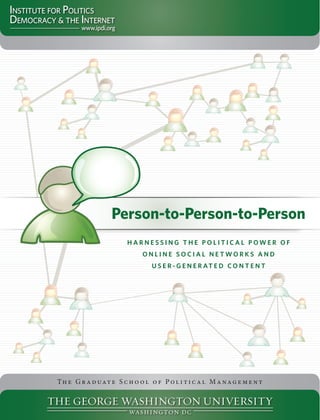
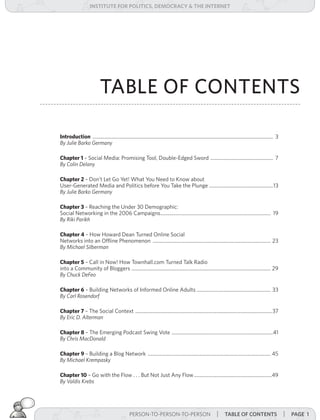
1   Cindy Gallop, “Monetize My Social Network? How One                 a network. You won’t find scatter diagrams in this
    can Answer the $580 Million Question,” Adotas, August 10,          publication (except on the cover). On the other
    2006.


                                             PERSON-TO-PERSON-TO-PERSON | taBle of contents
                                                 PERSON-TO-PERSON-TO-PERSON | introdUction                              | Page 3
institUte for Politics, deMocracY & tHe internet


                                                               In a social network, the term “nodes” is
  hand, if you’re seeking guidance on how to incor-            another word for individuals. The term
  porate the existing technology into the strategy of          “ties” refers to the relationships between
  your campaign or organization, then you’re in the            actors. A “scatter diagram” is used in
  right place. The authors in this publication offer           social network analysis to show poten-
  step-by-step guidance and a wealth of expert tips            tial relationships between individuals in a
  to help you figure it out.                                   network.
  	 Person-to-Person-to-Person	 includes the advice,
  strategies, analysis, and predictions of leading the-
  orists and practitioners who work for political can-
  didates, advocacy groups, non-profits, and busi-
                                                              Some of our authors take a more philosophical
  nesses. Almost all of the authors in this publication
                                                          approach to using social networks. Others discuss
  highlight the importance of blended networking,
                                                          incorporating social networks and user-generated
  which incorporates both online and offline network-
                                                          content into strategy. Still others present case stud-
  ing. They use MySpace profiles to drive volunteers
                                                          ies that outline their successes and failures. Some
  to campaign headquarters, and talk radio shows to
                                                          of them talk about the past; others look toward the
  herd people onto blogging communities. They en-
                                                          future. A few of them discuss large, national cam-
  courage their supporters to talk online and publish
                                                          paigns, while others illustrate the best tools for lo-
  content, such as blog entries or Web videos, and
                                                          cal campaigns and non-profit organizations. One
  they invite them to attend offline events, volunteer
                                                          or two question the power of large social network-
  as door-to-door canvassers, and evangelize in their
                                                          ing sites.
  communities and offices. All of them use technol-
  ogy to engage individuals in a community and ask            The purpose of this publication is to introduce
  them to take some kind of action – whether online       you to their ideas, provoke questions within your or-
  or offline.                                             ganization, and give you some concrete techniques.
                                                          This publication isn’t designed to sit on your shelf.
                                                          Every chapter includes tactics, best practices, and
                                                          suggestions for creating a social political space –
                                                          ideas that you can begin to implement immediate-
                                                          ly, once you understand the underlying concepts.
         Further Reading                                      Social networking involves a lot more than sim-
                                                          ply creating a MySpace profile and asking people to
         Mark Buchanan. Nexus: Small                      list you as their buddy. The idea is to use technol-
         Worlds and the Groundbreaking                    ogy, like the Internet, to develop an active network
         Science of Networks (New York: W. W.             of supporters around your issue, organization, or
         Norton, 2002).                                   candidate. It involves creatively altering your com-
                                                          munications strategy to give supporters a voice,
         Peter J. Carrington, John Scott and Stan-        engage them in the work of your campaign, and
         ley Wasserman. Models and Methods                empower them to reach people offline.
         in Social Network Analysis (New York:                This isn’t new. But it is the new business of
         Cambridge University Press, 2005).               politics. In his 1997 book Interface	 Culture, Steven
         Steven Johnson. Interface Culture: The           Johnson writes, “There’s a funny thing about the fu-
         Way We Create and Communicate (New               sion of technology and culture. It has been a part of
         York: Basic Books, 1997).                        human experience since the first cave painter, but
                                                          we’ve had a hard time seeing it until now.”2 Person-
         Martin Kilduff and Wenpin Tsai. Social           to-Person-to-Person takes what you already know
         Networks and Organizations (Thousand             about human nature – for example, that people like
         Oaks, California: Sage Publications,             to be treated as individuals and are more willing
         2003).                                           to buy into something when they feel they have a
                                                          voice in it – and incorporates the concepts in an af-
         Apophenia (http://www.zephoria.org/              fordable, tangible way into strategy.
         thoughts/).
         Network Centric Advocacy                         Top Ten Tactics:
         (http://www.network-centricadvocacy.                Throughout Person-to-Person-to-Person, our au-
         net/).                                           thors offer some of their best tips, techniques, and
         Network Weaving
         (http://www.networkweaving.com/                  2   Steven Johnson, Interface	 Culture (New York: Basic Books,
         blog/).                                              1997), 2.


Page 4     | introdUction | PERSON-TO-PERSON-TO-PERSON
institUte for Politics, deMocracY & tHe internet


advice. We’ve summarized some of their best ad-
vice below.                                                       “There’s a funny thing about the fu-
                                                                   sion of technology and culture. It
1. Make Participation Simple.                                      has been a part of human experience
    If it isn’t intuitive, people won’t use it – particu-          since the first cave painter, but we’ve
larly people who don’t log on to the Internet every-               had a hard time seeing it until now.”
day for work or school. Think about how easy it is                                   - Steven Johnson, Interface Culture
to send a YouTube video or post a photo on Flckr.
Long registration processes and pages of text are
time-consuming, and many people find them to be               3. Build Trust.
prohibitively encumbering. One of the main rea-
                                                                  Justin Perkins and Heather Holdridge call trust
sons YouTube has become so overwhelming popu-
                                                              the “currency” of success in social networking.
lar has do to the ease of use. Writer John C. Dvorak
                                                              That trust is a two-way street. Mara Veraar writes
summarized this best in a piece for MarketWatch
                                                              of the challenge that advocacy groups face when
earlier this year: “It’s brain dead simple,” he wrote.3
                                                              they attempt to build trust with their supporters
    Both Chuck DeFeo and Ravi Singh advise politi-            online. When conversation moves onto the Inter-
cal groups to make it easy for people to communi-             net, identity verification becomes difficult. Help
cate with each other – and with your organization.            your supporters get to know you because, in the
As you will read later, DeFeo’s site, Townhall.com,           words of Valdis Krebs, strangers don’t make good
created a blogging network of over 1,000 members              messengers.
in just a few weeks by providing blog templates for
                                                                  At the same time, many of our authors write
its users. Similarly, Singh suggests using simple, in-
                                                              that political organizations must learn to trust their
expensive software to connect supporters through
                                                              supporters. If you can’t trust them, how can you ex-
Web video networks. Technical and financial barri-
                                                              pect them to carry your message to others? Mike
ers of entry should not come between you and your
                                                              Krempasky suggests leading by example and giving
supporters.
                                                              your supporters a sense of ownership and freedom
                                                              to make the site their own. Still, Phil Sheldon rec-
2. Encourage Conversation.                                    ommends establishing standards for community
    Zack Rosen calls a good social networking site            conduct – and sticking to them.
“a living and growing organism.” Feed it by bring-
ing people together and encouraging them to talk              3.5 Trust but Verify.
to each other as often as possible. Conversation
                                                                  Remember the adages about birds of a feather
will build a stronger, more active community, as
                                                              flocking together and being known by the company
people grow more comfortable working with each
                                                              you keep. Colin Delany offers a cautionary note
other – and with you.
                                                              about letting anybody and everybody link to you.
    Carl Rosendorf recommends jump-starting                   “I’ve already seen news coverage of a candidate’s
conversation by posting comments at least twice a             MySpace site that mentioned some of his more
week. Chuck DeFeo suggests programming inter-                 noteworthy, (i.e., risqué) friends,” he says. “My
activity into every page of your social networking            approach so far has been to approve all friend re-
site. Give people the ability to post comments or             quests, figuring that a blanket policy is the safest
forward information from every page on your site.             course.”
In the words of Joe Green, conversation becomes
                                                                  What could be even worse is the creation of a
the “gut-level appeal” that gets people to return to
                                                              fake profile. “Fakester Politicians” has happened to
your site.
                                                              other candidates and it could happen to you. If you,
    Michael Silberman and Brad Fay suggest taking             your candidate, or your organization has been in
this one step further by creating a two-way con-              the public eye for anything longer than a split sec-
versation with your supporters. Invest personal               ond, you could be a victim of unauthorized profiles.
time with supporters who are active in your online            People may have logged onto a site and created a
community. Make it easy for them to contact you,              profile without either your knowledge or your per-
treat their inquiries with respect, personalize your          mission. It’s not a rare occurrence. In August 2005,
response, and respond to them in a timely manner.             the Minneapolis-St. Paul Star Tribune reported that
                                                              at least 14 governors had fake profiles.4


3   John C. Dvorak, “Missing the point about YouTube,” Mar-   4   Brady Averill, “Fake MySpace profiles pose a dilemma for poli-
    ketWatch     (http://www.marketwatch.com/News/Story/          ticians,” StarTribune.com (http://www.startribune.com/587/
    kx41F17ZJwXRG8Lm0R8nK9), August 10, 2006.                     story/612223.html), August 14, 2006.


                                                 PERSON-TO-PERSON-TO-PERSON            | introdUction | Page 5
institUte for Politics, deMocracY & tHe internet


  4. Don’t Forget What You Already Know.                  Rosendorf and Phil Sheldon, and create a group ex-
      Joe Green reminds political professionals to ap-    perience that enables your supporters to help you
  ply what they already know about offline grassroots     meet those goals.
  organizing to the Internet. Cultivate your early sup-
  porters online and empower them to spread your          8. Find the Leaders.
  message. Both Ravi Singh and Michael Krempasky
                                                              Many of our authors recommend targeting in-
  recommend building action tools directly into your
                                                          fluencers – the portion of the online and offline
  site. But don’t stop there. Brad Fay, Zack Rosen,
                                                          population who function as opinion leaders and
  and Michael Silberman all recommend combining
                                                          share advice with a large network of colleagues
  online and offline organizing tools to encourage
                                                          and neighbors. Several of our authors offer differ-
  activity. As Valdis Krebs writes, “don’t get enam-
                                                          ent ways to capture that collection of influential
  ored of technology and forget everything you know
                                                          activists. Carl Rosendorf recommends finding the
  about human behavior. Mix them together.”
                                                          people who lead the dialogue in your community
      Provide online resources that they can use in the   and engaging them more deeply in your organiza-
  offline world, such as event planning guides, volun-    tion. Michael Silberman also suggests pinpointing
  teer registration, customizable newsletters, and        your super-activists.
  printable talking points.
                                                              The point is to target people who are especially
                                                          active and who are willing to act on your behalf.
  5. Mind Your Content.                                   You’re looking for people who do more than just
      Don’t forget to post content regularly. Why?        participate once in while. Once you find them, give
  Because it provokes conversation, keeps people          them more responsibility and reward them for their
  engaged in what you are doing, and gives people         extra effort. Zack Rosen writes that you might con-
  information to share with their personal networks.      sider giving them a little message training and let-
  Content equals activity. Both Zack Rosen and Carl       ting them create their own messages and respond
  Rosendorf recommend posting no less frequently          to online queries.
  than every few days. William Greene suggests re-
  sponding quickly to news and current events within      9. Join a Hub.
  your community.
                                                              No one has the money or the staff to solve all the
      Follow Chuck DeFeo’s advice and ensure that         world’s problems. If you’re a smaller organization
  you give people correct information. This includes      or non-profit, considering joining forces with other
  getting your facts straight the first time and giving   organizations to accomplish major goals. A hub of
  people geographically-relevant content, such as         networks, such as the progressive-leaning Moving
  the names and contact information for local media       Ideas Network, help organizations work together
  and elected officials.                                  by increasing coordination, collaboration, and so-
                                                          cial capitol. Alan Rosenblatt, Zack Rosen, and Phil
  6. Cross Promote.                                       Sheldon recommend creating and driving people to
                                                          a hubsite – a place where people can sign petitions,
      Not everyone can find you on his or her own.
                                                          write letters, recruit more activists, and learn about
  For example, Chuck DeFeo writes that talk radio
                                                          boycotts. As Gideon Rosenblatt writes, “By work-
  helps push visitors onto his Townhall.com site. Carl
                                                          ing in harmony, a network raises the effectiveness
  Rosendorf recommends maximizing your media
                                                          of each individual while raising the collective effec-
  strategy by using each component to promote the
                                                          tiveness and value of the entire network.”
  others. Use events to promote your Web site, and
  your Web site to promote your events. That way,
  you reach a wider audience.                             10. Be Yourself.
                                                              All of us feel a special bond with people and
  7. Manage Expectations.                                 organizations that depict themselves genuinely.
                                                          Don’t try to conceal your identity, or your human-
      Technology does not win elections. However,
                                                          ity. Be up front about who you are and what you
  using technology effectively can encourage a com-
                                                          are trying to accomplish. Often, all it takes is a little
  munity to grow around your candidate, organiza-
                                                          Internet research to uncover misrepresentations.
  tion, or issue. A strong, active community can help
                                                          Allow your personality to shine through. As Chris
  you meet your goals – from raising money to win-
                                                          MacDonald writes, “If you come off like a press re-
  ning a campaign. But don’t depend on your net-
                                                          lease, you’re dead to the listener.”
  work for everything. Set realistic goals, say Carl


Page 6   | introdUction | PERSON-TO-PERSON-TO-PERSON
institUte for Politics, deMocracY & tHe internet


                                                   SOCIAL MEDIA
                                          Promising Tool, Double-Edged Sword
                                                                        by Colin Delany
                                                                                      e.politics


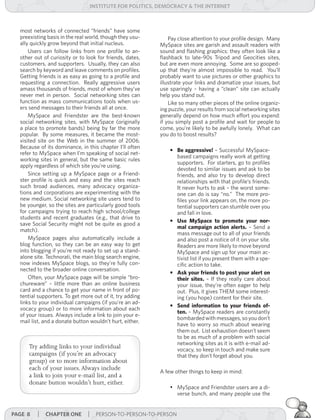
    Many political campaigns are experimenting         Social Networking Sites
with online social networking sites and social media      Social networking sites can be a good way to
as ways to reach supporters and motivate volun-        reach a new audience, though for most campaigns
teers. What should issue-advocacy and candidate        they’ll supplement rather than substitute for an
campaigns keep in mind as they dip their toes into     actual Web site. Let’s begin at the beginning – just
this new medium? What’s working? What might            what IS a social networking site?
just blow up in your face?
                                                          Social networking Web sites are designed to al-
    Let’s look at three basic ways to use the con-     low people and organizations to set up profile pages
cept. First, your campaign can work with existing      and link to other profile pages. It’s that simple. They
social networking sites such MySpace or Friendster     work on a “circle of friends” model – presumably
to reach a new audience. Second, you can build
social networking tools into your campaign’s own
Web site to motivate your existing supporters. And
finally, you can take advantage of the broader world
of user-created content to help turn casual sup-
porters into passionate activists.                          MySpace isn’t the only kid
                                                            on the block.
                                                            Trying to reach a particular demographic?
                                                            Try some of the following sites:
                                                            • Gather.com
                                                            • AsianAvenue.com
    The e.politics (www.epolitics.com/) blog                • MomsRising.com
    discusses online advocacy and online
    politics, including a how-to folder on us-              • MiGente.com
    ing social networking sites.                            • BlackPlanet.com
                                                            • Eons.com


                                           PERSON-TO-PERSON-TO-PERSON | | introdUction
                                             PERSON-TO-PERSON-TO-PERSON     cHaPter one              | Page 7
institUte for Politics, deMocracY & tHe internet


  most networks of connected “friends” have some
  preexisting basis in the real world, though they usu-       Pay close attention to your profile design. Many
  ally quickly grow beyond that initial nucleus.          MySpace sites are garish and assault readers with
      Users can follow links from one profile to an-      sound and flashing graphics: they often look like a
  other out of curiosity or to look for friends, dates,   flashback to late-90s Tripod and Geocities sites,
  customers, and supporters. Usually, they can also       but are even more annoying. Some are so gooped-
  search by keyword and leave comments on profiles.       up that they’re almost impossible to read. You’ll
  Getting friends is as easy as going to a profile and    probably want to use pictures or other graphics to
  requesting a connection. Really aggressive users        illustrate your links and dramatize your issues, but
  amass thousands of friends, most of whom they’ve        use sparingly – having a “clean” site can actually
  never met in person. Social networking sites can        help you stand out.
  function as mass communications tools when us-              Like so many other pieces of the online organiz-
  ers send messages to their friends all at once.         ing puzzle, your results from social networking sites
      MySpace and Friendster are the best-known           generally depend on how much effort you expend:
  social networking sites, with MySpace (originally       if you simply post a profile and wait for people to
  a place to promote bands) being by far the more         come, you’re likely to be awfully lonely. What can
  popular. By some measures, it became the most-          you do to boost results?
  visited site on the Web in the summer of 2006.
  Because of its dominance, in this chapter I’ll often
                                                              • Be aggressive! – Successful MySpace-
  refer to MySpace when I’m speaking of social net-
                                                                based campaigns really work at getting
  working sites in general, but the same basic rules
                                                                supporters. For starters, go to profiles
  apply regardless of which site you’re using.
                                                                devoted to similar issues and ask to be
      Since setting up a MySpace page or a Friend-              friends, and also try to develop direct
  ster profile is quick and easy and the sites reach            relationships with that profile’s friends.
  such broad audiences, many advocacy organiza-                 It never hurts to ask – the worst some-
  tions and corporations are experimenting with the             one can do is say “no.” The more pro-
  new medium. Social networking site users tend to              files your link appears on, the more po-
  be younger, so the sites are particularly good tools          tential supporters can stumble over you
  for campaigns trying to reach high school/college             and fall in love.
  students and recent graduates (e.g., that drive to
                                                              • Use MySpace to promote your nor-
  save Social Security might not be quite as good a
                                                                mal campaign action alerts. – Send a
  match).
                                                                mass message out to all of your friends
      MySpace pages also automatically include a                and also post a notice of it on your site.
  blog function, so they can be an easy way to get              Readers are more likely to move beyond
  into blogging if you’re not ready to set up a stand-          MySpace and sign up for your main ac-
  alone site. Technorati, the main blog search engine,          tivist list if you present them with a spe-
  now indexes MySpace blogs, so they’re fully con-              cific action to take.
  nected to the broader online conversation.
                                                              • Ask your friends to post your alert on
      Often, your MySpace page will be simple “bro-             their sites. – If they really care about
  chureware” – little more than an online business              your issue, they’re often eager to help
  card and a chance to get your name in front of po-            out. Plus, it gives THEM some interest-
  tential supporters. To get more out of it, try adding         ing (you hope) content for their site.
  links to your individual campaigns (if you’re an ad-
                                                              • Send information to your friends of-
  vocacy group) or to more information about each
                                                                ten. – MySpace readers are constantly
  of your issues. Always include a link to join your e-
                                                                bombarded with messages, so you don’t
  mail list, and a donate button wouldn’t hurt, either.
                                                                have to worry so much about wearing
                                                                them out. List exhaustion doesn’t seem
                                                                to be as much of a problem with social
                                                                networking sites as it is with e-mail ad-
      Try adding links to your individual                       vocacy, so keep in touch and make sure
      campaigns (if you’re an advocacy                          that they don’t forget about you.
      group) or to more information about
      each of your issues. Always include
                                                          A few other things to keep in mind:
      a link to join your e-mail list, and a
      donate button wouldn’t hurt, either.
                                                              •	 MySpace and Friendster users are a di-
                                                                 verse bunch, and many people use the


Page 8   | cHaPter one | PERSON-TO-PERSON-TO-PERSON
institUte for Politics, deMocracY & tHe internet


   sites for dating and self-promotion. You
   may end up with some “friends” with
   an exhibitionist streak, so decide in ad-
   vance how to handle friend requests                   Don’t just assign some random intern
   from less-conventional parts of your                  or junior staffer to create and run
   audience. This consideration is prob-                 a social networking profile because
   ably more important for a candidate’s                 “they’re young and know about these
   campaign than for an advocacy cam-                    things.” A MySpace site is just as much
   paign – just imagine how your opposi-                 a part of your campaign’s public front
   tion might use that “friend” of yours
   who loves her bikini shots. I’ve already              as your main Web site is, and it must
   seen news coverage of a candidate’s                   be on message.
   MySpace site that mentioned some
   of his more noteworthy, (i.e., risqué)
   friends. My approach so far has been to
   approve all friend requests, figuring that        Putting Social Networking Tools to Work
   a blanket policy is the safest course, but        for Your Campaign
   I’m also working with issue advocacy
                                                         Another way to employ social networking tools
   campaigns rather than for a politician.
                                                     is to integrate them directly into your own cam-
•	 Friend lists tend to build exponentially –        paign by allowing your supporters to create profile
   the more people who see you, the more             pages on your site. The obvious benefit lies in help-
   people who are going to link to you – so          ing to wed your backers to your issue or candidate
   try to build a healthy list right away. If        emotionally: if they have pages on your site and
   you have an e-mail list or newsletter,            visit them regularly, they’re more likely to identify
   mention your MySpace page to your                 with your campaign and become seriously involved
   readers when you launch it and invite             with it. With prompting, they’re also likely to ag-
   them to become friends. The stron-                gressively reach out to friends and family and draw
   ger your initial base, the faster your            them in as well. Also, social networking tools can
   growth.                                           help your supporters self-organize and work with
•	 As with every other Web site, don’t let           each other to promote your campaign.
   your content slip out of date. If you’re              The potential downside? Just as with campaign
   afraid that you’re not going to have time         blogs, all of these people will be putting content
   to keep your profile updated, stick with          on your site, and you’ll be limited in the amount of
   evergreen content. One trick I’ve found           control you’ll have over it. As we’ll discuss in the
   is to use your main campaign’s RSS feed           section on social media below, communications
   to keep your MySpace content current              professionals are used to being able to control a
   (you do have an RSS feed, don’t you?).            campaign’s message, and it can be very difficult for
   MySpace blocks JavaScript, which is               them to drop the reins and let the horses run free.
   the usual tool to display a feed on a re-         And for good reason – if you thought that having
   mote site, but several people have built          an exhibitionist “friend” on MySpace was bad, think
   free applications that convert your feed          about what happens when that same person can
   headlines into an automatically updat-            post content with your URL on the address line.
   ing image, which you can then link to
                                                         A second problem derives from the smaller
   a news or headlines page. Just go to
                                                     scale of most campaigns. MySpace and Friendster
   Google and search for ways to display
                                                     depend on a “network effect”: the sites get more
   RSS feeds on MySpace and you should
                                                     useful as more people sign up. A good analogy is a
   find what you’re looking for.
                                                     fax machine: one fax machine is useless (it has no
•	 Finally, don’t just assign some random            one to communicate with), but two can have a con-
   intern or junior staffer to create and            versation, and a million can become an essential
   run a social networking profile because           business tool. Similarly, social networking applica-
   “they’re young and know about these               tions work only if they have a critical mass of users,
   things.” A MySpace site is just as much           but most campaigns simply aren’t big enough to
   a part of your campaign’s public front            create one. Think of all the empty message boards
   as your main Web site is, and it must be          that sit lonely on low-traffic Web sites and you’ll
   on message. Make sure that it meshes              realize how painfully and publicly your social net-
   with your overall communications strat-           working application will fail if you can’t get enough
   egy.                                              supporters to sign up.


                                          PERSON-TO-PERSON-TO-PERSON        | cHaPter one | Page 9
institUte for Politics, deMocracY & tHe internet


       Despite the potential pitfalls, campaigns and       seeing the light of day). To keep from angering
  corporations alike are experimenting with their own      the creators, you’ll need to approve or disapprove
  social networking applications. One of the most          items quickly – people will get frustrated if their la-
  interesting I’ve heard of is planned for the Wash-       bor of love takes forever to appear. And if you block
  ingtonPost.com. The site is already implementing         a piece of content, be sure to contact the person
  reader comments on all news stories, starting with       who made it and explain why. This can help keep
  less controversial topics and expanding to political     feathers from being ruffled.
  coverage after the editors are sure that the content
  filtering mechanisms work. Next, the site will en-
  courage readers to create profile pages that gather
  all of their comments in a central place. Absolute           If a campaign is going to use social
  genius – every reader becomes an author! Not                 media, good gatekeeping is essential:
  only will this tie them more strongly to the site, but       content must be approved before the
  they’ll also have every incentive to spread the word         public can view it.
  about their own creations and draw more people to
  read the original articles. Turning a chunk of read-
  ers into both passionate fans and aggressive mar-
  keters is hard to beat.                                       That said, allowing your members or readers to
                                                           generate content has some real strengths as a tac-
  Social Media                                             tic. For one thing, it allows you to capture the brain-
                                                           power of far more people than you could reasonably
      Let’s expand our view and look at the wider          hire – you can leverage the collective intelligence of
  world of social media. First, what are we talking        a chunk of the Internet. Some of the content will be
  about? Social media is a broader concept than so-        junk, of course, but the occasional gems that rise
  cial networking: it refers generally to content cre-     to the surface might just blow you away. And of
  ated by site users rather than by a central person or    course, it’s potentially a terrific tool for community
  group. YouTube and Wikipedia are great examples,         building, for all the reasons discussed above.
  as are blogs that allow comments. Besides the obvi-
  ous example of blogs, how can political campaigns
  use social media?
      Carefully, as MoveOn.org discovered during the           Some of the user-generated content
  2004 presidential campaign. If you recall, early in          will be junk, of course, but the oc-
  2004 the group encouraged its members to create              casional gems that rise to the surface
  anti-Bush ads that it would then evaluate for ac-            might just blow you away.
  tual use on television. Hundreds of ads were sub-
  mitted and placed online, but one used historical
  footage to associate the Bush administration with            As an example of both aspects, in the summer
  Hitler and the Nazi party. Oops – that one ad gave       of 2006 the Ned Lamont campaign for Senate in
  MoveOn.org’s enemies fodder for days of attacks          Connecticut made great use of user-created video.
  on the organization. An ad that never ran got plenty     For instance, Lamont supporters shot clips of oppo-
  of media coverage and took attention away from           nent Joe Lieberman’s campaign appearances and
  the issues on which the group wanted to focus vot-       uploaded them to the Lamont site. Minor gaffes
  ers.                                                     that would have passed unnoticed in the past could
      Anytime you open the floodgates to user-gener-       thus be preserved for all to enjoy (all except the
  ated content, you take the same risk. Many cam-          Lieberman folks, of course), and those behind the
  paign professionals will have a very hard time ac-       cameras could feel that they really were an essen-
  cepting the concept – too many campaigns have            tial part of the campaign. Lamont supporters also
  been burned in the past by a candidate or staffer’s      amused themselves and their comrades endlessly
  loose lips, and political operatives are accustomed      by cleverly editing Lieberman footage into their
  to going to great lengths to make sure that informa-     own online ads and “documentary” clips.
  tion that goes to the press and the public has been          Ah, but that sword can have two sharp edges:
  carefully vetted.                                        for the Lamont campaign, social media bit back as
      If a campaign is going to use social media, good     well, when a supportive blogger posted a photo of
  gatekeeping is essential: content must be approved       Lieberman doctored into wearing blackface. She
  before the public can view it (be sure to keep those     intended the piece as a satire of the incumbent’s at-
  goose-stepping video clips and nudie shots from


Page 10   | cHaPter one | PERSON-TO-PERSON-TO-PERSON
institUte for Politics, deMocracY & tHe internet


tempts to reach out to black voters, but it backfired:
Lieberman’s campaign pounced and forced the
challenger to publicly disavow the piece. Lamont
won the election, but responding to media coverage
of the dust-up was not how he wanted to spend a
day on which he was campaigning with Jesse Jack-
son and Al Sharpton.

Summing It Up
   As we’ve seen, social networking and social me-
dia can be both a blessing and a curse. Use them
wisely and they can help your campaign turn casual
supporters into passionate partisans. But use them
less wisely and you might just find yourself being
spanked in public by the opposition. You have been
warned!


                                              PERSON-TO-PERSON-TO-PERSON   | cHaPter one | Page 11
institUte for Politics, deMocracY & tHe internet


Page 12   | PERSON-TO-PERSON-TO-PERSON
institUte for Politics, deMocracY & tHe internet


                                 DON’T LET GO YET!
    What You Need Know About User-Generated Media and
                      Politics Before You Take the Plunge
                                                                       by Julie Barko Germany
                                                         Institute for Politics, Democracy & the Internet


    Yahoo! is doing it. News Corp is definitely doing           ers), the duo managed to earn $30,000.5
it. Sony, Mentos, and Toyota are doing it, too.                     This is called user-generated media (UGM), and
    They’re loosening the reigns, letting go, and giv-          it will change marketing. As Jay Rosen writes in
ing customers control of their message in an effort             The	People	Formerly	Known	as	the	Audience, “There’s
to move beyond the same old 30-second advertis-                 a new balance of power between you and us.” It’s
ing spots. Many of them think they have the answer              not about passivity. It’s about interaction and par-
in something called user-generated media. Instead               ticipation.
of serving up a helping of the same-old, been-there-                The people become the producers, which allows
done-that TV and print advertising spots, many                  them to engage with a brand or product line more
companies are investing in marketing campaigns                  than when they remained a passive audience. It’s
produced by consumers.                                          cheaper than hiring an ad agency and paying enor-
    Consider this summer’s unusual pairing of Diet              mous production costs. And, according to writer
Coke and Mentos in a viral Web video that became                Ulises Mejias, it has the ability to translate ideas
a marketing phenomenon. In June 2006, a lawyer                  into action.6 Instead of just thinking about a prod-
and a professional juggler (Stephen Voltz and Fritz             uct, consumers do something with the product.
Globe) created a three-minute Web video of Diet                     Participation appears to translate into growth.
Coke bottles fizzing up like volcanoes when they                In August 2006, Nielson/       /NetRatings reported
tossed Mentos candies into them. They posted their              that five out of the top 10 fastest-growing Web
$300 video on the Web, and within two months, it                brands focused on user-generated media, such as
attracted millions of viewers and generated tens of             photo-sharing, video-sharing, and blogging.7 It is a
millions of dollars in free, prime-time media. Voltz            growing trend, but is it right for politics?
and Globe became celebrities, and, by posting their
video on Revver (a site that shares the revenue it
generates by placing ads before each video with us-             Can Political Groups Take a Leap of Faith?
                                                                    Political groups and campaigns already engage
                                                                in a sometimes difficult balancing act. We worry
                                                                about how to say what we really feel without un-
                                                                necessarily alienating some voters who may dis-
    User-generated content and user-gen-
    erated media refer to interactive, often                    5   Michael Geist, “Video and the Internet: An Explosive Mix,”
    multi-media material that members, us-                          BBC, July 17, 2006.
    ers, supporters, fans, and consumers pro-                   6   Ulises Mejias, “Social Media and the Networked Public Space,”
                                                                    E-Business	Blog (http://www.line56.com), July 24, 2006.
    duce and post online. Many marketers                        7   “User-Generated Content Drives Half of U.S. Top 10 Fast-
    view user-generated content as a way to                         est Growing Web Brands, According to Nielsen/        /NetRat-
    build loyalty for a brand – or, for the sake                    ings,” Interest!	 Alert (http://interestalert.com/story/siteia.
                                                                    shtml?Story=st/sn/08100000aaa00045.prn&Sys=siteia&F
    of this publication, an issue, advocacy                         id=ADVERTIS&Type=News&Filter=Advertising), August 10,
    group, political party, or candidate.                           2006.


                                             PERSON-TO-PERSON-TO-PERSON | cHaPter two
                                                              PERSON-TO-PERSON-TO-PERSON                               | Page 13
institUte for Politics, deMocracY & tHe internet


       Did you know?                                             If	I	let	go	of	your	message,	will	my	supporters	behave	or	
       What amount of money did media con-                       will	they	run	amok	and	destroy	my	credibility?	
       sultants spend on network television
                                                                       The answer to this question mostly depends
       advertising for political candidates, par-
                                                                 upon you and the rules that you set for your com-
       ties, and political groups during the 2004
                                                                 munity. Two of the authors in this publication
       campaign? The answer: zero dollars.
                                                                 – Chuck DeFeo and Michael Krempasky – launched
       They placed ads on cable and net-
                                                                 political blogging communities. When I spoke
       work affiliates, but they placed no
                                                                 with each of them about whether they could trust
       national network advertising.
                                                                 their communities, both men said yes. And they
                                                                 mentioned that their communities were very good
                                                                 at policing themselves. Their sites, RedState and
                                                                 Townhall, both contain brief guidelines of behavior,
  agree. We wonder if we can trust ordinary people               and individual members hold each other account-
  to speak on our behalf. We try to balance a proj-              able.
  ect’s potential with the time and human resources                    Sometimes these rules are written and posted
  deficit that occurs in the middle of campaign sea-             on the site. Sometimes they emerge organically
  son. We worry about financial cost. Even though                as offensive behavior emerges. One example
  we’ve seen some evidence to the contrary, we still             comprises a particularly telling chapter in Web
  trust television advertising more than the Internet.           lore. According to a few users of a creative, edgy
     As with many choices in life, the decision to               mashup network called YTMND.com, a teenage
  embrace user-generated media brings some costs.                boy found footage of someone torturing a kitten
  The picture isn’t all rosy and warm – even though              and combined the footage with music from the
  many of us think it’s pretty darn cool. But when               game Doom. The YTMND community was so out-
  used appropriately, it may have the ability to en-             raged that they started a meme of mashups called
  gage a core group of supporters, who will share the            NEDM (not even Doom music) to humiliate both
  messages they create with countless networks and               the American teenager and the man who originally
  possibly even convince people who may have never               posted the footage. Not even Doom music justified
  heard your name or cared about your issue to take              using the footage in a mashup. The NEDM meme
  an action.                                                     emerged online as a stand against animal abuse.
                                                                       Rules don’t necessarily have to ruin the party. In
                                                                 fact, it may even help create a healthy, vibrant com-
  	 Can	you	improve	civic	participation,	generate	more	
                                                                 munity. Several years ago, Clay Shirky wrote that
  volunteer	 dollars,	 increase	 the	 activism	 of	 your	 sup-
                                                                 the communities that will thrive online are those
  porters,	or	expand	the	name	recognition	of	your	issue,	
                                                                 that set guidelines:
  organization	and	candidate	by	allowing	normal,	every-
  day	people	to	create	a	media	campaign	for	you?
       While to our knowledge no one has studied the
  potential effects of user-generated content on po-
  litical organizations, we do know that interactivity
  with your message – whether through a blog post-                    Can’t find what you’re
  ing, a Web video, public discussion boards, mash-                   looking for on YouTube?
  ups, photos, or any other kind of activity – breeds                 Try one of these other video sites:
  intimacy with your organization. People feel closer
  to you, and they become less susceptible to being                   • Revver
  seduced by other messages.8                                         • Google Video
       True, politics differ from big business, but the               • Machinima
  end result of any marketing campaign is similar:                    • iTunes
  you want to get people to take an action. UGM is                    • PoliticsTV.com
  participatory. People are already taking an action
  by engaging with you. In the process, they feel as
  if they are developing a two-way relationship, and
  this may, in fact, lead to higher turnout, volunteer,
  and donation rates. Time will tell.


  8   Max Kalehoff, “Media Specialists Must Grasp Consumer-
      Generated Media,” OnlineSPIN, August 4, 2006.


Page 14    | cHaPter two | PERSON-TO-PERSON-TO-PERSON
institUte for Politics, deMocracY & tHe internet


     Instead of unlimited growth, membership,                          Am	I	just	using	people	to	do	the	hard	work	for	me?
     and freedom, many of the communities                              	 The simple answer is yes. But that doesn’t nec-
     that have done well have bounded size or                          essarily make you the bad guy. Stealing someone
     strong limits to growth, non-trivial barriers                     else’s handiwork online and using it to make an
     to joining or becoming a member in good                           enormous profit might categorize you as a villain
     standing, and enforceable community                               – as well as a criminal. Asking your supporters and
     norms that constrain individual freedoms.                         your super-activists to help you and going out of
     Forums that lack any mechanism for eject-                         your way to thank them (even if it means an extra
     ing or controlling hostile users, especially                      hour or two in the office) is a little different. It’s
     those convened around contentious top-                            asking them to volunteer in a new, creative way.
     ics, have often broken down under the
                                                                           Would you pay a marketing company or an of-
     weight of users hostile to the conversa-
                                                                       fice full of paid staff to do the same thing? If the an-
     tion.9 Thoughtful regulations can actually
                                                                       swer is yes, then consider being particularly grate-
     help, not hinder the growth of your com-
                                                                       ful – perhaps even effusive – with your praise. And
     munity.
                                                                       make sure you individualize your e-mails of thanks.
                                                                       Nothing goes over as poorly as a seemingly stan-
    Whether you decide to post a few rules for your                    dard, machine-generated response when someone
community (i.e., no profanity) or allow standards of                   has gone above and beyond. In another chapter,
behavior to emerge as the community grows, the                         Michael Silberman discusses sending your super-
fact that you allow your community to have a voice                     activists special thank you presents, such as pins
in the first place will breed trust between both you                   and bumper stickers, as a sign of thanks.
and them. That element of trust works both ways.
Yes, your supporters will feel like trusted, valuable
members of your community. But there is an add-
ed bonus as you watch what they produce – from a
blog posting to an e-mail to an animation – you will                       “Different people want to drive their
learn about them and trust them more too.                                   opinions around different topics.
                                                                            This results in a richer response, and
Will	it	save	me	money?                                                      it helps you reach people you haven’t
	 Quite possibly. Production costs and aggrega-                             already met. The Internet allows us
tion cost next to nothing. And people spread viral                          to survey a varied audience and let
messages free of charge.                                                    them provide responses on topics
                                                                            they care about in an unfiltered man-
Will	my	message	go	viral	if	someone	else	produces	it?		
                                                                            ner.”
    No promises. The viral nature of a message de-
pends on its content and its ability both to appeal to                              - Richard Counihan, Senior Vice President
                                                                                         Strategic Development, Who’s Calling
emotion and interact with the immediate moment.
If a UGM contains each of those things, then it is
relatively easy for it to spread through networks
and aggregation.
                                                                           Many of the most successful niche Web vid-
    UGM doesn’t feel like advertising. It feels fun                    eos and animations are textured, nuanced, col-
and catchy, and it has the ability to mesmerize ev-                    laborative endeavors – much like good Jazz music.
eryone from retirees to office workers to students.                    Their creators take an image (or several images),
                                                                       a theme, a famous line, or a news clip and reinter-
    “To create word-of-mouth about a                                   pret it in a new way. While portions of Web media
     viral ad, you have to do something                                may in fact impinge upon what we’ve historically
     that people love to talk about. That                              described as rights restrictions, many people know
                                                                       that when they post media content online, some-
     usually means sex, political or social                            one else will reuse it. However, this does not mean
     humor, or evil and violence – or, of                              that your organization should sweep the Web for
     course, gross-out jokes.”                                         cool media content and post it as your own. Give
               - Dave Balter and John Butman, Grapevine                them credit – a policy that works well with content
                                                                       that supporters produce on your behalf as well. If
                                                                       you just “have to have it,” try tracking down its pro-
                                                                       ducers. You never know: they might be flattered
9   Clay Shirky, “Social Software and the Politics of Groups,” Clay	   that you reached out to them. In any event, make
    Shirky’s	 Writings	 About	 the	 Internet (http://www.shirky.com/
    writings/group_politics.html), March 9, 2003.                      sure you observe copyright restrictions. For a good


                                                        PERSON-TO-PERSON-TO-PERSON           | cHaPter two | Page 15
institUte for Politics, deMocracY & tHe internet


                                                                       Greg Linden wrote, you may have to work to un-
                                                                       cover good content: “The experience of the World
                                                                       Wide Web as a whole should serve as a lesson to
                                                                       those building the next generation of community-
                                                                       powered Web sites. At scale, it is no longer about
                                                                       aggregating knowledge, it is about filtering crap.”11


                                                                            “Homogenous groups are great at
        Have you visited YouTube lately? For ev-
        ery fantastic video there are dozens of                              doing what they do well, but they
        boring clips that someone made by re-                                become progressively less able to
        cording a funny part of last night’s Daily                           investigate alternatives.”
        Show on her mobile phone.                                                       - James Surowiecki, The Wisdom of Crowds


  summary of these laws, see http://www.copyright.                     Can	 I	 get	 away	 with	 passing	 off	 professionally-pro-
  gov/.                                                                duced	content,	like	campaign	ads,	on	our	community	
                                                                       site?
  Will	 my	 message	 get	 lost	 in	 a	 swirl	 of	 crappy	 handi-       	 Well, that depends on what you’re trying to
  work:	videos	with	poor	production	quality,	humor	that	               accomplish. The standard 30-second, profession-
  doesn’t	work	well,	poorly	written	blog	entries,	etc.?                ally-produced campaign ad often comes across like
                                                                       “brochure-ware,” and just doesn’t seem to work
      Have you visited YouTube lately? For every fan-                  well online. People tend to like footage that shows
  tastic video there are dozens of boring clips that                   real emotion, unscripted action, interaction, and
  someone made by recording a funny part of last                       humor.
  night’s Daily Show on her mobile phone. Have you
  seen the Flckr pages of some non-profit organiza-                        On the other hand, one Washington firm, DCI
  tions? Even the most heart-wrenching trip to dig                     Group, was recently “outed” as having passed off
  wells in Africa can be reduced to insignificance                     as user-generated content a deliberately amateur-
  with out-of-focus shots of a latrine or a group hug                  ish parody they had produced of Al Gore’s movie,
  at the airport. As blogger Chris Pirillo wrote during                An	Inconvenient	Truth. The Wall	Street	Journal	called
  a fill-in-the-caption contest, “I’m going on the re-                 it “Propaganda 101.” A useful, cautionary tale for a
  cord by stating that user-generated content is often                 brave new media world.
  user-generated CRAP.”10
      Some of your supporters may be professional                      What	can	I	do	when	other	people	make	fun	of	me?
  designers, videographers, or writers. Others may                         The short answer: nothing. We live in an era of
  produce professional-quality work as a hobby. Val-                   video phones and easily updatable blogs. The re-
  ue them and encourage them. But don’t intention-                     ality is that many people who create online media
  ally leave anyone behind. If you want consumer-                      – everything from Web videos to mashups to blogs
  generated media to be a substantial part of your                     – feel that any public action, mistake, gaffe, speech,
  marketing, fundraising, or political strategy, then                  or piece of writing is up for grabs.
  consider sharing some of your expertise with your                        The good news is that this environment is
  supporters. Teach them how to conduct citizen                        good at holding public figures accountable. The
  journalism, what types of images are most appeal-                    bad news is that somewhere out there, somebody
  ing for a fundraising campaign, and how to simply                    doesn’t like you, your candidate, or your organiza-
  edit and post a video. Ask some of your volunteer                    tion. He knows how to create really funny mashups
  “experts” to share their advice, and create a mini-                  of you looking foolish. And making a big deal about
  community around message training. Equip your                        it will only fuel more publicity.
  supporters to create better content for you.
      Finally, consider devoting some of your human
  resources to monitoring (and removing) inade-
  quate or offensive content and spam. As Blogger
                                                                       11   Greg Linden, “Community, content, and the lessons of
  10 Chris Pirillo, “The Great Political Cartoon Experiment,” Chris.        the Web,” Geeking with Greg (http:/ /glinden.blogspot.
     Pirillo.com (http://chris.pirillo.com/2006/08/11/the-great-            com/2006/07/community-content-and-lessons-of-web.
     political-cartoon-experiemnt/), August 11, 2006.                       html), July 11, 2006.


Page 16     | cHaPter two | PERSON-TO-PERSON-TO-PERSON
institUte for Politics, deMocracY & tHe internet


Who	else	is	doing	it?
     Several authors in this publication tackle the
topic of user-generated media, and many more po-
litical practitioners have been incorporating it into
their strategies for a number of years.
     Both Michael Krempasky and Chuck DeFeo
discuss community blog networks as a form of
user-generated media and suggest ways to cre-
ate media coverage around an issue or campaign.
DeFeo produced an application that allows users to
create their own e-mail newsletters about current
events, politics, and opinion. Krempasky said that
a community blog, like RedState, sometimes func-
tions better than the professional press. “If written
by enough people,” he writes, a blog “can cover an
issue more intensely and more in-depth than any
single publication.”
     Eric Alterman writes that by asking supporters
to create media content, political groups physically
and virtually extend their reach. Each media cre-
ation provides a new entry point into your organiza-
tion – particularly when individuals post their work
on other sites. Eric recommends making sure that
each piece of supporter-made media links to your
site in order to drive people back to you.
     Their stories are just a few of the many good ex-
amples. And keep your eyes peeled the next time
you visit YouTube. What you see might inspire
you.

“Letting Go” Isn’t Enough
    Incorporating UGM into your political strategy
is not the easy way out. In fact, it may be more
time-consuming than writing your own copy. Us-
ing other people’s content takes time and vigilance,
but more importantly, it requires that you engage
directly with individual supporters. People need a
motivation to create, and they need to feel that you
appreciate their creative contributions.
    But the upside is a site that incorporates other
voices and other perspectives. If you want your
supporters to be active participants in your organi-
zation, then make your organization an active par-
ticipant in its supporters.


    “Once we’re part of a group, we’re all
     susceptible to peer pressure and so-
     cial norms and any number of other
     kinds of influence that can play a
     critical role in sweeping us up in the
     beginnings of an epidemic.”
                   - Malcolm Gladwell, The Tipping Point


                                                  PERSON-TO-PERSON-TO-PERSON   | cHaPter two | Page 17
institUte for Politics, deMocracY & tHe internet


Page 18   | PERSON-TO-PERSON-TO-PERSON
institUte for Politics, deMocracY & tHe internet


    REACHING THE UNDER-30
            DEMOGRAPHIC
                                 Social Networking in the 2006 Campaigns
                                                                                     by Riki Parikh
                                                         Institute for Politics, Democracy & the Internet


        “Social networking is probably the next big thing for campaigns
               because it’s the next big thing within our culture.”
                                              - Phil Noble, PoliticsOnline


    In the 2006 mid-term election, campaigns are                 What Makes It Work
pulling out the stops to look fresh in the eyes of                   Using these social networking sites, a campaign
voters who are tired of the status quo. And for the              can create a personal profile for its candidate, dis-
more adventurous that includes being hip with the                seminating biographical and professional informa-
MySpace Revolution.                                              tion to an entire network and acquainting users with
    Social networking has already been used by                   the candidate. Campaigns can then add media and
commercial marketers to target certain demo-                     messages to share within their network and create
graphics and decipher their interests and desires.               groups for feedback and discussion. In return, so-
As the social networking phenomenon begins to                    cial networks give campaigns instant information:
permeate politics, some of the more innovative                   social, geographic, and (in some cases) ideological
campaigns are starting to log-on and create pro-                 connections. A user’s profile lists a person’s so-
files for their candidates.                                      cial connections (who they are friends with, which
    Embracing social networking sites is seen by                 groups they associate with), regional location, and
many as the next natural step in campaigning be-                 political leanings.
cause of the sites’ ability to directly inform and en-               “Politics is essentially about the sharing of po-
gage the electorate. Just like a political campaign,             sitions and values and the ideas that a politician
social networking Web sites allow for the prolifera-             wants to implement and gaining support of that
tion of the four Ms: message, momentum, media,                   through conversation and persuasion,” said Chris
and mobilization: “Social networking can be used                 Kelly, vice president and chief privacy officer for
in the same way it is for everything: to build an au-            Facebook, the online social networking site for col-
dience, to create activists, to raise money, and to              lege students. “So, in many ways social networking
create buzz,” said Phil Noble, president of Politic-             sites… are a great platform for building support for
sOnline.                                                         a candidate or the particular positions of a candi-
                                                                 date.”
                                                                     Several candidates running in 2006 are seizing
    Social networks give campaigns instant                       the opportunity to attract and interact with young
    information: social, geographic and                          voters to build that support. They’ve turned to the
                                                                 social networking sites, particularly MySpace and
    (in some cases) ideological connec-                          Facebook, which are the two most popular commu-
    tions.                                                       nity-based sites on the Web, to target and engage
                                                                 with that demographic. “Young people under 30,
                                                                 who are the social networking constituency, care


                                           PERSON-TO-PERSON-TO-PERSON | cHaPter tHree
                                                             PERSON-TO-PERSON-TO-PERSON                      | Page 19
institUte for Politics, deMocracY & tHe internet


  passionately about issues and what’s happening           cess to a person’s group of friends and an easy and
  in society. They just don’t give a damn about poli-      effective way to target a certain demographic with a
  ticians,” said Noble. “If social networking can be       specific campaign or message. “With a traditional
  used to structure that commitment to channel it in       political site, you’ve got to create your own audi-
  a different way, then I think it has a lot of poten-     ence and gather your own crowd,” said Noble. “But
  tial.”                                                   with a social networking site, the crowd is already
      By generating interest and enthusiasm among          there and they’re already gathered. You’ve just got
  the younger demographic, politicians and candi-          to attract their attention.”
  dates can generate a base for both recruitment
  and organizing. By registering on a site as a “vir-      Who’s Using It
  tual person,” a campaign or issue group can tap
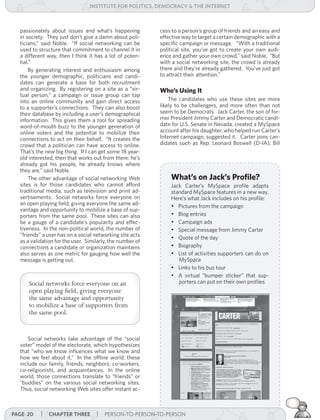
  into an online community and gain direct access              The candidates who use these sites are more
  to a supporter’s connections. They can also boost        likely to be challengers, and more often than not
  their database by including a user’s demographical       seem to be Democrats. Jack Carter, the son of for-
  information. This gives them a tool for spreading        mer President Jimmy Carter and Democratic candi-
  word-of-mouth buzz to the younger generation of          date for U.S. Senate in Nevada, created a MySpace
  online voters and the potential to mobilize their        account after his daughter, who helped run Carter’s
  connections to act on their behalf. “It creates the      Internet campaign, suggested it. Carter joins can-
  crowd that a politician can have access to online.       didates such as Rep. Leonard Boswell (D-IA); Bill
  That’s the new big thing. If I can get some 18 year-
  old interested, then that works out from there: he’s
  already got his people, he already knows where
  they are,” said Noble.
      The other advantage of social networking Web             What’s on Jack’s Profile?
  sites is for those candidates who cannot afford              Jack Carter’s MySpace profile adapts
  traditional media, such as television and print ad-          standard MySpace features in a new way.
  vertisements. Social networks force everyone on              Here’s what Jack includes on his profile:
  an open playing field, giving everyone the same ad-          •	 Pictures from the campaign
  vantage and opportunity to mobilize a base of sup-
  porters from the same pool. These sites can also             •	 Blog entries
  be a gauge of a candidate’s popularity and effec-            •	 Campaign ads
  tiveness. In the non-political world, the number of          •	 Special message from Jimmy Carter
  “friends” a user has on a social networking site acts
                                                               •	 Quote of the day
  as a validation for the user. Similarly, the number of
  connections a candidate or organization maintains            •	 Biography
  also serves as one metric for gauging how well the           •	 List of activities supporters can do on
  message is getting out.                                         MySpace
                                                               •	 Links to his bus tour
                                                               •	 A virtual “bumper sticker” that sup-
      Social networks force everyone on an                        porters can put on their own profiles
      open playing field, giving everyone
      the same advantage and opportunity
      to mobilize a base of supporters from
      the same pool.


      Social networks take advantage of the “social
  voter” model of the electorate, which hypothesizes
  that “who we know influences what we know and
  how we feel about it.” In the offline world, these
  include our family, friends, neighbors, co-workers,
  co-religionists, and acquaintances. In the online
  world, those connections translate to “friends” or
  “buddies” on the various social networking sites.
  Thus, social networking Web sites offer instant ac-


Page 20    | cHaPter tHree | PERSON-TO-PERSON-TO-PERSON
institUte for Politics, deMocracY & tHe internet


Ritter, candidate for governor of Colorado; and Phil     alter ego of somebody who has six profiles,” said
Angelides, candidate for California governor.            Kelly. “They’re rooted in the community and that
    The campaign chose MySpace “as one of sev-           allows the political types to get volunteers, dona-
eral innovative ways in which to reach potential         tions, and voters.”
voters – many of them young people – who don’t
necessarily connect to mainstream media,” said Jay
Jones, Carter’s press secretary. “This medium is
enabling us to reach out to potential voters who we          “When you reach a person on Face-
otherwise might overlook. The interactivity allows            book, you’re reaching that person.
people to share their perspectives both with fellow           You’re not reaching a profile or some
visitors and campaign leaders.”                               alter ego of somebody who has six
    The MySpace profile is accessible at www.                 profiles.”
MySpace.com/jackcarter2006. The account is                                               - Chris Kelly, Facebook
registered under the username “Jack Carter for Sen-
ate, 2006.” In the biographical portion of the site,
the campaign lists that Carter is a 59 year-old male
from Las Vegas, Nevada and includes the quote                 Both Facebook and MySpace are planning to
“I’m a Democrat running for US Senate in Nevada          capitalize on their popularity this election cycle
and I sure would appreciate your vote.” (Carter won      by offering candidates attractive advertising rates.
his primary bid in August 2006 with 73 percent of        Facebook created their own program for candi-
the vote.)                                               dates to use their site for their political gains. They
    The Carter campaign can communicate out              will begin offering global profiles to candidates so
through their blog and blurbs section, which gives       all Facebook users can see their profiles.
the campaign a chance to inform visitors about                Also, on the advertising end, they will reserve a
the candidates and keep visitors updated about           billion advertising impressions for political purpos-
the campaign. Visitors of the profile also par-          es and sell them at the lowest unit rate, much like
ticipate by adding “Jack Carter for Senate, 2006”        television commercials. Facebook said they are do-
as a friend, messaging the account, forwarding it        ing this out of their own desire to see young people
to friends, and posting comments on the public           more engaged in the democratic process. Through
message board. The campaign has even provided            that offer, campaigns can micro-target their adver-
source code so users can put a personalized online       tising based on location, gender, political views and
bumper sticker in their own profiles.                    interests.
                                                              However, candidates will not be able to get user
The Younger Demographic                                  information on these Web sites, which would be a
    There are about 100 million profiles on MySpace,     violation of privacy policies. “We don’t share data,”
a fact that accounts for it popularity in reaching the   said Kelly. “We will let our users share data if they
college-aged youth vote. Some argue, however,            want to with the campaign, but our privacy policy
that Facebook users may be more likely to vote than      strictly prohibits taking contact information from a
MySpace users, given its connection to colleges          user’s profile…. They (a campaign) can see it, but
and the fact that college-educated Americans are         they can’t use it.” Ultimately, of course the key to
more likely to vote than those with less education.      a successful social networking campaign is to pro-
Thus, while MySpace will give a candidate visibility,    vide a forum that allows users to connect with one
Facebook may be more likely to generate the kinds        another and with the campaign itself. That way
of volunteers that campaigns are seeking. “When          they can easily distribute the content or message
you reach a person on Facebook, you’re reaching          to people outside the group, converting the online
that person. You’re not reaching a profile or some       organization into offline action.


    Did you know?
    In September 2006, Facebook
    will open its site to politicians.
    Now, political candidates can buy pro-
    files and attempt to reach out to the sites
    more than 8 million members – many of
    them college students or alumni.


                                           PERSON-TO-PERSON-TO-PERSON        | cHaPter tHree | Page 21
institUte for Politics, deMocracY & tHe internet


Page 22   | PERSON-TO-PERSON-TO-PERSON
institUte for Politics, deMocracY & tHe internet


               HOW HOWARD DEAN
             TURNED ONLINE SOCIAL
                NETWORKS INTO AN
              OFFLINE PHENOMENON
                                                                       by Michael Silberman
                                                                                          EchoDitto


 Certain segments of the political world remain skeptical about the power
 of online social networks to encourage real-world offline action, such as
 voting, donating, or showing up for a rally or protest. Yet, Howard Dean
      and Meetup managed to achieve offline success thanks to their
                            online organizing.

Let’s be clear: The Net is not about technology, it’s
about people – a fact that is obvious to everyone
except to we programmers. The most important
                                                                   The Internet and new technologies
things we, as humans, need to do – commercially or                 enabled us to dramatically expand the
socially – is to connect with others. An online com-               size, reach, and strength of what oth-
munity is no substitute for real-world interactions.               erwise would have been a convention-
In fact, the most successful online communities are                al national volunteer program — all
the ones that throw parties, sponsor events, host                  for a fraction of the time and cost.
get-togethers – help members meet one another
face-to-face in the real world. 12
               —Craig Newmark, founder of Craigslist

    In a matter of months, the Dean campaign
coupled an online event-planning tool with the In-                 EchoDitto (www.echoditto.com) is an
ternet’s word-of-mouth potential to grow its online                Internet strategy firm that specializes in
volunteer network exponentially and build its active               interactive community building.
and engaged community of supporters. The Inter-
net and new technologies enabled us to dramati-
cally expand the size, reach, and strength of what
otherwise would have been a conventional national
volunteer program — all for a fraction of the time
and cost.


12 Katharine Mieszkowski, “Are You on Craig’s List?” Fast	Com-
   pany (http://www.fastcompany.com/magazine/nc02/026.
   html), November 2000.


                                                   PERSON-TO-PERSON-TO-PERSON | cHaPter foUr
                                                                    PERSON-TO-PERSON-TO-PERSON           | Page 23
institUte for Politics, deMocracY & tHe internet


                                                        work that we did (and invented) to build the larg-
                                                        est online/offline organizing program possible. The
                                                        Meetup team really had only one job in the Burling-
                                                        ton, Vermont headquarters: doing whatever it took
                                                        to support the self-organizing efforts taking place
                                                        in thousands of communities as best as we could.

                                                        Building an Online Network
                                                            The Dean Meetup program represented the ide-
                                                        al intersection of the online and offline organizing
      Meetup (www.meetup.com) is an online              worlds, as well as the convergence of our support-
      tool that allows people or groups to plan         ers’ online and offline social networks.
      monthly meetings around an issue, hob-                As we started building the Meetup program, we
      by, belief, interest, or pet. Over 200,000        benefited from the hundreds and thousands of peo-
      people signed up to attend Meetups for            ple who were looking for ways to get involved in the
      the presidential candidates in 2004. To-          campaign every day. Every campaign Web site, e-
      day, Meetup has over 2.5 million mem-             mail reply, and phone response funneled support-
      bers worldwide who participate in 4,500           ers to their local Meetup group. Not only was it the
      Meetup topics each month.                         most scalable solution to the ever-increasing (and
                                                        unmanageable) number of inquiries, but it was also
                                                        among the most effective ways of engaging volun-
      Can Meetups help with                             teers and supporters in meaningful activity.
      fundraising?
      IPDI’s study of donors to the 2004 presi-
      dential candidates, titled Small	 Donors	
      and	 Online	 Giving, found that 24% of all            Meetup.com was the most scalable
      respondents who attended a Meetup or                  solution to the ever-increasing (and
      house party said it prompted them                     unmanageable) number of inquiries,
      to make their first donation. For                     but it was also among the most effec-
      more information, visit www.                          tive ways of engaging volunteers and
      ipdi.org/publications.                                supporters in meaningful activity.


                                                            If a Dean Meetup didn’t exist in or near a sup-
      The very first Dean “Meetups” took place with-    porter’s community, the program and associated
  out the campaign ever knowing. Between January 1      Web tools encouraged people to start their own.
  and February 5, 2003 (the first Dean Meetup day),     Volunteer Meetup leaders continued to emerge in
  473 intrepid, independently-motivated “netizens”      places where none previously existed. These local
  used the site Meetup.com to join a group or vol-      grassroots leaders almost instinctively tapped their
  unteer to host one of 11 self-organized Dean gath-    own local networks to grow their events and in-
  erings across the country – outside the umbrella      crease the local Dean presence. They reached out to
  of the official campaign. Within a year, this small   other people they knew, forwarded the campaign’s
  cadre grew into a powerful force of 189,000 people    e-mails to them, and ultimately invited them to join
  who had signed up online to get together locally in   their local Dean Meetup group.
  1,200 cities and towns worldwide.                         Local Meetup groups flourished and grew as a
      The too-often untold stories of the Dean cam-     result of our volunteers’ built-in social networks. Al-
  paign came from a powerful network of 2,000           most every e-mail message encouraged supporters
  grassroots leaders — everyday citizens — who vol-     to pass the message along to five friends, and every
  unteered to run these independent Dean events.        Meetup agenda encouraged leaders to remind at-
  In most locations, these became just one of many      tendees to bring one or two new friends with them
  activities being organized by unofficial volunteer    to the next Meetup. Increasing media attention and
  Dean chapters that emerged from the Meetups.          press stories only facilitated this process by provid-
  My recounting of the Dean Meetup story focuses        ing third-party validation for their friends’ personal
  on the part I know best: the behind-the-scenes        requests.
  logistics, communications, and online organizing          Our ability to funnel supporters into this self-


Page 24   | cHaPter foUr | PERSON-TO-PERSON-TO-PERSON
institUte for Politics, deMocracY & tHe internet


                                                                       We targeted people who did more
generating and self-organized Meetup program                           than just sign up on an e-mail list.
allowed us to rapidly circumvent more traditional                      These were supporters who took
campaign practices of going out into the field to                      actions online, donated money, or
recruit volunteer organizers by hand. The Internet
also enabled us to provide a direct link and con-
                                                                       showed an indication that they were
nection to the official campaign, which provided a                     more than just e-mail activists.
good balance to the more local, decentralized en-
gagement that they had via the Meetups. We were
also wary of the Internet’s shortcomings in replac-
ing these high-quality face-to-face interactions, so                Keeping the Network Alive
we made a concerted effort to maintain constant                         Once we assembled this core group of grass-
dialogue with our grassroots leaders using every                    roots leaders, which included over 2,000 people
available technology (i.e. phone, conference call,                  volunteering to build and host Meetup events every
mail, instant message, and digital video).                          single month, we had to figure out how to organize
    As the campaign took off and our Meetup pro-                    and support them. How do we keep these leaders
gram really started growing, we started seeing gaps                 engaged with campaign goals while continuing to
in some geographical areas. We saw, for example,                    organize them to take further action? And how do
that the state of Florida lacked substantial cover-                 we balance our national campaign needs and pri-
age. The campaign needed to grow, so we asked                       orities with their local autonomy?
ourselves what we knew about traditional organiz-                       Many people assume that online organizing
ing and traditional social networks that we could                   only involves building an e-mail group and making
apply to the online world.                                          PDF downloads. This is just one layer of building
    As field organizers, we could ask a supporter,                  a successful grassroots network. As experienced
“Who do you know in your circle of friends who                      field and community organizers will attest, not ev-
might be willing to join us?” As a national online                  erything can be done over the Web. Here are some
campaign, we could ask a similar question, “Who                     lessons learned from managing the grassroots
in our supporter database might be likely to orga-                  leader network that powered the Dean Meetup
nize a Meetup in their area, given their previous                   program, as well as from other successful online/
engagement with the campaign?” We called and                        offline grassroots programs that we’ve managed:
e-mailed those very specific subsets of people, and
many agreed to help (and were happy to have been                        • Build a support desk. – We tried to
asked!).                                                                  make up for being physically absent
    We used the example of the local Rotary Club                          from each community by creating a vir-
to pinpoint other influencers and grassroots lead-                        tual field desk with a fulltime staff of 3-
ers. We knew that we needed to find the online                            4 people who responded personally to
equivalent to Rotary Club membership. These are                           e-mails and calls from Meetup leaders
the types of group members who know everybody                             and followed up with leaders when nec-
and everything in town and are respected for that.                        essary. We divided the country up into
We targeted people who did more than just sign                            regions, so that we could become more
up on an e-mail list. These were supporters who                           familiar with the volunteers we were
took actions online, donated money, or showed                             working to assist. More than half of our
an indication that they were more than just e-mail                        grassroots leaders were new to politics
activists. Once we found them, we called or sent                          or local organizing and were eager for
them an e-mail about Meetups and invited them to                          tips and organizing assistance.
build a Dean community in their towns and coun-                         • Use the next best thing: phone calls.
ties. Our strategy worked: Dean had more Meetup                           – In the absence of regular face-to-
groups across the country than almost all of the                          face meetings, we launched a series of
other Democratic presidential candidates com-                             monthly conference calls just for our
bined.13 Many of them still meet today as chapters                        grassroots leaders. These calls built
of Dean’s new organization, Democracy for Ameri-                          accountability and trust. The ability for
ca.                                                                       us all to hear each other’s voices made
                                                                          the program so much more real for ev-
                                                                          eryone involved, and it deepened the
                                                                          relationships we had established via
                                                                          e-mail. We hosted the maximum 100
                                                                          -125 people per call, usually at four dif-
13 Christine B. Williams and Jesse Gordon, The	Role	of	Meetup	in	         ferent times each month to accommo-
   the	2004	Presidential	Nomination	Contest, April 8, 2004.


                                                     PERSON-TO-PERSON-TO-PERSON         | cHaPter foUr | Page 25
institUte for Politics, deMocracY & tHe internet


        date work schedules and time zones.
                                                            Who attends a political
        After providing an inside look at the               Meetup?
        campaign’s progress and reviewing the               They look like the average political activ-
        suggested national Meetup agenda for                ist: mostly white, middle income, middle-
        the upcoming month, our leaders were                aged, and professional. They’re also high-
        encouraged to share best practices with                  ly wired. For more information, read
        each other.                                                 Meetup	 Study	 2004 by Christine
      • Don’t forget about the spokes. — There                       Williams and Jesse Gordon at
        are lots of ways for a campaign head-                         http://meetupsurvey.com.
        quarters, or hub, to stay in touch with
        its grassroots leaders, or the spokes.
        But spoke-to-spoke communication is
        just as critical to the viability of a net-     ter-writing parties at Meetups. (We later expanded
        work. One of the first and most suc-            the program to include voters in New Hampshire
        cessful things we did to facilitate this        and other states, and we encouraged letter-writing
        communication between and among                 parties to take place between Meetups.)
        leaders was to create a Yahoo! Group
        discussion list for Meetup hosts, where             We combined online and offline tools to build
        leaders asked questions of one other,           successful levels of activity. First, we made it easy
        swapped success (and horror) stories,           for the leaders to organize. We knew that the
        and shared resources or best practices.         burnout rate could be high. After all, these people
                                                        weren’t full-time organizers: they were volunteers.
      • Make an effort to visit. – We tried to be       We sent each group every item they would possi-
        physically present at some of the Meet-         bly need – sample letters, stamps, envelopes, pa-
        ups. While it was impossible to be at           per, pens, and even information about the county
        every single meeting, Howard Dean and           in Iowa to which they were writing and a DVD mes-
        the campaign staff rotated attending            sage from Howard Dean about the program.
        the monthly events, and we tried to visit
        as many as possible. Most importantly,              Secondly, we stayed in contact before, during
        we ensured that Dean could be virtu-            and after the events. We asked people to call us
        ally present at each Meetup by sending          right after or even from their Meetups and at any
        a special DVD message to each group             time of night. We wanted to hear how it went. This
        every month that they could play at the         gave us an extra level of personal contact. And al-
        Meetup.                                         most everyone called in.
      • Give them the credit they deserve.                  In retrospect, the effect of this “reverse phone
        – Phone calls and personal e-mail gave          bank” was far greater than we initially intended. We
        our grassroots leaders access that              set it up to get an early survey of the data, for our-
        other people didn’t have. We sent               selves and for the rest of the campaign staff, who
        them immediate updates, even in hard            would be asking for it next morning. We also real-
        times. For example, when Joe Trippi             ized how powerful that connection to headquarters
        left the campaign, we delivered the             was for these leaders. It showed that they weren’t
        news immediately, so that they could            alone on this campaign. When you can pick up the
        be prepared to discuss it with their local      phone and hear a familiar name or voice on the
        networks after it broke on the evening          other end of the line, interested in you and your last
        news. We treated them like high-dollar          three stressful volunteer hours, that means a lot.
        donors. As far as we were concerned,
        they were the most important people in          How to Run Your Own Online Grassroots
        the campaign because they were doing            Network
        all of the heavy lifting – without getting
        paid. We also sent our grassroots lead-            On our Web site (www.EchoDitto.com), we list
        ers surprise thank-you packages during          several ways to make it easy for your online volun-
        the holidays.                                   teers and leaders to host offline events fueled by
                                                        their personal or social networks:

  Taking the Network Offline
                                                            1. Communicate with your online leaders
     The first big test of our online grassroots net-          regularly. – Assume that the personal
  work occurred on July 2, 2003, when we launched              investment of time and energy that
  a major letter writing campaign to voters in Iowa.           these organizers make is equivalent to
  We asked our grassroots volunteers to organize let-


Page 26   | cHaPter five | PERSON-TO-PERSON-TO-PERSON
institUte for Politics, deMocracY & tHe internet


   the financial contributions of a high-                 swers to frequently asked questions as
   dollar donor. Acknowledge this invest-                 soon as possible to demonstrate your
   ment through regular “insider” updates                 responsiveness and attentiveness. Fi-
   and frequent expressions of apprecia-                  nally, when you launch new Web tools,
   tion.                                                  set up a help desk or special e-mail ad-
                                                          dress where people can send questions
                                                          and get help from a real person.
2. Respect local autonomy while pro-
   viding leadership and direction. – Re-
   member that your grassroots leaders                 5. Create a dynamic, two-way communi-
   signed-up to organize an event because                 cation system. – Keep your network of
   they support your cause or campaign.                   online leaders engaged and interested
   So provide them with clear goals and                   by communicating regularly with them,
   direction that they need to make the                   not at them. Find ways to foster dia-
   program a success, while respecting                    logue between and among leaders so
   the autonomy of the local organizer.                   that you’re not doing all of the talking.
   Publicly acknowledge that your role is                 Listen for trends and re-communicate
   simply to provide the volunteer orga-                  best practices back out to the larger
   nizers with the support and resources                  group.
   they need to make the local events a                     a. Watch your tone, and avoid speak-
   success.                                                    ing to “the masses.” Your tone
3. Provide step-by-step organizing and                         should reflect the intimate, special
   planning guides. – Outline specific                         nature of your online leadership
   program goals and simplify the steps                        core.
   required for organizing a local event,                   b. Vary communication mediums
   meeting or party. Think through ev-                         to maintain interest, and over-
   ery detail of the event as if you are the                   communicate to ensure that your
   grassroots organizer, and include these                     message points are conveyed ef-
   items with any additional materials you                     fectively.
   may send to event hosts, such as:
                                                            c. Assume your leaders are only
                                                               paying half as much attention as
     a. The action that you want everyone                      you’d like them to be, and publicly
        to take.                                               acknowledge that they have busy
     b. Goals (fundraising, action, etc.).                     lives outside their volunteer work.
                                                               Repeat the most important infor-
     c. Talking points, special announce-
                                                               mation.
        ments or facts to use when com-
        municating with the group.                          d. Remind yourself of the difference
                                                               between leaders and participants,
     d. Dial-in numbers for a conference
                                                               as each have different communi-
        call.
                                                               cation needs and expectations.
     e. DVDs.
                                                            e. Encourage collaboration.
     f. Contribution forms.
                                                            f. Solicit feedback and let your lead-
     g. Promotional items, like stickers or                    ers know how you’ve incorporated
        buttons.                                               their ideas.

   Keep in mind that many of your leaders,             6. Listen and create a feedback loop.
   especially the newer ones, will follow                 – Survey your leaders and your partici-
   your guide closely through every step                  pants to find out what worked and what
   of the planning process and even dur-                  didn’t both during the event preparation
   ing the actual event.                                  and the actual event. You might be sur-
                                                          prised by what you discover. Remem-
4. Provide ongoing support. – Hearing                     ber to communicate with them within
   from your volunteer organizers is a                    24 hours after the events take place,
   good sign that they are active and en-                 when people are still buzzing about
   gaged. Keep a tally of the questions                   what happened and are still eager to
   you receive from them or the problems                  share information and stories.
   they encounter. Communicate the an-


                                       PERSON-TO-PERSON-TO-PERSON | | cHaPter foUr
                                        PERSON-TO-PERSON-TO-PERSON     cHaPter five           | Page 27
institUte for Politics, deMocracY & tHe internet


     7. Let your program goals drive your
        technology strategy, not vice-versa.
        – Experienced community or field orga-
        nizers will likely be dissatisfied with the
        reporting and data collection systems
        included in most of the existing Web
        tools that are available for decentral-
        ized or self-organized event programs.
        Be wary of letting your technology in-
        frastructure drive your program. For
        example, Meetup.com was a great tool
        for local group organizing on the Dean
        campaign, but it was not designed to
        support communication or informa-
        tion flow that we needed between local
        organizers and our national campaign
        organization. To overcome this obsta-
        cle, we rapidly built a Web tool called
        Meetup Central that enabled us to get
        up-the-minute information from the
        network as leaders signed up to host
        the next month’s Meetup, entered ex-
        pected attendance numbers and their
        mailing address, identified secondary
        hosts, and reported back after their
        events.


Page 28   | cHaPter foUr | PERSON-TO-PERSON-TO-PERSON
institUte for Politics, deMocracY & tHe internet


                                                         CALL IN NOW!
                                How Townhall.com Turned Talk Radio Fans
                                          into a Community of Bloggers
                                                                           by Chuck DeFeo
                                                                                    Townhall.com


   How do you merge an existing online community with a national fan
base of radio listeners? How do you grow a community and ensure that a
             platform exists for different voices to be heard?

    In May 2006, Salem Communications, a con-             many of them became activists based on what they
servative talk radio company, purchased Townhall.         heard each day.
com, and on July 4, 2006, it launched a new Web               If this concept of finding a voice sounds familiar,
presence that combines the grassroots mediums of          consider the parallels between talk radio and the
talk radio and the Internet. Their metamorphosis          Internet. Talk radio rose to prominence in the late
illustrates how an online community can become a          1980s. At the height of the broadcast era, the abil-
multi-platform political movement.                        ity to pick up a phone and address an audience of
                                                          millions was revolutionary and powerful. Talk radio
Background
    Townhall.com has been America’s conservative
opinion editorial page for a decade, carrying over
100 different conservative columnists. Because of
the wide array of conservative opinion leaders car-            Townhall.com was launched in 1995 by
ried by Townhall.com, it is home to an active, online          the Heritage Foundation as the first con-
community that covers the spectrum of conserva-                servative Web community. It now exists
tives.                                                         under the umbrella of Salem Communi-
    Salem’s five nationally syndicated talk show               cations, and it amalgamates the online
hosts – Bill Bennett, Hugh Hewitt, Michael Medved,             information and content of 120 different
Dennis Prager, and Mike Gallagher – reach about                partner organizations. For more informa-
six or seven million people a week each on the ra-             tion, visit www.townhall.com.
dio. Like all the Townhall.com columnists, these
personalities enjoy a strong affinity with their lis-
teners and readers.
    Talk radio is a personal medium for its listeners,
many of whom feel as though they have developed
relationships with their favorite talk show hosts.
Further, radio listeners are accustomed to partici-
pating in dialogue as it happens. They can pick up
the phone and have their voices broadcast to mil-
lions of people, which is very empowering. And


                                            PERSON-TO-PERSON-TO-PERSON | | cHaPter foUr
                                             PERSON-TO-PERSON-TO-PERSON     cHaPter five               | Page 29
institUte for Politics, deMocracY & tHe internet


  influenced politics in a major way, particularly dur-    Step 3: Make It Easy to Have a Voice
  ing the 1994 election.                                       Next, you want to get your community talking,
      As the Internet grew to become a truly broad-        and you want to make it easy for them to join the
  based medium, it opened opportunities for self-          dialogue and buy into the community.
  publishers – bloggers – to build an audience. In fact,       Townhall.com does not require an advanced de-
  the blogosphere comprises the next big wave of           gree in technology. Supporters can create their own
  grassroots opinions media.                               blog in three easy steps, and they can individualize
      Our goal was to take these millions of grass-        it. We currently offer eight blog templates and plan
  roots listeners, who were accustomed to voicing          to expand that and expand features as we continue
  their opinions on the radio, and move them online        to grow. They can create their own blogroll. They
  for activism, blogging, and commentary. We ac-           can set up their own mailing lists, so when they
  complished that feat in several ways.                    post to their blogs, their friends will know about
                                                           it – and they will visit the site to post comments
                                                           of their own, thereby building the community. We
  Step 1: Cross Promote
                                                           give people standard blog features, like the ability to
      The talk radio hosts played a large role in driv-    turn comments on or off. We also offer a Townhall.
  ing their audiences to the Web site. For example,        com newsfeed and bibliographical information.
  rather than just saying, “Call in and talk to me now,”
                                                               The results have been phenomenal. In the first
  Hugh Hewitt now adds, “If you have something to
                                                           few weeks of Townhall.com’s new site release, we
  say, go to my blog and post your comments.” Even
                                                           gained over 1,000 bloggers.
  more powerfully, Hugh has called on his listeners
  and other bloggers to create their own Townhall.
  com blogs. People started logging on in droves,          Step 4: Acknowledge Effort
  creating over 1,000 blogs in three weeks, and they          We want the individuals in our community to
  brought intelligent conversation with them. Hewitt       know that we are listening. One of our editors reg-
  calls this the “great blog migration.”                   ularly reads across the blog community and pulls
      Now, talk radio listeners have a bigger platform     quotes that are then featured on our homepage.
  to voice opinion. Instead of just calling in during a    Further, when people post to the blog, the most re-
  pre-set, three-hour block of time, they can access       cent post automatically appears at the top of our
  the Web site and comment anytime and any way.            main Townhall.com blog. They will also appear in a
  The only requirement is having something to say in       section of Townhall.com called “Your Opinion.”
  the first place.
                                                           Step 5: Give Them the Right Information
  Step 2: Don’t Forget the Individual                          We want to know who our community mem-
      More importantly, talk radio listeners joined        bers are, so we developed a personal tracking ac-
  a large, online community of people who shared           tion center, similar to GeorgeWBush.com and GOP.
  their views. Rather than going to blogspot.com and       com. Once you register with the site, we remember
  creating a single blog in a sea of other blogs from      you, and we feed you specific information, such as
  across the spectrum of interests and political views,    the names of your federally- and state-elected of-
  conservatives can now go to Townhall.com and join        ficials and how to contact them.
  a like-minded community of people. Our members               We also know what media market you’re in,
  don’t become anonymous. Each person has his or           and we tell you how to contact the right newspaper
  her own chair in this big town hall where nobody is      editors, similar to what we did on GeorgeWBush.
  more important than the individual. You get to sit       com and GOP.com. We break the media down by
  right next to the celebrities, like Hugh Hewitt and      largest circulation and closest geographical loca-
  Bill Bennett.                                            tion in order to improve your punch. We want you
                                                           to reach the most effective media outlets within
                                                           your community, such as the local paper that your
      Our members don’t become anony-                      neighbor reads because it covers your local high
      mous. Each person has his or her                     school sports team. And, we don’t neglect talk ra-
      own chair in this big town hall where                dio! Not only do we encourage people to call our
      nobody is more important than the                    Salem hosts, but we also provide them with the in-
      individual. You get to sit right next to             formation of other talk radio shows in their media
      the celebrities, like Hugh Hewitt and                markets.
      Bill Bennett.


Page 30    | cHaPter five | PERSON-TO-PERSON-TO-PERSON
institUte for Politics, deMocracY & tHe internet


                                                              Grassroots-style media is hitting main-
Step 6: Trust Them to Carry the Message                       stream marketing in a major way. Thanks
    Our audience is influential, and we want them             in large part to sites like YouTube, origi-
to produce their own content because we trust                 nal ads created by fans, product users,
them to know which topics will interest their social          and people with a cool new idea, are
networks. Hundreds of thousands of them have re-              making their way from the Web to the
ceived e-mails from Townhall.com’s editor-in-chief            TV screen. Marketers are paying atten-
Jonathan Garthwaite for over a decade. We asked               tion. And they are using the cleverest
our members, “Can you write an e-mail as well as              ideas for new ads. Who’s doing it? Sony,
Jonathan Garthwaite? Can you find the best con-               L’Oreal, MasterCard, Mentos, Chevrolet,
tent in Townhall.com? What is it that your circle of          and Burger have all used ads created by
friends wants to read?” One of the actions we in-             everyday people online.
vite people to take is to become the author of their
own “what’s new on Townhall.com” e-mail, and we               Why are they catching on? Because
give them the tools to do it.                                 traditional marketing isn’t working any-
    We trust our community members to carry the               more. Many user-created ads have a
conservative message. They are movement con-                  strong viral component, and appeal to
servatives first and partisan party people second.            people on a more personal level. And
The vast majority of our readers and listeners are            don’t ignore the fact that many of the
thoughtful conservatives who seek to put out con-             ads become full-fledged online trends!
servative ideas and values in order to persuade and
inform people – not shout over them.

                                                          scene aside, if I were to give my one word on the
    We invited the community to interact                  future today it would be “broadband.”
    with us on every page. Conversation                       Broadband will only continue to enable both
    is ingrained in the DNA of the Web                    our opinion leaders and grassroots activists to
    site.                                                 achieve a new level in voicing their opinion by
                                                          allowing video. The Internet has always been
                                                          a visual medium. But because of load speed, it
                                                          has been primarily a text-driven medium. Up
                                                          until now, people have mostly consumed printed
Step 7: Make Conversation a Policy
                                                          words, but that is changing. As download speeds
    We didn’t create the community around one             increase and as the broadband infrastructure gets
“big bang” feature like “Your Blog.” Instead, we          bigger, video will be a relevant player, and we will
invited the community to interact with us on every        see more and more YouTube-style, grassroots vid-
page. Conversation is ingrained in the DNA of the         eo media. The political impact will be powerful.
Web site.
    Everywhere on the site is an opportunity to
post a comment – whether you’re listening to au-
                                                          Conclusion
dio or reading a blog post or reading a column.              What we are seeing today – the grassroots
And there is an opportunity to forward everything         participation in the political debate – is not new by
to somebody else. At every turn, we encourage             any means. It is how politics has always operated.
visitors to create their own blogs.                       For centuries prior to 1960 people knocking on
    After all, this is the era of interaction for poli-   neighbors’ doors, participating in the local town
tics. That is what our job is: to create a platform,      hall meeting was how ideas were communicated.
to create opportunities for people to voice their         Candidates literally touched voters with person-
opinions in political debate and participate in the       to-person contact efforts. For decades the domi-
arena of ideas.                                           nance of broadcast television has served to push
                                                          grassroots participation out of politics. The Inter-
                                                          net has brought the grassroots back.
Step 8: Look Ahead
    Remember the film The	 Graduate with Dustin
Hoffman? At a house party early in the movie, a               The Internet has brought the grass-
friend of the main character’s parents takes him to
the side and gives him a piece of advice on what              roots back.
to pay attention to in the future. That one word
was “plastics.” The social commentary of that


                                               PERSON-TO-PERSON-TO-PERSON       | cHaPter five | Page 31
institUte for Politics, deMocracY & tHe internet


Page 32   | PERSON-TO-PERSON-TO-PERSON
institUte for Politics, deMocracY & tHe internet


                      BUILDING NETWORKS
                             OF INFORMED
                           ONLINE ADULTS
                                                                        by Carl Rosendorf
                                                                                     Gather.com


   How do you merge an existing online community with a national fan
base of radio listeners? How do you grow a community and ensure that a
             platform exists for different voices to be heard?

   The Internet has made one thing incredibly diffi-      zations, advocacy groups, and non-profits. Many
cult: you simply can’t stop people from talking. Not      of these organizations share a hesitancy to loosen
that we’d want to. In fact, just the opposite is true.    the reins on how they control their message. They
The Internet has created a medium for dialogue,           typically have a Web site and most now have a
which allows for a broader, deeper discourse than         blog. But generally they follow the traditional path
ever before.                                              of one-way communication: centralized content
   For some, this has been a hard lesson to learn.        distributed to the masses. They want to control the
When it comes to social networks, some political          communication and their message. Most of these
groups have a fear of letting go. In my capacity as       fears reflect an older paradigm that fears change.
President and COO of Gather.com, an online social             We live in a changing world. Political groups
networking and social media site, I talk to the lead-     need to look no further than the big media orga-
ers of a lot of political parties, campaigns, organi-     nizations, including network television and news-
                                                          papers like the Washington	 Post and the	 New	 York	
                                                          Times, to find examples of how an equally hesitant
                                                          industry is learning – slowly and steadily – to adapt.
    Gather.com is a network for people who                Media companies are just as concerned about let-
    want to share their own content online.               ting go of their message as you are, but they are
    Gather.com members are rewarded for                   beginning to face reality: people want the ability to
    their participation with Gather Points™,              have a voice. They want the ability to talk to you,
    or even cash for top contributors.                    and more importantly, they want the ability to talk
                                                          to each other.


                                                              Media companies are just as con-
                                                              cerned about letting go of their mes-
                                                              sage as you are, but they are beginning
                                                              to face reality: people want the ability
                                                              to have a voice.


                                               PERSON-TO-PERSON-TO-PERSON | cHaPter siX
                                                              PERSON-TO-PERSON-TO-PERSON              | Page 33
institUte for Politics, deMocracY & tHe internet


      Social networking sites offer just that — a voice.     be incorporated into your overall Web strategy. Us-
  Think about one of the most visible phenomena of           ing a social media platform provides an additional
  the 2004 presidential campaign: political Meetups.         opportunity to extend your reach, generate dona-
  People used the Internet to meet each other in the         tions and sign-up volunteers. Think about social
  real world and act on behalf of their favorite can-        media as an integrated part of your strategy, both
  didates. That physical component was incredibly            as a part of Internet efforts and as a link to build of-
  significant, and it provides a metaphor for what so-       fline support.
  cial networks do in the virtual world.

  Building Online Communities                                    Think about social media as an inte-
       MySpace is one of the biggest media trends                grated part of your strategy, both as a
  of the year. At the time of this writing, it was an-           part of Internet efforts and as a link to
  nounced that MySpace was the most visited site on              build offline support.
  the Internet, above all the major media outlets and
  portals. Granted, MySpace tends to skew toward
  teenagers, but those teenagers are speaking to each
  other. My company, Gather.com, as well as other                Take the example of Alex Sink. Alex Sink, a busi-
  sites like LinkedIn and Eons.com, offers a grown-up        nesswoman and former President of Bank of Amer-
  alternative, providing the 30-year-old-plus demo-          ica in Florida, is running for Chief Financial Officer
  graphic with that same capability to interact on-          in Florida. Her campaign incorporated a social net-
  line.                                                      work, Gather.com, into its campaign strategy, and
       Social networks like ours provide organizations       the campaign promoted both the social networking
  with a multi-directional communications platform.          group and the Web site simultaneously.
  Not only can a political group communicate with                Alex Sink created six different groups on Gather,
  its constituents and the constituents communicate          targeted towards different constituencies, such as
  back to the political group, but the platform also         businesspeople and geographical groups. This way,
  allows the constituents to communicate with each	          the individual constituencies can hear messages
  other. Most importantly, the conversation happens          from Alex Sink that address their unique concerns
  within the construct of the organization itself. Thus,     and communicate amongst themselves on issues
  the organization can shape the dialogue, respond           of importance to that specific group of people. She
  to any concerns, and be exposed first-hand to the          is building her online groups through promotions
  issues on people’s minds.
       And, while enabling this flow of ideas, thoughts
  and discussion, you actually maintain a great deal
  of control. Companies like Gather.com provide or-
  ganizations the ability to create their own group – a
  customized, branded area within the broader on-                 What’s on Alex
  line community. Group owners can tailor the group               Sink’s Gather group?
  experience through a series of easy-to-use tools.               Alex Sink uses her gather group, Florid-
  The group owner has the ability to decide who can               ians for Alex (http:/ /floridaforalex.gather.
  join the group or post content. A group can be open             com), as a way to encourage her support-
  to anyone, allowing everyone the ability to post ar-            ers to write articles on her behalf. During
  ticles, or be more restricted as determined by the              August 2006, this included everything
  group owner. Private groups, for example, can en-               from articles on hurricanes and the insur-
  able a political field organization to restrict access          ance industry to tips on increasing atten-
  to those invited by the campaign itself. They can               dance at a grassroots house party event.
  use their online profile to share their field notes col-
  laboratively and confidentially. On the other hand,
  a public group, such as a group involved in the issue
  of immigration, can provide access to the public yet
  still moderate the content. In this case, the group
  owner decides which content appears on the group
  site.

  Web Site & Social Media Convergence
     As you develop a social media strategy, it should


Page 34    | cHaPter siX | PERSON-TO-PERSON-TO-PERSON
institUte for Politics, deMocracY & tHe internet


from her campaign Web site. The online groups
were promoted prominently on her campaign site’s             It is already evident how the Internet is chang-
home page, and supporters could fill out a form to       ing politics. Now, with social media, that change
sign up for one of her online groups on the cam-         continues. People want a voice, and they are using
paign site. Likewise, she used the online groups to      online tools to do it. They want their voice to be
draw people back to the campaign site.                   heard wherever it makes a difference. People are
    This example illustrates a very important com-       engaging in state and local politics beyond state
ponent of politically-motivated social networks.         and local lines. Geography isn’t holding back politi-
The way to build traffic to your group is to cross-      cal donors or political activists, for that matter.
promote across all mediums: on your Web site, in             People are beginning to recognize the impact of
your e-mail, and in your printed material. The goal      legislation and elections outside their states. Peo-
is to drive traffic to each and every one of you on-     ple in Missouri are starting to care about elections
line outlets, including your campaign site and your      in Indiana or Florida or Texas or Massachusetts.
social networking groups. And you want them to           And, they are willing to donate to political candi-
support each other.                                      dates outside of their state who share their views
                                                         on a particular issue. This trend gives your cam-
                                                         paign or issue a national platform, and that is where
                                                         the fundraising component of social networking
    The goal is to drive traffic to each and             sites comes alive. Your voice can be greater than
    every one of you online outlets, in-                 your typical reach or the content on your Web site,
    cluding your campaign site, and your                 which usually just speaks to people who seek you
    social networking groups. And you                    out in the first place.
    want them to support each other.

                                                             People want a voice, and they are us-
                                                             ing online tools to do it.
Remember: This Isn’t (Only) Kansas
Anymore
    Online social networking communities are high-
ly viral. People connecting to people connecting             To maximize your media strategy, leverage each
to people. This growth enables you to extend your        of the component parts. All of your media assets
reach beyond your core constituencies. You will          should promote each other. Your e-mail should
have access to people from around the globe that         promote your Web site, your Web site should pro-
may share your concerns on the issues facing all of      mote your online social networking group, and your
us. For example, if you are running a local political    online social networking group should drive traffic
race or a geographically-specific issue campaign,        back to your Web site. This type of cross promotion
then the fact that you are engaging people in an on-     further enables you to reach an audience wherever
line social network means that a lot of people out-      they may be.
side your region will become exposed to your or-
ganization or campaign. This opens new markets,
new opportunities, and a broader audience for your       Don’t Fear User-Generated Content
message.                                                     Web sites distribute a fairly universal message
    Think about it this way: online social networks      across a mass medium, but it doesn’t always speak
provide a way for you to reach out beyond just the       directly to the individual. On social networking
people who might visit your Web site. You might          sites, you can target specific groups, just like Alex
say that social networks are a no-cost marketing         Sink is doing in Florida, and tailor your message to
vehicle, with a high-impact potential amongst sup-       individuals who are interested in a specific area or
porters and voters.                                      issue.
                                                             More than that, individuals can become active
                                                         participants by writing articles on the issues that
                                                         matter to them most. They can blog about it, or go
    You might say that social networks are               on a social networking site, and they can write and
    a no-cost marketing vehicle, with a                  publish articles. When other people share their
    high-impact potential amongst sup-                   comments on an article, an online conversation en-
    porters and voters.                                  sues. Suddenly, activism is more than just reading
                                                         a position paper or a pamphlet. Social media con-
                                                         verts readers into advocates. They become your


                                              PERSON-TO-PERSON-TO-PERSON       | cHaPter siX | Page 35
institUte for Politics, deMocracY & tHe internet


  cheerleaders, voicing support for your position, and        • Identify the influencers in every com-
  they can have conversations amongst themselves                munity. – What is interesting about
  – all under the umbrella of your organization or can-         social networking sites is how quickly
  didate. That is very empowering.                              you can identify the influencers and
      More importantly, those voices are heard out-             their capacity to shape the discussion
  side the choir that is already preaching to itself.           and the dialogue. Find the people that
  Your participation in a social media site enables you         lead the dialogue and engage them in
  to extend your reach to those that have not heard             your group. Read the articles and espe-
  your perspective. As you know, victory comes from             cially the readers’ comments that drive
  engaging those people outside your normal base.               the conversation. It’s that on-going
  The viral nature of a social networking site makes            conversation that makes social media
  that happen.                                                  so special. It fosters communication.
                                                                Find the influencers as they can play a
                                                                significant role in driving traffic to your
  Tips for Leveraging the Power of Online                       group.
  Social Networks.
                                                             Remember, people have always sat in cafés or
      • Know who you want to reach. – It is               bars or around the dinner table, talking politics and
        very important to participate in a social         debating issues. Now, through social networking
        media site for the demographic that               and social media, they continue the conversation
        you want to speak to. If you are look-            on politics online.
        ing to speak to 15 to 25 year-olds, you
        go to MySpace or Friendster. If you
        are looking to speak to 30 to 60 year-            The Time Is Now
        olds, you come to sites like Gather. You             Today, the path is clear. People are now engaged.
        want to reach as many people as you               The dialogue has already begun. The only question
        can, so target the broadest community             that remains is whether you will be part of it. The
        that best represents your target demo-            key is finding the right balance and developing a
        graphic.                                          communications strategy that enables you to ac-
      • Define your expectations. – Create a              complish your goals.
        group experience for your members
        that enables you to meet your strate-
        gic goals while encouraging those who
        join your group to participate as you                 Remember, people have always sat
        hope they will. Whether your goal is to               in cafés or bars or around the dinner
        inform others of a platform, spark de-                table, talking politics and debating is-
        bate, get out the vote, or raise money,               sues. Now, through social networking
        be clear about those goals and you will               and social media, they continue the
        increase your social media success.
                                                              conversation on politics online.
      • Get them talking by initiating conver-
        sation. – Post content twice weekly to
        spark dialogue and to act as a catalyst
        for conversation. Conversation engages
        readers and writers within Gather and
        that leads to a vibrant community for
        your organization.


Page 36    | cHaPter siX | PERSON-TO-PERSON-TO-PERSON
institUte for Politics, deMocracY & tHe internet


                    THE SOCIAL CONTEXT
                                                                    by Eric D. Alterman
                                                                                      KickApps


            Context will drive the next phase of social networking and
                                 user participation.

    The two teachers who influenced me the most          reign over the social networking space was short-
were both professors at American University’s            lived. A new player named MySpace emerged on
Washington College of Law. Although they had             the scene, and by the summer of 2006, it became
been tasked to teach us mundane subjects like civil      the most visited site on the Web (that is, until You-
procedure and contract law, both spent an inordi-        Tube surpassed it a few weeks later).
nate amount of time during the first weeks (if not            While technology and design may have played a
months) of law school lecturing on linguistics and       role in MySpace’s ascendancy, it’s clear to me that
other esoteric subjects, often evoking the bewilder-     its focus on building audience within a specific con-
ing writings of philosophers like Ludwig Wittgen-        text – music – was the key driver of its early suc-
stein and Jacques Derrida.                               cess. Wherever there are guitars and poet-singers
    While most of us initially would have preferred      there will be girls, and where there are girls, there
that they cut to the chase and tell us “the law,” we
soon figured out that “the law” was a much more
amorphous concept than we previously imagined.
In short, we learned that the language of law only
had meaning within specific contexts and that the            KickApps (www.kickapps.com) is a host-
art of persuasion had everything to do with the par-         ed platform that allows webmasters to
ties defining that context. Today, outside the law           quickly and easily deploy user-generated
school lecture hall, context remains a key part of           content and social networking functional-
my role as an entrepreneur who develops social               ity directly on their Web sites.
networking tools.
    What does all this talk of context have to do
with the social networks that have come to domi-
nate the Internet experience for many people? The
answer is that context will drive the next phase of
social networking and user participation.
    Over the past few years, online social network-
ing sites have emerged, skyrocketed to the peak of
popularity, and fallen into irrelevance. Early innova-
tors like Friendster provided basic social networking
tools, quickly stealing attention away from tradi-
tional portals like Yahoo! and AOL. But Friendster’s


                                           PERSON-TO-PERSON-TO-PERSON |
                                              PERSON-TO-PERSON-TO-PERSON       | cHaPter siX
                                                                               cHaPter seven        | Page 37
institUte for Politics, deMocracY & tHe internet


  will be guys. Things snowballed accordingly.             content and media management tools.
      Imitation is the sincerest form of flattery, of          From a user’s perspective, uploading photos
  course, and MySpace soon found a spate of imi-           and videos to new, niche-oriented communities
  tators, all claiming superior technology and more        is not a significant barrier to entry: anyone under
  user-friendly interfaces (e.g., Tagworld). As of         the age of 35 can handle that task in a matter of
  writing, though, none have made serious inroads          minutes. However from a webmaster’s perspec-
  into MySpace’s dominant market share.                    tive, the harder barrier to entry is having the tools
      The cool kids will continue to hang-out at the       to manage all of this new technology. Resource-
  most popular social networking Web sites. But            rich, major media properties require sophisticated
  social networking sites aren’t just for kids, or teen-   media management, administration, and reporting
  agers for that matter. Granted, a teenage conver-        functionality.
  sation riddled with references to bands, girls, and          Why? Well, for one thing, it protects their
  “my parents don’t get me” on a MySpace profile is        brands (and advertisers) from people uploading
  not particularly compelling to slightly older adults.    pornography and other potentially offensive mate-
  Twenty-something, thirty-something and an in-            rial on their Web pages. In other words, building
  creasing number of forty-something web-savvy             a simple application that accepts video uploads
  surfers fully appreciate the excitement of sharing       and displays them on a page is relatively easy, but
  their ideas and media with friends and interested        building all the tools necessary to moderate and
  strangers. Many will turn to Web sites that provide      customize a community experience is quite a dif-
  niche contexts more relevant to their specific inter-    ferent engineering challenge.
  ests and lifestyle.
      However, that’s not where the story ends. The
  promise of the Internet has always been about pro-
  viding a platform through which individuals partici-         Building a simple application that ac-
  pate in conversation, covering every conceivable             cepts video uploads and displays them
  subject, moderated by webmasters with a full range           on a page is relatively easy, but build-
  of political and social points of view – on a never-         ing all the tools necessary to moderate
  ending stream of Web sites. The idea of a single
  venue like MySpace moderating 99 percent of our
                                                               and customize a community experi-
  online social experience is a not a viable long-term         ence is quite a different engineering
  reality. Context will again be the driver for what           challenge.
  comes next.
      Blogs and message boards already exist on mil-
  lions of content-specific Web sites. But this is just
  the beginning. Web sites are starting to incorpo-            With access to hosted platforms that provide
  rate easier access to other technologies that allow      turnkey community technology, it’s easy to imagine
  richer participation, including user-generated video     why active communities will form overnight around
                                                           specific television networks, reality shows, talk
                                                           shows, radio stations, newspapers, political cam-
                                                           paigns, universities, religious groups, expatriate
                                                           organizations, gaming enthusiasts, celebrities, ex-
                                                           treme sports, etc. Any online community should be
                                                           able to invite its members to participate in a media
      What’s a widget?                                     rich way. And it’s easy to see why advertisers will
      For the purposes of this essay,                      be willing to pay a meaningful cost per thousand
      a widget refers to an interactive,                   for advertising within communities with knowable
      graphical interface. Think about the re-             demographics and closely moderated content.
      cent success of YouTube, which allows
                                                               Nowhere is this discussion more relevant than
      users to place someone else’s videos di-
                                                           within the context of politics, where discursive par-
      rectly on their Web sites, social network-
                                                           ticipation is its actual purpose. While contextual
      ing profiles, and blogs. Those are wid-
                                                           participation may be the promise of the Internet,
      gets! According to Eric Alterman, allowing
                                                           participation is an actual requirement of democracy.
      people to steal your video- and audio-rich
                                                           Despite the proliferation of blogs and cable net-
      widgets provides a wormhole that fun-
                                                           works, the process of American democracy is still
      nels people back to your Web site. Why?
                                                           dominated by too few VERY LOUD voices. In most
      Because all of your widgets link back to
                                                           other parts of the world the social context is, of
      you – whether they are premium content
                                                           course, even more limited. But I think there’s hope
      developed by your organization or user
                                                           that technology may soon play an important role
      generated videos.


Page 38    | cHaPter seven | PERSON-TO-PERSON-TO-PERSON
institUte for Politics, deMocracY & tHe internet


in facilitating unprecedented participation at the
Web sites of political parties, candidates, interests
groups, and individual communities.


    “Distance on the Web is measured by
     links, so the way to make your site
     ‘close’ to where your customers are
     is to get lots of places to point to
     it. How? By being interesting or
     worthwhile.”
            – David Weinberger, Small Pieces Loosely Joined


    Think about it this way: when you combine
user-generated media content within the context of
a social networking community, you allow people
to touch and feel your cause, candidate, or issue.
They become part of the action as it happens. And                  How Big is YouTube?
the media they create extends the reach of your                    YouTube is perhaps the biggest consumer
Web site. In a way, they (and their creations) be-                 media company on the Web. Several oth-
come entry points into your organization for people                ers, including Google Video, Revver, and
who might not otherwise know your organization                     Metacafe, also serve video content to
or candidate’s name.                                               large audiences and allow users to watch,
                                                                   upload, and share video content. What
                                                                   makes YouTube special is its audience
                                                                   size. In summer 2006, YouTube sur-
    If power and meaning are defined by                            passed MySpace as the most trafficked
    context, contextual diversity in social                        site on the Web. Users view 100 million
    networking may be more disruptive                              videos a day, and the site attracts 20 mil-
                                                                   lion people a month.
    and interesting than most of us now
    imagine.
                                                                   The most popular video content remains
                                                                   stunts, song parodies, TV clips, and video
                                                                   content paid for by sponsors. But, You-
    So in a very real way the philosophical musings                Tube is quickly becoming a political me-
of my two favorite law professors are finding rel-                 dium. John McCain, Ned Lamont, Joe
evance outside their classrooms. And the issues                    Lieberman, Hillary Clinton, Tony Blair and
go beyond the score-keeping and Internet strate-                   Al Gore have all been captured in hun-
gies of venture capital firms and major media con-                 dreds of TV clips, parodies, animations,
glomerates. If power and meaning are defined by                    and campaign ads. But by far, George
context, contextual diversity in social networking                     W. Bush is one of the most visible
may be more disruptive and interesting than most                            political figures on YouTube with
of us now imagine.                                                           almost 3,000 video posts by the
                                                                             time of writing.


                                                  PERSON-TO-PERSON-TO-PERSON     | cHaPter seven | Page 39
institUte for Politics, deMocracY & tHe internet


Page 40   | PERSON-TO-PERSON-TO-PERSON
institUte for Politics, deMocracY & tHe internet


                     THE EMERGING
               PODCAST SWING VOTE
                                                                      by Chris MacDonald
                                                        Liberated Syndication – IndieFeed Networks


    Podcasting isn’t just for geeks anymore. Politi-        through this system, and several other podcast di-
cians are joining the world of the subscribed me-           rectories, including Yahoo, exist outside of iTunes
dia file – albeit cautiously – and their messages are       that provide even more access to podcast feeds.
meeting with success and new challenges. This                  This is not to say that all the programming pos-
chapter looks at how the podcasting medium can              sesses outstanding quality and production value.
drive social networks – and vice versa.                     As with blogs, the natural consequence of provid-
                                                            ing everyone with the means to produce a broad-
Background                                                  cast is a wide mix of releases, some of which is by
                                                            most measures uninspiring. The output by politi-
    Podcasting – the delivery of scheduled audio            cians who have rushed to the medium are no dif-
and video digital media, consumable on the com-
puter or a portable media device like an iPod – is a
natural environment for political discourse. Apple,
credited with bringing mainstream media to pod-
casting through its release of a podcast-enabled                 Indiefeed Network is a community-ori-
iTunes in mid 2005 (the dominant media delivery                  ented micro-media broadcast network.
service is available in both Windows and Mac op-                 Its blog offers tips for people who want to
erating systems), currently provides a rich platform             record and post their own podcasts:
for issues-oriented audio and video programming                    •	 Your content is unique, high im-
that is free to users and rich in content.                            pact, high energy, and compelling.
    While Apple’s support brought mainstream                       •	 Your art pushes the envelope and
media to podcasting and helped to establish pod-                      resonates, stimulates and perhaps
casting as a popular, legitimate media distribution                   even challenges the audience.
platform, it also – and perhaps more importantly
                                                                   •	 Your work is of a high production
– helped bolster independent and alternative pro-
                                                                      and recording quality.
gramming options.
                                                                   •	 Pieces no longer than six minutes
    Approximately 50,000 free shows are available
                                                                      are preferred.


    What’s a Podcast?
    A podcast is a publishing tool.
    It uses online syndication to de-
    liver multimedia content, such as the
    audio file of a speech or interview. It’s a
    relatively new tool. In fact, it’s only been
    around since 2000.

                                           PERSON-TO-PERSON-TO-PERSON | cHaPter eigHt
                                                             PERSON-TO-PERSON-TO-PERSON                 | Page 41
institUte for Politics, deMocracY & tHe internet


  ferent. Some have great shows (Wes Clark), some
  have good to passable shows (Pete Domenici, John            The TiVo sensibility is no longer a fad
  Edwards, Barack Obama), and some have been                  but has become an imbedded practice.
  simply terrible (Bill Frist, Russ Feingold).

  The Political Factor
                                                              Does this spell the end of television? Of course
      Why do we care? Research has yet to demon-          not. The myth of a mass audience is simply erod-
  strate that user-generated content such as blogs        ing to provide a much richer, more diverse environ-
  and podcasts will help turn out voters to the polls.    ment of choice, and, most importantly, participa-
  Nonetheless, those of us who work in this field can-    tion. Tom Webster of Edison Media Research in a
  not deny our positive bias toward Internet-enabled      recent presentation aptly predicted that the days of
  media, and we might over-accentuate the impact          Thursday night NBC “Must See TV” are a golden
  of this new phenomenon. One thing does ring true:       era that we are unlikely to see again. It was not a
  the user generated content echo chamber is cer-         matter of mass audiences electing a Thursday night
  tainly alive and reverberating.                         lineup; it was simply the best we had available at
      We care because all indications point to the fact   the time. To then make extrapolations about the
  that media distribution in general and podcasting in    mass media viewing population was also errone-
  particular, in their evolving states, are undergoing    ous (“which Friends character are you?” The real
  rapid change on the fringes and increasingly mov-       answer is none).
  ing inward. An analogy with global climate change           If certain portions of the population, then, want
  is appropriate in that mounting evidence and intui-     to hear more about the fine details of health care
  tive judgment simply cannot be denied: we are fac-      reform, politicians should be using these niche
  ing massive upheavals in the way we interact and        vehicles to expound on their subject matter po-
  consume as a global community.                          sition. Boring to some? Sure. But to the group
      The TiVo sensibility is no longer a fad but has     where the discussion is primary, it may be the dif-
  become an imbedded practice. Adopting personal          ference between a vote or a pass. Niche content
  schedules to accommodate the prime time televi-         by design is not consumable by everyone, just by
  sion lineup has given way to getting it when you        the right person. Leaving these fine categorical
  want it and how you want it. Recent polls indicate      messages within a static webpage is shortsighted
  a precipitous drop in television viewership. Televi-    because chances are most people will fail to dig
  sion is still powerful, but we are beginning to see     in and find the information. Multimedia presenta-
  the stress fractures on the walls of the terrestrial    tions that appear fresh and relevant (and therefore
  and cable television infrastructure.                    subscribed) are much more likely to penetrate the
                                                          clutter. And if you are not participating, be assured
                                                          that someone in the podesphere is talking about
                                                          you, probably negatively. Podcasters ignored are a
                                                          scornful bunch.
      Who’s Using It?
      WesPAC, the Political Action
      Committee of retired General                            If you are not participating, be assured
      Wesley Clark, offers ClarkCasts, a                      that someone in the podesphere is
      weekly podcast series in which Wesley                   talking about you, probably negatively.
      Clark discusses political issues and inter-             Podcasters ignored are a scornful
      views political figures. For more informa-
      tion, visit http://securingamerica.com.                 bunch.


                                                              From a political standpoint, depending on
                                                          where you sit in the political spectrum, the diver-
                                                          sity of content choice with podcasting is a welcome
                                                          movement that gets us closer to a truly democratic
                                                          system. By blurring the lines between content cre-
                                                          ator and consumer, we collectively take on a higher
                                                          burden of accountability of accessing what’s avail-
                                                          able to hear and read. Listeners become partici-


Page 42    | cHaPter eigHt | PERSON-TO-PERSON-TO-PERSON
institUte for Politics, deMocracY & tHe internet


pants and many become contributors and content
creators themselves. More often new social net-
working tools, like call-back features, audio com-
ments and tagging, lend to the necessary debates                        Internet savvy consumers who may
that help formulate policy and public discourse.                        very well become the most important
                                                                        swing population over the next decade
Podcast Demographics                                                    due to their habits and influence.
    We also care because we are learning through
research and practice that this new emerging cre-
ation class is an extremely influential segment                         Ask any politician if he or she is interested in ig-
of the population. Woe be the politician that dis-                  noring 10 percent of his or her constituency, and I
misses this group as being simply nerdy and out of                  doubt you will be surprised with the response. Yet
touch with the mainstream. Arbitron and Edison                      this is precisely what is happening in today’s politi-
Research recently released some interesting data                    cal campaigns that have chosen to ignore this co-
on the audio podcast consumer:                                      hort of voters. Television ads are less likely to pene-
                                                                    trate this group. Sound bites are less likely to make
     •	 11 percent of the population listens to                     a significant dent in their voting impulses. These
        podcasts.                                                   are bright, accomplished, culturally invested, Inter-
                                                                    net savvy consumers who may very well become
     •	 Listeners include 52 percent men and                        the most important swing population over the next
        48 percent women.                                           decade due to their habits and influence.
     •	 Ages are more spread than you might                             Podcast creators, in turn, tend to be highly net-
        first imagine:                                              worked and leveraged influencers. The average
           12 to 17 – 12 percent                                    audience per podcaster is around 100, and super-
           18 to 24 – 12 percent                                    stars are able to touch as many as a half million per
           25 to 34 – 20 percent                                    download. Simple math argues that savvy politi-
                                                                    cians should adjust their communications mix,
           35 to 44 – 22 percent                                    even slightly, to make an impact within this envi-
           45 to 54 – 17 percent                                    ronment. Whether it’s creating one’s own feed, or
           55 and up – 8 percent                                    being available to provide content for other shows,
     •	 They are more likely to be students and/                    they could reach those who are tuning out of tradi-
        or full-time employees than the average                     tional media.
        population.
     •	 They are more likely to live in higher in-
        come households.                                                Today, the average audience per pod-
     •	 They spend less time watching TV and                            caster is around 100. Superstars are
        more time on the Internet, consuming                            able to touch as many as a half million
        alternative forms of media.                                     per download.
     •	 They purchase significantly more mu-
        sic, movies and video games than the
        average person.
     •	 They spend more both online and of-                         Building a Relevant Podcast Presence
        fline, and they spend a tremendous                             My non-scientific, low-sample research sug-
        share of their income locally.                              gests that some common elements make for great
     •	 Podcasters are above average consum-                        political podcasting:
        ers of news and get their news via Inter-
        net video.
                                                                        • Don’t be uptight. – Podcasting is an
     •	 Given the choice of having to give up                             intimate medium. Podcasts are expe-
        TV or the Internet, 62 percent voted to                           rienced by listeners in very personal
        drop their TV.14                                                  places, such as your computer at home
                                                                          or work, or during a work out or a stroll
14 Tom Webster, “The Podcast Consumer Revealed: An Exclusive
                                                                          or on a commute. As such, audiences
   Early Look at the Growing Podcast Audience,” Arbitron/Edison	          are receptive to a casual, up-front en-
   Media	 Research	 Internet	 and	 Multimedia (http://www.edison-         vironment where candor and getting to
   research.com/home/archives/2006/07/the_podcast_con.                    the point score highly.
   php), 2006.


                                                    PERSON-TO-PERSON-TO-PERSON          | cHaPter eigHt | Page 43
institUte for Politics, deMocracY & tHe internet


      • Meet acceptable levels of production
        value. – High fidelity sound acts as
        proxy for personal presence. You don’t
        have to win a production award, just
        edit with an ear toward listening enjoy-
        ment. Appropriately tag the metadata
        of the podcast so that searching your
        content is easy in directories.
      • Stop selling. Be yourself. – The force of
        personality plays heavily in podcasting,
        and politicians who respect the medi-
        um can create a special bond with their
        constituents, which is very hard to repli-
        cate in other communication mediums.
        If you come off like a press release, then
        you’re dead to the listener.

  Conclusion
     Podcasts are one of the newest and most inno-
  vative ways to deliver niche content, and they will
  change communication habits just as surely as fax
  machines and e-mail did. Politicians who get out
  ahead of the curve will find a receptive audience of
  educated, influential and intellectually curious peo-
  ple – just the kind of voters that a savvy politician
  should cultivate.


      “The party’s already started. You
       can join or not. If you don’t your
       silence will be taken as arrogance,
       stupidity, meanness, or all three.”
                      – Doc Searls, The Cluetrain Manifesto


Page 44    | cHaPter eigHt | PERSON-TO-PERSON-TO-PERSON
institUte for Politics, deMocracY & tHe internet


                                                   BUILDING A
                                               BLOG NETWORK
                                                                 by Michael Krempasky
                                                                                        RedState


  “We saw the emergence of super activists – the precinct captains of the
  online world. Some individuals began to take more of a leadership role
  within the site by moderating content and keeping it fairly organized.”

    RedState was the brainchild of Josh Treviño, a        publican National Convention in New York City. We
war blogger who wrote at a site called Tacitus.org        blogged at the convention and covered it with a dif-
throughout 2002 and 2003. While Tacitus stayed            ferent perspective, including a lot of interviews and
focused on a particular topic, other sites like Daily     original content. However, unlike many of the other
Kos took a much broader view of politics and com-         new media folks at the convention, we wanted our
munity building. We felt this sense of a broader          site to be more than just an information source. We
community was absent on the right side of the aisle       wanted people to use the site to encourage people
and saw the potential advantage of developing a           to take action – not just read something and agree
community culture akin to what the left was doing,        with it, but take the next step of donating, volun-
but adapted for a Republican audience.                    teering, or otherwise supporting a candidate.
    We wanted to build our network from scratch,
so we started identifying other people who blogged
on their own and invited them to be a part of a new
site: RedState. The goal was to avoid making this a           We wanted people to use the site to
top down effort. Instead, we wanted to bring on as
many of the best bloggers on our side as we could,            encourage people to take action – not
particularly people who were good writers and who             just read something and agree with
(we felt) deserved more traffic. We knew that the             it, but take the next step of donating,
site had to be far more community-focused than                volunteering, or otherwise supporting
right-of-center blog efforts were historically.               a candidate.
    We launched RedState with an understanding
that each of the founders had been primarily in-
volved in significant offline political activities – me
in grassroots politics, Treviño and Ben Domenech
as speechwriters and policy staffers – which was
something that set RedState apart. At the time,
blogs generally – but Democrat and liberal blogs in
particular – lacked this type of background experi-
ence.
    We launched right before the August 2004 Re-


                                            PERSON-TO-PERSON-TO-PERSON | | cHaPter eigHt
                                             PERSON-TO-PERSON-TO-PERSON     cHaPter nine             | Page 45
institUte for Politics, deMocracY & tHe internet


      We picked three Senate campaigns in 2004 to           trum focused on one issue: the Federal Election
  raise money for: Tom Coburn in Oklahoma, John             Commission’s proposed regulations on online po-
  Thune in South Dakota, and Jim DeMint in South            litical activity – regulations that could have signifi-
  Carolina. We raised $10,000 to $12,000 for each of        cantly threatened what many political blogs were
  them, which, at the time, was a big achievement for       doing. On March 4, FEC commissioner Bradley
  us because we were a new brand. All three of them         Smith gave an interview to Declan McCullagh voic-
  won their elections.                                      ing his concern about the proposed regulations.
                                                            By March 12, we had assembled a coalition of left,
                                                            right, and libertarian bloggers, and we had already
  Online Activism and the Courts                            reached an agreement about a list of principles that
      Almost immediately after the 2004 election            we wanted the FEC to recognize.
  cycle, we started taking the next steps in build-              Along with a Democratic colleague, Michael
  ing the RedState community. Traffic was up. The           Bassik, we handed a letter to the FEC chairman in
  number of registered users was up. We started to          person at IPDI’s Politics Online Conference. When
  see the site develop into a community akin to any         we handed him that letter, we opened a Web page
  offline political network of the users and activists.     for other bloggers to sign on and make their own
  We saw the emergence of super activists – the pre-        comments. We enlisted 3,600 bloggers within
  cinct captains of the online world. Some individu-        72 hours, all of them from very broad and diverse
  als began to take more of a leadership role within        political backgrounds. This coalition was unusual
  the site by moderating content and keeping it fairly      because it did not consist of the same boogie men
  organized, and unlike some other social networks,         who consistently fight in the online political world.
  we retained a significant level of editorial control.     This was a new issue and a new coalition.
  We set fairly specific rules about content – what
  goes on the site and what doesn’t – and we relied              The FEC is a very inside-baseball game. Its his-
  on the community to police the site, which they did       tory is one of dealing with the elite, the smallest
  remarkably well.                                          number of people with the most money to affect
                                                            politics. But our coalition had the perfect conflu-
      Our next step was to get involved in policy is-       ence of timing and events. For the first time in its
  sues. The first one that engaged the site in 2005         history, the FEC had an audience of hundreds of
  was the Supreme Court nominations fight – one of          thousands of people, not just political insiders.
  the biggest issues of the year. One of the things
  that we noticed during 2004 was that the most in-              That summer, we submitted one of the largest
  teresting media coverage about particular nomina-         collections of public comments to the FEC. These
  tions wasn’t from the	Washington	Post or Roll	Call:       were substantive letters with enormous reach
  it was from blogs and bloggers who had personal           — bloggers who were lawyers weighed in, and
  connections to individual nominees or who worked          bloggers who weren’t hired lawyers to help them
  in the legal field. We wanted to take media cover-        navigate the process. A number of us ended up
  age one step further by assembling a community of         testifying before the FEC.
  bloggers from all over the place with the intention            This was one of the first times that the govern-
  of actually changing something. Simply writing            ment recognized a real constituency in the blogo-
  about the nominations and drawing traffic to the          sphere, and in a way, they reached out more to the
  site was not enough.                                      everyday public. Bloggers, by definition, act as a
      That’s one of the reasons we started a blog proj-     proxy for their readers. They may not always be
  ect of RedState, called ConfirmThem, focused on           completely representative, but they certainly rep-
  these judicial nominees, and featuring writing from       resent a new constituency – a constituency willing
  some of the best lawyers and court-watchers on            to work together on important single issues even
  our site. We were able to aggregate enough writ-          when they disagree over other political issues. Re-
  ten material that people started to turn to RedState      member, the broad-reaching FEC coalition we as-
  as their first source about what conservatives said       sembled occurred simultaneously with RedState’s
  about the issue, a place to see reaction, in real time,   heated campaign over the Supreme Court nomina-
  and to the fight over the direction of the courts. In     tions. That the online coalition didn’t crack under
  the end, the RedState community produced more             the pressure of the broader political fight says a lot
  written content about the Supreme Court nomina-           about the maturation of folks who engaged in poli-
  tions than any single publication in the country.         tics online.
                                                                 Since 2004, RedState has grown by leaps and
                                                            bounds. We’ve taken on new talent, new bloggers,
  Looking Outside the Community                             and new leadership – in our CEO Erick Erickson,
     In spring 2005, RedState launched a national           a political consultant, and CFO Clayton Wagar,
  coalition of bloggers from across the political spec-     a technology executive – in order to become the


Page 46    | cHaPter nine | PERSON-TO-PERSON-TO-PERSON
institUte for Politics, deMocracY & tHe internet


most vibrant and active Republican community site             can sign up and write an article about
on the web.                                                   a campaign that they care about, an is-
                                                              sue in their town, or their opinions on
                                                              national politics.
                                                            • Don’t underestimate your constitu-
    Bloggers, by definition, act as a proxy                   ents. A blog, if written by enough peo-
    for their readers. They may not always                    ple, can cover an issue more intensely
    be completely representative, but they                    and more in-depth than any single pub-
    certainly represent a new constitu-                       lication. There is no way Washington	
                                                              Post can assign someone to write an
    ency – a constituency willing to work                     article about the FEC every day for 200
    together on important single issues                       days. They would go broke, because
    even when they disagree over other                        there are not enough people to buy that
    political issues.                                         many papers. However, RedState was
                                                              able to do just that.
                                                            • Let your message be one of many.
                                                              Be willing to lose a little control over
    Today, RedState is a for-profit media company             your message in order to gain a more
that looks and feels a lot like an opinion journal.           engaged community of supporters.
We drive opinion, and we’re focused on changing               Remember that bloggers are not disin-
the country. We have launched a network of sites,             terested parties, but at the same time,
each focusing on key issues and appealing to spe-             they are not wholly owned subsidiaries
cific activist audiences. This will allow us to be both       of your campaign or organization.
more flexible and more strategic as we continue to
build a place for conservative activists to make a
difference both online and off.
    The forward-looking nature of the medium pro-
vides a way for a small media company to combine
the advantages that Republicans and conservatives            At IPDI’s 2006 Politics Online Confer-
have had for 40 years: small donors, grass-roots             ence, Idil Cakim, director of knowledge
activism, and volunteers. This is an opportunity for         development at Burson-Marsteller, spoke
us to connect directly with the voters, donors, and          about tech-fluentials, online influencers
people who care about the future of American poli-           who filter news and communicate their
tics.                                                        decisions on social and political issues
                                                             with others. In Cakim’s words, “social
                                                             influence and peer networks have to be
Lessons from RedState                                        taken into consideration when addressing
                                                             political constituencies.” She shared the
    • Lead by example. We discovered that                    following guidelines for communicating
      if the leaders of an online community                  with political tech-fluentials who blog:
      lead by example, then they can encour-
      age the community to rally around a                    •	 Check for consistency and credibility.
      particular political campaign. They will               •	 Learn about bloggers’ backgrounds by
      also give their time and money to it.                     reading their biographies.
    • Give the community some responsi-                      •	 Disclose your affiliation.
      bility. Shortly after launching RedState,              •	 Do not send them
      we discovered that if you invited the                     canned messages.
      community to help control the site, they
      were willing and able to take the reins.
                                                             For more information,
      People need to feel a sense of owner-
                                                             check out IPDI’s 2006	
      ship in any community (online or off)
                                                             Politics	 Online	 Confer-
      that they join. They need to have a real
                                                             ence	Magazine at www.
      measure of freedom to make your site
                                                             ipdi.org/publications.
      their own. One of the ways that Red-
      State accomplishes this is by allowing,
      encouraging, and soliciting anyone to
      produce content for the site. Anyone


                                             PERSON-TO-PERSON-TO-PERSON      | cHaPter nine | Page 47
institUte for Politics, deMocracY & tHe internet


Page 48   | PERSON-TO-PERSON-TO-PERSON
institUte for Politics, deMocracY & tHe internet


        GO WITH THE FLOW...
     BUT NOT JUST ANY FLOW
                                                                            by Valdis Krebs
                                                                                            Orgnet


                          “The easier it is for you to send a message,
                         the harder it is for you to get my attention.”


Are You Receiving Me?                                     realize that I am ignoring you! Again, the easier it is
    Online organizing is the new buzz word in poli-       for you to send it the easier it is for me to ignore it.
tics. It gives us ways to connect to people whom we           Old fashioned media – face-to-face (F2F) chats
normally wouldn’t reach. Online tools for tracking        – are difficult to organize and arrange, but easy to
connections and finding others keep getting better.       communicate a rich message that will influence
However, there is a cloud in this silver lining – when
it comes to politics, the Internet doesn’t solve every
problem. In fact, it sometimes causes new ones.
    Social networks are popular online. They are
also gaining interest among political organizers and           Did you know?
activists. A major piece of the political puzzle is            Common wisdom in networks is
how we influence those around us. In other words,              “the more connections, the better.”
how does influence “flow” in our social networks               This is not always true. What is always
– in our connections among neighbors, colleagues,              true is “the better connections, the better.”
friends, and family?                                           What to read more? Check out Orgnet’s
    Practically speaking, how do I get you to vote?            white paper on Managing the Connected
And how do I get you to vote for my candidates?                Organization at www.orgnet.com.
How do we engage people who normally stay away
from the polls on Election Day?
    The particular communications medium we use
affects how influence flows. Face-to-face, e-mail,
chat, and VoIP, are all different media with different
abilities to transmit influence. Unfortunately there
is an inverse	law	of	media	transmission that keeps the
Internet from being the ideal political tool everyone
thinks it is. The inverse law goes something like
this: the easier it is for you to send a message, the
harder it is for you to get my attention. We even
have automatic methods on the net – spam filters –
to help us bypass messages. I probably don’t even


                                              PERSON-TO-PERSON-TO-PERSON | cHaPter ten
                                                              PERSON-TO-PERSON-TO-PERSON                | Page 49
institUte for Politics, deMocracY & tHe internet


  others. The richer the media, the richer the mes-       tant part of the persuasion process: face-to-face.
  sage; the richer the message, the more it grabs my          The campaign really didn’t understand the dy-
  attention. It is difficult for me to ignore you when    namics of elections as well as they thought they
  we are sitting by side.                                 did, or as well as people gave them credit for. They
      So what about chatting online? The best of both     thought everything and everyone was online, that
  worlds? Nope. Again, it is easy for me to ignore        that was all you needed.
  you and side step your attempts to engage me. You           One of the big mistakes the Dean campaign
  are typing away in the chat window, I am opening        made was that they didn’t understand that friends
  e-mails, listening to a conference call on Skype,       influence friends, family members influence family
  reading a blog, and watching a clip from last night’s   members, and strangers don’t influence anybody.
  Daily	Show. What was that you wanted to say?            The campaign did a tremendous job of signing
      On the other hand, if you and I sit and talk in a   people up and getting them to take action, but they
  café, on a front porch, or at the supermarket, it’s     seemed to forget what they started. When it came
  much easier for me to get and maintain your at-         time for the Iowa caucuses, rather than organiz-
  tention. First, I am physically present with you. I     ing locally with local people, they flew in a bunch
  am looking at you, and you are looking at me, and       of people from out of state. They gave them these
  I can tell immediately whether or not my message        crazy orange caps that basically screamed to the lo-
  is getting across. Non-verbals count for much of        cals, “We are strangers and we don’t belong there!”
  the feedback and much of the influence we have          Then they tried to get people to vote for Dean,
  with each other. Again, the richer the message the      and slowly discovered that strangers, especially
  greater the opportunity for me to have an affect on     weirdly dressed strangers, don’t influence anyone!
  you.                                                    The Dean story is the story of how the Deaniacs
      I receive a lot of feedback from our face-to-face   screwed up. They had some great ideas, but they
  meeting that cannot be duplicated online. For ex-       didn’t realize how those ideas all fit together.
  ample, if I send you an e-mail and don’t hear back
  from you right away, then I assume that you are
  uninterested, when in fact your non-response may            Strangers, especially weirdly dressed
  be a result of the fact that you are out of town at a
  conference for three days. So, what do I do? I don’t
                                                              strangers, don’t influence anyone!
  have enough feedback to act. Do I follow up with
  another e-mail, or do I wait for your response. On-
  line I don’t know. F2F I know immediately whether
                                                              Contrast this with how the Republicans orga-
  I am coming across well or whether my message
                                                          nized in 2004. They used the Internet. But they
  is not registering with you. The Internet leaves us
                                                          also used naturally-formed social clusters, such as
  guessing about whether our messages resonate
                                                          church groups. They assembled people face-to-
  because we cannot accumulate physical cues.
                                                          face to talk about the issues and the candidates
  There are no cues – not even smiley faces and LOLs.
                                                          they were supporting. These volunteers tried to
  When it comes to getting people to listen to your
                                                          get their fellow parishioners and citizens to listen
  message and share it with others, nuance and in-
                                                          to them and hopefully agree with what they had
  tensity count. How can I get you excited about my
                                                          to say. They created networks of people who saw
  message when I don’t even know you are there?
                                                          each other on a regular basis, and they got them
                                                          talking to each other about what was important to
                                                          them. The way the Republicans leveraged offline
                                                          networks allowed them to spread their message,
      Non-verbals count for much of the                   and their message enabled people to take action.
      feedback and much of the influence                  They combined the best of F2F and online. They
      we have with each other. The richer                 used the right media in the right place for the right
      the message the greater the opportu-                reason.
      nity for me to have an affect on you.                   When push came to shove the Democrats for-
                                                          got about the sociology of how people function.
                                                          They walked off the cliff to the tune of the tech-
                                                          nology piper. They forgot that technology without
  Meet Me in Iowa                                         sociology is absolutely worthless. If you combine
      F2F also has problems. Unless they are famous,      those two effectively, then you can accomplish a
  strangers do not influence. The Howard Dean cam-        lot – including becoming president. By using the
  paign in 2004 was extremely successful at online        technology when it fits and sociology when it is ap-
  organizing, but they screwed up the most impor-         propriate, the Dean campaign could have organized


Page 50    | cHaPter ten | PERSON-TO-PERSON-TO-PERSON
institUte for Politics, deMocracY & tHe internet


themselves to a much better outcome. They were
blinded by the bright gleam of technology and ig-
nored everything else.                                      Don’t substitute one for the other, use
                                                            them as complements to each other,
Lesson 1: Don’t Forget What You Know About                  and end up with 1+ 1 > 2!
People
    The important thing is to not get enamored of
technology and forget everything else you know
about human behavior. Mix them together. The In-            The computer network is great for administra-
ternet crowd may be enamored of technology and          tion and organizing. Influence requires a people
think that electronic connectivity trumps all, but      network. Influence requires emotion, intensity,
the best use of technology comes when it recog-         opinion, evaluation – best accomplished through
nizes and supports human behavior.                      a rich media such as F2F or V2V communication.
    Take Google as the perfect example. Google          Use the Internet to assist and organize your face-
utilizes what people normally do – choose between       to-face activities, not as a replacement for it.
alternatives based on some factors of evaluation            Use the Internet to create networks of people
– and amplifies it using technology. Many people        based on location. Match people up online. If
think that Google’s very effective Page Rank algo-      someone from Westlake, Ohio, signs up to be an
rithm was a discovery of the 1990s. Actually, the       activist for your issue or candidate, then link them
link analysis portion of Page Rank is an evolution of   with 15 other people from the same zip code who
social network metrics that sociologists were using     have also signed up. Give them online tools to meet
in the 1960s to gauge who were the most influen-        each other and do something for your organization.
tial people in a community. Maybe the Google guys       Find a “network weaver” – a person skilled at con-
were not aware of this well-known work in sociol-       necting others and building community – to be a
ogy, but it is basically the same algorithm – look-     catalyst for creating clusters for your cause. Use
ing at both direct and indirect choices [incoming       computer networks to discover possible clusters,
links] and adjusting the chooser’s power by looking     then use your human networks to build the clus-
at who chooses the chooser. Given the computer          ters. This process can be repeated in a fractal-like
power of today such algorithms are much easier          manner by joining local clusters into more global
to calculate and can be refined and improved from       groups.
previous experience.
                                                        Lesson 3: Strangers Don’t Make Good Messen-
                                                        gers
    The important thing is to not get                       Unless the stranger is someone famous, people
    enamored of technology and forget                   do not extend their trust. Imagine how you feel
    everything else you know about hu-                  when a stranger shows up on your doorstep. Who
                                                        is this person? What do they really want? What
    man behavior. Mix them together.                    are they really after? People don’t usually react well
                                                        to strangers. Our first inclination is that maybe this
                                                        stranger isn’t a good person. With something as
                                                        personal as “our vote” we will never listen to those
Lesson 2: Use the Right Tool for the Job
                                                        we don’t trust.
    When I was learning computer science one of
                                                            The most effective skill a political activist or
the memes we heard was that “computers are high
                                                        campaign staffer can have is the ability to not be
speed idiots.” That is still true today. Of course,
                                                        a stranger. The best way to do that is to reach out
the Artificial Intelligence crowd disagreed, but
                                                        to people who you already know – your neighbors,
they could not build an alternative to prove that
                                                        friends, colleagues and congregation. If you’re the
rule wrong. The evolution of computers has been
                                                        only person on the block that has a big snow blow-
to complement the human mind effectively. Com-
                                                        er and you do everybody’s sidewalk, then you’ve
puters are good at storage, retrieval, hierarchy, and
                                                        gained a lot of positive points that you could utilize
calculation – things the human mind sometimes
                                                        later on. The same is true if you are the family that
struggles with. On the other hand, the human mind
                                                        lets others swim in your pool, or use your extension
is great at pattern matching, meaning, serendipity,
                                                        ladder: people will grow to respect you and listen
and creativity – things that computers have not yet
                                                        to you. During campaign season, you will be more
begun to do. Don’t substitute one for the other, use
                                                        effective than the guy down the street who only
them as complements to each other, and end up
                                                        talks to his neighbors every two years during politi-
with 1+ 1 > 2!


                                             PERSON-TO-PERSON-TO-PERSON       | cHaPter ten | Page 51
institUte for Politics, deMocracY & tHe internet


  cal season. When the helpful neighbor rings some-
                                                           Trying to extend the reach
  one’s doorbell, they are invited in and the channels     of your organization?
  for the flow of information and influence are wide       Close your triangles! An open triangle
  open.                                                    exists when there is an opportunity to
                                                           introduce two people by the third person
                                                           who knows them both. Often, closing
                                                           those triangles can lead to benefits, like
     With human beings, birds of a feather                 productive new relationships or a more
     flock together. Even though the In-                   expansive geographical reach. What’s
     ternet allows us to access and talk to a              more, anyone can do it. Close triangles
     diverse population of people all over                 around you wherever and whenever you
     the world, we still look for people                   see an opportunity. You and your com-
                                                              munity will benefit. To read more, see
     with similar backgrounds.                                    my Networking Weaving blog at
                                                                   http://www.networkweaving.
                                                                    com/blog/.
      With human beings, birds of a feather flock to-
  gether. Even though the Internet allows us to ac-
  cess and talk to a diverse population of people all
  over the world, we still look for people with simi-
  lar backgrounds. We feel comfortable with people
  who are somehow similar to us. They don’t have
  to be exactly like us, but there has to be enough
  similarity to allow us to open up to them. People
  we have shared experiences with, who have helped
  us, who have taken an interest in us, are those we
  consider “one of us.” It is these folks, who we have
  included in our social circle, that have the great-
  est influence on us – on the things we do and the
  choices we make.
      The new mantra for political activism – be a
  good neighbor!


Page 52   | cHaPter ten | PERSON-TO-PERSON-TO-PERSON
institUte for Politics, deMocracY & tHe internet


           IDENTITY FORMATION
               IN ONLINE SOCIAL
         NETWORKING WEB SITES
                                                                     by Mara Johanna Veraar
                                                                                  Democracy in Action


          “The difference between spam and constituent communication
          rests on one’s ability to confirm the identity behind the online
                               persona taking action.”

Introduction: Identity Formation on                                  The importance of truthfulness is also evident
Online Dating Web Sites                                          when individuals participate in social networks
                                                                 based on their online identity. Individuals can use
    Ten years ago, the idea of online dating conjured
                                                                 these networks not only to date, but also to learn
up images of pedophiles, pathetic old men and
                                                                 about advocacy issues that are important to them,
lonely housewives looking for love. That specter
                                                                 align themselves with a political party, and subse-
has given way to a more realistic landscape. “No
                                                                 quently take action, while at the same time rallying
longer the icky, desperate realm of those who are
                                                                 like-minded peers to effect social change.
looking for love and can’t find it elsewhere, today’s
over-friendly sites feature postings from young ur-                  Without a network of supporters to validate
ban professionals all over the continent,” a recent              the individual’s call to action, his or her advocacy
scholar noted. 15                                                attempts can become lost or overlooked. For that
    Similarly, until recently, online political activ-
ists were depicted as a mob of basement-dwelling,
pimply-faced social misfits – which does not reflect
the results of academic research from groups like
the Institute for Politics, Democracy & the Internet.                Democracy in Action (www.democracy-
The world of online dating, however, provides an                     inaction.org) develops online advocacy
instructive look at building trust online and offers                 tools for nonprofits.
important lessons for political groups.
    The task of truthfully creating an identity within
cyberspace is increasingly becoming an important
aspect of a person’s online interactions. When in-
dividuals create profiles on dating Web sites, for
example, they are in effect constructing online ver-
sions of themselves. Dating sites that have come
to the forefront are those that have succeeded in
creating believable profiles of their members.


15 Jonathan Durbin, “Internet Sex Unzipped” Maclean’s Mag-
   azine      (http://www.macleans.ca/topstories/life/article.
   jsp?content=20031006_66602_66602), October 6, 2003.


                                                PERSON-TO-PERSON-TO-PERSON | cHaPter eleven
                                                   PERSON-TO-PERSON-TO-PERSON | cHaPter ten                 | Page 53
institUte for Politics, deMocracY & tHe internet


       What is Web 2.0?                                     phenomenon not squarely but exponentially. The
       The term was coined by O’Reilly Media                best example of this, called Reed’s law, is seen in
       and MediaLive International. In short,               the huge success of eBay, an early adopter of this
       Web 2.0 refers to second-generation In-              idea.16 On eBay, the social capital of receiving posi-
       ternet services that will provide users with         tive feedback from other users makes a seller more
       more interactive social networking tools.            trustworthy and desirable, thereby allowing him or
       So, for example, while online publishing is          her to sell more items. Sellers who do not partici-
       Web 1.0, participation is Web 2.0. For               pate in the rating system, are new to eBay, or have
       more information, visit the many                     negative feedback do not ‘belong’ according to
       resources of O’Reilly Media at                       Reed’s law and are therefore not able to sell many
       http://www.oreilly.com/.                             items.

                                                            Online Identity and Accountability
                                                                 Offline, people are able to display their social
  reason, the difference between spam and constitu-         connections in various ways. Parties are places
  ent communication rests on one’s ability to confirm       where they introduce their friends to potential em-
  the identity behind the online persona taking action      ployers, attempt to climb socially by chatting up
  through online advocacy tools. Therefore, increased       a high status guest and arrange friends who they
  ability to confirm the validity of and strengthen on-     think would be a good match. Meeting new people
  line networks increases the effect that such online       within a social setting where mutual friends are
  political and social action has.                          present provides a context and information about
      This chapter explains identity formation and          the new individual. Online, accountability is lost and
  how this process changes in online spaces, draw-          therefore, different mechanisms have been created
  ing examples from Match.com and Friendster. How           out of a desire to mimic offline social connections.
  does lack of physical embodiment change the abil-         By displaying their social network, an individual is
  ity to truthfully participate in identity construction?   verifying their identity through their social and po-
  What is online identity anyway? Answers to these          litical connections. This is useful in combating the
  questions become increasingly important as much           identity deception, which is rampant among online
  of politics, non-profit space, popular culture, and       users. The ease with which users can create false
  postmodern identity as a whole continues to be de-        accounts and pseudonyms makes identity verifica-
  fined by computer mediated communication.                 tion problematic.


  Identity Construction and Social Networks
      Each time individuals interact, the potential ex-         Meeting new people within a social
  ists for them to exchange information about people            setting where mutual friends are
  whom they both know. The way in which each indi-              present provides a context and infor-
  vidual is linked to his or her friends, acquaintances,        mation about the new individual. In
  co-workers, and family is a Web of social networks            political action, the validity of advo-
  that can be charted. Individuals find community and
  reinforce their identity through these networks. So-
                                                                cacy groups and their supporters can
  cial networks function as sources of emotional sup-           be questioned without evidence of
  port, information about jobs, avenues for advocacy,           validity.
  and allegiance with politically like-minded friends.
      Currently, we are experiencing the explosion of
  social networks in cyberspace due to the increase
  of user-driven, or Web 2.0 sites. Through these               In political action, the validity of advocacy
  sites, the users help create the content of the Web       groups and their supporters is open to question,
  site. The individual’s ability to use these sites as      absent evidence of their trustworthiness. For this
  an outlet for their creativity, political leanings, and   reason, displaying connections helps to ensure the
  search for people who share their interests is what       cooperation of the individual creating the profile.
  drives the success of the Web 2.0 movement.               By linking a profile to their friends, individuals are
                                                            risking their reputation. They are much less likely to
      The ubiquity of communications technology             act unacceptably if socially sanctioned by their per-
  and the growth of social networking sites are on a        sonal network. Lastly, displaying social networks
  positive feedback loop. The ability for individuals
  in the network to form groups and gain the social         16 Howard Rheingold, Smart	 Mobs:	 The	 Next	 Social	 Revolution	
  capital of belonging drives growth of the Web 2.0            (Cambridge: Basic Books, 2002).


Page 54    | cHaPter eleven | PERSON-TO-PERSON-TO-PERSON
institUte for Politics, deMocracY & tHe internet

     Friendster (www.friendster.com) is an
     online social network with more than 30                   is a risky proposition. With Friendster, you meet
     million members. But it’s not all dating.                 people through people that you already know and
     The site also has more than 150 govern-                   trust. So it’s like having an infinite social network”
     ment and politics groups.                                 (www.friendster.com).
                                                                   Users build trust through a combination of fac-
                                                               tors:

helps to create common ground among users of
the site. Individuals can find clues about the user’s              •	 Demographic information – The bulk
social position, political interests, schooling, and                  of the Friendster’s profile. This includes
economic standing from the social network being                       the member’s screen name, gender and
displayed.                                                            status (which asks the user to select
                                                                      whether they are single/divorced/sep-
                                                                      arated/in a relationship/married/in an
Friendster and Identity Construction                                  open marriage). Members then choose
    Online, identity cues are sparse but they do ex-                  who they would like to meet out of men,
ist. People become attuned to the nuances of e-                       women, or men and women. Age, oc-
mail addresses and signature styles. New phrases                      cupation, location and hometown com-
evolve that mark their users as members of a cho-                     plete the demographic information.
sen subculture. Virtual reputations are established                   Besides creating the foundation of their
and impugned. By looking closely at these cues, at                    identity, this information allows users
how they work and when they fail, we can learn a                      to search throughout the Web site for
great deal about how to build vibrant online envi-                    other members who fit their criteria.
ronments.17                                                        •	 Descriptive prose – This includes a
The Evolution of Online Dating Sites                                  person’s interests, and who they want
                                                                      to meet on Friendster.
    Ten years ago, online dating, which began as an
alternative to the personal ads found in newspaper                 •	 Friends and testimonials –The Friend-
and magazine columns, revolutionized matchmak-                        ster Web site identifies the benefits of
ing because it allows the individual to supply vol-                   publicly articulating one’s social net-
umes more information than the standard four line                     work as being able to “stay in touch
print personal. Online dating services require their                  with your friends, find and reconnect
members to create profiles which showcase their                       with old friends, see how your friends
personality by including their favorite movie, their                  are connected, be reminded about
most embarrassing moment, sexual preference                           friends’ birthdays, meet new people
and occupation. When individuals create profiles                      through your friends, have fun brows-
on dating Web sites, they are constructing their                      ing people who share similar interests”
identity by utilizing the tools provided by the online                (www.friendster.com).
space.
    Friendster.com started out as a dating site and
has evolved into a phenomenon somewhere be-
tween the social networking game The Six Degrees
of Kevin Bacon and an extremely lucrative social ar-
chitecture system that has investors panting. The
site was built to compete with Match.com (the eco-
                                                                   Fakester Politicians
nomic giant of the online dating world) and various                It could happen to you. If you, your can-
other dating sites.                                                didate, or your organization has been in
                                                                   the public eye for anything longer than
    While it is no longer accurate to say that users               a split second, you could be a victim of
log on to Friendster simply to find romance, how-                  unauthorized profiles. People may have
ever, the site still operates under the same profile               logged onto a site and created a profile
software and users often still use the site as a dat-              without either your knowledge or your
ing service. Friendster was created on the assump-                 permission. It’s not a rare occurrence. In
tion that friends-of-friends are most likely to be                 August 2005, the Minneapolis-St. Paul
safer, more accountable dates than total strangers.                Star Tribune reported that at least 14 gov-
“We all know that meeting people out in the wild                   ernors have fake profiles.1

17 Danah Boyd and Judith Donath, “Public Displays of Connec-       1   Brady Averill, “Fake MySpace profiles pose a di-
   tion,” BT	Technology	Journal, 2004, 22(4), pg. 1.                   lemma for politicians,” StarTribune.com (http://
                                                                       www.startribune.com/587/story/612223.html),
                                                                       August 14, 2006.

                                              PERSON-TO-PERSON-TO-PERSON          | cHaPter eleven | Page 55
institUte for Politics, deMocracY & tHe internet

       Match.com is one of 30 online dating
       sites worldwide. It claims to have more                     the personality test is a set of questions designed
       than 20 million members. In a 2004 sur-                     to assess the personality of individuals. “The test.
       vey of 1,001 American singles, Match.com                    . . is the most scientifically grounded and cus-
       found that single voters favored Kerry and                  tomized personality assessment on the Internet”
       opposed both same-sex marriage and the                      (www.match.com). The test takes approximately
       war in Iraq. For more information, visit                    10 minutes and asks questions ranging from how
       http://corp.match.com/index/newscen-                        you act when you are stressed to how friends per-
       ter_main.asp.                                               ceive you. Once the test is complete, it is included
                                                                   on the profile and users are able to search for other
                                                                   profiles that match their personality according to
                                                                   the tests results. By supplying witty answers for
      Often users attempt to collect as many testimo-              users to choose from, Match.com makes it more
  nials as possible as a form of social capital, a pro-            difficult for one’s true personality to come through.
  cess which, like Ebay, demonstrates Reed’s Law. The              Subsequently, the profile created is considerably
  actual usability of the testimonials as solid charac-            less personal than face-to-face encounters.
  ter assessments is minimal, and most users view
  them as a fun addition to the Web site. However,
  when asked about the importance of friends and                   A Winning Strategy: Building
  testimonials, one interviewee stated that testimo-               Accountability
  nials gave “insight into the person,” and she “would                 On Match.com, the accountability of the profiles
  trust someone more if they had some friends and                  that individuals create remains questionable and the
  testimonials as opposed to just having a profile. It             blurred line between canned responses and original
  shows involvement and that they want to be a part                comments is still problematic on Match.com. How
  of the system (Anonymous).”                                      can a Match.com user have any assurance that the
      Thus, an articulated social network is very im-              profiles he or she is contacting for potential dates
  portant to identity creation for Friendster users. En-           are not to some degree fraudulent? The subtleties
  compassed in this are links to friends, the search-              of face-to-face interaction that Goffman attributes
  able aspect of the network and friend testimonials.              to identity formation are not being accommodated
  The social network allows users to verify their iden-            in online form through Match.com. There is no real
  tity, ensures cooperation and helps create a com-                solution, and more specifically there are no articu-
  mon ground among users. Without the inclusion                    lated social networks.
  of the social network, Friendster’s profile creation                 Friendster, on the other hand, which is a much
  system would lack depth. The system more ac-                     less comprehensive site in terms of profile con-
  curately mimics offline social relations and public              struction, has achieved the ability to checkpoint the
  performance discussed by Goffman.                                profiles that are created within the system publicly
                                                                   through the social network. It has achieved this by
                                                                   using these factors:
  Match.com: The Static Giant
      The second Web site highlighted for this article
  is at the head of countless competitor sites. The                    •	 Profiles resemble real-life identity.
  Web site is bright and inviting, filled with various                    – Users are able to use their social
  quizzes to assess your personality, Match.com                           networks to help create their identity,
  trips to go on and special features for contacting                      which more closely matches real life
  other users. Match.com claims to have more than                         identity construction.
  910,000 subscribers and more than 20 million                         •	 Friends and testimonials help verify
  members.                                                                identity. – They also combat identity
      Online dating has profoundly changed since                          deception, the hallmark problem of
  Match began in 1995. Early on there was a clear                         online dating. Furthermore, they en-
  stigma, and people would lie about meeting online.                      sure the cooperation of individuals who
  Now the company is seeing people order Match.                           participate on the Web site. Individu-
  com T-shirts and even put its logo on wedding                           als who are linked to friends through
  cakes.18                                                                their social network are less likely to
                                                                          abuse other users through spam and
      Instead of relying on friends and testimonials,                     inappropriate e-mail messages, thereby
  Match.com has three identity construction services                      helping to ensure online safety. Also, if
  that help make it so successful in its matches. First,                  two users decide to meet, they are less
                                                                          likely to behave badly for fear of social
  18 Scarlet Pruit, “It’s Valentine’s Day Every Day,” PC	 World,          sanctioning.
     Febrauary 14, 2003.


Page 56     | cHaPter eleven | PERSON-TO-PERSON-TO-PERSON
institUte for Politics, deMocracY & tHe internet


    •	 The social network builds common                 ate identity on online dating Web sites helps to
       ground. – Users feel a sense of com-             make Internet software more functional, as with
       munity, and this allows them to search           articulated social networks that have transcended
       through the network for allies, shared           online dating and are being used in all facets of on-
       friends and common hangouts.                     line communication.
    •	 Users develop accountability. – Being
       accountable for one’s Internet actions
       empowers the individual and allows                   The landscape of e-activism is chang-
       them to better comprehend the effects                ing, and its forefront is the social net-
       that their online actions bring. They are            work. More than ever before, the lines
       able to use the system more effectively              between social action and political
       to meet their own needs. Furthermore,                action are disappearing as online pro-
       they remain in control of their personal
       space and identity within the largely
                                                            files become centers of identity that
       unregulated territory of cyberspace.                 encompass more and more aspects of
                                                            an individual’s daily life.
    Ultimately, the two Web sites display differing
approaches to identity formation and are both suc-
cessful in their niche. What sets Friendster apart is
the unprecedented ways that its users have altered
the original intentions of the system to make it more
usable. Through this, Friendster and the social net-        Further Reading
working system have become better avenues for
identity construction than on a profile that, while
detailed, lacks the accountability and public perfor-       Boyd, Danah. 2002 Faceted Iden-
mance this concept allows.                                  tity: managing Representation in a
                                                            Digital World. Masters Thesis, Program
    Friendster and similar articulated social net-          in Media Arts and Sciences, Brown
working Web sites set the bar for the future of com-        University
puter mediated communication. Simply mimicking
offline environments when presenting social inter-          Boyd, Danah. 2004 Friendster and Pub-
action spaces online is not enough and often fall           licly Articulated Social Networking. Paper
short because, as we have seen, interactions online         presented at The Conference on Human
are vastly different. Friendster is an example of how       Factors and Computing Systems, Vienna,
an online space provides users with a platform for          April 2004.
creating usable interactive social software that is
built on the foundation of offline identity formation       Donath, Judith. 1998 Identity and Decep-
theory but encompasses the boundless, indescrib-            tion in the Virtual Community. In Com-
able aspects of the Internet.                               munities in Cyberspace. Kollock P., Smith
                                                            M., eds. London: Routledge
                                                            Donath, Judith and Danah Boyd. 2004
    What sets Friendster apart is the                       Public Displays of Connection. BT Tech-
    unprecedented ways that its users                       nology Journal 22(4): 71-82
    have altered the original intentions
                                                            Lawley, Elizabeth. 1993 Computers and
    of the system to make it more usable.                   the Communication of Gender. (http://
    Through this, Friendster and the social                 www.itcs.com/elawley/gender.html)
    networking system have become bet-
    ter avenues for identity construction.                  Miller, Hugh. 1995 The Presentation of
                                                            Self in Electronic life: Goffman on the
                                                            Internet. Paper presented at Embodied
                                                            Knowledge and Virtual Space Confer-
From Online Dating to E-activism                            ence, University of London, 1995.
    Online dating Web sites act as a beneficial cul-        Rheingold, Howard. 2002 Smart Mobs:
tural checkpoint for the changing popular concep-           The Next Social Revolution. Cambridge:
tions of self in an increasingly computer mediated          Basic Books
world, a checkpoint that political activists would do
well to take into consideration. An understanding           Turkle, Sherry. 1995 Life on the Screen.
of the interrelated aspects of how individuals cre-         New York: Simon & Schuster

                                         PERSON-TO-PERSON-TO-PERSON       | cHaPter eleven | Page 57
institUte for Politics, deMocracY & tHe internet


  Conclusion                                                tivists, seeing whom they associate with and what
     The repurposing of Web 2.0 sites for political         motivates them.
  action and advocacy is possible through the social            Indeed, many non-profits have created their own
  networks they help create. Just as with Fakesters         nodes on social networks by participating in Web
  on Friendster, these networks are building links be-      sites traditionally geared for online dating such as
  tween like-minded individuals while verifying their       Friendster and more recently, MySpace. The land-
  identity. With the influx of online political action,     scape of e-activism is changing, and its forefront
  having avenues for this type of user-verification is      is the social network. More than ever before, the
  crucial to differentiating between constituent com-       lines between social action and political action are
  munication and spam. Knowing who your activists           disappearing as online profiles become centers of
  are and what they like, for non-profits, is invaluable.   identity that encompass more and more aspects of
  Through the online network, they’re able to list-         an individual’s daily life.
  build while reading about the interests of their ac-


Page 58    | cHaPter eleven | PERSON-TO-PERSON-TO-PERSON
institUte for Politics, deMocracY & tHe internet


                                                        TAKE ACTION,
                                                         GET ACTION
                                 Using the Power of Love to Drive Activism

                                                                           by John Hlinko
                                                                          Grassroots Enterprise


    For most of the period from 1995 to 2002, my         place? Why not try to engage activists – using the
work consisted of trying to get people to take ac-       world’s oldest form of engagement?
tion using the Internet. As time went on, I couldn’t
help but notice that for every one person online in
search of activism, there were literally hundreds        “Activists of the World, Unite! Literally.”
online in search of dates. It’s understandable, of           Thus was born ActForLove.org, an online dating
course. Let’s face it: animal attraction is a power-     community geared specifically towards progressive
ful force. And no matter how far we’ve advanced in       activists. The recipe was simple:
the fields of science, philosophy, and the arts, when         1. Use an online matchmaking component
it comes down to it – human beings are basically                 as the heart of the site, and gear it spe-
just well-dressed monkeys. Animal attraction still               cifically towards progressive activists.
reigns supreme.                                               2. Feature progressive actions on the site.
    Finally, in early 2003, I had an epiphany: why            3. Use the site infrastructure and revenues
fight the tide? Why not combine the attraction of                to generate support for worthy causes
an online dating site with the power of an online                and organizations, and even to set up
activist network? Why not give people the oppor-                 new cause-oriented efforts altogether.
tunity to “take action” and “get action” in the same
                                                              4. Use incredibly cheesy (but viral) puns
                                                                 to make up for the lack of a marketing
                                                                 budget.
    Since ActForLove’s founding, nearly                      We weren’t naïve – we knew full well that num-
    40,000 people have registered, taken the             ber one would be the biggest draw by far. But we
    plunge, and gone looking for love. The               also knew that if we could use that draw to bring in
    site regularly receives over 100,000 page            legions of potential activists, some of them would
    views a week – and often several times               stay for a while longer, look through the causes
    that.                                                – and become actual activists.

                                                         Welcome to the Era of the “Dot-Orgasm”
                                                            Since its founding, nearly 40,000 people have
                                                         registered, taken the plunge, and gone looking for
                                                         love. The site regularly receives over 100,000 page
                                                         views a week – and often several times that.
                                                            On the romantic side, there have indeed been
                                                         a number of matches. And the common thread of
                                                         shared activism has proven a nice ice breaker for
                                                         otherwise awkward first dates. Equally interesting,


                                        PERSON-TO-PERSON-TO-PERSON || cHaPter twelve
                                         PERSON-TO-PERSON-TO-PERSON   cHaPter eleven               | Page 59
institUte for Politics, deMocracY & tHe internet


  however, have been the non-romantic connections.             The most notable of these thus far was Draft-
  On a number of occasions, couples who had no ro-         WesleyClark.com. Launched in the spring of
  mantic spark whatsoever still found shared passion       2003 – just as ActForLove.org was getting started
  on the activism front. What otherwise would’ve           – DraftWesleyClark.com was initially supported
  been a bad first (and last) date instead morphed         on the same back-end system – and virally spread
  into an activism inspired friendship.                    via the initial pool of ActForLove.org members. Six
      Of course, connecting activists is but one of the    months later, this “spin-off” effort had grown into a
  ways that ActForLove.org has spurred the “take           national campaign, with 50,000 volunteers, $2 mil-
  action” part of the equation. The site has also fea-     lion raised in pledges, and an unbelievable amount
  tured actions from a range of progressive groups,        of media coverage.
  from the National Breast Cancer Coalition to the             Another example is StemPAC, launched in
  ACLU to the Sierra Club to a slew of other, much         2005 to fight back against elected officials holding
  smaller grassroots groups.                               up the promise of stem cell research. By that time,
      ActForLove.org has also provided direct finan-       ActForLove.org was receiving far more traffic, and a
  cial support to a range of worthy entities. Initially,   few prominent links on the site were able to jump
  we directed this support towards much larger orga-       start StemPAC almost immediately. Within just
  nizations, such as Oxfam and Disabled American           the first few weeks, StemPAC had grown to one of
  Veterans. For the most part, however, we have tar-       the most heavily trafficked sites in support of stem
  geted support towards much smaller organizations,        cell research.
  and in particular – progressive blogs.
      Why progressive blogs? Very simple – we don’t        Oh Yes – the Puns
  have a lot of money to spend, and we want it to go           Throughout all of our work, we have tried to
  as far as possible. Giving a few hundred dollars or      keep the same spirit of fun and lightheartedness,
  even a few thousand to a huge organization might         even when the issue was quite serious.
  be a drop in the bucket. However, giving that same
  money to a progressive blogger might be the dif-             For example, in 2004, when a liberal Canadian
  ference between “rent” and “no rent.” Accordingly,       magazine joked that Canadians should offer to
  we’ve been proud to sponsor (generally via Blog          marry Americans to rescue them from a second
  ads) close to 100 progressive blogs, ranging from        Bush administration, we joined together to form
  mega-blogs such Daily Kos and America Blog, to           just such an effort – the “Oh, oh, OH, CANADA!”
  ones that are far smaller (at least for now).            campaign.
                                                               On another occasion, when we offered grants
                                                           to small, start-up progressive organizations, they
                                                           were known as “SHAGG” awards (i.e., “Spectacu-
      Giving a few hundred dollars or even                 larly Helpful ActForLove.org Grassroots Grants”).
      a few thousand to a huge organiza-                       And of course, there’s the ActForLove.org blog
      tion might be a drop in the bucket.                  – “Bloggie Style.”
      However, giving that same money to a                     Yes, they’ve been painful, but they’ve been pain-
      progressive blogger might be the dif-                ful for a reason – they work. They’re what our tar-
      ference between “rent” and “no rent.”                get audience was clamoring for. After years of be-
                                                           ing beaten over the head with political messages,
                                                           many progressive activists are simply suffering
                                                           from “outrage fatigue.” There’s nothing like humor
      Further, sponsoring these blogs via blog ads has     – even painful humor – to overcome that, pierce the
  been a fantastic way to grow the ActForLove.org          veneer of cynicism, and yes – spur some real nice
  community at the same time. Consistently, we are         viral spreading.
  told that our blog ads have received click through           It’s been a wild ride, it’s been a fun ride, and it’s
  rates that are far above average. (See? We told you      a ride that’s just getting started. But ActForLove.
  animal attraction was a powerful thing.)                 org has already taught us one key lesson – if you
                                                           want to reach someone’s brain, you might want to
  The “Act for Love Child” – Home Grown                    try aiming for the heart.
  Campaigns                                                    Or maybe even a few feet lower.
     Through the ActForLove.org backend infrastruc-
  ture, and through the revenue generated by the site,
  we have been able to launch new activist efforts al-
  together.


Page 60    | cHaPter twelve | PERSON-TO-PERSON-TO-PERSON
institUte for Politics, deMocracY & tHe internet


          HOW AN E-MAIL
   CAMPAIGN CAN TAP INTO
       SOCIAL NETWORKS
                                                                     by William Greene, Ph.D.
                                                               Founder and President, Rightmarch.com


                  “E-mail is a more immediate medium than paper.”
                                         – Rick Levine, The	Cluetrain	Manifesto


    Over the past few years, the political left has              we sent our members over five million e-mails.
been extremely successful at using online tools to               Hundreds of thousands of those e-mails were for-
create virtual communities, and these online social              warded to friends, and over 250,000 recipients
networks have garnered an enormous amount of                     took an action on the Web site, www.RescueTerri.
media attention.                                                 com, such as downloading flyers to print and dis-
    Conservatives on the political right have begun              tribute at church or in the neighborhood, or con-
to catch up. Rightmarch.com, for example, has                    tacting the Florida governor’s office or the state leg-
learned to use e-mail to cultivate influencers, who              islature. These figures do not begin to measure the
share our messages with others by forwarding our                 viral impact our network had on media coverage or
e-mail or talking to people in their communities                 on the public.
and churches.
    This was particularly true of one of the most                Why E-mail?
galvanizing issues of 2005: the Terri Schiavo case.                 First, we found that we have higher response
You may recall that after several years of legal wran-           rates when we engage people through e-mail, and
gling, Terri’s husband, Michael, won the right to re-
move a feeding tube from his wife, who had spent
more than 15 years in what the media described as
a “persistent vegetative state.”
    Rightmarch.com worked on behalf of Terri’s                        Rightmarch.com was founded in 2003
family and the Terri Schindler Schiavo Founda-                        as the conservative response to Moveon.
tion to raise money to cover lawyer bills and travel                  org.
costs. Then, when events took a political turn, we
transitioned from online fundraising to a large scale,
around the clock battle in order to create a network
of supporters, win public opinion, and change legis-
lation. Terri died on March 31, 2005, but not before
our combination of online fundraising and grass-
roots activism ensured that hundreds of thousands
of conservatives and pro-life Americans were able
to come together with a single, very loud voice in
support of saving Terri’s life.
    Over the course of the months-long campaign,


                                       PERSON-TO-PERSON-TO-PERSON | | cHaPter tHirteen
                                         PERSON-TO-PERSON-TO-PERSON    cHaPter twelve                         | Page 61
institUte for Politics, deMocracY & tHe internet


  e-mail has such a strong viral effect. When people          2. Quick response to news and current
  receive our e-mails, they often forward them on to             events. – Influencers pride themselves
  their entire contact lists. We even see those e-mails          on being the first to hear about news.
  coming back to our personal e-mail inbox after they            We used e-mail to respond to events in
  have made the rounds online.                                   the Florida legislature and governor’s
      Second, we know our audience, and we know                  office quickly, with an element of ur-
  how to use written communications that appeal                  gency that drove people to take action.
  to their backgrounds and ideologies. Most of our               This had a strong viral affect because
  members are older with more work experience.                   the entire country was tapped into the
  They are politically conservative, and they are opin-          Terri Schiavo case every night on the
  ion makers in their communities. In fact, a large              news.
  concentration of conservative influencers is online.
      When these conservative influencers share e-            3. Easy online actions. – Each of our e-
  mails, very quickly name recognition of a candi-               mails drove recipients to our Web site
  date – or an issue, as in the case of Terri Schiavo            to take actions:
  – shoots up. Our Terri Schiavo campaign spread to                a. Contact the Governor, Speaker of
  hundreds of thousands of people quickly, building                    the Florida House, and the Presi-
  like a snowball.                                                     dent of the Florida Senate.
                                                                   b. For Florida residents, contact your
  How We Built Our Network:                                            state senator and state represen-
                                                                       tative.
      1. A larger-than-life cause that touched                     c. Travel to Florida to protest the mo-
         our constituents. – In the case of Terri                      ment Terri’s feeding tube was re-
         Schiavo, the cause was greater than the                       moved.
         moment, and it tied into the greater                      d. Donate now.
         culture of life. We built a community
         around these shared values, and we                   4. Shareable information. – We gave our
         used our e-mail communications to                       supporters talking points and shareable
         reiterate these common beliefs. In our                  information, including an e-mail tool on
         e-mails, we called our actions an “im-                  the Web site to invite others to join the
         portant battle plan.” Thus, the death of                network and information about hotel
         Terri Schiavo was more than just one                    reservations in Florida.
         event: it was an attack on the values of
         the pro-life community. We used lan-
         guage that our supporters found com-                 By using our Web site and e-mail to engage our
         pelling, including an impending dark-            audience, placing the situation in the larger context
         ness, an emphasis on pro-life values,            of the culture of life, creating a sense of urgency
         and battle imagery. We also had a vis-           with language that spoke to the values of our sup-
         ible pro-life spokesman, Randall Terry.          porters, and making it easy for them to take direct
                                                          and meaningful actions, we helped keep the na-
                                                          tional spotlight – and public attention – focused on
                                                          a tragic situation that might otherwise have been a
                                                          one-day story.


Page 62    | cHaPter tHirteen | PERSON-TO-PERSON-TO-PERSON
institUte for Politics, deMocracY & tHe internet


                                          TAKE IT OFFLINE
                            How One Person Can Reach One Thousand
                                                                                 by Brad Fay
                                                                        The Keller Fay Group, LLC


   “Consumers today are less responsive to traditional media. They are
embracing new technologies that empower them with more control over
how and when they are marketed to. They are making purchase decisions
  in environments where marketers have less direct influence (in store,
        word-of-mouth, professional recommendations, etc.)….
 We need new channels to reach consumers. Brands that rely too heavily
    on mainstream media, or are not exploring new technologies and
                    connections, will lose touch.”
                                      - Jim Stengel, CMO, Procter & Gamble


   Companies are trying to connect with you. They         that those 30-second television spots they’ve been
know you probably work at a computer terminal all         pushing on you for the past few decades just are
day. They know that when you watch television,            not working as well as they used to.
you probably tune in to cable or perhaps even                  Instead of talking at you through the television,
watch your favorite shows online. They also know          major advertisers are trying to connect with you in
                                                          a new way: by engaging with your friends and fam-
                                                          ily, and by talking with rather than at you. This tac-
                                                          tic is called word-of-mouth marketing, and it based
                                                          on personal relationships, one of the most valuable
    The Keller Fay Group (www.kellerfay.                  currencies in the market today.
    com) is a marketing research and con-
    sulting company dedicated to word of                       Yes, advertisers are turning to the oldest form
    mouth marketing.                                      of marketing known to humans: personal recom-


                                                               Word-of-mouth marketing is based on
                                                               the concept that personal recommenda-
                                                               tions are a form of advertising because it
                                                               gives a brand, company, or in this case, a
                                                               candidate’s credibility. The point is to get
                                                               other people to generate as much buzz as
                                                               possible.


                                   PERSON-TO-PERSON-TO-PERSON || cHaPter foUrteen
                                    PERSON-TO-PERSON-TO-PERSON   cHaPter tHirteen                     | Page 63
institUte for Politics, deMocracY & tHe internet


       Did you know?                                                    sites, such as MeetUp and LinkedIn.
       Relationship capital, or the ability to influ-              •	   The overuse of intrusive advertising
       ence people in your social network, is the                       techniques, such as television and radio
       result of emotional bonding over time.1                          commercials, pop-up Internet ads, and
                                                                        billboards.
       1   Constance Porter, “Commercializing Social Net-          •	   Competition for consumers’ time and
           works of Consumers via Paid Word-of-Mouth
           Marketing Programs: Opportunities for                        attention.
           Value Creation or Value Destruction,”                   •	   Fragmentation of audiences and con-
           Centrality	Journal (http://www.
           centralityjournal.com), May 29, 2006.                        stituencies.
                                                                   •	   Distrust of traditional advertising and
                                                                        marketing.

  mendations from one trusted friend or associate                 In addition to these factors, the political world
  to another. Word-of-mouth marketing is all about            has undergone a number of other changes. These
  sharing messages within a social network. It’s a            include voter backlash against negative campaigns,
  method that political organizers and grassroots             declining trust in politics and elected officials, the
  door-to-door volunteers have been using for ages,           cost of television advertising and the rise of single
  perhaps without even knowing it. And it’s effective:        issue voters, who require extra attention and culti-
  about a half-century ago, Columbia University pro-          vation through microtargeting.
  fessors Elihu Katz & Paul Lazarsfeld discovered that
  word-of-mouth is seven times more powerful at
  convincing people to switch brands than advertis-
  ing in newspapers and magazines.                                Roper Reports found the average num-
      That’s why you don’t want to leave your word-
                                                                  ber of people citing word-of-mouth
  of-mouth marketing campaign, political or other-                as an important source of ideas and
  wise, to chance. In fact, word-of-mouth marketing               information has grown tremendously
  has become a manageable, measurable tool. It                    from 67% in 1977 to 92% today.
  ranks second only to e-mail as the most popular
  online marketing technique, and it packs a powerful
  marketing punch. As recently as February 2006,
  Procter and Gamble reported that when one moth-                 In order to meet your goals – from fundraising
  er recommends a product to another mother, that             and volunteer drives to get-out-the-vote efforts
  advice reaches up to 1,000 other moms19 through             – you need to adapt to the new marketplace. Think
  other conversations in their social networks.               about the marketing activities that your organiza-
                                                              tion runs on a regular basis. If you’re a political
      Roper Reports has been following these trends
                                                              campaign, then you probably focus on grassroots
  and surveying consumers for the past three de-
                                                              marketing. If you run an advocacy group or locally-
  cades. They have found the average number of
                                                              based non-profit, then you might focus on market-
  people citing word-of-mouth as an important
                                                              ing within your local community. You might even
  source of ideas and information has grown tremen-
                                                              have a plan to reach the influencers in your com-
  dously from 67 percent in 1977 to 92 today. That’s
                                                              munity – people who share their opinions about a
  right – 92 percent!
                                                              brand, political candidate or idea with their vast so-
                                                              cial networks. Political word-of-mouth marketing
  The Marketplace of Ideas Has Changed                        targets and cultivates these influencers as messen-
      In an article I recently wrote for New Politics         gers, mouthpieces and even evangelists for your
  Institute, titled “Word-of-Mouth Politics 2.0: Now          campaign, organization or issue.
  Powered by the Internet,” I highlighted some ma-                Note, however, this word of caution: you can-
  jor trends in social society and business that are          not buy word-of-mouth support. Shill marketing
  changing the way that ideas spread. Many of these           or stealth tactics will cause backlash against your
  trends have profound implications for politics:             organization. The only true way to build a sustained
                                                              word-of-mouth campaign is by engaging people
       •	 The power of the Internet to efficiently            with true affinity for your candidate or cause. Being
          transmit opinions from one person to                authentic and transparent is not just the right thing
          many another people.                                to do – it’s also the most effective strategy.20
       •	 The rise of “social networking” Internet
                                                              20 The Word of Mouth Marketing Association has published a
                                                                 code of ethics that strongly condemns both stealth and shill
  19 Financial	Times, February 18, 2006.                         marketing, among other unethical tactics.


Page 64      | cHaPter foUrteen | PERSON-TO-PERSON-TO-PERSON
institUte for Politics, deMocracY & tHe internet


                                                             Word-of-mouth marketing can also be a
                                                             good fundraising tool. IPDI’s latest study,
                                                             Small	Donors	and	Online	Giving, found that
    You cannot buy word-of-mouth sup-                        90 percent of large donors (people who
    port. Shill marketing or stealth tactics                 gave more than $500) to the 2004 presi-
    will cause backlash against your orga-                   dential candidates were asked to give by
    nization. The only true way to build a                   an e-mail, phone, or in person. For more
    sustained word-of-mouth campaign is                      information, visit www.ipdi.org/publica-
                                                             tions.
    by engaging people with true affinity
    for your candidate or cause.

                                                        ate messages that will cascade out to their social
The Secrets to Successful Social Networks               networks.
    Fast forward a few months from now, when you            Finally, the third key to successful word-of-
have taken the advice of many of the authors in this    mouth politics is to use your online efforts to en-
primer and are developing a strategy to leveraging      courage offline activity. Offer your supporters a tool
online social networks. One of the most important       box of other ways to advocate on your candidate’s
lessons to remember is to target influencers online     behalf: tips for writing letters to the editor, talking
and then put them to work in the offline world.         points, events to bring their friends to, links to other
                                                        groups supporting the campaign, and conference
    Political campaigns all look for the same kinds     calls they can attend as individuals or in groups.
of people: the influencers, the leaders, the network-
ers. However, people with true influence aren’t
necessarily the ones who have big jobs or reputa-       Take Online Word-of-Mouth Offline
tions. They are the everyday people who build sets          The Keller Fay Group recently found that Ameri-
for the elementary school play, coach tennis, orga-     cans talk with each other about politics and public
nize the annual church carnival, or help the local      affairs eight times a week, per average – and this
arm of the Red Cross. Your target is anyone with a      is outside the campaign season. Among the group
network of people friends and colleagues, the kind      of influencers we call Conversation Catalysts™ that
of influencer who changes minds or keeps people         number goes up to 25 times per week. Believe it
informed about public affairs.                          or not, most of those conversations happen face to
    You can find at least one influencer on every       face, not online. We found that more than 70 per-
street, in every town across the country.               cent of word-of-mouth marketing occurs the “old
    That’s the first big lesson: you don’t have to      fashioned” way: face-to-face.
search far and wide for influencers. They will come         The most powerful method for utilizing word-
to you. In fact, chances are good that every visitor    of-mouth techniques over the Internet comes in
to your Web site is an influencer. If you want to en-   the form of e-mails written between friends and
gage influencers and tap into their vast social net-    even includes commercial or political content that
works, then make it easy for them to sign up with       is forwarded by one friend to another, particularly
your organization. And, make it easy for them to        when it is accompanied by a personal endorsement
share your message with others – from e-mail to         or comment. In other words, the Internet has the
Web videos to content on your Web site.                 ability to accelerate peer-to-peer communications,
    Another key lesson is to look beyond the tradi-     both in terms of speed and reach. But power to in-
tional political world for influencers. Many of your    fluence is decidedly old fashioned – a message to
most effective potential influencers are leaders in     you, from a person you know and trust.
fields such as youth sports, fraternal organizations,
hobby clubs, school, work associations, and neigh-
borhood programs. These social networks have a
profound implication for your campaign: once you            The Internet has the ability to accel-
engage influencers in your campaign, you can de-            erate peer-to-peer communications,
pend on them to share your message and a per-               both in terms of speed and reach.
sonal endorsement with the many people in their
social circles.
    To leverage these networks, make sure that your
online (and offline) communications with influenc-          Thus, it follows that the best word-of-mouth
ers are not overtly partisan or offensive to people     strategy integrates public and private Internet tools
from another political ideology. Your goal is to cre-   with offline communication. The best strategy is
                                                        simply to listen and pay attention, then make it


                                     PERSON-TO-PERSON-TO-PERSON        | cHaPter foUrteen | Page 65
institUte for Politics, deMocracY & tHe internet


  no-brainer easy for influencers to do what they do       Further Reading
  best: advocate.
                                                           Ed Keller and John Berry. The Influentials.
      • Know what makes influencers tick.
        – Listen to their conversations. Moni-             The Institute for Politics, Democracy &
        tor “public spaces online, such as blogs           the Internet. Political Influentials
        and discussion boards.                             Online in the 2004 Campaign.
      • Talk to them. – Every time you commu-              (www.ipdi.org/publications)
        nicate with your influencers – whether
        online or offline – ask them to share the
        message, and make it easy for them to
        do so. Finally, create a two-way conver-
        sation with them by having volunteers
        or staff respond to their e-mails.
      • Know what they do. – Most of the con-
        versations that influencers have with
        their friends and family take place of-
        fline. Give them online tools, such as e-
        mail or Web site content, that they can
        take offline.

      Remember, word-of-mouth does not begin and
  end on the Internet. A good word-of-mouth cam-
  paign harnesses the power of an influencer’s offline
  relationships and behavior. Savvy campaigners
  know how to use the Internet as a tool to initiate
  offline, face-to-face activity and conversations.


Page 66   | cHaPter foUrteen | PERSON-TO-PERSON-TO-PERSON
institUte for Politics, deMocracY & tHe internet


                                                  MOVING IDEAS
                                                        A Higher Order Social Network

                                                                   by Alan Rosenblatt, Ph.D.
                                                        Internet Advocacy Center and MovingIdeas.org


    While most examples of social networks involve             Networking Online and Offline
communities of individuals networking with each                    Moving Ideas also organizes offline events for
other, the Moving Ideas Network (www.Movin-                    members to meet each other face to face. Every
gIdeas.org) is a social network of progressive non-            other month, members are invited to gather for
profit organizations, many of which are themselves             offline events, ranging from brown bag discussion
social networks of activists. Like individual-level            lunches to networking happy hours. Events with
social networks, Moving Ideas provides a platform              speakers will occasionally be Webcasted, so mem-
for its members to share their ideas with other                bers outside the DC metro area can participate.
members through a variety of channels. The dif-
ference is that the ideas and resources shared are                 Giving Moving Ideas members online and of-
the collective products of an organization, and they           fline opportunities to connect with each other is an
are shared with other organizations, as well as indi-          essential part of our community. Ideas exchanged
viduals visiting the Web site. And like some social            online lead to deeper conversations and connec-
networks, Moving Ideas provides opportunities for              tions when members meet offline. And offline
its members to connect online and offline.                     meetings spur a frenzy of online follow up. These
    Think of the Moving Ideas Network as a pro-
gressive hub of networks. To some degree, each
member organization is its own social network,
albeit with varying social networking opportunities
and tools for their individual members. Moving                      Did you know?
Ideas is the hub that connects these networks to                    The Moving Ideas Network has
each other. This allows member organizations to                     over 180 member organizations
share intellectual capital – policy research and ad-                that participate in discussion boards,
vocacy campaigns – with other members, as well as                   post issue papers, attend events, and take
with the activists who want to stay connected the                   actions that will help other member orga-
progressive, non-profit community.                                  nizations.
    Moving Ideas members can post research pa-
pers, policy briefs, and action alerts. Members can
contribute guest blog articles. As the community
grows, members will get more opportunities to cre-
ate profiles, contribute more content, and make
connections with each other and with individual
activists who visit the site and subscribe to the
site’s newsletter and RSS feeds. Members can also
participate in special discussion forums featuring
guest discussants from member organizations.


                                      PERSON-TO-PERSON-TO-PERSON | |cHaPter foUrteen
                                        PERSON-TO-PERSON-TO-PERSON    cHaPter fifteen                     | Page 67
institUte for Politics, deMocracY & tHe internet


  connections are bound to increase coordination            more intellectual capital with each other.
  and collaboration between and among members in                A network hub allows any organization’s activ-
  future campaigns.                                         ists, as well as its staff, to connect with many other
                                                            organizations and activists with related and rein-
  Why a Hub of Networks?                                    forcing agendas. Out of this multi-layered network
                                                            comes a deeper sense of connection among the
      In the long run, a hub of networks like Mov-          broader advocacy community and more opportuni-
  ing Ideas has the potential to create greater social      ties to generate local, as well as national actions.
  capital among progressive non-profit organizations        Further, the deeper our cross-organizational con-
  and their leaders, as well as linking the activists and   nections, the more likely a collective of organiza-
  the leaders to each other. Social capital may be the      tions and activists will transform into a social move-
  most powerful resource for the people to use in the       ment, which must occur if progressive officials who
  pursuit of public interests. Because the free market      implement progressive policies that can effect real
  inevitably under-produces public goods, like clean        social change are to be elected.
  air, and to some extent affordable housing, these
  policy interests must be championed by the people
  and executed by the government. Rather than try to
  outspend the opposing private interests, the people           A network hub allows any organi-
  can mobilize to act for change: in other words, to            zation’s activists, as well as staff, to
  use their social capital. This can take many forms.
  The people can spend their social capital by dem-             connect with many organizations and
  onstrating, writing letters to policymakers and edi-          activists with related and reinforcing
  tors, signing petitions, spreading the word to their          agendas.
  friends and family, participating in boycotts and
  boycotts, and recruiting more activists.
      In the 1960s, E. E. Schattschneider wrote that
  the masses will always be underrepresented be-            From a Hub of Networks to a Movement
  cause they lack organization and financial capital.           A quick look at the recent political history on the
  Network technologies now place organizing tools           right shows that a conservative movement emerged
  in the hands of the masses, even if not every single      in the 1980s and steadily took over the Republican
  person, addressing his concern about organization         Party. Using direct mail, talk radio, and now the In-
  and finances in one swoop. Where Putnam would             ternet, according to Richard Viguerie in America’s	
  say we were bowling alone, we are now virtually           Right	Turn, conservative advocacy groups captured
  bowling together in the ether with our friends and        the hearts of a large chunk of the American people
  fellow activists. Then we play soccer offline. Then       and turned them into a movement. These move-
  we organize e-mail campaigns. Then we e-mail our          ment conservatives captured the Republican Party,
  friends and tell them they should do it, too. Thus,       first electing Ronald Reagan to the presidency and
  social capital is converted to political capital.         then gaining a majority in the House and Senate.
      In this way, the hub can increase the synergy of          In order to compete, progressives must transi-
  progressive communities to transition from being          tion from a collection of separate and occasionally
  a collection of separate organizations to a progres-      cooperative issue advocacy networks into a syn-
  sive movement; a movement that can more effec-            ergistic community of communities, a hub of net-
  tively affect social change than single issue com-        works that can match the conservative movement
  munities acting alone.                                    with a progressive movement. The Moving Ideas
      A hub of networks devoted to public interest is-      Network has the potential to help achieve this type
  sues can create interlocking memberships of activ-        of collaboration across organizational boundaries.
  ists that provide the vast amounts of social capital          Moving Ideas was adopted recently by Care2.
  necessary to counteract the interlocking director-        com, a Web community of about 6 million grass-
  ates and vast amounts of financial capital often          roots activists, Cultural Creatives (individuals who
  used by private interest groups. Regardless of how        care about sustainable lifestyles and social justice),
  much progressive organizations collaborate, their         non-profits, and socially responsible businesses.
  members will share interests with many advocacy           As Care2 and Moving Ideas integrate in the coming
  groups and are likely to belong to many of them. By       years, the potential for solidifying the connection
  exposing these activists to many organizations pur-       between non-profits and constituencies with social
  suing progressive policy goals, Moving Ideas helps        networking tools Care2 offers is strong.
  organizations recruit more activists, while sharing


Page 68    | cHaPter seventeen | PERSON-TO-PERSON-TO-PERSON
institUte for Politics, deMocracY & tHe internet


                  BUILDING A NETWORK
                   OF POLITICAL ALLIES
                    How the Environmental Movement is Learning to
                                     Leverage its Network of Allies

                                                                 by Gideon Rosenblatt
                                                                               ONE/Northwest


    “By working in harmony, a network raises the effectiveness of each
 individual node while raising the collective effectiveness and value of the
                             entire network.”

    The environmental movement is at a critical          three primary organizational types. The essay then
juncture in its history. While it can lay claim to nu-   examined new possibilities for cooperation and col-
merous and important achievements over the last          laboration between these different organizational
four decades, recent setbacks in the United States       types.
show that its hard-fought accomplishments are still          The concepts outlined in that essay have a wide
all too vulnerable to changes in the political winds     applicability to other kinds of social and political
caused by pressures from special interests.              networks. In particular, the connected-yet-inde-
    Immunizing society for the long-term against         pendent actions of individual parts of any move-
such harmful influences means integrating a new          ment can accomplish extraordinarily complex and
set of values into our social fabric on a scale not      wonderful actions, just as a beautiful symphony
seen since the shifts that accompanied universal         emerges from the synchronous playing of violins,
suffrage and the broadening of civil rights. Environ-    flutes, horns, and percussion. And by working in
mental security requires a similar shift in society’s    harmony, a network raises the effectiveness of
behavioral patterns by harnessing the broad-based        each individual node while raising the collective ef-
social and political forces capable of applying both
political and economic pressure. This is the task
facing the environmental movement at the outset
of the new century and it is likely to require a very
different environmental movement from what ex-               ONE/Northwest is a non-profit support-
ists today.                                                  ing the environment and grass roots orga-
    In 2004, I wrote an essay called “Movement as            nizations through the use of technology.
Network: Connecting People and Organizations in
the Environmental Movement” that outlined a new
framework for thinking about the environmental
movement. It envisioned the environmental move-
ment not as a vague concept but as an actual en-
tity – a vast network made up of interconnections
between people and organizations whose whole is
greater than the sum of its parts. To reduce com-
petition and improve coordination between orga-
nizations within the network, the model proposed


                                     PERSON-TO-PERSON-TO-PERSON |
                                        PERSON-TO-PERSON-TO-PERSON       | cHaPter siXteen
                                                                         cHaPter seventeen          | Page 69
institUte for Politics, deMocracY & tHe internet


  fectiveness and value of the entire network. In this       cess for these organizations are carefully defining
  sense, the Movement as Network model reminds               audiences and listening closely to their needs. Be-
  all of us working on individual issues that we belong      cause these groups define themselves by constitu-
  to something greater and far more powerful than            ents whose interests are rarely one dimensional,
  we could ever amount to by ourselves.                      they tend to span issue areas and occasionally ex-
      With this goal in mind, let me describe the three      pand beyond a strict focus on the environmental.
  distinct organizational archetypes within the Move-            Solution Organizations define themselves not
  ment as Network model.                                     only by the issue they focus on, but also by their
                                                             particular approach to solving it. Some may solve
                                                             problems with hands-on field research; some by
  Three Organizational Roles                                 playing watchdog to a particular government agen-
      The 1990s were a time of economic upheaval             cy. The range of issues and solutions is extremely
  as U.S. financial markets pressured industry after         varied, which goes a long way toward explaining
  industry to restructure itself to become more effi-        the incredible diversity of the environmental move-
  cient. Specialization is one of evolution’s key tricks     ment. Collectively, these organizations define the
  for eking out efficiencies and profitability is the pri-   mission of the network by identifying the problems
  vate sector’s natural selector. Over the last decade       that need attention and by developing the broad
  corporations have invested heavily in outsourcing          range of approaches to solving them. Solution Or-
  as a means of allowing them to specialize in what          ganizations house the movement’s issue-related
  they do best and increasing their profitability. In        technical and policy expertise. They also play a
  contrast, mission-driven organizations, because            critical role in ensuring that ecologically important
  they are not driven by profits, lack the market sig-       issues receive attention even if they lack the kind of
  nals encouraging them to specialize in what they do        mass appeal to draw large constituent bases.
  best.                                                          Resource Organizations define themselves by
      The closest thing to this type of pressure within      the particular expertise or resources that they bring
  the non-profit sector comes from foundations and           to the rest of the network. These organizations spe-
  other supporters trying to avoid redundancies and          cialize in developing unique resources and exper-
  program overlaps between their grantees. When              tise and in deploying these resources throughout
  organizations succeed in developing unique mis-            the network to raise its collective effectiveness.
  sions, they differentiate their strategies from other      Examples of expertise include fundraising, technol-
  organizations in ways that reduce competition and          ogy, campaign strategy, legal strategy, and market-
  improve the potential for cooperation. One of the          ing and communications. Examples of resources
  primary tenets of this paper is that the movement          include providing financial support and particular
  as a whole becomes far more connected and pow-             types of infrastructure such as meeting places or
  erful when organizations specialize in one of the          communications infrastructure.
  following three strategy archetypes.
      People Organizations define themselves by              Collaborations with Solution
  serving distinct audiences. Some focus on specific
  demographic segments, while others focus on geo-
                                                             Organizations
  graphically-defined communities. These organiza-               Solution Organizations collectively define the
  tions come in two varieties: small grassroots orga-        purpose of the network in that they identify the en-
  nizers and large environmental brands. Their role in       vironmental problems that need attention and the
  the network is to reach out to various segments of         specific means of solving them. Solution Organiza-
  society and help them build appropriate connec-            tions are extremely diverse due to the variety of
  tions with environmental causes. The keys to suc-          approaches that can be adopted to solve a particu-
                                                             lar problem in a particular place. A group that pro-
                                                             tects orca whales off the Puget Sound, for instance,
                                                             might specialize in field research, in playing watch
                                                             dog to whale watching tours, or in developing ma-
                                                             rine regulatory policies.
       People Organizations work with the
       population and build social support for                   The tight issue focus of Solution Organizations
       a cause. Solution Organizations de-                   narrows their appeal to niche audiences of people
       velop projects that address an aspect of              with passion for their issue. Some issues appeal to
       the problem. Resource Organizations                   broader audiences than others, but rarely do Solu-
       provide expertise and research. In order              tion groups at the local, state or regional level build
       to be affective, a political or issue-based           active constituent bases larger than five thousand
       movement must harness the power of all                people. What these constituent bases lack in size,
       three.                                                however, they can make up for in passion. Well run


Page 70    | cHaPter siXteen | PERSON-TO-PERSON-TO-PERSON
institUte for Politics, deMocracY & tHe internet


Solution Organizations can have very strong fol-        tion work in a coordinated push for protection for
lowings of loyal financial supporters and volunteers    a particular area. These types of solution networks
and extremely involved activists. Solution Organi-      typically take the form of short term collabora-
zations thus are most effective when they work on       tions and account for the bulk of multi-organization
problems that are smaller in scale and concentrate      campaigns in the environmental movement today.
on mobilizing the most civically engaged citizens.      Solution coordinating networks are very important
    Solution groups become the network’s “solu-         because they can bring together fairly passionate
tion catalysts” by fluidly marshaling the expertise,    constituent bases. Solution coordinating networks
resources, people, and organizations best suited to     are tremendously powerful for bringing about deep
solving a particular problem.                           forms of engagement on small-to-medium-scale
                                                        solutions.
    When this kind of coordination of resources and
expertise happens it forms a “Solution Network.”            However, solution-coordinating networks can
                                                        be difficult to maintain because of competitive
    In a solution-sharing	 network, organizations
                                                        friction between groups, arising from a scarcity of
share knowledge and resources around a particular
                                                        resources, with money being one of the biggest
solution or approach to environmental problems.
                                                        sources of division. Organizations participating in
In many case, the organizations participating in so-
                                                        solution coordinating networks can have a lot of
lution sharing networks are geographically distrib-
                                                        overlap in their pools of prospective financial sup-
uted and collaborate relatively easily because there
                                                        porters. This is because these supporters are more
are obvious benefits from having a dedicated local
                                                        likely to connect with these organizations through
presence in a particular place.
                                                        an affinity with an issue than through the particular
    Examples include habitat restoration work,          programmatic approach a group takes.
watchdog roles, land acquisition, and field research.
If these local points of presence remain isolated
from each other, then investments are duplicated,
and it is difficult to build the critical mass of ex-       The environmental movement is full
pertise needed to develop the solution to its fullest       of organizations working to protect a
potential. In some cases, the network is hub-like,          particular swath of forest or some spe-
with the bulk of expertise and innovation occurring         cific species – important niche issues
in one centralized location. In others, the network
is more peer-like with expertise shared in a more           from an ecological perspective, but
distributed fashion across organizations.                   ones that lack the broad appeal needed
    In a solution-coordinating	network, organizations       to attract large audiences.
with different solutions collaborate and target their
different approaches at a common problem. For-
est groups, for example, might connect their legal
strategies with public outreach and land acquisi-          The focus on narrowly defined issues that most
                                                        Solution groups have limits their appeal to niche
                                                        audiences. When Solution groups face problems
                                                        requiring participation form large segments of the
                                                        public, many are tempted to try to build these con-
    Working Online for a                                nections themselves. The environmental move-
                                                        ment is full of organizations working to protect a
    Solution                                            particular swath of forest or some specific species
    In 2005, ONE/Northwest created “Clear               – important niche issues from an ecological per-
    Voices,” a collaborative bill-tracking sys-         spective, but ones that lack the broad appeal need-
    tem for environmental groups in Oregon.             ed to attract large audiences.
    Members can
    •	 Search through a database of thou-
       sands of bills and pending legislation           People Organizations as Environmental
       updated daily.                                   Intermediaries
    •	 Create hot lists of critical bills that              For larger scale decisions, the Movement as
       they could share with their donors and           Network model suggests a powerful collabora-
       members.                                         tion between People Organizations as a channel
                                                        through which Solution Organizations reach larger
    •	 Communicate with each other and
                                                        segments of the public. Because a large part of what
       build allies.
                                                        Solution Organizations do is develop policy around
    •	 Alert supporters of fast-breaking news           specific issues, this model suggests they focus on
       around the world.


                                        PERSON-TO-PERSON-TO-PERSON       | cHaPter siXteen | Page 71
institUte for Politics, deMocracY & tHe internet


                                                              The environmental movement is nearly devoid
                                                          of this kind of intermediary. People organizations
                                                          help by becoming publishers of “infomediaries” –
                                                          organizations focused on interpreting the most in-
                                                          teresting, most relevant news from a broad range of
                                                          environmental issues affecting a specific commu-
                                                          nity. As an intermediary, this environmental pub-
                                                          lisher would concentrate on listening to the needs
                                                          and interests of its audience and make heavy use of
                                                          outside sources, such as local Solution groups, for
                                                          their stories.
                                                              For example, Grist Magazine (www.gristmaga-
      Bringing People                                     zine.org) is an online news and editorial service
      Organizations Online                                aimed squarely at the budding next generation
      Grist Magazine (http:/   /www.grist.org/)           of 18-34-year-old environmentalists. Its tagline,
      is a blog and online community that al-             “doom and gloom with a sense of humor” high-
      lows people to submit their own stories             lights its unique and keenly insightful approach to
      and photographs. The site will even pur-            serving this audience.
      sue tips submitted by readers who have                  If a People organization does a good job of lis-
      neither the time nor inclination to write. It       tening to its audience’s needs, it will likely find that
      receives 650,000 hits per month.                    being of service to them does not stop with aggre-
                                                          gating interpreting environmental news. If it truly
                                                          understands the values and lifestyle of its audi-
                                                          ence, it will uncover all kinds of unmet needs that
  developing and packaging “policy products” that         fall within its environmental mission. Examples
  can be easily marketed and distributed by People        include organizing outdoor recreation activities
  Organizations. The networks that form between           (hiking, biking, and kayaking outings), providing
  these types of relationships are called solution	dis-   avenues for people to exercise civic responsibilities
  tribution	networks.                                     (voter guides, online advocacy campaigns), offer-
                                                          ing new types of consumer services (information
                                                          on healthy eating choices and energy conservation,
                                                          connections and discounts with green business),
      “The truly important role networks                  and providing education opportunities (nature
       play is in helping existing organi-                walks, lectures).
       zations adapt to rapidly changing                      The People group does not have to build and op-
       market conditions.”                                erate these services itself. Just as they source sub-
                                                          ject matter expertise from local Solution groups for
                              – Albert-László Barabási    news stories, they can also outsource specific ser-
                                                          vice opportunities like organizing nature walks and
                                                          other education opportunities, running targeted
      People organizations define themselves by their     campaigns, or managing volunteer beach cleanups.
  audience. Where Solution organizations start with       This is the concept of solution distributing network,
  issues and use power maps to identify the decision
  makers and influencer they need to engage to solve
  that issue, People Organizations start with clearly
  defined audiences, work to build their power, and
  then apply that power to a variety of issues.                ONE/Northwest (www.onenw.org) is
      Further, People Organizations can become en-             a non-profit consulting firm founded in
  vironmental intermediaries. That is, they can fo-            1995 that helps environmental groups
  cus on building relationships with a clearly defined         apply new strategies and technologies.
  audience, listening to their needs and translating           In 2005, One/Northwest used an e-mail
  those needs into services. Intermediaries play a             support system, Web site, and e-mail
  special role in connecting audiences with a range of         list to create a network of environmental
  suppliers who can meet those needs. Rather than              groups in Washington state, called “Pri-
  build these goods and services themselves, they              orities for a Healthy Washington.” By
  specialize in listening to what customers need and           January 2006, the network of organiza-
  solving their needs through a variety of sources.            tions worked together to pass three out
                                                               of four bills.


Page 72   | cHaPter siXteen | PERSON-TO-PERSON-TO-PERSON
institUte for Politics, deMocracY & tHe internet


and through it, People organizations play the role        velop. The Movement as Network model suggests
of intermediary, or broker, in connecting local audi-     that duplicating these investments across thou-
ences with Solution partners in order to offer the        sands of small organizations is a bad use of net-
broad range of services needed to appeal to larger        work resources and runs counter to the outsourc-
segments of sympathetic citizens.                         ing model that has been used so effectively by the
    These organizations are first and foremost social     private sector. Capacity builders need to reassess
change institutions. Whether they bring about this        the universal applicability of the “teach them to
change by aggregating political power like Moveon.        fish” emphasis on training and in-house capacity
org or focus on broader types of personal behav-          building. There are times when organizations just
ioral change, the services they provide to their au-      need to buy the fish. Capacity builders need to help
diences are always clearly understood as a means          organizations focus on what they do best so they
to these social change ends.                              can outsource the rest.


Resource Organizations: The Specialists                   Conclusion
    Resource Organizations develop and distrib-               The kinds of shifts in organizational behavior
ute resources and specialized expertise needed by         outlined in Movement as Network will not be easy.
the rest of the movement. These organizations are         Entrenched ways of thinking and the sheer scale of
some of the easiest to identify today because they        the changes will lead many to conclude it is unreal-
map directly to the movement’s capacity builders,         istic and cannot be done. And yet, deep down inside
consultants and foundations. Though small in num-         we know that something is not right. We see that
ber, these organizations play a critical role in ensur-   despite all its advances over the past quarter cen-
ing a healthy and effective movement.                     tury, environmental protection is still dangerously
                                                          dependent on short-term shifts in the political and
    One of the key conclusions of the Movement as
                                                          economic climate. True and lasting environmental
Network model is that organizations need to con-
                                                          protection depends upon building a society that
centrate on what they do best and outsource the
                                                          thrives in harmony with the natural world and this
rest. This concept is particularly important to Re-
                                                          level of impact requires integrating environmental
source Organizations, for they are most often the
                                                          concerns into the fabric of society at a much deeper
providers of this outsourcing activity, in the form
                                                          level than exists today. Working harder doesn’t get
of technology support, media consulting, fundrais-
                                                          us there by itself. We need new models and new
ing assistance, as well as marketing and campaign
                                                          approaches.
advice. This expertise takes time and money to de-


                                          PERSON-TO-PERSON-TO-PERSON      | cHaPter siXteen | Page 73
institUte for Politics, deMocracY & tHe internet


Page 74   | PERSON-TO-PERSON-TO-PERSON
institUte for Politics, deMocracY & tHe internet


                                                                 ESSEMBLY
                                                                            by Joe Green
                                                                                essembly.com


  People use social networks to meet other people. But how can you use
   them to gain valuable contacts and drive grassroots organizing? In this
  chapter, the founder of essembly shares his advice on building an active
                      and diverse online community.

Introduction                                           The Secrets to Successful Social Sites
    When I founded essembly last year, my over-           These experiences with traditional grassroots
all vision was to empower people to be heard and       campaigns led me to develop two overarching re-
change their community, nation, or world. I believe    quirements for a Web site – like essembly – devot-
that the time-tested principles of grassroots orga-    ed to empowering political organizing:
nizing provide the most effective way to change the
world, while simultaneously involving and empow-
                                                           • Help people find each other. – A po-
ering the largest number of stakeholders.
                                                             litically-driven, social networking site
    The idea for essembly emerged from my experi-            should act as a directory of politically in-
ence on political campaigns. I found recruiting to           terested people, most importantly con-
be the easy part. Keeping volunteers motivated for
the long months of a campaign was the real chal-
lenge. In 2004, volunteers were willing to show
up at campaign headquarters once because they
liked Kerry or hated Bush, or because a friend asked
                                                           Essembly (www.essembly.com) was
them. But they only returned if they felt socially
                                                           founded in 2005 as a non-partisan social
connected to the other volunteers.
                                                           network that allows politically interested
    The countless hours of unpaid labor and late           individuals to connect with one another,
nights required of successful campaigns necessar-          engage in constructive discussion, and
ily come from personal loyalty of volunteers to one        organize to take action
another, not from an abstract sense of support for
a candidate. I found that one of the most effective
factors for keeping people connected involved giv-
ing them the time and opportunity to discus their
political opinions. Although there was no way to
funnel these volunteer conversations back to the
candidate, I noticed that people still valued being
heard and appreciated.


                                    PERSON-TO-PERSON-TO-PERSON | cHaPter seventeen
                                                           PERSON-TO-PERSON-TO-PERSON               | Page 75
institUte for Politics, deMocracY & tHe internet


        taining information about how people                   That’s one of the problems I addressed while
        are connected socially, geographically,            developing essembly. I knew that the site had to
        and ideologically. That way, organizers            allow for ideological comparison. I addressed the
        can locate ideologically and geographi-            problem through the combination of two unique
        cally proximate supporters and use so-             ideas: resolves and ideological similarity. Resolves
        cial connections to reach out to them.             get the conversation going. They are short state-
      • Encourage people to talk and talk                  ments of opinion that any essembly user can cre-
        some more. – While a directory func-               ate, and which other users can vote in favor of or
        tion is useful, to grow and inspire people         against. Resolves act like topic sentences in an es-
        to political action, you must engage us-           say, summarizing the argument, which is explained
        ers in a social exchange of ideas. Thus,           and debated by users in the comments and discus-
        the second requirement for a Web site              sions attached to each resolve.
        with essembly’s goals is to be a place                 Users enjoy resolves. They are a great way to
        that allows users to exchange ideas in             see what your friends are thinking on the issues of
        a social context, understand the opin-             the day, and how you compare to other people. Re-
        ions of friends and strangers, and feel            solves also give users a way to express themselves,
        appreciated for their own opinions. We             from a simple discussion post or comment to cre-
        call this an “idea social network,” and it         ating their own resolves. This means that the vast
        is the first of its kind. We have always           majority of essembly members are active users,
        believed that in order for political or-           creating their own content.
        ganization (a long term goal) to occur,                The bigger a social network grows, the more
        there has to be a gut-level appeal to get          valuable it is. You have to build a catchy tool or
        people to return to the site.                      idea into your social network that keeps people
                                                           coming back and entices new people to sign up.
     In other words, if you invite people into your vir-   Our resolve system fills this purpose, and it keeps
  tual “house,” make sure you know how to keep a           people coming back for more. Why log onto a
  good party going.                                        static, single-issue site everyday when you can
                                                           log onto a dynamic site, and become actively en-
                                                           gaged with the political world, communicate with
                                                           friends, and debate the issues?
      In other words, if you invite people
      into your virtual “house,” make sure
      you know how to keep a good party                       The bigger a social network grows, the
      going.                                                  more valuable it is. You have to build a
                                                              gimmick or idea into your social net-
                                                              work that keeps people coming back
  Engaging Users in Idea Exchange                             and entices new people to sign up.
      Existing social networks, especially Facebook.
  com, act as very effective directories. Users cre-
  ate profiles about themselves, which contain in-
  formation about their interests, location, e-mail,
  schools attended, and anything else they choose
  to include. These profiles are linked to the profiles        What’s a directory?
  of their friends through mutually agreed upon con-           Online social networks like
  nections.                                                    Facebook, LinkedIn and Essem-
      The only type of connection missing from the             bly function as online directories.
  Facebook model is an ideological connection – a              You can use them to find information
  necessary component of political networking.                 about colleagues and friends, and you
                                                               can see who they are connected to. Met
                                                               someone at a fundraising event but didn’t
                                                               get his business card? Look him up on
      The only type of connection miss-                        LinkedIn. Forget your neighbor’s e-mail
      ing from the Facebook model is an                        address, phone number, or instant mes-
      ideological connection – a necessary                     saging name? Log onto essembly and
      component of political networking.                       contact her. See a cute girl in class and
                                                               want to find out more about her? Find
                                                               her on Facebook or Friendster.


Page 76    | cHaPter seventeen | PERSON-TO-PERSON-TO-PERSON
institUte for Politics, deMocracY & tHe internet


Calculating Similarity
                                                          Did You Know?
                                                          Two of the hottest topics on essembly
    We calculate ideological similarity by looking        during the summer months of 2006 were
at each user’s answers to resolves. Then, when a          the Israel-Hezbollah conflict and the for-
user views the profile of any other user, essembly’s      mation of a group called the “essembly
algorithm compares all of the resolves they have          parliamentary congress.” The congress is
answered in common to determine their ideologi-              a group of essembly users who decid-
cal similarity on a scale of 0 to 100, with 100 being            ed on their own to form a govern-
exactly the same, and 0 completely different. Ideo-               ment for the site, and they held
logical similarity is completely relational, meaning               elections for different positions.
that User A can be a 65 to User B, while User C is
a 94 to the same User B. This relational method
allows essembly to avoid the traditional (and limit-
ing) “liberal” and “conservative” labels.
    We also break down ideological similarity by             If you access a social networking site
topic, meaning that two people on opposite sides             in which politically inclined people
of the political spectrum can be a 30 on the Iraq            communicate with each other, then all
War and 22 on abortion, but they find they are a             it takes is grabbing just one person to
95 on the environment. This encourages people to             engage and organize a hundred. En-
find areas of similarity – something our users often         gage one person in your cause, con-
highlight as a favorite feature of essembly. People          nect on a personal level – not just on
can also compare their ideological similarity to es-         a policy level – and ask him or her
sembly groups, such as campaigns or local grass-             to bring some friends to an event or
roots organizations. This allows activists to join           house party. Congratulations, you’ve
groups of interest, and it allows groups to find in-         tapped into a first-degree social net-
dividuals based upon ideological, geographic, and            work. Maybe a few of those attendees
social connections – just as in a traditional house          will even hold their own meetings next
meeting.                                                     month. That is how you build an orga-
                                                             nization with longevity.
Conclusion
    This idea social network, along with its directory
capabilities, creates an environment ripe for politi-     Engage one person in your cause,
cal organizing. People can organize from the bot-         connect on a personal level – not just
tom-up, by starting a popular resolve, building sup-
port around it, and recruiting supporters through
                                                          on a policy level – and ask him or her
the social network. Over the long term, this has the      to bring some friends to an event or
potential to equalize the playing field between new       house party. Congratulations, you’ve
grassroots efforts and entrenched organizations.          tapped into a first-degree social net-
    Before you begin, however, remember the fol-          work.
lowing pieces of advice:

    • It’s not about racking up friends. – The
      power of social networks is the ability
      for people to pass ideas from peer to
      peer, with great speed and legitimacy.
      In other words, don’t jeopardize quality
      for quantity.

    • Use the tried and true principles of
      grassroots organizing. – Cultivate your
      early, enthusiastic supporters and em-
      power them to spread your message.
      You will end up with a richer community
      and a larger organization of volunteers.
      Social networks aren’t all pixie dust and
      magic. You need a little common sense
      and elbow grease!


                                     PERSON-TO-PERSON-TO-PERSON   | cHaPter seventeen | Page 77
institUte for Politics, deMocracY & tHe internet


Page 78   | cHaPter eigHteen | PERSON-TO-PERSON-TO-PERSON
institUte for Politics, deMocracY & tHe internet


     THINK LIKE A ROCK BAND
                                              How to Use Social Networking Sites
                                                         for Political Campaigns

                                              by Justin Perkins and Heather Holdridge
                                                                                         Care2


Unless you already have the name recognition of Bono or a sizable digital
   rolodex of MySpacing 18-year-olds, you’ve got some work ahead.

    It would be so convenient if launching a viral        network, and the medium is already in a form that
message campaign, political or otherwise, on a so-        can easily go viral: e-mail.
cial networking platform were easy. But, the truth           That’s not to say it hasn’t been done, or you
is that as with any grassroots campaign, it takes         shouldn’t take a calculated crack at using so-
persistence, lots of online and offline effort, and the
right tools and the right message in the hands of
the right people at the right time. Oh, and a little
luck, too. Basically, you need to be scrappy, flexible,
and think like a rock band.
    As odd as it may sound, successful independent
musicians are the masters of grassroots organizing
and provide one of the best examples for non-profit
or political organizers to follow – especially when it
comes to the use of the Web and social networking
sites. Although the rock bands’ messages are obvi-
ously different, their objectives, and the formula for
reaching them are strikingly similar. When it comes
down to it, musicians want people to listen to their
“message,” sign up for their mailing list, buy their
albums and t-shirts, attend their concerts, and tell          Care2 (www.care2.com) is a progressive
their friends – who then in turn repeat the same cy-          online community founded in 1998. It has
cle. This is accomplished most effectively through            more than 6 million individual members
a mix of online and offline strategies facilitated by         and 200 non-profit organizations. In May
the mailing list. Sound familiar?                             2004, Care2 launched Care2Connect
                                                              (http://www.care2.com/c2c), the first on-
                                                              line social network for progressive orga-
Can E-mail Do It All?                                         nizations. In June 2006, Care2 launched
    Before you even think about joining the pioneers          the Distributed Discussion Board Network
in the social networking gold rush, make sure you             (http://www.movingideas.org/boards/),
have	already maximized your own e-mail list or e-             which syndicates Care2 discussions to
mail lists from other organizations that are compli-          other non-profit sites and enables conver-
mentary to your campaign strategy. This is a much             sations from multiple entry points across
easier and proven strategy than trying to mobilize a          the web. Care2 donates five percent of its
                                                              net Web site revenue to non-profits.

                                        PERSON-TO-PERSON-TO-PERSON      | cHaPter eigHteen | Page 79
institUte for Politics, deMocracY & tHe internet

                                                               Don’t have a lot of money or a “destina-
                                                               tion” Web site? Maybe a top-down me-
  cial networking tools. Just look at the success of           dia strategy isn’t right for you. You might
  some recent examples, which include the Dean                 get more bang for your (limited) bucks
  campaign’s phenomenon of self-organizing Meet-               with a distributed media strategy. Dis-
  up.com groups and the recent mass immigration                tributed work grows virally. So, ask your
  walkouts staged by high school students who used             supporters to post online news stories
  MySpace and cell phones to spread the word. Or on            on your site and vote for which issues get
  a non-national level, non-profits have been formed           the most play. Or, ask them to host dis-
  and city candidates have been created from con-              cussion board chats on their Web sites.
  nections made on more active-oriented social net-            Remember, when someone else, like a
  working sites like Care2.com and Tribe.net.                  supporter, posts your content elsewhere,
      While social networking platforms can acceler-           it creates another entry point to your own
  ate the organizing process and eliminate geograph-           site. For more examples of distributed
  ical barriers, tapping into these social networks            media, check out the Care2 News Net-
  takes time. Unless you already have the name                 work (http:/ /www.Care2.com/news) and
  recognition of Bono or a sizable digital rolodex of          the Care2 Distributed Discussion Board
  MySpacing 18-year-olds, then you’ve got some                 Network on MovingIdeas.org (http:/        /
  work ahead. And there are a few questions worth              www.movingideas.org/boards/).
  answering before attempting to head down this
  new path of social network organizing:
       •	 Can you give up some message con-
          trol?                                                5. Can you contact anyone on the site with
       • Do you have sufficient staff or volun-                    a public profile, at least to invite them
          teer resources to cultivate and nurture                  to be a “friend” in your network?
          a presence in multiple online social net-            6. Can you view other members’ networks,
          works?                                                   ideally as a network map?
       • Do you already have a large network,                  7. Can you directly contact “friends of
          perhaps including some supporters                        friends”?
          who already have established an online
          presence that might help you spread                  8. Can you directly contact “friends of
          your message?                                            friends” en masse through the social
                                                                   networking platform, or ideally, via a
                                                                   message that’s pushed to their e-mail?
  Tool Talk                                                    9. Are there existing and active groups or
      Let’s talk about tools, and how to devise a strat-           forums relevant to your cause or cam-
  egy for tapping into existing networks of people                 paign?
  through social networking platforms, just as rock            10. Is there a place to post content that has
  bands do on MySpace and other sites. First, get                  potential to go viral and be visible to
  an overview of the playing field. Take a look at the             the entire network, and beyond, either
  list of social networking sites listed on Wikipedia              through tagging or a community voting
  by searching for “social networking sites.” While                system?
  the list is daunting and some of the membership
  numbers sound tempting, ask yourself the follow-
  ing questions, for they will help you prioritize which      If these basic tools aren’t available, you may as
  tools are worth your time. Look for these crucial el-    well just throw the dice and run some banner ads.
  ements for effective messaging in an online social       These tools are crucial prerequisites for a message
  network:                                                 to go viral – in other words, passed through word
                                                           of mouth at an exponential rate within a network.
                                                           That said, even with all of the elements above in
      1. Does it provide demographic and geo-              place, you’ve got some work to do and some dice to
         graphic information available in the              throw.
         member profiles on the site (at least
         age and state)?
      2. Are there enough people in your demo-
                                                           Tools are a commodity. Fish where the
         graphic and geographic targets to be              fish are.
         worth your time?                                      First, build your network. Get friendly with the
      3. Can you create a personal profile?                community’s “yellow pages.” Target your searches
                                                           for people within the social network based on ge-
      4. Can you search for people on the site?            ography and keywords related to your cause. Invite


Page 80    | cHaPter eigHteen | PERSON-TO-PERSON-TO-PERSON
institUte for Politics, deMocracY & tHe internet


people to join your friend network. Post interesting
content in your profile and community areas. Ap-
proach your new “friends” as human beings, and
build relationships. But also prioritize your efforts        People want to be part of an important
by seeking out the “mavens” and “connectors” who             cause or event, and feel ownership in
are constantly online and posting quality informa-           the message – this is a phenomenon
tion, leading discussion boards, and amassing large          observed time and again with fans of
numbers of friends. Pay attention to content, how-
                                                             the most popular rock bands, and a
ever, that makes it to the “front page” and note how
and why it gets there.                                       potential leverage point for political
    Be transparent and honest with your objec-
                                                             organizers as well.
tives, and invite people, especially those with well-
connected network nodes in the social network, to
help you with your campaigns. A sense of urgency
and the willingness to share ownership of your           Conclusion
cause and message are important. Though one                  As you rock your way through your social net-
needs to balance the need for controlling message        working initiative, don’t forget to do the obvious
with speed of dissemination, which is no doubt           things that are tried and true: call your friends and
more art than science, approaching people as an          family, hold fish fries, post fliers, send direct mail,
impersonal organization with a tightly-controlled        get on TV and the radio, hold rallies, write letters
message will fall short. The message needs to be         to the editor. Though social networking tools are
malleable, and you need to allow people to commu-        an exciting new opportunity, especially for tapping
nicate with their own networks on their own terms.       a younger audience, as well as a targeted, more
This is what enabled the Dean Meetup campaign            activist audience, it should be considered part of
to take off at an exponential rate, whereas an at-       a broader, multi-faceted strategy. If you can be
tempt to control the message surely would have           patient and persistent, dedicate the resources to
destroyed the grassroots energy.                         develop a strong and trusted presence within the
    And most importantly, recognize that trust is        right community, and are willing to be flexible with
the currency of success with any social network.         ownership of your message, you have a good shot
Trust is why word of mouth marketing is more pow-        at putting together a winning network-centric cam-
erful than any other medium for selling an idea or a     paign.
product. In an age of information overload, adver-
tising overload, and spin from all sides, an authentic
message is valuable. Human beings make decisions
based on information from sources they trust, and
their most trusted sources are usually people they
respect as experts or with whom they share close
relationships.
    Finally, keep in mind that one advantage of so-
cial networking platforms over e-mail is the abil-
ity for people to self-organize based on interests.
From an organizer’s point of view, this is the key
– especially when you can see and tap into these
networks. Social networking platforms also meet
people’s need to express their opinions and be cre-
ative, and to receive social recognition in return.
People also want to be part of an important cause
or event, and feel ownership in the message – this is
a phenomenon observed time and again with fans
of the most popular rock bands, and a potential
leverage point for political organizers as well. You
should be aware of these human needs that social
networking sites tap into as you come up with ways
to engage people in your campaign. This can be
done through creative photo or video contests, as
MoveOn and other non-profits have demonstrated,
or even by running a compelling petition or a virtual
march or rally.


                                       PERSON-TO-PERSON-TO-PERSON        | cHaPter eigHteen | Page 81
institUte for Politics, deMocracY & tHe internet


Page 82   | PERSON-TO-PERSON-TO-PERSON
institUte for Politics, deMocracY & tHe internet


                                          VIDEOGAMES ARE
                                          POLITICAL TOOLS
                                                                                      by Nicco Mele
                                                                                                  EchoDitto
                                                                                                       and
                                                                                    David K. Cohen
                                                                   Caldwader, Wickersham & Taft LLP


   Based on the sheer size and influence of the market, political interests
  cannot afford to ignore videogames – or the online social communities
                     that sometimes accompany them.

Videogames Are Big Business                                    gamers outnumber male gamers in the 25-34 age
     More than half of Americans, or about 145 mil-            bracket.25 ComScore Network found that almost
lion people, play videogames for an average of 13              half of all gamers are in two advertising sweet-
hours a week. This is more time than people spend              spots: not quite middle aged and with lots of dis-
with print media and equal to the amount of time               posable income. Twenty-three percent of gamers
people spend watching television.21 In fact, the               are 35-44 years old, and 17 percent are 18-24 years
American videogame industry is bigger than the                 old. Twenty percent of gamers have annual incomes
movie and music industries combined. Last year,                over $75,000.26
Adrants reported that more than half of all U.S.                   Politicos take note. Based on the sheer size and
households played videogames. Twenty-six per-                  influence of the market, political interests cannot
cent of these households report a decrease in tele-            afford to ignore videogames – or the online social
vision viewing.22                                              communities that sometimes accompany them. In
     Worldwide, the videogame industry is now a                fact, people are building vast social networks and
$24 billion per year industry – twice as large as the          playing with (and against) them in online games.
movie industry and three times as large as the mu-             Both online and offline videogames are filling up
sic industry.23 And the industry is growing. In the            with advertisements and marketing messages
United States alone, video games account for $9.9              – just like the offline world. And, people who play
billion, and Americans purchase an average of eight            video games are strategizing, exploring choices,
videogames every second.24                                     and learning more about the world.
     The average gamer is not what you’d expect:
pimply-faced, teenage boys who should be study-                Tapping into Online Gaming Communities
ing after school, who aren’t old enough to vote, and              The online gaming industry is growing. The
who have no reason to be interested in politics. In            DFC Intelligence Online Game Market Forecasts
fact, the average gamer is 30 years old, and female            says that subscription revenue from online games
                                                               was $2 billion in 2005 and will grow to $6.8 bil-
21 Nielson//NetRatings.
22 Adrants (http://www.adrants.com/2004/08/video-games-        25 “Study: Women Gamers Outnumber Men in 25-34 Age
   threaten-television.php), August 2004.                         Group,” Game	 Daily	 Biz (http:/ /biz.gamedaily.com/industry/
23 DFC	Intelligence	Report, November 2003.                        feature/?id=12424), April 17, 2006.
24 The Entertainment Software Association home page (http://   26 “In-Game Advertising Not a Deterrent to Most Gamers,” Cen-
   www.theusa.com/1_26_2005.html).                                ter	for	Media	Research, June 1, 2006.


                                           PERSON-TO-PERSON-TO-PERSON | cHaPter nineteen
                                                                PERSON-TO-PERSON-TO-PERSON                         | Page 83
institUte for Politics, deMocracY & tHe internet


  lion by 2011.27 Corporations are paying attention to              This is quickly becoming a very lucrative busi-
  the online gaming community and the relationships             ness: the gaming industry expects companies to
  among players, which are becoming another type                spend $750 million a year on in-game product
  of social network.                                            placement.28 Mitch Davis, CEO of Massive, Inc.,
      People often play online games in groups, and             estimates that “We’ve passed the tipping point, to
  the games they play increasingly echo their inter-            use a cliché, where [in-game advertising] is less
  ests and volunteer activities in the real world. Even         about experimenting and more about building it
  business occurs in the world of online gaming. Last           into business.”29 Investment in “adver-games”
  February, on the technology site Slashdot, one mem-           – videogames built specifically to promote a prod-
  ber wrote that some online games are becoming                 uct, service or organization – will reach $1 billion by
  places where friends and business partners “talk              200830 and $2 billion by the end of the decade.31
  shop” and swap stories – akin to the water cooler                 In-game advertising works. Last year, Nielson
  culture of offices in the offline world.                      Entertainment studied in-game advertising within
                                                                American Wasteland, a Tony Hawk-inspired skate-
                                                                boarding game in which players interact with Jeep
                                                                vehicles. The study found the average player inter-
      People often play online games in                         acts with a Jeep vehicle 23 times in 20 minutes. Of
      groups, and the games they play                           those players, product recall was high: 96 percent
      increasingly echo their interests and                     recalled seeing Jeep vehicles in the game. Further,
      volunteer activities in the real world.                   over half the players (51 percent) said they would
                                                                recommend Jeep to a friend, and 65 percent said
                                                                they would consider buying a Jeep.32
                                                                    For the political group, movement, or non-profit,
      For example, one online game called Second                videogames offer more than just brand advertis-
  Life includes networks of “avatars” (users) who are           ing. Adver-games allow your audience to interact
  interested in non-profits, politics, technology and           directly with your message, hone its political savvy,
  who hold regular meetings and connect in the vir-             and practice real-world scenarios. Some non-profit
  tual world. Harvard’s Berkman Center has hosted a             organizations, including UNICEF, the American
  series of events on video gaming, including a June            Cancer Society, and Greenpeace, have already
  2006 event on “Avatar-Based Marketing.”                       begun experimenting with adver-games, and they
      Finally, consider the offline components, wheth-          have achieved success on a small scale.
  er or not people are gathered at computer termi-                  As political groups turn to videogames, their
  nals in the same house, coffee shop, Internet café            efforts become more elaborate and more focused
  or set of office cubicles, they are playing together          on message. To date, most political games are
  – interacting with each other online in new ways,             relatively small productions. Only a few political
  even if they do not physically meet each other in             videogame projects have created robust, commer-
  the real world.                                               cially-distributed, consumer-oriented videogames.
                                                                However, those political projects that have broken
  Developing Interactive Political Marketing                    through have been shockingly successful. Almost
  and Messaging Strategies                                      all of the American successes have been produced
                                                                by politically conservative groups, and many of the
      The use of videogames as advertising vehicles is          successes outside the United States have been
  experiencing a meteoric rise. Companies can buy               used for militaristic purposes.
  advertising space and product-placement oppor-
  tunities within videogames, where players see and                 Finally, look at how successful games have
  interact with their products over and over again.             combined message with strategy. Some recent ex-
  For example, in some games, a player might drink
  a specific brand of soda, drive a particular brand            28 Massive Incorporated (http:/      /massiveincorporated.com/
                                                                   site_network_home.htm).
  of car, and wear a certain brand of clothes. This is          29 Mike Shields, “In-Game Ads Could Reach $2 Bil.,” Adweek
  called “in-game advertising.” Players interact over              (http://www.adweek.com/aw/national/article_display.
  and over again with brands that they will encounter              jsp?vnu_content_id=1002343563), April 12, 2006.
                                                                30 Matt Richtel, “Is Instructional Videogame an Oxymoron,”
  in the offline world, and companies pay a bundle for             New	 York	 Times (http:/  /www.nytimes.com/2005/02/04/
  this form of publicity.                                          business/04games.html?ei=5088&en=c9060787481d31c&
                                                                   ex=1265259600&partner=rssnyt&pagewanted=print&positi
                                                                   on=), February 4, 2005.
                                                                31 Shields.
  27 David Cole, “Online Games Boom: Who Benefits?” Business	   32 David Kiley, “Rated M for Ad Ave,” Business	Week (http://www.
     Week    (http://www.businessweek.com/innovate/content/        businessweek.com/magazine/content/06_09/b3973105.
     mar2006/id20060308_705784.htm?chan=tc&chan=techn              htm?chan=innovation_game+room_game+room+lead), Feb-
     ology+index+page_consumer+electronics), March 8, 2006.        ruary 27, 2006.


Page 84     | cHaPter nineteen | PERSON-TO-PERSON-TO-PERSON
institUte for Politics, deMocracY & tHe internet


amples of popular, politically-charged videogames                  •	 Tax Invaders – A GOP-funded version
include:                                                              of space invaders released on the GOP
                                                                      Web site during the 2004 campaign.
                                                                      The game is no longer on their site, but
      •	 Sim City (http:/  /simcity.ea.com) – An
                                                                      it can be played at http:/  /www.kerry-
         ultra-popular game that incorporates
                                                                      sucks.com.
         Reagan economic advisor Arthur Laf-
         fer’s tax model into the game. Sim City                   •	 Take Back Illinois (http:/   /www.take-
         also includes wealthy citizens’ strong                       backillinoisgame.com) – Developed
         preference for private schooling and                         for the Republican PAC Citizens	to	Elect	
         transportation, low-income citizens’                         Tom	 Cross during the 2004 election.
         lack of interest in higher education, and                    The game was nominated for the best
         many laissez-faire economic assump-                          independent videogame of the year at
         tions, such as the perfect mobility of                       the Slamdance Festival, the videogame
         labor.                                                       counterpart to the Sundance Film Festi-
                                                                      val.
      •	 Darfur is Dying (http:/   /www.darfuris-
         dying.com) – Allows players to take on                    •	 Activism: The Public Policy Game
         the role of a Sudanese refugee. They                         (http:/ /www.activismgame.com) – A
         must avoid being killed while they                           game sponsored by the DCCC during
         search for water and live in a refugee                       the 2004 election.
         camp. The game was downloaded                             •	 The Anti-Bush Online Videogame
         more than 750,000 times in May and                           (http://www.emogame.com/bush-
         June 2006.33                                                 game.html) – Developed with the intent
      •	 Peacemaker (http:/    /www.peacemaker-                       of using the videogame to reach out to
         game.com) – A videogame simulation of                        people who did not have the time or
         the Israeli-Palestinian conflict designed                    interest to learn about Bush’s policies
         to promote peace. Players can become                         during his first term.
         either the Israeli prime minister or the                  •	 The Howard Dean for Iowa Game
         Palestinian president.                                       (http://www.deanforamericagame.
      •	 UnderAsh (http:/     /www.underash.net)                      com) – Educated voters about the 2004
         – A game in Arabic presenting the War                        Iowa Caucus.
         on Terrorism from a Palestinian’s per-                    •	 America’s Army (http:/     /www.ameri-
         spective. The game describes itself as                       casarmy.com/) – A major recruiting
         a world in which “a nation in Palestine is                   tool used by the U.S. Army.
         being uprooted: their houses are being                    •	 Full Spectrum Warrior (http:/      /www.
         devastated, their establishments are                         fullspectrumwarrior.com/) – Developed
         being destroyed, their lands are being                       in conjunction with the U.S. Military,
         occupied . . . The whole world is plot-                      this game promotes the Bush adminis-
         ting to ignore them. None hears them                         tration’s War on Terrorism by directing
         moan. None sees the trains of their                          players to topple the terrorist plots of a
         martyrs. None says a word of support                         fictitious Zekistan’s Muslim dictator.
         to their rights. This is the tale of the
                                                                   •	 Victory at Hebron (http:/  /www.breth-
         game of UnderAsh.”
                                                                      ren-et.com) – Designed for the $200
      •	 Peace Bomb – A multiplayer online                            million a year Christian videogame
         game in which groups of players try to                       market.
         plan peaceful insurgency projects that
                                                                   •	 Special Force (http:/  /www.special
         undermine a corporate, militaristic gov-
                                                                      force.net/english/indexeng.htm) – De-
         ernment.
                                                                      veloped by Hezbollah. One of the most
      •	 September 12 (http:/   /newsgaming.                          popular games in Beirut. Players can
         com/games/index12.htm) – A small                             connect with one another over the In-
         game designed to provoke political and                       ternet to simulate attacks on the Israeli
         ethical discussions about the War on                         military.
         Terrorism.


33    “Videogame designers try to help save the world,” CNN.com,
     June 28, 2006.


                                              PERSON-TO-PERSON-TO-PERSON     | cHaPter nineteen | Page 85
institUte for Politics, deMocracY & tHe internet


Page 86   | PERSON-TO-PERSON-TO-PERSON
institUte for Politics, deMocracY & tHe internet


                      CREATING AN ONLINE
                             VOTER SPACE
                                                                             by Ravi Singh
                                                                      ElectionMall Technologies


     Community sites such as MySpace and YouTube         cess in bringing these meetings into the living
have over 50 million unique users and are growing        rooms of those unable to attend in person. But the
at accelerated rates. The Internet’s traditional por-    advent of a maturing Internet promises a quantum
tals and search engines are beginning to face com-       leap in engaging citizens in the decision-making
petition in terms of multi-media capability, reach,      processes of elected officials and in the public de-
and popularity from community sites that supply          bate that occurs in political campaigns.
their own content. Many of these community sites             What is being called Web 2.0, or interactive on-
rely on proprietary technology to compete with the       line media, has changed how political dialogue is
big guys.                                                being conducted, both nationally and locally. This
     Democracy is about the debate, the exchange         phenomenon is most apparent in social network-
of ideas, and engagement. Historically, town hall        ing Web sites that make it easy for people to share
meetings provided a forum for these exchanges,           ideas and opinions. These sites, in turn, are chang-
but as villages have grown into towns, and towns         ing the way that political campaigns are. As voters
into cities, the intimate face-to-face exchanges fa-     begin to find their “space” and become increasingly
cilitated by local civic gatherings have fallen by the   comfortable in joining in the conversation, political
wayside.                                                 campaigns must, of necessity, become more ac-
     Local cable channels have achieved some suc-        countable to voters.
                                                             There is no mistaking what has begun to hap-
                                                         pen in politics today: voters are writing themselves
                                                         in to the process. With increasing ease, voters and
                                                         potential voters are now able to maneuver around
    ElectionMall Technologies (www.elec-                 the three giants of our civic space: political cam-
    tionmall.com) provides online technology             paigns, the actual elections, and government creat-
    products and services to campaigns and               ing an impact on democracy that is now electroni-
    elections.


                                                             Did you know?
                                                             There is no mistaking what has
                                                             begun to happen in politics to-
                                                             day: voters are writing themselves
                                                             in to the process. With increasing ease,
                                                             voters and potential voters are now able
                                                             to maneuver around the three giants of
                                                             our civic space: political campaigns, the
                                                             actual elections, and government.


                                        PERSON-TO-PERSON-TO-PERSON | cHaPter twentY
                                                            PERSON-TO-PERSON-TO-PERSON              | Page 87
institUte for Politics, deMocracY & tHe internet


  cally influenced.                                           • Campaigns want some control. – With
      Ideally, an online space will intersect all three         this in mind, campaigns should stay in
  aspects — e-campaign, e-elections, and e-govern-              close contact with their supporters so
  ment that comprise the three pillars of e-democ-              that they can quickly change their mes-
  racy. In this way, a successful civic cyberspace              sage if need be, based on feedback.
  community expands the political dialogue beyond               Campaigns should be able to delete
  kitchens and water coolers and moves it to people’s           messages or videos, blacklist certain
  personal computers and from there to coffee shops             users, and choose not to approve a
  around the world.                                             member, video, or post.
                                                              • People need to be able to take action.
                                                                – Make it as easy as possible for people
  How to Create a Successful Social Voter                       to donate, so be sure to include dona-
  Space                                                         tion links, and respond quickly and indi-
     To actively engage e-citizens and e-voters (those          vidually to each donor. Consider a pro-
  who use the Internet to participate in government             gram that sends contribution thank you
  and political activities) and particularly e-leaders          messages with the click of a button.
  (those who use the Internet to actively engage by
  becoming donors or volunteers), a well-functioning
  online civic Web site should keep these points in       Best Practices for User-Generated
  mind:                                                   Political Content
      • A community space must be welcom-                     Still hesitant about whether or not a media
         ing. – A space that draws people in with         strategy that includes user-generated content will
         fresh content and relevant news and in-          work for your campaign? Keep the following two
         formation works not only for political           tips in mind:
         campaigns but also for social issues.
      • It needs to be easy for people to use.                • Computers don’t win elections. – Ex-
         – People should not have to buy tech-                  perienced campaigners know that tech-
         nology or software to use a system. All                nology cannot win an election for you.
         necessary software should download                     It’s not an easy way out. You have to
         automatically upon registration, and at                strategize. The campaigns that use
         the expense of the site, not the users.                technology most effectively and go on
      • Campaigns must be able to reach sup-                    to win elections are those that have in-
         porters. – Campaigns are too busy to                   ternalized the ability to execute.
         fuss with many disparate parts. They                 • Standard 30-second TV spots look
         need a cohesive, comprehensive sys-                    horrible online. – Web 2.0 is about
         tem. For this reason a good program                    engaging people, not sending them
         must accomplishes two goals: easy ac-                  canned, impersonal, cheesy messages.
         cess to people and measureable cam-                    Even though it sounds scary, consider
         paign progress. Pay particular attention               opening the political messaging pro-
         to proprietary programs that are pre-                  cess up to everyone.
         loaded with donor and volunteer lists,
         and automatically collect information
         about open rates and response rates.             Conclusion
      • It must have the hottest new tools.                   To truly compete, political candidates must now
         – Video is hot right now, and it’s also          respond to their constituents though multimedia
         a good way to personalize the face of            messaging. Even e-mails can now be video e-mails
         a political campaign and engage sup-             sent directly to voters or other interested parties
         porters, especially by using personal-           from the candidates own computer. With highly
         ized video e-mails. Video conferencing           powered technology tools and this new way of
         software is also a good idea because             conducting business, campaigns save money since
         it enables campaigns to talk directly            traditional campaign advertising such as television
         with volunteer coordinators, house               ads and direct mail are a campaign’s largest cross
         party hosts, precinct leaders, or ma-            to bear.
         jor donors, which keeps campaigns on                 Technology is changing the world we live in and
         track. In addition, video footage can be         impacting on democracy. The time is ripe to decide
         automatically added to an individual or          whether you will rule the space or be ruled by it.
         campaign’s blog.


Page 88    | cHaPter twentY | PERSON-TO-PERSON-TO-PERSON
institUte for Politics, deMocracY & tHe internet


           POLITICAL ORGANIZING
                THROUGH SOCIAL
              NETWORKING SITES
                                                                 The Fred Gooltz Story

                                                                          by Zack Rosen
                                                                       CivicSpace Foundation


   Can one person start a political movement?          ding into political awareness and eventually, direct
Fred Gooltz did. His Parks1 social network made        involvement in political campaigns. But first, Fred
New York City’s Parks a campaign issue. He later       connected to politics through one of the biggest
adapted social networking tools for use as a volun-    online, political-driven social networks – the liberal
teer hub in local political campaigns.                 blogosphere.
                                                           As Fred describes it, “I grew obsessed with read-
Background                                             ing stories that weren’t covered in any newspaper.
                                                       To do this I had to learn to navigate online worlds
     Fred Gooltz is a 28 year-old former actor. He     of information and communities. In my obsession,
made the leap to politics during his involvement       I embedded myself into scores of messageboards,
in the 2004 election cycle as a Democratic Party       ListServs, chatrooms, and personal Web sites
activist. Now a communications consultant for po-      where those ‘others’ were gathering and ‘contend-
litical technology firm Advomatic LLC, he special-     ing.’ It was the emerging progressive netroots.”
izes in community based marketing practices and
assists clients in leveraging community tools, such        From blogs, Fred joined Drinking Liberally, a
as social networking sites like MySpace.com.
     In 2002, Fred started paying close to attention
to press coverage during the weeks leading up to
the invasion of Iraq. The images stirred him, bud-         Drinking Liberally (http:/   /drinkingliber-
                                                           ally.org/) is an online, progressive, social
                                                           group that helps like-minded people meet
                                                           at bars to discuss politics. Founded in
    CivicSpace Foundation is the non-profit                2003, it now includes 160 chapters in 42
    arm of CivicSpace, LLC (http:/  /civic-                states plus the District of Columbia. The
    spacelabs.com/). It fosters the Civic-                 site includes a blog and tools to help us-
    Space community of users, developers,                  ers locate their nearest group or start one
    and service providers.                                 of their own.


                                 PERSON-TO-PERSON-TO-PERSON | cHaPter twentY-one
                                     PERSON-TO-PERSON-TO-PERSON | cHaPter twentY                   | Page 89
institUte for Politics, deMocracY & tHe internet


  low-key Democratic club, to meet other politicos.       council members, and candidates to writing letters
  His new network at Drinking Liberally events then       to participating in media rapid response.
  turned him on to local campaigns. Soon Fred found           Fred opted to find these “hobbyist” groups and
  himself deeply involved in campaigns as a politi-       communicate directly with their members through
  cal neophyte – with a license to experiment on the      MySpace.com. The search capabilities on the site
  frontiers of politics and online communities.           made it easy for Fred to find people based on specif-
      Fred was one of the first professional campaign     ic demographics and interests. He used MySpace
  consultants to dive feet first into social networks,    to:
  experimenting with real world grassroots organiz-
  ing and political communications. While his forays
                                                              •	 Identify people in every council district
  so far have been on a granular scale, the techniques
                                                                 based on their zip codes as a search pa-
  he is pioneering provide one of our first looks at
                                                                 rameter.
  what happens when political campaign organizing
  establishes itself directly inside social networking        •	 Find potential issue allies by glean-
  communities.                                                   ing information from member profiles,
                                                                 including their interests and hobbies,
                                                                 as well as the groups and associations
  New York for Parks                                             they belonged to.
      In 2005 Fred became the online communica-               •	 Locate the connectors – the people who
  tions director for the Parks1 campaign, a city-wide            were active in different kinds of groups
  parks advocacy group run by New Yorkers for Parks              that coalesced around, for example, en-
  (www.ny4p.org) as an offshoot of the New York                  vironmental issues.
  mayoral election campaign. The goal was to in-              •	 Join their friend lists and work his way
  ject parks issues into the political dialogue through          up as one of their top 8 friends – a very
  two separate efforts: a direct government relations            enviable position on MySpace.
  campaign and an activist base focused on “raising
  the issue to the point where it couldn’t be ignored.”       •	 Target people by demographics and in-
                                                                 terests. For example, this meant send-
      Fred’s duty was to seek out groups of New York-            ing comments to mothers under the
  ers who cared about park issues such as fishermen,             age of 35 about the toddler playground
  dogwalkers, Ultimate Frisbee players, softball and             in their local neighborhood park and its
  soccer leagues, wine lovers, local produce shop-               need for renovation.
  pers (park picnics), birdwatchers, and amateur
  landscape artists,	and coax them to join an activist        •	 Gain trust as a source of information
  base that the campaign then asked to take actions.             and earn a reputation for talking to in-
  These actions included everything from showing                 dividuals about their lifestyle. These
  up for events to calling the mayor’s office,                   weren’t broadcast messages. These
                                                                 were comments about concerts in a
                                                                 nearby park or other events. Com-
                                                                 ments were tailored to their recipient.
      What’s on a                                                As Fred put it, “People don’t vote on is-
                                                                 sues, they vote on lifestyles.”
      MySpace Profile?
      Each MySpace profile is unique. It
      consists of “blurbs” about the MySpace
      user and lists of his or her interests,                 People don’t vote on issues, they vote
      schools, and companies. Users can up-                   on lifestyles.
      load pictures and video on their profiles,
      send instant messages to other users, and
      write a blog. Each profile also includes a
      box of friends – pictures of people (with               The Parks1 campaign results were impressive.
      links to their profiles) whom you know              They built an e-mail list of 30,000 members and
      or who share similar interests or who               a coalition of 380 organizations. Eighty out of 100
      just look good. Friends leave each other            candidates for office in New York City endorsed
      comments – the most widespread form of              their positions, and 40 of 51 New York City Coun-
      communication on MySpace. For some,                 cil members pledged to work towards Parks1’s de-
      MySpace comments have taken the place               clared policies. This has led to the first increase in
      of e-mail, and people use them to say hi,           parks budget in generations. The money will be
      forward videos or pictures, talk about an           used to hire Parks Enforcement Police and full-time
      issue, and make plans for the weekend.              gardeners in 30 of NYC’s most neglected parks.


Page 90    | cHaPter twentY-one | PERSON-TO-PERSON-TO-PERSON
institUte for Politics, deMocracY & tHe internet


Chuck Lesnick’s City Council Race                        What’s a MySpace Group?
                                                         MySpace allows a user or users to create
    For his next campaign, Fred signed on with
                                                         a group around an issue, hobby, school,
Chuck Lesnick, who was running for City Council
                                                         club, television show, or interest. Groups
President in Yonkers, NY. The campaign faced a
                                                         can be set to open (all MySpace users
problem: its workhorse volunteers were no longer
                                                         can join) or private. Group members can
checking their e-mail accounts. Instead, they were
                                                         discuss forum topics and send bulletins to
communicating with each other, as well as with
                                                               each other. Groups also give mem-
their family and friends by sending MySpace mes-
                                                                  bers a sense of social validation,
sages. Almost immediately Fred began developing
                                                                   like belonging to a professional
a MySpace strategy to solve the problem and co-
                                                                   group or club.
ordinate campaign teenage volunteers more effec-
tively. He focused on these strategies:

    •	 Appointed MySpace captains. – Fred
                                                         •	 Connected them offline. – Fred encour-
       asked six volunteers to act as MySpace
                                                            aged his MySpace volunteers to bring
       captains.       They created MySpace
                                                            their friends with them to campaign
       Groups to recruit other members
                                                            headquarters and participate in the fi-
       through word-of-mouth messaging,
                                                            nal GOTV push of the campaign.
       communicate with other volunteers,
       and get them involved in campaign
       events and get-out-the-vote activities.           Chuck Lesnick, the underdog, won the race. Fred
                                                     kept in touch with his MySpace captains after the
    •	 Used viral marketing. – Once Fred built
                                                     campaign and consulted with them through the site
       trust with his MySpace community of
                                                     as they became office interns in City Hall. When
       supporters, he engaged them in viral
                                                     Chuck visited local high schools to discuss govern-
       action. He launched a “earn respect
                                                     ment or economics as an elected official, students
       from our parents” campaign that sent
                                                     already knew him from MySpace, and they posted
       messages and bulletins to the MySpace
                                                     pictures of his visit later that night on their pro-
       community with an “assignment” to
                                                     files.
       shame parents about not voting. The
       campaign provided a few stats about
       voter turnout and the state of political      Tips for Developing a MySpace Volunteer
       affairs. Another assignment was to            Network
       click a link in the message and print a           Fred told me that “people are sick of broadcast
       voter registration form. The members          politicians, but they are craving community and
       asked their MySpace network of friends        empowerment. A community-building and em-
       to give the forms to their parents, and       powering politician or campaign is the way to grow
       they followed up with each other, to          – and this model works perfectly online and in so-
       make sure everyone did it.                    cial networks, where most folks are trying also to
    •	 Asked people to take another action.          build a sense of community. They appreciate effort
       – In the last 3 days of the campaign, the     and will help.” With this in mind, try incorporating
       MySpace captains asked their network          some of Fred’s personal best practices for creating
       of friends to print out letters, download-    a MySpace volunteer network:
       ed via links in the messages, personalize
       the letters, sign them, and use them to
       urge people to vote for Chuck Lesnick
       – the man who vowed to make college              People are sick of broadcast politi-
       more affordable (a tune that echoed in           cians, but they are craving community
       the student MySpace community).                  and empowerment. A community-
    •	 Let MySpace captains take (some)                 building and empowering politician
       control. – Fred gave his MySpace cap-            or campaign is the way to grow – and
       tains a little message training. Once
       he felt that they were disciplined, he let       this model works perfectly online
       them do most of the work. They figured           and in social networks, where most
       out what to say to different people in           folks are trying also to build a sense of
       order to create the biggest effect. And          community.
       they sent their own MySpace messages
       to the network.


                                  PERSON-TO-PERSON-TO-PERSON    | cHaPter twentY-one | Page 91
institUte for Politics, deMocracY & tHe internet


                                                              a really good task to pass on to your
      •	 Make community count. – Social net-                  MySpace campaigns. As Fred says,
         working practices should dovetail with               “Not sending personal messages is
         an organization’s main Web site, which               death.”
         itself should be built to grow a com-             •	 Look at the small picture. – Too much
         munity around it. As Fred puts it, “A                big picture talk kills momentum. Mes-
         good Web site is a living and growing                sages are most successful and have
         organism.” Social networking sites like              better rates of referral when their con-
         MySpace are just a part of the ecosys-               tent speaks to as many different kinds
         tem.                                                 of people as possible. In other words,
      •	 Don’t take short cuts. – Don’t simply                take time to target the niche groups.
         replicate content from your campaign                 Take time to calibrate your language
         or organization hubsite onto your pro-               and speak to people based on their
         files at MySpace, Friendster, Facebook,              demographics. People can smell it if
         or MiGente. You’ll lose credibility, and             you’re just selling something. Then
         your open and click-through rates will               they’ll shut you out.
         drop.                                             •	 Tailor your messages to suit the me-
      •	 Taking breaks isn’t an option. – Don’t               dium. – MySpace doesn’t follow the
         slack off on comment posting. Post a                 Oxford English Dictionary. It doesn’t
         new comment every few days. Why?                     even follow political speak. Rather,
         Because when it comes to MySpace,                    Fred is quick to note that	“The lexicon
         the comment is the common currency.                  spoken in each social network evolves.”
         Place personalized comments on your                  Different abbreviations, acronyms, and
         friends’ spaces. Target them by looking              graphics go in and out of style. It’s im-
         at their interests.                                  portant to stay on top of the game – or
                                                              ask your MySpace captains to do some
      •	 Personalize your interactions. – Make
                                                              of it for you.
         every message count by personalizing
         it. This takes time, but it also gives you


Page 92   | cHaPter twentY-one | PERSON-TO-PERSON-TO-PERSON
institUte for Politics, deMocracY & tHe internet


                               IS THE HOT FACTOR
                                WORTH THE TRIP?
   Why Some Groups are Forgoing the MySpace Experience

                                                                           by Phil Sheldon
                                                                       Diener Consultants, Inc.


  It used to be that if you did other things while talking to someone, you
  were not giving them proper respect – and it used to be that if you put
     tawdry facts about yourself out for the world to see you had mental
      problems. Now those behaviors are called multitasking and social
                                  networking.

Introduction                                             that visitors to sites like MySpace and Friendster
    When you are a 47-year-old happily married           have been known to do (think: drunken college par-
man who wants to stay that way, you need a really        ties, hooking up, and trying to get dates). As with
good reason to be surfing on MySpace. I want to          much of our society, raw sex dominates the Web.
thank GW’s Institute for Politics, Democracy & the           I know personally that politics is a great place
Internet at the Graduate School of Political Man-        to meet a mate. I met my wife walking precincts
agement for providing me that really good reason.        for the GOP in 1982. Moreover, I know people do
    Not that I can ignore such sites. These days         impulsive things in the real world, as well as the In-
every mainstream media publication contains an           ternet. I proposed to her six days later. With that in
article about social networking Web sites. During        mind, my guess is that the large, mainstream social
about three decades as a political operative, I’ve       networking sites are much more about making a
learned that politics really is all about the network.   connection personally than driving public opinion.
Often when people ask me what I do, I have pretty
much forever described myself as a networker. I do
it daily – bringing people, ideas, and resources to-
                                                             Mainstream social networking sites are
gether for good. Today, the networking context is
changing.                                                    much more about making a connec-
    Most of the big-name social networking sites
                                                             tion personally than driving public
attract a predominantly younger crowd. Twenty                opinion.
year-olds are three times as likely to use MySpace
as 30 year-olds. Usage continues to drop off as the
age increases.                                              But are social networking sites good for more
    By now, I’ve read many MySpace Web pages.            than just trolling for dates? Will social network-
So many people say they join these sites for “net-       ing sites replace the church picnics, school board
working” that I am becoming concerned. When I            meetings, and house parties that are the staple of
tell people I do networking, I don’t want them to        the political operatives in my generation? More im-
think that I am doing the kinds of “other” things        portantly, will a MySpace political strategy turn off
                                                         conservative, family-values voters?


                                  PERSON-TO-PERSON-TO-PERSON || cHaPter twentY-two
                                   PERSON-TO-PERSON-TO-PERSON   cHaPter twentY-one                   | Page 93
institUte for Politics, deMocracY & tHe internet


       Did you know?
       Ad spending on social networking sites                15! Social networking sites are quickly becoming
       totaled $280 million in 2006. It is ex-               the wildest West of the Internet. Many members
       pected to grow to nearly $1.9 billion by              of the public, particularly concerned parents, are
       2010.1                                                tuning them out and asking their kids to do the
                                                             same.
      1   Debra Aho Williamson, “How                            What does this mean for politics?
          Google Could Change MySpace,”
          eMarketer (http://www.emarketer.
          com), August 10, 2006.

                                                                 Some candidates may find it difficult
                                                                 to have an official involvement with
                                                                 some social networking sites, but this
                                                                 doesn’t mean that social network-
  Size Matters
                                                                 ing isn’t a worthwhile endeavor for
       Neilson/ /NetRatings reports that the ten largest         politics.
  social networking sites experienced a 47 percent
  increase last year. As other authors in this publi-
  cation have pointed out, MySpace is now gigantic.
  And, it’s serving up a daily fix of interpersonal com-        The dangers inherent in Internet activity mean
  munications for millions of people. Americans are          that responsible candidates may find it difficult to
  becoming addicted to it. Late in July 2006, a heat         have an official involvement with some social net-
  wave in Los Angeles caused rolling blackouts that          working sites. This doesn’t mean that social net-
  shut down MySpace for what seemed like days.               working isn’t a worthwhile endeavor for politics. It
  During that time, Google, Facebook, and various            simply means that some groups may need to rethink
  dating sites suddenly experienced an average ten           their marketing and outreach strategies before they
  percent traffic increase. Hitwise attributed that in-      sign up for a MySpace or Friendster profile – or, for
  crease to MySpace’s lonesome users out looking for         that matter, onsite advertising.
  love. Traffic at “adult” Web sites also increased.
                                                                Here’s my best advice before you take the
       As of this writing, there are 21,428 identified po-   plunge:
  litical groups at MySpace. That number changes,
  of course, almost every day. The largest Republican
  group is “MySpace Republicans” with 48,119 mem-                •	 Should I buy advertising for my candi-
  bers, and it greets visitors with a genteel and gen-              date on a social networking site? – Ad-
  tle “Welcome to the party of ideas and our forum                  vertising broadly on a social networking
  to discuss them! There’s plenty of room for civil                 site like MySpace could garner some
  debate under the big tent of the Republican party                 embarrassing page images for political
  (sic).” Many of the other conservative groups have                candidates or family-friendly organiza-
  a more precise and aggressive basis for existence.                tions. This could result in some back-
       Compared to the total universe of people on                  lash and protests by people who should
  MySpace, the political junkie community seems                     be your natural allies. Do some self-
  rather small. But MySpace users are certainly more                selection and categorization to make
  interested in politics than charity. The largest of               your brand safer. Have some pre-es-
  the 13,097 Non-Profit & Philanthropic groups has                  tablished statement that indicates the
  just 12,397 members.                                              “evangelistic” nature of your adver-
                                                                    tising there. If you are not that brave,
                                                                    consider online communities like Free
  So What Are They Good For?                                        Republic and Townhall as a jumping off
      If you’ve paid attention to the news lately, then             point because their content is geared
  you’ve probably heard the terms “sexual predators”                toward (and acceptable to) a conserva-
  and “social networking sites” thrown together quite               tive audience.
  a bit. The combination of being known as a haven               •	 Should I develop a profile for my or-
  for teenage hookups and predatory behavior is giv-                ganization or candidate on a social
  ing many social networking sites – especially the                 networking site? – Much of the actual
  biggest of them all, MySpace – a bad reputation.                  marketing accomplished on these sites
  Public concern led to the passing of H.R. 5319 “De-               is not advertising at all: it is word-of-
  leting Online Predators Act (DOPA)” in the House                  mouth interaction with other members.
  of Representatives this summer by a vote of 410 to                But to do this, you have to create a pro-


Page 94    | cHaPter twentY-two | PERSON-TO-PERSON-TO-PERSON
institUte for Politics, deMocracY & tHe internet


         file. Many issue groups and candidates
         are already using social networking
         sites. Check out Morton Blackwell on             Did you know?
         Friendster. Morton is a political conser-        As of this writing, the Right
         vative who runs the Leadership Insti-            Brothers MySpace page (http:/    /
         tute. He’s been a Friendster member              www.MySpace.com/therightbroth-
         since December 2004! Ultimately, po-             ers) received about 8,696 page views and
         litical efforts need activists and money,        had garnered 824 friends. While these
         and social networking Web sites have             seem like good numbers, compare them
         the potential to help you find both.             to the numbers of another band, the out-
    Ask yourself how a social networking outreach         spoken, left-leaning group Dixie Chicks,
program can be an effective way to meet your goals.       which has received over 1.5 million page
Make sure you schedule enough time to monitor             views and 78,911 friends. This does not
the content! Find someone who meets some of the           mean that MySpace users are unfriendly
general demographics to help create and maintain          to conservative bands or causes. Rather,
the page. Promote it aggressively in your current         it shows how a relatively unknown group
online efforts. Even if your built-in constituency        is gaining popularity. The Right Brothers
has not made the leap to online social networking         are relatively new – on the music scene
sites you should consider it. Maybe they are still        and on MySpace. It shows you what kind
hanging out at church picnics and PTA meetings.           of numbers to expect with a start-up ef-
If this is the case, then consider using online tools     fort, compared to an older, internation-
that enhance your offline efforts, such as printable      ally-known, and commercially successful
talking points or maps to the nearest polling loca-       group.
tion.


    Political efforts need activists and
    money, and social networking Web
    sites have the potential to help you
    find both. Ask yourself how a social
    networking outreach program can be
    an effective way to meet your goals.


The Right Brothers: Making Music
Political Again
    The question, then, is can political activists with   The Right Brothers’ MySpace page
ideas to sell – and campaigns and committees with
candidates to elect – use sites like MySpace to ac-
complish those goals?
    The answer appears to be yes.
    This is perhaps more true for independent ef-
forts, and it helps if you can play a guitar and sing.
Music is one of the biggest parts of social network-
ing Web sites. Why? Because many people on
these sites describe themselves by listing their fa-
vorite bands and types of music. They play their
favorite songs on their profiles for you to enjoy. If
you’re surfing MySpace from your office cubicle, it
might be wise to turn the volume down!
    However, conservative groups have already
started to have some success on these sites com-
bining political beliefs with entertainment. The
best example is the Right Brothers, a Nashville,          The Dixie Chicks’ MySpace page


                                  PERSON-TO-PERSON-TO-PERSON   | cHaPter twentY-two | Page 95
institUte for Politics, deMocracY & tHe internet


  TN music group that recorded an entire album of             • Set community rules. – The Right
  songs devoted to conservative views in 2004. But              Brothers ask their friends not to use
  the story didn’t begin on MySpace. It started on              vulgarity when they post comments,
  another site, RightMarch.com. In January 2004,                which keeps the site family friendly.
  RightMarch posted a Right Brothers song, Hey	Hol-             You can set the tone of dialogue on your
  lywood, on its Web site, and in 72 hours it received          social networking profile. And, remem-
  15,000 downloads. It generated a tremendous                   ber that almost all sites give you con-
  amount of e-mail traffic to the Right Brothers. The           trol over comments, so if you don’t like
  band thought the timing was favorable for a right-            something, you don’t have to post it.
  wing album of political tunes. RightMarch contin-           • Expand your e-mail list. – The Right
  ued to post songs from their album, and in February           Brothers ask people to sign up for their
  2005 the Right Brothers released its second album.            e-mail list, and they put a signup form
      However, the Right Brothers movement didn’t               on their profile. They also assure peo-
  break into the mainstream until September 2005                ple that their e-mail addresses will not
  when the Right Brothers distributed Bush	Was	Right            be shared with third parties.
  on its Web site (therightbrothers.com). Air Amer-
                                                              • Download songs. – Fans can download
  ica, Fox News, and talk shows across the country
                                                                and listen to a selection of Right Broth-
  played the song. In March of 2006, the Right Broth-
                                                                ers songs. Consider doing the same
  ers built their first MySpace profile. Bands like the
                                                                with podcasts and YouTube-style video
  Right Brothers use their profiles to enhance their
                                                                footage.
  online and offline presence, and to build their fan
  base. Here are some lessons you can incorporate
  from the Right Brothers profile:                        Conclusion
                                                              Bottom line: social networking sites are hot this
      • Draw people to your Web site. – The               very minute, so if you can get there quickly and use
        Right Brothers put their official band            them effectively, then your presence has the poten-
        Web site front and center, and they               tial to inexpensively help your candidate or advo-
        draw people to it through pictures of             cacy group identify and target potential supporters
        their album cover and requests to visit           and activists. But remember: MySpace is just a big
        the Right Brothers store. Once on their           online Mardi Gras. Sometimes, if you expose your-
        official site, fans can take polls, read          self immodestly, you get some worthless baubles
        an expanded news section, and buy                 but nothing lasting. So use the tools to enhance
        things.                                           what you already have – a community of support-
      • Alert people to events. – The Right               ers and donors – and not to become the kid with the
        Brothers also display their concert               most bead necklaces!
        schedule front and center on both their
        MySpace profile and their official band
        site. And they reinforce concert appear-
        ances by talking about them on their                  MySpace is just a big online Mardi
        MySpace blog. Bands like the Right                    Gras. Sometimes, if you expose your-
        Brothers (or individuals like you and                 self immodestly, you get some worth-
        me, for that matter) can use MySpace                  less baubles but nothing lasting.
        to send bulletins announcing appear-
        ances to their network of friends. You
        can be like the band and do the same
        with political events, fundraisers, ral-
        lies, house parties, and even Election
        Day.


Page 96    | cHaPter twentY-two | PERSON-TO-PERSON-TO-PERSON
institUte for Politics, deMocracY & tHe internet


               MEET THE AUTHORS
eric d. alterman                                         developed the online strategy and managed In-
Founder, Chairman and CEO, KickApps                      ternet operations for President Bush’s re-election
                                                         campaign. He served in a similar capacity with the
    Eric Alterman is a founder of numerous soft-         Republican National Committee during the 2002
ware, telecommunications and semiconductor               Election. The campaign has been widely recognized
technology ventures, including MeshNetworks (ac-         for its pioneering grassroots activism tools with
quired by Motorola in 2005), Military Commercial         Party for the President, organizing neighborhood
Technologies, TeraNex, and SkyCross. In 1997 Eric        walks online and e-mailing maps and directions to
founded and operated MILCOM, a venture accel-            the polls to millions of supporters.
erator company that formed a number of venture-              DeFeo spent much of his career serving as a
backed companies based on technologies licensed          legislative and technology aide to Senator and At-
from military contractors like Lockheed Martin, ITT,     torney General John Ashcroft, from creating the
and Raytheon. Other companies include Quadfore,          first online petition for a member of Congress in
Centerpoint Broadband Technologies, Triton Net-          1996 to working to set up the CIO’s office for the
work Systems, TelAsic and Theseus Logic.                 Department of Justice. He has also assisted numer-
    Eric was also the founder of JED Broadcasting, a     ous Congressional, Senate, State, and Presidential
Northwest radio broadcasting company, and New            candidates with their online strategies. DeFeo cur-
Brand Agency Group, a publishing company based           rently serves as a contributing editor for Personal
in New York City. He began his career as an attor-       Democracy Forum and is a member of MeetUp.
ney, and he worked in a variety of areas, including      com’s Politics and Governance Advisory Council.
licensing and securities, for Akin, Gump, Hauer and
Strauss in Washington, DC. Eric graduated from
Tufts University and the Washington College of
                                                         colin delany
                                                         Founder and Chief Editor, epolitics.com
Law as a member of the Law Review.
                                                              Colin Delany is founder and chief editor of ep-
chuck defeo                                              olitics.com, a site that focuses on the tools and
General Manager, Townhall.com                            tactics of Internet politics and online political ad-
                                                         vocacy. He cut his political teeth in the early ‘90s
    Chuck DeFeo has been an innovator in using           in the Texas Capitol (where politics is considered a
the Internet and new technologies to increase par-       contact sport), helped launch an e-mail-based leg-
ticipation in the political process for over a decade.   islative alert system in 1996, and co-founded Po-
As general manager for Townhall.com, he works to         liticalInformation.com, a targeted search engine for
move conservative talk radio listeners online and        politics and policy, in 1999.
be a part of Townhall’s growing conservative online           After riding the initial round of ‘net-political
community.                                               startups into inevitable oblivion during the first In-
    Prior to joining Salem, DeFeo served as e-cam-       ternet boom and bust, Delany worked as a designer
paign manager for Bush-Cheney ‘04, where he              and communications consultant to help dozens of


                                  PERSON-TO-PERSON-TO-PERSON | | cHaPter twentY-two
                                   PERSON-TO-PERSON-TO-PERSON     aUtHor BiograPHies                 | Page 97
institUte for Politics, deMocracY & tHe internet


  advocacy campaigns promote themselves in the            program manager for international initiatives in
  digital world. In 2003, he was brought in as online     Korea, Ukraine, Haiti, and the United States. Julie
  communications manager at the National Environ-         is a founding member of Young Champions, a non-
  mental Trust, where he runs a number of advocacy        profit that works with youth health issues.
  sites in addition to NET.org. He also plays bass in a       She served as the principal author and editor of
  rock and roll band.                                     the Institute’s The	Politics-to-Go	Handbook:	A	Guide	
                                                          to	Using	Mobile	Technology	in	Politics and The	Politi-
  Brad fay                                                cal	Consultants’	Online	Fundraising	Primer and co-au-
  Chief Operating Officer, Keller Fay Group               thored Putting	 Online	 Influentials	 to	 Work	 for	 Your	
                                                          Campaign and Under	 the	 Radar	 and	 Over	 the	 Top:	
      Brad previously served as managing director at      Independently	 Produced	 Political	 Web	 Videos	 in	 the	
  RoperASW and NOP World, where he supervised             2004	Campaign.
  a variety of business units, including Roper Public         As an undergraduate, she studied Literature,
  Affairs, Starch Communications, Financial Services,     Philosophy, and Classics at Messiah College. Julie
  Technology, Media and Omnibus Services.                 also studied at Keble College, Oxford University,
      During his tenure at Roper and NOP World, Brad      as well as in Edinburgh, Scotland. She was a Pew
  launched numerous market and opinion research           Younger Scholar of Literature at the University of
  products and methods, including the Fortune/Rop-        Notre Dame. In 2003, she received an M.A. from
  er Reputation Index™; Green Gauge™; Cone/Roper          The George Washington University, where she was
  Cause Branding Report™; Newsflow™, and Phar-            a University Fellow.
  maNewsflow™. He also led the effort to introduce
  new “return on investment” tools into the Starch
  Ad Readership methodology.
                                                          Joe green
                                                          Founder and CEO, Essembly.com
      In 2005, Brad led the R&D effort for develop-
  ment of “Category Influentialism” for NOP World,            Joe Green is the founder and CEO of essembly.
  co-led the company’s word of mouth marketing            com, the first social networking site devoted to non-
  initiative and served as member of the Word of          partisan political discussion and action. Essembly
  Mouth Marketing Association’s Research & Met-           hopes to become a platform for all types of political
  rics Council.                                           dialog and to provide the tools of political organiza-
      Quoted on NBC Nightly News and in publica-          tion to every American. He is also currently com-
  tions including The Wall Street Journal, Business-      pleting his senior year at Harvard College, majoring
  Week, Fortune, Advertising Age, PR Week, and PR         in Social Studies.
  News, Brad was formerly editor of Roper’s Public            While at Harvard, Joe was an early collaborator
  Pulse newsletter and a columnist in AMA’s Mar-          on facebook.com, which was started by his room-
  ket Research magazine. His articles have appeared       mate Mark Zuckerberg. Facebook is the dominant
  in publications including Public Perspectives and       social networking site for college students, and the
  Pharmaceutical Executive, and in papers at indus-       7th most trafficked site on the Internet. Joe also
  try conferences for the Advertising Research Foun-      served on the Curricular Review Committee while
  dation, Word of Mouth Marketing Association, and        at Harvard and was featured in the book Harvard
  American Association of Public Opinion Research.        Rules. He was the chair of the Harvard Political
  Brad is a member of the Communications Council          Union, and wrote his honors thesis on the politics
  of the Word of Mouth Marketing Association, and         of white working class men, for which he conduct-
  he lectures about survey research at the Rutger’s       ed extensive interviews in Louisville, KY.
  University Bloustein School of Planning and Public          Joe has worked on four political campaigns. He
  Policy.                                                 interned on L.A. United, the campaign to keep the
                                                          San Fernando Valley from seceding his first summer
  Julie Barko germany                                     of college, and for John Kerry in the primary in New
  Deputy Director, Institute for Politics, Democracy &    Hampshire the next summer. He took a semester
  the Internet                                            off from school in 2004 to work as a field organizer
                                                          for John Kerry in Northwestern Arizona, including a
      Julie Germany is the Deputy Director of the In-     precinct that went Bush 678, Kerry 1. He spent the
  stitute for Politics, Democracy & the Internet.         last two weeks on the campaign managing GOTV
      Before coming to the Institute, Julie served as     for Southern Las Vegas and Henderson. While at
  the assistant to the president of Rome Foundation       school and in Santa Monica, Joe worked on the
  International, a non-profit organization dedicated      campaign to elect Julia Brownley to the California
  to providing health care in emerging countries.         Assembly.
  She has previously worked as a writer, editor, and          Joe was born in 1983, was raised in Santa Mon-


Page 98    | aUtHor BiograPHies | PERSON-TO-PERSON-TO-PERSON
institUte for Politics, deMocracY & tHe internet


ica, CA, and attended the public schools. He first      dian,” “published economist,” and “activist agita-
became interested in politics while serving on the      tor,” Hlinko specializes in speeches that entertain,
Santa-Monica Malibu Board of Education.                 inform and motivate at the same time.
                                                            Hlinko has received numerous awards for his
william greene, Ph.d.                                   work and been covered by a range of media, includ-
Founder and President, RightMarch.com                   ing all the major broadcast TV networks, CNN, Fox,
                                                        the New York Times, the Washington Post, and
     Dr. William Greene is founder and president of     many others. He has also been featured as a grass-
RightMarch.com, an online conservative organiza-        roots expert in numerous books, including “Power
tion formed as a “rapid response force” to enable       Public Relations” and “Getting Your 15 Minutes of
its members to take effective action against ac-        Fame and More.” Hlinko has appeared on television
tivities by online liberal groups like MoveOn.org.      numerous times as a grassroots expert, including
RightMarch has been responsible for over four           on CNN’s “Crossfire.” In recognition of his work,
million activist messages sent from conservatives       the American Association of Political Consultants
to Congress, the President, and other leaders. He       awarded him its prestigious “Rookie of the Year”
heads up the RightMarch.com PAC as well, which          Pollie, an award for excellence in public affairs.
targets federal races where they can support                Recently, he was named by PRWeek as one of
staunch movement conservatives against liberal          five finalists for 2006 “PR Professional of the Year.”
Republicans and Democrats. Greene is also presi-
dent of Strategic Internet Campaign Management,
Inc. (SICM.com - pronounced “sic ‘em”), an online       Heather Holdridge
political consulting firm that enables organizations    Director of Political Advocacy, Care2
and candidates to harness the power of the Inter-
                                                             Heather Holdridge serves as the director of po-
net for fundraising and grassroots activism.
                                                        litical advocacy for Care2, the largest online pro-
     In 2004, Greene’s firm was instrumental in rais-   gressive community with over 5 million members.
ing nearly half a million dollars online in less than   She is working to connect Care2’s audience to non-
three months for the upstart U.S. Senate candidacy      profits doing political work and campaigns in 2006.
of Dr. Alan Keyes in Illinois, and in 2005, his firm    Care2’s members are interested in leading healthy
was responsible for raising over a quarter of a mil-    lives and making a difference in the world, sup-
lion dollars for the Terri Schindler-Schiavo Founda-    porting progressive advocacy on issues as varied
tion. In its April, 2002 issue, Campaigns and Elec-     as women’s rights, environmental issues, human
tions magazine, the trade publication for political     rights, animal rights, and consumer issues, among
professionals, featured Greene as one of its “Rising    others. Prior to Care2, Heather was a partner and
Stars In Politics,” and in 2005 SICM received a “Pol-   Online Organizing Director for the Carol/Trevelyan
lie Award” from the American Association of Po-         Strategy Group, working with clients across the
litical consultants; he is also listed in Who’s Who     progressive spectrum to develop online campaigns
In America, and his organization has been a Poli-       and communications strategies. She specialized in
tics Online “Golden Dot Award” nominee for sev-         customizing content for the Web, and working to
eral years running. The Washington Times called         develop viral interactive media. Her work included
Greene a “conservative Internet guru.”                  the development and growth of the Creative Mul-
                                                        timedia department at CTSG, including executive
John Hlinko                                             producer and co-writer for media that have won
VP of Marketing and Creative Engagement,                Pollie awards and the popular Republican Survivor
Grassroots Enterprise                                   series for the DCCC in 2004.

   Long recognized as an innovator on the grass-
roots engagement front, John Hlinko is the Vice
                                                        valdis krebs
                                                        Management Consultant and Developer, InFlow
President of Marketing and Creative Engagement
with Grassroots Enterprise, a public affairs consult-       Valdis is a management consultant, researcher,
ing firm in Washington, DC. He was the founder of       trainer, author, and the developer of InFlow soft-
“DraftWesleyClark.com,” the movement to draft           ware for social and organizational network analysis
General Clark for President, and is the leader of       [SNA/ONA]. InFlow maps and measures knowl-
“ActForLove.org,” a dating site for activists.          edge exchange, information flow, emergent com-
   In recent years, Hlinko has become a highly          munities, networks of alliances, and other con-
sought-after speaker on the subjects of Internet        nections within and between organizations and
activism and creative “buzz building.” Drawing on a     communities. Since 1988, Valdis has participated
diverse background that includes “stand-up come-        in over 400 SNA/ONA projects.


                                   PERSON-TO-PERSON-TO-PERSON       | aUtHor BiograPHies | Page 99
institUte for Politics, deMocracY & tHe internet


      Clients such as IBM Global Services, TRW, Ray-     est corporation in the United States.
  theon, Northrop Grumman, Boeing, Aventis, Sol-             Mike combines an expertise in blog communi-
  vay, Cardinal Health, Annie E. Casey Foundation,       cations and direct marketing with a background in
  MacArthur Foundation, Barr Foundation, Centers         grassroots political organizing. Before coming to
  for Disease Control [CDC], ACENet, Scottish En-        Edelman, Mike was the Political Director of Ameri-
  terprise, Deloitte Touche Tohmatsu, Jaakko Poyry,      can Target Advertising, a full-service creative direct
  PricewaterhouseCoopers, Booz-Allen & Hamilton,         response marketing agency where he helped com-
  KPMG, University of Michigan Business School,          panies and organizations develop and use technol-
  Naval Postgraduate School, CapitalOne, Target,         ogy to enhance traditional fundraising and advo-
  Sempra Energy, Lucent Technologies, Hiram Walk-        cacy programs.
  er, Shell, various government offices, and hundreds
                                                             Mike is the co-founder of RedState.org (http:/   /
  of independent consultants use his software and
                                                         www.redstate.org), a Republican community blog.
  services to map and measure networks, flows, and
                                                         Mike is also a Director of the RedState.org Corpora-
  relationships in organizations, communities, and
                                                         tion, a political committee registered with the Fed-
  other complex human systems.
                                                         eral Election Commission. He has been a blogger
      Valdis is an often quoted expert on network        since 2001, and in that capacity testified before the
  analysis and network weaving. His work has been        FEC last year on the regulation of political speech
  covered in major media including Business Week,        on the Internet and became one of the first blog-
  Discover Magazine, Business 2.0, New York Times        gers called to offer expert testimony before a Com-
  Magazine, Fast Company, CNN, Entrepreneur, First       mittee in the House of Representatives.
  Monday, Optimize Magazine, Training, PC, ZDNet,
                                                             He is the co-founder of The Online Coalition
  O’Reilly Network, Knowledge Management, Across
                                                         (http://www.onlinecoalition.com), a bipartisan
  the Board, HR Executive, Personnel Journal, Forbes,
                                                         association of bloggers and online profession-
  FORTUNE, CIO Magazine, MSNBC.com, HR.com,
                                                         als formed earlier in 2005 to support freedom of
  Release 1.0, several major newspapers around the
                                                         speech and political participation online. Mike is a
  world including the Wall Street Journal, New York
                                                         frequent lecturer at technology and Internet semi-
  Times, Christian Science Monitor, Cleveland Plain
                                                         nars.
  Dealer, USA Today, Washington Post, and Associ-
  ated Press. Krebs is also quoted in dozens of books,
  many of which have reprinted his network maps.         chris Macdonald
      Valdis has undergraduate degrees in Math-          EVP Business Development and Operations,
  ematics & Computer Science and a graduate de-          Liberated Syndication (Libsyn), President, Loud
  gree in Organizational Behavior/Human Resources        Results, parent company of IndieFeed Networks,
  and has studied applied Artificial Intelligence. He    Co-Founder and General Counsel, Association of
  has given invited talks on organizational networks     Music Podcasting
  at UCLA School of Public Policy and The Anderson           Chris MacDonald has been deep in podcasting
  School of Management, Michigan State University        since releasing IndieFeed Networks in September
  School of Labor and Industrial Relations, Weather-     2004. A former rich media e-mail and streaming
  head School of Management - Case Western Re-           media executive, today Chris’ IndieFeed project
  serve University, Cleveland State University, Uni-     boasts the highest collective download rate for mu-
  versity of Michigan Business School, Kellogg School    sic podcasts, with 750,000 unique downloads per
  of Management - Northwestern University, and the       month, and consistent rankings on the iTunes top
  University of Latvia.                                  100 list.
      Before starting his own business, Valdis held          At Loud Results, Chris has advised corporate
  various HR management positions at Disney, TRW,        business executives, Washington-based politicians,
  Toyota, and Ford. Valdis works from his office in      and PR firms on effective ways to harness podcast-
  Cleveland, Ohio with a network of colleagues in the    ing as a mix within communication initiatives.
  USA, Canada, and Europe.
                                                             Chris recently joined the management team at
                                                         Libsyn to help the premier podcast host and solu-
  Mike krempasky                                         tions provider become even more successful, with
  Vice President, Edelman                                a focused emphasis toward new user services and
                                                         enterprise solutions.
      Mike Krempasky joined Edelman in August
  2005 as Vice President, focusing on Internet strat-
  egy and communications, marketing, and advocacy        nicco Mele
  for Edelman clients. He was responsible for the de-    CEO, EchoDitto
  velopment and launch of the first blog for the larg-
                                                            Born in West Africa to Foreign Service parents,


Page 100    | aUtHor BiograPHies | PERSON-TO-PERSON-TO-PERSON
institUte for Politics, deMocracY & tHe internet


Nicco Mele, CEO of EchoDitto, was Governor How-         support the issues.
ard Dean’s presidential campaign webmaster and              Prior to joining Care2, Justin worked at the Cen-
is a leading Internet strategist. Nicco has broad       ter for Technology and National Security Policy, a
experience working with NGOs and non-profits, in-       think tank at the National Defense University, where
cluding as webmaster at Common Cause and at the         he led an assessment of over 40 government to pri-
International AIDS Vaccine Initiative, in addition to   vate-sector technology transfer Web sites, devel-
his time as producer of the Shadow Conventions          oped a methodology for government science and
Web site and live streaming webcasts during the         technology research budget analysis combining
2000 presidential election cycle. As part of Gov.       text-mining of peer-reviewed Science & Technol-
Dean’s presidential campaign, Nicco managed all         ogy article databases and the Delphi Method, and
the technical, functional and design aspects of Gov.    co-authored a book about leveraging the power of
Dean’s national Web presence including online ad-       people and technological networks in high-stakes,
vertising and fundraising implementation. In De-        high pressure environments. Justin was also in-
cember of 2003, he was named one of America’s           volved in catalyzing the launch of several social
“best and brightest” by Esquire magazine. Nicco         ventures: WorldBlu, Afrique Profonde, InMomenta,
has been a panelist at conferences for the Word         and Abavuki, and holds a dual degree in History
of Mouth Marketing Association; the Institute for       and World Perspectives with an emphasis on Inter-
Politics, Democracy and the Internet; and Harvard       national Development, as well as an MBA from the
University’s Berkman Center and John F. Kennedy         University of Colorado with a focus on Marketing
School of Government.                                   and Organizational Development.

riki Parikh                                             Zack rosen
Researcher, Institute for Politics, Democracy & the     Co-founder and Executive Director, CivicSpace
Internet                                                Foundation
    Riki Parikh is junior at the George Washington          Zack created the “DeanSpace” project in 2003
University, majoring in political science with a mi-    during his summer break from the University of Il-
nor in international affairs. He is also editor-in-     linois. He then took a job at the Howard Dean presi-
chief of GW’s daily, online student newspaper, The      dential campaign head-quarters to work as a web-
Daily Colonial, which he helped create in 2004, and     developer and technical volunteer coordinator. He
has worked with Mark Warner’s Forward Together          was responsible for servicing the web-technology
PAC. Riki has an interest in both journalism and pol-   needs of the state campaign offices, constituency
itics and specializes in online media. He has also      groups, and grassroots Web developers. He is now
worked with Stephen Hess from the Brookings In-         the Co-Founder and Executive Director of the Civ-
stitution on his update to the 1981 book “Washing-      icSpace Foundation (civicspacelabs.org).
ton Reporters,” which was a comprehensive survey
of the most elite beat in journalism.
                                                        alan J. rosenblatt, Ph.d
                                                        Executive Director, Internet Advocacy Center
Justin Perkins
Business Development Manager, Care2                         Alan J. Rosenblatt, Ph.D. is the Executive Direc-
                                                        tor of the Internet Advocacy Center and a long-time
    Justin Perkins, a social entrepreneur and former    veteran in the field of e-politics. He is a frequent
state water resources administrator for a major wa-     lecturer and has published many articles on cyber-
tershed in Colorado, joined Care2 in January 2006       politics. He provides strategic consulting, training,
as Business Development Manager, a role in which        and research services related to politics, advocacy,
Justin supports Care2’s non-profit services team        and governance in the digital age. He is an Adjunct
and non-profits with marketing strategy and proj-       Professor at American University’s School of Com-
ect implementation. Care2’s 6 million members           munication, where he teaches a course called Inter-
are interested in leading healthy lives and making      net Advocacy Communications.
a difference in the world, supporting progressive
                                                            Prior to launching the Internet Advocacy Center,
advocacy on issues as varied as women’s rights,
                                                        Dr. Rosenblatt served as Director of Training Pro-
environmental issues, human rights, animal rights,
                                                        grams at e-advocates, an Internet advocacy firm
and consumer issues, among others. Among other
                                                        affiliated with Capitol Advantage, maker of Capwiz,
things, Justin manages and edits the FrogLoop Web
                                                        from 2003 to 2005. As Director of Training Pro-
site and newsletter, as well as Care2’s new project,
                                                        grams, he trained public affairs professionals how
www.movingideas.org, a site for the public to gain
                                                        to use the Internet to achieve their public policy
in-depth exposure to progressive issues from the
                                                        goals, provided e-advocacy strategy consulting and
190-plus Moving Ideas non-profit members that


                                  PERSON-TO-PERSON-TO-PERSON       | aUtHor BiograPHies | Page 101
institUte for Politics, deMocracY & tHe internet


  management services, as well as developed new             founded CarPoint, one of Microsoft’s most success-
  business opportunities for the firm.                      ful consumer businesses. He received his MBA in
       From 2001 to 2003, Dr. Rosenblatt served as          marketing from the Wharton School in 1991 after
  Vice President for Online Advocacy Services at            spending several years doing business consulting
  Stateside Associates. He was responsible for cre-         work in china. Gideon is a partner in Seattle Social
  ating and managing the first practice in the nation       Venture Partners, where he is active in strengthen-
  exclusively devoted to using the Internet as a tool to    ing ties between Seattle-area venture philanthro-
  shape state and local public policy. He also wrote        pists and the region’s environmental community.
  The Online Advocate, a monthly newsletter on In-          He and his wife, CJ, live in Seattle with their two
  ternet advocacy strategy.                                 sons, who were the primary motivation behind
                                                            Gideon’s decision to leave the business world and
       In 1997, Dr. Rosenblatt was part of the core team
                                                            focus his energies on ensuring a healthy natural
  that founded Media Bureau Networks (MBN), a
                                                            world for future generations.
  streaming media industry leader based in Phila-
  delphia. Under his project management as Wash-
  ington Bureau Chief, MBN Webcasted live cover-            carl rosendorf
  age from the 2000 Republican and Democratic               President and COO, Gather.com
  presidential nominating conventions. As part of
  MBN’s coverage, Dr. Rosenblatt wrote Questions                Carl Rosendorf, President & COO of Gather.
  You Should Ask, one of the first-ever Blogs from a        com, has been actively involved in the Internet
  Presidential Convention. With programming that            space since 1994. At Gather, Carl’s responsibilities
  included live interviews with the Reverend Jerry          include marketing, business development, editorial,
  Falwell, George P. Bush, Steve Forbes, Jr., and Ted       ad sales and customer service.
  Nugent, MBN was featured in Time magazine, as                 Prior to Gather.com, Carl was CEO of Smart-
  well as on ABC’s Nightline, WashingtonPost.com,           Bargains.com from 2001-2005. SmartBargains is
  and in major newspapers around the nation.                an online retailer of off-price merchandise. Dur-
       Dr. Rosenblatt served on the Government and          ing Carl’s tenure, SmartBargains received industry
  Politics faculty at George Mason University for nine      recognition as one of the top 50-ecommerce sites.
  years, where he was one of the very first in the na-      Prior to SmartBargains, Carl was Executive Vice
  tion to introduce the study of Internet politics to       President of Barnes & Noble.com from 1997-2001.
  university students. He started teaching The Poli-        Carl was instrumental in transforming Barnes &
  tics of Cyberspace in the spring of 1995 – less than      Noble from a bricks and mortar retailer into a multi-
  a year after Netscape first brought the World Wide        channel retailer with a strong Web presence. While
  Web to the masses – and taught the course for six         at Barnes & Noble.com, Carl was named by AdAge
  years.                                                    Magazine to the list of 1998 Digital Masters.
       Dr. Rosenblatt has a B.A. in Political Science and       It was in 1994 as one of the founders of Cyber-
  Philosophy from Tufts University, an M.A. in Politi-      smith, an Internet café company, that Carl first be-
  cal Science from Boston College, and a Ph.D. in Po-       came an Internet entrepreneur. By bringing emerg-
  litical Science from American University. He lives        ing Web and interactive technologies to the general
  in Northern Virginia with his wife, Faith Connolly,       public, Cybersmith received international attention.
  Ph.D.                                                     Prior to 1994, Carl was in the college bookstore in-
                                                            dustry for over 20 years.
                                                                Carl lives in Weston, grew up in the Boston area
  gideon rosenblatt                                         and received a political science degree from Ameri-
  Executive Director, ONE/Northwest
                                                            can University, Washington D.C.
      Gideon Rosenblatt is executive director of
  ONE/Northwest, a Seattle-based non-profit that            Phil sheldon
  uses technology to connect and engage people and          President, Diener Consultants, Inc.
  organizations in order to protect the environment
  of the Pacific Northwest. ONE/Northwest has just              Diener Consultants provides ideas and imple-
  completed a strategic plan to guide its work over         mentation to the conservative movement. Phil
  the next five years that draws heavily from conclu-       wants no politician’s seat but all of their ears hearts
  sions of the Movement as Network model.                   and minds. Phil crammed four years into six in get-
      Before joining ONE/Northwest, Gideon held a           ting his AB from Johns Hopkins University in 1983.
  variety of senior management positions in market-
  ing and product development over the course of ten
  years at Microsoft. While there he pioneered some
  of the company’s earliest work on the Internet and


Page 102    | aUtHor BiograPHies | PERSON-TO-PERSON-TO-PERSON
institUte for Politics, deMocracY & tHe internet


Michael silberman
Director and Senior Strategist, Echo Ditto

    Michael Silberman is the Director and Senior
Strategist at Echo Ditto. He managed the Dean
campaign’s hugely successful Meetup operation in
over 1,200 cities worldwide. He speaks frequently
on the effective use of technology for converting
online activity into real-world action. Michael man-
aged grassroots field organizing and leadership de-
velopment programs for Dean’s renowned activist
base, and he implemented an innovative commu-
nication strategy that kept thousands of grassroots
leaders engaged and directly connected to the na-
tional headquarters. Michael also gained valuable
organizing and political experience at the Union
of Concerned Scientists (UCS) and in the Clinton
White House at the Council on Environmental
Quality (CEQ).

ravi singh
CEO and Founder, ElectionMall Technologies

   Ravi Singh is CEO and founder of Election-
Mall Technologies, Inc., a non-partisan tech-
nology solutions firm that provides citizens,
candidates, and political parties with the nec-
essary online tools, services, and products
to help them win elections via the Internet.
   Ravi has a Bachelors of Science from Valpara-
iso University and a Masters in Political Science
from Northwestern University. He is a member
of the EAPC (European Association of Political
Consultants), IAPC (International), and AAPC
(American). Singh has authored two books: Lead-
ership	 by	 Turban and 101	 Secret	 Ways	 of	 Winning	
Campaigns	Online. Singh currently resides in Wash-
ington, D.C and Los Angeles.

Mara veraar
Online Communication Manager,
Democracyinaction.org.

    Mara received an M.A. from American Univer-
sity’s Anthropology department, where she stud-
ied emerging trends in online communication and
advocacy. Her professional experience includes
several years within the non-profit sector using e-
activism for causes such as public health, electoral
campaigns and the environment. Currently, she
acts as Online Communication Manager for De-
mocracyinaction.org.


                                  PERSON-TO-PERSON-TO-PERSON   | aUtHor BiograPHies | Page 103
The Institute for Politics Democracy & the Internet
                The Graduate School of Political Management
                     The George Washington University
                          805 21st St., NW, Suite 401
                            Washington, DC 20052
                            1.800.367.4776 toll free
                                  ipdi@ipdi.org


InstItute for PolItIcs                             T H E G E O R G E WA S H I N G T O N U N I V E R S I T Y
                                                     G R A D UAT E S C H O O L
Democracy & the Internet
                                                   THE                                                  OF
                                                   POLITICAL MANAGEMENT
                 www.IPDI.org

Ipdi.Person2 Person

  • 1.
    Person-to-Person-to-Person Harnessing tHe Political Power of online social networks and U s e r - g e n e r at e d c o n t e n t T h e G r a d u at e S c h o o l o f P o l i t i c a l M a n a g e m e n t
  • 3.
    Person-to-Person-to-Person Harnessing tHe Political Power of online social networks and U s e r - g e n e r at e d c o n t e n t T h e G r a d u at e S c h o o l o f P o l i t i c a l M a n a g e m e n t
  • 5.
    institUte for Politics,deMocracY & tHe internet ACKNOWLEDGEMENTS Person-to-Person-to-Person: Harnessing the Political Power of Social Networks and User-Generated Content is a publication of GW’s Institute for Politics, Democracy & the Internet (IPDI). Julie Barko Germany, deputy director of IPDI, is the principal editor of this publication. Riki Parikh (research- er) assisted with research, editing, and writing. Ed Trelinski (event manager), Chris Brooks (financial manager), and Ryan Sullivan (assistant event manager) provided invaluable assistance and helped with the editing. Carol Darr, director of the Institute, provided additional editing. Ian Koski of On Deck Communication Studio de- signed and paginated the publication. This project benefited greatly from the advice and assistance of many individuals. We especially thank all of our authors: Eric Alterman (KickApps), Colin Delany (epolitics.com), Chuck DeFeo (Townhall.com), Brad Fay (Keller Fay Group), Joe Green (Essembly.com), William Greene, (RightMarch.com), John Hlinko (Grassroots Enterprise), Heather Holdridge (Care2), Valdis Krebs (InFlow), Mike Krempasky (Edelman and RedState.com), Chris MacDonald (Liberated Syndication), Nicco Mele (EchoDitto), Justin Perkins (Care2), Zach Rosen (Civic- Space Foundation), Alan J. Rosenblatt, (Internet Advocacy Center), Gideon Rosenblatt (ONE/Northwest), Carl Rosendorf (Gather.com), Phil Sheldon (Diener Consultants, Inc.), Michael Silberman (EchoDitto), Ravi Singh (ElectionMall.com), and Mara Veraar (Democracyinaction.org). Their opinions, however, as interesting and provocative as they are, do not necessarily reflect those of the Institute. IPDI is the premier research and advocacy center for the study and promotion of online politics in a manner that encourages citizen participation and is consistent with democratic principles. IPDI is non-partisan and non-profit and is a part of the Graduate School of Political Management at The George Washington University. F. Christopher Arterton is dean of the school. For more information about the Graduate School of Political Man- agement, visit www.gwu.edu/~gspm. For more information about the Institute for Politics, Democracy & the Internet, visit http:/ /www.ipdi.org. © GW’s Institute for Politics, Democracy & the Internet. The editor is Julie Barko Germany. The date of publication is September 15, 2006. PERSON-TO-PERSON-TO-PERSON | Page v
  • 6.
    institUte for Politics,deMocracY & tHe internet Page vi | PERSON-TO-PERSON-TO-PERSON
  • 7.
    institUte for Politics,deMocracY & tHe internet TABLE OF CONTENTS Introduction ................................................................................................................................................ 3 By Julie Barko Germany Chapter 1 – Social Media: Promising Tool, Double-Edged Sword .................................................. 7 By Colin Delany Chapter 2 – Don’t Let Go Yet! What You Need to Know about User-Generated Media and Politics before You Take the Plunge ...................................................13 By Julie Barko Germany Chapter 3 – Reaching the Under 30 Demographic: Social Networking in the 2006 Campaigns........................................................................................ 19 By Riki Parikh Chapter 4 – How Howard Dean Turned Online Social Networks into an Offline Phenomenon .............................................................................................. 23 By Michael Silberman Chapter 5 – Call in Now! How Townhall.com Turned Talk Radio into a Community of Bloggers ............................................................................................................... 29 By Chuck DeFeo Chapter 6 – Building Networks of Informed Online Adults ........................................................... 33 By Carl Rosendorf Chapter 7 – The Social Context .............................................................................................................37 By Eric D. Alterman Chapter 8 – The Emerging Podcast Swing Vote .................................................................................41 By Chris MacDonald Chapter 9 – Building a Blog Network .................................................................................................. 45 By Michael Krempasky Chapter 10 – Go with the Flow . . . But Not Just Any Flow ..............................................................49 By Valdis Krebs PERSON-TO-PERSON-TO-PERSON | taBle of contents PERSON-TO-PERSON-TO-PERSON | Page 1
  • 8.
    institUte for Politics,deMocracY & tHe internet Chapter 11 – Identity Formation in Online Social Networking Web Sites................................... 53 By Mara Johanna Veraar Chapter 12 – Take Action, Get Action: Using the Power of Love to Drive Activism ............... 59 By John Hlinko Chapter 13 – How an E-mail Campaign Can Tap into Social Networks ...................................... 61 By William Greene Chapter 14 – Take It Offline: How One Person Can Reach One Thousand .............................. 63 By Brad Fay Chapter 15 – Moving Ideas: A Higher Order Social Network ....................................................... 67 By Alan Rosenblatt Chapter 16 – Building a Network of Political Allies: How the Environmental Movement Is Learning to Leverage Its Network of Allies ................................... 69 By Gideon Rosenblatt Chapter 17 – Essembly ............................................................................................................................ 75 By Joe Green Chapter 18 – Think like a Rock Band: How to Use Social Networking Sites for Political Campaigns .......................................................................................... 79 By Justin Perkins and Heather Holdridge Chapter 19 – Video Games Are Political Tools ................................................................................. 83 By Nicco Mele and David K. Cohen Chapter 20 – Creating an Online Voter Space ................................................................................. 87 By Ravi Singh Chapter 21 – Political Organizing through Social Networking Sites: the Fred Gooltz Story ............................................................................................ 89 By Zack Rosen Chapter 22 – Is the Hot Factor Worth the Trip? Why Some Groups Are Forgoing the MySpace Experience .......................................................... 93 By Phil Sheldon Author Biographies ................................................................................................................................ 97 Page 2 | taBle of contents | PERSON-TO-PERSON-TO-PERSON
  • 9.
    institUte for Politics,deMocracY & tHe internet INTRODUCTION by Julie Barko Germany Institute for Politics, Democracy & the Internet “Social software is political science in executable form.” - Clay Shirky, Social Software and the Politics of Groups In July 2006, a Web site called MySpace.com, So what’s a campaign, non-profit, or advocacy originally used as a way for bands and music lovers group to do when the public wants individualized, to connect online, became the most popular Web interactive, on-demand content thisveryminute? site in the United States. Bigger than Google. Big- The good news is that the tools for building active ger than MSN or Yahoo. Bigger than Amazon. So- social networks already exist. They are surprisingly cial networking officially arrived for most of main- affordable, and they seem to work well for both na- stream America. tional movements and small, local campaigns. Its reign as King of the Web, however, lasted just a few weeks. YouTube, a site that allows users to post, share, and discuss videos soon emerged as the new most popular site on the Web, serving up “Every time someone interacts with more than one million videos a day. another person, there is the poten- Is the hype of MySpace in particular and social tial to exchange information about networks in general justified? In the grand sweep people they both know. The struc- of social networks – both online and offline – In- ture of everyone’s links to everyone ternet giant MySpace is considered to be a “low trust” social network because of its size, the pro- else is a network that acts as a chan- liferation of fake profiles, and its devalued concept nel through which news, job tips, of what constitutes a friend.1 Further, some would possible romantic partners, and argue that sites like YouTube contain so many dif- contagious diseases travel.” ferent videos that the only way for political groups – Howard Rheingold, Smart Mobs to break through the clutter is to create extreme, even offensive content – a move that some groups and campaigns may be unwilling to make. On the other hand, the promises that Web 2.0 will engage, Nodes and Ties rejuvenate, and activate the public in new ways have led many organizations to leverage social net- If you’re looking for a tome on social network works in relatively simple ways and with successful analysis, then you’ve picked up the wrong hand- results. book. Person-to-Person-to-Person does not delve into social network analysis, a cross-disciplinary study that maps and measures relationships within 1 Cindy Gallop, “Monetize My Social Network? How One a network. You won’t find scatter diagrams in this can Answer the $580 Million Question,” Adotas, August 10, publication (except on the cover). On the other 2006. PERSON-TO-PERSON-TO-PERSON | taBle of contents PERSON-TO-PERSON-TO-PERSON | introdUction | Page 3
  • 10.
    institUte for Politics,deMocracY & tHe internet In a social network, the term “nodes” is hand, if you’re seeking guidance on how to incor- another word for individuals. The term porate the existing technology into the strategy of “ties” refers to the relationships between your campaign or organization, then you’re in the actors. A “scatter diagram” is used in right place. The authors in this publication offer social network analysis to show poten- step-by-step guidance and a wealth of expert tips tial relationships between individuals in a to help you figure it out. network. Person-to-Person-to-Person includes the advice, strategies, analysis, and predictions of leading the- orists and practitioners who work for political can- didates, advocacy groups, non-profits, and busi- Some of our authors take a more philosophical nesses. Almost all of the authors in this publication approach to using social networks. Others discuss highlight the importance of blended networking, incorporating social networks and user-generated which incorporates both online and offline network- content into strategy. Still others present case stud- ing. They use MySpace profiles to drive volunteers ies that outline their successes and failures. Some to campaign headquarters, and talk radio shows to of them talk about the past; others look toward the herd people onto blogging communities. They en- future. A few of them discuss large, national cam- courage their supporters to talk online and publish paigns, while others illustrate the best tools for lo- content, such as blog entries or Web videos, and cal campaigns and non-profit organizations. One they invite them to attend offline events, volunteer or two question the power of large social network- as door-to-door canvassers, and evangelize in their ing sites. communities and offices. All of them use technol- ogy to engage individuals in a community and ask The purpose of this publication is to introduce them to take some kind of action – whether online you to their ideas, provoke questions within your or- or offline. ganization, and give you some concrete techniques. This publication isn’t designed to sit on your shelf. Every chapter includes tactics, best practices, and suggestions for creating a social political space – ideas that you can begin to implement immediate- ly, once you understand the underlying concepts. Further Reading Social networking involves a lot more than sim- ply creating a MySpace profile and asking people to Mark Buchanan. Nexus: Small list you as their buddy. The idea is to use technol- Worlds and the Groundbreaking ogy, like the Internet, to develop an active network Science of Networks (New York: W. W. of supporters around your issue, organization, or Norton, 2002). candidate. It involves creatively altering your com- munications strategy to give supporters a voice, Peter J. Carrington, John Scott and Stan- engage them in the work of your campaign, and ley Wasserman. Models and Methods empower them to reach people offline. in Social Network Analysis (New York: This isn’t new. But it is the new business of Cambridge University Press, 2005). politics. In his 1997 book Interface Culture, Steven Steven Johnson. Interface Culture: The Johnson writes, “There’s a funny thing about the fu- Way We Create and Communicate (New sion of technology and culture. It has been a part of York: Basic Books, 1997). human experience since the first cave painter, but we’ve had a hard time seeing it until now.”2 Person- Martin Kilduff and Wenpin Tsai. Social to-Person-to-Person takes what you already know Networks and Organizations (Thousand about human nature – for example, that people like Oaks, California: Sage Publications, to be treated as individuals and are more willing 2003). to buy into something when they feel they have a voice in it – and incorporates the concepts in an af- Apophenia (http://www.zephoria.org/ fordable, tangible way into strategy. thoughts/). Network Centric Advocacy Top Ten Tactics: (http://www.network-centricadvocacy. Throughout Person-to-Person-to-Person, our au- net/). thors offer some of their best tips, techniques, and Network Weaving (http://www.networkweaving.com/ 2 Steven Johnson, Interface Culture (New York: Basic Books, blog/). 1997), 2. Page 4 | introdUction | PERSON-TO-PERSON-TO-PERSON
  • 11.
    institUte for Politics,deMocracY & tHe internet advice. We’ve summarized some of their best ad- vice below. “There’s a funny thing about the fu- sion of technology and culture. It 1. Make Participation Simple. has been a part of human experience If it isn’t intuitive, people won’t use it – particu- since the first cave painter, but we’ve larly people who don’t log on to the Internet every- had a hard time seeing it until now.” day for work or school. Think about how easy it is - Steven Johnson, Interface Culture to send a YouTube video or post a photo on Flckr. Long registration processes and pages of text are time-consuming, and many people find them to be 3. Build Trust. prohibitively encumbering. One of the main rea- Justin Perkins and Heather Holdridge call trust sons YouTube has become so overwhelming popu- the “currency” of success in social networking. lar has do to the ease of use. Writer John C. Dvorak That trust is a two-way street. Mara Veraar writes summarized this best in a piece for MarketWatch of the challenge that advocacy groups face when earlier this year: “It’s brain dead simple,” he wrote.3 they attempt to build trust with their supporters Both Chuck DeFeo and Ravi Singh advise politi- online. When conversation moves onto the Inter- cal groups to make it easy for people to communi- net, identity verification becomes difficult. Help cate with each other – and with your organization. your supporters get to know you because, in the As you will read later, DeFeo’s site, Townhall.com, words of Valdis Krebs, strangers don’t make good created a blogging network of over 1,000 members messengers. in just a few weeks by providing blog templates for At the same time, many of our authors write its users. Similarly, Singh suggests using simple, in- that political organizations must learn to trust their expensive software to connect supporters through supporters. If you can’t trust them, how can you ex- Web video networks. Technical and financial barri- pect them to carry your message to others? Mike ers of entry should not come between you and your Krempasky suggests leading by example and giving supporters. your supporters a sense of ownership and freedom to make the site their own. Still, Phil Sheldon rec- 2. Encourage Conversation. ommends establishing standards for community Zack Rosen calls a good social networking site conduct – and sticking to them. “a living and growing organism.” Feed it by bring- ing people together and encouraging them to talk 3.5 Trust but Verify. to each other as often as possible. Conversation Remember the adages about birds of a feather will build a stronger, more active community, as flocking together and being known by the company people grow more comfortable working with each you keep. Colin Delany offers a cautionary note other – and with you. about letting anybody and everybody link to you. Carl Rosendorf recommends jump-starting “I’ve already seen news coverage of a candidate’s conversation by posting comments at least twice a MySpace site that mentioned some of his more week. Chuck DeFeo suggests programming inter- noteworthy, (i.e., risqué) friends,” he says. “My activity into every page of your social networking approach so far has been to approve all friend re- site. Give people the ability to post comments or quests, figuring that a blanket policy is the safest forward information from every page on your site. course.” In the words of Joe Green, conversation becomes What could be even worse is the creation of a the “gut-level appeal” that gets people to return to fake profile. “Fakester Politicians” has happened to your site. other candidates and it could happen to you. If you, Michael Silberman and Brad Fay suggest taking your candidate, or your organization has been in this one step further by creating a two-way con- the public eye for anything longer than a split sec- versation with your supporters. Invest personal ond, you could be a victim of unauthorized profiles. time with supporters who are active in your online People may have logged onto a site and created a community. Make it easy for them to contact you, profile without either your knowledge or your per- treat their inquiries with respect, personalize your mission. It’s not a rare occurrence. In August 2005, response, and respond to them in a timely manner. the Minneapolis-St. Paul Star Tribune reported that at least 14 governors had fake profiles.4 3 John C. Dvorak, “Missing the point about YouTube,” Mar- 4 Brady Averill, “Fake MySpace profiles pose a dilemma for poli- ketWatch (http://www.marketwatch.com/News/Story/ ticians,” StarTribune.com (http://www.startribune.com/587/ kx41F17ZJwXRG8Lm0R8nK9), August 10, 2006. story/612223.html), August 14, 2006. PERSON-TO-PERSON-TO-PERSON | introdUction | Page 5
  • 12.
    institUte for Politics,deMocracY & tHe internet 4. Don’t Forget What You Already Know. Rosendorf and Phil Sheldon, and create a group ex- Joe Green reminds political professionals to ap- perience that enables your supporters to help you ply what they already know about offline grassroots meet those goals. organizing to the Internet. Cultivate your early sup- porters online and empower them to spread your 8. Find the Leaders. message. Both Ravi Singh and Michael Krempasky Many of our authors recommend targeting in- recommend building action tools directly into your fluencers – the portion of the online and offline site. But don’t stop there. Brad Fay, Zack Rosen, population who function as opinion leaders and and Michael Silberman all recommend combining share advice with a large network of colleagues online and offline organizing tools to encourage and neighbors. Several of our authors offer differ- activity. As Valdis Krebs writes, “don’t get enam- ent ways to capture that collection of influential ored of technology and forget everything you know activists. Carl Rosendorf recommends finding the about human behavior. Mix them together.” people who lead the dialogue in your community Provide online resources that they can use in the and engaging them more deeply in your organiza- offline world, such as event planning guides, volun- tion. Michael Silberman also suggests pinpointing teer registration, customizable newsletters, and your super-activists. printable talking points. The point is to target people who are especially active and who are willing to act on your behalf. 5. Mind Your Content. You’re looking for people who do more than just Don’t forget to post content regularly. Why? participate once in while. Once you find them, give Because it provokes conversation, keeps people them more responsibility and reward them for their engaged in what you are doing, and gives people extra effort. Zack Rosen writes that you might con- information to share with their personal networks. sider giving them a little message training and let- Content equals activity. Both Zack Rosen and Carl ting them create their own messages and respond Rosendorf recommend posting no less frequently to online queries. than every few days. William Greene suggests re- sponding quickly to news and current events within 9. Join a Hub. your community. No one has the money or the staff to solve all the Follow Chuck DeFeo’s advice and ensure that world’s problems. If you’re a smaller organization you give people correct information. This includes or non-profit, considering joining forces with other getting your facts straight the first time and giving organizations to accomplish major goals. A hub of people geographically-relevant content, such as networks, such as the progressive-leaning Moving the names and contact information for local media Ideas Network, help organizations work together and elected officials. by increasing coordination, collaboration, and so- cial capitol. Alan Rosenblatt, Zack Rosen, and Phil 6. Cross Promote. Sheldon recommend creating and driving people to a hubsite – a place where people can sign petitions, Not everyone can find you on his or her own. write letters, recruit more activists, and learn about For example, Chuck DeFeo writes that talk radio boycotts. As Gideon Rosenblatt writes, “By work- helps push visitors onto his Townhall.com site. Carl ing in harmony, a network raises the effectiveness Rosendorf recommends maximizing your media of each individual while raising the collective effec- strategy by using each component to promote the tiveness and value of the entire network.” others. Use events to promote your Web site, and your Web site to promote your events. That way, you reach a wider audience. 10. Be Yourself. All of us feel a special bond with people and 7. Manage Expectations. organizations that depict themselves genuinely. Don’t try to conceal your identity, or your human- Technology does not win elections. However, ity. Be up front about who you are and what you using technology effectively can encourage a com- are trying to accomplish. Often, all it takes is a little munity to grow around your candidate, organiza- Internet research to uncover misrepresentations. tion, or issue. A strong, active community can help Allow your personality to shine through. As Chris you meet your goals – from raising money to win- MacDonald writes, “If you come off like a press re- ning a campaign. But don’t depend on your net- lease, you’re dead to the listener.” work for everything. Set realistic goals, say Carl Page 6 | introdUction | PERSON-TO-PERSON-TO-PERSON
  • 13.
    institUte for Politics,deMocracY & tHe internet SOCIAL MEDIA Promising Tool, Double-Edged Sword by Colin Delany e.politics Many political campaigns are experimenting Social Networking Sites with online social networking sites and social media Social networking sites can be a good way to as ways to reach supporters and motivate volun- reach a new audience, though for most campaigns teers. What should issue-advocacy and candidate they’ll supplement rather than substitute for an campaigns keep in mind as they dip their toes into actual Web site. Let’s begin at the beginning – just this new medium? What’s working? What might what IS a social networking site? just blow up in your face? Social networking Web sites are designed to al- Let’s look at three basic ways to use the con- low people and organizations to set up profile pages cept. First, your campaign can work with existing and link to other profile pages. It’s that simple. They social networking sites such MySpace or Friendster work on a “circle of friends” model – presumably to reach a new audience. Second, you can build social networking tools into your campaign’s own Web site to motivate your existing supporters. And finally, you can take advantage of the broader world of user-created content to help turn casual sup- porters into passionate activists. MySpace isn’t the only kid on the block. Trying to reach a particular demographic? Try some of the following sites: • Gather.com • AsianAvenue.com The e.politics (www.epolitics.com/) blog • MomsRising.com discusses online advocacy and online politics, including a how-to folder on us- • MiGente.com ing social networking sites. • BlackPlanet.com • Eons.com PERSON-TO-PERSON-TO-PERSON | | introdUction PERSON-TO-PERSON-TO-PERSON cHaPter one | Page 7
  • 14.
    institUte for Politics,deMocracY & tHe internet most networks of connected “friends” have some preexisting basis in the real world, though they usu- Pay close attention to your profile design. Many ally quickly grow beyond that initial nucleus. MySpace sites are garish and assault readers with Users can follow links from one profile to an- sound and flashing graphics: they often look like a other out of curiosity or to look for friends, dates, flashback to late-90s Tripod and Geocities sites, customers, and supporters. Usually, they can also but are even more annoying. Some are so gooped- search by keyword and leave comments on profiles. up that they’re almost impossible to read. You’ll Getting friends is as easy as going to a profile and probably want to use pictures or other graphics to requesting a connection. Really aggressive users illustrate your links and dramatize your issues, but amass thousands of friends, most of whom they’ve use sparingly – having a “clean” site can actually never met in person. Social networking sites can help you stand out. function as mass communications tools when us- Like so many other pieces of the online organiz- ers send messages to their friends all at once. ing puzzle, your results from social networking sites MySpace and Friendster are the best-known generally depend on how much effort you expend: social networking sites, with MySpace (originally if you simply post a profile and wait for people to a place to promote bands) being by far the more come, you’re likely to be awfully lonely. What can popular. By some measures, it became the most- you do to boost results? visited site on the Web in the summer of 2006. Because of its dominance, in this chapter I’ll often • Be aggressive! – Successful MySpace- refer to MySpace when I’m speaking of social net- based campaigns really work at getting working sites in general, but the same basic rules supporters. For starters, go to profiles apply regardless of which site you’re using. devoted to similar issues and ask to be Since setting up a MySpace page or a Friend- friends, and also try to develop direct ster profile is quick and easy and the sites reach relationships with that profile’s friends. such broad audiences, many advocacy organiza- It never hurts to ask – the worst some- tions and corporations are experimenting with the one can do is say “no.” The more pro- new medium. Social networking site users tend to files your link appears on, the more po- be younger, so the sites are particularly good tools tential supporters can stumble over you for campaigns trying to reach high school/college and fall in love. students and recent graduates (e.g., that drive to • Use MySpace to promote your nor- save Social Security might not be quite as good a mal campaign action alerts. – Send a match). mass message out to all of your friends MySpace pages also automatically include a and also post a notice of it on your site. blog function, so they can be an easy way to get Readers are more likely to move beyond into blogging if you’re not ready to set up a stand- MySpace and sign up for your main ac- alone site. Technorati, the main blog search engine, tivist list if you present them with a spe- now indexes MySpace blogs, so they’re fully con- cific action to take. nected to the broader online conversation. • Ask your friends to post your alert on Often, your MySpace page will be simple “bro- their sites. – If they really care about chureware” – little more than an online business your issue, they’re often eager to help card and a chance to get your name in front of po- out. Plus, it gives THEM some interest- tential supporters. To get more out of it, try adding ing (you hope) content for their site. links to your individual campaigns (if you’re an ad- • Send information to your friends of- vocacy group) or to more information about each ten. – MySpace readers are constantly of your issues. Always include a link to join your e- bombarded with messages, so you don’t mail list, and a donate button wouldn’t hurt, either. have to worry so much about wearing them out. List exhaustion doesn’t seem to be as much of a problem with social networking sites as it is with e-mail ad- Try adding links to your individual vocacy, so keep in touch and make sure campaigns (if you’re an advocacy that they don’t forget about you. group) or to more information about each of your issues. Always include A few other things to keep in mind: a link to join your e-mail list, and a donate button wouldn’t hurt, either. • MySpace and Friendster users are a di- verse bunch, and many people use the Page 8 | cHaPter one | PERSON-TO-PERSON-TO-PERSON
  • 15.
    institUte for Politics,deMocracY & tHe internet sites for dating and self-promotion. You may end up with some “friends” with an exhibitionist streak, so decide in ad- vance how to handle friend requests Don’t just assign some random intern from less-conventional parts of your or junior staffer to create and run audience. This consideration is prob- a social networking profile because ably more important for a candidate’s “they’re young and know about these campaign than for an advocacy cam- things.” A MySpace site is just as much paign – just imagine how your opposi- a part of your campaign’s public front tion might use that “friend” of yours who loves her bikini shots. I’ve already as your main Web site is, and it must seen news coverage of a candidate’s be on message. MySpace site that mentioned some of his more noteworthy, (i.e., risqué) friends. My approach so far has been to approve all friend requests, figuring that Putting Social Networking Tools to Work a blanket policy is the safest course, but for Your Campaign I’m also working with issue advocacy Another way to employ social networking tools campaigns rather than for a politician. is to integrate them directly into your own cam- • Friend lists tend to build exponentially – paign by allowing your supporters to create profile the more people who see you, the more pages on your site. The obvious benefit lies in help- people who are going to link to you – so ing to wed your backers to your issue or candidate try to build a healthy list right away. If emotionally: if they have pages on your site and you have an e-mail list or newsletter, visit them regularly, they’re more likely to identify mention your MySpace page to your with your campaign and become seriously involved readers when you launch it and invite with it. With prompting, they’re also likely to ag- them to become friends. The stron- gressively reach out to friends and family and draw ger your initial base, the faster your them in as well. Also, social networking tools can growth. help your supporters self-organize and work with • As with every other Web site, don’t let each other to promote your campaign. your content slip out of date. If you’re The potential downside? Just as with campaign afraid that you’re not going to have time blogs, all of these people will be putting content to keep your profile updated, stick with on your site, and you’ll be limited in the amount of evergreen content. One trick I’ve found control you’ll have over it. As we’ll discuss in the is to use your main campaign’s RSS feed section on social media below, communications to keep your MySpace content current professionals are used to being able to control a (you do have an RSS feed, don’t you?). campaign’s message, and it can be very difficult for MySpace blocks JavaScript, which is them to drop the reins and let the horses run free. the usual tool to display a feed on a re- And for good reason – if you thought that having mote site, but several people have built an exhibitionist “friend” on MySpace was bad, think free applications that convert your feed about what happens when that same person can headlines into an automatically updat- post content with your URL on the address line. ing image, which you can then link to A second problem derives from the smaller a news or headlines page. Just go to scale of most campaigns. MySpace and Friendster Google and search for ways to display depend on a “network effect”: the sites get more RSS feeds on MySpace and you should useful as more people sign up. A good analogy is a find what you’re looking for. fax machine: one fax machine is useless (it has no • Finally, don’t just assign some random one to communicate with), but two can have a con- intern or junior staffer to create and versation, and a million can become an essential run a social networking profile because business tool. Similarly, social networking applica- “they’re young and know about these tions work only if they have a critical mass of users, things.” A MySpace site is just as much but most campaigns simply aren’t big enough to a part of your campaign’s public front create one. Think of all the empty message boards as your main Web site is, and it must be that sit lonely on low-traffic Web sites and you’ll on message. Make sure that it meshes realize how painfully and publicly your social net- with your overall communications strat- working application will fail if you can’t get enough egy. supporters to sign up. PERSON-TO-PERSON-TO-PERSON | cHaPter one | Page 9
  • 16.
    institUte for Politics,deMocracY & tHe internet Despite the potential pitfalls, campaigns and seeing the light of day). To keep from angering corporations alike are experimenting with their own the creators, you’ll need to approve or disapprove social networking applications. One of the most items quickly – people will get frustrated if their la- interesting I’ve heard of is planned for the Wash- bor of love takes forever to appear. And if you block ingtonPost.com. The site is already implementing a piece of content, be sure to contact the person reader comments on all news stories, starting with who made it and explain why. This can help keep less controversial topics and expanding to political feathers from being ruffled. coverage after the editors are sure that the content filtering mechanisms work. Next, the site will en- courage readers to create profile pages that gather all of their comments in a central place. Absolute If a campaign is going to use social genius – every reader becomes an author! Not media, good gatekeeping is essential: only will this tie them more strongly to the site, but content must be approved before the they’ll also have every incentive to spread the word public can view it. about their own creations and draw more people to read the original articles. Turning a chunk of read- ers into both passionate fans and aggressive mar- keters is hard to beat. That said, allowing your members or readers to generate content has some real strengths as a tac- Social Media tic. For one thing, it allows you to capture the brain- power of far more people than you could reasonably Let’s expand our view and look at the wider hire – you can leverage the collective intelligence of world of social media. First, what are we talking a chunk of the Internet. Some of the content will be about? Social media is a broader concept than so- junk, of course, but the occasional gems that rise cial networking: it refers generally to content cre- to the surface might just blow you away. And of ated by site users rather than by a central person or course, it’s potentially a terrific tool for community group. YouTube and Wikipedia are great examples, building, for all the reasons discussed above. as are blogs that allow comments. Besides the obvi- ous example of blogs, how can political campaigns use social media? Carefully, as MoveOn.org discovered during the Some of the user-generated content 2004 presidential campaign. If you recall, early in will be junk, of course, but the oc- 2004 the group encouraged its members to create casional gems that rise to the surface anti-Bush ads that it would then evaluate for ac- might just blow you away. tual use on television. Hundreds of ads were sub- mitted and placed online, but one used historical footage to associate the Bush administration with As an example of both aspects, in the summer Hitler and the Nazi party. Oops – that one ad gave of 2006 the Ned Lamont campaign for Senate in MoveOn.org’s enemies fodder for days of attacks Connecticut made great use of user-created video. on the organization. An ad that never ran got plenty For instance, Lamont supporters shot clips of oppo- of media coverage and took attention away from nent Joe Lieberman’s campaign appearances and the issues on which the group wanted to focus vot- uploaded them to the Lamont site. Minor gaffes ers. that would have passed unnoticed in the past could Anytime you open the floodgates to user-gener- thus be preserved for all to enjoy (all except the ated content, you take the same risk. Many cam- Lieberman folks, of course), and those behind the paign professionals will have a very hard time ac- cameras could feel that they really were an essen- cepting the concept – too many campaigns have tial part of the campaign. Lamont supporters also been burned in the past by a candidate or staffer’s amused themselves and their comrades endlessly loose lips, and political operatives are accustomed by cleverly editing Lieberman footage into their to going to great lengths to make sure that informa- own online ads and “documentary” clips. tion that goes to the press and the public has been Ah, but that sword can have two sharp edges: carefully vetted. for the Lamont campaign, social media bit back as If a campaign is going to use social media, good well, when a supportive blogger posted a photo of gatekeeping is essential: content must be approved Lieberman doctored into wearing blackface. She before the public can view it (be sure to keep those intended the piece as a satire of the incumbent’s at- goose-stepping video clips and nudie shots from Page 10 | cHaPter one | PERSON-TO-PERSON-TO-PERSON
  • 17.
    institUte for Politics,deMocracY & tHe internet tempts to reach out to black voters, but it backfired: Lieberman’s campaign pounced and forced the challenger to publicly disavow the piece. Lamont won the election, but responding to media coverage of the dust-up was not how he wanted to spend a day on which he was campaigning with Jesse Jack- son and Al Sharpton. Summing It Up As we’ve seen, social networking and social me- dia can be both a blessing and a curse. Use them wisely and they can help your campaign turn casual supporters into passionate partisans. But use them less wisely and you might just find yourself being spanked in public by the opposition. You have been warned! PERSON-TO-PERSON-TO-PERSON | cHaPter one | Page 11
  • 18.
    institUte for Politics,deMocracY & tHe internet Page 12 | PERSON-TO-PERSON-TO-PERSON
  • 19.
    institUte for Politics,deMocracY & tHe internet DON’T LET GO YET! What You Need Know About User-Generated Media and Politics Before You Take the Plunge by Julie Barko Germany Institute for Politics, Democracy & the Internet Yahoo! is doing it. News Corp is definitely doing ers), the duo managed to earn $30,000.5 it. Sony, Mentos, and Toyota are doing it, too. This is called user-generated media (UGM), and They’re loosening the reigns, letting go, and giv- it will change marketing. As Jay Rosen writes in ing customers control of their message in an effort The People Formerly Known as the Audience, “There’s to move beyond the same old 30-second advertis- a new balance of power between you and us.” It’s ing spots. Many of them think they have the answer not about passivity. It’s about interaction and par- in something called user-generated media. Instead ticipation. of serving up a helping of the same-old, been-there- The people become the producers, which allows done-that TV and print advertising spots, many them to engage with a brand or product line more companies are investing in marketing campaigns than when they remained a passive audience. It’s produced by consumers. cheaper than hiring an ad agency and paying enor- Consider this summer’s unusual pairing of Diet mous production costs. And, according to writer Coke and Mentos in a viral Web video that became Ulises Mejias, it has the ability to translate ideas a marketing phenomenon. In June 2006, a lawyer into action.6 Instead of just thinking about a prod- and a professional juggler (Stephen Voltz and Fritz uct, consumers do something with the product. Globe) created a three-minute Web video of Diet Participation appears to translate into growth. Coke bottles fizzing up like volcanoes when they In August 2006, Nielson/ /NetRatings reported tossed Mentos candies into them. They posted their that five out of the top 10 fastest-growing Web $300 video on the Web, and within two months, it brands focused on user-generated media, such as attracted millions of viewers and generated tens of photo-sharing, video-sharing, and blogging.7 It is a millions of dollars in free, prime-time media. Voltz growing trend, but is it right for politics? and Globe became celebrities, and, by posting their video on Revver (a site that shares the revenue it generates by placing ads before each video with us- Can Political Groups Take a Leap of Faith? Political groups and campaigns already engage in a sometimes difficult balancing act. We worry about how to say what we really feel without un- necessarily alienating some voters who may dis- User-generated content and user-gen- erated media refer to interactive, often 5 Michael Geist, “Video and the Internet: An Explosive Mix,” multi-media material that members, us- BBC, July 17, 2006. ers, supporters, fans, and consumers pro- 6 Ulises Mejias, “Social Media and the Networked Public Space,” E-Business Blog (http://www.line56.com), July 24, 2006. duce and post online. Many marketers 7 “User-Generated Content Drives Half of U.S. Top 10 Fast- view user-generated content as a way to est Growing Web Brands, According to Nielsen/ /NetRat- build loyalty for a brand – or, for the sake ings,” Interest! Alert (http://interestalert.com/story/siteia. shtml?Story=st/sn/08100000aaa00045.prn&Sys=siteia&F of this publication, an issue, advocacy id=ADVERTIS&Type=News&Filter=Advertising), August 10, group, political party, or candidate. 2006. PERSON-TO-PERSON-TO-PERSON | cHaPter two PERSON-TO-PERSON-TO-PERSON | Page 13
  • 20.
    institUte for Politics,deMocracY & tHe internet Did you know? If I let go of your message, will my supporters behave or What amount of money did media con- will they run amok and destroy my credibility? sultants spend on network television The answer to this question mostly depends advertising for political candidates, par- upon you and the rules that you set for your com- ties, and political groups during the 2004 munity. Two of the authors in this publication campaign? The answer: zero dollars. – Chuck DeFeo and Michael Krempasky – launched They placed ads on cable and net- political blogging communities. When I spoke work affiliates, but they placed no with each of them about whether they could trust national network advertising. their communities, both men said yes. And they mentioned that their communities were very good at policing themselves. Their sites, RedState and Townhall, both contain brief guidelines of behavior, agree. We wonder if we can trust ordinary people and individual members hold each other account- to speak on our behalf. We try to balance a proj- able. ect’s potential with the time and human resources Sometimes these rules are written and posted deficit that occurs in the middle of campaign sea- on the site. Sometimes they emerge organically son. We worry about financial cost. Even though as offensive behavior emerges. One example we’ve seen some evidence to the contrary, we still comprises a particularly telling chapter in Web trust television advertising more than the Internet. lore. According to a few users of a creative, edgy As with many choices in life, the decision to mashup network called YTMND.com, a teenage embrace user-generated media brings some costs. boy found footage of someone torturing a kitten The picture isn’t all rosy and warm – even though and combined the footage with music from the many of us think it’s pretty darn cool. But when game Doom. The YTMND community was so out- used appropriately, it may have the ability to en- raged that they started a meme of mashups called gage a core group of supporters, who will share the NEDM (not even Doom music) to humiliate both messages they create with countless networks and the American teenager and the man who originally possibly even convince people who may have never posted the footage. Not even Doom music justified heard your name or cared about your issue to take using the footage in a mashup. The NEDM meme an action. emerged online as a stand against animal abuse. Rules don’t necessarily have to ruin the party. In fact, it may even help create a healthy, vibrant com- Can you improve civic participation, generate more munity. Several years ago, Clay Shirky wrote that volunteer dollars, increase the activism of your sup- the communities that will thrive online are those porters, or expand the name recognition of your issue, that set guidelines: organization and candidate by allowing normal, every- day people to create a media campaign for you? While to our knowledge no one has studied the potential effects of user-generated content on po- litical organizations, we do know that interactivity with your message – whether through a blog post- Can’t find what you’re ing, a Web video, public discussion boards, mash- looking for on YouTube? ups, photos, or any other kind of activity – breeds Try one of these other video sites: intimacy with your organization. People feel closer to you, and they become less susceptible to being • Revver seduced by other messages.8 • Google Video True, politics differ from big business, but the • Machinima end result of any marketing campaign is similar: • iTunes you want to get people to take an action. UGM is • PoliticsTV.com participatory. People are already taking an action by engaging with you. In the process, they feel as if they are developing a two-way relationship, and this may, in fact, lead to higher turnout, volunteer, and donation rates. Time will tell. 8 Max Kalehoff, “Media Specialists Must Grasp Consumer- Generated Media,” OnlineSPIN, August 4, 2006. Page 14 | cHaPter two | PERSON-TO-PERSON-TO-PERSON
  • 21.
    institUte for Politics,deMocracY & tHe internet Instead of unlimited growth, membership, Am I just using people to do the hard work for me? and freedom, many of the communities The simple answer is yes. But that doesn’t nec- that have done well have bounded size or essarily make you the bad guy. Stealing someone strong limits to growth, non-trivial barriers else’s handiwork online and using it to make an to joining or becoming a member in good enormous profit might categorize you as a villain standing, and enforceable community – as well as a criminal. Asking your supporters and norms that constrain individual freedoms. your super-activists to help you and going out of Forums that lack any mechanism for eject- your way to thank them (even if it means an extra ing or controlling hostile users, especially hour or two in the office) is a little different. It’s those convened around contentious top- asking them to volunteer in a new, creative way. ics, have often broken down under the Would you pay a marketing company or an of- weight of users hostile to the conversa- fice full of paid staff to do the same thing? If the an- tion.9 Thoughtful regulations can actually swer is yes, then consider being particularly grate- help, not hinder the growth of your com- ful – perhaps even effusive – with your praise. And munity. make sure you individualize your e-mails of thanks. Nothing goes over as poorly as a seemingly stan- Whether you decide to post a few rules for your dard, machine-generated response when someone community (i.e., no profanity) or allow standards of has gone above and beyond. In another chapter, behavior to emerge as the community grows, the Michael Silberman discusses sending your super- fact that you allow your community to have a voice activists special thank you presents, such as pins in the first place will breed trust between both you and bumper stickers, as a sign of thanks. and them. That element of trust works both ways. Yes, your supporters will feel like trusted, valuable members of your community. But there is an add- ed bonus as you watch what they produce – from a blog posting to an e-mail to an animation – you will “Different people want to drive their learn about them and trust them more too. opinions around different topics. This results in a richer response, and Will it save me money? it helps you reach people you haven’t Quite possibly. Production costs and aggrega- already met. The Internet allows us tion cost next to nothing. And people spread viral to survey a varied audience and let messages free of charge. them provide responses on topics they care about in an unfiltered man- Will my message go viral if someone else produces it? ner.” No promises. The viral nature of a message de- pends on its content and its ability both to appeal to - Richard Counihan, Senior Vice President Strategic Development, Who’s Calling emotion and interact with the immediate moment. If a UGM contains each of those things, then it is relatively easy for it to spread through networks and aggregation. Many of the most successful niche Web vid- UGM doesn’t feel like advertising. It feels fun eos and animations are textured, nuanced, col- and catchy, and it has the ability to mesmerize ev- laborative endeavors – much like good Jazz music. eryone from retirees to office workers to students. Their creators take an image (or several images), a theme, a famous line, or a news clip and reinter- “To create word-of-mouth about a pret it in a new way. While portions of Web media viral ad, you have to do something may in fact impinge upon what we’ve historically that people love to talk about. That described as rights restrictions, many people know that when they post media content online, some- usually means sex, political or social one else will reuse it. However, this does not mean humor, or evil and violence – or, of that your organization should sweep the Web for course, gross-out jokes.” cool media content and post it as your own. Give - Dave Balter and John Butman, Grapevine them credit – a policy that works well with content that supporters produce on your behalf as well. If you just “have to have it,” try tracking down its pro- ducers. You never know: they might be flattered 9 Clay Shirky, “Social Software and the Politics of Groups,” Clay that you reached out to them. In any event, make Shirky’s Writings About the Internet (http://www.shirky.com/ writings/group_politics.html), March 9, 2003. sure you observe copyright restrictions. For a good PERSON-TO-PERSON-TO-PERSON | cHaPter two | Page 15
  • 22.
    institUte for Politics,deMocracY & tHe internet Greg Linden wrote, you may have to work to un- cover good content: “The experience of the World Wide Web as a whole should serve as a lesson to those building the next generation of community- powered Web sites. At scale, it is no longer about aggregating knowledge, it is about filtering crap.”11 “Homogenous groups are great at Have you visited YouTube lately? For ev- ery fantastic video there are dozens of doing what they do well, but they boring clips that someone made by re- become progressively less able to cording a funny part of last night’s Daily investigate alternatives.” Show on her mobile phone. - James Surowiecki, The Wisdom of Crowds summary of these laws, see http://www.copyright. Can I get away with passing off professionally-pro- gov/. duced content, like campaign ads, on our community site? Will my message get lost in a swirl of crappy handi- Well, that depends on what you’re trying to work: videos with poor production quality, humor that accomplish. The standard 30-second, profession- doesn’t work well, poorly written blog entries, etc.? ally-produced campaign ad often comes across like “brochure-ware,” and just doesn’t seem to work Have you visited YouTube lately? For every fan- well online. People tend to like footage that shows tastic video there are dozens of boring clips that real emotion, unscripted action, interaction, and someone made by recording a funny part of last humor. night’s Daily Show on her mobile phone. Have you seen the Flckr pages of some non-profit organiza- On the other hand, one Washington firm, DCI tions? Even the most heart-wrenching trip to dig Group, was recently “outed” as having passed off wells in Africa can be reduced to insignificance as user-generated content a deliberately amateur- with out-of-focus shots of a latrine or a group hug ish parody they had produced of Al Gore’s movie, at the airport. As blogger Chris Pirillo wrote during An Inconvenient Truth. The Wall Street Journal called a fill-in-the-caption contest, “I’m going on the re- it “Propaganda 101.” A useful, cautionary tale for a cord by stating that user-generated content is often brave new media world. user-generated CRAP.”10 Some of your supporters may be professional What can I do when other people make fun of me? designers, videographers, or writers. Others may The short answer: nothing. We live in an era of produce professional-quality work as a hobby. Val- video phones and easily updatable blogs. The re- ue them and encourage them. But don’t intention- ality is that many people who create online media ally leave anyone behind. If you want consumer- – everything from Web videos to mashups to blogs generated media to be a substantial part of your – feel that any public action, mistake, gaffe, speech, marketing, fundraising, or political strategy, then or piece of writing is up for grabs. consider sharing some of your expertise with your The good news is that this environment is supporters. Teach them how to conduct citizen good at holding public figures accountable. The journalism, what types of images are most appeal- bad news is that somewhere out there, somebody ing for a fundraising campaign, and how to simply doesn’t like you, your candidate, or your organiza- edit and post a video. Ask some of your volunteer tion. He knows how to create really funny mashups “experts” to share their advice, and create a mini- of you looking foolish. And making a big deal about community around message training. Equip your it will only fuel more publicity. supporters to create better content for you. Finally, consider devoting some of your human resources to monitoring (and removing) inade- quate or offensive content and spam. As Blogger 11 Greg Linden, “Community, content, and the lessons of 10 Chris Pirillo, “The Great Political Cartoon Experiment,” Chris. the Web,” Geeking with Greg (http:/ /glinden.blogspot. Pirillo.com (http://chris.pirillo.com/2006/08/11/the-great- com/2006/07/community-content-and-lessons-of-web. political-cartoon-experiemnt/), August 11, 2006. html), July 11, 2006. Page 16 | cHaPter two | PERSON-TO-PERSON-TO-PERSON
  • 23.
    institUte for Politics,deMocracY & tHe internet Who else is doing it? Several authors in this publication tackle the topic of user-generated media, and many more po- litical practitioners have been incorporating it into their strategies for a number of years. Both Michael Krempasky and Chuck DeFeo discuss community blog networks as a form of user-generated media and suggest ways to cre- ate media coverage around an issue or campaign. DeFeo produced an application that allows users to create their own e-mail newsletters about current events, politics, and opinion. Krempasky said that a community blog, like RedState, sometimes func- tions better than the professional press. “If written by enough people,” he writes, a blog “can cover an issue more intensely and more in-depth than any single publication.” Eric Alterman writes that by asking supporters to create media content, political groups physically and virtually extend their reach. Each media cre- ation provides a new entry point into your organiza- tion – particularly when individuals post their work on other sites. Eric recommends making sure that each piece of supporter-made media links to your site in order to drive people back to you. Their stories are just a few of the many good ex- amples. And keep your eyes peeled the next time you visit YouTube. What you see might inspire you. “Letting Go” Isn’t Enough Incorporating UGM into your political strategy is not the easy way out. In fact, it may be more time-consuming than writing your own copy. Us- ing other people’s content takes time and vigilance, but more importantly, it requires that you engage directly with individual supporters. People need a motivation to create, and they need to feel that you appreciate their creative contributions. But the upside is a site that incorporates other voices and other perspectives. If you want your supporters to be active participants in your organi- zation, then make your organization an active par- ticipant in its supporters. “Once we’re part of a group, we’re all susceptible to peer pressure and so- cial norms and any number of other kinds of influence that can play a critical role in sweeping us up in the beginnings of an epidemic.” - Malcolm Gladwell, The Tipping Point PERSON-TO-PERSON-TO-PERSON | cHaPter two | Page 17
  • 24.
    institUte for Politics,deMocracY & tHe internet Page 18 | PERSON-TO-PERSON-TO-PERSON
  • 25.
    institUte for Politics,deMocracY & tHe internet REACHING THE UNDER-30 DEMOGRAPHIC Social Networking in the 2006 Campaigns by Riki Parikh Institute for Politics, Democracy & the Internet “Social networking is probably the next big thing for campaigns because it’s the next big thing within our culture.” - Phil Noble, PoliticsOnline In the 2006 mid-term election, campaigns are What Makes It Work pulling out the stops to look fresh in the eyes of Using these social networking sites, a campaign voters who are tired of the status quo. And for the can create a personal profile for its candidate, dis- more adventurous that includes being hip with the seminating biographical and professional informa- MySpace Revolution. tion to an entire network and acquainting users with Social networking has already been used by the candidate. Campaigns can then add media and commercial marketers to target certain demo- messages to share within their network and create graphics and decipher their interests and desires. groups for feedback and discussion. In return, so- As the social networking phenomenon begins to cial networks give campaigns instant information: permeate politics, some of the more innovative social, geographic, and (in some cases) ideological campaigns are starting to log-on and create pro- connections. A user’s profile lists a person’s so- files for their candidates. cial connections (who they are friends with, which Embracing social networking sites is seen by groups they associate with), regional location, and many as the next natural step in campaigning be- political leanings. cause of the sites’ ability to directly inform and en- “Politics is essentially about the sharing of po- gage the electorate. Just like a political campaign, sitions and values and the ideas that a politician social networking Web sites allow for the prolifera- wants to implement and gaining support of that tion of the four Ms: message, momentum, media, through conversation and persuasion,” said Chris and mobilization: “Social networking can be used Kelly, vice president and chief privacy officer for in the same way it is for everything: to build an au- Facebook, the online social networking site for col- dience, to create activists, to raise money, and to lege students. “So, in many ways social networking create buzz,” said Phil Noble, president of Politic- sites… are a great platform for building support for sOnline. a candidate or the particular positions of a candi- date.” Several candidates running in 2006 are seizing Social networks give campaigns instant the opportunity to attract and interact with young information: social, geographic and voters to build that support. They’ve turned to the social networking sites, particularly MySpace and (in some cases) ideological connec- Facebook, which are the two most popular commu- tions. nity-based sites on the Web, to target and engage with that demographic. “Young people under 30, who are the social networking constituency, care PERSON-TO-PERSON-TO-PERSON | cHaPter tHree PERSON-TO-PERSON-TO-PERSON | Page 19
  • 26.
    institUte for Politics,deMocracY & tHe internet passionately about issues and what’s happening cess to a person’s group of friends and an easy and in society. They just don’t give a damn about poli- effective way to target a certain demographic with a ticians,” said Noble. “If social networking can be specific campaign or message. “With a traditional used to structure that commitment to channel it in political site, you’ve got to create your own audi- a different way, then I think it has a lot of poten- ence and gather your own crowd,” said Noble. “But tial.” with a social networking site, the crowd is already By generating interest and enthusiasm among there and they’re already gathered. You’ve just got the younger demographic, politicians and candi- to attract their attention.” dates can generate a base for both recruitment and organizing. By registering on a site as a “vir- Who’s Using It tual person,” a campaign or issue group can tap into an online community and gain direct access The candidates who use these sites are more to a supporter’s connections. They can also boost likely to be challengers, and more often than not their database by including a user’s demographical seem to be Democrats. Jack Carter, the son of for- information. This gives them a tool for spreading mer President Jimmy Carter and Democratic candi- word-of-mouth buzz to the younger generation of date for U.S. Senate in Nevada, created a MySpace online voters and the potential to mobilize their account after his daughter, who helped run Carter’s connections to act on their behalf. “It creates the Internet campaign, suggested it. Carter joins can- crowd that a politician can have access to online. didates such as Rep. Leonard Boswell (D-IA); Bill That’s the new big thing. If I can get some 18 year- old interested, then that works out from there: he’s already got his people, he already knows where they are,” said Noble. The other advantage of social networking Web What’s on Jack’s Profile? sites is for those candidates who cannot afford Jack Carter’s MySpace profile adapts traditional media, such as television and print ad- standard MySpace features in a new way. vertisements. Social networks force everyone on Here’s what Jack includes on his profile: an open playing field, giving everyone the same ad- • Pictures from the campaign vantage and opportunity to mobilize a base of sup- porters from the same pool. These sites can also • Blog entries be a gauge of a candidate’s popularity and effec- • Campaign ads tiveness. In the non-political world, the number of • Special message from Jimmy Carter “friends” a user has on a social networking site acts • Quote of the day as a validation for the user. Similarly, the number of connections a candidate or organization maintains • Biography also serves as one metric for gauging how well the • List of activities supporters can do on message is getting out. MySpace • Links to his bus tour • A virtual “bumper sticker” that sup- Social networks force everyone on an porters can put on their own profiles open playing field, giving everyone the same advantage and opportunity to mobilize a base of supporters from the same pool. Social networks take advantage of the “social voter” model of the electorate, which hypothesizes that “who we know influences what we know and how we feel about it.” In the offline world, these include our family, friends, neighbors, co-workers, co-religionists, and acquaintances. In the online world, those connections translate to “friends” or “buddies” on the various social networking sites. Thus, social networking Web sites offer instant ac- Page 20 | cHaPter tHree | PERSON-TO-PERSON-TO-PERSON
  • 27.
    institUte for Politics,deMocracY & tHe internet Ritter, candidate for governor of Colorado; and Phil alter ego of somebody who has six profiles,” said Angelides, candidate for California governor. Kelly. “They’re rooted in the community and that The campaign chose MySpace “as one of sev- allows the political types to get volunteers, dona- eral innovative ways in which to reach potential tions, and voters.” voters – many of them young people – who don’t necessarily connect to mainstream media,” said Jay Jones, Carter’s press secretary. “This medium is enabling us to reach out to potential voters who we “When you reach a person on Face- otherwise might overlook. The interactivity allows book, you’re reaching that person. people to share their perspectives both with fellow You’re not reaching a profile or some visitors and campaign leaders.” alter ego of somebody who has six The MySpace profile is accessible at www. profiles.” MySpace.com/jackcarter2006. The account is - Chris Kelly, Facebook registered under the username “Jack Carter for Sen- ate, 2006.” In the biographical portion of the site, the campaign lists that Carter is a 59 year-old male from Las Vegas, Nevada and includes the quote Both Facebook and MySpace are planning to “I’m a Democrat running for US Senate in Nevada capitalize on their popularity this election cycle and I sure would appreciate your vote.” (Carter won by offering candidates attractive advertising rates. his primary bid in August 2006 with 73 percent of Facebook created their own program for candi- the vote.) dates to use their site for their political gains. They The Carter campaign can communicate out will begin offering global profiles to candidates so through their blog and blurbs section, which gives all Facebook users can see their profiles. the campaign a chance to inform visitors about Also, on the advertising end, they will reserve a the candidates and keep visitors updated about billion advertising impressions for political purpos- the campaign. Visitors of the profile also par- es and sell them at the lowest unit rate, much like ticipate by adding “Jack Carter for Senate, 2006” television commercials. Facebook said they are do- as a friend, messaging the account, forwarding it ing this out of their own desire to see young people to friends, and posting comments on the public more engaged in the democratic process. Through message board. The campaign has even provided that offer, campaigns can micro-target their adver- source code so users can put a personalized online tising based on location, gender, political views and bumper sticker in their own profiles. interests. However, candidates will not be able to get user The Younger Demographic information on these Web sites, which would be a There are about 100 million profiles on MySpace, violation of privacy policies. “We don’t share data,” a fact that accounts for it popularity in reaching the said Kelly. “We will let our users share data if they college-aged youth vote. Some argue, however, want to with the campaign, but our privacy policy that Facebook users may be more likely to vote than strictly prohibits taking contact information from a MySpace users, given its connection to colleges user’s profile…. They (a campaign) can see it, but and the fact that college-educated Americans are they can’t use it.” Ultimately, of course the key to more likely to vote than those with less education. a successful social networking campaign is to pro- Thus, while MySpace will give a candidate visibility, vide a forum that allows users to connect with one Facebook may be more likely to generate the kinds another and with the campaign itself. That way of volunteers that campaigns are seeking. “When they can easily distribute the content or message you reach a person on Facebook, you’re reaching to people outside the group, converting the online that person. You’re not reaching a profile or some organization into offline action. Did you know? In September 2006, Facebook will open its site to politicians. Now, political candidates can buy pro- files and attempt to reach out to the sites more than 8 million members – many of them college students or alumni. PERSON-TO-PERSON-TO-PERSON | cHaPter tHree | Page 21
  • 28.
    institUte for Politics,deMocracY & tHe internet Page 22 | PERSON-TO-PERSON-TO-PERSON
  • 29.
    institUte for Politics,deMocracY & tHe internet HOW HOWARD DEAN TURNED ONLINE SOCIAL NETWORKS INTO AN OFFLINE PHENOMENON by Michael Silberman EchoDitto Certain segments of the political world remain skeptical about the power of online social networks to encourage real-world offline action, such as voting, donating, or showing up for a rally or protest. Yet, Howard Dean and Meetup managed to achieve offline success thanks to their online organizing. Let’s be clear: The Net is not about technology, it’s about people – a fact that is obvious to everyone except to we programmers. The most important The Internet and new technologies things we, as humans, need to do – commercially or enabled us to dramatically expand the socially – is to connect with others. An online com- size, reach, and strength of what oth- munity is no substitute for real-world interactions. erwise would have been a convention- In fact, the most successful online communities are al national volunteer program — all the ones that throw parties, sponsor events, host for a fraction of the time and cost. get-togethers – help members meet one another face-to-face in the real world. 12 —Craig Newmark, founder of Craigslist In a matter of months, the Dean campaign coupled an online event-planning tool with the In- EchoDitto (www.echoditto.com) is an ternet’s word-of-mouth potential to grow its online Internet strategy firm that specializes in volunteer network exponentially and build its active interactive community building. and engaged community of supporters. The Inter- net and new technologies enabled us to dramati- cally expand the size, reach, and strength of what otherwise would have been a conventional national volunteer program — all for a fraction of the time and cost. 12 Katharine Mieszkowski, “Are You on Craig’s List?” Fast Com- pany (http://www.fastcompany.com/magazine/nc02/026. html), November 2000. PERSON-TO-PERSON-TO-PERSON | cHaPter foUr PERSON-TO-PERSON-TO-PERSON | Page 23
  • 30.
    institUte for Politics,deMocracY & tHe internet work that we did (and invented) to build the larg- est online/offline organizing program possible. The Meetup team really had only one job in the Burling- ton, Vermont headquarters: doing whatever it took to support the self-organizing efforts taking place in thousands of communities as best as we could. Building an Online Network The Dean Meetup program represented the ide- al intersection of the online and offline organizing Meetup (www.meetup.com) is an online worlds, as well as the convergence of our support- tool that allows people or groups to plan ers’ online and offline social networks. monthly meetings around an issue, hob- As we started building the Meetup program, we by, belief, interest, or pet. Over 200,000 benefited from the hundreds and thousands of peo- people signed up to attend Meetups for ple who were looking for ways to get involved in the the presidential candidates in 2004. To- campaign every day. Every campaign Web site, e- day, Meetup has over 2.5 million mem- mail reply, and phone response funneled support- bers worldwide who participate in 4,500 ers to their local Meetup group. Not only was it the Meetup topics each month. most scalable solution to the ever-increasing (and unmanageable) number of inquiries, but it was also among the most effective ways of engaging volun- Can Meetups help with teers and supporters in meaningful activity. fundraising? IPDI’s study of donors to the 2004 presi- dential candidates, titled Small Donors and Online Giving, found that 24% of all Meetup.com was the most scalable respondents who attended a Meetup or solution to the ever-increasing (and house party said it prompted them unmanageable) number of inquiries, to make their first donation. For but it was also among the most effec- more information, visit www. tive ways of engaging volunteers and ipdi.org/publications. supporters in meaningful activity. If a Dean Meetup didn’t exist in or near a sup- The very first Dean “Meetups” took place with- porter’s community, the program and associated out the campaign ever knowing. Between January 1 Web tools encouraged people to start their own. and February 5, 2003 (the first Dean Meetup day), Volunteer Meetup leaders continued to emerge in 473 intrepid, independently-motivated “netizens” places where none previously existed. These local used the site Meetup.com to join a group or vol- grassroots leaders almost instinctively tapped their unteer to host one of 11 self-organized Dean gath- own local networks to grow their events and in- erings across the country – outside the umbrella crease the local Dean presence. They reached out to of the official campaign. Within a year, this small other people they knew, forwarded the campaign’s cadre grew into a powerful force of 189,000 people e-mails to them, and ultimately invited them to join who had signed up online to get together locally in their local Dean Meetup group. 1,200 cities and towns worldwide. Local Meetup groups flourished and grew as a The too-often untold stories of the Dean cam- result of our volunteers’ built-in social networks. Al- paign came from a powerful network of 2,000 most every e-mail message encouraged supporters grassroots leaders — everyday citizens — who vol- to pass the message along to five friends, and every unteered to run these independent Dean events. Meetup agenda encouraged leaders to remind at- In most locations, these became just one of many tendees to bring one or two new friends with them activities being organized by unofficial volunteer to the next Meetup. Increasing media attention and Dean chapters that emerged from the Meetups. press stories only facilitated this process by provid- My recounting of the Dean Meetup story focuses ing third-party validation for their friends’ personal on the part I know best: the behind-the-scenes requests. logistics, communications, and online organizing Our ability to funnel supporters into this self- Page 24 | cHaPter foUr | PERSON-TO-PERSON-TO-PERSON
  • 31.
    institUte for Politics,deMocracY & tHe internet We targeted people who did more generating and self-organized Meetup program than just sign up on an e-mail list. allowed us to rapidly circumvent more traditional These were supporters who took campaign practices of going out into the field to actions online, donated money, or recruit volunteer organizers by hand. The Internet also enabled us to provide a direct link and con- showed an indication that they were nection to the official campaign, which provided a more than just e-mail activists. good balance to the more local, decentralized en- gagement that they had via the Meetups. We were also wary of the Internet’s shortcomings in replac- ing these high-quality face-to-face interactions, so Keeping the Network Alive we made a concerted effort to maintain constant Once we assembled this core group of grass- dialogue with our grassroots leaders using every roots leaders, which included over 2,000 people available technology (i.e. phone, conference call, volunteering to build and host Meetup events every mail, instant message, and digital video). single month, we had to figure out how to organize As the campaign took off and our Meetup pro- and support them. How do we keep these leaders gram really started growing, we started seeing gaps engaged with campaign goals while continuing to in some geographical areas. We saw, for example, organize them to take further action? And how do that the state of Florida lacked substantial cover- we balance our national campaign needs and pri- age. The campaign needed to grow, so we asked orities with their local autonomy? ourselves what we knew about traditional organiz- Many people assume that online organizing ing and traditional social networks that we could only involves building an e-mail group and making apply to the online world. PDF downloads. This is just one layer of building As field organizers, we could ask a supporter, a successful grassroots network. As experienced “Who do you know in your circle of friends who field and community organizers will attest, not ev- might be willing to join us?” As a national online erything can be done over the Web. Here are some campaign, we could ask a similar question, “Who lessons learned from managing the grassroots in our supporter database might be likely to orga- leader network that powered the Dean Meetup nize a Meetup in their area, given their previous program, as well as from other successful online/ engagement with the campaign?” We called and offline grassroots programs that we’ve managed: e-mailed those very specific subsets of people, and many agreed to help (and were happy to have been • Build a support desk. – We tried to asked!). make up for being physically absent We used the example of the local Rotary Club from each community by creating a vir- to pinpoint other influencers and grassroots lead- tual field desk with a fulltime staff of 3- ers. We knew that we needed to find the online 4 people who responded personally to equivalent to Rotary Club membership. These are e-mails and calls from Meetup leaders the types of group members who know everybody and followed up with leaders when nec- and everything in town and are respected for that. essary. We divided the country up into We targeted people who did more than just sign regions, so that we could become more up on an e-mail list. These were supporters who familiar with the volunteers we were took actions online, donated money, or showed working to assist. More than half of our an indication that they were more than just e-mail grassroots leaders were new to politics activists. Once we found them, we called or sent or local organizing and were eager for them an e-mail about Meetups and invited them to tips and organizing assistance. build a Dean community in their towns and coun- • Use the next best thing: phone calls. ties. Our strategy worked: Dean had more Meetup – In the absence of regular face-to- groups across the country than almost all of the face meetings, we launched a series of other Democratic presidential candidates com- monthly conference calls just for our bined.13 Many of them still meet today as chapters grassroots leaders. These calls built of Dean’s new organization, Democracy for Ameri- accountability and trust. The ability for ca. us all to hear each other’s voices made the program so much more real for ev- eryone involved, and it deepened the relationships we had established via e-mail. We hosted the maximum 100 -125 people per call, usually at four dif- 13 Christine B. Williams and Jesse Gordon, The Role of Meetup in ferent times each month to accommo- the 2004 Presidential Nomination Contest, April 8, 2004. PERSON-TO-PERSON-TO-PERSON | cHaPter foUr | Page 25
  • 32.
    institUte for Politics,deMocracY & tHe internet date work schedules and time zones. Who attends a political After providing an inside look at the Meetup? campaign’s progress and reviewing the They look like the average political activ- suggested national Meetup agenda for ist: mostly white, middle income, middle- the upcoming month, our leaders were aged, and professional. They’re also high- encouraged to share best practices with ly wired. For more information, read each other. Meetup Study 2004 by Christine • Don’t forget about the spokes. — There Williams and Jesse Gordon at are lots of ways for a campaign head- http://meetupsurvey.com. quarters, or hub, to stay in touch with its grassroots leaders, or the spokes. But spoke-to-spoke communication is just as critical to the viability of a net- ter-writing parties at Meetups. (We later expanded work. One of the first and most suc- the program to include voters in New Hampshire cessful things we did to facilitate this and other states, and we encouraged letter-writing communication between and among parties to take place between Meetups.) leaders was to create a Yahoo! Group discussion list for Meetup hosts, where We combined online and offline tools to build leaders asked questions of one other, successful levels of activity. First, we made it easy swapped success (and horror) stories, for the leaders to organize. We knew that the and shared resources or best practices. burnout rate could be high. After all, these people weren’t full-time organizers: they were volunteers. • Make an effort to visit. – We tried to be We sent each group every item they would possi- physically present at some of the Meet- bly need – sample letters, stamps, envelopes, pa- ups. While it was impossible to be at per, pens, and even information about the county every single meeting, Howard Dean and in Iowa to which they were writing and a DVD mes- the campaign staff rotated attending sage from Howard Dean about the program. the monthly events, and we tried to visit as many as possible. Most importantly, Secondly, we stayed in contact before, during we ensured that Dean could be virtu- and after the events. We asked people to call us ally present at each Meetup by sending right after or even from their Meetups and at any a special DVD message to each group time of night. We wanted to hear how it went. This every month that they could play at the gave us an extra level of personal contact. And al- Meetup. most everyone called in. • Give them the credit they deserve. In retrospect, the effect of this “reverse phone – Phone calls and personal e-mail gave bank” was far greater than we initially intended. We our grassroots leaders access that set it up to get an early survey of the data, for our- other people didn’t have. We sent selves and for the rest of the campaign staff, who them immediate updates, even in hard would be asking for it next morning. We also real- times. For example, when Joe Trippi ized how powerful that connection to headquarters left the campaign, we delivered the was for these leaders. It showed that they weren’t news immediately, so that they could alone on this campaign. When you can pick up the be prepared to discuss it with their local phone and hear a familiar name or voice on the networks after it broke on the evening other end of the line, interested in you and your last news. We treated them like high-dollar three stressful volunteer hours, that means a lot. donors. As far as we were concerned, they were the most important people in How to Run Your Own Online Grassroots the campaign because they were doing Network all of the heavy lifting – without getting paid. We also sent our grassroots lead- On our Web site (www.EchoDitto.com), we list ers surprise thank-you packages during several ways to make it easy for your online volun- the holidays. teers and leaders to host offline events fueled by their personal or social networks: Taking the Network Offline 1. Communicate with your online leaders The first big test of our online grassroots net- regularly. – Assume that the personal work occurred on July 2, 2003, when we launched investment of time and energy that a major letter writing campaign to voters in Iowa. these organizers make is equivalent to We asked our grassroots volunteers to organize let- Page 26 | cHaPter five | PERSON-TO-PERSON-TO-PERSON
  • 33.
    institUte for Politics,deMocracY & tHe internet the financial contributions of a high- swers to frequently asked questions as dollar donor. Acknowledge this invest- soon as possible to demonstrate your ment through regular “insider” updates responsiveness and attentiveness. Fi- and frequent expressions of apprecia- nally, when you launch new Web tools, tion. set up a help desk or special e-mail ad- dress where people can send questions and get help from a real person. 2. Respect local autonomy while pro- viding leadership and direction. – Re- member that your grassroots leaders 5. Create a dynamic, two-way communi- signed-up to organize an event because cation system. – Keep your network of they support your cause or campaign. online leaders engaged and interested So provide them with clear goals and by communicating regularly with them, direction that they need to make the not at them. Find ways to foster dia- program a success, while respecting logue between and among leaders so the autonomy of the local organizer. that you’re not doing all of the talking. Publicly acknowledge that your role is Listen for trends and re-communicate simply to provide the volunteer orga- best practices back out to the larger nizers with the support and resources group. they need to make the local events a a. Watch your tone, and avoid speak- success. ing to “the masses.” Your tone 3. Provide step-by-step organizing and should reflect the intimate, special planning guides. – Outline specific nature of your online leadership program goals and simplify the steps core. required for organizing a local event, b. Vary communication mediums meeting or party. Think through ev- to maintain interest, and over- ery detail of the event as if you are the communicate to ensure that your grassroots organizer, and include these message points are conveyed ef- items with any additional materials you fectively. may send to event hosts, such as: c. Assume your leaders are only paying half as much attention as a. The action that you want everyone you’d like them to be, and publicly to take. acknowledge that they have busy b. Goals (fundraising, action, etc.). lives outside their volunteer work. Repeat the most important infor- c. Talking points, special announce- mation. ments or facts to use when com- municating with the group. d. Remind yourself of the difference between leaders and participants, d. Dial-in numbers for a conference as each have different communi- call. cation needs and expectations. e. DVDs. e. Encourage collaboration. f. Contribution forms. f. Solicit feedback and let your lead- g. Promotional items, like stickers or ers know how you’ve incorporated buttons. their ideas. Keep in mind that many of your leaders, 6. Listen and create a feedback loop. especially the newer ones, will follow – Survey your leaders and your partici- your guide closely through every step pants to find out what worked and what of the planning process and even dur- didn’t both during the event preparation ing the actual event. and the actual event. You might be sur- prised by what you discover. Remem- 4. Provide ongoing support. – Hearing ber to communicate with them within from your volunteer organizers is a 24 hours after the events take place, good sign that they are active and en- when people are still buzzing about gaged. Keep a tally of the questions what happened and are still eager to you receive from them or the problems share information and stories. they encounter. Communicate the an- PERSON-TO-PERSON-TO-PERSON | | cHaPter foUr PERSON-TO-PERSON-TO-PERSON cHaPter five | Page 27
  • 34.
    institUte for Politics,deMocracY & tHe internet 7. Let your program goals drive your technology strategy, not vice-versa. – Experienced community or field orga- nizers will likely be dissatisfied with the reporting and data collection systems included in most of the existing Web tools that are available for decentral- ized or self-organized event programs. Be wary of letting your technology in- frastructure drive your program. For example, Meetup.com was a great tool for local group organizing on the Dean campaign, but it was not designed to support communication or informa- tion flow that we needed between local organizers and our national campaign organization. To overcome this obsta- cle, we rapidly built a Web tool called Meetup Central that enabled us to get up-the-minute information from the network as leaders signed up to host the next month’s Meetup, entered ex- pected attendance numbers and their mailing address, identified secondary hosts, and reported back after their events. Page 28 | cHaPter foUr | PERSON-TO-PERSON-TO-PERSON
  • 35.
    institUte for Politics,deMocracY & tHe internet CALL IN NOW! How Townhall.com Turned Talk Radio Fans into a Community of Bloggers by Chuck DeFeo Townhall.com How do you merge an existing online community with a national fan base of radio listeners? How do you grow a community and ensure that a platform exists for different voices to be heard? In May 2006, Salem Communications, a con- many of them became activists based on what they servative talk radio company, purchased Townhall. heard each day. com, and on July 4, 2006, it launched a new Web If this concept of finding a voice sounds familiar, presence that combines the grassroots mediums of consider the parallels between talk radio and the talk radio and the Internet. Their metamorphosis Internet. Talk radio rose to prominence in the late illustrates how an online community can become a 1980s. At the height of the broadcast era, the abil- multi-platform political movement. ity to pick up a phone and address an audience of millions was revolutionary and powerful. Talk radio Background Townhall.com has been America’s conservative opinion editorial page for a decade, carrying over 100 different conservative columnists. Because of the wide array of conservative opinion leaders car- Townhall.com was launched in 1995 by ried by Townhall.com, it is home to an active, online the Heritage Foundation as the first con- community that covers the spectrum of conserva- servative Web community. It now exists tives. under the umbrella of Salem Communi- Salem’s five nationally syndicated talk show cations, and it amalgamates the online hosts – Bill Bennett, Hugh Hewitt, Michael Medved, information and content of 120 different Dennis Prager, and Mike Gallagher – reach about partner organizations. For more informa- six or seven million people a week each on the ra- tion, visit www.townhall.com. dio. Like all the Townhall.com columnists, these personalities enjoy a strong affinity with their lis- teners and readers. Talk radio is a personal medium for its listeners, many of whom feel as though they have developed relationships with their favorite talk show hosts. Further, radio listeners are accustomed to partici- pating in dialogue as it happens. They can pick up the phone and have their voices broadcast to mil- lions of people, which is very empowering. And PERSON-TO-PERSON-TO-PERSON | | cHaPter foUr PERSON-TO-PERSON-TO-PERSON cHaPter five | Page 29
  • 36.
    institUte for Politics,deMocracY & tHe internet influenced politics in a major way, particularly dur- Step 3: Make It Easy to Have a Voice ing the 1994 election. Next, you want to get your community talking, As the Internet grew to become a truly broad- and you want to make it easy for them to join the based medium, it opened opportunities for self- dialogue and buy into the community. publishers – bloggers – to build an audience. In fact, Townhall.com does not require an advanced de- the blogosphere comprises the next big wave of gree in technology. Supporters can create their own grassroots opinions media. blog in three easy steps, and they can individualize Our goal was to take these millions of grass- it. We currently offer eight blog templates and plan roots listeners, who were accustomed to voicing to expand that and expand features as we continue their opinions on the radio, and move them online to grow. They can create their own blogroll. They for activism, blogging, and commentary. We ac- can set up their own mailing lists, so when they complished that feat in several ways. post to their blogs, their friends will know about it – and they will visit the site to post comments of their own, thereby building the community. We Step 1: Cross Promote give people standard blog features, like the ability to The talk radio hosts played a large role in driv- turn comments on or off. We also offer a Townhall. ing their audiences to the Web site. For example, com newsfeed and bibliographical information. rather than just saying, “Call in and talk to me now,” The results have been phenomenal. In the first Hugh Hewitt now adds, “If you have something to few weeks of Townhall.com’s new site release, we say, go to my blog and post your comments.” Even gained over 1,000 bloggers. more powerfully, Hugh has called on his listeners and other bloggers to create their own Townhall. com blogs. People started logging on in droves, Step 4: Acknowledge Effort creating over 1,000 blogs in three weeks, and they We want the individuals in our community to brought intelligent conversation with them. Hewitt know that we are listening. One of our editors reg- calls this the “great blog migration.” ularly reads across the blog community and pulls Now, talk radio listeners have a bigger platform quotes that are then featured on our homepage. to voice opinion. Instead of just calling in during a Further, when people post to the blog, the most re- pre-set, three-hour block of time, they can access cent post automatically appears at the top of our the Web site and comment anytime and any way. main Townhall.com blog. They will also appear in a The only requirement is having something to say in section of Townhall.com called “Your Opinion.” the first place. Step 5: Give Them the Right Information Step 2: Don’t Forget the Individual We want to know who our community mem- More importantly, talk radio listeners joined bers are, so we developed a personal tracking ac- a large, online community of people who shared tion center, similar to GeorgeWBush.com and GOP. their views. Rather than going to blogspot.com and com. Once you register with the site, we remember creating a single blog in a sea of other blogs from you, and we feed you specific information, such as across the spectrum of interests and political views, the names of your federally- and state-elected of- conservatives can now go to Townhall.com and join ficials and how to contact them. a like-minded community of people. Our members We also know what media market you’re in, don’t become anonymous. Each person has his or and we tell you how to contact the right newspaper her own chair in this big town hall where nobody is editors, similar to what we did on GeorgeWBush. more important than the individual. You get to sit com and GOP.com. We break the media down by right next to the celebrities, like Hugh Hewitt and largest circulation and closest geographical loca- Bill Bennett. tion in order to improve your punch. We want you to reach the most effective media outlets within your community, such as the local paper that your Our members don’t become anony- neighbor reads because it covers your local high mous. Each person has his or her school sports team. And, we don’t neglect talk ra- own chair in this big town hall where dio! Not only do we encourage people to call our nobody is more important than the Salem hosts, but we also provide them with the in- individual. You get to sit right next to formation of other talk radio shows in their media the celebrities, like Hugh Hewitt and markets. Bill Bennett. Page 30 | cHaPter five | PERSON-TO-PERSON-TO-PERSON
  • 37.
    institUte for Politics,deMocracY & tHe internet Grassroots-style media is hitting main- Step 6: Trust Them to Carry the Message stream marketing in a major way. Thanks Our audience is influential, and we want them in large part to sites like YouTube, origi- to produce their own content because we trust nal ads created by fans, product users, them to know which topics will interest their social and people with a cool new idea, are networks. Hundreds of thousands of them have re- making their way from the Web to the ceived e-mails from Townhall.com’s editor-in-chief TV screen. Marketers are paying atten- Jonathan Garthwaite for over a decade. We asked tion. And they are using the cleverest our members, “Can you write an e-mail as well as ideas for new ads. Who’s doing it? Sony, Jonathan Garthwaite? Can you find the best con- L’Oreal, MasterCard, Mentos, Chevrolet, tent in Townhall.com? What is it that your circle of and Burger have all used ads created by friends wants to read?” One of the actions we in- everyday people online. vite people to take is to become the author of their own “what’s new on Townhall.com” e-mail, and we Why are they catching on? Because give them the tools to do it. traditional marketing isn’t working any- We trust our community members to carry the more. Many user-created ads have a conservative message. They are movement con- strong viral component, and appeal to servatives first and partisan party people second. people on a more personal level. And The vast majority of our readers and listeners are don’t ignore the fact that many of the thoughtful conservatives who seek to put out con- ads become full-fledged online trends! servative ideas and values in order to persuade and inform people – not shout over them. scene aside, if I were to give my one word on the We invited the community to interact future today it would be “broadband.” with us on every page. Conversation Broadband will only continue to enable both is ingrained in the DNA of the Web our opinion leaders and grassroots activists to site. achieve a new level in voicing their opinion by allowing video. The Internet has always been a visual medium. But because of load speed, it has been primarily a text-driven medium. Up until now, people have mostly consumed printed Step 7: Make Conversation a Policy words, but that is changing. As download speeds We didn’t create the community around one increase and as the broadband infrastructure gets “big bang” feature like “Your Blog.” Instead, we bigger, video will be a relevant player, and we will invited the community to interact with us on every see more and more YouTube-style, grassroots vid- page. Conversation is ingrained in the DNA of the eo media. The political impact will be powerful. Web site. Everywhere on the site is an opportunity to post a comment – whether you’re listening to au- Conclusion dio or reading a blog post or reading a column. What we are seeing today – the grassroots And there is an opportunity to forward everything participation in the political debate – is not new by to somebody else. At every turn, we encourage any means. It is how politics has always operated. visitors to create their own blogs. For centuries prior to 1960 people knocking on After all, this is the era of interaction for poli- neighbors’ doors, participating in the local town tics. That is what our job is: to create a platform, hall meeting was how ideas were communicated. to create opportunities for people to voice their Candidates literally touched voters with person- opinions in political debate and participate in the to-person contact efforts. For decades the domi- arena of ideas. nance of broadcast television has served to push grassroots participation out of politics. The Inter- net has brought the grassroots back. Step 8: Look Ahead Remember the film The Graduate with Dustin Hoffman? At a house party early in the movie, a The Internet has brought the grass- friend of the main character’s parents takes him to the side and gives him a piece of advice on what roots back. to pay attention to in the future. That one word was “plastics.” The social commentary of that PERSON-TO-PERSON-TO-PERSON | cHaPter five | Page 31
  • 38.
    institUte for Politics,deMocracY & tHe internet Page 32 | PERSON-TO-PERSON-TO-PERSON
  • 39.
    institUte for Politics,deMocracY & tHe internet BUILDING NETWORKS OF INFORMED ONLINE ADULTS by Carl Rosendorf Gather.com How do you merge an existing online community with a national fan base of radio listeners? How do you grow a community and ensure that a platform exists for different voices to be heard? The Internet has made one thing incredibly diffi- zations, advocacy groups, and non-profits. Many cult: you simply can’t stop people from talking. Not of these organizations share a hesitancy to loosen that we’d want to. In fact, just the opposite is true. the reins on how they control their message. They The Internet has created a medium for dialogue, typically have a Web site and most now have a which allows for a broader, deeper discourse than blog. But generally they follow the traditional path ever before. of one-way communication: centralized content For some, this has been a hard lesson to learn. distributed to the masses. They want to control the When it comes to social networks, some political communication and their message. Most of these groups have a fear of letting go. In my capacity as fears reflect an older paradigm that fears change. President and COO of Gather.com, an online social We live in a changing world. Political groups networking and social media site, I talk to the lead- need to look no further than the big media orga- ers of a lot of political parties, campaigns, organi- nizations, including network television and news- papers like the Washington Post and the New York Times, to find examples of how an equally hesitant industry is learning – slowly and steadily – to adapt. Gather.com is a network for people who Media companies are just as concerned about let- want to share their own content online. ting go of their message as you are, but they are Gather.com members are rewarded for beginning to face reality: people want the ability to their participation with Gather Points™, have a voice. They want the ability to talk to you, or even cash for top contributors. and more importantly, they want the ability to talk to each other. Media companies are just as con- cerned about letting go of their mes- sage as you are, but they are beginning to face reality: people want the ability to have a voice. PERSON-TO-PERSON-TO-PERSON | cHaPter siX PERSON-TO-PERSON-TO-PERSON | Page 33
  • 40.
    institUte for Politics,deMocracY & tHe internet Social networking sites offer just that — a voice. be incorporated into your overall Web strategy. Us- Think about one of the most visible phenomena of ing a social media platform provides an additional the 2004 presidential campaign: political Meetups. opportunity to extend your reach, generate dona- People used the Internet to meet each other in the tions and sign-up volunteers. Think about social real world and act on behalf of their favorite can- media as an integrated part of your strategy, both didates. That physical component was incredibly as a part of Internet efforts and as a link to build of- significant, and it provides a metaphor for what so- fline support. cial networks do in the virtual world. Building Online Communities Think about social media as an inte- MySpace is one of the biggest media trends grated part of your strategy, both as a of the year. At the time of this writing, it was an- part of Internet efforts and as a link to nounced that MySpace was the most visited site on build offline support. the Internet, above all the major media outlets and portals. Granted, MySpace tends to skew toward teenagers, but those teenagers are speaking to each other. My company, Gather.com, as well as other Take the example of Alex Sink. Alex Sink, a busi- sites like LinkedIn and Eons.com, offers a grown-up nesswoman and former President of Bank of Amer- alternative, providing the 30-year-old-plus demo- ica in Florida, is running for Chief Financial Officer graphic with that same capability to interact on- in Florida. Her campaign incorporated a social net- line. work, Gather.com, into its campaign strategy, and Social networks like ours provide organizations the campaign promoted both the social networking with a multi-directional communications platform. group and the Web site simultaneously. Not only can a political group communicate with Alex Sink created six different groups on Gather, its constituents and the constituents communicate targeted towards different constituencies, such as back to the political group, but the platform also businesspeople and geographical groups. This way, allows the constituents to communicate with each the individual constituencies can hear messages other. Most importantly, the conversation happens from Alex Sink that address their unique concerns within the construct of the organization itself. Thus, and communicate amongst themselves on issues the organization can shape the dialogue, respond of importance to that specific group of people. She to any concerns, and be exposed first-hand to the is building her online groups through promotions issues on people’s minds. And, while enabling this flow of ideas, thoughts and discussion, you actually maintain a great deal of control. Companies like Gather.com provide or- ganizations the ability to create their own group – a customized, branded area within the broader on- What’s on Alex line community. Group owners can tailor the group Sink’s Gather group? experience through a series of easy-to-use tools. Alex Sink uses her gather group, Florid- The group owner has the ability to decide who can ians for Alex (http:/ /floridaforalex.gather. join the group or post content. A group can be open com), as a way to encourage her support- to anyone, allowing everyone the ability to post ar- ers to write articles on her behalf. During ticles, or be more restricted as determined by the August 2006, this included everything group owner. Private groups, for example, can en- from articles on hurricanes and the insur- able a political field organization to restrict access ance industry to tips on increasing atten- to those invited by the campaign itself. They can dance at a grassroots house party event. use their online profile to share their field notes col- laboratively and confidentially. On the other hand, a public group, such as a group involved in the issue of immigration, can provide access to the public yet still moderate the content. In this case, the group owner decides which content appears on the group site. Web Site & Social Media Convergence As you develop a social media strategy, it should Page 34 | cHaPter siX | PERSON-TO-PERSON-TO-PERSON
  • 41.
    institUte for Politics,deMocracY & tHe internet from her campaign Web site. The online groups were promoted prominently on her campaign site’s It is already evident how the Internet is chang- home page, and supporters could fill out a form to ing politics. Now, with social media, that change sign up for one of her online groups on the cam- continues. People want a voice, and they are using paign site. Likewise, she used the online groups to online tools to do it. They want their voice to be draw people back to the campaign site. heard wherever it makes a difference. People are This example illustrates a very important com- engaging in state and local politics beyond state ponent of politically-motivated social networks. and local lines. Geography isn’t holding back politi- The way to build traffic to your group is to cross- cal donors or political activists, for that matter. promote across all mediums: on your Web site, in People are beginning to recognize the impact of your e-mail, and in your printed material. The goal legislation and elections outside their states. Peo- is to drive traffic to each and every one of you on- ple in Missouri are starting to care about elections line outlets, including your campaign site and your in Indiana or Florida or Texas or Massachusetts. social networking groups. And you want them to And, they are willing to donate to political candi- support each other. dates outside of their state who share their views on a particular issue. This trend gives your cam- paign or issue a national platform, and that is where the fundraising component of social networking The goal is to drive traffic to each and sites comes alive. Your voice can be greater than every one of you online outlets, in- your typical reach or the content on your Web site, cluding your campaign site, and your which usually just speaks to people who seek you social networking groups. And you out in the first place. want them to support each other. People want a voice, and they are us- ing online tools to do it. Remember: This Isn’t (Only) Kansas Anymore Online social networking communities are high- ly viral. People connecting to people connecting To maximize your media strategy, leverage each to people. This growth enables you to extend your of the component parts. All of your media assets reach beyond your core constituencies. You will should promote each other. Your e-mail should have access to people from around the globe that promote your Web site, your Web site should pro- may share your concerns on the issues facing all of mote your online social networking group, and your us. For example, if you are running a local political online social networking group should drive traffic race or a geographically-specific issue campaign, back to your Web site. This type of cross promotion then the fact that you are engaging people in an on- further enables you to reach an audience wherever line social network means that a lot of people out- they may be. side your region will become exposed to your or- ganization or campaign. This opens new markets, new opportunities, and a broader audience for your Don’t Fear User-Generated Content message. Web sites distribute a fairly universal message Think about it this way: online social networks across a mass medium, but it doesn’t always speak provide a way for you to reach out beyond just the directly to the individual. On social networking people who might visit your Web site. You might sites, you can target specific groups, just like Alex say that social networks are a no-cost marketing Sink is doing in Florida, and tailor your message to vehicle, with a high-impact potential amongst sup- individuals who are interested in a specific area or porters and voters. issue. More than that, individuals can become active participants by writing articles on the issues that matter to them most. They can blog about it, or go You might say that social networks are on a social networking site, and they can write and a no-cost marketing vehicle, with a publish articles. When other people share their high-impact potential amongst sup- comments on an article, an online conversation en- porters and voters. sues. Suddenly, activism is more than just reading a position paper or a pamphlet. Social media con- verts readers into advocates. They become your PERSON-TO-PERSON-TO-PERSON | cHaPter siX | Page 35
  • 42.
    institUte for Politics,deMocracY & tHe internet cheerleaders, voicing support for your position, and • Identify the influencers in every com- they can have conversations amongst themselves munity. – What is interesting about – all under the umbrella of your organization or can- social networking sites is how quickly didate. That is very empowering. you can identify the influencers and More importantly, those voices are heard out- their capacity to shape the discussion side the choir that is already preaching to itself. and the dialogue. Find the people that Your participation in a social media site enables you lead the dialogue and engage them in to extend your reach to those that have not heard your group. Read the articles and espe- your perspective. As you know, victory comes from cially the readers’ comments that drive engaging those people outside your normal base. the conversation. It’s that on-going The viral nature of a social networking site makes conversation that makes social media that happen. so special. It fosters communication. Find the influencers as they can play a significant role in driving traffic to your Tips for Leveraging the Power of Online group. Social Networks. Remember, people have always sat in cafés or • Know who you want to reach. – It is bars or around the dinner table, talking politics and very important to participate in a social debating issues. Now, through social networking media site for the demographic that and social media, they continue the conversation you want to speak to. If you are look- on politics online. ing to speak to 15 to 25 year-olds, you go to MySpace or Friendster. If you are looking to speak to 30 to 60 year- The Time Is Now olds, you come to sites like Gather. You Today, the path is clear. People are now engaged. want to reach as many people as you The dialogue has already begun. The only question can, so target the broadest community that remains is whether you will be part of it. The that best represents your target demo- key is finding the right balance and developing a graphic. communications strategy that enables you to ac- • Define your expectations. – Create a complish your goals. group experience for your members that enables you to meet your strate- gic goals while encouraging those who join your group to participate as you Remember, people have always sat hope they will. Whether your goal is to in cafés or bars or around the dinner inform others of a platform, spark de- table, talking politics and debating is- bate, get out the vote, or raise money, sues. Now, through social networking be clear about those goals and you will and social media, they continue the increase your social media success. conversation on politics online. • Get them talking by initiating conver- sation. – Post content twice weekly to spark dialogue and to act as a catalyst for conversation. Conversation engages readers and writers within Gather and that leads to a vibrant community for your organization. Page 36 | cHaPter siX | PERSON-TO-PERSON-TO-PERSON
  • 43.
    institUte for Politics,deMocracY & tHe internet THE SOCIAL CONTEXT by Eric D. Alterman KickApps Context will drive the next phase of social networking and user participation. The two teachers who influenced me the most reign over the social networking space was short- were both professors at American University’s lived. A new player named MySpace emerged on Washington College of Law. Although they had the scene, and by the summer of 2006, it became been tasked to teach us mundane subjects like civil the most visited site on the Web (that is, until You- procedure and contract law, both spent an inordi- Tube surpassed it a few weeks later). nate amount of time during the first weeks (if not While technology and design may have played a months) of law school lecturing on linguistics and role in MySpace’s ascendancy, it’s clear to me that other esoteric subjects, often evoking the bewilder- its focus on building audience within a specific con- ing writings of philosophers like Ludwig Wittgen- text – music – was the key driver of its early suc- stein and Jacques Derrida. cess. Wherever there are guitars and poet-singers While most of us initially would have preferred there will be girls, and where there are girls, there that they cut to the chase and tell us “the law,” we soon figured out that “the law” was a much more amorphous concept than we previously imagined. In short, we learned that the language of law only had meaning within specific contexts and that the KickApps (www.kickapps.com) is a host- art of persuasion had everything to do with the par- ed platform that allows webmasters to ties defining that context. Today, outside the law quickly and easily deploy user-generated school lecture hall, context remains a key part of content and social networking functional- my role as an entrepreneur who develops social ity directly on their Web sites. networking tools. What does all this talk of context have to do with the social networks that have come to domi- nate the Internet experience for many people? The answer is that context will drive the next phase of social networking and user participation. Over the past few years, online social network- ing sites have emerged, skyrocketed to the peak of popularity, and fallen into irrelevance. Early innova- tors like Friendster provided basic social networking tools, quickly stealing attention away from tradi- tional portals like Yahoo! and AOL. But Friendster’s PERSON-TO-PERSON-TO-PERSON | PERSON-TO-PERSON-TO-PERSON | cHaPter siX cHaPter seven | Page 37
  • 44.
    institUte for Politics,deMocracY & tHe internet will be guys. Things snowballed accordingly. content and media management tools. Imitation is the sincerest form of flattery, of From a user’s perspective, uploading photos course, and MySpace soon found a spate of imi- and videos to new, niche-oriented communities tators, all claiming superior technology and more is not a significant barrier to entry: anyone under user-friendly interfaces (e.g., Tagworld). As of the age of 35 can handle that task in a matter of writing, though, none have made serious inroads minutes. However from a webmaster’s perspec- into MySpace’s dominant market share. tive, the harder barrier to entry is having the tools The cool kids will continue to hang-out at the to manage all of this new technology. Resource- most popular social networking Web sites. But rich, major media properties require sophisticated social networking sites aren’t just for kids, or teen- media management, administration, and reporting agers for that matter. Granted, a teenage conver- functionality. sation riddled with references to bands, girls, and Why? Well, for one thing, it protects their “my parents don’t get me” on a MySpace profile is brands (and advertisers) from people uploading not particularly compelling to slightly older adults. pornography and other potentially offensive mate- Twenty-something, thirty-something and an in- rial on their Web pages. In other words, building creasing number of forty-something web-savvy a simple application that accepts video uploads surfers fully appreciate the excitement of sharing and displays them on a page is relatively easy, but their ideas and media with friends and interested building all the tools necessary to moderate and strangers. Many will turn to Web sites that provide customize a community experience is quite a dif- niche contexts more relevant to their specific inter- ferent engineering challenge. ests and lifestyle. However, that’s not where the story ends. The promise of the Internet has always been about pro- viding a platform through which individuals partici- Building a simple application that ac- pate in conversation, covering every conceivable cepts video uploads and displays them subject, moderated by webmasters with a full range on a page is relatively easy, but build- of political and social points of view – on a never- ing all the tools necessary to moderate ending stream of Web sites. The idea of a single venue like MySpace moderating 99 percent of our and customize a community experi- online social experience is a not a viable long-term ence is quite a different engineering reality. Context will again be the driver for what challenge. comes next. Blogs and message boards already exist on mil- lions of content-specific Web sites. But this is just the beginning. Web sites are starting to incorpo- With access to hosted platforms that provide rate easier access to other technologies that allow turnkey community technology, it’s easy to imagine richer participation, including user-generated video why active communities will form overnight around specific television networks, reality shows, talk shows, radio stations, newspapers, political cam- paigns, universities, religious groups, expatriate organizations, gaming enthusiasts, celebrities, ex- treme sports, etc. Any online community should be able to invite its members to participate in a media What’s a widget? rich way. And it’s easy to see why advertisers will For the purposes of this essay, be willing to pay a meaningful cost per thousand a widget refers to an interactive, for advertising within communities with knowable graphical interface. Think about the re- demographics and closely moderated content. cent success of YouTube, which allows Nowhere is this discussion more relevant than users to place someone else’s videos di- within the context of politics, where discursive par- rectly on their Web sites, social network- ticipation is its actual purpose. While contextual ing profiles, and blogs. Those are wid- participation may be the promise of the Internet, gets! According to Eric Alterman, allowing participation is an actual requirement of democracy. people to steal your video- and audio-rich Despite the proliferation of blogs and cable net- widgets provides a wormhole that fun- works, the process of American democracy is still nels people back to your Web site. Why? dominated by too few VERY LOUD voices. In most Because all of your widgets link back to other parts of the world the social context is, of you – whether they are premium content course, even more limited. But I think there’s hope developed by your organization or user that technology may soon play an important role generated videos. Page 38 | cHaPter seven | PERSON-TO-PERSON-TO-PERSON
  • 45.
    institUte for Politics,deMocracY & tHe internet in facilitating unprecedented participation at the Web sites of political parties, candidates, interests groups, and individual communities. “Distance on the Web is measured by links, so the way to make your site ‘close’ to where your customers are is to get lots of places to point to it. How? By being interesting or worthwhile.” – David Weinberger, Small Pieces Loosely Joined Think about it this way: when you combine user-generated media content within the context of a social networking community, you allow people to touch and feel your cause, candidate, or issue. They become part of the action as it happens. And How Big is YouTube? the media they create extends the reach of your YouTube is perhaps the biggest consumer Web site. In a way, they (and their creations) be- media company on the Web. Several oth- come entry points into your organization for people ers, including Google Video, Revver, and who might not otherwise know your organization Metacafe, also serve video content to or candidate’s name. large audiences and allow users to watch, upload, and share video content. What makes YouTube special is its audience size. In summer 2006, YouTube sur- If power and meaning are defined by passed MySpace as the most trafficked context, contextual diversity in social site on the Web. Users view 100 million networking may be more disruptive videos a day, and the site attracts 20 mil- lion people a month. and interesting than most of us now imagine. The most popular video content remains stunts, song parodies, TV clips, and video content paid for by sponsors. But, You- So in a very real way the philosophical musings Tube is quickly becoming a political me- of my two favorite law professors are finding rel- dium. John McCain, Ned Lamont, Joe evance outside their classrooms. And the issues Lieberman, Hillary Clinton, Tony Blair and go beyond the score-keeping and Internet strate- Al Gore have all been captured in hun- gies of venture capital firms and major media con- dreds of TV clips, parodies, animations, glomerates. If power and meaning are defined by and campaign ads. But by far, George context, contextual diversity in social networking W. Bush is one of the most visible may be more disruptive and interesting than most political figures on YouTube with of us now imagine. almost 3,000 video posts by the time of writing. PERSON-TO-PERSON-TO-PERSON | cHaPter seven | Page 39
  • 46.
    institUte for Politics,deMocracY & tHe internet Page 40 | PERSON-TO-PERSON-TO-PERSON
  • 47.
    institUte for Politics,deMocracY & tHe internet THE EMERGING PODCAST SWING VOTE by Chris MacDonald Liberated Syndication – IndieFeed Networks Podcasting isn’t just for geeks anymore. Politi- through this system, and several other podcast di- cians are joining the world of the subscribed me- rectories, including Yahoo, exist outside of iTunes dia file – albeit cautiously – and their messages are that provide even more access to podcast feeds. meeting with success and new challenges. This This is not to say that all the programming pos- chapter looks at how the podcasting medium can sesses outstanding quality and production value. drive social networks – and vice versa. As with blogs, the natural consequence of provid- ing everyone with the means to produce a broad- Background cast is a wide mix of releases, some of which is by most measures uninspiring. The output by politi- Podcasting – the delivery of scheduled audio cians who have rushed to the medium are no dif- and video digital media, consumable on the com- puter or a portable media device like an iPod – is a natural environment for political discourse. Apple, credited with bringing mainstream media to pod- casting through its release of a podcast-enabled Indiefeed Network is a community-ori- iTunes in mid 2005 (the dominant media delivery ented micro-media broadcast network. service is available in both Windows and Mac op- Its blog offers tips for people who want to erating systems), currently provides a rich platform record and post their own podcasts: for issues-oriented audio and video programming • Your content is unique, high im- that is free to users and rich in content. pact, high energy, and compelling. While Apple’s support brought mainstream • Your art pushes the envelope and media to podcasting and helped to establish pod- resonates, stimulates and perhaps casting as a popular, legitimate media distribution even challenges the audience. platform, it also – and perhaps more importantly • Your work is of a high production – helped bolster independent and alternative pro- and recording quality. gramming options. • Pieces no longer than six minutes Approximately 50,000 free shows are available are preferred. What’s a Podcast? A podcast is a publishing tool. It uses online syndication to de- liver multimedia content, such as the audio file of a speech or interview. It’s a relatively new tool. In fact, it’s only been around since 2000. PERSON-TO-PERSON-TO-PERSON | cHaPter eigHt PERSON-TO-PERSON-TO-PERSON | Page 41
  • 48.
    institUte for Politics,deMocracY & tHe internet ferent. Some have great shows (Wes Clark), some have good to passable shows (Pete Domenici, John The TiVo sensibility is no longer a fad Edwards, Barack Obama), and some have been but has become an imbedded practice. simply terrible (Bill Frist, Russ Feingold). The Political Factor Does this spell the end of television? Of course Why do we care? Research has yet to demon- not. The myth of a mass audience is simply erod- strate that user-generated content such as blogs ing to provide a much richer, more diverse environ- and podcasts will help turn out voters to the polls. ment of choice, and, most importantly, participa- Nonetheless, those of us who work in this field can- tion. Tom Webster of Edison Media Research in a not deny our positive bias toward Internet-enabled recent presentation aptly predicted that the days of media, and we might over-accentuate the impact Thursday night NBC “Must See TV” are a golden of this new phenomenon. One thing does ring true: era that we are unlikely to see again. It was not a the user generated content echo chamber is cer- matter of mass audiences electing a Thursday night tainly alive and reverberating. lineup; it was simply the best we had available at We care because all indications point to the fact the time. To then make extrapolations about the that media distribution in general and podcasting in mass media viewing population was also errone- particular, in their evolving states, are undergoing ous (“which Friends character are you?” The real rapid change on the fringes and increasingly mov- answer is none). ing inward. An analogy with global climate change If certain portions of the population, then, want is appropriate in that mounting evidence and intui- to hear more about the fine details of health care tive judgment simply cannot be denied: we are fac- reform, politicians should be using these niche ing massive upheavals in the way we interact and vehicles to expound on their subject matter po- consume as a global community. sition. Boring to some? Sure. But to the group The TiVo sensibility is no longer a fad but has where the discussion is primary, it may be the dif- become an imbedded practice. Adopting personal ference between a vote or a pass. Niche content schedules to accommodate the prime time televi- by design is not consumable by everyone, just by sion lineup has given way to getting it when you the right person. Leaving these fine categorical want it and how you want it. Recent polls indicate messages within a static webpage is shortsighted a precipitous drop in television viewership. Televi- because chances are most people will fail to dig sion is still powerful, but we are beginning to see in and find the information. Multimedia presenta- the stress fractures on the walls of the terrestrial tions that appear fresh and relevant (and therefore and cable television infrastructure. subscribed) are much more likely to penetrate the clutter. And if you are not participating, be assured that someone in the podesphere is talking about you, probably negatively. Podcasters ignored are a scornful bunch. Who’s Using It? WesPAC, the Political Action Committee of retired General If you are not participating, be assured Wesley Clark, offers ClarkCasts, a that someone in the podesphere is weekly podcast series in which Wesley talking about you, probably negatively. Clark discusses political issues and inter- Podcasters ignored are a scornful views political figures. For more informa- tion, visit http://securingamerica.com. bunch. From a political standpoint, depending on where you sit in the political spectrum, the diver- sity of content choice with podcasting is a welcome movement that gets us closer to a truly democratic system. By blurring the lines between content cre- ator and consumer, we collectively take on a higher burden of accountability of accessing what’s avail- able to hear and read. Listeners become partici- Page 42 | cHaPter eigHt | PERSON-TO-PERSON-TO-PERSON
  • 49.
    institUte for Politics,deMocracY & tHe internet pants and many become contributors and content creators themselves. More often new social net- working tools, like call-back features, audio com- ments and tagging, lend to the necessary debates Internet savvy consumers who may that help formulate policy and public discourse. very well become the most important swing population over the next decade Podcast Demographics due to their habits and influence. We also care because we are learning through research and practice that this new emerging cre- ation class is an extremely influential segment Ask any politician if he or she is interested in ig- of the population. Woe be the politician that dis- noring 10 percent of his or her constituency, and I misses this group as being simply nerdy and out of doubt you will be surprised with the response. Yet touch with the mainstream. Arbitron and Edison this is precisely what is happening in today’s politi- Research recently released some interesting data cal campaigns that have chosen to ignore this co- on the audio podcast consumer: hort of voters. Television ads are less likely to pene- trate this group. Sound bites are less likely to make • 11 percent of the population listens to a significant dent in their voting impulses. These podcasts. are bright, accomplished, culturally invested, Inter- net savvy consumers who may very well become • Listeners include 52 percent men and the most important swing population over the next 48 percent women. decade due to their habits and influence. • Ages are more spread than you might Podcast creators, in turn, tend to be highly net- first imagine: worked and leveraged influencers. The average 12 to 17 – 12 percent audience per podcaster is around 100, and super- 18 to 24 – 12 percent stars are able to touch as many as a half million per 25 to 34 – 20 percent download. Simple math argues that savvy politi- cians should adjust their communications mix, 35 to 44 – 22 percent even slightly, to make an impact within this envi- 45 to 54 – 17 percent ronment. Whether it’s creating one’s own feed, or 55 and up – 8 percent being available to provide content for other shows, • They are more likely to be students and/ they could reach those who are tuning out of tradi- or full-time employees than the average tional media. population. • They are more likely to live in higher in- come households. Today, the average audience per pod- • They spend less time watching TV and caster is around 100. Superstars are more time on the Internet, consuming able to touch as many as a half million alternative forms of media. per download. • They purchase significantly more mu- sic, movies and video games than the average person. • They spend more both online and of- Building a Relevant Podcast Presence fline, and they spend a tremendous My non-scientific, low-sample research sug- share of their income locally. gests that some common elements make for great • Podcasters are above average consum- political podcasting: ers of news and get their news via Inter- net video. • Don’t be uptight. – Podcasting is an • Given the choice of having to give up intimate medium. Podcasts are expe- TV or the Internet, 62 percent voted to rienced by listeners in very personal drop their TV.14 places, such as your computer at home or work, or during a work out or a stroll 14 Tom Webster, “The Podcast Consumer Revealed: An Exclusive or on a commute. As such, audiences Early Look at the Growing Podcast Audience,” Arbitron/Edison are receptive to a casual, up-front en- Media Research Internet and Multimedia (http://www.edison- vironment where candor and getting to research.com/home/archives/2006/07/the_podcast_con. the point score highly. php), 2006. PERSON-TO-PERSON-TO-PERSON | cHaPter eigHt | Page 43
  • 50.
    institUte for Politics,deMocracY & tHe internet • Meet acceptable levels of production value. – High fidelity sound acts as proxy for personal presence. You don’t have to win a production award, just edit with an ear toward listening enjoy- ment. Appropriately tag the metadata of the podcast so that searching your content is easy in directories. • Stop selling. Be yourself. – The force of personality plays heavily in podcasting, and politicians who respect the medi- um can create a special bond with their constituents, which is very hard to repli- cate in other communication mediums. If you come off like a press release, then you’re dead to the listener. Conclusion Podcasts are one of the newest and most inno- vative ways to deliver niche content, and they will change communication habits just as surely as fax machines and e-mail did. Politicians who get out ahead of the curve will find a receptive audience of educated, influential and intellectually curious peo- ple – just the kind of voters that a savvy politician should cultivate. “The party’s already started. You can join or not. If you don’t your silence will be taken as arrogance, stupidity, meanness, or all three.” – Doc Searls, The Cluetrain Manifesto Page 44 | cHaPter eigHt | PERSON-TO-PERSON-TO-PERSON
  • 51.
    institUte for Politics,deMocracY & tHe internet BUILDING A BLOG NETWORK by Michael Krempasky RedState “We saw the emergence of super activists – the precinct captains of the online world. Some individuals began to take more of a leadership role within the site by moderating content and keeping it fairly organized.” RedState was the brainchild of Josh Treviño, a publican National Convention in New York City. We war blogger who wrote at a site called Tacitus.org blogged at the convention and covered it with a dif- throughout 2002 and 2003. While Tacitus stayed ferent perspective, including a lot of interviews and focused on a particular topic, other sites like Daily original content. However, unlike many of the other Kos took a much broader view of politics and com- new media folks at the convention, we wanted our munity building. We felt this sense of a broader site to be more than just an information source. We community was absent on the right side of the aisle wanted people to use the site to encourage people and saw the potential advantage of developing a to take action – not just read something and agree community culture akin to what the left was doing, with it, but take the next step of donating, volun- but adapted for a Republican audience. teering, or otherwise supporting a candidate. We wanted to build our network from scratch, so we started identifying other people who blogged on their own and invited them to be a part of a new site: RedState. The goal was to avoid making this a We wanted people to use the site to top down effort. Instead, we wanted to bring on as many of the best bloggers on our side as we could, encourage people to take action – not particularly people who were good writers and who just read something and agree with (we felt) deserved more traffic. We knew that the it, but take the next step of donating, site had to be far more community-focused than volunteering, or otherwise supporting right-of-center blog efforts were historically. a candidate. We launched RedState with an understanding that each of the founders had been primarily in- volved in significant offline political activities – me in grassroots politics, Treviño and Ben Domenech as speechwriters and policy staffers – which was something that set RedState apart. At the time, blogs generally – but Democrat and liberal blogs in particular – lacked this type of background experi- ence. We launched right before the August 2004 Re- PERSON-TO-PERSON-TO-PERSON | | cHaPter eigHt PERSON-TO-PERSON-TO-PERSON cHaPter nine | Page 45
  • 52.
    institUte for Politics,deMocracY & tHe internet We picked three Senate campaigns in 2004 to trum focused on one issue: the Federal Election raise money for: Tom Coburn in Oklahoma, John Commission’s proposed regulations on online po- Thune in South Dakota, and Jim DeMint in South litical activity – regulations that could have signifi- Carolina. We raised $10,000 to $12,000 for each of cantly threatened what many political blogs were them, which, at the time, was a big achievement for doing. On March 4, FEC commissioner Bradley us because we were a new brand. All three of them Smith gave an interview to Declan McCullagh voic- won their elections. ing his concern about the proposed regulations. By March 12, we had assembled a coalition of left, right, and libertarian bloggers, and we had already Online Activism and the Courts reached an agreement about a list of principles that Almost immediately after the 2004 election we wanted the FEC to recognize. cycle, we started taking the next steps in build- Along with a Democratic colleague, Michael ing the RedState community. Traffic was up. The Bassik, we handed a letter to the FEC chairman in number of registered users was up. We started to person at IPDI’s Politics Online Conference. When see the site develop into a community akin to any we handed him that letter, we opened a Web page offline political network of the users and activists. for other bloggers to sign on and make their own We saw the emergence of super activists – the pre- comments. We enlisted 3,600 bloggers within cinct captains of the online world. Some individu- 72 hours, all of them from very broad and diverse als began to take more of a leadership role within political backgrounds. This coalition was unusual the site by moderating content and keeping it fairly because it did not consist of the same boogie men organized, and unlike some other social networks, who consistently fight in the online political world. we retained a significant level of editorial control. This was a new issue and a new coalition. We set fairly specific rules about content – what goes on the site and what doesn’t – and we relied The FEC is a very inside-baseball game. Its his- on the community to police the site, which they did tory is one of dealing with the elite, the smallest remarkably well. number of people with the most money to affect politics. But our coalition had the perfect conflu- Our next step was to get involved in policy is- ence of timing and events. For the first time in its sues. The first one that engaged the site in 2005 history, the FEC had an audience of hundreds of was the Supreme Court nominations fight – one of thousands of people, not just political insiders. the biggest issues of the year. One of the things that we noticed during 2004 was that the most in- That summer, we submitted one of the largest teresting media coverage about particular nomina- collections of public comments to the FEC. These tions wasn’t from the Washington Post or Roll Call: were substantive letters with enormous reach it was from blogs and bloggers who had personal — bloggers who were lawyers weighed in, and connections to individual nominees or who worked bloggers who weren’t hired lawyers to help them in the legal field. We wanted to take media cover- navigate the process. A number of us ended up age one step further by assembling a community of testifying before the FEC. bloggers from all over the place with the intention This was one of the first times that the govern- of actually changing something. Simply writing ment recognized a real constituency in the blogo- about the nominations and drawing traffic to the sphere, and in a way, they reached out more to the site was not enough. everyday public. Bloggers, by definition, act as a That’s one of the reasons we started a blog proj- proxy for their readers. They may not always be ect of RedState, called ConfirmThem, focused on completely representative, but they certainly rep- these judicial nominees, and featuring writing from resent a new constituency – a constituency willing some of the best lawyers and court-watchers on to work together on important single issues even our site. We were able to aggregate enough writ- when they disagree over other political issues. Re- ten material that people started to turn to RedState member, the broad-reaching FEC coalition we as- as their first source about what conservatives said sembled occurred simultaneously with RedState’s about the issue, a place to see reaction, in real time, heated campaign over the Supreme Court nomina- and to the fight over the direction of the courts. In tions. That the online coalition didn’t crack under the end, the RedState community produced more the pressure of the broader political fight says a lot written content about the Supreme Court nomina- about the maturation of folks who engaged in poli- tions than any single publication in the country. tics online. Since 2004, RedState has grown by leaps and bounds. We’ve taken on new talent, new bloggers, Looking Outside the Community and new leadership – in our CEO Erick Erickson, In spring 2005, RedState launched a national a political consultant, and CFO Clayton Wagar, coalition of bloggers from across the political spec- a technology executive – in order to become the Page 46 | cHaPter nine | PERSON-TO-PERSON-TO-PERSON
  • 53.
    institUte for Politics,deMocracY & tHe internet most vibrant and active Republican community site can sign up and write an article about on the web. a campaign that they care about, an is- sue in their town, or their opinions on national politics. • Don’t underestimate your constitu- Bloggers, by definition, act as a proxy ents. A blog, if written by enough peo- for their readers. They may not always ple, can cover an issue more intensely be completely representative, but they and more in-depth than any single pub- certainly represent a new constitu- lication. There is no way Washington Post can assign someone to write an ency – a constituency willing to work article about the FEC every day for 200 together on important single issues days. They would go broke, because even when they disagree over other there are not enough people to buy that political issues. many papers. However, RedState was able to do just that. • Let your message be one of many. Be willing to lose a little control over Today, RedState is a for-profit media company your message in order to gain a more that looks and feels a lot like an opinion journal. engaged community of supporters. We drive opinion, and we’re focused on changing Remember that bloggers are not disin- the country. We have launched a network of sites, terested parties, but at the same time, each focusing on key issues and appealing to spe- they are not wholly owned subsidiaries cific activist audiences. This will allow us to be both of your campaign or organization. more flexible and more strategic as we continue to build a place for conservative activists to make a difference both online and off. The forward-looking nature of the medium pro- vides a way for a small media company to combine the advantages that Republicans and conservatives At IPDI’s 2006 Politics Online Confer- have had for 40 years: small donors, grass-roots ence, Idil Cakim, director of knowledge activism, and volunteers. This is an opportunity for development at Burson-Marsteller, spoke us to connect directly with the voters, donors, and about tech-fluentials, online influencers people who care about the future of American poli- who filter news and communicate their tics. decisions on social and political issues with others. In Cakim’s words, “social influence and peer networks have to be Lessons from RedState taken into consideration when addressing political constituencies.” She shared the • Lead by example. We discovered that following guidelines for communicating if the leaders of an online community with political tech-fluentials who blog: lead by example, then they can encour- age the community to rally around a • Check for consistency and credibility. particular political campaign. They will • Learn about bloggers’ backgrounds by also give their time and money to it. reading their biographies. • Give the community some responsi- • Disclose your affiliation. bility. Shortly after launching RedState, • Do not send them we discovered that if you invited the canned messages. community to help control the site, they were willing and able to take the reins. For more information, People need to feel a sense of owner- check out IPDI’s 2006 ship in any community (online or off) Politics Online Confer- that they join. They need to have a real ence Magazine at www. measure of freedom to make your site ipdi.org/publications. their own. One of the ways that Red- State accomplishes this is by allowing, encouraging, and soliciting anyone to produce content for the site. Anyone PERSON-TO-PERSON-TO-PERSON | cHaPter nine | Page 47
  • 54.
    institUte for Politics,deMocracY & tHe internet Page 48 | PERSON-TO-PERSON-TO-PERSON
  • 55.
    institUte for Politics,deMocracY & tHe internet GO WITH THE FLOW... BUT NOT JUST ANY FLOW by Valdis Krebs Orgnet “The easier it is for you to send a message, the harder it is for you to get my attention.” Are You Receiving Me? realize that I am ignoring you! Again, the easier it is Online organizing is the new buzz word in poli- for you to send it the easier it is for me to ignore it. tics. It gives us ways to connect to people whom we Old fashioned media – face-to-face (F2F) chats normally wouldn’t reach. Online tools for tracking – are difficult to organize and arrange, but easy to connections and finding others keep getting better. communicate a rich message that will influence However, there is a cloud in this silver lining – when it comes to politics, the Internet doesn’t solve every problem. In fact, it sometimes causes new ones. Social networks are popular online. They are also gaining interest among political organizers and Did you know? activists. A major piece of the political puzzle is Common wisdom in networks is how we influence those around us. In other words, “the more connections, the better.” how does influence “flow” in our social networks This is not always true. What is always – in our connections among neighbors, colleagues, true is “the better connections, the better.” friends, and family? What to read more? Check out Orgnet’s Practically speaking, how do I get you to vote? white paper on Managing the Connected And how do I get you to vote for my candidates? Organization at www.orgnet.com. How do we engage people who normally stay away from the polls on Election Day? The particular communications medium we use affects how influence flows. Face-to-face, e-mail, chat, and VoIP, are all different media with different abilities to transmit influence. Unfortunately there is an inverse law of media transmission that keeps the Internet from being the ideal political tool everyone thinks it is. The inverse law goes something like this: the easier it is for you to send a message, the harder it is for you to get my attention. We even have automatic methods on the net – spam filters – to help us bypass messages. I probably don’t even PERSON-TO-PERSON-TO-PERSON | cHaPter ten PERSON-TO-PERSON-TO-PERSON | Page 49
  • 56.
    institUte for Politics,deMocracY & tHe internet others. The richer the media, the richer the mes- tant part of the persuasion process: face-to-face. sage; the richer the message, the more it grabs my The campaign really didn’t understand the dy- attention. It is difficult for me to ignore you when namics of elections as well as they thought they we are sitting by side. did, or as well as people gave them credit for. They So what about chatting online? The best of both thought everything and everyone was online, that worlds? Nope. Again, it is easy for me to ignore that was all you needed. you and side step your attempts to engage me. You One of the big mistakes the Dean campaign are typing away in the chat window, I am opening made was that they didn’t understand that friends e-mails, listening to a conference call on Skype, influence friends, family members influence family reading a blog, and watching a clip from last night’s members, and strangers don’t influence anybody. Daily Show. What was that you wanted to say? The campaign did a tremendous job of signing On the other hand, if you and I sit and talk in a people up and getting them to take action, but they café, on a front porch, or at the supermarket, it’s seemed to forget what they started. When it came much easier for me to get and maintain your at- time for the Iowa caucuses, rather than organiz- tention. First, I am physically present with you. I ing locally with local people, they flew in a bunch am looking at you, and you are looking at me, and of people from out of state. They gave them these I can tell immediately whether or not my message crazy orange caps that basically screamed to the lo- is getting across. Non-verbals count for much of cals, “We are strangers and we don’t belong there!” the feedback and much of the influence we have Then they tried to get people to vote for Dean, with each other. Again, the richer the message the and slowly discovered that strangers, especially greater the opportunity for me to have an affect on weirdly dressed strangers, don’t influence anyone! you. The Dean story is the story of how the Deaniacs I receive a lot of feedback from our face-to-face screwed up. They had some great ideas, but they meeting that cannot be duplicated online. For ex- didn’t realize how those ideas all fit together. ample, if I send you an e-mail and don’t hear back from you right away, then I assume that you are uninterested, when in fact your non-response may Strangers, especially weirdly dressed be a result of the fact that you are out of town at a conference for three days. So, what do I do? I don’t strangers, don’t influence anyone! have enough feedback to act. Do I follow up with another e-mail, or do I wait for your response. On- line I don’t know. F2F I know immediately whether Contrast this with how the Republicans orga- I am coming across well or whether my message nized in 2004. They used the Internet. But they is not registering with you. The Internet leaves us also used naturally-formed social clusters, such as guessing about whether our messages resonate church groups. They assembled people face-to- because we cannot accumulate physical cues. face to talk about the issues and the candidates There are no cues – not even smiley faces and LOLs. they were supporting. These volunteers tried to When it comes to getting people to listen to your get their fellow parishioners and citizens to listen message and share it with others, nuance and in- to them and hopefully agree with what they had tensity count. How can I get you excited about my to say. They created networks of people who saw message when I don’t even know you are there? each other on a regular basis, and they got them talking to each other about what was important to them. The way the Republicans leveraged offline networks allowed them to spread their message, Non-verbals count for much of the and their message enabled people to take action. feedback and much of the influence They combined the best of F2F and online. They we have with each other. The richer used the right media in the right place for the right the message the greater the opportu- reason. nity for me to have an affect on you. When push came to shove the Democrats for- got about the sociology of how people function. They walked off the cliff to the tune of the tech- nology piper. They forgot that technology without Meet Me in Iowa sociology is absolutely worthless. If you combine F2F also has problems. Unless they are famous, those two effectively, then you can accomplish a strangers do not influence. The Howard Dean cam- lot – including becoming president. By using the paign in 2004 was extremely successful at online technology when it fits and sociology when it is ap- organizing, but they screwed up the most impor- propriate, the Dean campaign could have organized Page 50 | cHaPter ten | PERSON-TO-PERSON-TO-PERSON
  • 57.
    institUte for Politics,deMocracY & tHe internet themselves to a much better outcome. They were blinded by the bright gleam of technology and ig- nored everything else. Don’t substitute one for the other, use them as complements to each other, Lesson 1: Don’t Forget What You Know About and end up with 1+ 1 > 2! People The important thing is to not get enamored of technology and forget everything else you know about human behavior. Mix them together. The In- The computer network is great for administra- ternet crowd may be enamored of technology and tion and organizing. Influence requires a people think that electronic connectivity trumps all, but network. Influence requires emotion, intensity, the best use of technology comes when it recog- opinion, evaluation – best accomplished through nizes and supports human behavior. a rich media such as F2F or V2V communication. Take Google as the perfect example. Google Use the Internet to assist and organize your face- utilizes what people normally do – choose between to-face activities, not as a replacement for it. alternatives based on some factors of evaluation Use the Internet to create networks of people – and amplifies it using technology. Many people based on location. Match people up online. If think that Google’s very effective Page Rank algo- someone from Westlake, Ohio, signs up to be an rithm was a discovery of the 1990s. Actually, the activist for your issue or candidate, then link them link analysis portion of Page Rank is an evolution of with 15 other people from the same zip code who social network metrics that sociologists were using have also signed up. Give them online tools to meet in the 1960s to gauge who were the most influen- each other and do something for your organization. tial people in a community. Maybe the Google guys Find a “network weaver” – a person skilled at con- were not aware of this well-known work in sociol- necting others and building community – to be a ogy, but it is basically the same algorithm – look- catalyst for creating clusters for your cause. Use ing at both direct and indirect choices [incoming computer networks to discover possible clusters, links] and adjusting the chooser’s power by looking then use your human networks to build the clus- at who chooses the chooser. Given the computer ters. This process can be repeated in a fractal-like power of today such algorithms are much easier manner by joining local clusters into more global to calculate and can be refined and improved from groups. previous experience. Lesson 3: Strangers Don’t Make Good Messen- gers The important thing is to not get Unless the stranger is someone famous, people enamored of technology and forget do not extend their trust. Imagine how you feel everything else you know about hu- when a stranger shows up on your doorstep. Who is this person? What do they really want? What man behavior. Mix them together. are they really after? People don’t usually react well to strangers. Our first inclination is that maybe this stranger isn’t a good person. With something as personal as “our vote” we will never listen to those Lesson 2: Use the Right Tool for the Job we don’t trust. When I was learning computer science one of The most effective skill a political activist or the memes we heard was that “computers are high campaign staffer can have is the ability to not be speed idiots.” That is still true today. Of course, a stranger. The best way to do that is to reach out the Artificial Intelligence crowd disagreed, but to people who you already know – your neighbors, they could not build an alternative to prove that friends, colleagues and congregation. If you’re the rule wrong. The evolution of computers has been only person on the block that has a big snow blow- to complement the human mind effectively. Com- er and you do everybody’s sidewalk, then you’ve puters are good at storage, retrieval, hierarchy, and gained a lot of positive points that you could utilize calculation – things the human mind sometimes later on. The same is true if you are the family that struggles with. On the other hand, the human mind lets others swim in your pool, or use your extension is great at pattern matching, meaning, serendipity, ladder: people will grow to respect you and listen and creativity – things that computers have not yet to you. During campaign season, you will be more begun to do. Don’t substitute one for the other, use effective than the guy down the street who only them as complements to each other, and end up talks to his neighbors every two years during politi- with 1+ 1 > 2! PERSON-TO-PERSON-TO-PERSON | cHaPter ten | Page 51
  • 58.
    institUte for Politics,deMocracY & tHe internet cal season. When the helpful neighbor rings some- Trying to extend the reach one’s doorbell, they are invited in and the channels of your organization? for the flow of information and influence are wide Close your triangles! An open triangle open. exists when there is an opportunity to introduce two people by the third person who knows them both. Often, closing those triangles can lead to benefits, like With human beings, birds of a feather productive new relationships or a more flock together. Even though the In- expansive geographical reach. What’s ternet allows us to access and talk to a more, anyone can do it. Close triangles diverse population of people all over around you wherever and whenever you the world, we still look for people see an opportunity. You and your com- munity will benefit. To read more, see with similar backgrounds. my Networking Weaving blog at http://www.networkweaving. com/blog/. With human beings, birds of a feather flock to- gether. Even though the Internet allows us to ac- cess and talk to a diverse population of people all over the world, we still look for people with simi- lar backgrounds. We feel comfortable with people who are somehow similar to us. They don’t have to be exactly like us, but there has to be enough similarity to allow us to open up to them. People we have shared experiences with, who have helped us, who have taken an interest in us, are those we consider “one of us.” It is these folks, who we have included in our social circle, that have the great- est influence on us – on the things we do and the choices we make. The new mantra for political activism – be a good neighbor! Page 52 | cHaPter ten | PERSON-TO-PERSON-TO-PERSON
  • 59.
    institUte for Politics,deMocracY & tHe internet IDENTITY FORMATION IN ONLINE SOCIAL NETWORKING WEB SITES by Mara Johanna Veraar Democracy in Action “The difference between spam and constituent communication rests on one’s ability to confirm the identity behind the online persona taking action.” Introduction: Identity Formation on The importance of truthfulness is also evident Online Dating Web Sites when individuals participate in social networks based on their online identity. Individuals can use Ten years ago, the idea of online dating conjured these networks not only to date, but also to learn up images of pedophiles, pathetic old men and about advocacy issues that are important to them, lonely housewives looking for love. That specter align themselves with a political party, and subse- has given way to a more realistic landscape. “No quently take action, while at the same time rallying longer the icky, desperate realm of those who are like-minded peers to effect social change. looking for love and can’t find it elsewhere, today’s over-friendly sites feature postings from young ur- Without a network of supporters to validate ban professionals all over the continent,” a recent the individual’s call to action, his or her advocacy scholar noted. 15 attempts can become lost or overlooked. For that Similarly, until recently, online political activ- ists were depicted as a mob of basement-dwelling, pimply-faced social misfits – which does not reflect the results of academic research from groups like the Institute for Politics, Democracy & the Internet. Democracy in Action (www.democracy- The world of online dating, however, provides an inaction.org) develops online advocacy instructive look at building trust online and offers tools for nonprofits. important lessons for political groups. The task of truthfully creating an identity within cyberspace is increasingly becoming an important aspect of a person’s online interactions. When in- dividuals create profiles on dating Web sites, for example, they are in effect constructing online ver- sions of themselves. Dating sites that have come to the forefront are those that have succeeded in creating believable profiles of their members. 15 Jonathan Durbin, “Internet Sex Unzipped” Maclean’s Mag- azine (http://www.macleans.ca/topstories/life/article. jsp?content=20031006_66602_66602), October 6, 2003. PERSON-TO-PERSON-TO-PERSON | cHaPter eleven PERSON-TO-PERSON-TO-PERSON | cHaPter ten | Page 53
  • 60.
    institUte for Politics,deMocracY & tHe internet What is Web 2.0? phenomenon not squarely but exponentially. The The term was coined by O’Reilly Media best example of this, called Reed’s law, is seen in and MediaLive International. In short, the huge success of eBay, an early adopter of this Web 2.0 refers to second-generation In- idea.16 On eBay, the social capital of receiving posi- ternet services that will provide users with tive feedback from other users makes a seller more more interactive social networking tools. trustworthy and desirable, thereby allowing him or So, for example, while online publishing is her to sell more items. Sellers who do not partici- Web 1.0, participation is Web 2.0. For pate in the rating system, are new to eBay, or have more information, visit the many negative feedback do not ‘belong’ according to resources of O’Reilly Media at Reed’s law and are therefore not able to sell many http://www.oreilly.com/. items. Online Identity and Accountability Offline, people are able to display their social reason, the difference between spam and constitu- connections in various ways. Parties are places ent communication rests on one’s ability to confirm where they introduce their friends to potential em- the identity behind the online persona taking action ployers, attempt to climb socially by chatting up through online advocacy tools. Therefore, increased a high status guest and arrange friends who they ability to confirm the validity of and strengthen on- think would be a good match. Meeting new people line networks increases the effect that such online within a social setting where mutual friends are political and social action has. present provides a context and information about This chapter explains identity formation and the new individual. Online, accountability is lost and how this process changes in online spaces, draw- therefore, different mechanisms have been created ing examples from Match.com and Friendster. How out of a desire to mimic offline social connections. does lack of physical embodiment change the abil- By displaying their social network, an individual is ity to truthfully participate in identity construction? verifying their identity through their social and po- What is online identity anyway? Answers to these litical connections. This is useful in combating the questions become increasingly important as much identity deception, which is rampant among online of politics, non-profit space, popular culture, and users. The ease with which users can create false postmodern identity as a whole continues to be de- accounts and pseudonyms makes identity verifica- fined by computer mediated communication. tion problematic. Identity Construction and Social Networks Each time individuals interact, the potential ex- Meeting new people within a social ists for them to exchange information about people setting where mutual friends are whom they both know. The way in which each indi- present provides a context and infor- vidual is linked to his or her friends, acquaintances, mation about the new individual. In co-workers, and family is a Web of social networks political action, the validity of advo- that can be charted. Individuals find community and reinforce their identity through these networks. So- cacy groups and their supporters can cial networks function as sources of emotional sup- be questioned without evidence of port, information about jobs, avenues for advocacy, validity. and allegiance with politically like-minded friends. Currently, we are experiencing the explosion of social networks in cyberspace due to the increase of user-driven, or Web 2.0 sites. Through these In political action, the validity of advocacy sites, the users help create the content of the Web groups and their supporters is open to question, site. The individual’s ability to use these sites as absent evidence of their trustworthiness. For this an outlet for their creativity, political leanings, and reason, displaying connections helps to ensure the search for people who share their interests is what cooperation of the individual creating the profile. drives the success of the Web 2.0 movement. By linking a profile to their friends, individuals are risking their reputation. They are much less likely to The ubiquity of communications technology act unacceptably if socially sanctioned by their per- and the growth of social networking sites are on a sonal network. Lastly, displaying social networks positive feedback loop. The ability for individuals in the network to form groups and gain the social 16 Howard Rheingold, Smart Mobs: The Next Social Revolution capital of belonging drives growth of the Web 2.0 (Cambridge: Basic Books, 2002). Page 54 | cHaPter eleven | PERSON-TO-PERSON-TO-PERSON
  • 61.
    institUte for Politics,deMocracY & tHe internet Friendster (www.friendster.com) is an online social network with more than 30 is a risky proposition. With Friendster, you meet million members. But it’s not all dating. people through people that you already know and The site also has more than 150 govern- trust. So it’s like having an infinite social network” ment and politics groups. (www.friendster.com). Users build trust through a combination of fac- tors: helps to create common ground among users of the site. Individuals can find clues about the user’s • Demographic information – The bulk social position, political interests, schooling, and of the Friendster’s profile. This includes economic standing from the social network being the member’s screen name, gender and displayed. status (which asks the user to select whether they are single/divorced/sep- arated/in a relationship/married/in an Friendster and Identity Construction open marriage). Members then choose Online, identity cues are sparse but they do ex- who they would like to meet out of men, ist. People become attuned to the nuances of e- women, or men and women. Age, oc- mail addresses and signature styles. New phrases cupation, location and hometown com- evolve that mark their users as members of a cho- plete the demographic information. sen subculture. Virtual reputations are established Besides creating the foundation of their and impugned. By looking closely at these cues, at identity, this information allows users how they work and when they fail, we can learn a to search throughout the Web site for great deal about how to build vibrant online envi- other members who fit their criteria. ronments.17 • Descriptive prose – This includes a The Evolution of Online Dating Sites person’s interests, and who they want to meet on Friendster. Ten years ago, online dating, which began as an alternative to the personal ads found in newspaper • Friends and testimonials –The Friend- and magazine columns, revolutionized matchmak- ster Web site identifies the benefits of ing because it allows the individual to supply vol- publicly articulating one’s social net- umes more information than the standard four line work as being able to “stay in touch print personal. Online dating services require their with your friends, find and reconnect members to create profiles which showcase their with old friends, see how your friends personality by including their favorite movie, their are connected, be reminded about most embarrassing moment, sexual preference friends’ birthdays, meet new people and occupation. When individuals create profiles through your friends, have fun brows- on dating Web sites, they are constructing their ing people who share similar interests” identity by utilizing the tools provided by the online (www.friendster.com). space. Friendster.com started out as a dating site and has evolved into a phenomenon somewhere be- tween the social networking game The Six Degrees of Kevin Bacon and an extremely lucrative social ar- chitecture system that has investors panting. The site was built to compete with Match.com (the eco- Fakester Politicians nomic giant of the online dating world) and various It could happen to you. If you, your can- other dating sites. didate, or your organization has been in the public eye for anything longer than While it is no longer accurate to say that users a split second, you could be a victim of log on to Friendster simply to find romance, how- unauthorized profiles. People may have ever, the site still operates under the same profile logged onto a site and created a profile software and users often still use the site as a dat- without either your knowledge or your ing service. Friendster was created on the assump- permission. It’s not a rare occurrence. In tion that friends-of-friends are most likely to be August 2005, the Minneapolis-St. Paul safer, more accountable dates than total strangers. Star Tribune reported that at least 14 gov- “We all know that meeting people out in the wild ernors have fake profiles.1 17 Danah Boyd and Judith Donath, “Public Displays of Connec- 1 Brady Averill, “Fake MySpace profiles pose a di- tion,” BT Technology Journal, 2004, 22(4), pg. 1. lemma for politicians,” StarTribune.com (http:// www.startribune.com/587/story/612223.html), August 14, 2006. PERSON-TO-PERSON-TO-PERSON | cHaPter eleven | Page 55
  • 62.
    institUte for Politics,deMocracY & tHe internet Match.com is one of 30 online dating sites worldwide. It claims to have more the personality test is a set of questions designed than 20 million members. In a 2004 sur- to assess the personality of individuals. “The test. vey of 1,001 American singles, Match.com . . is the most scientifically grounded and cus- found that single voters favored Kerry and tomized personality assessment on the Internet” opposed both same-sex marriage and the (www.match.com). The test takes approximately war in Iraq. For more information, visit 10 minutes and asks questions ranging from how http://corp.match.com/index/newscen- you act when you are stressed to how friends per- ter_main.asp. ceive you. Once the test is complete, it is included on the profile and users are able to search for other profiles that match their personality according to the tests results. By supplying witty answers for Often users attempt to collect as many testimo- users to choose from, Match.com makes it more nials as possible as a form of social capital, a pro- difficult for one’s true personality to come through. cess which, like Ebay, demonstrates Reed’s Law. The Subsequently, the profile created is considerably actual usability of the testimonials as solid charac- less personal than face-to-face encounters. ter assessments is minimal, and most users view them as a fun addition to the Web site. However, when asked about the importance of friends and A Winning Strategy: Building testimonials, one interviewee stated that testimo- Accountability nials gave “insight into the person,” and she “would On Match.com, the accountability of the profiles trust someone more if they had some friends and that individuals create remains questionable and the testimonials as opposed to just having a profile. It blurred line between canned responses and original shows involvement and that they want to be a part comments is still problematic on Match.com. How of the system (Anonymous).” can a Match.com user have any assurance that the Thus, an articulated social network is very im- profiles he or she is contacting for potential dates portant to identity creation for Friendster users. En- are not to some degree fraudulent? The subtleties compassed in this are links to friends, the search- of face-to-face interaction that Goffman attributes able aspect of the network and friend testimonials. to identity formation are not being accommodated The social network allows users to verify their iden- in online form through Match.com. There is no real tity, ensures cooperation and helps create a com- solution, and more specifically there are no articu- mon ground among users. Without the inclusion lated social networks. of the social network, Friendster’s profile creation Friendster, on the other hand, which is a much system would lack depth. The system more ac- less comprehensive site in terms of profile con- curately mimics offline social relations and public struction, has achieved the ability to checkpoint the performance discussed by Goffman. profiles that are created within the system publicly through the social network. It has achieved this by using these factors: Match.com: The Static Giant The second Web site highlighted for this article is at the head of countless competitor sites. The • Profiles resemble real-life identity. Web site is bright and inviting, filled with various – Users are able to use their social quizzes to assess your personality, Match.com networks to help create their identity, trips to go on and special features for contacting which more closely matches real life other users. Match.com claims to have more than identity construction. 910,000 subscribers and more than 20 million • Friends and testimonials help verify members. identity. – They also combat identity Online dating has profoundly changed since deception, the hallmark problem of Match began in 1995. Early on there was a clear online dating. Furthermore, they en- stigma, and people would lie about meeting online. sure the cooperation of individuals who Now the company is seeing people order Match. participate on the Web site. Individu- com T-shirts and even put its logo on wedding als who are linked to friends through cakes.18 their social network are less likely to abuse other users through spam and Instead of relying on friends and testimonials, inappropriate e-mail messages, thereby Match.com has three identity construction services helping to ensure online safety. Also, if that help make it so successful in its matches. First, two users decide to meet, they are less likely to behave badly for fear of social 18 Scarlet Pruit, “It’s Valentine’s Day Every Day,” PC World, sanctioning. Febrauary 14, 2003. Page 56 | cHaPter eleven | PERSON-TO-PERSON-TO-PERSON
  • 63.
    institUte for Politics,deMocracY & tHe internet • The social network builds common ate identity on online dating Web sites helps to ground. – Users feel a sense of com- make Internet software more functional, as with munity, and this allows them to search articulated social networks that have transcended through the network for allies, shared online dating and are being used in all facets of on- friends and common hangouts. line communication. • Users develop accountability. – Being accountable for one’s Internet actions empowers the individual and allows The landscape of e-activism is chang- them to better comprehend the effects ing, and its forefront is the social net- that their online actions bring. They are work. More than ever before, the lines able to use the system more effectively between social action and political to meet their own needs. Furthermore, action are disappearing as online pro- they remain in control of their personal space and identity within the largely files become centers of identity that unregulated territory of cyberspace. encompass more and more aspects of an individual’s daily life. Ultimately, the two Web sites display differing approaches to identity formation and are both suc- cessful in their niche. What sets Friendster apart is the unprecedented ways that its users have altered the original intentions of the system to make it more usable. Through this, Friendster and the social net- Further Reading working system have become better avenues for identity construction than on a profile that, while detailed, lacks the accountability and public perfor- Boyd, Danah. 2002 Faceted Iden- mance this concept allows. tity: managing Representation in a Digital World. Masters Thesis, Program Friendster and similar articulated social net- in Media Arts and Sciences, Brown working Web sites set the bar for the future of com- University puter mediated communication. Simply mimicking offline environments when presenting social inter- Boyd, Danah. 2004 Friendster and Pub- action spaces online is not enough and often fall licly Articulated Social Networking. Paper short because, as we have seen, interactions online presented at The Conference on Human are vastly different. Friendster is an example of how Factors and Computing Systems, Vienna, an online space provides users with a platform for April 2004. creating usable interactive social software that is built on the foundation of offline identity formation Donath, Judith. 1998 Identity and Decep- theory but encompasses the boundless, indescrib- tion in the Virtual Community. In Com- able aspects of the Internet. munities in Cyberspace. Kollock P., Smith M., eds. London: Routledge Donath, Judith and Danah Boyd. 2004 What sets Friendster apart is the Public Displays of Connection. BT Tech- unprecedented ways that its users nology Journal 22(4): 71-82 have altered the original intentions Lawley, Elizabeth. 1993 Computers and of the system to make it more usable. the Communication of Gender. (http:// Through this, Friendster and the social www.itcs.com/elawley/gender.html) networking system have become bet- ter avenues for identity construction. Miller, Hugh. 1995 The Presentation of Self in Electronic life: Goffman on the Internet. Paper presented at Embodied Knowledge and Virtual Space Confer- From Online Dating to E-activism ence, University of London, 1995. Online dating Web sites act as a beneficial cul- Rheingold, Howard. 2002 Smart Mobs: tural checkpoint for the changing popular concep- The Next Social Revolution. Cambridge: tions of self in an increasingly computer mediated Basic Books world, a checkpoint that political activists would do well to take into consideration. An understanding Turkle, Sherry. 1995 Life on the Screen. of the interrelated aspects of how individuals cre- New York: Simon & Schuster PERSON-TO-PERSON-TO-PERSON | cHaPter eleven | Page 57
  • 64.
    institUte for Politics,deMocracY & tHe internet Conclusion tivists, seeing whom they associate with and what The repurposing of Web 2.0 sites for political motivates them. action and advocacy is possible through the social Indeed, many non-profits have created their own networks they help create. Just as with Fakesters nodes on social networks by participating in Web on Friendster, these networks are building links be- sites traditionally geared for online dating such as tween like-minded individuals while verifying their Friendster and more recently, MySpace. The land- identity. With the influx of online political action, scape of e-activism is changing, and its forefront having avenues for this type of user-verification is is the social network. More than ever before, the crucial to differentiating between constituent com- lines between social action and political action are munication and spam. Knowing who your activists disappearing as online profiles become centers of are and what they like, for non-profits, is invaluable. identity that encompass more and more aspects of Through the online network, they’re able to list- an individual’s daily life. build while reading about the interests of their ac- Page 58 | cHaPter eleven | PERSON-TO-PERSON-TO-PERSON
  • 65.
    institUte for Politics,deMocracY & tHe internet TAKE ACTION, GET ACTION Using the Power of Love to Drive Activism by John Hlinko Grassroots Enterprise For most of the period from 1995 to 2002, my place? Why not try to engage activists – using the work consisted of trying to get people to take ac- world’s oldest form of engagement? tion using the Internet. As time went on, I couldn’t help but notice that for every one person online in search of activism, there were literally hundreds “Activists of the World, Unite! Literally.” online in search of dates. It’s understandable, of Thus was born ActForLove.org, an online dating course. Let’s face it: animal attraction is a power- community geared specifically towards progressive ful force. And no matter how far we’ve advanced in activists. The recipe was simple: the fields of science, philosophy, and the arts, when 1. Use an online matchmaking component it comes down to it – human beings are basically as the heart of the site, and gear it spe- just well-dressed monkeys. Animal attraction still cifically towards progressive activists. reigns supreme. 2. Feature progressive actions on the site. Finally, in early 2003, I had an epiphany: why 3. Use the site infrastructure and revenues fight the tide? Why not combine the attraction of to generate support for worthy causes an online dating site with the power of an online and organizations, and even to set up activist network? Why not give people the oppor- new cause-oriented efforts altogether. tunity to “take action” and “get action” in the same 4. Use incredibly cheesy (but viral) puns to make up for the lack of a marketing budget. Since ActForLove’s founding, nearly We weren’t naïve – we knew full well that num- 40,000 people have registered, taken the ber one would be the biggest draw by far. But we plunge, and gone looking for love. The also knew that if we could use that draw to bring in site regularly receives over 100,000 page legions of potential activists, some of them would views a week – and often several times stay for a while longer, look through the causes that. – and become actual activists. Welcome to the Era of the “Dot-Orgasm” Since its founding, nearly 40,000 people have registered, taken the plunge, and gone looking for love. The site regularly receives over 100,000 page views a week – and often several times that. On the romantic side, there have indeed been a number of matches. And the common thread of shared activism has proven a nice ice breaker for otherwise awkward first dates. Equally interesting, PERSON-TO-PERSON-TO-PERSON || cHaPter twelve PERSON-TO-PERSON-TO-PERSON cHaPter eleven | Page 59
  • 66.
    institUte for Politics,deMocracY & tHe internet however, have been the non-romantic connections. The most notable of these thus far was Draft- On a number of occasions, couples who had no ro- WesleyClark.com. Launched in the spring of mantic spark whatsoever still found shared passion 2003 – just as ActForLove.org was getting started on the activism front. What otherwise would’ve – DraftWesleyClark.com was initially supported been a bad first (and last) date instead morphed on the same back-end system – and virally spread into an activism inspired friendship. via the initial pool of ActForLove.org members. Six Of course, connecting activists is but one of the months later, this “spin-off” effort had grown into a ways that ActForLove.org has spurred the “take national campaign, with 50,000 volunteers, $2 mil- action” part of the equation. The site has also fea- lion raised in pledges, and an unbelievable amount tured actions from a range of progressive groups, of media coverage. from the National Breast Cancer Coalition to the Another example is StemPAC, launched in ACLU to the Sierra Club to a slew of other, much 2005 to fight back against elected officials holding smaller grassroots groups. up the promise of stem cell research. By that time, ActForLove.org has also provided direct finan- ActForLove.org was receiving far more traffic, and a cial support to a range of worthy entities. Initially, few prominent links on the site were able to jump we directed this support towards much larger orga- start StemPAC almost immediately. Within just nizations, such as Oxfam and Disabled American the first few weeks, StemPAC had grown to one of Veterans. For the most part, however, we have tar- the most heavily trafficked sites in support of stem geted support towards much smaller organizations, cell research. and in particular – progressive blogs. Why progressive blogs? Very simple – we don’t Oh Yes – the Puns have a lot of money to spend, and we want it to go Throughout all of our work, we have tried to as far as possible. Giving a few hundred dollars or keep the same spirit of fun and lightheartedness, even a few thousand to a huge organization might even when the issue was quite serious. be a drop in the bucket. However, giving that same money to a progressive blogger might be the dif- For example, in 2004, when a liberal Canadian ference between “rent” and “no rent.” Accordingly, magazine joked that Canadians should offer to we’ve been proud to sponsor (generally via Blog marry Americans to rescue them from a second ads) close to 100 progressive blogs, ranging from Bush administration, we joined together to form mega-blogs such Daily Kos and America Blog, to just such an effort – the “Oh, oh, OH, CANADA!” ones that are far smaller (at least for now). campaign. On another occasion, when we offered grants to small, start-up progressive organizations, they were known as “SHAGG” awards (i.e., “Spectacu- Giving a few hundred dollars or even larly Helpful ActForLove.org Grassroots Grants”). a few thousand to a huge organiza- And of course, there’s the ActForLove.org blog tion might be a drop in the bucket. – “Bloggie Style.” However, giving that same money to a Yes, they’ve been painful, but they’ve been pain- progressive blogger might be the dif- ful for a reason – they work. They’re what our tar- ference between “rent” and “no rent.” get audience was clamoring for. After years of be- ing beaten over the head with political messages, many progressive activists are simply suffering from “outrage fatigue.” There’s nothing like humor Further, sponsoring these blogs via blog ads has – even painful humor – to overcome that, pierce the been a fantastic way to grow the ActForLove.org veneer of cynicism, and yes – spur some real nice community at the same time. Consistently, we are viral spreading. told that our blog ads have received click through It’s been a wild ride, it’s been a fun ride, and it’s rates that are far above average. (See? We told you a ride that’s just getting started. But ActForLove. animal attraction was a powerful thing.) org has already taught us one key lesson – if you want to reach someone’s brain, you might want to The “Act for Love Child” – Home Grown try aiming for the heart. Campaigns Or maybe even a few feet lower. Through the ActForLove.org backend infrastruc- ture, and through the revenue generated by the site, we have been able to launch new activist efforts al- together. Page 60 | cHaPter twelve | PERSON-TO-PERSON-TO-PERSON
  • 67.
    institUte for Politics,deMocracY & tHe internet HOW AN E-MAIL CAMPAIGN CAN TAP INTO SOCIAL NETWORKS by William Greene, Ph.D. Founder and President, Rightmarch.com “E-mail is a more immediate medium than paper.” – Rick Levine, The Cluetrain Manifesto Over the past few years, the political left has we sent our members over five million e-mails. been extremely successful at using online tools to Hundreds of thousands of those e-mails were for- create virtual communities, and these online social warded to friends, and over 250,000 recipients networks have garnered an enormous amount of took an action on the Web site, www.RescueTerri. media attention. com, such as downloading flyers to print and dis- Conservatives on the political right have begun tribute at church or in the neighborhood, or con- to catch up. Rightmarch.com, for example, has tacting the Florida governor’s office or the state leg- learned to use e-mail to cultivate influencers, who islature. These figures do not begin to measure the share our messages with others by forwarding our viral impact our network had on media coverage or e-mail or talking to people in their communities on the public. and churches. This was particularly true of one of the most Why E-mail? galvanizing issues of 2005: the Terri Schiavo case. First, we found that we have higher response You may recall that after several years of legal wran- rates when we engage people through e-mail, and gling, Terri’s husband, Michael, won the right to re- move a feeding tube from his wife, who had spent more than 15 years in what the media described as a “persistent vegetative state.” Rightmarch.com worked on behalf of Terri’s Rightmarch.com was founded in 2003 family and the Terri Schindler Schiavo Founda- as the conservative response to Moveon. tion to raise money to cover lawyer bills and travel org. costs. Then, when events took a political turn, we transitioned from online fundraising to a large scale, around the clock battle in order to create a network of supporters, win public opinion, and change legis- lation. Terri died on March 31, 2005, but not before our combination of online fundraising and grass- roots activism ensured that hundreds of thousands of conservatives and pro-life Americans were able to come together with a single, very loud voice in support of saving Terri’s life. Over the course of the months-long campaign, PERSON-TO-PERSON-TO-PERSON | | cHaPter tHirteen PERSON-TO-PERSON-TO-PERSON cHaPter twelve | Page 61
  • 68.
    institUte for Politics,deMocracY & tHe internet e-mail has such a strong viral effect. When people 2. Quick response to news and current receive our e-mails, they often forward them on to events. – Influencers pride themselves their entire contact lists. We even see those e-mails on being the first to hear about news. coming back to our personal e-mail inbox after they We used e-mail to respond to events in have made the rounds online. the Florida legislature and governor’s Second, we know our audience, and we know office quickly, with an element of ur- how to use written communications that appeal gency that drove people to take action. to their backgrounds and ideologies. Most of our This had a strong viral affect because members are older with more work experience. the entire country was tapped into the They are politically conservative, and they are opin- Terri Schiavo case every night on the ion makers in their communities. In fact, a large news. concentration of conservative influencers is online. When these conservative influencers share e- 3. Easy online actions. – Each of our e- mails, very quickly name recognition of a candi- mails drove recipients to our Web site date – or an issue, as in the case of Terri Schiavo to take actions: – shoots up. Our Terri Schiavo campaign spread to a. Contact the Governor, Speaker of hundreds of thousands of people quickly, building the Florida House, and the Presi- like a snowball. dent of the Florida Senate. b. For Florida residents, contact your How We Built Our Network: state senator and state represen- tative. 1. A larger-than-life cause that touched c. Travel to Florida to protest the mo- our constituents. – In the case of Terri ment Terri’s feeding tube was re- Schiavo, the cause was greater than the moved. moment, and it tied into the greater d. Donate now. culture of life. We built a community around these shared values, and we 4. Shareable information. – We gave our used our e-mail communications to supporters talking points and shareable reiterate these common beliefs. In our information, including an e-mail tool on e-mails, we called our actions an “im- the Web site to invite others to join the portant battle plan.” Thus, the death of network and information about hotel Terri Schiavo was more than just one reservations in Florida. event: it was an attack on the values of the pro-life community. We used lan- guage that our supporters found com- By using our Web site and e-mail to engage our pelling, including an impending dark- audience, placing the situation in the larger context ness, an emphasis on pro-life values, of the culture of life, creating a sense of urgency and battle imagery. We also had a vis- with language that spoke to the values of our sup- ible pro-life spokesman, Randall Terry. porters, and making it easy for them to take direct and meaningful actions, we helped keep the na- tional spotlight – and public attention – focused on a tragic situation that might otherwise have been a one-day story. Page 62 | cHaPter tHirteen | PERSON-TO-PERSON-TO-PERSON
  • 69.
    institUte for Politics,deMocracY & tHe internet TAKE IT OFFLINE How One Person Can Reach One Thousand by Brad Fay The Keller Fay Group, LLC “Consumers today are less responsive to traditional media. They are embracing new technologies that empower them with more control over how and when they are marketed to. They are making purchase decisions in environments where marketers have less direct influence (in store, word-of-mouth, professional recommendations, etc.)…. We need new channels to reach consumers. Brands that rely too heavily on mainstream media, or are not exploring new technologies and connections, will lose touch.” - Jim Stengel, CMO, Procter & Gamble Companies are trying to connect with you. They that those 30-second television spots they’ve been know you probably work at a computer terminal all pushing on you for the past few decades just are day. They know that when you watch television, not working as well as they used to. you probably tune in to cable or perhaps even Instead of talking at you through the television, watch your favorite shows online. They also know major advertisers are trying to connect with you in a new way: by engaging with your friends and fam- ily, and by talking with rather than at you. This tac- tic is called word-of-mouth marketing, and it based on personal relationships, one of the most valuable The Keller Fay Group (www.kellerfay. currencies in the market today. com) is a marketing research and con- sulting company dedicated to word of Yes, advertisers are turning to the oldest form mouth marketing. of marketing known to humans: personal recom- Word-of-mouth marketing is based on the concept that personal recommenda- tions are a form of advertising because it gives a brand, company, or in this case, a candidate’s credibility. The point is to get other people to generate as much buzz as possible. PERSON-TO-PERSON-TO-PERSON || cHaPter foUrteen PERSON-TO-PERSON-TO-PERSON cHaPter tHirteen | Page 63
  • 70.
    institUte for Politics,deMocracY & tHe internet Did you know? sites, such as MeetUp and LinkedIn. Relationship capital, or the ability to influ- • The overuse of intrusive advertising ence people in your social network, is the techniques, such as television and radio result of emotional bonding over time.1 commercials, pop-up Internet ads, and billboards. 1 Constance Porter, “Commercializing Social Net- • Competition for consumers’ time and works of Consumers via Paid Word-of-Mouth Marketing Programs: Opportunities for attention. Value Creation or Value Destruction,” • Fragmentation of audiences and con- Centrality Journal (http://www. centralityjournal.com), May 29, 2006. stituencies. • Distrust of traditional advertising and marketing. mendations from one trusted friend or associate In addition to these factors, the political world to another. Word-of-mouth marketing is all about has undergone a number of other changes. These sharing messages within a social network. It’s a include voter backlash against negative campaigns, method that political organizers and grassroots declining trust in politics and elected officials, the door-to-door volunteers have been using for ages, cost of television advertising and the rise of single perhaps without even knowing it. And it’s effective: issue voters, who require extra attention and culti- about a half-century ago, Columbia University pro- vation through microtargeting. fessors Elihu Katz & Paul Lazarsfeld discovered that word-of-mouth is seven times more powerful at convincing people to switch brands than advertis- ing in newspapers and magazines. Roper Reports found the average num- That’s why you don’t want to leave your word- ber of people citing word-of-mouth of-mouth marketing campaign, political or other- as an important source of ideas and wise, to chance. In fact, word-of-mouth marketing information has grown tremendously has become a manageable, measurable tool. It from 67% in 1977 to 92% today. ranks second only to e-mail as the most popular online marketing technique, and it packs a powerful marketing punch. As recently as February 2006, Procter and Gamble reported that when one moth- In order to meet your goals – from fundraising er recommends a product to another mother, that and volunteer drives to get-out-the-vote efforts advice reaches up to 1,000 other moms19 through – you need to adapt to the new marketplace. Think other conversations in their social networks. about the marketing activities that your organiza- tion runs on a regular basis. If you’re a political Roper Reports has been following these trends campaign, then you probably focus on grassroots and surveying consumers for the past three de- marketing. If you run an advocacy group or locally- cades. They have found the average number of based non-profit, then you might focus on market- people citing word-of-mouth as an important ing within your local community. You might even source of ideas and information has grown tremen- have a plan to reach the influencers in your com- dously from 67 percent in 1977 to 92 today. That’s munity – people who share their opinions about a right – 92 percent! brand, political candidate or idea with their vast so- cial networks. Political word-of-mouth marketing The Marketplace of Ideas Has Changed targets and cultivates these influencers as messen- In an article I recently wrote for New Politics gers, mouthpieces and even evangelists for your Institute, titled “Word-of-Mouth Politics 2.0: Now campaign, organization or issue. Powered by the Internet,” I highlighted some ma- Note, however, this word of caution: you can- jor trends in social society and business that are not buy word-of-mouth support. Shill marketing changing the way that ideas spread. Many of these or stealth tactics will cause backlash against your trends have profound implications for politics: organization. The only true way to build a sustained word-of-mouth campaign is by engaging people • The power of the Internet to efficiently with true affinity for your candidate or cause. Being transmit opinions from one person to authentic and transparent is not just the right thing many another people. to do – it’s also the most effective strategy.20 • The rise of “social networking” Internet 20 The Word of Mouth Marketing Association has published a code of ethics that strongly condemns both stealth and shill 19 Financial Times, February 18, 2006. marketing, among other unethical tactics. Page 64 | cHaPter foUrteen | PERSON-TO-PERSON-TO-PERSON
  • 71.
    institUte for Politics,deMocracY & tHe internet Word-of-mouth marketing can also be a good fundraising tool. IPDI’s latest study, Small Donors and Online Giving, found that You cannot buy word-of-mouth sup- 90 percent of large donors (people who port. Shill marketing or stealth tactics gave more than $500) to the 2004 presi- will cause backlash against your orga- dential candidates were asked to give by nization. The only true way to build a an e-mail, phone, or in person. For more sustained word-of-mouth campaign is information, visit www.ipdi.org/publica- tions. by engaging people with true affinity for your candidate or cause. ate messages that will cascade out to their social The Secrets to Successful Social Networks networks. Fast forward a few months from now, when you Finally, the third key to successful word-of- have taken the advice of many of the authors in this mouth politics is to use your online efforts to en- primer and are developing a strategy to leveraging courage offline activity. Offer your supporters a tool online social networks. One of the most important box of other ways to advocate on your candidate’s lessons to remember is to target influencers online behalf: tips for writing letters to the editor, talking and then put them to work in the offline world. points, events to bring their friends to, links to other groups supporting the campaign, and conference Political campaigns all look for the same kinds calls they can attend as individuals or in groups. of people: the influencers, the leaders, the network- ers. However, people with true influence aren’t necessarily the ones who have big jobs or reputa- Take Online Word-of-Mouth Offline tions. They are the everyday people who build sets The Keller Fay Group recently found that Ameri- for the elementary school play, coach tennis, orga- cans talk with each other about politics and public nize the annual church carnival, or help the local affairs eight times a week, per average – and this arm of the Red Cross. Your target is anyone with a is outside the campaign season. Among the group network of people friends and colleagues, the kind of influencers we call Conversation Catalysts™ that of influencer who changes minds or keeps people number goes up to 25 times per week. Believe it informed about public affairs. or not, most of those conversations happen face to You can find at least one influencer on every face, not online. We found that more than 70 per- street, in every town across the country. cent of word-of-mouth marketing occurs the “old That’s the first big lesson: you don’t have to fashioned” way: face-to-face. search far and wide for influencers. They will come The most powerful method for utilizing word- to you. In fact, chances are good that every visitor of-mouth techniques over the Internet comes in to your Web site is an influencer. If you want to en- the form of e-mails written between friends and gage influencers and tap into their vast social net- even includes commercial or political content that works, then make it easy for them to sign up with is forwarded by one friend to another, particularly your organization. And, make it easy for them to when it is accompanied by a personal endorsement share your message with others – from e-mail to or comment. In other words, the Internet has the Web videos to content on your Web site. ability to accelerate peer-to-peer communications, Another key lesson is to look beyond the tradi- both in terms of speed and reach. But power to in- tional political world for influencers. Many of your fluence is decidedly old fashioned – a message to most effective potential influencers are leaders in you, from a person you know and trust. fields such as youth sports, fraternal organizations, hobby clubs, school, work associations, and neigh- borhood programs. These social networks have a profound implication for your campaign: once you The Internet has the ability to accel- engage influencers in your campaign, you can de- erate peer-to-peer communications, pend on them to share your message and a per- both in terms of speed and reach. sonal endorsement with the many people in their social circles. To leverage these networks, make sure that your online (and offline) communications with influenc- Thus, it follows that the best word-of-mouth ers are not overtly partisan or offensive to people strategy integrates public and private Internet tools from another political ideology. Your goal is to cre- with offline communication. The best strategy is simply to listen and pay attention, then make it PERSON-TO-PERSON-TO-PERSON | cHaPter foUrteen | Page 65
  • 72.
    institUte for Politics,deMocracY & tHe internet no-brainer easy for influencers to do what they do Further Reading best: advocate. Ed Keller and John Berry. The Influentials. • Know what makes influencers tick. – Listen to their conversations. Moni- The Institute for Politics, Democracy & tor “public spaces online, such as blogs the Internet. Political Influentials and discussion boards. Online in the 2004 Campaign. • Talk to them. – Every time you commu- (www.ipdi.org/publications) nicate with your influencers – whether online or offline – ask them to share the message, and make it easy for them to do so. Finally, create a two-way conver- sation with them by having volunteers or staff respond to their e-mails. • Know what they do. – Most of the con- versations that influencers have with their friends and family take place of- fline. Give them online tools, such as e- mail or Web site content, that they can take offline. Remember, word-of-mouth does not begin and end on the Internet. A good word-of-mouth cam- paign harnesses the power of an influencer’s offline relationships and behavior. Savvy campaigners know how to use the Internet as a tool to initiate offline, face-to-face activity and conversations. Page 66 | cHaPter foUrteen | PERSON-TO-PERSON-TO-PERSON
  • 73.
    institUte for Politics,deMocracY & tHe internet MOVING IDEAS A Higher Order Social Network by Alan Rosenblatt, Ph.D. Internet Advocacy Center and MovingIdeas.org While most examples of social networks involve Networking Online and Offline communities of individuals networking with each Moving Ideas also organizes offline events for other, the Moving Ideas Network (www.Movin- members to meet each other face to face. Every gIdeas.org) is a social network of progressive non- other month, members are invited to gather for profit organizations, many of which are themselves offline events, ranging from brown bag discussion social networks of activists. Like individual-level lunches to networking happy hours. Events with social networks, Moving Ideas provides a platform speakers will occasionally be Webcasted, so mem- for its members to share their ideas with other bers outside the DC metro area can participate. members through a variety of channels. The dif- ference is that the ideas and resources shared are Giving Moving Ideas members online and of- the collective products of an organization, and they fline opportunities to connect with each other is an are shared with other organizations, as well as indi- essential part of our community. Ideas exchanged viduals visiting the Web site. And like some social online lead to deeper conversations and connec- networks, Moving Ideas provides opportunities for tions when members meet offline. And offline its members to connect online and offline. meetings spur a frenzy of online follow up. These Think of the Moving Ideas Network as a pro- gressive hub of networks. To some degree, each member organization is its own social network, albeit with varying social networking opportunities and tools for their individual members. Moving Did you know? Ideas is the hub that connects these networks to The Moving Ideas Network has each other. This allows member organizations to over 180 member organizations share intellectual capital – policy research and ad- that participate in discussion boards, vocacy campaigns – with other members, as well as post issue papers, attend events, and take with the activists who want to stay connected the actions that will help other member orga- progressive, non-profit community. nizations. Moving Ideas members can post research pa- pers, policy briefs, and action alerts. Members can contribute guest blog articles. As the community grows, members will get more opportunities to cre- ate profiles, contribute more content, and make connections with each other and with individual activists who visit the site and subscribe to the site’s newsletter and RSS feeds. Members can also participate in special discussion forums featuring guest discussants from member organizations. PERSON-TO-PERSON-TO-PERSON | |cHaPter foUrteen PERSON-TO-PERSON-TO-PERSON cHaPter fifteen | Page 67
  • 74.
    institUte for Politics,deMocracY & tHe internet connections are bound to increase coordination more intellectual capital with each other. and collaboration between and among members in A network hub allows any organization’s activ- future campaigns. ists, as well as its staff, to connect with many other organizations and activists with related and rein- Why a Hub of Networks? forcing agendas. Out of this multi-layered network comes a deeper sense of connection among the In the long run, a hub of networks like Mov- broader advocacy community and more opportuni- ing Ideas has the potential to create greater social ties to generate local, as well as national actions. capital among progressive non-profit organizations Further, the deeper our cross-organizational con- and their leaders, as well as linking the activists and nections, the more likely a collective of organiza- the leaders to each other. Social capital may be the tions and activists will transform into a social move- most powerful resource for the people to use in the ment, which must occur if progressive officials who pursuit of public interests. Because the free market implement progressive policies that can effect real inevitably under-produces public goods, like clean social change are to be elected. air, and to some extent affordable housing, these policy interests must be championed by the people and executed by the government. Rather than try to outspend the opposing private interests, the people A network hub allows any organi- can mobilize to act for change: in other words, to zation’s activists, as well as staff, to use their social capital. This can take many forms. The people can spend their social capital by dem- connect with many organizations and onstrating, writing letters to policymakers and edi- activists with related and reinforcing tors, signing petitions, spreading the word to their agendas. friends and family, participating in boycotts and boycotts, and recruiting more activists. In the 1960s, E. E. Schattschneider wrote that the masses will always be underrepresented be- From a Hub of Networks to a Movement cause they lack organization and financial capital. A quick look at the recent political history on the Network technologies now place organizing tools right shows that a conservative movement emerged in the hands of the masses, even if not every single in the 1980s and steadily took over the Republican person, addressing his concern about organization Party. Using direct mail, talk radio, and now the In- and finances in one swoop. Where Putnam would ternet, according to Richard Viguerie in America’s say we were bowling alone, we are now virtually Right Turn, conservative advocacy groups captured bowling together in the ether with our friends and the hearts of a large chunk of the American people fellow activists. Then we play soccer offline. Then and turned them into a movement. These move- we organize e-mail campaigns. Then we e-mail our ment conservatives captured the Republican Party, friends and tell them they should do it, too. Thus, first electing Ronald Reagan to the presidency and social capital is converted to political capital. then gaining a majority in the House and Senate. In this way, the hub can increase the synergy of In order to compete, progressives must transi- progressive communities to transition from being tion from a collection of separate and occasionally a collection of separate organizations to a progres- cooperative issue advocacy networks into a syn- sive movement; a movement that can more effec- ergistic community of communities, a hub of net- tively affect social change than single issue com- works that can match the conservative movement munities acting alone. with a progressive movement. The Moving Ideas A hub of networks devoted to public interest is- Network has the potential to help achieve this type sues can create interlocking memberships of activ- of collaboration across organizational boundaries. ists that provide the vast amounts of social capital Moving Ideas was adopted recently by Care2. necessary to counteract the interlocking director- com, a Web community of about 6 million grass- ates and vast amounts of financial capital often roots activists, Cultural Creatives (individuals who used by private interest groups. Regardless of how care about sustainable lifestyles and social justice), much progressive organizations collaborate, their non-profits, and socially responsible businesses. members will share interests with many advocacy As Care2 and Moving Ideas integrate in the coming groups and are likely to belong to many of them. By years, the potential for solidifying the connection exposing these activists to many organizations pur- between non-profits and constituencies with social suing progressive policy goals, Moving Ideas helps networking tools Care2 offers is strong. organizations recruit more activists, while sharing Page 68 | cHaPter seventeen | PERSON-TO-PERSON-TO-PERSON
  • 75.
    institUte for Politics,deMocracY & tHe internet BUILDING A NETWORK OF POLITICAL ALLIES How the Environmental Movement is Learning to Leverage its Network of Allies by Gideon Rosenblatt ONE/Northwest “By working in harmony, a network raises the effectiveness of each individual node while raising the collective effectiveness and value of the entire network.” The environmental movement is at a critical three primary organizational types. The essay then juncture in its history. While it can lay claim to nu- examined new possibilities for cooperation and col- merous and important achievements over the last laboration between these different organizational four decades, recent setbacks in the United States types. show that its hard-fought accomplishments are still The concepts outlined in that essay have a wide all too vulnerable to changes in the political winds applicability to other kinds of social and political caused by pressures from special interests. networks. In particular, the connected-yet-inde- Immunizing society for the long-term against pendent actions of individual parts of any move- such harmful influences means integrating a new ment can accomplish extraordinarily complex and set of values into our social fabric on a scale not wonderful actions, just as a beautiful symphony seen since the shifts that accompanied universal emerges from the synchronous playing of violins, suffrage and the broadening of civil rights. Environ- flutes, horns, and percussion. And by working in mental security requires a similar shift in society’s harmony, a network raises the effectiveness of behavioral patterns by harnessing the broad-based each individual node while raising the collective ef- social and political forces capable of applying both political and economic pressure. This is the task facing the environmental movement at the outset of the new century and it is likely to require a very different environmental movement from what ex- ONE/Northwest is a non-profit support- ists today. ing the environment and grass roots orga- In 2004, I wrote an essay called “Movement as nizations through the use of technology. Network: Connecting People and Organizations in the Environmental Movement” that outlined a new framework for thinking about the environmental movement. It envisioned the environmental move- ment not as a vague concept but as an actual en- tity – a vast network made up of interconnections between people and organizations whose whole is greater than the sum of its parts. To reduce com- petition and improve coordination between orga- nizations within the network, the model proposed PERSON-TO-PERSON-TO-PERSON | PERSON-TO-PERSON-TO-PERSON | cHaPter siXteen cHaPter seventeen | Page 69
  • 76.
    institUte for Politics,deMocracY & tHe internet fectiveness and value of the entire network. In this cess for these organizations are carefully defining sense, the Movement as Network model reminds audiences and listening closely to their needs. Be- all of us working on individual issues that we belong cause these groups define themselves by constitu- to something greater and far more powerful than ents whose interests are rarely one dimensional, we could ever amount to by ourselves. they tend to span issue areas and occasionally ex- With this goal in mind, let me describe the three pand beyond a strict focus on the environmental. distinct organizational archetypes within the Move- Solution Organizations define themselves not ment as Network model. only by the issue they focus on, but also by their particular approach to solving it. Some may solve problems with hands-on field research; some by Three Organizational Roles playing watchdog to a particular government agen- The 1990s were a time of economic upheaval cy. The range of issues and solutions is extremely as U.S. financial markets pressured industry after varied, which goes a long way toward explaining industry to restructure itself to become more effi- the incredible diversity of the environmental move- cient. Specialization is one of evolution’s key tricks ment. Collectively, these organizations define the for eking out efficiencies and profitability is the pri- mission of the network by identifying the problems vate sector’s natural selector. Over the last decade that need attention and by developing the broad corporations have invested heavily in outsourcing range of approaches to solving them. Solution Or- as a means of allowing them to specialize in what ganizations house the movement’s issue-related they do best and increasing their profitability. In technical and policy expertise. They also play a contrast, mission-driven organizations, because critical role in ensuring that ecologically important they are not driven by profits, lack the market sig- issues receive attention even if they lack the kind of nals encouraging them to specialize in what they do mass appeal to draw large constituent bases. best. Resource Organizations define themselves by The closest thing to this type of pressure within the particular expertise or resources that they bring the non-profit sector comes from foundations and to the rest of the network. These organizations spe- other supporters trying to avoid redundancies and cialize in developing unique resources and exper- program overlaps between their grantees. When tise and in deploying these resources throughout organizations succeed in developing unique mis- the network to raise its collective effectiveness. sions, they differentiate their strategies from other Examples of expertise include fundraising, technol- organizations in ways that reduce competition and ogy, campaign strategy, legal strategy, and market- improve the potential for cooperation. One of the ing and communications. Examples of resources primary tenets of this paper is that the movement include providing financial support and particular as a whole becomes far more connected and pow- types of infrastructure such as meeting places or erful when organizations specialize in one of the communications infrastructure. following three strategy archetypes. People Organizations define themselves by Collaborations with Solution serving distinct audiences. Some focus on specific demographic segments, while others focus on geo- Organizations graphically-defined communities. These organiza- Solution Organizations collectively define the tions come in two varieties: small grassroots orga- purpose of the network in that they identify the en- nizers and large environmental brands. Their role in vironmental problems that need attention and the the network is to reach out to various segments of specific means of solving them. Solution Organiza- society and help them build appropriate connec- tions are extremely diverse due to the variety of tions with environmental causes. The keys to suc- approaches that can be adopted to solve a particu- lar problem in a particular place. A group that pro- tects orca whales off the Puget Sound, for instance, might specialize in field research, in playing watch dog to whale watching tours, or in developing ma- rine regulatory policies. People Organizations work with the population and build social support for The tight issue focus of Solution Organizations a cause. Solution Organizations de- narrows their appeal to niche audiences of people velop projects that address an aspect of with passion for their issue. Some issues appeal to the problem. Resource Organizations broader audiences than others, but rarely do Solu- provide expertise and research. In order tion groups at the local, state or regional level build to be affective, a political or issue-based active constituent bases larger than five thousand movement must harness the power of all people. What these constituent bases lack in size, three. however, they can make up for in passion. Well run Page 70 | cHaPter siXteen | PERSON-TO-PERSON-TO-PERSON
  • 77.
    institUte for Politics,deMocracY & tHe internet Solution Organizations can have very strong fol- tion work in a coordinated push for protection for lowings of loyal financial supporters and volunteers a particular area. These types of solution networks and extremely involved activists. Solution Organi- typically take the form of short term collabora- zations thus are most effective when they work on tions and account for the bulk of multi-organization problems that are smaller in scale and concentrate campaigns in the environmental movement today. on mobilizing the most civically engaged citizens. Solution coordinating networks are very important Solution groups become the network’s “solu- because they can bring together fairly passionate tion catalysts” by fluidly marshaling the expertise, constituent bases. Solution coordinating networks resources, people, and organizations best suited to are tremendously powerful for bringing about deep solving a particular problem. forms of engagement on small-to-medium-scale solutions. When this kind of coordination of resources and expertise happens it forms a “Solution Network.” However, solution-coordinating networks can be difficult to maintain because of competitive In a solution-sharing network, organizations friction between groups, arising from a scarcity of share knowledge and resources around a particular resources, with money being one of the biggest solution or approach to environmental problems. sources of division. Organizations participating in In many case, the organizations participating in so- solution coordinating networks can have a lot of lution sharing networks are geographically distrib- overlap in their pools of prospective financial sup- uted and collaborate relatively easily because there porters. This is because these supporters are more are obvious benefits from having a dedicated local likely to connect with these organizations through presence in a particular place. an affinity with an issue than through the particular Examples include habitat restoration work, programmatic approach a group takes. watchdog roles, land acquisition, and field research. If these local points of presence remain isolated from each other, then investments are duplicated, and it is difficult to build the critical mass of ex- The environmental movement is full pertise needed to develop the solution to its fullest of organizations working to protect a potential. In some cases, the network is hub-like, particular swath of forest or some spe- with the bulk of expertise and innovation occurring cific species – important niche issues in one centralized location. In others, the network is more peer-like with expertise shared in a more from an ecological perspective, but distributed fashion across organizations. ones that lack the broad appeal needed In a solution-coordinating network, organizations to attract large audiences. with different solutions collaborate and target their different approaches at a common problem. For- est groups, for example, might connect their legal strategies with public outreach and land acquisi- The focus on narrowly defined issues that most Solution groups have limits their appeal to niche audiences. When Solution groups face problems requiring participation form large segments of the public, many are tempted to try to build these con- Working Online for a nections themselves. The environmental move- ment is full of organizations working to protect a Solution particular swath of forest or some specific species In 2005, ONE/Northwest created “Clear – important niche issues from an ecological per- Voices,” a collaborative bill-tracking sys- spective, but ones that lack the broad appeal need- tem for environmental groups in Oregon. ed to attract large audiences. Members can • Search through a database of thou- sands of bills and pending legislation People Organizations as Environmental updated daily. Intermediaries • Create hot lists of critical bills that For larger scale decisions, the Movement as they could share with their donors and Network model suggests a powerful collabora- members. tion between People Organizations as a channel through which Solution Organizations reach larger • Communicate with each other and segments of the public. Because a large part of what build allies. Solution Organizations do is develop policy around • Alert supporters of fast-breaking news specific issues, this model suggests they focus on around the world. PERSON-TO-PERSON-TO-PERSON | cHaPter siXteen | Page 71
  • 78.
    institUte for Politics,deMocracY & tHe internet The environmental movement is nearly devoid of this kind of intermediary. People organizations help by becoming publishers of “infomediaries” – organizations focused on interpreting the most in- teresting, most relevant news from a broad range of environmental issues affecting a specific commu- nity. As an intermediary, this environmental pub- lisher would concentrate on listening to the needs and interests of its audience and make heavy use of outside sources, such as local Solution groups, for their stories. For example, Grist Magazine (www.gristmaga- Bringing People zine.org) is an online news and editorial service Organizations Online aimed squarely at the budding next generation Grist Magazine (http:/ /www.grist.org/) of 18-34-year-old environmentalists. Its tagline, is a blog and online community that al- “doom and gloom with a sense of humor” high- lows people to submit their own stories lights its unique and keenly insightful approach to and photographs. The site will even pur- serving this audience. sue tips submitted by readers who have If a People organization does a good job of lis- neither the time nor inclination to write. It tening to its audience’s needs, it will likely find that receives 650,000 hits per month. being of service to them does not stop with aggre- gating interpreting environmental news. If it truly understands the values and lifestyle of its audi- ence, it will uncover all kinds of unmet needs that developing and packaging “policy products” that fall within its environmental mission. Examples can be easily marketed and distributed by People include organizing outdoor recreation activities Organizations. The networks that form between (hiking, biking, and kayaking outings), providing these types of relationships are called solution dis- avenues for people to exercise civic responsibilities tribution networks. (voter guides, online advocacy campaigns), offer- ing new types of consumer services (information on healthy eating choices and energy conservation, connections and discounts with green business), “The truly important role networks and providing education opportunities (nature play is in helping existing organi- walks, lectures). zations adapt to rapidly changing The People group does not have to build and op- market conditions.” erate these services itself. Just as they source sub- ject matter expertise from local Solution groups for – Albert-László Barabási news stories, they can also outsource specific ser- vice opportunities like organizing nature walks and other education opportunities, running targeted People organizations define themselves by their campaigns, or managing volunteer beach cleanups. audience. Where Solution organizations start with This is the concept of solution distributing network, issues and use power maps to identify the decision makers and influencer they need to engage to solve that issue, People Organizations start with clearly defined audiences, work to build their power, and then apply that power to a variety of issues. ONE/Northwest (www.onenw.org) is Further, People Organizations can become en- a non-profit consulting firm founded in vironmental intermediaries. That is, they can fo- 1995 that helps environmental groups cus on building relationships with a clearly defined apply new strategies and technologies. audience, listening to their needs and translating In 2005, One/Northwest used an e-mail those needs into services. Intermediaries play a support system, Web site, and e-mail special role in connecting audiences with a range of list to create a network of environmental suppliers who can meet those needs. Rather than groups in Washington state, called “Pri- build these goods and services themselves, they orities for a Healthy Washington.” By specialize in listening to what customers need and January 2006, the network of organiza- solving their needs through a variety of sources. tions worked together to pass three out of four bills. Page 72 | cHaPter siXteen | PERSON-TO-PERSON-TO-PERSON
  • 79.
    institUte for Politics,deMocracY & tHe internet and through it, People organizations play the role velop. The Movement as Network model suggests of intermediary, or broker, in connecting local audi- that duplicating these investments across thou- ences with Solution partners in order to offer the sands of small organizations is a bad use of net- broad range of services needed to appeal to larger work resources and runs counter to the outsourc- segments of sympathetic citizens. ing model that has been used so effectively by the These organizations are first and foremost social private sector. Capacity builders need to reassess change institutions. Whether they bring about this the universal applicability of the “teach them to change by aggregating political power like Moveon. fish” emphasis on training and in-house capacity org or focus on broader types of personal behav- building. There are times when organizations just ioral change, the services they provide to their au- need to buy the fish. Capacity builders need to help diences are always clearly understood as a means organizations focus on what they do best so they to these social change ends. can outsource the rest. Resource Organizations: The Specialists Conclusion Resource Organizations develop and distrib- The kinds of shifts in organizational behavior ute resources and specialized expertise needed by outlined in Movement as Network will not be easy. the rest of the movement. These organizations are Entrenched ways of thinking and the sheer scale of some of the easiest to identify today because they the changes will lead many to conclude it is unreal- map directly to the movement’s capacity builders, istic and cannot be done. And yet, deep down inside consultants and foundations. Though small in num- we know that something is not right. We see that ber, these organizations play a critical role in ensur- despite all its advances over the past quarter cen- ing a healthy and effective movement. tury, environmental protection is still dangerously dependent on short-term shifts in the political and One of the key conclusions of the Movement as economic climate. True and lasting environmental Network model is that organizations need to con- protection depends upon building a society that centrate on what they do best and outsource the thrives in harmony with the natural world and this rest. This concept is particularly important to Re- level of impact requires integrating environmental source Organizations, for they are most often the concerns into the fabric of society at a much deeper providers of this outsourcing activity, in the form level than exists today. Working harder doesn’t get of technology support, media consulting, fundrais- us there by itself. We need new models and new ing assistance, as well as marketing and campaign approaches. advice. This expertise takes time and money to de- PERSON-TO-PERSON-TO-PERSON | cHaPter siXteen | Page 73
  • 80.
    institUte for Politics,deMocracY & tHe internet Page 74 | PERSON-TO-PERSON-TO-PERSON
  • 81.
    institUte for Politics,deMocracY & tHe internet ESSEMBLY by Joe Green essembly.com People use social networks to meet other people. But how can you use them to gain valuable contacts and drive grassroots organizing? In this chapter, the founder of essembly shares his advice on building an active and diverse online community. Introduction The Secrets to Successful Social Sites When I founded essembly last year, my over- These experiences with traditional grassroots all vision was to empower people to be heard and campaigns led me to develop two overarching re- change their community, nation, or world. I believe quirements for a Web site – like essembly – devot- that the time-tested principles of grassroots orga- ed to empowering political organizing: nizing provide the most effective way to change the world, while simultaneously involving and empow- • Help people find each other. – A po- ering the largest number of stakeholders. litically-driven, social networking site The idea for essembly emerged from my experi- should act as a directory of politically in- ence on political campaigns. I found recruiting to terested people, most importantly con- be the easy part. Keeping volunteers motivated for the long months of a campaign was the real chal- lenge. In 2004, volunteers were willing to show up at campaign headquarters once because they liked Kerry or hated Bush, or because a friend asked Essembly (www.essembly.com) was them. But they only returned if they felt socially founded in 2005 as a non-partisan social connected to the other volunteers. network that allows politically interested The countless hours of unpaid labor and late individuals to connect with one another, nights required of successful campaigns necessar- engage in constructive discussion, and ily come from personal loyalty of volunteers to one organize to take action another, not from an abstract sense of support for a candidate. I found that one of the most effective factors for keeping people connected involved giv- ing them the time and opportunity to discus their political opinions. Although there was no way to funnel these volunteer conversations back to the candidate, I noticed that people still valued being heard and appreciated. PERSON-TO-PERSON-TO-PERSON | cHaPter seventeen PERSON-TO-PERSON-TO-PERSON | Page 75
  • 82.
    institUte for Politics,deMocracY & tHe internet taining information about how people That’s one of the problems I addressed while are connected socially, geographically, developing essembly. I knew that the site had to and ideologically. That way, organizers allow for ideological comparison. I addressed the can locate ideologically and geographi- problem through the combination of two unique cally proximate supporters and use so- ideas: resolves and ideological similarity. Resolves cial connections to reach out to them. get the conversation going. They are short state- • Encourage people to talk and talk ments of opinion that any essembly user can cre- some more. – While a directory func- ate, and which other users can vote in favor of or tion is useful, to grow and inspire people against. Resolves act like topic sentences in an es- to political action, you must engage us- say, summarizing the argument, which is explained ers in a social exchange of ideas. Thus, and debated by users in the comments and discus- the second requirement for a Web site sions attached to each resolve. with essembly’s goals is to be a place Users enjoy resolves. They are a great way to that allows users to exchange ideas in see what your friends are thinking on the issues of a social context, understand the opin- the day, and how you compare to other people. Re- ions of friends and strangers, and feel solves also give users a way to express themselves, appreciated for their own opinions. We from a simple discussion post or comment to cre- call this an “idea social network,” and it ating their own resolves. This means that the vast is the first of its kind. We have always majority of essembly members are active users, believed that in order for political or- creating their own content. ganization (a long term goal) to occur, The bigger a social network grows, the more there has to be a gut-level appeal to get valuable it is. You have to build a catchy tool or people to return to the site. idea into your social network that keeps people coming back and entices new people to sign up. In other words, if you invite people into your vir- Our resolve system fills this purpose, and it keeps tual “house,” make sure you know how to keep a people coming back for more. Why log onto a good party going. static, single-issue site everyday when you can log onto a dynamic site, and become actively en- gaged with the political world, communicate with friends, and debate the issues? In other words, if you invite people into your virtual “house,” make sure you know how to keep a good party The bigger a social network grows, the going. more valuable it is. You have to build a gimmick or idea into your social net- work that keeps people coming back Engaging Users in Idea Exchange and entices new people to sign up. Existing social networks, especially Facebook. com, act as very effective directories. Users cre- ate profiles about themselves, which contain in- formation about their interests, location, e-mail, schools attended, and anything else they choose to include. These profiles are linked to the profiles What’s a directory? of their friends through mutually agreed upon con- Online social networks like nections. Facebook, LinkedIn and Essem- The only type of connection missing from the bly function as online directories. Facebook model is an ideological connection – a You can use them to find information necessary component of political networking. about colleagues and friends, and you can see who they are connected to. Met someone at a fundraising event but didn’t get his business card? Look him up on The only type of connection miss- LinkedIn. Forget your neighbor’s e-mail ing from the Facebook model is an address, phone number, or instant mes- ideological connection – a necessary saging name? Log onto essembly and component of political networking. contact her. See a cute girl in class and want to find out more about her? Find her on Facebook or Friendster. Page 76 | cHaPter seventeen | PERSON-TO-PERSON-TO-PERSON
  • 83.
    institUte for Politics,deMocracY & tHe internet Calculating Similarity Did You Know? Two of the hottest topics on essembly We calculate ideological similarity by looking during the summer months of 2006 were at each user’s answers to resolves. Then, when a the Israel-Hezbollah conflict and the for- user views the profile of any other user, essembly’s mation of a group called the “essembly algorithm compares all of the resolves they have parliamentary congress.” The congress is answered in common to determine their ideologi- a group of essembly users who decid- cal similarity on a scale of 0 to 100, with 100 being ed on their own to form a govern- exactly the same, and 0 completely different. Ideo- ment for the site, and they held logical similarity is completely relational, meaning elections for different positions. that User A can be a 65 to User B, while User C is a 94 to the same User B. This relational method allows essembly to avoid the traditional (and limit- ing) “liberal” and “conservative” labels. We also break down ideological similarity by If you access a social networking site topic, meaning that two people on opposite sides in which politically inclined people of the political spectrum can be a 30 on the Iraq communicate with each other, then all War and 22 on abortion, but they find they are a it takes is grabbing just one person to 95 on the environment. This encourages people to engage and organize a hundred. En- find areas of similarity – something our users often gage one person in your cause, con- highlight as a favorite feature of essembly. People nect on a personal level – not just on can also compare their ideological similarity to es- a policy level – and ask him or her sembly groups, such as campaigns or local grass- to bring some friends to an event or roots organizations. This allows activists to join house party. Congratulations, you’ve groups of interest, and it allows groups to find in- tapped into a first-degree social net- dividuals based upon ideological, geographic, and work. Maybe a few of those attendees social connections – just as in a traditional house will even hold their own meetings next meeting. month. That is how you build an orga- nization with longevity. Conclusion This idea social network, along with its directory capabilities, creates an environment ripe for politi- Engage one person in your cause, cal organizing. People can organize from the bot- connect on a personal level – not just tom-up, by starting a popular resolve, building sup- port around it, and recruiting supporters through on a policy level – and ask him or her the social network. Over the long term, this has the to bring some friends to an event or potential to equalize the playing field between new house party. Congratulations, you’ve grassroots efforts and entrenched organizations. tapped into a first-degree social net- Before you begin, however, remember the fol- work. lowing pieces of advice: • It’s not about racking up friends. – The power of social networks is the ability for people to pass ideas from peer to peer, with great speed and legitimacy. In other words, don’t jeopardize quality for quantity. • Use the tried and true principles of grassroots organizing. – Cultivate your early, enthusiastic supporters and em- power them to spread your message. You will end up with a richer community and a larger organization of volunteers. Social networks aren’t all pixie dust and magic. You need a little common sense and elbow grease! PERSON-TO-PERSON-TO-PERSON | cHaPter seventeen | Page 77
  • 84.
    institUte for Politics,deMocracY & tHe internet Page 78 | cHaPter eigHteen | PERSON-TO-PERSON-TO-PERSON
  • 85.
    institUte for Politics,deMocracY & tHe internet THINK LIKE A ROCK BAND How to Use Social Networking Sites for Political Campaigns by Justin Perkins and Heather Holdridge Care2 Unless you already have the name recognition of Bono or a sizable digital rolodex of MySpacing 18-year-olds, you’ve got some work ahead. It would be so convenient if launching a viral network, and the medium is already in a form that message campaign, political or otherwise, on a so- can easily go viral: e-mail. cial networking platform were easy. But, the truth That’s not to say it hasn’t been done, or you is that as with any grassroots campaign, it takes shouldn’t take a calculated crack at using so- persistence, lots of online and offline effort, and the right tools and the right message in the hands of the right people at the right time. Oh, and a little luck, too. Basically, you need to be scrappy, flexible, and think like a rock band. As odd as it may sound, successful independent musicians are the masters of grassroots organizing and provide one of the best examples for non-profit or political organizers to follow – especially when it comes to the use of the Web and social networking sites. Although the rock bands’ messages are obvi- ously different, their objectives, and the formula for reaching them are strikingly similar. When it comes down to it, musicians want people to listen to their “message,” sign up for their mailing list, buy their albums and t-shirts, attend their concerts, and tell Care2 (www.care2.com) is a progressive their friends – who then in turn repeat the same cy- online community founded in 1998. It has cle. This is accomplished most effectively through more than 6 million individual members a mix of online and offline strategies facilitated by and 200 non-profit organizations. In May the mailing list. Sound familiar? 2004, Care2 launched Care2Connect (http://www.care2.com/c2c), the first on- line social network for progressive orga- Can E-mail Do It All? nizations. In June 2006, Care2 launched Before you even think about joining the pioneers the Distributed Discussion Board Network in the social networking gold rush, make sure you (http://www.movingideas.org/boards/), have already maximized your own e-mail list or e- which syndicates Care2 discussions to mail lists from other organizations that are compli- other non-profit sites and enables conver- mentary to your campaign strategy. This is a much sations from multiple entry points across easier and proven strategy than trying to mobilize a the web. Care2 donates five percent of its net Web site revenue to non-profits. PERSON-TO-PERSON-TO-PERSON | cHaPter eigHteen | Page 79
  • 86.
    institUte for Politics,deMocracY & tHe internet Don’t have a lot of money or a “destina- tion” Web site? Maybe a top-down me- cial networking tools. Just look at the success of dia strategy isn’t right for you. You might some recent examples, which include the Dean get more bang for your (limited) bucks campaign’s phenomenon of self-organizing Meet- with a distributed media strategy. Dis- up.com groups and the recent mass immigration tributed work grows virally. So, ask your walkouts staged by high school students who used supporters to post online news stories MySpace and cell phones to spread the word. Or on on your site and vote for which issues get a non-national level, non-profits have been formed the most play. Or, ask them to host dis- and city candidates have been created from con- cussion board chats on their Web sites. nections made on more active-oriented social net- Remember, when someone else, like a working sites like Care2.com and Tribe.net. supporter, posts your content elsewhere, While social networking platforms can acceler- it creates another entry point to your own ate the organizing process and eliminate geograph- site. For more examples of distributed ical barriers, tapping into these social networks media, check out the Care2 News Net- takes time. Unless you already have the name work (http:/ /www.Care2.com/news) and recognition of Bono or a sizable digital rolodex of the Care2 Distributed Discussion Board MySpacing 18-year-olds, then you’ve got some Network on MovingIdeas.org (http:/ / work ahead. And there are a few questions worth www.movingideas.org/boards/). answering before attempting to head down this new path of social network organizing: • Can you give up some message con- trol? 5. Can you contact anyone on the site with • Do you have sufficient staff or volun- a public profile, at least to invite them teer resources to cultivate and nurture to be a “friend” in your network? a presence in multiple online social net- 6. Can you view other members’ networks, works? ideally as a network map? • Do you already have a large network, 7. Can you directly contact “friends of perhaps including some supporters friends”? who already have established an online presence that might help you spread 8. Can you directly contact “friends of your message? friends” en masse through the social networking platform, or ideally, via a message that’s pushed to their e-mail? Tool Talk 9. Are there existing and active groups or Let’s talk about tools, and how to devise a strat- forums relevant to your cause or cam- egy for tapping into existing networks of people paign? through social networking platforms, just as rock 10. Is there a place to post content that has bands do on MySpace and other sites. First, get potential to go viral and be visible to an overview of the playing field. Take a look at the the entire network, and beyond, either list of social networking sites listed on Wikipedia through tagging or a community voting by searching for “social networking sites.” While system? the list is daunting and some of the membership numbers sound tempting, ask yourself the follow- ing questions, for they will help you prioritize which If these basic tools aren’t available, you may as tools are worth your time. Look for these crucial el- well just throw the dice and run some banner ads. ements for effective messaging in an online social These tools are crucial prerequisites for a message network: to go viral – in other words, passed through word of mouth at an exponential rate within a network. That said, even with all of the elements above in 1. Does it provide demographic and geo- place, you’ve got some work to do and some dice to graphic information available in the throw. member profiles on the site (at least age and state)? 2. Are there enough people in your demo- Tools are a commodity. Fish where the graphic and geographic targets to be fish are. worth your time? First, build your network. Get friendly with the 3. Can you create a personal profile? community’s “yellow pages.” Target your searches for people within the social network based on ge- 4. Can you search for people on the site? ography and keywords related to your cause. Invite Page 80 | cHaPter eigHteen | PERSON-TO-PERSON-TO-PERSON
  • 87.
    institUte for Politics,deMocracY & tHe internet people to join your friend network. Post interesting content in your profile and community areas. Ap- proach your new “friends” as human beings, and build relationships. But also prioritize your efforts People want to be part of an important by seeking out the “mavens” and “connectors” who cause or event, and feel ownership in are constantly online and posting quality informa- the message – this is a phenomenon tion, leading discussion boards, and amassing large observed time and again with fans of numbers of friends. Pay attention to content, how- the most popular rock bands, and a ever, that makes it to the “front page” and note how and why it gets there. potential leverage point for political Be transparent and honest with your objec- organizers as well. tives, and invite people, especially those with well- connected network nodes in the social network, to help you with your campaigns. A sense of urgency and the willingness to share ownership of your Conclusion cause and message are important. Though one As you rock your way through your social net- needs to balance the need for controlling message working initiative, don’t forget to do the obvious with speed of dissemination, which is no doubt things that are tried and true: call your friends and more art than science, approaching people as an family, hold fish fries, post fliers, send direct mail, impersonal organization with a tightly-controlled get on TV and the radio, hold rallies, write letters message will fall short. The message needs to be to the editor. Though social networking tools are malleable, and you need to allow people to commu- an exciting new opportunity, especially for tapping nicate with their own networks on their own terms. a younger audience, as well as a targeted, more This is what enabled the Dean Meetup campaign activist audience, it should be considered part of to take off at an exponential rate, whereas an at- a broader, multi-faceted strategy. If you can be tempt to control the message surely would have patient and persistent, dedicate the resources to destroyed the grassroots energy. develop a strong and trusted presence within the And most importantly, recognize that trust is right community, and are willing to be flexible with the currency of success with any social network. ownership of your message, you have a good shot Trust is why word of mouth marketing is more pow- at putting together a winning network-centric cam- erful than any other medium for selling an idea or a paign. product. In an age of information overload, adver- tising overload, and spin from all sides, an authentic message is valuable. Human beings make decisions based on information from sources they trust, and their most trusted sources are usually people they respect as experts or with whom they share close relationships. Finally, keep in mind that one advantage of so- cial networking platforms over e-mail is the abil- ity for people to self-organize based on interests. From an organizer’s point of view, this is the key – especially when you can see and tap into these networks. Social networking platforms also meet people’s need to express their opinions and be cre- ative, and to receive social recognition in return. People also want to be part of an important cause or event, and feel ownership in the message – this is a phenomenon observed time and again with fans of the most popular rock bands, and a potential leverage point for political organizers as well. You should be aware of these human needs that social networking sites tap into as you come up with ways to engage people in your campaign. This can be done through creative photo or video contests, as MoveOn and other non-profits have demonstrated, or even by running a compelling petition or a virtual march or rally. PERSON-TO-PERSON-TO-PERSON | cHaPter eigHteen | Page 81
  • 88.
    institUte for Politics,deMocracY & tHe internet Page 82 | PERSON-TO-PERSON-TO-PERSON
  • 89.
    institUte for Politics,deMocracY & tHe internet VIDEOGAMES ARE POLITICAL TOOLS by Nicco Mele EchoDitto and David K. Cohen Caldwader, Wickersham & Taft LLP Based on the sheer size and influence of the market, political interests cannot afford to ignore videogames – or the online social communities that sometimes accompany them. Videogames Are Big Business gamers outnumber male gamers in the 25-34 age More than half of Americans, or about 145 mil- bracket.25 ComScore Network found that almost lion people, play videogames for an average of 13 half of all gamers are in two advertising sweet- hours a week. This is more time than people spend spots: not quite middle aged and with lots of dis- with print media and equal to the amount of time posable income. Twenty-three percent of gamers people spend watching television.21 In fact, the are 35-44 years old, and 17 percent are 18-24 years American videogame industry is bigger than the old. Twenty percent of gamers have annual incomes movie and music industries combined. Last year, over $75,000.26 Adrants reported that more than half of all U.S. Politicos take note. Based on the sheer size and households played videogames. Twenty-six per- influence of the market, political interests cannot cent of these households report a decrease in tele- afford to ignore videogames – or the online social vision viewing.22 communities that sometimes accompany them. In Worldwide, the videogame industry is now a fact, people are building vast social networks and $24 billion per year industry – twice as large as the playing with (and against) them in online games. movie industry and three times as large as the mu- Both online and offline videogames are filling up sic industry.23 And the industry is growing. In the with advertisements and marketing messages United States alone, video games account for $9.9 – just like the offline world. And, people who play billion, and Americans purchase an average of eight video games are strategizing, exploring choices, videogames every second.24 and learning more about the world. The average gamer is not what you’d expect: pimply-faced, teenage boys who should be study- Tapping into Online Gaming Communities ing after school, who aren’t old enough to vote, and The online gaming industry is growing. The who have no reason to be interested in politics. In DFC Intelligence Online Game Market Forecasts fact, the average gamer is 30 years old, and female says that subscription revenue from online games was $2 billion in 2005 and will grow to $6.8 bil- 21 Nielson//NetRatings. 22 Adrants (http://www.adrants.com/2004/08/video-games- 25 “Study: Women Gamers Outnumber Men in 25-34 Age threaten-television.php), August 2004. Group,” Game Daily Biz (http:/ /biz.gamedaily.com/industry/ 23 DFC Intelligence Report, November 2003. feature/?id=12424), April 17, 2006. 24 The Entertainment Software Association home page (http:// 26 “In-Game Advertising Not a Deterrent to Most Gamers,” Cen- www.theusa.com/1_26_2005.html). ter for Media Research, June 1, 2006. PERSON-TO-PERSON-TO-PERSON | cHaPter nineteen PERSON-TO-PERSON-TO-PERSON | Page 83
  • 90.
    institUte for Politics,deMocracY & tHe internet lion by 2011.27 Corporations are paying attention to This is quickly becoming a very lucrative busi- the online gaming community and the relationships ness: the gaming industry expects companies to among players, which are becoming another type spend $750 million a year on in-game product of social network. placement.28 Mitch Davis, CEO of Massive, Inc., People often play online games in groups, and estimates that “We’ve passed the tipping point, to the games they play increasingly echo their inter- use a cliché, where [in-game advertising] is less ests and volunteer activities in the real world. Even about experimenting and more about building it business occurs in the world of online gaming. Last into business.”29 Investment in “adver-games” February, on the technology site Slashdot, one mem- – videogames built specifically to promote a prod- ber wrote that some online games are becoming uct, service or organization – will reach $1 billion by places where friends and business partners “talk 200830 and $2 billion by the end of the decade.31 shop” and swap stories – akin to the water cooler In-game advertising works. Last year, Nielson culture of offices in the offline world. Entertainment studied in-game advertising within American Wasteland, a Tony Hawk-inspired skate- boarding game in which players interact with Jeep vehicles. The study found the average player inter- People often play online games in acts with a Jeep vehicle 23 times in 20 minutes. Of groups, and the games they play those players, product recall was high: 96 percent increasingly echo their interests and recalled seeing Jeep vehicles in the game. Further, volunteer activities in the real world. over half the players (51 percent) said they would recommend Jeep to a friend, and 65 percent said they would consider buying a Jeep.32 For the political group, movement, or non-profit, For example, one online game called Second videogames offer more than just brand advertis- Life includes networks of “avatars” (users) who are ing. Adver-games allow your audience to interact interested in non-profits, politics, technology and directly with your message, hone its political savvy, who hold regular meetings and connect in the vir- and practice real-world scenarios. Some non-profit tual world. Harvard’s Berkman Center has hosted a organizations, including UNICEF, the American series of events on video gaming, including a June Cancer Society, and Greenpeace, have already 2006 event on “Avatar-Based Marketing.” begun experimenting with adver-games, and they Finally, consider the offline components, wheth- have achieved success on a small scale. er or not people are gathered at computer termi- As political groups turn to videogames, their nals in the same house, coffee shop, Internet café efforts become more elaborate and more focused or set of office cubicles, they are playing together on message. To date, most political games are – interacting with each other online in new ways, relatively small productions. Only a few political even if they do not physically meet each other in videogame projects have created robust, commer- the real world. cially-distributed, consumer-oriented videogames. However, those political projects that have broken Developing Interactive Political Marketing through have been shockingly successful. Almost and Messaging Strategies all of the American successes have been produced by politically conservative groups, and many of the The use of videogames as advertising vehicles is successes outside the United States have been experiencing a meteoric rise. Companies can buy used for militaristic purposes. advertising space and product-placement oppor- tunities within videogames, where players see and Finally, look at how successful games have interact with their products over and over again. combined message with strategy. Some recent ex- For example, in some games, a player might drink a specific brand of soda, drive a particular brand 28 Massive Incorporated (http:/ /massiveincorporated.com/ site_network_home.htm). of car, and wear a certain brand of clothes. This is 29 Mike Shields, “In-Game Ads Could Reach $2 Bil.,” Adweek called “in-game advertising.” Players interact over (http://www.adweek.com/aw/national/article_display. and over again with brands that they will encounter jsp?vnu_content_id=1002343563), April 12, 2006. 30 Matt Richtel, “Is Instructional Videogame an Oxymoron,” in the offline world, and companies pay a bundle for New York Times (http:/ /www.nytimes.com/2005/02/04/ this form of publicity. business/04games.html?ei=5088&en=c9060787481d31c& ex=1265259600&partner=rssnyt&pagewanted=print&positi on=), February 4, 2005. 31 Shields. 27 David Cole, “Online Games Boom: Who Benefits?” Business 32 David Kiley, “Rated M for Ad Ave,” Business Week (http://www. Week (http://www.businessweek.com/innovate/content/ businessweek.com/magazine/content/06_09/b3973105. mar2006/id20060308_705784.htm?chan=tc&chan=techn htm?chan=innovation_game+room_game+room+lead), Feb- ology+index+page_consumer+electronics), March 8, 2006. ruary 27, 2006. Page 84 | cHaPter nineteen | PERSON-TO-PERSON-TO-PERSON
  • 91.
    institUte for Politics,deMocracY & tHe internet amples of popular, politically-charged videogames • Tax Invaders – A GOP-funded version include: of space invaders released on the GOP Web site during the 2004 campaign. The game is no longer on their site, but • Sim City (http:/ /simcity.ea.com) – An it can be played at http:/ /www.kerry- ultra-popular game that incorporates sucks.com. Reagan economic advisor Arthur Laf- fer’s tax model into the game. Sim City • Take Back Illinois (http:/ /www.take- also includes wealthy citizens’ strong backillinoisgame.com) – Developed preference for private schooling and for the Republican PAC Citizens to Elect transportation, low-income citizens’ Tom Cross during the 2004 election. lack of interest in higher education, and The game was nominated for the best many laissez-faire economic assump- independent videogame of the year at tions, such as the perfect mobility of the Slamdance Festival, the videogame labor. counterpart to the Sundance Film Festi- val. • Darfur is Dying (http:/ /www.darfuris- dying.com) – Allows players to take on • Activism: The Public Policy Game the role of a Sudanese refugee. They (http:/ /www.activismgame.com) – A must avoid being killed while they game sponsored by the DCCC during search for water and live in a refugee the 2004 election. camp. The game was downloaded • The Anti-Bush Online Videogame more than 750,000 times in May and (http://www.emogame.com/bush- June 2006.33 game.html) – Developed with the intent • Peacemaker (http:/ /www.peacemaker- of using the videogame to reach out to game.com) – A videogame simulation of people who did not have the time or the Israeli-Palestinian conflict designed interest to learn about Bush’s policies to promote peace. Players can become during his first term. either the Israeli prime minister or the • The Howard Dean for Iowa Game Palestinian president. (http://www.deanforamericagame. • UnderAsh (http:/ /www.underash.net) com) – Educated voters about the 2004 – A game in Arabic presenting the War Iowa Caucus. on Terrorism from a Palestinian’s per- • America’s Army (http:/ /www.ameri- spective. The game describes itself as casarmy.com/) – A major recruiting a world in which “a nation in Palestine is tool used by the U.S. Army. being uprooted: their houses are being • Full Spectrum Warrior (http:/ /www. devastated, their establishments are fullspectrumwarrior.com/) – Developed being destroyed, their lands are being in conjunction with the U.S. Military, occupied . . . The whole world is plot- this game promotes the Bush adminis- ting to ignore them. None hears them tration’s War on Terrorism by directing moan. None sees the trains of their players to topple the terrorist plots of a martyrs. None says a word of support fictitious Zekistan’s Muslim dictator. to their rights. This is the tale of the • Victory at Hebron (http:/ /www.breth- game of UnderAsh.” ren-et.com) – Designed for the $200 • Peace Bomb – A multiplayer online million a year Christian videogame game in which groups of players try to market. plan peaceful insurgency projects that • Special Force (http:/ /www.special undermine a corporate, militaristic gov- force.net/english/indexeng.htm) – De- ernment. veloped by Hezbollah. One of the most • September 12 (http:/ /newsgaming. popular games in Beirut. Players can com/games/index12.htm) – A small connect with one another over the In- game designed to provoke political and ternet to simulate attacks on the Israeli ethical discussions about the War on military. Terrorism. 33 “Videogame designers try to help save the world,” CNN.com, June 28, 2006. PERSON-TO-PERSON-TO-PERSON | cHaPter nineteen | Page 85
  • 92.
    institUte for Politics,deMocracY & tHe internet Page 86 | PERSON-TO-PERSON-TO-PERSON
  • 93.
    institUte for Politics,deMocracY & tHe internet CREATING AN ONLINE VOTER SPACE by Ravi Singh ElectionMall Technologies Community sites such as MySpace and YouTube cess in bringing these meetings into the living have over 50 million unique users and are growing rooms of those unable to attend in person. But the at accelerated rates. The Internet’s traditional por- advent of a maturing Internet promises a quantum tals and search engines are beginning to face com- leap in engaging citizens in the decision-making petition in terms of multi-media capability, reach, processes of elected officials and in the public de- and popularity from community sites that supply bate that occurs in political campaigns. their own content. Many of these community sites What is being called Web 2.0, or interactive on- rely on proprietary technology to compete with the line media, has changed how political dialogue is big guys. being conducted, both nationally and locally. This Democracy is about the debate, the exchange phenomenon is most apparent in social network- of ideas, and engagement. Historically, town hall ing Web sites that make it easy for people to share meetings provided a forum for these exchanges, ideas and opinions. These sites, in turn, are chang- but as villages have grown into towns, and towns ing the way that political campaigns are. As voters into cities, the intimate face-to-face exchanges fa- begin to find their “space” and become increasingly cilitated by local civic gatherings have fallen by the comfortable in joining in the conversation, political wayside. campaigns must, of necessity, become more ac- Local cable channels have achieved some suc- countable to voters. There is no mistaking what has begun to hap- pen in politics today: voters are writing themselves in to the process. With increasing ease, voters and potential voters are now able to maneuver around ElectionMall Technologies (www.elec- the three giants of our civic space: political cam- tionmall.com) provides online technology paigns, the actual elections, and government creat- products and services to campaigns and ing an impact on democracy that is now electroni- elections. Did you know? There is no mistaking what has begun to happen in politics to- day: voters are writing themselves in to the process. With increasing ease, voters and potential voters are now able to maneuver around the three giants of our civic space: political campaigns, the actual elections, and government. PERSON-TO-PERSON-TO-PERSON | cHaPter twentY PERSON-TO-PERSON-TO-PERSON | Page 87
  • 94.
    institUte for Politics,deMocracY & tHe internet cally influenced. • Campaigns want some control. – With Ideally, an online space will intersect all three this in mind, campaigns should stay in aspects — e-campaign, e-elections, and e-govern- close contact with their supporters so ment that comprise the three pillars of e-democ- that they can quickly change their mes- racy. In this way, a successful civic cyberspace sage if need be, based on feedback. community expands the political dialogue beyond Campaigns should be able to delete kitchens and water coolers and moves it to people’s messages or videos, blacklist certain personal computers and from there to coffee shops users, and choose not to approve a around the world. member, video, or post. • People need to be able to take action. – Make it as easy as possible for people How to Create a Successful Social Voter to donate, so be sure to include dona- Space tion links, and respond quickly and indi- To actively engage e-citizens and e-voters (those vidually to each donor. Consider a pro- who use the Internet to participate in government gram that sends contribution thank you and political activities) and particularly e-leaders messages with the click of a button. (those who use the Internet to actively engage by becoming donors or volunteers), a well-functioning online civic Web site should keep these points in Best Practices for User-Generated mind: Political Content • A community space must be welcom- Still hesitant about whether or not a media ing. – A space that draws people in with strategy that includes user-generated content will fresh content and relevant news and in- work for your campaign? Keep the following two formation works not only for political tips in mind: campaigns but also for social issues. • It needs to be easy for people to use. • Computers don’t win elections. – Ex- – People should not have to buy tech- perienced campaigners know that tech- nology or software to use a system. All nology cannot win an election for you. necessary software should download It’s not an easy way out. You have to automatically upon registration, and at strategize. The campaigns that use the expense of the site, not the users. technology most effectively and go on • Campaigns must be able to reach sup- to win elections are those that have in- porters. – Campaigns are too busy to ternalized the ability to execute. fuss with many disparate parts. They • Standard 30-second TV spots look need a cohesive, comprehensive sys- horrible online. – Web 2.0 is about tem. For this reason a good program engaging people, not sending them must accomplishes two goals: easy ac- canned, impersonal, cheesy messages. cess to people and measureable cam- Even though it sounds scary, consider paign progress. Pay particular attention opening the political messaging pro- to proprietary programs that are pre- cess up to everyone. loaded with donor and volunteer lists, and automatically collect information about open rates and response rates. Conclusion • It must have the hottest new tools. To truly compete, political candidates must now – Video is hot right now, and it’s also respond to their constituents though multimedia a good way to personalize the face of messaging. Even e-mails can now be video e-mails a political campaign and engage sup- sent directly to voters or other interested parties porters, especially by using personal- from the candidates own computer. With highly ized video e-mails. Video conferencing powered technology tools and this new way of software is also a good idea because conducting business, campaigns save money since it enables campaigns to talk directly traditional campaign advertising such as television with volunteer coordinators, house ads and direct mail are a campaign’s largest cross party hosts, precinct leaders, or ma- to bear. jor donors, which keeps campaigns on Technology is changing the world we live in and track. In addition, video footage can be impacting on democracy. The time is ripe to decide automatically added to an individual or whether you will rule the space or be ruled by it. campaign’s blog. Page 88 | cHaPter twentY | PERSON-TO-PERSON-TO-PERSON
  • 95.
    institUte for Politics,deMocracY & tHe internet POLITICAL ORGANIZING THROUGH SOCIAL NETWORKING SITES The Fred Gooltz Story by Zack Rosen CivicSpace Foundation Can one person start a political movement? ding into political awareness and eventually, direct Fred Gooltz did. His Parks1 social network made involvement in political campaigns. But first, Fred New York City’s Parks a campaign issue. He later connected to politics through one of the biggest adapted social networking tools for use as a volun- online, political-driven social networks – the liberal teer hub in local political campaigns. blogosphere. As Fred describes it, “I grew obsessed with read- Background ing stories that weren’t covered in any newspaper. To do this I had to learn to navigate online worlds Fred Gooltz is a 28 year-old former actor. He of information and communities. In my obsession, made the leap to politics during his involvement I embedded myself into scores of messageboards, in the 2004 election cycle as a Democratic Party ListServs, chatrooms, and personal Web sites activist. Now a communications consultant for po- where those ‘others’ were gathering and ‘contend- litical technology firm Advomatic LLC, he special- ing.’ It was the emerging progressive netroots.” izes in community based marketing practices and assists clients in leveraging community tools, such From blogs, Fred joined Drinking Liberally, a as social networking sites like MySpace.com. In 2002, Fred started paying close to attention to press coverage during the weeks leading up to the invasion of Iraq. The images stirred him, bud- Drinking Liberally (http:/ /drinkingliber- ally.org/) is an online, progressive, social group that helps like-minded people meet at bars to discuss politics. Founded in CivicSpace Foundation is the non-profit 2003, it now includes 160 chapters in 42 arm of CivicSpace, LLC (http:/ /civic- states plus the District of Columbia. The spacelabs.com/). It fosters the Civic- site includes a blog and tools to help us- Space community of users, developers, ers locate their nearest group or start one and service providers. of their own. PERSON-TO-PERSON-TO-PERSON | cHaPter twentY-one PERSON-TO-PERSON-TO-PERSON | cHaPter twentY | Page 89
  • 96.
    institUte for Politics,deMocracY & tHe internet low-key Democratic club, to meet other politicos. council members, and candidates to writing letters His new network at Drinking Liberally events then to participating in media rapid response. turned him on to local campaigns. Soon Fred found Fred opted to find these “hobbyist” groups and himself deeply involved in campaigns as a politi- communicate directly with their members through cal neophyte – with a license to experiment on the MySpace.com. The search capabilities on the site frontiers of politics and online communities. made it easy for Fred to find people based on specif- Fred was one of the first professional campaign ic demographics and interests. He used MySpace consultants to dive feet first into social networks, to: experimenting with real world grassroots organiz- ing and political communications. While his forays • Identify people in every council district so far have been on a granular scale, the techniques based on their zip codes as a search pa- he is pioneering provide one of our first looks at rameter. what happens when political campaign organizing establishes itself directly inside social networking • Find potential issue allies by glean- communities. ing information from member profiles, including their interests and hobbies, as well as the groups and associations New York for Parks they belonged to. In 2005 Fred became the online communica- • Locate the connectors – the people who tions director for the Parks1 campaign, a city-wide were active in different kinds of groups parks advocacy group run by New Yorkers for Parks that coalesced around, for example, en- (www.ny4p.org) as an offshoot of the New York vironmental issues. mayoral election campaign. The goal was to in- • Join their friend lists and work his way ject parks issues into the political dialogue through up as one of their top 8 friends – a very two separate efforts: a direct government relations enviable position on MySpace. campaign and an activist base focused on “raising the issue to the point where it couldn’t be ignored.” • Target people by demographics and in- terests. For example, this meant send- Fred’s duty was to seek out groups of New York- ing comments to mothers under the ers who cared about park issues such as fishermen, age of 35 about the toddler playground dogwalkers, Ultimate Frisbee players, softball and in their local neighborhood park and its soccer leagues, wine lovers, local produce shop- need for renovation. pers (park picnics), birdwatchers, and amateur landscape artists, and coax them to join an activist • Gain trust as a source of information base that the campaign then asked to take actions. and earn a reputation for talking to in- These actions included everything from showing dividuals about their lifestyle. These up for events to calling the mayor’s office, weren’t broadcast messages. These were comments about concerts in a nearby park or other events. Com- ments were tailored to their recipient. What’s on a As Fred put it, “People don’t vote on is- sues, they vote on lifestyles.” MySpace Profile? Each MySpace profile is unique. It consists of “blurbs” about the MySpace user and lists of his or her interests, People don’t vote on issues, they vote schools, and companies. Users can up- on lifestyles. load pictures and video on their profiles, send instant messages to other users, and write a blog. Each profile also includes a box of friends – pictures of people (with The Parks1 campaign results were impressive. links to their profiles) whom you know They built an e-mail list of 30,000 members and or who share similar interests or who a coalition of 380 organizations. Eighty out of 100 just look good. Friends leave each other candidates for office in New York City endorsed comments – the most widespread form of their positions, and 40 of 51 New York City Coun- communication on MySpace. For some, cil members pledged to work towards Parks1’s de- MySpace comments have taken the place clared policies. This has led to the first increase in of e-mail, and people use them to say hi, parks budget in generations. The money will be forward videos or pictures, talk about an used to hire Parks Enforcement Police and full-time issue, and make plans for the weekend. gardeners in 30 of NYC’s most neglected parks. Page 90 | cHaPter twentY-one | PERSON-TO-PERSON-TO-PERSON
  • 97.
    institUte for Politics,deMocracY & tHe internet Chuck Lesnick’s City Council Race What’s a MySpace Group? MySpace allows a user or users to create For his next campaign, Fred signed on with a group around an issue, hobby, school, Chuck Lesnick, who was running for City Council club, television show, or interest. Groups President in Yonkers, NY. The campaign faced a can be set to open (all MySpace users problem: its workhorse volunteers were no longer can join) or private. Group members can checking their e-mail accounts. Instead, they were discuss forum topics and send bulletins to communicating with each other, as well as with each other. Groups also give mem- their family and friends by sending MySpace mes- bers a sense of social validation, sages. Almost immediately Fred began developing like belonging to a professional a MySpace strategy to solve the problem and co- group or club. ordinate campaign teenage volunteers more effec- tively. He focused on these strategies: • Appointed MySpace captains. – Fred • Connected them offline. – Fred encour- asked six volunteers to act as MySpace aged his MySpace volunteers to bring captains. They created MySpace their friends with them to campaign Groups to recruit other members headquarters and participate in the fi- through word-of-mouth messaging, nal GOTV push of the campaign. communicate with other volunteers, and get them involved in campaign events and get-out-the-vote activities. Chuck Lesnick, the underdog, won the race. Fred kept in touch with his MySpace captains after the • Used viral marketing. – Once Fred built campaign and consulted with them through the site trust with his MySpace community of as they became office interns in City Hall. When supporters, he engaged them in viral Chuck visited local high schools to discuss govern- action. He launched a “earn respect ment or economics as an elected official, students from our parents” campaign that sent already knew him from MySpace, and they posted messages and bulletins to the MySpace pictures of his visit later that night on their pro- community with an “assignment” to files. shame parents about not voting. The campaign provided a few stats about voter turnout and the state of political Tips for Developing a MySpace Volunteer affairs. Another assignment was to Network click a link in the message and print a Fred told me that “people are sick of broadcast voter registration form. The members politicians, but they are craving community and asked their MySpace network of friends empowerment. A community-building and em- to give the forms to their parents, and powering politician or campaign is the way to grow they followed up with each other, to – and this model works perfectly online and in so- make sure everyone did it. cial networks, where most folks are trying also to • Asked people to take another action. build a sense of community. They appreciate effort – In the last 3 days of the campaign, the and will help.” With this in mind, try incorporating MySpace captains asked their network some of Fred’s personal best practices for creating of friends to print out letters, download- a MySpace volunteer network: ed via links in the messages, personalize the letters, sign them, and use them to urge people to vote for Chuck Lesnick – the man who vowed to make college People are sick of broadcast politi- more affordable (a tune that echoed in cians, but they are craving community the student MySpace community). and empowerment. A community- • Let MySpace captains take (some) building and empowering politician control. – Fred gave his MySpace cap- or campaign is the way to grow – and tains a little message training. Once he felt that they were disciplined, he let this model works perfectly online them do most of the work. They figured and in social networks, where most out what to say to different people in folks are trying also to build a sense of order to create the biggest effect. And community. they sent their own MySpace messages to the network. PERSON-TO-PERSON-TO-PERSON | cHaPter twentY-one | Page 91
  • 98.
    institUte for Politics,deMocracY & tHe internet a really good task to pass on to your • Make community count. – Social net- MySpace campaigns. As Fred says, working practices should dovetail with “Not sending personal messages is an organization’s main Web site, which death.” itself should be built to grow a com- • Look at the small picture. – Too much munity around it. As Fred puts it, “A big picture talk kills momentum. Mes- good Web site is a living and growing sages are most successful and have organism.” Social networking sites like better rates of referral when their con- MySpace are just a part of the ecosys- tent speaks to as many different kinds tem. of people as possible. In other words, • Don’t take short cuts. – Don’t simply take time to target the niche groups. replicate content from your campaign Take time to calibrate your language or organization hubsite onto your pro- and speak to people based on their files at MySpace, Friendster, Facebook, demographics. People can smell it if or MiGente. You’ll lose credibility, and you’re just selling something. Then your open and click-through rates will they’ll shut you out. drop. • Tailor your messages to suit the me- • Taking breaks isn’t an option. – Don’t dium. – MySpace doesn’t follow the slack off on comment posting. Post a Oxford English Dictionary. It doesn’t new comment every few days. Why? even follow political speak. Rather, Because when it comes to MySpace, Fred is quick to note that “The lexicon the comment is the common currency. spoken in each social network evolves.” Place personalized comments on your Different abbreviations, acronyms, and friends’ spaces. Target them by looking graphics go in and out of style. It’s im- at their interests. portant to stay on top of the game – or ask your MySpace captains to do some • Personalize your interactions. – Make of it for you. every message count by personalizing it. This takes time, but it also gives you Page 92 | cHaPter twentY-one | PERSON-TO-PERSON-TO-PERSON
  • 99.
    institUte for Politics,deMocracY & tHe internet IS THE HOT FACTOR WORTH THE TRIP? Why Some Groups are Forgoing the MySpace Experience by Phil Sheldon Diener Consultants, Inc. It used to be that if you did other things while talking to someone, you were not giving them proper respect – and it used to be that if you put tawdry facts about yourself out for the world to see you had mental problems. Now those behaviors are called multitasking and social networking. Introduction that visitors to sites like MySpace and Friendster When you are a 47-year-old happily married have been known to do (think: drunken college par- man who wants to stay that way, you need a really ties, hooking up, and trying to get dates). As with good reason to be surfing on MySpace. I want to much of our society, raw sex dominates the Web. thank GW’s Institute for Politics, Democracy & the I know personally that politics is a great place Internet at the Graduate School of Political Man- to meet a mate. I met my wife walking precincts agement for providing me that really good reason. for the GOP in 1982. Moreover, I know people do Not that I can ignore such sites. These days impulsive things in the real world, as well as the In- every mainstream media publication contains an ternet. I proposed to her six days later. With that in article about social networking Web sites. During mind, my guess is that the large, mainstream social about three decades as a political operative, I’ve networking sites are much more about making a learned that politics really is all about the network. connection personally than driving public opinion. Often when people ask me what I do, I have pretty much forever described myself as a networker. I do it daily – bringing people, ideas, and resources to- Mainstream social networking sites are gether for good. Today, the networking context is changing. much more about making a connec- Most of the big-name social networking sites tion personally than driving public attract a predominantly younger crowd. Twenty opinion. year-olds are three times as likely to use MySpace as 30 year-olds. Usage continues to drop off as the age increases. But are social networking sites good for more By now, I’ve read many MySpace Web pages. than just trolling for dates? Will social network- So many people say they join these sites for “net- ing sites replace the church picnics, school board working” that I am becoming concerned. When I meetings, and house parties that are the staple of tell people I do networking, I don’t want them to the political operatives in my generation? More im- think that I am doing the kinds of “other” things portantly, will a MySpace political strategy turn off conservative, family-values voters? PERSON-TO-PERSON-TO-PERSON || cHaPter twentY-two PERSON-TO-PERSON-TO-PERSON cHaPter twentY-one | Page 93
  • 100.
    institUte for Politics,deMocracY & tHe internet Did you know? Ad spending on social networking sites 15! Social networking sites are quickly becoming totaled $280 million in 2006. It is ex- the wildest West of the Internet. Many members pected to grow to nearly $1.9 billion by of the public, particularly concerned parents, are 2010.1 tuning them out and asking their kids to do the same. 1 Debra Aho Williamson, “How What does this mean for politics? Google Could Change MySpace,” eMarketer (http://www.emarketer. com), August 10, 2006. Some candidates may find it difficult to have an official involvement with some social networking sites, but this doesn’t mean that social network- Size Matters ing isn’t a worthwhile endeavor for Neilson/ /NetRatings reports that the ten largest politics. social networking sites experienced a 47 percent increase last year. As other authors in this publi- cation have pointed out, MySpace is now gigantic. And, it’s serving up a daily fix of interpersonal com- The dangers inherent in Internet activity mean munications for millions of people. Americans are that responsible candidates may find it difficult to becoming addicted to it. Late in July 2006, a heat have an official involvement with some social net- wave in Los Angeles caused rolling blackouts that working sites. This doesn’t mean that social net- shut down MySpace for what seemed like days. working isn’t a worthwhile endeavor for politics. It During that time, Google, Facebook, and various simply means that some groups may need to rethink dating sites suddenly experienced an average ten their marketing and outreach strategies before they percent traffic increase. Hitwise attributed that in- sign up for a MySpace or Friendster profile – or, for crease to MySpace’s lonesome users out looking for that matter, onsite advertising. love. Traffic at “adult” Web sites also increased. Here’s my best advice before you take the As of this writing, there are 21,428 identified po- plunge: litical groups at MySpace. That number changes, of course, almost every day. The largest Republican group is “MySpace Republicans” with 48,119 mem- • Should I buy advertising for my candi- bers, and it greets visitors with a genteel and gen- date on a social networking site? – Ad- tle “Welcome to the party of ideas and our forum vertising broadly on a social networking to discuss them! There’s plenty of room for civil site like MySpace could garner some debate under the big tent of the Republican party embarrassing page images for political (sic).” Many of the other conservative groups have candidates or family-friendly organiza- a more precise and aggressive basis for existence. tions. This could result in some back- Compared to the total universe of people on lash and protests by people who should MySpace, the political junkie community seems be your natural allies. Do some self- rather small. But MySpace users are certainly more selection and categorization to make interested in politics than charity. The largest of your brand safer. Have some pre-es- the 13,097 Non-Profit & Philanthropic groups has tablished statement that indicates the just 12,397 members. “evangelistic” nature of your adver- tising there. If you are not that brave, consider online communities like Free So What Are They Good For? Republic and Townhall as a jumping off If you’ve paid attention to the news lately, then point because their content is geared you’ve probably heard the terms “sexual predators” toward (and acceptable to) a conserva- and “social networking sites” thrown together quite tive audience. a bit. The combination of being known as a haven • Should I develop a profile for my or- for teenage hookups and predatory behavior is giv- ganization or candidate on a social ing many social networking sites – especially the networking site? – Much of the actual biggest of them all, MySpace – a bad reputation. marketing accomplished on these sites Public concern led to the passing of H.R. 5319 “De- is not advertising at all: it is word-of- leting Online Predators Act (DOPA)” in the House mouth interaction with other members. of Representatives this summer by a vote of 410 to But to do this, you have to create a pro- Page 94 | cHaPter twentY-two | PERSON-TO-PERSON-TO-PERSON
  • 101.
    institUte for Politics,deMocracY & tHe internet file. Many issue groups and candidates are already using social networking sites. Check out Morton Blackwell on Did you know? Friendster. Morton is a political conser- As of this writing, the Right vative who runs the Leadership Insti- Brothers MySpace page (http:/ / tute. He’s been a Friendster member www.MySpace.com/therightbroth- since December 2004! Ultimately, po- ers) received about 8,696 page views and litical efforts need activists and money, had garnered 824 friends. While these and social networking Web sites have seem like good numbers, compare them the potential to help you find both. to the numbers of another band, the out- Ask yourself how a social networking outreach spoken, left-leaning group Dixie Chicks, program can be an effective way to meet your goals. which has received over 1.5 million page Make sure you schedule enough time to monitor views and 78,911 friends. This does not the content! Find someone who meets some of the mean that MySpace users are unfriendly general demographics to help create and maintain to conservative bands or causes. Rather, the page. Promote it aggressively in your current it shows how a relatively unknown group online efforts. Even if your built-in constituency is gaining popularity. The Right Brothers has not made the leap to online social networking are relatively new – on the music scene sites you should consider it. Maybe they are still and on MySpace. It shows you what kind hanging out at church picnics and PTA meetings. of numbers to expect with a start-up ef- If this is the case, then consider using online tools fort, compared to an older, internation- that enhance your offline efforts, such as printable ally-known, and commercially successful talking points or maps to the nearest polling loca- group. tion. Political efforts need activists and money, and social networking Web sites have the potential to help you find both. Ask yourself how a social networking outreach program can be an effective way to meet your goals. The Right Brothers: Making Music Political Again The question, then, is can political activists with The Right Brothers’ MySpace page ideas to sell – and campaigns and committees with candidates to elect – use sites like MySpace to ac- complish those goals? The answer appears to be yes. This is perhaps more true for independent ef- forts, and it helps if you can play a guitar and sing. Music is one of the biggest parts of social network- ing Web sites. Why? Because many people on these sites describe themselves by listing their fa- vorite bands and types of music. They play their favorite songs on their profiles for you to enjoy. If you’re surfing MySpace from your office cubicle, it might be wise to turn the volume down! However, conservative groups have already started to have some success on these sites com- bining political beliefs with entertainment. The best example is the Right Brothers, a Nashville, The Dixie Chicks’ MySpace page PERSON-TO-PERSON-TO-PERSON | cHaPter twentY-two | Page 95
  • 102.
    institUte for Politics,deMocracY & tHe internet TN music group that recorded an entire album of • Set community rules. – The Right songs devoted to conservative views in 2004. But Brothers ask their friends not to use the story didn’t begin on MySpace. It started on vulgarity when they post comments, another site, RightMarch.com. In January 2004, which keeps the site family friendly. RightMarch posted a Right Brothers song, Hey Hol- You can set the tone of dialogue on your lywood, on its Web site, and in 72 hours it received social networking profile. And, remem- 15,000 downloads. It generated a tremendous ber that almost all sites give you con- amount of e-mail traffic to the Right Brothers. The trol over comments, so if you don’t like band thought the timing was favorable for a right- something, you don’t have to post it. wing album of political tunes. RightMarch contin- • Expand your e-mail list. – The Right ued to post songs from their album, and in February Brothers ask people to sign up for their 2005 the Right Brothers released its second album. e-mail list, and they put a signup form However, the Right Brothers movement didn’t on their profile. They also assure peo- break into the mainstream until September 2005 ple that their e-mail addresses will not when the Right Brothers distributed Bush Was Right be shared with third parties. on its Web site (therightbrothers.com). Air Amer- • Download songs. – Fans can download ica, Fox News, and talk shows across the country and listen to a selection of Right Broth- played the song. In March of 2006, the Right Broth- ers songs. Consider doing the same ers built their first MySpace profile. Bands like the with podcasts and YouTube-style video Right Brothers use their profiles to enhance their footage. online and offline presence, and to build their fan base. Here are some lessons you can incorporate from the Right Brothers profile: Conclusion Bottom line: social networking sites are hot this • Draw people to your Web site. – The very minute, so if you can get there quickly and use Right Brothers put their official band them effectively, then your presence has the poten- Web site front and center, and they tial to inexpensively help your candidate or advo- draw people to it through pictures of cacy group identify and target potential supporters their album cover and requests to visit and activists. But remember: MySpace is just a big the Right Brothers store. Once on their online Mardi Gras. Sometimes, if you expose your- official site, fans can take polls, read self immodestly, you get some worthless baubles an expanded news section, and buy but nothing lasting. So use the tools to enhance things. what you already have – a community of support- • Alert people to events. – The Right ers and donors – and not to become the kid with the Brothers also display their concert most bead necklaces! schedule front and center on both their MySpace profile and their official band site. And they reinforce concert appear- ances by talking about them on their MySpace is just a big online Mardi MySpace blog. Bands like the Right Gras. Sometimes, if you expose your- Brothers (or individuals like you and self immodestly, you get some worth- me, for that matter) can use MySpace less baubles but nothing lasting. to send bulletins announcing appear- ances to their network of friends. You can be like the band and do the same with political events, fundraisers, ral- lies, house parties, and even Election Day. Page 96 | cHaPter twentY-two | PERSON-TO-PERSON-TO-PERSON
  • 103.
    institUte for Politics,deMocracY & tHe internet MEET THE AUTHORS eric d. alterman developed the online strategy and managed In- Founder, Chairman and CEO, KickApps ternet operations for President Bush’s re-election campaign. He served in a similar capacity with the Eric Alterman is a founder of numerous soft- Republican National Committee during the 2002 ware, telecommunications and semiconductor Election. The campaign has been widely recognized technology ventures, including MeshNetworks (ac- for its pioneering grassroots activism tools with quired by Motorola in 2005), Military Commercial Party for the President, organizing neighborhood Technologies, TeraNex, and SkyCross. In 1997 Eric walks online and e-mailing maps and directions to founded and operated MILCOM, a venture accel- the polls to millions of supporters. erator company that formed a number of venture- DeFeo spent much of his career serving as a backed companies based on technologies licensed legislative and technology aide to Senator and At- from military contractors like Lockheed Martin, ITT, torney General John Ashcroft, from creating the and Raytheon. Other companies include Quadfore, first online petition for a member of Congress in Centerpoint Broadband Technologies, Triton Net- 1996 to working to set up the CIO’s office for the work Systems, TelAsic and Theseus Logic. Department of Justice. He has also assisted numer- Eric was also the founder of JED Broadcasting, a ous Congressional, Senate, State, and Presidential Northwest radio broadcasting company, and New candidates with their online strategies. DeFeo cur- Brand Agency Group, a publishing company based rently serves as a contributing editor for Personal in New York City. He began his career as an attor- Democracy Forum and is a member of MeetUp. ney, and he worked in a variety of areas, including com’s Politics and Governance Advisory Council. licensing and securities, for Akin, Gump, Hauer and Strauss in Washington, DC. Eric graduated from Tufts University and the Washington College of colin delany Founder and Chief Editor, epolitics.com Law as a member of the Law Review. Colin Delany is founder and chief editor of ep- chuck defeo olitics.com, a site that focuses on the tools and General Manager, Townhall.com tactics of Internet politics and online political ad- vocacy. He cut his political teeth in the early ‘90s Chuck DeFeo has been an innovator in using in the Texas Capitol (where politics is considered a the Internet and new technologies to increase par- contact sport), helped launch an e-mail-based leg- ticipation in the political process for over a decade. islative alert system in 1996, and co-founded Po- As general manager for Townhall.com, he works to liticalInformation.com, a targeted search engine for move conservative talk radio listeners online and politics and policy, in 1999. be a part of Townhall’s growing conservative online After riding the initial round of ‘net-political community. startups into inevitable oblivion during the first In- Prior to joining Salem, DeFeo served as e-cam- ternet boom and bust, Delany worked as a designer paign manager for Bush-Cheney ‘04, where he and communications consultant to help dozens of PERSON-TO-PERSON-TO-PERSON | | cHaPter twentY-two PERSON-TO-PERSON-TO-PERSON aUtHor BiograPHies | Page 97
  • 104.
    institUte for Politics,deMocracY & tHe internet advocacy campaigns promote themselves in the program manager for international initiatives in digital world. In 2003, he was brought in as online Korea, Ukraine, Haiti, and the United States. Julie communications manager at the National Environ- is a founding member of Young Champions, a non- mental Trust, where he runs a number of advocacy profit that works with youth health issues. sites in addition to NET.org. He also plays bass in a She served as the principal author and editor of rock and roll band. the Institute’s The Politics-to-Go Handbook: A Guide to Using Mobile Technology in Politics and The Politi- Brad fay cal Consultants’ Online Fundraising Primer and co-au- Chief Operating Officer, Keller Fay Group thored Putting Online Influentials to Work for Your Campaign and Under the Radar and Over the Top: Brad previously served as managing director at Independently Produced Political Web Videos in the RoperASW and NOP World, where he supervised 2004 Campaign. a variety of business units, including Roper Public As an undergraduate, she studied Literature, Affairs, Starch Communications, Financial Services, Philosophy, and Classics at Messiah College. Julie Technology, Media and Omnibus Services. also studied at Keble College, Oxford University, During his tenure at Roper and NOP World, Brad as well as in Edinburgh, Scotland. She was a Pew launched numerous market and opinion research Younger Scholar of Literature at the University of products and methods, including the Fortune/Rop- Notre Dame. In 2003, she received an M.A. from er Reputation Index™; Green Gauge™; Cone/Roper The George Washington University, where she was Cause Branding Report™; Newsflow™, and Phar- a University Fellow. maNewsflow™. He also led the effort to introduce new “return on investment” tools into the Starch Ad Readership methodology. Joe green Founder and CEO, Essembly.com In 2005, Brad led the R&D effort for develop- ment of “Category Influentialism” for NOP World, Joe Green is the founder and CEO of essembly. co-led the company’s word of mouth marketing com, the first social networking site devoted to non- initiative and served as member of the Word of partisan political discussion and action. Essembly Mouth Marketing Association’s Research & Met- hopes to become a platform for all types of political rics Council. dialog and to provide the tools of political organiza- Quoted on NBC Nightly News and in publica- tion to every American. He is also currently com- tions including The Wall Street Journal, Business- pleting his senior year at Harvard College, majoring Week, Fortune, Advertising Age, PR Week, and PR in Social Studies. News, Brad was formerly editor of Roper’s Public While at Harvard, Joe was an early collaborator Pulse newsletter and a columnist in AMA’s Mar- on facebook.com, which was started by his room- ket Research magazine. His articles have appeared mate Mark Zuckerberg. Facebook is the dominant in publications including Public Perspectives and social networking site for college students, and the Pharmaceutical Executive, and in papers at indus- 7th most trafficked site on the Internet. Joe also try conferences for the Advertising Research Foun- served on the Curricular Review Committee while dation, Word of Mouth Marketing Association, and at Harvard and was featured in the book Harvard American Association of Public Opinion Research. Rules. He was the chair of the Harvard Political Brad is a member of the Communications Council Union, and wrote his honors thesis on the politics of the Word of Mouth Marketing Association, and of white working class men, for which he conduct- he lectures about survey research at the Rutger’s ed extensive interviews in Louisville, KY. University Bloustein School of Planning and Public Joe has worked on four political campaigns. He Policy. interned on L.A. United, the campaign to keep the San Fernando Valley from seceding his first summer Julie Barko germany of college, and for John Kerry in the primary in New Deputy Director, Institute for Politics, Democracy & Hampshire the next summer. He took a semester the Internet off from school in 2004 to work as a field organizer for John Kerry in Northwestern Arizona, including a Julie Germany is the Deputy Director of the In- precinct that went Bush 678, Kerry 1. He spent the stitute for Politics, Democracy & the Internet. last two weeks on the campaign managing GOTV Before coming to the Institute, Julie served as for Southern Las Vegas and Henderson. While at the assistant to the president of Rome Foundation school and in Santa Monica, Joe worked on the International, a non-profit organization dedicated campaign to elect Julia Brownley to the California to providing health care in emerging countries. Assembly. She has previously worked as a writer, editor, and Joe was born in 1983, was raised in Santa Mon- Page 98 | aUtHor BiograPHies | PERSON-TO-PERSON-TO-PERSON
  • 105.
    institUte for Politics,deMocracY & tHe internet ica, CA, and attended the public schools. He first dian,” “published economist,” and “activist agita- became interested in politics while serving on the tor,” Hlinko specializes in speeches that entertain, Santa-Monica Malibu Board of Education. inform and motivate at the same time. Hlinko has received numerous awards for his william greene, Ph.d. work and been covered by a range of media, includ- Founder and President, RightMarch.com ing all the major broadcast TV networks, CNN, Fox, the New York Times, the Washington Post, and Dr. William Greene is founder and president of many others. He has also been featured as a grass- RightMarch.com, an online conservative organiza- roots expert in numerous books, including “Power tion formed as a “rapid response force” to enable Public Relations” and “Getting Your 15 Minutes of its members to take effective action against ac- Fame and More.” Hlinko has appeared on television tivities by online liberal groups like MoveOn.org. numerous times as a grassroots expert, including RightMarch has been responsible for over four on CNN’s “Crossfire.” In recognition of his work, million activist messages sent from conservatives the American Association of Political Consultants to Congress, the President, and other leaders. He awarded him its prestigious “Rookie of the Year” heads up the RightMarch.com PAC as well, which Pollie, an award for excellence in public affairs. targets federal races where they can support Recently, he was named by PRWeek as one of staunch movement conservatives against liberal five finalists for 2006 “PR Professional of the Year.” Republicans and Democrats. Greene is also presi- dent of Strategic Internet Campaign Management, Inc. (SICM.com - pronounced “sic ‘em”), an online Heather Holdridge political consulting firm that enables organizations Director of Political Advocacy, Care2 and candidates to harness the power of the Inter- Heather Holdridge serves as the director of po- net for fundraising and grassroots activism. litical advocacy for Care2, the largest online pro- In 2004, Greene’s firm was instrumental in rais- gressive community with over 5 million members. ing nearly half a million dollars online in less than She is working to connect Care2’s audience to non- three months for the upstart U.S. Senate candidacy profits doing political work and campaigns in 2006. of Dr. Alan Keyes in Illinois, and in 2005, his firm Care2’s members are interested in leading healthy was responsible for raising over a quarter of a mil- lives and making a difference in the world, sup- lion dollars for the Terri Schindler-Schiavo Founda- porting progressive advocacy on issues as varied tion. In its April, 2002 issue, Campaigns and Elec- as women’s rights, environmental issues, human tions magazine, the trade publication for political rights, animal rights, and consumer issues, among professionals, featured Greene as one of its “Rising others. Prior to Care2, Heather was a partner and Stars In Politics,” and in 2005 SICM received a “Pol- Online Organizing Director for the Carol/Trevelyan lie Award” from the American Association of Po- Strategy Group, working with clients across the litical consultants; he is also listed in Who’s Who progressive spectrum to develop online campaigns In America, and his organization has been a Poli- and communications strategies. She specialized in tics Online “Golden Dot Award” nominee for sev- customizing content for the Web, and working to eral years running. The Washington Times called develop viral interactive media. Her work included Greene a “conservative Internet guru.” the development and growth of the Creative Mul- timedia department at CTSG, including executive John Hlinko producer and co-writer for media that have won VP of Marketing and Creative Engagement, Pollie awards and the popular Republican Survivor Grassroots Enterprise series for the DCCC in 2004. Long recognized as an innovator on the grass- roots engagement front, John Hlinko is the Vice valdis krebs Management Consultant and Developer, InFlow President of Marketing and Creative Engagement with Grassroots Enterprise, a public affairs consult- Valdis is a management consultant, researcher, ing firm in Washington, DC. He was the founder of trainer, author, and the developer of InFlow soft- “DraftWesleyClark.com,” the movement to draft ware for social and organizational network analysis General Clark for President, and is the leader of [SNA/ONA]. InFlow maps and measures knowl- “ActForLove.org,” a dating site for activists. edge exchange, information flow, emergent com- In recent years, Hlinko has become a highly munities, networks of alliances, and other con- sought-after speaker on the subjects of Internet nections within and between organizations and activism and creative “buzz building.” Drawing on a communities. Since 1988, Valdis has participated diverse background that includes “stand-up come- in over 400 SNA/ONA projects. PERSON-TO-PERSON-TO-PERSON | aUtHor BiograPHies | Page 99
  • 106.
    institUte for Politics,deMocracY & tHe internet Clients such as IBM Global Services, TRW, Ray- est corporation in the United States. theon, Northrop Grumman, Boeing, Aventis, Sol- Mike combines an expertise in blog communi- vay, Cardinal Health, Annie E. Casey Foundation, cations and direct marketing with a background in MacArthur Foundation, Barr Foundation, Centers grassroots political organizing. Before coming to for Disease Control [CDC], ACENet, Scottish En- Edelman, Mike was the Political Director of Ameri- terprise, Deloitte Touche Tohmatsu, Jaakko Poyry, can Target Advertising, a full-service creative direct PricewaterhouseCoopers, Booz-Allen & Hamilton, response marketing agency where he helped com- KPMG, University of Michigan Business School, panies and organizations develop and use technol- Naval Postgraduate School, CapitalOne, Target, ogy to enhance traditional fundraising and advo- Sempra Energy, Lucent Technologies, Hiram Walk- cacy programs. er, Shell, various government offices, and hundreds Mike is the co-founder of RedState.org (http:/ / of independent consultants use his software and www.redstate.org), a Republican community blog. services to map and measure networks, flows, and Mike is also a Director of the RedState.org Corpora- relationships in organizations, communities, and tion, a political committee registered with the Fed- other complex human systems. eral Election Commission. He has been a blogger Valdis is an often quoted expert on network since 2001, and in that capacity testified before the analysis and network weaving. His work has been FEC last year on the regulation of political speech covered in major media including Business Week, on the Internet and became one of the first blog- Discover Magazine, Business 2.0, New York Times gers called to offer expert testimony before a Com- Magazine, Fast Company, CNN, Entrepreneur, First mittee in the House of Representatives. Monday, Optimize Magazine, Training, PC, ZDNet, He is the co-founder of The Online Coalition O’Reilly Network, Knowledge Management, Across (http://www.onlinecoalition.com), a bipartisan the Board, HR Executive, Personnel Journal, Forbes, association of bloggers and online profession- FORTUNE, CIO Magazine, MSNBC.com, HR.com, als formed earlier in 2005 to support freedom of Release 1.0, several major newspapers around the speech and political participation online. Mike is a world including the Wall Street Journal, New York frequent lecturer at technology and Internet semi- Times, Christian Science Monitor, Cleveland Plain nars. Dealer, USA Today, Washington Post, and Associ- ated Press. Krebs is also quoted in dozens of books, many of which have reprinted his network maps. chris Macdonald Valdis has undergraduate degrees in Math- EVP Business Development and Operations, ematics & Computer Science and a graduate de- Liberated Syndication (Libsyn), President, Loud gree in Organizational Behavior/Human Resources Results, parent company of IndieFeed Networks, and has studied applied Artificial Intelligence. He Co-Founder and General Counsel, Association of has given invited talks on organizational networks Music Podcasting at UCLA School of Public Policy and The Anderson Chris MacDonald has been deep in podcasting School of Management, Michigan State University since releasing IndieFeed Networks in September School of Labor and Industrial Relations, Weather- 2004. A former rich media e-mail and streaming head School of Management - Case Western Re- media executive, today Chris’ IndieFeed project serve University, Cleveland State University, Uni- boasts the highest collective download rate for mu- versity of Michigan Business School, Kellogg School sic podcasts, with 750,000 unique downloads per of Management - Northwestern University, and the month, and consistent rankings on the iTunes top University of Latvia. 100 list. Before starting his own business, Valdis held At Loud Results, Chris has advised corporate various HR management positions at Disney, TRW, business executives, Washington-based politicians, Toyota, and Ford. Valdis works from his office in and PR firms on effective ways to harness podcast- Cleveland, Ohio with a network of colleagues in the ing as a mix within communication initiatives. USA, Canada, and Europe. Chris recently joined the management team at Libsyn to help the premier podcast host and solu- Mike krempasky tions provider become even more successful, with Vice President, Edelman a focused emphasis toward new user services and enterprise solutions. Mike Krempasky joined Edelman in August 2005 as Vice President, focusing on Internet strat- egy and communications, marketing, and advocacy nicco Mele for Edelman clients. He was responsible for the de- CEO, EchoDitto velopment and launch of the first blog for the larg- Born in West Africa to Foreign Service parents, Page 100 | aUtHor BiograPHies | PERSON-TO-PERSON-TO-PERSON
  • 107.
    institUte for Politics,deMocracY & tHe internet Nicco Mele, CEO of EchoDitto, was Governor How- support the issues. ard Dean’s presidential campaign webmaster and Prior to joining Care2, Justin worked at the Cen- is a leading Internet strategist. Nicco has broad ter for Technology and National Security Policy, a experience working with NGOs and non-profits, in- think tank at the National Defense University, where cluding as webmaster at Common Cause and at the he led an assessment of over 40 government to pri- International AIDS Vaccine Initiative, in addition to vate-sector technology transfer Web sites, devel- his time as producer of the Shadow Conventions oped a methodology for government science and Web site and live streaming webcasts during the technology research budget analysis combining 2000 presidential election cycle. As part of Gov. text-mining of peer-reviewed Science & Technol- Dean’s presidential campaign, Nicco managed all ogy article databases and the Delphi Method, and the technical, functional and design aspects of Gov. co-authored a book about leveraging the power of Dean’s national Web presence including online ad- people and technological networks in high-stakes, vertising and fundraising implementation. In De- high pressure environments. Justin was also in- cember of 2003, he was named one of America’s volved in catalyzing the launch of several social “best and brightest” by Esquire magazine. Nicco ventures: WorldBlu, Afrique Profonde, InMomenta, has been a panelist at conferences for the Word and Abavuki, and holds a dual degree in History of Mouth Marketing Association; the Institute for and World Perspectives with an emphasis on Inter- Politics, Democracy and the Internet; and Harvard national Development, as well as an MBA from the University’s Berkman Center and John F. Kennedy University of Colorado with a focus on Marketing School of Government. and Organizational Development. riki Parikh Zack rosen Researcher, Institute for Politics, Democracy & the Co-founder and Executive Director, CivicSpace Internet Foundation Riki Parikh is junior at the George Washington Zack created the “DeanSpace” project in 2003 University, majoring in political science with a mi- during his summer break from the University of Il- nor in international affairs. He is also editor-in- linois. He then took a job at the Howard Dean presi- chief of GW’s daily, online student newspaper, The dential campaign head-quarters to work as a web- Daily Colonial, which he helped create in 2004, and developer and technical volunteer coordinator. He has worked with Mark Warner’s Forward Together was responsible for servicing the web-technology PAC. Riki has an interest in both journalism and pol- needs of the state campaign offices, constituency itics and specializes in online media. He has also groups, and grassroots Web developers. He is now worked with Stephen Hess from the Brookings In- the Co-Founder and Executive Director of the Civ- stitution on his update to the 1981 book “Washing- icSpace Foundation (civicspacelabs.org). ton Reporters,” which was a comprehensive survey of the most elite beat in journalism. alan J. rosenblatt, Ph.d Executive Director, Internet Advocacy Center Justin Perkins Business Development Manager, Care2 Alan J. Rosenblatt, Ph.D. is the Executive Direc- tor of the Internet Advocacy Center and a long-time Justin Perkins, a social entrepreneur and former veteran in the field of e-politics. He is a frequent state water resources administrator for a major wa- lecturer and has published many articles on cyber- tershed in Colorado, joined Care2 in January 2006 politics. He provides strategic consulting, training, as Business Development Manager, a role in which and research services related to politics, advocacy, Justin supports Care2’s non-profit services team and governance in the digital age. He is an Adjunct and non-profits with marketing strategy and proj- Professor at American University’s School of Com- ect implementation. Care2’s 6 million members munication, where he teaches a course called Inter- are interested in leading healthy lives and making net Advocacy Communications. a difference in the world, supporting progressive Prior to launching the Internet Advocacy Center, advocacy on issues as varied as women’s rights, Dr. Rosenblatt served as Director of Training Pro- environmental issues, human rights, animal rights, grams at e-advocates, an Internet advocacy firm and consumer issues, among others. Among other affiliated with Capitol Advantage, maker of Capwiz, things, Justin manages and edits the FrogLoop Web from 2003 to 2005. As Director of Training Pro- site and newsletter, as well as Care2’s new project, grams, he trained public affairs professionals how www.movingideas.org, a site for the public to gain to use the Internet to achieve their public policy in-depth exposure to progressive issues from the goals, provided e-advocacy strategy consulting and 190-plus Moving Ideas non-profit members that PERSON-TO-PERSON-TO-PERSON | aUtHor BiograPHies | Page 101
  • 108.
    institUte for Politics,deMocracY & tHe internet management services, as well as developed new founded CarPoint, one of Microsoft’s most success- business opportunities for the firm. ful consumer businesses. He received his MBA in From 2001 to 2003, Dr. Rosenblatt served as marketing from the Wharton School in 1991 after Vice President for Online Advocacy Services at spending several years doing business consulting Stateside Associates. He was responsible for cre- work in china. Gideon is a partner in Seattle Social ating and managing the first practice in the nation Venture Partners, where he is active in strengthen- exclusively devoted to using the Internet as a tool to ing ties between Seattle-area venture philanthro- shape state and local public policy. He also wrote pists and the region’s environmental community. The Online Advocate, a monthly newsletter on In- He and his wife, CJ, live in Seattle with their two ternet advocacy strategy. sons, who were the primary motivation behind Gideon’s decision to leave the business world and In 1997, Dr. Rosenblatt was part of the core team focus his energies on ensuring a healthy natural that founded Media Bureau Networks (MBN), a world for future generations. streaming media industry leader based in Phila- delphia. Under his project management as Wash- ington Bureau Chief, MBN Webcasted live cover- carl rosendorf age from the 2000 Republican and Democratic President and COO, Gather.com presidential nominating conventions. As part of MBN’s coverage, Dr. Rosenblatt wrote Questions Carl Rosendorf, President & COO of Gather. You Should Ask, one of the first-ever Blogs from a com, has been actively involved in the Internet Presidential Convention. With programming that space since 1994. At Gather, Carl’s responsibilities included live interviews with the Reverend Jerry include marketing, business development, editorial, Falwell, George P. Bush, Steve Forbes, Jr., and Ted ad sales and customer service. Nugent, MBN was featured in Time magazine, as Prior to Gather.com, Carl was CEO of Smart- well as on ABC’s Nightline, WashingtonPost.com, Bargains.com from 2001-2005. SmartBargains is and in major newspapers around the nation. an online retailer of off-price merchandise. Dur- Dr. Rosenblatt served on the Government and ing Carl’s tenure, SmartBargains received industry Politics faculty at George Mason University for nine recognition as one of the top 50-ecommerce sites. years, where he was one of the very first in the na- Prior to SmartBargains, Carl was Executive Vice tion to introduce the study of Internet politics to President of Barnes & Noble.com from 1997-2001. university students. He started teaching The Poli- Carl was instrumental in transforming Barnes & tics of Cyberspace in the spring of 1995 – less than Noble from a bricks and mortar retailer into a multi- a year after Netscape first brought the World Wide channel retailer with a strong Web presence. While Web to the masses – and taught the course for six at Barnes & Noble.com, Carl was named by AdAge years. Magazine to the list of 1998 Digital Masters. Dr. Rosenblatt has a B.A. in Political Science and It was in 1994 as one of the founders of Cyber- Philosophy from Tufts University, an M.A. in Politi- smith, an Internet café company, that Carl first be- cal Science from Boston College, and a Ph.D. in Po- came an Internet entrepreneur. By bringing emerg- litical Science from American University. He lives ing Web and interactive technologies to the general in Northern Virginia with his wife, Faith Connolly, public, Cybersmith received international attention. Ph.D. Prior to 1994, Carl was in the college bookstore in- dustry for over 20 years. Carl lives in Weston, grew up in the Boston area gideon rosenblatt and received a political science degree from Ameri- Executive Director, ONE/Northwest can University, Washington D.C. Gideon Rosenblatt is executive director of ONE/Northwest, a Seattle-based non-profit that Phil sheldon uses technology to connect and engage people and President, Diener Consultants, Inc. organizations in order to protect the environment of the Pacific Northwest. ONE/Northwest has just Diener Consultants provides ideas and imple- completed a strategic plan to guide its work over mentation to the conservative movement. Phil the next five years that draws heavily from conclu- wants no politician’s seat but all of their ears hearts sions of the Movement as Network model. and minds. Phil crammed four years into six in get- Before joining ONE/Northwest, Gideon held a ting his AB from Johns Hopkins University in 1983. variety of senior management positions in market- ing and product development over the course of ten years at Microsoft. While there he pioneered some of the company’s earliest work on the Internet and Page 102 | aUtHor BiograPHies | PERSON-TO-PERSON-TO-PERSON
  • 109.
    institUte for Politics,deMocracY & tHe internet Michael silberman Director and Senior Strategist, Echo Ditto Michael Silberman is the Director and Senior Strategist at Echo Ditto. He managed the Dean campaign’s hugely successful Meetup operation in over 1,200 cities worldwide. He speaks frequently on the effective use of technology for converting online activity into real-world action. Michael man- aged grassroots field organizing and leadership de- velopment programs for Dean’s renowned activist base, and he implemented an innovative commu- nication strategy that kept thousands of grassroots leaders engaged and directly connected to the na- tional headquarters. Michael also gained valuable organizing and political experience at the Union of Concerned Scientists (UCS) and in the Clinton White House at the Council on Environmental Quality (CEQ). ravi singh CEO and Founder, ElectionMall Technologies Ravi Singh is CEO and founder of Election- Mall Technologies, Inc., a non-partisan tech- nology solutions firm that provides citizens, candidates, and political parties with the nec- essary online tools, services, and products to help them win elections via the Internet. Ravi has a Bachelors of Science from Valpara- iso University and a Masters in Political Science from Northwestern University. He is a member of the EAPC (European Association of Political Consultants), IAPC (International), and AAPC (American). Singh has authored two books: Lead- ership by Turban and 101 Secret Ways of Winning Campaigns Online. Singh currently resides in Wash- ington, D.C and Los Angeles. Mara veraar Online Communication Manager, Democracyinaction.org. Mara received an M.A. from American Univer- sity’s Anthropology department, where she stud- ied emerging trends in online communication and advocacy. Her professional experience includes several years within the non-profit sector using e- activism for causes such as public health, electoral campaigns and the environment. Currently, she acts as Online Communication Manager for De- mocracyinaction.org. PERSON-TO-PERSON-TO-PERSON | aUtHor BiograPHies | Page 103
  • 112.
    The Institute forPolitics Democracy & the Internet The Graduate School of Political Management The George Washington University 805 21st St., NW, Suite 401 Washington, DC 20052 1.800.367.4776 toll free ipdi@ipdi.org InstItute for PolItIcs T H E G E O R G E WA S H I N G T O N U N I V E R S I T Y G R A D UAT E S C H O O L Democracy & the Internet THE OF POLITICAL MANAGEMENT www.IPDI.org