IDL - International Digital Library Of
Technology & Research
Volume 1, Issue 6, June 2017 Available at: www.dbpublications.org
International e-Journal For Technology And Research-2017
IDL - International Digital Library 1 | P a g e Copyright@IDL-2017
Abstract- Today many forms of communication exist
throughout the computer technology over the world since
past two decades. From instant messaging towards shared
folders, FTP, Telephony communication, Mail transferring
and so on. Each serves different purposes and uses distinct
techniques to operate. IP Messenger and File Transfer
over Ethernet LAN is a combination of Instant Messaging
and File Sharing. IP Messenger and File Transfer is a
LAN-based network application used within an
organization for the employees and colleagues to share the
files among themselves and to have text-chat with each
other, this application replaces the use of shared folders
and usage of e-mail and USB drive to transfer files and
also replaces the use of instant messaging such as Skype,
WhatsApp etc.
I. INTRODUCTION
Communication is a method of using technology
to bring people and ideas ―together‖ despite of
the geographical barriers. The technology has
been available for years but the acceptance it was
quit recent.
Our project is an example of a IP Messenger and
File Transfer. It is made up of client application,
which runs on the user’s PC and server
application, which runs on any Pc on the
network. To start chatting client should get
connected to server where they can practice two
kinds of chatting, public one (message is
broadcasted to all connected users) and private
one (between any 2 users only) and during the
last one security measures were taken.
System Analysis
System Objectives Communication over a network is
one field where this tool finds wide ranging
application. Chat application establishes a connection
between 2 or more systems connected over an intra-
net or ad-hoc. This tool can be used for large scale
communication and conferencing in an organization
or campus of vast size, thus increasing the standard of
co-operation.
In addition it converts the complex concept of sockets
to a user friendly environment. This software can
have further potentials, such as file transfer and voice
chatting options that can be worked upon later
 Relation to External Environment This tool
helps in two major aspects –
 Resolving the names of all the system
connected in a network and enlisting them.
 Used for communication between multiple
systems enlisted in the resolved list.
IP Messenger
And File Transfer over Ethernet LAN
Mr. Solaiman Jahed
Solaiman.jahed@gmail.com
Department of CSE (Computer Science and Engineering)
School of Computing and Technology
REVA University, Karnataka, 560064 India
IDL - International Digital Library Of
Technology & Research
Volume 1, Issue 6, June 2017 Available at: www.dbpublications.org
International e-Journal For Technology And Research-2017
IDL - International Digital Library 2 | P a g e Copyright@IDL-2017
Design Consideration
Approach: The tool has been designed using C#
(Windows Form Application).
 Methodology: The user interacts with the tool
using a GUI.
 The GUI operates in 1 forms, the List form &
the chat form.
 The List form contains the names of all the
systems connected to a network.
 The chat form makes the actual
communication possible in the form of text.
Operational Concepts and Scenarios Operation of
the application
Based on the inputs given by the user: List Form:
When initialized, returns a list containing the names
of all the system connected in a network. Contains
two buttons: Refresh and Connect.
When Refresh button is clicked refreshes the list of
names. When the Connect button is clicked or a name
is double clicked, the chat form is initialized with a
connection between the host and the client machine.
Note: If no name is selected, and connect button is
clicked an error box is displayed. Chat form:
Contains a rich textbox which cannot be edited but
only displays the messages from one user to another,
including the self-sent message, as in any chat
application.
Fig 1.1 General Schema
II. LITERATURE SURVEY
A Survey of Machine Learning Algorithm in
Network Traffic Classification
Network Traffic Classification is an emerging
research area and now a day the research is widely
used in various activities such as intrusion detection
system and for security purpose. Many of the
protocols and proposed application have been
investigated and developed by using machine
learning algorithms.
We also focused on traditional and statistical
methods. The previous used techniques and recent
techniques have been compared using machine
learning.
In this paper the survey of different machine learning
techniques are done and I identify better techniques to
improve the performance
IP Multimedia Subsystem
IP Multimedia Subsystem (IMS) defined by 3GPP
and 3GPP2 standardized based on IETF Internet
Protocols. Most of researches in Next Generation
Network enabled IMS has been focused on the
engineering, rules, protocol, service provision in IMS,
compatibility issues and refinements of SIP with
IMS.
IMS is access independent as it supports IP to IP
session over wire-line IP, 802.11, 802.15, CDMA,
packet data along with GSM/EDGE/UMTS and other
packet data applications. It consists of session
control, connection control and an applications
services framework along with subscriber and
services data. It enables new converged voice and
IDL - International Digital Library Of
Technology & Research
Volume 1, Issue 6, June 2017 Available at: www.dbpublications.org
International e-Journal For Technology And Research-2017
IDL - International Digital Library 3 | P a g e Copyright@IDL-2017
data services, while allowing for the interoperability
of these converged services between subscribers.
LAN Messenger
The LM uses two-tier Client/Server architecture as
shown in figure 1. The application handling is
completed separately for database queries and
updates and for business logic processing and user
interface presentation. Generally, the networks bind
the back-end of an application to the front-end. The
client is the first tier and the server is the second.
Design is like two sockets are created at the client
side and the server side. The client connects to the
server through its IP address and port number.
They must share the same port number for them to
communicate.The client and the server both
communicate through a stream of bytes written to the
socket. The client and the server must agree on a
protocol (TCP, UDP or RAW) and agree on the
language of the information transferred back and
forth through the socket, this study used socket
concept to collect messages. Basically, themessage
sent by one staff into a socket and passes it to another
staff on the receiving side. If it is group chatting, a
central socket will be used to collect the message and
then it will be broadcast to all staff that are active.
Fig 2.2LAN Messenger Flowchart
III. IP MESSENGER AND FILE TRANSFER
OVER ETHERNET LAN
This is a LAN messenger application, It is a Client
/Server application program developed in (C# .NET).
Here the individual can chat with other individual
through LAN connection. Even they can exchange
file through one computer to other. Administrator can
view chat logs through server. Here no need of
Internet access.
3.1. Tools and Technologies Used
This section describes the tools and technologies used
to develop the project. The tools and technologies
used in the BSF Applications are Web forms,
Bootstrap, JQuery, JSON .Net framework 4.5
Win forms
Win Forms are used to create a Standalone as the
interface or front-end. Users can easily access the
application from any computer connected.
Jquery
jQuery used in our application increases the
productivity of the developer by enabling them to
achieve critical UI functionality by writing very small
amount of code such as helps to improve
performance of the application, Helps to develop
browser compatible web page.
JSon
JSON, used for JavaScript Object Notation, is a
minimal, readable format for structuring data. It is
used primarily to transmit data between a server and
web application, as an alternative to XML.
3.2. System Design
IDL - International Digital Library Of
Technology & Research
Volume 1, Issue 6, June 2017 Available at: www.dbpublications.org
International e-Journal For Technology And Research-2017
IDL - International Digital Library 4 | P a g e Copyright@IDL-2017
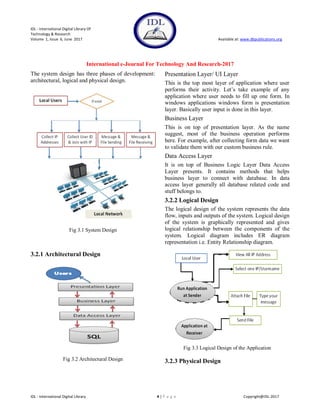
The system design has three phases of development:
architectural, logical and physical design.
Fig 3.1 System Design
3.2.1 Architectural Design
Fig 3.2 Architectural Design
Presentation Layer/ UI Layer
This is the top most layer of application where user
performs their activity. Let’s take example of any
application where user needs to fill up one form. In
windows applications windows form is presentation
layer. Basically user input is done in this layer.
Business Layer
This is on top of presentation layer. As the name
suggest, most of the business operation performs
here. For example, after collecting form data we want
to validate them with our custom business rule.
Data Access Layer
It is on top of Business Logic Layer Data Access
Layer presents. It contains methods that helps
business layer to connect with database. In data
access layer generally all database related code and
stuff belongs to.
3.2.2 Logical Design
The logical design of the system represents the data
flow, inputs and outputs of the system. Logical design
of the system is graphically represented and gives
logical relationship between the components of the
system. Logical diagram includes ER diagram
representation i.e. Entity Relationship diagram.
Fig 3.3 Logical Design of the Application
3.2.3 Physical Design
IDL - International Digital Library Of
Technology & Research
Volume 1, Issue 6, June 2017 Available at: www.dbpublications.org
International e-Journal For Technology And Research-2017
IDL - International Digital Library 5 | P a g e Copyright@IDL-2017
Physical design represents physical behavior of the
system. Physical design is related to the input and
output process of the system. Physical design will
gives how to input the data into system, how can it is
authenticated, how does it is processed and how it is
displayed. The requirement of the physical design is:
 Input requirements, Output requirements,
Storage requirements, Process requirements,
System Control and back up or recovery is
required to design physical design.
The physical design is categorized into three sub task.
 User interface
 Data design
 Process design
User Interfaceis designed to describe how user will
give input to the system and how system process the
information and return back to the users.
Data design is concerned in representing about how
data represented in the system do and how those data
are stored into the system.
Process design concerned about the movements of
the data in the system, and how and where these data
are validated. Also concerned about the how data is
secured and transformed through and the system and
out of the system.
IV. SYSTEM ARCHITECTURE
The IP Messenger and the File Transfer Interface
Design works as follows
 List form: In this form, all the computer
names and IPs of the systems connected to a
network that runs the IP Messenger and File
Transfer application are enlisted. List Form
contains the IPs and names of all the system
connected to the LAN which runs the
application otherwise the application not
enlist the IPs and Computer names of those
system which not run the application. These
names and IPs can later be used for
communication with the help of mouse event,
or in simple language: a click or a double
click.
 Chat form This form is called only when an
element is selected from the List form. In this
form, a connection is created between the
host system and the selected system with the
help of a socket.
 When the Connect button is clicked or a
name is double clicked, the chat form is
initialized with a connection between the host
and the client machine.
 Log files is a concept that has been added to
the application so that you can track each and
every transaction over the LAN between
machines that run this Application and
communicated among each other.
V. CONCLUSION
This paper is a survey of how to build an Instant
messaging over Ethernet LAN without having any
Internet connection and also having a portable
application for transferring files over Ethernet LAN.
The advantage of this application is used within an
organization between employees regardless of having
Internet connection and need to open the mail for file
transferring or exchanging the files over USB devices
or texting with each other.
VI. REFERENCES
[1] Kazuki Ueda, TatsushiKikutani, and Takahiro Yakoh
―Parallel Implementation of Real-Time
Communication and IP Communication by using
Multiple Ring Buff ers‖
[2] Marius Marcu and Adela Bascacov ―Tariff System
Design for IP Conference Communication Solutions‖
IDL - International Digital Library Of
Technology & Research
Volume 1, Issue 6, June 2017 Available at: www.dbpublications.org
International e-Journal For Technology And Research-2017
IDL - International Digital Library 6 | P a g e Copyright@IDL-2017
[3] Lilin Zhang, Ali Tizghadam, HadiBannazadeh and
Alberto Leon-Garcia ―Iterative Traffic Engineering in
the Data Plane of Multimedia IP Communication‖
[4]
http://csharp.netinformations.com/communications/cs
harp-socket-programming.htm
[5] N. Wang, K. H. Ho, G. Pavlou, and M. Howarth, ―An
overview of routing optimization for internet traffic
engineering,‖ 2008.
[6] A. Tizghadam and A. Leon-Garcia, ―On Robust
Traffic Engineering in Transport Networks.‖ in
GLOBECOM. IEEE, 2008, pp. 2372–2377.
[7]―AGraphTheoreticalApproachtoTrafficEngineeringand
NetworkControl Problem.‖ in International
Teletraffic Congress. IEEE, 2009, pp. 1–8. [4] ——,
―Autonomic Traffic Engineering for Network
Robustness,‖ IEEE J.Sel. A. Commun., vol. 28, no. 1,
pp. 39–50, Jan. 2010.
[8] Intel82574GbEControllerFamilyDatasheet.
Intel,2011.
[9] J.-D. Decotignie.Ethernet-based real-time and
industrial communications. Proceedings of the IEEE,
93(6):1102– 1117, 2005.
[10] B. Feng, D. Ghosal, and N. Kannappan.Impact of
ATM ABR controlontheperformanceofTCP-Tahoe
and TCPReno. IEEE Global Telecommunications
Conference, GLOBECOM ’97, 3:1832–1837,
November 1997.

IP Messenger And File Transfer over Ethernet LAN

  • 1.
    IDL - InternationalDigital Library Of Technology & Research Volume 1, Issue 6, June 2017 Available at: www.dbpublications.org International e-Journal For Technology And Research-2017 IDL - International Digital Library 1 | P a g e Copyright@IDL-2017 Abstract- Today many forms of communication exist throughout the computer technology over the world since past two decades. From instant messaging towards shared folders, FTP, Telephony communication, Mail transferring and so on. Each serves different purposes and uses distinct techniques to operate. IP Messenger and File Transfer over Ethernet LAN is a combination of Instant Messaging and File Sharing. IP Messenger and File Transfer is a LAN-based network application used within an organization for the employees and colleagues to share the files among themselves and to have text-chat with each other, this application replaces the use of shared folders and usage of e-mail and USB drive to transfer files and also replaces the use of instant messaging such as Skype, WhatsApp etc. I. INTRODUCTION Communication is a method of using technology to bring people and ideas ―together‖ despite of the geographical barriers. The technology has been available for years but the acceptance it was quit recent. Our project is an example of a IP Messenger and File Transfer. It is made up of client application, which runs on the user’s PC and server application, which runs on any Pc on the network. To start chatting client should get connected to server where they can practice two kinds of chatting, public one (message is broadcasted to all connected users) and private one (between any 2 users only) and during the last one security measures were taken. System Analysis System Objectives Communication over a network is one field where this tool finds wide ranging application. Chat application establishes a connection between 2 or more systems connected over an intra- net or ad-hoc. This tool can be used for large scale communication and conferencing in an organization or campus of vast size, thus increasing the standard of co-operation. In addition it converts the complex concept of sockets to a user friendly environment. This software can have further potentials, such as file transfer and voice chatting options that can be worked upon later  Relation to External Environment This tool helps in two major aspects –  Resolving the names of all the system connected in a network and enlisting them.  Used for communication between multiple systems enlisted in the resolved list. IP Messenger And File Transfer over Ethernet LAN Mr. Solaiman Jahed Solaiman.jahed@gmail.com Department of CSE (Computer Science and Engineering) School of Computing and Technology REVA University, Karnataka, 560064 India
  • 2.
    IDL - InternationalDigital Library Of Technology & Research Volume 1, Issue 6, June 2017 Available at: www.dbpublications.org International e-Journal For Technology And Research-2017 IDL - International Digital Library 2 | P a g e Copyright@IDL-2017 Design Consideration Approach: The tool has been designed using C# (Windows Form Application).  Methodology: The user interacts with the tool using a GUI.  The GUI operates in 1 forms, the List form & the chat form.  The List form contains the names of all the systems connected to a network.  The chat form makes the actual communication possible in the form of text. Operational Concepts and Scenarios Operation of the application Based on the inputs given by the user: List Form: When initialized, returns a list containing the names of all the system connected in a network. Contains two buttons: Refresh and Connect. When Refresh button is clicked refreshes the list of names. When the Connect button is clicked or a name is double clicked, the chat form is initialized with a connection between the host and the client machine. Note: If no name is selected, and connect button is clicked an error box is displayed. Chat form: Contains a rich textbox which cannot be edited but only displays the messages from one user to another, including the self-sent message, as in any chat application. Fig 1.1 General Schema II. LITERATURE SURVEY A Survey of Machine Learning Algorithm in Network Traffic Classification Network Traffic Classification is an emerging research area and now a day the research is widely used in various activities such as intrusion detection system and for security purpose. Many of the protocols and proposed application have been investigated and developed by using machine learning algorithms. We also focused on traditional and statistical methods. The previous used techniques and recent techniques have been compared using machine learning. In this paper the survey of different machine learning techniques are done and I identify better techniques to improve the performance IP Multimedia Subsystem IP Multimedia Subsystem (IMS) defined by 3GPP and 3GPP2 standardized based on IETF Internet Protocols. Most of researches in Next Generation Network enabled IMS has been focused on the engineering, rules, protocol, service provision in IMS, compatibility issues and refinements of SIP with IMS. IMS is access independent as it supports IP to IP session over wire-line IP, 802.11, 802.15, CDMA, packet data along with GSM/EDGE/UMTS and other packet data applications. It consists of session control, connection control and an applications services framework along with subscriber and services data. It enables new converged voice and
  • 3.
    IDL - InternationalDigital Library Of Technology & Research Volume 1, Issue 6, June 2017 Available at: www.dbpublications.org International e-Journal For Technology And Research-2017 IDL - International Digital Library 3 | P a g e Copyright@IDL-2017 data services, while allowing for the interoperability of these converged services between subscribers. LAN Messenger The LM uses two-tier Client/Server architecture as shown in figure 1. The application handling is completed separately for database queries and updates and for business logic processing and user interface presentation. Generally, the networks bind the back-end of an application to the front-end. The client is the first tier and the server is the second. Design is like two sockets are created at the client side and the server side. The client connects to the server through its IP address and port number. They must share the same port number for them to communicate.The client and the server both communicate through a stream of bytes written to the socket. The client and the server must agree on a protocol (TCP, UDP or RAW) and agree on the language of the information transferred back and forth through the socket, this study used socket concept to collect messages. Basically, themessage sent by one staff into a socket and passes it to another staff on the receiving side. If it is group chatting, a central socket will be used to collect the message and then it will be broadcast to all staff that are active. Fig 2.2LAN Messenger Flowchart III. IP MESSENGER AND FILE TRANSFER OVER ETHERNET LAN This is a LAN messenger application, It is a Client /Server application program developed in (C# .NET). Here the individual can chat with other individual through LAN connection. Even they can exchange file through one computer to other. Administrator can view chat logs through server. Here no need of Internet access. 3.1. Tools and Technologies Used This section describes the tools and technologies used to develop the project. The tools and technologies used in the BSF Applications are Web forms, Bootstrap, JQuery, JSON .Net framework 4.5 Win forms Win Forms are used to create a Standalone as the interface or front-end. Users can easily access the application from any computer connected. Jquery jQuery used in our application increases the productivity of the developer by enabling them to achieve critical UI functionality by writing very small amount of code such as helps to improve performance of the application, Helps to develop browser compatible web page. JSon JSON, used for JavaScript Object Notation, is a minimal, readable format for structuring data. It is used primarily to transmit data between a server and web application, as an alternative to XML. 3.2. System Design
  • 4.
    IDL - InternationalDigital Library Of Technology & Research Volume 1, Issue 6, June 2017 Available at: www.dbpublications.org International e-Journal For Technology And Research-2017 IDL - International Digital Library 4 | P a g e Copyright@IDL-2017 The system design has three phases of development: architectural, logical and physical design. Fig 3.1 System Design 3.2.1 Architectural Design Fig 3.2 Architectural Design Presentation Layer/ UI Layer This is the top most layer of application where user performs their activity. Let’s take example of any application where user needs to fill up one form. In windows applications windows form is presentation layer. Basically user input is done in this layer. Business Layer This is on top of presentation layer. As the name suggest, most of the business operation performs here. For example, after collecting form data we want to validate them with our custom business rule. Data Access Layer It is on top of Business Logic Layer Data Access Layer presents. It contains methods that helps business layer to connect with database. In data access layer generally all database related code and stuff belongs to. 3.2.2 Logical Design The logical design of the system represents the data flow, inputs and outputs of the system. Logical design of the system is graphically represented and gives logical relationship between the components of the system. Logical diagram includes ER diagram representation i.e. Entity Relationship diagram. Fig 3.3 Logical Design of the Application 3.2.3 Physical Design
  • 5.
    IDL - InternationalDigital Library Of Technology & Research Volume 1, Issue 6, June 2017 Available at: www.dbpublications.org International e-Journal For Technology And Research-2017 IDL - International Digital Library 5 | P a g e Copyright@IDL-2017 Physical design represents physical behavior of the system. Physical design is related to the input and output process of the system. Physical design will gives how to input the data into system, how can it is authenticated, how does it is processed and how it is displayed. The requirement of the physical design is:  Input requirements, Output requirements, Storage requirements, Process requirements, System Control and back up or recovery is required to design physical design. The physical design is categorized into three sub task.  User interface  Data design  Process design User Interfaceis designed to describe how user will give input to the system and how system process the information and return back to the users. Data design is concerned in representing about how data represented in the system do and how those data are stored into the system. Process design concerned about the movements of the data in the system, and how and where these data are validated. Also concerned about the how data is secured and transformed through and the system and out of the system. IV. SYSTEM ARCHITECTURE The IP Messenger and the File Transfer Interface Design works as follows  List form: In this form, all the computer names and IPs of the systems connected to a network that runs the IP Messenger and File Transfer application are enlisted. List Form contains the IPs and names of all the system connected to the LAN which runs the application otherwise the application not enlist the IPs and Computer names of those system which not run the application. These names and IPs can later be used for communication with the help of mouse event, or in simple language: a click or a double click.  Chat form This form is called only when an element is selected from the List form. In this form, a connection is created between the host system and the selected system with the help of a socket.  When the Connect button is clicked or a name is double clicked, the chat form is initialized with a connection between the host and the client machine.  Log files is a concept that has been added to the application so that you can track each and every transaction over the LAN between machines that run this Application and communicated among each other. V. CONCLUSION This paper is a survey of how to build an Instant messaging over Ethernet LAN without having any Internet connection and also having a portable application for transferring files over Ethernet LAN. The advantage of this application is used within an organization between employees regardless of having Internet connection and need to open the mail for file transferring or exchanging the files over USB devices or texting with each other. VI. REFERENCES [1] Kazuki Ueda, TatsushiKikutani, and Takahiro Yakoh ―Parallel Implementation of Real-Time Communication and IP Communication by using Multiple Ring Buff ers‖ [2] Marius Marcu and Adela Bascacov ―Tariff System Design for IP Conference Communication Solutions‖
  • 6.
    IDL - InternationalDigital Library Of Technology & Research Volume 1, Issue 6, June 2017 Available at: www.dbpublications.org International e-Journal For Technology And Research-2017 IDL - International Digital Library 6 | P a g e Copyright@IDL-2017 [3] Lilin Zhang, Ali Tizghadam, HadiBannazadeh and Alberto Leon-Garcia ―Iterative Traffic Engineering in the Data Plane of Multimedia IP Communication‖ [4] http://csharp.netinformations.com/communications/cs harp-socket-programming.htm [5] N. Wang, K. H. Ho, G. Pavlou, and M. Howarth, ―An overview of routing optimization for internet traffic engineering,‖ 2008. [6] A. Tizghadam and A. Leon-Garcia, ―On Robust Traffic Engineering in Transport Networks.‖ in GLOBECOM. IEEE, 2008, pp. 2372–2377. [7]―AGraphTheoreticalApproachtoTrafficEngineeringand NetworkControl Problem.‖ in International Teletraffic Congress. IEEE, 2009, pp. 1–8. [4] ——, ―Autonomic Traffic Engineering for Network Robustness,‖ IEEE J.Sel. A. Commun., vol. 28, no. 1, pp. 39–50, Jan. 2010. [8] Intel82574GbEControllerFamilyDatasheet. Intel,2011. [9] J.-D. Decotignie.Ethernet-based real-time and industrial communications. Proceedings of the IEEE, 93(6):1102– 1117, 2005. [10] B. Feng, D. Ghosal, and N. Kannappan.Impact of ATM ABR controlontheperformanceofTCP-Tahoe and TCPReno. IEEE Global Telecommunications Conference, GLOBECOM ’97, 3:1832–1837, November 1997.