IoT Agents (Advanced)
OMA Lightweight M2M
Contact email
daniel.moranjimenez@telefonica.com
(Reference Orion Context Broker version: 0.21.0)
http://bit.ly/fiware-iotAgents-lwm2m
• Introduction
• IOT Agents
• Interaction models
• Provisioning APIs
• Lightweight M2M
• IOT Agent development
Outline
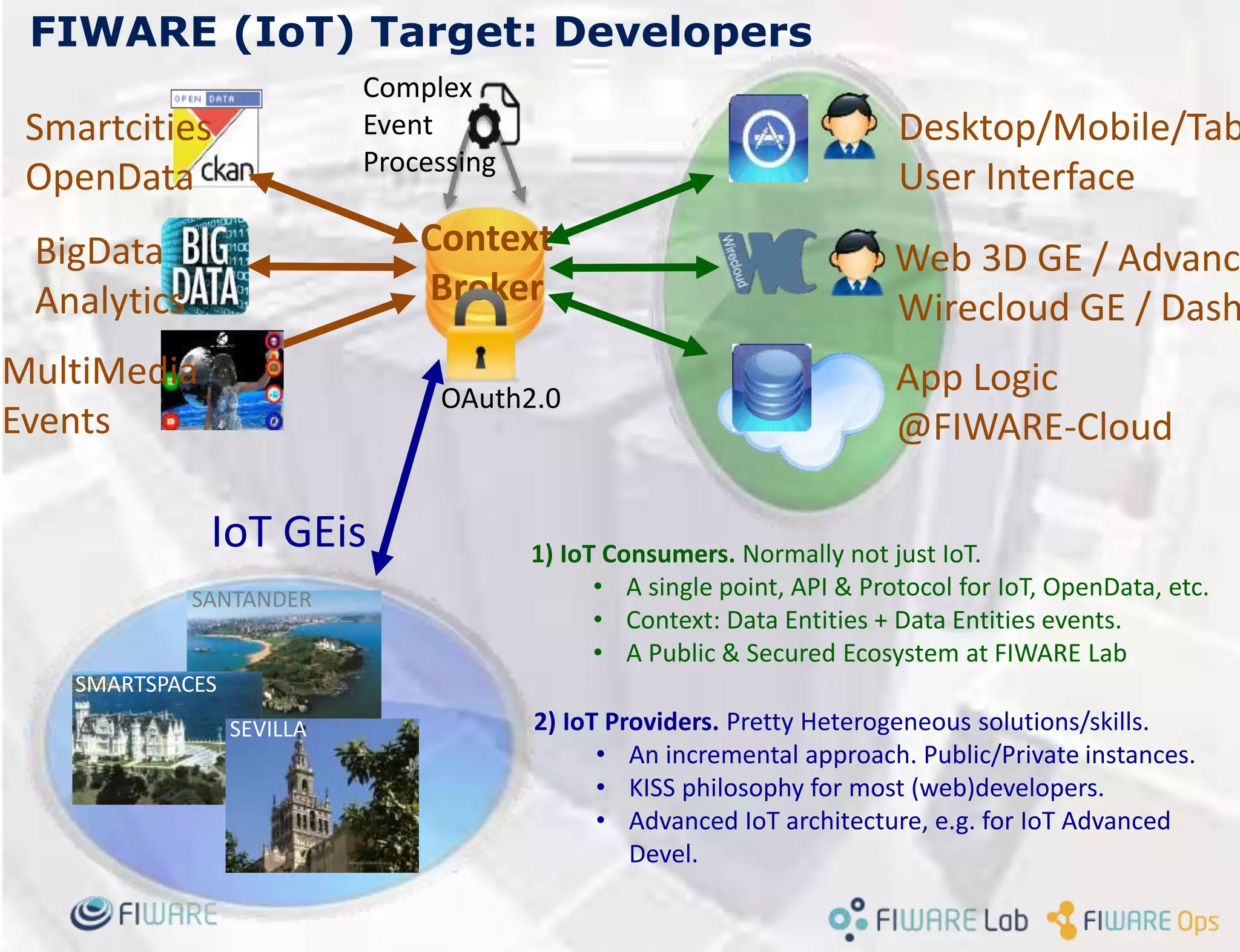
FIWARE (IoT) Target: Developers
Context
Broker
App Logic
@FIWARE-Cloud
Desktop/Mobile/Tab
User Interface
Web 3D GE / Advanc
Wirecloud GE / Dash
OAuth2.0
SANTANDER
SMARTSPACES
SEVILLA 2) IoT Providers. Pretty Heterogeneous solutions/skills.
• An incremental approach. Public/Private instances.
• KISS philosophy for most (web)developers.
• Advanced IoT architecture, e.g. for IoT Advanced
Devel.
1) IoT Consumers. Normally not just IoT.
• A single point, API & Protocol for IoT, OpenData, etc.
• Context: Data Entities + Data Entities events.
• A Public & Secured Ecosystem at FIWARE Lab
MultiMedia
Events
Complex
Event
Processing
IoT GEis
Smartcities
OpenData
BigData
Analytics
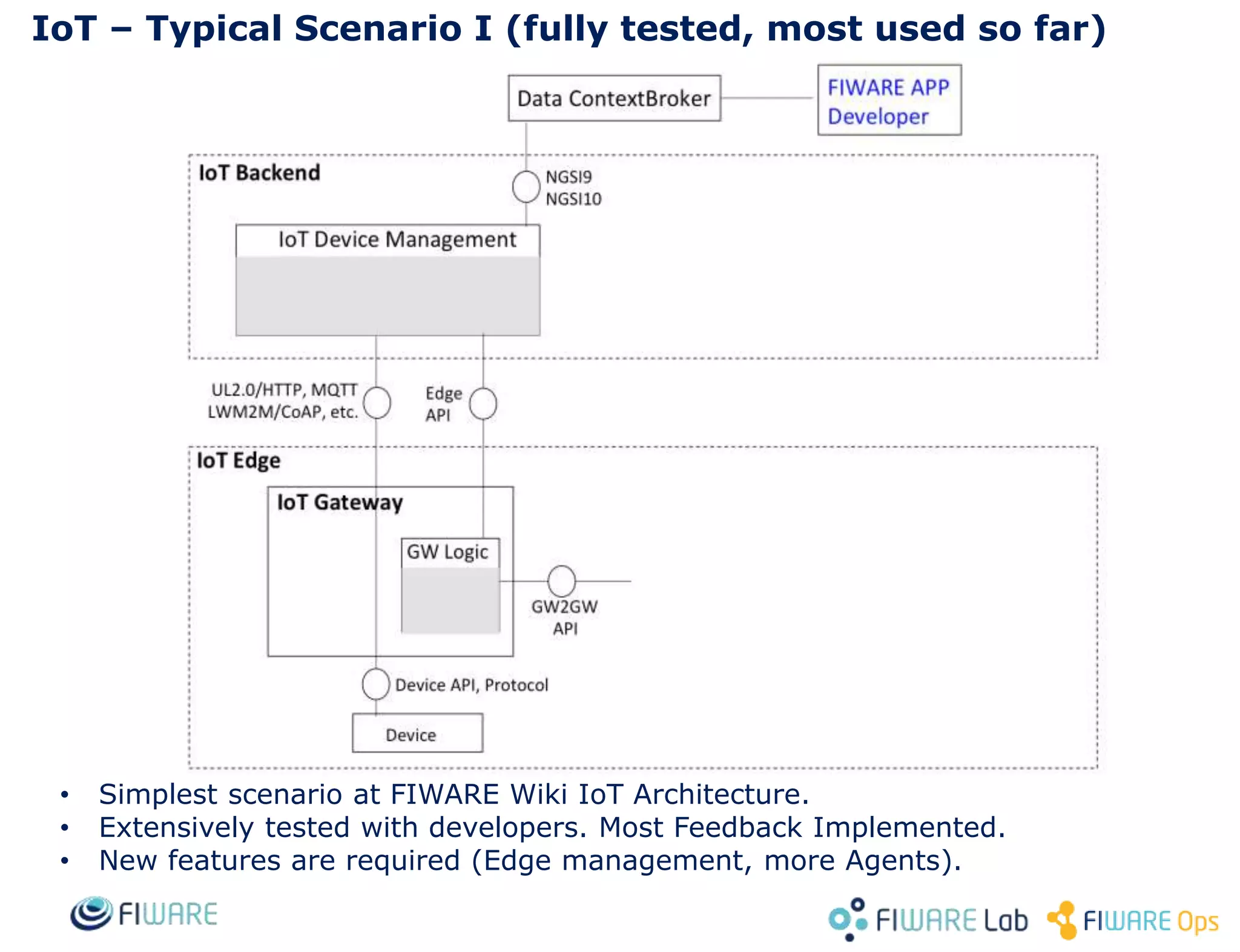
IoT – Typical Scenario I (fully tested, most used so far)
• Simplest scenario at FIWARE Wiki IoT Architecture.
• Extensively tested with developers. Most Feedback Implemented.
• New features are required (Edge management, more Agents).
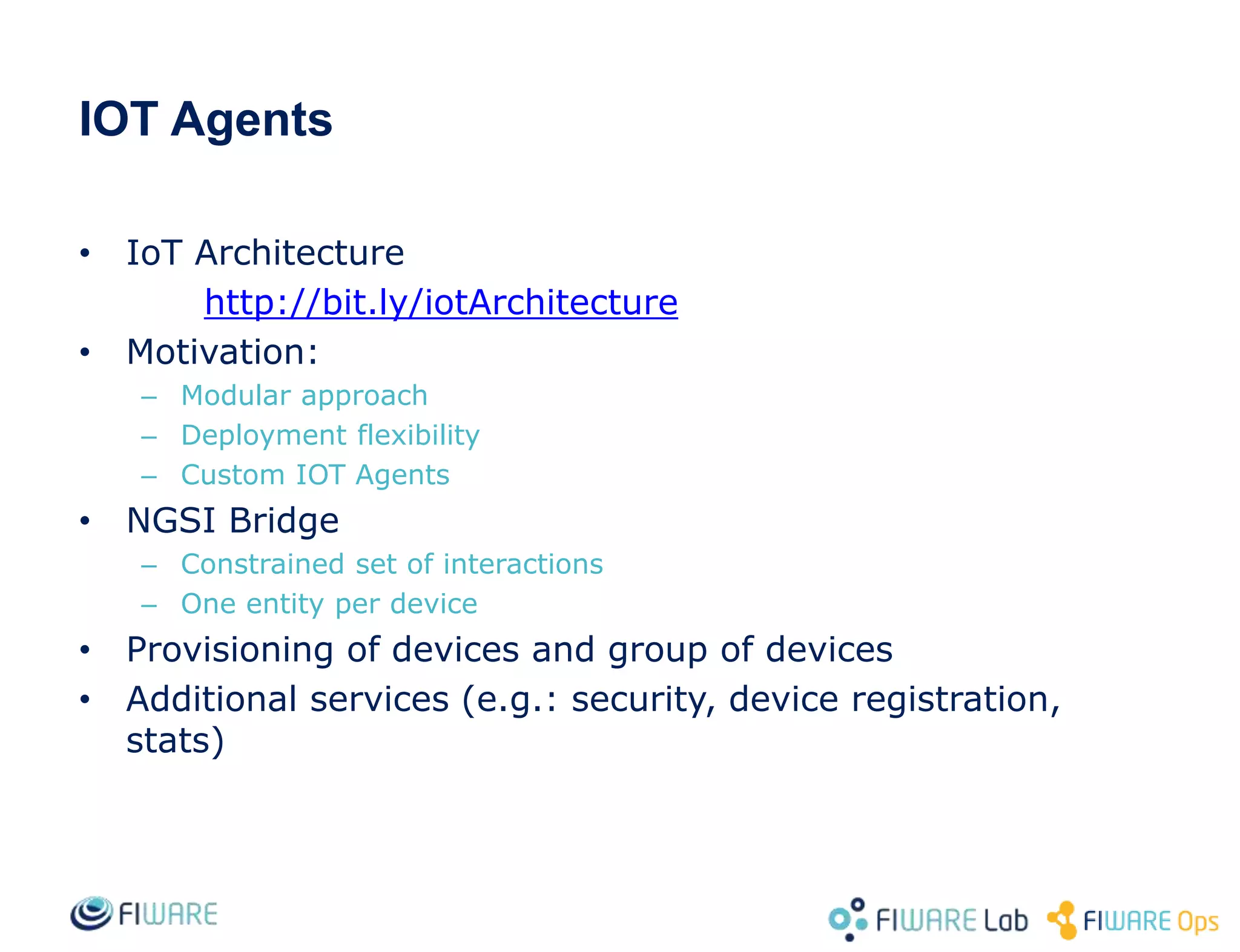
IOT Agents
• IoT Architecture
http://bit.ly/iotArchitecture
• Motivation:
– Modular approach
– Deployment flexibility
– Custom IOT Agents
• NGSI Bridge
– Constrained set of interactions
– One entity per device
• Provisioning of devices and group of devices
• Additional services (e.g.: security, device registration,
stats)
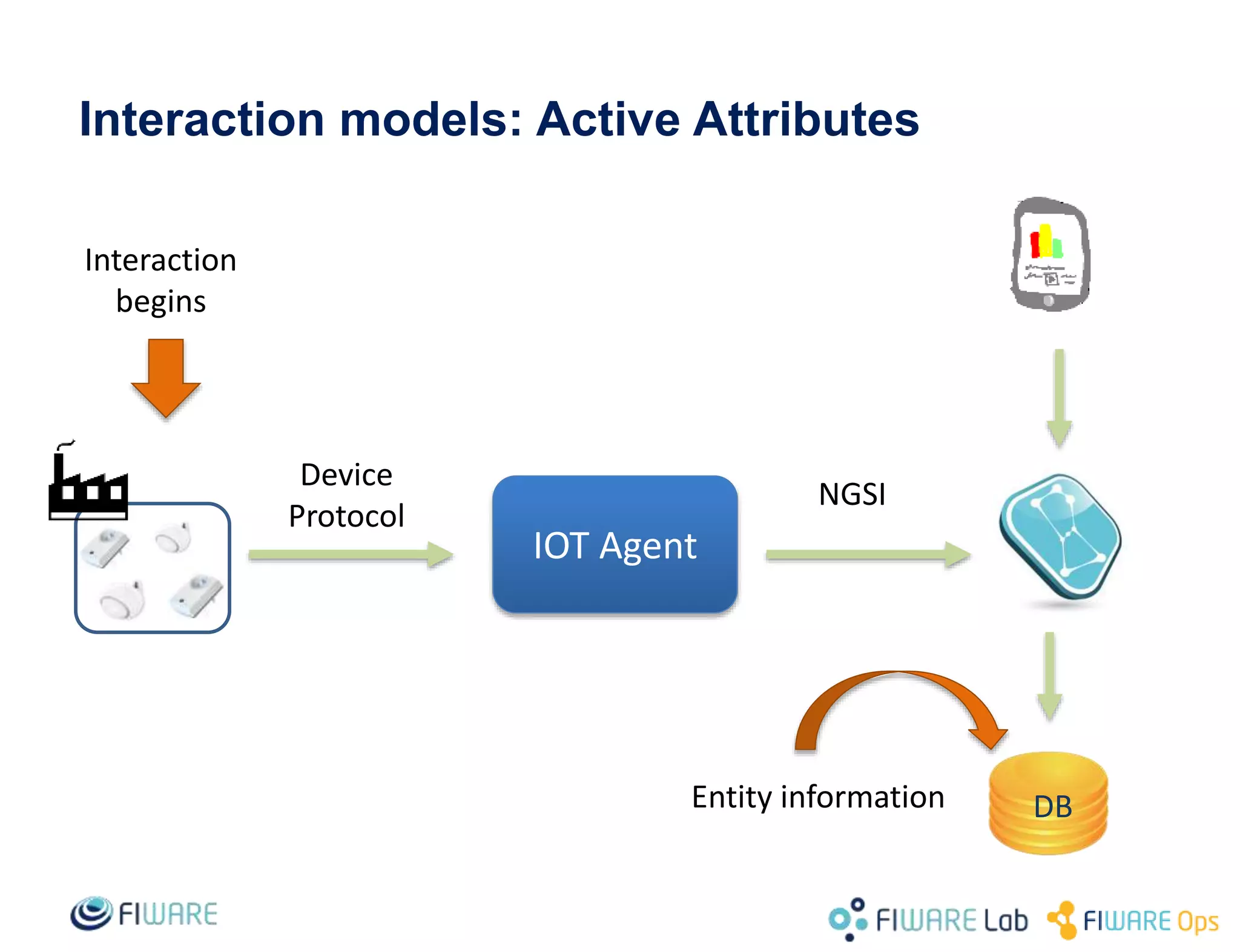
Interaction models: Active Attributes
IOT Agent
DB
Device
Protocol
NGSI
Entity information
Interaction
begins
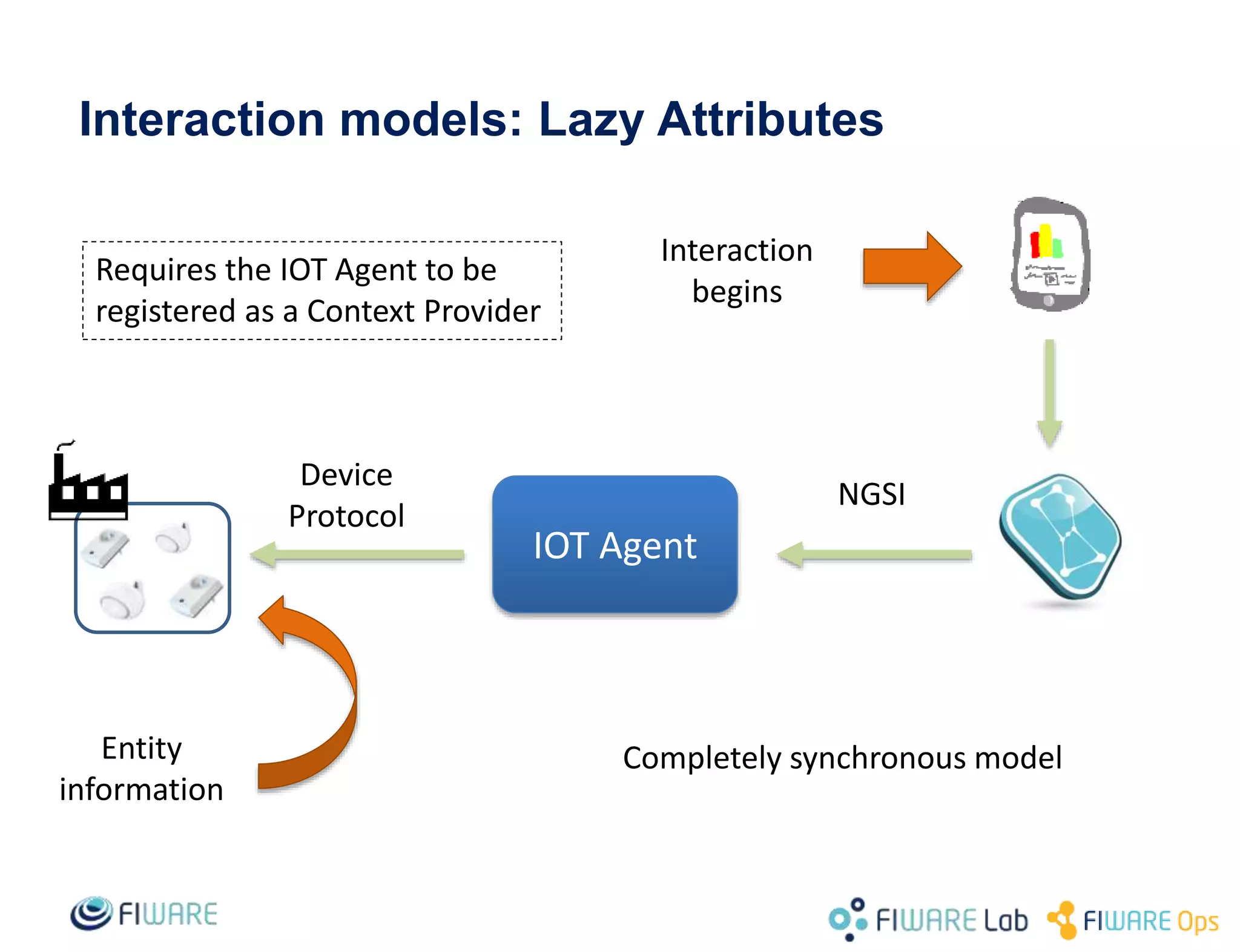
Interaction models: Lazy Attributes
IOT Agent
Device
Protocol
NGSI
Entity
information
Interaction
begins
Requires the IOT Agent to be
registered as a Context Provider
Completely synchronous model
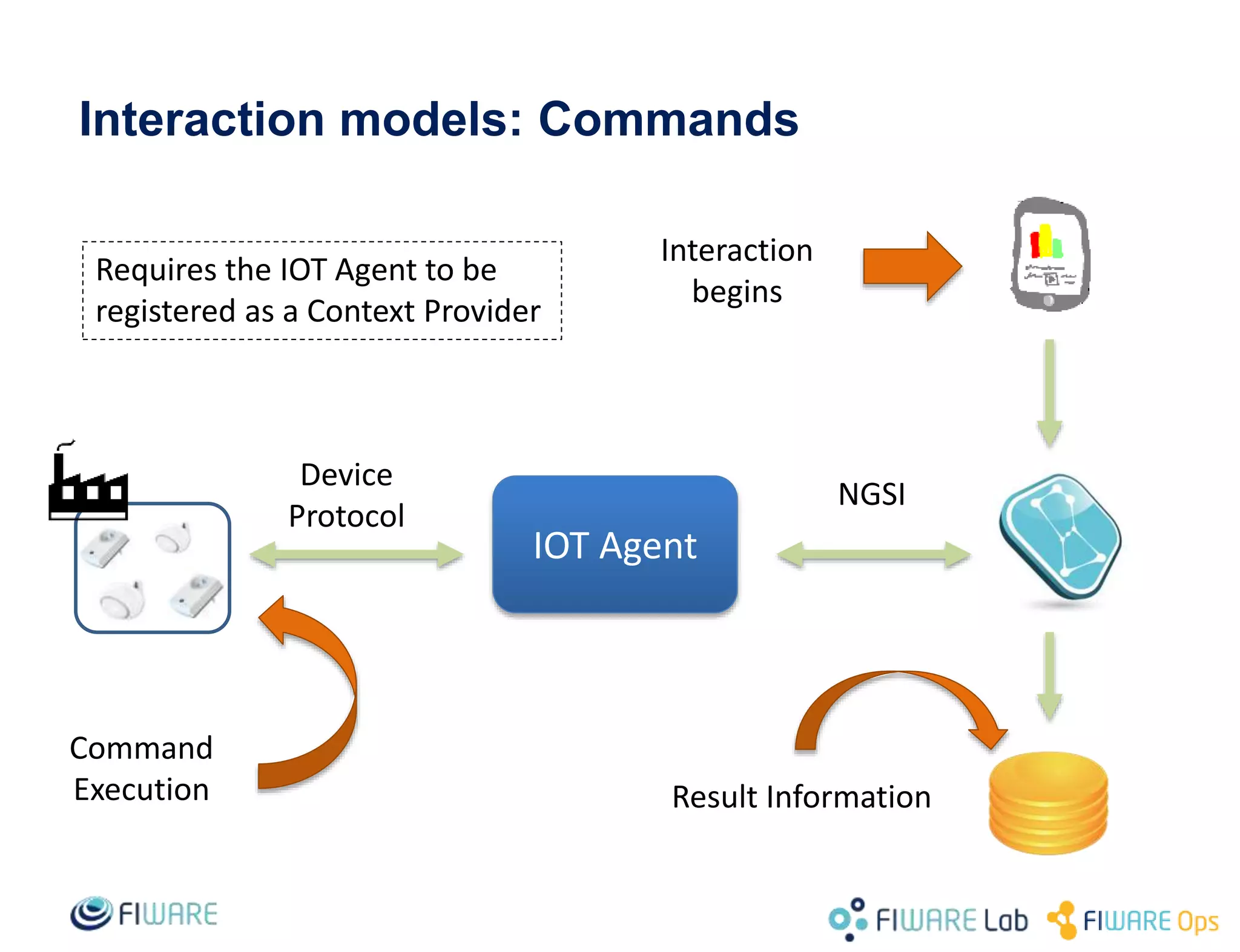
Interaction models: Commands
IOT Agent
Device
Protocol
NGSI
Command
Execution
Interaction
begins
Result Information
Requires the IOT Agent to be
registered as a Context Provider
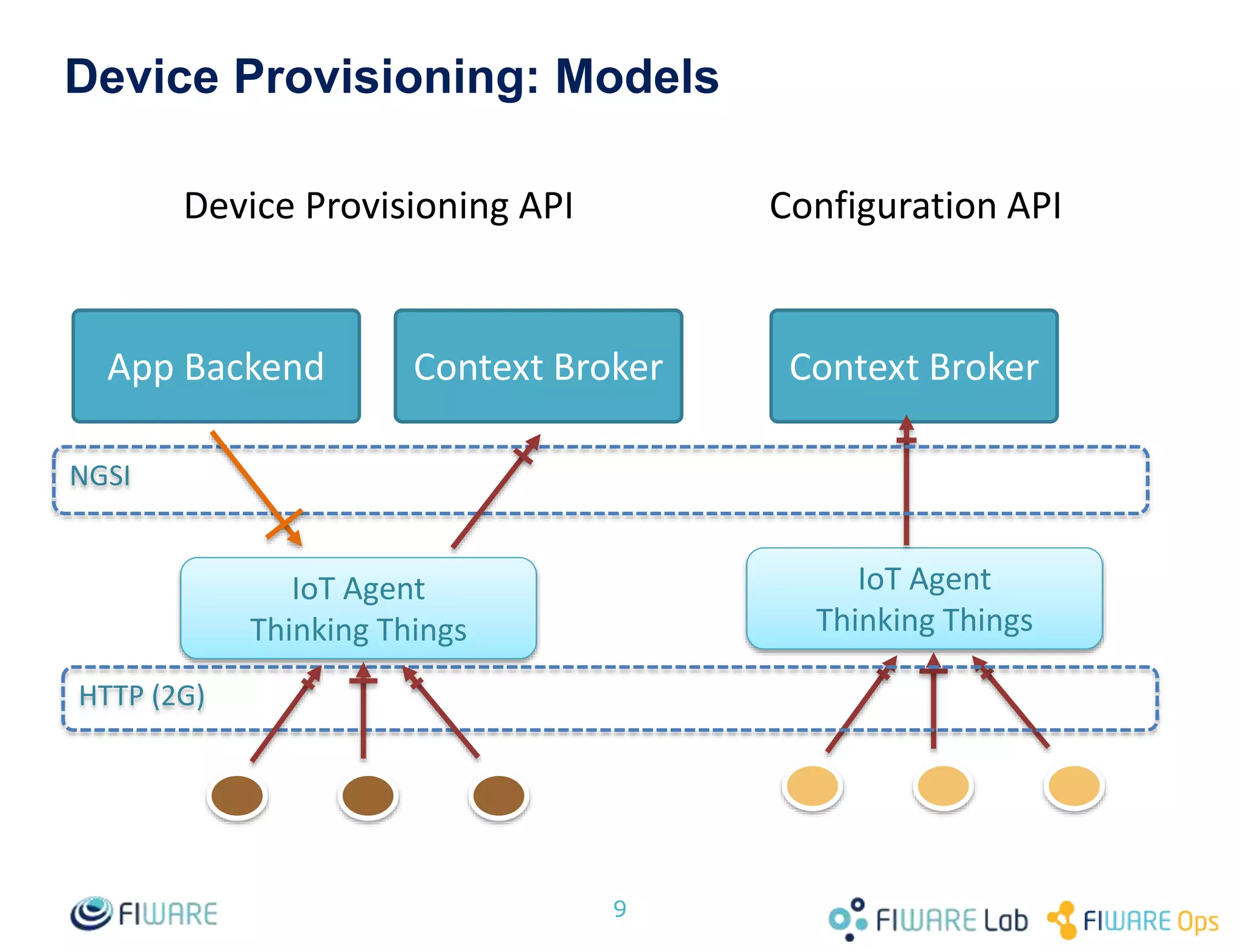
Device Provisioning: Models
9
Context Broker
IoT Agent
Thinking Things
NGSI
HTTP (2G)
IoT Agent
Thinking Things
Context BrokerApp Backend
Configuration APIDevice Provisioning API
Device Provisioning: Device Provisioning API
{
"name": "Light1",
"entity_name": "TheFirstLight",
"entity_type": "TheLightType",
"attributes": [
{
"name": "attr_name",
"type": "string"
}
],
"lazy": [
{
"name": "luminance",
"type": "lumens"
}
],
"commands": [
{
"name": "commandAttr",
"type": "commandType"
}
]
}
• /iot/devices/:deviceId
• REST CRUD:
– POST
– GET
– DELETE
– PUT
• Service headers:
– Fiware-service
– Fiware-servicepath
• Mandatory
– Name
– Entity_type
• Internal_attributes
Device Provisioning: Configuration API
{
services: [
{
resource: '/deviceTest',
apikey: '801230BJKL23Y24HV8732',
type: 'Light',
trust: '8970A9078A803HAMS’,
commands: [],
lazy: [
{
name: 'luminescence',
type: 'Lumens'
}
],
active: [
{
name: 'status',
type: 'Boolean'
}
]
}
]
}
• /iot/agents/default/servi
ces
• Not exactly REST (check
doc)
• Service headers:
– Fiware-service
– Fiware-servicepath
• Mandatory
– Resource
– Api_key
– Type
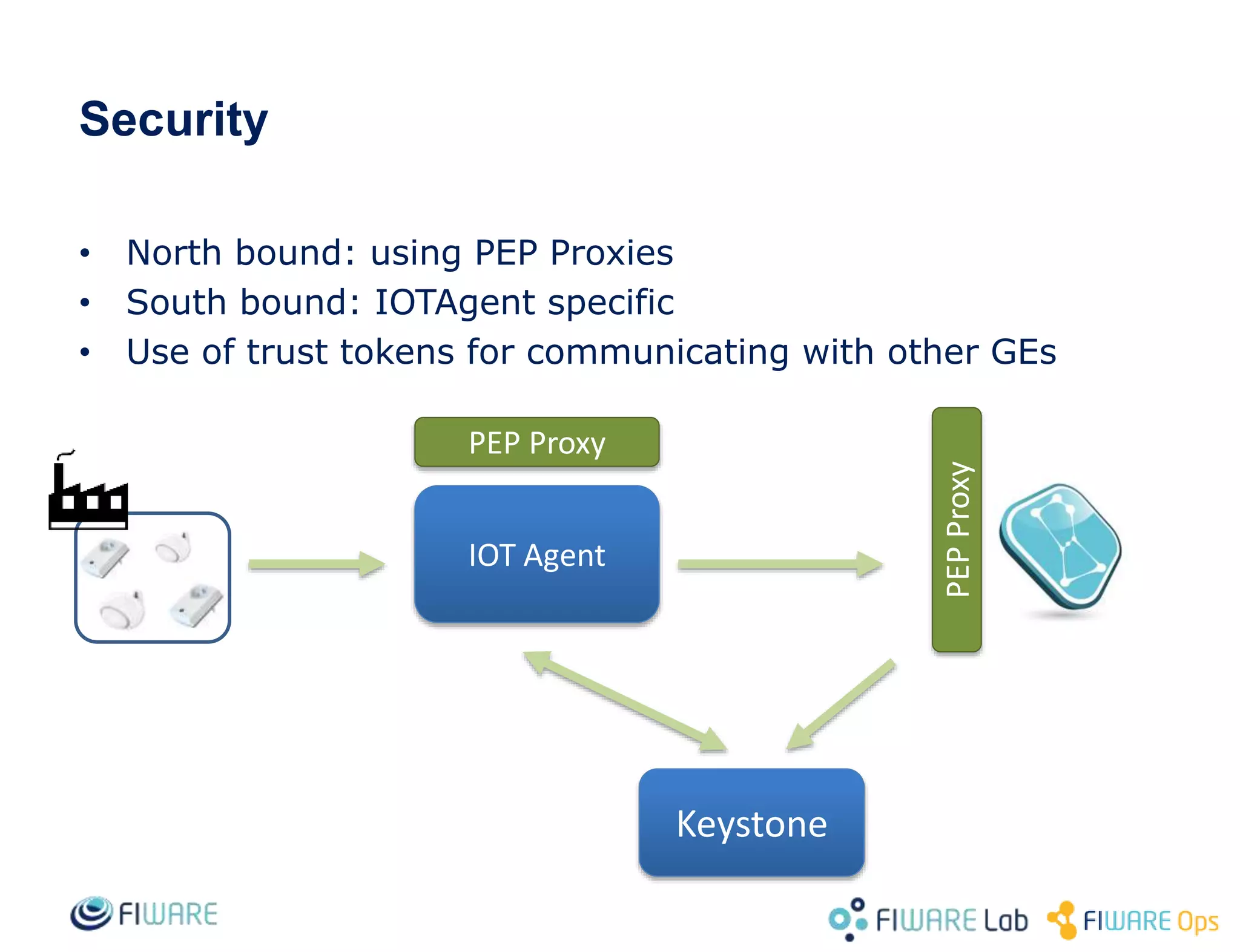
Security
• North bound: using PEP Proxies
• South bound: IOTAgent specific
• Use of trust tokens for communicating with other GEs
IOT Agent
PEP Proxy
PEPProxy
Keystone
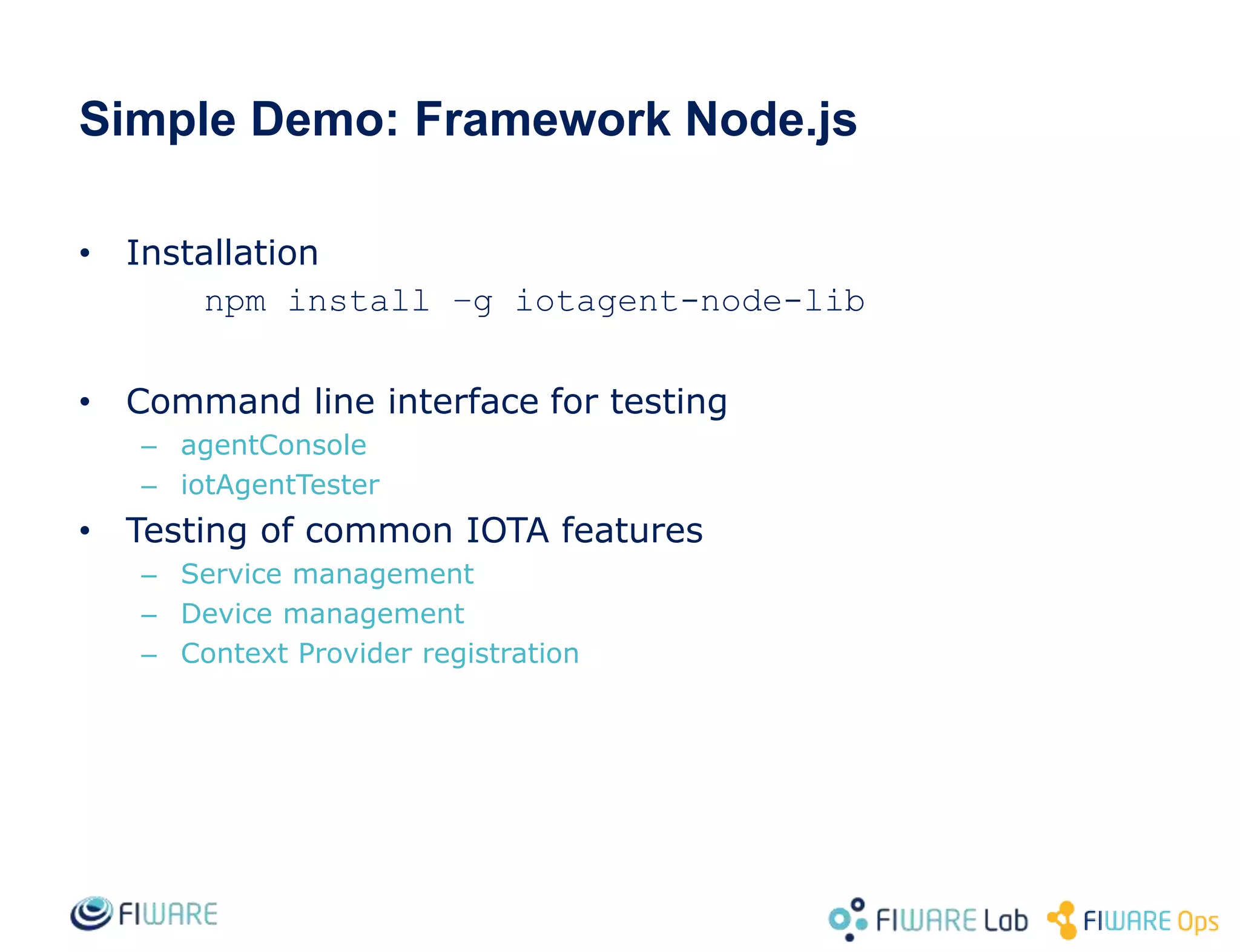
Simple Demo: Framework Node.js
• Installation
npm install –g iotagent-node-lib
• Command line interface for testing
– agentConsole
– iotAgentTester
• Testing of common IOTA features
– Service management
– Device management
– Context Provider registration
Lightweight M2M IoT Agent
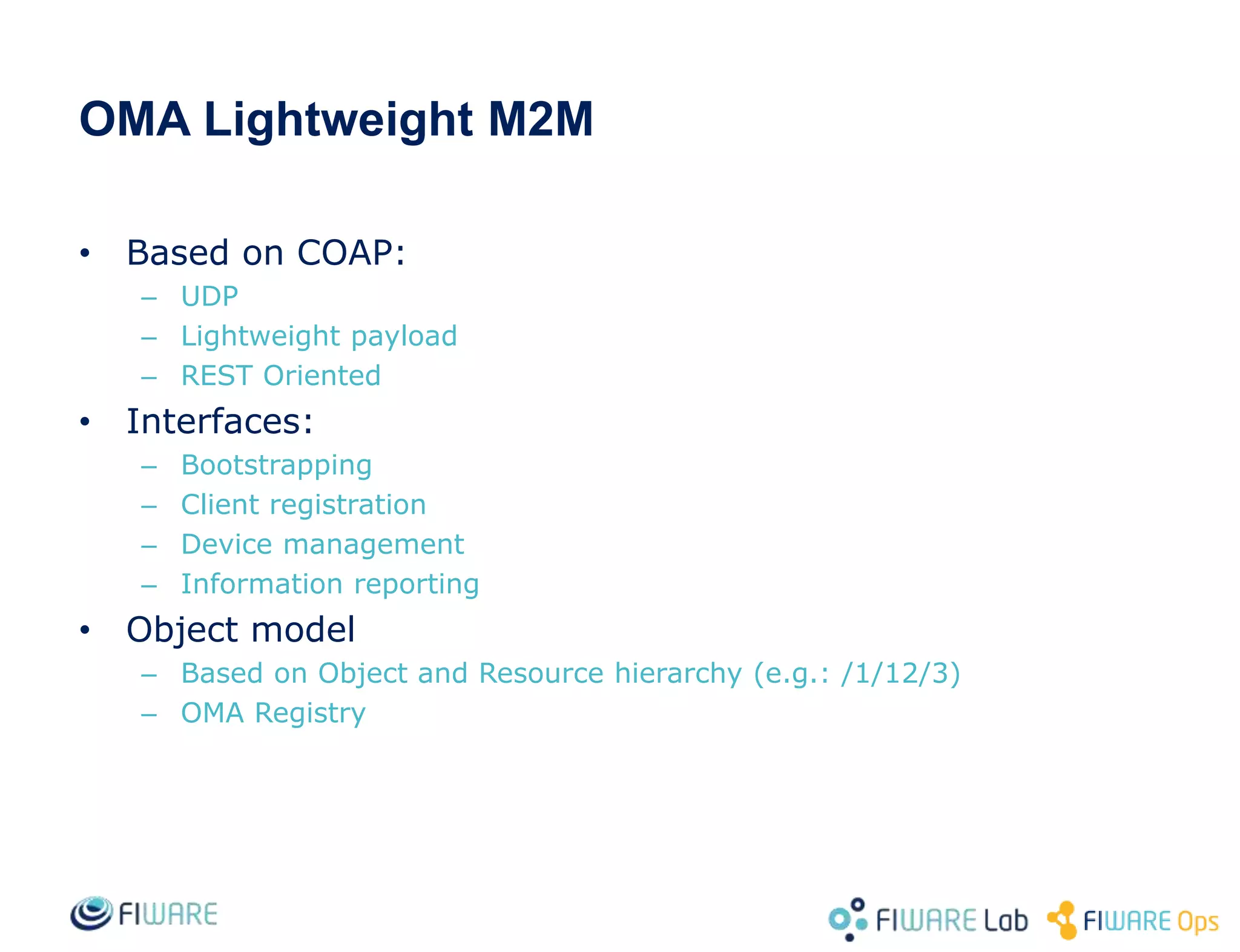
OMA Lightweight M2M
• Based on COAP:
– UDP
– Lightweight payload
– REST Oriented
• Interfaces:
– Bootstrapping
– Client registration
– Device management
– Information reporting
• Object model
– Based on Object and Resource hierarchy (e.g.: /1/12/3)
– OMA Registry
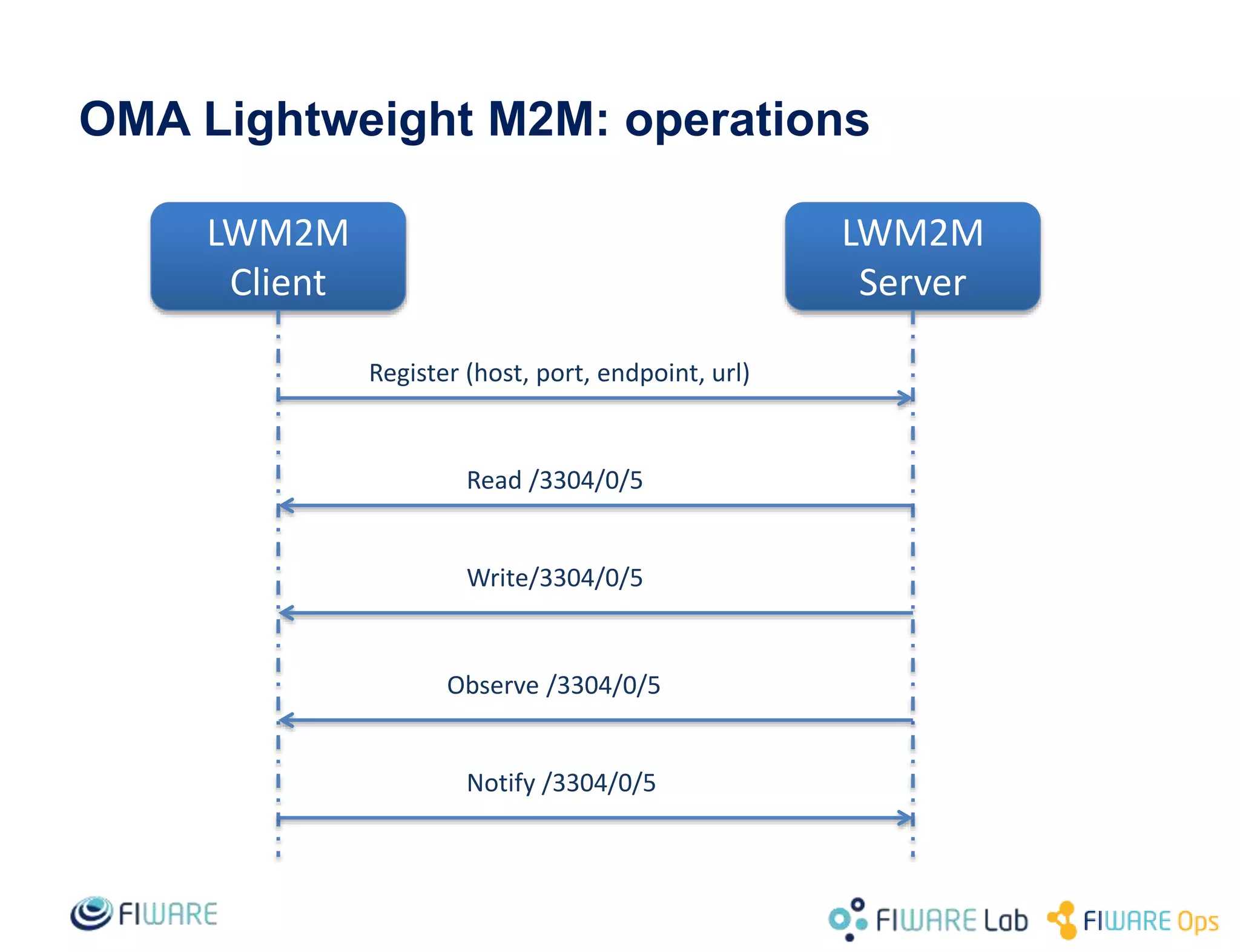
OMA Lightweight M2M: operations
LWM2M
Client
LWM2M
Server
Register (host, port, endpoint, url)
Read /3304/0/5
Write/3304/0/5
Observe /3304/0/5
Notify /3304/0/5
Lightweight M2M IOT Agent
• Github project
https://github.com/telefonicaid/lightweightm2m-iotagent
• Work in progress
• Quickstart guides
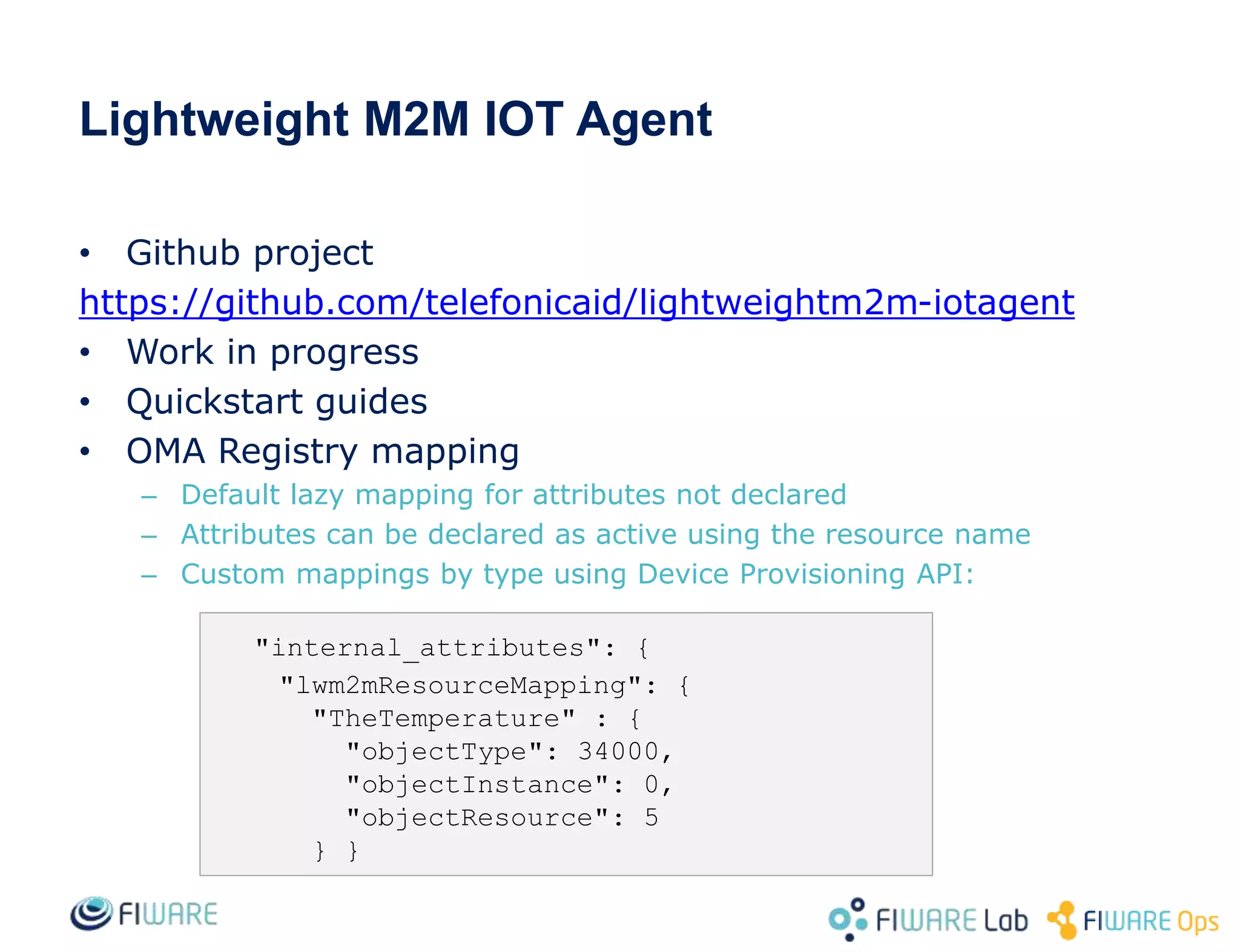
• OMA Registry mapping
– Default lazy mapping for attributes not declared
– Attributes can be declared as active using the resource name
– Custom mappings by type using Device Provisioning API:
"internal_attributes": {
"lwm2mResourceMapping": {
"TheTemperature" : {
"objectType": 34000,
"objectInstance": 0,
"objectResource": 5
} }
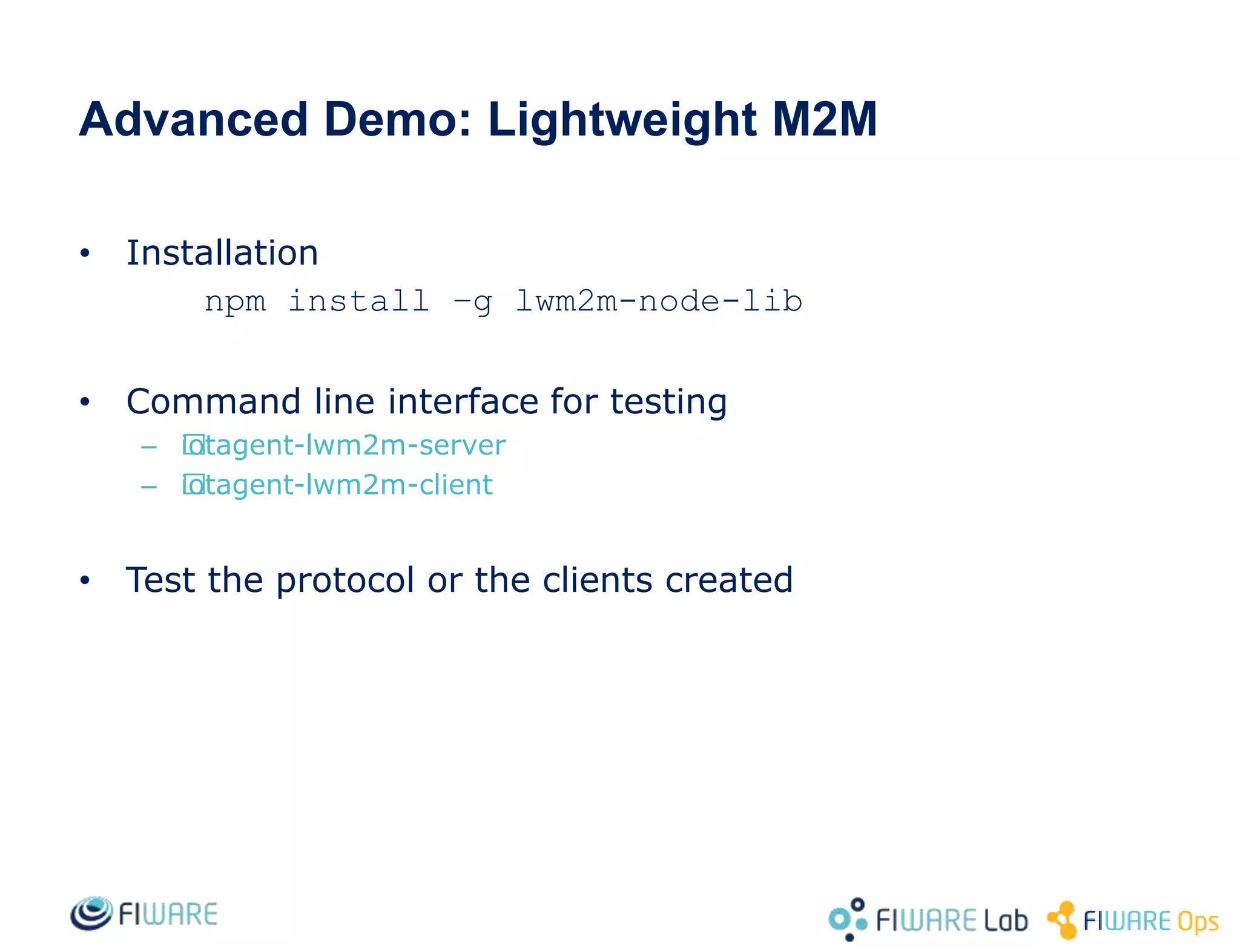
Advanced Demo: Lightweight M2M
• Installation
npm install –g lwm2m-node-lib
• Command line interface for testing
– iotagent-lwm2m-server
– iotagent-lwm2m-client
• Test the protocol or the clients created
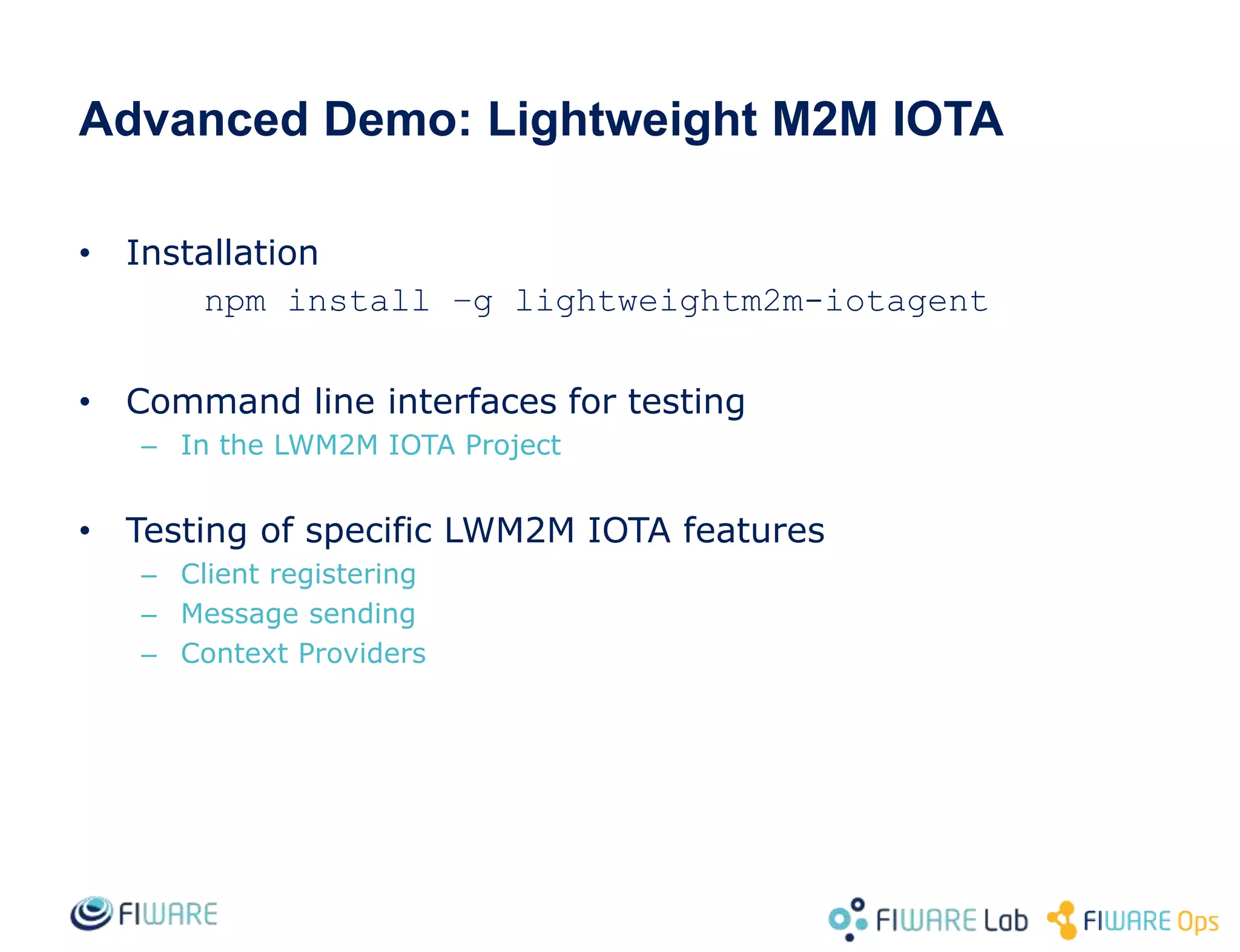
Advanced Demo: Lightweight M2M IOTA
• Installation
npm install –g lightweightm2m-iotagent
• Command line interfaces for testing
– In the LWM2M IOTA Project
• Testing of specific LWM2M IOTA features
– Client registering
– Message sending
– Context Providers
IoT Agent Development
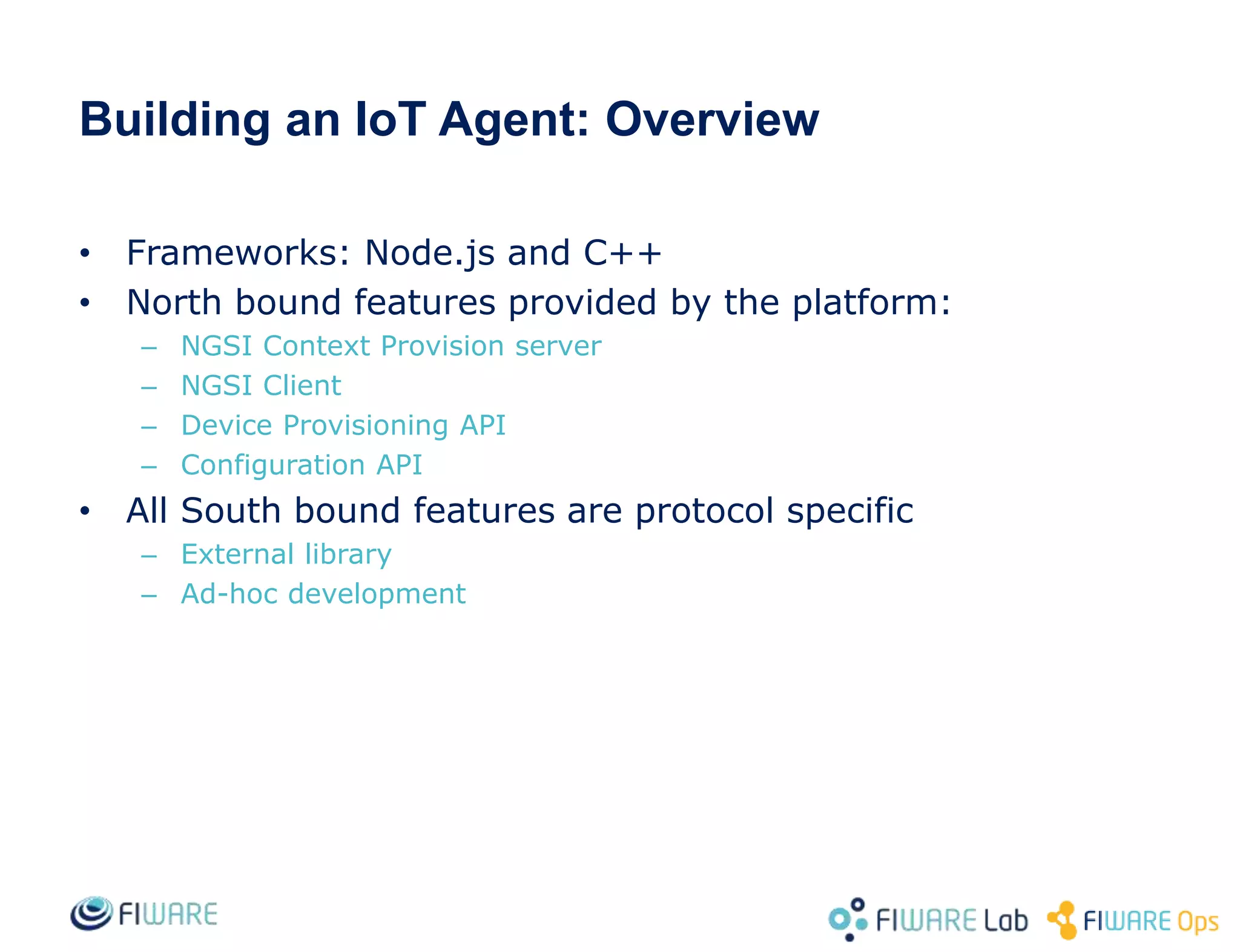
Building an IoT Agent: Overview
• Frameworks: Node.js and C++
• North bound features provided by the platform:
– NGSI Context Provision server
– NGSI Client
– Device Provisioning API
– Configuration API
• All South bound features are protocol specific
– External library
– Ad-hoc development
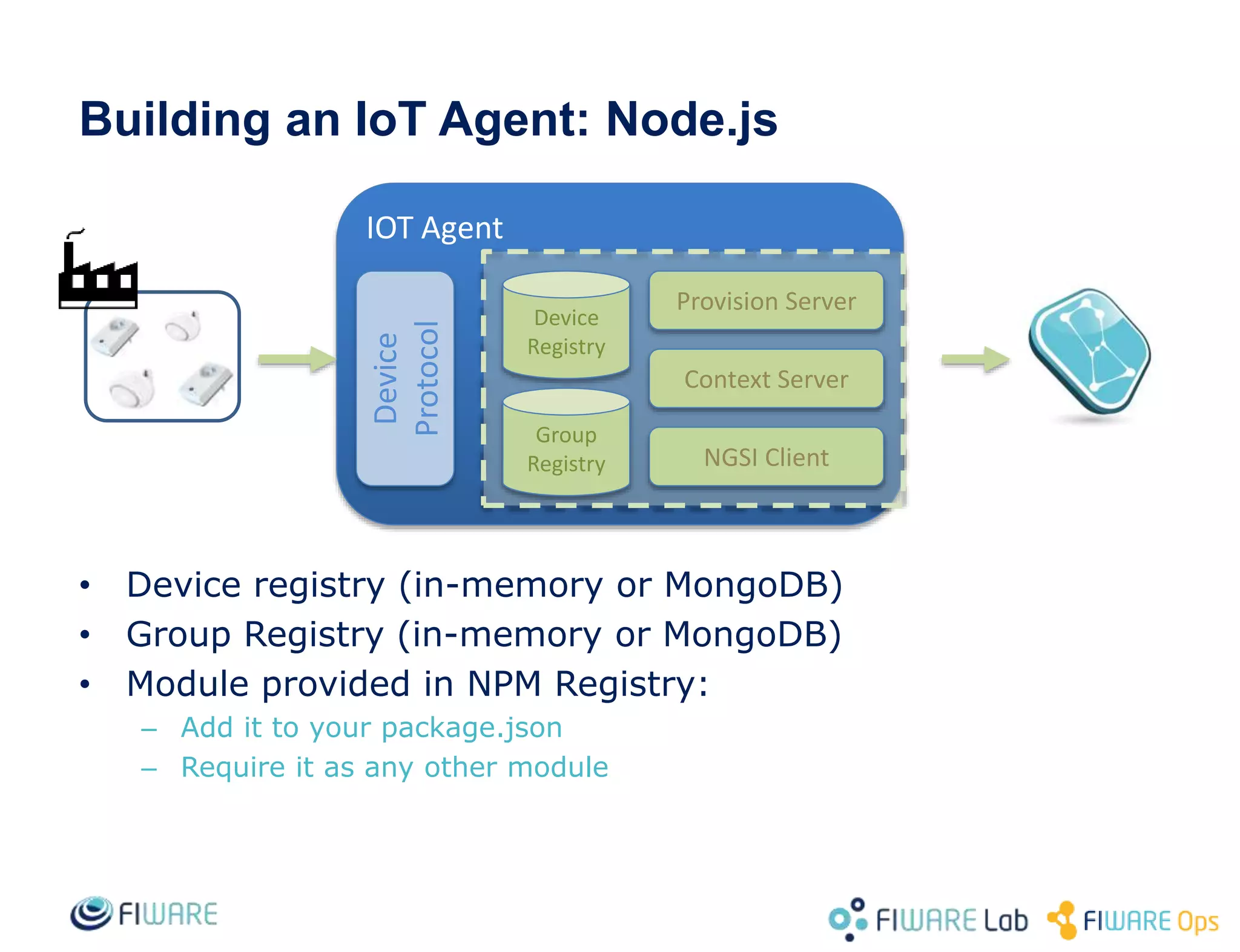
IOT Agent
Building an IoT Agent: Node.js
• Device registry (in-memory or MongoDB)
• Group Registry (in-memory or MongoDB)
• Module provided in NPM Registry:
– Add it to your package.json
– Require it as any other module
Context Server
NGSI Client
Device
Protocol
Device
Registry
Group
Registry
Provision Server
Building an IoT Agent: Node.js
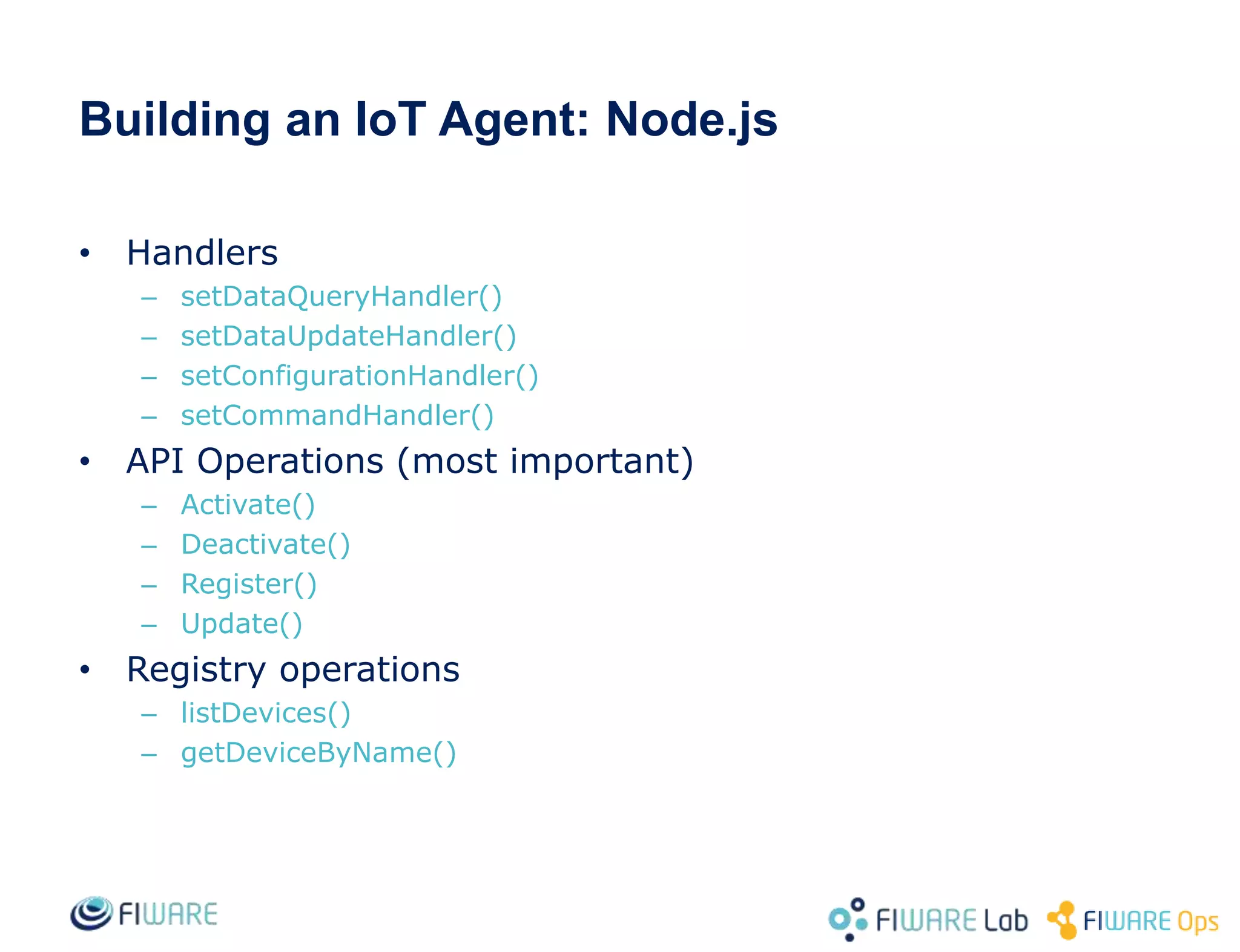
• Handlers
– setDataQueryHandler()
– setDataUpdateHandler()
– setConfigurationHandler()
– setCommandHandler()
• API Operations (most important)
– Activate()
– Deactivate()
– Register()
– Update()
• Registry operations
– listDevices()
– getDeviceByName()
Building an IoT Agent: Node.js
• Available IoT Agents
– OMA Lightweight M2M
– Sigfox
– Thinking Things Closed
Exercises
• Suggestion: deploy your local IOT Agent.
• Alternative: workshop IOTAgent
– IP: 130.206.80.48
– Port: 9500
• Exercise descriptions (and this presentation) in SlideShare
• Prerequisites:
– Rest clients
– Node.js (environment)
• Nice to have:
– Node.js programming skills
Resources
• Github Projects:
– Node.js IOT Agent framework
https://github.com/telefonicaid/iotagent-node-lib
– C++ IOT Agent framework
https://github.com/telefonicaid/fiware-IoTAgent-Cplusplus
– Node.js LWM2M Library
https://github.com/telefonicaid/lwm2m-node-lib
– LWM2M IOT Agent
https://github.com/telefonicaid/lightweightm2m-iotagent
• IoT Architecture
http://bit.ly/iotArchitecture
• COAP
https://tools.ietf.org/html/rfc7252
• Lightweight M2M
http://openmobilealliance.org/about-oma/work-program/m2m-enablers/
BACKUP SLIDES
Backup slides
27

IoT Agents (With Lightweight M2M)

  • 1.
    IoT Agents (Advanced) OMALightweight M2M Contact email daniel.moranjimenez@telefonica.com (Reference Orion Context Broker version: 0.21.0) http://bit.ly/fiware-iotAgents-lwm2m
  • 2.
    • Introduction • IOTAgents • Interaction models • Provisioning APIs • Lightweight M2M • IOT Agent development Outline
  • 3.
    FIWARE (IoT) Target:Developers Context Broker App Logic @FIWARE-Cloud Desktop/Mobile/Tab User Interface Web 3D GE / Advanc Wirecloud GE / Dash OAuth2.0 SANTANDER SMARTSPACES SEVILLA 2) IoT Providers. Pretty Heterogeneous solutions/skills. • An incremental approach. Public/Private instances. • KISS philosophy for most (web)developers. • Advanced IoT architecture, e.g. for IoT Advanced Devel. 1) IoT Consumers. Normally not just IoT. • A single point, API & Protocol for IoT, OpenData, etc. • Context: Data Entities + Data Entities events. • A Public & Secured Ecosystem at FIWARE Lab MultiMedia Events Complex Event Processing IoT GEis Smartcities OpenData BigData Analytics
  • 4.
    IoT – TypicalScenario I (fully tested, most used so far) • Simplest scenario at FIWARE Wiki IoT Architecture. • Extensively tested with developers. Most Feedback Implemented. • New features are required (Edge management, more Agents).
  • 5.
    IOT Agents • IoTArchitecture http://bit.ly/iotArchitecture • Motivation: – Modular approach – Deployment flexibility – Custom IOT Agents • NGSI Bridge – Constrained set of interactions – One entity per device • Provisioning of devices and group of devices • Additional services (e.g.: security, device registration, stats)
  • 6.
    Interaction models: ActiveAttributes IOT Agent DB Device Protocol NGSI Entity information Interaction begins
  • 7.
    Interaction models: LazyAttributes IOT Agent Device Protocol NGSI Entity information Interaction begins Requires the IOT Agent to be registered as a Context Provider Completely synchronous model
  • 8.
    Interaction models: Commands IOTAgent Device Protocol NGSI Command Execution Interaction begins Result Information Requires the IOT Agent to be registered as a Context Provider
  • 9.
    Device Provisioning: Models 9 ContextBroker IoT Agent Thinking Things NGSI HTTP (2G) IoT Agent Thinking Things Context BrokerApp Backend Configuration APIDevice Provisioning API
  • 10.
    Device Provisioning: DeviceProvisioning API { "name": "Light1", "entity_name": "TheFirstLight", "entity_type": "TheLightType", "attributes": [ { "name": "attr_name", "type": "string" } ], "lazy": [ { "name": "luminance", "type": "lumens" } ], "commands": [ { "name": "commandAttr", "type": "commandType" } ] } • /iot/devices/:deviceId • REST CRUD: – POST – GET – DELETE – PUT • Service headers: – Fiware-service – Fiware-servicepath • Mandatory – Name – Entity_type • Internal_attributes
  • 11.
    Device Provisioning: ConfigurationAPI { services: [ { resource: '/deviceTest', apikey: '801230BJKL23Y24HV8732', type: 'Light', trust: '8970A9078A803HAMS’, commands: [], lazy: [ { name: 'luminescence', type: 'Lumens' } ], active: [ { name: 'status', type: 'Boolean' } ] } ] } • /iot/agents/default/servi ces • Not exactly REST (check doc) • Service headers: – Fiware-service – Fiware-servicepath • Mandatory – Resource – Api_key – Type
  • 12.
    Security • North bound:using PEP Proxies • South bound: IOTAgent specific • Use of trust tokens for communicating with other GEs IOT Agent PEP Proxy PEPProxy Keystone
  • 13.
    Simple Demo: FrameworkNode.js • Installation npm install –g iotagent-node-lib • Command line interface for testing – agentConsole – iotAgentTester • Testing of common IOTA features – Service management – Device management – Context Provider registration
  • 14.
  • 15.
    OMA Lightweight M2M •Based on COAP: – UDP – Lightweight payload – REST Oriented • Interfaces: – Bootstrapping – Client registration – Device management – Information reporting • Object model – Based on Object and Resource hierarchy (e.g.: /1/12/3) – OMA Registry
  • 16.
    OMA Lightweight M2M:operations LWM2M Client LWM2M Server Register (host, port, endpoint, url) Read /3304/0/5 Write/3304/0/5 Observe /3304/0/5 Notify /3304/0/5
  • 17.
    Lightweight M2M IOTAgent • Github project https://github.com/telefonicaid/lightweightm2m-iotagent • Work in progress • Quickstart guides • OMA Registry mapping – Default lazy mapping for attributes not declared – Attributes can be declared as active using the resource name – Custom mappings by type using Device Provisioning API: "internal_attributes": { "lwm2mResourceMapping": { "TheTemperature" : { "objectType": 34000, "objectInstance": 0, "objectResource": 5 } }
  • 18.
    Advanced Demo: LightweightM2M • Installation npm install –g lwm2m-node-lib • Command line interface for testing – iotagent-lwm2m-server – iotagent-lwm2m-client • Test the protocol or the clients created
  • 19.
    Advanced Demo: LightweightM2M IOTA • Installation npm install –g lightweightm2m-iotagent • Command line interfaces for testing – In the LWM2M IOTA Project • Testing of specific LWM2M IOTA features – Client registering – Message sending – Context Providers
  • 20.
  • 21.
    Building an IoTAgent: Overview • Frameworks: Node.js and C++ • North bound features provided by the platform: – NGSI Context Provision server – NGSI Client – Device Provisioning API – Configuration API • All South bound features are protocol specific – External library – Ad-hoc development
  • 22.
    IOT Agent Building anIoT Agent: Node.js • Device registry (in-memory or MongoDB) • Group Registry (in-memory or MongoDB) • Module provided in NPM Registry: – Add it to your package.json – Require it as any other module Context Server NGSI Client Device Protocol Device Registry Group Registry Provision Server
  • 23.
    Building an IoTAgent: Node.js • Handlers – setDataQueryHandler() – setDataUpdateHandler() – setConfigurationHandler() – setCommandHandler() • API Operations (most important) – Activate() – Deactivate() – Register() – Update() • Registry operations – listDevices() – getDeviceByName()
  • 24.
    Building an IoTAgent: Node.js • Available IoT Agents – OMA Lightweight M2M – Sigfox – Thinking Things Closed
  • 25.
    Exercises • Suggestion: deployyour local IOT Agent. • Alternative: workshop IOTAgent – IP: 130.206.80.48 – Port: 9500 • Exercise descriptions (and this presentation) in SlideShare • Prerequisites: – Rest clients – Node.js (environment) • Nice to have: – Node.js programming skills
  • 26.
    Resources • Github Projects: –Node.js IOT Agent framework https://github.com/telefonicaid/iotagent-node-lib – C++ IOT Agent framework https://github.com/telefonicaid/fiware-IoTAgent-Cplusplus – Node.js LWM2M Library https://github.com/telefonicaid/lwm2m-node-lib – LWM2M IOT Agent https://github.com/telefonicaid/lightweightm2m-iotagent • IoT Architecture http://bit.ly/iotArchitecture • COAP https://tools.ietf.org/html/rfc7252 • Lightweight M2M http://openmobilealliance.org/about-oma/work-program/m2m-enablers/
  • 27.