Submitted By
T.Saravana Kumar
PLAN OF PRESENTATION
 What is Internet of Things?
 How IoT Works?
 Current Status & Future Prospect of IoT
 The Future of IoT
 Few Applications of IoT
 Advantages of IoT
 Disadvantages of IoT
 References
WHAT IS IOT?
The Internet of Things (IoT) is the network of physical objects
or "things" embedded with electronics, software, sensors, and
network connectivity, which enables these objects to collect
and exchange data.
IoT allows objects to be sensed and controlled remotely
across existing network infrastructure, creating opportunities
for more direct integration between the physical world and
computer-based systems, and resulting in improved efficiency,
accuracy and economic benefit.
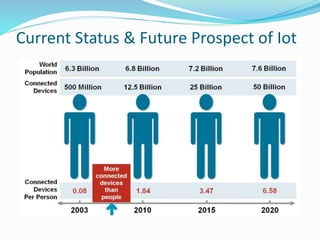
Current Status & Future Prospect of Iot
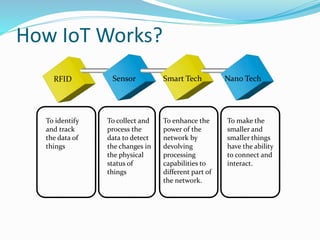
How IoT Works?
RFID Sensor Smart Tech Nano Tech
To identify
and track
the data of
things
To collect and
process the
data to detect
the changes in
the physical
status of
things
To enhance the
power of the
network by
devolving
processing
capabilities to
different part of
the network.
To make the
smaller and
smaller things
have the ability
to connect and
interact.
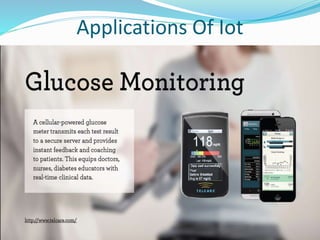
Applications Of Iot
Advantages
 Data: The more the information, the easier it is to make the right
decision ,not only saves time but is convenient as well.
 Tracking: We can track all those devices and the information given by
them.
 Time: The amount of time saved in monitoring and the number of
trips done otherwise would be tremendous.
 Money: The financial aspect is the best advantage. This technology
could replace humans who are in charge of monitoring and
maintaining supplies.
Disadvantages
 Privacy/Security: Privacy is a big issue with IoT. All the data
must be encrypted so that data related to our personal are safe.
 Safety: There is a chance that the software can be hacked and
your personal information misused. The possibilities are endless.
 Data: The IoT generates countless bytes of data—but business
value is measured not in bytes, but in the analysis of trends and
patterns.
 Complexity: Now, imagine the complexity of thousands of
sensors collecting data each hour across a single organization.
Conclusion
 Efforts will have to be made to find ways to combat its
disadvantages.
 Use IoT as tool for our development.
 By this we can create a smart world.
Thank You
REFERENCE
 https://sites.google.com/a/cortland.edu/the-
internet-of-things/disadvantages
 https://e27.co/advantages-disadvantages-
internet-things-20160615/
 https://en.wikipedia.org/wiki/Internet_of_thin
gs
 https://www.atlanticbt.com/blog/3-threats-
and-3-benefits-of-the-internet-of-things/

Iot

  • 1.
  • 2.
    PLAN OF PRESENTATION What is Internet of Things?  How IoT Works?  Current Status & Future Prospect of IoT  The Future of IoT  Few Applications of IoT  Advantages of IoT  Disadvantages of IoT  References
  • 3.
    WHAT IS IOT? TheInternet of Things (IoT) is the network of physical objects or "things" embedded with electronics, software, sensors, and network connectivity, which enables these objects to collect and exchange data. IoT allows objects to be sensed and controlled remotely across existing network infrastructure, creating opportunities for more direct integration between the physical world and computer-based systems, and resulting in improved efficiency, accuracy and economic benefit.
  • 4.
    Current Status &Future Prospect of Iot
  • 5.
    How IoT Works? RFIDSensor Smart Tech Nano Tech To identify and track the data of things To collect and process the data to detect the changes in the physical status of things To enhance the power of the network by devolving processing capabilities to different part of the network. To make the smaller and smaller things have the ability to connect and interact.
  • 6.
  • 11.
    Advantages  Data: Themore the information, the easier it is to make the right decision ,not only saves time but is convenient as well.  Tracking: We can track all those devices and the information given by them.  Time: The amount of time saved in monitoring and the number of trips done otherwise would be tremendous.  Money: The financial aspect is the best advantage. This technology could replace humans who are in charge of monitoring and maintaining supplies.
  • 12.
    Disadvantages  Privacy/Security: Privacyis a big issue with IoT. All the data must be encrypted so that data related to our personal are safe.  Safety: There is a chance that the software can be hacked and your personal information misused. The possibilities are endless.  Data: The IoT generates countless bytes of data—but business value is measured not in bytes, but in the analysis of trends and patterns.  Complexity: Now, imagine the complexity of thousands of sensors collecting data each hour across a single organization.
  • 13.
    Conclusion  Efforts willhave to be made to find ways to combat its disadvantages.  Use IoT as tool for our development.  By this we can create a smart world. Thank You
  • 14.
    REFERENCE  https://sites.google.com/a/cortland.edu/the- internet-of-things/disadvantages  https://e27.co/advantages-disadvantages- internet-things-20160615/ https://en.wikipedia.org/wiki/Internet_of_thin gs  https://www.atlanticbt.com/blog/3-threats- and-3-benefits-of-the-internet-of-things/