Internet of
things
Name: P.SRI HARSHA
E-mail: harshasri588@gmail.com
Twitter Id: @sriharsha742
University: CVR College Of Engineering
Year/Semester: 3/2
Branch: ECE
 Internet of Things is a network of items, each
embedded with sensors, which are connected to
the Internet.
 These sensors are part of a device category
called a micro electromechanical system (MEMS)
and are manufactured in much the same way
microprocessors are manufactured.
 These sensors can use various types of local area
connections such as RFID, NFC, Wi-Fi, Bluetooth,
and Zigbee.
 IoT can offer advanced connectivity of devices,
systems, and services that go beyond machine to
machine (M2M) and implements different
protocols, domains, and applications.
Introduction
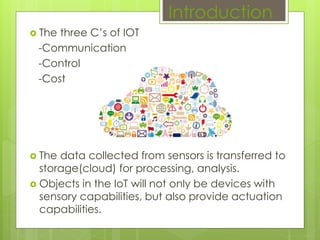
 The three C’s of IOT
-Communication
-Control
-Cost
 The data collected from sensors is transferred to
storage(cloud) for processing, analysis.
 Objects in the IoT will not only be devices with
sensory capabilities, but also provide actuation
capabilities.
Introduction
Trends
 Smart Cities:
-Smart Parking
-Smart Lighting
- Smart Roads
 Smart Environment:
-Forest Fire Detection
-Earthquake Early Detection
-Air Pollution
 Industrial Control:
-M2M Applications
-Temperature Monitoring
-Indoor Air Quality
Trends
 Smart Agriculture
-Green Houses
-Meteorological Station Network
 In my opinion Smart City is going make a big impact
in near future because the global population
continues to grow at a steady pace, more and more
people are moving to cities every single day.
 With this rapid growth ahead of us, imagine if our
cities could talk—if they could give us live status
updates on traffic patterns, pollution, parking spaces,
water, power and light. Imagine how that kind of
information could improve the economic and
environmental health of the city for residents,
merchants, and visitors. Imagine how it could improve
working conditions and productivity for the people
who maintain the city.
Interested Areas
 I am interested in developing low cost and
flexible devices equipped with sensors which
collect and analyse data for smart homes and
smart cities.
 If given an internship in this area, I would like to
work on how large volumes of data collected by
different devices is handled, processed,
analyzed, and is converted into a meaningful
form for automation.
Thank you
P. Sri Harsha

Internet of Things

  • 1.
    Internet of things Name: P.SRIHARSHA E-mail: harshasri588@gmail.com Twitter Id: @sriharsha742 University: CVR College Of Engineering Year/Semester: 3/2 Branch: ECE
  • 2.
     Internet ofThings is a network of items, each embedded with sensors, which are connected to the Internet.  These sensors are part of a device category called a micro electromechanical system (MEMS) and are manufactured in much the same way microprocessors are manufactured.  These sensors can use various types of local area connections such as RFID, NFC, Wi-Fi, Bluetooth, and Zigbee.  IoT can offer advanced connectivity of devices, systems, and services that go beyond machine to machine (M2M) and implements different protocols, domains, and applications. Introduction
  • 3.
     The threeC’s of IOT -Communication -Control -Cost  The data collected from sensors is transferred to storage(cloud) for processing, analysis.  Objects in the IoT will not only be devices with sensory capabilities, but also provide actuation capabilities. Introduction
  • 4.
    Trends  Smart Cities: -SmartParking -Smart Lighting - Smart Roads  Smart Environment: -Forest Fire Detection -Earthquake Early Detection -Air Pollution  Industrial Control: -M2M Applications -Temperature Monitoring -Indoor Air Quality
  • 5.
    Trends  Smart Agriculture -GreenHouses -Meteorological Station Network  In my opinion Smart City is going make a big impact in near future because the global population continues to grow at a steady pace, more and more people are moving to cities every single day.  With this rapid growth ahead of us, imagine if our cities could talk—if they could give us live status updates on traffic patterns, pollution, parking spaces, water, power and light. Imagine how that kind of information could improve the economic and environmental health of the city for residents, merchants, and visitors. Imagine how it could improve working conditions and productivity for the people who maintain the city.
  • 6.
    Interested Areas  Iam interested in developing low cost and flexible devices equipped with sensors which collect and analyse data for smart homes and smart cities.  If given an internship in this area, I would like to work on how large volumes of data collected by different devices is handled, processed, analyzed, and is converted into a meaningful form for automation.
  • 7.