INTERNET OF
THINGS (IoT)
Presented by-
Sumit kumar 121
Mantu kumar chauhan 126
Shubham kumar singh 119
Technical Lecture Presentation
& Group Discussion-I (MC681)
Introduction to IoT
Internet has became an essential need of human life in 21st Century.
With the evolvement of the internet, various concepts have been
developed to communicate remotely between human to human and
human to machine.
Its next step is to interconnect devices and systems in order to
develop machine to machine communication. Based on this, a new
concept called “Internet of Things (IoT) ” has been introduced to the
world.
IoT definition
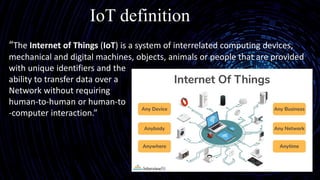
“The Internet of Things (IoT) is a system of interrelated computing devices,
mechanical and digital machines, objects, animals or people that are provided
with unique identifiers and the
ability to transfer data over a
Network without requiring
human-to-human or human-to
-computer interaction.”
What is Internet of Things (IoT)
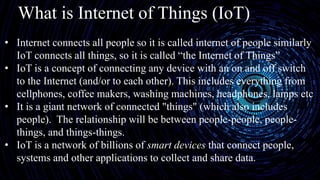
• Internet connects all people so it is called internet of people similarly
IoT connects all things, so it is called “the Internet of Things”
• IoT is a concept of connecting any device with an on and off switch
to the Internet (and/or to each other). This includes everything from
cellphones, coffee makers, washing machines, headphones, lamps etc
• It is a giant network of connected "things" (which also includes
people). The relationship will be between people-people, people-
things, and things-things.
• IoT is a network of billions of smart devices that connect people,
systems and other applications to collect and share data.
Why should we learn about IoT?
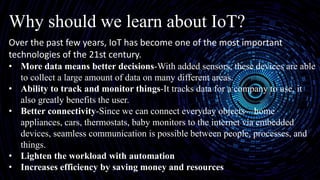
Over the past few years, IoT has become one of the most important
technologies of the 21st century.
• More data means better decisions-With added sensors, these devices are able
to collect a large amount of data on many different areas.
• Ability to track and monitor things-It tracks data for a company to use, it
also greatly benefits the user.
• Better connectivity-Since we can connect everyday objects—home
appliances, cars, thermostats, baby monitors to the internet via embedded
devices, seamless communication is possible between people, processes, and
things.
• Lighten the workload with automation
• Increases efficiency by saving money and resources
“Things” connected to the internet
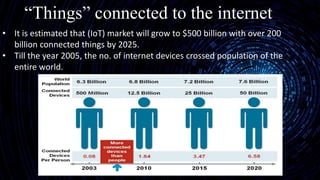
• It is estimated that (IoT) market will grow to $500 billion with over 200
billion connected things by 2025.
• Till the year 2005, the no. of internet devices crossed population of the
entire world.
Life in IoT era
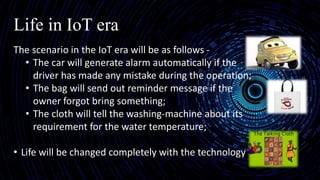
The scenario in the IoT era will be as follows -
• The car will generate alarm automatically if the
driver has made any mistake during the operation;
• The bag will send out reminder message if the
owner forgot bring something;
• The cloth will tell the washing-machine about its
requirement for the water temperature;
• Life will be changed completely with the technology of
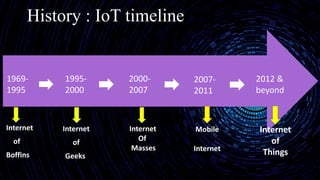
History : IoT timeline
1969-
1995
2000-
2007
2012 &
beyond
1995-
2000
Internet
of
Boffins
Internet
of
Geeks:
Mobile
Internet
2007-
2011
Internet
Of
Masses
Internet
of
Things
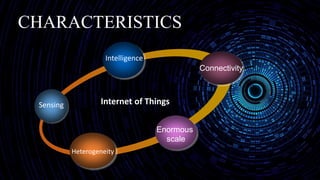
CHARACTERISTICS
Internet of Things
Sensing
Intelligence
Connectivity
Enormous
scale
Heterogeneity
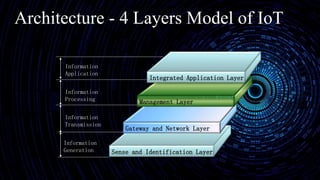
Architecture - 4 Layers Model of IoT
Sense and Identification Layer
Information
Generation
Gateway and Network Layer
Management Layer
Integrated Application Layer
Information
Processing
Information
Transmission
Information
Application
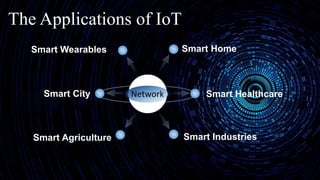
Network
Smart Home
Smart Healthcare
Smart City
Smart Wearables
Smart Industries
Smart Agriculture
The Applications of IoT
Advantages of IoT
 Better accessibility of data- Ability to access information from anywhere at
any time on any device.
 Minimizes human effort: As the devices of IoT interact and communicate
with each other and do lot of task for us, they minimize the human effort.
 Saves time -Transferring data packets over a connected network saving time
and money.
 Automation- Automating tasks helps to improve the quality of business's
services and reducing the need for human intervention.
 Improved communication between connected electronic devices.
Disadvantages of IoT
1. Privacy-As the number of connected devices increases and more information
is shared between devices, the potential that a hacker could steal confidential
information also increases.
2. Difficulty in managing large amount of data-Enterprises may eventually
have to deal with massive numbers -- maybe even millions -- of IoT devices,
and collecting and managing the data from all those devices will be
challenging.
3. Bug control-If there's a bug in the system, it's likely that every connected
device will become corrupted.
4. Compatibility of devices-Since there's no international standard of
compatibility for IoT, it's difficult for devices from different manufacturers to
communicate with each other.
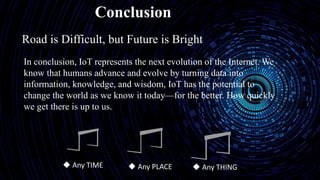
 Any TIME  Any PLACE  Any THING
Conclusion
In conclusion, IoT represents the next evolution of the Internet. We
know that humans advance and evolve by turning data into
information, knowledge, and wisdom, IoT has the potential to
change the world as we know it today—for the better. How quickly
we get there is up to us.
Road is Difficult, but Future is Bright
THANK YOU

IoT-updated.pptx

  • 1.
    INTERNET OF THINGS (IoT) Presentedby- Sumit kumar 121 Mantu kumar chauhan 126 Shubham kumar singh 119 Technical Lecture Presentation & Group Discussion-I (MC681)
  • 2.
    Introduction to IoT Internethas became an essential need of human life in 21st Century. With the evolvement of the internet, various concepts have been developed to communicate remotely between human to human and human to machine. Its next step is to interconnect devices and systems in order to develop machine to machine communication. Based on this, a new concept called “Internet of Things (IoT) ” has been introduced to the world.
  • 3.
    IoT definition “The Internetof Things (IoT) is a system of interrelated computing devices, mechanical and digital machines, objects, animals or people that are provided with unique identifiers and the ability to transfer data over a Network without requiring human-to-human or human-to -computer interaction.”
  • 4.
    What is Internetof Things (IoT) • Internet connects all people so it is called internet of people similarly IoT connects all things, so it is called “the Internet of Things” • IoT is a concept of connecting any device with an on and off switch to the Internet (and/or to each other). This includes everything from cellphones, coffee makers, washing machines, headphones, lamps etc • It is a giant network of connected "things" (which also includes people). The relationship will be between people-people, people- things, and things-things. • IoT is a network of billions of smart devices that connect people, systems and other applications to collect and share data.
  • 5.
    Why should welearn about IoT? Over the past few years, IoT has become one of the most important technologies of the 21st century. • More data means better decisions-With added sensors, these devices are able to collect a large amount of data on many different areas. • Ability to track and monitor things-It tracks data for a company to use, it also greatly benefits the user. • Better connectivity-Since we can connect everyday objects—home appliances, cars, thermostats, baby monitors to the internet via embedded devices, seamless communication is possible between people, processes, and things. • Lighten the workload with automation • Increases efficiency by saving money and resources
  • 6.
    “Things” connected tothe internet • It is estimated that (IoT) market will grow to $500 billion with over 200 billion connected things by 2025. • Till the year 2005, the no. of internet devices crossed population of the entire world.
  • 7.
    Life in IoTera The scenario in the IoT era will be as follows - • The car will generate alarm automatically if the driver has made any mistake during the operation; • The bag will send out reminder message if the owner forgot bring something; • The cloth will tell the washing-machine about its requirement for the water temperature; • Life will be changed completely with the technology of
  • 8.
    History : IoTtimeline 1969- 1995 2000- 2007 2012 & beyond 1995- 2000 Internet of Boffins Internet of Geeks: Mobile Internet 2007- 2011 Internet Of Masses Internet of Things
  • 9.
  • 10.
    Architecture - 4Layers Model of IoT Sense and Identification Layer Information Generation Gateway and Network Layer Management Layer Integrated Application Layer Information Processing Information Transmission Information Application
  • 11.
    Network Smart Home Smart Healthcare SmartCity Smart Wearables Smart Industries Smart Agriculture The Applications of IoT
  • 12.
    Advantages of IoT Better accessibility of data- Ability to access information from anywhere at any time on any device.  Minimizes human effort: As the devices of IoT interact and communicate with each other and do lot of task for us, they minimize the human effort.  Saves time -Transferring data packets over a connected network saving time and money.  Automation- Automating tasks helps to improve the quality of business's services and reducing the need for human intervention.  Improved communication between connected electronic devices.
  • 13.
    Disadvantages of IoT 1.Privacy-As the number of connected devices increases and more information is shared between devices, the potential that a hacker could steal confidential information also increases. 2. Difficulty in managing large amount of data-Enterprises may eventually have to deal with massive numbers -- maybe even millions -- of IoT devices, and collecting and managing the data from all those devices will be challenging. 3. Bug control-If there's a bug in the system, it's likely that every connected device will become corrupted. 4. Compatibility of devices-Since there's no international standard of compatibility for IoT, it's difficult for devices from different manufacturers to communicate with each other.
  • 14.
     Any TIME Any PLACE  Any THING Conclusion In conclusion, IoT represents the next evolution of the Internet. We know that humans advance and evolve by turning data into information, knowledge, and wisdom, IoT has the potential to change the world as we know it today—for the better. How quickly we get there is up to us. Road is Difficult, but Future is Bright
  • 15.