An inotrope isan agent which alters the force or energy of
muscular contraction. Negatively inotropic agents weaken the
force of muscular contractions. Positively inotropic agents
increase the strength of muscular contraction.
• Most commonly, the inotropic state is used in reference to
various drugs that affect the myocardial contractility.
However, it can also refer to pathological conditions. For
example, ventricular hypertrophy can increase inotropic
state, while myocardial infarction can decrease it.
3.
Vasopressor
• Agents areadministered to increase vascular tone and
thereby elevate mean arterial pressure (MAP).
Positive inotropic agents
Positiveinotropic agents increase myocardial contractility,
and are used to support cardiac function in conditions such
as decompensated congestive heart failure, cardiogenic
shock, septic shock, myocardial infarction, cardiomyopathy,
etc.
6.
Negative inotropic agents
•Negative inotropic agents decrease myocardial contractility,
and are used to decrease cardiac workload in conditions
such as angina. While negative inotropism may precipitate
or exacerbate heart failure, certain beta blockers (e.g.
Carvedilol) have been shown to reduce morbidity and
mortality in congestive heart failure.
7.
> An inotropeis an agent, which increases or decreases the
force or energy of muscular contractions.
• ➤ Positive inotropic agent enhances myocardial contractility
so; cardiac output, the amount of blood ejected by the heart
with each beat, will also increase.
8.
Maintenance of adequateoxygen balance is one of the
primary objectives when dealing with patients undergoing
cardiac surgery.
• Cardiac output is one of the major components of oxygen
delivery.
9.
• Due topreoperative cardiac lesion and myocardial
dysfunction secondary to the events related to cardiac
surgery and cardio pulmonary bypass, circulatory support
by pharmacological means is frequently required after
surgery.
10.
Norepinephrine principal neurotransmittersin the sympathetic nervous system
➤ potent a- adrenoceptor agonist vasoconstrictor
norepinephrine stimulates ẞ1-adrenoceptors, increases both heart rate and
contractility.
➤ Norepinephrine does not affect ẞ2-adrenoceptors.
• > Dose: 2-20µg/min(0.04-0.4 µg/kg/min)
11.
Epinephrine
➤ Hormone secretedby the adrenal medulla
➤ Potent a- and ẞ-adrenoceptor agonist.
➤ so a powerful vasoconstrictor, a positive inotrope, and a positive chronotrope.
➤ But, diastolic blood pressure may decrease as a result of vasodilation due to stimulation
of ẞ2-adrenoceptor effects.
• > Dose: 2-20µg/min(0.04-0.4 µg/kg/min)
12.
Dopamine : stimulatesẞ1 receptor and increases cardiac output (CO), predominantly
by increasing stroke volume with variable effect on heart rate.
➤ An endogenous catecholamine
➤ Stimulates both adrenergic and dopaminergic (D1 and D2) receptors.
➤ Low-dose infusion (<5 µg/kg/min)
➤ Intermediate doses (5-10 µg/kg/min).
• ➤ Higher doses (>10 µg/kg/min)
13.
Dobutamine: improves cardiacoutput by improving stroke volume and
decreasing afterload with minimal tachycardia
➤ ẞ 1-adrenergic agonist
➤ Had positive inotropic and peripheral vasodilative properties.
➤ As established dobutamine as a first line therapeutic choice in patients with
decompensated HF.
• > Dose : 2.5-10 µg/kg/min
14.
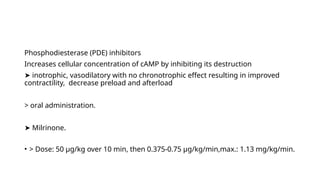
Phosphodiesterase (PDE) inhibitors
Increasescellular concentration of cAMP by inhibiting its destruction
➤ inotrophic, vasodilatory with no chronotrophic effect resulting in improved
contractility, decrease preload and afterload
> oral administration.
➤ Milrinone.
• > Dose: 50 µg/kg over 10 min, then 0.375-0.75 µg/kg/min,max.: 1.13 mg/kg/min.
15.
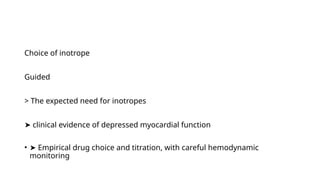
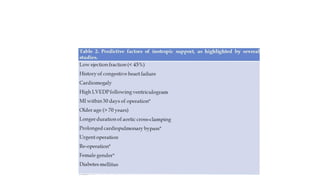
Choice of inotrope
Guided
>The expected need for inotropes
➤ clinical evidence of depressed myocardial function
• ➤ Empirical drug choice and titration, with careful hemodynamic
monitoring
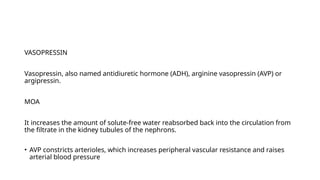
VASOPRESSIN
Vasopressin, also namedantidiuretic hormone (ADH), arginine vasopressin (AVP) or
argipressin.
MOA
It increases the amount of solute-free water reabsorbed back into the circulation from
the filtrate in the kidney tubules of the nephrons.
• AVP constricts arterioles, which increases peripheral vascular resistance and raises
arterial blood pressure
19.
It has avery short half-life, between 16-24 minut
It is widely distributed throughout the body and remains in the
extracellular fluid. It is degraded by the liver and excreted through the
kidneys.
Vasopressin infusions are also used as second line therapy for septic
shock.
• Dose start 0.1 unit/hr to 2.4 unit/hr
20.
Conclusion
Postoperative myocardial dysfunctionis a major concern in the setting
of cardiac surgery since it is extremely frequent and is related to a
greater morbidity and mortality.
Inotropic drugs are nowadays an important therapeutic tools in the
treatment of perioperative heart failure.
• Good selection usually guide our outcome.