Gold & Its Introduction
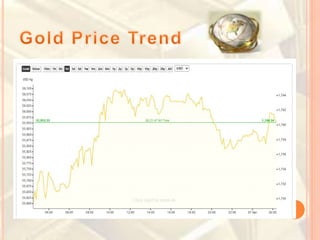
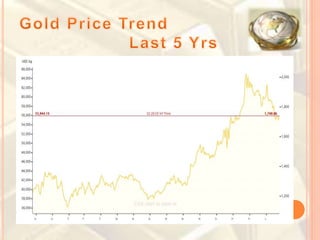
Gold Price Trend
Factors Affecting Gold Prices
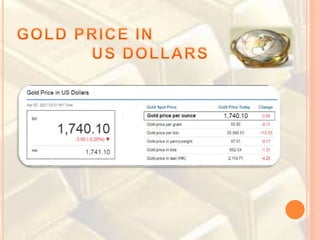
Gold Prices In US Dollars
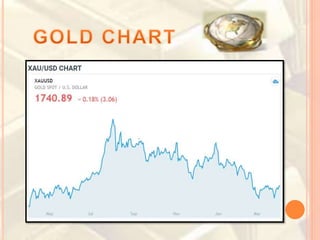
Gold Chart
 Gold is a chemical element with symbol Au and
atomic number 79.
 In its purest form, it is a bright, slightly reddish
yellow, dense, soft, malleable and ductile metal.
 It is one of the least reactive chemical elements,
and is solid under standard conditions.
 It occurs often in free elemental (native) form, as
nuggets or grains, in rocks, in veins and in alluvial
deposits.
 It occurs in a solid solution series with the native
element silver (as electrum) and also naturally
alloyed with copper and palladium.
Precious & finite natural commodity
 60% Jwellery
 India & China at the forefront of
consumption
 World Gold Council's GDT
 Toppers: South Africa, United States,
Australia & Indonesia
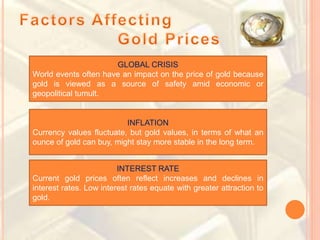
GLOBAL CRISIS
World events often have an impact on the price of gold because
gold is viewed as a source of safety amid economic or
geopolitical tumult.
INFLATION
Currency values fluctuate, but gold values, in terms of what an
ounce of gold can buy, might stay more stable in the long term.
INTEREST RATE
Current gold prices often reflect increases and declines in
interest rates. Low interest rates equate with greater attraction to
gold.
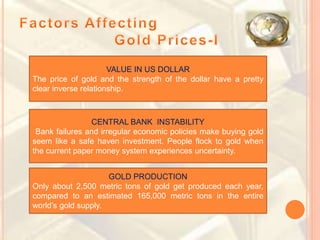
VALUE IN US DOLLAR
The price of gold and the strength of the dollar have a pretty
clear inverse relationship.
CENTRAL BANK INSTABILITY
Bank failures and irregular economic policies make buying gold
seem like a safe haven investment. People flock to gold when
the current paper money system experiences uncertainty.
GOLD PRODUCTION
Only about 2,500 metric tons of gold get produced each year,
compared to an estimated 165,000 metric tons in the entire
world’s gold supply.
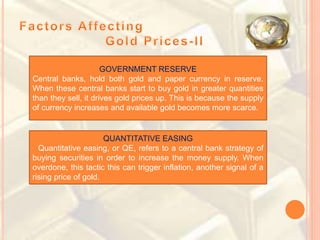
GOVERNMENT RESERVE
Central banks, hold both gold and paper currency in reserve.
When these central banks start to buy gold in greater quantities
than they sell, it drives gold prices up. This is because the supply
of currency increases and available gold becomes more scarce.
QUANTITATIVE EASING
Quantitative easing, or QE, refers to a central bank strategy of
buying securities in order to increase the money supply. When
overdone, this tactic this can trigger inflation, another signal of a
rising price of gold.
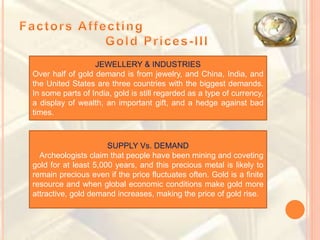
JEWELLERY & INDUSTRIES
Over half of gold demand is from jewelry, and China, India, and
the United States are three countries with the biggest demands.
In some parts of India, gold is still regarded as a type of currency,
a display of wealth, an important gift, and a hedge against bad
times.
SUPPLY Vs. DEMAND
Archeologists claim that people have been mining and coveting
gold for at least 5,000 years, and this precious metal is likely to
remain precious even if the price fluctuates often. Gold is a finite
resource and when global economic conditions make gold more
attractive, gold demand increases, making the price of gold rise.
GBIH| Gold Trading | Session  1- April-8

GBIH| Gold Trading | Session 1- April-8

  • 2.
    Gold & ItsIntroduction Gold Price Trend Factors Affecting Gold Prices Gold Prices In US Dollars Gold Chart
  • 3.
     Gold isa chemical element with symbol Au and atomic number 79.  In its purest form, it is a bright, slightly reddish yellow, dense, soft, malleable and ductile metal.  It is one of the least reactive chemical elements, and is solid under standard conditions.  It occurs often in free elemental (native) form, as nuggets or grains, in rocks, in veins and in alluvial deposits.  It occurs in a solid solution series with the native element silver (as electrum) and also naturally alloyed with copper and palladium.
  • 4.
    Precious & finitenatural commodity  60% Jwellery  India & China at the forefront of consumption  World Gold Council's GDT  Toppers: South Africa, United States, Australia & Indonesia
  • 7.
    GLOBAL CRISIS World eventsoften have an impact on the price of gold because gold is viewed as a source of safety amid economic or geopolitical tumult. INFLATION Currency values fluctuate, but gold values, in terms of what an ounce of gold can buy, might stay more stable in the long term. INTEREST RATE Current gold prices often reflect increases and declines in interest rates. Low interest rates equate with greater attraction to gold.
  • 8.
    VALUE IN USDOLLAR The price of gold and the strength of the dollar have a pretty clear inverse relationship. CENTRAL BANK INSTABILITY Bank failures and irregular economic policies make buying gold seem like a safe haven investment. People flock to gold when the current paper money system experiences uncertainty. GOLD PRODUCTION Only about 2,500 metric tons of gold get produced each year, compared to an estimated 165,000 metric tons in the entire world’s gold supply.
  • 9.
    GOVERNMENT RESERVE Central banks,hold both gold and paper currency in reserve. When these central banks start to buy gold in greater quantities than they sell, it drives gold prices up. This is because the supply of currency increases and available gold becomes more scarce. QUANTITATIVE EASING Quantitative easing, or QE, refers to a central bank strategy of buying securities in order to increase the money supply. When overdone, this tactic this can trigger inflation, another signal of a rising price of gold.
  • 10.
    JEWELLERY & INDUSTRIES Overhalf of gold demand is from jewelry, and China, India, and the United States are three countries with the biggest demands. In some parts of India, gold is still regarded as a type of currency, a display of wealth, an important gift, and a hedge against bad times. SUPPLY Vs. DEMAND Archeologists claim that people have been mining and coveting gold for at least 5,000 years, and this precious metal is likely to remain precious even if the price fluctuates often. Gold is a finite resource and when global economic conditions make gold more attractive, gold demand increases, making the price of gold rise.