COMMUNITY
DIAGNOSISD R K H A R D E A N U P
A S S I S T A N T P R O F E S S O R
D E P A R T M E N T O F C O M M U N I T Y M E D I C I N E
R M C P I M S - D U L O N I
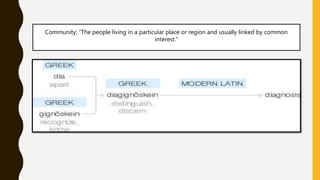
Community: “The people living in a particular place or region and usually linked by common
interest.”
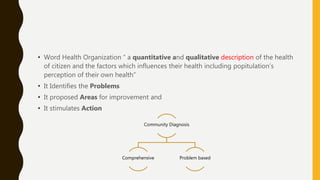
• Word Health Organization “ a quantitative and qualitative description of the health
of citizen and the factors which influences their health including popitulation’s
perception of their own health”
• It Identifies the Problems
• It proposed Areas for improvement and
• It stimulates Action
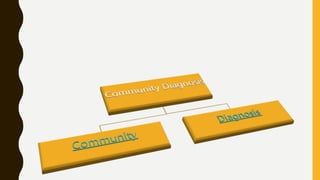
Community Diagnosis
Comprehensive Problem based
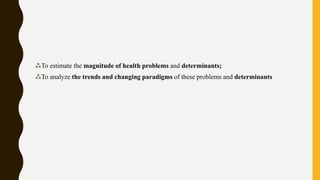
⁂To estimate the magnitude of health problems and determinants;
⁂To analyze the trends and changing paradigms of these problems and determinants
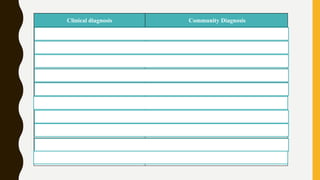
Clinical diagnosis Community Diagnosis
Made by the doctor (physician) Made by epidemiologist (or doctor)
Concerned with individual case Concerned with define population
Concerned with only sick Concerned with sick as well healthy
Examination of patients Epidemiologist conduct survey
Signs and Symptoms Natural history of disease
Laboratory investigation Epidemiological investigation
Doctors decide the treatment Epidemiologist decide the plan of action
Treatment is the main aim Prevention and Promotion is the main aim
Involves follow up cases It involves evaluation of Program
Technology advances Statistical values
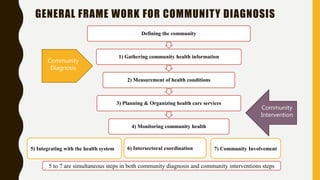
GENERAL FRAME WORK FOR COMMUNITY DIAGNOSIS
Defining the community
1) Gathering community health information
2) Measurement of health conditions
3) Planning & Organizing health care services
4) Monitoring community health
Community
Diagnosis
Community
Intervention
5) Integrating with the health system 6) Intersectoral coordination 7) Community Involvement
5 to 7 are simultaneous steps in both community diagnosis and community interventions steps
Defining the community:
o Initial step, define the target community
o Country, Province, District, or State
o More define geographical region Urban inner city
o Socially defined groups; poor community, reproductive age women, infants, elders etc.
Poor defining may cause over or under representation of sub groups
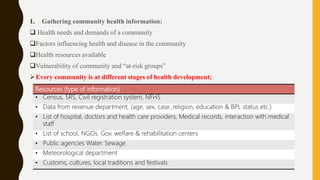
1. Gathering community health information:
 Health needs and demands of a community
Factors influencing health and disease in the community
Health resources available
Vulnerability of community and “at-risk groups”
Every community is at different stages of health development;
Resources (type of information)
• Census, SRS, Civil registration system, NFHS
• Data from revenue department, (age, sex, case ,religion, education & BPL status etc.)
• List of hospital, doctors and health care providers, Medical records, interaction with medical
staff
• List of school, NGOs. Gov. welfare & rehabilitation centers
• Public agencies Water. Sewage
• Meteorological department
• Customs, cultures, local traditions and festivals
2. Measurement of health conditions
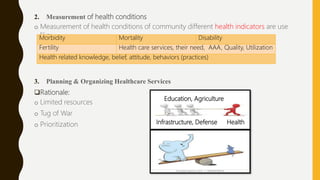
o Measurement of health conditions of community different health indicators are use
like;
3. Planning & Organizing Healthcare Services
Rationale:
o Limited resources
o Tug of War
o Prioritization
Morbidity Mortality Disability
Fertility Health care services, their need, AAA, Quality, Utilization
Health related knowledge, belief, attitude, behaviors (practices)
HealthInfrastructure, Defense
Education, Agriculture
4. Monitoring Health of Community:
o Purpose: to know the effect of community health interventions, identify the reason behind
failure and poor effects, or to do mid way correction
o Outcome indicators are used to monitor short term effects
o Impact indicators are used to monitor long term effects
5. Integrating with Health system:
o To achieve best results government health care delivery system should be integrated with local
health systems like private hospital, NGO,SNGO, academic or research institute in health
o Nature of partnership may be coordination, cooperation or collaboration
6. Intersectoral coordination:
o Health is affected by multiplicity of factors like housing conditions, air & water pollutions,
sanitary conditions etc.
o Intersectoral coordination will ensure timely warning, ensure optimum unitization of
resources and prevent duplication of work
7. Community Involvement:
o Its futile if community not utilizes the health services
o Member of the community are to be involved in each and every process of community
intervention like; health need assessment, planning of services, resources mobilization,
monitoring health situation etc.
o Community gate keepers: Local social or political or religious leaders, teachers, social
workers, office bearers of community organization

7 community diagnosis

  • 1.
    COMMUNITY DIAGNOSISD R KH A R D E A N U P A S S I S T A N T P R O F E S S O R D E P A R T M E N T O F C O M M U N I T Y M E D I C I N E R M C P I M S - D U L O N I
  • 3.
    Community: “The peopleliving in a particular place or region and usually linked by common interest.”
  • 4.
    • Word HealthOrganization “ a quantitative and qualitative description of the health of citizen and the factors which influences their health including popitulation’s perception of their own health” • It Identifies the Problems • It proposed Areas for improvement and • It stimulates Action Community Diagnosis Comprehensive Problem based
  • 5.
    ⁂To estimate themagnitude of health problems and determinants; ⁂To analyze the trends and changing paradigms of these problems and determinants
  • 6.
    Clinical diagnosis CommunityDiagnosis Made by the doctor (physician) Made by epidemiologist (or doctor) Concerned with individual case Concerned with define population Concerned with only sick Concerned with sick as well healthy Examination of patients Epidemiologist conduct survey Signs and Symptoms Natural history of disease Laboratory investigation Epidemiological investigation Doctors decide the treatment Epidemiologist decide the plan of action Treatment is the main aim Prevention and Promotion is the main aim Involves follow up cases It involves evaluation of Program Technology advances Statistical values
  • 7.
    GENERAL FRAME WORKFOR COMMUNITY DIAGNOSIS Defining the community 1) Gathering community health information 2) Measurement of health conditions 3) Planning & Organizing health care services 4) Monitoring community health Community Diagnosis Community Intervention 5) Integrating with the health system 6) Intersectoral coordination 7) Community Involvement 5 to 7 are simultaneous steps in both community diagnosis and community interventions steps
  • 8.
    Defining the community: oInitial step, define the target community o Country, Province, District, or State o More define geographical region Urban inner city o Socially defined groups; poor community, reproductive age women, infants, elders etc. Poor defining may cause over or under representation of sub groups
  • 9.
    1. Gathering communityhealth information:  Health needs and demands of a community Factors influencing health and disease in the community Health resources available Vulnerability of community and “at-risk groups” Every community is at different stages of health development; Resources (type of information) • Census, SRS, Civil registration system, NFHS • Data from revenue department, (age, sex, case ,religion, education & BPL status etc.) • List of hospital, doctors and health care providers, Medical records, interaction with medical staff • List of school, NGOs. Gov. welfare & rehabilitation centers • Public agencies Water. Sewage • Meteorological department • Customs, cultures, local traditions and festivals
  • 10.
    2. Measurement ofhealth conditions o Measurement of health conditions of community different health indicators are use like; 3. Planning & Organizing Healthcare Services Rationale: o Limited resources o Tug of War o Prioritization Morbidity Mortality Disability Fertility Health care services, their need, AAA, Quality, Utilization Health related knowledge, belief, attitude, behaviors (practices) HealthInfrastructure, Defense Education, Agriculture
  • 11.
    4. Monitoring Healthof Community: o Purpose: to know the effect of community health interventions, identify the reason behind failure and poor effects, or to do mid way correction o Outcome indicators are used to monitor short term effects o Impact indicators are used to monitor long term effects 5. Integrating with Health system: o To achieve best results government health care delivery system should be integrated with local health systems like private hospital, NGO,SNGO, academic or research institute in health o Nature of partnership may be coordination, cooperation or collaboration
  • 12.
    6. Intersectoral coordination: oHealth is affected by multiplicity of factors like housing conditions, air & water pollutions, sanitary conditions etc. o Intersectoral coordination will ensure timely warning, ensure optimum unitization of resources and prevent duplication of work
  • 13.
    7. Community Involvement: oIts futile if community not utilizes the health services o Member of the community are to be involved in each and every process of community intervention like; health need assessment, planning of services, resources mobilization, monitoring health situation etc. o Community gate keepers: Local social or political or religious leaders, teachers, social workers, office bearers of community organization

Editor's Notes

  • #2 Reference books Red book Chapter 69 Oxford textbook of global public health Section 4.2 Text book of community medicine AM Kadri Ed.1st
  • #4 Community is defined as cluster of people with at least one characteristics such as geographic location, occupation, ethnicity, housing conditions, exposure to similar risk factors, E,g. mine workers: constitute a community similar risk of exposure to occupational hazards o
  • #5 Where the community stands now; where it wants to reach; and how it will get there ? Comprehensive: collect more general information: demographic, sociocultural, economic, health related, resources available Problem based: More specific, to address its solutions
  • #6 Identifying the Needs as felt by the community (some of which may have no connection at all with health Should be investigated and listed according to priority for community treatment
  • #8 5 to 7 are not subsequent stops but simultaneous supplementary s
  • #10 Every community is invariably different from each other; sociodemographic, health issues, availability of resources, environmental and climatic conditions etc.
  • #11 In conventional clinical practice to assess health of individual we do inspection, auscultation, palpitation and investigation if necessary AAA: affordability, availability and accessibility Even rich country may not have enough resources to meet all health needs of its community
  • #12 In conventional clinical practice to monitor the health conditions, follow up visit/rounds are carried out, changes in sign & symptoms are monitored, changes in vitals like temperature, pulse BP etc are recorded with laboratory and radiological investigation. Home wok find PPP model of health care delivery
  • #14 Community gatekeeper or Opinion makers