Investigating Thrillers
John Roberts
Thrillers
■ Protagonist vs Antagonist.
■ Protagonist usually fighting to restore equilibrium, narrative rarely under their
control.
■ Focus on tension throughout the film.
■ Low lighting, emphasis on shadows and darkness
■ Tense, usually classical, soundtrack. Focus on diegetic sound.
■ Fast cuts, lots of camera changes. Frequent use of cross-cutting.
■ Protagonist has lots of close-ups and extreme close-ups, to display emotion.
■ Antagonist usually shown in shadow from distant shots.
Fatal Attraction
■ Extended close-ups build tension, suggest they are hiding something
■ Static shots imply discomfort
■ Camera jumps inward as tension increases.
■ No non-diegetic sound used, makes it as if the audience were in the scene.
■ Low angle shows power of both characters, tension in the ‘clash’ of two powers.
■ Dutch tilt shows something is psychologically wrong with Alex.
Panic Room
■ Slow motion, increases tension through audience anticipation.
■ Monosyllabic dialogue punctuates following lack of sound.
■ Cross cutting creates a sort of dramatic irony.
■ Drone is added as tension increases.
■ Low key lighting. Creates a ‘dark’ effect.
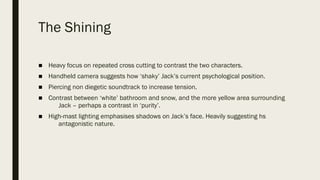
The Shining
■ Heavy focus on repeated cross cutting to contrast the two characters.
■ Handheld camera suggests how ‘shaky’ Jack’s current psychological position.
■ Piercing non diegetic soundtrack to increase tension.
■ Contrast between ‘white’ bathroom and snow, and the more yellow area surrounding
Jack – perhaps a contrast in ‘purity’.
■ High-mast lighting emphasises shadows on Jack’s face. Heavily suggesting hs
antagonistic nature.
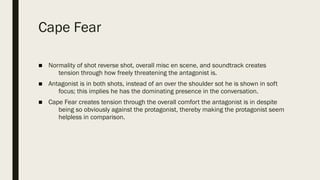
Cape Fear
■ Normality of shot reverse shot, overall misc en scene, and soundtrack creates
tension through how freely threatening the antagonist is.
■ Antagonist is in both shots, instead of an over the shoulder sot he is shown in soft
focus; this implies he has the dominating presence in the conversation.
■ Cape Fear creates tension through the overall comfort the antagonist is in despite
being so obviously against the protagonist, thereby making the protagonist seem
helpless in comparison.
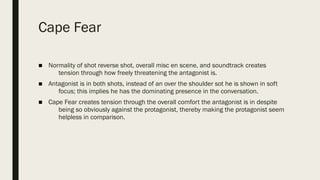
Cape Fear
■ Normality of shot reverse shot, overall misc en scene, and soundtrack creates
tension through how freely threatening the antagonist is.
■ Antagonist is in both shots, instead of an over the shoulder sot he is shown in soft
focus; this implies he has the dominating presence in the conversation.
■ Cape Fear creates tension through the overall comfort the antagonist is in despite
being so obviously against the protagonist, thereby making the protagonist seem
helpless in comparison.

Investigating Thrillers

  • 1.
  • 2.
    Thrillers ■ Protagonist vsAntagonist. ■ Protagonist usually fighting to restore equilibrium, narrative rarely under their control. ■ Focus on tension throughout the film. ■ Low lighting, emphasis on shadows and darkness ■ Tense, usually classical, soundtrack. Focus on diegetic sound. ■ Fast cuts, lots of camera changes. Frequent use of cross-cutting. ■ Protagonist has lots of close-ups and extreme close-ups, to display emotion. ■ Antagonist usually shown in shadow from distant shots.
  • 3.
    Fatal Attraction ■ Extendedclose-ups build tension, suggest they are hiding something ■ Static shots imply discomfort ■ Camera jumps inward as tension increases. ■ No non-diegetic sound used, makes it as if the audience were in the scene. ■ Low angle shows power of both characters, tension in the ‘clash’ of two powers. ■ Dutch tilt shows something is psychologically wrong with Alex.
  • 4.
    Panic Room ■ Slowmotion, increases tension through audience anticipation. ■ Monosyllabic dialogue punctuates following lack of sound. ■ Cross cutting creates a sort of dramatic irony. ■ Drone is added as tension increases. ■ Low key lighting. Creates a ‘dark’ effect.
  • 5.
    The Shining ■ Heavyfocus on repeated cross cutting to contrast the two characters. ■ Handheld camera suggests how ‘shaky’ Jack’s current psychological position. ■ Piercing non diegetic soundtrack to increase tension. ■ Contrast between ‘white’ bathroom and snow, and the more yellow area surrounding Jack – perhaps a contrast in ‘purity’. ■ High-mast lighting emphasises shadows on Jack’s face. Heavily suggesting hs antagonistic nature.
  • 6.
    Cape Fear ■ Normalityof shot reverse shot, overall misc en scene, and soundtrack creates tension through how freely threatening the antagonist is. ■ Antagonist is in both shots, instead of an over the shoulder sot he is shown in soft focus; this implies he has the dominating presence in the conversation. ■ Cape Fear creates tension through the overall comfort the antagonist is in despite being so obviously against the protagonist, thereby making the protagonist seem helpless in comparison.
  • 7.
    Cape Fear ■ Normalityof shot reverse shot, overall misc en scene, and soundtrack creates tension through how freely threatening the antagonist is. ■ Antagonist is in both shots, instead of an over the shoulder sot he is shown in soft focus; this implies he has the dominating presence in the conversation. ■ Cape Fear creates tension through the overall comfort the antagonist is in despite being so obviously against the protagonist, thereby making the protagonist seem helpless in comparison.