Hydrology & Water Storage
Structures
18 - Batch
Main Topics
1. Surface Water Hydrology
2. Ground Water Hydrology
3. Quality of Water
4. Basic Principles and Equations
5. Diversion Head Works
6. Theories of Seepage and Design of Weir & Barrage
7. Dams in General
8. Reservoir Planning and management
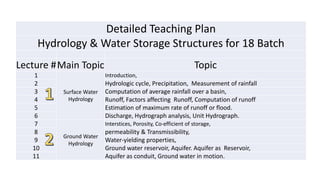
Detailed Teaching Plan
Hydrology & Water Storage Structures for 18 Batch
Lecture #Main Topic Topic
1
Surface Water
Hydrology
Introduction,
2 Hydrologic cycle, Precipitation, Measurement of rainfall
3 Computation of average rainfall over a basin,
4 Runoff, Factors affecting Runoff, Computation of runoff
5 Estimation of maximum rate of runoff or flood.
6 Discharge, Hydrograph analysis, Unit Hydrograph.
7
Ground Water
Hydrology
Interstices, Porosity, Co-efficient of storage,
8 permeability & Transmissibility,
9 Water-yielding properties,
10 Ground water reservoir, Aquifer. Aquifer as Reservoir,
11 Aquifer as conduit, Ground water in motion.
Detailed Teaching Plan
Hydrology & Water Storage Structures for 18 Batch
Lecture #Main Topic Topic
12
Quality of Water
Quality of water, Methods of indicating quality,
13 Salt concentration and its Limits for irrigation water,
14 Quality of water in the Indus plain.
15 Assignment Day
16
Basic Principles and
Equations
Darcy’s law, Volume elasticity of aquifer,
17 Differential equation governing Ground water flow,
18 hydraulic boundaries, Flow form and to stream,
19 Flow net,
20 Numerical analysis of water levels.
21
Diversion Head
Works
Difference between weir, barrage and head works;
22 Layout of diversion head works. The diversion weir,
23 Types and components of diversion weir.
24
The canal head regulator, canal regulation and silt control at the head
works.
Detailed Teaching Plan
Hydrology & Water Storage Structures for 18 Batch
Lecture #Main Topic Topic
25
Theories of
Seepage and
Design of Weir &
Barrage
Causes of failure by piping and direct uplift, Safely against piping and
uplift
26 Bligh`s Theory, Lane`s theory,
27 Khosla`s theory and concept of flow nets,
28 Stream lines and equipotential lines, Critical gradient,
29
Khosla`s method of independent variables for determination of pressure
an exit gradient below a weir or barrage,
30 Khosla`s simple standard profiles,
31 Design examples of barrage, head regulator, etc.
32
Cross regulator and its design, Canal outlets or Modules, Types of
moudules.
Detailed Teaching Plan
Hydrology & Water Storage Structures for 17 Batch
Lectur
e #
Main Topic
Topic
33
Dams in General
Introduction, necessity and purpose of water storage infrastructure, types of
dams,
34 Earthen dams, Gravity dam, site investigation,
35 factors to be considered in selecting type of dam, design of gravity dam,
36 forces acting on gravity dam,
37 stability analysis of gravity dam
38
Reservoir Planning and
management
Types of reservoirs, Flood control reservoir Multi purpose reservoir
39 Capacity of reservoirs, Storage zones of reservoirs, Reservoir yield,
40 Estimation of demands and optimal reservoir operation,
41
Flood routing or flood absorption, Reservoir sedimentation, Silt control in
reservoir,
42 selection of suitable site for reservoir
43 Economics of combined project,
44 Cost-benefit consideration and general principle of optimizing capital budget.
Assignments
• To be decided
Attendance
• Will be taken online.
Questions / Suggestions
• End of Lecture.

introduction.pptx

  • 1.
    Hydrology & WaterStorage Structures 18 - Batch
  • 2.
    Main Topics 1. SurfaceWater Hydrology 2. Ground Water Hydrology 3. Quality of Water 4. Basic Principles and Equations 5. Diversion Head Works 6. Theories of Seepage and Design of Weir & Barrage 7. Dams in General 8. Reservoir Planning and management
  • 3.
    Detailed Teaching Plan Hydrology& Water Storage Structures for 18 Batch Lecture #Main Topic Topic 1 Surface Water Hydrology Introduction, 2 Hydrologic cycle, Precipitation, Measurement of rainfall 3 Computation of average rainfall over a basin, 4 Runoff, Factors affecting Runoff, Computation of runoff 5 Estimation of maximum rate of runoff or flood. 6 Discharge, Hydrograph analysis, Unit Hydrograph. 7 Ground Water Hydrology Interstices, Porosity, Co-efficient of storage, 8 permeability & Transmissibility, 9 Water-yielding properties, 10 Ground water reservoir, Aquifer. Aquifer as Reservoir, 11 Aquifer as conduit, Ground water in motion.
  • 4.
    Detailed Teaching Plan Hydrology& Water Storage Structures for 18 Batch Lecture #Main Topic Topic 12 Quality of Water Quality of water, Methods of indicating quality, 13 Salt concentration and its Limits for irrigation water, 14 Quality of water in the Indus plain. 15 Assignment Day 16 Basic Principles and Equations Darcy’s law, Volume elasticity of aquifer, 17 Differential equation governing Ground water flow, 18 hydraulic boundaries, Flow form and to stream, 19 Flow net, 20 Numerical analysis of water levels. 21 Diversion Head Works Difference between weir, barrage and head works; 22 Layout of diversion head works. The diversion weir, 23 Types and components of diversion weir. 24 The canal head regulator, canal regulation and silt control at the head works.
  • 5.
    Detailed Teaching Plan Hydrology& Water Storage Structures for 18 Batch Lecture #Main Topic Topic 25 Theories of Seepage and Design of Weir & Barrage Causes of failure by piping and direct uplift, Safely against piping and uplift 26 Bligh`s Theory, Lane`s theory, 27 Khosla`s theory and concept of flow nets, 28 Stream lines and equipotential lines, Critical gradient, 29 Khosla`s method of independent variables for determination of pressure an exit gradient below a weir or barrage, 30 Khosla`s simple standard profiles, 31 Design examples of barrage, head regulator, etc. 32 Cross regulator and its design, Canal outlets or Modules, Types of moudules.
  • 6.
    Detailed Teaching Plan Hydrology& Water Storage Structures for 17 Batch Lectur e # Main Topic Topic 33 Dams in General Introduction, necessity and purpose of water storage infrastructure, types of dams, 34 Earthen dams, Gravity dam, site investigation, 35 factors to be considered in selecting type of dam, design of gravity dam, 36 forces acting on gravity dam, 37 stability analysis of gravity dam 38 Reservoir Planning and management Types of reservoirs, Flood control reservoir Multi purpose reservoir 39 Capacity of reservoirs, Storage zones of reservoirs, Reservoir yield, 40 Estimation of demands and optimal reservoir operation, 41 Flood routing or flood absorption, Reservoir sedimentation, Silt control in reservoir, 42 selection of suitable site for reservoir 43 Economics of combined project, 44 Cost-benefit consideration and general principle of optimizing capital budget.
  • 7.
  • 8.
  • 9.
  • 10.
    • End ofLecture.