Fundamentals of Water
ResourcesPlanning and
Development
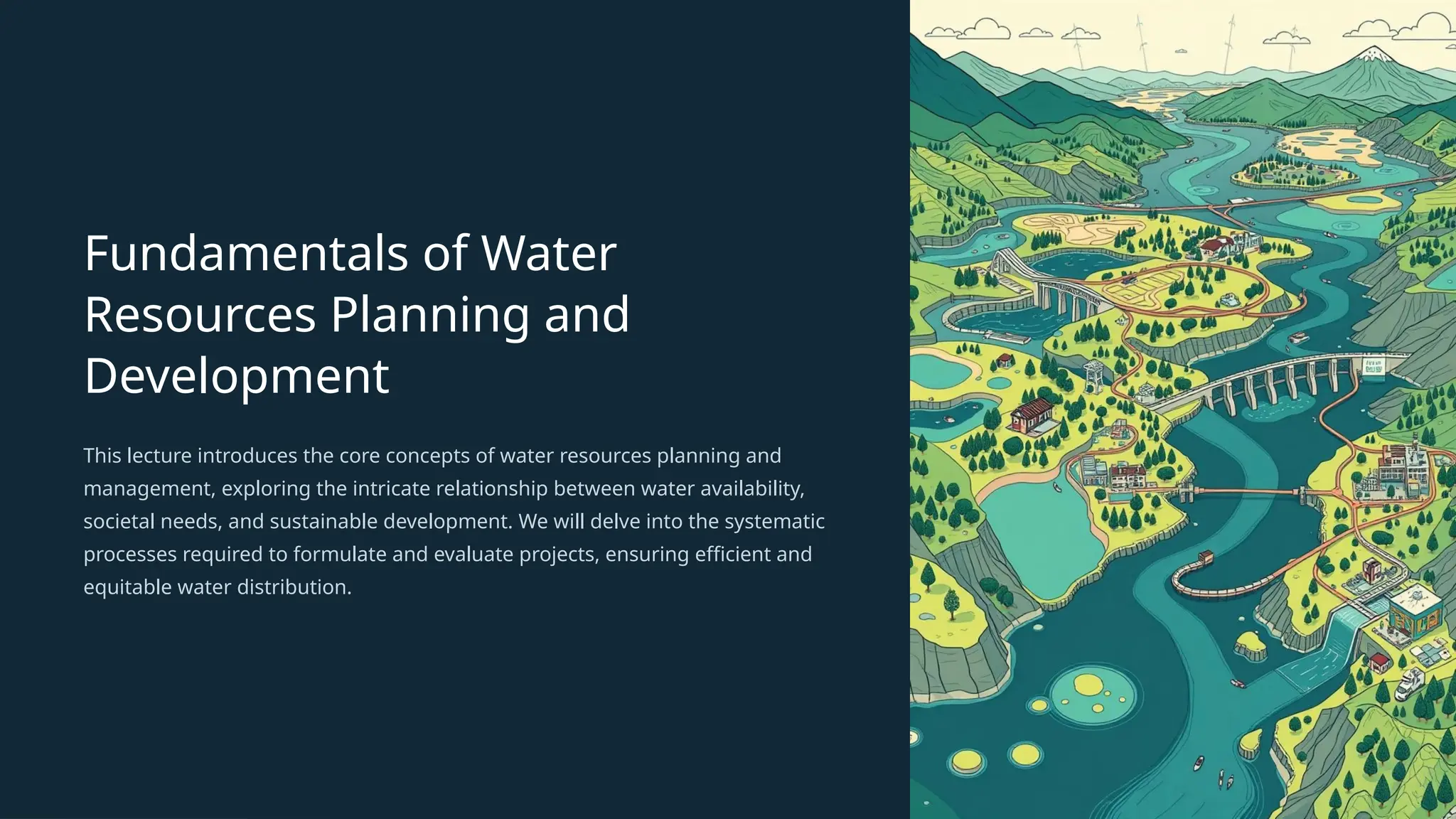
This lecture introduces the core concepts of water resources planning and
management, exploring the intricate relationship between water availability,
societal needs, and sustainable development. We will delve into the systematic
processes required to formulate and evaluate projects, ensuring efficient and
equitable water distribution.
2.
Introduction to WaterResources Systems Planning and Management
Water resources planning is a systematic process of formulating and evaluating alternative projects to meet various water-related
objectives. It involves comprehensive data collection on water availability, future needs, and potential environmental impacts. This
process is crucial for sustainable development and resource allocation.
Water planning is unique due to the inherent uncertainty in water availability and its high demand, often leading to potential
conflicts. It encompasses complex technical, political, and social dimensions, requiring interdisciplinary approaches for
effective solutions.
3.
Stakeholders in WaterPlanning
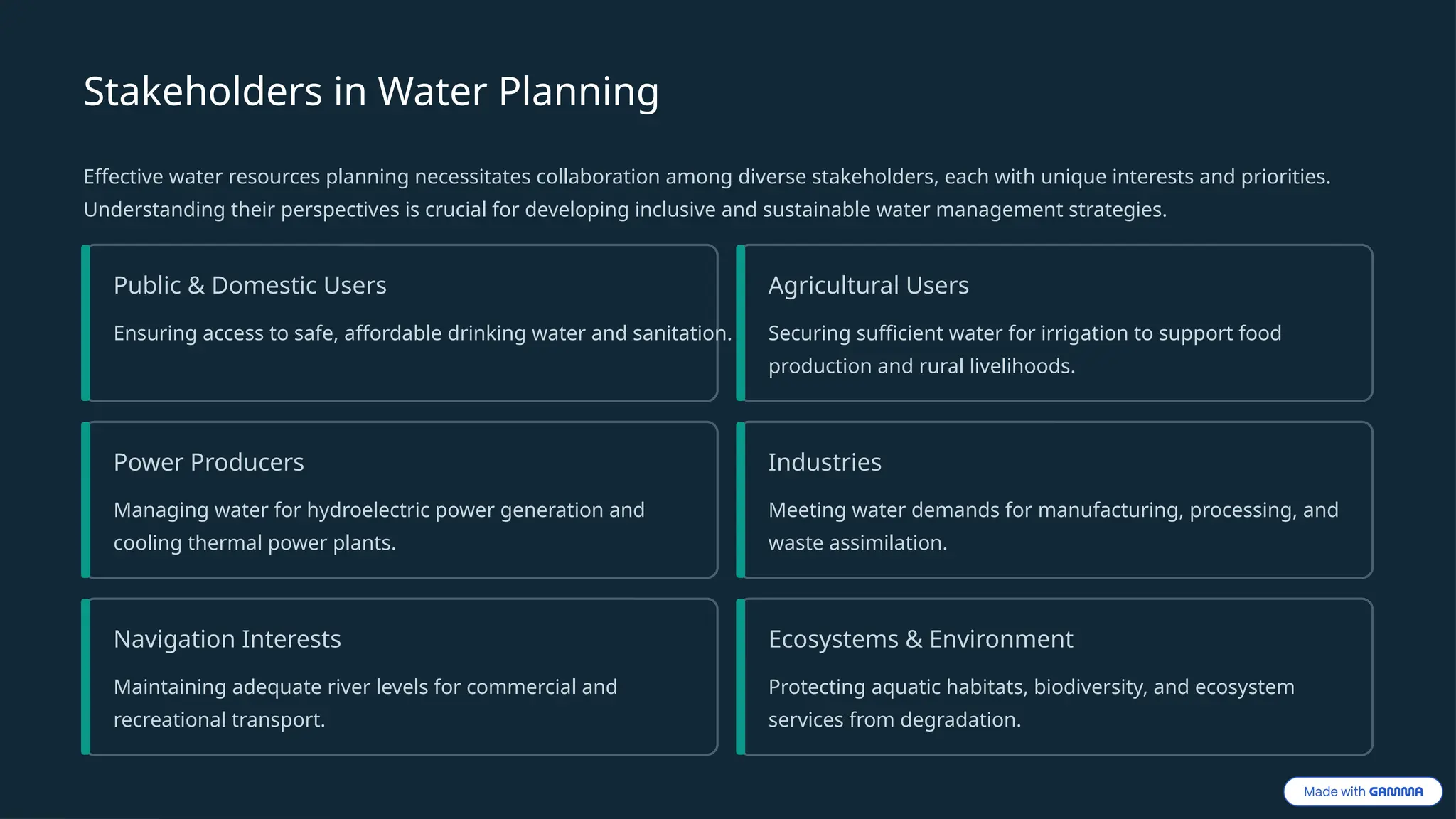
Effective water resources planning necessitates collaboration among diverse stakeholders, each with unique interests and priorities.
Understanding their perspectives is crucial for developing inclusive and sustainable water management strategies.
Public & Domestic Users
Ensuring access to safe, affordable drinking water and sanitation.
Agricultural Users
Securing sufficient water for irrigation to support food
production and rural livelihoods.
Power Producers
Managing water for hydroelectric power generation and
cooling thermal power plants.
Industries
Meeting water demands for manufacturing, processing, and
waste assimilation.
Navigation Interests
Maintaining adequate river levels for commercial and
recreational transport.
Ecosystems & Environment
Protecting aquatic habitats, biodiversity, and ecosystem
services from degradation.
4.
Levels of WaterResources Planning
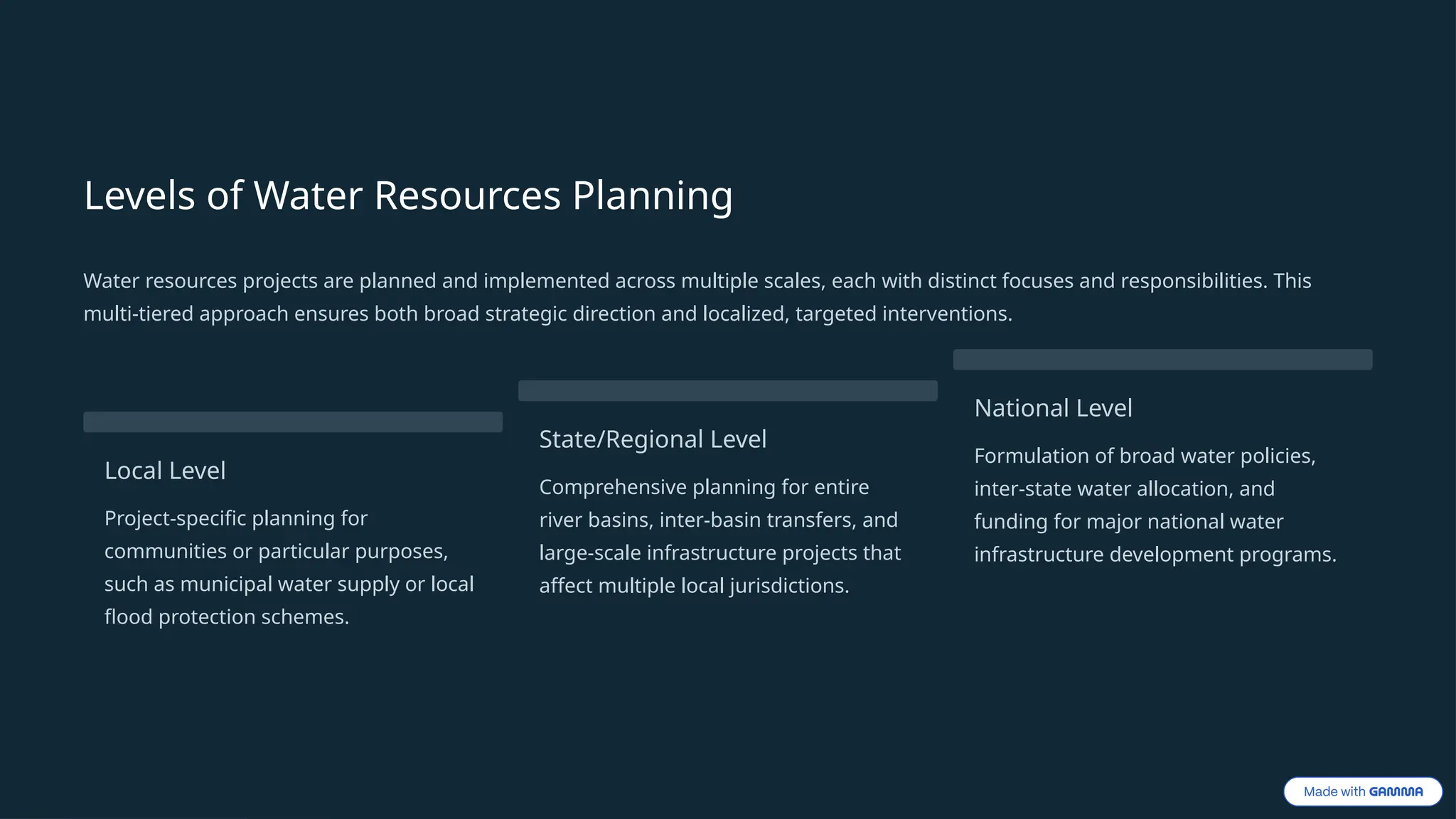
Water resources projects are planned and implemented across multiple scales, each with distinct focuses and responsibilities. This
multi-tiered approach ensures both broad strategic direction and localized, targeted interventions.
Local Level
Project-specific planning for
communities or particular purposes,
such as municipal water supply or local
flood protection schemes.
State/Regional Level
Comprehensive planning for entire
river basins, inter-basin transfers, and
large-scale infrastructure projects that
affect multiple local jurisdictions.
National Level
Formulation of broad water policies,
inter-state water allocation, and
funding for major national water
infrastructure development programs.
5.
Functional Requirements ofWater Resources Projects
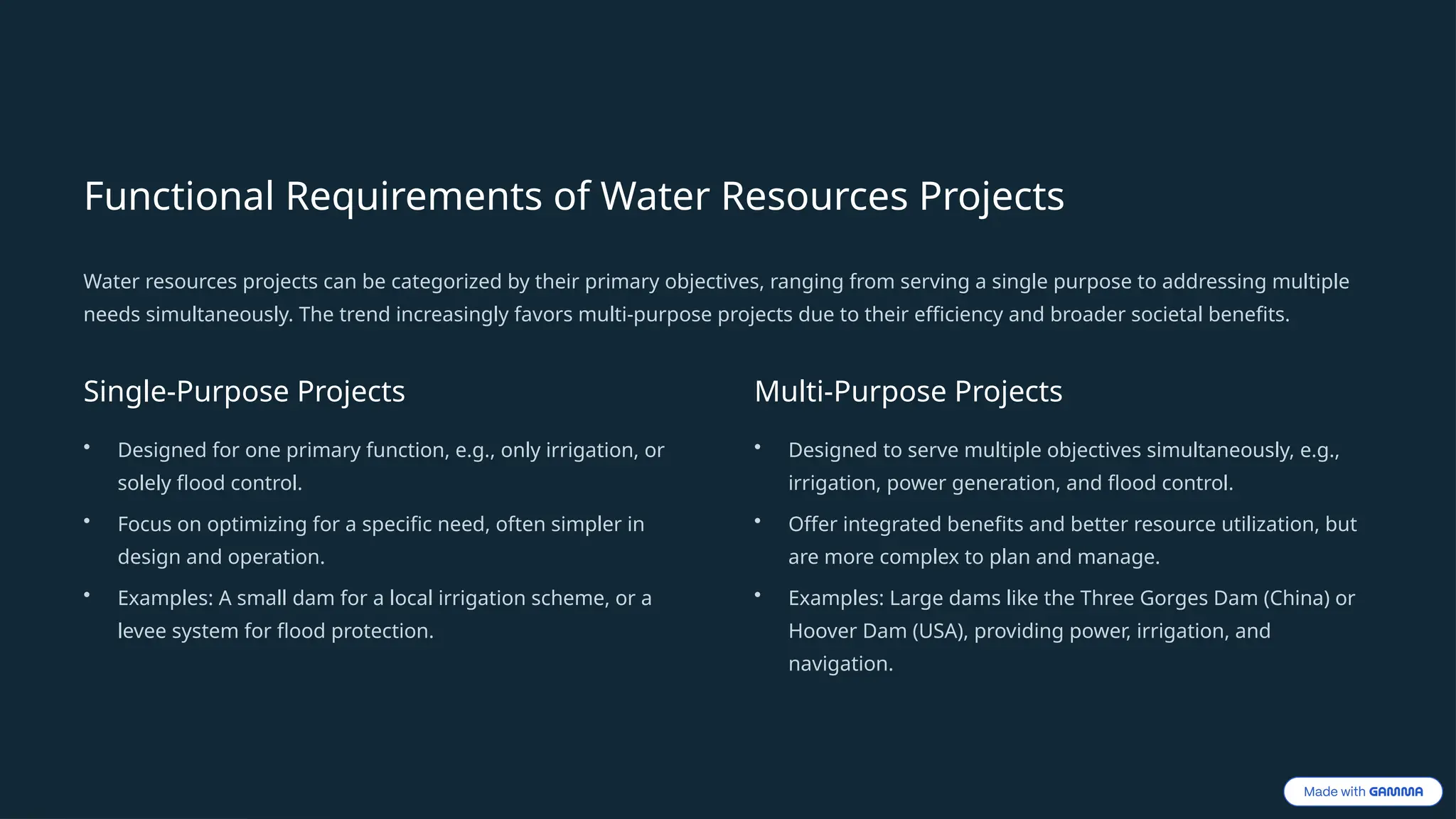
Water resources projects can be categorized by their primary objectives, ranging from serving a single purpose to addressing multiple
needs simultaneously. The trend increasingly favors multi-purpose projects due to their efficiency and broader societal benefits.
Single-Purpose Projects
• Designed for one primary function, e.g., only irrigation, or
solely flood control.
• Focus on optimizing for a specific need, often simpler in
design and operation.
• Examples: A small dam for a local irrigation scheme, or a
levee system for flood protection.
Multi-Purpose Projects
• Designed to serve multiple objectives simultaneously, e.g.,
irrigation, power generation, and flood control.
• Offer integrated benefits and better resource utilization, but
are more complex to plan and manage.
• Examples: Large dams like the Three Gorges Dam (China) or
Hoover Dam (USA), providing power, irrigation, and
navigation.
6.
Developing the RelationshipBetween Need and Source: Data
Collection
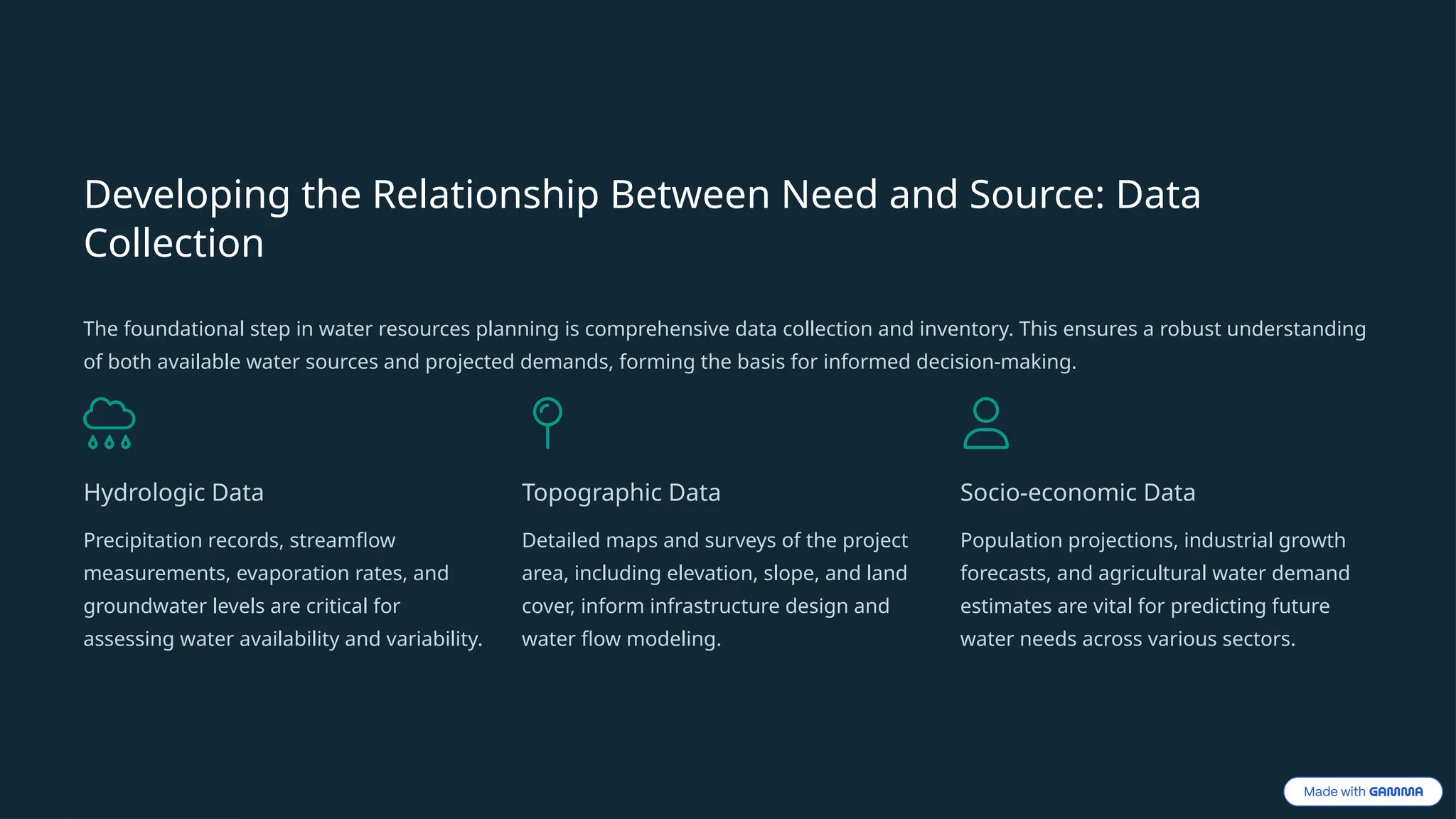
The foundational step in water resources planning is comprehensive data collection and inventory. This ensures a robust understanding
of both available water sources and projected demands, forming the basis for informed decision-making.
Hydrologic Data
Precipitation records, streamflow
measurements, evaporation rates, and
groundwater levels are critical for
assessing water availability and variability.
Topographic Data
Detailed maps and surveys of the project
area, including elevation, slope, and land
cover, inform infrastructure design and
water flow modeling.
Socio-economic Data
Population projections, industrial growth
forecasts, and agricultural water demand
estimates are vital for predicting future
water needs across various sectors.
7.
Forecasting and AssessingWater Balance
Once data is collected, the next crucial steps involve projecting future water demands and rigorously assessing water availability. This
process establishes the crucial "need-source" relationship that underpins all water resource development.
Projecting Future Water Demands
This involves forecasting future water needs based on
anticipated population growth, economic development,
technological advancements in water use efficiency, and shifts in
agricultural practices. Various models and scenarios are used to
predict demand for domestic, industrial, and agricultural sectors,
considering climatic variations and potential behavioral changes.
Assessing Water Availability
Analyzing historical hydrologic data, conducting comprehensive
water balance studies, and employing hydrological models are
essential to determine the reliable yield from surface water
sources (rivers, lakes) and groundwater aquifers. This
assessment considers natural variability, climate change impacts,
and existing water rights.
8.
The Planning Cycle:From Needs to Implementation
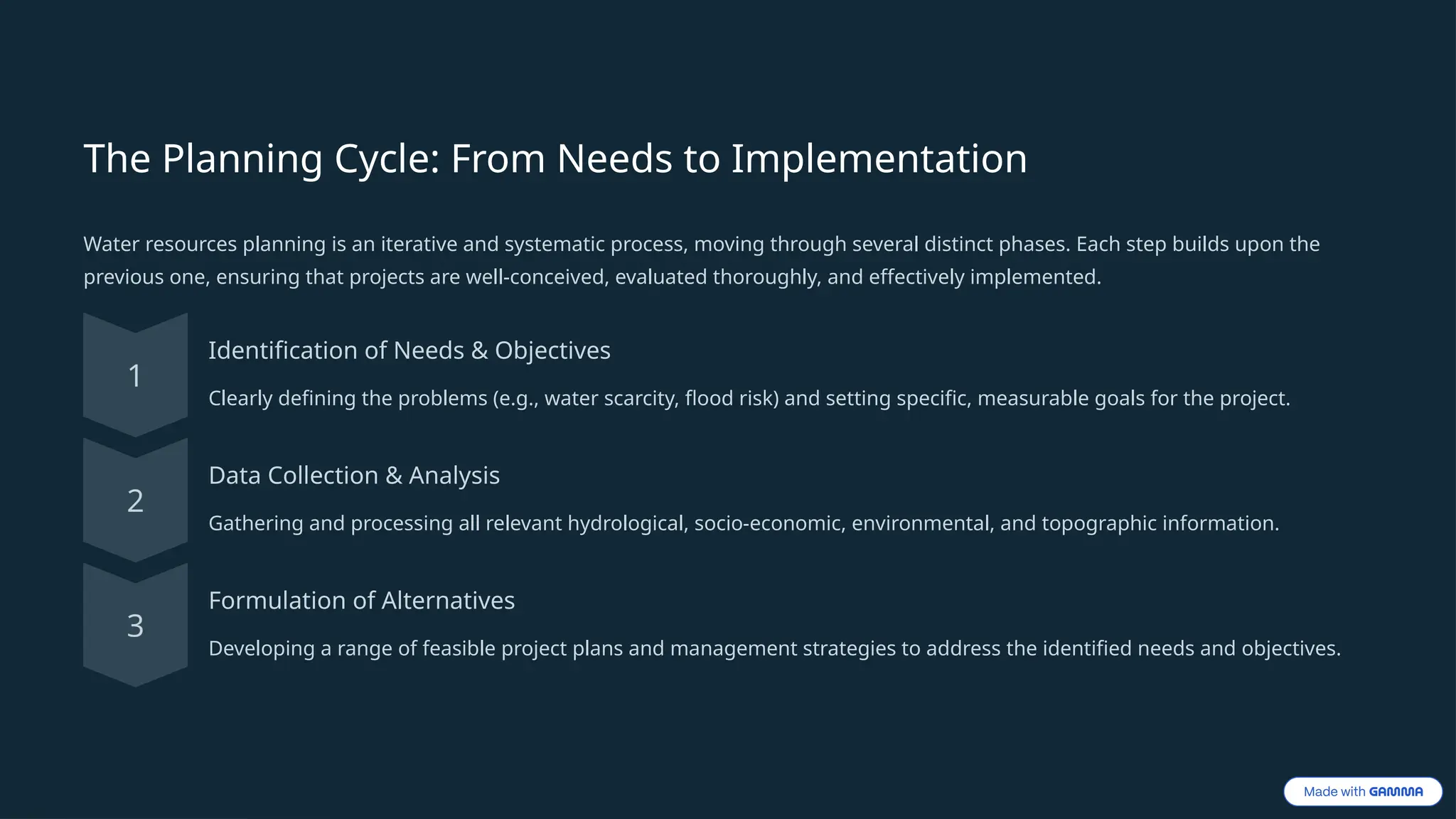
Water resources planning is an iterative and systematic process, moving through several distinct phases. Each step builds upon the
previous one, ensuring that projects are well-conceived, evaluated thoroughly, and effectively implemented.
Identification of Needs & Objectives
Clearly defining the problems (e.g., water scarcity, flood risk) and setting specific, measurable goals for the project.
Data Collection & Analysis
Gathering and processing all relevant hydrological, socio-economic, environmental, and topographic information.
Formulation of Alternatives
Developing a range of feasible project plans and management strategies to address the identified needs and objectives.
9.
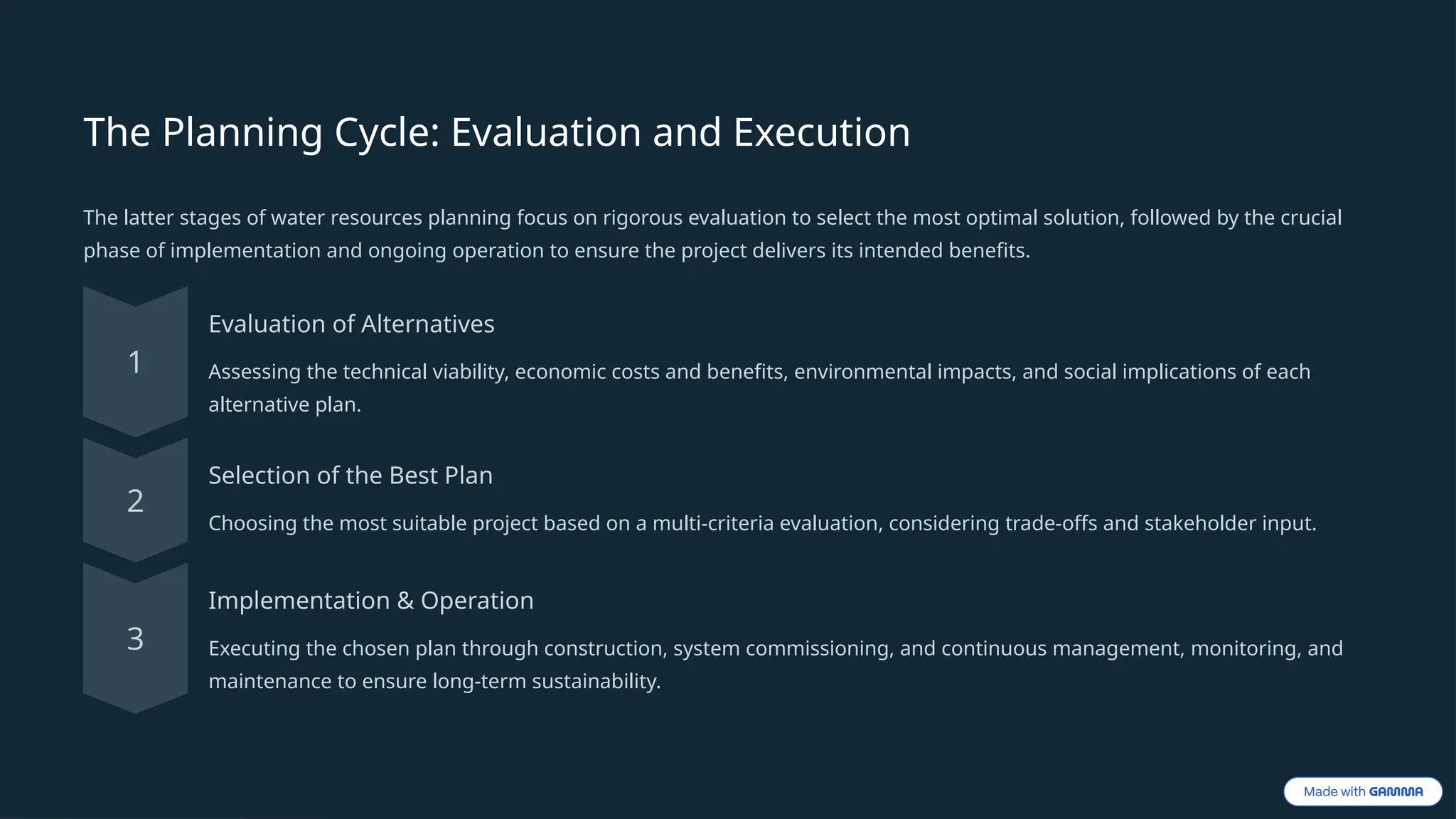
The Planning Cycle:Evaluation and Execution
The latter stages of water resources planning focus on rigorous evaluation to select the most optimal solution, followed by the crucial
phase of implementation and ongoing operation to ensure the project delivers its intended benefits.
Evaluation of Alternatives
Assessing the technical viability, economic costs and benefits, environmental impacts, and social implications of each
alternative plan.
Selection of the Best Plan
Choosing the most suitable project based on a multi-criteria evaluation, considering trade-offs and stakeholder input.
Implementation & Operation
Executing the chosen plan through construction, system commissioning, and continuous management, monitoring, and
maintenance to ensure long-term sustainability.
10.
Key Takeaways &Next Steps
Water resources planning is a dynamic and essential field. We've covered the foundational elements, from understanding the unique
nature of water as a resource to the systematic steps involved in planning and development. Your role as future engineers will be
pivotal in navigating these complexities.
Systematic Approach: Recognize planning as a multi-stage, iterative process.
Multifaceted Challenges: Appreciate the technical, social, and political dimensions of water management.
Stakeholder Engagement: Understand the importance of involving diverse interests for sustainable outcomes.
Data-Driven Decisions: Emphasize the critical role of comprehensive data in all planning phases.
In our next lecture, we will explore economic considerations and financing mechanisms for water resources projects.