Download to read offline
![An Introduction to Brownian Motion
Kimthanh Nguyen
May 19, 2016
1 Introduction
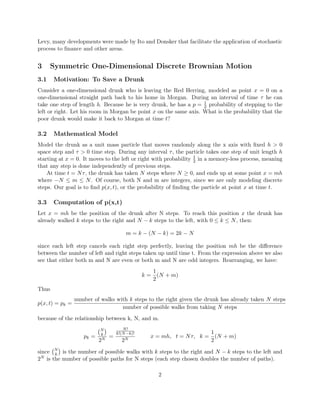
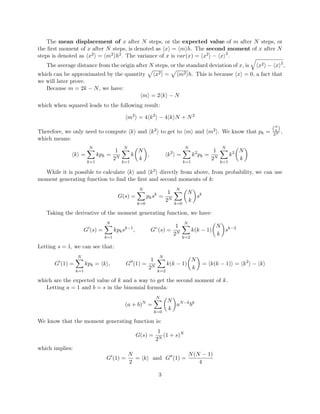
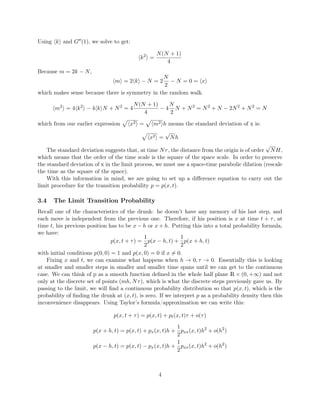
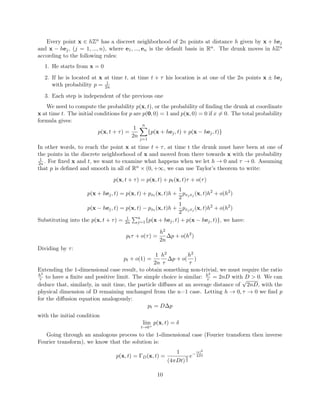
Brownian motion is the jittery movement observed in 2 dimensions under a microscope when parti-
cles bounce around in 3 dimensions. Originally discovered by a biologist, Robert Brown, Brownian
motion is modeled as a stochastic process. This is also called a Wiener process with the operator
1
2∆.
For this paper, I will start with a one-dimensional discrete Brownian motion, motivated by the
story of a drunk trying to find his way home. Using the analogue of the drunk and his quest home
walking in a straight line (and his expected probability of making it back home), I explore important
characteristics of Brownian motion: (1) that it is a memory-less process (also known as Markov), (2)
that it is homogeneous in regards to time and space, and finally, (3) by taking the limit of discrete
steps of the drunk, we get continuous Brownian motion of a particle.
After the one-dimensional case, I will explore the symmetric n-dimensional case leading to a
unique solution. Starting with a more realistic drunk, I once again discover his expected probability
of making it home. This is accomplished using lattice and point coordinate remodeling. Then, by
taking the limit of the discrete steps, I will get to particle diffusion and solve using the Brownian
motion partial differential equation and its initial condition. The progression follows Salsa’s Chapter
2: Diffusion in his book Partial Differential Equations in Action [4].
2 History
In 1827, Robert Brown, a biologist, noticed unusual "motions" of particles inside of pollen grains
under his microscope. The pollen grains were suspended in water and had a jittery movement.
He attributed this motion to "being alive." The actual cause for this motion is water molecules.
While undergoing thermal motion, water molecules bombard the pollen particles, creating Brownian
motion [5].
In 1905, Albert Einstein solved the Brownian motion puzzle through modeling the movements
of "bodies of microscopically-visible size" suspended in a liquid using the molecular kinetic theory
of heat. He found that these movements can be accounted for by the molecular motions of heat [2].
In 1923, Norbert Wiener proved the existence of Brownian motion by combining measure theory
and harmonic analysis to find an equation that fulfills all of Einstein’s criteria for Brownian motion
constraints and properties [3].
In 1939, Paul Levy proved that if the normal distribution is replaced by any other distribution in
Einstein’s criteria then either no stochastic process exists or that it is not continuous [3]. Following
1](https://image.slidesharecdn.com/7ecea2cf-9f79-4efa-a80e-21bf0f6a85bc-160519203450/85/introduction-brownian-motion-final-1-320.jpg)
![An Introduction to Brownian Motion
Kimthanh Nguyen
May 19, 2016
1 Introduction
Brownian motion is the jittery movement observed in 2 dimensions under a microscope when parti-
cles bounce around in 3 dimensions. Originally discovered by a biologist, Robert Brown, Brownian
motion is modeled as a stochastic process. This is also called a Wiener process with the operator
1
2∆.
For this paper, I will start with a one-dimensional discrete Brownian motion, motivated by the
story of a drunk trying to find his way home. Using the analogue of the drunk and his quest home
walking in a straight line (and his expected probability of making it back home), I explore important
characteristics of Brownian motion: (1) that it is a memory-less process (also known as Markov), (2)
that it is homogeneous in regards to time and space, and finally, (3) by taking the limit of discrete
steps of the drunk, we get continuous Brownian motion of a particle.
After the one-dimensional case, I will explore the symmetric n-dimensional case leading to a
unique solution. Starting with a more realistic drunk, I once again discover his expected probability
of making it home. This is accomplished using lattice and point coordinate remodeling. Then, by
taking the limit of the discrete steps, I will get to particle diffusion and solve using the Brownian
motion partial differential equation and its initial condition. The progression follows Salsa’s Chapter
2: Diffusion in his book Partial Differential Equations in Action [4].
2 History
In 1827, Robert Brown, a biologist, noticed unusual "motions" of particles inside of pollen grains
under his microscope. The pollen grains were suspended in water and had a jittery movement.
He attributed this motion to "being alive." The actual cause for this motion is water molecules.
While undergoing thermal motion, water molecules bombard the pollen particles, creating Brownian
motion [5].
In 1905, Albert Einstein solved the Brownian motion puzzle through modeling the movements
of "bodies of microscopically-visible size" suspended in a liquid using the molecular kinetic theory
of heat. He found that these movements can be accounted for by the molecular motions of heat [2].
In 1923, Norbert Wiener proved the existence of Brownian motion by combining measure theory
and harmonic analysis to find an equation that fulfills all of Einstein’s criteria for Brownian motion
constraints and properties [3].
In 1939, Paul Levy proved that if the normal distribution is replaced by any other distribution in
Einstein’s criteria then either no stochastic process exists or that it is not continuous [3]. Following
1](https://image.slidesharecdn.com/7ecea2cf-9f79-4efa-a80e-21bf0f6a85bc-160519203450/75/introduction-brownian-motion-final-1-2048.jpg)
![Substituting this into the original equation p(x, t + τ) = 1
2p(x − h, t) + 1
2p(x + h, t), we have:
p(x, t+τ) =
1
2
p(x, t)−px(x, t)h+
1
2
pxx(x, t)h2
+o(h2
) +
1
2
p(x, t)+px(x, t)h+
1
2
pxx(x, t)h2
+o(h2
)
Simplifying the algebra explicitly further, we get:
p(x, t + τ) = p(x, t) +
1
2
pxx(x, t)h2
+ o(h2
)
Plugging in p(x, t) + pt(x, t)τ + o(τ) = p(x, t + τ), once again we get this explicit expression:
p(x, t) + pt(x, t)τ + o(τ) = p(x, t) +
1
2
pxx(x, t)h2
+ o(h2
)
Subtracting p(x, t) from both sides, we have:
ptτ + o(τ) =
1
2
pxxh2
+ o(h2
)
Dividing by τ:
pt + o(1) =
1
2
pxx
h2
τ
+ o(
h2
τ
)
In order for us to obtain something non-trivial, we need to require that h2
τ has to have a finite and
positive limit. The simplest choice is to have:
h2
τ
= 2D
for some D > 0. Passing through the limit:
pt = Dpxx
∂p
∂t
= D
∂2p
∂x2
And the initial condition becomes:
lim
t→0+
p(x, t) = δ0
Where δ0 is a delta spike at 0. That is, we are requiring that the probability of the particle being
at x = 0 at t → 0 is 1 (and that the probability of it being at x = 0 is 0).
We define Fourier transform as a linear operator mapping a function f(x), x ∈ R, to a function
ˆf(k), k ∈ R such that:
[F][f](k) = ˆf(k) :=
1
√
2π
∞
−∞
e−ikx
f(x)dx
We define the inverse Fourier transform as a linear operator mapping a Fourier transformed
function ˆf(k), k ∈ R back to a function f(x), x ∈ R such that:
[F−1
][ ˆf](k) = ˆf(k) :=
1
√
2π
∞
−∞
eikx ˆf(x)dx = f(x)
5](https://image.slidesharecdn.com/7ecea2cf-9f79-4efa-a80e-21bf0f6a85bc-160519203450/85/introduction-brownian-motion-final-5-320.jpg)
![Taking inverse Fourier transform of the Fourier transform of p(x, t) with respect to x, we have:
p(x, t) =
1
√
2π
∞
−∞
eikx
ˆp(k, t)dx
Differentiating both sides with respect to x, we have:
px(x, t) =
1
√
2π
∞
−∞
ikeikx
ˆp(k, t)dx = F−
1[ikˆp]
Differentiating both sides with respect to x again, we have:
pxx(x, t) =
1
√
2π
∞
−∞
(ik)2
eikx
ˆp(k, t)dx = F−
1[−k2
ˆp]
Taking inverse Fourier transform of the Fourier transform of pt(x, t) with respect to x, we have:
pt(x, t) =
1
√
2π
∞
−∞
eikx
ˆpt(k, t)dx = F−1
[ˆpt]
Plugging these three equations into the original partial differential equations, we have:
ˆpt(k, t) = −k2
Dˆp(k, t), ˆp(k, 0) = ˆδ0 = 1
This is an ODE of t with k ∈ R treated as a parameter. The solution is:
ˆp(k, t) = e−k2Dt
[1]
To return to p(x, t) we apply the inverse Fourier transform:
p(x, t) =
1
√
2π
∞
−∞
eikx
e−k2Dt
dk
Let a = Dt, we can rewrite the inverse Fourier transform of the Gaussian as:
p(x, t) = F−1
[e−ak2
]
=
1
√
4πa
e
−x2
4a [6]
=
1
√
4πDt
e− x2
4Dt
This fundamental solution is also the solution to the diffusion problem:
p(x, t) =
1
√
4πDt
e− x2
4Dt = ΓD(x, t)
D is the diffusion coefficient. We know that:
h2
=
x2
N
, τ =
t
N
6](https://image.slidesharecdn.com/7ecea2cf-9f79-4efa-a80e-21bf0f6a85bc-160519203450/85/introduction-brownian-motion-final-6-320.jpg)
![h2
τ
=
x2
t
= 2D
This means that in unit time, the particle diffuses an average distance of
√
2D. We also know that
the dimension of D are [length]2 ∗ [time]−1, which means that x2
Dt is also dimensionless, not only
just invariant by parabolic dilation. We can also deduce from h2
τ = 2D that:
h
τ
=
2D
h
→ +∞
which means that the average speed h
τ of the particle at each step becomes unbounded. Therefore,
the fact that the particle diffuses in unit time to a finite average distance is purely due to the rapid
fluctuations of the motion.
3.5 To Brownian Motion
In order to find out what happens to random walks in the limit, we need to get help from probability.
Let xj = x(jτ) be the position of an infinitely small drunk after j steps for j ≤ 1, let:
hξj = xj − xj−1
for ξj independently identically distributed random variables. Each ξj takes on a value 1 or -1
with probability 1
2. Their expectation is ξj = 0 and their variance is ξ2
j = 1. The drunk’s
displacement after N steps is:
xN = h
N
j=1
ξj
Let h = 2Dt
N , which means h2
τ = 2D, and let N → ∞, by the Central Limit Theorem, we
know that xN coverges to a random variable X = X(t) that is normally distributed with mean 0
and variance 2Dt with density ΓD(x, t). This means that the discrete random walk has become a
continuous walk as the drunk’s step size and step time shrink smaller and smaller at the limit. If
D=1
2 it is called a 1 dimensional Brownian motion or Wiener process.
We denote the random position of the infinitely small drunk by the symbol B = B(t), called the
position of the Brownian particle. The family of the random variable B(t) where t plays the role
of a parameter is defined on a common probability space (Ω, F, ρ) where Ω is the set of elementary
events, F is a σ-algebra in Ω of measurable events, and ρ is a suitable probability measure in F. The
right notation is B(t, ω) where ω ∈ Ω but the dependence on ω is often omitted and understood.
The family of B(t, ω) is a continuous stochastic process. Keeping ω ∈ Ω fixed, the random
variable ω ∈ Ω fixed, we get the real function t → B(t, ω) whose graph describes a Brownian path.
Keeping t fixed, we get the random variable ω → B(t, ω).
Without caring too much of what really is ω, it is important to be able to compute the probability
P{B(t) ∈ I} where I ⊆ R is a reasonable subset of R.
We can summarize everything in this formula:
dB ∼
√
dtN(0, 1) = N(0, dt)
where X ∼ N(µ, σ2) is the normal distribution with mean µ and standard deviation σ.
Here are some characteristics of Brownian motion:
7](https://image.slidesharecdn.com/7ecea2cf-9f79-4efa-a80e-21bf0f6a85bc-160519203450/85/introduction-brownian-motion-final-7-320.jpg)
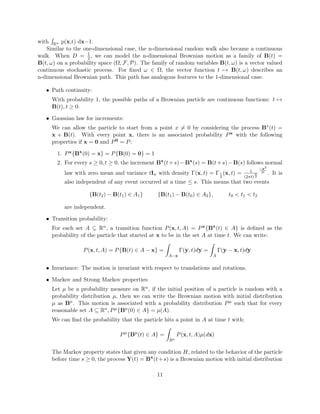
![• Path continuity:
With probability 1, the possible paths of a Brownian particle are continuous functions: t →
B(t), t ≥ 0. Because the instantaneous speed of the particle is infinite, their graphs are
nowhere differentiable.
• Gaussian law for increments:
We can allow the particle to start from a point x = 0 by considering the process Bx(t) =
x+B(t). With every point x, there is an associated probability Px with the following properties
if x = 0 and P0 = P:
1. Px{Bx(0) = x} = P{B(0) = 0} = 1
2. For every s ≥ 0, t ≥ 0, the increment Bx(t+s)−Bx(s) = B(t+s)−B(s) follows normal
law with zero mean and variance t with density Γ(x, t) = Γ1
2
(x, t) = 1√
2πt
e
−x2
2t . It is also
independent of any event occurred at a time ≤ s. This means that two events
{Bx
(t2) − Bx
(t1) ∈ I2} {Bx
(t1) − Bx
(t0) ∈ I1}, t0 < t1 < t2
are independent.
• Transition probability:
For each set I ⊆ R, a transition function P(x, t, I) = Px{Bx(t) ∈ I} is defined as the
probability of the particle that started at x to be in the interval I at time t. We can write:
P(x, t, I) = P{B(t) ∈ I − x} =
I−x
Γ(y, t)dy =
I
Γ(y − x, t)dy
• Invariance: The motion is invariant with respect to translations.
• Markov and Strong Markov properties:
Let µ be a probability measure on R, if the initial position of a particle is random with a
probability distribution µ, then we can write the Brownian motion with initial distribution
µ as Bµ. This motion is associated with a probability distribution Pµ such that for every
reasonable set F ⊆ R, Pµ{Bµ(0) ∈ F} = µ(F).
We can find the probability that the particle hits a point in I at time t with:
Pµ
{Bµ
(t) ∈ I} =
R
Px
{Bx
(t) ∈ I}dµ(x) =
R
P(x, t, I)dµ(x)
The Markov property states that given any condition H, related to the behavior of the particle
before time s ≥ 0, the process Y (t) = Bx(t+s) is a Brownian motion with initial distribution
µ(I) = Px{Bx(s) ∈ I|H}. Having this property means that future process Bx(t + s) is
independent from the past and the present process Bx(s).
The strong Markov property states that s is substituted by a random time τ, depending only
on the behavior of the particle in the interval [0, t]. In other words, to decide whether or not
the event {τ ≤ t} is true, it is enough to know the behavior of the particle up to time t.
8](https://image.slidesharecdn.com/7ecea2cf-9f79-4efa-a80e-21bf0f6a85bc-160519203450/85/introduction-brownian-motion-final-8-320.jpg)
![• Expectation:
Given a sufficiently smooth function g = g(y), y ∈ R, we can define the random variable
Z(t) = (g ◦ Bx)(t) = g(Bx(t))
. The expected value is:
Ex
[Z(t)] =
R
g(y)P(x, t, dy) =
R
g(y)Γ(y − x, t)dy
4 Symmetric n-Dimensional Brownian Motion
4.1 Ode to a More Realistic Drunk
Of course, n = 1 is an overly simplified situation for drunks, as any freshman who had to take their
friends back home after First Fridays can vouch. I will go through the same analysis for the n=1
case and extends it to n-dimensional Brownian motion.
4.2 Remodeling
In order to extend the notion of motion, we need to introduce the notion of a lattice Zn given the
set of points x ∈ Rn. Think of x as a vector with signed integer coordinates. Given the space step
h>0, hZn denotes the lattice of points whose coordinates are signed integers multiplied by h.
Figure 1: 2D random walk represented using lattice of points. Source: Page 59, Salsa’s "Partial
Differential Equations in Action"
9](https://image.slidesharecdn.com/7ecea2cf-9f79-4efa-a80e-21bf0f6a85bc-160519203450/85/introduction-brownian-motion-final-9-320.jpg)
![µ(A) = Px{Bx
(s) ∈ A|H}. Having this property means that future process Bx
(t + s) is
independent from the past and the present process Bx
(s).
The strong Markov property states that s is substituted by a random time τ, depending only
on the behavior of the particle in the interval [0, t]. In other words, to decide whether or not
the event {τ ≤ t} is true, it is enough to know the behavior of the particle up to time t.
• Expectation:
Given a sufficiently smooth function g = g(y), y ∈ Rn, we can define the random variable
Z(t) = (g ◦ Bx
)(t) = g(Bx
(t))
. The expected value is:
E[Z(t)] =
Rn
g(y)P(x, t, dy) =
Rn
g(y)Γ(y − x, t)dy
References
[1] P.C. Bressloff. “Chapter 2 Diffusion in Cells: Random Walks and Brownian Motion”. In: Stochas-
tic Processes in Cell Biology, Switzerland: Springer International Publishing, 2014. url: http:
//www.springer.com/cda/content/document/cda_downloaddocument/9783319084879-
c1.pdf?SGWID=0-0-45-1490968-p176811738.
[2] Albert Einstein. “Investigations on the Theory of the Brownian Movement”. In: (1965). url:
http://www.maths.usyd.edu.au/u/UG/SM/MATH3075/r/Einstein_1905.pdf.
[3] Davar Khoshnevisan. The University of Utah Research Experience for Undergraduates Summer
2002 Lecture Notes. Department of Mathematics: University of Utah, 2002. url: http://www.
math.utah.edu/~davar/REU-2002/notes/all-notes.pdf.
[4] Sandro Salsa. Partial Differential Equations in Action: From Modelling to Theory. English. 1st
ed. 2008. Corr. 2nd printing 2010 edition. Milan: Springer, Jan. 2010. isbn: 978-88-470-0751-2.
[5] Karl Sigman. IEOR 4700: Notes on Brownian Motion. 2006. url: http://www.columbia.
edu/~ks20/FE-Notes/4700-07-Notes-BM.pdf.
[6] Eric W. Weisstein. Fourier Transform–Gaussian. en. Text. url: http://mathworld.wolfram.
com/FourierTransformGaussian.html.
12](https://image.slidesharecdn.com/7ecea2cf-9f79-4efa-a80e-21bf0f6a85bc-160519203450/85/introduction-brownian-motion-final-12-320.jpg)

The document provides an introduction to Brownian motion by starting with a one-dimensional discrete case modeled as a drunk walking randomly. It shows that Brownian motion has the properties of being memory-less, homogeneous in time and space. By taking the limit of discrete steps, the model arrives at continuous Brownian motion described by a partial differential equation. The document then briefly outlines the history of Brownian motion from its discovery to developments in modeling it as a stochastic process.


