Introduction-to-TELNET.pptx protocol in networking
1.
Introduction to TELNET
Welcometo this presentation about TELNET! We will explore its
functions and uses. We will also cover its limitations. Understanding
TELNET is crucial for network management.
by DUCTILE AMAN
2.
What is TELNET?
Text-BasedProtocol
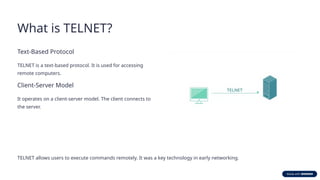
TELNET is a text-based protocol. It is used for accessing
remote computers.
Client-Server Model
It operates on a client-server model. The client connects to
the server.
TELNET allows users to execute commands remotely. It was a key technology in early networking.
3.
How TELNET Works
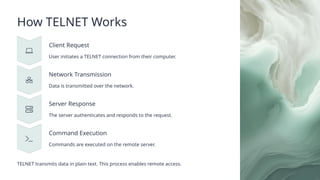
ClientRequest
User initiates a TELNET connection from their computer.
Network Transmission
Data is transmitted over the network.
Server Response
The server authenticates and responds to the request.
Command Execution
Commands are executed on the remote server.
TELNET transmits data in plain text. This process enables remote access.
4.
TELNET Security Risks
PlainText Transmission
TELNET sends data in plain
text, making it vulnerable.
Lack of Encryption
It lacks encryption, exposing
sensitive information.
Security Vulnerabilities
Subject to eavesdropping and interception of credentials.
Due to security concerns, TELNET is not recommended for sensitive
data. Always consider more secure alternatives.
5.
Alternatives to TELNET
SSH
SecureShell (SSH)
provides encrypted
communication.
VPN
Virtual Private
Networks (VPNs)
encrypt network
traffic.
HTTPS
Hypertext Transfer
Protocol Secure
(HTTPS) for web.
Secure alternatives like SSH and VPN offer better protection. They
ensure confidentiality and integrity.
6.
Advantages and Disadvantagesof TELNET
Advantages
• Simple to use
• Widely available
• Easy to troubleshoot
Disadvantages
• Insecure
• Plain text
• Vulnerable
While TELNET offers simplicity, its security flaws make it unsuitable for many modern applications. Weighing pros and cons is
essential.
7.
Uses of TELNET
RemoteServer
Management
Accessing and managing
servers remotely.
Network Device
Configuration
Configuring network
devices like routers and
switches.
Basic Diagnostics
Performing basic network diagnostics and testing.
TELNET is still used in specific scenarios where security is not a primary
concern. It's helpful for quick checks.
8.
Conclusion: The Futureof
Remote Access
TELNET's role has diminished. It is replaced by secure protocols like SSH.
The future of remote access lies in encrypted and secure
communication methods.