Introduction to SS7
Konrad Hammel
Sangoma Technologies
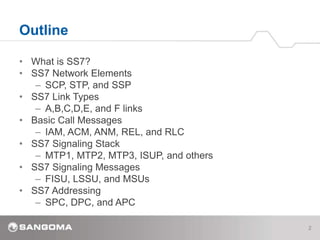
• What is SS7?
• SS7 Network Elements
– SCP, STP, and SSP
• SS7 Link Types
– A,B,C,D,E, and F links
• Basic Call Messages
– IAM, ACM, ANM, REL, and RLC
• SS7 Signaling Stack
– MTP1, MTP2, MTP3, ISUP, and others
• SS7 Signaling Messages
– FISU, LSSU, and MSUs
• SS7 Addressing
– SPC, DPC, and APC
Outline
2
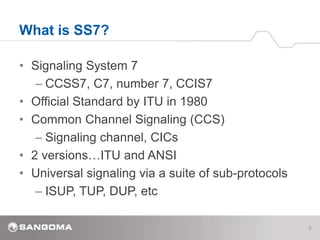
• Signaling System 7
– CCSS7, C7, number 7, CCIS7
• Official Standard by ITU in 1980
• Common Channel Signaling (CCS)
– Signaling channel, CICs
• 2 versions…ITU and ANSI
• Universal signaling via a suite of sub-protocols
– ISUP, TUP, DUP, etc
What is SS7?
3
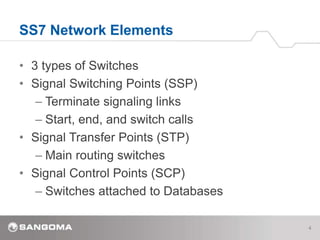
• 3 types of Switches
• Signal Switching Points (SSP)
– Terminate signaling links
– Start, end, and switch calls
• Signal Transfer Points (STP)
– Main routing switches
• Signal Control Points (SCP)
– Switches attached to Databases
SS7 Network Elements
4
SS7 Network Elements
5
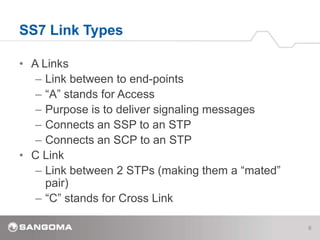
• A Links
– Link between to end-points
– “A” stands for Access
– Purpose is to deliver signaling messages
– Connects an SSP to an STP
– Connects an SCP to an STP
• C Link
– Link between 2 STPs (making them a “mated”
pair)
– “C” stands for Cross Link
SS7 Link Types
6
SS7 Link Types
7
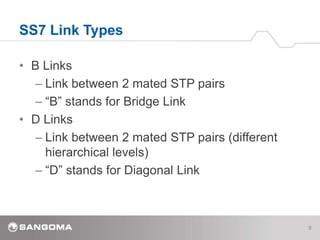
• B Links
– Link between 2 mated STP pairs
– “B” stands for Bridge Link
• D Links
– Link between 2 mated STP pairs (different
hierarchical levels)
– “D” stands for Diagonal Link
SS7 Link Types
8
SS7 Link Types
9
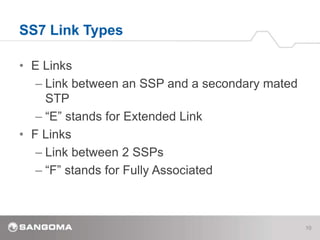
• E Links
– Link between an SSP and a secondary mated
STP
– “E” stands for Extended Link
• F Links
– Link between 2 SSPs
– “F” stands for Fully Associated
SS7 Link Types
10
SS7 Link Types
11
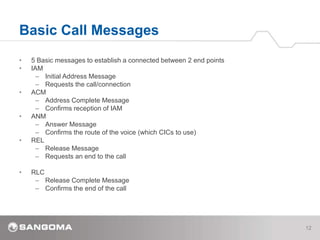
• 5 Basic messages to establish a connected between 2 end points
• IAM
– Initial Address Message
– Requests the call/connection
• ACM
– Address Complete Message
– Confirms reception of IAM
• ANM
– Answer Message
– Confirms the route of the voice (which CICs to use)
• REL
– Release Message
– Requests an end to the call
• RLC
– Release Complete Message
– Confirms the end of the call
Basic Call Messages
12
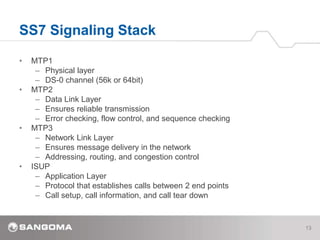
• MTP1
– Physical layer
– DS-0 channel (56k or 64bit)
• MTP2
– Data Link Layer
– Ensures reliable transmission
– Error checking, flow control, and sequence checking
• MTP3
– Network Link Layer
– Ensures message delivery in the network
– Addressing, routing, and congestion control
• ISUP
– Application Layer
– Protocol that establishes calls between 2 end points
– Call setup, call information, and call tear down
SS7 Signaling Stack
13
• 3 type of messages
• FISU
– Fill In Signal Units
– MTP2
– Sequence checking, error checking, and line filler
• LSSU
– Link Status Signal Units
– MTP2
– Signaling status messages
– Used to “align” or “sync” two points
• MSU
– Message Signal Units
– MTP3
– Carry all messages between points
SS7 Signaling Messages
14
• 3 types of addresses
• 2 different styles of addresses
– ITU -> Decimal Number…1234
– ANSI -> Network-Cluster-Member…. 1-2-3
• SPC
– Self Point Code
– The address of the local system
• APC
– Adjacent Point Code
– Address of system on the other end of the signaling link
• DPC
– Destination Point Code
– Address of system that controls the voice CICs
SS7 Addressing
15
THANK YOU.
16
Introduction to ss7

Introduction to ss7

  • 1.
    Introduction to SS7 KonradHammel Sangoma Technologies
  • 2.
    • What isSS7? • SS7 Network Elements – SCP, STP, and SSP • SS7 Link Types – A,B,C,D,E, and F links • Basic Call Messages – IAM, ACM, ANM, REL, and RLC • SS7 Signaling Stack – MTP1, MTP2, MTP3, ISUP, and others • SS7 Signaling Messages – FISU, LSSU, and MSUs • SS7 Addressing – SPC, DPC, and APC Outline 2
  • 3.
    • Signaling System7 – CCSS7, C7, number 7, CCIS7 • Official Standard by ITU in 1980 • Common Channel Signaling (CCS) – Signaling channel, CICs • 2 versions…ITU and ANSI • Universal signaling via a suite of sub-protocols – ISUP, TUP, DUP, etc What is SS7? 3
  • 4.
    • 3 typesof Switches • Signal Switching Points (SSP) – Terminate signaling links – Start, end, and switch calls • Signal Transfer Points (STP) – Main routing switches • Signal Control Points (SCP) – Switches attached to Databases SS7 Network Elements 4
  • 5.
  • 6.
    • A Links –Link between to end-points – “A” stands for Access – Purpose is to deliver signaling messages – Connects an SSP to an STP – Connects an SCP to an STP • C Link – Link between 2 STPs (making them a “mated” pair) – “C” stands for Cross Link SS7 Link Types 6
  • 7.
  • 8.
    • B Links –Link between 2 mated STP pairs – “B” stands for Bridge Link • D Links – Link between 2 mated STP pairs (different hierarchical levels) – “D” stands for Diagonal Link SS7 Link Types 8
  • 9.
  • 10.
    • E Links –Link between an SSP and a secondary mated STP – “E” stands for Extended Link • F Links – Link between 2 SSPs – “F” stands for Fully Associated SS7 Link Types 10
  • 11.
  • 12.
    • 5 Basicmessages to establish a connected between 2 end points • IAM – Initial Address Message – Requests the call/connection • ACM – Address Complete Message – Confirms reception of IAM • ANM – Answer Message – Confirms the route of the voice (which CICs to use) • REL – Release Message – Requests an end to the call • RLC – Release Complete Message – Confirms the end of the call Basic Call Messages 12
  • 13.
    • MTP1 – Physicallayer – DS-0 channel (56k or 64bit) • MTP2 – Data Link Layer – Ensures reliable transmission – Error checking, flow control, and sequence checking • MTP3 – Network Link Layer – Ensures message delivery in the network – Addressing, routing, and congestion control • ISUP – Application Layer – Protocol that establishes calls between 2 end points – Call setup, call information, and call tear down SS7 Signaling Stack 13
  • 14.
    • 3 typeof messages • FISU – Fill In Signal Units – MTP2 – Sequence checking, error checking, and line filler • LSSU – Link Status Signal Units – MTP2 – Signaling status messages – Used to “align” or “sync” two points • MSU – Message Signal Units – MTP3 – Carry all messages between points SS7 Signaling Messages 14
  • 15.
    • 3 typesof addresses • 2 different styles of addresses – ITU -> Decimal Number…1234 – ANSI -> Network-Cluster-Member…. 1-2-3 • SPC – Self Point Code – The address of the local system • APC – Adjacent Point Code – Address of system on the other end of the signaling link • DPC – Destination Point Code – Address of system that controls the voice CICs SS7 Addressing 15
  • 16.