Harmonic Practice in Tonal Music 2nd Edition Robert Gauldin
Harmonic Practice in Tonal Music 2nd Edition Robert Gauldin
Harmonic Practice in Tonal Music 2nd Edition Robert Gauldin
Harmonic Practice in Tonal Music 2nd Edition Robert Gauldin
Harmonic Practice in Tonal Music 2nd Edition Robert Gauldin
1.
Visit https://ebookfinal.com todownload the full version and
explore more ebooks
Harmonic Practice in Tonal Music 2nd Edition
Robert Gauldin
_____ Click the link below to download _____
https://ebookfinal.com/download/harmonic-practice-in-
tonal-music-2nd-edition-robert-gauldin/
Explore and download more ebooks at ebookfinal.com
2.
Here are somesuggested products you might be interested in.
Click the link to download
Understanding Post Tonal Music 2nd Edition Miguel A. Roig-
Francolí
https://ebookfinal.com/download/understanding-post-tonal-music-2nd-
edition-miguel-a-roig-francoli/
A Practical Approach to 16th Century Counterpoint Revised
Edition Robert Gauldin
https://ebookfinal.com/download/a-practical-approach-to-16th-century-
counterpoint-revised-edition-robert-gauldin/
Music Theory in Practice Grade 2 2nd Edition Eric Taylor
https://ebookfinal.com/download/music-theory-in-practice-grade-2-2nd-
edition-eric-taylor/
18th Century Keyboard Music 2nd Edition Robert Marshall
https://ebookfinal.com/download/18th-century-keyboard-music-2nd-
edition-robert-marshall/
3.
Music Theory inPractice Grade 1 1st Edition Eric Taylor
https://ebookfinal.com/download/music-theory-in-practice-grade-1-1st-
edition-eric-taylor/
Music as concept and practice in the Late Middle Ages
Strohm
https://ebookfinal.com/download/music-as-concept-and-practice-in-the-
late-middle-ages-strohm/
Guidelines for Music Therapy Practice in Pediatric Care
1st Edition Joke Bradt
https://ebookfinal.com/download/guidelines-for-music-therapy-practice-
in-pediatric-care-1st-edition-joke-bradt/
The complete musician an integrated approach to tonal
theory analysis and listening 2nd Edition Steven Geoffrey
Laitz
https://ebookfinal.com/download/the-complete-musician-an-integrated-
approach-to-tonal-theory-analysis-and-listening-2nd-edition-steven-
geoffrey-laitz/
Classical and Romantic Music The Library of Essays on
Music Performance Practice 1st Edition David Milsom
https://ebookfinal.com/download/classical-and-romantic-music-the-
library-of-essays-on-music-performance-practice-1st-edition-david-
milsom/
5.
Harmonic Practice inTonal Music 2nd Edition Robert
Gauldin Digital Instant Download
Author(s): Robert Gauldin
ISBN(s): 9780393976663, 0393976661
Edition: 2
File Details: PDF, 53.32 MB
Year: 2004
Language: english
CONTENTS
PREFACE (TO THETEACHER)
INTRODUCTION (TO THE STUDENT)
XXi1
Xx1x
PART ONE THE BASIC ELEMENTS OF MUSIC
CHAPTER 1. Pitch
and Intervals
Pitch Notation and the Diatonic Pitch
Collection 4
Pitch Register and Pitch Class 6
Half Steps and Accidentals 7
The Natural or White-Key Intervals 9
Simple and Compound Intervals 12
Spelling Intervals with Accidentals 13
Interval Inversion 14
Consonant and Dissonant Intervals 16
TERMS AND CONCEPTS FOR
REVIEW 1S
A BRIEF REVIEW SELF-QUIZ 1S
Vil
CONTENTS 1x
CHAPTER 6
Partwritingin Four-Voice Texture 82
Criteria for Melodic Writing 82 Perfect Intervals in Succession 87
Melodic Motion between Voices 83 Chordal Spacing or Structure 89
Voice Leading 85 Chordal Doubling 90
Partwriting 85 TERMS AND CONCEPTS FOR
Principles of Melodic Writing 86 REVIEW 9
Connecting Chords 86 A BRIEF REVIEW SELF-QUIZ 92
cHuapter 7 Melodic Figuration and Dissonance I:
CATEGORIES OF EMBELLISHING TONES Q4
R
Essential and Embellishing Notes 95
Chordal Embellishment and Compound
Melody 96
Categories of Dissonant Embellishing
Tones 98
Unaccented/Stepwise Embellishing
Tones 99
Unaccented/Leaping Embellishing
Tones 102
Accented/Stepwise Embellishing
Tones 104
PART TWO
Accented/Leaping Embellishing
Tones 107
Free Tones 108
Consonant Embellishing Tones 109
The Pedal Point 110
The Perception of Embellishing
Tones 110
TERMS AND CONCEPTS FOR
REVIEW 112
A BRIEF REVIEW SELF-QUIZ 112
DIATONIC HARMONY
CHAPTER §S Introduction to Diatonic Harmony iam
Aspects of Harmony 117
Roman Numerals 118
Harmonic Tendency 120
The Underlving Basis for Harmonic
Tendency 121
The Influence of Melodic Sequences
on Harmonic Tendency 123
Harmonic Models 123
TERMS AND CONCEPTS FOR REVIEW 124
A BRIEF REVIEW SELF-QUIZ 124
13.
x CONTENTS
sg ThePrimary Triads: TONIC. DOMINANT, AND SUBDOMINANT CHORDS 126
Tonality as the Extension of Tonic
Harmony 126
The Prolongation of Tonic Harmony 127
The Tonic, Dominant, and Subdominant
Triads 128
Relationships between the Primary
Chords 129
Partwriting Connections between
the Primary Triads 129
The Polarity between Tonic and Dominant
Chords 131
The Authentic Cadence 133
The Half Cadence 134
The Plagal Cadence 135
Voice-Leading Reduction 137
Cadential Expansion within
the Phrase 137
Harmonizing Melodies 140
Elaborating Harmonic Models 142
TERMS AND CONCEPTS FOR
REVIEW 145
A BRIEF REVIEW SELF-QUIZ 143
CHAPTER 10. The Dominant Seventh: emBeLLISHING TUE TONIC HARMONY 146
The Dominant Seventh in Root
Position 146
Preparation and Resolution of the Vi 147
The Cadential Dominant Seventh 149
Arpeggiated Tonic Prolongation within
the Phrase 151
Prolongation of Tonic Harmony using
Embellishing Chords 154
Melody Harmonization 159
The Elaboration of a Harmonic
Model 160
TERMS AND CONCEPTS FOR
REVIEW 162
A BRIEF REVIEW SELF-QUIZ 162
cHuaerer ait The Tonic and Subdominant Triads in First Inversion:
THE IV AND LAS EMBELLISHING CHORDS 164
Partwriting with the I® and IV® 165
The Use of the I® 166
The Use of the IV° 167
The IV as an Embellishing Chord 169
The I as an Embellishing Chord 170
Melody Harmonization 172
Elaboration of Harmonic Models 175
TERMS AND CONCEPTS FOR
REVIEW J77
A BRIEF REVIEW SELF-QUIZ 177
14.
CONTENTS xi
cuHaprer 12.Phrase Structure and Grouping 179
Phrase Length 179
Larger Phrase Grouping: The Period
Family 181
Double Periods 184
Some Miniature Formal Designs 186
Phrase Periodicity 187
Phrase Extension, Contraction,
and Elision 189
Varied Phrase Lengths 191
The Internal Anatomy of Phrases:
Sub-Phrases and Sentence
Structure 192
Motives and Their Development 193
Pitch and Rhythmic Motives 196
TERMS AND CONCEPTS FOR
REVIEW 197
A BRIEF REVIEW SELF-QUIZ 195
CHAPTER 13. Linear Dominant Chords: vie. AND INVERSIONS OF V7 200
The V°, vii°®, and Inversions of Vi
200
Uses of the V° and vii® 202
Embedded Voice-Leading Motion 204
Examples of the V® and vii® in Music
Literature 205
Inversions of the Vi
205
Examples of Inversions of V' in Music
Literature 208
Arpeggiated Extensions of Dominant
Harmony 211
CHAPTER 14. The Pre-Dominant II and II’ Chords
Exceptional Treatments of the Chordal
Tth 213
Extended Embellishment of the Tonic
Harmony 215
Melody Harmonization 216
TERMS AND CONCEPTS FOR
REVIEW 219
A BRIEF REVIEW SELF-QUIZ 220
ho
bo
bo
The Supertonic Family 222
Partwriting with Supertonic Chords 224
The Pre-Dominant ii® and ii? in Cadential
Formulas 225
Supertonic Harmony in Embellishing
Progressions 229
Examples of Supertonic Harmony in Music
Literature 230
Prolongation of the Pre-Dominant
Function 234
Melody Harmonization 237
TERMS AND CONCEPTS FOR
REVIEW 239
A BRIEF REVIEW SELF-QUIZ 240
15.
xil CONTENTS
cHaptreR 15.Melodic Figuration and Dissonance II:
SUSPENSIONS AND OTHER USES OF EMBELLISHING TONES QAI
Suspensions in Two-Voice Texture 242 The Interaction of Consecutive
Suspensions in Four-Voice Texture 246 or Simultaneous Embellishing Tones 256
Omamental Resolutions 249
Some Analytical Problems with
Embellishing Tones 256
Additional Suspension Techniques 249
The Affective Nature of Melodic
Multiple Suspensions 251 Dissonance 260
Suspensions as a Compositional Embellishing Tones in Partwriting
Device 253 and Melody Harmonization 262
Melody Harmonization 254 TERMS AND CONCEPTS FOR
Other Features of Embellishing
REVIEW 264
Tones 255 A BRIEF REVIEW SELF-OUIZ 264
The J and Other Linear Chords 267
The Accented or Cadential §
Chord 268 The Extended § and the Cadenza 279
Elaborating the Cadential $
270 Melody Harmonization 280
The Passing$
Chord 278 Other Diatonic Linear Chords 281
The Pedal
§ Chord 275 TERMS AND CONCEPTS FOR
The Arpeggiated$
Chord 277 REVIEW 257
Other Treatments of the Cadential } 278 A BRIEF REVIEW SELF-QUIZ 257
iz The VI, II, and Other Diatonic Triads 290
The Submediant and Mediant Triads The “First-inversion” VI and III as Voice-
in Major and Minor 290 leading Substitutes for land V 300
The Root-position VI between Tonic Modal Chords 302
and Pre-dominant Harmonies 291 Other Diatonic Triads: The v° and VII
The VI as a Substitute for I: The Deceptive in Minor 303
Cadence and Progression 294
Melody Harmonization 304
Other Treatments of the V-vi TERMS AND CONCEPTS FOR
Progression 295 REVIEW 305
The Root-position IJ Triad within the A BRIEF REVIEW SELF-QUIZ 305
Phrase 297
16.
CONTENTS xili
CHAPTER 18Rhythm and Meter II: appDITIONAL METER SIGNATURES
AND RHYTHMIC-METRICAL DISSONANCE 307
Meter Signatures in Very Slow or Very Fast Rhythmic Dissonance 311
Tempo 307 Metrical Dissonance 315
Asymmetrical Meters 309 TERMS AND CONCEPTS FOR
Fast Complex Meters 310 REVIEW 32]
Rhythmic-Metrical Consonance 311 A BRIEF REVIEW SELF-QUIZ 322
19 The Leading-tone Seventh Chord and Other
Seventh Chords 323
The Leading-tone Diminished-seventh Melody Harmonization 334
Chord in the Minor Mode 323 Other Diatonic Seventh Chords: The IV’,
Partwriting with the vii’ in the Minor I’, Vi, and Hl’ 335
Mode 325 TERMS AND CONCEPTS FOR
Other Uses of the vii?’ 328 REVIEW 340
The Leading-tone Seventh Chord A BRIEF REVIEW SELF-QUIZ 340
in the Major Mode 333
CHAPTER 20 Harmonic Sequences I: ROOT MOVEMENT
BY 5TH, 2ND. AND 3RD 342
Sequential and Cyclical Root
Movement 342
Harmonic Sequences 344
Triadic Root Movement by Descending
5th 346
Triads in Descending 5th Sequences 347
Triads in Ascending 5th Sequences 351
Root Movement by 2nd: Successive
First-inversion Chords 352
Sequences of Root-position Triads
in Stepwise Motion 355
Root Movement by Descending
and Ascending 3rd 357
Harmonic Sequences in Melody
Harmonization 360
TERMS AND CONCEPTS FOR
REVIEW 36-4
A BRIEF REVIEW SELF-QUIZ 364
CONTENTS XV
CHAPTER 24Simple Forms 426
Content and Form 427 Baroque Continuous Variations 438
Formal Design and Tonal Structure 427 Sectional Variations, or Theme
One-part Form 427 and Variations 441
Binary or Two-reprise Design 429 Rondo Form 445
The Two-reprise Design in the Baroque
The Five-part Rondo 446
Period 429 Seven-part Rondo Form 450
The Two-reprise Design in the Classical TERMS AND CONCEPTS FOR
Period 431 REVIEW 451
Ternary Form 432 A BRIEF REVIEW SELF-QUIZ 452
Variation Form 436
25 Analytical Comments on a Menuetto
and Trio by Beethoven 453
Larger Formal Considerations 453
Formal Characteristics of Beethoven’s
Menuetto and Trio 454
Motives and Phrase Grouping
inthe Menuetto 455
Voice Leading in the Menuetto 460
Motives and Phrase Groupings
inthe Trio 46]
Middleground Voice Leading
inthe Trio 464
Overall Voice Leading in the Menuetto
and Trio 465
Unifying Factors in the Movement 466
TERMS AND CONCEPTS FOR
REVIEW 467
PART THREE CHROMATIC HARMONY
CHAPTER 26 Introduction to Chromatic Harmony 471
The Historical Evolution of Non-Diatonic
Tones 472
Chromatic Melodic Motion 474
Enharmonic Duality 477
Decorative versus Structural
Chromaticism 478
Using Roman Numerals to Designate
Chromatic Harmonies 481]
TERMS AND CONCEPTS FOR
REVIEW 45]
A BRIEF REVIEW SELF-OUIZ 482
19.
Xvi CONTENTS
CHAPTER 27.Tonicization and Modulation III:
MODULATIONS TO CLOSELY RELATED KEYS 483
Close] Related Key 185
Relative Frequency of Closely Related
Keys 486
The Fatent of the Tonicized Area 186
The Process of Modulating to Closely
Related Keys 488
CHAPTER 28
Tonal Schemes Within a Movement t91
Melody Harmonization 494
TERMS AND CONCEPTS FOR
REVIEW {9S
A BRIEFED REVIEW SELF -ovuIz [99
Modal Exchange and Mixture Chords 501
Modal Exchange 502
Mixture Chords 505
Mixture Chords in the Major Mode 505
Mixture Chords in the Minor Mode 516
The III Triad as a Secondary Mixture Chord
in Major 516
The Relationship between Scale Degrees #5
versus }6 518
Melody Warmonization 520
VLEMS AND GONCLI YS LOR
REVIEW 52]
lo
A BRIEF REVIEW SELPF-QUTZ 5!
CHAPTER 29 The Neapolitan or bII Chord 524
A Question of Terminology: iv }6—5
versus bII® 525
The Neapolitau Sixth ii Miitur and Majoi
Modes 525
The 511° as an Embellishing Chord 527
Other Characteristics of the nae 529
Other Uses of the Neapolitan Chord 530
CHAPTER 30
Augmented Sixth Chords
Tonicization of the Neapolitan
Harmony 533
Melody Hariionizauon 554
TERMS AND CONCEPTS FOR
REVIEW 536
VBRIEE REVEPW SET E-OLIZ 355
535
The Three Common Forms of Augmented
Sixth Chords 539
The Italian, French, and German
Augmented Sixth Chords in the Minor
Mode 541
Augmented Sixth Chords in the Major
Mode 544
Secondary Augmented Sixth Chords 545
Inversions of the Augmented Sixth
Chords 547
Other Resolutions of Augmented Sixth
Chords 550
Enharmonic Augmented Sixth Chords 531
More Exotic Augmented Sixth Chords 553
Melody Harmonization 555
TERMS AND CONCEPTS FOR
REVIEW 5955
A BRIEF REVIEW SELF-QUIZ 556
20.
CONTENTS XVii
CHAPTER 31Extended Homophonic and Contrapuntal
Formal Designs 558
Sonata Form 558 TERMS AND CONCEPTS FOR
—— +
Sonata-Rondo Form 567 REVIEW 975
Concerto Form 567 A BRIEF REVIEW SELF-QUIZ 579
Contrapuntal Forms 569
cHaprerR 32 Embellishing Chromatic Chords 580
Augmented Triads as Passing Additional Chromatic Chords in the Major
or Neighboring Chords 58] and Minor Modes 594
Altered V' Chords 585 The Use of Chromaticism to Create Modal
Embellishing or Common-Tone Ambiguity 597
Diminished-Seventh Chords 587 Melody Harmonization 598
Common-Tone Augmented Sixth TERMS AND CONCEPTS FOR
Chords 590 REVIEW 599
Unusual Linear Chords 593 A BRIEF REVIEW SELF-QUIZ 600
CHAPTER 33. Dominant Prolongation 602
Short-Term Chromatic Prolongation Dominant Prolongations as Preparation
of Vi" 603 fora Climax 608
Prolongation of the Dominant in TERMS AND CONCEPTS FOR
Introductions 604 REVIEW 610
Prolongation of the Dominant in A BRIEF REVIEW SELF-QUIZ 610
Retransitions 605
Prolongation of the Cadential
Formula 606
CHAPTER 34 Modulation to Foreign Keys I 612
Modulations to Foreign Keys in the Major Foreign-Key Modulations in Development
Mode 613 Sections 626
Change-of-Mode Modulation 614 Melody Harmonization 627
Third-Related Modulations by Common TERMS AND CONCEPTS FOR
Tone 619 REVIEW 625
Modulations to Foreign Kevs by Pivot A BRIEF REVIEW SELF-QUIZ 628
Chord 621
Modulations to Foreign Kevs in the Minor
Mode 624
21.
XVlii CONTENTS
cHAprerR 35.Ninth, Eleventh, Thirteenth, and Added-Note Chords 630
General Considerations 631 Added Notes Gths and 9ths 642
Dominant Ninth Chords 631 TERMS AND CONCEPTS FOR
Non-dominant Ninth Chords 636 REVIEW 645
Eleventh and Thirteenth Chords 638 A BRIEF REVIEW SELP-QUIZ 645
cCuaptTeR 36 Implication and Realization 647
Music as Communication 648 Application to Musical Analysis 664
Reforentialistn versus Absolutisna 648 PE RAIS ANID CONE PIS FOR
The Origins of Emotion in Music 649 REVIEW 665
Implication and Realization 649 A BRIEF REVIEW SELB-QUIZ 665
Surprise and Ambiguity 663
CuareTrer 37 Harmonic Sequences LIT: Crrovtaric ELABORATIONS
OF DIATONIC SEQUENCES 666
Fifth-Related Chromatic Sequences 667 Extended Use of Chromatic 5-6
The Role of Diatonic Tetrachords Sequences 679
in Stepwise Chromatic Sequences 669 TERMS AND CONCEPTS FOR
Chromatic Elaborations of Diatonic REVIEW 652
Stepwise Sequences 671 A BRIEF REVIEW SELE-QUIZ 655
3s Analytical Comments on Wagner's Trista Prelude 685
PART FOUR ADVANCED CHROMATIC TECHNIQUES
CHAPTER 39. Chromatic Voice Leading 703
Sequences Based on Half-Step
Movement 704
Strict Chromatic Parallelism 706
Chromaticism by Contrary Motion
Non-sequential Chromatic Passages
Extended Use of Non-sequential
Chromaticism 714
TERMS AND CONCEPTS FOR
708 REVIEW 717
713 A BRIEF REVIEW SELEP-QUIZ 717
22.
CONTENTS Xix
40 Modulationsto Foreign Kevs I 719
Enharmonic Modulation 719 Modulation by Chromatic Linear
Chromatic Alterations of Diminished Progression 729
Seventh Chords 726 TERMS AND CONCEPTS FOR
Modulation by Strict Harmonic REVIEW 733
Sequence 727 A BRIEF REVIEW SELF-QUIZ 733
CHAPTER 41. Symmetrical Divisions of the Octave 735
Symmetrical Root Movements 737 TERMS AND CONCEPTS FOR
Extended Root Movement by Perfect REVIEW 752
Sth 744 A BRIEF REVIEW SELF-QUIZ 752
The Omnibus Sequence 746
Tonal Schemes Using Symmetrical
Divisions of the Octave 749
CHAPTER 42. At the Limits of Tonalitv: ALBAN BERG'S FOUR SONGS. OP. 2 754
TERMS AND CONCEPTS FOR
REVIEW 77]
APPENDIX 1 Some Fundamentals of Acoustics AQ
Frequency and Pitch AO Vibration Form and Timbre A3
Intensity and Loudness A2 Duration and Length A5
APPENDIX 2. The Diatonic Church Modes and Other Scales A6
The Ecclesiastical or Church Modes A6 Other Scales AQ
APPENDIX 3. An Introduction to Species Counterpoint Al4
Melodic Characteristics A16 Fourth Species A22
First Species A16 Fifth Species A23
Second Species A19 Underlying Species Technique in Two-
Third Species A21 Voice Passages A25
23.
Xx CONTENTS
APPENDIX 4Chord Symbols for Jazz and Commercial Music A26
Triads A26 Extended Tertian Chords A28
Seventh Chords A27
APPENDIX 5
Conducting Patterns A3l
Duple Meter A32 Quintuple Meter A33
Triple Meter A32 Sextuple Meter or Divided Beat A34
Quadruple Meter A32 Complex Meters A34
Single Meter A233
APPENDIX 6
Transposing Instruments A385
Concert Instruments A35 Classical Brass Instruments, Crooks,
Transposing Instruments A36 and Transpositions A37
ANSWERS TO REVIEW SELF-QUIZZES A39
GLOSSARY A87
INDEX OF MUSIC EXAMPLES AQI1
CREDITS ALOO
INDEX A102
24.
PREFACE
( T OT H &E T E AC R )
Harmonic Practice in Tonal Music takes a linear, functional approach to
tonal music in the common-practice era, not only showing students how in-
dividual chords function within the larger realm of harmonic tendency, but
also the interaction between melody and harmony. Through comprehensive
revisions, this new Second Edition ultimately aims to achieve the same ob-
jective as the First Edition—to provide students with a thorough treatment
of harmony and voice-leading principles in tonal music. Traditionally this
body of music has been approached through a
vertically oriented system of
harmonic analysis. While this method provides a thorough classification of
the various chords and their harmonic tendencies in progressions, it tends to
ignore the melodic aspects of the music and the way these linear forces
shape the harmony. This text has attempted to correct this imbalance by cor-
relating harmony with the interaction of melodic lines, especially the so-
prano and bass voices. Therefore, harmonic function is largely derivative of
this contrapuntal framework, the voice-leading analysis of which may form
the basis for more-insightful performances of the music itself.
NEW TO THIS EDITION
In response to feedback from professors at colleges and universities around
the country, the following revisions have been implemented to make the text
maximally useful to students and teachers alike:
e The prose has been thoroughly rewritten for clarity and precision.
Definitions of fundamental vocabulary have been simplified and dif-
ferences between similar concepts emphasized.
Xxi
25.
XXli PREFACE (TOTHE TEACHER)
¢ The chapters covering diatonic and chromatic harmony have been re-
ordered to increase the accessibility of core concepts. Specifically, the
subdominant chord is now introduced along with the tonic and domi-
nant; mediant and submediant chords are introduced earlier; se-
quences are presented in a single chapter; and an entire chapter
devoted to secondary dominants occurs before the introduction of
basic modulation.
¢ The harmony chapters have been restructured internally as well. Each
of these chapters now begins with a short introduction that relates the
new chord to those discussed in previous chapters, followed by a section
on chord type, spelling, and terminology. An explanation of practical
partwriting considerations follows. Short excerpts from the literature
occur throughout the chapters, providing contexts for the chords’ typical
uses and functions. Exceptions or rare applications are now reserved for
the end of the chapter, and additional sources for study may be found in
footnotes. Each chapter concludes with explanations of ways in which
mode] chord progressions may he embellished, guidelines for melody
harmonization, a list of terms for review, and a short self-quiz.
¢
Summary boxes have been added throughout the text to highlight key
information, recapping and providing straightforward descriptions of
the more complex concepts and procedures. Students will be able to
easily refer back to these boxes in order to remind themselves of these
ideas.
¢ Guidelines boxes have also been added to offer clear outlines for such
procedures as partwriting, making voice-leading reductions, and har-
monizing melodies.
¢
Self-quizzes have been included at the end of each chapter, enabling
students to review the material and test their understanding of con-
cepts. The answers to each of these quizzes are included in a section
at the end of the book.
¢
Many new music examples, by a broader range of composers, have
been added throughout the book, resulting in the inclusion of more
world music, popular music, rock, jazz, and music by women.
e An appendix covering the transposition of instruments has been
added, and the appendix explaining chord svmbols for jazz and com-
mercial music now incorporates more standard commercial symbols.
e A single CD-ROM accompanies the Second Edition, replacing the
three-CD set that accompanied the First Edition. This one disc con-
tains all excerpts from the music literature cited within the text (ex-
cept for most single-line melodies), and is both Macintosh- and
PC-compatible. A special “CD” icon (@)) appears next to each
recorded excerpt in the book.
26.
PREFACE (TO THETEACHER) Xxlii
e While the underlying principles of the First Edition of Harmonic
Practice in Tonal Music are maintained in the Second Edition, the ap-
proach is now more flexible in its presentations of linear ideas. The
graphing procedures have been simplified and the voice-leading re-
ductions have been clarified, with more emphasis on the elaboration
of framework models.
ORGANIZATION
Like the First Edition, the text is divided into four parts. Part One surveys
the basic elements of music; Part Two introduces functional diatonic har-
mony, modulations, and sequences; Part Three explores the most common
procedures of chromatic harmony; and Part Four examines some advanced
chromatic techniques. Separate chapters on formal organization occur in the
first three parts.
The chapters are arranged to provide a gradual progression from sim-
ple to more sophisticated issues. In Part One, for instance, Chapter 3
(“Tonic, Scale, and Melody”) places the topics introduced in Chapter 1
(“Pitch and Intervals”) and Chapter 2 (“Rhythm and Meter I”) within the
larger context of tonality and melody. Likewise, Chapter 7 examines the
chordal figuration and embellishing dissonance arising from the interac-
tion between melody (Chapter 3) and chords (Chapters 4 through 6). The
initial chapters on music findamentals have been especially revised and
rewritten for clarity, and new music examples have been added to Chap-
ters 1, 3, and 7.
A working knowledge of the fundamental topics found in Part One is
prercquisite to the study of tonal harmony (covered in Part Two and be-
yond). In addition to understanding meter (Chapter 2), keys (Chapter 3),
partwriting errors (Chapter 6), and embellishing or non-harmonic tones
(Chapter 7), students must develop a
facility in spelling and playing intervals
(Chapter 1), scales (Chapter 3), chords (Chapter 4), and figured bass (Chap-
ters 4 and 5).
The review of fundamental materials in Part One provides the basis for the
largely harmonic topics in Part Two. The chapters of this portion of the text
systematically present the various diatonic chords and their harmonic func-
tions in different musical contexts, from the three primary tonic-dominant-
subdominant triads (Chapters 9, 10, 11, and 13) to the remaining diatonic
triads and seventh chords (Chapters 14, 17, and 19). The other chapters in
Part Two mostly treat broader topics, such as phrase-grouping (Chapter 12):
suspension technique (Chapter 15); linear chords, including the “(Chapter 16):
rhythmic and metrical dissonance (Chapter 18); and harmonic sequences
27.
XXIV PREFACE (TOTHE TEACHER)
(Chapters 20 and 23). Secondary dominants are given their own chapter
(Chapter 21), thereby providing a basis for the discussion of simple modula-
tion in Chapter 22. As in Part One, the concepts introduced in one chapter
provide the necessary foundation for those introduced later. For example,
the introduction of suspensions in Chapter 15 establishes the basis for the
cadential in
Chapter 16.
Chapters 24 and 31 (formerly Excursions I and II in the First Edition)
deal with formal design in homophonic and contrapuntal music Although
they can be introduced and discussed at various times during the course of
study, they have been strategically repositioned near chapters that raise
larger issues of formal organization, such as modulation.
Part Three is patterned after Part Two. Some of its chapters focus on
specific altered harmonies, such as mixture chords, the Neapolitan triad,
augmented-sixth sonorities, and embellishing chromatic chords. Others ex-
amine the use of chromaticism in larger contexts, such as chromaticized dia-
tonic sequences and modulations to foreign keys. Separate chapters are
devoted to extended tertian chords, dominant prolongations, and melodic
and harmonic implication and realization.
Finally, Part Four extends the study of chromaticism into more-
advanced areas. These include chromatic sequences, chromaticism by paral-
lel and contrary motion, more-unusual ways of effecting foreign modula-
tions, and tonal organization based on symmetrical divisions of the octave.
The chapters in Parts Two and Three stress the interaction between
the melodic and harmonic forces in tonal music. Those chapters that focus
on the function of specific chords proceed from generalizations (spelling
and partwriting), through musical examples from literature, to practical
applications (melody harmonization). Couventioual terminology is em-
ployed for the chords and devices, although a few recently coined theoreti-
cal terms that have gained wide acceptance are incorporated when
appropriate. Several innovative approaches to traditional classification or
symbolization are also utilized. For example, emphasis is placed on the ac-
centuation of various types of embellishing tones, bringing their terminol-
ogy wore in line with the way we tend to perceive Uhem. Furthermore, in
modulatory passages, a giveu tonality is denoted by its relation to the
previahng tonic designated by Roman numerals cuclosed im boxes: rather
than by key designation.
The more common harmonic progressions first appear in each chapter as
basic harmonic models in C major or C minor, allowing us to see and hear
their essential voice leading, Excerpis from iiusic literature then demou-
strate how these models aay be fleshed out aud elaborated in various kevs,
meters, rhythms, and textures. This “model-to-music” format is often re-
28.
PREFACE (TO THETEACHER) XXV
versed by the reduction of music excerpts back to their essential harmonic
basis and voice leading. Thus, quotations from music literature are fre-
quently followed by one or more layers of reductive analvsis. The student is
carefully guided through each step of this reduction process. Such analvses,
when carried out on complete pieces, provide insight into the role of tonal
function within shifting musical contexts, and may thereby lay the founda-
tion for a more coherent performance strategy.
The appendixes contain a wealth of supplementary information. Since
some teachers prefer to introduce the basic principles of two-voice linear or
contrapuntal writing in the first year of music theory, Appendix 3 provides a
short introduction to species counterpoint. Some minor changes to the
Renaissance-oriented Fuxian species approach bring this appendix’s presen-
tation in line with the tonal procedures of the common-practice period. A
new appendix covering the transposition of instruments has been added
(Appendix 6), and Appendix 4 now incorporates more standard commercial
chord symbols. The remaining appendixes address such diverse topics as
basic acoustics, modes and other scales, and conducting patterns. The text
concludes with a section containing answers to all of the self-quizzes, a glos-
sary of terms often found in musical scores, and indexes of both music exam-
ples and terms.
Music EXAMPLES
All core concepts in the text are illustrated by carefully selected music ex-
amples. These excerpts are drawn from an exceptionally wide range of lit-
erature that extends from the Baroque stvle of the early common-practice
period to the popular music of the twentieth century. Representing vari-
ous vocal and instrumental media, these examples include not only the tra-
ditional “classical” genres (such as sonatas, svmphonies, concertos, and art
songs), but also excerpts from hymns, chorale harmonizations, folk songs.
waltzes, marches, rags, popular and jazz standards, and rock music. Al-
though the music examples are seldom longer than eight or sixteen mea-
sures, three in-depth analvses of complete compositions have been
included at the ends of Part Two (a Beethoven Menuetto), Part Three
(Wagner's Tristan Prelude), and Part Four (Berg's Four Songs, Op. 2).
The majority of the text's examples require only moderate keyboard ability
to perform; in fact, some of them have been simplified or are shown only
in voice-leading reduction. With the exception of lieder and solo sonatas.
ensemble works employ condensed two-stave scores rather than open full
scores,
fa
29.
Xxvi PREFACE (TOTHE TEACHER)
CD-ROM
WORKBOOK
Recognizing that many students now prefer to listen to music on their com-
puters, the First Edition’s set of three audio CDs has been replaced with a
single CD-ROM, which features all of the examples from music literature
discussed in the text (with the exception of single-line melodies). As visual
reminders to students, all music examples included on the CD-ROM are
marked in the text with a special “CD” icon (@). In using the CD-ROM,
students can easily navigate through the chapters or an index of the music
examples and simply click on ones they wish to hear. Listening to the exam-
ples will help students understand the melodic, rhythmic, and harmonic
concepts explained in the text, while aiding in the transition from theory to
ear training and performance. The excerpts on the CD-ROM were recorded
at the Eastman School of Music and performed by its faculty and students.
The written exercises in the accompanying Workbook, which serve as ample
assignments for students, include such tasks as filling in short harmonic pro-
gressions, completing sequential patterns, realizing figured basses, harmo-
nizing melodies, analyzing excerpts from music literature, and composing
original music. By working through these exercises, students learn in a tangi-
ble way how harmony functions within a large-scale melodic organization,
and thereby develop the tools they need to write and analyze music and to
plan convincing performances. In the Second Edition of the Workbook, ex-
ercises have been added to each chapter to give students more thorough
practice in basic concepts and procedures, and to reflect the revisions incor-
porated in the Second Edition of the text. More-detailed descriptions of
changes to the Workbook are noted in its preface.
Acknowledgments
The author would like to thank the reviewers of the Second Edition—
including Allen Anderson (University of North Carolina, Chapel Hill),
Steven Cahn (University of Cincinnati), Stefanie Crumbley Dickinson (Uni-
versity of Georgia), David Smyth (Louisiana State University), Charles
Stokes (Illinois State University), and J. Kent Williams (University of North
Carolina, Greensboro)—whose extremely useful suggestions were instru-
mental in this revision. For their numerous suggestions regarding the First
Edition, I am likewise indebted to the theory faculty and teaching assistants
30.
PREFACE (TO THETEACHER) XXVii
of the Eastman School of Music. I also wish to acknowledge the following
staff at W. W. Norton & Company for their work on the Second Edition:
Maribeth Anderson Payne (editor), Allison Benter (assistant editor), and
Christopher Miragliotta (project editor); thanks, too, to Richard Wingell,
who copyedited the manuscript. Furthermore, I would be remiss if I failed
to mention the continued encouragement and patience of my wife during
the long task of both writing and revising this book. Finally, in response to
the many inquiries I have received concerning the rather obscure dedica-
tion, they are simply “nicknames” for my four children.
32.
I N TC T ION
( T O T H E S T U DEN T )
As children we memorized songs the same way we learned to speak a
language—by repeating the music or words over and over until we could sing
them perfectly. We call this method rote learning. However, before we can
play music that is notated or written down, we must first know certain basic in-
formation about music notation, such as clefs, rhythmic durations and meter,
keys, intervals, scales, and even chords. These are fundamental subjects that
all practicing musicians must master. As we continue to hone our skills in the
basics of music, we begin to focus on what might be called the “chemistry” of
music—that is, how music is constructed and how it operates. This inquiry
forms the basis of the discipline called music theory. In the same way that our
study of grammar and syntax enables us to better express ourselves in speech
and writing, our study of music theory allows us to better express ourselves
when performing, interpreting, and explaining music. Learning about how the
essential components of music are organized and how they influence each
other provides us with a better understanding ofwhat makes music so aesthet-
ically pleasing and satisfying to our ears. It also suggests ways of examining
how we may best perform and hear musical works.
We can summarize the relation between acquiring skills in language and
music as follows:
Language Music
1. imitating speech 1. learning by rote
2. learning to spell words 2. learning notation and music fundamentals
3. studying grammar 3. studying the organization of music (music
theory)
Xxix
33.
XXX INTRODUCTION (TOTHE STUDENT)
This text focuses primarily on music composed during what we call the
common-practice or tonal period. Extending roughly from the early—
eighteenth century to the beginning of the twentieth century, this period en-
compasses the music of the late-Baroque composers (such as Bach and Han-
del), the masters of the Classical era (Haydn, Mozart, and Beethoven), and
the figures of the Romantic period (Schubert, Schumann, Wagner, Brahms,
and Tchaikovsky, to name a few). The text also includes examples of popular
genres of the twentieth century (such as ballads, jazz, and rock), which con-
tinue to employ tonal procedures introduced and developed during the
common-practice period.
We will begin our study of music theory with a review of the rudimen-
tary elements of music, as found in Part One (Chapters 1 to 7). While some
of the information in these chapters may already be familiar to you, other
material may be new. Since all of the subject matter in this rudiments survey
is prerequisite to the study of harmony, it is essential that you thoroughly un-
derstand the underlying concepts and master the preliminary skills outlined
in Part One before going on the topics discussed in Part Two (“Diatonic
Harmony”), Part Three (“Chromatic Harmony”), and Part Four (“Advanced
Chromatic Techniques”).
Aside from the introductory chapters that begin each of the last three
parts of this text, you will find that the remaining chapters are organized in
approximately the same manner. Following a short lead-in, which links the
material in the new chapter to concepts introduced previously, we will dis-
cuss the spelling, notation, and context of the new chord(s), and then exam-
ine ways of connecting or partwriting the harmonies in question. Basic
models that demonstrate their customary or normative use are followed by
examples from actual musical literature. As the chapter proceeds, you may
find instances of less-traditional procedures, with possible additional sources
provided in footnotes. Following some further “practical” applications, such
as elaborating harmonic models or harmonizing melodies, each chapter con-
cludes with a list of terms and concepts for review, and a brief self-quiz.
The accompanying CD-ROM includes recordings of each chapter’s ex-
cerpts from music literature, not only allowing you easier access to the text’s
music examples, but also providing a resource to widen your knowledge of
Western music. In addition to listening to these recorded examples, you
should also try to play through them on the piano whenever possible. Since
most of the harmonic models (given in C major and C minor) and analytical
reductions are not included on the CD-ROM, you should always attempt to
play them to establish their sound in your ear.
The accompanying Workbook is designed to follow the text closely and
offers many types of written assignments and keyboard exercises for each
chapter. These assignments should always be supplemented with oral drills,
34.
INTRODUCTION (TO THESTUDENT) XXxi
ear training, sight singing, and aural dictation—exercises which allow you to
further develop your skills in basic musicianship.
The purpose of all these aids is to help you better assimilate the material
in the text, to establish a solid foundation in music theory. Mastering music
theory represents a major step toward becoming a complete musician. It
provides listeners with the vocabulary necessary for discerning the tonal and
formal frameworks of the works they hear. It supplies composers, arrangers,
and improvisers with an essential language for musical communication. And
it enables singers and instrumentalists to achieve deeper insights into the
tonal drama and coherence of the works they perform.
C H AP T E
Pitch and Intervals
HIS BOOK WILL DISCUSS THE MUSIC ofwhat we call the common-
practice era—the span of music history that extends from the late Baroque
period, about 1700, to the close of the Romantic period, about 1900—and
the tonal system on which this music is based. The music we are concerned
with includes the art music beginning from Corelli, Vivaldi, Bach, and Han-
del and extending to Liszt, Wagner, and Debussy, as well as most genres and
styles of twentieth-century commercial music. Before we can begin our
comprehensive study of harmony and voice leading in the music of this pe-
riod, we must first review the fundamentals of music theory and the skills
necessary to study music theory, such as the ability to read pitches in the tre-
ble and bass clefs, to notate intervals and chords correctly, to understand
rhythmic notation, to interpret meter and key signatures, to write chords
correctly in four-part texture, to detect errors in partwriting, and to identify
and analyze non-chord tones. We begin this preliminary survey by examin-
ing the most distinguishing characteristic of music, its use of musical tones
and the pitch, or relative highness or lowness, of those musical tones.
39.
4 [CH. 1]PITCH AND INTERVALS
PITCH NOTATION AND THE DIATONIC PITCH COLLECTION
Figure
Our first concern is the notation of pitch—that is, our system of writing down
the music we hear or perform. Note that music does not always exist in written
form; much of the world’s music, and much of the folk and popular music of
our own culture, is not written down, but transmitted orally, through perfor-
Mance Or one-to-one stu With aoriaster Writing minsic down, however, can
be useful for several purposes, it enables society, for whatever reason, to estab-
lish a definitive version of its music and preserve it acerrately for fiture gencra-
tions. One of the earliest attempts to notate music employed the first seven
letters of the alphabet, A-B-C-D-E-F-G, to represent the musical tones.! Mov-
ing forward through the letters represented moving upward, raising the pitch,
and moving backward represented moving down To extend the range, these
same letters were repeated, sometimes using uppercase and lowercase letters
to distinguish different octaves. In our present notational system, we call the
seven tones represented by these letters the white-key or diatonic pitch col-
lection. We will return to the term “diatonic” in Chapter 3; for now we can de-
fine these diatonic notes as the group of pitches that occur in the same
repeating pattern as the white keys of the piano keyboard (Figure 1.1).
C DE —F
GA BC D EF GA BBCODE F GA B
. | | |
r
Tf you start from any white key and play successive white keys up or down,
each new key will have a different sound or pitch until you reach the key that has
the same letter name as your starting key. That key will sound higher or lower
than the note vou started with, but, allowing for that, the two notes will sound the
same. This recurnig sonority occurs on the eivlith white key frou your starting
point, and is therefore called an octave, from the Greek word okta, meaning
“eight.” The reason for the nearly identical sound of anv note and its octave lies in
the physics of musical sound, or acoustics. Pitch results from the frequency of a
sound—that is, the number of complete vibrations or cvcles per second pro-
duced by a sound. All sounds result from vibrating bodies of some sort—a
string,
1
Fark nofation Svstoris Ne traced dack as far as T3500 Be in Bal tenia The: svstenn dee
scribed here was used by the ancient Greeks about the second century B.C.. and appears in
treatises on music in medieval Europe around A.D. 900.
40.
Example 1.1
PITCH NOTATIONAND THE DIATONIC PITCH COLLECTION 5
a column of air in a wind instrument, a drumhead. Measuring the frequencies of
notes reveals that an octave above a given note is exactly twice its frequency, and
that an octave below it is exactly half its frequency. For example, A above middle
C (the note we use as a reference for tuning) has a frequency of 440 cycles per
second; the A an octave higher has a frequency of 880 cycles per second, and the
Aan octave below A 440 has a frequency of 220 cycles per second.”
If music had remained a single melody, letter names would probably
have sufficed for notating pitch. As music became more complex, however,
new ways of indicating pitch were developed in the early medieval period,
from roughly a.p. 900 to 1200. One of the first such methods attempted to
indicate relative pitch by drawing the notes higher or lower on the unlined
page (Example 1.la). Later a single guideline was added as a point of ref-
erence (Example 1.1b), and then two, and this system evolved into staff
notation, in which the various lines and spaces of a four-line staff desig-
nated specific notes (Example 1.1c). A fifth line was added later, and the
five-line staff became the standard system for notating music throughout
the common-practice period (Example 1.1d).
B.
a ge
a4
.
u - a
C
ae a
|
*
D.
fh.
x = |
=
E. o
= = =
e
oe
pis
2. The term hertz named after the German physicist Heinrich Hertz, is commonly used to in-
dicate frequency—for example, 440 hertz. For a more extensive discussion of the acoustics
of musical sounds, see Appendix I.
V7
=4a
41.
6 (CH. 1]PITCH AND INTERVALS
Example 1.2
Clefs are signs that designate the lines and spaces of the staff to repre-
sent the various pitches of the scale. The most important clefs in use in the
common-practice period are the treble clef and the bass clef. The treble
clef, also called the G clef, assigns the second staff line from the bottom to G
above middle C; middle C is the first extra or ledger line below the staff.
The bass clef, or F clef, assigns the fourth staff line from the bottom of the
staff to F below middle C; middle C, therefore, is the first ledger line
above the staff. These two clefs bracketed together form the grand staff
(Example 1.le), used for piano music or keyboard reductions of music writ-
ten for other performing groups.
There is another clef, the C clef, that locates middle C on one of the staff
lines. Two C clefs are still in use; the alto clef, which locates middle C on
the middle staff line, is used in music for the viola, and the tenor clef,
which locates middle C on the fourth line from the bottom, is used occasion-
ally in music for the cello, bassoon, and trombone. In Example 1.2, a series
of five pitches beginning with middle C (C-G-A-B-C) is written in four dif-
ferent clefs. This example makes clear why we have different clefs; even this
narrow-range melody fits better on some staves than others.
treble clef alto clef tenor clef bass clef
h rita eo eo
Ve wey 2
L haul
I ant 1
1h a Wall
2. HW
XY ij
eo
The musical examples in this text will employ the treble and bass clefs. It
is imperative that you can read pitches in both these clefs quickly and accu-
rately; see Chapter | in the Workbook for drills in rapid pitch reading.
PITCH REGISTER AND PITCH CLASS
When discussing or writing about music, we often need to refer to a note in
a specific octave range or register. One system for specifying the octave loca-
tion of a pitch designates middle C “cl” and calls the C’s on the piano, start-
ing from the lowest, CC, C, c, ce! c?, c?, and so forth. In this book we will use
a system now in common use among music theorists and acousticians that
designates the lowest C on the piano C! and calls the C’s in the following oc-
taves C’, C?, and so forth, up to C’. The same superscript numbers are used
for all the pitches in that octave, so that we can designate any pitch in its
specific octave.
§ [CH. 1]PITCH AND INTERVALS
only pitches that tonal music has used. As early as the Renaissance, additional
notes were added to the scale, often to create leading tones in cadences, and
by the late sixteenth century, keyboard instruments had the same set of white
and black keys as the modern piano. If we count all the keys between middle
C (C*) and the C an octave higher (C”), we see that the octave is divided into
twelve different pitches, not seven. The distance between any two adjacent
keys is called a half step or semitone. It is the smallest distance between
two pitches commonly used in Western music. In the tuning system in use
since about 1800, called equal temperament, each of the twelve half steps
within the octave is exactly equalin size. The twelve-note scale, including all
the white kevs and black keys of the piano, is called the chromatic scale.
We write these additional pitches through the use of accidentals. A
sharp sign (#) raises the pitch of a note by one half step, a flat sign (5) low-
ers the pitch by one half step, and a natural sign (4) cancels a previous
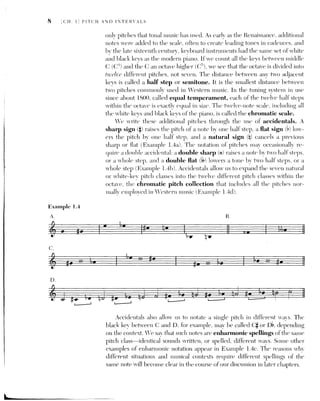
sharp ov flat (Fxunple Tota’ The notation of pite
tches aOccasionall roe
quire a double accidental: a double sharp
(x) raises a note by two half steps.
or a whole step, and a double flat (b) lowers a tone by two half steps, or a
whole step (Example 1.4b). Accidentals allow us to expand the seven natural
or white-key pitch classes into the twelve different pitch classes within the
octave, the chromatic pitch collection that includes all the pitches nor-
mally emploved in Western music (Example 1.4d).
O
Example 1.4
A, B.
4 T
—T Mt
mo
y
4 | t t tt
bw vw
C.
|
va a.
|
|
Hh,
|
i
W
i
eT
MN
Accidentals also allow us to notate a single pitch in different wavs. The
black kev between C and D, for example, mav be called C¥ or Db, depending
on the context. We sav that such notes are enharmonic spellings of the same
pitch class—identical sounds written, or spelled, different ways. Some other
examples of enharmonic notation appear in Example 1.4c. The reasons why
different situations and musical contexts require different spellings of the
same note will become clear in the course of our discussion in later chapters.
44.
THE NATURAL ORWHITE-KEY INTERVALS 9
THE NATURAL OR WHITE-KEY INTERVALS
Example 1.5
Since music theory is primarily concerned with relationships between two or
more pitches, we need an accurate way of measuring the distance between
pitches. Two pitches considered as a unit represent what we call a dyad, and the
distance between the two pitches of a dyad is called an interval. The interval
between two pitches sounded successively is called a melodic interval; the in-
terval between two notes sounded at the same time is called a harmonic inter-
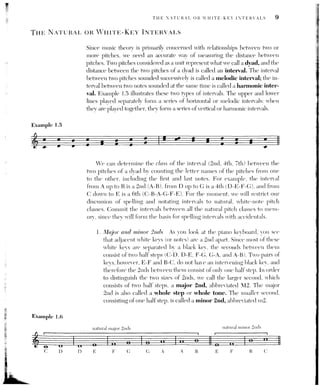
val. Example 1.5 illustrates these two types of intervals. The upper and lower
lines played separately form a series of horizontal or melodic intervals; when
they are played together, they form a series ofvertical or harmonic intervals.
Example 1.6
We can determine the class of the interval (2nd, 4th, 7th) between the
two pitches of a dyad by counting the letter names of the pitches from one
to the other, including the first and last notes. For example, the interval
from A up to B is a 2nd (A-B), from D up to G is a 4th (D-E-F-G), and from
C down to E is a 6th (C B A G F E). For the moment, we will restrict our
discussion of spelling and notating intervals to natural, white-note pitch
classes. Cominit the intervals between all the natural pitch classes to mem-
ory, since they will form the basis for spelling intervals with accidentals.
L Major and minor Pnds As vor Took at the piano Kevhoard Val see
that adjacent white kevs (or notes) are a 2nd apart. Since most of these
white kevs are separated by a black kev, the seconds between them
consist of two half steps (C-D, D-E, F-G, G-A, and A-B). Two pairs of
kevs, however, E-F and B-C, do not have an intervening black kev, and
therefore the 2nds between them consist of only one half step. In order
to distingnish Che (wo sizes of Inds. we call the larger secoricl, which
consists of bvo half steps. a major 2nd, abbroaiated M2. The major
2nd is also called a whole step or whole tone. The smaller second.
consisting of one half step, is called a minor 2nd, abbreviated m2.
natural major 2nds natural minor 2nds
' 1 i LJ
T I T 1 1
I I i |
ra TT a) mel
|
_| _ T |
bad TT
eo I
Ht t
D E F G G A A B
Ty
7
lee
~
In the meantimeRenzo, who has had the plague in the
Bergamascan territory, finds it safe to return home, amid the general
confusion, and proceeds to Milan to find Lucia. The terrible scenes in
the streets are graphically described, but the realism is combined
with a certain delicacy on the part of the author which renders even
its most dreadful details not wholly repulsive. For instance, Renzo
sees coming down the steps of one of the doorways.
“A woman with the delicate, yet majestic beauty, which is
conspicuous in the Lombard blood. Her gait was weary, but not
tottering; no tears fell from her eyes, though they bore tokens of
having shed many; there was something peaceful and profound in
her sorrow, which indicated a mind fully conscious and sensitive
enough to feel it.... She carried in her arms a little child, about
nine years old, now a lifeless body; but laid out and arranged, with
her hair parted on her forehead, and in a white and remarkably
clean dress, as if those hands had decked her out for a long
promised feast, granted as a reward. Nor was she lying there, but
upheld and adjusted on one arm, with her breast reclining against
her mother’s, like a living creature; save that a delicate little hand,
as white as wax, hung from one side with a kind of inanimate
weight, and the head rested upon her mother’s shoulder with an
abandonment deeper than that of sleep: her mother; for, even if
their likeness to each other had not given assurance of the fact,
the countenance which still depicted any feeling would have
clearly revealed it.”
“A horrible looking monatto approached the woman, and
attempted to take the burden from her arms, with a kind of
unusual respect, however, and with involuntary hesitation. But
she, slightly drawing back, yet with the air of one who shows
neither scorn nor displeasure, said, ‘No, don’t take her from me
yet; I must place her myself on this cart; here.’ So saying, she
opened her hand, displayed a purse which she held in it, and
dropped it into that which the monatto extended towards her. She
then continued: ‘Promise me not to take a thread from around her,
nor let any one else attempt to do so, and to lay her in the ground
thus.’
“The monatto laid his right hand on his heart; and then zealously,
and almost obsequiously, rather from the new feeling by which he
47.
was, as itwere, subdued, than on account of the unlooked-for
reward, hastened to make a little room on the car for the infant
dead. The lady, giving it a kiss on the forehead, laid it on the spot
prepared for it, as upon a bed, arranged it there, covering it with a
pure white linen cloth, and pronounced the parting words:
‘Farewell, Cecilia! rest in peace! This evening we, too, will join
you, to rest together forever. In the meanwhile, pray for us; for I
will pray for you and the others.’ Then, turning again to the
monatto, ‘You,’ said she, ‘when you pass this way in the evening,
may come to fetch me too, and not me only.’
“So saying, she re-entered the house, and, after an instant,
appeared at the window, holding in her arms another more dearly-
loved one, still living, but with the marks of death on its
countenance. She remained to contemplate these so unworthy
obsequies of the first child, from the time the car started until it
was out of sight, and then disappeared. And what remained for
her to do, but to lay upon the bed the only one that was left her,
and to stretch herself beside it, that they might die together, as the
flower already full blown upon the stem falls together with the bud
still enfolded in its calyx, under the scythe which levels alike all
the herbage of the field.”
Renzo learns that Lucia has been taken to the Lazaretto, and he
proceeds thither. The scenes in that dreadful abode of suffering are
described in detail. Here he meets Father Cristoforo, who in tending
the sick is already falling a victim.
“His voice was feeble, hollow, and as changed as everything else
about him. His eye alone was what it always was, or had
something about it even more bright and resplendent; as if
Charity, elevated by the approaching end of her labors, and
exulting in the consciousness of being near her source, restored
to it a more ardent and purer fire than that which infirmity was
every hour extinguishing.”
Renzo learns that Don Rodrigo himself is lying unconscious in one of
the miserable hovels, and, filled at first with rage at the recollection
of the man who has caused him so much wretchedness, he is at last
brought, by the commanding reproofs of Father Cristoforo, into such
a forgiving spirit that he can pray for his enemy’s salvation.
48.
Renzo seeks Luciain vain amid the procession of the few persons
who were going forth cured from the Lazaretto, but he finds her at
last, convalescent in one of the little huts in the woman’s quarters. A
very characteristic conversation ensued between the lovers in regard
to the binding nature of her vow, which Renzo naturally disputes, and
calls Father Cristoforo to remonstrate and interpose. The good father
consolingly tells Lucia that she had no right to offer to the Lord the
will of another to whom she was already pledged; and by virtue of
the authority of the church he absolves her from her vow. It is not
long until the lovers, restored to their former happiness, leave the
Lazaretto; and the book concludes with the consummation of their
wishes—their marriage, and a happy wedded life.
A great deal of quiet satire pervades the story. Take, for instance, the
following, in the description of Lecco, at the very opening of the
book:
“At the time the events happened which we undertake to recount,
this town, already of considerable importance, was also a place of
defense, and for that reason had the honor of lodging a
commander, and the advantage of possessing a fixed garrison of
Spanish soldiers, who taught modesty to the damsels and
matrons of the country; bestowed from time to time marks of their
favor on the shoulders of a husband or a father; and never failed,
in autumn, to disperse themselves in the vineyards, to thin the
grapes, and lighten for the peasant the labors of the vintage.”
There is a great deal of homely philosophy intermixed with this
satire. For instance, the criticism of
“those prudent persons who shrink back with alarm from the
extreme of virtue as well as vice, are forever proclaiming that
perfection lies in the medium between the two, and fix that
medium exactly at the point which they have reached, and where
they find themselves very much at their ease.”
These delicate touches come in most appropriately, and, as it were,
spontaneously from the context. They are never lugged in head
49.
foremost, for theevident purpose of saying a good thing.
The book abounds in apt similes; for instance, in the following
description of Perpetua’s vain efforts to keep a secret:
“But certain it is that such a secret in the poor woman’s breast
was like very new wine in an old and badly-hooped cask, which
ferments, and bubbles, and boils, and if it does not send the bung
into the air, works itself about till it issues in froth, and penetrates
between the staves, and oozes out in drops here and there, so
that one can taste it, and almost decide what kind of wine it is.”
When the bravoes, led by Griso, in the guise of a pilgrim, attempt to
carry off Lucia from her home and are suddenly thrown into
consternation by the pealing of the bell, the author tells us:
“It required all the authority of Griso to keep them together, so that
it might be a retreat and not a flight. Just as a dog urging a drove
of pigs, runs here and there after those that break the ranks,
seizes one by the ears, and drags him into the herd, propels
another with his nose, barks at a third that leaves the line at the
same moment, so the pilgrim laid hold of one of his troop just
passing the threshold, and drew him back, detained with his staff
others who had almost reached it, called after some who were
flying they knew not whither, and finally succeeded in assembling
them all in the middle of the courtyard.”
The characters are extremely well described. Perhaps the two lovers
are the least striking of any in the book. Lucia is a simple peasant
girl; Renzo, a rash, impulsive, kindly boy, easily led, a very natural,
grown-up child such as Italy produces in greater luxuriance than
colder and severer latitudes. There are no passionate love scenes in
the book. The affection of the betrothed for each other seems rather
an incident than the principal theme of the story. Don Ferrante, the
husband of Donna Prassede, is a fine type of scholastic pedantry.
The catalogue of his ridiculous acquirements in the absurd
philosophy and learning of the time, with long lists of authors now
unknown, reminds us of the studies of Don Quixote; Don Ferrante,
too, is skilled in the science of chivalry, wherein he enjoyed the title
50.
of “Professor,” and“not only argued on it in a real, masterly manner,
but, frequently requested to interfere in affairs of honor, always gave
some decision.”
The officiousness of Donna Prassede is well set forth in the
following:
“It was well for Lucia that she was not the only one to whom
Donna Prassede had to do good.... Besides the rest of the family,
all of whom were persons more or less needing amendment and
guidance—besides all the other occasions which offered
themselves to her, or she contrived to find, of extending the same
kind offices, of her own free will, to many to whom she was under
no obligations; she had also five daughters, none of whom were
at home, but who gave her much more to think about than if they
had been. Three of these were nuns, two were married; hence
Donna Prassede naturally found herself with three monasteries,
and two houses to superintend; a vast and complicated
undertaking, and the more arduous, because two husbands,
backed by fathers, mothers, and brothers; three abbesses,
supported by other dignitaries, and by many nuns, would not
accept her superintendence. It was a complete warfare, alias five
warfares, concealed, and even courteous, up to a certain point,
but ever active, ever vigilant. There was in every one of these
places a continued watchfulness to avoid her solicitude, to close
the door against her counsels, to elude her inquiries, and to keep
her in the dark, as far as possible, on every undertaking. We do
not mention the resistance, the difficulties she encountered in the
management of other still more extraneous affairs; it is well known
that one must generally do good to men by force.”
The story, like some other of the greatest works of fiction—like Don
Quixote, Les Misérables, nay, like Henry Esmond itself, is somewhat
too prolix. The long historical citations, the extracts from the edicts
and proclamations of the time, look as if the author considered it
necessary to prove his story rather than to let it prove itself. That
Renzo and Lucia should leave Father Cristoforo to die alone is, to
my mind, the most serious blemish in the book; but in spite of these
shortcomings, “The Betrothed” is entitled to one of the first places in
the front rank of the masterpieces of fiction.
51.
EUGENIE GRANDET
HONORÉ DEBALZAC
It is not quite fair to Balzac to judge him by any one of the stories in
his encyclopædic “Comedie Humaine.” The countless varieties of life
and character which he portrays show the author’s versatility and
power, and have perhaps a value from their very number which can
not be adequately treated when we consider only a single specimen
of his work. Many of his characters, it is true, are grotesques; some
are absolute deformities; others are hard to understand by any but a
Frenchman,—French human nature, as it seems to me, being a little
different from human nature elsewhere; but there is one great work
of his which, although it is not without its morbid side, must appeal to
the common consciousness of all mankind, and bring to every
human heart the conviction of its spiritual truth. “Eugenie Grandet” is
a novel of this universal kind of excellence.
The plot is a very simple one. M. Grandet is a miser who lives in an
old comfortless house in Saumur with his wife, his daughter Eugenie,
and big Nanon, the maid of all work. The Cruchots and the De
Grassins are intriguing for the hand of the heiress, and on Eugenie’s
birthday, when all these are assembled, a stranger unexpectedly
appears, Charles Grandet, her cousin, committed to the care of his
uncle by his father in Paris, who has become a bankrupt and has
determined upon suicide. Charles, however, knows nothing of this,
and is overcome with pitiful grief when he learns of his father’s
death. Eugenie, a simple minded girl, falls in love with him, but the
52.
old miser, anxiousto get rid of him, sends him to the Indies.
Grandet’s tyranny over his wife and child is graphically portrayed.
The poor wife succumbs to it and dies. It is not long till the miser
follows her, and Eugenie is left alone with a colossal fortune for
which she cares nothing, and with a lover from whom she has
received no word. In the meantime Charles has acquired a fortune of
his own, and on his return writes to her that he wishes to marry
another. Her dream is over, the light of her life is extinguished; she
gives her hand without her heart to Cruchot, and upon his death
continues her hopeless life alone in the desolate home,
administering her estate with economy, but devoting its proceeds to
works of beneficence.
This is a story, the like of which has happened many a time in actual
life, but the cold skeleton of the tale as given above conveys not the
slightest idea of the warm flesh and blood with which it is invested.
The description of the old street and the dreary house and its
furniture is a literary jewel. The account of the way in which Grandet
accumulates his fortune, and of the neighborhood rumors regarding
his wealth, stirs our own acquisitiveness as we read it, and shows
him to be a very natural and almost inevitable sort of miser. He is
moreover a man of commanding ability, who extorts respect even
though he inspires abhorrence. The details of his habits, his
economies, and his schemes, as well as his personal appearance,
are admirably given. Equally lifelike are the descriptions of big
Nanon, the devoted house-servant, starved and overtasked, yet
always grateful to the master who took her when none others would;
of the wife, submissive, sensitive, magnanimous, and
uncomplaining; and of Eugenie, a girl who has grown up in perfect
innocence of the world, pure, beautiful, and of a generous and noble
spirit. All these are the subjects of an odious domestic tyranny on the
part of “Goodman Grandet,” the particulars of which are set forth with
powerful fidelity.
Charles is a rather uninteresting young dandy, who comes arrayed
for conquest. It is not unnatural that an artless girl like Eugenie
should fall in love with him, and her devices to procure him such
53.
luxuries as acake, a wax candle, and sugar for his coffee, add to the
charm of their simple love-making. The sympathy of the two women
in his sorrow contrasts sharply with the sordid calculations of the
miser, and the scene where Eugenie learns his needs by furtively
reading two of his letters (for even her good qualities are decidedly
of the French type) and then brings him her little store of gold, and
when he hesitates, begs him on her knees to take it—this scene is
very effective, as is also her despairing cry, after he departs, “O
mother, mother, if I had God’s power for one moment!”
But the more tragic parts of this simple drama are near its close,—
the stormy scene when Grandet learns that Eugenie has given
Charles her money, her imprisonment in a room of the old house, her
mother’s illness and patient death, and, ghastliest of all, the last
hours of the miser:
“So long as he could open his eyes, where the last sparks of life
seemed to linger, they used to turn at once to the door of the room
where all his treasures lay, and he would say to his daughter, in
tones that seemed to thrill with a panic of fear:
“‘Are they there still?’
“‘Yes, father.’
“‘Keep watch over the gold!... Let me see the gold.’
“Then Eugenie used to spread out the louis on a table before him,
and he would sit for whole hours with his eyes fixed on the louis in
an unseeing stare, like that of a child who begins to see for the
first time; and sometimes a weak infantine smile, painful to see,
would steal across his features.
“‘That warms me!’ he muttered more than once, and his face
expressed a perfect content.
“When the curé came to administer the sacrament, all the life
seemed to have died out of the miser’s eyes, but they lit up for the
first time for many hours at the sight of the silver crucifix, the
candlesticks, and holy water vessel, all of silver; he fixed his gaze
54.
on the preciousmetal, and the wen on his face twitched for the
last time.
“As the priest held the gilded crucifix above him that the image of
Christ might be laid to his lips, he made a frightful effort to clutch it
—a last effort which cost him his life. He called Eugenie, who saw
nothing; she was kneeling beside him, bathing in tears the hand
that was growing cold already. ‘Give me your blessing, father,’ she
entreated. ‘Be very careful!’ the last words came from him; ‘one
day you will render an account to me of everything here below.’
Which utterance clearly shows that a miser should adopt
Christianity as his religion.”
Then follows the long waiting of Eugenie; the dastardly letter sent by
Charles after his return; the noble dignity with which she releases
him and pays his father’s creditors to preserve the honor of one who
is quite careless of it himself, and then resigns herself to her
hopeless destiny.
“Eugenie Grandet” is a consummate work of art.
55.
DEAD SOULS
NIKOLAI GOGOL
“DeadSouls,” the masterpiece of Gogol, is not very widely known
among English readers, but it is entitled to a high rank in literature.
Perhaps the fact that it is a torso has been one cause of this neglect,
for before the second volume was finished the author was overtaken
by that madness which clouded his last days. But the first volume is
practically complete in itself. It records the efforts of the smug,
shrewd, rascally Tchitschikoff to procure from various landowners
certain paper transfers of the serfs who had died on their estates
since the last enumeration in order to effect a fraudulent loan by
means of a list corresponding with the official register. The
description of the stranger, of his sudden arrival in a provincial city, of
the various estates he visits and the remarkable people he
encounters, and then, while his enterprise is prospering, of the
sudden spreading of the scandal through the town and his forced
flight to other regions—these things are told with a power of
portraiture which is amazing. The characters he describes are
sometimes grotesque, but they are faithful to the essentials of
human nature; even the wild Nozdreff and the massive Sobakevitch
are very real. Gogol has been called the Dickens of Russian
literature, and his portraits, while fewer in number and variety, are
less like puppets than many of those drawn by the English novelist.
His description of Pliushkin the miser is quite as striking as that of
L’Avare of Molière or Père Grandet of Balzac, while his account of
56.
the way thegossip regarding Tchitschikoff started and circulated is
as fine as anything in “The School for Scandal.” He calls his book a
“poem,” and although it is quite devoid of versification or lofty diction,
yet if the word “poem” means a “work of original creative art,” “Dead
Souls” will fully justify the name.
It has the same sort of masterly quality as “Don Quixote,” and
transports us as completely to the scenes which it describes. His
patriotic apostrophe to Russia in the final chapter, and his description
of the swift flight of the hero in his troika, are picturesque and
eloquent to the last degree.
57.
THE THREE GUARDSMEN
ALEXANDREDUMAS
Probably there is no better example of the novel of adventure than
“The Three Guardsmen,” by Alexandre Dumas. The author claims in
his preface a historical origin for his novel. However that may be, the
plot seems plausible in spite of its extravagances, and never was
there a book in which men conspired and slaughtered each other
more merrily, nor in which the mere strenuous life without moral
accessories has found a more perfect embodiment.
The book in its way is a masterpiece. The style is simple and
luminous to such a degree as would hardly be possible in any other
language than that in which it was written. No work in the world is
more easy to read, to understand, or to translate. The old French
dictum that no words should be used in literature which can not be
understood upon the market-place here attains its highest
realization.
As for the characters, they are of the simplest type. The dashing
devil-may-care soldier and adventurer, the deep drinker, the heavy
player, the man who with equal gayety defies the bullets of the
enemy and the commonest precepts of morality, has here his
apotheosis. Perhaps the hero of the book even more than
D’Artagnan himself is Athos, the chief of the three musketeers, who,
having made an unfortunate marriage in his youth, has forsaken his
name and station and embarked upon a life of mere adventure. We
58.
love him andadmire him, and yet it is hard to tell why upon any
logical or ethical principles we should do either. Yet when he gets
very drunk, or when he hangs his wife because he finds that she
bears upon her shoulder the mark of a criminal conviction, we feel
that he has done in each case exactly the right thing. Generally a
novelist seeks by contrasting his hero with more commonplace
characters to set him off in relief, but in this novel almost everybody
is a hero, and all are equally and superlatively great and admirable,
except perhaps the poor woman who has been hanged and comes
to life again and engages in divers diabolical plots against the rest of
the world.
59.
JANE EYRE
CHARLOTTE BRONTE
“JaneEyre” is a book which impresses the reader with its power,—I
might say its masculine power, were it not for the fact that the author
gives us at every turn the woman’s point of view.
The narrative, like that of “David Copperfield,” is in the form of an
autobiography, and the plot, which is quite simple, has only that sort
of unity which the heroine gives it. Yet the work glows with intense
passion and the characters are so faithful to nature that they
convince us that vivid personal experience must have come to the
aid of the author’s imagination in delineating them.
Jane Eyre, an orphan, is abused and mistreated in childhood, first in
the family of Mrs. Reed, where she is brought up, and afterwards at
the Lowood charity school, where she is first a pupil and then
becomes a teacher. She seeks a situation as governess, and finds
employment at Thornfield Hall, the residence of a Mr. Rochester,
who, after a wild, dissipated, wandering life, has come, some time
before, into possession of this splendid property. Here she has the
charge of Adele, his ward.
There is a certain uncanny secret about Thornfield which the
governess finds herself unable to fathom. She hears wild laughter
and inarticulate sounds in a distant part of the Hall. One night
Rochester’s bed is mysteriously set on fire, and Jane Eyre saves his
60.
life. On anotheroccasion, while the house is full of guests, a horrible
shriek comes from the upper floor and a murder is well nigh
committed by some unknown creature who is hidden there.
In the meantime Mr. Rochester has become greatly interested in his
little governess, who, although quiet and plain in appearance, is
warm-hearted and high-spirited, with a strong sense of duty, great
courage, and an indomitable will. And she on her side becomes
fascinated and at last utterly devoted to her master, a man of brilliant
parts, strong, brusque, proud and autocratic. He offers her his hand,
and she accepts him, to learn, however, in the very presence of the
altar and during the wedding ceremony, that he has another wife! It
seems that in his early years he had been beguiled into a marriage
in the West Indies with a woman whose dissolute courses had
wrecked his life, and had terminated in her own madness, and that
this was the maniac who had occasioned the strange scenes at the
Hall.
Jane Eyre now flees from Thornfield, concealing all traces of her
whereabouts. She wanders amid incredible hardships and
destitution, and at last finds shelter at Moor House, the home of St.
John Rivers and his two sisters, who are afterwards discovered to be
her relatives, and with whom she divides a legacy which she
receives from a deceased uncle. St. John is a country clergyman of
high character, full of zeal, ambition, and fanaticism, and determined
to devote his life to missionary service in India. He seeks her hand,
but she realizes that it is not from love but to make her his fellow
laborer in the work of the Gospel. He has sought to inspire her with
his own enthusiasm, and she is on the point of yielding, when she
seems to hear the voice of Rochester calling to her in pain and
anguish. She returns to Thornfield, and finds that the Hall has been
consumed in a conflagration kindled by the maniac, and that
Rochester, who had sought in vain to save the life of the wretched
creature, has been himself rescued, blind and a cripple, from the
ruins. She seeks him and becomes his wife.
61.
But the barerecital of these leading events gives very little idea of
the characters in this somber and tragic tale, or the feelings which
control their actions. The book must be read through to be
understood. From the very beginning the author strikes a resounding
chord in human nature. Brutality to children stirs us to fury, and no
one, not even Dickens or Victor Hugo, has painted this form of
tyranny in livelier colors than Charlotte Brontë. The conduct of Mrs.
Reed and of Rev. Mr. Brocklehurst, the sanctified and inhuman
director of Lowood school, arouses our hot resentment.
Of course there are blemishes in the book. Sometimes the
conversation is too carefully written to be natural. Then there is an
intrinsic improbability in the plot. Why should a young woman so self-
sufficient as the heroine consent to marry Rochester before she had
solved the secret of Thornfield? But these defects in the novel are
trifling by the side of its abounding excellences. At nearly every point
the heroine awakens our admiration; we feel (sometimes, perhaps,
in spite of our better judgment) that she is doing right; and so
masterly is the author’s portraiture that, in spite of many repulsive
features, she awakens a stronger sympathy for the seared and
blighted Rochester than for the pure and devoted yet inexorable St.
John Rivers. Jane Eyre is an eloquent novel. It is emphatically a
work of genius.
62.
CARMEN
PROSPER MERIMÉE
It hasalways seemed to me that “Carmen” was a story of great
power and told with wonderful skill. I know not whether it be fact, nor
whether the author has learned it in the way he says; but so
convincing is the narrative, it seems to me impossible that it is a
mere product of the imagination. Yet the leading characters are so
abnormal that I sometimes wonder why I believe this story so
thoroughly. It must be because it is true.
The author, in pursuing certain archæological researches to discover
the site of the ancient battle of Munda, comes with his guide upon a
secluded amphitheatre among the rocks, where he suddenly
encounters an outlaw, José Navarro, whom he makes his friend by
the exchange of some simple courtesies and by warning him at the
humble venta where they lodge together, of the approach of the
officers of justice.
Some days afterwards, while the author was leaning upon the
parapet of the quay at Cordova, Carmen, a young gipsy girl of a
strange and savage beauty, comes and sits near him. After some
conversation he accompanies her to her residence to have his
fortune told. Suddenly the door opens, and Navarro, in a very bad
humor, enters the room. A quarrel ensues between him and Carmen
in the gipsy language, and it appears from the gestures that the
young girl is urging the bandit to cut the stranger’s throat. He
63.
refuses, takes theauthor by the arm, leads him into the street, and
directs him home.
Some time afterwards the narrator, in passing through Cordova,
learns that Navarro has been condemned to death, and upon a visit
to the prison the day before his execution, the bandit tells him the
strange story of his liaison with this wild and cruel, yet fascinating
girl.
At the great cigar factory at Seville she has a bloody altercation with
one of her fellow operatives. Navarro, a rough, green soldier
stationed in that city, is ordered to conduct her to prison. She talks to
him in his own Basque tongue, pretending to be his fellow
countryman, and pleads with him to release her. Inflamed with a
sudden passion, he suffers her to escape, and is himself degraded
and imprisoned. She secretly sends to him in his cell the means of
securing his freedom, and after his release she gives him the liveliest
proofs of her gratitude and affection. But she is capricious and fickle
to the last degree. Urged by jealousy, Navarro kills an officer and is
compelled to desert the army, and at her instigation he takes up the
life, first of a smuggler, and then of a bandit. She is the controlling
spirit of a little band of outlaws, whose diabolical crimes are
described in a manner so natural that they cease to appear
extraordinary. Navarro slays the husband of Carmen, a one-eyed
miscreant, and takes his place as her lawful lord. But she soon falls
in love with a picador, and although this passion is as ephemeral as
the rest, Navarro is seized with fury. He strives to persuade her to go
with him to some distant region where they can begin life anew. He
will forgive the past; he asks only her companionship and love. But
she spurns him; he may kill her if he likes, but she will not live with
him. She scorns even to flee or to defend herself. At his command
she rides with him to a lonely place, where he stabs her, while her
eyes flash defiance. He buries her in the wood and delivers himself
to justice.
In spite of her crimes and infidelities, there is a touch of heroism and
magnanimity in this wild creature which commands our admiration,
64.
and explains thepassion she awakens in the heart of Navarro.
“Carmen” is a short story, meagre both in incidents and characters,
but its few touches are those of the master. It is a work of
consummate art.
65.
DAVID COPPERFIELD
CHARLES DICKENS
“DavidCopperfield” and “Henry Esmond” are perhaps the best
illustrations extant of the advantages of the autobiographical method
in fiction, which, whatever may be its drawbacks, is better fitted than
any other to subjective description. It is said that the true function of
the painter is to reproduce things on the canvas, not as they are, but
as they appear to the person observing them. In like manner it is
often the function of the novelist’s art to describe the world, not as it
is, but as it appears to some particular person; and there is no better
way to do this than by an autobiography. The artistic truth of the
picture will appear, when the reader says to himself, “How often that
thing looked just so to me!” Of course the estimate of the truth of this
sort of a picture will vary with the personal temperament of the
reader, but I think most young readers will find an instant bond of
sympathy between David Copperfield and themselves.
At the time I first read it, as a college student, I think no work of
fiction had ever attracted me so greatly. There seemed to be much in
it which corresponded with my own feelings and experiences, and I
still think that those parts of the book that deal with childhood, youth,
and early manhood are very true to nature. David’s description of the
home at Blunderstone where he was born, of the church, of the fowls
in the yard and the fears that they occasioned, of his joy in the house
that was made out of a boat on the sand, of his resentment at the
tyranny of his stepfather, of his school-boy fancies, of his hero-
66.
Welcome to ourwebsite – the ideal destination for book lovers and
knowledge seekers. With a mission to inspire endlessly, we offer a
vast collection of books, ranging from classic literary works to
specialized publications, self-development books, and children's
literature. Each book is a new journey of discovery, expanding
knowledge and enriching the soul of the reade
Our website is not just a platform for buying books, but a bridge
connecting readers to the timeless values of culture and wisdom. With
an elegant, user-friendly interface and an intelligent search system,
we are committed to providing a quick and convenient shopping
experience. Additionally, our special promotions and home delivery
services ensure that you save time and fully enjoy the joy of reading.
Let us accompany you on the journey of exploring knowledge and
personal growth!
ebookfinal.com

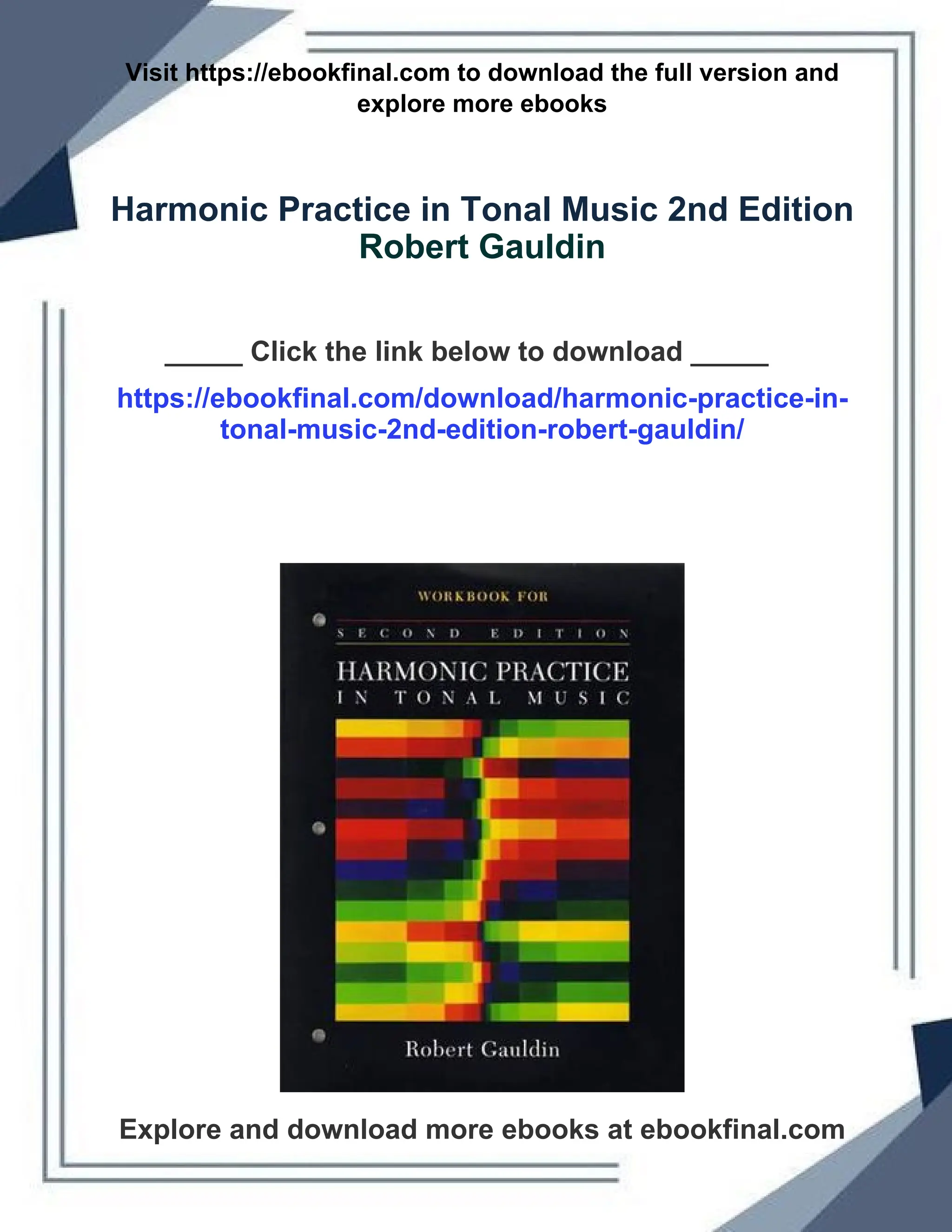




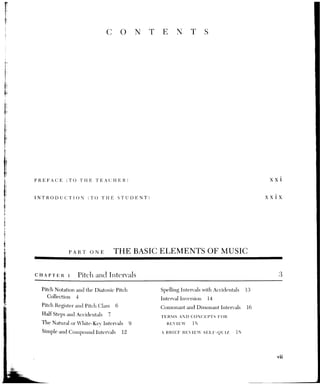
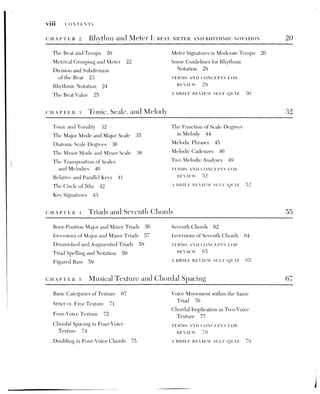
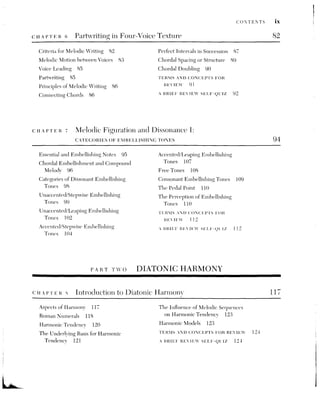
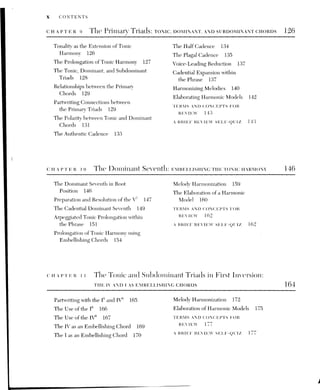
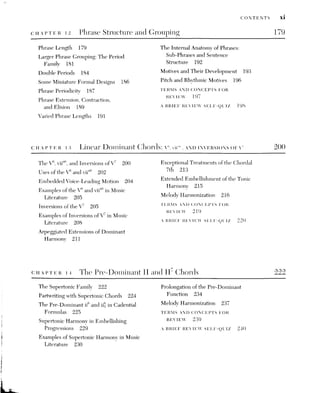
![CONTENTS xili
CHAPTER 18 Rhythm and Meter II: appDITIONAL METER SIGNATURES
AND RHYTHMIC-METRICAL DISSONANCE 307
Meter Signatures in Very Slow or Very Fast Rhythmic Dissonance 311
Tempo 307 Metrical Dissonance 315
Asymmetrical Meters 309 TERMS AND CONCEPTS FOR
Fast Complex Meters 310 REVIEW 32]
Rhythmic-Metrical Consonance 311 A BRIEF REVIEW SELF-QUIZ 322
19 The Leading-tone Seventh Chord and Other
Seventh Chords 323
The Leading-tone Diminished-seventh Melody Harmonization 334
Chord in the Minor Mode 323 Other Diatonic Seventh Chords: The IV’,
Partwriting with the vii’ in the Minor I’, Vi, and Hl’ 335
Mode 325 TERMS AND CONCEPTS FOR
Other Uses of the vii?’ 328 REVIEW 340
The Leading-tone Seventh Chord A BRIEF REVIEW SELF-QUIZ 340
in the Major Mode 333
CHAPTER 20 Harmonic Sequences I: ROOT MOVEMENT
BY 5TH, 2ND. AND 3RD 342
Sequential and Cyclical Root
Movement 342
Harmonic Sequences 344
Triadic Root Movement by Descending
5th 346
Triads in Descending 5th Sequences 347
Triads in Ascending 5th Sequences 351
Root Movement by 2nd: Successive
First-inversion Chords 352
Sequences of Root-position Triads
in Stepwise Motion 355
Root Movement by Descending
and Ascending 3rd 357
Harmonic Sequences in Melody
Harmonization 360
TERMS AND CONCEPTS FOR
REVIEW 36-4
A BRIEF REVIEW SELF-QUIZ 364](https://image.slidesharecdn.com/27906-250225140932-25229c23/85/Harmonic-Practice-in-Tonal-Music-2nd-Edition-Robert-Gauldin-16-320.jpg)
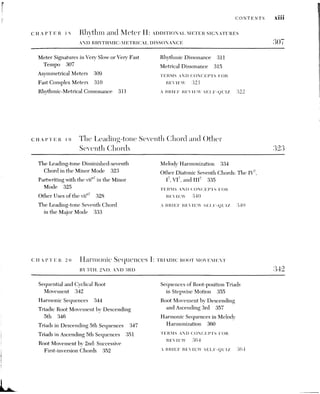
![CONTENTS XV
CHAPTER 24 Simple Forms 426
Content and Form 427 Baroque Continuous Variations 438
Formal Design and Tonal Structure 427 Sectional Variations, or Theme
One-part Form 427 and Variations 441
Binary or Two-reprise Design 429 Rondo Form 445
The Two-reprise Design in the Baroque
The Five-part Rondo 446
Period 429 Seven-part Rondo Form 450
The Two-reprise Design in the Classical TERMS AND CONCEPTS FOR
Period 431 REVIEW 451
Ternary Form 432 A BRIEF REVIEW SELF-QUIZ 452
Variation Form 436
25 Analytical Comments on a Menuetto
and Trio by Beethoven 453
Larger Formal Considerations 453
Formal Characteristics of Beethoven’s
Menuetto and Trio 454
Motives and Phrase Grouping
inthe Menuetto 455
Voice Leading in the Menuetto 460
Motives and Phrase Groupings
inthe Trio 46]
Middleground Voice Leading
inthe Trio 464
Overall Voice Leading in the Menuetto
and Trio 465
Unifying Factors in the Movement 466
TERMS AND CONCEPTS FOR
REVIEW 467
PART THREE CHROMATIC HARMONY
CHAPTER 26 Introduction to Chromatic Harmony 471
The Historical Evolution of Non-Diatonic
Tones 472
Chromatic Melodic Motion 474
Enharmonic Duality 477
Decorative versus Structural
Chromaticism 478
Using Roman Numerals to Designate
Chromatic Harmonies 481]
TERMS AND CONCEPTS FOR
REVIEW 45]
A BRIEF REVIEW SELF-OUIZ 482](https://image.slidesharecdn.com/27906-250225140932-25229c23/85/Harmonic-Practice-in-Tonal-Music-2nd-Edition-Robert-Gauldin-18-320.jpg)
![Xvi CONTENTS
CHAPTER 27. Tonicization and Modulation III:
MODULATIONS TO CLOSELY RELATED KEYS 483
Close] Related Key 185
Relative Frequency of Closely Related
Keys 486
The Fatent of the Tonicized Area 186
The Process of Modulating to Closely
Related Keys 488
CHAPTER 28
Tonal Schemes Within a Movement t91
Melody Harmonization 494
TERMS AND CONCEPTS FOR
REVIEW {9S
A BRIEFED REVIEW SELF -ovuIz [99
Modal Exchange and Mixture Chords 501
Modal Exchange 502
Mixture Chords 505
Mixture Chords in the Major Mode 505
Mixture Chords in the Minor Mode 516
The III Triad as a Secondary Mixture Chord
in Major 516
The Relationship between Scale Degrees #5
versus }6 518
Melody Warmonization 520
VLEMS AND GONCLI YS LOR
REVIEW 52]
lo
A BRIEF REVIEW SELPF-QUTZ 5!
CHAPTER 29 The Neapolitan or bII Chord 524
A Question of Terminology: iv }6—5
versus bII® 525
The Neapolitau Sixth ii Miitur and Majoi
Modes 525
The 511° as an Embellishing Chord 527
Other Characteristics of the nae 529
Other Uses of the Neapolitan Chord 530
CHAPTER 30
Augmented Sixth Chords
Tonicization of the Neapolitan
Harmony 533
Melody Hariionizauon 554
TERMS AND CONCEPTS FOR
REVIEW 536
VBRIEE REVEPW SET E-OLIZ 355
535
The Three Common Forms of Augmented
Sixth Chords 539
The Italian, French, and German
Augmented Sixth Chords in the Minor
Mode 541
Augmented Sixth Chords in the Major
Mode 544
Secondary Augmented Sixth Chords 545
Inversions of the Augmented Sixth
Chords 547
Other Resolutions of Augmented Sixth
Chords 550
Enharmonic Augmented Sixth Chords 531
More Exotic Augmented Sixth Chords 553
Melody Harmonization 555
TERMS AND CONCEPTS FOR
REVIEW 5955
A BRIEF REVIEW SELF-QUIZ 556](https://image.slidesharecdn.com/27906-250225140932-25229c23/85/Harmonic-Practice-in-Tonal-Music-2nd-Edition-Robert-Gauldin-19-320.jpg)
![CONTENTS XVii
CHAPTER 31 Extended Homophonic and Contrapuntal
Formal Designs 558
Sonata Form 558 TERMS AND CONCEPTS FOR
—— +
Sonata-Rondo Form 567 REVIEW 975
Concerto Form 567 A BRIEF REVIEW SELF-QUIZ 579
Contrapuntal Forms 569
cHaprerR 32 Embellishing Chromatic Chords 580
Augmented Triads as Passing Additional Chromatic Chords in the Major
or Neighboring Chords 58] and Minor Modes 594
Altered V' Chords 585 The Use of Chromaticism to Create Modal
Embellishing or Common-Tone Ambiguity 597
Diminished-Seventh Chords 587 Melody Harmonization 598
Common-Tone Augmented Sixth TERMS AND CONCEPTS FOR
Chords 590 REVIEW 599
Unusual Linear Chords 593 A BRIEF REVIEW SELF-QUIZ 600
CHAPTER 33. Dominant Prolongation 602
Short-Term Chromatic Prolongation Dominant Prolongations as Preparation
of Vi" 603 fora Climax 608
Prolongation of the Dominant in TERMS AND CONCEPTS FOR
Introductions 604 REVIEW 610
Prolongation of the Dominant in A BRIEF REVIEW SELF-QUIZ 610
Retransitions 605
Prolongation of the Cadential
Formula 606
CHAPTER 34 Modulation to Foreign Keys I 612
Modulations to Foreign Keys in the Major Foreign-Key Modulations in Development
Mode 613 Sections 626
Change-of-Mode Modulation 614 Melody Harmonization 627
Third-Related Modulations by Common TERMS AND CONCEPTS FOR
Tone 619 REVIEW 625
Modulations to Foreign Kevs by Pivot A BRIEF REVIEW SELF-QUIZ 628
Chord 621
Modulations to Foreign Kevs in the Minor
Mode 624](https://image.slidesharecdn.com/27906-250225140932-25229c23/85/Harmonic-Practice-in-Tonal-Music-2nd-Edition-Robert-Gauldin-20-320.jpg)
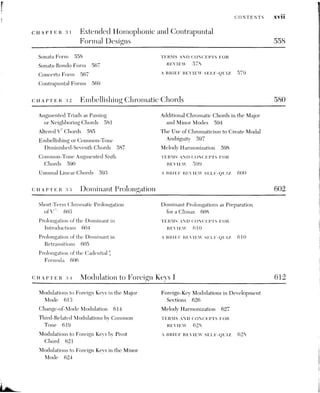
![CONTENTS Xix
40 Modulations to Foreign Kevs I 719
Enharmonic Modulation 719 Modulation by Chromatic Linear
Chromatic Alterations of Diminished Progression 729
Seventh Chords 726 TERMS AND CONCEPTS FOR
Modulation by Strict Harmonic REVIEW 733
Sequence 727 A BRIEF REVIEW SELF-QUIZ 733
CHAPTER 41. Symmetrical Divisions of the Octave 735
Symmetrical Root Movements 737 TERMS AND CONCEPTS FOR
Extended Root Movement by Perfect REVIEW 752
Sth 744 A BRIEF REVIEW SELF-QUIZ 752
The Omnibus Sequence 746
Tonal Schemes Using Symmetrical
Divisions of the Octave 749
CHAPTER 42. At the Limits of Tonalitv: ALBAN BERG'S FOUR SONGS. OP. 2 754
TERMS AND CONCEPTS FOR
REVIEW 77]
APPENDIX 1 Some Fundamentals of Acoustics AQ
Frequency and Pitch AO Vibration Form and Timbre A3
Intensity and Loudness A2 Duration and Length A5
APPENDIX 2. The Diatonic Church Modes and Other Scales A6
The Ecclesiastical or Church Modes A6 Other Scales AQ
APPENDIX 3. An Introduction to Species Counterpoint Al4
Melodic Characteristics A16 Fourth Species A22
First Species A16 Fifth Species A23
Second Species A19 Underlying Species Technique in Two-
Third Species A21 Voice Passages A25](https://image.slidesharecdn.com/27906-250225140932-25229c23/85/Harmonic-Practice-in-Tonal-Music-2nd-Edition-Robert-Gauldin-22-320.jpg)
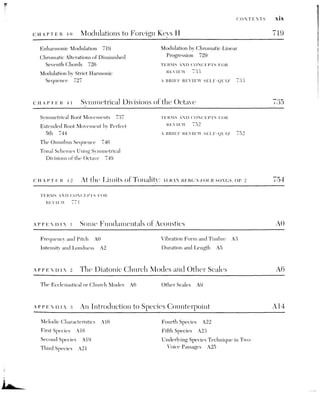
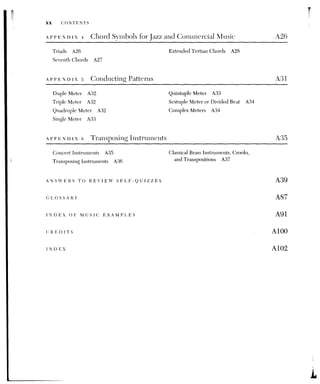
![XXli PREFACE (TO THE TEACHER)
¢ The chapters covering diatonic and chromatic harmony have been re-
ordered to increase the accessibility of core concepts. Specifically, the
subdominant chord is now introduced along with the tonic and domi-
nant; mediant and submediant chords are introduced earlier; se-
quences are presented in a single chapter; and an entire chapter
devoted to secondary dominants occurs before the introduction of
basic modulation.
¢ The harmony chapters have been restructured internally as well. Each
of these chapters now begins with a short introduction that relates the
new chord to those discussed in previous chapters, followed by a section
on chord type, spelling, and terminology. An explanation of practical
partwriting considerations follows. Short excerpts from the literature
occur throughout the chapters, providing contexts for the chords’ typical
uses and functions. Exceptions or rare applications are now reserved for
the end of the chapter, and additional sources for study may be found in
footnotes. Each chapter concludes with explanations of ways in which
mode] chord progressions may he embellished, guidelines for melody
harmonization, a list of terms for review, and a short self-quiz.
¢
Summary boxes have been added throughout the text to highlight key
information, recapping and providing straightforward descriptions of
the more complex concepts and procedures. Students will be able to
easily refer back to these boxes in order to remind themselves of these
ideas.
¢ Guidelines boxes have also been added to offer clear outlines for such
procedures as partwriting, making voice-leading reductions, and har-
monizing melodies.
¢
Self-quizzes have been included at the end of each chapter, enabling
students to review the material and test their understanding of con-
cepts. The answers to each of these quizzes are included in a section
at the end of the book.
¢
Many new music examples, by a broader range of composers, have
been added throughout the book, resulting in the inclusion of more
world music, popular music, rock, jazz, and music by women.
e An appendix covering the transposition of instruments has been
added, and the appendix explaining chord svmbols for jazz and com-
mercial music now incorporates more standard commercial symbols.
e A single CD-ROM accompanies the Second Edition, replacing the
three-CD set that accompanied the First Edition. This one disc con-
tains all excerpts from the music literature cited within the text (ex-
cept for most single-line melodies), and is both Macintosh- and
PC-compatible. A special “CD” icon (@)) appears next to each
recorded excerpt in the book.](https://image.slidesharecdn.com/27906-250225140932-25229c23/85/Harmonic-Practice-in-Tonal-Music-2nd-Edition-Robert-Gauldin-25-320.jpg)
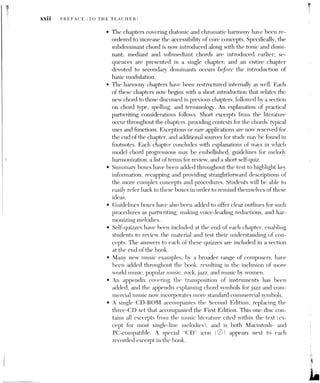
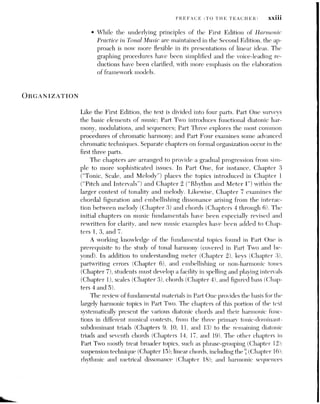



![4 [CH. 1] PITCH AND INTERVALS
PITCH NOTATION AND THE DIATONIC PITCH COLLECTION
Figure
Our first concern is the notation of pitch—that is, our system of writing down
the music we hear or perform. Note that music does not always exist in written
form; much of the world’s music, and much of the folk and popular music of
our own culture, is not written down, but transmitted orally, through perfor-
Mance Or one-to-one stu With aoriaster Writing minsic down, however, can
be useful for several purposes, it enables society, for whatever reason, to estab-
lish a definitive version of its music and preserve it acerrately for fiture gencra-
tions. One of the earliest attempts to notate music employed the first seven
letters of the alphabet, A-B-C-D-E-F-G, to represent the musical tones.! Mov-
ing forward through the letters represented moving upward, raising the pitch,
and moving backward represented moving down To extend the range, these
same letters were repeated, sometimes using uppercase and lowercase letters
to distinguish different octaves. In our present notational system, we call the
seven tones represented by these letters the white-key or diatonic pitch col-
lection. We will return to the term “diatonic” in Chapter 3; for now we can de-
fine these diatonic notes as the group of pitches that occur in the same
repeating pattern as the white keys of the piano keyboard (Figure 1.1).
C DE —F
GA BC D EF GA BBCODE F GA B
. | | |
r
Tf you start from any white key and play successive white keys up or down,
each new key will have a different sound or pitch until you reach the key that has
the same letter name as your starting key. That key will sound higher or lower
than the note vou started with, but, allowing for that, the two notes will sound the
same. This recurnig sonority occurs on the eivlith white key frou your starting
point, and is therefore called an octave, from the Greek word okta, meaning
“eight.” The reason for the nearly identical sound of anv note and its octave lies in
the physics of musical sound, or acoustics. Pitch results from the frequency of a
sound—that is, the number of complete vibrations or cvcles per second pro-
duced by a sound. All sounds result from vibrating bodies of some sort—a
string,
1
Fark nofation Svstoris Ne traced dack as far as T3500 Be in Bal tenia The: svstenn dee
scribed here was used by the ancient Greeks about the second century B.C.. and appears in
treatises on music in medieval Europe around A.D. 900.](https://image.slidesharecdn.com/27906-250225140932-25229c23/85/Harmonic-Practice-in-Tonal-Music-2nd-Edition-Robert-Gauldin-39-320.jpg)
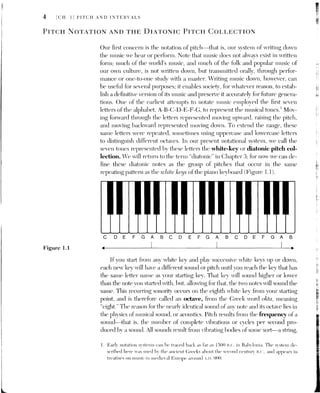
![6 (CH. 1] PITCH AND INTERVALS
Example 1.2
Clefs are signs that designate the lines and spaces of the staff to repre-
sent the various pitches of the scale. The most important clefs in use in the
common-practice period are the treble clef and the bass clef. The treble
clef, also called the G clef, assigns the second staff line from the bottom to G
above middle C; middle C is the first extra or ledger line below the staff.
The bass clef, or F clef, assigns the fourth staff line from the bottom of the
staff to F below middle C; middle C, therefore, is the first ledger line
above the staff. These two clefs bracketed together form the grand staff
(Example 1.le), used for piano music or keyboard reductions of music writ-
ten for other performing groups.
There is another clef, the C clef, that locates middle C on one of the staff
lines. Two C clefs are still in use; the alto clef, which locates middle C on
the middle staff line, is used in music for the viola, and the tenor clef,
which locates middle C on the fourth line from the bottom, is used occasion-
ally in music for the cello, bassoon, and trombone. In Example 1.2, a series
of five pitches beginning with middle C (C-G-A-B-C) is written in four dif-
ferent clefs. This example makes clear why we have different clefs; even this
narrow-range melody fits better on some staves than others.
treble clef alto clef tenor clef bass clef
h rita eo eo
Ve wey 2
L haul
I ant 1
1h a Wall
2. HW
XY ij
eo
The musical examples in this text will employ the treble and bass clefs. It
is imperative that you can read pitches in both these clefs quickly and accu-
rately; see Chapter | in the Workbook for drills in rapid pitch reading.
PITCH REGISTER AND PITCH CLASS
When discussing or writing about music, we often need to refer to a note in
a specific octave range or register. One system for specifying the octave loca-
tion of a pitch designates middle C “cl” and calls the C’s on the piano, start-
ing from the lowest, CC, C, c, ce! c?, c?, and so forth. In this book we will use
a system now in common use among music theorists and acousticians that
designates the lowest C on the piano C! and calls the C’s in the following oc-
taves C’, C?, and so forth, up to C’. The same superscript numbers are used
for all the pitches in that octave, so that we can designate any pitch in its
specific octave.](https://image.slidesharecdn.com/27906-250225140932-25229c23/85/Harmonic-Practice-in-Tonal-Music-2nd-Edition-Robert-Gauldin-41-320.jpg)
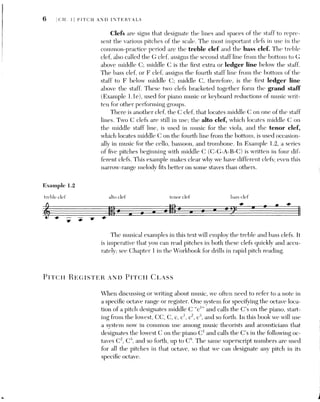
![§ [CH. 1] PITCH AND INTERVALS
only pitches that tonal music has used. As early as the Renaissance, additional
notes were added to the scale, often to create leading tones in cadences, and
by the late sixteenth century, keyboard instruments had the same set of white
and black keys as the modern piano. If we count all the keys between middle
C (C*) and the C an octave higher (C”), we see that the octave is divided into
twelve different pitches, not seven. The distance between any two adjacent
keys is called a half step or semitone. It is the smallest distance between
two pitches commonly used in Western music. In the tuning system in use
since about 1800, called equal temperament, each of the twelve half steps
within the octave is exactly equalin size. The twelve-note scale, including all
the white kevs and black keys of the piano, is called the chromatic scale.
We write these additional pitches through the use of accidentals. A
sharp sign (#) raises the pitch of a note by one half step, a flat sign (5) low-
ers the pitch by one half step, and a natural sign (4) cancels a previous
sharp ov flat (Fxunple Tota’ The notation of pite
tches aOccasionall roe
quire a double accidental: a double sharp
(x) raises a note by two half steps.
or a whole step, and a double flat (b) lowers a tone by two half steps, or a
whole step (Example 1.4b). Accidentals allow us to expand the seven natural
or white-key pitch classes into the twelve different pitch classes within the
octave, the chromatic pitch collection that includes all the pitches nor-
mally emploved in Western music (Example 1.4d).
O
Example 1.4
A, B.
4 T
—T Mt
mo
y
4 | t t tt
bw vw
C.
|
va a.
|
|
Hh,
|
i
W
i
eT
MN
Accidentals also allow us to notate a single pitch in different wavs. The
black kev between C and D, for example, mav be called C¥ or Db, depending
on the context. We sav that such notes are enharmonic spellings of the same
pitch class—identical sounds written, or spelled, different ways. Some other
examples of enharmonic notation appear in Example 1.4c. The reasons why
different situations and musical contexts require different spellings of the
same note will become clear in the course of our discussion in later chapters.](https://image.slidesharecdn.com/27906-250225140932-25229c23/85/Harmonic-Practice-in-Tonal-Music-2nd-Edition-Robert-Gauldin-43-320.jpg)