Music Theory the Fun Way:
Through Soloing!
Steve Danielsson
steve@littlekidsrock.org
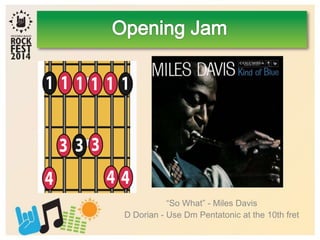
“So What” - Miles Davis
D Dorian - Use Dm Pentatonic at the 10th fret
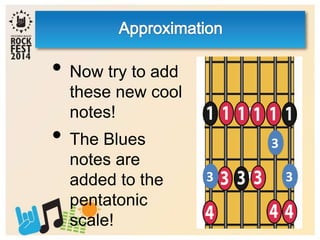
• Now try to add
these new cool
notes!
• The Blues
notes are
added to the
pentatonic
scale!
3
3
3
• Basics of music theory
• Pentatonic Review - Why it’s
awesome
• Starting point - The Major Scale
• Advanced (more fun!) scales
• Building your knowledge further
• Music theory is the formalized
study of the rules of music that
we hear
• It is studied to further our
understanding of what we hear
• The formalized study is based on
musical trends
• Learning rules to music implies there is a “right”
answer
• Many of us learn music theory in a regimented
classroom setting
• There is no immediate success in the study of
music theory
• Studying/practicing music theory with your
instrument in hand increases your understanding
and enjoyment
• Learning to
approximate your
ear takes practice
• Building a low
stress environment
is easy!
• Simply take out
your guitar and get
ready!
• In all three musical
examples, we will
work to find what key
we are in
• We will find this
simply by using the
sixth string
• Play along with the
song, until you find
the note that the song
seems to rest on
• Most musicians ear are developed enough to
find Do in popular music
• Occasionally, it will be difficult to find a key,
feel free to use online hints!
• Every second you are playing and listening to
your instrument, your musicianship is
developing
• The most important thing to learn is The
Confidence To Try!
• According to most guitar players: “All
music was written to have guitar solos
played over it”
• Approximating with a familiar shape will
develop your ear, your hand and increase
your fluency using the scale
• Let’s start by Approximating on a famous
progression
• A Blues in A is built on the idea of
tension
• An A7 Chord has a C# in it, while an A
pentatonic has a C natural in it
• These differing notes create musical
tension, that many of us today know
as a “bluesy” sound
• We will now play a Blues in a
few new keys
• After each 12 bar phrase, we
will switch to a new key
• Find the key by experimenting
with the pentatonic shape
• The tension in blues makes
it feel safe to miss notes
• In Diatonic music (music
built in one key), missed
notes will sometimes sound
more out of place
• Ignore your desire to be
perfect, and try as many
pentatonic shapes as you
can
• The location of the scale will
tell you what key we are in!
“BAM!”
• Alway! The best way to develop your ear and
understanding of your guitar is to have your
guitar out while your listening.
• Try everything you hear
• Every missed note should be thought of as an
exercise
• Sitting on the couch watching TV? Take out the
guitar! You’d be surprised how much there is to
try and play along with!
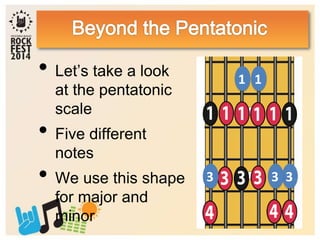
• Let’s take a look
at the pentatonic
scale
• Five different
notes
• We use this shape
for major and
minor
3 3 3
1 1
• Learning to hear the sound, for you
and for your students
• Avoid “happy” and “sad”
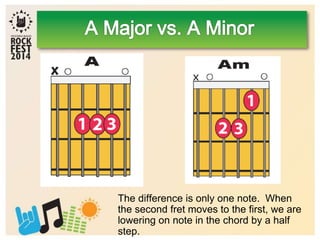
• Make the terms Minor and Major part
of your classroom vocabulary
• Most songs use major AND minor
chords together
The difference is only one note. When
the second fret moves to the first, we are
lowering on note in the chord by a half
step.
• All modern Western music is built
on the same pattern
• Even the most advanced music
theory is based on the same
simple information
• That information is so famous,
most people already know it
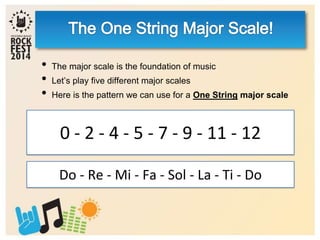
• The major scale is the foundation of music
• Let’s play five different major scales
• Here is the pattern we can use for a One String major scale
0 - 2 - 4 - 5 - 7 - 9 - 11 - 12
Do - Re - Mi - Fa - Sol - La - Ti - Do
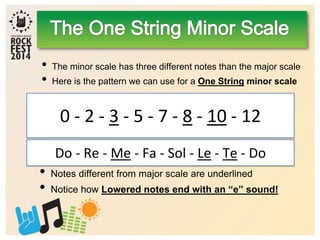
• The minor scale has three different notes than the major scale
• Here is the pattern we can use for a One String minor scale
0 - 2 - 3 - 5 - 7 - 8 - 10 - 12
Do - Re - Me - Fa - Sol - Le - Te - Do
• Notes different from major scale are underlined
• Notice how Lowered notes end with an “e” sound!
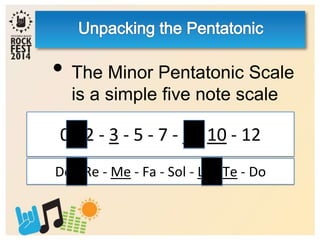
• The Minor Pentatonic Scale
is a simple five note scale
0 - 2 - 3 - 5 - 7 - 8 - 10 - 12
Do - Re - Me - Fa - Sol - Le - Te - Do
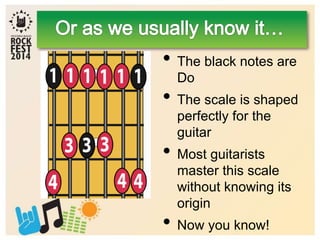
• The black notes are
Do
• The scale is shaped
perfectly for the
guitar
• Most guitarists
master this scale
without knowing its
origin
• Now you know!
• Knowledge of how a
scale works will ALWAYS
enhance your ability to
use it
• Even just knowing where
“Do” is
• Learning scales is a life
long process, each time
you play it, it builds itself
stronger into your
musical lexicon
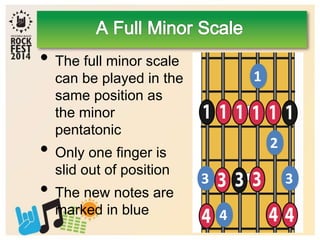
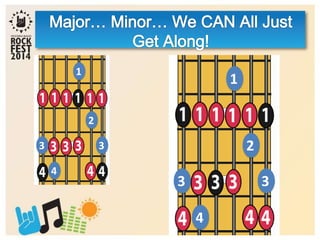
• The full minor scale
can be played in the
same position as
the minor
pentatonic
• Only one finger is
slid out of position
• The new notes are
marked in blue
1
3 3
2
4
1
3 3
2
4
1
2
3 3
4
• We add two important notes in
the full scale
• These notes are the 4th and
7th of the major scale
• They add a lot of tension,
which can be a great tool for
soloing
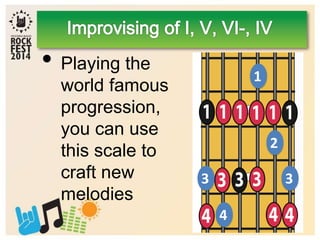
• Playing the
world famous
progression,
you can use
this scale to
craft new
melodies
1
3 3
2
4
• A “Mode” is a unique
scale pattern and
shape
• These are all based
on the original major
and minor scales
• Just like minor/major
have the same notes,
so do modes
• Most guitarists learn
these modes in new
1
3 3
1
3
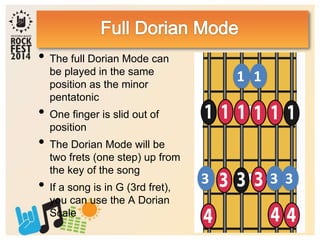
• The full Dorian Mode can
be played in the same
position as the minor
pentatonic
• One finger is slid out of
position
• The Dorian Mode will be
two frets (one step) up from
the key of the song
• If a song is in G (3rd fret),
you can use the A Dorian
Scale
1
3 3
1
3
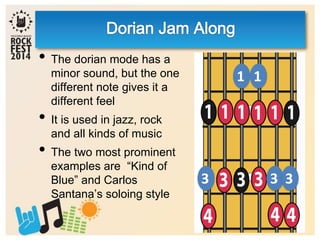
• The dorian mode has a
minor sound, but the one
different note gives it a
different feel
• It is used in jazz, rock
and all kinds of music
• The two most prominent
examples are “Kind of
Blue” and Carlos
Santana’s soloing style
1
3 3
1
3
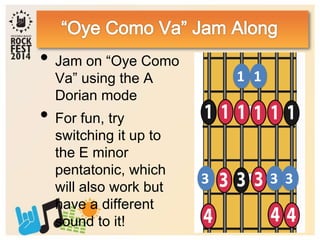
• Jam on “Oye Como
Va” using the A
Dorian mode
• For fun, try
switching it up to
the E minor
pentatonic, which
will also work but
have a different
sound to it!
1
3 3
1
3
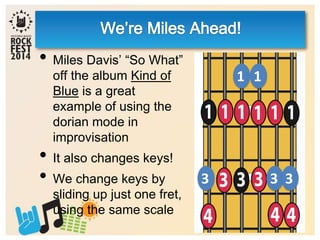
• Miles Davis’ “So What”
off the album Kind of
Blue is a great
example of using the
dorian mode in
improvisation
• It also changes keys!
• We change keys by
sliding up just one fret,
using the same scale

Music.pptx

  • 1.
    Music Theory theFun Way: Through Soloing! Steve Danielsson steve@littlekidsrock.org
  • 2.
    “So What” -Miles Davis D Dorian - Use Dm Pentatonic at the 10th fret
  • 3.
    • Now tryto add these new cool notes! • The Blues notes are added to the pentatonic scale! 3 3 3
  • 4.
    • Basics ofmusic theory • Pentatonic Review - Why it’s awesome • Starting point - The Major Scale • Advanced (more fun!) scales • Building your knowledge further
  • 5.
    • Music theoryis the formalized study of the rules of music that we hear • It is studied to further our understanding of what we hear • The formalized study is based on musical trends
  • 6.
    • Learning rulesto music implies there is a “right” answer • Many of us learn music theory in a regimented classroom setting • There is no immediate success in the study of music theory • Studying/practicing music theory with your instrument in hand increases your understanding and enjoyment
  • 7.
    • Learning to approximateyour ear takes practice • Building a low stress environment is easy! • Simply take out your guitar and get ready!
  • 8.
    • In allthree musical examples, we will work to find what key we are in • We will find this simply by using the sixth string • Play along with the song, until you find the note that the song seems to rest on
  • 9.
    • Most musiciansear are developed enough to find Do in popular music • Occasionally, it will be difficult to find a key, feel free to use online hints! • Every second you are playing and listening to your instrument, your musicianship is developing • The most important thing to learn is The Confidence To Try!
  • 10.
    • According tomost guitar players: “All music was written to have guitar solos played over it” • Approximating with a familiar shape will develop your ear, your hand and increase your fluency using the scale • Let’s start by Approximating on a famous progression
  • 11.
    • A Bluesin A is built on the idea of tension • An A7 Chord has a C# in it, while an A pentatonic has a C natural in it • These differing notes create musical tension, that many of us today know as a “bluesy” sound
  • 12.
    • We willnow play a Blues in a few new keys • After each 12 bar phrase, we will switch to a new key • Find the key by experimenting with the pentatonic shape
  • 13.
    • The tensionin blues makes it feel safe to miss notes • In Diatonic music (music built in one key), missed notes will sometimes sound more out of place • Ignore your desire to be perfect, and try as many pentatonic shapes as you can • The location of the scale will tell you what key we are in! “BAM!”
  • 14.
    • Alway! Thebest way to develop your ear and understanding of your guitar is to have your guitar out while your listening. • Try everything you hear • Every missed note should be thought of as an exercise • Sitting on the couch watching TV? Take out the guitar! You’d be surprised how much there is to try and play along with!
  • 15.
    • Let’s takea look at the pentatonic scale • Five different notes • We use this shape for major and minor 3 3 3 1 1
  • 16.
    • Learning tohear the sound, for you and for your students • Avoid “happy” and “sad” • Make the terms Minor and Major part of your classroom vocabulary • Most songs use major AND minor chords together
  • 17.
    The difference isonly one note. When the second fret moves to the first, we are lowering on note in the chord by a half step.
  • 18.
    • All modernWestern music is built on the same pattern • Even the most advanced music theory is based on the same simple information • That information is so famous, most people already know it
  • 19.
    • The majorscale is the foundation of music • Let’s play five different major scales • Here is the pattern we can use for a One String major scale 0 - 2 - 4 - 5 - 7 - 9 - 11 - 12 Do - Re - Mi - Fa - Sol - La - Ti - Do
  • 20.
    • The minorscale has three different notes than the major scale • Here is the pattern we can use for a One String minor scale 0 - 2 - 3 - 5 - 7 - 8 - 10 - 12 Do - Re - Me - Fa - Sol - Le - Te - Do • Notes different from major scale are underlined • Notice how Lowered notes end with an “e” sound!
  • 21.
    • The MinorPentatonic Scale is a simple five note scale 0 - 2 - 3 - 5 - 7 - 8 - 10 - 12 Do - Re - Me - Fa - Sol - Le - Te - Do
  • 22.
    • The blacknotes are Do • The scale is shaped perfectly for the guitar • Most guitarists master this scale without knowing its origin • Now you know!
  • 23.
    • Knowledge ofhow a scale works will ALWAYS enhance your ability to use it • Even just knowing where “Do” is • Learning scales is a life long process, each time you play it, it builds itself stronger into your musical lexicon
  • 24.
    • The fullminor scale can be played in the same position as the minor pentatonic • Only one finger is slid out of position • The new notes are marked in blue 1 3 3 2 4
  • 25.
  • 26.
    • We addtwo important notes in the full scale • These notes are the 4th and 7th of the major scale • They add a lot of tension, which can be a great tool for soloing
  • 27.
    • Playing the worldfamous progression, you can use this scale to craft new melodies 1 3 3 2 4
  • 28.
    • A “Mode”is a unique scale pattern and shape • These are all based on the original major and minor scales • Just like minor/major have the same notes, so do modes • Most guitarists learn these modes in new
  • 29.
    1 3 3 1 3 • Thefull Dorian Mode can be played in the same position as the minor pentatonic • One finger is slid out of position • The Dorian Mode will be two frets (one step) up from the key of the song • If a song is in G (3rd fret), you can use the A Dorian Scale
  • 30.
    1 3 3 1 3 • Thedorian mode has a minor sound, but the one different note gives it a different feel • It is used in jazz, rock and all kinds of music • The two most prominent examples are “Kind of Blue” and Carlos Santana’s soloing style
  • 31.
    1 3 3 1 3 • Jamon “Oye Como Va” using the A Dorian mode • For fun, try switching it up to the E minor pentatonic, which will also work but have a different sound to it!
  • 32.
    1 3 3 1 3 • MilesDavis’ “So What” off the album Kind of Blue is a great example of using the dorian mode in improvisation • It also changes keys! • We change keys by sliding up just one fret, using the same scale