The Small and Medium Enterprises (SMEs):
Bangladesh and International Perspective
Dr. Engr. Syed Md. Ihsanul Karim
Managing Director & CEO
The Small and Medium Enterprise Foundation
Presentation Outline:
 Introduction
 Definition of SMEs: Bangladesh Perspective
 Definition of SMEs: International Perspective
 Definition of SMEs in some selected countries: India, Japan,
Korea, Malaysia, Thailand, China and Vietnam
 Contribution of SMEs in Bangladesh Economy
 Contribution of SMEs: International Experience
 Major constraints of SME around the globe.
 Conclusion
Introduction
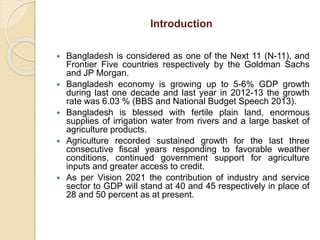
 Bangladesh is considered as one of the Next 11 (N-11), and
Frontier Five countries respectively by the Goldman Sachs
and JP Morgan.
 Bangladesh economy is growing up to 5-6% GDP growth
during last one decade and last year in 2012-13 the growth
rate was 6.03 % (BBS and National Budget Speech 2013).
 Bangladesh is blessed with fertile plain land, enormous
supplies of irrigation water from rivers and a large basket of
agriculture products.
 Agriculture recorded sustained growth for the last three
consecutive fiscal years responding to favorable weather
conditions, continued government support for agriculture
inputs and greater access to credit.
 As per Vision 2021 the contribution of industry and service
sector to GDP will stand at 40 and 45 respectively in place of
28 and 50 percent as at present.
Continued . . .
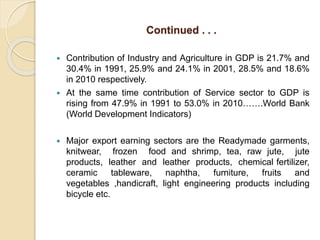
 Contribution of Industry and Agriculture in GDP is 21.7% and
30.4% in 1991, 25.9% and 24.1% in 2001, 28.5% and 18.6%
in 2010 respectively.
 At the same time contribution of Service sector to GDP is
rising from 47.9% in 1991 to 53.0% in 2010…….World Bank
(World Development Indicators)
 Major export earning sectors are the Readymade garments,
knitwear, frozen food and shrimp, tea, raw jute, jute
products, leather and leather products, chemical fertilizer,
ceramic tableware, naphtha, furniture, fruits and
vegetables ,handicraft, light engineering products including
bicycle etc.
Definition of SMEs: Bangladesh Perspective
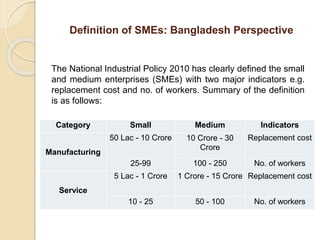
The National Industrial Policy 2010 has clearly defined the small
and medium enterprises (SMEs) with two major indicators e.g.
replacement cost and no. of workers. Summary of the definition
is as follows:
Category Small Medium Indicators
Manufacturing
50 Lac - 10 Crore 10 Crore - 30
Crore
Replacement cost
25-99 100 - 250 No. of workers
Service
5 Lac - 1 Crore 1 Crore - 15 Crore Replacement cost
10 - 25 50 - 100 No. of workers
Definition of SMEs: International Perspective
OECD & EC:
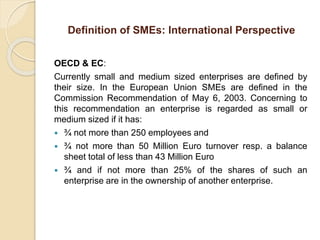
Currently small and medium sized enterprises are defined by
their size. In the European Union SMEs are defined in the
Commission Recommendation of May 6, 2003. Concerning to
this recommendation an enterprise is regarded as small or
medium sized if it has:
 ¾ not more than 250 employees and
 ¾ not more than 50 Million Euro turnover resp. a balance
sheet total of less than 43 Million Euro
 ¾ and if not more than 25% of the shares of such an
enterprise are in the ownership of another enterprise.
Continued . . .
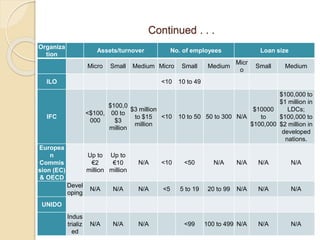
Organiza
tion
Assets/turnover No. of employees Loan size
Micro Small Medium Micro Small Medium
Micr
o
Small Medium
ILO <10 10 to 49
IFC
<$100,
000
$100,0
00 to
$3
million
$3 million
to $15
million
<10 10 to 50 50 to 300 N/A
$10000
to
$100,000
$100,000 to
$1 million in
LDCs;
$100,000 to
$2 million in
developed
nations.
Europea
n
Commis
sion (EC)
& OECD
Up to
€2
million
Up to
€10
million
N/A <10 <50 N/A N/A N/A N/A
Devel
oping
N/A N/A N/A <5 5 to 19 20 to 99 N/A N/A N/A
UNIDO
Indus
trializ
ed
N/A N/A N/A <99 100 to 499 N/A N/A N/A
Definition of SMEs in some selected countries
1. India:
According to the Micro, Small and Medium Enterprises
Development Act 2006, enterprises engaged in manufacturing
were defined as:
 A micro enterprise, where the investment in plant and
machinery does not exceed twenty five lakh rupees (
$50,000);
 A small enterprise, where the investment in plant and
machinery is more than twenty five lakh rupees but does not
exceed five crore rupees ($1 million); or
 A medium enterprise, where the investment in plant and
machinery is more than five crore rupees but does not
exceed ten crore rupees ($2 million).
Continued . . .
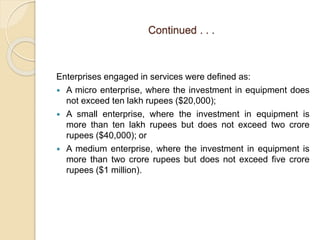
Enterprises engaged in services were defined as:
 A micro enterprise, where the investment in equipment does
not exceed ten lakh rupees ($20,000);
 A small enterprise, where the investment in equipment is
more than ten lakh rupees but does not exceed two crore
rupees ($40,000); or
 A medium enterprise, where the investment in equipment is
more than two crore rupees but does not exceed five crore
rupees ($1 million).
Continued . . .
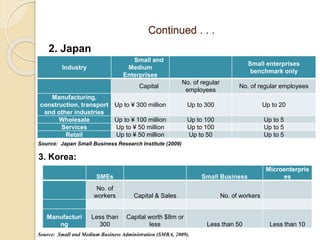
Industry
Small and
Medium
Enterprises
Small enterprises
benchmark only
Capital
No. of regular
employees
No. of regular employees
Manufacturing,
construction, transport
and other industries
Up to ¥ 300 million Up to 300 Up to 20
Wholesale Up to ¥ 100 million Up to 100 Up to 5
Services Up to ¥ 50 million Up to 100 Up to 5
Retail Up to ¥ 50 million Up to 50 Up to 5
2. Japan
Source: Japan Small Business Research Institute (2009)
SMEs Small Business
Microenterpris
es
No. of
workers Capital & Sales No. of workers
Manufacturi
ng
Less than
300
Capital worth $8m or
less Less than 50 Less than 10
3. Korea:
Source: Small and Medium Business Administration (SMBA, 2009).
Continued . . .
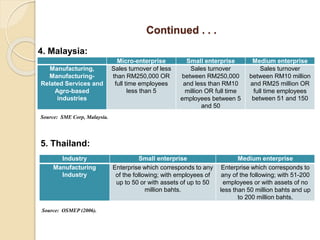
Micro-enterprise Small enterprise Medium enterprise
Manufacturing,
Manufacturing-
Related Services and
Agro-based
industries
Sales turnover of less
than RM250,000 OR
full time employees
less than 5
Sales turnover
between RM250,000
and less than RM10
million OR full time
employees between 5
and 50
Sales turnover
between RM10 million
and RM25 million OR
full time employees
between 51 and 150
4. Malaysia:
Source: SME Corp, Malaysia.
Industry Small enterprise Medium enterprise
Manufacturing
Industry
Enterprise which corresponds to any
of the following; with employees of
up to 50 or with assets of up to 50
million bahts.
Enterprise which corresponds to
any of the following; with 51-200
employees or with assets of no
less than 50 million bahts and up
to 200 million bahts.
5. Thailand:
Source: OSMEP (2006).
Continued . . .
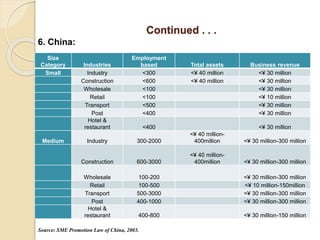
Size
Category Industries
Employment
based Total assets Business revenue
Small Industry <300 <¥ 40 million <¥ 30 million
Construction <600 <¥ 40 million <¥ 30 million
Wholesale <100 <¥ 30 million
Retail <100 <¥ 10 million
Transport <500 <¥ 30 million
Post <400 <¥ 30 million
Hotel &
restaurant <400 <¥ 30 million
Medium Industry 300-2000
<¥ 40 million-
400million <¥ 30 million-300 million
Construction 600-3000
<¥ 40 million-
400million <¥ 30 million-300 million
Wholesale 100-200 <¥ 30 million-300 million
Retail 100-500 <¥ 10 million-150million
Transport 500-3000 <¥ 30 million-300 million
Post 400-1000 <¥ 30 million-300 million
Hotel &
restaurant 400-800 <¥ 30 million-150 million
6. China:
Source: SME Promotion Law of China, 2003.
Continued . . .
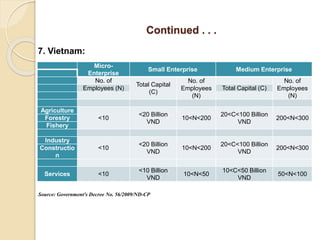
Micro-
Enterprise
Small Enterprise Medium Enterprise
No. of
Total Capital
(C)
No. of
Employees
(N)
No. of
Employees
(N)
Employees (N) Total Capital (C)
Agriculture
<10
<20 Billion
VND
10<N<200
20<C<100 Billion
VND
200<N<300Forestry
Fishery
Industry
<10
<20 Billion
VND
10<N<200
20<C<100 Billion
VND
200<N<300Constructio
n
Services <10
<10 Billion
VND
10<N<50
10<C<50 Billion
VND
50<N<100
7. Vietnam:
Source: Government's Decree No. 56/2009/ND-CP
Contribution of SMEs in Bangladesh Economy
 SMEs are the engine of growth in Bangladesh. There are
about 6 million SMEs in Bangladesh.
 About 90 per cent of all industrial units in Bangladesh are
SMEs generating about 25 per cent of the GDP, employing
about 31 million people and providing 75 per cent of
household income. Various categories of SMEs together
contribute between 80% to 85% of industrial employment and
23% of total civilian employment in Bangladesh.
 About 60%–65% of SMEs are located outside the
metropolitan areas of Dhaka and Chittagong. SMEs are
providing job opportunities to about 70%–80% of the
nonagricultural labor force. The SME share in manufacturing
value added to GDP varies at 28%– 30%.
Continued . . .
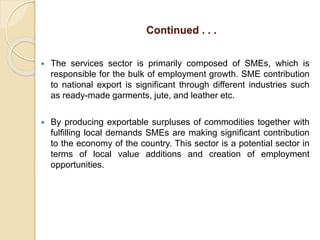
 The services sector is primarily composed of SMEs, which is
responsible for the bulk of employment growth. SME contribution
to national export is significant through different industries such
as ready-made garments, jute, and leather etc.
 By producing exportable surpluses of commodities together with
fulfilling local demands SMEs are making significant contribution
to the economy of the country. This sector is a potential sector in
terms of local value additions and creation of employment
opportunities.
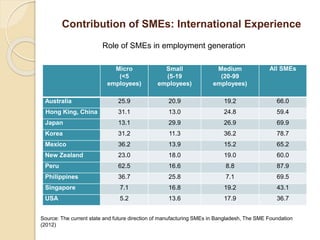
Contribution of SMEs: International Experience
Micro
(<5
employees)
Small
(5-19
employees)
Medium
(20-99
employees)
All SMEs
Australia 25.9 20.9 19.2 66.0
Hong King, China 31.1 13.0 24.8 59.4
Japan 13.1 29.9 26.9 69.9
Korea 31.2 11.3 36.2 78.7
Mexico 36.2 13.9 15.2 65.2
New Zealand 23.0 18.0 19.0 60.0
Peru 62.5 16.6 8.8 87.9
Philippines 36.7 25.8 7.1 69.5
Singapore 7.1 16.8 19.2 43.1
USA 5.2 13.6 17.9 36.7
Source: The current state and future direction of manufacturing SMEs in Bangladesh, The SME Foundation
(2012)
Role of SMEs in employment generation
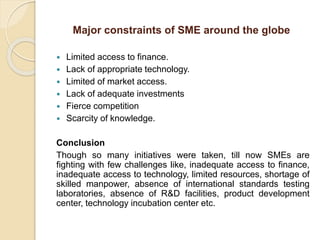
Major constraints of SME around the globe
 Limited access to finance.
 Lack of appropriate technology.
 Limited of market access.
 Lack of adequate investments
 Fierce competition
 Scarcity of knowledge.
Conclusion
Though so many initiatives were taken, till now SMEs are
fighting with few challenges like, inadequate access to finance,
inadequate access to technology, limited resources, shortage of
skilled manpower, absence of international standards testing
laboratories, absence of R&D facilities, product development
center, technology incubation center etc.
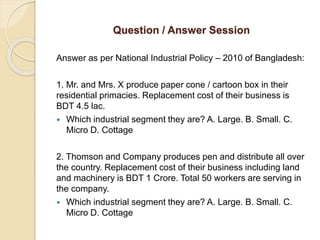
Question / Answer Session
Answer as per National Industrial Policy – 2010 of Bangladesh:
1. Mr. and Mrs. X produce paper cone / cartoon box in their
residential primacies. Replacement cost of their business is
BDT 4.5 lac.
 Which industrial segment they are? A. Large. B. Small. C.
Micro D. Cottage
2. Thomson and Company produces pen and distribute all over
the country. Replacement cost of their business including land
and machinery is BDT 1 Crore. Total 50 workers are serving in
the company.
 Which industrial segment they are? A. Large. B. Small. C.
Micro D. Cottage
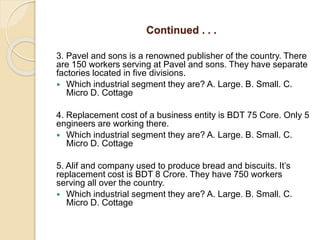
Continued . . .
3. Pavel and sons is a renowned publisher of the country. There
are 150 workers serving at Pavel and sons. They have separate
factories located in five divisions.
 Which industrial segment they are? A. Large. B. Small. C.
Micro D. Cottage
4. Replacement cost of a business entity is BDT 75 Core. Only 5
engineers are working there.
 Which industrial segment they are? A. Large. B. Small. C.
Micro D. Cottage
5. Alif and company used to produce bread and biscuits. It’s
replacement cost is BDT 8 Crore. They have 750 workers
serving all over the country.
 Which industrial segment they are? A. Large. B. Small. C.
Micro D. Cottage

Introduction to small & Medium Enterprises (SMEs)

  • 1.
    The Small andMedium Enterprises (SMEs): Bangladesh and International Perspective Dr. Engr. Syed Md. Ihsanul Karim Managing Director & CEO The Small and Medium Enterprise Foundation
  • 2.
    Presentation Outline:  Introduction Definition of SMEs: Bangladesh Perspective  Definition of SMEs: International Perspective  Definition of SMEs in some selected countries: India, Japan, Korea, Malaysia, Thailand, China and Vietnam  Contribution of SMEs in Bangladesh Economy  Contribution of SMEs: International Experience  Major constraints of SME around the globe.  Conclusion
  • 3.
    Introduction  Bangladesh isconsidered as one of the Next 11 (N-11), and Frontier Five countries respectively by the Goldman Sachs and JP Morgan.  Bangladesh economy is growing up to 5-6% GDP growth during last one decade and last year in 2012-13 the growth rate was 6.03 % (BBS and National Budget Speech 2013).  Bangladesh is blessed with fertile plain land, enormous supplies of irrigation water from rivers and a large basket of agriculture products.  Agriculture recorded sustained growth for the last three consecutive fiscal years responding to favorable weather conditions, continued government support for agriculture inputs and greater access to credit.  As per Vision 2021 the contribution of industry and service sector to GDP will stand at 40 and 45 respectively in place of 28 and 50 percent as at present.
  • 4.
    Continued . ..  Contribution of Industry and Agriculture in GDP is 21.7% and 30.4% in 1991, 25.9% and 24.1% in 2001, 28.5% and 18.6% in 2010 respectively.  At the same time contribution of Service sector to GDP is rising from 47.9% in 1991 to 53.0% in 2010…….World Bank (World Development Indicators)  Major export earning sectors are the Readymade garments, knitwear, frozen food and shrimp, tea, raw jute, jute products, leather and leather products, chemical fertilizer, ceramic tableware, naphtha, furniture, fruits and vegetables ,handicraft, light engineering products including bicycle etc.
  • 5.
    Definition of SMEs:Bangladesh Perspective The National Industrial Policy 2010 has clearly defined the small and medium enterprises (SMEs) with two major indicators e.g. replacement cost and no. of workers. Summary of the definition is as follows: Category Small Medium Indicators Manufacturing 50 Lac - 10 Crore 10 Crore - 30 Crore Replacement cost 25-99 100 - 250 No. of workers Service 5 Lac - 1 Crore 1 Crore - 15 Crore Replacement cost 10 - 25 50 - 100 No. of workers
  • 6.
    Definition of SMEs:International Perspective OECD & EC: Currently small and medium sized enterprises are defined by their size. In the European Union SMEs are defined in the Commission Recommendation of May 6, 2003. Concerning to this recommendation an enterprise is regarded as small or medium sized if it has:  ¾ not more than 250 employees and  ¾ not more than 50 Million Euro turnover resp. a balance sheet total of less than 43 Million Euro  ¾ and if not more than 25% of the shares of such an enterprise are in the ownership of another enterprise.
  • 7.
    Continued . .. Organiza tion Assets/turnover No. of employees Loan size Micro Small Medium Micro Small Medium Micr o Small Medium ILO <10 10 to 49 IFC <$100, 000 $100,0 00 to $3 million $3 million to $15 million <10 10 to 50 50 to 300 N/A $10000 to $100,000 $100,000 to $1 million in LDCs; $100,000 to $2 million in developed nations. Europea n Commis sion (EC) & OECD Up to €2 million Up to €10 million N/A <10 <50 N/A N/A N/A N/A Devel oping N/A N/A N/A <5 5 to 19 20 to 99 N/A N/A N/A UNIDO Indus trializ ed N/A N/A N/A <99 100 to 499 N/A N/A N/A
  • 8.
    Definition of SMEsin some selected countries 1. India: According to the Micro, Small and Medium Enterprises Development Act 2006, enterprises engaged in manufacturing were defined as:  A micro enterprise, where the investment in plant and machinery does not exceed twenty five lakh rupees ( $50,000);  A small enterprise, where the investment in plant and machinery is more than twenty five lakh rupees but does not exceed five crore rupees ($1 million); or  A medium enterprise, where the investment in plant and machinery is more than five crore rupees but does not exceed ten crore rupees ($2 million).
  • 9.
    Continued . .. Enterprises engaged in services were defined as:  A micro enterprise, where the investment in equipment does not exceed ten lakh rupees ($20,000);  A small enterprise, where the investment in equipment is more than ten lakh rupees but does not exceed two crore rupees ($40,000); or  A medium enterprise, where the investment in equipment is more than two crore rupees but does not exceed five crore rupees ($1 million).
  • 10.
    Continued . .. Industry Small and Medium Enterprises Small enterprises benchmark only Capital No. of regular employees No. of regular employees Manufacturing, construction, transport and other industries Up to ¥ 300 million Up to 300 Up to 20 Wholesale Up to ¥ 100 million Up to 100 Up to 5 Services Up to ¥ 50 million Up to 100 Up to 5 Retail Up to ¥ 50 million Up to 50 Up to 5 2. Japan Source: Japan Small Business Research Institute (2009) SMEs Small Business Microenterpris es No. of workers Capital & Sales No. of workers Manufacturi ng Less than 300 Capital worth $8m or less Less than 50 Less than 10 3. Korea: Source: Small and Medium Business Administration (SMBA, 2009).
  • 11.
    Continued . .. Micro-enterprise Small enterprise Medium enterprise Manufacturing, Manufacturing- Related Services and Agro-based industries Sales turnover of less than RM250,000 OR full time employees less than 5 Sales turnover between RM250,000 and less than RM10 million OR full time employees between 5 and 50 Sales turnover between RM10 million and RM25 million OR full time employees between 51 and 150 4. Malaysia: Source: SME Corp, Malaysia. Industry Small enterprise Medium enterprise Manufacturing Industry Enterprise which corresponds to any of the following; with employees of up to 50 or with assets of up to 50 million bahts. Enterprise which corresponds to any of the following; with 51-200 employees or with assets of no less than 50 million bahts and up to 200 million bahts. 5. Thailand: Source: OSMEP (2006).
  • 12.
    Continued . .. Size Category Industries Employment based Total assets Business revenue Small Industry <300 <¥ 40 million <¥ 30 million Construction <600 <¥ 40 million <¥ 30 million Wholesale <100 <¥ 30 million Retail <100 <¥ 10 million Transport <500 <¥ 30 million Post <400 <¥ 30 million Hotel & restaurant <400 <¥ 30 million Medium Industry 300-2000 <¥ 40 million- 400million <¥ 30 million-300 million Construction 600-3000 <¥ 40 million- 400million <¥ 30 million-300 million Wholesale 100-200 <¥ 30 million-300 million Retail 100-500 <¥ 10 million-150million Transport 500-3000 <¥ 30 million-300 million Post 400-1000 <¥ 30 million-300 million Hotel & restaurant 400-800 <¥ 30 million-150 million 6. China: Source: SME Promotion Law of China, 2003.
  • 13.
    Continued . .. Micro- Enterprise Small Enterprise Medium Enterprise No. of Total Capital (C) No. of Employees (N) No. of Employees (N) Employees (N) Total Capital (C) Agriculture <10 <20 Billion VND 10<N<200 20<C<100 Billion VND 200<N<300Forestry Fishery Industry <10 <20 Billion VND 10<N<200 20<C<100 Billion VND 200<N<300Constructio n Services <10 <10 Billion VND 10<N<50 10<C<50 Billion VND 50<N<100 7. Vietnam: Source: Government's Decree No. 56/2009/ND-CP
  • 14.
    Contribution of SMEsin Bangladesh Economy  SMEs are the engine of growth in Bangladesh. There are about 6 million SMEs in Bangladesh.  About 90 per cent of all industrial units in Bangladesh are SMEs generating about 25 per cent of the GDP, employing about 31 million people and providing 75 per cent of household income. Various categories of SMEs together contribute between 80% to 85% of industrial employment and 23% of total civilian employment in Bangladesh.  About 60%–65% of SMEs are located outside the metropolitan areas of Dhaka and Chittagong. SMEs are providing job opportunities to about 70%–80% of the nonagricultural labor force. The SME share in manufacturing value added to GDP varies at 28%– 30%.
  • 15.
    Continued . ..  The services sector is primarily composed of SMEs, which is responsible for the bulk of employment growth. SME contribution to national export is significant through different industries such as ready-made garments, jute, and leather etc.  By producing exportable surpluses of commodities together with fulfilling local demands SMEs are making significant contribution to the economy of the country. This sector is a potential sector in terms of local value additions and creation of employment opportunities.
  • 16.
    Contribution of SMEs:International Experience Micro (<5 employees) Small (5-19 employees) Medium (20-99 employees) All SMEs Australia 25.9 20.9 19.2 66.0 Hong King, China 31.1 13.0 24.8 59.4 Japan 13.1 29.9 26.9 69.9 Korea 31.2 11.3 36.2 78.7 Mexico 36.2 13.9 15.2 65.2 New Zealand 23.0 18.0 19.0 60.0 Peru 62.5 16.6 8.8 87.9 Philippines 36.7 25.8 7.1 69.5 Singapore 7.1 16.8 19.2 43.1 USA 5.2 13.6 17.9 36.7 Source: The current state and future direction of manufacturing SMEs in Bangladesh, The SME Foundation (2012) Role of SMEs in employment generation
  • 17.
    Major constraints ofSME around the globe  Limited access to finance.  Lack of appropriate technology.  Limited of market access.  Lack of adequate investments  Fierce competition  Scarcity of knowledge. Conclusion Though so many initiatives were taken, till now SMEs are fighting with few challenges like, inadequate access to finance, inadequate access to technology, limited resources, shortage of skilled manpower, absence of international standards testing laboratories, absence of R&D facilities, product development center, technology incubation center etc.
  • 18.
    Question / AnswerSession Answer as per National Industrial Policy – 2010 of Bangladesh: 1. Mr. and Mrs. X produce paper cone / cartoon box in their residential primacies. Replacement cost of their business is BDT 4.5 lac.  Which industrial segment they are? A. Large. B. Small. C. Micro D. Cottage 2. Thomson and Company produces pen and distribute all over the country. Replacement cost of their business including land and machinery is BDT 1 Crore. Total 50 workers are serving in the company.  Which industrial segment they are? A. Large. B. Small. C. Micro D. Cottage
  • 19.
    Continued . .. 3. Pavel and sons is a renowned publisher of the country. There are 150 workers serving at Pavel and sons. They have separate factories located in five divisions.  Which industrial segment they are? A. Large. B. Small. C. Micro D. Cottage 4. Replacement cost of a business entity is BDT 75 Core. Only 5 engineers are working there.  Which industrial segment they are? A. Large. B. Small. C. Micro D. Cottage 5. Alif and company used to produce bread and biscuits. It’s replacement cost is BDT 8 Crore. They have 750 workers serving all over the country.  Which industrial segment they are? A. Large. B. Small. C. Micro D. Cottage