An Introduction to Higher Gradient Theories of Elasticity
Arjun Narayanan, Ali Javili, Christian Linder
Outline
Introduction
Mathematical Preliminaries
Variational Structure of Gradient Elasticity
FE Discretization of Variational Equation
Numerical Examples
Deformation Measures
Invariants
Computational Micromechanics of Materials Lab Group Meeting
Part I Introduction
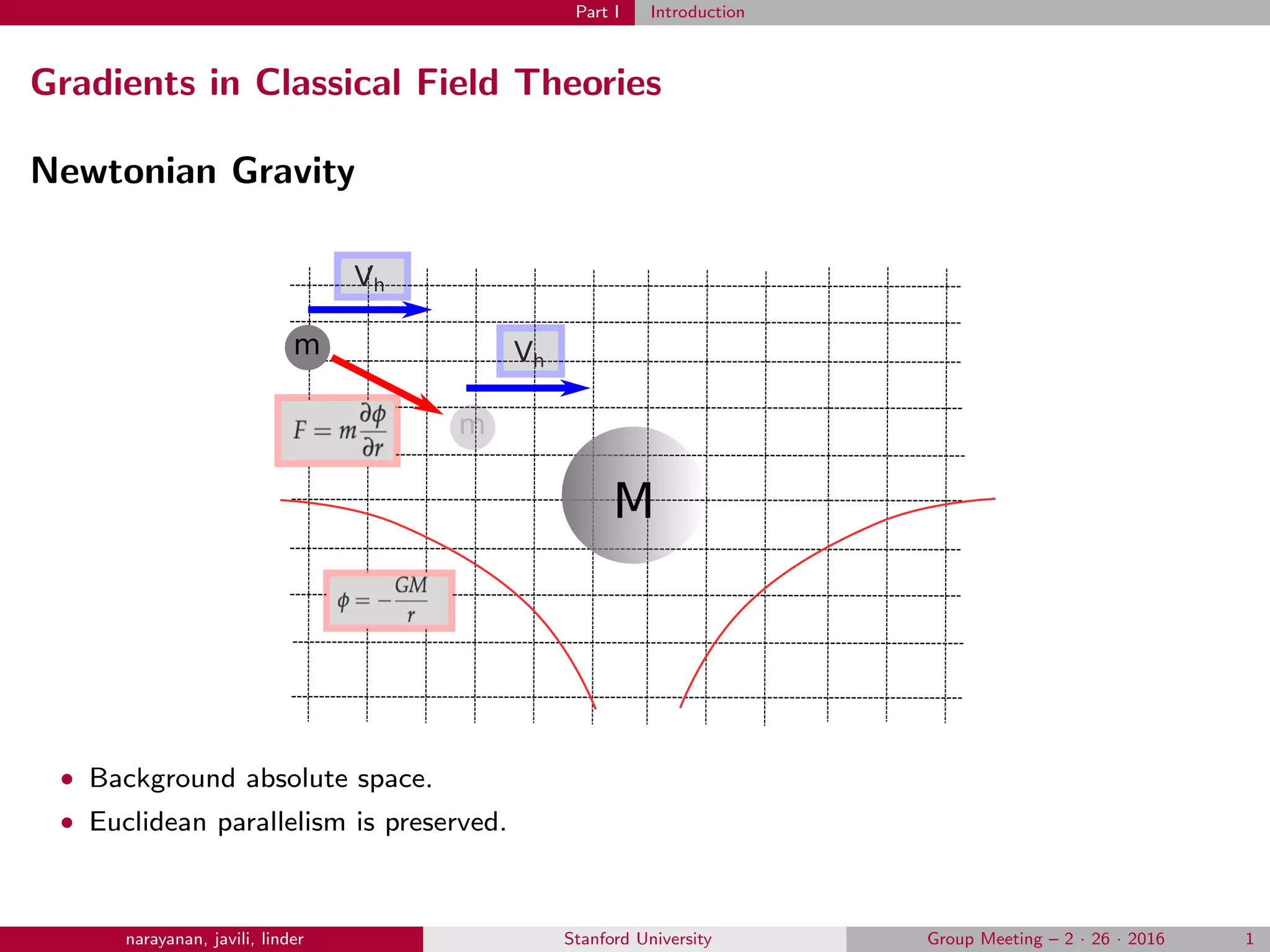
Gradients in Classical Field Theories
Newtonian Gravity
Vh
Vh
M
m
m
• Background absolute space.
• Euclidean parallelism is preserved.
narayanan, javili, linder Stanford University Group Meeting – 2 · 26 · 2016 1
Part I Introduction
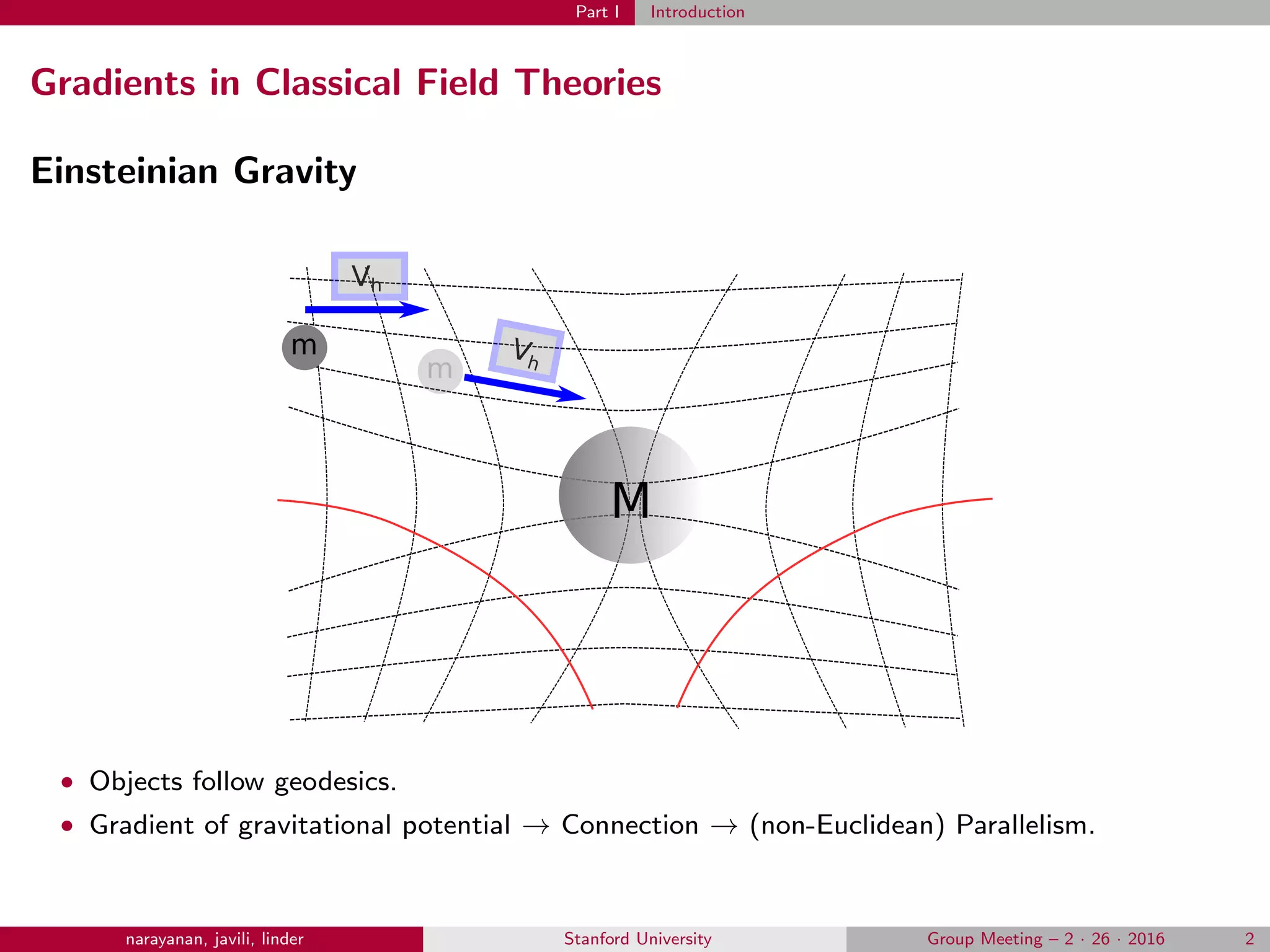
Gradients in Classical Field Theories
Einsteinian Gravity
Vh
Vh
M
m
m
• Objects follow geodesics.
• Gradient of gravitational potential → Connection → (non-Euclidean) Parallelism.
narayanan, javili, linder Stanford University Group Meeting – 2 · 26 · 2016 2
Part I Introduction
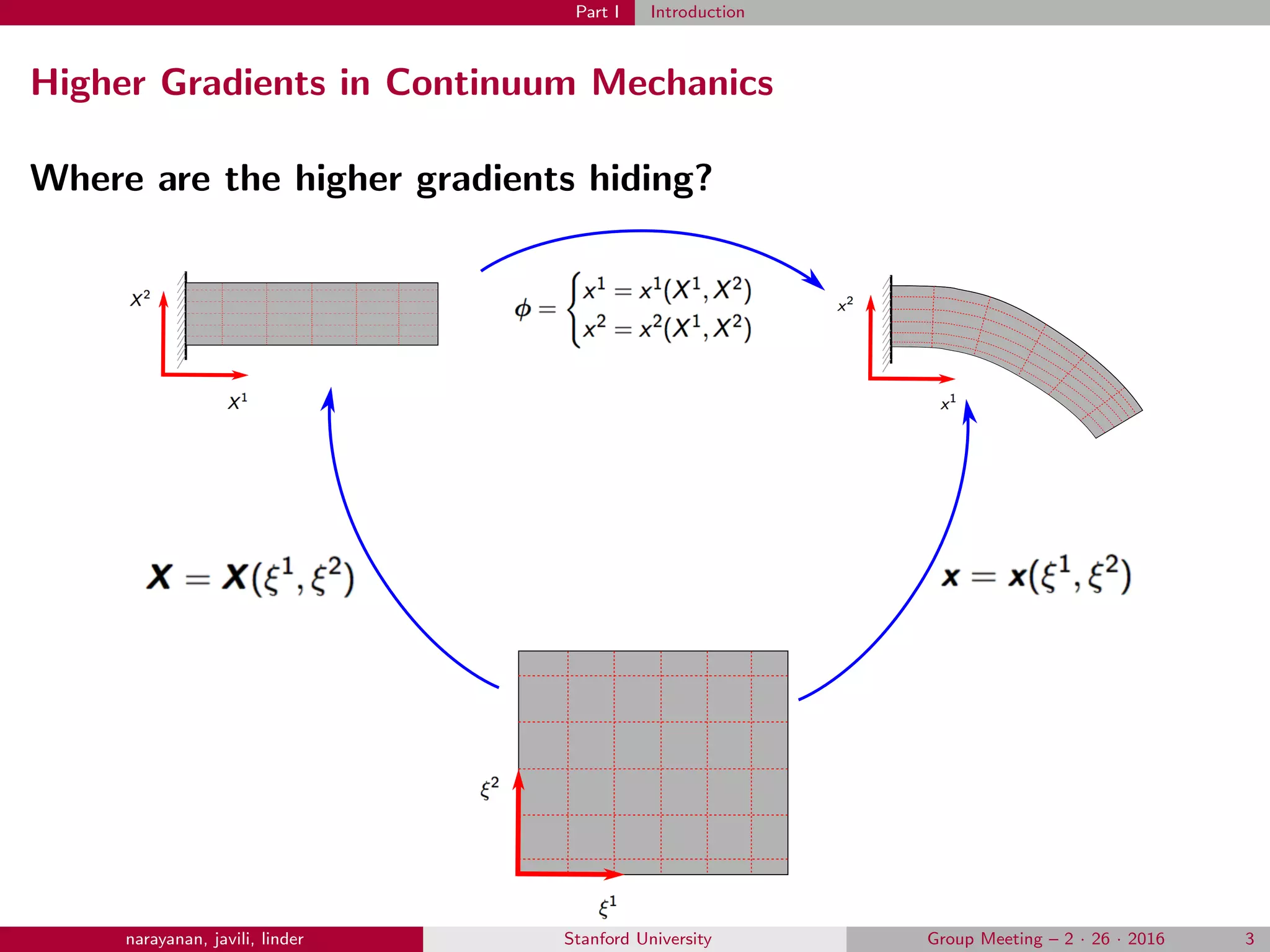
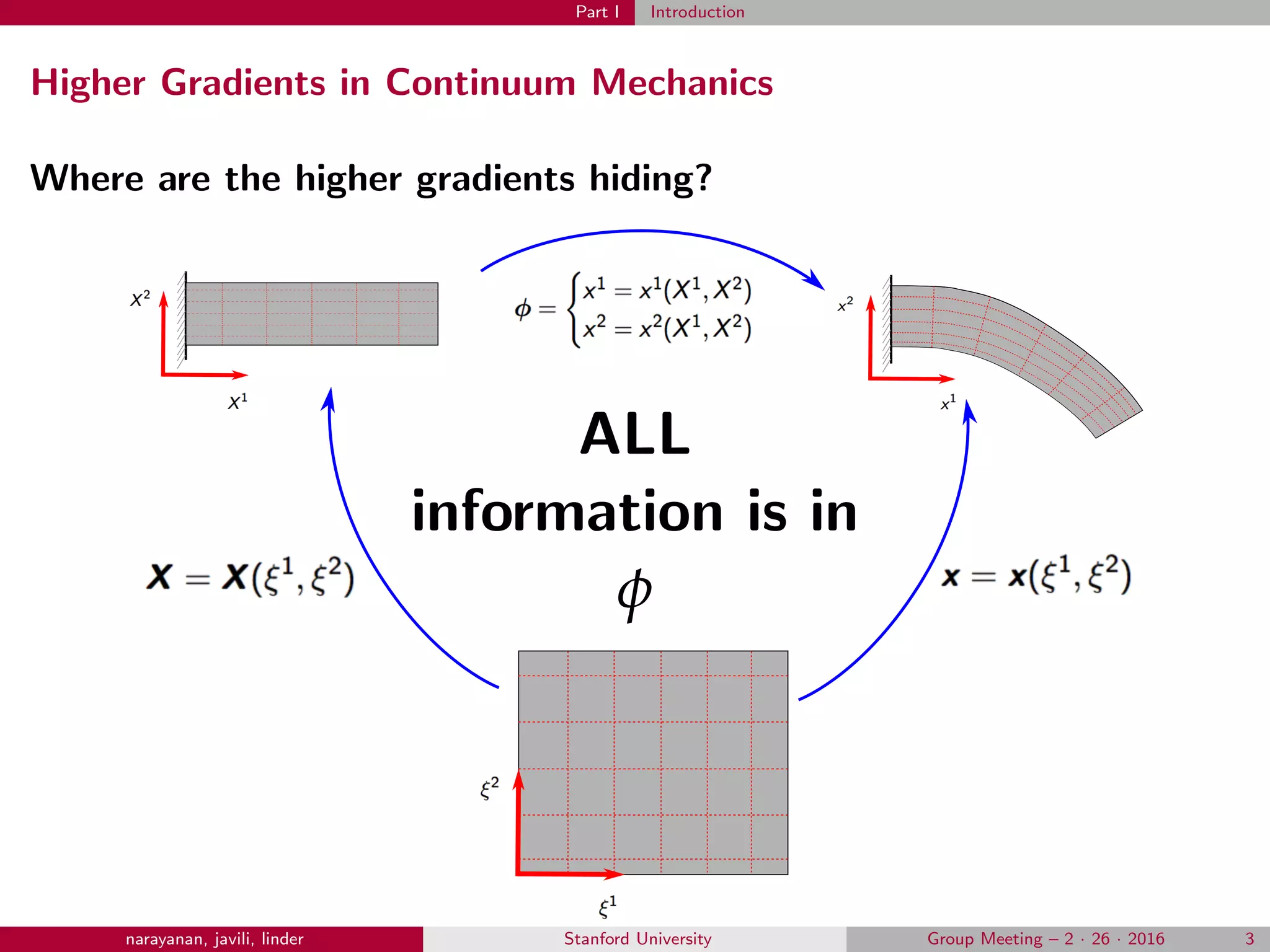
Higher Gradients in Continuum Mechanics
Where are the higher gradients hiding?
narayanan, javili, linder Stanford University Group Meeting – 2 · 26 · 2016 3
Part I Introduction
Higher Gradients in Continuum Mechanics
Where are the higher gradients hiding?
ALL
information is in
φ
narayanan, javili, linder Stanford University Group Meeting – 2 · 26 · 2016 3
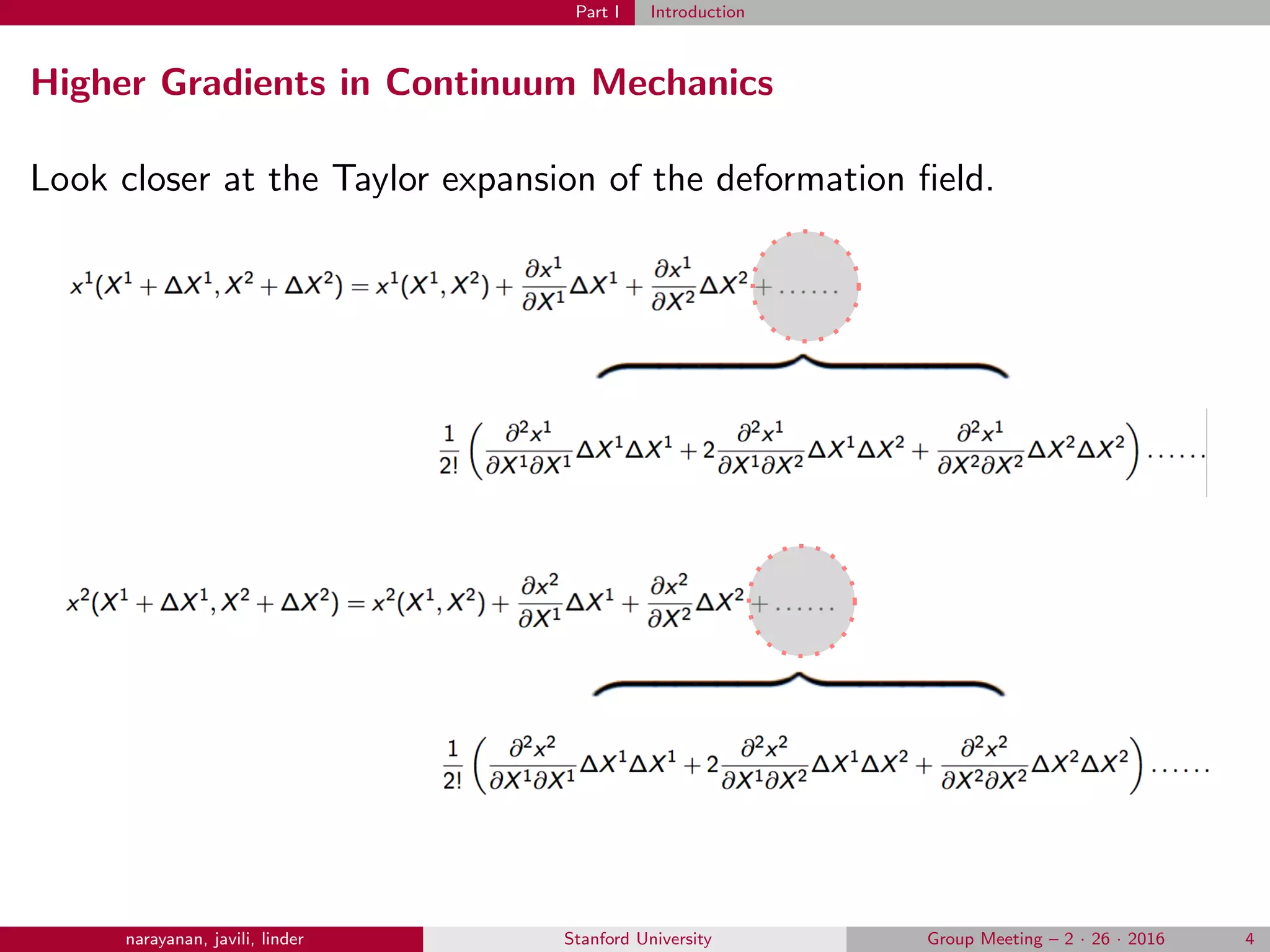
Part I Introduction
Higher Gradients in Continuum Mechanics
Look closer at the Taylor expansion of the deformation field.
narayanan, javili, linder Stanford University Group Meeting – 2 · 26 · 2016 4
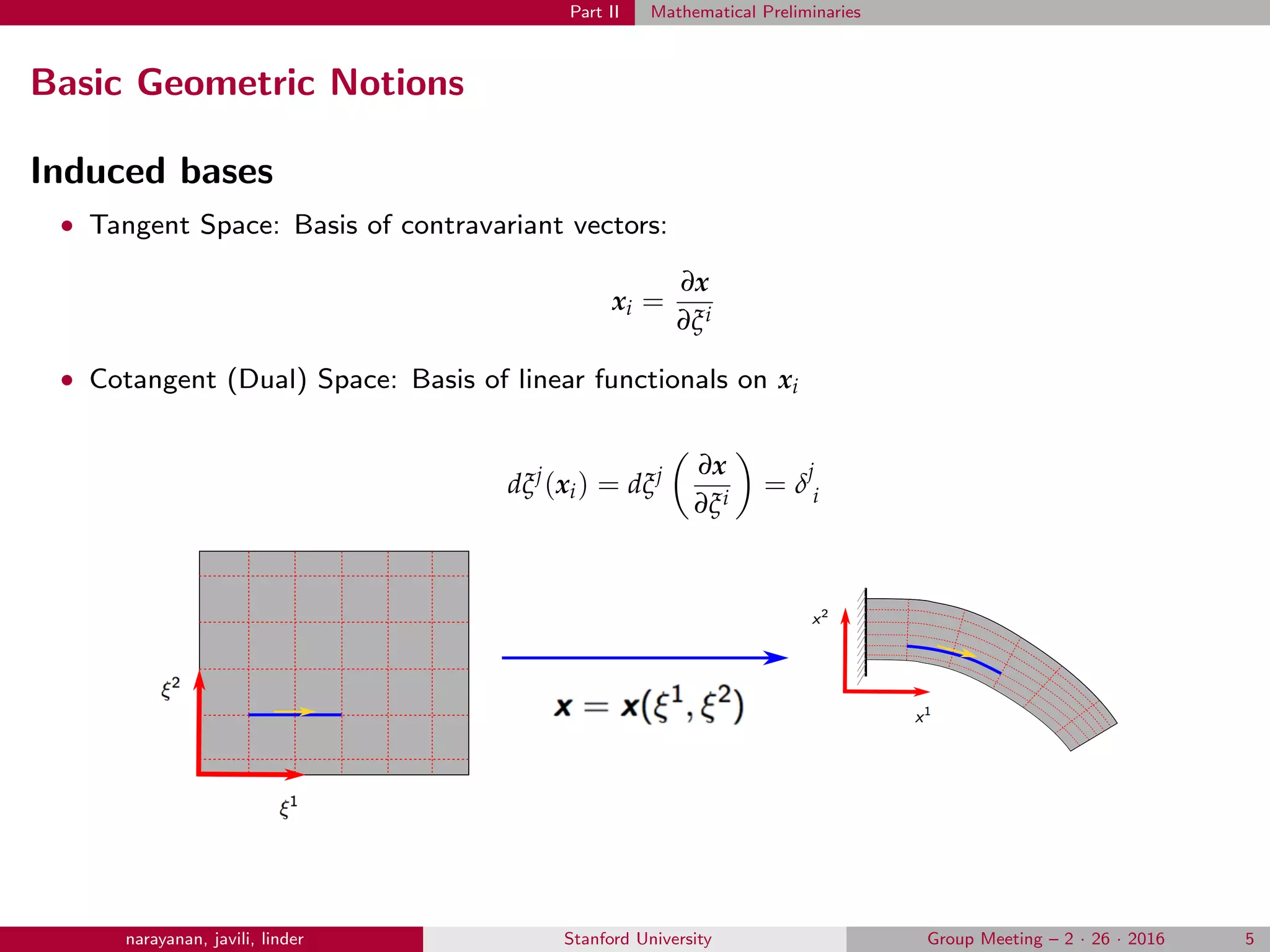
Part II Mathematical Preliminaries
Basic Geometric Notions
Induced bases
• Tangent Space: Basis of contravariant vectors:
xi =
∂x
∂ξi
• Cotangent (Dual) Space: Basis of linear functionals on xi
dξj
(xi) = dξj ∂x
∂ξi
= δ
j
i
narayanan, javili, linder Stanford University Group Meeting – 2 · 26 · 2016 5
Part II Mathematical Preliminaries
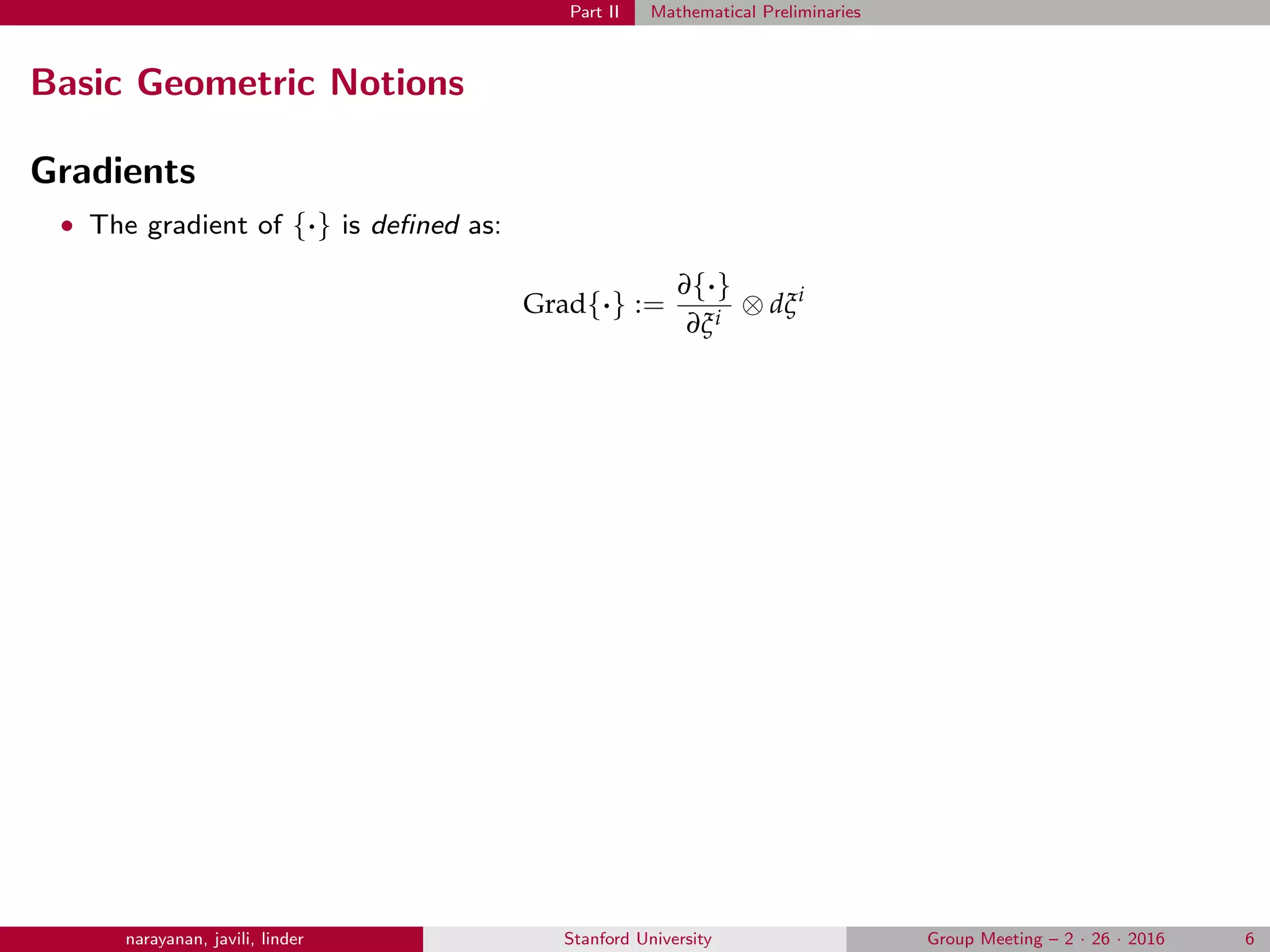
Basic Geometric Notions
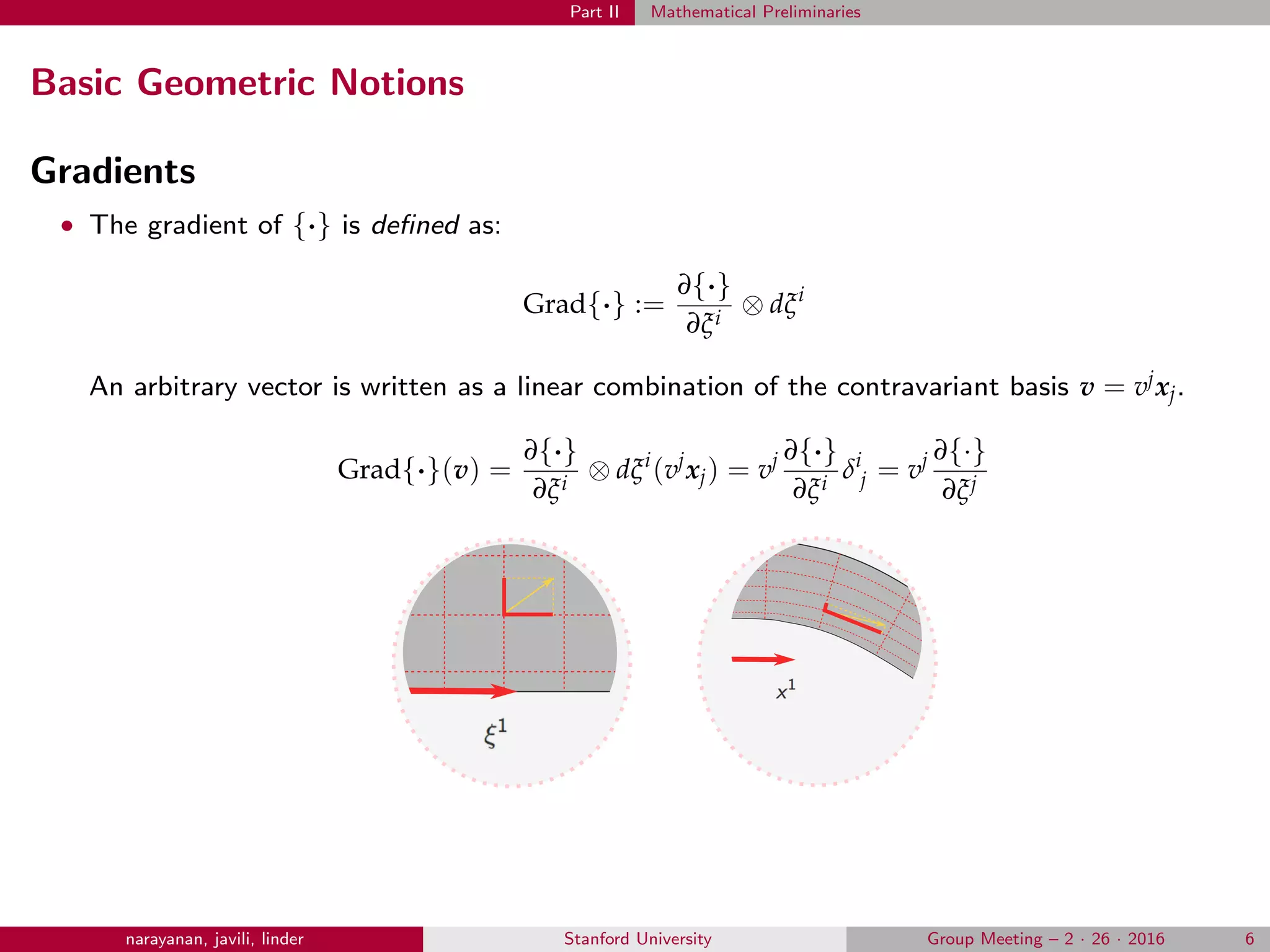
Gradients
• The gradient of {·} is defined as:
Grad{·} :=
∂{·}
∂ξi
⊗ dξi
narayanan, javili, linder Stanford University Group Meeting – 2 · 26 · 2016 6
Part II Mathematical Preliminaries
Basic Geometric Notions
Gradients
• The gradient of {·} is defined as:
Grad{·} :=
∂{·}
∂ξi
⊗ dξi
An arbitrary vector is written as a linear combination of the contravariant basis v = vjxj.
Grad{·}(v) =
∂{·}
∂ξi
⊗ dξi
(vj
xj) = vj ∂{·}
∂ξi
δi
j = vj ∂{·}
∂ξj
narayanan, javili, linder Stanford University Group Meeting – 2 · 26 · 2016 6
Part II Mathematical Preliminaries
Basic Geometric Notions
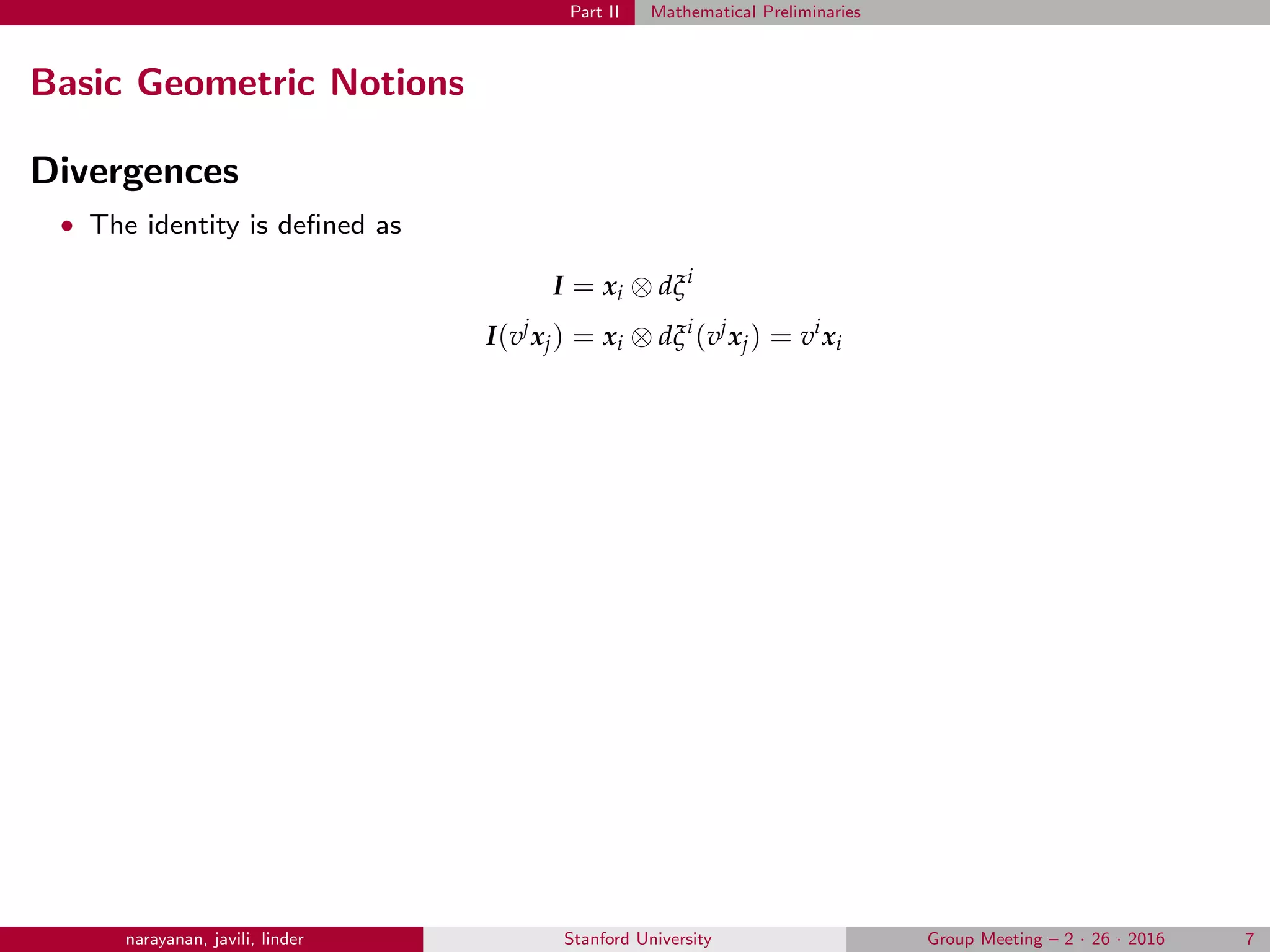
Divergences
• The identity is defined as
I = xi ⊗ dξi
I(vj
xj) = xi ⊗ dξi
(vj
xj) = vi
xi
narayanan, javili, linder Stanford University Group Meeting – 2 · 26 · 2016 7
Part II Mathematical Preliminaries
Basic Geometric Notions
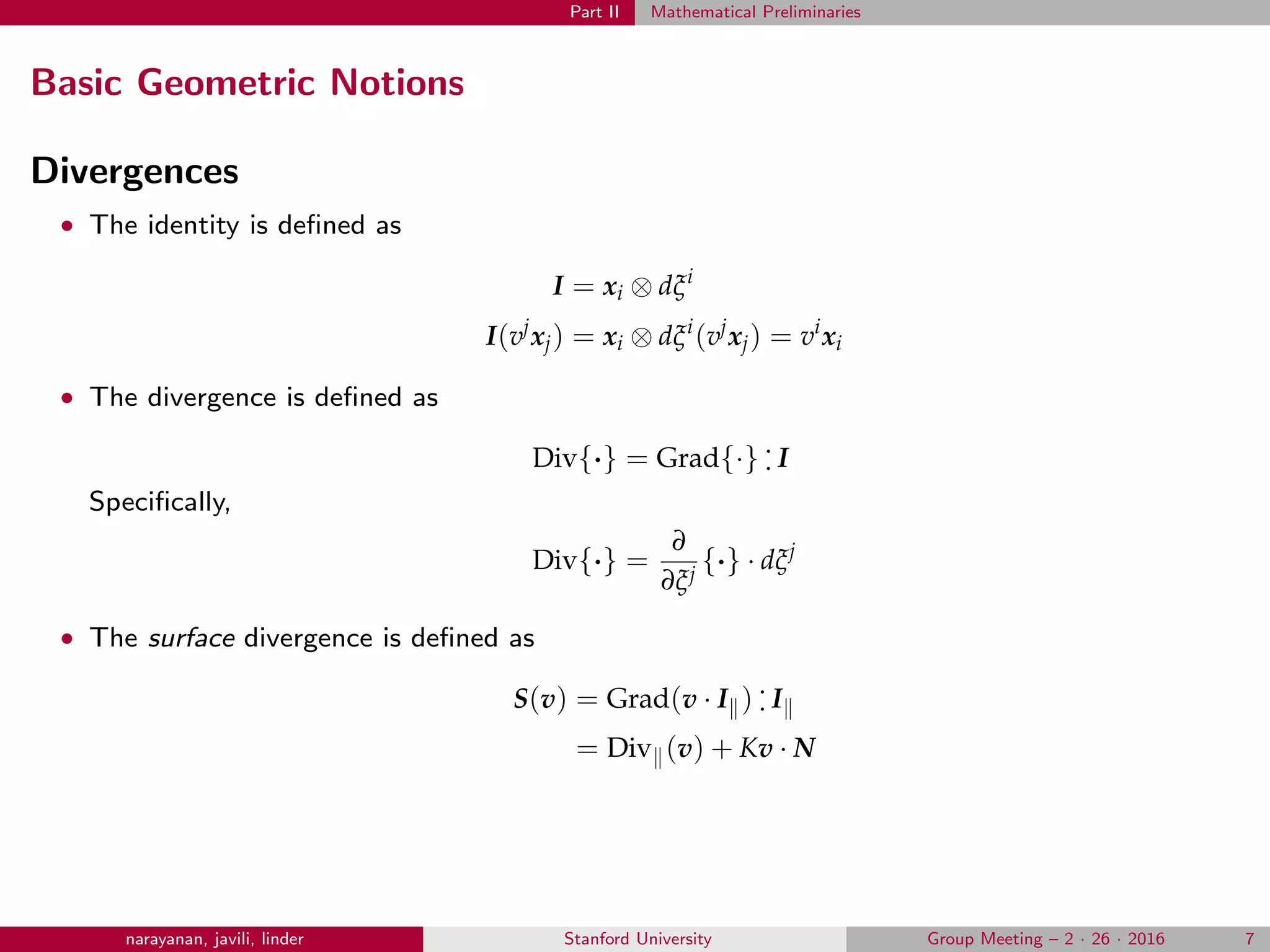
Divergences
• The identity is defined as
I = xi ⊗ dξi
I(vj
xj) = xi ⊗ dξi
(vj
xj) = vi
xi
• The divergence is defined as
Div{·} = Grad{·} .
. I
Specifically,
Div{·} =
∂
∂ξj
{·} · dξj
• The surface divergence is defined as
S(v) = Grad(v · I ) .
. I
= Div (v) + Kv · N
narayanan, javili, linder Stanford University Group Meeting – 2 · 26 · 2016 7
Part II Mathematical Preliminaries
Ingredients For Higher Gradient Elasticity
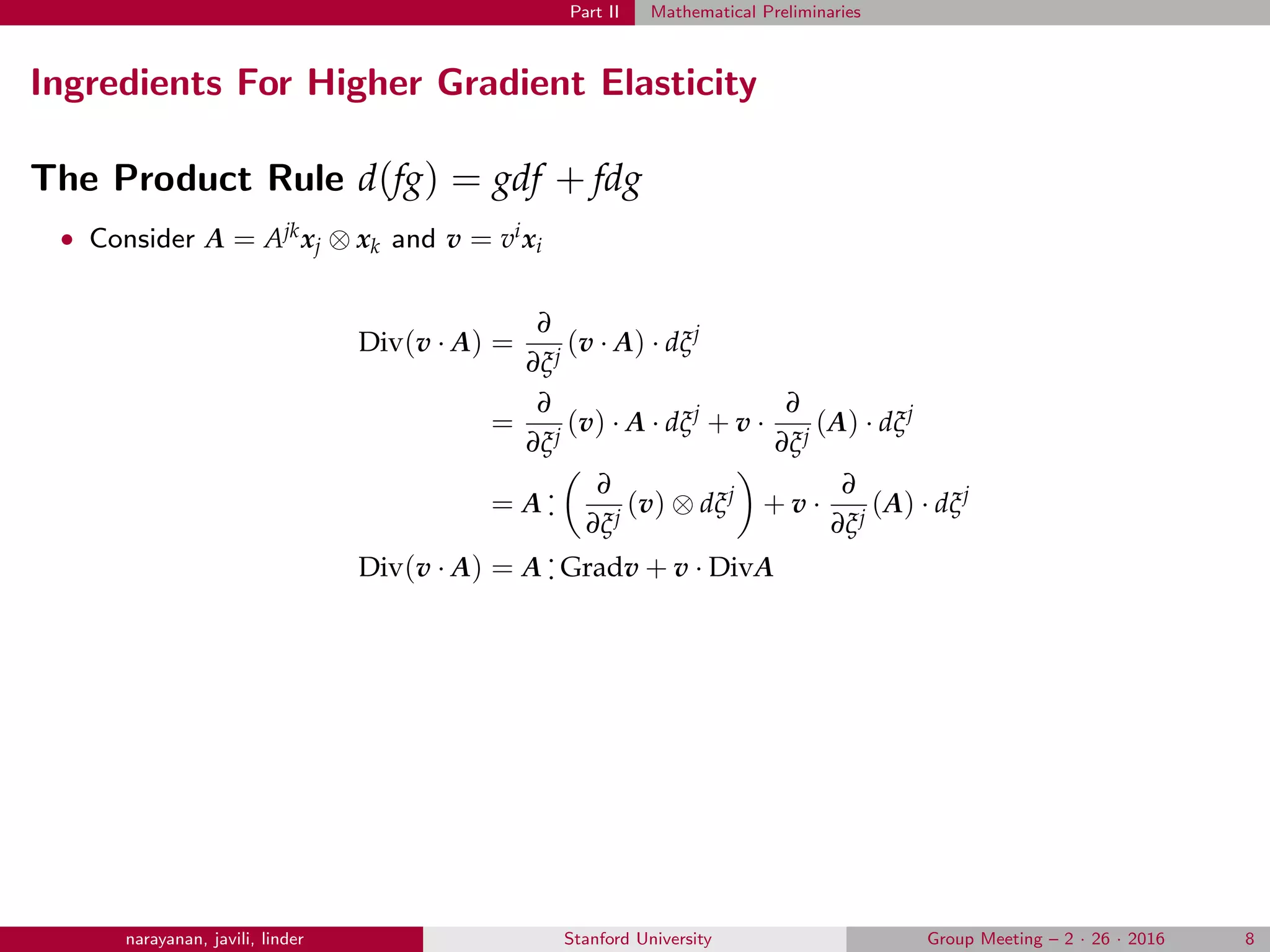
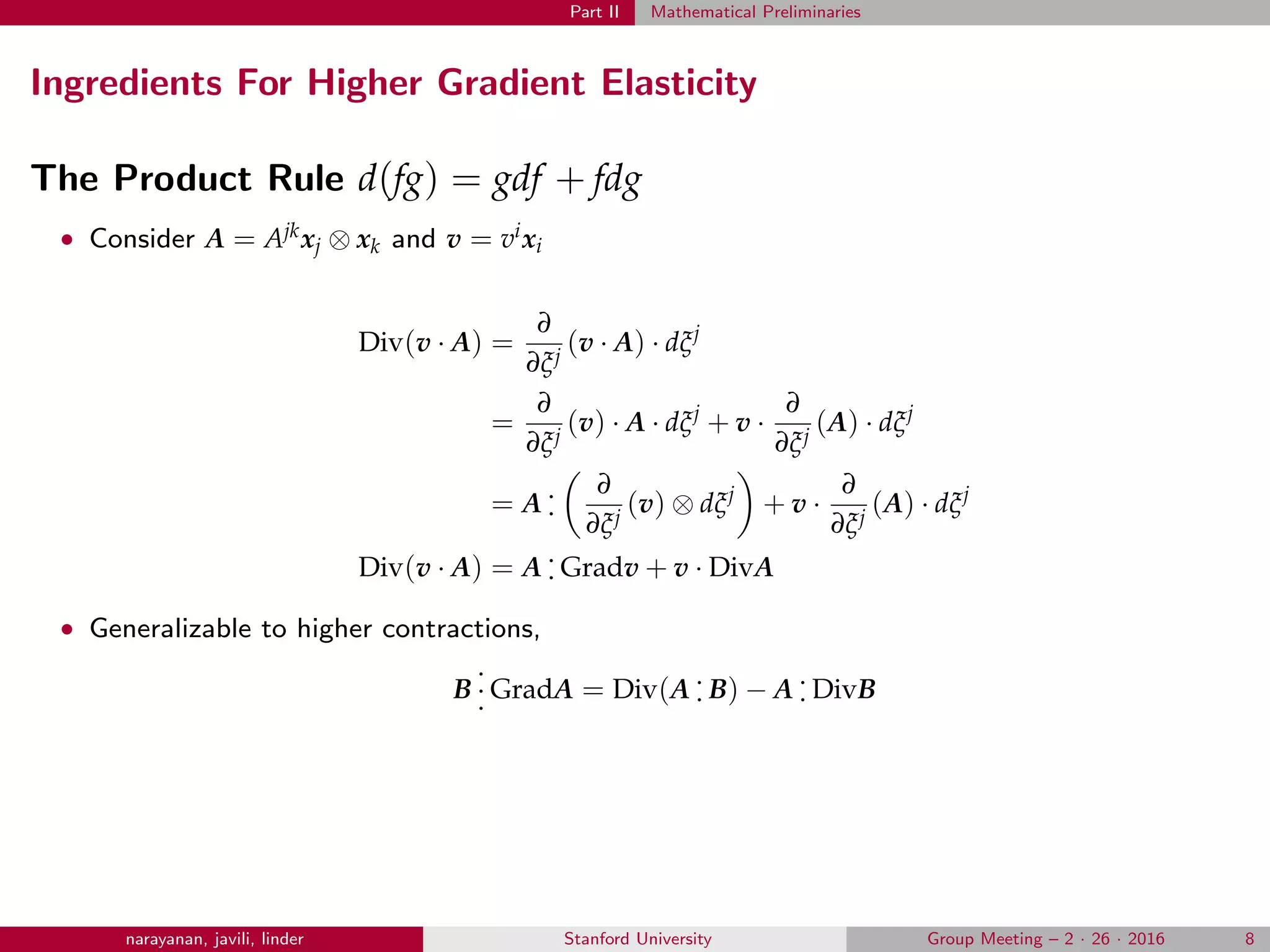
The Product Rule d(fg) = gdf + fdg
• Consider A = Ajkxj ⊗ xk and v = vixi
Div(v · A) =
∂
∂ξj
(v · A) · dξj
=
∂
∂ξj
(v) · A · dξj
+ v ·
∂
∂ξj
(A) · dξj
= A
.
.
∂
∂ξj
(v) ⊗ dξj
+ v ·
∂
∂ξj
(A) · dξj
Div(v · A) = A
.
. Gradv + v · DivA
narayanan, javili, linder Stanford University Group Meeting – 2 · 26 · 2016 8
Part II Mathematical Preliminaries
Ingredients For Higher Gradient Elasticity
The Product Rule d(fg) = gdf + fdg
• Consider A = Ajkxj ⊗ xk and v = vixi
Div(v · A) =
∂
∂ξj
(v · A) · dξj
=
∂
∂ξj
(v) · A · dξj
+ v ·
∂
∂ξj
(A) · dξj
= A
.
.
∂
∂ξj
(v) ⊗ dξj
+ v ·
∂
∂ξj
(A) · dξj
Div(v · A) = A
.
. Gradv + v · DivA
• Generalizable to higher contractions,
B
.
.
. GradA = Div(A
.
. B) − A
.
. DivB
narayanan, javili, linder Stanford University Group Meeting – 2 · 26 · 2016 8
Part II Mathematical Preliminaries
Ingredients For Higher Gradient Elasticity
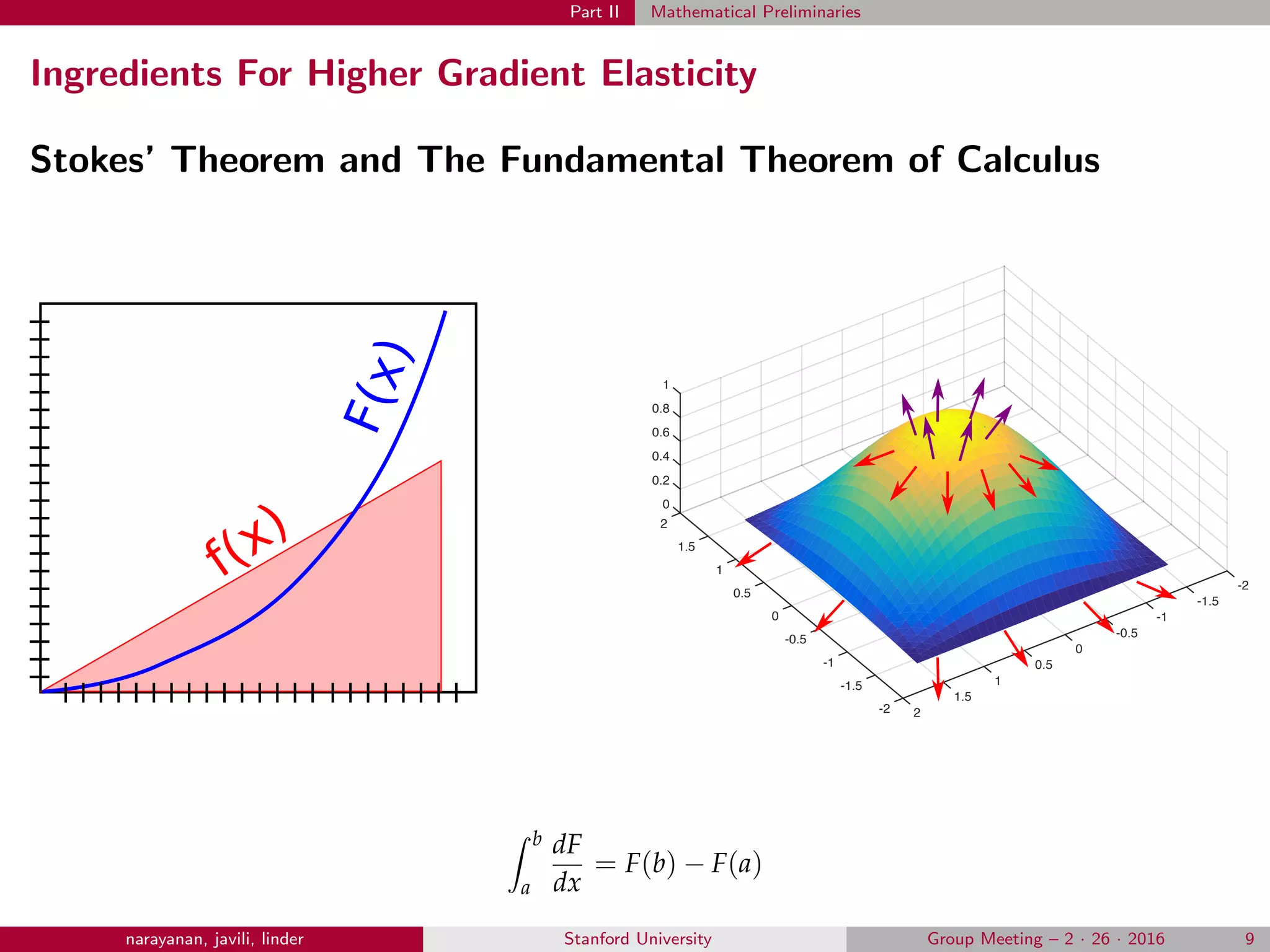
Stokes’ Theorem and The Fundamental Theorem of Calculus
F(x)
f(x)
-2
-1.5
-1
-0.5
0
0.5
1
1.5
2-2
-1.5
-1
-0.5
0
0.5
1
1.5
0
0.2
0.4
0.6
0.8
1
2
b
a
dF
dx
= F(b) − F(a)
narayanan, javili, linder Stanford University Group Meeting – 2 · 26 · 2016 9
Part II Mathematical Preliminaries
Ingredients For Higher Gradient Elasticity
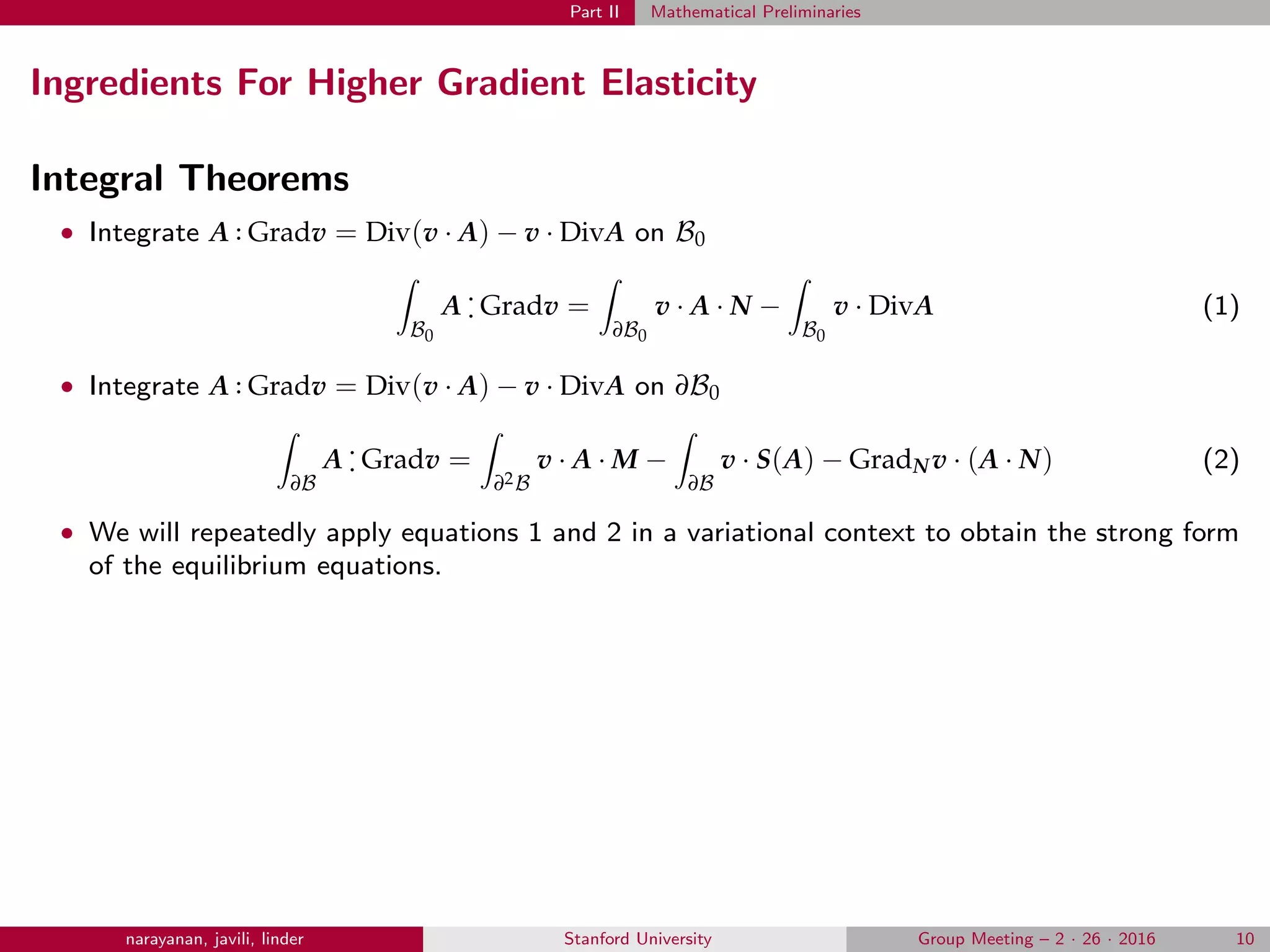
Integral Theorems
• Integrate A .. Gradv = Div(v · A) − v · DivA on B0
B0
A
.
. Gradv =
∂B0
v · A · N −
B0
v · DivA (1)
• Integrate A .. Gradv = Div(v · A) − v · DivA on ∂B0
∂B
A
.
. Gradv =
∂2B
v · A · M −
∂B
v · S(A) − GradNv · (A · N) (2)
• We will repeatedly apply equations 1 and 2 in a variational context to obtain the strong form
of the equilibrium equations.
narayanan, javili, linder Stanford University Group Meeting – 2 · 26 · 2016 10
Part III Variational Structure of Gradient Elasticity
Higher Gradient Elasticity
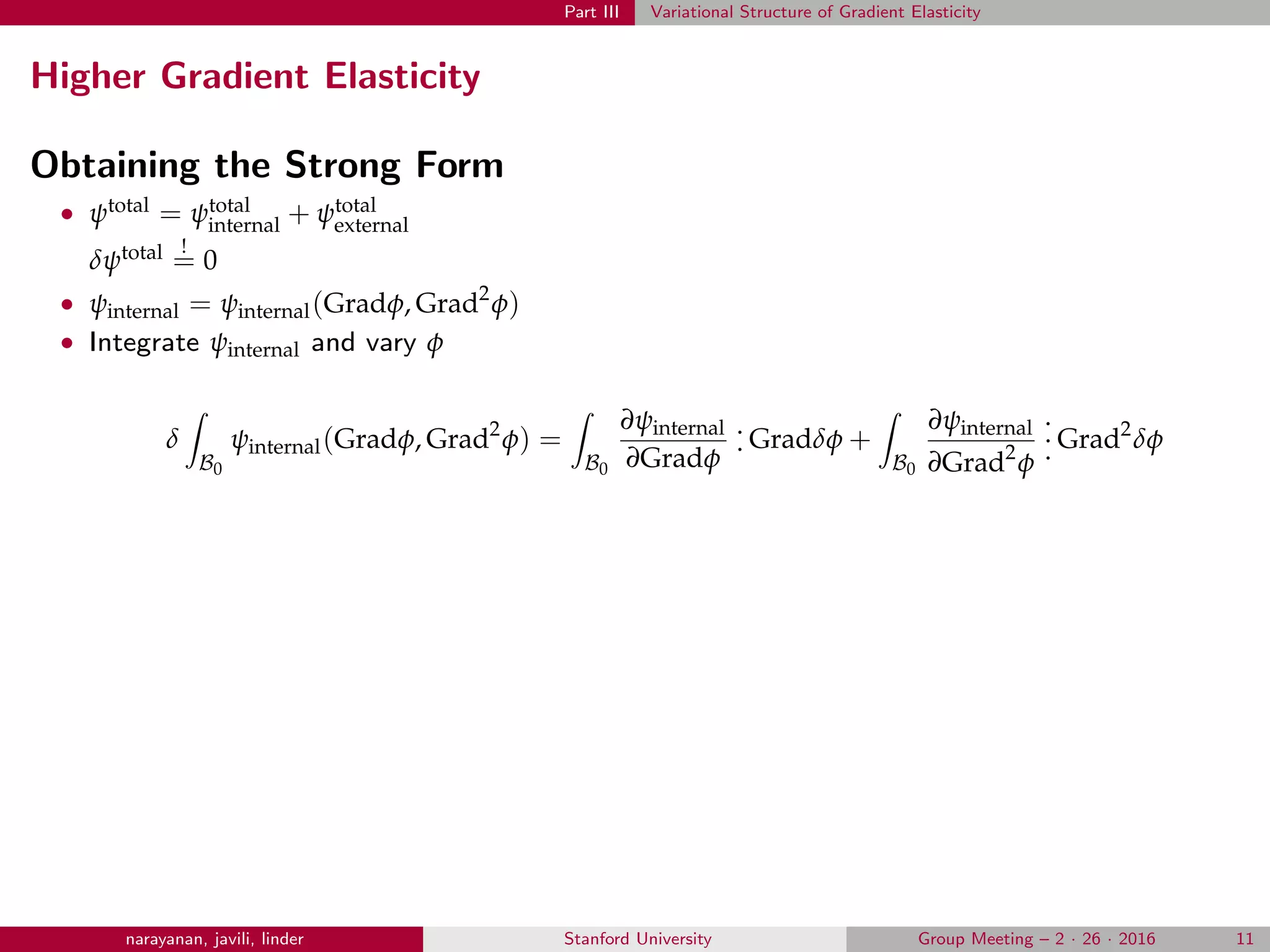
Obtaining the Strong Form
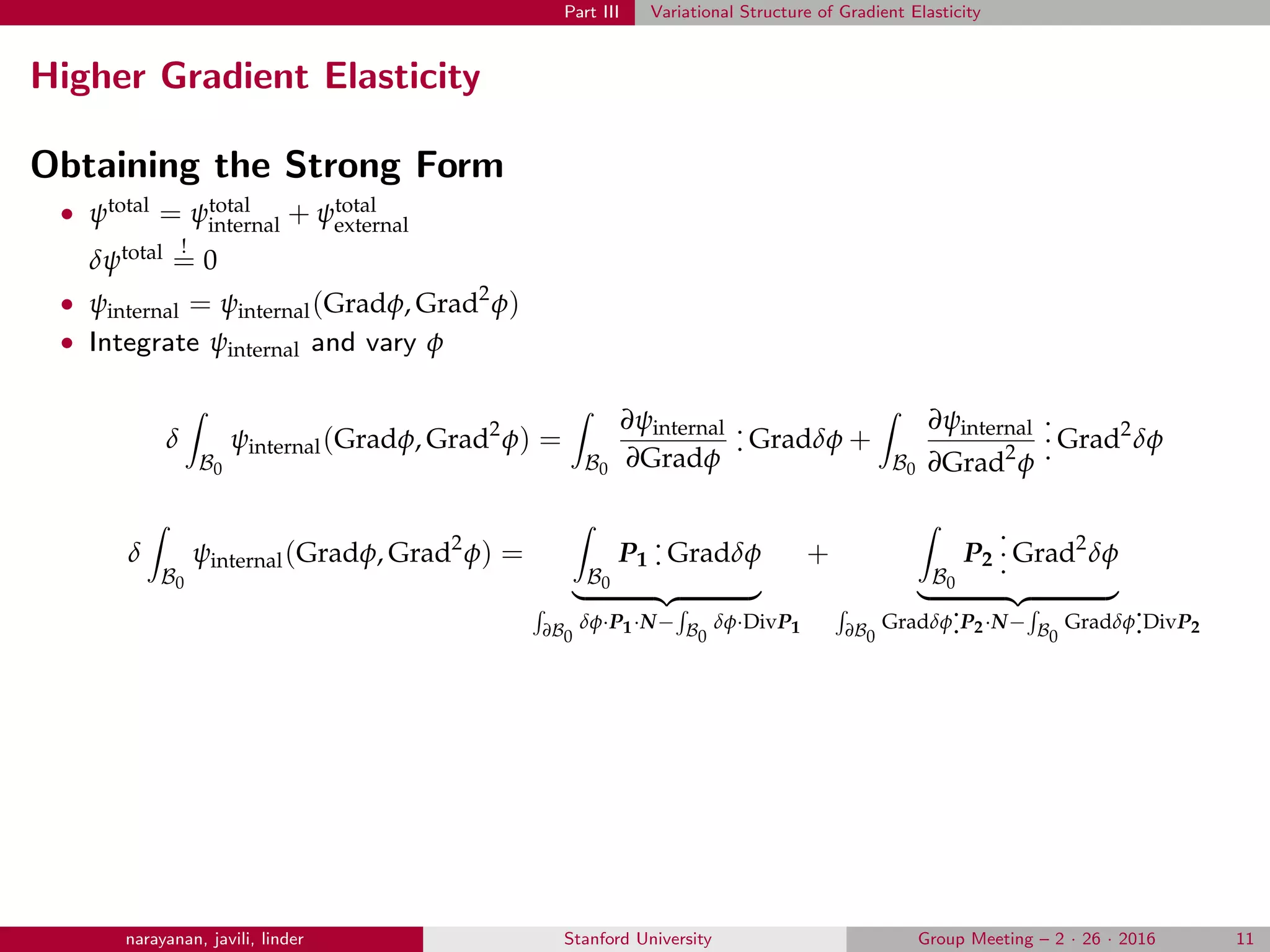
• ψtotal = ψtotal
internal + ψtotal
external
δψtotal !
= 0
• ψinternal = ψinternal(Gradφ, Grad2
φ)
• Integrate ψinternal and vary φ
δ
B0
ψinternal(Gradφ, Grad2
φ) =
B0
∂ψinternal
∂Gradφ
.
. Gradδφ +
B0
∂ψinternal
∂Grad2
φ
.
.
. Grad2
δφ
narayanan, javili, linder Stanford University Group Meeting – 2 · 26 · 2016 11
Part III Variational Structure of Gradient Elasticity
Higher Gradient Elasticity
Obtaining the Strong Form
• ψtotal = ψtotal
internal + ψtotal
external
δψtotal !
= 0
• ψinternal = ψinternal(Gradφ, Grad2
φ)
• Integrate ψinternal and vary φ
δ
B0
ψinternal(Gradφ, Grad2
φ) =
B0
∂ψinternal
∂Gradφ
.
. Gradδφ +
B0
∂ψinternal
∂Grad2
φ
.
.
. Grad2
δφ
δ
B0
ψinternal(Gradφ, Grad2
φ) =
B0
P1
.
. Gradδφ
∂B0
δφ·P1·N− B0
δφ·DivP1
+
B0
P2
.
.
. Grad2
δφ
∂B0
Gradδφ
.
.P2·N− B0
Gradδφ
.
.DivP2
narayanan, javili, linder Stanford University Group Meeting – 2 · 26 · 2016 11
Part III Variational Structure of Gradient Elasticity
Higher Gradient Elasticity
Obtaining the Strong Form
• ψtotal = ψtotal
internal + ψtotal
external
δψtotal !
= 0
• ψinternal = ψinternal(Gradφ, Grad2
φ)
• Integrate ψinternal and vary φ
δ
B0
ψinternal(Gradφ, Grad2
φ) =
B0
∂ψinternal
∂Gradφ
.
. Gradδφ +
B0
∂ψinternal
∂Grad2
φ
.
.
. Grad2
δφ
δ
B0
ψinternal(Gradφ, Grad2
φ) =
B0
P1
.
. Gradδφ
∂B0
δφ·P1·N− B0
δφ·DivP1
+
B0
P2
.
.
. Grad2
δφ
∂B0
Gradδφ
.
.P2·N− B0
Gradδφ
.
.DivP2
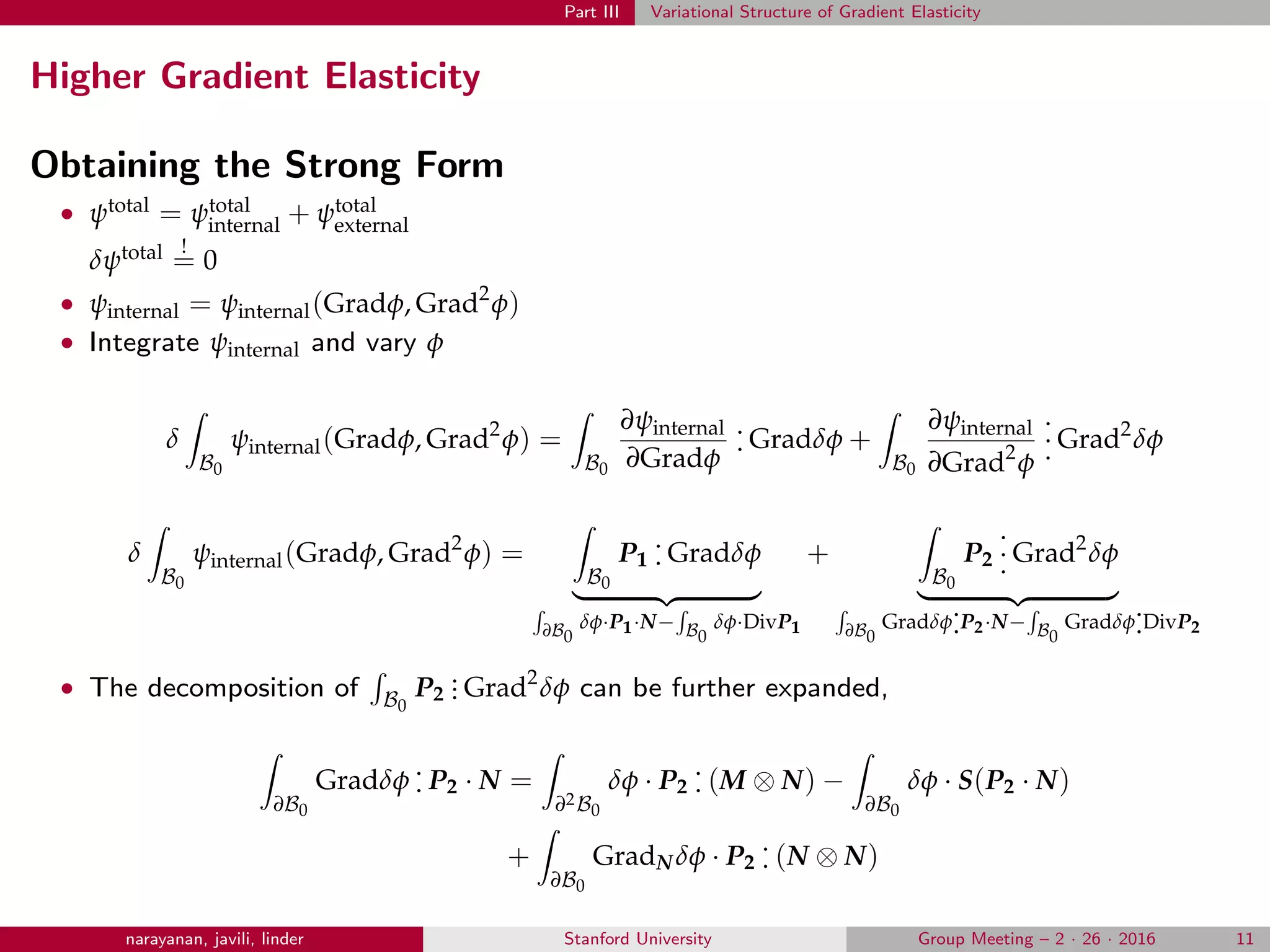
• The decomposition of B0
P2
... Grad2
δφ can be further expanded,
∂B0
Gradδφ
.
. P2 · N =
∂2B0
δφ · P2
.
. (M ⊗ N) −
∂B0
δφ · S(P2 · N)
+
∂B0
GradN δφ · P2
.
. (N ⊗ N)
narayanan, javili, linder Stanford University Group Meeting – 2 · 26 · 2016 11
Part III Variational Structure of Gradient Elasticity
Higher Gradient Elasticity
Obtaining the Strong Form
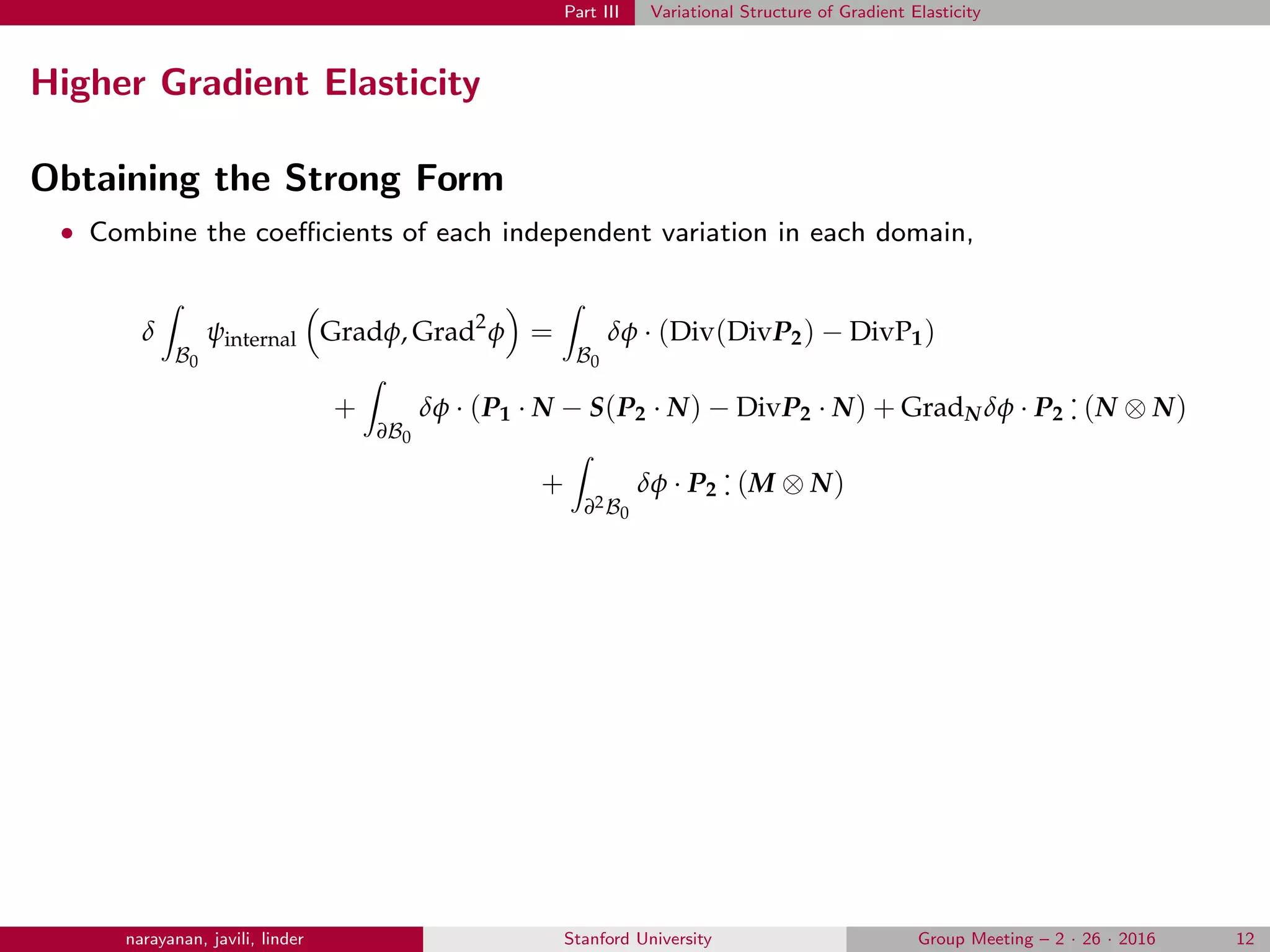
• Combine the coefficients of each independent variation in each domain,
δ
B0
ψinternal Gradφ, Grad2
φ =
B0
δφ · (Div(DivP2) − DivP1)
+
∂B0
δφ · (P1 · N − S(P2 · N) − DivP2 · N) + GradN δφ · P2
.
. (N ⊗ N)
+
∂2B0
δφ · P2
.
. (M ⊗ N)
narayanan, javili, linder Stanford University Group Meeting – 2 · 26 · 2016 12
Part III Variational Structure of Gradient Elasticity
Higher Gradient Elasticity
Obtaining the Strong Form
• Combine the coefficients of each independent variation in each domain,
δ
B0
ψinternal Gradφ, Grad2
φ =
B0
δφ · (Div(DivP2) − DivP1)
+
∂B0
δφ · (P1 · N − S(P2 · N) − DivP2 · N) + GradN δφ · P2
.
. (N ⊗ N)
+
∂2B0
δφ · P2
.
. (M ⊗ N)
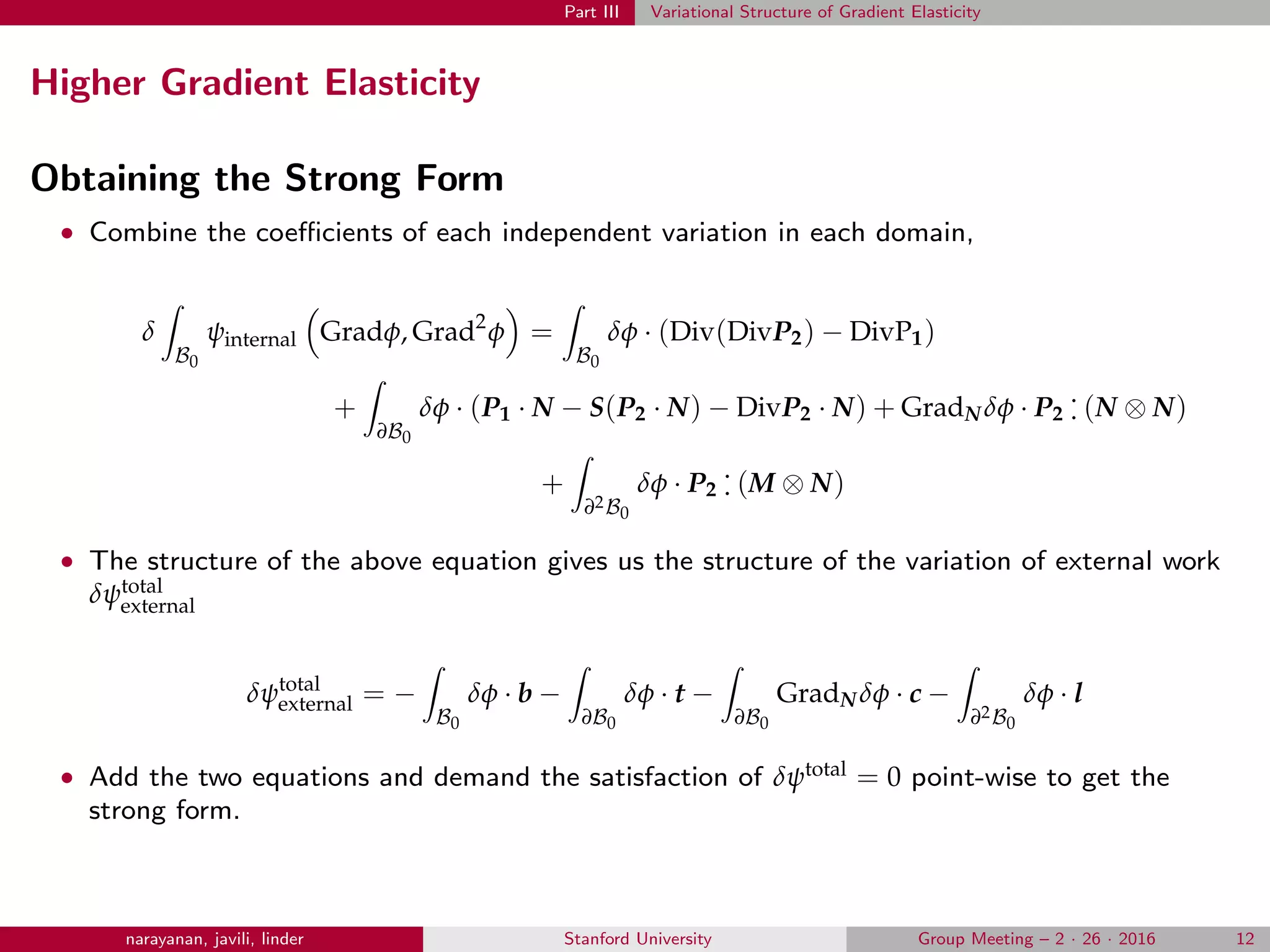
• The structure of the above equation gives us the structure of the variation of external work
δψtotal
external
δψtotal
external = −
B0
δφ · b −
∂B0
δφ · t −
∂B0
GradN δφ · c −
∂2B0
δφ · l
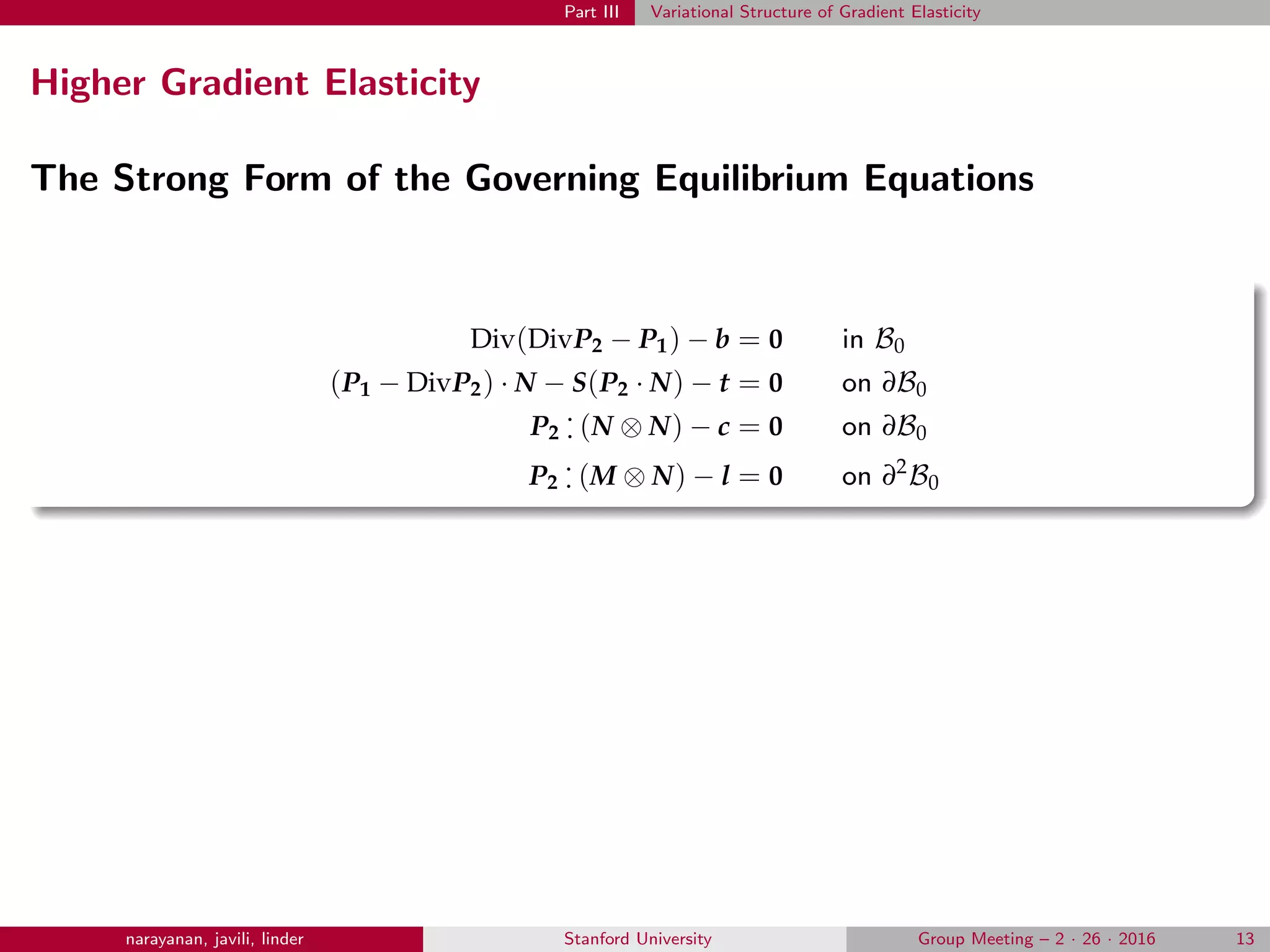
• Add the two equations and demand the satisfaction of δψtotal = 0 point-wise to get the
strong form.
narayanan, javili, linder Stanford University Group Meeting – 2 · 26 · 2016 12
Part III Variational Structure of Gradient Elasticity
Higher Gradient Elasticity
The Strong Form of the Governing Equilibrium Equations
Div(DivP2 − P1) − b = 0 in B0
(P1 − DivP2) · N − S(P2 · N) − t = 0 on ∂B0
P2
.
. (N ⊗ N) − c = 0 on ∂B0
P2
.
. (M ⊗ N) − l = 0 on ∂2
B0
narayanan, javili, linder Stanford University Group Meeting – 2 · 26 · 2016 13
Part IV FE Discretization of Variational Equation
The Path To a Numerical Implementation
Finite Element Discretization
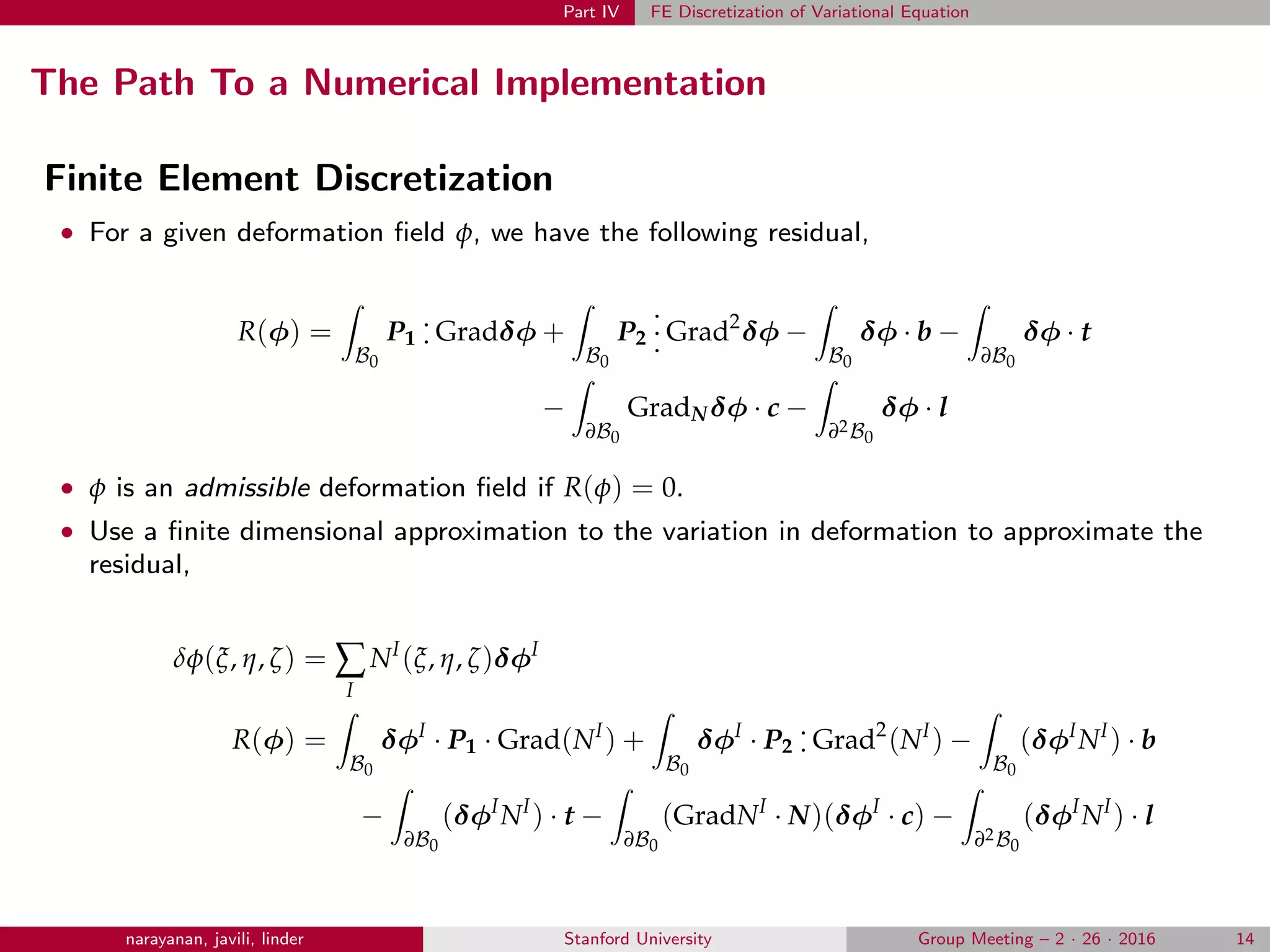
• For a given deformation field φ, we have the following residual,
R(φ) =
B0
P1
.
. Gradδφ +
B0
P2
.
.
. Grad2
δφ −
B0
δφ · b −
∂B0
δφ · t
−
∂B0
GradNδφ · c −
∂2B0
δφ · l
• φ is an admissible deformation field if R(φ) = 0.
• Use a finite dimensional approximation to the variation in deformation to approximate the
residual,
δφ(ξ, η, ζ) = ∑
I
NI
(ξ, η, ζ)δφI
R(φ) =
B0
δφI
· P1 · Grad(NI
) +
B0
δφI
· P2
.
. Grad2
(NI
) −
B0
(δφI
NI
) · b
−
∂B0
(δφI
NI
) · t −
∂B0
(GradNI
· N)(δφI
· c) −
∂2B0
(δφI
NI
) · l
narayanan, javili, linder Stanford University Group Meeting – 2 · 26 · 2016 14
Part IV FE Discretization of Variational Equation
The Path To a Numerical Implementation
Finite Element Discretization
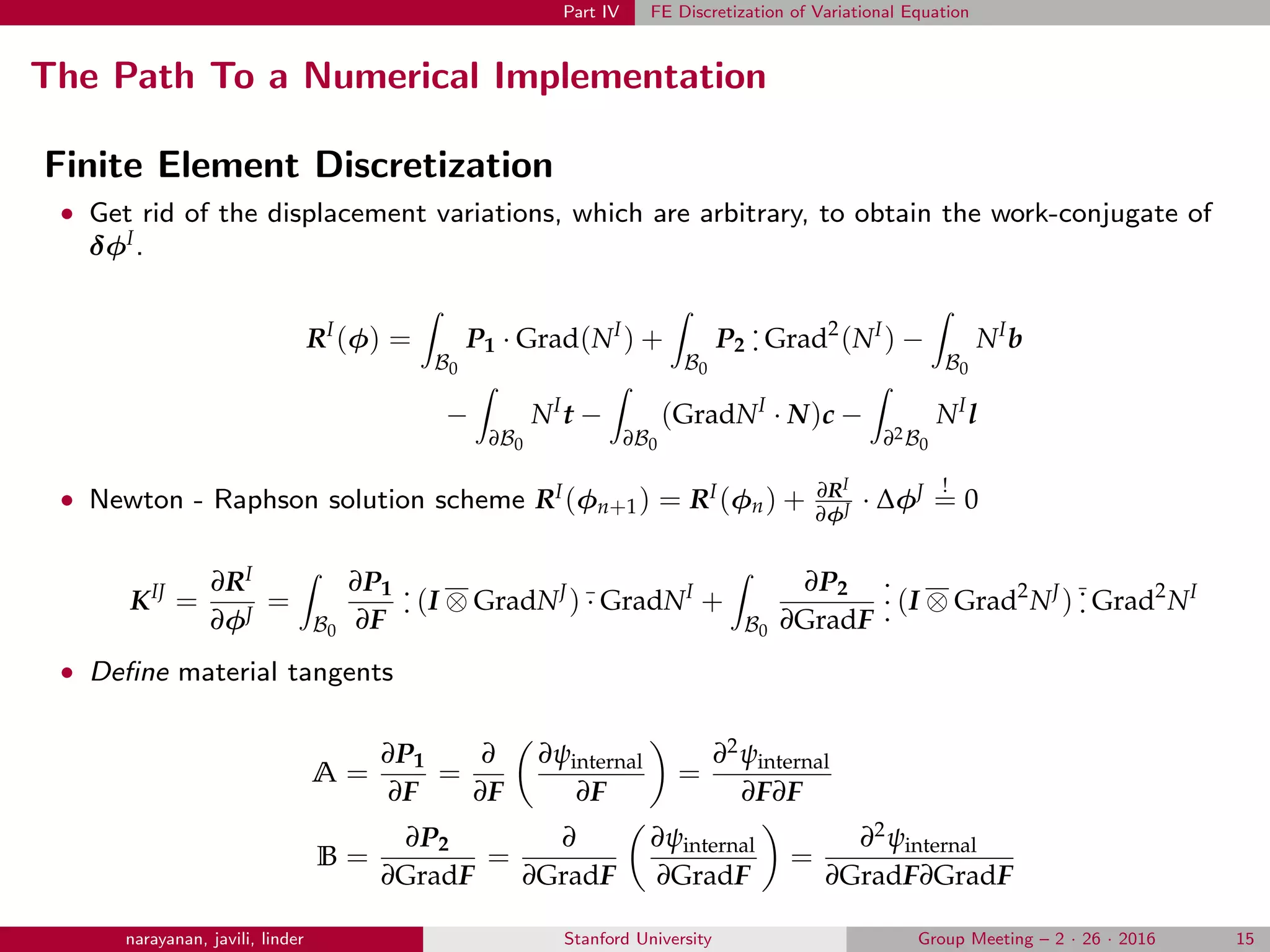
• Get rid of the displacement variations, which are arbitrary, to obtain the work-conjugate of
δφI.
RI
(φ) =
B0
P1 · Grad(NI
) +
B0
P2
.
. Grad2
(NI
) −
B0
NI
b
−
∂B0
NI
t −
∂B0
(GradNI
· N)c −
∂2B0
NI
l
• Newton - Raphson solution scheme RI(φn+1) = RI(φn) + ∂RI
∂φJ · ∆φJ !
= 0
KIJ
=
∂RI
∂φJ
=
B0
∂P1
∂F
.
. (I ⊗ GradNJ
) · GradNI
+
B0
∂P2
∂GradF
.
.
. (I ⊗ Grad2
NJ
) .
. Grad2
NI
• Define material tangents
A =
∂P1
∂F
=
∂
∂F
∂ψinternal
∂F
=
∂2ψinternal
∂F∂F
B =
∂P2
∂GradF
=
∂
∂GradF
∂ψinternal
∂GradF
=
∂2ψinternal
∂GradF∂GradF
narayanan, javili, linder Stanford University Group Meeting – 2 · 26 · 2016 15
Part IV FE Discretization of Variational Equation
The Path To a Numerical Implementation
Constitutive Equations
• We use the following strain energy density function,
ψinternal =
1
2
µ(F
.
. F − 3 − 2ln(J)) +
1
2
λ
1
2
(J2
− 1) − ln(J) +
1
2
µl2
EAB,CEAB,C
• We have the following component-wise expression for P1 and P2,
[P1]bL = µ([F]bL − [F−T
]bL) +
λ
2
(J2
− 1)[F−T
]bL
+
1
2
µl2
[GradF]bJK([GradF]aJK[F]aL + [F]aJ[GradF]aLK)
[P2]bLM =
µl2
2
[F]bJ([GradF]aLM[F]aJ + [F]aL[GradF]aJM)
narayanan, javili, linder Stanford University Group Meeting – 2 · 26 · 2016 16
Part IV FE Discretization of Variational Equation
The Path To a Numerical Implementation
Constitutive Equations
• We have the following component wise expression for A and B
[A]bLgM = µ δb
gδL
M + [F−T
]gL[F−T
]bM + λJ2
[F−T
]gM[F−T
]bL
−
λ
2
(J2
− 1)[F−T
]gL[F−T
]bM +
µl2
2
[GradF]bJK [GradF]gJKδL
M + [GradF]gLKδJ
M
[B]bLMgPQ =
µl2
4
[F]bJ[F]gJ(δL
PδM
Q + δL
QδM
P ) + [F]bP[F]gLδM
Q + [F]bQ[F]gLδM
P
narayanan, javili, linder Stanford University Group Meeting – 2 · 26 · 2016 17
Part IV FE Discretization of Variational Equation
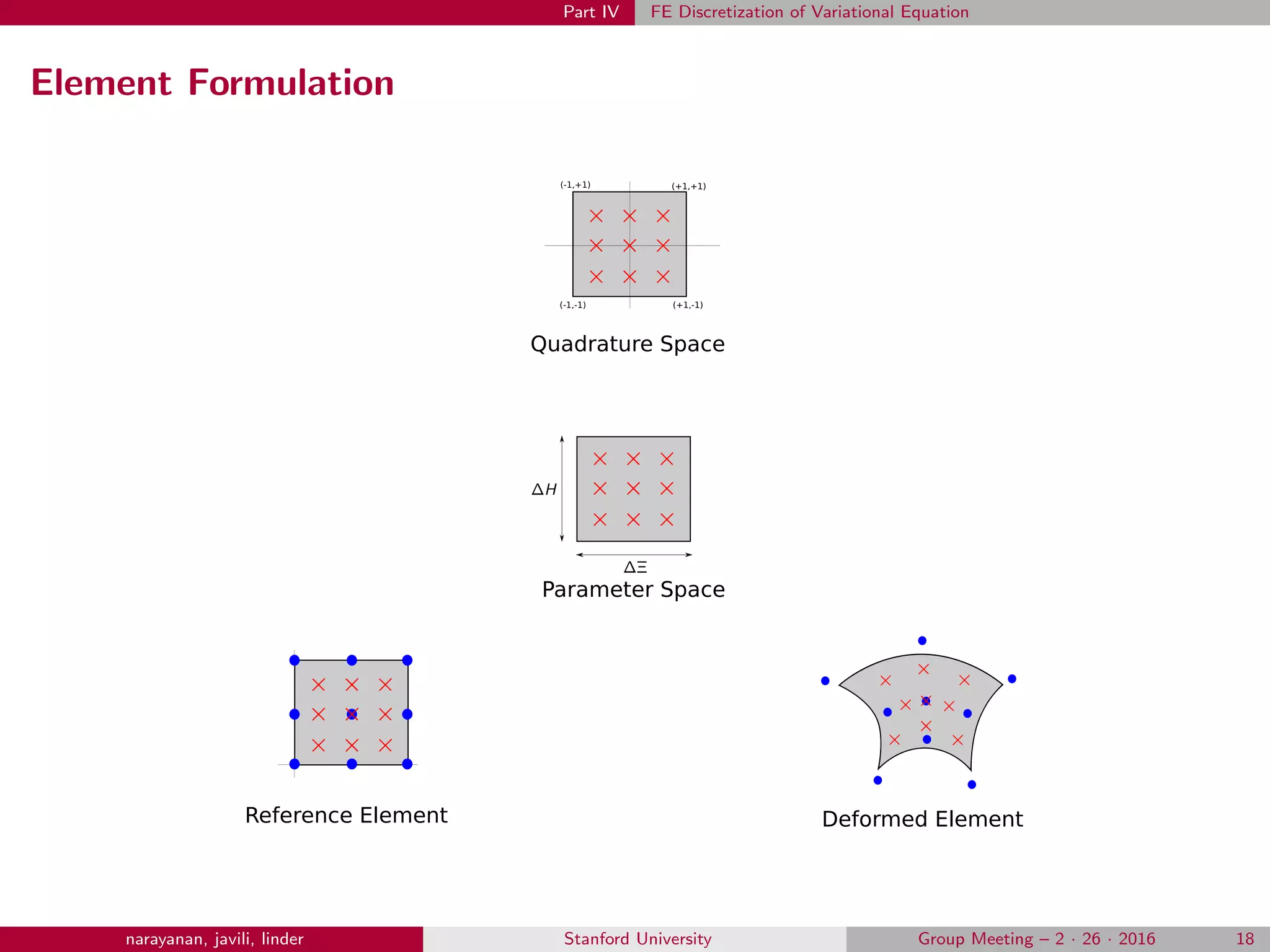
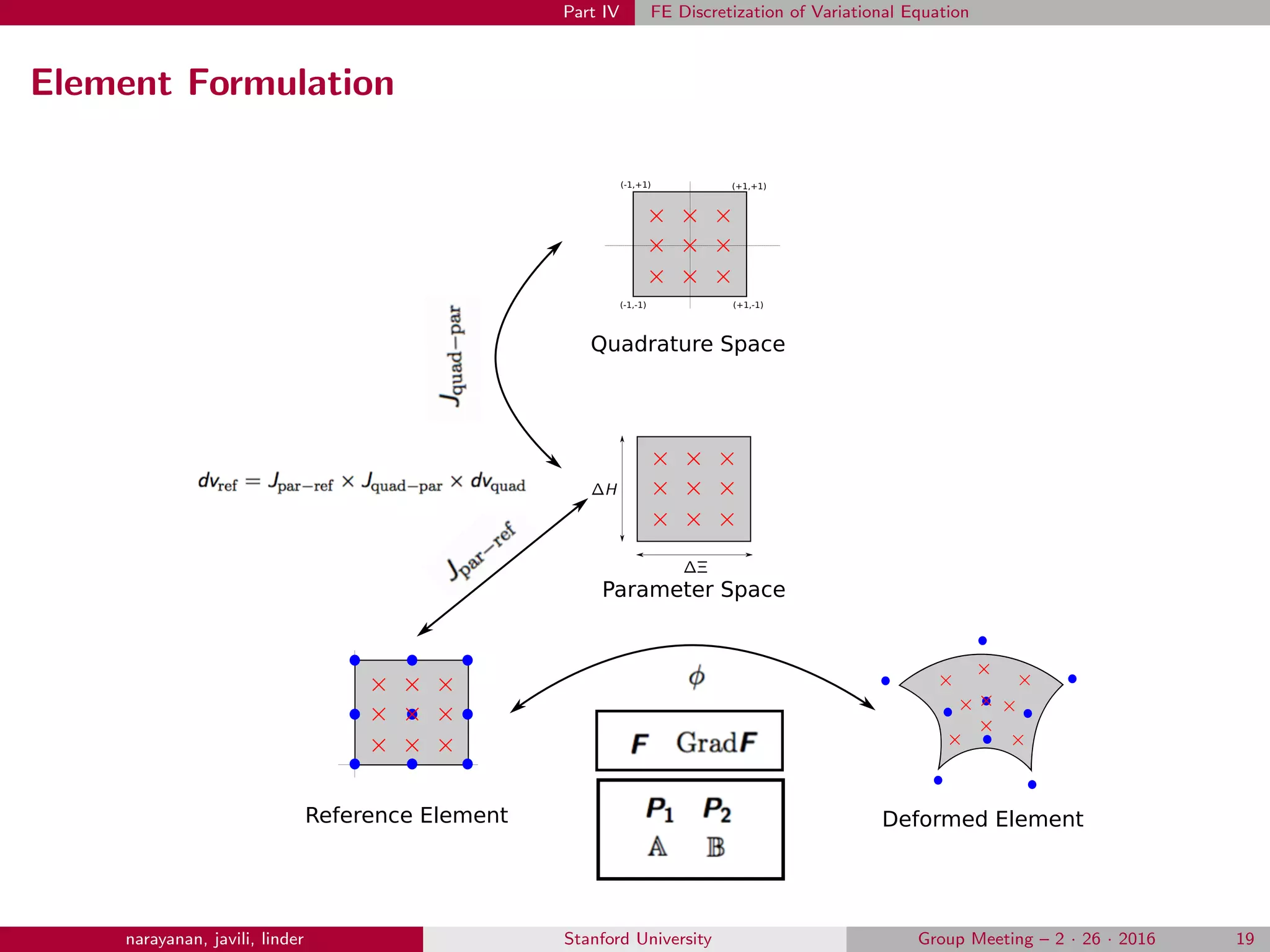
Element Formulation
(-1,-1) (+1,-1)
(+1,+1)(-1,+1)
Quadrature Space
Reference Element Deformed Element
Parameter Space
narayanan, javili, linder Stanford University Group Meeting – 2 · 26 · 2016 18
Part IV FE Discretization of Variational Equation
Element Formulation
(-1,-1) (+1,-1)
(+1,+1)(-1,+1)
Quadrature Space
Reference Element Deformed Element
Parameter Space
narayanan, javili, linder Stanford University Group Meeting – 2 · 26 · 2016 19
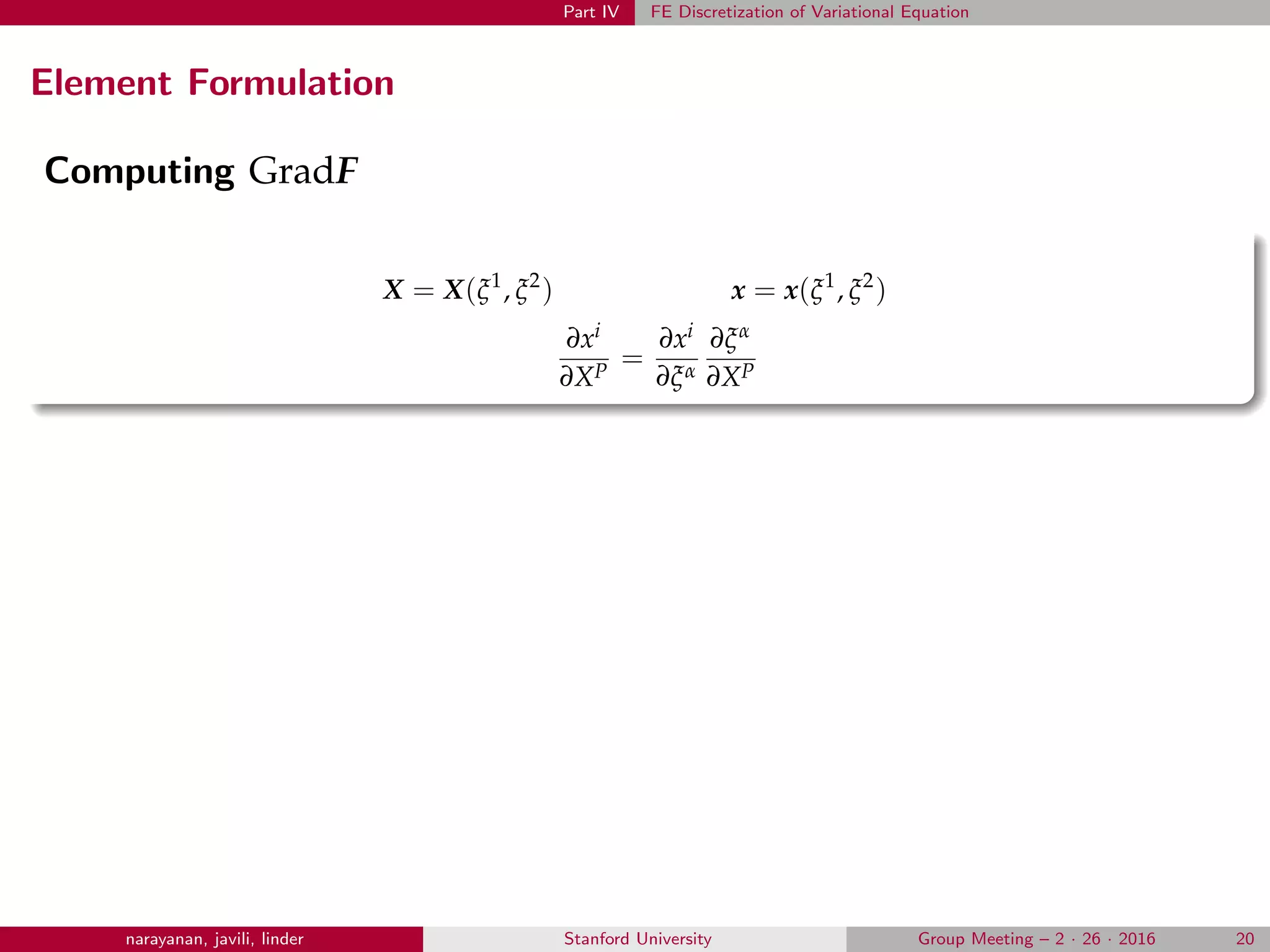
Part IV FE Discretization of Variational Equation
Element Formulation
Computing GradF
X = X(ξ1
, ξ2
) x = x(ξ1
, ξ2
)
∂xi
∂XP
=
∂xi
∂ξα
∂ξα
∂XP
narayanan, javili, linder Stanford University Group Meeting – 2 · 26 · 2016 20
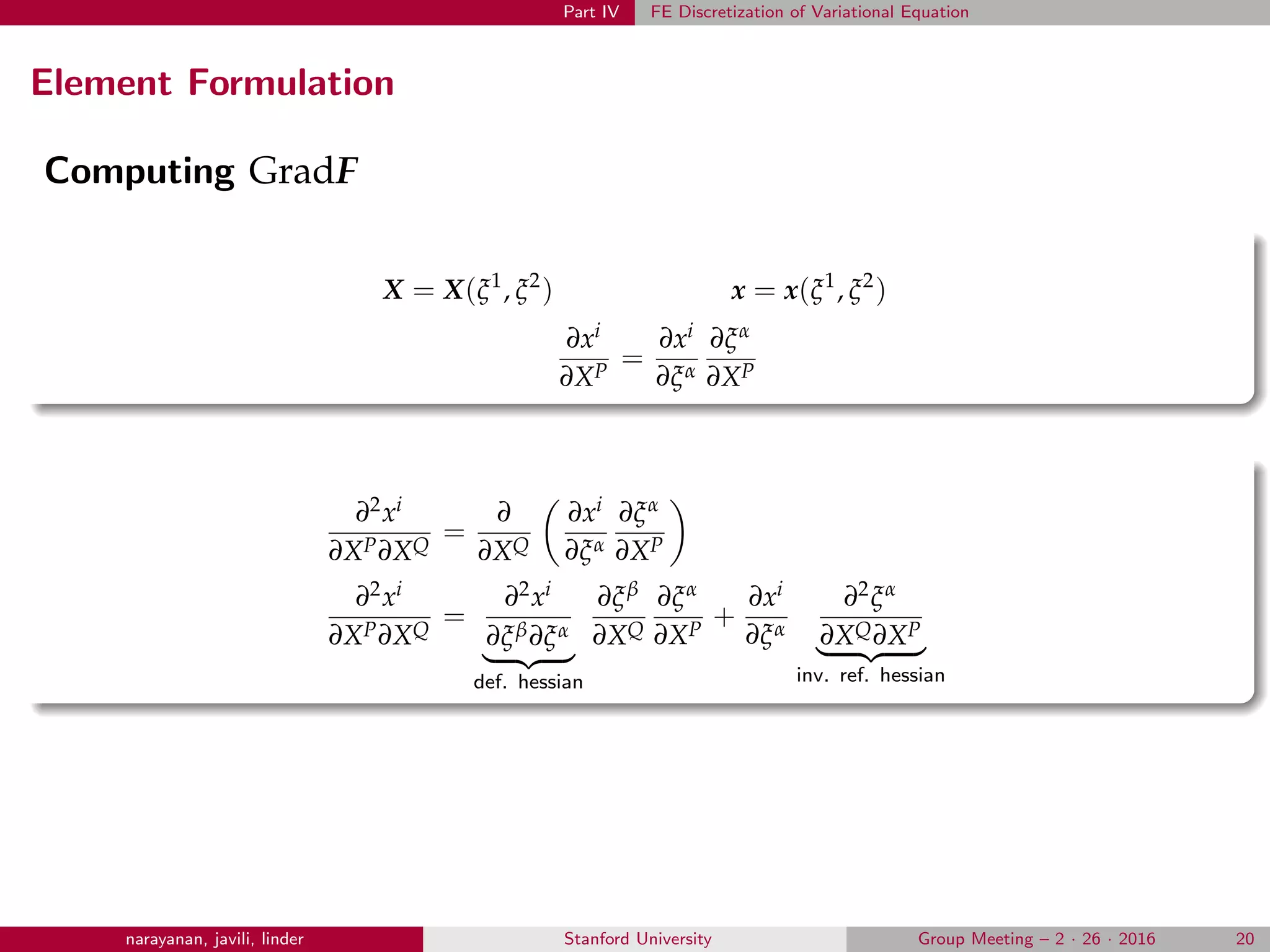
Part IV FE Discretization of Variational Equation
Element Formulation
Computing GradF
X = X(ξ1
, ξ2
) x = x(ξ1
, ξ2
)
∂xi
∂XP
=
∂xi
∂ξα
∂ξα
∂XP
∂2xi
∂XP∂XQ
=
∂
∂XQ
∂xi
∂ξα
∂ξα
∂XP
∂2xi
∂XP∂XQ
=
∂2xi
∂ξβ∂ξα
def. hessian
∂ξβ
∂XQ
∂ξα
∂XP
+
∂xi
∂ξα
∂2ξα
∂XQ∂XP
inv. ref. hessian
narayanan, javili, linder Stanford University Group Meeting – 2 · 26 · 2016 20
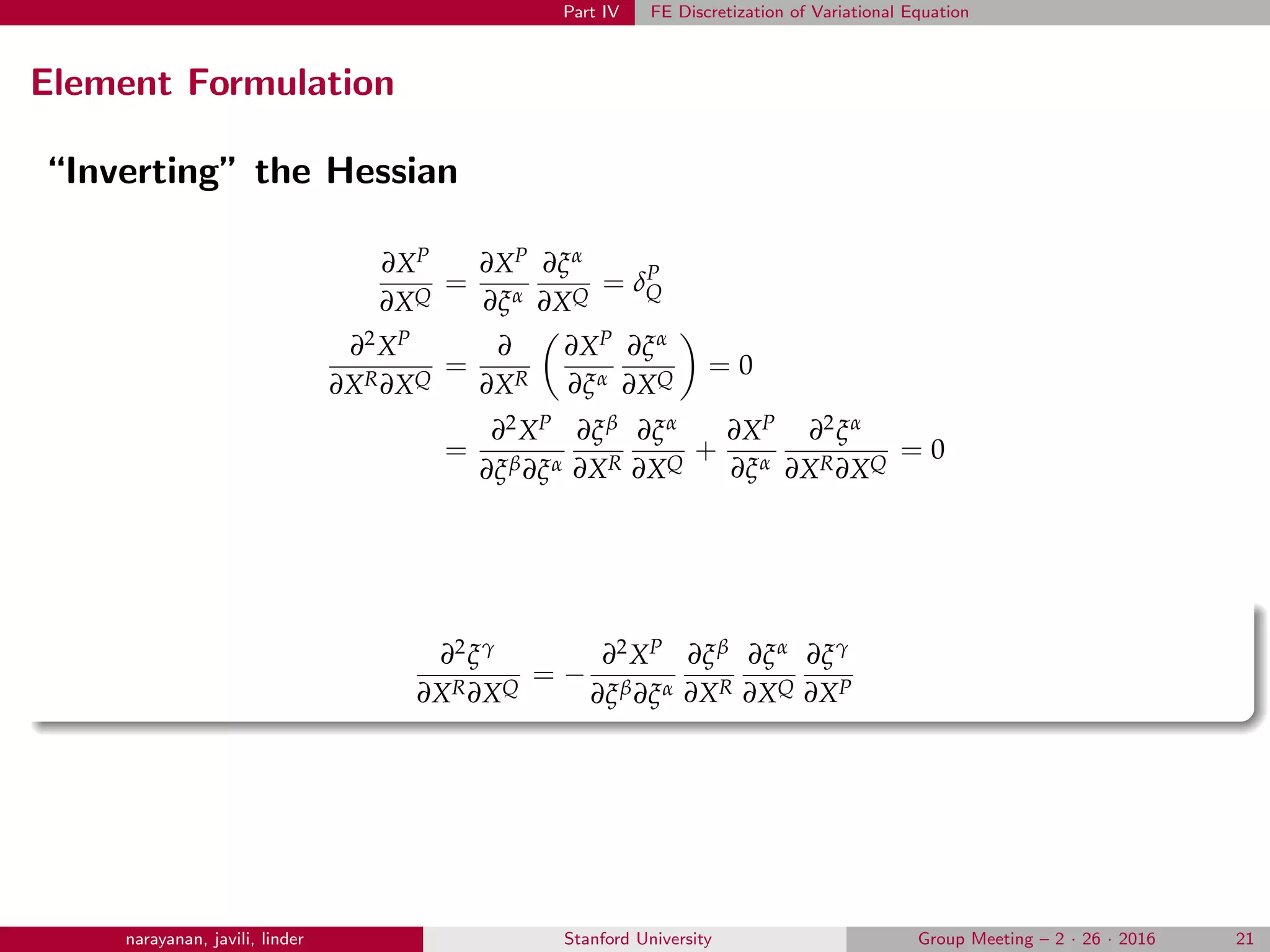
Part IV FE Discretization of Variational Equation
Element Formulation
“Inverting” the Hessian
∂XP
∂XQ
=
∂XP
∂ξα
∂ξα
∂XQ
= δP
Q
∂2XP
∂XR∂XQ
=
∂
∂XR
∂XP
∂ξα
∂ξα
∂XQ
= 0
=
∂2XP
∂ξβ∂ξα
∂ξβ
∂XR
∂ξα
∂XQ
+
∂XP
∂ξα
∂2ξα
∂XR∂XQ
= 0
∂2ξγ
∂XR∂XQ
= −
∂2XP
∂ξβ∂ξα
∂ξβ
∂XR
∂ξα
∂XQ
∂ξγ
∂XP
narayanan, javili, linder Stanford University Group Meeting – 2 · 26 · 2016 21
Part V Numerical Examples
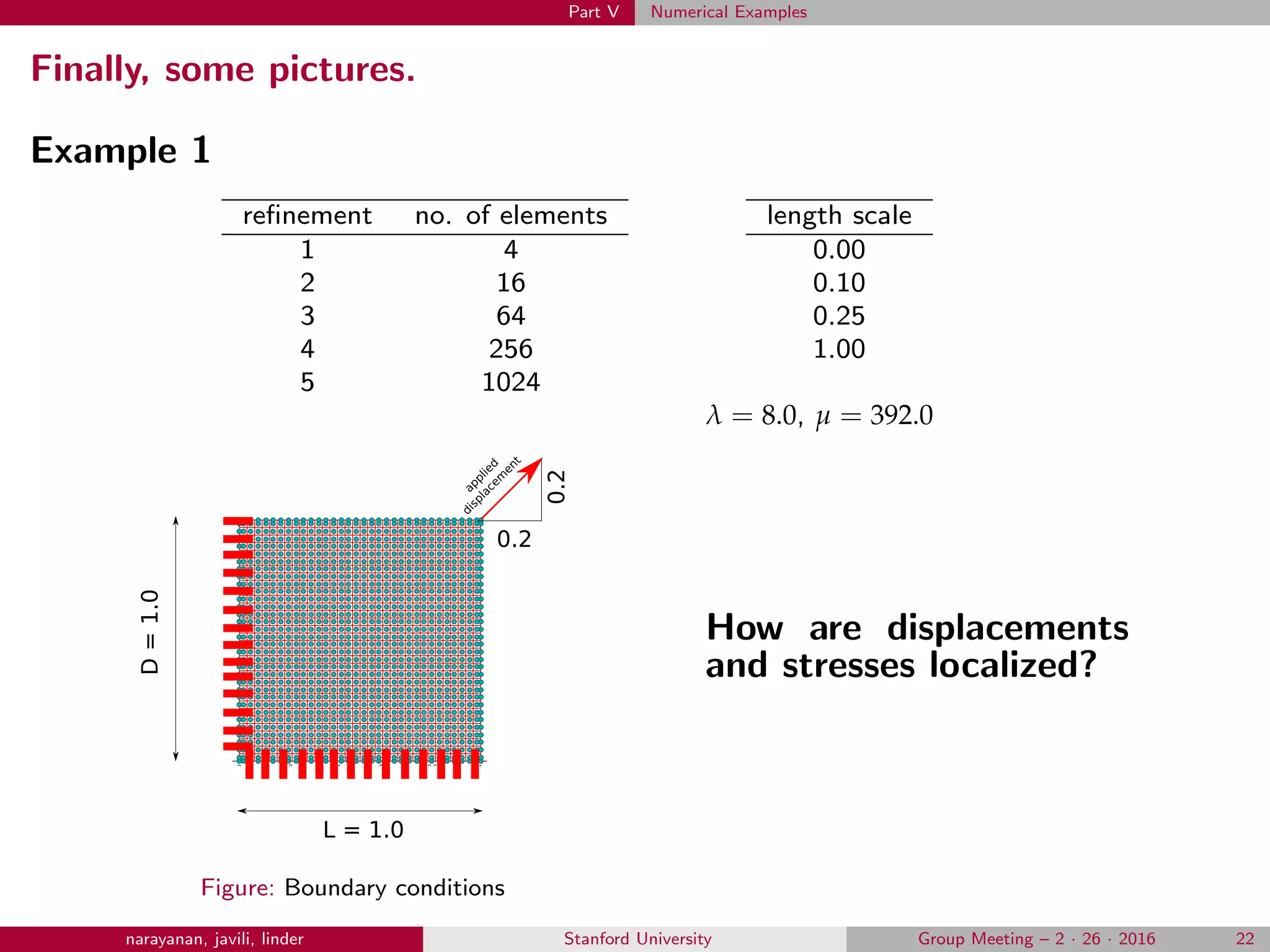
Finally, some pictures.
Example 1
refinement no. of elements
1 4
2 16
3 64
4 256
5 1024
length scale
0.00
0.10
0.25
1.00
0 0.2 0.4 0.6 0.8 1
0
0.1
0.2
0.3
0.4
0.5
0.6
0.7
0.8
0.9
1
L = 1.0
D=1.0
0.2
0.2
applied
displacem
ent
Figure: Boundary conditions
λ = 8.0, µ = 392.0
How are displacements
and stresses localized?
narayanan, javili, linder Stanford University Group Meeting – 2 · 26 · 2016 22
Part V Numerical Examples
Finally, some pictures.
Example 1: Deformed mesh under refinement
Figure: Length scale =
0.0
Figure: Length scale =
0.1
Figure: Length scale =
0.25
Figure: Length scale =
1.0
narayanan, javili, linder Stanford University Group Meeting – 2 · 26 · 2016 23
0 0.2 0.4 0.6 0.8 1 1.2
0
0.2
0.4
0.6
0.8
1
1.2
0 0.2 0.4 0.6 0.8 1 1.2
0
0.2
0.4
0.6
0.8
1
1.2
0 0.2 0.4 0.6 0.8 1 1.2
0
0.2
0.4
0.6
0.8
1
1.2
0 0.2 0.4 0.6 0.8 1 1.2
0
0.2
0.4
0.6
0.8
1
1.2
Part V Numerical Examples
Finally, some pictures.
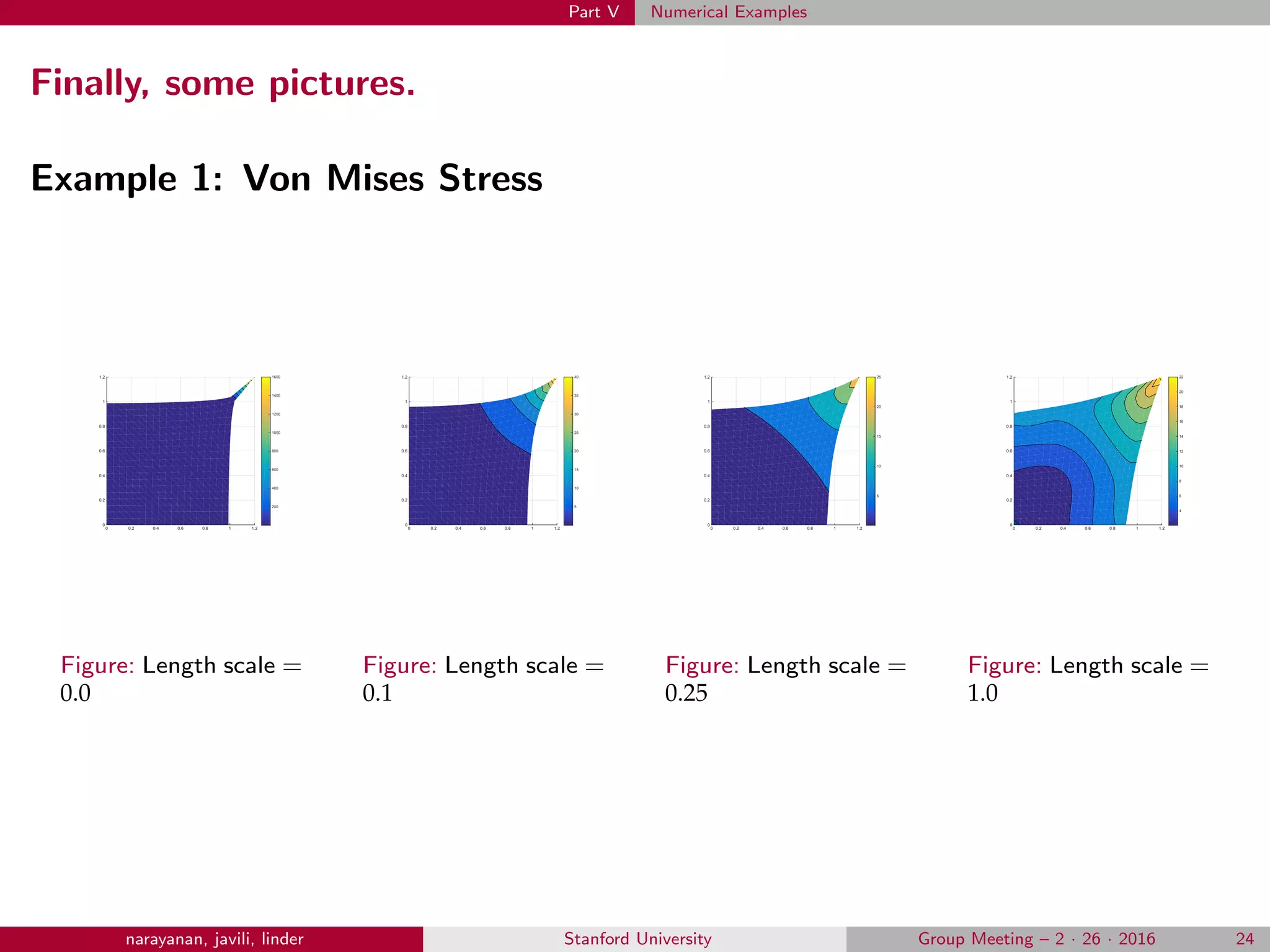
Example 1: Von Mises Stress
0 0.2 0.4 0.6 0.8 1 1.2
0
0.2
0.4
0.6
0.8
1
1.2
200
400
600
800
1000
1200
1400
1600
Figure: Length scale =
0.0
0 0.2 0.4 0.6 0.8 1 1.2
0
0.2
0.4
0.6
0.8
1
1.2
5
10
15
20
25
30
35
40
Figure: Length scale =
0.1
0 0.2 0.4 0.6 0.8 1 1.2
0
0.2
0.4
0.6
0.8
1
1.2
5
10
15
20
25
Figure: Length scale =
0.25
0 0.2 0.4 0.6 0.8 1 1.2
0
0.2
0.4
0.6
0.8
1
1.2
4
6
8
10
12
14
16
18
20
22
Figure: Length scale =
1.0
narayanan, javili, linder Stanford University Group Meeting – 2 · 26 · 2016 24
Part V Numerical Examples
Finally, some pictures.
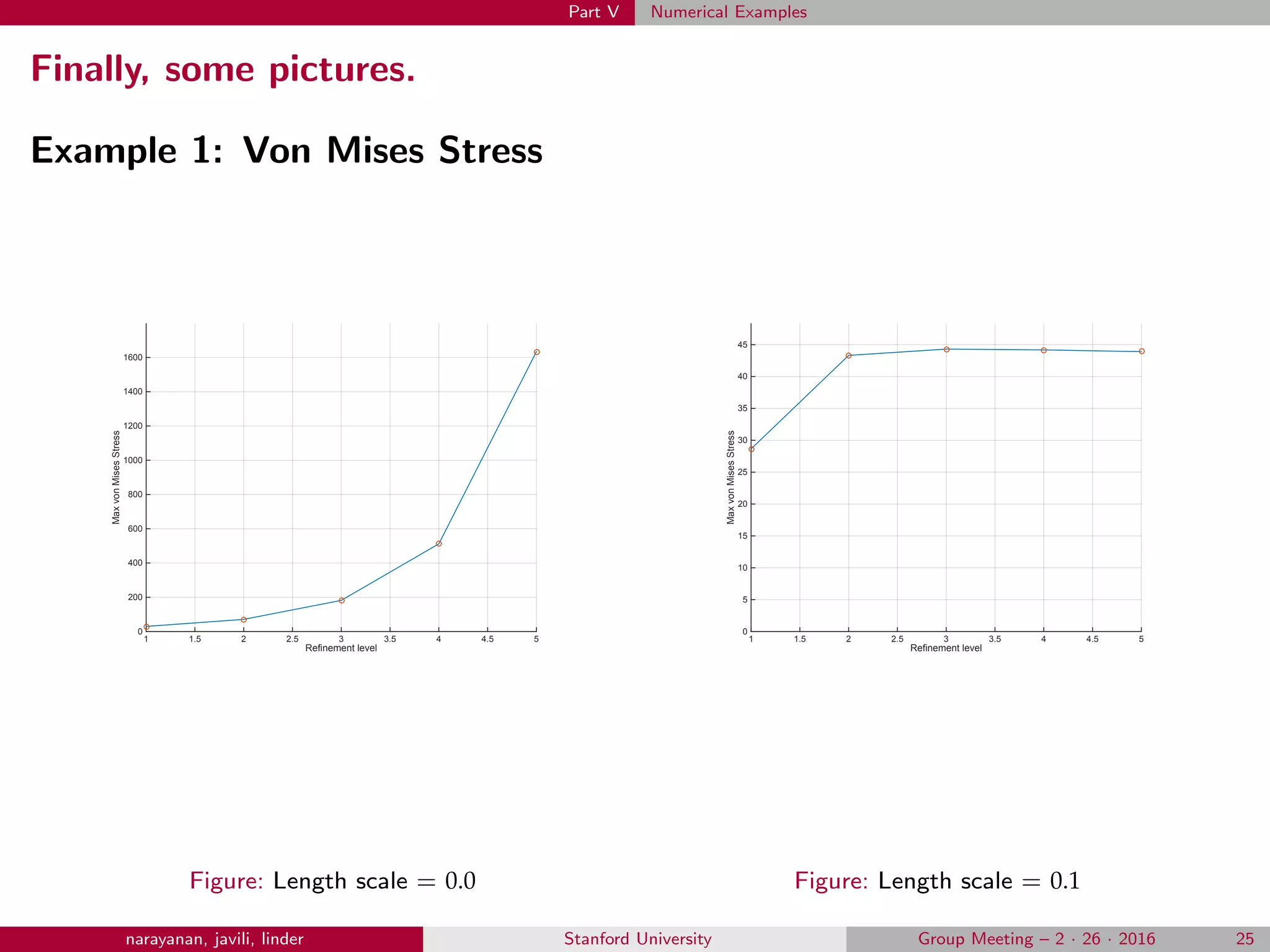
Example 1: Von Mises Stress
Refinement level
1 1.5 2 2.5 3 3.5 4 4.5 5
MaxvonMisesStress
0
200
400
600
800
1000
1200
1400
1600
Figure: Length scale = 0.0
Refinement level
1 1.5 2 2.5 3 3.5 4 4.5 5
MaxvonMisesStress
0
5
10
15
20
25
30
35
40
45
Figure: Length scale = 0.1
narayanan, javili, linder Stanford University Group Meeting – 2 · 26 · 2016 25
Part V Numerical Examples
Finally, some pictures.
Example 1: Von Mises Stress
Refinement level
1 1.5 2 2.5 3 3.5 4 4.5 5
MaxvonMisesStress
0
5
10
15
20
25
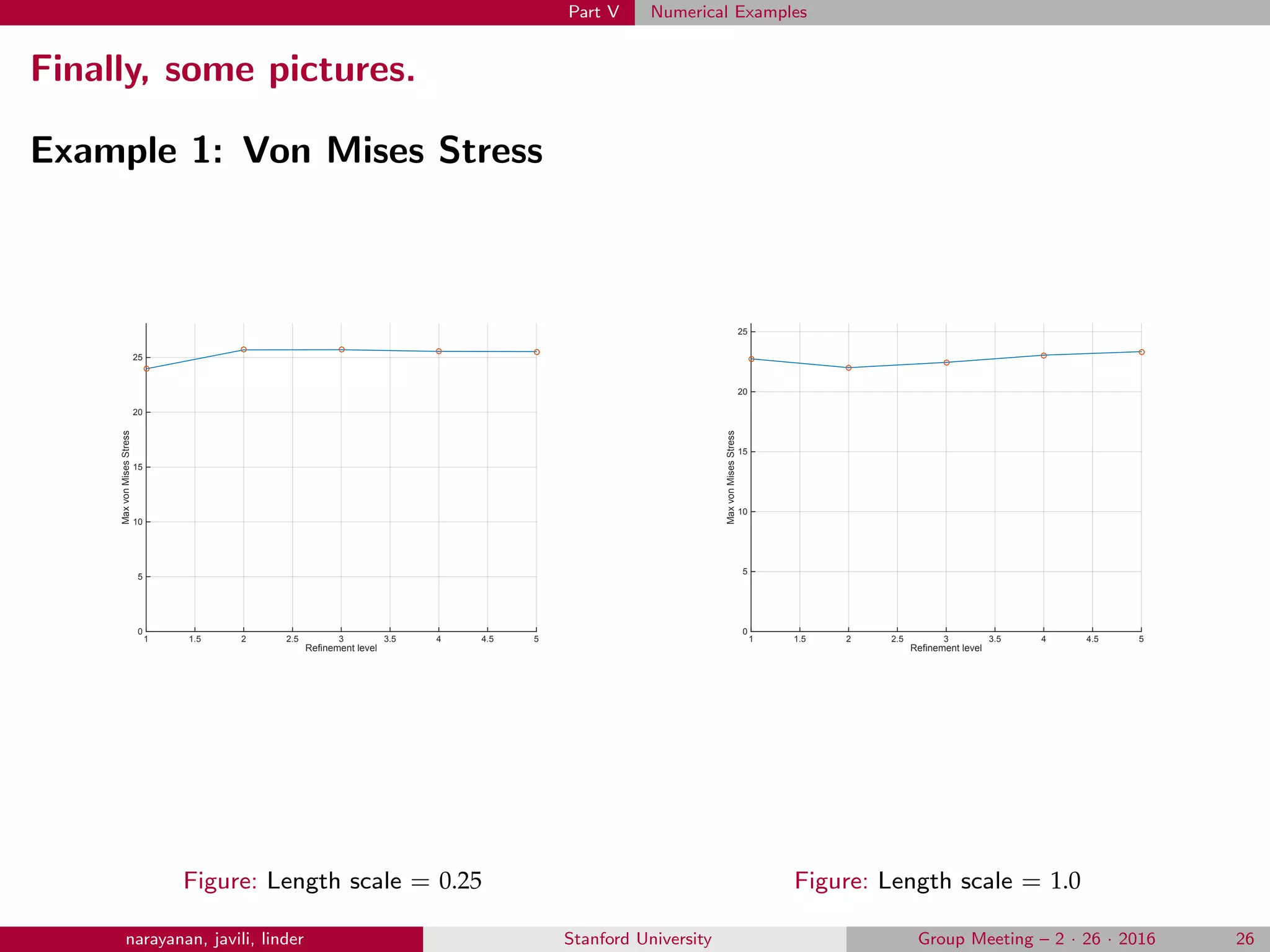
Figure: Length scale = 0.25
Refinement level
1 1.5 2 2.5 3 3.5 4 4.5 5
MaxvonMisesStress
0
5
10
15
20
25
Figure: Length scale = 1.0
narayanan, javili, linder Stanford University Group Meeting – 2 · 26 · 2016 26
Part VI Deformation Measures
In search of a better constitutive relation
Can we do better than 1
2 µl2EAB,CEAB,C ?
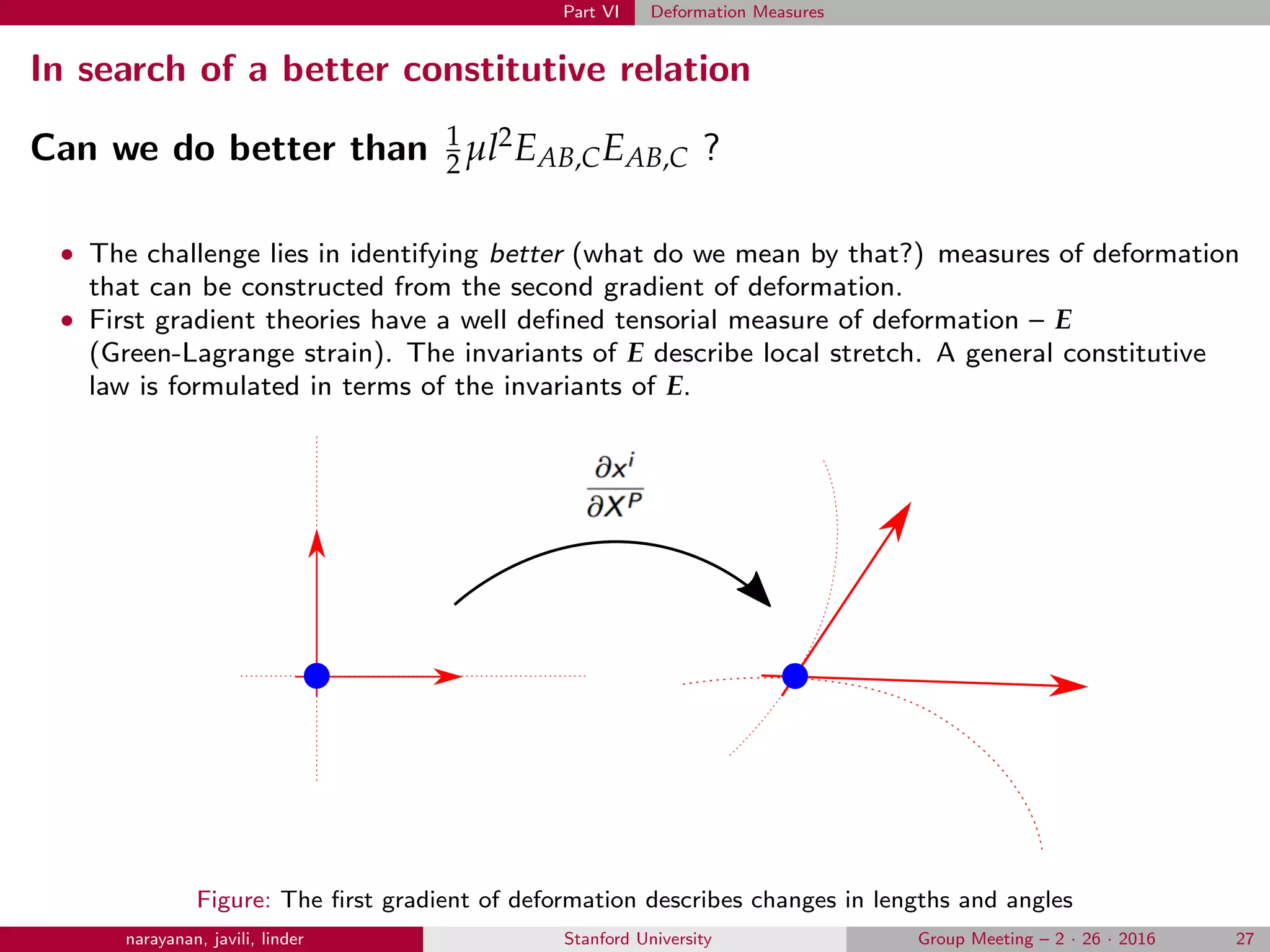
• The challenge lies in identifying better (what do we mean by that?) measures of deformation
that can be constructed from the second gradient of deformation.
• First gradient theories have a well defined tensorial measure of deformation – E
(Green-Lagrange strain). The invariants of E describe local stretch. A general constitutive
law is formulated in terms of the invariants of E.
Figure: The first gradient of deformation describes changes in lengths and angles
narayanan, javili, linder Stanford University Group Meeting – 2 · 26 · 2016 27
Part VI Deformation Measures
In search of a better constitutive relation
Can we do better than 1
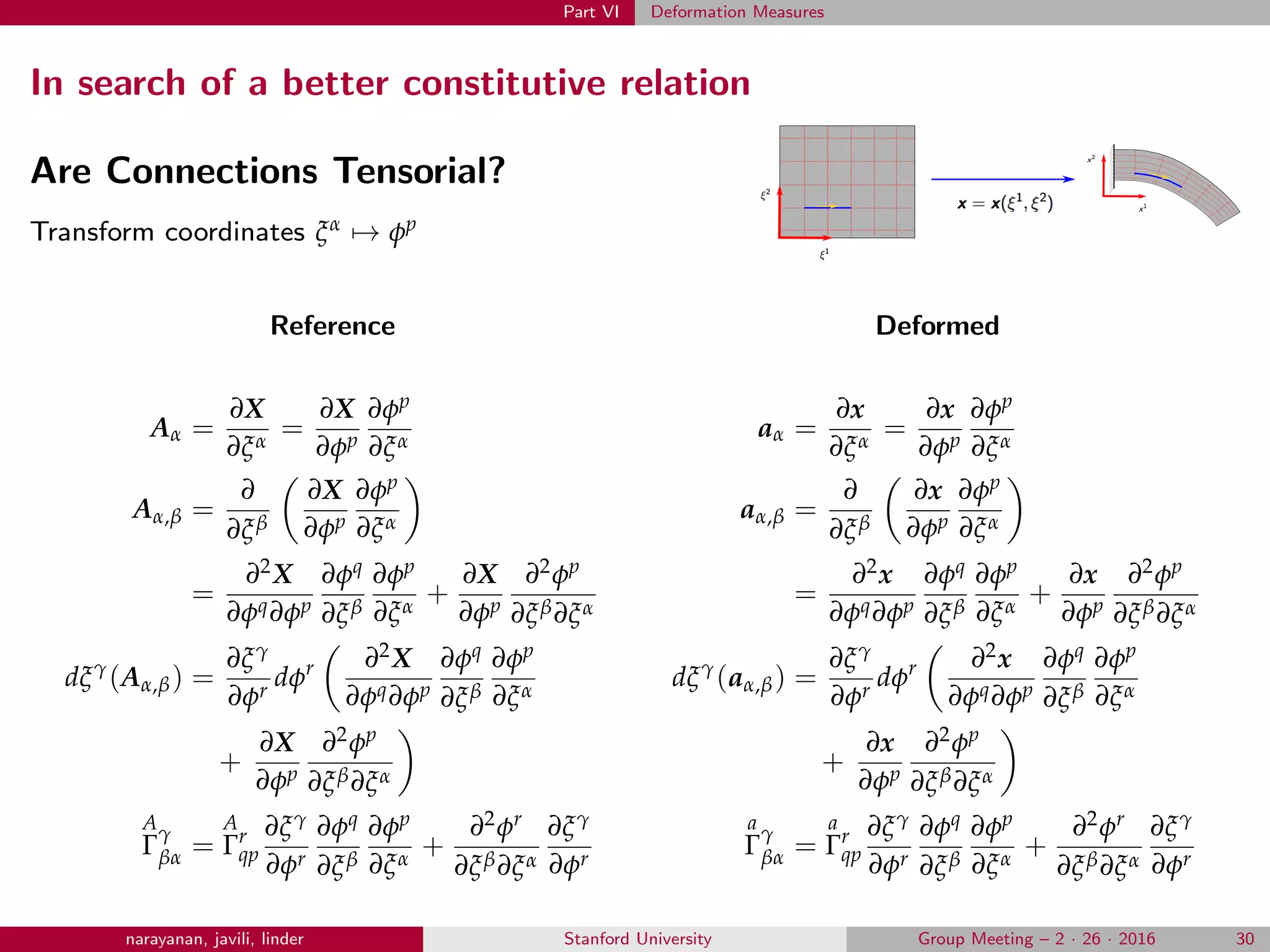
2 µl2EAB,CEAB,C ?
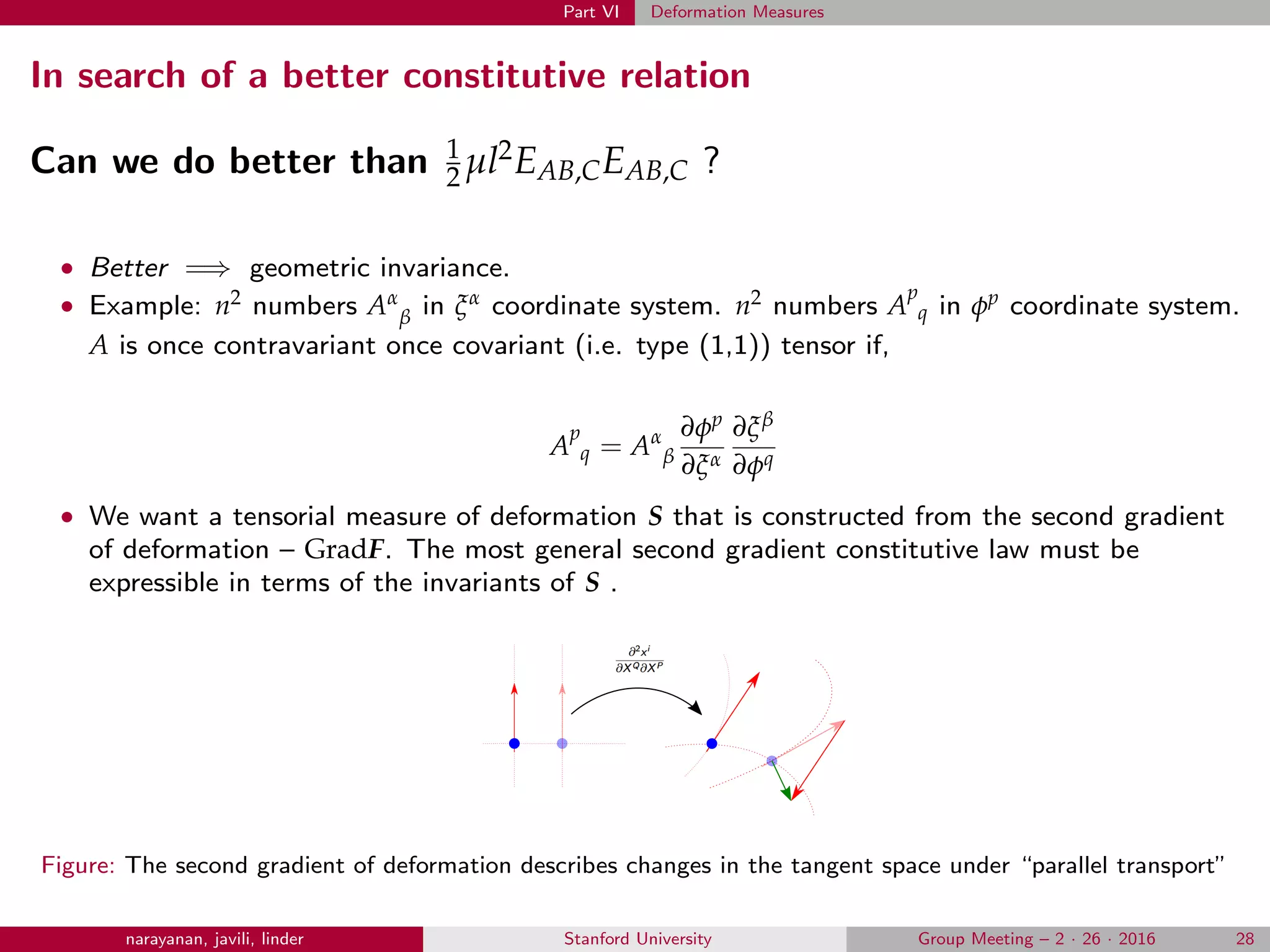
• Better =⇒ geometric invariance.
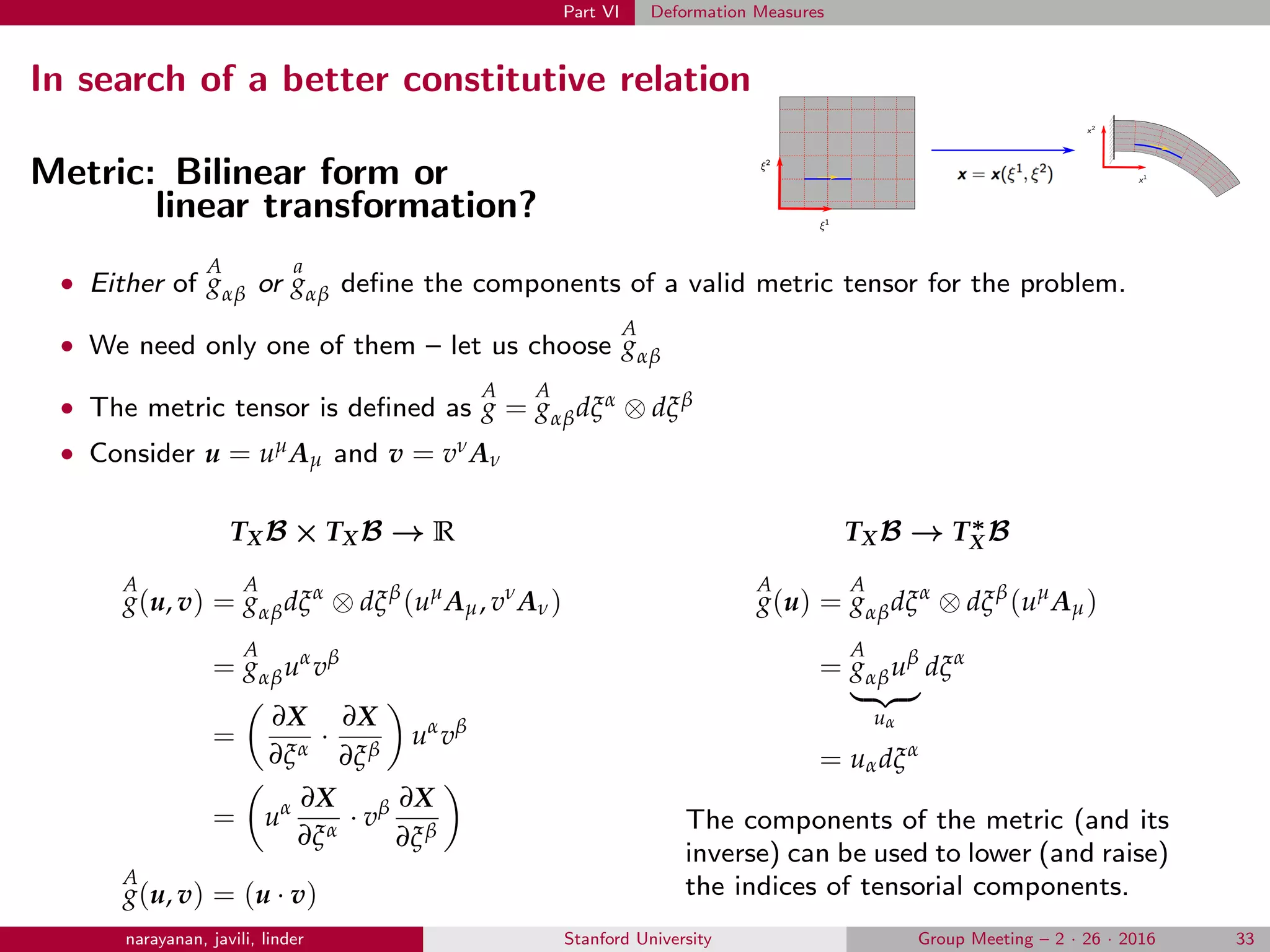
• Example: n2 numbers Aα
β in ξα coordinate system. n2 numbers A
p
q in φp coordinate system.
A is once contravariant once covariant (i.e. type (1,1)) tensor if,
A
p
q = Aα
β
∂φp
∂ξα
∂ξβ
∂φq
• We want a tensorial measure of deformation S that is constructed from the second gradient
of deformation – GradF. The most general second gradient constitutive law must be
expressible in terms of the invariants of S .
Figure: The second gradient of deformation describes changes in the tangent space under “parallel transport”
narayanan, javili, linder Stanford University Group Meeting – 2 · 26 · 2016 28
Part VI Deformation Measures
In search of a better constitutive relation
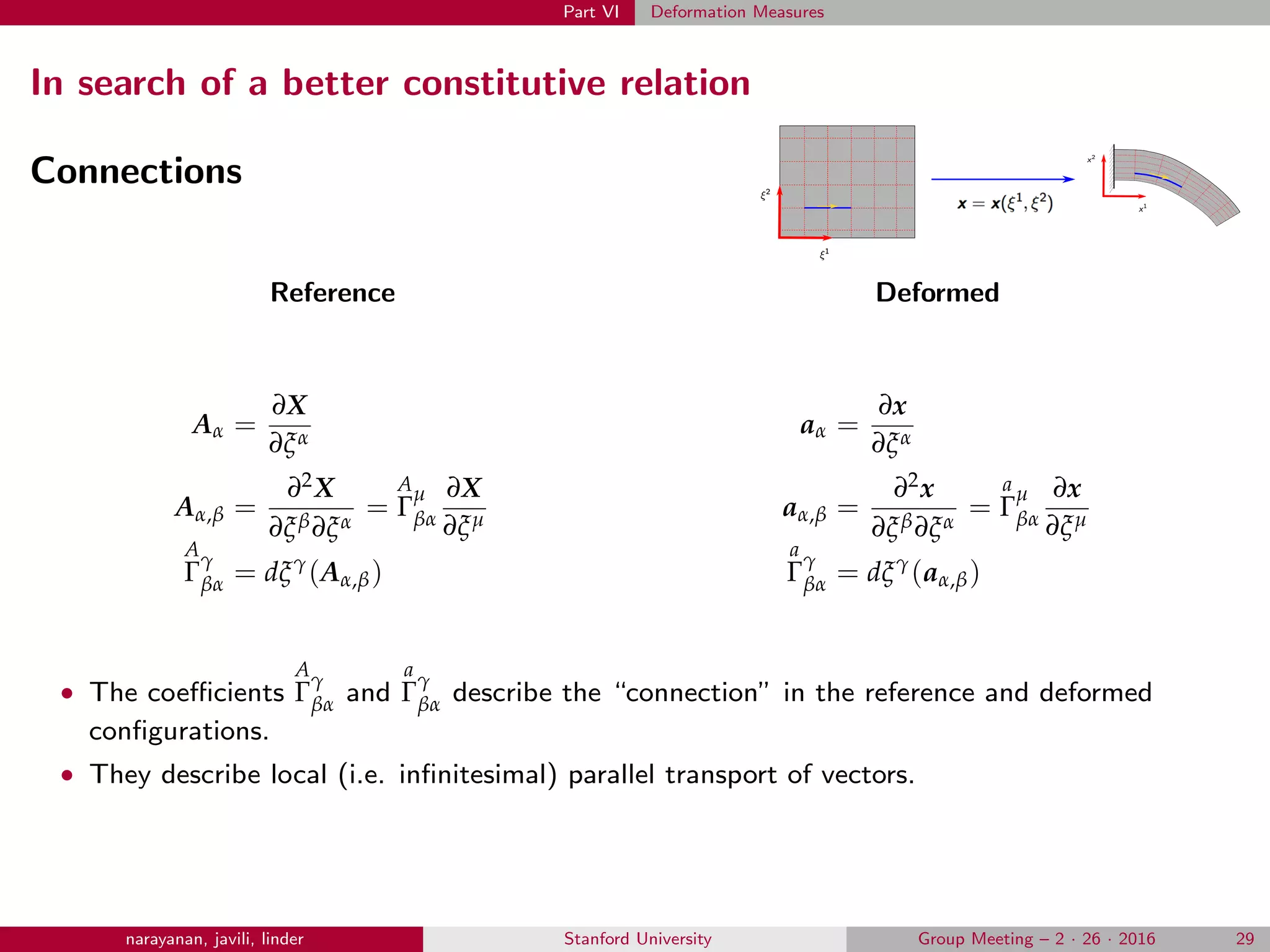
Connections
Reference
Aα =
∂X
∂ξα
Aα,β =
∂2X
∂ξβ∂ξα
=
A
Γ
µ
βα
∂X
∂ξµ
A
Γ
γ
βα = dξγ
(Aα,β)
Deformed
aα =
∂x
∂ξα
aα,β =
∂2x
∂ξβ∂ξα
=
a
Γ
µ
βα
∂x
∂ξµ
a
Γ
γ
βα = dξγ
(aα,β)
• The coefficients
A
Γ
γ
βα and
a
Γ
γ
βα describe the “connection” in the reference and deformed
configurations.
• They describe local (i.e. infinitesimal) parallel transport of vectors.
narayanan, javili, linder Stanford University Group Meeting – 2 · 26 · 2016 29
Part VI Deformation Measures
In search of a better constitutive relation
Are Connections Tensorial?
Transform coordinates ξα → φp
Reference
Aα =
∂X
∂ξα
=
∂X
∂φp
∂φp
∂ξα
Aα,β =
∂
∂ξβ
∂X
∂φp
∂φp
∂ξα
=
∂2X
∂φq∂φp
∂φq
∂ξβ
∂φp
∂ξα
+
∂X
∂φp
∂2φp
∂ξβ∂ξα
dξγ
(Aα,β) =
∂ξγ
∂φr
dφr ∂2X
∂φq∂φp
∂φq
∂ξβ
∂φp
∂ξα
+
∂X
∂φp
∂2φp
∂ξβ∂ξα
A
Γ
γ
βα =
A
Γr
qp
∂ξγ
∂φr
∂φq
∂ξβ
∂φp
∂ξα
+
∂2φr
∂ξβ∂ξα
∂ξγ
∂φr
Deformed
aα =
∂x
∂ξα
=
∂x
∂φp
∂φp
∂ξα
aα,β =
∂
∂ξβ
∂x
∂φp
∂φp
∂ξα
=
∂2x
∂φq∂φp
∂φq
∂ξβ
∂φp
∂ξα
+
∂x
∂φp
∂2φp
∂ξβ∂ξα
dξγ
(aα,β) =
∂ξγ
∂φr
dφr ∂2x
∂φq∂φp
∂φq
∂ξβ
∂φp
∂ξα
+
∂x
∂φp
∂2φp
∂ξβ∂ξα
a
Γ
γ
βα =
a
Γr
qp
∂ξγ
∂φr
∂φq
∂ξβ
∂φp
∂ξα
+
∂2φr
∂ξβ∂ξα
∂ξγ
∂φr
narayanan, javili, linder Stanford University Group Meeting – 2 · 26 · 2016 30
Part VI Deformation Measures
In search of a better constitutive relation
Are Connections Tensorial?
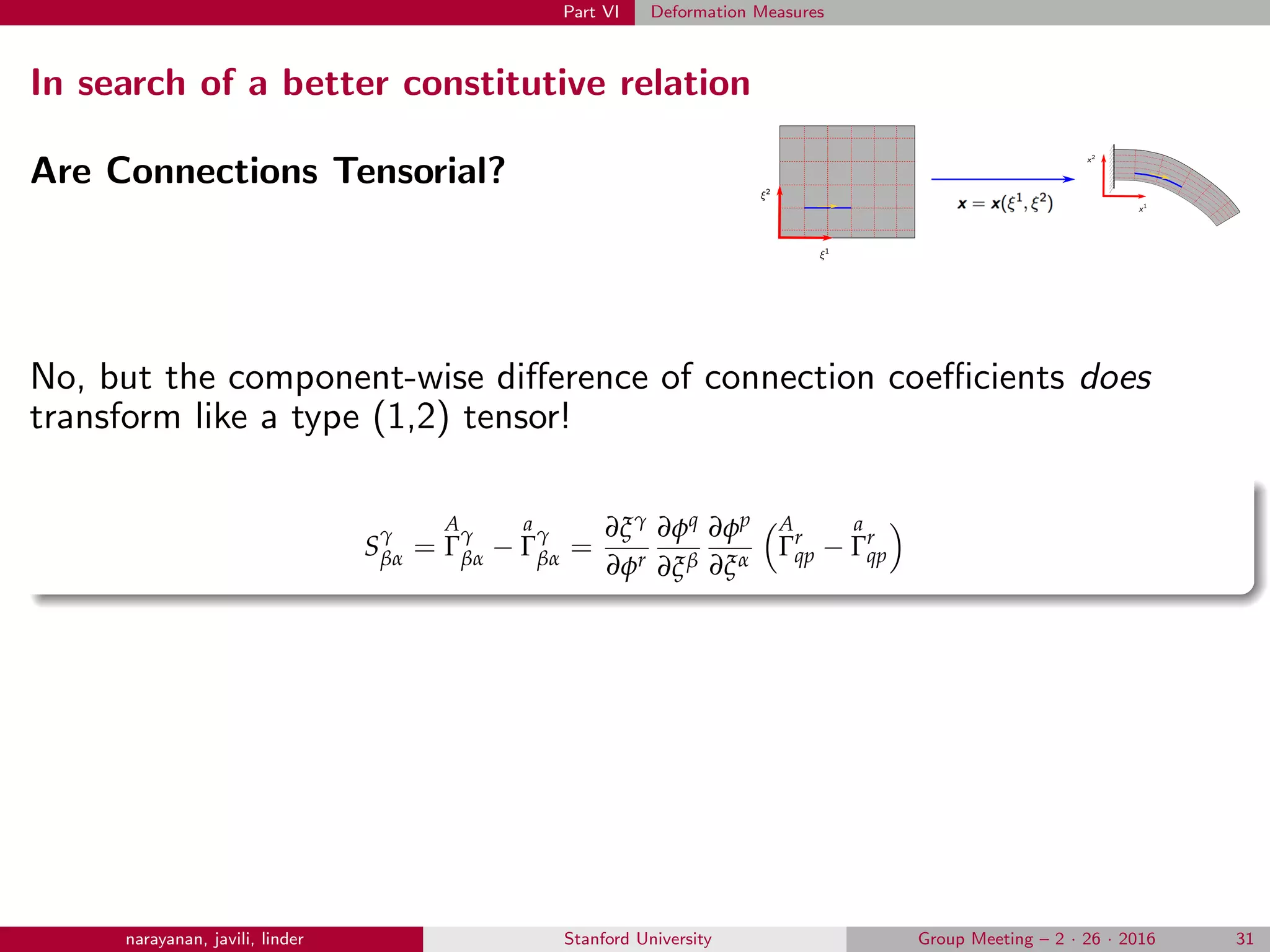
No, but the component-wise difference of connection coefficients does
transform like a type (1,2) tensor!
S
γ
βα =
A
Γ
γ
βα −
a
Γ
γ
βα =
∂ξγ
∂φr
∂φq
∂ξβ
∂φp
∂ξα
A
Γr
qp −
a
Γr
qp
narayanan, javili, linder Stanford University Group Meeting – 2 · 26 · 2016 31
Part VI Deformation Measures
In search of a better constitutive relation
Metrics
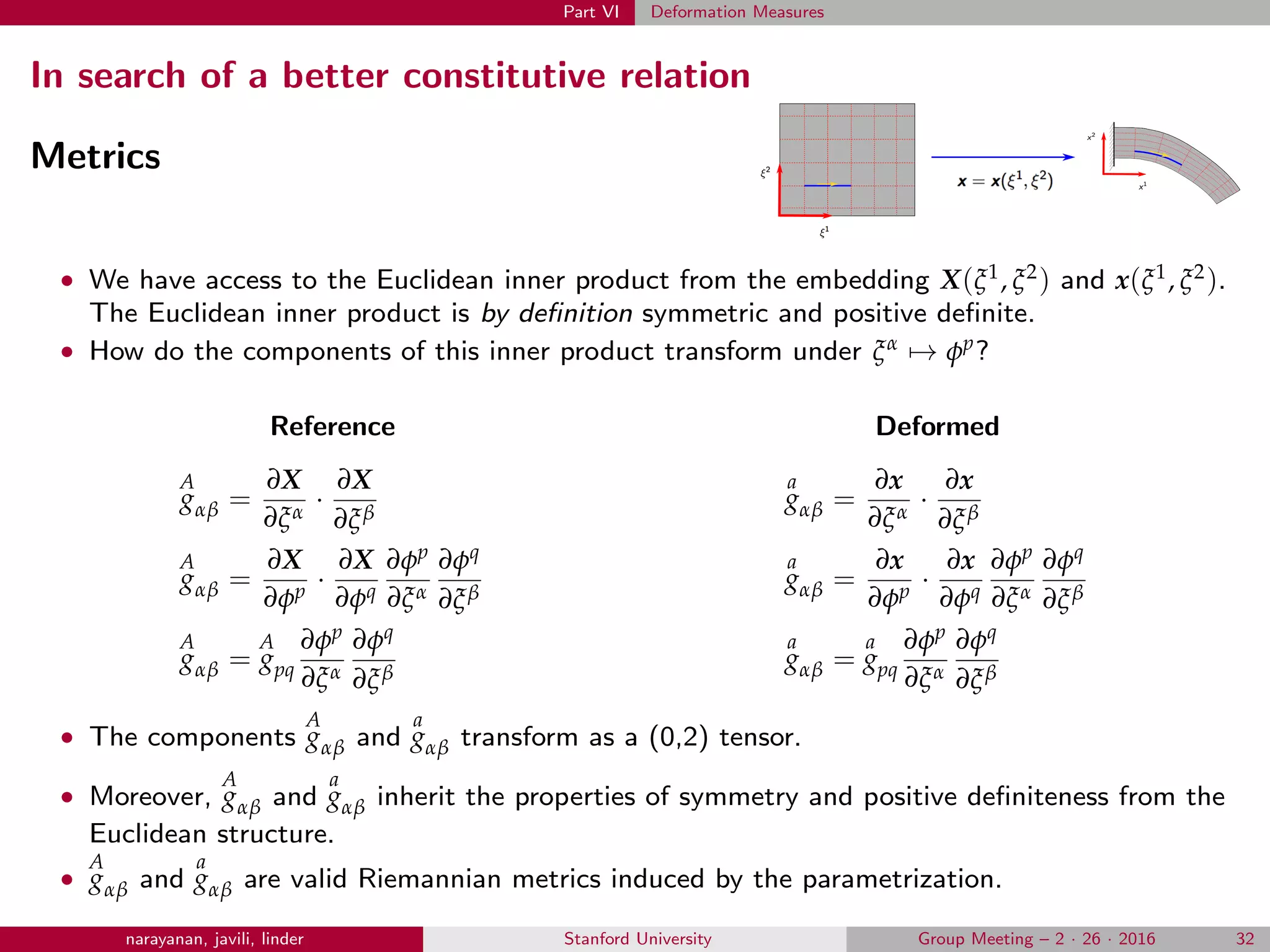
• We have access to the Euclidean inner product from the embedding X(ξ1, ξ2) and x(ξ1, ξ2).
The Euclidean inner product is by definition symmetric and positive definite.
• How do the components of this inner product transform under ξα → φp?
Reference
A
gαβ =
∂X
∂ξα
·
∂X
∂ξβ
A
gαβ =
∂X
∂φp ·
∂X
∂φq
∂φp
∂ξα
∂φq
∂ξβ
A
gαβ =
A
gpq
∂φp
∂ξα
∂φq
∂ξβ
Deformed
a
gαβ =
∂x
∂ξα
·
∂x
∂ξβ
a
gαβ =
∂x
∂φp ·
∂x
∂φq
∂φp
∂ξα
∂φq
∂ξβ
a
gαβ =
a
gpq
∂φp
∂ξα
∂φq
∂ξβ
• The components
A
gαβ and
a
gαβ transform as a (0,2) tensor.
• Moreover,
A
gαβ and
a
gαβ inherit the properties of symmetry and positive definiteness from the
Euclidean structure.
•
A
gαβ and
a
gαβ are valid Riemannian metrics induced by the parametrization.
narayanan, javili, linder Stanford University Group Meeting – 2 · 26 · 2016 32
Part VI Deformation Measures
In search of a better constitutive relation
Metric: Bilinear form or
linear transformation?
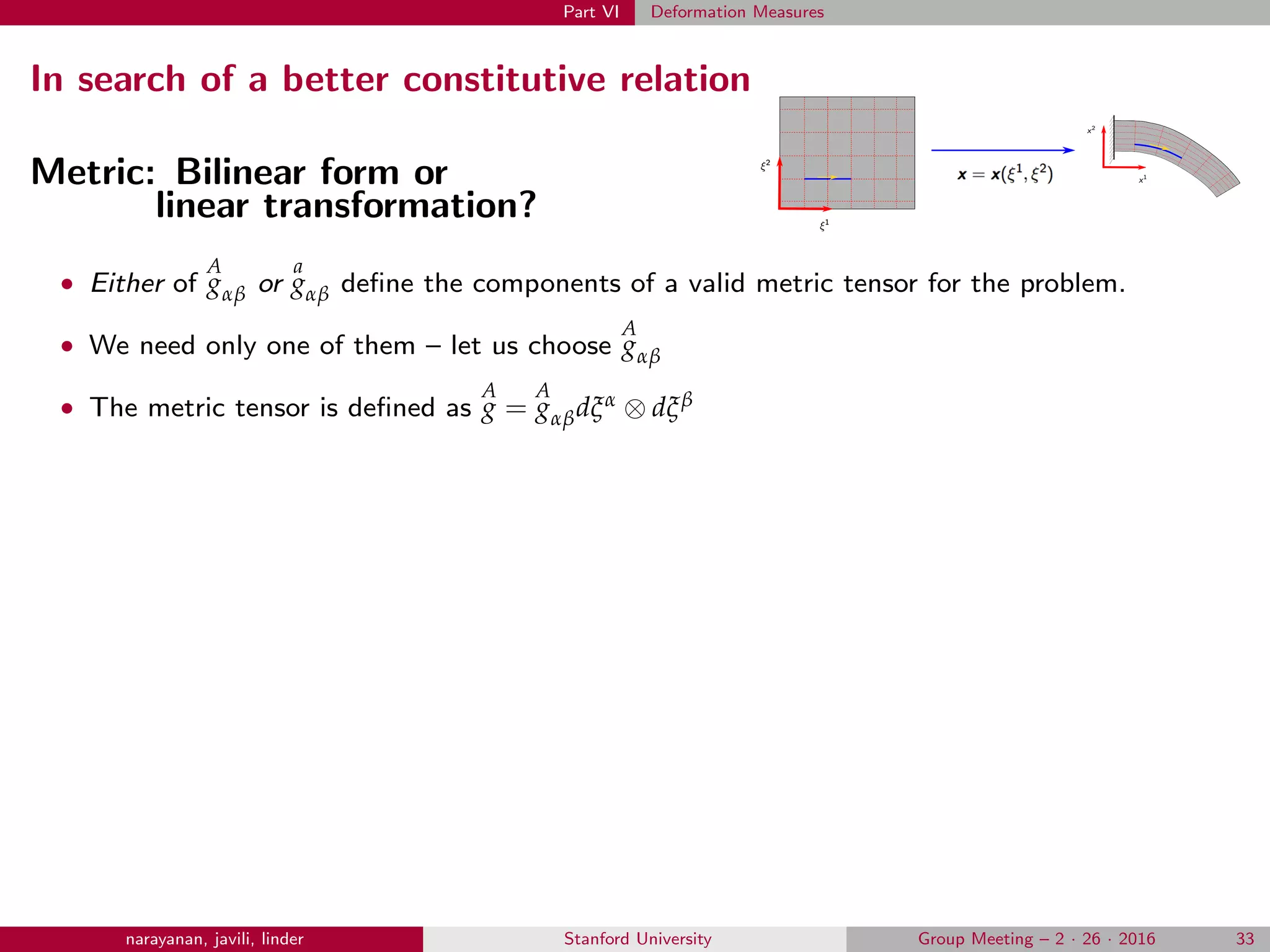
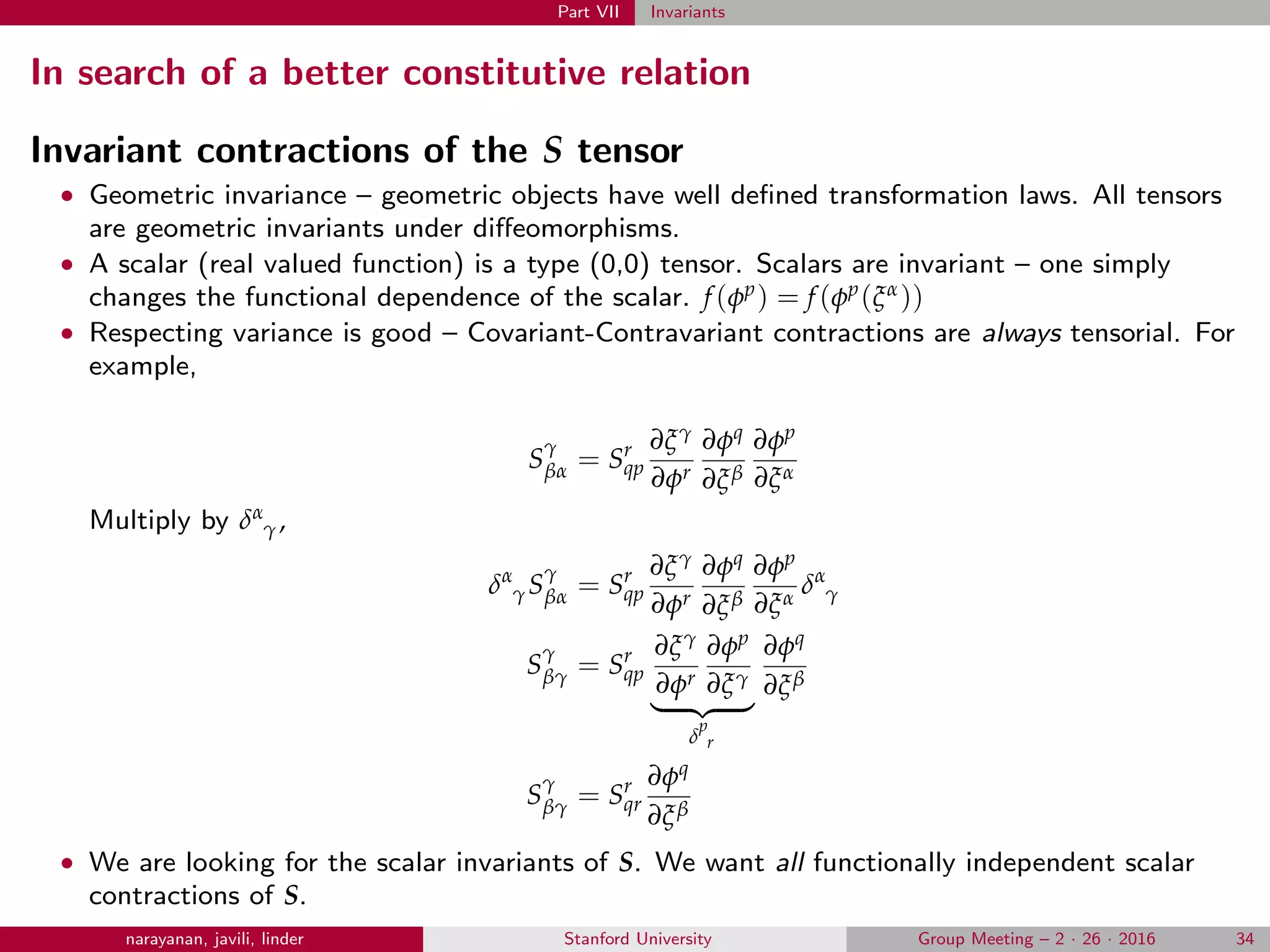
• Either of
A
gαβ or
a
gαβ define the components of a valid metric tensor for the problem.
• We need only one of them – let us choose
A
gαβ
• The metric tensor is defined as
A
g =
A
gαβdξα ⊗ dξβ
narayanan, javili, linder Stanford University Group Meeting – 2 · 26 · 2016 33
Part VI Deformation Measures
In search of a better constitutive relation
Metric: Bilinear form or
linear transformation?
• Either of
A
gαβ or
a
gαβ define the components of a valid metric tensor for the problem.
• We need only one of them – let us choose
A
gαβ
• The metric tensor is defined as
A
g =
A
gαβdξα ⊗ dξβ
• Consider u = uµAµ and v = vνAν
TX B × TX B → R
A
g(u, v) =
A
gαβdξα
⊗ dξβ
(uµ
Aµ, vν
Aν)
=
A
gαβuα
vβ
=
∂X
∂ξα
·
∂X
∂ξβ
uα
vβ
= uα ∂X
∂ξα
· vβ ∂X
∂ξβ
A
g(u, v) = (u · v)
TXB → T∗
X B
A
g(u) =
A
gαβdξα
⊗ dξβ
(uµ
Aµ)
=
A
gαβuβ
uα
dξα
= uαdξα
The components of the metric (and its
inverse) can be used to lower (and raise)
the indices of tensorial components.
narayanan, javili, linder Stanford University Group Meeting – 2 · 26 · 2016 33
Part VII Invariants
In search of a better constitutive relation
Invariant contractions of the S tensor
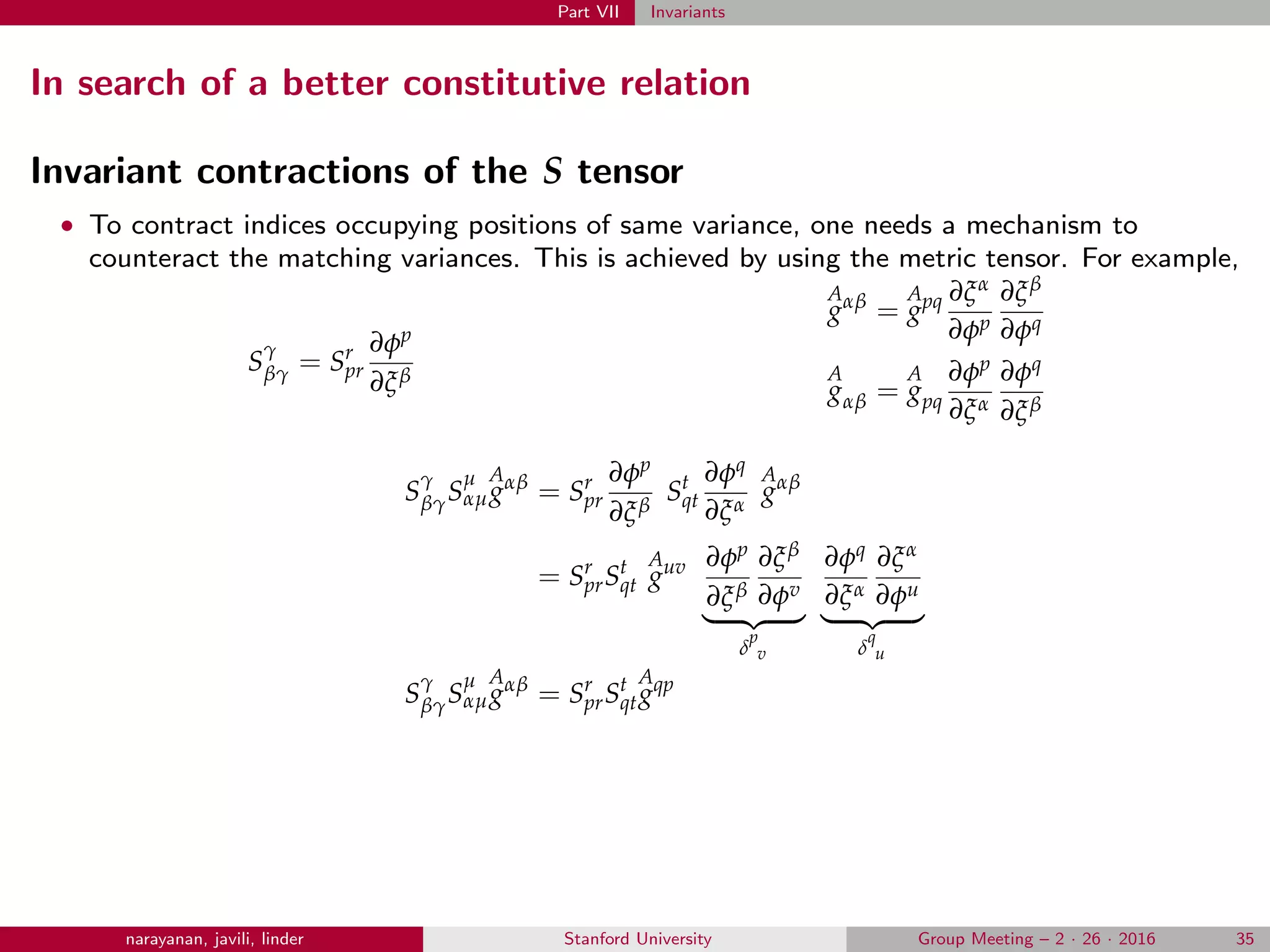
• Geometric invariance – geometric objects have well defined transformation laws. All tensors
are geometric invariants under diffeomorphisms.
• A scalar (real valued function) is a type (0,0) tensor. Scalars are invariant – one simply
changes the functional dependence of the scalar. f(φp) = f(φp(ξα))
• Respecting variance is good – Covariant-Contravariant contractions are always tensorial. For
example,
S
γ
βα = Sr
qp
∂ξγ
∂φr
∂φq
∂ξβ
∂φp
∂ξα
Multiply by δα
γ,
δα
γS
γ
βα = Sr
qp
∂ξγ
∂φr
∂φq
∂ξβ
∂φp
∂ξα
δα
γ
S
γ
βγ = Sr
qp
∂ξγ
∂φr
∂φp
∂ξγ
δ
p
r
∂φq
∂ξβ
S
γ
βγ = Sr
qr
∂φq
∂ξβ
• We are looking for the scalar invariants of S. We want all functionally independent scalar
contractions of S.
narayanan, javili, linder Stanford University Group Meeting – 2 · 26 · 2016 34
Part VII Invariants
In search of a better constitutive relation
Invariant contractions of the S tensor
• To contract indices occupying positions of same variance, one needs a mechanism to
counteract the matching variances. This is achieved by using the metric tensor. For example,
S
γ
βγ = Sr
pr
∂φp
∂ξβ
A
gαβ
=
A
gpq ∂ξα
∂φp
∂ξβ
∂φq
A
gαβ =
A
gpq
∂φp
∂ξα
∂φq
∂ξβ
S
γ
βγS
µ
αµ
A
gαβ
= Sr
pr
∂φp
∂ξβ
St
qt
∂φq
∂ξα
A
gαβ
= Sr
prSt
qt
A
guv ∂φp
∂ξβ
∂ξβ
∂φv
δ
p
v
∂φq
∂ξα
∂ξα
∂φu
δ
q
u
S
γ
βγS
µ
αµ
A
gαβ
= Sr
prSt
qt
A
gqp
narayanan, javili, linder Stanford University Group Meeting – 2 · 26 · 2016 35
Part VII Invariants
In search of a better constitutive relation
Invariant contractions of the S tensor
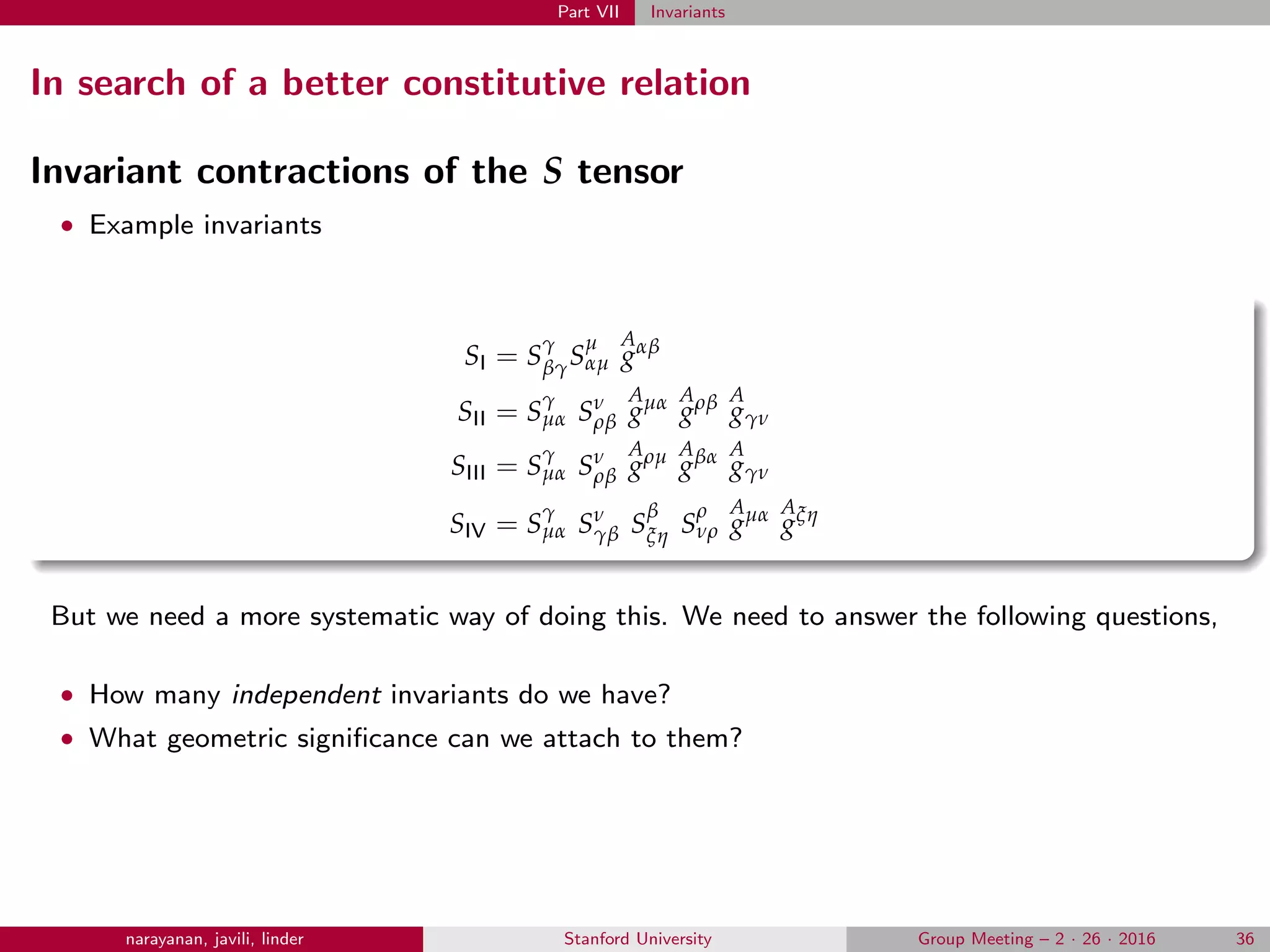
• Example invariants
SI = S
γ
βγS
µ
αµ
A
gαβ
SII = S
γ
µα Sν
ρβ
A
gµα A
gρβ A
gγν
SIII = S
γ
µα Sν
ρβ
A
gρµ A
gβα A
gγν
SIV = S
γ
µα Sν
γβ S
β
ξη S
ρ
νρ
A
gµα A
gξη
But we need a more systematic way of doing this. We need to answer the following questions,
• How many independent invariants do we have?
• What geometric significance can we attach to them?
narayanan, javili, linder Stanford University Group Meeting – 2 · 26 · 2016 36
Part VII Invariants
Visualizing Invariants
Length Scale = 0.0
Figure: SI Figure: SII
narayanan, javili, linder Stanford University Group Meeting – 2 · 26 · 2016 37
0 0.2 0.4 0.6 0.8 1
0
0.1
0.2
0.3
0.4
0.5
0.6
0.7
0.8
0.9
1
0
5000
10000
15000
20000
0 0.2 0.4 0.6 0.8 1
0
0.1
0.2
0.3
0.4
0.5
0.6
0.7
0.8
0.9
1
#104
-1
-0.5
0
0.5
1
1.5
Part VII Invariants
Visualizing Invariants
Length Scale = 0.0
Figure: SIII Figure: SIV
narayanan, javili, linder Stanford University Group Meeting – 2 · 26 · 2016 38
0 0.2 0.4 0.6 0.8 1
0
0.1
0.2
0.3
0.4
0.5
0.6
0.7
0.8
0.9
1
#104
0
1
2
3
4
5
6
7
8
9
0 0.2 0.4 0.6 0.8 1
0
0.1
0.2
0.3
0.4
0.5
0.6
0.7
0.8
0.9
1
#107
-1.5
-1
-0.5
0
0.5
1
Part VII Invariants
Visualizing Invariants
Length Scale = 0.25
Figure: SI Figure: SII
narayanan, javili, linder Stanford University Group Meeting – 2 · 26 · 2016 39
0 0.2 0.4 0.6 0.8 1
0
0.1
0.2
0.3
0.4
0.5
0.6
0.7
0.8
0.9
1
-0.5
0
0.5
1
1.5
2
2.5
0 0.2 0.4 0.6 0.8 1
0
0.1
0.2
0.3
0.4
0.5
0.6
0.7
0.8
0.9
1
-1
-0.5
0
0.5
1
1.5
2
2.5
3
3.5
Part VII Invariants
Visualizing Invariants
Length Scale = 0.25
Figure: SIII Figure: SIV
narayanan, javili, linder Stanford University Group Meeting – 2 · 26 · 2016 40
0 0.2 0.4 0.6 0.8 1
0
0.1
0.2
0.3
0.4
0.5
0.6
0.7
0.8
0.9
1
0.5
1
1.5
2
2.5
3
3.5
4
4.5
0 0.2 0.4 0.6 0.8 1
0
0.1
0.2
0.3
0.4
0.5
0.6
0.7
0.8
0.9
1
-1.5
-1
-0.5
0
0.5
1
1.5
Part VII Invariants
Visualizing Invariants
Length Scale = 1.0
Figure: SI Figure: SII
narayanan, javili, linder Stanford University Group Meeting – 2 · 26 · 2016 41
0 0.2 0.4 0.6 0.8 1
0
0.1
0.2
0.3
0.4
0.5
0.6
0.7
0.8
0.9
1
0.2
0.4
0.6
0.8
1
1.2
1.4
0 0.2 0.4 0.6 0.8 1
0
0.1
0.2
0.3
0.4
0.5
0.6
0.7
0.8
0.9
1
0
0.1
0.2
0.3
0.4
0.5
0.6
Part VII Invariants
Visualizing Invariants
Length Scale = 1.0
Figure: SIII Figure: SIV
narayanan, javili, linder Stanford University Group Meeting – 2 · 26 · 2016 42
0 0.2 0.4 0.6 0.8 1
0
0.1
0.2
0.3
0.4
0.5
0.6
0.7
0.8
0.9
1
0.5
1
1.5
2
2.5
0 0.2 0.4 0.6 0.8 1
0
0.1
0.2
0.3
0.4
0.5
0.6
0.7
0.8
0.9
1
-0.1
-0.05
0
0.05
0.1
Part VII Invariants
Questions?
Thank You!
narayanan, javili, linder Stanford University Group Meeting – 2 · 26 · 2016 43

Introduction to second gradient theory of elasticity - Arjun Narayanan

  • 1.
    An Introduction toHigher Gradient Theories of Elasticity Arjun Narayanan, Ali Javili, Christian Linder Outline Introduction Mathematical Preliminaries Variational Structure of Gradient Elasticity FE Discretization of Variational Equation Numerical Examples Deformation Measures Invariants Computational Micromechanics of Materials Lab Group Meeting
  • 2.
    Part I Introduction Gradientsin Classical Field Theories Newtonian Gravity Vh Vh M m m • Background absolute space. • Euclidean parallelism is preserved. narayanan, javili, linder Stanford University Group Meeting – 2 · 26 · 2016 1
  • 3.
    Part I Introduction Gradientsin Classical Field Theories Einsteinian Gravity Vh Vh M m m • Objects follow geodesics. • Gradient of gravitational potential → Connection → (non-Euclidean) Parallelism. narayanan, javili, linder Stanford University Group Meeting – 2 · 26 · 2016 2
  • 4.
    Part I Introduction HigherGradients in Continuum Mechanics Where are the higher gradients hiding? narayanan, javili, linder Stanford University Group Meeting – 2 · 26 · 2016 3
  • 5.
    Part I Introduction HigherGradients in Continuum Mechanics Where are the higher gradients hiding? ALL information is in φ narayanan, javili, linder Stanford University Group Meeting – 2 · 26 · 2016 3
  • 6.
    Part I Introduction HigherGradients in Continuum Mechanics Look closer at the Taylor expansion of the deformation field. narayanan, javili, linder Stanford University Group Meeting – 2 · 26 · 2016 4
  • 7.
    Part II MathematicalPreliminaries Basic Geometric Notions Induced bases • Tangent Space: Basis of contravariant vectors: xi = ∂x ∂ξi • Cotangent (Dual) Space: Basis of linear functionals on xi dξj (xi) = dξj ∂x ∂ξi = δ j i narayanan, javili, linder Stanford University Group Meeting – 2 · 26 · 2016 5
  • 8.
    Part II MathematicalPreliminaries Basic Geometric Notions Gradients • The gradient of {·} is defined as: Grad{·} := ∂{·} ∂ξi ⊗ dξi narayanan, javili, linder Stanford University Group Meeting – 2 · 26 · 2016 6
  • 9.
    Part II MathematicalPreliminaries Basic Geometric Notions Gradients • The gradient of {·} is defined as: Grad{·} := ∂{·} ∂ξi ⊗ dξi An arbitrary vector is written as a linear combination of the contravariant basis v = vjxj. Grad{·}(v) = ∂{·} ∂ξi ⊗ dξi (vj xj) = vj ∂{·} ∂ξi δi j = vj ∂{·} ∂ξj narayanan, javili, linder Stanford University Group Meeting – 2 · 26 · 2016 6
  • 10.
    Part II MathematicalPreliminaries Basic Geometric Notions Divergences • The identity is defined as I = xi ⊗ dξi I(vj xj) = xi ⊗ dξi (vj xj) = vi xi narayanan, javili, linder Stanford University Group Meeting – 2 · 26 · 2016 7
  • 11.
    Part II MathematicalPreliminaries Basic Geometric Notions Divergences • The identity is defined as I = xi ⊗ dξi I(vj xj) = xi ⊗ dξi (vj xj) = vi xi • The divergence is defined as Div{·} = Grad{·} . . I Specifically, Div{·} = ∂ ∂ξj {·} · dξj • The surface divergence is defined as S(v) = Grad(v · I ) . . I = Div (v) + Kv · N narayanan, javili, linder Stanford University Group Meeting – 2 · 26 · 2016 7
  • 12.
    Part II MathematicalPreliminaries Ingredients For Higher Gradient Elasticity The Product Rule d(fg) = gdf + fdg • Consider A = Ajkxj ⊗ xk and v = vixi Div(v · A) = ∂ ∂ξj (v · A) · dξj = ∂ ∂ξj (v) · A · dξj + v · ∂ ∂ξj (A) · dξj = A . . ∂ ∂ξj (v) ⊗ dξj + v · ∂ ∂ξj (A) · dξj Div(v · A) = A . . Gradv + v · DivA narayanan, javili, linder Stanford University Group Meeting – 2 · 26 · 2016 8
  • 13.
    Part II MathematicalPreliminaries Ingredients For Higher Gradient Elasticity The Product Rule d(fg) = gdf + fdg • Consider A = Ajkxj ⊗ xk and v = vixi Div(v · A) = ∂ ∂ξj (v · A) · dξj = ∂ ∂ξj (v) · A · dξj + v · ∂ ∂ξj (A) · dξj = A . . ∂ ∂ξj (v) ⊗ dξj + v · ∂ ∂ξj (A) · dξj Div(v · A) = A . . Gradv + v · DivA • Generalizable to higher contractions, B . . . GradA = Div(A . . B) − A . . DivB narayanan, javili, linder Stanford University Group Meeting – 2 · 26 · 2016 8
  • 14.
    Part II MathematicalPreliminaries Ingredients For Higher Gradient Elasticity Stokes’ Theorem and The Fundamental Theorem of Calculus F(x) f(x) -2 -1.5 -1 -0.5 0 0.5 1 1.5 2-2 -1.5 -1 -0.5 0 0.5 1 1.5 0 0.2 0.4 0.6 0.8 1 2 b a dF dx = F(b) − F(a) narayanan, javili, linder Stanford University Group Meeting – 2 · 26 · 2016 9
  • 15.
    Part II MathematicalPreliminaries Ingredients For Higher Gradient Elasticity Integral Theorems • Integrate A .. Gradv = Div(v · A) − v · DivA on B0 B0 A . . Gradv = ∂B0 v · A · N − B0 v · DivA (1) • Integrate A .. Gradv = Div(v · A) − v · DivA on ∂B0 ∂B A . . Gradv = ∂2B v · A · M − ∂B v · S(A) − GradNv · (A · N) (2) • We will repeatedly apply equations 1 and 2 in a variational context to obtain the strong form of the equilibrium equations. narayanan, javili, linder Stanford University Group Meeting – 2 · 26 · 2016 10
  • 16.
    Part III VariationalStructure of Gradient Elasticity Higher Gradient Elasticity Obtaining the Strong Form • ψtotal = ψtotal internal + ψtotal external δψtotal ! = 0 • ψinternal = ψinternal(Gradφ, Grad2 φ) • Integrate ψinternal and vary φ δ B0 ψinternal(Gradφ, Grad2 φ) = B0 ∂ψinternal ∂Gradφ . . Gradδφ + B0 ∂ψinternal ∂Grad2 φ . . . Grad2 δφ narayanan, javili, linder Stanford University Group Meeting – 2 · 26 · 2016 11
  • 17.
    Part III VariationalStructure of Gradient Elasticity Higher Gradient Elasticity Obtaining the Strong Form • ψtotal = ψtotal internal + ψtotal external δψtotal ! = 0 • ψinternal = ψinternal(Gradφ, Grad2 φ) • Integrate ψinternal and vary φ δ B0 ψinternal(Gradφ, Grad2 φ) = B0 ∂ψinternal ∂Gradφ . . Gradδφ + B0 ∂ψinternal ∂Grad2 φ . . . Grad2 δφ δ B0 ψinternal(Gradφ, Grad2 φ) = B0 P1 . . Gradδφ ∂B0 δφ·P1·N− B0 δφ·DivP1 + B0 P2 . . . Grad2 δφ ∂B0 Gradδφ . .P2·N− B0 Gradδφ . .DivP2 narayanan, javili, linder Stanford University Group Meeting – 2 · 26 · 2016 11
  • 18.
    Part III VariationalStructure of Gradient Elasticity Higher Gradient Elasticity Obtaining the Strong Form • ψtotal = ψtotal internal + ψtotal external δψtotal ! = 0 • ψinternal = ψinternal(Gradφ, Grad2 φ) • Integrate ψinternal and vary φ δ B0 ψinternal(Gradφ, Grad2 φ) = B0 ∂ψinternal ∂Gradφ . . Gradδφ + B0 ∂ψinternal ∂Grad2 φ . . . Grad2 δφ δ B0 ψinternal(Gradφ, Grad2 φ) = B0 P1 . . Gradδφ ∂B0 δφ·P1·N− B0 δφ·DivP1 + B0 P2 . . . Grad2 δφ ∂B0 Gradδφ . .P2·N− B0 Gradδφ . .DivP2 • The decomposition of B0 P2 ... Grad2 δφ can be further expanded, ∂B0 Gradδφ . . P2 · N = ∂2B0 δφ · P2 . . (M ⊗ N) − ∂B0 δφ · S(P2 · N) + ∂B0 GradN δφ · P2 . . (N ⊗ N) narayanan, javili, linder Stanford University Group Meeting – 2 · 26 · 2016 11
  • 19.
    Part III VariationalStructure of Gradient Elasticity Higher Gradient Elasticity Obtaining the Strong Form • Combine the coefficients of each independent variation in each domain, δ B0 ψinternal Gradφ, Grad2 φ = B0 δφ · (Div(DivP2) − DivP1) + ∂B0 δφ · (P1 · N − S(P2 · N) − DivP2 · N) + GradN δφ · P2 . . (N ⊗ N) + ∂2B0 δφ · P2 . . (M ⊗ N) narayanan, javili, linder Stanford University Group Meeting – 2 · 26 · 2016 12
  • 20.
    Part III VariationalStructure of Gradient Elasticity Higher Gradient Elasticity Obtaining the Strong Form • Combine the coefficients of each independent variation in each domain, δ B0 ψinternal Gradφ, Grad2 φ = B0 δφ · (Div(DivP2) − DivP1) + ∂B0 δφ · (P1 · N − S(P2 · N) − DivP2 · N) + GradN δφ · P2 . . (N ⊗ N) + ∂2B0 δφ · P2 . . (M ⊗ N) • The structure of the above equation gives us the structure of the variation of external work δψtotal external δψtotal external = − B0 δφ · b − ∂B0 δφ · t − ∂B0 GradN δφ · c − ∂2B0 δφ · l • Add the two equations and demand the satisfaction of δψtotal = 0 point-wise to get the strong form. narayanan, javili, linder Stanford University Group Meeting – 2 · 26 · 2016 12
  • 21.
    Part III VariationalStructure of Gradient Elasticity Higher Gradient Elasticity The Strong Form of the Governing Equilibrium Equations Div(DivP2 − P1) − b = 0 in B0 (P1 − DivP2) · N − S(P2 · N) − t = 0 on ∂B0 P2 . . (N ⊗ N) − c = 0 on ∂B0 P2 . . (M ⊗ N) − l = 0 on ∂2 B0 narayanan, javili, linder Stanford University Group Meeting – 2 · 26 · 2016 13
  • 22.
    Part IV FEDiscretization of Variational Equation The Path To a Numerical Implementation Finite Element Discretization • For a given deformation field φ, we have the following residual, R(φ) = B0 P1 . . Gradδφ + B0 P2 . . . Grad2 δφ − B0 δφ · b − ∂B0 δφ · t − ∂B0 GradNδφ · c − ∂2B0 δφ · l • φ is an admissible deformation field if R(φ) = 0. • Use a finite dimensional approximation to the variation in deformation to approximate the residual, δφ(ξ, η, ζ) = ∑ I NI (ξ, η, ζ)δφI R(φ) = B0 δφI · P1 · Grad(NI ) + B0 δφI · P2 . . Grad2 (NI ) − B0 (δφI NI ) · b − ∂B0 (δφI NI ) · t − ∂B0 (GradNI · N)(δφI · c) − ∂2B0 (δφI NI ) · l narayanan, javili, linder Stanford University Group Meeting – 2 · 26 · 2016 14
  • 23.
    Part IV FEDiscretization of Variational Equation The Path To a Numerical Implementation Finite Element Discretization • Get rid of the displacement variations, which are arbitrary, to obtain the work-conjugate of δφI. RI (φ) = B0 P1 · Grad(NI ) + B0 P2 . . Grad2 (NI ) − B0 NI b − ∂B0 NI t − ∂B0 (GradNI · N)c − ∂2B0 NI l • Newton - Raphson solution scheme RI(φn+1) = RI(φn) + ∂RI ∂φJ · ∆φJ ! = 0 KIJ = ∂RI ∂φJ = B0 ∂P1 ∂F . . (I ⊗ GradNJ ) · GradNI + B0 ∂P2 ∂GradF . . . (I ⊗ Grad2 NJ ) . . Grad2 NI • Define material tangents A = ∂P1 ∂F = ∂ ∂F ∂ψinternal ∂F = ∂2ψinternal ∂F∂F B = ∂P2 ∂GradF = ∂ ∂GradF ∂ψinternal ∂GradF = ∂2ψinternal ∂GradF∂GradF narayanan, javili, linder Stanford University Group Meeting – 2 · 26 · 2016 15
  • 24.
    Part IV FEDiscretization of Variational Equation The Path To a Numerical Implementation Constitutive Equations • We use the following strain energy density function, ψinternal = 1 2 µ(F . . F − 3 − 2ln(J)) + 1 2 λ 1 2 (J2 − 1) − ln(J) + 1 2 µl2 EAB,CEAB,C • We have the following component-wise expression for P1 and P2, [P1]bL = µ([F]bL − [F−T ]bL) + λ 2 (J2 − 1)[F−T ]bL + 1 2 µl2 [GradF]bJK([GradF]aJK[F]aL + [F]aJ[GradF]aLK) [P2]bLM = µl2 2 [F]bJ([GradF]aLM[F]aJ + [F]aL[GradF]aJM) narayanan, javili, linder Stanford University Group Meeting – 2 · 26 · 2016 16
  • 25.
    Part IV FEDiscretization of Variational Equation The Path To a Numerical Implementation Constitutive Equations • We have the following component wise expression for A and B [A]bLgM = µ δb gδL M + [F−T ]gL[F−T ]bM + λJ2 [F−T ]gM[F−T ]bL − λ 2 (J2 − 1)[F−T ]gL[F−T ]bM + µl2 2 [GradF]bJK [GradF]gJKδL M + [GradF]gLKδJ M [B]bLMgPQ = µl2 4 [F]bJ[F]gJ(δL PδM Q + δL QδM P ) + [F]bP[F]gLδM Q + [F]bQ[F]gLδM P narayanan, javili, linder Stanford University Group Meeting – 2 · 26 · 2016 17
  • 26.
    Part IV FEDiscretization of Variational Equation Element Formulation (-1,-1) (+1,-1) (+1,+1)(-1,+1) Quadrature Space Reference Element Deformed Element Parameter Space narayanan, javili, linder Stanford University Group Meeting – 2 · 26 · 2016 18
  • 27.
    Part IV FEDiscretization of Variational Equation Element Formulation (-1,-1) (+1,-1) (+1,+1)(-1,+1) Quadrature Space Reference Element Deformed Element Parameter Space narayanan, javili, linder Stanford University Group Meeting – 2 · 26 · 2016 19
  • 28.
    Part IV FEDiscretization of Variational Equation Element Formulation Computing GradF X = X(ξ1 , ξ2 ) x = x(ξ1 , ξ2 ) ∂xi ∂XP = ∂xi ∂ξα ∂ξα ∂XP narayanan, javili, linder Stanford University Group Meeting – 2 · 26 · 2016 20
  • 29.
    Part IV FEDiscretization of Variational Equation Element Formulation Computing GradF X = X(ξ1 , ξ2 ) x = x(ξ1 , ξ2 ) ∂xi ∂XP = ∂xi ∂ξα ∂ξα ∂XP ∂2xi ∂XP∂XQ = ∂ ∂XQ ∂xi ∂ξα ∂ξα ∂XP ∂2xi ∂XP∂XQ = ∂2xi ∂ξβ∂ξα def. hessian ∂ξβ ∂XQ ∂ξα ∂XP + ∂xi ∂ξα ∂2ξα ∂XQ∂XP inv. ref. hessian narayanan, javili, linder Stanford University Group Meeting – 2 · 26 · 2016 20
  • 30.
    Part IV FEDiscretization of Variational Equation Element Formulation “Inverting” the Hessian ∂XP ∂XQ = ∂XP ∂ξα ∂ξα ∂XQ = δP Q ∂2XP ∂XR∂XQ = ∂ ∂XR ∂XP ∂ξα ∂ξα ∂XQ = 0 = ∂2XP ∂ξβ∂ξα ∂ξβ ∂XR ∂ξα ∂XQ + ∂XP ∂ξα ∂2ξα ∂XR∂XQ = 0 ∂2ξγ ∂XR∂XQ = − ∂2XP ∂ξβ∂ξα ∂ξβ ∂XR ∂ξα ∂XQ ∂ξγ ∂XP narayanan, javili, linder Stanford University Group Meeting – 2 · 26 · 2016 21
  • 31.
    Part V NumericalExamples Finally, some pictures. Example 1 refinement no. of elements 1 4 2 16 3 64 4 256 5 1024 length scale 0.00 0.10 0.25 1.00 0 0.2 0.4 0.6 0.8 1 0 0.1 0.2 0.3 0.4 0.5 0.6 0.7 0.8 0.9 1 L = 1.0 D=1.0 0.2 0.2 applied displacem ent Figure: Boundary conditions λ = 8.0, µ = 392.0 How are displacements and stresses localized? narayanan, javili, linder Stanford University Group Meeting – 2 · 26 · 2016 22
  • 32.
    Part V NumericalExamples Finally, some pictures. Example 1: Deformed mesh under refinement Figure: Length scale = 0.0 Figure: Length scale = 0.1 Figure: Length scale = 0.25 Figure: Length scale = 1.0 narayanan, javili, linder Stanford University Group Meeting – 2 · 26 · 2016 23 0 0.2 0.4 0.6 0.8 1 1.2 0 0.2 0.4 0.6 0.8 1 1.2 0 0.2 0.4 0.6 0.8 1 1.2 0 0.2 0.4 0.6 0.8 1 1.2 0 0.2 0.4 0.6 0.8 1 1.2 0 0.2 0.4 0.6 0.8 1 1.2 0 0.2 0.4 0.6 0.8 1 1.2 0 0.2 0.4 0.6 0.8 1 1.2
  • 33.
    Part V NumericalExamples Finally, some pictures. Example 1: Von Mises Stress 0 0.2 0.4 0.6 0.8 1 1.2 0 0.2 0.4 0.6 0.8 1 1.2 200 400 600 800 1000 1200 1400 1600 Figure: Length scale = 0.0 0 0.2 0.4 0.6 0.8 1 1.2 0 0.2 0.4 0.6 0.8 1 1.2 5 10 15 20 25 30 35 40 Figure: Length scale = 0.1 0 0.2 0.4 0.6 0.8 1 1.2 0 0.2 0.4 0.6 0.8 1 1.2 5 10 15 20 25 Figure: Length scale = 0.25 0 0.2 0.4 0.6 0.8 1 1.2 0 0.2 0.4 0.6 0.8 1 1.2 4 6 8 10 12 14 16 18 20 22 Figure: Length scale = 1.0 narayanan, javili, linder Stanford University Group Meeting – 2 · 26 · 2016 24
  • 34.
    Part V NumericalExamples Finally, some pictures. Example 1: Von Mises Stress Refinement level 1 1.5 2 2.5 3 3.5 4 4.5 5 MaxvonMisesStress 0 200 400 600 800 1000 1200 1400 1600 Figure: Length scale = 0.0 Refinement level 1 1.5 2 2.5 3 3.5 4 4.5 5 MaxvonMisesStress 0 5 10 15 20 25 30 35 40 45 Figure: Length scale = 0.1 narayanan, javili, linder Stanford University Group Meeting – 2 · 26 · 2016 25
  • 35.
    Part V NumericalExamples Finally, some pictures. Example 1: Von Mises Stress Refinement level 1 1.5 2 2.5 3 3.5 4 4.5 5 MaxvonMisesStress 0 5 10 15 20 25 Figure: Length scale = 0.25 Refinement level 1 1.5 2 2.5 3 3.5 4 4.5 5 MaxvonMisesStress 0 5 10 15 20 25 Figure: Length scale = 1.0 narayanan, javili, linder Stanford University Group Meeting – 2 · 26 · 2016 26
  • 36.
    Part VI DeformationMeasures In search of a better constitutive relation Can we do better than 1 2 µl2EAB,CEAB,C ? • The challenge lies in identifying better (what do we mean by that?) measures of deformation that can be constructed from the second gradient of deformation. • First gradient theories have a well defined tensorial measure of deformation – E (Green-Lagrange strain). The invariants of E describe local stretch. A general constitutive law is formulated in terms of the invariants of E. Figure: The first gradient of deformation describes changes in lengths and angles narayanan, javili, linder Stanford University Group Meeting – 2 · 26 · 2016 27
  • 37.
    Part VI DeformationMeasures In search of a better constitutive relation Can we do better than 1 2 µl2EAB,CEAB,C ? • Better =⇒ geometric invariance. • Example: n2 numbers Aα β in ξα coordinate system. n2 numbers A p q in φp coordinate system. A is once contravariant once covariant (i.e. type (1,1)) tensor if, A p q = Aα β ∂φp ∂ξα ∂ξβ ∂φq • We want a tensorial measure of deformation S that is constructed from the second gradient of deformation – GradF. The most general second gradient constitutive law must be expressible in terms of the invariants of S . Figure: The second gradient of deformation describes changes in the tangent space under “parallel transport” narayanan, javili, linder Stanford University Group Meeting – 2 · 26 · 2016 28
  • 38.
    Part VI DeformationMeasures In search of a better constitutive relation Connections Reference Aα = ∂X ∂ξα Aα,β = ∂2X ∂ξβ∂ξα = A Γ µ βα ∂X ∂ξµ A Γ γ βα = dξγ (Aα,β) Deformed aα = ∂x ∂ξα aα,β = ∂2x ∂ξβ∂ξα = a Γ µ βα ∂x ∂ξµ a Γ γ βα = dξγ (aα,β) • The coefficients A Γ γ βα and a Γ γ βα describe the “connection” in the reference and deformed configurations. • They describe local (i.e. infinitesimal) parallel transport of vectors. narayanan, javili, linder Stanford University Group Meeting – 2 · 26 · 2016 29
  • 39.
    Part VI DeformationMeasures In search of a better constitutive relation Are Connections Tensorial? Transform coordinates ξα → φp Reference Aα = ∂X ∂ξα = ∂X ∂φp ∂φp ∂ξα Aα,β = ∂ ∂ξβ ∂X ∂φp ∂φp ∂ξα = ∂2X ∂φq∂φp ∂φq ∂ξβ ∂φp ∂ξα + ∂X ∂φp ∂2φp ∂ξβ∂ξα dξγ (Aα,β) = ∂ξγ ∂φr dφr ∂2X ∂φq∂φp ∂φq ∂ξβ ∂φp ∂ξα + ∂X ∂φp ∂2φp ∂ξβ∂ξα A Γ γ βα = A Γr qp ∂ξγ ∂φr ∂φq ∂ξβ ∂φp ∂ξα + ∂2φr ∂ξβ∂ξα ∂ξγ ∂φr Deformed aα = ∂x ∂ξα = ∂x ∂φp ∂φp ∂ξα aα,β = ∂ ∂ξβ ∂x ∂φp ∂φp ∂ξα = ∂2x ∂φq∂φp ∂φq ∂ξβ ∂φp ∂ξα + ∂x ∂φp ∂2φp ∂ξβ∂ξα dξγ (aα,β) = ∂ξγ ∂φr dφr ∂2x ∂φq∂φp ∂φq ∂ξβ ∂φp ∂ξα + ∂x ∂φp ∂2φp ∂ξβ∂ξα a Γ γ βα = a Γr qp ∂ξγ ∂φr ∂φq ∂ξβ ∂φp ∂ξα + ∂2φr ∂ξβ∂ξα ∂ξγ ∂φr narayanan, javili, linder Stanford University Group Meeting – 2 · 26 · 2016 30
  • 40.
    Part VI DeformationMeasures In search of a better constitutive relation Are Connections Tensorial? No, but the component-wise difference of connection coefficients does transform like a type (1,2) tensor! S γ βα = A Γ γ βα − a Γ γ βα = ∂ξγ ∂φr ∂φq ∂ξβ ∂φp ∂ξα A Γr qp − a Γr qp narayanan, javili, linder Stanford University Group Meeting – 2 · 26 · 2016 31
  • 41.
    Part VI DeformationMeasures In search of a better constitutive relation Metrics • We have access to the Euclidean inner product from the embedding X(ξ1, ξ2) and x(ξ1, ξ2). The Euclidean inner product is by definition symmetric and positive definite. • How do the components of this inner product transform under ξα → φp? Reference A gαβ = ∂X ∂ξα · ∂X ∂ξβ A gαβ = ∂X ∂φp · ∂X ∂φq ∂φp ∂ξα ∂φq ∂ξβ A gαβ = A gpq ∂φp ∂ξα ∂φq ∂ξβ Deformed a gαβ = ∂x ∂ξα · ∂x ∂ξβ a gαβ = ∂x ∂φp · ∂x ∂φq ∂φp ∂ξα ∂φq ∂ξβ a gαβ = a gpq ∂φp ∂ξα ∂φq ∂ξβ • The components A gαβ and a gαβ transform as a (0,2) tensor. • Moreover, A gαβ and a gαβ inherit the properties of symmetry and positive definiteness from the Euclidean structure. • A gαβ and a gαβ are valid Riemannian metrics induced by the parametrization. narayanan, javili, linder Stanford University Group Meeting – 2 · 26 · 2016 32
  • 42.
    Part VI DeformationMeasures In search of a better constitutive relation Metric: Bilinear form or linear transformation? • Either of A gαβ or a gαβ define the components of a valid metric tensor for the problem. • We need only one of them – let us choose A gαβ • The metric tensor is defined as A g = A gαβdξα ⊗ dξβ narayanan, javili, linder Stanford University Group Meeting – 2 · 26 · 2016 33
  • 43.
    Part VI DeformationMeasures In search of a better constitutive relation Metric: Bilinear form or linear transformation? • Either of A gαβ or a gαβ define the components of a valid metric tensor for the problem. • We need only one of them – let us choose A gαβ • The metric tensor is defined as A g = A gαβdξα ⊗ dξβ • Consider u = uµAµ and v = vνAν TX B × TX B → R A g(u, v) = A gαβdξα ⊗ dξβ (uµ Aµ, vν Aν) = A gαβuα vβ = ∂X ∂ξα · ∂X ∂ξβ uα vβ = uα ∂X ∂ξα · vβ ∂X ∂ξβ A g(u, v) = (u · v) TXB → T∗ X B A g(u) = A gαβdξα ⊗ dξβ (uµ Aµ) = A gαβuβ uα dξα = uαdξα The components of the metric (and its inverse) can be used to lower (and raise) the indices of tensorial components. narayanan, javili, linder Stanford University Group Meeting – 2 · 26 · 2016 33
  • 44.
    Part VII Invariants Insearch of a better constitutive relation Invariant contractions of the S tensor • Geometric invariance – geometric objects have well defined transformation laws. All tensors are geometric invariants under diffeomorphisms. • A scalar (real valued function) is a type (0,0) tensor. Scalars are invariant – one simply changes the functional dependence of the scalar. f(φp) = f(φp(ξα)) • Respecting variance is good – Covariant-Contravariant contractions are always tensorial. For example, S γ βα = Sr qp ∂ξγ ∂φr ∂φq ∂ξβ ∂φp ∂ξα Multiply by δα γ, δα γS γ βα = Sr qp ∂ξγ ∂φr ∂φq ∂ξβ ∂φp ∂ξα δα γ S γ βγ = Sr qp ∂ξγ ∂φr ∂φp ∂ξγ δ p r ∂φq ∂ξβ S γ βγ = Sr qr ∂φq ∂ξβ • We are looking for the scalar invariants of S. We want all functionally independent scalar contractions of S. narayanan, javili, linder Stanford University Group Meeting – 2 · 26 · 2016 34
  • 45.
    Part VII Invariants Insearch of a better constitutive relation Invariant contractions of the S tensor • To contract indices occupying positions of same variance, one needs a mechanism to counteract the matching variances. This is achieved by using the metric tensor. For example, S γ βγ = Sr pr ∂φp ∂ξβ A gαβ = A gpq ∂ξα ∂φp ∂ξβ ∂φq A gαβ = A gpq ∂φp ∂ξα ∂φq ∂ξβ S γ βγS µ αµ A gαβ = Sr pr ∂φp ∂ξβ St qt ∂φq ∂ξα A gαβ = Sr prSt qt A guv ∂φp ∂ξβ ∂ξβ ∂φv δ p v ∂φq ∂ξα ∂ξα ∂φu δ q u S γ βγS µ αµ A gαβ = Sr prSt qt A gqp narayanan, javili, linder Stanford University Group Meeting – 2 · 26 · 2016 35
  • 46.
    Part VII Invariants Insearch of a better constitutive relation Invariant contractions of the S tensor • Example invariants SI = S γ βγS µ αµ A gαβ SII = S γ µα Sν ρβ A gµα A gρβ A gγν SIII = S γ µα Sν ρβ A gρµ A gβα A gγν SIV = S γ µα Sν γβ S β ξη S ρ νρ A gµα A gξη But we need a more systematic way of doing this. We need to answer the following questions, • How many independent invariants do we have? • What geometric significance can we attach to them? narayanan, javili, linder Stanford University Group Meeting – 2 · 26 · 2016 36
  • 47.
    Part VII Invariants VisualizingInvariants Length Scale = 0.0 Figure: SI Figure: SII narayanan, javili, linder Stanford University Group Meeting – 2 · 26 · 2016 37 0 0.2 0.4 0.6 0.8 1 0 0.1 0.2 0.3 0.4 0.5 0.6 0.7 0.8 0.9 1 0 5000 10000 15000 20000 0 0.2 0.4 0.6 0.8 1 0 0.1 0.2 0.3 0.4 0.5 0.6 0.7 0.8 0.9 1 #104 -1 -0.5 0 0.5 1 1.5
  • 48.
    Part VII Invariants VisualizingInvariants Length Scale = 0.0 Figure: SIII Figure: SIV narayanan, javili, linder Stanford University Group Meeting – 2 · 26 · 2016 38 0 0.2 0.4 0.6 0.8 1 0 0.1 0.2 0.3 0.4 0.5 0.6 0.7 0.8 0.9 1 #104 0 1 2 3 4 5 6 7 8 9 0 0.2 0.4 0.6 0.8 1 0 0.1 0.2 0.3 0.4 0.5 0.6 0.7 0.8 0.9 1 #107 -1.5 -1 -0.5 0 0.5 1
  • 49.
    Part VII Invariants VisualizingInvariants Length Scale = 0.25 Figure: SI Figure: SII narayanan, javili, linder Stanford University Group Meeting – 2 · 26 · 2016 39 0 0.2 0.4 0.6 0.8 1 0 0.1 0.2 0.3 0.4 0.5 0.6 0.7 0.8 0.9 1 -0.5 0 0.5 1 1.5 2 2.5 0 0.2 0.4 0.6 0.8 1 0 0.1 0.2 0.3 0.4 0.5 0.6 0.7 0.8 0.9 1 -1 -0.5 0 0.5 1 1.5 2 2.5 3 3.5
  • 50.
    Part VII Invariants VisualizingInvariants Length Scale = 0.25 Figure: SIII Figure: SIV narayanan, javili, linder Stanford University Group Meeting – 2 · 26 · 2016 40 0 0.2 0.4 0.6 0.8 1 0 0.1 0.2 0.3 0.4 0.5 0.6 0.7 0.8 0.9 1 0.5 1 1.5 2 2.5 3 3.5 4 4.5 0 0.2 0.4 0.6 0.8 1 0 0.1 0.2 0.3 0.4 0.5 0.6 0.7 0.8 0.9 1 -1.5 -1 -0.5 0 0.5 1 1.5
  • 51.
    Part VII Invariants VisualizingInvariants Length Scale = 1.0 Figure: SI Figure: SII narayanan, javili, linder Stanford University Group Meeting – 2 · 26 · 2016 41 0 0.2 0.4 0.6 0.8 1 0 0.1 0.2 0.3 0.4 0.5 0.6 0.7 0.8 0.9 1 0.2 0.4 0.6 0.8 1 1.2 1.4 0 0.2 0.4 0.6 0.8 1 0 0.1 0.2 0.3 0.4 0.5 0.6 0.7 0.8 0.9 1 0 0.1 0.2 0.3 0.4 0.5 0.6
  • 52.
    Part VII Invariants VisualizingInvariants Length Scale = 1.0 Figure: SIII Figure: SIV narayanan, javili, linder Stanford University Group Meeting – 2 · 26 · 2016 42 0 0.2 0.4 0.6 0.8 1 0 0.1 0.2 0.3 0.4 0.5 0.6 0.7 0.8 0.9 1 0.5 1 1.5 2 2.5 0 0.2 0.4 0.6 0.8 1 0 0.1 0.2 0.3 0.4 0.5 0.6 0.7 0.8 0.9 1 -0.1 -0.05 0 0.05 0.1
  • 53.
    Part VII Invariants Questions? ThankYou! narayanan, javili, linder Stanford University Group Meeting – 2 · 26 · 2016 43