INTRODUCTION TO
SEARCHING ONLINE
COURTESY OF GCG LEARNFREE.ORG
Presented by Celia Bandelier
Why you need to know
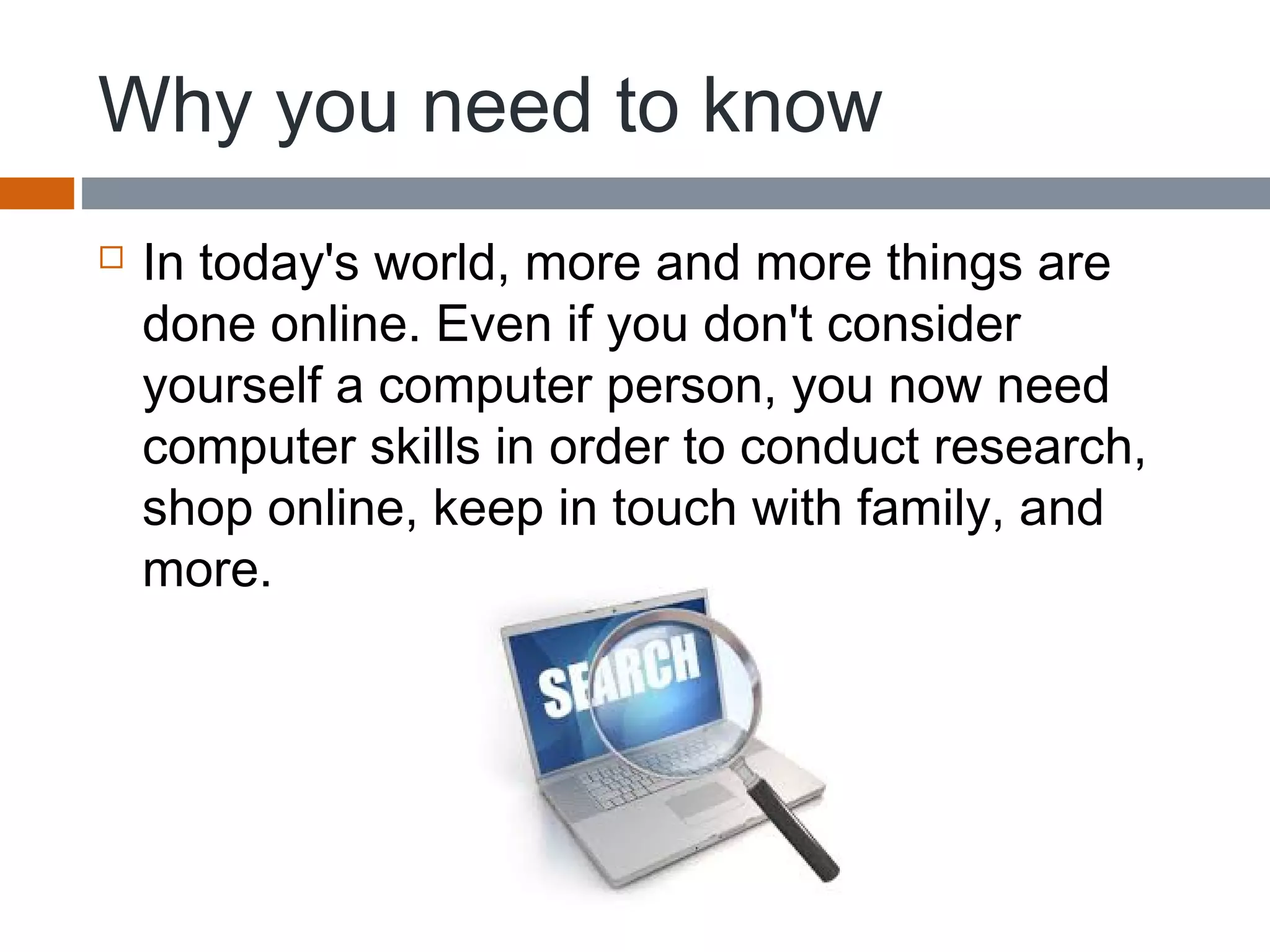
 In today's world, more and more things are
done online. Even if you don't consider
yourself a computer person, you now need
computer skills in order to conduct research,
shop online, keep in touch with family, and
more.
Internet Literacy
 The ability to search for information online is
one of the most important information
literacy skills you can possess.
 By improving your search skills, you can find
what you're looking for more quickly without
having to sift through tons of irrelevant results.
 I’ll give you some information literacy
strategies to help you improve your
searches and evaluate yourresults to find the
most reliable information.
Google
 To find what you are looking for on the
Internet, the first step is usually a basic search
engine search i.e. Google.
 Go to www.google.com
 And enter your search.
Don’t give up
 You may not find the answers you are looking
for on the first try.
 If you don’t try refining your search
 Go more basic to expand your search
 Or go more specific to limit your search
 Think of other search term
 You may need a more specialized site for your
search.
Remember
 If you can find the right search terms, you can
find anything on the Internet.
The web isn’t magic
 Search engines like Google can find almost
anything, but they can’t understand complex
questions like:
 How’s the weather in California?
 Where can I get a cup of coffee?
The web is smarter than you
think
 Search for keywords instead of questions and
you’ll probably find exactly what you’re looking
for:
 Weather San Francisco
 Coffee
Not always reliable
 Just because it’s online doesn’t mean it’s true.
 There is no guarantee that the results of your
search are accurate, unbiased or up-to-date.
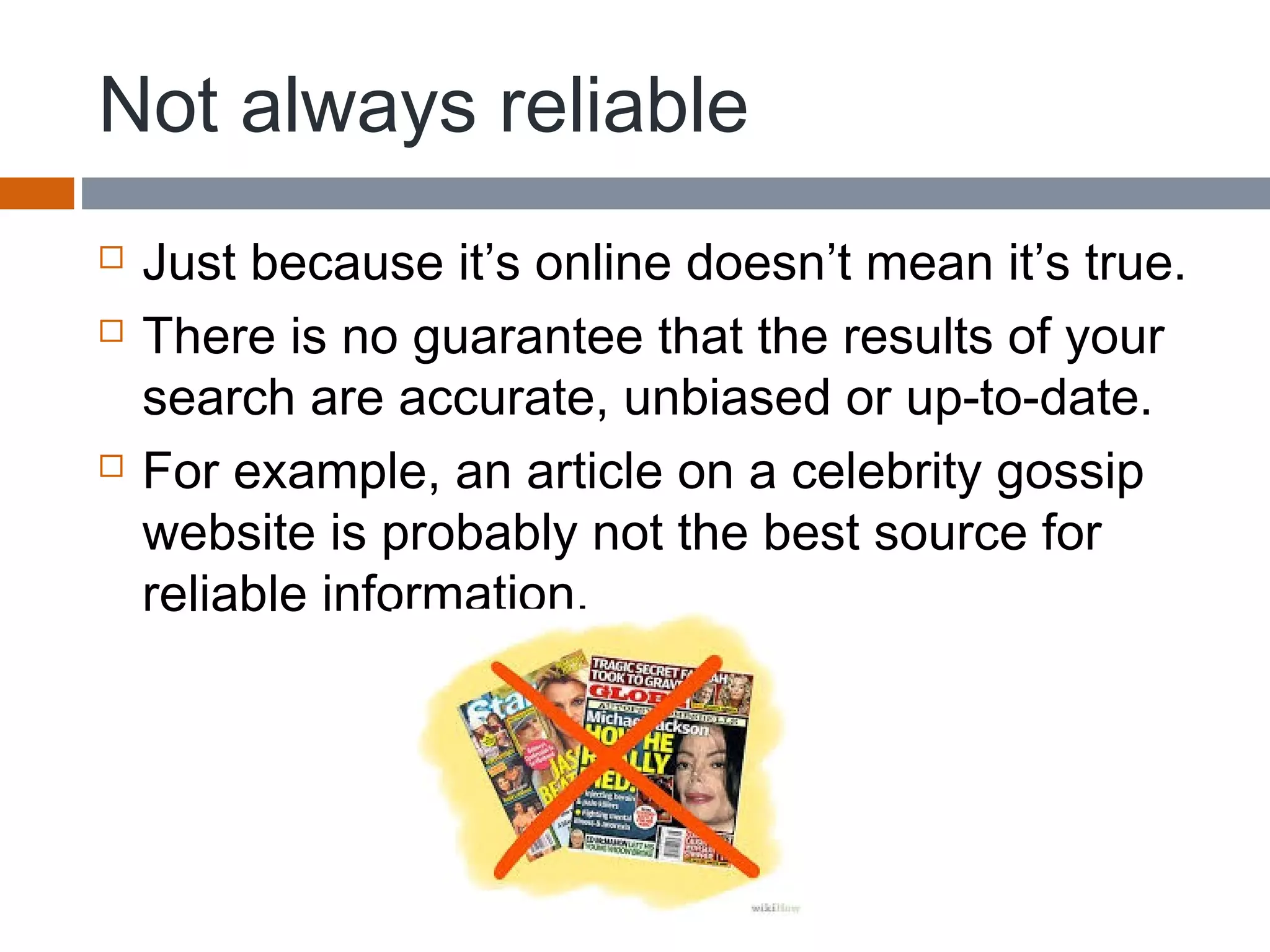
 For example, an article on a celebrity gossip
website is probably not the best source for
reliable information.
Wide variety of content
 That’s the great thing about the Internet, it give
you access to everything—the good, the bad,
and everything in between.
 You just have to be mindful of the difference
between personal opinion and resources that
are reliable and reputable.
You can’t copy and paste someone
else’s work
 Even though you “just found it on the Internet,”
it still belongs to someone.
 Plagiarism is plagiarism, whether you’re
writing a presentation, a research paper or a
personal post for your blog.
Create your own masterpiece
 You just have to follow the rules.
 Always state your findings in your own words.
 Give credit where credit is due.
 Be respectful of copyright and fair use laws.
Search engines
 Search engines are specialized websites that
can help you find what you're looking for.
You've probably heard of some of the most
popular ones—including Google, Yahoo!, and 
Bing—even if you've never used them.
Same information, same
results???
 With these three search engines in mind, you may
be wondering, "What's the difference?" They all
have access to the same information (i.e., the
contents of the Internet), so they should return the
same results, right?
 Not necessarily. Different search engines can
yield different search results. Google is the most
popular search engine because it's the most
effective at finding what you're looking for. On
average, it produces more relevant results than
Yahoo! or Bing, and it's better at organizing and
filtering them. For this reason, we will focus
on Google.
Search Bar
 Your browser's search bar is probably set to
Google by default.
 However, if it is set to something else (for
example, Yahoo! or Bing), you can easily
change it to Google. To find out how, visit 
Make Google my default search engine on
Google's support site.
 The steps are different for each browser, so
make sure you follow the instructions for the
one you're using.
Types of websites
 When you're looking for information online, it's
a good idea to be aware of what types of
websites are available and what kind of
information they contain.
 Depending on what you're looking for, you
may find that certain types are more relevant
to your search than others.
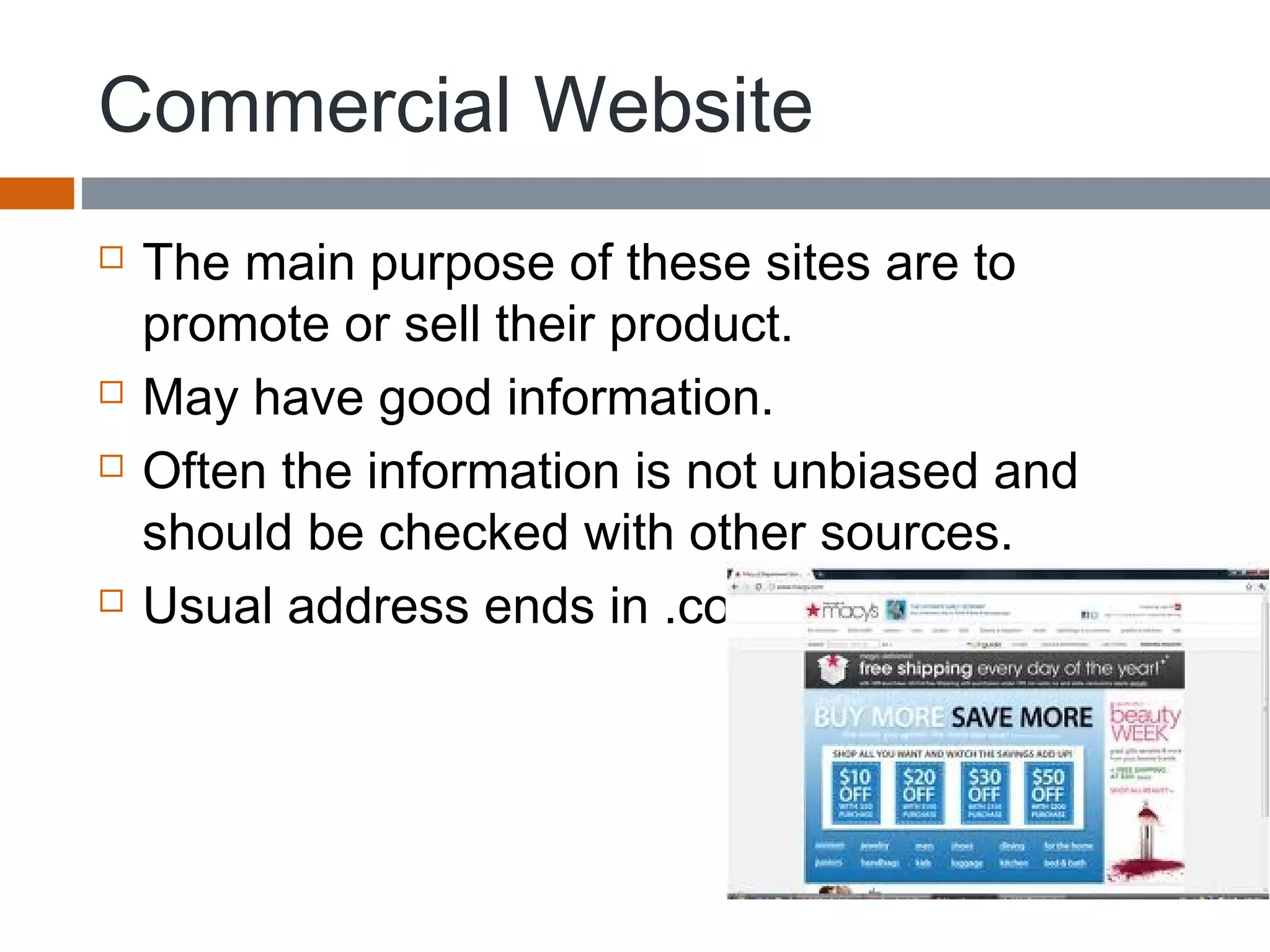
Commercial Website
 The main purpose of these sites are to
promote or sell their product.
 May have good information.
 Often the information is not unbiased and
should be checked with other sources.
 Usual address ends in .com
Organization Website
 Main purpose is to promote their cause.
 Usually have an agenda.
 May have good information.
 Often the information is not unbiased and
should be checked with other sources.
 Usually address ends in .org
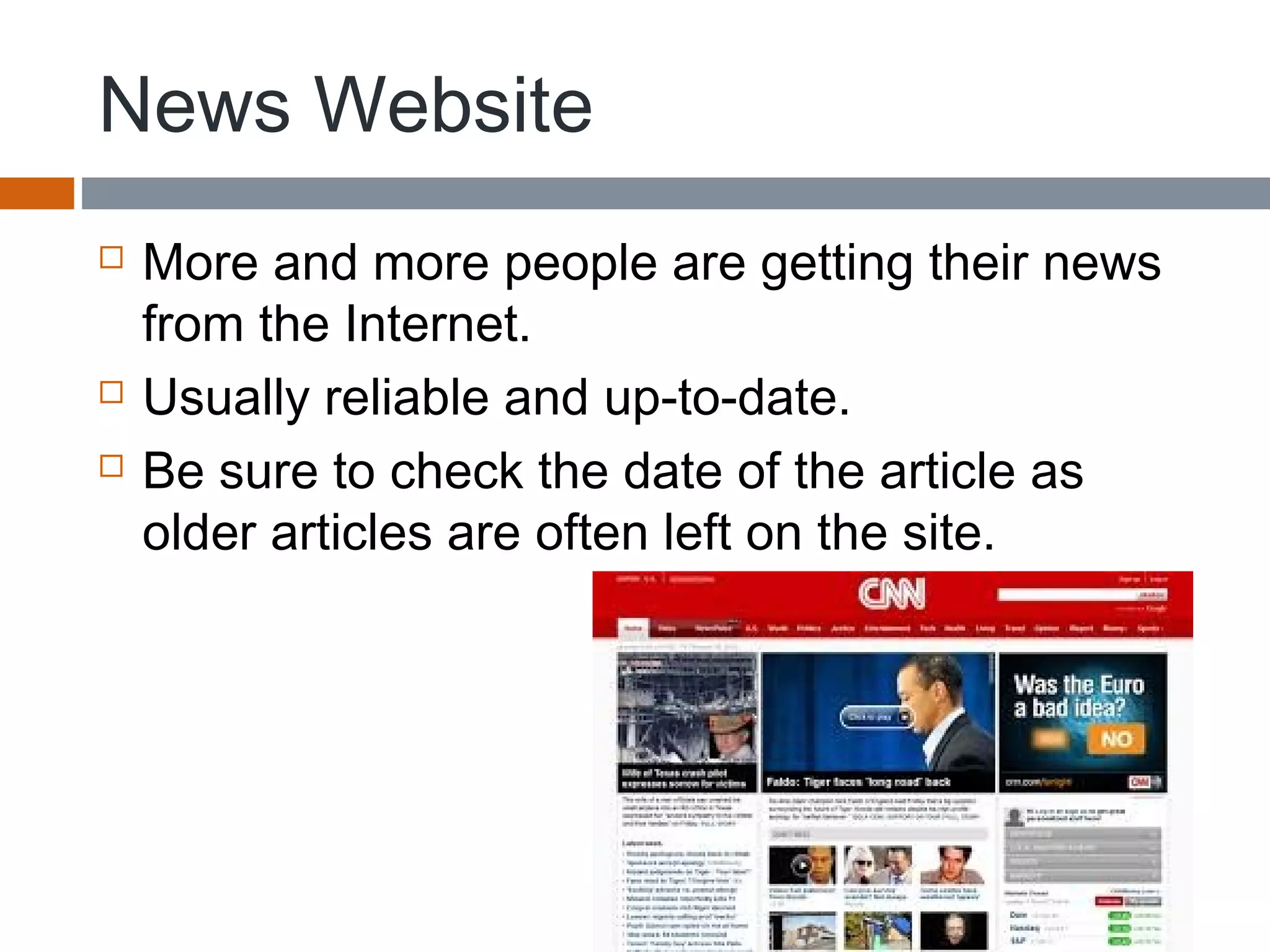
News Website
 More and more people are getting their news
from the Internet.
 Usually reliable and up-to-date.
 Be sure to check the date of the article as
older articles are often left on the site.
Blogs
 Blogs are “web logs”.
 They are a type of diary.
 Have good information on many topics.
 Updated frequently sometimes more than
once a day.
Wikis
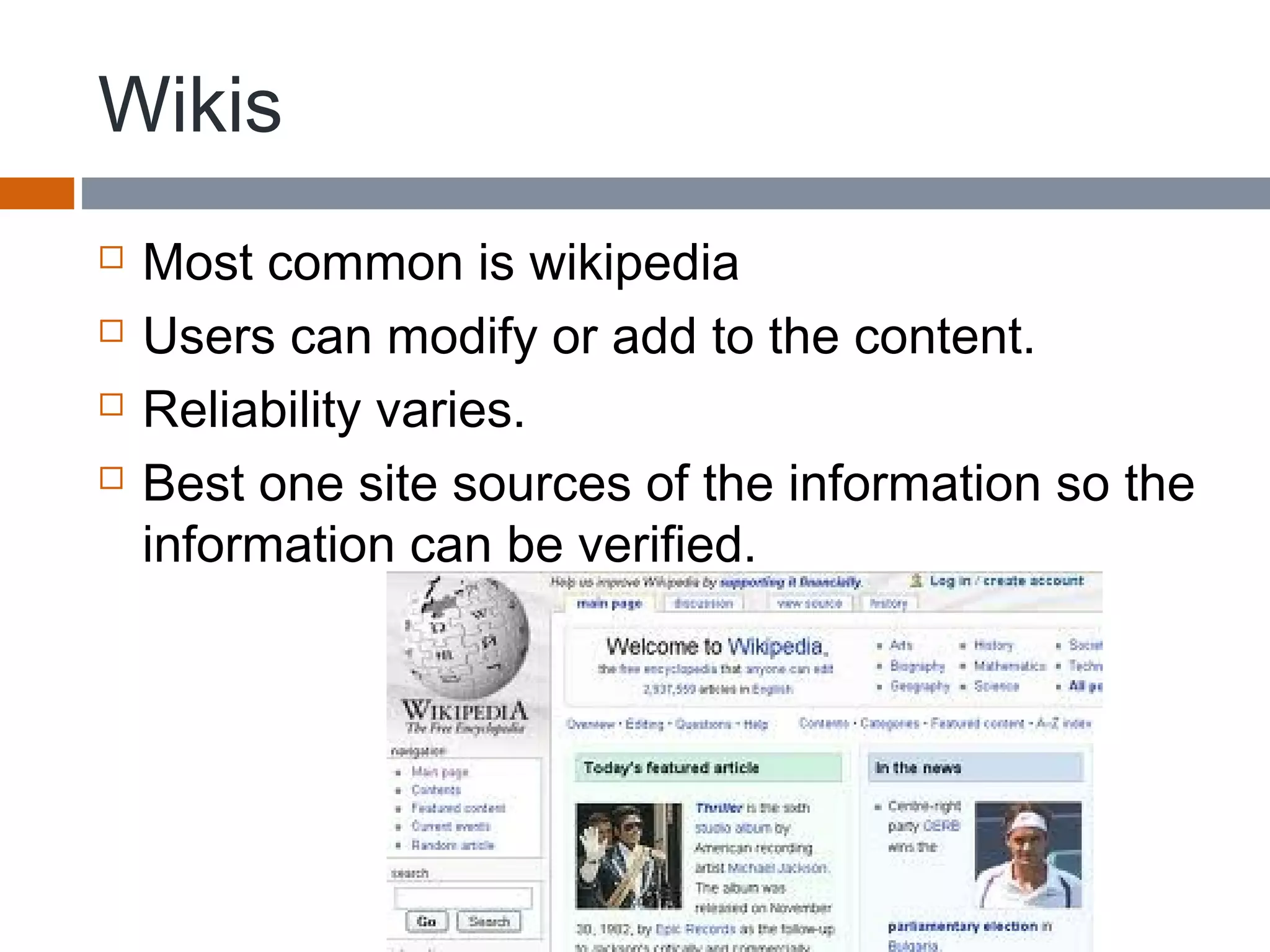
 Most common is wikipedia
 Users can modify or add to the content.
 Reliability varies.
 Best one site sources of the information so the
information can be verified.
School websites
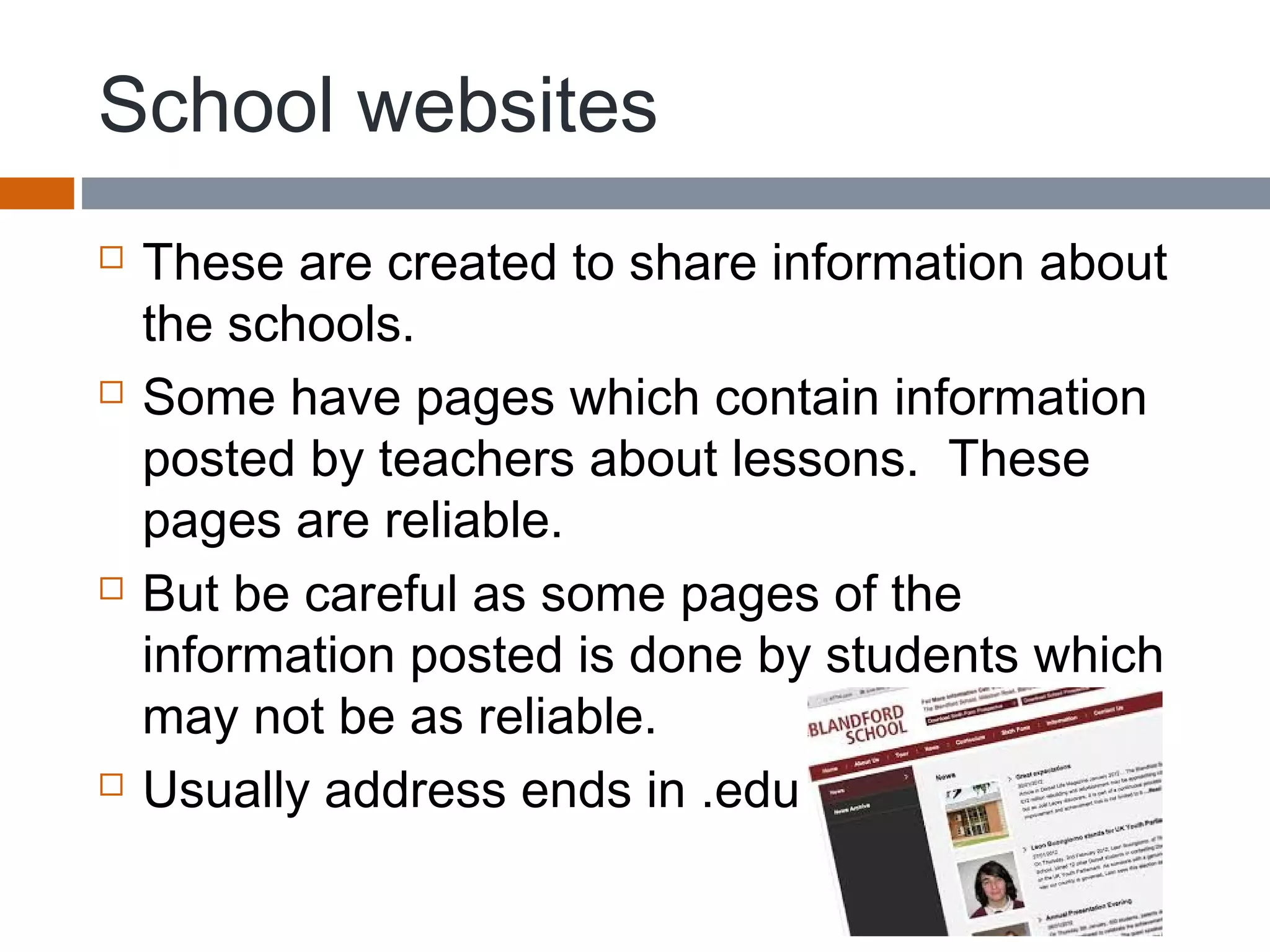
 These are created to share information about
the schools.
 Some have pages which contain information
posted by teachers about lessons. These
pages are reliable.
 But be careful as some pages of the
information posted is done by students which
may not be as reliable.
 Usually address ends in .edu
Scholarly Sites
 These site contain scholarly items such as
dissertation or academic journals.
 To find this type of information, Search Google
Scholar.
Databases
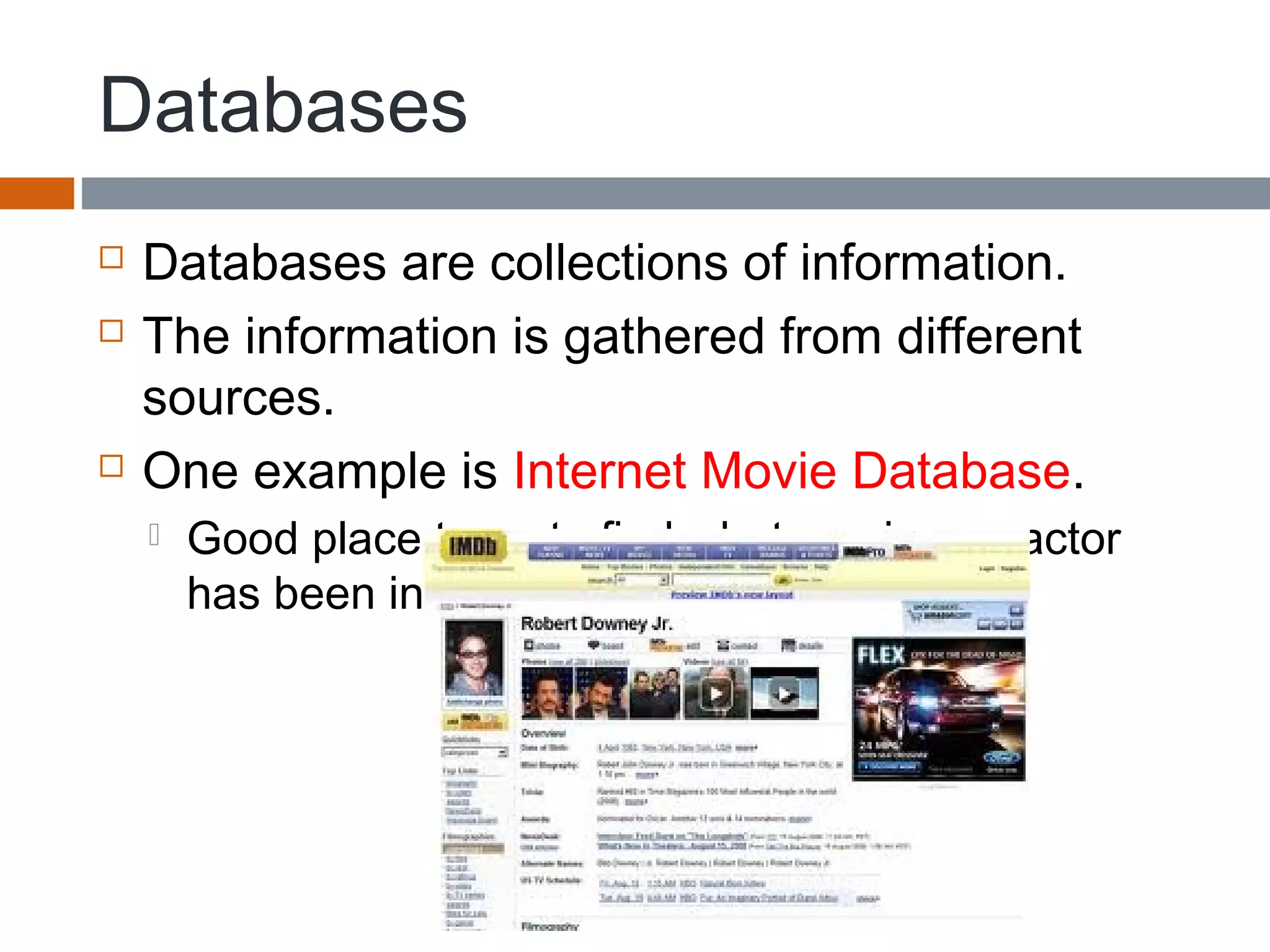
 Databases are collections of information.
 The information is gathered from different
sources.
 One example is Internet Movie Database.
 Good place to go to find what movies an actor
has been in.
Forums
 Forums are places where people have
discussions.
 Good place for answers about specific
products or services.
 Information often stays up long after the
discussion has ended.
 Often come up in Google searches.
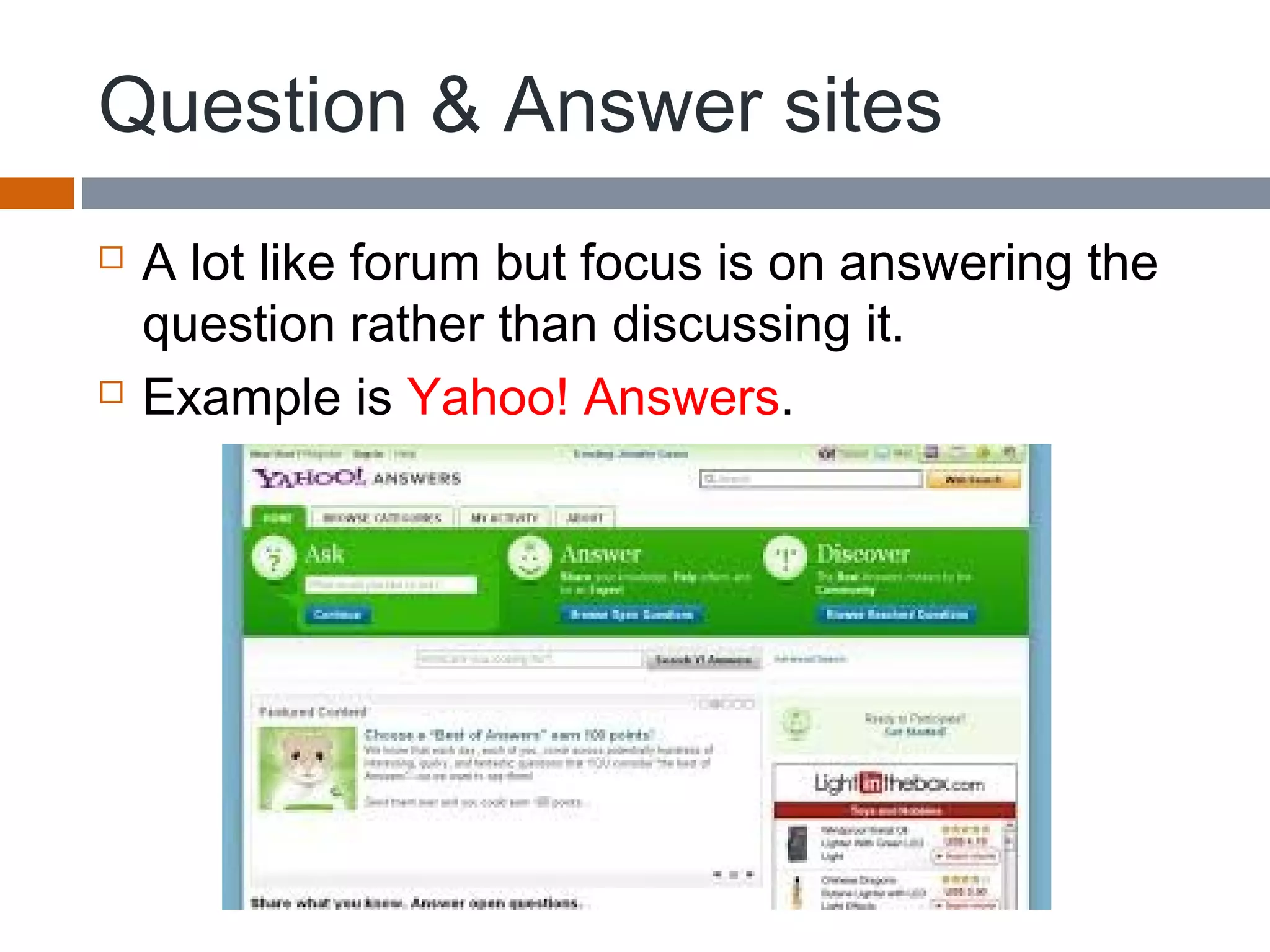
Question & Answer sites
 A lot like forum but focus is on answering the
question rather than discussing it.
 Example is Yahoo! Answers.
Organizing your search
 Being search savvy isn't just about finding
information online. It's also about being able to
save and organize the sites you've searched
for so you can easily find them later. The
simplest way to do this is to bookmark a site.
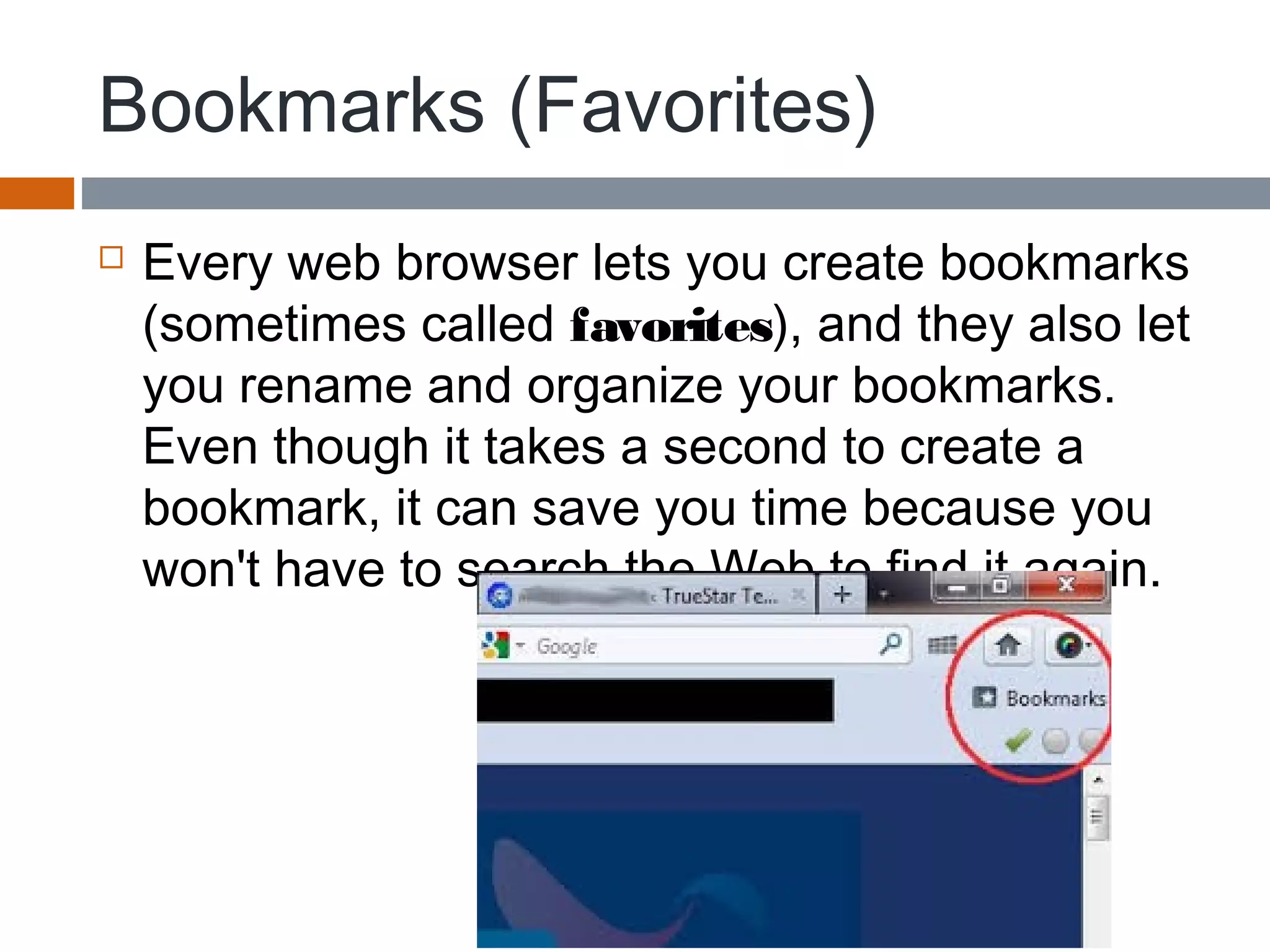
Bookmarks (Favorites)
 Every web browser lets you create bookmarks
(sometimes called favorites), and they also let
you rename and organize your bookmarks.
Even though it takes a second to create a
bookmark, it can save you time because you
won't have to search the Web to find it again.
Cloud-based bookmarking
 One disadvantage of traditional bookmarks is
that you won't be able to access them from a
different computer.
 To solve this problem, you can use a cloud-
based bookmarking service, which stores your
bookmarks online.
 This means you'll be able to access them from
any computer or device that has an Internet
connection.
Examples
 Google Bookmarks: If you have a Google account, you can view and
add bookmarks whenever you are signed in.
 Diigo: Diigo allows you to do more than just bookmark sites. You can
also highlight part of a page, add comments, and share bookmarks
with other people. There is a free version, and you can also purchase a
premium plan that includes more features.
 Delicious: Delicious makes it easy to share bookmarks with other
people, which is especially useful if you are collaborating with
coworkers or friends. Bookmarks can be grouped into Stacks, which
you can share with other people. You can also follow Stacks you find
interesting.
 Springpad: In addition to saving bookmarks, Springpad includes
productivity features like note-taking, to-do lists, and reminders. Like
Delicious, Springpad lets you share bookmarks with other people.
 Google Chrome: If you use Chrome as your main browser, you may
prefer to use its bookmarksyncingfeature. Whenever you are signed in
to Chrome, your bookmarks and other settings are synced with your
Google account. You can access your bookmarks from any computer
by simply signing in to Chrome.
Safety note
 Generally, you shouldn't sign in to Chrome on
a public computer, since it saves some of your
data to the computer.
 Even after you sign out, other people may be
able to access yourpersonal data. 
What type of website is….
 www.boots.com
 www.amazon.com
 www.campsimcha.org
 www.rspca.org.uk
 www.oxfam.org
 www.mtsmichael.org
 www.smowschool.org
 www.miamiartcharter.net
More websites
 www.southshorefinearts.org
 www.bestsurvivalknifedude.com
 www.totallydogsblog.com
 www.boardingarea.com
 www.techcrunch.com
 www.acronymfinder.com
 www.allgame.com
 www.hoovers.com
More websites
 http://libguides.csuchico.edu/scholarly
 http://biology.merlot.org
 http://www.mybbsecurity.net
 http://mybbsource.com
 http://hackforums.net
 http://www.huffingtonpost.com
 http://www.theguardian.com
 http://www.usatoday.com
The end
 Thank you for attending.
 For more information, contact
 Celia Bandelier, Library Director
 Roanoke Public Library

Introduction to searching online

  • 1.
    INTRODUCTION TO SEARCHING ONLINE COURTESYOF GCG LEARNFREE.ORG Presented by Celia Bandelier
  • 2.
    Why you needto know  In today's world, more and more things are done online. Even if you don't consider yourself a computer person, you now need computer skills in order to conduct research, shop online, keep in touch with family, and more.
  • 3.
    Internet Literacy  Theability to search for information online is one of the most important information literacy skills you can possess.  By improving your search skills, you can find what you're looking for more quickly without having to sift through tons of irrelevant results.  I’ll give you some information literacy strategies to help you improve your searches and evaluate yourresults to find the most reliable information.
  • 4.
    Google  To findwhat you are looking for on the Internet, the first step is usually a basic search engine search i.e. Google.  Go to www.google.com  And enter your search.
  • 5.
    Don’t give up You may not find the answers you are looking for on the first try.  If you don’t try refining your search  Go more basic to expand your search  Or go more specific to limit your search  Think of other search term  You may need a more specialized site for your search.
  • 6.
    Remember  If youcan find the right search terms, you can find anything on the Internet.
  • 7.
    The web isn’tmagic  Search engines like Google can find almost anything, but they can’t understand complex questions like:  How’s the weather in California?  Where can I get a cup of coffee?
  • 8.
    The web issmarter than you think  Search for keywords instead of questions and you’ll probably find exactly what you’re looking for:  Weather San Francisco  Coffee
  • 9.
    Not always reliable Just because it’s online doesn’t mean it’s true.  There is no guarantee that the results of your search are accurate, unbiased or up-to-date.  For example, an article on a celebrity gossip website is probably not the best source for reliable information.
  • 10.
    Wide variety ofcontent  That’s the great thing about the Internet, it give you access to everything—the good, the bad, and everything in between.  You just have to be mindful of the difference between personal opinion and resources that are reliable and reputable.
  • 11.
    You can’t copyand paste someone else’s work  Even though you “just found it on the Internet,” it still belongs to someone.  Plagiarism is plagiarism, whether you’re writing a presentation, a research paper or a personal post for your blog.
  • 12.
    Create your ownmasterpiece  You just have to follow the rules.  Always state your findings in your own words.  Give credit where credit is due.  Be respectful of copyright and fair use laws.
  • 13.
    Search engines  Searchengines are specialized websites that can help you find what you're looking for. You've probably heard of some of the most popular ones—including Google, Yahoo!, and  Bing—even if you've never used them.
  • 14.
    Same information, same results??? With these three search engines in mind, you may be wondering, "What's the difference?" They all have access to the same information (i.e., the contents of the Internet), so they should return the same results, right?  Not necessarily. Different search engines can yield different search results. Google is the most popular search engine because it's the most effective at finding what you're looking for. On average, it produces more relevant results than Yahoo! or Bing, and it's better at organizing and filtering them. For this reason, we will focus on Google.
  • 15.
    Search Bar  Yourbrowser's search bar is probably set to Google by default.  However, if it is set to something else (for example, Yahoo! or Bing), you can easily change it to Google. To find out how, visit  Make Google my default search engine on Google's support site.  The steps are different for each browser, so make sure you follow the instructions for the one you're using.
  • 16.
    Types of websites When you're looking for information online, it's a good idea to be aware of what types of websites are available and what kind of information they contain.  Depending on what you're looking for, you may find that certain types are more relevant to your search than others.
  • 17.
    Commercial Website  Themain purpose of these sites are to promote or sell their product.  May have good information.  Often the information is not unbiased and should be checked with other sources.  Usual address ends in .com
  • 18.
    Organization Website  Mainpurpose is to promote their cause.  Usually have an agenda.  May have good information.  Often the information is not unbiased and should be checked with other sources.  Usually address ends in .org
  • 19.
    News Website  Moreand more people are getting their news from the Internet.  Usually reliable and up-to-date.  Be sure to check the date of the article as older articles are often left on the site.
  • 20.
    Blogs  Blogs are“web logs”.  They are a type of diary.  Have good information on many topics.  Updated frequently sometimes more than once a day.
  • 21.
    Wikis  Most commonis wikipedia  Users can modify or add to the content.  Reliability varies.  Best one site sources of the information so the information can be verified.
  • 22.
    School websites  Theseare created to share information about the schools.  Some have pages which contain information posted by teachers about lessons. These pages are reliable.  But be careful as some pages of the information posted is done by students which may not be as reliable.  Usually address ends in .edu
  • 23.
    Scholarly Sites  Thesesite contain scholarly items such as dissertation or academic journals.  To find this type of information, Search Google Scholar.
  • 24.
    Databases  Databases arecollections of information.  The information is gathered from different sources.  One example is Internet Movie Database.  Good place to go to find what movies an actor has been in.
  • 25.
    Forums  Forums areplaces where people have discussions.  Good place for answers about specific products or services.  Information often stays up long after the discussion has ended.  Often come up in Google searches.
  • 26.
    Question & Answersites  A lot like forum but focus is on answering the question rather than discussing it.  Example is Yahoo! Answers.
  • 27.
    Organizing your search Being search savvy isn't just about finding information online. It's also about being able to save and organize the sites you've searched for so you can easily find them later. The simplest way to do this is to bookmark a site.
  • 28.
    Bookmarks (Favorites)  Everyweb browser lets you create bookmarks (sometimes called favorites), and they also let you rename and organize your bookmarks. Even though it takes a second to create a bookmark, it can save you time because you won't have to search the Web to find it again.
  • 29.
    Cloud-based bookmarking  Onedisadvantage of traditional bookmarks is that you won't be able to access them from a different computer.  To solve this problem, you can use a cloud- based bookmarking service, which stores your bookmarks online.  This means you'll be able to access them from any computer or device that has an Internet connection.
  • 30.
    Examples  Google Bookmarks:If you have a Google account, you can view and add bookmarks whenever you are signed in.  Diigo: Diigo allows you to do more than just bookmark sites. You can also highlight part of a page, add comments, and share bookmarks with other people. There is a free version, and you can also purchase a premium plan that includes more features.  Delicious: Delicious makes it easy to share bookmarks with other people, which is especially useful if you are collaborating with coworkers or friends. Bookmarks can be grouped into Stacks, which you can share with other people. You can also follow Stacks you find interesting.  Springpad: In addition to saving bookmarks, Springpad includes productivity features like note-taking, to-do lists, and reminders. Like Delicious, Springpad lets you share bookmarks with other people.  Google Chrome: If you use Chrome as your main browser, you may prefer to use its bookmarksyncingfeature. Whenever you are signed in to Chrome, your bookmarks and other settings are synced with your Google account. You can access your bookmarks from any computer by simply signing in to Chrome.
  • 31.
    Safety note  Generally,you shouldn't sign in to Chrome on a public computer, since it saves some of your data to the computer.  Even after you sign out, other people may be able to access yourpersonal data. 
  • 32.
    What type ofwebsite is….  www.boots.com  www.amazon.com  www.campsimcha.org  www.rspca.org.uk  www.oxfam.org  www.mtsmichael.org  www.smowschool.org  www.miamiartcharter.net
  • 33.
    More websites  www.southshorefinearts.org www.bestsurvivalknifedude.com  www.totallydogsblog.com  www.boardingarea.com  www.techcrunch.com  www.acronymfinder.com  www.allgame.com  www.hoovers.com
  • 34.
    More websites  http://libguides.csuchico.edu/scholarly http://biology.merlot.org  http://www.mybbsecurity.net  http://mybbsource.com  http://hackforums.net  http://www.huffingtonpost.com  http://www.theguardian.com  http://www.usatoday.com
  • 35.
    The end  Thankyou for attending.  For more information, contact  Celia Bandelier, Library Director  Roanoke Public Library

Editor's Notes

  • #33 www.boots.com www.amazon.com www.campsimcha.org www.rspca.org.uk www.oxfam.org www.mtsmichael.org www.smowschool.org www.miamiartcharter.net
  • #34 www.southshorefinearts.org -school www.bestsurvivalknifedude.com -blog www.totallydogsblog.com -blog www.boardingarea.com -blog www.techcrunch.com-blog www.acronymfinder.com-database www.allgame.com -database www.hoovers.com-database
  • #35 http://libguides.csuchico.edu/scholarly -scholarly http://biology.merlot.org -scholarly http://www.mybbsecurity.net- forums http://mybbsource.com -forums http://hackforums.net –forums http://www.huffingtonpost.com news http://www.theguardian.com news http://www.usatoday.com news