Introduction to RTC Robotic Technology Component Specification Revised Submission MARS, June 2006 Boston, MA National Institute of Advanced Science & Technology (AIST) Real-Time Innovations (RTI)
Timeline September 2005: RFP issued ptc/2005-09-01 February 2006: Initial submissions National Institute of Advanced Industrial Science and Technology (AIST) mars/2006-01-05 Japan Robot Association (JARA) and Technologic Arts Incorporated join as supporters Real-Time Innovations (RTI) mars/2006-01-06 June 2006: Revised submission Joint submission by AIST and RTI mars/2006-06-11 Seoul National University (SNU) joins as third supporter
Problem Statement Domain: Distributed robotic systems Process problem characteristics Lack of common programming practice(s) makes collaboration among developers difficult Technical problem characteristics Complexity in time and space Behavioral design patterns Periodic ordered execution Strict causality requirement Stimulus response Autonomous components cooperating without timeliness contract
Solution Requirements Address problem characteristics Provide well-defined interfaces Improve reusability Enable interoperability Among components Tool-to-component Promote component composition Range of component granularities Solution-driven reusability Problem-driven decomposition
Features of RTC Provides rich component lifecycle to enforce state coherency among components Defines data structures for describing components and other elements Supports fundamental design patterns Collaboration of fine-grained components tightly coupled in time ( e.g . Simulink) Stimulus response with finite state machines Dynamic composition of components collaborating synchronously or asynchronously
Relation to Existing Standards UML Domain-specific profile for UML components Super Distributed Objects (SDO) Introspection of distributed components Ports exposed as SDO services May be combined or implemented with another model e.g.  Lightweight CORBA Component Model e.g.  Software Radio components
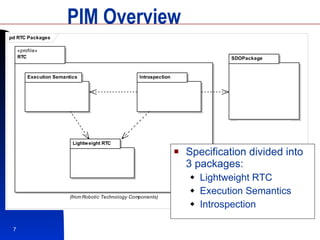
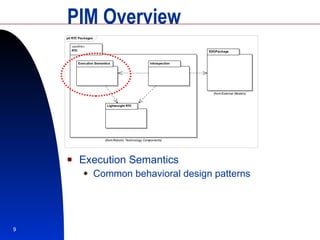
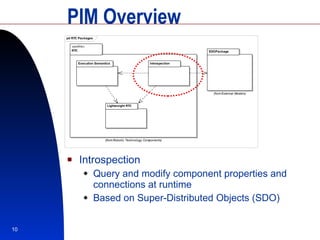
PIM Overview Specification divided into 3 packages: Lightweight RTC Execution Semantics Introspection
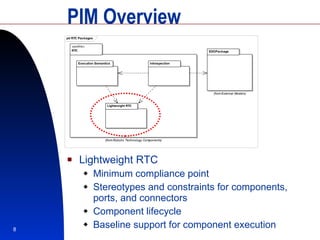
PIM Overview Lightweight RTC Minimum compliance point Stereotypes and constraints for components, ports, and connectors Component lifecycle Baseline support for component execution
PIM Overview Execution Semantics Common behavioral design patterns
PIM Overview Introspection Query and modify component properties and connections at runtime Based on Super-Distributed Objects (SDO)
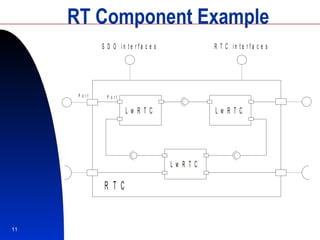
RT Component Example
Platform-Specific Models CORBA IDL Lightweight CORBA Component Model Distributed CORBA-based components Local components Low-overhead communication in a single process
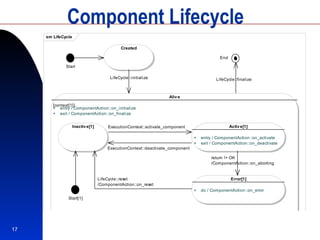
Lightweight RTC Overview Conforming components extended by  lightweightRTComponent  stereotype Component lifecycle: initialization, activation/deactivation, and finalization Callbacks for responding to lifecycle changes ExecutionContext Logical representation of thread Collaboration pattern (“execution kind”) “ Participating” components can be started and stopped as a group Components can participate in any number of execution contexts
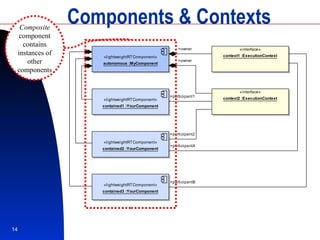
Components & Contexts Composite  component contains instances of other components
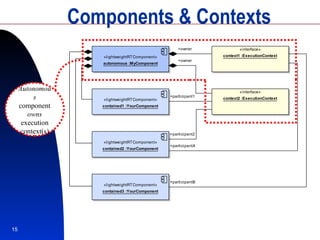
Components & Contexts Autonomous  component  owns  execution context(s)
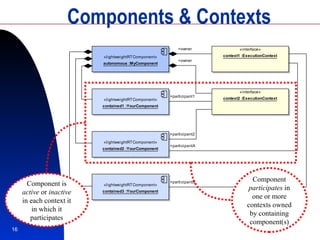
Components & Contexts Component  participates  in one or more contexts owned by containing component(s) Component is  active  or  inactive  in each context it in which it participates
Component Lifecycle
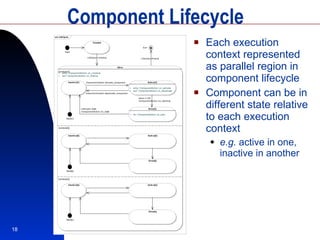
Component Lifecycle Each execution context represented as parallel region in component lifecycle Component can be in different state relative to each execution context e.g.  active in one, inactive in another
Execution Semantics Overview Common design patterns of robotics applications that components plug into Kinds of execution Data flow Discrete event/stimulus response Multiple modes of operation Component declares participation in pattern(s) using stereotype(s) Each execution context has an execution kind Well-known interfaces of participating components are invoked
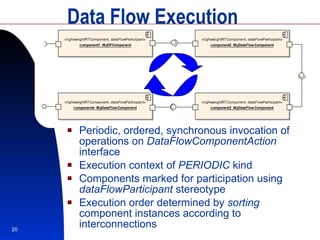
Data Flow Execution Periodic, ordered, synchronous invocation of operations on  DataFlowComponentAction  interface Execution context of  PERIODIC  kind Components marked for participation using  dataFlowParticipant  stereotype Execution order determined by  sorting  component instances according to interconnections
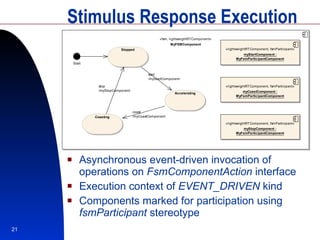
Stimulus Response Execution Asynchronous event-driven invocation of operations on  FsmComponentAction  interface Execution context of  EVENT_DRIVEN  kind Components marked for participation using  fsmParticipant  stereotype
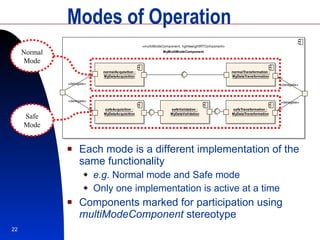
Modes of Operation Each mode is a different implementation of the same functionality e.g.  Normal mode and Safe mode Only one implementation is active at a time Components marked for participation using  multiModeComponent  stereotype Normal Mode Safe Mode
Introspection Overview Basis for interoperability of dynamically distributed components Useful interface for analysis tools Extends Lightweight RTC with SDO-based API for query and configuration Connect/disconnect components Start/stop execution contexts remotely Get/set properties Query properties of device that component runs on
Introspection & SDO Conforming components extended by  rtComponent  stereotype Components realize all Lightweight RTC interfaces  Components realize  SDOPackage:: SDO  interface
Interfaces & Profiles Types separated into interfaces and “profiles” Interfaces expose behavioral capabilities of Lightweight RTC elements,  e.g. : Components Ports ExecutionContexts Profiles are data-only descriptor classes Expose state of underlying element IDL structs Separation allows for more efficient data distribution than remote accessor methods
Conclusion RTC defines domain-specific extensions to a general-purpose component model Behavioral design patterns Introspection of distributed components RTC is founded on proven technologies Existing standards UML SDO Lightweight CORBA Component Model Existing proprietary middlewares OpenRTM from AIST Constellation from RTI

Introduction to Robotic Technology Components (RTC), MARS PTF

  • 1.
    Introduction to RTCRobotic Technology Component Specification Revised Submission MARS, June 2006 Boston, MA National Institute of Advanced Science & Technology (AIST) Real-Time Innovations (RTI)
  • 2.
    Timeline September 2005:RFP issued ptc/2005-09-01 February 2006: Initial submissions National Institute of Advanced Industrial Science and Technology (AIST) mars/2006-01-05 Japan Robot Association (JARA) and Technologic Arts Incorporated join as supporters Real-Time Innovations (RTI) mars/2006-01-06 June 2006: Revised submission Joint submission by AIST and RTI mars/2006-06-11 Seoul National University (SNU) joins as third supporter
  • 3.
    Problem Statement Domain:Distributed robotic systems Process problem characteristics Lack of common programming practice(s) makes collaboration among developers difficult Technical problem characteristics Complexity in time and space Behavioral design patterns Periodic ordered execution Strict causality requirement Stimulus response Autonomous components cooperating without timeliness contract
  • 4.
    Solution Requirements Addressproblem characteristics Provide well-defined interfaces Improve reusability Enable interoperability Among components Tool-to-component Promote component composition Range of component granularities Solution-driven reusability Problem-driven decomposition
  • 5.
    Features of RTCProvides rich component lifecycle to enforce state coherency among components Defines data structures for describing components and other elements Supports fundamental design patterns Collaboration of fine-grained components tightly coupled in time ( e.g . Simulink) Stimulus response with finite state machines Dynamic composition of components collaborating synchronously or asynchronously
  • 6.
    Relation to ExistingStandards UML Domain-specific profile for UML components Super Distributed Objects (SDO) Introspection of distributed components Ports exposed as SDO services May be combined or implemented with another model e.g. Lightweight CORBA Component Model e.g. Software Radio components
  • 7.
    PIM Overview Specificationdivided into 3 packages: Lightweight RTC Execution Semantics Introspection
  • 8.
    PIM Overview LightweightRTC Minimum compliance point Stereotypes and constraints for components, ports, and connectors Component lifecycle Baseline support for component execution
  • 9.
    PIM Overview ExecutionSemantics Common behavioral design patterns
  • 10.
    PIM Overview IntrospectionQuery and modify component properties and connections at runtime Based on Super-Distributed Objects (SDO)
  • 11.
  • 12.
    Platform-Specific Models CORBAIDL Lightweight CORBA Component Model Distributed CORBA-based components Local components Low-overhead communication in a single process
  • 13.
    Lightweight RTC OverviewConforming components extended by lightweightRTComponent stereotype Component lifecycle: initialization, activation/deactivation, and finalization Callbacks for responding to lifecycle changes ExecutionContext Logical representation of thread Collaboration pattern (“execution kind”) “ Participating” components can be started and stopped as a group Components can participate in any number of execution contexts
  • 14.
    Components & ContextsComposite component contains instances of other components
  • 15.
    Components & ContextsAutonomous component owns execution context(s)
  • 16.
    Components & ContextsComponent participates in one or more contexts owned by containing component(s) Component is active or inactive in each context it in which it participates
  • 17.
  • 18.
    Component Lifecycle Eachexecution context represented as parallel region in component lifecycle Component can be in different state relative to each execution context e.g. active in one, inactive in another
  • 19.
    Execution Semantics OverviewCommon design patterns of robotics applications that components plug into Kinds of execution Data flow Discrete event/stimulus response Multiple modes of operation Component declares participation in pattern(s) using stereotype(s) Each execution context has an execution kind Well-known interfaces of participating components are invoked
  • 20.
    Data Flow ExecutionPeriodic, ordered, synchronous invocation of operations on DataFlowComponentAction interface Execution context of PERIODIC kind Components marked for participation using dataFlowParticipant stereotype Execution order determined by sorting component instances according to interconnections
  • 21.
    Stimulus Response ExecutionAsynchronous event-driven invocation of operations on FsmComponentAction interface Execution context of EVENT_DRIVEN kind Components marked for participation using fsmParticipant stereotype
  • 22.
    Modes of OperationEach mode is a different implementation of the same functionality e.g. Normal mode and Safe mode Only one implementation is active at a time Components marked for participation using multiModeComponent stereotype Normal Mode Safe Mode
  • 23.
    Introspection Overview Basisfor interoperability of dynamically distributed components Useful interface for analysis tools Extends Lightweight RTC with SDO-based API for query and configuration Connect/disconnect components Start/stop execution contexts remotely Get/set properties Query properties of device that component runs on
  • 24.
    Introspection & SDOConforming components extended by rtComponent stereotype Components realize all Lightweight RTC interfaces Components realize SDOPackage:: SDO interface
  • 25.
    Interfaces & ProfilesTypes separated into interfaces and “profiles” Interfaces expose behavioral capabilities of Lightweight RTC elements, e.g. : Components Ports ExecutionContexts Profiles are data-only descriptor classes Expose state of underlying element IDL structs Separation allows for more efficient data distribution than remote accessor methods
  • 26.
    Conclusion RTC definesdomain-specific extensions to a general-purpose component model Behavioral design patterns Introspection of distributed components RTC is founded on proven technologies Existing standards UML SDO Lightweight CORBA Component Model Existing proprietary middlewares OpenRTM from AIST Constellation from RTI

Editor's Notes

  • #2 Welcome Hold questions until the end
  • #4 Dev process problem Gap in level of abstraction between how engineers think about problem and expressiveness of programming language(s) Engineers may not be formally trained in software or modeling => Common practices, methodologies, frameworks very important, but missing now Technical problem: spectrum Data flow: series of actions execute in lock-step Stim response: asynchronous, but still causal Autonomous: loose contract comes from components themselves, not imposed by external constraints
  • #5 In addition to addressing specific problem characteristics, there are more general requirements called out in RFP Interoperability has 2 aspects Comps from different vendors communicate Tool composes application at design time, monitors at runtime Composition can be looked at from two directions: Solution-driven: combine pre-built comps to solve bigger problem Problem-driven: top-down division of labor, decompose big problem into smaller
  • #6 RTC fits problem domain, meets solution requirements